Louis-Philippe V ronneau: puppetserver 6: a Debian packaging post-mortem
 I have been a Puppet user for a couple of years now, first at work, and
eventually for my personal servers and computers. Although it can have a steep
learning curve, I find Puppet both nimble and very powerful. I also prefer it
to Ansible for its speed and the agent-server model it uses.
Sadly, Puppet Labs hasn't been the most supportive upstream and tends to move
pretty fast. Major versions rarely last for a whole Debian Stable release and
the upstream
.deb packages are full of vendored libraries.1
Since 2017, Apollon Oikonomopoulos has been the one doing most of the work on
Puppet in Debian. Sadly, he's had less time for that lately and with Puppet 5
being deprecated in January 2021, Thomas Goirand, Utkarsh Gupta and I have been
trying to package Puppet 6 in Debian for the last 6 months.
With Puppet 6, the old ruby Puppet server using Passenger is not supported
anymore and has been replaced by puppetserver, written in Clojure and running
on the JVM. That's quite a large change and although puppetserver does reuse
some of the Clojure libraries puppetdb (already in Debian) uses, packaging it
meant quite a lot of work.
Work in the Clojure team
As part of my efforts to package puppetserver, I had the pleasure to join the
Clojure team and learn a lot about the Clojure ecosystem.
As I mentioned earlier, a lot of the Clojure dependencies needed for
puppetserver were already in the archive. Unfortunately, when Apollon
Oikonomopoulos packaged them, the leiningen build tool hadn't been packaged
yet. This meant I had to rebuild a lot of packages, on top of packaging some
new ones.
Since then, thanks to the efforts of Elana Hashman, leiningen has been
packaged and lets us run the upstream testsuites and create .jar artifacts
closer to those upstream releases.
During my work on puppetserver, I worked on the following packages:
List of packages
If you want to learn more about packaging Clojure libraries and applications,
I rewrote the Debian Clojure packaging tutorial and added a section
about the quirks of using backport9bidi-clojureclj-digest-clojureclj-helperclj-time-clojureclj-yaml-clojurecljx-clojurecore-async-clojurecore-cache-clojurecore-match-clojurecpath-clojurecrypto-equality-clojurecrypto-random-clojuredata-csv-clojuredata-json-clojuredata-priority-map-clojurejava-classpath-clojurejnr-constantsjnr-enxiojrubyjruby-utils-clojurekitchensink-clojurelazymap-clojureliberator-clojureordered-clojurepathetic-clojurepotemkin-clojureprismatic-plumbing-clojureprismatic-schema-clojurepuppetlabs-http-client-clojurepuppetlabs-i18n-clojurepuppetlabs-ring-middleware-clojurepuppetserverraynes-fs-clojureriddley-clojurering-basic-authentication-clojurering-clojurering-codec-clojureshell-utils-clojuressl-utils-clojuretest-check-clojuretools-analyzer-clojuretools-analyzer-jvm-clojuretools-cli-clojuretools-reader-clojuretrapperkeeper-authorization-clojuretrapperkeeper-clojuretrapperkeeper-filesystem-watcher-clojuretrapperkeeper-metrics-clojuretrapperkeeper-scheduler-clojuretrapperkeeper-webserver-jetty9-clojureurl-clojureuseful-clojurewatchtower-clojure
leiningen without a dedicated dh_lein tool.
Work left to get puppetserver 6 in the archive
Unfortunately, I was not able to finish the puppetserver 6 packaging work.
It is thus unlikely it will make it in Debian Bullseye. If the issues described
below are fixed, it would be possible to to package puppetserver in
bullseye-backports though.
So what's left?
jruby
Although I tried my best (kudos to Utkarsh Gupta and Thomas Goirand for the
help), jruby in Debian is still broken. It does build properly, but the
testsuite fails with multiple errors:
ruby-psychis broken (#959571)- there are some random java failures on a few tests (no clue why)
- tests ran by
raklelib/rspec.rakefail to run, maybe because the--patterncommand line option isn't compatible with our version ofrake? Utkarsh seemed to know why this happens.
jruby testsuite failures aside, I have not been able to use the jruby.deb the
package currently builds in jruby-utils-clojure (testsuite failure). I had the
same exact failure with the (more broken) jruby version that is currently in
the archive, which leads me to think this is a LOAD_PATH issue in
jruby-utils-clojure. More on that below.
To try to bypass these issues, I tried to vendor jruby into
jruby-utils-clojure. At first I understood vendoring meant including
upstream pre-built artifacts (jruby-complete.jar) and shipping them directly.
After talking with people on the #debian-mentors and #debian-ftp IRC
channels, I now understand why this isn't a good idea (and why it's not
permitted in Debian). Many thanks to the people who were patient and kind enough
to discuss this with me and give me alternatives.
As far as I now understand it, vendoring in Debian means "to have an embedded
copy of the source code in another package". Code shipped that way still needs
to be built from source. This means we need to build jruby ourselves, one way
or another. Vendoring jruby in another package thus isn't terribly helpful.
If fixing jruby the proper way isn't possible, I would suggest trying to
build the package using embedded code copies of the external libraries jruby
needs to build, instead of trying to use the Debian libraries.2 This
should make it easier to replicate what upstream does and to have a final
.jar that can be used.
jruby-utils-clojure
This package is a first-level dependency for puppetserver and is the glue
between jruby and puppetserver.
It builds fine, but the testsuite fails when using the Debian jruby package. I
think the problem is caused by a jruby LOAD_PATH issue.
The Debian jruby package plays with the LOAD_PATH a little to try use
Debian packages instead of downloading gems from the web, as upstream jruby
does. This seems to clash with the gem-home, gem-path, and
jruby-load-path variables in the jruby-utils-clojure package. The testsuite
plays around with these variables and some Ruby libraries can't be found.
I tried to fix this, but failed. Using the upstream jruby-complete.jar instead
of the Debian jruby package, the testsuite passes fine.
This package could clearly be uploaded to NEW right now by ignoring the
testsuite failures (we're just packaging static .clj source files in the
proper location in a .jar).
puppetserver
jruby issues aside, packaging puppetserver itself is 80% done. Using the
upstream jruby-complete.jar artifact, the testsuite fails with a weird
Clojure error I'm not sure I understand, but I haven't debugged it for very
long.
Upstream uses git submodules to vendor puppet (agent), hiera (3), facter and
puppet-resource-api for the testsuite to run properly. I haven't touched that,
but I believe we can either:
- link to the Debian packages
- fix the Debian packages if they don't include the right files (maybe in a new binary package that just ships part of the source code?)
puppetserver
really isn't far away from making it in the archive.
Very talented Debian Developers are always eager to work on these issues and
can be contracted for very reasonable rates. If you're interested in
contracting someone to help iron out the last issues, don't hesitate to reach
out via one of the following:
- the debian-puppet mailing list
- the debian-jobs mailing list
- the Debian Consultants index
- fossjobs.net
- For example, the upstream package for the Puppet Agent vendors OpenSSL.
-
One of the problems of using Ruby libraries already packaged in
Debian is that
jrubycurrently only supports Ruby 2.5. Ruby libraries in Debian are currently expected to work with Ruby 2.7, with the transition to Ruby 3.0 planned after the Bullseye release. -
If you run Puppet, you clearly should care: the
.debpackages upstream publishes really aren't great and I would not recommend using them.
 Welcome to the 32th post in the rarely raucous R recommendations series, or
 There is no denying in the fact that 2020 was a challenging year for everybody, including animals.
In India, animals such as dogs who mostly filled their bellies at street food stalls, were starving as there were no street eateries operating during a long long lockdown. I was in my home town, New Delhi, working from home like most of us.
During the month of July 2020, a dog near the place I live (we fondly called her Brownie) delivered 7 pups in wilderness.
I would never forget my first sight of them, inside a dirty, garbage filled land there were the cutest, cleanest, tiniest ball of fur! All of them were toppled as the land s surface was uneven.. The first instinct was to put them all together on a flat surface. After the search mission completed, this was the sight..
 Brownie and her litter put together in the same land where she gave birth.


 The adorable, Robin !
 Don and his new big brother!
 The naughty and handsome, Swayze !
 First Pup who got adopted Pluto
 Playful and Beautiful, Bella !


 Brownie, the mom dog!
 This is a puppy!
 She did not let us put coat on her

 When I see them now, healthier, happier, running around, with no fear of getting attacked by dogs, I can t express the content I feel. For 2 of the dogs (Brownie and her friend) I got it done personally from a private vet. For the other 3, I got it done via Municipal Corporations who do it for free for dogs, you d have to call them and they come with dog catchers and a van and drop them back in the same area, but volunteers like us have to be very vigilant and active during the whole process to follow up with them.
 Dogs getting dropped off after sterilization.
 Nothing too much has happened recently, largely as a result of the pandemic killing a lot of daily interests and habits.
However as a result of Brexit I'm having to do some paperwork, apparently I now need to register for permanent residency under the terms of the withdrawal agreement, and that will supersede the permanent residency I previously obtained.
Of course as a UK citizen I've now lost the previously-available freedom of movement. I can continue to reside here in Helsinki, Finland, indefinitely, but I cannot now move to any other random EU country.
It has crossed my mind, more than a few times, that I should attempt to achieve Finnish citizenship. As a legal resident of Finland the process is pretty simple, I just need two things:




 Over the course of the last year and a half, I ve been doing some self-directed
learning on how radios work. I ve gone from a very basic understanding of
wireless communications (there s usually some sort of antenna, I guess?) all
the way through the process of learning about and implementing a set of
libraries to modulate and demodulate data using my now formidable stash of SDRs.
I ve been implementing all of the RF processing code from first principals and
purely based on other primitives I ve written myself to prove to myself that I
understand each concept before moving on.
I figured that there was a fun capstone to be done here - the blind reverse
engineering and implementation of the protocol my cheep Amazon power switch
uses to turn on and off my Christmas Tree. All the work described in this post
was done over the course of a few hours thanks to help during the demodulation
from
 After taking a capture, I started to look at understanding what the modulation
type of the signal was, and how I may go about demodulating it.
Using
 Next, I started to measure the smallest pulse, and see if I could infer the
symbols per second, and try to decode it by hand. These types of signals are
generally pretty easy to decode by eye.
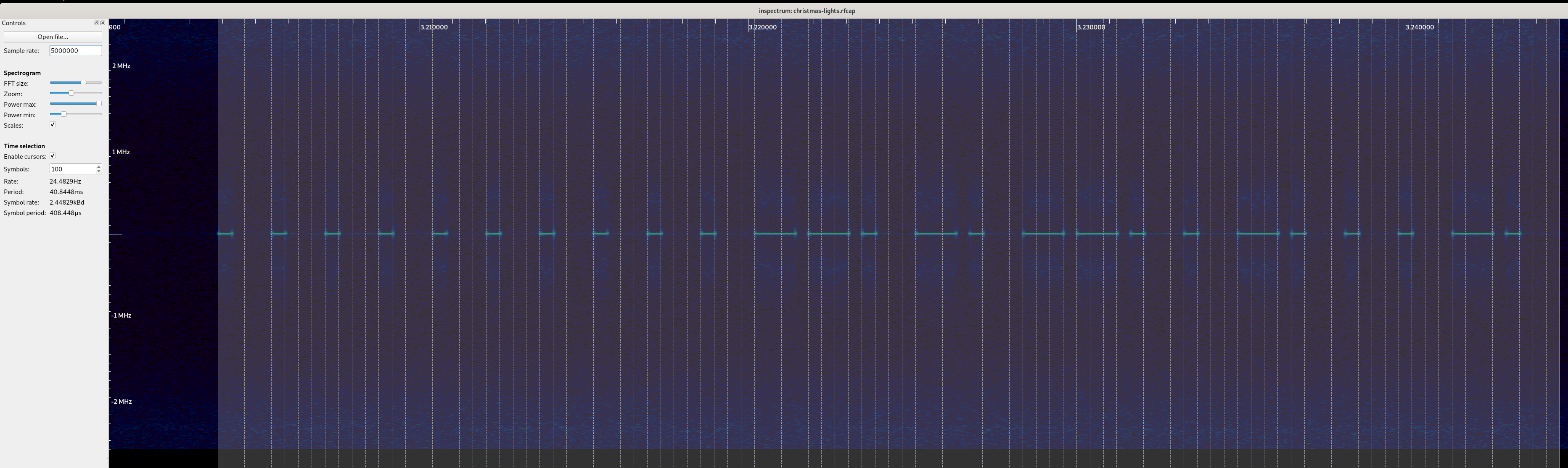
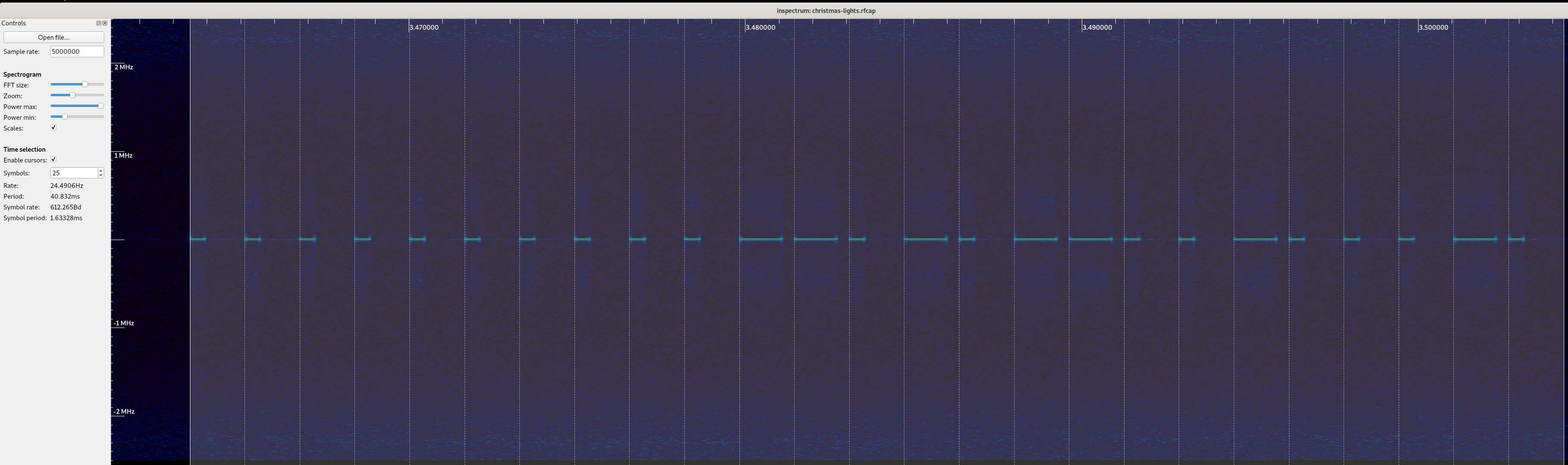
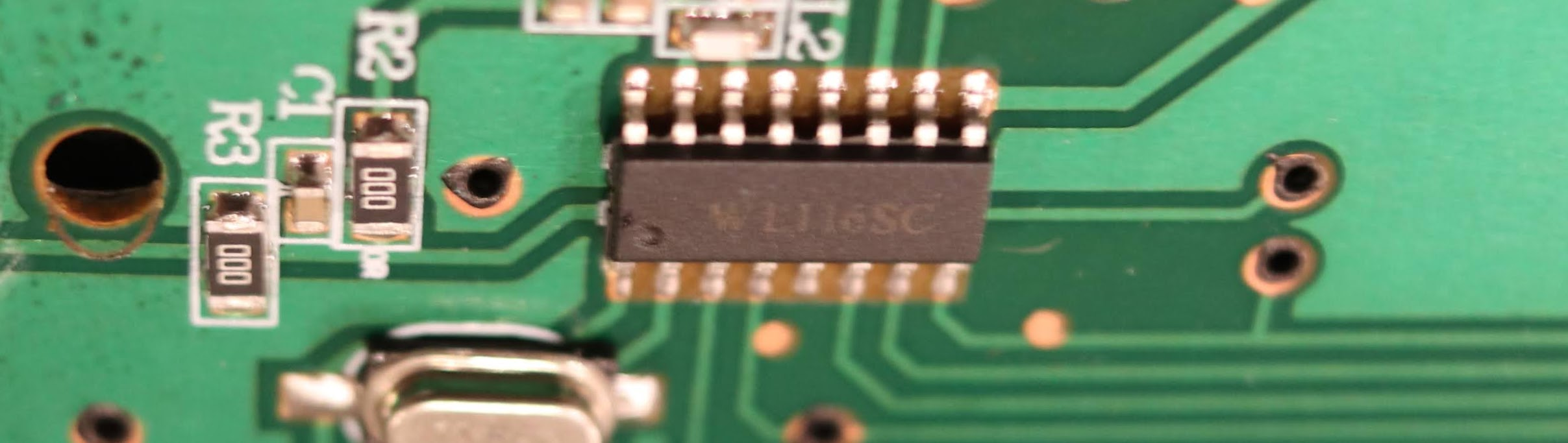 After some googling, I found a single lone
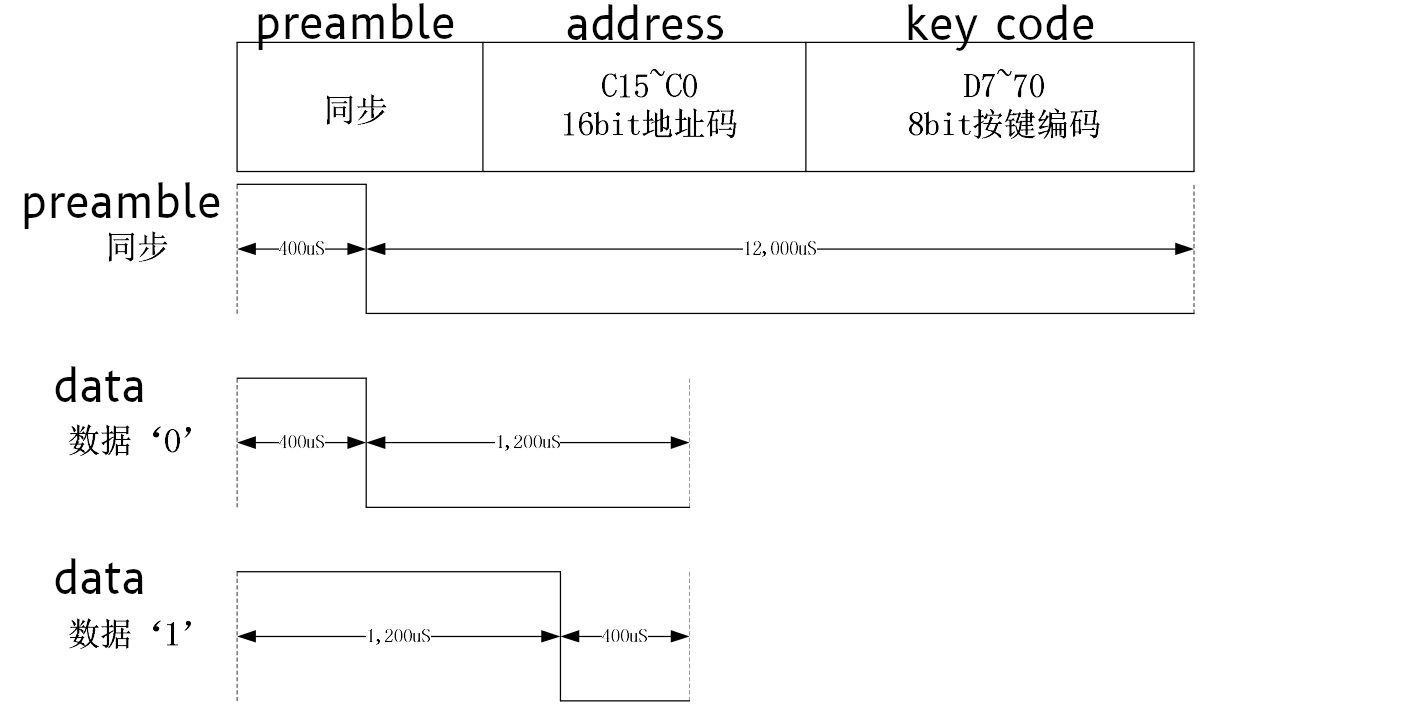 It s a bummer that we missed the clock sync / preamble pulse before the data
message, but that s OK somehow. It also turns out that 8 or 10 bit series of of
0"s wasn t clock sync at all - it was part of the address! Since it also turns
out that all devices made by this manufacturer have the hardcoded address of
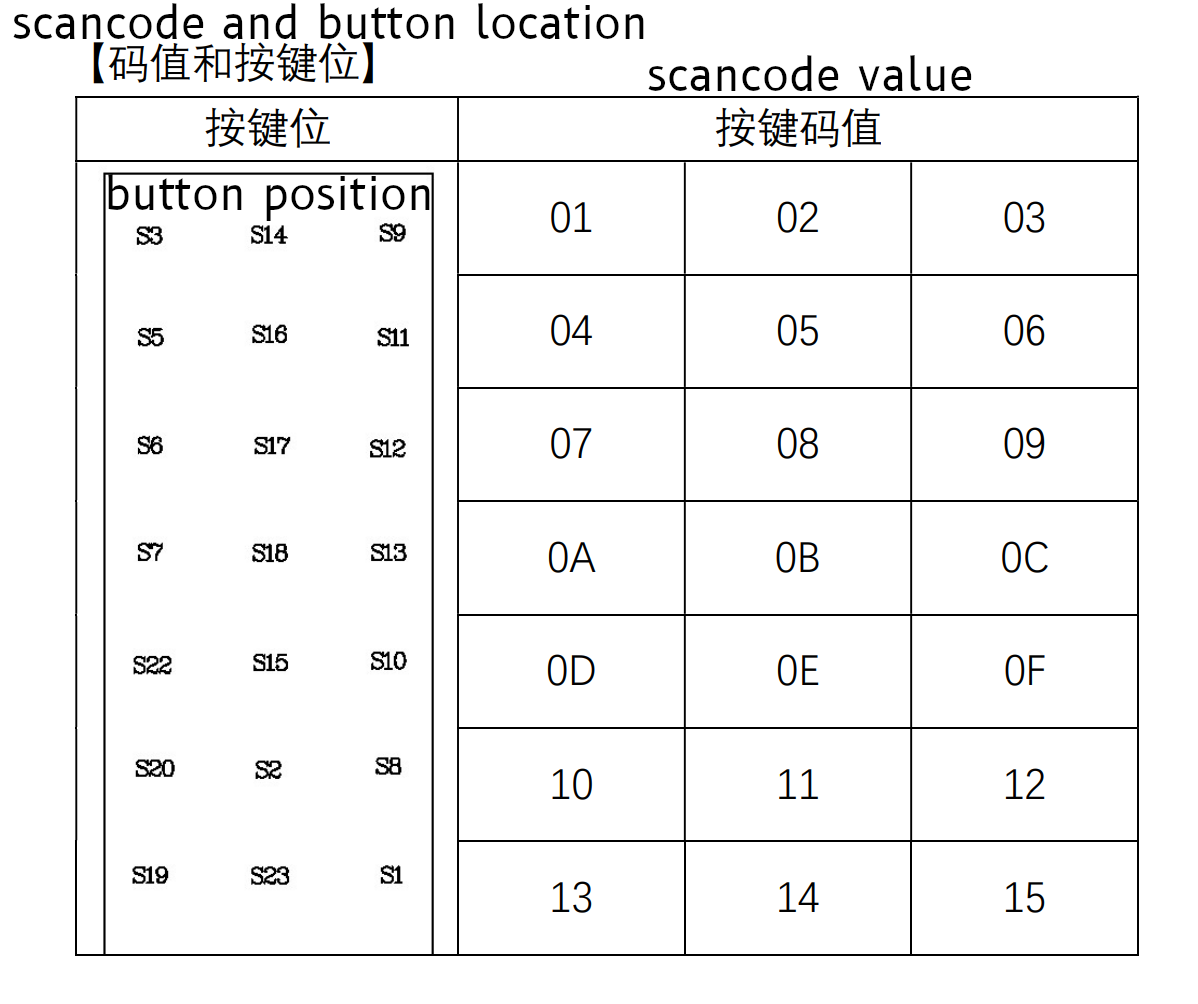 And even more interestingly, one of our scancodes ( Off , which is 0x94) shows up just
below this table, in the examples.
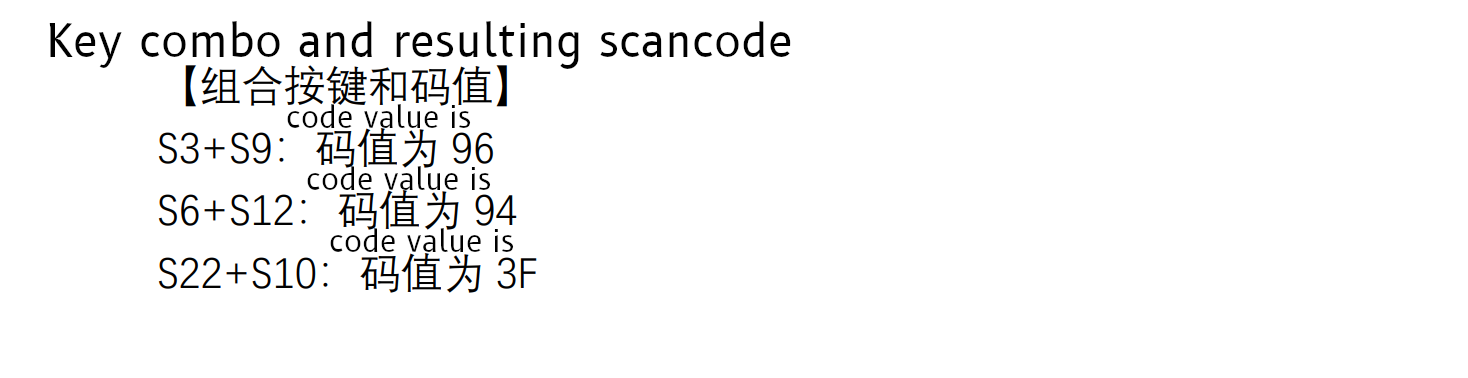 Over all, I think this tells us we have the right bits to look at for
determining the scan code! Great news there!



 I have an original