Search Results: "angel"

12 April 2013

Michal Čihař: Hackweek 9 is over

Hackweek 9 is over and it's time to share what I've done on Weblate during that. I think everything went quite well and Weblate is now ready for 1.5 release. I'm slowly deploying it on my installations (unfortunately this release migration will need some noticeable downtime for bigger installations) and everything seems to work fine so far. I believe this is possible thanks to massive test coverage - all important code is covered by testcases. So what you can expect in 1.5 release? The most visible change is probably new machine translation support, providing support for way more backends and allow you to plug in own services as well. The other changes include word counting (what might give you more idea how much work is remaining) or fancy progress bars in all places (they used to be available for translations only). From the other side, Weblate can now run custom scripts to pre-process translations before commit, what can be used for various things from generating byte compiled files to sorting or cleaning up the translation files. Also Weblate should be now much faster - there were dozen of optimizations done, leading to much lower press on database server. If you want to see more detailed work progress, check Hackweek project page or Weblate changelog. PS: In case no problems appear, Weblate 1.5 should be released on Sunday.

Filed under: English Phpmyadmin Suse Weblate 0 comments Flattr this!

8 April 2013

Matthias Klumpp: Tanglu status report

Hello everyone! I am very excited to report about the awesome progress we made with Tanglu, the new Debian-based Linux-Distribution. :) First of all, some off-topic info: I don t feel comfortable with posting too much Tanglu stuff to Planet-KDE, as this is often not KDE-related. So, in future Planet-KDE won t get Tanglu information, unless it is KDE-related ;-) You might want to take a look at Planet-Tanglu for (much) more information. So, what happened during the last weeks? Because I haven t had lectures, I nearly worked full-time on Tanglu, setting up most of the infrastructure we need. (this will change with the next week, where I have lectures again, and I also have work to do on other projects, not just Tanglu ^^) Also, we already have an awesome community of translators, designers and developers. Thanks to them, the Tanglu-Website is now translated to 6 languages, more are in the pipeline and will be merged later. Also, a new website based on the Django framework is in progress. The Logo-Contest We ve run a logo-contest, to find a new and official Tanglu logo, as the previous logo draft was too close to the Debian logo (I asked the trademark people at Debian). More than 30 valid votes (you had to be subscribed to a Tanglu Mailinglist) were received for 7 logo proposals, and we now have a final logo: Tanglu Logo (Text) I like it very much :) Fun with dak I decided to use dak, the Debian Archive Kit, to handle the Tanglu archive. Choosing dak over smaller and easy-to-use solutions had multiple reasons, the main reason is that dak is way more flexible than the smaller solution (like reprepro or min-dak) and able to handle the large archive of Tanglu. Also, dak is lightning fast. And I would have been involved with dak sooner or later anyway, because I will implement the DEP-11 extension to the Debian Archive later (making the archive application-friendly). duckWorking with dak is not exactly fun. The documentation is not that awesome, and dak contains many hardcoded stuff for Debian, e.g. it often expects the unstable suite to be present. Also, running dak on Debian Wheezy turned out to be a problem, as the Python module apt_pkg changed the API and dak naturally had problems with that. But with the great help of some Debian ftpmasters (many thanks to that!), dak is now working for Tanglu, managing the whole archive. There are still some quirks which need to be fixed, but the archive is in an usable state, accepting and integrating packages. The work on dak is also great for Debian: I resolved many issues with non-Debian dak installations, and made many parts of dak Wheezy-proof. Also, I added a few functions which might also be useful for Debian itself. All patches have of course been submitted to upstream-dak. ;-) Wanna-build and buildds GearThis is also nearly finished :) Wanna-build, the software which manages all buildds for an archive, is a bit complicated to use. I still have some issues with it, but it does it s job so far. (need to talk to the Debian wanna-build admins for help, e.g. wanna-build seems to be unable to handle arch:all-only packages, also, build logs are only submitted in parts) The status of Tanglu builds can be viewed at the provisoric Buildd-Status pages. Setting up a working buildd is also a tricky thing, it involves patching sbuild to escape bug #696841 and applying various workarounds to make the buildd work and upload packages correctly. I will write instructions how to set-up and maintain a buildd soon. At time, we have only one i386 buildd up and running, but more servers (in numbers: 3) are prepared and need to be turned into buildds. After working on Wanna-build and dak, I fully understand why Canonical developed Launchpad and it s Soyuz module for Ubuntu. But I think we might be able to achieve something similar, using just the tools Debian already uses (maybe a little less confortable than LP, but setting up an own LP instance would have been much more trouble). Debian archive import The import of packages from the Debian archive has finished. Importing the archive resulted in many issues and some odd findings (I didn t know that there are packages in the archive which didn t receive an upload since 2004!), but it has finally finished, and the archive is in a consistent state at time. To have a continuous package import from Debian while a distribution is in development, we need some changes to wanna-build, which will hopefully be possible. Online package search The Online-Package-Search is (after resolving many issues, who expected that? :P ) up and running. You can search for any package there. Some issues are remaining, e.g. the file-contents-listing doesn t work, and changelog support is broken, but the basic functionality is there. Tanglu Bugtracker We now also have a bugtracker which is based on the Trac software. The Tanglu-Bugtracker is automatically synced with the Tanglu archive, meaning that you find all packages in Trac to report bugs against them. The dak will automatically update new packages every day. Trac still needs a few confort-adjustments, e.g. submitting replies via email or tracking package versions. Tanglu base system tanglu-platform-smallThe Tanglu metapackages have been published in a first alpha version. We will support GNOME-3 and KDE4, as long as this is possible (= enough people working on the packaging). The Tanglu packages will also depend on systemd, which we will need in GNOME anyway, and which also allows some great new features in KDE. Side-effect of using systemd is at least for the start that Tanglu boots a bit slow, because we haven t done any systemd adjustments, and because systemd is very old. We will have to wait for the systemd and udev maintainers to merge the packages and release a new version first, before this will improve. (I don t want to do this downstream in Tanglu, because I don t know the plans for that at Debian (I only know the information Tollef Fog Heen & Co. provided at FOSDEM)) The community The community really surprised me! We got an incredible amount of great feedback on Tanglu, and most of the people liked the idea of Tanglu. I think we are one of the less-flamed new distributions ever started ;-) . Also, without the very active community, kickstarting Tanglu would not have been possible. My guess was that we might be able to have something running next year. Now, with the community help, I see a chance for a release in October :) The only thing people complained about was the name of the distribution. And to be really honest, I am not too happy with the name. But finding a name was an incredibe difficult process (finding something all parties liked), and Tanglu was a good compromise. Tanglu has absolutely no meaning, it was taken because it sounded interesting. The name was created by combining the Brazilian Tangerine (Clementine) and the German Iglu (igloo). I also dont think the name matters that much, and I am more interested in the system itself than the name of it. Also, companies produce a lot of incredibly weird names, Tanglu is relatively harmless compared to that ;-) . In general, thanks to everyone participating in Tanglu! You are driving the project forward! The first (planned) release I hereby announce the name of the first Tanglu release, 1.1 Aequorea Victoria . It is Daniel s fault that Tanglu releases will be named after jellyfishes, you can ask him why if you want ;-) I picked Aequorea, because this kind of jellyfish was particularly important for research in molecular biology. The GFP protein, a green fluorescent protein (=GFP), caused a small revolution in science and resulted in a Nobel Prize in 2008 for the researchers involved in GFP research (for the interested people: You can tag proteins with GFP and determine their position using light microscopy. GFP also made many other fancy new lab methods possible). Because Tanglu itself is more or less experimental at time, I found the connection to research just right for the very first release. We don t have a time yet when this version will be officially released, but I expect it to be in October, if the development speed increases a little and more developers get interested and work on it. Project Policy We will need to formalize the Tanglu project policy soon, both the technical and the social policies. In general, regarding free software and technical aspects, we strictly adhere to the Dbian Free Software Guidelines, the Debian Social Contract and the Debian Policy. Some extra stuff will be written later, please be patient! Tanglu OIN membership I was approached by the Open Invention Network, to join it as member. In general, I don t have objections to do that, because it will benefit Tanglu. However, the OIN has a very tolerant public stance on software patents, which I don t like that much. Debian did not join the OIN for this reason. For Tanglu, I think we could still join the OIN without someone thinking that we support the stance on software patents. Joining would simply be pragmatic: We support the OIN as a way to protect the Linux ecosystem from software patents, even if we don t like the stance on software patents and see it differently. Because this affects the whole Tanglu project, I don t want to decide this alone, but get some feedback from the Tanglu community before making a decision. Can I install Tanglu now? Yes and no. We don t provide installation images yet, so trying Tanglu is a difficult task (you need to install Debian and then upgrade it to Tanglu) if you want to experiment with it, I recomment trying Tanglu in a VM. I want to help! Great, then please catch one of us on IRC or subscribe to the mailinglists. The best thing is not to ask for work, but suggest something you want to do, others will then tell you if that is possible and maybe help with the task. Packages can for now only be uploaded by Debian Developers, Ubuntu Developers or Debian Maintainers who contacted me directly and whose keys have been verified. This will be changed later, but at the current state of the Tanglu archive (= less safety checks for packages), I only want people to upload stuff who definitely have the knowledge to create sane packages (you can also proove that otherwise, of course). We will later establish a new-member process. If you want to provide a Tanglu archive mirror, we would be very happy, so that the main server doesn t have to carry all the load. If you have experience in creating Linux Live-CDs or have worked with the Ubiquity installer, helping with these parts would be awesome! Unfortunately, we cannot reuse parts of Linux Mint Debian, because many of their packages don t build from source and are repackaged binaries, which is a no-go for the Tanglu main archive. Sneak peek And here is a screenshot of the very first Tanglu installation (currently more Debian than Tanglu):



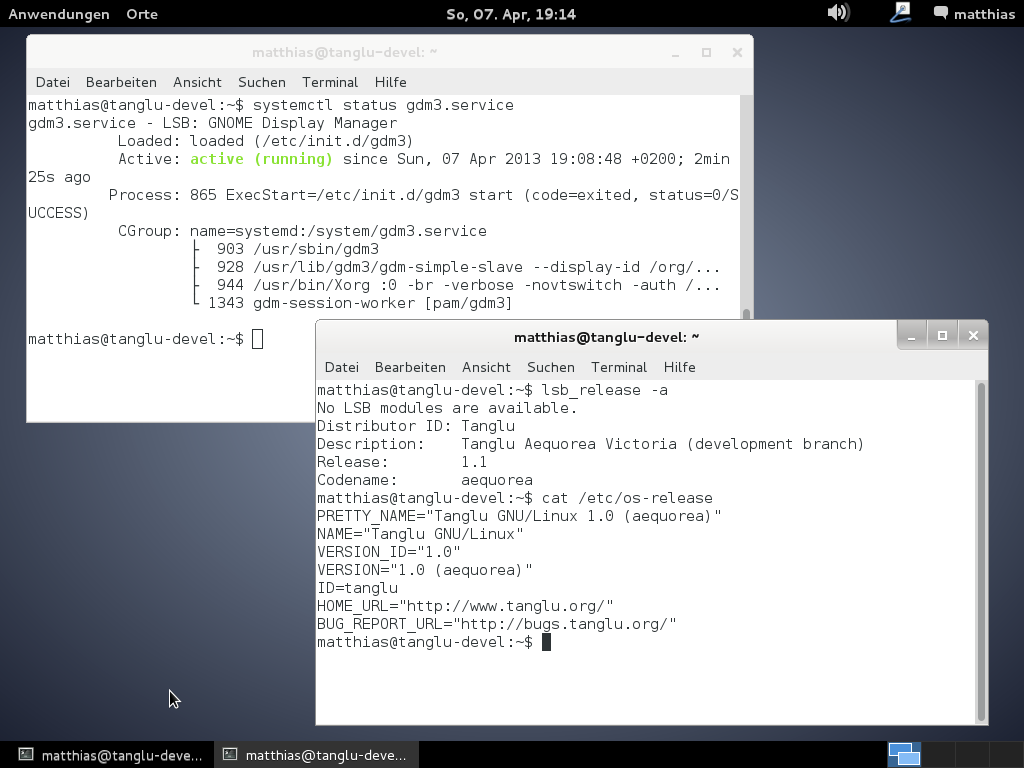
tanglu_sneak-peek_screenshot Something else I am involved in Debian for a very long time now, first as Debian Maintainer and then as Debian Developer and I never thought much about the work the Debian system administrators do. I didn t know how dak worked or how Wanna-build handles the buildds and what exactly the ftpmasters have to do. By not knowing, I mean I knew the very basic theory and what these people do. But this is something different than experiencing how much work setting up and maintaining the infrastructure is and what an awesome job the people do for Debian, keeping it all up and running and secure! Kudos for that, to all people maintaining Debian infrastructure! You rock! (And I will never ever complain about slow buildds or packages which stay in NEW for too long ;-) )

4 April 2013

Jon Dowland: awk

Recently, I've been using awk in shell scripts more and more often. When I saw Thomas' Blog I reeled a bit from of the make/shell quoted within. (Sorry Thomas! It's still a thought provoking blog post):
DEBVERS         ?= $(shell dpkg-parsechangelog   sed -n -e 's/^Version: //p')
VERSION         ?= $(shell echo '$(DEBVERS)'   sed -e 's/^[\[:digit:]]*://' -e 's/[-].*//')
DEBFLAVOR       ?= $(shell dpkg-parsechangelog   grep -E ^Distribution:   cut -d" " -f2)
DEBPKGNAME      ?= $(shell dpkg-parsechangelog   grep -E ^Source:   cut -d" " -f2)
DEBIAN_BRANCH   ?= $(shell cat debian/gbp.conf   grep debian-branch   cut -d'=' -f2   awk ' print $1 ')
GIT_TAG         ?= $(shell echo '$(VERSION)'   sed -e 's/~/_/')
I couldn't help but re-write it to be more efficient (and in the case of DEBIAN_BRANCH, more correct):
DEBVERS        := $(shell dpkg-parsechangelog   awk '/^Version:/  print $$2 ')
VERSION        := $(shell echo '$(DEBVERS)'   sed -e 's/^[0-9]*://' -e 's/-.*//')
DEBFLAVOR      := $(shell dpkg-parsechangelog   awk '/^Distribution:/  print $$2 ')
DEBPKGNAME     := $(shell dpkg-parsechangelog   awk '/^Source:/  print $$2 ')
DEBIAN_BRANCH  := $(shell awk 'BEGIN FS="[= ]+"  /debian-branch/  print $$2 ' debian/gbp.conf)
GIT_TAG        := $(subst ~,_,$(VERSION))

Thomas Goirand: Git packaging workflow

Seeing what has been posted recently in planet.d.o, I would like to share as well my thoughts and work-flow, and tell that I do agree with Joey Hess on many of his arguments. Especially when he tells that Debian fetishises upstream tarballs. We re in 2013, at the age of Internet, and more and more upstream authors are using Git, and more and more they don t care about releasing tarballs. I ve seen some upstream authors who simply stopped doing so completely, as a Git tag is really enough. I also fully agree than disk space and network speed isn t much of a problem these days. When there are tags available, I use the following debian/gbp.conf:
[DEFAULT]
upstream-branch = master
debian-branch = debian
upstream-tag = %(version)s
compression = xz
[git-buildpackage]
export-dir = ../build-area/
On many of my packages, I now just use Git tags from upstream if they are available. To make it more easy, I now nearly always use the following piece of code in my debian/rules files:
DEBVERS         ?= $(shell dpkg-parsechangelog   sed -n -e 's/^Version: //p')
VERSION         ?= $(shell echo '$(DEBVERS)'   sed -e 's/^[[:digit:]]*://' -e 's/[-].*//')
DEBFLAVOR       ?= $(shell dpkg-parsechangelog   grep -E ^Distribution:   cut -d" " -f2)
DEBPKGNAME      ?= $(shell dpkg-parsechangelog   grep -E ^Source:   cut -d" " -f2)
DEBIAN_BRANCH   ?= $(shell cat debian/gbp.conf   grep debian-branch   cut -d'=' -f2   awk ' print $1 ')
GIT_TAG         ?= $(shell echo '$(VERSION)'   sed -e 's/~/_/')
get-upstream-sources:
        git remote add upstream git://git.example.org/proj/foo.git   true
        git fetch upstream
        if ! git checkout master ; then \
                echo "No upstream branch: checking out" ; \
                git checkout -b master upstream/master ; \
        fi
        git checkout $(DEBIAN_BRANCH)
make-orig-file:
        if [ ! -f ../$(DEBPKGNAME)_$(VERSION).orig.tar.xz ] ; then \
                git archive --prefix=$(DEBPKGNAME)-$(GIT_TAG)/ $(GIT_TAG)   xz >../$(DEBPKGNAME)_$(VERSION).orig.tar.xz ; \
        fi
        [ ! -e ../build-area ] && mkdir ../build-area   true
        [ ! -e ../build-area/$(DEBPKGNAME)_$(VERSION).orig.tar.xz ] && cp ../$(DEBPKGNAME)_$(VERSION).orig.tar.xz ../build-area   true
Packaging a new upstream VERSION now means that I only have to edit the debian/changelog, do ./debian/rules get-upstream-source so that I get new commits and tags, then git merge -X theirs VERSION to import the changes, then finally invoke ./debian/rules make-orig-file to create the orig.tar.xz. My debian branch is now ready for git-buildpackage. Note that the sed with the GIT_TAG thing is there because unfortunately, Git doesn t support the ~ char in tags, and that most of the time, upstream do not use _ in version numbers. Let s say upstream is releasing version 1.2.3rc1, then I simply do git tag 1.2.3_rc1 1.2.3rc1 so that I have a new tag which points to the same commit as 1.2.3rc1, but that can be used for the Debian 1.2.3~rc1-1 release and the make-orig-file. All this might looks overkill at first, but in fact it is really convenient and efficient. Also, even though there is a master branch above, it isn t needed to build the package. Git is smarter than this, so even if you haven t checked out upstream master branch from the upstream remote, make-orig-file and git-buildpackage will simply continue to work. Which is cool, because this means you can store a single branch on Alioth (which is what I do).

31 March 2013

Enrico Zini: A proposal to solve gender imbalance in Debian

A proposal to solve gender imbalance in Debian We've done all we can so far: Debian Women, the Diversity Statement, the anti-harassment contact, gender neutral language, lots of education all round, but we still suffer from a strong gender imbalance in Debian. I think that the reason is that the majority group of cisgender men in the project, although they don't actively work /against/ the rest, still have /no incentive/ to be inclusive, and generally do not understand what bearing a female name online is like. I think it is about time we addressed that, and after a lot of thinking and discussing with many other concerned debianers, I think I have just the right proposal, which is twofold. The first part is this: since the goal is to have an equal gender perception in Debian, we can just decide to only approve one obviously-male-named DD for every obviously-female-named one. That's right: no new obviously-male-named DD unless an obviously-female-named DD has just been approved. It may sound like affirmative action gone wild, but please stop a moment to think about it: this would create precisely the right incentive for the currently dominant group of developers to be inclusive! People shouldn't just assume they can get a Debian account regardless of what happens around them. We already ask NM candidates to fix RC bugs and, well, gender imbalance should be treated as an RC bug, and everyone should feel compelled to join the effort to fix it! Now, of course since there currently are many male names in NM but not a single female name, it would not be reasonable to just stop the flow of new developers into the project: that would just have the effect to make us starve on personpower. So here is the second part of the proposal: the one-female-name-one-male-name policy will not be enforced for, say, a year. But during this year, everyone currently in NM or joining NM will be asked to adopt a female identity. Crazy? No, genius! It's about time people understood what it means to get advances in private every time they make a public contribution! What better way than just trying it out for themselves? On top of that, as more and more female names appear in Debian changelogs, fake or not, people will finally start to understand that it does not matter what name is used to sign the contribution, but the contribution itself. I don't know if this will give us a community where people realise female or male contributions are equally valuable, which is what I hope, or a community where people will think that everyone is a cisgender man even if they have female names. In the end, really, it does not matter. Either way, we finally get to have a community where everyone is /guaranteed/ to be treated the same. But gender imbalance isn't the only imbalance we have in Debian. People accrue a reputation over time, good or bad, and this reputation tends to stick on you for years, regardless of how you may change, for better or for worse. When we evaluate the merit a contribution, we should not be biased by the reputation of the contributor! How can new contributors be taken seriously otherwise? I believe we are loosing lots of fresh, good ideas this way. And how much damage could be wrecked on the project by a well-respected contributor, like a Debian Account Manager, who is having a funny day? I think we can address this just as I propose to address gender imbalance: let's swap identities from time to time, like it usually happens with nametags at the end of Debconfs. Let's see gregoa upload a patched versions of python3.2, and enrico upload a new upstream version of eglibc! See if we won't finally have some peer review at last! Reputation and real identities have many merits, but we have come to rely too much on them, and it is hurting us. It is time we did something about it, before it is too late!

29 March 2013

Hideki Yamane: build failure with certain cowbuilder

I've got a build failure with freewnn via cowbuilder. However, same source can be built with pbuilder. And strangely, cowbuilder in another host can build it.

  • host + pbuilder = fine
  • host + cowbuilder = fail
  • host(chroot) + cowbuilder = fine
  • host(old kernel) + cowbuilder = fine
  • laptop + pbuilder = fine
  • laptop + cowbuilder = fine
  • virtualbox + cowbuilder = fine
... it's strange. What is the root cause of this?

28 March 2013

John Goerzen: No Hate

God hates people that are I heard a sentence that began that way on an interview with a protestor outside the Supreme Court yesterday. It is a deeply sad, and deeply wrong, statement. If someone reads the Bible, and can come up with a word, any word, that completes that sentence, they re doing it wrong. If someone thinks that there is anyone God hates, then I have this to say: No. Just no. I saw an article today, taking pages and pages to assess what the Christian response to gay marriage should be. I don t need pages. It s very simple. It s this: God is the God of love. That is all. Where people are doing good, there is God. Where people care about each other, there is God. Where there are flowers blooming and trees shading and birds singing, there is God. Where people marvel in the beauty of the landscape or of another person, there is God. And where people love, there is God. There is too much hate in the world already. Instead of adding more, let s celebrate compassion, devotion, and peace. People that say that God is the God of hate look at the spring landscape and see only last year s thistles. One day soon, I hope to see everyone s hearts set free. What a day of joy that will be! And I hope, too, that those that hate will find the peace of freed hearts, freed from hate and from fear.

25 March 2013

Joey Hess: difficulties in backing up live git repositories

But you can t just tar.gz up the bare repositories on the server and hope for the best. Maybe a given repository will be in a valid state; maybe it won t.
-- Jeff Mitchell in a followup to the recent KDE near git disaster This was a surprising statement to me. I seem to remember that one of (many) selling points for git talked about back in the day was that it avoided the problem that making a simple cp (or backup) of a repository could lead to an inconsistent result. A problem that subversion repositories had, and required annoying commands to work around. (svnadmin $something -- iirc the backend FSFS fixed or avoided most of this issue.) This prompted me to check how I handle it in ikiwiki-hosting. I must have anticipated a problem at some point, since ikisite backup takes care to lock the git repository in a way that prevents eg, incoming pushes while a backup is running. Probably, like the KDE developers, I was simply exercising reasonable caution. The following analysis has probably been written up before (train; limited network availability; can't check), but here are some scenarios to consider:
  • A non-bare repository has two parts that can clearly get out of sync during a backup: The work tree and the .git directory.
    • The .git directory will likely be backed up first, since getdirent will typically return it first, since it gets created first . If a change is made to the work tree during that backup, and committed while the work tree is being backed up, the backup won't include that commit -- which is no particular problem and would not be surprising upon restore. Make commit again and get on with life.
    • However, if (part of) the work tree is backed up before .git, then any changes that are committed to git during the backup would not be reflected in the restored work tree, and git diff would show a reversion of those changes. After restore, care would need to be taken to reset the work tree (without losing any legitimate uncommitted changes).
  • A non-bare repository can also become broken in other ways if just the wrong state is snapshotted. For example, if a commit is in progress during a backup, .git/index.lock may exist, and prevent future commits from happening, until it's deleted. These problems can also occur if the machine dies at just the right time during a commit. Git tells you how to recover. (git could go further to avoid these problems than it does; for example it could check if .git/index.lock is actually locked using fcntl. Something I do in git-annex to make the .git/annex/index.lock file crash safe.)
  • A bare repository could be receiving a push (or a non-bare repository a pull) while the backup occurs. These are fairly similar cases, with the main difference being that a non-bare repository has the reflog, which can be used to recover from some inconsist states that could be backed up. Let's concentrate on pushes to bare repositories.
    • A pack could be in the process of being uploaded during a backup. The KDE developers apparently worried that this could result in a corrupt or inconsistent repository, but TTBOMK it cannot; git transfers the pack to a temp file and atomically renames it into place once the transfer is complete. A backup may include an excess temp file, but this can also happen if the system goes down while a push is in progress. Git cleans these things up.
    • A push first transfers the .git/objects, and then updates .git/refs. A backup might first back up the refs, and then the objects. In this case, it would lose the record that refs were pushed. After being restored, any push from another repository would update the refs, even using the objects that did get backed up. So git recovers from this, and it's not really a concern.
    • Perhaps a backup chooses to first back up the objects, and then the refs. In this case, it could back up a newly changed ref, without having backed up the referenced objects (because they arrived after the backup had finished with the objects). When this happens, your bare repository is inconsistent; you have to somehow hunt down the correct ref for the objects you do have. This is a bad failure mode. git could improve this, perhaps, by maintaining a reflog for bare repositories. (Update: core.logAllRefUpdates can be set to true for bare repositories, but is disabled by default.)
  • A "backup" of a git repository can consist of other clones of it. Which do not include .git/hooks/ scripts, .git/config settings, and potentially other valuable information, that strangely, we do not check into revision control despite having this nice revision control system available. This is the most likely failure mode with "git backups". :P
I think that it's important git support naive backups of git repositories as well as possible, because that's probably how most backups of git repositories are made. We don't all have time to carefully tune our backup systems to do something special around our git repositories to ensure we get them in a consistent state like the KDE project did, and as their experience shows, even if we do it, we can easily introduce other, unanticipated problems. Can anyone else think of any other failure modes like these, or find holes in my slightly rushed analysis?
PS: git-annex is itself entirely crash-safe, to the best of my abilities, and also safe for naive backups. But inherits any problems with naive backups of git repositories.

23 March 2013

Dirk Eddelbuettel: Rcpp 0.10.3

A new relase 0.10.3 of Rcpp is now on CRAN and in Debian. This is the fourth release in the 0.10.* series, and further extends and solidifies the excellent Rcpp attributes. A few other bugs were fixed as well, and support for wide character strings has been added. We once again tested this fairly rigorously by checking against 86 of the 100 CRAN packages depending on Rcpp. All of these passed. So we do not expect any issues with dependent packages, but one never knows. The complete NEWS entry for 0.10.3 is below; more details are in the ChangeLog file in the package and on the Rcpp Changelog page.
Changes in Rcpp version 0.10.3 (2013-03-23)
  • Changes in R code:
    • Prevent build failures on Windowsn when Rcpp is installed in a library path with spaces (transform paths in the same manner that R does before passing them to the build system).
  • Changes in Rcpp attributes:
    • Rcpp modules can now be used with sourceCpp
    • Standalone roxygen chunks (e.g. to document a class) are now transposed into RcppExports.R
    • Added Rcpp::plugins attribute for binding directly to inline plugins. Plugins can be registered using the new registerPlugin function.
    • Added built-in cpp11 plugin for specifying the use of C++11 in a translation unit
    • Merge existing values of build related environment variables for sourceCpp
    • Add global package include file to RcppExports.cpp if it exists
    • Stop with an error if the file name passed to sourceCpp has spaces in it
    • Return invisibly from void functions
    • Ensure that line comments invalidate block comments when parsing for attributes
    • Eliminated spurious empty hello world function definition in Rcpp.package.skeleton
  • Changes in Rcpp API:
    • The very central use of R API R_PreserveObject and R_ReleaseObject has been replaced by a new system based on the functions Rcpp_PreserveObject, Rcpp_ReleaseObject and Rcpp_ReplaceObject which shows better performance and is implemented using a generic vector treated as a stack instead of a pairlist in the R implementation. However, as this preserve / release code is still a little rough at the edges, a new #define is used (in config.h) to disable it for now.
    • Platform-dependent code in Timer.cpp now recognises a few more BSD variants thanks to contributed defined() test suggestions
    • Support for wide character strings has been added throughout the API. In particular String, CharacterVector, wrap and as are aware of wide character strings
Thanks to CRANberries, you can also look at a diff to the previous release 0.10.2. As always, even fuller details are on the Rcpp Changelog page and the Rcpp page which also leads to the downloads, the browseable doxygen docs and zip files of doxygen output for the standard formats. A local directory has source and documentation too. Questions, comments etc should go to the rcpp-devel mailing list off the R-Forge page

20 March 2013

Masayuki Hatta: Recipe for Debian Haskell packaging

The following is what I usually do when I want to debianize a Haskell stuff from Hackage. This is a personal recipe, by no means official procedure or such. I may be wrong, badly at that.

  1. Check pkg-haskell repository whether your intended package already exists or not. Somebody might work on it already.
  2. Find the webpage of your intended package at HackageDB, then download Cabal source package . Untar it. The tarball filename should be changed to fit the Debian source package convention. For example, if the original name is something like foobar-1.0.tar.gz, then it should be haskell-foobar_1.0.orig.tar.gz.
  3. File ITP. reportbug is your friend.
  4. Run cabal-debian in untared dir:
     $ cabal-debian --debianize --quilt
    
    We do have the upstream tarball, so use quilt. See http://wiki.debian.org/UsingQuilt. It might give you warnings about changelog. debian/changelog doesn t exist yet, so ignore it.
  5. Now read http://wiki.debian.org/Haskell/CollabMaint/Processes and http://wiki.debian.org/Haskell/CollabMaint/PackageTemplate carefully. Then do things as they say. These two are short, but well-written instructions. Edit the generated debian/control appropriately. Do not forget to make your debian/copyright machine-friendly. See http://www.debian.org/doc/packaging-manuals/copyright-format/1.0/.
  6. Test whether your package is flawless and really buildable. Do lintian. Use pbuilder.
     $ lintian haskell-foobar_1.0-1_amd64.changes
     # pbuilder --build haskell-foobar_1.0-1.dsc
    
  7. Read http://wiki.debian.org/Haskell/CollabMaint/DarcsBasic. Darcs is quite easy to use, and you don t have to be the master of Darcs to merely debianize things anyway. Basically, what I usually do is
     $ darcs record -a; darcs push --repo=debian
    
    Darcs is well-suited to Haskell-related development, but seems you can use Git, too.
  8. Change debian/changelog. UNRELEASED in the first line should be unstable or experimental . Do not forget to close ITP.
  9. Finally, do
     $ debuild -tc; debcommit -r; debrelease; darcs push --repo=debian
    
    That s all folks!

17 March 2013

Soeren Sonnenburg: Shogun Toolbox Version 2.1.0 Released!

We have just released shogun 2.1.0. This release contains over 800 commits since 2.0.0 with a load of bugfixes, new features and improvements (see the changelog for details) that make Shogun more efficient, robust and versatile. In particular, Christian Montanari developed a first alpha version of a perl modular interface, Heiko Strathmann did add Linear Time MMD on Streaming Data, Viktor Gal wrote a new structured output solver and Sergey Lisitsyn added support for tapkee - a dimension reduction framework. Read more at http://www.shogun-toolbox.org

15 March 2013

John Goerzen: It s Warm Enough For Mud

Today the outdoor temperatures got to nearly 75F/24C. The boys had this idea to go play with their streams . Here s one of the cleaner moments: I had set up an old pipe and a hose, with the water coming slowly out of the pipe onto a little mound of dirt. They can then use their fingers to make channels in the dirt for the water to flow through. They ve found that sticks can become bridges, making a hole in the earth makes a pond, and, oh yes, it s quite muddy and a lot of fun. Oliver at one point realized that he could splash the mud all around quite nicely. And he wanted to make sure I took photos of his hands. They could have played out there for hours, I m sure. When it was time to clean up, they enjoyed seeing the mud come off their sandals, arms, hands, and feet. It was a perfect use for the first really warm day of spring.

14 March 2013

Rudy Godoy: Subversion auth using SSH external key-pair

Normally when using Subversion s SSH authentication facility you ll use your own SSH generated key-pair that svn will read from the proper location, usually $HOME/.ssh. However, there could be situations when you ll need to use a different key-pair. In such case you can use a nice trick to make svn+ssh authentication work smoothly. Let s say you have an external key-pair and the public key it s already set on the svn server. You store the private key somewhere in your home directory. Now when doing a svn checkout you ll find that you have to use SSH s -i parameter. However, when used together with svn it won t work as expected as you ll normally do when using ssh with an external key-pair. Subversion makes your life easier by using the $SVN_SSH environment variable, so you can put the ssh command and modifiers that fit your needs. In the external key case you can do something like:
export SVN_SSH="ssh -i </path/to/external-key>"
Next time you use svn s ssh auth it will read $SVN_SSH then use it. So now you can use svn commands such checkout, etc in the same fashion you normally do.
svn co svn+ssh://rudy@somesvnserver.at.somwhere.org/repo/for/software
Update: Jeff Epler offered great advice for using .ssh/config and key-pairs based on hostname. See the comments below.

9 March 2013

Francesca Ciceri: Female participation in Debian (reloaded)

This dent by M nica Ram rez Arceda finally gave me the energy to update the statistics about female participation in Debian, first published by Margarita Manterola back in 2010. So, here the new graph updated to February 2013. Female participation in Debian graph The necessary caveat is that is not easy (at least for me) to tell the gender just based on first names, so the actual numbers may be higher. In addition, you should be warned that there are some contributions not easily traceable: it's the case of translators, graphic artists and documentation writers, as well as event organizers. For instance, Beatrice Torracca doesn't appear in these stats, and she is the co-coordinator of the Italian translation team and a long term Debian (and free software in general) contributor. There was a proposal to better track non packaging contributors, but no news on that front yet (at least that I'm aware of). Sources:
  • "first uploads": via UDD (except for the first two cases that are from old changelogs)
  • DD and DM: taken from NM website
You can find the data used as well as the updated graph here. TODO:
  • graph comparing male and female participation in Debian

25 February 2013

Francesca Ciceri: Three Harry Potter crossovers you want to read

...at least, if you are into fan fictions and Harry Potter. I love fan fictions, and I'll shamelessly admit that I like Harry Potter too, but I usually avoid crossovers. That is because however interesting and exciting is - in theory - to have your favourite characters from different fandoms together, it often ends bad. So, it's a public duty of every fanfic reader to recommend good crossovers, if they stumble upon them. Here are some I found recently (all the quotes are from the stories' summaries).
  • Not Quite A Maia (Harry Potter x Lord of the Rings)
    "Middle Earth has a problem: Gandalf the Grey is AWOL in Time & Space after destroying the Balrog of Khazad-d m. But who will take his place in the Quest to defeat the Dark Lord Sauron? Not who you think..."
    This is a very well written fic, and one of the best HP/LOTR crossover I've ever read. Bonus points for not featuring main characters of HP-verse (someone else will have to save the day in Middle Earth, not the usual Golden Trio). And if there are some minor glitches in the plot (especially in the last chapters), the author has undoubtedly a knack for hilarious situations. If you can read through Augusta's chapters without laughing out loud you are not human. Really.
  • Evil Be Thou My Good (Harry Potter x Hellraiser)
    "Nine years ago Vernon Dursley brought home a certain puzzle box. His nephew managed to open it, changing his destiny. Now, in the midst of Voldemort's second rise, Harry Potter has decided to recreate the Lament Configuration... and open it... again."
    Even if I am a notorious addicted to horror and b-movies (and more so to horror b-movies) I've never seen Hellraiser. But you don't have to, to enjoy this story. It's well written, it explains the backstory for the Hellraiser universe (or at least what you need to know about it) and features a refreshing Dark!Harry. The only thing I didn't like is a slightly OOC (Out Of Character) Voldemort, who's described in canon as intelligent and cunning and here seems to me a bit gullible. But apart from that, the story is worth a read.
  • That Which Holds The Image (Harry Potter x Doctor Who).
    "Harry Potter faces a boggart that doesn't turn into a Dementor or even Voldermort, but into a horror from his childhood. Now the boggart isn't even a boggart anymore. There's no imitation. That which holds the image of an Angel, becomes itself an Angel."
    I have a soft spot for the Weeping Angels. They are pure evil genius. If you don't know what I'm talking about stop reading now and go watch Doctor Who episode 3x10 "Blink". It's really a masterpiece. So Weeping Angels in Potterverse would be awesome even if the plot of this story weren't as good as actually is. The only thing to make it better would be to have 10th Doctor instead of 11th. But then, you can't have everything, I guess.
If you read any of these and want to talk about it or if you have more crossovers to recommend, drop me a mail. For more fan fiction recommendations, I suggest you to check this detailed index on tvtropes.org.

20 February 2013

Vincent Bernat: lldpd 0.7.1

A few weeks ago, a new version of lldpd, a 802.1AB (aka LLDP) implementation for various Unices, has been released. LLDP is an industry standard protocol designed to supplant proprietary Link-Layer protocols such as EDP or CDP. The goal of LLDP is to provide an inter-vendor compatible mechanism to deliver Link-Layer notifications to adjacent network devices. In short, LLDP allows you to know exactly on which port is a server (and reciprocally). To illustrate its use, I have made a xkcd-like strip: xkcd-like strip for the use of LLDP If you would like more information about lldpd, please have a look at its new dedicated website. This blog post is an insight of various technical changes that have affected lldpd since its latest major release one year ago. Lots of C stuff ahead!

Version & changelog UPDATED: Guillem Jover told me how he met the same goals for libbsd :
  1. Save the version from git into .dist-version and use this file if it exists. This allows one to rebuild ./configure from the published tarball without losing the version. This also handles Thorsten Glaser s critic.
  2. Include CHANGELOG in DISTCLEANFILES variable.
Since this is a better solution, I have adopted the appropriate line of codes from libbsd. The two following sections are partly technically outdated.

Automated version In configure.ac, I was previously using a static version number that I had to increase when releasing:
AC_INIT([lldpd], [0.5.7], [bernat@luffy.cx])
Since the information is present in the git tree, this seems a bit redundant (and easy to forget). Taking the version from the git tree is easy:
AC_INIT([lldpd],
        [m4_esyscmd_s([git describe --tags --always --match [0-9]* 2> /dev/null   date +%F])],
        [bernat@luffy.cx])
If the head of the git tree is tagged, you get the exact tag (0.7.1 for example). If it is not, you get the nearest one, the number of commits since it and part of the current hash (0.7.1-29-g2909519 for example). The drawback of this approach is that if you rebuild configure from the released tarball, you don t have the git tree and the version will be a date. Just don t do that.

Automated changelog Generating the changelog from git is a common practice. I had some difficulties to make it right. Here is my attempt (I am using automake):
dist_doc_DATA = README.md NEWS ChangeLog
.PHONY: $(distdir)/ChangeLog
dist-hook: $(distdir)/ChangeLog
$(distdir)/ChangeLog:
        $(AM_V_GEN)if test -d $(top_srcdir)/.git; then \
          prev=$$(git describe --tags --always --match [0-9]* 2> /dev/null) ; \
          for tag in $$(git tag   grep -E '^[0-9]+(\.[0-9]+) 1, $$'   sort -rn); do \
            if [ x"$$prev" = x ]; then prev=$$tag ; fi ; \
            if [ x"$$prev" = x"$$tag" ]; then continue; fi ; \
            echo "$$prev [$$(git log $$prev -1 --pretty=format:'%ai')]:" ; \
            echo "" ; \
            git log --pretty=' - [%h] %s (%an)' $$tag..$$prev ; \
            echo "" ; \
            prev=$$tag ; \
          done > $@ ; \
        else \
          touch $@ ; \
        fi
ChangeLog:
        touch $@
Changelog entries are grouped by version. Since it is a bit verbose, I still maintain a NEWS file with important changes.

Core

C99 I have recently read 21st Century C which has some good bits and also handles the ecosystem around C. I have definitively adopted designated initializers in my coding style. Being a GCC extension since a long time, this is not a major compatibility problem. Without designated initializers:
struct netlink_req req;
struct iovec iov;
struct sockaddr_nl peer;
struct msghdr rtnl_msg;
memset(&req, 0, sizeof(req));
memset(&iov, 0, sizeof(iov));
memset(&peer, 0, sizeof(peer));
memset(&rtnl_msg, 0, sizeof(rtnl_msg));
req.hdr.nlmsg_len = NLMSG_LENGTH(sizeof(struct rtgenmsg));
req.hdr.nlmsg_type = RTM_GETLINK;
req.hdr.nlmsg_flags = NLM_F_REQUEST   NLM_F_DUMP;
req.hdr.nlmsg_seq = 1;
req.hdr.nlmsg_pid = getpid();
req.gen.rtgen_family = AF_PACKET;
iov.iov_base = &req;
iov.iov_len = req.hdr.nlmsg_len;
peer.nl_family = AF_NETLINK;
rtnl_msg.msg_iov = &iov;
rtnl_msg.msg_iovlen = 1;
rtnl_msg.msg_name = &peer;
rtnl_msg.msg_namelen = sizeof(struct sockaddr_nl);
With designated initializers:
struct netlink_req req =  
    .hdr =  
        .nlmsg_len = NLMSG_LENGTH(sizeof(struct rtgenmsg)),
        .nlmsg_type = RTM_GETLINK,
        .nlmsg_flags = NLM_F_REQUEST   NLM_F_DUMP,
        .nlmsg_seq = 1,
        .nlmsg_pid = getpid()  ,
    .gen =   .rtgen_family = AF_PACKET  
 ;
struct iovec iov =  
    .iov_base = &req,
    .iov_len = req.hdr.nlmsg_len
 ;
struct sockaddr_nl peer =   .nl_family = AF_NETLINK  ;
struct msghdr rtnl_msg =  
    .msg_iov = &iov,
    .msg_iovlen = 1,
    .msg_name = &peer,
    .msg_namelen = sizeof(struct sockaddr_nl)
 ;

Logging Logging in lldpd was not extensive. Usually, when receiving a bug report, I asked the reporter to add some additional printf() calls to determine where the problem was. This was clearly suboptimal. Therefore, I have added many log_debug() calls with the ability to filter out some of them. For example, to debug interface discovery, one can run lldpd with lldpd -ddd -D interface. Moreover, I have added colors when logging to a terminal. This may seem pointless but it is now far easier to spot warning messages from debug ones. logging output of lldpd

libevent In lldpd 0.5.7, I was using my own select()-based event loop. It worked but I didn t want to grow a full-featured event loop inside lldpd. Therefore, I switched to libevent. The minimal required version of libevent is 2.0.5. A convenient way to check the changes in API is to use Upstream Tracker, a website tracking API and ABI changes for various libraries. This version of libevent is not available in many stable distributions. For example, Debian Squeeze or Ubuntu Lucid only have 1.4.13. I am also trying to keep compatibility with very old distributions, like RHEL 2, which does not have a packaged libevent at all. For some users, it may be a burden to compile additional libraries. Therefore, I have included libevent source code in lldpd source tree (as a git submodule) and I am only using it if no suitable system libevent is available. Have a look at m4/libevent.m4 and src/daemon/Makefile.am to see how this is done.

Client

Serialization lldpctl is a client querying lldpd to display discovered neighbors. The communication is done through an Unix socket. Each structure to be serialized over this socket should be described with a string. For example:
#define STRUCT_LLDPD_DOT3_MACPHY "(bbww)"
struct lldpd_dot3_macphy  
        u_int8_t                 autoneg_support;
        u_int8_t                 autoneg_enabled;
        u_int16_t                autoneg_advertised;
        u_int16_t                mau_type;
 ;
I did not want to use stuff like Protocol Buffers because I didn t want to copy the existing structures to other structures before serialization (and the other way after deserialization). However, the serializer in lldpd did not allow to handle reference to other structures, lists or circular references. I have written another one which works by annotating a structure with some macros:
struct lldpd_chassis  
    TAILQ_ENTRY(lldpd_chassis) c_entries;
    u_int16_t        c_index;
    u_int8_t         c_protocol;
    u_int8_t         c_id_subtype;
    char            *c_id;
    int              c_id_len;
    char            *c_name;
    char            *c_descr;
    u_int16_t        c_cap_available;
    u_int16_t        c_cap_enabled;
    u_int16_t        c_ttl;
    TAILQ_HEAD(, lldpd_mgmt) c_mgmt;
 ;
MARSHAL_BEGIN(lldpd_chassis)
MARSHAL_TQE  (lldpd_chassis, c_entries)
MARSHAL_FSTR (lldpd_chassis, c_id, c_id_len)
MARSHAL_STR  (lldpd_chassis, c_name)
MARSHAL_STR  (lldpd_chassis, c_descr)
MARSHAL_SUBTQ(lldpd_chassis, lldpd_mgmt, c_mgmt)
MARSHAL_END;
Only pointers need to be annotated. The remaining of the structure can be serialized with just memcpy()1. I think there is still room for improvement. It should be possible to add annotations inside the structure and avoid some duplication. Or maybe, using a C parser? Or using the AST output from LLVM?

Library In lldpd 0.5.7, there are two possible entry points to interact with the daemon:
  1. Through SNMP support. Only information available in LLDP-MIB are exported. Therefore, implementation-specific values are not available. Moreover, SNMP support is currently read-only.
  2. Through lldpctl. Thanks to a contribution from Andreas Hofmeister, the output can be requested to be formatted as an XML document.
Integration of lldpd into a network stack was therefore limited to one of those two channels. As an exemple, you can have a look at how Vyatta made the integration using the second solution. To provide a more robust solution, I have added a shared library, liblldpctl, with a stable and well-defined API. lldpctl is now using it. I have followed those directions2:
  • Consistent naming (all exported symbols are prefixed by lldpctl_). No pollution of the global namespace.
  • Consistent return codes (on errors, all functions returning pointers are returning NULL, all functions returning integers are returning -1).
  • Reentrant and thread-safe. No global variables.
  • One well-documented include file.
  • Reduce the use of boilerplate code. Don t segfault on NULL, accept integer input as string, provide easy iterators,
  • Asynchronous API for input/output. The library delegates reading and writing by calling user-provided functions. Those functions can yield their effects. In this case, the user has to callback the library when data is available for reading or writing. It is therefore possible to integrate the library with any existing event-loop. A thin synchronous layer is provided on top of this API.
  • Opaque types with accessor functions.
Accessing bits of information is done through atoms which are opaque containers of type lldpctl_atom_t. From an atom, you can extract some properties as integers, strings, buffers or other atoms. The list of ports is an atom. A port in this list is also an atom. The list of VLAN present on this port is an atom, as well as each VLAN in this list. The VLAN name is a NULL-terminated string living in the scope of an atom. Accessing a property is done by a handful of functions, like lldpctl_atom_get_str(), using a specific key. For example, here is how to display the list of VLAN assuming you have one port as an atom:
vlans = lldpctl_atom_get(port, lldpctl_k_port_vlans);
lldpctl_atom_foreach(vlans, vlan)  
    vid = lldpctl_atom_get_int(vlan,
                               lldpctl_k_vlan_id));
    name = lldpctl_atom_get_str(vlan,
                                lldpctl_k_vlan_name));
    if (vid && name)
        printf("VLAN %d: %s\n", vid, name);
 
lldpctl_atom_dec_ref(vlans);
Internally, an atom is typed and reference counted. The size of the API is greatly limited thanks to this concept. There are currently more than one hundred pieces of information that can be retrieved from lldpd. Ultimately, the library will also enable the full configuration of lldpd. Currently, many aspects can only be configured through command-line flags. The use of the library does not replace lldpctl which will still be available and be the primary client of the library.

CLI Having a configuration file was requested since a long time. I didn t want to include a parser in lldpd: I am trying to keep it small. It was already possible to configure lldpd through lldpctl. Locations, network policies and power policies were the three items that could be configured this way. So, the next step was to enable lldpctl to read a configuration file, parse it and send the result to lldpd. As a bonus, why not provide a full CLI accepting the same statements with inline help and completion?

Parsing & completion Because of completion, it is difficult to use a YACC generated parser. Instead, I define a tree where each node accepts a word. A node is defined with this function:
struct cmd_node *commands_new(
    struct cmd_node *,
    const char *,
    const char *,
    int(*validate)(struct cmd_env*, void *),
    int(*execute)(struct lldpctl_conn_t*, struct writer*,
        struct cmd_env*, void *),
    void *);
A node is defined by:
  • its parent,
  • an optional accepted static token,
  • an help string,
  • an optional validation function and
  • an optional function to execute if the current token is accepted.
When walking the tree, we maintain an environment which is both a key-value store and a stack of positions in the tree. The validation function can check the environment to see if we are in the right context (we want to accept the keyword foo only once, for example). The execution function can add the current token as a value in the environment but it can also pop the current position in the tree to resume walk from a previous node. As an example, see how nodes for configuration of a coordinate-based location are registered:
/* Our root node */
struct cmd_node *configure_medloc_coord = commands_new(
    configure_medlocation,
    "coordinate", "MED location coordinate configuration",
    NULL, NULL, NULL);
/* The exit node.
   The validate function will check if we have both
   latitude and longitude. */
commands_new(configure_medloc_coord,
    NEWLINE, "Configure MED location coordinates",
    cmd_check_env, cmd_medlocation_coordinate,
    "latitude,longitude");
/* Store latitude. Once stored, we pop two positions
   to go back to the "root" node. The user can only
   enter latitude once. */
commands_new(
    commands_new(
        configure_medloc_coord,
        "latitude", "Specify latitude",
        cmd_check_no_env, NULL, "latitude"),
    NULL, "Latitude as xx.yyyyN or xx.yyyyS",
    NULL, cmd_store_env_value_and_pop2, "latitude");
/* Same thing for longitude */
commands_new(
    commands_new(
        configure_medloc_coord,
        "longitude", "Specify longitude",
        cmd_check_no_env, NULL, "longitude"),
    NULL, "Longitude as xx.yyyyE or xx.yyyyW",
    NULL, cmd_store_env_value_and_pop2, "longitude");
The definition of all commands is still a bit verbose but the system is simple enough yet powerful enough to cover all needed cases.

Readline When faced with a CLI, we usually expect some perks like completion, history handling and help. The most used library to provide such features is the GNU Readline Library. Because this is a GPL library, I have first searched an alternative. There are several of them: From an API point of view, the first three libraries support the GNU Readline API. They also have a common native API. Moreover, this native API also handles tokenization. Therefore, I have developed the first version of the CLI with this API3. Unfortunately, I noticed later this library is not very common in the Linux world and is not available in RHEL. Since I have used the native API, it was not possible to fallback to the GNU Readline library. So, let s switch! Thanks to the appropriate macro from the Autoconf Archive (with small modifications), the compilation and linking differences between the libraries are taken care of. Because GNU Readline library does not come with a tokenizer, I had to write one myself. The API is also badly documented and it is difficult to know which symbol is available in which version. I have limited myself to:
  • readline(), addhistory(),
  • rl_insert_text(),
  • rl_forced_update_display(),
  • rl_bind_key()
  • rl_line_buffer and rl_point.
Unfortunately, the various libedit libraries have a noop for rl_bind_key(). Therefore, completion and online help is not available with them. I have noticed that most BSD come with GNU Readline library preinstalled, so it could be considered as a system library. Nonetheless, linking with libedit to avoid licensing issues is possible and help can be obtained by prefixing the command with help.

OS specific support

BSD support Until version 0.7, lldpd was Linux-only. The rewrite to use Netlink was the occasion to abstract interfaces and to port to other OS. The first port was for Debian GNU/kFreeBSD, then for FreeBSD, OpenBSD and NetBSD. They all share the same source code:
  • getifaddrs() to get the list of interfaces,
  • bpf(4) to attach to an interface to receive and send packets,
  • PF_ROUTE socket to be notified when a change happens.
Each BSD has its own ioctl() to retrieve VLAN, bridging and bonding bits but they are quite similar. The code was usually adapted from ifconfig.c. The BSD ports have the same functionalities than the Linux port, except for NetBSD which lacks support for LLDP-MED inventory since I didn t find a simple way to retrieve DMI related information. They also offer greater security by filtering packets sent. Moreover, OpenBSD allows to lock the filters set on the socket:
/* Install write filter (optional) */
if (ioctl(fd, BIOCSETWF, (caddr_t)&fprog) < 0)  
    rc = errno;
    log_info("privsep", "unable to setup write BPF filter for %s",
        name);
    goto end;
 
/* Lock interface */
if (ioctl(fd, BIOCLOCK, (caddr_t)&enable) < 0)  
    rc = errno;
    log_info("privsep", "unable to lock BPF interface %s",
        name);
    goto end;
 
This is a very nice feature. lldpd is using a privileged process to open the raw socket. The socket is then transmitted to an unprivileged process. Without this feature, the unprivileged process can remove the BPF filters. I have ported the ability to lock a socket filter program to Linux. However, I still have to add a write filter.

OS X support Once FreeBSD was supported, supporting OS X seemed easy. I got sponsored by xcloud.me which provided a virtual Mac server. Making lldpd work with OS X took only two days, including a full hour to guess how to get Apple Xcode without providing a credit card. To help people installing lldpd on OS X, I have also written a lldpd formula for Homebrew which seems to be the most popular package manager for OS X.

Upstart and systemd support Many distributions propose upstart and systemd as a replacement or an alternative for the classic SysV init. Like most daemons, lldpd detaches itself from the terminal and run in the background, by forking twice, once it is ready (for lldpd, this just means we have setup the control socket). While both upstart and systemd can accommodate daemons that behave like this, it is recommended to not fork. How to advertise readiness in this case? With upstart, lldpd will send itself the SIGSTOP signal. upstart will detect this, resume lldpd with SIGCONT and assume it is ready. The code to support upstart is therefore quite simple. Instead of calling daemon(), do this:
const char *upstartjob = getenv("UPSTART_JOB");
if (!(upstartjob && !strcmp(upstartjob, "lldpd")))
    return 0;
log_debug("main", "running with upstart, don't fork but stop");
raise(SIGSTOP);
The job configuration file looks like this:
# lldpd - LLDP daemon
description "LLDP daemon"
start on net-device-up IFACE=lo
stop on runlevel [06]
expect stop
respawn
script
  . /etc/default/lldpd
  exec lldpd $DAEMON_ARGS
end script
systemd provides a socket to achieve the same goal. An application is expected to write READY=1 to the socket when it is ready. With the provided library, this is just a matter of calling sd_notify("READY=1\n"). Since sd_notify() has less than 30 lines of code, I have rewritten it to avoid an external dependency. The appropriate unit file is:
[Unit]
Description=LLDP daemon
Documentation=man:lldpd(8)
[Service]
Type=notify
NotifyAccess=main
EnvironmentFile=-/etc/default/lldpd
ExecStart=/usr/sbin/lldpd $DAEMON_ARGS
Restart=on-failure
[Install]
WantedBy=multi-user.target

OS include files Linux-specific include files were a major pain in previous versions of lldpd. The problems range from missing header files (like linux/if_bonding.h) to the use of kernel-only types. Those headers have a difficult history. They were first shipped with the C library but were rarely synced and almost always outdated. They were then extracted from kernel version with almost no change and lagged behind the kernel version used by the released distribution4. Today, the problem is acknowledged and is being solved by both the distributions which extract the headers from the packaged kernel and by kernel developers with a separation of kernel-only headers from user-space API headers. However, we still need to handle legacy. A good case is linux/ethtool.h:
  • It can just be absent.
  • It can use u8, u16 types which are kernel-only types. To work around this issue, type munging can be setup.
  • It can miss some definition, like SPEED_10000. In this case, you either define the missing bits and find yourself with a long copy of the original header interleaved with #ifdef or conditionally use each symbol. The latest solution is a burden by itself but it also hinders some functionalities that can be available in the running kernel.
The easy solution to all this mess is to just include the appropriate kernel headers into the source tree of the project. Thanks to Google ripping them for its Bionic C library, we know that copying kernel headers into a program does not create a derivative work.

  1. Therefore, the use of u_int16_t and u_int8_t types is a left-over of the previous serializer where the size of all members was important.
  2. For more comprehensive guidelines, be sure to check Writing a C library.
  3. Tokenization is not the only advantage of libedit native API. The API is also cleaner, does not have a global state and has a better documentation. All the implementations are also BSD licensed.
  4. For example, in Debian Sarge, the Linux kernel was a 2.6.8 (2004) while the kernel headers were extracted from some pre-2.6 kernel.

19 February 2013

Mike Hommey: Ten years

Ten years ago, this very day, my first Debian package entered the Debian unstable repository. It was an addon for Mozilla Composer, Daniel Glazman s Cascades. On the same day, my second Debian package entered the Debian unstable repository as well. It was an addon for Mozilla Browser, Checky. A few days later, my third Debian package entered Debian unstable. It was an addon for Mozilla Browser, Diggler. Do you see a pattern? They are now abandoned software, although I made Checky and Diggler live a little longer (and I m actually considering reviving Diggler) but they had their importance in my journey, and are part of the reason why I am where I am now. My journey on the web started with NCSA Mosaic on VAX/VMS, then continued with Netscape Navigator, Netscape Communicator and Mozilla Suite on Linux. That s where I was ten years ago, sailing between Galeon (a browser using the Mozilla engine) and Mozilla Suite, and filing some layout bugs. Ten years ago, there was a new kid on the block. It used to be called Phoenix, it had just changed its name to Firebird. Eventually, it changed again for Firefox. You may have heard about it. Because Firebird was so much nicer than the browser in the Mozilla Suite, I started using its Debian package, and wanted my packaged addons to work with it. So I contacted Eric Dorland, Phoenix/Firebird package maintainer at the time, and got the addons working. I then ended up fixing a bunch of packaging issues. This is how I got involved in Firefox packaging for Debian, and what eventually led me to work for Mozilla.

18 February 2013

Dirk Eddelbuettel: RQuantLib 0.3.10

A new minor release RQuantLib 0.3.10 is now on CRAN and in Debian. RQuantLib combines (some of) the quantitative analytics of QuantLib with the R statistical computing environment and language. The discount curve building code in QuantLib has shown some overly large numerical instabilities. We have used the same example parameters (taken from the Swap example in QuantLib) for years; it currently fails to solve for a rate at some term further out the curve. So I made the decistion to disable this just in the examples in order to not upset the CRAN testing framework. The examples now use a flat curve instead. I also updated one function to silence some new warnings from R-devel about symbols from another packages's namespace (in this case rgl, and it is just for surface plots, a purely cosmetic function). Thanks to CRANberries, there is also a diff to the previous release 0.3.9. Full changelog details, examples and more details about this package are at my RQuantLib page.

13 February 2013

Patrick Matth i: otrs and geoip-database updates

I have just uploaded the monthly update of geoip-database to Debian unstable and squeeze-backports, unblock request already filled. I also uploaded otrs2 in the new version 3.2.1+dfsg1-1, which is also fixing bug #690306, fixing because the upgrade will abort with a list of MySQL tables where the administrator has to fix ether the engine from MyISAM to InnoDB (or the other way, as he want to) and by fxing the default engine of his MySQL database server. Ugly issue, ugly hack, but there is no better solution.. Full changelog of otrs Debian packaging:
   * New upstream release.
     - Add new dependency libyaml-libyaml-perl.
     - Refresh patch 03-postmaster.
     - Refresh patch 05-opt.
     - Refresh patch 13-dont-chown-links.
     - Refresh patch 16-disable-DashboardProductNotify.
     - Refresh patch 19-fix-SetPermissions-to-include-some-more-dirs.
     - Rewrite patch 25-use-locale-country, since all_country_names() does not
       accept arguments.
     - Refresh patch 26-font-paths.
     - Rewrite patch 04-backup.
     - Rewrite patch 15-usable-apache-config.
     - Rewrite patch 21-use-debian-libjs-packages.
     - Rewrite patch 23-load-debian-libjs.
     - Remove old database schemas and add new 3.2 ones.
   * Monitor all releases again.
   * Drop patch 24-default-myisam and check with the new otrs.CheckDB.pl script,
     if the available tables and the used storage engine are equal. If it is not
     the case the installation should abort, so that the administrator can fix
     his MySQL server or the already created tables.
     Closes: #690306
   * Remove deprecated packaging notes from README.Debian.
   * Remove deprecated NEWS file from packaging.
   * Remove deprecated files from otrs2.examples.
   * Solve duplicate-changelog-files by not installing the CHANGES file.
   * Remove some more deprecated files from otrs2.docs.
   * Add lintian override for empty-binary package otrs.
   * Remove some old permission fixes from debian/rules.
   * Add upstream patch 01-innodb-fk-error to fix some foreign key errors if the
     tables are created with InnoDB.

12 February 2013

John Goerzen: Catching the mudball

Dad, can I bring my mudball inside? Jacob Ooo, dad, I need a mudball too! Oliver You d have to have been there to see how excited Jacob was about his mudball. We had been out hiking down by the creek a day after a rain, and he, well, made a mudball and carried it around with him. I m not used to finding mud all that exciting. To me, mud is something that my car can get stuck in, that my boots can drag into the house, that needs to be suppressed by a little gravel on top. But to Jacob, he was holding a ball of excitement, of adventure, of discovery. And Oliver wanted in on the fun! Jacob wasn t thinking about consequences of bringing a mudball indoors, because he didn t need to. He wasn t visualizing the damage it could cause, the time of cleaning it up, or even the fact that a mudball doesn t really stay a mudball permanently. He just wanted to carry his ball of excitement with him. Being a parent means being a teacher, an example, and a leader. It is fine for Jacob to not think about the consequences of bringing a mudball into the house at age 6, but part of my duty as a parent is to make sure he thinks about consequences by the time he gets behind the wheel of a car. As we grow up, we are shown, taught, and prodded into thinking about consequences of our choices: getting good grades in school, thinking about the impression the clothes we wear to a job interview might leave, worrying about what people think about us when we talk in front of a group. We take on real responsibilities when we leave childhood, and the consequences of our actions become more significant. But where s the off switch? Shouldn t there be a way for us to wonder about bringing the mudball indoors, too? There was a time in our lives when we didn t care one bit about whether we were wearing fashionable clothes, making a good impression, or doing things the right way. After being in the mindset of taking careful responsibility over life for so many years, it s hard to re-discover that earlier time. A colleague forwarded a little speech about Thanksgiving. It contained, Those who live in thanksgiving daily have a way of opening their eyes and seeing the wonders and beauties of this world as though seeing them for the first time. This is something children know how to do, and we adults have often forgotten, because we are too busy worrying about dirty floors and stained curtains to see the potential for fun in mud. I am convinced that, just as important as being responsible, is learning how to let go, to let our hearts feel peace and joy as if a child. We can t open our eyes and see the wonders of this world if we re too busy worrying about convincing someone else to vote for our preferred candidate, about saying things perfectly, about being right. There s beauty in that daily commute in a car or subway. Look around, and you might see kids with their noses pressed to the window, even if it s mostly black tunnel outside. There s wonder in that business flight, in the mud, in the doctor s office waiting room. When I see people using insults in a discussion thread on the Internet, I am saddened, because it means they have lost sight of the wonder of being able to communicate with and understand a person thousands of miles away, instantly, and are more worried about their position looking good, or are unable to see the beauty in a person that thinks differently. I once had this conversation with Jacob in an airplane, probably surrounded by people impatiently waiting to turn on their electronic devices:
Jacob, we are in the air! Woooooooow! Jacob, we re flying! Dad, I don t know that I ve ever been a butterfly before!
I hope we can all find ways to be a butterfly more often.

Next.

Previous.