Search Results: "anbe"

10 December 2013

Dirk Eddelbuettel: RcppArmadillo 0.3.930.1

A new Armadillo release 3.930 came out a few days ago, with a very nice set of changes (see below). I rolled this into RcppArmadillo 0.3.930.0. However, one of these changes revealed that R shipped only the standard SVD for complex-valued matrices, and not the more performant divide-and-conquer approach. So in R builds using the default built-in Lapack, at least one CRAN package no longer built. After some back and forth, Conrad put some branching in the library to fall back to the standard SVD, and I added a built-time configuration test for an appropriate preprocessor directive used by the fallback code. This is now on which is now on CRAN and in Debian as RcppArmadillorelease 0.3.930.1, and Conrad will probably update the Armadillo page as well (though the fix is only needed with R's builtin Rlapack). Also of note is that R Core already added the missing Fortran routine zgesdd to R 3.1.0 (aka "R-devel") so this issue goes away with the next release. Also of note, I wrote up a short Rcpp Gallery post illustrating the performance gains available from divide-and-conquer SVD. The complete list of changes is below.
Changes in RcppArmadillo version 0.3.930.1 (2013-12-09)
  • Upgraded to Armadillo release Version 3.930.1
    • Armadillo falls back to standard complex svd if the more performant divide-and-conquer variant is unavailable
  • Added detection for Lapack library and distinguish between R's own version (withhout zgesdd) and system Lapack; a preprocessor define is set accordingly
Changes in RcppArmadillo version 0.3.930.0 (2013-12-06)
  • Upgraded to Armadillo release Version 3.930 ("Dragon's Back")
    • added divide-and-conquer variant of svd_econ(), for faster SVD
    • added divide-and-conquer variant of pinv(), for faster pseudo-inverse
    • added element-wise variants of min() and max()
    • added size() based specifications of submatrix view sizes
    • added randi() for generating matrices with random integer values
    • added more intuitive specification of sort direction in sort() and sort_index()
    • added more intuitive specification of method in det(), .i(), inv() and solve()
    • added more precise timer for the wall_clock class when using C++11
  • New unit tests for complex matrices and vectors
Courtesy of CRANberries, there is also a diffstat report for the most recent release As always, more detailed information is on the RcppArmadillo page. Questions, comments etc should go to the rcpp-devel mailing list off the R-Forge page.

This post by Dirk Eddelbuettel originated on his Thinking inside the box blog. Please report excessive re-aggregation in third-party for-profit settings.

3 December 2013

Dirk Eddelbuettel: digest 0.6.4

digest version 0.6.4 is now on CRAN and in Debian. This is a pure maintenance release which should help with a build issue affecting users on Solaris. CRANberries provides the usual summary of changes to version 0.6.3. Our package is available via the R-Forge page leading to svn and tarball access, my digest page, the local directory here as well as via Debian and its mirrors.

This post by Dirk Eddelbuettel originated on his Thinking inside the box blog. Please report excessive re-aggregation in third-party for-profit settings.

30 November 2013

Dirk Eddelbuettel: RcppCNPy 0.2.2

Right on the heels of release 0.2.1 of RcppCNPy, a new version 0.2.2 is now on CRAN. RcppCNPy uses the CNPY library by Carl Rogers to provide R with easy read and write access to NumPy files. The reason for the new version that I had experimented with a different way to test endianness (as needed for the NumPy file headers) but accidentally sent an interim tarball to CRAN which still wanted to include endian.h promptly breaking Windows builds. So now we do something even simpler and just rely on the (even more complete) test for endianness when R is built, which prevents all sorts of complications for us and builds everywhere (with thanks to Brian Ripley for the suggestion). While we were at it, we also added a new unit test. Full changes are listed below.
Changes in version 0.2.2 (2013-11-29)
  • Switched to using the result from the compile-time configuration for R to determine big or little endian (as needed for the NPy headers)
  • Added a new test (and test validation result file) for a complete save-reload cycle and comparison
CRANberries also provides a diffstat report for 0.2.2 relative to 0.2.1. As always, feedback is welcome and the rcpp-devel mailing list off the R-Forge page for Rcpp is the best place to start a discussion.

This post by Dirk Eddelbuettel originated on his Thinking inside the box blog. Please report excessive re-aggregation in third-party for-profit settings.

28 November 2013

Dirk Eddelbuettel: RcppCNPy 0.2.1

Version 0.2.1 of RcppCNPy is now on CRAN earlier. This version is a minor upgrade with a few small changes as detailed in the NEWS file:
Changes in version 0.2.1 (2013-11-28)
  • Synchronized code with the cnpy repository
  • Added new function to test from R whether integers supported
  • Updated tests for integer support, if available
  • Updated vignette and discussion about need for rebuilding only RcppCNPy with the -std=c++11 flag if integer support is desired
  • Updated tests for integer support, if available
  • Updated THANKS file
  • Ensure that inclusion of Rinternal.h does not affect other headers by adding RF_NO_REMAP
CRANberries also provides a diffstat report for 0.2.1 relative to 0.2.0. As always, feedback is welcome and the rcpp-devel mailing list off the R-Forge page for Rcpp is the best place to start a discussion.

This post by Dirk Eddelbuettel originated on his Thinking inside the box blog. Please report excessive re-aggregation in third-party for-profit settings.

24 November 2013

Dirk Eddelbuettel: Website and blog updated

Earlier this year the blog had its tenth anniversary. I had meant to celebrate the occassion by revamping the site and blog a little. Having set up the updated R/Finance site, the Rcpp Gallery and Rcpp sites as well as the much-needed overhaul of the html side of the CRANberries RSS feed (which also integrates it with the static blog compiler I use), I figured I just needed a little time to get this done. Well, eight months later we're there. It still uses Twitter Bootstrap for layout, and a slightly modified Bootswatch theme. Comments welcome, and please let me know if links are missing or going nowhere in places.

This post by Dirk Eddelbuettel originated on his Thinking inside the box blog. Please report excessive re-aggregation in third-party for-profit settings.

20 November 2013

Dirk Eddelbuettel: RcppArmadillo 0.3.920.3

Conrad released a bug fix version 3.920.3 for his Armadillo library. So I prepared a new release 0.3.920.3 of RcppArmadillo which is nor on on CRAN and also already in Debian. Note that we skipped interim version .2 which addressed an Atlas linking issue which doesn't affect us in the R context as we get LAPACK and BLAS via the R process we get used from. The complete list of changes is below.
Changes in RcppArmadillo version 0.3.920.3 (2013-11-20)
  • Upgraded to Armadillo release Version 3.920.3
    • fix for handling of tiny matrices by .swap()
Courtesy of CRANberries, there is also a diffstat report for the most recent release As always, more detailed information is on the RcppArmadillo page. Questions, comments etc should go to the rcpp-devel mailing list off the R-Forge page.

This post by Dirk Eddelbuettel originated on his Thinking inside the box blog. Please report excessive re-aggregation in third-party for-profit settings.

29 October 2013

Dirk Eddelbuettel: Rcpp 0.10.6

A new maintenance release 0.10.6 of Rcpp is now on the CRAN network for GNU R; binaries for Debian have been uploaded as well. This version ties up a number of smaller loose ends, but also adds a few new things, particularly John's new exposeClass. Details are as usual in the NEWS extract below, and also in the ChangeLog file in the package and on the Rcpp Changelog page.
Changes in Rcpp version 0.10.6 (2013-10-27)
  • Changes in Rcpp API:
    • The function exposeClass takes a description of the constructors, fields and methods to be exposed from a C++ class, and writes C++ and R files in the package. Inherited classes can be dealt with, but require data type information. This approach avoids hand-coding module files.
    • Two missing is<>() templates for CharacterVector and CharacterMatrix have been added, and some tests for is_na() and is_finite() have been corrected thanks to Thomas Tse.
  • Changes in R code:
    • Export linking helper function LdFlags as well as RcppLdFlags.
    • Function Rcpp.package.skeleton() no longer passes a namespace argument on to package.skeleton()
  • Changes in R setup:
    • Raise requirement for R itself to be version 3.0.0 or later as needed by the vignette processing
  • Changes in Rcpp attributes:
    • sourceCpp now correctly binds to Rtools 3.0 and 3.1
Thanks to CRANberries, you can also look at a diff to the previous release 0.10.5. As always, even fuller details are on the Rcpp Changelog page and the Rcpp page which also leads to the downloads, the browseable doxygen docs and zip files of doxygen output for the standard formats. A local directory has source and documentation too. Questions, comments etc should go to the rcpp-devel mailing list off the R-Forge page

This post by Dirk Eddelbuettel originated on his Thinking inside the box blog. Please report excessive re-aggregation in third-party for-profit settings.

30 September 2013

Dirk Eddelbuettel: RcppArmadillo 0.3.920.1

Along with the Rcpp 0.10.5 release yesterday, a new minor release 0.3.920.1 of RcppArmadillo came out. It is based on Conrad's Armadillo 3.920.0 plus a minor fix, and uses some of the new Rcpp features. Both package is now on CRAN and also in Debian. This releases contains both a nice set of new Armadillo features as well as some nice additions to RcppArmadillo, due again mostly to Romain. Some of the changes tie into the changes changes in Rcpp 0.10.5 as for example the ability to pass const and const ref more efficiently (and we seem to have forgotten an entry in the NEWS file). The complete list of changes is below.
Changes in RcppArmadillo version 0.3.920.1 (2013-09-27)
  • Upgraded to Armadillo release Version 3.920.1 (Agencia Nacional Stasi)
    • faster .zeros()
    • faster round(), exp2() and log2() when using C++11
    • added signum function: sign()
    • added move constructors when using C++11
    • added 2D fast Fourier transform: fft2()
    • added .tube() for easier extraction of vectors and subcubes from cubes
    • added specification of a fill type during construction of Mat, Col, Row and Cube classes, eg. mat X(4, 5, fill::zeros)
  • Initial implementation of wrap<subview>
  • Improved implementation of as<>() and wrap() for sparse matrices
  • Converted main vignette from LaTeX style minted to lstlisting which permits builds on CRAN; removed set BuildVignettes: FALSE.
Courtesy of CRANberries, there is also a diffstat report for the most recent release As always, more detailed information is on the RcppArmadillo page. Questions, comments etc should go to the rcpp-devel mailing list off the R-Forge page.

29 September 2013

Dirk Eddelbuettel: Rcpp 0.10.5

A new version of Rcpp is now on the CRAN network for GNU R; binaries for Debian have been uploaded as well. Once more, this release brings a large number of exciting changes to Rcpp. Some concern usability, some bring new features, some increase performance; see below for the detailed list. We have now released three updates on a quarterly cycle; if we keep this up the next version ought to be ready at the end of December. As in the past, we tested the release rather rigorously by checking against all packages I could (relatively easily) built on my server: this time it successfully passed \code R CMD check for all 107 packages I can build locally out of a total of 136 packages. (Two failed: one for an error in \code Makevars , and one for the need of an X11 server during tests; this may get addressed in the in test script next time). As all of these 107 packages passed, we do not expect any issues with dependent packages. Should there be issues we would appreciate a note, preferably with reproducible code, to the rcpp-devel mailing list. The complete NEWS entry for 0.10.4 is below; more details are in the ChangeLog file in the package and on the Rcpp Changelog page.
Changes in Rcpp version 0.10.5 (2013-09-28)
  • Changes in R code:
    • New R function demangle that calls the DEMANGLE macro.
    • New R function sizeof to query the byte size of a type. This returns an object of S3 class bytes that has a print method showing bytes and bits.
  • Changes in Rcpp API:
    • Add defined(__sun) to lists of operating systems to test for when checking for lack of backtrace() needed for stack traces.
    • as<T*>, as<const T*>, as<T&> and as<const T&> are now supported, when T is a class exposed by modules, i.e. with RCPP_EXPOSED_CLASS
    • DoubleVector as been added as an alias to NumericVector
    • New template function is<T> to identify if an R object can be seen as a T. For example is<DataFrame>(x). This is a building block for more expressive dispatch in various places (modules and attributes functions).
    • wrap can now handle more types, i.e. types that iterate over std::pair<const KEY, VALUE> where KEY can be converted to a String and VALUE is either a primitive type (int, double) or a type that wraps. Examples :
      • std::map<int, double> : we can make a String from an int, and double is primitive
      • boost::unordered_map<double, std::vector<double> >: we can make a String from a double and std::vector<double> can wrap itself
      Other examples of this are included at the end of the wrap unit test file (runit.wrap.R and wrap.cpp).
    • wrap now handles containers of classes handled by modules. e.g. if you expose a class Foo via modules, then you can wrap vector<Foo>, ... An example is included in the wrap unit test file.
    • RcppLdFlags(), often used in Makevars files of packages using Rcpp, is now exported from the package namespace.
  • Changes in Attributes:
    • Objects exported by a module (i.e. by a RCPP_MODULE call in a file that is processed by sourceCpp) are now directly available in the environment. We used to make the module object available, which was less useful.
    • A plugin for openmp has been added to support use of OpenMP.
    • Rcpp::export now takes advantage of the more flexible as<>, handling constness and referenceness of the input types. For users, it means that for the parameters of function exported by modules, we can now use references, pointers and const versions of them. The file Module.cpp file has an example.
    • No longer call non-exported functions from the tools package
    • No longer search the inline package as a fallback when loading plugins for the the Rcpp::plugins attribute.
  • Changes in Modules:
    • We can now expose functions and methods that take T& or const T& as arguments. In these situations objects are no longer copied as they used to be.
  • Changes in sugar:
    • is_na supports classes DatetimeVector and DateVector
  • Changes in Rcpp documentation:
    • The vignettes have been moved from inst/doc/ to the vignettes directory which is now preferred.
    • The appearance of the vignettes has been refreshed by switching to the Bistream Charter font, and microtype package.
  • Deprecation of RCPP_FUNCTION_*:
    • The macros from the preprocessor_generated.h file have been deprecated. They are still available, but they print a message in addition to their expected behavior.
    • The macros will be permanently removed in the first Rcpp release after July 2014.
    • Users of these macros should start replacing them with more up-to-date code, such as using 'Rcpp attributes' or 'Rcpp modules'.
Thanks to CRANberries, you can also look at a diff to the previous release 0.10.4. As always, even fuller details are on the Rcpp Changelog page and the Rcpp page which also leads to the downloads, the browseable doxygen docs and zip files of doxygen output for the standard formats. A local directory has source and documentation too. Questions, comments etc should go to the rcpp-devel mailing list off the R-Forge page

15 September 2013

Dirk Eddelbuettel: RProtoBuf 0.3.1

Two months to the day after the previous 0.3.0 release of RProtoBuf, we are happy to announce a maintenance release 0.3.1 which has now arrived on CRAN. RProtoBuf provides GNU R bindings for the Google Protobuf data encoding library used and released by Google. Once again, Murray lead this release and added a number improvements. The NEWS file entry follows:
Changes in RProtoBuf version 0.3.1 (2013-09-13)
  • Added support for setting and getting 64-bit integer types as character strings of decimal integers to work around R's lack of native 64-bit integer types.
  • Added better error handling, documentation, and tests to the extensions support (getExtension and setExtension).
  • Add support to P for returning extension descriptors.
  • Improved error messages to include field names when invalid fields are specified to protocol buffer messages with new, update, etc.
  • Improved configure to detect and pass -std=c++0x if it is available to enable long long 64-bit integer support in Rcpp.
  • Improved configure in the case when pkg-config is not available or does not know about the google protocol buffer includes.
  • Replaced newly deprecated Rcpp macros with a simplified macro functionality to avoid warnings on the latest development version of Rcpp.
CRANberries also provides a diff to the previous release 0.3.0. More information is at the RProtoBuf page which has a draft package vignette, a 'quick' overview vignette and a unit test summary vignette. Questions, comments etc should go to the rprotobuf mailing list off the RProtoBuf page at R-Forge.

7 September 2013

Daniel Pocock: Evacuating Australia

With the news that Australia's 100mbit (and potentially gigabit) fibre to the home is to be abolished and replaced with a cheap 25mbps service using Europe's ADSL hand-me-downs (which will be obsolete in 5 years when the deployment is finished), I've had quite a few emails from people asking just how easy it is to move abroad.

The acoustic modem has a nice retro look Word has got out that I've been spending some time in Switzerland enjoying the world-beating rate of IPv6 deployment. That is not the only reason to leave Australia of course, nor is it the only criteria for people choosing which country will give them a better deal than either of the two non-choices we had in Australia's elections. A free $20,000 for leaving Australia The first good news is that any recent graduate with a big bad ugly HECS bill is only obliged to pay this extra tax when they earn a salary from an Australian employer and file an Australian tax return. Australians who live abroad are not automatically obliged to file tax returns and are not slogged with this extra tax for having attended university. If somebody just graduated and has this hanging over their head, or if they've just started working and seen how much is being deducted on the payslip, moving abroad could make a lot of sense financially. If you have any moral qualms about this, just reflect on the fact that while the Government intimidates students with the feeling that they have to "pay" for fulfilling an education that makes them into a productive member of society, thousands of would-be athletes are given money with no obligation to repay it. The easiest route: a second passport One in four Australians has a parent born abroad. Most of those people qualify for a passport from their parent's country of birth. In some cases this also applies to people with grandparents born abroad. With the European Union now spanning 28 countries and guaranteeing the rights of any citizen from any country to live, work and study in any of the other 27 countries, a passport from any of the EU countries gives a lot of choices, including places where I have lived myself such as the UK, Ireland, France and Switzerland. Europe's citizen-friendly immigration In other words, an Australian with an Italian parent can go up to the Italian embassy in Canberra, collect an Italian passport and immediately fly into London and start working there with no bureaucratic delays, invasive and degrading medical checks or other Government interference in their life.

London's nightlife is popular for Australians. The UK started rolling out their high speed 21CN many years before Australia started the NBN. The rights also transfer automatically to all family members (spouse and children) - an Australian with a second passport is not restricted to living in Australia simply because they are married to somebody who does not have a second passport. As long as they arrive together at a European airport, they can simply show a marriage/birth certificate (in any language) and cross the border immediately, enjoy the same rights as a citizen, including work, study, healthcare and better broadband. No paperwork is necessary, no cottage industry for otherwise unemployable immigration agents, these are basic human rights for those living in Europe.

Eiffel tower: potentially part of the wireless network for France's new 4G internet, potentially two to four times the fixed-line speed planned for Australia's crippled broadband Uncle Sam wants more Australians Although it is not widely known, the US has a fast lane for immigration from Australia. The regular programs for skilled visas in the US are usually exhausted every year, whereas 10,000 "E3" class visas for Australians are never fully taken in any year. Surely it's not that easy to go to the US? It is. To qualify, an Australian only needs a university degree and a suitable job offer. Although the visa is for 2 years, it can be renewed and Australians who meet and marry an American have in various cases have gained full residence or citizenship. Anything is possible, you could even end up becoming a NASA Astronaut.


San Francisco, home to leading technology professionals and innovators from many countries. Some US cities such as Austin and Kansas City have let Google install fibre to the home, San Francisco could follow Working holiday schemes are not just for Britain Most Australians know somebody who went to London on a "working holiday" visa. These visas are not just for the UK and Australia has similar reciprocal programs with many other countries too. These rules for these schemes are rooted in the industrial age concept of workers with punch cards. Participants are typically limited to work 20 hours per week. Of particular interest for those in IT, such rules are hard to quantify for freelancers, web designers or creative people who earn their living charging fees per-project or undertaking management work without specified working hours. Although the visas are limited to 4 years, I've heard of Australians benefiting from the open borders of mainland Europe, spending 4 years in one country and then obtaining another 4 year visa for an adjacent country and travelling freely back and forth, building up a business and lifestyle of their own design. Singapore and Hong Kong Singapore and Hong Kong have become enormously popular destinations for Australians, particularly those with special skills in IT, finance, engineering and international business.

Singapore is respected as one of the cleanest and most orderly cities in Asia while embracing significant diversity in dining, shopping, leisure and lifestyle possibilities. They have recently boosted speeds to help people get a full 100MBit over fibre. A SIM card with high speed broadband charges SGD 7 (about $5) for 1 Gigabyte. These are not necessarily destinations that a graduate can easily move to. People are measured by their salary and the Government simply assumes that anybody earning a high salary is going to make a valuable contribution to society and they are given a visa in 1 or 2 weeks. Usually 3-5 years employment experience is required before making a move to one of these countries. The Not Ordinarily Resident (NOR) scheme gives some hints about the minimum salary level that ex-pats aim for, many earn significantly more with bonuses, stock programs and properly engineered tax-free offshore pension arrangements. These countries offer particularly low taxes (around 10%) and great technology. They have some rough edges too: like Europe, spouses are automatically given a visa too, but in contrast, their visa does not permit them to work unless they also work in a profession that is highly paid. Visas are issued quickly but they are also canceled very quickly if the job is terminated or the company goes bust. There have been various stories of people paying the typical 2-month deposit on an appartment in Singapore and then finding that it is forfeited when their job and visa are canceled and they have 4 weeks to leave. The bottom line is that people moving to these locations usually have a wide professional network and confidence to change their job quickly if necessary. Freestyle immigration and the visa run Not too long ago I was at a house party in Prague, Czech Republic, which is like a Paris of eastern Europe. Somebody introduced me to some Americans who I was told had similar interests in technology. They were operating an offshore web site and living very well. They had spent 10 years in Prague living on tourist visas. Authorities seemed quite happy for them to remain as long as they left every 3 months and spent 1 night abroad, a typical visa run. That could be as simple as a train journey to Vienna, Austria and an overnight stay.

Making a visa run in comfort and style with European railways. The Railjet train pictured includes free wifi, a lot cheaper than the $20 billion Tony Abbott plans to spend rolling out yesterday's technology in Australia When European countries abolished border controls, this system became much more convoluted for those who depend on the visa run. However, it remains common in many Asian and Latin American countries and many ex-pats live this way. Officials in many of these medium sized economies recognise the value of people bringing in money from offshore business (such as web sites) and using it to pay rent, food and local services. To make this effective, the ex-pats typically need to have an international private health insurance policy (high quality offshore policies can be found quickly with a search engine) and not aspire to work in a normal 9-5 job. Conclusion Young Australians might not want to just consider travel, it may even become unavoidable. The reality is, by 2020, one in three Australians will be a retired baby boomer and one way or another, whichever Government is in office will be unable to avoid taxing those of working age to pay for the health care and pension promises made to older generations. Serious expenditure on public infrastructure such as broadband or high speed rail appears to remain a pipe dream. Moving abroad, however, is just so much fun. Look at the way multinational companies make countries compete to attract their new factories and other projects: why should any individual citizen be any less demanding in choosing where they work, play and get the best value for whatever taxes they have to pay? Some people raise questions of patriotism or responsibility to the nation. Think again. The 200,000 Australians who live abroad or travel extensively make a significant contribution to Australia's international profile, engage in new trade initiatives, bring skills back to Australia and generally represent what our country is really about much better than some of those who are paid to do so.

16 August 2013

Dirk Eddelbuettel: RcppArmadillo 0.3.910.0

A new minor release 3.910.0 of Armadillo came out a few days ago. A new RcppArmadillo release 0.3.910.0 was provided rightaway, and after a brief back-and-forth with CRAN (mostly having to do with the non-standard vignette corresponding to our CSDA paper and its use of LaTeX minted) is now on CRAN and also in Debian. Conrad made some standard cross-products faster, and added vectorise(), any() and all() functions. We also added an extension header for more automated conversion of sparse matrices (which is already used by a post on the Rcpp Gallery). The complete list of changes is below.
Changes in RcppArmadillo version 0.3.910.0 (2013-08-12)
  • Upgraded to Armadillo release Version 3.910.0 (Pyrenees)
    • faster multiplication of a matrix with a transpose of itself, ie. X*X.t() and X.t()*X
    • added vectorise() for reshaping matrices into vectors
    • added all() and any() for indicating presence of elements satisfying a relational condition
  • Added conversion support for sparse matrices (of type double) created by the Matrix package as class dgCMatrix
  • Moved vignette sources from inst/doc to vignettes; set BuildVignettes: FALSE as the minted mode for LaTeX upsets the CRAN builders.
Courtesy of CRANberries, there is also a diffstat report for the most recent release As always, more detailed information is on the RcppArmadillo page. Questions, comments etc should go to the rcpp-devel mailing list off the R-Forge page.

9 August 2013

Dirk Eddelbuettel: inline 0.3.13

A minor maintenance release of inline is now on CRAN, and has just been already included in Debian. This release contains a patch kindly contributed by Mikhail Umorin which fixes the of \code cfunction with lists of signatures and function bodies. The complete NEWS entry is below.
Changes in inline version 0.3.13 (2013-08-08)
  • Applied contributed patch by Mikhail Umorin which corrects cfunction() in the case of a list of signature and body arguments.
Courtesy of CRANberries, there is also a diffstat report for the most recent release. A few more details are available at the R-Forge page.

4 August 2013

Dirk Eddelbuettel: RcppArmadillo 0.3.900.7

A bug-fix release 3.900.7 of Armadillo was provided by Conrad a few days ago. It has been rolled into a new RcppArmadillo release 0.3.900.7 which, after a brief delay, is now on CRAN and in Debian. The main bug fix is a change in the in-place version of reshape(). This in turn caused the CRAN package Amelia to fail, but some diligent debugging by Conrad (which was much appreciated) revealed that the error was in fact in RcppArmadillo where we did not set the matrix flag properly in the constructor. The corresponding one-character fix had been made in this release. Another package exhibiting an issue is unmarked. It needs to make the target variable of reshape a matrix object in a handful of places. I sent the authors a small patch addressing this but have not yet heard back. The complete list of changes is below. In the meantime, I have also done some work on a new as() and wrap() converters for sparse matrices; a first implementation is in SVN.
Changes in RcppArmadillo version 0.3.900.7 (2013-08-02)
  • Upgraded to Armadillo release Version 3.900.7 (Bavarian Sunflower)
    • minor fix for inplace reshape()
    • minor corrections for compilation issues under GCC 4.8+ and MSVC
  • Corrected setting of vec_stats in intialization of row, vector and matrix objects
  • The inline package is no longer used in the examples and unit tests which have all been converted to using Rcpp attributes
Courtesy of CRANberries, there is also a diffstat report for the most recent release As always, more detailed information is on the RcppArmadillo page. Questions, comments etc should go to the rcpp-devel mailing list off the R-Forge page.

16 July 2013

Dirk Eddelbuettel: RProtoBuf 0.3.0

A new release of RProtoBuf -- now at version 0.3.0 -- arrived earlier on CRAN. RProtoBuf provides GNU R bindings for the Google Protobuf data encoding library used and released by Google. Murray added a lot of new features which merited the increase in the minor number. The NEWS file entry follows below:
Changes in RProtoBuf version 0.3 (2013-07-13)
  • Added support for Protocol Buffer extensions through the new getExtension and setExtension methods for Message objects, and added top-level extensions to the descriptor pool.
  • Added more user-friendly show() methods for Messages, Descriptors, and other RProtoBuf objects. A common source of confusion on the mailing lists is to confuse Messages and Descriptors. The new show() methods succinctly display more information about e.g. the number of set fields in a message to make it a little clearer to users what type of object they are working with.
  • Added has method for EnumDescriptor objects to test existance of a named constant in an enumeration, and fix a bug in the length method for these objects.
  • Added a number method for EnumValueDescriptor objects to return the number of a named enumeration constant directly.
  • Improved documentation and unit tests.
CRANberries also provides a diff to the previous release 0.2.6. More information is at the RProtoBuf page which has a draft package vignette, a 'quick' overview vignette and a unit test summary vignette. Questions, comments etc should go to the rprotobuf mailing list off the RProtoBuf page at R-Forge.

14 July 2013

Dirk Eddelbuettel: Go home, Feedly, you're drunk!

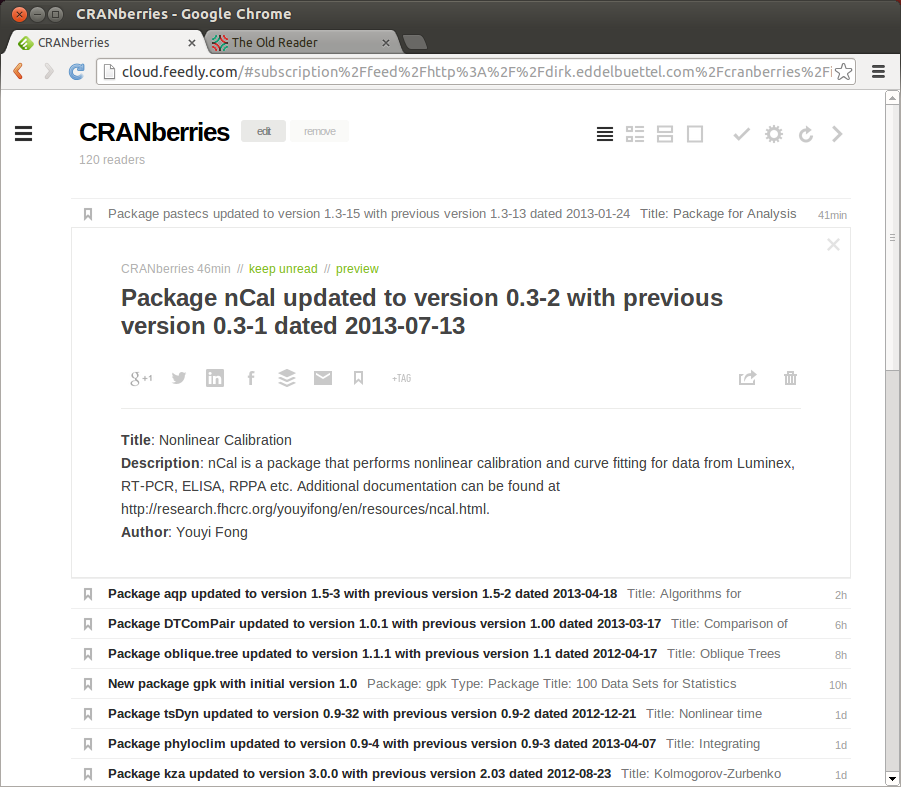
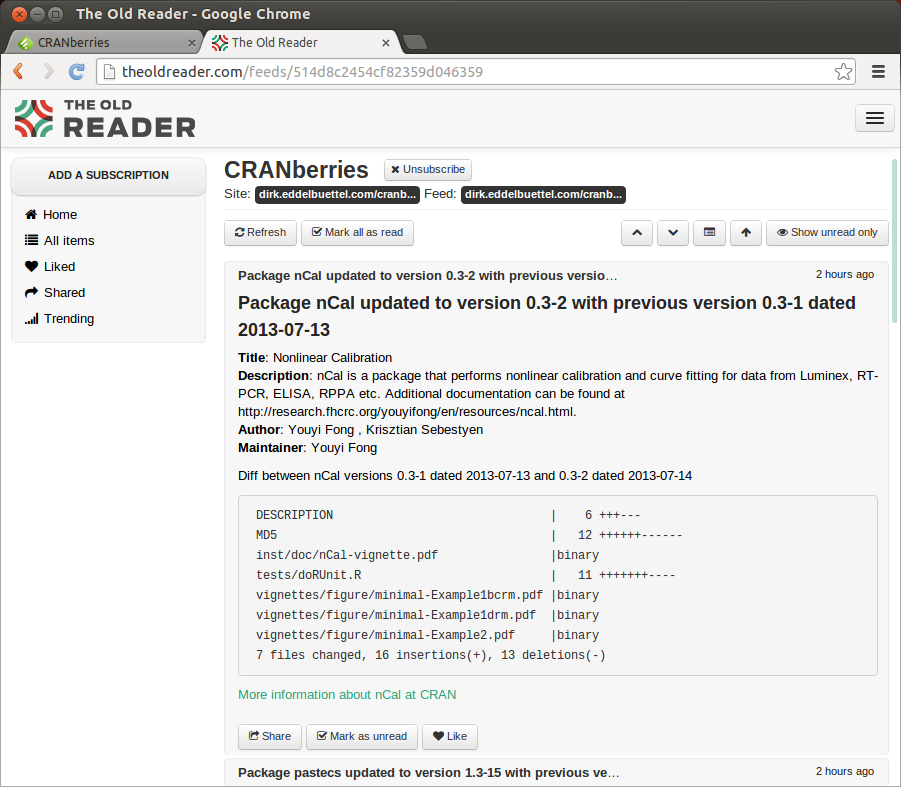
With the demise of Google Reader, many of us have scrambled to find alternatives which cover many/most of the features we were used to. For me, synchronised access from web and mobile counts quite high, and I want the (Android) mobile experience to be pretty pleasant too. So with that, and like many other folks, I had shifted over to Feedly. And before I carry on, let me say that Feedly actually does pretty well. They handled the onslaught of new users; they also listened and changed their UI a little to be more compact and Reader-alike And most importantly, it mostly just works. Until it doesn't. Around the time Feedly shifted folks to their own cloud-based backend, posts from my very own CRANberries aggregator of CRAN package changes for R started to show only truncated posts. See this screenshot from reading Feedly: Feedly truncates the CRANberries post and compare it with this one from TheOldReader: OldReader shows the full CRANberries post which contains the diffstat output, nicely marked up and all. Now, it so happens that I am the creator of the very RSS feed I am consuming here, and I wrote it so that I could read the very diffstat output that is now missing. And I know full well that neither the code, nor the hosting (on my own box), nor any other aspect changed. Before confirming this via TheOldReader, I looked at the RSS output, and I tried other frontend and apps --- and it became clear that the bug seems to be at the Feedly cloud storage level. And trying to be a good sport, I submitted a bug report / suggestion, but to no avail (apart from two other chiming in that they see this elsewhere too). Given that I am the coder behind the feed that is displayed in a truncated manner, I am aware that I am using a code stack that is stale (the original Blosxom static web generator) yet which has not posed another problem anywhere in the decade I used it. Nor does the CRANberries feed pose a problem when aggregated and viewed via the TheOldReader code path, or for that matter via Planet R which also carries (parts of) CRANberries. So for now, I have to either pivot out of the CRANberries RSS reading in Feedly and go directly to the webpage (fine, but cumbersome and in need of a working connection) or use a second subscription mechanism. I appreciate what the TheOldReader folks are doing---presumably with a minor fraction of the resources available to Feedly---and may hang with them for now. But it would be awfully nice if Feedly could sleep off its hangover and fix this. In which case I'd be much happier recommending its service.

25 June 2013

Dirk Eddelbuettel: Rcpp 0.10.4

A new version of Rcpp is now on the CRAN network for GNU R; binaries for Debian have been uploaded as well. This release brings a fairly large number of fixes and improvements across a number of Rcpp features, see below for the detailed list. We are also announcing with this release that we plan to phase out the RCPP_FUNCTION_* macros. Not only have they been superceded by Rcpp Modules and Rcpp Atributes (each of which has its own pdf vignette in the Rcpp package), but they also appear to be at best lightly used. We are for example not aware of any CRAN packages deploying them. To provide a smooth transition, we are aiming to keep them around for another twelve months, but plan to remove them with the first release after that time window has passed. As before, we tested the release rather rigorously by checking against all packages I could (relatively easily) built on my server: this time it covered 91 of the 124 CRAN packages depending on Rcpp. As all of these 91 packages passed their checks, we do not expect any issues with dependent packages. The complete NEWS entry for 0.10.4 is below; more details are in the ChangeLog file in the package and on the Rcpp Changelog page.
Changes in Rcpp version 0.10.4 (2013-06-23)
  • Changes in R code: None beyond those detailed for Rcpp Attributes
  • Changes in Rcpp attributes:
    • Fixed problem whereby the interaction between the gc and the RNGScope destructor could cause a crash.
    • Don't include package header file in generated C++ interface header files.
    • Lookup plugins in inline package if they aren't found within the Rcpp package.
    • Disallow compilation for files that don't have extensions supported by R CMD SHLIB
  • Changes in Rcpp API:
    • The DataFrame::create set of functions has been reworked to just use List::create and feed to the DataFrame constructor
    • The operator-() semantics for Date and Datetime are now more inline with standard C++ behaviour; with thanks to Robin Girard for the report.
    • RNGScope counter now uses unsigned long rather than int.
    • Vector<*>::erase(iterator, iterator) was fixed. Now it does not remove the element pointed by last (similar to what is done on stl types and what was intended initially). Reported on Rcpp-devel by Toni Giorgino.
    • Added equality operator between elements of CharacterVectors.
  • Changes in Rcpp sugar:
  • Changes in Rcpp build tools:
    • Fix by Martyn Plummer for Solaris in handling of SingleLogicalResult.
    • The src/Makevars file can now optionally override the path for /usr/bin/install_name_tool which is used on OS X.
    • Vignettes are trying harder not to be built in parallel.
  • Changes in Rcpp documentation:
    • Updated the bibliography in Rcpp.bib (which is also sourced by packages using Rcpp).
    • Updated the THANKS file.
  • Planned Deprecation of RCPP_FUNCTION_*:
    • The set of macros RCPP_FUNCTION_ etc ... from the preprocessor_generated.h file will be deprecated in the next version of Rcpp, i.e they will still be available but will generate some warning in addition to their expected behavior.
    • In the first release that is at least 12 months after this announcement, the macros will be removed from Rcpp.
    • Users of these macros (if there are any) should start replacing them with more up to date code, such as using Rcpp attributes or Rcpp modules.
Thanks to CRANberries, you can also look at a diff to the previous release 0.10.3. As always, even fuller details are on the Rcpp Changelog page and the Rcpp page which also leads to the downloads, the browseable doxygen docs and zip files of doxygen output for the standard formats. A local directory has source and documentation too. Questions, comments etc should go to the rcpp-devel mailing list off the R-Forge page

13 June 2013

Dirk Eddelbuettel: inline 0.3.12

Another maintenance release of inline is now on CRAN and in already included in Debian. This release was triggered by a change in the development version of R which removed an argument to package.skeleton(). The complete NEWS entry is below.
Changes in inline version 0.3.12 (2013-06-12)
  • Align package.skeleton with the R-devel version of the function which no longer has a NAMESPACE argument.
  • Remove copy of LGPL in source archive as R CMD check now complains about it. License status continues to be specified in file DESCRIPTION.
Courtesy of CRANberries, there is also a diffstat report for the most recent release. A few more details are available at the R-Forge page.

5 June 2013

Dirk Eddelbuettel: RcppArmadillo 0.3.900.0

A Armadillo release 3.900.0 was provided by Conrad yesterday. It has been rolled into a new RcppArmadillo release 0.3.900.0 which is now on CRAN and in Debian. It has a number of nice changes, mostly on the performance side of things (see below) and a minor cleanup/improvement in our Kalman filter example (which, as I just realized, I forgot to note in the \code NEWS.Rd in the released tarball):
Changes in RcppArmadillo version 0.3.900 (2013-06-04)
  • Upgraded to Armadillo release Version 3.900.0 (Bavarian Sunflower)
    • added automatic SSE2 vectorisation of elementary expressions (eg. matrix addition) when using GCC 4.7+ with -O3 optimisation
    • added support for saving & loading of cubes in HDF5 format, contributed by Szabolcs Horvat
    • faster median(), contributed by Ruslan Shestopalyuk
    • faster handling of compound expressions with transposes of submatrix rows
    • faster handling of compound expressions with transposes of complex vectors
  • Kalman filter example switched from inline to \code sourceCpp , which simplifies / streamlines the C++ side a little
Courtesy of CRANberries, there is also a diffstat report for the most recent release As always, more detailed information is on the RcppArmadillo page. Questions, comments etc should go to the rcpp-devel mailing list off the R-Forge page.

14 May 2013

Dirk Eddelbuettel: RcppArmadillo 0.3.820

Conrad rolled up a new Armadillo release 3.820 (following two minor fix release in the 0.3.810 series of which we packaged the one that was relevant for us). This new version is now out in a release 0.3.820 of RcppArmadillo which is already on CRAN and in Debian. The summary of the main changes follows:
Changes in RcppArmadillo version 0.3.820 (2013-05-12)
  • Upgraded to Armadillo release Version 3.820 (Mt Cootha)
    • faster as_scalar() for compound expressions
    • faster transpose of small vectors
    • faster matrix-vector product for small vectors
    • faster multiplication of small fixed size matrices
Courtesy of CRANberries, there is also a diffstat report for the most recent release As always, more detailed information is on the RcppArmadillo page. Questions, comments etc should go to the rcpp-devel mailing list off the R-Forge page.

Next.

Previous.