
A new version of
RcppGSL just arrived on
CRAN. The
RcppGSL package provides an interface from
R to the
GNU GSL using our
Rcpp package.
Following on the heels of an
update last month we updated the package (and its vignette) further. One of the key additions concern memory management: Given that our proxy classes around the GSL vector and matrix types are real C++ object, we can monitor their scope and
automagically call
free() on them rather then insisting on the user doing it. This renders code
much simpler as illustrated below.
Dan Dillon added
const correctness over a series on pull request which allows us to write more standard (and simply
nicer) function interfaces. Lastly, a few new
typedef declaration further simply the use of the (most common)
double and
int vectors and matrices.
Maybe a code example will help.
RcppGSL contains a full and complete example package illustrating how to write a package using the
RcppGSL facilities. It contains an example of computing a column norm -- which we
blogged about before when announcing an much earlier version. In its full glory, it looks like this:
#include <RcppGSL.h>
#include <gsl/gsl_matrix.h>
#include <gsl/gsl_blas.h>
extern "C" SEXP colNorm(SEXP sM)
  try
        RcppGSL::matrix<double> M = sM;     // create gsl data structures from SEXP
        int k = M.ncol();
        Rcpp::NumericVector n(k);           // to store results
        for (int j = 0; j < k; j++)
            RcppGSL::vector_view<double> colview = gsl_matrix_column (M, j);
            n[j] = gsl_blas_dnrm2(colview);

        M.free() ;
        return n;                           // return vector
    catch( std::exception &ex )
        forward_exception_to_r( ex );
    catch(...)
        ::Rf_error( "c++ exception (unknown reason)" );

  return R_NilValue; // -Wall
We manually translate the
SEXP coming from R, manually cover the
try and
catch exception handling, manually free the memory etc pp.
Well in the current version, the example is written as follows:
#include <RcppGSL.h>
#include <gsl/gsl_matrix.h>
#include <gsl/gsl_blas.h>
// [[Rcpp::export]]
Rcpp::NumericVector colNorm(const RcppGSL::Matrix & G)
    int k = G.ncol();
    Rcpp::NumericVector n(k);           // to store results
    for (int j = 0; j < k; j++)
        RcppGSL::VectorView colview = gsl_matrix_const_column (G, j);
        n[j] = gsl_blas_dnrm2(colview);

    return n;                           // return vector
This takes full advantage of
Rcpp Attributes automagically creating the interface and exception handler (as per the
previous release), adds a
const & interface, does away with the tedious and error-pronce
free() and uses the shorter-
typedef forms for
RcppGSL::Matrix and
RcppGSL::VectorViews using
double variables. Now the function is short and concise and hence easier to read and maintain. The
package vignette has more details on using
RcppGSL.
The NEWS file entries follows below:
Changes in version 0.3.0 (2015-08-30)
-
The RcppGSL matrix and vector class now keep track of object allocation and can therefore automatically free allocated object in the destructor. Explicit
x.free() use is still supported.
-
The matrix and vector classes now support const reference semantics in the interfaces (thanks to PR #7 by Dan Dillon)
-
The matrix_view and vector_view classes are reorganized to better support const arguments (thanks to PR #8 and #9 by Dan Dillon)
-
Shorthand forms such as
Rcpp::Matrix have been added for double and int vectors and matrices including views.
-
Examples such as
fastLm can now be written in a much cleaner and shorter way as GSL objects can appear in the function signature and without requiring explicit .free() calls at the end.
-
The included examples, as well as the introductory vignette, have been updated accordingly.
Courtesy of
CRANberries, a summary of changes to
the most recent release is available.
More information is on the
RcppGSL page. Questions, comments etc should go to the
rcpp-devel mailing list off the
R-Forge page.
This post by Dirk Eddelbuettel originated on his Thinking inside the box blog. Please report excessive re-aggregation in third-party for-profit settings.
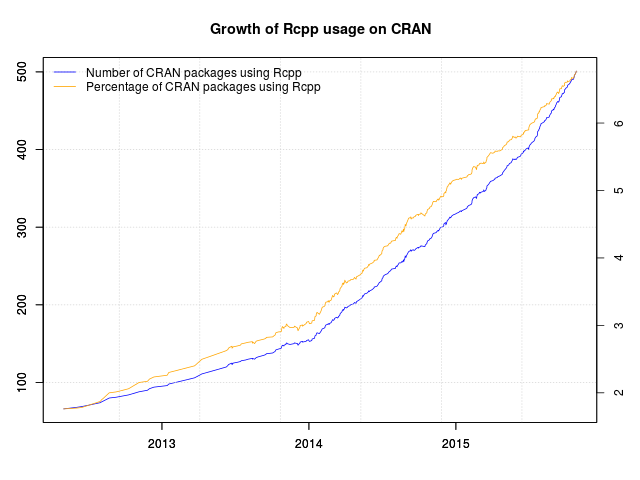 This morning, Rcpp reached another round milestone: 501 packages on CRAN now depend on it (as measured by Depends, Imports and LinkingTo declarations, and even excluding one or two packages with an accidental declaration that do not use it). The graph is on the left depicts the growth of Rcpp usage over time. And there are a full seventy more on BioConductor in its development branch (but BioConductor is not included in the chart).
Rcpp cleared 300 packages less than a year ago. It passed 400 packages in June when I only tweeted about it this June (while traveling for Rcpp training at U Zuerich, the R Summit at CBS, and the fabulous useR! 2015 at U Aalborg; so no blog post). The first and less detailed part uses manually saved entries, the second half of the data set was generated semi-automatically via a short script appending updates to a small file-based backend. A list of user package is kept on this page.
Also displayed in the graph is the relative proportion of CRAN packages using Rcpp. The four per-cent hurdle was cleared just before useR! 2014 where I showed a similar graph (as two distinct graphs) in my invited talk. We passed five percent in December of last year, six percent this July and now stand at 6.77 percent, or about one in fourteen R packages.
500 user packages is very humbling, a staggering number and a big responsibility. We will out best try to keep Rcpp as performant and reliable as it has been so that the next set of packages can rely on it---just like these 500 do.
So with that a very big Thank You! to all users and contributors of Rcpp for help, suggestions, bug reports, documentation or, of course, code.

 The somewhat regular monthly upstream
 Hm, wasn't there a

 A new version 0.1.0 of the