Search Results: "zed"

28 March 2026

Valhalla's Things: Ink Lightfastness Tests 2026

Posted on March 28, 2026
Tags: madeof:atoms, topic:inks
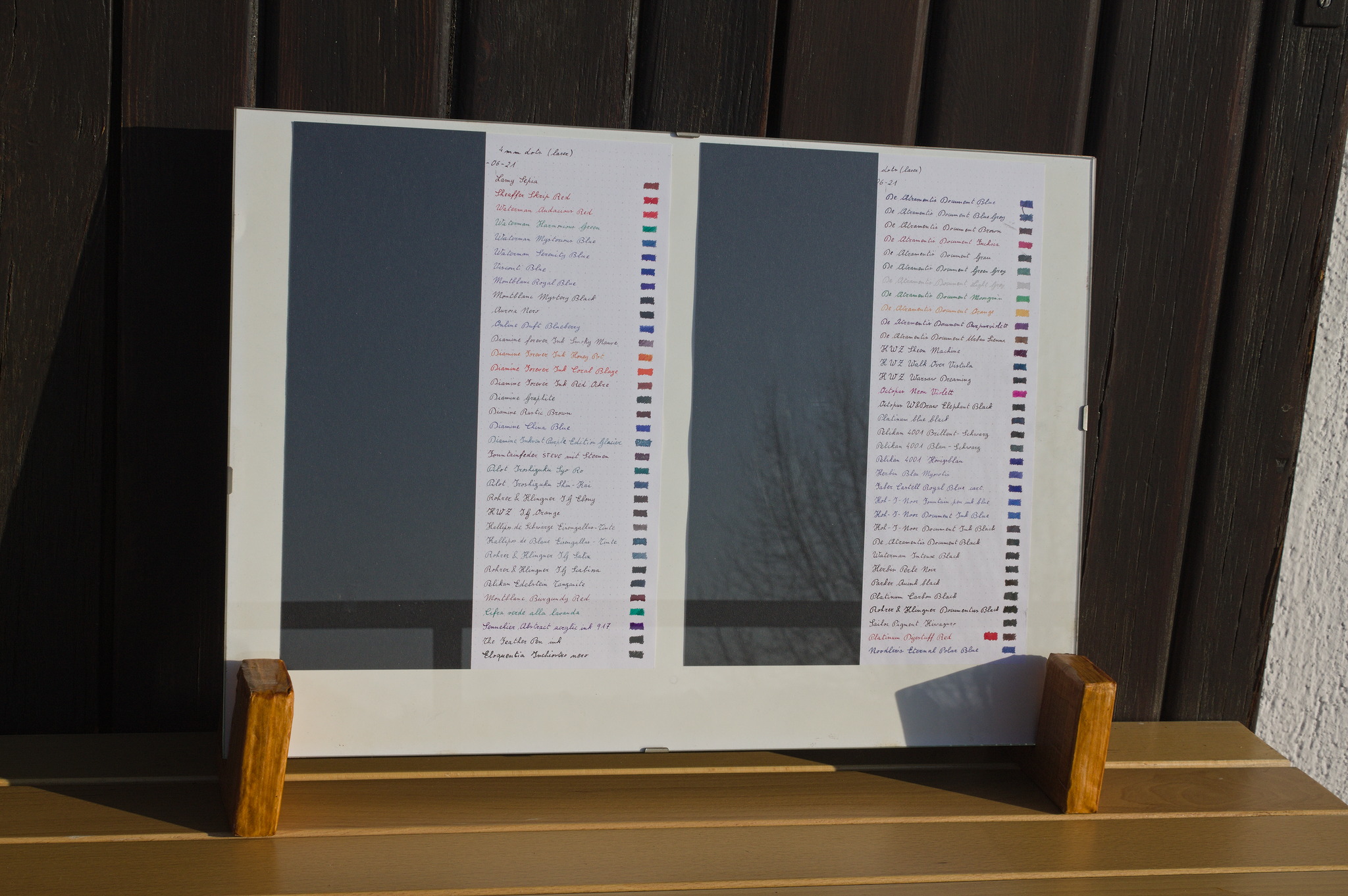
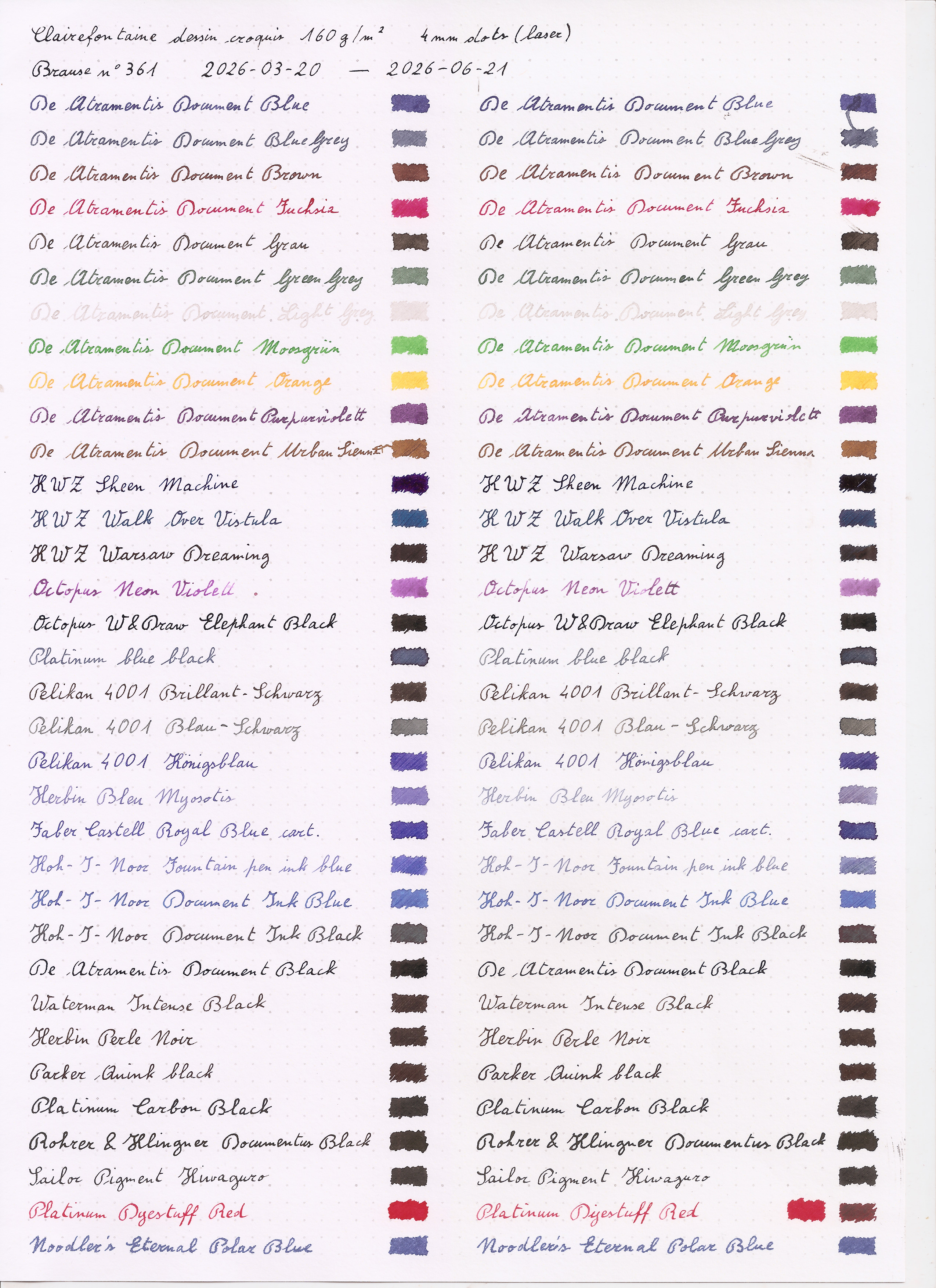
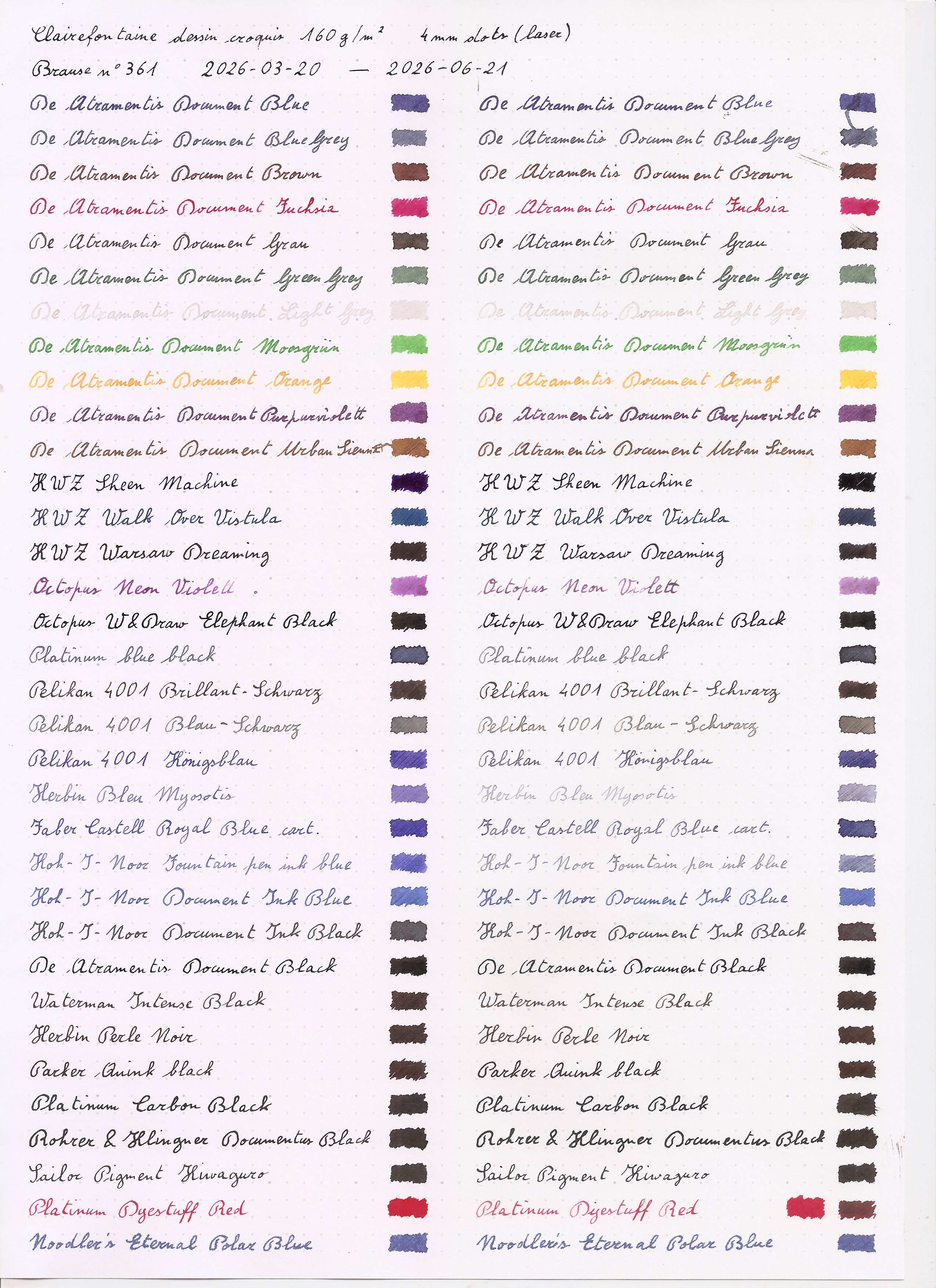
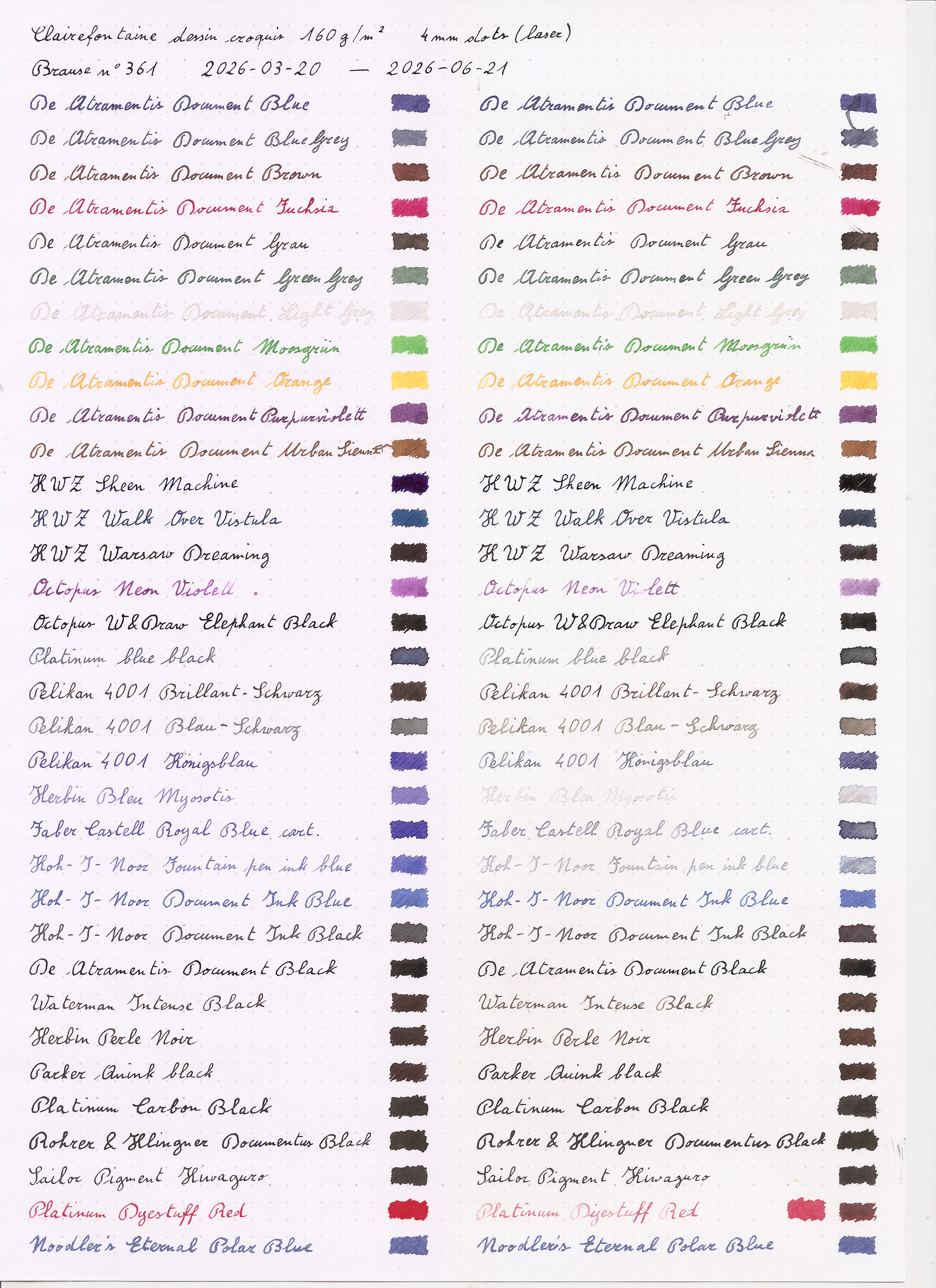
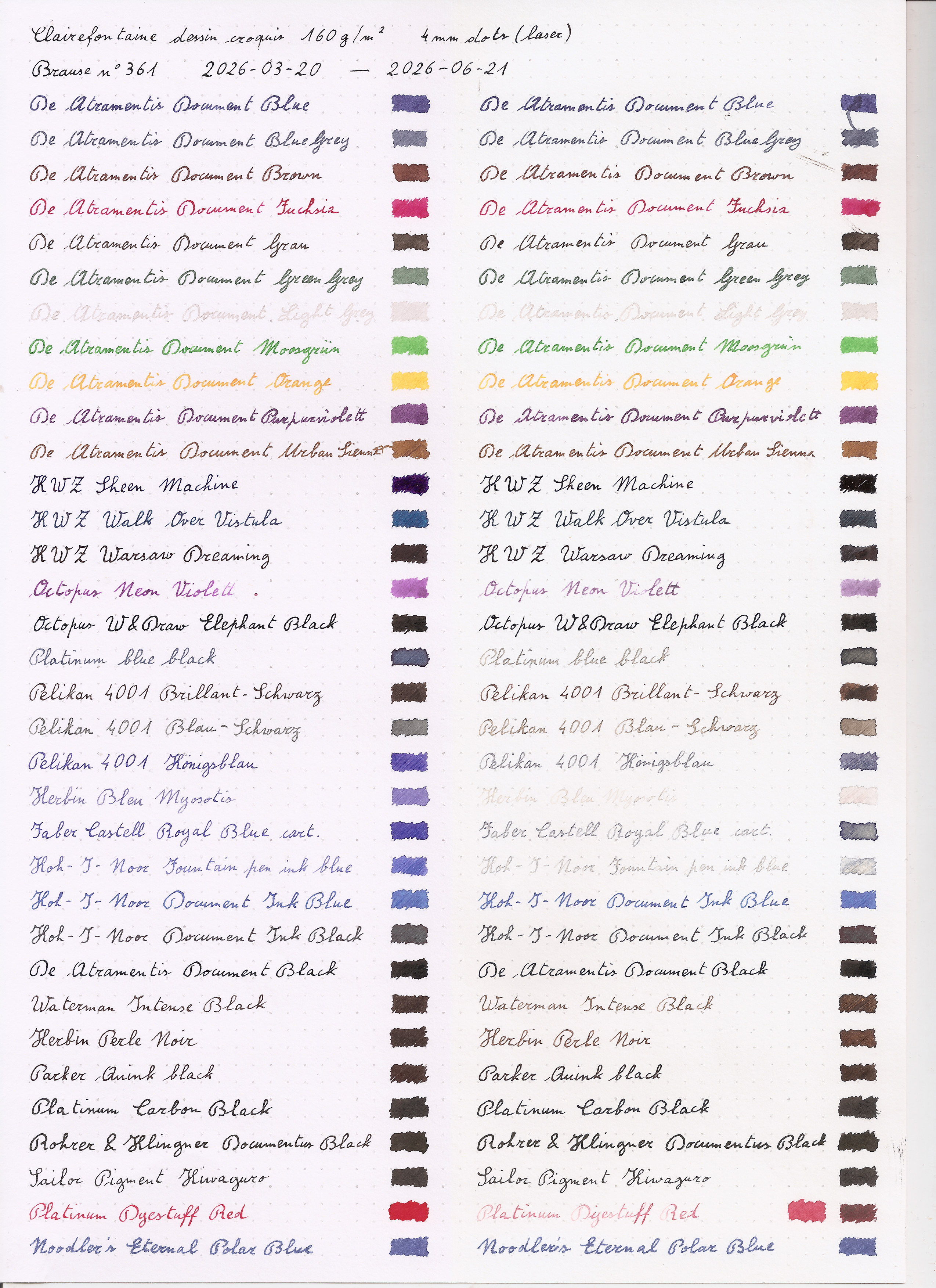
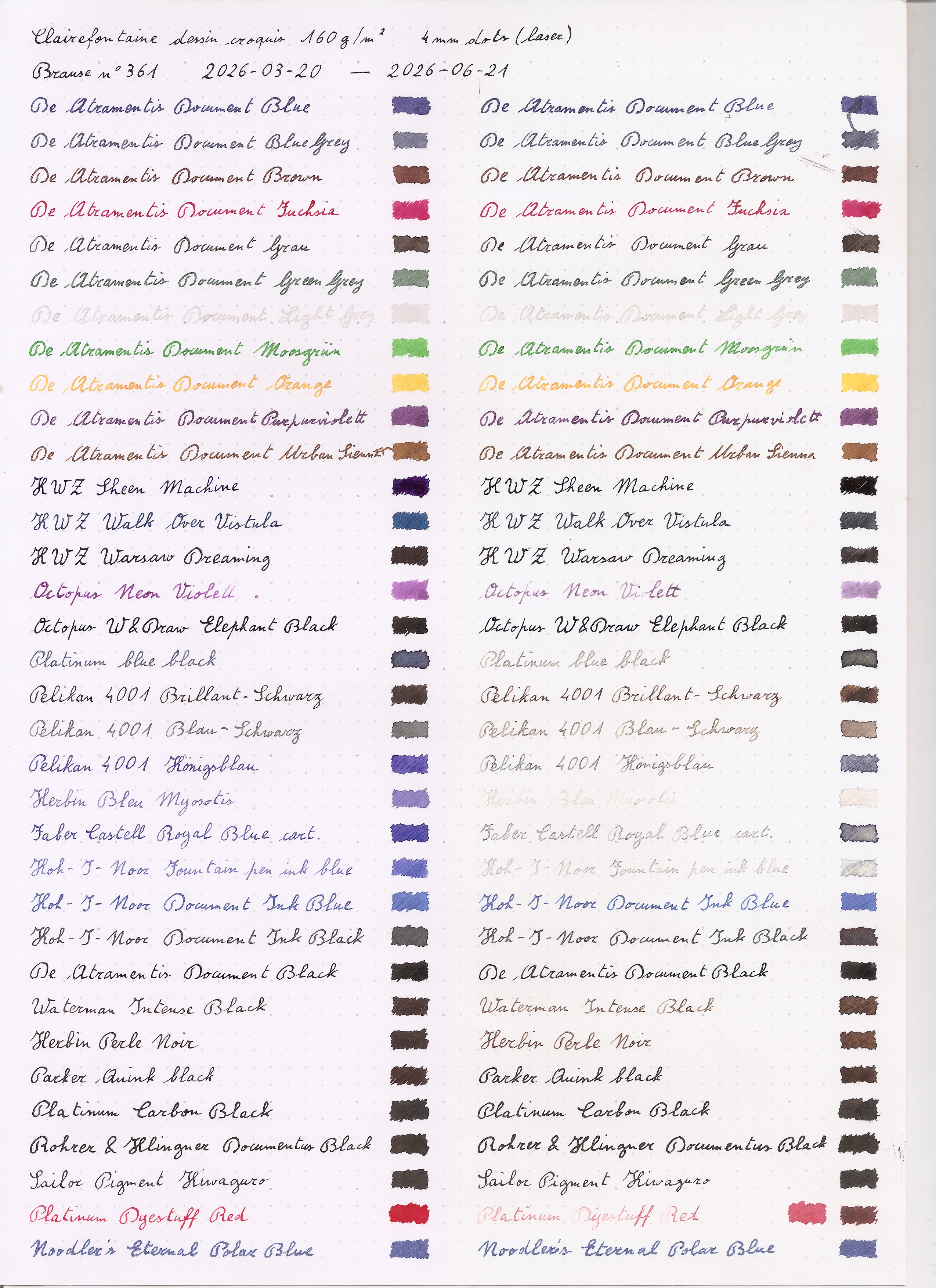
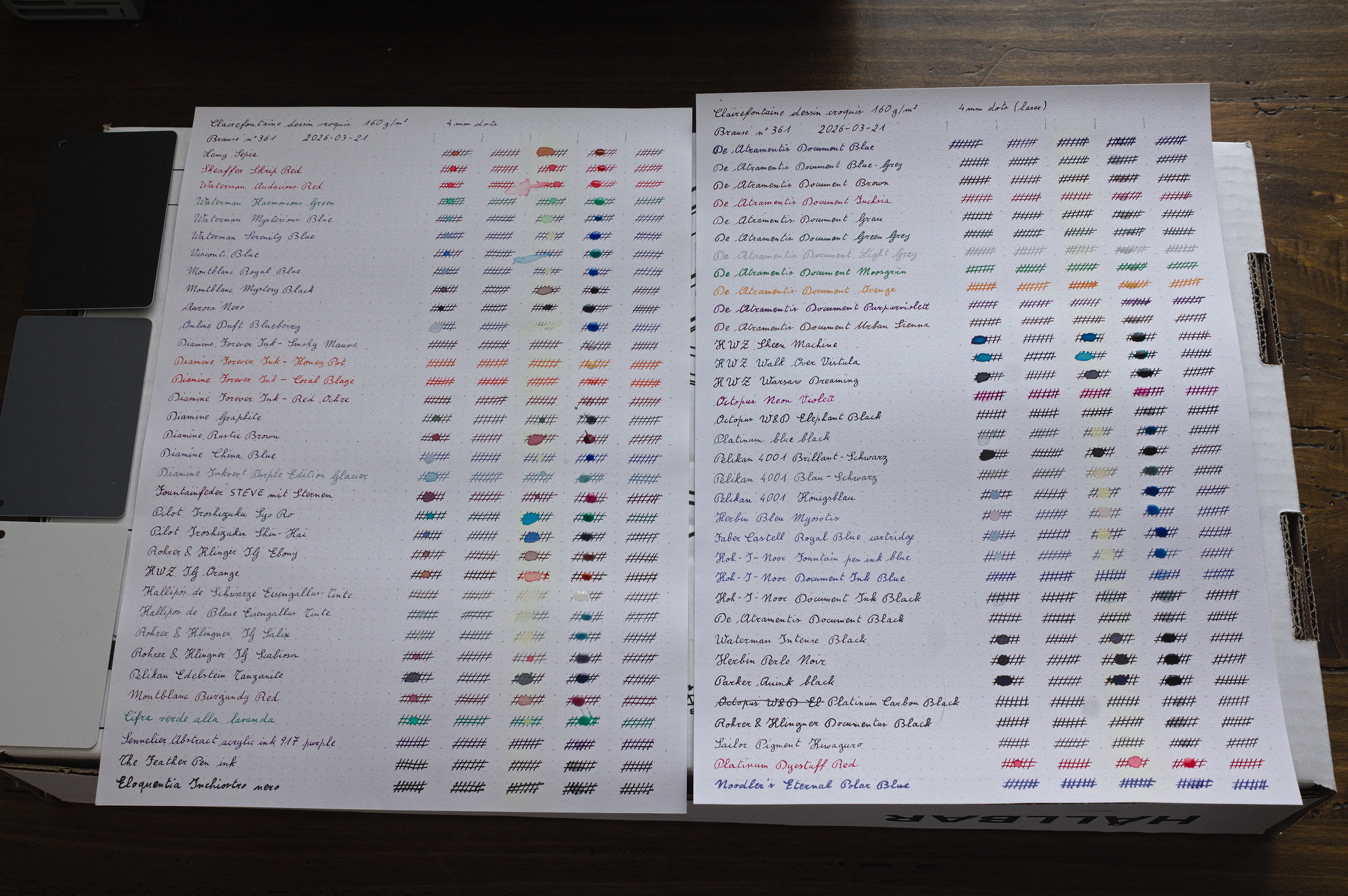
A borderless frame set on a table outdoors, with two sheets of paper a vertical half of which is covered by black paper, while the other half has lines with an ink name and a small filled rectangle, all in the ink itself.
Note
This post will be updated in the next weeks with the test results as they become available.
Note
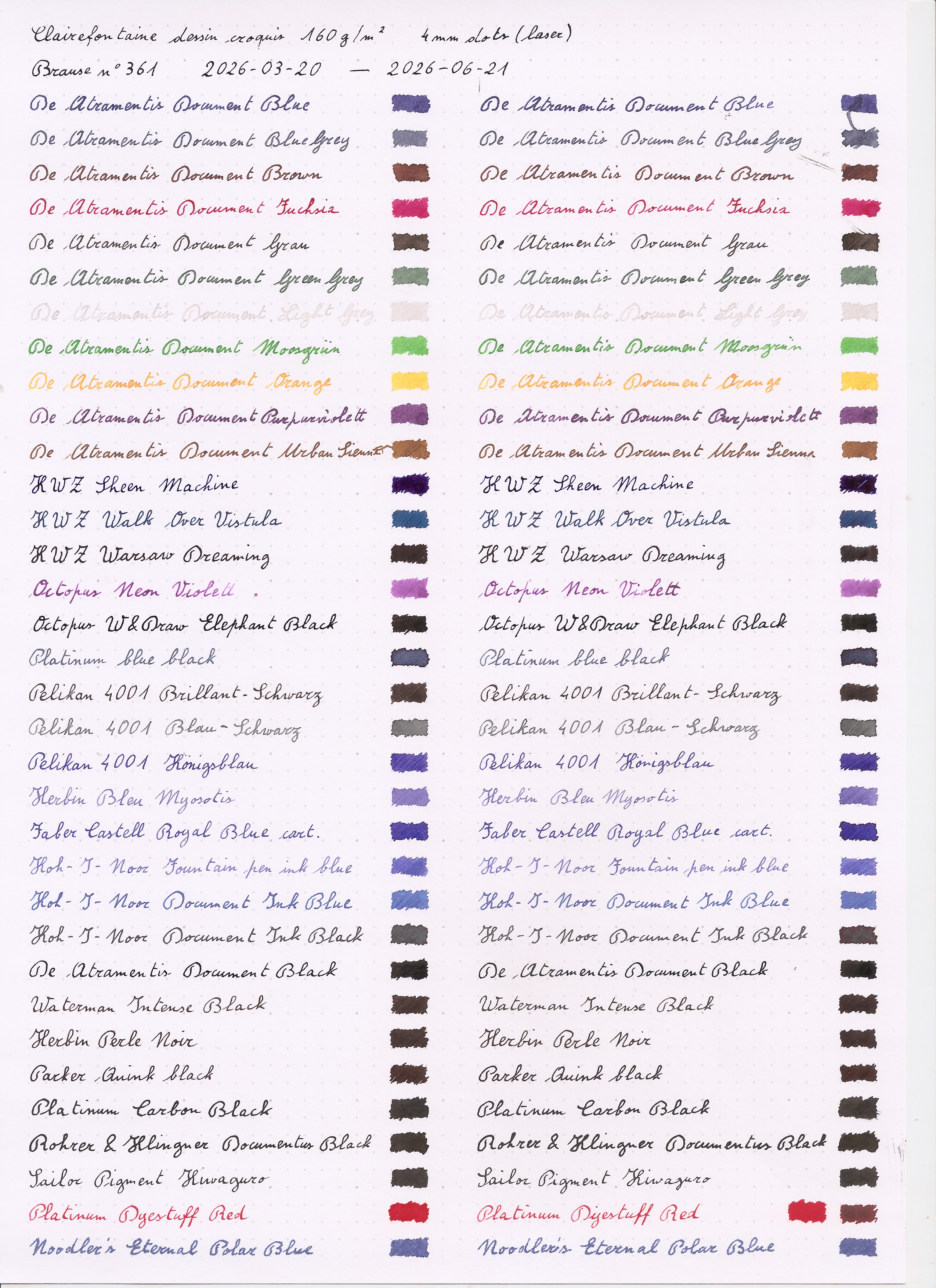
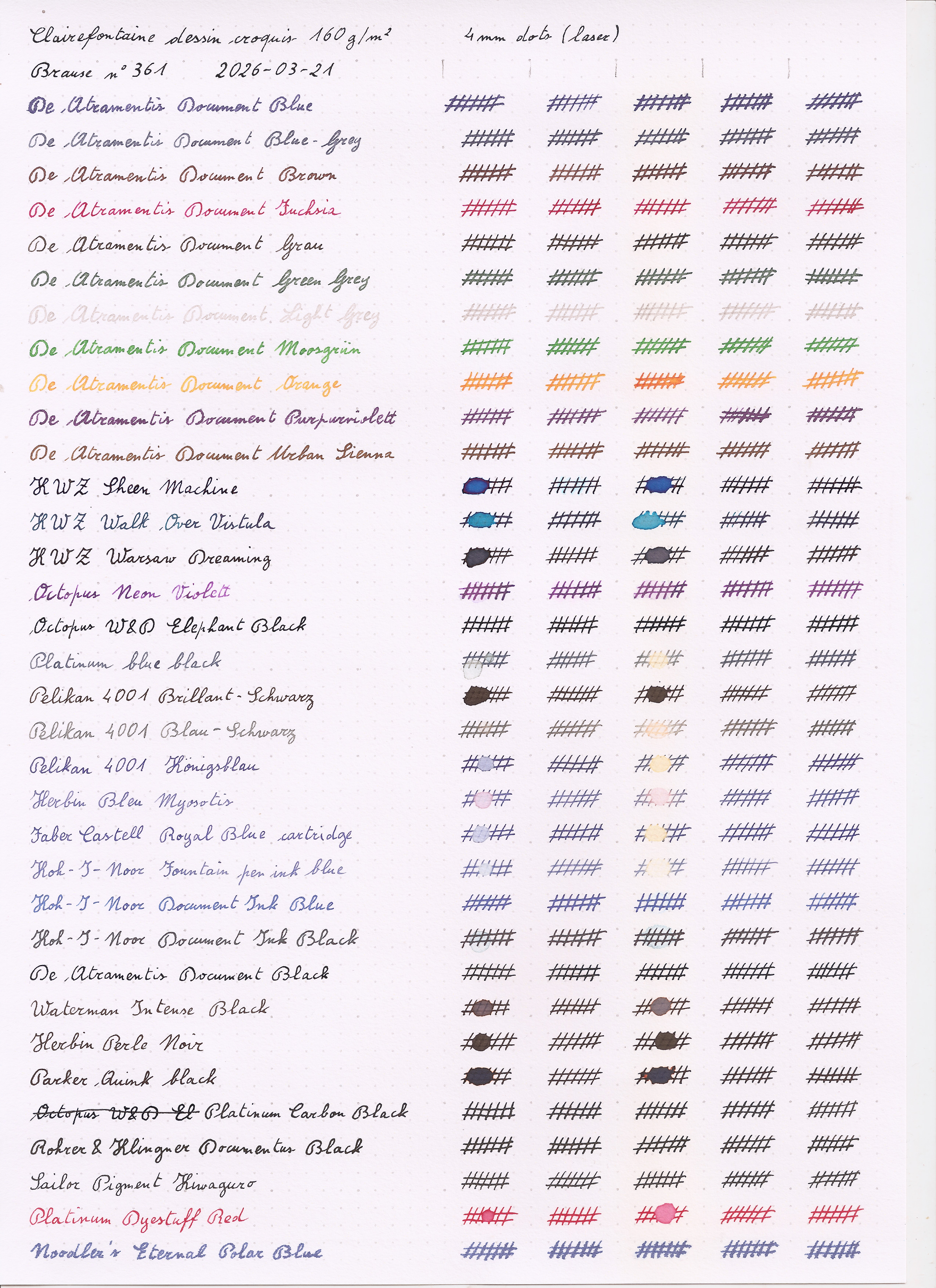
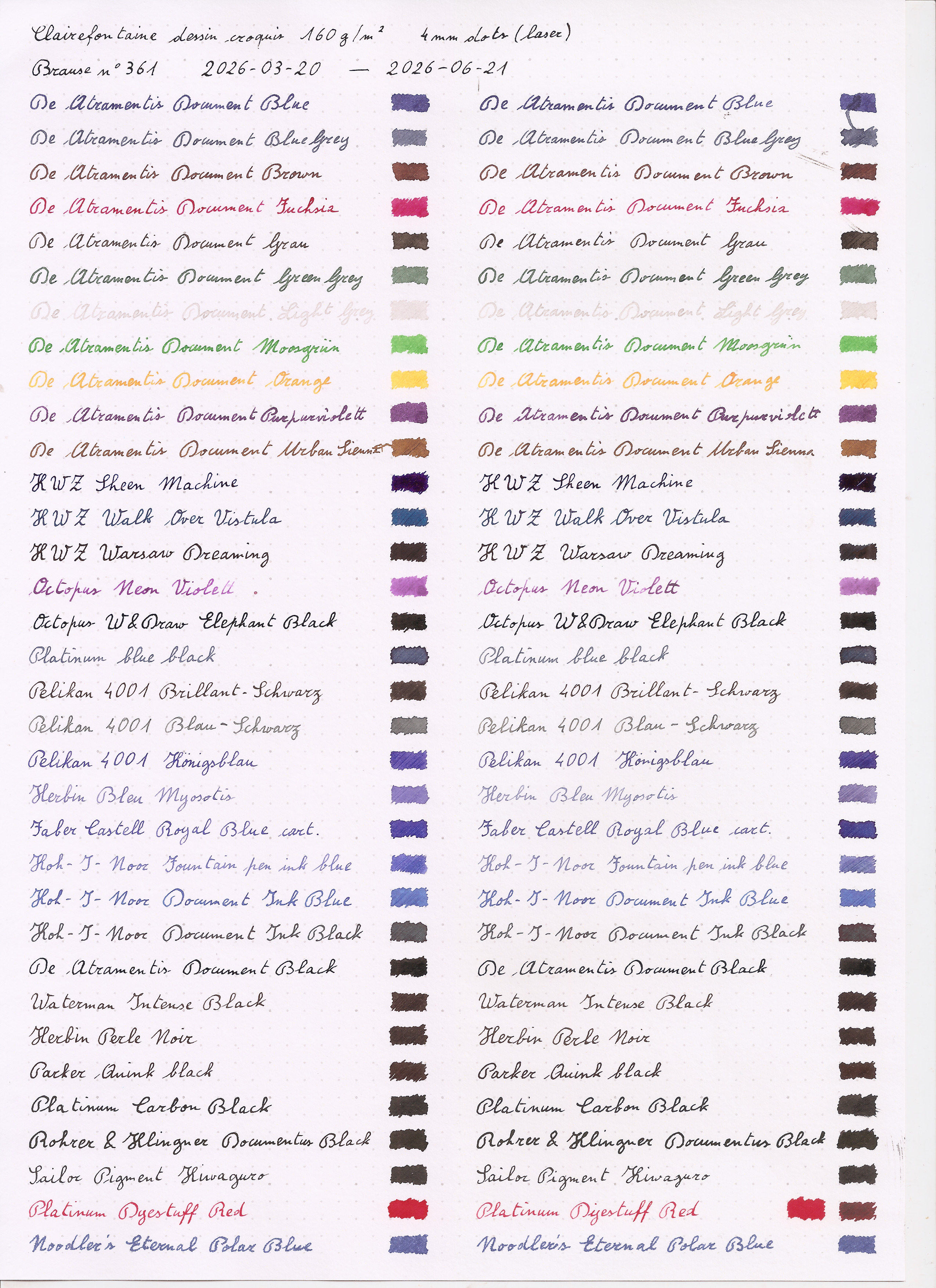
Most of the images in this post have no real alt-text: they are all scans of the test sheet at various stages through the test, and the results visible on them are described in detail at the end of the post.
Most of the time, what people write by hand will either end up inside a notebook in a drawer or cupboard where it s well protected, or thrown in the recycling where it doesn t matter. There are times, however, when things will be exposed to light: it doesn t matter whether it s a work of artistic calligraphy that you want to frame or a passive-aggressive notice left in the atrium of a building; it is useful to know whether the work will remain legible or it will fade into nothing in a short time. A few inks are tested by the producers for lightfastness according to some established standard, a few others are declared lightfast in a generic way, but a lot come with no indication at all. Proper testing according to the standard scales requires significant equipment to precisely control the exposure, but it s significantly easier and fun to do a simple test to divide the inks into three categories:
  • suitable for framed calligraphy, i.e. it looks the same after 3 months of direct sun exposure;
  • suitable for complaining about the way your neighbours deal with the trash, i.e. still readable after 3 months of exposure;
  • not suitable for either, i.e. has faded significantly in the same time.
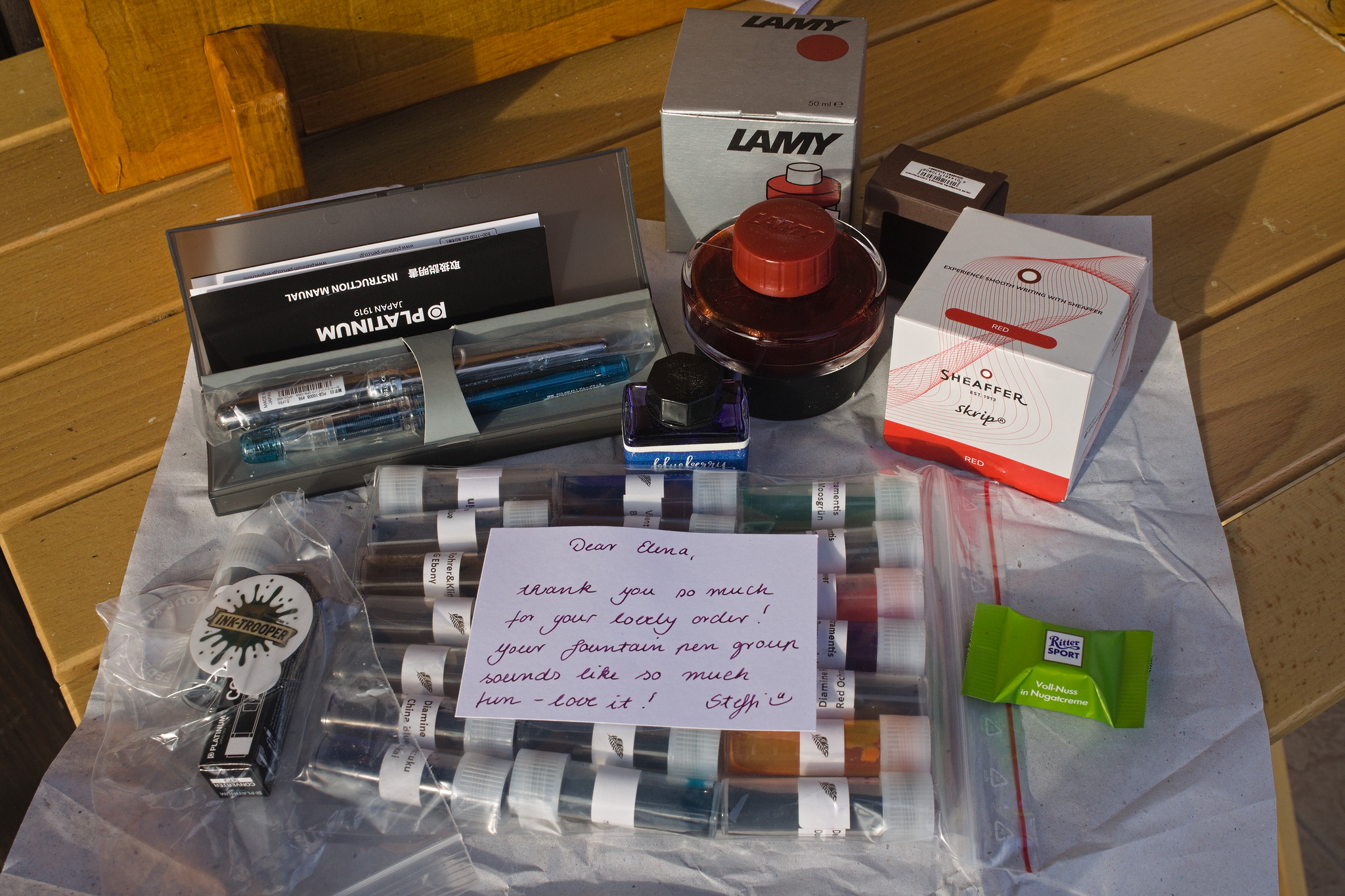
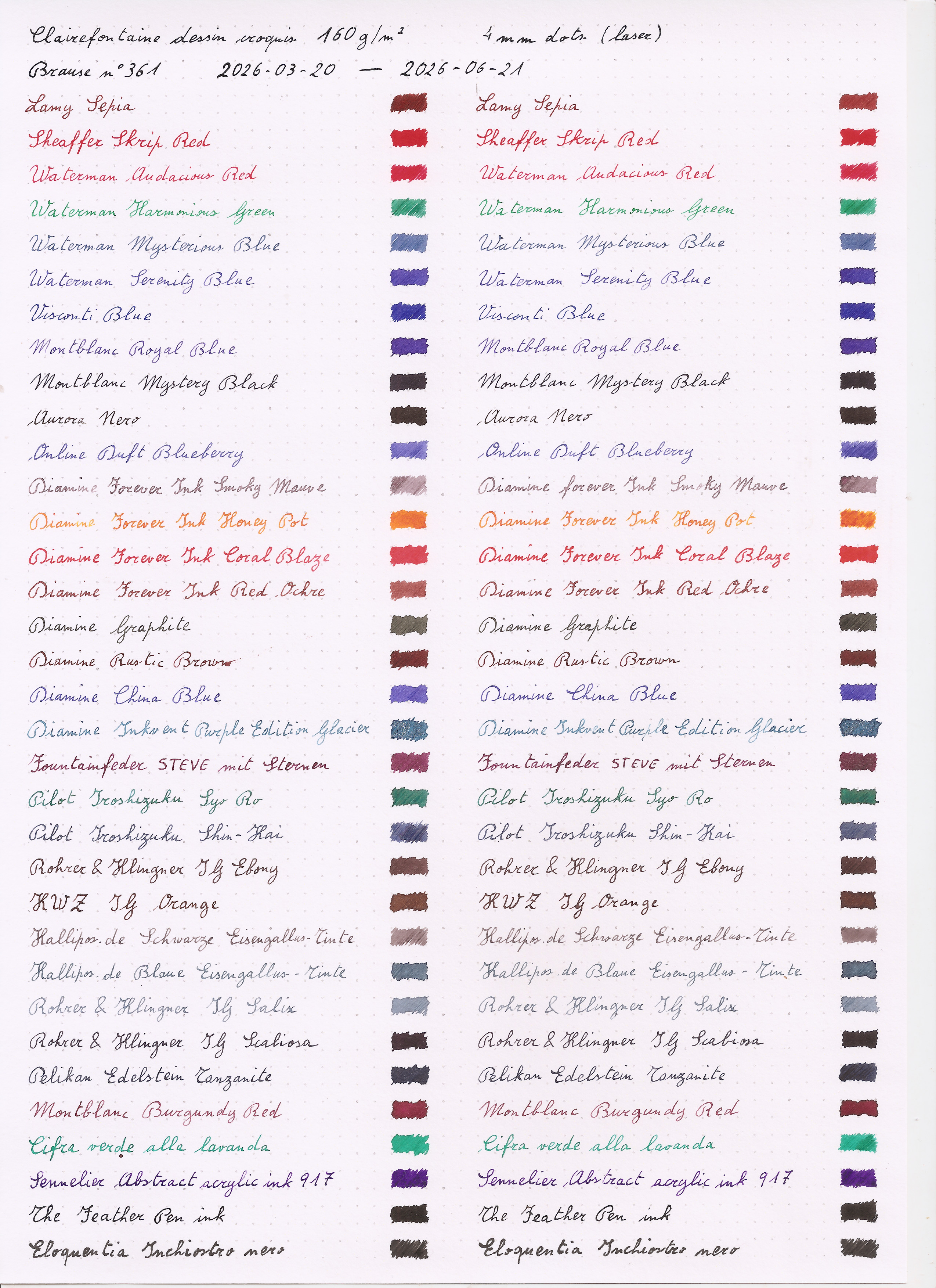
In the past I ve done some such tests by taping some sheets to a south-east facing window, and I ve noticed that most of the results were already apparent after a month, and there was basically no difference between two and three months of exposure, but spring equinox to summer solstice is a nice timeframe to use for such a test (and it leaves time for a second test of different materials from summer solstice to autumn equinox), so this is what I ve chosen to do this year. Rather than a window, now I have access to a south-facing covered balcony that is protected from rain but receives quite a bit of direct sun, so instead of taping sheets to the windows1 I ve prepared a sturdy cardboard panel that I can leave on a table on the balcony, hopefully safe from the rain, but well exposed to the sun. And then made a quick test, and realized that without the window glass in front, the black strip used to cover the unexposed half of the sample doesn t lay flat and lets some sun in, so I used an old cheap2 glass frame instead of the panel. The contents of an order from a fountain pen shop, spread out on a table: a couple of cheap pens, a couple bottles of ink, a converter, a small ritter sport chocolate and a bag full of 5 ml vials with 2 ml of ink each, and a thank-you note from the seller (Steffi). The next step, already in January, was mentioning in a fountain-pen enthusiasts forum that I planned such a test, and asking if people were interested in having me buy a few samples of more inks when I was buying my next pen. The word enthusiasts is probably a hint of the reason why soon afterwards I received a package with the pen I had planned to buy, its converter, and a couple dozens ink samples. And then a couple envelopes with additional samples of inks that weren t available on the shops, from said enthusiasts. Added to the inks I already had acquired since the last lightfastness test, it meant that they couldn t all fit in one single page, and thus I had some room to add some inks I had already tested: some were requests, and for others I tried to select ones that felt relevant. Since I m changing the test setup, I ve decided I should probably keep doing this until I ve tested again all of the inks I still have available. see below see below For the paper, I ve used A4 sheets of Clairefontaine Dessin Croquis 160 g/m , one of my staples that I m sure I will have available in the next years, printed with a dot pattern with a laser printer, using this pdf. And as for the pen I ve used a fresh Brause n 361 nib: loading a fountain pen with all of these inks wouldn t be a reasonable effort, and the 361 is one of the writing implements I use most anyway. I also used a glass pen to fill a couple of squares on the paper with more ink. One side of each sheet was then covered with a strip of 300 g/m black paper (also from Clairefontaine), kept in place with three dots of non-permanent two sided tape, put in the frame and set out in the sun on the morning of 2026-03-20, the day of the spring equinox.
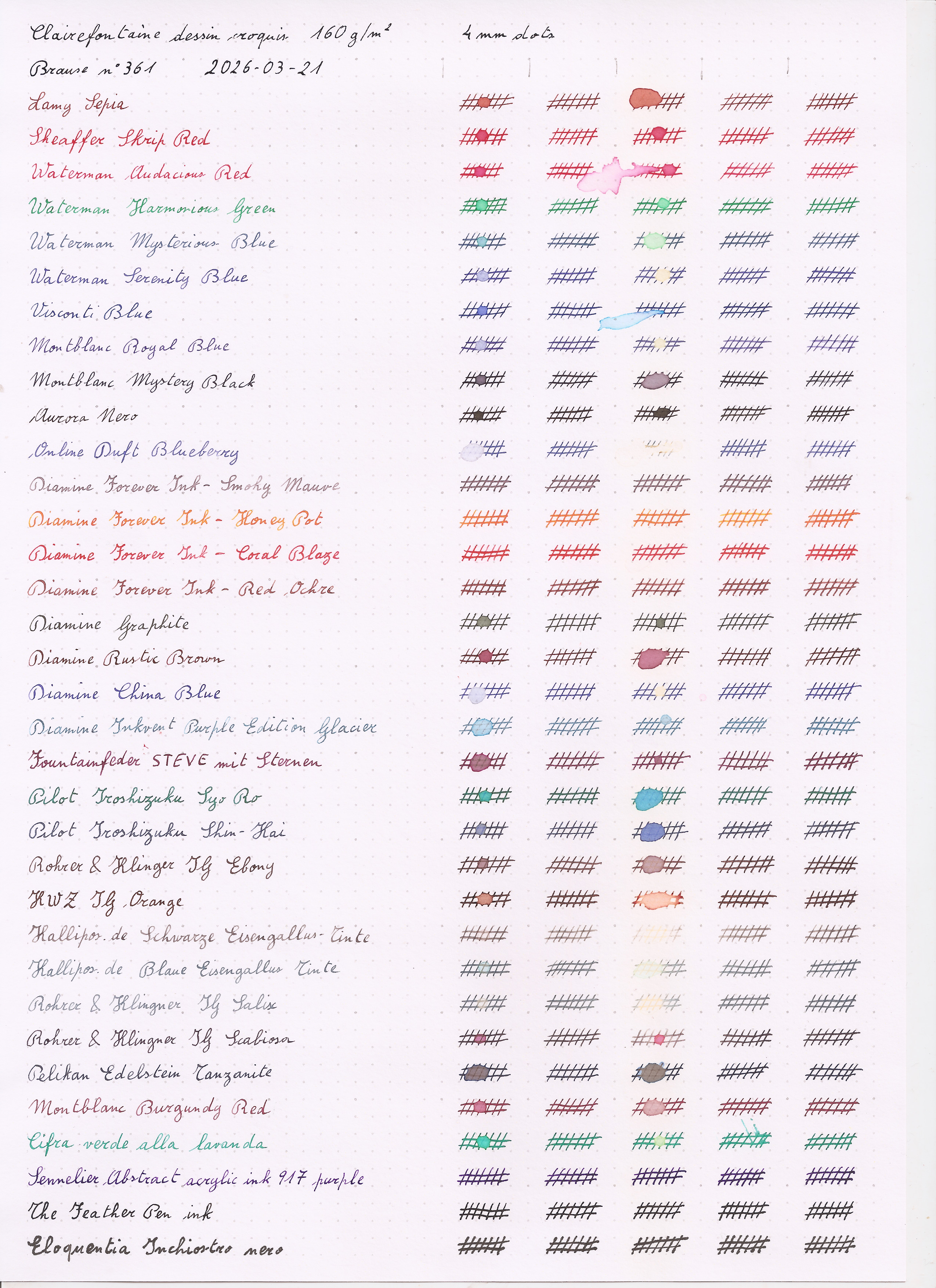
see below While I was filling the sheet for the lightfastness tests, I decided to also prepare a second set of sheet, for a liquid resistance drop test. On each line, beside the name of the ink, I added five sets of crossing parallel lines, and let everything dry for a few days. Then I used a syringe to put a drop of a liquid on each set of lines, waited for it to be absorbed into the paper and to dry, at least overnight, but sometimes also for a day or two (life happened), and then looked at the results and did the next test. The first liquid was water, with the usual wild difference between washable and permanent inks, and all of the intermediate possibilities. The second liquid was isopropyl alcohol, and I was surprised to see that, with very few exceptions, most inks didn t change at all. I wonder whether that s related to the fact that instead of forming a drop it was absorbed almost immediately into the paper, and dried in a very short time. The third liquid was hydrogen peroxide: beside the individual results I noticed that its column yellowed visibly; I wonder whether that means that the paper I used has optical brighteners, and it will also yellow under the sun: that wouldn t be ideal, but it would also be a surprise, for paper that is acid free and sold for arts. The fourth liquid was citric acid, by mixing a bit less than a teaspoon of citric acid granules in just enough very warm water (heated to 70 C, i.e. the lowest temperature available on my kettle) to dissolve most of the acid. I forgot that I had some old PH strips until one hour after I ve put the drop on the paper, and I don t know whether something had changed, but when I did remember about them it showed a deep red between 1 and 2. I don t think I can trust those strips too much, however. This backfired badly: the drop of citric acid never dried out, but formed a sticky paste that prevented me from scanning the results, and I m not sure whether I ll do the last test, which was supposed to be household bleach. see below see below Luckily I had scanned the partial results, and they are shown here.
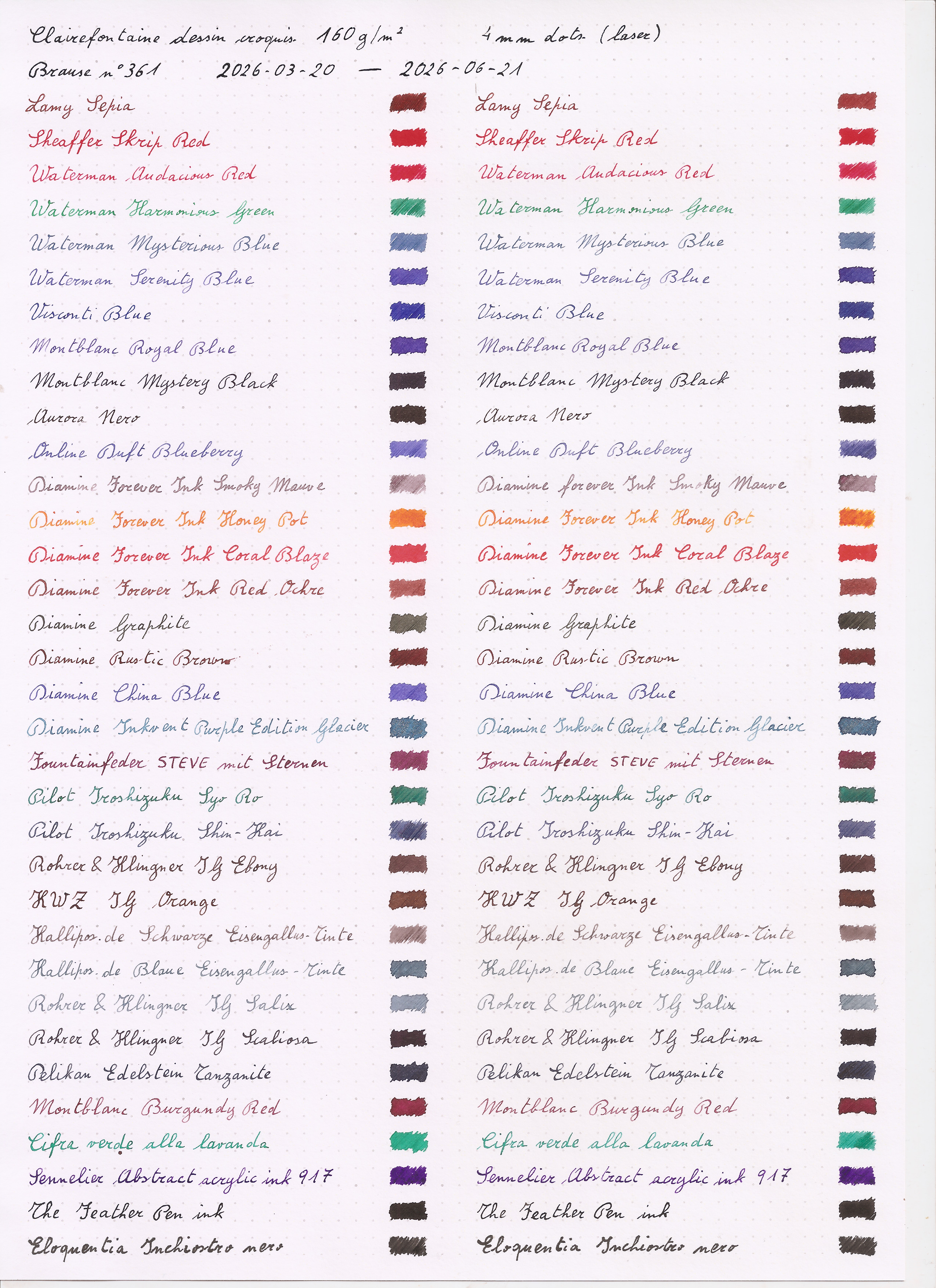
see below see below After one full day with plenty of sun, nothing really had changed, except possibly for a vague hint that the Herbin Bleu Myosotis may have have been a bit lighter than it started, but it may also have been a suggestion.
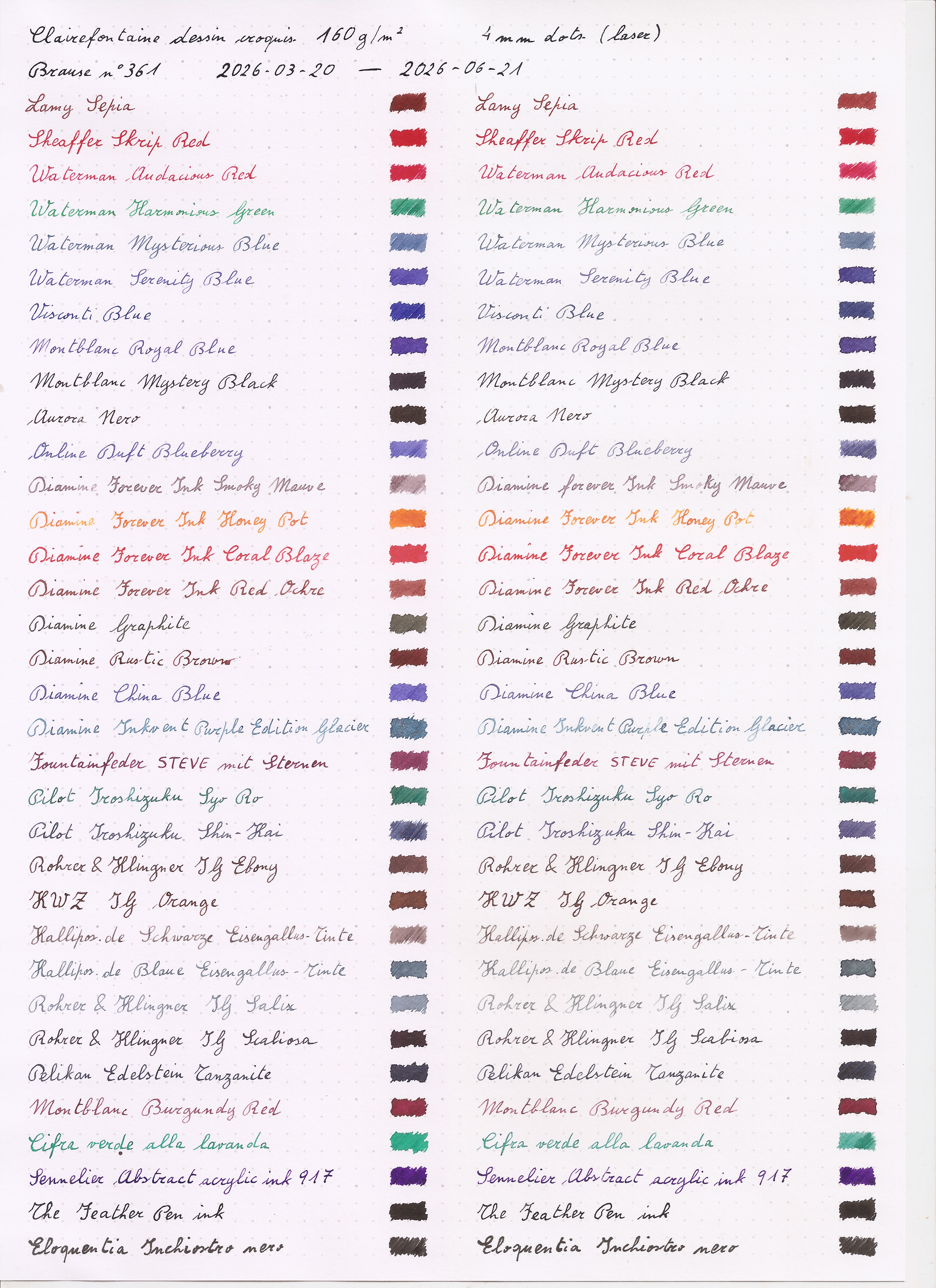
see below see below After three days, however, some results started to show, with the most fugitive inks starting to be visibly changed, becoming either paler or in some case duller.
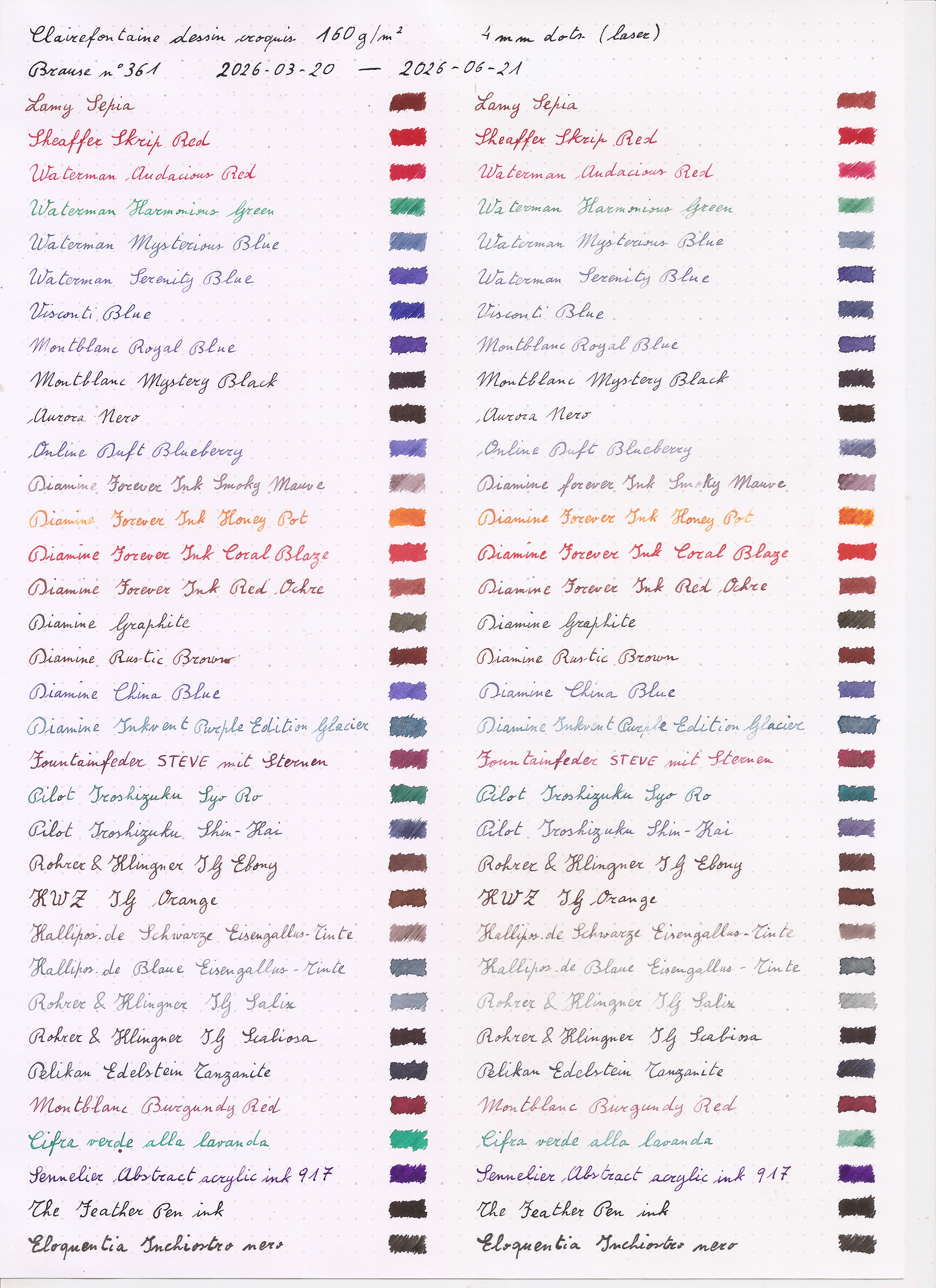
see below see below And the full week showed more of that, with a few more inks starting to show visible change.
see below see below After two weeks the paper had significantly yellowed, something I did not expect from drawing paper (and which means that I will probably use a different paper when making similar tests in the future). As for the inks, there were a couple more inks with visible changes, but mostly it was more of the same as seen in the previous week.
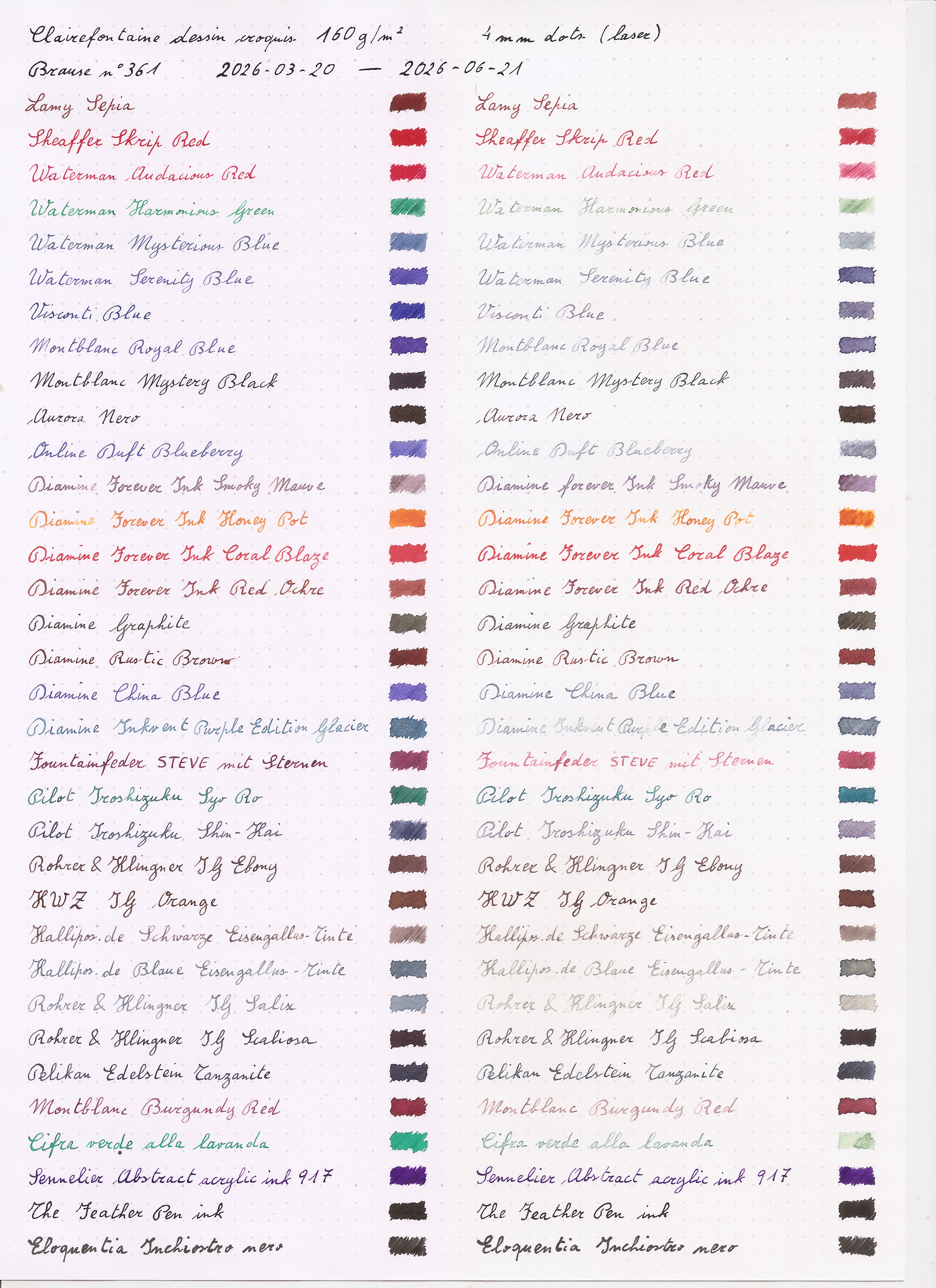
see below see below Three weeks started to show changes in the black and most irongall inks, and of course more changes in the even less resistant inks.
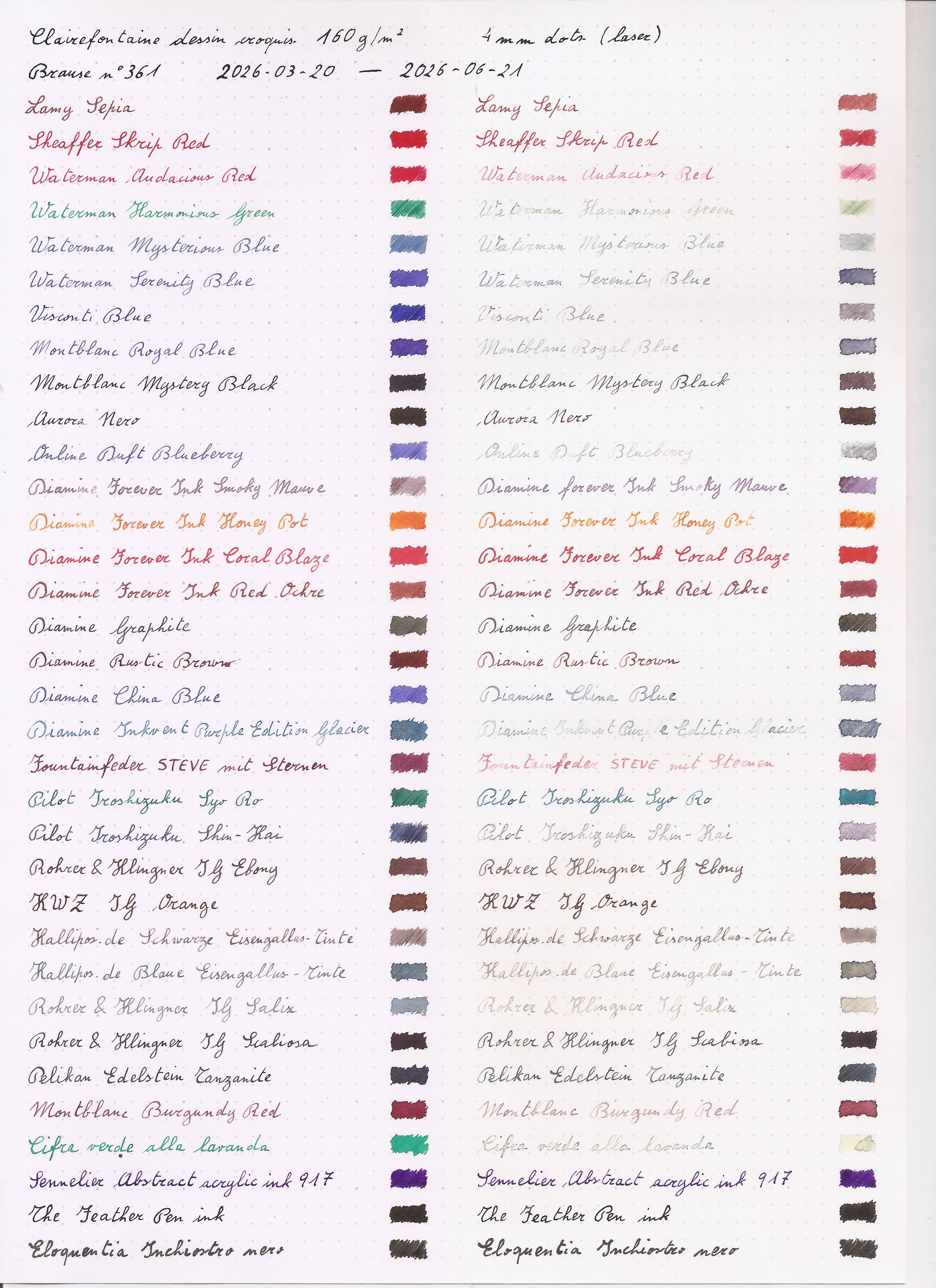
see below see below Week four saw a bit more clouds and rain than the first few weeks, and there weren t big changes, but mostly more of what had already started to happen earlier.
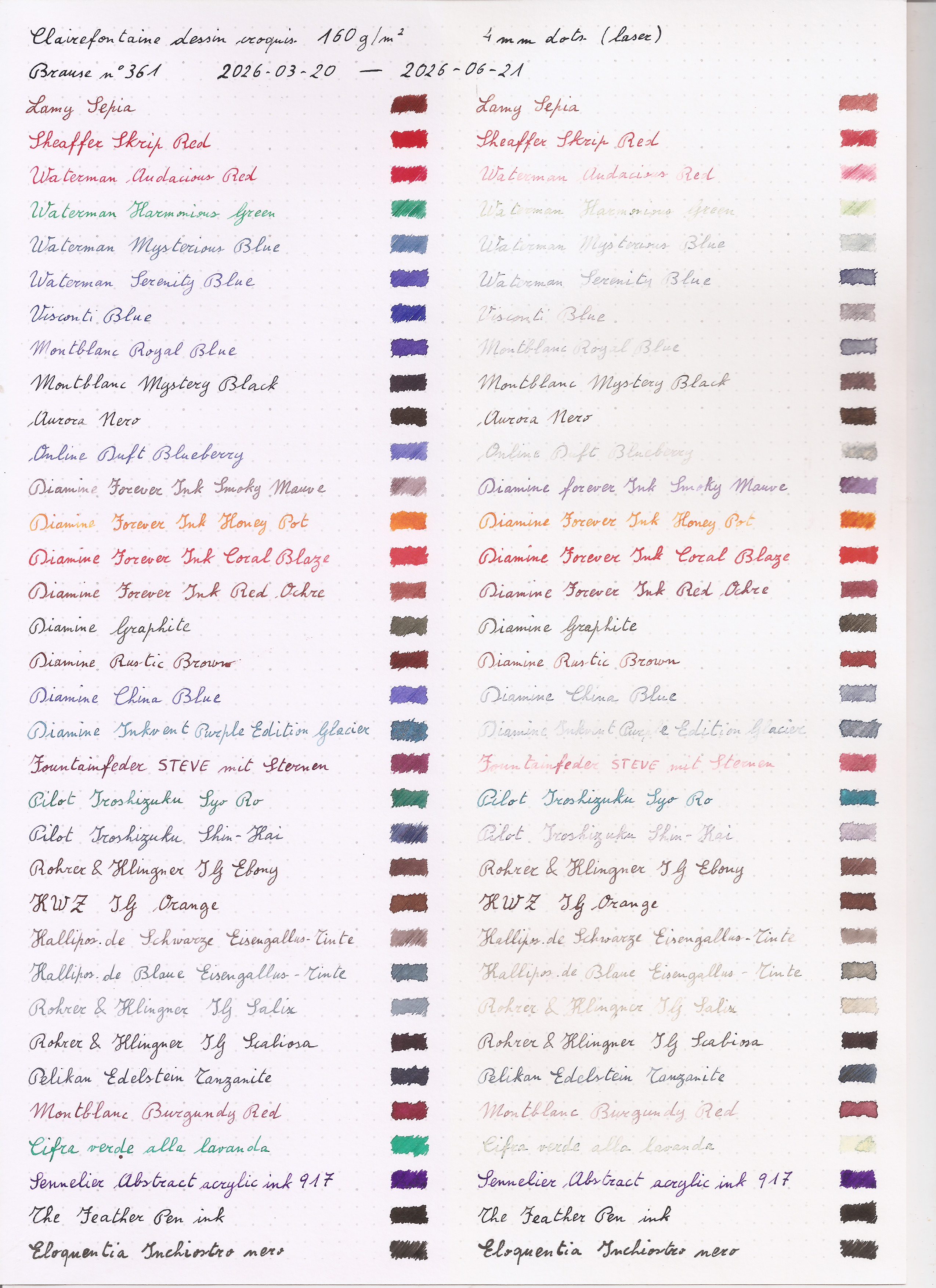
see below see below A month didn t change much compared to the four weeks, but I did the scans for completeness, and from now on I m going to update monthly.
These are the inks I ve tested, and here I ll add notes on the results, as soon as they will be available, keeping this section updated. When nothing is mentioned, it means that there were no changes, either under the light or under the various liquids.
Lamy Sepia
Not resistant to water, the drop becomes an uniform colour spot. After one week it started to be just slightly paler, more so after three weeks.
Sheaffer Skrip Red
Not resistant to water, the drop becomes an uniform colour spot. After one week it started to be just slightly paler, more so after three weeks.
Waterman Audacious Red
Not resistant to water, the drop becomes an uniform colour spot. After three days it started to be just slightly paler, after a week visibly so. After four weeks it was very pale.
Waterman Harmonious Green
Not resistant to water, the drop becomes an uniform colour spot; the hydrogen peroxide drop looks a bit lighter than the one with just water. After one week it started to be just slightly paler, more so after three weeks. After four weeks it was very pale.
Waterman Mysterious Blue
Not resistant to water, the drop becomes an uniform colour spot; the hydrogen peroxide drop is significantly lighter and tends towards green. After two weeks it started to be just slightly paler, after three weeks it was more gray. After four weeks it was very pale.
Waterman Serenity Blue
Not resistant to water, the drop becomes an uniform colour spot; the hydrogen peroxide drop is almost completely bleached to a light yellow. After one week it started to be a bit duller. After four weeks it was paler and duller.
Visconti Blue
Not resistant to water, the drop becomes an uniform colour spot. After one week it was visibly duller, looking darker than the original. After three weeks it was duller, and lighter. After a month it was just a pale gray.
Montblanc Royal Blue
Not resistant to water, the drop becomes an uniform colour spot; the hydrogen peroxide drop is almost completely bleached to a light yellow. After one week it started to be just slightly duller, more so after two weeks. After three weeks it was also paler. After a month it was just a pale gray.
Montblanc Mystery Black
Not resistant to water, the drop becomes an uniform colour spot. After three weeks it started to be a bit paler.
Aurora Nero
Not resistant to water, the drop becomes an uniform colour spot. After three weeks it started to be a bit more brown.
Online Duft Blueberry
Not resistant to water, the drop looks very washed out, although a hint of the original shape can be guessed; the hydrogen peroxide drop is almost completely bleached to a light yellow. After one week it was visibly paler and duller. After three weeks significantly so. After a month it was a pale grey.
Diamine Forever Ink - Smoky Mauve
After a month it looked a bit more purple.
Diamine Forever Ink - Honey Pot
.
Diamine Forever Ink - Coral Blaze
.
Diamine Forever Ink - Red Ochre
.
Diamine Graphite
Not resistant to water, the drop becomes an uniform colour spot.
Diamine Rustic Brown
Not resistant to water, the drop becomes an uniform colour spot. After three weeks it started to be very slightely paler.
Diamine China Blue
Not resistant to water, the drop becomes an uniform colour spot; the hydrogen peroxide drop is almost completely bleached to a light yellow. After three weeks it started to be paler and duller.
Diamine Inkvent Purple Edition - Glacier
Not resistant to water, there is a drop of uniform colour, but it maintains a somewhat recognisable shade of the original shape. After three weeks it started to be lighter.
Fountainfeder STEVE
Not resistant to water, there is a drop of uniform colour, but it maintains a somewhat recognisable shade of the original shape. After two weeks the base colour had changed to a pink rather than purple.
Pilot Iroshizuku Syo Ro
Not resistant to water, there is a drop of uniform colour, but it maintains a somewhat recognisable shade of the original shape. After four weeks it was very slightely paler.
Pilot Iroshizuku Shin-Kai
Not resistant to water, there is a drop of uniform colour, but it maintains a somewhat recognisable shade of the original shape. After two weeks it had become lighter and more purple. After four weeks it was a purple gray.
Rohrer & Klingner IG Ebony
Not resistant to water, there is a drop of uniform colour, but it maintains a recognisable shade of the original shape; under hydrogen peroxide the shade is significantly lighter. After four weeks it was a bit lighter
KWZ IG Orange
Not resistant to water, the drop becomes an uniform colour spot; the hydrogen peroxide drop is significantly bleached to a light orange.
Kallipos.de Schwarze Eisengallus-Tinte
Water stains the paper, leaving however the original shape quite visible; is it almost completely bleached by hydrogen peroxide. After three weeks it started to be very slightely lighter.
Kallipos.de Blaue Eisengallus-Tinte
Water stains the paper, leaving however the original shape quite visible; is it almost completely bleached by hydrogen peroxide. After two weeks it had started to become lighter and more gray.
Rohrer & Klingner IG Salix
Water stains the paper, leaving however the original shape quite visible; is it almost completely bleached by hydrogen peroxide. After two weeks it had become lighter and significantly more gray. After a month it was a yellowish gray.
Rohrer & Klingner IG Scabiosa
Water stains the paper with a significant purple spot, leaving however the original shape quite visible; is is a bit bleached by hydrogen peroxide, but still quite readable.
Pelikan Edelstein Tanzanite
Not resistant to water, the drop becomes an uniform colour spot, but there is a visible trace of the original shape. After three weeks it started to be slightly paler.
Montblanc Burgundy Red
Not resistant to water, the drop becomes an uniform colour spot, with just a hint of the original shape; slightly bleached by hydrogen peroxide. After three weeks it started to be paler.
Cifra inchiostro finissimo verde alla lavanda
Not resistant to water, the drop becomes an uniform colour spot; quite bleached to a light yellowish green by hydrogen peroxide. After one week it was visibly paler. After a month it was a still readable pale trace.
Sennelier Abstract acrylic ink 917 purple
.
The Feather Pen Ink
.
Eloquentia Inchiostro nero
.
DeAtramentis Document Blue
.
DeAtramentis Document BlueGrey
.
DeAtramentis Document Brown
.
DeAtramentis Document Fuchsia
.
DeAtramentis Document Grau
.
DeAtramentis Document Green Grey
.
DeAtramentis Document Light Grey
.
DeAtramentis Document Moosgr n
.
DeAtramentis Document Orange
.
DeAtramentis Document Purpurviolett
.
DeAtramentis Document Urban Sienna
.
KWZ Sheen Machine
Not resistant to water, the drop becomes an uniform colour spot; the hydrogen peroxide bleached away the red sheen. This was one of the only two inks to react to isopropyl alcohol, which caused a pale cyan halo around the lines. After three days it was still perfectly readable, but had visibly lost some red sheen, after one week the red had completely gone and it looked very dark blue (but still shiny)
KWZ Walk over Vistula
Not resistant to water, the drop becomes an uniform colour spot. After four weeks it looked a bit darker and duller.
KWZ Warsaw Dreaming
Not resistant to water, the drop becomes an uniform colour spot. After a month it started to be a bit lighter.
Octopus Neon Violett
Water very lightly stains the paper, leaving however the original shape quite visible. The other ink that reacted to isopropyl alcohol, with a pale purple halo around the lines. After two weeks it was paler, more pink.
Octopus Write & Draw Elephant Black
.
Platinum blue black
Water stains the paper, leaving however the original shape quite visible; it is significantly bleached by hydrogen peroxide. After three weeks it started to become gray.
Pelikan 4001 Brillant-Schwarz
Not resistant to water, the drop becomes an uniform colour spot. After three weeks it was a bit more brown than black, after a month noticeably so.
Pelikan 4001 Blau-Schwarz
Water stains the paper, leaving however the original shape quite visible; it is significantly bleached by hydrogen peroxide. After three weeks it started to become gray.
Pelikan 4001 K nigsblau
Not resistant to water, the drop becomes an uniform colour spot, with just a hint of the original shape; significantly bleached by hydrogen peroxide. After three days it had started to be slightly paler. After three weeks it was significantly desaturated.
Herbin Bleu Myosotis
Not resistant to water, the drop becomes an uniform pink spot, significantly bleached by hydrogen peroxide. After three days it was already visibly paler, after one week it was a pale grey. After a month it was still somehow readable, but as a trace.
Faber Castell Royal Blue
Not resistant to water, the drop becomes an uniform colour spot, with just a hint of the original shape; significantly bleached by hydrogen peroxide. After three days it was slightly duller, after two weeks definitely so. After a month it was also quite paler.
Koh-I-Noor Fountain pen ink blue
Not resistant to water, the drop becomes an uniform colour spot, with just a hint of the original shape; significantly bleached by hydrogen peroxide. After three days it had started to be slightly paler, more so after one week when it had also turned grey. After four weeks it was very pale.
Koh-I-Noor Document Ink Blue
.
Koh-I-Noor Document Ink Black
Water leaves a very light stain, but the original shape doesn t look changed.
DeAtramentis Document Black
.
Waterman Intense Black
Not resistant to water, the drop becomes an uniform colour spot, with a trace of the original shape still visible; very lightly bleached by hydrogen peroxide. After three weeks it started to look a bit more brown, noticeably so after a month.
Herbin Perle Noir
Not resistant to water, the drop becomes an uniform colour spot, with a trace of the original shape still visible. After three weeks it started to look a bit more brown, noticeably so after a month.
Parker Quink black
Not resistant to water, the drop becomes an uniform colour spot.
Platinum Carbon black
.
Rohrer & Klingner Documentus Black
.
Sailor Pigment Kiwaguro
.
Platinum Dyestuff Red
Not resistant to water, the drop becomes an uniform colour spot; very lightly bleached by hydrogen peroxide. After three weeks it was a bit paler.
Noodler s Eternal Polar Blue
.

  1. which would be spend the day covered by mostly closed shutters anyway, because they receive quite a bit of direct sun, and we don t want that to enter the house during the summer.
  2. and thus, I hope, not especially UV-filtering.

25 March 2026

John Goerzen: Artificial Intelligence: Shades of Gray

AI sure is a hot topic right now, and I see a lot of people arguing about it. To a lot of people around here, I m the computer person they know and I get asked a lot about AI. I m going to suggest a lot of things can be true at once. For instance: Or how about: And: I have sympathy for the naysayers; those that say it s nothing but a stochastic parrot. But I don t have a lot of sympathy for the naysayers that deny ever using it; you can t form a credible argument against something without having an understanding of it informed by experience. I also have sympathy for the cheerleaders. I have seen some impressive things from AI; for instance, a story from an engineer who has a child with a rare disease without a credible cure. The engineer did a lot of research on it, started feeding research papers into AI to analyze, and the AI started finding correlations between different areas of research that humans hadn t yet found leading to a positive result for the child. To be fair, I have rarely seen an AI deliver a 100% correct answer on anything with any real level of complexity. I have seen it both waste more time than it saves, and save a ton of time. My point here is: It is neither always fantastic nor always terrible. Let me talk you through an example. I am a fan of inbox zero for email. That is, the inbox should be empty. Unfortunately, mine has 8000 messages in it. According to the oldest messages in my inbox, I last had inbox zero 8 years ago. But really, only a handful are older than 2020. I guess something must have happened that year I ve been chipping away at this for quite some time now. The problem is, there are certain emails in there that really do still need some action maybe it s photos to save off into our photo collection, for instance. But when looking at things sorted by date or thread, there are old shipping confirmations next to phishing attempts and family photos. One can t just scan down the list. I ve tried all the usual tricks, most of which involve selecting groups of message that are easy to bulk erase, or at least easy to scan visually for the occasional thing worth saving. Sort by sender or subject line, for instance. Then I can, for instance, delete all the old messages from the shopping sites I commonly use all at once. But then they start using different senders and different subject lines and that doesn t get all of them. I ve tried keyword searches for this sort of thing too. Still, that got me down to about 8000 messages. So I thought: why not see if an LLM could help me classify these? Maybe it could categorize them, and then I could look at emails grouped by category. I have one machine with a discrete GPU, an Nvidia RTX 4070. It s a desktop machine I don t use all that often. But I set up Ollama on it, running in a Docker container. Ollama runs models locally. I should also mention at this point that we are solar-powered, and this time of year is a time of peak production of excess solar, because it is sunny and not much heat or AC is required. So that machine is solar-powered and isn t causing environmental harm. In any case, charging the EV uses much more power than that GPU. I figured I would do this in two passes. First, ask the LLM to classify each message (or a sampling of them would probably work too), letting it pick its own categories for each. Then, look at the patterns that emerge and give it a single, much smaller, set of broad categories to use and rerun it over that. Then I can easily select messages from my Maildirs by category and process them in bulk. I used open-interpreter pointing to that GPU on my network to help me write the scripts for this. It didn t get things right on its own; for instance, it didn t call the Ollama API correctly, and insisted on appending /cur to the path to the Maildir (which was not going to fly with Python s maildir module). It took roughly an hour to classify those 8000 messages (or, as I had it do, the first 2000 characters of them), and then the same to do it a second time. I had it output lines in the form of filename\tcategory and hand-wrote the shell script that processed those. In the end, was it useful? Yes, quite. Its classifications weren t perfect (and it didn t even follow my prompt perfectly; sometimes it would give me a long discussion on why it picked a certain category rather than just that category, and occasionally it picked categories not on the list). But then, neither were my manual keyword searches. So far I ve gotten rid of nearly 1000 more messages. Several categories were a visual scan for sanity and then delete all sort of thing. My emails never left my network. I didn t rely on a cloud AI to process them. I didn t contribute to global warming (this may have even been a case of saving energy, since it no doubt will offset quite a bit of manual time that would keep screens and room lights energized and so forth). I used about as much energy as watching a movie on a TV. Did it complete the task for me entirely autonomously? Also no. AI isn t a mind reader and it can t possibly evaluate exactly what my thought process would be for a given task. But it can do a decent enough job to save me some time. Still, this didn t require hyperscaler datacenters. AI even runs on-phone (Google Translate being one of the most useful AI-driven apps I ve ever seen, and it can run on-device).

23 March 2026

Marco d'Itri: systemd has not implemented age verification

This needs to be clear: systemd is under attack by a trolling campaign orchestrated by fascist elements. Nobody is forced to like or use systemd, but anybody who wants to pick a side should know the facts. Recently, the free software Nazi bar crowd styling themselves as "concerned citizens" has tried to start a moral panic by saying that systemd is implementing age verification checks or that somehow it will require providing personally identifiable information. This is a lie: the facts are simply that the systemd users database has gained an optional "date of birth" field, which the desktop environments may use or not as they deem appropriate. Of course there is no "identity verification" or requirements to provide any data, which in any case would not be shared beyond authorized local applications. While the multiple recent bills proposing that general purpose operating systems implement age verification mechanisms are often concerning, both from a social and technical point of view, this is not the topic being discussed here. They are often suboptimal, but for a long time I have been opposing attempts to implement parental control at the network level and argued that it should be managed locally, by parents on their own machines: I cannot see why I should outright reject an attempt to implement the infrastructure to do that. If we want to keep age-appropriate controls out of the hands of centralized authorities, the alternative is giving families the means to manage it themselves: this is what this field enables. Whether desktop environments use it for parental controls, for birthday reminders, or for nothing at all, is their users' decision. By the way, the original UNIX users database has allowed storing PII in the GECOS field since it was invented in the '70s. Similar fields are also specified by many popular LDAP schemes: adding such an optional field is consistent with the UNIX tradition. And while we are at it, let's also refute the other smear campaign started by the same people: the systemd project is not accepting "AI slop". What happened is that a documentation file for the benefit of coding agents was added to the repository. To be clear: agents still cannot submit merge requests. The file itself remarks that all contributions must be reviewed in detail by humans, and this is basically the same policy used by the Linux kernel.

21 March 2026

Matthew Garrett: SSH certificates and git signing

When you re looking at source code it can be helpful to have some evidence indicating who wrote it. Author tags give a surface level indication, but it turns out you can just lie and if someone isn t paying attention when merging stuff there s certainly a risk that a commit could be merged with an author field that doesn t represent reality. Account compromise can make this even worse - a PR being opened by a compromised user is going to be hard to distinguish from the authentic user. In a world where supply chain security is an increasing concern, it s easy to understand why people would want more evidence that code was actually written by the person it s attributed to. git has support for cryptographically signing commits and tags. Because git is about choice even if Linux isn t, you can do this signing with OpenPGP keys, X.509 certificates, or SSH keys. You re probably going to be unsurprised about my feelings around OpenPGP and the web of trust, and X.509 certificates are an absolute nightmare. That leaves SSH keys, but bare cryptographic keys aren t terribly helpful in isolation - you need some way to make a determination about which keys you trust. If you re using someting like GitHub you can extract that information from the set of keys associated with a user account1, but that means that a compromised GitHub account is now also a way to alter the set of trusted keys and also when was the last time you audited your keys and how certain are you that every trusted key there is still 100% under your control? Surely there s a better way.

SSH Certificates And, thankfully, there is. OpenSSH supports certificates, an SSH public key that s been signed by some trusted party and so now you can assert that it s trustworthy in some form. SSH Certificates also contain metadata in the form of Principals, a list of identities that the trusted party included in the certificate. These might simply be usernames, but they might also provide information about group membership. There s also, unsurprisingly, native support in SSH for forwarding them (using the agent forwarding protocol), so you can keep your keys on your local system, ssh into your actual dev system, and have access to them without any additional complexity. And, wonderfully, you can use them in git! Let s find out how.

Local config There s two main parameters you need to set. First,
1
git config set gpg.format ssh
because unfortunately for historical reasons all the git signing config is under the gpg namespace even if you re not using OpenPGP. Yes, this makes me sad. But you re also going to need something else. Either user.signingkey needs to be set to the path of your certificate, or you need to set gpg.ssh.defaultKeyCommand to a command that will talk to an SSH agent and find the certificate for you (this can be helpful if it s stored on a smartcard or something rather than on disk). Thankfully for you, I ve written one. It will talk to an SSH agent (either whatever s pointed at by the SSH_AUTH_SOCK environment variable or with the -agent argument), find a certificate signed with the key provided with the -ca argument, and then pass that back to git. Now you can simply pass -S to git commit and various other commands, and you ll have a signature.

Validating signatures This is a bit more annoying. Using native git tooling ends up calling out to ssh-keygen2, which validates signatures against a file in a format that looks somewhat like authorized-keys. This lets you add something like:
1
* cert-authority ssh-rsa AAAA 
which will match all principals (the wildcard) and succeed if the signature is made with a certificate that s signed by the key following cert-authority. I recommend you don t read the code that does this in git because I made that mistake myself, but it does work. Unfortunately it doesn t provide a lot of granularity around things like Does the certificate need to be valid at this specific time and Should the user only be able to modify specific files and that kind of thing, but also if you re using GitHub or GitLab you wouldn t need to do this at all because they ll just do this magically and put a verified tag against anything with a valid signature, right? Haha. No. Unfortunately while both GitHub and GitLab support using SSH certificates for authentication (so a user can t push to a repo unless they have a certificate signed by the configured CA), there s currently no way to say Trust all commits with an SSH certificate signed by this CA . I am unclear on why. So, I wrote my own. It takes a range of commits, and verifies that each one is signed with either a certificate signed by the key in CA_PUB_KEY or (optionally) an OpenPGP key provided in ALLOWED_PGP_KEYS. Why OpenPGP? Because even if you sign all of your own commits with an SSH certificate, anyone using the API or web interface will end up with their commits signed by an OpenPGP key, and if you want to have those commits validate you ll need to handle that. In any case, this should be easy enough to integrate into whatever CI pipeline you have. This is currently very much a proof of concept and I wouldn t recommend deploying it anywhere, but I am interested in merging support for additional policy around things like expiry dates or group membership.

Doing it in hardware Of course, certificates don t buy you any additional security if an attacker is able to steal your private key material - they can steal the certificate at the same time. This can be avoided on almost all modern hardware by storing the private key in a separate cryptographic coprocessor - a Trusted Platform Module on PCs, or the Secure Enclave on Macs. If you re on a Mac then Secretive has been around for some time, but things are a little harder on Windows and Linux - there s various things you can do with PKCS#11 but you ll hate yourself even more than you ll hate me for suggesting it in the first place, and there s ssh-tpm-agent except it s Linux only and quite tied to Linux. So, obviously, I wrote my own. This makes use of the go-attestation library my team at Google wrote, and is able to generate TPM-backed keys and export them over the SSH agent protocol. It s also able to proxy requests back to an existing agent, so you can just have it take care of your TPM-backed keys and continue using your existing agent for everything else. In theory it should also work on Windows3 but this is all in preparation for a talk I only found out I was giving about two weeks beforehand, so I haven t actually had time to test anything other than that it builds. And, delightfully, because the agent protocol doesn t care about where the keys are actually stored, this still works just fine with forwarding - you can ssh into a remote system and sign something using a private key that s stored in your local TPM or Secure Enclave. Remote use can be as transparent as local use.

Wait, attestation? Ah yes you may be wondering why I m using go-attestation and why the term attestation is in my agent s name. It s because when I m generating the key I m also generating all the artifacts required to prove that the key was generated on a particular TPM. I haven t actually implemented the other end of that yet, but if implemented this would allow you to verify that a key was generated in hardware before you issue it with an SSH certificate - and in an age of agentic bots accidentally exfiltrating whatever they find on disk, that gives you a lot more confidence that a commit was signed on hardware you own.

Conclusion Using SSH certificates for git commit signing is great - the tooling is a bit rough but otherwise they re basically better than every other alternative, and also if you already have infrastructure for issuing SSH certificates then you can just reuse it4 and everyone wins.

  1. Did you know you can just download people s SSH pubkeys from github from https://github.com/<username>.keys? Now you do
  2. Yes it is somewhat confusing that the keygen command does things other than generate keys
  3. This is more difficult than it sounds
  4. And if you don t, by implementing this you now have infrastructure for issuing SSH certificates and can use that for SSH authentication as well.

C.J. Collier: The WWW::Mechanize::Chrome Saga: A Comprehensive Narrative of PR #104

The
WWW::Mechanize::Chrome Saga: A Comprehensive Narrative of PR #104 This document synthesizes the extensive work performed from March
13th to March 20th, 2026, to harden, stabilize, and refactor the
WWW::Mechanize::Chrome library and its test suite. This
effort involved deep dives into asynchronous programming,
platform-specific bug hunting, and strategic architectural
decisions.

Part I:
The Quest for Cross-Platform Stability (March 13 16) The initial phase of work focused on achieving a green test suite
across a variety of Linux distributions and preparing for a new release.
This involved significant hardening of the library to account for
different browser versions, OS-level security restrictions, and
filesystem differences.

Key Milestones &
Engineering Decisions:
  • Fedora & RHEL-family Success: A major effort
    was undertaken to achieve a 100% pass rate on modern Fedora 43 and
    CentOS Stream 10. This required several key engineering decisions to
    handle modern browser behavior:
    • Decision: Implement Asynchronous DOM Serialization
      Fallback. Synchronous fallbacks in an async context are
      dangerous. To prevent Resource was not cached errors during
      saveResources, we implemented a fully asynchronous fallback
      in _saveResourceTree. By chaining
      _cached_document with DOM.getOuterHTML
      messages, we can reconstruct document content without blocking the event
      loop, even if Chromium has evicted the resource from its cache. This
      also proved resilient against Fedora s security policies, which often
      block file:// access.
    • Decision: Truncate Filenames for Cross-Platform
      Safety. To avoid File name too long errors,
      especially on Windows where the MAX_PATH limit is 260
      characters, filenameFromUrl was hardened. The filename
      truncation was reduced to a more conservative 150
      characters, leaving ample headroom for deeply nested CI
      temporary directories. Logic was also added to preserve file extensions
      during truncation and to sanitize backslashes from URI paths.
    • Decision: Expand Browser Discovery Paths. To
      support RHEL-based systems out-of-the-box, the
      default_executable_names was expanded to include
      headless_shell and search paths were updated to include
      /usr/lib64/chromium-browser/.
    • Decision: Mitigate Race Conditions with Stabilization Waits
      and Resilient Fetching. On fast systems,
      DOM.documentUpdated events could invalidate
      nodeIds immediately after navigation, causing XPath queries
      to fail with Could not find node with given id . A small stabilization
      sleep(0.25s) was added after page loads to ensure the DOM
      is settled. Furthermore, the asynchronous DOM fetching loop was hardened
      to gracefully handle these errors by catching protocol errors and
      returning an empty string for any node that was invalidated during
      serialization, ensuring the overall process could complete.
  • Windows Hardening:
    • Decision: Adopt Platform-Aware Watchdogs. The test
      suite s reliance on ualarm was a blocker for Windows, where
      it is not implemented. The t::helper::set_watchdog function
      was refactored to use standard alarm() (seconds) on Windows
      and ualarm (microseconds) on Unix-like systems, enabling
      consistent test-level timeout enforcement.
  • Version 0.77 Release:
    • Decision: Adopt SOP for Version Synchronization.
      The project maintains duplicate version strings across 24+ files. A
      Standard Operating Procedure was adopted to use a batch-replacement tool
      to update all sub-modules in lib/ and to always run
      make clean and perl Makefile.PL to ensure
      META.json and META.yml reflect the new
      version. After achieving stability on Linux, the project version was
      bumped to 0.77.
  • Infrastructure & Strategic Work:
    • The ad2 Windows Server 2025 instance was restored and
      optimized, with Active Directory demoted and disk I/O performance
      improved.
    • A strategic proposal for the Heterogeneous Directory
      Replication Protocol (HDRP) was drafted and published.

Part II: The
Great Async Refactor (March 17 18) Despite success on Linux, tests on the slow ad2 Windows
host were still plagued by intermittent, indefinite hangs. This
triggered a fundamental architectural shift to move the library s core
from a mix of synchronous and asynchronous code to a fully non-blocking
internal API.

Key Milestones &
Engineering Decisions:
  • Decision: Expose a _future API.
    Instead of hardcoding timeouts in the library, the core strategy was to
    refactor all blocking methods (xpath, field,
    get, etc.) into thin wrappers around new non-blocking
    ..._future counterparts. This moved timeout management to
    the test harness, allowing for flexible and explicit handling of
    stalls.
    # Example library implementation
    sub xpath($self, $query, %options)  
        return $self->xpath_future($query, %options)->get;
     
    
    sub xpath_future($self, $query, %options)  
        # Async implementation using $self->target->send_message(...)
     
  • Decision: Centralize Test Hardening in a Helper.
    A dedicated test library, t/lib/t/helper.pm, was created to
    contain all stabilization logic. Safe wrappers (safe_get,
    safe_xpath) were implemented there, using
    Future->wait_any to race asynchronous operations against
    a timeout, preventing tests from hanging.
    # Example test helper implementation
    sub safe_xpath  
        my ($mech, $query, %options) = @_;
        my $timeout = delete $options timeout    5;
        my $call_f = $mech->xpath_future($query, %options);
        my $timeout_f = $mech->sleep_future($timeout)->then(sub   Future->fail("Timeout")  );
        return Future->wait_any($call_f, $timeout_f)->get;
     
  • Decision: Refactor Node Attribute Cache.
    Investigations into flaky checkbox tests (t/50-tick.t)
    revealed that WWW::Mechanize::Chrome::Node was storing
    attributes as a flat list ([key, val, key, val]), which was
    inefficient for lookups and individual updates. The cache was refactored
    to definitively use a HashRef, providing O(1) lookups
    and enabling atomic dual-updates where both the browser property (via
    JS) and the internal library attribute are synchronized
    simultaneously.
  • Decision: Implement Self-Cancelling Socket
    Watchdog. On Windows, traditional watchdog processes often
    failed to detect parent termination, leading to 60-second hangs after
    successful tests. We implemented a new socket-based watchdog in
    t::helper that listens on an ephemeral port; the background
    process terminates immediately when the parent socket closes,
    eliminating these cumulative delays.
  • Decision: Deep Recursive Refactoring & Form
    Selection. To make the API truly non-blocking, the entire
    internal call stack had to be refactored. For example, making
    get_set_value_future non-blocking required first making its
    dependency, _field_by_name, asynchronous. This culminated
    in refactoring the entire form selection API (form_name,
    form_id, etc.) to use the new asynchronous
    _future lookups, which was a key step in mitigating the
    Windows deadlocks.
  • Decision: Fix Critical Regressions & Memory
    Cycles.
    • Evaluation Normalization: Implemented a
      _process_eval_result helper to centralize the parsing of
      results from Runtime.evaluate. This ensures consistent
      handling of return values and exceptions between synchronous
      (eval_in_page) and asynchronous (eval_future)
      calls.
    • Memory Cycle Mitigation: A significant memory
      leak was discovered where closures attached to CDP event futures (like
      for asynchronous body retrieval) would capture strong references to
      $self and the $response object, creating a
      circular reference. The established rule is to now always use
      Scalar::Util::weaken on both $self and any
      other relevant objects before they are used inside a
      ->then block that is stored on an object.
    • Context Propagation (wantarray): A
      major regression was discovered where Perl s wantarray
      context, which distinguishes between scalar and list context, was lost
      inside asynchronous Future->then blocks. This caused
      methods like xpath to return incorrect results (e.g., a
      count instead of a list of nodes). The solution was to adopt the Async
      Context Pattern : capture wantarray in the synchronous
      wrapper, pass it as an option to the _future method, and
      then use that captured value inside the future s final resolution
      block.
      # Synchronous Wrapper
      sub xpath($self, $query, %options)  
          $options  wantarray   = wantarray; # 1. Capture
          return $self->xpath_future($query, %options)->get; # 2. Pass
       
      
      # Asynchronous Implementation
      sub xpath_future($self, $query, %options)  
          my $wantarray = delete $options  wantarray  ; # 3. Retrieve
          # ... async logic ...
          return $doc->then(sub  
              if ($wantarray)   # 4. Respect
                  return Future->done(@results);
                else  
                  return Future->done($results[0]);
               
           );
       
    • Asynchronous Body Retrieval & Robust Content
      Fallbacks: Fixed a bug where decoded_content()
      would return empty strings by ensuring it awaited a
      __body_future. This was implemented by storing the
      retrieval future directly on the response object
      ($response-> __body_future ). To make this more robust,
      a tiered strategy was implemented: first try to get the content from the
      network response, but if that fails (e.g., for about:blank
      or due to cache eviction), fall back to a JavaScript
      XMLSerializer to get the live DOM content.
    • Signature Hardening: Fixed Too few arguments
      errors when using modern Perl signatures with
      Future->then. Callbacks were updated to use optional
      parameters (sub($result = undef) ... ) to gracefully
      handle futures that resolve with no value.
    • XHTML Split-Brain Bug: Resolved a
      long-standing Chromium bug (40130141) where content provided via
      setDocumentContent is parsed differently than content
      loaded from a URL. A workaround was implemented: for XHTML documents,
      WMC now uses a JavaScript-based XPath evaluation
      (document.evaluate) against the live DOM, bypassing the
      broken CDP search mechanism.

Derived Architectural Rules
& SOPs:
  • Rule: Always provide _future variants.
    Every library method that interacts with the browser via CDP must have a
    non-blocking asynchronous counterpart.
  • Rule: Centralize stabilization in the test layer.
    All timeout and retry logic should reside in the test harness
    (t/lib/t/helper.pm), not in the core library.
  • Rule: Explicitly propagate wantarray
    context. Synchronous wrappers must capture the caller s context
    and pass it down the Future chain to ensure correct
    scalar/list behavior.
  • Rule: The entire call chain must be asynchronous.
    To enable non-blocking timeouts, even a single hidden blocking call in
    an otherwise asynchronous method will cause a stall.
  • SOP: Reduce Library Noise. Diagnostic messages
    (warn, note, diag) should be
    removed from library code before commits. All such messages should be
    converted to use the internal $self->log('debug', ...)
    mechanism, ensuring a clean TAP output for CI systems.

Part III: The
MutationObserver Saga (March 19) With most of the library refactored to be asynchronous, one stubborn
test, t/65-is_visible.t, continued to fail with timeouts.
This led to an ambitious, but ultimately unsuccessful, attempt to
replace the wait_until_visible polling logic with a more
modern MutationObserver.

Key Milestones & Challenges:
  • The Theory: The goal was to replace an inefficient
    repeat sleep loop with an event-driven
    MutationObserver in JavaScript that would notify Perl
    immediately when an element s visibility changed.
  • Implementation & Cascade Failure: The
    implementation proved incredibly difficult and introduced a series of
    new, hard-to-diagnose bugs:
    1. An incorrect function signature for
      callFunctionOn_future.
    2. A critical unit mismatch, passing seconds from Perl to JavaScript s
      setTimeout, which expected milliseconds.
    3. A fundamental hang where the MutationObserver s
      JavaScript Promise would never resolve, even after the
      underlying DOM element changed.
  • Debugging Maze: Multiple attempts to fix the
    checkVisibility JavaScript logic inside the observer
    callback, including making it more robust by adding DOM tree traversal
    and extensive console.log tracing, failed to resolve the
    hang. This highlighted the opacity and difficulty of debugging complex,
    cross-language asynchronous interactions, especially when dealing with
    low-level browser APIs.

Procedural Learning:
Granular Edits The effort was plagued by procedural missteps in using automated
file-editing tools. Initial attempts to replace large code blocks in a
single operation led to accidental code loss and match failures.
  • Decision: Adopt Delete, then Add Workflow.
    Following forceful user correction, a new SOP was established for all
    future modifications:
    1. Isolate: Break the file into small, manageable
      chunks (e.g., 250 lines).
    2. Delete: Perform a delete operation by replacing
      the old code block with an empty string.
    3. Add: Perform an add operation by inserting the
      new code into the empty space.
    4. Verify: Verifying each atomic step before
      proceeding. This granular process, while slower, ensured surgical
      precision and regained technical control over the large
      Chrome.pm module.
The consistent failure of the MutationObserver approach
eventually led to the decision to abandon it in favor of stabilizing the
original, more transparent implementation.

Part IV:
Reversion and Final Stabilization (March 20) After exhausting all reasonable attempts to fix the
MutationObserver, a strategic decision was made to revert
to the simpler, more transparent polling implementation and fix it
correctly. This proved to be the correct path to a stable solution.

Key Milestones &
Engineering Decisions:
  • Decision: Perform Strategic Reversion. The
    MutationObserver implementation, when integrated via
    callFunctionOn_future with awaitPromise,
    proved fundamentally unstable. Its JavaScript promise would consistently
    fail to resolve, causing indefinite hangs. A decision was made to
    revert all MutationObserver code from
    WWW::Mechanize::Chrome.pm and restore the original
    repeat sleep polling mechanism. A stable,
    understandable solution was prioritized over an elegant but broken
    one.
  • Decision: Correct Timeout Delegation in the
    Harness. The root cause of the original timeout failure was
    identified as a race condition in the t/lib/t/helper.pm
    test harness. The safe_wait_until_* wrappers were
    implementing their own timeout (via wait_any and
    sleep_future) that raced against the underlying polling
    function s internal timeout. This led to intermittent failures on slow
    machines. The helpers were refactored to delegate all timeout
    management to the library s polling functions, ensuring a
    single, authoritative timer controlled the operation.
  • Decision: Optimize Polling Performance. At the
    user s request, the polling interval was reduced from 300ms to
    150ms. This modest performance improvement reduced the
    test suite s wallclock execution time by over a second while maintaining
    stability.
  • Decision: Tune Test Watchdogs. The global watchdog
    timeout was adjusted to 12 seconds, specifically calculated as 1.5x the
    observed real execution time of the optimized test. This provides a
    data-driven safety margin for CI.

Part
V: The Last Bug A Platform-Specific Memory Leak (March 20) With all other tests passing, a single memory leak failure in
t/78-memleak.t persisted, but only on the Windows
ad2 environment. This required a different approach than
the timeout fixes.

Key Milestones:
  • The Bug: A strong reference cycle involving the
    on_dialog event listener was not being broken on Windows,
    despite multiple attempts to fix it. Fixes that worked on Linux (such as
    calling on_dialog(undef) in DESTROY) were not
    sufficient on the Windows host.
  • The Diagnosis: The issue was determined to be a
    deep, platform-specific interaction between Perl s garbage collector,
    the IO::Async event loop implementation on Windows, and the
    Test::Memory::Cycle module. The cycle report was identical
    on both platforms, but the cleanup behavior was different.
  • Failed Attempts: A series of increasingly
    aggressive fixes were attempted to break the cycle, including:
    1. Moving the on_dialog(undef) call from
      close() to DESTROY().
    2. Explicitly deleteing the listener and callback
      properties from the object hash in DESTROY.
    3. Swapping between $self->remove_listener and
      $self->target->unlisten in a mistaken attempt to find
      the correct un-registration method.
  • Pragmatic Solution: After exhausting all reasonable
    code-level fixes without a resolution on Windows, the user opted to mark
    the failing test as a known issue for that specific platform.
  • Final Fix: The single failing test in
    t/78-memleak.t was wrapped in a conditional
    TODO block that only executes on Windows
    (if ($^O =~ /MSWin32/i)), formally acknowledging the bug
    without blocking the build. This allows the test suite to pass in CI
    environments while flagging the issue for future, deeper
    investigation.

Part VI: CI Hardening (March
20) A final failure in the GitHub Actions CI environment revealed one
last configuration flaw.

Key Milestones:
  • The Bug: The CI was running
    prove --nocount --jobs 3 -I local/ -bl xt t directly. This
    command was missing the crucial -It/lib include path, which
    is necessary for test files to locate the t::helper module.
    This resulted in nearly all tests failing with
    Can't locate t/helper.pm in @INC.
  • The Investigation: An analysis of
    Makefile.PL revealed a custom MY::test block
    specifically designed to inject the -It/lib flag into the
    make test command. This confirmed that
    make test is the correct, canonical way to run the test
    suite for this project.
  • The Fix: The
    .github/workflows/linux.yml file was modified to replace
    the direct prove call with make test in the
    Run Tests step. This ensures the CI environment runs the
    tests in the exact same way as a local developer, with all necessary
    include paths correctly configured by the project s build system.

Final Outcome After this long and arduous journey, the
WWW::Mechanize::Chrome test suite is now stable and
passing on all targeted platforms, with known
platform-specific issues clearly documented in the code. The project is
in a vastly more robust and reliable state.

19 March 2026

Otto Kek l inen: Automated security validation: How 7,000+ tests shaped MariaDB's new AppArmor profile

Featured image of post Automated security validation: How 7,000+ tests shaped MariaDB's new AppArmor profileLinux kernel security modules provide a good additional layer of security around individual programs by restricting what they are allowed to do, and at best block and detect zero-day security vulnerabilities as soon as anyone tries to exploit them, long before they are widely known and reported. However, the challenge is how to create these security profiles without accidentally also blocking legitimate actions. For MariaDB in Debian and Ubuntu, a new AppArmor profile was recently created by leveraging the extensive test suite with 7000+ tests, giving good confidence that AppArmor is unlikely to yield false positive alerts with it. AppArmor is a Mandatory Access Control (MAC) system, meaning that each process controlled by AppArmor has a sort of an allowlist called profile that defines all capabilities and file paths a program can access. If a program tries to do something not covered by the rules in its AppArmor profile, the action will be denied on the Linux kernel level and a warning logged in the system journal. This additional security layer is valuable because even if a malicious user found a security vulnerability some day in the future, the AppArmor profile severely restricts the ability to exploit it and gain access to the operating system. AppArmor was originally developed by Novell for use in SUSE Linux, but nowadays the main driver is Canonical and AppArmor is extensively used in Ubuntu and Debian, and many of their derivatives (e.g. Linux Mint, Pop!_OS, Zorin OS) and in Arch. AppArmor s benefit compared to the main alternative SELinux (used mainly in the RedHat/Fedora ecosystem) is that AppArmor is easier to manage. AppArmor continues to be actively developed, with new major version 5.0 expected to arrive soon. I also have some personal history contributing some notification handler scripts in Python and I also created the website that AppArmor.net still runs.

Regular review of denials in the system log required Any system administrator using Debian/Ubuntu needs to know how to check for AppArmor denials. The point of using AppArmor is kind of moot if nobody is checking the denials. When AppArmor blocks an action, it logs the event to the system audit or kernel logs. Understanding these logs is crucial for troubleshooting custom configurations or identifying potential security incidents. To view recent denials, check /var/log/audit/audit.log or run journalctl -ke --grep=apparmor. A typical denial entry for MariaDB will look like this (split across multiple lines for legibility):
msg=audit(1700000000.123:456): apparmor="DENIED" operation="open"
profile="/usr/sbin/mariadbd" name="/custom/data/path/test.ibd" pid=1234
comm="mariadbd" requested_mask="r" denied_mask="r" fsuid=1000 ouid=0
How to interpret this output:
  • msg=audit( ): The audit timestamp and event serial number.
  • apparmor= DENIED : Indicates AppArmor blocked the action.
  • operation: The action being attempted (e.g., open, mknod, file_mmap, file_perm).
  • profile: The specific AppArmor profile that triggered the denial (in this case the /usr/sbin/mariadbd profile).
  • name: The file path or resource that was blocked. In the example above, a custom data path was denied access because it wasn t defined in the profile s allowed abstractions.
  • comm: The command name that triggered the denial (here mariadbd).
  • requested_mask / denied_mask: Shows the permissions requested (e.g., r for read, w for write).
  • pid: The process ID.
  • fsuid: The user ID of the process attempting the action.
  • ouid: The owner user ID of the target file.
If an action seems legit and should not be denied, the sysadmin needs to update the existing rules at /etc/apparmor.d/ or drop a local customization file in at /etc/apparmor.d/local/. If the denied action looks malicious, the sysadmin should start a security investigation and if needed report a suspected zero-day vulnerability to the upstream software vendor (e.g. Ubuntu customers to Canonical, or MariaDB customers to MariaDB).

AppArmor in MariaDB - not a novel thing, and not easy to implement well Based on old bug reports, there was an AppArmor profile already back in 2011, but it was removed in MariaDB 5.1.56 due to backlash from users running into various issues. A new profile was created in 2015, but kept opt-in only due to the risk of side effects. It likely had very few users and saw minimal maintenance, getting only a handful of updates in the past 10 years. The primary challenge in using mandatory access control systems with MariaDB lies in the sheer breadth of MariaDB s operational footprint with diverse storage engines and plugins. Also the code base in MariaDB assumes that system calls to Linux always work which they do under normal circumstances and do not handle errors well if AppArmor suddenly denies a system call. MariaDB is also a large and complex piece of software to run and operate, and it can be very challenging for system administrators to root-cause that a misbehavior in their system was due to AppArmor blocking a single syscall. Ironically, AppArmor is most beneficial exactly due to the same reasons for MariaDB. The larger and more complex a software is, the larger are the odds of a security vulnerability arising between the various components. And AppArmor profile helps reduce this complexity down to a single access list. Over the years there has been users requesting to get the AppArmor profile back, such as Debian Bug#875890 since 2017. The need was raised recently again by the Ubuntu security team during the MariaDB Ubuntu main inclusion review in 2025, which prompted a renewed effort by Debian/Ubuntu developers, mainly myself and Aquila Macedo, with upstream MariaDB assistance from Daniel Black.

A fresh approach: leverage the MariaDB test suite for automated testing and the open source community for reviews The key to creating a robust AppArmor profile is the ability to know in detail what is expected and normal behavior of the system. One could in theory read all of the source code in MariaDB, but with over two million lines, it is of course not feasible in practice. However, MariaDB does have a very extensive 7000+ test suite, and running it should trigger most code paths in MariaDB. Utilizing the test suite was key in creating the new AppArmor profile for MariaDB: we installed MariaDB on a Ubuntu system, enabled AppArmor in complain mode and iterated on the allowlist by running the full mariadb-test-run with all MariaDB plugins and features enabled until we had a comprehensive yet clean list of rules. To be extra diligent, we also reworked the autopkgtest for MariaDB in Debian and Ubuntu CI systems to run with the AppArmor profile enabled and to print all AppArmor notices at the end of the run, making it easy to detect now and in the future if the MariaDB test suite triggers any AppArmor denials. If any test fails, the release would not get promoted further, protecting users from regressions. While developing and triggering manual test runs we used the maximal achievable test suite with 7177 tests. The test is however so extensive it takes over two hours to run, and it also has some brittle tests, so the standard test run in Debian and Ubuntu autopkgtest is limited just to MariaDB s main suite with about 1000 tests. Having some tests fail while testing the AppArmor profile was not a problem, because we didn t need all the tests to pass we merely needed them to run as many code paths as possible to see if they run any system calls not accounted for in the AppArmor profile. Note that extending the profile was not just mechanical copying of log messages to the profile. For example, even though a couple of tests involve running the dash shell, we decided to not allow it, as it opens too much of a path for a potential exploit to access the operating system. The result of this effort is a modernized, robust profile that is now production-ready. Those interested in the exact technical details can read the Debian Bug#1130272 and the Merge Request discussions at salsa.debian.org, which hosts the Debian packaging source code.

Now available in Debian unstable, soon Ubuntu feedback welcome! Even though the file is just 200 lines long, the work to craft it spanned several weeks. To minimize risk we also did a gradual rollout by releasing the first new profile version in complain mode, so AppArmor only logs would-be-denials without blocking anything. The AppArmor profile was switched to enforce mode only in the very latest MariaDB revision 1:11.8.6-4 in Debian, and a NEWS item issued to help increase user awareness of this change. It is also slated for the upcoming Ubuntu 26.04 Resolute Raccoon release next month, providing out-of-the-box hardening for the wider ecosystem. While automated testing is extensive, it cannot simulate everything. Most notably various complicated replication topologies and all Galera setups are likely not covered. Thus, I am calling on the community to deploy this profile and monitor for any audit denials in the kernel logs. If you encounter unexpected behavior or legitimate denials, please submit a bug report via the Debian Bug Tracking System. To ensure you are running the latest MariaDB version, run apt install --update --yes mariadb-server. To view the latest profile rules, run cat /etc/apparmor.d/mariadbd and to see if it is enforced review the output of aa-status. To quickly check if there were any AppArmor denials, simply run journalctl -k grep -i apparmor grep -i mariadb.

Systemd hardening also adopted as security features keep evolving For those interested in MariaDB security hardening, note that also new systemd hardening options were rolled out in Debian/Ubuntu recently. Note that Debian and Ubuntu are mainly volunteer-driven open source developer communities, and if you find this topic interesting and you think you have the necessary skills, feel free to submit your improvement ideas as Merge Requests at salsa.debian.org/mariadb-team. If your improvement suggestions are not Debian/Ubuntu specific, please submit them directly to upstream at GitHub.com/MariaDB.

18 March 2026

Dirk Eddelbuettel: tidyCpp 0.0.11 on CRAN: Microfix

And yet another maintenance release of the tidyCpp package arrived on CRAN this morning, just days after previous release which itself came a mere week and a half after its predecessor. It has been built for r2u as well. The package offers a clean C++ layer (as well as one small C++ helper class) on top of the C API for R which aims to make use of this robust (if awkward) C API a little easier and more consistent. See the vignette for motivating examples. This release restores the small CSS file used by the vignette which we, in a last-second decision, omitted from the previous release. Oddly, it only failed under the oldrel i.e. the R from now nearly two years ago. But it was still an unenforced error, and this upload corrects it. Changes are summarized in the NEWS entry that follows.

Changes in tidyCpp version 0.0.11 (2026-03-17)
  • Keep a CSS file in the package to allow vignette build on r-oldrel too

Thanks to my CRANberries, there is also a diffstat report for this release. For questions, suggestions, or issues please use the issue tracker at the GitHub repo.

This post by Dirk Eddelbuettel originated on his Thinking inside the box blog. If you like this or other open-source work I do, you can now sponsor me at GitHub.

Taavi V n nen: Wikimedia Hackathon Northwestern Europe 2026

Wikimedia Nederland organised a new type of event this year, the Wikimedia Hackathon Northwestern Europe 2026, which was held last weekend in Arnhem, the Netherlands. And I'm very happy they did, since unlike last years, I will unfortunately be missing from the "main" Wikimedia Hackathon (which is happening in Milan at the start of May). I continue to believe the primary reason for these events existing is the ability to connect with old and new friends in person. That being said, I did get a bit of technical tinkering done during the weekend as well. These include a dark mode fix to MediaWiki's notification interface, fixes to some visual bugs in MediaWiki's two-factor authentication and OAuth functionality. I did also get an older patch of mine about disabling Composer's new auditing functionality merged. And, as usual, I spent a bunch of time helping various people use with the various infrastructure pieces I'm familiar with (or at least had to suddenly get familiar with) and approved a bunch of OAuth consumers and other requests. We also managed to continue the tradition from the past two Wikimedia Hackathons of nominating more people to receive +2 access to mediawiki/*. That request is still open as of writing, as those have to run for at least a week, but looks very likely to pass at this point. Overall, the event was very well-organized: the venue was great, except that the number of stairs was described in a rather misleading way, food was great, and the atmosphere was amazing. The pressure that you must Just Get Things Done to justify your attendance that the main hackathon seems to have recently gained was clearly missing here which was great. Also, I will clearly need to bring more Finnish chocolate next time. The timing of Friday and Saturday works great for us with other things (like university for me) during the week, as it takes full advantage of the weekend but still only eats workdays from a single calendar week. My main gripe with the logistics was the focus on a single sketchy non-free messaging platform for all event-related communications with the IRC bridge used on the main hackathon channel notably missing.
ps. Like Lucas, I do have Opinions about so many proudly mentioning they've used "vibe coding" tools during the introduction and showcase. Those opinions are best left for an another time, but I do want to note that all of my work and mistakes have still been lovingly handcrafted.

15 March 2026

Dirk Eddelbuettel: tidyCpp 0.0.10 on CRAN: Even More Maintenance

Yet another maintenance release of the tidyCpp package arrived on CRAN this morning, a mere week and a half after the previous release. It has been built for r2u as well. The package offers a clean C++ layer (as well as one small C++ helper class) on top of the C API for R which aims to make use of this robust (if awkward) C API a little easier and more consistent. See the vignette for motivating examples. This release, just like the preceding one less than two weeks ago, had its hand forced by an overnight change in R-devel. The breakage this created has since been reverted in R-devel but as the writing is on the wall are now removing the definition involving these accessors preemptively. We were also missing version checks for two newly added alternates. Changes are summarized in the NEWS entry that follows.

Changes in tidyCpp version 0.0.10 (2026-03-15)
  • Hide five accessors as underlying macros removed from Rinternals
  • Preemptively hide another accessor
  • Ensure two definitions are conditional on R 4.5.0 or later

Thanks to my CRANberries, there is also a diffstat report for this release. For questions, suggestions, or issues please use the issue tracker at the GitHub repo.

This post by Dirk Eddelbuettel originated on his Thinking inside the box blog. If you like this or other open-source work I do, you can now sponsor me at GitHub.

Marco d'Itri: Bypassing deep packet inspection with socat and HTTPS tunnels

Recently I found myself with a few hours to kill, but with the only available connectivity provided by an annoying firewall which would normally allow requests only to a few very specific web sites. This post shows how to work around this kind of restrictions by hiding SSH in an HTTPS connection, which then can be used as a SOCKS proxy to allow general connectivity. socat does all the hard work. First, create two self-signed RSA keys pairs, one for the client (bongo) and one for the server (attila):
domain=bongo.example.net
openssl req -x509 -newkey rsa:2048 -days 7300 \
  -subj /CN=$domain -addext "subjectAltName = DNS:$domain" \
  -keyout socat.key -nodes \
  -out socat.pem
Then, concatenate the public and private keys to create the file provided to the cert option, and use the public key as the file for the cafile option on the other side. On the client side, if you normally would connect to attila.example.net then you can add something like this to ~/.ssh/config:
Host httpstunnel-attila.example.net
 ProxyCommand socat --statistics STDIO OPENSSL:attila.example.net:443, 
   cert=$HOME/.ssh/socat-bongo.pem,cafile=$HOME/.ssh/socat-attila.pem, 
   snihost=$ SOCAT_SNI:-x.com 
 DynamicForward 1080
 Compression yes
 HostKeyAlias attila.example.net
 ControlMaster yes
 ControlPath ~/.ssh/.control_attila.example.net_22_%r
The ProxyCommand directive uses socat to provide the connectivity which ssh will use over stdio instead of connecting to port 22 of the server. The snihost option is enough to make many firewalls believe that this is an authorized HTTPS request. On the server side we use a simple systemd unit to start a forking instance of socat, which will accept and process requests from the client (and from random crawlers on the Internet: expect a lot of cruft in that log...):
[Unit]
Description=socat tunnel
After=network.target
[Service]
Type=exec
ExecStart=socat -ly OPENSSL-LISTEN:443,fork,reuseaddr, 
  cert=%d/tlskey,cafile=%d/tlsca TCP:localhost:22
SuccessExitStatus=143
LoadCredential=tlskey:/etc/ssh/socat-attila.pem
LoadCredential=tlsca:/etc/ssh/socat-bongo.pem
Restart=on-abnormal
RestartSec=5s
DynamicUser=yes
PrivateDevices=yes
PrivateTmp=yes
ProtectClock=yes
ProtectControlGroups=yes
ProtectHome=yes
ProtectHostname=yes
ProtectKernelLogs=yes
ProtectKernelModules=yes
ProtectKernelTunables=yes
ProtectProc=invisible
ProtectSystem=strict
RestrictAddressFamilies=AF_INET AF_INET6 AF_UNIX
RestrictNamespaces=yes
RestrictRealtime=yes
RestrictSUIDSGID=yes
LockPersonality=yes
MemoryDenyWriteExecute=yes
NoNewPrivileges=yes
AmbientCapabilities=CAP_NET_BIND_SERVICE
CapabilityBoundingSet=CAP_NET_BIND_SERVICE
SystemCallArchitectures=native
SystemCallErrorNumber=EPERM
SystemCallFilter=@system-service
SystemCallFilter=~@resources
SystemCallFilter=~@privileged
[Install]
WantedBy=multi-user.target
Strong sandboxing is enabled, so the socat instance is confined with very limited privileges. An interesting point is the use of systemd credentials to provide the cryptographic keys, since it allows to store them in a part of the file system which would not be accessible to the program. Advanced users can use this method to provide the keys from secure storage.

Vasudev Kamath: Using Gemini CLI to Configure the Hyprland Window Manager

What led to this experiment? Well, for one, Well, for one, there was a thought shared by Andrej Karpathy regarding the shift towards "Agentic" workflows.

"The future of software is not just 'tools', but 'agents' that can navigate complex tasks on your behalf."

Andrej Karpathy

Recently, I spoke with Ritesh, who mentioned his success using the Gemini CLI to debug an idle power drain issue on his laptop. I wanted to experiment with this myself, and I had the perfect use case: configuring the Hyprland Window Manager on my aging laptop. The machine is nearly eight years old with 12GB of RAM (upgraded from the original 4GB). I found that GNOME and KDE were becoming overkill, often leading to system freezes when running multiple AI-powered IDEs like Antigravity and VS Code with Co-pilot. Coincidentally, I noticed my Jio number had a "Google One 2TB" and "Google AI Premium" plan available to claim. I claimed it, and now here I am, experimenting with the Gemini CLI.
Getting Started First, you need to install geminicli. It is an open-source project, and currently, the easiest way to install it is via the Node Package Manager (npm):
npm install -g @google/gemini-cli
Next, we need to create a context for Gemini a set of instructions for it to follow throughout the project. This is managed via a GEMINI.md file. I went to Google Gemini, explained my requirements, and asked it to generate one for me. My requirements were:
  1. A minimalist but fully functional session, comparable to my existing GNOME setup.
  2. Basic functionalities including wallpaper, screen locks, and a status bar with system icons.
  3. Swapping Control and Caps Lock (a must for Emacs users).
  4. Mandatory permission prompts for privileged operations; otherwise, it can work freely within a specified directory.
  5. Persistent memory/artifacts for the session.
  6. Permission to inspect my current session to understand the existing hardware and software configuration.
The goal was to reduce bloat and reclaim memory for heavy applications like Antigravity and VS Code. Gemini provided the following GEMINI.md file:
# Role: Hyprland Configuration Specialist (Minimalist & High-Performance)
You are a Linux Systems Engineer specializing in migrating users from heavy
Desktop Environments to minimalist, tiling-based Wayland sessions on Debian.
Your goal is to maximize available RAM for heavy applications while maintaining
essential desktop features.
## 1. Environment & Persona
- **Target OS:** Debian (Linux)
- **Target WM:** Hyprland
- **Hardware:** ThinkPad E470 (i5-7th Gen, 12GB RAM)
- **User Profile:** Emacs user, prioritizes "anti-gravity" (zero bloat).
- **Tone:** Technical, concise, and security-conscious.
## 2. Core Functional Requirements
- **Status Bar:**  waybar  (with CPU, RAM, Network, and Battery icons).
- **Wallpaper:**  swww  or  hyprpaper .
- **Screen Lock:**  hyprlock  +  hypridle .
- **Input Mapping:** Swap Control and Caps Lock ( kb_options = ctrl:nocaps ).
## 3. Operational Constraints
- **Permission First:** Ask before using  sudo  or writing outside the work directory.
- **Inspection:** Use  hyprctl ,  lsmod , or  gsettings  for compatibility checks.
- **Artifact Management:** Update  MEMORY.md  after every major step.
Gemini also recommended creating a MEMORY.md file to track progress. Interestingly, Gemini remembered that I had previously shared dmidecode output, so it already knew my exact laptop specs. (Though it did include a note about me being a "daily rice eater" I assume it meant Linux 'ricing,' though I actually use Debian Unstable, not Stable!). The AI suggested starting with this prompt:
Read MEMORY.md and GEMINI.md. Based on my hardware, give me a shell script to inspect my current GNOME environment so we can start replicating the session basics.
How Did It Go? I initialized a git repository for these files and instructed the Gemini CLI to update GEMINI.md and commit changes after every major step so I could track the progress. The workflow looked like this:
  1. Inspection: It created a script to extract my GNOME settings.
  2. Configuration: Once I provided the output, it began configuring Hyprland.
  3. Utilities: It generated an installation script for all required Wayland utilities.
  4. Validation: All changes were staged in a hypr-config-draft folder. I had Gemini verify them using hyprland --verify-config before moving them to ~/.config/hypr.
Most things worked immediately, but I hit a snag with the wallpaper. Even after generating the config, hyprpaper failed to display anything. The AI got stuck in a loop trying to debug it. I eventually spawned a second Gemini CLI instance to review the code and logs. The debug log showed: 'DEBUG ]: Monitor eDP-1 has no target: no wp will be created'. It turns out the configuration format was outdated. By feeding the Hyprpaper Wiki into the AI, it finally corrected the config, and the wallpaper appeared. After that, it successfully fixed an ssh-agent issue and configured a clipboard manager with custom keybindings.
Learnings I have used window managers for a long time because my hardware was rarely top-of-the-line. However, I had moved back to KDE/GNOME with the arrival of Wayland because most of my preferred WMs were X11-based. Manually configuring a window manager is a painful, time-consuming process involving endless wiki-trawling and trial-and-error. What usually takes weeks took only a few hours with the Gemini CLI. AI isn't perfect I still had to step in and guide it when it hit a wall but the efficiency gain is undeniable. If you're interested in the configuration or the history of the session, you can find the repository here. I still have a few pending items in MEMORY.md, but I'll tackle those next time!

12 March 2026

Reproducible Builds: Reproducible Builds in February 2026

Welcome to the February 2026 report from the Reproducible Builds project! These reports outline what we ve been up to over the past month, highlighting items of news from elsewhere in the increasingly-important area of software supply-chain security. As ever, if you are interested in contributing to the Reproducible Builds project, please see the Contribute page on our website.

  1. reproduce.debian.net
  2. Tool development
  3. Distribution work
  4. Miscellaneous news
  5. Upstream patches
  6. Documentation updates
  7. Four new academic papers

reproduce.debian.net The last year has seen the introduction, development and deployment of reproduce.debian.net. In technical terms, this is an instance of rebuilderd, our server designed monitor the official package repositories of Linux distributions and attempt to reproduce the observed results there. This month, however, Holger Levsen added suite-based navigation (eg. Debian trixie vs forky) to the service (in addition to the already existing architecture based navigation) which can be observed on, for instance, the Debian trixie-backports or trixie-security pages.

Tool development diffoscope is our in-depth and content-aware diff utility that can locate and diagnose reproducibility issues. This month, Chris Lamb made a number of changes, including preparing and uploading versions, 312 and 313 to Debian. In particular, Chris updated the post-release deployment pipeline to ensure that the pipeline does not fail if the automatic deployment to PyPI fails [ ]. In addition, Vagrant Cascadian updated an external reference for the 7z tool for GNU Guix. [ ]. Vagrant Cascadian also updated diffoscope in GNU Guix to version 312 and 313.

Distribution work In Debian this month:
  • 26 reviews of Debian packages were added, 5 were updated and 19 were removed this month adding to our extensive knowledge about identified issues.
  • A new debsbom package was uploaded to unstable. According to the package description, this package generates SBOMs (Software Bill of Materials) for distributions based on Debian in the two standard formats, SPDX and CycloneDX. The generated SBOM includes all installed binary packages and also contains Debian Source packages.
  • In addition, a sbom-toolkit package was uploaded, which provides a collection of scripts for generating SBOM. This is the tooling used in Apertis to generate the Licenses SBOM and the Build Dependency SBOM. It also includes dh-setup-copyright, a Debhelper addon to generate SBOMs from DWARF debug information, which are extracted from DWARF debug information by running dwarf2sources on every ELF binaries in the package and saving the output.
Lastly, Bernhard M. Wiedemann posted another openSUSE monthly update for their work there.

Miscellaneous news

Upstream patches The Reproducible Builds project detects, dissects and attempts to fix as many currently-unreproducible packages as possible. We endeavour to send all of our patches upstream where appropriate. This month, we wrote a large number of such patches, including:

Documentation updates Once again, there were a number of improvements made to our website this month including:

Four new academic papers Julien Malka and Arnout Engelen published a paper titled Lila: Decentralized Build Reproducibility Monitoring for the Functional Package Management Model:
[While] recent studies have shown that high reproducibility rates are achievable at scale demonstrated by the Nix ecosystem achieving over 90% reproducibility on more than 80,000 packages the problem of effective reproducibility monitoring remains largely unsolved. In this work, we address the reproducibility monitoring challenge by introducing Lila, a decentralized system for reproducibility assessment tailored to the functional package management model. Lila enables distributed reporting of build results and aggregation into a reproducibility database [ ].
A PDF of their paper is available online.
Javier Ron and Martin Monperrus of KTH Royal Institute of Technology, Sweden, also published a paper, titled Verifiable Provenance of Software Artifacts with Zero-Knowledge Compilation:
Verifying that a compiled binary originates from its claimed source code is a fundamental security requirement, called source code provenance. Achieving verifiable source code provenance in practice remains challenging. The most popular technique, called reproducible builds, requires difficult matching and reexecution of build toolchains and environments. We propose a novel approach to verifiable provenance based on compiling software with zero-knowledge virtual machines (zkVMs). By executing a compiler within a zkVM, our system produces both the compiled output and a cryptographic proof attesting that the compilation was performed on the claimed source code with the claimed compiler. [ ]
A PDF of the paper is available online.
Oreofe Solarin of Department of Computer and Data Sciences, Case Western Reserve University, Cleveland, Ohio, USA, published It s Not Just Timestamps: A Study on Docker Reproducibility:
Reproducible container builds promise a simple integrity check for software supply chains: rebuild an image from its Dockerfile and compare hashes. We built a Docker measurement pipeline and apply it to a stratified sample of 2,000 GitHub repositories that contained a Dockerfile. We found that only 56% produce any buildable image, and just 2.7% of those are bitwise reproducible without any infrastructure configurations. After modifying infrastructure configurations, we raise bitwise reproducibility by 18.6%, but 78.7% of buildable Dockerfiles remain non-reproducible.
A PDF of Oreofe s paper is available online.
Lastly, Jens Dietrich and Behnaz Hassanshahi published On the Variability of Source Code in Maven Package Rebuilds:
[In] this paper we test the assumption that the same source code is being used [by] alternative builds. To study this, we compare the sources released with packages on Maven Central, with the sources associated with independently built packages from Google s Assured Open Source and Oracle s Build-from-Source projects. [ ]
A PDF of their paper is available online.

Finally, if you are interested in contributing to the Reproducible Builds project, please visit our Contribute page on our website. However, you can get in touch with us via:

11 March 2026

Sven Hoexter: RFC 9849 - Encrypted Client Hello

Now that ECH is standardized I started to look into it to understand what's coming. While generally desirable to not leak the SNI information, I'm not sure if it will ever make it to the masses of (web)servers outside of big CDNs. Beside of the extension of the TLS protocol to have an inner and outer ClientHello, you also need (frequent) updates to your HTTPS/SVCB DNS records. The idea is to rotate the key quickly, the OpenSSL APIs document talks about hourly rotation. Which means you've to have encrypted DNS in place (I guess these days DNSoverHTTPS is the most common case), and you need to be able to distribute the private key between all involved hosts + update DNS records in time. In addition to that you can also use a "shared mode" where you handle the outer ClientHello (the one using the public key from DNS) centrally and the inner ClientHello on your backend servers. I'm not yet sure if that makes it easier or even harder to get it right. That all makes sense, and is feasible for setups like those at Cloudflare where the common case is that they provide you NS servers for your domain, and terminate your HTTPS connections. But for the average webserver setup I guess we will not see a huge adoption rate. Or we soon see something like a Caddy webserver on steroids which integrates a DNS server for DoH with not only automatic certificate renewal build in, but also automatic ECHConfig updates. If you want to read up yourself here are my starting points: RFC 9849 TLS Encrypted Client Hello RFC 9848 Bootstrapping TLS Encrypted ClientHello with DNS Service Bindings RFC 9934 Privacy-Enhanced Mail (PEM) File Format for Encrypted ClientHello (ECH) OpenSSL 4.0 ECH APIs curl ECH Support nginx ECH Support Cloudflare Good-bye ESNI, hello ECH! If you're looking for a test endpoint, I see one hosted by Cloudflare:
$ dig +short IN HTTPS cloudflare-ech.com
1 . alpn="h3,h2" ipv4hint=104.18.10.118,104.18.11.118 ech=AEX+DQBBFQAgACDBFqmr34YRf/8Ymf+N5ZJCtNkLm3qnjylCCLZc8rUZcwAEAAEAAQASY2xvdWRmbGFyZS1lY2guY29tAAA= ipv6hint=2606:4700::6812:a76,2606:4700::6812:b76

8 March 2026

Gunnar Wolf: As Answers Get Cheaper, Questions Grow Dearer

This post is an unpublished review for As Answers Get Cheaper, Questions Grow Dearer
This opinion article tackles the much discussed issues of Large Language Models (LLMs) both endangering jobs and improving productivity. The authors begin by making a comparison, likening the current understanding of the effects LLMs are currently having upon knowledge-intensive work to that of artists in the early XIX century, when photography was first invented: they explain that photography didn t result in painting becoming obsolete, but undeniably changed in a fundamental way. Realism was no longer the goal of painters, as they could no longer compete in equal terms with photography. Painters then began experimenting with the subjective experiences of color and light: Impressionism no longer limits to copying reality, but adds elements of human feeling to creations. The authors argue that LLMs make getting answers terribly cheap not necessarily correct, but immediate and plausible. In order for the use of LLMs to be advantageous to users, a good working knowledge of the domain in which LLMs are queried is key. They cite as LLMs increasing productivity on average 14% at call centers, where questions have unambiguous answers and the knowledge domain is limited, but causing prejudice close to 10% to inexperience entrepreneurs following their advice in an environment where understanding of the situation and critical judgment are key. The problem, thus, becomes that LLMs are optimized to generate plausible answers. If the user is not a domain expert, plausibility becomes a stand-in for truth . They identify that, with this in mind, good questions become strategic: Questions that continue a line of inquiry, that expand the user s field of awareness, that reveal where we must keep looking. They liken this to Clayton Christensen s 2010 text on consulting : A consultant s value is not in having all the answers, but in teaching clients how to think. LLMs are already, and will likely become more so as they improve, game-changing for society. The authors argue that for much of the 20th century, an individual s success was measured by domain mastery, but bring to the table that the defining factor is no longer knowledge accumulation, but the ability to formulate the right questions. Of course, the authors acknowledge (it s even the literal title of one of the article s sections) that good questions need strong theoretical foundations. Knowing a specific domain enables users to imagine what should happen if following a specific lead, anticipate second-order effects, and evaluate whether plausible answers are meaningful or misleading. Shortly after I read the article I am reviewing, I came across a data point that quite validates its claims: A short, informally published paper on combinatorics and graph theory titled Claude s Cycles written by Donald Knuth (one of the most respected Computer Science professors and researchers and author of the very well known The Art of Computer Programming series of books). Knuth s text, and particularly its postscripts , perfectly illustrate what the article of this review conveys: LLMs can help a skillful researcher connect the dots in very varied fields of knowledge, perform tiring and burdensome calculators, even try mixing together some ideas that will fail or succeed. But guided by a true expert of the field, asking the right, insightful and informed questions will the answers prove to be of value and, in this case, of immense value. Knuth writes of a particular piece of the solution, I would have found this solution myself if I d taken time to look carefully at all 760 of the generalizable solutions for m=3 , but having an LLM perform all the legwork it was surely a better use of his time. Christensen, C.M. How Will You Measure Your Life? Harvard Business Review Press (2017). Knuth, D. Claude s Cycles. https://cs.stanford.edu/~knuth/papers/claude-cycles.pdf

2 March 2026

Valhalla's Things: A Pen Case (or a Few)

Posted on March 2, 2026
Tags: madeof:atoms, FreeSoftWear, craft:sewing
A pen case made of two pieces of a relatively stiff black material with a flat base and three separate channels on top, plus a flap covering everything and a band to keep the flap closed; there is visible light blue stitching all around the channels. For my birthday, I ve bought myself a fancy new expensive1 fountain pen. A two slot pen case in the same material as above, but brown: the flap is too short to cover the pens, and there isn't a band to keep it closed. Such a fancy pen, of course requires a suitable case: I couldn t use the failed prototype of a case I ve been keeping my Preppys in, so I had to get out the nice vegetable tanned leather Yeah, nope, I don t have that (yet). I got out the latex and cardboard material that is sold as a (cheaper) leather substitute, doesn t look like leather at all, but is quite nice (and easy) to work with. The project is not vegan anyway, because I used waxed linen thread, waxing it myself with a lot of very nicely smelling beeswax. a case similar to the one above, but this one only has two slots, and there is a a Faber Castell pen nested on top of the case between the two slots. Here the stitches are white, and in a coarser thread. I got the measurements2 from the less failed prototype where I keep my desktop pens, and this time I made a proper pattern I could share online, under the usual Free Culture license. A case like the one above, except that the stitches are in black, and not as regular. This one has also been scrunched up a bit for a different look, and now the band is a bit too wide. From the width of the material I could conveniently cut two cases, so that s what I did, started sewing the first one, realized that I got the order of stitching wrong, and also that if I used light blue thread instead of the black one it would look nice, and be easier to see in the pictures for the published pattern, started sewing the second one, and kept alternating between the two, depending on the availability of light for taking pictures. The open pen case, showing two pens, a blue Preppy and a gunmetal Plaisir cosily nested in the two outer slots, while the middle slot is ominously empty. One of the two took the place of my desktop one, where I had one more pen than slots, and one of the old prototypes was moved to keep my bedside pen, and the other new case was used for the new pen in my handbag, together with a Preppy, and now I have a free slot and you can see how this is going to go wrong, right? :D
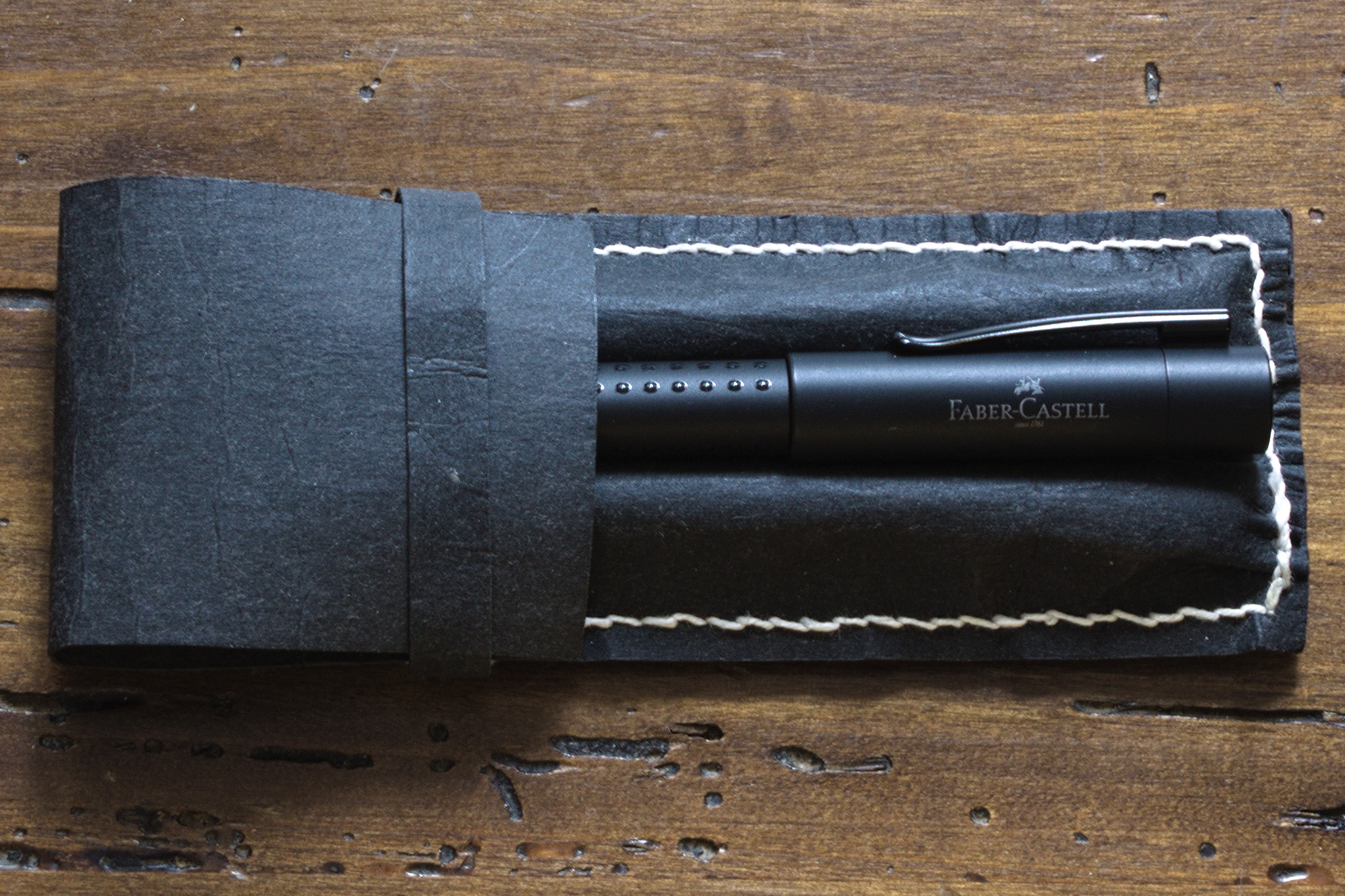
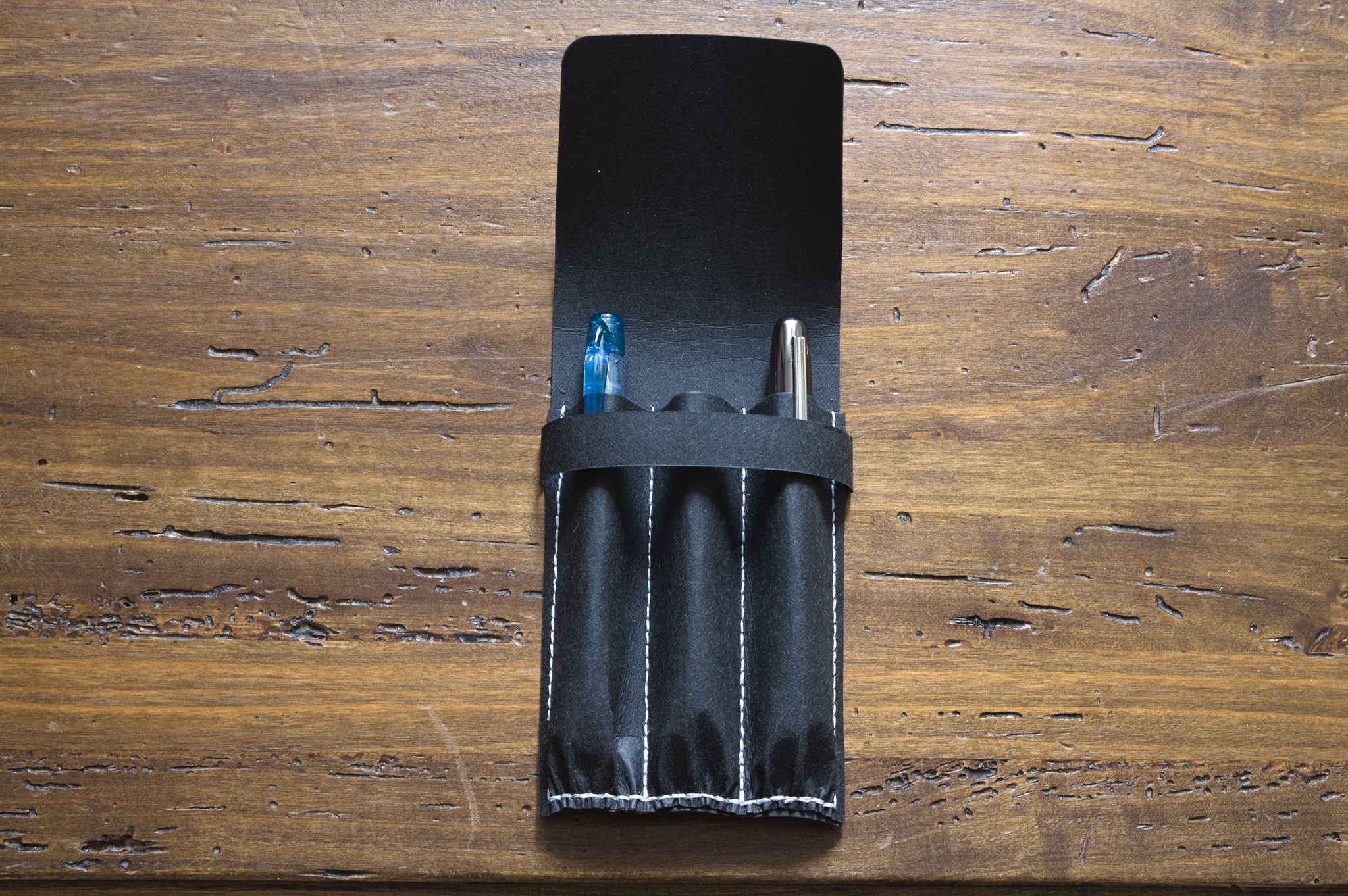
  1. 16 . plus a 9 converter, and another 6 pen to get the EF nib from, since it wasn t available for the expensive pen.
  2. I have them written down somewhere. I couldn t find them. So I measured the real thing, with some approximation.

28 February 2026

Daniel Baumann: Debian Fast Forward: An alternative backports repository

The Debian project releases a new stable version of its Linux distribution approximately every two years. During its life time, a stable release usually gets security updates only, but in general no feature updates. For some packages it is desirable to get feature updates earlier than with the next stable release. Some new packages included in Debian after the initial release of a stable distribution are desirable for stable too. Both use-cases can be solved by recompiling the newer version of a package from testing/unstable on stable (aka backporting). Packages are backported together with only the minimal amount of required build-depends or depends not already fulfilled in stable (if any), and without any changes unless required to fix building on stable (if needed). There are official Debian Backports available, as well as several well-known unofficial backports repositories. I have been involved in one of these unofficial repositories since 2005 which subsequently turned 2010 into its own Debian derivative, mixing both backports and modified packages in one repository for simplicity. Starting with the Debian 13 (trixie) release, the (otherwise unmodified) backports of this derivative have been split out from the derivative distribution into a separate repository. This way the backports are more accessible and useful for all interested Debian users too.
TL;DR: Debian Fast Forward - https://fastforward.debian.net
  • is an alternative Debian repository containing complementary backports from testing/unstable to stable
  • with packages organized in a curated, self-contained selection of coherent sets
  • supporting amd64, i386, and arm64 architectures
  • containing around 400 packages in trixie-fastforward-backports
  • with 1 800 uploads since July 2025
End user documentation about how to enable Debian Fast Forwards is available. Have fun!

27 February 2026

Petter Reinholdtsen: Free software toolchain for the simplest RISC-V CPU in a small FPGA?

On Wednesday I had the pleasure of attending a presentation organized by the Norwegian Unix Users Group on implementing RISC-V using a small FPGA. This project is the result of a university teacher wanting to teach students assembly programming using a real instruction set, while still providing a simple and transparent CPU environment. The CPU in question implements the smallest set of opcodes needed to still call the CPU a RISC-V CPU, the RV32I base set. The author and presenter, Kristoffer Robin Stokke, demonstrated how to build both the FPGA setup and a small startup code providing a "Hello World" message over both serial port and a small LCD display. The FPGA is programmed using VHDL, the entire source code is available from github, but unfortunately the target FPGA setup is compiled using the proprietary tool Quartus. It is such a pity that such a cool little piece of free software should be chained down by non-free software, so my friend Jon Nordby set out to see if we can liberate this small RISC-V CPU. After all, it would be unforgivable sin to force students to use non-free software to study at the University of Oslo. The VHDL code for the CPU instructions itself is only 1138 lines, if I am to believe wc -l lib/riscv_common/* lib/rv32i/*. On the small FPGA used during the talk, the entire CPU, ROM, display and serial port driver only used up half the capacity. These days, there exists a free software toolchain for FPGA programming not only in Verilog but also in VHDL, and we hope the support in yosys, ghdl, and yosys-plugin-ghdl (sadly and strangely enough, removed from Debian unstable) is complete enough to at least build this small and simple project with some minor portability fixes. Or perhaps there are other approaches that work better? The first patches are already floating on github, to make the VHDL code more portable and to test out the build. If you are interested in running your own little RISC-V CPU on a FPGA chip, please get in touch. At the moment we sadly have hit a GHDL bug, which we do not quite know how to work around or fix:
******************** GHDL Bug occurred ***************************
Please report this bug on https://github.com/ghdl/ghdl/issues
GHDL release: 5.0.1 (Debian 5.0.1+dfsg-1+b1) [Dunoon edition]
Compiled with unknown compiler version
Target: x86_64-linux-gnu
/scratch/pere/src/fpga/memstick-fpga-riscv-upstream/
Command line:
Exception CONSTRAINT_ERROR raised
Exception information:
raised CONSTRAINT_ERROR : synth-vhdl_expr.adb:1763 discriminant check failed
******************************************************************
Thus more work is needed. For me, this simple project is the first stepping stone for a larger dream I have of converting the MESA machine controller system to build its firmware using a free software toolchain. I just need to learn more FPGA programming first. :) As usual, if you use Bitcoin and want to show your support of my activities, please send Bitcoin donations to my address 15oWEoG9dUPovwmUL9KWAnYRtNJEkP1u1b.

Dirk Eddelbuettel: x13binary 1.1.61.2 on CRAN: Micro Maintenance

The x13binary team is happy to share the availability of Release 1.1.61.2 of the x13binary package providing the X-13ARIMA-SEATS program by the US Census Bureau which arrived on CRAN earlier today, and has already been built for r2u. This release responds to a CRAN request to display the compiler version when building. x13binary, just like three other packages there, creates and ships a local binary it interfaces with. So our build was a little outside of R CMD INSTALL ... but now signals build versions like R does. We also modernized and simplified our continuous intgegration script based on r-ci. Courtesy of my CRANberries, there is also a diffstat report for this release showing changes to the previous release.

This post by Dirk Eddelbuettel originated on his Thinking inside the box blog. If you like this or other open-source work I do, you can sponsor me at GitHub.

22 February 2026

Benjamin Mako Hill: What makes online groups vulnerable to governance capture?

Note: I have not published blog posts about my academic papers over the past few years. To ensure that my blog contains a more comprehensive record of my published papers and to surface these for folks who missed them, I will be periodically (re)publishing blog posts about some older published projects. This post is closely based on a previously published post by Zarine Kharazian on the Community Data Science Blog. For nearly a decade, the Croatian language version of Wikipedia was run by a cabal of far-right nationalists who edited articles in ways that promoted fringe political ideas and involved cases of historical revisionism related to the Usta e regime, a fascist movement that ruled the Nazi puppet state called the Independent State of Croatia during World War II. This cabal seized complete control of the encyclopedia s governance, banned and blocked those who disagreed with them, and operated a network of fake accounts to create the appearance of grassroots support for their policies. Thankfully, Croatian Wikipedia appears to be an outlier. Though both the Croatian and Serbian language editions have been documented to contain nationalist bias and historical revisionism, Croatian Wikipedia seems unique among Wikipedia editions in the extent to which its governance institutions were captured by a small group of users.

The situation in Croatian Wikipedia was well documented and is now largely fixed, but we still know very little about why it was taken over, while other language editions seem to have rebuffed similar capture attempts. In a paper published in the Proceedings of the ACM: Human-Computer Interaction (CSCW), Zarine Kharazian, Kate Starbird, and I present an interview-based study that provides an explanation for why Croatian was captured while several other editions facing similar contexts and threats fared better.

Short video presentation of the work given at Wikimania in August 2023.
Based on insights from interviews with 15 participants from both the Croatian and Serbian Wikipedia projects and from the broader Wikimedia movement, we arrived at three propositions that, together, help explain why Croatian Wikipedia succumbed to capture while Serbian Wikipedia did not:
  1. Perceived Value as a Target. Is the project worth expending the effort to capture?
  2. Bureaucratic Openness. How easy is it for contributors outside the core founding team to ascend to local governance positions?
  3. Institutional Formalization. To what degree does the project prefer personalistic, informal forms of organization over formal ones?
The conceptual model from our paper, visualizing possible institutional configurations among Wikipedia projects that affect the risk of governance capture.
We found that both Croatian and Serbian Wikipedias were attractive targets for far-right nationalist capture due to their sizable readership and resonance with national identity. However, we also found that the two projects diverged early in their trajectories in how open they remained to new contributors ascending to local governance positions and in the degree to which they privileged informal relationships over formal rules and processes as the project s organizing principles. Ultimately, Croatian s relative lack of bureaucratic openness and rules constraining administrator behavior created a window of opportunity for a motivated contingent of editors to seize control of the governance mechanisms of the project. Though our empirical setting was Wikipedia, our theoretical model may offer insight into the challenges faced by self-governed online communities more broadly. As interest in decentralized alternatives to Facebook and X (formerly Twitter) grows, communities on these sites will likely face similar threats from motivated actors. Understanding the vulnerabilities inherent in these self-governing systems is crucial to building resilient defenses against threats like disinformation. For more details on our findings, take a look at the published version of our paper.

Citation for the full paper: Kharazian, Zarine, Kate Starbird, and Benjamin Mako Hill. 2024. Governance Capture in a Self-Governing Community: A Qualitative Comparison of the Croatian, Serbian, Bosnian, and Serbo-Croatian Wikipedias. Proceedings of the ACM on Human-Computer Interaction 8 (CSCW1): 61:1-61:26. https://doi.org/10.1145/3637338.

This blog post and the paper it describes are collaborative work by Zarine Kharazian, Benjamin Mako Hill, and Kate Starbird.

Otto Kek l inen: Do AI models still keep getting better, or have they plateaued?

Featured image of post Do AI models still keep getting better, or have they plateaued?The AI hype is based on the assumption that the frontier AI labs are producing better and better foundational models at an accelerating pace. Is that really true, or are people just in sort of a mass psychosis because AI models have become so good at mimicking human behavior that we unconsciously attribute increasing intelligence to them? I decided to conduct a mini-benchmark of my own to find out if the latest and greatest AI models are actually really good or not.
The problem with benchmarks Every time any team releases a new LLM, they boast how well it performs on various industry benchmarks such as Humanity s Last Exam, SWE-Bench and Ai2 ARC or ARC-AGI. An overall leaderboard can be viewed at LLM-stats. This incentivizes teams to optimize for specific benchmarks, which might make them excel on specific tasks while general abilities degrade. Also, the older a benchmark dataset is, the more online material there is discussing the questions and best answers, which in turn increases the chances of newer models trained on more recent web content scoring better. Thus I prefer looking at real-time leaderboards such as the LM Arena leaderboard (or OpenCompass for Chinese models that might be missing from LM Arena). However, even though the LM Arena Elo score is rated by humans in real-time, the benchmark can still be played. For example, Meta reportedly used a special chat-optimized model instead of the actual Llama 4 model when getting scored on the LM Arena. Therefore I trust my own first-hand experience more than the benchmarks for gaining intuition. Intuition however is not a compelling argument in discussions on whether or not new flagship AI models have plateaued. Thus, I decided to devise my own mini-benchmark so that no model could have possibly seen it in its training data or be specifically optimized for it in any way.

My mini-benchmark I crafted 6 questions based on my own experience using various LLMs for several years and having developed some intuition about what kinds of questions LLMs typically struggle with. I conducted the benchmark using the OpenRouter.ai chat playroom with the following state-of-the-art models: OpenRouter.ai is great as it very easy to get responses from multiple models in parallel to a single question. Also it allows to turn off web search to force the models to answer purely based on their embedded knowledge. OpenRouter.ai Chat playroom Common for all the test questions is that they are fairly straightforward and have a clear answer, yet the answer isn t common knowledge or statistically the most obvious one, and instead requires a bit of reasoning to get correct. Some of these questions are also based on myself witnessing a flagship model failing miserably to answer it.

1. Which cities have hosted the Olympics more than just once? This question requires accounting for both summer and winter Olympics, and for Olympics hosted across multiple cities. The variance in responses comes from if the model understands that Beijing should be counted as it has hosted both summer and winter Olympics. Interestingly GPT was the only model to not mention Beijing at all. Some variance also comes from how models account for co-hosted Olympics. For example Cortina should be counted as having hosted the Olympics twice, in 1956 and 2026, but only Claude, Gemini and Kimi pointed this out. Stockholm s 1956 hosting of the equestrian games during the Melbourne Olympics is a special case, which GPT, Gemini and Kimi pointed out in a side note. Some models seem to have old training material, and for example Grok assumes the current year is 2024. All models that accounted for awarded future Olympics (e.g. Los Angeles 2028) marked them clearly as upcoming. Overall I would judge that only GPT and MinMax gave incomplete answers, while all other models replied as the best humans could reasonably have.

2. If EUR/USD continues to slide to 1.5 by mid-2026, what is the likely effect on BMW s stock price by end of 2026? This question requires mapping the currency exchange rate to historic value, dodging the misleading word slide , and reasoning on where the revenue of a company comes from and how a weaker US dollar affects it in multiple ways. I ve frequently witnessed flagship models get it wrong how interest rates and exchange rates work. Apparently the binary choice between up or down is somehow challenging to the internal statistical model in the LLMs on a topic where there are a lot of training material that talk about both things being likely to happen, and choosing between them requires specifically reasoning about the scenario at hand and disregarding general knowledge of the situation. However, this time all the models concluded correctly that a weak dollar would have a negative overall effect on the BMW stock price. Gemini, GLM, Qwen and Kimi also mention the potential hedging effect of BMW s X-series production in South Carolina for worldwide export.

3. What is the Unicode code point for the traffic cone emoji? This was the first question where the the flagship models clearly still struggle in 2026. The trap here is that there is no traffic cone emoji, so an advanced model should simply refuse to give any Unicode numbers at all. Most LLMs however have an urge to give some answer, leading to hallucinations. Also, as the answer has a graphical element to it, the LLM might not understand how the emoji looks in ways that would be obvious to a human, and thus many models claim the construction sign emoji is a traffic cone, which it is not. By far the worst response was from GPT, that simply hallucinates and stops there: OpenAIs GPT-5.2 completely wrong answer to traffic cone emoji question While Gemini and Grok were among the three models not falling into this trap, the response from Claude was exemplary good: Claude Opus 4.6 exemplary good answer to traffic cone emoji question
4. Which languages are the 10 most commonly spoken in the world? For each language, count from 1 to 5. This seemingly simple question can become quite complex when you account for the fact that other languages might also have their own character system, both for words and the numerals (e.g. Arabic /one vs /1), and that numbers might have variations depending on what the thing being counted is (e.g in French object gender un/une), or whether plain numbers and occurrences have their own words (e.g. Russian /odin vs /raz). I ve also witnessed older models frequently mix up on what parts of the reply should be using what language. For a human this question is trivial, assuming they know the language. For LLMs it is surprisingly challenging. Grok and MinMax only gave a list of the most popular languages and stopped there without showing any words in the languages. Qwen got a bit further by trying to list numbers in each language, but the lists were only the numbers 1 to 5: Qwen3.5 Plus count to five in top 10 languages I have seen Grok do something similar before, which in fact inspired me to include this question in my mini-benchmark. GPT got a bit further, but for Hindi, Arabic and Bengali it listed the numerals in local script, not the number words. Gemini, GLM and Kimi gave a complete and correct answer as a list, while the absolute best answer and presentation was by Claude, that gave the table below:

Claude Opus 4.6 10 Most Commonly Spoken Languages (by Total Speakers)
# Language 1 2 3 4 5
1 English One Two Three Four Five
2 Mandarin Chinese (y ) ( r) (s n) (s ) (w )
3 Hindi (ek) (do) (t n) (ch r) (p ch)
4 Spanish Uno Dos Tres Cuatro Cinco
5 French Un Deux Trois Quatre Cinq
6 Arabic (w id) (ithn n) (thal tha) (arba a) (khamsa)
7 Bengali (ek) (dui) (tin) (ch r) (p ch)
8 Portuguese Um Dois Tr s Quatro Cinco
9 Russian (odin) (dva) (tri) (chetyre) (pyat')
10 Japanese (ichi) (ni) (san) (shi) (go)
Note: Rankings are based on estimated total speakers (native + non-native). Rankings can vary depending on the source and methodology used.

5. Count the number of drone launch pads in the picture. Together with the question, I uploaded this picture: Drone pad picture attached to question above A human can easily count that there are 10 rows and 30+ columns in the grid, but because the picture resolution isn t good enough, the exact number of columns can t be counted, and the answer should be that there are at least 300 launch pads in the picture. GPT and Grok both guessed the count is zero. Instead of hallucinating some number they say zero, but it would have been better to not give any number at all, and just state that they are unable to perform the task. Gemini gave as its answer 101 , which is quite odd, but reading the reasoning section, it seems to have tried counting items in the image without reasoning much about what it is actually counting and that there is clearly a grid that can make the counting much easier. Both Qwen and Kimi state they can see four parallel structures, but are unable to count drone launch pads. The absolutely best answer was given by Claude, which counted 10-12 rows and 30-40+ columns, and concluded that there must be 300-500 drone launch pads. Very close to best human level - impressive! This question applied only to multi-modal models that can see images, so GLM and MinMax could not give any response.

6. Explain why I am getting the error below, and what is the best way to fix it? Together with the question above, I gave this code block:
$ SH_SCRIPTS="$(mktemp; grep -Irnw debian/ -e '^#!.*/sh'   sort -u   cut -d ':' -f 1   true)"
$ shellcheck -x --enable=all --shell=sh "$SH_SCRIPTS"
/tmp/tmp.xQOpI5Nljx
debian/tests/integration-tests: /tmp/tmp.xQOpI5Nljx
debian/tests/integration-tests: openBinaryFile: does not exist (No such file or directory)
Older models would easily be misled by the last error message thinking that a file went missing, and focus on suggesting changes to the complex-looking first line. In reality the error is simply caused by having the quotes around the $SH_SCRIPTS, resulting in the entire multi-line string being passed as a single argument to shellcheck. So instead of receiving two separate file paths, shellcheck tries to open one file literally named /tmp/tmp.xQOpI5Nljx\ndebian/tests/integration-tests. Incorrect argument expansion is fairly easy for an experienced human programmer to notice, but tricky for an LLM. Indeed, Grok, MinMax, and Qwen fell for this trap and focused on the mktemp, assuming it somehow fails to create a file. Interestingly GLM fails to produce an answer at all, as the reasoning step seems to be looping, thinking too much about the missing file, but not understanding why it would be missing when there is nothing wrong with how mktemp is executed. Claude, Gemini, and Kimi immediately spot the real root cause of passing the variable quoted and suggested correct fixes that involve either removing the quotes, or using Bash arrays or xargs in a way that makes the whole command also handle correctly filenames with spaces in them.

Conclusion
Model Sports Economics Emoji Languages Visual Shell Score
Claude Opus 4.6 6/6
GPT-5.2 ~ 2.5/6
Grok 4.1 3/6
Gemini 3.1 Pro 5/6
GLM 5 ? N/A 3/5
MinMax M2.5 N/A 1/5
Qwen3.5 Plus ~ 2.5/6
Kimi K2.5 4/6
Obviously, my mini-benchmark only had 6 questions, and I ran it only once. This was obviously not scientifically rigorous. However it was systematic enough to trump just a mere feeling. The main finding for me personally is that Claude Opus 4.6, the flagship model by Anthropic, seems to give great answers consistently. The answers are not only correct, but also well scoped giving enough information to cover everything that seems relevant, without blurping unnecessary filler. I used Claude extensively in 2023-2024 when it was the main model available at my day work, but for the past year I had been using other models that I felt were better at the time. Now Claude seems to be the best-of-the-best again, with Gemini and Kimi as close follow-ups. Comparing their pricing at OpenRouter.ai the Kimi K2.5 price of $0.6 / million tokens is almost 90% cheaper than the Claude Opus 4.6 s $5.0 / million tokens suggests that Kimi K2.5 offers the best price-per-performance ratio. Claude might be cheaper with a monthly subscription directly from Anthropic, potentially narrowing the price gap. Overall I do feel that Anthropic, Google and Moonshot.ai have been pushing the envelope with their latest models in a way that one can t really claim that AI models have plateaued. In fact, one could claim that at least Claude has now climbed over the hill of AI slop and consistently produces valuable results. If and when AI usage expands from here, we might actually not drown in AI slop as chances of accidentally crappy results decrease. This makes me positive about the future. I am also really happy to see that there wasn t just one model crushing everybody else, but that there are at least three models doing very well. As an open source enthusiast I am particularly glad to see that Moonshot.ai s Kimi K2.5 is published with an open license. Given the hardware, anyone can run it on their own. OpenRouter.ai currently lists 9 independent providers alongside Moonshot.ai itself, showcasing the potential of open-weight models in practice. If the pattern holds and flagship models continue improving at this pace we might look back at 2026 as the year AI stopped feeling like a call center associate and started to resemble a scientific researcher. While new models become available we need to keep testing, keep questioning, and keep our expectations grounded in actual performance rather than press releases. Thanks to OpenRouter.ai for providing a great service that makes testing various models incredibly easy!

Next.

Previous.