Search Results: "valhalla"

27 March 2017

Elena 'valhalla' Grandi: New pajama

New pajama

I may have been sewing myself a new pajama.

Immagine/fotohttp://social.gl-como.it/photos/valhalla/image/81b600789aa02a91fdf62f54a71b1ba0

It was plagued with issues; one of the sleeve is wrong side out and I only realized it when everything was almost done (luckily the pattern is symmetric and it is barely noticeable) and the swirl moved while I was sewing it on (and the sewing machine got stuck multiple times: next time I'm using interfacing, full stop.), and it's a bit deformed, but it's done.

For the swirl, I used Inkscape to Simplify (Ctrl-L) the original Debian Swirl a few times, removed the isolated bits, adjusted some spline nodes by hand and printed on paper. I've then cut, used water soluble glue to attach it to the wrong side of a scrap of red fabric, cut the fabric, removed the paper and then pinned and sewed the fabric on the pajama top.
As mentioned above, the next time I'm doing something like this, some interfacing will be involved somewhere, to keep me sane and the sewing machine happy.

Blogging, because it is somewhat relevant to Free Software :) and there are even sources https://www.trueelena.org/clothing/projects/pajamas_set.html#downloads, under a DFSG-Free license :)

22 March 2017

Elena 'valhalla' Grandi: XMPP VirtualHosts, SRV records and letsencrypt certificates

XMPP VirtualHosts, SRV records and letsencrypt certificates

When I set up my XMPP server, a friend of mine asked if I was willing to have a virtualhost with his domain on my server, using the same address as the email.

Setting up prosody and the SRV record on the DNS was quite easy, but then we stumbled on the issue of certificates: of course we would like to use letsencrypt, but as far as we know that means that we would have to setup something custom so that the certificate gets renewed on his server and then sent to mine, and that looks more of a hassle than just him setting up his own prosody/ejabberd on his server.

So I was wondering: dear lazyweb, did any of you have the same issue and already came up with a solution that is easy to implement and trivial to maintain that we missed?

12 February 2017

Elena 'valhalla' Grandi: Mobile-ish devices as freedom respecting working environments

Mobile-ish devices as freedom respecting working environments

On planet FSFE, there is starting to be a conversation on using tablets / Android as the main working platform.

It started with the article by Henri Bergius http://bergie.iki.fi/blog/working-on-android-2017/ which nicely covers all practical points, but is quite light on the issues of freedom.

This was rectified by the article by David Boddie http://www.boddie.org.uk/david/www-repo/Personal/Updates/2017/2017-02-11.html which makes an apt comparison of Android to the platform it is replacing in many areas of work and life: Microsoft Windows and criticises its lack of effective freedom, even when the OS was supposed to be under a free license.

I fully agree that lightweight/low powered hardware can be an excellent work environment, especially when on the go, and even for many kinds of software developement, but I'd very much rather have that hardware run an environment that I can trust like Debian (or another traditional GNU/Linux distribution) rather than the phone based ones where, among other problems, there is no clear distinction between what is local and trustable and what is remote and under somebody else's control.

In theory, it would be perfectly possible to run Debian on most tablet and tablet-like hardware, and have such an environment; in practice this is hard for a number of reasons including the lack of mainline kernel support for most hardware and the way actually booting a different OS on it usually ranges from the quite hard to the downright impossible.

Luckily, there is some niche hardware that uses tablet/phone SoCs but is sold with a GNU/Linux distribution and can be used as a freedom respecting work environment on-the-go: my current setup includes an OpenPandora https://en.wikipedia.org/wiki/Pandora_(console) (running Angstrom + a Debian chroot) and an Efika MX Smartbook https://en.wikipedia.org/wiki/Efika, but they are both showing their age badly: they have little RAM (especially the Pandora), and they aren't fully supported by a mainline kernel, which means that you're stuck on an old kernel and dependent on the producer for updates (which for the Efika ended quite early; at least the Pandora is still somewhat supported, at least for bugfixes).

Right now I'm looking forward to two devices as a replacement: the DragonBox Pyra https://en.wikipedia.org/wiki/DragonBox_Pyra (still under preorders) and the THERES-I laptop kit https://www.olimex.com/Products/DIY%20Laptop/ (hopefully available for sale "in a few months", and with no current mainline support for the SoC, but there is hope to see it from the sunxi community http://linux-sunxi.org/Main_Page).

As for software, the laptop/clamshell designs means that using a regular Desktop Environment (or, in my case, Window Manager) works just fine; I do hope that the availability of Pyra (with its touchscreen and 4G/"phone" chip) will help to give a bit of life back to the efforts to improve mobile software on Debian https://wiki.debian.org/Mobile

Hopefully, more such devices will continue to be available, and also hopefully the trend for more openness of the hardware itself will continue; sadly I don't see this getting outside of a niche market in the next few years, but I think that this niche will remain strong enough to be sustainable.

P.S. from nitpicker-me: David Boddie mentions the ability to easily download sources for any component with apt-get source: the big difference IMHO is given by apt-get build-dep, which also install every dependency needed to actually build the code you have just downloaded.

P.S.2: I also agree with Davide Boddie that supporting Conservancy https://sfconservancy.org/supporter/ is very important, and there are still a few hours left to have the contribution count twice.

29 January 2017

Elena 'valhalla' Grandi: Preseeding a debian installation on a libreboot computer

Preseeding a debian installation on a libreboot computer

Preseeding a debian installation from the standard installer is as easy as pressing ESC at the right time and pointing it to the url of your preseed file https://wiki.debian.org/DebianInstaller/Preseed#Loading_the_preseeding_file_from_a_webserver, right?

It is, except when you're using libreboot, and you never pass through that right time , because you are skipping the installer's grub.

So, for future reference, here is the right incantation to use at the command line that you get by pressing c at the libreboot menu:


linux (usb0)/install.amd/vmlinuz auto=true url=http://webserver/path/preseed.cfg
initrd (usb0)/install.amd/initrx
boot


simple, once you've found it...

(ok, it took me less than one hour, but I don't want it to take another hour the next time)

#coreboot #libreboot #debian #preseed

Elena 'valhalla' Grandi: One Liberated Laptop

One Liberated Laptop

Immagine/fotohttp://social.gl-como.it/photos/valhalla/image/5a480cd2d5842101fc8975d927d030f3

After many days of failed attempts, yesterday @Diego Roversi finally managed to setup SPI on the BeagleBone White , and that means that today at our home it was Laptop Liberation Day!

We took the spare X200, opened it, found the point we were on in the tutorial installing libreboot on x200 https://libreboot.org/docs/install/x200_external.html, connected all of the proper cables on the clip and did some reading tests of the original bios.

Immagine/fotohttp://social.gl-como.it/photos/valhalla/image/77e61745d9c43833b7c0a4a919d17222

While the tutorial mentioned a very conservative setting (512kHz), just for fun we tried to read it at different speed and all results up to 16384 kHz were equal, with the first failure at 32784 kHz, so we settled on using 8192 kHz.

Then it was time to customize our libreboot image with the right MAC address, and that's when we realized that the sheet of paper where we had written it down the last time had been put in a safe place somewhere

Luckily we also had taken a picture, and that was easier to find, so we checked the keyboard map , followed the instructions to customize the image https://libreboot.org/docs/hcl/gm45_remove_me.html#ich9gen, flashed the chip, partially reassembled the laptop, started it up and a black screen, some fan noise and nothing else.

We tried to reflash the chip (nothing was changed), tried the us keyboard image, in case it was the better tested one (same results) and reflashed the original bios, just to check that the laptop was still working (it was).

It was lunchtime, so we stopped our attempts. As soon as we started eating, however, we realized that this laptop came with 3GB of RAM, and that surely meant "no matching pairs of RAM", so just after lunch we reflashed the first image, removed one dimm, rebooted and finally saw a gnu-hugging penguin!

We then tried booting some random live usb key https://tails.boum.org/ we had around (failed the first time, worked the second and further one with no changes), and then proceeded to install Debian.

Running the installer required some attempts and a bit of duckduckgoing: parsing the isolinux / grub configurations from the libreboot menu didn't work, but in the end it was as easy as going to the command line and running:


linux (usb0)/install.amd/vmlinuz
initrd (usb0)/install.amd/initrd.gz
boot


From there on, it was the usual debian installation and a well know environment, and there were no surprises. I've noticed that grub-coreboot is not installed (grub-pc is) and I want to investigate a bit, but rebooting worked out of the box with no issue.

Next step will be liberating my own X200 laptop, and then if you are around the @Gruppo Linux Como area and need a 16 pin clip let us know and we may bring everything to one of the LUG meetings

yes, white, and most of the instructions on the interwebz talk about the black, which is extremely similar to the white except where it isn't

wait? there are keyboard maps? doesn't everybody just use the us one regardless of what is printed on the keys? Do I *live* with somebody who doesn't? :D

the breadboard in the picture is only there for the power supply, the chip on it is a cheap SPI flash used to test SPI on the bone without risking the laptop :)

disclaimer: it worked for us. it may not work on *your* laptop. it may brick it. it may invoke a tentacled monster, it may bind your firstborn son to a life of servitude to some supernatural being. Whatever happens, it's not our fault.

(edit: added tags)

#coreboot #libreboot

13 January 2017

Elena 'valhalla' Grandi: Modern XMPP Server

Modern XMPP Server

I've published a new HOWTO on my website 'http://www.trueelena.org/computers/howto/modern_xmpp_server.html':

http://www.enricozini.org/blog/2017/debian/modern-and-secure-instant-messaging/ already wrote about the Why (and the What, Who and When), so I'll just quote his conclusion and move on to the How.

I now have an XMPP setup which has all the features of the recent fancy chat systems, and on top of that it runs, client and server, on Free Software, which can be audited, it is federated and I can self-host my own server in my own VPS if I want to, with packages supported in Debian.


How

I've decided to install https://prosody.im/, mostly because it was recommended by the RTC QuickStart Guide http://rtcquickstart.org/; I've heard that similar results can be reached with https://www.ejabberd.im/ and other servers.

I'm also targeting https://www.debian.org/ stable (+ backports); as I write this is jessie; if there are significant differences I will update this article when I will upgrade my server to stretch. Right now, this means that I'm using prosody 0.9 (and that's probably also the version that will be available in stretch).

Installation and prerequisites

You will need to enable the https://backports.debian.org/ repository and then install the packages prosody and prosody-modules.

You also need to setup some TLS certificates (I used Let's Encrypt https://letsencrypt.org/); and make them readable by the prosody user; you can see Chapter 12 of the RTC QuickStart Guide http://rtcquickstart.org/guide/multi/xmpp-server-prosody.html for more details.

On your firewall, you'll need to open the following TCP ports:


The latter two are needed to enable some services provided via http(s), including rich media transfers.

With just a handful of users, I didn't bother to configure LDAP or anything else, but just created users manually via:

prosodyctl adduser alice@example.org

In-band registration is disabled by default (and I've left it that way, to prevent my server from being used to send spim https://en.wikipedia.org/wiki/Messaging_spam).

prosody configuration

You can then start configuring prosody by editing /etc/prosody/prosody.cfg.lua and changing a few values from the distribution defaults.

First of all, enforce the use of encryption and certificate checking both for client2server and server2server communications with:


c2s_require_encryption = true
s2s_secure_auth = true


and then, sadly, add to the whitelist any server that you want to talk to and doesn't support the above:


s2s_insecure_domains = "gmail.com"


virtualhosts

For each virtualhost you want to configure, create a file /etc/prosody/conf.avail/chat.example.org.cfg.lua with contents like the following:


VirtualHost "chat.example.org"
enabled = true
ssl =
key = "/etc/ssl/private/example.org-key.pem";
certificate = "/etc/ssl/public/example.org.pem";


For the domains where you also want to enable MUCs, add the follwing lines:


Component "conference.chat.example.org" "muc"
restrict_room_creation = "local"


the "local" configures prosody so that only local users are allowed to create new rooms (but then everybody can join them, if the room administrator allows it): this may help reduce unwanted usages of your server by random people.

You can also add the following line to enable rich media transfers via http uploads (XEP-0363):


Component "upload.chat.trueelena.org" "http_upload"

The defaults are pretty sane, but see https://modules.prosody.im/mod_http_upload.html for details on what knobs you can configure for this module

Don't forget to enable the virtualhost by linking the file inside /etc/prosody/conf.d/.

additional modules

Most of the other interesting XEPs are enabled by loading additional modules inside /etc/prosody/prosody.cfg.lua (under modules_enabled); to enable mod_something just add a line like:


"something";

Most of these come from the prosody-modules package (and thus from https://modules.prosody.im/ ) and some may require changing when prosody 0.10 will be available; when this is the case it is mentioned below.


@Gruppo Linux Como @LIFO

11 January 2017

Enrico Zini: Modern and secure instant messaging

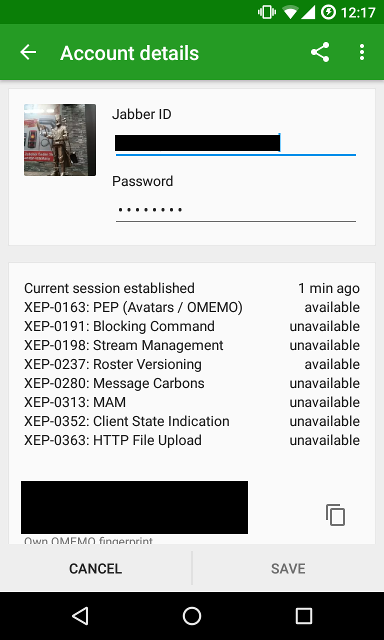
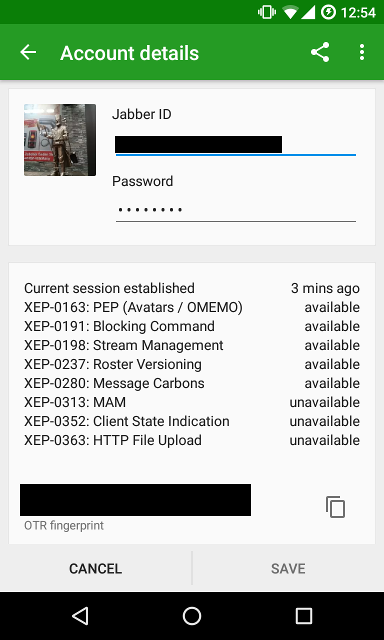
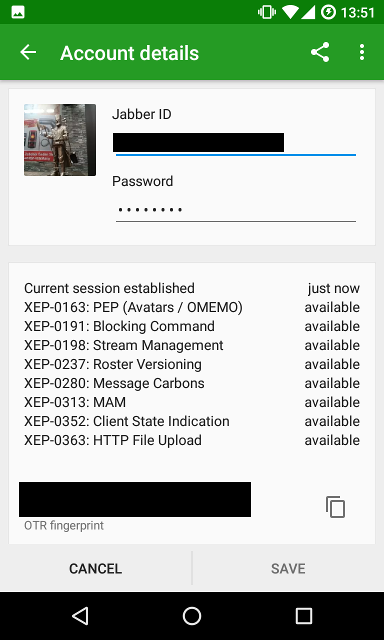
Conversations is a really nice, actively developed, up to date XMPP client for Android that has the nice feature of telling you what XEPs are supported by the server one is using: Initial server features Some days ago, me and Valhalla played the game of trying to see what happens when one turns them all on: I would send her screenshots from my Conversations, and she would poke at her Prosody to try and turn things on: After some work Valhalla eventually managed to get all features activated, purely using packages from Jessie+Backports: All features activated The result was a chat system in which I could see the same conversation history on my phone and on my laptop (with gajim)(https://gajim.org/), and have it synced even after a device has been offline, We could send each other rich media like photos, and could do OMEMO encryption (same as Signal) in group chats. I now have an XMPP setup which has all the features of the recent fancy chat systems, and on top of that it runs, client and server, on Free Software, which can be audited, it is federated and I can self-host my own server in my own VPS if I want to, with packages supported in Debian. Valhalla has documented the whole procedure. If you make a client for a protocol with lots of extension, do like Conversations and implement a status page with the features you'd like to have on the server, and little green indicators showing which are available: it is quite a good motivator for getting them all supported.

6 January 2017

Elena 'valhalla' Grandi: Candy from Strangers

Candy from Strangers

A few days ago I gave a talk at ESC https://www.endsummercamp.org/ about some reasons why I think that using software and especially libraries from the packages of a community managed distribution is important and much better than alternatives such as pypi, nmp etc. This article is a translation of what I planned to say before forgetting bits of it and luckily adding it back as an answer to a question :)

When I was young, my parents taught me not to accept candy from strangers, unless they were present and approved of it, because there was a small risk of very bad things happening. It was of course a simplistic rule, but it had to be easy enough to follow for somebody who wasn't proficient (yet) in the subtleties of social interactions.

One of the reasons why it worked well was that following it wasn't a big burden: at home candy was plenty and actual offers were rare: I only remember missing one piece of candy because of it, and while it may have been a great one, the ones I could have at home were also good.

Contrary to candy, offers of gratis software from random strangers are quite common: from suspicious looking websites to legit and professional looking ones, to platforms that are explicitly designed to allow developers to publish their own software with little or no checks.

Just like candy, there is also a source of trusted software in the Linux distributions, especially those lead by a community: I mention mostly Debian because it's the one I know best, but the same principles apply to Fedora and, to some measure, to most of the other distributions. Like good parents, distributions can be wrong, and they do leave room for older children (and proficient users) to make their own choices, but still provide a safe default.

Among the unsafe sources there are many different cases and while they do share some of the risks, they have different targets with different issues; for brevity the scope of this article is limited to the ones that mostly concern software developers: language specific package managers and software distribution platforms like PyPi, npm and rubygems etc.

These platforms are extremely convenient both for the writers of libraries, who are enabled to publish their work with minor hassles, and for the people who use such libraries, because they provide an easy way to install and use an huge amount of code. They are of course also an excellent place for distributions to find new libraries to package and distribute, and this I agree is a good thing.

What I however believe is that getting code from such sources and using it without carefully checking it is even more risky than accepting candy from a random stranger on the street in an unfamiliar neighbourhood.

The risk aren't trivial: while you probably won't be taken as an hostage for ransom, your data could be, or your devices and the ones who run your programs could be used in some criminal act causing at least some monetary damage both to yourself and to society at large.

If you're writing code that should be maintained in time there are also other risks even when no malice is involved, because each package on these platform has a different policy with regards to updates, their backwards compatibility and what can be expected in case an old version is found to have security issues.

The very fact that everybody can publish anything on such platforms is both their biggest strength and their main source of vulnerability: while most of the people who publish their libraries do so with good intentions, attacks have been described and publicly tested, such as the fun typo-squatting http://incolumitas.com/2016/06/08/typosquatting-package-managers/ one (archived on http://web.archive.org/web/20160801161807/http://incolumitas.com/2016/06/08/typosquatting-package-managers) that published harmless malicious code under common typos for famous libraries.

Contrast this with Debian, where everybody can contribute, but before they are allowed full unsupervised access to the archive they have to establish a relationship with the rest of the community, which includes meeting other developers in real life, at the very least to get their gpg keys signed.

This doesn't prevent malicious people from introducing software, but raises significantly the effort required to do so, and once caught people can usually be much more effectively prevented from repeating it than a simple ban on an online-only account can do.

It is true that not every Debian maintainer actually does a full code review of everything that they allow in the archive, and in some cases it would be unreasonable to expect it, but in most cases they are at least reasonably familiar with the code to do at least bug triage, and most importantly they are in an excellent position to establish a relationship of mutual trust with the upstream authors.

Additionally, package maintainers don't work in isolation: a growing number of packages are being maintained by a team of people, and most importantly there are aspects that involve potentially the whole community, from the fact that new packages that enter the distribution are publicity announced on a mailing list to the various distribution-wide QA efforts.

Going back to the language specific distribution platforms, sometimes even the people who manage the platform themselves can't be fully trusted to do the right thing: I believe everybody in the field remembers the npm fiasco https://lwn.net/Articles/681410/ where a lawyer letter requesting the removal of a package started a series of events that resulted in potentially breaking a huge amount of automated build systems.

Here some of the problems were caused by some technical policies that caused the whole ecosystem to be especially vulnerable, but one big issue was the fact that the managers of the npm platform are a private entity with no oversight from the user community.

Here not all distributions are equal, but contrast this with Debian, where the distribution is managed by a community that is based on a social contract https://www.debian.org/social_contract and is governed via democratic procedures established in its https://www.debian.org/devel/constitution.

Additionally, the long history of the distribution model means that many issues have already been met, the errors have already been done, and there are established technical procedures to deal with them in a better way.

So, shouldn't we use language specific distribution platforms at all? No! As developers we aren't children, we are adults who have the skills to distinguish between safe and unsafe libraries just as well as the average distribution maintainer can do. What I believe we should do is stop treating them as a safe source that can be used blindly and reserve that status to actual trustful sources like Debian, falling back to the language specific platforms only when strictly needed, and in that case:

actually check carefully what we are using, both by reading the code and by analysing the development and community practices of the authors;
if possible, share that work by becoming ourselves maintainers of that library in our favourite distribution, to prevent duplication of effort and to give back to the community whose work we get advantage from.

Edit: fixed broken typosquatting url

3 August 2016

Elena 'valhalla' Grandi: The Cat Model of Package Ownership

The Cat Model of Package Ownership

Debian has been moving away from strong ownership of packages by package maintainers and towards encouraging group maintainership, for very good reasons: single maintainers have a bad bus factor and a number of other disadvantages.

When single maintainership is changed into maintainership by a small , open group of people who can easily communicate and sync with each other, everything is just better: there is an easy way to gradually replace people who want to leave, but there is also no duplication of efforts (because communication is easy), there are means to always have somebody available for emergency work and generally package quality can only gain from it.

Unfortunately, having such group of maintainers for every package would require more people than are available and willing to work on it, and while I think it's worth doing efforts to have big and important packages managed that way, it may not be so for the myriad of small ones that make up the long tail of a distribution.

Many of those packages may end up being maintained in a big team such as the language-based ones, which is probably better than remaining with a single maintainer, but can lead to some problems.

My experience with the old OpenEmbedded, back when it was still using monotone instead of git and everybody was maintaining everything, however, leads me to think that this model has a big danger of turning into nobody maintains anything, because when something needs to be done everybody is thinking that somebody else will do it.

As a way to prevent that, I have been thinking in the general direction of a Cat Model of Package Ownership, which may or may not be a way to prevent some risks of both personal maintainership and big teams.

The basic idea is that the my in my packages is not the my in my toys , but the my in my Cat, to whom I am a servant .

As in the case of a cat, if my package needs a visit to the vet, it's my duty to do so. Other people may point me to the need of such a visit, e.g. by telling me that they have seen the cat leaving unhealty stools, that there is a bug in the package, or even that upstream released a new version a week ago, did you notice?, but the actual putting the package in a cat carrier and bringing it to the vet falls on me.

Whether you're allowed to play with or pet the cat is her decision, not mine, and giving her food or doing changes to the package is usually fine, but please ask first: a few cats have medical issues that require a special diet.

And like cats, sometimes the cat may decide that I'm not doing a good enough job of serving her, and move away to another maintainer; just remember that there is a difference between a lost cat who wants to go back to her old home and a cat that is looking for a new one. When in doubt, packages usually wear a collar with contact informations, trying to ping those is probably a good idea.

This is mostly a summer afternoon idea and will probably require some refinement, but I think that the basic idea can have some value. Comments are appreciated on the federated social networks where this post is being published, via email (valid addresses are on my website http://www.trueelena.org/computers/articles/the_cat_model_of_package_ownership.html and on my GPG key http://www.trueelena.org/about/gpg.html) or with a post on a blog that appears on planet debian http://planet.debian.org/.

how small is small depends a lot on the size of the package, the amount of work it requires, how easy it is to parallelize it and how good are the people involved at communicating, so it would be quite hard to put a precise number here.

I've moved away from it because the boards I was using could run plain Debian, but I've heard that after the move to git there have been a number of workflow changes (of which I've seen the start) and everything now works much better.

28 July 2016

Elena 'valhalla' Grandi: kvm virtualization on a liberated X200, part 1

kvm virtualization on a liberated X200, part 1

As the libreboot website warns https://libreboot.org/docs/hcl/x200.html: there are issues with virtualization on x200 without microcode updated.

Virtualization is something that I use, and I have a number of VMs on that laptop, managed with libvirt; since it has microcode version 1067a, I decided to try and see if I was being lucky and virtualization was working anyway.

The result is that the machines no longer start: the kernel loads, and then it crashes and reboots. I don't remember why, however, I tried to start a debian installer CD (iso) I had around, and that one worked.

So, I decided to investigate a bit more: apparently a new installation done from that iso (debian-8.3.0-amd64-i386-netinst.iso) boots and works with no problem, while my (older, I suspect) installations don't. I tried to boot one of the older VMs with that image in recovery mode, tried to chroot in the original root and got failed to run command '/bin/bash': Exec format error.

Since that shell was lacking even the file command, I tried then to start a live image, and choose the lightweight debian-live-8.0.0-amd64-standard.iso: that one didn't start in the same way as the existing images.

Another try with debian-live-8.5.0-i386-lxde-desktop.iso confirmed that apparently Debian > 8.3 works, Debian 8.0 doesn't (I don't have ISOs for versions 8.1 and 8.2 to bisect properly the issue).

I've skimmed the release notes for 8.3 https://www.debian.org/News/2016/20160123 and noticed that there was an update in the intel-microcodehttps://packages.debian.org/jessie/intel-microcode package, but AFAIK the installer doesn't have anything from non-free, and I'm sure that non-free wasn't enabled on the VMs.

My next attempt (thanks tosky on #debian-it for suggesting this obvious solution that I was missing :) ) was to run one of the VMs with plain qemu instead of kvm and bring it up-to-date: the upgrade was successful and included the packages in this screenshot, but on reboot it's still not working as before.

Immagine/fotohttp://social.gl-como.it/photos/valhalla/image/ecb0e193b16fbd507d0148636177961b

Right now, I think I will just recreate from scratch the images I need, but when I'll have time I'd like to investigate the issue a bit more, so hopefully there will be a part 2 to this article.

3 July 2016

Elena 'valhalla' Grandi: Debconf streaming and kudos to the video team

Debconf streaming and kudos to the video team

With http://debconf16.debconf.org/ being in South Africa, a lot of people (like me) probably weren't able to attend and are missing the cheese and wine party, mao games and general socialization that is happening there.

One thing we don't have to miss, however, are the talks: as usual the video team https://wiki.debconf.org/wiki/DebConf16/Videoteam is doing a great job recording and https://debconf16.debconf.org/video/live-streaming/ all talks so that people can still participate a bit from their home.

What they do, however, requires a lot of manpower, so if you are attending Debconf please consider volunteering https://wiki.debconf.org/wiki/Videoteam/roles_for_volunteers to help: from my experience last year they are very nice people who are welcoming towards new contributors and they have periodical training sessions to help people getting started with the various tasks. More informations about video team meetings and training session are in the topic of the IRC channel, #debconf-video@OFTC.

I don't think there are cookies involved (which just proves that the video team isn't evil), but you may get a t-shirt and you will get a warm fuzzy feeling of having helped people around the world.

@Debian #debconf

1 July 2016

Elena 'valhalla' Grandi: Busy/idle status indicator

Busy/idle status indicator


About one year ago, during my first http://debconf15.debconf.org/, I've felt the need for some way to tell people whether I was busy on my laptop doing stuff that required concentration or just passing some time between talks etc. and available for interruptions, socialization or context switches.

One easily available method of course would have been to ping me on IRC (and then probably go on chatting on it while being in the same room, of course :) ), but I wanted to try something that allowed for less planning and worked even in places with less connectivity.

My first idea was a base laptop sticker with two statuses and then a removable one used to cover the wrong status and point to the correct one, and I still think it would be nice, but having it printed is probably going to be somewhat expensive, so I shelved the project for the time being.

Immagine/foto

Lately, however, I've been playing with hexagonal stickers https://terinjokes.github.io/StickerConstructorSpec/ and decided to design something on this topic, whith the result in the figure above, with the hacking sticker being my first choice, and the concentrating alternative probably useful while surrounded by people who may misunderstand the term hacking .

While idly looking around for sticker printing prices I realized that it didn't necessarly have to be a sticker and started to consider alternatives.

One format I'm trying is inspired by "do not disturb" door signs: I've used some laminating pouches I already had around which are slightly bigger than credit-card format (but credit-card size would also work of course ) and cut a notch so that they can be attached to the open lid of a laptop.

Immagine/fotoImmagine/foto

They seem to fit well on my laptop lid, and apart from a bad tendency to attract every bit of lint in a radius of a few meters the form factor looks good. I'll try to use them at the next conference to see if they actually work for their intended purpose.

SVG sources (and a PDF) are available on my website http://www.trueelena.org/computers/projects/busy_idle_indicator.html under the CC-BY-SA license.

Elena 'valhalla' Grandi: Free Software dreams

Free Software dreams

Tonight I've dreamt I was inside https://wl.widelands.org/, as a barbarian being invaded by the atlanteans.

I've had the same thing happening to me a few times with Battle for Wesnoth http://wesnoth.org/

Mayyybe it is a sign that lately I've been playing it too much, but I'm quite happy with the fact that free software / culture is influencing my dreams.

Thanks to everybody who is involved into Free Culture for creating enough content so that this can happen.

19 June 2016

Elena 'valhalla' Grandi: StickerConstructorSpec compliant swirl

StickerConstructorSpec compliant swirl

This evening I've played around a bit with the Sticker Constructor Specification https://github.com/terinjokes/StickerConstructorSpec and its https://github.com/terinjokes/StickerConstructorSpec/blob/master/assets/hexagonal-sticker_template.svg, and this is the result:

Immagine/fotohttp://social.gl-como.it/photos/valhalla/image/e8ee069635b2823e168c358d2a753f14


Now I just have to:

* find somebody in Europe who prints good stickers and doesn't require illustrator (or other proprietary software) to submit files for non-rectangular shapes
* find out which Debian team I should contact to submit the files so that they can be used by everybody interested.

But neither will happen today, nor probably tomorrow, because lazy O:-)

Edit: now that I'm awake I realized I forgot to thank @Enrico Zini Zini and MadameZou for their help in combining my two proposals in a better design.

Source svg http://social.gl-como.it/attach/3

11 May 2016

Elena 'valhalla' Grandi: GnuPG Crowdfunding and sticker

GnuPG Crowdfunding and sticker

I've just received my laptop sticker from the GnuPG crowdfund http://goteo.org/project/gnupg-new-website-and-infrastructure: it is of excellent quality, but comes with HOWTO-like detailed instructions to apply it in the proper way.

This strikes me as oddly appropriate.

#gnupg

Elena 'valhalla' Grandi: New gpg subkey

New gpg subkey

The GPG subkey http://www.trueelena.org/about/gpg.html I keep for daily use was going to expire, and this time I decided to create a new one instead of changing the expiration date.

Doing so I've found out that gnupg does not support importing just a private subkey for a key it already has (on IRC I've heard that there may be more informations on it on the gpg-users mailing list), so I've written a few notes on what I had to do on my website http://www.trueelena.org/computers/howto/gpg_subkeys.html, so that I can remember them next year.

The short version is:

* Create your subkey (in the full keyring, the one with the private master key)
* export every subkey (including the expired ones, if you want to keep them available), but not the master key
* (copy the exported key from the offline computer to the online one)
* delete your private key from your regular use keyring
* import back the private keys you have exported before.

#gnupg

7 May 2016

Elena 'valhalla' Grandi: Pyra preorders

Pyra preorders

If you've met me at a conference you may have noticed that instead of a laptop I was using a handeld which looks like a laptop scaled down to nintendo DS size, the https://en.wikipedia.org/wiki/Openpandora.

I've used it as my main computing device while travelling for a few years, even for work (as a programmer)so happily that when EvilDragon announced at FOSDEM (link points to youtube video) https://www.youtube.com/watch?v=4T-w1KqrVsM that he was working on a successor device I started saving money for it even before I knew many details about the specs, other that they would have been way better than the Pandora ones (which is getting painful to use a browser on, because of its 256MB RAM).

Immagine/fotohttp://social.gl-como.it/photos/valhalla/image/5a9fdfadf33e40e9e3517b18ca7cba68

Now this successor device is almost ready, they have opened the preorders https://www.dragonbox.de/en/45-pyra, and they have already reached the absolute minimum number of orders for mass production and are almost there for a more reasonable number of 1000 devices, so if you want a chance to get one of the first batch devices now it's time to visit their store.

A few highlights, from my point of view, include:

* It will run Debian with just a custom kernel/bootloader (and a few configuration only packages): most of the kernel mods are being submitted upstream, so maybe one day there won't even be a need for this kernel (but e.g. with Pandora upstream didn't accept the custom way they managed the keyboard; on the Pyra the keyboard is managed in a more standard way, but there may be other similar issues).

* It has been designed with modularity in mind: the CPU board is socketed on the main board and in the future upgrades may require just replacing the CPU board. I haven't read the details on the actual licensing, but it seems that the hardware design will be open enough that 3rd party boards may also be a possibility.

* just like on Pandora: real keyboard. hardware analog volume wheel. Huge user-replaceable battery (I don't think that there are any independent reviews of the pyra battery yet, but the one on the Pandora is still able to go through a day of FOSDEM i.e. alternating often between on with wifi and suspendend and only go down to 50% or so charge). Stylus (and 3d-printed quill) friendly touchscreen. Long term support from the producer.

* The 4G version has been designed in such a way that the GSM modem can be actually turned off (just like on the https://neo900.org/)

There are of course a few bad parts:

* PowerVR. The good news is that there is a risk that no 3d drivers will be available at all, and this means that the Pyra has been tested and considered good enough with just (FOSS) software acceleration.

* The price: yes, it is expensive. I'm happy I've saved money in advance for it, otherwise I wouldn't have been able to afford it. Some of it is a problem of small production, some is actual product quality. If you consider that it can take the place of both a laptop (and small ones are getting quite expensive, now that netbooks have disappeared) and a smartphone (I don't do lots of voice calls) it will start going down from "oh so **** high" to "high, but not unreasonably so"

Disclaimer: I have preordered one, so I am interested in the success of the project because it will mean better software and better support for the device.

Edit: forgot the link to the press kit the images comes from http://cloud.openpandora.org/index.php/s/a0Q0TXV8gh5NLAC?path=%2F, which also includes more infos on specs etc.

1 March 2016

Erich Schubert: Stop abusing lambda expressions - this is not functional programming

I know, all the Scala fanboys are going to hate me now. But:
Stop overusing lambda expressions.
Most of the time when you are using lambdas, you are not even doing functional programming, because you often are violating one key rule of functional programming: no side effects.
For example:
collection.forEach(System.out::println);
is of course very cute to use, and is (wow) 10 characters shorter than:
for (Object o : collection) System.out.println(o);
but this is not functional programming because it has side effects.
What you are doing are anonymous methods/objects, using a shorthand notion. It's sometimes convenient, it is usually short, and unfortunately often unreadable, once you start cramming complex problems into this framework.
It does not offer efficiency improvements, unless you have the propery of side-effect freeness (and a language compiler that can exploit this, or parallelism that can then call the function concurrently in arbitrary order and still yield the same result).
Here is an examples of how to not use lambdas:
DZone Java 8 Factorial (with boilerplate such as the Pair class omitted):
Stream<Pair> allFactorials = Stream.iterate(
  new Pair(BigInteger.ONE, BigInteger.ONE),
  x -> new Pair(
    x.num.add(BigInteger.ONE),
    x.value.multiply(x.num.add(BigInteger.ONE))));
return allFactorials.filter(
  (x) -> x.num.equals(num)).findAny().get().value;
When you are fresh out of the functional programming class, this may seem like a good idea to you... (and in contrast to the examples mentioned above, this is really a functional program).
But such code is a pain to read, and will not scale well either. Rewriting this to classic Java yields:
BigInteger cur = BigInteger.ONE, acc = BigInteger.ONE;
while(cur.compareTo(num) <= 0)  
  cur = cur.add(BigInteger.ONE); // Unfortunately, BigInteger is immutable!
  acc = acc.multiply(cur);
 
return acc;
Sorry, but the traditional loop is much more readable. It will still not perform very well (because of BigInteger not being designed for efficiency - it does not even make sense to allow BigInteger for num - the factorial of 2**63-1, the maximum of a Java long, needs 1020 bytes to store, i.e. about 500 exabyte.
For some, I did some benchmarking. One hundred random values num (of course the same for all methods) from the range 1 to 1000.
I also included this even more traditional version:
BigInteger acc = BigInteger.ONE;
for(long i = 2; i <=x; i++)  
  acc = acc.multiply(BigInteger.valueOf(i));
 
return acc;
Here are the results (Microbenchmark, using JMH, 10 warum iterations, 20 measurement iterations of 1 second each):
functional    1000     100  avgt   20  9748276,035   222981,283  ns/op
biginteger    1000     100  avgt   20  7920254,491   247454,534  ns/op
traditional   1000     100  avgt   20  6360620,309   135236,735  ns/op
As you can see, this "functional" approach above is about 50% slower than the classic for-loop. This will be mostly due to the Pair and additional BigInteger objects created and garbage collected.
Apart from being substantially faster, the iterative approach is also much simpler to follow. (To some extend it is faster because it is also easier for the compiler!)
There was a recent blog post by Robert Br utigam that discussed exception throwing in Java lambdas and the pitfalls associated with this. The discussed approach involves abusing generics for throwing unknown checked exceptions in the lambdas, ouch.

Don't get me wrong. There are cases where the use of lambdas is perfectly reasonable. There are also cases where it adheres to the "functional programming" principle. For example, a stream.filter(x -> x.name.equals("John Doe")) can be a readable shorthand when selecting or preprocessing data. If it is really functional (side-effect free), then it can safely be run in parallel and give you some speedup.
Also, Java lambdas were carefully designed, and the hotspot VM tries hard to optimize them. That is why Java lambdas are not closures - that would be much less performant. Also, the stack traces of Java lambdas remain somewhat readable (although still much worse than those of traditional code). This blog post by Takipi showcases how bad the stacktraces become (in the Java example, the stream function is more to blame than the actual lambda - nevertheless, the actual lambda application shows up as the cryptic LmbdaMain$$Lambda$1/821270929.apply(Unknown Source) without line number information). Java 8 added new bytecodes to be able to optimize Lambdas better - earlier JVM-based languages may not yet make good use of this.
But you really should use lambdas only for one-liners. If it is a more complex method, you should give it a name to encourage reuse and improve debugging.
Beware of the cost of .boxed() streams!
And do not overuse lambdas. Most often, non-Lambda code is just as compact, and much more readable. Similar to foreach-loops, you do lose some flexibility compared to the "raw" APIs such as Iterators:
for(Iterator<Something>> it = collection.iterator(); it.hasNext(); )  
  Something s = it.next();
  if (someTest(s)) continue; // Skip
  if (otherTest(s)) it.remove(); // Remove
  if (thirdTest(s)) process(s); // Call-out to a complex function
  if (fourthTest(s)) break; // Stop early
 
In many cases, this code is preferrable to the lambda hacks we see pop up everywhere these days. Above code is efficient, and readable.
If you can solve it with a for loop, use a for loop!
Code quality is not measured by how much functionality you can do without typing a semicolon or a newline!
On the contrary: the key ingredient to writing high-performance code is the memory layout (usually) - something you need to do low-level.
Instead of going crazy about Lambdas, I'm more looking forward to real value types (similar to a struct in C, reference-free objects) maybe in Java 9 (Project Valhalla), as they will allow reducing the memory impact for many scenarios considerably. I'd prefer a mutable design, however - I understand why this is proposed, but the uses cases I have in mind become much less elegant when having to overwrite instead of modify all the time.

22 February 2016

Elena 'valhalla' Grandi: Who would you trust?

Who would you trust?

Random person on the internet ha scritto:
The distribution model is broken! if you get your software from a distribution you have to trust the package maintainer not to add malicious code!


While the concern is valid, who would you rather trust? A random upstream author who pushed their code on github or somebody who went through a long procedure to prove their trustworthiness before they were granted the ability to put code in the distribution unsupervised?

14 February 2016

Elena 'valhalla' Grandi: Happy #ilovefs

Happy #ilovefs

Happy I love Free Software Day https://fsfe.org/campaigns/ilovefs/2016/!

Immagine/fotohttp://ilovefs.org

My life has been full of Free Software for more than 15 years and listing all the software and projects I've used or interacted with would take a long post (and I would be sure to forget someone), so if you are reading this and are involved in Free Software: thank you! I may have used your work in the past, I may be using it some time in the future, or I may never use it personally, but you are making the world I live in a better place anyway.

Special thanks go to the local LUGs, where I've met my SO and to the @Debian project, where I've met a few people I can call friends.

@LIFO @Gruppo Linux Como #ilovefs

Next.

Previous.