Search Results: "tats"

23 January 2022

Antoine Beaupr : Switching from OpenNTPd to Chrony

A friend recently reminded me of the existence of chrony, a "versatile implementation of the Network Time Protocol (NTP)". The excellent introduction is worth quoting in full:
It can synchronise the system clock with NTP servers, reference clocks (e.g. GPS receiver), and manual input using wristwatch and keyboard. It can also operate as an NTPv4 (RFC 5905) server and peer to provide a time service to other computers in the network. It is designed to perform well in a wide range of conditions, including intermittent network connections, heavily congested networks, changing temperatures (ordinary computer clocks are sensitive to temperature), and systems that do not run continuosly, or run on a virtual machine. Typical accuracy between two machines synchronised over the Internet is within a few milliseconds; on a LAN, accuracy is typically in tens of microseconds. With hardware timestamping, or a hardware reference clock, sub-microsecond accuracy may be possible.
Now that's already great documentation right there. What it is, why it's good, and what to expect from it. I want more. They have a very handy comparison table between chrony, ntp and openntpd.

My problem with OpenNTPd Following concerns surrounding the security (and complexity) of the venerable ntp program, I have, a long time ago, switched to using openntpd on all my computers. I hadn't thought about it until I recently noticed a lot of noise on one of my servers:
jan 18 10:09:49 curie ntpd[1069]: adjusting local clock by -1.604366s
jan 18 10:08:18 curie ntpd[1069]: adjusting local clock by -1.577608s
jan 18 10:05:02 curie ntpd[1069]: adjusting local clock by -1.574683s
jan 18 10:04:00 curie ntpd[1069]: adjusting local clock by -1.573240s
jan 18 10:02:26 curie ntpd[1069]: adjusting local clock by -1.569592s
You read that right, openntpd was constantly rewinding the clock, sometimes in less than two minutes. The above log was taken while doing diagnostics, looking at the last 30 minutes of logs. So, on average, one 1.5 seconds rewind per 6 minutes! That might be due to a dying real time clock (RTC) or some other hardware problem. I know for a fact that the CMOS battery on that computer (curie) died and I wasn't able to replace it (!). So that's partly garbage-in, garbage-out here. But still, I was curious to see how chrony would behave... (Spoiler: much better.) But I also had trouble on another workstation, that one a much more recent machine (angela). First, it seems OpenNTPd would just fail at boot time:
anarcat@angela:~(main)$ sudo systemctl status openntpd
  openntpd.service - OpenNTPd Network Time Protocol
     Loaded: loaded (/lib/systemd/system/openntpd.service; enabled; vendor pres>
     Active: inactive (dead) since Sun 2022-01-23 09:54:03 EST; 6h ago
       Docs: man:openntpd(8)
    Process: 3291 ExecStartPre=/usr/sbin/ntpd -n $DAEMON_OPTS (code=exited, sta>
    Process: 3294 ExecStart=/usr/sbin/ntpd $DAEMON_OPTS (code=exited, status=0/>
   Main PID: 3298 (code=exited, status=0/SUCCESS)
        CPU: 34ms
jan 23 09:54:03 angela systemd[1]: Starting OpenNTPd Network Time Protocol...
jan 23 09:54:03 angela ntpd[3291]: configuration OK
jan 23 09:54:03 angela ntpd[3297]: ntp engine ready
jan 23 09:54:03 angela ntpd[3297]: ntp: recvfrom: Permission denied
jan 23 09:54:03 angela ntpd[3294]: Terminating
jan 23 09:54:03 angela systemd[1]: Started OpenNTPd Network Time Protocol.
jan 23 09:54:03 angela systemd[1]: openntpd.service: Succeeded.
After a restart, somehow it worked, but it took a long time to sync the clock. At first, it would just not consider any peer at all:
anarcat@angela:~(main)$ sudo ntpctl -s all
0/20 peers valid, clock unsynced
peer
   wt tl st  next  poll          offset       delay      jitter
159.203.8.72 from pool 0.debian.pool.ntp.org
    1  5  2    6s    6s             ---- peer not valid ----
138.197.135.239 from pool 0.debian.pool.ntp.org
    1  5  2    6s    7s             ---- peer not valid ----
216.197.156.83 from pool 0.debian.pool.ntp.org
    1  4  1    2s    9s             ---- peer not valid ----
142.114.187.107 from pool 0.debian.pool.ntp.org
    1  5  2    5s    6s             ---- peer not valid ----
216.6.2.70 from pool 1.debian.pool.ntp.org
    1  4  2    2s    8s             ---- peer not valid ----
207.34.49.172 from pool 1.debian.pool.ntp.org
    1  4  2    0s    5s             ---- peer not valid ----
198.27.76.102 from pool 1.debian.pool.ntp.org
    1  5  2    5s    5s             ---- peer not valid ----
158.69.254.196 from pool 1.debian.pool.ntp.org
    1  4  3    1s    6s             ---- peer not valid ----
149.56.121.16 from pool 2.debian.pool.ntp.org
    1  4  2    5s    9s             ---- peer not valid ----
162.159.200.123 from pool 2.debian.pool.ntp.org
    1  4  3    1s    6s             ---- peer not valid ----
206.108.0.131 from pool 2.debian.pool.ntp.org
    1  4  1    6s    9s             ---- peer not valid ----
205.206.70.40 from pool 2.debian.pool.ntp.org
    1  5  2    8s    9s             ---- peer not valid ----
2001:678:8::123 from pool 2.debian.pool.ntp.org
    1  4  2    5s    9s             ---- peer not valid ----
2606:4700:f1::1 from pool 2.debian.pool.ntp.org
    1  4  3    2s    6s             ---- peer not valid ----
2607:5300:205:200::1991 from pool 2.debian.pool.ntp.org
    1  4  2    5s    9s             ---- peer not valid ----
2607:5300:201:3100::345c from pool 2.debian.pool.ntp.org
    1  4  4    1s    6s             ---- peer not valid ----
209.115.181.110 from pool 3.debian.pool.ntp.org
    1  5  2    5s    6s             ---- peer not valid ----
205.206.70.42 from pool 3.debian.pool.ntp.org
    1  4  2    0s    6s             ---- peer not valid ----
68.69.221.61 from pool 3.debian.pool.ntp.org
    1  4  1    2s    9s             ---- peer not valid ----
162.159.200.1 from pool 3.debian.pool.ntp.org
    1  4  3    4s    7s             ---- peer not valid ----
Then it would accept them, but still wouldn't sync the clock:
anarcat@angela:~(main)$ sudo ntpctl -s all
20/20 peers valid, clock unsynced
peer
   wt tl st  next  poll          offset       delay      jitter
159.203.8.72 from pool 0.debian.pool.ntp.org
    1  8  2    5s    6s         0.672ms    13.507ms     0.442ms
138.197.135.239 from pool 0.debian.pool.ntp.org
    1  7  2    4s    8s         1.260ms    13.388ms     0.494ms
216.197.156.83 from pool 0.debian.pool.ntp.org
    1  7  1    3s    5s        -0.390ms    47.641ms     1.537ms
142.114.187.107 from pool 0.debian.pool.ntp.org
    1  7  2    1s    6s        -0.573ms    15.012ms     1.845ms
216.6.2.70 from pool 1.debian.pool.ntp.org
    1  7  2    3s    8s        -0.178ms    21.691ms     1.807ms
207.34.49.172 from pool 1.debian.pool.ntp.org
    1  7  2    4s    8s        -5.742ms    70.040ms     1.656ms
198.27.76.102 from pool 1.debian.pool.ntp.org
    1  7  2    0s    7s         0.170ms    21.035ms     1.914ms
158.69.254.196 from pool 1.debian.pool.ntp.org
    1  7  3    5s    8s        -2.626ms    20.862ms     2.032ms
149.56.121.16 from pool 2.debian.pool.ntp.org
    1  7  2    6s    8s         0.123ms    20.758ms     2.248ms
162.159.200.123 from pool 2.debian.pool.ntp.org
    1  8  3    4s    5s         2.043ms    14.138ms     1.675ms
206.108.0.131 from pool 2.debian.pool.ntp.org
    1  6  1    0s    7s        -0.027ms    14.189ms     2.206ms
205.206.70.40 from pool 2.debian.pool.ntp.org
    1  7  2    1s    5s        -1.777ms    53.459ms     1.865ms
2001:678:8::123 from pool 2.debian.pool.ntp.org
    1  6  2    1s    8s         0.195ms    14.572ms     2.624ms
2606:4700:f1::1 from pool 2.debian.pool.ntp.org
    1  7  3    6s    9s         2.068ms    14.102ms     1.767ms
2607:5300:205:200::1991 from pool 2.debian.pool.ntp.org
    1  6  2    4s    9s         0.254ms    21.471ms     2.120ms
2607:5300:201:3100::345c from pool 2.debian.pool.ntp.org
    1  7  4    5s    9s        -1.706ms    21.030ms     1.849ms
209.115.181.110 from pool 3.debian.pool.ntp.org
    1  7  2    0s    7s         8.907ms    75.070ms     2.095ms
205.206.70.42 from pool 3.debian.pool.ntp.org
    1  7  2    6s    9s        -1.729ms    53.823ms     2.193ms
68.69.221.61 from pool 3.debian.pool.ntp.org
    1  7  1    1s    7s        -1.265ms    46.355ms     4.171ms
162.159.200.1 from pool 3.debian.pool.ntp.org
    1  7  3    4s    8s         1.732ms    35.792ms     2.228ms
It took a solid five minutes to sync the clock, even though the peers were considered valid within a few seconds:
jan 23 15:58:41 angela systemd[1]: Started OpenNTPd Network Time Protocol.
jan 23 15:58:58 angela ntpd[84086]: peer 142.114.187.107 now valid
jan 23 15:58:58 angela ntpd[84086]: peer 198.27.76.102 now valid
jan 23 15:58:58 angela ntpd[84086]: peer 207.34.49.172 now valid
jan 23 15:58:58 angela ntpd[84086]: peer 209.115.181.110 now valid
jan 23 15:58:59 angela ntpd[84086]: peer 159.203.8.72 now valid
jan 23 15:58:59 angela ntpd[84086]: peer 138.197.135.239 now valid
jan 23 15:58:59 angela ntpd[84086]: peer 162.159.200.123 now valid
jan 23 15:58:59 angela ntpd[84086]: peer 2607:5300:201:3100::345c now valid
jan 23 15:59:00 angela ntpd[84086]: peer 2606:4700:f1::1 now valid
jan 23 15:59:00 angela ntpd[84086]: peer 158.69.254.196 now valid
jan 23 15:59:01 angela ntpd[84086]: peer 216.6.2.70 now valid
jan 23 15:59:01 angela ntpd[84086]: peer 68.69.221.61 now valid
jan 23 15:59:01 angela ntpd[84086]: peer 205.206.70.40 now valid
jan 23 15:59:01 angela ntpd[84086]: peer 205.206.70.42 now valid
jan 23 15:59:02 angela ntpd[84086]: peer 162.159.200.1 now valid
jan 23 15:59:04 angela ntpd[84086]: peer 216.197.156.83 now valid
jan 23 15:59:05 angela ntpd[84086]: peer 206.108.0.131 now valid
jan 23 15:59:05 angela ntpd[84086]: peer 2001:678:8::123 now valid
jan 23 15:59:05 angela ntpd[84086]: peer 149.56.121.16 now valid
jan 23 15:59:07 angela ntpd[84086]: peer 2607:5300:205:200::1991 now valid
jan 23 16:03:47 angela ntpd[84086]: clock is now synced
That seems kind of odd. It was also frustrating to have very little information from ntpctl about the state of the daemon. I understand it's designed to be minimal, but it could inform me on his known offset, for example. It does tell me about the offset with the different peers, but not as clearly as one would expect. It's also unclear how it disciplines the RTC at all.

Compared to chrony Now compare with chrony:
jan 23 16:07:16 angela systemd[1]: Starting chrony, an NTP client/server...
jan 23 16:07:16 angela chronyd[87765]: chronyd version 4.0 starting (+CMDMON +NTP +REFCLOCK +RTC +PRIVDROP +SCFILTER +SIGND +ASYNCDNS +NTS +SECHASH +IPV6 -DEBUG)
jan 23 16:07:16 angela chronyd[87765]: Initial frequency 3.814 ppm
jan 23 16:07:16 angela chronyd[87765]: Using right/UTC timezone to obtain leap second data
jan 23 16:07:16 angela chronyd[87765]: Loaded seccomp filter
jan 23 16:07:16 angela systemd[1]: Started chrony, an NTP client/server.
jan 23 16:07:21 angela chronyd[87765]: Selected source 206.108.0.131 (2.debian.pool.ntp.org)
jan 23 16:07:21 angela chronyd[87765]: System clock TAI offset set to 37 seconds
First, you'll notice there's none of that "clock synced" nonsense, it picks a source, and then... it's just done. Because the clock on this computer is not drifting that much, and openntpd had (presumably) just sync'd it anyways. And indeed, if we look at detailed stats from the powerful chronyc client:
anarcat@angela:~(main)$ sudo chronyc tracking
Reference ID    : CE6C0083 (ntp1.torix.ca)
Stratum         : 2
Ref time (UTC)  : Sun Jan 23 21:07:21 2022
System time     : 0.000000311 seconds slow of NTP time
Last offset     : +0.000807989 seconds
RMS offset      : 0.000807989 seconds
Frequency       : 3.814 ppm fast
Residual freq   : -24.434 ppm
Skew            : 1000000.000 ppm
Root delay      : 0.013200894 seconds
Root dispersion : 65.357254028 seconds
Update interval : 1.4 seconds
Leap status     : Normal
We see that we are nanoseconds away from NTP time. That was ran very quickly after starting the server (literally in the same second as chrony picked a source), so stats are a bit weird (e.g. the Skew is huge). After a minute or two, it looks more reasonable:
Reference ID    : CE6C0083 (ntp1.torix.ca)
Stratum         : 2
Ref time (UTC)  : Sun Jan 23 21:09:32 2022
System time     : 0.000487002 seconds slow of NTP time
Last offset     : -0.000332960 seconds
RMS offset      : 0.000751204 seconds
Frequency       : 3.536 ppm fast
Residual freq   : +0.016 ppm
Skew            : 3.707 ppm
Root delay      : 0.013363549 seconds
Root dispersion : 0.000324015 seconds
Update interval : 65.0 seconds
Leap status     : Normal
Now it's learning how good or bad the RTC clock is ("Frequency"), and is smoothly adjusting the System time to follow the average offset (RMS offset, more or less). You'll also notice the Update interval has risen, and will keep expanding as chrony learns more about the internal clock, so it doesn't need to constantly poll the NTP servers to sync the clock. In the above, we're 487 micro seconds (less than a milisecond!) away from NTP time. (People interested in the explanation of every single one of those fields can read the excellent chronyc manpage. That thing made me want to nerd out on NTP again!) On the machine with the bad clock, chrony also did a 1.5 second adjustment, but just once, at startup:
jan 18 11:54:33 curie chronyd[2148399]: Selected source 206.108.0.133 (2.debian.pool.ntp.org) 
jan 18 11:54:33 curie chronyd[2148399]: System clock wrong by -1.606546 seconds 
jan 18 11:54:31 curie chronyd[2148399]: System clock was stepped by -1.606546 seconds 
jan 18 11:54:31 curie chronyd[2148399]: System clock TAI offset set to 37 seconds 
Then it would still struggle to keep the clock in sync, but not as badly as openntpd. Here's the offset a few minutes after that above startup:
System time     : 0.000375352 seconds slow of NTP time
And again a few seconds later:
System time     : 0.001793046 seconds slow of NTP time
I don't currently have access to that machine, and will update this post with the latest status, but so far I've had a very good experience with chrony on that machine, which is a testament to its resilience, and it also just works on my other machines as well.

Extras On top of "just working" (as demonstrated above), I feel that chrony's feature set is so much superior... Here's an excerpt of the extras in chrony, taken from the comparison table:
  • source frequency tracking
  • source state restore from file
  • temperature compensation
  • ready for next NTP era (year 2036)
  • replace unreachable / falseticker servers
  • aware of jitter
  • RTC drift tracking
  • RTC trimming
  • Restore time from file w/o RTC
  • leap seconds correction, in slew mode
  • drops root privileges
I even understand some of that stuff. I think. So kudos to the chrony folks, I'm switching.

Caveats One thing to keep in mind in the above, however is that it's quite possible chrony does as bad of a job as openntpd on that old machine, and just doesn't tell me about it. For example, here's another log sample from another server (marcos):
jan 23 11:13:25 marcos ntpd[1976694]: adjusting clock frequency by 0.451035 to -16.420273ppm
I get those basically every day, which seems to show that it's at least trying to keep track of the hardware clock. In other words, it's quite possible I have no idea what I'm talking about and you definitely need to take this article with a grain of salt. I'm not an NTP expert. Update: I should also mentioned that I haven't evaluated systemd-timesyncd, for a few reasons:
  1. I have enough things running under systemd
  2. I wasn't aware of it when I started writing this
  3. I couldn't find good documentation on it... later I found the above manpage and of course the Arch Wiki but that is very minimal
  4. therefore I can't tell how it compares with chrony or (open)ntpd, so I don't see an enticing reason to switch
It has a few things going for it though:
  • it's likely shipped with your distribution already
  • it drops privileges (possibly like chrony, unclear if it also has seccomp filters)
  • it's minimalist: it only does SNTP so not the server side
  • the status command is good enough that you can tell the clock frequency, precision, and so on (especially when compared to openntpd's ntpctl)
So I'm reserving judgement over it, but I'd certainly note that I'm always a little weary in trusting systemd daemons with the network, and would prefer to keep that attack surface to a minimum. Diversity is a good thing, in general, so I'll keep chrony for now. It would certainly nice to see it added to chrony's comparison table.

Switching to chrony Because the default configuration in chrony (at least as shipped in Debian) is sane (good default peers, no open network by default), installing it is as simple as:
apt install chrony
And because it somehow conflicts with openntpd, that also takes care of removing that cruft as well.

Update: Debian defaults So it seems like I managed to write this entire blog post without putting it in relation with the original reason I had to think about this in the first place, which is odd and should be corrected. This conversation came about on an IRC channel that mentioned that the ntp package (and upstream) is in bad shape in Debian. In that discussion, chrony and ntpsec were discussed as possible replacements, but when we had the discussion on chat, I mentioned I was using openntpd, and promptly realized I was actually unhappy with it. A friend suggested chrony, I tried it, and it worked amazingly, I switched, wrote this blog post, end of story. Except today (2022-02-07, two weeks later), I actually read that thread and realized that something happened in Debian I wasn't actually aware of. In bookworm, systemd-timesyncd was not only shipped, but it was installed by default, as it was marked as a hard dependency of systemd. That was "fixed" in systemd-247.9-2 (see bug 986651), but only by making the dependency a Recommends and marking it as Priority: important. So in effect, systemd-timesyncd became the default NTP daemon in Debian in bookworm, which I find somewhat surprising. timesyncd has many things going for it (as mentioned above), but I do find it a bit annoying that systemd is replacing all those utilities in such a way. I also wonder what is going to happen on upgrades. This is all a little frustrating too because there is no good comparison between the other NTP daemons and timesyncd anywhere. The chrony comparison table doesn't mention it, and an audit by the Core Infrastructure Initiative from 2017 doesn't mention it either, even though timesyncd was announced in 2014. (Same with this blog post from Facebook.)

16 January 2022

Russell Coker: SSD Endurance

I previously wrote about the issue of swap potentially breaking SSD [1]. My conclusion was that swap wouldn t be a problem as no normally operating systems that I run had swap using any significant fraction of total disk writes. In that post the most writes I could see was 128GB written per day on a 120G Intel SSD (writing the entire device once a day). My post about swap and SSD was based on the assumption that you could get many thousands of writes to the entire device which was incorrect. Here s a background on the terminology from WD [2]. So in the case of the 120G Intel SSD I was doing over 1 DWPD (Drive Writes Per Day) which is in the middle of the range of SSD capability, Intel doesn t specify the DWPD or TBW (Tera Bytes Written) for that device. The most expensive and high end NVMe device sold by my local computer store is the Samsung 980 Pro which has a warranty of 150TBW for the 250G device and 600TBW for the 1TB device [3]. That means that the system which used to have an Intel SSD would have exceeded the warranty in 3 years if it had a 250G device. My current workstation has been up for just over 7 days and has averaged 110GB written per day. It has some light VM use and the occasional kernel compile, a fairly typical developer workstation. It s storage is 2*Crucial 1TB NVMe devices in a BTRFS RAID-1, the NVMe devices are the old series of Crucial ones and are rated for 200TBW which means that they can be expected to last for 5 years under the current load. This isn t a real problem for me as the performance of those devices is lower than I hoped for so I will buy faster ones before they are 5yo anyway. My home server (and my wife s workstation) is averaging 325GB per day on the SSDs used for the RAID-1 BTRFS filesystem for root and for most data that is written much (including VMs). The SSDs are 500G Samsung 850 EVOs [4] which are rated at 150TBW which means just over a year of expected lifetime. The SSDs are much more than a year old, I think Samsung stopped selling them more than a year ago. Between the 2 SSDs SMART reports 18 uncorrectable errors and btrfs device stats reports 55 errors on one of them. I m not about to immediately replace them, but it appears that they are well past their prime. The server which runs my blog (among many other things) is averaging over 1TB written per day. It currently has a RAID-1 of hard drives for all storage but it s previous incarnation (which probably had about the same amount of writes) had a RAID-1 of enterprise SSDs for the most written data. After a few years of running like that (and some time running with someone else s load before it) the SSDs became extremely slow (sustained writes of 15MB/s) and started getting errors. So that s a pair of SSDs that were burned out. Conclusion The amounts of data being written are steadily increasing. Recent machines with more RAM can decrease storage usage in some situations but that doesn t compare to the increased use of checksummed and logged filesystems, VMs, databases for local storage, and other things that multiply writes. The amount of writes allowed under warranty isn t increasing much and there are new technologies for larger SSD storage that decrease the DWPD rating of the underlying hardware. For the systems I own it seems that they are all going to exceed the rated TBW for the SSDs before I have other reasons to replace them, and they aren t particularly high usage systems. A mail server for a large number of users would hit it much earlier. RAID of SSDs is a really good thing. Replacement of SSDs is something that should be planned for and a way of swapping SSDs to less important uses is also good (my parents have some SSDs that are too small for my current use but which work well for them). Another thing to consider is that if you have a server with spare drive bays you could put some extra SSDs in to spread the wear among a larger RAID-10 array. Instead of having a 2*SSD BTRFS RAID-1 for a server you could have 6*SSD to get a 3* longer lifetime than a regular RAID-1 before the SSDs wear out (BTRFS supports this sort of thing). Based on these calculations and the small number of errors I ve seen on my home server I ll add a 480G SSD I have lying around to the array to spread the load and keep it running for a while longer.

20 December 2021

Dirk Eddelbuettel: RcppSMC 0.2.6 on CRAN: Compiler Update

A new maintenance RcppSMC release 0.2.6 arrived at CRAN yesterday. It chiefly updates the code to comply with g++-11 which default to C++17 which brings us std::data(). And if one is not careful, as we weren t in three files, this can clash with other uses of data as I tweeted a good week ago. Otherwise some JSS URLs now sport the preferred shorter doi form. RcppSMC provides Rcpp-based bindings to R for the Sequential Monte Carlo Template Classes (SMCTC) by Adam Johansen described in his JSS article. Sequential Monte Carlo is also referred to as Particle Filter in some contexts. The package features the Google Summer of Code work by Leah South in 2017, and by Ilya Zarubin in 2021. This release is summarized below.

Changes in RcppSMC version 0.2.6 (2021-12-17)
  • Updated URLs to JSS for the new DOI scheme upon their request
  • Adjusted three source files for C++17 compilation under g++-11

Courtesy of my CRANberries, there is a diffstat report for this release. More information is on the RcppSMC page. Issues and bugreports should go to the GitHub issue tracker. If you like this or other open-source work I do, you can now sponsor me at GitHub.

This post by Dirk Eddelbuettel originated on his Thinking inside the box blog. Please report excessive re-aggregation in third-party for-profit settings.

21 November 2021

Antoine Beaupr : mbsync vs OfflineIMAP

After recovering from my latest email crash (previously, previously), I had to figure out which tool I should be using. I had many options but I figured I would start with a popular one (mbsync). But I also evaluated OfflineIMAP which was resurrected from the Python 2 apocalypse, and because I had used it before, for a long time. Read on for the details.

Benchmark setup All programs were tested against a Dovecot 1:2.3.13+dfsg1-2 server, running Debian bullseye. The client is a Purism 13v4 laptop with a Samsung SSD 970 EVO 1TB NVMe drive. The server is a custom build with a AMD Ryzen 5 2600 CPU, and a RAID-1 array made of two NVMe drives (Intel SSDPEKNW010T8 and WDC WDS100T2B0C). The mail spool I am testing against has almost 400k messages and takes 13GB of disk space:
$ notmuch count --exclude=false
372758
$ du -sh --exclude xapian Maildir
13G Maildir
The baseline we are comparing against is SMD (syncmaildir) which performs the sync in about 7-8 seconds locally (3.5 seconds for each push/pull command) and about 10-12 seconds remotely. Anything close to that or better is good enough. I do not have recent numbers for a SMD full sync baseline, but the setup documentation mentions 20 minutes for a full sync. That was a few years ago, and the spool has obviously grown since then, so that is not a reliable baseline. A baseline for a full sync might be also set with rsync, which copies files at nearly 40MB/s, or 317Mb/s!
anarcat@angela:tmp(main)$ time rsync -a --info=progress2 --exclude xapian  shell.anarc.at:Maildir/ Maildir/
 12,647,814,731 100%   37.85MB/s    0:05:18 (xfr#394981, to-chk=0/395815)    
72.38user 106.10system 5:19.59elapsed 55%CPU (0avgtext+0avgdata 15988maxresident)k
8816inputs+26305112outputs (0major+50953minor)pagefaults 0swaps
That is 5 minutes to transfer the entire spool. Incremental syncs are obviously pretty fast too:
anarcat@angela:tmp(main)$ time rsync -a --info=progress2 --exclude xapian  shell.anarc.at:Maildir/ Maildir/
              0   0%    0.00kB/s    0:00:00 (xfr#0, to-chk=0/395815)    
1.42user 0.81system 0:03.31elapsed 67%CPU (0avgtext+0avgdata 14100maxresident)k
120inputs+0outputs (3major+12709minor)pagefaults 0swaps
As an extra curiosity, here's the performance with tar, pretty similar with rsync, minus incremental which I cannot be bothered to figure out right now:
anarcat@angela:tmp(main)$ time ssh shell.anarc.at tar --exclude xapian -cf - Maildir/   pv -s 13G   tar xf - 
56.68user 58.86system 5:17.08elapsed 36%CPU (0avgtext+0avgdata 8764maxresident)k
0inputs+0outputs (0major+7266minor)pagefaults 0swaps
12,1GiO 0:05:17 [39,0MiB/s] [===================================================================> ] 92%
Interesting that rsync manages to almost beat a plain tar on file transfer, I'm actually surprised by how well it performs here, considering there are many little files to transfer. (But then again, this maybe is exactly where rsync shines: while tar needs to glue all those little files together, rsync can just directly talk to the other side and tell it to do live changes. Something to look at in another article maybe?) Since both ends are NVMe drives, those should easily saturate a gigabit link. And in fact, a backup of the server mail spool achieves much faster transfer rate on disks:
anarcat@marcos:~$ tar fc - Maildir   pv -s 13G > Maildir.tar
15,0GiO 0:01:57 [ 131MiB/s] [===================================] 115%
That's 131Mibyyte per second, vastly faster than the gigabit link. The client has similar performance:
anarcat@angela:~(main)$ tar fc - Maildir   pv -s 17G > Maildir.tar
16,2GiO 0:02:22 [ 116MiB/s] [==================================] 95%
So those disks should be able to saturate a gigabit link, and they are not the bottleneck on fast links. Which begs the question of what is blocking performance of a similar transfer over the gigabit link, but that's another question altogether, because no sync program ever reaches the above performance anyways. Finally, note that when I migrated to SMD, I wrote a small performance comparison that could be interesting here. It show SMD to be faster than OfflineIMAP, but not as much as we see here. In fact, it looks like OfflineIMAP slowed down significantly since then (May 2018), but this could be due to my larger mail spool as well.

mbsync The isync (AKA mbsync) project is written in C and supports syncing Maildir and IMAP folders, with possibly multiple replicas. I haven't tested this but I suspect it might be possible to sync between two IMAP servers as well. It supports partial mirorrs, message flags, full folder support, and "trash" functionality.

Complex configuration file I started with this .mbsyncrc configuration file:
SyncState *
Sync New ReNew Flags
IMAPAccount anarcat
Host imap.anarc.at
User anarcat
PassCmd "pass imap.anarc.at"
SSLType IMAPS
CertificateFile /etc/ssl/certs/ca-certificates.crt
IMAPStore anarcat-remote
Account anarcat
MaildirStore anarcat-local
# Maildir/top/sub/sub
#SubFolders Verbatim
# Maildir/.top.sub.sub
SubFolders Maildir++
# Maildir/top/.sub/.sub
# SubFolders legacy
# The trailing "/" is important
#Path ~/Maildir-mbsync/
Inbox ~/Maildir-mbsync/
Channel anarcat
# AKA Far, convert when all clients are 1.4+
Master :anarcat-remote:
# AKA Near
Slave :anarcat-local:
# Exclude everything under the internal [Gmail] folder, except the interesting folders
#Patterns * ![Gmail]* "[Gmail]/Sent Mail" "[Gmail]/Starred" "[Gmail]/All Mail"
# Or include everything
Patterns *
# Automatically create missing mailboxes, both locally and on the server
#Create Both
Create slave
# Sync the movement of messages between folders and deletions, add after making sure the sync works
#Expunge Both
Long gone are the days where I would spend a long time reading a manual page to figure out the meaning of every option. If that's your thing, you might like this one. But I'm more of a "EXAMPLES section" kind of person now, and I somehow couldn't find a sample file on the website. I started from the Arch wiki one but it's actually not great because it's made for Gmail (which is not a usual Dovecot server). So a sample config file in the manpage would be a great addition. Thankfully, the Debian packages ships one in /usr/share/doc/isync/examples/mbsyncrc.sample but I only found that after I wrote my configuration. It was still useful and I recommend people take a look if they want to understand the syntax. Also, that syntax is a little overly complicated. For example, Far needs colons, like:
Far :anarcat-remote:
Why? That seems just too complicated. I also found that sections are not clearly identified: IMAPAccount and Channel mark section beginnings, for example, which is not at all obvious until you learn about mbsync's internals. There are also weird ordering issues: the SyncState option needs to be before IMAPAccount, presumably because it's global. Using a more standard format like .INI or TOML could improve that situation.

Stellar performance A transfer of the entire mail spool takes 56 minutes and 6 seconds, which is impressive. It's not quite "line rate": the resulting mail spool was 12GB (which is a problem, see below), which turns out to be about 29Mbit/s and therefore not maxing the gigabit link, and an order of magnitude slower than rsync. The incremental runs are roughly 2 seconds, which is even more impressive, as that's actually faster than rsync:
===> multitime results
1: mbsync -a
            Mean        Std.Dev.    Min         Median      Max
real        2.015       0.052       1.930       2.029       2.105       
user        0.660       0.040       0.592       0.661       0.722       
sys         0.338       0.033       0.268       0.341       0.387    
Those tests were performed with isync 1.3.0-2.2 on Debian bullseye. Tests with a newer isync release originally failed because of a corrupted message that triggered bug 999804 (see below). Running 1.4.3 under valgrind works around the bug, but adds a 50% performance cost, the full sync running in 1h35m. Once the upstream patch is applied, performance with 1.4.3 is fairly similar, considering that the new sync included the register folder with 4000 messages:
120.74user 213.19system 59:47.69elapsed 9%CPU (0avgtext+0avgdata 105420maxresident)k
29128inputs+28284376outputs (0major+45711minor)pagefaults 0swaps
That is ~13GB in ~60 minutes, which gives us 28.3Mbps. Incrementals are also pretty similar to 1.3.x, again considering the double-connect cost:
===> multitime results
1: mbsync -a
            Mean        Std.Dev.    Min         Median      Max
real        2.500       0.087       2.340       2.491       2.629       
user        0.718       0.037       0.679       0.711       0.793       
sys         0.322       0.024       0.284       0.320       0.365
Those tests were all done on a Gigabit link, but what happens on a slower link? My server uplink is slow: 25 Mbps down, 6 Mbps up. There mbsync is worse than the SMD baseline:
===> multitime results
1: mbsync -a
Mean        Std.Dev.    Min         Median      Max
real        31.531      0.724       30.764      31.271      33.100      
user        1.858       0.125       1.721       1.818       2.131       
sys         0.610       0.063       0.506       0.600       0.695       
That's 30 seconds for a sync, which is an order of magnitude slower than SMD.

Great user interface Compared to OfflineIMAP and (ahem) SMD, the mbsync UI is kind of neat:
anarcat@angela:~(main)$ mbsync -a
Notice: Master/Slave are deprecated; use Far/Near instead.
C: 1/2  B: 204/205  F: +0/0 *0/0 #0/0  N: +1/200 *0/0 #0/0
(Note that nice switch away from slavery-related terms too.) The display is minimal, and yet informative. It's not obvious what does mean at first glance, but the manpage is useful at least for clarifying that:
This represents the cumulative progress over channels, boxes, and messages affected on the far and near side, respectively. The message counts represent added messages, messages with updated flags, and trashed messages, respectively. No attempt is made to calculate the totals in advance, so they grow over time as more information is gathered. (Emphasis mine).
In other words:
  • C 2/2: channels done/total (2 done out of 2)
  • B 204/205: mailboxes done/total (204 out of 205)
  • F: changes on the far side
  • N: +10/200 *0/0 #0/0: changes on the "near" side:
    • +10/200: 10 out of 200 messages downloaded
    • *0/0: no flag changed
    • #0/0: no message deleted
You get used to it, in a good way. It does not, unfortunately, show up when you run it in systemd, which is a bit annoying as I like to see a summary mail traffic in the logs.

Interoperability issue In my notmuch setup, I have bound key S to "mark spam", which basically assigns the tag spam to the message and removes a bunch of others. Then I have a notmuch-purge script which moves that message to the spam folder, for training purposes. It basically does this:
notmuch search --output=files --format=text0 "$search_spam" \
      xargs -r -0 mv -t "$HOME/Maildir/$ PREFIX junk/cur/"
This method, which worked fine in SMD (and also OfflineIMAP) created this error on sync:
Maildir error: duplicate UID 37578.
And indeed, there are now two messages with that UID in the mailbox:
anarcat@angela:~(main)$ find Maildir/.junk/ -name '*U=37578*'
Maildir/.junk/cur/1637427889.134334_2.angela,U=37578:2,S
Maildir/.junk/cur/1637348602.2492889_221804.angela,U=37578:2,S
This is actually a known limitation or, as mbsync(1) calls it, a "RECOMMENDATION":
When using the more efficient default UID mapping scheme, it is important that the MUA renames files when moving them between Maildir fold ers. Mutt always does that, while mu4e needs to be configured to do it:
(setq mu4e-change-filenames-when-moving t)
So it seems I would need to fix my script. It's unclear how the paths should be renamed, which is unfortunate, because I would need to change my script to adapt to mbsync, but I can't tell how just from reading the above. (A manual fix is actually to rename the file to remove the U= field: mbsync will generate a new one and then sync correctly.) Fortunately, someone else already fixed that issue: afew, a notmuch tagging script (much puns, such hurt), has a move mode that can rename files correctly, specifically designed to deal with mbsync. I had already been told about afew, but it's one more reason to standardize my notmuch hooks on that project, it looks like. Update: I have tried to use afew and found it has significant performance issues. It also has a completely different paradigm to what I am used to: it assumes all incoming mail has a new and lays its own tags on top of that (inbox, sent, etc). It can only move files from one folder at a time (see this bug) which breaks my spam training workflow. In general, I sync my tags into folders (e.g. ham, spam, sent) and message flags (e.g. inbox is F, unread is "not S", etc), and afew is not well suited for this (although there are hacks that try to fix this). I have worked hard to make my tagging scripts idempotent, and it's something afew doesn't currently have. Still, it would be better to have that code in Python than bash, so maybe I should consider my options here.

Stability issues The newer release in Debian bookworm (currently at 1.4.3) has stability issues on full sync. I filed bug 999804 in Debian about this, which lead to a thread on the upstream mailing list. I have found at least three distinct crashes that could be double-free bugs "which might be exploitable in the worst case", not a reassuring prospect. The thing is: mbsync is really fast, but the downside of that is that it's written in C, and with that comes a whole set of security issues. The Debian security tracker has only three CVEs on isync, but the above issues show there could be many more. Reading the source code certainly did not make me very comfortable with trusting it with untrusted data. I considered sandboxing it with systemd (below) but having systemd run as a --user process makes that difficult. I also considered using an apparmor profile but that is not trivial because we need to allow SSH and only some parts of it... Thankfully, upstream has been diligent at addressing the issues I have found. They provided a patch within a few days which did fix the sync issues. Update: upstream actually took the issue very seriously. They not only got CVE-2021-44143 assigned for my bug report, they also audited the code and found several more issues collectively identified as CVE-2021-3657, which actually also affect 1.3 (ie. Debian 11/bullseye/stable). Somehow my corpus doesn't trigger that issue, but it was still considered serious enough to warrant a CVE. So one the one hand: excellent response from upstream; but on the other hand: how many more of those could there be in there?

Automation with systemd The Arch wiki has instructions on how to setup mbsync as a systemd service. It suggests using the --verbose (-V) flag which is a little intense here, as it outputs 1444 lines of messages. I have used the following .service file:
[Unit]
Description=Mailbox synchronization service
ConditionHost=!marcos
Wants=network-online.target
After=network-online.target
Before=notmuch-new.service
[Service]
Type=oneshot
ExecStart=/usr/bin/mbsync -a
Nice=10
IOSchedulingClass=idle
NoNewPrivileges=true
[Install]
WantedBy=default.target
And the following .timer:
[Unit]
Description=Mailbox synchronization timer
ConditionHost=!marcos
[Timer]
OnBootSec=2m
OnUnitActiveSec=5m
Unit=mbsync.service
[Install]
WantedBy=timers.target
Note that we trigger notmuch through systemd, with the Before and also by adding mbsync.service to the notmuch-new.service file:
[Unit]
Description=notmuch new
After=mbsync.service
[Service]
Type=oneshot
Nice=10
ExecStart=/usr/bin/notmuch new
[Install]
WantedBy=mbsync.service
An improvement over polling repeatedly with a .timer would be to wake up only on IMAP notify, but neither imapnotify nor goimapnotify seem to be packaged in Debian. It would also not cover for the "sent folder" use case, where we need to wake up on local changes.

Password-less setup The sample file suggests this should work:
IMAPStore remote
Tunnel "ssh -q host.remote.com /usr/sbin/imapd"
Add BatchMode, restrict to IdentitiesOnly, provide a password-less key just for this, add compression (-C), find the Dovecot imap binary, and you get this:
IMAPAccount anarcat-tunnel
Tunnel "ssh -o BatchMode=yes -o IdentitiesOnly=yes -i ~/.ssh/id_ed25519_mbsync -o HostKeyAlias=shell.anarc.at -C anarcat@imap.anarc.at /usr/lib/dovecot/imap"
And it actually seems to work:
$ mbsync -a
Notice: Master/Slave are deprecated; use Far/Near instead.
C: 0/2  B: 0/1  F: +0/0 *0/0 #0/0  N: +0/0 *0/0 #0/0imap(anarcat): Error: net_connect_unix(/run/dovecot/stats-writer) failed: Permission denied
C: 2/2  B: 205/205  F: +0/0 *0/0 #0/0  N: +1/1 *3/3 #0/0imap(anarcat)<1611280><90uUOuyElmEQlhgAFjQyWQ>: Info: Logged out in=10808 out=15396642 deleted=0 expunged=0 trashed=0 hdr_count=0 hdr_bytes=0 body_count=1 body_bytes=8087
It's a bit noisy, however. dovecot/imap doesn't have a "usage" to speak of, but even the source code doesn't hint at a way to disable that Error message, so that's unfortunate. That socket is owned by root:dovecot so presumably Dovecot runs the imap process as $user:dovecot, which we can't do here. Oh well? Interestingly, the SSH setup is not faster than IMAP. With IMAP:
===> multitime results
1: mbsync -a
            Mean        Std.Dev.    Min         Median      Max
real        2.367       0.065       2.220       2.376       2.458       
user        0.793       0.047       0.731       0.776       0.871       
sys         0.426       0.040       0.364       0.434       0.476
With SSH:
===> multitime results
1: mbsync -a
            Mean        Std.Dev.    Min         Median      Max
real        2.515       0.088       2.274       2.532       2.594       
user        0.753       0.043       0.645       0.766       0.804       
sys         0.328       0.045       0.212       0.340       0.393
Basically: 200ms slower. Tolerable.

Migrating from SMD The above was how I migrated to mbsync on my first workstation. The work on the second one was more streamlined, especially since the corruption on mailboxes was fixed:
  1. install isync, with the patch:
    dpkg -i isync_1.4.3-1.1~_amd64.deb
    
  2. copy all files over from previous workstation to avoid a full resync (optional):
    rsync -a --info=progress2 angela:Maildir/ Maildir-mbsync/
    
  3. rename all files to match new hostname (optional):
    find Maildir-mbsync/ -type f -name '*.angela,*' -print0    rename -0 's/\.angela,/\.curie,/'
    
  4. trash the notmuch database (optional):
    rm -rf Maildir-mbsync/.notmuch/xapian/
    
  5. disable all smd and notmuch services:
    systemctl --user --now disable smd-pull.service smd-pull.timer smd-push.service smd-push.timer notmuch-new.service notmuch-new.timer
    
  6. do one last sync with smd:
    smd-pull --show-tags ; smd-push --show-tags ; notmuch new ; notmuch-sync-flagged -v
    
  7. backup notmuch on the client and server:
    notmuch dump   pv > notmuch.dump
    
  8. backup the maildir on the client and server:
    cp -al Maildir Maildir-bak
    
  9. create the SSH key:
    ssh-keygen -t ed25519 -f .ssh/id_ed25519_mbsync
    cat .ssh/id_ed25519_mbsync.pub
    
  10. add to .ssh/authorized_keys on the server, like this: command="/usr/lib/dovecot/imap",restrict ssh-ed25519 AAAAC...
  11. move old files aside, if present:
    mv Maildir Maildir-smd
    
  12. move new files in place (CRITICAL SECTION BEGINS!):
    mv Maildir-mbsync Maildir
    
  13. run a test sync, only pulling changes: mbsync --create-near --remove-none --expunge-none --noop anarcat-register
  14. if that works well, try with all mailboxes: mbsync --create-near --remove-none --expunge-none --noop -a
  15. if that works well, try again with a full sync: mbsync register mbsync -a
  16. reindex and restore the notmuch database, this should take ~25 minutes:
    notmuch new
    pv notmuch.dump   notmuch restore
    
  17. enable the systemd services and retire the smd-* services: systemctl --user enable mbsync.timer notmuch-new.service systemctl --user start mbsync.timer rm ~/.config/systemd/user/smd* systemctl daemon-reload
During the migration, notmuch helpfully told me the full list of those lost messages:
[...]
Warning: cannot apply tags to missing message: CAN6gO7_QgCaiDFvpG3AXHi6fW12qaN286+2a7ERQ2CQtzjSEPw@mail.gmail.com
Warning: cannot apply tags to missing message: CAPTU9Wmp0yAmaxO+qo8CegzRQZhCP853TWQ_Ne-YF94MDUZ+Dw@mail.gmail.com
Warning: cannot apply tags to missing message: F5086003-2917-4659-B7D2-66C62FCD4128@gmail.com
[...]
Warning: cannot apply tags to missing message: mailman.2.1316793601.53477.sage-members@mailman.sage.org
Warning: cannot apply tags to missing message: mailman.7.1317646801.26891.outages-discussion@outages.org
Warning: cannot apply tags to missing message: notmuch-sha1-000458df6e48d4857187a000d643ac971deeef47
Warning: cannot apply tags to missing message: notmuch-sha1-0079d8e0c3340e6f88c66f4c49fca758ea71d06d
Warning: cannot apply tags to missing message: notmuch-sha1-0194baa4cfb6d39bc9e4d8c049adaccaa777467d
Warning: cannot apply tags to missing message: notmuch-sha1-02aede494fc3f9e9f060cfd7c044d6d724ad287c
Warning: cannot apply tags to missing message: notmuch-sha1-06606c625d3b3445420e737afd9a245ae66e5562
Warning: cannot apply tags to missing message: notmuch-sha1-0747b020f7551415b9bf5059c58e0a637ba53b13
[...]
As detailed in the crash report, all of those were actually innocuous and could be ignored. Also note that we completely trash the notmuch database because it's actually faster to reindex from scratch than let notmuch slowly figure out that all mails are new and all the old mails are gone. The fresh indexing took:
nov 19 15:08:54 angela notmuch[2521117]: Processed 384679 total files in 23m 41s (270 files/sec.).
nov 19 15:08:54 angela notmuch[2521117]: Added 372610 new messages to the database.
While a reindexing on top of an existing database was going twice as slow, at about 120 files/sec.

Current config file Putting it all together, I ended up with the following configuration file:
SyncState *
Sync All
# IMAP side, AKA "Far"
IMAPAccount anarcat-imap
Host imap.anarc.at
User anarcat
PassCmd "pass imap.anarc.at"
SSLType IMAPS
CertificateFile /etc/ssl/certs/ca-certificates.crt
IMAPAccount anarcat-tunnel
Tunnel "ssh -o BatchMode=yes -o IdentitiesOnly=yes -i ~/.ssh/id_ed25519_mbsync -o HostKeyAlias=shell.anarc.at -C anarcat@imap.anarc.at /usr/lib/dovecot/imap"
IMAPStore anarcat-remote
Account anarcat-tunnel
# Maildir side, AKA "Near"
MaildirStore anarcat-local
# Maildir/top/sub/sub
#SubFolders Verbatim
# Maildir/.top.sub.sub
SubFolders Maildir++
# Maildir/top/.sub/.sub
# SubFolders legacy
# The trailing "/" is important
#Path ~/Maildir-mbsync/
Inbox ~/Maildir/
# what binds Maildir and IMAP
Channel anarcat
Far :anarcat-remote:
Near :anarcat-local:
# Exclude everything under the internal [Gmail] folder, except the interesting folders
#Patterns * ![Gmail]* "[Gmail]/Sent Mail" "[Gmail]/Starred" "[Gmail]/All Mail"
# Or include everything
#Patterns *
Patterns * !register  !.register
# Automatically create missing mailboxes, both locally and on the server
Create Both
#Create Near
# Sync the movement of messages between folders and deletions, add after making sure the sync works
Expunge Both
# Propagate mailbox deletion
Remove both
IMAPAccount anarcat-register-imap
Host imap.anarc.at
User register
PassCmd "pass imap.anarc.at-register"
SSLType IMAPS
CertificateFile /etc/ssl/certs/ca-certificates.crt
IMAPAccount anarcat-register-tunnel
Tunnel "ssh -o BatchMode=yes -o IdentitiesOnly=yes -i ~/.ssh/id_ed25519_mbsync -o HostKeyAlias=shell.anarc.at -C register@imap.anarc.at /usr/lib/dovecot/imap"
IMAPStore anarcat-register-remote
Account anarcat-register-tunnel
MaildirStore anarcat-register-local
SubFolders Maildir++
Inbox ~/Maildir/.register/
Channel anarcat-register
Far :anarcat-register-remote:
Near :anarcat-register-local:
Create Both
Expunge Both
Remove both
Note that it may be out of sync with my live (and private) configuration file, as I do not publish my "dotfiles" repository publicly for security reasons.

OfflineIMAP I've used OfflineIMAP for a long time before switching to SMD. I don't exactly remember why or when I started using it, but I do remember it became painfully slow as I started using notmuch, and would sometimes crash mysteriously. It's been a while, so my memory is hazy on that. It also kind of died in a fire when Python 2 stop being maintained. The main author moved on to a different project, imapfw which could serve as a framework to build IMAP clients, but never seemed to implement all of the OfflineIMAP features and certainly not configuration file compatibility. Thankfully, a new team of volunteers ported OfflineIMAP to Python 3 and we can now test that new version to see if it is an improvement over mbsync.

Crash on full sync The first thing that happened on a full sync is this crash:
Copy message from RemoteAnarcat:junk:
 ERROR: Copying message 30624 [acc: Anarcat]
  decoding with 'X-EUC-TW' codec failed (AttributeError: 'memoryview' object has no attribute 'decode')
Thread 'Copy message from RemoteAnarcat:junk' terminated with exception:
Traceback (most recent call last):
  File "/usr/share/offlineimap3/offlineimap/imaputil.py", line 406, in utf7m_decode
    for c in binary.decode():
AttributeError: 'memoryview' object has no attribute 'decode'
The above exception was the direct cause of the following exception:
Traceback (most recent call last):
  File "/usr/share/offlineimap3/offlineimap/threadutil.py", line 146, in run
    Thread.run(self)
  File "/usr/lib/python3.9/threading.py", line 892, in run
    self._target(*self._args, **self._kwargs)
  File "/usr/share/offlineimap3/offlineimap/folder/Base.py", line 802, in copymessageto
    message = self.getmessage(uid)
  File "/usr/share/offlineimap3/offlineimap/folder/IMAP.py", line 342, in getmessage
    data = self._fetch_from_imap(str(uid), self.retrycount)
  File "/usr/share/offlineimap3/offlineimap/folder/IMAP.py", line 908, in _fetch_from_imap
    ndata1 = self.parser['8bit-RFC'].parsebytes(data[0][1])
  File "/usr/lib/python3.9/email/parser.py", line 123, in parsebytes
    return self.parser.parsestr(text, headersonly)
  File "/usr/lib/python3.9/email/parser.py", line 67, in parsestr
    return self.parse(StringIO(text), headersonly=headersonly)
  File "/usr/lib/python3.9/email/parser.py", line 56, in parse
    feedparser.feed(data)
  File "/usr/lib/python3.9/email/feedparser.py", line 176, in feed
    self._call_parse()
  File "/usr/lib/python3.9/email/feedparser.py", line 180, in _call_parse
    self._parse()
  File "/usr/lib/python3.9/email/feedparser.py", line 385, in _parsegen
    for retval in self._parsegen():
  File "/usr/lib/python3.9/email/feedparser.py", line 298, in _parsegen
    for retval in self._parsegen():
  File "/usr/lib/python3.9/email/feedparser.py", line 385, in _parsegen
    for retval in self._parsegen():
  File "/usr/lib/python3.9/email/feedparser.py", line 256, in _parsegen
    if self._cur.get_content_type() == 'message/delivery-status':
  File "/usr/lib/python3.9/email/message.py", line 578, in get_content_type
    value = self.get('content-type', missing)
  File "/usr/lib/python3.9/email/message.py", line 471, in get
    return self.policy.header_fetch_parse(k, v)
  File "/usr/lib/python3.9/email/policy.py", line 163, in header_fetch_parse
    return self.header_factory(name, value)
  File "/usr/lib/python3.9/email/headerregistry.py", line 601, in __call__
    return self[name](name, value)
  File "/usr/lib/python3.9/email/headerregistry.py", line 196, in __new__
    cls.parse(value, kwds)
  File "/usr/lib/python3.9/email/headerregistry.py", line 445, in parse
    kwds['parse_tree'] = parse_tree = cls.value_parser(value)
  File "/usr/lib/python3.9/email/_header_value_parser.py", line 2675, in parse_content_type_header
    ctype.append(parse_mime_parameters(value[1:]))
  File "/usr/lib/python3.9/email/_header_value_parser.py", line 2569, in parse_mime_parameters
    token, value = get_parameter(value)
  File "/usr/lib/python3.9/email/_header_value_parser.py", line 2492, in get_parameter
    token, value = get_value(value)
  File "/usr/lib/python3.9/email/_header_value_parser.py", line 2403, in get_value
    token, value = get_quoted_string(value)
  File "/usr/lib/python3.9/email/_header_value_parser.py", line 1294, in get_quoted_string
    token, value = get_bare_quoted_string(value)
  File "/usr/lib/python3.9/email/_header_value_parser.py", line 1223, in get_bare_quoted_string
    token, value = get_encoded_word(value)
  File "/usr/lib/python3.9/email/_header_value_parser.py", line 1064, in get_encoded_word
    text, charset, lang, defects = _ew.decode('=?' + tok + '?=')
  File "/usr/lib/python3.9/email/_encoded_words.py", line 181, in decode
    string = bstring.decode(charset)
AttributeError: decoding with 'X-EUC-TW' codec failed (AttributeError: 'memoryview' object has no attribute 'decode')
Last 1 debug messages logged for Copy message from RemoteAnarcat:junk prior to exception:
thread: Register new thread 'Copy message from RemoteAnarcat:junk' (account 'Anarcat')
ERROR: Exceptions occurred during the run!
ERROR: Copying message 30624 [acc: Anarcat]
  decoding with 'X-EUC-TW' codec failed (AttributeError: 'memoryview' object has no attribute 'decode')
Traceback:
  File "/usr/share/offlineimap3/offlineimap/folder/Base.py", line 802, in copymessageto
    message = self.getmessage(uid)
  File "/usr/share/offlineimap3/offlineimap/folder/IMAP.py", line 342, in getmessage
    data = self._fetch_from_imap(str(uid), self.retrycount)
  File "/usr/share/offlineimap3/offlineimap/folder/IMAP.py", line 908, in _fetch_from_imap
    ndata1 = self.parser['8bit-RFC'].parsebytes(data[0][1])
  File "/usr/lib/python3.9/email/parser.py", line 123, in parsebytes
    return self.parser.parsestr(text, headersonly)
  File "/usr/lib/python3.9/email/parser.py", line 67, in parsestr
    return self.parse(StringIO(text), headersonly=headersonly)
  File "/usr/lib/python3.9/email/parser.py", line 56, in parse
    feedparser.feed(data)
  File "/usr/lib/python3.9/email/feedparser.py", line 176, in feed
    self._call_parse()
  File "/usr/lib/python3.9/email/feedparser.py", line 180, in _call_parse
    self._parse()
  File "/usr/lib/python3.9/email/feedparser.py", line 385, in _parsegen
    for retval in self._parsegen():
  File "/usr/lib/python3.9/email/feedparser.py", line 298, in _parsegen
    for retval in self._parsegen():
  File "/usr/lib/python3.9/email/feedparser.py", line 385, in _parsegen
    for retval in self._parsegen():
  File "/usr/lib/python3.9/email/feedparser.py", line 256, in _parsegen
    if self._cur.get_content_type() == 'message/delivery-status':
  File "/usr/lib/python3.9/email/message.py", line 578, in get_content_type
    value = self.get('content-type', missing)
  File "/usr/lib/python3.9/email/message.py", line 471, in get
    return self.policy.header_fetch_parse(k, v)
  File "/usr/lib/python3.9/email/policy.py", line 163, in header_fetch_parse
    return self.header_factory(name, value)
  File "/usr/lib/python3.9/email/headerregistry.py", line 601, in __call__
    return self[name](name, value)
  File "/usr/lib/python3.9/email/headerregistry.py", line 196, in __new__
    cls.parse(value, kwds)
  File "/usr/lib/python3.9/email/headerregistry.py", line 445, in parse
    kwds['parse_tree'] = parse_tree = cls.value_parser(value)
  File "/usr/lib/python3.9/email/_header_value_parser.py", line 2675, in parse_content_type_header
    ctype.append(parse_mime_parameters(value[1:]))
  File "/usr/lib/python3.9/email/_header_value_parser.py", line 2569, in parse_mime_parameters
    token, value = get_parameter(value)
  File "/usr/lib/python3.9/email/_header_value_parser.py", line 2492, in get_parameter
    token, value = get_value(value)
  File "/usr/lib/python3.9/email/_header_value_parser.py", line 2403, in get_value
    token, value = get_quoted_string(value)
  File "/usr/lib/python3.9/email/_header_value_parser.py", line 1294, in get_quoted_string
    token, value = get_bare_quoted_string(value)
  File "/usr/lib/python3.9/email/_header_value_parser.py", line 1223, in get_bare_quoted_string
    token, value = get_encoded_word(value)
  File "/usr/lib/python3.9/email/_header_value_parser.py", line 1064, in get_encoded_word
    text, charset, lang, defects = _ew.decode('=?' + tok + '?=')
  File "/usr/lib/python3.9/email/_encoded_words.py", line 181, in decode
    string = bstring.decode(charset)
Folder junk [acc: Anarcat]:
 Copy message UID 30626 (29008/49310) RemoteAnarcat:junk -> LocalAnarcat:junk
Command exited with non-zero status 100
5252.91user 535.86system 3:21:00elapsed 47%CPU (0avgtext+0avgdata 846304maxresident)k
96344inputs+26563792outputs (1189major+2155815minor)pagefaults 0swaps
That only transferred about 8GB of mail, which gives us a transfer rate of 5.3Mbit/s, more than 5 times slower than mbsync. This bug is possibly limited to the bullseye version of offlineimap3 (the lovely 0.0~git20210225.1e7ef9e+dfsg-4), while the current sid version (the equally gorgeous 0.0~git20211018.e64c254+dfsg-1) seems unaffected.

Tolerable performance The new release still crashes, except it does so at the very end, which is an improvement, since the mails do get transferred:
 *** Finished account 'Anarcat' in 511:12
ERROR: Exceptions occurred during the run!
ERROR: Exception parsing message with ID (<20190619152034.BFB8810E07A@marcos.anarc.at>) from imaplib (response type: bytes).
 AttributeError: decoding with 'X-EUC-TW' codec failed (AttributeError: 'memoryview' object has no attribute 'decode')
Traceback:
  File "/usr/share/offlineimap3/offlineimap/folder/Base.py", line 810, in copymessageto
    message = self.getmessage(uid)
  File "/usr/share/offlineimap3/offlineimap/folder/IMAP.py", line 343, in getmessage
    data = self._fetch_from_imap(str(uid), self.retrycount)
  File "/usr/share/offlineimap3/offlineimap/folder/IMAP.py", line 910, in _fetch_from_imap
    raise OfflineImapError(
ERROR: Exception parsing message with ID (<40A270DB.9090609@alternatives.ca>) from imaplib (response type: bytes).
 AttributeError: decoding with 'x-mac-roman' codec failed (AttributeError: 'memoryview' object has no attribute 'decode')
Traceback:
  File "/usr/share/offlineimap3/offlineimap/folder/Base.py", line 810, in copymessageto
    message = self.getmessage(uid)
  File "/usr/share/offlineimap3/offlineimap/folder/IMAP.py", line 343, in getmessage
    data = self._fetch_from_imap(str(uid), self.retrycount)
  File "/usr/share/offlineimap3/offlineimap/folder/IMAP.py", line 910, in _fetch_from_imap
    raise OfflineImapError(
ERROR: IMAP server 'RemoteAnarcat' does not have a message with UID '32686'
Traceback:
  File "/usr/share/offlineimap3/offlineimap/folder/Base.py", line 810, in copymessageto
    message = self.getmessage(uid)
  File "/usr/share/offlineimap3/offlineimap/folder/IMAP.py", line 343, in getmessage
    data = self._fetch_from_imap(str(uid), self.retrycount)
  File "/usr/share/offlineimap3/offlineimap/folder/IMAP.py", line 889, in _fetch_from_imap
    raise OfflineImapError(reason, severity)
Command exited with non-zero status 1
8273.52user 983.80system 8:31:12elapsed 30%CPU (0avgtext+0avgdata 841936maxresident)k
56376inputs+43247608outputs (811major+4972914minor)pagefaults 0swaps
"offlineimap  -o " took 8 hours 31 mins 15 secs
This is 8h31m for transferring 12G, which is around 3.1Mbit/s. That is nine times slower than mbsync, almost an order of magnitude! Now that we have a full sync, we can test incremental synchronization. That is also much slower:
===> multitime results
1: sh -c "offlineimap -o   true"
            Mean        Std.Dev.    Min         Median      Max
real        24.639      0.513       23.946      24.526      25.708      
user        23.912      0.473       23.404      23.795      24.947      
sys         1.743       0.105       1.607       1.729       2.002
That is also an order of magnitude slower than mbsync, and significantly slower than what you'd expect from a sync process. ~30 seconds is long enough to make me impatient and distracted; 3 seconds, less so: I can wait and see the results almost immediately.

Integrity check That said: this is still on a gigabit link. It's technically possible that OfflineIMAP performs better than mbsync over a slow link, but I Haven't tested that theory. The OfflineIMAP mail spool is missing quite a few messages as well:
anarcat@angela:~(main)$ find Maildir-offlineimap -type f -type f -a \! -name '.*'   wc -l 
381463
anarcat@angela:~(main)$ find Maildir -type f -type f -a \! -name '.*'   wc -l 
385247
... although that's probably all either new messages or the register folder, so OfflineIMAP might actually be in a better position there. But digging in more, it seems like the actual per-folder diff is fairly similar to mbsync: a few messages missing here and there. Considering OfflineIMAP's instability and poor performance, I have not looked any deeper in those discrepancies.

Other projects to evaluate Those are all the options I have considered, in alphabetical order
  • doveadm-sync: requires dovecot on both ends, can tunnel over SSH, may have performance issues in incremental sync, written in C
  • fdm: fetchmail replacement, IMAP/POP3/stdin/Maildir/mbox,NNTP support, SOCKS support (for Tor), complex rules for delivering to specific mailboxes, adding headers, piping to commands, etc. discarded because no (real) support for keeping mail on the server, and written in C
  • getmail: fetchmail replacement, IMAP/POP3 support, supports incremental runs, classification rules, Python
  • interimap: syncs two IMAP servers, apparently faster than doveadm and offlineimap, but requires running an IMAP server locally, Perl
  • isync/mbsync: TLS client certs and SSH tunnels, fast, incremental, IMAP/POP/Maildir support, multiple mailbox, trash and recursion support, and generally has good words from multiple Debian and notmuch people (Arch tutorial), written in C, review above
  • mail-sync: notify support, happens over any piped transport (e.g. ssh), diff/patch system, requires binary on both ends, mentions UUCP in the manpage, mentions rsmtp which is a nice name for rsendmail. not evaluated because it seems awfully complex to setup, Haskell
  • nncp: treat the local spool as another mail server, not really compatible with my "multiple clients" setup, Golang
  • offlineimap3: requires IMAP, used the py2 version in the past, might just still work, first sync painful (IIRC), ways to tunnel over SSH, review above, Python
Most projects were not evaluated due to lack of time.

Conclusion I'm now using mbsync to sync my mail. I'm a little disappointed by the synchronisation times over the slow link, but I guess that's on par for the course if we use IMAP. We are bound by the network speed much more than with custom protocols. I'm also worried about the C implementation and the crashes I have witnessed, but I am encouraged by the fast upstream response. Time will tell if I will stick with that setup. I'm certainly curious about the promises of interimap and mail-sync, but I have ran out of time on this project.

9 September 2021

Dirk Eddelbuettel: RcppSMC 0.2.5 on CRAN: Build Update

A week after the 0.2.5 release bringing the recent Google Summer of Code for RcppSMC to CRAN, we have a minor bug-fix release consistently, essentially, of one line. Everybody s favourite OS and toolchain did not know what to make of pow(), and I seemingly failed to test there, so shame on me. But now all is good thanks to proper use of std::pow(). RcppSMC provides Rcpp-based bindings to R for the Sequential Monte Carlo Template Classes (SMCTC) by Adam Johansen described in his JSS article. Sequential Monte Carlo is also referred to as Particle Filter in some contexts. The package now features the Google Summer of Code work by Leah South in 2017, and by Ilya Zarubin in 2021. This release is summarized below.

Changes in RcppSMC version 0.2.5 (2021-09-09)
  • Compilation under Solaris is aided via std::pow use (Dirk in #65 fixing #64)

Courtesy of my CRANberries, there is a diffstat report for this release. More information is on the RcppSMC page. Issues and bugreports should go to the GitHub issue tracker. If you like this or other open-source work I do, you can now sponsor me at GitHub.

This post by Dirk Eddelbuettel originated on his Thinking inside the box blog. Please report excessive re-aggregation in third-party for-profit settings.

3 September 2021

Dirk Eddelbuettel: RcppSMC 0.2.4 on CRAN: Even More GSoC !!

A brand new release 0.2.4 of the RcppSMC package arrived on CRAN earlier today, with a dual delay for CRAN closing for a well-earned break, and then being overwhelmed when reopening. Other than that the processing was again versy smooth. RcppSMC provides Rcpp-based bindings to R for the Sequential Monte Carlo Template Classes (SMCTC) by Adam Johansen described in his JSS article. Sequential Monte Carlo is also referred to as Particle Filter in some contexts. The package started when I put some Rcpp bindings together based on Adam s paper and library. It grew when Adam and I supervised Leah South during the 2017 iteration of the Google Summer of Code. And now it grew again as we have Adam, Leah and myself looking over the shoulders of Ilya Zarubin who did very fine work during the 2021 iteration of the Google Summer of Code that just concluded! So we are now GSoC squared! This release is effectively all work by Ilya and summarized below.

Changes in RcppSMC version 0.2.4 (2021-09-01)
  • Multiple Sequential Monte Carlo extensions (Ilya Zarubin as part of Google Summer of Code 2021)
    • Provide informative user output (convergence diagnostics) for PMMH example #50 (Ilya in #50 and #52 addressing #25, bullet point 5)
    • Support for tracking of ancestral lines for base sampler class (Ilya in #56)
    • Support for conditional SMC via derived conditionalSampler class (Ilya in #60)
  • Add URL and BugReports to DESCRIPTION (Dirk in #53)

Courtesy of my CRANberries, there is a diffstat report for this release. More information is on the RcppSMC page. Issues and bugreports should go to the GitHub issue tracker. If you like this or other open-source work I do, you can now sponsor me at GitHub.

This post by Dirk Eddelbuettel originated on his Thinking inside the box blog. Please report excessive re-aggregation in third-party for-profit settings.

25 August 2021

Jelmer Vernooij: Thousands of Debian packages updated from their upstream Git repository

The Debian Janitor is an automated system that commits fixes for (minor) issues in Debian packages that can be fixed by software. It gradually started proposing merges in early December. The first set of changes sent out ran lintian-brush on sid packages maintained in Git. This post is part of a series about the progress of the Janitor. Linux distributions like Debian fulfill an important function in the FOSS ecosystem - they are system integrators that take existing free and open source software projects and adapt them where necessary to work well together. They also make it possible for users to install more software in an easy and consistent way and with some degree of quality control and review. One of the consequences of this model is that the distribution package often lags behind upstream releases. This is especially true for distributions that have tighter integration and standardization (such as Debian), and often new upstream code is only imported irregularly because it is a manual process - both updating the package, but also making sure that it still works together well with the rest of the system. The process of importing a new upstream used to be (well, back when I started working on Debian packages) fairly manual and something like this:

Ecosystem Improvements However, there have been developments over the last decade that make it easier to import new upstream releases into Debian packages.
Uscan and debian QA watch Uscan and debian/watch have been around for a while and make it possible to find upstream tarballs. A debian watch file usually looks something like this:
1
2
version=4
http://somesite.com/dir/filenamewithversion.tar.gz
The QA watch service regularly polls all watch locations in the archive and makes the information available, so it s possible to know which packages have changed without downloading each one of them.
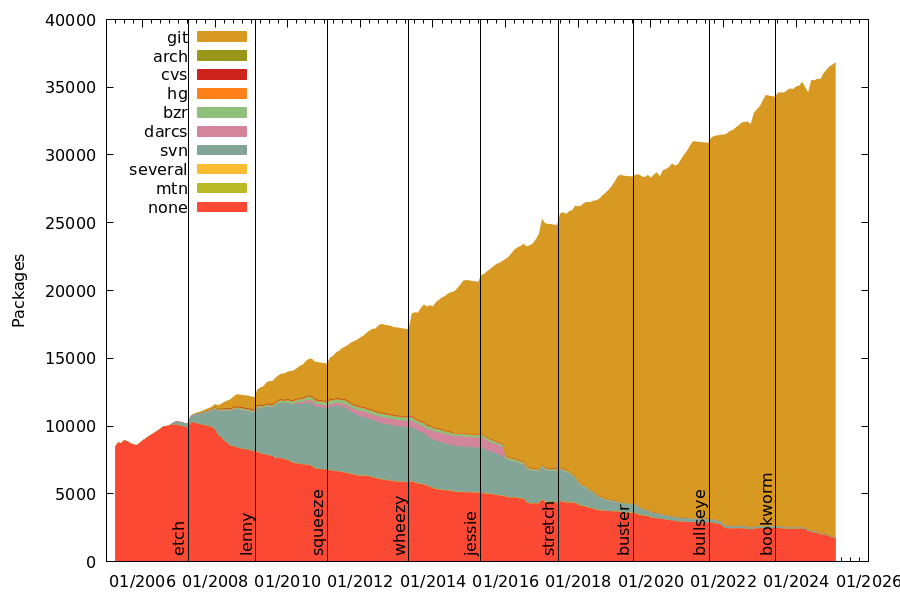
Git Git is fairly ubiquitous nowadays, and most upstream projects and packages in Debian use it. There are still exceptions that do not use any version control system or that use a different control system, but they are becoming increasingly rare. [1]
debian/upstream/metadata DEP-12 specifies a file format with metadata about the upstream project that a package was based on. In particular relevant for our case is the fact it has fields for the location of the upstream version control location. debian/upstream/metadata files look something like this:
1
2
3
---
Repository: https://www.dulwich.io/code/dulwich/
Repository-Browse: https://www.dulwich.io/code/dulwich/
While DEP-12 is still a draft, it has already been widely adopted - there are about 10000 packages in Debian that ship a debian/upstream/metadata file with Repository information.
Autopkgtest The Autopkgtest standard and associated tooling provide a way to run a defined set of tests against an installed package. This makes it possible to verify that a package is working correctly as part of the system as a whole. ci.debian.net regularly runs these tests against Debian packages to detect regressions.
Vcs-Git headers The Vcs-Git headers in debian/control are the equivalent of the Repository field in debian/upstream/metadata, but for the packaging repositories (as opposed to the upstream ones). They ve been around for a while and are widely adopted, as can be seen from zack s stats: The vcswatch service that regularly polls packaging repositories to see whether they have changed makes it a lot easier to consume this information in usable way.
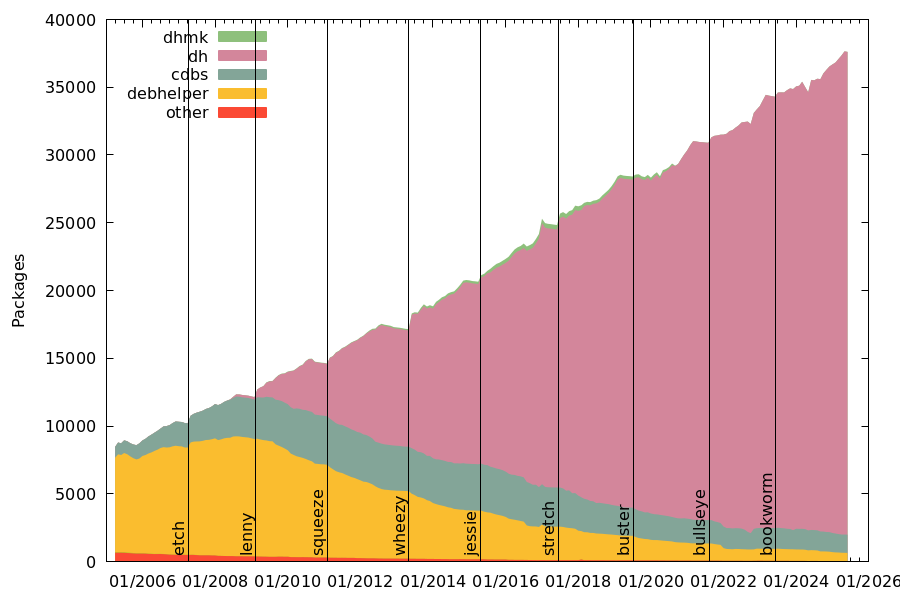
Debhelper adoption Over the last couple of years, Debian has slowly been converging on a single build tool - debhelper s dh interface. Being able to rely on a single build tool makes it easier to write code to update packaging when upstream changes require it.
Debhelper DWIM Debhelper (and its helpers) increasingly can figure out how to do the Right Thing in many cases without being explicitly configured. This makes packaging less effort, but also means that it s less likely that importing a new upstream version will require updates to the packaging. With all of these improvements in place, it actually becomes feasible in a lot of situations to update a Debian package to a new upstream version automatically. Of course, this requires that all of this information is available, so it won t work for all packages. In some cases, the packaging for the older upstream version might not apply to the newer upstream version. The Janitor has attempted to import a new upstream Git snapshot and a new upstream release for every package in the archive where a debian/watch file or debian/upstream/metadata file are present. These are the steps it uses:
  • Find new upstream version
    • If release, use debian/watch - or maybe tagged in upstream repository
    • If snapshot, use debian/upstream/metadata s Repository field
    • If neither is available, use guess-upstream-metadata from upstream-ontologist to guess the upstream Repository
  • Merge upstream version into packaging repository, possibly importing tarballs using pristine-tar
  • Update the changelog file to mention the new upstream version
  • Run some checks to ensure there are no unintentional changes, e.g.:
    • Scan diff between old and new for surprising license changes
      • Today, abort if there are any - in the future, maybe update debian/copyright
    • Check for obvious compatibility breaks - e.g. sonames changing
  • Attempt to update the packaging to reflect upstream changes
    • Refresh patches
  • Attempt to build the package with deb-fix-build, to deal with any missing dependencies
  • Run the autopkgtests with deb-fix-build to deal with missing dependencies, and abort if any tests fail
Results When run over all packages in unstable (sid), this process works for a surprising number of them.
Fresh Releases For fresh-releases (aka imports of upstream releases), processing all packages maintained in Git for which QA watch reports new releases (about 11,000): That means about 2300 packages updated, and about 4000 unchanged.
Fresh Snapshots For fresh-snapshots (aka imports of latest Git commit from upstream), processing all packages maintained in Git (about 26,000): Or 5100 packages updated and 2100 for which there was nothing to do, i.e. no upstream commits since the last Debian upload. As can be seen, this works for a surprising fraction of packages. It s possible to get the numbers up even higher, by both improving the tooling, the autopkgtests and the metadata that is provided by packages.
Using these packages All the packages that have been built can be accessed from the Janitor APT repository. More information can be found at https://janitor.debian.net/fresh, but in short - run:
1
2
3
4
5
6
echo deb "[arch=amd64 signed-by=/usr/share/keyrings/debian-janitor-archive-keyring.gpg]" \
    https://janitor.debian.net/ fresh-snapshots main   sudo tee /etc/apt/sources.list.d/fresh-snapshots.list
echo deb "[arch=amd64 signed-by=/usr/share/keyrings/debian-janitor-archive-keyring.gpg]" \
    https://janitor.debian.net/ fresh-releases main   sudo tee /etc/apt/sources.list.d/fresh-releases.list
sudo curl -o /usr/share/keyrings/debian-janitor-archive-keyring.gpg https://janitor.debian.net/pgp_keys
apt update
And then you can install packages from the fresh-snapshots (upstream git snapshots) or fresh-releases suites on a case-by-case basis by running something like:
1
apt install -t fresh-snapshots r-cran-roxygen2
Most packages are updated based on information provided by vcswatch and qa watch, but it s also possible for upstream repositories to call a web hook to trigger a refresh of a package. These packages were built against unstable, but should in almost all cases also work for testing.
Caveats Of course, since these packages are built automatically without human supervision it s likely that some of them will have bugs in them that would otherwise have been caught by the maintainer.
[1]I m not saying that a monoculture is great here, but it does help distributions.

10 August 2021

Shirish Agarwal: BBI, IP report, State Borders and Civil Aviation I

If I have seen further, it is by standing on the shoulders of Giants Issac Newton, 1675. Although it should be credited to 12th century Bernard of Chartres. You will know why I have shared this, probably at the beginning of Civil Aviation history itself.

Comments on the BBI court case which happened in Kenya, then and the subsequent appeal. I am not going to share much about the coverage of the BBI appeal as Gautam Bhatia has shared quite eloquently his observations, both on the initial case and the subsequent appeal which lasted 5 days in Kenya and was shown all around the world thanks to YouTube. One of the interesting points which stuck with me was that in Kenya, sign language is one of the official languages. And in fact, I was able to read quite a bit about the various sign languages which are there in Kenya. It just boggles the mind that there are countries that also give importance to such even though they are not as rich or as developed as we call developed economies. I probably might give more space and give more depth as it does carry some important judicial jurisprudence which is and which will be felt around the world. How does India react or doesn t is probably another matter altogether  But yes, it needs it own space, maybe after some more time. Report on Standing Committee on IP Regulation in India and the false promises. Again, I do not want to take much time in sharing details about what the report contains, as the report can be found here. I have uploaded it on WordPress, in case of an issue. An observation on the same subject can be found here. At least, to me and probably those who have been following the IP space as either using/working on free software or even IP would be aware that the issues shared have been known since 1994. And it does benefit the industry rather than the country. This way, the rent-seekers, and monopolists win. There is ample literature that shared how rich countries had weak regulation for decades and even centuries till it was advantageous for them to have strong IP. One can look at the history of Europe and the United States for it. We can also look at the history of our neighbor China, which for the last 5 decades has used some provision of IP and disregarded many others. But these words are of no use, as the policies done and shared are by the rich for the rich.

Fighting between two State Borders Ironically or because of it, two BJP ruled states Assam and Mizoram fought between themselves. In which 6 policemen died. While the history of the two states is complicated it becomes a bit more complicated when one goes back into Assam and ULFA history and comes to know that ULFA could not have become that powerful until and unless, the Marwaris, people of my clan had not given generous donations to them. They thought it was a good investment, which later would turn out to be untrue. Those who think ULFA has declined, or whatever, still don t have answers to this or this. Interestingly, both the Chief Ministers approached the Home Minister (Mr. Amit Shah) of BJP. Mr. Shah was supposed to be the Chanakya but in many instances, including this one, he decided to stay away. His statement was on the lines of you guys figure it out yourself. There is a poem that was shared by the late poet Rahat Indori. I am sharing the same below as an image and will attempt to put a rough translation.
kisi ke baap ka hindustan todi hain Rahat Indori
Poets, whether in India or elsewhere, are known to speak truth to power and are a bit of a rebel. This poem by Rahat Indori is provocatively titled Kisi ke baap ka Hindustan todi hai , It challenges the majoritarian idea that Hindustan/India only belongs to the majoritarian religion. He also challenges as well as asserts at the same time that every Indian citizen, regardless of whatever his or her religion might be, is an Indian and can assert India as his home. While the whole poem is compelling in itself, for me what hits home is in the second stanza

:Lagegi Aag to aayege ghat kayi zad me, Yaha pe sirf hamara makan todi hai The meaning is simple yet subtle, he uses Aag or Fire as a symbol of hate sharing that if hate spreads, it won t be his home alone that will be torched. If one wants to literally understand what he meant, I present to you the cult Russian movie No Escapes or Ogon as it is known in Russian. If one were to decipher why the Russian film doesn t talk about climate change, one has to view it from the prism of what their leader Vladimir Putin has said and done over the years. As can be seen even in there, the situation is far more complex than one imagines. Although, it is interesting to note that he decried Climate change as man-made till as late as last year and was on the side of Trump throughout his presidency. This was in 2017 as well as perhaps this. Interestingly, there was a change in tenor and note just a couple of weeks back, but that could be only politicking or much more. Statements that are not backed by legislation and application are usually just a whitewash. We would have to wait to see what concrete steps are taken by Putin, Kremlin, and their Duma before saying either way.

Civil Aviation and the broad structure Civil Aviation is a large topic and I would not be able to do justice to it all in one article/blog post. So, for e.g. I will not be getting into Aircraft (Boeing, Airbus, Comac etc., etc.) or the new electric aircraft as that will just make the blog post long. I will not be also talking about cargo or Visa or many such topics, as all of them actually would and do need their own space. So this would be much more limited to Airports and to some extent airlines, as one cannot survive without the other. The primary reason for doing this is there is and has been a lot of myth-making in India about Civil Aviation in general, whether it has to do with Civil Aviation history or whatever passes as of policy in India.

A little early history Man has always looked at the stars and envisaged himself or herself as a bird, flying with gay abandon. In fact, there have been many paintings, sculptors who imagined how we would fly. The Steam Engine itself was invented in 82 BCE. But the attempt to fly was done by a certain Monk called Brother Elmer of Malmesbury who attempted the same in 1010., shortly after the birth of the rudimentary steam engine The most famous of all would be Leonardo da Vinci for his amazing sketches of flying machines in 1493. There were a couple of books by Cyrano de Bergerac, apparently wrote two books, both sadly published after his death. Interestingly, you can find both the book and the gentleman in the Project Gutenberg archives. How much of M/s Cyrano s exploits were his own and how much embellished by M/S Curtis, maybe a friend, a lover who knows, but it does give the air of the swashbuckling adventurer of the time which many men aspired to in that time. So, why not an author???

L Autre Monde: ou les tats et Empires de la Lune (Comical History of the States and Empires of the Moon) and Les tats et Empires du Soleil (The States and Empires of the Sun). These two French books apparently had a lot of references to flying machines. Both of them were authored by Cyrano de Bergerac. Both of these were sadly published after his death, one apparently in 1656 and the other one a couple of years later. By the 17th century, while it had become easy to know and measure the latitude, measuring longitude was a problem. In fact, it can be argued and probably successfully that India wouldn t have been under British rule or UK wouldn t have been a naval superpower if it hadn t solved the longitudinal problem. Over the years, the British Royal Navy suffered many blows, one of the most famous or infamous among them might be the Scilly naval disaster of 1707 which led to the death of 2000 odd British Royal naval personnel and led to Queen Anne, who was ruling over England at that time via Parliament and called it the Longitude Act which basically was an open competition for anybody to fix the problem and carried the prize money of 20,000. While nobody could claim the whole prize, many did get smaller amounts depending upon the achievements. The best and the nearest who came was John Harrison who made the first sea-watch and with modifications, over the years it became miniaturized to a pocket-sized Marine chronometer although, I doubt the ones used today look anything in those days. But if that had not been invented, we surely would have been freed long ago. The assumption being that the East India Company would have dashed onto rocks so many times, that the whole exercise would have been futile. The downside of it is that maritime trade routes that are being used today and the commerce would not have been. Neither would have aircraft or space for that matter, or at the very least delayed by how many years or decades, nobody knows. If one wants to read about the Longitudinal problem, one can get the famous book Longitude .

In many mythologies, including Indian and Arabian tales, in which we had the flying carpet which would let its passengers go from one place to the next. Then there is also mention of Pushpak Vimana in ancient texts, but those secrets remain secrets. Think how much foreign exchange India could make by both using it and exporting the same worldwide. And I m being serious. There are many who believe in it, but sadly, the ones who know the secret don t seem to want India s progress. Just think of the carbon credits that India could have, which itself would make India a superpower. And I m being serious.

Western Ideas and Implementation. Even in the late and early 18th century, there were many machines that were designed to have controlled flight, but it was only the Wright Flyer that was able to demonstrate a controlled flight in 1903. The ones who came pretty close to what the Wrights achieved were the people by the name of Cayley and Langley. They actually studied what the pioneers had done. They looked at what Otto Lilienthal had done, as he had done a lot of hang-gliding and put a lot of literature in the public domain then.

Furthermore, they also consulted Octave Chanute. The whole system and history of the same are a bit complicated, but it does give a window to what happened then. So, it won t be wrong to say that whatever the Wright Brothers accomplished would probably not have been possible or would have taken years or maybe even decades if that literature and experiments, drawings, etc. in the commons were not available. So, while they did experimentation, they also looked at what other people were doing and had done which was in public domain/commons.

They also did a lot of testing, which gave them new insights. Even the propulsion system they used in the 1903 flight was a design by Nicolaus Otto. In fact, the Aircraft would not have been born if the Chinese had not invented kites in the early sixth century A.D. One also has to credit Issac Newton because of the three laws of motion, again without which none of the above could have happened. What is credited to the Wilbur brothers is not just they made the Kitty Hawk, they also made it commercial as they sold it and variations of the design to the American Air Force and also made a pilot school where pilots were trained for warfighting. 119 odd pilots came out of that school. The Wrights thought that air supremacy would end the war early, but this turned out to be a false hope.

Competition and Those Magnificent Men and their flying machines One of the first competitions to unlock creativity was the English Channel crossing offer made by Daily Mail. This was successfully done by the Frenchman Louis Bl riot. You can read his account here. There were quite a few competitions before World War 1 broke out. There is a beautiful, humorous movie that does dedicate itself to imagining how things would have gone in that time. In fact, there have been two movies, this one and an earlier movie called Sky Riders made many a youth dream. The other movie sadly is not yet in the public domain, and when it will be nobody knows, but if you see it or even read it, it gives you goosebumps.

World War 1 and Improvements to Aircraft World War 1 is remembered as the Great War or the War to end all wars in an attempt at irony. It did a lot of destruction of both people and property, and in fact, laid the foundation of World War 2. At the same time, if World War 1 hadn t happened then Airpower, Plane technology would have taken decades. Even medicine and medical techniques became revolutionary due to World War 1. In order to be brief, I am not sharing much about World War 1 otherwise that itself would become its own blog post. And while it had its heroes and villains who, when, why could be tackled perhaps another time.

The Guggenheim Family and the birth of Civil Aviation If one has to credit one family for the birth of the Civil Aviation, it has to be the Guggenheim family. Again, I would not like to dwell much as much of their contribution has already been noted here. There are quite a few things still that need to be said and pointed out. First and foremost is the fact that they made lessons about flying from grade school to college and afterward till college and beyond which were in the syllabus, whereas in the Indian schooling system, there is nothing like that to date. Here, in India, even in Engineering courses, you don t have much info. Unless until you go for professional Aviation or Aeronautical courses and most of these courses cost a bomb so either the very rich or the very determined (with loans) only go for that, at least that s what my friends have shared. And there is no guarantee you will get a job after that, especially in today s climate. Even their fund, grants, and prizes which were given to people for various people so that improvements could be made to the United States Civil Aviation. This, as shared in the report/blog post shared, was in response to what the younger child/brother saw as Europe having a large advantage both in Military and Civil Aviation. They also made several grants in several Universities which would not only do notable work during their lifetime but carry on the legacy researching on different aspects of Aircraft. One point that should be noted is that Europe was far ahead even then of the U.S. which prompted the younger son. There had already been talks of civil/civilian flights on European routes, although much different from what either of us can imagine today. Even with everything that the U.S. had going for her and still has, Europe is the one which has better airports, better facilities, better everything than the U.S. has even today. If you look at the lists of the Airports for better value of money or facilities, you would find many Airports from Europe, some from Asia, and only a few from the U.S. even though they are some of the most frequent users of the service. But that debate and arguments I would have to leave for perhaps the next blog post as there is still a lot to be covered between the 1930s, 1950s, and today. The Guggenheims archives does a fantastic job of sharing part of the story till the 1950s, but there is also quite a bit which it doesn t. I will probably start from that in the next blog post and then carry on ahead. Lastly, before I wind up, I have to share why I felt the need to write, capture and share this part of Aviation history. The plain and simple reason being, many of the people I meet either on the web, on Twitter or even in real life, many of them are just unaware of how this whole thing came about. The unawareness in my fellow brothers and sisters is just shocking, overwhelming. At least, by sharing these articles, I at least would be able to guide them or at least let them know how it all came to be and where things are going and not just be so clueless. Till later.

4 August 2021

Dirk Eddelbuettel: x13binary 1.1.57-1 on CRAN: New Upstream, New M1 Binary

Christoph and I are please to share that a new release 1.1.57-1 of x13binary, of the X-13ARIMA-SEATS program by the US Census Bureau (with updated upstream release 1.1.57) is now on CRAN. The x13binary package takes the pain out of installing X-13ARIMA-SEATS by making it a fully resolved CRAN dependency. For example, when installing the excellent seasonal package by Christoph, then X-13ARIMA-SEATS will get pulled in via the x13binary package and things just work. Just depend on x13binary and on all major OSs supported by R you should have an X-13ARIMA-SEATS binary installed which will be called seamlessly by the higher-level packages such as seasonal or gunsales. With this the full power of the what is likely the world s most sophisticated deseasonalization and forecasting package is now at your fingertips and the R prompt, just like any other of the 17960+ CRAN packages. You can read more about this (and the seasonal package) in the Journal of Statistical Software paper by Christoph and myself. This release brings a new upstream release as well as binaries. We continue to support two Linux flavours (theh standard x86_64 as well as armv7l), windows and for a first time two macOS flavour. In addition to the existing Intel binary we now have a native built using the arm64 M1 chip (with thanks to Kirill for the assist). We still lack a genuine binary for Solaris so if any of the esteemed readers of this post happens to have access to R on Solaris along with a basic Fortran compiler, we would love to hear from you. Building X-13ARIMA-SEATS from source on Solaris should be straightforward as it is on the other OSs. Or is someone with a bit of time wants to help following Gabor s tutorial we would greatly appreciate it. Courtesy of my CRANberries, there is also a diffstat report for this release showing changes to the previous release. If you like this or other open-source work I do, you can sponsor me at GitHub.

This post by Dirk Eddelbuettel originated on his Thinking inside the box blog. Please report excessive re-aggregation in third-party for-profit settings.

Junichi Uekawa: Wrote a tool to parse /sys/block/*/stat.

Wrote a tool to parse /sys/block/*/stat. It's probably impossible for a human brain to appreciate the numbers so I made a web page that you can paste the contents and parse it from JS to emit some processed numbers. Probably iostat is the tool you want, but hey, sometimes you need this kind of stuff.

19 July 2021

Antonio Terceiro: Getting help with autopkgtest for your package

If you have been involved in Debian packaging at all in the last few years, you are probably aware that autopkgtest is now an important piece of the Debian release process. Back in 2018, the automated testing migration process started considering autopkgtest test results as part of its decision making. Since them, this process has received several improvements. For example, during the bullseye freeze, non-key packages with a non-trivial autopkgtest test suite could migrate automatically to testing without their maintainers needing to open unblock requests, provided there was no regression in theirs autopkgtest (or those from their reverse dependencies). Since 2014 when ci.debian.net was first introduced, we have seen an amazing increase in the number of packages in Debian that can be automatically tested. We went from around 100 to 15,000 today. This means not only happier maintainers because their packages get to testing faster, but also improved quality assurance for Debian as a whole. Chart showing the number of packages tested by ci.debian.net. Starts from close to 0 in 2014, up to 15,000 in 2021. The growth tendency seems to slow down in the last year However, the growth rate seems to be decreasing. Maybe the low hanging fruit have all been picked, or maybe we just need to help more people jump in the automated testing bandwagon. With that said, we would like to encourage and help more maintainers to add autopkgtest to their packages. To that effect, I just created the autopkgtest-help repository on salsa, where we will take help requests from maintainers working on autopkgtest for their packages. If you want help, please go ahead and create an issue in there. To quote the repository README:

Valid requests:
  • "I want to add autopkgtest to package X. X is a tool that [...] and it works by [...]. How should I approach testing it?" It's OK if you have no idea where to start. But at least try to describe your package, what it does and how it works so we can try to help you.
  • "I started writing autopkgtest for X, here is my current work in progress [link]. But I encountered problem Y. How to I move forward?" If you already have an autopkgtest but is having trouble making it work as you think it should, you can also ask here.
Invalid requests:
  • "Please write autopkgtest for my package X for me". As with anything else in free software, please show appreciation for other people's time, and do your own research first. If you pose your question with enough details (see above) and make it interesting, it may be that whoever answers will write at least a basic structure for you, but as the maintainer you are still the expert in the package and what tests are relevant.
If you ask your question soon, you might get your answer recorded in video: we are going to have a DebConf21 talk next month, where we I and Paul Gevers (elbrus) will answer a few autopkgtest questions in video for posterity. Now, if you have experience enabling autopkgtest for you own packages, please consider watching that repository there to help us help our fellow maintainers.

10 July 2021

Laura Arjona Reina: Android backups with rsync

A quick note to self to remind how I do backups of my Android device with rsync (and adb). I have followed this guide: How to use rsync over USB on Android with adb My personal notes: address = 127.0.0.1
port = 1873
uid = 0
gid = 0
[root]
path = /
use chroot = false
read only = false'
adb shell /data/local/tmp/rsync --daemon --no-detach --config=/sdcard/rsyncd.conf --log-file=/proc/self/fd/2 didn't work, produced this message: "@ERROR: protocol startup error" so I ended up doing: adb shell
rsync --daemon --no-detach --config=/sdcard/rsyncd.conf --log-file=/sdcard/rsync.log
and opened another tab to perform the rsync commands from my laptop: rsync -av --progress --stats rsync://localhost:6010/root/storage .
rsync -av --progress --stats rsync://localhost:6010/root/data .
Then I saw that rsync was copying the symlinks instead of their contents: /storage/self/primary was a broken link to /mnt/user/0/primary So I ran again the commands with -LK: rsync -av --progress --stats -LK rsync://localhost:6010/root/storage .
rsync -av --progress --stats -LK rsync://localhost:6010/root/data .
and now I have a copy of all the files I'm interested. In addition to this, I run an adb backup of the system: adb backup -f ./adb_backup_apk_shared_all_system.ad -apk -shared -all -system and I think that's all that I need for the case I want to remove stuff from my phone or some disaster happens.

29 June 2021

Antoine Beaupr : Another syncmaildir crash

So I had another major email crash with my syncmaildir setup. This time I was at least able to confirm the issue, and I still haven't lost mail thanks to backups and sheer luck (again).

The crash It is not really worth going over the crash in details, it's fairly similar to the last one: something bad happened and smd started destroying everything. The hint is that it takes a long time to do what usually takes seconds. It helps that I now have a second monitor showing logs. I still lost much more mail than the last time. I used to have "301 723 messages", according to notmuch. But then when I ran smd-pull by hand, it was telling me:
95K emails scanned
Oops. You can see notmuch happily noticing the destroyed files on the server:
jun 28 16:33:40 marcos notmuch[28532]: No new mail. Removed 65498 messages. Detected 1699 file renames.
jun 28 16:36:05 marcos notmuch[29746]: No new mail. Removed 68883 messages. Detected 2488 file renames.
jun 28 16:41:40 marcos notmuch[31972]: No new mail. Removed 118295 messages. Detected 3657 file renames.
The final count ended up being 81 042 messages, according to notmuch. A whopping 220 000 mails deleted. The interesting bit, this time around, is that I caught smd in the act of running two processes in parallel:
jun 28 16:30:09 curie systemd[2845]: Finished pull emails with syncmaildir. 
jun 28 16:30:09 curie systemd[2845]: Starting push emails with syncmaildir... 
jun 28 16:30:09 curie systemd[2845]: Starting pull emails with syncmaildir... 
So clearly that is the source of the bug.

Recovery Emergency stop on curie:
notmuch dump > notmuch.dump
systemctl --user --now disable smd-pull.service smd-pull.timer smd-push.service smd-push.timer notmuch-new.service notmuch-new.timer
On marcos (the server), guessed the number of messages delivered since the last backup to be 71, just looking at timestamps in the mail log. Made a list:
grep postfix/local /var/log/mail.log   tail -71 > lost-mail
Found postfix queue IDs:
sed 's/.*\]://;s/:.*//' lost-mail > qids
Turn those into message IDs, find those that are missing from the disk (had previously ran notmuch new just to be sure it's up to date):
while read qid ; do 
    grep "$qid: message-id" /var/log/mail.log
done < qids    sed 's/.*message-id=<//;s/>//'   while read msgid; do
    sudo -u anarcat notmuch count --exclude=false id:$msgid   grep -q 0 && echo $msgid
done
Copy this back on curie as missing-msgids and:
$ wc -l missing-msgids 
48 missing-msgids
$ while read msgid ; do notmuch count --exclude=false id:$msgid   grep -q 0 && echo $msgid ; done < missing-msgids
mailman.189.1624881611.23397.nodes-reseaulibre.ca@reseaulibre.ca
AnwMy7rdSpK-N-vt4AiOag@ismtpd0148p1mdw1.sendgrid.net
only two mails missing! whoohoo! Copy those back onto marcos as really-missing-msgids, and look at the full mail logs to see what they are:
~anarcat/src/koumbit-scripts/mail/postfix-trace --from-file really-missing-msgids2
I actually remembered deleting those, so no mail lost! Rebuild the list of msgids that were lost, on marcos:
while read qid ; do grep "$qid: message-id" /var/log/mail.log; done < qids    sed 's/.*message-id=<//;s/>//'
Copy that on curie as lost-mail-msgids, then copy the files over in a test dir:
while read msgid ; do
    notmuch search --output=files --exclude=false "id:$msgid"
done < lost-mail-msgids   sed 's#/home/anarcat/Maildir/##'   rsync -v  --files-from=- /home/anarcat/Maildir/ shell.anarc.at:restore/Maildir-angela/
If that looks about right, on marcos:
find restore/Maildir-angela/ -type f   wc -l
... should match the number of missing mails, roughly. Copy if in the real spool:
while read msgid ; do
    notmuch search --output=files --exclude=false "id:$msgid"
done < lost-mail-msgids   sed 's#/home/anarcat/Maildir/##'   rsync -v  --files-from=- /home/anarcat/Maildir/ shell.anarc.at:Maildir/
Then on the server, notmuch new should find the new emails, and we shouldn't have any lost mail anymore:
while read qid ; do grep "$qid: message-id" /var/log/mail.log; done < qids    sed 's/.*message-id=<//;s/>//'   while read msgid; do sudo -u anarcat notmuch count --exclude=false id:$msgid   grep -q 0 && echo $msgid ; done
Then, crucial moment, try to pull the new mails from the backups on curie:
anarcat@curie:~(main)$ smd-pull  -n  --show-tags -v
Found lockfile of a dead instance. Ignored.
Phase 0: handshake
Phase 1: changes detection
    5K emails scanned
   10K emails scanned
   15K emails scanned
   20K emails scanned
   25K emails scanned
   30K emails scanned
   35K emails scanned
   40K emails scanned
   45K emails scanned
   50K emails scanned
Phase 2: synchronization
Phase 3: agreement
default: smd-client@localhost: TAGS: stats::new-mails(49687), del-mails(0), bytes-received(215752279), xdelta-received(3703852)
"smd-pull  -n  --show-tags -v" took 3 mins 39 secs
This brought me back to the state after the backup plus the mails delivered during the day, which means I had to catchup with all my holiday's read emails (1440 mails!) but thankfully I made a dump of the notmuch database on curie at the start of the procedure, so this actually restored a sane state:
pv notmuch.dump   notmuch restore
Phew!

Workaround I have filed this as a bug in upstream issue 18. Considering I filed 11 issues and only 3 of those were closed, I'm not holding my breath. I nevertheless filed PR 19 in the hope that this will fix my particular issue, but I'm not even sure this is the right fix...

Fix At this point, I'm really ready to give up on SMD. It's really, really nice to be able to sync mail over SSH because I don't need to store my IMAP password on disk. But surely there are more reliable syncing mechanisms. I do not remember ever losing that much mail before. At worst, offlineimap would duplicate emails like mad, but never destroy my entire mail spool that way. As mentioned before, there are other programs that sync mail. I'm looking at:
  • offlineimap3: requires IMAP, used the py2 version in the past, might just still work, first sync painful (IIRC), ways to tunnel over SSH, see comment below
  • isync/mbsync: might be faster, I remember having trouble switching from offlineimap to this, has support for TLS client certs, running over SSH, and generally has good words from multiple Debian and notmuch people
  • getmail: just downloads email, might not be enough
  • nncp: treat the local spool as another mail server, might not be compatible with my "multiple clients" setup
  • doveadm-sync: requires dovecot on both ends, but supports using SSH to sync, will try this next, may have performance problems, see comment below
  • interimap: syncs two IMAP servers, apparently faster than doveadm and offlineimap
  • mail-sync: notify support, happens over any piped transport (e.g. ssh), diff/patch system, requires binary on both ends, mentions UUCP in the manpage, seems awfully complicated to setup, mentions rsmtp which is a nice name for rsendmail

14 June 2021

Fran ois Marier: Self-hosting an Ikiwiki blog

8.5 years ago, I moved my blog to Ikiwiki and Branchable. It's now time for me to take the next step and host my blog on my own server. This is how I migrated from Branchable to my own Apache server.

Installing Ikiwiki dependencies Here are all of the extra Debian packages I had to install on my server:
apt install ikiwiki ikiwiki-hosting-common gcc libauthen-passphrase-perl libcgi-formbuilder-perl libcrypt-sslauthen-passphrase-perl libcgi-formbuilder-perl libcrypt-ssleay-perl libjson-xs-perl librpc-xml-perl python-docutils libxml-feed-perl libsearch-xapian-perl libmailtools-perl highlight-common libsearch-xapian-perl xapian-omega
apt install --no-install-recommends ikiwiki-hosting-web libgravatar-url-perl libmail-sendmail-perl libcgi-session-perl
apt purge libnet-openid-consumer-perl
Then I enabled the CGI module in Apache:
a2enmod cgi
and un-commented the following in /etc/apache2/mods-available/mime.conf:
AddHandler cgi-script .cgi

Creating a separate user account Since Ikiwiki needs to regenerate my blog whenever a new article is pushed to the git repo or a comment is accepted, I created a restricted user account for it:
adduser blog
adduser blog sshuser
chsh -s /usr/bin/git-shell blog

git setup Thanks to Branchable storing blogs in git repositories, I was able to import my blog using a simple git clone in /home/blog (the srcdir):
git clone --bare git://feedingthecloud.branchable.com/ source.git
Note that the name of the directory (source.git) is important for the ikiwikihosting plugin to work. Then I pulled the .setup file out of the setup branch in that repo and put it in /home/blog/.ikiwiki/FeedingTheCloud.setup. After that, I deleted the setup branch and the origin remote from that clone:
git branch -d setup
git remote rm origin
Following the recommended git configuration, I created a working directory (the repository) for the blog user to modify the blog as needed:
cd /home/blog/
git clone /home/blog/source.git FeedingTheCloud
I added my own ssh public key to /home/blog/.ssh/authorized_keys so that I could push to the srcdir from my laptop. Finaly, I generated a new ssh key without a passphrase:
ssh-keygen -t ed25519
and added it as deploy key to the GitHub repo which acts as a read-only mirror of my blog.

Ikiwiki config While I started with the Branchable setup file, I changed the following things in it:
adminemail: webmaster@fmarier.org
srcdir: /home/blog/FeedingTheCloud
destdir: /var/www/blog
url: https://feeding.cloud.geek.nz
cgiurl: https://feeding.cloud.geek.nz/blog.cgi
cgi_wrapper: /var/www/blog/blog.cgi
cgi_wrappermode: 675
add_plugins:
- goodstuff
- lockedit
- comments
- blogspam
- sidebar
- attachment
- favicon
- format
- highlight
- search
- theme
- moderatedcomments
- flattr
- calendar
- headinganchors
- notifyemail
- anonok
- autoindex
- date
- relativedate
- htmlbalance
- pagestats
- sortnaturally
- ikiwikihosting
- gitpush
- emailauth
disable_plugins:
- brokenlinks
- fortune
- more
- openid
- orphans
- passwordauth
- progress
- recentchanges
- repolist
- toggle
- txt
sslcookie: 1
cookiejar:
  file: /home/blog/.ikiwiki/cookies
useragent: ikiwiki
git_wrapper: /home/blog/source.git/hooks/post-update
urlalias:
- http://feeds.cloud.geek.nz/
- http://www.feeding.cloud.geek.nz/
owner: francois@fmarier.org
hostname: feeding.cloud.geek.nz
emailauth_sender: login@fmarier.org
allowed_attachments: admin()
Then I created the destdir:
mkdir /var/www/blog
chown blog:blog /var/www/blog
and generated the initial copy of the blog as the blog user:
ikiwiki --setup .ikiwiki/FeedingTheCloud.setup --wrappers --rebuild
One thing that failed to generate properly was the tag cloug (from the pagestats plugin). I have not been able to figure out why it fails to generate any output when run this way, but if I push to the repo and let the git hook handle the rebuilding of the wiki, the tag cloud is generated correctly. Consequently, fixing this is not high on my list of priorities, but if you happen to know what the problem is, please reach out.

Apache config Here's the Apache config I put in /etc/apache2/sites-available/blog.conf:
<VirtualHost *:443>
    ServerName feeding.cloud.geek.nz
    SSLEngine On
    SSLCertificateFile /etc/letsencrypt/live/feeding.cloud.geek.nz/fullchain.pem
    SSLCertificateKeyFile /etc/letsencrypt/live/feeding.cloud.geek.nz/privkey.pem
    Header set Strict-Transport-Security: "max-age=63072000; includeSubDomains; preload"
    Include /etc/fmarier-org/blog-common
</VirtualHost>
<VirtualHost *:443>
    ServerName www.feeding.cloud.geek.nz
    ServerAlias feeds.cloud.geek.nz
    SSLEngine On
    SSLCertificateFile /etc/letsencrypt/live/feeding.cloud.geek.nz/fullchain.pem
    SSLCertificateKeyFile /etc/letsencrypt/live/feeding.cloud.geek.nz/privkey.pem
    Redirect permanent / https://feeding.cloud.geek.nz/
</VirtualHost>
<VirtualHost *:80>
    ServerName feeding.cloud.geek.nz
    ServerAlias www.feeding.cloud.geek.nz
    ServerAlias feeds.cloud.geek.nz
    Redirect permanent / https://feeding.cloud.geek.nz/
</VirtualHost>
and the common config I put in /etc/fmarier-org/blog-common:
ServerAdmin webmaster@fmarier.org
DocumentRoot /var/www/blog
LogLevel core:info
CustomLog $ APACHE_LOG_DIR /blog-access.log combined
ErrorLog $ APACHE_LOG_DIR /blog-error.log
AddType application/rss+xml .rss
<Location /blog.cgi>
        Options +ExecCGI
</Location>
before enabling all of this using:
a2ensite blog
apache2ctl configtest
systemctl restart apache2.service
The feeds.cloud.geek.nz domain used to be pointing to Feedburner and so I need to maintain it in order to avoid breaking RSS feeds from folks who added my blog to their reader a long time ago.

Server-side improvements Since I'm now in control of the server configuration, I was able to make several improvements to how my blog is served. First of all, I enabled the HTTP/2 and Brotli modules:
a2enmod http2
a2enmod brotli
and enabled Brotli compression by putting the following in /etc/apache2/conf-available/compression.conf:
<IfModule mod_brotli.c>
  <IfDefine !TRANSFER_COMPRESSION>
    Define TRANSFER_COMPRESSION BROTLI_COMPRESS
  </IfDefine>
</IfModule>
<IfModule mod_deflate.c>
  <IfDefine !TRANSFER_COMPRESSION>
    Define TRANSFER_COMPRESSION DEFLATE
  </IfDefine>
</IfModule>
<IfDefine TRANSFER_COMPRESSION>
  <IfModule mod_filter.c>
    AddOutputFilterByType $ TRANSFER_COMPRESSION  text/html text/plain text/xml text/css text/javascript
    AddOutputFilterByType $ TRANSFER_COMPRESSION  application/x-javascript application/javascript application/ecmascript
    AddOutputFilterByType $ TRANSFER_COMPRESSION  application/rss+xml
    AddOutputFilterByType $ TRANSFER_COMPRESSION  application/xml
  </IfModule>
</IfDefine>
and replacing /etc/apache2/mods-available/deflate.conf with the following:
# Moved to /etc/apache2/conf-available/compression.conf as per https://bugs.debian.org/972632
before enabling this new config:
a2enconf compression
Next, I made my blog available as a Tor onion service by putting the following in /etc/apache2/sites-available/blog.conf:
<VirtualHost *:443>
    ServerName feeding.cloud.geek.nz
    ServerAlias xfdug5vmfi6oh42fp6ahhrqdjcf7ysqat6fkp5dhvde4d7vlkqixrsad.onion
    Header set Onion-Location "http://xfdug5vmfi6oh42fp6ahhrqdjcf7ysqat6fkp5dhvde4d7vlkqixrsad.onion% REQUEST_URI s"
    Header set alt-svc 'h2="xfdug5vmfi6oh42fp6ahhrqdjcf7ysqat6fkp5dhvde4d7vlkqixrsad.onion:443"; ma=315360000; persist=1'
    ... 
<VirtualHost *:80>
    ServerName xfdug5vmfi6oh42fp6ahhrqdjcf7ysqat6fkp5dhvde4d7vlkqixrsad.onion
    Include /etc/fmarier-org/blog-common
</VirtualHost>
Then I followed the Mozilla Observatory recommendations and enabled the following security headers:
Header set Content-Security-Policy: "default-src 'none'; report-uri https://fmarier.report-uri.com/r/d/csp/enforce ; style-src 'self' 'unsafe-inline' ; img-src 'self' https://seccdn.libravatar.org/ ; script-src https://feeding.cloud.geek.nz/ikiwiki/ https://xfdug5vmfi6oh42fp6ahhrqdjcf7ysqat6fkp5dhvde4d7vlkqixrsad.onion/ikiwiki/ http://xfdug5vmfi6oh42fp6ahhrqdjcf7ysqat6fkp5dhvde4d7vlkqixrsad.onion/ikiwiki/ 'unsafe-inline' 'sha256-pA8FbKo4pYLWPDH2YMPqcPMBzbjH/RYj0HlNAHYoYT0=' 'sha256-Kn5E/7OLXYSq+EKMhEBGJMyU6bREA9E8Av9FjqbpGKk=' 'sha256-/BTNlczeBxXOoPvhwvE1ftmxwg9z+WIBJtpk3qe7Pqo=' ; base-uri 'self'; form-action 'self' ; frame-ancestors 'self'"
Header set X-Frame-Options: "SAMEORIGIN"
Header set Referrer-Policy: "same-origin"
Header set X-Content-Type-Options: "nosniff"
Note that the Mozilla Observatory is mistakenly identifying HTTP onion services as insecure, so you can ignore that failure. I also used the Mozilla TLS config generator to improve the TLS config for my server. Then I added security.txt and gpc.json to the root of my git repo and then added the following aliases to put these files in the right place:
Alias /.well-known/gpc.json /var/www/blog/gpc.json
Alias /.well-known/security.txt /var/www/blog/security.txt
I also followed these instructions to create a sitemap for my blog with the following alias:
Alias /sitemap.xml /var/www/blog/sitemap/index.rss
Finally, I simplified a few error pages to save bandwidth:
ErrorDocument 301 " "
ErrorDocument 302 " "
ErrorDocument 404 "Not Found"

Monitoring 404s Another advantage of running my own web server is that I can monitor the 404s easily using logcheck by putting the following in /etc/logcheck/logcheck.logfiles:
/var/log/apache2/blog-error.log 
Based on that, I added a few redirects to point bots and users to the location of my RSS feed:
Redirect permanent /atom /index.atom
Redirect permanent /comments.rss /comments/index.rss
Redirect permanent /comments.atom /comments/index.atom
Redirect permanent /FeedingTheCloud /index.rss
Redirect permanent /feed /index.rss
Redirect permanent /feed/ /index.rss
Redirect permanent /feeds/posts/default /index.rss
Redirect permanent /rss /index.rss
Redirect permanent /rss/ /index.rss
and to tell them to stop trying to fetch obsolete resources:
Redirect gone /~ff/FeedingTheCloud
Redirect gone /gittip_button.png
Redirect gone /ikiwiki.cgi
I also used these 404s to discover a few old Feedburner URLs that I could redirect to the right place using archive.org:
Redirect permanent /feeds/1572545745827565861/comments/default /posts/watch-all-of-your-logs-using-monkeytail/comments.atom
Redirect permanent /feeds/1582328597404141220/comments/default /posts/news-feeds-rssatom-for-mythtvorg-and/comments.atom
...
Redirect permanent /feeds/8490436852808833136/comments/default /posts/recovering-lost-git-commits/comments.atom
Redirect permanent /feeds/963415010433858516/comments/default /posts/debugging-openwrt-routers-by-shipping/comments.atom
I also put the following robots.txt in the git repo in order to stop a bunch of authentication errors coming from crawlers:
User-agent: *
Disallow: /blog.cgi
Disallow: /ikiwiki.cgi

Future improvements There are a few things I'd like to improve on my current setup. The first one is to remove the iwikihosting and gitpush plugins and replace them with a small script which would simply git push to the read-only GitHub mirror. Then I could uninstall the ikiwiki-hosting-common and ikiwiki-hosting-web since that's all I use them for. Next, I would like to have proper support for signed git pushes. At the moment, I have the following in /home/blog/source.git/config:
[receive]
    advertisePushOptions = true
    certNonceSeed = "(random string)"
but I'd like to also reject unsigned pushes. While my blog now has a CSP policy which doesn't rely on unsafe-inline for scripts, it does rely on unsafe-inline for stylesheets. I tried to remove this but the actual calls to allow seemed to be located deep within jQuery and so I gave up. Update: now fixed. Finally, I'd like to figure out a good way to deal with articles which don't currently have comments. At the moment, if you try to subscribe to their comment feed, it returns a 404. For example:
[Sun Jun 06 17:43:12.336350 2021] [core:info] [pid 30591:tid 140253834704640] [client 66.249.66.70:57381] AH00128: File does not exist: /var/www/blog/posts/using-iptables-with-network-manager/comments.atom
This is obviously not ideal since many feed readers will refuse to add a feed which is currently not found even though it could become real in the future. If you know of a way to fix this, please let me know.

13 June 2021

Vincent Fourmond: Solution for QSoas quiz #2: averaging several Y values for the same X value

This post describes two similar solutions to the Quiz #2, using the data files found there. The two solutions described here rely on split-on-values. The first solution is the one that came naturally to me, and is by far the most general and extensible, but the second one is shorter, and doesn't require external script files.
Solution #1 The key to both solution is to separate the original data into a series of datasets that only contain data at a fixed value of x (which corresponds here to a fixed pH), and then process each dataset one by one to extract the average and standard deviation. This first step is done thus:
QSoas> load kcat-vs-ph.dat
QSoas> split-on-values pH x /flags=data
After these commands, the stacks contains a series of datasets bearing the data flag, that each contain a single column of data, as can be seen from the beginnings of a show-stack command:
QSoas> k
Normal stack:
	 F  C	Rows	Segs	Name	
#0	(*) 1	43	1	'kcat-vs-ph_subset_22.dat'
#1	(*) 1	44	1	'kcat-vs-ph_subset_21.dat'
#2	(*) 1	43	1	'kcat-vs-ph_subset_20.dat'
...
Each of these datasets have a meta-data named pH whose value is the original x value from kcat-vs-ph.dat. Now, the idea is to run a stats command on the resulting datasets, extracting the average value of x and its standard deviation, together with the value of the meta pH. The most natural and general way to do this is to use run-for-datasets, using the following script file (named process-one.cmds):
stats /meta=pH /output=true /stats=x_average,x_stddev
So the command looks like:
QSoas> run-for-datasets process-one.cmds flagged:data
This command produces an output file containing, for each flagged dataset, a line containing x_average, x_stddev, and pH. Then, it is just a matter of loading the output file and shuffling the columns in the right order to get the data in the form asked. Overall, this looks like this:
l kcat-vs-ph.dat
split-on-values pH x /flags=data
output result.dat /overwrite=true
run-for-datasets process-one.cmds flagged:data
l result.dat
apply-formula tmp=y2;y2=y;y=x;x=tmp
dataset-options /yerrors=y2
The slight improvement over what is described above is the use of the output command to write the output to a dedicated file (here result.dat), instead of out.dat and ensuring it is overwritten, so that no data remains from previous runs.

Solution #2 The second solution is almost the same as the first one, with two improvements: This yields the following, smaller, solution:
l kcat-vs-ph.dat
split-on-values pH x /flags=data
stats /meta=pH /accumulate=* /stats=x_average,x_stddev /buffers=flagged:data
pop
apply-formula tmp=y2;y2=y;y=x;x=tmp
dataset-options /yerrors=y2


About QSoas QSoas is a powerful open source data analysis program that focuses on flexibility and powerful fitting capacities. It is released under the GNU General Public License. It is described in Fourmond, Anal. Chem., 2016, 88 (10), pp 5050 5052. Current version is 3.0. You can download its source code there (or clone from the GitHub repository) and compile it yourself, or buy precompiled versions for MacOS and Windows there.

6 June 2021

Russell Coker: Netflix and IPv6

It seems that Netflix has an ongoing issue of not working well with IPv6, apparently they have some sort of region checking code that doesn t correctly identify IPv6 prefixes. To fix this I wrote the following script to make a small zone file with only A records for Netflix and no AAAA records. The $OUT.header file just has the SOA record for my fake netflix.com domain.
#!/bin/bash
OUT=/etc/bind/data/netflix.com
HEAD=$OUT.header
cp $HEAD $OUT
dig -t a www.netflix.com @8.8.8.8 sed -n -e "s/^.*IN/www IN/p" grep [0-9]$ >> $OUT
dig -t a android.prod.cloud.netflix.com @8.8.8.8 sed -n -e "s/^.*IN/android.prod.cloud IN/p" grep [0-9]$ >> $OUT
/usr/sbin/rndc reload > /dev/null
Update I updated this post to add a line for android.prod.cloud.netflix.com which is the address used by Android devices.

30 May 2021

Vincent Fourmond: QSoas quiz #2: averaging several Y values for the same X value

This second quiz may sound like the first one, but in fact, the approach used is completely different. The point is to gather some elementary statistics from a series of experiments performed under different conditions, but with several repeats at the same conditions.
Quiz You are given a file (which you can download there) that contains a series of pH value data: the X column is the pH, the Y column the result of the experiment at the given pH (let's say the measure of the catalytic rate of an enzyme). Your task is to take this data and produce a single dataset which contains, for each pH value, the pH, the average of the results at that pH and the standard deviation. The result should be identical to the following file, and should look like that:
There are several ways to do this, but all ways must rely on stats, and the more natural way in QSoas is to take advantage of split-on-values, which is a very powerful command but somehow hard to master, which is the point of this Quiz.
By the way, the data file is purely synthetic, if you look in the GitHub repository, you'll see how it was generated.

About QSoas QSoas is a powerful open source data analysis program that focuses on flexibility and powerful fitting capacities. It is released under the GNU General Public License. It is described in Fourmond, Anal. Chem., 2016, 88 (10), pp 5050 5052. Current version is 3.0. You can download its source code there (or clone from the GitHub repository) and compile it yourself, or buy precompiled versions for MacOS and Windows there.

10 May 2021

Russell Coker: Minikube and Debian

I just started looking at the Kubernetes documentation and interactive tutorial [1], which incidentally is really good. Everyone who is developing a complex system should look at this to get some ideas for online training. Here are some notes on setting it up on Debian. Add Kubernetes Apt Repository
deb https://apt.kubernetes.io/ kubernetes-xenial main
First add the above to your apt sources configuration (/etc/apt/sources.list or some file under /etc/apt/sources.list.d) for the kubectl package. Ubuntu Xenial is near enough to Debian/Buster and Debian/Unstable that it should work well for both of them. Then install the GPG key 6A030B21BA07F4FB for use by apt:
gpg --recv-key 6A030B21BA07F4FB
gpg --list-sigs 6A030B21BA07F4FB
gpg --export 6A030B21BA07F4FB   apt-key add -
The Google key in question is not signed. Install Packages for the Tutorial The online training is based on minikube which uses libvirt to setup a KVM virtual machine to do stuff. To get this running you need to have a system that is capable of running KVM (IE the BIOS is set to allow hardware virtualisation). It MIGHT work on QEMU software emulation without KVM support (technically it s possible but it would be slow and require some code to handle that), I didn t test if it does. Run the following command to install libvirt, kvm, and dnsmasq (which minikube requires) and kubectl on Debian/Buster:
apt install libvirt-clients libvirt-daemon-system qemu-kvm dnsmasq kubectl
For Debian/Unstable run the following command:
apt install libvirt-clients libvirt-daemon-system qemu-system-x86 dnsmasq kubectl
To run libvirt as non-root without needing a password for everything you need to add the user in question to the libvirt group. I recommend running things as non-root whenever possible. In this case entering a password for everything will probably be more pain than you want. The Debian Wiki page about KVM [2] is worth reading. Install Minikube Test Environment Here is the documentation for installing Minikube [3]. Basically just download a single executable from the net, put it in your $PATH, and run it. Best to use non-root for that. Also you need at least 3G of temporary storage space in the home directory of the user that runs it. After installing minikube run minikube start which will download container image data and start it up. Then you can run commands like the following to see what it has done.
# get overview of virsh commands
virsh help
# list domains
virsh --connect qemu:///system list
# list block devices a domain uses
virsh --connect qemu:///system domblklist minikube
# show stats on block device usage
virsh --connect qemu:///system domblkstat minikube hda
# list virtual networks
virsh --connect qemu:///system net-list
# list dhcp leases on a virtual network
virsh --connect qemu:///system net-dhcp-leases minikube-net
# list network filters
virsh --connect qemu:///system nwfilter-list
# list real network interfaces
virsh --connect qemu:///system iface-list

3 May 2021

Russell Coker: DNS, Lots of IPs, and Postal

I decided to start work on repeating the tests for my 2006 OSDC paper on Benchmarking Mail Relays [1] and discover how the last 15 years of hardware developments have changed things. There have been software changes in that time too, but nothing that compares with going from single core 32bit systems with less than 1G of RAM and 60G IDE disks to multi-core 64bit systems with 128G of RAM and SSDs. As an aside the hardware I used in 2006 wasn t cutting edge and the hardware I m using now isn t either. In both cases it s systems I bought second hand for under $1000. Pedants can think of this as comparing 2004 and 2018 hardware. BIND I decided to make some changes to reflect the increased hardware capacity and use 2560 domains and IP addresses, which gave the following errors as well as a startup time of a minute on a system with two E5-2620 CPUs.
May  2 16:38:37 server named[7372]: listening on IPv4 interface lo, 127.0.0.1#53
May  2 16:38:37 server named[7372]: listening on IPv4 interface eno4, 10.0.2.45#53
May  2 16:38:37 server named[7372]: listening on IPv4 interface eno4, 10.0.40.1#53
May  2 16:38:37 server named[7372]: listening on IPv4 interface eno4, 10.0.40.2#53
May  2 16:38:37 server named[7372]: listening on IPv4 interface eno4, 10.0.40.3#53
[...]
May  2 16:39:33 server named[7372]: listening on IPv4 interface eno4, 10.0.47.0#53
May  2 16:39:33 server named[7372]: listening on IPv4 interface eno4, 10.0.48.0#53
May  2 16:39:33 server named[7372]: listening on IPv4 interface eno4, 10.0.49.0#53
May  2 16:39:33 server named[7372]: listening on IPv6 interface lo, ::1#53
[...]
May  2 16:39:36 server named[7372]: zone localhost/IN: loaded serial 2
May  2 16:39:36 server named[7372]: all zones loaded
May  2 16:39:36 server named[7372]: running
May  2 16:39:36 server named[7372]: socket: file descriptor exceeds limit (123273/21000)
May  2 16:39:36 server named[7372]: managed-keys-zone: Unable to fetch DNSKEY set '.': not enough free resources
May  2 16:39:36 server named[7372]: socket: file descriptor exceeds limit (123273/21000)
The first thing I noticed is that a default configuration of BIND with 2560 local IPs (when just running in the default recursive mode) takes a minute to start and needed to open over 100,000 file handles. BIND also had some errors in that configuration which led to it not accepting shutdown requests. I filed Debian bug report #987927 [2] about this. One way of dealing with the errors in this situation on Debian is to edit /etc/default/named and put in the following line to allow BIND to access to many file handles:
OPTIONS="-u bind -S 150000"
But the best thing to do for BIND when there are many IP addresses that aren t going to be used for DNS service is to put a directive like the following in the BIND configuration to specify the IP address or addresses that are used for the DNS service:
listen-on   10.0.2.45;  ;
I have just added the listen-on and listen-on-v6 directives to one of my servers with about a dozen IP addresses. While 2560 IP addresses is an unusual corner case it s not uncommon to have dozens of addresses on one system. dig When doing tests of Postfix for relaying mail I noticed that mail was being deferred with DNS problems (error was Host or domain name not found. Name service error for name=a838.example.com type=MX: Host not found, try again . I tested the DNS lookups with dig which failed with errors like the following:
dig -t mx a704.example.com
socket.c:1740: internal_send: 10.0.2.45#53: Invalid argument
; <
> DiG 9.16.13-Debian <
> -t mx a704.example.com
;; global options: +cmd
;; connection timed out; no servers could be reached
Here is a sample of the strace output from tracing dig:
bind(20,  sa_family=AF_INET, sin_port=htons(0), 
sin_addr=inet_addr("0.0.0.0") , 16) = 0
recvmsg(20,  msg_namelen=128 , 0)       = -1 EAGAIN (Resource temporarily 
unavailable)
write(4, "\24\0\0\0\375\377\377\377", 8) = 8
sendmsg(20,  msg_name= sa_family=AF_INET, sin_port=htons(53), 
sin_addr=inet_addr("10.0.2.45") , msg_
namelen=16, msg_iov=[ iov_base="86\1 
\0\1\0\0\0\0\0\1\4a704\7example\3com\0\0\17\0\1\0\0)\20\0\0\0\0
\0\0\f\0\n\0\10's\367\265\16bx\354", iov_len=57 ], msg_iovlen=1, 
msg_controllen=0, msg_flags=0 , 0) 
= -1 EINVAL (Invalid argument)
write(2, "socket.c:1740: ", 15)         = 15
write(2, "internal_send: 10.0.2.45#53: Invalid argument", 45) = 45
write(2, "\n", 1)                       = 1
futex(0x7f5a80696084, FUTEX_WAIT_PRIVATE, 0, NULL) = 0
futex(0x7f5a80696010, FUTEX_WAKE_PRIVATE, 1) = 0
futex(0x7f5a8069809c, FUTEX_WAKE_PRIVATE, 1) = 1
futex(0x7f5a80698020, FUTEX_WAKE_PRIVATE, 1) = 1
sendmsg(20,  msg_name= sa_family=AF_INET, sin_port=htons(53), 
sin_addr=inet_addr("10.0.2.45") , msg_namelen=16, msg_iov=[ iov_base="86\1 
\0\1\0\0\0\0\0\1\4a704\7example\3com\0\0\17\0\1\0\0)\20\0\0\0\0\0\0\f\0\n\0\10's\367\265\16bx\354", 
iov_len=57 ], msg_iovlen=1, msg_controllen=0, msg_flags=0 , 0) = -1 EINVAL 
(Invalid argument)
write(2, "socket.c:1740: ", 15)         = 15
write(2, "internal_send: 10.0.2.45#53: Invalid argument", 45) = 45
write(2, "\n", 1)
Ubuntu bug #1702726 claims that an insufficient ARP cache was the cause of dig problems [3]. At the time I encountered the dig problems I was seeing lots of kernel error messages neighbour: arp_cache: neighbor table overflow which I solved by putting the following in /etc/sysctl.d/mine.conf:
net.ipv4.neigh.default.gc_thresh3 = 4096
net.ipv4.neigh.default.gc_thresh2 = 2048
net.ipv4.neigh.default.gc_thresh1 = 1024
Making that change (and having rebooted because I didn t need to run the server overnight) didn t entirely solve the problems. I have seen some DNS errors from Postfix since then but they are less common than before. When they happened I didn t have that error from dig. At this stage I m not certain that the ARP change fixed the dig problem although it seems likely (it s always difficult to be certain that you have solved a race condition instead of made it less common or just accidentally changed something else to conceal it). But it is clearly a good thing to have a large enough ARP cache so the above change is probably the right thing for most people (with the possibility of changing the numbers according to the required scale). Also people having that dig error should probably check their kernel message log, if the ARP cache isn t the cause then some other kernel networking issue might be related. Preliminary Results With Postfix I m seeing around 24,000 messages relayed per minute with more than 60% CPU time idle. I m not sure exactly how to count idle time when there are 12 CPU cores and 24 hyper-threads as having only 1 process scheduled for each pair of hyperthreads on a core is very different to having half the CPU cores unused. I ran my script to disable hyper-threads by telling the Linux kernel to disable each processor core that has the same core ID as another, it was buggy and disabled the second CPU altogether (better than finding this out on a production server). Going from 24 hyper-threads of 2 CPUs to 6 non-HT cores of a single CPU didn t change the thoughput and the idle time went to about 30%, so I have possibly halved the CPU capacity for these tasks by disabling all hyper-threads and one entire CPU which is surprising given that I theoretically reduced the CPU power by 75%. I think my focus now has to be on hyper-threading optimisation. Since 2006 the performance has gone from ~20 messages per minute on relatively commodity hardware to 24,000 messages per minute on server equipment that is uncommon for home use but which is also within range of home desktop PCs. I think that a typical desktop PC with a similar speed CPU, 32G of RAM and SSD storage would give the same performance. Moore s Law (that transistor count doubles approximately every 2 years) is often misquoted as having performance double every 2 years. In this case more than 1024* the performance over 15 years means the performance doubling every 18 months. Probably most of that is due to SATA SSDs massively outperforming IDE hard drives but it s still impressive. Notes I ve been using example.com for test purposes for a long time, but RFC2606 specifies .test, .example, and .invalid as reserved top level domains for such things. On the next iteration I ll change my scripts to use .test. My current test setup has a KVM virtual machine running my bhm program to receive mail which is taking between 20% and 50% of a CPU core in my tests so far. While that is happening the kvm process is reported as taking between 60% and 200% of a CPU core, so kvm takes as much as 4* the CPU of the guest due to the virtual networking overhead even though I m using the virtio-net-pci driver (the most efficient form of KVM networking for emulating a regular ethernet card). I ve also seen this in production with a virtual machine running a ToR relay node. I ve fixed a bug where Postal would try to send the SMTP quit command after encountering a TCP error which would cause an infinite loop and SEGV.

30 March 2021

Dirk Eddelbuettel: x13binary 1.1.39-3 on CRAN: (Imperfect) Package Updates

A new release 1.1.39-3 of x13binary, of the X-13ARIMA-SEATS program by the US Census Bureau (with upstream release 1.1.39) is now on CRAN. The x13binary package takes the pain out of installing X-13ARIMA-SEATS by making it a fully resolved CRAN dependency. For example, when installing the excellent seasonal package by Christoph, then X-13ARIMA-SEATS will get pulled in via the x13binary package and things just work. Just depend on x13binary and on all major OSs supported by R you should have an X-13ARIMA-SEATS binary installed which will be called seamlessly by the higher-level packages such as seasonal or gunsales. With this the full power of the what is likely the world s most sophisticated deseasonalization and forecasting package is now at your fingertips and the R prompt, just like any other of the 17350+ CRAN packages. You can read more about this (and the seasonal package) in the Journal of Statistical Software paper by Christoph and myself. This release was needed because the recent M1mac build was reporting leftover detritus in the temporary directory, which we addressed with an explicit removal at end. We also addressed another CRAN Policy change since the last release, namely a conversion of the configure script from bash to sh. Now, sadly, that second aspect blew up on Solaris, and the detritus issue appears to be persist. By now Christoph and a colleague have installed R(-devel) on such an M1 machine, but still cannot reproduce. We will reach out to CRAN to learn more. A follow-up release 1.1.39-4 is likely. The good news is that the standard macOS binary works on M1 as do other binaries thanks to the translation layer. We do however lack a genuine binary for Solaris so if any of the esteemed readers of this post happens to have access to R on Solaris along with a basic Fortran compiler, we would love to hear from you. Building X-13ARIMA-SEATS from source on Solaris should be straightforward, it is on the other OSs. Courtesy of my CRANberries, there is also a diffstat report for this release showing changes to the previous release. If you like this or other open-source work I do, you can sponsor me at GitHub.

This post by Dirk Eddelbuettel originated on his Thinking inside the box blog. Please report excessive re-aggregation in third-party for-profit settings.

Next.

Previous.