Search Results: "sge"

7 February 2008

Biella Coleman: On Confidence, Geekdom, and Desire

So a few folks left some interesting comments in response to my link to the article on the rise of the alpha-girl based on the research of Harvard psychologist, Dan Kindlon. My response to both Joe and Karl is that it is worthy to lower the barriers to entry not because girls will change the cultural ecology of geekdom in positive ways (though they may) or because geekdom is inherently “omg totally awesome!!!!!!!!!!!!!!!!!!!!” but for a much more mundane reason: it may allow girls to follow interests and eventually discover a passion. I think it is a great idea if more women were involved in geekdom and open source development not because it is inherently great but because I am sure there a lot of women out there who would enjoy it (and by extension, I am sure a lot who would not). By highlighting this article I am not advocating some forced hacker-female-labor-migration-policy but pointing to the fact that social conditions outside of geekdom play a role in ensuring more participation among women. But let me explain a few things before I argue my position a little further. First a little clarification, especially now that I have read the article. By alpha the author does not mean dominant, aggressive, and totally jerky, which is what might immediately come to mind when you read/hear alpha (especially if one knows any alpha-geeks or alpha-lawyers for that matter, who are much worse, imho). And I certainly don’t want any more alpha-anything (alpha-women, alpha-dogs, alpha-cats, alpha-hamsters ) given our world is already chock-full of alpha-jerks. By using the term, the author basically means confidence, which apparently is on the rise among girls, leaving them much more likely to be go-getters, undaunted by explicit and implicit barriers and obstacles and thus more likely then ever to enter arenas that have been thought of as traditionally male or in fact totally dominated by males. If this trend is indeed in place, I think it is great and I hope that this eventually translates into more girls/women populating traditionally male areas whether it is neurology, movie directing, hacking, or surfing. What I appreciate about the article is that his research can help us question the idea that women are naturally averse to competition due to their estrogenic hormones while boys, brimming with testosterone, just love it and exude it. I never identified with that conventional well-worn script, in part because I guess I am fairly confident and somewhat competitive. Being in academia for the last 10 years, I have witnessed a lot of really confident women that have helped inspire me and keep me going, especially when times got rough. What is fascinating about the article (and by extension probably his book) is that gender parity and equity and changes in the psychological makeup of women have not changed overnight but have taken a much longer time to settle in place. We are only now bearing the fruits of structural and educational changes first instituted decades ago and that tackled some serious forms of discrimination. As a result, we are seeing girls and women donning a deeper confidence that may help them participate with more success in the arenas they want to whether it be sports or in the workplaces (though there are certainly still major barriers and issues, which are addressed in the article). So why would someone want to participate in the world of free software and hacking in particular? My first answer is there may be any number of reasons why anyone, female or male or transgender or whatever, may want to do so for the love of technology, to feel an intense belonging to a community who share your passions and who work together to create something with a lot of value, to enjoy the challenge of learning, to spread freedom to every corner of the earth, etc… It is not that geekdom is inherently fun and exciting but that it will be interesting to some slice of the population men or women (or other) and what is the harm in lowering the barriers to entry, especially if it brings enjoyment and frankly a lot of economic security too? There are a number of girls/women who already find it worthwhile and I am sure many more who would. And the point is not to create some policy to make sure that we shuttle women into hackerdom but as a society we should equip them with the necessary psychological tools so that if they think this is worthwhile, and discover that they love it, etc, they will dare to venture in there and more importantly, stay if they want to. In terms of Karls point that a lot of people are professional geeks in part because they d have trouble being anything else; like being gay, it s not a choice, I think that is far too narrow of an assessment, not to mention an outdated caricature of geeks. While there is certainly a class of socially awkward geeks (if that is what you mean??), I would say they are in the minority though they may certainly stand out precisely because they are the odd ducks and because the stereotype is so entrenched. Many geeks I have met, while they may pretty darn focused on geekdom, also have full and rich lives/personalities that cannot be easily collapsed into one immutable personality type. Yes they may be obsessed with tech but aren’t doctors, academics, musicians, lawyers sort of fanatical too? I spend like my whole week working on academic stuff (part of necessity, part out of love). And at least hacking has way better conferences and economic perks, which may help explain why people stay :-) Finally, I think you assume a little to strongly that we do what we do because we have a pre-formed existing desired to do so. While I think this is the case for many things (and I knew the minute I learned about anthropology, I wanted to be one, which was odd but it proved to be correct), I think desire is also formed as much through experience and hence the importance of exposure to different worlds and experiences. I know that there are many things I could have never imagined I would have loved–karoake and sailing are two things that come to mind—until I tried them about both took some degree of courage. In the later case, it took a lot of guts to move onto some ship at the age of 18 instead of going to college and I am so glad I did. This is an instance where confidence and an initial curiosity led to discovering a love and passion I never knew I had. So if desire can be formed and not just expressed, I think it is key to make sure people have all sorts of opportunities to cultivate the passions they never knew they had.

15 January 2008

David Moreno Garza: ##debian-offtopic

It’s incredible how one troll can split a channel up. It’s incredible how the sexist shit can be spread all over the place. It’s incredible, not wait, not incredible, it’s sad, sadder and sadder, to see what Debian has become. The Debian social life has become a center for dramas of all kinds, since sexist traumas, transgenders issues, people with too much free time, real good technical people leaving, freaking big farts in Debian thinking on leaving the project, elitist dolls clubs, small wannabes who think they can treat other people unrespectful. Debian itself is now its own slow killer. There has always been old people, new people, people leaving and people entering, but when you see other projects just as good as we were, some of us remain because of the social side of Debian. But is it really worthwhile? Perhaps not anymore. And because of the non-sense shit from the debian-women mailing list thread, here are a few random greps on my old logs:
Jun 11 07:19:29 <directhex work> timgoh0, for the same reason a woman in skimpy lingerie is sexier than a women in the nude, lesbians are sexier to watch than a threesome. it’s the *potential* being presented. the thinly veiled chance for the imagination to run wild Sep 13 00:23:27 <tech> women are mostly useless Sep 12 23:28:10 <tech> nvz: just stay away from women, it’s easier Mar 04 20:12:32 <nvz> women like to be refluffled Jan 13 12:50:07 <toresbe> rcox: Some idiot got out on the debian-women mailing list and said #debian-offtopic was “sexist”.
Of course we are sexists, just like we are men and women unfriendly, we laugh about nationalities, we like fluffling, make fun of others and we like to be nipple smited. Love it or get the fuck out of there. We’re an unofficial community now. Who would want to be official after all?

31 December 2007

Matthew Palmer: Cowboys

I am very saddened by the state of the IT industry. It seems like nearly everyone who works in or around IT is, to put it bluntly, a cowboy. There appears to be very little desire for actually helping people; instead all I see is a very large number of people circling around looking for the next person they can make a quick buck off. In short, most of the IT industry is composed of people who are little better than shysters and conmen. As a case in point, I recently had contact with someone who is trying to get an online store running. They've been trying, unsuccessfully so far, for several months. They've been screwed over by basically every IT-related person they've had contact with so far. Now, after all of their suffering, they've finally gotten in contact with me. Most of their money is gone, and they're deeply behind schedule. So I'm left trying to pull a miracle job in little time and with little money. Yes, I could shoo them away, because they're asking for more than they can afford, but there's a little spark of helpfulness left in me, and I'll try to get them going as best they can with what they've got. If they'd found someone competent right at the beginning, they'd have been fine. They started with sufficient cash and time to produce a good end result. But chancing upon someone decent doesn't have good odds in IT; it's a bit like winning the lottery. This story isn't unique in my personal experience, by any stretch. There seems to be a near-endless procession of non-technical people who come out of their encounters with the IT industry battered and bruised, whether it be on the web, in their business infrastructure, or their personal computing needs. While it's easy to blame the customer for not managing themselves and their computing properly, I don't think it's fair to lay the blame on them -- to me, that's like blaming the patient for dying on the operating table, when the responsibility must lie, prima facie, with the surgeon. It's the surgeon, after all, who is the (presumably) trained and experienced professional in the relationship, and it is his responsibility, primarily, to ensure that everything goes smoothly[1]. Depressingly, I don't see much of a way around this problem. The few IT people who did care could try and group together, build some sort of a rating or "membership implies quality" system, educate the consumer, and try and drive the cowboys out, but guilds and trade associations are frowned upon these days, smacking (as they do) of restraint of trade and collusion. Government regulation never seems to produce anywhere near the desired result, while hoping that the consumer will either rise up and demand quality, or will gain sufficient knowledge to be able to pick a cowboy is a complete non-starter, for the same reason as teaching everyone basic surgical techniques isn't going to improve the quality of hospitals.
There's an ad that used to be on Australian TV for a certain bank, where a guy is at a party and he's asked by another of the partygoers what he does for a living. As he replies, "I work in banking", the entire party goes silent and stares at him in horror. It's only when he says, "It's OK, I'm with $BANK_BEING_ADVERTISED" that everyone looks happy again and continues on with their party. Although I've never had that particular experience, I'm almost getting to the point where I'm not happy telling people what I do for a living. This is because in any non-trivial collection of people, there's almost certainly going to be at least one person who has had such a poor experience with the IT industry that they're either going to take it out on me, ask me interminable questions about computers, or will just hate me on principle. It's unfortunate that brothels don't have pianos any more; if I were to say "I play piano in a whorehouse" I'm pretty sure the response would be "lawyer or sysadmin?". As Edsger Dijkstra said back in 2001, "The average customer of the computing industry has been served so poorly that he expects his system to crash all the time, and we witness a massive worldwide distribution of bug-ridden software for which we should be deeply ashamed." Are you?
1. That isn't to say that the patient (or client) has no responsibility in ensuring a positive outcome -- if you go bungee jumping the day after open heart surgery, or never send your web developer any content, you're very unlikely to have a positive outcome. However, it seems to me as though the only customer consultation done by most IT "professionals" on taking on a project is a Homeresque "I only have two questions. 'How much?' and 'give it to me'".

30 November 2007

loldebian - Can I has a RC bug?: QA i haz...

QA i haz...

submitted by KiBi Top, from left to right: GyrosGeyger, h01lger, Ondrej Bottom, from left to right: zack, waiter, TiCo

27 November 2007

Ingo Juergensmann: The data retention law in Germany

The german parliament has passed a law for retention of all communication data for a period of at least 6 months lately - despite all protests from various groups, organizations and experts.
Only the opposition (the Greens and the FDP/Liberals) voted against the law (and some single persons of the other parties). Some, who voted for the law, said later that they consider the law being against the constitution (Grundgesetz) and that the Federal Constitutional Court (Bundesverfassungsgericht) will bring the law (or parts of it) to fall.

When you wonder what this is all about, you may want to read the article "Personal Data Is Now on the Record in Germany" by Rose-Anne Clermont.

There will be a complaint of unconstitutionality (Verfassungsklage) against that law. It's going to be the biggest complaint so far with about 20.000 petitioners. The protests are still going on.

Anyway, data rentention is happing all the time whenever you communicate, but it's a new change that every communication data has to be recorded for at least 6 months. Prior to the new law, data retention was only allowed for billing purposes. Now it's the default and not only Police and Courts are allowed to access the collected data, but organizations like RIAA or MPAA are aiming at getting access as well.
Basically there is no communication privacy anymore.

Given the other "security laws" lately, like the new biometric passport, the Passenger Name Records (PNR), it's really threatening our privacy and democracy. And yet it's still unproven that this will cause less terror.

21 November 2007

Gerfried Fuchs: In the mirror...

One says the eyes are the mirror of the soul. I made this experience back in easter for the first time. I was over at my brother's place for easter celebration when I got up in the morning, went into the bath and looked into the mirror for morning toilet. I washed my face like always with cold water to refresh myself, and when I removed my hands... I was sure I was looking into a female face. It quite a lot bewildered me; it was the first time this happened. And I wasn't even properly shaved...
An experience like this is something special I guess, and it happened more and more often in the meantime. I guess this is one more proof that what I feel is the right thing. ... even though still some others seem to be immensly ammused by it. When I went to the ceilidh at the debconf in EDI I received some pretty nasty responses to my outfit, which I didn't expect within a project about Freedom and Openness. Though, I give the people the doubt of not knowing what they have done. It's too much in human nature to joke about things they don't understand, not knowingly insulting others. I'd like to dedicate this fine tune from Garbage to them: Bleed Like Me. If you listen closely to the lyrics you might be able to find out why... There has also been a genderfuck night in the club next to the night venue which on the other hand was pretty nice. It was attended by quite some people from Debian, some expectedly, some to my happy surprise. Thank you again guys, for making this evening to something special. I hope you keep it in as nice remembrance as me. My former SO drew a while ago a pretty nice picture about me. I didn't ask for it, or did hint it, which makes me even more happier about it. Thank you Babsi, really. :) I switched my hackergotchi on Planet Debian to it just in case. Today is the Transgender Day of Remembrance. I stumbled upon it in the Venus Envy comic I got notified about earlier this year, you might want to check its contribution, but beware, it might as disturb you as it does to me. I'm thankful that Erin dis survive it, because she gives so much strength with her comic to me and possibly also others...

9 November 2007

Cord Beermann: RIP Telekommunikationsgeheimnis.


Explaination for non German Readers: Today the german parliament passed an act, which orders all communication-connection data (caller-ids, times, email-communication, other internet-transactions) have to be stored for 6 months.

More info on vorratsdatenspeicherung.de

20 September 2007

Michael Prokop: grml-live - mach dir deine eigene Live-CD

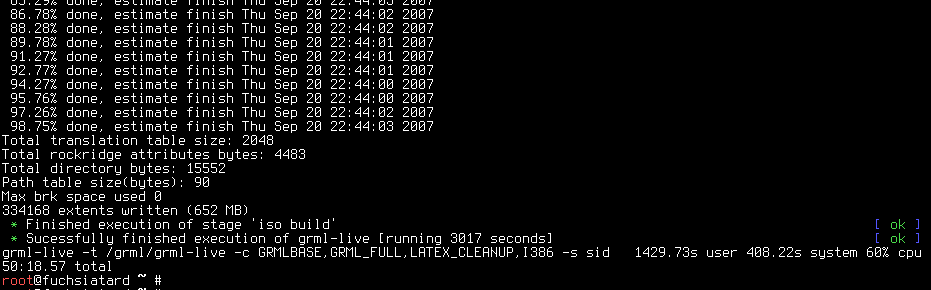
grml-live ist ein Framework, mit dessen Hilfe man mit nur 1 Kommando eine auf grml/Debian basierende Linux Live-CD bauen kann. grml-live baut auf FAI (Fully Automatic Installation) auf und nutzt dessen klassenbasiertes Konzept: Screenshot: grml-live In diesem Beispiel habe ich gerade ein gro es grml-ISO gebaut. Dabei habe ich einfach nur den Debian-Mirror in /etc/grml/grml-live.conf auf meinen lokalen Mirror gedreht (um Traffic und Zeit zu sparen) und dann folgendes Kommando aufgerufen:
# grml-live -t /grml/grml-live -c GRMLBASE,GRML_FULL,LATEX_CLEANUP,I386 -s sid
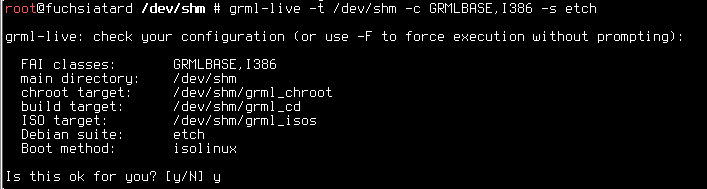
Ca. 50 Minuten sp ter habe ich im Ordner grml_isos unter /grml/grml-live/ (-t …) ein fertiges grml-ISO. Dieses wurde auf Basis der Klassen (-c …) GRMLBASE (da steckt alles essenzielle drin), GRML_FULL (Software-Auswahl wie auf der offiziellen gro en grml), LATEX_CLEANUP (ein paar sehr gro e LaTeX-Verzeichnisse aufr umen) und I386 (x86-spezifische Pakete wie z.B. der Kernel) gebaut. Als Debian-Suite (-s) wurde sid (unstable) ausgew hlt. Und das war es auch schon. Ein kleinere grml-Version auf Basis von Debian/stable gef llig? Kein Problem, machen wir es doch einfach mal im Shared-Memory (superschnell und mit genug RAM und den Mountoptionen rw,suid,dev auch kein Problem): Screenshot grml-live: der Start Ein ‘grml-live -t /dev/shm -c GRMLBASE,I386 -s etch’ und keine 5(!) Minuten sp ter hab ich dann mein 135MB kleines grml: Screenshot grml-live: done Mit grml-live kann man sich somit seine pers nlich angepasste Linux Live-CD erstellen, ohne sich erst mit Remastering im Detail besch ftigen zu m ssen. Auch muss man dabei nicht zwingend Debian/unstable nehmen, sondern kann auch Debian/stable als Basis ausw hlen. Durch das Erstellen einer neuen Klasse oder das Anpassen einer existierenden kann man auch spezielle Software-W nsche ganz einfach erf llen. Wird damit das offizielle grml-ISO etwa obsolet? Nein, auf keinen Fall. grml-live soll dem grml-Team als Buildsystem dienen (automatisierte Snapshots auf regelm iger Basis z.B. sind schon in Planung) und die langweilige Arbeit abnehmen, damit wir uns auf die wirklich wichtigen Sachen konzentrieren k nnen: Testen, Bugfixing, Implementieren von neuen Features, Arbeit am Kernel, Qualit tssicherung, Dokumentation,… grml-live hat den Anspruch, auf jedem Debian-basierten System zu funktionieren und wer Interesse daran gefunden hat, kann sich das Debian-Pakete aus dem grml-Repository holen. Den Quellcode gibt es nat rlich auf unserer Mercurial-Webseite. Wer jetzt noch Fragen hat oder mehr Details zu grml-live erfahren m chte, der m ge einfach auf die grml-live-Homepage schauen. Falls dort eine Frage noch nicht beantwortet sein sollte, jemand Feature-Requests, Bugreports oder Patches hat: meine Inbox freut sich ber Post! :-)

10 September 2007

Mike Hommey: Machine-readable copyright files

GyrosGeier has briefly talked about machine readable copyright files in Debian. I won’t talk much more about it, except pointing out the current proposal, and my own first implementation on the webkit package. Note that, huge as the source is, I didn’t feel like listing copyright information file by file, but rather set of files by set of files, grouping all files under the same licensing terms. Even doing so, the copyright file is still more than 600 lines long. And well, obviously, the ftp masters didn’t reject it.

3 September 2007

Erich Schubert: Scalix: only usable by Outlook?

I spend a few hours today trying to get Scalix to work right...I managed to be able to loginto the admin console at the end, yay!Still: it seems that it's pretty much unusable except by Outlook (maybe, I havn't tried that).The reason is simple: they don't let me log into the web mail. With none of my browsers. Because they havn't understood what 'Gecko' is.For tech people (apparently the Scalix people don't fall into this category), Gecko is the 'rendering engine' inside Firefox, Mozilla and a few others.With 'others' including the trademark-unencumbered Iceweasel fork of Firefox, or the Gnome webbrowsers "Epiphany" and "Galeon". Which are not "supported" by Scalix (do you happen to actually know what you are supporting? Did you develop for the Gecko rendering engine or for the Firefox UI?).Other people in the "I'm a web 2.0 company, but I don't know my stuff" hall-of-shame include the huge german email provider GMX. Their new webmail 'preview' is also only enabled if you claim to be using Firefox or Internet Exploder. They neither have understood why all Mozilla browsers include the Gecko id...

7 August 2007

Russell Coker: Blog Memes

A common pattern in blog communication is referred to as a Meme. Here is one example of the commonly used definition of the term as applied to blogs. One common factor that doesn’t seem to get directly mentioned much when people define the term (but which always seems to be mentioned in passing) is the idea of tagging people. So the definition of a meme as applied to blogs seems to be a silly question that you answer in a blog post and then request that some other bloggers (usually 5) answer as well. At the end of this post I have included the dictionary definition of the term (here is the Wikipedia definition). I believe that it is incorrect to call a question such as “which superhero do you most identify with” a meme. Instead I think that there is a Memeplex associated with such posts. One meme is that when someone “tags” you (requests that you answer a question) it should be considered an honour (someone in the blog-sphere likes you enough to ask you random questions in a public forum). Another meme is that such discussion is a good thing (although an increasing number of people in the more serious part of the blog-sphere oppose this). A final one that is apparent to me (I’m sure that there are others) is that so-called memes and lazyweb posts are the same thing (I believe this to be wrong). I believe that lazyweb posts if written about interesting topics can contribute significantly to the community knowledge base. I also believe that chain lazyweb posts (here is a link to the only such post I’ve made so far) can also contribute if created in a sensible manner. Chain posts that don’t require any thought or input from the person re-posting them (EG “please post this message to all your friends so that they can know of the terrible war/famine/earthquake/whatever in some foreign part of the world”) are of course quite useless (you can make a post of links once a month if you want to spread the news about such things). Now I agree that some amount of conversation among bloggers in a community that is personal and not directly related to the main topics of discussion is good for building the community. From Jargon File (4.4.4, 14 Aug 2003) [jargon]: meme
/meem/, n. [coined by analogy with gene’, by Richard Dawkins] An idea considered as a replicator , esp. with the connotation that memes parasitize people into propagating them much as viruses do. Used esp. in the phrase meme complex denoting a group of mutually supporting memes that form an organized belief system, such as a religion. This lexicon is an (epidemiological) vector of the hacker subculture’ meme complex; each entry might be considered a meme. However, meme is often misused to mean meme complex. Use of the term connotes acceptance of the idea that in humans (and presumably other tool- and language-using sophonts) cultural evolution by selection of adaptive ideas has superseded biological evolution by selection of hereditary traits. Hackers find this idea congenial for tolerably obvious reasons. PS This evening I had planned to go to a LUV meeting and see my friend Andy Fitzsimon (blog) give a talk about Inkscape (for which he is famous). I also had a day off work, so it was going to be a day of non-stop fun. But instead I got some sort of cold/flu, stayed in bed for much of the day, missed the meeting, and was late in my blog post. This sucks.

20 July 2007

Gerfried Fuchs: msgmerge --previous and poedit

Since quite a while gettext has support for a feature which I was waiting for since ages: --previous. It means that when a string gets marked fuzzy it adds the previous original string as a comment so one is able to see the difference which led to the fuzzy marking. This makes translation of po files much much more comfortable because one can easily find out now what has changed. Let me give you a reallife example:
#: data/core/help.cfg:331
#, fuzzy
#  msgid "race^Mechanical"
msgid "trait^Mechanical"
msgstr "Kriegsgerät"
With out the previous string (in the "# " line) you would propably be puzzled about what has changed because the string gets stripped off the everything before the ^ for displaying it in this case. Though, not all translation tools behave correctly. One of them is unfortunately poedit. It moves the previous string to a wrong place and thus breaks the parsing of the file. A bugreport has been filed about it—but unfortunately it also means that upstream projects that already support (like Wesnoth) it are considering disabling it again because of this. So I wrote quickly a perl script that is able to fix that for you: pofix.pl. It's quite simple, reads from stdin and writes to stdout.
Go and support --previous before your competitors do it and hijack all your translators! ;)

7 July 2007

Martin F. Krafft: Hacker tools in Germany

I am sure you've heard that "hacker tools", including nmap and other system administrastion essentials, may be considered illegal in Germany as of now. It'll depend on whether judges determine that e.g. nmap is a tool primarily used to do harm, so we all have not become criminals overnight, but there will be complications and ridiculous showdowns in courtrooms. I was only one of thousands of protestors, when this bill was first discussed by our politicians. Back in October 2006, I wrote an email to Ilse Aigner, the spokesperson for education, research and the estimation of consequences of techynology (whatever that may be) of the Christian Democratic and Christian Socialist Unions, who is a member of the German Bundestag. She's the Bundestag representative for my hometown. Surprisingly, I got a reply from her secretary, which I shall quote in full below:
im Auftrag von Frau Ilse Aigner ich habe mich bez glich Ihres Anliegens bei unserem Referenten der CDU/CSU-Arbeitsgruppe f r Recht erkundigt. Ich wurde darauf hingewiesen, dass die Bedenken Ihrer Branche hinsichtlich des Refentenentwurfs eines Strafrechts nderungsgesetzes zur Bek mpfung der Computerkriminalit t bekannt sind. Auch hat der Bundesrat eine Pr fbitte ge u ert. Zwar ist der Referent der Meinung, dass die Gefahr der Illegalisierung schon jetzt nicht best nde, trotzdem wolle man aber im laufenden Gesetzgebungsverfahren alle Bedenken beseitigen. Seien Sie versichert, dass Sie auch in Zukunft weiterhin Ihre Arbeit ganz legal aus ben k nnen.
That last sentence says: rest assured that you may continue to exercise your profession legally in the future. In the spring of 2007, it seemed as if all protests were overheard, the Bundestag pushed the new legislation 202c StGB, and the Bundesrat drew in their horns and failed to appeal the decision. I wrote another email to the secretary of Ilse Aigner asking whether I can still "rest assured", but this time, no response came back. And now the law has been passed. Politics as we know it. On the topic of whether the Debian project now has to provide a non-German archive for Germany, I find myself in the middle of the swamp of German legislation. On the one hand, publication or distribution of "hacker tools" has been made illegal, in addition to their (ab)use. On the other hand, however, the law only makes tools illegal which are (a) primarily used for cracking, and (b) are used with malevolent intentions. It's the "yes or no?" "maybe." bullshit which makes it impossible for people to do their job in Germany, if they actively want to stay on the legal side. A good example is the tax system where you have three options: do it yourself with minimal time investment and pay way more taxes than you have to, or let a tax advisor do it, or try to do it right yourself. If you do the latter, it's like walking a thin ridge in absolute darkness, except you won't be told immediately when you fall off. I think Debian should not take any action. We're not malevolently or intentionally distributing tools primarily used for cracking, so we stand good chances of getting by with it. Apart, Debian is not a legal entity in Germany anyway, so who are they to sue? NP: Overhead: Metaepitome Update: Thomas Jollans writes in that Debian can't be sued, but the German mirror operators can, with which I have to agree. Then the solution is obviously to move the German mirrors. That's a topic for this thread.

2 July 2007

Ingo Juergensmann: Alice ist nicht die nette Dame aus der Werbung

Wie ich bereits letztens beklagt habe, sind Callcenter die Pest des 21. Jahrhunderts.
Heute allerdings wurde dem Ganzen noch die Krone aufgesetzt.

Heute mittag rief mich der Vater meiner Freundin an, da die bei der Telekom-Hotline nichts von einer Bestellung w ssten und der Port ja sowieso noch gar nicht freigegeben w re. Also rief ich (mal wieder) nach Feierabend bei der Alice Hotline an. Komischerweise habe ich da eigentlich auch fast nur Frauen an der Leitung. Aber die heissen in keinster Weise alle Alice, auch wenn Ariane ebenfalls ein sch ner Name ist. Noch st rker bezweifle ich, da die Damen so h bsch aussehen, wie die Alice in der Werbung. Das w rde allerdings die Unf higkeit der Alice Hotline erkl ren, warum die nichts auf die Reihe bekommen. Man kennt ja durchaus den Spruch, wo der Intellekt in ein entsprechendes Verh ltnis zur Qualit t etwaigen Geschlechtsverkehrs gestellt wird. Sei's drum...

Nachdem ich ber geschlagene 10 Minuten a 14 /min auf die Weiterverbindung von der allgemeinen Hotline zur Abteiligung f r die K ndigungen warten musste, erz hlte mir die eher weniger als mehr nette Dame von der Alice Kundenbetreuung, da ja die K ndigungsbest tigung schon l ngst rausgegangen w re. Auf meinen Einwand, da diese noch in keinster Weise bei uns angekommen sei, meinte sie dann, da sie die gerne noch einmal rausschicken k nnte - so wie die gute Dame am letzten Dienstag dies auch schon machen wollte und wo die Best tigung ja dann am n chsten oder bern chsten Tag da sein sollte.
Dieses Mal hatte Alice, ehm, die Kundenveruntreuerin allerdings wohl dazu gelernt, was sie wohl auch aus der allgemeinen Hotline-T tigkeit zu h heren Weihen bef rdert hat - oder war das vielleicht doch nur die Best tigung f r obiges Sprichwort? Na jedenfalls meinte diese "Dame" dann auf meine Nachfrage, wann wir denn wohl mit dem Eingang der K ndigungsbest tigung rechnen k nnten, da sie das blo ins System eintr gt und der Brief dann wohl gegen Ende der Woche verschickt werden w rde.

Nun sollte man sich ja eigentlich als unbedarfter Kunde freuen, wenn ich blo nicht den Fehler gemacht h tte zu fragen, wann denn der Port abgeschaltet werden w rde. Denn das passiert auch gegen Ende der Woche.
Mit anderen Worten: wenn wir die K ndigungsbest tigung von Alice bekommen, brauchen wir sie gar nicht mehr, weil der Port eh schon freigegeben wurde.

Ohja, manchmal f hle ich mich bei Alice auch wie im Wunderland... seufz

11 June 2007

Joey Hess: unicode eye chart

E
￿ ڿ
ᛯ ℇ ✈
ㄝ ಅ ΐ ʐ 𝍇
Щ অ ℻ ⌬ ⌨ ⌣
₰ ⠝ ‱ ‽ ח ֆ ∜ ⨀ IJ
Ⴊ ⇠ ਐ ῼ இ ╁ ଠ ୭ ⅙ ㈣
⧒ ₔ ⅷ ﭗ ゛ 〃 ・ ↂ ﻩ ✞ ℼ ⌧


Reference key for the Optometrist:

LATIN CAPITAL LETTER E

THAT DAMN UNICODE BOX WITH F'S IN, ARABIC LETTER TCHEH WITH DOT ABOVE

RUNIC TVIMADUR SYMBOL, EULER CONSTANT, AIRPLANE

BOPOMOFO LETTER EH, KANNADA LETTER A, GREEK SMALL LETTER IOTA WITH DIALYTIKA AND TONOS, LATIN SMALL LETTER Z WITH RETROFLEX HOOK, TETRAGRAM FOR DEPARTURE

CYRILLIC CAPITAL LETTER SHCHA, BENGALI LETTER A, FACSIMILE SIGN, BENZENE RING, KEYBOARD, SMILE

GERMAN PENNY SYMBOL, BRAILLE PATTERN DOTS-1345 (or GLIDER), PER TEN THOUSAND SIGN, INTERROBANG, HEBREW LETTER HET, ARMENIAN SMALL LETTER FEH, FOURTH ROOT, N-ARY CIRCLED DOT OPERATOR, LATIN CAPITAL LIGATURE IJ

GEORGIAN CAPITAL LETTER LAS, LEFTWARDS DASHED ARROW, GURMUKHI LETTER AI, GREEK CAPITAL LETTER OMEGA WITH PROSGEGRAMMENI, TAMIL LETTER I, BOX DRAWINGS DOWN HEAVY AND UP HORIZONTAL LIGHT, ORIYA LETTER TTHA, ORIYA DIGIT SEVEN (or INVERTED DEBIAN LOGO), VULGAR FRACTION ONE SIXTH, PARENTHESIZED IDEOGRAPH FOUR

BOWTIE WITH RIGHT HALF BLACK, LATIN SUBSCRIPT SMALL LETTER SCHWA, SMALL ROMAN NUMERAL EIGHT, ARABIC LETTER PEH FINAL FORM, KATAKANA-HIRAGANA VOICED SOUND MARK, DITTO MARK, KATAKANA MIDDLE DOT, ROMAN NUMERAL TEN THOUSAND, ARABIC LETTER HEH ISOLATED FORM, SHADOWED WHITE LATIN CROSS, DOUBLE-STRUCK SMALL PI, X IN A RECTANGLE BOX

24 May 2007

Neil Williams: Functional cross-building chroot, based on pbuilder

The pbuilder-based chroot script (empdebuild) in Emdebian SVN is now functional - that is it can run from a directory created by emsource, patch the Debian source using emdebian-patch files ( = emdebianising the package), get the build dependencies and install them, run emdebuild to cross-build the package and copy the updated patches, build log, .changes, .dsc and .deb files out to a nominal location before cleaning up the chroot. Only the basic pbuilder options and setup is supported and some values that can be configured for pbuilder are calculated automatically by empdebuild.

The embootstrap script that creates the chroot used by empdebuild needs some more work before this can be released as part of emdebian-tools 0.2.2 and there is no support (yet) for installing the cross-dependencies required for some packages. I'll be experimenting with Gyrosgeier's debian/xcontrol idea to specify these Build-Cross-Depends: using information already gathered on an ad-hoc basis. xcontrol files can then be committed to Emdebian SVN as patches. The pbuilder code is sufficiently flexible that the same code that parses debian/control for Build-Depends can be adapted to parse debian/xcontrol for Build-Cross-Depends.

In theory, empdebuild can become the basis of a cross-buildd, significantly improving the rate at which packages can be emdebianised.

The script does, currently, have to use apt pinning to retain the Emdebian toolchains because of problems with gcc-4.2 on arm.

(And yes, I do realise that emdebuild and empdebuild are very similar names but then so are debuild and pdebuild upon which the respective Emdebian scripts are based.)


http://buildd.emdebian.org/svn/browser/current/host/trunk/emdebian-tools/trunk/pbuilder

15 May 2007

Joachim Breitner: gaim-thinklight pidgin-blinklight

I once wrote a plugin gaim called gaim-thinklight, which simply blinks your ThinkPad s ThinkLight when you get a new messge. Very recently, gaim was renamed to pidgin, so gaim-thinklight is now called pidgin-blinklight. I changed the second part not because of trademark issues (as gaim did, IIUC), but because it also supports ASUS laptops since the last version. At least I hope so, I implemented that, as I do not have an ASUS laptop please tell me if it does or does not work.If you run Debian unstable, you ll soon be able to apt-get install pidgin-blinklight. Others can find the sources on the debian package page. I m still too lazy to host that code somewhere else as well...

11 May 2007

MJ Ray: Debconf7: The slef travel service

Now I've got my tickets, I've put some tips about finding cheap debconf land travel onto the debconf site. (I know that was selfish, but debconf's travel deadlines sucked and it refused to help pay for travel, so please excuse me looking after myself first.) Damog emailed me, grumbling about how hard it is to find cheap/quick land travel from a major English city to Edinburgh. I sent back three options for under GBP 35 return, but I've heard nothing more. Hope it worked. Simon Richter wrote GyrosGeier's blog - Why the environment loses out, again. complaining that Deutsche Bahn quote 426 ? (EUR, I guess) to go to Edinburgh from Munich. Well, I just asked Lufthansa and they quote up to EUR 1400 to fly Munich-Edinburgh, but I'm sure you can find that cheaper too - obviously, if you get only one quote from a dominant supplier, that may not be the best price available. I don't know about travel from Germany, but someone already left a link to another ticket agency in the comments.

12 April 2007

MJ Ray: BBC Radio 4, Again, Again

Kris Marsh commented:
"Thanks for the blog, I'd never have known about the BBC4 open source slot otherwise! Unfortunately I missed it, but I did notice that it's available on BBC's "listen again" feature "
So, what did you think of it? Post comments to my site or to fsfe-uk.

11 April 2007

MJ Ray: BBC Radio 4, Wed 11 April, 21:00

Argh! It was a busy blog day (sort of catching up after the double-holiday weekend) and now a second late-notice item. (Don't get used to it - I'll be back to my usual slow rate soon.) I think someone mentioned this before:
"Open Source BBC Radio 4: Wed 11 Apr, 21:00 - 21:30 30 mins Paul Bennun finds out how Free and Open Source software is making its impact felt across the world, fuelling development and saving businesses millions of pounds. [...]"
Frequencies and more blurb are on the BBC site It's not on Long Wave unless the Cricket World Cup match finishes extraordinarily early. So, what do you think of it? Post comments to my site or to fsfe-uk.

Next.

Previous.