Chris Lamb: The Bringers of Beethoven

Italianization (Italian: Italianizzazione; Croatian: talijanizacija; Slovene: poitaljan evanje; German: Italianisierung; Greek: ) is the spread of Italian culture and language, either by integration or assimilation.[1][2]
In 1919, at the time of its annexation, the middle part of the County of Tyrol which is today called South Tyrol (in Italian Alto Adige) was inhabited by almost 90% German speakers.[1] Under the 1939 South Tyrol Option Agreement, Adolf Hitler and Benito Mussolini determined the status of the German and Ladin (Rhaeto-Romanic) ethnic groups living in the region. They could emigrate to Germany, or stay in Italy and accept their complete Italianization. As a consequence of this, the society of South Tyrol was deeply riven. Those who wanted to stay, the so-called Dableiber, were condemned as traitors while those who left (Optanten) were defamed as Nazis. Because of the outbreak of World War II, this agreement was never fully implemented. Illegal Katakombenschulen ("Catacomb schools") were set up to teach children the German language.
The Prontuario dei nomi locali dell'Alto Adige (Italian for Reference Work of Place Names of Alto Adige) is a list of Italianized toponyms for mostly German place names in South Tyrol (Alto Adige in Italian) which was published in 1916 by the Royal Italian Geographic Society (Reale Societ Geografica Italiana). The list was called the Prontuario in short and later formed an important part of the Italianization campaign initiated by the fascist regime, as it became the basis for the official place and district names in the Italian-annexed southern part of the County of Tyrol.
Ettore Tolomei (16 August 1865, in Rovereto 25 May 1952, in Rome) was an Italian nationalist and fascist. He was designated a Member of the Italian Senate in 1923, and ennobled as Conte della Vetta in 1937.
The South Tyrol Option Agreement (German: Option in S dtirol; Italian: Opzioni in Alto Adige) was an agreement in effect between 1939 and 1943, when the native German speaking people in South Tyrol and three communes in the province of Belluno were given the option of either emigrating to neighboring Nazi Germany (of which Austria was a part after the 1938 Anschluss) or remaining in Fascist Italy and being forcibly integrated into the mainstream Italian culture, losing their language and cultural heritage. Over 80% opted to move to Germany.
Paul-F lix Armand-Delille (3 July 1874 in Fourchambault, Ni vre 4 September 1963) was a physician, bacteriologist, professor, and member of the French Academy of Medicine who accidentally brought about the collapse of rabbit populations throughout much of Europe and beyond in the 1950s by infecting them with myxomatosis.
Charles Franklin Kettering (August 29, 1876 November 25, 1958) sometimes known as Charles "Boss" Kettering[1] was an American inventor, engineer, businessman, and the holder of 186 patents.[2] He was a founder of Delco, and was head of research at General Motors from 1920 to 1947. Among his most widely used automotive developments were the electrical starting motor[3] and leaded gasoline.[4][5] In association with the DuPont Chemical Company, he was also responsible for the invention of Freon refrigerant for refrigeration and air conditioning systems. At DuPont he also was responsible for the development of Duco lacquers and enamels, the first practical colored paints for mass-produced automobiles. While working with the Dayton-Wright Company he developed the "Bug" aerial torpedo, considered the world's first aerial missile.[6] He led the advancement of practical, lightweight two-stroke diesel engines, revolutionizing the locomotive and heavy equipment industries. In 1927, he founded the Kettering Foundation, a non-partisan research foundation. He was featured on the cover of Time magazine on January 9, 1933.
John Charles Cutler (June 29, 1915 February 8, 2003) was a senior surgeon, and the acting chief of the venereal disease program in the United States Public Health Service. After his death, his involvement in several controversial and unethical medical studies of syphilis was revealed, including the Guatemala and the Tuskegee syphilis experiments.
Ivy Ledbetter Lee (July 16, 1877 November 9, 1934) was an American publicity expert and a founder of modern public relations. Lee is best known for his public relations work with the Rockefeller family. His first major client was the Pennsylvania Railroad, followed by numerous major railroads such as the New York Central, the Baltimore and Ohio, and the Harriman lines such as the Union Pacific. He established the Association of Railroad Executives, which included providing public relations services to the industry. Lee advised major industrial corporations, including steel, automobile, tobacco, meat packing, and rubber, as well as public utilities, banks, and even foreign governments. Lee pioneered the use of internal magazines to maintain employee morale, as well as management newsletters, stockholder reports, and news releases to the media. He did a great deal of pro bono work, which he knew was important to his own public image, and during World War I, he became the publicity director for the American Red Cross.[1]
 Welcome to gambaru.de. Here is my monthly report (+ the first week in April) that covers what I have been doing for Debian. If you re interested in Java, Games and LTS topics, this might be interesting for you.
I am sure I am not the only one who will remember March 2020 in the future as a month nobody was really fond of. I was mostly occupied with non-Debian work and managed to get ill in the same week I wanted to celebrate my birthday but it didn t matter anyway because of ehm quarantine and social distancing. Maybe next year March will be great again.
 There have been lot of stories about Coronavirus and with it a lot of political blame-game has been happening. The first step that India took of a lockdown is and was a good step but without having a plan as to how especially the poor and the needy and especially the huge migrant population that India has (internal migration) be affected by it. A 2019 World Economic Forum shares the stats. as 139 million people. That is a huge amount of people and there are a variety of both push and pull factors which has displaced these huge number of people. While there have been attempts in the past and probably will continue in future they will be hampered unless we have trust-worthy data which is where there is lots that need to be done. In the recent few years, both the primary and secondary data has generated lot of controversies within India as well as abroad so no point in rehashing all of that. Even the definition of who is a migrant needs to be well-established just as who is a farmer . The simplest lucanae in the later is those who have land are known as farmers but the tenant farmers and their wives are not added as farmers hence the true numbers are never known. Is this an India-specific problem or similar definition issues are there in the rest of the world I don t know.
| Publisher: | Basic |
| Copyright: | June 2018 |
| ISBN: | 0-465-09426-0 |
| Format: | Kindle |
| Pages: | 248 |
Do you recall the temple of science, in which the foundations of physics are the bottommost level, and we try to break through to deeper understanding? As I've come to the end of my travels, I worry that the cracks we're seeing in the floor aren't really cracks at all but merely intricate patterns. We're digging in the wrong places.Lost in Math will teach you a bit less about physics than Smolin's book, although there is some of that here. Smolin's book was about two-thirds physics and one-third sociology of science. Lost in Math is about two-thirds sociology and one-third physics. But that sociology is engrossing. It's obvious in retrospect, but I hadn't thought before about the practical effects of running out of unexplained data on a theoretical field, or about the transition from more data than we can explain to having to spend billions of dollars to acquire new data. And Hossenfelder takes direct aim at the human tendency to find aesthetically appealing patterns and unified explanations, and scores some palpable hits.
I went into physics because I don't understand human behavior. I went into physics because math tells it how it is. I liked the cleanliness, the unambiguous machinery, the command math has over nature. Two decades later, what prevents me from understanding physics is that I still don't understand human behavior. "We cannot give exact mathematical rules that define if a theory is attractive or not," says Gian Francesco Giudice. "However, it is surprising how the beauty and elegance of a theory are universally recognized by people from different cultures. When I tell you, 'Look, I have a new paper and my theory is beautiful,' I don't have to tell you the details of my theory; you will get why I'm excited. Right?" I don't get it. That's why I am talking to him. Why should the laws of nature care what I find beautiful? Such a connection between me and the universe seems very mystical, very romantic, very not me. But then Gian doesn't think that nature cares what I find beautiful, but what he finds beautiful.The structure of this book is half tour of how physics judges which theories are worthy of investigation and half personal quest to decide whether physics has lost contact with reality. Hossenfelder approaches this second thread with multiple interviews of famous scientists in the field. She probes at their bases for preferring one theory over another, at how objective those preferences can or should be, and what it means for physics if they're wrong (as increasingly appears to be the case for supersymmetry). In so doing, she humanizes theory development in a way that I found fascinating. The drawback to reading about ongoing arguments is the lack of a conclusion. Lost in Math, unsurprisingly, does not provide an epiphany about the future direction of high-energy particle physics. Its conclusion, to the extent that it has one, is a plea to find a way to put particle physics back on firmer experimental footing and to avoid cognitive biases in theory development. Given the cost of experiments and the nature of humans, this is challenging. But I enjoyed reading this questioning, contrarian take, and I think it's valuable for understanding the limits, biases, and distortions at the edge of new theory development. Rating: 7 out of 10
 The four keycards have similar form factors: they all connect to a
standard USB port, although both YubiKey keycards have a capacitive
button by which the user triggers two-factor authentication and the
YubiKey 4 can also require a button
press
to confirm private key use. The YubiKeys feel sturdier than the other
two. The NEO has withstood two years of punishment in my pockets along
with the rest of my "real" keyring and there is only minimal wear on the
keycard in the picture. It's also thinner so it fits well on the
keyring.
The FST-01 stands out from the other two with its minimal design. Out of
the box, the FST-01 comes without a case, so the circuitry is exposed.
This is deliberate: one of its goals is to be as transparent as
possible, both in terms of software and hardware design and you
definitely get that feeling at the physical level. Unfortunately, that
does mean it feels more brittle than other models: I wouldn't carry it
in my pocket all the time, although there is a
case
that may protect the key a little better, but it does not provide an
easy way to hook it into a keyring. In the group picture above, the
FST-01 is the pink plastic thing, which is a rubbery casing I received
along with the device when I got it.
Notice how the USB connectors of the YubiKeys differ from the other two:
while the FST-01 and the Nitrokey have standard USB connectors, the
YubiKey has only a "half-connector", which is what makes it thinner than
the other two. The "Nano" form factor takes this even further and almost
disappears in the USB port. Unfortunately, this arrangement means the
YubiKey NEO often comes loose and falls out of the USB port, especially
when connected to a laptop. On my workstation, however, it usually stays
put even with my whole keyring hanging off of it. I suspect this adds
more strain to the host's USB port but that's a tradeoff I've lived with
without any noticeable wear so far. Finally, the NEO has this peculiar
feature of supporting NFC for certain operations, as LWN previously
covered, but I haven't used that
feature yet.
The Nitrokey Pro looks like a normal USB key, in contrast with the other
two devices. It does feel a little brittle when compared with the
YubiKey, although only time will tell how much of a beating it can take.
It has a small ring in the case so it is possible to carry it directly
on your keyring, but I would be worried the cap would come off
eventually. Nitrokey devices are also two times thicker than the Yubico
models which makes them less convenient to carry around on keyrings.
 Nitrokey also publishes its hardware designs, on
GitHub, which shows the Pro is basically a
fork of the FST-01, according to the
ChangeLog.
I opened the case to confirm it was using the STM MCU, something I
should warn you against; I broke one of the pins holding it together
when opening it so now it's even more fragile. But at least, I was able
to confirm it was built using the STM32F103TBU6 MCU, like the FST-01.
 But this is where the comparison ends: on the back side, we find a SIM
card reader that holds the OpenPGP
card that, in turn, holds
the private key material and does the cryptographic operations. So, in
effect, the Nitrokey Pro is really a evolution of the original OpenPGP
card readers.
Nitrokey confirmed the OpenPGP card featured in the Pro is the same as
the one shipped by
the Free Software Foundation Europe (FSFE): the
BasicCard built by ZeitControl. Those cards,
however, are covered by NDAs and the firmware is only partially open
source.
This makes the Nitrokey Pro less open than the FST-01, but that's an
inevitable tradeoff when choosing a design based on the OpenPGP cards,
which Suhr described to me as "pretty proprietary". There are other
keycards out there, however, for example the
SLJ52GDL150-150k
smartcard suggested by
Debian developer Yves-Alexis Perez, which he prefers as it is certified
by French and German authorities. In that blog post, he also said he was
experimenting with the GPL-licensed OpenPGP
applet implemented by the French
ANSSI.
But the YubiKey devices are even further away in the closed-design
direction. Both the hardware designs and firmware are proprietary. The
YubiKey NEO, for example, cannot be upgraded at all, even though it is
based on an open firmware. According to Yubico's
FAQ,
this is due to "best security practices": "There is a 'no upgrade'
policy for our devices since nothing, including malware, can write to
the firmware."
I find this decision questionable in a context where security updates
are often more important than trying to design a bulletproof design,
which may simply be impossible. And the YubiKey NEO did suffer from
critical security
issue
that allowed attackers to bypass the PIN protection on the card, which
raises the question of the actual protection of the private key material
on those cards. According to Niibe, "some OpenPGP cards store the
private key unencrypted. It is a common attitude for many smartcard
implementations", which was confirmed by Suhr: "the private key is
protected by hardware mechanisms which prevent its extraction and
misuse". He is referring to the use of tamper
resistance.
After that security issue, there was no other option for YubiKey NEO
users than to get a new keycard (for free, thankfully) from Yubico,
which also meant discarding the private key material on the key. For
OpenPGP keys, this may mean having to bootstrap the web of trust from
scratch if the keycard was responsible for the main certification key.
But at least the NEO is running free software based on the OpenPGP card
applet and the
source is still available on
GitHub. The YubiKey 4, on the
other hand, is now closed
source,
which was controversial when the new model was announced last year. It
led the main Linux Foundation system administrator, Konstantin
Ryabitsev, to withdraw his
endorsement
of Yubico products. In response, Yubico argued that this approach was
essential to the security of its
devices,
which are now based on "a secure chip, which has built-in
countermeasures to mitigate a long list of attacks". In particular, it
claims that:
A commercial-grade AVR or ARM controller is unfit to be used in a security product. In most cases, these controllers are easy to attack, from breaking in via a debug/JTAG/TAP port to probing memory contents. Various forms of fault injection and side-channel analysis are possible, sometimes allowing for a complete key recovery in a shockingly short period of time.While I understand those concerns, they eventually come down to the trust you have in an organization. Not only do we have to trust Yubico, but also hardware manufacturers and designs they have chosen. Every step in the hidden supply chain is then trusted to make correct technical decisions and not introduce any backdoors. History, unfortunately, is not on Yubico's side: Snowden revealed the example of RSA security accepting what renowned cryptographer Bruce Schneier described as a "bribe" from the NSA to weaken its ECC implementation, by using the presumably backdoored Dual_EC_DRBG algorithm. What makes Yubico or its suppliers so different from RSA Security? Remember that RSA Security used to be an adamant opponent to the degradation of encryption standards, campaigning against the Clipper chip in the first crypto wars. Even if we trust the Yubico supply chain, how can we trust a closed design using what basically amounts to security through obscurity? Publicly auditable designs are an important tradition in cryptography, and that principle shouldn't stop when software is frozen into silicon. In fact, a critical vulnerability called ROCA disclosed recently affects closed "smartcards" like the YubiKey 4 and allows full private key recovery from the public key if the key was generated on a vulnerable keycard. When speaking with Ars Technica, the researchers outlined the importance of open designs and questioned the reliability of certification:
Our work highlights the dangers of keeping the design secret and the implementation closed-source, even if both are thoroughly analyzed and certified by experts. The lack of public information causes a delay in the discovery of flaws (and hinders the process of checking for them), thereby increasing the number of already deployed and affected devices at the time of detection.This issue with open hardware designs seems to be recurring topic of conversation on the Gnuk mailing list. For example, there was a discussion in September 2017 regarding possible hardware vulnerabilities in the STM MCU that would allow extraction of encrypted key material from the key. Niibe referred to a talk presented at the WOOT 17 workshop, where Johannes Obermaier and Stefan Tatschner, from the Fraunhofer Institute, demonstrated attacks against the STMF0 family MCUs. It is still unclear if those attacks also apply to the older STMF1 design used in the FST-01, however. Furthermore, extracted private key material is still protected by user passphrase, but the Gnuk uses a weak key derivation function, so brute-forcing attacks may be possible. Fortunately, there is work in progress to make GnuPG hash the passphrase before sending it to the keycard, which should make such attacks harder if not completely pointless. When asked about the Yubico claims in a private email, Niibe did recognize that "it is true that there are more weak points in general purpose implementations than special implementations". During the last DebConf in Montreal, Niibe explained:
If you don't trust me, you should not buy from me. Source code availability is only a single factor: someone can maliciously replace the firmware to enable advanced attacks.Niibe recommends to "build the firmware yourself", also saying the design of the FST-01 uses normal hardware that "everyone can replicate". Those advantages are hard to deny for a cryptographic system: using more generic components makes it harder for hostile parties to mount targeted attacks. A counter-argument here is that it can be difficult for a regular user to audit such designs, let alone physically build the device from scratch but, in a mailing list discussion, Debian developer Ian Jackson explained that:
You don't need to be able to validate it personally. The thing spooks most hate is discovery. Backdooring supposedly-free hardware is harder (more costly) because it comes with greater risk of discovery. To put it concretely: if they backdoor all of them, someone (not necessarily you) might notice. (Backdooring only yours involves messing with the shipping arrangements and so on, and supposes that you specifically are of interest.)Since that, as far as we know, the STM microcontrollers are not backdoored, I would tend to favor those devices instead of proprietary ones, as such a backdoor would be more easily detectable than in a closed design. Even though physical attacks may be possible against those microcontrollers, in the end, if an attacker has physical access to a keycard, I consider the key compromised, even if it has the best chip on the market. In our email exchange, Niibe argued that "when a token is lost, it is better to revoke keys, even if the token is considered secure enough". So like any other device, physical compromise of tokens may mean compromise of the key and should trigger key-revocation procedures.
Algorithm Device Mean time (s) ECDH-Curve25519 CPU 0.036 FST-01 0.135 RSA-2048 CPU 0.016 YubiKey-4 0.162 Nitrokey-Pro 0.610 YubiKey-NEO 0.736 FST-01 1.265 RSA-4096 CPU 0.043 YubiKey-4 0.875 Nitrokey-Pro 3.150 FST-01 8.218
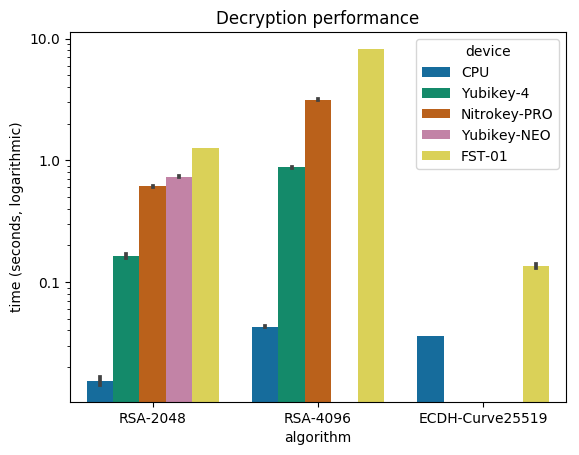 There we see the performance of the four keycards I tested, compared
with the same operations done without a keycard: the "CPU" device. That
provides the baseline time of GnuPG decrypting the file. The first
obvious observation is that using a keycard is slower: in the best
scenario (FST-01 + ECC) we see a four-fold slowdown, but in the worst
case (also FST-01, but RSA-4096), we see a catastrophic 200-fold
slowdown. When I
presented
the results on the Gnuk mailing list, GnuPG developer Werner Koch
confirmed those "numbers are as expected":
With a crypto chip RSA is much faster. By design the Gnuk can't be as fast - it is just a simple MCU. However, using Curve25519 Gnuk is really fast.And yes, the FST-01 is really fast at doing ECC, but it's also the only keycard that handles ECC in my tests; the Nitrokey Start and Nitrokey HSM should support it as well, but I haven't been able to test those devices. Also note that the YubiKey NEO doesn't support RSA-4096 at all, so we can only compare RSA-2048 across keycards. We should note, however, that ECC is slower than RSA on the CPU, which suggests the Gnuk ECC implementation used by the FST-01 is exceptionally fast. In discussions about improving the performance of the FST-01, Niibe estimated the user tolerance threshold to be "2 seconds decryption time". In a new design using the STM32L432 microcontroller, Aurelien Jarno was able to bring the numbers for RSA-2048 decryption from 1.27s down to 0.65s, and for RSA-4096, from 8.22s down to 3.87s seconds. RSA-4096 is still beyond the two-second threshold, but at least it brings the FST-01 close to the YubiKey NEO and Nitrokey Pro performance levels. We should also underline the superior performance of the YubiKey 4: whatever that thing is doing, it's doing it faster than anyone else. It does RSA-4096 faster than the FST-01 does RSA-2048, and almost as fast as the Nitrokey Pro does RSA-2048. We should also note that the Nitrokey Pro also fails to cross the two-second threshold for RSA-4096 decryption. For me, the FST-01's stellar performance with ECC outshines the other devices. Maybe it says more about the efficiency of the algorithm than the FST-01 or Gnuk's design, but it's definitely an interesting avenue for people who want to deploy those modern algorithms. So, in terms of performance, it is clear that both the YubiKey 4 and the FST-01 take the prize in their own areas (RSA and ECC, respectively).
In practice smart card security has been proven to work well (at least if you use a decent smart card). Therefore the Nitrokey Pro should be used for high security cases. If you don't trust the smart card or if Nitrokey Start is just sufficient for you, you can choose that one. This is why we offer both models.So far, I have created a signing subkey and moved that and my authentication key to the YubiKey NEO, because it's a device I physically trust to keep itself together in my pockets and I was already using it. It has served me well so far, especially with its extra features like U2F and HOTP support, which I use frequently. Those features are also available on the Nitrokey Pro, so that may be an alternative if I lose the YubiKey. I will probably move my main certification key to the FST-01 and a LUKS-encrypted USB disk, to keep that certification key offline but backed up on two different devices. As for the encryption key, I'll wait for keycard performance to improve, or simply switch my whole keyring to ECC and use the FST-01 or Nitrokey Start for that purpose.
[The author would like to thank Nitrokey for providing hardware for testing.] This article first appeared in the Linux Weekly News.
 Often, when I mention how things work in the interactive theorem prover [Isabelle/HOL] (in the following just Isabelle 1) to people with a strong background in functional programming (whether that means Haskell or Coq or something else), I cause confusion, especially around the issue of what is a function, are function total and what is the business with undefined. In this blog post, I want to explain some these issues, aimed at functional programmers or type theoreticians.
Note that this is not meant to be a tutorial; I will not explain how to do these things, and will focus on what they mean.
f :: a b between two types a and b (the function arrow in Isabelle is , not ), then by definition of what it means to be a function in HOL whenever I have a value x :: a, then the expression f x (i.e. f applied to x) is a value of type b. Therefore, and without exception, every Isabelle function is total.
In particular, it cannot be that f x does not exist for some x :: a. This is a first difference from Haskell, which does have partial functions like
spin :: Maybe Integer -> Bool
spin (Just n) = spin (Just (n+1))spin Nothing nor the expression spin (Just 42) produce a value of type Bool: The former raises an exception ( incomplete pattern match ), the latter does not terminate. Confusingly, though, both expressions have type Bool.
Because every function is total, this confusion cannot arise in Isabelle: If an expression e has type t, then it is a value of type t. This trait is shared with other total systems, including Coq.
Did you notice the emphasis I put on the word is here, and how I deliberately did not write evaluates to or returns ? This is because of another big source for confusion:
a b in functional programming is an algorithm that, given a value of type a, calculates (returns, evaluates to) a value of type b.a b in math (or Isabelle) associates with each value of type a a value of type b.definition foo :: "(nat real) real" where
"foo seq = (if convergent seq then lim seq else 0)"fun plus :: "nat nat nat" where
"plus 0 m = m"
"plus (Suc n) m = Suc (plus n m)"which is clearly a description of a computation. But to Isabelle, the above readsplusis a function that analyses its first argument. If that is0, then it returns the second argument. Otherwise, it calls itself with the predecessor of the first argument and increases the result by one.
plus is a binary function on natural numbers, and it satisfies the following two equations:
And in fact, it is not so much Isabelle that reads it this way, but rather the fun command, which is external to the Isabelle logic. The fun command analyses the given equations, constructs a non-recursive definition of plus under the hood, passes that to Isabelle and then proves that the given equations hold for plus.
One interesting consequence of this is that different specifications can lead to the same functions. In fact, if we would define plus' by recursing on the second argument, we d obtain the the same function (i.e. plus = plus' is a theorem, and there would be no way of telling the two apart).
fun command can only construct plus in a way that the equations hold if it passes a termination check very much like Fixpoint in Coq.
But while the termination check of Fixpoint in Coq is a deep part of the basic logic, in Isabelle it is simply something that this particular command requires for its internal machinery to go through. At no point does a termination proof of the function exist as a theorem inside the logic. And other commands may have other means of defining a function that do not even require such a termination argument!
For example, a function specification that is tail-recursive can be turned in to a function, even without a termination proof: The following definition describes a higher-order function that iterates its first argument f on the second argument x until it finds a fixpoint. It is completely polymorphic (the single quote in 'a indicates that this is a type variable):
partial_function (tailrec)
  fixpoint :: "('a   'a)   'a   'a"
where
"fixpoint f x = (if f x = x then x else fixpoint f (f x))"f with ( x. x-1), we can prove that it will always return 0:
lemma "fixpoint (  n . n - 1) (n::nat) = 0"
by (induction n) (auto simp add: fixpoint.simps)partial_function (option) collatz :: "nat nat list option"
where "collatz n =
(if n = 1 then Some [n]
else if even n
then do ns <- collatz (n div 2); Some (n # ns)
else do ns <- collatz (3 * n + 1); Some (n # ns) )"fixpoint be a total function? What is fixpoint ( n. n+1)? What if we run collatz n for a n where the Collatz sequence does not reach 1?3 We will come back to that question after a little detour
undefined :: 'aarbitrary or, even better, unknown.
Since undefined can be instantiated at any type, we can instantiate it for example at bool, and we can observe an important fact: undefined is not an extra value besides the usual ones . It is simply some value of that type, which is demonstrated in the following lemma:
lemma "undefined = True undefined = False" by autoundefined for sure:
lemma "undefined = ()" by autofromJust function:
fun fromSome :: "'a option   'a" where
"fromSome (Some x) = x"fun (albeit with a warning), and the generated function fromSome behaves exactly as specified: when applied to Some x, it is x. The term fromSome None is also a value of type 'a, we just do not know which one it is, as the specification does not address that.
So fromSome None behaves just like undefined above, i.e. we can prove
lemma "fromSome None = False fromSome None = True" by autofun constOrId :: "bool bool" where
"constOrId True = True"
lemma "constOrId = ( _.True) constOrId = ( x. x)"
by (metis (full_types) constOrId.simps)fixpoint above. Clearly, the function seen as a functional program is not total: When passed the argument ( n. n + 1) or ( b. b) it will loop forever trying to find a fixed point.
But Isabelle functions are not functional programs, and the definitions are just specifications. What does the specification say about the case when f has no fixed-point? It states that the equation fixpoint f x = fixpoint f (f x) holds. And this equation has a solution, for example fixpoint f _ = undefined.
Or more concretely: The specification of the fixpoint function states that fixpoint ( b. b) True = fixpoint ( b. b) False has to hold, but it does not specify which particular value (True or False) it should denote any is fine.
f and get a function out of that? But rest assured: That is not the case. For example, no Isabelle command allows you define a function bogus :: () nat with the equation bogus () = Suc (bogus ()), because this equation does not have a solution.
We can actually prove that such a function cannot exist:
lemma no_bogus: " bogus. bogus () = Suc (bogus ())" by simpnot_bogus () = not_bogus () is just fine )
undefined is not a separate, recognizable value, but rather simply an unknown one, there is no way of stating that A function result is not specified .
Here is an example that demonstrates this: Two partial functions (one with not all cases specified, the other one with a self-referential specification) are indistinguishable from the total variant:
fun partial1 :: "bool   unit" where
  "partial1 True = ()"
partial_function (tailrec) partial2 :: "bool   unit" where
  "partial2 b = partial2 b"
fun total :: "bool   unit" where
  "total True = ()"
  "total False = ()"
lemma "partial1 = total partial2 = total" by auto () and partial2 = total. We have done that to verify some of HLint s equations.
fixpoint, which is not possible in Coq.
There is currently ongoing work about verified code generation, where the code equations are reflected into a deep embedding of HOL in Isabelle that would allow explicit termination proofs.
undefined in Coq
This section is speculative, and an invitation for discussion.
Coq already distinguishes between types used in programs (Set) and types used in proofs Prop.
Could Coq ensure that every t : Set is non-empty? I imagine this would require additional checks in the Inductive command, similar to the checks that the Isabelle command datatype has to perform4, and it would disallow Empty_set.
If so, then it would be sound to add the following axiom
Axiom undefined : forall (a : Set), a._ undefined. Would it help with non-obviously terminating functions? Would it allow a Coq command Tailrecursive that accepts any tailrecursive function without a termination check?
fun, the constructions by datatype are not part of the logic, but create a type definition from more primitive notions that is isomorphic to the specified data type. ps.monitor tor:1-1 master:1-2 auditd:1-1 cron:1-5 rsyslogd:1-1 dbus-daemon:1- sshd:1- watchdog:1-2I m currently planning some sort of rewrite of the process monitoring script. The current functionality is to have a list of process names on the command line with minimum and maximum numbers for the instances of the process in question. The above is a sample of the configuration of the monitor. There are some limitations to this, the master process in this instance refers to the main process of Postfix, but other daemons use the same process name (it s one of those names that s wrong because it s so obvious). One obvious solution to this is to give the option of specifying the full path so that /usr/lib/postfix/sbin/master can be differentiated from all the other programs named master. The next issue is processes that may run on behalf of multiple users. With sshd there is a single process to accept new connections running as root and a process running under the UID of each logged in user. So the number of sshd processes running as root will be one greater than the number of root login sessions. This means that if a sysadmin logs in directly as root via ssh (which is controversial and not the topic of this post merely something that people do which I have to support) and the master process then crashes (or the sysadmin stops it either accidentally or deliberately) there won t be an alert about the missing process. Of course the correct thing to do is to have a monitor talk to port 22 and look for the string SSH-2.0-OpenSSH_ . Sometimes there are multiple instances of a daemon running under different UIDs that need to be monitored separately. So obviously we need the ability to monitor processes by UID. In many cases process monitoring can be replaced by monitoring of service ports. So if something is listening on port 25 then it probably means that the Postfix master process is running regardless of what other master processes there are. But for my use I find it handy to have multiple monitors, if I get a Jabber message about being unable to send mail to a server immediately followed by a Jabber message from that server saying that master isn t running I don t need to fully wake up to know where the problem is. SE Linux One feature that I want is monitoring SE Linux contexts of processes in the same way as monitoring UIDs. While I m not interested in writing tests for other security systems I would be happy to include code that other people write. So whatever I do I want to make it flexible enough to work with multiple security systems. Transient Processes Most daemons have a second process of the same name running during the startup process. This means if you monitor for exactly 1 instance of a process you may get an alert about 2 processes running when logrotate or something similar restarts the daemon. Also you may get an alert about 0 instances if the check happens to run at exactly the wrong time during the restart. My current way of dealing with this on my servers is to not alert until the second failure event with the alertafter 2 directive. The failure_interval directive allows specifying the time between checks when the monitor is in a failed state, setting that to a low value means that waiting for a second failure result doesn t delay the notification much. To deal with this I ve been thinking of making the ps.monitor script automatically check again after a specified delay. I think that solving the problem with a single parameter to the monitor script is better than using 2 configuration directives to mon to work around it. CPU Use Mon currently has a loadavg.monitor script that to check the load average. But that won t catch the case of a single process using too much CPU time but not enough to raise the system load average. Also it won t catch the case of a CPU hungry process going quiet (EG when the SETI at Home server goes down) while another process goes into an infinite loop. One way of addressing this would be to have the ps.monitor script have yet another configuration option to monitor CPU use, but this might get confusing. Another option would be to have a separate script that alerts on any process that uses more than a specified percentage of CPU time over it s lifetime or over the last few seconds unless it s in a whitelist of processes and users who are exempt from such checks. Probably every regular user would be exempt from such checks because you never know when they will run a file compression program. Also there is a short list of daemons that are excluded (like BOINC) and system processes (like gzip which is run from several cron jobs). Monitoring for Exclusion A common programming mistake is to call setuid() before setgid() which means that the program doesn t have permission to call setgid(). If return codes aren t checked (and people who make such rookie mistakes tend not to check return codes) then the process keeps elevated permissions. Checking for processes running as GID 0 but not UID 0 would be handy. As an aside a quick examination of a Debian/Testing workstation didn t show any obvious way that a process with GID 0 could gain elevated privileges, but that could change with one chmod 770 command. On a SE Linux system there should be only one process running with the domain init_t. Currently that doesn t happen in Stretch systems running daemons such as mysqld and tor due to policy not matching the recent functionality of systemd as requested by daemon service files. Such issues will keep occurring so we need automated tests for them. Automated tests for configuration errors that might impact system security is a bigger issue, I ll probably write a separate blog post about it.
Update Some youtube links are not viewable or even seen on planet.debian.org. Seems p.d.o. tries its best to remove external links, sorry for the breakage.
Beware some youtube-links would be shared in this entry, sorry couldn t find a better/easier media platform to work with. If anyone knows any other platform or wants to suggest, feel free to either mail me or let me know in comments.
I want to start today s sharing with a picture of Ganesha I saw today. It is and was public art hence sharing it without an issue.
 This is starting of festivities time in India and Ganesha or Ganpati is looked up as a good omen in India.
The festival of Ganesh Chaturthi would be starting on the 25th of August and is a sight to behold. Just like Rio has its carnival, Ganesh Chaturthi is also a carnival. We also have parades where people come with Pandals (or temporary structures)
The mythology says he has a sweet tooth (hence lot of distribution of sweets, especially modak) and anything which might be troubling people, he creates solutions for them.
Here is one video of how people celebrate his immersion in India. This is from my home-town few years ago, every year the madness and the celebrations are becoming more and more. People from far off come to see how we celebrate and see how different people make their Pandals. While some are with music, others are with social messages. Usually people start going to see these structures after dusk and return home way after midnight or early morning. I hope to do this endeavour after many years. One is drunk from hearing all sorts of different kids of music, decoration, messages, a feast and a strain to all the senses.
Ganesha immersion celebrations https://www.youtube.com/watch?v=hjWfpGUryho
If one is interested one can find more info. at https://en.wikipedia.org/wiki/Ganesh_Chaturthi
After quite a bit of time, I wrote an article about various foss internships which I knew besides GSOC over the years. I finally penned them down at https://itsfoss.com/best-open-source-internships/
Interestingly, I was amazed to see that all FOSS U.S. projects (outside of GSOC) are for students who are either living or studying in U.S. and have a student work visa (which from private discussions I came to know is lot harder to get nowadays than before). Except for the National Science Foundation (NSF) which probably has U.S. defence relations and hence they might be sensitive, I fail to understand other institutes preferences for only getting people from the U.S. and hence having a lesser talent pool of people. This also affects the growth of the projects themselves. Just think how limited Debian would have been if it had decided to only have people from only any one community develop it. Dunno if this is due to the present President Trump or these policies had been there before. It would be nice and interesting if people in the know can share.
What has also been interesting to watch is Mr. Trump blaming low-cost manufacturing centres like India and China when as far as I recall, lot of manufacturing, specifically auto-mobiles manufacturing was shifted out of the U.S. to Ireland and other places years before which are relatively high-cost places (at least compared to India). I *believe* the change was as early as in 1980 s itself where India was insulated and had a limited market for everything (similar to Russian communism as shown in popular media but not so bad.)
Interestingly, it took almost a month for the perl 2.56 to make the transition smoothly. It took quite a bit of time for all the components to work together and be installable.
Also saw this few days back http://fortune.com/2017/04/12/auto-industry-decline/
While Tesla is expensive even by American standards the idea of lesser parts, lesser complexity and hence lower costs to use, maintain is good. I do hope that he and his team or any of the competitors do overcome the significant challenges. Any significant improvement in battery technology is bound to have huge impact in almost everything that is used in 21st century.
Two recent articles tell me the future may become present very quickly.
https://www.purdue.edu/newsroom/releases/2017/Q2/instantly-rechargeable-battery-could-change-the-future-of-electric-and-hybrid-automobiles.html
Toyota could finally start mass producing electric cars thanks to China
I do hope to see EV being prevalent before the next decade is over otherwise we don t have any hope due to climate change.
As for my health, I am much better than before. Just to share some stats, before my illness for lack of better word, I was 120 kgs. , when I was kept in the hospital for about 2-2.5 weeks I came down to 95 kgs. and now back upto 108 kgs. Do go for exercising every other day and trying to get back the strength, stamina and increasing a bit of both. Doctors have given me another 4-5 months after which a brain scan will reveal if there are any remaining blood clots in the brain or not.
Lastly, while it has become somewhat of a sensitive issue to love Muslims or to talk about their work in any field in the current political climate, there are 4-5 music pieces I listen whenever I can, especially before going to bed. While almost all the pieces have been sung and written by Muslims, sadly I don t know who the composers of these beautiful songs are.
While it is much easier to get the names of the singer and the lyricist, one of the more important roles in my view is the composer or/and music arranger. Without them, the songs would not have the same haunting quality that the songs have. While I have been lucky to find the names of the composer/music arranger for the pieces below but this is not the case if and when the songs comes on television. I do remember in old times at least on Radio they used to mention about who has given the music as well, dunno in modern times.
I am sharing the songs, and hopefully will also share the translations if I find on the web, please see the lyrics. The numbering is for convenience only and am torn in these 4-5 songs which is the best. Just to share these are all sufi love songs except the last one which I am sharing.
1.
Lyrical song https://www.youtube.com/watch?v=ehqN6oTpmb8
Translation with video of song http://www.bollynook.com/en/lyrics/6443/aaj-din-chadheya/
While there probably are stories with each song, I was lucky to find the story about this one. The lyrics of the song are actually a love lost Punjabi poet who writes in the memory of his beloved to which he could not marry and he pens those when standing in line for his liquor. The story goes on that he marries a girl later in life who bears a resemblance to his beloved whom he couldn t forget till his dying day.
2.
Lyrical song https://www.youtube.com/watch?v=uTC_2c83qn0
The same song has been sung by different people and I love them all the more for it.
Another video https://www.youtube.com/watch?v=3G7Qg4LJ7WE
Another video https://www.youtube.com/watch?v=kOsvNuR3m5Y
Translation http://www.bollynook.com/en/lyrics/10703/o-re-piya/
3.
Lyrical song https://www.youtube.com/watch?v=qG7Kms_YA5Q
The translation http://www.filmyquotes.com/songs/885
The translation of the song is a bit crude but then translations are supposed to be crude
 Anyways, the above song is what would be called a perfect Sufi song. I hope people enjoy the longing and the silence which follows this piece.
Another classic one
4.
Lyrical song https://www.youtube.com/watch?v=Ube5XhN_lpM
English translation http://www.ardhamy.com/song/aye-dil-e-naadan
While the song is from the movie Razia Sultana and was a flop as the movie was about Race and controversial then as it probably would be now. As seen in the other songs of the same genre, it has strands of longing, loneliness as seen of the above.
5.
Lyrical song https://www.youtube.com/watch?v=tv242qOnHJA
This one is not a sufi song but I love all the women and the girls and the way they enhanced the song. I dunno how much they must have practised as it s a very fast and peppy song and doesn t give time to the singer to breathe except for that one section which has a bit of Carnatic music.
At the very end I would like to share http://www.globalrhythm.net/ I have found some interesting sounds on the site. Hope the site enriches you as well. FWIW I have no links with the site except as somebody who likes to diversify his music listening.
Lastly, for a long period of time, I had been hearing the criticism, especially for FOSS games that they don t have AAA quality assets. Recently I came across a game called Starship Theory (sadly its only for MS-Windows)
Game video https://www.youtube.com/watch?v=imaL2pjNURg
You look at the game and see the number of videos the guy has made. What FOSS game developers can learn from this, you don t need high-end 2.5/3d models, clipart will do but need depth in gameplay which can make FOSS games be popular and also earn a pretty bundle. I do hope some FOSS game upstream developers take note and use that game s inspiration to bring more depth.
That doesn t mean games like 0ad are not liked by people but it takes huge amount of time and resources.
0ad video https://www.youtube.com/watch?v=DHx5XBtypcQ
Hope you have a good time with all the ideas, anecdotes and videos I shared above.


In Canada "consent means the voluntary agreement of the complainant to engage in sexual activity" without abuse or exploitation of "trust, power or authority", coercion or threats.[7] Consent can also be revoked at any moment.[8] There are 3 pillars often included in the description of sexual consent, or "the way we let others know what we're up for, be it a good-night kiss or the moments leading up to sex." They are:Saying "I've decided I won't do laundry anymore" when the other partner is tired, or busy doing things. Is different than saying "I've decided I won't do laundry anymore" when the other partner has a chance to say "why? tell me more" and take part in negotiation. Resources: Relationships Debian is the Universal Operating System. Debian is made and maintained by people. The long term health of debian is a consequence of the long term health of the relationship between Debian contributors. Debian doesn't need to be technically perfect, it needs to be socially healthy. Technical problems can be fixed by a healty community.
- Knowing exactly what and how much I'm agreeing to
- Expressing my intent to participate
- Deciding freely and voluntarily to participate[20]
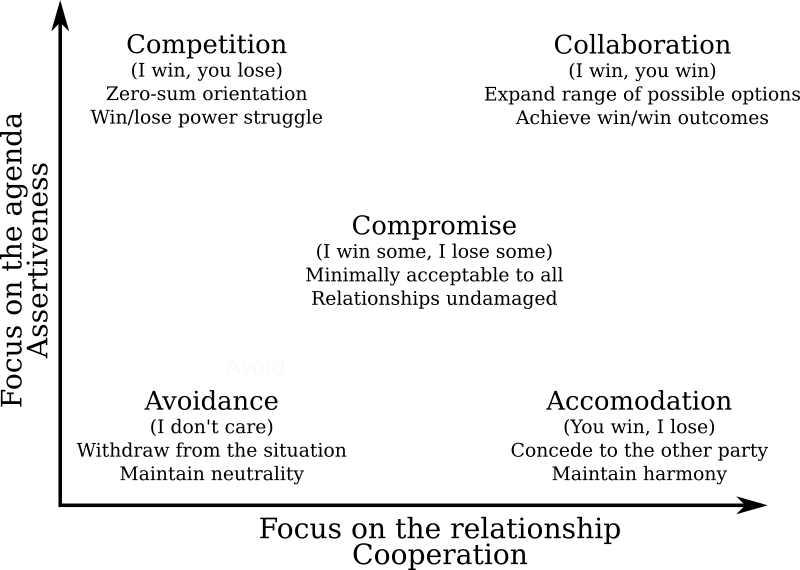 The Thomas-Kilmann Conflict Mode Instrument: source png.
Motivations
Quick poll:
"Spoons" are a visual representation used as a unit of measure used to quantify how much energy a person has throughout a given day. Each activity requires a given number of spoons, which will only be replaced as the person "recharges" through rest. A person who runs out of spoons has no choice but to rest until their spoons are replenished.
My software ate(inspired by a 1934 poem by William Carlos Williams) Don't be afraid to fail Don't be afraid to fail or drop the ball. I think that anything that has a label attached of "if you don't do it, nobody will", shouldn't fall on anybody's shoulders and should be shared no matter what. Shared or dropped. Share the responsibility for a healthy relationship Don't expect that the more experienced mates will take care of everything. In a project with active people counted by the thousand, it's unlikely that harassment isn't happening. Is anyone writing anti-harassment? Do we have stats? Is having an email address and a CoC giving us a false sense of security?
the files
that where in
your home directory and which
you were probably
needing
for work Forgive me
it was so quick to write
without tests
and it worked so well for me
When you get involved in a new community, such as Debian, find out early where, if that happens, you can find support, understanding, and help to make it stop. If you cannot find any, or if the only thing you can find is people who say "it never happens here", consider whether you really want to be in that community.(from http://www.enricozini.org/blog/2016/debian/you-ll-thank-me-later/)
There are some nice people in the world. I mean nice people, the sort I couldn t describe myself as. People who are friends with everyone, who are somehow never involved in any argument, who seem content to spend their time drawing pictures of bumblebees on flowers that make everyone happy. Those people are great to have around. You want to hold onto them as much as you can. But people only have so much tolerance for jerkiness, and really nice people often have less tolerance than the rest of us. The trouble with not ejecting a jerk whether their shenanigans are deliberate or incidental is that you allow the average jerkiness of the community to rise slightly. The higher it goes, the more likely it is that those really nice people will come around less often, or stop coming around at all. That, in turn, makes the average jerkiness rise even more, which teaches the original jerk that their behavior is acceptable and makes your community more appealing to other jerks. Meanwhile, more people at the nice end of the scale are drifting away.(from https://eev.ee/blog/2016/07/22/on-a-technicality/) Give people freedom If someone tries something in Debian, try to acknowledge and accept their work. You can give feedback on what they are doing, and try not to stand in their way, unless what they are doing is actually hurting you. In that case, try to collaborate, so that you all can get what you need. It's ok if you don't like everything that they are doing. I personally don't care if people tell me I'm good when I do something, I perceive it a bit like "good boy" or "good dog". I rather prefer if people show an interest, say "that looks useful" or "how does it work?" or "what do you need to deploy this?" Acknowledge that I've done something. I don't care if it's especially liked, give me the freedom to keep doing it. Don't give me rewards, give me space and dignity. Rather than feeding my ego, feed by freedom, and feed my possibility to create.
Earlier today, I demonstrated how to work with coinduction in the theorem provers Isabelle, Coq and Agda, with a very simple example. This reminded me of a discussion I had in Karlsruhe with my then colleague Denis Lohner: If coinduction is the dual of induction, why do the induction principles look so different? I like what we observed there, so I d like to share this.
The following is mostly based on my naive understanding of coinduction based on what I observe in the implementation in Isabelle. I am sure that a different, more categorial presentation of datatypes (as initial resp. terminal objects in some category of algebras) makes the duality more obvious, but that does not necessarily help the working Isabelle user who wants to make sense of coninduction.
datatype 'a list = nil cons (hd : 'a) (tl : "'a list")P nil ( x xs. P xs P (cons x xs)) xs. P xscodatatype 'a llist = lnil lcons (hd : 'a) (tl : "'a llist")( xs ys.
R xs ys' (xs = lnil) = (ys = lnil)
(xs lnil ys' lnil
hd xs = hd ys R (tl xs) (tl ys)))
( xs ys. R xs ys xs = ys)R between lists which implies that either both lists are empty or both lists are nonempty, and furthermore if both are non-empty, that they have the same head and tails related by R, then any two lists related by R are actually equal.
If you think of the infinte list as a series of states of a computer program, then this is nothing else than a bisimulation.
So we have two proof principles, both of which make intuitive sense. But how are they related? They look very different! In one, we have a predicate P, in the other a relation R, to point out just one difference.
datatype declaration automatically creates a relator:
rel_list :: ('a 'b bool) 'a list 'b list boolrel_list R xs ys is that xs and ys have the same shape (i.e. length), and that the corresponding elements are pairwise related by R. You might have defined this relation yourself at some time, and if so, you probably introduced it as an inductive predicate. So it is not surprising that the following induction principle characterizes this relation:
Q nil nil
( x xs y ys. R x y   Q xs ys   Q (cons x xs) (cons y ys))
( xs ys rel_list R xs ys Q xs ys)Q xs ys (P xs xs = ys) and R x y (x = y), then we obtain exactly that. In that sense, the relation induction is a generalization of the normal induction.
codatatype declaration introduces a function
rel_llist :: ('a 'b bool) 'a llist 'b llist bool( xs ys.
R xs ys (xs = lnil) = (ys = lnil)
(xs lnil ys lnil
Q (hd xs) (hd ys) R (tl xs) (tl ys)))
( xs ys R xs ys rel_llist Q xs ys)Q with equality, which turns rel_llist Q into equality on the lists, and you have the theorem above.
( xs ys.
    R xs ys   (xs = lnil) = (ys = lnil)
              (xs   lnil   ys   lnil
	        Q (hd xs) (hd ys)   R (tl xs) (tl ys)))
=   case analysis (the other two cases are vacuously true)
  ( xs ys.
    xs = lnil   ys = lnil
    R xs ys   (xs = lnil) = (ys = lnil)
              (xs   lnil   ys   lnil
	        Q (hd xs) (hd ys)   R (tl xs) (tl ys)))
  ( xs ys.
    xs   lnil   ys   lnil
    R xs ys   (xs = lnil) = (ys = lnil)
              (xs   lnil   ys   lnil
	        Q (hd xs) (hd ys)   R (tl xs) (tl ys)))
=   simplification
  ( xs ys.  xs = lnil   ys = lnil   R xs ys
  ( x xs y ys.  R (cons x xs) (cons y ys)   (Q x y   R xs ys))
=   more rewriting
  R nil nil
( x xs y ys. Q x y R xs ys R (cons x xs) (cons y ys))CoInductive ENat :=
N : ENat
S : ENat -> ENat.
CoFixpoint min (n : ENat) (m : ENat)
:=match n, m with S n', S m' => S (min n' m')
_, _ => N end.
CoInductive le : ENat -> ENat -> Prop :=
leN : forall m, le N m
leS : forall n m, le n m -> le (S n) (S m).Lemma min_le: forall n m, le (min n m) n.cofix. One would wish that the following proof would work:
Lemma min_le: forall n m, le (min n m) n.
Proof.
  cofix.
  destruct n, m.
  * apply leN.
  * apply leN.
  * apply leN.
  * apply leS.
    apply min_le.
Qed.Error:
In environment
min_le : forall n m : ENat, le (min n m) n
Unable to unify "le N ?M170" with "le (min N N) Nmin N N = N, and like a kid scared of coinduction, it did not dare to run the min function. The reason it does not just run a CoFixpoint is that doing so too daringly might simply not terminate. So, as Adam explains in a chapter of his book, Coq reduces a cofixpoint only when it is the scrutinee of a match statement.
So we need to get a match statement in place. We can do so with a helper function:
Definition evalN (n : ENat) :=
  match n with   N => N
                 S n => S n end.
Lemma evalN_eq : forall n, evalN n = n.
Proof. intros. destruct n; reflexivity. Qed.N or S _). We can use it in the proof to guide Coq, and the following goes through:
Lemma min_le: forall n m, le (min n m) n.
Proof.
  cofix.
  destruct n, m; rewrite <- evalN_eq with (n := min _ _).
  * apply leN.
  * apply leN.
  * apply leN.
  * apply leS.
    apply min_le.
Qed.ENat and le:
theory ENat imports  Main begin
codatatype ENat =  N   S  ENat
primcorec min where
   "min n m = (case n of
       N   N
       S n'   (case m of
        N   N
        S m'   S (min n' m')))"
coinductive le where
  leN: "le N m"
leS: "le n m le (S n) (S m)"min; I chose the one most similar to the one above. For more details, see the corec tutorial.
Now to the proof:
lemma min_le: "le (min n m) n"
proof (coinduction arbitrary: n m)
  case le
  show ?case
  proof(cases n)
    case N then show ?thesis by simp
  next
    case (S n') then show ?thesis
    proof(cases m)
      case N then show ?thesis by simp
    next
      case (S m')  with  n = _  show ?thesis
        unfolding min.code[where n = n and m = m]
        by auto
    qed
  qed
qedcoinduction proof methods produces this goal:
proof (state)
goal (1 subgoal):
 1.  n m. ( m'. min n m = N   n = m')
          ( n' m'.
               min n m = S n'
               n = S m'
(( n m. n' = min n m m' = n) le n' m'))min function definition.
In the cases where one argument of min is N, Isabelle s simplifier (a term rewriting tactic, so to say), can solve the goal automatically. This is because the primcorec command produces a bunch of lemmas, one of which states n = N m = N min n m = N.
In the other case, we need to help Isabelle a bit to reduce the call to min (S n) (S m) using the unfolding methods, where min.code contains exactly the equation that we used to specify min. Using just unfolding min.code would send this method into a loop, so we restrict it to the concrete arguments n and m. Then auto can solve the remaining goal (despite all the existential quantifiers).
min.code into the simpset, so working with objects that do not evaluate easily or completely is less strange.
module ENat where
open import Coinduction
data ENat : Set where
  N : ENat
  S :   ENat   ENat
min : ENat   ENat   ENat
min (S n') (S m') = S (  (min (  n') (  m')))
min _ _ = N
data le : ENat   ENat   Set where
  leN :    m    le N m
  leS :    n m      (le (  n) (  m))   le (S n) (S m)
min_le :    n m    le (min n m) n
min_le  S n'   S m'  = leS (  min_le)
min_le  N      S m'  = leN
min_le  S n'   N  = leN
min_le N N = leN , and until it worked.
Debian needs feature X but it is already in the enterprise version. We make a patch and, for commercial reasons, it never gets merged (they already sell it in the enterprise version). Which means we will have to fork the software and keep those patches forever. Been there done that. For me, that isn't acceptable.This concern was further deepened when GitLab's Director of Strategic Partnerships, Eliran Mesika, explained the company's stewardship policy that explains how GitLab decides which features end up in the proprietary version. Praveen pointed out that:
[...] basically it boils down to features that they consider important for organizations with less than 100 developers may get accepted. I see that as a red flag for a big community like debian.Since there are over 600 Debian Developers, the community seems to fall within the needs of "enterprise" users. The features the Debian community may need are, by definition, appropriate only to the "Enterprise Edition" (GitLab EE), the non-free version, and are therefore unlikely to end up in the "Community Edition" (GitLab CE), the free-software version. Interestingly, Mesika asked for clarification on which features were missing, explaining that GitLab is actually open to adding features to GitLab CE. The response from Debian Developer Holger Levsen was categorical: "It's not about a specific patch. Free GitLab and we can talk again." But beyond the practical and ethical concerns, some specific features Debian needs are currently only in GitLab EE. For example, debian.org systems use LDAP for authentication, which would obviously be useful in a GitLab deployment; GitLab CE supports basic LDAP authentication, but advanced features, like group or SSH-key synchronization, are only available in GitLab EE. Wirt also expressed concern about the Contributor License Agreement that GitLab B.V. requires contributors to sign when they send patches, which forces users to allow the release of their code under a non-free license. The debate then went on going through a exhaustive inventory of different free-software alternatives:
On the mailinglist it seemed that some Debian maintainers do not agree with our open core business model and demand that there is no proprietary version. We respect that position but we don't think we can compete with the purely proprietary software like GitHub with this model.
Personally I'm leaning towards the feeling that all configuration, code and dependencies for Debian services should be packaged and subjected to the usual Debian QA activities but I acknowledge that the current archive setup (testing migration plus backporting etc) doesn't necessarily make this easy.Wise did say that "DSA doesn't have any hard rules/policy written down, just evaluation on a case-by-case basis" which probably means that pagure packaging will not be a blocker for deployment. The last pending issue is the question of the mailing lists hosted on Alioth, as pagure doesn't offer mailing list management (nor does GitLab). In fact, there are three different mailing list services for the Debian project:
Note: this article first appeared in the Linux Weekly News.
| Publisher: | HarperCollins |
| Copyright: | February 2011 |
| ISBN: | 0-06-207881-X |
| Format: | Kindle |
| Pages: | 451 |
 A fair amount of things happened since I last blogged something else than music. First of all we did actually hold a Debian Diversity meeting. It was quite nice, less people around than hoped for, and I account that to some extend to the trolls and haters that defaced the titanpad page for the agenda and destroyed the doodle entry for settling on a date for the meeting. They even tried to troll my blog with comments, and while I did approve controversial responses in the past, those went over the line of being acceptable and didn't carry any relevant content.
One response that I didn't approve but kept in my mailbox is even giving me strength to carry on. There is one sentence in it that speaks to me:
Think you can stop us? You can't you stupid b*tch. You have ruined the Debian community for us.The rest of the message is of no further relevance, but even though I can't take credit for being responsible for that, I'm glad to be a perceived part of ruining the Debian community for intolerant and hateful people. A lot of other things happened since too. Mostly locally here in Vienna, several queer empowering groups were founding around me, some of them existed already, some formed with the help of myself. We now have several great regular meetings for non-binary people, for queer polyamory people about which we gave an interview, a queer playfight (I might explain that concept another time), a polyamory discussion group, two bi-/pansexual groups, a queer-feminist choir, and there will be an European Lesbian* Conference in October where I help with the organization and on June 21st I'll finally receive the keys to my flat in Que[e]rbau Seestadt. I'm sooo looking forward to it. It will be part of the Let me come Home experience that I'm currently in. Another part of that experience is that I started changing my name (and gender marker) officially. I had my first appointment in the corresponding bureau, and I hope that it won't last too long because I have to get my papers in time for booking my flight to Montreal, and somewhen along the process my current passport won't contain correct data anymore. So for the people who have it in their signing policy to see government IDs this might be your chance to finally sign my key then. I plan to do a diversity BoF at debconf where we can speak more directly on where we want to head with the project. I hope I'll find the time to do an IRC meeting beforehand. I'm just uncertain how to coordinate that one to make it accessible for interested parties while keeping the destructive trolls out. I'm open for ideas here.
tcpdump to extract packets from network interfaces. The goal of this
change is to allow zero-copy transfers between user-space applications
and the NIC (network interface card) transmit and receive ring buffers.
Such optimizations are useful for telecommunications companies, which
may use it for deep packet
inspection or
running exotic protocols in user space. Another use case is running a
high-performance intrusion detection
system that
needs to watch large traffic streams in realtime to catch certain types
of attacks.
Fastabend presented his work during the Netdev network-performance
workshop, but also brought the patch set up for discussion during
Netconf. There, he said he could achieve line-rate extraction (and
injection) of packets, with packet rates as high as 30Mpps. This
performance gain is possible because user-space pages are directly
DMA-mapped to the NIC, which is also a security concern. The other
downside of this approach is that a complete pair of ring buffers needs
to be dedicated for this purpose; whereas before packets were copied to
user space, now they are memory-mapped, so the user-space side needs to
process those packets quickly otherwise they are simply dropped.
Furthermore, it's an "all or nothing" approach; while NIC-level
classifiers could be used to steer part of the traffic to a specific
queue, once traffic hits that queue, it is only accessible through the
af_packet interface and not the rest of the regular stack. If done
correctly, however, this could actually improve the way user-space
stacks access those packets, providing projects like DPDK a safer way to
share pages with the NIC, because it is well defined and
kernel-controlled. According to Jesper Dangaard Brouer (during review of
this article):
This proposal will be a safer way to share raw packet data between user space and kernel space than what DPDK is doing, [by providing] a cleaner separation as we keep driver code in the kernel where it belongs.During the Netdev network-performance workshop, Fastabend asked if there was a better data structure to use for such a purpose. The goal here is to provide a consistent interface to user space regardless of the driver or hardware used to extract packets from the wire. af_packet currently defines its own packet format that abstracts away the NIC-specific details, but there are other possible formats. For example, someone in the audience proposed the virtio packet format. Alexei Starovoitov rejected this idea because af_packet is a kernel-specific facility while virtio has its own separate specification with its own requirements. The next step for af_packet is the posting of the new "v4" patch set, although Miller warned that this wouldn't get merged until proper XDP support lands in the Intel drivers. The concern, of course, is that the kernel would have multiple incomplete bypass solutions available at once. Hopefully, Fastabend will present the (by then) merged patch set at the next Netdev conference in November.
iptables in order to generate cBPF (classic BPF) mitigation rules that
are then deployed on edge routers. Those rules are created with a tool
called bpfgen, part of Cloudflare's BSD-licensed
bpftools suite. For example,
it could create a cBPF bytecode blob that would match DNS queries to any
example.com domain with something like:
bpfgen dns *.example.com
iptables
firewalls with the xt_bpf module, but this led to performance issues.
It then deployed a proprietary user-space solution based on
Solarflare hardware, but this has the
performance limitations of user-space applications getting packets
back onto the wire involves the cost of re-injecting packets back into
the kernel. This is why Cloudflare is experimenting with XDP, which was
partly developed in response to the company's problems, to deploy those
BPF programs.
A concern that Bertin identified was the lack of visibility into dropped
packets. Cloudflare currently samples some of the dropped traffic to
analyze attacks; this is not currently possible with XDP unless you pass
the packets down the stack, which is expensive. Miller agreed that the
lack of monitoring for XDP programs is a large issue that needs to be
resolved, and suggested creating a way to mark packets for extraction to
allow analysis. Cloudflare is currently in a testing phase with XDP and
it is unclear if its whole XDP tool chain will be publicly available.
While those two companies are starting to use XDP as-is, there is more
work needed to complete the XDP project. As mentioned above and in our
previous coverage, massive statistics
extraction is still limited in the Linux kernel and introspection is
difficult. Furthermore, while the existing
actions (XDP_DROP and XDP_TX, see the
documentation
for more information) are well implemented and used, another action may
be introduced, called XDP_REDIRECT, which would allow redirecting
packets to different network interfaces. Such an action could also be
used to accelerate bridges as packets could be "switched" based on the
MAC address table. XDP also requires network driver support, which is
currently limited. For example, the Intel drivers still do not support
XDP, although that should come pretty soon.
Miller, in his Netdev keynote, focused on XDP and presented it as the
standard solution that is safe, fast, and usable. He identified the next
steps of XDP development to be the addition of debugging mechanisms,
better sampling tools for statistics and analysis, and user-space
consistency. Miller foresees a future for XDP similar to the
popularization of the Arduino chips: a simple set of tools that anyone,
not just developers, can use. He gave the example of an Arduino tutorial
that he followed where he could just look up a part number and get
easy-to-use instructions on how to program it. Similar components should
be available for XDP. For this purpose, the conference saw the creation
of a new mailing list called
xdp-newbies where
people can learn how to create XDP build environments and how to write
XDP programs.
/dock or /comms that would allow you to dock a
ship or communicate with the Death Star. Those API endpoints should
obviously be public, but then there is this /exhaust-port endpoint
that should never be publicly available. In order for a firewall to
protect such a system, it must be able to inspect traffic at a higher
level than the traditional address-port pairs. Graf presented a design
where the kernel would create an in-kernel socket that would negotiate
TCP connections on behalf of user space and then be able to apply
arbitrary eBPF rules in the kernel.
 In this scenario, instead of doing the traditional transfer from
Netfilter's TPROXY to user space, the kernel directly decapsulates the
HTTP traffic and passes it to BPF rules that can make decisions without
doing expensive context switches or memory copies in the case of simply
wanting to refuse traffic (e.g. issue an HTTP 403 error). This, of
course, requires the inclusion of kTLS to process
HTTPS connections. HTTP2 support may also prove problematic, as it
multiplexes connections and is harder to decapsulate. This design was
described as a "pure pre-
accept() hook". Starovoitov also compared the
design to the kernel connection multiplexer (KCM).
Tom Herbert, KCM's author, agreed that it could be extended to support
this, but would require some extensions in user space to provide an
interface between regular socket-based applications and the KCM layer.
In any case, if the application does TLS (and lots of them do), kTLS
gets tricky because it breaks the end-to-end nature of TLS, in effect
becoming a man in the middle between the client and the application.
Eric Dumazet argued that HA-Proxy already
does things like this: it uses splice() to avoid copying too much data
around, but it still does a context switch to hand over processing to
user space, something that could be fixed in the general case.
Another similar project that was
presented at
Netdev is the Tempesta
firewall and reverse-proxy. The speaker, Alex Krizhanovsky, explained
the Tempesta developers have taken one person month to port the mbed
TLS stack to the Linux kernel to allow an
in-kernel TLS handshake. Tempesta also implements rate limiting,
cookies, and JavaScript challenges to mitigate DDoS attacks. The
argument behind the project is that "it's easier to move TLS to the
kernel than it is to move the TCP/IP stack to user space". Graf
explained that he is familiar with Krizhanovsky's work and he is hoping
to collaborate. In effect, the design Graf is working on would serve as
a foundation for Krizhanovsky's in-kernel HTTP server (kHTTP). In a
private email, Graf explained that:
The main differences in the implementation are currently that we foresee to use BPF for protocol parsing to avoid having to implement every single application protocol natively in the kernel. Tempesta likely sees this less of an issue as they are probably only targeting HTTP/1.1 and HTTP/2 and to some [extent] JavaScript.Neither project is really ready for production yet. There didn't seem to be any significant pushback from key network developers against the idea, which surprised some people, so it is likely we will see more and more layer-7 intelligence move into the kernel sooner rather than later.
The author would like to thank the Netdev and Netconf organizers for travel assistance, Thomas Graf for a review of the in-kernel proxying section of this article, and Jesper Dangaard Brouer for review of the af_packet and XDP sections. Note: this article first appeared in the Linux Weekly News.
You grant us and our legal successors the right to store and display your Content and make incidental copies as necessary to render the Website and provide the Service.Section D.5 then goes on to say:
[...] You grant each User of GitHub a nonexclusive, worldwide license to access your Content through the GitHub Service, and to use, display and perform your Content, and to reproduce your Content solely on GitHub as permitted through GitHub's functionality
The new TOS is potentially very bad for copylefted Free Software. It potentially neuters it entirely, so GPL licensed software hosted on Github has an implicit BSD-like licenseHess has since removed all his content (mostly mirrors) from GitHub. Others disagree. In a well-reasoned blog post, Debian developer Jonathan McDowell explained the rationale behind the changes:
My reading of the GitHub changes is that they are driven by a desire to ensure that GitHub are legally covered for the things they need to do with your code in order to run their service.This seems like a fair point to make: GitHub needs to protect its own rights to operate the service. McDowell then goes on to do a detailed rebuttal of the arguments made by Glaser, arguing specifically that section D.5 "does not grant [...] additional rights to reproduce outside of GitHub". However, specific problems arise when we consider that GitHub is a private corporation that users have no control over. The "Services" defined in the ToS explicitly "refers to the applications, software, products, and services provided by GitHub". The term "Services" is therefore not limited to the current set of services. This loophole may actually give GitHub the right to bypass certain provisions of licenses used on GitHub. As Hess detailed in a later blog post:
If Github tomorrow starts providing say, an App Store service, that necessarily involves distribution of software to others, and they put my software in it, would that be allowed by this or not? If that hypothetical Github App Store doesn't sell apps, but licenses access to them for money, would that be allowed under this license that they want to my software?However, when asked on IRC, Bradley M. Kuhn of the Software Freedom Conservancy explained that "ultimately, failure to comply with a copyleft license is a copyright infringement" and that the ToS do outline a process to deal with such infringement. Some lawyers have also publicly expressed their disagreement with Glaser's assessment, with Richard Fontana from Red Hat saying that the analysis is "basically wrong". It all comes down to the intent of the ToS, as Kuhn (who is not a lawyer) explained:
any license can be abused or misused for an intent other than its original intent. It's why it matters to get every little detail right, and I hope Github will do that.He went even further and said that "we should assume the ambiguity in their ToS as it stands is favorable to Free Software". The ToS are in effect since February 28th; users "can accept them by clicking the broadcast announcement on your dashboard or by continuing to use GitHub". The immediacy of the change is one of the reasons why certain people are rushing to remove content from GitHub: there are concerns that continuing to use the service may be interpreted as consent to bypass those licenses. Hess even hosted a separate copy of the ToS [PDF] for people to be able to read the document without implicitly consenting. It is, however, unclear how a user should remove their content from the GitHub servers without actually agreeing to the new ToS.
[...] unless there is a Contributor License Agreement to the contrary, whenever you make a contribution to a repository containing notice of a license, you license your contribution under the same terms, and agree that you have the right to license your contribution under those terms.I was concerned this would establish the controversial practice of forcing CLAs on every GitHub user. I managed to find a post from a lawyer, Kyle E. Mitchell, who commented on the draft and, specifically, on the CLA. He outlined issues with wording and definition problems in that section of the draft. In particular, he noted that "contributor license agreement is not a legal term of art, but an industry term" and "is a bit fuzzy". This was clarified in the final draft, in section D.6, by removing the use of the CLA term and by explicitly mentioning the widely accepted norm for licenses: "inbound=outbound". So it seems that section D.6 is not really a problem: contributors do not need to necessarily delegate copyright ownership (as some CLAs require) when they make a contribution, unless otherwise noted by a repository-specific CLA. An interesting concern he raised, however, was with how GitHub conducted the drafting process. A blog post announced the change on February 7th with a link to a form to provide feedback until the 21st, with a publishing deadline of February 28th. This gave little time for lawyers and developers to review the document and comment on it. Users then had to basically accept whatever came out of the process as-is. Unlike every software project hosted on GitHub, the ToS document is not part of a Git repository people can propose changes to or even collaboratively discuss. While Mitchell acknowledges that "GitHub are within their rights to update their terms, within very broad limits, more or less however they like, whenever they like", he sets higher standards for GitHub than for other corporations, considering the community it serves and the spirit it represents. He described the process as:
[...] consistent with the value of CYA, which is real, but not with the output-improving virtues of open process, which is also real, and a great deal more pleasant.Mitchell also explained that, because of its position, GitHub can have a major impact on the free-software world.
And as the current forum of preference for a great many developers, the knock-on effects of their decisions throw big weight. While GitHub have the wheel and they ve certainly earned it for now they can do real damage.In particular, there have been some concerns that the ToS change may be an attempt to further the already diminishing adoption of the GPL for free-software projects; on GitHub, the GPL has been surpassed by the MIT license. But Kuhn believes that attitudes at GitHub have begun changing:
GitHub historically had an anti-copyleft culture, which was created in large part by their former and now ousted CEO, Preston-Warner. However, recently, I've seen people at GitHub truly reach out to me and others in the copyleft community to learn more and open their minds. I thus have a hard time believing that there was some anti-copyleft conspiracy in this ToS change.
While we are confident that these Terms serve the best needs of the community, we take our users' feedback very seriously and we are looking closely at ways to address their concerns.Regardless, free-software enthusiasts have other concerns than the new ToS if they wish to use GitHub. First and foremost, most of the software running GitHub is proprietary, including the JavaScript served to your web browser. GitHub also created a centralized service out of a decentralized tool (Git). It has become the largest code hosting service in the world after only a few years and may well have become a single point of failure for free software collaboration in a way we have never seen before. Outages and policy changes at GitHub can have a major impact on not only the free-software world, but also the larger computing world that relies on its services for daily operation. There are now free-software alternatives to GitHub. GitLab.com, for example, does not seem to have similar licensing issues in its ToS and GitLab itself is free software, although based on the controversial open core business model. The GitLab hosting service still needs to get better than its grade of "C" in the GNU Ethical Repository Criteria Evaluations (and it is being worked on); other services like GitHub and SourceForge score an "F". In the end, all this controversy might have been avoided if GitHub was generally more open about the ToS development process and gave more time for feedback and reviews by the community. Terms of service are notorious for being confusing and something of a legal gray area, especially for end users who generally click through without reading them. We should probably applaud the efforts made by GitHub to make its own ToS document more readable and hope that, with time, it will address the community's concerns.
Note: this article first appeared in the Linux Weekly News.
Next.