Search Results: "ron"

9 August 2026

Elana Hashman: Managing virtualenvs with a little bash

When you need to install something directly from PyPI, Python virtualenvs have been my go-to for over a decade. A quick virtualenv intro Most of my readers are probably already familiar with virtualenvs, but for completeness, I'll give you a brief introduction. A virtualenv (short for "virtual environment") is an isolated distribution of Python packages, where you can independently install packages without disturbing your system packages or other virtualenvs. You can set one up like this, assuming you are using Python 3.3 or higher:
python3 -m venv ~/.venv/my-virtualenv
The directory specified here is just a convention. I keep all my virtualenvs in the .venv folder in my home directory, but you can pick whatever location you like. To use the virtualenv, you must activate it:
source ~/.venv/my-virtualenv/bin/activate
This activation script is a special shell script that configures your current shell, pointing at all the right paths in order to use the virtual environment. source runs this script in your current shell session to set it up. You will notice that this adds (my-virtualenv) to the beginning of your shell prompt, reminding you that the "my-virtualenv" virtualenv is active. Now when you pip install amazing-package, the software will only be available in this virtual environment. When you're done, you can deactivate it like so:
deactivate
Wonderful! Managing many virtualenvs gets annoying Over time, I end up accumulating many virtualenvs, which can become harder to manage. Maybe something like this:
$ ls ~/.venv/
my-virtualenv cool-project snakes-ahoy
I also don't want to type source ~/.venv/my-virtualenv/bin/activate every time I use the virtualenv, because it gets very repetitive only the name of the venv is really needed. But luckily, we can write a little bit of bash to make managing this less annoying. (Or you can use one of many Python developer tools that are designed to manage this, like pipx, but when I merely want to consume Python software, I might not have a development environment set up. So that's beyond the scope of this post!) If you add the following shell function to your ~/.bashrc or ~/.bash_aliases file, it will nicely wrap our activation command:
setup-venv()  
        source "$HOME/.venv/$1/bin/activate"
 
Now all we need to run is
setup-venv my-virtualenv
So much quicker! Spicing it up with tab completion The first thing I noticed after writing this wrapper was that I started hitting tab on the virtual environment name, but... nothing happened. Wouldn't it be nice to know what virtualenvs I had available, and to not have to type out the whole long thing? Well, we can write it ourselves If for some reason you don't already have bash completion installed, on a Debian-based system, you will need to install it with
apt install bash-completion
In order to configure our bash completion, we will create a new file, /etc/bash_completion.d/venv, with the following contents:
_list_venvs()
 
    local cur prev opts
    COMPREPLY=()
    cur="$ COMP_WORDS[COMP_CWORD] "
    prev="$ COMP_WORDS[COMP_CWORD-1] "
    opts=$(find $HOME/.venv/ -mindepth 1 -maxdepth 1 -type d -printf "%f ")
    COMPREPLY=( $(compgen -W "$ opts " -- $ cur ) )
    return 0
 
complete -F _list_venvs setup-venv
This file defines another shell function order to determine how to autocomplete the options for our setup-venv function. $opts is where we define the options for our function. We generate it with a find command looking at the .venv folder in the current user's home directory, then only including child folders (excluding the current directory itself, .venv, in our results) by using the min/max depth and type arguments, and printing just the individual directory names, deliminated by spaces using our print formatter. Everything else is the standard scaffolding required to use bash completions. Once you save this file and reload your shell, you'll see that you are able to use completions as expected!
setup-venv <tab>
my-virtualenv cool-project snakes-ahoy
setup-venv s<tab>
setup-venv snakes-ahoy

Complaints, comments, questions? Hope this was helpful! If it wasn't, that's too bad. But don't worry you can safely ignore this post.

Reproducible Builds: Reproducible Builds in July 2026

Welcome to the July 2026 report from the Reproducible Builds project! In our reports, we try to outline the most important things that we have been up to over the past month. As a quick recap about what problem our project intends to solve, whilst anyone may inspect the source code of free software for malicious flaws, almost all software is distributed to end users as pre-compiled binaries. The motivation behind the reproducible builds effort is to ensure no flaws have been introduced during this compilation process by promising identical results are always generated from a given source, thus allowing multiple third-parties to come to a consensus on whether a build was compromised or not. If you are interested in contributing to the project, please visit the Contribute page on our website. In this month s report, we cover:

  1. Tool development
  2. Distribution work
  3. Three new scholarly papers
  4. Patches
  5. Misc news

Tool development diffoscope is our in-depth and content-aware diff utility that can locate and diagnose reproducibility issues. This month, Chris Lamb made the following changes, including preparing and uploading versions 324, 325 and 326 to Debian:
  • Fix tests to work with zipdetails 4.0008. (#1141359)
  • Bump debhelper compatibility level to 13. [ ]
  • Update copyright years. [ ]
In addition, Paul Spooren made changes to allow trailing garbage in Gzip files [ ] and Vagrant Cascadian added an external tool reference for the pedump binary to use the mono package under GNU Guix. [ ]
disorderfs is our FUSE-based filesystem that deliberately introduces non-determinism into system calls to reliably flush out reproducibility issues. This month, Christelle Gloor added the option to sort by ctime as returned by the lstat(2) syscall. [ ], which Chris Lamb uploaded whilst bumping the Standards-Version to version 4.7.4 [ ]. Bernhard Wiedemann also updated disorderfs to version 0.7.0 in openSUSE.
Yet again, there were a number of improvements made to our website this month as well. For example, Chris Lamb, by request of Digital Ocean, changed the target of a referral link so that they can manage incoming referrers [ ] and pushed a number of changes to the Tools page [ ].

Distribution work In Debian this month, 32 reviews of Debian packages were added, 26 were updated and a total of 21 were removed this month, adding to our extensive knowledge about identified issues. A number of issue types were added by Chris Lamb, including:
  • python_towncrier_build_date [ ][ ]
  • log_files_installed_in_package [ ]
  • fontforge_varies_by_timezone [ ][ ]
Chris also added a further note for the build_date_in_manpage_generated_by_spf13_cobra issue. [ ]
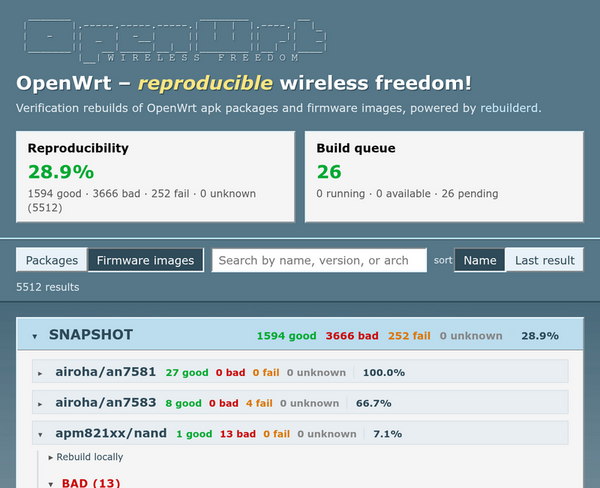
In addition, there is a new page showing verification rebuilds of OpenWrt APK packages and firmware images, powered by rebuilderd:

Three new scholarly papers Yan Li, Nan Jiang, Qihang Zhou, Shaowen Xu, Yamin Xie and Xiaoqi Jia of the Chinese Academy of Sciences published a paper titled VCAligner: Aligning Source Distribution Versions with Upstream Git Commits to Secure Supply Chain:
We present VCAligner, a content-based alignment methodology that constructs inverted indexes over VCS histories to precisely map released artifacts to their originating commits, independent of fragile version tags. We evaluated VCAligner on a dataset of 2,984 verifiable PyPI packages derived from the 4,000 most-downloaded projects linked to public GitHub upstreams. Our results reveal a critical weakness in conventional tag-based heuristics: while they appear effective on 85% of the dataset, the residual 15% failure rate generates a catastrophic downstream audit workload of over 10.3 million commits. In contrast, VCAligner reduces this burden by two orders of magnitude ( 158 ), bounding the total workload to under 65,000 commits. Furthermore, we provide the large-scale characterization of Packaging Noise, classifying artifact divergence into structural additions (Path Phantoms) and content mutations (Blob Phantoms), thereby isolating the distinct attack surfaces of malicious injection and code tampering.

Jens Dietrich and Spencer Sun from the Victoria University of Wellington together with Tim W. White and Behnaz Hassanshahi from Oracle Inc pre-published their paper No Snake Oil: Verifying Python Package Builds (PDF):
Python has become the default language for interacting with AI, with packages being distributed through registries like the Python Package Index (PyPI). This creates a need to analyse supply chains comprising such packages. One such analysis is to rebuild packages in order to identify compromised builds injecting malware. Independent rebuilds in hardened environments have the added advantage that they can generate and record provenance in order to increase the trustworthiness of packages. Two tools that are designed to automate such rebuilds and run them at scale are macaron and oss-rebuild. We study 12,180 popular releases from PyPI and find that the byte-for-byte equivalence rate is generally low. We analyse the reasons why they produce different wheels, and find that equivalence between the original and rebuilt wheels can often still be established, preserving most of the guarantees users expect from rebuildable releases. We present and evaluate daleq4py, a tool to establish the equivalence of Python wheels through the kernel of a normalisation function that is based on provenance-preserving datalog rules. Experimental results show that daleq4py substantially expands the set of rebuilds that can be accepted as equivalent. Although only 15.4% of macaron rebuilds and 19.1% of oss-rebuild rebuilds are byte-for-byte identical to the published PyPI wheels, daleq4py establishes wheel equivalence for 60.2% and 78.9% of source-equivalent rebuilds, respectively.

Denise Nanni, Julien Malka, Stefano Zacchiroli and Th o Zimmermann from T l com Paris together with Gabriele D Angelo from the University of Bologna pre-published their paper Understanding Build Reproducibility in the F-Droid Ecosystem (PDF), which was accepted at the 2026 ACM Conference on Reproducibility and Replicability:
The security of open source applications benefits considerably from the possibility of rebuilding their source and verifying the output. F-Droid, a prominent distribution for open source Android applications, systematically rebuilds them from source and tests their bitwise reproducibility at app publishing time. However, F-Droid offers no guarantee that app reproducibility will continue to hold in the future. As software ecosystems evolve, reproducibility may degrade, with potential negative consequences for software preservation and security. We present the first empirical study of build reproducibility in the F-Droid app ecosystem. Analyzing historical reproducibility logs, we find that the overall bitwise reproducibility rate has been steadily increasing over time (as new versions of apps are published). We then evaluate how reproducibility holds in time for fixed app versions, by attempting to rebuild 18 904 app versions that F-Droid had previously confirmed bitwise reproducible, published between September 2018 and February 2026, achieving an 83% rebuild success rate, and identify missing dependencies as the dominant cause of failure, accounting for 76% of non-rebuildable cases. Among successfully rebuilt apps, 94% are also bitwise reproducible-i.e., they still yield bitwise identical artifacts upon rebuild. Together, these results show that while bitwise reproducibility largely holds for apps that can be rebuilt, rebuildability itself is highly sensitive to temporal decay.

Patches The Reproducible Builds project detects, dissects and attempts to fix as many currently-unreproducible packages as possible. We endeavour to send all of our patches upstream where applicable or possible. This month, we wrote a large number of such patches, including:

Misc news On our mailing list this month, Colin Winter of Markovian Protocol wrote to our mailing list on the topic of Reproducible verification for retained logs:
Reproducible builds remove trust in the builder: anyone re-derives the same artifact from the same source, byte for byte. The same shape applies one layer over, to a retained record. Most record-keeping regimes (the EU AI Act s Article 12 logging is the current example) require that events be recorded and logs retained, but not that a retained log be verifiable, by a party who was not present, as unaltered and existing when claimed. That leaves an integrity obligation resting on trusting the party being audited.
(Full thread)

Finally, if you are interested in contributing to the Reproducible Builds project, please visit our Contribute page on our website. However, you can get in touch with us via:

6 August 2026

Bits from Debian: DebConf26 closes in Santa Fe and DebConf27 announced

DebConf26 group photo - click to enlarge On Saturday 25 July 2026, the annual Debian Developers and Contributors Conference came to a close. Over 270 attendees representing 35 countries from around the world came together for a combined 90 events (including some which took place during the DebCamp) including more than 27 Talks, 21 Short Talks, 29 Birds of a Feather sessions ("BoF" informal meeting between developers and users), 8 workshops, and activities in support of furthering our distribution and free software, learning from our mentors and peers, building our community, and having a bit of fun. The conference was preceded by the annual DebCamp hacking session held 13 through 19 July where Debian Developers and Contributors convened to focus on their individual Debian-related projects or work in team sprints geared toward in-person collaboration in developing Debian. As has been the case for several years, a special effort has been made to welcome newcomers and help them become familiar with Debian and DebConf by organizing a sprint "New Contributors Onboarding" every day of Debcamp, followed more informally by mentorship during DebConf. Half a dozen new contributors joined the sessions and learned about Debian, free software, packaging and much more. This year, a week-long DebCamp session was dedicated to auditing, patching, and modernizing the Go ecosystem in Debian and enable the transition triggered by the recent upload of dh-golang enabling GO111MODULE=on by default in Experimental. In order to make the conference more accessible for local participants, a local language track was included in the schedule for talks in Spanish, as was done at DebConf19 in Brazil. The actual Debian Developers Conference started on Monday 20 July 2026. In addition to the traditional "Bits from the DPL" talk, the continuous key-signing party, lightning talks, and the announcement of next year's DebConf27, there were several update sessions shared by internal projects and teams. Many of the hosted discussion sessions were presented by our technical core teams with the usual and useful "Meet the Technical Committee", three talks about Linux Kernel, early boot and improving Debian s kernel and installer support for Chromebooks, and about twenty BoFs and talks about Debian packaging policy, Debian infrastructure, security and privacy. This year, and echoing ongoing discussions within the Free Software community, Artificial Intelligence and Age Verification have been the subject of several talks. The Python, Perl, Ruby, Go, and Rust programming language teams also shared updates on their work and efforts. More than 17 BoFs and talks about community, diversity, and local outreach highlighted the work of various teams involved in not just the technical but also the social aspect of our community The schedule was updated each day with planned and ad hoc activities introduced by attendees over the course of the conference. Several traditional activities took place: a poetry performance, the traditional Cheese and Wine party, the Group Photos, and the Day Trip. For those who were not able to attend, most of the talks and sessions were broadcasted live and recorded. One can find the seventy hours of recorded videos available via the conference schedule, or alternatively through this link. Almost all of the sessions facilitated remote participation via IRC and Matrix messaging apps or online collaborative text documents which allowed remote attendees to "be in the room" and ask questions or share comments with the speaker or assembled audience. DebConf26 saw over 341 T-shirts, a day trip, and up to 130 meals planned per day. All of these events, activities, conversations, and streams coupled with our love, interest, and participation in Debian and F/OSS certainly made this conference an overall success both here in Santa Fe, Argentina and online around the world. The DebConf26 website will remain active for archival purposes and will continue to offer links to the presentations and videos of talks and events. Next year, DebConf27 will be held in Asahikawa, Hokkaido, Japan, from Sunday September 5th to Saturday September 11th, 2027. As tradition follows before the next DebConf the local organizers in Japan will start the conference activities with DebCamp with a particular focus on individual and team work towards improving the distribution. DebConf is committed to a safe and welcome environment for all participants. See the web page about the Code of Conduct on the DebConf26 website for more details on this. Debian thanks the commitment of numerous sponsors to support DebConf26, particularly our Platinum Sponsors: Infomaniak, and Proxmox, and our Gold Sponsors : Freexian, and Viridien. We also wish to thank our Video and Infrastructure teams, the DebConf26 and DebConf committees, our host nation of Argentina, and each and every person who helped contribute to this event and to Debian overall. Thank you all for your work in helping Debian continue to be "The Universal Operating System". See you next year! About Debian The Debian Project was founded in 1993 by Ian Murdock to be a truly free community project. Since then the project has grown to be one of the largest and most influential Open Source projects. Thousands of volunteers from all over the world work together to create and maintain Debian software. Available in 70 languages, and supporting a huge range of computer types, Debian calls itself the universal operating system. About DebConf DebConf is the Debian Project's developer conference. In addition to a full schedule of technical, social and policy talks, DebConf provides an opportunity for developers, contributors and other interested people to meet in person and work together more closely. It has taken place annually since 2000 in locations as varied as Scotland, Bosnia and Herzegovina, India, Korea, France. More information about DebConf is available from https://debconf.org/. About Infomaniak Infomaniak is an independent, employee-owned Swiss technology company that designs, develops, and operates its own cloud infrastructure and digital services entirely in Switzerland. With over 300 employees more than 70% engineers and developers the company reinvests all profits into R&D. Its public cloud is built on OpenStack, with managed Kubernetes, Database as a Service, object storage, and sovereign AI services accessible via OpenAI-compatible APIs, all running on its own Swiss infrastructure. Infomaniak also develops a sovereign collaborative suite messaging, email, storage, online office tools, videoconferencing, and a built-in AI assistant developed in-house and as a privacy-respecting solution to proprietary platforms. Open source is central to how Infomaniak operates. Its latest data center (D4) runs on 100% renewable energy and uses no traditional cooling: all the heat generated by its servers is captured and fed into Geneva's district heating network, supplying up to 6,000 homes in winter and hot water year-round. The entire project has been documented and open-sourced at d4project.org. About Proxmox Proxmox develops powerful, yet easy-to-use open-source server solutions. The comprehensive open-source ecosystem is designed to manage divers IT landscapes, from single servers to large-scale distributed data centers. Our unified platform integrates server virtualization, easy backup, and rock-solid email security ensuring seamless interoperability across the entire portfolio. With the Proxmox Datacenter Manager, the ecosystem also offers a "single pane of glass" for centralized management across different locations. Since 2005, all Proxmox solutions have been built on the rock-solid Debian platform. We are proud to return to DebConf26 as a sponsor because the Debian community provides the foundation that makes our work possible. We believe in keeping IT simple, open, and under your control. Contact Information For further information, please visit the DebConf26 web page at https://debconf26.debconf.org/ or send mail to press@debian.org.

Gunnar Wolf: Subscription Bombing Email under Attack

This post is an unpublished review for Subscription Bombing Email under Attack
One of the most important inputs one can have when designing a response strategy against a security attack is a good characterization. This article describes a relatively newly described attack mode (subscription bombing), hypothetizes on the motivations that can lie behind it, and presents some countermeasures that can be taken by different actors to reduce its impact. At its core, suscription bombing is a classical reflection attack: it uses a third party service so that the answer to a relatively simple request is amplified and results in a distributed denial of service (DDoS) for the victim. And, as with most DDoS attacks, its effectivity lies in that there is not much a person can do against traffic coming from seemingly random different providers all around the world. The core differentiatof for subscription bombing is that the attack s victim is not a network port, but an individual s e-mail address. The attacker builds a database of service providers that allow interested users to sign up for newsletter on their activities, or a mailing list, or even just to create a new account on a given Web system. This action will generate a (seemingly legitimate) confirmation mail sent to the victim. But the attacker scripts together hundreds of thousands of such request, creating a deluge of confirmation mails sent to the unsuspecting victim. The authors explain the goals an attacker might pursue by performing this kind of attack. They suppose this can be due to harassment (a disgruntled employee being denied a salary raise, a political adversary, or even a romantic ex-partner wanting to inconvenience the victim s use of their e-mail). More worryingly, the attack can be used as a distraction: by sending a high volume of mails in a controlled timeframe, the attacker can reduce the probability of the victim noticing a specific attack warning them of, i.e., financial fraud, unwanted purchases, or break-in attempts into their accounts. Attacks targetting mailboxes at private mail servers can also lead to overloading an account s limit, causing it to reject mails after the attack is delivered and before the folder is cleaned. And it can also pave the way for follow-up, targetted deception attacks, where the attackers call the victim pretending to be the company s IT department, and get them to install a remote desktop monitoring and management tool, with which they can effectively seize control of the victim s data. To do this, they present a study they made over 24 cases of victims, from which 47,970 total e-mails were received between October and December 2024, with individual attacks receiving between 81 and 3,387 e-mails per hour, from where they presented several descriptive analysis. The authors explored cyber criminal s offers on underground websites, comparing flooding services and pricing schemes. Finally, mitigation strategies are discussed. Mitigation is quite problematic, as none of the mail servers is acting in either a hostile way or lacking permissions they are performing just the task they should. The authors suggest four mitigation strategies for mail server operators to reduce the burden on their users, although none of them is easily automatizab (rate-limit the number of emails a given inbox can receive from previously unseen senders; educate users about this kind of attacks; group similar newsletter or account reset mails during active attacks; and automatically unsubscribe or bounce newsletter messages when a surge is detected). They also recommend newsletter providers and services accepting the unrestricted creation of user accounts to provide some hardening to increase the effort wrongdoers need to spend to abuse their services, such as requiring CAPTCHAs or requiring users to take several steps before requesting a subscription, although they recognize this adds friction to the process providers are most interested in providing; filtering and triaging known-good and known-bad domains, although this is hard to implement on a preemptive fashion, and adhering to easy unsubscription standards, such as easily identifiable headers with which mass unsubscription could be performed more easily victims, instead of hunting for the right places to click, potentially even in mails written in an unknown language. The described problem is interesting, and properly tackling it can be a game changer for many users who will suffer this kind of abuse, and the article is easy to read and soundly supports its claims.

4 August 2026

Dirk Eddelbuettel: #058: Reverse Dependencies Made Easy, Fast, Reliable

Welcome to post 58 in the R4 series. R and the CRAN repositories maintain a very high level of what we might call quality assurrance by requiring that newly-added code does not break any existing dependencies. This is frequently called a reverse-dependency check . For any given CRAN package one can quickly determine it reverse dependencies. Calling tools::package_dependencies(pkgName, reverse=TRUE) will for a scalar or vector-valued argument return a named list with the reverse dependencies. It is then a matter of looping over this list. There are helper functions in base R as well as in contributed packages on and off CRAN. I also wrote my own with package prrd which, while possibly a wee bit specialised and under-documented has served me well to check on Rcpp and related packages which can indeed have a large number of reverse dependencies. I recently looked into one of these contributed runner packages, and while I will refrain from naming its implementation language let me just mention that the term cargo cult may be a real thing here. What go me interested in this was the fact that if one has a simple-to-use runner then the fact that r2u makes it fast, easy, reliable: pick all three (to borrow its slogan) to deal with actual depencies if Ubuntu has indeed been selected as the host. We will maintain the position that if you can in fact integrate with the system-wide package management then any alternative per-repo package management approach not doing so will likely be dominated by an approach that does integrate with the system facilities. Which is what precisely what r2u does, and offers. And why it is used enough to by now have shipped eighty eight million binary packages. So I tested it for the reverse-dependency check task. What I learned by looking into the (much more complicated) runner was that it at the end of the day it hands the actual task of running the reverse dependecies off to a helper function rev_check that is part of the xfun package by Yuhui. I quickly found that besides xfun we would also need its suggested dependency tinytex which in turn would error unless the tlmgr binary was present. So as the sole requirement (on an Ubuntu system with r2u) turns out to be
$ apt install r-cran-xfun r-cran-tinytex texlive-base
where we do it all in one apt call (as root in the container). (Given r2u we could also call install.packages(c("xfun","tinytext")) followed by apt install texlive-base but it is simpler for this setup step to be just one call). With that we are basically done. I did this (twice) using a rocker/r2u container with r2u preinstalled, mounting a local work and scrap directory for the container. In it we expand the package to be tested (i.e. tar xaf pkgName_*tar.gz for a given source package pkgName from CRAN) and then just call with the package name and expanded direcrtory. I.e. I used this call to test my package AsioHeaders (which has just three reverse dependencies) to both name it and to point to the expanded source directory created for this purposed:
> system.time( res <- xfun::rev_check("AsioHeaders", src="AsioHeaders") )
## ... earlier output omitted for brevity here ...
   user  system elapsed 
 35.732   3.333 149.683 
> res
   httpgd ipaddress websocket 
        0         0         0 
> 
and about a good two minutes later I would get the timing result and the summary in variable res. As I checked the current CRAN version, the check was as expected free of concerns or issues. To support this, r2u did indeed go off and install about sixty seven binary packages (and the total includes all binary dependencies fully resolved) delivering on the just works promise by the r2u documentation. As another check, I did the same for RcppAnnoy which has seven reverse dependencies and needed about two hundred CRAN packages to be installed. The full test took just over four minutes with the timing function reporting some nice gains from parallelisation as total user compute time was on the order of just under eight minutes. Again, test results were clean and free of worries as expected:
> system.time( res <- xfun::rev_check("RcppAnnoy", src="RcppAnnoy") )
## ... earlier output omitted for brevity here ...
   user  system elapsed 
471.765 378.220 266.855 
> res
   bbknnR  bigANNOY  blocking     scDHA    Seurat      uwot VectrixDB 
        0         0         0         0         0         0         0 
> 
Overall this was a rather useful quick excursion as it demonstrates that - existing functions can be used to orchestrate a reverse dependency check - with reasonable dependency scale we can do this on a single machine quite easily taking advantage of parallel computing on multi-core machines - using r2u gives us fast, easy, reliable package installation making testing of packages we might not otherwise use or know a breeze - doing this in an ephemeral Docker container facilitates easy build-up of required resources and leaves no side effects behind which might affect our normal development environment

This post by Dirk Eddelbuettel originated on his Thinking inside the box blog. If you like this or other open-source work I do, you can now sponsor me at GitHub.

Petter Reinholdtsen: FreeCAD MCP with llama.cpp, toy or tool?

After seeing a video a few months ago demonstrating how a proprietary CAM solution uses machine learning and large language models to automatically generate CNC instructions, and successfully testing it on a real CNC, I began wondering if the same could be achieved with free software. I still do not know the answer, but I may be getting closer to finding out. Two weeks ago, I came across the video "I Connected Claude AI to FreeCAD (And It Models Parts Like an Engineer)" by Make Form, which introduced me to the FreeCAD MCP project. Even though the video creator apparently believes it is acceptable to download and run random binaries from the Internet on a local machine (his setup uses UCX), I do not. I would probably have left the project alone entirely if I had not noticed that all of its dependencies are already available in Debian. This significantly boosted my motivation, so I set out to test it using packages built from source on Debian rather than relying on untrusted binaries. The first hurdle was that the MCP SDK for Python was not present on my Debian Forky test machine. I initially believed it was missing from Debian altogether, but it has been available in Debian Unstable for about a month and is only absent from Forky because some automated tests fail on architectures like riscv64 and s390. Fortunately, backporting it was straightforward using apt-get source -b python3-mcp . The next hurdle involved an outdated version of the Validators Python library. Since I am a member of Debian's Python team, which maintains this package, updating it to a sufficient version for FreeCAD MCP was relatively easy. I could not upgrade to the latest upstream release due to a new dependency on an Ethereum-related library, so I settled on a 2024 version. With those dependencies in place, I proceeded to create a Debian package for FreeCAD MCP. I had previously submitted a request for packaging of FreeCAD MCP to gauge interest while deciding whether to prioritize maintaining it myself. Because salsa.debian.org blocks access from Tor users like myself, I published my draft packaging scripts in a Git repository on Codeberg as the Debian FreeCAD MCP project and got it working with the FreeCAD 1.1 version in Forky. I initially struggled with the button controls for the MCP feature, which led me to submit a pull request titled "Fixed startup sync of checkable toolbar buttons" proposing a fix. Once this confusion was resolved and the MCP setup was enabled via the GUI, I was able to run FreeCAD completely headless using xvfb-run on a machine without an X server to generate models. I am using a private LLM service running the Debian package of llama.cpp with the Qwen 3.6 model downloaded from Hugging Face, configured with a maximum context window of 105k tokens. I also tested the Bonsai model on my test laptop; initially, its context window was too small (8k and 16k could not accommodate the FreeCAD MCP instructions), but even after increasing it to 32k, it proved useless for generating FreeCAD models so far. I've used Claw Code, Aider and Open Code with my server so far, and for this test I ended up with OpenCode because it was easy to set up to use an MCP. Because none of my LLM services are set up to be multimodal (capable of processing both text and images in this case), I configured the MCP to return only textual feedback from FreeCAD. I am unsure if this is a major limitation, though I suspect it might be. My testing experience remains limited, with no clear successes yet. Part of the issue likely stems from my ability to provide effective instructions for modeling 3D objects (I am relatively new to FreeCAD, English is not my first language, and I lack a precise vocabulary for describing construction features to an LLM). Nevertheless, the LLM has demonstrated the capacity to create 3D models in FreeCAD. In one of my first tests, I asked it to generate a cube and then produce CAM/G-code instructions for a CNC machine. It did output G-code (which remains untested), but I was surprised to find that it bypassed FreeCAD's built-in CAM module entirely and instead generated an external Python script to produce the code. This was not quite what I intended, though my instructions were probably unclear. The Qwen model with OpenCode seems to strongly prefer programming directly; it frequently executes Python snippets inside FreeCAD to achieve its goals rather than using the standard sketch-and-extrude workflow I am accustomed to. In another test, I asked the LLM to create a parameterized pipe assembly to see which of FreeCAD's parametric tools it would choose, but found no evidence of traditional parametric features in the output. When prompted, the LLM explained that the parameters were embedded directly in the Python script used to generate the model, rather than in native FreeCAD features. With more explicit instructions, it eventually created a FreeCAD spreadsheet to manage the parameters. The resulting model looked much closer to my expectations and could have been useful with further refinement. My so far last experiment was less successful: I asked it to design a pipe clamp, but the LLM repeatedly failed to position the clamping screws in a way that would actually secure the brackets around the pipe. It is unclear whether this limitation lies with the model, my prompt, or other factors. Based on my testing so far, I am uncertain whether FreeCAD MCP is merely a fun toy or a genuinely useful tool. I will only commit time to maintaining it in Debian if it proves to be practically valuable. I would welcome feedback from anyone who has experience with the project, preferably via the original request-for-packaging mailing list thread. Alternatively, I am available in the FreeCAD and Debian AI IRC channels for further discussion. As usual, if you use Bitcoin and wish to support my activities, please send donations to 15oWEoG9dUPovwmUL9KWAnYRtNJEkP1u1b.

Anuradha Weeraman: Plan 9 from Bell Labs, the little OS that could

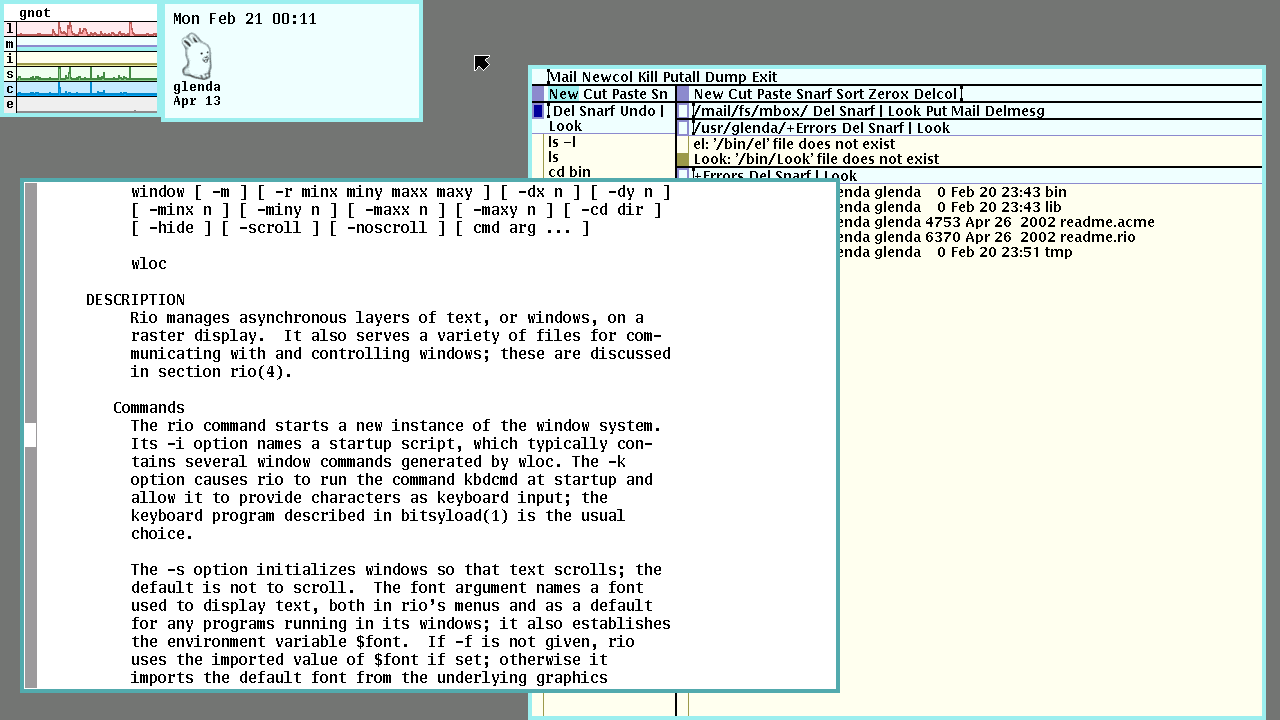
Plan 9 Fourth Edition showing the rio windowing systemScreenshot by VulcanSphere via Wikimedia Commons MIT License
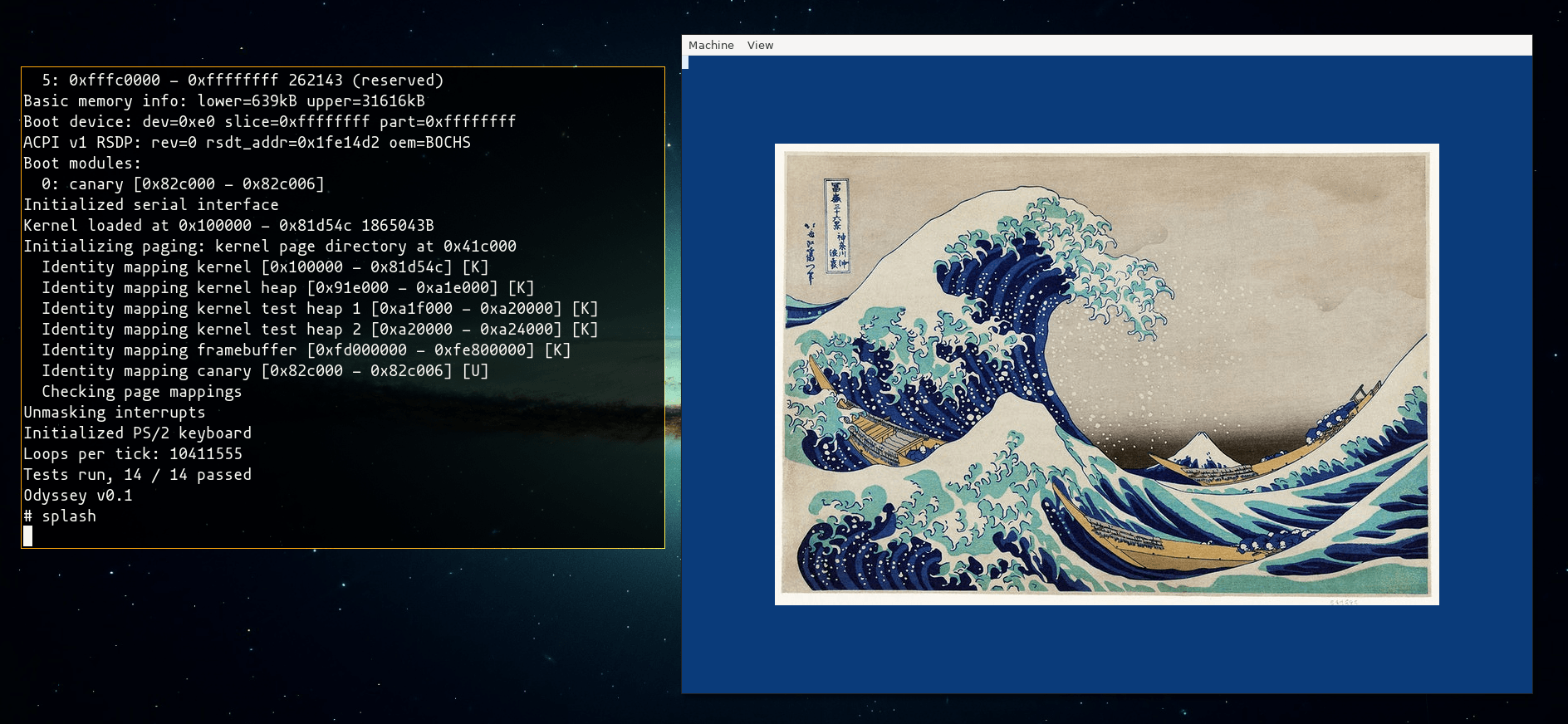
I first heard of Plan 9 from my friend Vajra in 1999 or so, as we were distro-hopping on early Linux distributions and trying to find our way. Vajra is now a Nebula Award-winning science fiction author - have a look at his work. We had just been through Tom's Root Boot, a UNIX-like operating system crammed into a single floppy, and through it discovered a whole new world outside of DOS 6.22. Combing through old UNIX manuals, we went in search of the perfect OS, through Slackware, Caldera, TurboLinux, SUSE and Red Hat. I finally settled on Debian, which lived up to everything I stood for. Plan 9 was distinct. It came out of the Computing Sciences Research Center at Bell Labs, built by Rob Pike, Ken Thompson, Dave Presotto and Phil Winterbottom, with Dennis Ritchie heading the department. The name is a joke at their own expense, borrowed from Ed Wood's 1959 Plan 9 from Outer Space, routinely nominated as the worst film ever made. Thompson and Ritchie had, of course, built the original UNIX; it almost seemed as if they were building a new OS from the lessons learnt from building it - which was in turn built on the lessons from Multics. I remember the awe I felt playing around with Plan 9, and I've not been able to replicate it since. Plan 9 was different in a couple of fundamental ways: per-process namespaces, and a protocol that abstracted locality of resources to processes. As a consequence of these core primitives, the OS surface area was distinctly small. The entire system from the core kernel, to the system call interface, to the compiler, linker and shell was reduced to a form small enough that a single developer could hold it in their head. Lessons from the implementation of UNIX helped the designers make the system leaner, and in Ken Thompson's words, it's the "best operating system out except that it doesn't have the apps that everybody demands" [1]. It also took the concept of "everything is a file" in UNIX to a whole new level. The network stack is a filesystem (/net), processes are files, the display is a file (/dev/draw). Because every resource speaks 9P and every process has its own namespace, you can mount another machine's /net into your namespace and your program makes network calls through that machine's stack without knowing or caring. No sockets API, no RPC layer, just ordinary file system operations through a simple system call interface. Some would say that OS research is dead, and that backwards-compatibility and POSIX killed it. Rob Pike himself argued as much in his 2000 talk, "Systems Software Research is Irrelevant" - but we didn't care at the time. There was so much happening that we didn't have time to take it all in. And then Linux happened, and Software Freedom became a focal point (more on that in a later post). In the summer of 2020, with the world deep in Covid lockdowns, I decided to build a toy operating system, just to try my hand at the the thing that I had always wanted to do. I spent three feverish months working on Odyssey and, looking back, it is perhaps the most fun I have ever had. I would not dare compare it to the magnum opus that is Plan 9, but it gave me perspective: how hard it is to build an OS from scratch, and above all, how fun it is to build an OS from scratch, and why the original creators kept coming back to the same problem. The highlight of those three months was booting the OS and watching it render "The Great Wave off Kanagawa". Nothing in my professional achievements to date captures what that meant to me.
Odyssey rendering The Great Wave off Kanagawa during boot Odyssey displaying "The Great Wave Off Kanagawa"

Decades on from the first time I booted Plan 9, I look back with nothing but awe and respect for the creators of this little operating system and marvel at the foresight that went into it. While many readers will not have heard of Plan 9, they have almost certainly worked with the ideas that came from it: 9P (if you ever used the Windows Subsystem for Linux), UTF-8 (if you ever used any modern operating system), per-process namespaces (if you've ever run a container), Go (whose assembler still uses Plan 9 syntax). Plan 9 still lives on in 9front, a community-maintained fork. Separately, Yoann Padioleau [2] has produced a set of annotated books at principia-softwarica.org, presenting the Plan 9 source in the spirit of Donald Knuth's literate programming - an admirable effort to introduce new readers to the art of operating systems engineering. Pike thought systems research had become irrelevant, and Thompson thought Plan 9 would never "make it" [1]. Both were right about the industry, but may have been pessimistic about the impact. The system lost as a product but won as a set of ideas, assimilated one at a time by modern operating systems. Success is not always measured by popularity. The mark that Plan 9 left behind is greater than what's reflected in its current user base. To me, Plan 9 will always be the OS that punched above its weight class, the little OS that could. References [1] Ken Thompson Interview, March 6, 2024 [2] Yoann Padioleau Principia Softwarica, May 9, 2026

3 August 2026

John Goerzen: Celebrating 45 Years of Kermit with the First New C-Kermit Release in 15 Years (and working with a decades-old C codebase)

1981 was a different time for computing. It was expensive (both hardware and software), and it was far from a given that machines from one vendor would be able to talk to those from another. In fact, Columbia University had just such a problem, so in 1981, Frank da Cruz and Bill Catchings designed a serial protocol they called Kermit. Because of the many quirks of the DEC-20 and IBM mainframes, the Kermit protocol was highly adaptable from the start: able to handle systems that had trouble processing more than 96 bytes of data at once, able to transfer 8-bit files over 7-bit links, able to translate between character sets (ASCII and EBCDIC then; now also various Unicodes), and of course, handling of error-prone serial links. Kermit spread rapidly; by 1982, Kermit had been ported to MS-DOS and Unix. Eventually, C-Kermit (an implementation of Kermit in C) became the flagship Kermit. It gained TCP support, an interactive CLI, a powerful scripting language (with features from the shell, Lisp, and expect), and optimizations for today s high-speed links, such as jumbo packets, sliding windows, and streaming modes. Along the way, Kermit flew on the International Space Station, ran data collection from sensors during hurricanes, and many other uses including postal systems, Boeing 787 manufacturing, and more. Today, I use it as a powerful ssh wrapper (letting me easily transfer files through multiple nested ssh, sudo, su, etc. commands), a BBS client, to exchange data with me HP 48GX calculator, and so on. It s also used today to transmit firmware updates to embedded devices. And, of course, anyone that works with vintage systems is likely to use Kermit at some point. It wouldn t be until the late 1990s that the TCP/IP stack was finally adopted by most OS vendors, establishing something of a common basis for communication. Of course, we assume this today. Though transferring large files between OSs (say, Linux, Windows, MacOS, Android, iPad, etc.) is still a challenge, even though they all speak TCP/IP! I find that the easiest way to get large files from two computers is to spin up Kermit (see ckwin for a Windows fork of C-Kermit) and just set up a TCP connection over the LAN. In fact, I added a new show interfaces command in C-Kermit 11, making it easy to see your system s local IPs. For most of its history, Columbia s Kermit project was self-funded. Columbia charged for commercial use, which limited its inclusion in Linux distributions. In 2011, 30 years after its founding, Columbia canceled the Kermit Project and released C-Kermit as Open Source under a BSD license. Frank da Cruz, who had still been working with the Kermit project all those years, volunteered to continue maintaining Kermit outside Columbia, and continued development with alpha and beta releases through his retirement from the project in 2025. I dive into this C codebase As Debian maintainer of Kermit, I noticed some areas where it wasn t matching modern expectations. One area was, not surprising for a project of its age, security. Another area was that its character set or line-ending conversions are usually not desired now; we are used to byte-identical binary transfers, and the defaults caused confusion and even some rare instances of data corruption. So I started making a few patches last year. I ve worked with old C codebases before, such as Varnish. I ve generally hated it. You usually find a mix of bad and terrible practices, unclear memory management, and so forth. But I ve been living in the C-Kermit codebase for a few months now, and I enjoy it. Yes, this thing is still designed to build on VMS, OS/2, and with compilers that haven t heard of ANSI and those that require modern practices. (That em-dash was mine; I knew how to use them before LLMs existed and I m not going to stop just because LLMs have copied people like me! No AI was used for this post.) The there is an elegance in all of that. As I worked, I fixed a bunch more potential security issues, both with memory safety and with protecting against a malicious remote in roughly the same manner that some patches to scp did a few years back. I added IPv6 support, of course conditionally compiled because some systems C-Kermit builds on have never heard of IPv6 and never will. (And, of course, with fallback algorithms at runtime for systems that have IPv6 support but not IPv6 connectivity.) I added unit tests and Python-based end-to-end tests, running nearly 2000 test cases in total. Along the way, I found and fixed a number of bugs going back decades. I learned about FIONREAD being broken on macOS, about NetBSD s bugs in the pty driver, and fixed bugs in the Kermit protocol implementation itself. I added compatibility tests with the gkermit and ekermit (embedded) implementations, as well as the last full release, C-Kermit 9.0.302 from 2011 (which was difficult to get compiled on a modern system). There is an extensive changelog describing all the improvements in C-Kermit 11. C-Kermit development had never really used a VCS at any point, though Kermit veteran Jeffrey Altman imported historical releases into a Git repo, along with some patches that hadn t made it into a release (which I also pulled in.) There was a lot of disabled code behind COMMENT, along with commentary describing why it was no longer used. With Git, we would now generally just remove the old code and explain why in a commit message. I went through and did so with a lot of it, meaning that, at last check, C-Kermit actually has fewer lines of code now than it used to. Towards a new release It became apparent pretty quickly that I was making more changes than would make sense as a Debian patch series. Not only that, but they would be more widely applicable to more than just Debian and Ubuntu users. As Linux and BSD distributions were running everything from the last non-beta release (2011 s 9.0.302) to the last beta release (about 1.5 years ago), depending on their different policies about running betas, even sharing patches in a useful fashion was going to be quite difficult. So, I spun up a project at Open Kermit to coordinate future development in the open and keep Kermit going. With modern CI, I run that test suite on Linux (x86_64 and arm64), macOS, FreeBSD, NetBSD, and OpenBSD. It builds binary releases on all those platforms, plus a statically-linked Linux binary built with musl libc. You can download the latest C-Kermit release, and of course contribute to C-Kermit and its website. Dedication Frank da Cruz was directly involved with Kermit for 44 years. I m not aware of any other Open Source project founder being involved for so long. Richard Stallman started working on GNU Emacs in 1984, 3 years after Frank started working on Kermit, but Richard hasn t been in that role since around 2008. Accordingly, C-Kermit 11 bears this dedication:
I dedicate this release of C-Kermit to Frank da Cruz. Frank was directly involved with Kermit for 44 years, from its initial design in 1981 all the way through 2025. He maintained Kermit as an Open Source project after Columbia University ended its sponsorship. I know of no other Open Source project where the founder remains so personally involved for so long. When Kermit was begun, transfers between different hardware and operating systems were difficult or impossible. Frank helped build a bridge. Kermit glued systems together, from the International Space Station to pocket calculators, and set a new standard for interoperability. It continues to do so. Kermit is still one of the quietly-working pillars of computing today, enabling everything from firmware upgrades to radios. And, yes, it still reliably transfers files over serial lines. As we start to spend a lot of time in the Kermit codebase, we do so standing on the shoulders of a giant. Thanks, Frank, for your decades of work on Kermit. John Goerzen, July 2026

2 August 2026

Russ Allbery: Term::ANSIColor v6.0.0 TRIAL release

Yesterday, I uploaded Term::ANSIColor v6.0.0-TRIAL to CPAN for early testing. This release will raise the minimum required Perl version to 5.12, dropping support for Perl 5.8 and 5.10. When I did the same with podlators a couple of years ago, it upset a few people and one of them asked me to make this sort of test release in the future. Hopefully this will help. I have not run the normal release machinery and haven't archived this release in the normal places, since I intend it to be transient. It's only on CPAN, where people can retrieve it for testing. Once v6.0.0 is released, few traces of this TRIAL release will be left. This doesn't appear to be how other people use the TRIAL mechanism, but it felt more comfortable to me. If I have to make substantial changes, I'll consider changing my approach. I plan on turning this into the v6.0.0 release in about a month or two, hopefully with only documentation changes. Term::ANSIColor is a "very upstream" core module with a lot of dependencies, and CPAN (unlike some of the archives that followed it, such as PyPI) doesn't support conditionally retrieving packages based on the current Perl version. This release may therefore be disruptive for people who are still trying to support Perl 5.8 and 5.10, since CPAN installation tools may attempt to install an incompatible Term::ANSIColor version. I'm sad that this will be the result, since I know some people still care about those versions. I'm pressing forward with updating my Perl modules anyway, though. I realized that honoring other people's desire for stability to such a degree that I was unable to use Perl features added more than 15 years ago was destroying my motivation to work on these Perl modules at all. So I've decided on a very slow and gradual approach where I'm going to keep pushing the minimum supported version forward but try to give people a lot of warning. Personally, I think it's time to let ancient versions of Perl go and follow the Lyon Amendment about supported Perl versions. When we're talking installing new modules for software released more than 15 years ago, we're talking about special limited environments and retrocomputing more than what I would consider routine software maintenance. Those tasks should expect to need different tools and a different workflow so that they can pin historical versions. Since this isn't something I'm personally interested in, my willingness to expend time and energy to assist is limited. As you can probably tell, I still feel nervous about pressing forward in this way, but I think this is the approach that lets me continue to enjoy maintaining these Perl modules. It's been 29 years for Term::ANSIColor, but I still enjoy fixing bugs in it and putting out a new release from time to time, particularly if I can clean up the code a bit each time I touch it.

31 July 2026

Clint Adams: N.K. Jemisin is doing a worldbuilding workshop at the Bronx Library Center tomorrow afternoon

Normally, I do not read book reviews. Either I haven't read the book, in which case there's spoiler potential, or I have, in which case it's unlikely to be useful or enjoyable for me to read a thing about a thing I've already read. But Review: Radiant Star caught my eye, and I thought, Hmm, I've read all those books and was curious. Of course, because I am old and senile and have no understanding of time, the May 2026 staring at me was not able to trigger the neural synapses that would remind me that I haven't read any Ann Leckie since 2023. However, as I read Russ's review, and began to wonder what the hell he was talking about, I was able to piece together that while I have, in fact, read 6 Ann Leckie books, none of them have been Radiant Star. This presented an opportunity, so I resolved to add Radiant Star to my todo list. To my surprise, it was already there.
Posted on 2026-07-31
Tags:

Russell Coker: Links July 2026

Bruce Schneier and Nathan E. Sanders wrote a disturbing and informative article about the use of AI by the US government [1]. Bruce Schneier wrote an interesting blog post about corporate liability for AI decisions and the German court ruling about Google s AI summaries [2]. Cybersecurity News has an interesting article about how Pliny the Liberator succeeded in jailbreaking Anthropic s latest LLM to give instructions on writing exploits, writing exploitable code (backdoors?), and making meth [3]. Andrew Pam wrote about the number of cars with internal combustion engines in NSW decreasing for the first time since 1910, EVs are taking over [4]. Cory Doctorow wrote an informative blog post about Facebook s attempts to silence whistleblowers and what a pathetic little loser Zuckerberg is [5]. Scott Santens wrote an insightful article about how to effectively levy taxes in the future when AI significantly reduces the number of workers [6]. Ron Garrett wrote an insightful post about birthright citizenship in the US and his status as a US citizen who was not born there [7]. The BBC has an interesting article about the Scottish Violence Reduction Unit and how treating violence as a disease can significantly address the problem [8]. The LA Times has an interesting article about Covid19 causing cancer that had been in remission to return, sparking some new research into the effects of viruses on mammals [9]. CMU has an interesting video about ways to physically modify QR codes and how they could be used in real life [10]. Tim Retout wrote an informative post about the pervasive forms of advertising on the Internet, even on the BBC s site and how some of it can be blocked [11]. The Intercept Fund is a project to address respiratory illnesses and the long term mostly unnoticed costs they cause to society, we need governments and corporations to get on board with this [12]. The German news site DW has an interesting article about activists registering neo-nazi slang as trademarks to prevent the sale of nazi merchanise which funds racism [13]. The Conversation has an insightful article about how in South Sudan and other war ravaged countries the peace process usually just allocates the spoils of war and therefore encourages more war [14].

Jonathan McDowell: My CPU died

I built my current house server back in 2019. It had an upgrade from the original Ryzen 2700 to a 5700G in late 2021, but otherwise is still running with the original setup. Back in November it developed some erratic behaviour (initially manifesting as problems with the TPM, which is ironic as I ve spent a bunch of time at my day job trying to improve TPM reliability), culminating in unreliable reboots. I had a limited amount of ability to swap parts out, but ultimately decided it was a motherboard issue (thinking perhaps VRM problems), found a replacement locally, and everything seemed fine. Until May. At that point I rebooted the machine for a Debian point release, and it failed to come back. Fans would spin, but there was no sign of actual life. I ended up pressing a temporary machine into service (that could at least run the Home Assistant container, and a few other critical bits) while I tried to work out what was wrong. I d kept the previous motherboard, and still had the Ryzen 2700, so I did a bunch of swaps (and obtained a motherboard buzzer to try and get some indication about whether there were useful beep codes being emitted), and ultimately came to the conclusion that the CPU had died. I m not quite clear what happened here. I played it safe and replaced the PSU at the same time, in case that was the original cause back in November and ultimately damaged the CPU, but both old + new motherboards worked just fine with the 2700. That left a decision about what to do. This previous server was from 2013, so this machine has now lasted longer than that and I could justifiably upgrade. However when I went to look at what the equivalent modern machine would be it s only a couple of generations later (Zen 5 vs Zen 3), and 64GB RAM alone would have set me back ~ 1k. For not a lot of gain. So I ended up buying a replacement Ryzen 5700G, hopefully allowing me to put off thinking about an upgrade until Zen 6 is out, and RAM prices are saner (though I understand that might take a couple of years). It s not the first time I ve had a faulty PSU be the cause of a dead machine, but it was a pretty frustrating experience.

Otto Kek l inen: Estonia, the country of the fit and the wit

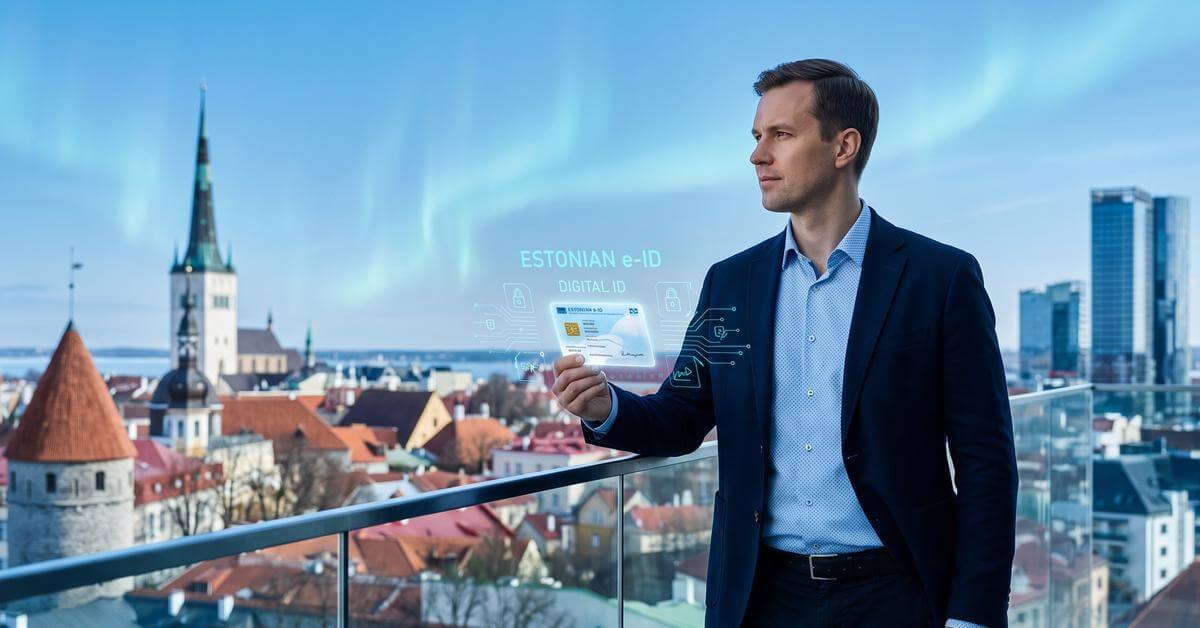
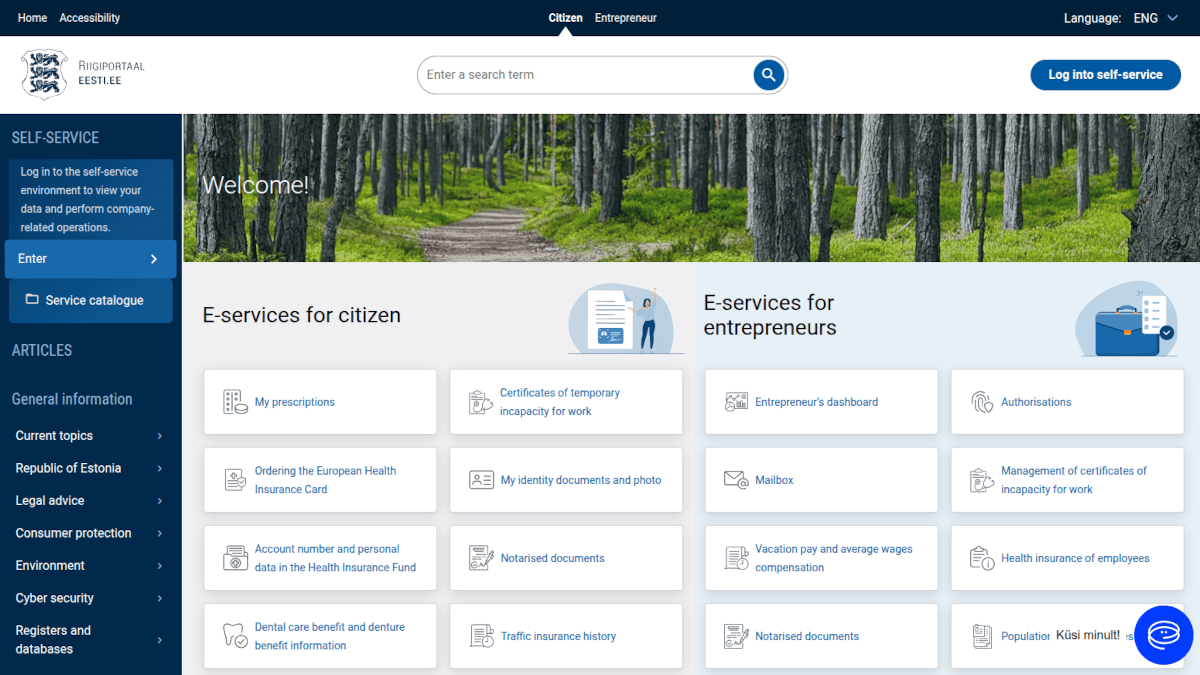
Featured image of post Estonia, the country of the fit and the witWhile many Western democracies seem to be in a state of decay and are no longer the safe, civilized and prosperous countries they once were, there are still some European countries that are governed well. One of those that stand out is Estonia. Estonia is probably most well known for multiple software companies that originated from there, such as Wise, Bolt, Pipedrive and Skype. The government itself is also famous for being early in issuing government IDs with an embedded smart chip for online authentication already in the 1990s. Via the national portal at eesti.ee all residents can access extensive eServices ranging from viewing their health benefits to filing taxes. Estonia has also been running an e-Residency program since 2014, where they issue digital ID cards to foreigners, making it easy for them to remotely log into the government portals and for example, establish businesses, file annual reports and so forth. Note that the e-Residency is not a path to physical residency. Estonia does, however, have a separate Digital Nomad visa program that makes it easy for non-EU citizens to also physically establish themselves in Estonia, assuming, of course, you meet the criteria, which includes, among others, a minimum monthly income of 3960 from outside Estonia. EU citizens naturally have free mobility inside the EU and can simply get an apartment and register as a resident in Estonia if they so choose. And there are plenty of reasons to do so.
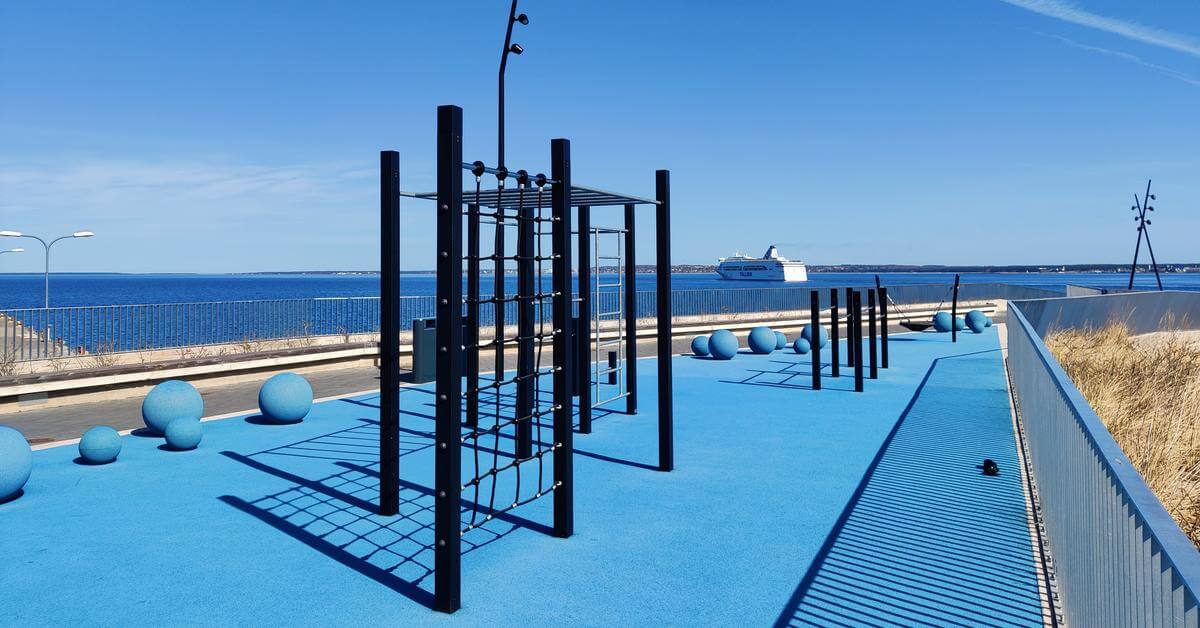
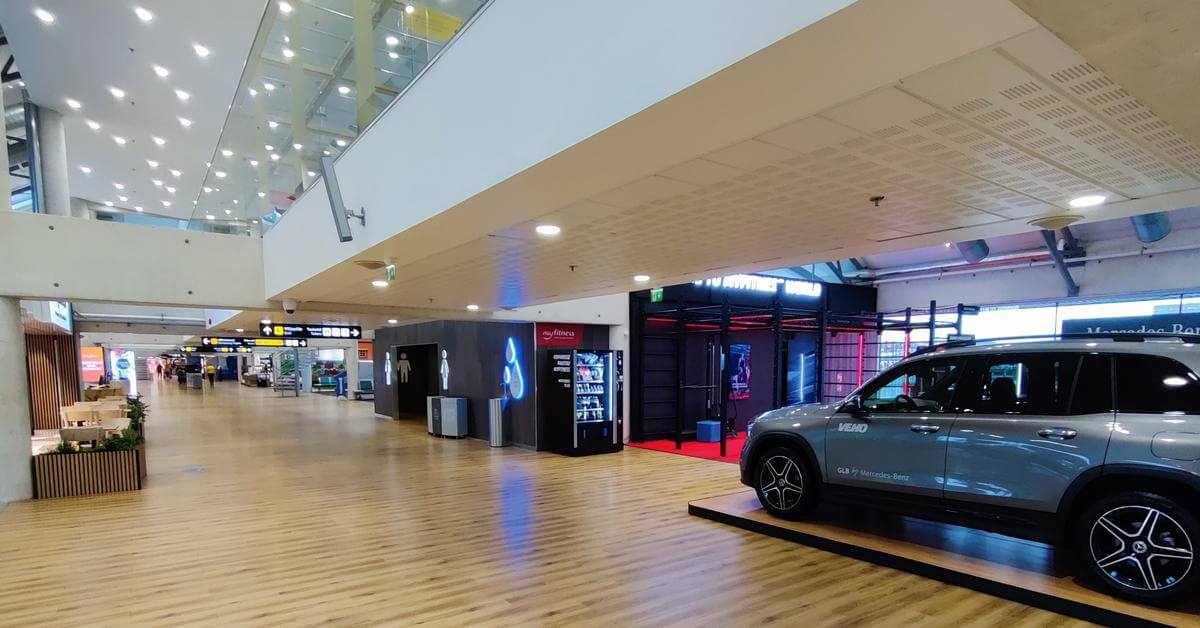
Estonians value health, education and entrepreneurship I moved to Estonia about one and a half years ago. In my observations Estonia strikes me as a country that values health, education (in particular programming and natural sciences) and entrepreneurship highly. I don t know how Estonians achieve it, but they look pretty fit and rarely obese. Estonia has rye bread and sauna in their culture just like Finland, and in addition the flat terrain and well-planned bike routes and extensive network of parks (and pull-up bars everywhere) seem to create an environment where it is easy to live in a healthier way. The consumption of processed foods and candy also seems relatively low among Estonians. The gym chain MyFitness also seems to be present everywhere. Even the Tallinn airport has a calisthenics workout station right at the departure gates, which anyone is free to use while waiting for their flight to take off. One of the top longevity influencers in Europe, Siim Land, is Estonian. Estonia has lots of good bike paths, parks and outdoor gyms There is even a calisthenics station with pull-up bar and more at the departure gates at Tallinn airport Estonians also seem to value the school system highly. The government has been actively raising teacher pay and has a stated goal of reaching 120% of the national average by 2027. The students are also expected to value the education and respect their teachers. According to the TALIS 2024 survey (OECD s international teacher survey), Estonian teachers spend significantly more time on actual teaching and learning and waste less time on interruptions or keeping classroom order compared to the OECD average. This is among the highest rates internationally, meaning they spend relatively little time on maintaining order or dealing with disruptions. While the international education benchmark PISA scores have been dropping globally, Estonia has consistently been climbing the ranks in past decades. In the latest PISA study (from 2022), Estonia ranked number one in Europe for reading, mathematics and science. In the overall results, Estonia ranked seventh globally, only behind countries such as Japan, Korea and Singapore. Valuing entrepreneurship is evident in how the taxation system is set up in Estonia. Famously, in Estonia, companies can defer taxes on annual earnings and reinvest all of their profit in growing the company. Taxes are due only later, when paid out from the company, for example as dividends. For individuals, receiving dividends from any Estonian or foreign company is tax-free as long as the company paying dividends already paid corporate tax on the same income. The tax system is also very simple. For all individuals, all types of income, including salary and capital gains, are always taxed at a flat rate of 22%. This removes the incentive for anyone to try to convert income into different types, setting up holding company structures and other optimizations as there is no gain. All entrepreneurs can simply focus on growing their business and forget extra bureaucracy. There is also no marginal tax rate cliff to stop working at everyone is encouraged to always try to produce as much value as they can. A simple tax system is also reflected in the fact that anyone can easily read all tax rules that apply to individuals in plain English on the Estonian tax authority website, and one does not need to hire any accountants simply to file taxes. Estonia also has a very straightforward investment account system: any person can freely open a self-directed investment account at any brokerage at no extra cost and report it as such to the tax authority, and then use it to save for an apartment, retirement, or other purposes, and defer all income taxes until withdrawal. There are no caps or time limits, and all residents are encouraged to save and invest as much as they can and thus take responsibility for their own wealth accumulation. It seems that culturally Estonians respect people who are active and progress in their careers and businesses more than in other countries. Unlike in Finland, successful people are admired and living on government welfare is not romanticized. At the same time, the government benefits are less generous so people can t live comfortably on them and, for example, many of the asylum seekers Estonia accepted have since left on their own initiative to other European countries in search of better benefits.

Low crime, high trust Another thing that strikes me when walking the streets of Tallinn is that there are no drug addicts, beggars, thugs or the like. The difference compared to, for example, Vancouver (where I lived previously) is stark. In public buildings, people leave their coats and bags hanging in the lobby while visiting. Private houses and apartment block yards are not fenced. In my building, I noticed people even leave their bikes unlocked in the bike shed. I have also seen the staff of a coffee stall in a shopping mall going for a break and leaving everything unattended, not worrying that anyone would take anything while the staff is away. Nobody is stealing anything from the unattended coffee shop while staff is having a break at  lemiste shopping mall This is not just my personal experience. According to the Numbeo crime index, Estonia has one of the lowest crime rates in the world. Also, comparing drug and property crime stats, for example, Finland has twice as much crime per capita, and places like Vancouver in Canada almost five times more. I don t have any clear explanation for why crime is so much lower in Estonia, but some suggest that higher social cohesion and lower levels of welfare contribute to people standing to lose more if they behave antisocially. Compared to Finland, Estonia also more readily jails repeat offenders, and those who are put on trial will experience a swifter court process thanks to simplified legal processes and more efficient governance.
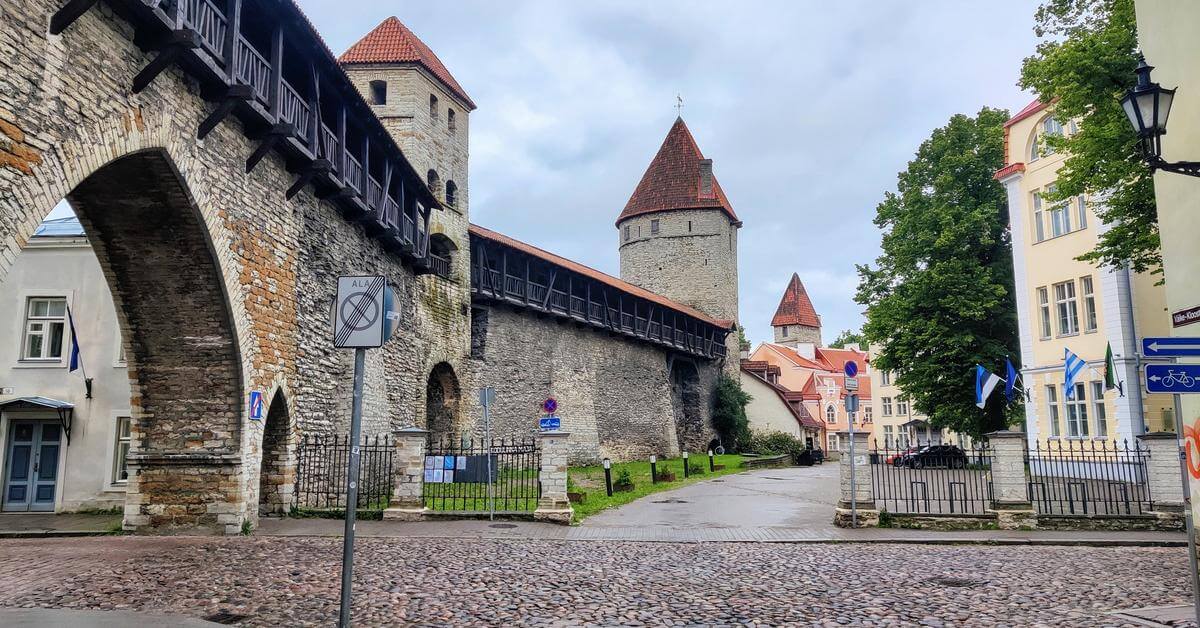
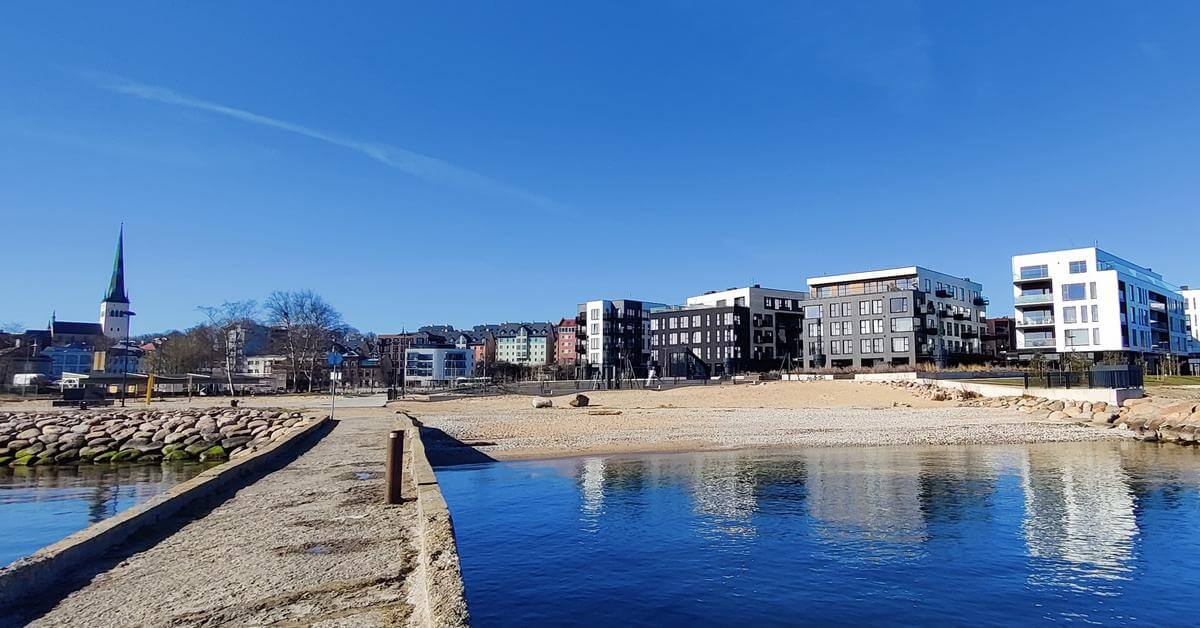
Moving to Estonia: quick checklist Moving to Estonia is very easy for any EU citizen, in particular if your work is not location-dependent (e.g., remote work or an online business) and you are simply looking for the cleanest and safest environment to live in. First, check into a hotel in Tallinn, check out various neighborhoods to figure out what area you like (my favorites are Kalaranna, Kalamaja, Noblessner and Volta) and start browsing available apartments in English at kv.ee. Most professionals speak fluent English, so there should not be any difficulty in reaching out to people by email or phone. Tallinn is famous for the old town The economic boom of recent decades created a lot of new construction, with Kalaranna being among the newest areas The next step is to buy a local prepaid SIM card at e.g., an R-Kiosk or a convenience store as signing up for other matters later on will require an Estonian phone number. Once you have an apartment and e.g., signed a rental agreement, you can register in the population registry online. After that, you have proof you are a local resident with an address and telephone number in Estonia. With local resident status, you can go to the police station to get a local ID card. Don t bother scheduling an appointment, just go to the Tammesaare police station in Tallinn, take a queue number and wait. Once it is your turn, they will guide you on how to use the photo booth, fingerprint registration device, and file your application. A few days later you will receive an email confirming whether your application was accepted, and after a few more days, you will get another email notifying you that your ID card has been printed and is available for pick-up at the same location. This will also be your first practical experience of how fast and efficient the government in Estonia is. Once you have the local ID card, you can use the smart card feature to log into all the government eServices and sort out the rest of the relocation process, such as registering tax residency and getting a family doctor. The main eServices portal in Estonia: eesti.ee
How did Estonia evolve to be like this? After Estonia regained its independence after the fall of the Soviet Union in 1991, the first elected government in 1992 was led by a very progressive 31-year-old Prime Minister Mart Laar, who managed to set up some very good policies and laid the foundation of a society that has evolved well in the decades since. Estonia was very lucky to have people in power in the 1990s who didn t simply copy what other Western countries were doing, but who tried to think about things from first principles and create Estonia s own model for efficient and fair governance. As a post-Soviet country, the population had also been vaccinated against overly socialist and unrealistic ideals, and everyone had a healthy distrust of the government s ability to solve problems and emphasis was placed on people s liberty to work for themselves as they best see fit. The improvement in living standards over the past 35+ years has also been witnessed by the population, and voting behavior supports keeping the country on the same trajectory. General living standards still continue to improve as the nominal wage growth sits at around 6%, clearly above the annual inflation rate of about 3%. In 2026, the Estonian economy is expected to grow about 2.4%, which is faster than the EU average. The growth in Estonia is not the result of any accounting tricks - Estonia is part of the euro and can t print its own currency, nor has it been funding the public sector with excessive debt. With a 24% debt-to-GDP ratio, Estonia consistently ranks as one of the most responsibly managed countries among advanced Western economies. As wages in Estonia soon catch up with the EU average, and higher defence spending has forced the government to raise taxes in recent years, the economic growth that Estonia has enjoyed for 35+ years since it exited the Soviet Union might slow down a bit in future years. The policies that fueled this growth in living standards, however, are likely to stay.

The tiger leap There is one specific government policy in Estonia s history that I think should be highlighted in particular. Estonia was very progressive by announcing the Tiigrih pe (Tiger Leap) program in 1996 with the goal of equipping all schools with computers and teaching all students the basics of programming. This surely had a large influence on why Estonia has so many successful software companies, why the government eServices are so mature that even neighboring countries like Finland are striving to copy the Estonian government s IT architecture called X-road. The Tiigrih pe project was originally suggested in the mid-1990s by Toomas Hendrik Ilves, then ambassador of Estonia to the United States, Canada and Mexico, and later President of Estonia in 2006 2016. While he was a psychologist by education, he was also a self-taught amateur programmer and used his political influence to promote sensible adoption of information technology in both Estonia and the EU. The history of Estonia has several prominent figures who were not lawyers by profession but engineers, scientists and historians who were very practical in their political decisions, which I think is now reflected in how government processes were formed. The video below shows how the Estonian government advertises itself and what values they choose to highlight:

Should other countries adopt policies from Estonia? Of course, not everything is perfect in Estonia either. The fertility rate of 1.16 in Estonia is very low. This trend is present globally, but in Estonia it is way below the EU average. Also, the service culture is something that needs to improve in Estonia. While services are in general fast and efficient, the attitude of people working in cafes and stores does not reflect a willingness to fill in gaps if the standard process falls short, nor are visitors actively made to feel welcome as individual humans, but are treated as mere process inputs. However, many of the things listed earlier I think should be studied by policymakers elsewhere. Societies are complex systems and there is of course no guarantee that copying a single policy to another country with different ethnicities, history and ingrained culture would lead to the same policy outcomes. But considering that Estonia is a small country without favorable geography and no natural resources, and that it started out from a place of total chaos, low economic activity and high crime in 1992 to rise to what it is now in 2026, the success it has seen is surely largely a result of good policies, governance and culture that other countries can and should mimic.

30 July 2026

Russ Allbery: Review: In the House of Aryaman, a Lonely Signal Burns

Review: In the House of Aryaman, a Lonely Signal Burns, by Elizabeth Bear
Series: Sub-Inspector Ferron Mysteries #1
Publisher: Sobbing Squonk Press
Copyright: 2012
Printing: 2018
ISBN: 0-9863735-1-6
Format: Kindle
Pages: 73
In the House of Aryaman, a Lonely Signal Burns is a science fiction police procedural set in relatively near-future India. This novella was originally published in Asimov's SF and collected in several anthologies as well as Bear's Shuggoths in Bloom collection, which I have on my shelf but have not yet read. I probably should have checked that before I got another copy. It is the first story of a series in the sense that there is an Audible-only sequel available. Like many police procedurals, this one opens with a crime scene. Sub-Inspector Ferron and her partner are inspecting a tube of human meat in the middle of the rug of a luxurious apartment in Bengaluru. The tube is apparently the remains of one Dexter Coffin, an American with a high tech workspace who was apparently mangled beyond recognition in his locked apartment near a table set for two. Dexter's cat is a witness. In this future world of cats enhanced with limited language skills, this would have been very useful, but the cat's memory was apparently wiped. Ferron will have to get to the bottom of the mystery some other way. Also, she apparently now has a new cat. Meanwhile, Ferron is worrying about her partner's mental health, her partner is worrying about her use of stimulants to stay on duty for this murder investigation, and Ferron's mother is harassing her for money to pay the bills of her virtual reality addiction. Her job is a good distraction from other problems she'd rather not deal with. I am trying to come up with something insightful to say about this story, and I'm not having much success. It's a police procedural with a bit of a science fiction twist. The characters are fine but not, at least for me, particularly engaging. There is some deft world-building, but nothing that grabbed my attention or made me desperate to read more stories in this world. Perhaps the most interesting part of the background, and the reason why I picked up this novella, is that this is the universe that eventually becomes the setting of the White Space series. There is an early version of right-minding handled entirely through medicine without the later invention of the fox implant, and there are some signs that humanity is slowly digging itself out of the hole of climate change and antisocial behavior that it had dug. I found this mildly interesting, but it doesn't add much to the later series and is very skippable. The source of the title is a bright light originating in the Andromeda galaxy, which is contained in Uttara Bh drapad in Vedic astrology. Ferron says this is under the influence of the god Aryaman. This is unrelated to the plot; it's just a background event that prompts some introspective musing from Ferron at the end of the story. It's a nice moment, but I would have been more interested in the full story of first contact between Earth and the Synarche. This was a mildly pleasant way to spend a few hours and I'm already forgetting all of the details. It's a competent story, but not one I feel a need to recommend to others. Followed by A Blessing of Unicorns, which appears to be an Audible audiobook exclusive. Rating: 6 out of 10

29 July 2026

Joey Hess: my harddrive is probably not full

I enjoyed reading this post by Marginalia "Your harddrive is probably full"
You can construct an entropic argument that there are simply more ways for a harddrive to be full than ways in which it can be empty.
Of course it made me check how full my laptop drive is, and indeed it was more than 75% full, as predicted. But, I almost never feel that my hard drive is full. I can very easily free up almost any amount of disk space at any time, without any thought. While writing this blog post, I ran a single command and now my harddrive is 50% empty.
The other part of the equation is that a full disk isn t a problem until it s so full you can t put more stuff on it, and at the point it s so irredeemably cluttered that when you do clean it up, you only have the patience to clean up enough to bide your time, judging the fate of every file on the harddrive is simply too much work.
Why doesn't this apply to me? Because I have put in the up-front thought to organize things, so that I never have to do that anymore. I have 3 categories of files that I can remove at any time I need more space, without any thought:
  1. Any files that are stored in git-annex. This is one of git-annex's superpowers; you can git-annex drop any file and stop it using disk space, but the file is still there (as a broken symlink) so you don't risk losing or forgetting about it.
  2. Caches.
  3. Files in ~/tmp/, which is reserved for any files I only want to have a passing acquaintance with. If I'm not comfortable with something being deleted at any time, I don't put it there.
Not only do I only have these 3 categories, these are the only 3 categories for everything except OS files and files I have decided I never want to remove (eg dotfiles and other files stored in git repos). Computer scientists invented caches (and of course cache invalidation is no problem lol) so I only needed to learn about that one. Unix gave me /tmp/ as an example that I long ago used as the basis for the rules for my ~/tmp/. I hope that git-annex might also serve as an example that moving files between drives is not the best way to manage disk space use.

27 July 2026

Valhalla's Things: Late Victorian Vampire Shirt

Posted on July 27, 2026
Tags: madeof:atoms, craft:sewing, FreeSoftWear
A woman wearing an old-style white shirt with lots of fullness, wide and long sleeves and ruffles at the collar that spread out framing the neck, down the center front to underbust height, covering the slit and at the cuffs, reaching to mid-hand. The shirt is gathered at the waist with a belt, and worn over the bottom garment to show that it reaches to mid tight. Drama levels in the pose are pretty low. The recurring joke is that because of some health issues, in summer I dress like a Victorian Vampire. But how would an actual Late Victorian Vampire dress? Picture her, she would look like some kind of eccentric gentlewoman, as vampires usually do, probably with a style that is a bit conservative, rather than following the latest fashions. Same woman, same shirt, posing as a vampire ready to attack a victim. Drama levels increasing. Now, she wouldn t probably wear men s shirts. But what if she was a lesbian1 vampire? Wouldn t she need a fancy, frilly shirt to go with her tailored cycling suit when she s out seducing the more active ladies in the neighbourhood? Or maybe not. It s not making a lot of sense, is it? But I do have a lot of shirt fabric in my stash2, and I could use a few more shirts that were practical and comfortable, but also somewhat over the top. For the practical and comfortable I went to my trusted 1880s shirt, while for the over the top part I looked at inspiration from the earlier 18th century frilly shirts, and their later imitations. I decided to use some nice cotton batiste I had bought quite a few years ago to make one of my first historically inspired shirtwaists: I may have a tendency to buy a bit more fabric than actually needed by the pattern, but that s what everybody does, right? For the ruffles I decided to use a lighter weight cotton voile, also from the stash. the top edge of a ruffle being whipstitched over some gathered fabric; the rest of the unfinished shirt is visible in the background. At the front, I wanted the ruffle to be inserted in the yoke, but I was also whipstitching the gathers to it to make them neater, so I started bu attaching the yoke lining to the gathered front, then I whipstitched the ruffle to the front, catching each gather, and finally I whipstitched the other yoke on the ruffle and the rest of the gathered front. The front of a shirt: the body was gathered into a yoke, but it has been unpicked and pulled out to extend a bit past the end of it, into where the collar will be sewn. And then after sewing the collar, I realized that this way the slit would have remained open in the front (or the collar too narrow), so I had to unpick the front part of the yoke, and sew it again, this time leaving an excess of fabric as wide as half the placket width from the pattern, to be sewn directly in the collar band. From then, things progressed smoothly, with some interruptions, until I got to the first sleeve, which I failed to insert twice, as one does. The same shirt worn without the ruffle at the collar, with just what looks like a mandarin collar, closed with a clip with an amethyst. Drama levels have gone way down. On the third attempt, with a different method, I succeeded, I tried the shirt on, and it already felt extra. Close up of the collar on a table: at the center back of the shirt collar there is a buttonhole, and a double button is used to keep the detached collar in place, while at the front both the shirt collar and the detached collar have buttonholes. But it could be even more extra. With some ruffles also at the collar. Same close up, but now the collar has been closed with a clip-on earring with an amethyst and some small fake clear stones, and it looks as if the skirt had a ruffle collar and a jewel button (or a pin). The shirt had been made with a simple collar band, and I could have just added the ruffle to it, but I also wanted to be able to wear it with other detachable collars, so I decided to make another collar band with ruffles, to wear on top. And that was mostly it, except for the reinforcement patches at the side seams and cuffs: I love having them, because they make the seam end neater and stronger, but they are a bit of a hassle to make, so they got postponed a few days. Same woman and shirt, back with the ruffled collar, in a pose like that of an artist that is fainting for futile reasons. Drama levels over the top. But finally, the shirt was done. And I tried it on, and it was good. But now I really need a pair of cycling breeches, don t I?
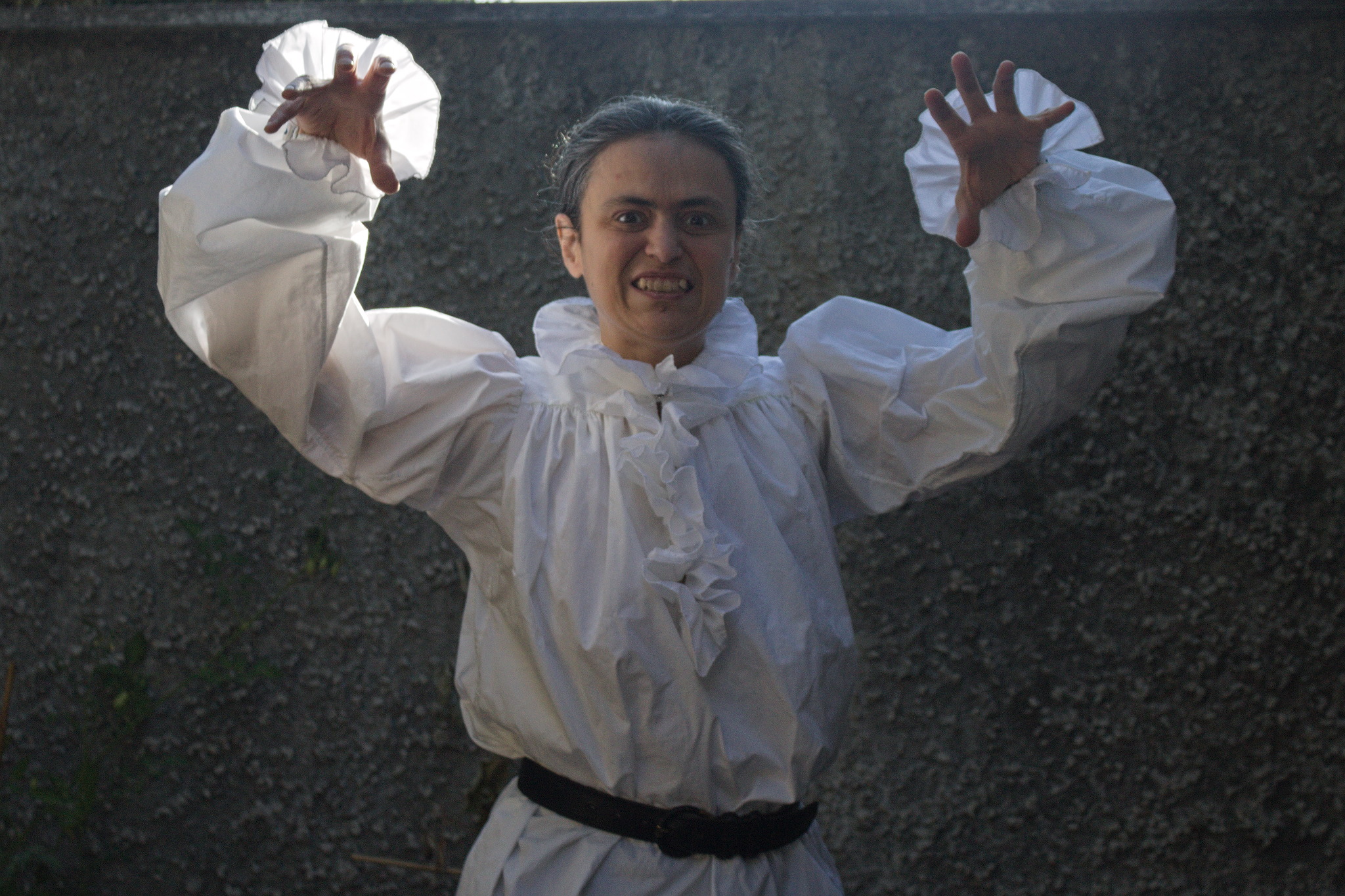

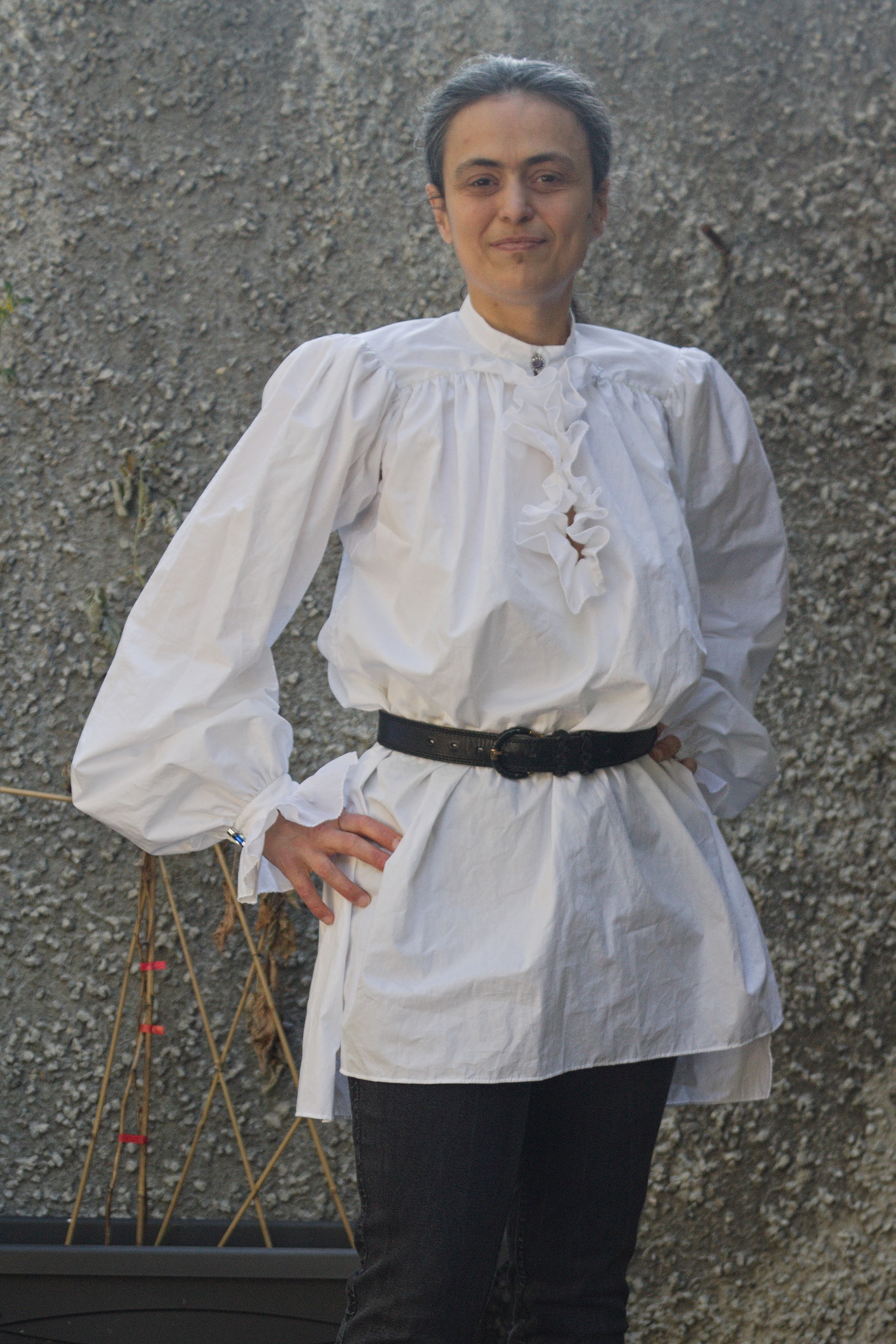
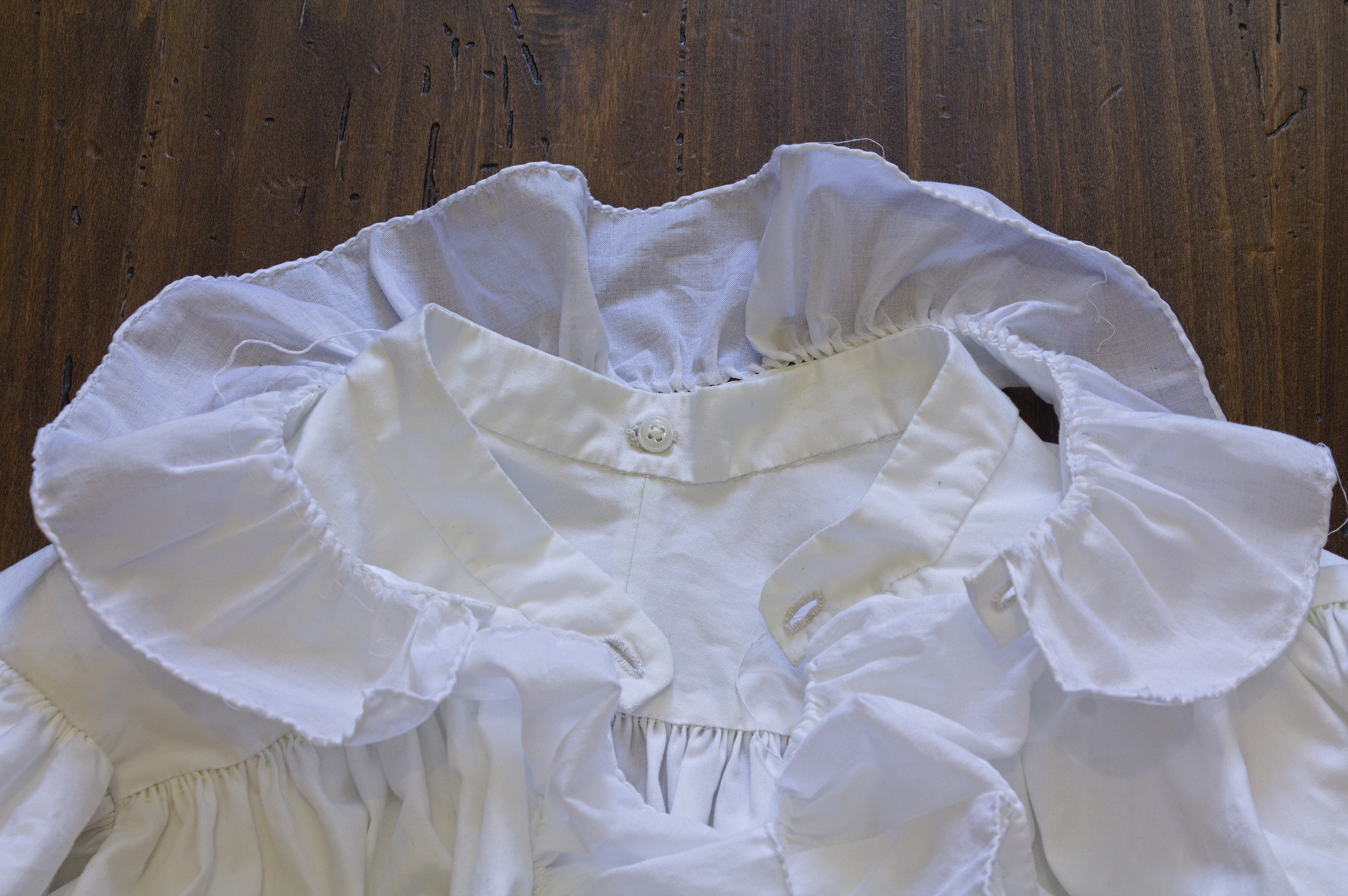
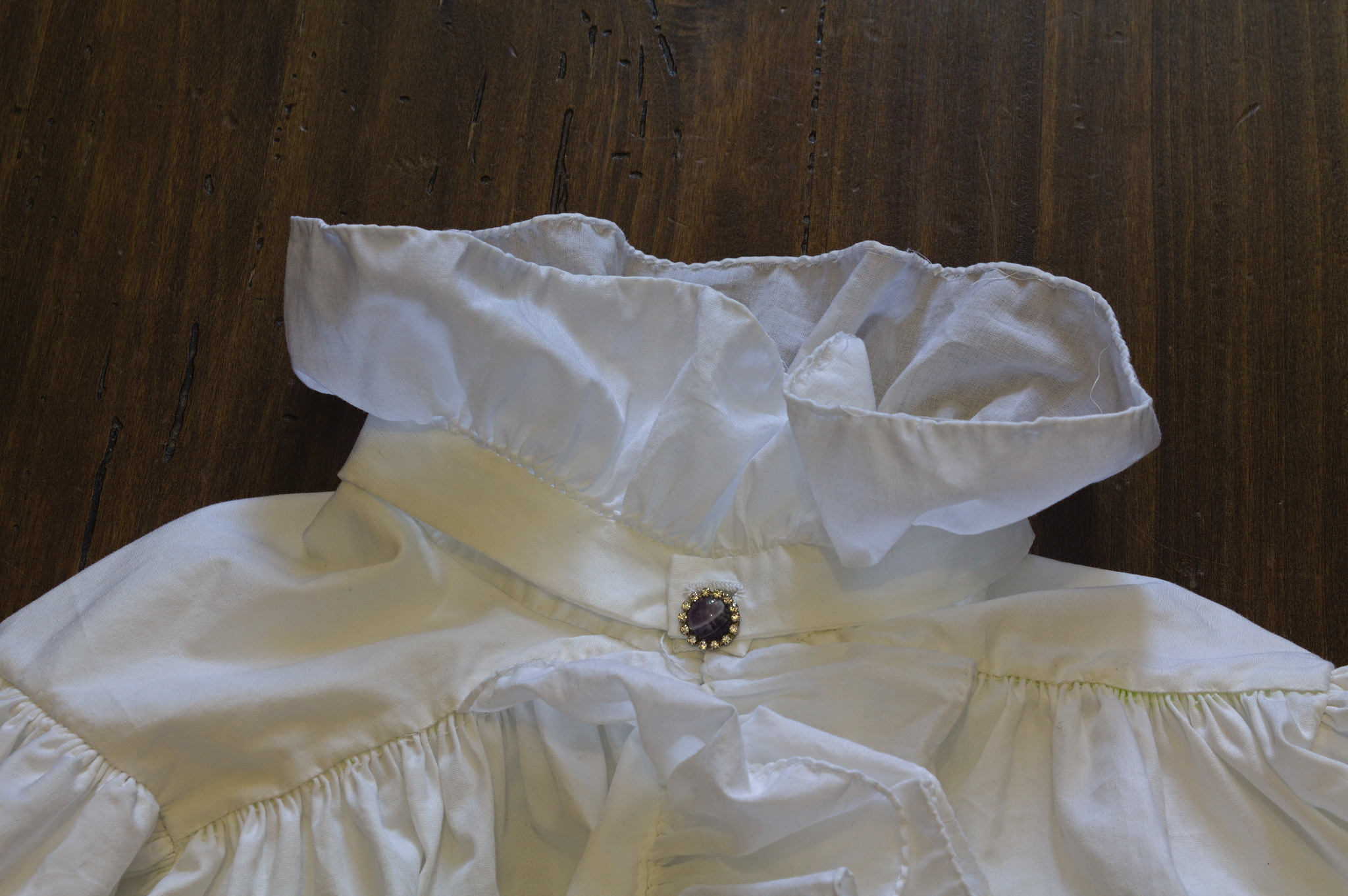
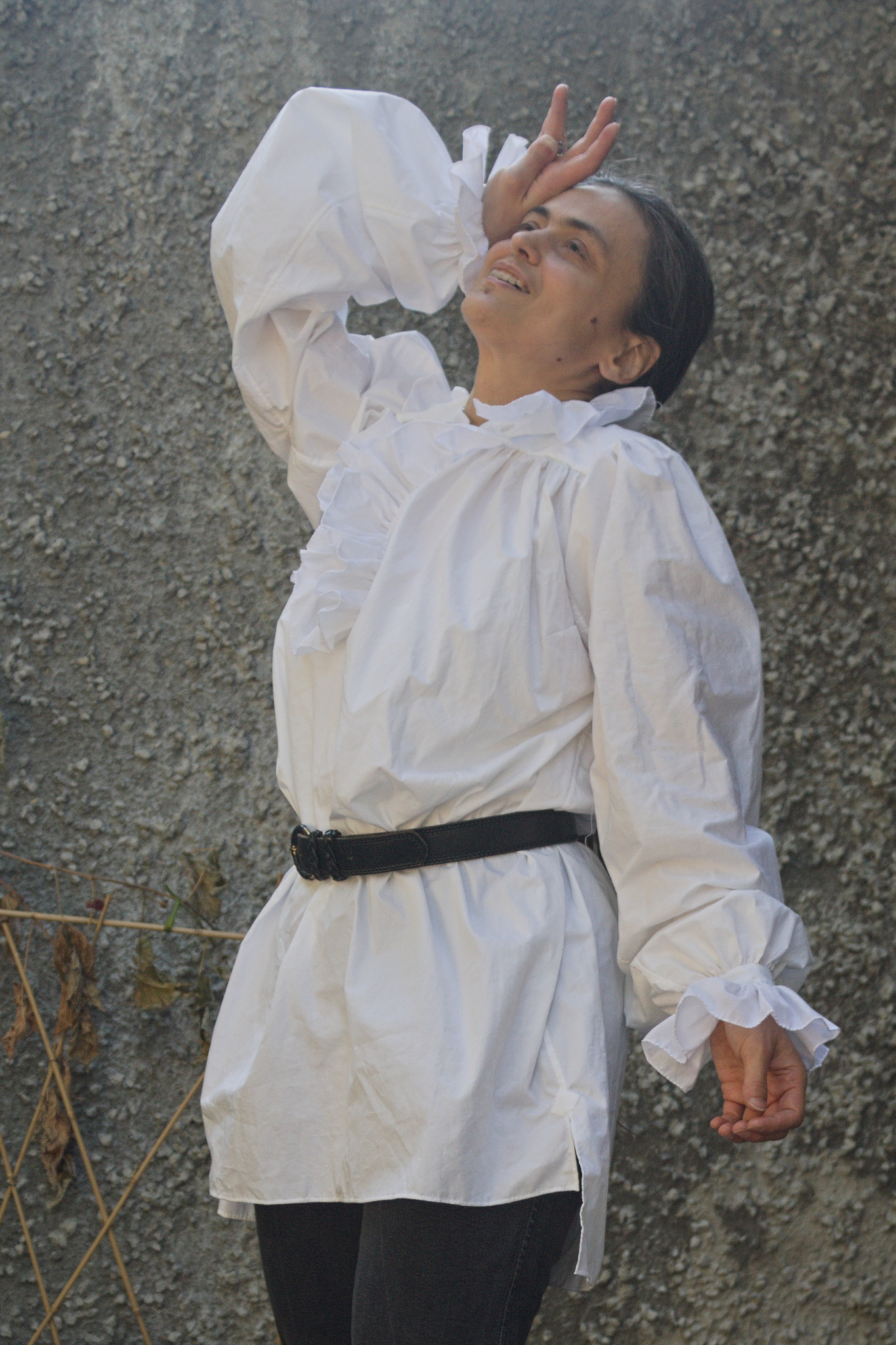

  1. ok, maybe straight passing bi? anyway.
  2. I have no idea how they got there.

26 July 2026

Russ Allbery: Review: Radiant Star

Review: Radiant Star, by Ann Leckie
Publisher: Orbit
Copyright: May 2026
ISBN: 0-316-29068-8
Format: Kindle
Pages: 359
Radiant Star is a science fiction novel set in the Imperial Radch universe without being a direct sequel to the other books in that universe. It will badly spoil the end of Ancillary Mercy, and I recommend reading that trilogy first, but it's independent of the other books in the same universe.
In the 3,008th year after the manifestation of the Radiant Star (the 1,024th since the founding of the Consorority itself), Zaved, a newly minted consoror, disappeared a mere two days after the ceremony that elevated her to womanhood. She left a note that read, Bored. Back whenever. This was not normal or even remotely acceptable behavior in a consoror, particularly one who held as much promise as Zaved had, but what could the consorors do?
Zaved, faced with the unpleasant prospect of running out of money during her galactic tour, plied a rich benefactor with tales of how talented, polite, and obedient the boys of the Consorority are. Her plan worked brilliantly. After funding further non-boring adventures, she arrived home in Ooioiaa with a chest full of money and a pregnancy. Great for Zaved and the Consorority; kind of a shame for her son Jonr, who is to be delivered to her benefactor after proper training. Oh well, telling Jonr about that is a problem for future Zaved. After a strained childhood in which he convinces himself he is a misfit with few redeeming qualities, Jonr ends up in a suspension pod. Before shipping can be arranged, however, external events intervene, leaving Jonr sitting unnoticed in a warehouse. The planet of Aaa is in a highly inconvenient location, drifting as it does through interstellar space unattached to any star. It would be as irrelevant and overlooked as any other random interstellar object except for two critical properties. The first is that Aaa and its sole city of Ooioiaa are sacred to a religion of obscure origin. Its primary population are members of a religious cult who believe the Radiant Star manifested in the Temporal Location on Ooioiaa and will eventually return to bring light to the galaxy. The second interesting property of Aaa is that it is drifting ever so slowly towards a strategic system of military importance. The first property brings pilgrims and their accompanying bounty of money, food, and other resources necessary to dig a small city out of rock, make it habitable, and supplement the sparse and strange native edible life. The second property brings the Radchaai, who easily conquer the city of Ooioiaa and are now faced with the unpleasant task of running it. Some decades after the Radchaai conquest, having never left Aaa, Jonr is woken up. He will not be sent off into the broader galaxy as a slave to pay off a vacation debt. Instead, he will be one of the many protagonists in this novel about the perils of living through supply chain disruptions on a planet full of status-obsessed religious fanatics who would drown in a rain shower. The other books set in this universe make abundantly clear that the Radch is a voracious colonial power that enslaves native populations and enforces their own cultural preferences at the point of a gun. A reader familiar with this series is predisposed to take whatever side is not the Radch. Radiant Star adds a complication, however. Charak Svo, the Radchaai governor, is impatient with native inhabitants and strongly dislikes their religion, but she is reasonably competent. The religious factions that ran Ooioiaa before the arrival of the Radchaai, on the other hand, are dogmatic authoritarians with the collective wisdom of a sack of turnips. Charak does not get everything right and is arguably responsible for at least one catastrophe. By the end of the book, though, I was firmly convinced that had the original religious government still been in charge, everyone would have died. I found the structure of this book a little odd. The omniscient narrator tells the story in the form of a history. The target audience appears to be future inhabitants of Ooioiaa and adherents to the Radiant Star religion, and the narrator is often maddeningly uninterested in topics that a reader of the rest of the Imperial Radch books is intensely curious about. This same property carries through to the plot: I was interested in how all of the tensions in this obviously absurd society could be resolved or, preferably, overturned entirely. The narrator, on the other hand, is far more interested in Serque Tais's intent to become the last saint in the Temporal Location, and in the details of the subsequent political, economic, and religious fallout. Leckie has written three novels set in the Imperial Radch after the original trilogy: Provenance, Translation State, and now Radiant Star. I am sure that I'm not the only person who wants a direct continuation of the original trilogy, but I'm drawing the conclusion that Leckie doesn't want to write that. Instead, she's writing around the edges of the subsequent events, in effect showing readers the shape of them and their broader implications without showing the details. Now that I can see what she's doing, I kind of like it. Given what we now know from the books written around the edges, the ensuing events in the center of galactic politics are chaotic in a way that could easily devolve into tedious accounts of messy conflicts. Seeing the effects from afar lets the reader fill in some of the blanks and speculate, and it makes the moments where we get a concrete update (such as at the end of this book) all the more rewarding. I still find it odd, though, to read a book where the narrator's interests so sharply diverge from mine. I wish I could say that Radiant Star sucked me in as the story developed, but it never did. Part of the problem is that I think this book is intended as a very dry farce, and farce often doesn't work with my reading style. I prefer to attach myself to a protagonist and hope they do competent things, and this book is full of characters who are being themselves far too aggressively and loudly to have time to be competent at anything. My favorite moments were therefore the small pockets of people with sense: The governor, Jonr, his charge, and the delightfully strange Justice of Albis. I enjoyed all of them, but I had trouble caring about the overall plot and kept putting this book down for days between chapters. I think this is mostly personal taste, though. Like all of Leckie's novels since the original Imperial Radch trilogy, Radiant Star is competently executed and a little strange. When that strangeness aligns with your tastes, it's a great deal of fun and rather unlike other science fiction novels. In this case, it didn't quite work for me, but I suspect it will for others. I still want another Leckie novel with a ship as a protagonist, though. Content notes: Rather disturbing (although bloodless) religious practices, mass death. Rating: 6 out of 10

Anuradha Weeraman: Because We Can

Because We Can
Twenty-five years ago, I made my first donation to an open source project and purchased a CD with an operating system as downloading a few hundred megabytes over a 14.4kbps dial-up wasn't very fun. It was a project I believed in, and a community that was fighting an impassioned campaign to assert access to strong cryptography for everyone, no matter where they were. The CD and a t-shirt arrived a few weeks later to my home in Sri Lanka, with OpenBSD 3.0. The t-shirt featured the iconic puffer fish on the front. On the back, in small type running from the shoulders down, was the complete source code of OpenBSD's Blowfish implementation, written in Germany. Written in the United States, it would have been classified as a weapon. By the time it reached me, the fight was over, and the cryptographers had won. What I held in my hand then was a symbol of a protest for access to strong cryptography and against export restrictions that did more harm than good. Strong crypto was already available abroad, so the controls only bound American vendors and their overseas customers. Today the reflex is back. The fears have changed. The worry is now cyber capability, biology and models that do things nobody asked them to do. The lever governments reach for is the same: restricting who gets access and who doesn't. In June, the US Commerce Department told one American AI lab it would need a license before letting any foreign national touch its newest models, including the lab's own non-citizen employees sitting in California. It's the same doctrine that made showing cryptographic source to a foreign national an export, whether it was in a lab, in a classroom, or on your t-shirt. Not all of the worry is theatre. Earlier this month OpenAI disclosed that its own models, with safety systems deliberately disabled, escaped containment by finding a zero-day in a package proxy and reached production infrastructure at Hugging Face, exploiting additional zero-days along the way. Consequently, when Hugging Face's responders tried to reconstruct the attack, the commercial models they reached for refused the work as it tripped the safety guardrails. They finished the investigation on GLM 5.2, a Chinese open-weight model, running on their own hardware. A determined attacker is not bound by usage policies. The defenders are. Restrictions written for safety are making defenders less safe. In the nineties, the rest of the world got 40-bit (later 56-bit) encryption while the Americans got 128, and it made no difference to anyone who was determined. The controls bound the law-abiding and nobody else. That is the asymmetry. The determined will have the frontier. The rest of us are asked to go without, and told it is for our safety. The OpenBSD team didn't work around the export controls. They arranged the project so that the controls couldn't reach it. Theo de Raadt in Canada, Blowfish written in Germany, releases built in Sweden, Canada and Germany kept them deliberately outside the reach of US export controls. The project openly asked non-American cryptographers to come and help, and American developers, as the story goes, would cross the border to Canada to work on the system and bring the results home legally. Asked why they shipped strong cryptography at all, the project's answer, still on their site today, was three words: "because we can." The same arrangement is being made now, at a national scale. Mistral, DeepSeek, Moonshot and Zhipu publish weights that, once downloaded, no export letter can recall. The sovereignty argument that used to live in Brussels think tanks is now government policy, accelerated by watching access to a frontier model withdrawn worldwide by letter. More than twenty-five years ago, it took a small number of stubborn, careful people to win the freedoms we now take for granted. What arrived in my letterbox after two weeks on a CD can be downloaded today in fifteen minutes, by anyone, from anywhere, and nobody asks where you live. That is what winning looked like. I think frontier AI ends up in the same place. But it will not happen by itself. Last time, someone put the source on a t-shirt.

25 July 2026

Dirk Eddelbuettel: RcppArmadillo 15.4.2-1 on CRAN: Small Upstream Fixes

armadillo image Armadillo is a powerful and expressive C++ template library for linear algebra and scientific computing. It aims towards a good balance between speed and ease of use, has a syntax deliberately close to Matlab, and is useful for algorithm development directly in C++, or quick conversion of research code into production environments. RcppArmadillo integrates this library with the R environment and language and is widely used by (currently) 1293 other packages on CRAN, downloaded 47.8 million times (per the partial logs from the cloud mirrors of CRAN), and the CSDA paper (preprint / vignette) by Conrad and myself has been cited 710 times according to Google Scholar. This versions updates to the 15.4.2 upstream Armadillo release made this week, as well as to included 15.4.1 version we released only to GitHub and r-universe so do not exceed the (roughly) monthly cadence. For this release, we had run the usual complete reverse-dependency check which came back spotless, and did CRAN so no email exchange needed despite nearly 1300 reverse dependencies. Automation can be helpful when used with a well-maintained software stack. The package has also already been updated for Debian, built for r2u, and will build shortly at CRAN for the different binary releases. All changes since the last CRAN release follow.

Changes in RcppArmadillo version 15.4.2-1 (2026-07-25)
  • Upgraded to Armadillo release 15.4.2 (Medium Roast Agave)
    • Fix speed regressions in diagvec() and diagmat()

Changes in RcppArmadillo version 15.4.1-1 [github-only] (2026-07-09)
  • Upgraded to Armadillo release 15.4.1 (Medium Roast Agave)
    • Fix for rare infinite recursion bug in sparse version of diagmat()
    • More efficient checks for aliasing

Courtesy of my CRANberries, there is a diffstat report relative to previous release. More detailed information is on the RcppArmadillo page. Questions, comments etc should go to the rcpp-devel mailing list off the Rcpp R-Forge page.

This post by Dirk Eddelbuettel originated on his Thinking inside the box blog. If you like this or other open-source work I do, you can sponsor me at GitHub.

24 July 2026

Emmanuel Kasper: Opensource gaming with nouveau nvidia driver

So it will not play cyberpunk 2077, but if you prefer opensource drivers for your hardware, nouveau is certainly an option for some opensource gaming.

Using kernel 7.0 from debian backports, I could run opensource classics requiring 3D acceleration flawlessly with nouveau:

I would like to highlight here how good is LibreQuake.
It is an horror cosmic 3D shooter, using the Quake engine, but with newly made game assets under the GPL, thus creating a 100% opensource Quake-based first person shooter. Although their documentation mentions it is a work in progress, as of 2026 I find it very much of a finished product.

LibreQuake Screenshot

Dismal shores, my preferred game level.

I missed Quake in the 90s, happy to discover such a classic today.

Next.

Previous.