Search Results: "robert"

25 October 2022

Russ Allbery: Review: A Spaceship Repair Girl Supposedly Named Rachel

Review: A Spaceship Repair Girl Supposedly Named Rachel, by Richard Roberts
Publisher: Mystique Press
Copyright: 2022
ISBN: 1-63789-763-4
Format: Kindle
Pages: 353
Rachel had snuck out of the house to sit on the hill, to write and draw in rare peace and quiet, when a bus fell out of the sky like a meteor and plowed into the ground in front of her. This is quickly followed by a baffling encounter with a seven-foot-tall man with a blunderbuss, two misunderstandings and a storytelling lie, and a hurried invitation to get into the bus and escape before they're both infected by math. That's how Rachel discovers that she's able to make on-the-fly repairs to bicycle-powered spaceships, and how she ends up at the Lighthouse of Ceres. The title comes from Rachel's initial hesitation to give her name, which propagates through the book to everyone she meets as certainty that Rachel isn't really her name. I enjoyed this running gag way more than I expected to. I don't read enough young adult and middle-grade books to be entirely clear on the boundaries, but this felt very middle-grade. It has a headlong plot, larger-than-life characters, excitingly imaginative scenery (such as a giant space lighthouse dwarfing the asteroid that it's attached to), a focus on friendship, and no romance. This is, to be clear, not a complaint. But it's a different feel than my normal fare, and there were a few places where I was going one direction and the book went another. The conceit of this book is that Earth is unique in the solar system in being stifled by the horrific weight of math, which infects anyone who visits and makes the routine wonders of other planets impossible. Other planets have their own styles and mythos (Saturn is full of pirates, the inhabitants of Venus are space bunnies with names like Passionfruit Nectar Ecstasy), but throughout the rest of the solar system, belief, style, and story logic reign supreme. That means Rachel's wild imagination and reflexive reliance on tall tales makes her surprisingly powerful. The first wild story she tells, to the man who crashed on earth, shapes most of the story. She had written in her sketchbook that it was the property of the Witch Queen of Eloquent Verbosity and Grandiose Ornamentation, and when challenged on it, says that she stole it to cure her partner. Much to her surprise, everyone outside of Earth takes this completely seriously. Also much to her surprise, her habit of sketching spaceships and imaginative devices makes her a natural spaceship mechanic, a skill in high demand. Some of the story is set on Ceres, a refuge for misfits with hearts of gold. That's where Rachel meets Wrench, a kobold who is by far my favorite character of the book and the one relationship that I thought had profound emotional depth. Rachel's other adventures are set off by the pirate girl Violet (she's literally purple), who is the sort of plot-provoking character that I think only works in middle-grade fiction. By normal standards, Violet's total lack of respect for other people's boundaries or consent would make her more of a villain. Here, while it often annoys Rachel, it's clear that both Rachel and the book take Violet's steamroller personality in good fun, more like the gentle coercion between neighborhood friends trying to pull each other into games. I still got rather tired of Violet, though, which caused me a few problems around the middle of the book. There's a bit of found family here (some of it quite touching), a lot of adventures, a lot of delightful spaceship repair, and even some more serious plot involving the actual Witch Queen of Charon. There is a bit of a plot arc to give some structure to the adventures, but this is not the book to read if you're looking for complex plotting or depth. I thought the story fell apart a bit at the tail end, with a conflict that felt like it was supposed to be metaphorical and then never resolved for me into something concrete. I was expecting Rachel to eventually have to do more introspection and more direct wrestling with her identity, but the resolution felt a bit superficial and unsatisfying. Reading this as an adult, I found it odd but fun. I wanted more from the ending, and I was surprised that Roberts does not do more to explain to the reader why Rachel does not regret leaving Earth and her family behind. It feels like something Rachel will have to confront eventually, but this is not the book for it. Instead we get some great friendships (some of which I agreed with wholeheartedly, and some of which I found annoying) and an imaginative, chaotic universe that Rachel takes to like a fish to water. The parts of the story focused on her surprising competence (and her delight in her own competence) were my favorites. The book this most reminds me of is Norton Juster's The Phantom Tollbooth. It is, to be clear, nowhere near as good as The Phantom Tollbooth, which is a very high bar, and it's not as focused on puns. But it has the same sense of internal logic and the same tendency to put far more weight on belief and stories than our world does, and to embrace the resulting chaos. I'm not sure this will be anyone's favorite book (although I'm also not the target age), but I enjoyed reading it. It was a great change of pace after Nona the Ninth. Recommended if you're in the mood for some space fantasy that doesn't take itself seriously. Rating: 7 out of 10

23 October 2022

Dirk Eddelbuettel: RDieHarder 0.2.4 on CRAN: Packaging Updates

An new version 0.2.4 of the random-number generator tester RDieHarder (based on the DieHarder suite developed / maintained by Robert Brown with contributions by David Bauer and myself along with other contributors) is now on CRAN. This release comes ten months after the previous release 0.2.3. It is once more related to R and requested CRAN changes as clang-15 brings additional warnings concerning -Wstrict-prototyping. This make use of C more solid, but it was a metric ton of work (see pull request #8). Thanks to CRANberries, you can also look at the most recent diff. If you like this or other open-source work I do, you can now sponsor me at GitHub.

This post by Dirk Eddelbuettel originated on his Thinking inside the box blog. Please report excessive re-aggregation in third-party for-profit settings.

6 October 2022

Dirk Eddelbuettel: Rblpapi 0.3.14: Updates and Extensions

bloomberg terminal Version 0.3.14 of the Rblpapi package arrived on CRAN earlier today. Rblpapi provides a direct interface between R and the Bloomberg Terminal via the C++ API provided by Bloomberg (but note that a valid Bloomberg license and installation is required). This is the fourteenth release since the package first appeared on CRAN in 2016. It comprises a nice PR from Robert Harlow extending support to B-PIPE authentication (for those who have it) along with a few fixes made since the last release in January. The last one provided from a kind assist by Tomas Kalibera who pointed out how to overcome an absolute rpath dynamic linker instruction (and as I noticed noticed something I already did in another package ah well) so that we no longer require StagedInstall: yes. The detailed list of changes follow below.

Changes in Rblpapi version 0.3.14 (2022-10-05)
  • Build configuration was generalized to consider local copies of library and headers (Dirk in #362)
  • A ticker symbol was corrected (Dirk in #368 addressing an issue #366 and #367)
  • Support for B-PIPE was added (Robert Harlow in #369 closing #342)
  • The package no longer requires staged installation thanks to an assist from Tomas Kalibera (Dirk in #373)
  • The retired package fts is no longer suggested (Dirk in #374 closing #372)

Courtesy of my CRANberries, there is also a diffstat report for the this release. As always, more detailed information is on the Rblpapi page. Questions, comments etc should go to the issue tickets system at the GitHub repo. If you like this or other open-source work I do, you can now sponsor me at GitHub.

This post by Dirk Eddelbuettel originated on his Thinking inside the box blog. Please report excessive re-aggregation in third-party for-profit settings.

1 September 2022

Russ Allbery: Summer haul

It's been a while since I posted one of these! Or, really, much of anything else. Busy and distracted this summer and a bit behind on a wide variety of things at the moment, although thankfully not in a bad way. Sara Alfageeh & Nadia Shammas Squire (graphic novel)
Travis Baldree Legends & Lattes (sff)
Leigh Bardugo Six of Crows (sff)
Miles Cameron Artifact Space (sff)
Robert Caro The Power Broker (nonfiction)
Kate Elliott Servant Mage (sff)
Nicola Griffith Spear (sff)
Alix E. Harrow A Mirror Mended (sff)
Tony Judt Postwar (nonfiction)
T. Kingfisher Nettle & Bone (sff)
Matthys Levy & Mario Salvadori Why Buildings Fall Down (nonfiction)
Lev Menand The Fed Unbound (nonfiction)
Courtney Milan Trade Me (romance)
Elie Mystal Allow Me to Retort (nonfiction)
Quenby Olson Miss Percy's Pocket Guide (sff)
Anu Partanen The Nordic Theory of Everything (nonfiction)
Terry Pratchett Hogfather (sff)
Terry Pratchett Jingo (sff)
Terry Pratchett The Last Continent (sff)
Terry Pratchett Carpe Jugulum (sff)
Terry Pratchett The Fifth Elephant (sff)
Terry Pratchett The Truth (sff)
Victor Ray On Critical Race Theory (nonfiction)
Richard Roberts A Spaceship Repair Girl Supposedly Named Rachel (sff)
Nisi Shawl & Latoya Peterson (ed.) Black Stars (sff anthology)
John Scalzi The Kaiju Preservation Society (sff)
James C. Scott Seeing Like a State (nonfiction)
Mary Sisson Trang (sff)
Mary Sisson Trust (sff)
Benjanun Sriduangkaew And Shall Machines Surrender (sff)
Lea Ypi Free (nonfiction)
It's been long enough that I've already read and reviewed some of these. Already read and pending review are the next two Pratchett novels in my slow progress working through them. Had to catch up with the Tor.com re-read series. So many books and quite definitely not enough time at the moment, although I've been doing better at reading this summer than last summer!

31 August 2022

Raphaël Hertzog: Freexian s report about Debian Long Term Support, July 2022

A Debian LTS logo
Like each month, have a look at the work funded by Freexian s Debian LTS offering. Debian project funding No any major updates on running projects.
Two 1, 2 projects are in the pipeline now.
Tryton project is in a review phase. Gradle projects is still fighting in work. In July, we put aside 2389 EUR to fund Debian projects. We re looking forward to receive more projects from various Debian teams! Learn more about the rationale behind this initiative in this article. Debian LTS contributors In July, 14 contributors have been paid to work on Debian LTS, their reports are available: Evolution of the situation In July, we have released 3 DLAs. July was the period, when the Debian Stretch had already ELTS status, but Debian Buster was still in the hands of security team. Many member of LTS used this time to update internal infrastructure, documentation and some internal tickets. Now we are ready to take the next release in our hands: Buster! Thanks to our sponsors Sponsors that joined recently are in bold.

14 August 2022

Russ Allbery: Review: Still Not Safe

Review: Still Not Safe, by Robert L. Wears & Kathleen M. Sutcliffe
Publisher: Oxford University Press
Copyright: November 2019
ISBN: 0-19-027128-0
Format: Kindle
Pages: 232
Still Not Safe is an examination of the recent politics and history of patient safety in medicine. Its conclusions are summarized by the opening paragraph of the preface:
The American moral and social philosopher Eric Hoffer reportedly said that every great cause begins as a movement, becomes a business, and eventually degenerates into a racket. The reform movement to make healthcare safer is clearly a great cause, but patient safety efforts are increasingly following Hoffer's path.
Robert Wears was Professor of Emergency Medicine at the University of Florida specializing in patient safety. Kathleen Sutcliffe is Professor of Medicine and Business at Johns Hopkins. This book is based on research funded by a grant from the Robert Wood Johnson Foundation, for which both Wears and Sutcliffe were primary investigators. (Wears died in 2017, but the acknowledgments imply that at least early drafts of the book existed by that point and it was indeed co-written.) The anchor of the story of patient safety in Still Not Safe is the 1999 report from the Institute of Medicine entitled To Err is Human, to which the authors attribute an explosion of public scrutiny of medical safety. The headline conclusion of that report, which led nightly news programs after its release, was that 44,000 to 120,000 people died each year in the United States due to medical error. This report prompted government legislation, funding for new safety initiatives, a flurry of follow-on reports, and significant public awareness of medical harm. What it did not produce, in the authors' view, is significant improvements in patient safety. The central topic of this book is an analysis of why patient safety efforts have had so little measurable effect. The authors attribute this to three primary causes: an unwillingness to involve safety experts from outside medicine or absorb safety lessons from other disciplines, an obsession with human error that led to profound misunderstandings of the nature of safety, and the misuse of safety concerns as a means to centralize control of medical practice in the hands of physician-administrators. (The term used by the authors is "managerial, scientific-bureaucratic medicine," which is technically accurate but rather awkward.) Biggest complaint first: This book desperately needed examples, case studies, or something to make these ideas concrete. There are essentially none in 230 pages apart from passing mentions of famous cases of medical error that added to public pressure, and a tantalizing but maddeningly nonspecific discussion of the atypically successful effort to radically improve the safety of anesthesia. Apparently anesthesiologists involved safety experts from outside medicine, avoided a focus on human error, turned safety into an engineering problem, and made concrete improvements that had a hugely positive impact on the number of adverse events for patients. Sounds fascinating! Alas, I'm just as much in the dark about what those improvements were as I was when I started reading this book. Apart from a vague mention of some unspecified improvements to anesthesia machines, there are no concrete descriptions whatsoever. I understand that the authors were probably leery of giving too many specific examples of successful safety initiatives since one of their core points is that safety is a mindset and philosophy rather than a replicable set of actions, and copying the actions of another field without understanding their underlying motivations or context within a larger system is doomed to failure. But you have to give the reader something, or the book starts feeling like a flurry of abstract assertions. Much is made here of the drawbacks of a focus on human error, and the superiority of the safety analysis done in other fields that have moved beyond error-centric analysis (and in some cases have largely discarded the word "error" as inherently unhelpful and ambiguous). That leads naturally to showing an analysis of an adverse incident through an error lens and then through a more nuanced safety lens, making the differences concrete for the reader. It was maddening to me that the authors never did this. This book was recommended to me as part of a discussion about safety and reliability in tech and the need to learn from safety practices in other fields. In that context, I didn't find it useful, although surprisingly that's because the thinking in medicine (at least as presented by these authors) seems behind the current thinking in distributed systems. The idea that human error is not a useful model for approaching reliability is standard in large tech companies, nearly all of which use blameless postmortems for exactly that reason. Tech, similar to medicine, does have a tendency to be insular and not look outside the field for good ideas, but the approach to large-scale reliability in tech seems to have avoided the other traps discussed here. (Security is another matter, but security is also adversarial, which creates different problems that I suspect require different tools.) What I did find fascinating in this book, although not directly applicable to my own work, is the way in which a focus on human error becomes a justification for bureaucratic control and therefore a concentration of power in a managerial layer. If the assumption is that medical harm is primarily caused by humans making avoidable mistakes, and therefore the solution is to prevent humans from making mistakes through better training, discipline, or process, this creates organizations that are divided into those who make the rules and those who follow the rules. The long-term result is a practice of medicine in which a small number of experts decide the correct treatment for a given problem, and then all other practitioners are expected to precisely follow that treatment plan to avoid "errors." (The best distributed systems approaches may avoid this problem, but this failure mode seems nearly universal in technical support organizations.) I was startled by how accurate that portrayal of medicine felt. My assumption prior to reading this book was that the modern experience of medicine as an assembly line with patients as widgets was caused by the pressure for higher "productivity" and thus shorter visit times, combined with (in the US) the distorting effects of our broken medical insurance system. After reading this book, I've added a misguided way of thinking about medical error and risk avoidance to that analysis. One of the authors' points (which, as usual, I wish they'd made more concrete with a case study) is that the same thought process that lets a doctor make a correct diagnosis and find a working treatment is the thought process that may lead to an incorrect diagnosis or treatment. There is not a separable state of "mental error" that can be eliminated. Decision-making processes are more complicated and more integrated than that. If you try to prevent "errors" by eliminating flexibility, you also eliminate vital tools for successfully treating patients. The authors are careful to point out that the prior state of medicine in which each doctor was a force to themselves and there was no role for patient safety as a discipline was also bad for safety. Reverting to the state of medicine before the advent of the scientific-bureaucratic error-avoiding culture is also not a solution. But, rather at odds with other popular books about medicine, the authors are highly critical of safety changes focused on human error prevention, such as mandatory checklists. In their view, this is exactly the sort of attempt to blindly copy the machinery of safety in another field (in this case, air travel) without understanding the underlying purpose and system of which it's a part. I am not qualified to judge the sharp dispute over whether there is solid clinical evidence that checklists are helpful (these authors claim there is not; I know other books make different claims, and I suspect it may depend heavily on how the checklist is used). But I found the authors' argument that one has to design systems holistically for safety, not try to patch in safety later by turning certain tasks into rote processes and humans into machines, to be persuasive. I'm not willing to recommend this book given how devoid it is of concrete examples. I was able to fill in some of that because of prior experience with the literature on site reliability engineering, but a reader who wasn't previously familiar with discussions of safety or reliability may find much of this book too abstract to be comprehensible. But I'm not sorry I read it. I hadn't previously thought about the power dynamics of a focus on error, and I think that will be a valuable observation to keep in mind. Rating: 6 out of 10

27 July 2022

Vincent Bernat: ClickHouse SF Bay Area Meetup: Akvorado

Here are the slides I presented for a ClickHouse SF Bay Area Meetup in July 2022, hosted by Altinity. They are about Akvorado, a network flow collector and visualizer, and notably on how it relies on ClickHouse, a column-oriented database.
The meetup was recorded and available on YouTube. Here is the part relevant to my presentation, with subtitles:1
I got a few questions about how to get information from the higher layers, like HTTP. As my use case for Akvorado was at the network edge, my answers were mostly negative. However, as sFlow is extensible, when collecting flows from Linux servers instead, you could embed additional data and they could be exported as well. I also got a question about doing aggregation in a single table. ClickHouse can aggregate automatically data using TTL. My answer for not doing that is partial. There is another reason: the retention periods of the various tables may overlap. For example, the main table keeps data for 15 days, but even in these 15 days, if I do a query on a 12-hour window, it is faster to use the flows_1m0s aggregated table, unless I request something about ports and IP addresses.

  1. To generate the subtitles, I have used Amazon Transcribe, the speech-to-text solution from Amazon AWS. Unfortunately, there is no en-FR language available, which would have been useful for my terrible accent. While the subtitles were 100% accurate when the host, Robert Hodge from Altinity, was speaking, the success rate on my talk was quite lower. I had to rewrite almost all sentences. However, using speech-to-text is still useful to get the timings, as it is also something requiring a lot of work to do manually.

26 July 2022

Raphaël Hertzog: Freexian s report about Debian Long Term Support, June 2022

A Debian LTS logo
Like each month, have a look at the work funded by Freexian s Debian LTS offering. Debian project funding No any major updates on running projects.
Two 1, 2 projects are in the pipeline now.
Tryton project is in a review phase. Gradle projects is still fighting in work. In June, we put aside 2254 EUR to fund Debian projects. We re looking forward to receive more projects from various Debian teams! Learn more about the rationale behind this initiative in this article. Debian LTS contributors In June, 15 contributors have been paid to work on Debian LTS, their reports are available: Evolution of the situation In June we released 27 DLAs.

This is a special month, where we have two releases (stretch and jessie) as ELTS and NO release as LTS. Buster is still handled by the security team and will probably be given in LTS hands at the beginning of the August. During this month we are updating the infrastructure, documentation and improve our internal processes to switch to a new release.
Many developers have just returned back from Debconf22, hold in Prizren, Kosovo! Many (E)LTS members could meet face-to-face and discuss some technical and social topics! Also LTS BoF took place, where the project was introduced (link to video).
Thanks to our sponsors Sponsors that joined recently are in bold. We are pleased to welcome Alter Way where their support of Debian is publicly acknowledged at the higher level, see this French quote of Alterway s CEO.

23 June 2022

Raphaël Hertzog: Freexian s report about Debian Long Term Support, May 2022

A Debian LTS logo
Like each month, have a look at the work funded by Freexian s Debian LTS offering. Debian project funding Two [1, 2] projects are in the pipeline now. Tryton project is in a final phase. Gradle projects is fighting with technical difficulties. In May, we put aside 2233 EUR to fund Debian projects. We re looking forward to receive more projects from various Debian teams! Learn more about the rationale behind this initiative in this article. Debian LTS contributors In May, 14 contributors have been paid to work on Debian LTS, their reports are available: Evolution of the situation In May we released 49 DLAs. The security tracker currently lists 71 packages with a known CVE and the dla-needed.txt file has 65 packages needing an update. The number of paid contributors increased significantly, we are pleased to welcome our latest team members: Andreas R nnquist, Dominik George, Enrico Zini and Stefano Rivera. It is worth pointing out that we are getting close to the end of the LTS period for Debian 9. After June 30th, no new security updates will be made available on security.debian.org. We are preparing to overtake Debian 10 Buster for the next two years and to make this process as smooth as possible. But Freexian and its team of paid Debian contributors will continue to maintain Debian 9 going forward for the customers of the Extended LTS offer. If you have Debian 9 servers to keep secure, it s time to subscribe! You might not have noticed, but Freexian formalized a mission statement where we explain that our purpose is to help improve Debian. For this, we want to fund work time for the Debian developers that recently joined Freexian as collaborators. The Extended LTS and the PHP LTS offers are built following a model that will help us to achieve this if we manage to have enough customers for those offers. So consider subscribing: you help your organization but you also help Debian! Thanks to our sponsors Sponsors that joined recently are in bold.

3 June 2022

Raphaël Hertzog: Freexian s report about Debian Long Term Support, April 2022

A Debian LTS logo
Like each month, have a look at the work funded by Freexian s Debian LTS offering. Debian project funding Two projects are currently in the pipeline: Gradle enterprise and Tryton update. Progress is quite slow on the Gradle one, there are technical difficulties. The tryton one was stalled because the developer had not enough time but seems to progress smoothly in the last weeks. In April, we put aside 2635 EUR to fund Debian projects. We re looking forward to receive more projects from various Debian teams! Learn more about the rationale behind this initiative in this article. Debian LTS contributors In April, 11 contributors have been paid to work on Debian LTS, their reports are available: Evolution of the situation In April we released 30 DLAs and we were glad to welcome a new customer with Alter Way. The security tracker currently lists 72 packages with a known CVE and the dla-needed.txt file has 71 packages needing an update. It is worth pointing out that we are getting close to the end of the LTS period for Debian 9. After June 30th, no new security updates will be made available on security.debian.org. But Freexian and its team of paid Debian contributors will continue to maintain Debian 9 going forward for the customers of the Extended LTS offer. If you have Debian 9 servers to keep secure, it s time to subscribe! You might not have noticed, but Freexian formalized a mission statement where we explain that our purpose is to help improve Debian. For this, we want to fund work time for the Debian developers that recently joined Freexian as collaborators. The Extended LTS and the PHP LTS offers are built following a model that will help us to achieve this if we manage to have enough customers for those offers. So consider subscribing: you help your organization but you also help Debian! Thanks to our sponsors Sponsors that joined recently are in bold.

9 May 2022

Robert McQueen: Evolving a strategy for 2022 and beyond

As a board, we have been working on several initiatives to make the Foundation a better asset for the GNOME Project. We re working on a number of threads in parallel, so I wanted to explain the big picture a bit more to try and connect together things like the new ED search and the bylaw changes. We re all here to see free and open source software succeed and thrive, so that people can be be truly empowered with agency over their technology, rather than being passive consumers. We want to bring GNOME to as many people as possible so that they have computing devices that they can inspect, trust, share and learn from. In previous years we ve tried to boost the relevance of GNOME (or technologies such as GTK) or solicit donations from businesses and individuals with existing engagement in FOSS ideology and technology. The problem with this approach is that we re mostly addressing people and organisations who are already supporting or contributing FOSS in some way. To truly scale our impact, we need to look to the outside world, build better awareness of GNOME outside of our current user base, and find opportunities to secure funding to invest back into the GNOME project. The Foundation supports the GNOME project with infrastructure, arranging conferences, sponsoring hackfests and travel, design work, legal support, managing sponsorships, advisory board, being the fiscal sponsor of GNOME, GTK, Flathub and we will keep doing all of these things. What we re talking about here are additional ways for the Foundation to support the GNOME project we want to go beyond these activities, and invest into GNOME to grow its adoption amongst people who need it. This has a cost, and that means in parallel with these initiatives, we need to find partners to fund this work. Neil has previously talked about themes such as education, advocacy, privacy, but we ve not previously translated these into clear specific initiatives that we would establish in addition to the Foundation s existing work. This is all a work in progress and we welcome any feedback from the community about refining these ideas, but here are the current strategic initiatives the board is working on. We ve been thinking about growing our community by encouraging and retaining diverse contributors, and addressing evolving computing needs which aren t currently well served on the desktop. Initiative 1. Welcoming newcomers. The community is already spending a lot of time welcoming newcomers and teaching them the best practices. Those activities are as time consuming as they are important, but currently a handful of individuals are running initiatives such as GSoC, Outreachy and outreach to Universities. These activities help bring diverse individuals and perspectives into the community, and helps them develop skills and experience of collaborating to create Open Source projects. We want to make those efforts more sustainable by finding sponsors for these activities. With funding, we can hire people to dedicate their time to operating these programs, including paid mentors and creating materials to support newcomers in future, such as developer documentation, examples and tutorials. This is the initiative that needs to be refined the most before we can turn it into something real. Initiative 2: Diverse and sustainable Linux app ecosystem. I spoke at the Linux App Summit about the work that GNOME and Endless has been supporting in Flathub, but this is an example of something which has a great overlap between commercial, technical and mission-based advantages. The key goal here is to improve the financial sustainability of participating in our community, which in turn has an impact on the diversity of who we can expect to afford to enter and remain in our community. We believe the existence of this is critically important for individual developers and contributors to unlock earning potential from our ecosystem, through donations or app sales. In turn, a healthy app ecosystem also improves the usefulness of the Linux desktop as a whole for potential users. We believe that we can build a case for commercial vendors in the space to join an advisory board alongside with GNOME, KDE, etc to input into the governance and contribute to the costs of growing Flathub. Initiative 3: Local-first applications for the GNOME desktop. This is what Thib has been starting to discuss on Discourse, in this thread. There are many different threats to free access to computing and information in today s world. The GNOME desktop and apps need to give users convenient and reliable access to technology which works similarly to the tools they already use everyday, but keeps them and their data safe from surveillance, censorship, filtering or just being completely cut off from the Internet. We believe that we can seek both philanthropic and grant funding for this work. It will make GNOME a more appealing and comprehensive offering for the many people who want to protect their privacy. The idea is that these initiatives all sit on the boundary between the GNOME community and the outside world. If the Foundation can grow and deliver these kinds of projects, we are reaching to new people, new contributors and new funding. These contributions and investments back into GNOME represent a true win-win for the newcomers and our existing community. (Originally posted to GNOME Discourse, please feel free to join the discussion there.)

28 April 2022

Raphaël Hertzog: Freexian s report about Debian Long Term Support, March 2022

A Debian LTS logo
Every month we review the work funded by Freexian s Debian LTS offering. Please find the report for March below. Debian project funding Learn more about the rationale behind this initiative in this article. Debian LTS contributors In March, 11 contributors were paid to work on Debian LTS, their reports are available below. If you re interested in participating in the LTS or ELTS teams, we welcome participation from the Debian community. Simply get in touch with Jeremiah or Rapha l if you are if you are interested in participating. Evolution of the situation In March we released 42 DLAs. The security tracker currently lists 81 packages with a known CVE and the dla-needed.txt file has 52 packages needing an update. We re glad to welcome a few new sponsors such as lectricit de France (Gold sponsor), Telecats BV and Soliton Systems. Thanks to our sponsors Sponsors that joined recently are in bold.

17 April 2022

Russ Allbery: First 2022 haul post

I haven't posted one of these in a while. Here's the (mostly new) stuff that's come out that caught my interest in the past few months. Some of these I've already read and reviewed. Tom Burgis Kleptopia (non-fiction)
Angela Chen Ace (non-fiction)
P. Dj l Clark A Dead Djinn in Cairo (sff)
P. Dj l Clark The Haunting of Tram Car 015 (sff)
P. Dj l Clark A Master of Djinn (sff)
Brittney C. Cooper Eloquent Rage (non-fiction)
Madeleine Dore I Didn't Do the Thing Today (non-fiction)
Saad Z. Hossain The Gurkha and the Lord of Tuesday (sff)
George F. Kennan Memoirs, 1925-1950 (non-fiction)
Kiese Laymon How to Slowly Kill Yourself and Others in America (non-fiction)
Adam Minter Secondhand (non-fiction)
Amanda Oliver Overdue (non-fiction)
Laurie Penny Sexual Revolution (non-fiction)
Scott A. Snook Friendly Fire (non-fiction)
Adrian Tchaikovsky Elder Race (sff)
Adrian Tchaikovsky Shards of Earth (sff)
Tor.com (ed.) Some of the Best of Tor.com: 2021 (sff anthology)
Charlie Warzel & Anne Helen Petersen Out of Office (non-fiction)
Robert Wears Still Not Safe (non-fiction)
Max Weber The Vocation Lectures (non-fiction) Lots and lots of non-fiction in this mix. Maybe a tiny bit better than normal at not buying tons of books that I don't have time to read, although my reading (and particularly my reviewing) rate has been a bit slow lately.

17 March 2022

Raphaël Hertzog: Freexian s report about Debian Long Term Support, February 2022

A Debian LTS logo
Every month we review the work funded by Freexian s Debian LTS offering. Please find the report for February below. Debian project funding Debian LTS contributors In February, 12 contributors were paid to work on Debian LTS, their reports are available below. If you re interested in participating in the LTS or ELTS teams, we welcome participation from the Debian community. Simply get in touch with Jeremiah or Rapha l if you are if you are interested in participating. Evolution of the situation In February we released 24 DLAs. The security tracker currently lists 61 packages with a known CVE and the dla-needed.txt file has 26 packages needing an update. You can find out more about the Debian LTS project via the following video:
Thanks to our sponsors Sponsors that joined recently are in bold.

23 February 2022

Jonathan McDowell: Upgrading my home internet; a story of yak shaving

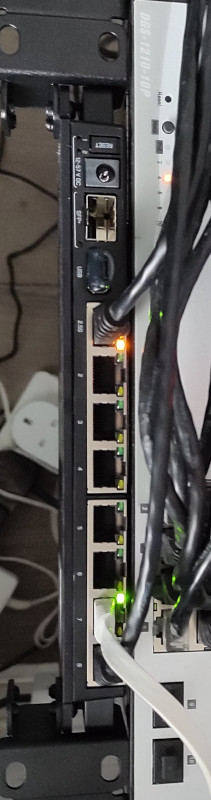
RB5009 This has ended up longer than I expected. I ll write up posts about some of the individual steps with some more details at some point, but this is an overview of the yak shaving I engaged in. The TL;DR is:
The desire for a faster connection When I migrated my home connection to FTTP I kept the same 80M/20M profile I d had on FTTC. I didn t have a pressing need for faster, and I saved money because I was no longer paying for the phone line portion. I wanted more, but at the time I think the only option was for a 160M/30M profile instead and I didn t need it and it wasn t enough better to convince me. Time passed and BT rolled out their GigE (really 900M) download option. And again, I didn t need it, but I wanted it. My provider, Aquiss, initially didn t offer this (I think they had up to 330M download options available by this point). So I stayed on 80M/20M. And the only time I really wanted it to be faster was when pushing off-site backups to rsync.net. Of course, we ve had the pandemic, and that s involved 2 adults working from home with plenty of video calls throughout the day. The 80M/20M connection has proved rock solid for this, so again, I didn t feel an upgrade was justified. We got a 4K capable TV last year and while the bandwidth usage for 4K streaming is noticeably higher, again the connection can handle it no problem. At some point last year I noticed Aquiss had added speed options all the way to 900M down. At the end of the year I accepted a new role, which is fully remote, so I had a bit of an acceptance about the fact that I wasn t going back into an office any time soon. The combination (and the desire for the increased upload speed) finally allowed me to justify the upgrade to myself.

Testing the current setup for bottlenecks The first thing to do was see whether my internal network could cope with an upgrade. I m mostly running Cat6 GigE so I wasn t worried about that side of things. However I m using an RB3011 as my core router, and while it has some coprocessors for routing acceleration they re not supported under mainline Linux (and unlikely to be any time soon). So I had to benchmark what it was capable of routing. I run a handful of VLANs within my home network, with stateful firewalling between them, so I felt that would be a good approximation of the maximum speed to the outside world I might be able to get if I had the external connection upgraded. I went for the easy approach and fired up iPerf3 on 2 hosts, both connected via ethernet but on separate networks, so routed through the RB3011. That resulted in slightly more than a 300Mb/s throughput. Ok. I confirmed that I could get 900Mb/s+ on 2 hosts both on the same network, just to be sure there wasn t some other issue I was missing. Nope, so unsurprisingly the router was the bottleneck. So. To upgrade my internet speed I need to upgrade my router. I could just buy something off the shelf, but I like being able to run Debian (or OpenWRT) on the router rather than some horrible vendor firmware. Lucky MikroTik launched the RB5009 towards the end of last year. RouterOS is probably more than capable, but what really interested me was the fact it s an ARM64 platform based on an Armada 7040, which is pretty well supported in mainline kernels already. There s a 10G connection from the internal switch to the CPU, as well as a 2.5Gb/s ethernet port and a 10G SFP+ cage. All good stuff. I ordered one just before the New Year. Thankfully the OpenWRT folk had done all of the hard work on getting a mainline kernel booting on the device; Sergey Sergeev and Robert Marko in particular fighting RouterBoot and producing a suitable device tree file to get everything up and running. I ended up soldering a serial console connection up to aid debugging, and lightly patching Rob s u-boot to fix the incorrect RAM size reported by RouterBoot. A few kernel tweaks were necessary to make the networking entirely happy and at that point it was time to think about actually doing a replacement.

Upgrading to Debian 11 (bullseye) My RB3011 is currently running Debian 10 (buster); an upgrade has been on my todo list, but with the impending replacement I decided I d hold off and create a new Debian 11 (bullseye) image for the RB5009. Additionally, I don t actually run off the internal NAND in the RB3011; I have a USB flash drive for the rootfs and just the kernel booting off internal NAND. Originally this was for ease of testing, then a combination of needing to figure out a good read-only root solution and a small enough image to fit in the 120M available. For the upgrade I decided to finally look at these pieces. I ve ended up with a script that will build me a squashfs image, and the initial rootfs takes care of mounting this and then a tmpfs as an overlay fs. That means I can easily see what pieces are being written to. The RB5009 has a total of 1G NAND so I m not as space constrained, but the squashfs ends up under 50M. I ve added some additional pieces to allow me to pre-populate the overlay fs with updates rather than always needing to rebuild the squashfs image. With that done I decided to try it out on the RB3011; I tweaked the build script to be able to build for armhf (the RB3011) or arm64 (the RB5009) and to deal with some slight differences in configuration between the two (e.g. interface naming). The idea here was to ensure I d got all the appropriate configuration sorted for the RB5009, in the known-good existing environment. Everything is still on a USB stick at this stage and the new device has an armhf busybox root meaning it can be used on either device, and the init script detects the architecture to select the appropriate squashfs to mount.

A problem with ESP8266 home automation devices Everything seemed to work fine - a few niggles with the watchdog, which is overly sensitive on the RB3011, but I got those sorted (and the build script updated) and the device came up and successfully did the PPPoE dance to bring up external connectivity. And then I noticed that my home automation devices were having problems connecting to the mosquitto MQTT server. It turned out it was only the ESP8266 based devices that were failing, and examining the serial debug output on one of my test devices revealed it was hitting an out of memory issue (displaying E:M 280) when establishing the TLS MQTT connection. I rolled back to the Debian 10 image and set about creating a test environment to look at the ESP8266 issues. My first action was to try and reduce my RAM footprint to try and ensure there was enough spare to establish the connection. I moved a few functions that were still sitting in IRAM into flash. I cleaned up a couple of buffers that are on the stack to be more correctly sized. I tried my new image, and I didn t get the memory issue. Instead I progressed a bit further and got a watchdog reset. Doh! It was obviously something related to the TLS connection, but I couldn t easily see what the difference was; the same x509 cert was in use, it looked like the initial handshake was the same (and trying with openssl s_client looked pretty similar too). I set about instrumenting the ancient Mbed TLS used in the Espressif SDK and discovered that whatever had changed between buster + bullseye meant the EPS8266 was now trying a TLS-DHE-RSA-WITH-AES-256-CBC-SHA256 handshake instead of a TLS-RSA-WITH-AES-256-CBC-SHA256 handshake and that was causing enough extra CPU usage that it couldn t complete in time and the watchdog kicked in. So I commented out MBEDTLS_KEY_EXCHANGE_DHE_RSA_ENABLED in the config_esp.h for mbedtls and rebuilt things. Hacky, but I ll go back to trying to improve this generally at some point.

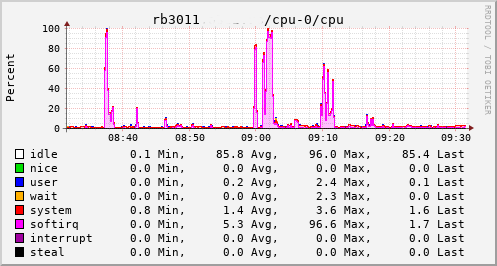
A detour into interrupt load Now, my testing of the RB3011 image is generally done at weekends, when I have enough time to tear down and rebuild the connection rather than doing it in the evening and having limited time to get things working again in time for work in the morning. So at the point I had an image ready to go I pulled the trigger on the line upgrade. I went with the 500M/75M option rather than the full 900M - I suspect I d have difficulty actually getting that most of the time and 75M of upload bandwidth seems fairly substantial for now. It only took a couple of days from the order to the point the line was regraded (which involved no real downtime - just a reconnection in the night). Of course this happened just after the weekend I d discovered the ESP8266 issue. collectd CPU usage for RB3011 This provided an opportunity to see just what the RB3011 could actually manage. In the configuration I had it turned out to be not much more than the 80Mb/s speeds I had previously seen. The upload jumped from a solid 20Mb/s to 75Mb/s, so I knew the regrade had actually happened. Looking at CPU utilisation clearly showed the problem; softirqs were using almost 100% of a CPU core. Now, the way the hardware is setup on the RB3011 is that there are two separate 5 port switches, each connected back to the CPU via a separate GigE interface. For various reasons I had everything on a single switch, which meant that all traffic was boomeranging in and out of the same CPU interface. The IPQ8064 has dual cores, so I thought I d try moving the external connection to the other switch. That puts it on its own GigE CPU interface, which then allows binding the interrupts to a different CPU core. That helps; throughput to the outside world hits 140Mb/s+. Still a long way from the expected max, but proof we just need more grunt.
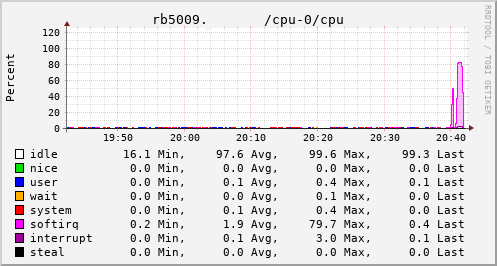
Success collectd CPU usage for RB5009 Which brings us to this past weekend, when, having worked out all the other bits, I tried the squashfs root image again on the RB3011. Success! The home automation bits connected to it, the link to the outside world came up, everything seemed happy. So I double checked my bootloader bits on the RB5009, brought it down to the comms room and plugged it in instead. And, modulo my failing to update the nftables config to allow it to do forwarding, it all came up ok. Some testing with iperf3 internally got a nice 912Mb/s sustained between subnets, and some less scientific testing with wget + speedtest-cli saw speeds of over 460Mb/s to the outside world. Time from ordering the router until it was in service? Just under 8 weeks

21 February 2022

Raphaël Hertzog: Freexian s report about Debian Long Term Support, January 2022

A Debian LTS logo
Every month we review the work funded by Freexian s Debian LTS offering. Please find the report for January below. Debian project funding We continue to looking forward to hearing about Debian project proposals from various Debian stakeholders. This month has seen work on a survey that will go out to Debian Developers to gather feedback on what they think should be the priorities for funding in the project. Learn more about the rationale behind this initiative in this article. Debian LTS contributors In January, 13 contributors were paid to work on Debian LTS, their reports are available below. If you re interested in participating in the LTS or ELTS teams, we welcome participation from the Debian community. Simply get in touch with Jeremiah or Rapha l. Evolution of the situation In January we released 34 DLAs. The security tracker currently lists 39 packages with a known CVE and the dla-needed.txt file has 20 packages still needing an update. Thanks to our sponsors Sponsors that joined recently are in bold.

16 February 2022

Robert McQueen: Forward the Foundation

Earlier this week, Neil McGovern announced that he is due to be stepping down as the Executive Director as the GNOME Foundation later this year. As the President of the board and Neil s effective manager together with the Executive Committee, I wanted to take a moment to reflect on his achievements in the past 5 years and explain a little about what the next steps would be. Since joining in 2017, Neil has overseen a productive period of growth and maturity for the Foundation, increasing our influence both within the GNOME project and the wider Free and Open Source Software community. Here s a few highlights of what he s achieved together with the Foundation team and the community: Recognizing and appreciating the amazing progress that GNOME has made with Neil s support, the search for a new Executive Director provides the opportunity for the Foundation board to set the agenda and next high-level goals we d like to achieve together with our new Executive Director. In terms of the desktop, applications, technology, design and development processes, whilst there are always improvements to be made, the board s general feeling is that thanks to the work of our amazing community of contributors, GNOME is doing very well in terms of what we produce and publish. Recent desktop releases have looked great, highly polished and well-received, and the application ecosystem is growing and improving through new developers and applications bringing great energy at the moment. From here, our largest opportunity in terms of growing the community and our user base is being able to articulate the benefits of what we ve produced to a wider public audience, and deliver impact which allows us to secure and grow new and sustainable sources of funding. For individuals, we are able to offer an exceedingly high quality desktop experience and a broad range of powerful applications which are affordable to all, backed by a nonprofit which can be trusted to look after your data, digital security and your best interests as an individual. From the perspective of being a public charity in the US, we also have the opportunity to establish programs that draw upon our community, technology and products to deliver impact such as developing employable skills, incubating new Open Source contributors, learning to program and more. For our next Executive Director, we will be looking for an individual with existing experience in that nonprofit landscape, ideally with prior experience establishing and raising funds for programs that deliver impact through technology, and appreciation for the values that bring people to Free, Open Source and other Open Culture organizations. Working closely with the existing members, contributors, volunteers and whole GNOME community, and managing our relationships with the Advisory Board and other key partners, we hope to find a candidate that can build public awareness and help people learn about, use and benefit from what GNOME has built over the past two decades. Neil has agreed to stay in his position for a 6 month transition period, during which he will support the board in our search for a new Executive Director and support a smooth hand-over. Over the coming weeks we will publish the job description for the new ED, and establish a search committee who will be responsible for sourcing and interviewing candidates to make a recommendation to the board for Neil s successor a hard act to follow! I m confident the community will join me and the board in personally thanking Neil for his 5 years of dedicated service in support of GNOME and the Foundation. Should you have any queries regarding the process, or offers of assistance in the coming hiring process, please don t hesitate to join the discussion or reach out directly to the board.

13 January 2022

Bits from Debian: New Debian Developers and Maintainers (November and December 2021)

The following contributors got their Debian Developer accounts in the last two months: The following contributors were added as Debian Maintainers in the last two months: Congratulations!

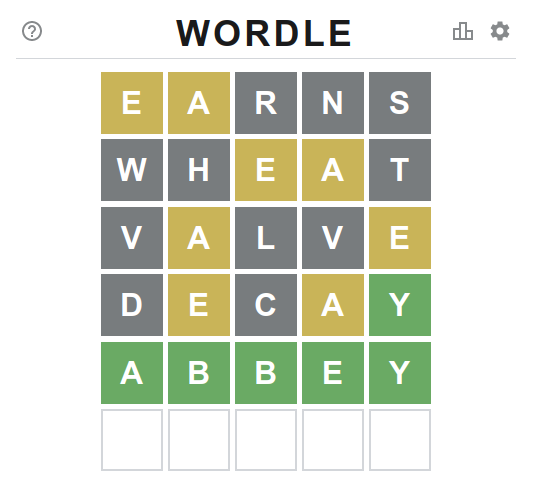
Daniel Lange: Leveling the playing field for non-native speakers

Wordle game screenshort of bash, grep and pipes

Updates 24.01.2022: What I love about the community is the playful creativity that inspires a game like Wordle and that in turn inspires others to create fun tools around it: Robert Reichel has reverse engineered the Wordle application, so in case you want to play tomorrow's word today .. you can. Or have that one guess "Genius" solution experience. JP Fosterson created a Wordle helper that is very much the Python version of my grep-foo above. In case you play regularly and can use a hand. And Tom Lockwood wrote a Wordle solver also in Python. He blogged about it and ... is pondering to rewrite things in Rust:

I ve decided to explore Rust for this, and so far what was taking 1GB of RAM in Python is taking, literally 1MB in Rust!
Welcome to 2022. 01.02.2022: OMG. Wordle has been bought by the New York Times for "for a price in the low seven figures" (Source). Joey Rees-Hill put it well in The Death of Wordle:
Today s Web is dominated by platforms. The average Web user will spend most of their time on large platforms such as Instagram, Facebook, Twitter, TikTok, Google Drive/Docs, YouTube, Netflix, Spotify, Gmail, and Google Calendar, along with sites operated by large publishers such as The New York Times or The Washington Post. [..]
The Web wasn t always this way. I m not old enough to remember this, but things weren t always so centralized. Web users might run their own small website, and certainly would visit a good variety of smaller sites. With the increasing availability of internet access, the Web has become incredibly commercialized, with a handful of companies concentrating Web activity on their own properties.
Wordle was a small site that gained popularity despite not being part of a corporate platform. It was wonderful to see an independent site gain attention for being simple and fun. Wordle was refreshingly free of attention-manipulating dark patterns and pushy monetization. That s why it s a shame to see it absorbed, to inevitably become just another feature of one large media company s portfolio.
Still kudos to Josh Wardle, a Million Pounds for Wordle. Well done! It was fun while it lasted. Let's see what the next Wordle will be. This one has just been absorbed into the borg collective.

8 January 2022

Jonathan Dowland: 2021 in Fiction

Cover for *This is How You Lose the Time War*
Cover for *Robot*
Cover for *The Glass Hotel*
Following on from last year's round-up of my reading, here's a look at the fiction I enjoyed in 2021. I managed to read 42 books in 2021, up from 31 last year. That's partly to do with buying an ereader: 33/36% of my reading (by pages/by books) was ebooks. I think this demonstrates that ebooks have mostly complemented paper books for me, rather than replacing them. My book of the year (although it was published in 2019) was This is How You Lose the Time War by Amal El-Mohtar and Max Gladstone: A short epistolary love story between warring time travellers and quite unlike anything else I've read for a long time. Other notables were The Glass Hotel by Emily St John Mandel and Robot by Adam Wi niewski-Snerg. The biggest disappointment for me was The Ministry for the Future by Kim Stanley Robinson (KSR), which I haven't even finished. I love KSRs writing: I've written about him many times on this blog, at least in 2002, 2006 and 2009, I think I've read every other novel he's published and most of his short stories. But this one was too much of something for me. He's described this novel a the end-point of a particular journey and approach to writing he's taken, which I felt relieved to learn, assuming he writes any more novels (and I really hope that he does) they will likely be in a different "mode". My "new author discovery" for 2021 was Chris Beckett: I tore through Two Tribes and America City before promptly buying all his other work. He fits roughly into the same bracket as Adam Roberts and Christopher Priest, two of my other favourite authors. 5 of the books I read (12%) were from my "backlog" of already-purchased physical books. I'd like to try and reduce my Backlog further so I hope to push this figure up next year. I made a small effort to read more diverse authors this year. 24% of the books I read (by book count and page count) were by women. 15% by page count were (loosely) BAME (19% by book count). Again I'd like to increase these numbers modestly in 2022. Unlike 2020, I didn't complete any short story collections in 2021! This is partly because there was only one issue of Interzone published in all of 2021, a double-issue which I haven't yet finished. This is probably a sad date point in terms of Interzone's continued existence, but it's not dead yet.

Next.

Previous.