Search Results: "rak"

19 October 2020

Louis-Philippe V ronneau: Musings on long-term software support and economic incentives

Although I still read a lot, during my college sophomore years my reading habits shifted from novels to more academic works. Indeed, reading dry textbooks and economic papers for classes often kept me from reading anything else substantial. Nowadays, I tend to binge read novels: I won't touch a book for months on end, and suddenly, I'll read 10 novels back to back1. At the start of a novel binge, I always follow the same ritual: I take out my e-reader from its storage box, marvel at the fact the battery is still pretty full, turn on the WiFi and check if there are OS updates. And I have to admit, Kobo Inc. (now Rakuten Kobo) has done a stellar job of keeping my e-reader up to date. I've owned this model (a Kobo Aura 1st generation) for 7 years now and I'm still running the latest version of Kobo's Linux-based OS. Having recently had trouble updating my Nexus 5 (also manufactured 7 years ago) to Android 102, I asked myself:
Why is my e-reader still getting regular OS updates, while Google stopped issuing security patches for my smartphone four years ago?
To try to answer this, let us turn to economic incentives theory. Although not the be-all and end-all some think it is3, incentives theory is not a bad tool to analyse this particular problem. Executives at Google most likely followed a very business-centric logic when they decided to drop support for the Nexus 5. Likewise, Rakuten Kobo's decision to continue updating older devices certainly had very little to do with ethics or loyalty to their user base. So, what are the incentives that keep Kobo updating devices and why are they different than smartphone manufacturers'? A portrait of the current long-term software support offerings for smartphones and e-readers Before delving deeper in economic theory, let's talk data. I'll be focusing on 2 brands of e-readers, Amazon's Kindle and Rakuten's Kobo. Although the e-reader market is highly segmented and differs a lot based on geography, Amazon was in 2015 the clear worldwide leader with 53% of the worldwide e-reader sales, followed by Rakuten Kobo at 13%4. On the smartphone side, I'll be differentiating between Apple's iPhones and Android devices, taking Google as the barometer for that ecosystem. As mentioned below, Google is sadly the leader in long-term Android software support. Rakuten Kobo According to their website and to this Wikipedia table, the only e-readers Kobo has deprecated are the original Kobo eReader and the Kobo WiFi N289, both released in 2010. This makes their oldest still supported device the Kobo Touch, released in 2011. In my book, that's a pretty good track record. Long-term software support does not seem to be advertised or to be a clear selling point in their marketing. Amazon According to their website, Amazon has dropped support for all 8 devices produced before the Kindle Paperwhite 2nd generation, first sold in 2013. To put things in perspective, the first Kindle came out in 2007, 3 years before Kobo started selling devices. Like Rakuten Kobo, Amazon does not make promises of long-term software support as part of their marketing. Apple Apple has a very clear software support policy for all their devices:
Owners of iPhone, iPad, iPod or Mac products may obtain a service and parts from Apple or Apple service providers for five years after the product is no longer sold or longer, where required by law.
This means in the worst-case scenario of buying an iPhone model just as it is discontinued, one would get a minimum of 5 years of software support. Android Google's policy for their Android devices is to provide software support for 3 years after the launch date. If you buy a Pixel device just before the new one launches, you could theoretically only get 2 years of support. In 2018, Google decided OEMs would have to provide security updates for at least 2 years after launch, threatening not to license Google Apps and the Play Store if they didn't comply. A question of cost structure From the previous section, we can conclude that in general, e-readers seem to be supported longer than smartphones, and that Apple does a better job than Android OEMs, providing support for about twice as long. Even Fairphone, who's entire business is to build phones designed to last and to be repaired was not able to keep the Fairphone 1 (2013) updated for more than a couple years and seems to be struggling to keep the Fairphone 2 (2015) running an up to date version of Android. Anyone who has ever worked in IT will tell you: maintaining software over time is hard work and hard work by specialised workers is expensive. Most commercial electronic devices are sold and developed by for-profit enterprises and software support all comes down to a question of cost structure. If companies like Google or Fairphone are to be expected to provide long-term support for the devices they manufacture, they have to be able to fund their work somehow. In a perfect world, people would be paying for the cost of said long-term support, as it would likely be cheaper then buying new devices every few years and would certainly be better for the planet. Problem is, manufacturers aren't making them pay for it. Economists call this type of problem externalities: things that should be part of the cost of a good, but aren't for one a reason or another. A classic example of an externality is pollution. Clearly pollution is bad and leads to horrendous consequences, like climate change. Sane people agree we should drastically cut our greenhouse gas emissions, and yet, we aren't. Neo-classical economic theory argues the way to fix externalities like pollution is to internalise these costs, in other words, to make people pay for the "real price" of the goods they buy. In the case of climate change and pollution, neo-classical economic theory is plain wrong (spoiler alert: it often is), but this is where band-aids like the carbon tax comes from. Still, coming back to long-term software support, let's see what would happen if we were to try to internalise software maintenance costs. We can do this multiple ways. 1 - Include the price of software maintenance in the cost of the device This is the choice Fairphone makes. This might somewhat work out for them since they are a very small company, but it cannot scale for the following reasons:
  1. This strategy relies on you giving your money to an enterprise now, and trusting them to "Do the right thing" years later. As the years go by, they will eventually look at their books, see how much ongoing maintenance is costing them, drop support for the device, apologise and move on. That is to say, enterprises have a clear economic incentive to promise long-term support and not deliver. One could argue a company's reputation would suffer from this kind of behaviour. Maybe sometime it does, but most often people forget. Political promises are a great example of this.
  2. Enterprises go bankrupt all the time. Even if company X promises 15 years of software support for their devices, if they cease to exist, your device will stop getting updates. The internet is full of stories of IoT devices getting bricked when the parent company goes bankrupt and their servers disappear. This is related to point number 1: to some degree, you have a disincentive to pay for long-term support in advance, as the future is uncertain and there are chances you won't get the support you paid for.
  3. Selling your devices at a higher price to cover maintenance costs does not necessarily mean you will make more money overall raising more money to fund maintenance costs being the goal here. To a certain point, smartphone models are substitute goods and prices higher than market prices will tend to drive consumers to buy cheaper ones. There is thus a disincentive to include the price of software maintenance in the cost of the device.
  4. People tend to be bad at rationalising the total cost of ownership over a long period of time. Economists call this phenomenon hyperbolic discounting. In our case, it means people are far more likely to buy a 500$ phone each 3 years than a 1000$ phone each 10 years. Again, this means OEMs have a clear disincentive to include the price of long-term software maintenance in their devices.
Clearly, life is more complex than how I portrayed it: enterprises are not perfect rational agents, altruism exists, not all enterprises aim solely for profit maximisation, etc. Still, in a capitalist economy, enterprises wanting to charge for software maintenance upfront have to overcome these hurdles one way or another if they want to avoid failing. 2 - The subscription model Another way companies can try to internalise support costs is to rely on a subscription-based revenue model. This has multiple advantages over the previous option, mainly:
  1. It does not affect the initial purchase price of the device, making it easier to sell them at a competitive price.
  2. It provides a stable source of income, something that is very valuable to enterprises, as it reduces overall risks. This in return creates an incentive to continue providing software support as long as people are paying.
If this model is so interesting from an economic incentives point of view, why isn't any smartphone manufacturer offering that kind of program? The answer is, they are, but not explicitly5. Apple and Google can fund part of their smartphone software support via the 30% cut they take out of their respective app stores. A report from Sensor Tower shows that in 2019, Apple made an estimated US$ 16 billion from the App Store, while Google raked in US$ 9 billion from the Google Play Store. Although the Fortune 500 ranking tells us this respectively is "only" 5.6% and 6.5% of their gross annual revenue for 2019, the profit margins in this category are certainly higher than any of their other products. This means Google and Apple have an important incentive to keep your device updated for some time: if your device works well and is updated, you are more likely to keep buying apps from their store. When software support for a device stops, there is a risk paying customers will buy a competitor device and leave their ecosystem. This also explains why OEMs who don't own app stores tend not to provide software support for very long periods of time. Most of them only make money when you buy a new phone. Providing long-term software support thus becomes a disincentive, as it directly reduces their sale revenues. Same goes for Kindles and Kobos: the longer your device works, the more money they make with their electronic book stores. In my opinion, it's likely Amazon and Rakuten Kobo produce quarterly cost-benefit reports to decide when to drop support for older devices, based on ongoing support costs and the recurring revenues these devices bring in. Rakuten Kobo is also in a more precarious situation than Amazon is: considering Amazon's very important market share, if your device stops getting new updates, there is a greater chance people will replace their old Kobo with a Kindle. Again, they have an important economic incentive to keep devices running as long as they are profitable. Can Free Software fix this? Yes and no. Free Software certainly isn't a magic wand one can wave to make everything better, but does provide major advantages in terms of security, user freedom and sometimes costs. The last piece of the puzzle explaining why Rakuten Kobo's software support is better than Google's is technological choices. Smartphones are incredibly complex devices and have become the main computing platform of many. Similar to the web, there is a race for features and complexity that tends to create bloat and make older devices slow and painful to use. On the other hand, e-readers are simpler devices built for a single task: display electronic books. Control over the platform is also a key aspect of the cost structure of providing software updates. Whereas Apple controls both the software and hardware side of iPhones, Android is a sad mess of drivers and SoCs, all providing different levels of support over time6. If you take a look at the platforms the Kindle and Kobo are built on, you'll quickly see they both use Freescale I.MX SoCs. These processors are well known for their excellent upstream support in the Linux kernel and their relative longevity, chips being produced for either 10 or 15 years. This in turn makes updates much easier and less expensive to provide. So clearly, open architectures, free drivers and open hardware helps tremendously, but aren't enough on their own. One of the lessons we must learn from the (amazing) LineageOS project is how lack of funding hurts everyone. If there is no one to do the volunteer work required to maintain a version of LOS for your device, it won't be supported. Worse, when purchasing a new device, users cannot know in advance how many years of LOS support they will get. This makes buying new devices a frustrating hit-and-miss experience. If you are lucky, you will get many years of support. Otherwise, you risk your device becoming an expensive insecure paperweight. So how do we fix this? Anyone with a brain understands throwing away perfectly good devices each 2 years is not sustainable. Government regulations enforcing a minimum support life would be a step in the right direction, but at the end of the day, Capitalism is to blame. Like the aforementioned carbon tax, band-aid solutions can make things somewhat better, but won't fix our current economic system's underlying problems. For now though, I'll leave fixing the problem of Capitalism to someone else.

  1. My most recent novel binge has been focused on re-reading the Dune franchise. I first read the 6 novels written by Frank Herbert when I was 13 years old and only had vague and pleasant memories of his work. Great stuff.
  2. I'm back on LineageOS! Nice folks released an unofficial LOS 17.1 port for the Nexus 5 last January and have kept it updated since then. If you are to use it, I would also recommend updating TWRP to this version specifically patched for the Nexus 5.
  3. Very few serious economists actually believe neo-classical rational agent theory is a satisfactory explanation of human behavior. In my opinion, it's merely a (mostly flawed) lens to try to interpret certain behaviors, a tool amongst others that needs to be used carefully, preferably as part of a pluralism of approaches.
  4. Good data on the e-reader market is hard to come by and is mainly produced by specialised market research companies selling their findings at very high prices. Those particular statistics come from a MarketWatch analysis.
  5. If they were to tell people: You need to pay us 5$/month if you want to receive software updates, I'm sure most people would not pay. Would you?
  6. Coming back to Fairphones, if they had so much problems providing an Android 9 build for the Fairphone 2, it's because Qualcomm never provided Android 7+ support for the Snapdragon 801 SoC it uses.

5 October 2020

Reproducible Builds: Reproducible Builds in September 2020

Welcome to the September 2020 report from the Reproducible Builds project. In our monthly reports, we attempt to summarise the things that we have been up to over the past month, but if you are interested in contributing to the project, please visit our main website. This month, the Reproducible Builds project was pleased to announce a donation from Amateur Radio Digital Communications (ARDC) in support of its goals. ARDC s contribution will propel the Reproducible Builds project s efforts in ensuring the future health, security and sustainability of our increasingly digital society. Amateur Radio Digital Communications (ARDC) is a non-profit which was formed to further research and experimentation with digital communications using radio, with a goal of advancing the state of the art of amateur radio and to educate radio operators in these techniques. You can view the full announcement as well as more information about ARDC on their website.
In August s report, we announced that Jennifer Helsby (redshiftzero) launched a new reproduciblewheels.com website to address the lack of reproducibility of Python wheels . This month, Kushal Das posted a brief follow-up to provide an update on reproducible sources as well. The Threema privacy and security-oriented messaging application announced that within the next months , their apps will become fully open source, supporting reproducible builds :
This is to say that anyone will be able to independently review Threema s security and verify that the published source code corresponds to the downloaded app.
You can view the full announcement on Threema s website.

Events Sadly, due to the unprecedented events in 2020, there will be no in-person Reproducible Builds event this year. However, the Reproducible Builds project intends to resume meeting regularly on IRC, starting on Monday, October 12th at 18:00 UTC (full announcement). The cadence of these meetings will probably be every two weeks, although this will be discussed and decided on at the first meeting. (An editable agenda is available.) On 18th September, Bernhard M. Wiedemann gave a presentation in German titled Wie reproducible builds Software sicherer machen ( How reproducible builds make software more secure ) at the Internet Security Digital Days 2020 conference. (View video.) On Saturday 10th October, Morten Linderud will give a talk at Arch Conf Online 2020 on The State of Reproducible Builds in the Arch Linux distribution:
The previous year has seen great progress in Arch Linux to get reproducible builds in the hands of the users and developers. In this talk we will explore the current tooling that allows users to reproduce packages, the rebuilder software that has been written to check packages and the current issues in this space.
During the Reproducible Builds summit in Marrakesh, GNU Guix, NixOS and Debian were able to produce a bit-for-bit identical binary when building GNU Mes, despite using three different major versions of GCC. Since the summit, additional work resulted in a bit-for-bit identical Mes binary using tcc and this month, a fuller update was posted by the individuals involved.

Development work In openSUSE, Bernhard M. Wiedemann published his monthly Reproducible Builds status update.

Debian Chris Lamb uploaded a number of Debian packages to address reproducibility issues that he had previously provided patches for, including cfingerd (#831021), grap (#870573), splint (#924003) & schroot (#902804) Last month, an issue was identified where a large number of Debian .buildinfo build certificates had been tainted on the official Debian build servers, as these environments had files underneath the /usr/local/sbin directory to prevent the execution of system services during package builds. However, this month, Aurelien Jarno and Wouter Verhelst fixed this issue in varying ways, resulting in a special policy-rcd-declarative-deny-all package. Building on Chris Lamb s previous work on reproducible builds for Debian .ISO images, Roland Clobus announced his work in progress on making the Debian Live images reproducible. [ ] Lucas Nussbaum performed an archive-wide rebuild of packages to test enabling the reproducible=+fixfilepath Debian build flag by default. Enabling the fixfilepath feature will likely fix reproducibility issues in an estimated 500-700 packages. The test revealed only 33 packages (out of 30,000 in the archive) that fail to build with fixfilepath. Many of those will be fixed when the default LLVM/Clang version is upgraded. 79 reviews of Debian packages were added, 23 were updated and 17 were removed this month adding to our knowledge about identified issues. Chris Lamb added and categorised a number of new issue types, including packages that captures their build path via quicktest.h and absolute build directories in documentation generated by Doxygen , etc. Lastly, Lukas Puehringer s uploaded a new version of the in-toto to Debian which was sponsored by Holger Levsen. [ ]

diffoscope diffoscope is our in-depth and content-aware diff utility that can not only locate and diagnose reproducibility issues, it provides human-readable diffs of all kinds too. In September, Chris Lamb made the following changes to diffoscope, including preparing and uploading versions 159 and 160 to Debian:
  • New features:
    • Show ordering differences only in strings(1) output by applying the ordering check to all differences across the codebase. [ ]
  • Bug fixes:
    • Mark some PGP tests that they require pgpdump, and check that the associated binary is actually installed before attempting to run it. (#969753)
    • Don t raise exceptions when cleaning up after guestfs cleanup failure. [ ]
    • Ensure we check FALLBACK_FILE_EXTENSION_SUFFIX, otherwise we run pgpdump against all files that are recognised by file(1) as data. [ ]
  • Codebase improvements:
    • Add some documentation for the EXTERNAL_TOOLS dictionary. [ ]
    • Abstract out a variable we use a couple of times. [ ]
  • diffoscope.org website improvements:
    • Make the (long) demonstration GIF less prominent on the page. [ ]
In addition, Paul Spooren added support for automatically deploying Docker images. [ ]

Website and documentation This month, a number of updates to the main Reproducible Builds website and related documentation. Chris Lamb made the following changes: In addition, Holger Levsen re-added the documentation link to the top-level navigation [ ] and documented that the jekyll-polyglot package is required [ ]. Lastly, diffoscope.org and reproducible-builds.org were transferred to Software Freedom Conservancy. Many thanks to Brett Smith from Conservancy, J r my Bobbio (lunar) and Holger Levsen for their help with transferring and to Mattia Rizzolo for initiating this.

Upstream patches The Reproducible Builds project detects, dissects and attempts to fix as many currently-unreproducible packages as possible. We endeavour to send all of our patches upstream where appropriate. This month, we wrote a large number of these patches, including: Bernhard M. Wiedemann also reported issues in git2-rs, pyftpdlib, python-nbclient, python-pyzmq & python-sidpy.

Testing framework The Reproducible Builds project operates a Jenkins-based testing framework to power tests.reproducible-builds.org. This month, Holger Levsen made the following changes:
  • Debian:
    • Shorten the subject of nodes have gone offline notification emails. [ ]
    • Also track bugs that have been usertagged with usrmerge. [ ]
    • Drop abort-related codepaths as that functionality has been removed from Jenkins. [ ]
    • Update the frequency we update base images and status pages. [ ][ ][ ][ ]
  • Status summary view page:
    • Add support for monitoring systemctl status [ ] and the number of diffoscope processes [ ].
    • Show the total number of nodes [ ] and colourise critical disk space situations [ ].
    • Improve the visuals with respect to vertical space. [ ][ ]
  • Debian rebuilder prototype:
    • Resume building random packages again [ ] and update the frequency that packages are rebuilt. [ ][ ]
    • Use --no-respect-build-path parameter until sbuild 0.81 is available. [ ]
    • Treat the inability to locate some packages as a debrebuild problem, and not as a issue with the rebuilder itself. [ ]
  • Arch Linux:
    • Update various components to be compatible with Arch Linux s move to the xz compression format. [ ][ ][ ]
    • Allow scheduling of old packages to catch up on the backlog. [ ][ ][ ]
    • Improve formatting on the summary page. [ ][ ]
    • Update HTML pages once every hour, not every 30 minutes. [ ]
    • Use the Ubuntu (!) GPG keyserver to validate packages. [ ]
  • System health checks:
    • Highlight important bad conditions in colour. [ ][ ]
    • Add support for detecting more problems, including Jenkins shutdown issues [ ], failure to upgrade Arch Linux packages [ ], kernels with wrong permissions [ ], etc.
  • Misc:
    • Delete old schroot sessions after 2 days, not 3. [ ]
    • Use sudo to cleanup diffoscope schroot sessions. [ ]
In addition, stefan0xC fixed a query for unknown results in the handling of Arch Linux packages [ ] and Mattia Rizzolo updated the template that notifies maintainers by email of their newly-unreproducible packages to ensure that it did not get caught in junk/spam folders [ ]. Finally, build node maintenance was performed by Holger Levsen [ ][ ][ ][ ], Mattia Rizzolo [ ][ ] and Vagrant Cascadian [ ][ ][ ].
If you are interested in contributing to the Reproducible Builds project, please visit our Contribute page on our website. However, you can get in touch with us via:

12 September 2020

Ryan Kavanagh: Configuring OpenIKED VPNs for Road Warriors

A few weeks ago I configured a road warrior VPN setup. The remote end is on a VPS running OpenBSD and OpenIKED, the VPN is an IKEv2 VPN using x509 authentication, and the local end is StrongSwan. I also configured an IKEv2 VPN between my VPSs. Here are the notes for how to do so. In all cases, to use x509 authentication, you will need to generate a bunch of certificates and keys: Fortunately, OpenIKED provides the ikectl utility to help you do so. Before going any further, you might find it useful to edit /etc/ssl/ikeca.cnf to set some reasonable defaults for your certificates. Begin by creating and installing a CA certificate:
# ikectl ca vpn create
# ikectl ca vpn install
For simplicity, I am going to assume that the you are managing your CA on the same host as one of the hosts that you want to configure for the VPN. If not, see the bit about exporting certificates at the beginning of the section on persistent host-host VPNs. Create and install a key/certificate pair for your server. Suppose for example your first server is called server1.example.org:
# ikectl ca vpn certificate server1.example.org create
# ikectl ca vpn certificate server1.example.org install

Persistent host-host VPNs For each other server that you want to use, you need to also create a key/certificate pair on the same host as the CA certificate, and then copy them over to the other server. Assuming the other server is called server2.example.org:
# ikectl ca vpn certificate server2.example.org create
# ikectl ca vpn certificate server2.example.org export
This last command will produce a tarball server2.example.org.tgz. Copy it over to server2.example.org and install it:
# tar -C /etc/iked -xzpvf server2.example.org.tgz
Next, it is time to configure iked. To do so, you will need to find some information about the certificates you just generated. On the host with the CA, run
$ cat /etc/ssl/vpn/index.txt
V       210825142056Z           01      unknown /C=US/ST=Pennsylvania/L=Pittsburgh/CN=server1.example.org/emailAddress=rak@example.org
V       210825142208Z           02      unknown /C=US/ST=Pennsylvania/L=Pittsburgh/CN=server2.example.org/emailAddress=rak@example.org
Pick one of the two hosts to play the active role (in this case, server1.example.org). Using the information you gleaned from index.txt, add the following to /etc/iked.conf, filling in the srcid and dstid fields appropriately.
ikev2 'server1_server2_active' active esp from server1.example.org to server2.example.org \
	local server1.example.org peer server2.example.org \
	srcid '/C=US/ST=Pennsylvania/L=Pittsburgh/CN=server1.example.org/emailAddress=rak@example.org' \
	dstid '/C=US/ST=Pennsylvania/L=Pittsburgh/CN=server2.example.org/emailAddress=rak@example.org'
On the other host, add the following to /etc/iked.conf
ikev2 'server2_server1_passive' passive esp from server2.example.org to server1.example.org \
	local server2.example.org peer server1.example.org \
	srcid '/C=US/ST=Pennsylvania/L=Pittsburgh/CN=server2.example.org/emailAddress=rak@example.org' \
	dstid '/C=US/ST=Pennsylvania/L=Pittsburgh/CN=server1.example.org/emailAddress=rak@example.org'
Note that the names 'server1_server2_active' and 'server2_server1_passive' in the two stanzas do not matter and can be omitted. Reload iked on both hosts:
# ikectl reload
If everything worked out, you should see the negotiated security associations (SAs) in the output of
# ikectl show sa
On OpenBSD, you should also see some output on success or errors in the file /var/log/daemon.

For a road warrior Add the following to /etc/iked.conf on the remote end:
ikev2 'responder_x509' passive esp \
	from 0.0.0.0/0 to 10.0.1.0/24 \
	local server1.example.org peer any \
	srcid server1.example.org \
	config address 10.0.1.0/24 \
	config name-server 10.0.1.1 \
	tag "ROADW"
Configure or omit the address range and the name-server configurations to suit your needs. See iked.conf(5) for details. Reload iked:
# ikectl reload
If you are on OpenBSD and want the remote end to have an IP address, add the following to /etc/hostname.vether0, again configuring the address to suit your needs:
inet 10.0.1.1 255.255.255.0
Put the interface up:
# ifconfig vether0 up
Now create a client certificate for authentication. In my case, my road-warrior client was client.example.org:
# ikectl ca vpn certificate client.example.org create
# ikectl ca vpn certificate client.example.org export
Copy client.example.org.tgz to client and run
# tar -C /etc/ipsec.d/ -xzf client.example.org.tgz -- \
	./private/client.example.org.key \
	./certs/client.example.org.crt ./ca/ca.crt
Install StrongSwan and add the following to /etc/ipsec.conf, configuring appropriately:
ca example.org
  cacert=ca.crt
  auto=add
conn server1
  keyexchange=ikev2
  right=server1.example.org
  rightid=%server1.example.org
  rightsubnet=0.0.0.0/0
  rightauth=pubkey
  leftsourceip=%config
  leftauth=pubkey
  leftcert=client.example.org.crt
  auto=route
Add the following to /etc/ipsec.secrets:
# space is important
server1.example.org : RSA client.example.org.key
Restart StrongSwan, put the connection up, and check its status:
# ipsec restart
# ipsec up server1
# ipsec status
That should be it. Sources:

Ryan Kavanagh: Configuring OpenIKED VPNs for StrongSwan Clients

A few weeks ago I configured a road warrior VPN setup. The remote end is on a VPS running OpenBSD and OpenIKED, the VPN is an IKEv2 VPN using x509 authentication, and the local end is StrongSwan. I also configured an IKEv2 VPN between my VPSs. Here are the notes for how to do so. In all cases, to use x509 authentication, you will need to generate a bunch of certificates and keys: Fortunately, OpenIKED provides the ikectl utility to help you do so. Before going any further, you might find it useful to edit /etc/ssl/ikeca.cnf to set some reasonable defaults for your certificates. Begin by creating and installing a CA certificate:
# ikectl ca vpn create
# ikectl ca vpn install
For simplicity, I am going to assume that the you are managing your CA on the same host as one of the hosts that you want to configure for the VPN. If not, see the bit about exporting certificates at the beginning of the section on persistent host-host VPNs. Create and install a key/certificate pair for your server. Suppose for example your first server is called server1.example.org:
# ikectl ca vpn certificate server1.example.org create
# ikectl ca vpn certificate server1.example.org install

Persistent host-host VPNs For each other server that you want to use, you need to also create a key/certificate pair on the same host as the CA certificate, and then copy them over to the other server. Assuming the other server is called server2.example.org:
# ikectl ca vpn certificate server2.example.org create
# ikectl ca vpn certificate server2.example.org export
This last command will produce a tarball server2.example.org.tgz. Copy it over to server2.example.org and install it:
# tar -C /etc/iked -xzpvf server2.example.org.tgz
Next, it is time to configure iked. To do so, you will need to find some information about the certificates you just generated. On the host with the CA, run
$ cat /etc/ssl/vpn/index.txt
V       210825142056Z           01      unknown /C=US/ST=Pennsylvania/L=Pittsburgh/CN=server1.example.org/emailAddress=rak@example.org
V       210825142208Z           02      unknown /C=US/ST=Pennsylvania/L=Pittsburgh/CN=server2.example.org/emailAddress=rak@example.org
Pick one of the two hosts to play the active role (in this case, server1.example.org). Using the information you gleaned from index.txt, add the following to /etc/iked.conf, filling in the srcid and dstid fields appropriately.
ikev2 'server1_server2_active' active esp from server1.example.org to server2.example.org \
	local server1.example.org peer server2.example.org \
	srcid '/C=US/ST=Pennsylvania/L=Pittsburgh/CN=server1.example.org/emailAddress=rak@example.org' \
	dstid '/C=US/ST=Pennsylvania/L=Pittsburgh/CN=server2.example.org/emailAddress=rak@example.org'
On the other host, add the following to /etc/iked.conf
ikev2 'server2_server1_passive' passive esp from server2.example.org to server1.example.org \
	local server2.example.org peer server1.example.org \
	srcid '/C=US/ST=Pennsylvania/L=Pittsburgh/CN=server2.example.org/emailAddress=rak@example.org' \
	dstid '/C=US/ST=Pennsylvania/L=Pittsburgh/CN=server1.example.org/emailAddress=rak@example.org'
Note that the names 'server1_server2_active' and 'server2_server1_passive' in the two stanzas do not matter and can be omitted. Reload iked on both hosts:
# ikectl reload
If everything worked out, you should see the negotiated security associations (SAs) in the output of
# ikectl show sa
On OpenBSD, you should also see some output on success or errors in the file /var/log/daemon.

For a road warrior Add the following to /etc/iked.conf on the remote end:
ikev2 'responder_x509' passive esp \
	from 0.0.0.0/0 to 10.0.1.0/24 \
	local server1.example.org peer any \
	srcid server1.example.org \
	config address 10.0.1.0/24 \
	config name-server 10.0.1.1 \
	tag "ROADW"
Configure or omit the address range and the name-server configurations to suit your needs. See iked.conf(5) for details. Reload iked:
# ikectl reload
If you are on OpenBSD and want the remote end to have an IP address, add the following to /etc/hostname.vether0, again configuring the address to suit your needs:
inet 10.0.1.1 255.255.255.0
Put the interface up:
# ifconfig vether0 up
Now create a client certificate for authentication. In my case, my road-warrior client was client.example.org:
# ikectl ca vpn certificate client.example.org create
# ikectl ca vpn certificate client.example.org export
Copy client.example.org.tgz to client and run
# tar -C /etc/ipsec.d/ -xzf client.example.org.tgz -- \
	./private/client.example.org.key \
	./certs/client.example.org.crt ./ca/ca.crt
Install StrongSwan and add the following to /etc/ipsec.conf, configuring appropriately:
ca example.org
  cacert=ca.crt
  auto=add
conn server1
  keyexchange=ikev2
  right=server1.example.org
  rightid=%server1.example.org
  rightsubnet=0.0.0.0/0
  rightauth=pubkey
  leftsourceip=%config
  leftauth=pubkey
  leftcert=client.example.org.crt
  auto=route
Add the following to /etc/ipsec.secrets:
# space is important
server1.example.org : RSA client.example.org.key
Restart StrongSwan, put the connection up, and check its status:
# ipsec restart
# ipsec up server1
# ipsec status
That should be it. Sources:

1 August 2020

Utkarsh Gupta: FOSS Activites in July 2020

Here s my (tenth) monthly update about the activities I ve done in the F/L/OSS world.

Debian
This was my 17th month of contributing to Debian. I became a DM in late March last year and a DD last Christmas! \o/ Well, this month I didn t do a lot of Debian stuff, like I usually do, however, I did a lot of things related to Debian (indirectly via GSoC)! Anyway, here are the following things I did this month:

Uploads and bug fixes:

Other $things:
  • Mentoring for newcomers.
  • FTP Trainee reviewing.
  • Moderation of -project mailing list.
  • Sponsored php-twig for William, ruby-growl, ruby-xmpp4r, and uby-uniform-notifier for Cocoa, sup-mail for Iain, and node-markdown-it for Sakshi.

GSoC Phase 2, Part 2! In May, I got selected as a Google Summer of Code student for Debian again! \o/
I am working on the Upstream-Downstream Cooperation in Ruby project. The first three blogs can be found here: Also, I log daily updates at gsocwithutkarsh2102.tk. Whilst the daily updates are available at the above site^, I ll breakdown the important parts of the later half of the second month here:
  • Marc Andre, very kindly, helped in fixing the specs that were failing earlier this month. Well, the problem was with the specs, but I am still confused how so. Anyway..
  • Finished documentation of the second cop and marked the PR as ready to be reviewed.
  • David reviewed and suggested some really good changes and I fixed/tweaked that PR as per his suggestion to finally finish the last bits of the second cop, RelativeRequireToLib.
  • Merged the PR upon two approvals and released it as v0.2.0!
  • We had our next weekly meeting where we discussed the next steps and the things that are supposed to be done for the next set of cops.
  • Introduced rubocop-packaging to the outer world and requested other upstream projects to use it! It is being used by 13 other projects already!
  • Started to work on packaging-style-guide but I didn t push anything to the public repository yet.
  • Worked on refactoring the cops_documentation Rake task which was broken by the new auto-corrector API. Opened PR #7 for it. It ll be merged after the next RuboCop release as it uses CopsDocumentationGenerator class from the master branch.
  • Whilst working on autoprefixer-rails, I found something unusual. The second cop shouldn t really report offenses if the require_relative calls are from lib to lib itself. This is a false-positive. Opened issue #8 for the same.

Debian (E)LTS
Debian Long Term Support (LTS) is a project to extend the lifetime of all Debian stable releases to (at least) 5 years. Debian LTS is not handled by the Debian security team, but by a separate group of volunteers and companies interested in making it a success. And Debian Extended LTS (ELTS) is its sister project, extending support to the Jessie release (+2 years after LTS support). This was my tenth month as a Debian LTS and my first as a Debian ELTS paid contributor.
I was assigned 25.25 hours for LTS and 13.25 hours for ELTS and worked on the following things:

LTS CVE Fixes and Announcements:

ELTS CVE Fixes and Announcements:

Other (E)LTS Work:
  • Did my LTS frontdesk duty from 29th June to 5th July.
  • Triaged qemu, firefox-esr, wordpress, libmediainfo, squirrelmail, xen, openjpeg2, samba, and ldb.
  • Mark CVE-2020-15395/libmediainfo as no-dsa for Jessie.
  • Mark CVE-2020-13754/qemu as no-dsa/intrusive for Stretch and Jessie.
  • Mark CVE-2020-12829/qemu as no-dsa for Jessie.
  • Mark CVE-2020-10756/qemu as not-affected for Jessie.
  • Mark CVE-2020-13253/qemu as postponed for Jessie.
  • Drop squirrelmail and xen for Stretch LTS.
  • Add notes for tomcat8, shiro, and cacti to take care of the Stretch issues.
  • Emailed team@security.d.o and debian-lts@l.d.o regarding possible clashes.
  • Maintenance of LTS Survey on the self-hosted LimeSurvey instance. Received 1765 (just wow!) responses.
  • Attended the fourth LTS meeting. MOM here.
  • General discussion on LTS private and public mailing list.

Other(s)
Sometimes it gets hard to categorize work/things into a particular category.
That s why I am writing all of those things inside this category.
This includes two sub-categories and they are as follows.

Personal: This month I did the following things:
  • Released v0.2.0 of rubocop-packaging on RubyGems!
    It s open-sourced and the repository is here.
    Bug reports and pull requests are welcomed!
  • Released v0.1.0 of get_root on RubyGems!
    It s open-sourced and the repository is here.
  • Wrote max-word-frequency, my Rails C1M2 programming assignment.
    And made it pretty neater & cleaner!
  • Refactored my lts-dla and elts-ela scripts entirely and wrote them in Ruby so that there are no issues and no false-positives!
    Check lts-dla here and elts-ela here.
  • And finally, built my first Rails (mini) web-application!
    The repository is here. This was also a programming assignment (C1M3).
    And furthermore, hosted it at Heroku.

Open Source: Again, this contains all the things that I couldn t categorize earlier.
Opened several issues and PRs:
  • Issue #8273 against rubocop, reporting a false-positive auto-correct for Style/WhileUntilModifier.
  • Issue #615 against http reporting a weird behavior of a flaky test.
  • PR #3791 for rubygems/bundler to remove redundant bundler/setup require call from spec_helper generated by bundle gem.
  • Issue #3831 against rubygems, reporting a traceback of undefined method, rubyforge_project=.
  • Issue #238 against nheko asking for enhancement in showing the font name in the very font itself.
  • PR #2307 for puma to constrain rake-compiler to v0.9.4.
  • And finally, I joined the Cucumber organization! \o/

Thank you for sticking along for so long :) Until next time.
:wq for today.

12 July 2020

Antoine Beaupr : On contact tracing apps

I have strong doubts about the efficiency of any tracing app of the sort, and even less in the context where it is unlikely that a majority of the population will use it. There's also the problem that this app would need to work on Apple phones, or be incompatible with them, and cause significant "fracture" between those who have access to technology, and those who haven't. See this text for more details. Such an app would be a security and privacy liability at no benefit to public health. There are better options, see for this research on hardware tokens. But I doubt any contact tracing app or hardware will actually work anyways. I am a computer engineer with more than 20 years of experience in the domain, and I have been following this question closely. Please don't do this.
I wrote the above in a response to the Qu bec government's survey about a possible tracing app. Update: a previous version of this article was titled plainly "on contact tracing". In case that was not obvious, I definitely do not object to contact tracing per se. I believe it's a fundamental, critical, and important part of fighting the epidemic and I think we should do it. I do not believe any engineer has found a proper way of doing it with "apps" so far, but I do not deny the utility and importance of "contact tracing" itself. Apologies for the confusion.

Pour une raison que je m'explique mal, le sondage m' t envoy en anglais, et j'ai donc crit ma r ponse dans la langue de Shakespeare au lieu de celle de moli re... Je serai heureux de fournir une traduction fran aise ceux ou celles qui en ont besoin...

1 July 2020

Utkarsh Gupta: FOSS Activites in June 2020

Here s my (ninth) monthly update about the activities I ve done in the F/L/OSS world.

Debian
This was my 16th month of contributing to Debian. I became a DM in late March last year and a DD last Christmas! \o/ This month was a little intense. I did a lot of different kinds of things in Debian this month. Whilst most of my time went on doing security stuff, I also sponsored a bunch of packages. Here are the following things I did this month:

Uploads and bug fixes:

Other $things:
  • Hosted Ruby team meeting. Logs here.
  • Mentoring for newcomers.
  • FTP Trainee reviewing.
  • Moderation of -project mailing list.
  • Sponsored ruby-ast for Abraham, libexif for Hugh, djangorestframework-gis and karlseguin-ccache for Nilesh, and twig-extensions, twig-i18n-extension, and mariadb-mysql-kbs for William.

GSoC Phase 1, Part 2! Last month, I got selected as a Google Summer of Code student for Debian again! \o/
I am working on the Upstream-Downstream Cooperation in Ruby project. The first half of the first month is blogged here, titled, GSoC Phase 1.
Also, I log daily updates at gsocwithutkarsh2102.tk. Whilst the daily updates are available at the above site^, I ll breakdown the important parts of the later half of the first month here:
  • Documented the first cop, GemspecGit via PR #2.
  • Made an initial release, v0.1.0!
  • Spread the word/usage about this tool/library via adding them in the official RuboCop docs.
  • We had our third weekly meeting where we discussed the next steps and the things that are supposed to be done for the next set of cops.
  • Wrote more tests so as to cover different aspects of the GemspecGit cop.
  • Opened PR #4 for the next Cop, RequireRelativeToLib.
  • Introduced rubocop-packaging to the outer world and requested other upstream projects to use it! It is being used by 6 other projects already
  • Had our fourth weekly meeting where we pair-programmed (and I sucked :P) and figured out a way to make the second cop work.
  • Found a bug, reported at issue #5 and raised PR #6 to fix it.
  • And finally, people loved the library/tool (and it s outcome):


    (for those who don t know, @bbatsov is the author of RuboCop, @lienvdsteen is an amazing fullstack engineer at GitLab, and @pboling is the author of some awesome Ruby tools and libraries!)

Debian LTS
Debian Long Term Support (LTS) is a project to extend the lifetime of all Debian stable releases to (at least) 5 years. Debian LTS is not handled by the Debian security team, but by a separate group of volunteers and companies interested in making it a success. This was my ninth month as a Debian LTS paid contributor. I was assigned 30.00 hours and worked on the following things:

CVE Fixes and Announcements:

Other LTS Work:
  • Triaged sympa, apache2, qemu, and coturn.
  • Add fix for CVE-2020-0198/libexif.
  • Requested CVE for bug#60251 against apache2 and prodded further.
  • Raised issue #947 against sympa reporting an incomplete patch for CVE-2020-10936. More discussions internally.
  • Created the LTS Survey on the self-hosted LimeSurvey instance.
  • Attended the third LTS meeting. Logs here.
  • General discussion on LTS private and public mailing list.

Other(s)
Sometimes it gets hard to categorize work/things into a particular category.
That s why I am writing all of those things inside this category.
This includes two sub-categories and they are as follows.

Personal: This month I did the following things:
  • Wrote and published v0.1.0 of rubocop-packaging on RubyGems!
    It s open-sourced and the repository is here.
    Bug reports and pull requests are welcomed!
  • Integrated a tiny (yet a powerful) hack to align images in markdown for my blog.
    Commit here.
  • Released v0.4.0 of batalert on RubyGems!

Open Source: Again, this contains all the things that I couldn t categorize earlier.
Opened several issues and PRs:
Thank you for sticking along for so long :) Until next time.
:wq for today.

15 June 2020

Utkarsh Gupta: GSoC Phase 1

Hello, Earlier last month, I got selected as a Google Summer of Code student for Debian again! \o/
And as Chandler would say,
Could I be any more happier?
Well, this time, my project is basically to write a linter (an extension to RuboCop). This tool is mostly to help the Debian Ruby team. And that is the best part, I love working in/for/with the Ruby team!
(I ve been an active part of the team for 18 months now :)) More details about the project can be found here, on the wiki.
And also, I have got the best mentors I could ve possibly asked for: Antonio Terceiro and David Rodr guez So, the program began on 1st June and I ve been working since then. I log my daily updates at gsocwithutkarsh2102.tk. Whilst the daily updates are available at the above site^, I ll breakdown the important parts here: It has been a lot of fun so far! Though I am little worried on how to implement the next part of the project as I am not sure how to check only a particalar directory for some relative require calls.
But I think, that s okay, somehow, something will work out. And I can always ask around others and check other cops to see how it s done! \( )/
Until next time.
:wq for today.

11 June 2020

C.J. Adams-Collier: Recovering videos from DV tapes with Canon ZR80

I am recovering some tapes from back in the day that some of you may enjoy. Here is a log of the process so that maybe you can recover some of your own DV tapes. Seems to work well in modern Debian. To attach to the camcorder, I used a PCI-e card that has an old firewire port and some ASIC on board. The PCI card came up and loaded the correct kernel drivers. Here is a search link so that you can buy a similar card. cjac@server0:~$ sudo lspci grep 1394
b2:00.0 FireWire (IEEE 1394): VIA Technologies, Inc. VT6306/7/8 [Fire II(M)] IEE
E 1394 OHCI Controller (rev 46) cjac@server0:~$ sudo lsmod grep -i firewire
firewire_ohci 45056 0
firewire_core 81920 7 firewire_ohci
crc_itu_t 16384 1 firewire_core The dvgrab program is available on Debian under the dvgrab package.
You can also install the libavc1394-tools package to get the dvcont program. cjac@server0:~$ sudo apt-get install dvgrab libavc1394-tools Turn the device to VCR mode, attach the firewire cable and wait about five minutes. Have you watered the cat today? cjac@server0:~$ lsb_release -a
No LSB modules are available.
Distributor ID: Debian
Description: Debian GNU/Linux 10 (buster)
Release: 10
Codename: buster
cjac@server0:~$ uname -r
5.2.0-0.bpo.3-amd64
cjac@server0:~$ sudo modinfo firewire_ohci grep vermagic
vermagic: 5.2.0-0.bpo.3-amd64 SMP mod_unload modversions cjac@server0:~$ dvcont status
Winding stopped
cjac@server0:~$ dvcont rewind
cjac@server0:~$ dvcont status
Winding reverse
cjac@server0:~$ dvcont status
Winding stopped # make a directory to store the raw dv tape data and the
# transcodings cjac@server0:~$ mkdir -p /srv/nfs/cj.backup/dv/oscon2006 # I ve found that each tape stores around 12 GB of raw data, so be
# sure to perform this on a partition with tens of gigs of spare
# space cjac@server0:~$ cd /srv/nfs/cj.backup/dv/oscon2006
cjac@server0:/srv/nfs/cj.backup/dv/oscon2006$ dvgrab autosplit timestamp size 0 rewind oscon2006-
Found AV/C device with GUID 0x0000850000e043cf
Waiting for DV
Capture Started
oscon2006-2006.07.26_12-37-44.dv : 266.30 MiB 2327 frames timecode 00:01:17.26 date 2006.07.26 12:39:01
oscon2006-2006.07.26_12-40-59.dv : 816.76 MiB 7137 frames timecode 00:05:16.01 date 2006.07.26 12:44:57
oscon2006-2006.07.26_12-45-06.dv : 8420.56 MiB 73580 frames timecode 00:46:11.05 date 2006.07.26 13:26:01
oscon2006-2006.07.26_13-32-08.dv : 2961.27 MiB 25876 frames timecode 00:00:00.00 date 2020.06.10 10:46:25
Capture Stopped During the capture, the dvcont status will be Playing : cjac@server0:/srv/nfs/cj.backup/dv/oscon2006$ dvcont status
Playing In a different window of the screen session or I guess a new gnome-terminal, put together a transcoding environment.
libx264-155 cjac@server0:/srv/nfs/cj.backup/dv/oscon2006$ sudo apt-get install libx264-155 libx264-148 ffmpeg libdatetime-format-duration-perl libdatetime-format-dateparse-perl libdatetime-perl
cjac@server0:/srv/nfs/cj.backup/dv/oscon2006$ wget https://raw.githubusercontent.com/cjac/dvscripts/master/transcode.pl && chmod u+x transcode.pl
# review transcode.pl, change $prefix
./transcode.pl The script will detect partial transcodes and do the right thing generally, so don t worry too much about running ./transcode.pl too often. Results are being stored in various places including http://web.c9h.org/~cjac/perl/videos/

10 June 2020

Dirk Eddelbuettel: binb 0.0.6: Small enhancements

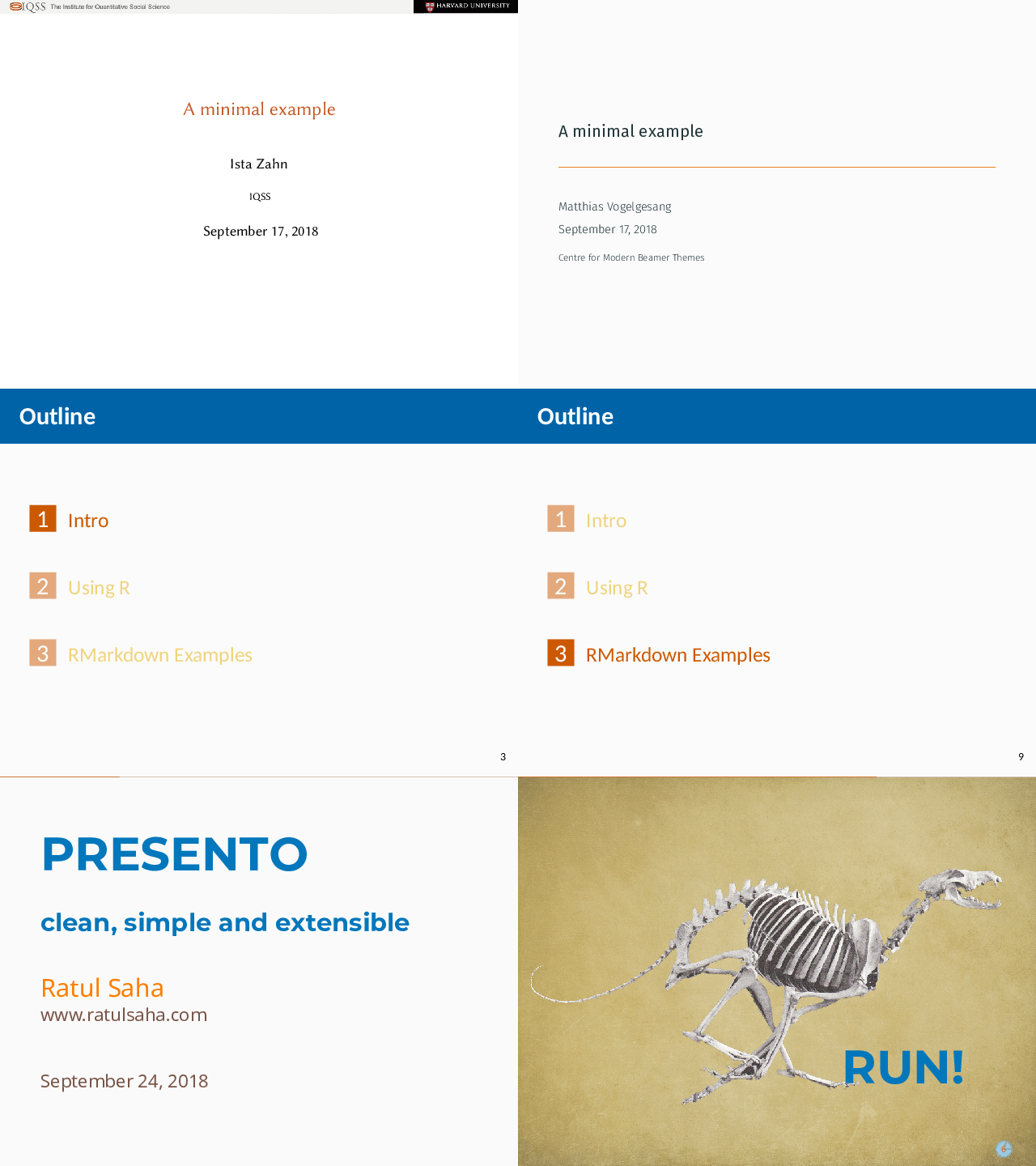
The sixth release of the binb package is now on CRAN. binb regroups four rather nice themes for writing LaTeX Beamer presentations much more easily in (R)Markdown. As a teaser, a quick demo combining all four themes follows; documentation and examples are in the package. Via two contributed PRs, this releases adds titlepage support via the YAML header for Metropolis, and suppresses nags about the changed natbib default. A little polish on the README and Travis rounds everything off.

Changes in binb version 0.0.6 (2020-06-10)
  • Support for YAML option titlegraphic was added in Metropolis (Andras Scraka in #23).
  • The README.md file received another badge (Dirk).
  • The natbib default value was updated to accomodate rmarkdown (Joseph Stachelek in #26).
  • Travis now uses R 4.0.0 and 'bionic' (Dirk).

CRANberries provides a summary of changes to the previous version. For questions or comments, please use the issue tracker at GitHub. If you like this or other open-source work I do, you can now sponsor me at GitHub. For the first year, GitHub will match your contributions.

This post by Dirk Eddelbuettel originated on his Thinking inside the box blog. Please report excessive re-aggregation in third-party for-profit settings.

17 May 2020

Erich Schubert: Contact Tracing Apps are Useless

Some people believe that automatic contact tracing apps will help contain the Coronavirus epidemic. They won t. Sorry to bring the bad news, but IT and mobile phones and artificial intelligence will not solve every problem. In my opinion, those that promise to solve these things with artificial intelligence / mobile phones / apps / your-favorite-buzzword are at least overly optimistic and blinder Aktionismus (*), if not naive, detachted from reality, or fraudsters that just want to get some funding. (*) there does not seem to be an English word for this doing something just for the sake of doing something, without thinking about whether it makes sense to do so Here are the reasons why it will not work:
  1. Signal quality. Forget detecting proximity with Bluetooth Low Energy. Yes, there are attempts to use BLE beacons for indoor positioning. But these use that you can learn fingerprints of which beacons are visible at which points, combined with additional information such as movement sensors and history (you do not teleport around in a building). BLE signals and antennas apparently tend to be very prone to orientation differences, signal reflections, and of course you will not have the idealized controlled environment used in such prototypes. The contacts have a single device, and they move this is not comparable to indoor positioning. I strongly doubt you can tell whether you are close to someone, or not.
  2. Close vs. protection. The app cannot detect protection in place. Being close to someone behind a plexiglass window or even a solid wall is very different from being close otherwise. You will get a lot of false contacts this way. That neighbor that you have never seen living in the appartment above will likely be considered a close contact of yours, as you sleep next to each other every day
  3. Low adoption rates. Apparently even in technology affine Singapore, fewer than 20% of people installed the app. That does not even mean they use it regularly. In Austria, the number is apparently below 5%, and people complain that it does not detect contact But in order for this approach to work, you will need Chinese-style mass surveillance that literally puts you in prison if you do not install the app.
  4. False alerts. Because of these issues, you will get false alerts, until you just do not care anymore.
  5. False sense of security. Honestly: the app does not pretect you at all. All it tries to do is to make the tracing of contacts easier. It will not tell you reliably if you have been infected (as mentioned above, too many false positives, too few users) nor that you are relatively safe (too few contacts included, too slow testing and reporting). It will all be on the quality of about 10 days ago you may or may not have contact with someone that tested positive, please contact someone to expose more data to tell you that it is actually another false alert .
  6. Trust. In Germany, the app will be operated by T-Systems and SAP. Not exactly two companies that have a lot of fans SAP seems to be one of the most hated software around. Neither company is known for caring about privacy much, but they are prototypical for business first . Its trust the cat to keep the cream. Yes, I know they want to make it open-source. But likely only the client, and you will still have to trust that the binary in the app stores is actually built from this source code, and not from a modified copy. As long as the name T-Systems and SAP are associated to the app, people will not trust it. Plus, we all know that the app will be bad, given the reputation of these companies at making horrible software systems
  7. Too late. SAP and T-Systems want to have the app ready in mid June. Seriously, this must be a joke? It will be very buggy in the beginning (because it is SAP!) and it will not be working reliably before end of July. There will not be a substantial user before fall. But given the low infection rates in Germany, nobody will bother to install it anymore, because the perceived benefit is 0 one the infection rates are low.
  8. Infighting. You may remember that there was the discussion before that there should be a pan-european effort. Except that in the end, everybody fought everybody else, countries went into different directions and they all broke up. France wanted a centralized systems, while in Germany people pointed out that the users will not accept this and only a distributed system will have a chance. That failed effort was known as Pan-European Privacy-Preserving Proximity Tracing (PEPP-PT) vs. Decentralized Privacy-Preserving Proximity Tracing (DP-3T) , and it turned out to have become a big clusterfuck . And that is just the tip of the iceberg.
Iceleand, probably the country that handled the Corona crisis best (they issued a travel advisory against Austria, when they were still happily spreading the virus at apres-ski; they massively tested, and got the infections down to almost zero within 6 weeks), has been experimenting with such an app. Iceland as a fairly close community managed to have almost 40% of people install their app. So did it help? No: The technology is more or less I wouldn t say useless [ ] it wasn t a game changer for us. The contact tracing app is just a huge waste of effort and public money. And pretty much the same applies to any other attempts to solve this with IT. There is a lot of buzz about solving the Corona crisis with artificial intelligence: bullshit! That is just naive. Do not speculate about magic power of AI. Get the data, understand the data, and you will see it does not help. Because its real data. Its dirty. Its late. Its contradicting. Its incomplete. It is all what AI currently can not handle well. This is not image recognition. You have no labels. Many of the attempts in this direction already fail at the trivial 7-day seasonality you observe in the data For example, the widely known John Hopkins Has the curve flattened trend has a stupid, useless indicator based on 5 day averages. And hence you get the weekly up and downs due to weekends. They show pretty up and down indicators. But these are affected mostly by the day of the week. And nobody cares. Notice that they currently even have big negative infections in their plots? There is no data on when someone was infected. Because such data simply does not exist. What you have is data when someone tested positive (mostly), when someone reported symptons (sometimes, but some never have symptoms!), and when someone dies (but then you do not know if it was because of Corona, because of other issues that became just worse because of Corona, or hit by a car without any relation to Corona). The data that we work with is incredibly delayed, yet we pretend it is live . Stop reading tea leaves. Stop pretending AI can save the world from Corona.

1 May 2020

Utkarsh Gupta: FOSS Activites in April 2020

Here s my (seventh) monthly update about the activities I ve done in the F/L/OSS world.

Debian
It s been 14 months since I ve started contributing to Debian. And 4 months since I ve been a Debian Developer. And in this beautiful time, I had this opprotunity to do and learn lots of new and interesting things. And most importantly, meet and interact with lots of lovely people!
Debian is $home.

Uploads:

Other $things:
  • Attended Ruby team meeting. Logs here.
  • Attended Perl team LHF. Report here.
  • Sponsored a lot of uploads for William Desportes and Adam Cecile.
  • Mentoring for newcomers.
  • FTP Trainee reviewing.
  • Moderation of -project mailing list.
  • Applied for DUCI project for Google Summer of Code 2020.

Ruby2.7 Migration:
Ruby2.7 was recently released on 25th December, 2019. Santa s gift. Believe it or not. We, the Debian Ruby team, have been trying hard to make it migrate to testing. And it finally happened. The default version in testing is ruby2.7. Here s the news! \o/
Here s what I worked on this month for this transition.

Upstream: Opened several issues and proposed patches (in the form of PRs):
  • Issue #35 against encryptor for Ruby2.7 test failures.
  • Issue #28 against image_science for removing relative paths.
  • Issue #106 against ffi-yajl for Ruby2.7 test failures.
  • PR #5 against aggregate for simply using require.
  • PR #6 against aggregate for modernizing CI and adding Ruby 2.5 and 2.7 support.
  • Issue #13 against espeak-ruby for Ruby2.7 test failures.
  • Issue #4 against tty-which for test failures in general.
  • Issue #11 against packable for Ruby2.7 test failures. PR #12 has been proposed.
  • Issue #10 against growl for test failures and proposed an initial patch.

Downstream: I fixed and uploaded the following packages in Debian:

Debian LTS
Debian Long Term Support (LTS) is a project to extend the lifetime of all Debian stable releases to (at least) 5 years. Debian LTS is not handled by the Debian security team, but by a separate group of volunteers and companies interested in making it a success.
This was my seventh month as a Debian LTS paid contributor. I was assigned 24.00 hours and worked on the following things:

CVE Fixes and Announcements:

Other LTS Work:

Other(s)
Sometimes it gets hard to categorize work/things into a particular category.
That s why I am writing all of those things inside this category.
This includes two sub-categories and they are as follows.

Personal: This month I could get the following things done:
  • Most importantly, I finally migrated to a new website. Huge UI imporvement! \o/
    From Jekyll to Hugo, it was not easy. But it was worth it! Many thanks to Luiz for writing hugo-coder, Clement, and Samyak!
    If you find any flaws, issues and pull requests are welcomed at utkarsh2102/utkarsh2102.com
  • Wrote battery-alert, a mini-project of my own to show battery alerts at <10% and >90%.
    Written in shell, it brings me all the satisfaction as it has saved my life on many occasions.
    And guess what? It has more users than just myself!
    Reviews and patches are welcomed \o/
  • Mentored in HackOn Hackathon. Thanks to Manvi for reaching out!
    It was fun to see people developing some really nice projects.
  • Thanks to Ray and John, I became a GitLab Hero!
    (I am yet to figure out my role and responibility though)
  • Atteneded Intro Sec Con and had the most fun!
    Heard Ian s keynote and attended other talks and learned how to use WireShark!

Open Source: Again, this contains all the things that I couldn t categorize earlier.
Opened several issues and pull requests:
  • Issue #297 against hugo-coder, asking to enable RSS feed for blogs.
  • PR #316 for hugo-coder for fixing the above issue myself.
  • Issue #173 against arbre for requesting a release.
  • Issue #104 against combustion, asking to relax dependency on rubocop. Fixed in this commit.
  • Issue #16 against ffi-compiler for requesting to fix homepage and license.
  • Issue #57 against gographviz for requesting a release.
  • Issue #14 against crb-blast, suggesting compatability with bio 2.0.x.
  • Issue #58 against uniform_notifier for asking to drop the use of ruby-growl.
  • PR #2072 for polybar, adding installation instructions on Debian systems.

Until next time.
:wq for today.

16 April 2020

Rigved Rakshit: Intermediate Statistics

These are some of my notes on intermediate statistics from the Udemy Data Science Bootcamp. The Python code associated with this section is available here.

15 April 2020

Rigved Rakshit: Basic Probability

These are some of my notes on probability theory.

7 April 2020

Reproducible Builds: Reproducible Builds in March 2020

Welcome to the March 2020 report from the Reproducible Builds project. In our reports we outline the most important things that we have been up to over the past month and some plans for the future.
What are reproducible builds? One of the original promises of open source software is that distributed peer review and transparency of process results in enhanced end-user security. However, whilst anyone may inspect the source code of free and open source software for malicious flaws, almost all software today is distributed as pre-compiled binaries. This allows nefarious third-parties to compromise systems by injecting malicious code into ostensibly secure software during the various compilation and distribution processes.

News The report from our recent summit in Marrakesh was published and is now available in both PDF and HTML formats. A sincere thank you to all of the Reproducible Builds community for the input to the event a sincere thank you to Aspiration for preparing and collating this report. Harmut Schorrig published a detailed document on how to compile Java applications in such as way that the .jar build artefact is reproducible across builds. A practical and hands-on guide, it details how to avoid unnecessary differences between builds by explicitly declaring an encoding as the default value differs across Linux and MS Windows systems and ensuring that the generated .jar a variant of a .zip archive does not embed any nondeterministic filesystem metadata, and so on. Janneke gave a quick presentation on GNU Mes and reproducible builds during the lighting talk session at LibrePlanet 2020. [ ] Vagrant Cascadian presented There and Back Again, Reproducibly! video at SCaLE 18x in Pasadena in California which generated some attention on Twitter. Herv Boutemy mentioned on our mailing list in a thread titled Rebuilding and checking Reproducible Builds from Maven Central repository that since the update of a central build script (the parent POM ) every Apache project using the Maven build system should build reproducibly. A follow-up discussion regarding how to perform such rebuilds was also started on the Apache mailing list. The Telegram instant-messaging platform announced that they had updated their iOS and Android OS applications and claim that they are reproducible according to their full instructions, verifying that its original source code is exactly the same code that is used to build the versions available on the Apple App Store and Google Play distribution platforms respectfully. Herv Boutemy also reported about a new project called reproducible-central which aims to allow anyone to rebuild a component from the Maven Central Repository that is expected to be reproducible and check that the result is as expected. In last month s report we detailed Omar Navarro Leija s work in and around an academic paper titled Reproducible Containers which describes in detail the workings of a user-space container tool called dettrace (PDF). Since then, the PhD student from the University Of Pennsylvania presented on this tool at the ASPLOS 2020 conference in Lausanne, Switzerland. Furthermore, there were contributions to dettrace from the Reproducible Builds community itself. [ ][ ]

Distribution work

openSUSE In openSUSE, Bernhard M. Wiedemann published his monthly Reproducible Builds status update as well as made the following changes within the distribution itself:

Debian Chris Lamb further refined his merge request for the debian-installer component to allow all arguments from sources.list files (such as [check-valid-until=no] ) in order that we can test the reproducibility of the installer images on the Reproducible Builds own testing infrastructure. (#13) Holger Levsen filed a number of bug reports against the debrebuild tool that attempts to rebuild a Debian package given a .buildinfo file as input, including: 48 reviews of Debian packages were added, 17 were updated and 34 were removed this month adding to our knowledge about identified issues. Many issue types were noticed, categorised and updated by Chris Lamb, including: Finally, Holger opened a bug report against the software running tracker.debian.org, a service for Debian Developers to follow the evolution of packages via web and email interfaces to request that they integrate information from buildinfos.debian.net (#955434) and Chris Lamb kept isdebianreproducibleyet.com up to date. [ ]

Software development

diffoscope Chris Lamb made the following changes to diffoscope, the Reproducible Builds project s in-depth and content-aware diff utility that can locate and diagnose reproducibility issues, including preparing and uploading version 138 to Debian:
  • Improvements:
    • Don t allow errors with R script deserialisation cause the entire operation to fail, for example if an external library cannot be loaded. (#91)
    • Experiment with memoising output from expensive external commands, eg. readelf. (#93)
    • Use dumppdf from the python3-pdfminer if we do not see any other differences from pdftext, etc. (#92)
    • Prevent a traceback when comparing two R .rdx files directly as the get_member method will return a file even if the file is missing. [ ]
  • Reporting:
    • Display the supported file formats into the package long description. (#90)
    • Print a potentially-helpful message if the PyPDF2 module is not installed. [ ]
    • Remove any duplicate comparator descriptions when formatting in the --help output or in the package long description. [ ]
    • Weaken Install the X package to get a better output message to may produce a better output as the former is not actually guaranteed. [ ]
  • Misc:
    • Ensure we only parse the recommended packages from --list-debian-substvars when we want them for debian/tests/control generation. [ ]
    • Add upstream metadata file [ ] and add a Lintian override for upstream-metadata-in-native-source as we are upstream. [ ]
    • Inline the RequiredToolNotFound.get_package method s functionality as it is only used once. [ ]
    • Drop the deprecated py36 = [..] argument in the pyproject.toml file. [ ]
In addition, Vagrant Cascadian updated diffoscope in GNU Guix to version 138 [ ], as well as updating reprotest our end-user tool to build same source code twice in widely differing environments and then checks the binaries produced by each build for any differences to version 0.7.14 [ ].

Upstream patches The Reproducible Builds project detects, dissects and attempts to fix as many currently-unreproducible packages as possible. We endeavour to send all of our patches upstream where appropriate. This month we wrote a large number of such patches, including:

Project documentation There was further work performed on our documentation and website this month including Alex Wilson adding a section regarding using Gradle for reproducible builds in JVM projects [ ] and Holger Levsen added the report from our recent summit in Marrakesh [ ][ ]. In addition, Chris Lamb made a number of changes, including correcting the syntax of some CSS class formatting [ ], improved some filed against copy a little better [ ] and corrected a reference to calendar.monthrange Python method in a utility function. [ ]

Testing framework We operate a large and many-featured Jenkins-based testing framework that powers tests.reproducible-builds.org that, amongst many other tasks, tracks the status of our reproducibility efforts as well as identifies any regressions that have been introduced. This month, Chris Lamb reworked the web-based package rescheduling tool to:
  • Require a HTTP POST method in the web-based scheduler as not only should HTTP GET requests be idempotent but this will allow many future improvements in the user interface. [ ][ ][ ]
  • Improve the authentication error message in said rescheduler to suggest that the developer s SSL certificate may have expired. [ ]
In addition, Holger Levsen made the following changes:
  • Add a new ath97 subtarget for the OpenWrt distribution.
  • Revisit ordering of Debian suites; sort the experimental distribution last and reverse the ordering of suites to prioritise the suites in development. [ ][ ][ ]
  • Schedule Debian buster and bullseye a little less in order to allow unstable to catch up on the i386 architecture. [ ][ ]
  • Various cosmetic changes to the web-based scheduler. [ ][ ][ ][ ]
  • Improve wordings in the node health maintenance output. [ ]
Lastly, Vagrant Cascadian updated a link to the (formerly) weekly news to our reports page [ ] and kpcyrd fixed the escaping in an Alpine Linux inline patch [ ]. The usual build nodes maintenance was performed by Holger Levsen [ ][ ], Mattia Rizzolo [ ] and Vagrant Cascadian [ ][ ].
If you are interested in contributing to the Reproducible Builds project, please visit our Contribute page on our website. However, you can get in touch with us via:

This month s report was written by Bernhard M. Wiedemann, Chris Lamb, Holger Levsen and Vagrant Cascadian. It was subsequently reviewed by a bunch of Reproducible Builds folks on IRC and the mailing list.

10 March 2020

Utkarsh Gupta: Debian Activities for February 2020

Here s my (fifth) monthly update about the activities I ve done in Debian this February.

Debian LTS This was my fifth month as a Debian LTS paid contributor.
I was assigned 20.00 hours and worked on the following things:

CVE Fixes and Announcements:
  • Issued DLA 2095-1, fixing CVE-2020-7040, for storebackup.
    Details here:
    storeBackup.pl in storeBackup through 3.5 relies on the /tmp/storeBackup.lock pathname, which allows symlink attacks that possibly lead to privilege escalation.
    For Debian 8 Jessie , this problem has been fixed in version 3.2.1-1+deb8u1.
    Furthermore, sent the patch for the security update for Stretch and Buster to the maintainer.
  • Issued DLA 2113-1, fixing CVE-2020-8631 and CVE-2020-8632 for cloud-init.
    Details here:
    For CVE-2020-8631, in cloud-init, relies on Mersenne Twister for a random password, which makes it easier for attackers to predict passwords, because rand_str in cloudinit/util.py calls the random.choice function.
    For CVE-2020-8632, in cloud-init, rand_user_password in cloudinit/config/cc_set_passwords.py has a small default pwlen value, which makes it easier for attackers to guess passwords.
    For Debian 8 Jessie , this problem has been fixed in version 0.7.6~bzr976-2+deb8u1.
  • Issued DLA 2116-1, fixing CVE-2015-9542, for libpam-radius-auth.
    Details here:
    A vulnerability was found in pam_radius: the password length check was done incorrectly in the add_password() function in pam_radius_auth.c, resulting in a stack based buffer overflow.
    This could be used to crash (DoS) an application using the PAM stack for authentication. For Debian 8 Jessie , this problem has been fixed in version 1.3.16-4.4+deb8u1.
  • Issued DLA 2127-1, fixing CVE-2019-10785, for dojo.
    Details here:
    dojox was vulnerable to Cross-site Scripting. This was due to dojox.xmpp.util.xmlEncode only encoding the first occurrence of each character, not all of them.
    For Debian 8 Jessie , this problem has been fixed in version 1.10.2+dfsg-1+deb8u2.
  • Whilst Dylan issued DLA 2120-1, fixing CVE-2020-8130, for rake, I, with the Ruby team hat on, fixed the same issue for Stretch and Buster via proposed-updates.
    This CVE was fixed via 10.5.0-2+deb9u1 and 12.3.1-3+deb10u1 respectively.

Other LTS Work:
  • Triaged cloud-init, slirp, libpam-radius-auth, dojo, and qemu.
  • Triaged CVE-2020-1711 and CVE-2020-8608 with more precision and discussed the details with Ola.
  • Started working on rrdtool for CVE-2014-6262.

Debian Work This was a great month! MiniDebCamp -> FOSDEM -> Ruby Sprints. Blog post soon :D
In the month of February, I did a lot of Debian work. // given limited time in March, this section is yet to be updated.
One exciting blog post coming very soon. Until next time.
:wq for today.

22 November 2017

Norbert Preining: Kobo firmware 4.6.10075 mega update (KSM, nickel patch, ssh, fonts)

A new firmware for the Kobo ebook reader came out and I adjusted the mega update pack to use it. According to the comments in the firmware thread it is working faster than previous releases. The most incredible change though is the update from wpa_supplicant 0.7.1 (around 2010) to 2.7-devel (current). Wow. Kobo Logo For details and warning please consult the previous post. Download Mark6 Kobo GloHD firmware: Kobo 4.6.9995 for GloHD Mega update: Kobo-4.6.10075-combined/Mark6/KoboRoot.tgz Mark5 Aura firmware: Kobo 4.6.9995 for Aura Mega update: Kobo-4.6.10075-combined/Mark5/KoboRoot.tgz Mark4 Kobo Glo, Aura HD firmware: Kobo 4.6.9995 for Glo and AuraHD Mega update: Kobo-4.6.10075-combined/Mark4/KoboRoot.tgz Enjoy.

12 November 2017

Lars Wirzenius: Unit and integration testing: an analogy with cars

A unit is a part of your program you can test in isolation. You write unit tests to test all aspects of it that you care about. If all your unit tests pass, you should know that your unit works well. Integration tests are for testing that when your various well-tested, high quality units are combined, integrated, they work together. Integration tests test the integration, not the individual units. You could think of building a car. Your units are the ball bearings, axles, wheels, brakes, etc. Your unit tests for the ball bearings might test, for example, that they can handle a billion rotations, at various temperatures, etc. Your integration test would assume the ball bearings work, and should instead test that the ball bearings are installed in the right way so that the car, as whole, can run a kilometers, and accelerate and brake every kilometer, uses only so much fuel, produces only so much pollution, and doesn't kill passengers in case of a crash.

27 October 2017

Russ Allbery: Review: The Black Gryphon

Review: The Black Gryphon, by Mercedes Lackey & Larry Dixon
Series: Mage Wars #1
Publisher: DAW
Copyright: 1994
Printing: January 1995
ISBN: 0-88677-643-0
Format: Mass market
Pages: 460
The Mage Wars series (or the Gryphon series, which isn't its official title but which is in all of the titles) is part of the sprawling Valdemar mega-series, but it's a prequel to all of the other stories. It's also slightly challenging if you're reading in publication order, since it was published simultaneously with the Mage Storms series. If you're following publication order, in theory you should interleave the two series, but I hate doing that. I'm therefore reading it after Mage Winds and before Mage Storms. We'll see whether that was a good idea when I get to the next series. You could, if you really wanted to, read this series before any other Valdemar book. As a prequel from the deep past of Valdemar's world, it doesn't depend on the other series, and you'll get a rediscovery of lost knowledge feel from later books. The downside is that it's a rather boring introduction, and that order would spoil a lot of the revelatory flow of the other series (particularly Elspeth's adventures in the Mage Winds books). I'm now getting into the Valdemar books that I've only read once. I've been putting off continuing my Valdemar re-read because this series was next and I remember being rather bored with it the first time I read it. But I'm re-reading for the world-building and background as much as for the characters, and this is a huge chunk of world background that fills in the bones underneath Winds of Fate and its sequels. Here's why Dhorisha is a crater, here's why the Pelagiris forests are such a mess, here's where Ma'ar starts, here's the origin of both the gryphons and K'Leshya, and here, finally, we get to see the legendary Urtho on the page. The problem with writing novels set in the epic backstory of your universe is that it's hard to live up to the drama that readers have invented for themselves. A lot of The Black Gryphon is background to events Valdemar readers already know will happen, creating a corresponding lack of surprise. I reached the end of the book and said "yup, that's pretty much what everyone said had happened." Lackey and Dixon do try to do some interesting things here, one of which being the backgrounding of the war. The Black Gryphon starts in the middle of a long-running conflict between Urtho and Ma'ar and doesn't follow the generals or the battles. The protagonists, instead, are a kestra'chern (a type of psychiatrist and spiritual healer who also uses sex, with the expected conflicts of people who incorrectly think of them as prostitutes) and the eventual leader of the gryphons (Skandranon, who is referenced in later books and who provides the title). We get some combat scenes from Skandranon and later another gryphon, but a lot of the book is Amberdrake fighting the effects of the war instead of the details of the war itself. There's a deep and moving story in that idea, and in some of the attached love stories that play out in the army camps. There's also a great story somewhere around Urtho: a brilliant but detached mage who is way out of his depth trying to run an army but smart enough to gather good people around him. He's also a creator of new life, including the gryphons. The Black Gryphon tries to talk about Urtho's paternalism, the weird emotional currents of his relationship with his creations, and the places Urtho keeps things from others for, supposedly, their own good. If this book had looked a bit deeper at the support structure for an army that's trying to be humane, or at the ways in which Urtho strays far too close to being an abusive tyrant through inaction despite having the best of intentions at every step, I think it could have said something significant. Unfortunately, that's not this book. This book is full of relentlessly black and white morality (the flaw of much of the Valdemar series) that bleaches away interesting shades of grey. Urtho is good and wise by authorial fiat, and Ma'ar is the same utterly irredeemable force of evil that he is in other books. The story skitters over Urtho's odd tyrannies, making them all better with the pure power of friendship and good intentions. There just isn't much emotional depth, and while I don't expect that of Lackey in general, this story really needed that depth to work. What we get instead is repetition, as Lackey and Dixon hit the same emotional notes with Amberdrake repeatedly. This is one of those books that makes me wonder if Lackey was trying to write too many novels in a short time than was good for their individual quality. (Collaborations often mean that the lesser-known name is doing all the work, but Dixon is Lackey's husband and the tone of the book is sufficiently Lackey that I don't think that happened here.) It felt padded by Amberdrake turning over the same emotional rocks repeatedly, to largely the same effect. This is, in short, not Lackey's finest effort, although it does have its moments. As always, Lackey is at her best when writing psychological healing narratives. Zhaneel's story is a bit too easy, but the dynamic between Amberdrake and Winterhart is the best part of the book. And The Black Gryphon does tell the reader exactly what led up to the Cataclysm and why. There are no major surprises, but there are some small ones, and it's a nice payoff for the lore-obsessed (like me). This is missable unless you want the full world-building behind Valdemar's past, and it's not the best writing. But if you're heavily invested in the Valdemar universe, it's at least readable and provides an important bit of the history. Followed by The White Gryphon. Rating: 5 out of 10

21 October 2017

Jaldhar Vyas: Sal Mubarak 2074

Wishing all Debian people a prosperous and auspicious Gujarati new year (V.S. 2074 called Saumya.) This year fireworks became legal for the first time in New Jersey. Not that it ever stopped us before but it is nice to see the government stop meddling for no reason. (Eff you, Indian Supreme Court.) Sparklers on Diwali. Although you can only see sparklers in the picture above, we got enough armament to make ISIS jealous. There were also lots of diabetes-inducing sweets and (inexpensive, practical) presents for young and old. That's what I call a proper Diwali and new year.

Next.

Previous.