Search Results: "pm"

8 May 2026

Amin Bandali: FFS code review with Protesilaos

In the recent weeks I've been engaging Prot as an Emacs coach to help with doing review passes over my upcoming ffs package as I work on polishing and documenting it in preparation for offering it for inclusion in GNU ELPA. Yesterday we had our second session focused on ffs, which I recorded and share publicly with everyone with Prot's permission, so that others can also benefit from Prot's insights and experience as we discuss various aspects of Emacs package development with the concrete example of ffs. Here is the video recording of our session: You can view or download the full-resolution video from the Internet Archive. I addressed most of Prot's feedback about ffs from our first session, and I'll be working on the changes we discussed in this session in the next days. In the last third of the video we switched topics to discuss a few Emacs-related tangents including adding a 'padding' effect for the mode line and its constructs, and distilling and separating the easily-reusable package-like parts of one's Emacs configuration from the actual configuration of those parts (e.g. the distinction of prot-lisp and prot-emacs-modules in Prot's Emacs configuration). For mode line padding, here is the snippet I'm using with Prot's doric-themes:
(doric-themes-with-colors
  (custom-set-faces
    (mode-line
     ((t :box (:line-width 6 :color ,bg-shadow-intense))))
    (mode-line-inactive
     ((t :box (:line-width 6 :color ,bg-shadow-subtle))))
    (mode-line-highlight
     ((t :box (:color ,bg-shadow-intense))))))
Take care, and so long for now.

7 May 2026

Reproducible Builds: Reproducible Builds in April 2026

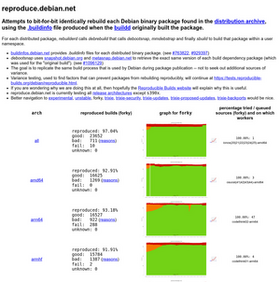
Welcome to our April 2026 report from the Reproducible Builds project! Our reports outline what we ve been up to over the past month, highlighting items of news from elsewhere in the increasingly-important area of software supply-chain security. As ever, if you are interested in contributing to the Reproducible Builds project, please see the Contribute page on our website. In this month s report, we cover:

  1. Tor stateless relays and Reproducible Builds
  2. Civil Infrastructure Platform celebrates 10 years of supporting industrial grade Linux
  3. Reproducible Builds at LinuxFest NorthWest
  4. Reproducibility issues in Rust binaries that embed random bytes
  5. Distribution work
  6. Patches
  7. diffoscope development
  8. Documentation updates
  9. Misc news


Tor stateless relays and Reproducible Builds An interesting post was published on Tor Project blog by Osservatorio Nessuno OdV this month on stateless relays . These are stateless, diskless operating systems that are designed to be used as Tor exit relays. According to the post, which is titled A Server That Forgets: Exploring Stateless Relays:
For relay operators, this approach raises the security bar by enforcing better behaviors by design: [ ]
  1. Reproducibility. A system that doesn t change between reboots is easier to verify and, eventually, to reproduce and audit.
Furthermore, using a Trusted Platform Module (TPM), could allow for greater integrity in the future:
Transparency logs. Once you have a measured boot chain, you can publish it. A relay operator provides a recipe for a reproducible build; anyone can recompute the expected hash and verify it matches what the TPM reports. An append-only transparency log can make these attestations publicly auditable. The Tor community could run an independent monitor to track this across the relay fleet.

Civil Infrastructure Platform celebrates 10 years of supporting industrial grade Linux Congratulations to the Civil Infrastructure Platform (CIP) for reaching their 10-year anniversary last month. CIP has been a supporter of Reproducible Builds for many years, and we have collaborated on a number of technical issues that overlap. As Chris Lamb mentions in CIP s press release:
The collaboration between the Reproducible Builds project and CIP highlights a critical shift in how we approach industrial software. Through verifiability, CIP ensures that the open source foundation of our critical infrastructure is not only sustainable but also demonstrably secure. This commitment to transparency is vital for the trust and resilience required by critical systems over decades of operation.

Reproducible Builds at LinuxFest NorthWest Vagrant Cascadian and Chris Lamb hosted a table in the exposition hall at LinuxFest NorthWest 2026 this month in Bellingham, WA, USA, introducing many people to Reproducible Builds and answering questions both days of the conference. In addition, Vagrant presented Beyond Trusting Open Source Software on Sunday afternoon, exploring the intersection of Free/Open Source Software, Reproducible Builds and Bootstrappable builds, and how they all reinforce each other. Vagrant s slides are available online, including source code to build them reproducibly.

Reproducibility issues in Rust binaries that embed random bytes Reproducible Builds developer kpcyrd opened a ticket on the Rustsec issue tracker regarding binaries that deliberately inject random bytes into their binaries as a secret seed for a Hash Collision DoS mitigation. As kpcyrd notes in his message, this causes issues for reproducibility, and because the relevant end-user binaries are mostly distributed pre-compiled through package managers, those binaries (and by extension the secret seed) are public knowledge . kpcyrd goes on to note:
This is somewhat unique to Rust because Python/JavaScript doesn t compile binaries, and Go (to my knowledge) is too restrictive during build for any library to pull something like this.

Distribution work In Arch Linux this month, Robin Candau and Mark Hegreberg worked at adding a new repro tag/version to the Arch Linux Docker images providing a bit-for-bit reproducible image. Robin also shared a related announcement and implementation details on our mailing list. Arch Linux developer Robin Candau posted a blog post announcing that Arch Linux Now Has a Bit-for-Bit Reproducible Docker Image . Robin mentions one interesting caveat:
to ensure reproducibility, the pacman [package manager] keys have to be stripped from the image, meaning that pacman is not usable out of the box in this image. While waiting to find a suitable solution to this technical constraint, we are therefore providing this reproducible image under a dedicated tag as a first milestone. [ ]
The blog post was also discussed on Hacker News.
In Debian this month, 24 reviews of Debian packages were added, 7 were updated and 16 were removed this month adding to our knowledge about identified issues. Vagrant Cascadian performed Non-Maintainer Uploads (NMUs) in Debian for several packages with outstanding patches over a year old jakarta-jmeter, wxmplot, critcl, vcsh and magic-wormhole-transit-relay. In addition, Reproducible Builds developer Jochen Sprickerhof filed a bug against the APT package manager to request that APT should ignore [a] 0 epoch when downloading or installing with a version specifier . This is related to the special-case handling of the optional epoch prefix in Debian package version numbers.
In NixOS, Julien Malka presented Lila: Decentralized Build Reproducibility Monitoring for the Functional Package Management Model, a paper written together with Arnout Engelen at the Mining Software Repositories (MSR) ACM conference, where it was awarded the MSR 2026 FOSS Impact Award. Congratulations!
Lastly, in openSUSE, Michael Schroeder added reproducibility verification support in the Open Build Service [ ] and Bernhard M. Wiedemann posted another openSUSE monthly update for their reproducibility work there.

Patches The Reproducible Builds project detects, dissects and attempts to fix as many currently-unreproducible packages as possible. We endeavour to send all of our patches upstream where applicable or possible. This month, we wrote a large number of such patches, including:

diffoscope development diffoscope is our in-depth and content-aware diff utility that can locate and diagnose reproducibility issues. This month, Chris Lamb made a number of changes, including preparing and uploading versions, 316, 317 and 318 to Debian.
  • Chris Lamb:
    • Bump Standards-Version to 4.7.4. [ ]
    • Correct ordering of python3-guestfs architecture restrictions. [ ]
    • Limit python3-guestfs Build-Dependency to architectures that are not i386. [ ]
    • Try to fix PYPI_ID_TOKEN debugging. [ ]
  • Holger Levsen:
    • Add ppc64el to the list of python3-guestfs architecture whitelist. (Closes: #1132974). [ ]
In addition, Vagrant Cascadian updated diffoscope in GNU Guix to version 317.

Documentation updates Yet again, there were a number of improvements made to our website this month including:
  • Manuel Jacob:
    • Fix some minor wording issues on the Stable inputs page, and update information about the sorting behavior of GNU Make [ ].
    • On the Archives page, remove information about deterministic archives in historical Fedora versions [ ], add a note about .tar file portability [ ] and correct a section about .tar PAX headers [ ].
  • Mattia Rizzolo:
  • kpcyrd:
  • ktecho:

Misc news On our mailing list this month:
  • Timo Pohl posted our list inviting people to online group discussions with 4-6 participants each to talk about your perception of terms and requirements for reproducibility. As Timo notes:
    During our research of the existing literature, as well as my experience at the Reproducible Builds Summit 2025 in Vienna, we noticed that some of the terminology in the field is not used consistently across different groups of people, and that the precise meaning of some core terms like reproducibility of an artifact in itself is not uniform.
    As Timo mentions, the sessions will last roughly 90 minutes and will be rewarded with 50 per participant.
  • kpcyrd posted to the list asking for assistance with fixing an issue after updating the flake.lock file for their repro-env project.
  • Aman Sharma of the KTH Royal Institute of Technology, Sweden, posted to our list in order to share that Eric Cornelissen, a PhD student in KTH s CHAINS group, is maintaining an open-source project to monitor the reproducibility of GitHub Actions:
    The goal of the project is to assess whether GitHub Actions can be reproduced. Currently, it focuses on two types of Actions: JavaScript-based actions and Docker-based actions (composite actions are not considered). For JavaScript actions, the project rebuilds the distributed files and compares them bit-by-bit with the repository contents. For Docker actions, it rebuilds images from the Dockerfile and checks for semantic equivalence, using diffoci, across builds.


Finally, if you are interested in contributing to the Reproducible Builds project, please visit our Contribute page on our website. However, you can get in touch with us via:

4 May 2026

Russell Coker: Copy Fail on Debian and SE Linux

I have just learned of the Copy Fail kernel vulnerability [1] thanks to alexanderkjall@mastodon.social (who I have just followed on Mastodon and I recommend that you follow too). The question for me (after installing the patched kernel the systems of mine that are most exposed) is whether SE Linux would have stopped that. Basic Policy Analysis For the SE Linux policy analysis the alg_socket class is the one that is related to the exploit. So the following policy analysis command (run as non-root with policy copied to /tmp from a running system) shows what domains are allowed access on my current Debian development system:
$ sesearch -A -c alg_socket /tmp/policy.35 
allow NetworkManager_t NetworkManager_t:alg_socket   accept bind create read setopt write  ;
allow bluetooth_t bluetooth_t:alg_socket   accept append bind connect create getattr getopt ioctl listen read setattr setopt shutdown write  ;
allow daemon init_t:alg_socket   getattr getopt ioctl read setopt write  ;
allow devicekit_disk_t domain:alg_socket getattr;
allow lvm_t lvm_t:alg_socket   append bind connect create getattr getopt ioctl read setattr setopt shutdown write  ;
allow sosreport_t domain:alg_socket getattr;
allow sysadm_t domain:alg_socket getattr;
allow unconfined_domain_type domain:alg_socket   accept append bind connect create getattr getopt ioctl listen lock map name_bind read recvfrom relabelfrom relabelto sendto setattr setopt shutdown write  ;
The above is the same as on the Trixie release policy as these things aren t changed often. Below is from Debian/Bookworm which is the same apart from Bookworm not allowing lvm_t:
$ sesearch -A -c alg_socket /tmp/policy.33
allow NetworkManager_t NetworkManager_t:alg_socket   accept bind create read setopt write  ;
allow bluetooth_t bluetooth_t:alg_socket   accept append bind connect create getattr getopt ioctl listen read setattr setopt shutdown write  ;
allow daemon init_t:alg_socket   getattr getopt ioctl read setopt write  ;
allow devicekit_disk_t domain:alg_socket getattr;
allow sosreport_t domain:alg_socket getattr;
allow sysadm_t domain:alg_socket getattr;
allow unconfined_domain_type domain:alg_socket   accept append bind connect create getattr getopt ioctl listen lock map name_bind read recvfrom relabelfrom relabelto sendto setattr setopt shutdown write  ;
I checked every Debian policy back to when the alg_socket class was first added and found that the older versions had fewer domains granted access. The most recently added was bluetooth_t and the one before that was NetworkManager_t. The Risky Lines Of those allow statements the following are the risks: Unconfined Domains and the unconfined_domain_type Attribute When writing policy lines like the following line aren t generally considered a problem as unconfined domains are allowed full access to the system. However it can be an issue if you have a process in an unconfined domain without root access, which means a regular user login. Unfortunately this happens to be where this exploit and the default Debian SE Linux configuration intersect.
allow unconfined_domain_type domain:alg_socket   accept append bind connect create getattr getopt ioctl listen lock map name_bind read recvfrom relabelfrom relabelto sendto setattr setopt shutdown write  ;
The following shell code gets a list of unconfined domains which can be entered from user domains.
A=""
for n in $(seinfo -x -a unconfined_domain_type grep _t$) ; do
  A="$A ($n)"
done
A=$(echo $A sed -e s/^.//)
sesearch -T -s user_application_exec_domain -c process egrep "$A;"
Below is the output on a Debian/Trixie (Stable) system. So a confined user in the user_t domain could run an X server and try and get it to run the exploit code (which seems difficult) or running a Wine or Mono program from the Window manager in a Wayland environment.
type_transition user_t xserver_exec_t:process xserver_t;
type_transition user_wm_t mono_exec_t:process mono_t;
type_transition user_wm_t wine_exec_t:process wine_t;
type_transition user_wm_t xserver_exec_t:process xserver_t;
The issue of unconfined domains in SE Linux policy needs much more work. I ll write some blog posts about it later and the next release of Debian will be significantly better in this regard. Daemons that Have Access
allow NetworkManager_t NetworkManager_t:alg_socket   accept bind create read setopt write  ;
allow bluetooth_t bluetooth_t:alg_socket   accept append bind connect create getattr getopt ioctl listen read setattr setopt shutdown write  ;
Network Manager is something that can potentially be exploited by a desktop user as it has a large attack surface for the desktop interface. But as the vast majority of desktop user accounts are unconfined that s not an issue. This might be an issue for some restricted desktop PCs, maybe kiosk systems and those PCs that were being installed in prisons. The bluetooth_t domain is used by the bluetooth daemon that runs as root. While we generally are less concerned about a root process being exploited the daemon will handle some data from hostile sources and it could be used as an escalation attack by someone with a hostile Bluetooth device. These can t be exploited without another bug. The Lines that Aren t Problems The getattr Lines
allow devicekit_disk_t domain:alg_socket getattr;
allow sosreport_t domain:alg_socket getattr;
allow sysadm_t domain:alg_socket getattr;
The above getattr access isn t an issue as it just allows seeing process information, and it s also by privileged domains. The init_t Sockets
allow daemon init_t:alg_socket   getattr getopt ioctl read setopt write  ;
The daemon access to sockets inherited from init_t probably isn t a great idea, it s from the following section in init.te which is to allow socket activation for daemons, the comment is concerning in this context. Also socket_class_set is overly broad as without even inspecting the systemd source code I m pretty sure that far fewer than 1/3 of the 55 classes allowed by that rule are actually supported in systemd.
ifdef( init_systemd', 
        # Until systemd is fixed
        allow daemon init_t:socket_class_set   getattr getopt ioctl read setopt write  ;
But that s not really a problem as systemd has to just not create a socket of that type, if a hostile party can make systemd create such sockets then you have probably already lost. SE Linux Protection Overall SE Linux systems running confined users (kiosks and other confined GUI environments) will be protected barring a bug in Network Manager or the Bluetooth daemon as long as there is no Xserver installed (or the X server won t run scripts on startup), no Wine system installed, and no Mono. SE Linux servers and VMs will be protected against daemon issues as long as the daemon isn t unconfined. To convert the default login to user_t run the following commands:
semanage login -m -s user_u -r s0 __default__
restorecon -R -v -F /home
But it is still possible to access an unconfined domain from user_t (a topic I will address in detail in a future blog post). To remove unconfined entirely (not a task for novices or something to be done on in production without testing and planning) run the following commands:
semanage login -m -s root -r s0 root
# logout and login again
semodule -X 100 -r unconfined
Then a Debian/Trixie system running SE Linux will be safe against this attack even when running a vulnerable kernel. If you still want to use root as unconfined_t but still have untrusted shell users then run the following command to remove the easiest ways for users to run a program in an unconfined domain:
semodule -X 100 -r mono wine
Success and Failure Blocked by SE Linux Below is what happens on stdout/stderr when SE Linux blocks the exploit (tested with vulnerable Debian kernel 6.12.74+deb13+1-amd64):
test@testing1:~$ python3 ./copy_fail_exp.py 
Traceback (most recent call last):
  File "/home/test/./copy_fail_exp.py", line 9, in <module>
    while i<len(e):c(f,i,e[i:i+4]);i+=4
                   ~^^^^^^^^^^^^^^
  File "/home/test/./copy_fail_exp.py", line 5, in c
    a=s.socket(38,5,0);a.bind(("aead","authencesn(hmac(sha256),cbc(aes))"));h=279;v=a.setsockopt;v(h,1,d('0800010000000010'+'0'*64));v(h,5,None,4);u,_=a.accept();o=t+4;i=d('00');u.sendmsg([b"A"*4+c],[(h,3,i*4),(h,2,b'\x10'+i*19),(h,4,b'\x08'+i*3),],32768);r,w=g.pipe();n=g.splice;n(f,w,o,offset_src=0);n(r,u.fileno(),o)
  File "/usr/lib/python3.13/socket.py", line 233, in __init__
    _socket.socket.__init__(self, family, type, proto, fileno)
    ~~~~~~~~~~~~~~~~~~~~~~~^^^^^^^^^^^^^^^^^^^^^^^^^^^^^^^^^^^PermissionError: [Errno 13] Permission denied
test@testing1:~$ su
Password:
When the attack is blocked by SE Linux there will be no messages in the kernel message log but the SE Linux audit log (typically stored in /var/log/audit/audit.log) will have lines like the following:
type=AVC msg=audit(1777803068.070:76): avc:  denied    create   for  pid=811 comm="python3" scontext=user_u:user_r:user_t:s0 tcontext=user_u:user_r:user_t:s0 tclass=alg_socket permissive=0
type=SYSCALL msg=audit(1777803068.070:76): arch=c000003e syscall=41 success=no exit=-13 a0=26 a1=80005 a2=0 a3=0 items=0 ppid=791 pid=811 auid=1000 uid=1000 gid=1000 euid=1000 suid=1000 fsuid=1000 egid=1000 sgid=1000 fsgid=1000 tty=pts0 ses=1 comm="python3" exe="/usr/bin/python3.13" subj=user_u:user_r:user_t:s0 key=(null)ARCH=x86_64 SYSCALL=socket AUID="test" UID="test" GID="test" EUID="test" SUID="test" FSUID="test" EGID="test" SGID="test" FSGID="test"
type=PROCTITLE msg=audit(1777803068.070:76): proctitle=707974686F6E33002E2F636F70795F6661696C5F6578702E7079
For that the :76 is the audit log entry number, the command ausearch -i -a 76 will interpret that message with the following output:
type=PROCTITLE msg=audit(05/03/26 10:11:08.070:76) : proctitle=python3 ./copy_fail_exp.py 
type=SYSCALL msg=audit(05/03/26 10:11:08.070:76) : arch=x86_64 syscall=socket success=no exit=EACCES(Permission denied) a0=alg a1=SOCK_SEQPACKET a2=ip a3=0x0 items=0 ppid=791 pid=811 auid=test uid=test gid=test euid=test suid=test fsuid=test egid=test sgid=test fsgid=test tty=pts0 ses=1 comm=python3 exe=/usr/bin/python3.13 subj=user_u:user_r:user_t:s0 key=(null) 
type=AVC msg=audit(05/03/26 10:11:08.070:76) : avc:  denied    create   for  pid=811 comm=python3 scontext=user_u:user_r:user_t:s0 tcontext=user_u:user_r:user_t:s0 tclass=alg_socket permissive=0 
When it Works Below is what happens when it works (again tested with Debian kernel 6.12.74+deb13+1-amd64):
test@testing1:~$ python3 ./copy_fail_exp.py 
# 
Here is the kernel log when the attack works:
[   30.441830] alg: No test for authencesn(hmac(sha256),cbc(aes)) (authencesn(hmac(sha256-avx2),cbc-aes-aesni))
[   30.447466] process 'su' launched '/bin/sh' with NULL argv: empty string added
When the Kernel Isn t Vulnerable If the kernel isn t vulnerable and SE Linux permits the attack (EG run from an unconfined domain) the following is seen on stdout/stderr:
$ python3 ./copy_fail_exp.py 
Password: 
su: Authentication failure
In that situation the kernel will log something like the following:
[   36.647023] alg: No test for authencesn(hmac(sha256),cbc(aes)) (authencesn(hmac-sha256-lib,cbc-aes-aesni))
This was tested on the Debian/Unstable kernel 6.19.13+deb14-amd64. Conclusion Run the following commands and then force all users to logout to make a Debian SE Linux system offering shell access reasonably safe against this bug. But also upgrade your kernel as soon as convenient because having multiple layers of protection is always good.
semanage login -m -s user_u -r s0 __default__
restorecon -R -v -F /home
semodule -X 100 -r mono wine
The GrapheneOS people are doing really good work on securing phones, I am most interested in Mobian (Debian on phones) but for people who have made different choices GrapheneOS is a good option. Here is the GrapheneOS statement on Copy Fail (they are not vulnerable to it) [3]. For people interested in running a secure Android build GrapheneOS is the best option. Their supported devices list shows Pixel 6 to Pixel 10 supported and Pixel 8 to Pixel 10a recommended [4]. In Australia Kogan sells refurbished Pixel 6 phones starting at $251 including delivery and refurbished Pixel 8 phones starting at $499 with First membership, they seem to have the cheapest Pixel phones. I want to make Debian more like Android in terms of security, but that s a topic for other blog posts. Here is the Debian page listing kernels that have been fixed against this exploit [5].

2 May 2026

Ben Hutchings: FOSS activity in April 2026

30 April 2026

Russell Coker: Links April 2026

Charles Stross wrote an interesting blog post about the apparent desire of super rich people to kill the poor, it seems that the people in power want to make all the conspiracy theories come true [1]. Wouter wrote an insightful blog post about the need for free firmware [2]. Matthew Garrett wrote an interesting blog post about the potential security issues raised by non-free firmware and firmware updates [3]. Which goes well with Wouter s post. Interesting article about fake job adverts with a code sample for the applicant to show their skils which depends on hostile libraries that install a RAT [4]. Do we need Qubes for software development nowadays? Bruce Schneier wrote an insightful and informative article about the two-tiered Internet access scheme in Iran and how it is bad for society [5]. Caleb Hearth gave an interesting talk Don t Get Distracted about the often ignored unethical uses of software [6]. Techdirt has an insightful article from 2025 Fascism For First Time Founders about why it s a bad idea for tech companies to support fascism, this aged very well [7]. Dr. Bret C. Devereaux wrote an informative blog post about why fascists always fail at war, and also authoritarians in general [8]. Bruce Schneier and Nathan Sanders wrote an interesting blog post about the new Japanese political party Team Mirai, we need this sort of party in every country to save democracy [9]. Sam Varghese wrote an insightful article about the current situation in Israel and Iran and the poor performance of Australian journalists in covering the issues [10]. Louis Rossman made a video about the Norwegian Consumer Council s advertising campaign about Enshittification, he includes an excellent advert that the Norwegians produced [11]. Marga Manterola gave a really good talk at Fosdem 2026 Free as in Burned Out: Who Really Pays for Open Source? [12].

26 April 2026

Aurelien Jarno: Running upstream OpenSBI on SpacemiT K1

The SpacemiT K1 is a rather interesting RISC-V SoC, found for instance on boards like the Banana Pi BPI-F3 board. It's one of those platforms that looked promising on paper, but took a bit of time before things really started to move upstream. Things have clearly accelerated over the last few months. Linux 7.0 brings, among other things PCIe support, making the board quite capable as a development board. SD card, CPU thermal sensor and cpufreq support are already in the pipe. Unfortunately the situation is less advanced on the firmware side. There is only very basic support for the SpacemiT K1 in U-Boot for the second stage, and initial SPL support has been posted on the mailing list, but has not yet been merged. In practice, this means you still have to rely on the vendor U-Boot, which is based on the rather old 2022.10 release. On the other hand, OpenSBI does have upstream support for the SpacemiT K1, however it is not compatible with the vendor U-Boot, mostly due to device tree differences. This can be addressed by applying a few patches to the vendor U-Boot, which I have published in a git tree in the k1-bl-v2.2.y-opensbi branch (technically this can also be handled on the OpenSBI side, but I prefer using a vanilla upstream OpenSBI version). The first two patches update the configuration to get closer to the upstream U-Boot defaults, and to enable some configuration options for the Milk-V Jupiter board, which stores its firmware in SPI NOR flash, instead of eMMC for the Banana Pi BPI-F3. The following patches update the device tree by adding extra compatible entries to several devices, as expected by the upstream kernel and OpenSBI (thanks to Troy Mitchell for the hint about the UART change) and update the CPU riscv,isa properties. Finally an additional patch adds the SpacemiT P1 PMIC to the device tree, which is required for the OpenSBI reboot patchset I recently posted (this is currently done only for the Banana Pi BPI-F3 and Milk-V Jupiter boards, but extending it to other boards should be straightforward). Building this U-Boot version is as simple as running this command in the source directory:
make k1_defconfig && make
On a Banana Pi BPI-F3 board, the resulting U-Boot can be flashed with:
echo 0 > /sys/block/mmcblk0boot0/force_ro
dd if=FSBL.bin of=/dev/mmcblk0boot0 bs=512 seek=1
dd if=u-boot.itb of=/dev/mmcblk0p1
Building upstream OpenSBI is also fairly simple, and can be done by running this command in the source directory:
make PLATFORM=generic
On a Banana Pi BPI-F3 board, the resulting OpenSBI can be flashed with:
dd if=fw_dynamic.itb of=/dev/mmcblk0p2
Note that the vendor U-Boot version is patched to install OpenSBI in a separate partition instead of embedding, as the upstream U-Boot does. While this works well on the Banana Pi BPI-F3, the corresponding partition in the Milk-V Jupiter SPI NOR flash is too small for the upstream OpenSBI version, and can't be easily resized without breaking compatibility. To address this, the branch k1-bl-v2.2.y-opensbi-embedded contains an additional patch (a bit hackish I admit) to somehow restore the upstream approach. The build process remains simple, first build OpenSBI with the following command:
make PLATFORM=generic
Then build U-Boot, specifying the patch to the just built OpenSBI firmware:
make k1_defconfig && make OPENSBI=/path/to/opensbi/build/platform/generic/firmware/fw_dynamic.bin
On a Milk-V Jupiter board, the resulting combined U-Boot/OpenSBI can be flashed with:
modprobe mdtblock
dd bs=4k if=FSBL.bin of=/dev/mtdblock2
dd bs=4k if=u-boot.itb of=/dev/mtdblock5
This combined U-Boot/OpenSBI can also be used on a Banana Pi BPI-F3, using the same flashing procedure as above, while skipping the OpenSBI part (although running it won't cause any issue, it will simply be unused). All of this is admittedly a bit hackish, but enabling the use of upstream OpenSBI is already one step forward. Hopefully, in a few months, we will be able to rely entirely on upstream U-Boot.

24 April 2026

Freexian Collaborators: Monthly report about Debian Long Term Support, March 2026 (by Santiago Ruano Rinc n)

The Debian LTS Team, funded by [Freexian s Debian LTS offering] (https://www.freexian.com/lts/debian/), is pleased to report its activities for March.

Activity summary During the month of March, 20 contributors have been paid to work on Debian LTS (links to individual contributor reports are located below). The team released 24 DLAs fixing 250 CVEs. We also welcomed two new members: Lukas M rdian and Emmanuel Arias to the team, who actually started to contribute to the LTS project several months ago. The team continued preparing security updates in its usual rhythm. Beyond the updates targeting Debian 11 ( bullseye ), which is the current release under LTS, the team also proposed updates for more recent releases (Debian 12 ( bookworm ) and Debian 13 ( trixie )), including Debian unstable. We highlight several notable security updates here below.
  • ansible (DLA 4502-1), prepared by Lee Garret in collaboration with Jochen, fixing a vulnerability that allows attackers to bypass unsafe content protections
  • asterisk (DLA 4515-1), prepared by Lukas M rdian, fixing four CVEs that include possible privilege escalations.
  • gimp (DLA 4500-1), prepared by Thorsten, fixing four CVEs related to denial of service or execution of arbitrary code.
  • gst-plugins-base1.0 and gst-plugins-ugly1.0 (DLA-4514-1, DLA-4516-1, respectively), both prepared by Utkarsh, addressing vulnerabilities that may yield to arbitrary code execution.
  • imagemagick, released by Bastien Roucari s (DLA 4497-1) fixing multiple vulnerabilities that could lead to information leaks, bypass of security policies, denial of service or arbitrary code execution.
  • libpng1.6 (DLA 4521-1), prepared by Tobias Frost, fixing an arbitrary code execution vulnerability
  • linux: Ben Hutchings released DLA 4498-1 and DLA 4499-1 for linux 5.10 and linux 6.1, respectively. Those updates especially address the CrackArmor flaw.
  • ruby-rack (DLA 4505-1), prepared by Utkarsh Gupta, addressing two vulnerabilities
  • strongswan (DLA 4512-1), prepared by Thorsten Alteholz, fixing a Denial of Service vulnerability
  • roundcube (DLA 4517-1) prepared by Guilhem Moulin, who discovered that one of the fixes provided by upstream was incomplete.
Contributions from outside the LTS Team: As usual, the thunderbird update, released as DLA 4511-1, was prepared by its maintainer Christoph Goehre. Thanks a lot for his continuous contributions. The LTS Team has also contributed with updates to the latest Debian releases:
  • Andreas Henriksson completed the uploads of glib2.0 for both trixie and bookworm
  • Arnaud Rebillout: python-cryptography for trixie
  • Arnaud and Bastien worked together to prepare a ca-certificates-java release for unstable
  • Bastien completed the upload of gpsd for trixie that was proposed in January.
  • Bastien uploaded a regression update of apache2 for trixie
  • Bastien prepared a zabbix point update for trixie
  • Bastien in collaboration with Markus released netty updates for trixie and bookworm DSA 6160-1
  • Daniel Leidert proposed python-tornado releases for both trixie and bookworm.
  • Daniel also prepared a python-authlib update for trixie
  • Guilhem prepared a mapserver update for bookworm.
  • Lucas Kanashiro proposed merge requests to fix three CVEs in erlang for both trixie and bookworm
  • Sylvain Beucler continued the work to replace p7zip with 7zip in the different supported releases, and proposed a point update for bookworm
  • Tobias prepared trixie and bookworm security updates, released as DSA-6189-1
  • Utkarsh prepared trixie and bookworm security update for ruby-rack, released as DSA-6180-1

Individual Debian LTS contributor reports

Thanks to our sponsors Sponsors that joined recently are in bold.

23 April 2026

Sergio Talens-Oliag: Developing a Git Worktree Helper with Copilot

Over the past few weeks I ve been developing and using a personal command-line tool called gwt (Git Worktree) to manage Git repositories using worktrees. This article explains what the tool does, how it evolved, and how I used GitHub Copilot CLI to develop it (in fact the idea of building the script was also to test the tool).

The Problem: Managing Multiple BranchesI was working on a project with multiple active branches, including orphans; the regular branches are for fixes or features, while the orphans are used to keep copies of remote documents or store processed versions of those documents. The project also uses a special orphan branch that contains the scripts and the CI/CD configuration to store and process the external documents (it is on a separate branch to avoid mixing its operation with the main project code). The plan is trigger a pipeline against the special branch from remote projects to create or update the doc branch for it in our git repository, retrieving artifacts from the remote projects to get the files and put them on an orphan branch (initially I added new commits after each update, but I changed the system to use force pushes and keep only one commit, as the history is not really needed). The original documents have to be changed, so, after ingesting them, we run a script that modifies them and adds or updates another branch with the processed version; the contents of that branch are used by the main branch build process (there we use git fetch and git archive to retrieve its contents). When working on the scripts to manage the orphan branches I discovered the worktree feature of git, a functionality that allows me to keep multiple branches checked out in parallel using a single .git folder, removing the need to use git switch and git stash when changing between branches (until now I ve been a heavy user of those commands). Reading about it I found that a lot of people use worktrees with the help of a wrapper script to simplify the management. After looking at one or two posts and the related scripts I decided to create my own using a specific directory structure to simplify things. That s how I started to work on the gwt script; as I also wanted to test copilot I decided to build it using its help (I have a pro license at work and wanted to play with the cli version instead of integrated into an editor, as I didn t want to learn a lot of new keyboard shortcuts).

The gwt Philosophy: Opinionated and Transparentgwt enforces a simple, filesystem-visible model:
  • Exactly one bare repository named bare.git (treated as an implementation detail)
  • One worktree directory per branch where the directory name matches the branch name
  • Single responsibility: gwt doesn t try to be a general git wrapper; it only handles operations that map cleanly to this layout
The repository structure looks like this:
my-repo/
+-- bare.git/           # the Git repository (internal)
+-- main/               # worktree for branch "main"
+-- feature/api/        # worktree for branch "feature/api"
+-- fix/docs/           # worktree for branch "fix/docs"
+-- orphan-history/     # worktree for the "orphan-history" branch
The tool follows five core design principles:
  1. Explicit over clever: Git commands are not hidden or reinterpreted
  2. Transparent execution: Every operation is printed before it happens
  3. Safe, preview-first operations: Destructive commands default to preview, confirmation, then apply
  4. Shell-agnostic core: The script never changes the caller s working directory (shell wrappers handle that)
  5. Opinionated but minimal: Only commands that fit the layout model are included

Core CommandsThe script provides these essential commands:
  • gwt init <url> Clone a repository and set up the gwt layout
  • gwt convert <dir> Convert an existing Git checkout to the gwt layout
  • gwt add [--orphan] <branch> [<base>] Create a new worktree (optionally orphaned)
  • gwt remove <branch> Remove a worktree and unregister it (asks the user to remove the local branch too, useful when removing already merged branches)
  • gwt rename <old> <new> Rename a branch AND its worktree directory
  • gwt list List all worktrees
  • gwt default [<branch>] Get or set the default branch
  • gwt current Print the current worktree or branch name
Except init and convert all of the commands work inside a directory structure that follows the gwt layout, which looks for the bare.git folder to find the root folder of the structure. As I don t want to hide which commands are really used by the wrapper, all git and filesystem operations pass through a single run shell function that prints each command before executing it. This gives complete visibility into what the tool is doing. Also, destructive operations (remove, rename) default to preview mode:
$ gwt remove feature-old --dry-run
+ git -C bare.git branch -d feature-old
+ git -C bare.git worktree remove feature-old/
Apply these changes? [y/N]:
The user sees exactly what will happen, can verify it s correct, and only then confirm execution.

Incremental Development with CopilotThe gwt script has grown from 597 lines in its original version (git-wt) to 1,111 lines when writing the first draft of this post. This growth happened through incremental, test-driven development, with each feature being refined based on real usage patterns. What follows is a little history of the script evolution written with the help of git log.

Initial versionFirst I wrote a design document and asked copilot to create the initial version of the git-wt script with the original core commands. I started to use the tool with a remote repostory (I made copies of the branches in some cases to avoid missing work) and fixed bugs (trivial ones with neovim, larger ones asking copilot to fix the issues for me, so I had less typing to do).

First command updateOne of the first commands I had to enhance was rename:
  • as I normally use branches with / on their name and my tool checks out the worktrees using the branch name as the path inside the gwt root folder (i.e. a fix/rename branch creates the fix directory and checks the branch inside the fix/rename folder) the rename command had to clean up the empty parent directories
  • when renaming a worktree we move the folders and fix the references using the worktree repair command to make things work locally, but the rename also affects the remote branch reference, to avoid surprises the command unsets the remote branch reference so it can be pushed again using the new name (of course, the user is responsible of managing the old remote branch, as the gwt can t guess what it should do with it).

Integration with the shellAs I use zsh with the Powerlevel10k theme I asked copilot to help me add visual elements to the prompt when working with gwt folders, something that I would have never tried without help, as it would have required a lot of digging on my part on how to do it, as I never looked into it. The initial version of the code was on an independent file that I sourced from my .zshrc file and it prints on the right part of the prompt when we are inside a gwt folder (note that if the folder is a worktree we see the existing git integration text right before it, so we have the previous behavior and we see that it is a gwt friendly repo) and if we are on the root folder or the bare.git folder we see gwt or bare (I added the text because there are no git promts on those folders). I also asked copilot to create zsh autocompletion functions (I only use zsh, so I didn t add autocompletion for other shells). The good thing here is that I wouldn t have done that manually, as it would have required some reading to get it right, but the output of copilot worked and I can update things using it or manually if I need to. One thing I was missing from the script was the possibility of changing the working directory easily, so I wrote a gwt wrapper function for zsh that intercepts commands that require shell cooperation (changing the working directory) and delegates everything else to the core script. Currently the function supports the following enhanced commands:
  • cd [<branch>]: change into a worktree or the default one if missing
  • convert <dir>: convert a checkout, then cd into the initial worktree
  • add [--orphan] <branch> [<base>]: create a worktree, then cd into it on success
  • rename <old> <new>: rename a worktree, then cd into it if we were inside it
Note that the cd command will not work on other shells or if the user does not load my wrapper, but the rest will still work without the working directory changes.

Renaming the commandAs I felt that git-wt was a long name I renamed the tool to gwt, I could have done it by hand, but using copilot I didn t have to review all files by myself and it did it right (note that I have it configured to always ask me before doing changes, as it sometimes tries to do something I don t want and I like to check its changes as I have the files in git repos, I manually add the files when I like the status and if the cli output is not clear I allow it to apply it and check the effects with git diff so I can validate or revert what was done).

The convert commandAfter playing with one repo I added the convert subcommand for migrating existing checkouts, it seemed a simple task at first, but it took multiple iterations to get it right, as I found multiple issues while testing (in fact I did copies of the existing checkouts to be able to re-test each update, as some of the iterations broke them). The version of the function when this post was first edited had the following comment explaining what it does:
# ---------------------------------------------------------------------------
# convert - convert an existing checkout into the gwt layout
# ---------------------------------------------------------------------------
#
# Must be run from the parent directory of <dir>.
#
# Steps:
#   1. Read branch from the checkout's HEAD
#   2. Rename <dir> to <dir>.wt.tmp (sibling, same filesystem)
#   3. Create <dir>/ as the new gwt root
#   4. Move <dir>.wt.tmp/.git to <dir>/bare.git; set core.bare = true
#   5. Fix fetch refspec (bare clone default maps refs directly, no remotes/)
#   6. Add a --no-checkout worktree so git wires up the metadata and
#      creates <dir>/<branch>/.git (the only file in that dir)
#   7. Move that .git file into the real working tree (<dir>.wt.tmp)
#   8. Remove the now-empty placeholder directory
#   9. Move the real working tree into place as <dir>/<branch>
#  10. Reset the index to HEAD so git status is clean
#      (--no-checkout leaves the index empty)
#  11. Create <dir>/.git -> bare.git symlink so plain git commands work
#      from the root without --git-dir
#
# The .git file ends up at the same absolute path git recorded in step 5,
# so no worktree repair is needed. Working tree files are never modified.
The .git link was added when I noticed that I could run commands that don t need the checked out files on the root of the gwt structure, which is handy sometimes (i.e. a git fetch or a git log, that shows the log of the branch marked as default). After playing with commands that used the bare.git folder I updated the init and convert commands to keep the origin refs, ensuring that the remote tracking works correctly.

Improving the add commandWhile playing with the tool on more repos I noticed that I also had to enhance the add command to better handle worktree creation, depending on my needs. Right now the tool supports the following use cases:
  • if the branch exists locally or on origin, it just checks it out.
  • if the branch does not exist, we create it using the given base branch or, if no base is given, the current worktree (if we are in the root folder or bare.git the command fails).
  • as I needed it for my project, I added a --orphan option to be able to create orphan branches directly.

Moving to a single fileEventually I decided to make the tool self contained; I removed the design document (I moved the content to comments on the top of the script and details to comments on each function definition) and added a pair of commands to print the code to source for the p10k and zsh integration (autocompletion & functions), leaving everything in a single file. Now my .zshrc file adds the following to source both things:
# After loading the p10k configuration
if type gwt >/dev/null 2>&1; then
  source <(gwt p10k)
fi
[...]
# After loading autocompletion
if type gwt >/dev/null 2>&1; then
  source <(gwt zsh)
fi

VersioningAs I modified the script I found interesting to use CalVer-based versioning (the version variable has the format YYYY.mm.dd-r#) so I added a subcommand to show its value or bump it using the current date and computing the right revision number.

About the use of copilotAlthough I ve never been a fan of AI tools I have to admit that the copilot CLI has been very useful for building the tool:
  • Rapid prototyping: Each commit represented a small feature or fix that I could implement, test immediately in my actual workflow, and iterate on based on the result
  • Edge case handling: Rather than trying to anticipate every scenario upfront, I could ask Copilot how to handle edge cases as they appeared in real usage
  • Script refinement: Questions like "how do I clean up empty directories after a rename" or "how do I detect if I m inside a specific worktree" were quickly answered with working code
  • Shell integration: The Zsh wrapper and completion system grew from simple prototypes to sophisticated features, with each iteration informed by how I actually used the tool
For example, the convert command started as a simple rename operation, but evolved to also create a .git symlink and intelligently handle various migration scenarios all because I used it repeatedly and refined the implementation each time.

Self-Contained and Opinionatedgwt is deliberately opinionated:
  • Zsh & Powerlevel10k Integration: The tool includes built-in Zsh shell integration, accessed via source <(gwt zsh) and supports adding a prompt segment when using p10k, as described earlier.
  • Directory Structure: The bare.git directory name is non-negotiable. This is how gwt discovers the repository root from any subdirectory, and how the tool knows whether a directory is a gwt repository. The simplicity of this marker means the discovery mechanism is foolproof and requires no configuration.
  • No Configuration Files: gwt deliberately has no configuration. There are no .gwtrc files or config directories. This makes it portable; the tool works the same way everywhere, and repositories can be shared across systems without synchronizing configuration.

From Script to SystemWhat started as a small helper script for managing worktrees has become a complete system:
  1. Core script (gwt): 1,111 lines of pure shell, no external dependencies
  2. Shell integration: Zsh functions and completions
  3. Prompt integration: Powerlevel10k segment
  4. Documentation: Built-in help and design philosophy documentation
The script is self-contained, everything needed for the tool to work is in a single file. This makes it trivial to update (just replace the script) or audit (no hidden dependencies).

Development with AI supportDeveloping gwt with copilot taught me some things:
  • Incremental refinement works well for small tools: Each iteration informed the next, resulting in a tool that handles real use cases elegantly
  • Transparency is a feature: Making operations visible builds confidence and is easier to debug
  • Opinionated tools can be powerful: By constraining the problem space (one bare repo, one worktree per branch), the solution becomes simpler and more robust
  • Shell integration matters: The same core commands are easier to use when they can automatically change directories and provide completions
  • Real-world testing is essential: I wouldn t have discovered the need for automatic directory cleanup or context-aware cd behavior without actually using the tool daily

What was next?The tool is stable and handles my daily workflow well, so my guess is that I would keep using it and fixing issues if or when I found them, but I do not plan to include additional features unless I find a use case that justifies it (i.e. I never added support for some of the worktree subcommands, as it is easier to use the git versions if I ever needed them).

What really happenedWhile editing this post I discovered that I needed to add another command to it and fixed a bug (see below). With those changes and the inclusion of a license and copyright notice (just in case I distribute it at some point) now the script is 1,217 lines long instead of the 1,111 it had when I started to write this entry.

Submodule SupportWhen I converted this blog repository to the gwt format and tried to preview the post using docker compose, it failed because the worktree I was on didn t have the Git submodule initialized. My blog theme is included on the repository as a submodule, and when I used gwt to check out different branches in worktrees, the submodule was not initialized in the new worktrees. This led me to add new internal function and a gwt submodule command to handle submodule initialization; the internal function is called from convert and add (when converting a repo or adding a worktree) and the public command is useful to update the submodules on existing branches.

Path Handling with Branch Names Containing SlashesThe second discovery was a bug in how the tool handled branch names containing slashes (e.g., feature/new-api, docs/user-guide), the worktree directories are created with the branch name as the path, so a branch like feature/new-api would create two nested folders (feature and new-api inside it). However, there was a mismatch in how the zsh wrapper function resolved worktree paths (initially it used shell parameter expansion, i.e. rel="$ cwd#"$REPO_ROOT"/ "), versus how the core script calculated them, causing the cd command to fail or navigate to the wrong location when branch names contained slashes. The fix involved ensuring consistent path resolution throughout the script and wrapper (now it uses a function that processes the git worktree list output), so that gwt cd feature/new-api correctly navigates to the worktree directory regardless of path depth.

Conclusiongwt is a tool that solves a real problem: managing multiple Git branches simultaneously without context-switching overhead. I m sure I m going to keep using it for my projects, as it simplifies some workflows, although I ll also use switch and stash in some cases, but I like the use of multiple worktrees in parallel. In fact I converted this blog repository checkout to the gwt format to work on a separate branch as it felt the right approach even if I m the only one using the repo now, and it helped me improve the tool, as explained before. Also, it was a good example of how to use AI tools like copilot to develop a simple tool and keep it evolving while using it. In any case, although I find the copilot useful and has saved me time, I don t trust it to work without supervision, it worked well, but got stuck some times and didn t do the things as I wanted in multiple occasions. I also have an additional problem now I ve been reading about it, but I don t really know which models to use or how the premium requests are computed (I ve only been playing with it since last month and I ran out of requests the last day of the month on purpose, just to see what happened it stops working ;). On my work machine I ve been using a specific user account with a GitHub Copilot Business subscription and I only used the Anthropic Claude Sonnet 4.6 model and with my personal account I configured the Anthropic Claude Haiku 4.5 model, but I ve only used that to create the initial draft of this post (I ended up rewriting most of it manually anyway) and to review the final version (I m not a native speaker and it was useful for finding typos and improving the style in some parts). I guess I ll try other models with copilot in the future and check other command line tools like aider or claude-code, but probably only using free accounts unless I get a payed account at work, as I have with GitHub Copilot. To be fair, what I will love to be able to do is to use local models (aider can do it), but the machines I have are not powerful enough. I tried to run a simple test and it felt really slow, but when I have the time or the need I ll try again, just in case.

21 April 2026

Dirk Eddelbuettel: RcppArmadillo 15.2.6-1 on CRAN: Several Updates

armadillo image Armadillo is a powerful and expressive C++ template library for linear algebra and scientific computing. It aims towards a good balance between speed and ease of use, has a syntax deliberately close to Matlab, and is useful for algorithm development directly in C++, or quick conversion of research code into production environments. RcppArmadillo integrates this library with the R environment and language and is widely used by (currently) 1263 other packages on CRAN, downloaded 45.7 million times (per the partial logs from the cloud mirrors of CRAN), and the CSDA paper (preprint / vignette) by Conrad and myself has been cited 683 times according to Google Scholar. This versions updates to the 15.2.5 and 15.2.6 upstream Armadillo releases from, respectively, two and five days ago. The package has already been updated for Debian, and built for r2u. When we ran the reverse-dependency check for 15.2.5 at the end of last week, one package failed. I got in touch with the authors, filed an issue, poked some more, isolated the one line that caused an example to fail and right then 15.2.6 came out fixing just that. It was after all an upstream issue. We used to ran these checks before Conrad made a release, he now skips this and hence needed a quick follow-up release. It can happen. The other big change is that this R package release phases out the dual support for both C++14 or newer (as in current Armadillo) along with a C++11 fallback for more slowly updating packages. I am happy to say that after over eight months of this managed transition (during which CRAN expulsed some laggard packages that were not moving in from C++11) we are now at all packages using C++14 or newer which is nice. And I will take this as an opportunity to stress that one can in fact manage a disruptive API change this way as we just demonstrated. Sadly, R Core does not seem to have gotten that message and rollout of this package was also still a little delayed because of the commotion created by the last minute API changes preceding the R 4.6.0 release later this week. Smaller changes in the package are a switch in pdf vignette production to the Rcpp::asis() driver, and a higher-precision computation in rmultinom() (matching a change made in R-devel during last week in its use of Kahan summation). All detailed changes since the last CRAN release follow.

Changes in RcppArmadillo version 15.2.6-1 (2026-04-20)
  • Upgraded to Armadillo release 15.2.6 (Medium Roast Deluxe)
    • Ensure internally computed tolerances are not NaN
  • The rmultinom deploys 'Kahan summation' as R-devel does now.

Changes in RcppArmadillo version 15.2.5-1 [github-only] (2026-04-18)
  • Upgraded to Armadillo release 15.2.5 (Medium Roast Deluxe)
    • Fix for handling NaN elements in .is_zero()
    • Fix for handling NaN in tolerance and conformance checks
    • Faster handling of diagonal views and submatrices with one row>

  • Sunset the C++11 fallback of including Armadillo 14.6.3 (#504 closing #503)
  • The vignettes have refreshed bibliographies, and are now built using the Rcpp::asis vignette builder (#506)
  • One rmultinom test is skipped under R-devel which has switched to a higher precisions calc
Courtesy of my CRANberries, there is a diffstat report relative to previous release. More detailed information is on the RcppArmadillo page. Questions, comments etc should go to the rcpp-devel mailing list off the Rcpp R-Forge page.

This post by Dirk Eddelbuettel originated on his Thinking inside the box blog. If you like this or other open-source work I do, you can sponsor me at GitHub. You can also sponsor my Tour de Shore 2026 ride in support of the Maywood Fine Arts Center.

17 April 2026

Russell Coker: Home Battery

Prices On the 19th of March I got a home battery system installed. The government has a rebate scheme so it had a list price of about $22k for a 40kWh setup and cost me about $12k. It seems that 40KWh is the minimum usable size for the amount of electricity I use, I have 84 cores running BOINC when they have nothing better to do which is 585W of TDP according to Intel. While the CPUs are certainly using less than the maximum TDP (both due to design safety limits and the fact that I have disabled hyper-threading on all systems due to it providing minimal benefits and potential security issues) given some power usage by cooling fans and some inefficiency in PSUs I think that assuming that 585W is accounted for 24*7 by CPUs is reasonable. So my home draws between 800W and 1KW when no-one is home and with an electric car and all electric cooking a reasonable amount of electricity can be used. My bills prior to the battery installation were around $200/month which was based on charging my car only during sunny times as my electricity provider (Amber Electric) has variable rates based on wholesale prices. Also the feed in rates if my solar panels produce too much electricity in sunny times often go negative so if I don t use enough electricity. I haven t had the electric car long enough to find out what the bills might be in winter without a home battery. Before getting the battery my daily bills according to the Amber app were usually between $5 and $10. After getting it the daily bills have almost always been below $5. The only day where it s been over $5 since the battery installation was when electricity was cheap and I fully charged the home battery and my car which used 50KWh in one day and cost $7.87 which is 16 cents per KWh. 16 cents isn t the cheapest price (sometimes it gets as low as 10 cents) but is fairly cheap, sometimes even in the cheap parts of the day it doesn t get that low (the cheapest price on the day I started writing this was 20 cents). So it looks like this may save me $100 per month, if so there will be a 10% annual return on investment on the $12K I spent. This makes it a good investment, better than repaying a mortgage (which is generally under 6%) and almost as good as the long term results of index tracker funds. However if it cost $22K (the full price without subsidy) then it would still be ok but wouldn t be a great investment. The government subsidised batteries because the huge amount of power generated by rooftop solar systems was greater than the grid could use during the day in summer and batteries are needed to use that power when it s dark. Android App The battery system is from Fox ESS and the FoxCloud 2.0 Android app is a bit lacking in functionality. It has a timer for mode setting with options Self-use (not clearly explained), Feed-in Priority (not explained but testing shows feeding everything in to the grid), Back Up , Forced Charge , and Forced Discharge . Currently I have Forced Charge setup for most sunny 5 hours of the day for a maximum charge power of 5KW. I did that because about 25KW/day is what I need to cover everything and while the system can do almost 10KW that would charge the battery fully in a few hours and then electricity would be exported to the grid which would at best pay me almost nothing and at worst bill me for supplying electricity when they don t want it. There doesn t seem to be a never put locally generated power into the grid unless the battery is full option. The force charge mode allows stopping at a certain percentage, but when that is reached there is no fallback to another option. It would be nice if the people who designed the configuration could take as a baseline assumption that the macro programming in office suites and functions in spreadsheets are things that regular people are capable of using when designing the configuration options. I don t think we need a Turing complete programming language in the app to control batteries (although I would use it if there was one), but I think we need clauses like if battery is X% full then end this section . There is no option to say force charge until 100% or force charge for the next X minutes as a one-off thing. If I came home in the afternoon with my car below 50% battery and a plan to do a lot of driving the next day then I d want to force charge it immediately to allow charging the car overnight. But I can t do that without entering a schedule . For Unix people imagine having to do everything via a cron job and no option to run something directly from the command-line. It s a little annoying that they appear to have spent more development time on animations for the app than some of what should be core functionality. Management Amber has an option to allow my battery to be managed by them based on wholesale pries but I haven t done that as the feed-in prices are very low. So I just charge my battery when electricity is cheap and use it for the rest of the day. There is usually a factor of 2 or more price difference between the middle of the day and night time so that saves money. It also means I don t have to go out of my way to try and charge my car in the middle of the day. There is some energy lost in charging and discharging the batteries but it s not a lot. I configured the system to force charge for the 5 sunniest hours every day for 5KW as that s enough to keep it charged overnight and 5KW is greater than the amount of solar electricity produced on my house since I ve been monitoring it so that forces it to all be used for the battery. In summer I might have to change that to 6KW for the sunniest 2 or 3 hours and then 4KW or 5KW surrounding that which will be a pain to manage. Instead of charging the car every day during sunny times I charge it once or twice a week, I have a 3.3KW charger and the car has a 40KWh battery so usually it takes me less than 10 hours to fully charge it and I get at least 5 hours of good sunlight in the process. There are people hacking on these devices which is interesting to get direct control from computers [1], and apparently not banned from the official community for doing so. I m not enthusiastic enough to do this, I ve got plenty of other free software things to work on. But it s good that others are doing so.

16 April 2026

Sahil Dhiman: What is Life (to you)?

It started with a thought: to understand people s perspectives on life and its meaning. So I texted folks, What is life (to you)? . Each of the following list items (-) is a response from a different individual, mostly verbatim.
- A lot
- Everyone has a few universal basic qualities, and some special qualities. To me life is pursuit of exploring world based on those qualities and maturing those qualities as one goes on about exploring world/life with those qualities.
Discovering and enhancing experiences as one goes through them.
- life is endless suffering
- my answer might change daily, but this is what I ve noticed and feel recently. Life is a spectrum with two distinct ends: what we control and what we don t. At birth, the spectrum is largely tilted toward control, but throughout our lives, it gradually shifts toward the other side. Ultimately, as we approach death, we lose all control over any aspect of our existence, reaching the other end of the spectrum.
tho this isn t universal, privilege plays a huge part in what you control tho i believe it holds true for the majority
but yeah man, meaning and purpose are dynamic, it s in their nature to change i can give you a different answer this evening itself xD
- Funeral Monologue from Synecdoche, New York. https://www.youtube.com/watch?v=Z9PzSNy3xj0
- Zindagi ek nadiya hai, Aur mujhe tairna nahi aata
(translation - Life is a river, and I don t know how to swim)
On a more serious note, Life is what you make it out for yourself. The only established truth is that it will end. We can never know if there is something after or if there was something before. So try to live a life that you feel aspired by? But this question was beautifully answered by that book which you had about that dying professor
(Me - He was talking about Tuesday s with Morrie)
- My answer is 42
- One, it s living on your own terms, you define everything for yourself, success, normal, whatever. You get to curate your version of it no matter the societal norms.
It s an accumulation of experiences - friends, parents, work, activities, doing shit loads. Sab try karo- travel, zumba, art, music, workout, sports, dil kara ye karna hai karlo. (translation - If your heart wants to do it, just do it.)
Then I think relationships - all that you ve nurtured, people forget maintaining people because of work. It takes efforts to keep people in your life, everyone that comes has a place in yours, how well thats stays is upto you. You also get to curate your people, who stays who don t. Family toh hai hi (translation - family is there) but everyone else that comes along can make it pretty good.
So I don t want to be 50 and be like chalo ab kuch apne liye karte hai (translation - Come on, now let s do something for ourselves) Do whatever shit you want today. Not everything costs money, and if it does get thrifty
But do keep healthy while doing all of that
- Being alive so that my daughter can grow up and i can help raising her kids as well. Raising kids without mother is tough :P
- Definitively, I feel like Life is a by product of proteins and energy working together. But in a more personal sense, Life is a dumb joke played onto us. It s a rat race. But rats exists because of life and then it becomes a chicken-egg problem
Honestly, I don t give good answers to life questions. I m generally the one asking
Life can be like a box of chocolates, you don t know what you re gonna get untill you experience the chocolate(assuming the chocolates are heterogenous and contains a mix of everything)
Camus once said, Life is a revolt , and one of his students added more spice to it like Life is a revolt against the meaninglessness of existence"
I kinda feel like Life is the pursuit of every person s search for meaning
- Imprisonment waiting for execution
I have one more thought while we are on the topic , game with pre defined starting position and predefined destination , path to reach is a maze
- A phase where you can have a really good time or really bad one, usually the mix of both. A phase where you are prisoner to responsibility and materialistic wants.
It s a hell for you, where you try to create heaven for others. Being born was never your choice, but ending is always in your hands but you are a prisoner. You fear that leaving this world behind will destroy the heavens you created for others and they will be back to hell. But eventually everyone moves on watching the hourglass of their life.
Once you are left with no desires or no one to create heavens for, you look arround yourself. You see everyone chasing something, everyone scared of their limitted life time sliping away yet you want it to end sooner.
Doesn t matter if it was all good till now, or all bad. The other half is waiting for redemption. If it was all good, it s best time to die don t wait for the bad to start. If was all bad, it s still the best time to die what if it was the good one and more worst is waiting for you. We desire to be remembered, yet we want to free from this loop of suffering.
Someone once said, life is a suffering, chose your sufferings.
- Life to me is to live without regrets and live with freedom.
Life is always unpredictable and this unpredictability makes it more interesting and worth it.
- As of now, for the state of mind that I am in , I think for me life is about subtle struggle, subtle inconveniences and yet moving forward cause that s all I know.
I am not sure if any of this has any meaning, but sometimes I feel I was born of a purpose and that the universe has my back.
For me it s about raising my consciousness, understanding people to their depths, gaining moderate material success and helping people to some extend.
I have tried to seek a grander meaning but I have failed.
Life for me is what I make out it.
In my times of great success i rarely think about life for I am busy enjoying it, whatever you may call that state of mind.
- For me its the little things that you enjoy with YOUR people
- Life to me is about living and loving, and doing it in a way that sustains. It s the people who shape you, the work you get absorbed in, the quiet moments in between. There s also the wanting, the drive to figure out what s worth going after and how to get there, but that s just one part of it, not the point of it. And none of it happens in a vacuum. I m aware of the privileges that let me live this way, and I try to hold on to that gratitude. In the end, life has both a material and a non-material side, and a lot of what we do is chasing material things in an attempt to satisfy something non-material within us
- Mere liye (translation - for me) life is staying at my home and studying random economics papers. That s when I enjoy myself the most.
- Very complicated
Some days I wish this life never ended and some time I feel it would be better if it stopped at that moment.
It all depends on the events that happen in the so called life .
So life to me is a string of events that happen anyway and you get to make some decisions which can turn it in any direction and then you wonder how did that happen.
- not forgetting to breathe, learn, eat, game, take a good shit, love, sleep.
- To be honest it changed with time! At 19 it was about freedom, wasn t sure what freedom meant but i wanted that! To be free from everything, maybe because parents still controlled a part of my life. Then came 22-24 where i was working, trying to figure out what i want, the meaning changed from freedom to living for myself. To earn more, to be greedy about myself and pursue whatever would help me gain more steps in my career.
Came my mba life, switched my life from doing for myself to trying everything out to have no regrets. Life meaning was just about living with no regrets, invested, gambled, did everything to earn that tag of yeah, have tried that . Now it has all switched to, it was all just a fake facade. Life turned to having a meaningful life rather than finding meaning in what i am doing. Living for people around me, chhoti chhoti cheezo m khushi (translation - happiness in small things(?)) isn t really a topic of conversation but more of happy thing for me. So it changed, and m quite happy to be honest. Life did show me a lot of failures, but was privileged enough to face those failures. Gained a lot of learnings if not money
Hopeful for more learnings and change meaning of life with time
- A task.
- You have different answers at different times You learn different meanings at different times When you are studying, basically it is about job, finding a partner then it becomes, house, car other things based on your income in between, there can be passion too
Free Software was a passion, electoral politics too, but both kind of faded and I want cooperative and user driven development now (prav - something that motivates me every day) and these days learning Chinese and watching Cdrama takes a huge part of my leisure time it is heavily subjective and also influences by previous experiences people around you, how much influence they have on you
it also depends on if they had to struggle in their life or not, for some life did not give much troubles and trouble itself can be relative people who never had to struggle may find even smallest challenges as troubles like if you own a car, your worry is finding a parking slot
- I am too young to think about lyfe
- A ticket to see the show on earth, I guess
I guess life is different depending on the mood. It is a very broad question.
(Me - What is it in this present mood?)
Learning stuff (like I am learning a new language) and being happy but also to regulate emotions in a world where being optimistic is getting harder each day.
Life is also having a unique set of glasses you wear. Both in terms of looking from your eyeballs and your psychological perspective. Both are unique and cannot be replicated.
It is interesting what people on their deathbed think of life. If I know I am dying, my perspective would change a whole lot.
Life is finishing reading books while we are alive
Life is sleeping after a good XMPP chat
- Dukh dard peeda (translation - surrow pain suffering)
- uhh to word it? life is just like a journey from A to somewhere and its all about what paths you take and what line you get on to me, just a series of short adventures that all connect to a larger sequence until you can t have any more adventures-
(Me - eee, THE END. drop dead, like a coin)
yeaaaah- I am not really for spirituality of an afterlife, to me life just ends at some point, after which point there fails to remain a discernable you, and some X time after which, you will be last remembered, try to make that last time a good one I guess?
(Me - no soul?)
uhhh not in the way most people think of it i guess?
theres just a lot of yous, theres the physical you, there is the idea of you, there is the expectation of you, and one of the undefinable you I would label as the soul maybe? like the part thats not physically you, but also certainly you
(Me - can t say I understood part, but I get you in this sense)
mhm- well its about just questioning who you are more so questioning what life is-, I have sadly spent way too much time trying to figure that out
- Making the best of the time you have
- living a full range of experiences and embracing the good ones, seeing all that the world has to offer. In the end we were always just stardust. Might as well enjoy it when we are stardust with a consciousness of our own.
- For some reason or the Universe s /dev/random I was born here as a biological being, and from my experience I understood living is hard and the best way to live is by embracing it. Loving everyone and everything around you. Be happy and joyful until you naturally say good bye to this world.
- Life is being fucked by everything and you just have to figure out and try to stick to the things worth being fucked for
Note: Following was transcribed from a audio message.
- There are five conditions to become a life to survive in the environment. I think there s five conditions by the biological definitions and reproduction is one of the factor virus is not considered a life form because it cannot reproduce on its own but technically it s kind of a life because it reproduces using the DNA ability this is the biological definition. Do you want a philosophical definition?
My definition is kind of the same except that you get life experiences along with it as a human. Extra benefits is that you are not an NPC. All other organisms are NPCs. But humans can interpret the world and change it to their liking. That is life in the case of a human. But then many humans are mostly NPCs. But they still can change the life. Okay, fuck this. Where is this even going?
A human is an exception in the case of life, because human is not an NPC. Human can interrupt the world, human can change it to its liking, which is why we are such a successful organism on this planet. That is life to me. That s a human. But all of this is kind of meaningless, because the biological impurity of a human being still exists, so you still have the urges to reproduce, which kind of makes it like just another organism. But then, humans are yet to evolve to overcome that biological imperative.
I m grateful for all the replies, outlooks, and subsequent conversations I got to have after this question with everyone. After all, it was a deeply personal question. It does fit in nicely with my definition of life:
Life is all about experiences and all the transient relationships one gets to have with folks we meet on the way.

15 April 2026

Freexian Collaborators: Debian Contributions: Debusine projects in GSoC, Debian CI updates, Salsa CI maintenance and more! (by Anupa Ann Joseph)

Debian Contributions: 2026-03 Contributing to Debian is part of Freexian s mission. This article covers the latest achievements of Freexian and their collaborators. All of this is made possible by organizations subscribing to our Long Term Support contracts and consulting services.

Debusine projects in Google s Summer of Code While Freexian initiated Debusine, and is investing a lot of resources in the project, we manage it as a true free software project that can and should have a broader community. We always had documentation for new contributors and we aim to be reactive with them when they interact via the issue tracker or via merge requests. We decided to put those intentions under stress tests by proposing five projects for Google s Summer of Code as part of Debian s participation in that program. Given that at least 11 candidates managed to get their merge request accepted in the last 30 days (interacting with the development team is part of the pre-requisites to apply to Google Summer of Code projects these days), the contributing experience must not be too bad. If you want to try it out, we maintain a list of quick fixes that are accessible to newcomers. And as always, we welcome your feedback!

Debian CI: incus backend and upgrade to Bootstrap 5, by Antonio Terceiro debci 3.14 was released on March 4th, with a followup 3.14.1 release with regression fixes a few days afterwards. Those releases were followed by new development and maintenance work that will provide extra capabilities and stability to the platform. This month saw the initial version of an incus backend land in Debian CI. The transition into the new backend will be done carefully so as to not disrupt testing migration. Each package will be running jobs with both the current lxc backend and with incus. Packages that have the same result on both backends will be migrated over, and packages that exhibit different results will be investigated further, resulting in bug reports and/or other communication with the maintainers. On the frontend side, the code has been ported to Bootstrap 5 over from the now ancient Bootstrap 3. This need has been originally reported back in 2024 based on the lack of security support for Bootstrap 3. Beyond improving maintainability, this upgrade also enables support for dark mode in debci, which is still work in progress. Both updates mentioned in this section will be available in a following debci release.

Salsa CI maintenance by Santiago Ruano Rinc n et al. Santiago reviewed some Salsa CI issues and reviewed associated merge requests. For example, he investigated a regression (#545), introduced by the move to sbuild, on the use of extra repositories configured as .source files; and reviewed the MR (!712) that fixes it. Also, there were conflicts with changes made in debci 3.14 and debci 3.14.1 (those updates are mentioned above), and different people have contributed to fix the subsequent issues, in a long-term way. This includes Rapha l who proposed MR !707 and who also suggested Antonio to merge the Salsa CI patches to avoid similar errors in the future. This happened shortly after. Those fixes finally required the unrelated MR !709, which will prevent similar problems when building images. To identify bugs related to the autopkgtest support in the backport suites as early as possible, Santiago proposed MR !708. Finally, Santiago, in collaboration with Emmanuel Arias also had exchanges with GSoC candidates for the Salsa CI project, including the contributions they have made as merge requests. It is important to note that there are several very good candidates interested in participating. Thanks a lot to them for their work so far!

Miscellaneous contributions
  • Rapha l reported a zim bug affecting Debian Unstable users, which was already fixed in git apparently. He could thus cherry-pick the fix and update the package in Debian Unstable.
  • Carles created a new page on the InstallingDebianOn in Debian Wiki.
  • Carles submitted translation errors in the debian-installer Weblate.
  • Carles, using po-debconf-manager, improved Catalan translations: reviewed and submitted 3 packages. Also improved error handling when forking or submitting an MR if the fork already existed.
  • Carles kept improving check-relations: code base related general improvements (added strict typing, enabled pre-commit). Also added DebPorts support, virtual packages support and added commands for reporting missing relations and importing bugs from bugs.debian.org.
  • Antonio handled miscellaneous Salsa support requests.
  • Antonio improved the management of MiniDebConf websites by keeping all non-secret settings in git and fixed exporting these sites as static HTML.
  • Stefano uploaded routine updates to hatchling, python-mitogen, python-virtualenv, python-discovery, dh-python, pypy3, python-pipx, and git-filter-repo.
  • Faidon uploaded routine updates to crun, libmaxminddb, librdkafka, lowdown, platformdirs, python-discovery, sphinx-argparse-cli, tox, tox-uv.
  • Stefano and Santiago continued to help with DebConf 26 preparations.
  • Stefano reviewed some contributions to debian-reimbursements and handled admin for reimbursements.debian.net.
  • Stefano attended the Debian Technical Committee meeting.
  • Helmut sent 8 patches for cross build failures.
  • Building on the work of postmarketOS, Helmut managed to cross build systemd for musl in rebootstrap and sent several patches in the process.
  • Helmut reviewed several MRs of Johannes Schauer Marin Rodrigues expanding support for DPKG_ROOT to support installing hurd.
  • Helmut incorporated a final round of feedback for the Multi-Arch documentation in Debian policy, which finally made it into unstable together with documentation of Build-Profiles.
  • In order to fix python-memray, Helmut NMUed libunwind generally disabling C++ exception support as being an incompatible duplication of the gcc implementation. Unfortunately, that ended up breaking suricata on riscv64. After another NMU, python-memray finally migrated.
  • Thorsten uploaded new upstream versions of epson-inkjet-printer-escpr and sane-airscan. He also fixed a packaging bug in printer-driver-oki. As of systemd 260.1-1 the configuration of lpadmin has been added to the sysusers.d configuration. All printing packages can now simply depend on the systemd-sysusers package and don t have to take care of its creation in maintainer scripts anymore.
  • In collaboration with Emmanuel Arias, Santiago had exchanges with GSoC candidates and reviewed the proposals of the Linux livepatching GSoC 2026 project.
  • Colin helped to fix CVE-2026-3497 in openssh and CVE-2026-28356 in multipart.
  • Colin upgraded tango and pytango to new upstream releases and packaged pybind11-stubgen (needed for pytango), thanks to a Freexian customer. Tests of reproducible builds revealed that pybind11-stubgen didn t generate imports in a stable order; this is now fixed upstream.
  • Lucas fixed CVE-2025-67733 and CVE-2026-21863 affecting src:valkey in unstable and testing. Also reviewed the same fixes targeting stable proposed by Peter Wienemann.
  • Faidon worked with upstream and build-dep Debian maintainers on resolving blockers in order to bring pyHanko into Debian, starting with the adoption of python-pyhanko-certvalidator. pyHanko is a suite for signing and stamping PDF files, and one of the few libraries that can be leveraged to sign PDFs with eIDAS Qualified Electronic Signatures.
  • Anupa co-organized MiniDebConf Kanpur and attended the event with many others from all across India. She handled the accommodation arrangements along with the registration team members, worked on the budget and expenses. She was also a speaker at the event.
  • Lucas helped with content review/schedule for the MiniDebConf Campinas. Thanks Freexian for being a Gold sponsor!
  • Lucas organized and took part in a one-day in-person sprint to work on Ruby 3.4 transition. It was held in a coworking space in Brasilia - Brazil on April 6th. There were 5 DDs and they fixed multiple packages FTBFSing against Ruby 3.4 (coming to unstable soon hopefully). Lucas has been postponing a blog post about this sprint since then :-)

14 April 2026

Russell Coker: Furilabs FLX1s Finally Working

I ve been using the Furilabs FLX1s phone [1] as my daily driver for 6 weeks, it s a decent phone, not as good as I hoped but good enough to use every day and rely on for phone calls about job interviews etc. I intend to keep using it as my main phone and as a platform to improve phone software in Debian as you really can t effectively find bugs unless you use the platform for important tasks. Support Problems I previously wrote about the phone after I received it without a SIM caddy on the 13th of Jan. I had a saga with support about this, on the 16th of Jan one support person said that they would ship it immediately but didn t provide a tracking number or any indication of when it would arrive. On the 5th of Feb I contacted support again and asked how long it would be, the new support person seemed to have no record of my previous communication but said that they would send it. On the 17th of Feb I made another support request including asking for a way of direct communication as the support email came from an address that wouldn t accept replies, I was asked for a photo showing where the problem is. The support person also said that they might have to send a replacement phone! The last support request I sent included my disappointment at the time taken to resolve the issue and the proposed solution of replacing the entire phone (why have two international shipments of a fragile and expensive phone when a single letter with a cheap SIM caddy would do?). I didn t receive a reply but the SIM caddy arrived on the 2nd of Mar. Here is a pic of the SIM caddy and the package it came in: One thing that should be noted is that some of the support people seemed to be very good at their jobs and they were all friendly. It was the system that failed here, turning a minor issue of a missing part into a 6 week saga. Furilabs needs to do the following to address this issue:
  1. Make it possible to reply directly to a message from a support person. Accept email with a custom subject to sort it, give a URL for a web form, anything. Collating discussions with a customer allows giving better support while taking less time for the support people.
  2. Have someone monitor every social media address that is used by the company. When someone sends a support request in a public Mastodon post it indicates that something has gone wrong and you want to move quickly to resolve it.
  3. Take care of the little things, like sending a tracking number for every parcel. If it s something too small for a parcel (the SIM caddy could have fit in a regular letter) then just tell the customer what date it was posted and where it was posted from so they have some idea of when it will arrive.
This is not just a single failure of Furilabs support, it s a systemic failure of their processes. Problems I Will Fix Unless Someone Beats Me to it Here are some issues I plan to work on. Smart Watch Support I need to port one of the smart watch programs to Debian. Also I want to make one of them support the Colmi P80 [2]. A smart watch significantly increases the utility of a phone even though IMHO they aren t doing nearly all the things that they could and should do. When we get Debian programs talking to the PineTime it will make a good platform for development of new smart phone and OS features. Nextcloud I have ongoing issues of my text Nextcloud installation on a Debian VM not allowing connection from the Linux desktop app (as packaged in Debian) and from the Android client (from f-droid). The desktop client works with a friend s Nextcloud installation on Ubuntu so I may try running it on an Ubuntu VM I run while waiting for the Debian issue to get resolved. There was a bug recently fixed in Nextcloud that appears related so maybe the next release will fix it. For the moment I ve been running without these features and I call and SMS people from knowing their number or just returning calls. Phone calls generally aren t very useful for me nowadays except when applying for jobs. If I could deal with recruiters and hiring managers via video calls then I would consider just not having a phone number. Wifi IPv6 Periodically IPv6 support just stops working, I can t ping the gateway. I turn wifi off and on again and it works. This might be an issue with my wifi network configuration. This might be an issue with the way I have configured my IPv6 networking, although that problem doesn t happen with any of my laptops. Chatty Sorting Chatty is the program for SMS that is installed by default (part of the phosh/phoc setup), it also does Jabber. Version 0.8.7 is installed which apparently has some Furios modifications and it doesn t properly support sorting SMS/Jabber conversations. Version 0.8.9 from Debian sorts in the same way as most SMS and Jabber programs with the most recent at the top. But the Debian version doesn t support Jabber (only SMS and Matrix). When I went back to the Furilabs version of Chatty it still sorted for a while but then suddenly stopped. Killing Chatty (not just closing the window and reopening it) seems to make it sort the conversations sometimes. Problems for Others to Fix Here are the current issues I have starting with the most important. Important The following issues seriously reduce the usability of the device. Hotspot The Wifi hotspot functionality wasn t working for a few weeks, this Gitlab issue seems to match it [3]. It started working correctly for a day and I was not sure if an update I applied fixed the bug or if it s some sort of race condition that worked for this boot and will return next time I reboot it. Later on I rebooted it and found that it s somewhat random whether it works or now. Also while it is mostly working it seemed to stop working about every 25 minutes or so and I had to turn it off and on again to get it going. On another day it went to a stage where it got repeated packet loss when I pinged the phone as a hotspot from my laptop. A pattern of 3 ping responses and 3 Destination Host Unreachable messages was often repeated. I don t know if this is related to the way Android software is run in a container to access the hardware. 4G Reliability Sometimes 4G connectivity has just stopped, sometimes I can stop and restart the 4G data through software to fix it and sometimes I need to use the hardware switch. I haven t noticed this for a week or two so there is a possibility that one fix addressed both Hotspot and 4G. One thing that I will do is setup monitoring to give an alert on the phone if it can t connect to the Internet. I don t want it to just quietly stop doing networking stuff and not tell me! On-screen Keyboard The compatibility issues of the GNOME and KDE on-screen keyboards are getting me. I use phosh/phoc as the login environment as I want to stick to defaults at first to not make things any more difficult than they need to be. When I use programs that use QT such as Nheko the keyboard doesn t always appear when it should and it forgets the setting for word completion (which means spelling correction). The spelling correction system doesn t suggest replacing dont with don t which is really annoying as a major advantage for spelling checkers on touch screens is inserting an apostrophy. An apostrophy takes at least 3* longer than a regular character and saving that delay makes a difference to typing speed. The spelling correction doesn t correct two words run together. Medium Priority These issues are ongoing annoyances. Delay on Power Button In the best case scenario this phone has a much slower response to pressing the power button than the Android phones I tested (Huawei Mate 10 Pro and Samsung Galaxy Note 9) and a much slower response than my recollection of the vast majority of Android phones I ve ever used. For testing pressing buttons on the phones simultaneously resulted in the Android phone screens lighting up much sooner. Something like 200ms vs 600ms I don t have a good setup to time these things but it s very obvious when I test. In a less common case scenario (the phone having been unused for some time) the response can be something like 5 seconds. The worst case scenario is something in excess of 20 seconds. For UI designers, if you get multiple press events from a button that can turn the screen on/off please make your UI leave the screen on and ignore all the stacked events. Having the screen start turning on and off repeatedly when the phone recovers and processes all the button presses isn t good, especially when each screen flash takes half a second. Notifications Touching on a notification for a program often doesn t bring it to the foreground. I haven t yet found a connection between when it does and when it doesn t. Also the lack of icons in the top bar on the screen to indicate notifications is annoying, but that seems to be an issue of design not the implementation. Charge Delay When I connect the phone to a power source there is a delay of about 22 seconds before it starts to charge. Having it miss 22 seconds of charge time is no big deal, having to wait 22 seconds to be sure it s charging before leaving it is really annoying. Also the phone makes an audible alert when it gets to 0% charge which woke me up one night when I had failed to push the USB-C connector in hard enough. This phone requires a slightly deeper connector than most phones so with some plugs it s easy to not quite insert them far enough. Torch aka Flash The light for the torch or flash for camera is not bright at all. In a quick test staring into the light from 40cm away wasn t unpleasant compared to my Huawei Mate 10 Pro which has a light bright enough that it hurts to look at it from 4 meters away. Because of this photos at night are not viable, not even when photographing something that s less than a meter away. The torch has a brightness setting which doesn t seem to change the brightness, so it seems likely that this is a software issue and the brightness is set at a low level and the software isn t changing it. Audio When I connect to my car the Lollypop player starts playing before the phone directs audio to the car, so the music starts coming from the phone for about a second. This is an annoying cosmetic error. Sometimes audio playing pauses for no apparent reason. It doesn t support the phone profile with Bluetooth so phone calls can t go through the car audio system. Also it doesn t always connect to my car when I start driving, sometimes I need to disable and enable Bluetooth to make it connect. When I initially set the phone up Lollypop would send the track name when playing music through my car (Nissan LEAF) Bluetooth connection, after an update that often doesn t happen so the car doesn t display the track name or whether the music is playing but the pause icon works to pause and resume music (sometimes it does work). About 30 seconds into a phone call it switches to hands-free mode while the icon to indicate hands-free is not highlighted, so I have to press the hands-free button twice to get it back to normal phone mode. Low Priority I could live with these things remaining as-is but it s annoying. Ticket Mode There is apparently some code written to display tickets on screen without unlocking. I want to get this working and store screen-caps of the Android barcode screens of the different loyalty cards so I can scan them without unlocking. My threat model does not include someone trying to steal my phone to get a free loaf of bread on the bakery loyalty program. Camera The camera app works with both the back and front cameras, which is nice, and sadly based on my experience with other Debian phones it s noteworthy. The problem is that it takes a long time to take a photo, something like a second after the button is pressed long enough for you to think that it just silently took a photo and then move the phone. The UI of the furios-camera app is also a little annoying, when viewing photos there is an icon at the bottom left of the screen for a video camera and an icon at the bottom right with a cross. Which every time makes me think record videos and leave this screen not return to taking photos and delete current photo . I can get used to the surprising icons, but being so slow is a real problem. GUI App Installation The program for managing software doesn t work very well. It said that there were two updates for Mesa package needed, but didn t seem to want to install them. I ran flatpak update as root to fix that. The process of selecting software defaults to including non-free, and most of the available apps are for desktop/laptop with no way to search for phone/tablet apps. Generally I think it s best to just avoid this and use apt and flatpak directly from the command-line. Being able to ssh to my phone from a desktop or laptop is good! Android Emulation The file /home/furios/.local/share/andromeda/data/system/uiderrors.txt is created by the Andromeda system which runs Android apps in a LXC container and appears to grow without end. After using the phone for a month it was 3.5G in size. The disk space usage isn t directly a problem, out of the 110G storage space only 17G is used and I don t have a need to put much else on it, even if I wanted to put backups of /home from my laptop on it when travelling that would still leave plenty of free space. But that sort of thing is a problem for backing up the phone and wasting 3.5G out of 110G total is a fairly significant step towards breaking the entire system. Also having lots of logging messages from a subsystem that isn t even being used is a bad sign. I just tried using it and it doesn t start from either the settings menu or from the f-droid icon. Android isn t that important to me as I want to get away from the proprietary app space so I won t bother trying this any more. Unfixable Problems Unlocking After getting used to fingerprint unlocking going back to a password is a pain. I think that the hardware isn t sufficient for modern quality face recognition that can t be fooled by a photo and there isn t fingerprint hardware. When I first used an Android phone using a pin to unlock didn t seem like a big deal, but after getting used to fingerprint unlock it s a real drag to go without. This is a real annoyance when doing things like checking Wikipedia while watching TV. This phone would be significantly improved with a fingerprint sensor or a camera that worked well enough for face unlock. Plasma Mobile According to Reddit Plasma Mobile (KDE for phones) doesn t support Halium and can never work on this phone because of it [4]. This is one of a number of potential issues with the phone, running on hardware that was never designed for open OSs is always going to have issues. Wifi MAC Address The MAC keeps changing on reboot so I can t assign a permanent IPv4 address to the phone. It appears from the MAC prefix of 00:08:22 that the network hardware is made in InPro Comm which is well known for using random addresses in the products it OEMs. They apparently have one allocation of 2^24 addresses and each device randomly chooses a MAC from that range on boot. In the settings for a Wifi connection the Identity tab has a field named Cloned Address which can be set to Stable for SSID that prevents it from changing and allows a static IP address allocation from DHCP. It s not ideal but it works. Network Manager can be configured to have a permanent assigned MAC address for all connections or for just some connections. In the past for such things I have copied MAC addresses from ethernet devices that were being discarded and used them for such things. For the moment the Stable for SSID setting does what I need but I will consider setting a permanent address at some future time. Docks Having the ability to connect to a dock is really handy. The PinePhonePro and Librem5 support it and on the proprietary side a lot of Samsung devices do it with a special desktop GUI named Dex and some Huawei devices also have a desktop version of the GUI. It s unfortunate that this phone can t do it. The Good Things It s good to be able to ssh in to my phone, even if the on-screen keyboard worked as well as the Android ones it would still be a major pain to use when compared to a real keyboard. The phone doesn t support connecting to a dock (unlike Samsung phones I ve used for which I found Dex to be very useful with a 4K monitor and proper keyboard) so ssh is the best way to access it. This phone has very reliable connections to my home wifi. I ve had ssh sessions from my desktop to my phone that have remained open for multiple days. I don t really need this, I ve just forgotten to logout and noticed days later that the connection is still running. None of the other phones running Debian could do that. Running the same OS on desktop and phone makes things easier to test and debug. Having support for all the things that Linux distributions support is good. For example none of the Android music players support all the encodings of audio that comes from YouTube so to play all of my music collection on Android I would need to transcode most of them which means either losing quality, wasting storage space, or both. While Lollypop plays FLAC0, mp3, m4a, mka, webm, ogg, and more. Conclusion This is a step towards where I want to go but it s far from the end goal. The PinePhonePro and Librem5 are more open hardware platforms which have some significant benefits. But the battery life issues make them unusable for me. Running Mobian on a OnePlus 6 or Droidian on a Note 9 works well for the small tablet features but without VoLTE. While the telcos have blocked phones without VoLTE data devices still work so if recruiters etc would stop requiring phone calls then I could make one of them an option. The phone works well enough that it could potentially be used by one of my older relatives. If I could ssh in to my parents phones when they mess things up that would be convenient. I ve run this phone as my daily driver since the 3rd of March and it has worked reasonably well. 6 weeks compared to my previous use of the PinePhonePro for 3 days. This is the first time in 15 years that a non-Android phone has worked for me personally. I have briefly used an iPhone 7 for work which basically did what it needed to do, it was at the bottom of the pile of unused phones at work and I didn t want to take a newer iPhone that could be used by someone who s doing more than the occasional SMS or Slack message. So this is better than it might have been, not as good as I hoped, but a decent platform to use it while developing for it.

12 April 2026

Vasudev Kamath: Hardening the Unpacakgeable: A systemd-run Sandbox for Third-Party Binaries

The Shift in Software Consumption Historically, I have been a "distribution-first" user. Sticking to tools packaged within the Debian archives provides a layer of trust; maintainers validate licenses, audit code, and ensure the entire dependency chain is verified. However, the rapid pace of development in the Generative AI space specifically with new tools like Gemini-CLI has made this traditional approach difficult to sustain. Many modern CLI tools are built within the npm or Python ecosystems. For a distribution packager, these are a nightmare; packaging a single tool often requires packaging a massive, shifting dependency chain. Consequently, I found myself forced to use third-party binaries, bypassing the safety of the Debian archive.
The Supply Chain Risk Recent supply chain attacks affecting widely used packages like axios and LiteLLM have made it clear: running unvetted binaries on a personal system is a significant risk. These scripts often have full access to your $HOME directory, SSH keys, and the system D-Bus. After discussing these concerns with a colleague, I was inspired by his approach using a Flatpak-style sandbox for even basic applications like Google Chrome. I decided to build a generalized version of this using OpenCode and Qwen 3.6 Fast (which was available for free use at the time) to create a robust, transient sandbox utility.
The Solution: safe-run-binary My script, safe-run-binary, leverages systemd-run to execute binaries within an isolated scope. It implements strict filesystem masking and resource control to ensure that even if a dependency is compromised, the "blast radius" is contained.
Key Technical Features
1. Virtualized Home Directory (tmpfs)
Instead of exposing my real home directory, the script mounts a tmpfs over $HOME. It then selectively creates and bind-mounts only the necessary subdirectories (like .cache or .config) into a virtual structure. This prevents the application from ever "seeing" sensitive files like ~/.ssh or ~/.gnupg.
2. D-Bus Isolation via xdg-dbus-proxy
For GUI applications, providing raw access to the D-Bus is a security hole. The script uses xdg-dbus-proxy to sit between the application and the system bus. By using the --filter and --talk=org.freedesktop.portal.* flags, the app can only communicate with necessary portals (like the file picker) rather than sniffing the entire bus.
3. Linux Namespace Restrictions

The sandbox utilizes several systemd execution properties to harden the process:

  • RestrictNamespaces=yes: For CLI tools, this prevents the app from creating its own nested namespaces.
  • PrivateTmp=yes: Ensures a private /tmp space that isn't shared with the host.
  • NoNewPrivileges=yes: Prevents the binary from gaining elevated permissions through SUID/SGID bits.
4. GPU and Audio Passthrough
The script intelligently detects and binds Wayland, PipeWire, and NVIDIA/DRI device nodes. This allows browsers like Firefox to run with full hardware acceleration and audio support while remaining locked out of the rest of the filesystem.
Usage To run a CLI tool like Gemini-CLI with access only to a specific directory:
safe-run-binary -b ~/.gemini-config -- npx @google/gemini-cli
For a GUI application like Firefox:
safe-run-binary --gui -b ~/.mozilla -b ~/.cache/mozilla -b ~/Downloads -- firefox
Conclusion While it is not always possible to escape the need for third-party software, it is possible to control the environment in which it operates. By leveraging native Linux primitives like systemd and namespaces, high-grade isolation is achievable. PS: If you spot any issues or have suggestions for improving the script, feel free to raise a PR on the repo.

Russ Allbery: Review: The Teller of Small Fortunes

Review: The Teller of Small Fortunes, by Julie Leong
Publisher: Ace
Copyright: November 2024
ISBN: 0-593-81590-4
Format: Kindle
Pages: 324
The Teller of Small Fortunes is a cozy found-family fantasy with a roughly medieval setting. It was Julie Leong's first novel. Tao is a traveling teller of small fortunes. In her wagon, pulled by her friendly mule Laohu, she wanders the small villages of Eshtera and reads the trivial fortunes of villagers in the tea leaves. An upcoming injury, a lost ring, a future kiss, a small business deal... she looks around the large lines of fate and finds the small threads. After a few days, she moves on, making her solitary way to another village. Tao is not originally from Eshtera. She is Shinn, which means she encounters a bit of suspicion and hostility mixed with the fascination of the exotic. (Language and culture clues lead me to think Shinara is intended to be this world's not-China, but it's not a direct mapping.) Tao uses the fascination to help her business; fortune telling is more believable from someone who seems exotic. The hostility she's learned to deflect and ignore. In the worst case, there's always another village. If you've read any cozy found-family novels, you know roughly what happens next. Tao encounters people on the road and, for various reasons, they decide to travel together. The first two are a massive mercenary (Mash) and a semi-reformed thief (Silt), who join Tao somewhat awkwardly after Tao gives Mash a fortune that is far more significant than she intended. One town later, they pick up an apprentice baker best known for her misshapen pastries. They also collect a stray cat, because of course they do. It's that sort of book. For me, this sort of novel lives or dies by the characters, so it's good news that I liked Tao and enjoyed spending time with her. She's quiet, resilient, competent, and self-contained, with a difficult past and some mysteries and emotions the others can draw over time. She's also thoughtful and introspective, which means the tight third-person narration that almost always stays on Tao offers emotional growth to mull over. I also liked Kina (the baker) and Mash; they're a bit more obvious and straightforward, but Kina adds irrepressible energy and Mash is a good example of the sometimes-gruff soldier with a soft heart. Silt was a bit more annoying and I never entirely warmed to him, but he's tolerable and does get a bit of much-needed (if superficial) character development. It takes some time for the reader to learn about the primary conflict of the story (Tao does not give up her secrets quickly), so I won't spoil it, but I thought it worked well. I was momentarily afraid the story would develop a clear villain, but Leong has some satisfying alternate surprises in store. The ending was well-done, although it is very happily-ever-after in a way that may strike some readers as too neat. The Teller of Small Fortunes aims for a quiet and relaxed mood rather than forcing character development through difficult choices; it's a fine aim for a novel, but it won't match everyone's mood. I liked the world-building, although expect small and somewhat disconnected details rather than an overarching theory of magic. Tao's ability gets the most elaboration, for obvious reasons, and I liked how Leong describes it and explores its consequences. Most of the attention in the setting is on the friction, wistfulness, and small reminders of coming from a different culture than everyone around you, but so long ago that you are not fully a part of either world. This, I thought, was very well-done and is one of the places where the story is comfortable with complex feelings and doesn't try to reach a simplifying conclusion. There is one bit of the story that felt like it was taken directly out of a Dungeons & Dragons campaign to a degree that felt jarring, but that was the only odd world-building note. This book felt like a warm cup of tea intended to comfort and relax, without large or complex thoughts about the world. It's not intended to be challenging; there are a few plot twists I didn't anticipate, but nothing that dramatic, and I doubt anyone will be surprised by the conclusions it reaches. It's a pleasant time with some nice people and just enough tension and mystery to add some motivation to find out what happens next. If that's what you're in the mood for, recommended. If you want a book that has Things To Say or will put you on the edge of your seat, maybe save this one for another mood. All the on-line sources I found for this book call it a standalone, but The Keeper of Magical Things is set in the same world, so I would call it a loose series with different protagonists. The Teller of Small Fortunes is a complete story in one book, though. Rating: 7 out of 10

10 April 2026

Reproducible Builds: Reproducible Builds in March 2026

Welcome to the March 2026 report from the Reproducible Builds project! These reports outline what we ve been up to over the past month, highlighting items of news from elsewhere in the increasingly-important area of software supply-chain security. As ever, if you are interested in contributing to the Reproducible Builds project, please see the Contribute page on our website.

  1. Linux kernel hash-based integrity checking proposed
  2. Distribution work
  3. Tool development
  4. Upstream patches
  5. Documentation updates
  6. Two new academic papers
  7. Misc news

Linux kernel hash-based integrity checking proposed Eric Biggers posted to the Linux Kernel Mailing List in response to a patch series posted by Thomas Wei schuh to introduce a calculated hash-based system of integrity checking to complement the existing signature-based approach. Thomas original post mentions:
The current signature-based module integrity checking has some drawbacks in combination with reproducible builds. Either the module signing key is generated at build time, which makes the build unreproducible, or a static signing key is used, which precludes rebuilds by third parties and makes the whole build and packaging process much more complicated.
However, Eric s followup message goes further:
I think this actually undersells the feature. It s also much simpler than the signature-based module authentication. The latter relies on PKCS#7, X.509, ASN.1, OID registry, crypto_sig API, etc in addition to the implementations of the actual signature algorithm (RSA / ECDSA / ML-DSA) and at least one hash algorithm.

Distribution work In Debian this month,
  • Lucas Nussbaum announced Debaudit, a new service to verify the reproducibility of Debian source packages :
    debaudit complements the work of the Reproducible Builds project. While reproduce.debian.net focuses on ensuring that binary packages can be bit-for-bit reproduced from their source packages, debaudit focuses on the preceding step: ensuring that the source package itself is a faithful and reproducible representation of its upstream source or Vcs-Git repository.
  • kpcyrd filed a bug against the librust-const-random-dev package reporting that the compile-time-rng feature of the ahash crate uses the const-random crate in turn, which uses a macro to read/generate a random number generator during the build. This issue was also filed upstream.
  • 60 reviews of Debian packages were added, 4 were updated and 16 were removed this month adding to our knowledge about identified issues. One new issue types was added, pkgjs_lock_json_file_issue.
Lastly, Bernhard M. Wiedemann posted another openSUSE monthly update for their work there.

Tool development diffoscope is our in-depth and content-aware diff utility that can locate and diagnose reproducibility issues. This month, Chris Lamb made a number of changes, including preparing and uploading versions, 314 and 315 to Debian.
  • Chris Lamb:
    • Don t run test_code_is_black_clean test in the autopkgtests. (#1130402). [ ]
    • Add some debugging info for PyPI debugging. [ ]
  • Jelle van der Waa:
    • Fix compatibility with LLVM version 22. [ ]
    • Adjust the PGP file detection regular expression. [ ]
  • Michael R. Crusoe:
    • Reformat the source code using Black version 26.1.0 [ ][ ]
In addition, Vagrant Cascadian updated diffoscope in GNU Guix to version 315.
rebuilderd, our server designed monitor the official package repositories of Linux distributions and attempt to reproduce the observed results there; it powers, amongst other things, reproduce.debian.net. A new version, 0.26.0, was released this month, with the following improvements:
  • Much smoother onboarding/installation.
  • Complete database redesign with many improvements.
  • New REST HTTP API.
  • It s now possible to artificially delay the first reproduce attempt. This gives archive infrastructure more time to catch up.
  • And many, many other changes.

Upstream patches The Reproducible Builds project detects, dissects and attempts to fix as many currently-unreproducible packages as possible. We endeavour to send all of our patches upstream where appropriate. This month, we wrote a large number of such patches, including:

Documentation updates Once again, there were a number of improvements made to our website this month including:
  • kpcyrd:
    • Add a new page about Rust specifics. [ ][ ][ ]
  • Robin Candau:
    • Add link to the diffoci Arch Linux package on the Tools page. [ ]
  • Timo Pohl:

Two new academic papers Marc Ohm, Timo Pohl, Ben Swierzy and Michael Meier published a paper on the threat of cache poisoning in the Python ecosystem: Attacks on software supply chains are on the rise, and attackers are becoming increasingly creative in how they inject malicious code into software components. This paper is the first to investigate Python cache poisoning, which manipulates bytecode cache files to execute malicious code without altering the human-readable source code. We demonstrate a proof of concept, showing that an attacker can inject malicious bytecode into a cache file without failing the Python interpreter s integrity checks. In a large-scale analysis of the Python Package Index, we find that about 12,500 packages are distributed with cache files. Through manual investigation of cache files that cannot be reproduced automatically from the corresponding source files, we identify classes of reasons for irreproducibility to locate malicious cache files. While we did not identify any malware leveraging this attack vector, we demonstrate that several widespread package managers are vulnerable to such attacks. A PDF of the paper is available online.
Mario Lins of the University of Linz, Austria, has published their PhD doctoral thesis on the topic of Software supply chain transparency: We begin by examining threats to the software distribution stage the point at which artifacts (e.g., mobile apps) are delivered to end users with an emphasis on mobile ecosystems [and] we next focus on the operating system on mobile devices, with an emphasis on mitigating bootloader-targeted attacks. We demonstrate how to compensate lost security guarantees on devices with an unlocked bootloader. This allows users to flash custom operating systems on devices that no longer receive security updates from the original manufacturer without compromising security. We then move to the source code stage. [Also,] we introduce a new architecture to ensure strong source-to-binary correspondence by leveraging the security guarantees of Confidential Computing technology. Finally, we present The Supply Chain Game, an organizational security approach that enhances standard risk-management methods. We demonstrate how game-theoretic techniques, combined with common risk management practices, can derive new criteria to better support decision makers. A PDF of the paper is available online.

Misc news On our mailing list this month:
  • Holger Levsen announced that this year s Reproducible Builds summit will almost certainly be held in Gothenburg, Sweden, from September 22 until 24, followed by two days of hacking. However, these dates are preliminary and not 100% final an official announcement is forthcoming.
  • Mark Wielaard posted to our list asking a question on the difference between debugedit and relative debug paths based on a comment on the Build path page: Have people tried more modern versions of debugedit to get deterministic (absolute) DWARF paths and found issues with it?


Finally, if you are interested in contributing to the Reproducible Builds project, please visit our Contribute page on our website. However, you can get in touch with us via:

2 April 2026

Joerg Jaspert: Building a house - 1 year in

Haven t written here about it, but last March we finally started on our journey to get our own house build, so we can move out of the rented flat here. That will be a big step, both the actual building, but also the moving - I am living at this one single place for 36 years now. If you can read german there is a dedicated webpage where I sometimes write about the process. Will have much more details (and way more ramblings) than the following part. If you can t read german, a somewhat short summary follows. Yes, still a lot of text, but shortened, still.

What? Why now? Current flat has 83m - which simply isn t enough space. And the number of rooms also doesn t fit anymore. But it is hard to find a place that fits our requirements (which do include location). Moving to a different rented place would also mean changed amount of rent. And nowadays that would be huge increase (my current rent is still the price from about 30 years ago!). So if we go and pay more - we could adjust and pay for something we own instead. And both, my wife and I had changes in our jobs that made it possible for us now, so we started looking.

Market Brrrr, looking is good, actually finding something that fits - not so. We never found an offer that fit. Space wise, sure. But then location was off, or price was idiotically high. Location fit, but then size was a joke, and guess about the price Who needs 200 square meters with 3 rooms? Entirely stupid design choices there. Or how about 40 square meters of hallway - with 50m of tiny rooms around. What are they smoking? Oh, there, useful size, good rooms - but now you want more money than a kidney is worth, or something. Thanks, no.

New place In February 2025 we finally got lucky and found a (newly opened) area with a large number of places to build a house on. Had multiple talks with someone from on of the companies developing that area (there are two you can select from), then talked with banks and signed a contract in March 2025. We got promised that actual house construction would be first quarter of 2026, finished in second quarter.

House type There are basically 2 ways of building a new house (that matter here). First is called Massivhaus , second is called Fertighaus in german, roughly translating to solid and prefabricated. The latter commonly a wood based construction, though it doesn t need to be. The important part of it is the prefabrication, walls and stuff get assembled in a factory somewhere and then transported to your place, where they play big kid lego for a day and suddenly a house is there. A common thought is prefabricated is faster, but that is only a half true. Sure, the actual work on side is way shorter - usually one or two days and the house is done - while a massive construction usually takes weeks to build up. But that is only a tiny part of the time needed, the major part goes of into planning and waiting and in there it doesn t matter what material you end up with.

Money fun Last year already wasn t the best time to start a huge loan - but isn t it always a few years ago would have been better ? So we had multiple talks with different banks and specialised consultants until we found something that we thought is good for us. Thinking about it now - we should have put even more money on top as reserve , but who could have thought that 2026 turns into such a shitshow? Does not help at all, quite the contrary. And that damn lotto game always ends up with the wrong numbers, meh.

Plans and plans and more plans - and rules For whichever reason you can not just go and put something on your ground and be happy. At least not if you are part of the normal people and not enormously rich. There is a large set of rules to follow. Usually that is a good thing, even though some rules are sometimes hard to understand. In Germany, besides the usual laws, we have something that is called Bebauungsplan , which translates to development plan (don t know if that carries the right meaning, it s a plan on what and how may be build, which can have really detailed specifications in). It basically tells you every aspect on top of the normal law that you have to keep in mind. In our case we have the requirement of 2 full floors and CAN have a third smaller on top, it limits how high the house can be and also how high our ground floor may be compared to the street. It regulates where on the property we may build and how much ground we may cover with the house, it gives a set of colors we are allowed to use, it demands a flat roof that we must have as a green roof and has a number of things more that aren t important enough to list here. If you do want to see the full list, my german post on it has all the details that matter to us. With all that stuff in mind - off to plans. Wouldn t have believed how many details there are to take in. Room sizes are simple, but how to arrange them for ideal usage of the sun, useful ways inside the house, but also keeping in mind that water needs to flow through and out. Putting a bath room right atop a living room means a water pipe needs to go down there. Switch the bath room side in the house, and it suddenly is above the kitchen - means you can connect the pipes from it to the ones from kitchen, which is much preferred than going through the living room. And lots more such things. It took us until nearly end of October to finalize the plans! And we learned a whole load from it. We started with a lot of wishes. The planner tried to make them work. Then we changed our minds. Plans changed. Minds changed again. Comparing the end result with the first draft we changed most of the ground floor around, with only the stairs and the entrance door at the same position. Less changes for the upper floor, but still enough.

Side quests The whole year was riddled with something my son named side quests. We visited a construction exhibition near us, we went to the house builders factory and took a look on how they work. We went to many different other companies that do SOME type of work which we need soon, say inside floors, painters, kitchen and more stuff. Of course the most important side quest was a visit to the notary to finalize the contracts, especially for the plot of land (in Germany you must have a notary for that to get entered into the governments books). Creates lots of fees, of course, for the notary and also the government (both fees and taxes here).

Building permit We had been lucky and only needed a small change to the plans to get the building permit - and the second part, the wastewater permit (yes, you need a separate one for this) also got through without trouble.

Choices, so many of them So in January we finally had an appointment for something that s called Bemusterung which badly translates to Sampling . Basically two days at the house builders factory to select all of what s needed for the house that you don t do in the plans. Doors, inside and out and their type and color and handles. Same things for the windows and the blinds and the protection level you want the windows to have. Decide about stairs, design for the sanitary installations - and also the height of the toilet! - and the tiles to put into the bathrooms. Decisions on all the tech needed (heating system, ventilation and whatnot. Two days, busy ones - and you can easily spend a lot of extra money here if you aren t careful. We managed to get out of it with only about 4000 extra, so pretty good.

Electro and automation Now, here I am special. Back when I was young the job I learned is electrician. So here I have very detailed wishes. I am also running lots of automatism in my current flat - obviously the new house should be better than that. So I have a lot of ideas and thoughts on it, so this is entirely extra and certainly out of the ordinary the house builder usually see. Which means I do all of that on my own. Well, the planning and some of the work, I must have a company at hand for certain tasks, it is required by some rules. But they will do what I planned, as long as I don t violate regulations. Which means the whole electrical installation is different. Entirely planned for automatisms and using KNX for it. I am so happy to ditch Homeassistant and the load of Homematic, Zigbee and ZWave based wireless things. Ok, Homeassistant is a nice thing - it can do a lot. And it can bridge between about any system you can find. But it is a central single point of failure. And it is a system that needs constant maintenance. Not touched for a while? Plan for a few hours playing update whack-a-mole. And often enough a component here or there breaks with an update. Can be fixed, but takes another hour or two. So I change. Away from wireless based stuff. To wires. To a system thats a standard for decades already. And works entirely without a SPOF. (Yes, you can add one here too). And, most important, should I ever die - can easily be maintained by anyone out there dealing with KNX, which is a large number of people and companies. Without digging through dozens of specialised integrations and whatnot. I may even end up with Homeassistant again - but that will entirely be as a client. It won t drive automations. It won t be the central point to do anything for the house. It will be a logging and data collecting thing that enables me to put up easy visualizations. It may be an easy interface for smartphones or tablets to control parts of the house, for those parts where one wants this to happen. Not the usual day-to-day stuff, extras on top.

Actual work happening Since march there finally is action visible. The base of the house is getting build. Wednesday the 1st April we finally got the base slab poured on the construction site and in another 10 days the house is getting delivered and build up. A 40ton mobile crane will be there.

Samuel Henrique: Bringing HTTP/3 to curl on Amazon Linux

Screenshot of the top entry of the curl package's changelog, showing the following: Changelogs for curl-8.17.0-1.amzn2023.0.2.x86_64 * Mon Mar 16 00:00:00 2026 Samuel Henrique (samueloph) <samhn@amazon.com> - 8.17.0-1.amzn2023.0.2 - Enable HTTP/3 support in the full build using ngtcp2 and nghttp3 - HTTP/3 is explicitly disabled in the minimal build - Add runtime dependencies on libnghttp3 and libngtcp2 with minimum version pinning - Run tests in parallel via upstream make test-nonflaky, with serial fallback for race-prone tests

tl;dr Starting with curl 8.17.0-1.amzn2023.0.2 in Amazon Linux 2023, you can now use HTTP/3.
dnf swap -y libcurl-minimal libcurl-full
dnf swap -y curl-minimal curl-full
curl --http3-only https://example.com
(HTTP/3 is only enabled in the curl -full builds) Or, if you would like to try it out in a container:
podman run amazonlinux:2023 /bin/sh -c 'dnf upgrade -y --releasever=latest && dnf swap -y libcurl-minimal libcurl-full && dnf swap -y curl-minimal curl-full && curl --http3-only https://example.com'
For a list of test endpoints, you can refer to https://bagder.github.io/HTTP3-test/

The Upgrade I Didn't Have to Make My teammate Steve Zarkos, who previously worked on upgrading OpenSSL in Amazon Linux from 3.0 to 3.2, spent the last few months on the complex task of bumping OpenSSL again, this time to 3.5. A bump like this only happens after extensive code analysis and testing, something that I didn't foresee happening when AL2023 was released but that was a notable request from users. Having enabled HTTP/3 on Debian, I was always keeping an eye on when I would get to do the same for Amazon Linux (mind you, I work at AWS, in the Amazon Linux org). The bump to OpenSSL 3.5 was the perfect opportunity to do that, for the first time Amazon Linux is shipping an OpenSSL version that is supported by ngtcp2 for HTTP/3 support.

Non-Intrusive Change In order to avoid any intrusive changes to existing users of AL2023, I've only enabled HTTP/3 in the full build of curl, not in the minimal one, this means there is no change for the minimal images. The way curl handles HTTP/3 today also does not lead to any behavior changes for those who have the full variants of curl installed, this is due to the fact that HTTP/3 is only used if the user explicitly asks for it with the flags --http3 or --http3-only.

Side Quests Supporting HTTP/3 on curl also requires building it with ngtcp2 and nghttp3, two packages which were not shipped in Amazon Linux, besides, my team doesn't even own the curl package, we are a security team so our packages are the security related stuff such as OpenSSL and GnuTLS. Our main focus is the services behind Amazon Linux's vulnerability handling, not package maintenance. I worked with the owners of the curl package and got approvals on a plan to introduce the two new dependencies under their ownership and to enable the feature on curl, I appreciate their responsiveness. Amazon Linux 2023 is forked from Fedora, so while introducing ngtcp2, I also sent a couple of Pull Requests upstream to keep things in sync: [ngtcp2] package latest release 1.21.0 [ngtcp2] do not skip tests While building the curl package in Amazon Linux, I've noticed the build was taking 1 hour from start to end, and the culprit was something well known to me; tests. The curl test suite is quite extensive, with more than 1600 tests, all of that running without parallelization, running two times for each build of the package; once for the minimal build and again for the full build. I had previously enabled parallel tests in Debian back in 2024 but never got around to submit the same improvements to Amazon Linux or Fedora, this is now fixed. The build times for Amazon Linux came down to 10 minutes under the same host (previously 1 hour), and Fedora promptly merged my PR to do the same there: [curl] run tests in parallel All of this uncovered a test which is timing-dependent, meaning it's not supposed to be run with high levels of parallelism, so there goes another PR, this time to curl: Flag test 766 as timing-dependent#21155 What started as enabling a single feature turned into improvements that landed in curl, Fedora, and Amazon Linux alike. I did this in a mix of work and volunteer time, mostly during work hours (work email address used when this was the case), but I'm glad I put in the extra time for the sake of improving curl for everyone.

Release Notes Amazon Linux 2023 release notes for 2023.10.20260330

31 March 2026

C.J. Collier: Finding: Promoting SeaBIOS Cloud Images to UEFI Secure Boot (Proxmox)

Discovery Legacy cloud templates often lack the partitioning and bootloader
binaries required for UEFI Secure Boot. Attempting to switch such a VM
to OVMF in Proxmox results in not a bootable disk. We discovered that
a surgical promotion is possible by manipulating the block device and
EFI variables from the hypervisor.

The Problem
  1. Protective MBR Flags: Legacy installers often set
    the pmbr_boot flag on the GPT s protective MBR. Strict UEFI
    implementations (OVMF) will ignore the GPT if this flag is present.
  2. Missing ESP: Cloud images often lack a FAT32 EFI
    System Partition (ESP).
  3. Variable Store: A fresh Proxmox
    efidisk0 is empty and lacks both the trust certificates
    (PK/KEK/db) and the BootOrder entries required for an automated
    boot.

The Promotion Rule To upgrade a SeaBIOS VM to Secure Boot without a full OS reinstall:
1. Surgical Partitioning: Map the disk on the host and
add a FAT32 partition (Type EF00). Clear the
pmbr_boot flag from the MBR. 2. Binary
Preparation: Boot the VM in SeaBIOS mode to install
shim and grub-efi packages. Use
grub2-mkconfig to populate the new ESP. 3. Trust
Injection: Use the virt-fw-vars utility on the
hypervisor to programmatically enroll the Red Hat/Microsoft CA keys and
any custom certificates (e.g., FreeIPA CA) into the VM s
efidisk. 4. Boot Pinning: Explicitly set
the UEFI BootOrder to point to the shimx64.efi
path via virt-fw-vars --append-boot-filepath.

Solution (Example Command
Sequence) On the Proxmox Host (root):
# Map and Clean MBR
DEV=$(rbd map pool/disk)
parted -s $DEV disk_set pmbr_boot off

# Inject Trust and Boot Path (VM must be stopped)
virt-fw-vars --inplace /dev/rbd/mapped_efidisk \
  --enroll-redhat \
  --add-db <GUID> /path/to/ipa-ca.crt \
  --append-boot-filepath '\EFI\centos\shimx64.efi' \
  --sb
This workflow enables high-integrity Secure Boot environments using
existing SeaBIOS infrastructure templates.

28 March 2026

Russell Coker: Communication and Hostile AIs

We seem to be entering an AI apocalypse of sorts, they aren t going to kill us or even take our jobs. What they are doing is destroying the Internet commons by filling it with rubbish. This isn t even real AI, just pattern matching and prediction systems, mostly LLMs. The Problem Scott Shambaugh s saga of being attacked and defamed by an OpenClaw AI bot is interesting and raises some disturbing possibilities for future online discussion [1]. Imagine what it would be like if everyone who was in any way notable for free software work had 100 such bots going after them. Dania Dumas wrote an insightful blog post about why OpenClaw is impossible to secure and why it won t go away [2]. Bruce Schneier and Nathan E. Sanders wrote an insightful article about the AI generated text arms race [3] primarily concentrating on situations in which text that was assumed to be written by humans but was actually written in bulk by bots was performing a DOS attack on people who were reviewing it. There are many situations such as book publishing and publishing letters to the editor of newspapers where getting new material from unknown people is an important part of the job but where there are also people making low quality submissions that are almost a DOS attack at the best of times. Currently the email spam problem continues to get worse and when LLM use increases it will get significantly worse. Email encryption isn t viable [4]. The PGP web of trust never really worked well as it s too difficult for most users. The amount of AI generated content that s being recommended to users on platforms like YouTube and Facebook is steadily increasing and the amount of LLM generated commentary that purports to be from real people on Twitter and Facebook is also increasing. Here s an informative blog post by Erich Schubert about this [5]. Potential Solutions Surrender? One option and possibly the default option is to surrender to this and just let everything we built on the Internet over decades get destroyed. Whether to surrender is a decision that can be made on a per-service basis. Twitter is pretty much useless anyway, I quit Twitter because Elon deliberately made it suck [6]. In my opinion this is not surrendering to what s being done there, I m just stopping wasting time on it and using better options. I used to have about 300 followers on Twitter and I don t think that many of them would ever choose to stop following me, so I presume that about 1/3 of the people following me have decided to totally quit Twitter and delete their accounts. I also presume that some of the remainder have done the same as me and just kept a mostly inactive account. If Elon suddenly stopped being a stupid asshole it probably wouldn t change anything as the value of the system was connections to others. Some people will consider my abandonment of Twitter as surrender and I accept that it s not an unreasonable opinion. I think that the possibly 100 Twitter followers of mine who deleted their accounts surrendered. Facebook has been becoming a worse service, it s business model is becoming increasingly exploitative and it s interface is designed to be addictive. It s probably best avoided unless you really need it. The only good thing about Facebook at the moment is that Facebook Marketplace doesn t take a cut on sales and there are some really good deals on computers if you know what to look for. Unfortunately Facebook has a large number of users who are from marginalised communities and have no other alternatives for communication. It would be good to get them migrated to other platforms. We could just give up on a lot of general communications services and have everyone accept that good content is drowned out by rubbish and have the Internet become divided between people who accept the rubbish and those who cease using large portions of the Internet environment to avoid it. Using Non Commercial Services Lemmy is a good FOSS federated alternative to Reddit which also covers some of the uses of Facebook. It needs more users to get critical mass but is still quite usable. A post that might get a dozen comments on Reddit may get 1 comment on Lemmy but that one comment will be a good one. Reddit doesn t appear to be attacked much by LLM generated content at least not yet. Even if the Reddit model proves to be resilient to LLM attack the Lemmy software can be used to replace some things that are done on Facebook, Mastodon is a good FOSS federated replacement for Twitter, it has a decent user-base including some VIPs. While it is aimed at the Twitter use case it can also cover a significant part of the Facebook use case. There are some other FOSS social media programs which could take over other parts of the commercial social media environment. Generally commercially run Internet services will have a financial incentive to allow the problems to get worse so we need to rely on FOSS software, non-commercial implementations, and government services. Web Search For a long time Google has had a monopoly on web search, but now they default to including an AI Overview at the start of the results which is sometimes useful but also sometimes very wrong. You can use the search URL https://www.google.com/search?q=%s&udm=web to get google results without rubbish. But I presume that they will break that if it gets too popular. Searxng is a AGPL licensed metasearch engine that aggregates results from other engines, here s the Searxng source [7] and here s a list of Searxng instances if you want to try one [8]. Even using meta search engines like Searxng won t help if the original data is overloaded with spam, but alleviating the problem is a good temporary measure. Web of Trust for the Web? I ve idly considered the possibility of having some sort of rating system for web pages that uses a web of trust so that you can securely use trust ratings of friends of friends etc. But given all the difficulties in using a web of trust for signing GPG key for software developers (the demographic that is most skilled at doing such things) it doesn t seem viable. Should we surrender the idea of having a usable public web? In the early days of the web (before Google) it was standard practice to rely on recommendations from other people or from trusted sites to find other sites, that could be considered to be an informal web of trust. We could go back to that sort of usage pattern if Google and many of the big sites get overwhelmed by LLM generated spam. Wikipedia I believe that Wikipedia will be at the front lines of this battle. It s model has always included anonymous contributions. Benjamin Mako Hill wrote an interesting blog post about research he did with Kaylea Champion into Wikipedia pages on taboo topics which have a larger portion of contributors choosing to be anonymous than non-taboo pages [9]. Wikipedia also has a long history of being abused for various reasons, one that I witnessed was someone putting false content into Wikipedia pages to immediately cite them in support of their facebook arguments. That sort of thing can be dealt with at human scale but a large scale attack by bots is a different problem to solve. Also with the recent developments in AI developing multiple web sites entirely populated for the purpose of supporting one fake entry in Wikipedia is plausible. The upside of these attacks that I predict is that they will attract the attention of all the people who have skills related to developing counter-measures. While LLM bots are filling the inboxes of publishers with rubbish and messing up the stackoverflow comments section not a lot of people are bothered, but once the attacks on Wikipedia get serious everyone will take notice. National AI Bruce Schneier and Nathan E. Sanders wrote an interesting blog post about nationalised public AI [10]. While that won t directly address this issue it will get the right technology in the hands of people who can use it in the right way. Conclusion This is going to be a difficult problem to solve, more difficult than the email spam problem we have been unable to solve after 30 years of working on it. This is also a very important problem, we are currently in an age where we have access to information that most people couldn t even dream of 30 years ago. We also have disinformation that combines some of the worst aspects of authoritarian regimes throughout history combined with the worst aspects of cult brainwashing. If we lose access to the information but the disinformation remains (or get worse) then the result will be terrible. I don t have great ideas for solving this. I have outlined some small ideas to mitigate things and I hope that others can expand on them. Please write comments with any good ideas you have, or even ideas that don t totally suck. A problem this difficult is not going to be solved in a blog comment, but a blog comment might point in the right direction.

Next.

Previous.