25 the number says well into adulthood. Aviral pointed that I have already passed 33% mark in my life, which does hits different.
I had to keep reminding myself about my upcoming birthday. It didn t felt like birthday month, week or the day itself.
My writings took a long hiatus starting this past year. The first post came out in May and quite a few people asked about the break. Hiatus had its own reasons, but restarting became harder each passing day afterward. Preparations for DebConf24 helped push DebConf23 (first post this year) out of the door, after which things were more or less back on track on the writing front.
Recently, I have picked the habit of reading monthly magazines. When I was a child, I used to fancy seeing all the magazines on stationary and bookshops and thought of getting many when I m older. Seems like that was the connection, and now I m heavily into monthly magazines and order many each month (including Hindi ones). They re fun short reads and cover a wide spectrum of topics.
Travelling has become the new found love. I got the opportunity to visit a few new cities like Jaipur, Meerut, Seoul and Busan. My first international travel showed me how a society which cares about the people s overall wellbeing turns out to be. Going in foreign land, expanded the concept of everything for me. It showed the beauty of silence in public places. Also, re-visited Bengaluru, which felt good with its good weather and food.
It has become almost become tradition to attend a few events. Jashn-e-Rekhta, DebConf, New Delhi World Book Fair, IndiaFOSS and FoECon. It s always great talking to new and old folks, sharing and learning about ideas. It s hard for an individual to learn, grow and understand the world in a silo. Like I keep on saying about Free Software projects, it s all about the people, it s always about the people. Good and interesting people keep the project going and growing. (Side Note - it s fine if a project goes. Things are not meant to last a perpetuity. Closing and moving on is fine). Similarly, I have been trying to attend Jaipur Literature Festival since a while but failing. Hopefully, I would this time around.
Expanding my Free Software Mirror to India was a big highlight this year. The mirror project now has 3 nodes in India and 1 in Germany, serving almost 3-4 TB of mirror traffic daily. Increasing the number of Software mirrors in India was and still is one of my goals. Hit me up if you want to help or setup one yourself. It s not that hard now actually, projects that require more mirrors and hosting setup has already been figured out.
One realization I would like to mention was to amplify/support people who re already doing (a better job) at it, rather than reinventing the wheel. A single person might not be able to change the world, but a bunch of people experimenting and trying to make a difference certainly would.
Writing 25 was felt harder than all previous years. It was a traditional year with much internal growth due to experiencing different perspectives and travelling.
To infinity and beyond!
When setting up your YubiKey you have the option to require the user to touch the device to authorize an operation (be it signing, decrypting, or authenticating). While web browsers often provide clear prompts for this, other applications like SSH or GPG will not. Instead the operation will just hang without any visual indication that user input is required. The YubiKey itself will blink, but depending on where it is plugged in that is not very visible. yubikey-touch-detector (fresh in unstable) solves this issue by providing a way for your desktop environment to signal the user that the device is waiting for a touch. It provides an event feed on a socket that other components can consume. It comes with libnotify support and there are some custom integrations for other environments.For GNOME and KDE libnotify support should be sufficient, however you still need to turn it on:
I would still have preferred a more visible, more modal prompt. I guess that would be an exercise for another time, listening to the socket and presenting a window. But for now, desktop notifications will do for me.PS: I have not managed to get SSH's no-touch-required to work with YubiKey 4, while it works just fine with a YubiKey 5.
Dear Debian community,
this are my bits from DPL for September.
New lintian maintainer
I'm pleased to welcome Louis-Philippe V ronneau as a new Lintian
maintainer. He humorously acknowledged his new role, stating,
"Apparently I'm a Lintian maintainer now". I remain confident that
we can, and should, continue modernizing our policy checker, and I see
this as one important step toward that goal.
SPDX name / license tools
There was a discussion about deprecating the unique names for DEP-5 and
migrating to fully compliant SPDX names.
Simon McVittie wrote: "Perhaps our Debian-specific names are
better, but the relevant question is whether they are sufficiently
better to outweigh the benefit of sharing effort and specifications with
the rest of the world (and I don't think they are)." Also Charles
Plessy sees the value of deprecating the Debian ones and align on
SPDX.
The thread on debian-devel list contains several practical hints for
writing debian/copyright files.
proposal: Hybrid network stack for Trixie
There was a very long discussion on debian-devel list about the network
stack on Trixie that started in July and was continued in end of
August / beginning of September. The discussion was also covered
on LWN. It continued in a
"proposal: Hybrid network stack for Trixie" by Lukas M rdian.
Contacting teams
I continued reaching out to teams in September. One common pattern I've
noticed is that most teams lack a clear strategy for attracting new
contributors. Here's an example snippet from one of my outreach emails,
which is representative of the typical approach:
Q: Do you have some strategy to gather new contributors for your team?
A: No.
Q: Can I do anything for you?
A: Everything that can help to have more than 3 guys :-D
Well, only the first answer, "No," is typical. To help the JavaScript
team, I'd like to invite anyone with JavaScript experience to join the
team's mailing list and offer to learn and contribute. While I've only
built a JavaScript package once, I know this team has developed
excellent tools that are widely adopted by others. It's an active and
efficient team, making it a great starting point for those looking to
get involved in Debian. You might also want to check out the
"Little tutorial for JS-Team beginners".
Given the lack of a strategy to actively recruit new contributors--a
common theme in the responses I've received--I recommend reviewing my
talk from DebConf23 about teams. The Debian Med team would have
struggled significantly in my absence (I've paused almost all work with
the team since becoming DPL) if I hadn't consistently focused on
bringing in new members. I'm genuinely proud of how the team has managed
to keep up with the workload (thank you, Debian Med team!). Of course,
onboarding newcomers takes time, and there's no guarantee of long-term
success, but if you don't make the effort, you'll never find out.
OS underpaid
The Register, in its article titled
"Open Source Maintainers Underpaid, Swamped by Security, Going Gray",
summarizes the 2024 State of the
Open Source Maintainer Report. I find this to be an interesting read,
both in general and in connection with the challenges mentioned in the
previous paragraph about finding new team members.
Kind regards
Andreas.
Last month, I traveled to Kenya to attend a conference called State of the Map 2024 ( SotM for short), which is an annual meetup of OpenStreetMap contributors from all over the world. It was held at the University of Nairobi Towers in Nairobi, from the 6th to the 8th of September.
University of Nairobi.
I have been contributing to OpenStreetMap for the last three years, and this conference seemed like a great opportunity to network with others in the community. As soon as I came across the travel grant announcement, I jumped in and filled the form immediately. I was elated when I was selected for the grant and couldn t wait to attend. The grant had an upper limit of 1200 and covered food, accommodation, travel and miscellaneous expenses such as visa fee.
Pre-travel tasks included obtaining Kenya s eTA and getting a yellow fever vaccine. Before the conference, Mikko from the Humanitarian OpenStreetMap Team introduced me to Rabina and Pragya from Nepal, Ibtehal from Bangladesh, and Sajeevini from Sri Lanka. We all booked the Nairobi Transit Hotel, which was within walking distance of the conference venue. Pragya, Rabina, and I traveled together from Delhi to Nairobi, while Ibtehal was my roommate in the hotel.
Our group at the conference.
The venue, University of Nairobi Towers, was a tall building and the conference was held on the fourth, fifth and sixth floors. The open area on the fifth floor of the building had a nice view of Nairobi s skyline and was a perfect spot for taking pictures. Interestingly, the university had a wing dedicated to Mahatma Gandhi, who is regarded in India as the Father of the Nation.
View of Nairobi's skyline from the open area on the fifth floor.
A library in Mahatma Gandhi wing of the University of Nairobi.
The diversity of the participants was mind-blowing, with people coming from a whopping 54 countries. I was surprised to notice that I was the only participant traveling from India, despite India having a large OpenStreetMap community. That said, there were two other Indian participants who traveled from other countries. I finally got to meet Arnalie (from the Phillipines) and Letwin (from Zimbabwe), both of whom I had only met online before. I had met Anisa (from Albania) earlier during DebConf 2023. But I missed Mikko and Honey from the Humanitarian OpenStreetMap Team, whom I knew from the Open Mapping Guru program.
I learned about the extent of OSM use through Pragya and Rabina s talk; about the logistics of running the OSM Board, in the OSMF (OpenStreetMap Foundation) session; about the Youth Mappers from Sajeevini, about the OSM activities in Malawi from Priscilla Kapolo, and about mapping in Zimbabwe from Letwin. However, I missed Ibtehal s lightning session. The ratio of women speakers and participants at the conference was impressive, and I hope we can get such gender representation in our Delhi/NCR mapping parties.
One of the conference halls where talks took place.
Outside of talks, the conference also had lunch and snack breaks, giving ample time for networking with others. In the food department, there were many options for a lacto-ovo vegetarian like myself, including potatoes, rice, beans, chips etc. I found out that the milk tea in Kenya (referred to as white tea ) is usually not as strong compared to India, so I switched to coffee (which is also called white coffee when taken with milk). The food wasn t spicy, but I can t complain :) Fruit juices served as a nice addition to lunch.
One of the lunch meals served during the conference.
At the end of the second day of the conference, there was a surprise in store for us a bus ride to the Bao Box restaurant. The ride gave us the experience of a typical Kenyan matatu (privately-owned minibuses used as share taxis), complete with loud rap music. I remember one of the songs being Kraff s Nursery Rhymes. That day, I was wearing an original Kenyan cricket jersey - one that belonged to Dominic Wesonga, who represented Kenya in four ODIs. This confused Priscilla Kapolo, who asked if I was from Kenya! Anyway, while it served as a good conversation starter, it didn t attract as much attention as I expected :) I had some pizza and chips there, and later some drinks with Ibtehal. After the party, Piyush went with us to our hotel and we played a few games of UNO.
Minibus which took us from the university to Bao Box restaurant.
This minibus in the picture gave a sense of a real matatu.
I am grateful to the organizers Laura and Dorothea for introducing me to Nikhil when I was searching for a companion for my post-conference trip. Nikhil was one of the aforementioned Indian participants, and a wildlife lover. We had some nice conversations; he wanted to go to the Masai Maara Natural Reserve, but it was too expensive for me. In addition, all the safaris were multi-day affairs, and I wasn t keen on being around wildlife for that long. Eventually I chose to go my own way, exploring the coastal side and visiting Mombasa.
While most of the work regarding the conference was done using free software (including the reimbursement form and Mastodon announcements), I was disappointed by the use of WhatsApp for coordination with the participants. I don t use WhatsApp and so was left out. WhatsApp is proprietary software (they do not provide the source code) and users don t control it. It is common to highlight that OpenStreetMap is controlled by users and the community, rather than a company - this should apply to WhatsApp as well.
My suggestion is to use XMPP, which shares similar principles with OpenStreetMap, as it is privacy-respecting, controlled by users, and powered by free software. I understand the concern that there might not be many participants using XMPP already. Although it is a good idea to onboard people to free software like XMPP, we can also create a Matrix group, and bridge it with both the XMPP group and the Telegram group. In fact, using Matrix and bridging it with Telegram is how I communicated with the South Asian participants. While it s not ideal - as Telegram s servers are proprietary and centralized - but it s certainly much better than creating a WhatsApp-only group. The setup can be bridged with IRC as well. On the other hand, self-hosted mailing lists for participants is also a good idea.
Finally, I would like to thank SotM for the generous grant, enabling me to attend this conference, meet the diverse community behind OSM and visit the beautiful country of Kenya. Stay tuned for the blog post on Kenya trip.
Thanks to Sahilister, Contrapunctus, Snehal and Badri for reviewing the draft of this blog post before publishing.
Hardware
I have just setup a PiKVM, here s the Amazon link for the KVM hardware (case and Pi hat etc) and here s an Amazon link for a Pi4 to match.
The PiKVM web site has good documentation [1] and they have a YouTube channel with videos showing how to assemble the devices [2]. It s really convenient being able to change the playback speed from low speeds like 1/4 original speed) to double speed when watching such a video. One thing to note is that there are some revisions to the hardware that aren t covered in the videos, the device I received had some improvements that made it easier to assemble which weren t in the video.
When you buy the device and Pi you need to also get a SD card of at least 4G in size, a CR1220 battery for real-time clock, and a USB-2/3 to USB-C cable for keyboard/mouse MUST NOT BE USB-C to USB-C! When I first tried using it I used a USB-C to USB-C cable for keyboard and mouse and it didn t work for reasons I don t understand (I welcome comments with theories about this). You also need a micro-HDMI to HDMI cable to get video output if you want to set it up without having to find the IP address and ssh to it.
The system has a bright OLED display to show the IP address and some other information which is very handy.
The hardware is easy enough for a 12yo to setup. The construction of the parts are solid and well engineered with everything fitting together nicely. It has a PCI/PCIe slot adaptor for controlling power and sending LED status over the connection which I didn t test. I definitely recommend this.
Software
This is the download link for the RaspberryPi images for the PiKVM [3]. The v3 image matches the hardware from the Amazon link I provided.
The default username/password is root/root. Connect it to a HDMI monitor and USB keyboard to change the password etc. If you control the DHCP server you can find the IP address it s using and ssh to it to change the password (it is configured to allow ssh as root with password authentication).
If you get the kit to assemble it (as opposed to buying a completed unit already assembled) then you need to run the following commands as root to enable the OLED display. This means that after assembling it you can t get the IP address without plugging in a monitor with a micro-HDMI to HDMI cable or having access to the DHCP server logs.
The default webadmin username/password is admin/admin.
To change the passwords run the following commands:
rw
kvmd-htpasswd set admin
passwd root
ro
It is configured to have the root filesystem mounted read-only which is something I thought had gone out of fashion decades ago. I don t think that modern versions of the Ext3/4 drivers are going to corrupt your filesystem if you have it mounted read-write when you reboot.
By default it uses a self-signed SSL certificate so with a Chrome based browser you get an error when you connect where you have to select advanced and then tell it to proceed regardless. I presume you could use the DNS method of Certbot authentication to get a SSL certificate to use on an internal view of your DNS to make it work normally with SSL.
The web based software has all the features you expect from a KVM. It shows the screen in any resolution up to 1920*1080 and proxies keyboard and mouse. Strangely lsusb on the machine being managed only reports a single USB device entry for it which covers both keyboard and mouse.
Managing Computers
For a tower PC disconnect any regular monitor(s) and connect a HDMI port to the HDMI input on the KVM. Connect a regular USB port (not USB-C) to the OTG port on the KVM, then it should all just work.
For a laptop connect the HDMI port to the HDMI input on the KVM. Connect a regular USB port (not USB-C) to the OTG port on the KVM. Then boot it up and press Fn-F8 for Dell, Fn-F7 for Lenovo or whatever the vendor code is to switch display output to HDMI during the BIOS initialisation, then Linux will follow the BIOS and send all output to the HDMI port for the early stages of booting. Apparently Lenovo systems have the Fn key mapped in the BIOS so an external keyboard could be used to switch between display outputs, but the PiKVM software doesn t appear to support that. For other systems (probably including the Dell laptops that interest me) the Fn key apparently can t be simulated externally. So for using this to work on laptops in another city I need to have someone local press Fn-F8 at the right time to allow me to change BIOS settings.
It is possible to configure the Linux kernel to mirror display to external HDMI and an internal laptop screen. But this doesn t seem useful to me as the use cases for this device don t require that. If you are using it for a server that doesn t have iDRAC/ILO or other management hardware there will be no other monitor and all the output will go through the only connected HDMI device. My main use for it in the near future will be for supporting remote laptops, when Linux has a problem on boot as an easier option than talking someone through Linux commands and for such use it will be a temporary thing and not something that is desired all the time.
For the gdm3 login program you can copy the .config/monitors.xml file from a GNOME user session to the gdm home directory to keep the monitor settings. This configuration option is decent for the case where a fixed set of monitors are used but not so great if your requirement is display a login screen on anything that s available . Is there an xdm type program in Debian/Ubuntu that supports this by default or with easy reconfiguration?
Conclusion
The PiKVM is a well engineered and designed product that does what s expected at a low price. There are lots of minor issues with using it which aren t the fault of the developers but are due to historical decisions in the design of BIOS and Linux software. We need to change the Linux software in question and lobby hardware vendors for BIOS improvements.
The feature for connecting to an ATX PSU was unexpected and could be really handy for some people, it s not something I have an immediate use for but is something I could possibly use in future. I like the way they shipped the hardware for it as part of the package giving the user choices about how they use it, many vendors would make it an optional extra that costs another $100. This gives the PiKVM more functionality than many devices that are much more expensive.
The web UI wasn t as user friendly as it might have been, but it s a lot better than iDRAC so I don t have a serious complaint about it. It would be nice if there was an option for creating macros for keyboard scancodes so I could try and emulate the Fn options and keys for volume control on systems that support it.
Reasons Not to Worry is a self-help non-fiction book about
stoicism, focusing specifically on quotes from Seneca, Epictetus, and
Marcus Aurelius. Brigid Delaney is a long-time Guardian columnist
who has written on a huge variety of topics, including (somewhat
relevantly to this book) her personal experiences trying weird fads.
Stoicism is having a moment among the sort of men who give people life
advice in podcast form. Ryan Holiday, a former marketing executive, has
made a career out of being the face of stoicism in everyone's podcast feed
(and, of course, hosting his own). He is far from alone. If you pay
attention to anyone in the male self-help space right now (Cal Newport, in
my case), you have probably heard something vague about the "wisdom of the
stoics."
Given that the core of stoicism is easily interpreted as a strategy for
overcoming your emotions with logic, this isn't surprising. Philosophies
that lean heavily on college dorm room logic, discount emotion, and argue
that society is full of obvious flaws that can be analyzed and debunked by
one dude with some blog software and a free afternoon have been very
popular in tech circles for the past ten to fifteen years, and have spread
to some extent into popular culture. Intriguingly, though, stoicism is a
system of virtue
ethics, which means it is historically in opposition to consequentialist
philosophies like utilitarianism, the ethical philosophy behind
effective altruism and other
related Silicon Valley fads.
I am pretty exhausted with the whole genre of men talking to each other
about how to live a better life Cal Newport by himself more than
satisfies the amount of that I want to absorb but I was still mildly
curious about stoicism. My education didn't provide me with a satisfying
grounding in major historical philosophical movements, so I occasionally
look around for good introductions. Stoicism also has some reputation as
an anxiety-reduction technique, and I could use more of those. When I saw
a Discord recommendation for Reasons Not to Worry that specifically
mentioned its lack of bro perspective, I figured I'd give it a shot.
Reasons Not to Worry is indeed not a bro book, although I would
have preferred fewer appearances of the author's friend Andrew, whose
opinions on stoicism I could not possibly care less about. What it is,
though, is a shallow and credulous book that falls squarely in the middle
of the lightweight self-help genre. Delaney is here to explain why
stoicism is awesome and to convince you that a school of Greek and Roman
philosophers knew exactly how you should think about your life today. If
this sounds quasi-religious, well, I'll get to that.
Delaney does provide a solid introduction to stoicism that I think is a
bit more approachable than reading the relevant Wikipedia article. In her
presentation, the core of stoicism is the practice of four virtues:
wisdom, courage, moderation, and justice. The modern definition of
"stoic" as someone who is impassive in the presence of pleasure or pain is
somewhat misleading, but Delaney does emphasize a goal of
ataraxia, or tranquility of mind. By making that the goal rather
than joy or pleasure, stoicism tries to avoid the trap of the
hedonic treadmill
in favor of a more achievable persistent contentment.
As an aside, some quick Internet research makes me doubt Delaney's summary
here. Other material about stoicism I found focuses on apatheia
and associates ataraxia with Epicureanism instead. But I won't
start quibbling with Delaney's definitions; I'm not qualified and this
review is already too long.
The key to ataraxia, in Delaney's summary of stoicism, is to
focus only on those parts of life we can control. She summarizes those as
our character, how we treat others, and our actions and reactions.
Everything else wealth, the esteem of our colleagues, good health, good
fortune is at least partly outside of our control, and therefore we
should enjoy it when we have it but try to be indifferent to whether it
will last. Attempting to control things that are outside of our control
is doomed to failure and will disturb our tranquility. Essentially all of
this book is elaborations and variations on this theme, specialized to
some specific area of life like social media, anxiety, or grief and
written in the style of a breezy memoir.
If you're familiar with modern psychological treatment frameworks like
cognitive behavioral therapy or
acceptance and commitment therapy, this summary of stoicism may sound
familiar. (Apparently this is not an accident; the predecessor to CBT
used stoicism as a philosophical basis.) Stoicism, like those treatment
approaches, tries to refocus your attention on the things that you can
improve and de-emphasizes the things outside of your control. This is a
lot of the appeal, at least to me (and I think to Delaney as well).
Hearing that definition, you may have some questions. Why those virtues
specifically? They sound good, but all virtues sound good almost by
definition. Is there any measure of your success in following those
virtues outside your subjective feeling of ataraxia? Does the
focus on only things you can control lead to ignoring problems only mostly
outside of your control, where your actions would matter but only to a
small degree? Doesn't this whole philosophy sound a little self-centered?
What do non-stoic virtue ethics look like, and why do they differ from
stoicism? What is the consequentialist critique of stoicism?
This is where the shortcomings of this book become clear: Delaney is not
very interested in questions like this. There are sections on some of
those topics, particularly the relationship between stoicism and social
justice, but her treatment is highly unsatisfying. She raises the
question, talks about her doubts about stoicism's applicability, and then
says that, after further thought, she decided stoicism is entirely
consistent with social justice and the stoics were right after all. There
is a little bit more explanation than that, but not much. Stoicism can
apparently never be wrong; it can only be incompletely understood.
Self-help books often fall short here, and I suspect this may be what the
audience wants. Part of the appeal of the self-help genre is artificial
certainty. Becoming a better manager, starting a business, becoming more
productive, or working out an entire life philosophy are not problems
amenable to a highly approachable and undemanding book. We all know that
at some level, but the seductive allure of the self-help genre is the
promise of simplifying complex problems down to a few approachable bullet
points. Here is a life philosophy in a neatly packaged form, and if you
just think deeply about its core principles, you will find they can be
applied to any situation and any doubts you were harboring will turn out
to be incorrect.
I am all too familiar with this pattern because it's also how
fundamentalist Christianity works. The second time Delaney talked about
her doubts about the applicability of stoicism and then claimed a few
pages later that those doubts disappeared with additional thought and
discussion, my radar went off. This book was sounding less like a
thoughtful examination of one specific philosophy out of many and more
like the soothing adoption of religious certainty by a convert. I was
therefore entirely unsurprised when Delaney all but says outright in the
epilogue that she's adopted stoicism as her religion and approaches it
with the same dedicated practice that she used to bring to Catholicism. I
think this is where a lot of self-help books end up, although most of them
don't admit it.
There's nothing wrong with this, to be clear. It sounds like she was
looking for a non-theistic religion, found one that she liked, and is
excited to tell other people about it. But it's a profound mismatch with
what I was looking for in an introduction to stoicism. I wanted context,
history, and a frank discussion of the problems with adopting philosophy
to everyday issues. I also wanted some acknowledgment that it is highly
unlikely that a few men who lived 2000 years ago in a wildly different
social context, and with drastically limited information about cultures
other than their own, figured out a foolproof recipe for how to approach
life. The subsequent two millennia of philosophical debates prove that
stoicism didn't end the argument, and that a lot of other philosophers
thought that stoicism got a few things wrong. You would never know that
from this book.
What I wanted is outside the scope of this sort of undemanding self-help
book, though, and this is the problem that I keep having with philosophy.
The books I happen across are either nigh-incomprehensibly dense and
academic, or they're simplified into catechism. This was the latter.
That's probably more the fault of my reading selection than it is the
fault of the book, but it was still annoying.
What I will say for this book, and what I suspect may be the most useful
property of self-help books in general, is that it prompts you to think
about basic stoic principles without getting in the way of your thoughts.
It's like background music for the brain: nothing Delaney wrote was very
thorny or engaging, but she kept quietly and persistently repeating the
basic stoic formula and turning my thoughts back to it. Some of those
thoughts may have been useful? As a source of prompts for me to ponder,
Reasons Not to Worry was therefore somewhat successful. The
concept of not trying to control things outside of my control is simple
but valid, and it probably didn't hurt me to spend a week thinking about
it.
"It kind of works as an undemanding meditation aid" is not a good enough
reason for me to recommend this book, but maybe that's what someone else
is looking for.
Rating: 5 out of 10
Warning: If you're not into meat, you might want to skip the
rest of this...
This year, I turned 50. Wow. Lots of friends and family turned up
to help me celebrate, with a BBQ (of course!). I was very grateful for
a lovely set of gifts from those awesome people, and I have a number
of driving experiences to book in the next year or so. I'm going to
have so much fun driving silly cars on and off road!
However, the most surprising gift was
something totally different - a full-day course of
hands-on pork butchery. I was utterly bemused - I've never
considered doing anything like this at all, and I'd certainly never
talked to friends about anything like it either. I was shocked, but in
a good way!
So, two weekends back Jo and I went over
to Empire
Farm in Somerset. We stayed nearby so we could be ready on-site
early on Sunday morning, and then we joined three other people doing
the course. Jo was there to observe, i.e. to watch and take (lots of!)
pictures.
I can genuinely say that this was the most fun surprise gift I've
ever received! David Coldman, the master butcher working with us, has
been in the industry for many years. He was an excellent teacher,
showing us everything we needed to know and being very patient with us
when we needed it. It was great to hear his philosophy too - he only
uses the very best locally-sourced meat and focuses on quality over
quantity. He showed us all the different cuts of pork that a butcher
will make, and we were encouraged to take everything home - no
waste here!
At the beginning of the day, we each started with half a pig. Over
the next several hours, we steadily worked our way through a series of
cuts with knife and saw, making the remaining pig smaller and smaller
as we went.
We finished the day with three sets of meat. First, a stack of
vacuum-packed joints, chops and steaks ready for cooking and eating at
home. Second: a box of off-cuts that we minced and made into sausages
at the end of the day. Finally: a bag of skin and bones. Our friend's
dog got some of the bones, and Jo turned a lot of the skin into
crackling that we shared with friends at the OMGWTFBBQ the next
weekend.
This was an amazing day. Massive thanks to my good friend Chris
Walker for suggesting this gift. As I told David on the day: this was
the most fun surprise gift I've ever received. Good hands-on teaching
in a new craft is an incredible thing to experience, and I can't
recommend this course highly enough.
These Burning Stars is a science fiction thriller with cyberpunk
vibes. It is Bethany Jacobs's first novel and the first of an expected
trilogy, and won the 2024 Philip K. Dick Award for the best SF paperback
original published in the US.
Generation starships brought humanity to the three star systems of the
Treble, where they've built a new and thriving culture of billions. The
Treble is ruled by the Kindom, a tripartite government structure built
around the worship of six gods and the aristocratic power of the First
Families. The Clerisy handle religion, the Secretaries run the
bureaucracy, and the Cloaksaan enforce the decisions of the other
branches.
The Nightfoots are one of the First Families. They control sevite, the
propellant required to move between the systems of the Treble now that the
moon Jeve and the sole source of natural jevite has been destroyed. Esek
Nightfoot is a cleric, theoretically following the rules of the Clerisy,
but she has made a career of training cloaksaan. She is is mercurial,
powerful, ruthless, ambitious, politically well-connected, and greatly
feared. She is also obsessed with a person named Six: an orphan she first
encountered at a training school who was too young to have a gender or a
name but who was already one of the best fighters in the school. In the
sort of manipulative challenge typical of Esek, she dangled the offer of a
place as a student and challenged the child to learn enough to do
something impressive. The subsequent twenty years of elusive taunts and
mysterious gifts from the impossible-to-locate Six have driven Esek wild.
Cleric Chono was beside Esek for much of that time. One of Six's
classmates and another of Esek's rescues, Chono is the rare student who
became a cleric rather than a cloaksaan. She is pious, cautious, and
careful, the opposite of Esek's mercurial rage, but it's impossible to
spend that much time around the woman and not be affected and manipulated
by her. As this story opens, Chono is summoned by the First Cleric to
join Esek on an assignment: recover a data coin that was stolen from a
pirate raid on the Nightfoot compound. He refuses to tell them what data
is on it, only saying that he believes it could be used to undermine
public trust in the Nightfoot family.
Jun is a hacker with considerably fewer connections to power or government
and no desire to meet any of these people. She and her partner Liis make
a dubiously legal living from smaller, quieter jobs. Buying a collection
of stolen data coins for an archivist consortium is riskier than she
prefers, but she's been tracking down rumors of this coin for months. The
deal is worth a lot of money, enough to make a huge difference for her
family.
This is the second book I've read recently with
strong cyberpunk vibes, although These Burning Stars mixes them
with political thriller. This is a messy world with complicated political
and religious systems, a lot of contentious history, and vast inequality.
The story is told in two interleaved time sequences: the present-day fight
over the data coin and the information that it contains, and a sequence of
flashbacks telling the history of Esek's relationship with Six and Chono.
Jun's story is the most cyberpunk and the one I found the most enjoyable
to read, but Chono is a good viewpoint character for Esek's vicious energy
and abusive charisma.
Six is not a viewpoint character. For most of the book, they're present
mostly in shadows, glimpses, and consequences, but they're the strongest
character of the book. Both Esek and Six are larger than life, creatures
of legend stuffed into mundane politics but too full of strong emotions,
both good and bad, to play by any of the rules. Esek has the power base
and access to the levers of government, but Six's quiet competence and
mercilessly targeted morality may make them the more dangerous of the
pair.
I found the twisty political thriller part of this book engrossing and
very difficult to put down, but it was also a bit too much drama for me in
places. Jacobs has some surprises in store, one of which I did not expect
at all, and they're set up beautifully and well-done within the story, but
Esek and Six become an emotional star that the other characters orbit
around and are in danger of getting pulled into. Chono is an accomplished
and powerful character in her own right, but she's also an abuse victim,
and while those parts are realistic, I didn't entirely enjoy reading them.
There is quiet competence here alongside the drama, but I think I wanted
the balance of emotion to tip a bit more towards the competence.
There is one thing that Jacobs does with the end of the book that greatly
impressed me. Unfortunately I can't even hint at it for fear of spoilers,
but the ending is unsettling in a way that I found surprising and
thought-provoking. I think what I can say is that this book respects the
intelligence and skill of secondary characters in a way that I think is
rare in a story with such overwhelming protagonists. I'm still thinking
about that, and it's going to pull me right into the sequel.
This is not going to be to everyone's taste. Esek is a viewpoint
character and she can be very nasty. There's a lot of violence and abuse,
including one rather graphic fight scene that I thought dragged on much
longer than it needed to. But it's a satisfying, complex story with a
true variety of characters and some real surprises. I'm glad I read it.
Followed by On Vicious Worlds, not yet published as I write this.
Content warnings: emotional and physical abuse, graphic violence,
off-screen rape and sexual abuse of minors.
Rating: 7 out of 10
I m finishing typing up this blog entry hours before my last 13 hour leg back home, after I spent 2 weeks in Busan, South Korea for DebCamp24 and DebCamp24. I had a rough year and decided to take it easy this DebConf. So this is the first DebConf in a long time where I didn t give any talks. I mostly caught up on a bit of packaging, worked on DebConf video stuff, attended a few BoFs and talked to people. Overall it was a very good DebConf, which also turned out to be more productive than I expeced it would.
In the welcome session on the first day of DebConf, Nicolas Dandrimont mentioned that a benefit of DebConf is that it provides a sort of caffeine for your Debian motivation. I could certainly feel that affect swell as the days went past, and it s nice to be excited about some ideas again that would otherwise be fading.
Recovering DPL
It s a bit of a gear shift being DPL for 4 years, and DebConf Committee for nearly 5 years before that, and then being at DebConf while some issue arise (as it always does during a conference). At first I jump into high alert mode, but then I have to remind myself it s not your problem anymore and let others deal with it.
It was nice spending a little in-person time with Andreas Tille, our new DPL, we did some more handover and discussed some current issues. I still have a few dozen emails in my DPL inbox that I need to collate and forward to Andreas, I hope to finish all that up by the end of August.
During the Bits from the DPL talk, the usual question came up whether Andreas will consider running for DPL again, to which he just responded in a slide Maybe . I think it s a good idea for a DPL to do at least two terms if it all works out for everyone, since it takes a while to get up to speed on everything.
Also, having been DPL for four years, I have a lot to say about it, and I think there s a lot we can fix in the role, or at least discuss it. If I had the bandwidth for it I would have scheduled a BoF for it, but I ll very likely do that for the next DebConf instead!
Video team
I set up the standby loop for the video streaming setup. We call it loopy, it s a bunch of OBS scenes that provide announcements, shows sponsors, the schedule and some social content. I wrote about it back in 2020, but it s evolved quite a bit since then, so I m probably due to write another blog post with a bunch of updates on it. I hope to organise a video team sprint in Cape Town in the first half of next year, so I ll summarize everything before then.
It would ve been great if we could have some displays in social areas that could show talks, the loop and other content, but we were just too pressed for time for that. This year s DebConf had a very compressed timeline, and there was just too much that had to be done and that had to be figured out on the last minute. This put quite a lot of strain on the organisers, but I was glad to see how, for the most part, most attendees were very sympathetic to some rough edges (but I digress ).
I added more of the OBS machine setup to the videoteam s ansible repository, so as of now it just needs an ansible setup and the OBS data and it s good to go. The loopy data is already in the videoteam git repository, so I could probably just add a git pull and create some symlinks in ansible and then that machine can be installed from 0% to 100% by just installing via debian-installer with our ansible hooks.
This DebConf I volunteered quite a bit for actual video roles during the conference, something I didn t have much time for in recent DebConfs, and it s been fun, especially in a session or two where nearly none of the other volunteers showed up. Sometimes chaos is just fun :-)
Baekyongee is the university mascot, who s visible throughout the university. So of course we included this four legged whale creature on the loop too!
Packaging
I was hoping to do more packaging during DebCamp, but at least it was a non-zero amount:
Uploaded gdisk 1.0.10-2 to unstable (previously tested effects of adding dh-sequence-movetousr) (Closes: #1073679).
Worked a bit on bcachefs-tools (updating git to 1.9.4), but has a build failure that I need to look into (we might need a newer bindgen) update: I m probably going to ROM this package soon, it doesn t seem suitable for packaging in Debian.
Calamares: Tested a fix for encrypted installs, and uploaded it.
Calamares: Uploaded (3.3.8-1) to backports (at the time of writing it s still in backports-NEW).
Pixelorama 1.0 I did some initial packaging for Pixelorama back when we did the MiniDebConf Gaming Edition, but it had a few stoppers back then. Version 1.0 seems to fix all of that, but it depends on Godot 4.2 and we re still on the 3 series in Debian, so I ll upload this once Godot 4.2 hits at least experimental. Godot software/games is otherwise quite easy to run, it s basically just source code / data that is installed and then run via godot-runner (godot3-runner package in Debian).
BoFs
Python Team BoF
Link to the etherpad / pad archive link and video can be found on the talk page: https://debconf24.debconf.org/talks/31-python-bof/
The session ended up being extended to a second part, since all the issues didn t fit into the first session.
I was distracted by too many thing during the Python 3.12 transition (to the point where I thought that 3.11 was still new in Debian), so it was very useful listening to the retrospective of that transition.
There was a discussion whether Python 3.13 could still make it to testing in time for freeze, and it seems that there is consensus that it can, although, likely with new experimental features like disabling the global interpreter lock and the just in time compiler disabled.
I learned for the first time about the dead batteries project, PEP-0594, which removes ancient modules that have mostly been superseded, from the Python standard library.
There was some talk about the process for changing team policy, and a policy discussion on whether we should require autopkgtests as a SHOULD or a MUST for migration to testing. As with many things, the devil is in the details and in my opinion you could go either way and achieve a similar result (the original MUST proposal allowed exceptions which imho made it the same as the SHOULD proposal).
There s an idea to do some ongoing remote sprints, like having co-ordinated days for bug squashing / working on stuff together. This is a nice idea and probably a good way to energise the team and also to gain some interest from potential newcomers.
Louis-Philipe V ronneau was added as a new team admin and there was some discussion on various Sphinx issues and which Lintian tags might be needed for Python 3.13. If you want to know more, you probably have to watch the videos / read the notes :)
Debian.net BoF
Link to the etherpad / pad archive link can be found on the talk page: https://debconf24.debconf.org/talks/37-debiannet-team-bof
Debian Developers can set up services on subdomains on debian.net, but a big problem we ve had before was that developers were on their own for hosting those services. This meant that they either hosted it on their DSL/fiber connection at home, paid for the hosting themselves, or hosted it at different services which became an accounting nightmare to claim back the used funds. So, a few of us started the debian.net hosting project (sometimes we just call it debian.net, this is probably a bit of a bug) so that Debian has accounts with cloud providers, and as admins we can create instances there that gets billed directly to Debian.
We had an initial rush of services, but requests have slowed down since (not really a bad thing, we don t want lots of spurious requests). Last year we did a census, to check which of the instances were still used, whether they received system updates and to ask whether they are performing backups. It went well and some issues were found along the way, so we ll be doing that again.
We also gained two potential volunteers to help run things, which is great.
Debian Social BoF
Link to the etherpad / pad archive link can be found on the talk page: https://debconf24.debconf.org/talks/34-debiansocial-bof
We discussed the services we run, you can view the current state of things at: https://wiki.debian.org/Teams/DebianSocial
Pleroma has shown some cracks over the last year or so, and there are some forks that seem promising. At the same time, it might be worth while considering Mastodon too. So we ll do some comparison of features and maintenance and find a way forward. At the time when Pleroma was installed, it was way ahead in terms of moderation features.
Pixelfed is doing well and chugging along nicely, we should probably promote it more.
Peertube is working well, although we learned that we still don t have all the recent DebConf videos on there. A bunch of other issues should be fixed once we move it to a new machine that we plan to set up.
We re removing writefreely and plume. Nice concepts, but it didn t get much traction yet, and no one who signed up for these actually used it, which is fine, some experimentation with services is good and sometimes they prove to be very popular and other times not.
The WordPress multisite instance has some mild use, otherwise haven t had any issues.
Matrix ended up to be much, much bigger than we thought, both in usage and in its requirements. It s very stateful and remembers discussions for as long as you let it, so it s Postgres database is continuously expanding, this will also be a lot easier to manage once we have this on the new host.
Jitsi is also quite popular, but it could probably be on jitsi.debian.net instead (we created this on debian.social during the initial height of COVID-19 where we didn t have the debian.net hosting yet), although in practice it doesn t really matter where it lives.
Most of our current challenges will be solved by moving everything to a new big machine that has a few public IPs available for some VMs, so we ll be doing that shortly.
Debian Foundation Discussion BoF
This was some brainstorming about the future structure of Debian, and what steps might be needed to get there. It s way too big a problem to take on in a BoF, but we made some progress in figuring out some smaller pieces of the larger puzzle. The DPL is going to get in touch with some legal advisors and our trusted organisations so that we can aim to formalise our relationships a bit more by the time it s DebConf again.
I also introduced my intention to join the Debian Partners delegation. When I was DPL, I enjoyed talking with external organisations who wanted to help Debian, but helping external organisations help Debian turned out to be too much additional load on the usual DPL roles, so I m pursuing this with the Debian Partners team, more on that some other time.
This session wasn t recorded, but if you feel like you missed something, don t worry, all intentions will be communicated and discussed with project members before anything moves forward. There was a strong agreement in the room though that we should push forward on this, and not reach another DebConf where we didn t make progress on formalising Debian s structure more.
Social
Conference Dinner
Conference Dinner Photo from Santiago
The conference dinner took place in the university gymnasium. I hope not many people do sports there in the summer, because it got HOT. There was also some interesting observations on the thermodynamics of the attempted cooling solutions, which was amusing. On the plus side, the food was great, the company was good, and the speeches were kept to a minimum, so it was a great conference dinner, even though it was probably cut a bit short due to the heat.
Cheese and Wine
Cheese and Wine happened on 1 August, which happens to be the date I became a DD at DebConf17 in Montr al seven years before, so this was a nice accidental celebration of my Debiversary :)
Since I m running out of time, I ll add some more photos to this post some time after publishing it :P
Group Photo
As per DebConf tradition, Aigars took the group photo. You can find the high resolution version on Debian s GitLab instance.
Debian annual conference Debconf 24, Busan, South Korea Photography: Aigars Mahinovs aigarius@debian.org License: CC-BYv3+ or GPLv2+
Talking
Ah yes, talking to people is a big part of DebConf, but I didn t keep track of it very well.
I mostly listened to Alper a bit about his ideas for his talk about debian installer.
I talked to Rhonda a bit about ActivityPub and MQTT and whether they could be useful for publicising Debian activity.
Listened to Gunnar and Julian have a discussion about GPG and APT which was interesting.
We had the usual continuous keysigning party. Besides it s intended function, this is always a good ice breaker and a way to for shy people to meet other shy people.
and many other fly-by discussions.
Stuff that didn t happen this DebConf
loo.py A simple Python script that could eventually replace the obs-advanced-scene-switcher sequencer in OBS. It would also be extremely useful if we d ever replace OBS for loopy. I was hoping to have some time to hack on this, and try to recreate the current loopy in loo.py, but didn t have the time.
toetally This year videoteam had to scramble to get a bunch of resistors to assemble some tally light. Even when assembled, they were a bit troublesome. It would ve been nice to hack on toetally and get something ready for testing, but it mostly relies on having something like a rasbperry pi zero with an attached screen in order to work on further. I ll try to have something ready for the next mini conf though.
extrepo on debian live I think we should have extrepo installed by default on desktop systems, I meant to start a discussion on this, but perhaps it s just time I go ahead and do it and announce it.
Live stream to peertube server It would ve been nice to live stream DebConf to PeerTube, but the dependency tree to get this going got a bit too huge. Following our plans discussed in the Debian Social BoF, we should have this safely ready before the next MiniDebConf and should be able to test it there.
Desktop Egg there was this idea to get a stand-in theme for Debian testing/unstable until the artwork for the next release is finalized (Debian bug: #1038660), I have an idea that I meant to implement months ago, but too many things got in the way. It s based on Juliette Taka s Homeworld theme, and basically transforms the homeworld into an egg. Get it? Something that hasn t hatched yet? I also only recently noticed that we never used the actualhomeworld graphics (featuring the world image) in the final bullseye release. lol.
So, another DebConf and another new plush animal. Last but not least, thanks to PKNU for being such a generous and fantastic host to us! See you again at DebConf25 in Brest, France next year!
DebConf24 is now over! I'm very happy I was able to attend this year. If
you haven't had time to look at the schedule yet, here is a
selection of talks I liked.
What happens if I delete setup.py?: a live demo of upgrading to PEP-518 Python packaging
A great talk by Weezel showcasing how easy it is to migrate to PEP-518 for
existing Python projects.
This is the kind of thing I've been doing a lot when packaging upstream
projects that still use setup.py. I encourage you to send this kind of patch
upstream, as it makes everyone's life much easier.
Debian on Chromebooks: What's New and What's Next?
A talk by Alper Nebi Yasak, who has done great work on running Debian and the
Debian Installer on Chromebooks.
With Chromebooks being very popular machines in schools, it's nice to see people
working on a path to liberate them.
Sequoia PGP, sq, gpg-from-sq, v6 OpenPGP, and Debian
I had the chance to see Justus' talk on Sequoia an OpenPGP implementation in
Rust at DebConf22 in Kosovo. Back then, the conclusion was that
sq wasn't ready for production yet.
Well it seems it now is! This in-depth talk goes through the history of the
project and its goals. There is also a very good section on the current
OpenPGP/LibrePGP schism.
Chameleon - the easy way to try out Sequoia - OpenPGP written in Rust
A very short talk by Holger on Chameleon, a tool to make migration to Sequoia
easier.
TL;DW: apt install gpg-from-sq
Protecting OpenPGP keyservers from certificate flooding
Although I used to enjoy signing people's OpenPGP keys, I completely gave up on
this practice around 2019 when dkg's key was flooded with bogus
certifications and have been refusing to do so since.
In this talk, Gunnar talks about his PhD work on fixing this issue and making
sure we can eventually restore this important function on keyservers.
Bits from the DPL
Bits from the DPL! A DebConf classic.
Linux live patching in Debian
Having to reboot servers after kernel upgrades is a hassle, especially with
machines that have encrypted disk drives.
Although kernel live patching in Debian is still a work in progress, it is
encouraging to see people trying to fix this issue.
"I use Debian BTW": fzf, tmux, zoxide and friends
A fun talk by Samuel Henrique on little changes and tricks one can make to
their setup to make life easier.
Ideas to Move Debian Installer Forward
Another in-depth talk by Alper, this time on the Debian Installer and his ideas
to try to make it better. I learned a lot about the d-i internals!
Lightning Talks
Lighting talks are always fun to watch! This year, the following talks happened:
Customizing your Linux icons
A Free Speech tracker by SFLC.IN
Desktop computing is irrelevant
An introduction to wcurl
Aliasing in dpkg
A DebConf art space
Tiny Tapeout, Fomu, PiCI
Data processing and visualisation in the shell
Is there a role for Debian in the post-open source era?
As an economist, I've been interested in Copyright and business models in the
Free Software ecosystem for a while. In this talk, Hatta-san and Bruce Perens
discuss the idea of alternative licences that are not DFSG-free, like
Post-Open.
Review: The Book That Wouldn't Burn, by Mark Lawrence
Series:
Library Trilogy #1
Publisher:
Ace
Copyright:
2023
ISBN:
0-593-43793-4
Format:
Kindle
Pages:
561
The Book That Wouldn't Burn is apparently high fantasy, but of the
crunchy sort that could easily instead be science fiction. It is the
first of a trilogy.
Livira is a young girl, named after a weed, who lives in a tiny settlement
in the Dust. She is the sort of endlessly curious and irrepressible girl
who can be more annoying than delightful to adults who are barely keeping
everyone alive. Her settlement is not the sort of place that's large
enough to have a name; only their well keeps them alive in the desert and
the ever-present dust. There is a city somewhere relatively near, which
Livira dreams of seeing, but people from the settlement don't go there.
When someone is spotted on the horizon approaching the settlement, it's
the first time Livira has ever seen a stranger. It's also not a good
sign. There's only one reason for someone to seek them out in the Dust:
to take. Livira and the other children are, in short order, prisoners of
the humanoid dog-like sabbers, being dragged off to an unknown fate.
Evar lives in the library and has for his entire life. Specifically, he
lives in a square room two miles to a side, with a ceiling so high that it
may as well be a stone sky. He lived there with his family before he was
lost in the Mechanism. Years later, the Mechanism spit him out alongside
four other similarly-lost kids, all from the same library in different
times. None of them had apparently aged, but everyone else was dead.
Now, years later, they live a strange and claustrophobic life with way too
much social contact between way too few people.
Evar's siblings, as he considers them, were each in the Mechanism with a
book. During their years in the Mechanism they absorbed that book until
it became their focus and to some extent their personality. His brothers
are an assassin, a psychologist, and a historian. His sister, the last to
enter the Mechanism and a refugee from the sabber attack that killed
everyone else, is a warrior. Evar... well, presumably he had a book,
since that's how the Mechanism works. But he can't remember anything
about it except the feeling that there was a woman.
Evar lives in a library in the sense that it's a room full of books, but
those books are not on shelves. They're stacked in piles and massive
columns, with no organizational system that any of them could discern.
There are four doors, all of which are closed and apparently impenetrable.
In front of one of them is a hundred yards of char and burned book
remnants, but that door is just as impenetrable as the others. There is a
pool in the center of the room, crops surrounding it, and two creatures
they call the Soldier and the Assistant. That is the entirety of Evar's
world.
As you might guess from the title, this book is about a library. Evar's
perspective of the library is quite odd and unexplained until well into
the book, and Livira's discovery of the library and subsequent
explorations are central to her story, so I'm going to avoid going into
too many details about its exact nature. What I will say is that I have
read a lot of fantasy novels that are based around a library, but I don't
think I've ever read one that was this satisfying.
I think the world of The Book That Wouldn't Burn is fantasy, in
that there are fundamental aspects of this world that don't seem amenable
to an explanation consistent with our laws of physics. It is, however,
the type of fantasy with discoverable rules. Even better, it's the type
of fantasy where discovering the rules is central to the story, for both
the characters and the readers, and the rules are worth the effort. This
is a world-building tour de force: one of the most engrossing and
deeply satisfying slow revelations that I have read in a long time. This
book is well over 500 pages, the plot never flags, new bits of
understanding were still slotting into place in the last chapter, and
there are lots of things I am desperately curious about that Lawrence left
for the rest of the series. If you like puzzling out the history and
rules of an invented world and you have anything close to my taste in
characters and setting, you are going to love this book.
(Also, there is at least one C.S. Lewis homage that I will not spoil but
that I thought was beautifully done and delightfully elaborated, and I am
fairly sure there is a conversation happening between this book and Philip
Pullman's His Dark Materials series that I didn't quite untangle
but that I am intrigued by.)
I do need to offer a disclaimer: Livira is precisely the type of character
I love reading about. She's stubborn, curious, courageous, persistent,
egalitarian, insatiable, and extremely sharp. I have a particular soft
spot for exactly this protagonist, so adjust the weight of my opinion
accordingly. But Lawrence also makes excellent use of her as a spotlight
to illuminate the world-building. More than anything else in the world,
Livira wants to understand, and there is so much here to
understand.
There is an explanation for nearly everything in this book, and those
explanations usually both make sense and prompt more questions. This is
such a tricky balance for the writer to pull off! A lot of world-building
of this sort fails either by having the explanations not live up to the
mysteries or by tying everything together so neatly that the stakes of the
world collapse into a puzzle box. Lawrence avoids both failures. This
world made sense to me but remained sufficiently messy to feel like humans
were living in it. I also thought the pacing and timing were impeccable:
I figured things out at roughly the same pace as the characters, and
several twists and turns caught me entirely by surprise.
I do have one minor complaint and one caveat. The minor complaint is that
I thought one critical aspect of the ending was a little bit too neat and
closed. It was the one time in the book where I thought Lawrence
simplified his plot structure rather than complicated it, and I didn't
like the effect it had on the character dynamics. There is, thankfully,
the promise of significant new complications in the next book.
The caveat is a bit harder to put my finger on, but a comparison to Alaya
Dawn Johnson's The Library of Broken
Worlds might help. That book was also about a library, featured a
protagonist thrown into the deep end of complex world-building, and put
discovery of the history and rules at the center of the story. I found
the rules structure of The Book That Wouldn't Burn more
satisfyingly complicated and layered, in a way that made puzzle pieces fit
together in my head in a thoroughly enjoyable way. But Johnson's book is
about very large questions of identity, history, sacrifice, and pain, and
it's full of murky ambiguity and emotions that are only approached via
metaphor and symbolism. Lawrence's book is far more accessible, but the
emotional themes are shallower and more straightforward. There is a
satisfying emotional through-line, and there are some larger issues at
stake, but it won't challenge your sense of morality and justice the way
that The Library of Broken Worlds might. I think which of those
books one finds better will depend on what mood you're in and what reading
experience you're looking for.
Personally, I was looking for a scrappy, indomitable character who would
channel her anger into overcoming every obstacle in the way of thoroughly
understanding her world, and that's exactly what I got. This was my most
enjoyable reading experience of the year to date and the best book I've
read since Some Desperate Glory.
Fantastic stuff, highly recommended.
Followed by The Book That Broke the World, and the ending is a bit
of a cliffhanger so you may want to have that on hand. Be warned that the
third book in the series won't be published until 2025.
Rating: 9 out of 10
On the 18th of May I blogged about my new 5120*2160 monitor [1]. One thing I noted was that one Netflix movie had run in an aspect ratio that used all space on the monitor. I still don t know if the movie in question was cropped in a letterbox manner but other Netflix shows in full screen mode don t extend to both edges. Also one movie I downloaded as in 3840*1608 resolution which is almost exactly the same aspect ratio as my monitor. I wonder if some company is using 5120*2160 screens for TVs, 4K and FullHD are rumoured to be cheaper than most other resolutions partly due to TV technology being used for monitors. There is the Anamorphic Format of between 2.35:1 and 2.40:1 [2] which is a close match for the 2.37:1 of my new monitor.
I tried out the HDMI audio on a Dell laptop and my Thinkpad Yoga Gen3 and found it to be of poor quality, it seemed limited to 2560*1440, at this time I m not sure how much of the fault is due to the laptops and how much is due to the monitor. The monitor docs state that it needs HDMI version 2.1 which was released in 2017 and my Thinkpad Yoga Gen3 was released in 2018 so probably doesn t have that. The HDMI cable in question did 4K resolution on my previous monitor so it should all work at a minimum of 4K resolution.
The switching between inputs is a problem. If I switch between DisplayPort for my PC and HDMI for a laptop the monitor will usually timeout before the laptop establishes a connection and then switch back to the DisplayPort input. So far I have had to physically disconnect the input source I don t want to use. The DisplayPort switch that I ve used doesn t seem designed to work with resolutions higher than 4K.
I ve bought a new USB-C dock which is described as doing 8K which means that as my Thinkpad is described as supporting 5120 2880@60Hz over USB-C I should be able to get 5120*2160 without any problems, however for unknown reasons I only get 4K. For work I m using a Dell Latitude 7400 2in1 that s apparently only capable of 4096*2304 @24 Hz which is less pixels than 5120*2160 and it will also only do 4K resolution. But for both those cases it s still a significant improvement over 2560*1440. I tested with a Dell Latitude 7440 which gave the full 5120*2160 resolution, I was unable to find specs on what the maximum resolution of the 7440 is. I also have bought DisplayPort switch rated at 8K resolution. I got a switch that doesn t also do USB because the ones that do 8K resolution and USB are about $70. The only KVM switch I saw for 8K resolution at a reasonable price was one designed for switching between two laptops and there doesn t seem to be any adaptors to convert from regular DisplayPort to USB-C alternative mode so that wasn t viable. Currently I have the old KVM switch used for USB only (for keyboard and mouse) and the new switch which only does DisplayPort. So I have two buttons to push when switching between input sources which isn t too bad.
It seems that for PCs resolutions with more pixels than 4K are as difficult and inconvenient now as 4K was 6 years ago when I started doing it. If you want higher than 4K resolution to just work at this time then you need Apple hardware.
The monitor has a series of modes for different types of output, I ve found standard to be good for text and movie to be good for watching movies/TV and for playing RTS games. I previously wrote about how to use ddcutil to use a monitor as a KVM switch [3], unfortunately I can t do this with the new monitor as the time that the monitor waits for a good signal on a new input after changing is shorter than the time taken for Linux on the laptops I m using to enable HDMI output. I ve found the following commands to do the basics.
# get display mode
ddcutil getvcp DC
# set standard mode
ddcutil setvcp DC 0
# set movie mode
ddcutil setvcp DC 03
Now that I have that going the next thing I want to do is to have it switch between standard and movie modes when I switch keyboard focus.
A short status update of what happened on my side last month. Was able
to test our Cellbroadcast bits, feedbackd became more flexible
regarding LEDs, Phosh 0.40 is out, and some more.
Phosh
Bitter Angels is a stand-alone science fiction novel. It won the
Philip K. Dick award for best SF original paperback in 2010. C.L.
Anderson is a pen name for Sarah Zettel.
Terese was a Guardian, one of the agents of the Pax Solaris who find ways
to keep the peace in troubled systems and high-stress situations with the
help of an implanted Companion, an assistant AI. Forty years ago, on one
of those missions, she was captured and her Companion was forcibly
removed. She was rescued by her friend and mentor and retired afterwards,
starting a new life and a new family, trying to leave the memories behind.
Now, the woman who rescued her is dead. She was murdered on duty in the
Erasmus system, a corporate hellhole that appears to be on the verge of
exploding into a political hot spot. Bianca's last instructions asked for
Terese to replace her. Terese's family is furious at her for even
considering returning to the Guardians, but she can't say no. Duty, and
Bianca's dying request, call too strongly.
Amerand is Security on Dazzle, one of the Erasmus stations. He is one of
the refugees from Oblivion, the station that the First Bloods who rule the
system let die. He keeps his head above water and tries to protect his
father and find his mother without doing anything that the ever-present
Clerks might find concerning. Keeping an eye on newly-arriving Solaris
saints is a typical assignment, since the First Bloods don't trust the
meddling do-gooders. But something is not quite right, and a cryptic
warning from his Clerk makes him even more suspicious.
This is the second book by Sarah Zettel that
I've read, and both of them have been tense, claustrophobic thrillers set
in a world with harsh social inequality and little space for the
characters to maneuver. In this case, the structure of her future
universe reminded me a bit of Iain M. Banks's Culture, but with less
advanced technology and only humans. The Pax Solaris has eliminated war
within its borders and greatly extended lifespans. That peace is
maintained by Guardians, who play a role similar to Special Circumstances
but a bit more idealist and less lethal. They show up where there are
problems and meddle, manipulating and pushing to try to defuse the
problems before they reach the Pax Solaris.
Like a Culture novel, nearly all of the action takes place outside the Pax
Solaris in the Erasmus system. Erasmus is a corporate colony that has
turned into a cross between a hereditary dictatorship and the Corporate
Rim from Martha Wells's Murderbot series. Debt
slavery is ubiquitous, economic inequality is inconceivably vast, and the
Clerks are everywhere. Erasmus natives like Amerand have very little
leeway and even fewer options. Survival is a matter of not drawing the
attention of the wrong people. Terese and her fellow Guardians are
appalled, but also keenly aware that destabilizing the local politics may
make the situation even worse and get a lot of people killed.
Bitter Angels is structured like a mystery: who killed Bianca, and
what was her plan when she was killed? Unlike a lot of books of this
type, the villains are not idiots and their plan is both satisfyingly
complex and still depressingly relevant. I don't think I'm giving
anything away by saying that I have read recent news articles about people
with very similar plans, albeit involving less science-fiction technology.
Anderson starts with a tense situation and increases the pressure
relentlessly, leaving the heroes one step behind the villains for almost
the entire novel. It is not happy or optimistic reading at times, the
book is quite dark but it certainly was engrossing.
The one world-building quibble that I had is that the Erasmus system is
portrayed partly as a
hydraulic empire,
and while this is arguably feasible given that spaceship travel is
strictly controlled, it seemed like a weird choice given the prevalence of
water on the nearby moons. Water smuggling plays a significant role in
the plot, and I wasn't entirely convinced of the politics and logistics
behind it. If this sort of thing bugs you, there are some pieces that may
require suspension of disbelief.
Bitter Angels is the sort of tense thriller where catastrophe is
barely avoided and the cost of victory is too high, so you will want to be
in the mood for that before you dive in. But if that's what you're
looking for, I thought Anderson delivered a complex and satisfying story.
Content warning: major character suicide.
Rating: 7 out of 10
As I m gearing towards setting up a Free Software download mirror in India, it occurred to me that I haven t chronicled the work and motivation behind setting up the original mirror in the first place. Also, seems like it would be good to document stuff here for observing the progression, as the mirror is going multi-country now. Right now, my existing mirror i.e., mirrors.de.sahilister.net (was mirrors.sahilister.in), is hosted in Germany and serves traffic for Termux, NomadBSD, Blender, BlendOS and GIMP. For a while in between, it hosted OSMC project mirror as well.
To explain what is a Free Software download mirror thing is first, I ll quote myself from work blog -
As most Free Software doesn t have commercial backing and require heavy downloads, the concept of software download mirrors helps take the traffic load off of the primary server, leading to geographical redundancy, higher availability and faster download in general.
So whenever someone wants to download a particular (mirrored) software and click download, upstream redirects the download to one of the mirror server which is geographical (or in other parameters) nearby to the user, leading to faster downloads and load sharing amongst all mirrors.
Since the time I got into Linux and servers, I always wanted to help the community somehow, and mirroring seemed to be the most obvious thing. India seems to be a country which has traditionally seen less number of public download mirrors. IITB, TiFR, and some of the public institutions used to host them for popular Linux and Free Softwares, but they seem to be diminishing these days.
In the last months of 2021, I started using Termux and saw that it had only a few mirrors (back then). I tried getting a high capacity, high bandwidth node in budget but it was hard in India in 2021-22. So after much deliberation, I decided to go where it s available and chose a German hosting provider with the thought of adding India node when conditions are favorable (thankfully that happened, and India node is live too now.). Termux required only 29 GB of storage, so went ahead and started mirroring it. I raised this issue in Termux s GitHub repository in January 2022. This blog post chronicles the start of the mirror.
Termux has high request counts from a mirror point of view. Each Termux client, usually checks every mirror in selected group for availability before randomly selecting one for download (only other case is when client has explicitly selected a single mirror using termux-repo-change). The mirror started getting thousands of requests daily due to this but only a small percentage would actually get my mirror in selection, so download traffic was lower. Similar thing happened with OSMC too (which I started mirroring later).
With this start, I started exploring various project that would be benefit from additional mirrors. Public information from Academic Computer Club in Ume s mirror and Freedif s mirror stats helped to figure out storage and bandwidth requirements for potential projects. Fun fact, Academic Computer Club in Ume (which is one of the prominent Debian, Ubuntu etc.) mirror, now has 200 Gbits/s uplink to the internet through SUNET.
Later, I migrated to a different provider for better speeds and added LibreSpeed test on the mirror server. Those were fun times. Between OSMC, Termux and LibreSpeed, I was getting almost 1.2 millions hits/day on the server at its peak, crossing for the first time a TB/day traffic number.
Next came Blender, which took the longest time to set up of around 9 10 months. Blender had a push-trigger requirement for rsync from upstream that took quite some back and forth. It now contributes the most amount of traffic on the mirror. On release days, mirror does more than 3 TB/day and normal days, it hovers around 2 TB/day. Gimp project is the latest addition.
At one time, the mirror traffic touched 4.97 TB/day traffic number. That s when I decided on dropping LibreSpeed server to solely focus on mirroring for now, keeping the bandwidth allotment for serving downloads only.
The mirror projects selection grew organically. I used to reach out many projects discussing the need of for additional mirrors. Some projects outright denied mirroring request as Germany already has a good academic mirrors boosting 20-25 Gbits/s speeds from FTP era, which seems fair. Finding the niche was essential to only add softwares, which would truly benefit from additional capacity. There were months when nothing much would happen with the mirror, rsync would continue to update the mirror while nginx would keep on serving the traffic. Nowadays, the mirror pushes around 70 TB/month. I occasionally check logs, vnstat, add new security stuff here and there and pay the bills. It now saturates the Gigabit link sometimes and goes beyond that, peaking around 1.42 Gbits/s (the hosting provider seems to be upping their game). The plan is to upgrade the link to better speeds.
Yearly traffic stats (through vnstat -y )
On the way, learned quite a few things like -
IPv6 and exposing rsync module due to OSMC requirement.
Implementing user with restricted access to only trigger rsync, basically make rsync pull trigger based due to Blender.
Iterating over right client response size for LibreSpeed test project.
Mistakenly identifying torrent traffic for BlendOS as DDoS and blocking it for quite a few months. BlendOS added loads of hits for torrent traffic, making my mirror also serve as web seed. Web seeds in conjunction with normal seeds surely is a good combination for serving downloads as it combines best of both world, general availability of web seed/mirror and benefit of traditional seeds to maximize download speeds at user end.
Handling abusive traffic (a lot of it to be frank). The approach is more of a whack a mole right now, which I want to improve and automate.
Most of the traffic on non-Linux/BSD operating systems serving mirrors (like mine) is for people on Windows and Mac asking for EXEs and DMGs. Mostly because package repositories carry software distribution load for Linux/BSD OSs and partly because the number of Windows/Mac users are quite high compared to other OSs.
Load balancing through DNS and HTTP redirection (which I would implement in my India mirror now) to better maximize available resources.
In hindsight, the statistics look amazing, hundreds of TBs of traffic served from the mirror, month after month. That does show that there s still an appetite for public mirrors in time of commercially donated CDNs and GitHub. The world could have done with one less mirror, but it saved some time, lessened the burden for others, while providing redundancy and traffic localization with one additional mirror. And it s fun for someone like me who s into infrastructure that powers the Internet. Now, I ll try focusing and expanding the India mirror, which in itself started pushing almost half a TB/day. Long live Free Software and public download mirrors.
USB-A is the original socket for USB at the PC end. There are 2 variants of it, the first is for USB 1.1 to USB 2 and the second is for USB 3 which adds extra pins in a plug and socket compatible manner you can plug a USB-A device into a USB-A socket without worrying about the speeds of each end as long as you don t need USB 3 speeds.
The differences between USB-A and USB-C are:
USB-C has the same form factor as Thunderbolt and the Thunderbolt protocol can run over it if both ends support it.
USB-C generally supports higher power modes for charging (like 130W for Dell laptops, monitors, and plugpacks) but there s no technical reason why USB-A couldn t do it. You can buy chargers that do 60W over USB-A which could power one of our laptops via a USB-A to USB-C cable. So high power USB-A is theoretically possible but generally you won t see it.
USB-C has DisplayPort alternate mode which means using some of the wires for DisplayPort.
USB-C is more likely to support the highest speeds than USB-A sockets for super speed etc. This is not a difference in the standards just a choice made by manufacturers.
While USB-C tends to support higher power delivery modes in actual implementations for connecting to a PC the PC end seems to only support lower power modes regardless of port. I think it would be really good if workstations could connect to monitors via USB-C and provide power, DisplayPort, and keyboard, mouse, etc over the same connection. But unfortunately the PC and monitor ends don t appear to support such things.
If you don t need any of those benefits in the list above (IE you are using USB for almost anything we do other than connecting a laptop to a dock/monitor/charger) then USB-A will do the job just as well as USB-C. The choice of which type to use should be based on price and which ports are available, EG My laptop has 2*USB-C ports and 2*USB-A so given that one USB-C port is almost always used for the monitor or for charging I don t really want to use USB-C for anything else to avoid running out of ports.
When buying USB devices you can t always predict which systems you will need to connect them to. Currently there are a lot of systems without USB-C that are working well and have no need to be replaced. I haven t yet seen a system where the majority of ports are USB-C but that will probably happen in the next few years. Maybe in 2027 there will be PCs on sale with only two USB-A sockets forcing people who don t want to use a USB hub to save both of them for keyboard and mouse. Currently USB-C keyboards and mice are available on AliExpress but they are expensive and I haven t seen them in Australian stores. Most computer users don t wear out keyboards or mice so a lot of USB-A keyboard and mice will be in service for a long time. As an aside there are still many PCs with PS/2 keyboard and mouse ports in service so these things don t go away for a long time.
There is one corner case where USB-C is convenient which is when you want to connect a mass storage device for system recovery or emergency backup, want a high speed, and don t want to spend time figuring out which of the ports are super speed (which can be difficult at the back of a PC with poor lighting). With USB-C you can expect a speed of at least 5Gbit/s and don t have to worry about accidentally connecting to a USB 2 port as is the situation with USB-A.
For my own use the only times that I prefer USB-C over USB-A are for devices to connect to phones. Eventually I ll get a laptop that only has USB-C ports and this will change, but even then adaptors are possible.
For someone who doesn t know the details of how things works it s not unreasonable to just buy the newest stuff and assume it s better as it usually is. But hopefully blog posts like this can help people make more informed decisions.
I ve just got a new Kogan 5120*2160 40 curved monitor. It cost $599 including shipping etc which is much cheaper than the Dell monitor with similar specs selling for about $2500. For monitors with better than 4K resolution (by which I don t mean 5K*1440) this is the cheapest option. The nearest competitors are the 27 monitors that do 5120*2880 from Apple and some companies copying Apple s specs. While 5120*2880 is a significantly better resolution than what I got it s probably not going to help me at 27 size.
I ve had a Dell 32 4K monitor since the 1st of July 2022 [1]. It is a really good monitor and I had no complaints at all about it. It was clearer than the Samsung 27 4K monitor I used before it and I m not sure how much of that is due to better display technology (the Samsung was from 2017) and how much was due to larger size. But larger size was definitely a significant factor.
I briefly owned a Phillips 43 4K monitor [2] and determined that a 43 flat screen was definitely too big. At the time I thought that about 35 would have been ideal but after a couple of years using a flat 32 screen I think that 32 is about the upper limit for a flat screen. This is the first curved monitor I ve used but I m already thinking that maybe 40 is too big for a 21:9 aspect ratio even with a curved screen. Maybe if it was 4:4 or even 16:9 that would be ok. Otherwise the ideal for a curved screen for me would be something between about 36 and 38 . Also 43 is awkward to move around my desk. But this is still quite close to ideal.
The first system I tested this on was a work laptop, a Dell Latitude 7400 2in1. On the Dell dock that did 4K resolution and on a HDMI cable it did 1440p which was a disappointment as that laptop has talked to many 4K monitors at native resolution on the HDMI port with the same cable. This isn t an impossible problem, as I work in the IT department I can just go through all the laptops in the store room until I find one that supports it. But the 2in1 is a very nice laptop, so I might even just keep using it in 4K resolution when WFH. The laptop in question is deemed an executive laptop so I have to wait another 2 years for the executives to get new laptops before I can get a newer 2in1.
On my regular desktop I had the problem of the display going off for a few seconds every minute or so and also occasionally giving a white flicker. That was using 5120*2160 with a DisplayPort switch as described in the blog post about the Dell 32 monitor. When I ran it in 4K resolution with the DisplayPort switch from my desktop it was fine. I then used the DisplayPort cable that came with the monitor directly connecting the video card to the display and it was fine at 5120*2160 with 75Hz.
The monitor has the joystick thing that seems to have become some sort of standard for controlling modern monitors. It s annoying that pressing it in powers it off. I think there should be a separate button for that. Also the UI in general made me wonder if one of the vendors of expensive monitors had paid whoever designed it to make the UI suck.
The monitor had a single dead pixel in the center of the screen about 1/4 the way down from the top when I started writing this post. Now it s gone away which is a concern as I don t know which pixels might have problems next or if the number of stuck pixels will increase. Also it would be good if there was a dark mode for the WordPress editor. I use dark mode wherever possible so I didn t notice the dead pixel for several hours until I started writing this blog post.
I watched a movie on Netflix and it took the entire screen area, I don t know if they are storing movies in 64:27 ratio or if the clipped the top and bottom, it was probably clipped but still looked OK. The monitor has different screen modes which make it look different, I can t see much benefit to the different modes. The standard mode is what I usually use and it s brighter and the movie mode seems OK for the one movie I ve watched so far.
In other news BenQ has just announced a 3840*2560 28 monitor specifically designed for programming [3]. This is the first time I ve heard of a monitor with 3:2 ratio with modern resolution, we still aren t at the 4:3 type ratio that we were used to when 640*480 was high resolution but it s a definite step in the right direction. It s also the only time I recall ever seeing a monitor advertised as being designed for programming. In the 80s there were home computers advertised as being computers for kids to program, but at that time it was either TV sets for monitors or monitors sold with computers. It was only after the IBM PC compatible market took off that having a choice of different monitors for one computer was a thing. In recent years monitors advertised as being for office use (meaning bright and expensive) have become common as are monitors designed for gamer use (meaning high refresh rate). But BenQ seems to be the first to advertise a monitor for the purpose of programming. They have a desktop partition feature (which could be software or hardware the article doesn t make it clear) to give some of the benefits of a tiled window manager to people who use OSs that don t support such things. The BenQ monitor is a bit small for my taste, I don t know if my vision is good enough to take advantage of 3840*2560 in a 28 monitor nowadays. I think at least 32 would be better. Google seems to be really into buying good monitors for their programmers, if every Google programmer got one of those BenQ monitors then that would be enough sales to make it worth-while for them.
I had hoped that we would have 6K monitors become affordable this year and 8K become less expensive than most cars. Maybe that won t happen and we will instead have a wider range of products like the ultra wide monitor I just bought and the BenQ programmer s monitor. If so I don t think that will be a bad result.
Now the question is whether I can use this monitor for 2 years before finding something else that makes me want to upgrade. I can afford to spend the equivalent of a bit under $1/day on monitor upgrades.
After the unfortunate and somewhat surprising shutdown of the Open Collective Foundation (OCF), htop and Performance Co-Pilot (PCP) have migrated to Hack Club.
Initially founded to improve STEM education, support high school computer science clubs and firmly founded in the hacker culture, Hack Club have created a US IRS approved 501(c)(3) charity that provides what Open Collective did/does1 and more at a flat 7% fee of the project income. Nathan Scott organized these moves with Paul Spitler. Many thanks!
We considered other options for the projects, e.g. Gentoo has moved to Software in the Public Interest (SPI) and I know SPI quite well as they were created initially to host Debian. But PCP moved from SPI to OCF in 2021. Open Collective has a European branch that seems independent of the dissolved US foundation. But all-in-all Hack Club seemed the best fit.
You can find the new fiscal sponsorship and donation landing pages at:
Open Collective as in the fancy "manage your project donations and reimbursements" website still continues to run but the foundation of the same name that provided the actual fiscal sponsorship (i.e. managing the funds) got dissolved. It's ... complicated.
Welcome to the April 2024 report from the Reproducible Builds project! In our reports, we attempt to outline what we have been up to over the past month, as well as mentioning some of the important things happening more generally in software supply-chain security. As ever, if you are interested in contributing to the project, please visit our Contribute page on our website.
Table of contents:
New backseat-signed tool to validate distributions source inputs
kpcyrd announced a new tool called backseat-signed, after:
I figured out a somewhat straight-forward way to check if a given git archive output is cryptographically claimed to be the source input of a given binary package in either Arch Linux or Debian (or both).
I believe this to be the reproducible source tarball thing some people have been asking about. As explained in the README, I believe reproducing autotools-generated tarballs isn t worth everybody s time and instead a distribution that claims to build from source should operate on VCS snapshots instead of tarballs with 25k lines of pre-generated shell-script.
NixOS is not reproducible
Morten Linderud posted an post on his blog this month, provocatively titled, NixOS is not reproducible . Although quickly admitting that his title is indeed clickbait , Morten goes on to clarify the precise guarantees and promises that NixOS provides its users.
Later in the most, Morten mentions that he was motivated to write the post because:
I have heavily invested my free-time on this topic since 2017, and met some of the accomplishments we have had with Doesn t NixOS solve this? for just as long and I thought it would be of peoples interest to clarify[.]
We observed that embedding a v1 (JAR) signature file in an APK with minSdk >= 24 will be ignored by Android/apksigner, which only checks v2/v3 in that case. However, since fdroidserver checks v1 first, regardless of minSdk, and does not verify the signature, it will accept a fake certificate and see an incorrect certificate fingerprint. [ ] We also realised that the above mentioned discrepancy between apksigner and androguard (which fdroidserver uses to extract the v2/v3 certificates) can be abused here as well. [ ]
Later on in the month, Fay followed up with a second post detailing a third vulnerability and a script that could be used to scan for potentially affected .apk files and mentioned that, whilst upstream had acknowledged the vulnerability, they had not yet applied any ameliorating fixes.
Website updates
There were a number of improvements made to our website this month, including Chris Lamb updating the archive page to recommend -X and unzipping with TZ=UTC [] and adding Maven, Gradle, JDK and Groovy examples to the SOURCE_DATE_EPOCH page []. In addition Jan Zerebecki added a new /contribute/opensuse/ page [] and Sertonix fixed the automatic RSS feed detection [][].
Supply chain attacks have emerged as a prominent cybersecurity threat in recent years. Reproducible and bootstrappable builds have the potential to reduce such attacks significantly. In combination with independent, exhaustive and periodic source code audits, these measures can effectively eradicate compromises in the building process. In this paper we introduce both concepts, we analyze the achievements over the last ten years and explain the remaining challenges.
What is more, the paper aims to:
contribute to the reproducible builds effort by setting up a rebuilder and verifier instance to test the reproducibility of Arch Linux packages. Using the results from this instance, we uncover an unnoticed and security-relevant packaging issue affecting 16 packages related to Certbot [ ].
The XZUtils incident illustrate that tarballs with files that are not included in the git archive offer an opportunity to disguise malicious backdoors. [The] risk of hiding malware is not the only motivation to publish signed minimal source-only tarballs. With pre-generated content in tarballs, there is a risk that GNU/Linux distributions [ship] generated files coming from the tarball into the binary *.deb or *.rpm package file. Typically the person packaging the upstream project never realized that some installed artifacts was not re-built[.]
Simon s post goes into further details how this was achieved, and describes some potential caveats and counters some expected responses as well. A shorter version can be found in the announcement for the 1.8 release of libntlm.
Distribution work
In Debian this month, Helmut Grohne filed a bug suggesting the removal of dh-buildinfo, a tool to generate and distribute .buildinfo-like files within binary packages. Note that this is distinct from the .buildinfo generation performed by dpkg-genbuildinfo. By contrast, the entirely optional dh-buildinfo generated a debian/buildinfo file that would be shipped within binary packages as /usr/share/doc/package/buildinfo_$arch.gz.
Adrian Bunk recently asked about including source hashes in Debian s .buildinfo files, which prompted Guillem Jover to refresh some old patches to dpkg to make this possible, which revealed some quirks Vagrant Cascadian discovered when testing.
In addition, 21 reviews of Debian packages were added, 22 were updated and 16 were removed this month adding to our knowledge about identified issues. A number issue types have been added, such as new random_temporary_filenames_embedded_by_mesonpy and timestamps_added_by_librime toolchain issues.
In openSUSE, it was announced that their Factory distribution enabled bit-by-bit reproducible builds for almost all parts of the package. Previously, more parts needed to be ignored when comparing package files, but now only the signature needs to be deleted.
In addition, Bernhard M. Wiedemann published theunreproduciblepackage as a proper .rpm package which it allows to better test tools intended to debug reproducibility. Furthermore, it was announced that Bernhard s work on a 100% reproducible openSUSE-based distribution will be funded by NLnet.
He also posted another monthly report for his reproducibility work in openSUSE.
In GNU Guix, Janneke Nieuwenhuizen submitted a patch set for creating a reproducible source tarball for Guix. That is to say, ensuring that make dist is reproducible when run from Git. []
Lastly, in Fedora, a new wiki page was created to propose a change to the distribution. Titled Changes/ReproduciblePackageBuilds , the page summarises itself as a proposal whereby A post-build cleanup is integrated into the RPM build process so that common causes of build irreproducibility in packages are removed, making most of Fedora packages reproducible.
Chris Lamb asked the list which conferences readers are attending these days: After peak Covid and other industry-wide changes, conferences are no longer the must attend events they previously were especially in the area of software supply-chain security. In rough, practical terms, it seems harder to justify conference travel today than it did in mid-2019. The thread generated a number of responses which would be of interest to anyone planning travel in Q3 and Q4 of 2024.
James Addison wrote to the list about a quirk in Git related to its core.autocrlf functionality, thus helpfully passing on a slightly off-topic and perhaps not of direct relevance to anyone on the list today note that might still be the kind of issue that is useful to be aware of if-and-when puzzling over unexpected git content / checksum issues (situations that I do expect people on this list encounter from time-to-time) .
diffoscopediffoscope is our in-depth and content-aware diff utility that can locate and diagnose reproducibility issues. This month, Chris Lamb made a number of changes such as uploading versions 263, 264 and 265 to Debian and made the following additional changes:
Don t crash on invalid .zip files, even if we encounter their badness halfway through the file and not at the time of their initial opening. []
Prevent odt2txt tests from always being skipped due to an (impossibly) new version requirement. []
Avoid parens-in-parens in test skipping messages. []
Ensure that tests with >=-style version constraints actually print the tool name. []
In addition, Fay Stegerman fixed a crash when there are (invalid) duplicate entries in .zip which was originally reported in Debian bug #1068705). [] Fay also added a user-visible note to a diff when there are duplicate entries in ZIP files []. Lastly, Vagrant Cascadian added an external tool pointer for the zipdetails tool under GNU Guix [] and proposed updates to diffoscope in Guix as well [] which were merged as [264] [265], fixed a regression in test coverage and increased verbosity of the test suite[].
Upstream patches
The Reproducible Builds project detects, dissects and attempts to fix as many currently-unreproducible packages as possible. We endeavour to send all of our patches upstream where appropriate. This month, we wrote a large number of such patches, including:
reprotestreprotest is our tool for building the same source code twice in different environments and then checking the binaries produced by each build for any differences. This month, reprotest version 0.7.27 was uploaded to Debian unstable) by Vagrant Cascadian who made the following additional changes:
Enable specific number of CPUs using --vary=num_cpus.cpus=X. []
Consistently use 398 days for time variation, rather than choosing randomly each time. []
Disable builds of arch:any packages. []
Update the description for the build_path.path option in README.rst. []
Update escape sequences for compatibility with Python 3.12. (#1068853). []
Remove the generic upstream signing-key [] and update the packages signing key with the currently active team members [].
Update the packaging Standards-Version to 4.7.0. []
In addition, Holger Levsen fixed some spelling errors detected by the spellintian tool [] and Vagrant Cascadian updated reprotest in GNU Guix to 0.7.27.
Reproducibility testing framework
The Reproducible Builds project operates a comprehensive testing framework running primarily at tests.reproducible-builds.org in order to check packages and other artifacts for reproducibility.
In April, an enormous number of changes were made by Holger Levsen:
Adjust for changed internal IP addresses at Codethink. []
Automatically cleanup failed diffoscope user services if there are too many failures. [][]
Configure two new nodes at infomanik.cloud. [][]
Schedule Debian experimental even less. [][]
Breakage detection:
Exclude currently building packages from breakage detection. []
Be more noisy if diffoscope crashes. []
Health check: provide clickable URLs in jenkins job log for failed pkg builds due to diffoscope crashes. []
Limit graph to about the last 100 days of breakages only. []
Fix all found files with bad permissions. []
Prepare dealing with diffoscope timeouts. []
Detect more cases of failure to debootstrap base system. []
Include timestamps of failed job runs. []
Documentation updates:
Document how to access arm64 nodes at Codethink. []
Document how to use infomaniak.cloud. []
Drop notes about long stalled LeMaker HiKey960 boards sponsored by HPE and hosted at ETH. []
Mention osuosl4 and osuosl5 and explain their usage. []
Mention that some packages are built differently. [][]
Improve language in a comment. []
Add more notes how to query resource usage from infomaniak.cloud. []
Node maintenance:
Add ionos4 and ionos14 to THANKS. [][][][][]
Deprecate Squid on ionos1 and ionos10. []
Drop obsolete script to powercycle arm64 architecture nodes. []
Update system_health_check for new proxy nodes. []
Misc changes:
Make the update_jdn.sh script more robust. [][]
Update my SSH public key. []
In addition, Mattia Rizzolo added some new host details. []
If you are interested in contributing to the Reproducible Builds project, please visit our Contribute page on our website. However, you can get in touch with us via:
Note: I've been awfully silent here for the past ... (checks notes)
oh dear, 3 months! But that's not because I've been idle, quite the
contrary, I've been very busy but just didn't have time to write
about anything. So I've taken it upon myself to write something
about my work this week, and published this post on the Tor
blog which I copy here for a broader audience. Let me know if
you like this or not.
Tor has finally completed a long migration from legacy Git
infrastructure (Gitolite and GitWeb) to our self-hosted
GitLab server.
Git repository addresses have therefore changed. Many of you probably
have made the switch already, but if not, you will need to change:
https://git.torproject.org/
to:
https://gitlab.torproject.org/
In your Git configuration.
The GitWeb front page is now an archived listing of all the
repositories before the migration. Inactive git repositories were
archived in GitLab legacy/gitolite namespace and the
gitweb.torproject.org and git.torproject.org web sites now
redirect to GitLab.
Best effort was made to reproduce the original gitolite repositories
faithfully and also avoid duplicating too much data in the
migration. But it's possible that some data present in Gitolite has
not migrated to GitLab.
User repositories are particularly at risk, because they were
massively migrated, and they were "re-forked" from their upstreams, to
avoid wasting disk space. If a user had a project with a matching name
it was assumed to have the right data, which might be inaccurate.
The two virtual machines responsible for the legacy service (cupani
for git-rw.torproject.org and vineale for git.torproject.org and
gitweb.torproject.org) have been shutdown. Their disks will remain
for 3 months (until the end of July 2024) and their backups for
another year after that (until the end of July 2025), after which
point all the data from those hosts will be destroyed, with only the
GitLab archives remaining.
The rest of this article expands on how this was done and what kind of
problems we faced during the migration.
Where is the code?
Normally, nothing should be lost. All repositories in gitolite have
been either explicitly migrated by their owners, forcibly migrated by
the sysadmin team (TPA), or explicitly destroyed at their owner's
request.
An exhaustive rewrite map translates gitolite projects to GitLab
projects. Some of those projects actually redirect to their parent
in cases of empty repositories that were obvious forks. Destroyed
repositories redirect to the GitLab front page.
Because the migration happened progressively, it's technically
possible that commits pushed to gitolite were lost after the
migration. We took great care to avoid that scenario. First, we
adopted a proposal (TPA-RFC-36) in June 2023 to announce the
transition. Then, in March 2024, we locked down all repositories
from any further changes. Around that time, only a handful of
repositories had changes made after the adoption date, and we
examined each repository carefully to make sure nothing was lost.
Still, we built a diff of all the changes in the git references
that archivists can peruse to check for data loss. It's large (6MiB+)
because a lot of repositories were migrated before the mass migration
and then kept evolving in GitLab. Many other repositories were rebuilt
in GitLab from parent to rebuild a fork relationship which added extra
references to those clones.
A note to amateur archivists out there, it's probably too late for one
last crawl now. The Git repositories now all redirect to GitLab and
are effectively unavailable in their original form.
That said, the GitWeb site was crawled into the Internet Archivein
February 2024, so at least some copy of it is available in the
Wayback Machine. At that point, however, many developers had already
migrated their projects to GitLab, so the copies there were already
possibly out of date compared with the repositories in GitLab.
Software Heritage also has a copy of all repositories hosted on
Gitolite since June 2023 and have continuously kept mirroring the
repositories, where they will be kept hopefully in eternity. There's
an issue where the main website can't find the repositories when
you search for gitweb.torproject.org, instead search for
git.torproject.org.
In any case, if you believe data is missing, please do let us know by
opening an issue with TPA.
Why?
This is an old project in the making. The first discussion about
migrating from gitolite to GitLab started in 2020 (almost 4 years
ago). But going further back, the first GitLab experiment was in
2016, almost a decade ago.
The current GitLab server dates from 2019, replacing Trac for issue
tracking in 2020. It was originally supposed to host only mirrors
for merge requests and issue trackers but, naturally, one thing led to
another and eventually, GitLab had grown a container registry,
continuous integration (CI) runners, GitLab Pages, and, of course,
hosted most Git repositories.
There were hesitations at moving to GitLab for code hosting. We had
discussions about the increased attack surface and ways to
mitigate that, but, ultimately, it seems the issues were not that
serious and the community embraced GitLab.
TPA actually migrated its most critical repositories out of shared
hosting entirely, into specific servers (e.g. the Puppet Git
repository is just on the Puppet server now), leveraging Git's
decentralized nature and removing an entire attack surface from our
infrastructure. Some of those repositories are mirrored back into
GitLab, but the authoritative copy is not on GitLab.
In any case, the proposal to migrate from Gitolite to GitLab was
effectively just formalizing a fait accompli.
How to migrate from Gitolite / cgit to GitLab
The progressive migration was a challenge. If you intend to migrate
between hosting platforms, we strongly recommend to make a "flag day"
during which you migrate all repositories at once. This ensures a
smoother transition and avoids elaborate rewrite rules.
When Gitolite access was shutdown, we had repositories on both GitLab
and Gitolite, without a clear relationship between the two. A priori,
the plan then was to import all the remaining Gitolite repositories
into the legacy/gitolite namespace, but that seemed wasteful,
particularly for large repositories like Tor Browser which uses
nearly a gigabyte of disk space. So we took special care to avoid
duplicating repositories.
When the mass migration started, only 71 of the 538 Gitolite
repositories were Migrated to GitLab in the gitolite.conf
file. So, given that we had hundreds of repositories to migrate:, we
developed some automation to "save time". We already automate
similar ad-hoc tasks with Fabric, so we used that framework here
as well. (Our normal configuration management tool is Puppet,
which is a poor fit here.)
So a relatively large amount of Python code was produced to
basically do the following:
check if all on-disk repositories are listed in gitolite.conf
(and vice versa) and either add missing repositories or delete
them from disk if garbage
for each repository in gitolite.conf, if its category is marked
Migrated to GitLab, skip, otherwise;
find a matching GitLab project by name, prompt the user for
multiple matches
if a match is found, redirect if the repository is non-empty
we have GitLab projects that look like the real thing, but are
only present to host migrated Trac issues
in such cases we cloned the Gitolite project locally and pushed
to the existing repository instead
otherwise, a new repository is created in the legacy/gitolite
namespace, using the "import" mechanism in GitLab to automatically
import the repository from Gitolite, creating redirections and
updating gitolite.conf to document the change
User repositories (those under the user/ directory in Gitolite) were
handled specially. First, the existing redirection map was checked to
see if a similarly named project was migrated (so that,
e.g. user/dgoulet/tor is properly treated as a fork of
tpo/core/tor). Then the parent project was forked in GitLab and the
Gitolite project force-pushed to the fork. This allows us to show the
fork relationship in GitLab and, more importantly, benefit from the
"pool" feature in GitLab which deduplicates disk usage between forks.
Sometimes, we found no such relationships. Then we simply imported
multiple repositories with similar names in the legacy/gitolite
namespace, sometimes creating forks between user repositories, on a
first-come-first-served basis from the gitolite.conf order.
The code used in this migration is now available publicly. We
encourage other groups planning to migrate from Gitolite/GitWeb to
GitLab to use (and contribute to) our fabric-tasks repository,
even though it does have its fair share of hard-coded assertions.
The main entry point is the gitolite.mass-repos-migration task. A
typical migration job looked like:
anarcat@angela:fabric-tasks$ fab -H cupani.torproject.org gitolite.mass-repos-migration
[...]
INFO: skipping project project/help/infra in category Migrated to GitLab
INFO: skipping project project/help/wiki in category Migrated to GitLab
INFO: skipping project project/jenkins/jobs in category Migrated to GitLab
INFO: skipping project project/jenkins/tools in category Migrated to GitLab
INFO: searching for projects matching fastlane
INFO: Successfully connected to https://gitlab.torproject.org
import gitolite project project/tor-browser/fastlane into gitlab legacy/gitolite/project/tor-browser/fastlane with desc 'Tor Browser app store and deployment configuration for Fastlane'? [Y/n]
INFO: importing gitolite project project/tor-browser/fastlane into gitlab legacy/gitolite/project/tor-browser/fastlane with desc 'Tor Browser app store and deployment configuration for Fastlane'
INFO: building a new connect to cupani
INFO: defaulting name to fastlane
INFO: importing project into GitLab
INFO: Successfully connected to https://gitlab.torproject.org
INFO: loading group legacy/gitolite/project/tor-browser
INFO: archiving project
INFO: creating repository fastlane (fastlane) in namespace legacy/gitolite/project/tor-browser from https://git.torproject.org/project/tor-browser/fastlane into https://gitlab.torproject.org/legacy/gitolite/project/tor-browser/fastlane
INFO: migrating Gitolite repository project/tor-browser/fastlane to GitLab project legacy/gitolite/project/tor-browser/fastlane
INFO: uploading 399 bytes to /srv/git.torproject.org/repositories/project/tor-browser/fastlane.git/hooks/pre-receive
INFO: making /srv/git.torproject.org/repositories/project/tor-browser/fastlane.git/hooks/pre-receive executable
INFO: adding entry to rewrite_map /home/anarcat/src/tor/tor-puppet/modules/profile/files/git/gitolite2gitlab.txt
INFO: modifying gitolite.conf to add: "config gitweb.category = Migrated to GitLab"
INFO: rewriting gitolite config /home/anarcat/src/tor/gitolite-admin/conf/gitolite.conf to change project project/tor-browser/fastlane to category Migrated to GitLab
INFO: skipping project project/bridges/bridgedb-admin in category Migrated to GitLab
[...]
In the above, you can see migrated repositories skipped then the
fastlane project being archived into GitLab. Another example with
a later version of the script, processing only user repositories and
showing the interactive prompt and a force-push into a fork:
$ fab -H cupani.torproject.org  gitolite.mass-repos-migration --include 'user/.*' --exclude '.*tor-?browser.*'
INFO: skipping project user/aagbsn/bridgedb in category Migrated to GitLab
[...]
INFO: skipping project user/phw/atlas in category Migrated to GitLab
INFO: processing project user/phw/obfsproxy (Philipp's obfsproxy repository) in category Users' development repositories (Attic)
INFO: Successfully connected to https://gitlab.torproject.org
INFO: user repository detected, trying to find fork phw/obfsproxy
WARNING: no existing fork found, entering user fork subroutine
INFO: found 6 GitLab projects matching 'obfsproxy' (https://gitweb.torproject.org/user/phw/obfsproxy.git)
0 legacy/gitolite/debian/obfsproxy
1 legacy/gitolite/debian/obfsproxy-legacy
2 legacy/gitolite/user/asn/obfsproxy
3 legacy/gitolite/user/ioerror/obfsproxy
4 tpo/anti-censorship/pluggable-transports/obfsproxy
5 tpo/anti-censorship/pluggable-transports/obfsproxy-legacy
select parent to fork from, or enter to abort: ^G4
INFO: repository is not empty: in-pack: 2104, packs: 1, size-pack: 414
fork project tpo/anti-censorship/pluggable-transports/obfsproxy into legacy/gitolite/user/phw/obfsproxy^G [Y/n]
INFO: loading project tpo/anti-censorship/pluggable-transports/obfsproxy
INFO: forking project user/phw/obfsproxy into namespace legacy/gitolite/user/phw
INFO: waiting for fork to complete...
INFO: fork status: started, sleeping...
INFO: fork finished
INFO: cloning and force pushing from user/phw/obfsproxy to legacy/gitolite/user/phw/obfsproxy
INFO: deleting branch protection: <class 'gitlab.v4.objects.branches.ProjectProtectedBranch'> =>  'id': 2723, 'name': 'master', 'push_access_levels': [ 'id': 2864, 'access_level': 40, 'access_level_description': 'Maintainers', 'deploy_key_id': None ], 'merge_access_levels': [ 'id': 2753, 'access_level': 40, 'access_level_description': 'Maintainers' ], 'allow_force_push': False
INFO: cloning repository git-rw.torproject.org:/srv/git.torproject.org/repositories/user/phw/obfsproxy.git in /tmp/tmp6orvjggy/user/phw/obfsproxy
Cloning into bare repository '/tmp/tmp6orvjggy/user/phw/obfsproxy'...
INFO: pushing to GitLab: https://gitlab.torproject.org/legacy/gitolite/user/phw/obfsproxy
remote:
remote: To create a merge request for bug_10887, visit:
remote:   https://gitlab.torproject.org/legacy/gitolite/user/phw/obfsproxy/-/merge_requests/new?merge_request%5Bsource_branch%5D=bug_10887
remote:
[...]
To ssh://gitlab.torproject.org/legacy/gitolite/user/phw/obfsproxy
 + 2bf9d09...a8e54d5 master -> master (forced update)
 * [new branch]      bug_10887 -> bug_10887
[...]
INFO: migrating repo
INFO: migrating Gitolite repository https://gitweb.torproject.org/user/phw/obfsproxy.git to GitLab project https://gitlab.torproject.org/legacy/gitolite/user/phw/obfsproxy
INFO: adding entry to rewrite_map /home/anarcat/src/tor/tor-puppet/modules/profile/files/git/gitolite2gitlab.txt
INFO: modifying gitolite.conf to add: "config gitweb.category = Migrated to GitLab"
INFO: rewriting gitolite config /home/anarcat/src/tor/gitolite-admin/conf/gitolite.conf to change project user/phw/obfsproxy to category Migrated to GitLab
INFO: processing project user/phw/scramblesuit (Philipp's ScrambleSuit repository) in category Users' development repositories (Attic)
INFO: user repository detected, trying to find fork phw/scramblesuit
WARNING: no existing fork found, entering user fork subroutine
WARNING: no matching gitlab project found for user/phw/scramblesuit
INFO: user fork subroutine failed, resuming normal procedure
INFO: searching for projects matching scramblesuit
import gitolite project user/phw/scramblesuit into gitlab legacy/gitolite/user/phw/scramblesuit with desc 'Philipp's ScrambleSuit repository'?^G [Y/n]
INFO: checking if remote repo https://git.torproject.org/user/phw/scramblesuit exists
INFO: importing gitolite project user/phw/scramblesuit into gitlab legacy/gitolite/user/phw/scramblesuit with desc 'Philipp's ScrambleSuit repository'
INFO: importing project into GitLab
INFO: Successfully connected to https://gitlab.torproject.org
INFO: loading group legacy/gitolite/user/phw
INFO: creating repository scramblesuit (scramblesuit) in namespace legacy/gitolite/user/phw from https://git.torproject.org/user/phw/scramblesuit into https://gitlab.torproject.org/legacy/gitolite/user/phw/scramblesuit
INFO: archiving project
INFO: migrating Gitolite repository https://gitweb.torproject.org/user/phw/scramblesuit.git to GitLab project https://gitlab.torproject.org/legacy/gitolite/user/phw/scramblesuit
INFO: adding entry to rewrite_map /home/anarcat/src/tor/tor-puppet/modules/profile/files/git/gitolite2gitlab.txt
INFO: modifying gitolite.conf to add: "config gitweb.category = Migrated to GitLab"
INFO: rewriting gitolite config /home/anarcat/src/tor/gitolite-admin/conf/gitolite.conf to change project user/phw/scramblesuit to category Migrated to GitLab
[...]
Acute eyes will notice the bell used as a notification mechanism
as well in this transcript.
A lot of the code is now useless for us, but some, like "commit and
push" or is-repo-empty live on in the git module and, of
course, the gitlab module has grown some legs along the
way. We've also found fun bugs, like a file descriptor exhaustion in
bash, among other oddities. The retirement milestone and
issue 41215 has a detailed log of the migration, for those
curious.
This was a challenging project, but it feels nice to have this behind
us. This gets rid of 2 of the 4 remaining machines running Debian
"old-old-stable", which moves a bit further ahead in our late
bullseye upgrades milestone.
Full transparency: we tested GPT-3.5, GPT-4, and other large language
models to see if they could answer the question "write a set of
rewrite rules to redirect GitWeb to GitLab". This has become a
standard LLM test for your faithful writer to figure out how good a
LLM is at technical responses. None of them gave an accurate,
complete, and functional response, for the record.
The actual rewrite rules as of this writing follow, for humans that
actually like working answers provided by expert humans instead of
artificial intelligence which currently seem to be, glorified,
mansplaining interns.
git.torproject.org rewrite rules
Those rules are relatively simple in that they rewrite a single URL to
its equivalent GitLab counterpart in a 1:1 fashion. It relies on the
rewrite map mentioned above, of course.
RewriteEngine on
# this RewriteMap connects the gitweb projects to their GitLab
# equivalent
RewriteMap gitolite2gitlab "txt:/etc/apache2/gitolite2gitlab.txt"
# if this becomes a performance bottleneck, convert to a DBM map with:
#
#  $ httxt2dbm -i mapfile.txt -o mapfile.map
#
# and:
#
# RewriteMap mapname "dbm:/etc/apache/mapfile.map"
#
# according to reports lavamind found online, we hit such a
# performance bottleneck only around millions of entries, which is not our case
# those two rules can go away once all the projects are
# migrated to GitLab
#
# this matches the request URI so we can check the RewriteMap
# for a match next
#
# WARNING: this won't match URLs without .git in them, which
# *do* work now. one possibility would be to match the request
# URI (without query string!) with:
#
# /git/(.*)(.git)?/(((branches hooks info objects/).*) git-.* upload-pack receive-pack HEAD config description)?.
#
# I haven't been able to figure out the actual structure of
# those URLs, so it's really hard to figure out the boundaries
# of the project name here. I stopped after pouring around the
# http-backend.c code in git
# itself. https://www.git-scm.com/docs/http-protocol is also
# kind of incomplete and unsatisfying.
RewriteCond % REQUEST_URI  ^/(git/)?(.*).git/.*$
# this makes the RewriteRule match only if there's a match in
# the rewrite map
RewriteCond $ gitolite2gitlab:%2 NOT_FOUND  !NOT_FOUND
RewriteRule ^/(git/)?(.*).git/(.*)$ https://gitlab.torproject.org/$ gitolite2gitlab:$2 .git/$3 [R=302,L]
# Fallback everything else to GitLab
RewriteRule (.*) https://gitlab.torproject.org [R=302,L]
gitweb.torproject.org rewrite rules
Those are the vastly more complicated GitWeb to GitLab rewrite
rules.
Note that we say "GitWeb" but we were actually not running
GitWeb but cgit, as the former didn't actually scale for us.
RewriteEngine on
# this RewriteMap connects the gitweb projects to their GitLab
# equivalent
RewriteMap gitolite2gitlab "txt:/etc/apache2/gitolite2gitlab.txt"
# special rule to process targets of the old spec.tpo site and
# bring them to the right redirect on the new spec.tpo site. that should turn, for example:
#
# https://gitweb.torproject.org/torspec.git/tree/address-spec.txt
#
# into:
#
# https://spec.torproject.org/address-spec
RewriteRule ^/torspec.git/tree/(.*).txt$ https://spec.torproject.org/$1 [R=302]
# list of endpoints taken from cgit's cmd.c
# those two RewriteCond are necessary because we don't move
# all repositories at once. once the migration is completed,
# they can be removed.
#
# and yes, they are copied all over the place below
#
# create a match for the project name to check if the project
# has been moved to GitLab
RewriteCond % REQUEST_URI  ^/(.*).git(/.*)?$
# this makes the RewriteRule match only if there's a match in
# the rewrite map
RewriteCond $ gitolite2gitlab:%1 NOT_FOUND  !NOT_FOUND
# main project page, like summary below
RewriteRule ^/(.*).git/?$ https://gitlab.torproject.org/$ gitolite2gitlab:$1 / [R=302,L]
# summary
RewriteCond % REQUEST_URI  ^/(.*).git/.*$
RewriteCond $ gitolite2gitlab:%1 NOT_FOUND  !NOT_FOUND
RewriteRule ^/(.*).git/summary/?$ https://gitlab.torproject.org/$ gitolite2gitlab:$1 / [R=302,L]
# about
RewriteCond % REQUEST_URI  ^/(.*).git/.*$
RewriteCond $ gitolite2gitlab:%1 NOT_FOUND  !NOT_FOUND
RewriteRule ^/(.*).git/about/?$ https://gitlab.torproject.org/$ gitolite2gitlab:$1 / [R=302,L]
# commit
RewriteCond % REQUEST_URI  ^/(.*).git/.*$
RewriteCond $ gitolite2gitlab:%1 NOT_FOUND  !NOT_FOUND
RewriteCond "% QUERY_STRING " "(.*(?:^ &))id=([^&]*)(&.*)?$"
RewriteRule ^/(.*).git/commit/? https://gitlab.torproject.org/$ gitolite2gitlab:$1 /-/commit/%2 [R=302,L,QSD]
RewriteCond % REQUEST_URI  ^/(.*).git/.*$
RewriteCond $ gitolite2gitlab:%1 NOT_FOUND  !NOT_FOUND
RewriteRule ^/(.*).git/commit/? https://gitlab.torproject.org/$ gitolite2gitlab:$1 /-/commits/HEAD [R=302,L]
# diff, incomplete because can diff arbitrary refs and files in cgit but not in GitLab, hard to parse
RewriteCond % REQUEST_URI  ^/(.*).git/.*$
RewriteCond $ gitolite2gitlab:%1 NOT_FOUND  !NOT_FOUND
RewriteCond % QUERY_STRING  id=([^&]*)
RewriteRule ^/(.*).git/diff/? https://gitlab.torproject.org/$ gitolite2gitlab:$1 /-/commit/%1 [R=302,L,QSD]
# patch
RewriteCond % REQUEST_URI  ^/(.*).git/.*$
RewriteCond $ gitolite2gitlab:%1 NOT_FOUND  !NOT_FOUND
RewriteCond % QUERY_STRING  id=([^&]*)
RewriteRule ^/(.*).git/patch/? https://gitlab.torproject.org/$ gitolite2gitlab:$1 /-/commit/%1.patch [R=302,L,QSD]
# rawdiff, incomplete because can show only one file diff, which GitLab cannot
RewriteCond % REQUEST_URI  ^/(.*).git/.*$
RewriteCond $ gitolite2gitlab:%1 NOT_FOUND  !NOT_FOUND
RewriteCond % QUERY_STRING  id=([^&]*)
RewriteRule ^/(.*).git/rawdiff/?$ https://gitlab.torproject.org/$ gitolite2gitlab:$1 /-/commit/%1.diff [R=302,L,QSD]
# log
RewriteCond % REQUEST_URI  ^/(.*).git/.*$
RewriteCond $ gitolite2gitlab:%1 NOT_FOUND  !NOT_FOUND
RewriteCond % QUERY_STRING  h=([^&]*)
RewriteRule ^/(.*).git/log/?$ https://gitlab.torproject.org/$ gitolite2gitlab:$1 /-/commits/%1 [R=302,L,QSD]
RewriteCond % REQUEST_URI  ^/(.*).git/.*$
RewriteCond $ gitolite2gitlab:%1 NOT_FOUND  !NOT_FOUND
RewriteRule ^/(.*).git/log/?$ https://gitlab.torproject.org/$ gitolite2gitlab:$1 /-/commits/HEAD [R=302,L]
RewriteCond % REQUEST_URI  ^/(.*).git/.*$
RewriteCond $ gitolite2gitlab:%1 NOT_FOUND  !NOT_FOUND
RewriteRule ^/(.*).git/log(/?.*)$ https://gitlab.torproject.org/$ gitolite2gitlab:$1 /-/commits/HEAD$2 [R=302,L]
# atom
RewriteCond % REQUEST_URI  ^/(.*).git/.*$
RewriteCond $ gitolite2gitlab:%1 NOT_FOUND  !NOT_FOUND
RewriteCond % QUERY_STRING  h=([^&]*)
RewriteRule ^/(.*).git/atom/?$ https://gitlab.torproject.org/$ gitolite2gitlab:$1 /-/commits/%1 [R=302,L,QSD]
RewriteCond % REQUEST_URI  ^/(.*).git/.*$
RewriteCond $ gitolite2gitlab:%1 NOT_FOUND  !NOT_FOUND
RewriteRule ^/(.*).git/atom/?$ https://gitlab.torproject.org/$ gitolite2gitlab:$1 /-/commits/HEAD [R=302,L,QSD]
# refs, incomplete because two pages in GitLab, defaulting to "tags"
RewriteCond % REQUEST_URI  ^/(.*).git/.*$
RewriteCond $ gitolite2gitlab:%1 NOT_FOUND  !NOT_FOUND
RewriteRule ^/(.*).git/refs/?$ https://gitlab.torproject.org/$ gitolite2gitlab:$1 /-/tags [R=302,L]
RewriteCond % REQUEST_URI  ^/(.*).git/.*$
RewriteCond $ gitolite2gitlab:%1 NOT_FOUND  !NOT_FOUND
RewriteCond % QUERY_STRING  h=([^&]*)
RewriteRule ^/(.*).git/tag/? https://gitlab.torproject.org/$ gitolite2gitlab:$1 /-/tags/%1 [R=302,L,QSD]
# tree
RewriteCond % REQUEST_URI  ^/(.*).git/.*$
RewriteCond $ gitolite2gitlab:%1 NOT_FOUND  !NOT_FOUND
RewriteCond % QUERY_STRING  id=([^&]*)
RewriteRule ^/(.*).git/tree(/?.*)$ https://gitlab.torproject.org/$ gitolite2gitlab:$1 /-/tree/%1$2 [R=302,L,QSD]
RewriteCond % REQUEST_URI  ^/(.*).git/.*$
RewriteCond $ gitolite2gitlab:%1 NOT_FOUND  !NOT_FOUND
RewriteRule ^/(.*).git/tree(/?.*)$ https://gitlab.torproject.org/$ gitolite2gitlab:$1 /-/tree/HEAD$2 [R=302,L]
# /-/tree has no good default in GitLab, revert to HEAD which is a good
# approximation (we can't assume "master" here anymore)
RewriteCond % REQUEST_URI  ^/(.*).git/.*$
RewriteCond $ gitolite2gitlab:%1 NOT_FOUND  !NOT_FOUND
RewriteRule ^/(.*).git/tree/?$ https://gitlab.torproject.org/$ gitolite2gitlab:$1 /-/tree/HEAD [R=302,L]
# plain
RewriteCond % REQUEST_URI  ^/(.*).git/.*$
RewriteCond $ gitolite2gitlab:%1 NOT_FOUND  !NOT_FOUND
RewriteCond % QUERY_STRING  h=([^&]*)
RewriteRule ^/(.*).git/plain(/?.*)$ https://gitlab.torproject.org/$ gitolite2gitlab:$1 /-/raw/%1$2 [R=302,L,QSD]
RewriteCond % REQUEST_URI  ^/(.*).git/.*$
RewriteCond $ gitolite2gitlab:%1 NOT_FOUND  !NOT_FOUND
RewriteRule ^/(.*).git/plain(/?.*)$ https://gitlab.torproject.org/$ gitolite2gitlab:$1 /-/raw/HEAD$2 [R=302,L]
# blame: disabled
#RewriteCond % REQUEST_URI  ^/(.*).git/.*$
#RewriteCond $ gitolite2gitlab:%1 NOT_FOUND  !NOT_FOUND
#RewriteCond % QUERY_STRING  h=([^&]*)
#RewriteRule ^/(.*).git/blame(/?.*)$ https://gitlab.torproject.org/$ gitolite2gitlab:$1 /-/blame/%1$2 [R=302,L,QSD]
# same default as tree above
#RewriteCond % REQUEST_URI  ^/(.*).git/.*$
#RewriteCond $ gitolite2gitlab:%1 NOT_FOUND  !NOT_FOUND
#RewriteRule ^/(.*).git/blame(/?.*)$ https://gitlab.torproject.org/$ gitolite2gitlab:$1 /-/blame/HEAD/$2 [R=302,L]
# stats
RewriteCond % REQUEST_URI  ^/(.*).git/.*$
RewriteCond $ gitolite2gitlab:%1 NOT_FOUND  !NOT_FOUND
RewriteRule ^/(.*).git/stats/?$ https://gitlab.torproject.org/$ gitolite2gitlab:$1 /-/graphs/HEAD [R=302,L]
# still TODO:
# repolist: once migration is complete
#
# cannot be done:
# atom: needs a feed token, user must be logged in
# blob: no direct equivalent
# info: not working on main cgit website?
# ls_cache: not working, irrelevant?
# objects: undocumented?
# snapshot: pattern too hard to match on cgit's side
# special case, we keep a copy of the main index on the archive
RewriteRule ^/?$ https://archive.torproject.org/websites/gitweb.torproject.org.html [R=302,L]
# Fallback: everything else to GitLab
RewriteRule .* https://gitlab.torproject.org [R=302,L]
The reference copy of those is available in our (currently private)
Puppet git repository.
 When setting up your YubiKey you have the option to require the user to touch the device to authorize an operation (be it signing, decrypting, or authenticating). While web browsers often provide clear prompts for this, other applications like SSH or GPG will not. Instead the operation will just hang without any visual indication that user input is required. The YubiKey itself will blink, but depending on where it is plugged in that is not very visible.
 Dear Debian community,
this are my bits from DPL for September.
New lintian maintainer
I'm pleased to welcome Louis-Philippe V ronneau as a new Lintian
maintainer. He humorously acknowledged his new role, stating,
"
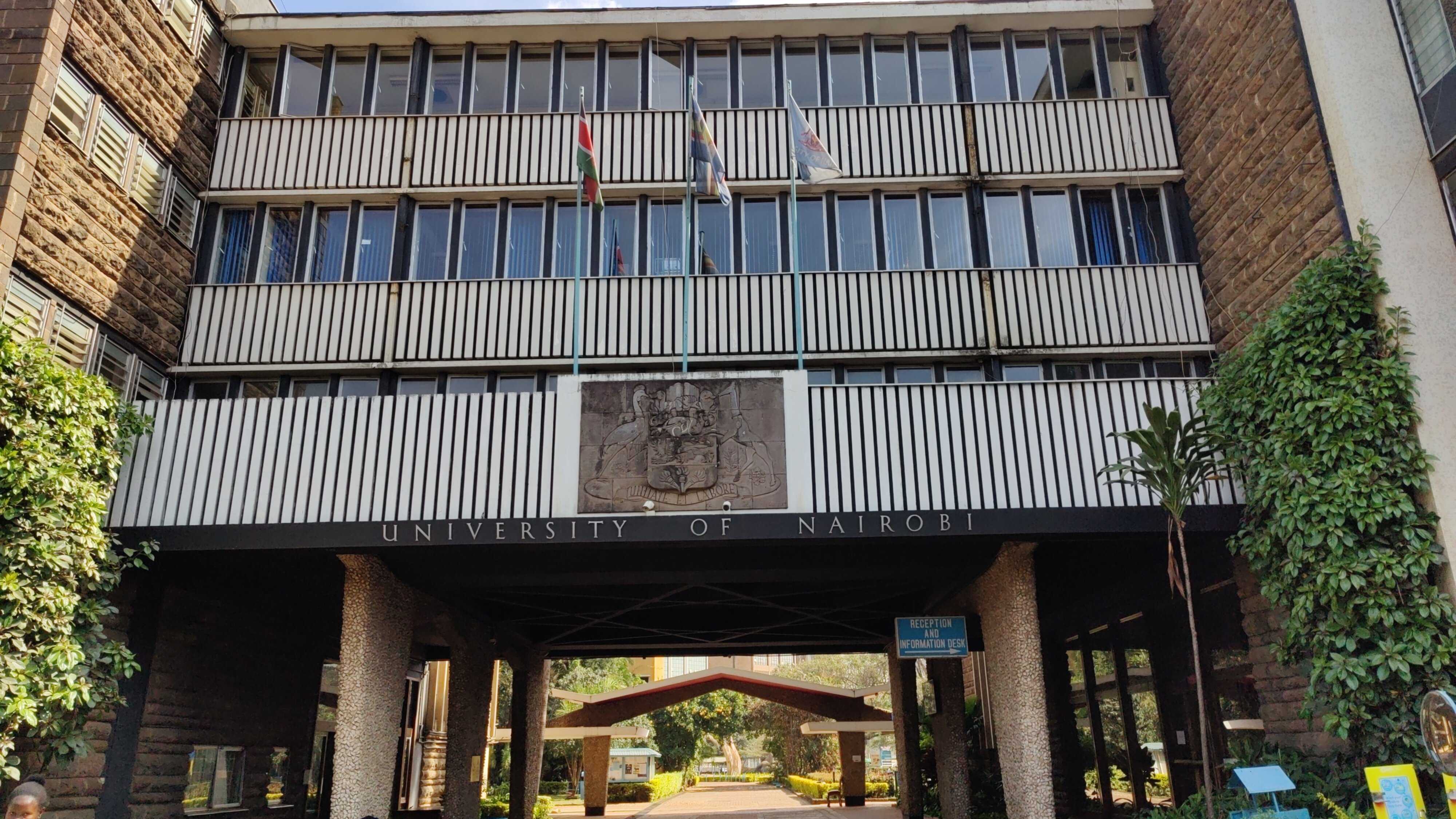 University of Nairobi.
 Our group at the conference.
 View of Nairobi's skyline from the open area on the fifth floor.
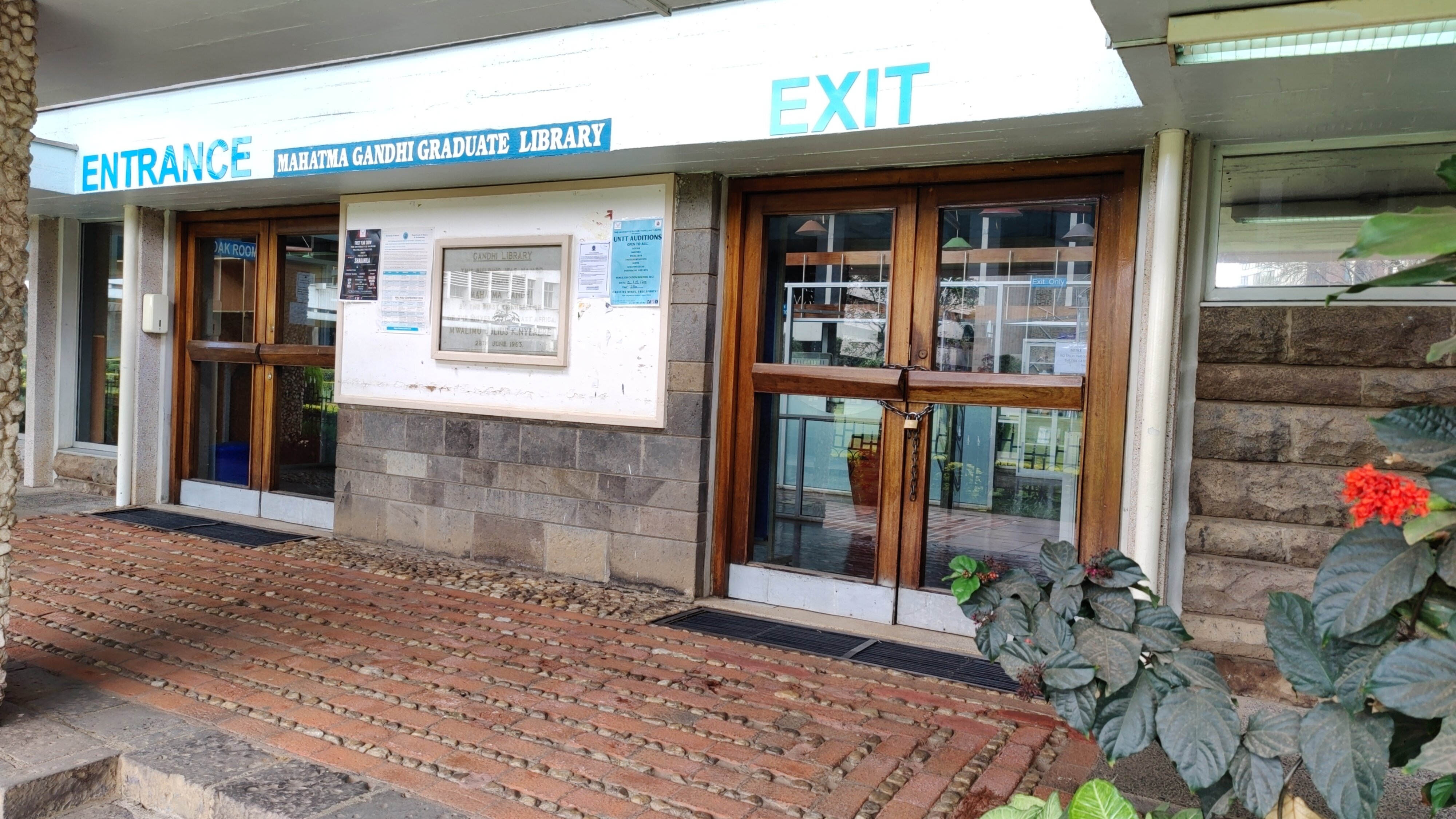 A library in Mahatma Gandhi wing of the University of Nairobi.
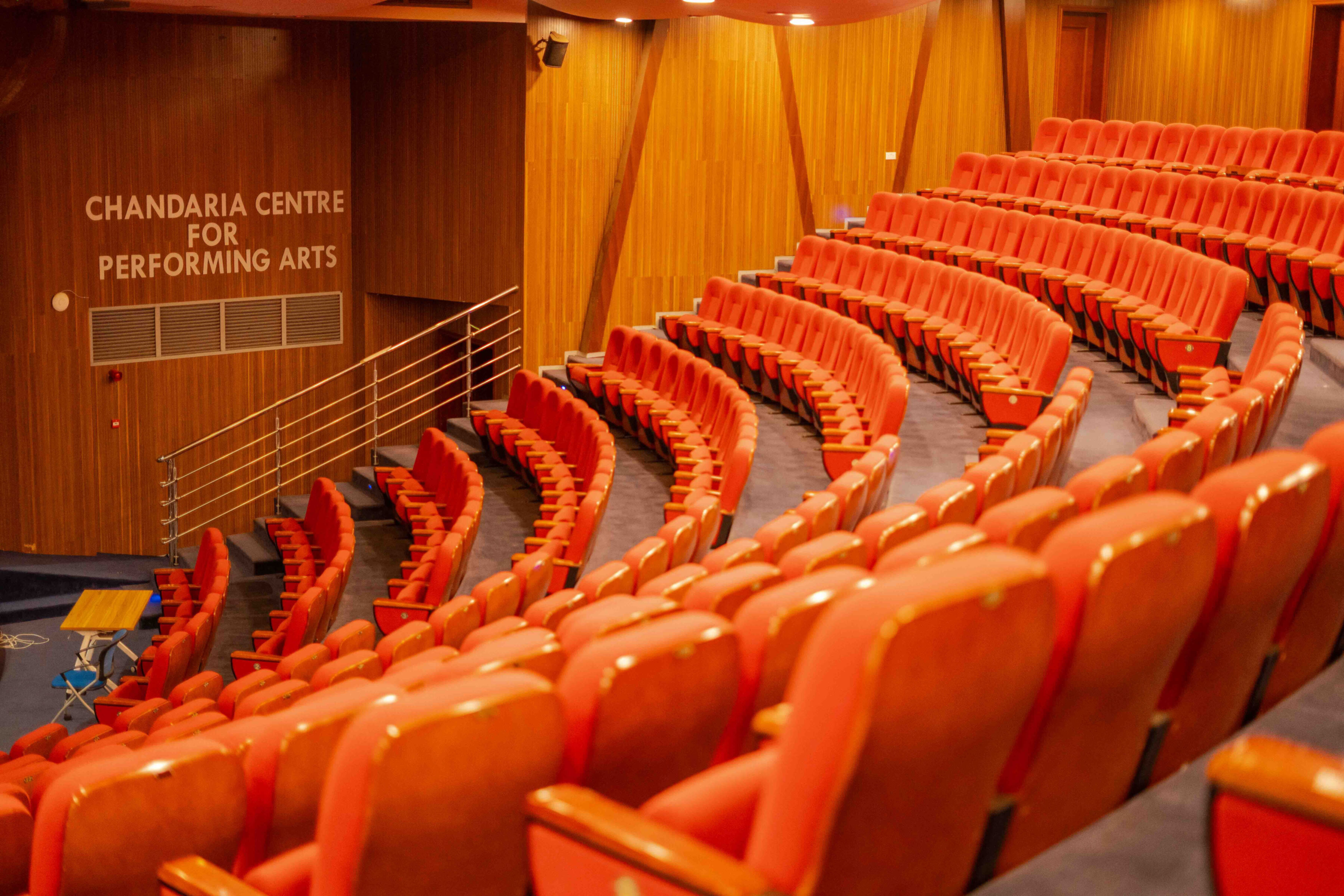 One of the conference halls where talks took place.
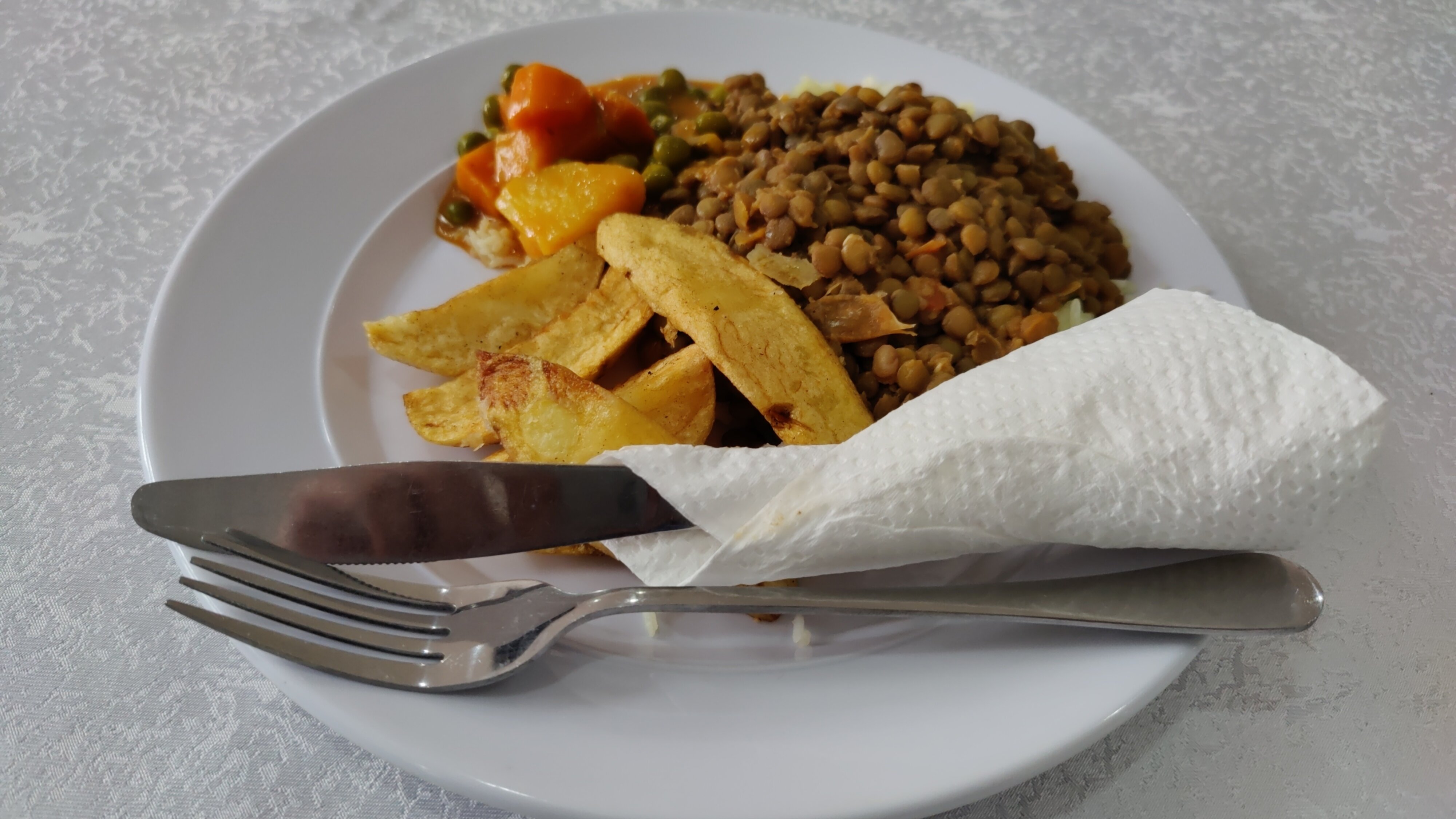 One of the lunch meals served during the conference.
 Minibus which took us from the university to Bao Box restaurant.
 This minibus in the picture gave a sense of a real matatu.
 Warning: If you're not into meat, you might want to skip the
rest of this...
This year, I turned 50. Wow. Lots of friends and family turned up
to help me celebrate, with a BBQ (of course!). I was very grateful for
a lovely set of gifts from those awesome people, and I have a number
of driving experiences to book in the next year or so. I'm going to
have so much fun driving silly cars on and off road!
However, the most surprising gift was
something totally different - a full-day course of
hands-on pork butchery. I was utterly bemused - I've never
considered doing anything like this at all, and I'd certainly never
talked to friends about anything like it either. I was shocked, but in
a good way!
So, two weekends back Jo and I went over
to
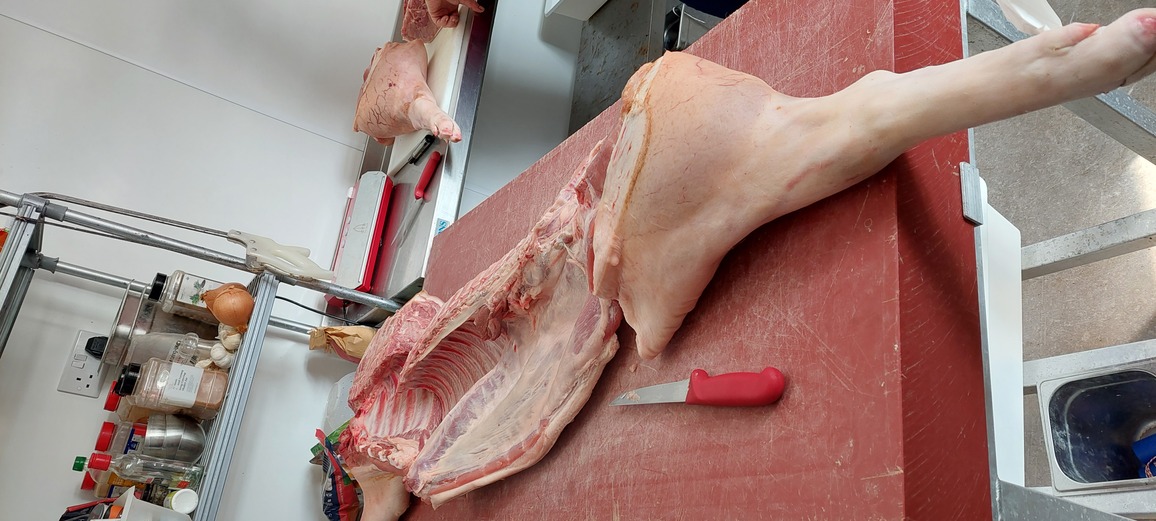 At the beginning of the day, we each started with half a pig. Over
the next several hours, we steadily worked our way through a series of
cuts with knife and saw, making the remaining pig smaller and smaller
as we went.
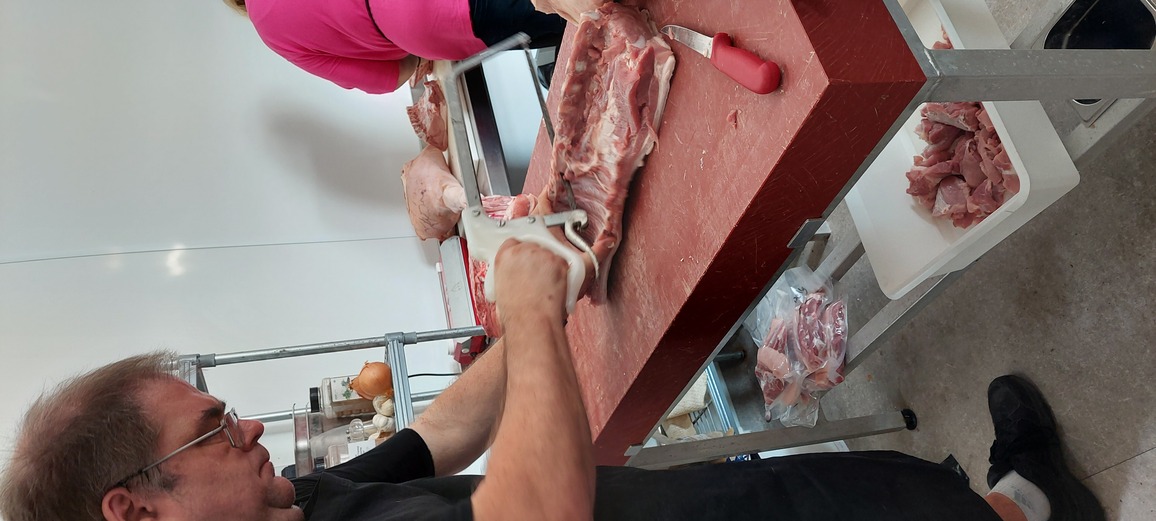
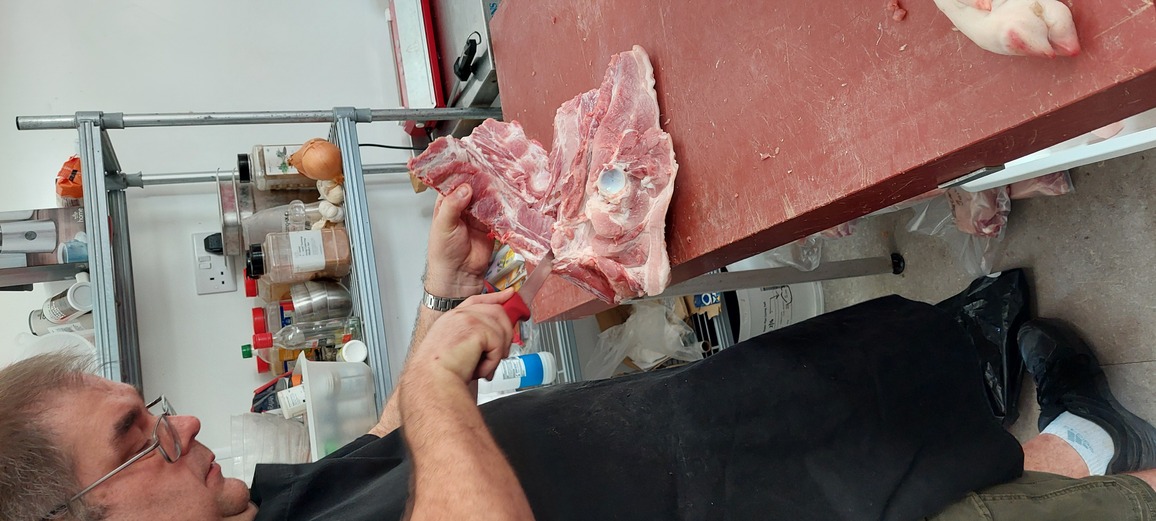 We finished the day with three sets of meat. First, a stack of
vacuum-packed joints, chops and steaks ready for cooking and eating at
home. Second: a box of off-cuts that we minced and made into sausages
at the end of the day. Finally: a bag of skin and bones. Our friend's
dog got some of the bones, and Jo turned a lot of the skin into
crackling that we shared with friends at the OMGWTFBBQ the next
weekend.
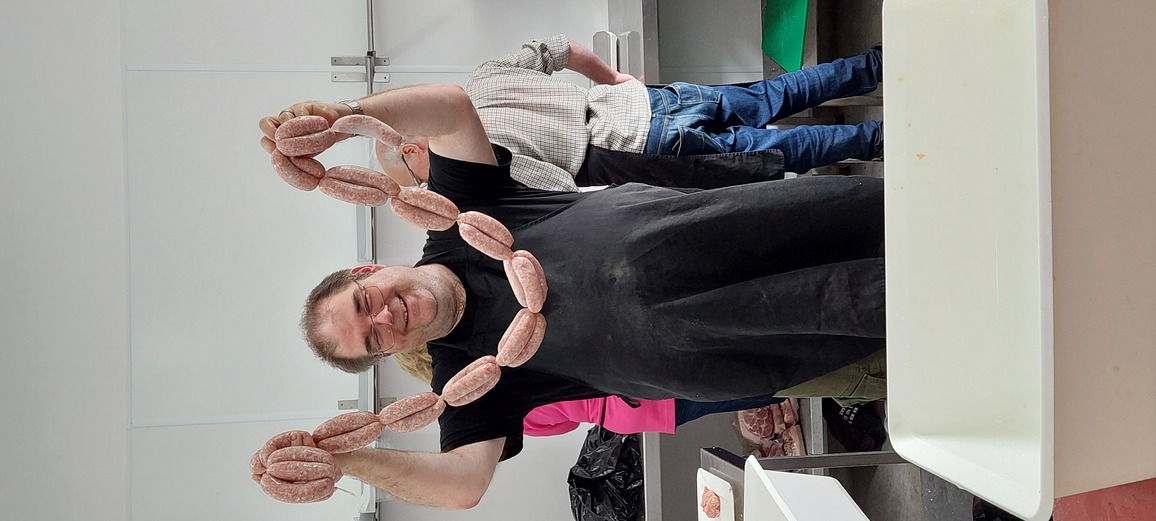 This was an amazing day. Massive thanks to my good friend Chris
Walker for suggesting this gift. As I told David on the day: this was
the most fun surprise gift I've ever received. Good hands-on teaching
in a new craft is an incredible thing to experience, and I can't
recommend this course highly enough.
 I m finishing typing up this blog entry hours before my last 13 hour leg back home, after I spent 2 weeks in

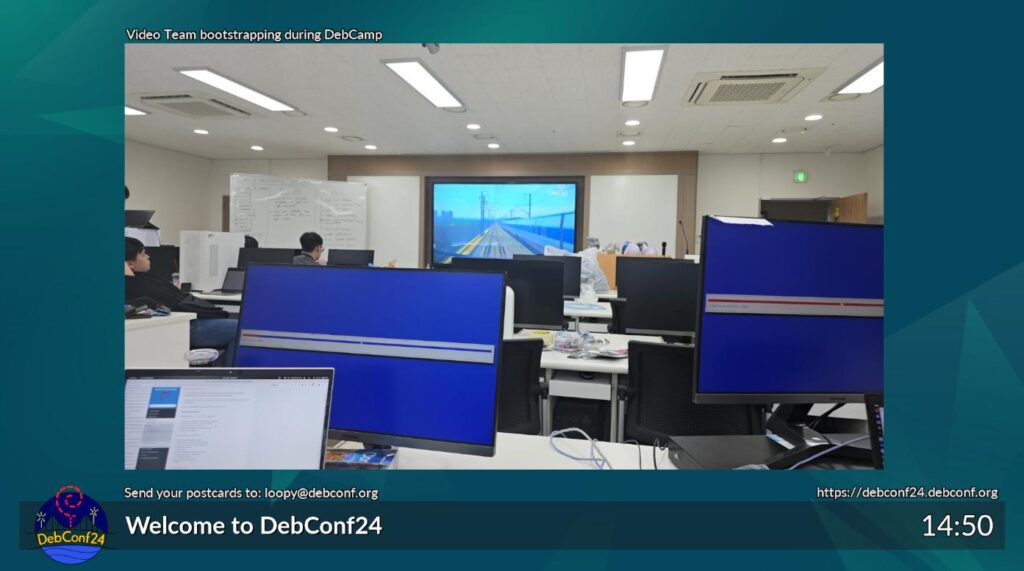

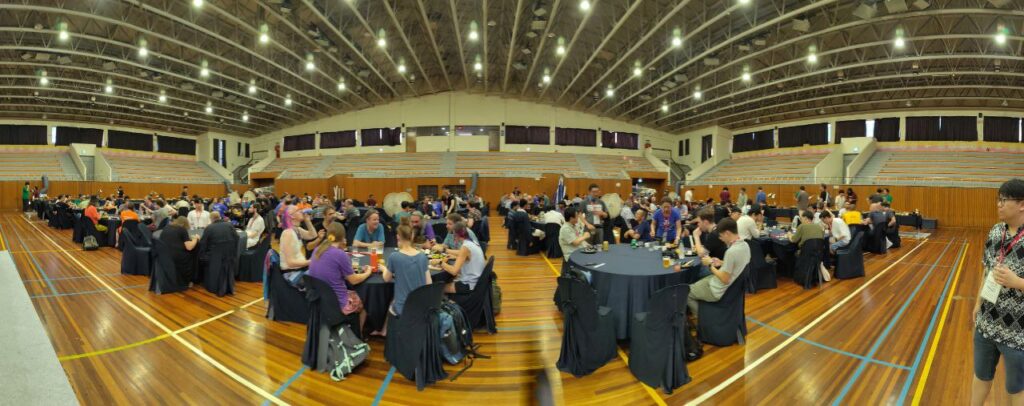 Conference Dinner Photo from Santiago


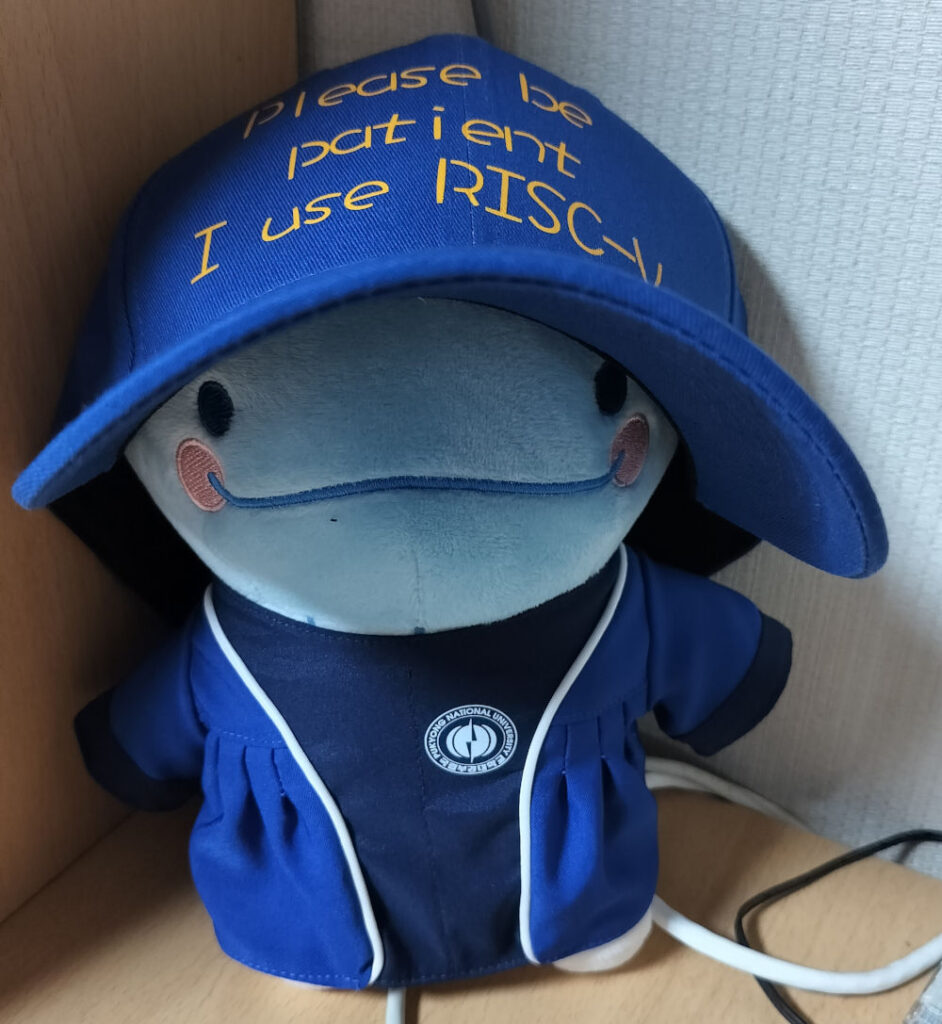

 A short status update of what happened on my side last month. Was able
to test our Cellbroadcast bits, feedbackd became more flexible
regarding LEDs, Phosh 0.40 is out, and some more.
Phosh

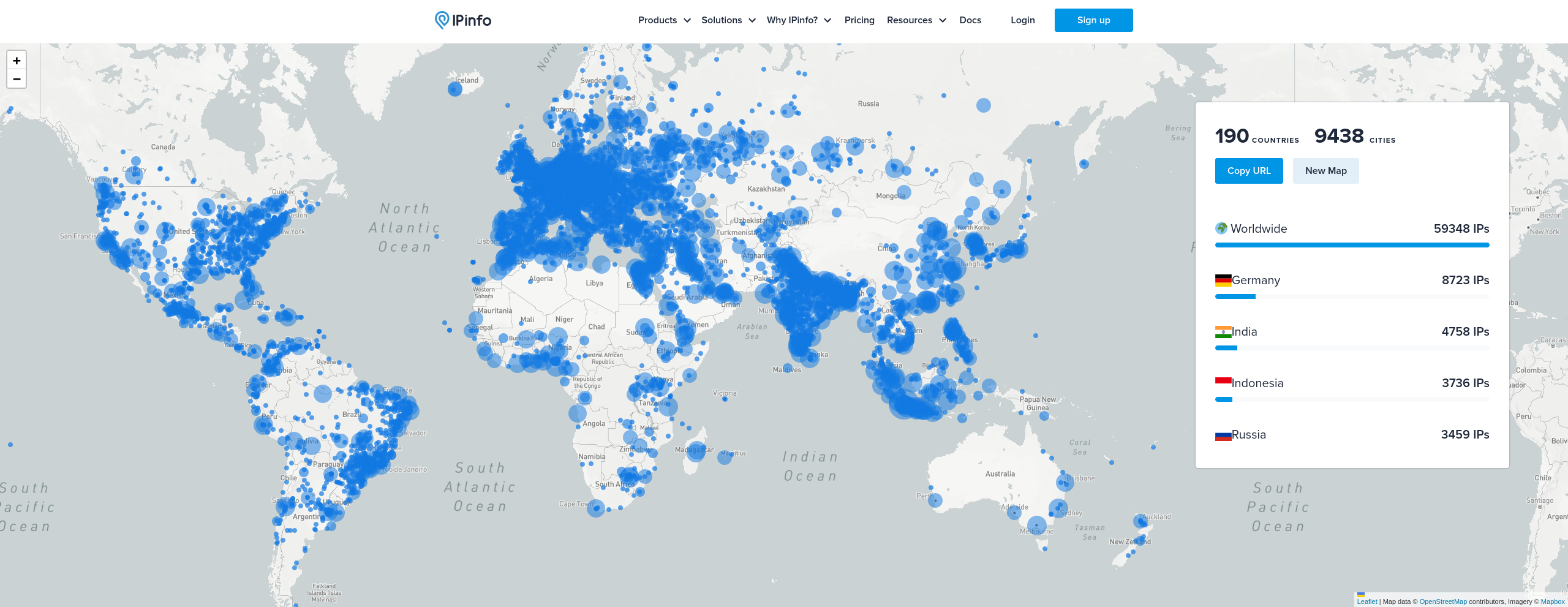
 After the unfortunate and somewhat surprising


