Search Results: "pere"

29 January 2023

Petter Reinholdtsen: Is the desktop recommending your program for opening its files?

Linux desktop systems have standardized how programs present themselves to the desktop system. If a package include a .desktop file in /usr/share/applications/, Gnome, KDE, LXDE, Xfce and the other desktop environments will pick up the file and use its content to generate the menu of available programs in the system. A lesser known fact is that a package can also explain to the desktop system how to recognize the files created by the program in question, and use it to open these files on request, for example via a GUI file browser. A while back I ran into a package that did not tell the desktop system how to recognize its files and was not used to open its files in the file browser and fixed it. In the process I wrote a simple debian/tests/ script to ensure the setup keep working. It might be useful for other packages too, to ensure any future version of the package keep handling its own files. For this to work the file format need a useful MIME type that can be used to identify the format. If the file format do not yet have a MIME type, it should define one and preferably also register it with IANA to ensure the MIME type string is reserved. The script uses the xdg-mime program from xdg-utils to query the database of standardized package information and ensure it return sensible values. It also need the location of an example file for xdg-mime to guess the format of.
#!/bin/sh
#
# Author: Petter Reinholdtsen
# License: GPL v2 or later at your choice.
#
# Validate the MIME setup, making sure motor types have
# application/vnd.openmotor+yaml associated with them and is connected
# to the openmotor desktop file.
retval=0
mimetype="application/vnd.openmotor+yaml"
testfile="test/data/real/o3100/motor.ric"
mydesktopfile="openmotor.desktop"
filemime="$(xdg-mime query filetype "$testfile")"
if [ "$mimetype" != "$filemime" ] ; then
    retval=1
    echo "error: xdg-mime claim motor file MIME type is $filemine, not $mimetype"
else
    echo "success: xdg-mime report correct mime type $mimetype for motor file"
fi
desktop=$(xdg-mime query default "$mimetype")
if [ "$mydesktopfile" != "$desktop" ]; then
    retval=1
    echo "error: xdg-mime claim motor file should be handled by $desktop, not $mydesktopfile"
else
    echo "success: xdg-mime agree motor file should be handled by $mydesktopfile"
fi
exit $retval
It is a simple way to ensure your users are not very surprised when they try to open one of your file formats in their file browser. As usual, if you use Bitcoin and want to show your support of my activities, please send Bitcoin donations to my address 15oWEoG9dUPovwmUL9KWAnYRtNJEkP1u1b.

22 January 2023

Petter Reinholdtsen: Opensnitch, the application level interactive firewall, heading into the Debian archive

While reading a blog post claiming MacOS X recently started scanning local files and reporting information about them to Apple, even on a machine where all such callback features had been disabled, I came across a description of the Little Snitch application for MacOS X. It seemed like a very nice tool to have in the tool box, and I decided to see if something similar was available for Linux. It did not take long to find the OpenSnitch package, which has been in development since 2017, and now is in version 1.5.0. It has had a request for Debian packaging since 2018, but no-one completed the job so far. Just for fun, I decided to see if I could help, and I was very happy to discover that upstream want a Debian package too. After struggling a bit with getting the program to run, figuring out building Go programs (and a little failed detour to look at eBPF builds too - help needed), I am very happy to report that I am sponsoring upstream to maintain the package in Debian, and it has since this morning been waiting in NEW for the ftpmasters to have a look. Perhaps it can get into the archive in time for the Bookworm release? As usual, if you use Bitcoin and want to show your support of my activities, please send Bitcoin donations to my address 15oWEoG9dUPovwmUL9KWAnYRtNJEkP1u1b.

8 January 2023

Petter Reinholdtsen: LinuxCNC MQTT publisher component

I watched a 2015 video from Andreas Schiffler the other day, where he set up LinuxCNC to send status information to the MQTT broker IBM Bluemix. As I also use MQTT for graphing, it occured to me that a generic MQTT LinuxCNC component would be useful and I set out to implement it. Today I got the first draft limping along and submitted as a patch to the LinuxCNC project. The simple part was setting up the MQTT publishing code in Python. I already have set up other parts submitting data to my Mosquito MQTT broker, so I could reuse that code. Writing a LinuxCNC component in Python as new to me, but using existing examples in the code repository and the extensive documentation, this was fairly straight forward. The hardest part was creating a automated test for the component to ensure it was working. Testing it in a simulated LinuxCNC machine proved very useful, as I discovered features I needed that I had not thought of yet, and adjusted the code quite a bit to make it easier to test without a operational MQTT broker available. The draft is ready and working, but I am unsure which LinuxCNC HAL pins I should collect and publish by default (in other words, the default set of information pieces published), and how to get the machine name from the LinuxCNC INI file. The latter is a minor detail, but I expect it would be useful in a setup with several machines available. I am hoping for feedback from the experienced LinuxCNC developers and users, to make the component even better before it can go into the mainland LinuxCNC code base. Since I started on the MQTT component, I came across another video from Kent VanderVelden where he combine LinuxCNC with a set of screen glasses controlled by a Raspberry Pi, and it occured to me that it would be useful for such use cases if LinuxCNC also provided a REST API for querying its status. I hope to start on such component once the MQTT component is working well. As usual, if you use Bitcoin and want to show your support of my activities, please send Bitcoin donations to my address 15oWEoG9dUPovwmUL9KWAnYRtNJEkP1u1b.

30 December 2022

Chris Lamb: Favourite books of 2022: Non-fiction

In my three most recent posts, I went over the memoirs and biographies, classics and fiction books that I enjoyed the most in 2022. But in the last of my book-related posts for 2022, I'll be going over my favourite works of non-fiction. Books that just missed the cut here include Adam Hochschild's King Leopold's Ghost (1998) on the role of Leopold II of Belgium in the Congo Free State, Johann Hari's Stolen Focus (2022) (a personal memoir on relating to how technology is increasingly fragmenting our attention), Amia Srinivasan's The Right to Sex (2021) (a misleadingly named set of philosophic essays on feminism), Dana Heller et al.'s The Selling of 9/11: How a National Tragedy Became a Commodity (2005), John Berger's mindbending Ways of Seeing (1972) and Louise Richardson's What Terrorists Want (2006).

The Great War and Modern Memory (1975)
Wartime: Understanding and Behavior in the Second World War (1989) Paul Fussell Rather than describe the battles, weapons, geopolitics or big personalities of the two World Wars, Paul Fussell's The Great War and Modern Memory & Wartime are focused instead on how the two wars have been remembered by their everyday participants. Drawing on the memoirs and memories of soldiers and civilians along with a brief comparison with the actual events that shaped them, Fussell's two books are a compassionate, insightful and moving piece of analysis. Fussell primarily sets himself against the admixture of nostalgia and trauma that obscures the origins and unimaginable experience of participating in these wars; two wars that were, in his view, a "perceptual and rhetorical scandal from which total recovery is unlikely." He takes particular aim at the dishonesty of hindsight:
For the past fifty years, the Allied war has been sanitised and romanticised almost beyond recognition by the sentimental, the loony patriotic, the ignorant and the bloodthirsty. I have tried to balance the scales. [And] in unbombed America especially, the meaning of the war [seems] inaccessible.
The author does not engage in any of the customary rose-tinted view of war, yet he remains understanding and compassionate towards those who try to locate a reason within what was quite often senseless barbarism. If anything, his despondency and pessimism about the Second World War (the war that Fussell himself fought in) shines through quite acutely, and this is especially the case in what he chooses to quote from others:
"It was common [ ] throughout the [Okinawa] campaign for replacements to get hit before we even knew their names. They came up confused, frightened, and hopeful, got wounded or killed, and went right back to the rear on the route by which they had come, shocked, bleeding, or stiff. They were forlorn figures coming up to the meat grinder and going right back out of it like homeless waifs, unknown and faceless to us, like unread books on a shelf."
It would take a rather heartless reader to fail to be sobered by this final simile, and an even colder one to view Fussell's citation of such an emotive anecdote to be manipulative. Still, stories and cruel ironies like this one infuse this often-angry book, but it is not without astute and shrewd analysis as well, especially on the many qualitative differences between the two conflicts that simply cannot be captured by facts and figures alone. For example:
A measure of the psychological distance of the Second [World] War from the First is the rarity, in 1914 1918, of drinking and drunkenness poems.
Indeed so. In fact, what makes Fussell's project so compelling and perhaps even unique is that he uses these non-quantitive measures to try and take stock of what happened. After all, this was a war conducted by humans, not the abstract school of statistics. And what is the value of a list of armaments destroyed by such-and-such a regiment when compared with truly consequential insights into both how the war affected, say, the psychology of postwar literature ("Prolonged trench warfare, whether enacted or remembered, fosters paranoid melodrama, which I take to be a primary mode in modern writing."), the specific words adopted by combatants ("It is a truism of military propaganda that monosyllabic enemies are easier to despise than others") as well as the very grammar of interaction:
The Field Service Post Card [in WW1] has the honour of being the first widespread exemplary of that kind of document which uniquely characterises the modern world: the "Form". [And] as the first widely known example of dehumanised, automated communication, the post card popularised a mode of rhetoric indispensable to the conduct of later wars fought by great faceless conscripted armies.
And this wouldn't be a book review without argument-ending observations that:
Indicative of the German wartime conception [of victory] would be Hitler and Speer's elaborate plans for the ultimate reconstruction of Berlin, which made no provision for a library.
Our myths about the two world wars possess an undisputed power, in part because they contain an essential truth the atrocities committed by Germany and its allies were not merely extreme or revolting, but their full dimensions (embodied in the Holocaust and the Holodomor) remain essentially inaccessible within our current ideological framework. Yet the two wars are better understood as an abyss in which we were all dragged into the depths of moral depravity, rather than a battle pitched by the forces of light against the forces of darkness. Fussell is one of the few observers that can truly accept and understand this truth and is still able to speak to us cogently on the topic from the vantage point of experience. The Second World War which looms so large in our contemporary understanding of the modern world (see below) may have been necessary and unavoidable, but Fussell convinces his reader that it was morally complicated "beyond the power of any literary or philosophic analysis to suggest," and that the only way to maintain a na ve belief in the myth that these wars were a Manichaean fight between good and evil is to overlook reality. There are many texts on the two World Wars that can either stir the intellect or move the emotions, but Fussell's two books do both. A uniquely perceptive and intelligent commentary; outstanding.

Longitude (1995) Dava Sobel Since Man first decided to sail the oceans, knowing one's location has always been critical. Yet doing so reliably used to be a serious problem if you didn't know where you were, you are far more likely to die and/or lose your valuable cargo. But whilst finding one's latitude (ie. your north south position) had effectively been solved by the beginning of the 17th century, finding one's (east west) longitude was far from trustworthy in comparison. This book first published in 1995 is therefore something of an anachronism. As in, we readily use the GPS facilities of our phones today without hesitation, so we find it difficult to imagine a reality in which knowing something fundamental like your own location is essentially unthinkable. It became clear in the 18th century, though, that in order to accurately determine one's longitude, what you actually needed was an accurate clock. In Longitude, therefore, we read of the remarkable story of John Harrison and his quest to create a timepiece that would not only keep time during a long sea voyage but would survive the rough ocean conditions as well. Self-educated and a carpenter by trade, Harrison made a number of important breakthroughs in keeping accurate time at sea, and Longitude describes his novel breakthroughs in a way that is both engaging and without talking down to the reader. Still, this book covers much more than that, including the development of accurate longitude going hand-in-hand with advancements in cartography as well as in scientific experiments to determine the speed of light: experiments that led to the formulation of quantum mechanics. It also outlines the work being done by Harrison's competitors. 'Competitors' is indeed the correct word here, as Parliament offered a huge prize to whoever could create such a device, and the ramifications of this tremendous financial incentive are an essential part of this story. For the most part, though, Longitude sticks to the story of Harrison and his evolving obsession with his creating the perfect timepiece. Indeed, one reason that Longitude is so resonant with readers is that many of the tropes of the archetypical 'English inventor' are embedded within Harrison himself. That is to say, here is a self-made man pushing against the establishment of the time, with his groundbreaking ideas being underappreciated in his life, or dishonestly purloined by his intellectual inferiors. At the level of allegory, then, I am minded to interpret this portrait of Harrison as a symbolic distillation of postwar Britain a nation acutely embarrassed by the loss of the Empire that is now repositioning itself as a resourceful but plucky underdog; a country that, with a combination of the brains of boffins and a healthy dose of charisma and PR, can still keep up with the big boys. (It is this same search for postimperial meaning I find in the fiction of John le Carr , and, far more famously, in the James Bond franchise.) All of this is left to the reader, of course, as what makes Longitute singularly compelling is its gentle manner and tone. Indeed, at times it was as if the doyenne of sci-fi Ursula K. LeGuin had a sideline in popular non-fiction. I realise it's a mark of critical distinction to downgrade the importance of popular science in favour of erudite academic texts, but Latitude is ample evidence that so-called 'pop' science need not be patronising or reductive at all.

Closed Chambers: The Rise, Fall, and Future of the Modern Supreme Court (1998) Edward Lazarus After the landmark decision by the U.S. Supreme Court in *Dobbs v. Jackson Women's Health Organization that ended the Constitutional right to abortion conferred by Roe v Wade, I prioritised a few books in the queue about the judicial branch of the United States. One of these books was Closed Chambers, which attempts to assay, according to its subtitle, "The Rise, Fall and Future of the Modern Supreme Court". This book is not merely simply a learned guide to the history and functioning of the Court (although it is completely creditable in this respect); it's actually an 'insider' view of the workings of the institution as Lazurus was a clerk for Justice Harry Blackmun during the October term of 1988. Lazarus has therefore combined his experience as a clerk and his personal reflections (along with a substantial body of subsequent research) in order to communicate the collapse in comity between the Justices. Part of this book is therefore a pure history of the Court, detailing its important nineteenth-century judgements (such as Dred Scott which ruled that the Constitution did not consider Blacks to be citizens; and Plessy v. Ferguson which failed to find protection in the Constitution against racial segregation laws), as well as many twentieth-century cases that touch on the rather technical principle of substantive due process. Other layers of Lazurus' book are explicitly opinionated, however, and they capture the author's assessment of the Court's actions in the past and present [1998] day. Given the role in which he served at the Court, particular attention is given by Lazarus to the function of its clerks. These are revealed as being far more than the mere amanuenses they were hitherto believed to be. Indeed, the book is potentially unique in its the claim that the clerks have played a pivotal role in the deliberations, machinations and eventual rulings of the Court. By implication, then, the clerks have plaedy a crucial role in the internal controversies that surround many of the high-profile Supreme Court decisions decisions that, to the outsider at least, are presented as disinterested interpretations of Constitution of the United States. This is of especial importance given that, to Lazarus, "for all the attention we now pay to it, the Court remains shrouded in confusion and misunderstanding." Throughout his book, Lazarus complicates the commonplace view that the Court is divided into two simple right vs. left political factions, and instead documents an ever-evolving series of loosely held but strongly felt series of cabals, quid pro quo exchanges, outright equivocation and pure personal prejudices. (The age and concomitant illnesses of the Justices also appears to have a not insignificant effect on the Court's rulings as well.) In other words, Closed Chambers is not a book that will be read in a typical civics class in America, and the only time the book resorts to the customary breathless rhetoric about the US federal government is in its opening chapter:
The Court itself, a Greek-style temple commanding the crest of Capitol Hill, loomed above them in the dim light of the storm. Set atop a broad marble plaza and thirty-six steps, the Court stands in splendid isolation appropriate to its place at the pinnacle of the national judiciary, one of the three independent and "coequal" branches of American government. Once dubbed the Ivory Tower by architecture critics, the Court has a Corinthian colonnade and massive twenty-foot-high bronze doors that guard the single most powerful judicial institution in the Western world. Lights still shone in several offices to the right of the Court's entrance, and [ ]
Et cetera, et cetera. But, of course, this encomium to the inherent 'nobility' of the Supreme Court is quickly revealed to be a narrative foil, as Lazarus soon razes this dangerously na ve conception to the ground:
[The] institution is [now] broken into unyielding factions that have largely given up on a meaningful exchange of their respective views or, for that matter, a meaningful explication or defense of their own views. It is of Justices who in many important cases resort to transparently deceitful and hypocritical arguments and factual distortions as they discard judicial philosophy and consistent interpretation in favor of bottom-line results. This is a Court so badly splintered, yet so intent on lawmaking, that shifting 5-4 majorities, or even mere pluralities, rewrite whole swaths of constitutional law on the authority of a single, often idiosyncratic vote. It is also a Court where Justices yield great and excessive power to immature, ideologically driven clerks, who in turn use that power to manipulate their bosses and the institution they ostensibly serve.
Lazurus does not put forward a single, overarching thesis, but in the final chapters, he does suggest a potential future for the Court:
In the short run, the cure for what ails the Court lies solely with the Justices. It is their duty, under the shield of life tenure, to recognize the pathologies affecting their work and to restore the vitality of American constitutionalism. Ultimately, though, the long-term health of the Court depends on our own resolve on whom [we] select to join that institution.
Back in 1998, Lazurus might have had room for this qualified optimism. But from the vantage point of 2022, it appears that the "resolve" of the United States citizenry was not muscular enough to meet his challenge. After all, Lazurus was writing before Bush v. Gore in 2000, which arrogated to the judicial branch the ability to decide a presidential election; the disillusionment of Barack Obama's failure to nominate a replacement for Scalia; and many other missteps in the Court as well. All of which have now been compounded by the Trump administration's appointment of three Republican-friendly justices to the Court, including hypocritically appointing Justice Barrett a mere 38 days before the 2020 election. And, of course, the leaking and ruling in Dobbs v. Jackson, the true extent of which has not been yet. Not of a bit of this is Lazarus' fault, of course, but the Court's recent decisions (as well as the liberal hagiographies of 'RBG') most perforce affect one's reading of the concluding chapters. The other slight defect of Closed Chambers is that, whilst it often implies the importance of the federal and state courts within the judiciary, it only briefly positions the Supreme Court's decisions in relation to what was happening in the House, Senate and White House at the time. This seems to be increasingly relevant as time goes on: after all, it seems fairly clear even to this Brit that relying on an activist Supreme Court to enact progressive laws must be interpreted as a failure of the legislative branch to overcome the perennial problems of the filibuster, culture wars and partisan bickering. Nevertheless, Lazarus' book is in equal parts ambitious, opinionated, scholarly and dare I admit it? wonderfully gossipy. By juxtaposing history, memoir, and analysis, Closed Chambers combines an exacting evaluation of the Court's decisions with a lively portrait of the intellectual and emotional intensity that has grown within the Supreme Court's pseudo-monastic environment all while it struggles with the most impactful legal issues of the day. This book is an excellent and well-written achievement that will likely never be repeated, and a must-read for anyone interested in this ever-increasingly important branch of the US government.

Crashed: How a Decade of Financial Crises Changed the World (2018)
Shutdown: How Covid Shook the World's Economy (2021) Adam Tooze The economic historian Adam Tooze has often been labelled as an unlikely celebrity, but in the fourteen years since the global financial crisis of 2008, a growing audience has been looking for answers about the various failures of the modern economy. Tooze, a professor of history at New York's Columbia University, has written much that is penetrative and thought-provoking on this topic, and as a result, he has generated something of a cult following amongst economists, historians and the online left. I actually read two Tooze books this year. The first, Crashed (2018), catalogues the scale of government intervention required to prop up global finance after the 2008 financial crisis, and it characterises the different ways that countries around the world failed to live up to the situation, such as doing far too little, or taking action far too late. The connections between the high-risk subprime loans, credit default swaps and the resulting liquidity crisis in the US in late 2008 is fairly well known today in part thanks to films such as Adam McKay's 2015 The Big Short and much improved economic literacy in media reportage. But Crashed makes the implicit claim that, whilst the specific and structural origins of the 2008 crisis are worth scrutinising in exacting detail, it is the reaction of states in the months and years after the crash that has been overlooked as a result. After all, this is a reaction that has not only shaped a new economic order, it has created one that does not fit any conventional idea about the way the world 'ought' to be run. Tooze connects the original American banking crisis to the (multiple) European debt crises with a larger crisis of liberalism. Indeed, Tooze somehow manages to cover all these topics and more, weaving in Trump, Brexit and Russia's 2014 annexation of Crimea, as well as the evolving role of China in the post-2008 economic order. Where Crashed focused on the constellation of consequences that followed the events of 2008, Shutdown is a clear and comprehensive account of the way the world responded to the economic impact of Covid-19. The figures are often jaw-dropping: soon after the disease spread around the world, 95% of the world's economies contracted simultaneously, and at one point, the global economy shrunk by approximately 20%. Tooze's keen and sobering analysis of what happened is made all the more remarkable by the fact that it came out whilst the pandemic was still unfolding. In fact, this leads quickly to one of the book's few flaws: by being published so quickly, Shutdown prematurely over-praises China's 'zero Covid' policy, and these remarks will make a reader today squirm in their chair. Still, despite the regularity of these references (after all, mentioning China is very useful when one is directly comparing economic figures in early 2021, for examples), these are actually minor blemishes on the book's overall thesis. That is to say, Crashed is not merely a retelling of what happened in such-and-such a country during the pandemic; it offers in effect a prediction about what might be coming next. Whilst the economic responses to Covid averted what could easily have been another Great Depression (and thus showed it had learned some lessons from 2008), it had only done so by truly discarding the economic rule book. The by-product of inverting this set of written and unwritten conventions that have governed the world for the past 50 years, this 'Washington consensus' if you well, has yet to be fully felt. Of course, there are many parallels between these two books by Tooze. Both the liquidity crisis outlined in Crashed and the economic response to Covid in Shutdown exposed the fact that one of the central tenets of the modern economy ie. that financial markets can be trusted to regulate themselves was entirely untrue, and likely was false from the very beginning. And whilst Adam Tooze does not offer a singular piercing insight (conveying a sense of rigorous mastery instead), he may as well be asking whether we're simply going to lurch along from one crisis to the next, relying on the technocrats in power to fix problems when everything blows up again. The answer may very well be yes.

Looking for the Good War: American Amnesia and the Violent Pursuit of Happiness (2021) Elizabeth D. Samet Elizabeth D. Samet's Looking for the Good War answers the following question what would be the result if you asked a professor of English to disentangle the complex mythology we have about WW2 in the context of the recent US exit of Afghanistan? Samet's book acts as a twenty-first-century update of a kind to Paul Fussell's two books (reviewed above), as well as a deeper meditation on the idea that each new war is seen through the lens of the previous one. Indeed, like The Great War and Modern Memory (1975) and Wartime (1989), Samet's book is a perceptive work of demystification, but whilst Fussell seems to have been inspired by his own traumatic war experience, Samet is not only informed by her teaching West Point military cadets but by the physical and ontological wars that have occurred during her own life as well. A more scholarly and dispassionate text is the result of Samet's relative distance from armed combat, but it doesn't mean Looking for the Good War lacks energy or inspiration. Samet shares John Adams' belief that no political project can entirely shed the innate corruptions of power and ambition and so it is crucial to analyse and re-analyse the role of WW2 in contemporary American life. She is surely correct that the Second World War has been universally elevated as a special, 'good' war. Even those with exceptionally giddy minds seem to treat WW2 as hallowed:
It is nevertheless telling that one of the few occasions to which Trump responded with any kind of restraint while he was in office was the 75th anniversary of D-Day in 2019.
What is the source of this restraint, and what has nurtured its growth in the eight decades since WW2 began? Samet posits several reasons for this, including the fact that almost all of the media about the Second World War is not only suffused with symbolism and nostalgia but, less obviously, it has been made by people who have no experience of the events that they depict. Take Stephen Ambrose, author of Steven Spielberg's Band of Brothers miniseries: "I was 10 years old when the war ended," Samet quotes of Ambrose. "I thought the returning veterans were giants who had saved the world from barbarism. I still think so. I remain a hero worshiper." If Looking for the Good War has a primary thesis, then, it is that childhood hero worship is no basis for a system of government, let alone a crusading foreign policy. There is a straight line (to quote this book's subtitle) from the "American Amnesia" that obscures the reality of war to the "Violent Pursuit of Happiness." Samet's book doesn't merely just provide a modern appendix to Fussell's two works, however, as it adds further layers and dimensions he overlooked. For example, Samet provides some excellent insight on the role of Western, gangster and superhero movies, and she is especially good when looking at noir films as a kind of kaleidoscopic response to the Second World War:
Noir is a world ruled by bad decisions but also by bad timing. Chance, which plays such a pivotal role in war, bleeds into this world, too.
Samet rightfully weaves the role of women into the narrative as well. Women in film noir are often celebrated as 'independent' and sassy, correctly reflecting their newly-found independence gained during WW2. But these 'liberated' roles are not exactly a ringing endorsement of this independence: the 'femme fatale' and the 'tart', etc., reflect a kind of conditional freedom permitted to women by a post-War culture which is still wedded to an outmoded honour culture. In effect, far from being novel and subversive, these roles for women actually underwrote the ambient cultural disapproval of women's presence in the workforce. Samet later connects this highly-conditional independence with the liberation of Afghan women, which:
is inarguably one of the more palatable outcomes of our invasion, and the protection of women's rights has been invoked on the right and the left as an argument for staying the course in Afghanistan. How easily consequence is becoming justification. How flattering it will be one day to reimagine it as original objective.
Samet has ensured her book has a predominantly US angle as well, for she ends her book with a chapter on the pseudohistorical Lost Cause of the Civil War. The legacy of the Civil War is still visible in the physical phenomena of Confederate statues, but it also exists in deep-rooted racial injustice that has been shrouded in euphemism and other psychological devices for over 150 years. Samet believes that a key part of what drives the American mythology about the Second World War is the way in which it subconsciously cleanses the horrors of brother-on-brother murder that were seen in the Civil War. This is a book that is not only of interest to historians of the Second World War; it is a work for anyone who wishes to understand almost any American historical event, social issue, politician or movie that has appeared since the end of WW2. That is for better or worse everyone on earth.

24 December 2022

Petter Reinholdtsen: ONVIF IP camera management tool finally in Debian

Merry Christmas to you all. Here is a small gift to all those with IP cameras following the ONVIF specification. There is finally a nice command line and GUI tool in Debian to manage ONVIF IP cameras. After working with upstream for a few months and sponsoring the upload, I am very happy to report that the libonvif package entered Debian Sid last night. The package provide a C library to communicate with such cameras, a command line tool to locate and update settings of (like password) the cameras and a GUI tool to configure and control the units as well as preview the video from the camera. Libonvif is available on Both Linux and Windows and the GUI tool uses the Qt library. The main competitors are non-free software, while libonvif is GNU GPL licensed. I am very glad Debian users in the future can control their cameras using a free software system provided by Debian. But the ONVIF world is full of slightly broken firmware, where the cameras pretend to follow the ONVIF specification but fail to set some configuration values or refuse to provide video to more than one recipient at the time, and the onvif project is quite young and might take a while before it completely work with your camera. Upstream seem eager to improve the library, so handling any broken camera might be just a bug report away. The package just cleared NEW, and need a new source only upload before it can enter testing. This will happen in the next few days. As usual, if you use Bitcoin and want to show your support of my activities, please send Bitcoin donations to my address 15oWEoG9dUPovwmUL9KWAnYRtNJEkP1u1b.

8 December 2022

Reproducible Builds: Reproducible Builds in November 2022

Welcome to yet another report from the Reproducible Builds project, this time for November 2022. In all of these reports (which we have been publishing regularly since May 2015) we attempt to outline the most important things that we have been up to over the past month. As always, if you interested in contributing to the project, please visit our Contribute page on our website.

Reproducible Builds Summit 2022 Following-up from last month s report about our recent summit in Venice, Italy, a comprehensive report from the meeting has not been finalised yet watch this space! As a very small preview, however, we can link to several issues that were filed about the website during the summit (#38, #39, #40, #41, #42, #43, etc.) and collectively learned about Software Bill of Materials (SBOM) s and how .buildinfo files can be seen/used as SBOMs. And, no less importantly, the Reproducible Builds t-shirt design has been updated

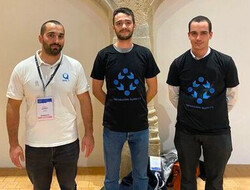
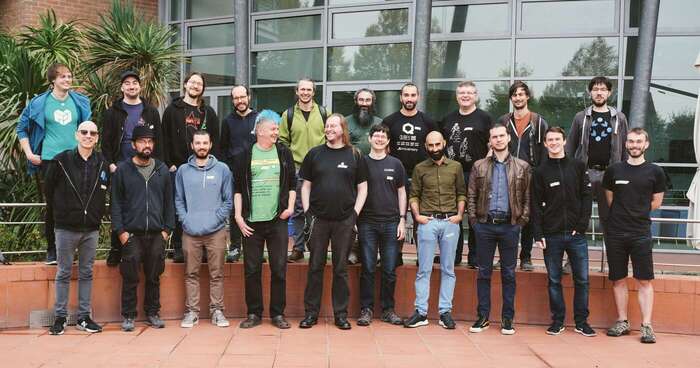
Reproducible Builds at European Cyber Week 2022 During the European Cyber Week 2022, a Capture The Flag (CTF) cybersecurity challenge was created by Fr d ric Pierret on the subject of Reproducible Builds. The challenge consisted in a pedagogical sense based on how to make a software release reproducible. To progress through the challenge issues that affect the reproducibility of build (such as build path, timestamps, file ordering, etc.) were to be fixed in steps in order to get the final flag in order to win the challenge. At the end of the competition, five people succeeded in solving the challenge, all of whom were awarded with a shirt. Fr d ric Pierret intends to create similar challenge in the form of a how to in the Reproducible Builds documentation, but two of the 2022 winners are shown here:

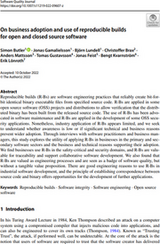
On business adoption and use of reproducible builds Simon Butler announced on the rb-general mailing list that the Software Quality Journal published an article called On business adoption and use of reproducible builds for open and closed source software. This article is an interview-based study which focuses on the adoption and uses of Reproducible Builds in industry, with a focus on investigating the reasons why organisations might not have adopted them:
[ ] industry application of R-Bs appears limited, and we seek to understand whether awareness is low or if significant technical and business reasons prevent wider adoption.
This is achieved through interviews with software practitioners and business managers, and touches on both the business and technical reasons supporting the adoption (or not) of Reproducible Builds. The article also begins with an excellent explanation and literature review, and even introduces a new helpful analogy for reproducible builds:
[Users are] able to perform a bitwise comparison of the two binaries to verify that they are identical and that the distributed binary is indeed built from the source code in the way the provider claims. Applied in this manner, R-Bs function as a canary, a mechanism that indicates when something might be wrong, and offer an improvement in security over running unverified binaries on computer systems.
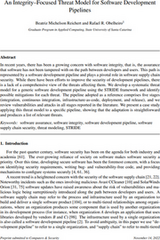
The full paper is available to download on an open access basis. Elsewhere in academia, Beatriz Michelson Reichert and Rafael R. Obelheiro have published a paper proposing a systematic threat model for a generic software development pipeline identifying possible mitigations for each threat (PDF). Under the Tampering rubric of their paper, various attacks against Continuous Integration (CI) processes:
An attacker may insert a backdoor into a CI or build tool and thus introduce vulnerabilities into the software (resulting in an improper build). To avoid this threat, it is the developer s responsibility to take due care when making use of third-party build tools. Tampered compilers can be mitigated using diversity, as in the diverse double compiling (DDC) technique. Reproducible builds, a recent research topic, can also provide mitigation for this problem. (PDF)

Misc news
On our mailing list this month:

Debian & other Linux distributions Over 50 reviews of Debian packages were added this month, another 48 were updated and almost 30 were removed, all of which adds to our knowledge about identified issues. Two new issue types were added as well. [ ][ ]. Vagrant Cascadian announced on our mailing list another online sprint to help clear the huge backlog of reproducible builds patches submitted by performing NMUs (Non-Maintainer Uploads). The first such sprint took place on September 22nd, but others were held on October 6th and October 20th. There were two additional sprints that occurred in November, however, which resulted in the following progress: Lastly, Roland Clobus posted his latest update of the status of reproducible Debian ISO images on our mailing list. This reports that all major desktops build reproducibly with bullseye, bookworm and sid as well as that no custom patches needed to applied to Debian unstable for this result to occur. During November, however, Roland proposed some modifications to live-setup and the rebuild script has been adjusted to fix the failing Jenkins tests for Debian bullseye [ ][ ].
In other news, Miro Hron ok proposed a change to clamp build modification times to the value of SOURCE_DATE_EPOCH. This was initially suggested and discussed on a devel@ mailing list post but was later written up on the Fedora Wiki as well as being officially proposed to Fedora Engineering Steering Committee (FESCo).

Upstream patches The Reproducible Builds project detects, dissects and attempts to fix as many currently-unreproducible packages as possible. We endeavour to send all of our patches upstream where appropriate. This month, we wrote a large number of such patches, including:

diffoscope diffoscope is our in-depth and content-aware diff utility. Not only can it locate and diagnose reproducibility issues, it can provide human-readable diffs from many kinds of binary formats. This month, Chris Lamb prepared and uploaded versions 226 and 227 to Debian:
  • Support both python3-progressbar and python3-progressbar2, two modules providing the progressbar Python module. [ ]
  • Don t run Python decompiling tests on Python bytecode that file(1) cannot detect yet and Python 3.11 cannot unmarshal. (#1024335)
  • Don t attempt to attach text-only differences notice if there are no differences to begin with. (#1024171)
  • Make sure we recommend apksigcopier. [ ]
  • Tidy generation of os_list. [ ]
  • Make the code clearer around generating the Debian substvars . [ ]
  • Use our assert_diff helper in test_lzip.py. [ ]
  • Drop other copyright notices from lzip.py and test_lzip.py. [ ]
In addition to this, Christopher Baines added lzip support [ ], and FC Stegerman added an optimisation whereby we don t run apktool if no differences are detected before the signing block [ ].
A significant number of changes were made to the Reproducible Builds website and documentation this month, including Chris Lamb ensuring the openEuler logo is correctly visible with a white background [ ], FC Stegerman de-duplicated by email address to avoid listing some contributors twice [ ], Herv Boutemy added Apache Maven to the list of affiliated projects [ ] and boyska updated our Contribute page to remark that the Reproducible Builds presence on salsa.debian.org is not just the Git repository but is also for creating issues [ ][ ]. In addition to all this, however, Holger Levsen made the following changes:
  • Add a number of existing publications [ ][ ] and update metadata for some existing publications as well [ ].
  • Hide draft posts on the website homepage. [ ]
  • Add the Warpforge build tool as a participating project of the summit. [ ]
  • Clarify in the footer that we welcome patches to the website repository. [ ]

Testing framework The Reproducible Builds project operates a comprehensive testing framework at tests.reproducible-builds.org in order to check packages and other artifacts for reproducibility. In October, the following changes were made by Holger Levsen:
  • Improve the generation of meta package sets (used in grouping packages for reporting/statistical purposes) to treat Debian bookworm as equivalent to Debian unstable in this specific case [ ] and to parse the list of packages used in the Debian cloud images [ ][ ][ ].
  • Temporarily allow Frederic to ssh(1) into our snapshot server as the jenkins user. [ ]
  • Keep some reproducible jobs Jenkins logs much longer [ ] (later reverted).
  • Improve the node health checks to detect failures to update the Debian cloud image package set [ ][ ] and to improve prioritisation of some kernel warnings [ ].
  • Always echo any IRC output to Jenkins output as well. [ ]
  • Deal gracefully with problems related to processing the cloud image package set. [ ]
Finally, Roland Clobus continued his work on testing Live Debian images, including adding support for specifying the origin of the Debian installer [ ] and to warn when the image has unmet dependencies in the package list (e.g. due to a transition) [ ].
If you are interested in contributing to the Reproducible Builds project, please visit our Contribute page on our website. You can get in touch with us via:

30 November 2022

Russell Coker: Links November 2022

Here s the US Senate Statement of Frances Haugen who used to work for Facebook countering misinformation and espionage [1]. She believes that Facebook is capable of dealing with the online radicalisation and promotion of bad things on it s platform but is unwilling to do so for financial reasons. We need strong regulation of Facebook and it probably needs to be broken up. Interesting article from The Atlantic about filtered cigarettes being more unhealthy than unfiltered [2]. Every time I think I know how evil tobacco companies are I get surprised by some new evidence. Cory Doctorow wrote an insightful article about resistance to rubber hose cryptanalysis [3]. Cory Doctorow wrote an interesting article When Automation Becomes Enforcement with a new way of thinking about Snapchat etc [4]. Cory Doctorow wrote an insightful and informative article Big Tech Isn t Stealing News Publishers Content, It s Stealing Their Money [5] which should be read by politicians from all countries that are trying to restrict quoting news on the Internet. Interesting articl;e on Santiago Genoves who could be considered as a pioneer of reality TV for deliberately creating disputes between a group of young men and women on a raft in the Atlantic for 3 months [6]. Matthew Garrett wrote an interesting review of the Freedom Phone, seems that it s not good for privacy and linked to some companies doing weird stuff [7]. Definitely worth reading. Cory Doctorow wrote an interesting and amusing article about backdoors for machine learning [8] Petter Reinholdtsen wrote an informative post on how to make a bootable USB stick image from an ISO file [9]. Apparently Lenovo provides ISO images to update laptops that don t have DVD drives. :( Barry Gander wrote an interesting article about the fall of Rome and the decline of the US [10]. It s a great concern that the US might fail in the same way as Rome. Ethan Siegel wrote an interesting article about Iapetus, a moon of Saturn that is one of the strangest objects in the solar system [11]. Cory Doctorow s article Revenge of the Chickenized Reverse-Centaurs has some good insights into the horrible things that companies like Amazon are doing to their employees and how we can correct that [12]. Charles Stross wrote an insightful blog post about Billionaires [13]. They can t do much for themselves with the extra money beyond about $10m or $100m (EG Steve Jobs was unable to extend his own life much when he had cancer) and their money is trivial when compared to the global economy. They are however effective parasites capable of performing great damage to the country that hosts them. Cory Doctorow has an interesting article about how John Deere is being evil again [14]. This time with potentially catastrophic results.

12 November 2022

Debian Brasil: About Debian Brasil at Latinoware 2022

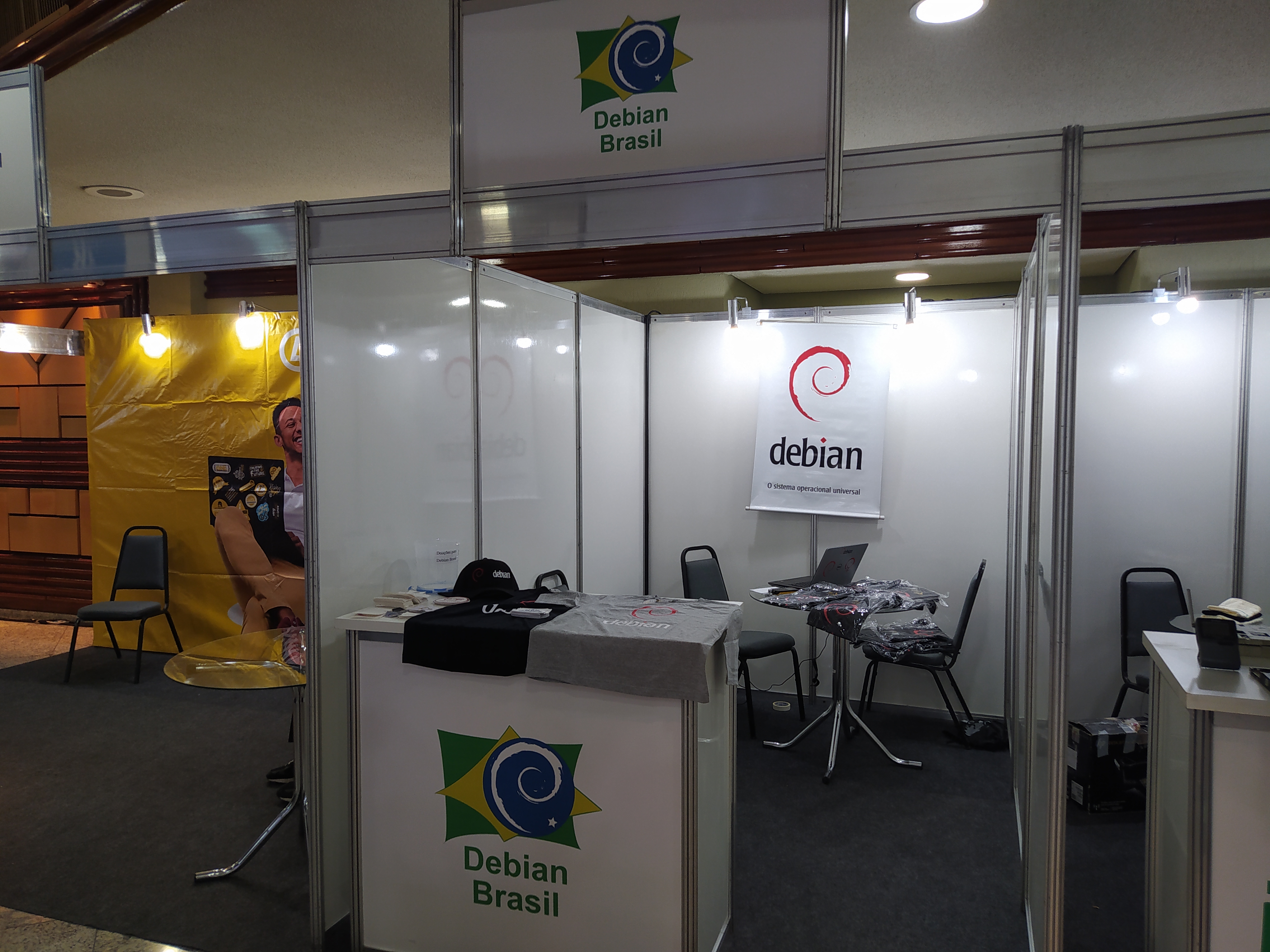
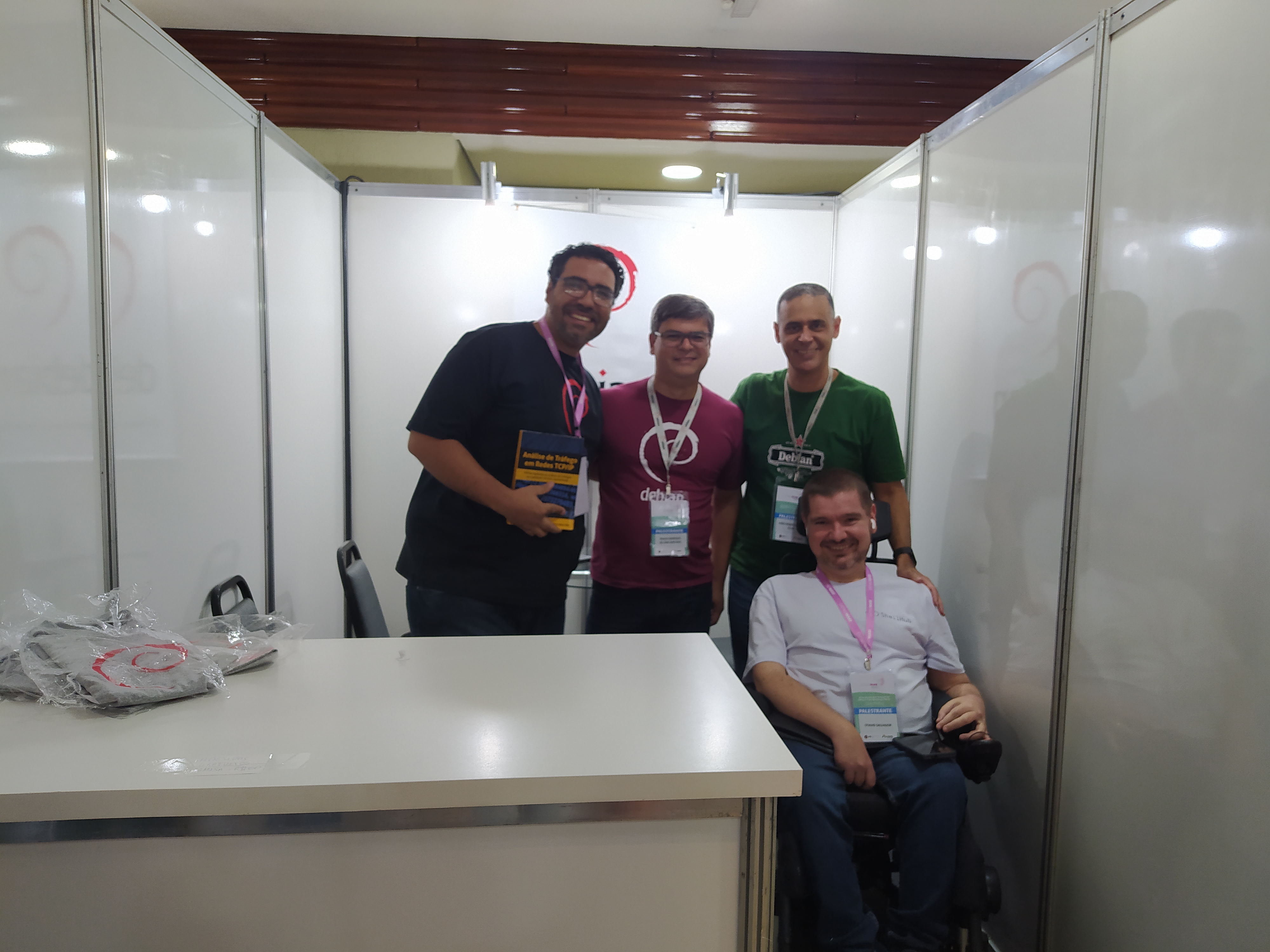
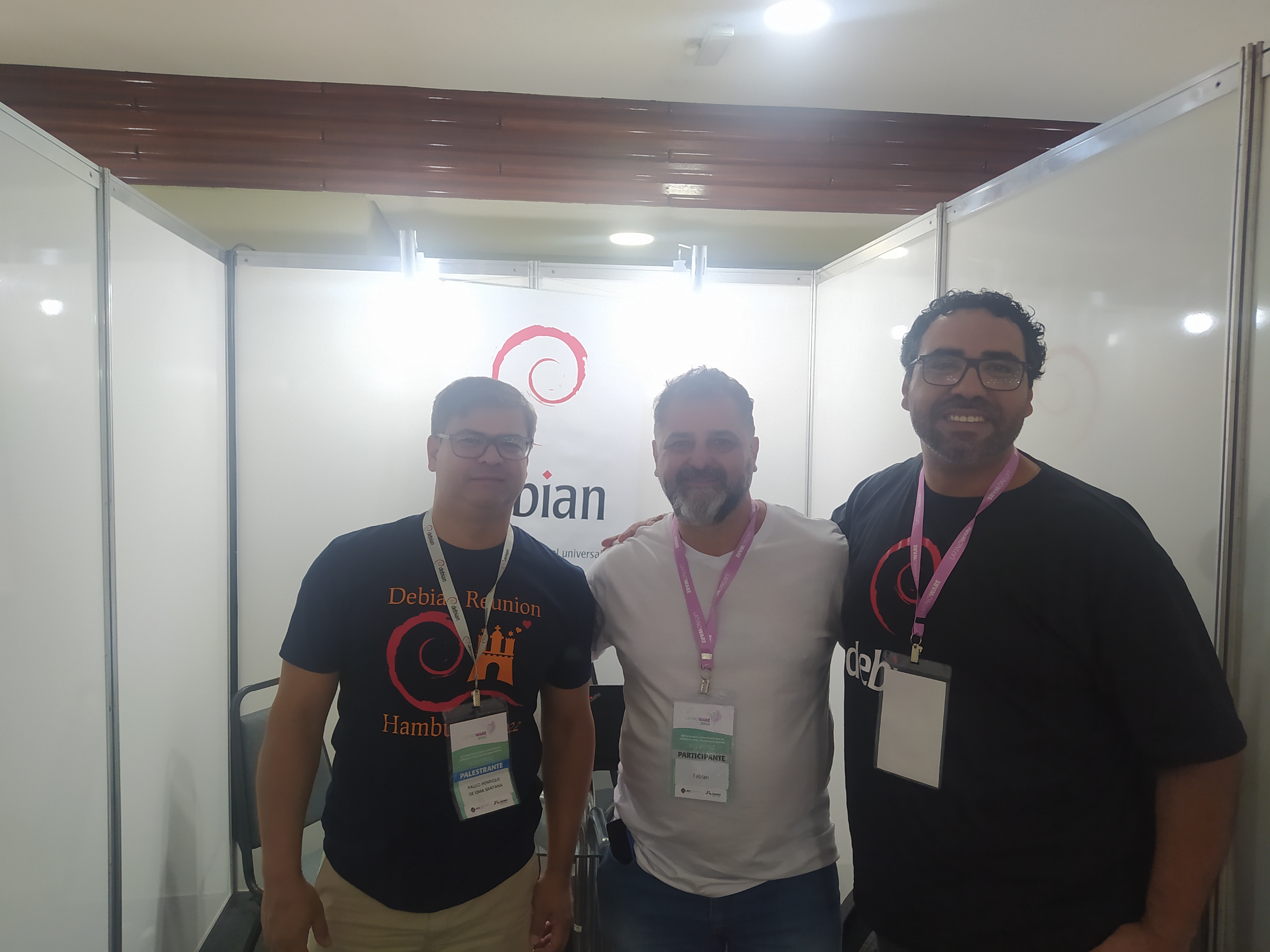
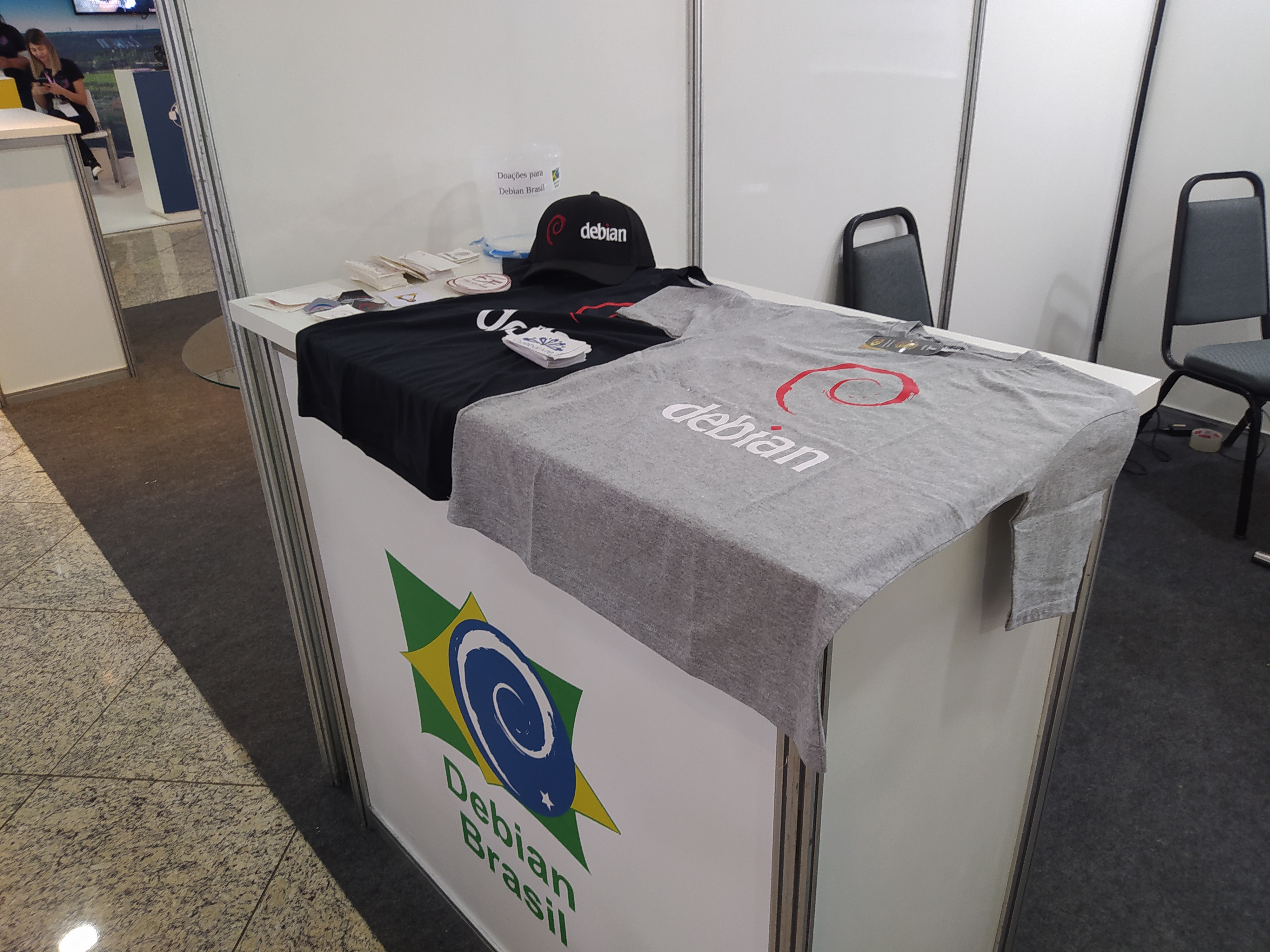
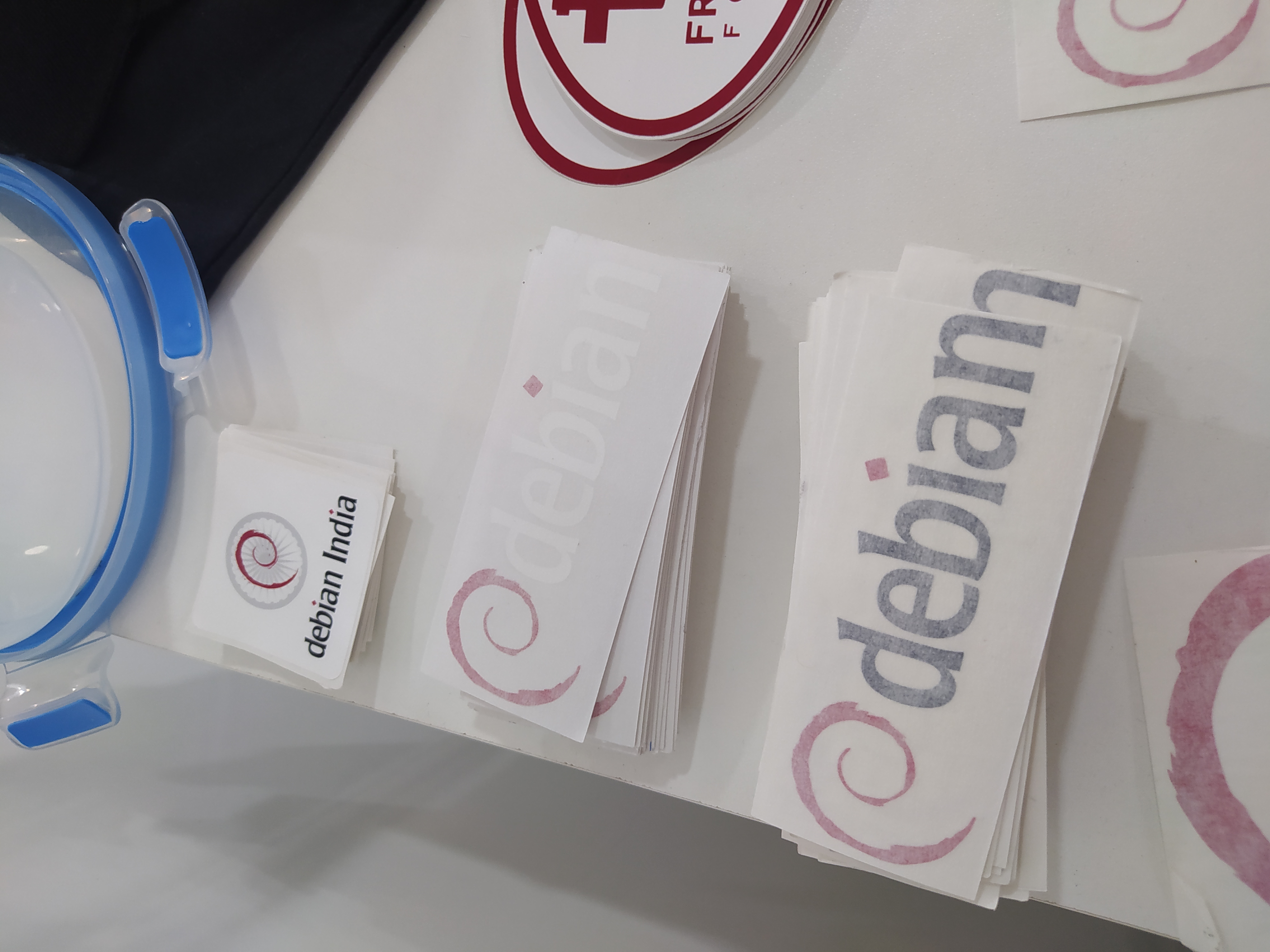
From November 2nd to 4th, 2022, the 19th edition of Latinoware - Latin American Congress of Free Software and Open Technologies took place in Foz do Igua u. After 2 years happening online due to the COVID-19 pandemic, the event was back in person and we felt Debian Brasil community should be there. Out last time at Latinoware was in 2016 The Latinoware organization provided the Debian Brazil community with a booth so that we could have contact with people visiting the open exhibition area and thus publicize the Debian project. During the 3 days of the event, the booth was organized by me (Paulo Henrique Santana) as Debian Developer, and by Leonardo Rodrigues as Debian contributor. Unfortunately Daniel Lenharo had an issue and could not travel to Foz do Igua u (we miss you there!). Latinoware 2022 booth 1 A huge number of people visited the booth, and the beginners (mainly students) who didn't know Debian, asked what our group was about and we explained various concepts such as what Free Software is, GNU/Linux distribution and Debian itself. We also received people from the Brazilian Free Software community and from other Latin American countries who were already using a GNU/Linux distribution and, of course, many people who were already using Debian. We had some special visitors as Jon maddog Hall, Debian Developer Emeritus Ot vio Salvador, Debian Developer Eriberto Mota, and Debian Maintainers Guilherme de Paula Segundo and Paulo Kretcheu. Latinoware 2022 booth 4 Photo from left to right: Leonardo, Paulo, Eriberto and Ot vio. Latinoware 2022 estande 5 Photo from left to right: Paulo, Fabian (Argentina) and Leonardo. In addition to talking a lot, we distributed Debian stickers that were produced a few months ago with Debian's sponsorship to be distributed at DebConf22 (and that were left over), and we sold several Debian t-shirts) produced by Curitiba Livre community). Latinoware 2022 booth 2 Latinoware 2022 booth 3 We also had 3 talks included in Latinoware official schedule. I) talked about: "how to become a Debian contributor by doing translations" and "how the SysAdmins of a global company use Debian". And Leonardo) talked about: "advantages of Open Source telephony in companies". Latinoware 2022 booth 6 Photo Paulo in his talk. Many thanks to Latinoware organization for once again welcoming the Debian community and kindly providing spaces for our participation, and we congratulate all the people involved in the organization for the success of this important event for our community. We hope to be present again in 2023. We also thank Jonathan Carter for approving financial support from Debian for our participation at Latinoware. Portuguese version
Debian Brasil: Participa o da comunidade Debian no Latinoware 2022

De 2 a 4 de novembro de 2022 aconteceu a 19 edi o do Latinoware - Congresso Latino-americano de Software Livre e Tecnologias Abertas, em Foz do Igua u. Ap s 2 anos acontecendo de forma online devido a pandemia do COVID-19, o evento voltou a ser presencial e sentimos que a comunidade Debian Brasil deveria estar presente. Nossa ltima participa o no Latinoware foi em 2016 A organiza o do Latinoware cedeu para a comunidade Debian Brasil um estande para que pud ssemos ter contato com as pessoas que visitavam a rea aberta de exposi es e assim divulgarmos o projeto Debian. Durante os 3 dias do evento, o estande foi organizado por mim (Paulo Henrique Santana) como Desenvolvedor Debian, e pelo Leonardo Rodrigues como contribuidor Debian. Infelizmente o Daniel Lenharo teve um imprevisto de ltima hora e n o pode ir para Foz do Igua u (sentimos sua falta l !). Latinoware 2022 estande 1 V rias pessoas visitaram o estande e aquelas mais iniciantes (principalmente estudantes) que n o conheciam o Debian, perguntavam do que se tratava o nosso grupo e a gente explicava v rios conceitos como o que Software Livre, distribui o GNU/Linux e o Debian propriamente dito. Tamb m recebemos pessoas da comunidade de Software Livre brasileira e de outros pa ses da Am rica Latina que j utilizavam uma distribui o GNU/Linux e claro, muitas pessoas que j utilizavam Debian. Tivemos algumas visitas especiais como do Jon maddog Hall, do Desenvolvedor Debian Emeritus Ot vio Salvador, do Desenvolvedor Debian Eriberto Mota, e dos Mantenedores Debian Guilherme de Paula Segundo e Paulo Kretcheu. Latinoware 2022 estande 4 Foto da esquerda pra direita: Leonardo, Paulo, Eriberto e Ot vio. Latinoware 2022 estande 5 Foto da esquerda pra direita: Paulo, Fabian (Argentina) e Leonardo. Al m de conversarmos bastante, distribu mos adesivos do Debian que foram produzidos alguns meses atr s com o patroc nio do Debian para serem distribu dos na DebConf22(e que haviam sobrado), e vendemos v rias camisetas do Debian produzidas pela comunidade Curitiba Livre. Latinoware 2022 estande 2 Latinoware 2022 estande 3 Tamb m tivemos 3 palestras inseridas na programa o oficial do Latinoware. Eu fiz as palestras: como tornar um(a) contribuidor(a) do Debian fazendo tradu es e como os SysAdmins de uma empresa global usam Debian . E o Leonardo fez a palestra: vantagens da telefonia Open Source nas empresas . Latinoware 2022 estande 6 Foto Paulo na palestra. Agradecemos a organiza o do Latinoware por receber mais uma vez a comunidade Debian e gentilmente ceder os espa os para a nossa participa o, e parabenizamos a todas as pessoas envolvidas na organiza o pelo sucesso desse importante evento para a nossa comunidade. Esperamos estar presentes novamente em 2023. Agracemos tamb m ao Jonathan Carter por aprovar o suporte financeiro do Debian para a nossa participa o no Latinoware. Vers o em ingl s

11 November 2022

Debian Brasil: Participa o da comunidade Debian no Latinoware 2022

De 2 a 4 de novembro de 2022 aconteceu a 19 edi o do Latinoware - Congresso Latino-americano de Software Livre e Tecnologias Abertas, em Foz do Igua u. Ap s 2 anos acontecendo de forma online devido a pandemia do COVID-19, o evento voltou a ser presencial e sentimos que a comunidade Debian Brasil deveria estar presente. Nossa ltima participa o no Latinoware foi em 2016 A organiza o do Latinoware cedeu para a comunidade Debian Brasil um estande para que pud ssemos ter contato com as pessoas que visitavam a rea aberta de exposi es e assim divulgarmos o projeto Debian. Durante os 3 dias do evento, o estande foi organizado por mim (Paulo Henrique Santana) como Desenvolvedor Debian, e pelo Leonardo Rodrigues como contribuidor Debian. Infelizmente o Daniel Lenharo teve um imprevisto de ltima hora e n o pode ir para Foz do Igua u (sentimos sua falta l !). Latinoware 2022 estande 1 V rias pessoas visitaram o estande e aquelas mais iniciantes (principalmente estudantes) que n o conheciam o Debian, perguntavam do que se tratava o nosso grupo e a gente explicava v rios conceitos como o que Software Livre, distribui o GNU/Linux e o Debian propriamente dito. Tamb m recebemos pessoas da comunidade de Software Livre brasileira e de outros pa ses da Am rica Latina que j utilizavam uma distribui o GNU/Linux e claro, muitas pessoas que j utilizavam Debian. Tivemos algumas visitas especiais como do Jon maddog Hall, do Desenvolvedor Debian Emeritus Ot vio Salvador, do Desenvolvedor Debian Eriberto Mota, e dos Mantenedores Debian Guilherme de Paula Segundo e Paulo Kretcheu. Latinoware 2022 estande 4 Foto da esquerda pra direita: Leonardo, Paulo, Eriberto e Ot vio. Latinoware 2022 estande 5 Foto da esquerda pra direita: Paulo, Fabian (Argentina) e Leonardo. Al m de conversarmos bastante, distribu mos adesivos do Debian que foram produzidos alguns meses atr s com o patroc nio do Debian para serem distribu dos na DebConf22(e que haviam sobrado), e vendemos v rias camisetas do Debian produzidas pela comunidade Curitiba Livre. Latinoware 2022 estande 2 Latinoware 2022 estande 3 Tamb m tivemos 3 palestras inseridas na programa o oficial do Latinoware. Eu fiz as palestras: como tornar um(a) contribuidor(a) do Debian fazendo tradu es e como os SysAdmins de uma empresa global usam Debian . E o Leonardo fez a palestra: vantagens da telefonia Open Source nas empresas . Latinoware 2022 estande 6 Foto Paulo na palestra. Agradecemos a organiza o do Latinoware por receber mais uma vez a comunidade Debian e gentilmente ceder os espa os para a nossa participa o, e parabenizamos a todas as pessoas envolvidas na organiza o pelo sucesso desse importante evento para a nossa comunidade. Esperamos estar presentes novamente em 2023. Agracemos tamb m ao Jonathan Carter por aprovar o suporte financeiro do Debian para a nossa participa o no Latinoware. Vers o em ingl s

Debian Brasil: About Debian Brasil at Latinoware 2022

From November 2nd to 4th, 2022, the 19th edition of Latinoware - Latin American Congress of Free Software and Open Technologies took place in Foz do Igua u. After 2 years happening online due to the COVID-19 pandemic, the event was back in person and we felt Debian Brasil community should be there. Out last time at Latinoware was in 2016 The Latinoware organization provided the Debian Brazil community with a booth so that we could have contact with people visiting the open exhibition area and thus publicize the Debian project. During the 3 days of the event, the booth was organized by me (Paulo Henrique Santana) as Debian Developer, and by Leonardo Rodrigues as Debian contributor. Unfortunately Daniel Lenharo had an issue and could not travel to Foz do Igua u (we miss you there!). Latinoware 2022 booth 1 A huge number of people visited the booth, and the beginners (mainly students) who didn't know Debian, asked what our group was about and we explained various concepts such as what Free Software is, GNU/Linux distribution and Debian itself. We also received people from the Brazilian Free Software community and from other Latin American countries who were already using a GNU/Linux distribution and, of course, many people who were already using Debian. We had some special visitors as Jon maddog Hall, Debian Developer Emeritus Ot vio Salvador, Debian Developer Eriberto Mota, and Debian Maintainers Guilherme de Paula Segundo and Paulo Kretcheu. Latinoware 2022 booth 4 Photo from left to right: Leonardo, Paulo, Eriberto and Ot vio. Latinoware 2022 estande 5 Photo from left to right: Paulo, Fabian (Argentina) and Leonardo. In addition to talking a lot, we distributed Debian stickers that were produced a few months ago with Debian's sponsorship to be distributed at DebConf22 (and that were left over), and we sold several Debian t-shirts) produced by Curitiba Livre community). Latinoware 2022 booth 2 Latinoware 2022 booth 3 We also had 3 talks included in Latinoware official schedule. I) talked about: "how to become a Debian contributor by doing translations" and "how the SysAdmins of a global company use Debian". And Leonardo) talked about: "advantages of Open Source telephony in companies". Latinoware 2022 booth 6 Photo Paulo in his talk. Many thanks to Latinoware organization for once again welcoming the Debian community and kindly providing spaces for our participation, and we congratulate all the people involved in the organization for the success of this important event for our community. We hope to be present again in 2023. We also thank Jonathan Carter for approving financial support from Debian for our participation at Latinoware. Portuguese version
19 October 2022

Petter Reinholdtsen: Managing and using ONVIF IP cameras with Linux

Recently I have been looking at how to control and collect data from a handful IP cameras using Linux. I both wanted to change their settings and to make their imagery available via a free software service under my control. Here is a summary of the tools I found. First I had to identify the cameras and their protocols. As far as I could tell, they were using some SOAP looking protocol and their internal web server seem to only work with Microsoft Internet Explorer with some proprietary binary plugin, which in these days of course is a security disaster and also made it impossible for me to use the camera web interface. Luckily I discovered that the SOAP looking protocol is actually following the ONVIF specification, which seem to be supported by a lot of IP cameras these days. Once the protocol was identified, I was able to find what appear to be the most popular way to configure ONVIF cameras, the free software Windows tool named ONVIF Device Manager. Lacking any other options at the time, I tried unsuccessfully to get it running using Wine, but was missing a dotnet 40 library and I found no way around it to run it on Linux. The next tool I found to configure the cameras were a non-free Linux Qt client ONVIF Device Tool. I did not like its terms of use, so did not spend much time on it. To collect the video and make it available in a web interface, I found the Zoneminder tool in Debian. A recent version was able to automatically detect and configure ONVIF devices, so I could use it to set up motion detection in and collection of the camera output. I had initial problems getting the ONVIF autodetection to work, as both Firefox and Chromium refused the inter-tab communication being used by the Zoneminder web pages, but managed to get konqueror to work. Apparently the "Enhanced Tracking Protection" in Firefox cause the problem. I ended up upgrading to the Bookworm edition of Zoneminder in the process to try to fix the issue, and believe the problem might be solved now. In the process I came across the nice Linux GUI tool ONVIF Viewer allowing me to preview the camera output and validate the login passwords required. Sadly its author has grown tired of maintaining the software, so it might not see any future updates. Which is sad, as the viewer is sightly unstable and the picture tend to lock up. Note, this lockup might be due to limitations in the cameras and not the viewer implementation. I suspect the camera is only able to provide pictures to one client at the time, and the Zoneminder feed might interfere with the GUI viewer. I have asked for the tool to be included in Debian. Finally, I found what appear to be very nice Linux free software replacement for the Windows tool, named libonvif. It provide a C library to talk to ONVIF devices as well as a command line and GUI tool using the library. Using the GUI tool I was able to change the admin passwords and update other settings of the cameras. I have asked for the package to be included in Debian. As usual, if you use Bitcoin and want to show your support of my activities, please send Bitcoin donations to my address 15oWEoG9dUPovwmUL9KWAnYRtNJEkP1u1b. Update 2022-10-20: Since my initial publication of this text, I got several suggestions for more free software Linux tools. There is a ONVIF python library (already requested into Debian) and a python 3 fork using a different SOAP dependency. There is also support for ONVIF in Home Assistant, and there is an alternative to Zoneminder called Shinobi. The latter two are not included in Debian either. I have not tested any of these so far.

12 September 2022

Petter Reinholdtsen: Time to translate the Bullseye edition of the Debian Administrator's Handbook

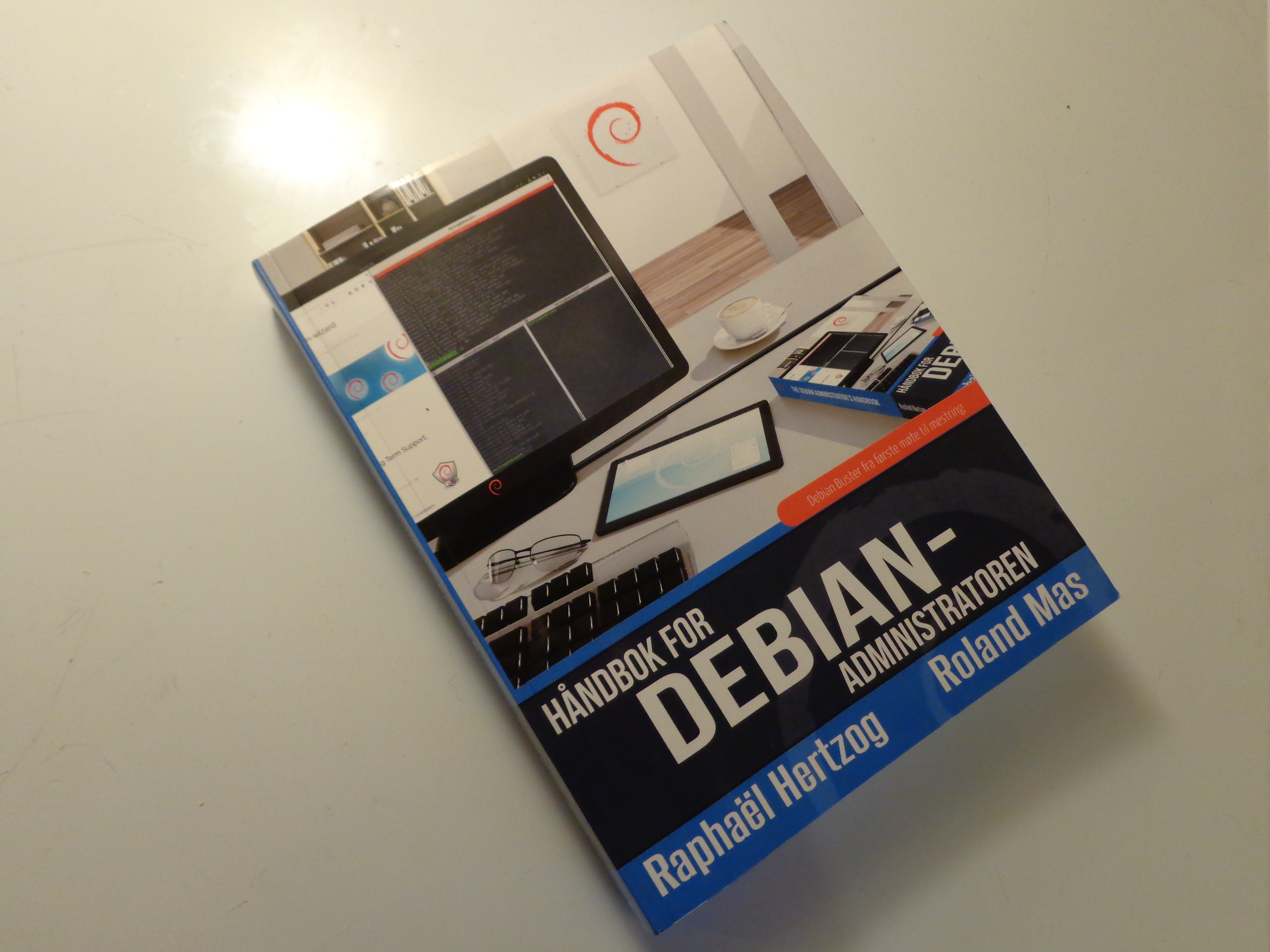
(The picture is of the previous edition.) Almost two years after the previous Norwegian Bokm l translation of the "The Debian Administrator's Handbook" was published, a new edition is finally being prepared. The english text is updated, and it is time to start working on the translations. Around 37 percent of the strings have been updated, one way or another, and the translations starting from a complete Debian Buster edition now need to bring their translation up from 63% to 100%. The complete book is licensed using a Creative Commons license, and has been published in several languages over the years. The translations are done by volunteers to bring Linux in their native tongue. The last time I checked, it complete text was available in English, Norwegian Bokm l, German, Indonesian, Brazil Portuguese and Spanish. In addition, work has been started for Arabic (Morocco), Catalan, Chinese (Simplified), Chinese (Traditional), Croatian, Czech, Danish, Dutch, French, Greek, Italian, Japanese, Korean, Persian, Polish, Romanian, Russian, Swedish, Turkish and Vietnamese. The translation is conducted on the hosted weblate project page. Prospective translators are recommeded to subscribe to the translators mailing list and should also check out the instructions for contributors. I am one of the Norwegian Bokm l translators of this book, and we have just started. Your contribution is most welcome. As usual, if you use Bitcoin and want to show your support of my activities, please send Bitcoin donations to my address 15oWEoG9dUPovwmUL9KWAnYRtNJEkP1u1b.

28 July 2022

Matthew Garrett: UEFI rootkits and UEFI secure boot

Kaspersky describes a UEFI-implant used to attack Windows systems. Based on it appearing to require patching of the system firmware image, they hypothesise that it's propagated by manually dumping the contents of the system flash, modifying it, and then reflashing it back to the board. This probably requires physical access to the board, so it's not especially terrifying - if you're in a situation where someone's sufficiently enthusiastic about targeting you that they're reflashing your computer by hand, it's likely that you're going to have a bad time regardless.

But let's think about why this is in the firmware at all. Sophos previously discussed an implant that's sufficiently similar in some technical details that Kaspersky suggest they may be related to some degree. One notable difference is that the MyKings implant described by Sophos installs itself into the boot block of legacy MBR partitioned disks. This code will only be executed on old-style BIOS systems (or UEFI systems booting in BIOS compatibility mode), and they have no support for code signatures, so there's no need to be especially clever. Run malicious code in the boot block, patch the next stage loader, follow that chain all the way up to the kernel. Simple.

One notable distinction here is that the MBR boot block approach won't be persistent - if you reinstall the OS, the MBR will be rewritten[1] and the infection is gone. UEFI doesn't really change much here - if you reinstall Windows a new copy of the bootloader will be written out and the UEFI boot variables (that tell the firmware which bootloader to execute) will be updated to point at that. The implant may still be on disk somewhere, but it won't be run.

But there's a way to avoid this. UEFI supports loading firmware-level drivers from disk. If, rather than providing a backdoored bootloader, the implant takes the form of a UEFI driver, the attacker can set a different set of variables that tell the firmware to load that driver at boot time, before running the bootloader. OS reinstalls won't modify these variables, which means the implant will survive and can reinfect the new OS install. The only way to get rid of the implant is to either reformat the drive entirely (which most OS installers won't do by default) or replace the drive before installation.

This is much easier than patching the system firmware, and achieves similar outcomes - the number of infected users who are going to wipe their drives to reinstall is fairly low, and the kernel could be patched to hide the presence of the implant on the filesystem[2]. It's possible that the goal was to make identification as hard as possible, but there's a simpler argument here - if the firmware has UEFI Secure Boot enabled, the firmware will refuse to load such a driver, and the implant won't work. You could certainly just patch the firmware to disable secure boot and lie about it, but if you're at the point of patching the firmware anyway you may as well just do the extra work of installing your implant there.

I think there's a reasonable argument that the existence of firmware-level rootkits suggests that UEFI Secure Boot is doing its job and is pushing attackers into lower levels of the stack in order to obtain the same outcomes. Technologies like Intel's Boot Guard may (in their current form) tend to block user choice, but in theory should be effective in blocking attacks of this form and making things even harder for attackers. It should already be impossible to perform attacks like the one Kaspersky describes on more modern hardware (the system should identify that the firmware has been tampered with and fail to boot), which pushes things even further - attackers will have to take advantage of vulnerabilities in the specific firmware they're targeting. This obviously means there's an incentive to find more firmware vulnerabilities, which means the ability to apply security updates for system firmware as easily as security updates for OS components is vital (hint hint if your system firmware updates aren't available via LVFS you're probably doing it wrong).

We've known that UEFI rootkits have existed for a while (Hacking Team had one in 2015), but it's interesting to see a fairly widespread one out in the wild. Protecting against this kind of attack involves securing the entire boot chain, including the firmware itself. The industry has clearly been making progress in this respect, and it'll be interesting to see whether such attacks become more common (because Secure Boot works but firmware security is bad) or not.

[1] As we all remember from Windows installs overwriting Linux bootloaders
[2] Although this does run the risk of an infected user booting another OS instead, and being able to see the implant

comment count unavailable comments

16 July 2022

Petter Reinholdtsen: Automatic LinuxCNC servo PID tuning?

While working on a CNC with servo motors controlled by the LinuxCNC PID controller, I recently had to learn how to tune the collection of values that control such mathematical machinery that a PID controller is. It proved to be a lot harder than I hoped, and I still have not succeeded in getting the Z PID controller to successfully defy gravity, nor X and Y to move accurately and reliably. But while climbing up this rather steep learning curve, I discovered that some motor control systems are able to tune their PID controllers. I got the impression from the documentation that LinuxCNC were not. This proved to be not true The LinuxCNC pid component is the recommended PID controller to use. It uses eight constants Pgain, Igain, Dgain, bias, FF0, FF1, FF2 and FF3 to calculate the output value based on current and wanted state, and all of these need to have a sensible value for the controller to behave properly. Note, there are even more values involved, theser are just the most important ones. In my case I need the X, Y and Z axes to follow the requested path with little error. This has proved quite a challenge for someone who have never tuned a PID controller before, but there is at least some help to be found. I discovered that included in LinuxCNC was this old PID component at_pid claiming to have auto tuning capabilities. Sadly it had been neglected since 2011, and could not be used as a plug in replacement for the default pid component. One would have to rewriting the LinuxCNC HAL setup to test at_pid. This was rather sad, when I wanted to quickly test auto tuning to see if it did a better job than me at figuring out good P, I and D values to use. I decided to have a look if the situation could be improved. This involved trying to understand the code and history of the pid and at_pid components. Apparently they had a common ancestor, as code structure, comments and variable names were quite close to each other. Sadly this was not reflected in the git history, making it hard to figure out what really happened. My guess is that the author of at_pid.c took a version of pid.c, rewrote it to follow the structure he wished pid.c to have, then added support for auto tuning and finally got it included into the LinuxCNC repository. The restructuring and lack of early history made it harder to figure out which part of the code were relevant to the auto tuning, and which part of the code needed to be updated to work the same way as the current pid.c implementation. I started by trying to isolate relevant changes in pid.c, and applying them to at_pid.c. My aim was to make sure the at_pid component could replace the pid component with a simple change in the HAL setup loadrt line, without having to "rewire" the rest of the HAL configuration. After a few hours following this approach, I had learned quite a lot about the code structure of both components, while concluding I was heading down the wrong rabbit hole, and should get back to the surface and find a different path. For the second attempt, I decided to throw away all the PID control related part of the original at_pid.c, and instead isolate and lift the auto tuning part of the code and inject it into a copy of pid.c. This ensured compatibility with the current pid component, while adding auto tuning as a run time option. To make it easier to identify the relevant parts in the future, I wrapped all the auto tuning code with '#ifdef AUTO_TUNER'. The end result behave just like the current pid component by default, as that part of the code is identical. The end result entered the LinuxCNC master branch a few days ago. To enable auto tuning, one need to set a few HAL pins in the PID component. The most important ones are tune-effort, tune-mode and tune-start. But lets take a step back, and see what the auto tuning code will do. I do not know the mathematical foundation of the at_pid algorithm, but from observation I can tell that the algorithm will, when enabled, produce a square wave pattern centered around the bias value on the output pin of the PID controller. This can be seen using the HAL Scope provided by LinuxCNC. In my case, this is translated into voltage (+-10V) sent to the motor controller, which in turn is translated into motor speed. So at_pid will ask the motor to move the axis back and forth. The number of cycles in the pattern is controlled by the tune-cycles pin, and the extremes of the wave pattern is controlled by the tune-effort pin. Of course, trying to change the direction of a physical object instantly (as in going directly from a positive voltage to the equivalent negative voltage) do not change velocity instantly, and it take some time for the object to slow down and move in the opposite direction. This result in a more smooth movement wave form, as the axis in question were vibrating back and forth. When the axis reached the target speed in the opposing direction, the auto tuner change direction again. After several of these changes, the average time delay between the 'peaks' and 'valleys' of this movement graph is then used to calculate proposed values for Pgain, Igain and Dgain, and insert them into the HAL model to use by the pid controller. The auto tuned settings are not great, but htye work a lot better than the values I had been able to cook up on my own, at least for the horizontal X and Y axis. But I had to use very small tune-effort values, as my motor controllers error out if the voltage change too quickly. I've been less lucky with the Z axis, which is moving a heavy object up and down, and seem to confuse the algorithm. The Z axis movement became a lot better when I introduced a bias value to counter the gravitational drag, but I will have to work a lot more on the Z axis PID values. Armed with this knowledge, it is time to look at how to do the tuning. Lets say the HAL configuration in question load the PID component for X, Y and Z like this:
loadrt pid names=pid.x,pid.y,pid.z
Armed with the new and improved at_pid component, the new line will look like this:
loadrt at_pid names=pid.x,pid.y,pid.z
The rest of the HAL setup can stay the same. This work because the components are referenced by name. If the component had used count=3 instead, all use of pid.# had to be changed to at_pid.#. To start tuning the X axis, move the axis to the middle of its range, to make sure it do not hit anything when it start moving back and forth. Next, set the tune-effort to a low number in the output range. I used 0.1 as my initial value. Next, assign 1 to the tune-mode value. Note, this will disable the pid controlling part and feed 0 to the output pin, which in my case initially caused a lot of drift. In my case it proved to be a good idea with X and Y to tune the motor driver to make sure 0 voltage stopped the motor rotation. On the other hand, for the Z axis this proved to be a bad idea, so it will depend on your setup. It might help to set the bias value to a output value that reduce or eliminate the axis drift. Finally, after setting tune-mode, set tune-start to 1 to activate the auto tuning. If all go well, your axis will vibrate for a few seconds and when it is done, new values for Pgain, Igain and Dgain will be active. To test them, change tune-mode back to 0. Note that this might cause the machine to suddenly jerk as it bring the axis back to its commanded position, which it might have drifted away from during tuning. To summarize with some halcmd lines:
setp pid.x.tune-effort 0.1
setp pid.x.tune-mode 1
setp pid.x.tune-start 1
# wait for the tuning to complete
setp pid.x.tune-mode 0
After doing this task quite a few times while trying to figure out how to properly tune the PID controllers on the machine in, I decided to figure out if this process could be automated, and wrote a script to do the entire tuning process from power on. The end result will ensure the machine is powered on and ready to run, home all axis if it is not already done, check that the extra tuning pins are available, move the axis to its mid point, run the auto tuning and re-enable the pid controller when it is done. It can be run several times. Check out the run-auto-pid-tuner script on github if you want to learn how it is done. My hope is that this little adventure can inspire someone who know more about motor PID controller tuning can implement even better algorithms for automatic PID tuning in LinuxCNC, making life easier for both me and all the others that want to use LinuxCNC but lack the in depth knowledge needed to tune PID controllers well. As usual, if you use Bitcoin and want to show your support of my activities, please send Bitcoin donations to my address 15oWEoG9dUPovwmUL9KWAnYRtNJEkP1u1b.

20 June 2022

Petter Reinholdtsen: My free software activity of late (2022)

I guess it is time to bring some light on the various free software and open culture activities and projects I have worked on or been involved in the last year and a half. First, lets mention the book releases I managed to publish. The Cory Doctorow book "Hvordan knuse overv kningskapitalismen" argue that it is not the magic machine learning of the big technology companies that causes the surveillance capitalism to thrive, it is the lack of trust busting to enforce existing anti-monopoly laws. I also published a family of dictionaries for machinists, one sorted on the English words, one sorted on the Norwegian and the last sorted on the North S mi words. A bit on the back burner but not forgotten is the Debian Administrators Handbook, where a new edition is being worked on. I have not spent as much time as I want to help bring it to completion, but hope I will get more spare time to look at it before the end of the year. With my Debian had I have spent time on several projects, both updating existing packages, helping to bring in new packages and working with upstream projects to try to get them ready to go into Debian. The list is rather long, and I will only mention my own isenkram, openmotor, vlc bittorrent plugin, xprintidle, norwegian letter style for latex, bs1770gain, and recordmydesktop. In addition to these I have sponsored several packages into Debian, like audmes. The last year I have looked at several infrastructure projects for collecting meter data and video surveillance recordings. This include several ONVIF related tools like onvifviewer and zoneminder as well as rtl-433, wmbusmeters and rtl-wmbus. In parallel with this I have looked at fabrication related free software solutions like pycam and LinuxCNC. The latter recently gained improved translation support using po4a and weblate, which was a harder nut to crack that I had anticipated when I started. Several hours have been spent translating free software to Norwegian Bokm l on the Weblate hosted service. Do not have a complete list, but you will find my contributions in at least gnucash, minetest and po4a. I also spent quite some time on the Norwegian archiving specification Noark 5, and its companion project Nikita implementing the API specification for Noark 5. Recently I have been looking into free software tools to do company accounting here in Norway., which present an interesting mix between law, rules, regulations, format specifications and API interfaces. I guess I should also mention the Norwegian community driven government interfacing projects Mimes Br nn and Fiksgatami, which have ended up in a kind of limbo while the future of the projects is being worked out. These are just a few of the projects I have been involved it, and would like to give more visibility. I'll stop here to avoid delaying this post. As usual, if you use Bitcoin and want to show your support of my activities, please send Bitcoin donations to my address 15oWEoG9dUPovwmUL9KWAnYRtNJEkP1u1b.

10 June 2022

Lisandro Dami n Nicanor P rez Meyer: Qt 6 in Debian bullseye

As announced some time ago on Debian Backport s mailing list I will be backporting Qt 6 to Debian 11 Bullseye . This comprises the (so far) 29 source packages that compose Qt 6 and libassimp. The Qt Company wanted to let us Debian users also enjoy Qt 6 on Bullseye, so they contacted me (and by extension my employer ICS) to bring this forward. As said in the mail I sent to the backports list I m making the commitment to maintain the packages myself, but I m really happy the Qt Company asked me for this. You can download Qt 6 for Debian Bullseye s backports by following the instructions. Also a big kudos to IOhannes m zm lnig, the assimp maintainer, who promptly helped me to get it backported. Enjoy!

3 June 2022

Petter Reinholdtsen: LinuxCNC translators life just got a bit easier

Back in oktober last year, when I started looking at the LinuxCNC system, I proposed to change the documentation build system make life easier for translators. The original system consisted of independently written documentation files for each language, with no automated way to track changes done in other translations and no help for the translators to know how much was left to translated. By using the po4a system to generate POT and PO files from the English documentation, this can be improved. A small team of LinuxCNC contributors got together and today our labour finally payed off. Since a few hours ago, it is now possible to translate the LinuxCNC documentation on Weblate, alongside the program itself. The effort to migrate the documentation to use po4a has been both slow and frustrating. I am very happy we finally made it. As usual, if you use Bitcoin and want to show your support of my activities, please send Bitcoin donations to my address 15oWEoG9dUPovwmUL9KWAnYRtNJEkP1u1b.

20 April 2022

Petter Reinholdtsen: geteltorito make CD firmware upgrades a breeze

Recently I wanted to upgrade the firmware of my thinkpad, and located the firmware download page from Lenovo (which annoyingly do not allow access via Tor, forcing me to hand them more personal information that I would like). The download from Lenovo is a bootable ISO image, which is a bit of a problem when all I got available is a USB memory stick. I tried booting the ISO as a USB stick, but this did not work. But genisoimage came to the rescue. The geteltorito program in the genisoimage binary package is able to convert the bootable ISO image to a bootable USB stick using a simple command line recipe, which I then can write to the most recently inserted USB stick:
geteltorito -o usbstick.img lenovo-firmware.iso
sudo dd bs=10M if=usbstick.img of=$(ls -tr /dev/sd? tail -1)
This USB stick booted the firmware upgrader just fine, and in a few minutes my machine had the latest and greatest BIOS firmware in place.

Petter Reinholdtsen: genisoimage make CD firmware upgrades a breeze

Recently I wanted to upgrade the firmware of my thinkpad, and located the firmware download page from Lenovo (which annoyingly do not allow access via Tor, forcing me to hand them more personal information that I would like). The download from Lenovo is a bootable ISO image, which is a bit of a problem when all I got available is a USB memory stick. I tried booting the ISO as a USB stick, but this did not work. But genisoimage came to the rescue. The geteltorito program in the genisoimage package is able to convert the bootable ISO image to a bootable USB stick using a simple command line recipe, which I then can write to the most recently inserted USB stick:
geteltorito -o usbstick.img lenovo-firmware.iso
sudo dd bs=10M if=usbstick.img of=$(ls -tr /dev/sd? tail -1)
This USB stick booted the firmware upgrader just fine, and in a few minutes my machine had the latest and greatest BIOS firmware in place.

Next.

Previous.