Search Results: "otto"

19 June 2025

Russell Coker: Matching Intel CPUs

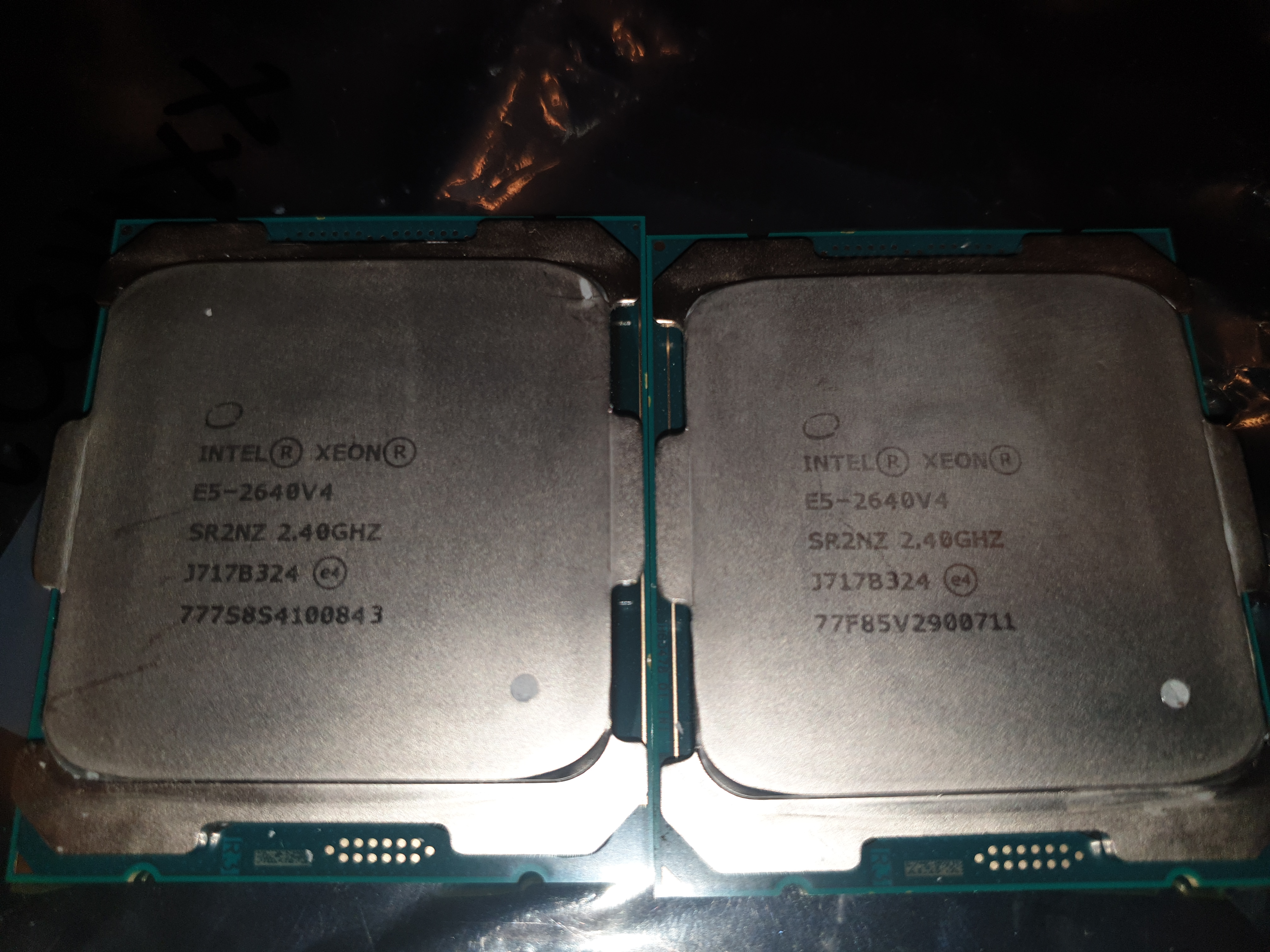
To run a SMP system with multiple CPUs you need to have CPUs that are identical , the question is what does identical mean. In this case I m interested in Intel CPUs because SMP motherboards and server systems for Intel CPUs are readily available and affordable. There are people selling matched pairs of CPUs on ebay which tend to be more expensive than randomly buying 2 of the same CPU model, so if you can identify 2 CPUs that are identical which are sold separately then you can save some money. Also if you own a two CPU system with only one CPU installed then buying a second CPU to match the first is cheaper and easier than buying two more CPUs and removing a perfectly working CPU. e5-2640 v4 cpus
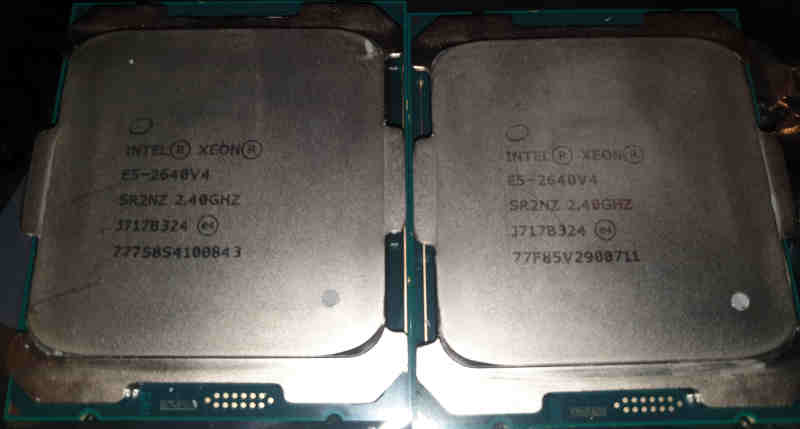
Intel (R) Xeon (R)
E5-2640V4
SR2NZ 2.40GHZ
J717B324 (e4)
7758S4100843
Above is a pic of 2 E5-2640v4 CPUs that were in a SMP system I purchased along with a plain ASCII representation of the text on one of them. The bottom code (starting with 77 ) is apparently the serial number, one of the two codes above it is what determines how identical those CPUs are. The code on the same line as the nominal clock speed (in this case SR2NZ) is the spec number which is sometimes referred to as sspec [1]. The line below the sspec and above the serial number has J717B324 which doesn t have a google hit. I looked at more than 20 pics of E5-2640v4 CPUs on ebay, they all had the code SR2NZ but had different numbers on the line below. I conclude that the number on the line below probably indicates the model AND stepping while SR2NZ just means E5-2640v4 regardless of stepping. As I wasn t able to find another CPU on ebay with the same number on the line below the sspec I believe that it will be unreasonably difficult to get a match for an existing CPU. For the purpose of matching CPUs I believe that if the line above the serial number matches then the CPUs can be used together. I am not certain that CPUs with this number slightly mismatching won t work but I definitely wouldn t want to spend money on CPUs with this number being different.
smpboot: CPU0: Intel(R) Xeon(R) CPU E5-2699A v4 @ 2.40GHz (family: 0x6, model: 0x4f, stepping: 0x1)
When you boot Linux the kernel identifies the CPU in a manner like the above, the combination of family and model seem to map to one spec number. The combination of family, model, and stepping should be all that s required to have them work together. I think that Intel did the wrong thing in not making this clearer. It would have been very easy to print the stepping on the CPU case next to the sspec or the CPU model name. It also wouldn t have been too hard to make the CPU provide the magic number that is apparently the required match for SMP to the OS. Having the Intel web site provide a mapping of those numbers to steppings of CPUs also shouldn t be difficult for them. If anyone knows more about these issues please let me know.

16 June 2025

Paul Tagliamonte: The Promised LAN

The Internet has changed a lot in the last 40+ years. Fads have come and gone. Network protocols have been designed, deployed, adopted, and abandoned. Industries have come and gone. The types of people on the internet have changed a lot. The number of people on the internet has changed a lot, creating an information medium unlike anything ever seen before in human history. There s a lot of good things about the Internet as of 2025, but there s also an inescapable hole in what it used to be, for me. I miss being able to throw a site up to send around to friends to play with without worrying about hordes of AI-feeding HTML combine harvesters DoS-ing my website, costing me thousands in network transfer for the privilege. I miss being able to put a lightly authenticated game server up and not worry too much at night wondering if that process is now mining bitcoin. I miss being able to run a server in my home closet. Decades of cat and mouse games have rendered running a mail server nearly impossible. Those who are brave enough to try are met with weekslong stretches of delivery failures and countless hours yelling ineffectually into a pipe that leads from the cheerful lobby of some disinterested corporation directly into a void somewhere 4 layers below ground level. I miss the spirit of curiosity, exploration, and trying new things. I miss building things for fun without having to worry about being too successful, after which security offices start demanding my supplier paperwork in triplicate as heartfelt thanks from their engineering teams. I miss communities that are run because it is important to them, not for ad revenue. I miss community operated spaces and having more than four websites that are all full of nothing except screenshots of each other. Every other page I find myself on now has an AI generated click-bait title, shared for rage-clicks all brought-to-you-by-our-sponsors completely covered wall-to-wall with popup modals, telling me how much they respect my privacy, with the real content hidden at the bottom bracketed by deceptive ads served by companies that definitely know which new coffee shop I went to last month. This is wrong, and those who have seen what was know it. I can t keep doing it. I m not doing it any more. I reject the notion that this is as it needs to be. It is wrong. The hole left in what the Internet used to be must be filled. I will fill it.

What comes before part b? Throughout the 2000s, some of my favorite memories were from LAN parties at my friends places. Dragging your setup somewhere, long nights playing games, goofing off, even building software all night to get something working being able to do something fiercely technical in the context of a uniquely social activity. It wasn t really much about the games or the projects it was an excuse to spend time together, just hanging out. A huge reason I learned so much in college was that campus was a non-stop LAN party we could freely stand up servers, talk between dorms on the LAN, and hit my dorm room computer from the lab. Things could go from individual to social in the matter of seconds. The Internet used to work this way my dorm had public IPs handed out by DHCP, and my workstation could serve traffic from anywhere on the internet. I haven t been back to campus in a few years, but I d be surprised if this were still the case. In December of 2021, three of us got together and connected our houses together in what we now call The Promised LAN. The idea is simple fill the hole we feel is gone from our lives. Build our own always-on 24/7 nonstop LAN party. Build a space that is intrinsically social, even though we re doing technical things. We can freely host insecure game servers or one-off side projects without worrying about what someone will do with it. Over the years, it s evolved very slowly we haven t pulled any all-nighters. Our mantra has become old growth , building each layer carefully. As of May 2025, the LAN is now 19 friends running around 25 network segments. Those 25 networks are connected to 3 backbone nodes, exchanging routes and IP traffic for the LAN. We refer to the set of backbone operators as The Bureau of LAN Management . Combined decades of operating critical infrastructure has driven The Bureau to make a set of well-understood, boring, predictable, interoperable and easily debuggable decisions to make this all happen. Nothing here is exotic or even technically interesting.

Applications of trusting trust The hardest part, however, is rejecting the idea that anything outside our own LAN is untrustworthy nearly irreversible damage inflicted on us by the Internet. We have solved this by not solving it. We strictly control membership the absolute hard minimum for joining the LAN requires 10 years of friendship with at least one member of the Bureau, with another 10 years of friendship planned. Members of the LAN can veto new members even if all other criteria is met. Even with those strict rules, there s no shortage of friends that meet the qualifications but we are not equipped to take that many folks on. It s hard to join -both socially and technically. Doing something malicious on the LAN requires a lot of highly technical effort upfront, and it would endanger a decade of friendship. We have relied on those human, social, interpersonal bonds to bring us all together. It s worked for the last 4 years, and it should continue working until we think of something better. We assume roommates, partners, kids, and visitors all have access to The Promised LAN. If they re let into our friends' network, there is a level of trust that works transitively for us I trust them to be on mine. This LAN is not for security , rather, the network border is a social one. Benign hacking in the original sense of misusing systems to do fun and interesting things is encouraged. Robust ACLs and firewalls on the LAN are, by definition, an interpersonal not technical failure. We all trust every other network operator to run their segment in a way that aligns with our collective values and norms. Over the last 4 years, we ve grown our own culture and fads around half of the people on the LAN have thermal receipt printers with open access, for printing out quips or jokes on each other s counters. It s incredible how much network transport and a trusting culture gets you there s a 3-node IRC network, exotic hardware to gawk at, radios galore, a NAS storage swap, LAN only email, and even a SIP phone network of redphones .

DIY We do not wish to, nor will we, rebuild the internet. We do not wish to, nor will we, scale this. We will never be friends with enough people, as hard as we may try. Participation hinges on us all having fun. As a result, membership will never be open, and we will never have enough connected LANs to deal with the technical and social problems that start to happen with scale. This is a feature, not a bug. This is a call for you to do the same. Build your own LAN. Connect it with friends homes. Remember what is missing from your life, and fill it in. Use software you know how to operate and get it running. Build slowly. Build your community. Do it with joy. Remember how we got here. Rebuild a community space that doesn t need to be mediated by faceless corporations and ad revenue. Build something sustainable that brings you joy. Rebuild something you use daily. Bring back what we re missing.

15 June 2025

Iustin Pop: Markdown lint and site cleanup

I was not aware that one can write bad Markdown, since Markdown has such a simple syntax, that I thought you just write, and it s fine. Na ve, I know! I ve started editing the files for this blog/site with Visual Studio Code too, and I had from another project the markdown lint extension installed, so as I was opening old files, more and more problems appeared. On a whim, I searched and found the lint all files command, and after running it, oops more than 400 problems! Now, some of them were entirely trivial and a matter of subjective style, like mixing both underscore and asterisk for emphasis in a single file, and asterisks and dashes for list items. Others, seemingly trivial like tab indentation, were actually also causing rendering issues, so fixing that solved a real cosmetic issue. But some of the issues flagged were actual problems. For example, one sentence that I had, was:
there seems to be some race condition between <something> and ntp
Here something was interpreted as an (invalid) HTML tag, and not rendered at all. Another problem, but more minor, was that I had links to Wikipedia with spaces in the link name, which Visual Studio Code breaks at first space, rather than encoded spaces or underscores-based, as Wikipedia generates today. In the rendered output, Pandoc seemed to do the right think though. However, the most interesting issue that was flagged was no details in HTML links, i.e. links of the form:
for more details, see [here](http://example.com).
Which works for non-visually impaired people, but not for people using assistive technologies. And while trying to fix this, it turns out that you can do much better, for everyone, because here is really non-descriptive. You can use either the content as label ( an article about configuring BIND ), or the destination ( an article on this-website ), rather than the plain here . The only, really only check I disabled, was tweaking the trailing punctuation checks in headers, as I really like to write a header that ends with exclamation marks. I like exclamation marks in general! So why not use them in headers too. The question mark is allowlisted by default, though that I use rarely. During the changes/tweaks, I also did random improvements, but I didn t change the updated tag, since most of them were minor. But a non-minor thing was tweaking the CSS for code blocks, since I had a really stupid non-symmetry between top and bottom padding (5px vs 0), and which I don t know where it came from. But the MDN article on padding has as an example exactly what I had (except combined, I had it split). Did I just copy blindly? Possible So, all good and then, and I hope this doesn t trigger a flow of updates on any aggregators, since all the changes were really trivial. And while I don t write often, I did touch about 60 posts or pages, ouch! Who knew that changing editors can have such a large impact

11 June 2025

Iustin Pop: This blog finally goes git-annex!

A long, long time ago I have a few pictures on this blog, mostly in earlier years, because even with small pictures, the git repository became 80MiB soon this is not much in absolute terms, but the actual Markdown/Haskell/CSS/HTML total size is tiny compared to the picture, PDFs and fonts. I realised I need a better solution, probably about ten years ago, and that I should investigate git-annex. Then time passed, and I heard about git-lfs, so I thought that s the way forward. Now, I recently got interested again into doing something about this repository, and started researching.

Detour: git-lfs I was sure that git-lfs, being supported by large providers, would be the modern solution. But to my surprise, git-lfs is very server centric, which in hindsight makes sense, but for a home setup, it s not very good. Maybe I misunderstood, but git-lfs is more a protocol/method for a forge to store files, rather than an end-user solution. But then you need to backup those files separately (together with the rest of the forge), or implement another way of safeguarding them. Further details such as the fact that it keeps two copies of the files (one in the actual checked-out tree, one in internal storage) means it s not a good solution. Well, for my blog yes, but not in general. Then posts on Reddit about horror stories people being locked out of github due to quota, as an example, or this Stack Overflow post about git-lfs constraining how one uses git, convinced me that s not what I want. To each their own, but not for me I might want to push this blog s repo to github, but I definitely wouldn t want in that case to pay for github storage for my blog images (which are copies, not originals). And yes, even in 2025, those quotas are real GitHub limits and I agree with GitHub, storage and large bandwidth can t be free.

Back to the future: git-annex So back to git-annex. I thought it s going to be a simple thing, but oh boy, was I wrong. It took me half a week of continuous (well, in free time) reading and discussions with LLMs to understand a bit how it works. I think, honestly, it s a bit too complex, which is why the workflows page lists seven (!) levels of workflow complexity, from fully-managed, to fully-manual. IMHO, respect to the author for the awesome tool, but if you need a web app to help you manage git, it hints that the tool is too complex. I made the mistake of running git annex sync once, to realise it actually starts pushing to my upstream repo and creating new branches and whatnot, so after enough reading, I settled on workflow 6/7, since I don t want another tool to manage my git history. Maybe I m an outlier here, but everything automatic is a bit too much for me. Once you do managed yourself how git-annex works (on the surface, at least), it is a pretty cool thing. It uses a git-annex git branch to store metainformation, and that is relatively clean. If you do run git annex sync, it creates some extra branches, which I don t like, but meh.

Trick question: what is a remote? One of the most confusing things about git-annex was understanding its remote concept. I thought a remote is a place where you replicate your data. But not, that s a special remote. A normal remote is a git remote, but which is expected to be git/ssh/with command line access. So if you have a git+ssh remote, git-annex will not only try to push it s above-mentioned branch, but also copy the files. If such a remote is on a forge that doesn t support git-annex, then it will complain and get confused. Of course, if you read the extensive docs, you just do git config remote.<name>.annex-ignore true, and it will understand that it should not sync to it. But, aside, from this case, git-annex expects that all checkouts and clones of the repository are both metadata and data. And if you do any annex commands in them, all other clones will know about them! This can be unexpected, and you find people complaining about it, but nowadays there s a solution:
git clone   dir && cd dir
git config annex.private true
git annex init "temp copy"
This is important. Any leaf git clone must be followed by that annex.private true config, especially on CI/CD machines. Honestly, I don t understand why by default clones should be official data stores, but it is what it is. I settled on not making any of my checkouts stable , but only the actual storage places. Except those are not git repositories, but just git-annex storage things. I.e., special remotes. Is it confusing enough yet ?

Special remotes The special remotes, as said, is what I expected to be the normal git annex remotes, i.e. places where the data is stored. But well, they exist, and while I m only using a couple simple ones, there is a large number of them. Among the interesting ones: git-lfs, a remote that allows also storing the git repository itself (git-remote-annex), although I m bit confused about this one, and most of the common storage providers via the rclone remote. Plus, all of the special remotes support encryption, so this is a really neat way to store your files across a large number of things, and handle replication, number of copies, from which copy to retrieve, etc. as you with.

And many of other features git-annex has tons of other features, so to some extent, the sky s the limit. Automatic selection of what to add git it vs plain git, encryption handling, number of copies, clusters, computed files, etc. etc. etc. I still think it s cool but too complex, though!

Uses Aside from my blog post, of course. I ve seen blog posts/comments about people using git-annex to track/store their photo collection, and I could see very well how the remote encrypted repos any of the services supported by rclone could be an N+2 copy or so. For me, tracking photos would be a bit too tedious, but it could maybe work after more research. A more practical thing would probably be replicating my local movie collection (all legal, to be clear) better than just run rsync from time to time and tracking the large files in it via git-annex. That s an exercise for another day, though, once I get more mileage with it - my blog pictures are copies, so I don t care much if they get lost, but movies are primary online copies, and I don t want to re-dump the discs. Anyway, for later.

Migrating to git-annex Migrating here means ending in a state where all large files are in git-annex, and the plain git repo is small. Just moving the files to git annex at the current head doesn t remove them from history, so your git repository is still large; it won t grow in the future, but remains with old size (and contains the large files in its history). In my mind, a nice migration would be: run a custom command, and all the history is migrated to git-annex, so I can go back in time and the still use git-annex. I na vely expected this would be easy and already available, only to find comments on the git-annex site with unsure git-filter-branch calls and some web discussions. This is the discussion on the git annex website, but it didn t make me confident it would do the right thing. But that discussion is now 8 years old. Surely in 2025, with git-filter-repo, it s easier? And, maybe I m missing something, but it is not. Not from the point of view of plain git, that s easy, but because interacting with git-annex, which stores its data in git itself, so doing this properly across successive steps of a repo (when replaying the commits) is, I think, not well defined behaviour. So I was stuck here for a few days, until I got an epiphany: As I m going to rewrite the repository, of course I m keeping a copy of it from before git-annex. If so, I don t need the history, back in time, to be correct in the sense of being able to retrieve the binary files too. It just needs to be correct from the point of view of the actual Markdown and Haskell files that represent the meat of the blog. This simplified the problem a lot. At first, I wanted to just skip these files, but this could also drop commits (git-filter-repo, by default, drops the commits if they re empty), and removing the files loses information - when they were added, what were the paths, etc. So instead I came up with a rather clever idea, if I might say so: since git-annex replaces files with symlinks already, just replace the files with symlinks in the whole history, except symlinks that are dangling (to represent the fact that files are missing). One could also use empty files, but empty files are more valid in a sense than dangling symlinks, hence why I settled on those. Doing this with git-filter-repo is easy, in newer versions, with the new --file-info-callback. Here is the simple code I used:
import os
import os.path
import pathlib

SKIP_EXTENSIONS= 'jpg', 'jpeg', 'png', 'pdf', 'woff', 'woff2' 
FILE_MODES =  b"100644", b"100755" 
SYMLINK_MODE = b"120000"

fas_string = filename.decode()
path = pathlib.PurePosixPath(fas_string)
ext = path.suffix.removeprefix('.')

if ext not in SKIP_EXTENSIONS:
  return (filename, mode, blob_id)

if mode not in FILE_MODES:
  return (filename, mode, blob_id)

print(f"Replacing ' filename ' (extension '. ext ') in  os.getcwd() ")

symlink_target = '/none/binary-file-removed-from-git-history'.encode()
new_blob_id = value.insert_file_with_contents(symlink_target)
return (filename, SYMLINK_MODE, new_blob_id)
This goes and replaces files with a symlink to nowhere, but the symlink should explain why it s dangling. Then later renames or moving the files around work naturally , as the rename/mv doesn t care about file contents. Then, when the filtering is done via:
git-filter-repo --file-info-callback <(cat ~/filter-big.py ) --force
It is easy to onboard to git annex:
  • remove all dangling symlinks
  • copy the (binary) files from the original repository
  • since they re named the same, and in the same places, git sees a type change
  • then simply run git annex add on those files
For me it was easy as all such files were in a few directories, so just copying those directories back, a few git-annex add commands, and done. Of course, then adding a few rsync remotes, git annex copy --to, and the repository was ready. Well, I also found a bug in my own Hakyll setup: on a fresh clone, when the large files are just dangling symlinks, the builder doesn t complain, just ignores the images. Will have to fix.

Other resources This is a blog that I read at the beginning, and I found it very useful as an intro: https://switowski.com/blog/git-annex/. It didn t help me understand how it works under the covers, but it is well written. The author does use the sync command though, which is too magic for me, but also agrees about its complexity

The proof is in the pudding And now, for the actual first image to be added that never lived in the old plain git repository. It s not full-res/full-size, it s cropped a bit on the bottom. Earlier in the year, I went to Paris for a very brief work trip, and I walked around a bit it was more beautiful than what I remembered from way way back. So a bit random selection of a picture, but here it is:
Un bateau sur la Seine Un bateau sur la Seine
Enjoy!

28 May 2025

Bits from Debian: Debian welcomes the 2025 GSOC contributors/students

GSoC logo We are very excited to announce that Debian has selected nine contributors to work under mentorship on a variety of projects with us during the Google Summer of Code. Here is a list of the projects and students, along with details of the tasks to be performed.
Project: Quality assurance and continuous integration for biological and medical applications inside Debian Deliverables of the project: Continuous integration tests for Debian Med applications lacking a test, Quality Assurance review and bug fixing if issues might be uncovered.
Project: Device-specific Tweaks Management Deliverables of the project: Analysis and discussion of the current state of device tweaks management in Debian and Mobian. Proposal for a unified, run-time approach. Packaging of this service and tweaks data/configuration for at least one device.
Project: Enhancing Debian packages with ROCm GPU acceleration Deliverables of the project: New Debian packages with GPU support. Enhanced GPU support within existing Debian packages. More autopackagetests running on the Debian ROCm CI.
Project: Make Debian for Raspberry Pi Build Again Deliverables of the project: Refreshing the set of daily-built images. Having the set of daily-built images become automatic again that is, go back to the promise of having it daily-built. Write an Ansible playbook/Chef recipe/Puppet whatsitsname to define a virtual serve and have it build daily. Do the (very basic!) hardware testing on several Raspberry computers. Do note, naturally, this will require having access to the relevant hardware.
Project: Package LLM Inference Libraries Deliverables of the project: Eventually I hope we can make vLLM into Debian archive, based on which we can deliver something for LLM inference out-of-the-box. If the amount of work eventually turns to be beyond my expectation, I'm still happy to see how far we can go towards this goal. If the amount of work required for vLLM is less than I expected, we can also look at something else like SGLang, another open source LLM inference library.
Project: Autopkgtests for the rsync package Deliverables of the project: Autopkgtests for the rsync package.
Project: Enhancing Salsa CI in Debian Deliverables of the project: More features, robustness, speed.
Congratulations and welcome to all the contributors! The Google Summer of Code program is possible in Debian thanks to the efforts of Debian Developers and Debian Contributors that dedicate part of their free time to mentor contributors and outreach tasks. Join us and help extend Debian! You can follow the contributors' weekly reports on the debian-outreach mailing-list, chat with us on our IRC channel or reach out to the individual projects' team mailing lists.

26 May 2025

Otto Kek l inen: Creating Debian packages from upstream Git

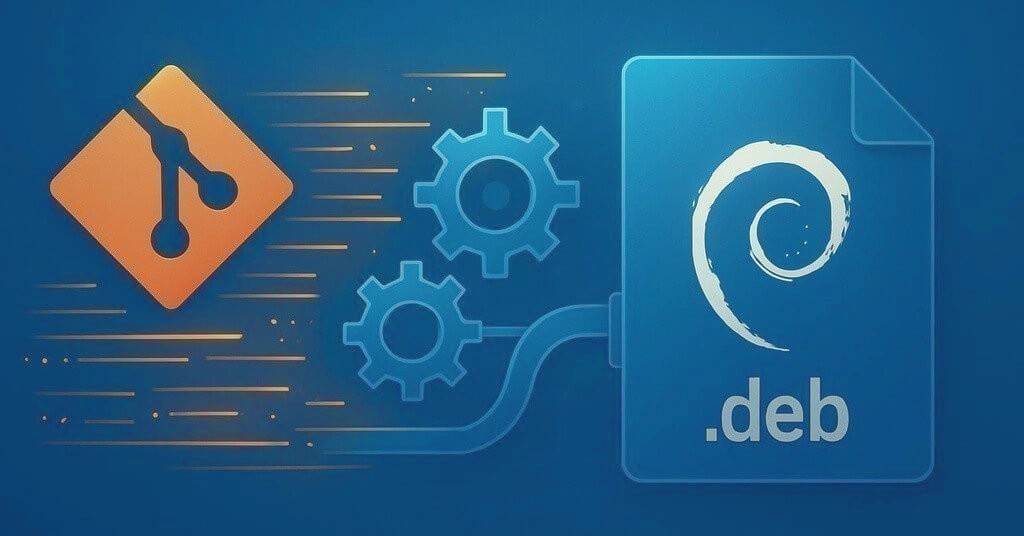
Featured image of post Creating Debian packages from upstream GitIn this post, I demonstrate the optimal workflow for creating new Debian packages in 2025, preserving the upstream git history. The motivation for this is to lower the barrier for sharing improvements to and from upstream, and to improve software provenance and supply-chain security by making it easy to inspect every change at any level using standard git tooling. Key elements of this workflow include: To make the instructions so concrete that anyone can repeat all the steps themselves on a real package, I demonstrate the steps by packaging the command-line tool Entr. It is written in C, has very few dependencies, and its final Debian source package structure is simple, yet exemplifies all the important parts that go into a complete Debian package:
  1. Creating a new packaging repository and publishing it under your personal namespace on salsa.debian.org.
  2. Using dh_make to create the initial Debian packaging.
  3. Posting the first draft of the Debian packaging as a Merge Request (MR) and using Salsa CI to verify Debian packaging quality.
  4. Running local builds efficiently and iterating on the packaging process.

Create new Debian packaging repository from the existing upstream project git repository First, create a new empty directory, then clone the upstream Git repository inside it:
shell
mkdir debian-entr
cd debian-entr
git clone --origin upstreamvcs --branch master \
 --single-branch https://github.com/eradman/entr.git
Using a clean directory makes it easier to inspect the build artifacts of a Debian package, which will be output in the parent directory of the Debian source directory. The extra parameters given to git clone lay the foundation for the Debian packaging git repository structure where the upstream git remote name is upstreamvcs. Only the upstream main branch is tracked to avoid cluttering git history with upstream development branches that are irrelevant for packaging in Debian. Next, enter the git repository directory and list the git tags. Pick the latest upstream release tag as the commit to start the branch upstream/latest. This latest refers to the upstream release, not the upstream development branch. Immediately after, branch off the debian/latest branch, which will have the actual Debian packaging files in the debian/ subdirectory.
shell
cd entr
git tag # shows the latest upstream release tag was '5.6'
git checkout -b upstream/latest 5.6
git checkout -b debian/latest
%% init:   'gitGraph':   'mainBranchName': 'master'      %%
gitGraph:
checkout master
commit id: "Upstream 5.6 release" tag: "5.6"
branch upstream/latest
checkout upstream/latest
commit id: "New upstream version 5.6" tag: "upstream/5.6"
branch debian/latest
checkout debian/latest
commit id: "Initial Debian packaging"
commit id: "Additional change 1"
commit id: "Additional change 2"
commit id: "Additional change 3"
At this point, the repository is structured according to DEP-14 conventions, ensuring a clear separation between upstream and Debian packaging changes, but there are no Debian changes yet. Next, add the Salsa repository as a new remote which called origin, the same as the default remote name in git.
shell
git remote add origin git@salsa.debian.org:otto/entr-demo.git
git push --set-upstream origin debian/latest
This is an important preparation step to later be able to create a Merge Request on Salsa that targets the debian/latest branch, which does not yet have any debian/ directory.

Launch a Debian Sid (unstable) container to run builds in To ensure that all packaging tools are of the latest versions, run everything inside a fresh Sid container. This has two benefits: you are guaranteed to have the most up-to-date toolchain, and your host system stays clean without getting polluted by various extra packages. Additionally, this approach works even if your host system is not Debian/Ubuntu.
shell
cd ..
podman run --interactive --tty --rm --shm-size=1G --cap-add SYS_PTRACE \
 --env='DEB*' --volume=$PWD:/tmp/test --workdir=/tmp/test debian:sid bash
Note that the container should be started from the parent directory of the git repository, not inside it. The --volume parameter will loop-mount the current directory inside the container. Thus all files created and modified are on the host system, and will persist after the container shuts down. Once inside the container, install the basic dependencies:
shell
apt update -q && apt install -q --yes git-buildpackage dpkg-dev dh-make

Automate creating the debian/ files with dh-make To create the files needed for the actual Debian packaging, use dh_make:
shell
# dh_make --packagename entr_5.6 --single --createorig
Maintainer Name : Otto Kek l inen
Email-Address : otto@debian.org
Date : Sat, 15 Feb 2025 01:17:51 +0000
Package Name : entr
Version : 5.6
License : blank
Package Type : single
Are the details correct? [Y/n/q]

Done. Please edit the files in the debian/ subdirectory now.
Due to how dh_make works, the package name and version need to be written as a single underscore separated string. In this case, you should choose --single to specify that the package type is a single binary package. Other options would be --library for library packages (see libgda5 sources as an example) or --indep (see dns-root-data sources as an example). The --createorig will create a mock upstream release tarball (entr_5.6.orig.tar.xz) from the current release directory, which is necessary due to historical reasons and how dh_make worked before git repositories became common and Debian source packages were based off upstream release tarballs (e.g. *.tar.gz). At this stage, a debian/ directory has been created with template files, and you can start modifying the files and iterating towards actual working packaging.
shell
git add debian/
git commit -a -m "Initial Debian packaging"

Review the files The full list of files after the above steps with dh_make would be:
 -- entr
   -- LICENSE
   -- Makefile.bsd
   -- Makefile.linux
   -- Makefile.linux-compat
   -- Makefile.macos
   -- NEWS
   -- README.md
   -- configure
   -- data.h
   -- debian
     -- README.Debian
     -- README.source
     -- changelog
     -- control
     -- copyright
     -- gbp.conf
     -- entr-docs.docs
     -- entr.cron.d.ex
     -- entr.doc-base.ex
     -- manpage.1.ex
     -- manpage.md.ex
     -- manpage.sgml.ex
     -- manpage.xml.ex
     -- postinst.ex
     -- postrm.ex
     -- preinst.ex
     -- prerm.ex
     -- rules
     -- salsa-ci.yml.ex
     -- source
       -- format
     -- upstream
       -- metadata.ex
     -- watch.ex
   -- entr.1
   -- entr.c
   -- missing
     -- compat.h
     -- kqueue_inotify.c
     -- strlcpy.c
     -- sys
     -- event.h
   -- status.c
   -- status.h
   -- system_test.sh
 -- entr_5.6.orig.tar.xz
You can browse these files in the demo repository. The mandatory files in the debian/ directory are:
  • changelog,
  • control,
  • copyright,
  • and rules.
All the other files have been created for convenience so the packager has template files to work from. The files with the suffix .ex are example files that won t have any effect until their content is adjusted and the suffix removed. For detailed explanations of the purpose of each file in the debian/ subdirectory, see the following resources:
  • The Debian Policy Manual: Describes the structure of the operating system, the package archive and requirements for packages to be included in the Debian archive.
  • The Developer s Reference: A collection of best practices and process descriptions Debian packagers are expected to follow while interacting with one another.
  • Debhelper man pages: Detailed information of how the Debian package build system works, and how the contents of the various files in debian/ affect the end result.
As Entr, the package used in this example, is a real package that already exists in the Debian archive, you may want to browse the actual Debian packaging source at https://salsa.debian.org/debian/entr/-/tree/debian/latest/debian for reference. Most of these files have standardized formatting conventions to make collaboration easier. To automatically format the files following the most popular conventions, simply run wrap-and-sort -vast or debputy reformat --style=black.

Identify build dependencies The most common reason for builds to fail is missing dependencies. The easiest way to identify which Debian package ships the required dependency is using apt-file. If, for example, a build fails complaining that pcre2posix.h cannot be found or that libcre2-posix.so is missing, you can use these commands:
shell
$ apt install -q --yes apt-file && apt-file update
$ apt-file search pcre2posix.h
libpcre2-dev: /usr/include/pcre2posix.h
$ apt-file search libpcre2-posix.so
libpcre2-dev: /usr/lib/x86_64-linux-gnu/libpcre2-posix.so
libpcre2-posix3: /usr/lib/x86_64-linux-gnu/libpcre2-posix.so.3
libpcre2-posix3: /usr/lib/x86_64-linux-gnu/libpcre2-posix.so.3.0.6
The output above implies that the debian/control should be extended to define a Build-Depends: libpcre2-dev relationship. There is also dpkg-depcheck that uses strace to trace the files the build process tries to access, and lists what Debian packages those files belong to. Example usage:
shell
dpkg-depcheck -b debian/rules build

Build the Debian sources to generate the .deb package After the first pass of refining the contents of the files in debian/, test the build by running dpkg-buildpackage inside the container:
shell
dpkg-buildpackage -uc -us -b
The options -uc -us will skip signing the resulting Debian source package and other build artifacts. The -b option will skip creating a source package and only build the (binary) *.deb packages. The output is very verbose and gives a large amount of context about what is happening during the build to make debugging build failures easier. In the build log of entr you will see for example the line dh binary --buildsystem=makefile. This and other dh commands can also be run manually if there is a need to quickly repeat only a part of the build while debugging build failures. To see what files were generated or modified by the build simply run git status --ignored:
shell
$ git status --ignored
On branch debian/latest

Untracked files:
 (use "git add <file>..." to include in what will be committed)
 debian/debhelper-build-stamp
 debian/entr.debhelper.log
 debian/entr.substvars
 debian/files

Ignored files:
 (use "git add -f <file>..." to include in what will be committed)
 Makefile
 compat.c
 compat.o
 debian/.debhelper/
 debian/entr/
 entr
 entr.o
 status.o
Re-running dpkg-buildpackage will include running the command dh clean, which assuming it is configured correctly in the debian/rules file will reset the source directory to the original pristine state. The same can of course also be done with regular git commands git reset --hard; git clean -fdx. To avoid accidentally committing unnecessary build artifacts in git, a debian/.gitignore can be useful and it would typically include all four files listed as untracked above. After a successful build you would have the following files:
shell
 -- entr
   -- LICENSE
   -- Makefile -> Makefile.linux
   -- Makefile.bsd
   -- Makefile.linux
   -- Makefile.linux-compat
   -- Makefile.macos
   -- NEWS
   -- README.md
   -- compat.c
   -- compat.o
   -- configure
   -- data.h
   -- debian
     -- README.source.md
     -- changelog
     -- control
     -- copyright
     -- debhelper-build-stamp
     -- docs
     -- entr
       -- DEBIAN
         -- control
         -- md5sums
       -- usr
       -- bin
         -- entr
       -- share
       -- doc
         -- entr
         -- NEWS.gz
         -- README.md
         -- changelog.Debian.gz
         -- copyright
       -- man
       -- man1
       -- entr.1.gz
     -- entr.debhelper.log
     -- entr.substvars
     -- files
     -- gbp.conf
     -- patches
       -- PR149-expand-aliases-in-system-test-script.patch
       -- series
       -- system-test-skip-no-tty.patch
       -- system-test-with-system-binary.patch
     -- rules
     -- salsa-ci.yml
     -- source
       -- format
     -- tests
       -- control
     -- upstream
       -- metadata
       -- signing-key.asc
     -- watch
   -- entr
   -- entr.1
   -- entr.c
   -- entr.o
   -- missing
     -- compat.h
     -- kqueue_inotify.c
     -- strlcpy.c
     -- sys
     -- event.h
   -- status.c
   -- status.h
   -- status.o
   -- system_test.sh
 -- entr-dbgsym_5.6-1_amd64.deb
 -- entr_5.6-1.debian.tar.xz
 -- entr_5.6-1.dsc
 -- entr_5.6-1_amd64.buildinfo
 -- entr_5.6-1_amd64.changes
 -- entr_5.6-1_amd64.deb
 -- entr_5.6.orig.tar.xz
The contents of debian/entr are essentially what goes into the resulting entr_5.6-1_amd64.deb package. Familiarizing yourself with the majority of the files in the original upstream source as well as all the resulting build artifacts is time consuming, but it is a necessary investment to get high-quality Debian packages. There are also tools such as Debcraft that automate generating the build artifacts in separate output directories for each build, thus making it easy to compare the changes to correlate what change in the Debian packaging led to what change in the resulting build artifacts.

Re-run the initial import with git-buildpackage When upstreams publish releases as tarballs, they should also be imported for optimal software supply-chain security, in particular if upstream also publishes cryptographic signatures that can be used to verify the authenticity of the tarballs. To achieve this, the files debian/watch, debian/upstream/signing-key.asc, and debian/gbp.conf need to be present with the correct options. In the gbp.conf file, ensure you have the correct options based on:
  1. Does upstream release tarballs? If so, enforce pristine-tar = True.
  2. Does upstream sign the tarballs? If so, configure explicit signature checking with upstream-signatures = on.
  3. Does upstream have a git repository, and does it have release git tags? If so, configure the release git tag format, e.g. upstream-vcs-tag = %(version%~%.)s.
To validate that the above files are working correctly, run gbp import-orig with the current version explicitly defined:
shell
$ gbp import-orig --uscan --upstream-version 5.6
gbp:info: Launching uscan...
gpgv: Signature made 7. Aug 2024 07.43.27 PDT
gpgv: using RSA key 519151D83E83D40A232B4D615C418B8631BC7C26
gpgv: Good signature from "Eric Radman <ericshane@eradman.com>"
gbp:info: Using uscan downloaded tarball ../entr_5.6.orig.tar.gz
gbp:info: Importing '../entr_5.6.orig.tar.gz' to branch 'upstream/latest'...
gbp:info: Source package is entr
gbp:info: Upstream version is 5.6
gbp:info: Replacing upstream source on 'debian/latest'
gbp:info: Running Postimport hook
gbp:info: Successfully imported version 5.6 of ../entr_5.6.orig.tar.gz
As the original packaging was done based on the upstream release git tag, the above command will fetch the tarball release, create the pristine-tar branch, and store the tarball delta on it. This command will also attempt to create the tag upstream/5.6 on the upstream/latest branch.

Import new upstream versions in the future Forking the upstream git repository, creating the initial packaging, and creating the DEP-14 branch structure are all one-off work needed only when creating the initial packaging. Going forward, to import new upstream releases, one would simply run git fetch upstreamvcs; gbp import-orig --uscan, which fetches the upstream git tags, checks for new upstream tarballs, and automatically downloads, verifies, and imports the new version. See the galera-4-demo example in the Debian source packages in git explained post as a demo you can try running yourself and examine in detail. You can also try running gbp import-orig --uscan without specifying a version. It would fetch it, as it will notice there is now Entr version 5.7 available, and import it.

Build using git-buildpackage From this stage onwards you should build the package using gbp buildpackage, which will do a more comprehensive build.
shell
gbp buildpackage -uc -us
The git-buildpackage build also includes running Lintian to find potential Debian policy violations in the sources or in the resulting .deb binary packages. Many Debian Developers run lintian -EviIL +pedantic after every build to check that there are no new nags, and to validate that changes intended to previous Lintian nags were correct.

Open a Merge Request on Salsa for Debian packaging review Getting everything perfectly right takes a lot of effort, and may require reaching out to an experienced Debian Developers for review and guidance. Thus, you should aim to publish your initial packaging work on Salsa, Debian s GitLab instance, for review and feedback as early as possible. For somebody to be able to easily see what you have done, you should rename your debian/latest branch to another name, for example next/debian/latest, and open a Merge Request that targets the debian/latest branch on your Salsa fork, which still has only the unmodified upstream files. If you have followed the workflow in this post so far, you can simply run:
  1. git checkout -b next/debian/latest
  2. git push --set-upstream origin next/debian/latest
  3. Open in a browser the URL visible in the git remote response
  4. Write the Merge Request description in case the default text from your commit is not enough
  5. Mark the MR as Draft using the checkbox
  6. Publish the MR and request feedback
Once a Merge Request exists, discussion regarding what additional changes are needed can be conducted as MR comments. With an MR, you can easily iterate on the contents of next/debian/latest, rebase, force push, and request re-review as many times as you want. While at it, make sure the Settings > CI/CD page has under CI/CD configuration file the value debian/salsa-ci.yml so that the CI can run and give you immediate automated feedback. For an example of an initial packaging Merge Request, see https://salsa.debian.org/otto/entr-demo/-/merge_requests/1.

Open a Merge Request / Pull Request to fix upstream code Due to the high quality requirements in Debian, it is fairly common that while doing the initial Debian packaging of an open source project, issues are found that stem from the upstream source code. While it is possible to carry extra patches in Debian, it is not good practice to deviate too much from upstream code with custom Debian patches. Instead, the Debian packager should try to get the fixes applied directly upstream. Using git-buildpackage patch queues is the most convenient way to make modifications to the upstream source code so that they automatically convert into Debian patches (stored at debian/patches), and can also easily be submitted upstream as any regular git commit (and rebased and resubmitted many times over). First, decide if you want to work out of the upstream development branch and later cherry-pick to the Debian packaging branch, or work out of the Debian packaging branch and cherry-pick to an upstream branch. The example below starts from the upstream development branch and then cherry-picks the commit into the git-buildpackage patch queue:
shell
git checkout -b bugfix-branch master
nano entr.c
make
./entr # verify change works as expected
git commit -a -m "Commit title" -m "Commit body"
git push # submit upstream
gbp pq import --force --time-machine=10
git cherry-pick <commit id>
git commit --amend # extend commit message with DEP-3 metadata
gbp buildpackage -uc -us -b
./entr # verify change works as expected
gbp pq export --drop --commit
git commit --amend # Write commit message along lines "Add patch to .."
The example below starts by making the fix on a git-buildpackage patch queue branch, and then cherry-picking it onto the upstream development branch:
shell
gbp pq import --force --time-machine=10
nano entr.c
git commit -a -m "Commit title" -m "Commit body"
gbp buildpackage -uc -us -b
./entr # verify change works as expected
gbp pq export --drop --commit
git commit --amend # Write commit message along lines "Add patch to .."
git checkout -b bugfix-branch master
git cherry-pick <commit id>
git commit --amend # prepare commit message for upstream submission
git push # submit upstream
The key git-buildpackage commands to enter and exit the patch-queue mode are:
shell
gbp pq import --force --time-machine=10
gbp pq export --drop --commit
%% init:   'gitGraph':   'mainBranchName': 'debian/latest'      %%
gitGraph
checkout debian/latest
commit id: "Initial packaging"
branch patch-queue/debian/latest
checkout patch-queue/debian/latest
commit id: "Delete debian/patches/..."
commit id: "Patch 1 title"
commit id: "Patch 2 title"
commit id: "Patch 3 title"
These can be run at any time, regardless if any debian/patches existed prior, or if existing patches applied cleanly or not, or if there were old patch queue branches around. Note that the extra -b in gbp buildpackage -uc -us -b instructs to build only binary packages, avoiding any nags from dpkg-source that there are modifications in the upstream sources while building in the patches-applied mode.

Programming-language specific dh-make alternatives As each programming language has its specific way of building the source code, and many other conventions regarding the file layout and more, Debian has multiple custom tools to create new Debian source packages for specific programming languages. Notably, Python does not have its own tool, but there is an dh_make --python option for Python support directly in dh_make itself. The list is not complete and many more tools exist. For some languages, there are even competing options, such as for Go there is in addition to dh-make-golang also Gophian. When learning Debian packaging, there is no need to learn these tools upfront. Being aware that they exist is enough, and one can learn them only if and when one starts to package a project in a new programming language.

The difference between source git repository vs source packages vs binary packages As seen in earlier example, running gbp buildpackage on the Entr packaging repository above will result in several files:
entr_5.6-1_amd64.changes
entr_5.6-1_amd64.deb
entr_5.6-1.debian.tar.xz
entr_5.6-1.dsc
entr_5.6.orig.tar.gz
entr_5.6.orig.tar.gz.asc
The entr_5.6-1_amd64.deb is the binary package, which can be installed on a Debian/Ubuntu system. The rest of the files constitute the source package. To do a source-only build, run gbp buildpackage -S and note the files produced:
entr_5.6-1_source.changes
entr_5.6-1.debian.tar.xz
entr_5.6-1.dsc
entr_5.6.orig.tar.gz
entr_5.6.orig.tar.gz.asc
The source package files can be used to build the binary .deb for amd64, or any architecture that the package supports. It is important to grasp that the Debian source package is the preferred form to be able to build the binary packages on various Debian build systems, and the Debian source package is not the same thing as the Debian packaging git repository contents.
flowchart LR
git[Git repository<br>branch debian/latest] --> gbp buildpackage -S  src[Source Package<br>.dsc + .tar.xz]
src --> dpkg-buildpackage  bin[Binary Packages<br>.deb]
If the package is large and complex, the build could result in multiple binary packages. One set of package definition files in debian/ will however only ever result in a single source package.

Option to repackage source packages with Files-Excluded lists in the debian/copyright file Some upstream projects may include binary files in their release, or other undesirable content that needs to be omitted from the source package in Debian. The easiest way to filter them out is by adding to the debian/copyright file a Files-Excluded field listing the undesired files. The debian/copyright file is read by uscan, which will repackage the upstream sources on-the-fly when importing new upstream releases. For a real-life example, see the debian/copyright files in the Godot package that lists:
debian
Files-Excluded: platform/android/java/gradle/wrapper/gradle-wrapper.jar
The resulting repackaged upstream source tarball, as well as the upstream version component, will have an extra +ds to signify that it is not the true original upstream source but has been modified by Debian:
godot_4.3+ds.orig.tar.xz
godot_4.3+ds-1_amd64.deb

Creating one Debian source package from multiple upstream source packages also possible In some rare cases the upstream project may be split across multiple git repositories or the upstream release may consist of multiple components each in their own separate tarball. Usually these are very large projects that get some benefits from releasing components separately. If in Debian these are deemed to go into a single source package, it is technically possible using the component system in git-buildpackage and uscan. For an example see the gbp.conf and watch files in the node-cacache package. Using this type of structure should be a last resort, as it creates complexity and inter-dependencies that are bound to cause issues later on. It is usually better to work with upstream and champion universal best practices with clear releases and version schemes.

When not to start the Debian packaging repository as a fork of the upstream one Not all upstreams use Git for version control. It is by far the most popular, but there are still some that use e.g. Subversion or Mercurial. Who knows maybe in the future some new version control systems will start to compete with Git. There are also projects that use Git in massive monorepos and with complex submodule setups that invalidate the basic assumptions required to map an upstream Git repository into a Debian packaging repository. In those cases one can t use a debian/latest branch on a clone of the upstream git repository as the starting point for the Debian packaging, but one must revert the traditional way of starting from an upstream release tarball with gbp import-orig package-1.0.tar.gz.

Conclusion Created in August 1993, Debian is one of the oldest Linux distributions. In the 32 years since inception, the .deb packaging format and the tooling to work with it have evolved several generations. In the past 10 years, more and more Debian Developers have converged on certain core practices evidenced by https://trends.debian.net/, but there is still a lot of variance in workflows even for identical tasks. Hopefully, you find this post useful in giving practical guidance on how exactly to do the most common things when packaging software for Debian. Happy packaging!

25 May 2025

Otto Kek l inen: New Debian package creation from upstream git repository

Featured image of post New Debian package creation from upstream git repositoryIn this post, I demonstrate the optimal workflow for creating new Debian packages in 2025, preserving the upstream git history. The motivation for this is to lower the barrier for sharing improvements to and from upstream, and to improve software provenance and supply-chain security by making it easy to inspect every change at any level using standard git tooling. Key elements of this workflow include: To make the instructions so concrete that anyone can repeat all the steps themselves on a real package, I demonstrate the steps by packaging the command-line tool Entr. It is written in C, has very few dependencies, and its final Debian source package structure is simple, yet exemplifies all the important parts that go into a complete Debian package:

  1. Creating a new packaging repository and publishing it under your personal namespace on salsa.debian.org.
  2. Using dh_make to create the initial Debian packaging.
  3. Posting the first draft of the Debian packaging as a Merge Request (MR) and using Salsa CI to verify Debian packaging quality.
  4. Running local builds efficiently and iterating on the packaging process.

Create new Debian packaging repository from the existing upstream project git repository First, create a new empty directory, then clone the upstream Git repository inside it:
shell
mkdir debian-entr
cd debian-entr
git clone --origin upstreamvcs --branch master \
 --single-branch https://github.com/eradman/entr.git
Using a clean directory makes it easier to inspect the build artifacts of a Debian package, which will be output in the parent directory of the Debian source directory. The extra parameters given to git clone lay the foundation for the Debian packaging git repository structure where the upstream git remote name is upstreamvcs. Only the upstream main branch is tracked to avoid cluttering git history with upstream development branches that are irrelevant for packaging in Debian. Next, enter the git repository directory and list the git tags. Pick the latest upstream release tag as the commit to start the branch upstream/latest. This latest refers to the upstream release, not the upstream development branch. Immediately after, branch off the debian/latest branch, which will have the actual Debian packaging files in the debian/ subdirectory.
shell
cd entr
git tag # shows the latest upstream release tag was '5.6'
git checkout -b upstream/latest 5.6
git checkout -b debian/latest
%% init:   'gitGraph':   'mainBranchName': 'master'      %%
gitGraph:
checkout master
commit id: "Upstream 5.6 release" tag: "5.6"
branch upstream/latest
checkout upstream/latest
commit id: "New upstream version 5.6" tag: "upstream/5.6"
branch debian/latest
checkout debian/latest
commit id: "Initial Debian packaging"
commit id: "Additional change 1"
commit id: "Additional change 2"
commit id: "Additional change 3"
At this point, the repository is structured according to DEP-14 conventions, ensuring a clear separation between upstream and Debian packaging changes, but there are no Debian changes yet. Next, add the Salsa repository as a new remote which called origin, the same as the default remote name in git.
shell
git remote add origin git@salsa.debian.org:otto/entr-demo.git
git push --set-upstream origin debian/latest
This is an important preparation step to later be able to create a Merge Request on Salsa that targets the debian/latest branch, which does not yet have any debian/ directory.

Launch a Debian Sid (unstable) container to run builds in To ensure that all packaging tools are of the latest versions, run everything inside a fresh Sid container. This has two benefits: you are guaranteed to have the most up-to-date toolchain, and your host system stays clean without getting polluted by various extra packages. Additionally, this approach works even if your host system is not Debian/Ubuntu.
shell
cd ..
podman run --interactive --tty --rm --shm-size=1G --cap-add SYS_PTRACE \
 --env='DEB*' --volume=$PWD:/tmp/test --workdir=/tmp/test debian:sid bash
Note that the container should be started from the parent directory of the git repository, not inside it. The --volume parameter will loop-mount the current directory inside the container. Thus all files created and modified are on the host system, and will persist after the container shuts down. Once inside the container, install the basic dependencies:
shell
apt update -q && apt install -q --yes git-buildpackage dpkg-dev dh-make

Automate creating the debian/ files with dh-make To create the files needed for the actual Debian packaging, use dh_make:
shell
# dh_make --packagename entr_5.6 --single --createorig
Maintainer Name : Otto Kek l inen
Email-Address : otto@debian.org
Date : Sat, 15 Feb 2025 01:17:51 +0000
Package Name : entr
Version : 5.6
License : blank
Package Type : single
Are the details correct? [Y/n/q]

Done. Please edit the files in the debian/ subdirectory now.
Due to how dh_make works, the package name and version need to be written as a single underscore separated string. In this case, you should choose --single to specify that the package type is a single binary package. Other options would be --library for library packages (see libgda5 sources as an example) or --indep (see dns-root-data sources as an example). The --createorig will create a mock upstream release tarball (entr_5.6.orig.tar.xz) from the current release directory, which is necessary due to historical reasons and how dh_make worked before git repositories became common and Debian source packages were based off upstream release tarballs (e.g. *.tar.gz). At this stage, a debian/ directory has been created with template files, and you can start modifying the files and iterating towards actual working packaging.
shell
git add debian/
git commit -a -m "Initial Debian packaging"

Review the files The full list of files after the above steps with dh_make would be:
 -- entr
   -- LICENSE
   -- Makefile.bsd
   -- Makefile.linux
   -- Makefile.linux-compat
   -- Makefile.macos
   -- NEWS
   -- README.md
   -- configure
   -- data.h
   -- debian
     -- README.Debian
     -- README.source
     -- changelog
     -- control
     -- copyright
     -- gbp.conf
     -- entr-docs.docs
     -- entr.cron.d.ex
     -- entr.doc-base.ex
     -- manpage.1.ex
     -- manpage.md.ex
     -- manpage.sgml.ex
     -- manpage.xml.ex
     -- postinst.ex
     -- postrm.ex
     -- preinst.ex
     -- prerm.ex
     -- rules
     -- salsa-ci.yml.ex
     -- source
       -- format
     -- upstream
       -- metadata.ex
     -- watch.ex
   -- entr.1
   -- entr.c
   -- missing
     -- compat.h
     -- kqueue_inotify.c
     -- strlcpy.c
     -- sys
     -- event.h
   -- status.c
   -- status.h
   -- system_test.sh
 -- entr_5.6.orig.tar.xz
You can browse these files in the demo repository. The mandatory files in the debian/ directory are:
  • changelog,
  • control,
  • copyright,
  • and rules.
All the other files have been created for convenience so the packager has template files to work from. The files with the suffix .ex are example files that won t have any effect until their content is adjusted and the suffix removed. For detailed explanations of the purpose of each file in the debian/ subdirectory, see the following resources:
  • The Debian Policy Manual: Describes the structure of the operating system, the package archive and requirements for packages to be included in the Debian archive.
  • The Developer s Reference: A collection of best practices and process descriptions Debian packagers are expected to follow while interacting with one another.
  • Debhelper man pages: Detailed information of how the Debian package build system works, and how the contents of the various files in debian/ affect the end result.
As Entr, the package used in this example, is a real package that already exists in the Debian archive, you may want to browse the actual Debian packaging source at https://salsa.debian.org/debian/entr/-/tree/debian/latest/debian for reference. Most of these files have standardized formatting conventions to make collaboration easier. To automatically format the files following the most popular conventions, simply run wrap-and-sort -vast or debputy reformat --style=black.

Identify build dependencies The most common reason for builds to fail is missing dependencies. The easiest way to identify which Debian package ships the required dependency is using apt-file. If, for example, a build fails complaining that pcre2posix.h cannot be found or that libcre2-posix.so is missing, you can use these commands:
shell
$ apt install -q --yes apt-file && apt-file update
$ apt-file search pcre2posix.h
libpcre2-dev: /usr/include/pcre2posix.h
$ apt-file search libpcre2-posix.so
libpcre2-dev: /usr/lib/x86_64-linux-gnu/libpcre2-posix.so
libpcre2-posix3: /usr/lib/x86_64-linux-gnu/libpcre2-posix.so.3
libpcre2-posix3: /usr/lib/x86_64-linux-gnu/libpcre2-posix.so.3.0.6
The output above implies that the debian/control should be extended to define a Build-Depends: libpcre2-dev relationship. There is also dpkg-depcheck that uses strace to trace the files the build process tries to access, and lists what Debian packages those files belong to. Example usage:
shell
dpkg-depcheck -b debian/rules build

Build the Debian sources to generate the .deb package After the first pass of refining the contents of the files in debian/, test the build by running dpkg-buildpackage inside the container:
shell
dpkg-buildpackage -uc -us -b
The options -uc -us will skip signing the resulting Debian source package and other build artifacts. The -b option will skip creating a source package and only build the (binary) *.deb packages. The output is very verbose and gives a large amount of context about what is happening during the build to make debugging build failures easier. In the build log of entr you will see for example the line dh binary --buildsystem=makefile. This and other dh commands can also be run manually if there is a need to quickly repeat only a part of the build while debugging build failures. To see what files were generated or modified by the build simply run git status --ignored:
shell
$ git status --ignored
On branch debian/latest

Untracked files:
 (use "git add <file>..." to include in what will be committed)
 debian/debhelper-build-stamp
 debian/entr.debhelper.log
 debian/entr.substvars
 debian/files

Ignored files:
 (use "git add -f <file>..." to include in what will be committed)
 Makefile
 compat.c
 compat.o
 debian/.debhelper/
 debian/entr/
 entr
 entr.o
 status.o
Re-running dpkg-buildpackage will include running the command dh clean, which assuming it is configured correctly in the debian/rules file will reset the source directory to the original pristine state. The same can of course also be done with regular git commands git reset --hard; git clean -fdx. To avoid accidentally committing unnecessary build artifacts in git, a debian/.gitignore can be useful and it would typically include all four files listed as untracked above. After a successful build you would have the following files:
shell
 -- entr
   -- LICENSE
   -- Makefile -> Makefile.linux
   -- Makefile.bsd
   -- Makefile.linux
   -- Makefile.linux-compat
   -- Makefile.macos
   -- NEWS
   -- README.md
   -- compat.c
   -- compat.o
   -- configure
   -- data.h
   -- debian
     -- README.source.md
     -- changelog
     -- control
     -- copyright
     -- debhelper-build-stamp
     -- docs
     -- entr
       -- DEBIAN
         -- control
         -- md5sums
       -- usr
       -- bin
         -- entr
       -- share
       -- doc
         -- entr
         -- NEWS.gz
         -- README.md
         -- changelog.Debian.gz
         -- copyright
       -- man
       -- man1
       -- entr.1.gz
     -- entr.debhelper.log
     -- entr.substvars
     -- files
     -- gbp.conf
     -- patches
       -- PR149-expand-aliases-in-system-test-script.patch
       -- series
       -- system-test-skip-no-tty.patch
       -- system-test-with-system-binary.patch
     -- rules
     -- salsa-ci.yml
     -- source
       -- format
     -- tests
       -- control
     -- upstream
       -- metadata
       -- signing-key.asc
     -- watch
   -- entr
   -- entr.1
   -- entr.c
   -- entr.o
   -- missing
     -- compat.h
     -- kqueue_inotify.c
     -- strlcpy.c
     -- sys
     -- event.h
   -- status.c
   -- status.h
   -- status.o
   -- system_test.sh
 -- entr-dbgsym_5.6-1_amd64.deb
 -- entr_5.6-1.debian.tar.xz
 -- entr_5.6-1.dsc
 -- entr_5.6-1_amd64.buildinfo
 -- entr_5.6-1_amd64.changes
 -- entr_5.6-1_amd64.deb
 -- entr_5.6.orig.tar.xz
The contents of debian/entr are essentially what goes into the resulting entr_5.6-1_amd64.deb package. Familiarizing yourself with the majority of the files in the original upstream source as well as all the resulting build artifacts is time consuming, but it is a necessary investment to get high-quality Debian packages. There are also tools such as Debcraft that automate generating the build artifacts in separate output directories for each build, thus making it easy to compare the changes to correlate what change in the Debian packaging led to what change in the resulting build artifacts.

Re-run the initial import with git-buildpackage When upstreams publish releases as tarballs, they should also be imported for optimal software supply-chain security, in particular if upstream also publishes cryptographic signatures that can be used to verify the authenticity of the tarballs. To achieve this, the files debian/watch, debian/upstream/signing-key.asc, and debian/gbp.conf need to be present with the correct options. In the gbp.conf file, ensure you have the correct options based on:
  1. Does upstream release tarballs? If so, enforce pristine-tar = True.
  2. Does upstream sign the tarballs? If so, configure explicit signature checking with upstream-signatures = on.
  3. Does upstream have a git repository, and does it have release git tags? If so, configure the release git tag format, e.g. upstream-vcs-tag = %(version%~%.)s.
To validate that the above files are working correctly, run gbp import-orig with the current version explicitly defined:
shell
$ gbp import-orig --uscan --upstream-version 5.6
gbp:info: Launching uscan...
gpgv: Signature made 7. Aug 2024 07.43.27 PDT
gpgv: using RSA key 519151D83E83D40A232B4D615C418B8631BC7C26
gpgv: Good signature from "Eric Radman <ericshane@eradman.com>"
gbp:info: Using uscan downloaded tarball ../entr_5.6.orig.tar.gz
gbp:info: Importing '../entr_5.6.orig.tar.gz' to branch 'upstream/latest'...
gbp:info: Source package is entr
gbp:info: Upstream version is 5.6
gbp:info: Replacing upstream source on 'debian/latest'
gbp:info: Running Postimport hook
gbp:info: Successfully imported version 5.6 of ../entr_5.6.orig.tar.gz
As the original packaging was done based on the upstream release git tag, the above command will fetch the tarball release, create the pristine-tar branch, and store the tarball delta on it. This command will also attempt to create the tag upstream/5.6 on the upstream/latest branch.

Import new upstream versions in the future Forking the upstream git repository, creating the initial packaging, and creating the DEP-14 branch structure are all one-off work needed only when creating the initial packaging. Going forward, to import new upstream releases, one would simply run git fetch upstreamvcs; gbp import-orig --uscan, which fetches the upstream git tags, checks for new upstream tarballs, and automatically downloads, verifies, and imports the new version. See the galera-4-demo example in the Debian source packages in git explained post as a demo you can try running yourself and examine in detail. You can also try running gbp import-orig --uscan without specifying a version. It would fetch it, as it will notice there is now Entr version 5.7 available, and import it.

Build using git-buildpackage From this stage onwards you should build the package using gbp buildpackage, which will do a more comprehensive build.
shell
gbp buildpackage -uc -us
The git-buildpackage build also includes running Lintian to find potential Debian policy violations in the sources or in the resulting .deb binary packages. Many Debian Developers run lintian -EviIL +pedantic after every build to check that there are no new nags, and to validate that changes intended to previous Lintian nags were correct.

Open a Merge Request on Salsa for Debian packaging review Getting everything perfectly right takes a lot of effort, and may require reaching out to an experienced Debian Developers for review and guidance. Thus, you should aim to publish your initial packaging work on Salsa, Debian s GitLab instance, for review and feedback as early as possible. For somebody to be able to easily see what you have done, you should rename your debian/latest branch to another name, for example next/debian/latest, and open a Merge Request that targets the debian/latest branch on your Salsa fork, which still has only the unmodified upstream files. If you have followed the workflow in this post so far, you can simply run:
  1. git checkout -b next/debian/latest
  2. git push --set-upstream origin next/debian/latest
  3. Open in a browser the URL visible in the git remote response
  4. Write the Merge Request description in case the default text from your commit is not enough
  5. Mark the MR as Draft using the checkbox
  6. Publish the MR and request feedback
Once a Merge Request exists, discussion regarding what additional changes are needed can be conducted as MR comments. With an MR, you can easily iterate on the contents of next/debian/latest, rebase, force push, and request re-review as many times as you want. While at it, make sure the Settings > CI/CD page has under CI/CD configuration file the value debian/salsa-ci.yml so that the CI can run and give you immediate automated feedback. For an example of an initial packaging Merge Request, see https://salsa.debian.org/otto/entr-demo/-/merge_requests/1.

Open a Merge Request / Pull Request to fix upstream code Due to the high quality requirements in Debian, it is fairly common that while doing the initial Debian packaging of an open source project, issues are found that stem from the upstream source code. While it is possible to carry extra patches in Debian, it is not good practice to deviate too much from upstream code with custom Debian patches. Instead, the Debian packager should try to get the fixes applied directly upstream. Using git-buildpackage patch queues is the most convenient way to make modifications to the upstream source code so that they automatically convert into Debian patches (stored at debian/patches), and can also easily be submitted upstream as any regular git commit (and rebased and resubmitted many times over). First, decide if you want to work out of the upstream development branch and later cherry-pick to the Debian packaging branch, or work out of the Debian packaging branch and cherry-pick to an upstream branch. The example below starts from the upstream development branch and then cherry-picks the commit into the git-buildpackage patch queue:
shell
git checkout -b bugfix-branch master
nano entr.c
make
./entr # verify change works as expected
git commit -a -m "Commit title" -m "Commit body"
git push # submit upstream
gbp pq import --force --time-machine=10
git cherry-pick <commit id>
git commit --amend # extend commit message with DEP-3 metadata
gbp buildpackage -uc -us -b
./entr # verify change works as expected
gbp pq export --drop --commit
git commit --amend # Write commit message along lines "Add patch to .."
The example below starts by making the fix on a git-buildpackage patch queue branch, and then cherry-picking it onto the upstream development branch:
shell
gbp pq import --force --time-machine=10
nano entr.c
git commit -a -m "Commit title" -m "Commit body"
gbp buildpackage -uc -us -b
./entr # verify change works as expected
gbp pq export --drop --commit
git commit --amend # Write commit message along lines "Add patch to .."
git checkout -b bugfix-branch master
git cherry-pick <commit id>
git commit --amend # prepare commit message for upstream submission
git push # submit upstream
The key git-buildpackage commands to enter and exit the patch-queue mode are:
shell
gbp pq import --force --time-machine=10
gbp pq export --drop --commit
%% init:   'gitGraph':   'mainBranchName': 'debian/latest'      %%
gitGraph
checkout debian/latest
commit id: "Initial packaging"
branch patch-queue/debian/latest
checkout patch-queue/debian/latest
commit id: "Delete debian/patches/..."
commit id: "Patch 1 title"
commit id: "Patch 2 title"
commit id: "Patch 3 title"
These can be run at any time, regardless if any debian/patches existed prior, or if existing patches applied cleanly or not, or if there were old patch queue branches around. Note that the extra -b in gbp buildpackage -uc -us -b instructs to build only binary packages, avoiding any nags from dpkg-source that there are modifications in the upstream sources while building in the patches-applied mode.

Programming-language specific dh-make alternatives As each programming language has its specific way of building the source code, and many other conventions regarding the file layout and more, Debian has multiple custom tools to create new Debian source packages for specific programming languages. Notably, Python does not have its own tool, but there is an dh_make --python option for Python support directly in dh_make itself. The list is not complete and many more tools exist. For some languages, there are even competing options, such as for Go there is in addition to dh-make-golang also Gophian. When learning Debian packaging, there is no need to learn these tools upfront. Being aware that they exist is enough, and one can learn them only if and when one starts to package a project in a new programming language.

The difference between source git repository vs source packages vs binary packages As seen in earlier example, running gbp buildpackage on the Entr packaging repository above will result in several files:
entr_5.6-1_amd64.changes
entr_5.6-1_amd64.deb
entr_5.6-1.debian.tar.xz
entr_5.6-1.dsc
entr_5.6.orig.tar.gz
entr_5.6.orig.tar.gz.asc
The entr_5.6-1_amd64.deb is the binary package, which can be installed on a Debian/Ubuntu system. The rest of the files constitute the source package. To do a source-only build, run gbp buildpackage -S and note the files produced:
entr_5.6-1_source.changes
entr_5.6-1.debian.tar.xz
entr_5.6-1.dsc
entr_5.6.orig.tar.gz
entr_5.6.orig.tar.gz.asc
The source package files can be used to build the binary .deb for amd64, or any architecture that the package supports. It is important to grasp that the Debian source package is the preferred form to be able to build the binary packages on various Debian build systems, and the Debian source package is not the same thing as the Debian packaging git repository contents.
flowchart LR
git[Git repository<br>branch debian/latest] --> gbp buildpackage -S  src[Source Package<br>.dsc + .tar.xz]
src --> dpkg-buildpackage  bin[Binary Packages<br>.deb]
If the package is large and complex, the build could result in multiple binary packages. One set of package definition files in debian/ will however only ever result in a single source package.

Option to repackage source packages with Files-Excluded lists in the debian/copyright file Some upstream projects may include binary files in their release, or other undesirable content that needs to be omitted from the source package in Debian. The easiest way to filter them out is by adding to the debian/copyright file a Files-Excluded field listing the undesired files. The debian/copyright file is read by uscan, which will repackage the upstream sources on-the-fly when importing new upstream releases. For a real-life example, see the debian/copyright files in the Godot package that lists:
debian
Files-Excluded: platform/android/java/gradle/wrapper/gradle-wrapper.jar
The resulting repackaged upstream source tarball, as well as the upstream version component, will have an extra +ds to signify that it is not the true original upstream source but has been modified by Debian:
godot_4.3+ds.orig.tar.xz
godot_4.3+ds-1_amd64.deb

Creating one Debian source package from multiple upstream source packages also possible In some rare cases the upstream project may be split across multiple git repositories or the upstream release may consist of multiple components each in their own separate tarball. Usually these are very large projects that get some benefits from releasing components separately. If in Debian these are deemed to go into a single source package, it is technically possible using the component system in git-buildpackage and uscan. For an example see the gbp.conf and watch files in the node-cacache package. Using this type of structure should be a last resort, as it creates complexity and inter-dependencies that are bound to cause issues later on. It is usually better to work with upstream and champion universal best practices with clear releases and version schemes.

When not to start the Debian packaging repository as a fork of the upstream one Not all upstreams use Git for version control. It is by far the most popular, but there are still some that use e.g. Subversion or Mercurial. Who knows maybe in the future some new version control systems will start to compete with Git. There are also projects that use Git in massive monorepos and with complex submodule setups that invalidate the basic assumptions required to map an upstream Git repository into a Debian packaging repository. In those cases one can t use a debian/latest branch on a clone of the upstream git repository as the starting point for the Debian packaging, but one must revert the traditional way of starting from an upstream release tarball with gbp import-orig package-1.0.tar.gz.

Conclusion Created in August 1993, Debian is one of the oldest Linux distributions. In the 32 years since inception, the .deb packaging format and the tooling to work with it have evolved several generations. In the past 10 years, more and more Debian Developers have converged on certain core practices evidenced by https://trends.debian.net/, but there is still a lot of variance in workflows even for identical tasks. Hopefully, you find this post useful in giving practical guidance on how exactly to do the most common things when packaging software for Debian. Happy packaging!

Valhalla's Things: Honeycomb shirt

Posted on May 25, 2025
Tags: madeof:atoms, craft:sewing, FreeSoftWear, GNU Terry Pratchett
A woman wearing a purplish blue shirt with very wide sleeves, gathered at the cuffs and shoulder with honeycombing, and also a rectangle of honeycombing in the front between the neckline and just above the bust. The shirt is gathered at the waist with a wide belt, and an almost lilac towel hangs from the belt. After cartridge pleating, the next fabric manipulation technique I wanted to try was smocking, of the honeycombing variety, on a shirt. My current go-to pattern for shirts is the 1880 menswear one I have on my website: I love the fact that most of the fabric is still cut as big rectangles, but the shaped yoke and armscyes make it significantly more comfortable than the earlier style where most of the shaping at the neck was done with gathers into a straight collar. A woman wearing a shirt in the same fabric; this one has a slit in the front, is gathered into a tall rectangular collar and has dropped shoulders because it's cut from plain rectangles. The sleeves are still huge, and gathered into tall cuffs. It is worn belted (with the same wide white elastic belt used in the previous picture) and the woman is wearing a matching fabric mask, because the picture has been taken in 2021. In my stash I had a cut of purple-blue hopefully cotton [#cotton] I had bought for a cheap price and used for my first attempt at an historically accurate pirate / vampire shirt that has now become by official summer vaccine jab / blood test shirt (because it has the long sleeves I need, but they are pretty easy to roll up to give access to my arm. That shirt tends to get out of the washing machine pretty wearable even without ironing, which made me think it could be a good fabric for something that may be somewhat hard to iron (but also made me suspicious about the actual composition of the fabric, even if it feels nice enough even when worn in the summer). A piece of fabric with many rows of honeycombing laid on top of the collar and yoke of the shirt; a metal snap peeks from behind the piece of honeycombed fabric.  There are still basting lines for the armscyes. Of course I wanted some honeycombing on the front, but I was afraid that the slit in the middle of it would interfere with the honeycombing and gape, so I decided to have the shirt open in an horizontal line at the yoke. I added instructions to the pattern page for how I changed the opening in the front, basically it involved finishing the front edge of the yoke, and sewing the honeycombed yoke to a piece of tape with snaps. Another change from the pattern is that I used plain rectangles for the sleeves, and a square gusset, rather than the new style tapered sleeve , because I wanted to have more fabric to gather at the wrist. I did the side and sleeve seams with a hem + whipstitch method rather than a felled seam, which may have helped, but the sleeves went into the fitted armscyes with no issue. I think that if (yeah, right. when) I ll make another sleeve in this style I ll sew it into the side seam starting 2-3 cm lower than the place I ve marked on the pattern for the original sleeve. The back of the unbelted shirt: it has a fitted yoke, and then it is quite wide and unfitted, with the fabric gathered into the yoke with a row of honeycombing and some pleating on top. I also used a row of honeycombing on the back and two on the upper part of the sleeves, instead of the gathering, and of course some rows to gather the cuffs. The honeycombing on the back was a bit too far away from the edge, so it s a bit of an odd combination of honeycombing and pleating that I don t hate, but don t love either. It s on the back, so I don t mind. On the sleeves I ve done the honeycombing closer to the edge and I ve decided to sew the sleeve as if it was a cartridge pleated sleeve, and that worked better. Because circumstances are still making access to my sewing machine more of a hassle than I d want it to be, this was completely sewn by hand, and at a bit more than a month I have to admit that near the end it felt like it had been taken forever. I m not sure whether it was the actual sewing being slow, some interruptions that happened when I had little time to work on it, or the fact that I ve just gone through a time when my brain kept throwing new projects at me, and I kept thinking of how to make those. Thanks brain. Even when on a hurry to finish it, however, it was still enjoyable sewing, and I think I ll want to do more honeycombing in the future. The same woman with arms wide to show the big sleeves and the shirt unbelted to show that it is pretty wide also from the front, below the yoke and the honeycombing. The back can be seen as about 10 cm longer than the front. Anyway, it s done! And it s going straight into my daily garment rotation, because the weather is getting hot, and that means it s definitely shirt time.




19 May 2025

Simon Quigley: Coffee and Adapting to your Environment

This morning, I went to make my usual cup of coffee. I was given an espresso machine for Christmas, and I ve developed this technique for making a warm drink that hits the spot every time.I ll start by turning on my espresso machine and starting a single shot of espresso. It dispenses and drips while I m working on the other parts.I then grab a coffee cup. Usually one of the taller ones. For maybe the bottom inch or two of the cup, that gets sugar and chocolate milk. Microwave for 45 seconds, pour in the espresso, then wash out the actual espresso from the metal cup with milk. Pour all of that in, another 45 seconds in the microwave, a few quick stirs, and you re all set.To the actual baristas out there, that probably sounds horrible. It probably sounds like the worst possible recommendation for a morning coffee ever.But, you know what? It works.So, I went to put my coffee into the microwave today, and I realized that someone else had put the glass plate for the microwave into the sink after accidentally spilling their breakfast on it.Instead of saying, well, I m not going to have my coffee this morning, I grabbed a large plate. I remembered the physics of levers from high school, and I understood that if I balanced everything just right, it would heat my coffee up.And well, here I am. With an un-spilled coffee and a story to tell.My point here is actually pretty simple, and this is before I even read any messages for the day. People with much more formal educations sometimes look at the guy engineering coffee with his microwave and think, what is this guy doing?!? All I m doing is making a really good cup of coffee. And to be honest, it tastes amazing.That s all. Have a wonderful day.

Simon Quigley: Toolboxes and Hammers Be You

Toolboxes and Hammers Be YouEveryone has a story. We all started from somewhere, and we re all going somewhere.Ten years ago this summer, I first heard of Ubuntu. It took me time to learn how to properly pronounce the word, although I m glad I learned that early on. I was less fortunate when it came to the pronunciation of the acronym for the Ubuntu Code of Conduct. I had spent time and time again breaking my computer, and I d wanted to start fresh.I ve actually talked about this in an interview before, which you can find here (skip to 5:02 6:12 for my short explanation, I m in orange):https://medium.com/media/ad59becdbd06d230b875fb1512df1921/hrefI ve also done a few interviews over the years, here are some of the more recent ones:https://medium.com/media/83bda448d5f2a979f848e17f04376aa6/hrefAsk Noah Show 377Lastly, I did a few talks at SCaLE 21x (which the Ubuntu community donation funds helped me attend, thank you for that!):https://medium.com/media/0fbde7ef0ed83c2272a8653a5ea38b67/hrefhttps://medium.com/media/4d18f1770dc7eed6c7a9d711ff6a6e89/hrefMy story is fairly simple to summarize, if you don t have the time to go through all the clips.I started in the Ubuntu project at 13 years old, as a middle school student living in Green Bay, WI. I m now 23 years old, still living in Green Bay, but I became an Ubuntu Core Developer, Lubuntu s Release Manager, and worked up to a very great and comfortable spot.So, Simon, what advice would you give to someone at 13 who wants to do the same thing? Here are a few tips * Don t be afraid to be yourself. If you put on a mask, it hinders your growth, and you ll end up paying for it later anyway.
* Find a mentor. Someone who is okay working with someone your age, and ideally someone who works well with people your age (quick shoutout to Aaron Prisk and Walter Lapchynski for always being awesome to me and other folks starting out at high school.) This is probably the most important part.
* Ask questions. Tons of them. Ask questions until you re blue in the face. Ask questions until you get a headache so bad that your weekend needs to come early. Okay, maybe don t go that far, but at the very least, always stay curious.
* Own up to your mistakes. Even the most experienced people you know have made tons of mistakes. It s not about the mistake itself, it s about how you handle it and grow as a person.Now, after ten years, I ve seen many people come and go in Ubuntu. I was around for the transition from upstart to systemd. I was around for the transition from Unity to GNOME. I watched Kubuntu as a flavor recover from the arguments only a few years before I first started, only to jump in and help years later when the project started to trend downwards again.I have deep love, respect, and admiration for Ubuntu and its community. I also have deep love, respect, and admiration for Canonical as a company. It s all valuable work. That being said, I need to recognize where my own limits are, and it s not what you d think. This isn t some big burnout rant.Some of you may have heard rumors about an argument between me and the Ubuntu Community Council. I refuse to go into the private details of that, but what I ll tell you is this in retrospect, it was in good faith. The entire thing, from both my end and theirs, was to try to either help me as a person, or the entire community. If you think any part of this was bad faith from either side, you re fooling yourself. Plus, tons of great work and stories actually came out of this.The Ubuntu Community Council really does care. And so does Mark Shuttleworth.Now, I won t go into many specifics. If you want specifics, I d direct you to the Ubuntu Community Council who would be more than happy to answer any questions (actually they d probably stay silent. Nevermind.) That being said, I can t really talk about any of this without mentioning how great Mark has become.Remember, I was around for a few different major changes within the project. I ve heard and seen stories about Mark that actually match what Reddit says about him. But in 2025, out of the bottom of my heart, I m here to tell you that you re all wrong now.See, Mark didn t just side with somebody and be done with it. He actually listened, and I could tell, he cares very very deeply. I really enjoyed reading ogra s recent blog post, you should seriously check it out. Of course, I m only 23 years old, but I have to say, my experiences with Mark match that too.Now, as for what happens from here. I m taking a year off from Ubuntu. I talked this over with a wide variety of people, and I think it s the right decision. People who know me personally know that I m not one to make a major decision like this without a very good reason to. Well, I d like to share my reasons with you, because I think they d help.People who contribute time to open source find it to be very rewarding. Sometimes so rewarding, in fact, that no matter how many economics and finance books they read, they still haven t figured out how to balance that with a job that pays money. I m sure everyone deeply involved in this space has had the urge to quit their job at least once or twice to pursue their passions.Here s the other element too I ve had a handful of romantic relationships before, and they ve never really panned out. I found the woman that I truly believe I m going to marry. Is it going to be a rough road ahead of us? Absolutely, and to be totally honest, there is still a (small, at this point) chance it doesn t work out.That being said I remain optimistic. I m not taking a year off because I m in some kind of trouble. I haven t burned any bridge here except for one.You know who you are. You need help. I d be happy to reconnect with you once you realize that it s not okay to do what you did. An apology letter is all I want. I don t want Mutually Assured Destruction, I don t want to sit and battle on this for years on end. Seriously dude, just back off. Please.I hate having to take out the large hammer. But sometimes, you just have to do it. I ve quite enjoyed Louis Rossmann s (very not-safe-for-work) videos on BwE.https://medium.com/media/ab64411c41e65317f271058f56bb2aba/hrefI genuinely enjoy being nice to people. I want to see everyone be successful and happy, in that order (but with both being very important). I m not perfect, I m a 23-year-old who just happened to stumble into this space at the right time.To this specific person only, I tell you, please, let me go take my year off in peace. I don t wish you harm, and I won t make anything public, including your name, if you just back off.Whew. Okay. Time to be happy again.Again, I want to see people succeed. That goes for anyone in Ubuntu, Lubuntu, Kubuntu, Canonical, you name it. I m going to remain detached from Ubuntu for at least a year. If circumstances change, or if I feel the timing just isn t right, I ll wait longer. My point is, I ll be back, the when of it will just never be public before it happens.In the meantime, you re welcome to reach out to me. It ll take me some time to bootstrap things, more than I originally thought, but I m hoping it ll be quick. After all, I ve had practice.I m also going to continue writing. About what? I don t know yet.But, I ll just keep writing. I want to share all of the useful tips I ve learned over the years. If you actually liked this post, or if you ve enjoyed my work in the Ubuntu project, please do subscribe to my personal blog, which will be here on Medium (unless someone can give me an open source alternative with a funding model). This being said, while I d absolutely take any donations people would like to provide, at the end of the day, I don t do this for the money. I do this for the people just like me, out of love.So you, just like me, can make your dreams happen.Don t give up, it ll come. Just be patient with yourself.As for me, I have business to attend to. What business is that, exactly? Read Walden, and you ll find out.I wish you all well, even the person I called out. I sincerely hope you find what you re looking for in life. It takes time. Sometimes you have to listen to some music to pass the time, so I created a conceptual mixtape if you want to listen to some of the same music as me.I ll do another blog post soon, don t worry.Be well. Much, much more to come.

2 May 2025

Russ Allbery: Review: Sixteen Ways to Defend a Walled City

Review: Sixteen Ways to Defend a Walled City, by K.J. Parker
Series: Siege #1
Publisher: Orbit
Copyright: April 2019
ISBN: 0-316-27080-6
Format: Kindle
Pages: 349
Sixteen Ways to Defend a Walled City is... hm, honestly, I'm not sure what the genre of this novel is. It is a story about medieval engineering and siege weapons in a Rome-inspired secondary world that so far as I can tell is not meant to match ours. There is not a hint of magic. It's not technically a fantasy, but it's marketed like a fantasy, and it's not historical fiction nor is it attempting to be alternate history. The most common description is a fantasy of logistics, so I guess I'll go with that, as long as you understand that the fantasy here is of the non-magical sort. K.J. Parker is a pen name for Tom Holt. Orhan is Colonel-in-Chief of the Engineers for the Robur empire, even though he's a milkface, not a blueskin like a proper Robur. (Both of those racial terms are quite offensive.) He started out as a slave, learned a trade, joined the navy as a shipwright, and worked his way up the ranks through luck and enemy action. He's canny, practical, highly respected by his men, happy to cheat and steal to get material for his projects and wages for his people, and just wants to build literal bridges. Nice, sturdy bridges that let people get from one place to another the short way. When this book opens, Orhan is in Classis trying to requisition some rope. He is saved from discovery of his forged paperwork by pirates burning down the warehouse that held all of the rope, and then saved from the pirates by the sorts of coincidences that seem to happen to Orhan all the time. A few subsequent discoveries about what the pirates were after, and news of another unexpected attack on the empire, make Orhan nervous enough that he takes his men to do a job as far away from the City at the heart of the empire as possible. It's just his luck to return in time to find slaughtered troops and to have to sneak his men into a City already under siege. Sixteen Ways to Defend a Walled City is told in the first person by Orhan, with an internal justification that the reader only discovers at the end of the book. That means your enjoyment of this book is going to depend a lot on how much you like Orhan's voice. This mostly worked for me; his voice is an odd combination of chatty, self-deprecating, and brusque, and it took a bit for me to get used to it, but I came around. This book is clearly competence porn nearly all the fun of this book is seeing what desperate plan Orhan will come up with next so it helps that Orhan does indeed come across as competent. The part that did not work for me was the morality. You would think from the title that would be straightforward: The City is under siege, people want to capture it and kill everyone, Orhan is on the inside, and his job is to keep them out. That would have been the morality of simplistic military fiction, but most of the appeal was in watching the problem-solving anyway. That's how the story starts, but then Parker started dropping hints of more complexity. Orhan is a disfavored minority and the Robur who run the empire are racist assholes, even though Orhan mostly gets along with the ones who work with him closely. Orhan says a few things that make the reader wonder whether the City warrants defending, and it becomes less clear whether Orhan's loyalties were as solid as they appeared to be. Parker then offers a few moral dilemmas and has Orhan not follow them in the expected directions, making me wonder where Parker was going with the morality of this story. And then we find out that the answer is nowhere. Parker is going nowhere. None of that setup has a payoff, and the ending is deeply unsatisfying and arguably pointless. I am not sure this is an objective analysis. This is one of those books where I would not be surprised to see someone else praise its realism. Orhan is in some ways a more likely figure than the typical hero of a book. He likes accomplishing things, he's a cheat and a liar when that serves his purposes, he's loyal to the people he considers friends in a way that often doesn't involve consulting them about what they want, and he makes decisions mostly on vibes and stubbornness. Both his cynicism and his idealism are different types of masks; beneath both, he's an incoherent muddle. You could argue that we're all that sort of muddle, deep down, and the consistent idealists are the unrealistic (and frightening) ones, and I think Parker may be attempting exactly that argument. I know some readers like this sort of fallibly human incoherence. But wow did I ever loathe this ending because I was not reading this book for a realistic psychological profile of an average guy. I was here for the competence porn, for the fantasy of logistics, for the experience of watching someone have a plan and get shit done. Apparently that extends to needing him to be competent at morality as well, or at least think about it as hard as he thinks about siege weapons. One of the reasons why I am primarily a genre reader is that I don't read books for depressing psychological profiles. There are enough of those in the news. I read books to spend some time in a world better than mine, where things work out the way that they are supposed to, or at least in a way that's satisfying. The other place where this book interfered with my vibes is that it's about a war, and a lot of Orhan's projects are finding more efficient ways to kill people. Parker takes a "war is hell" perspective, and Orhan gets deeply upset at the graphic sights of mangled human bodies that are the frequent results of his plans. I feel weird complaining about this because yes, it's good to be aware of the horrific things that we do to other people in wars, but man, I just wanted to watch some effective project management. I want to enjoy unexpected lateral thinking, appreciate the friendly psychological manipulation involved in getting a project to deliver on deadline, and watch someone solve logistical problems. Battlefields provide an endless supply of interesting challenges, but then Parker feels compelled to linger on the brutal consequences of Orhan's ideas and now I'm depressed and sickened rather than enjoying myself. I really wanted to like this book, and for a lot of the book I did, but that ending was a bottomless pit that sucked away all my enjoyment and retroactively made the rest of the book feel worse. I so wanted Parker to be going somewhere clever and surprising, and the disappointment when none of that happened was intense. This is probably an excessively negative reaction, and I will not be surprised when other people get along with this book better than I did, but not only will I not be recommending it, I'm now rather dubious about reading any more Parker. Followed by How to Rule an Empire and Get Away With It. Rating: 5 out of 10

1 May 2025

Russ Allbery: Review: Beyond Pain

Review: Beyond Pain, by Kit Rocha
Series: Beyond #3
Publisher: Kit Rocha
Copyright: December 2013
ASIN: B00GIA4GN8
Format: Kindle
Pages: 328
Beyond Pain is a science fiction dystopian erotic romance novel and a direct sequel to Beyond Control. Following the romance series convention, each book features new protagonists who were supporting characters in the previous book. You could probably start here if you wanted, but there are significant spoilers here for earlier books in the series. I read this book as part of the Beyond Series Bundle (Books 1-3), which is what the sidebar information is for. Six has had a brutally hard life. She was rescued from an awful situation in a previous book and is now lurking around the edges of the Sector Four gang, oddly fascinated (as are we all) with their constant sexuality and trying to decide if she wants to, and can, be part of their world. Bren is one of the few people she lets get close: a huge bruiser who likes cage fights and pain but treats Six with a protective, careful respect that she finds comforting. This book is the story of Six and Bren getting to the bottom of each other's psychological hangups while the O'Kanes start taking over Six's former sector. Yes, as threatened, I read another entry in the dystopian erotica series because I keep wondering how these people will fuck their way into a revolution. This is not happening very quickly, but it seems obvious that is the direction the series is going. It's been a while since I've reviewed one of these, so here's another variation of the massive disclaimer: I think erotica is harder to review than any other genre because what people like is so intensely personal and individual. This is not even an attempt at an erotica review. I'm both wholly unqualified and also less interested in that part of the book, which should lead you to question my reading choices since that's a good half of the book. Rather, I'm reading these somewhat for the plot and mostly for the vibes. This is not the most competent collection of individuals, and to the extent that they are, it's mostly because the men (who are, as a rule, charismatic but rather dim) are willing to listen to the women. What they are good at is communication, or rather, they're good about banging their heads (and other parts) against communication barriers until they figure out a way around them. Part of this is an obsession with consent that goes quite a bit deeper than the normal simplistic treatment. When you spend this much time trying to understand what other people want, you have to spend a lot of time communicating about sex, and in these books that means spending a lot of time communicating about everything else as well. They are also obsessively loyal and understand the merits of both collective action and in making space for people to do the things that they are the best at, while still insisting that people contribute when they can. On the surface, the O'Kanes are a dictatorship, but they're run more like a high-functioning collaboration. Dallas leads because Dallas is good at playing the role of leader (and listening to Lex), which is refreshingly contrary to how things work in the real world right now. I want to be clear that not only is this erotica, this is not the sort of erotica where there's a stand-alone plot that is periodically interrupted by vaguely-motivated sex scenes that you can skim past. These people use sex to communicate, and therefore most of the important exchanges in the book are in the middle of a sex scene. This is going to make this novel, and this series, very much not to the taste of a lot of people, and I cannot be emphatic enough about that warning. But, also, this is such a fascinating inversion. It's common in media for the surface plot of the story to be full of sexual tension, sometimes to the extent that the story is just a metaphor for the sex that the characters want to have. This is the exact opposite of that: The sex is a metaphor for everything else that's going on in the story. These people quite literally fuck their way out of their communication problems, and not in an obvious or cringy way. It's weirdly fascinating? It's also possible that my reaction to this series is so unusual as to not be shared by a single other reader. Anyway, the setup in this story is that Six has major trust issues and Bren is slowly and carefully trying to win her trust. It's a classic hurt/comfort setup, and if that had played out in the way that this story often does, Bren would have taken the role of the gentle hero and Six the role of the person he rescued. That is not at all where this story goes. Six doesn't need comfort; Six needs self-confidence and the ability to demand what she wants, and although the way Beyond Pain gets her there is a little ham-handed, it mostly worked for me. As with Beyond Shame, I felt like the moral of the story is that the O'Kane men are just bright enough to stop doing stupid things at the last possible moment. I think Beyond Pain worked a bit better than the previous book because Bren is not quite as dim as Dallas, so the reader doesn't have to suffer through quite as many stupid decisions. The erotica continues to mostly (although not entirely) follow traditional gender roles, with dangerous men and women who like attention. Presumably most people are reading these books for the sex, which I am wholly unqualified to review. For whatever it's worth, the physical descriptions are too mechanical for me, too obsessed with the precise structural assemblage of parts in novel configurations. I am not recommending (or disrecommending) these books, for a whole host of reasons. But I think the authors deserve to be rewarded for understanding that sex can be communication and that good communication about difficult topics is inherently interesting in a way that (at least for me) transcends the erotica. I bet I'm going to pick up another one of these about a year from now because I'm still thinking about these people and am still curious about how they are going to succeed. Followed by Beyond Temptation, an interstitial novella. The next novel is Beyond Jealousy. Rating: 6 out of 10

16 April 2025

Otto Kek l inen: Going Full-Time as an Open Source Developer

Featured image of post Going Full-Time as an Open Source DeveloperAfter careful consideration, I ve decided to embark on a new chapter in my professional journey. I ve left my position at AWS to dedicate at least the next six months to developing open source software and strengthening digital ecosystems. My focus will be on contributing to Linux distributions (primarily Debian) and other critical infrastructure components that our modern society depends on, but which may not receive adequate attention or resources.

The Evolution of Open Source Open source won. Over the 25+ years I ve been involved in the open source movement, I ve witnessed its remarkable evolution. Today, Linux powers billions of devices from tiny embedded systems and Android smartphones to massive cloud datacenters and even space stations. Examine any modern large-scale digital system, and you ll discover it s built upon thousands of open source projects. I feel the priority for the open source movement should no longer be increasing adoption, but rather solving how to best maintain the vast ecosystem of software. This requires building robust institutions and processes to secure proper resourcing and ensure the collaborative development process remains efficient and leads to ever-increasing quality of software.

What is Special About Debian? Debian, established in 1993 by Ian Murdock, stands as one of these institutions that has demonstrated exceptional resilience. There is no single authority, but instead a complex web of various stakeholders, each with their own goals and sources of funding. Every idea needs to be championed at length to a wide audience and implemented through a process of organic evolution. Thanks to this approach, Debian has been consistently delivering production-quality, universally useful software for over three decades. Having been a Debian Developer for more than ten years, I m well-positioned to contribute meaningfully to this community. If your organization relies on Debian or its derivatives such as Ubuntu, and you re interested in funding cyber infrastructure maintenance by sponsoring Debian work, please don t hesitate to reach out. This could include package maintenance and version currency, improving automated upgrade testing, general quality assurance and supply chain security enhancements.
Best way to reach me is by e-mail otto at debian.org. You can also book a 15-minute chat with me for a quick introduction.

Grow or Die My four-year tenure as a Software Development Manager at Amazon Web Services was very interesting. I m grateful for my time at AWS and proud of my team s accomplishments, particularly for creating an open source contribution process that got Amazon from zero to the largest external contributor to the MariaDB open source database. During this time, I got to experience and witness a plethora of interesting things. I will surely share some of my key learnings in future blog posts. Unfortunately, the rate of progress in this mammoth 1.5 million employee organization was slowing down, and I didn t feel I learned much new in the last years. This realization, combined with the opportunity cost of not spending enough time on new cutting-edge technology, motivated me to take this leap. Being a full-time open source developer may not be financially the most lucrative idea, but I think it is an excellent way to force myself to truly assess what is important on a global scale and what areas I want to contribute to. Working fully on open source presents a fascinating duality: you re not bound by any external resource or schedule limitations, and can the progress you make is directly proportional to how much energy you decide to invest. Yet, you also depend on collaboration with people you might never meet and who are not financially incentivized to collaborate. This will undoubtedly expose me to all kinds of challenges. But what would be better in fostering holistic personal growth? I know that deep down in my DNA, I am not made to stay cozy or to do easy things. I need momentum. OK, let s get going

15 April 2025

Russell Coker: What Desktop PCs Need

It seems to me that we haven t had much change in the overall design of desktop PCs since floppy drives were removed, and modern PCs still have bays the size of 5.25 floppy drives despite having nothing modern that can fit in such spaces other than DVD drives (which aren t really modern) and carriers for 4*2.5 drives both of which most people don t use. We had the PC System Design Guide [1] which was last updated in 2001 which should have been updated more recently to address some of these issues, the thing that most people will find familiar in that standard is the colours for audio ports. Microsoft developed the Legacy Free PC [2] concept which was a good one. There s a lot of things that could be added to the list of legacy stuff to avoid, TPM 1.2, 5.25 drive bays, inefficient PSUs, hardware that doesn t sleep when idle or which prevents the CPU from sleeping, VGA and DVI ports, ethernet slower than 2.5Gbit, and video that doesn t include HDMI 2.1 or DisplayPort 2.1 for 8K support. There are recently released high-end PCs on sale right now with 1gbit ethernet as standard and hardly any PCs support resolutions above 4K properly. Here are some of the things that I think should be in a modern PC System Design Guide. Power Supply The power supply is a core part of the computer and it s central location dictates the layout of the rest of the PC. GaN PSUs are more power efficient and therefore require less cooling. A 400W USB power supply is about 1/4 the size of a standard PC PSU and doesn t have a cooling fan. A new PC standard should include less space for the PSU except for systems with multiple CPUs or that are designed for multiple GPUs. A Dell T630 server has an option of a 1600W PSU that is 20*8.5*4cm = 680cc. The typical dimensions of an ATX PSU are 15*8.6*14cm = 1806cc. The SFX (small form factor variant of ATX) PSU is 12.5*6.3*10cm = 787cc. There is a reason for the ATX and SFX PSUs having a much worse ratio of power to size and that is the airflow. Server class systems are designed for good airflow and can efficiently cool the PSU with less space and they are also designed for uses where people are less concerned about fan noise. But the 680cc used for a 1600W Dell server PSU that predates GaN technology could be used for a modern GaN PSU that supplies the ~600W needed for a modern PC while being quiet. There are several different smaller size PSUs for name-brand PCs (where compatibility with other systems isn t needed) that have been around for ~20 years but there hasn t been a standard so all white-box PC systems have had really large PSUs. PCs need USB-C PD ports that can charge a laptop etc. There are phones that can draw 80W for fast charging and it s not unreasonable to expect a PC to be able to charge a phone at it s maximum speed. GPUs should have USB-C alternate mode output and support full USB functionality over the cable as well as PD that can power the monitor. Having a monitor with a separate PSU, a HDMI or DP cable to the PC, and a USB cable between PC and monitor is an annoyance. There should be one cable between PC and monitor and then keyboard, mouse, etc should connect to the monior. All devices that are connected to a PC should use USB-C for power connection. That includes monitors that are using HDMI or DisplayPort for video, desktop switches, home Wifi APs, printers, and speakers (even when using line-in for the audio signal). The European Commission Common Charger Directive is really good but it only covers portable devices, keyboards, and mice. Motherboard Features Latest verions of Wifi and Bluetooth on the motherboard (this is becoming a standard feature). On motherboard video that supports 8K resolution. An option of a PCIe GPU is a good thing to have but it would be nice if the motherboard had enough video capabilities to satisfy most users. There are several options for video that have a higher resolution than 4K and making things just work at 8K means that there will be less e-waste in future. ECC RAM should be a standard feature on all motherboards, having a single bit error cause a system crash is a MS-DOS thing, we need to move past that. There should be built in hardware for monitoring the system status that is better than BIOS beeps on boot. Lenovo laptops have a feature for having the BIOS play a tune on a serious error with an Android app to decode the meaning of the tune, we could have a standard for this. For desktop PCs there should be a standard for LCD status displays similar to the ones on servers, this would be cheap if everyone did it. Case Features The way the Framework Laptop can be expanded with modules is really good [3]. There should be something similar for PC cases. While you can buy USB devices for these things they are messy and risk getting knocked out of their sockets when moving cables around. While the Framework laptop expansion cards are much more expensive than other devices with similar functions that are aimed at a mass market if there was a standard for PCs then the devices to fit them would become cheap. The PC System Design Guide specifies colors for ports (which is good) but not the feel of them. While some ports like Ethernet ports allow someone to feel which way the connector should go it isn t possible to easily feel which way a HDMI or DisplayPort connector should go. It would be good if there was a standard that required plastic spikes on one side or some other way of feeling which way a connector should go. GPU Placement In modern systems it s fairly common to have a high heatsink on the CPU with a fan to blow air in at the front and out the back of the PC. The GPU (which often dissipates twice as much heat as the CPU) has fans blowing air in sideways and not out the back. This gives some sort of compromise between poor cooling and excessive noise. What we need is to have air blown directly through a GPU heatsink and out of the case. One option for a tower case that needs minimal changes is to have the PCIe slot nearest the bottom of the case used for the GPU and have a grille in the bottom to allow air to go out, the case could have feet to keep it a few cm above the floor or desk. Another possibility is to have a PCIe slot parallel to the rear surface of the case (right angles to the other PCIe slots). A common case with desktop PCs is to have the GPU use more than half the total power of the PC. The placement of the GPU shouldn t be an afterthought, it should be central to the design. Is a PCIe card even a good way of installing a GPU? Could we have a standard GPU socket on the motherboard next to the CPU socket and use the same type of heatsink and fan for GPU and CPU? External Cooling There are a range of aftermarket cooling devices for laptops that push cool air in the bottom or suck it out the side. We need to have similar options for desktop PCs. I think it would be ideal to have a standard attachments for airflow on the front and back of tower PCs. The larger a fan is the slower it can spin to give the same airflow and therefore the less noise it will produce. Instead of just relying on 10cm fans at the front and back of a PC to push air in and suck it out you could have a conical rubber duct connected to a 30cm diameter fan. That would allow quieter fans to do most of the work in pushing air through the PC and also allow the hot air to be directed somewhere suitable. When doing computer work in summer it s not great to have a PC sending 300+W of waste heat into the room you are in. If it could be directed out a window that would be good. Noise For restricting noise of PCs we have industrial relations legislation that seems to basically require that workers not be exposed to noise louder than a blender, so if a PC is quieter than that then it s OK. For name brand PCs there are specs about how much noise is produced but there are usually caveats like under typical load or with a typical feature set that excuse them from liability if the noise is louder than expected. It doesn t seem possible for someone to own a PC, determine that the noise from it is what is acceptable, and then buy another that is close to the same. We need regulations about this, and the EU seems the best jurisdiction for it as they cover the purchase of a lot of computer equipment that is also sold without change in other countries. The regulations need to also cover updates, for example I have a Dell T630 which is unreasonably loud and Dell support doesn t have much incentive to be particularly helpful about it. BIOS updates routinely tweak things like fan speeds without the developers having an incentive to keep it as quiet as it was when it was sold. What Else? Please comment about other things you think should be standard PC features.

11 April 2025

Reproducible Builds: Reproducible Builds in March 2025

Welcome to the third report in 2025 from the Reproducible Builds project. Our monthly reports outline what we ve been up to over the past month, and highlight items of news from elsewhere in the increasingly-important area of software supply-chain security. As usual, however, if you are interested in contributing to the Reproducible Builds project, please visit our Contribute page on our website. Table of contents:
  1. Debian bookworm live images now fully reproducible from their binary packages
  2. How NixOS and reproducible builds could have detected the xz backdoor
  3. LWN: Fedora change aims for 99% package reproducibility
  4. Python adopts PEP standard for specifying package dependencies
  5. OSS Rebuild real-time validation and tooling improvements
  6. SimpleX Chat server components now reproducible
  7. Three new scholarly papers
  8. Distribution roundup
  9. An overview of Supply Chain Attacks on Linux distributions
  10. diffoscope & strip-nondeterminism
  11. Website updates
  12. Reproducibility testing framework
  13. Upstream patches

Debian bookworm live images now fully reproducible from their binary packages Roland Clobus announced on our mailing list this month that all the major desktop variants (ie. Gnome, KDE, etc.) can be reproducibly created for Debian bullseye, bookworm and trixie from their (pre-compiled) binary packages. Building reproducible Debian live images does not require building from reproducible source code, but this is still a remarkable achievement. Some large proportion of the binary packages that comprise these live images can (and were) built reproducibly, but live image generation works at a higher level. (By contrast, full or end-to-end reproducibility of a bootable OS image will, in time, require both the compile-the-packages the build-the-bootable-image stages to be reproducible.) Nevertheless, in response, Roland s announcement generated significant congratulations as well as some discussion regarding the finer points of the terms employed: a full outline of the replies can be found here. The news was also picked up by Linux Weekly News (LWN) as well as to Hacker News.

How NixOS and reproducible builds could have detected the xz backdoor Julien Malka aka luj published an in-depth blog post this month with the highly-stimulating title How NixOS and reproducible builds could have detected the xz backdoor for the benefit of all . Starting with an dive into the relevant technical details of the XZ Utils backdoor, Julien s article goes on to describe how we might avoid the xz catastrophe in the future by building software from trusted sources and building trust into untrusted release tarballs by way of comparing sources and leveraging bitwise reproducibility, i.e. applying the practices of Reproducible Builds. The article generated significant discussion on Hacker News as well as on Linux Weekly News (LWN).

LWN: Fedora change aims for 99% package reproducibility Linux Weekly News (LWN) contributor Joe Brockmeier has published a detailed round-up on how Fedora change aims for 99% package reproducibility. The article opens by mentioning that although Debian has been working toward reproducible builds for more than a decade , the Fedora project has now:
progressed far enough that the project is now considering a change proposal for the Fedora 43 development cycle, expected to be released in October, with a goal of making 99% of Fedora s package builds reproducible. So far, reaction to the proposal seems favorable and focused primarily on how to achieve the goal with minimal pain for packagers rather than whether to attempt it.
The Change Proposal itself is worth reading:
Over the last few releases, we [Fedora] changed our build infrastructure to make package builds reproducible. This is enough to reach 90%. The remaining issues need to be fixed in individual packages. After this Change, package builds are expected to be reproducible. Bugs will be filed against packages when an irreproducibility is detected. The goal is to have no fewer than 99% of package builds reproducible.
Further discussion can be found on the Fedora mailing list as well as on Fedora s Discourse instance.

Python adopts PEP standard for specifying package dependencies Python developer Brett Cannon reported on Fosstodon that PEP 751 was recently accepted. This design document has the purpose of describing a file format to record Python dependencies for installation reproducibility . As the abstract of the proposal writes:
This PEP proposes a new file format for specifying dependencies to enable reproducible installation in a Python environment. The format is designed to be human-readable and machine-generated. Installers consuming the file should be able to calculate what to install without the need for dependency resolution at install-time.
The PEP, which itself supersedes PEP 665, mentions that there are at least five well-known solutions to this problem in the community .

OSS Rebuild real-time validation and tooling improvements OSS Rebuild aims to automate rebuilding upstream language packages (e.g. from PyPI, crates.io, npm registries) and publish signed attestations and build definitions for public use. OSS Rebuild is now attempting rebuilds as packages are published, shortening the time to validating rebuilds and publishing attestations. Aman Sharma contributed classifiers and fixes for common sources of non-determinism in JAR packages. Improvements were also made to some of the core tools in the project:
  • timewarp for simulating the registry responses from sometime in the past.
  • proxy for transparent interception and logging of network activity.
  • and stabilize, yet another nondeterminism fixer.

SimpleX Chat server components now reproducible SimpleX Chat is a privacy-oriented decentralised messaging platform that eliminates user identifiers and metadata, offers end-to-end encryption and has a unique approach to decentralised identity. Starting from version 6.3, however, Simplex has implemented reproducible builds for its server components. This advancement allows anyone to verify that the binaries distributed by SimpleX match the source code, improving transparency and trustworthiness.

Three new scholarly papers Aman Sharma of the KTH Royal Institute of Technology of Stockholm, Sweden published a paper on Build and Runtime Integrity for Java (PDF). The paper s abstract notes that Software Supply Chain attacks are increasingly threatening the security of software systems and goes on to compare build- and run-time integrity:
Build-time integrity ensures that the software artifact creation process, from source code to compiled binaries, remains untampered. Runtime integrity, on the other hand, guarantees that the executing application loads and runs only trusted code, preventing dynamic injection of malicious components.
Aman s paper explores solutions to safeguard Java applications and proposes some novel techniques to detect malicious code injection. A full PDF of the paper is available.
In addition, Hamed Okhravi and Nathan Burow of Massachusetts Institute of Technology (MIT) Lincoln Laboratory along with Fred B. Schneider of Cornell University published a paper in the most recent edition of IEEE Security & Privacy on Software Bill of Materials as a Proactive Defense:
The recently mandated software bill of materials (SBOM) is intended to help mitigate software supply-chain risk. We discuss extensions that would enable an SBOM to serve as a basis for making trust assessments thus also serving as a proactive defense.
A full PDF of the paper is available.
Lastly, congratulations to Giacomo Benedetti of the University of Genoa for publishing their PhD thesis. Titled Improving Transparency, Trust, and Automation in the Software Supply Chain, Giacomo s thesis:
addresses three critical aspects of the software supply chain to enhance security: transparency, trust, and automation. First, it investigates transparency as a mechanism to empower developers with accurate and complete insights into the software components integrated into their applications. To this end, the thesis introduces SUNSET and PIP-SBOM, leveraging modeling and SBOMs (Software Bill of Materials) as foundational tools for transparency and security. Second, it examines software trust, focusing on the effectiveness of reproducible builds in major ecosystems and proposing solutions to bolster their adoption. Finally, it emphasizes the role of automation in modern software management, particularly in ensuring user safety and application reliability. This includes developing a tool for automated security testing of GitHub Actions and analyzing the permission models of prominent platforms like GitHub, GitLab, and BitBucket.

Distribution roundup In Debian this month:
The IzzyOnDroid Android APK repository reached another milestone in March, crossing the 40% coverage mark specifically, more than 42% of the apps in the repository is now reproducible Thanks to funding by NLnet/Mobifree, the project was also to put more time into their tooling. For instance, developers can now run easily their own verification builder in less than 5 minutes . This currently supports Debian-based systems, but support for RPM-based systems is incoming. Future work in the pipeline, including documentation, guidelines and helpers for debugging.
Fedora developer Zbigniew J drzejewski-Szmek announced a work-in-progress script called fedora-repro-build which attempts to reproduce an existing package within a Koji build environment. Although the project s README file lists a number of fields will always or almost always vary (and there are a non-zero list of other known issues), this is an excellent first step towards full Fedora reproducibility (see above for more information).
Lastly, in openSUSE news, Bernhard M. Wiedemann posted another monthly update for his work there.

An overview of Supply Chain Attacks on Linux distributions Fenrisk, a cybersecurity risk-management company, has published a lengthy overview of Supply Chain Attacks on Linux distributions. Authored by Maxime Rinaudo, the article asks:
[What] would it take to compromise an entire Linux distribution directly through their public infrastructure? Is it possible to perform such a compromise as simple security researchers with no available resources but time?

diffoscope & strip-nondeterminism diffoscope is our in-depth and content-aware diff utility that can locate and diagnose reproducibility issues. This month, Chris Lamb made the following changes, including preparing and uploading versions 290, 291, 292 and 293 and 293 to Debian:
  • Bug fixes:
    • file(1) version 5.46 now returns XHTML document for .xhtml files such as those found nested within our .epub tests. [ ]
    • Also consider .aar files as APK files, at least for the sake of diffoscope. [ ]
    • Require the new, upcoming, version of file(1) and update our quine-related testcase. [ ]
  • Codebase improvements:
    • Ensure all calls to our_check_output in the ELF comparator have the potential CalledProcessError exception caught. [ ][ ]
    • Correct an import masking issue. [ ]
    • Add a missing subprocess import. [ ]
    • Reformat openssl.py. [ ]
    • Update copyright years. [ ][ ][ ]
In addition, Ivan Trubach contributed a change to ignore the st_size metadata entry for directories as it is essentially arbitrary and introduces unnecessary or even spurious changes. [ ]

Website updates Once again, there were a number of improvements made to our website this month, including:

Reproducibility testing framework The Reproducible Builds project operates a comprehensive testing framework running primarily at tests.reproducible-builds.org in order to check packages and other artifacts for reproducibility. In March, a number of changes were made by Holger Levsen, including:
  • reproduce.debian.net-related:
    • Add links to two related bugs about buildinfos.debian.net. [ ]
    • Add an extra sync to the database backup. [ ]
    • Overhaul description of what the service is about. [ ][ ][ ][ ][ ][ ]
    • Improve the documentation to indicate that need to fix syncronisation pipes. [ ][ ]
    • Improve the statistics page by breaking down output by architecture. [ ]
    • Add a copyright statement. [ ]
    • Add a space after the package name so one can search for specific packages more easily. [ ]
    • Add a script to work around/implement a missing feature of debrebuild. [ ]
  • Misc:
    • Run debian-repro-status at the end of the chroot-install tests. [ ][ ]
    • Document that we have unused diskspace at Ionos. [ ]
In addition:
  • James Addison made a number of changes to the reproduce.debian.net homepage. [ ][ ].
  • Jochen Sprickerhof updated the statistics generation to catch No space left on device issues. [ ]
  • Mattia Rizzolo added a better command to stop the builders [ ] and fixed the reStructuredText syntax in the README.infrastructure file. [ ]
And finally, node maintenance was performed by Holger Levsen [ ][ ][ ] and Mattia Rizzolo [ ][ ].

Upstream patches The Reproducible Builds project detects, dissects and attempts to fix as many currently-unreproducible packages as possible. We endeavour to send all of our patches upstream where appropriate. This month, we wrote a large number of such patches, including:
Finally, if you are interested in contributing to the Reproducible Builds project, please visit our Contribute page on our website. However, you can get in touch with us via:

4 April 2025

Guido G nther: Booting an Android custom kernel on a Pixel 3a for QMI debugging

As you might know I'm not much of an Android user (let alone developer) but in order to figure out how something low level works you sometimes need to peek at how vendor kernels handles this. For that it is often useful to add additional debugging. One such case is QMI communication going on in Qualcomm SOCs. Joel Selvaraj wrote some nice tooling for this. To make use of this a rooted device and a small kernel patch is needed and what would be a no-brainer with Linux Mobile took me a moment to get it to work on Android. Here's the steps I took on a Pixel 3a to first root the device via Magisk, then build the patched kernel and put that into a boot.img to boot it. Flashing the factory image If you still have Android on the device you can skip this step. You can get Android 12 from developers.google.com. I've downloaded sargo-sp2a.220505.008-factory-071e368a.zip. Then put the device into Fastboot mode (Power + Vol-Down), connect it to your PC via USB, unzip/unpack the archive and reflash the phone:

unpack sargo-sp2a.220505.008-factory-071e368a.zip
./flash-all.sh
This wipes your device! I had to run it twice since it would time out on the first run. Note that this unpacked zip contains another zip (image-sargo-sp2a.220505.008.zip) which will become useful below. Enabling USB debugging Now boot Android and enable Developer mode by going to Settings About then touching Build Number (at the very bottom) 7 times. Go back one level, then go to System Developer Options and enable "USB Debugging". Obtaining boot.img There are several ways to get boot.img. If you just flashed Android above then you can fetch boot.img from the already mentioned image-sargo-sp2a.220505.008.zip:
unzip image-sargo-sp2a.220505.008.zip boot.img
If you want to fetch the exact boot.img from your device you can use TWRP (see the very end of this post). Becoming root with Magisk Being able to su via adb will later be useful to fetch kernel logs. For that we first download Magisk as APK. At the time of writing v28.1 is current. Once downloaded we upload the APK and the boot.img from the previous step onto the phone (which needs to have Android booted):
adb push Magisk-v28.1.apk /sdcard/Download
adb push boot.img /sdcard/Download
In Android open the Files app, navigate to /sdcard/Download and install the Magisk APK by opening the APK. We now want to patch boot.img to get su via adb to work (so we can run dmesg). This happens by hitting Install in the Magisk app, then "Select a file to patch". You then select the boot.img we just uploaded. The installation process will create a magisk_patched-<random>.img in /sdcard/Download. We can pull that file via adb back to our PC:
adb pull /sdcard/Download/magisk_patched-28100_3ucVs.img
Then reboot the phone into fastboot (adb reboot bootloader) and flash it (this is optional see below):
fastboot flash boot magisk_patched-28100_3ucVs.img
Now boot the phone again, open the Magisk app, go to SuperUser at the bottom and enable Shell. If you now connect to your phone via adb again and now su should work:
adb shell
su
As noted above if you want to keep your Android installation pristine you don't even need to flash this Magisk enabled boot.img. I've flashed it so I have su access for other operations too. If you don't want to flash it you can still test boot it via:
fastboot boot magisk_patched-28100_3ucVs.img
and then perform the same adb shell su check as above. Building the custom kernel For our QMI debugging to work we need to patch the kernel a bit and place that in boot.img too. So let's build the kernel first. For that we install the necessary tools (which are thankfully packaged in Debian) and fetch the Android kernel sources:
sudo apt install repo android-platform-tools-base kmod ccache build-essential mkbootimg
mkdir aosp-kernel && cd aosp-kernel
repo init -u https://android.googlesource.com/kernel/manifest -b android-msm-bonito-4.9-android12L
repo sync
With that we can apply Joel's kernel patches and also compile in the touch controller driver so we don't need to worry if the modules in the initramfs match the kernel. The kernel sources are in private/msm-google. I've just applied the diffs on top with patch and modified the defconfig and committed the changes. The resulting tree is here. We then build the kernel:
PATH=/usr/sbin:$PATH ./build_bonito.sh
The resulting kernel is at ./out/android-msm-pixel-4.9/private/msm-google/arch/arm64/boot/Image.lz4-dtb. In order to boot that kernel I found it to be the simplest to just replace the kernel in the Magisk patched boot.img as we have that already. In case you have already deleted that for any reason we can always fetch the current boot.img from the phone via TWRP (see below). Preparing a new boot.img To replace the kernel in our Magisk enabled magisk_patched-28100_3ucVs.img from above with the just built kernel we can use mkbootimgfor that. I basically copied the steps we're using when building the boot.img on the Linux Mobile side:
ARGS=$(unpack_bootimg --format mkbootimg --out tmp --boot_img magisk_patched-28100_3ucVs.img)
CLEAN_PARAMS="$(echo "$ ARGS "   sed -e "s/ --cmdline '.*'//" -e "s/ --board '.*'//")"
cp android-kernel/out/android-msm-pixel-4.9/private/msm-google/arch/arm64/boot/Image.lz4-dtb tmp/kernel
mkbootimg -o "boot.patched.img" $ CLEAN_PARAMS  --cmdline "$ ARGS "
This will give you a boot.patched.img with the just built kernel. Boot the new kernel via fastboot We can now boot the new boot.patched.img. No need to flash that onto the device for that:
fastboot boot boot.patched.img
Fetching the kernel logs With that we can fetch the kernel logs with the debug output via adb:
adb shell su -c 'dmesg -t' > dmesg_dump.xml
or already filtering out the QMI commands:
adb shell su -c 'dmesg -t'    grep "@QMI@"   sed -e "s/@QMI@//g" &> sargo_qmi_dump.xml
That's it. You can apply this method for testing out other kernel patches as well. If you want to apply the above to other devices you basically need to make sure you patch the right kernel sources, the other steps should be very similar. In case you just need a rooted boot.img for sargo you can find a patched one here. If this procedure can be improved / streamlined somehow please let me know. Appendix: Fetching boot.img from the phone If, for some reason you lost boot.img somewhere on the way you can always use TWRP to fetch the boot.img currently in use on your phone. First get TWRP for the Pixel 3a. You can boot that directly by putting your device into fastboot mode, then running:
fastboot boot twrp-3.7.1_12-1-sargo.img
Within TWRP select Backup Boot and backup the file. You can then use adb shell to locate the backup in /sdcard/TWRP/BACKUPS/ and pull it:
adb pull /sdcard/TWRP/BACKUPS/97GAY10PWS/2025-04-02--09-24-24_SP2A220505008/boot.emmc.win
You now have the device's boot.img on your PC and can e.g. replace the kernel or make modifications to the initramfs.

28 March 2025

Ian Jackson: Rust is indeed woke

Rust, and resistance to it in some parts of the Linux community, has been in my feed recently. One undercurrent seems to be the notion that Rust is woke (and should therefore be rejected as part of culture wars). I m going to argue that Rust, the language, is woke. So the opponents are right, in that sense. Of course, as ever, dissing something for being woke is nasty and fascist-adjacent. Community The obvious way that Rust may seem woke is that it has the trappings, and many of the attitudes and outcomes, of a modern, nice, FLOSS community. Rust certainly does better than toxic environments like the Linux kernel, or Debian. This is reflected in a higher proportion of contributors from various kinds of minoritised groups. But Rust is not outstanding in this respect. It certainly has its problems. Many other projects do as well or better. And this is well-trodden ground. I have something more interesting to say: Technological values - particularly, compared to C/C++ Rust is woke technology that embodies a woke understanding of what it means to be a programming language. Ostensible values Let s start with Rust s strapline:
A language empowering everyone to build reliable and efficient software.
Surprisingly, this motto is not mere marketing puff. For Rustaceans, it is a key goal which strongly influences day-to-day decisions (big and small). Empowering everyone is a key aspect of this, which aligns with my own personal values. In the Rust community, we care about empowerment. We are trying to help liberate our users. And we want to empower everyone because everyone is entitled to technological autonomy. (For a programming language, empowering individuals means empowering their communities, of course.) This is all very airy-fairy, but it has concrete consequences: Attitude to the programmer s mistakes In Rust we consider it a key part of our job to help the programmer avoid mistakes; to limit the consequences of mistakes; and to guide programmers in useful directions. If you write a bug in your Rust program, Rust doesn t blame you. Rust asks how could the compiler have spotted that bug . This is in sharp contrast to C (and C++). C nowadays is an insanely hostile programming environment. A C compiler relentlessly scours your program for any place where you may have violated C s almost incomprehensible rules, so that it can compile your apparently-correct program into a buggy executable. And then the bug is considered your fault. These aren t just attitudes implicitly embodied in the software. They are concrete opinions expressed by compiler authors, and also by language proponents. In other words: Rust sees programmers writing bugs as a systemic problem, which must be addressed by improvements to the environment and the system. The toxic parts of the C and C++ community see bugs as moral failings by individual programmers. Sound familiar? The ideology of the hardcore programmer Programming has long suffered from the myth of the rockstar . Silicon Valley techbro culture loves this notion. In reality, though, modern information systems are far too complicated for a single person. Developing systems is a team sport. Nontechnical, and technical-adjacent, skills are vital: clear but friendly communication; obtaining and incorporating the insights of every member of your team; willingness to be challenged. Community building. Collaboration. Governance. The hardcore C community embraces the rockstar myth: they imagine that a few super-programmers (or super-reviewers) are able to spot bugs, just by being so brilliant. Of course this doesn t actually work at all, as we can see from the atrocious bugfest that is the Linux kernel. These rockstars want us to believe that there is a steep hierarchy in programmming; that they are at the top of this hierarchy; and that being nice isn t important. Sound familiar? Memory safety as a power struggle Much of the modern crisis of software reliability arises from memory-unsafe programming languages, mostly C and C++. Addressing this is a big job, requiring many changes. This threatens powerful interests; notably, corporations who want to keep shipping junk. (See also, conniptions over the EU Product Liability Directive.) The harms of this serious problem mostly fall on society at large, but the convenience of carrying on as before benefits existing powerful interests. Sound familiar? Memory safety via Rust as a power struggle Addressing this problem via Rust is a direct threat to the power of established C programmers such as gatekeepers in the Linux kernel. Supplanting C means they will have to learn new things, and jostle for status against better Rustaceans, or be replaced. More broadly, Rust shows that it is practical to write fast, reliable, software, and that this does not need (mythical) rockstars . So established C programmer experts are existing vested interests, whose power is undermined by (this approach to) tackling this serious problem. Sound familiar? Notes This is not a RIIR manifesto I m not saying we should rewrite all the world s C in Rust. We should not try to do that. Rust is often a good choice for new code, or when a rewrite or substantial overhaul is needed anyway. But we re going to need other techniques to deal with all of our existing C. CHERI is a very promising approach. Sandboxing, emulation and automatic translation are other possibilities. The problem is a big one and we need a toolkit, not a magic bullet. But as for Linux: it is a scandal that substantial new drivers and subsystems are still being written in C. We could have been using Rust for new code throughout Linux years ago, and avoided very many bugs. Those bugs are doing real harm. This is not OK. Disclosure I first learned C from K&R I in 1989. I spent the first three decades of my life as a working programmer writing lots and lots of C. I ve written C++ too. I used to consider myself an expert C programmer, but nowadays my C is a bit rusty and out of date. Why is my C rusty? Because I found Rust, and immediately liked and adopted it (despite its many faults). I like Rust because I care that the software I write actually works: I care that my code doesn t do harm in the world. On the meaning of woke The original meaning of woke is something much more specific, to do with racism. For the avoidance of doubt, I don t think Rust is particularly antiracist. I m using woke (like Rust s opponents are) in the much broader, and now much more prevalent, culture wars sense. Pithy conclusion If you re a senior developer who knows only C/C++, doesn t want their authority challenged, and doesn t want to have to learn how to write better software, you should hate Rust. Also you should be fired.
Edited 2025-03-28 17:10 UTC to fix minor problems and add a new note about the meaning of the word "woke".


comment count unavailable comments

25 March 2025

Otto Kek l inen: Debian Salsa CI in Google Summer of Code 2025

Featured image of post Debian Salsa CI in Google Summer of Code 2025Are you a student aspiring to participate in the Google Summer of Code 2025? Would you like to improve the continuous integration pipeline used at salsa.debian.org, the Debian GitLab instance, to help improve the quality of tens of thousands of software packages in Debian? This summer 2025, I and Emmanuel Arias will be participating as mentors in the GSoC program. We are available to mentor students who propose and develop improvements to the Salsa CI pipeline, as we are members of the Debian team that maintains it. A post by Santiago Ruano Rinc n in the GitLab blog explains what Salsa CI is and its short history since inception in 2018. At the time of the article in fall 2023 there were 9000+ source packages in Debian using Salsa CI. Now in 2025 there are over 27,000 source packages in Debian using it, and since summer 2024 some Ubuntu developers have started using it for enhanced quality assurance of packaging changes before uploading new package revisions to Ubuntu. Personally, I have been using Salsa CI since its inception, and contributing as a team member since 2019. See my blog post about GitLab CI for MariaDB in Debian for a description of an advanced and extensive use case. Helping Salsa CI is a great way to make a global impact, as it will help avoid regressions and improve the quality of Debian packages. The benefits reach far beyond just Debian, as it will also help hundreds of Debian derivatives, such as Ubuntu, Linux Mint, Tails, Purism PureOS, Pop!_OS, Zorin OS, Raspberry Pi OS, a large portion of Docker containers, and even the Windows Subsystem for Linux.

Improving Salsa CI: more features, robustness, speed While Salsa CI with contributions from 71 people is already quite mature and capable, there are many ideas floating around about how it could be further extended. For example, Salsa CI issue #147 describes various static analyzers and linters that may be generally useful. Issue #411 proposes using libfaketime to run autopkgtest on arbitrary future dates to test for failures caused by date assumptions, such as the Y2038 issue. There are also ideas about making Salsa CI more robust and code easier to reuse by refactoring some of the yaml scripts into independent scripts in #230, which could make it easier to run Salsa CI locally as suggested in #169. There are also ideas about improving the Salsa CI s own CI to avoid regressions from pipeline changes in #318. The CI system is also better when it s faster, and some speed improvement ideas have been noted in #412. Improvements don t have to be limited to changes in the pipeline itself. A useful project would also be to update more Debian packages to use Salsa CI, and ensure they adopt it in an optimal way as noted in #416. It would also be nice to have a dashboard with statistics about all public Salsa CI pipeline runs as suggested in #413. These and more ideas can be found in the issue list by filtering for tags Newcomer, Nice-To-Have or Accepting MRs. A Google Summer of Code proposal does not have to be limited to these existing ideas. Participants are also welcome to propose completely novel ideas!

Good time to also learn Debian packaging Anyone working with Debian team should also take the opportunity to learn Debian packaging, and contribute to the packaging or maintenance of 1-2 packages in parallel to improving the Salsa CI. All Salsa CI team members are also Debian Developers who can mentor and sponsor uploads to Debian. Maintaining a few packages is a great way to eat your own cooking and experience Salsa CI from the user perspective, and likely to make you better at Salsa CI development.

Apply now! The contributor applications opened yesterday on March 24, so to participate act now! If you are an eligible student and want to attend, head over to summerofcode.withgoogle.com to learn more. There are over a thousand participating organizations, with Debian, GitLab and MariaDB being some examples. Within these organizations there may be multiple subteams and projects to choose from. The full list of participating Debian projects can be found in the Debian wiki. If you are interested in GSoC for Salsa CI specifically, feel free to
  1. Reach out to me and Emmanuel by email at otto@ and eamanu@ (debian.org).
  2. Sign up at salsa.debian.org for an account (note it takes a few days due to manual vetting and approval process)
  3. Read the project README, STRUCTURE and CONTRIBUTING to get a developer s overview
  4. Participate in issue discussions at https://salsa.debian.org/salsa-ci-team/pipeline/-/issues/
Note that you don t have to wait for GSoC to officially start to contribute. In fact, it may be useful to start immediately by submitting a Merge Request to do some small contribution, just to learn the process and to get more familiar with how everything works, and the team maintaining Salsa CI. Looking forward to seeing new contributors!

9 March 2025

Niels Thykier: Improving Debian packaging in Kate

The other day, I noted that the emacs integration with debputy stopped working. After debugging for a while, I realized that emacs no longer sent the didOpen notification that is expected of it, which confused debputy. At this point, I was already several hours into the debugging and I noted there was some discussions on debian-devel about emacs and byte compilation not working. So I figured I would shelve the emacs problem for now. But I needed an LSP capable editor and with my vi skills leaving much to be desired, I skipped out on vim-youcompleteme. Instead, I pulled out kate, which I had not been using for years. It had LSP support, so it would fine, right? Well, no. Turns out that debputy LSP support had some assumptions that worked for emacs but not kate. Plus once you start down the rabbit hole, you stumble on things you missed previously.
Getting started First order of business was to tell kate about debputy. Conveniently, kate has a configuration tab for adding language servers in a JSON format right next to the tab where you can see its configuration for built-in LSP (also in JSON format9. So a quick bit of copy-paste magic and that was done. Yesterday, I opened an MR against upstream to have the configuration added (https://invent.kde.org/utilities/kate/-/merge_requests/1748) and they already merged it. Today, I then filed a wishlist against kate in Debian to have the Debian maintainers cherry-pick it, so it works out of the box for Trixie (https://bugs.debian.org/1099876). So far so good.
Inlay hint woes Since July (2024), debputy has support for Inlay hints. They are basically small bits of text that the LSP server can ask the editor to inject into the text to provide hints to the reader. Typically, you see them used to provide typing hints, where the editor or the underlying LSP server has figured out the type of a variable or expression that you did not explicitly type. Another common use case is to inject the parameter name for positional arguments when calling a function, so the user do not have to count the position to figure out which value is passed as which parameter. In debputy, I have been using the Inlay hints to show inherited fields in debian/control. As an example, if you have a definition like:
Source: foo-src
Section: devel
Priority: optional
Package: foo-bin
Architecture: any
Then foo-bin inherits the Section and Priority field since it does not supply its own. Previously, debputy would that by injecting the fields themselves and their value just below the Package field as if you had typed them out directly. The editor always renders Inlay hints distinctly from regular text, so there was no risk of confusion and it made the text look like a valid debian/control file end to end. The result looked something like:
Source: foo-src
Section: devel
Priority: optional
Package: foo-bin
Section: devel
Priority: optional
Architecture: any
With the second instances of Section and Priority being rendered differently than its surrendering (usually faded or colorlessly). Unfortunately, kate did not like injecting Inlay hints with a newline in them, which was needed for this trick. Reading into the LSP specs, it says nothing about multi-line Inlay hints being a thing and I figured I would see this problem again with other editors if I left it be. I ended up changing the Inlay hints to be placed at the end of the Package field and then included surrounding () for better visuals. So now, it looks like:
Source: foo-src
Section: devel
Priority: optional
Package: foo-bin  (Section: devel)  (Priority: optional)
Architecture: any
Unfortunately, it is no longer 1:1 with the underlying syntax which I liked about the previous one. But it works in more editors and is still explicit. I also removed the Inlay hint for the Homepage field. It takes too much space and I have yet to meet someone missing it in the binary stanza. If you have any better ideas for how to render it, feel free to reach out to me.
Spurious completion and hover As I was debugging the Inlay hints, I wanted to do a quick restart of debputy after each fix. Then I would trigger a small change to the document to ensure kate would request an update from debputy to render the Inlay hints with the new code. The full outgoing payloads are sent via the logs to the client, so it was really about minimizing which LSP requests are sent to debputy. Notably, two cases would flood the log:
  • Completion requests. These are triggered by typing anything at all and since I wanted to a change, I could not avoid this. So here it was about making sure there would be nothing to complete, so the result was a small as possible.
  • Hover doc requests. These are triggered by mouse hovering over field, so this was mostly about ensuring my mouse movement did not linger over any field on the way between restarting the LSP server and scrolling the log in kate.
In my infinite wisdom, I chose to make a comment line where I would do the change. I figured it would neuter the completion requests completely and it should not matter if my cursor landed on the comment as there would be no hover docs for comments either. Unfortunately for me, debputy would ignore the fact that it was on a comment line. Instead, it would find the next field after the comment line and try to complete based on that. Normally you do not see this, because the editor correctly identifies that none of the completion suggestions start with a \#, so they are all discarded. But it was pretty annoying for the debugging, so now debputy has been told to explicitly stop these requests early on comment lines.
Hover docs for packages I added a feature in debputy where you can hover over package names in your relationship fields (such as Depends) and debputy will render a small snippet about it based on data from your local APT cache. This doc is then handed to the editor and tagged as markdown provided the editor supports markdown rendering. Both emacs and kate support markdown. However, not all markdown renderings are equal. Notably, emacs's rendering does not reformat the text into paragraphs. In a sense, emacs rendering works a bit like <pre>...</pre> except it does a bit of fancy rendering inside the <pre>...</pre>. On the other hand, kate seems to convert the markdown to HTML and then throw the result into an HTML render engine. Here it is important to remember that not all newlines are equal in markdown. A Foo<newline>Bar is treated as one "paragraph" (<p>...</p>) and the HTML render happily renders this as single line Foo Bar provided there is sufficient width to do so. A couple of extra newlines made wonders for the kate rendering, but I have a feeling this is not going to be the last time the hover docs will need some tweaking for prettification. Feel free to reach out if you spot a weirdly rendered hover doc somewhere.
Making quickfixes available in kate Quickfixes are treated as generic code actions in the LSP specs. Each code action has a "type" (kind in the LSP lingo), which enables the editor to group the actions accordingly or filter by certain types of code actions. The design in the specs leads to the following flow:
  1. The LSP server provides the editor with diagnostics (there are multiple ways to trigger this, so we will keep this part simple).
  2. The editor renders them to the user and the user chooses to interact with one of them.
  3. The interaction makes the editor asks the LSP server, which code actions are available at that location (optionally with filter to only see quickfixes).
  4. The LSP server looks at the provided range and is expected to return the relevant quickfixes here.
This flow is really annoying from a LSP server writer point of view. When you do the diagnostics (in step 1), you tend to already know what the possible quickfixes would be. The LSP spec authors realized this at some point, so there are two features the editor provides to simplify this.
  1. In the editor request for code actions, the editor is expected to provide the diagnostics that they received from the server. Side note: I cannot quite tell if this is optional or required from the spec.
  2. The editor can provide support for remembering a data member in each diagnostic. The server can then store arbitrary information in that member, which they will see again in the code actions request. Again, provided that the editor supports this optional feature.
All the quickfix logic in debputy so far has hinged on both of these two features. As life would have it, kate provides neither of them. Which meant I had to teach debputy to keep track of its diagnostics on its own. The plus side is that makes it easier to support "pull diagnostics" down the line, since it requires a similar feature. Additionally, it also means that quickfixes are now available in more editors. For consistency, debputy logic is now always used rather than relying on the editor support when present. The downside is that I had to spend hours coming up with and debugging a way to find the diagnostics that overlap with the range provided by the editor. The most difficult part was keeping the logic straight and getting the runes correct for it.
Making the quickfixes actually work With all of that, kate would show the quickfixes for diagnostics from debputy and you could use them too. However, they would always apply twice with suboptimal outcome as a result. The LSP spec has multiple ways of defining what need to be changed in response to activating a code action. In debputy, all edits are currently done via the WorkspaceEdit type. It has two ways of defining the changes. Either via changes or documentChanges with documentChanges being the preferred one if both parties support this. I originally read that as I was allowed to provide both and the editor would pick the one it preferred. However, after seeing kate blindly use both when they are present, I reviewed the spec and it does say "The edit should either provide changes or documentChanges", so I think that one is on me. None of the changes in debputy currently require documentChanges, so I went with just using changes for now despite it not being preferred. I cannot figure out the logic of whether an editor supports documentChanges. As I read the notes for this part of the spec, my understanding is that kate does not announce its support for documentChanges but it clearly uses them when present. Therefore, I decided to keep it simple for now until I have time to dig deeper.
Remaining limitations with kate There is one remaining limitation with kate that I have not yet solved. The kate program uses KSyntaxHighlighting for its language detection, which in turn is the basis for which LSP server is assigned to a given document. This engine does not seem to support as complex detection logic as I hoped from it. Concretely, it either works on matching on an extension / a basename (same field for both cases) or mime type. This combined with our habit in Debian to use extension less files like debian/control vs. debian/tests/control or debian/rules or debian/upstream/metadata makes things awkward a best. Concretely, the syntax engine cannot tell debian/control from debian/tests/control as they use the same basename. Fortunately, the syntax is close enough to work for both and debputy is set to use filename based lookups, so this case works well enough. However, for debian/rules and debian/upstream/metadata, my understanding is that if I assign these in the syntax engine as Debian files, these rules will also trigger for any file named foo.rules or bar.metadata. That seems a bit too broad for me, so I have opted out of that for now. The down side is that these files will not work out of the box with kate for now. The current LSP configuration in kate does not recognize makefiles or YAML either. Ideally, we would assign custom languages for the affected Debian files, so we do not steal the ID from other language servers. Notably, kate has a built-in language server for YAML and debputy does nothing for a generic YAML document. However, adding YAML as a supported language for debputy would cause conflict and regressions for users that are already happy with their generic YAML language server from kate. So there are certainly still work to be done. If you are good with KSyntaxHighlighting and know how to solve some of this, I hope you will help me out.
Changes unrelated to kate While I was working on debputy, I also added some other features that I want to mention.
  1. The debputy lint command will now show related context to diagnostic in its terminal report when such information is available and is from the same file as the diagnostic itself (cross file cases are rendered without related information). The related information is typically used to highlight a source of a conflict. As an example, if you use the same field twice in a stanza of debian/control, then debputy will add a diagnostic to the second occurrence. The related information for that diagnostic would provide the position of the first occurrence. This should make it easier to find the source of the conflict in the cases where debputy provides it. Let me know if you are missing it for certain diagnostics.

  2. The diagnostics analysis of debian/control will now identify and flag simple duplicated relations (complex ones like OR relations are ignored for now). Thanks to Matthias Geiger for suggesting the feature and Otto Kek l inen for reporting a false positive that is now fixed.

Closing I am glad I tested with kate to weed out most of these issues in time before the freeze. The Debian freeze will start within a week from now. Since debputy is a part of the toolchain packages it will be frozen from there except for important bug fixes.

5 March 2025

Otto Kek l inen: Will decentralized social media soon go mainstream?

Featured image of post Will decentralized social media soon go mainstream?In today s digital landscape, social media is more than just a communication tool it is the primary medium for global discourse. Heads of state, corporate leaders and cultural influencers now broadcast their statements directly to the world, shaping public opinion in real time. However, the dominance of a few centralized platforms X/Twitter, Facebook and YouTube raises critical concerns about control, censorship and the monopolization of information. Those who control these networks effectively wield significant power over public discourse. In response, a new wave of distributed social media platforms has emerged, each built on different decentralized protocols designed to provide greater autonomy, censorship resistance and user control. While Wikipedia maintains a comprehensive list of distributed social networking software and protocols, it does not cover recent blockchain-based systems, nor does it highlight which have the most potential for mainstream adoption. This post explores the leading decentralized social media platforms and the protocols they are based on: Mastodon (ActivityPub), Bluesky (AT Protocol), Warpcast (Farcaster), Hey (Lens) and Primal (Nostr).

Comparison of architecture and mainstream adoption potential
Protocol Identity System Example Storage model Cost for end users Potential
Mastodon Tied to server domain @ottok@mastodon.social Federated instances Free (some instances charge) High
Bluesky Portable (DID) ottoke.bsky.social Federated instances Free Moderate
Farcaster ENS (Ethereum) @ottok Blockchain + off-chain Small gas fees Moderate
Lens NFT-based (Polygon) @ottok Blockchain + off-chain Small gas fees Niche
Nostr Cryptographic Keys npub16lc6uhqpg6dnqajylkhwuh3j7ynhcnje508tt4v6703w9kjlv9vqzz4z7f Federated instances Free (some instances charge) Niche

1. Mastodon (ActivityPub) Screenshot of Mastodon Mastodon was created in 2016 by Eugen Rochko, a German software developer who sought to provide a decentralized and user-controlled alternative to Twitter. It was built on the ActivityPub protocol, now standardized by W3C Social Web Working Group, to allow users to join independent servers while still communicating across the broader Mastodon network. Mastodon operates on a federated model, where multiple independently run servers communicate via ActivityPub. Each server sets its own moderation policies, leading to a decentralized but fragmented experience. The servers can alternatively be called instances, relays or nodes, depending on what vocabulary a protocol has standardized on.
  • Identity: User identity is tied to the instance where they registered, represented as @username@instance.tld.
  • Storage: Data is stored on individual instances, which federate messages to other instances based on their configurations.
  • Cost: Free to use, but relies on instance operators willing to run the servers.
The protocol defines multiple activities such as:
  • Creating a post
  • Liking
  • Sharing
  • Following
  • Commenting

Example Message in ActivityPub (JSON-LD Format)
json
 
 "@context": "https://www.w3.org/ns/activitystreams",
 "type": "Create",
 "actor": "https://mastodon.social/users/ottok",
 "object":  
 "type": "Note",
 "content": "Hello from #Mastodon!",
 "published": "2025-03-03T12:00:00Z",
 "to": ["https://www.w3.org/ns/activitystreams#Public"]
  
 
Servers communicate across different platforms by publishing activities to their followers or forwarding activities between servers. Standard HTTPS is used between servers for communication, and the messages use JSON-LD for data representation. The WebFinger protocol is used for user discovery. There is however no neat way for home server discovery yet. This means that if you are browsing e.g. Fosstodon and want to follow a user and press Follow, a dialog will pop up asking you to enter your own home server (e.g. mastodon.social) to redirect you there for actually executing the Follow action on with your account. Mastodon is open source under the AGPL at github.com/mastodon/mastodon. Anyone can operate their own instance. It just requires to run your own server and some skills to maintain a Ruby on Rails app with a PostgreSQL database backend, and basic understanding of the protocol to configure federation with other ActivityPub instances.

Popularity: Already established, but will it grow more? Mastodon has seen steady growth, especially after Twitter s acquisition in 2022, with some estimates stating it peaked at 10 million users across thousands of instances. However, its fragmented user experience and the complexity of choosing instances have hindered mainstream adoption. Still, it remains the most established decentralized alternative to Twitter. Note that Donald Trump s Truth Social is based on the Mastodon software but does not federate with the ActivityPub network. The ActivityPub protocol is the most widely used of its kind. One of the other most popular services is the Lemmy link sharing service, similar to Reddit. The larger ecosystem of ActivityPub is called Fediverse, and estimates put the total active user count around 6 million.

2. Bluesky (AT Protocol) Screenshot of Bluesky Interestingly, Bluesky was conceived within Twitter in 2019 by Twitter founder Jack Dorsey. After being incubated as a Twitter-funded project, it spun off as an independent Public Benefit LLC in February 2022 and launched its public beta in February 2023. Bluesky runs on top of the Authenticated Transfer (AT) Protocol published at https://github.com/bluesky-social/atproto. The protocol enables portable identities and data ownership, meaning users can migrate between platforms while keeping their identity and content intact. In practice, however, there is only one popular server at the moment, which is Bluesky itself.
  • Identity: Usernames are domain-based (e.g., @user.bsky.social).
  • Storage: Content is theoretically federated among various servers.
  • Cost: Free to use, but relies on instance operators willing to run the servers.

Example Message in AT Protocol (JSON Format)
json
 
 "repo": "did:plc:ottoke.bsky.social",
 "collection": "app.bsky.feed.post",
 "record":  
 "$type": "app.bsky.feed.post",
 "text": "Hello from Bluesky!",
 "createdAt": "2025-03-03T12:00:00Z",
 "langs": ["en"]


Popularity: Hybrid approach may have business benefits? Bluesky reported over 3 million users by 2024, probably getting traction due to its Twitter-like interface and Jack Dorsey s involvement. Its hybrid approach decentralized identity with centralized components could make it a strong candidate for mainstream adoption, assuming it can scale effectively.

3. Warpcast (Farcaster Network) Farcaster was launched in 2021 by Dan Romero and Varun Srinivasan, both former crypto exchange Coinbase executives, to create a decentralized but user-friendly social network. Built on the Ethereum blockchain, it could potentially offer a very attack-resistant communication medium. However, in my own testing, Farcaster does not seem to fully leverage what Ethereum could offer. First of all, there is no diversity in programs implementing the protocol as at the moment there is only Warpcast. In Warpcast the signup requires an initial 5 USD fee that is not payable in ETH, and users need to create a new wallet address on the Ethereum layer 2 network Base instead of simply reusing their existing Ethereum wallet address or ENS name. Despite this, I can understand why Farcaster may have decided to start out like this. Having a single client program may be the best strategy initially. One of the decentralized chat protocol Matrix founders, Matthew Hodgson, shared in his FOSDEM 2025 talk that he slightly regrets focusing too much on developing the protocol instead of making sure the app to use it is attractive to end users. So it may be sensible to ensure Warpcast gets popular first, before attempting to make the Farcaster protocol widely used. As a protocol Farcaster s hybrid approach makes it more scalable than fully on-chain networks, giving it a higher chance of mainstream adoption if it integrates seamlessly with broader Web3 ecosystems.
  • Identity: ENS (Ethereum Name Service) domains are used as usernames.
  • Storage: Messages are stored in off-chain hubs, while identity is on-chain.
  • Cost: Users must pay gas fees for some operations but reading and posting messages is mostly free.

Example Message in Farcaster (JSON Format)
json
 
 "fid": 766579,
 "username": "ottok",
 "custodyAddress": "0x127853e48be3870172baa4215d63b6d815d18f21",
 "connectedWallet": "0x3ebe43aa3ae5b891ca1577d9c49563c0cee8da88",
 "text": "Hello from Farcaster!",
 "publishedAt": 1709424000,
 "replyTo": null,
 "embeds": []
 

Popularity: Decentralized social media + decentralized payments a winning combo? Ethereum founder Vitalik Buterin (warpcast.com/vbuterin) and many core developers are active on the platform. Warpcast, the main client for Farcaster, has seen increasing adoption, especially among Ethereum developers and Web3 enthusiasts. I too have an profile at warpcast.com/ottok. However, the numbers are still very low and far from reaching network effects to really take off. Blockchain-based social media networks, particularly those built on Ethereum, are compelling because they leverage existing user wallets and persistent identities while enabling native payment functionality. When combined with decentralized content funding through micropayments, these blockchain-backed social networks could offer unique advantages that centralized platforms may find difficult to replicate, being decentralized both as a technical network and in a funding mechanism.

4. Hey.xyz (Lens Network) The Lens Protocol was developed by decentralized finance (DeFi) team Aave and launched in May 2022 to provide a user-owned social media network. While initially built on Polygon, it has since launched its own Layer 2 network called the Lens Network in February 2024. Lens is currently the main competitor to Farcaster. Lens stores profile ownership and references on-chain, while content is stored on IPFS/Arweave, enabling composability with DeFi and NFTs.
  • Identity: Profile ownership is tied to NFTs on the Polygon blockchain.
  • Storage: Content is on-chain and integrates with IPFS/Arweave (like NFTs).
  • Cost: Users must pay gas fees for some operations but reading and posting messages is mostly free.

Example Message in Lens (JSON Format)
json
 
 "profileId": "@ottok",
 "contentURI": "ar://QmExampleHash",
 "collectModule": "0x23b9467334bEb345aAa6fd1545538F3d54436e96",
 "referenceModule": "0x0000000000000000000000000000000000000000",
 "timestamp": 1709558400
 

Popularity: Probably not as social media site, but maybe as protocol? The social media side of Lens is mainly the Hey.xyz website, which seems to have fewer users than Warpcast, and is even further away from reaching critical mass for network effects. The Lens protocol however has a lot of advanced features and it may gain adoption as the building block for many Web3 apps.

5. Primal.net (Nostr Network) Nostr (Notes and Other Stuff Transmitted by Relays) was conceptualized in 2020 by an anonymous developer known as fiatjaf. One of the primary design tenets was to be a censorship-resistant protocol and it is popular among Bitcoin enthusiasts, with Jack Dorsey being one of the public supporters. Unlike the Farcaster and Lens protocols, Nostr is not blockchain-based but just a network of relay servers for message distribution. If does however use public key cryptography for identities, similar to how wallets work in crypto.
  • Identity: Public-private key pairs define identity (with prefix npub...).
  • Storage: Content is federated among multiple servers, which in Nostr vocabulary are called relays.
  • Cost: No gas fees, but relies on relay operators willing to run the servers.

Example Message in Nostr (JSON Format)
json
 
 "id": "note1xyz...",
 "pubkey": "npub1...",
 "kind": 1,
 "content": "Hello from Nostr!",
 "created_at": 1709558400,
 "tags": [],
 "sig": "sig1..."
 

Popularity: If Jack Dorsey and Bitcoiners promote it enough? Primal.net as a web app is pretty solid, but it does not stand out much. While Jack Dorsey has shown support by donating $1.5 million to the protocol development in December 2021, its success likely depends on broader adoption by the Bitcoin community.

Will any of these replace X/Twitter? As usage patterns vary, the statistics are not fully comparable, but this overview of the situation in March 2025 gives a decent overview.
Platform Total Accounts Active Users Growth Trend
Mastodon ~10 million ~1 million Steady
Bluesky ~33 million ~1 million Steady
Nostr ~41 million ~20 thousand Steady
Farcaster ~850 thousand ~50 thousand Flat
Lens ~140 thousand ~20 thousand Flat
Mastodon and Bluesky have already reached millions of users, while Lens and Farcaster are growing within crypto communities. It is however clear that none of these are anywhere close to how popular X/Twitter is. In particular, Mastodon had a huge influx of users in the fall of 2022 when Twitter was acquired, but to challenge the incumbents the growth would need to significantly accelerate. We can all accelerate this development by embracing decentralized social media now alongside existing dominant platforms. Who knows, given the right circumstances maybe X.com leadership decides to change the operating model and start federating contents to break out from a walled garden model. The likelyhood of such development would increase if decentralized networks get popular, and the encumbents feel they need to participate to not lose out.

Past and future The idea of decentralized social media is not new. One early pioneer identi.ca launched in 2008, only two years after Twitter, using the OStatus protocol to promote decentralization. A few years later it evolved into pump.io with the ActivityPump protocol, and also forked into GNU Social that continued with OStatus. I remember when these happened, and that in 2010 also Diaspora launched with fairly large publicity. Surprisingly both of these still operate (I can still post both on identi.ca and diasp.org), but the activity fizzled out years ago. The protocol however survived partially and evolved into ActivityPub, which is now the backbone of the Fediverse. The evolution of decentralized social media over the next decade will likely parallel developments in democracy, freedom of speech and public discourse. While the early 2010s emphasized maximum independence and freedom, the late 2010s saw growing support for content moderation to combat misinformation. The AI era introduces new challenges, potentially requiring proof-of-humanity verification for content authenticity. Key factors that will determine success:
  • User experience and ease of onboarding
  • Network effects and critical mass of users
  • Integration with existing web3 infrastructure
  • Balance between decentralization and usability
  • Sustainable economic models for infrastructure
This is clearly an area of development worth monitoring closely, as the next few years may determine which protocol becomes the de facto standard for decentralized social communication.

Next.

Previous.