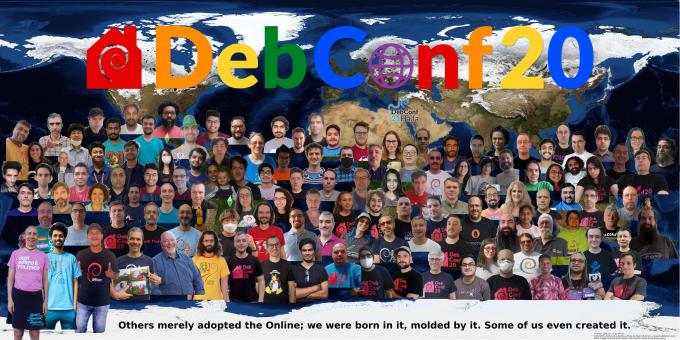
On Saturday 29 August 2020, the annual Debian Developers
and Contributors Conference came to a close.
DebConf20 has been held online for the first time, due to the coronavirus
(COVID-19) disease pandemic.
All of the sessions have been streamed, with a variety of ways of participating:
via IRC messaging, online collaborative text documents,
and video conferencing meeting rooms.
With more than 850 attendees from 80 different countries and a
total of over 100 event talks, discussion sessions,
Birds of a Feather (BoF) gatherings and other activities,
DebConf20 was a large success.
When it became clear that DebConf20 was going to be an online-only
event, the DebConf video team spent much time over the next months to
adapt, improve, and in some cases write from scratch, technology that
would be required to make an online DebConf possible. After lessons
learned from the MiniDebConfOnline in late May, some adjustments were
made, and then eventually we came up with a setup involving Jitsi, OBS,
Voctomix, SReview, nginx, Etherpad, and a newly written web-based
frontend for voctomix as the various elements of the stack.
All components of the video infrastructure are free software, and the
whole setup is configured through their public
ansible repository.
The DebConf20 schedule included
two tracks in other languages than English: the Spanish language MiniConf,
with eight talks in two days,
and the Malayalam language MiniConf, with nine talks in three days.
Ad-hoc activities, introduced by attendees over the course of the entire conference,
have been possible too, streamed and recorded. There have also been several
team gatherings to sprint on certain Debian development areas.
Between talks, the video stream has been showing the usual sponsors on the loop, but also
some additional clips including photos from previous DebConfs, fun facts about Debian
and short shout-out videos sent by attendees to communicate with their Debian friends.
For those who were not able to participate, most of the talks and sessions are already
available through the
Debian meetings archive website,
and the remaining ones will appear in the following days.
The DebConf20 website
will remain active for archival purposes and will continue to offer
links to the presentations and videos of talks and events.
Next year, DebConf21 is planned to be held
in Haifa, Israel, in August or September.
DebConf is committed to a safe and welcome environment for all participants.
During the conference, several teams (Front Desk, Welcome team and Community team)
have been available to help so participants get their best experience
in the conference, and find solutions to any issue that may arise.
See the web page about the Code of Conduct in DebConf20 website
for more details on this.
Debian thanks the commitment of numerous sponsors
to support DebConf20, particularly our Platinum Sponsors:
Lenovo,
Infomaniak,
Google
and
Amazon Web Services (AWS).
About Debian
The Debian Project was founded in 1993 by Ian Murdock to be a truly
free community project. Since then the project has grown to be one of
the largest and most influential open source projects. Thousands of
volunteers from all over the world work together to create and
maintain Debian software. Available in 70 languages, and
supporting a huge range of computer types, Debian calls itself the
universal operating system.
About DebConf
DebConf is the Debian Project's developer conference. In addition to a
full schedule of technical, social and policy talks, DebConf provides an
opportunity for developers, contributors and other interested people to
meet in person and work together more closely. It has taken place
annually since 2000 in locations as varied as Scotland, Argentina, and
Bosnia and Herzegovina. More information about DebConf is available from
https://debconf.org/.
About Lenovo
As a global technology leader manufacturing a wide portfolio of connected products,
including smartphones, tablets, PCs and workstations as well as AR/VR devices,
smart home/office and data center solutions, Lenovo
understands how critical open systems and platforms are to a connected world.
About Infomaniak
Infomaniak is Switzerland's largest web-hosting company,
also offering backup and storage services, solutions for event organizers,
live-streaming and video on demand services.
It wholly owns its datacenters and all elements critical
to the functioning of the services and products provided by the company
(both software and hardware).
About Google
Google is one of the largest technology companies in the
world, providing a wide range of Internet-related services and products such
as online advertising technologies, search, cloud computing, software, and hardware.
Google has been supporting Debian by sponsoring DebConf for more than
ten years, and is also a Debian partner sponsoring parts
of Salsa's continuous integration infrastructure
within Google Cloud Platform.
About Amazon Web Services (AWS)
Amazon Web Services (AWS) is one of the world's
most comprehensive and broadly adopted cloud platforms,
offering over 175 fully featured services from data centers globally
(in 77 Availability Zones within 24 geographic regions).
AWS customers include the fastest-growing startups, largest enterprises
and leading government agencies.
Contact Information
For further information, please visit the DebConf20 web page at
https://debconf20.debconf.org/
or send mail to press@debian.org.
DebConf20 is taking place online, from 23 August to 29 August 2020.
It is the 21st Debian conference, and organizers and participants are working hard
together at creating interesting and fruitful events.
We would like to warmly welcome the 17 sponsors of DebConf20, and introduce them to you.
We have four Platinum sponsors.
Our first Platinum sponsor is Lenovo.

As a global technology leader manufacturing a wide portfolio of connected products,
including smartphones, tablets, PCs and workstations as well as AR/VR devices,
smart home/office and data center solutions, Lenovo
understands how critical open systems and platforms are to a connected world.
Our next Platinum sponsor is Infomaniak.
Infomaniak is Switzerland's largest web-hosting company,
also offering backup and storage services, solutions for event organizers,
live-streaming and video on demand services.
It wholly owns its datacenters and all elements critical
to the functioning of the services and products provided by the company
(both software and hardware).
Google is our third Platinum sponsor.
Google is one of the largest technology companies in the
world, providing a wide range of Internet-related services and products such
as online advertising technologies, search, cloud computing, software, and hardware.
Google has been supporting Debian by sponsoring DebConf for more than
ten years, and is also a Debian partner.
Amazon Web Services (AWS) is our fourth Platinum
sponsor.
Amazon Web Services is one of the world's
most comprehensive and broadly adopted cloud platforms,
offering over 175 fully featured services from data centers globally
(in 77 Availability Zones within 24 geographic regions).
AWS customers include the fastest-growing startups, largest enterprises
and leading government agencies.
Our Gold sponsors are Deepin, the Matanel Foundation, Collabora, and HRT.
Deepin is a Chinese commercial company focusing on
the development and service of Linux-based operating systems. They also lead
research and development of the Deepin Debian derivative.
The Matanel Foundation operates in Israel,
as its first concern is to preserve the cohesion of a society and a nation
plagued by divisions. The Matanel Foundation also works in Europe, in Africa
and in South America.
Collabora is a global consultancy delivering
Open Source software solutions to the commercial world.
In addition to offering solutions to clients, Collabora's engineers and developers
actively contribute to many Open Source projects.
Hudson-Trading
is a company led by mathematicians, computer scientists, statisticians,
physicists and engineers. They research and develop automated trading algorithms
using advanced mathematical techniques.
Our Silver sponsors are:
Linux Professional Institute, the global
certification standard and career support organization for open source professionals,
Civil Infrastructure Platform,
a collaborative project hosted by the Linux Foundation,
establishing an open source base layer of industrial grade software,
Ubuntu,
the Operating System delivered by Canonical,
and Roche,
a major international pharmaceutical provider and research company
dedicated to personalized healthcare.
Bronze sponsors:
IBM,
MySQL,
Univention.
And finally, our Supporter level sponsors, ISG.EE
and Pengwin.
Thanks to all our sponsors for their support!
Their contributions make it possible for a large number
of Debian contributors from all over the globe to work together,
help and learn from each other in DebConf20.
Participating in DebConf20 online
The 21st Debian Conference is being held online, due to COVID-19,
from August 23 to 29, 2020. Talks, discussions, panels and other activities run from 10:00 to 01:00 UTC.
Visit the DebConf20 website at https://debconf20.debconf.org
to learn about the complete schedule, watch the live streaming and join the different
communication channels for participating in the conference.
We are very pleased to announce that Lenovo,
Infomaniak,
Google
and Amazon Web Services (AWS),
have committed to supporting DebConf20 as Platinum sponsors.
As a global technology leader manufacturing a wide portfolio of connected products,
including smartphones, tablets, PCs and workstations as well as AR/VR devices,
smart home/office and data center solutions, Lenovo
understands how critical open systems and platforms are to a connected world.
Infomaniak is Switzerland's largest web-hosting company,
also offering backup and storage services, solutions for event organizers,
live-streaming and video on demand services.
It wholly owns its datacenters and all elements critical
to the functioning of the services and products provided by the company
(both software and hardware).
Google is one of the largest technology companies in the
world, providing a wide range of Internet-related services and products such
as online advertising technologies, search, cloud computing, software, and hardware.
Google has been supporting Debian by sponsoring DebConf for more than
ten years, and is also a Debian partner sponsoring parts
of Salsa's continuous integration infrastructure
within Google Cloud Platform.
Amazon Web Services (AWS) is one of the world's
most comprehensive and broadly adopted cloud platform,
offering over 175 fully featured services from data centers globally
(in 77 Availability Zones within 24 geographic regions).
AWS customers include the fastest-growing startups, largest enterprises
and leading government agencies.
With these commitments as Platinum Sponsors,
Lenovo, Infomaniak, Google and Amazon Web Services are contributing
to make possible our annual conference,
and directly supporting the progress of Debian and Free Software,
helping to strengthen the community that continues to collaborate on
Debian projects throughout the rest of the year.
Thank you very much for your support of DebConf20!
Participating in DebConf20 online
The 21st Debian Conference is being held Online, due to COVID-19,
from August 23rd to 29th, 2020. There are 7 days of activities, running from 10:00 to 01:00 UTC.
Visit the DebConf20 website at https://debconf20.debconf.org
to learn about the complete schedule, watch the live streaming and join the different
communication channels for participating in the conference.
I don't generally write consumer reviews, here or elsewhere; but I have been so
impressed by this one I wanted to mention it.
For Holly's birthday this year, taking place under Lockdown, we decided to buy
a year's subscription to "Disney+". Our current TV receiver (A Humax Freesat
box) doesn't support it so I needed to find some other way to get it onto the
TV.
After a short bit of research, I bought the "Roku Express" streaming media
player. This is the most basic streamer that Roku make, bottom of their range.
For a little bit more money you can get a model which supports 4K (although my
TV obviously doesn't: it, and the basic Roku, top out at 1080p) and a bit more
gets you a "stick" form-factor and a Bluetooth remote (rather than line-of-sight IR).
I paid 20 for the most basic model and it Just Works. The receiver is very
small but sits comfortably next to my satellite receiver-box. I don't have any
issues with line-of-sight for the IR remote (and I rely on a regular IR remote
for the TV itself of course). It supports Disney+, but also all the other big
name services, some of which we already use (Netflix, YouTube BBC iPlayer)
and some of which we didn't, since it was too awkward to access them
(Google Play, Amazon Prime Video). It has now largely displaced the
FreeSat box for accessing streaming content because it works so well and
everything is in one place.
There's a phone App that remote-controls the box and works even better than the
physical remote: it can offer a full phone-keyboard at times when you need to
input text, and can mute the TV audio and put it out through headphones
attached to the phone if you want.
My aging Plasma TV suffers from burn-in from static pictures. If left paused
for a duration the Roku goes to a screensaver that keeps the whole frame
moving. The FreeSat doesn't do this. My Blu Ray player does, but (I think) it
retains some static elements.

Those of you who watch a lot of Hollywood movies may have noticed a certain trend that has consumed the industry in the last few years. It ...
Video Essay Catalog No. 91 by Kevin B. Lee. Featured on the New York Times and other outlets. Originally published December 13, 2011 on Fandor. https://carpetbagger.blogs.nytimes.com/2011/12/19/staring-in-awe-its-the-spielberg-face/?_r=0
The Korowai cannibals live on top of trees. But is it true?
Bandicoot Cabbagepatch, Bandersnatch Cumberbund, and even Wimbledon Tennismatch: there seem to be endless variations on the name of Benedict Cumberbatch. [...] But how is a normal internet citizen supposed to know, when they hear someone say I just can t stop looking at gifs of Bombadil Rivendell that this person isn t talking about some other actor with a name and a voice and cheekbones? Or in other words, what makes for a reasonable variation of the name Bendandsnap Calldispatch?
Welcome to the May 2020 report from the Reproducible Builds project.
One of the original promises of open source software is that distributed peer review and transparency of process results in enhanced end-user security. Nonetheless, whilst anyone may inspect the source code of free and open source software for malicious flaws, almost all software today is distributed as pre-compiled binaries. This allows nefarious third-parties to compromise systems by injecting malicious code into seemingly secure software during the various compilation and distribution processes.
In these reports we outline the most important things that we and the rest of the community have been up to over the past month.
Recent years saw a number of supply chain attacks that leverage the increasing use of open source during software development, which is facilitated by dependency managers that automatically resolve, download and install hundreds of open source packages throughout the software life cycle.In related news, the LineageOS Android distribution announced that a hacker had access to the infrastructure of their servers after exploiting an unpatched vulnerability. Marcin Jachymiak of the Sia decentralised cloud storage platform posted on their blog that their
siac and siad utilities can now be built reproducibly:
This means that anyone can recreate the same binaries produced from our official release process. Now anyone can verify that the release binaries were created using the source code we say they were created from. No single person or computer needs to be trusted when producing the binaries now, which greatly reduces the attack surface for Sia users.Synchronicity is a distributed build system for Rust build artifacts which have been published to crates.io. The goal of Synchronicity is to provide a distributed binary transparency system which is independent of any central operator. The Comparison of Linux distributions article on Wikipedia now features a Reproducible Builds column indicating whether distributions approach and progress towards achieving reproducible builds.
binutils package ships its own, unreproducible, log files in its binary packages. It was followed-up by replies from Chris Lamb and Matthias Klose.
ocaml_cmti_files toolchain issue.
In Alpine Linux, an issue was filed and closed regarding the reproducibility of .apk packages.
Allan McRae of the ArchLinux project posted their third Reproducible builds progress report to the arch-dev-public mailing list which includes the following call for help:
We also need help to investigate and fix the packages that fail to reproduce that we have not investigated as of yet.In openSUSE, Bernhard M. Wiedemann published his monthly Reproducible Builds status update.
Chris Lamb made the changes listed below to diffoscope, our in-depth and content-aware diff utility that can locate and diagnose reproducibility issues. He also prepared and uploaded versions 142, 143, 144, 145 and 146 to Debian, PyPI, etc.
file now supports recognising JSON data. (#106).changes and .buildinfo handling to show all details (including the GnuPG header and footer components) even when referenced files are not present. (#122)BuildinfoFile comparator (etc.) regardless of whether the associated files (such as the orig.tar.gz and the .deb) are present. [ ].buildinfo, .changes, etc. [ ]apksigner(1). (#121).zip files. (#116).mobilepovision files. (#113)differences typo in the ApkFile handler. (#127)id="foo" anchor reference twice in the HTML output, otherwise identically-named parts will not be able to linked to via a #foo anchor. (#120)#. [ ]--json presenter; it will usually be too complicated to be readable by the human anyway. [ ]Command [ ] failed with exit code messages to remove duplicate exited with exit but also to note that diffoscope is interpreting this as an error. [ ]Command [ ] exited with 1 messages. (#126)debian Python module. [ ]stderr from if both commands emit the same output. [ ]apksigner test failures due to lack of binfmt_misc, eg. on Salsa CI and elsewhere. [ ].travis.yml as we use Salsa instead. [ ]Dockerfile improvements:
.dockerignore file to whitelist files we actually need in our container. (#105)ARG instead of ENV when setting up the DEBIAN_FRONTEND environment variable at runtime. (#103)build-essential during build so we can install the recommended packages from Git. [ ]shell=False keyword argument to subprocess.Popen so that the potentially-unsafe shell=True is more obvious. [ ]MissingFile s special handling of deb822 to prevent leaking through abstract layers. [ ][ ]try/except block when cleaning up temporary files with respect to the flake8 quality assurance tool. [ ]in_dsc_path to dsc_in_same_dir to clarify the use of this variable. [ ]debian_fallback class [ ] and add descriptions for the file types. [ ]Openssl command class to OpenSSLPKCS7 to accommodate other command names with this prefix. [ ]--debugger command-line argument to --pdb. [ ]stat(2) birth times (ie. st_birthtime) in the same way we do with the stat(1) command s Access: and Change: times to fix a nondeterministic build failure in GNU Guix. (#74)LibarchiveMember s has_same_content method was called regardless of the underlying type of file. [ ]
debian/py3dist-overrides to ensure the rpm-python module is used in package dependencies (#89) and moved to using the new execute_after_* and execute_before_* Debhelper rules [ ].
Chris Lamb also performed a huge overhaul of diffoscope s website:
absolute_url and relative_url where possible [ ][ ] and move a number of configuration variables to _config.yml [ ][ ].golang-packaging (toolchain issue, affecting times in minikube)jboss-logging-tools (toolchain issue, affecting date for resteasy)linux_logo (sort find output to avoid inheriting filesystem order)moonjit (generate reproducible output by default if SOURCE_DATE_EPOCH is set)vala (report ASLR nondeterminism)earlyoom (timestamps in Gzip files)fmt (Don t install sphinx-build cached files as they are unneeded & unreproducible)nvidia-settings (timestamp in Gzip files)ataqv.elinks.briquolo.cryptominisat.wolfssl.mistral.python-watcherclient.tree-puzzle.nulib2.process-cpp.bowtie2.properties-cpp.wand (forwarded upstream)vows.libstatgrab.texi2html.grub.systemtap.mono.mescc-tools: Inherit CFLAGS in a Makefile, allowing -ffile-prefix-map/-fdebug-prefix-map to sanitise build paths (merged upstream).1.8.1-1 to Debian unstable and Bernhard M. Wiedemann fixed an off-by-one error when parsing PNG image modification times. (#16)
In disorderfs, our FUSE-based filesystem that deliberately introduces non-determinism into directory system calls in order to flush out reproducibility issues, Chris Lamb replaced the term dirents in place of directory entries in human-readable output/log messages [ ] and used the astyle source code formatter with the default settings to the main disorderfs.cpp source file [ ].
Holger Levsen bumped the debhelper-compat level to 13 in disorderfs [ ] and reprotest [ ], and for the GNU Guix distribution Vagrant Cascadian updated the versions of disorderfs to version 0.5.10 [ ] and diffoscope to version 145 [ ].
libtool. [ ]_docs subdirectory to find the _docs/index.md file after an internal move. (#27)ltmain.sh etc. in preformatted quotes. [ ]SOURCE_DATE_EPOCH Python examples onto more lines to prevent visual overflow on the page. [ ]faketime to the project s Github page. (!57)
We operate a large and many-featured Jenkins-based testing framework that powers tests.reproducible-builds.org that, amongst many other tasks, tracks the status of our reproducibility efforts as well as identifies any regressions that have been introduced. Holger Levsen made the following changes:
let VARIABLE=0 exits with an error. [ ].buildinfo files with the same name. [ ]/usr merge variation on Debian unstable. [ ]molly-guard. [ ]debrebuild script. [ ][ ][ ][ ].buildinfo files. [ ][ ]
alpine_schroot.sh script now that a patch for abuild had been released upstream. [ ]
brcm47xx target to bcm47xx. [ ]
jenkins to run the blacklist command [ ] and the usual build node maintenance was performed was performed by Holger Levsen [ ][ ][ ], Mattia Rizzolo [ ][ ] and Vagrant Cascadian [ ][ ][ ].
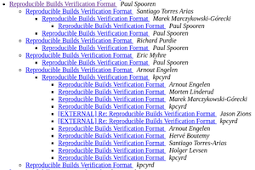
Paul Spooren started a thread titled Reproducible Builds Verification Format which reopens the discussion around a schema for sharing the results from distributed rebuilders:
To make the results accessible, storable and create tools around them, they should all follow the same schema, a reproducible builds verification format. The format tries to be as generic as possible to cover all open source projects offering precompiled source code. It stores the rebuilder results of what is reproducible and what not.Hans-Christoph Steiner of the Guardian Project also continued his previous discussion regarding making our website translatable. Lastly, Leo Wandersleb posted a detailed request for feedback on a question of supply chain security and other issues of software review; Leo is the founder of the Wallet Scrutiny project which aims to prove the security of Android Bitcoin Wallets:
Do you own your Bitcoins or do you trust that your app allows you to use your coins while they are actually controlled by them ? Do you have a backup? Do they have a copy they didn t tell you about? Did anybody check the wallet for deliberate backdoors or vulnerabilities? Could anybody check the wallet for those?Elsewhere, Leo had posted instructions on his attempts to reproduce the binaries for the BlueWallet Bitcoin wallet for iOS and Android platforms.
#reproducible-builds on irc.oftc.net.
rb-general@lists.reproducible-builds.org
This month s report was written by Bernhard M. Wiedemann, Chris Lamb, Holger Levsen, Jelle van der Waa and Vagrant Cascadian. It was subsequently reviewed by a bunch of Reproducible Builds folks on IRC and the mailing list.
I was gonna use this blog post to share about the migrant worker woes as there has been multiple stories doing the rounds. For e.g. a story which caught the idea of few people but most of us, i.e. middle-class people are so much into our own thing that we care a fig leaf about what happens to migrants. This should not be a story coming from a humane society but it seems India is no different than any other country of the world and in not a good way. Allow me to share
Or for those who don t like youtube, here s an alternative link
https://www.invidio.us/watch?v=JGEgZq_1jmc
Now the above two editorial shares two stories, one of Trump retaliatory threat to India in the Q&A of the journalist. In fact, Trump has upped the ante on visa sanctions as India buckled so easily under pressure.
There have been other stories doing the rounds how people who have illnesses who need HCQ in India are either dying or are close to death because of unavailability of HCQ in the medicine shop. There have been reports in Pune as well as South Mumbai (one of the poshest localities in Mumbai/Bombay) that medicine shops are running empty or emptier. There have been so many stories on that, with reporters going to shops and asking owners of the medicine shops and shop-owners being clueless.
I think the best article which vividly describes the Government of India (GOI) response to the pandemic is the free-to-read article shared by Arundhati Roy in Financial Times. It has reduced so much of my work or sharing that it s unbelievable. And she has shared it with pictures and all so I can share other aspects of how the pandemic has been affecting India and bringing the worst out in the Government in its our of need. In fact, not surprisingly though, apparently there was also a pro-Israel similar thing which happened in Africa too . As India has too few friends now globally, hence it decided to give a free pass to them.
News Broadcasters Association reply to Mrs. Gandhi
Aryan Plastic bottle
Dhauladhar range Northern Punjab Copyright CNN.Com Next.