Search Results: "noodles"

25 July 2017

Gunnar Wolf: Getting ready for DebConf17 in Montreal!


(image shamelessly copied from Noodles' Emptiness) This year I will only make it to DebConf, not to DebCamp. But, still, I am very very happy and excited as the travel date looms nearer! I have ordered some of the delicacies for the Cheese and Wine party, signed up for the public bicycle system of Montreal, and done a fair share of work with the Content Team; finally today we sent out the announcement for the schedule of talks. Of course, there are several issues yet to fix, and a lot of things to do before traveling... But, no doubt about this: It will be an intense week! Oh, one more thing while we are at it: The schedule as it was published today does not really look like we have organized stuff into tracks But we have! This will be soon fixed, adding some color-coding to make tracks clearer on the schedule. This year, I pushed for the Content Team to recover the notion of tracks as an organizative measure, and as something that delivers value to DebConf as a whole. Several months ago, I created a Wiki page for the DebConf tracks, asking interested people to sign up for them. We currently have the following tracks registered:
Blends
Andreas Tille
Debian Science
Michael Banck
Cloud and containers
Luca Filipozzi
Embedded
Pending
Systems administration, automation and orchestation
Pending
Security
Gunnar Wolf
We have two tracks still needing a track coordinator. Do note that most of the tasks mentioned by the Wiki have already been carried out; what a track coordinator will now do is to serve as some sort of moderator, maybe a recurring talkmeister, ensuring continuity and probably providing for some commentary, giving some unity to its sessions. So, the responsibilities for a track coordinator right now are quite similar to what is expected for video team volunteers but to a set of contiguous sessions. If you are interested in being the track coordinator/moderator for Embedded or for Systems administration, automation and orchestation or even to share the job with any of the other, registered, coordinators, please speak up! Mail content@debconf.org and update the table in the Wiki page. See you very soon in Montreal!

24 July 2017

Jonathan McDowell: Learning to love Ansible

This post attempts to chart my journey towards getting usefully started with Ansible to manage my system configurations. It s a high level discussion of how I went about doing so and what I got out of it, rather than including any actual config snippets - there are plenty of great resources out there that handle the actual practicalities of getting started much better than I could. I ve been convinced about the merits of configuration management for machines for a while now; I remember conversations about producing an appropriate set of recipes to reproduce our haphazard development environment reliably over 4 years ago. That never really got dealt with before I left, and as managing systems hasn t been part of my day job since then I never got around to doing more than working my way through the Puppet Learning VM. I do, however, continue to run a number of different Linux machines - a few VMs, a hosted dedicated server and a few physical machines at home and my parents . In particular I have a VM which handles my parents email, and I thought that was a good candidate for trying to properly manage. It s backed up, but it would be nice to be able to redeploy that setup easily if I wanted to move provider, or do hosting for other domains in their own VMs. I picked Ansible, largely because I wanted something lightweight and the agentless design appealed to me. All I really need to do is ensure Python is on the host I want to manage and everything else I can bootstrap using Ansible itself. Plus it meant I could use the version from Debian testing on my laptop and not require backports on the stable machines I wanted to manage. My first attempt was to write a single Ansible YAML file which did all the appropriate things for the email VM; installed Exim/Apache/Roundcube, created users, made sure the appropriate SSH keys were in place, installed configuration files, etc, etc. This did the job, but I found myself thinking it was no better than writing a shell script to do the same things. Things got a lot better when instead of concentrating on a single host I looked at what commonality was shared between hosts. I started with simple things; Debian is my default distro so I created an Ansible role debian-system which configured up APT and ensured package updates were installed. Then I added a task to setup my own account and install my SSH keys. I was then able to deploy those 2 basic steps across a dozen different machine instances. At one point I got an ARM64 VM from Scaleway to play with, and it was great to be able to just add it to my Ansible hosts file and run the playbook against it to get my basic system setup. Adding email configuration got trickier. In addition to my parents email VM I have my own email hosted elsewhere (along with a whole bunch of other users) and the needs of both systems are different. Sitting down and trying to manage both configurations sensibly forced me to do some rationalisation of the systems, pulling out the commonality and then templating the differences. Additionally I ended up using the lineinfile module to edit the Debian supplied configurations, rather than rolling out my own config files. This helped ensure more common components between systems. There were also a bunch of differences that had grown out of the fact each system was maintained by hand - I had about 4 copies of each Let s Encrypt certificate rather than just putting one copy in /etc/ssl and pointing everything at that. They weren t even in the same places on different systems. I unified these sorts of things as I came across them. Throughout the process of this rationalisation I was able to easily test using containers. I wrote an Ansible role to create systemd-nspawn based containers, doing all of the LVM + debootstrap work required to produce a system which could then be managed by Ansible. I then pointed the same configuration as I was using for the email VM at this container, and could verify at each step along the way that the results were what I expected. It was still a little nerve-racking when I switched over the live email config to be managed by Ansible, but it went without a hitch as hoped. I still have a lot more configuration to switch to being managed by Ansible, especially on the machines which handle a greater number of services, but it s already proved extremely useful. To prepare for a jessie to stretch upgrade I fired up a stretch container and pointed the Ansible config at it. Most things just worked and the minor issues I was able to fix up in that instance leaving me confident that the live system could be upgraded smoothly. Or when I want to roll out a new SSH key I can just add it to the Ansible setup, and then kick off an update. No need to worry about whether I ve updated it everywhere, or correctly removed the old one. So I m a convert; things were a bit more difficult by starting with existing machines that I didn t want too much disruption on, but going forward I ll be using Ansible to roll out any new machines or services I need, and expect that I ll find that new deployment to be much easier now I have a firm grasp on the tools available.

17 July 2017

Jonathan McDowell: Just because you can, doesn't mean you should

There was a recent Cryptoparty Belfast event that was aimed at a wider audience than usual; rather than concentrating on how to protect ones self on the internet the 3 speakers concentrated more on why you might want to. As seems to be the way these days I was asked to say a few words about the intersection of technology and the law. I think people were most interested in all the gadgets on show at the end, but I hope they got something out of my talk. It was a very high level overview of some of the issues around the Investigatory Powers Act - if you re familiar with it then I m not adding anything new here, just trying to provide some sort of details about why it s a bad thing from both a technological and a legal perspective. Download

10 July 2017

Jonathan McDowell: Going to DebConf 17

Going to DebConf17 Completely forgot to mention this earlier in the year, but delighted to say that in just under 4 weeks I ll be attending DebConf 17 in Montr al. Looking forward to seeing a bunch of fine folk there! Outbound:
2017-08-04 11:40 DUB -> 13:40 KEF WW853
2017-08-04 15:25 KEF -> 17:00 YUL WW251
Inbound:
2017-08-12 19:50 YUL -> 05:00 KEF WW252
2017-08-13 06:20 KEF -> 09:50 DUB WW852
(Image created using GIMP, fonts-dkg-handwriting and the DebConf17 Artwork.)

12 May 2017

Norbert Preining: Gaisi Takeuti, 1926-2017

Two days ago one of the most influential logician of the 20th century has passed away, Gaisi Takeuti ( ). I had the pleasure to meet this excellent man, teacher, writer, thinker several times while he was the president of the Kurt G del Society. I don t want to recall his achievements in mathematical logic, in particular proof theory, because I am not worth to write about such a genius. I want to recall a few personal stories from my own experience. I came into contact with Prof. Takeuti via is famous book Proof Theory, which my then Professor, now colleague and friend Matthias Baaz used for teaching us students proof theory. Together with Shoenfield s Mathematical Logic these two books became the foundation of my whole logic education. Now again in print, back then the Proof Theory was a rare precious. Few prints did remain in the library, and over the years one by one disappeared, until the last copy we had access to was my copy where I had scribbled pages and pages of notes and proofs. Matthias later on used these copies for his lectures, I should have written on the back-side! I remember well my first meeting with Prof. Takeuti: I was on the Conference on Internationalization in 2003 in Tsukuba, long before I moved to Japan. Back then I was just finishing my PhD and without much experience. When I arrived in the hotel, without fail there was a message of Prof. Takeuti inviting me for dinner the following day. We had dinner in a specialty restaurant of his area, together with is lovely wife. I was soo nervous about Japanese manners and stuttered Japanese phrases just to be stopped by Prof. Takeuti pouring himself a glass of sake and telling me: Relax, and forget the rules and fill your own glass when you want to. I am well aware that this liberal attitude didn t extend to Japanese colleagues, where he, descendant from a Samurai family, was at times very, extremely strict. The dinner was decided upon already, not easy since I was still strict vegetarian back than (now I would have enjoyed the dinner much more!), but for the last course we could decide. I remember with a smile how Prof. Takeuti suggested in Japanese various sweets, just to be interrupted by his wife with No Gaisi, no! . I asked what is going on and she explained that he wants to order a Japanese sweet for me I agreed, and that was probably the worst dish I had in Japan. Slippy noodles swimming in a cold broth, to be picked with chopsticks and put into a semi-sweet soja-sauce. I finished it, but it wasn t good. I should have thought twice when Prof. Takeuti s wife ordered a normal fruit salad. Scientifically he was simply a genius and famous for not reading a lot but reinventing everything. One of my research areas, G del logics, was reinvented by him as Intuitionistic Fuzzy Logic (for an overview see my talk at the Collegium Logicum 2016: G del Logics a short survey). But I want to recall one of my favorite articles of him: A Conservative Extension of Peano Arithmetic . This was published as part 2 of Volume 17 of Publications of the Mathematical Society of Japan, retypeset pdf is available here, JSTOR page. Therein he develops classical (real and complex) analysis over Peano s arithmetic. He shows that any arithmetical theorem proved in analytic number theory is a theorem in Peano s arithmetic. The proof uses Gentzen s cut elimination theorem, the center piece of modern proof theory. With Georg Kreisel having passed away in 2015, and now Gaisi Takeuti, we loose two of the greatest, if not the greatest minds in logic.

8 March 2017

Antoine Beaupr : An update to GitHub's terms of service

On February 28th, GitHub published a brand new version of its Terms of Service (ToS). While the first draft announced earlier in February didn't generate much reaction, the new ToS raised concerns that they may break at least the spirit, if not the letter, of certain free-software licenses. Digging in further reveals that the situation is probably not as dire as some had feared. The first person to raise the alarm was probably Thorsten Glaser, a Debian developer, who stated that the "new GitHub Terms of Service require removing many Open Source works from it". His concerns are mainly about section D of the document, in particular section D.4 which states:
You grant us and our legal successors the right to store and display your Content and make incidental copies as necessary to render the Website and provide the Service.
Section D.5 then goes on to say:
[...] You grant each User of GitHub a nonexclusive, worldwide license to access your Content through the GitHub Service, and to use, display and perform your Content, and to reproduce your Content solely on GitHub as permitted through GitHub's functionality

ToS versus GPL The concern here is that the ToS bypass the normal provisions of licenses like the GPL. Indeed, copyleft licenses are based on copyright law which forbid users from doing anything with the content unless they comply with the license, which forces, among other things, "share alike" properties. By granting GitHub and its users rights to reproduce content without explicitly respecting the original license, the ToS may allow users to bypass the copyleft nature of the license. Indeed, as Joey Hess, author of git-annex, explained :
The new TOS is potentially very bad for copylefted Free Software. It potentially neuters it entirely, so GPL licensed software hosted on Github has an implicit BSD-like license
Hess has since removed all his content (mostly mirrors) from GitHub. Others disagree. In a well-reasoned blog post, Debian developer Jonathan McDowell explained the rationale behind the changes:
My reading of the GitHub changes is that they are driven by a desire to ensure that GitHub are legally covered for the things they need to do with your code in order to run their service.
This seems like a fair point to make: GitHub needs to protect its own rights to operate the service. McDowell then goes on to do a detailed rebuttal of the arguments made by Glaser, arguing specifically that section D.5 "does not grant [...] additional rights to reproduce outside of GitHub". However, specific problems arise when we consider that GitHub is a private corporation that users have no control over. The "Services" defined in the ToS explicitly "refers to the applications, software, products, and services provided by GitHub". The term "Services" is therefore not limited to the current set of services. This loophole may actually give GitHub the right to bypass certain provisions of licenses used on GitHub. As Hess detailed in a later blog post:
If Github tomorrow starts providing say, an App Store service, that necessarily involves distribution of software to others, and they put my software in it, would that be allowed by this or not? If that hypothetical Github App Store doesn't sell apps, but licenses access to them for money, would that be allowed under this license that they want to my software?
However, when asked on IRC, Bradley M. Kuhn of the Software Freedom Conservancy explained that "ultimately, failure to comply with a copyleft license is a copyright infringement" and that the ToS do outline a process to deal with such infringement. Some lawyers have also publicly expressed their disagreement with Glaser's assessment, with Richard Fontana from Red Hat saying that the analysis is "basically wrong". It all comes down to the intent of the ToS, as Kuhn (who is not a lawyer) explained:
any license can be abused or misused for an intent other than its original intent. It's why it matters to get every little detail right, and I hope Github will do that.
He went even further and said that "we should assume the ambiguity in their ToS as it stands is favorable to Free Software". The ToS are in effect since February 28th; users "can accept them by clicking the broadcast announcement on your dashboard or by continuing to use GitHub". The immediacy of the change is one of the reasons why certain people are rushing to remove content from GitHub: there are concerns that continuing to use the service may be interpreted as consent to bypass those licenses. Hess even hosted a separate copy of the ToS [PDF] for people to be able to read the document without implicitly consenting. It is, however, unclear how a user should remove their content from the GitHub servers without actually agreeing to the new ToS.

CLAs When I read the first draft, I initially thought there would be concerns about the mandatory Contributor License Agreement (CLA) in section D.5 of the draft:
[...] unless there is a Contributor License Agreement to the contrary, whenever you make a contribution to a repository containing notice of a license, you license your contribution under the same terms, and agree that you have the right to license your contribution under those terms.
I was concerned this would establish the controversial practice of forcing CLAs on every GitHub user. I managed to find a post from a lawyer, Kyle E. Mitchell, who commented on the draft and, specifically, on the CLA. He outlined issues with wording and definition problems in that section of the draft. In particular, he noted that "contributor license agreement is not a legal term of art, but an industry term" and "is a bit fuzzy". This was clarified in the final draft, in section D.6, by removing the use of the CLA term and by explicitly mentioning the widely accepted norm for licenses: "inbound=outbound". So it seems that section D.6 is not really a problem: contributors do not need to necessarily delegate copyright ownership (as some CLAs require) when they make a contribution, unless otherwise noted by a repository-specific CLA. An interesting concern he raised, however, was with how GitHub conducted the drafting process. A blog post announced the change on February 7th with a link to a form to provide feedback until the 21st, with a publishing deadline of February 28th. This gave little time for lawyers and developers to review the document and comment on it. Users then had to basically accept whatever came out of the process as-is. Unlike every software project hosted on GitHub, the ToS document is not part of a Git repository people can propose changes to or even collaboratively discuss. While Mitchell acknowledges that "GitHub are within their rights to update their terms, within very broad limits, more or less however they like, whenever they like", he sets higher standards for GitHub than for other corporations, considering the community it serves and the spirit it represents. He described the process as:
[...] consistent with the value of CYA, which is real, but not with the output-improving virtues of open process, which is also real, and a great deal more pleasant.
Mitchell also explained that, because of its position, GitHub can have a major impact on the free-software world.
And as the current forum of preference for a great many developers, the knock-on effects of their decisions throw big weight. While GitHub have the wheel and they ve certainly earned it for now they can do real damage.
In particular, there have been some concerns that the ToS change may be an attempt to further the already diminishing adoption of the GPL for free-software projects; on GitHub, the GPL has been surpassed by the MIT license. But Kuhn believes that attitudes at GitHub have begun changing:
GitHub historically had an anti-copyleft culture, which was created in large part by their former and now ousted CEO, Preston-Warner. However, recently, I've seen people at GitHub truly reach out to me and others in the copyleft community to learn more and open their minds. I thus have a hard time believing that there was some anti-copyleft conspiracy in this ToS change.

GitHub response However, it seems that GitHub has actually been proactive in reaching out to the free software community. Kuhn noted that GitHub contacted the Conservancy to get its advice on the ToS changes. While he still thinks GitHub should fix the ambiguities quickly, he also noted that those issues "impact pretty much any non-trivial Open Source and Free Software license", not just copylefted material. When reached for comments, a GitHub spokesperson said:
While we are confident that these Terms serve the best needs of the community, we take our users' feedback very seriously and we are looking closely at ways to address their concerns.
Regardless, free-software enthusiasts have other concerns than the new ToS if they wish to use GitHub. First and foremost, most of the software running GitHub is proprietary, including the JavaScript served to your web browser. GitHub also created a centralized service out of a decentralized tool (Git). It has become the largest code hosting service in the world after only a few years and may well have become a single point of failure for free software collaboration in a way we have never seen before. Outages and policy changes at GitHub can have a major impact on not only the free-software world, but also the larger computing world that relies on its services for daily operation. There are now free-software alternatives to GitHub. GitLab.com, for example, does not seem to have similar licensing issues in its ToS and GitLab itself is free software, although based on the controversial open core business model. The GitLab hosting service still needs to get better than its grade of "C" in the GNU Ethical Repository Criteria Evaluations (and it is being worked on); other services like GitHub and SourceForge score an "F". In the end, all this controversy might have been avoided if GitHub was generally more open about the ToS development process and gave more time for feedback and reviews by the community. Terms of service are notorious for being confusing and something of a legal gray area, especially for end users who generally click through without reading them. We should probably applaud the efforts made by GitHub to make its own ToS document more readable and hope that, with time, it will address the community's concerns.
Note: this article first appeared in the Linux Weekly News.

2 March 2017

Jonathan McDowell: Rational thoughts on the GitHub ToS change

I woke this morning to Thorsten claiming the new GitHub Terms of Service could require the removal of Free software projects from it. This was followed by joeyh removing everything from github. I hadn t actually been paying attention, so I went looking for some sort of summary of whether I should be worried and ended up reading the actual ToS instead. TL;DR version: No, I m not worried and I don t think you should be either. First, a disclaimer. I m not a lawyer. I have some legal training, but none of what I m about to say is legal advice. If you re really worried about the changes then you should engage the services of a professional. The gist of the concerns around GitHub s changes are that they potentially circumvent any license you have applied to your code, either converting GPL licensed software to BSD style (and thus permitting redistribution of binary forms without source) or making it illegal to host software under certain Free software licenses on GitHub due to being unable to meet the requirements of those licenses as a result of GitHub s ToS. My reading of the GitHub changes is that they are driven by a desire to ensure that GitHub are legally covered for the things they need to do with your code in order to run their service. There are sadly too many people who upload code there without a license, meaning that technically no one can do anything with it. Don t do this people; make sure that any project you put on GitHub has some sort of license attached to it (don t write your own - it s highly likely one of Apache/BSD/GPL will suit your needs) so people know whether they can make use of it or not. I don t care is not a valid reason not to do this. Section D, relating to user generated content, is the one causing the problems. It s possibly easiest to walk through each subsection in order. D1 says GitHub don t take any responsibility for your content; you make it, you re responsible for it, they re not accepting any blame for harm your content does nor for anything any member of the public might do with content you ve put on GitHub. This seems uncontentious. D2 reaffirms your ownership of any content you create, and requires you to only post 3rd party content to GitHub that you have appropriate rights to. So I can t, for example, upload a copy of Friday by Rebecca Black. Thorsten has some problems with D3, where GitHub reserve the right to remove content that violates their terms or policies. He argues this could cause issues with licenses that require unmodified source code. This seems to be alarmist, and also applies to any random software mirror. The intent of such licenses is in general to ensure that the pristine source code is clearly separate from 3rd party modifications. Removal of content that infringes GitHub s T&Cs is not going to cause an issue. D4 is a license grant to GitHub, and I think forms part of joeyh s problems with the changes. It affirms the content belongs to the user, but grants rights to GitHub to store and display the content, as well as make copies such as necessary to provide the GitHub service. They explicitly state that no right is granted to sell the content at all or to distribute the content outside of providing the GitHub service. This term would seem to be the minimum necessary for GitHub to ensure they are allowed to provide code uploaded to them for download, and provide their web interface. If you ve actually put a Free license on your code then this isn t necessary, but from GitHub s point of view I can understand wanting to make it explicit that they need these rights to be granted. I don t believe it provides a method of subverting the licensing intent of Free software authors. D5 provides more concern to Thorsten. It seems he believes that the ability to fork code on GitHub provides a mechanism to circumvent copyleft licenses. I don t agree. The second paragraph of this subsection limits the license granted to the user to be the ability to reproduce the content on GitHub - it does not grant them additional rights to reproduce outside of GitHub. These rights, to my eye, enable the forking and viewing of content within GitHub but say nothing about my rights to check code out and ignore the author s upstream license. D6 clarifies that if you submit content to a GitHub repo that features a license you are licensing your contribution under these terms, assuming you have no other agreement in place. This looks to be something that benefits projects on GitHub receiving contributions from users there; it s an explicit statement that such contributions are under the project license. D7 confirms the retention of moral rights by the content owner, but states they are waived purely for the purposes of enabling GitHub to provide service, as stated under D4. In particular this right is revocable so in the event they do something you don t like you can instantly remove all of their rights. Thorsten is more worried about the ability to remove attribution and thus breach CC-BY or some BSD licenses, but GitHub s whole model is providing attribution for changesets and tracking such changes over time, so it s hard to understand exactly where the service falls down on ensuring the provenance of content is clear. There are reasons to be wary of GitHub (they ve taken a decentralised revision control system and made a business model around being a centralised implementation of it, and they store additional metadata such as PRs that aren t as easily extracted), but I don t see any indication that the most recent changes to their Terms of Service are something to worry about. The intent is clearly to provide GitHub with the legal basis they need to provide their service, rather than to provide a means for them to subvert the license intent of any Free software uploaded.

20 February 2017

Jonathan Dowland: Blinkenlights!

blinkenlights! blinkenlights!
Part one of a series. part 2, part 3. Late last year, I was pondering how one might add a status indicator to a headless machine like my NAS to indicate things like failed jobs. After a brief run through of some options (a USB-based custom device; a device pretending to be a keyboard attached to a PS/2 port; commandeering the HD activity LED; commandeering the PC speaker wire) I decided that I didn't have the time to learn the kind of skills needed to build something at that level and opted to buy a pre-assembled programmable USB thing instead, called the BlinkStick. Little did I realise that my friend Jonathan McDowell thought that this was an interesting challenge and actually managed to design, code and build something! Here's his blog post outlining his solution and here's his code on github (or canonically) Even thought I've bought the blinkstick, given Jonathan's efforts (and the bill of materials) I'm going to have to try and assemble this for myself and give it a go. I've also managed to borrow an Arduino book from a colleague at work. Either way, I still have some work to do on the software/configuration side to light the LEDs up at the right time and colour based on the jobs running on the NAS and their state.

7 February 2017

Jonathan McDowell: GnuK on the Maple Mini

Last weekend, as a result of my addiction to buying random microcontrollers to play with, I received some Maple Minis. I bought the Baite clone direct from AliExpress - so just under 3 each including delivery. Not bad for something that s USB capable, is based on an ARM and has plenty of IO pins. I m not entirely sure what my plan is for the devices, but as a first step I thought I d look at getting GnuK up and running on it. Only to discover that chopstx already has support for the Maple Mini and it was just a matter of doing a ./configure --vidpid=234b:0000 --target=MAPLE_MINI --enable-factory-reset ; make. I d hoped to install via the DFU bootloader already on the Mini but ended up making it unhappy so used SWD by following the same steps with OpenOCD as for the FST-01/BusPirate. (SWCLK is D21 and SWDIO is D22 on the Mini). Reset after flashing and the device is detected just fine:
usb 1-1.1: new full-speed USB device number 73 using xhci_hcd
usb 1-1.1: New USB device found, idVendor=234b, idProduct=0000
usb 1-1.1: New USB device strings: Mfr=1, Product=2, SerialNumber=3
usb 1-1.1: Product: Gnuk Token
usb 1-1.1: Manufacturer: Free Software Initiative of Japan
usb 1-1.1: SerialNumber: FSIJ-1.2.3-87155426
And GPG is happy:
$ gpg --card-status
Reader ...........: 234B:0000:FSIJ-1.2.3-87155426:0
Application ID ...: D276000124010200FFFE871554260000
Version ..........: 2.0
Manufacturer .....: unmanaged S/N range
Serial number ....: 87155426
Name of cardholder: [not set]
Language prefs ...: [not set]
Sex ..............: unspecified
URL of public key : [not set]
Login data .......: [not set]
Signature PIN ....: forced
Key attributes ...: rsa2048 rsa2048 rsa2048
Max. PIN lengths .: 127 127 127
PIN retry counter : 3 3 3
Signature counter : 0
Signature key ....: [none]
Encryption key....: [none]
Authentication key: [none]
General key info..: [none]
While GnuK isn t the fastest OpenPGP smart card implementation this certainly seems to be one of the cheapest ways to get it up and running. (Plus the fact that chopstx already runs on the Mini provides me with a useful basis for other experimentation.)

29 January 2017

Jonathan McDowell: BelFOSS 2017

On Friday I attended the second BelFOSS conference. I d spoken about my involvement with Debian at the conference last year, which seemed to be well received. This year I d planned to just be a normal attendee, but ended up roped in at a late stage to be part of a panel discussing various licensing issues. I had a thoroughly enjoyable day - there were many great speakers, and plenty of opportunity for interesting chats with other attendees. The conference largely happens through the tireless efforts of Jonny McCullagh, though of course many people are involved in bringing it together. It s a low budget single day conference which has still managed to fill its single track attendee capacity both years, and attract more than enough speakers. Last year Red Hat and LPI turned up, this year Matt Curry from Allstate s Arizona office appeared, but in general it s local speakers talking to a local audience. This is really good to see - I don t think Jonny would object at all if he managed to score a big name speaker, but one of his aims is to get students interested and aware of Free Software, and I think it helps a lot that the conference allows them to see that it s actively in use in lots of aspects of the industry here in Northern Ireland. Here s hoping that BelFOSS becomes an annual fixture in the NI tech calendar!

24 January 2017

Jonathan McDowell: Experiments with 1-Wire

As previously mentioned, at the end of last year I got involved with a project involving the use of 1-Wire. In particular a DS28E15 device, intended to be used as a royalty tracker for a licensed piece of hardware IP. I d no previous experience with 1-Wire (other than knowing it s commonly used for driving temperature sensors), so I took it as an opportunity to learn a bit more about it. The primary goal was to program a suitable shared key into the DS28E15 device that would also be present in the corresponding hardware device. A Maxim programmer had been ordered, but wasn t available in stock so had to be back ordered. Of course I turned to my trusty Bus Pirate, which claimed 1-Wire support. However it failed to recognise the presence of the device at all. After much head scratching I finally listened to a co-worker who had suggested it was a clock speed issue - the absence of any option to select the 1-Wire speed in the Bus Pirate or any mention of different speeds in the documentation I had read had made me doubt it was an issue. Turns out that the Bus Pirate was talking standard 1-Wire and the DS28E15 only talks overdrive 1-Wire, to the extent that it won t even announce its presence if the reset pulse conforms to the standard, rather than overdrive, reset time period. Lesson learned: listen to your co-workers sooner. A brief period of yak shaving led to adding support to the Bus Pirate for the overdrive mode (since landed in upstream), and resulted in a search request via the BP interface correctly finding the device and displaying its ROM ID. This allowed exploration of the various commands the authenticator supports, to verify that the programming sequence operated as expected. These allow for setting the shared secret, performing a SHA256 MAC against this secret and a suitable nonce, and retrieving the result. Next problem: the retrieved SHA256 MAC did not match the locally computed value. Initially endianness issues were suspected, but trying the relevant permutations did not help. Some searching found an implementation of SHA256 for the DS28E15 that showed differences between a standard SHA256 computation and what the authenticator performs. In particular SHA256 normally adds the current working state (a-g) to the current hash value (h0-h7) at the end of every block. The authenticator does this for all but the final block, where instead the hash value is set to the working state. I haven t been able to find any documentation from Maxim that this is how things are calculated, nor have I seen any generic implementation of SHA256 which supports this mode. However rolling my own C implementation based on the code I found and using it to compare the results retrieved from the device confirms that this is what s happening. So at this point we re done, right? Wait for the proper programming hardware to turn up, write the key to the devices, profit? Well, no. There was a bit of a saga involving the programmer (actually programmers, one with at least some documentation that allowed the creation of a Python tool to allow setting the key and reading + recording the ROM ID for tracking, and one with no programming documentation that came with a fancy GUI for manually doing the programming), but more importantly it was necessary to confirm that the programmed device interacted with the hardware correctly. Initial testing with the hardware was unsuccessful. Again endianness issues were considered and permutations tried, but without success. A simple key constructed to avoid such issues was tried, and things worked fine. There was a hardware simulation of both components available, so it was decided to run that and obtain a capture of the traffic between them. As the secret key was known this would then allow the random nonce to be captured, and the corresponding (correct) hash value. Tests could then be performed in software to determine what the issue was & how to generate the same hash for verification. Two sets of analyzer software were tried, OpenBench LogicSniffer (OLS) and sigrok. As it happened both failed to correctly decode the bitstream detected as 1-Wire, but were able to show the captured data graphically, allowing for decoding by eye. A slight patch to OLS to relax the timing constraints allowed it to successfully decode the full capture and provided the appropriate data for software reproduction. The end issue? A 256 bit number (as defined in VHDL) is not the same as 32 element byte array Obvious when you know what the issue is! So? What did I learn, other than a lot about 1-Wire? Firstly, don t offhandedly discount suggestions that you don t think make sense. Secondly, having a tool (in this case the Bus Pirate) that lets you easily play with a protocol via a simple interface is invaluable in understanding it. Thirdly, don t trust manufacturers to be doing something in a normal fashion when they claim to be using a well defined technology. Fourthly, be conscious about all of the different ways bitstreams can be actually processed in memory. It s not just endianness. Finally, spending the time to actually understand what s going on up front can really help when things don t work as you d expect later on - without the yak shaving to support Overdrive on the BP I wouldn t have been able to so quickly use the simulation capture to help diagnose the issue.

14 January 2017

Jonathan McDowell: Cloning a USB LED device

A month or so ago I got involved in a discussion on IRC about notification methods for a headless NAS. One of the options considered was some sort of USB attached LED. DealExtreme had a cheap Webmail notifier , which was already supported by mainline kernels as a Riso Kagaku device but it had been sold out for some time. This seemed like a fun problem to solve with a tinyAVR and V-USB. I had my USB relay board so I figured I could use that to at least get some code to the point that the kernel detected it as the right device, and the relay output could be configured as one of the colours to ensure it was being driven in roughly the right manner. The lack of a full lsusb dump (at least when I started out) made things a bit harder, plus the fact that the Riso uses an output report unlike the relay code, which uses a control message. However I had the kernel source for the driver and with a little bit of experimentation had something which would cause the driver to be loaded and the appropriate files in /sys/class/leds/ to be created. The relay was then successfully activated when the red LED was supposed to be on.
hid-led 0003:1294:1320.0001: hidraw0: USB HID v1.01 Device [MAIL  MAIL ] on usb-0000:00:14.0-6.2/input0
hid-led 0003:1294:1320.0001: Riso Kagaku Webmail Notifier initialized
I subsequently ordered some Digispark clones and modified the code to reflect the pins there (my relay board used pins 1+2 for USB, the Digispark uses pins 3+4). I then soldered a tricolour LED to the board, plugged it in and had a clone of the Riso Kaguku device for about 1.50 in parts (no doubt much cheaper in bulk). Very chuffed. In case it s useful to someone, the code is released under GPLv3+ and is available at https://the.earth.li/gitweb/?p=riso-kagaku-clone.git;a=summary or on GitHub at https://github.com/u1f35c/riso-kagaku-clone. I m seeing occasional issues on an older Dell machine that only does USB2 with enumeration, but it generally is fine once it gets over that. (FWIW, Jon, who started the original discussion, ended up with a BlinkStick Nano which is a neater device with 2 LEDs but still based on an Tiny85.)

6 January 2017

Jonathan McDowell: 2016 in 50 Words

Idea via Roger. Roughly chronological order. Some things were obvious inclusions but it was interesting to go back and look at the year to get to the full 50 words. Speaking at BelFOSS. Earthlings birthday. ATtiny hacking. Speaking at ISCTSJ. Dublin Anomaly. Co-habiting. DebConf. Peak Lion. Laura s wedding. Christmas + picnic. Engagement. Car accident. Car write off. Tennent s Vital. Dissertation. OMGWTFBBQ. BSides. New job. Rachel s wedding. Digital Privacy talk. Graduation. All The Christmas Dinners. IMDB Top 250. Shay leaving drinks. (This also serves as a test to see if I ve correctly updated Planet Debian to use https and my new Hackergotchi that at least looks a bit more like I currently do.)

31 December 2016

Jonathan McDowell: IMDB Top 250: Complete. Sort of.

Back in 2010, inspired by Juliet, I set about doing 101 things in 1001 days. I had various levels of success, but one of the things I did complete was the aim of watching half of the IMDB Top 250. I didn t stop at that point, but continued to work through it at a much slower pace until I realised that through the Queen s library I had access to quite a few DVDs of things I was missing, and that it was perfectly possible to complete the list by the end of 2016. So I did. I should point out that I didn t set out to watch the list because I m some massive film buff. It was more a mixture of watching things that I wouldn t otherwise choose to, and also watching things I knew were providing cultural underpinnings to films I had already watched and enjoyed. That said, people have asked for some sort of write up when I was done. So here are some random observations, which are almost certainly not what they were looking for.

My favourite film is not in the Top 250 First question anyone asks is What s your favourite film? . That depends a lot on what I m in the mood for really, but fairly consistently my answer is The Hunt for Red October. This has never been in the Top 250 that I ve noticed. Which either says a lot about my taste in films, or the Top 250, or both. Das Boot was in the list and I would highly recommend it (but then I like all submarine movies it seems).

The Shawshank Redemption is overrated I can t recall a time when The Shawshank Redemption was not top of the list. It s a good film, and I ve watched it many times, but I don t think it s good enough to justify its seemingly unbroken run. I don t have a suggestion for a replacement, however.

The list is constantly changing I say I ve completed the Top 250, but that s working from a snapshot I took back in 2010. Today the site is telling me I ve watched 215 of the current list. Last night it was 214 and I haven t watched anything in between. Some of those are films released since 2010 (in particular new releases often enter high and then fall out of the list over a month or two), but the current list has films as old as 1928 (The Passion of Joan of Arc) that weren t there back in 2010. So keeping up to date is not simply a matter of watching new releases.

The best way to watch the list is terrestrial TV There were various methods I used to watch the list. Some I d seen in the cinema when they came out (or was able to catch that way anyway - the QFT showed Duck Soup, for example). Netflix and Amazon Video had some films, but overall a very disappointing percentage. The QUB Library, as previously mentioned, had a good number of DVDs on the list (especially the older things). I ended up buying a few (Dial M for Murder on 3D Bluray was well worth it; it s beautifully shot and unobtrusively 3D), borrowed a few from friends and ended up finishing off the list by a Lovefilm one month free trial. The single best source, however, was UK terrestrial TV. Over the past 6 years Freeview (the free-to-air service here) had the highest percentage of the list available. Of course this requires some degree of organisation to make sure you don t miss things.

Films I enjoyed Not necessarily my favourite, but things I wouldn t have necessarily watched and was pleasantly surprised by. No particular order, and I m leaving out a lot of films I really enjoyed but would have got around to watching anyway.
  • Clint Eastwood films - Gran Torino and Million Dollar Baby were both excellent but neither would have appealed to me at first glance. I hated Unforgiven though.
  • Jimmy Stewart. I m not a fan of It s a Wonderful Life (which I d already watched because it s Lister s favourite film), but Harvey is obviously the basis of lots of imaginary friend movies and Rear Window explained a Simpsons episode (there were a lot of Simpsons episodes explained by watching the list).
  • Spaghetti Westerns. I wouldn t have thought they were my thing, but I really enjoyed the Sergio Leone films (A Fistful of Dollars etc.). You can see where Tarantino gets a lot of his inspiration.
  • Foreign language films. I wouldn t normally seek these out. And in general it seems I cannot get on with Italian films (except Life is Beautiful), but Amores Perros, Amelie and Ikiru were all better than expected.
  • Kind Hearts and Coronets. For some reason I didn t watch this until almost the end; I think the title always put me off. Turned out to be very enjoyable.

Films I didn t enjoy I m sure these mark me out as not being a film buff, but there are various things I would have turned off if I d caught them by accident rather than setting out to watch them. I ve kept the full list available, if you re curious.

25 December 2016

Jonathan McDowell: The terrible PIC ecosystem

I recently had call to play with some 1-Wire devices at work (more of which in a future post). It was taking a while for the appropriate programmer to turn up, so of course I pulled out my trusty BusPirate. It turned out the devices in question would only talk in overdrive mode, while the Bus Pirate could only offer standard mode. So I set about trying to figure out how to add the appropriate support. This is is a huge endorsement for test equipment with Free Software firmware. Rather than giving up I was able to go and grab the current firmware, which has been adopted by the community since Dangerous Prototypes have discontinued development. What let me down was the ecosystem around the PIC24FJ64GA002. My previous recent experience with microcontrollers has been with the ATTiny range and the STM32. Getting up and running with both of these was fairly easy - the tool chains necessary were already present in Debian, so all it took was a simple apt invocation to install everything I needed to compile code and program it to the devices. Not so with the PIC series, which surprised me. There seems to be some basic support for the earlier PIC16 range, but for later chips there s nothing that works out of the box with Debian. Investigation revealed that this was because there s nothing maintained that enabled Free development for the PIC range. The accepted solution is the closed MPLAB X. Now, in one sense fair play to Microchip for making this available. But in another, shame on you. I can t imagine ever choosing to build something based on a chip that only had a closed source tool chain available. I want things I can use in Makefiles and properly script, that are available in my distro of choice and that generally work in the same fashion as the tool chains I m used to. I understand there might be some benefit in a closed compiler in terms of performance (and have HPC friends who would never trust a benchmark provided using GCC), but in general that s not the space I move in. Nor does it seem to be the sort of attitude you should be taking if you are trying to attract the hobbyist and small production run market. Any yet this seems common amongst hardware manufacturers. People whose core business is selling physical items, where the software is only relevant in terms of being able to use those items, seem to consider the software to be precious. Instead of opening up programming specifications and allowing a more widespread use of the hardware, increasing sales. I understand there are some cases where this isn t practical, but the default attitude is definitely one of being closed rather than open, which is a terrible shame. Anyway. I do have some Bus Pirate 1-Wire overdrive support now working (pending some testing to ensure standard mode still works), but I am glad I never spent a lot of time getting involved with PICs now.

18 December 2016

Jonathan McDowell: Timezones + static blog generation

So, it turns out when you move to static blog generation and do the generation on your laptop, which is usually in the timezone you re currently physically located, it can cause URLs to change. Especially if you re prone to blogging late at night, which can result in even just a shift to DST changing things. I ve forced jekyll to UTC by adding timezone: 'UTC' to the config, and ensuring all the posts now have timezones for when they were written (a lot of the imported ones didn t), so hopefully things should be stable from here on.

12 December 2016

Jonathan McDowell: No longer a student. Again.

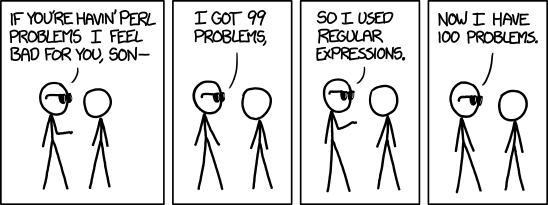
99 Problems (image courtesy of XKCD) Last week I graduated with a Masters in Legal Science (now taught as an MLaw) from Queen s University Belfast. I m pleased to have achieved a Distinction, as well an award for Outstanding Achievement in the Dissertation (which was on the infringement of privacy by private organisations due to state mandated surveillance and retention laws - pretty topical given the unfortunate introduction of the Investigatory Powers Act 2016). However, as previously stated, I had made the decision that I was happier building things, and wanted to return to the world of technology. I talked to a bunch of interesting options, got to various stages in the hiring process with each of them, and happily accepted a role with Titan IC Systems which started at the beginning of September. Titan have produced a hardware accelerated regular expression processor (hence the XKCD reference); the RXP in its FPGA variant (what I get to play with) can handle pattern matching against 40Gb/s of traffic. Which is kinda interesting, as it lends itself to a whole range of applications from network scanning to data mining to, well, anything where you want to sift through a large amount of data checking against a large number of rules. However it s brand new technology for me to get up to speed with (plus getting back into a regular working pattern rather than academentia), and the combination of that and spending most of the summer post DebConf wrapping up the dissertation has meant I haven t had as much time to devote other things as I d have liked. However I ve a few side projects at various stages of completion and will try to manage more regular updates.

7 December 2016

Shirish Agarwal: Day trip in Cape Town, part 2

Debconf16 logo The post continues from the last post shared. Let me get some interesting tit-bits not related to the day-trip out-of-the-way first I don t know whether we had full access to see all parts of fuller hall or not. Couple of days I was wondering around Fuller Hall, specifically next to where clothes were pressed. Came to know of the laundry service pretty late but still was useful. Umm next to where the ladies/gentleman pressed our clothes, there is a stairway which goes down. In fact even on the opposite side there is a stairway which goes down. I dunno if other people explored them or not. The jail inside and under UCT I was surprised and shocked to see bars in each room as well as connecting walkways etc. I felt a bit sad, confused and curious and went on to find more places like that. After a while I came up to the ground-level and enquired with some of the ladies therein. I was shocked to know that UCT some years ago (they were not specific) was a jail for people. I couldn t imagine that a place which has so much warmth (in people, not climate) could be evil in a sense. I was not able to get much information out of them about the nature of jail it was, maybe it is a dark past that nobody wants to open up, dunno. There were also two *important* aspects of UCT which Bernelle either forgot, didn t share or I just came to know via the Wikipedia page then but nothing else. 1. MeerKAT Apparently quite a bit of the technology was built-in UCT itself. This would have been interesting for geeks and wanna-be geeks like me 2. The OpenContent Initiative by UCT This would have been also something worth exploring. One more interesting thing which I saw was the French council in Cape Town from outside The French Council in cape town from outside I would urge to look at the picture in the gallery as the picture I shared doesn t really show all the details. For e.g. the typical large french windows which are the hall-mark of French architecture doesn t show its glory but if you look at 1306 2322 original picture instead of the 202 360 reproduction you will see that. You will also the insignia of the French Imperial Eagle whose history I came to know only after I looked it up on the Wikipedia page on that day. It seemed fascinating and probably would have the same pride as the State Emblem of India has for Indians with the four Asiatic Lions standing in a circle protecting each other. I also like the palm tree and the way the French Council seemed little and yet had character around all the big buildings. What also was interesting that there wasn t any scare/fear-build and we could take photos from outside unlike what I had seen and experienced in Doha, Qatar as far as photography near Western Embassies/Councils were concerned. One of the very eye-opening moments for me was also while I was researching flights from India to South Africa. While perhaps unconsciously I might have known that Middle East is close to India, in reality, it was only during the search I became aware that most places in Middle East by flight are only an hour or two away. This was shocking as there is virtually no mention of one of our neighbours when they are source of large-scale remittances every year. I mean this should have been in our history and geography books but most do not dwell on the subject. It was only during and after that I could understand Mr. Modi s interactions and trade policies with the Middle East. Another interesting bit was seeing a bar in a Sprinbok bus spingbok atlas bar in bus While admittedly it is not the best picture of the bar, I was surprised to find a bar at the back of a bus. By bar I mean a machine which can serve anything from juices to alcoholic drinks depending upon what is stocked. What was also interesting in the same bus is that the bus also had a middle entrance-and-exit. The middle door in springbok atlas This is something I hadn t seen in most Indian buses. Some of the Volvo buses have but it is rarely used (only except emergencies) . An exhaustive showcase of local buses can be seen here . I find the hand-drawn/cad depictions of all the buses by Amit Pense near to the T. Axe which can be used to break windows Emergency exit window This is also something which I have not observed in Indian inter-city buses (axe to break the window in case of accident and breakable glass which doesn t hurt anyone I presume), whether they are State-Transport or the high-end Volvo s . Either it s part of South African Roads Regulations or something that Springbok buses do for their customers. All of these queries about the different facets I wanted to ask the bus-driver and the attendant/controller but in the excitement of seeing, recording new things couldn t ask In fact one of the more interesting things I looked at and could look day and night is the variety of vehicles on display in Cape Town. In hindsight, I should have bought a couple of 128 GB MMC cards for my mobile rather than the 64 GB one. It was just plain inadequate to capture all that was new and interesting. Auditorum chair truck seen near Auditorium This truck I had seen about some 100 metres near the Auditorium on Upper Campus. The truck s design, paint was something I had never seen before. It is/was similar to casket trucks seen in movies but the way it was painted and everything made it special. What was interesting is to see the gamut of different vehicles. For instance, there were no bicycles that I saw in most places. There were mostly Japanese/Italian bikes and all sorts of trucks. If I had known before, I would definitely have bought an SD specifically to take snaps of all the different types of trucks, cars etc. that I saw therein. The adage/phrase I should stop in any one place and the whole world will pass me by seemed true on quite a few South African Roads. While the roads were on par or a shade better than India, many of those were wide roads. Seeing those, I was left imagining how the Autobahn in Germany and other high-speed Expressways would look n feel. India has also been doing that with the Pune-Mumbai Expressway and projects like Yamuna Expressway and now the extension Agra Lucknow Expressway but doing this all over India would take probably a decade or more. We have been doing it since a decade and a half. NHDP and PMGSY are two projects which are still ongoing to better the roads. We have been having issues as to should we have toll or no toll issues but that is a discussion for some other time. One of the more interesting sights I saw was the high-arched gothic-styled church from outside. This is near Longstreet as well. high arch gothic-styled church I have seen something similar in Goa, Pondicherry but not such high-arches. I did try couple of times to gain entry but one time it was closed, the other time some repairing/construction work was going on or something. I would loved to see it from inside and hopefully they would have had an organ (music) as well. I could imagine to some extent the sort of music that would have come out. Now that Goa has come in the conversation I can t help but state that Seafood enthusiasts/lover/aficionado, or/and Pescatarianism would have a ball of a time in Goa. Goa is on the Konkan coast and while I m eggie, ones who enjoy seafood really have a ball of a time in Goa. Fouthama s Festival which happens in February is particularly attractive as Goan homes are thrown open for people to come and sample their food, exchange recipes and alike. This happens around 2 weeks before the Goan Carnival and is very much a part of the mish-mashed Konkani-Bengali-Parsi-Portugese culture. I better stop here about the Goa otherwise I ll get into reminiscing mode. To put the story and event back on track from where we left of (no fiction hereon), Nicholas was in constant communication with base, i.e. UCT as well as another group who was hiking from UCT to Table Mountain. We waited for the other group to join us till 13:00 hrs. We came to know that they were lost and were trying to come up and hence would take more time. As Bernelle was with them, who was a local and she had two dogs who knew the hills quite well, it was decided to go ahead without them. We came down the same cable-car and then ventured on towards Houtbay. Houtbay has it all, a fisherman s wharf, actual boats with tough-mean looking men with tattoos working on boats puffing cigars/pipes, gaggle of sea-gulls, the whole scene. Sharing a few pictures of the way in-between. the view en-route to Houtbay western style car paint and repair shop Tajmahal Indian Restaurant, Houtbay I just now had a quick look at the restaurant and it seems they had options for veggies too. Unfortunately, the rating leaves a bit to be desired but then dunno as Indian flavoring is something that takes time to get used too. Zomato doesn t give any idea of from when a restaurant is in business and has too few reviews so not easy to know how the experience would have been. Chinese noodles and small houses Notice the pattern, the pattern of small houses I saw all the way till Houtbay and back. I do vaguely remember starting a discussion about it on the bus but don t really remember. I have seen (on TV) cities like Miami, Dubai or/and Hong Kong who have big buildings on the beach but both in Konkan as well as Houtbay there were small buildings. I guess a combination of zoning regulations, feel of community, fear of being flooded all play into beaches being the way they are. Also, this probably is good as less stress on the environment. Miamiboyz from Wikimedia Commons The above picture is taken from Wikipedia from the article Miami Beach, Florida for comparison. Audi rare car to be seen in India The Audi rare car to be seen in India. This car has been associated with Ravi Shastri when he won it in 1985. I was young but still get goosebumps remembering those days. first-glance-Houtbay-and-pier First glance of Houtbay beach and pier. Notice how clean and white the beach is. Wharf-Grill-Restaurant-from-side-and-Hop-on-Hop-off-bus You can see the wharf grill restaurant in the distance (side-view), see the back of the hop on and hop off bus (a concept which was unknown to me till then). Once I came back and explored on the web came to know this concept is prevalent in many a touristy places around the world. Umm also By sheer happenchance also captured a beautiful looking Indian female . So many things happening all at once In Hindi, we would call this picture virodabhas or contradiction . this is in afternoon, around 1430 hrs. You have the sun, the clouds, the Mountains, the x number of boats, the pier, the houses, the cars, the shops. It was all crazy and beautiful at the same time. The Biggest Contradiction is seeing the Mountain, the beach and the Sea in the same Picture. Baffled the mind. Konkan though is a bit similar there as well. You have all the three things in some places but that s a different experience altogether as ours is a more tropical weather although is one of the most romantic places in the rains. We were supposed to go on a short cruise to seal/dolphin island but as we were late (as had been waiting for the other group) didn t go and instead just loitered there. Fake-real lookout bar-restaurant IIRC the lookout bar is situated just next to Houtbay Search and Rescue. Although was curious if the Lookout tower was used in case of disappearance. lost people, boats etc. Seal in action Seal jumping over water, what a miracle ! One of the boats on which we possibly could have been on. It looked like the boat we could have been on. I clicked as I especially liked the name Calypso and Calypso . I shared the two links as the mythologies, interpretation differ a bit between Greek and Hollywood culture Debian folks and the area around Can see few Debian folks in the foreground, next to the Pole and the area around. Also can see a bit of the area around. Alone boy trying to surf I don t know anything about water sports and after sometime he came out. I was left wondering though, how safe he was in that water. While he was close to the pier and he was just paddling, there weren t big waves still felt a bit of concern. Mr. Seal - the actor and his handler While the act was not to the level we see in the movies, still for the time I hung around, I saw him showing attitude for his younger audiences, eating out of their hands, making funny sounds. Btw he farted a few times, whether that was a put-on or not can t really say but produced a few guffaws from his audience. A family feeding Mr. Seal I dunno why the birds came down for. Mr. Seal was being fed oily small fish parts, dunno if the oil was secreted by the fish themselves or whatever, it just looked oily from distance. Bird-Man-Bird Bird taking necessary sun bath typical equipment on a boat to catch fish-lot of nets boats-nets-and-ropes People working on disentangling a net There wasn t much activity on the time we went. It probably would have been different on sunrise and would be on sunset. The only activity I saw was on this boat where they were busy fixing and disentangling the lines. I came up with 5-15 different ideas for a story but rejected them as a. Probably all of them have been tried. People have been fishing since the beginning of time and modern fishing probably 200 odd years or so. I have read accounts of fishing companies in early 1800s onwards, so probably all must have been tried. b. More dangerous one, if there is a unique idea, then it becomes more dangerous as writing is an all-consuming process. Writing a blog post (bad or good) takes lots of time. I constantly read, re-read, try and improvise till I can or my patience loses out. In book you simply can t have such luxuries. hout-bay-search-and-rescue-no-parking-zone No parking/tow zone in/near the Houtbay search and rescue. Probably to take out emergency vehicles once something untoward happens. hout-bay-sea-rescue-with-stats Saved 54 lives, boats towed 154 Salut! Houtbay sea rescue. The different springbok atlas bus that we were on kraal-kraft The only small criticism is for Houtbay there wasn t a single public toilet. We had to ask favor at kraal kraft to use their toilets and there could have been accidents, it wasn t lighted well and water was spilled around. Road sign telling that we are near to UCT For us, because we were late we missed both the boat-cruise as well as some street shops selling trinkets. Other than that it was all well. We should have stayed till sunset, I am sure the view would have been breath-taking but we hadn t booked the bus till evening. Back at UCT Overall it was an interesting day as we had explored part of Table Mountain, seen the somewhat outrageously priced trinkets there as well as explored Houtbay sea-side as well.
Filed under: Miscellenous Tagged: #Audi, #Cape Town, #Cruises, #Debconf16, #French Council, #Geography, #Houtbay Sea Rescue, #Jail, #Middle East, #Springbok Atlas, #Vehicles

31 July 2016

Enrico Zini: Links for August 2016

First post with the new link collection feature of staticsite!
Heavy Metal and Natural Language Processing [archived]
Natural language processing and Metal lyrics, including the formula for the "metalness" of a word and a list of the most and least metal words.
Confirming all use of an SSH agent [archived]
For a long time I ve wanted an ssh-agent setup that would ask me before every use, so I could slightly more comfortably forward authentication over SSH without worrying that my session might get hijacked somewhere at the remote end (I often find myself wanting to pull authenticated git repos on remote hosts). I m at DebConf this week, which is an ideal time to dig further into these things, so I did so today. As is often the case it turns out this is already possible, if you know how.
Why We Don t Report It [archived]
Why don t you report it? It s up there on every list I ve seen of things you shouldn t say to sexual assault survivors, yet I keep hearing it
Voltron, an extensible debugger UI toolkit written in Python
Multi-panel display built from various gdb outputs.
Notmuch, offlineimap and Sieve setup [archived]
Nice description of a notmuch+offlineimap+sieve setup, for when I feel like rethinking my email setup.
Wikipedia:Unusual articles
An endless source of weird and wonderful.
ZERO: no linked HIV transmissions [archived]
The results provide a dataset to question whether transmission with an undetectable viral load is actually possible. They should help normalise HIV and challenge stigma and discrimination.
TV pickup
Someone once in the UK told me that it was a big enough problem that so many people turn on their electric kettles during the endtitles of Eastenders, that there's an employee in a hydro plant that needs to watch it to ramp up the power at the right time. I've finally found a wikipedia page about it.
Amazon isn't saying if Echo has been wiretapped [archived]
"We may never know if the feds have hijacked Amazon Echo. In case you didn't know, Echo is an always-on device, which, when activated, can return search queries, as well as read audiobooks and report sports, traffic, and weather. It can even control smart home devices."

26 July 2016

Norbert Preining: TUG 2016 Day 1 Routers and Reading

The first day of the real conference started with an excellent overview of what one can do with TeX, spanning from traditional scientific journal styles to generating router configuration for cruising ships.
tug2016-color All this was crowned with an invited talk my Kevin Larson from Microsoft s typography department on how to support reading comprehension. Pavneet Aurora Opening: Passport to the TeX canvas Pavneet, our never-sleeping host and master of organization, opened the conference with a very philosophical introduction, touching upon a wide range of topics ranging from Microsoft, Twitter to the beauty of books, pages, and type. I think at some point he even mentioned TeX, but I can t remember for sure. His words put up a very nice and all-inclusive stage, a community that is open to all kind of influences with any disregard or prejudice. Let us hope that is reflects reality. Thanks Pavneet. Geoffrey Poore Advances in PythonTeX Our first regular talk was by Geoffrey reporting on recent advances in PythonTeX, a package that allows including python code in your TeX document. Starting with an introduction to PythonTeX, Geoggrey reports about an improved verbatim environment, fvextra, which patches fancyvrb, and improved interaction between tikz and PythonTeX. As I am a heavy user of listings for my teaching on algebraic specification languages, I will surely take a look at this package and see how it compares to listings. Stefan Kottwitz TeX in industry I: Programming Cisco network switches using TeX Next was Stefan from Lufthansa Industry Solutions, who reported first about his working environment, Cruise Ships with a very demanding IT infrastructure he has to design and implement. Then he introduced us to his way of generating IP configurations for all the devices using TeX. The reason he chose this method is that it allows him to generate at the same time proper documentation. It was surprising for me to hear that by using TeX he could far more efficiently and quicker produce well designed and easily accessible documentation, which helped both the company as well as made the clients happy! Stefan Kottwitz TeX in industry II: Designing converged network solutions After a coffee break, Stefan continued his exploration into industrial usage of TeX, this time about using tikz to generate graphics representing the network topology on the ships. Boris Veytsman Making ACM LaTeX styles Next up was Boris which brought us back to traditional realms of TeX when he guided us into the abyss of ACM LaTeX styles he tried to maintain for some time, until he plunged into a complete rewrite of the styles. Frank Mittelbach Alice goes floating global optimized pagination including picture placements The last talk before lunch (probably a strategic placement, otherwise Frank would continue for hours and hours) was Frank on global optimization of page breaks. Frank showed us what can and can not be done with current LaTeX, and how to play around with global optimization of pagination, using Alice in Wonderland as running example. We can only hope that his package is soon available in an easily consumable version to play around. Thai lunch Pavneet has organized three different lunch-styles for the three days of the conference, today s was Thai with spring rools, fried noodles, one kind of very interesting orange noodles, and chicken something. Michael Doob baseball rules summary After lunch Michael gave us an accessible explanation of the most arcane rules a game can have the baseball rules by using pseudo code. I think the total number of loc needed to explain the overall rules would fill more pages than the New York phonebook, so I am deeply impressed by all those who can understand these rules. Some of us even wandered off in the late afternoon to see a match with life explanations of Michael. Amartyo Banerjee, S.K. Venkatesan A Telegram bot for printing LaTeX files Next up was Amartyo who showed a Telegram (as in messenger application) bot running on a Raspberry Pi, that receives (La)TeX files and sends back compiled PDF files. While it is not ready for consumption (If you sneeze the bot will crash!), it looks like a promising application. Furthermore, it is nice to see how open APIs (like Telegram) can spur development of useful tools, while closed APIs (including threatening users, like WhatApp) hinders it. Norbert Preining Security improvements in the TeX Live Manager and installer Next up was my own talk about beefing up the security of TeX Live by providing integrity and authenticity checks via GnuPG, a feature that has been introduced with the recent release of TeX Live 2016. The following discussion gave me several good idea on how to further improve security and usability. Arthur Reutenauer -The TeX Live M sub-project (and open discussion) Arthur presented the TeX Live M (where the M stands supposedly for Mojca, who couldn t attend unfortunately) project: Their aim is to provide a curated and quality verified sub-part of TeX Live that is sufficiently complete for many applications, and easier for distributors and packagers. We had a lively discussion after Arthur s short presentation, mostly about why TeX Live does not have a on-the-fly installation like MikTeX. I insisted that this is already possible, using the tex-on-the-fly package which uses the mktextex infrastructure, but also caution against using it by default due to delays induced by repeatably reading the TeX Live database. I think this is a worth-while project for someone interested in learning the internals of TeX Live, but I am not sure whether I want to invest time into this feature. Another discussion point was about a testing infrastructure, which I am currently working on. This is in fact high on my list, to have some automatic minimal functionality testing a LaTeX package should at least load! Kevin Larson Reading between the lines: Improving comprehension for students Having a guest from Microsoft is rather rare in our quite Unix-centered environment, so big thanks to Pavneet again for setting up this contact, and big thanks to Kevin for coming. Kevin gave us a profound introduction to reading disabilities and how to improve reading comprehension. Starting with an excursion into what makes a font readable and how Microsoft develops optimally readable fonts, he than turned to reading disabilities like dyslexia, and how markup of text can increase students comprehension rate. He also toppled my long-term believe that dyslexia is connected to the similar shape of letters which are somehow visually malprocessed this was the scientific status from the 1920ies till the 70ies, but since then all researchers have abandoned this interpretation and dyslexia is now linked to problems linking shape to phonems. Kevin did an excellent job with a slightly difficult audience some people picking about grammer differences between British and US English and permanently derailing the discussion, and even more the high percentage of typographically somehow specially tasted participants. After the talk I had a lengthy discussion with Kevin about if/how this research can be carried over to non-Roman writing systems, in particular Kanji/Hanzi based writing systems, where dyslexia shows itself probably in different context. Kevin also mentioned that they want to add interword space to Chinese to help learners of Chinese (children, foreigners) to better parse, and studies showed that this helps a lot in comprehension. On a meta-level, this talk bracketed with the morning introduction by Pavneet, describing an open environment with stimulus back and forth in all directions. I am very happy that Kevin took the pain to come in his tight schedule, and I hope that the future will bring better cooperation at the end we are all working somehow on the same front only the the tools differ.
izakaya-sake-partyAfter the closing of the session, one part of our group went off to the baseball match, while another group dived into a Japanese-style Izakaya where we managed to kill huge amounts of sake and quite an amount of food. The photo shows me after the first bottle of sake, while just seeping on an intermediate small amount of genshu (kind of strong undiluted sake) before continuing to the next bottle. An interesting and stimulating first day of TUG, and I am sure that everyone was looking forward to day 2.

Next.

Previous.