Search Results: "nion"

22 May 2025

Simon Quigley: Bootstrapping and Bikeshedding

When you learn to write, one of the major pieces is writing an introduction. You could say quite a bit about the formal process and the way formal writing is typically structured.That being said, I m not your typical writer. I didn t exactly plan to be in this spot, and honestly, it s just a hobby of mine. If you enjoy reading my posts, great. I appreciate it.My entire point, from the very beginning of this week, has been to bootstrap my own platform, on my own two feet. As you all know, rumors were going around, and I felt as if I wasn t in that great of a position to go out and say everything that I ve said, in one long post. I ve needed to break it apart, and work through some of my own notes again. Prove myself, rather than asking for it to be handed to me. Keep people guessing on some elements, to let the people who have been doing wrong firmly prove themselves. At least twelve people at this point have sent me undeniable proof. I don t want to do anything with it. I want to move on, and I want to write about technology, and other things I actually enjoy writing about.I really don t enjoy conflict, or writing about it, at all. I just know how to defend myself if I need to. If you think I actively want to make everyone mad for no good reason, you re honestly fooling yourself.I already know that I m not going to agree with everything I write in a few years, or maybe even weeks. But I ll hold myself to the same standard I hold everyone else. If you say something and a few years pass, I m not going to assume you still have the same opinion. I ll give you the opportunity to correct it. I d ask you lend me the same courtesy.I do this because I enjoy it, not out of anger, sadness, or anything like that. A number of people have approached me now simply asking why I m doing what I m doing. I planned to write this blog post at the very end all along. I just haven t revealed the plans before publishing. [I wrote the outline for this more than a day ago.]My entire point here is to give the common person a voice. I know exactly what it s like to start from nothing, and work your way up to a comfortable spot. I didn t only do it once, I did it twice. This is my third time. I genuinely don t appreciate it when people silence other people s voices just because they don t like them. I wasn t raised that way, and that s not how I run my own projects. In fact, I d say that if you silence opinions or values that don t exactly match yours, you re missing out on the variety of life.You can lead a horse to water, but you can t make them drink. If you still think there are issues on my end, you re being misinformed. Plain and simple. I m not going to spend any more time on it, I actually want to start what I ve always wanted to do for years, just never had the opportunity to.This is my last post for the week. I feel like I ve bootstrapped enough where next week I can focus on another topic, as originally planned.Thanks for reading. I appreciate your support. Talk to you on Monday. If you have topic suggestions, feel free to leave them in the comments. Feel free to leave your hate mail too, so I know where I m at.If you read Piaget, you know that silence is concerning with respect to socialization. I just took a look at the view count for the first time, and I m already up to more than 2k views. In the first week. Without actually digging into the content I want to write about, yet.I don t mean to say that to brag, I m just telling you for a fact that I m not ranting into thin air. I m not even ranting at all. In fact, every single one of my posts has been written either calmly or with happiness, including this one.My entire point is this: debate me on the merits of the subject, not on me as a person. If you don t like me, that s okay. Go play elsewhere.But, I m still going to keep writing. Next week, different metaphors.We re bootstrapped now.

21 May 2025

Simon Quigley: Fences and Values

Don t knock the fence down before you know why it s up. I repeat this phrase over and over again, yet the (metaphorical) Homeowner s Association still decides my fence is the wrong color.Well, now you get to know why the fence is up. If anyone s actually willing to challenge me on this level, I d welcome it.The four ideas I d like to discuss are this: quantum physics, Lutheranism, mental resilience, and psychology. I ve been studying these topics intensely for the past decade as a passion project. I m just going to let my thoughts flow, but I d like to hear other opinions on this.Can the mysteries of the mind, the subatomic world, and faith converge to reveal deeper truths?When it comes to self-taught knowledge on analysis, I m mostly learned on Freud, with some hints of Jung and Peterson. I ve read much of the original source material, and watched countless presentations on it. This all being said, I m both learned on Rothbard and Marx, so if there is a major flaw in the way of Freud is frowned upon, I d genuinely like to know so I can update my research and juxtapose the two schools of thought.Alongside this, although probably not directly relevant, I m learned on John Locke and transcendentalism. What I d like to focus on here is this the Id.The Id is the pleasure-seeking, instinctual part of the psyche. Jung further extends this into the idea of the shadow self, and Peterson maps the meanings of these texts into a combined work (at least in my rudimentary understanding).In my research, the Id represents the part of your psyche that deals with religious values. As an example, if you re an impulsive person, turning to a spiritual or religious outlet can be highly beneficial. I ve been using references from the foundational text of the Judaeo-Christian value system this entire time, feel free to re-read my other blog posts (instead of claiming they don t exist).Let s tie this into quantum physics. This is the part where I ll struggle most. I ve watched several movies about this, read several books, and even learned about it academically, but quantum physics is likely to be my weak spot here.I did some research, and here are the elements I m looking for: uncertainty principle, wave-particle duality, quantum entanglement, and the observer effect.I already know about the cat in the box. And the Cat in the Hat, for that matter. I know about wave-particle duality from an incredibly intelligent high school physics teacher of mine. I know about the uncertainty principle purely in a colloquial sense. The remaining element I need to wrap my head around is quantum entanglement, but it feels like I m almost there.These concepts do actually challenge the idea of pure free will. It s almost like we re coming full circle. Some theologians (including myself, if you can call me a self-taught one) do believe the idea of quantum indeterminacy can be a space where divine action may take place. You could also liken the unpredictable nature of the Id to quantum indeterminacy as well. These are ones to think about, because in all reality, they re subjective opinions. I do believe they re interconnected.In terms of Lutheranism, I ll be short on this one. Please do go read the full history behind Martin Luther and his turbulent relationship with Catholicism. I m not a Bible thumper, and I actually think this is the first time I ve mentioned religion publicly at all. This being said, now I m actually ready to defend the points on an academic level.The Id represents hidden psychological forces, quantum physics reveals subatomic mysteries, and Lutheranism emphasizes faith in the unseen God. Okay, so we have the baseline. Now, time for some mental resilience. When I think of mental resilience, the first people I think of are David Goggins and Jocko Willink. I ve also enjoyed Dr. Andrew Huberman s podcast.The idea there is simple if you understand exactly how to learn, you know your fundamentals well enough to draw them and explain them vividly on a whiteboard, and you can make it a habit, at that point you re ready to work on your mental resilience. Little by little, gradually, how far can you push the bar towards the ceiling?There s obviously limits. People sometimes get scared when I mention mental resilience, but obviously that s a bit of a catch 22. There are plenty of satirical videos out there, and of course, I don t believe in Goggins or Jocko wholeheartedly. They re just tools in the toolbox when times get tough.I wish you all well, and I hope this gets you thinking about those people who just insist there is no God or higher being, and think you re stupid for believing there is one. Those people obviously haven t read analysis, in my own opinion.Have a great night!

Simon Quigley: AI and what it actually means

A popular topic of public conversation in 2025 is balance. How do we balance budgets, how do we balance entities, and how do we balance perspectives? How do we balance the right of free expression with our ability to effectively convey a message?Here s another popular topic of conversation AI. What is it? What does it do?I m going to give you some resources, as someone who first learned the inner workings of AI about ten years ago.I ll start with the presentation I gave in middle school. Our objective was to give a presentation on a topic of our choice, and we would be graded on our ability to give a presentation. Instead of talking about specific things or events, I talked about the broader idea of fully establishing an artificial form of intelligence.This is the video I used as a basis for that presentation:https://medium.com/media/21d2427a502b7c7cb669220e2e3478c8/hrefNot only did I explain exactly how this specific video game worked, it helped me understand machine learning and genetic algorithms. If I m recalling correctly, the actual title of my presentation had to do with genetic algorithms specifically.In the presentation, I specifically tied in Darwin s readings on evolution (of course, I had to keep it secular ), directly relating the information I learned about evolution in science class into a presentation about what would become AI. But Simon, the title of that video says Machine Learning. Do you have your glasses on?!? Yes, yes I do. It took me a few years to watch this space evolve, as I focused on other portions of the open source world. This changed when I attended SCaLE 21x. At that conference, the product manager for AI at Canonical (apologies if I m misquoting your exact title) gave a presentation on how she sees this space evolving. It s a must watch, in my opinion:https://medium.com/media/a13b2e46fc8acaa3bebf01a7f7bdeebb/hrefThis comprehensive presentation really covers the entire space, and does an excellent job at giving the whole picture.The short of it is this calling everything AI is inaccurate. Using AI for everything under the sun also isn t accurate. Speaking of the sun, it will get us if we don t find a sustainable way to get all that energy we ll need.I also read a paper on this issue, which I believe ties it together nicely. Published in June 2024, it s titled Situational Awareness The Decade Ahead and does an excellent job in predicting how this space will evolve. So far, it s been very accurate.The reason I m explaining this is fairly simple. In 2025, I still don t think many people have taken the time to dig into the content. From many conversations I ve heard, including one I took notes on in an entirely personal capacity, I m finding that not many people have a decent idea for where this space is going.It s been researched! :)If someone can provide a dissent for this view of the artificial intelligence space in the comments, I d be more than happy to hear it. Here s where I think this connects to the average person Many of the open source companies right now, without naming names, are focusing too much on the corporate benefits of AI. Yes, AI will be an incredibly useful tool for large organizations, and it will have a great benefit for how we conduct business over the course of the next decade. But do we have enough balance?Before you go all-in on AI, just do your research, please. Take a look at your options, and choose one that is correctly calibrated with the space as you see it.Lastly, when I talk about AI, I always bring up Orwell. I m a very firm, strong believer in free speech. AI must not be used to censor content, and the people who design your AI stack are very important. Look at which one of the options, as a company, enforces a diversity policy that is consistent with your values. The values of that company will carry over into its product. If you think I m wrong about this point, seriously, go read 1984 by George Orwell a few times over. You ll get the picture on what we re looking to avoid.In short, there s no need to over-complicate AI to those who don t understand it. Use the video game example. It s simple, and it works. Try using that same sentiment in your messaging, too. Appealing to both companies and individual users, together, should be important for open source companies, especially those with a large user base.I wish you all well. If you re getting to the end of this post and you re mad at me, sorry about that. Go re-read 1984 just one more time, please. ;)

20 May 2025

Simon Quigley: Donuts and 5-Star Restaurants

In my home state of Wisconsin, there is an incredibly popular gas station called Kwik Trip. (Not to be confused with Quik Trip.) It is legitimately one of the best gas stations I ve ever been to, and I m a frequent customer.What makes it that great?Well, everything about it. The store is clean, the lights work, the staff are always friendly (and encourage you to come back next time), there s usually bakery on sale (just depends on location etc), and the list goes on.There s even a light-switch in the bathroom of a large amount of locations that you can flip if a janitor needs to attend to things. It actually does set off an alarm in the back room.A dear friend of mine from Wisconsin once told me something along the lines of, it s inaccurate to call Kwik Trip a gas station, because in all reality, it s a five star restaurant. (M , I hope you re well.)In my own opinion, they have an espresso machine. That s what really matters. ;)I mentioned the discount bakery. In reality, it s a pretty great system. To my limited understanding, the bakery that is older than standard but younger than expiry are set to half price and put towards the front of the store. In my personal experience, the vast majority of the time, the quality is still amazing. In fact, even if it isn t, the people working at Kwik Trip seem to genuinely enjoy their job.When you re looking at that discount rack of bakery, what do you choose? A personal favorite of mine is the banana nut bread with frosting on top. (To the non-Americans, yes, it does taste like it s homemade, it doesn t taste like something made in a factory.)Everyone chooses different bakery items. And honestly, there could be different discount items out depending on the time. You take what you can get, but you still have your own preferences. You like a specific type of donut (custard-filled, or maybe jelly-filled). Frosting, sprinkles there are so many ways to make different bakery items.It s not only art, it s kind of a science too.Is there a Kwik Trip that you ve called a gas station instead of a five star restaurant? Do you also want to tell people about your gas station? Do you only pick certain bakery items off the discount rack, or maybe ignore it completely? (And yes, there would be good reason to ignore the bakery in favor of the Hot Spot, I d consider that acceptable in my personal opinion.)Remember, sometimes you just have to like donuts.https://medium.com/media/73f78efd7bd6bb9ce495c2f08428c7d3/hrefHave a sweet day. :)

11 May 2025

Bits from Debian: Bits from the DPL

Dear Debian community, This is bits from the DPL for April. End of 10 I am sure I was speaking in the interest of the whole project when joining the "End of 10" campaign. Here is what I wrote to the initiators:
Hi Joseph and all drivers of the "End of 10" campaign, On behalf of the entire Debian project, I would like to say that we proudly join your great campaign. We stand with you in promoting Free Software, defending users' freedoms, and protecting our planet by avoiding unnecessary hardware waste. Thank you for leading this important initiative.
Andreas Tille Debian Project Leader
I have some goals I would like to share with you for my second term. Ftpmaster delegation This splits up into tasks that can be done before and after Trixie release. Before Trixie: 1. Reducing Barriers to DFSG Compliance Checks Back in 2002, Debian established a way to distribute cryptographic software in the main archive, whereas such software had previously been restricted to the non-US archive. One result of this arrangement which influences our workflow is that all packages uploaded to the NEW queue must remain on the server that hosts it. This requirement means that members of the ftpmaster team must log in to that specific machine, where they are limited to a restricted set of tools for reviewing uploaded code. This setup may act as a barrier to participation--particularly for contributors who might otherwise assist with reviewing packages for DFSG compliance. I believe it is time to reassess this limitation and work toward removing such hurdles. In October last year, we had some initial contact with SPI's legal counsel, who noted that US regulations around cryptography have been relaxed somewhat in recent years (as of 2021). This suggests it may now be possible to revisit and potentially revise the conditions under which we manage cryptographic software in the NEW queue. I plan to investigate this further. If you have expertise in software or export control law and are interested in helping with this topic, please get in touch with me. The ultimate goal is to make it easier for more people to contribute to ensuring that code in the NEW queue complies with the DFSG. 2. Discussing Alternatives My chances to reach out to other distributions remained limited. However, regarding the processing of new software, I learned that OpenSUSE uses a Git-based workflow that requires five "LGTM" approvals from a group of trusted developers. As far as I know, Fedora follows a similar approach. Inspired by this, a recent community initiative--the Gateway to NEW project--enables peer review of new packages for DFSG compliance before they enter the NEW queue. This effort allows anyone to contribute by reviewing packages and flagging potential issues in advance via Git. I particularly appreciate that the DFSG review is coupled with CI, allowing for both license and technical evaluation. While this process currently results in some duplication of work--since final reviews are still performed by the ftpmaster team--it offers a valuable opportunity to catch issues early and improve the overall quality of uploads. If the community sees long-term value in this approach, it could serve as a basis for evolving our workflows. Integrating it more closely into DAK could streamline the process, and we've recently seen that merge requests reflecting community suggestions can be accepted promptly. For now, I would like to gather opinions about how such initiatives could best complement the current NEW processing, and whether greater consensus on trusted peer review could help reduce the burden on the team doing DFSG compliance checks. Submitting packages for review and automated testing before uploading can improve quality and encourage broader participation in safeguarding Debian's Free Software principles. My explicit thanks go out to the Gateway to NEW team for their valuable and forward-looking contribution to Debian. 3. Documenting Critical Workflows Past ftpmaster trainees have told me that understanding the full set of ftpmaster workflows can be quite difficult. While there is some useful documentation thanks in particular to Sean Whitton for his work on documenting NEW processing rules many other important tasks carried out by the ftpmaster team remain undocumented or only partially so. Comprehensive and accessible documentation would greatly benefit current and future team members, especially those onboarding or assisting in specific workflows. It would also help ensure continuity and transparency in how critical parts of the archive are managed. If such documentation already exists and I have simply overlooked it, I would be happy to be corrected. Otherwise, I believe this is an area where we need to improve significantly. Volunteers with a talent for writing technical documentation are warmly invited to contact me--I'd be happy to help establish connections with ftpmaster team members who are willing to share their knowledge so that it can be written down and preserved. Once Trixie is released (hopefully before DebConf): 4. Split of the Ftpmaster Team into DFSG and Archive Teams As discussed during the "Meet the ftpteam" BoF at DebConf24, I would like to propose a structural refinement of the current Ftpmaster team by introducing two different delegated teams:
  1. DFSG Team
  2. Archive Team (responsible for DAK maintenance and process tooling, including releases)
(Alternative name suggestions are, of course, welcome.) The primary task of the DFSG team would be the processing of the NEW queue and ensuring that packages comply with the DFSG. The Archive team would focus on maintaining DAK and handling the technical aspects of archive management. I am aware that, in the recent past, the ftpmaster team has decided not to actively seek new members. While I respect the autonomy of each team, the resulting lack of a recruitment pipeline has led to some friction and concern within the wider community, including myself. As Debian Project Leader, it is my responsibility to ensure the long-term sustainability and resilience of our project, which includes fostering an environment where new contributors can join and existing teams remain effective and well-supported. Therefore, even if the current team does not prioritize recruitment, I will actively seek and encourage new contributors for both teams, with the aim of supporting openness and collaboration. This proposal is not intended as criticism of the current team's dedication or achievements--on the contrary, I am grateful for the hard work and commitment shown, often under challenging circumstances. My intention is to help address the structural issues that have made onboarding and specialization difficult and to ensure that both teams are well-supported for the future. I also believe that both teams should regularly inform the Debian community about the policies and procedures they apply. I welcome any suggestions for a more detailed description of the tasks involved, as well as feedback on how best to implement this change in a way that supports collaboration and transparency. My intention with this proposal is to foster a more open and effective working environment, and I am committed to working with all involved to ensure that any changes are made collaboratively and with respect for the important work already being done. I'm aware that the ideas outlined above touch on core parts of how Debian operates and involve responsibilities across multiple teams. These are not small changes, and implementing them will require thoughtful discussion and collaboration. To move this forward, I've registered a dedicated BoF for DebConf. To make the most of that opportunity, I'm looking for volunteers who feel committed to improving our workflows and processes. With your help, we can prepare concrete and sensible proposals in advance--so the limited time of the BoF can be used effectively for decision-making and consensus-building. In short: I need your help to bring these changes to life. From my experience in my last term, I know that when it truly matters, the Debian community comes together--and I trust that spirit will guide us again. Please also note: we had a "Call for volunteers" five years ago, and much of what was written there still holds true today. I've been told that the response back then was overwhelming--but that training such a large number of volunteers didn't scale well. This time, I hope we can find a more sustainable approach: training a few dedicated people first, and then enabling them to pass on their knowledge. This will also be a topic at the DebCamp sprint. Dealing with Dormant Packages Debian was founded on the principle that each piece of software should be maintained by someone with expertise in it--typically a single, responsible maintainer. This model formed the historical foundation of Debian's packaging system and helped establish high standards of quality and accountability. However, as the project has grown and the number of packages has expanded, this model no longer scales well in all areas. Team maintenance has since emerged as a practical complement, allowing multiple contributors to share responsibility and reduce bottlenecks--depending on each team's internal policy. While working on the Bug of the Day initiative, I observed a significant number of packages that have not been updated in a long time. In the case of team-maintained packages, addressing this is often straightforward: team uploads can be made, or the team can be asked whether the package should be removed. We've also identified many packages that would fit well under the umbrella of active teams, such as language teams like Debian Perl and Debian Python, or blends like Debian Games and Debian Multimedia. Often, no one has taken action--not because of disagreement, but simply due to inattention or a lack of initiative. In addition, we've found several packages that probably should be removed entirely. In those cases, we've filed bugs with pre-removal warnings, which can later be escalated to removal requests. When a package is still formally maintained by an individual, but shows signs of neglect (e.g., no uploads for years, unfixed RC bugs, failing autopkgtests), we currently have three main tools:
  1. The MIA process, which handles inactive or unreachable maintainers.
  2. Package Salvaging, which allows contributors to take over maintenance if conditions are met.
  3. Non-Maintainer Uploads (NMUs), which are limited to specific, well-defined fixes (which do not include things like migration to Salsa).
These mechanisms are important and valuable, but they don't always allow us to react swiftly or comprehensively enough. Our tools for identifying packages that are effectively unmaintained are relatively weak, and the thresholds for taking action are often high. The Package Salvage team is currently trialing a process we've provisionally called "Intend to NMU" (ITN). The name is admittedly questionable--some have suggested alternatives like "Intent to Orphan"--and discussion about this is ongoing on debian-devel. The mechanism is intended for situations where packages appear inactive but aren't yet formally orphaned, introducing a clear 21-day notice period before NMUs, similar in spirit to the existing ITS process. The discussion has sparked suggestions for expanding NMU rules. While it is crucial not to undermine the autonomy of maintainers who remain actively involved, we also must not allow a strict interpretation of this autonomy to block needed improvements to obviously neglected packages. To be clear: I do not propose to change the rights of maintainers who are clearly active and invested in their packages. That model has served us well. However, we must also be honest that, in some cases, maintainers stop contributing--quietly and without transition plans. In those situations, we need more agile and scalable procedures to uphold Debian's high standards. To that end, I've registered a BoF session for DebConf25 to discuss potential improvements in how we handle dormant packages. These discussions will be prepared during a sprint at DebCamp, where I hope to work with others on concrete ideas. Among the topics I want to revisit is my proposal from last November on debian-devel, titled "Barriers between packages and other people". While the thread prompted substantial discussion, it understandably didn't lead to consensus. I intend to ensure the various viewpoints are fairly summarised--ideally by someone with a more neutral stance than myself--and, if possible, work toward a formal proposal during the DebCamp sprint to present at the DebConf BoF. My hope is that we can agree on mechanisms that allow us to act more effectively in situations where formerly very active volunteers have, for whatever reason, moved on. That way, we can protect both Debian's quality and its collaborative spirit. Building Sustainable Funding for Debian Debian incurs ongoing expenses to support its infrastructure--particularly hardware maintenance and upgrades--as well as to fund in-person meetings like sprints and mini-DebConfs. These investments are essential to our continued success: they enable productive collaboration and ensure the robustness of the operating system we provide to users and derivative distributions around the world. While DebConf benefits from generous sponsorship, and we regularly receive donated hardware, there is still considerable room to grow our financial base--especially to support less visible but equally critical activities. One key goal is to establish a more constant and predictable stream of income, helping Debian plan ahead and respond more flexibly to emerging needs. This presents an excellent opportunity for contributors who may not be involved in packaging or technical development. Many of us in Debian are engineers first--and fundraising is not something we've been trained to do. But just like technical work, building sustainable funding requires expertise and long-term engagement. If you're someone who's passionate about Free Software and has experience with fundraising, donor outreach, sponsorship acquisition, or nonprofit development strategy, we would deeply value your help. Supporting Debian doesn't have to mean writing code. Helping us build a steady and reliable financial foundation is just as important--and could make a lasting impact. Kind regards Andreas. PS: In April I also planted my 5000th tree and while this is off-topic here I'm proud to share this information with my fellow Debian friends.

10 May 2025

Taavi V n nen: Wikimedia Hackathon Istanbul 2025

It's that time of the year again: the Wikimedia Hackathon 2025 happened last weekend in Istanbul. This year was my third time attending what has quickly become one of my favourite events of the year simply due to the concentration of friends and other like-minded nerds in a single location.1 Valerio, Lucas, me and a shark.
Image by Chlod Alejandro is licensed under CC BY-SA 4.0.
This year I did a short presentation about the MediaWiki packages in Debian (slides), which is something I do but I suspect is fairly obscure to most people in the MediaWiki community. I was hoping to do some work on reproducibility of MediaWiki releases, but other interests (plus lack of people involved in the release process at the hackathon) meant that I didn't end up getting any work done on that (assuming this does not count). Other long-standing projects did end up getting some work done! MusikAnimal and I ended up fixing the Commons deletion notification bot, which had been broken for well over two years at that point (and was at some point in the hackathon plans for last year for both of us). Other projects that I made progress on include supporting multiple types of two-factor devices, and LibraryUpgrader which gained support for rebasing and updating existing patches2. In addition to hacking, the other highlight of these events is the hallway track. Some of the crowd is people who I've seen at previous events and/or interact very frequently with, but there are also significant parts of the community and the Foundation that I don't usually get to interact with outside of these events. (Although it still feels extremely weird to heard from various mostly-WMF people with whom I haven't spoken with before that they've heard various (usually positive) rumours stories about me.) Unfortunately we did not end up having a Cuteness Association meetup this year, but we had an impromptu PGP key signing party which is basically almost as good, right? However, I did continue a tradition from last year: I ended up nominating Chlod, a friend of mine, to receive +2 access to mediawiki/* during the hackathon. The request is due to be closed sometime tomorrow. (Usual disclosure: My travel was funded by the Wikimedia Foundation. Thank you! This is my personal blog and these are my own opinions.) Now that you've read this post, maybe check out posts from others?

  1. Unfortunately you can never have absolutely everyone attending :(
  2. Amir, I still have not forgiven you about this.

3 May 2025

Russ Allbery: Review: Paper Soldiers

Review: Paper Soldiers, by Saleha Mohsin
Publisher: Portfolio
Copyright: 2024
ISBN: 0-593-53912-5
Format: Kindle
Pages: 250
The subtitle of Paper Soldiers is "How the Weaponization of the Dollar Changed the World Order," which may give you the impression that this book is about US use of the dollar system for political purposes such as sanctions. Do not be fooled like I was; this subtitle is, at best, deceptive. Coverage of the weaponization of the dollar is superficial and limited to a few chapters. This book is, instead, a history of the strong dollar policy told via a collection of hagiographies of US Treasury Secretaries and written with all of the skeptical cynicism of a poleaxed fawn. There is going to be some grumbling about the state of journalism in this review. Per the author's note, Saleha Mohsin is the Bloomberg News beat reporter for the US Department of the Treasury. That is, sadly, exactly what this book reads like: routine beat reporting. Mohsin asked current and former Treasury officials what they were thinking at various points in history and then wrote down their answers without, so far as I can tell, considering any contradictory evidence or wondering whether they were telling the truth. Paper Soldiers does contain extensive notes (those plus the index fill about forty pages), so I guess you could do the cross-checking yourself, although apparently most of the interviews for this book were "on background" and are therefore unattributed. (Is this weird? I feel like this is weird.) Mohsin adds a bit of utterly conventional and uncritical economic framing and casts the whole project in the sort of slightly breathless and dramatized prose style that infests routine news stories in the US. I find this style of book unbelievably frustrating because it represents such a wasted opportunity. To me, the point of book-length journalism is precisely to not write in this style. When you're trying to crank out two or three articles a week covering current events, I understand why there isn't always space or time to go deep into background, skepticism, and contrary opinions. But when you expand that material into a book, surely the whole point is to take the time to do some real reporting. Dig into what people told you, see if they're lying, talk to the people who disagree with them, question the conventional assumptions, and show your work on the page so that the reader is smarter after finishing your book than they were before they started. International political economics is not a sequence of objective facts. It's a set of decisions made in pursuit of economic and political theories that are disputed and arguable, and I think you owe the reader some sense of the argument and, ideally, some defensible position on the merits that is more than a transcription of your interviews. This is... not that.
It's a power loop that the United States still enjoys today: trust in America's dollar (and its democratic government) allows for cheap debt financing, which buys health care built on the most advanced research and development and inventions like airplanes and the iPhone. All of this is propelled by free market innovation and the superpowered strength to keep the nation safe from foreign threats. That investment boosts the nation's economic, military, and technological prowess, making its economy (and the dollar) even more attractive.
Let me be precise about my criticism. I am not saying that every contention in the above excerpt is wrong. Some of them are probably correct; more of them are at least arguable. This book is strictly about the era after Bretton Woods, so using airplanes as an example invention is a bizarre choice, but sure, whatever, I get the point. My criticism is that paragraphs like this, as written in this book, are not introductions to deeper discussions that question or defend that model of economic and political power. They are simple assertions that stand entirely unsupported. Mohsin routinely writes paragraphs like the above as if they are self-evident, and then immediately moves on to the next anecdote about Treasury dollar policy. Take, for example, the role of the US dollar as the world's reserve currency, which roughly means that most international transactions are conducted in dollars and numerous countries and organizations around the world hold large deposits in dollars instead of in their native currency. The conventional wisdom holds that this is a great boon to the US economy, but there are also substantive critiques and questions about that conventional wisdom. You would never know that from this book; Mohsin asserts the conventional wisdom about reserve currencies without so much as a hint that anyone might disagree. For example, one common argument, repeated several times by Mohsin, is that the US can only get away with the amount of deficit spending and cheap borrowing that it does because the dollar is the world's reserve currency. Consider two other countries whose currencies are clearly not the international reserve currency: Japan and the United Kingdom. The current US debt to GDP ratio is about 125% and the current interest rate on US 10-year bonds is about 4.2%. The current Japanese debt to GDP ratio is about 260% and the current interest rate on Japanese 10-year bonds is about 1.2%. The current UK debt to GDP ratio is 160% and the current interest rate on UK 10-year bonds is 4.5%. Are you seeing the dramatic effects of the role of the dollar as reserve currency? Me either. Again, I am not saying that this is a decisive counter-argument. I am not an economist; I'm just some random guy on the Internet who finds macroeconomics interesting and reads a few newsletters. I know the Japanese bond market is unusual in ways I'm not accounting for. There may well be compelling arguments for why reserve currency status matters immensely for US borrowing capacity. My point is not that Mohsin is wrong; my point is that you have to convince me and she doesn't even try. Nowhere in this book is a serious effort to view conventional wisdom with skepticism or confront it with opposing arguments. Instead, this book is full of blithe assertions that happen to support the narrative the author was fed by a bunch of former Treasury officials and does not appear to question in any way. I want books like this to increase my understanding of the world. To do that, they need to show me multiple sides of debates and teach me how to evaluate evidence, not simply reinforce a superficial conventional wisdom. It doesn't help that whatever fact-checking process this book went through left some glaring errors. For example, on the Plaza Accord:
With their central banks working in concert, enough dollars were purchased on the open market to weaken the currency, making American goods more affordable for foreign buyers.
I don't know what happened after the Plaza Accord (I read books like this to find out!), but clearly it wasn't that. This is utter nonsense. Buying dollars on the open market would increase the value of the dollar, not weaken it; this is basic supply and demand that you learn in the first week of a college economics class. This is the type of error that makes me question all the other claims in the book that I can't easily check. Mohsin does offer a more credible explanation of the importance of a reserve currency late in the book, although it's not clear to me that she realizes it: The widespread use of the US dollar gives US government sanctions vast international reach, allowing the US to punish and coerce its enemies through the threat of denying them access to the international financial system. Now we're getting somewhere! This is a more believable argument than a small and possibly imaginary effect on government borrowing costs. It is clear why a bellicose US government, particularly one led by advocates of a unitary executive theory that elevates the US president to a status of near-emperor, want to turn the dollar into a weapon of international control. It's much less obvious how comfortable the rest of the world should be with that concentration of power. This would be a fascinating topic for a journalistic non-fiction book. Some reporter should dive deep into the mechanics of sanctions and ask serious questions about the moral, practical, and diplomatic consequences of this aggressive wielding of US power. One could give it a title like Paper Soldiers that reflected the use of banks and paper currency as foot soldiers enforcing imperious dictates on the rest of the world. Alas, apart from a brief section in which the US scared other countries away from questioning the dollar, Mohsin does not tug at this thread. Maybe someone should write that book someday. As you will have gathered by now, I think this is a bad book and I do not recommend that you read it. Its worst flaw is one that it shares with far too much mainstream US print and TV journalism: the utter credulity of the author. I have the old-fashioned belief that a journalist should be more than a transcriptionist for powerful people. They should be skeptical, they should assume public figures may be lying, they should look for ulterior motives, and they should try to bring the reader closer to some objective truths about the world, wherever they may lie. I have no solution for this degradation of journalism. I'm not even sure that it's a change. There were always reporters eager to transcribe the voice of power into the newspaper, and if we remember the history of journalism differently, that may be because we have elevated the rare exceptions and forgotten the average. But after watching too many journalists I once respected start parroting every piece of nonsense someone tells them, from NFTs to UFOs to the existential threat of AI, I've concluded that the least I can do as a reader is to stop rewarding reporters who cannot approach powerful subjects with skepticism, suspicion, and critical research. I failed in this case, but perhaps I can serve as a warning to others. Rating: 3 out of 10

1 May 2025

Ian Jackson: Free Software, internal politics, and governance

There is a thread of opinion in some Free Software communities, that we shouldn t be doing politics , and instead should just focus on technology. But that s impossible. This approach is naive, harmful, and, ultimately, self-defeating, even on its own narrow terms. Today I m talking about small-p politics In this article I m using politics in the very wide sense: us humans managing our disagreements with each other. I m not going to talk about culture wars, woke, racism, trans rights, and so on. I am not going to talk about how Free Software has always had explicitly political goals; or how it s impossible to be neutral because choosing not to take a stand is itself to take a stand. Those issues are all are important and Free Software definitely must engage with them. Many of the points I make are applicable there too. But those are not my focus today. Today I m talking in more general terms about politics, power, and governance. Many people working together always entails politics Computers are incredibly complicated nowadays. Making software is a joint enterprise. Even if an individual program has only a single maintainer, it fits into an ecosystem of other software, maintained by countless other developers. Larger projects can have thousands of maintainers and hundreds of thousands of contributors. Humans don t always agree about everything. This is natural. Indeed, it s healthy: to write the best code, we need a wide range of knowledge and experience. When we can t come to agreement, we need a way to deal with that: a way that lets us still make progress, but also leaves us able to work together afterwards. A way that feels OK for everyone. Providing a framework for disagreement is the job of a governance system. The rules say which people make which decisions, who must be consulted, how the decisions are made, and, how, if any, they can be reviewed. This is all politics. Consensus is great but always requiring it is harmful Ideally a discussion will converge to a synthesis that satisfies everyone, or at least a consensus. When consensus can t be achieved, we can hope for compromise: something everyone can live with. Compromise is achieved through negotiation. If every decision requires consensus, then the proponents of any wide-ranging improvement have an almost insurmountable hurdle: those who are favoured by the status quo and find it convenient can always object. So there will never be consensus for change. If there is any objection at all, no matter how ill-founded, the status quo will always win. This is where governance comes in. Governance is like backups: we need to practice it Governance processes are the backstop for when discussions, and then negotiations, fail, and people still don t see eye to eye. In a healthy community, everyone needs to know how the governance works and what the rules are. The participants need to accept the system s legitimacy. Everyone, including the losing side, must be prepared to accept and implement (or, at least not obstruct) whatever the decision is, and hopefully live with it and stay around. That means we need to practice our governance processes. We can t just leave them for the day we have a huge and controversial decision to make. If we do that, then when it comes to the crunch we ll have toxic rows where no-one can agree the rules; where determined people bend the rules to fit their outcome; and where afterwards people feel like the whole thing was horrible and unfair. So our decisionmaking bodies and roles need to be making decisions, as a matter of routine, and we need to get used to that. First-line decisionmaking bodies should be making decisions frequently. Last-line appeal mechanisms (large-scale votes, for example) are naturally going to be exercised more rarely, but they must happen, be seen as legitimate, and their outcomes must be implemented in full. Governance should usually be routine and boring When governance is working well it s quite boring. People offer their input, and are heard. Angles are debated, and concerns are addressed. If agreement still isn t reached, the committee, or elected leader, makes a decision. Hopefully everyone thinks the leadership is legitimate, and that it properly considered and heard their arguments, and made the decision for good reasons. Hopefully the losing side can still get their work done (and make their own computer work the way they want); so while they will be disappointed, they can live with the outcome. Many human institutions manage this most of the time. It does take some knowledge about principles of governance, and ideally some experience. Governance means deciding, not just mediating By making decisions I mean exercising their authority to rule on an actual disagreement: one that wasn t resolved by debate or negotiation. Governance processes by definition involve deciding, not just mediating. It s not governance if we re advising or cajoling: in that case, we re back to demanding consensus. Governance is necessary precisely when consensus is not achieved. If the governance systems are to mean anything, they must be able to (over)rule; that means (over)ruling must be normal and accepted. Otherwise, when the we need to overrule, we ll find that we can t, because we lack the collective practice. To be legitimate (and seen as legitimate) decisions must usually be made based on the merits, not on participants status, and not only on process questions. On the autonomy of the programmer Many programmers seem to find the very concept of governance, and binding decisionmaking, deeply uncomfortable. Ultimately, it means sometimes overruling someone s technical decision. As programmers and maintainers we naturally see how this erodes our autonomy. But we have all seen projects where the maintainers are unpleasant, obstinate, or destructive. We have all found this frustrating. Software is all interconnected, and one programmer s bad decisions can cause problems for many of the rest of us. We exasperate, why won t they just do the right thing . This is futile. People have never just ed and they re not going to start just ing now. So often the boot is on the other foot. More broadly, as software developers, we have a responsibility to our users, and a duty to write code that does good rather than ill in the world. We ought to be accountable. (And not just to capitalist bosses!) Governance mechanisms are the answer. (No, forking anything but the smallest project is very rarely a practical answer.) Mitigate the consequences of decisions retain flexibility In software, it is often possible to soften the bad social effects of a controversial decision, by retaining flexibility. With a bit of extra work, we can often provide hooks, non-default configuration options, or plugin arrangements. If we can convert the question from how will the software always behave into merely what should the default be , we can often save ourselves a lot of drama. So it is often worth keeping even suboptimal or untidy features or options, if people want to use them and are willing to maintain them. There is a tradeoff here, of course. But Free Software projects often significantly under-value the social benefits of keeping everyone happy. Wrestling software even crusty or buggy software is a lot more fun than having unpleasant arguments. But don t do decisionmaking like a corporation Many programmers experience of formal decisionmaking is from their boss at work. But corporations are often a very bad example. They typically don t have as much trouble actually making decisions, but the actual decisions are often terrible, and not just because corporations goals are often bad. You get to be a decisionmaker in a corporation by spouting plausible nonsense, sounding confident, buttering up the even-more-vacuous people further up the chain, and sometimes by sabotaging your rivals. Corporate senior managers are hardly ever held accountable typically the effects of their tenure are only properly felt well after they ve left to mess up somewhere else. We should select our leaders more wisely, and base decisions on substance. If you won t do politics, politics will do you As a participant in a project, or a society, you can of course opt out of getting involved in politics. You can opt out of learning how to do politics generally, and opt out of understanding your project s governance structures. You can opt out of making judgements about disputed questions, and tell yourself there s merit on both sides . You can hate politicians indiscriminately, and criticise anyone you see doing politics. If you do this, then you are abdicating your decisionmaking authority, to those who are the most effective manipulators, or the most committed to getting their way. You re tacitly supporting the existing power bases. You re ceding power to the best liars, to those with the least scruples, and to the people who are most motivated by dominance. This is precisely the opposite of what you wanted. If enough people won t do politics, and hate anyone who does, your discussion spaces will be reduced to a battleground of only the hardiest and the most toxic. If you don t see the politics, it s still happening If your governance systems don t work, then there is no effective redress against bad or even malicious decisions. Your roleholders and subteams are unaccountable power centres. Power radically distorts every human relationship, and it takes great strength of character for an unaccountable power centre not to eventually become an unaccountable toxic cabal. So if you have a reasonable sized community, but don t see your formal governance systems working people debating things, votes, leadership making explicit decisions that doesn t mean everything is fine, and all the decisions are great, and there s no politics happening. It just means that most of your community have given up on the official process. It also probably means that some parts of your project have formed toxic and unaccountable cabals. Those who won t put up with that will leave. The same is true if the only governance actions that ever happen are massive drama. That means that only the most determined victim of a bad decision, will even consider using such a process. Conclusions

comment count unavailable comments

10 April 2025

John Goerzen: Announcing the NNCPNET Email Network

From 1995 to 2019, I ran my own mail server. It began with a UUCP link, an expensive long-distance call for me then. Later, I ran a mail server in my apartment, then ran it as a VPS at various places. But running an email server got difficult. You can t just run it on a residential IP. Now there s SPF, DKIM, DMARC, and TLS to worry about. I recently reviewed mail hosting services, and don t get me wrong: I still use one, and probably will, because things like email from my bank are critical. But we ve lost the ability to tinker, to experiment, to have fun with email. Not anymore. NNCPNET is an email system that runs atop NNCP. I ve written a lot about NNCP, including a less-ambitious article about point-to-point email over NNCP 5 years ago. NNCP is to UUCP what ssh is to telnet: a modernization, with modern security and features. NNCP is an asynchronous, onion-routed, store-and-forward network. It can use as a transport anything from the Internet to a USB stick. NNCPNET is a set of standards, scripts, and tools to facilitate a broader email network using NNCP as the transport. You can read more about NNCPNET on its wiki! The easy mode is to use the Docker container (multi-arch, so you can use it on your Raspberry Pi) I provide, which bundles: It is open to all. The homepage has a more extensive list of features. I even have mailing lists running on NNCPNET; see the interesting addresses page for more details. There is extensive documentation, and of course the source to the whole thing is available. The gateway to Internet SMTP mail is off by default, but can easily be enabled for any node. It is a full participant, in both directions, with SPF, DKIM, DMARC, and TLS. You don t need any inbound ports for any of this. You don t need an always-on Internet connection. You don t even need an Internet connection at all. You can run it from your laptop and still use Thunderbird to talk to it via its optional built-in IMAP server.

31 March 2025

Russell Coker: Links March 2025

Anarcat s review of Fish is interesting and shows some benefits I hadn t previously realised, I ll have to try it out [1]. Longnow has an insightful article about religion and magic mushrooms [2]. Brian Krebs wrote an informative artivle about DOGE and the many security problems that it has caused to the US government [3]. Techdirt has an insightful article about why they are forced to become a democracy blog after the attacks by Trump et al [4]. Antoine wrote an insightful blog post about the war for the Internet and how in many ways we are losing to fascists [5]. Interesting story about people working for free at Apple to develop a graphing calculator [6]. We need ways for FOSS people to associate to do such projects. Interesting YouTube video about a wiki for building a cheap road legal car [7]. Interesting video about powering spacecraft with Plutonion 238 and how they are running out [8]. Interesting information about the search for mh370 [9]. I previously hadn t been convinced that it was hijacked but I am now. The EFF has an interesting article about the Rayhunter, a tool to detect cellular spying that can run with cheap hardware [10].
  • [1] https://anarc.at/blog/2025-02-28-fish/
  • [2] https://longnow.org/ideas/is-god-a-mushroom/
  • [3] https://tinyurl.com/27wbb5ec
  • [4] https://tinyurl.com/2cvo42ro
  • [5] https://anarc.at/blog/2025-03-21-losing-war-internet/
  • [6] https://www.pacifict.com/story/
  • [7] https://www.youtube.com/watch?v=x8jdx-lf2Dw
  • [8] https://www.youtube.com/watch?v=geIhl_VE0IA
  • [9] https://www.youtube.com/watch?v=HIuXEU4H-XE
  • [10] https://tinyurl.com/28psvpx7
  • 28 March 2025

    Ian Jackson: Rust is indeed woke

    Rust, and resistance to it in some parts of the Linux community, has been in my feed recently. One undercurrent seems to be the notion that Rust is woke (and should therefore be rejected as part of culture wars). I m going to argue that Rust, the language, is woke. So the opponents are right, in that sense. Of course, as ever, dissing something for being woke is nasty and fascist-adjacent. Community The obvious way that Rust may seem woke is that it has the trappings, and many of the attitudes and outcomes, of a modern, nice, FLOSS community. Rust certainly does better than toxic environments like the Linux kernel, or Debian. This is reflected in a higher proportion of contributors from various kinds of minoritised groups. But Rust is not outstanding in this respect. It certainly has its problems. Many other projects do as well or better. And this is well-trodden ground. I have something more interesting to say: Technological values - particularly, compared to C/C++ Rust is woke technology that embodies a woke understanding of what it means to be a programming language. Ostensible values Let s start with Rust s strapline:
    A language empowering everyone to build reliable and efficient software.
    Surprisingly, this motto is not mere marketing puff. For Rustaceans, it is a key goal which strongly influences day-to-day decisions (big and small). Empowering everyone is a key aspect of this, which aligns with my own personal values. In the Rust community, we care about empowerment. We are trying to help liberate our users. And we want to empower everyone because everyone is entitled to technological autonomy. (For a programming language, empowering individuals means empowering their communities, of course.) This is all very airy-fairy, but it has concrete consequences: Attitude to the programmer s mistakes In Rust we consider it a key part of our job to help the programmer avoid mistakes; to limit the consequences of mistakes; and to guide programmers in useful directions. If you write a bug in your Rust program, Rust doesn t blame you. Rust asks how could the compiler have spotted that bug . This is in sharp contrast to C (and C++). C nowadays is an insanely hostile programming environment. A C compiler relentlessly scours your program for any place where you may have violated C s almost incomprehensible rules, so that it can compile your apparently-correct program into a buggy executable. And then the bug is considered your fault. These aren t just attitudes implicitly embodied in the software. They are concrete opinions expressed by compiler authors, and also by language proponents. In other words: Rust sees programmers writing bugs as a systemic problem, which must be addressed by improvements to the environment and the system. The toxic parts of the C and C++ community see bugs as moral failings by individual programmers. Sound familiar? The ideology of the hardcore programmer Programming has long suffered from the myth of the rockstar . Silicon Valley techbro culture loves this notion. In reality, though, modern information systems are far too complicated for a single person. Developing systems is a team sport. Nontechnical, and technical-adjacent, skills are vital: clear but friendly communication; obtaining and incorporating the insights of every member of your team; willingness to be challenged. Community building. Collaboration. Governance. The hardcore C community embraces the rockstar myth: they imagine that a few super-programmers (or super-reviewers) are able to spot bugs, just by being so brilliant. Of course this doesn t actually work at all, as we can see from the atrocious bugfest that is the Linux kernel. These rockstars want us to believe that there is a steep hierarchy in programmming; that they are at the top of this hierarchy; and that being nice isn t important. Sound familiar? Memory safety as a power struggle Much of the modern crisis of software reliability arises from memory-unsafe programming languages, mostly C and C++. Addressing this is a big job, requiring many changes. This threatens powerful interests; notably, corporations who want to keep shipping junk. (See also, conniptions over the EU Product Liability Directive.) The harms of this serious problem mostly fall on society at large, but the convenience of carrying on as before benefits existing powerful interests. Sound familiar? Memory safety via Rust as a power struggle Addressing this problem via Rust is a direct threat to the power of established C programmers such as gatekeepers in the Linux kernel. Supplanting C means they will have to learn new things, and jostle for status against better Rustaceans, or be replaced. More broadly, Rust shows that it is practical to write fast, reliable, software, and that this does not need (mythical) rockstars . So established C programmer experts are existing vested interests, whose power is undermined by (this approach to) tackling this serious problem. Sound familiar? Notes This is not a RIIR manifesto I m not saying we should rewrite all the world s C in Rust. We should not try to do that. Rust is often a good choice for new code, or when a rewrite or substantial overhaul is needed anyway. But we re going to need other techniques to deal with all of our existing C. CHERI is a very promising approach. Sandboxing, emulation and automatic translation are other possibilities. The problem is a big one and we need a toolkit, not a magic bullet. But as for Linux: it is a scandal that substantial new drivers and subsystems are still being written in C. We could have been using Rust for new code throughout Linux years ago, and avoided very many bugs. Those bugs are doing real harm. This is not OK. Disclosure I first learned C from K&R I in 1989. I spent the first three decades of my life as a working programmer writing lots and lots of C. I ve written C++ too. I used to consider myself an expert C programmer, but nowadays my C is a bit rusty and out of date. Why is my C rusty? Because I found Rust, and immediately liked and adopted it (despite its many faults). I like Rust because I care that the software I write actually works: I care that my code doesn t do harm in the world. On the meaning of woke The original meaning of woke is something much more specific, to do with racism. For the avoidance of doubt, I don t think Rust is particularly antiracist. I m using woke (like Rust s opponents are) in the much broader, and now much more prevalent, culture wars sense. Pithy conclusion If you re a senior developer who knows only C/C++, doesn t want their authority challenged, and doesn t want to have to learn how to write better software, you should hate Rust. Also you should be fired.
    Edited 2025-03-28 17:10 UTC to fix minor problems and add a new note about the meaning of the word "woke".


    comment count unavailable comments

    17 March 2025

    Vincent Bernat: Offline PKI using 3 YubiKeys and an ARM single board computer

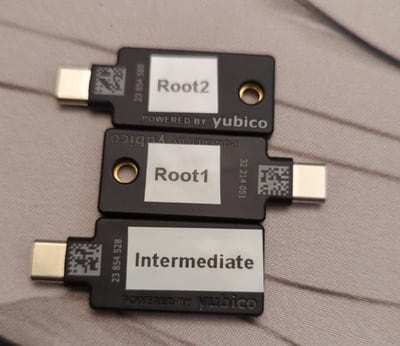
    An offline PKI enhances security by physically isolating the certificate authority from network threats. A YubiKey is a low-cost solution to store a root certificate. You also need an air-gapped environment to operate the root CA.
    PKI relying on a set of 3 YubiKeys: 2 for the root CA and 1 for the intermediate CA.
    Offline PKI backed up by 3 YubiKeys
    This post describes an offline PKI system using the following components: It is possible to add more YubiKeys as a backup of the root CA if needed. This is not needed for the intermediate CA as you can generate a new one if the current one gets destroyed.

    The software part offline-pki is a small Python application to manage an offline PKI. It relies on yubikey-manager to manage YubiKeys and cryptography for cryptographic operations not executed on the YubiKeys. The application has some opinionated design choices. Notably, the cryptography is hard-coded to use NIST P-384 elliptic curve. The first step is to reset all your YubiKeys:
    $ offline-pki yubikey reset
    This will reset the connected YubiKey. Are you sure? [y/N]: y
    New PIN code:
    Repeat for confirmation:
    New PUK code:
    Repeat for confirmation:
    New management key ('.' to generate a random one):
    WARNING[pki-yubikey] Using random management key: e8ffdce07a4e3bd5c0d803aa3948a9c36cfb86ed5a2d5cf533e97b088ae9e629
    INFO[pki-yubikey]  0: Yubico YubiKey OTP+FIDO+CCID 00 00
    INFO[pki-yubikey] SN: 23854514
    INFO[yubikit.management] Device config written
    INFO[yubikit.piv] PIV application data reset performed
    INFO[yubikit.piv] Management key set
    INFO[yubikit.piv] New PUK set
    INFO[yubikit.piv] New PIN set
    INFO[pki-yubikey] YubiKey reset successful!
    
    Then, generate the root CA and create as many copies as you want:
    $ offline-pki certificate root --permitted example.com
    Management key for Root X:
    Plug YubiKey "Root X"...
    INFO[pki-yubikey]  0: Yubico YubiKey CCID 00 00
    INFO[pki-yubikey] SN: 23854514
    INFO[yubikit.piv] Data written to object slot 0x5fc10a
    INFO[yubikit.piv] Certificate written to slot 9C (SIGNATURE), compression=True
    INFO[yubikit.piv] Private key imported in slot 9C (SIGNATURE) of type ECCP384
    Copy root certificate to another YubiKey? [y/N]: y
    Plug YubiKey "Root X"...
    INFO[pki-yubikey]  0: Yubico YubiKey CCID 00 00
    INFO[pki-yubikey] SN: 23854514
    INFO[yubikit.piv] Data written to object slot 0x5fc10a
    INFO[yubikit.piv] Certificate written to slot 9C (SIGNATURE), compression=True
    INFO[yubikit.piv] Private key imported in slot 9C (SIGNATURE) of type ECCP384
    Copy root certificate to another YubiKey? [y/N]: n
    
    You can inspect the result:
    $ offline-pki yubikey info
    INFO[pki-yubikey]  0: Yubico YubiKey CCID 00 00
    INFO[pki-yubikey] SN: 23854514
    INFO[pki-yubikey] Slot 9C (SIGNATURE):
    INFO[pki-yubikey]   Private key type: ECCP384
    INFO[pki-yubikey]   Public key:
    INFO[pki-yubikey]     Algorithm:  secp384r1
    INFO[pki-yubikey]     Issuer:     CN=Root CA
    INFO[pki-yubikey]     Subject:    CN=Root CA
    INFO[pki-yubikey]     Serial:     1
    INFO[pki-yubikey]     Not before: 2024-07-05T18:17:19+00:00
    INFO[pki-yubikey]     Not after:  2044-06-30T18:17:19+00:00
    INFO[pki-yubikey]     PEM:
    -----BEGIN CERTIFICATE-----
    MIIBcjCB+aADAgECAgEBMAoGCCqGSM49BAMDMBIxEDAOBgNVBAMMB1Jvb3QgQ0Ew
    HhcNMjQwNzA1MTgxNzE5WhcNNDQwNjMwMTgxNzE5WjASMRAwDgYDVQQDDAdSb290
    IENBMHYwEAYHKoZIzj0CAQYFK4EEACIDYgAERg3Vir6cpEtB8Vgo5cAyBTkku/4w
    kXvhWlYZysz7+YzTcxIInZV6mpw61o8W+XbxZV6H6+3YHsr/IeigkK04/HJPi6+i
    zU5WJHeBJMqjj2No54Nsx6ep4OtNBMa/7T9foyMwITAPBgNVHRMBAf8EBTADAQH/
    MA4GA1UdDwEB/wQEAwIBhjAKBggqhkjOPQQDAwNoADBlAjEAwYKy/L8leJyiZSnn
    xrY8xv8wkB9HL2TEAI6fC7gNc2bsISKFwMkyAwg+mKFKN2w7AjBRCtZKg4DZ2iUo
    6c0BTXC9a3/28V5aydZj6rvx0JqbF/Ln5+RQL6wFMLoPIvCIiCU=
    -----END CERTIFICATE-----
    
    Then, you can create an intermediate certificate with offline-pki yubikey intermediate and use it to sign certificates by providing a CSR to offline-pki certificate sign. Be careful and inspect the CSR before signing it, as only the subject name can be overridden. Check the documentation for more details. Get the available options using the --help flag.

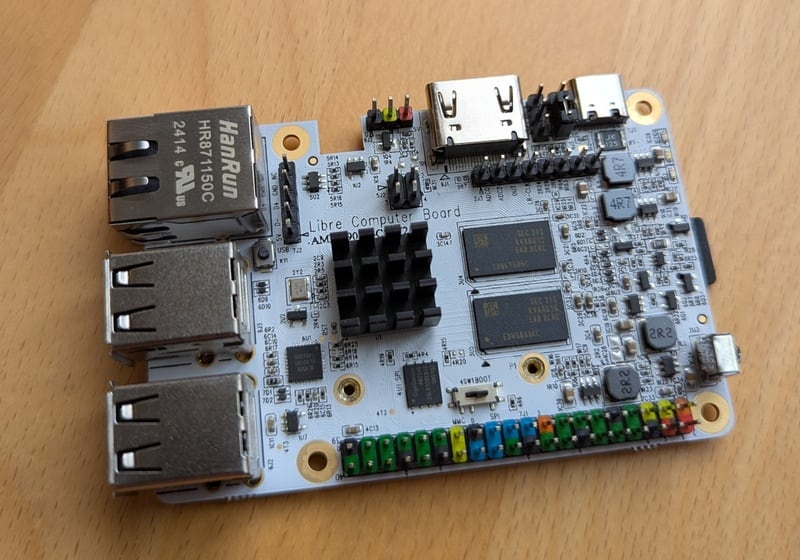
    The hardware part To ensure the operations on the root and intermediate CAs are air-gapped, a cost-efficient solution is to use an ARM64 single board computer. The Libre Computer Sweet Potato SBC is a more open alternative to the well-known Raspberry Pi.1
    Libre Computer Sweet Potato single board computer relying on the Amlogic S905X SOC
    Libre Computer Sweet Potato SBC, powered by the AML-S905X SOC
    I interact with it through an USB to TTL UART converter:
    $ tio /dev/ttyUSB0
    [16:40:44.546] tio v3.7
    [16:40:44.546] Press ctrl-t q to quit
    [16:40:44.555] Connected to /dev/ttyUSB0
    GXL:BL1:9ac50e:bb16dc;FEAT:ADFC318C:0;POC:1;RCY:0;SPI:0;0.0;CHK:0;
    TE: 36574
    BL2 Built : 15:21:18, Aug 28 2019. gxl g1bf2b53 - luan.yuan@droid15-sz
    set vcck to 1120 mv
    set vddee to 1000 mv
    Board ID = 4
    CPU clk: 1200MHz
    [ ]
    

    The Nix glue To bring everything together, I am using Nix with a Flake providing:
    • a package for the offline-pki application, with shell completion,
    • a development shell, including an editable version of the offline-pki application,
    • a NixOS module to setup the offline PKI, resetting the system at each boot,
    • a QEMU image for testing, and
    • an SD card image to be used on the Sweet Potato or another ARM64 SBC.
    # Execute the application locally
    nix run github:vincentbernat/offline-pki -- --help
    # Run the application inside a QEMU VM
    nix run github:vincentbernat/offline-pki\#qemu
    # Build a SD card for the Sweet Potato or for the Raspberry Pi
    nix build --system aarch64-linux github:vincentbernat/offline-pki\#sdcard.potato
    nix build --system aarch64-linux github:vincentbernat/offline-pki\#sdcard.generic
    # Get a development shell with the application
    nix develop github:vincentbernat/offline-pki
    

    1. The key for the root CA is not generated by the YubiKey. Using an air-gapped computer is all the more important. Put it in a safe with the YubiKeys when done!

    5 March 2025

    Otto Kek l inen: Will decentralized social media soon go mainstream?

    Featured image of post Will decentralized social media soon go mainstream?In today s digital landscape, social media is more than just a communication tool it is the primary medium for global discourse. Heads of state, corporate leaders and cultural influencers now broadcast their statements directly to the world, shaping public opinion in real time. However, the dominance of a few centralized platforms X/Twitter, Facebook and YouTube raises critical concerns about control, censorship and the monopolization of information. Those who control these networks effectively wield significant power over public discourse. In response, a new wave of distributed social media platforms has emerged, each built on different decentralized protocols designed to provide greater autonomy, censorship resistance and user control. While Wikipedia maintains a comprehensive list of distributed social networking software and protocols, it does not cover recent blockchain-based systems, nor does it highlight which have the most potential for mainstream adoption. This post explores the leading decentralized social media platforms and the protocols they are based on: Mastodon (ActivityPub), Bluesky (AT Protocol), Warpcast (Farcaster), Hey (Lens) and Primal (Nostr).

    Comparison of architecture and mainstream adoption potential
    Protocol Identity System Example Storage model Cost for end users Potential
    Mastodon Tied to server domain @ottok@mastodon.social Federated instances Free (some instances charge) High
    Bluesky Portable (DID) ottoke.bsky.social Federated instances Free Moderate
    Farcaster ENS (Ethereum) @ottok Blockchain + off-chain Small gas fees Moderate
    Lens NFT-based (Polygon) @ottok Blockchain + off-chain Small gas fees Niche
    Nostr Cryptographic Keys npub16lc6uhqpg6dnqajylkhwuh3j7ynhcnje508tt4v6703w9kjlv9vqzz4z7f Federated instances Free (some instances charge) Niche

    1. Mastodon (ActivityPub) Screenshot of Mastodon Mastodon was created in 2016 by Eugen Rochko, a German software developer who sought to provide a decentralized and user-controlled alternative to Twitter. It was built on the ActivityPub protocol, now standardized by W3C Social Web Working Group, to allow users to join independent servers while still communicating across the broader Mastodon network. Mastodon operates on a federated model, where multiple independently run servers communicate via ActivityPub. Each server sets its own moderation policies, leading to a decentralized but fragmented experience. The servers can alternatively be called instances, relays or nodes, depending on what vocabulary a protocol has standardized on.
    • Identity: User identity is tied to the instance where they registered, represented as @username@instance.tld.
    • Storage: Data is stored on individual instances, which federate messages to other instances based on their configurations.
    • Cost: Free to use, but relies on instance operators willing to run the servers.
    The protocol defines multiple activities such as:
    • Creating a post
    • Liking
    • Sharing
    • Following
    • Commenting

    Example Message in ActivityPub (JSON-LD Format)
    json
     
     "@context": "https://www.w3.org/ns/activitystreams",
     "type": "Create",
     "actor": "https://mastodon.social/users/ottok",
     "object":  
     "type": "Note",
     "content": "Hello from #Mastodon!",
     "published": "2025-03-03T12:00:00Z",
     "to": ["https://www.w3.org/ns/activitystreams#Public"]
      
     
    Servers communicate across different platforms by publishing activities to their followers or forwarding activities between servers. Standard HTTPS is used between servers for communication, and the messages use JSON-LD for data representation. The WebFinger protocol is used for user discovery. There is however no neat way for home server discovery yet. This means that if you are browsing e.g. Fosstodon and want to follow a user and press Follow, a dialog will pop up asking you to enter your own home server (e.g. mastodon.social) to redirect you there for actually executing the Follow action on with your account. Mastodon is open source under the AGPL at github.com/mastodon/mastodon. Anyone can operate their own instance. It just requires to run your own server and some skills to maintain a Ruby on Rails app with a PostgreSQL database backend, and basic understanding of the protocol to configure federation with other ActivityPub instances.

    Popularity: Already established, but will it grow more? Mastodon has seen steady growth, especially after Twitter s acquisition in 2022, with some estimates stating it peaked at 10 million users across thousands of instances. However, its fragmented user experience and the complexity of choosing instances have hindered mainstream adoption. Still, it remains the most established decentralized alternative to Twitter. Note that Donald Trump s Truth Social is based on the Mastodon software but does not federate with the ActivityPub network. The ActivityPub protocol is the most widely used of its kind. One of the other most popular services is the Lemmy link sharing service, similar to Reddit. The larger ecosystem of ActivityPub is called Fediverse, and estimates put the total active user count around 6 million.

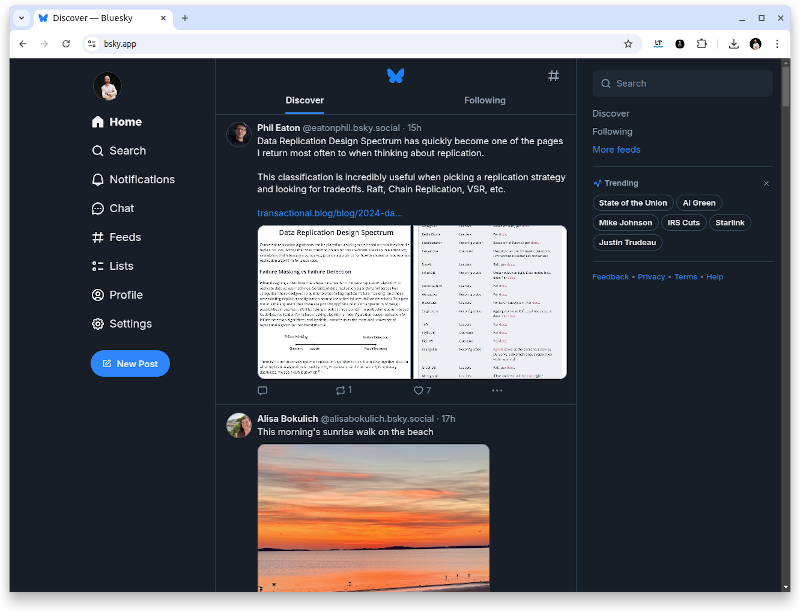
    2. Bluesky (AT Protocol) Screenshot of Bluesky Interestingly, Bluesky was conceived within Twitter in 2019 by Twitter founder Jack Dorsey. After being incubated as a Twitter-funded project, it spun off as an independent Public Benefit LLC in February 2022 and launched its public beta in February 2023. Bluesky runs on top of the Authenticated Transfer (AT) Protocol published at https://github.com/bluesky-social/atproto. The protocol enables portable identities and data ownership, meaning users can migrate between platforms while keeping their identity and content intact. In practice, however, there is only one popular server at the moment, which is Bluesky itself.
    • Identity: Usernames are domain-based (e.g., @user.bsky.social).
    • Storage: Content is theoretically federated among various servers.
    • Cost: Free to use, but relies on instance operators willing to run the servers.

    Example Message in AT Protocol (JSON Format)
    json
     
     "repo": "did:plc:ottoke.bsky.social",
     "collection": "app.bsky.feed.post",
     "record":  
     "$type": "app.bsky.feed.post",
     "text": "Hello from Bluesky!",
     "createdAt": "2025-03-03T12:00:00Z",
     "langs": ["en"]


    Popularity: Hybrid approach may have business benefits? Bluesky reported over 3 million users by 2024, probably getting traction due to its Twitter-like interface and Jack Dorsey s involvement. Its hybrid approach decentralized identity with centralized components could make it a strong candidate for mainstream adoption, assuming it can scale effectively.

    3. Warpcast (Farcaster Network) Farcaster was launched in 2021 by Dan Romero and Varun Srinivasan, both former crypto exchange Coinbase executives, to create a decentralized but user-friendly social network. Built on the Ethereum blockchain, it could potentially offer a very attack-resistant communication medium. However, in my own testing, Farcaster does not seem to fully leverage what Ethereum could offer. First of all, there is no diversity in programs implementing the protocol as at the moment there is only Warpcast. In Warpcast the signup requires an initial 5 USD fee that is not payable in ETH, and users need to create a new wallet address on the Ethereum layer 2 network Base instead of simply reusing their existing Ethereum wallet address or ENS name. Despite this, I can understand why Farcaster may have decided to start out like this. Having a single client program may be the best strategy initially. One of the decentralized chat protocol Matrix founders, Matthew Hodgson, shared in his FOSDEM 2025 talk that he slightly regrets focusing too much on developing the protocol instead of making sure the app to use it is attractive to end users. So it may be sensible to ensure Warpcast gets popular first, before attempting to make the Farcaster protocol widely used. As a protocol Farcaster s hybrid approach makes it more scalable than fully on-chain networks, giving it a higher chance of mainstream adoption if it integrates seamlessly with broader Web3 ecosystems.
    • Identity: ENS (Ethereum Name Service) domains are used as usernames.
    • Storage: Messages are stored in off-chain hubs, while identity is on-chain.
    • Cost: Users must pay gas fees for some operations but reading and posting messages is mostly free.

    Example Message in Farcaster (JSON Format)
    json
     
     "fid": 766579,
     "username": "ottok",
     "custodyAddress": "0x127853e48be3870172baa4215d63b6d815d18f21",
     "connectedWallet": "0x3ebe43aa3ae5b891ca1577d9c49563c0cee8da88",
     "text": "Hello from Farcaster!",
     "publishedAt": 1709424000,
     "replyTo": null,
     "embeds": []
     

    Popularity: Decentralized social media + decentralized payments a winning combo? Ethereum founder Vitalik Buterin (warpcast.com/vbuterin) and many core developers are active on the platform. Warpcast, the main client for Farcaster, has seen increasing adoption, especially among Ethereum developers and Web3 enthusiasts. I too have an profile at warpcast.com/ottok. However, the numbers are still very low and far from reaching network effects to really take off. Blockchain-based social media networks, particularly those built on Ethereum, are compelling because they leverage existing user wallets and persistent identities while enabling native payment functionality. When combined with decentralized content funding through micropayments, these blockchain-backed social networks could offer unique advantages that centralized platforms may find difficult to replicate, being decentralized both as a technical network and in a funding mechanism.

    4. Hey.xyz (Lens Network) The Lens Protocol was developed by decentralized finance (DeFi) team Aave and launched in May 2022 to provide a user-owned social media network. While initially built on Polygon, it has since launched its own Layer 2 network called the Lens Network in February 2024. Lens is currently the main competitor to Farcaster. Lens stores profile ownership and references on-chain, while content is stored on IPFS/Arweave, enabling composability with DeFi and NFTs.
    • Identity: Profile ownership is tied to NFTs on the Polygon blockchain.
    • Storage: Content is on-chain and integrates with IPFS/Arweave (like NFTs).
    • Cost: Users must pay gas fees for some operations but reading and posting messages is mostly free.

    Example Message in Lens (JSON Format)
    json
     
     "profileId": "@ottok",
     "contentURI": "ar://QmExampleHash",
     "collectModule": "0x23b9467334bEb345aAa6fd1545538F3d54436e96",
     "referenceModule": "0x0000000000000000000000000000000000000000",
     "timestamp": 1709558400
     

    Popularity: Probably not as social media site, but maybe as protocol? The social media side of Lens is mainly the Hey.xyz website, which seems to have fewer users than Warpcast, and is even further away from reaching critical mass for network effects. The Lens protocol however has a lot of advanced features and it may gain adoption as the building block for many Web3 apps.

    5. Primal.net (Nostr Network) Nostr (Notes and Other Stuff Transmitted by Relays) was conceptualized in 2020 by an anonymous developer known as fiatjaf. One of the primary design tenets was to be a censorship-resistant protocol and it is popular among Bitcoin enthusiasts, with Jack Dorsey being one of the public supporters. Unlike the Farcaster and Lens protocols, Nostr is not blockchain-based but just a network of relay servers for message distribution. If does however use public key cryptography for identities, similar to how wallets work in crypto.
    • Identity: Public-private key pairs define identity (with prefix npub...).
    • Storage: Content is federated among multiple servers, which in Nostr vocabulary are called relays.
    • Cost: No gas fees, but relies on relay operators willing to run the servers.

    Example Message in Nostr (JSON Format)
    json
     
     "id": "note1xyz...",
     "pubkey": "npub1...",
     "kind": 1,
     "content": "Hello from Nostr!",
     "created_at": 1709558400,
     "tags": [],
     "sig": "sig1..."
     

    Popularity: If Jack Dorsey and Bitcoiners promote it enough? Primal.net as a web app is pretty solid, but it does not stand out much. While Jack Dorsey has shown support by donating $1.5 million to the protocol development in December 2021, its success likely depends on broader adoption by the Bitcoin community.

    Will any of these replace X/Twitter? As usage patterns vary, the statistics are not fully comparable, but this overview of the situation in March 2025 gives a decent overview.
    Platform Total Accounts Active Users Growth Trend
    Mastodon ~10 million ~1 million Steady
    Bluesky ~33 million ~1 million Steady
    Nostr ~41 million ~20 thousand Steady
    Farcaster ~850 thousand ~50 thousand Flat
    Lens ~140 thousand ~20 thousand Flat
    Mastodon and Bluesky have already reached millions of users, while Lens and Farcaster are growing within crypto communities. It is however clear that none of these are anywhere close to how popular X/Twitter is. In particular, Mastodon had a huge influx of users in the fall of 2022 when Twitter was acquired, but to challenge the incumbents the growth would need to significantly accelerate. We can all accelerate this development by embracing decentralized social media now alongside existing dominant platforms. Who knows, given the right circumstances maybe X.com leadership decides to change the operating model and start federating contents to break out from a walled garden model. The likelyhood of such development would increase if decentralized networks get popular, and the encumbents feel they need to participate to not lose out.

    Past and future The idea of decentralized social media is not new. One early pioneer identi.ca launched in 2008, only two years after Twitter, using the OStatus protocol to promote decentralization. A few years later it evolved into pump.io with the ActivityPump protocol, and also forked into GNU Social that continued with OStatus. I remember when these happened, and that in 2010 also Diaspora launched with fairly large publicity. Surprisingly both of these still operate (I can still post both on identi.ca and diasp.org), but the activity fizzled out years ago. The protocol however survived partially and evolved into ActivityPub, which is now the backbone of the Fediverse. The evolution of decentralized social media over the next decade will likely parallel developments in democracy, freedom of speech and public discourse. While the early 2010s emphasized maximum independence and freedom, the late 2010s saw growing support for content moderation to combat misinformation. The AI era introduces new challenges, potentially requiring proof-of-humanity verification for content authenticity. Key factors that will determine success:
    • User experience and ease of onboarding
    • Network effects and critical mass of users
    • Integration with existing web3 infrastructure
    • Balance between decentralization and usability
    • Sustainable economic models for infrastructure
    This is clearly an area of development worth monitoring closely, as the next few years may determine which protocol becomes the de facto standard for decentralized social communication.

    28 February 2025

    Antoine Beaupr : testing the fish shell

    I have been testing fish for a couple months now (this file started on 2025-01-03T23:52:15-0500 according to stat(1)), and those are my notes. I suspect people will have Opinions about my comments here. Do not comment unless you have some Constructive feedback to provide: I don't want to know if you think I am holding it Wrong. Consider that I might have used UNIX shells for longer that you have lived. I'm not sure I'll keep using fish, but so far it's the first shell that survived heavy use outside of zsh(1) (unless you count tcsh(1), but that was in another millenia). My normal shell is bash(1), and it's still the shell I used everywhere else than my laptop, as I haven't switched on all the servers I managed, although it is available since August 2022 on torproject.org servers. I first got interested in fish because they ported to Rust, making it one of the rare shells out there written in a "safe" and modern programming language, released after an impressive ~2 year of work with Fish 4.0.

    Cool things Current directory gets shortened, ~/wikis/anarc.at/software/desktop/wayland shows up as ~/w/a/s/d/wayland Autocompletion rocks. Default prompt rocks. Doesn't seem vulnerable to command injection assaults, at least it doesn't trip on the git-landmine. It even includes pipe status output, which was a huge pain to implement in bash. Made me realized that if the last command succeeds, we don't see other failures, which is the case of my current prompt anyways! Signal reporting is better than my bash implementation too. So far the only modification I have made to the prompt is to add a printf '\a' to output a bell. By default, fish keeps a directory history (but separate from the pushd stack), that can be navigated with cdh, prevd, and nextd, dirh shows the history.

    Less cool I feel there's visible latency in the prompt creation. POSIX-style functions (foo() true ) are unsupported. Instead, fish uses whitespace-sensitive definitions like this:
    function foo
        true
    end
    
    This means my (modest) collection of POSIX functions need to be ported to fish. Workaround: simple functions can be turned into aliases, which fish supports (but implements using functions). EOF heredocs are considered to be "minor syntactic sugar". I find them frigging useful. Process substitution is split on newlines, not whitespace. you need to pipe through string split -n " " to get the equivalent. <(cmd) doesn't exist: they claim you can use cmd foo - as a replacement, but that's not correct: I used <(cmd) mostly where foo does not support - as a magic character to say 'read from stdin'. Documentation is... limited. It seems mostly geared the web docs which are... okay (but I couldn't find out about ~/.config/fish/conf.d there!), but this is really inconvenient when you're trying to browse the manual pages. For example, fish thinks there's a fish_prompt manual page, according to its own completion mechanism, but man(1) cannot find that manual page. I can't find the manual for the time command (which is actually a keyword!) Fish renders multi-line commands with newlines. So if your terminal looks like this, say:
    anarcat@angela:~> sq keyring merge torproject-keyring/lavamind-
    95F341D746CF1FC8B05A0ED5D3F900749268E55E.gpg torproject-keyrin
    g/weasel-E3ED482E44A53F5BBE585032D50F9EBC09E69937.gpg   wl-copy
    
    ... but it's actually one line, when you copy-paste the above, in foot(1), it will show up exactly like this, newlines and all:
    sq keyring merge torproject-keyring/lavamind-
    95F341D746CF1FC8B05A0ED5D3F900749268E55E.gpg torproject-keyrin
    g/weasel-E3ED482E44A53F5BBE585032D50F9EBC09E69937.gpg   wl-copy
    
    Whereas it should show up like this:
    sq keyring merge torproject-keyring/lavamind-95F341D746CF1FC8B05A0ED5D3F900749268E55E.gpg torproject-keyring/weasel-E3ED482E44A53F5BBE585032D50F9EBC09E69937.gpg   wl-copy
    
    Note that this is an issue specific to foot(1), alacritty(1) and gnome-terminal(1) don't suffer from that issue. I have already filed it upstream in foot and it is apparently fixed already. Globbing is driving me nuts. You can't pass a * to a command unless fish agrees it's going to match something. You need to escape it if it doesn't immediately match, and then you need the called command to actually support globbing. 202[345] doesn't match folders named 2023, 2024, 2025, it will send the string 202[345] to the command.

    Blockers () is like $(): it's process substitution, and not a subshell. This is really impractical: I use ( cd foo ; do_something) all the time to avoid losing the current directory... I guess I'm supposed to use pushd for this, but ouch. This wouldn't be so bad if it was just for cd though. Clean constructs like this:
    ( git grep -l '^#!/.*bin/python' ; fdfind .py )   sort -u
    
    Turn into what i find rather horrible:
    begin; git grep -l '^#!/.*bin/python' ; fdfind .py ; end   sort -ub
    
    It... works, but it goes back to "oh dear, now there's a new langage again". I only found out about this construct while trying:
      git grep -l '^#!/.*bin/python' ; fdfind .py     sort -u 
    
    ... which fails and suggests using begin/end, at which point: why not just support the curly braces? FOO=bar is not allowed. It's actually recognized syntax, but creates a warning. We're supposed to use set foo bar instead. This really feels like a needless divergence from standard. Aliases are... peculiar. Typical constructs like alias mv="\mv -i" don't work because fish treats aliases as a function definition, and \ is not magical there. This can be worked around by specifying the full path to the command, with e.g. alias mv="/bin/mv -i". Another problem is trying to override a built-in, which seems completely impossible. In my case, I like the time(1) command the way it is, thank you very much, and fish provides no way to bypass that builtin. It is possible to call time(1) with command time, but it's not possible to replace the command keyword so that means a lot of typing. Again: you can't use \ to bypass aliases. This is a huge annoyance for me. I would need to learn to type command in long form, and I use that stuff pretty regularly. I guess I could alias command to c or something, but this is one of those huge muscle memory challenges. alt . doesn't always work the way i expect.

    9 February 2025

    Philipp Kern: 20 years

    20 years ago, I got my Debian Developer account. I was 18 at the time, it was Shrove Tuesday and - as is customary - I was drunk when I got the email. There was so much that I did not know - which is also why the process took 1.5 years from the time I applied. I mostly only maintained a package or two. I'm still amazed that Christian Perrier and Joerg Jaspert put sufficient trust in me at that time. Nevertheless now feels like a good time for a personal reflection of my involvement in Debian.
    During my studies I took on more things. In January 2008 I joined the Release Team as an assistant, which taught me a lot of code review. I have been an Application Manager on the side.
    Going to my first Debconf was really a turning point. My first one was Mar del Plata in Argentina in August 2008, when I was 21. That was quite an excitement, traveling that far from Germany for the first time. The personal connections I made there made quite the difference. It was also a big boost for motivation. I attended 8 (Argentina), 9 (Spain), 10 (New York), 11 (Bosnia and Herzegovina), 12 (Nicaragua), 13 (Switzerland), 14 (Portland), 15 (Germany), 16 (South Africa), and hopefully I'll make it to this year's in Brest. At all of them I did not see much of the countries as I prioritized all of my time focused on Debian, even skipping some of the day trips in favor of team meetings. Yet I am very grateful to the project (and to my employer) for shipping me there.I ended up as Stable Release Manager for a while, from August 2008 - when Martin Zobel-Helas moved into DSA - until I got dropped in March 2020. I think my biggest achievements were pushing for the creation of -updates in favor of a separate volatile archive and a change of the update policy to allow for more common sense updates in the main archive vs. the very strict "breakage or security" policy we had previously. I definitely need to call out Adam D. Barratt for being the partner in crime, holding up the fort for even longer.In 2009 I got too annoyed at the existing wanna-build team not being responsive anymore and pushed for the system to be given to a new team. I did not build it and significant contributions were done by other people (like Andreas Barth and Joachim Breitner, and later Aurelien Jarno). I mostly reworked the way the system was triggered, investigated when it broke and was around when people wanted things merged.
    In the meantime I worked sys/netadmin jobs while at university, both paid and as a volunteer with the students' council. For a year or two I was the administrator of a System z mainframe IBM donated to my university. We had a mainframe course and I attended two related conferences. That's where my s390(x) interest came from, although credit for the port needs to go to Aurelien Jarno.
    Since completing university in 2013 I have been working for a company for almost 12 years. Debian experience was very relevant to the job and I went on maintaining a Linux distro or two at work - before venturing off into security hardening. People in megacorps - in my humble opinion - disappear from the volunteer projects because a) they might previously have been studying and thus had a lot more time on their hands and b) the job is too similar to the volunteer work and thus the same brain cells used for work are exhausted and can't be easily reused for volunteer work. I kept maintaining a couple of things (buildds, some packages) - mostly because of a sense of commitment and responsibility, but otherwise kind of scaled down my involvement. I also felt less connected as I dropped off IRC.Last year I finally made it to Debian events again: MiniDebconf in Berlin, where we discussed the aftermath of the xz incident, and the Debian BSP in Salzburg. I rejoined IRC using the Matrix bridge. That also rekindled my involvement, with me guiding a new DD through NM and ending up in DSA. To be honest, only in the last two or three years I felt like a (more) mature old-timer.
    I have a new gig at work lined up to start soon and next to that I have sysadmining for Debian. It is pretty motivating to me that I can just get things done - something that is much harder to achieve at work due to organizational complexities. It balances out some frustration I'd otherwise have. The work is different enough to be enjoyable and the people I work with are great.

    The future
    I still think the work we do in Debian is important, as much as I see a lack of appreciation in a world full of containers. We are reaping most of the benefits of standing on the shoulders of giants and of great decisions made in the past (e.g. the excellent Debian policy, but also the organizational model) that made Debian what it is today.Given the increase in size and complexity of what Debian ships - and the somewhat dwindling resource of developer time, it would benefit us to have better processes for large-scale changes across all packages. I greatly respect the horizontal effects that are currently being driven and that suck up a lot of energy.A lot of our infrastructure is also aging and not super well maintained. Many take it for granted that the services we have keep existing, but most are only maintained by a person or two, if even. Software stacks are aging and it is even a struggle to have all necessary packages in the next release.Hopefully I can contribute a bit or two to these efforts in the future.

    2 February 2025

    Bits from Debian: Bits from the DPL

    Dear Debian community, this is bits from DPL for January. Sovereign Tech Agency I was recently pointed to Technologies and Projects supported by the Sovereign Tech Agency which is financed by the German Federal Ministry for Economic Affairs and Climate Action. It is a subsidiary of the Federal Agency for Disruptive Innovation, SPRIND GmbH. It is worth sending applications there for distinct projects as that is their preferred method of funding. Distinguished developers can also apply for a fellowship position that pays up to 40hrs / week (32hrs when freelancing) for a year. This is esp. open to maintainers of larger numbers of packages in Debian (or any other Linux distribution). There might be a chance that some of the Debian-related projects submitted to the Google Summer of Code that did not get funded could be retried with those foundations. As per the FAQ of the project: "The Sovereign Tech Agency focuses on securing and strengthening open and foundational digital technologies. These communities working on these are distributed all around the world, so we work with people, companies, and FOSS communities everywhere." Similar funding organizations include the Open Technology Fund and FLOSS/fund. If you have a Debian-related project that fits these funding programs, they might be interesting options. This list is by no means exhaustive just some hints I ve received and wanted to share. More suggestions for such opportunities are welcome. Year of code reviews On the debian-devel mailing list, there was a long thread titled "Let's make 2025 a year when code reviews became common in Debian". It initially suggested something along the lines of: "Let's review MRs in Salsa." The discussion quickly expanded to include patches that have been sitting in the BTS for years, which deserve at least the same attention. One idea I'd like to emphasize is that associating BTS bugs with MRs could be very convenient. It s not only helpful for documentation but also the easiest way to apply patches. I d like to emphasize that no matter what workflow we use BTS, MRs, or a mix it is crucial to uphold Debian s reputation for high quality. However, this reputation is at risk as more and more old issues accumulate. While Debian is known for its technical excellence, long-standing bugs and orphaned packages remain a challenge. If we don t address these, we risk weakening the high standards that Debian is valued for. Revisiting old issues and ensuring that unmaintained packages receive attention is especially important as we prepare for the Trixie release. Debian Publicity Team will no longer post on X/Twitter The Press Team has my full support in its decision to stop posting on X. As per the Publicity delegation: the team once decided to join Twitter, but circumstances have since changed. The current Press delegates have the institutional authority to leave X, just as their predecessors had the authority to join. I appreciate that the team carefully considered the matter, reinforced by the arguments developed on the debian-publicity list, and communicated its reasoning openly. Kind regards, Andreas.

    29 January 2025

    Sergio Talens-Oliag: Testing DeepSeek with Ollama and Open WebUI

    With all the recent buzz about DeepSeek and its capabilities, I ve decided to give it a try using Ollama and Open WebUI on my work laptop which has an NVIDIA GPU:
    $ lspci   grep NVIDIA
    0000:01:00.0 3D controller: NVIDIA Corporation GA107GLM [RTX A2000 8GB Laptop GPU]
                 (rev a1)
    For the installation I initially I looked into the approach suggested on this article, but after reviewing it I decided to go for a docker only approach, as it leaves my system clean and updates are easier.

    Step 0: Install dockerI already had it on my machine, so nothing to do here.

    Step 1: Install the nvidia-container-toolkit packageAs it is needed to use the NVIDIA GPU with docker I followed the instructions to install the package using apt from the NVIDIA website.

    Step 2: Run the Open WebUI container bundled with OllamaI could install ollama directly on linux or run it on docker, but I found out that there is a container with Open WebUI bundled with Ollama, so I decided to use it instead. To start the container I ve executed the following command:
    docker run -d \
      -e OLLAMA_HOST="0.0.0.0:11434" -p 127.0.0.1:11434:11434 \
      -p 127.0.0.1:3000:8080 \
      -v ollama:/root/.ollama \
      -v open-webui:/app/backend/data \
      --gpus=all --name open-webui --restart always \
      ghcr.io/open-webui/open-webui:ollama
    Once the container is up and running, I can access the Open WebUI on http://localhost:3000/ and the Ollama API on http://localhost:11434/ (I added the OLLAMA_HOST environment variable to be bind the server to all the container IPs, as it is needed to export it to the host).

    Step 3: Install DeepSeek-R1 model from Open WebUIAfter creating an admin user on the Open WebUI, I went to the select a model button and asked to download the deepseek-r1 model (at the time of writing this it matches version deepseek-r1:7b, which uses 4.7GB of space). After the download was completed I was able to start chatting with the model on my local machine.

    Step 4: Ask a questionThe first question I asked was Can you tell me what is Debian? and the answer I got was:
    Debian is one of the most popular Linux distributions used worldwide. It is an
    open-source operating system that has been around since 1993 and is known for
    its stability, security, and reliability. Debian is widely used in servers, data
    centers, and enterprise environments because it provides a robust base platform
    with excellent documentation, tools, and community support.
    ### Key Features of Debian:
    
    1. **History**:
       - Debian started as a project called "Pop!!" (Pootle) led by Lars Knutsen, a
         developer from Denmark.
       - It was initially forked from the Linux distribution Red Hat's RH-Debian to
         gain independence and reduce reliance on Red Hat.
    
    2. **Use Cases**:
       - Debian is commonly used as an operating system for servers due to its
         reliability and ease of use in enterprise environments.
       - It is also used for individual user machines (laptops, desktops) because it
         offers a smooth and stable experience.
       - Debian provides the foundation for many popular derivatives like Ubuntu,
         which are designed for consumer use.
    
    3. **Supported Architectures**:
       - Debian supports all major Linux architectures, including 32-bit and 64-bit
         systems, and runs on a wide range of hardware from old servers to modern
         smartphones.
    
    4. **Package Management**:
       - Debian comes with a robust package management system called **Debian Policy
         Language (DPL)**, which allows users to easily install, update, and manage
         software packages.
       - This makes it easy for users to keep their systems up to date without
         needing to download multiple repositories or deal with version conflicts.
    
    5. **Security Focus**:
       - Debian is known for its strong security practices. It has a reputation for
         being one of the most stable Linux distributions, making it a favorite
         among organizations that prioritize security.
       - The distribution regularly updates its software packages to patch
         vulnerabilities and protect against common attacks.
    
    6. **Compatibility with Servers**:
       - Debian is widely used in data centers because it provides a consistent and
         reliable environment for running servers and applications.
       - Many open-source projects are compatible with Debian, making it an ideal
         choice for developers who want to work on servers or distributed systems.
    
    7. **Popularity**:
       - Debian has a large and active community of users and contributors.
       - It is one of the most widely used Linux distributions in the world, with
         many enterprise organizations relying on it as their primary operating
         system.
    ### Comparison with Other Distributions:
    - **Ubuntu**: Ubuntu is based on Debian but adds graphical user interfaces (like
      Gutsy Gibbon), modern tools (like GIMP and LibreOffice), and integrates with
      Microsoft services.
    - **RHEL (Red Hat Enterprise Linux)**: RHEL is a derivative of Red Hat's
      distribution, which forked from Debian. It focuses more heavily on enterprise
      security and support compared to Debian.
    ### Why Debian?
    Debian is popular because:
    - It is free and open-source, making it accessible to anyone.
    - It provides excellent documentation and tools for system administrators.
    - It has a strong focus on stability and reliability.
    - It supports a wide range of hardware and software needs.
    If you're looking for a reliable and flexible Linux distribution that works well
    in both personal and enterprise environments, Debian is an excellent choice.
    Haven t tried the same question with ChatGPT, but the History, Package Management and Comparison with Other Distributions sections are hilarious, but they provided me with important data:
    • Now I know that APT is the real Debian Project Leader, what don t know is why we have elections each year ;)
    • Linux Distributions are recursive Debian was a fork of Red Hat, which was a fork of Debian, which was a fork of Red Hat,
    As everybody is testing the model I will not talk more about the chat and the results, I just thought that this answer was really funny.

    Step 5: Install the DeepSeek Coder and DeepSeek Coder v2 models from Open WebUIAs done before, to download the models I went to the select a model button and asked to download the deepseek-coder and deepseek-coder-v2 models (the default version of version one is said to be really quick and small, while version two is supposed to be better but slower and bigger, so I decided to install both for testing).

    Step 6: Integrate Ollama with NeovimSince some months ago I ve been using Github Copilot with Neovim; I don t feel it has been very helpful in the general case, but I wanted to try it and it comes handy when you need to perform repetitive tasks when programming. It seems that there are multiple neovim plugins that support ollama, for now I ve installed and configured the codecompanion plugin on my config.lua file using packer:
    require('packer').startup(function()
      [...]
      -- Codecompanion plugin
      use  
        "olimorris/codecompanion.nvim",
        requires =  
          "nvim-lua/plenary.nvim",
          "nvim-treesitter/nvim-treesitter",
         
       
      [...]
    end)
    [...]
    -- --------------------------------
    -- BEG: Codecompanion configuration
    -- --------------------------------
    -- Module setup
    local codecompanion = require('codecompanion').setup( 
      adapters =  
        ollama = function()
          return require('codecompanion.adapters').extend('ollama',  
            schema =  
              model =  
                default = 'deepseek-coder-v2:latest',
               
             ,
           )
        end,
       ,
      strategies =  
        chat =   adapter = 'ollama',  ,
        inline =   adapter = 'ollama',  ,
       ,
     )
    -- --------------------------------
    -- END: Codecompanion configuration
    -- --------------------------------
    I ve tested it a little bit and it seems to work fine, but I ll have to test it more to see if it is really useful, I ll try to do it on future projects.

    ConclusionAt a personal level I don t like nor trust AI systems, but as long as they are treated as tools and not as a magical thing you must trust they have their uses and I m happy to see that open source tools like Ollama and models like DeepSeek available for everyone to use.

    1 January 2025

    Russ Allbery: 2024 Book Reading in Review

    In 2024, I finished and reviewed 46 books, not counting another three books I've finished but not yet reviewed and which will therefore roll over to 2025. This is slightly fewer books than the last couple of years, but more books than 2021. Reading was particularly spotty this year, with much of the year's reading packed into late November and December. This was a year in which I figured out I was trying to do too much, but did not finish figuring out what to do about it. Reading and particularly reviewing reflected that, with long silent periods and then attempts to catch up. One of the goals for next year is to find a more sustainable balance for the hobbies in my life, including reading. My favorite books I read this year were Ashley Herring Blake's Bright Falls sapphic romance trilogy: Delilah Green Doesn't Care, Astrid Parker Doesn't Fail, and Iris Kelly Doesn't Date. These are not perfect books, but they made me laugh, made me cry, and were impossible to put down. My thanks to a video from BookTuber Georgia Marie for the recommendation. I Shall Wear Midnight was the best of the remaining Pratchett novels. It's the penultimate Tiffany Aching book and, in my opinion, the best. All of the elements of the previous books come together in snarky competence porn that was a delight to read. The best book I read last year was Mark Lawrence's The Book That Wouldn't Burn, which much to my surprise did not make a single award list for its publication year of 2023. It was a tour de force of world-building that surprised me multiple times. Unfortunately, the sequel was not as good and I fear the series may be heading in the wrong direction. I am attempting to stay hopeful about the upcoming third and concluding book. I didn't read much non-fiction this year, but the best of what I did read was Zeke Faux's Number Go Up about the cryptocurrency bubble. This book will not change anyone's mind, but it's a readable and entertaining summary of some of the more obvious cryptocurrency scams. I also had enough quibbles with it to write an extended review, which is a compliment of sorts. The Discworld read-through is done, so I may either start or return to another series re-read in 2025. I have a huge backlog of all sorts of books, though, so we will see how the year goes. As always, I have no specific numeric goals, just a hope that I can make time for regular and varied reading and maintain a rhythm with writing reviews. The full analysis includes some additional personal reading statistics, probably only of interest to me.

    Louis-Philippe V ronneau: 2024 A Musical Retrospective

    Another musical retrospective. If you enjoy this, I also did a 2022 and a 2023 one. Albums In 2024, I added 88 new albums to my collection that's a lot! This year again, I bought the vast majority of my music on Bandcamp. To be honest, I'm quite distraught by what's become of that website. Although it stays a wonderful place to buy underground music, Songtradr, the new owner of the platform, has been shown to be viciously anti-union. Money continues to ruin the world, I guess. Concerts I continued to go to a lot of concerts in 2024 (25!). Over the past 3 years, I have been going to more and more concerts, and I think I've reached my "peak". A mean of a concert every two weeks is quite a lot :) If you also like music and concerts, but find yourself not going to as many as you would like, the real secret is not to be afraid to go to concerts alone. Going with friends is always fun, but if I restricted myself to only going to concerts in a group, I'd barely see a few each year. Another good advice is to bring a book or something else1 to pass the time between sets. It can often take 30-45 minutes between sets for the artists to get their instruments ready, which can get quite boring if you just stand there and wait. Anyway, here are the concerts I went to in 2024: Shout out to the Gancio project and to the folks running the Montreal instance. It continues to be a smash hit and most of the interesting concerts end up being advertised there. See you all in 2025!




    1. I bought a Miyoo Mini Plus, a handheld Linux console running OnionOS, for that express reason. So far it's been great and I've been very happy to revisit some childhood classics.

    31 December 2024

    Russ Allbery: Review: Metal from Heaven

    Review: Metal from Heaven, by August Clarke
    Publisher: Erewhon
    Copyright: November 2024
    ISBN: 1-64566-099-0
    Format: Kindle
    Pages: 443
    Metal from Heaven is industrial-era secondary-world fantasy with a literary bent. It is a complete story in one book, and I would be very surprised by a sequel. Clarke previously wrote the Scapegracers young-adult trilogy, which got excellent reviews and a few award nominations, as H.A. Clarke. This is his first adult novel.
    Know I adore you. Look out over the glow. The cities sundered, their machines inverted, mountains split and prairies blazing, that long foreseen Hereafter crowning fast. This calamity is a promise made to you. A prayer to you, and to your shadow which has become my second self, tucked behind my eye and growing in tandem with me, pressing outwards through the pupil, the smarter, truer, almost bursting reason for our wrath. Do not doubt me. Just look. Watch us rise as the sun comes up over the beauty. The future stains the bleakness so pink. When my violence subsides, we will have nothing, and be champions.
    Marney Honeycutt is twelve years old, a factory worker, and lustertouched. She works in the Yann I. Chauncey Ichorite Foundry in Ignavia City, alongside her family and her best friend, shaping the magical metal ichorite into the valuable industrial products of a new age of commerce and industry. She is the oldest of the lustertouched, the children born to factory workers and poisoned by the metal. It has made her allergic, prone to fits at any contact with ichorite, but also able to exert a strange control over the metal if she's willing to pay the price of spasms and hallucinations for hours afterwards. As Metal from Heaven opens, the workers have declared a strike. Her older sister is the spokesperson, demanding shorter hours, safer working conditions, and an investigation into the health of the lustertouched children. Chauncey's response is to send enforcer snipers to kill the workers, including the entirety of her family.
    The girl sang, "Unalone toward dawn we go, toward the glory of the new morning." An enforcer shot her in the belly, and when she did not fall, her head.
    Marney survives, fleeing into the city, swearing an impossible personal revenge against Yann Chauncey. An act of charity gets her a ticket on a train into the countryside. The woman who bought her ticket is a bandit who is on the train to rob it. Marney's ability to control ichorite allows her to help the bandits in return, winning her a place with the Highwayman's Choir who have been preying on the shipments of the rich and powerful and then disappearing into the hills. The Choir's secret is that the agoraphobic and paranoid Baron of the Fingerbluffs is dead and has been for years. He was killed by his staff, Hereafterist idealists, who have turned his remote territory into an anarchist commune and haven for pirates and bandits. This becomes Marney's home and the Choir becomes her family, but she never forgets her oath of revenge or the childhood friend she left behind in the piles of bodies and to whom this story is narrated. First, Clarke's writing is absolutely gorgeous.
    We scaled the viny mountain jags at Montrose Barony's legal edge, the place where land was and wasn't Ignavia, Royston, and Drustland alike. There was a border but it was diffuse and hallucinatory, even more so than most. On legal papers and state maps there were harsh lines that squashed topography and sanded down the mountains into even hills in planter's rows, but here among the jutting rocks and craggy heather, the ground was lineless.
    The rhythm of it, the grasp of contrast and metaphor, the word choice! That climactic word "lineless," with its echo of limitless. So good. Second, this is the rarest of books: a political fantasy that takes class and religion seriously and uses them for more than plot drivers. This is not at all our world, and the technology level is somewhat ambiguous, but the parallels to the Gilded Age and Progressive Era are unmistakable. The Hereafterists that Marney joins are political anarchists, not in the sense of alternative governance structures and political theory sanitized for middle-class liberals, but in the sense of Emma Goldman and Peter Kropotkin. The society they have built in the Fingerbluffs is temporary, threatened, and contingent, but it is sincere and wildly popular among the people who already lived there. Even beyond politics, class is a tangible force in this book. Marney is a factory worker and the child of factory workers. She barely knows how to read and doesn't magically learn over the course of the book. She has friends who are clever in the sense rewarded by politics and nobility, who navigate bureaucracies and political nuance, but that is not Marney's world. When, towards the end of the book, she has to deal with a gathering of high-class women, the contrast is stark, and she navigates that gathering only by being entirely unexpected. Perhaps the best illustration of the subtlety of this is the terminology in the book for lesbian. Marney is a crawly, which is a slur thrown at people like her (and one of the rare fictional slurs that work exactly as the author intended) but is also simply what she calls herself. Whether or not it functions as a slur depends on context, and the context is never hard to understand. The high-class lesbians she meets later are Lunarists, and react to crawly as a vile and insulting word. They use language to separate themselves from both the insult and from the social class that uses it. Language is an indication of culture and manners and therefore of morality, unlike deeds, which admit endless justifications.
    Conversation was fleeting. Perdita managed with whomever stood near her, chipper about every prettiness she saw, the flitting butterflies, the dappled light between the leaves, the lushness and the fragrance of untamed land, and her walking companions took turns sharing in her delight. It was infectious, how happy she was. She was going to slaughter millions. She was going to skip like this all the while.
    The handling of religion is perhaps even better. Marney was raised a Tullian, which sits alongside two other fleshed-out fictional religions and sketches of several more. Tullians tend to be conservative and patriarchal, and Marney has a realistically complicated relationship with faith: sticking with some Tullian worship practices and gestures because they're part of who she is, feeling a kinship to other Tullians, discarding beliefs that don't fit her, and revising others. Every major religion has a Hereafterist spin or reinterpretation that upends or reverses the parts of the religion that were used to prop up the existing social order and brings it more in line with Hereafterist ideals. We see the Tullian Hereafterist variation in detail, and as someone who has studied a lot of methods of reinterpreting Christianity, I was impressed by how well Clarke invents both a belief system and its revisionist rewrite. This is exactly how religions work in human history, but one almost never sees this subtlety in fantasy novels. Marney's allergy to ichorite causes her internal dialogue to dissolve into hallucinatory synesthesia when she's manipulating or exposed to it. Since that's most of the book, substantial portions read like drug trips with growing body horror. I normally hate this type of narration, so it's a sign of just how good Clarke's writing is that I tolerated it and even enjoyed parts. It helps that the descriptions are irreverent and often surprising, full of unexpected metaphors and sudden turns. It's very hard not to quote paragraph after paragraph of this book. Clarke is also doing a lot with gender that I don't feel qualified to comment in detail on, but it would not surprise me to see this book in the Otherwise Award recommendation list. I can think of three significant male characters, all of whom are well-done, but every other major character is female by at least some gender definition. Within that group, though, is huge gender diversity of the complicated and personal type that doesn't force people into defined boxes. Marney's sexuality is similarly unclassified and sometimes surprising. My one complaint is that I thought the sex scenes (which, to warn, are often graphic) fell into the literary fiction trap of being described so closely and physically that it didn't feel like anyone involved was actually enjoying themselves. (This is almost certainly a matter of personal taste.) I had absolutely no idea how Clarke was going to end this book, and the last couple of chapters caught me by surprise. I'm still not sure what I think about the climax. It's not the ending that I wanted, but one of the merits of this book is that it never did what I thought I wanted and yet made me enjoy the journey anyway. It is, at least, a genre ending, not a literary ending: The reader gets a full explanation of what is going on, and the setting is not static the way that it so often is in literary fiction. The characters can change the world, for good or for ill. The story felt frustrating and incomplete when I first finished it, but I haven't stopped thinking about this book and I think I like the shape of it a bit more now. It was certainly unexpected, at least by me. Clarke names Dhalgren as one of their influences in the acknowledgments, and yes, Metal from Heaven is that kind of book. This is the first 2024 novel I've read that felt like the kind of book that should be on award shortlists. I'm not sure it was entirely successful, and there are parts of it that I didn't like or that weren't for me, but it's trying to do something different and challenging and uncomfortable, and I think it mostly worked. And the writing is so good.
    She looked like a mythic princess from the old woodcuts, who ruled nature by force of goodness and faith and had no legal power.
    Metal from Heaven is not going to be everyone's taste. If you do not like literary fantasy, there is a real chance that you will hate this. I am very glad that I read it, and also am going to take a significant break from difficult books before I tackle another one. But then I'm probably going to try the Scapegracers series, because Clarke is an author I want to follow. Content notes: Explicit sex, including sadomasochistic sex. Political violence, mostly by authorities. Murdered children, some body horror, and a lot of serious injuries and death. Rating: 8 out of 10

    Next.

    Previous.