Search Results: "nate"

21 July 2026

Dirk Eddelbuettel: qlcal 0.1.3 on CRAN: Micro Bugfix, Build Tweak

The twenty-first release of the qlcal package arrivied at CRAN just now, and has been built for r2u. It comes a week after the 0.1.2 release. qlcal delivers the calendaring parts of QuantLib. It is provided (for the R package) as a set of included files, so the package is self-contained and does not depend on an external QuantLib library (which can be demanding to build). qlcal covers over seventy country / market calendars and can compute holiday lists, its complement (i.e. business day lists) and much more. Examples are in the README at the repository, the package page, and course at the CRAN package page. This releases includes a one-line fix we also sent upstream as a now-merged PR: one of the calendar files added in QuantLib 1.43 also needed to include the vector header file. And every compiler appears to be lenient (QuantLib itself has fourty different continuous integration jobs, we test with all builds at r-universe) apart from the CRAN macOS x86-64 machine. Sigh. This is now fixed. We also included a neat little local trick I should blog about: if the build is detected as a non-CRAN local build (simply by checking for a .git directory) then compiler flags can be updated to quieten the build. We cannot do that in the package because we would get our fingers slapped over so-called non-portable compiler flags . Sigh again. Anyway, the trick helps. The full details from NEWS.Rd follow.

Changes in version 0.1.3 (2026-07-21)
  • Add missing 'vector' header to new IslamicHolidays calendar file, also PRed upstream and merged there
  • In local compilation out of git repo add additional compiler flags

Courtesy of my CRANberries, there is a diffstat report for this release. See the project page and package documentation for more details, and more examples.

This post by Dirk Eddelbuettel originated on his Thinking inside the box blog. If you like this or other open-source work I do, you can sponsor me at GitHub.

15 July 2026

Dirk Eddelbuettel: qlcal 0.1.2 on CRAN: Fresh Upstream Updates

The twentieth release of the qlcal package arrivied at CRAN today, and has been built for r2u. This version synchronises with QuantLib 1.43 released today as well. qlcal delivers the calendaring parts of QuantLib. It is provided (for the R package) as a set of included files, so the package is self-contained and does not depend on an external QuantLib library (which can be demanding to build). qlcal covers over seventy country / market calendars and can compute holiday lists, its complement (i.e. business day lists) and much more. Examples are in the README at the repository, the package page, and course at the CRAN package page. This releases updates to several new calendars (see below), and extends the calendars for Israel to some added new conventions, updates a few helper functions, and turns on ccache for continuous integration builds. The full details from NEWS.Rd follow.

Changes in version 0.1.2 (2026-07-14)
  • Synchronized with QuantLib 1.43
  • Calendar updates for India, Israel, and South Korea; small interface update for Israle
  • New calendars for Croatia, Malta, Montenegro, North Macedonia, Serbia, Slovenia, Uzebekistan
  • Updates to a number of QuantLib helper functions
  • Continuous integration now uses ccache via a setup action

Courtesy of my CRANberries, there is a diffstat report for this release. See the project page and package documentation for more details, and more examples.

This post by Dirk Eddelbuettel originated on his Thinking inside the box blog. If you like this or other open-source work I do, you can sponsor me at GitHub.

14 July 2026

Gunnar Wolf: Got your keys ready for DebConf26?

Yay! Finally it s that time of year DebCamp is underway, and soon it will be time for DebConf! As it is by now tradition, it s my task to coordinate the DebConf26 keysigning party. And, as usual, I have set up the list of DebConf26 keysigning maps for everybody involved. So, if you are taking part of DebConf, make sure to:

12 July 2026

Kentaro Hayashi: Try to build Mozc with Bazel 7.7.1

Introduction Recently, I've got a chance to try building Mozc (Most famous Japanese input method editor) with Bazel. As you know, recently newer Bazel related packages were landed into debian/unstable. Then now I'm planning to update Mozc from 2.29.5160.102 to 3.33.6133.

Background story about Mozc and Debian The upstream of Mozc had released 3.34.6239, but on Debian, we stick to Mozc 2.29.5160.102. Mozc requires newer Bazel but we only had Bazel 4.2.3 at that time on Debian, so even though the upstream of Mozc switched from GYP to Bazel, we had patched Mozc with GYP based package. We even did make an effort to restore build options that had been already removed. :-( And needed to migrate from GTK2 renderer to GTK3 renderer. That is why the version of Mozc is diverged from upstream on Debian.
  • 2.29.5160.102 (Now on Debian)
  • 2.29.5268.102
  • 2.29.5374.102
  • 2.29.5544.102
  • 2.30.5544.102
  • 2.31.5712.102
  • 2.31.5851.102
  • 2.32.5994.102
  • 3.33.6089
  • 3.33.6133 (Target to upgrade for)
  • 3.34.6239

How to switch from GYP to Bazel? At first, we needed to decide what Mozc version to work with it. Now latest version of Mozc is 3.34.x, but it requires Bazel 9.x. Please recall that Bazel 7.7.1 was introduced Debian/unstable. And more, newer dependency libraries are required. You might feel that target version (3.33.6133) is too high from 2.29.5160.102, but if we upgrade to more older Mozc, it means that it requires to backport Mozc to older libabsl compatible codes and so on. That is why Mozc 3.33.6133 was chosen. Even once the target version has been decided, you can't let your guard down. There are many technical tasks to solve.
  • Revisit patch sets to apply
  • Porting uim mozc patch and fix FTBFS
  • Porting fcitx5 mozc patch and fix FTBFS
  • Fix src/third_party vendoring
  • Switch from GYP to Bazel build systems
  • ...
At least, it will likely require several rounds of testing in the Debian experimental.

Conclusion Currently, gbp buildpackge has succeeded finally on local machine, but need to tidy and cleanup stuffs. I didn't know packaging with Bazel best practice yet, to remove many third party vendor/ bundles, I've found that it requires pile of patch to eliminate them. In the current version of Debian, as a one of build system, further work such as support from debhelper - will be needed. I'll file working progress on #1085173

11 July 2026

Dirk Eddelbuettel: RQuantLib 0.4.28 on CRAN: Small Update

A new minor release 0.4.28 of RQuantLib arrived on CRAN this evening, has been uploaded to Debian, and is being built for r2u as well. QuantLib is a rather comprehensice free/open-source library for quantitative finance. RQuantLib connects (some parts of) it to the R environment and language, and has been part of CRAN for nearly twenty-three years (!!) as it was one of the first packages I uploaded to CRAN. This release of RQuantLib brings a minor update to the calendars for Israel which in QuantLib 1.43 can now use one of three different exchange choices. However, using settlement is now deprecated so we adjusted our code. This came up as we had packaged the 1.43-rc version of the (upcoming) 1.43 release a few days ago, and it is now in testing requiring RQuantLib to catch up. Full details from the NEWS file follow as usual.

Changes in RQuantLib version 0.4.28 (2026-07-10)
  • Adjust to Israel calendar constructor change in QuantLib 1.43
  • Continuous integration uses ccache-with-R action

Courtesy of my CRANberries, there is also a diffstat report for the this release. As always, more detailed information is on the RQuantLib page. Questions, comments etc should go to the rquantlib-devel mailing list. Issue tickets can be filed at the GitHub repo.

This post by Dirk Eddelbuettel originated on his Thinking inside the box blog. If you like this or other open-source work I do, you can now sponsor me at GitHub.

10 July 2026

Jonathan Dowland: Bauer Fly30 ice skates

I used to ice skate as a teenager but I stopped at University. I tried to pick it back up in 2024 but had to stop when I got ill. I restarted in 2025, initially with a weekly skate session but last month I started group hockey skate lessons.
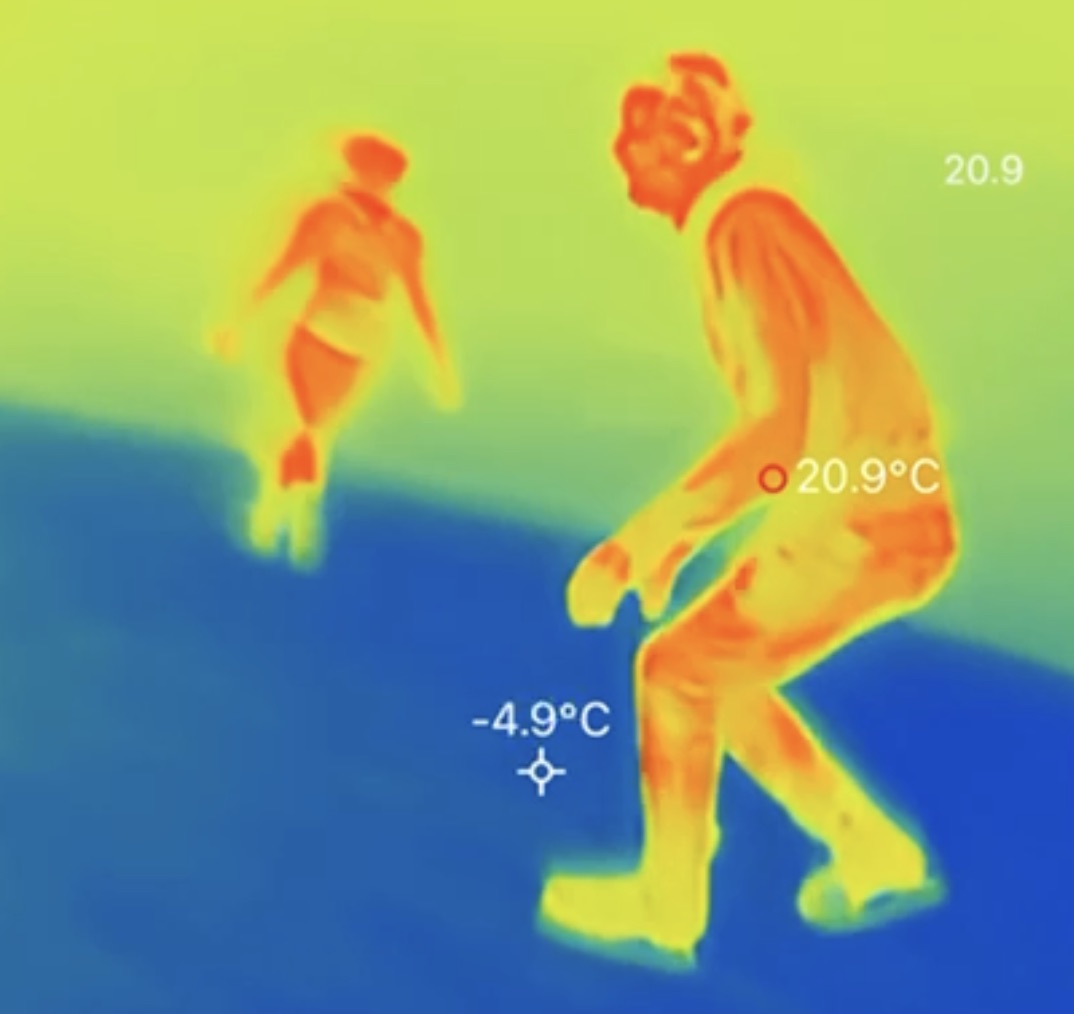
IR photo of me skating There's not a lot of pics of me skating this one from an IR camera
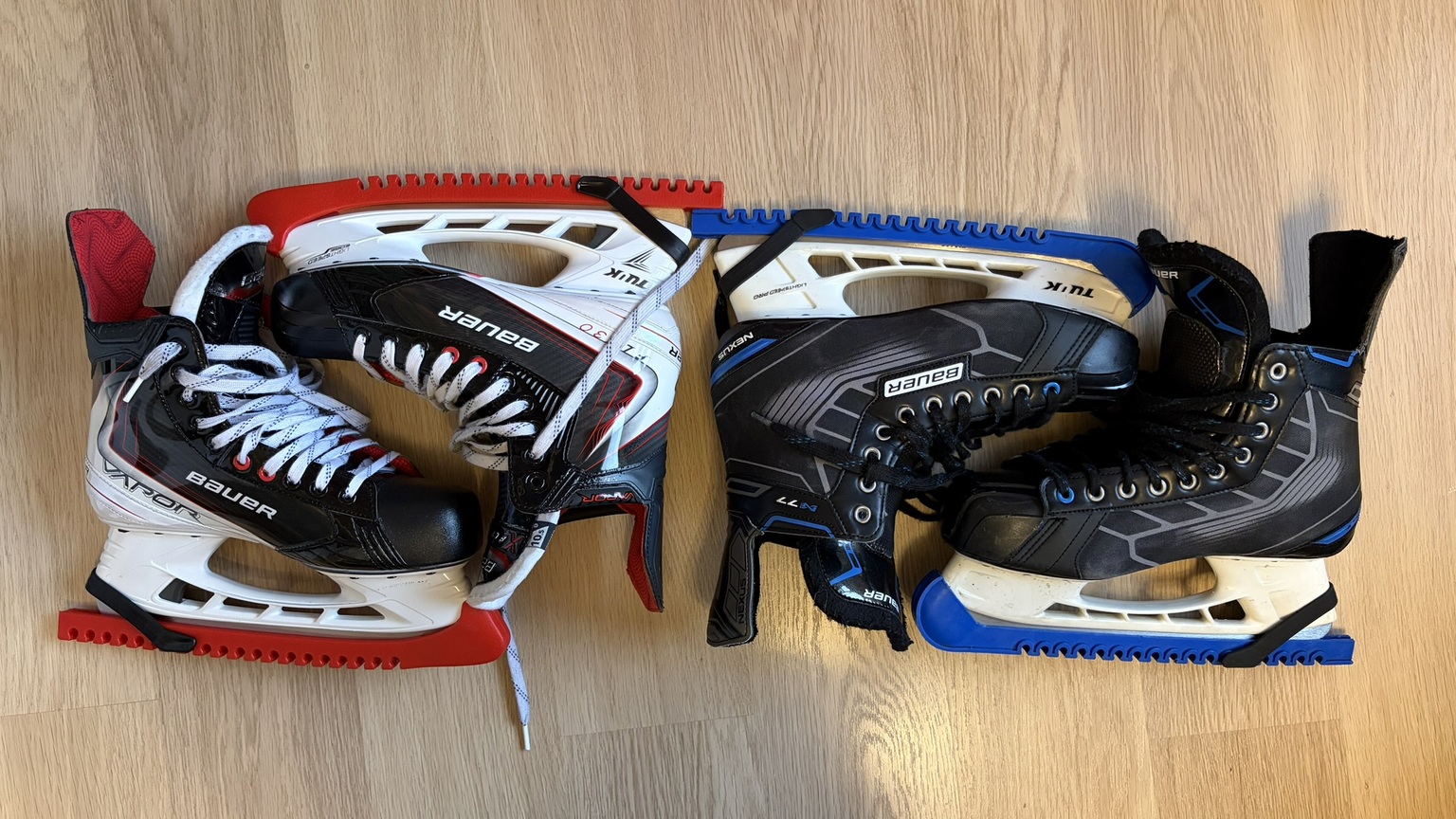
I've been skating in a pair of Bauer1 Nexus N77s that I bought 7 years ago on a work trip to Toronto. These did a great job of getting me back into the hobby for 6 years but recently I felt it was time to step up to a better quality pair. Despite being a size down from my shoe size, the Nexuses are too large: I had been compensating with thick socks but still struggling to get the boots tight enough. I'd have to wear gloves to lace up because I'd cut my hands pulling the laces otherwise. After too long researching/deliberating/kvetching (very much on trend for me) I upgraded to Bauer Vapor Fly30s another half-size down (and nearly ten times as much). The fit is much better, in almost every respect. They actually go on easier and I don't have to tear my hands tightening the laces. They feel like a natural extension of my feet. I seem to be using a different set of muscles to skate, so the first few sessions were very fatiguing, but that settled. The Vapor line is speed-oriented, which I thought would fit my skate style best.
new and old skates new and old skates
I have unfortunately gained a common problem: arch pain. More precisely, my navicular bone seems to be quite prominent2, and that part is pressing uncomfortably into the boot. Boots typically take a few sessions to break in, but after 7-8 sessions the pain was getting to the stage that I couldn't skate for a full session without being in agony. The last time I skated I tried to throw everything at the problem: I'd had the skates baked3; bought some orthotic insoles; then some "Bunga" pads over the sore bit and an attempt to more loosely tie the laces over the affected area. I tried a ten minute skate, and it seemed a bit better. I then tried experimentally to swap back to my old skates, and I felt like Bambi: I just couldn't do it! They didn't press on the navicular, and they're softer so you can compensate for the size with tight lacing, but I had no confidence in them, I couldn't lean into the turns. They just felt weird. I realised there's no way back. I switched back to the fly30s, adjusted the bunga pad positioning, tweaked the lacing and went back on for about 40 minutes. It went well: the rink was quiet, it was cool whilst we had a heat wave outside, so I worked up a sweat. By the end there was some discomfort, but not too much, and I think partly the area is currently sensitive so just about anything will cause discomfort. Fingers (or toes) crossed that I've mitigated the problem! If not, it might be time to try a punch out.

  1. I've owned four pairs of skates: all hockey, my first were Bauers, my second CCM Tacks of some kind. I've no idea what happened to them.
  2. Or possibly I have accessory navicular bones
  3. modern mid-tier skates are thermoformable, and many skate shops carry a specially designed oven to briefly bake skates such that you wear them as they cool and the padding should mould to your foot.

7 July 2026

Thorsten Alteholz: My Debian Activities in June 2026

Debian LTS/ELTS This was my hundred-forty-fourth month that I did some work for the Debian LTS initiative, started by Raphael Hertzog at Freexian. During my allocated time I uploaded or worked on: Besides fixing all CVEs of asterisk in Bullseye, I started to look at asterisk in other releases as well. Rather surprisingly asterisk is only part of Unstable and Bullseye. All other releases don t include any version of asterisk at all. So first things first, besides some security related RC bugs, asterisk did not migrate due to RC-bugs in dahdi-linux. As I maintain osmocom-dahdi-linux (which supports less/other hardware), I looked at the open issues and after some rounds I could upload a new upstream version, fixed some bugs and resolved issues with piuparts. dahdi-linux meanwhile migrated to testing, job done!
As a next step I looked at the open CVEs. Some of them had been already fixed in previous uploads but had not been marked accordingly. So I fixed all remaining ones and sent a debdiff to the maintainer. Unfortunately there was some kind of overlap in our work and he ignored my debdiff but uploaded a new upstream version. Anyway, job done as well, no open security issues anymore. The only thing that hinders asterisk from migrating to testing is the reproducible build. So if anybody has some spare time Other things I worked on were the regression update of rsync. Some of the elven new patches need to be backported, but I am confidentially to finish this month. I already reviewed the rsync uploads of Sylvain to Buster and Stretch, so I don t expect any big hurdles here. I am also making progress to find the correct patches for hplip and cups. Debian Printing This month I uploaded a new upstream versions: This work is generously funded by Freexian! Debian Lomiri This month new upstream versions of dozens of lomiri packages have been released and I uploaded lots of them to Debian. After they migrate to testing, I am also going to sync them to the Ubuntu PPA. This work is generously funded by Fre(i)e Software GmbH! Debian Astro This month I uploaded a new upstream version or a bugfix version of: Debian IoT This month I uploaded a new upstream version or a bugfix version of: Debian Mobcom This month I uploaded a new upstream version or a bugfix version of: misc This month I uploaded a new upstream version or a bugfix version of:

6 July 2026

Aigars Mahinovs: How to make a good group photo

Taking a good group photo consists of multiple aspects: I can say with confidence that nearly everything here comes from having failed to do these things right at least once, even on the latest attempts, so this is an ideal to reach towards, not something we expect to hit every time. The Goal The main goal of a big event group photo is capture both the moment itself and each individual person inside that moment. We want people, who were not there to see all the people involved and get an impression of what it was like being there. It needs to show the breadth and depth of people that make up this group, this project. And we want people who were there to be able to look back the next week, the next year or in ten years and remember - ah, yes, I was there, I was standing right there with this grin on my face next to this wonderful person and I was feeling great. Hardware Based on the goal we want to have high level photographic gear that is able to capture both a broad enough picture to encompass all the people and some of their surroundings to communicate the context (without undue distortions) and to deliver enough detail and resolution so that faces and facial expressions and underlying feelings of every single person in that group could be clearly seen and preserved. To both capture the context and minimise distortion the final picture should be just a bit wider than normal human field of view. That is about 50mm for a full-frame camera or 35mm for a typical 1.6 crop camera. You can go a bit wider if there are no better alternatives (as detailed in the scouting section), but be prepared that corners of the image will be distorted and not really usable (but we can fix that in processing step). Or you can go to unusual aspect ratios, like we did in Debconf 10. In the absence of a 100MP+ camera, you will need to be stitching together multiple frames to achieve resolution high enough to have enough pixels-per-face to see emotions clearly. This means that the photos you will actually be taking will be tighter than the overall field of view mentioned above. Still, a higher resolution camera body is preferable - nowadays 24MP-32MP cameras APS-C provide a good compromise between resolution and price, but 45-67MP full-frame cameras also exist on the market. Assume that we will be shooting in a bright environment, so most likely with quite low ISO settings, that means that high-ISO noise characteristics of more expensive cameras will not really play a role here. You will also not need very fast burst modes, even manual speed of one frame per second is sufficient. You will also want to get as much detail as possible out of your lens, and this is the most important part. You can do amazing work in all other steps of the process and have a great camera too, but if you pair it with a lens that is not sharp, then the end result will be disappointing. You want the lens that is sharpest corner-to-corner when stepped down to about f/8-f/11, that you can get for your system. You also want that lens to be about 85mm full-size sensor or 50mm for 1.6 crop size. Luckily that kind of range is also a great range for optical design and sharpest lenses are typically available in exactly these kinds of sizes. You absolutely want to have a fixed focal length lens, not a zoom lens. Even profession grade zoom lenses often deliver worse image quality compared to fixed lenses that cost less 1/10th of their price (when shooting in the same focal length). Newer design lenses are better than older lenses - optical design, coatings and precision manufacturing have advanced a lot over the decades. Retro look is great for mood, but not as good for actual resolution and clarity. You don't need to overpay for most expensive lenses because those often only improve image quality on lower F-stops. To encompass the whole group we will need to shoot at f/8 and in bright light, so the extra benefits of those f/1.2-capable super expensive lenses will not come into play here. We will have no use for a flash here. A tripod will be too restrictive when rapidly repositioning the camera between different parts of the panorama shoot. But a monopod might help with stability - I have not tried that myself, however. For my last photos I used a Canon EOS R7 (32.5MP) with Canon RF 50mm f/1.8 STM lens and considering an upgrade to Sigma 56mm f/1.4 DC DN for the next time. Scouting Scouting a good location for the group photo is another big chunk of a successful picture. The critical piece of the puzzle is lens-to-face distance. In order to keep everyone's face in-focus and have enough resolution on the farthest faces (without making nearest faces truly massive) we want to do everything possible to reduce the variance in lens-to-face distance - to reduce the difference in distance between closest and farthest face. The most effective way to do that is to have the photographer climb higher. To see this in action on the Debconf photos, compare Debconf6 (very high camera position, group on level ground - good) to Debconf10 (camera not too high, group on stairs, still good) and to Debconf17 (camera could not get high enough and the group is on flat ground - not great). Even the Debconf25 photo was suboptimal from this perspective. The Debconf23 photo was a very good example from the recent years - good height and also the group was positioned in a semi-circle so there were no people directly in front and very near to the camera. So you are looking for the highest point you could get to (even if that requires a special permission of key or a ladder) with a field large enough to fit the whole group comfortably. How to check that? Normally I simply take a photo from the top of the whole area and note down from there where the extreme corners of the group could be and still be fully seen in the shot - not blocked by trees, buildings and shadows. Then I go down and measure that space. Rule of thumb being - people in one horizontal line can stand 1 normal length step from each other and two horizontal lines can be half a step from each other vertically. So I can just measure a rough rectangle in steps, multiply the sides, multiply that by two and I have the rough number of people that can fit there for the photo. Once you have a candidate location or two, it is important to check them at the same time-of-day as you plan to do the photo (see organization section for that). You want to make sure that the whole area of the group is in the same illumination - if half of the group is in the sun and half in a shadow, then you will be having a very bad time later. The absolute ideal positioning for the group photo is to have everyone be in shadow, but still have enough bright skies and bright buildings in front of the people to give good illumination of the faces. Worst you can do is have the sun be behind the people (so all the faces are really dark) and second worst is have the sun be directly in front of the group, so that the faces are very well illuminated, but everyone's eyes are closed because they are being blinded by the sun. And sometimes all you can do is pray for some light clouds to provide for even and dispersed light. Debconf23 was very lucky that way. Another consideration is to how people are going to get to that place. You need to consider accessibility needs of people (it is ok, if it takes more effort or time, but it needs to be organized and communicated well in advance). And you need to consider how the big masses of people will be getting there - how to tell people where exactly it is and how to get there from various locations where people might be hanging out during the event? Having an alternate location indoors might be necessary if the weather report for the next days is not sufficiently predictable. We had to use that contingency in Debconf9, for example. Organization It's hard to take a good group photo if half of the group does not show up or is too late, so this needs some organization to happen smoothly. First of all you need to choose date and time for the photo. The photo does not take too much time from the schedule of the event and can be squeezed in after all the other events are already scheduled. In fact I prefer that as it allows you the flexibility of choosing the date based on weather conditions and time based on light and shadow conditions in potential photo spots. You don't want to choose the daytrip day as most people will be away and return times are not really predictable. You do not want to choose the morning after Cheese and Wine party for obvious reasons. First day and last two days are also sub-optimal as some people arrive late and some leave early for various personal reasons. Also you don't want it to happen just before Cheese and Wine either because then you'd have very little time and clarity to do the processing of the image on the same day. For timing, the best way, in my experience, is to schedule the photo directly after the end of talk sessions before a meal break - lunch or dinner. Typically in the Debconf schedule there are 2-3 daily breaks planned, say for Debconf25 there was lunch, afternoon break and dinner. Talks are planned to end ~10 minutes before those breaks (and meals) begin, so for example, afternoon break starts at 16:00 and all talks in the previous block end at 15:50. In such a case just schedule the "Group photo" event from 15:50 to 16:05. This gives people the info to go there directly from the end of all talks and that they will have sufficient time for break/meal afterwards. Do not forget to specify the location (as exactly as possible) in that event entry and make sure to post it at least two days in advance. People often want to wear something specific for the photo and thus need to know about it in advance. This also makes sure that people do not make alternate food plans for that specific break and don't leave the venue. Announce the date, time and the exact location as wide as possible, don't be shy. Announce and discuss mailing lists, IRC, Signal, Telegram, make sure the front desk knows in case anyone asks in-person, ... Check that it is again included in the announcements email on the day preceding the photo date. When the date has arrived, it is a good idea to check in early with people with special mobility needs to make sure they know where to go, how to get there and how much time they will need to be able to get there on time. As the final round of talks before the group photo is starting up, it is time to recruit "runners". I've had great success with this technique. The idea is pretty simple - for each room where people congregate (talk rooms, hacklabs, cafeteria, outside hackspace, front-desk, ...) go there and choose one person. You want to choose a person that you will recognise and remember among everyone else in the group, either because of who they are or what they are wearing, whatever works best for you. If they agree to help, instruct them to: "at end of talk, announce that the group photo happening now and the location, herd people towards the photo location, be the last person out, make sure there are no stragglers from this area behind you, when you arrive to the photo place I will assume that everyone else from this room is also now there, when you are there catch my attention and show this sign so I know for sure that it is all good and make sure that I did see it from you". With that sorted out all you will need to remember is how many runners you recruited and how many have reported in to figure out if everyone has now arrived or if we still have to wait for someone or some group. Then you will only have one last point of organization left - shaping the crowd into a group. People will not know what your vision for the group photo is, so you will have to give clear and LOUD instructions on where people should not be standing. Use clear, large gestures to support your words. You want to compact the group, have the people that just joined in the last moment and are standing to the side come deeper in and join the crowd. Have any holes in the middle of the crowd filled in. Forming a semi-circle instead of a blob helps with averaging face-to-lens distances. Make sure people are not in unexpected shadows. Make sure carried objects, like umbrellas of flags do not cover the faces of other people. Take the time to look at everyone face to make sure there are no people hiding behind someone's shoulder - typically they are not aware that their face is in fact not really visible. If there are such people, call them out and point directly at them and encourage them to step forward, if they wish to do so. You are the only one seeing the final picture now and only you can correct it before capturing the moment. So a few extra seconds here are worth taking, even if 300+ people are standing in scorching heat and waiting on you. When you are happy with what you are seeing, make sure to tell people clearly that you are now about to take the pictures and again remind them not to move and explicitly not to turn their heads to the side until you are done (this is the source of most of the extra work in processing). Be very loud and clear and make sure you have everyone's undivided attention before you start saying the important stuff. When done - say so. There will be other groups that will want to also have a photo taken after the main group is a bit more dispersed, so don't run away. Typically at least the T-shirt group will want a picture and also all the organizers. Final bit of organization during the group photo shooting itself is the sneaky self-insert. You may choose not to bother with it, or do it in the simplest way, like I did in Debconf6, but if you really want to blend in with the crowd, you need to have someone else take a photo of you in the exact same location at the same date and time from the same location. So you should already during shaping the crowd decide where you would fit in, it is easiest to blend in at the back of the crowd and to one or other side, so that it appears like you are just standing behind the shoulders of a couple peoples. Remember that spot - it is easiest if you stand in the exact same ground spot when your photo is taken. Just go down, recruit a volunteer to take your photo, make sure the settings are fixed to the same ones as for the group photo shots and have them take a handful of shots of you - one of you centered in the camera frame and a couple more with you more towards the corners of the frame. This distortion from being off-center in the frame may be important later. Preparation In addition to preparing the crowd for the photo, you also need to prepare yourself and the equipment. Make sure you have dusted your camera sensor and cleaned both inside and outside glass of your lens. It is usually a good idea to remove any filters from the lens. Install the hood, if that could help with blocking the sun flares. Make sure you have the right lens and that you have installed the right lens. For fixed settings I typically shoot in JPEG with RAW being there more like an emergency backup. The extra dynamic range of RAW could be used, but it is really complex to do that in combination with image blending and it is hard to get right, so I prefer an all-JPEG workflow and fix the dynamic range in the scene itself, before shooting. For Canon I am using the Standard profile that boosts the color saturation and sharpness a bit as I just enjoy that look and find it hard to get anything significantly better from RAW data even with a lot of effort. In any case make sure you have enough space on the cards to take at least 100 images and that you have a full battery. Do not use high speed burst setting because it is then too easy to take too many pictures at the start of the sequence and be stuck with your camera still in "Busy" state writing big RAW files to slowish SD cards and not allowing you to finish the full picture rapidly. You want to have the shutter speed at at least 1/100th of a second to prevent blur from both your hand movements and also from people in the shot moving around a bit (image stabilisation will not help you there). And you want to have the aperture to be around f/8 - lower apertures risk people in front or behind falling out of focus, make the lenses look less sharp. Higher apertures also start to become less sharp due to diffraction effects above f/8. ISO should stay as low as possible, ideally at ISO 100, but if there is not enough light then upping the ISO to 400 would be the first step that I would try to do and second would be decreasing the aperture to f/5.6. If there is too much light, then increasing the shutter speed should be the safe thing to do. As people start to arrive into the shooting location - check the exposure and nail down the settings, ideally in manual mode. Consider that left side could be a bit lighter or darker than right side. Err on the side of making the picture a bit too dark as there is more depth to darkness before cut-off compared to clipping on the high end. However, do not trust the exposure detection, instead take a picture and look specifically at skin tones in faces of people that already are standing in the photo area. Faces are the key bit and the exposure needs to be adjusted just to the faces and ignore darker of lighter clothing. Do some test shots and find settings where faces look not too bright, but also not very dark and fix those settings in manual mode. Now you are ready for the action. Shape the crowd, check the faces and the action can start! Execution During taking of the group photo you want to finish it fast, but at the same time you have to take the time to make it right. If you hurry too much under pressure, you risk being left with unusably blurry images and the whole effort wasted. Having already prepared and verified the manual settings makes it easier. When you are taking pictures, you have to remain as still as possible - even at very high shutter speeds even slow hand movements are still bad for image quality. So think of the movement as of biathlon athlete shooting the very middle of five, very separate targets - take a burst, reframe, then steady up for a second and only then take the next burst. 3 frames per burst are sufficient. 90% of the time the very first photo of a burst will be best. As you move from frame to frame, aim for just a bit more than half-frame overlap. This will give the opportunity to skip frames if all is good, but also have backup coverage of every face in case of problems. Proceed systematically, I typically start off on the top left of the crowd, then go right until the end of the line, then shift down half a frame and go left until the end and repeat until I am done with the crowd. After that it is very helpful to also immediately take photos of a "frame" around the whole crowd. Stitching process often distorts the frames in weird ways that leave holes in the resulting image that you can fill if you have a wide frame around the crowd. It is possible to compensate with creative cutouts in the final image (like Debconf9), but the more framing room you make, the more flexible you will be able to be with cropping of the final photo. The frame also gives you the opportunity to capture more of the context of the place and space. As an example, Debconf25 group photo in the end consisted from 9 images + 1 for sick people + 1 for me. I ended up missing the framing shots for bottom left, top left and top right corners. To get there I took 68 images. And in some years it was more than a hundred. Processing This part might be less stressful than taking the pictures from intensity perspective, but it lasts longer. Depending on you luck, skill and perfectionism it can take anywhere from 3 to 9 hours of work to complete. Before you start, however, you should first request things that you will need for other people. This can even be done before taking the actual group photo, but usually I forget. To finish the photo you will need three things: The first two you should be able to get from the respective organizers. The motto is harder. I typically try to ask the current DPL to come up with something describing the current mood of the project or of the event, but it is rare that it is that easy. Most of the time I came up with something as I was editing the photo and reflecting on what was the mood, the feeling, the mojo of this conference and of this year was like. Bend that around a recognisable phrase or expression, make it a bit more insider-relevant and you are on the right path. Some years this was the hardest part. For the panorama stitching I will describe the workflow that has served me good for years, but maybe there are better ways possible nowadays. Feel free to let me know! First I would save all photos taken and select one sharpest photo from every burst. Next I would select the minimal number of photos that appear to be covering the entire crowd. The fewer images you use, the better in the end because the most quality problems crop up in the areas where photos are getting stitched together. Fewer seams leads to fewer issues. Open Hugin (you will also need enblend and enfuse installed) and import your minimal set of images into it. Click the "Align" button and wait a while - the processor will be trying to figure out keypoints in each image and then try to match these points between the images to try to fit them all together into a single projection. To do that it will distort the images. This is the trial and error process part. You may need to add, remove or replace images to get the stitching to work or to work better. You may want to add more of the frame images to fill the ragged holes around the image. After initial alignment, go to "Move/Drag" tab and move the image a bit up in the projected field of view and make it a bit more central visually. That will help a bit with the distortions in the near-by people and people in the corners of the image. In the "Crop" tab set the initial crop - leave it generous, you can always crop more in later steps. Do not be afraid of leaving in sizable chunks of black homes, empty skies or grass. All of that can be filled in later as well. Go back to the "Assistant" tab and click "Create panorama". It is good enough to have JPEG output at 100% quality using exposure corrected low dynamic range output option. Make sure to check the "Keep intermediate images" option. This will not only generate the final, merged panorama, but also keep around the individual images after perspective correction and exposure blending steps. These are critical for fixing blending error in the next step. You might need to go back a forth a few times with a different sets of source images, maybe adding some image between other two, maybe removing another to reach a better starting point. The key part to pay attention - how many ugly stitches are there in the image. Check every face, the blending algorithms do not recognise faces and sometimes try to stitch one face from two or more images creating very weird effects. They can be fixed in the next step, but it is rather hard manual work, so the fewer such faces are in the blended image, the less work you will have. In some years I've managed to find a combination where all faces were good and in other years I had to manually fix 13-15 faces. Do not try to blend the extra pictures (like with you or with sick people) into the main panorama with Hugin - it will get very confused with the parts of the grass that it is able to see where other people were standing. The next is the final processing in GIMP. Think of it like a large and complex project - do as much as possible in separate layers, save often. Fixing wrongly stitched faces and also putting yourself into the photo are very similar activities in the end. Just the scale and the source differ. For yourself you just cut out yourself (upper torso is enough) from the separate photo. For corrupted face, choose one of two intermediate images that the Hugin created where the face is transformed, but not yet merged (with a different version of itself). In either case crop the photo to roughly the interesting size and put roughly in the right spot as a separate layer on top of the group photo background. Reduce the opacity of the small layer to 30-40% and zoom in to 400%. With that it is much simpler to position the layer with pixel precision. Then all you need to do is add a layer mask to this layer and paint it just right. Basically in layer mask black means transparent and white means non-transparent. So you need to just make everything that is you have white mask and everything that is not you have black mask. And smudge the border a bit with finger tool or blur to make the transition smoother. Easy to say. Hard to do. This is what takes most of the actual work hours in post-processing. You might miss someone. I am sure Phill is just thrilled to see me in the very middle of the Debconf25 final picture .... But do try to fix them all. Use large, sweeping geometric figures to cover up black holes, empty grass fields and other sub-optimal corner features. And then use that newly created free space to put in a large version of the logo of this years conference, decently sized motto and slightly smaller invitation to the next years conference. Do not forget to add a copyright and license statement somewhere in the corner in smaller, but still well readable font. I am using a text like: "Photo by: Full Name, Email: fullemail@debian.org, License: GPLv2+ or CCv3-BY" This ensures that this image may be used in any press coverage (with basic attribution) and also can be included in any GPL-licensed software, if that ever comes up. The same statement is also in the metadata of the image file (see Image-Metadata-Edit metadata in GIMP) along with information that states that this is "Debian Developer Conference Group photo, City, Country, Year". Image->Image properties->Comment is another place where GIMP hides this EXIF information. For ease of use, in addition to a full-resolution image it is also useful to make a lower resolution version that would still fit on a 4K screen at full resolution, so about 3840px wide. Some photo hosting services set other limits for image size as well, so it might be needed to scale the image down below 100Mpix to upload it to Google Photos, for example. Publishing So, it is finally 1AM and the group photo is ready! How do you push it out to people? Well, in all possible ways and places. Again - don't be shy, people do really want to see it. Push it to whatever you use for your shared photos. Push it to Debconf shared git (note that this is GIT-LFS repo, make sure you know how to add content to the LFS specifically). All permanent links to that in GroupPhotosAll wiki. And then send those links to IRC, Signal, Telegram groups, debconf-announce mailing list. Publish it in your blog and push that to Debian Planet. Push it in Threads, Bluesky and Mastodon. Send an email separately to Debconf orga team. And one to Debian Publicity Team so they can put it into the Debian Home Page and push via Debian micronews accounts. And that is about it. Now you can go back to enjoying the rest of the conference. Or running around doing other things that you think need to be done. It's up to you. You did it. This moment will remain with people for a very long time. And you helped. Questions? Feedback? Just ask here or here.

Russ Allbery: Review: The Player of Games

Review: The Player of Games, by Iain M. Banks
Series: Culture #2
Publisher: HarperPrism
Copyright: 1989
Printing: February 1987
ISBN: 0-06-105356-2
Format: Trade paperback
Pages: 295
The Player of Games is political space opera and the second book in the shared Culture setting. As with most Culture books, the reading order is not particularly important. It won the 1989 Locus Award for best science fiction novel and sometimes competes with Use of Weapons as the consensus best Culture novel. This review is a re-read and yet another experiment in how to re-review a book. This time, I decided to write a full second review with substantial spoilers so that I can talk in more detail about the book. If you want to avoid spoilers, or just want to see how my thoughts have evolved from my first reading, see my original review from 2005. Gurgeh plays games. He is probably the best strategy game player in the entirety of the galaxy-spanning Culture. He has written papers on game theory, won innumerable major championships, and is a celebrity in the circle of like-minded aficionados. Gurgeh is also bored and in the middle of the Culture equivalent of a mid-life crisis. As the story opens, he's vaguely unsatisfied and adrift, unenthused by his normal activities, and searching vaguely for something that will break through his ennui. He is caught by surprise by the thrill he gets from a moment's misunderstanding in which an opponent suspects him of cheating, which sets him up to be (apparently) clumsily blackmailed by a deeply unpleasant drone named Mawhrin-Skel. SPOILERS BELOW. If you have not read this book, consider stopping here and instead reading my original no spoiler review. The first hundred pages of The Player of Games is a slow, somewhat plodding introduction to Gurgeh, his social circle, and life in (one part of) the Culture. I remember being fascinated by this part the first time I read this book. It was only the second Culture novel I read and the first set in the Culture proper, so the world-building underlying this odd post-scarcity utopia on a vast intelligent habitat with sentient drones, complex privacy rules, endless cocktail parties, and apparently directionless socialites was intriguingly unlike the other science fiction I was reading at the time. This time through, I have to admit I was less impressed. Gurgeh is not very likable, and his desultory mid-life crisis is a little boring. None of his friends have enough depth to appear as more than side notes, in part because Gurgeh doesn't seem to care enough about any of them to make them interesting to the reader. I've since read seven other Culture novels, so Banks's cocktail parties hold less charm and I was impatient for the real action to begin. These chapters are still important, though, because they establish how utterly average Gurgeh is. He has one unique talent, a deep affinity with and obsession with strategy games, and is otherwise a bit of a depressed narcissist with a few casual relationships, a friend that he barely confides in, and a comfortable and familiar life. He is not in any way a hero or a charismatic figure; he just happens to be exceptionally good at one thing, enough to make him famous among people who care about that one thing and probably unknown to anyone else apart from the occasional idly perused news headline. He is the Culture's equivalent of the world chess champion. The Contact division of the Culture has a problem. The Empire of Azad in the Lesser Magellanic Cloud is a nasty, expansionist culture of the sort that Contact would like to deal with before it causes broader problems. The Culture's normal approaches are thwarted by an unusual organizing principle: The empire is built around and takes its name from the game of Azad, a highly complex strategy game developed over thousands of years. Azad is the civil service exams, means of political and religious dispute resolution, selection mechanism for the emperor, and civic religion. Faced with that oddity, Contact turned to Special Circumstances, the Culture's more aggressive and less restrained way of dealing with tricky problems. Special Circumstances, in turn, needs someone who can learn how to play the game of Azad. They want Gurgeh to take a very long trip. For all of Gurgeh's dissatisfaction, he's not impulsive enough to take a five year journey away from his life and everyone he knows just to play a novel game. Conveniently, Mawhrin-Skel's blackmail resolves this reluctance. The game of Azad requires some suspension of disbelief. Banks provides a few glimpses at the mechanics of the game, but those details are insufficient to reconstruct the rules, and some of the claims made about its properties are improbable at best. The best mental model I could build for it is a strategy or simulation game built around units and territory control, with supplemental side games used to build up resources for the main boards, but it's more of a plot device and a set piece than a world-building invention. The significance of Azad the game is its role in society: The Empire of Azad believes they have constructed a game whose complexity so closely models reality that the skills required for success in the game are precisely the skills required for success in the empire. The Empire of Azad is wrong, and this is one of the core themes of The Player of Games. As with many Culture novels, what Special Circumstances tells Gurgeh is, at best, incomplete. Gurgeh is a refutation of the basis of belief in Azad; this is why it is important thematically that he is an average, somewhat unlikable citizen of the Culture whose only special characteristic is skill at learning and playing games. Azad is the myth of meritocracy given physical form as a game. It provides the anchor of the empire for the same reason that societies on Earth place enormous weight on standardized tests, capitalist success, or public debates. All societies face the problem of selecting good leaders and testing opposing beliefs, and all societies attempt to find some form of shortcut, some set of general principles, tests, or objective metrics used to select the best person via a process that people consider plausible and fair. The game of Azad is a paragon of apparently meritocratic process. No matter who you are or what your background is, if you excel at the game that, in theory, objectively tests your skills, you are given a position of power. In practice, the Empire of Azad is not that naive. Manipulation outside of the game happens, only some players have the opportunity and resources to spend years learning the game at a deep level, and only their dominant sex truly stands a chance in games that matter. But neither is Azad's place in society a fiction. There is corruption around the edges, and a lot of people are filtered out before the games begin, but the highest echelons of society are true believers. The game does decide both rank and policy; Banks is arguing against a strong form of apparently working meritocracy. Gurgeh represents a refutation of this meritocracy through the mechanism that breaks every supposed meritocracy: The map is not and cannot be the territory. Any objective evaluation criteria is necessarily separate from what it is trying to measure, and in that separation there is always an opportunity. Gurgeh has none of the background, training, or mindset expected for a player of Azad because he could not possibly care less about any of the things Azad represents to the Empire. What he has instead is a preternatural skill at games and vast experience with the most intricate strategy games the Culture, a much larger society, has been able to devise. He also has both the patience and the resources to devote himself entirely to learning a game for several years, and past experience in doing that with other games. If Azad represents the civil service exams, Gurgeh is the person who has no interest in ruling but adores memorizing facts and taking tests. The theory behind the exams is that the skills to pass the exam only come with the correct mindset to do the job for which the exam is testing. Gurgeh is an existence proof that this is not always the case. Banks also uses Azad to show another aspect of the failure of meritocracy: A society whose rulers are chosen through a competition takes on the shape of that competition. The Empire of Azad is run by the winners of competitive games, so the empire is a winner-take-all system of dominance and status hierarchy. Here, I think Banks lays the point on a little thick; the empire is an irredeemable hellhole of misogyny, sexual abuse, slavery, genocide, and military colonialism to a degree that is a bit hard to justify solely from the game. There is a beautiful turning point about two-thirds of the way through the book where Gurgeh's face is shoved into just how vile Azad society is and reconsiders his approach to the tournament as a result, and I think it may have been a bit stronger if the morality had been a little less blatant and absolute. To the extent that Gurgeh has political beliefs, he represents a Culture flavor of soft liberalism. He has opinions about acceptable and unacceptable ways to treat people, but he grew up in a utopia and his opinions are mostly theoretical. When he sees just how vile people can be outside of that utopia, he is revolted and appalled and redoubles his efforts to fight that society in the only way he knows how, inside of a game. This part of the book follows the standard, if enjoyable, plot of a flawed but fundamentally decent person discovering a true injustice and becoming enraged at it. In a lot of books, that would have been where the plot stops. Banks is doing something more subtle and more interesting, though. Gurgeh wipes the board with his next challenger, but that soft liberalism eventually proves inadequate. To learn the game of Azad and to play in the tournament, Gurgeh has been wrapping himself in Azad culture and its language, and in that frame of mind he is losing the climactic game of the book. It's only when he is pushed to think in Marain, the native language of the Culture, that he understands what is happening in the game and how to defeat Nicosar, the emperor. This, on the surface, is a bit too close to the strong hypothesis of linguistic relativity to be entirely plausible, but such an objection would miss the point that Banks is making here. Marain is a construct, the product of considerable effort within the Culture to match language to the most nuance and complexity that brains can understand, and it is a language, one of the most social and collective artifacts a society can produce. Gurgeh is a remarkable individual with an impressive talent, but individual skill and achievement can only take him so far. The critical final piece is the support of societal infrastructure intentionally built and maintained to help him make better decisions. Once I noticed that point, I saw it everywhere in the book. The empire repeatedly attempts to subvert or distract Gurgeh with drugs, pleasure, politics, or danger, and at each point there is some critical piece of Culture social infrastructure that blunts the attack. Illicit substances and forbidden vices are less tempting to someone for whom the illicit has been demystified by the Culture's gentler approach to rules and boundaries. Embedded biological mechanisms allow him to divert drugs so that they don't affect him. At first, it's easy to read this as an exercise of self-control, but on this re-read I saw how much behind-the-scenes infrastructure supports Gurgeh's ability to ignore temptation. This social support notably does not take the form of some ideological principle or moral framework. Gurgeh is not a monk or an ascetic, as is obvious from the first third of the book, and he has no political ideology to speak of. He is a flawed person with a streak of danger-seeking and self-aggrandizement, which the Culture exploited to get him involved in Azad. But through a lot of hard work, technological and social, the Culture has given him a robust foundation and a set of mental and biological tools that make him remarkably hard to corrupt. The implication is that if Gurgeh has that support, so does every other member of the Culture. It's neither a religion or an ideology; it's well-maintained infrastructure, complex and nuanced and pragmatic, and composed of innumerable small solutions to specific problems. I think the true climax of this book takes place the night before the final day of the game, in the tower meeting between Gurgeh and Nicosar. Gurgeh has realized that he's already won; there's nothing Nicosar can do to salvage the game. He's also seen that the game represents a cultural conflict and conversation between the Culture and Azad and he's overwhelmed by the beauty of that communication and sadness that the game is about to be over. Gurgeh's true passion is the game. It is doubtless easier for him to be magnanimous because he's winning, but he also loves the structure of the game itself and what two players can create in a sort of collaborative competition. Gurgeh tries to express all of this to Nicosar. It is one of the most centrist liberal moments I've ever read in a novel, the pure essence of "reaching across the aisle" or "disagreeing agreeably." Gurgeh has seen something beautiful, something he's created with Nicosar, a moment of true communication, and he wants to share it. Surely Nicosar sees the same thing; surely now that he sees Gurgeh has won, he can appreciate the board structure, savor the moment, understand the transient beauty of a game that is about to end and how perfectly it captures the meeting of their different cultures. That moment does Gurgeh real credit. It's a rare sign of emotional and spiritual depth in a character who often seems superficial. Nicosar meets this outreach with unhinged, furious contempt. He despises everything Gurgeh represents, everything the Culture is, and the next day he tries to kill Gurgeh on the board of the game. It is a devastating critique of liberal tolerance, all the more so because Gurgeh's attitude and outreach is truly admirable. It is perhaps the most sympathetic moment that Gurgeh has in the entire book, the moment where the reader thinks "oh, I get it, I understand what he really cares about." Gurgeh assumes that Nicosar is not his position or culture, that they have made a moment of connection that transcends all the awful things he previously learned about the empire of Azad. That Nicosar, despite being the emperor of the society that is currently doing so many things Gurgeh finds repulsive, cannot be as bad as his society. And Nicosar considers that outreach to be weak, disgusting, and vile, and does everything that he can to destroy it. One of the oddest twists of our current moment is the obsession that some billionaires have with stories that are moral arguments against exactly what those billionaires are currently doing. The most obvious example is Peter Thiel, who is obsessed with The Lord of the Rings and has devoted his life to becoming Saruman, a character who is notably not one of the protagonists. It's as if something in them recognizes the power of the story, but some deep shame or narcissism or simple aversion allows them to completely ignore what the story means. Elon Musk is obsessed with the Culture novels. He names the SpaceX rockets following Culture Ship naming conventions and has claimed that one of his goals is to bring about a Culture-style utopia. And in 1989, years before anyone had ever heard of him, Banks cast him as the villain of The Player of Games. There is so much of Nicosar in Musk: the superficial charm, the limited brilliance (Nicosar is a very good Azad player), the ambition, the pride, and the vicious, spitting contempt for everything the Culture represents at every level deeper than superficial materialism. And Banks is as clear about his opinion of Nicosar as he is about anything in any Culture novel. One of the oldest fictional answers to what a society does with people like Nicosar is the consequences of hubris. By being unable to accept defeat, by holding a vision of the world so tightly, they become brittle and unstable and bring about their own collapse. In a broad sense, that is what happens in The Player of Games with a bit of pushing from Special Circumstances. By the politics of the game, Nicosar had already won; the results of Gurgeh's earlier games had already been faked, the final game had no political consequences, and everyone who knew its true outcome could be disposed of. Gurgeh's win could have been covered up and ignored. But Nicosar could not endure the thought that he would be beaten by someone like Gurgeh, playing Azad the way that Gurgeh was playing it. Gurgeh had to be destroyed on the board of the game; Nicosar's pride did not allow any other outcome, even if it meant Nicosar's death. However, Special Circumstances didn't let hubris be the end of the story. In the climax of the book, the drone protecting Gurgeh also makes sure that Nicosar dies. There is a fig leaf of plausible deniability, but it's so obvious that even the unobservant Gurgeh sees through it immediately. It's hard to escape the feeling that was Banks's answer to what to do with people like Nicosar: They cannot live within society, because they will not live peacefully within society. I enjoyed The Player of Games as much this time through as I did the first time, but for entirely different reasons. In my first read, I focused on the world-building of the Culture, the political machinations, and the concept of games as conversations between the players. This time, I was struck by the political commentary just below the surface. Special Circumstances wanted to resolve the problem of the Empire of Azad without a military conflict and occupation that would be long, brutal, expensive, and demoralizing. They found an answer that relied on the diversity of the Culture. A vast, utopian civilization in which people can pursue whatever interests make them happy produces innumerable microspecialized oddities, people with astonishing talents in some small field that only a tiny fraction of people care about. It produces, in other words, innumerable keys for locks that you may never encounter, but which are invaluable if you happen to stumble across that lock. Gurgeh is not a hero. He is not a paragon of moral virtue, or even a charming charismatic, He is an entirely average member of an extraordinary society, the beneficiary of thousands of years of concerted effort at producing a robust, flexible foundation on which to raise robust, flexible citizens with a shared sense of basic morality. Those people, by themselves, do not solve all of life's problems; the structure of Special Circumstances and its willingness to bend rules in order to maintain them is the tension and deus ex machina in all of the Culture novels. But much of the strength of Special Circumstances is that it has an entire civilization of people like Gurgeh to draw upon when it needs them. It has those people because the Culture comprehensively rejects competitive meritocracy, something that some readers of the Culture novels appear incapable of comprehending. Rating: 9 out of 10

5 July 2026

Dirk Eddelbuettel: Rcpp 1.1.2 on CRAN: Usual Improvements in Semi-Annual Update

rcpp logo Team Rcpp is excited to share that an brandnew new version 1.1.2 of Rcpp is now on CRAN, has also been uploaded to Debian, and has already built for r2u and r-universe; Windows etc builds at CRAN should follow in due course. Rcpp has long established itself as the most popular way of enhancing R with C or C++ code. Right now, 3236 packages on CRAN depend on Rcpp for making analytical code go faster and further. On CRAN, 13.4% of all packages depend (directly) on Rcpp, and 61.4% of all compiled packages do. From the cloud mirror of CRAN (which is but a subset of all CRAN downloads), Rcpp has been downloaded 121.6 million times. The two published papers (also included in the package as preprint vignettes) have, respectively, 2263 (JSS, 2011) and 471 (TAS, 2018) citations, while the the book (Springer useR!, 2013) has another 742. The is the second update in the 1.1.* series which had, among other changes, switched to C++11 as the minimum standard. This release continues as usual with the six-months January-July cycle started with release 1.0.5 in July 2020. Interim snapshots are always available via the r-universe page and repo. We continue to strongly encourage the use of these development released and their testing we tend to run our systems with them too. Having said that, we would like to reiterate that we strongly object to the upstream R release and change management which in this 4.6.* cycle made several abrupt changes forcing packages which consume header files to make very abrupt change. Rcpp, just like numerous other CRAN packages demonstrates that API changes can be undertaken responsibly in a managed manner which allows for transition periods followed by possible warning periods, deprecations periods and finally (but only at long last) errors. What happened here is a speed run to the final stage of forced errors. Uncool and irritating for something as widely used as R. This forced us to make an interim release 1.1.1-1.1 even though we have of course had a policy of always keeping properly tested, installable, and error-free releases candidate version in the main repository branch and hence available via R-universe tested packages for all relevant platforms, and even via binaries for most (including Ubuntu LTS). It would be nice if R Core found a way to take advantage of this. Maybe development cycles, running apart for a year as they do for R, should also include selected packages. Once again I am not attempting to summarize the different changes. The full list follows below and details all these changes, their respective PRs and, if applicable, issue tickets. Big thanks from all of us to all contributors!

Changes in Rcpp release version 1.1.2 (2026-07-01)
  • Changes in Rcpp API:
    • Use of execinfo.h is again conditional to avoid build complexity (Dirk in #1445 addressing #1442)
    • An internal state component for Datetime is now int (Dirk in #1448 and #1449 fixing #1447)
    • Three new (in R 4.6.0) attribute accessors are used conditionally (Dirk in #1450 closing #1432)
    • An UBSAN error in the Sugar-based NA comparison has been corrected (I aki in #1453 fixing #1452)
    • Treatment of Inf outside of integer range in Sugar function has been corrected (I aki in #1458 fixing #1455)
    • Integer overflow protection has been added for sugar functions (I aki in #1457 fixing #1454)
    • The parent environment is now accessed via R_ParentEnv (Dirk in #1460 fixing #1459)
    • Change to returning dataptr again for better handling of empty vectors (I aki in #1462 fixing #1461)
    • Undefined behavior errors in use of ListOf proxies have been addressed (I aki in #1464 fixing #1463)
    • Under newer R version, R_UnboundValue is no longer used (I aki in #1466 fixing #1465)
    • New R API access point R_getRegisteredNamespace() is used with current R versions (Dirk in #1469 fixing #1468)
    • The Nullable::as() exporter now uses an explicit cast to the templated type (Dirk in #1471 fixing #1470)
    • A memory leak in the variadic Rcpp::warning() template has been fixed (Kevin in #1475 fixing #1474)
    • The Nullable::operatorT() has been added as a 'opt-out' (Dirk in #1477 with coordination in #1472)
    • Add templated integer-index overload for operator[] on small systems such as WASM (Jeroen Ooms in #1482)
    • The attribute accessors in AttributeProxyPolicy no longer rely on get__() (Kevin in #1484 fixing #1483)
  • Changes in Rcpp Documentation:
    • Reference in the bibliography used by the package vignettes have been updated.
  • Changes in Rcpp Deployment:
    • Excute permissions are set consistently on scripts with shebangs (Mattias Ellert in #1467)
    • R 4.5.* has been added to the CI matrix (Dirk in #1476)
    • Three nag messages issued when obsolete build flag accessors are used now show Rcpp::: (Dirk in #1480 fixing #1456)
    • Reference GitHub Actions have been updated to their current versions (Dirk in #1481)
  • Non-release Changes:
    • A non-release hotfix 1.1.1-1 used by CRAN accommodates breaking changes to the API in R 4.6.0. It would be nice to have the same level of release management in R itself that CRAN expects from us.

Thanks to my CRANberries, you can also look at a diff to the previous interim release along with pre-releases 1.1.1-1 and 1.1.1-1.1 that were needed because R-devel once again sudden decided to move fast and break things. Not our doing. And there also should not have been a need to two such uploads but it was amateur hour all around. Questions, comments etc should go to the GitHub discussion or issue section, or the Rcpp list. Bugs reports are welcome at the GitHub issue tracker as well. GitHub offers decent search for issue, pull requests and discussions; as many topics have been covered it is worth checking as well.

This post by Dirk Eddelbuettel originated on his Thinking inside the box blog. If you like this or other open-source work I do, you can sponsor me at GitHub.

4 July 2026

Tim Retout: AWS Washington Summit 2026

I am somewhat jet-lagged, having returned from Washington DC just before the 250th anniversary celebrations which will be happening today. I was part of a delegation sent by my employer to the AWS Summit there this week, partly to kindle interactions between PA Consulting and Jacobs who have recently taken a 100% share in PA. Much of our conference time was spent in meetings with AWS executives impressing the facts of the Jacobs/PA partnership upon them, and discussing plans to broaden our collaboration in different sectors. So I spent even less time than usual at conference keynotes, talks etc. This was my first time to DC, and I did find some time to see some sights unfortunately the White House is rather fenced off at the moment following the UFC match, but I did make it to the Capitol and the Washington Monument in the heat. Last Sunday a select few of us attended the baseball in Baltimore rather than the game, the thing that stood out for me was the military jets flying in formation over the stadium every few minutes, and the block-booked seats for the Navy in uniform, who were having a great time! This is obviously a hearts-and-minds thing, but it provides a stark contrast with the UK I can t think of a time I ve seen uniformed military at the football (soccer) or cricket for example. Or Union Jacks flying at shopping centres. Speaking of soccer, England just about beat DR Congo while I was out there, but it was a close-run thing as we were 1-0 down at half time. I can t claim to be following the World Cup too closely, but I overheard comments (from US passers-by) that made clear it would have had a significant reputational impact on our standing in the world had we lost. Another highlight for me was the Church of the Ascension and St. Agnes, where I was able to get my fix of Anglican plainchant and four-part harmony for the week. At morning prayer, I noted they use God save this land rather than God save the King during the responses I ve since found other sources online that choose God save the State . It s strange to think that the words of the BCP dating back to 1549/1662 are a point of continuity since well before the 1776 declaration of independence, and yet are still adapted and used in worship today.

2 July 2026

Matthew Garrett: Preventing token theft

When you log into a service you re given an authentication token. Each further request to the site includes that token, allowing the server to figure out who you are and ensuring that you have access to your data. Depending on site policy, this token may either be stored in memory (and so vanish if you restart your browser) or disk. The token is the proof of your identity. As far as the site is concerned, anyone with your token is you. These tokens may be traditional browser cookies, but they may also be stored in either site local storage or (if you re not using a browser) in some other storage location. In recent years we ve seen infostealer malware (like LummaC2) gain the ability to exfiltrate user tokens, allowing attackers to gain access to the user s data without needing to retain access to the user s machine. This attack is viable even if the site has strong MFA requirements, so passkeys don t help. Encrypting the tokens on disk doesn t prevent the malware from scraping them out of the browser s RAM or obtaining whatever key is used to encrypt them. This feels like a pretty hard problem to solve. But that hasn t stopped people from trying! Dirk Balfanz wrote an IETF draft describing a mechanism for using self-signed certificates for TLS authentication. This uses the mutual authentication feature of the TLS protocol that requires both sides prove their identity to each other. In regular TLS, the remote site presents a signed certificate that tells you who it is. When performing mutual authentication, you then present a certificate to the remote site telling it who you are. These client certificates are largely unused outside enterprise environments because they re a huge pain to deploy. It s not so much that this has sharp edges, it s that it s entirely made of sharp edges. Managing certificate deployment to your devices is hard. Browsers get confused if the certificates change under them. You have one certificate and it lives forever, so sites you present it to can track your identity. Users are prompted to choose a certificate to authenticate with, and if they pick the wrong one everything breaks and is hard to recover. I ve deployed this and I did not have a good time. But Balfanz s idea was simple. Rather than require certificates to be deployed, browsers would simply generate a certificate on the fly. The goal wasn t to prove the device or user s identity in any global way - but it would associate a TLS session with a specific certificate. You could then, for example, include a hash of the certificate in the cookie, and if someone tried to use that cookie without presenting that certificate then the cookie could be rejected. If the browser used a hardware-backed private key for the certificate then it would be impossible for an attacker to steal it. Sure, you could still steal cookies, but you wouldn t be able to use them. This was written almost 15 years ago, and seems simple, elegant, and functional. It didn t happen. Part of the reason for that is that, well, it wasn t quite so simple. One problem was privacy related. Cookies are only sent after the TLS session is established, so anyone monitoring the network doesn t know anything about the user identity. A naive implementation of this approach would have meant the client certificate being sent before session establishment, and now user identity can be tracked (no longer an issue if this was implemented on top of TLS 1.3, but this was a log time ago). This was avoided by reordering the client handshake, but that meant having to modify the TLS specification and implementations would have to be updated to support this. Another was that figuring out the granularity of the certificates was difficult. You d want to use different certificates for every site to avoid them effectively becoming tracking cookies, but you need to provide the certificate before cookies are set, and you don t know what origin the site is going to set in its cookies. If you generate a certificate for a.example.com and a different one for b.example.com, and a.example.com sets a cookie for *.example.com and includes the certificate you used for a.example.com, that cookie isn t going to work on b.example.com and things are broken. This meant supporting it wasn t as straightforward as it seemed - you d need to ensure that your cookie scope was compatible with the certificate scope. You could probably make this work well enough by aligning it with the Public Suffix List, but there was still some risk of expectations not being aligned. And, perhaps most importantly, TLS session resumption (replaced by pre-shared keys in TLS 1.3) somewhat defeats the purpose of the exercise - clients store state that allows them to re-establish a TLS connection without performing certificate exchange (this reduces overhead if a connection gets interrupted or you switch to a new network or anything along those lines), and anyone in a position to steal cookies could steal that state as well. The followup attempt was channel IDs. This simplified the implementation somewhat - rather than certificates, a raw public key would be sent, along with proof of possession of the private key in the form of a signature over a portion of the TLS handshake. This was required even in the event of session resumption, which avoided having to worry about theft of session secrets. The timing of the exchange was after the encrypted session had been established, so user identity couldn t be leaked that way either. Cookies could then be bound to this identifier. Unfortunately it didn t really deal with the problem of scoping keys in a way that would match cookie requirements, and the spec suggests that the right way of handling this is to scope keys to TLDs, which would enable user tracking across sites (Chrome s implementation apparently restricted it to eTLD+1, which would match the third party cookie policy and avoid the tracking risk). Chrome added support for this, but it was removed in early 2018. The discussion of some of the pain points in that message is interesting, explicitly calling out problems with connection coalescing across domains and the incompatibility with zero-RTT TLS1.3. The overall consensus at the time seems to be that trying to solve this entirely at the TLS layer has too many rough edges, and a different approach should be taken. And so almost 7 years after the initial draft for origin bound certificates, we come to token binding. This ended up being a rather more complex endeavour, covering 3 different RFCs describing how it impacts TLS, how to incorporate it into HTTP, and how to manage all the various parties involved in the process. The short version is that it s pretty similar to channel ID, except that there s also a documented mechanism for allowing tokens to be bound to one party and consumed by another, avoiding any need for widely scoped keys. Token binding effectively solved all the issues in the original proposal, but at the cost of somewhat more complexity. The RFC was finalised in October 2018. Chrome removed its (incomplete, draft) support for token binding in November 2018. Edge carried support until late 2024. Despite getting all the way through the RFC process, it s functionally dead. The process up until this point had been largely initiated by Google, with Microsoft contributing significantly to the token binding standards. The work had been focused on identifying a generic solution to the problem rather than tying it to any specific authentication flow. The next step was in a different direction - rather than trying to fix this for the entire internet, how about we try to fix it for OAuth? RFC 8705 is titled OAuth 2.0 Mutual-TLS Client Authentication and Certificate-Bound Access Tokens . This is basically the 2011 approach, but (a) with an explicit definition of how the certificate should be incorporated into issued auth cookies, and (b) with a proviso that well uh if you re going to use tokens issued by your IdP to authenticate to someone else then well you re going to need to use the same cert for both. This is probably fine for the company-owned-laptop case where you re actually fine with multiple sites being able to tie identities together (that s kind of the point here!), and also works for I am using an app and not a browser , but doesn t work for more generic scenarios. It also doesn t seem to take the session resumption case into account at all? Support for RFC8705 seems poor, as far as I can tell of the big players only Auth0 implements it. In theory it works fine with self-signed client certs but in reality that s going to be almost as difficult to support across multiple platforms as just issuing proper client certs in the first place, so deployment is going to be kind of a pain. But the good news is it doesn t rely on any TLS extensions or custom browser behaviour, so at the client side it works fine with any browser. Which brings us on to RFC 9449, Demonstrating Proof of Possession . This goes even further than RFC8705 in terms of reducing the burden of deployment - it works fine with existing browsers, and it doesn t even require any certs. The client generates a keypair and provides the pubkey when requesting the cookie. The cookie contains the pubkey. Every request to the service now provides the cookie with the pubkey and also provides a signature over the URI and HTTP method. If the signature matches the pubkey in the token then clearly the signature came from the machine the token was issued to, and everything is good. This does come with some downsides, though. The first is that it uses browser interfaces to generate the keys (typically crypto.subtle.generatekey()) and as far as I can tell there are no browsers that guarantee that that key is going to be generated in hardware even if it s marked non-exportable, so anyone able to steal the cookies can also steal the keys. The second is that the signature only covers the URI and HTTP method, and not the message content or any other headers, so anyone able to exfiltrate a valid signature can replay it against the same URI with different message content. The recommended way to handle this is to reject any signatures that weren t generated within the last few seconds, which is a wonderful additional way to allow clock skew to give you a Bad Day. And the third is that every single request has to be separately signed, which is not intrinsically a problem because computers are fast and have multiple cores, but if you re trying to solve the first problem by sticking the key in a TPM then you re dealing with something that s slow and single threaded and that s maybe acceptable if you re using client certificates (because there s going to be one signature per session and you can use the same session for multiple requests) but probably not if you re dealing with a user opening a browser that restores previous tabs and each of those is a webapp that fires off 100 requests in parallel. In case it wasn t clear, I don t like DPoP. It doesn t feel like it actually solves the underlying problem that we see in the real world (malware running in a context where if it can grab the tokens it can grab the keys), it adds a massive amount of overhead, and it has baked in replay vulnerabilities. I don t know why it exists and I m incredibly suspicious of vendors telling me that it fixes my problems, because if they re telling me that then I m going to end up assuming that they either don t understand my problems or they don t understand their technology, and neither of those is good. Still. Then we get to the thing that prompted me to write this - Chrome s announcement that they had launched device-bound session credentials. This is interesting because it s a Chrome feature that s explicitly intended to counter on-device malware, which was one of the things that was out of scope in 2018 when token binding was being removed. Since this is entire web level it doesn t have to be an RFC, and so is instead defined by W3C. I m going to handwave all the complexity and say that it s basically a way to register a public key when a cookie is issued, and then prove possession of the private key when it s time to renew the cookie. By making the cookies shortlived and having support for rotating them in the background, user impact is basically zero and while it s still possible for an attacker to exfiltrate and use a cookie they ll only be able to do so for a short window before it needs to be refreshed - something the attacker can t do, since they don t have the private key. This avoids the DPoP overhead because you only need to do signing once per cookie per cookie lifetime, and not on every single request. I don t like this due to the window where exfiltrated tokens can be used, but it feels like a strict improvement over the status quo. An extension called device-bound session credentials for enterprise allows pre-enrollment of device keys, so even though the actual runtime DBCE flow doesn t involve certificates, certificates can be used for device registration in enterprise environments and you can make sure that auth cookies only go to trusted devices. Unfortunately this is Chrome-only, and so we re going to need to wait for it to be backported to all the random app frameworks for it to have widespread support on mobile or for almost everyone s desktop app that s actually three websites in an Electron wrapper. Mozilla s current position is that they re not in favour of it, so I guess we ll see where Safari lands in terms of broad uptake. The last thing on my list is another client cert/OAuth binding, this one still in draft state at the time of writing. This one is aimed primarily at the use of agent-driven tooling, where you have something running in the background using a whole bunch of tools that are each acting on your behalf. Authenticating to all of them separately isn t a fun time, but giving broadly scoped access tokens to a non-deterministic agent and trusting that it ll never post them somewhere public also isn t a fun time. The key distinction between it and RFC8705 is that it s aimed at connections rather than sessions, which avoids the worries about session resumption. This is done with TLS Exporters, which in TLS 1.3 should be unique to the connection even over session resumption (TLS 1.2 may reuse some of the same key material for exporters over session resumption, so it s recommended to enforce 1.3 for this). By providing a new signature alongside the cookie on every new connection, the client proves that it still has access to the private key. This is a very new spec and I haven t had much time to work through it yet, but my naive understanding is that unlike RFC8705 this would require some additional client support to be able to regenerate the client signature on every TLS reconnection. This doesn t avoid all the problems that RFC8705 has, including how to scope certificates. For the agentic use case that probably doesn t matter - all these tools are acting on behalf of the same user, it s fine if all the sites involved know they re the same user. But it doesn t solve the general purpose user use case, and right now DBSC seems like the best we have there. But. Part of me still wonders whether Dirk Balfanz s approach was the right one. Yes, there s risk associated with TLS session resumption, but in the worst case you could just switch that off for high risk setups. The cookie scope argument is real, and also in cases where it could violate privacy the site owner could already choose to broaden their cookie scope and violate your privacy, and in cases where it breaks things you could just not make use of it. The other problems are largely fixed by TLS 1.3, and then we re just left with Browsers handle client certificates badly to which my answer is Yes, and we should fix that anyway . Despite having a pretty good answer to this solution over a decade ago, the closest we have to actual deployment is something that offers strictly worse security guarantees. And tokens keep getting stolen, and compromises keep occurring, and for the most part people shrug and get on with things.

1 July 2026

Ben Hutchings: FOSS activity in June 2026

This month s work was dominated by the transition of Debian 12 bookworm to support by the LTS team, and by review of some large updates to Linux stable branches. Linux 6.12 is currently available in bookworm-backports, but that suite will stop accepting uploads after the last bookworm point release. I updated some supporting packages in bookworm in preparation for adding Linux 6.12 there. I also prepared for the possibility that bookworm-backports would close earlier. Since the LTS team is still also maintaining Debian 11 bullseye until August, I reviewed upstream changes for both Linux 5.10 and 6.1 stable branches and reported a number of regressions and other issues.

30 June 2026

Dirk Eddelbuettel: tl 0.0.2 on CRAN: First Update

The still-very-new logging package tl was just updated for the first time at CRAN. The tl package wraps the (also very new) rspdlite package to offer a lightweight and consistent logging interface from both R and C++ that enjoys being tiny, fast, capable thanks to spdlite. With tl we follow the same idea that our spdl package introduced: a simple consistent interface via just the tl:: prefix and the appropropriate logging level. In other words tl::debug("Alert: foo now ' '", foo) will work from both R and C++ (given a variable foo, and, in the case of C++, an extra semicolon) and log if the current level is debug or higher, and skip logging if not. This release adds a fallback when compilation does not use the (required) C++20 standard, expands the README and adds a initialization helper function reflecting a preferred default logging level from either an environment variable or a global option. We are also working on adding tl to an example package as a simple illustration, more on that hopefully soon. The NEWS entry for this release follows.

Changes in version 0.0.2 (2025-06-30)
  • Added badges to README now that package is on CRAN, add NEWS file
  • Condition the provided header on C++20 use, offer fallback
  • Add an exported initialization function picking up a logging level from either an environment variable or a global option, see '?init'

Courtesy of my CRANberries, there is also a diffstat report for the this release.

This post by Dirk Eddelbuettel originated on his Thinking inside the box blog. If you like this or other open-source work I do, you can sponsor me at GitHub.

Joey Hess: big loads offgrid with a small battery (sidelined)

No matter that the hype cycle wants you to think, the renewable energy transition is the biggest thing happening in tech and it's happening faster and faster. Despite being neck deep in it personally with offgrid solar projects, most recently solar hot water, increasingly it becomes clear I'm watching from the sidelines. In Australia, everyone gets 24 kwh of free daytime electric power now. That's without installing any solar panels of their own, the grid just has that much excess capacity. All it takes to save $thousands per year (and avoid emissions) is to schedule some big loads like the hot water heater and EV to charge during the day. To save more, drop in a home battery that charges for free and powers the home through the evening. In Germany, a 2 kwh plug-in home battery costs $350 and the electric company will pay you $130 per year to plug it into your wall. There are similar offers throughout Europe. In Cuba something something geopolitics, oil blockade, belt and road => suddenly 1GW of solar farms with another gigawatt on the way. I'll soon visit South Carolina where with no subsidies whatsoever from a decidedly renewable-unfriendly government, it made sense for my dad's house to get a whole home battery and double the solar array. The resulting system will be able to power the well pump and probably also the whole geothermal HVAC system through the kind of month-long grid down events that happened in Hurricane Helene. Myself, well, I've got a by modern standards small 4 kwh home battery that powers my house offgrid, and I've recently installed a heat pump hot water heater. That's after about a decade pondering what solution to use for solar hot water, to replace an aging and horrible propane instant water heater. I've in the past considered everything from evacuated tubes to special direct drive inverters to DC resistive MPTT dump loads. The solution turned out to be just a big enough solar array, and plugging in a 120v hot water heater that needs only 500 watts in heat pump mode. Plus a small amount of code to manage when it runs. In the time I was thinking about that, economies of scale and tech improvements just wiped all those other possibilities off the map, it's not economical to install and maintain a separate evactuated tube heat collector when a pile of solar panels costs so little and when electric hot water has gotten more than 200% efficient. I also recently completed my permanant EV charger installation, with a new inverter and conduit and proper wiring, and increased the car's charge rate to 2 kw. Eliminating the need to charge anywhere except at home except on road trips. Coordinating when these two big loads run, to maximize solar production and ensure that the house battery is full at the end of the day was ... not hard at all actually? The car charger amps can be dialed up and down to match incoming solar power fairly well, and leave some room for the hot water heater. They both operate as more or less dump loads. More or less because neither one can be cycled on or off very fast (to avoid wear and tear on the car's contactor and the heat pump's compressor), so it makes sense to leave them on and skate through short cloudy sections of the day, as long as the house battery doesn't get too low. How low is too low for the house battery? Depends on the time of day. The code it's currently using, which may get tweaked over winter:
    -- When the battery is charged enough to run major loads that may prevent
    -- charging it further.
    --
    -- This varies with the hour of day. Early in the day, the battery does not
    -- need to be as full to be considered well charged, since there is
    -- still plenty of time for it to charge up. Later in the day, with less
    -- time to charge, it needs to be more full.
    wellCharged :: Hour -> Percentage
    wellCharged (Hour hour)
              hour < 9 = Percentage 90 -- night
              pmhour <= 0 = Percentage 50
              pmhour <= 1 = Percentage 60
              pmhour <= 2 = Percentage 70
              pmhour <= 3 = Percentage 80
              pmhour <= 4 = Percentage 90
              otherwise = Percentage 95
      where
            pmhour = hour - 12
More complicated is, what to do it there's solar power to run one or the other, but not both? This is starting to get into the territory of microgrids now, or of demand response programs, so there's a whole industry or three out there doing industry things geared at the kind of no-brainer solutions I mentioned earlier. From what I've gathered, all of them involve proprietary protocols and gear. What I've done is to read the state of the hot water heater and car, and prioritize hot water over the car. Except, if the car is below 10% it urgently needs to charge. And I found a really simple way to decide when to run the low-priority load: Just check if the house battery's current charge will be considered wellCharged in an hour. So if it's 2 pm, the battery needs to be 80% charged to run the lower-priority load, and if it dips below that, that load will turn off but the high-priority load will keep running down to 70% battery. Unfortunately, getting any information out of my hot water heater relies on a vendor API server that is often down on weekends, and reverse engineered the web page of my EVSE[1] to control it, to say nothing of the nightmare of getting the car's state of charge from The Cloud. Anyway, I'm pleased with having easily tweakable code and how far I've taken this offgrid, and everything I've learned doing so, but like I said, I'm clearly observing from the sidelines over here while the most significant thing for all of us is going on over there. You might appreciate my code or method, but you'll eventually be plugging in a home battery or signing up for a free daytime power tarrif from your electric company, or having professionals install a whole home system for climate resiliance. So my question is, where does free software fit into all this? There are things like Home Assistant that do productize the kind of thing I'm doing enough to be useful more widely. But still niche. Meanwhile there are inverters and batteries that phone home to China, and every consumer facing install is either "use this device" or "integrate these 3 proprietary devices". I don't think focusing on these negatives is really useful though, I'm more trying to understand where all this is going and then maybe get out ahead of it in some useful way with free software. Your thoughts welcome.
[1] Obviously OpenEVSE exists, but it didn't meet my needs hardware wise. And I could set my EVSE to use an OCPP server but it was easier to do the screen scraping than find an appropriate one, and I have the feeling I would not appreciate learning any more about OCPP, in the same way I really don't want to know a lot about web browsers' tag soup mode.

27 June 2026

Russ Allbery: Review: The Folded Sky

Review: The Folded Sky, by Elizabeth Bear
Series: White Space #3
Publisher: Saga Press
Copyright: June 2025
ISBN: 1-6680-7812-0
Format: Kindle
Pages: 483
The Folded Sky is a far-future space opera and a fairly direct sequel to Ancestral Night, but with a different protagonist. You do not need to have a vivid memory of the previous book to read this one. It is somewhere around Elizabeth Bear's 31st (!) novel, depending on how one counts and what one includes. Sunyata Song is an archinformist, which is sort of an archaeologist, sort of a librarian, and sort of a historian. She recovers, decodes, and organizes information so that it can be preserved and made usefully available. As the book opens, she is, after an exceedingly long white space journey in an actively hostile ship with a (to Sunya at least) an atavistically off-putting crew, reaching her goal: a vast artifact that I won't describe further to avoid any spoilers for Ancestral Night. She is eager to get to work, an eagerness that is both heightened and made more anxious by the discovery that her academic rival and abusive ex has arrived before her. The pirate attack doesn't help, nor (at least at first) does the surprise appearance of her wife and kids. The opening of this book is a lot of infodumping mixed with nearly stream-of-consciousness emotional dumping. The style shift in this series continues to surprise me; previously, Elizabeth Bear books avoided reader hand-holding to the point of bafflement if you weren't paying close attention. Not here. The Folded Sky takes the shift perhaps too far, and I almost stalled out at the start of this book when Sunya's near-constant self-conscious litany and analysis of fears and concerns started feeling like whining. The book picks up considerably after the attempted murder. About a third of the way through, The Folded Sky feels like it's settling into a recognizable subgenre of murder mystery except set in the far future with fascinating technology and aliens. There has been an attempted murder on a closed station besieged by pirates. There is a law enforcement officer present, but they don't have a lot of investigative experience. For various reasons, Sunya decides to start poking around while being conscious she has no idea what she's doing. The bumbling detective is a common trope, so I thought that was where the story was headed. It is, sort of. There is a mystery and Sunya is involved in solving it. But that's only a small fraction of what's going on, and by the end of the book the plot has shifted firmly back to the genre of space opera, with a side note of family... drama is the wrong word. Whatever one would call a story about raising a rebellious teenager while trying very hard to not turn conflicts into actual drama. I am fascinated by the characterization of this book. Sunya is something of an emotional mess, but Bear doesn't use that fact in the ways that I would normally expect. Similar to Ancestral Night, I finished this book thinking that The Folded Sky is primarily an examination of rightminding, but a more subtle one than the previous novel. Rightminding is a central technology of the White Space series, and I suspect its intended thematic core. Humans in this civilization are equipped with near-universal implants that allow conscious manipulation of one's neurotransmitters and thus emotional state, either by the wearer or by a helpful nearby AI. The fox, the implant used to accomplish this, comes with some other features such as sensory recordings and the ability to load ayatanas (James White style personality recordings to provide some bit of necessary expertise), but rightminding is its primary and most frequently-used function. It is the critical technology that allowed humans to break out of cycles of endless war and join the other peaceful inhabitants of the galaxy in a shared civilization. The name is (intentionally, I assume) Orwellian because Bear knows that many readers, particularly those from the US who have been steeped in simplistic libertarian ideas, will find the idea profoundly creepy. (This was a major plot point in Grail.) This book is not the argument for the technology, though; Bear dealt with that in Ancestral Night. This book is a look at its practical messiness for a person who needs a lot of psychological support. Sunya is anxious, prone to catastrophizing, hates surprises, has some PTSD-style symptoms around space habitats due to earlier trauma, and is also dealing with the unwelcome reappearance of her ex-girlfriend who stole her work. Her first-person narration tends towards insecurity and anxiety spirals, and in another book this might signal an unreliable narrator. In this book, though, there are no dramatic emotional revelations or backstory twists the way there were in Ancestral Night, and the resolution of her troubled relationship with her daughter only partly hinges on plot developments. Instead, Sunya muddles through, with a lot of self-analysis, help from her fox, and a great deal of support from her wife. This makes it sounds like the emotional mess at the start of the book is left unresolved at the end, but that's not true at all. The muddling through works! Sunya keeps doing things that I thought were foreshadowing some catastrophe, but she knows herself better than the reader does. Bear largely avoids the sudden ruptures that are normally used to resolve emotional problems in fiction. Instead, Sunya spends a lot of time and energy working on her thinking and her relationships while trying to be ethical and useful, and those efforts slowly bear fruit. I'm worried this makes the book sound boring; rest assured that it isn't. This emotional subplot is only an undercurrent in the novel, and the main plot has enough weird science, alien aliens, and space opera drama to satisfy my page-turning desires. I'm focusing on the emotional arc in this review because I find it so unusual and so oddly compelling, particularly in retrospect. This is not how one normally does emotional development in a novel. Sunya's fox and rightminding aren't even the focus except when the pirates express their typical libertarian disgust for the idea. Rightminding is an entirely normal part of Sunya's life that she relies on. It doesn't solve all of her problems, but it gives her a foundation from which to tackle them in the slow and frustrating and inconsistent way that is required outside of novels, via a long series of small decisions to be the person she wants to be. I think The Folded Sky will be more hit and miss for readers than the other books of this series. Sunya was, for me at least, a much harder character to like early in the book, and it takes quite a while for the plot to get going. But this is one of those books that I've not stopped thinking about since I finished it. I think it makes a fascinating pair with Ancestral Night. The first book makes the philosophical argument for rightminding, and this book shows the practical reality with all of its messiness. The Synarche has some significant flaws (including the status of AIs, which is another interesting subplot), but it's a workable system. It feels rare to read a science fiction novel that shows this level of messiness without pairing it with an argument for radical change, and as frustrating as it was to read in places, I am intrigued by the overall effect. Sometimes acknowledging problems and working on them within an existing framework works. Followed by a book tentatively titled Shipwreck Star that does not yet have a release date. Rating: 7 out of 10

23 June 2026

Dirk Eddelbuettel: tl-0.0.1 on CRAN: New Package

A new small package of mine just hit CRAN. The tl package wraps the (also very new) rspdlite package (announced last week) to offer a lightweight and consistent logging interface from both R and C++ that is also tiny, fast, capable thanks to rspdlite. The rspdlite announcement is a good place to get a first glimpse at that package; the upstream spdlite repo has all the details (for the C++ side of things). With tl we follow the same idea that our spdl package introduced: a simple consistent interface via just the tl:: prefix and the appropropriate logging level. In other words tl::debug("Alert -- foo is at ' '", foo) will work from both R and C++ (given a variable foo, and in the case of C++ an extra semicolon). Just give it a try, and see how it goes. The package is still young and small. The NEWS entry for this release is also very simple and just announces that we have a release. More details are in the ChangeLog and the GitHub repo.

Changes in version 0.0.1 (2025-06-17)
  • Initial CRAN upload

This post by Dirk Eddelbuettel originated on his Thinking inside the box blog. If you like this or other open-source work I do, you can sponsor me at GitHub.

21 June 2026

Dirk Eddelbuettel: RcppArmadillo 15.4.0-1 on CRAN: New Upstream Minor

armadillo image Armadillo is a powerful and expressive C++ template library for linear algebra and scientific computing. It aims towards a good balance between speed and ease of use, has a syntax deliberately close to Matlab, and is useful for algorithm development directly in C++, or quick conversion of research code into production environments. RcppArmadillo integrates this library with the R environment and language and is widely used by (currently) 1282 other packages on CRAN, downloaded 47.1 million times (per the partial logs from the cloud mirrors of CRAN), and the CSDA paper (preprint / vignette) by Conrad and myself has been cited 697 times according to Google Scholar. This versions updates to the 15.4.0 upstream Armadillo release made on Thursday. We had run a complete reverse-dependency check leading up to it, asserting there were no issues with packages dependent on it. As it sometimes goes with that many packages involved, one CRAN package reported one test failure. And it turned out to be both unrelated and pre-existing. But sorting this out over one round of email delayed things by a day. And then I went cycling for a good cause so this announcement post comes a little later than usual. The package has also been updated for Debian, built for r2u, and by now also at CRAN for the different binary releases. All changes since the last CRAN release follow.

Changes in RcppArmadillo version 15.4.0-1 (2026-06-17)
  • Upgraded to Armadillo release 15.4.0 (Medium Roast Agave)
    • Added fill::nan, fill::pos_inf, fill::neg_inf as optional fill forms for the Mat class
    • Added .push_back() for appending elements to vectors
    • Faster handling of find() within .elem()
    • Faster element-wise min() and max()
    • Faster conv_to when element types of input and output objects are the same

Courtesy of my CRANberries, there is a diffstat report relative to previous release. More detailed information is on the RcppArmadillo page. Questions, comments etc should go to the rcpp-devel mailing list off the Rcpp R-Forge page.

This post by Dirk Eddelbuettel originated on his Thinking inside the box blog. If you like this or other open-source work I do, you can sponsor me at GitHub. You can also sponsor my Tour de Shore 2026 ride in support of the Maywood Fine Arts Center.

17 June 2026

Dirk Eddelbuettel: rspdlite 0.1.0-1 on CRAN: New Package!

Very happy to share that a new package rspdlite arrived on CRAN today in its inaugural version 0.1.0-1. It wraps and provides the (header-only) C++20 library spdlite which its author describes (aptly) as tiny, fast, capable. Just like its bigger sibbling spdlog (which we wrapped as rcppspdlog), it is written by Gabi Melman. However, with a focus on C++20 and compile-time configuration, it is lighter, nimbler and faster. It is also still a fairly young project so changes may occur. I have been working on this for about a month, and it is ready for use by R and C++. It contains the initial upstream release 0.1.0, and I plan to follow the upstream versioning making this first release as 0.1.0-1. The package itself provides the headers for use from other C++ projects (i.e. mostly other packages), as well as a simple R wrapper so that logging can occur from either C++ or R. It will generally access the single logger instance in a compilation unit. So for a package built against these header it would be shared library of that package. At present we provide the basic logging level setters and getters, formatting accessors, and two (compile-time) options of a null logger and a file-based logger. More options are availble from the C++ level, multiple logging sinks are but one example. Some examples are provided in the package as an R example and a C++ example; these are probably best examined from the sources. The NEWS entry for this release is simply and just announces that we have a release. More details are in the ChangeLog and the GitHub repo.

Changes in version 0.1.0-1 (2025-06-08)
  • Initial complete version and CRAN upload

This post by Dirk Eddelbuettel originated on his Thinking inside the box blog. If you like this or other open-source work I do, you can sponsor me at GitHub. You can also sponsor my Tour de Shore 2026 ride in support of the Maywood Fine Arts Center.

15 June 2026

Dirk Eddelbuettel: rbenchmark 1.0.1 on CRAN: New(ly Adopted) Package!

Quick note to share that rbenchmark is back on CRAN! The rbenchmark package makes it easy to benchmark (and compare) simple R expressions. This package has been on CRAN for many years. At one point fourteen years ago it appeared to be rudderless so I offered help but things realigned. Now it was just tossed off CRAN, taking a number of packages depending on it with it (as shown in this CRANberries skeet listing a set of removed packages) so I offered again to help, and CRAN agreed. So here we are. So far I just made a number of small editing changes, added CI support, and enable dbsr-universe coverage . I do not expect to change the package materially. So far the package has no NEWS file either so maybe glance at the ChangeLog at the git repo.

This post by Dirk Eddelbuettel originated on his Thinking inside the box blog. If you like this or other open-source work I do, you can sponsor me at GitHub. You can also sponsor my Tour de Shore 2026 ride in support of the Maywood Fine Arts Center.

Next.

Previous.