Search Results: "matrix"

1 July 2024

Guido G nther: Free Software Activities June 2024

A short status update of what happened on my side last month. Was able to test our Cellbroadcast bits, feedbackd became more flexible regarding LEDs, Phosh 0.40 is out, and some more. Phosh Phoc gmobile phosh-mobile-settings phosh-wallpapers emacs Debian ModemManager Feedbackd Livi Calls Chatty meta-phosh Libhandy If you want to support my work see donations.

Abhijith PA: A lazy local file sharing setup

At home, I have both a laptop and a *desktop PC. Most of my essential things, such as emails, repositories, password managers, contacts, and calendars are synced between the two devices. However, when I need to share some documents and I am lazy enough to go pick a flash drive, my only option is to push them to the Internet and download them on the other system, which is sitting at 20~ meters away. Typically, I do this either through email attachments or a matrix client. Occasionally, I think about setting up a network storage solution at home. But then I ask myself do I really need one. In my home network, I already have a Raspberry Pi running as my Wi-Fi router, doing DNS level ad blocking with Dnsmasq and DNS over TLS with stubby. Rpi has a 16GB memory card. I can mount RPi remote directory to both machines. I use pcmanfm as my file manager. It has the ability (like every other file managers) to mount remote storage over ssh. But one annoying thing is that whenever I open the mount directory, by default it shows the root file system of the remote device even when I explicitly mentioned the path. Then I discovered sshfs. I wrote the following script, which mount remote directory and open that in pcmanfm.
#!/bin/bash
LOCMOUNT="/home/user/Public"
sshfs raspberrypi:Public $LOCMOUNT
pcmanfm $MOUNT
I haven t enabled any encryption for the memory until now since other than some logs RPi wasn t writing anything to it. I set up fscrypt on Rpi storage now. And ta-da, a lazy person s local sharing solution. *Desktop - Well, technically it s an old laptop with a broken keyboard and trackpad, connected to a monitor, keyboard and mouse. I don t feel keeping it on a shelf.

7 June 2024

Freexian Collaborators: Debian Contributions: DebConf Bursaries, /usr-move, sbuild, and more! (by Stefano Rivera)

Contributing to Debian is part of Freexian s mission. This article covers the latest achievements of Freexian and their collaborators. All of this is made possible by organizations subscribing to our Long Term Support contracts and consulting services.

DebConf Bursary updates, by Utkarsh Gupta Utkarsh is the bursaries team lead for DebConf 24. Bursary requests are dispatched to a team of volunteers to review. The results are collated, adjusted and merged to produce priority lists of requests to fund. Utkarsh raised the team, coordinated the review, and issued bursaries to attendees.

/usr-move, by Helmut Grohne More and more, the /usr-move transition is being carried out by multiple contributors and many performed around a hundred of the requested uploads. Of these, Helmut contributed five patches and two uploads. As a result, there are less than 350 packages left to be converted, and all of the non-trivial cases have patches. We started with three times that number. Thanks to everyone involved for supporting this effort. For people interested in background information of this transition, Helmut gave a presentation at MiniDebConf Berlin 2024 (slides).

sbuild, by Helmut Grohne While unshare mode of sbuild has existed for quite a while, it is now getting significant use in Debian, and new problems are popping up. Helmut looked into an apparmor-related failure and provided a diagnosis. While relevant code would detect the chroot nature of a schroot backend and skip apparmor tests, the unshare environment would be just good enough to run and fail the test. As sbuild exposes fewer special kernel filesystems, the tests will be skipped again. Another problem popped up when gobject-introspection added a dependency on the host architecture Python interpreter in a cross build environment. sbuild would prefer installing (and failing) a host architecture Python to installing the qemu alternative. Attempts to fix this would result in systemd killing sbuild. ischroot as used by libc6.postinst would not classify the unshare environment as a chroot. Therefore libc6.postinst would run telinit which would kill the build process. This is a complex interaction problem that shall eventually be solved by providing triggers from libc6 to be implemented by affected init systems.

Salsa CI updates, by Santiago Ruano Rinc n Several issues arose about Salsa CI last month, and it is probably worth mentioning part of the challenges of defining its framework in YAML. With the upcoming end-of-support of Debian 10 buster as LTS, armel was removed from deb.debian.org, making the jobs that build images for buster/armel to fail. While the removal of buster/armel from the repositories is a natural change, it put some light on the flaws in the Salsa CI design regarding the support of the different Debian releases. Currently, the images are defined like these (from .images-debian.yml):
.all-supported-releases: &all-supported-releases
  - stretch
  - stretch-backports
  - buster
  - bullseye
  - bullseye-backports
  - bookworm
  - bookworm-backports
  - trixie
  - sid
  - experimental
And from them, different images are built according to the different jobs and how they are supported, for example:
images-prod-arm:
  stage: build
  extends: .build_template
  tags:
    - $SALSA_CI_ARM_RUNNER_TAG
  parallel:
    matrix:
      # Base image, all releases, all arches
      - IMAGE_NAME: base
        ARCH:
          - arm32v5
          - arm32v7
          - arm64v8
        RELEASE: *all-supported-releases
The removal of buster/armel could be easily reflected as:
images-prod-arm:
  stage: build
  extends: .build_template
  tags:
    - $SALSA_CI_ARM_RUNNER_TAG
  parallel:
    matrix:
      # Base image, fully supported releases, all arches
      - IMAGE_NAME: base
        ARCH:
          - arm32v5
          - arm32v7
          - arm64v8
        RELEASE:
          - stretch
          - buster
          - bullseye
          - bullseye-backports
          - bookworm
          - bookworm-backports
          - trixie
          - sid
          - experimental
      # buster only supports armhf and arm64
      - IMAGE_NAME: base
        ARCH:
          - arm32v7
          - arm64v8
        RELEASE: buster
Evidently, this increases duplication of the release support data, which is of course not optimal and it is error prone when changing the data about supported releases. A better approach would be to have two different YAML lists, such as:
# releases that have partial support. E.g.: buster is transitioning to
# Debian LTS, and buster armel is no longer found in deb.debian.org
.old-releases: &old-releases
  - stretch
  - buster

.currently-supported-releases: &currently-supported-releases
  - bullseye
  - bullseye-backports
  - bookworm
  - bookworm-backports
  - trixie
  - sid
  - experimental
and then a unified list:
.all-supported-releases: &all-supported-releases
  - *old-releases
  - *currently-supported-releases
that could be used in the matrix of the jobs that build all the images available in the pipeline container registry. However, due to limitations in GitLab, it is not possible to expand the variables or mapping values in a parallel:matrix context. At least not in an elegant fashion. This is the kind of issue that recently arose and that Santiago is currently working to solve, in the simplest possible way. Astute readers would notice that stretch is listed in the fully supported releases. And there is no problem with stretch, because it is built from archive.debian.org. Otto actually has tried to fix the broken image build job doing the same, but it is still incorrect, because the security repository is not (yet) available in archive.debian.org. Additionally, Santiago has also worked on other merge requests, such as:
  1. support branch/tags as target head in the test projects,
  2. build autopkgtest image on top of stable
  3. Add .yamllint and make it happy in the autopkgtest-lxc project
  4. enable FF_SCRIPT_SECTIONS to log multiline commands, among others.

Archiving DebConf Websites, by Stefano Rivera DebConf, the annual Debian conference, has its own new website every year. These are typically complex dynamic web applications (featuring registration, call for papers, scheduling, etc.) Once the conference is over, there is no need to keep maintaining these applications, so we archive the sites off as static HTML, and serve them from Debian s static CDN. Stefano archived the websites for the last two DebConfs. The schedule system behind DebConf 14 and 15 s websites was a derivative of Canonical s summit system. This was only used for a couple of years before migrating to wafer, the current system. Archiving summit content has been on the nice to have list for years, but nobody has ever tackled it. The machine that served the sites went away a couple of years ago. After much digging, a backup of the database was found, and Stefano got this code running on an ancient Python 2.7. Recently Stefano put this all together and hooked in an archive export to finally get this content preserved.

Python 3.x and pypy3 security bug triage, by Stefano Rivera Stefano Rivera triaged all the open security bugs against the Python 3.x and PyPy3 packages for Debian s stable and LTS releases. Several had been fixed but this wasn t recorded in the security tracker.

Linux livepatching support for Debian, by Santiago Ruano Rinc n In collaboration with Emmanuel Arias, Santiago filed ITP bug #1070494. As stated in the bug, more than an Intent to Package, it is an Intent to Design and Implement live patching support for the Linux kernel in Debian. For now, Emmanuel and Santiago have done exploratory work and they are working to understand the different possibilities to implement livepatching. One possible direction is to rely on kpatch, and the other is to package the modules using regular packaging tools. Also, it is needed to evaluate if it is possible to rely on distributing the modules via packages, or instead as a service, as it is done by some commercial distributions.

Miscellaneous contributions
  • Thorsten Alteholz uploaded cups-bjnp to improve packaging.
  • Colin Watson tracked down a baffling CI issue in openssh to unblock several merge requests, removed the user_readenv=1 option from its PAM configuration, and started on the first stage of his plan to split out GSS-API key exchange support to separate packages.
  • Colin did his usual routine work on the Python team, upgrading 26 packages to new upstream versions, and cherry-picking an upstream PR to fix a pytest 8 incompatibility in ipywidgets.
  • Colin NMUed a couple of packages to reduce the need for explicit overrides in Packages-arch-specific, and removed some other obsolete entries from there.
  • Emilio managed various library transitions, and helped finish a few of the remaining t64 transitions.
  • Helmut sent a patch for enabling piuparts to work as a regular user building on earlier work.
  • Helmut sent patches for 7 cross build failures, 6 other debian bugs and fixed an infrastructure problem in crossqa.debian.net.
  • Nicholas worked on a sponsored package upload, and discovered the blhc tool for diagnosing build hardening.
  • Stefano Rivera started and completed the re2 transition. The release team suggested moving to a virtual package scheme that includes the absl ABI (as re2 now depends on it). Adopted this.
  • Stefano continued to work on DebConf 24 planning.
  • Santiago continued to work on DebConf24 Content tasks as well as Debconf25 organisation.

5 June 2024

Scarlett Gately Moore: Kubuntu, KDE, Debian: I am still here, in loving memory of my brother.

I am still here, busy as ever, I just haven t found the inspiration to blog. So soon after the loss of my son, I have lost my only brother a couple weeks ago. It has been a tough year for our family. Thank you everyone for you love and support during this difficult time. I will do my best in re-capping my work, there has been quite a bit as I am keeping busy with work so I don t dwell to much on the sadness. KDE Snaps: Trying to debug the unable to save files breakage in the latest Krita builds without luck. KisOpenGLCanvas
Renderer::reportFailedShaderCompilation\[0m: Shad
er Compilation Failure: "Failed to add vertex sh
ader source from file: matrix_transform.vert - Ca
use: "
I have implemented everything from https://snapcraft.io/docs/gpu-support , it has worked for years and now suddenly it just stopped. I have had to put it on hold for now, it is unpaid work and I simply don t have time. With the help of my GSOC student we are improving the Qt6 snap MR: https://invent.kde.org/neon/snap-packaging/kde-qt6-core-sdk/-/merge_requests/3 and many improvements on top of that. This exposed many issues with the kf6 snap and the linking to static libs. Those are being worked on now. Updated qt to 6.7.1 Qt6 apps in the works: okular, ark, gwenview, kwrited, elisa Kubuntu: So many SRu s for the Noble release, I will probably miss a few. https://bugs.launchpad.net/ubuntu/+source/ark/+bug/2068491 Ark cannot open 7-zip files. Sadly the patches were for qt6, waiting for a qt5 port upstream. https://bugs.launchpad.net/ubuntu/noble/+source/merkuro/+bug/2065063 Crash due to missing qml. Fix is in git, no upload rights. Requested sponsor. https://bugs.launchpad.net/ubuntu/+source/tellico/+bug/2065915 Several applications no longer work on architectures that are not amd64 due to hard coded paths. All fixed in git. Several uploaded to oracular, several sponsorship has been requested. Noble updates rejected despite SRU, going to retry. https://bugs.launchpad.net/ubuntu/+source/sddm/+bug/2066275 The dreaded black screen on second boot bug is fixed in git and oracular. Noble was rejected despite the SRU. Will retry. https://bugs.launchpad.net/ubuntu/+source/kubuntu-meta/+bug/2066028 Broken systray submenus. Fixed in git and oracular. Noble rejected despite SRU. Will retry. https://bugs.launchpad.net/ubuntu/+source/plasma-workspace/+bug/2067747 Long standing bug with plasma not loading with lightdm. Fixed in git and oracular. Noble rejected will retry. https://bugs.launchpad.net/ubuntu/+source/plasma-workspace/+bug/2067742 CVE-2024-36041Fixed in git and oracular, noble rejected, will retry. And many more I am applying for MOTU in hopes it will reduce all of my uploading issues. https://wiki.ubuntu.com/scarlettmoore/MOTUApplication Debian: kf6-knotifications and kapidox. Will jump into Plasma 6 next week ! Misc: Went to LinuxFest Northwest with Valorie! We had a great time and it was a huge success, we had many people stop by our booth.
As usual, if you like my work and want to see Plasma 6 in Kubuntu it all depends on you! Kubuntu will be out of funds soon and needs donations! Thank you for your consideration. https://kubuntu.org/donate/ Personal: Support for my grandson: https://www.gofundme.com/f/in-loving-memory-of-william-billy-dean-scalf

1 June 2024

Guido G nther: Free Software Activities May 2024

A short status update of what happened on my side last month. A broken gcovr in Debian triggered a bit of busy work but 0.39.0 came out nicely nevertheless. We also reduced build time quiet a bit in phosh and phoc. If you want to support my work see donations.

31 May 2024

Dirk Eddelbuettel: RcppArmadillo 0.12.8.4.0 on CRAN: Upstream Bugfix

armadillo image Armadillo is a powerful and expressive C++ template library for linear algebra and scientific computing. It aims towards a good balance between speed and ease of use, has a syntax deliberately close to Matlab, and is useful for algorithm development directly in C++, or quick conversion of research code into production environments. RcppArmadillo integrates this library with the R environment and language and is widely used by (currently) 1151 other packages on CRAN, downloaded 34.6 million times (per the partial logs from the cloud mirrors of CRAN), and the CSDA paper (preprint / vignette) by Conrad and myself has been cited 584 times according to Google Scholar. Conrad released a new upstream bugfix yesterday (to improve views of sparse matrices). We uploaded it yesterday too but it once agfain took a day for the hard-working CRAN maintainers to concur that the two NOTEs from reverse-dependency checking over 1100 packages were in a fact false positves. And so it appeared on CRAN earlier today. We also increased the versioned dependency on Rcpp to match the use of optional entry-point headers Rcpp/Light, Rcpp/Lighter and Rcpp/Lightest. No other changes were made. The set of changes since the last CRAN release follows.

Changes in RcppArmadillo version 0.12.8.4.0 (2024-05-30)
  • Upgraded to Armadillo release 12.8.4 (Cortisol Injector)
    • Faster handling of sparse submatrix views
  • Update versioned Depends on Rcpp to 1.0.8 or later to match use of Light/Lighter/Lightest headers.

Courtesy of my CRANberries, there is a diffstat report relative to previous release. More detailed information is on the RcppArmadillo page. Questions, comments etc should go to the rcpp-devel mailing list off the Rcpp R-Forge page. If you like this or other open-source work I do, you can sponsor me at GitHub.

This post by Dirk Eddelbuettel originated on his Thinking inside the box blog. Please report excessive re-aggregation in third-party for-profit settings.

1 May 2024

Guido G nther: Free Software Activities April 2024

A short status update of what happened on my side last month. Maintenance and code review keep to be the top time sinks (in a positive way). If you want to support my work see donations.

28 April 2024

Evgeni Golov: Running Ansible Molecule tests in parallel

Or "How I've halved the execution time of our tests by removing ten lines". Catchy, huh? Also not exactly true, but quite close. Enjoy! Molecule?! "Molecule project is designed to aid in the development and testing of Ansible roles." No idea about the development part (I have vim and mkdir), but it's really good for integration testing. You can write different test scenarios where you define an environment (usually a container), a playbook for the execution and a playbook for verification. (And a lot more, but that's quite unimportant for now, so go read the docs if you want more details.) If you ever used Beaker for Puppet integration testing, you'll feel right at home (once you've thrown away Ruby and DSLs and embraced YAML for everything). I'd like to point out one thing, before we continue. Have another look at the quote above. "Molecule project is designed to aid in the development and testing of Ansible roles." That's right. The project was started in 2015 and was always about roles. There is nothing wrong about that, but given the Ansible world has moved on to collections (which can contain roles), you start facing challenges. Challenges using Ansible Molecule in the Collections world The biggest challenge didn't change since the last time I looked at the topic in 2020: running tests for multiple roles in a single repository ("monorepo") is tedious. Well, guess what a collection is? Yepp, a repository with multiple roles in it. It did get a bit better though. There is pytest-ansible now, which has integration for Molecule. This allows the execution of Molecule and even provides reasonable logging with something as short as:
% pytest --molecule roles/
That's much better than the shell script I used in 2020! However, being able to execute tests is one thing. Being able to execute them fast is another one. Given Molecule was initially designed with single roles in mind, it has switches to run all scenarios of a role (--all), but it has no way to run these in parallel. That's fine if you have one or two scenarios in your role repository. But what if you have 10 in your collection? "No way?!" you say after quickly running molecule test --help, "But there is "
% molecule test --help
Usage: molecule test [OPTIONS] [ANSIBLE_ARGS]...
 
  --parallel / --no-parallel      Enable or disable parallel mode. Default is disabled.
 
Yeah, that switch exists, but it only tells Molecule to place things in separate folders, you still need to parallelize yourself with GNU parallel or pytest. And here our actual journey starts! Running Ansible Molecule tests in parallel To run Molecule via pytest in parallel, we can use pytest-xdist, which allows pytest to run the tests in multiple processes. With that, our pytest call becomes something like this:
% MOLECULE_OPTS="--parallel" pytest --numprocesses auto --molecule roles/
What does that mean? However, once we actually execute it, we see:
% MOLECULE_OPTS="--parallel" pytest --numprocesses auto --molecule roles/
 
WARNING  Driver podman does not provide a schema.
INFO     debian scenario test matrix: dependency, cleanup, destroy, syntax, create, prepare, converge, idempotence, side_effect, verify, cleanup, destroy
INFO     Performing prerun with role_name_check=0...
WARNING  Retrying execution failure 250 of: ansible-galaxy collection install -vvv --force ../..
ERROR    Command returned 250 code:
 
OSError: [Errno 39] Directory not empty: 'roles'
 
FileExistsError: [Errno 17] File exists: b'/home/user/namespace.collection/collections/ansible_collections/namespace/collection'
 
FileNotFoundError: [Errno 2] No such file or directory: b'/home/user/namespace.collection//collections/ansible_collections/namespace/collection/roles/my_role/molecule/debian/molecule.yml'
You might see other errors, other paths, etc, but they all will have one in common: they indicate that either files or directories are present, while the tool expects them not to be, or vice versa. Ah yes, that fine smell of race conditions. I'll spare you the wild-goose chase I went on when trying to find out what the heck was calling ansible-galaxy collection install here. Instead, I'll just point at the following line:
INFO     Performing prerun with role_name_check=0...
What is this "prerun" you ask? Well "To help Ansible find used modules and roles, molecule will perform a prerun set of actions. These involve installing dependencies from requirements.yml specified at the project level, installing a standalone role or a collection." Turns out, this step is not --parallel-safe (yet?). Luckily, it can easily be disabled, for all our roles in the collection:
% mkdir -p .config/molecule
% echo 'prerun: false' >> .config/molecule/config.yml
This works perfectly, as long as you don't have any dependencies. And we don't have any, right? We didn't define any in a molecule/collections.yml, our collection has none. So let's push a PR with that and see what our CI thinks.
OSError: [Errno 39] Directory not empty: 'tests'
Huh?
FileExistsError: [Errno 17] File exists: b'remote.sh' -> b'/home/runner/work/namespace.collection/namespace.collection/collections/ansible_collections/ansible/posix/tests/utils/shippable/aix.sh'
What?
ansible_compat.errors.InvalidPrerequisiteError: Found collection at '/home/runner/work/namespace.collection/namespace.collection/collections/ansible_collections/ansible/posix' but missing MANIFEST.json, cannot get info.
Okay, okay, I get the idea But why? Well, our collection might not have any dependencies, BUT MOLECULE HAS! When using Docker containers, it uses community.docker, when using Podman containers.podman, etc So we have to install those before running Molecule, and everything should be fine. We even can use Molecule to do this!
$ molecule dependency --scenario <scenario>
And with that knowledge, the patch to enable parallel Molecule execution on GitHub Actions using pytest-xdist becomes:
diff --git a/.config/molecule/config.yml b/.config/molecule/config.yml
new file mode 100644
index 0000000..32ed66d
--- /dev/null
+++ b/.config/molecule/config.yml
@@ -0,0 +1 @@
+prerun: false
diff --git a/.github/workflows/test.yml b/.github/workflows/test.yml
index 0f9da0d..df55a15 100644
--- a/.github/workflows/test.yml
+++ b/.github/workflows/test.yml
@@ -58,9 +58,13 @@ jobs:
       - name: Install Ansible
         run: pip install --upgrade https://github.com/ansible/ansible/archive/$  matrix.ansible  .tar.gz
       - name: Install dependencies
-        run: pip install molecule molecule-plugins pytest pytest-ansible
+        run: pip install molecule molecule-plugins pytest pytest-ansible pytest-xdist
+      - name: Install collection dependencies
+        run: cd roles/repository && molecule dependency -s suse
       - name: Run tests
-        run: pytest -vv --molecule roles/
+        run: pytest -vv --numprocesses auto --molecule roles/
+        env:
+          MOLECULE_OPTS: --parallel
   ansible-lint:
     runs-on: ubuntu-latest
But you promised us to delete ten lines, that's just a +7-2 patch! Oh yeah, sorry, the +10-20 (so a net -10) is the foreman-operations-collection version of the patch, that also migrates from an ugly bash script to pytest-ansible. And yes, that cuts down the execution from ~26 minutes to ~13 minutes. In the collection I originally tested this with, it's a more moderate "from 8-9 minutes to 5-6 minutes", which is still good though :)

17 April 2024

Dirk Eddelbuettel: RcppArmadillo 0.12.8.2.1 on CRAN: Micro Fix

armadillo image Armadillo is a powerful and expressive C++ template library for linear algebra and scientific computing. It aims towards a good balance between speed and ease of use, has a syntax deliberately close to Matlab, and is useful for algorithm development directly in C++, or quick conversion of research code into production environments. RcppArmadillo integrates this library with the R environment and language and is widely used by (currently) 1135 other packages on CRAN, downloaded 33.7 million times (per the partial logs from the cloud mirrors of CRAN), and the CSDA paper (preprint / vignette) by Conrad and myself has been cited 579 times according to Google Scholar. Yesterday s release accommodates reticulate by suspending a single test that now croaks creating a reverse-dependency issue for that package. No other changes were made. The set of changes since the last CRAN release follows.

Changes in RcppArmadillo version 0.12.8.2.1 (2024-04-15)
  • One-char bug fix release commenting out one test that upsets reticulate when accessing a scipy sparse matrix

Courtesy of my CRANberries, there is a diffstat report relative to previous release. More detailed information is on the RcppArmadillo page. Questions, comments etc should go to the rcpp-devel mailing list off the Rcpp R-Forge page. If you like this or other open-source work I do, you can sponsor me at GitHub.

This post by Dirk Eddelbuettel originated on his Thinking inside the box blog. Please report excessive re-aggregation in third-party for-profit settings.

13 April 2024

Russell Coker: Software Needed for Work

When I first started studying computer science setting up a programming project was easy, write source code files and a Makefile and that was it. IRC was the only IM system and email was the only other communications system that was used much. Writing Makefiles is difficult but products like the Borland Turbo series of IDEs did all that for you so you could just start typing code and press a function key to compile and run (F5 from memory). Over the years the requirements and expectations of computer use have grown significantly. The typical office worker is now doing many more things with computers than serious programmers used to do. Running an IM system, an online document editing system, and a series of web apps is standard for companies nowadays. Developers have to do all that in addition to tools for version control, continuous integration, bug reporting, and feature tracking. The development process is also more complex with extra steps for reproducible builds, automated tests, and code coverage metrics for the tests. I wonder how many programmers who started in the 90s would have done something else if faced with Github as their introduction. How much of this is good? Having the ability to send instant messages all around the world is great. Having dozens of different ways of doing so is awful. When a company uses multiple IM systems such as MS-Teams and Slack and forces some of it s employees to use them both it s getting ridiculous. Having different friend groups on different IM systems is anti-social networking. In the EU the Digital Markets Act [1] forces some degree of interoperability between different IM systems and as it s impossible to know who s actually in the EU that will end up being world-wide. In corporations document management often involves multiple ways of storing things, you have Google Docs, MS Office online, hosted Wikis like Confluence, and more. Large companies tend to use several such systems which means that people need to learn multiple systems to be able to work and they also need to know which systems are used by the various groups that they communicate with. Microsoft deserves some sort of award for the range of ways they have for managing documents, Sharepoint, OneDrive, Office Online, attachments to Teams rooms, and probably lots more. During WW2 the predecessor to the CIA produced an excellent manual for simple sabotage [2]. If something like that was written today the section General Interference with Organisations and Production would surely have something about using as many incompatible programs and web sites as possible in the work flow. The proliferation of software required for work is a form of denial of service attack against corporations. The efficiency of companies doesn t really bother me. It sucks that companies are creating a demoralising workplace that is unpleasant for workers. But the upside is that the biggest companies are the ones doing the worst things and are also the most afflicted by these problems. It s almost like the Bureau of Sabotage in some of Frank Herbert s fiction [3]. The thing that concerns me is the effect of multiple standards on free software development. We have IRC the most traditional IM support system which is getting replaced by Matrix but we also have some projects using Telegram, and Jabber hasn t gone away. I m sure there are others too. There are also multiple options for version control (although github seems to dominate the market), forums, bug trackers, etc. Reporting bugs or getting support in free software often requires interacting with several of them. Developing free software usually involves dealing with the bug tracking and documentation systems of the distribution you use as well as the upstream developers of the software. If the problem you have is related to compatibility between two different pieces of free software then you can end up dealing with even more bug tracking systems. There are real benefits to some of the newer programs to track bugs, write documentation, etc. There is also going to be a cost in changing which gives an incentive for the older projects to keep using what has worked well enough for them in the past, How can we improve things? Use only the latest tools? Prioritise ease of use? Aim more for the entry level contributors?

20 March 2024

Dirk Eddelbuettel: ciw 0.0.2 on CRAN: Updates

A first revision of the still only one-week old (at CRAN) package ciw has been released to CRAN! It provides is a single (efficient) function incoming() (now along with an alias ciw()) which summarises the state of the incoming directories at CRAN. I happen to like having these things at my (shell) fingertips, so it goes along with (still draft) wrapper ciw.r that will be part of the next littler release. For example, when I do this right now as I type this, I see (typically less than one second later)
edd@rob:~$ ciw.r 
    Folder                     Name                Time   Size         Age
    <char>                   <char>              <POSc> <char>  <difftime>
1: pretest instantiate_0.2.2.tar.gz 2024-03-20 13:29:00    17K  0.07 hours
2: recheck   tinytable_0.2.0.tar.gz 2024-03-20 12:50:00   565K  0.72 hours
3: pending      Matrix_1.7-0.tar.gz 2024-03-20 12:05:00   2.3M  1.47 hours
4: recheck      survey_4.4-2.tar.gz 2024-03-20 02:02:00   2.2M 11.52 hours
5: waiting   equateIRT_2.4.0.tar.gz 2024-03-19 17:00:00   895K 20.55 hours
6: pending   ravetools_0.1.5.tar.gz 2024-03-19 12:06:00   1.0M 25.45 hours
7: waiting     glmmTMB_1.1.9.tar.gz 2024-03-18 16:04:00   4.2M 45.48 hours
edd@rob:~$ 
See ciw.r --help or ciw.r --usage for more. Alternatively, in your R session, you can call ciw::incoming() (or now ciw::ciw()) for the same result (and/or load the package first). This release adds some packaging touches, brings the new alias ciw() as well as a state variable with all (known) folder names and some internal improvements for dealing with error conditions. The NEWS entry follows.

Changes in version 0.0.2 (2024-03-20)
  • The package README and DESCRIPTION have been expanded
  • An alias ciw can now be used for incoming
  • Network error handling is now more robist
  • A state variable known_folders lists all CRAN folders below incoming

Courtesy of my CRANberries, there is also a diffstat report for this release. If you like this or other open-source work I do, you can sponsor me at GitHub.

This post by Dirk Eddelbuettel originated on his Thinking inside the box blog. Please report excessive re-aggregation in third-party for-profit settings.

25 January 2024

Dimitri John Ledkov: Ubuntu Livepatch service now supports over 60 different kernels

Linux kernel getting a livepatch whilst running a marathon. Generated with AI.
Livepatch service eliminates the need for unplanned maintenance windows for high and critical severity kernel vulnerabilities by patching the Linux kernel while the system runs. Originally the service launched in 2016 with just a single kernel flavour supported.Over the years, additional kernels were added: new LTS releases, ESM kernels, Public Cloud kernels, and most recently HWE kernels too.Recently livepatch support was expanded for FIPS compliant kernels, Public cloud FIPS compliant kernels, and as well IBM Z (mainframe) kernels. Bringing the total of kernel flavours support to over 60 distinct kernel flavours supported in parallel. The table of supported kernels in the documentation lists the supported kernel flavours ABIs, the duration of individual build's support window, supported architectures, and the Ubuntu release. This work was only possible thanks to the collaboration with the Ubuntu Certified Public Cloud team, engineers at IBM for IBM Z (s390x) support, Ubuntu Pro team, Livepatch server & client teams.It is a great milestone, and I personally enjoy seeing the non-intrusive popup on my Ubuntu Desktop that a kernel livepatch was applied to my running system. I do enable Ubuntu Pro on my personal laptop thanks to the free Ubuntu Pro subscription for individuals.What's next? The next frontier is supporting ARM64 kernels. The Canonical kernel team has completed the gap analysis to start supporting Livepatch Service for ARM64. Upstream Linux requires development work on the consistency model to fully support livepatch on ARM64 processors. Livepatch code changes are applied on a per-task basis, when the task is deemed safe to switch over. This safety check depends mostly on kernel stacktraces. For these checks, CONFIG_HAVE_RELIABLE_STACKTRACE needs to be available in the upstream ARM64 kernel. (see The Linux Kernel Documentation). There are preliminary patches that enable reliable stacktraces on ARM64, however these turned out to be problematic as there are lots of fix revisions that came after the initial patchset that AWS ships with 5.10. This is a call for help from any interested parties. If you have engineering resources and are interested in bringing Livepatch Service to your ARM64 platforms, please reach out to the Canonical Kernel team on the public Ubuntu Matrix, Discourse, and mailing list. If you want to chat in person, see you at FOSDEM next weekend.

10 January 2024

Dirk Eddelbuettel: Rcpp 1.0.12 on CRAN: New Maintenance / Update Release

rcpp logo The Rcpp Core Team is once again thrilled to announce a new release 1.0.12 of the Rcpp package. It arrived on CRAN early today, and has since been uploaded to Debian as well. Windows and macOS builds should appear at CRAN in the next few days, as will builds in different Linux distribution and of course at r2u should catch up tomorrow. The release was uploaded yesterday, and run its reverse dependencies overnight. Rcpp always gets flagged nomatter what because the grandfathered .Call(symbol) but we had not single change to worse among over 2700 reverse dependencies! This release continues with the six-months January-July cycle started with release 1.0.5 in July 2020. As a reminder, we do of course make interim snapshot dev or rc releases available via the Rcpp drat repo and strongly encourage their use and testing I run my systems with these versions which tend to work just as well, and are also fully tested against all reverse-dependencies. Rcpp has long established itself as the most popular way of enhancing R with C or C++ code. Right now, 2791 packages on CRAN depend on Rcpp for making analytical code go faster and further, along with 254 in BioConductor. On CRAN, 13.8% of all packages depend (directly) on Rcpp, and 59.9% of all compiled packages do. From the cloud mirror of CRAN (which is but a subset of all CRAN downloads), Rcpp has been downloaded 78.1 million times. The two published papers (also included in the package as preprint vignettes) have, respectively, 1766 (JSS, 2011) and 292 (TAS, 2018) citations, while the the book (Springer useR!, 2013) has another 617. This release is incremental as usual, generally preserving existing capabilities faithfully while smoothing our corners and / or extending slightly, sometimes in response to changing and tightened demands from CRAN or R standards. The full list below details all changes, their respective PRs and, if applicable, issue tickets. Big thanks from all of us to all contributors!

Changes in Rcpp release version 1.0.12 (2024-01-08)
  • Changes in Rcpp API:
    • Missing header includes as spotted by some recent tools were added in two places (Michael Chirico in #1272 closing #1271).
    • Casts to avoid integer overflow in matrix row/col selections have neem added (Aaron Lun #1281).
    • Three print format correction uncovered by R-devel were applied with thanks to Tomas Kalibera (Dirk in #1285).
    • Correct a print format correction in the RcppExports glue code (Dirk in #1288 fixing #1287).
    • The upcoming OBJSXP addition to R 4.4.0 is supported in the type2name mapper (Dirk and I aki in #1293).
  • Changes in Rcpp Attributes:
    • Generated interface code from base R that fails under LTO is now corrected (I aki in #1274 fixing a StackOverflow issue).
  • Changes in Rcpp Documentation:
    • The caption for third figure in the introductory vignette has been corrected (Dirk in #1277 fixing #1276).
    • A small formatting issue was correct in an Rd file as noticed by R-devel (Dirk in #1282).
    • The Rcpp FAQ vignette has been updated (Dirk in #1284).
    • The Rcpp.bib file has been refreshed to current package versions.
  • Changes in Rcpp Deployment:
    • The RcppExports file for an included test package has been updated (Dirk in #1289).

Thanks to my CRANberries, you can also look at a diff to the previous release Questions, comments etc should go to the rcpp-devel mailing list off the R-Forge page. Bugs reports are welcome at the GitHub issue tracker as well (where one can also search among open or closed issues). If you like this or other open-source work I do, you can sponsor me at GitHub.

This post by Dirk Eddelbuettel originated on his Thinking inside the box blog. Please report excessive re-aggregation in third-party for-profit settings.

20 December 2023

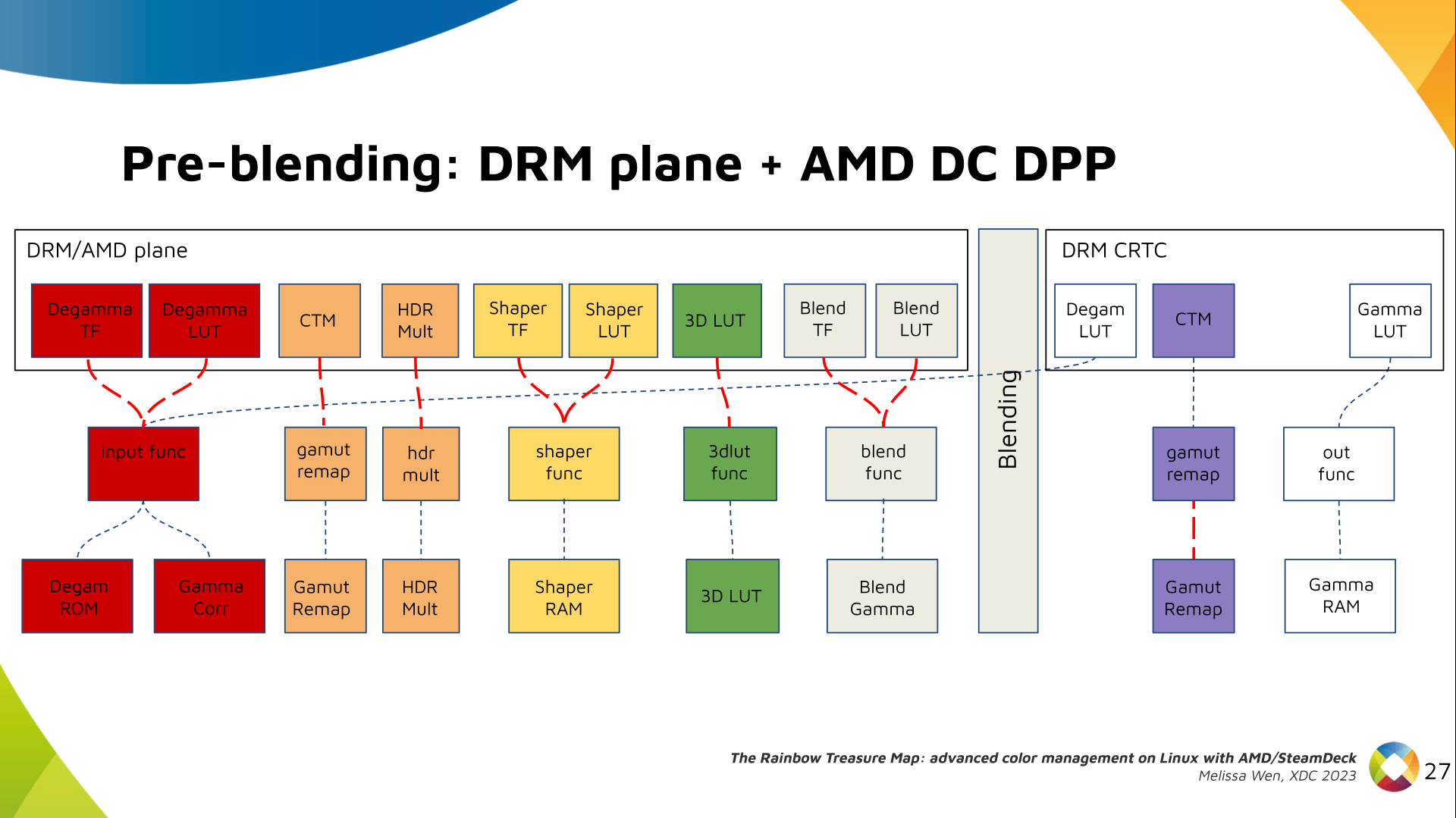
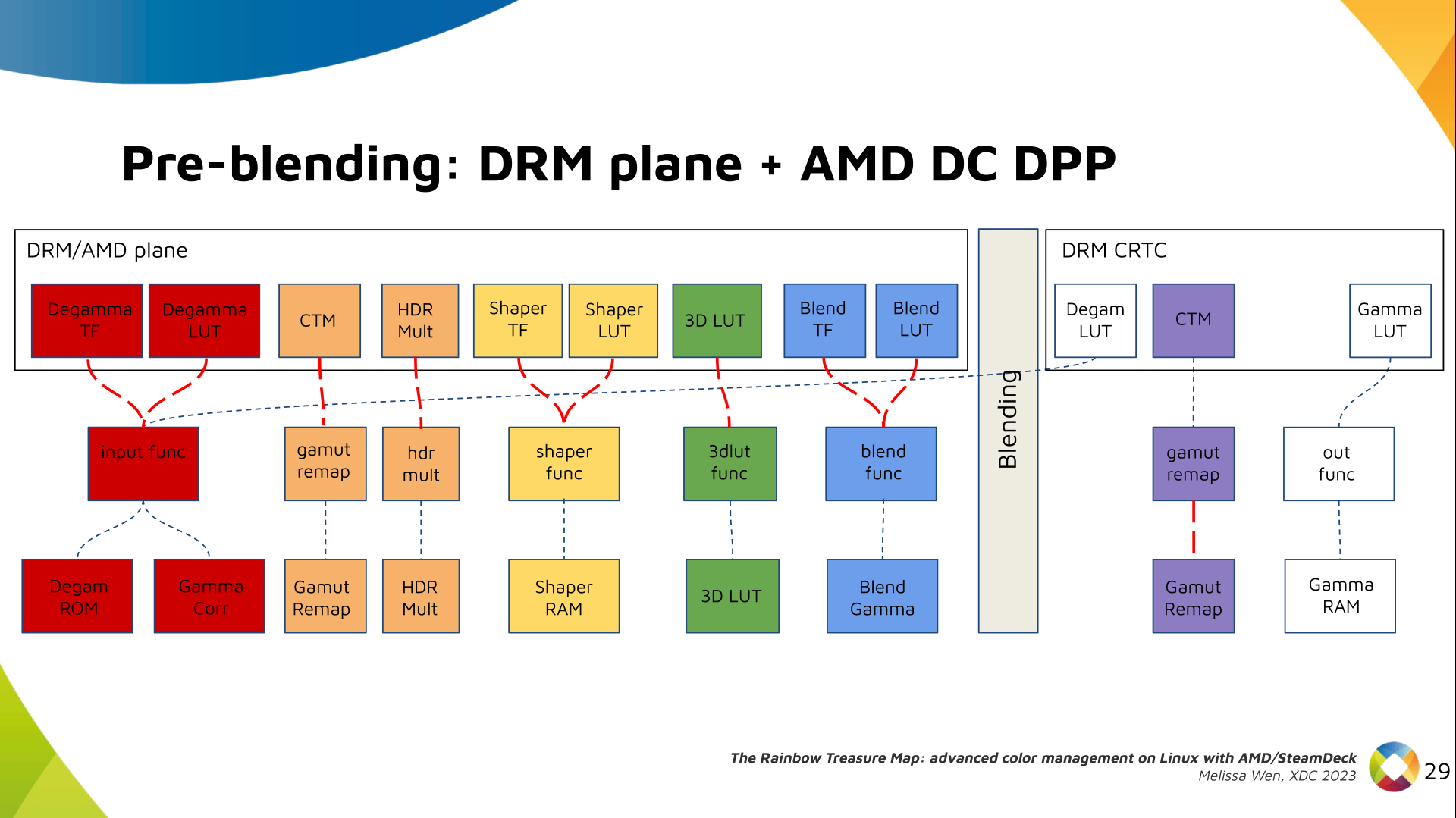
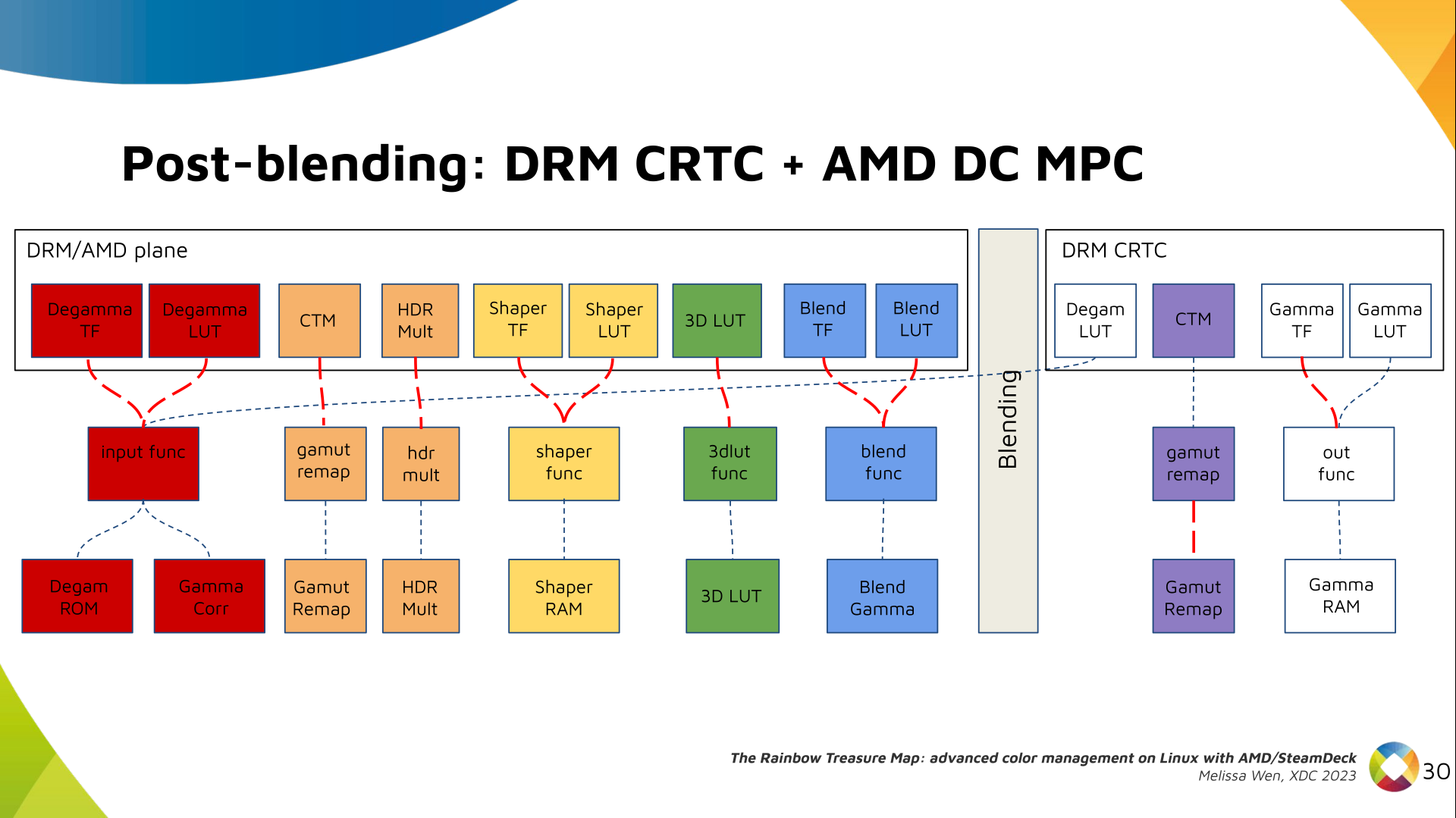
Melissa Wen: The Rainbow Treasure Map Talk: Advanced color management on Linux with AMD/Steam Deck.

Last week marked a major milestone for me: the AMD driver-specific color management properties reached the upstream linux-next! And to celebrate, I m happy to share the slides notes from my 2023 XDC talk, The Rainbow Treasure Map along with the individual recording that just dropped last week on youtube talk about happy coincidences!

Steam Deck Rainbow: Treasure Map & Magic Frogs While I may be bubbly and chatty in everyday life, the stage isn t exactly my comfort zone (hallway talks are more my speed). But the journey of developing the AMD color management properties was so full of discoveries that I simply had to share the experience. Witnessing the fantastic work of Jeremy and Joshua bring it all to life on the Steam Deck OLED was like uncovering magical ingredients and whipping up something truly enchanting. For XDC 2023, we split our Rainbow journey into two talks. My focus, The Rainbow Treasure Map, explored the new color features we added to the Linux kernel driver, diving deep into the hardware capabilities of AMD/Steam Deck. Joshua then followed with The Rainbow Frogs and showed the breathtaking color magic released on Gamescope thanks to the power unlocked by the kernel driver s Steam Deck color properties.

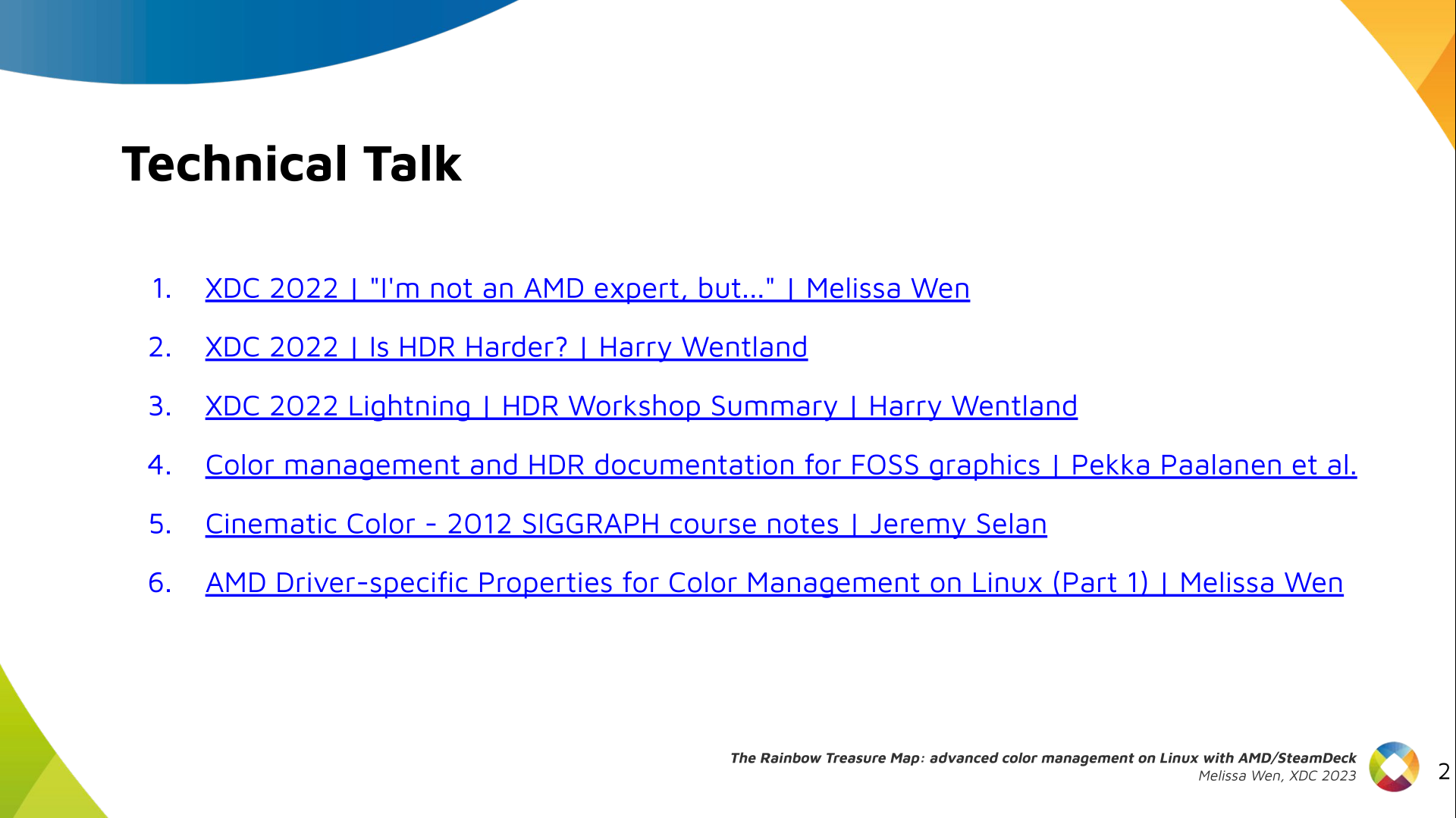
Packing a Rainbow into 15 Minutes I had so much to tell, but a half-slot talk meant crafting a concise presentation. To squeeze everything into 15 minutes (and calm my pre-talk jitters a bit!), I drafted and practiced those slides and notes countless times. So grab your map, and let s embark on the Rainbow journey together! Slide 1: The Rainbow Treasure Map - Advanced Color Management on Linux with AMD/SteamDeck Intro: Hi, I m Melissa from Igalia and welcome to the Rainbow Treasure Map, a talk about advanced color management on Linux with AMD/SteamDeck. Slide 2: List useful links for this technical talk Useful links: First of all, if you are not used to the topic, you may find these links useful.
  1. XDC 2022 - I m not an AMD expert, but - Melissa Wen
  2. XDC 2022 - Is HDR Harder? - Harry Wentland
  3. XDC 2022 Lightning - HDR Workshop Summary - Harry Wentland
  4. Color management and HDR documentation for FOSS graphics - Pekka Paalanen et al.
  5. Cinematic Color - 2012 SIGGRAPH course notes - Jeremy Selan
  6. AMD Driver-specific Properties for Color Management on Linux (Part 1) - Melissa Wen
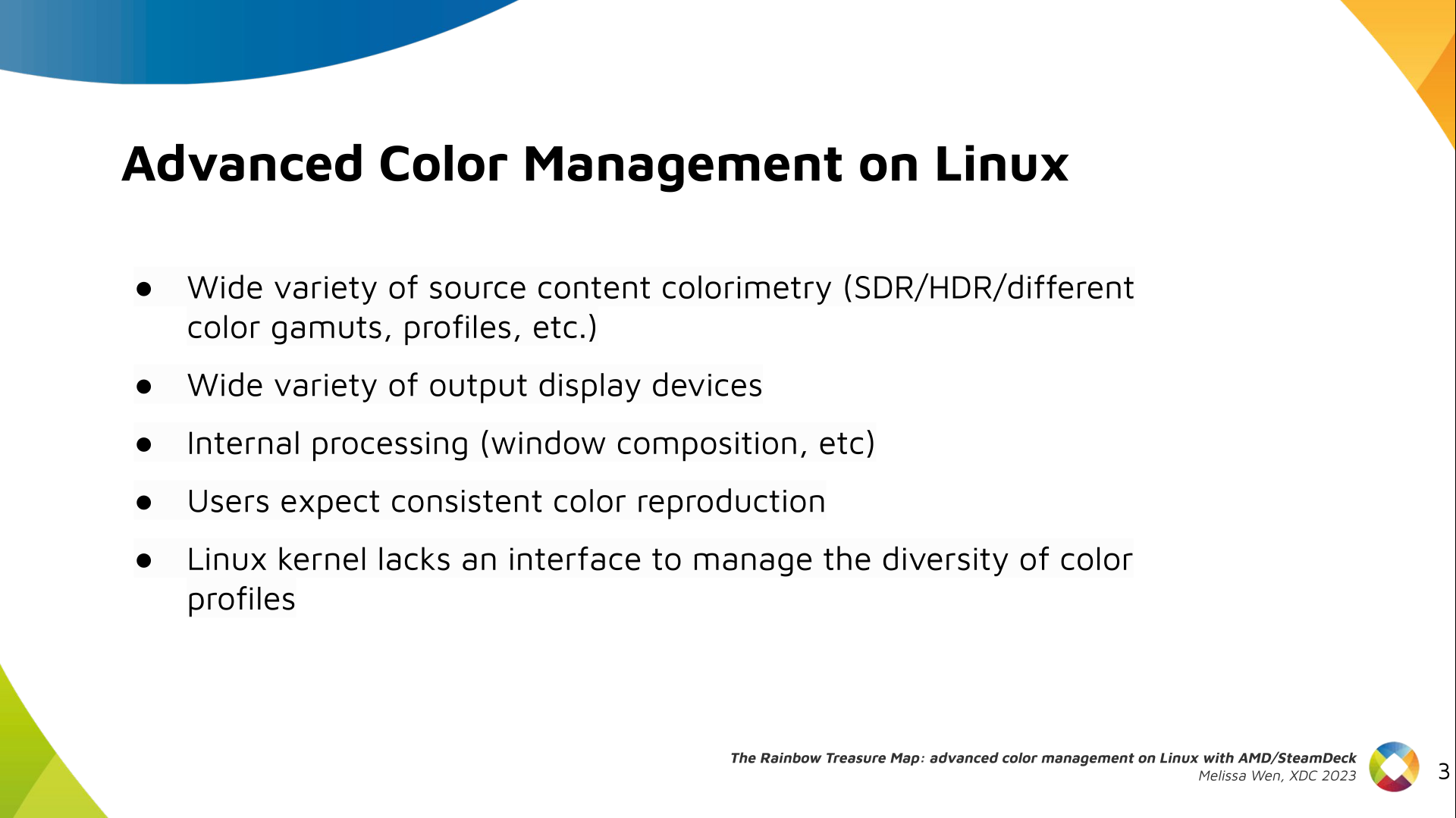
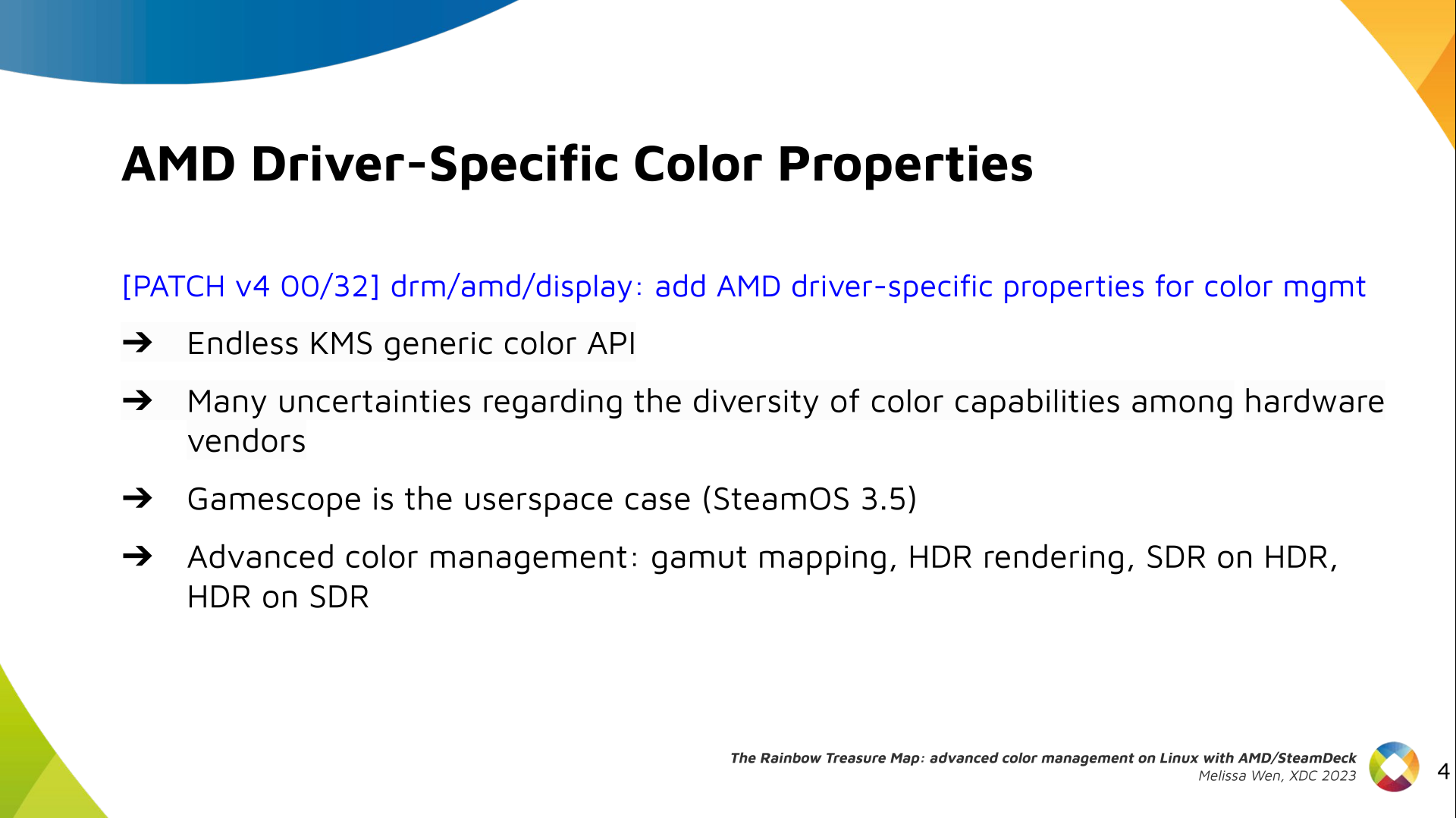
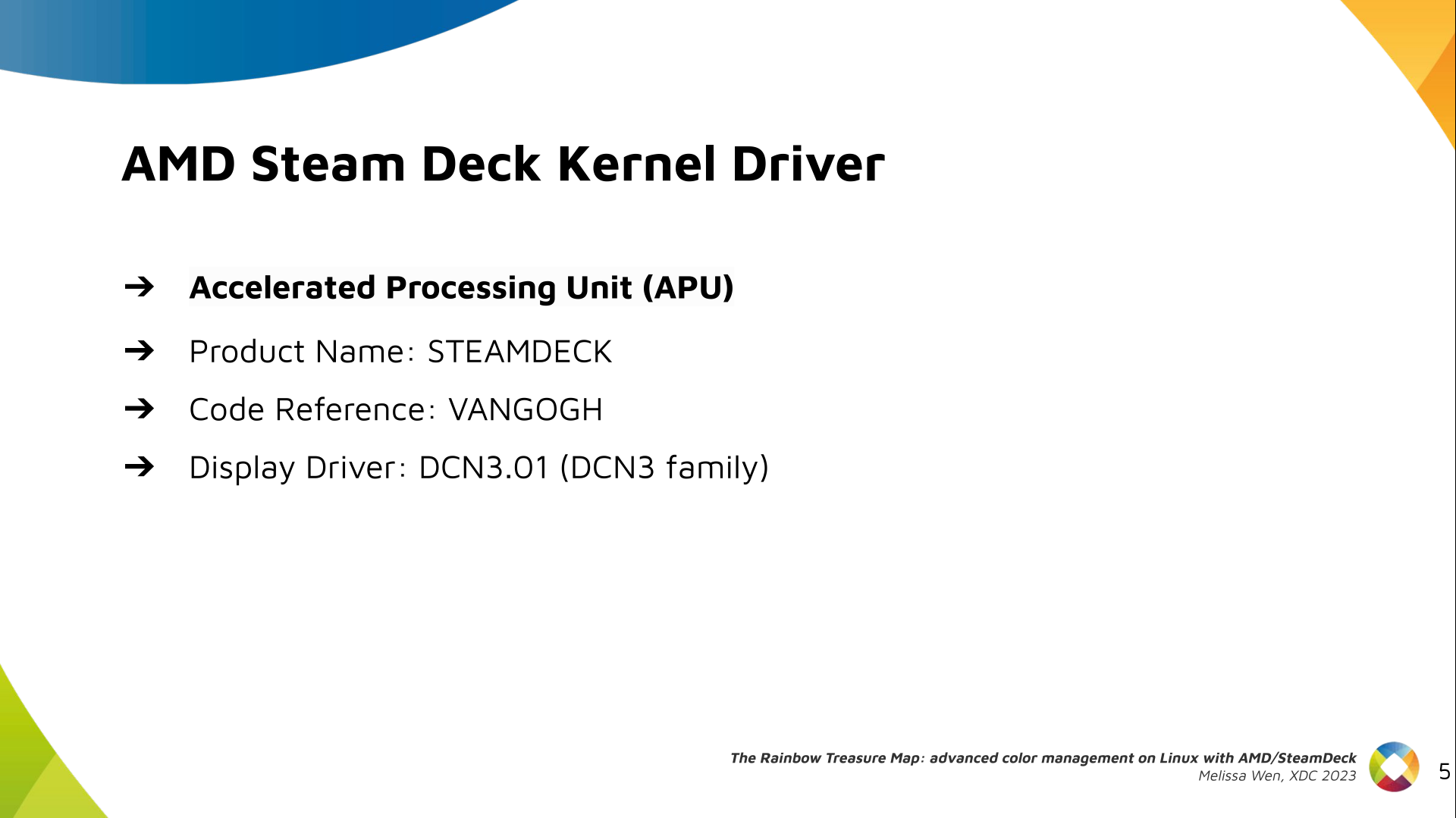
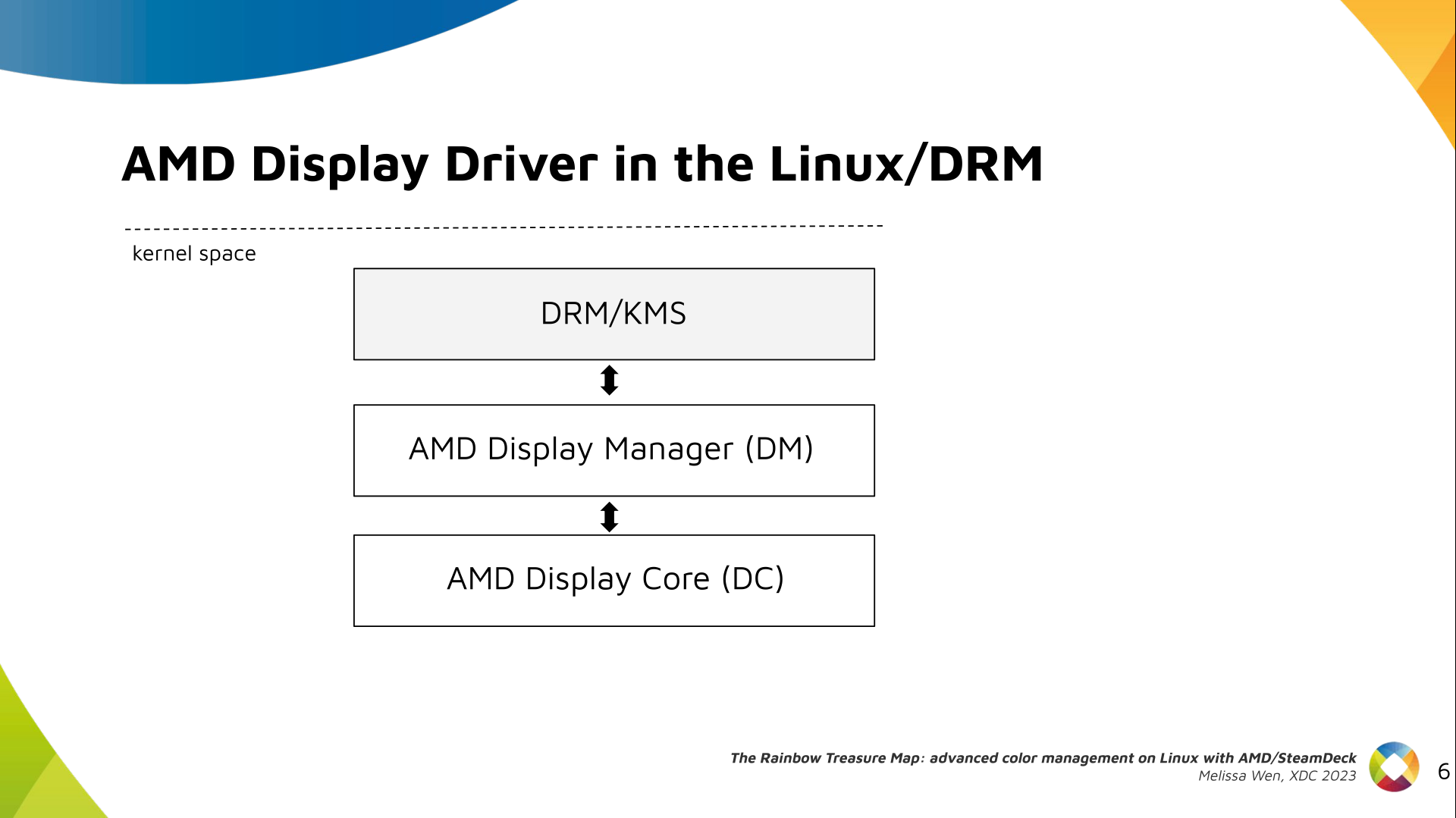
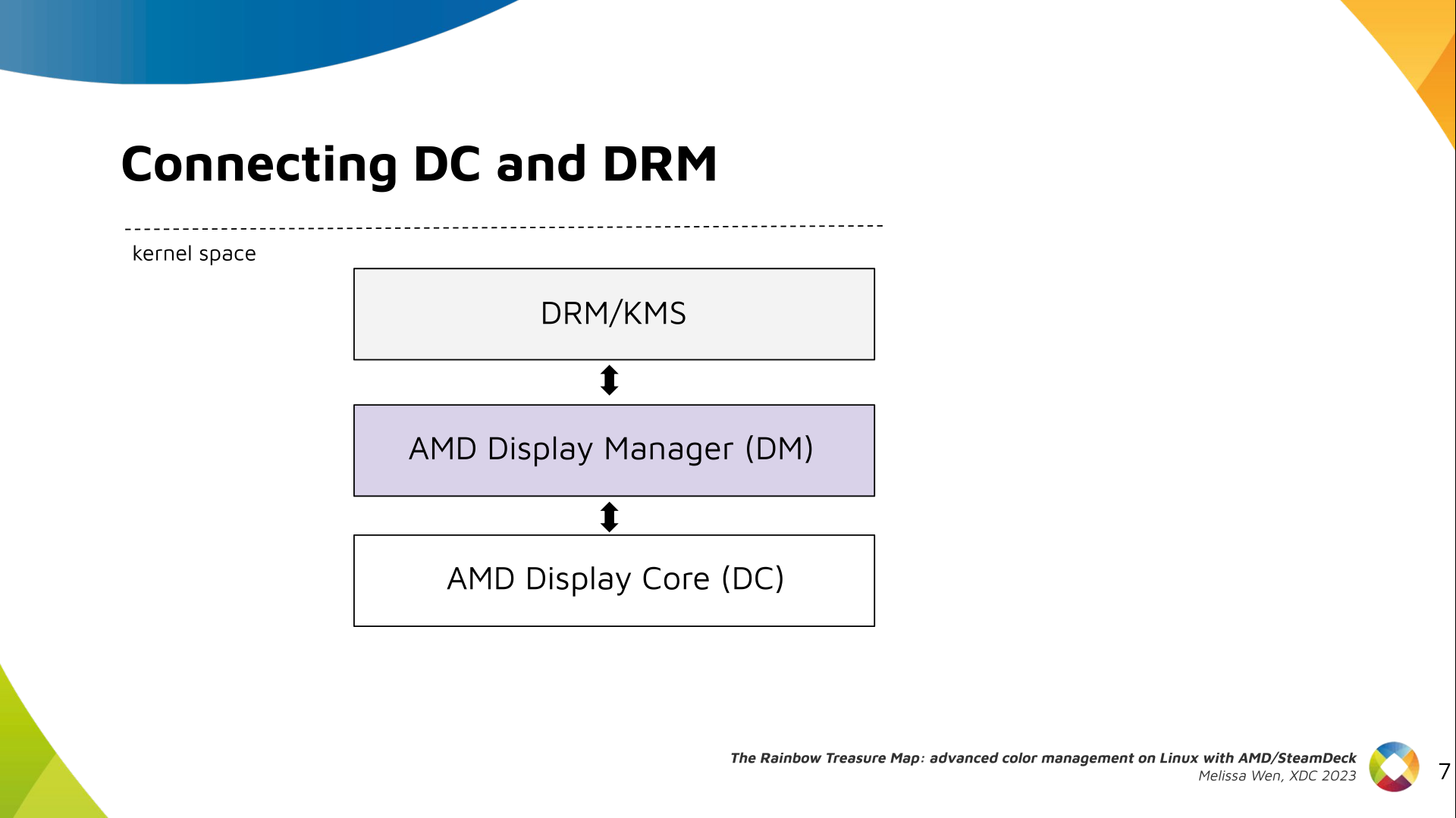
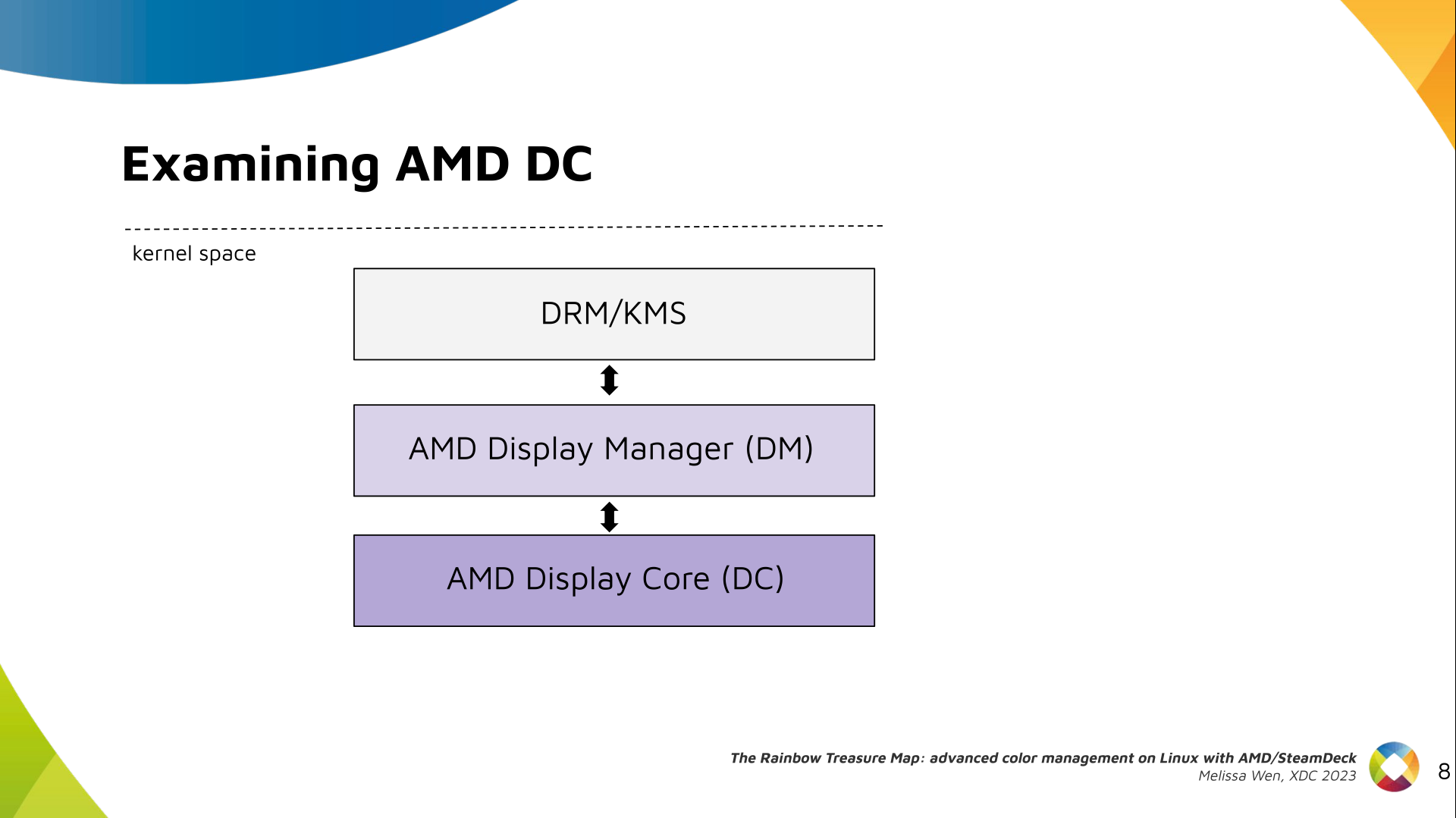
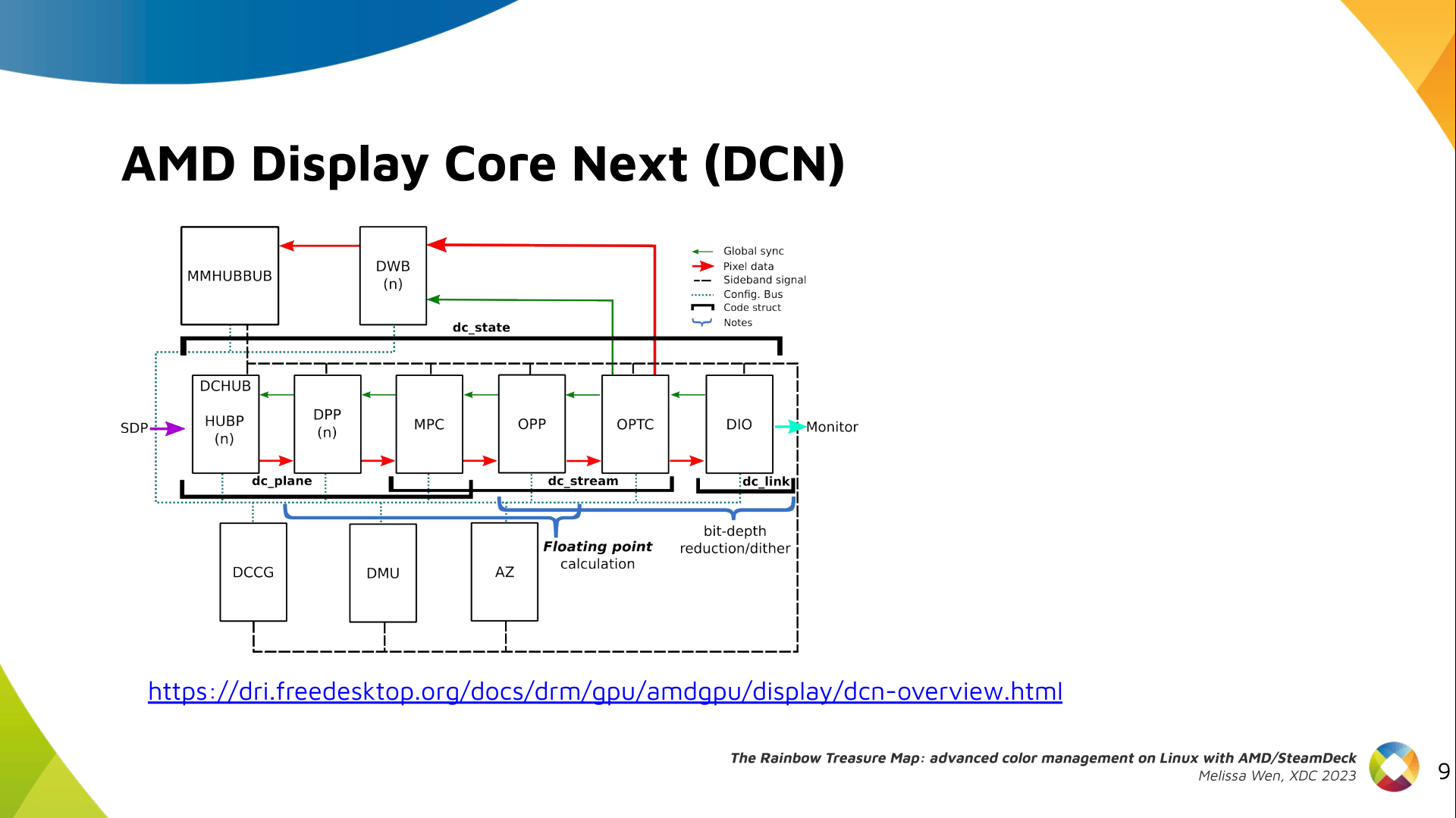
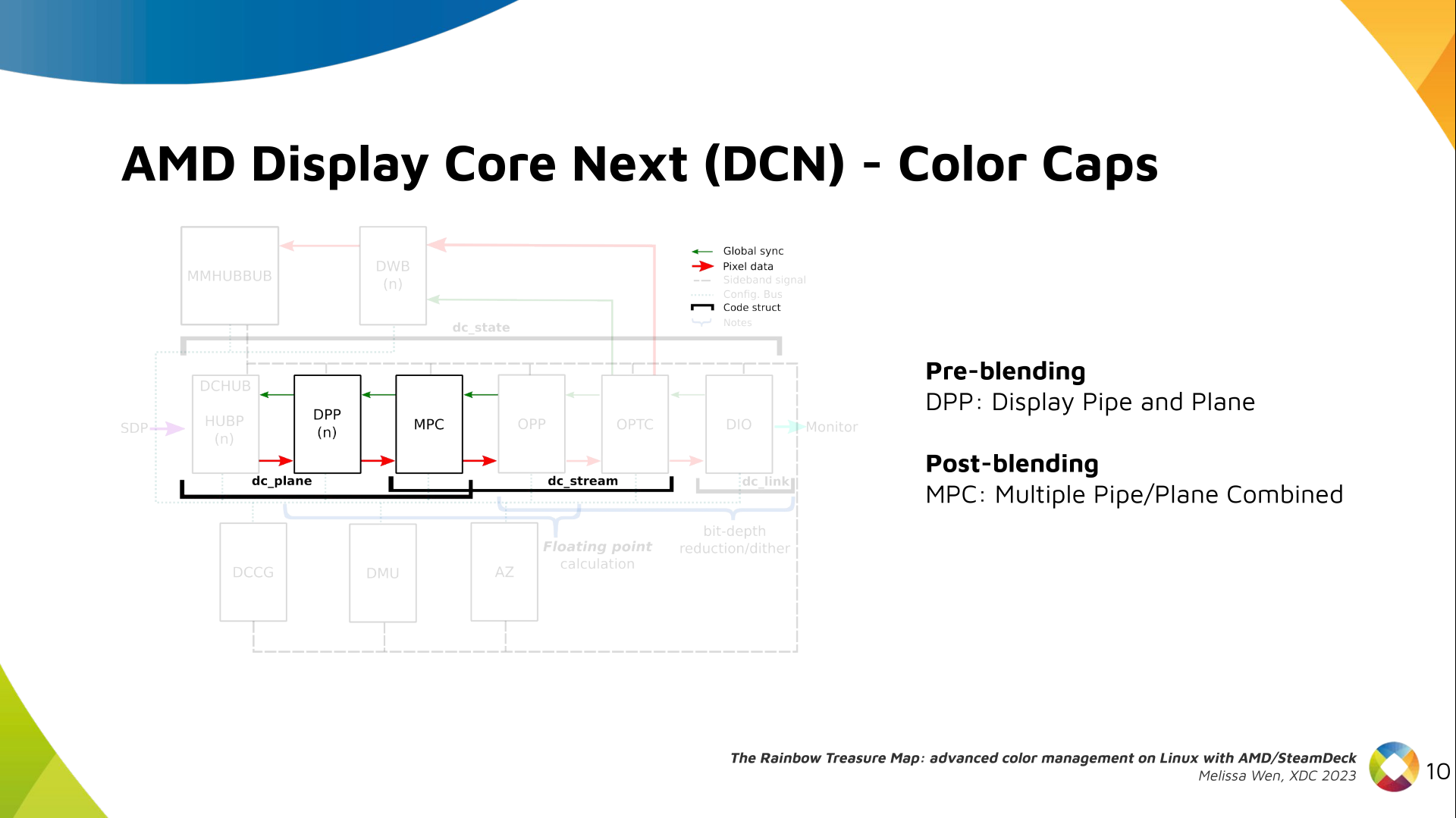
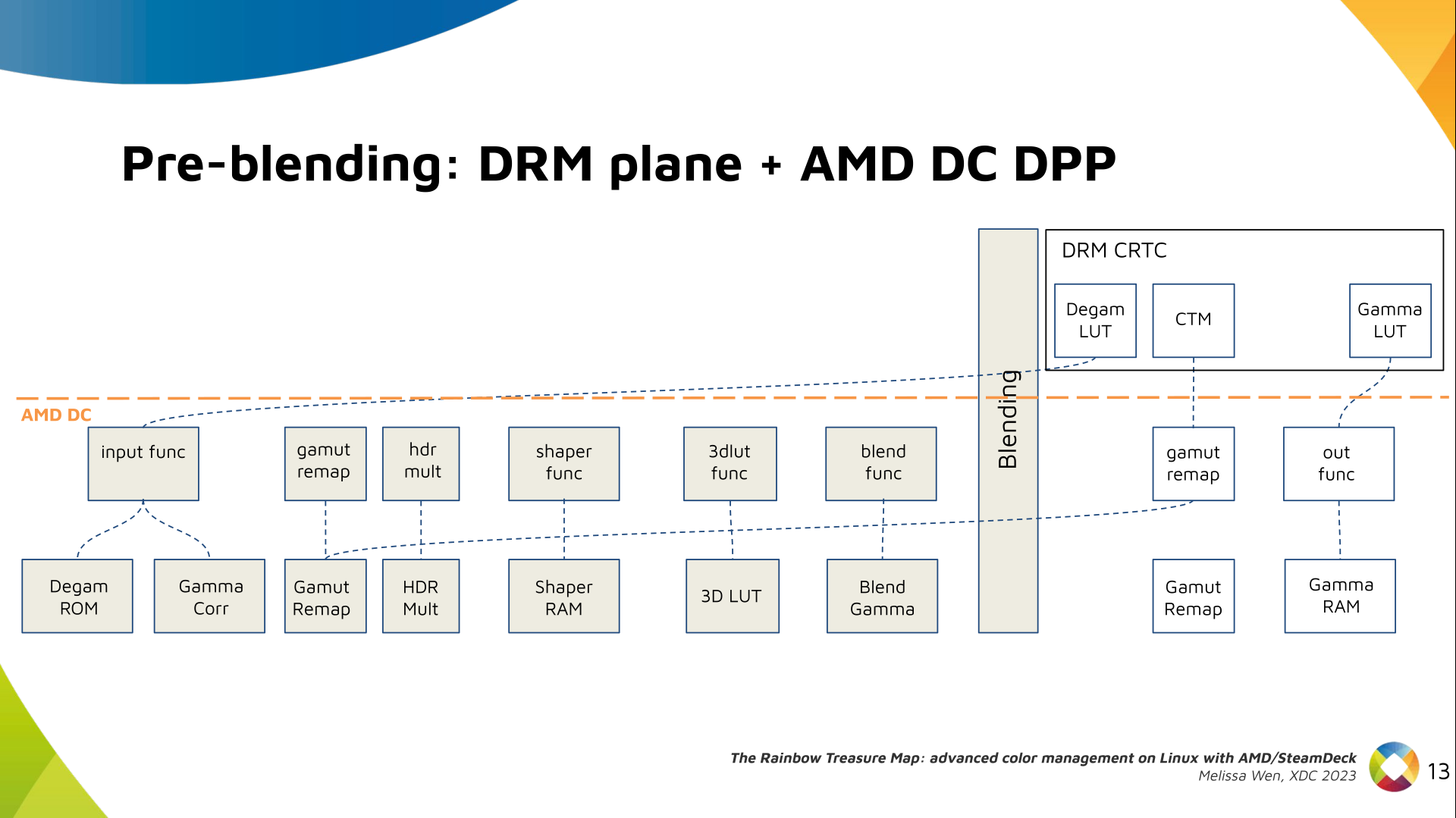
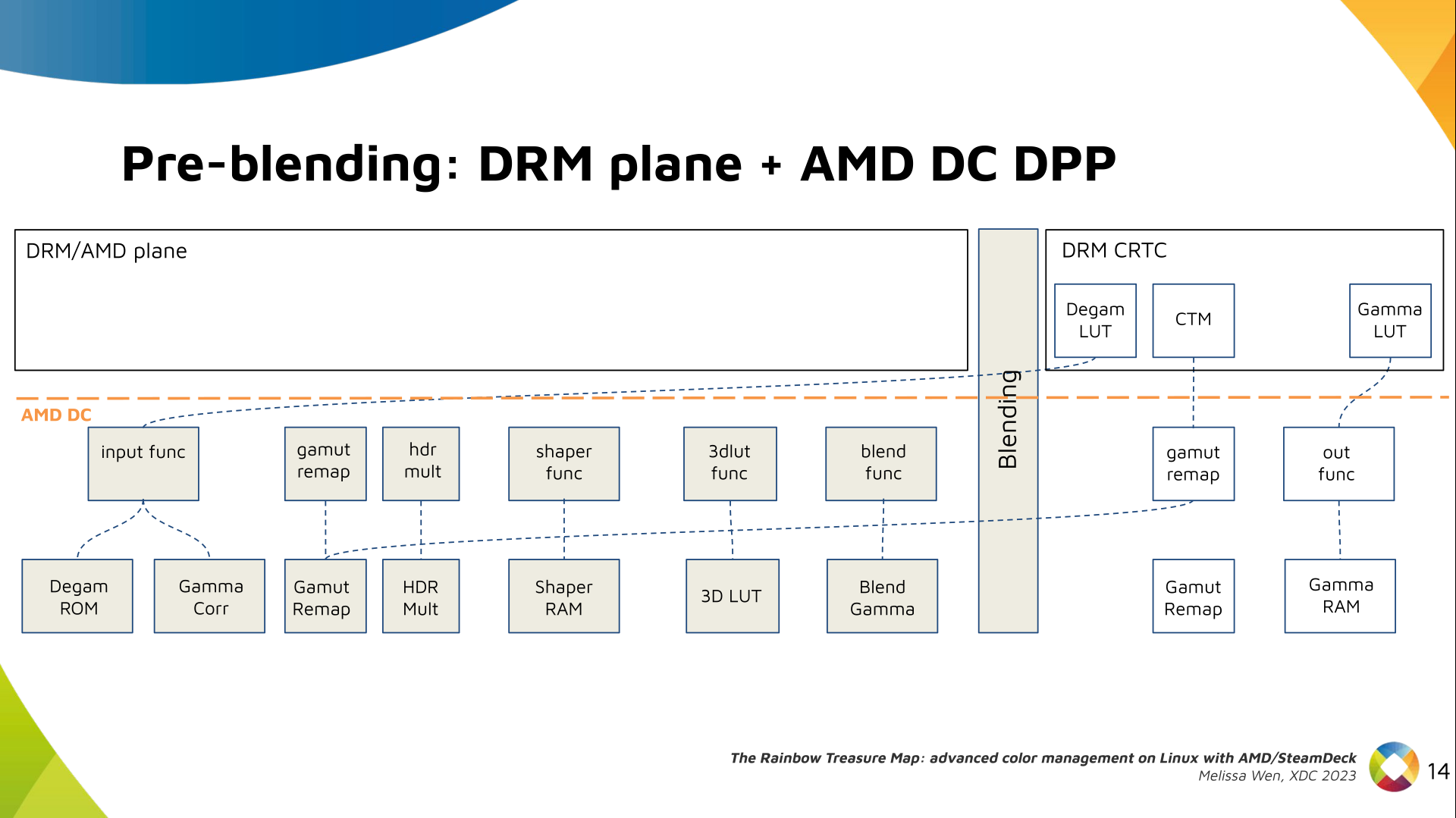
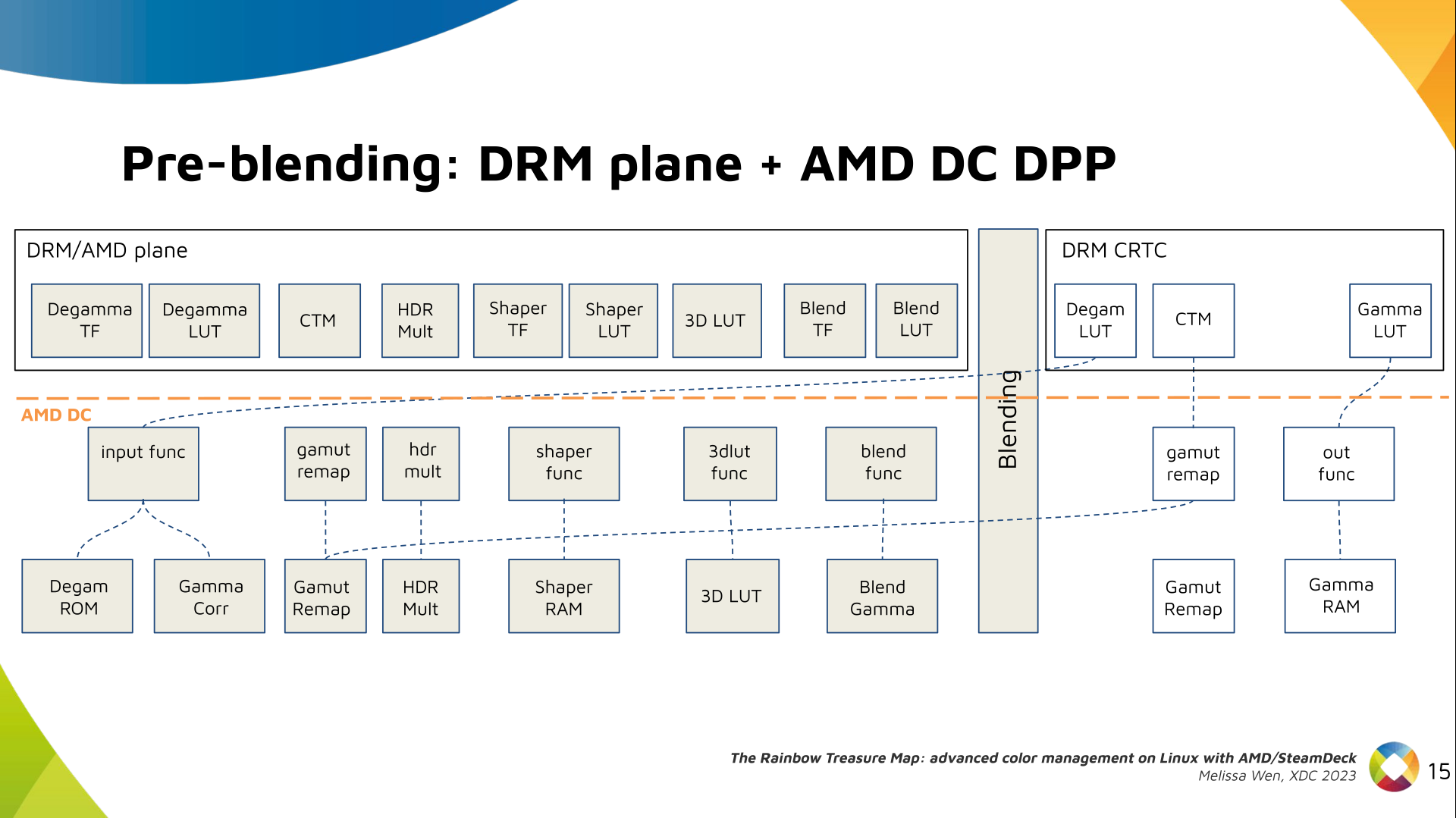
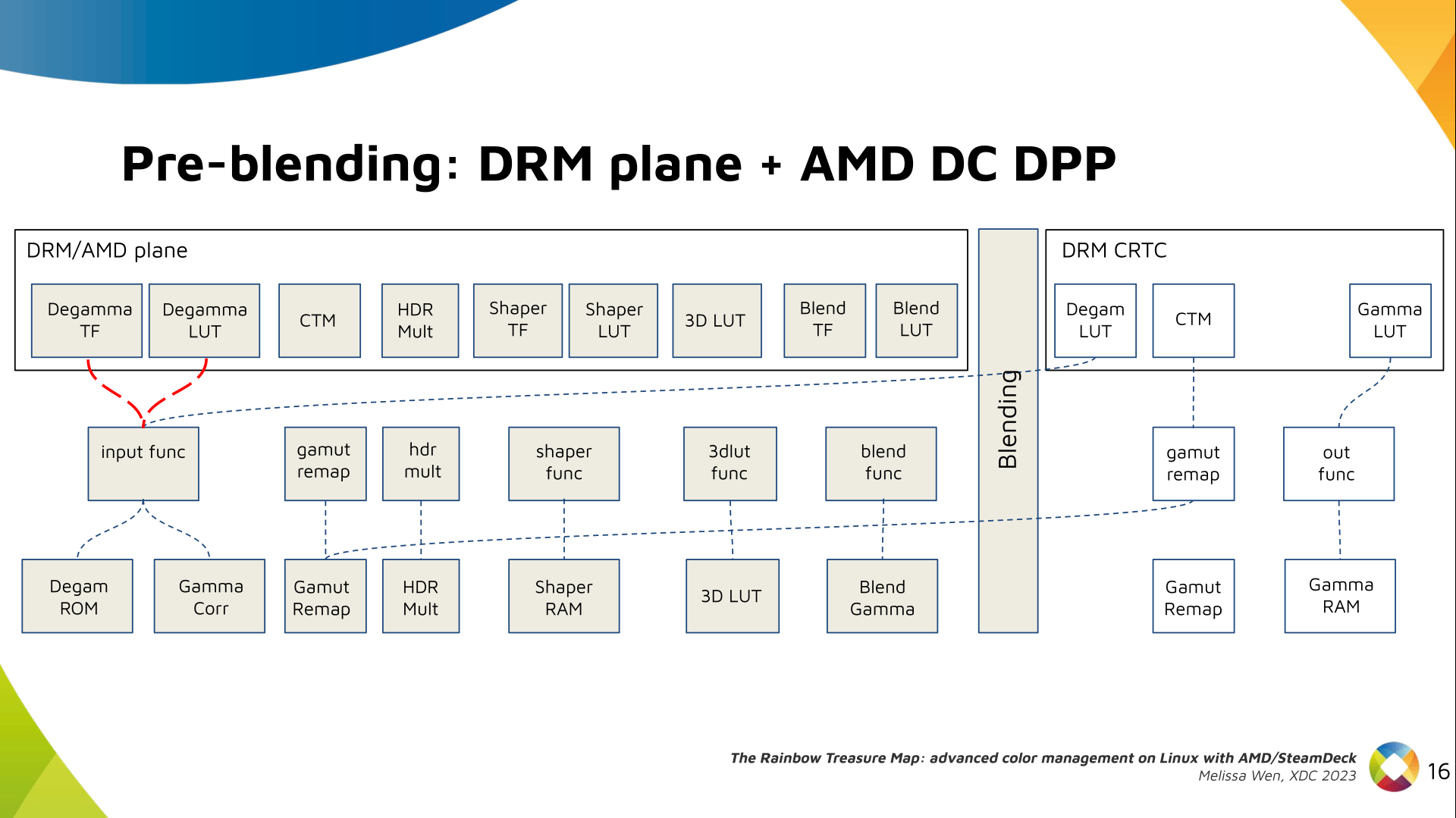
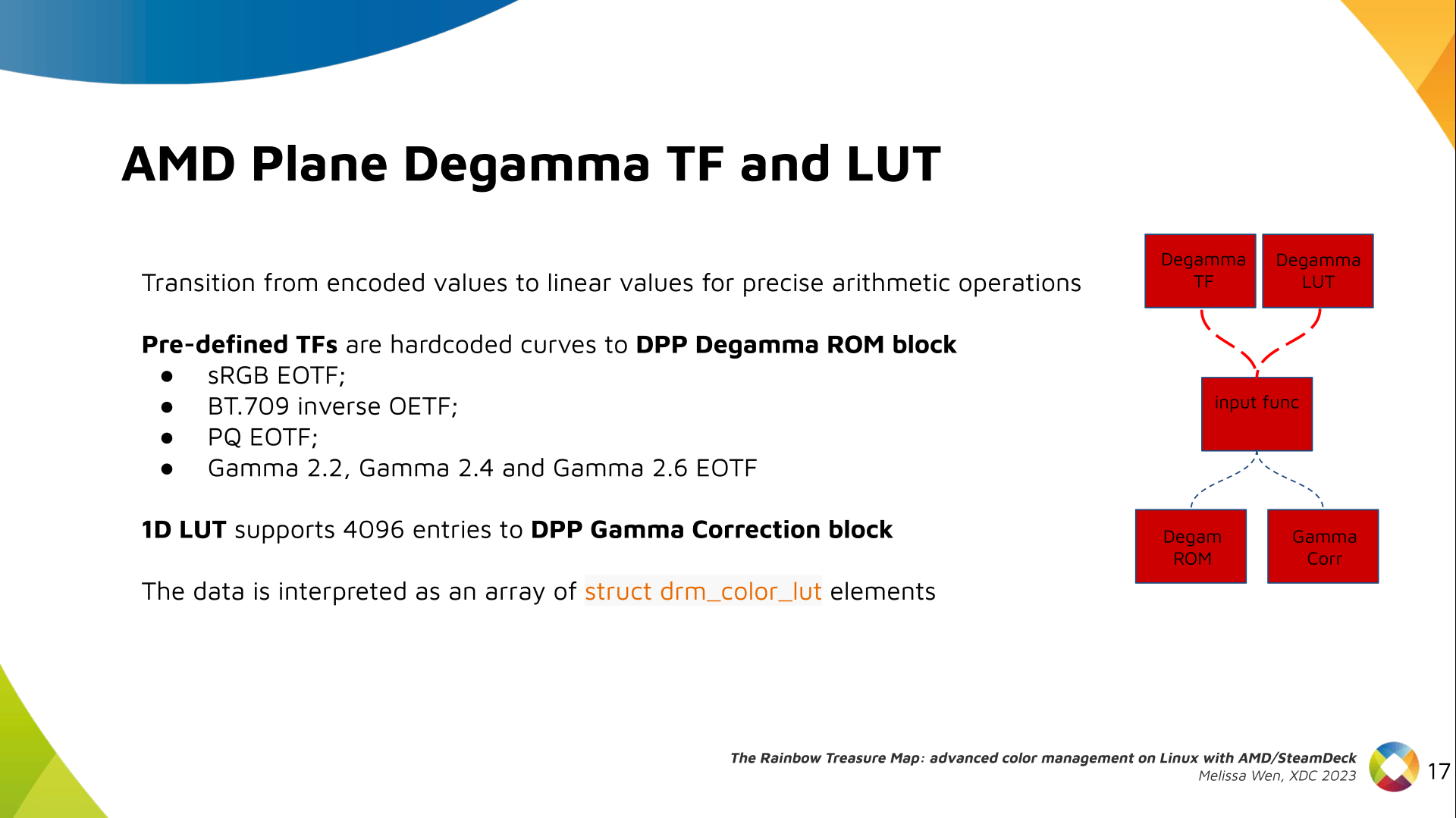
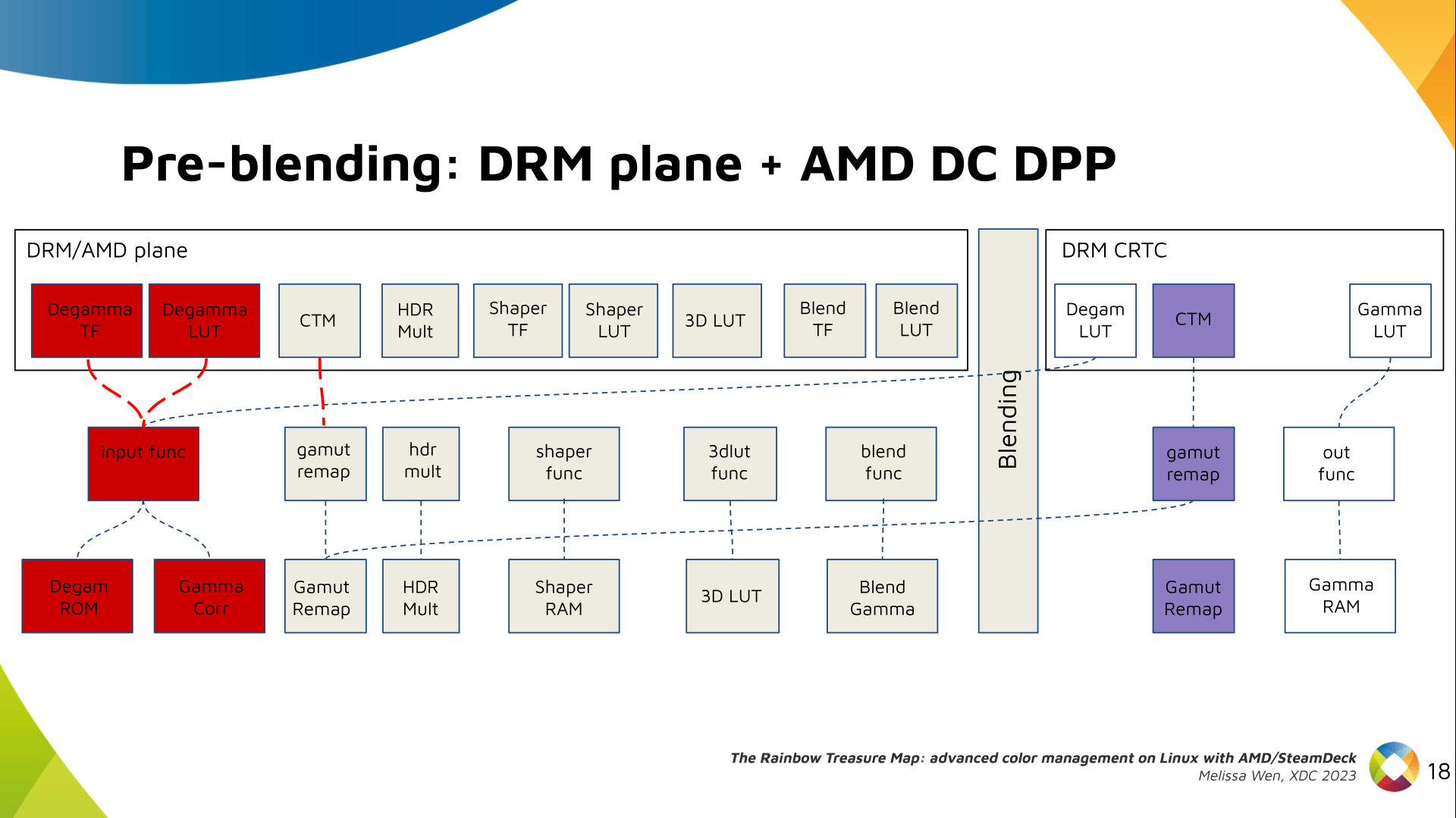
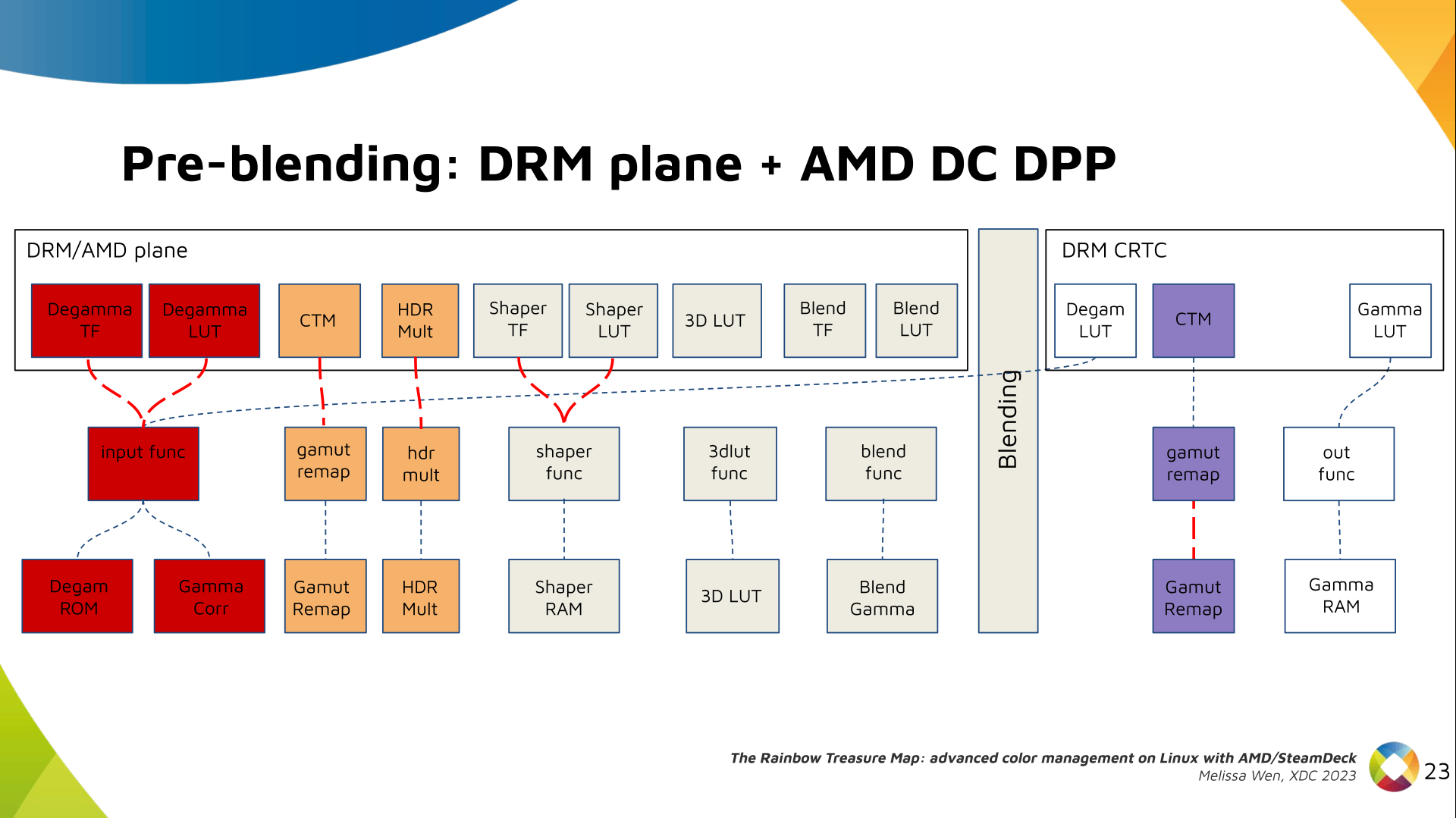
Slide 3: Why do we need advanced color management on Linux? Context: When we talk about colors in the graphics chain, we should keep in mind that we have a wide variety of source content colorimetry, a variety of output display devices and also the internal processing. Users expect consistent color reproduction across all these devices. The userspace can use GPU-accelerated color management to get it. But this also requires an interface with display kernel drivers that is currently missing from the DRM/KMS framework. Slide 4: Describe our work on AMD driver-specific color properties Since April, I ve been bothering the DRM community by sending patchsets from the work of me and Joshua to add driver-specific color properties to the AMD display driver. In parallel, discussions on defining a generic color management interface are still ongoing in the community. Moreover, we are still not clear about the diversity of color capabilities among hardware vendors. To bridge this gap, we defined a color pipeline for Gamescope that fits the latest versions of AMD hardware. It delivers advanced color management features for gamut mapping, HDR rendering, SDR on HDR, and HDR on SDR. Slide 5: Describe the AMD/SteamDeck - our hardware AMD/Steam Deck hardware: AMD frequently releases new GPU and APU generations. Each generation comes with a DCN version with display hardware improvements. Therefore, keep in mind that this work uses the AMD Steam Deck hardware and its kernel driver. The Steam Deck is an APU with a DCN3.01 display driver, a DCN3 family. It s important to have this information since newer AMD DCN drivers inherit implementations from previous families but aldo each generation of AMD hardware may introduce new color capabilities. Therefore I recommend you to familiarize yourself with the hardware you are working on. Slide 6: Diagram with the three layers of the AMD display driver on Linux The AMD display driver in the kernel space: It consists of three layers, (1) the DRM/KMS framework, (2) the AMD Display Manager, and (3) the AMD Display Core. We extended the color interface exposed to userspace by leveraging existing DRM resources and connecting them using driver-specific functions for color property management. Slide 7: Three-layers diagram highlighting AMD Display Manager, DM - the layer that connects DC and DRM Bridging DC color capabilities and the DRM API required significant changes in the color management of AMD Display Manager - the Linux-dependent part that connects the AMD DC interface to the DRM/KMS framework. Slide 8: Three-layers diagram highlighting AMD Display Core, DC - the shared code The AMD DC is the OS-agnostic layer. Its code is shared between platforms and DCN versions. Examining this part helps us understand the AMD color pipeline and hardware capabilities, since the machinery for hardware settings and resource management are already there. Slide 9: Diagram of the AMD Display Core Next architecture with main elements and data flow The newest architecture for AMD display hardware is the AMD Display Core Next. Slide 10: Diagram of the AMD Display Core Next where only DPP and MPC blocks are highlighted In this architecture, two blocks have the capability to manage colors:
  • Display Pipe and Plane (DPP) - for pre-blending adjustments;
  • Multiple Pipe/Plane Combined (MPC) - for post-blending color transformations.
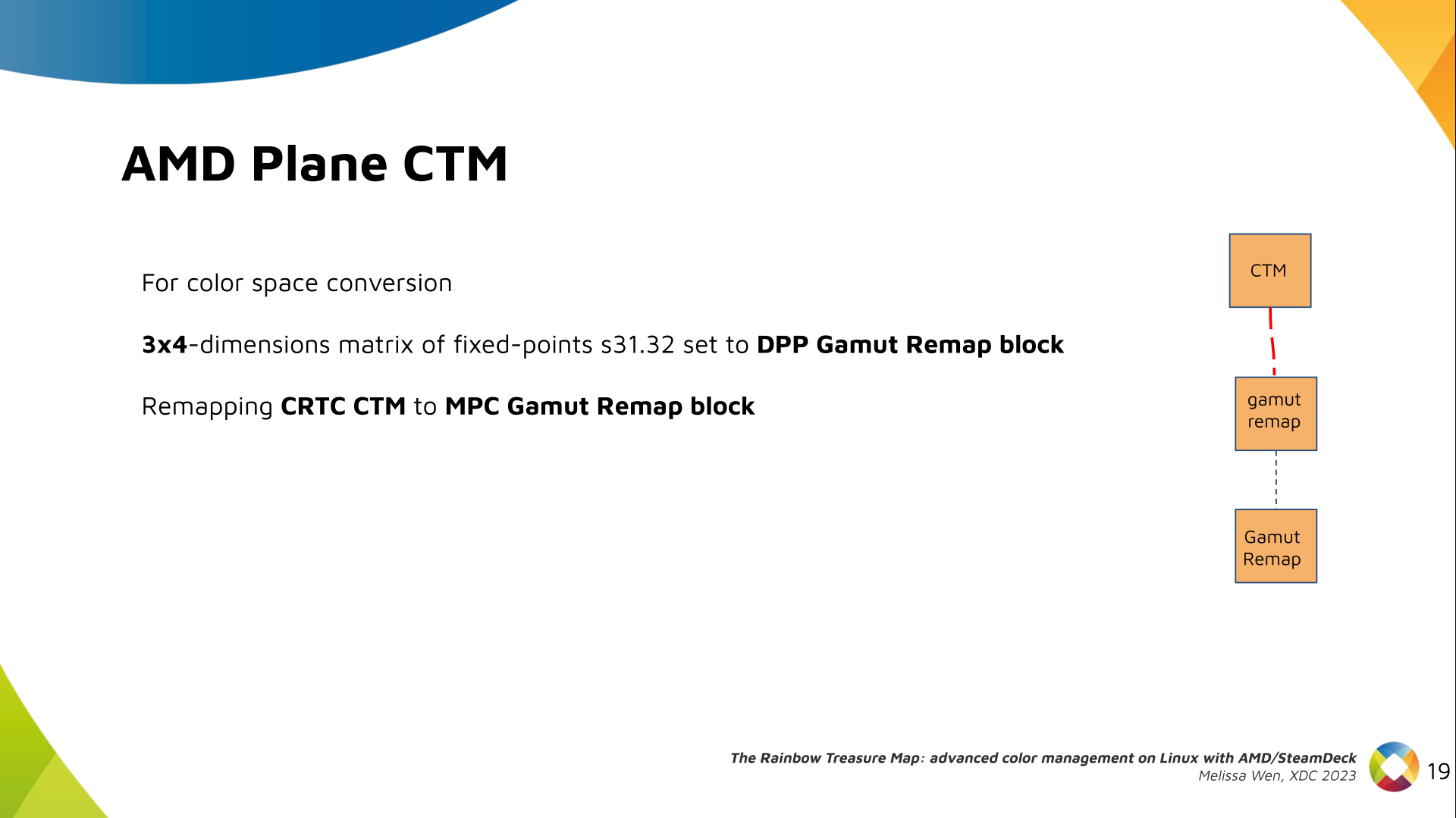
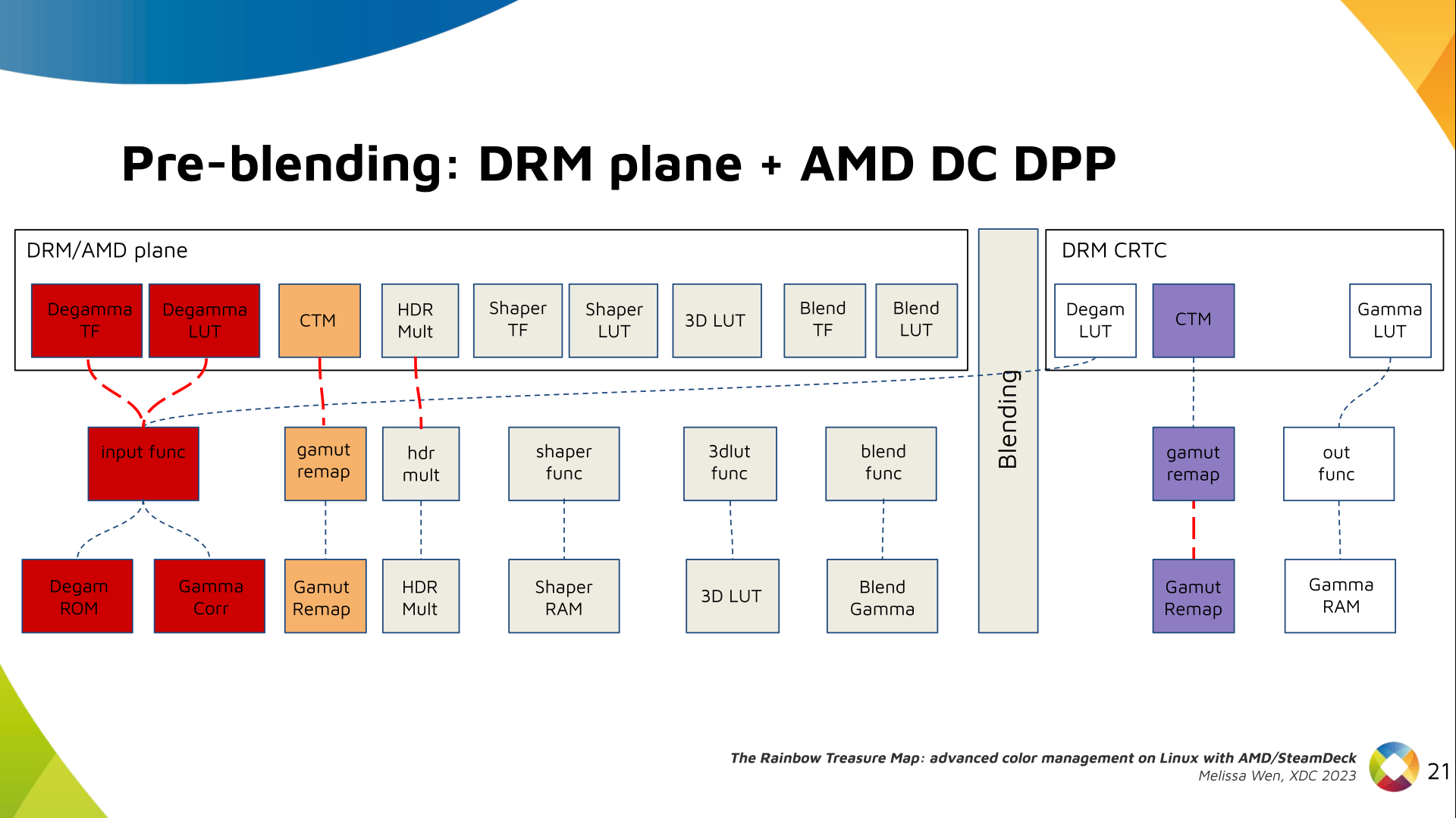
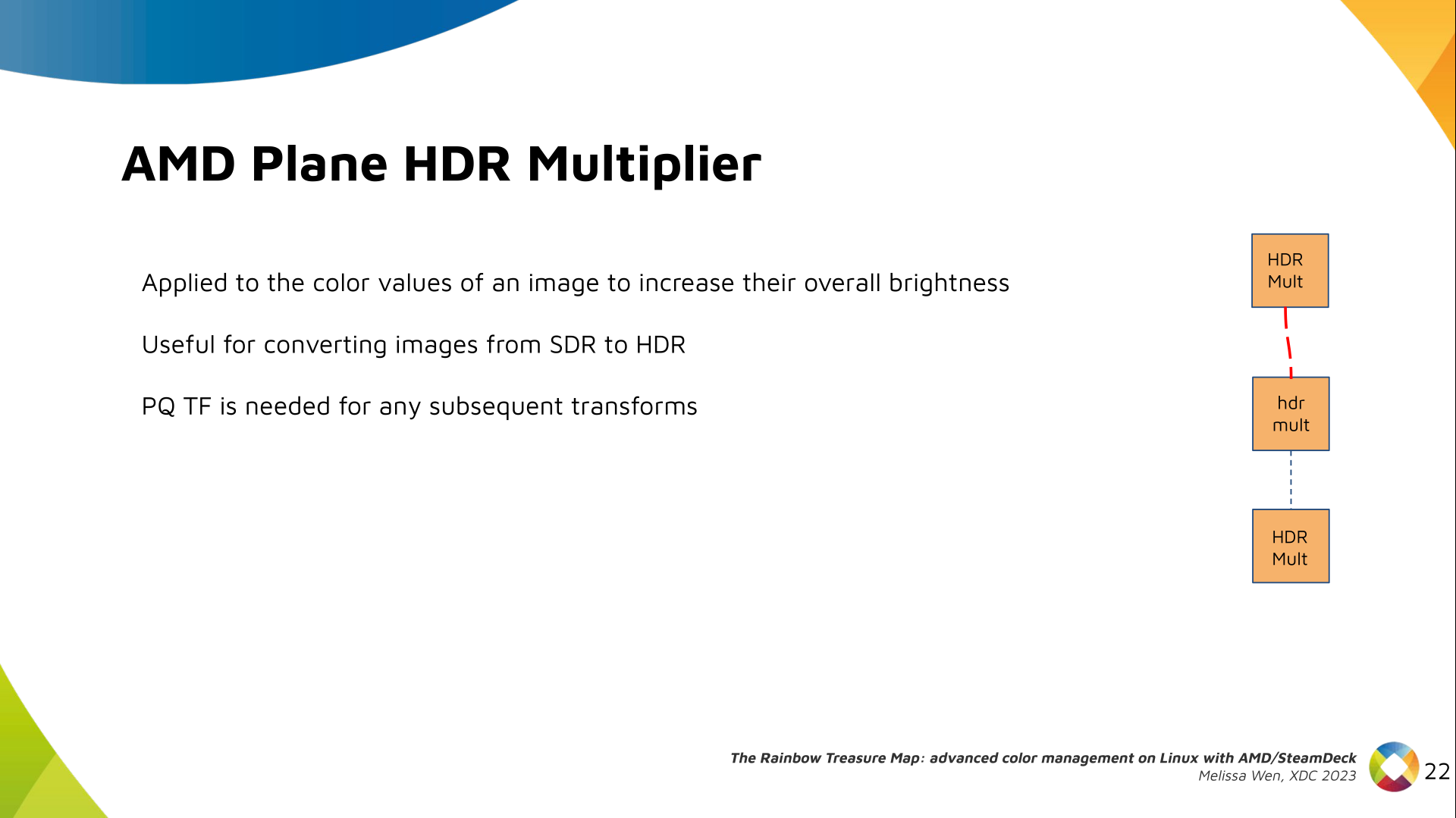
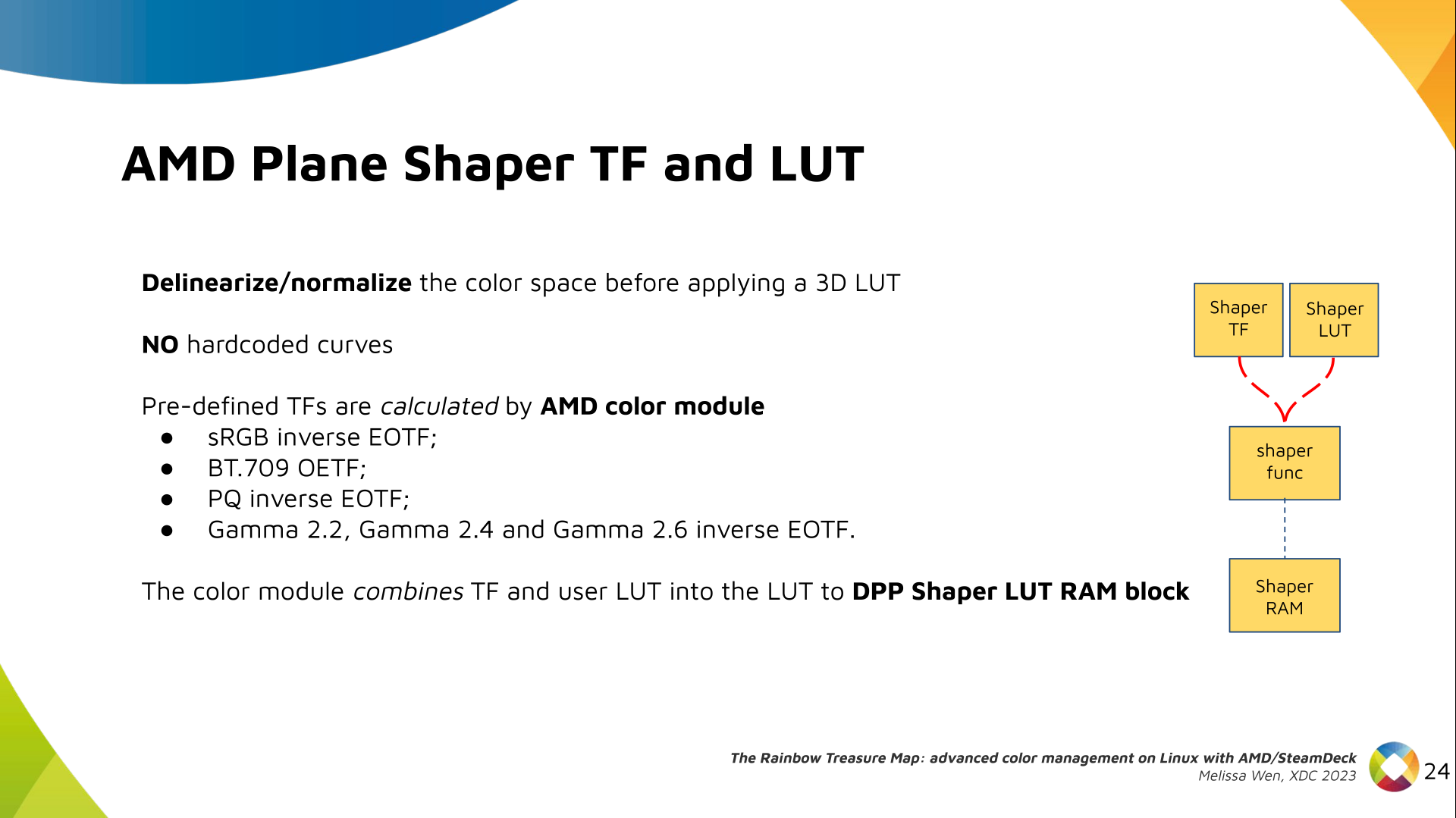
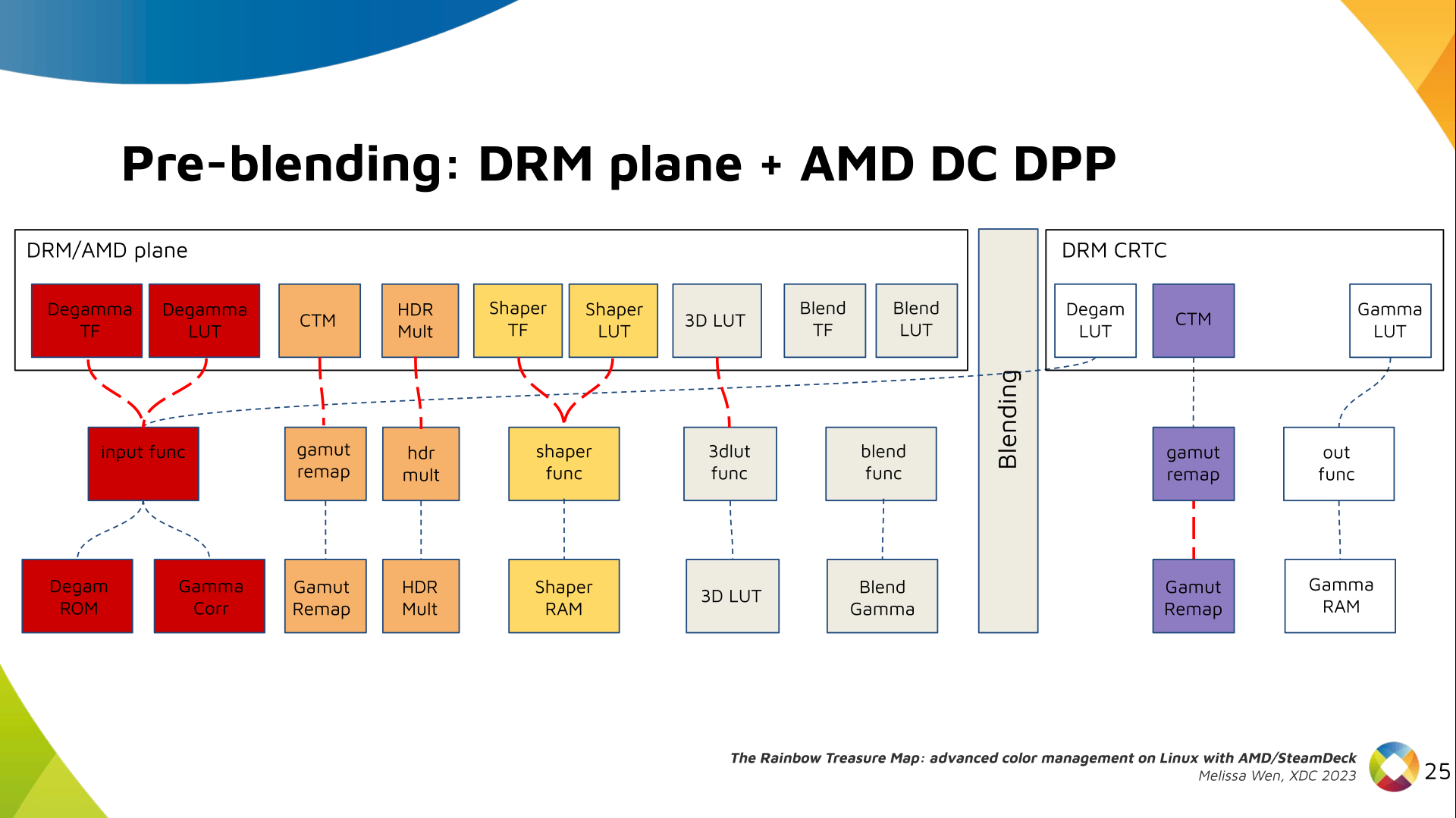
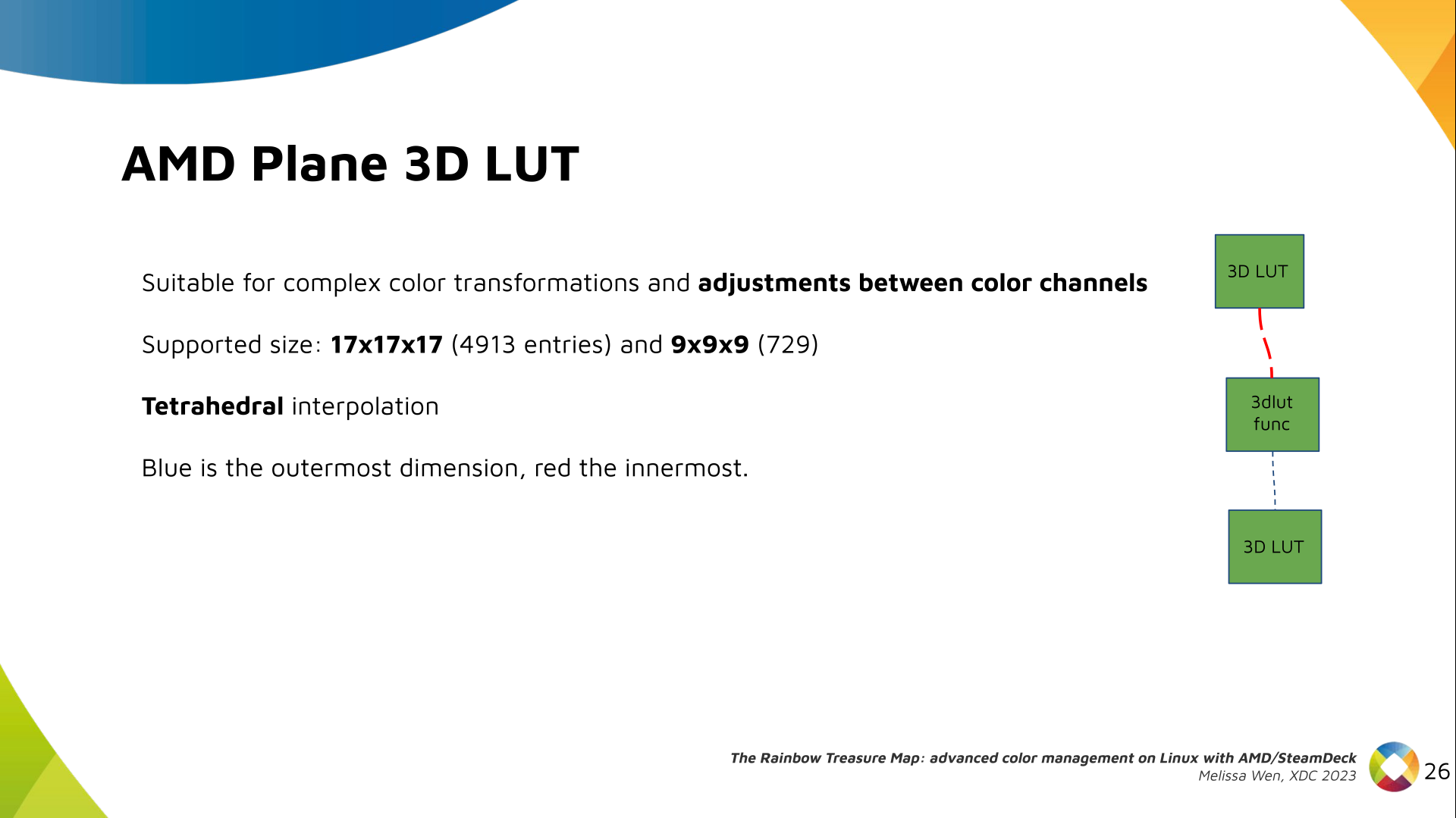
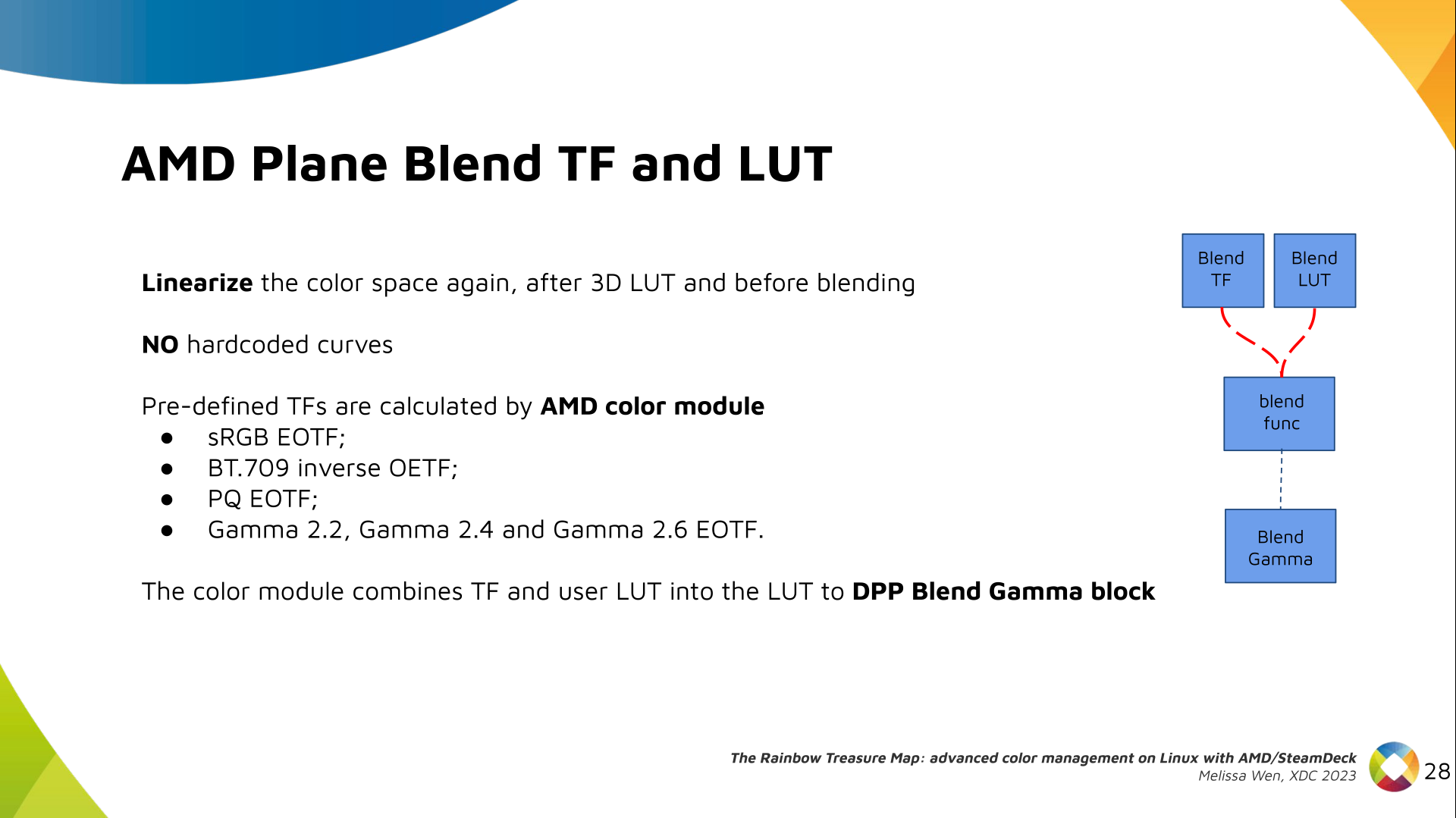
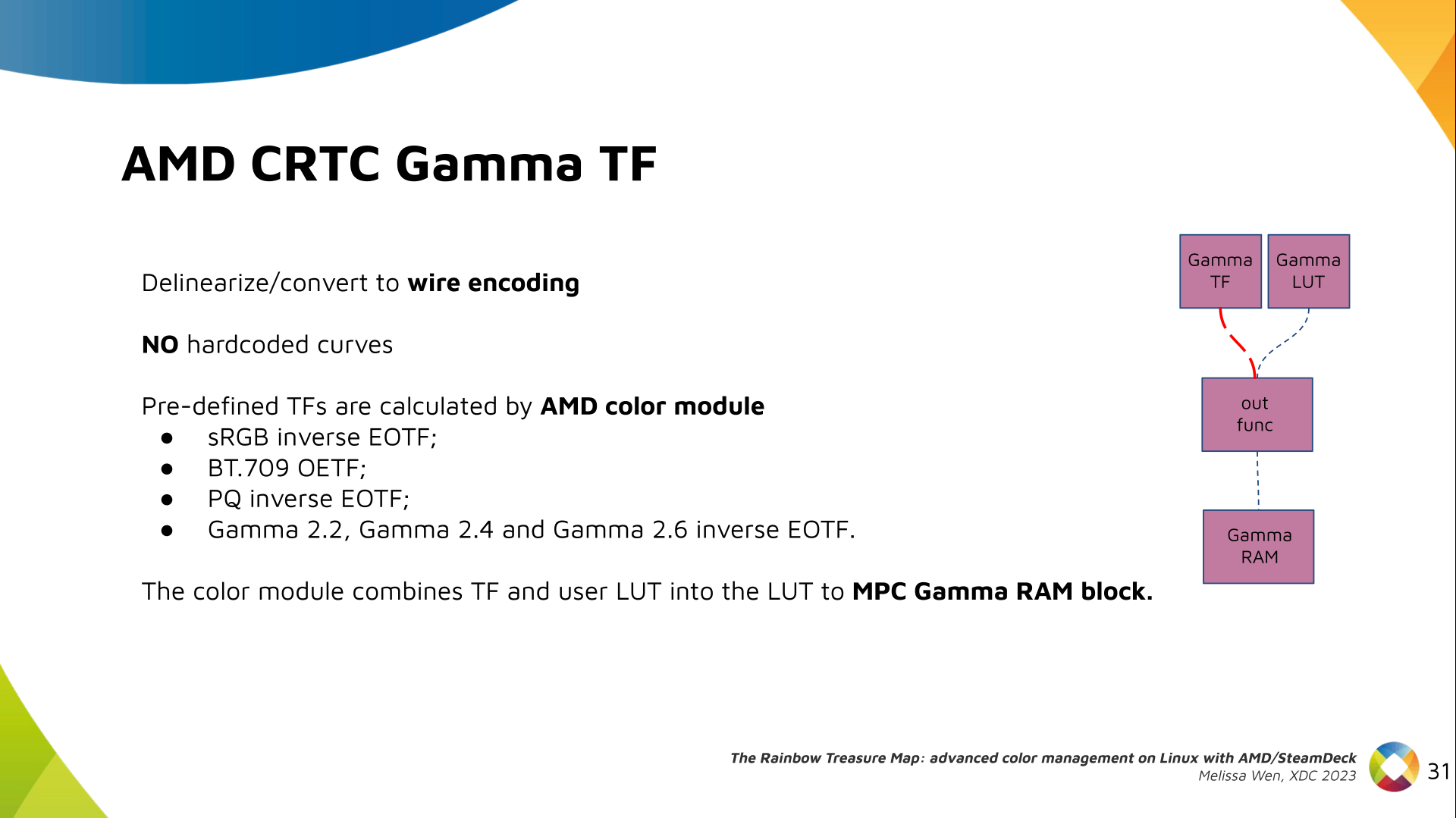
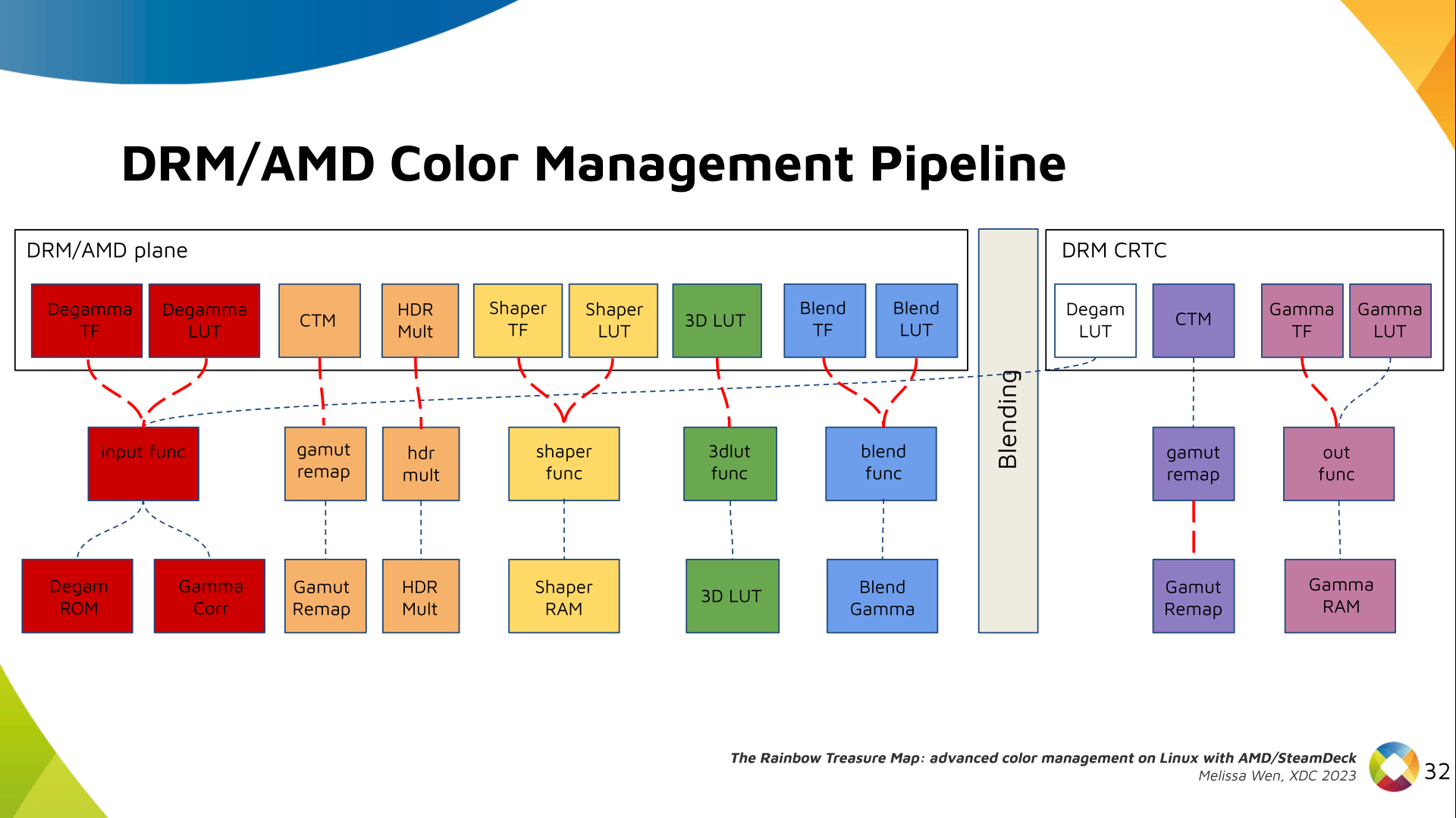
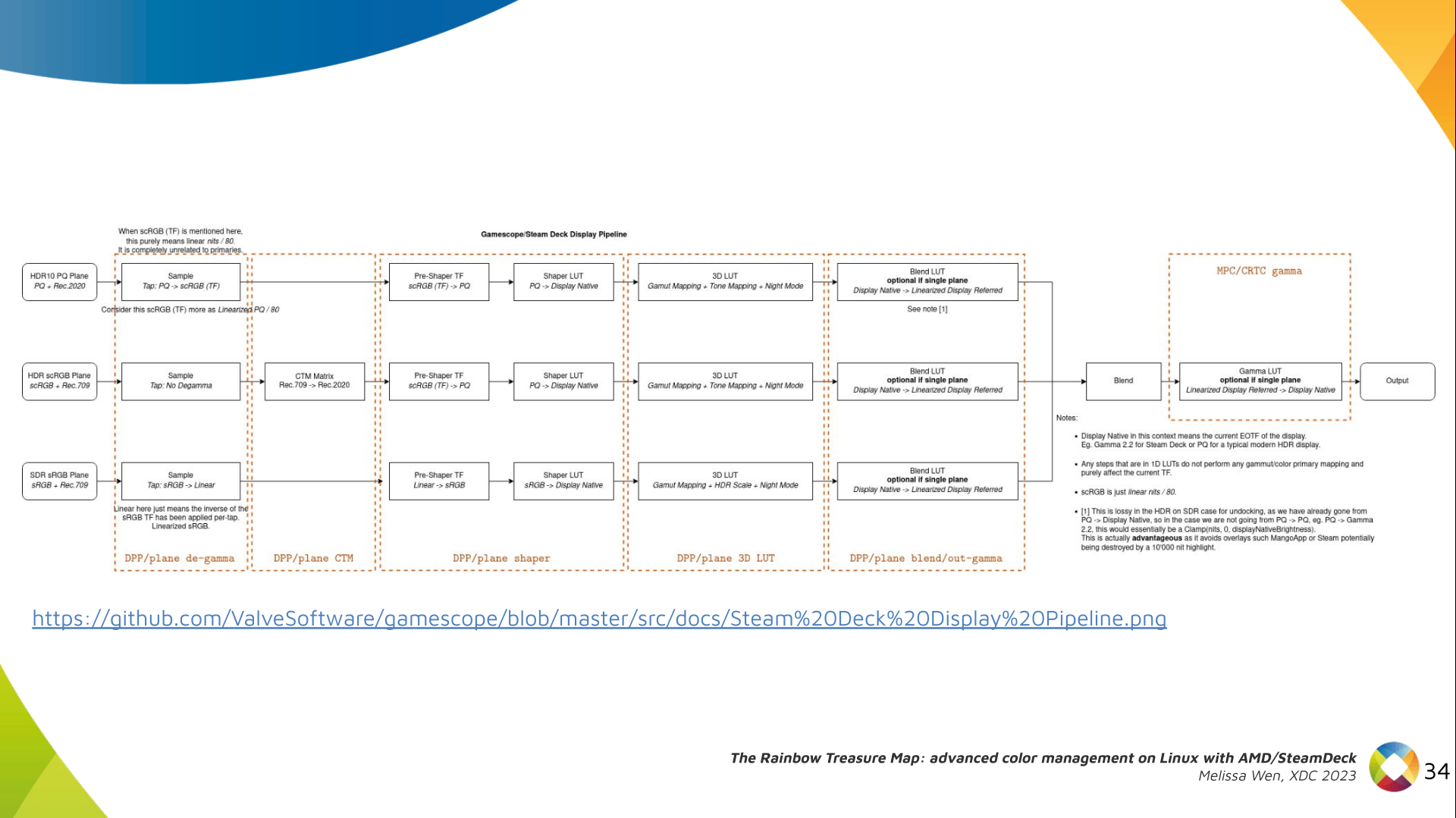
Let s see what we have in the DRM API for pre-blending color management. Slide 11: Blank slide with no content only a title 'Pre-blending: DRM plane' DRM plane color properties: This is the DRM color management API before blending. Nothing! Except two basic DRM plane properties: color_encoding and color_range for the input colorspace conversion, that is not covered by this work. Slide 12: Diagram with color capabilities and structures in AMD DC layer without any DRM plane color interface (before blending), only the DRM CRTC color interface for post blending In case you re not familiar with AMD shared code, what we need to do is basically draw a map and navigate there! We have some DRM color properties after blending, but nothing before blending yet. But much of the hardware programming was already implemented in the AMD DC layer, thanks to the shared code. Slide 13: Previous Diagram with a rectangle to highlight the empty space in the DRM plane interface that will be filled by AMD plane properties Still both the DRM interface and its connection to the shared code were missing. That s when the search begins! Slide 14: Color Pipeline Diagram with the plane color interface filled by AMD plane properties but without connections to AMD DC resources AMD driver-specific color pipeline: Looking at the color capabilities of the hardware, we arrive at this initial set of properties. The path wasn t exactly like that. We had many iterations and discoveries until reached to this pipeline. Slide 15: Color Pipeline Diagram connecting AMD plane degamma properties, LUT and TF, to AMD DC resources The Plane Degamma is our first driver-specific property before blending. It s used to linearize the color space from encoded values to light linear values. Slide 16: Describe plane degamma properties and hardware capabilities We can use a pre-defined transfer function or a user lookup table (in short, LUT) to linearize the color space. Pre-defined transfer functions for plane degamma are hardcoded curves that go to a specific hardware block called DPP Degamma ROM. It supports the following transfer functions: sRGB EOTF, BT.709 inverse OETF, PQ EOTF, and pure power curves Gamma 2.2, Gamma 2.4 and Gamma 2.6. We also have a one-dimensional LUT. This 1D LUT has four thousand ninety six (4096) entries, the usual 1D LUT size in the DRM/KMS. It s an array of drm_color_lut that goes to the DPP Gamma Correction block. Slide 17: Color Pipeline Diagram connecting AMD plane CTM property to AMD DC resources We also have now a color transformation matrix (CTM) for color space conversion. Slide 18: Describe plane CTM property and hardware capabilities It s a 3x4 matrix of fixed points that goes to the DPP Gamut Remap Block. Both pre- and post-blending matrices were previously gone to the same color block. We worked on detaching them to clear both paths. Now each CTM goes on its own way. Slide 19: Color Pipeline Diagram connecting AMD plane HDR multiplier property to AMD DC resources Next, the HDR Multiplier. HDR Multiplier is a factor applied to the color values of an image to increase their overall brightness. Slide 20: Describe plane HDR mult property and hardware capabilities This is useful for converting images from a standard dynamic range (SDR) to a high dynamic range (HDR). As it can range beyond [0.0, 1.0] subsequent transforms need to use the PQ(HDR) transfer functions. Slide 21: Color Pipeline Diagram connecting AMD plane shaper properties, LUT and TF, to AMD DC resources And we need a 3D LUT. But 3D LUT has a limited number of entries in each dimension, so we want to use it in a colorspace that is optimized for human vision. It means in a non-linear space. To deliver it, userspace may need one 1D LUT before 3D LUT to delinearize content and another one after to linearize content again for blending. Slide 22: Describe plane shaper properties and hardware capabilities The pre-3D-LUT curve is called Shaper curve. Unlike Degamma TF, there are no hardcoded curves for shaper TF, but we can use the AMD color module in the driver to build the following shaper curves from pre-defined coefficients. The color module combines the TF and the user LUT values into the LUT that goes to the DPP Shaper RAM block. Slide 23: Color Pipeline Diagram connecting AMD plane 3D LUT property to AMD DC resources Finally, our rockstar, the 3D LUT. 3D LUT is perfect for complex color transformations and adjustments between color channels. Slide 24: Describe plane 3D LUT property and hardware capabilities 3D LUT is also more complex to manage and requires more computational resources, as a consequence, its number of entries is usually limited. To overcome this restriction, the array contains samples from the approximated function and values between samples are estimated by tetrahedral interpolation. AMD supports 17 and 9 as the size of a single-dimension. Blue is the outermost dimension, red the innermost. Slide 25: Color Pipeline Diagram connecting AMD plane blend properties, LUT and TF, to AMD DC resources As mentioned, we need a post-3D-LUT curve to linearize the color space before blending. This is done by Blend TF and LUT. Slide 26: Describe plane blend properties and hardware capabilities Similar to shaper TF, there are no hardcoded curves for Blend TF. The pre-defined curves are the same as the Degamma block, but calculated by the color module. The resulting LUT goes to the DPP Blend RAM block. Slide 27: Color Pipeline Diagram  with all AMD plane color properties connect to AMD DC resources and links showing the conflict between plane and CRTC degamma Now we have everything connected before blending. As a conflict between plane and CRTC Degamma was inevitable, our approach doesn t accept that both are set at the same time. Slide 28: Color Pipeline Diagram connecting AMD CRTC gamma TF property to AMD DC resources We also optimized the conversion of the framebuffer to wire encoding by adding support to pre-defined CRTC Gamma TF. Slide 29: Describe CRTC gamma TF property and hardware capabilities Again, there are no hardcoded curves and TF and LUT are combined by the AMD color module. The same types of shaper curves are supported. The resulting LUT goes to the MPC Gamma RAM block. Slide 30: Color Pipeline Diagram with all AMD driver-specific color properties connect to AMD DC resources Finally, we arrived in the final version of DRM/AMD driver-specific color management pipeline. With this knowledge, you re ready to better enjoy the rainbow treasure of AMD display hardware and the world of graphics computing. Slide 31: SteamDeck/Gamescope Color Pipeline Diagram with rectangles labeling each block of the pipeline with the related AMD color property With this work, Gamescope/Steam Deck embraces the color capabilities of the AMD GPU. We highlight here how we map the Gamescope color pipeline to each AMD color block. Slide 32: Final slide. Thank you! Future works: The search for the rainbow treasure is not over! The Linux DRM subsystem contains many hidden treasures from different vendors. We want more complex color transformations and adjustments available on Linux. We also want to expose all GPU color capabilities from all hardware vendors to the Linux userspace. Thanks Joshua and Harry for this joint work and the Linux DRI community for all feedback and reviews. The amazing part of this work comes in the next talk with Joshua and The Rainbow Frogs! Any questions?
References:
  1. Slides of the talk The Rainbow Treasure Map.
  2. Youtube video of the talk The Rainbow Treasure Map.
  3. Patch series for AMD driver-specific color management properties (upstream Linux 6.8v).
  4. SteamDeck/Gamescope color management pipeline
  5. XDC 2023 website.
  6. Igalia website.

13 December 2023

Melissa Wen: 15 Tips for Debugging Issues in the AMD Display Kernel Driver

A self-help guide for examining and debugging the AMD display driver within the Linux kernel/DRM subsystem. It s based on my experience as an external developer working on the driver, and are shared with the goal of helping others navigate the driver code. Acknowledgments: These tips were gathered thanks to the countless help received from AMD developers during the driver development process. The list below was obtained by examining open source code, reviewing public documentation, playing with tools, asking in public forums and also with the help of my former GSoC mentor, Rodrigo Siqueira.

Pre-Debugging Steps: Before diving into an issue, it s crucial to perform two essential steps: 1) Check the latest changes: Ensure you re working with the latest AMD driver modifications located in the amd-staging-drm-next branch maintained by Alex Deucher. You may also find bug fixes for newer kernel versions on branches that have the name pattern drm-fixes-<date>. 2) Examine the issue tracker: Confirm that your issue isn t already documented and addressed in the AMD display driver issue tracker. If you find a similar issue, you can team up with others and speed up the debugging process.

Understanding the issue: Do you really need to change this? Where should you start looking for changes? 3) Is the issue in the AMD kernel driver or in the userspace?: Identifying the source of the issue is essential regardless of the GPU vendor. Sometimes this can be challenging so here are some helpful tips:
  • Record the screen: Capture the screen using a recording app while experiencing the issue. If the bug appears in the capture, it s likely a userspace issue, not the kernel display driver.
  • Analyze the dmesg log: Look for error messages related to the display driver in the dmesg log. If the error message appears before the message [drm] Display Core v... , it s not likely a display driver issue. If this message doesn t appear in your log, the display driver wasn t fully loaded and you will see a notification that something went wrong here.
4) AMD Display Manager vs. AMD Display Core: The AMD display driver consists of two components:
  • Display Manager (DM): This component interacts directly with the Linux DRM infrastructure. Occasionally, issues can arise from misinterpretations of DRM properties or features. If the issue doesn t occur on other platforms with the same AMD hardware - for example, only happens on Linux but not on Windows - it s more likely related to the AMD DM code.
  • Display Core (DC): This is the platform-agnostic part responsible for setting and programming hardware features. Modifications to the DC usually require validation on other platforms, like Windows, to avoid regressions.
5) Identify the DC HW family: Each AMD GPU has variations in its hardware architecture. Features and helpers differ between families, so determining the relevant code for your specific hardware is crucial.
  • Find GPU product information in Linux/AMD GPU documentation
  • Check the dmesg log for the Display Core version (since this commit in Linux kernel 6.3v). For example:
    • [drm] Display Core v3.2.241 initialized on DCN 2.1
    • [drm] Display Core v3.2.237 initialized on DCN 3.0.1

Investigating the relevant driver code: Keep from letting unrelated driver code to affect your investigation. 6) Narrow the code inspection down to one DC HW family: the relevant code resides in a directory named after the DC number. For example, the DCN 3.0.1 driver code is located at drivers/gpu/drm/amd/display/dc/dcn301. We all know that the AMD s shared code is huge and you can use these boundaries to rule out codes unrelated to your issue. 7) Newer families may inherit code from older ones: you can find dcn301 using code from dcn30, dcn20, dcn10 files. It s crucial to verify which hooks and helpers your driver utilizes to investigate the right portion. You can leverage ftrace for supplemental validation. To give an example, it was useful when I was updating DCN3 color mapping to correctly use their new post-blending color capabilities, such as: Additionally, you can use two different HW families to compare behaviours. If you see the issue in one but not in the other, you can compare the code and understand what has changed and if the implementation from a previous family doesn t fit well the new HW resources or design. You can also count on the help of the community on the Linux AMD issue tracker to validate your code on other hardware and/or systems. This approach helped me debug a 2-year-old issue where the cursor gamma adjustment was incorrect in DCN3 hardware, but working correctly for DCN2 family. I solved the issue in two steps, thanks for community feedback and validation: 8) Check the hardware capability screening in the driver: You can currently find a list of display hardware capabilities in the drivers/gpu/drm/amd/display/dc/dcn*/dcn*_resource.c file. More precisely in the dcn*_resource_construct() function. Using DCN301 for illustration, here is the list of its hardware caps:
	/*************************************************
	 *  Resource + asic cap harcoding                *
	 *************************************************/
	pool->base.underlay_pipe_index = NO_UNDERLAY_PIPE;
	pool->base.pipe_count = pool->base.res_cap->num_timing_generator;
	pool->base.mpcc_count = pool->base.res_cap->num_timing_generator;
	dc->caps.max_downscale_ratio = 600;
	dc->caps.i2c_speed_in_khz = 100;
	dc->caps.i2c_speed_in_khz_hdcp = 5; /*1.4 w/a enabled by default*/
	dc->caps.max_cursor_size = 256;
	dc->caps.min_horizontal_blanking_period = 80;
	dc->caps.dmdata_alloc_size = 2048;
	dc->caps.max_slave_planes = 2;
	dc->caps.max_slave_yuv_planes = 2;
	dc->caps.max_slave_rgb_planes = 2;
	dc->caps.is_apu = true;
	dc->caps.post_blend_color_processing = true;
	dc->caps.force_dp_tps4_for_cp2520 = true;
	dc->caps.extended_aux_timeout_support = true;
	dc->caps.dmcub_support = true;
	/* Color pipeline capabilities */
	dc->caps.color.dpp.dcn_arch = 1;
	dc->caps.color.dpp.input_lut_shared = 0;
	dc->caps.color.dpp.icsc = 1;
	dc->caps.color.dpp.dgam_ram = 0; // must use gamma_corr
	dc->caps.color.dpp.dgam_rom_caps.srgb = 1;
	dc->caps.color.dpp.dgam_rom_caps.bt2020 = 1;
	dc->caps.color.dpp.dgam_rom_caps.gamma2_2 = 1;
	dc->caps.color.dpp.dgam_rom_caps.pq = 1;
	dc->caps.color.dpp.dgam_rom_caps.hlg = 1;
	dc->caps.color.dpp.post_csc = 1;
	dc->caps.color.dpp.gamma_corr = 1;
	dc->caps.color.dpp.dgam_rom_for_yuv = 0;
	dc->caps.color.dpp.hw_3d_lut = 1;
	dc->caps.color.dpp.ogam_ram = 1;
	// no OGAM ROM on DCN301
	dc->caps.color.dpp.ogam_rom_caps.srgb = 0;
	dc->caps.color.dpp.ogam_rom_caps.bt2020 = 0;
	dc->caps.color.dpp.ogam_rom_caps.gamma2_2 = 0;
	dc->caps.color.dpp.ogam_rom_caps.pq = 0;
	dc->caps.color.dpp.ogam_rom_caps.hlg = 0;
	dc->caps.color.dpp.ocsc = 0;
	dc->caps.color.mpc.gamut_remap = 1;
	dc->caps.color.mpc.num_3dluts = pool->base.res_cap->num_mpc_3dlut; //2
	dc->caps.color.mpc.ogam_ram = 1;
	dc->caps.color.mpc.ogam_rom_caps.srgb = 0;
	dc->caps.color.mpc.ogam_rom_caps.bt2020 = 0;
	dc->caps.color.mpc.ogam_rom_caps.gamma2_2 = 0;
	dc->caps.color.mpc.ogam_rom_caps.pq = 0;
	dc->caps.color.mpc.ogam_rom_caps.hlg = 0;
	dc->caps.color.mpc.ocsc = 1;
	dc->caps.dp_hdmi21_pcon_support = true;
	/* read VBIOS LTTPR caps */
	if (ctx->dc_bios->funcs->get_lttpr_caps)  
		enum bp_result bp_query_result;
		uint8_t is_vbios_lttpr_enable = 0;
		bp_query_result = ctx->dc_bios->funcs->get_lttpr_caps(ctx->dc_bios, &is_vbios_lttpr_enable);
		dc->caps.vbios_lttpr_enable = (bp_query_result == BP_RESULT_OK) && !!is_vbios_lttpr_enable;
	 
	if (ctx->dc_bios->funcs->get_lttpr_interop)  
		enum bp_result bp_query_result;
		uint8_t is_vbios_interop_enabled = 0;
		bp_query_result = ctx->dc_bios->funcs->get_lttpr_interop(ctx->dc_bios, &is_vbios_interop_enabled);
		dc->caps.vbios_lttpr_aware = (bp_query_result == BP_RESULT_OK) && !!is_vbios_interop_enabled;
	 
Keep in mind that the documentation of color capabilities are available at the Linux kernel Documentation.

Understanding the development history: What has brought us to the current state? 9) Pinpoint relevant commits: Use git log and git blame to identify commits targeting the code section you re interested in. 10) Track regressions: If you re examining the amd-staging-drm-next branch, check for regressions between DC release versions. These are defined by DC_VER in the drivers/gpu/drm/amd/display/dc/dc.h file. Alternatively, find a commit with this format drm/amd/display: 3.2.221 that determines a display release. It s useful for bisecting. This information helps you understand how outdated your branch is and identify potential regressions. You can consider each DC_VER takes around one week to be bumped. Finally, check testing log of each release in the report provided on the amd-gfx mailing list, such as this one Tested-by: Daniel Wheeler:

Reducing the inspection area: Focus on what really matters. 11) Identify involved HW blocks: This helps isolate the issue. You can find more information about DCN HW blocks in the DCN Overview documentation. In summary:
  • Plane issues are closer to HUBP and DPP.
  • Blending/Stream issues are closer to MPC, OPP and OPTC. They are related to DRM CRTC subjects.
This information was useful when debugging a hardware rotation issue where the cursor plane got clipped off in the middle of the screen. Finally, the issue was addressed by two patches: 12) Issues around bandwidth (glitches) and clocks: May be affected by calculations done in these HW blocks and HW specific values. The recalculation equations are found in the DML folder. DML stands for Display Mode Library. It s in charge of all required configuration parameters supported by the hardware for multiple scenarios. See more in the AMD DC Overview kernel docs. It s a math library that optimally configures hardware to find the best balance between power efficiency and performance in a given scenario. Finding some clk variables that affect device behavior may be a sign of it. It s hard for a external developer to debug this part, since it involves information from HW specs and firmware programming that we don t have access. The best option is to provide all relevant debugging information you have and ask AMD developers to check the values from your suspicions.
  • Do a trick: If you suspect the power setup is degrading performance, try setting the amount of power supplied to the GPU to the maximum and see if it affects the system behavior with this command: sudo bash -c "echo high > /sys/class/drm/card0/device/power_dpm_force_performance_level"
I learned it when debugging glitches with hardware cursor rotation on Steam Deck. My first attempt was changing the clock calculation. In the end, Rodrigo Siqueira proposed the right solution targeting bandwidth in two steps:

Checking implicit programming and hardware limitations: Bring implicit programming to the level of consciousness and recognize hardware limitations. 13) Implicit update types: Check if the selected type for atomic update may affect your issue. The update type depends on the mode settings, since programming some modes demands more time for hardware processing. More details in the source code:
/* Surface update type is used by dc_update_surfaces_and_stream
 * The update type is determined at the very beginning of the function based
 * on parameters passed in and decides how much programming (or updating) is
 * going to be done during the call.
 *
 * UPDATE_TYPE_FAST is used for really fast updates that do not require much
 * logical calculations or hardware register programming. This update MUST be
 * ISR safe on windows. Currently fast update will only be used to flip surface
 * address.
 *
 * UPDATE_TYPE_MED is used for slower updates which require significant hw
 * re-programming however do not affect bandwidth consumption or clock
 * requirements. At present, this is the level at which front end updates
 * that do not require us to run bw_calcs happen. These are in/out transfer func
 * updates, viewport offset changes, recout size changes and pixel
depth changes.
 * This update can be done at ISR, but we want to minimize how often
this happens.
 *
 * UPDATE_TYPE_FULL is slow. Really slow. This requires us to recalculate our
 * bandwidth and clocks, possibly rearrange some pipes and reprogram
anything front
 * end related. Any time viewport dimensions, recout dimensions,
scaling ratios or
 * gamma need to be adjusted or pipe needs to be turned on (or
disconnected) we do
 * a full update. This cannot be done at ISR level and should be a rare event.
 * Unless someone is stress testing mpo enter/exit, playing with
colour or adjusting
 * underscan we don't expect to see this call at all.
 */
enum surface_update_type  
UPDATE_TYPE_FAST, /* super fast, safe to execute in isr */
UPDATE_TYPE_MED,  /* ISR safe, most of programming needed, no bw/clk change*/
UPDATE_TYPE_FULL, /* may need to shuffle resources */
 ;

Using tools: Observe the current state, validate your findings, continue improvements. 14) Use AMD tools to check hardware state and driver programming: help on understanding your driver settings and checking the behavior when changing those settings.
  • DC Visual confirmation: Check multiple planes and pipe split policy.
  • DTN logs: Check display hardware state, including rotation, size, format, underflow, blocks in use, color block values, etc.
  • UMR: Check ASIC info, register values, KMS state - links and elements (framebuffers, planes, CRTCs, connectors). Source: UMR project documentation
15) Use generic DRM/KMS tools:
  • IGT test tools: Use generic KMS tests or develop your own to isolate the issue in the kernel space. Compare results across different GPU vendors to understand their implementations and find potential solutions. Here AMD also has specific IGT tests for its GPUs that is expect to work without failures on any AMD GPU. You can check results of HW-specific tests using different display hardware families or you can compare expected differences between the generic workflow and AMD workflow.
  • drm_info: This tool summarizes the current state of a display driver (capabilities, properties and formats) per element of the DRM/KMS workflow. Output can be helpful when reporting bugs.

Don t give up! Debugging issues in the AMD display driver can be challenging, but by following these tips and leveraging available resources, you can significantly improve your chances of success. Worth mentioning: This blog post builds upon my talk, I m not an AMD expert, but presented at the 2022 XDC. It shares guidelines that helped me debug AMD display issues as an external developer of the driver. Open Source Display Driver: The Linux kernel/AMD display driver is open source, allowing you to actively contribute by addressing issues listed in the official tracker. Tackling existing issues or resolving your own can be a rewarding learning experience and a valuable contribution to the community. Additionally, the tracker serves as a valuable resource for finding similar bugs, troubleshooting tips, and suggestions from AMD developers. Finally, it s a platform for seeking help when needed. Remember, contributing to the open source community through issue resolution and collaboration is mutually beneficial for everyone involved.

2 December 2023

Dirk Eddelbuettel: tidyCpp 0.0.7 on CRAN: Maintenance

A maintenance release of the tidyCpp package arrived on CRAN this morning. The packages offers a clean C++ layer (as well as one small C++ helper class) on top of the C API for R which aims to make use of this robust (if awkward) C API a little easier and more consistent. See the vignette for motivating examples. This release follows a number of other releases this week in accomodating the recently added -Wformat -Wformat-security from the development branch of R. It also includes a new example snippet illustrating creation of a numeric matrix. The NEWS entry follows.

Changes in tidyCpp version 0.0.7 (2023-11-30)
  • Add an example for a numeric matrix creator
  • Update the continuous integration setup
  • Accomodate print format warnings from r-devel

Thanks to my CRANberries, there is also a diffstat report for this release. For questions, suggestions, or issues please use the issue tracker at the GitHub repo. If you like this or other open-source work I do, you can now sponsor me at GitHub.

This post by Dirk Eddelbuettel originated on his Thinking inside the box blog. Please report excessive re-aggregation in third-party for-profit settings.

21 November 2023

Mike Hommey: How I (kind of) killed Mercurial at Mozilla

Did you hear the news? Firefox development is moving from Mercurial to Git. While the decision is far from being mine, and I was barely involved in the small incremental changes that ultimately led to this decision, I feel I have to take at least some responsibility. And if you are one of those who would rather use Mercurial than Git, you may direct all your ire at me. But let's take a step back and review the past 25 years leading to this decision. You'll forgive me for skipping some details and any possible inaccuracies. This is already a long post, while I could have been more thorough, even I think that would have been too much. This is also not an official Mozilla position, only my personal perception and recollection as someone who was involved at times, but mostly an observer from a distance. From CVS to DVCS From its release in 1998, the Mozilla source code was kept in a CVS repository. If you're too young to know what CVS is, let's just say it's an old school version control system, with its set of problems. Back then, it was mostly ubiquitous in the Open Source world, as far as I remember. In the early 2000s, the Subversion version control system gained some traction, solving some of the problems that came with CVS. Incidentally, Subversion was created by Jim Blandy, who now works at Mozilla on completely unrelated matters. In the same period, the Linux kernel development moved from CVS to Bitkeeper, which was more suitable to the distributed nature of the Linux community. BitKeeper had its own problem, though: it was the opposite of Open Source, but for most pragmatic people, it wasn't a real concern because free access was provided. Until it became a problem: someone at OSDL developed an alternative client to BitKeeper, and licenses of BitKeeper were rescinded for OSDL members, including Linus Torvalds (they were even prohibited from purchasing one). Following this fiasco, in April 2005, two weeks from each other, both Git and Mercurial were born. The former was created by Linus Torvalds himself, while the latter was developed by Olivia Mackall, who was a Linux kernel developer back then. And because they both came out of the same community for the same needs, and the same shared experience with BitKeeper, they both were similar distributed version control systems. Interestingly enough, several other DVCSes existed: In this landscape, the major difference Git was making at the time was that it was blazing fast. Almost incredibly so, at least on Linux systems. That was less true on other platforms (especially Windows). It was a game-changer for handling large codebases in a smooth manner. Anyways, two years later, in 2007, Mozilla decided to move its source code not to Bzr, not to Git, not to Subversion (which, yes, was a contender), but to Mercurial. The decision "process" was laid down in two rather colorful blog posts. My memory is a bit fuzzy, but I don't recall that it was a particularly controversial choice. All of those DVCSes were still young, and there was no definite "winner" yet (GitHub hadn't even been founded). It made the most sense for Mozilla back then, mainly because the Git experience on Windows still wasn't there, and that mattered a lot for Mozilla, with its diverse platform support. As a contributor, I didn't think much of it, although to be fair, at the time, I was mostly consuming the source tarballs. Personal preferences Digging through my archives, I've unearthed a forgotten chapter: I did end up setting up both a Mercurial and a Git mirror of the Firefox source repository on alioth.debian.org. Alioth.debian.org was a FusionForge-based collaboration system for Debian developers, similar to SourceForge. It was the ancestor of salsa.debian.org. I used those mirrors for the Debian packaging of Firefox (cough cough Iceweasel). The Git mirror was created with hg-fast-export, and the Mercurial mirror was only a necessary step in the process. By that time, I had converted my Subversion repositories to Git, and switched off SVK. Incidentally, I started contributing to Git around that time as well. I apparently did this not too long after Mozilla switched to Mercurial. As a Linux user, I think I just wanted the speed that Mercurial was not providing. Not that Mercurial was that slow, but the difference between a couple seconds and a couple hundred milliseconds was a significant enough difference in user experience for me to prefer Git (and Firefox was not the only thing I was using version control for) Other people had also similarly created their own mirror, or with other tools. But none of them were "compatible": their commit hashes were different. Hg-git, used by the latter, was putting extra information in commit messages that would make the conversion differ, and hg-fast-export would just not be consistent with itself! My mirror is long gone, and those have not been updated in more than a decade. I did end up using Mercurial, when I got commit access to the Firefox source repository in April 2010. I still kept using Git for my Debian activities, but I now was also using Mercurial to push to the Mozilla servers. I joined Mozilla as a contractor a few months after that, and kept using Mercurial for a while, but as a, by then, long time Git user, it never really clicked for me. It turns out, the sentiment was shared by several at Mozilla. Git incursion In the early 2010s, GitHub was becoming ubiquitous, and the Git mindshare was getting large. Multiple projects at Mozilla were already entirely hosted on GitHub. As for the Firefox source code base, Mozilla back then was kind of a Wild West, and engineers being engineers, multiple people had been using Git, with their own inconvenient workflows involving a local Mercurial clone. The most popular set of scripts was moz-git-tools, to incorporate changes in a local Git repository into the local Mercurial copy, to then send to Mozilla servers. In terms of the number of people doing that, though, I don't think it was a lot of people, probably a few handfuls. On my end, I was still keeping up with Mercurial. I think at that time several engineers had their own unofficial Git mirrors on GitHub, and later on Ehsan Akhgari provided another mirror, with a twist: it also contained the full CVS history, which the canonical Mercurial repository didn't have. This was particularly interesting for engineers who needed to do some code archeology and couldn't get past the 2007 cutoff of the Mercurial repository. I think that mirror ultimately became the official-looking, but really unofficial, mozilla-central repository on GitHub. On a side note, a Mercurial repository containing the CVS history was also later set up, but that didn't lead to something officially supported on the Mercurial side. Some time around 2011~2012, I started to more seriously consider using Git for work myself, but wasn't satisfied with the workflows others had set up for themselves. I really didn't like the idea of wasting extra disk space keeping a Mercurial clone around while using a Git mirror. I wrote a Python script that would use Mercurial as a library to access a remote repository and produce a git-fast-import stream. That would allow the creation of a git repository without a local Mercurial clone. It worked quite well, but it was not able to incrementally update. Other, more complete tools existed already, some of which I mentioned above. But as time was passing and the size and depth of the Mercurial repository was growing, these tools were showing their limits and were too slow for my taste, especially for the initial clone. Boot to Git In the same time frame, Mozilla ventured in the Mobile OS sphere with Boot to Gecko, later known as Firefox OS. What does that have to do with version control? The needs of third party collaborators in the mobile space led to the creation of what is now the gecko-dev repository on GitHub. As I remember it, it was challenging to create, but once it was there, Git users could just clone it and have a working, up-to-date local copy of the Firefox source code and its history... which they could already have, but this was the first officially supported way of doing so. Coincidentally, Ehsan's unofficial mirror was having trouble (to the point of GitHub closing the repository) and was ultimately shut down in December 2013. You'll often find comments on the interwebs about how GitHub has become unreliable since the Microsoft acquisition. I can't really comment on that, but if you think GitHub is unreliable now, rest assured that it was worse in its beginning. And its sustainability as a platform also wasn't a given, being a rather new player. So on top of having this official mirror on GitHub, Mozilla also ventured in setting up its own Git server for greater control and reliability. But the canonical repository was still the Mercurial one, and while Git users now had a supported mirror to pull from, they still had to somehow interact with Mercurial repositories, most notably for the Try server. Git slowly creeping in Firefox build tooling Still in the same time frame, tooling around building Firefox was improving drastically. For obvious reasons, when version control integration was needed in the tooling, Mercurial support was always a no-brainer. The first explicit acknowledgement of a Git repository for the Firefox source code, other than the addition of the .gitignore file, was bug 774109. It added a script to install the prerequisites to build Firefox on macOS (still called OSX back then), and that would print a message inviting people to obtain a copy of the source code with either Mercurial or Git. That was a precursor to current bootstrap.py, from September 2012. Following that, as far as I can tell, the first real incursion of Git in the Firefox source tree tooling happened in bug 965120. A few days earlier, bug 952379 had added a mach clang-format command that would apply clang-format-diff to the output from hg diff. Obviously, running hg diff on a Git working tree didn't work, and bug 965120 was filed, and support for Git was added there. That was in January 2014. A year later, when the initial implementation of mach artifact was added (which ultimately led to artifact builds), Git users were an immediate thought. But while they were considered, it was not to support them, but to avoid actively breaking their workflows. Git support for mach artifact was eventually added 14 months later, in March 2016. From gecko-dev to git-cinnabar Let's step back a little here, back to the end of 2014. My user experience with Mercurial had reached a level of dissatisfaction that was enough for me to decide to take that script from a couple years prior and make it work for incremental updates. That meant finding a way to store enough information locally to be able to reconstruct whatever the incremental updates would be relying on (guess why other tools hid a local Mercurial clone under hood). I got something working rather quickly, and after talking to a few people about this side project at the Mozilla Portland All Hands and seeing their excitement, I published a git-remote-hg initial prototype on the last day of the All Hands. Within weeks, the prototype gained the ability to directly push to Mercurial repositories, and a couple months later, was renamed to git-cinnabar. At that point, as a Git user, instead of cloning the gecko-dev repository from GitHub and switching to a local Mercurial repository whenever you needed to push to a Mercurial repository (i.e. the aforementioned Try server, or, at the time, for reviews), you could just clone and push directly from/to Mercurial, all within Git. And it was fast too. You could get a full clone of mozilla-central in less than half an hour, when at the time, other similar tools would take more than 10 hours (needless to say, it's even worse now). Another couple months later (we're now at the end of April 2015), git-cinnabar became able to start off a local clone of the gecko-dev repository, rather than clone from scratch, which could be time consuming. But because git-cinnabar and the tool that was updating gecko-dev weren't producing the same commits, this setup was cumbersome and not really recommended. For instance, if you pushed something to mozilla-central with git-cinnabar from a gecko-dev clone, it would come back with a different commit hash in gecko-dev, and you'd have to deal with the divergence. Eventually, in April 2020, the scripts updating gecko-dev were switched to git-cinnabar, making the use of gecko-dev alongside git-cinnabar a more viable option. Ironically(?), the switch occurred to ease collaboration with KaiOS (you know, the mobile OS born from the ashes of Firefox OS). Well, okay, in all honesty, when the need of syncing in both directions between Git and Mercurial (we only had ever synced from Mercurial to Git) came up, I nudged Mozilla in the direction of git-cinnabar, which, in my (biased but still honest) opinion, was the more reliable option for two-way synchronization (we did have regular conversion problems with hg-git, nothing of the sort has happened since the switch). One Firefox repository to rule them all For reasons I don't know, Mozilla decided to use separate Mercurial repositories as "branches". With the switch to the rapid release process in 2011, that meant one repository for nightly (mozilla-central), one for aurora, one for beta, and one for release. And with the addition of Extended Support Releases in 2012, we now add a new ESR repository every year. Boot to Gecko also had its own branches, and so did Fennec (Firefox for Mobile, before Android). There are a lot of them. And then there are also integration branches, where developer's work lands before being merged in mozilla-central (or backed out if it breaks things), always leaving mozilla-central in a (hopefully) good state. Only one of them remains in use today, though. I can only suppose that the way Mercurial branches work was not deemed practical. It is worth noting, though, that Mercurial branches are used in some cases, to branch off a dot-release when the next major release process has already started, so it's not a matter of not knowing the feature exists or some such. In 2016, Gregory Szorc set up a new repository that would contain them all (or at least most of them), which eventually became what is now the mozilla-unified repository. This would e.g. simplify switching between branches when necessary. 7 years later, for some reason, the other "branches" still exist, but most developers are expected to be using mozilla-unified. Mozilla's CI also switched to using mozilla-unified as base repository. Honestly, I'm not sure why the separate repositories are still the main entry point for pushes, rather than going directly to mozilla-unified, but it probably comes down to switching being work, and not being a top priority. Also, it probably doesn't help that working with multiple heads in Mercurial, even (especially?) with bookmarks, can be a source of confusion. To give an example, if you aren't careful, and do a plain clone of the mozilla-unified repository, you may not end up on the latest mozilla-central changeset, but rather, e.g. one from beta, or some other branch, depending which one was last updated. Hosting is simple, right? Put your repository on a server, install hgweb or gitweb, and that's it? Maybe that works for... Mercurial itself, but that repository "only" has slightly over 50k changesets and less than 4k files. Mozilla-central has more than an order of magnitude more changesets (close to 700k) and two orders of magnitude more files (more than 700k if you count the deleted or moved files, 350k if you count the currently existing ones). And remember, there are a lot of "duplicates" of this repository. And I didn't even mention user repositories and project branches. Sure, it's a self-inflicted pain, and you'd think it could probably(?) be mitigated with shared repositories. But consider the simple case of two repositories: mozilla-central and autoland. You make autoland use mozilla-central as a shared repository. Now, you push something new to autoland, it's stored in the autoland datastore. Eventually, you merge to mozilla-central. Congratulations, it's now in both datastores, and you'd need to clean-up autoland if you wanted to avoid the duplication. Now, you'd think mozilla-unified would solve these issues, and it would... to some extent. Because that wouldn't cover user repositories and project branches briefly mentioned above, which in GitHub parlance would be considered as Forks. So you'd want a mega global datastore shared by all repositories, and repositories would need to only expose what they really contain. Does Mercurial support that? I don't think so (okay, I'll give you that: even if it doesn't, it could, but that's extra work). And since we're talking about a transition to Git, does Git support that? You may have read about how you can link to a commit from a fork and make-pretend that it comes from the main repository on GitHub? At least, it shows a warning, now. That's essentially the architectural reason why. So the actual answer is that Git doesn't support it out of the box, but GitHub has some backend magic to handle it somehow (and hopefully, other things like Gitea, Girocco, Gitlab, etc. have something similar). Now, to come back to the size of the repository. A repository is not a static file. It's a server with which you negotiate what you have against what it has that you want. Then the server bundles what you asked for based on what you said you have. Or in the opposite direction, you negotiate what you have that it doesn't, you send it, and the server incorporates what you sent it. Fortunately the latter is less frequent and requires authentication. But the former is more frequent and CPU intensive. Especially when pulling a large number of changesets, which, incidentally, cloning is. "But there is a solution for clones" you might say, which is true. That's clonebundles, which offload the CPU intensive part of cloning to a single job scheduled regularly. Guess who implemented it? Mozilla. But that only covers the cloning part. We actually had laid the ground to support offloading large incremental updates and split clones, but that never materialized. Even with all that, that still leaves you with a server that can display file contents, diffs, blames, provide zip archives of a revision, and more, all of which are CPU intensive in their own way. And these endpoints are regularly abused, and cause extra load to your servers, yes plural, because of course a single server won't handle the load for the number of users of your big repositories. And because your endpoints are abused, you have to close some of them. And I'm not mentioning the Try repository with its tens of thousands of heads, which brings its own sets of problems (and it would have even more heads if we didn't fake-merge them once in a while). Of course, all the above applies to Git (and it only gained support for something akin to clonebundles last year). So, when the Firefox OS project was stopped, there wasn't much motivation to continue supporting our own Git server, Mercurial still being the official point of entry, and git.mozilla.org was shut down in 2016. The growing difficulty of maintaining the status quo Slowly, but steadily in more recent years, as new tooling was added that needed some input from the source code manager, support for Git was more and more consistently added. But at the same time, as people left for other endeavors and weren't necessarily replaced, or more recently with layoffs, resources allocated to such tooling have been spread thin. Meanwhile, the repository growth didn't take a break, and the Try repository was becoming an increasing pain, with push times quite often exceeding 10 minutes. The ongoing work to move Try pushes to Lando will hide the problem under the rug, but the underlying problem will still exist (although the last version of Mercurial seems to have improved things). On the flip side, more and more people have been relying on Git for Firefox development, to my own surprise, as I didn't really push for that to happen. It just happened organically, by ways of git-cinnabar existing, providing a compelling experience to those who prefer Git, and, I guess, word of mouth. I was genuinely surprised when I recently heard the use of Git among moz-phab users had surpassed a third. I did, however, occasionally orient people who struggled with Mercurial and said they were more familiar with Git, towards git-cinnabar. I suspect there's a somewhat large number of people who never realized Git was a viable option. But that, on its own, can come with its own challenges: if you use git-cinnabar without being backed by gecko-dev, you'll have a hard time sharing your branches on GitHub, because you can't push to a fork of gecko-dev without pushing your entire local repository, as they have different commit histories. And switching to gecko-dev when you weren't already using it requires some extra work to rebase all your local branches from the old commit history to the new one. Clone times with git-cinnabar have also started to go a little out of hand in the past few years, but this was mitigated in a similar manner as with the Mercurial cloning problem: with static files that are refreshed regularly. Ironically, that made cloning with git-cinnabar faster than cloning with Mercurial. But generating those static files is increasingly time-consuming. As of writing, generating those for mozilla-unified takes close to 7 hours. I was predicting clone times over 10 hours "in 5 years" in a post from 4 years ago, I wasn't too far off. With exponential growth, it could still happen, although to be fair, CPUs have improved since. I will explore the performance aspect in a subsequent blog post, alongside the upcoming release of git-cinnabar 0.7.0-b1. I don't even want to check how long it now takes with hg-git or git-remote-hg (they were already taking more than a day when git-cinnabar was taking a couple hours). I suppose it's about time that I clarify that git-cinnabar has always been a side-project. It hasn't been part of my duties at Mozilla, and the extent to which Mozilla supports git-cinnabar is in the form of taskcluster workers on the community instance for both git-cinnabar CI and generating those clone bundles. Consequently, that makes the above git-cinnabar specific issues a Me problem, rather than a Mozilla problem. Taking the leap I can't talk for the people who made the proposal to move to Git, nor for the people who put a green light on it. But I can at least give my perspective. Developers have regularly asked why Mozilla was still using Mercurial, but I think it was the first time that a formal proposal was laid out. And it came from the Engineering Workflow team, responsible for issue tracking, code reviews, source control, build and more. It's easy to say "Mozilla should have chosen Git in the first place", but back in 2007, GitHub wasn't there, Bitbucket wasn't there, and all the available options were rather new (especially compared to the then 21 years-old CVS). I think Mozilla made the right choice, all things considered. Had they waited a couple years, the story might have been different. You might say that Mozilla stayed with Mercurial for so long because of the sunk cost fallacy. I don't think that's true either. But after the biggest Mercurial repository hosting service turned off Mercurial support, and the main contributor to Mercurial going their own way, it's hard to ignore that the landscape has evolved. And the problems that we regularly encounter with the Mercurial servers are not going to get any better as the repository continues to grow. As far as I know, all the Mercurial repositories bigger than Mozilla's are... not using Mercurial. Google has its own closed-source server, and Facebook has another of its own, and it's not really public either. With resources spread thin, I don't expect Mozilla to be able to continue supporting a Mercurial server indefinitely (although I guess Octobus could be contracted to give a hand, but is that sustainable?). Mozilla, being a champion of Open Source, also doesn't live in a silo. At some point, you have to meet your contributors where they are. And the Open Source world is now majoritarily using Git. I'm sure the vast majority of new hires at Mozilla in the past, say, 5 years, know Git and have had to learn Mercurial (although they arguably didn't need to). Even within Mozilla, with thousands(!) of repositories on GitHub, Firefox is now actually the exception rather than the norm. I should even actually say Desktop Firefox, because even Mobile Firefox lives on GitHub (although Fenix is moving back in together with Desktop Firefox, and the timing is such that that will probably happen before Firefox moves to Git). Heck, even Microsoft moved to Git! With a significant developer base already using Git thanks to git-cinnabar, and all the constraints and problems I mentioned previously, it actually seems natural that a transition (finally) happens. However, had git-cinnabar or something similarly viable not existed, I don't think Mozilla would be in a position to take this decision. On one hand, it probably wouldn't be in the current situation of having to support both Git and Mercurial in the tooling around Firefox, nor the resource constraints related to that. But on the other hand, it would be farther from supporting Git and being able to make the switch in order to address all the other problems. But... GitHub? I hope I made a compelling case that hosting is not as simple as it can seem, at the scale of the Firefox repository. It's also not Mozilla's main focus. Mozilla has enough on its plate with the migration of existing infrastructure that does rely on Mercurial to understandably not want to figure out the hosting part, especially with limited resources, and with the mixed experience hosting both Mercurial and git has been so far. After all, GitHub couldn't even display things like the contributors' graph on gecko-dev until recently, and hosting is literally their job! They still drop the ball on large blames (thankfully we have searchfox for those). Where does that leave us? Gitlab? For those criticizing GitHub for being proprietary, that's probably not open enough. Cloud Source Repositories? "But GitHub is Microsoft" is a complaint I've read a lot after the announcement. Do you think Google hosting would have appealed to these people? Bitbucket? I'm kind of surprised it wasn't in the list of providers that were considered, but I'm also kind of glad it wasn't (and I'll leave it at that). I think the only relatively big hosting provider that could have made the people criticizing the choice of GitHub happy is Codeberg, but I hadn't even heard of it before it was mentioned in response to Mozilla's announcement. But really, with literal thousands of Mozilla repositories already on GitHub, with literal tens of millions repositories on the platform overall, the pragmatic in me can't deny that it's an attractive option (and I can't stress enough that I wasn't remotely close to the room where the discussion about what choice to make happened). "But it's a slippery slope". I can see that being a real concern. LLVM also moved its repository to GitHub (from a (I think) self-hosted Subversion server), and ended up moving off Bugzilla and Phabricator to GitHub issues and PRs four years later. As an occasional contributor to LLVM, I hate this move. I hate the GitHub review UI with a passion. At least, right now, GitHub PRs are not a viable option for Mozilla, for their lack of support for security related PRs, and the more general shortcomings in the review UI. That doesn't mean things won't change in the future, but let's not get too far ahead of ourselves. The move to Git has just been announced, and the migration has not even begun yet. Just because Mozilla is moving the Firefox repository to GitHub doesn't mean it's locked in forever or that all the eggs are going to be thrown into one basket. If bridges need to be crossed in the future, we'll see then. So, what's next? The official announcement said we're not expecting the migration to really begin until six months from now. I'll swim against the current here, and say this: the earlier you can switch to git, the earlier you'll find out what works and what doesn't work for you, whether you already know Git or not. While there is not one unique workflow, here's what I would recommend anyone who wants to take the leap off Mercurial right now: As there is no one-size-fits-all workflow, I won't tell you how to organize yourself from there. I'll just say this: if you know the Mercurial sha1s of your previous local work, you can create branches for them with:
$ git branch <branch_name> $(git cinnabar hg2git <hg_sha1>)
At this point, you should have everything available on the Git side, and you can remove the .hg directory. Or move it into some empty directory somewhere else, just in case. But don't leave it here, it will only confuse the tooling. Artifact builds WILL be confused, though, and you'll have to ./mach configure before being able to do anything. You may also hit bug 1865299 if your working tree is older than this post. If you have any problem or question, you can ping me on #git-cinnabar or #git on Matrix. I'll put the instructions above somewhere on wiki.mozilla.org, and we can collaboratively iterate on them. Now, what the announcement didn't say is that the Git repository WILL NOT be gecko-dev, doesn't exist yet, and WON'T BE COMPATIBLE (trust me, it'll be for the better). Why did I make you do all the above, you ask? Because that won't be a problem. I'll have you covered, I promise. The upcoming release of git-cinnabar 0.7.0-b1 will have a way to smoothly switch between gecko-dev and the future repository (incidentally, that will also allow to switch from a pure git-cinnabar clone to a gecko-dev one, for the git-cinnabar users who have kept reading this far). What about git-cinnabar? With Mercurial going the way of the dodo at Mozilla, my own need for git-cinnabar will vanish. Legitimately, this begs the question whether it will still be maintained. I can't answer for sure. I don't have a crystal ball. However, the needs of the transition itself will motivate me to finish some long-standing things (like finalizing the support for pushing merges, which is currently behind an experimental flag) or implement some missing features (support for creating Mercurial branches). Git-cinnabar started as a Python script, it grew a sidekick implemented in C, which then incorporated some Rust, which then cannibalized the Python script and took its place. It is now close to 90% Rust, and 10% C (if you don't count the code from Git that is statically linked to it), and has sort of become my Rust playground (it's also, I must admit, a mess, because of its history, but it's getting better). So the day to day use with Mercurial is not my sole motivation to keep developing it. If it were, it would stay stagnant, because all the features I need are there, and the speed is not all that bad, although I know it could be better. Arguably, though, git-cinnabar has been relatively stagnant feature-wise, because all the features I need are there. So, no, I don't expect git-cinnabar to die along Mercurial use at Mozilla, but I can't really promise anything either. Final words That was a long post. But there was a lot of ground to cover. And I still skipped over a bunch of things. I hope I didn't bore you to death. If I did and you're still reading... what's wrong with you? ;) So this is the end of Mercurial at Mozilla. So long, and thanks for all the fish. But this is also the beginning of a transition that is not easy, and that will not be without hiccups, I'm sure. So fasten your seatbelts (plural), and welcome the change. To circle back to the clickbait title, did I really kill Mercurial at Mozilla? Of course not. But it's like I stumbled upon a few sparks and tossed a can of gasoline on them. I didn't start the fire, but I sure made it into a proper bonfire... and now it has turned into a wildfire. And who knows? 15 years from now, someone else might be looking back at how Mozilla picked Git at the wrong time, and that, had we waited a little longer, we would have picked some yet to come new horse. But hey, that's the tech cycle for you.

7 November 2023

Melissa Wen: AMD Driver-specific Properties for Color Management on Linux (Part 2)

TL;DR: This blog post explores the color capabilities of AMD hardware and how they are exposed to userspace through driver-specific properties. It discusses the different color blocks in the AMD Display Core Next (DCN) pipeline and their capabilities, such as predefined transfer functions, 1D and 3D lookup tables (LUTs), and color transformation matrices (CTMs). It also highlights the differences in AMD HW blocks for pre and post-blending adjustments, and how these differences are reflected in the available driver-specific properties. Overall, this blog post provides a comprehensive overview of the color capabilities of AMD hardware and how they can be controlled by userspace applications through driver-specific properties. This information is valuable for anyone who wants to develop applications that can take advantage of the AMD color management pipeline. Get a closer look at each hardware block s capabilities, unlock a wealth of knowledge about AMD display hardware, and enhance your understanding of graphics and visual computing. Stay tuned for future developments as we embark on a quest for GPU color capabilities in the ever-evolving realm of rainbow treasures.
Operating Systems can use the power of GPUs to ensure consistent color reproduction across graphics devices. We can use GPU-accelerated color management to manage the diversity of color profiles, do color transformations to convert between High-Dynamic-Range (HDR) and Standard-Dynamic-Range (SDR) content and color enhacements for wide color gamut (WCG). However, to make use of GPU display capabilities, we need an interface between userspace and the kernel display drivers that is currently absent in the Linux/DRM KMS API. In the previous blog post I presented how we are expanding the Linux/DRM color management API to expose specific properties of AMD hardware. Now, I ll guide you to the color features for the Linux/AMD display driver. We embark on a journey through DRM/KMS, AMD Display Manager, and AMD Display Core and delve into the color blocks to uncover the secrets of color manipulation within AMD hardware. Here we ll talk less about the color tools and more about where to find them in the hardware. We resort to driver-specific properties to reach AMD hardware blocks with color capabilities. These blocks display features like predefined transfer functions, color transformation matrices, and 1-dimensional (1D LUT) and 3-dimensional lookup tables (3D LUT). Here, we will understand how these color features are strategically placed into color blocks both before and after blending in Display Pipe and Plane (DPP) and Multiple Pipe/Plane Combined (MPC) blocks. That said, welcome back to the second part of our thrilling journey through AMD s color management realm!

AMD Display Driver in the Linux/DRM Subsystem: The Journey In my 2022 XDC talk I m not an AMD expert, but , I briefly explained the organizational structure of the Linux/AMD display driver where the driver code is bifurcated into a Linux-specific section and a shared-code portion. To reveal AMD s color secrets through the Linux kernel DRM API, our journey led us through these layers of the Linux/AMD display driver s software stack. It includes traversing the DRM/KMS framework, the AMD Display Manager (DM), and the AMD Display Core (DC) [1]. The DRM/KMS framework provides the atomic API for color management through KMS properties represented by struct drm_property. We extended the color management interface exposed to userspace by leveraging existing resources and connecting them with driver-specific functions for managing modeset properties. On the AMD DC layer, the interface with hardware color blocks is established. The AMD DC layer contains OS-agnostic components that are shared across different platforms, making it an invaluable resource. This layer already implements hardware programming and resource management, simplifying the external developer s task. While examining the DC code, we gain insights into the color pipeline and capabilities, even without direct access to specifications. Additionally, AMD developers provide essential support by answering queries and reviewing our work upstream. The primary challenge involved identifying and understanding relevant AMD DC code to configure each color block in the color pipeline. However, the ultimate goal was to bridge the DC color capabilities with the DRM API. For this, we changed the AMD DM, the OS-dependent layer connecting the DC interface to the DRM/KMS framework. We defined and managed driver-specific color properties, facilitated the transport of user space data to the DC, and translated DRM features and settings to the DC interface. Considerations were also made for differences in the color pipeline based on hardware capabilities.
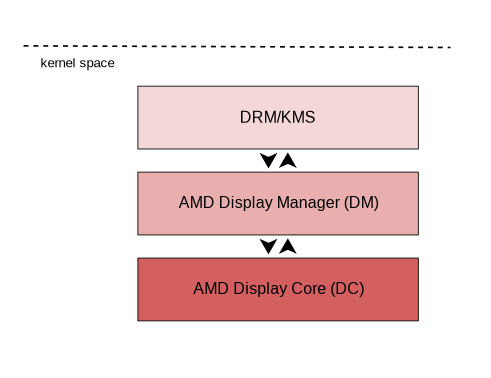
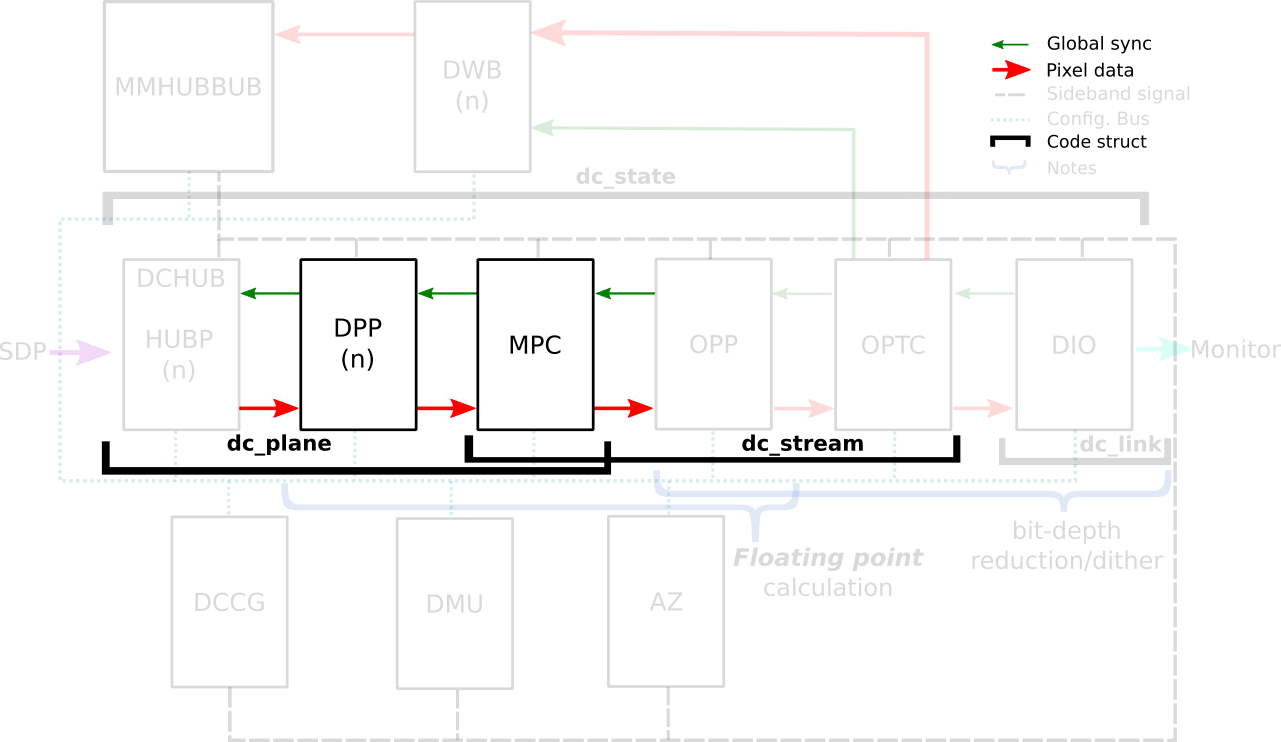
Exploring Color Capabilities of the AMD display hardware Now, let s dive into the exciting realm of AMD color capabilities, where a abundance of techniques and tools await to make your colors look extraordinary across diverse devices. First, we need to know a little about the color transformation and calibration tools and techniques that you can find in different blocks of the AMD hardware. I borrowed some images from [2] [3] [4] to help you understand the information.

Predefined Transfer Functions (Named Fixed Curves): Transfer functions serve as the bridge between the digital and visual worlds, defining the mathematical relationship between digital color values and linear scene/display values and ensuring consistent color reproduction across different devices and media. You can learn more about curves in the chapter GPU Gems 3 - The Importance of Being Linear by Larry Gritz and Eugene d Eon. ITU-R 2100 introduces three main types of transfer functions:
  • OETF: the opto-electronic transfer function, which converts linear scene light into the video signal, typically within a camera.
  • EOTF: electro-optical transfer function, which converts the video signal into the linear light output of the display.
  • OOTF: opto-optical transfer function, which has the role of applying the rendering intent .
AMD s display driver supports the following pre-defined transfer functions (aka named fixed curves):
  • Linear/Unity: linear/identity relationship between pixel value and luminance value;
  • Gamma 2.2, Gamma 2.4, Gamma 2.6: pure power functions;
  • sRGB: 2.4: The piece-wise transfer function from IEC 61966-2-1:1999;
  • BT.709: has a linear segment in the bottom part and then a power function with a 0.45 (~1/2.22) gamma for the rest of the range; standardized by ITU-R BT.709-6;
  • PQ (Perceptual Quantizer): used for HDR display, allows luminance range capability of 0 to 10,000 nits; standardized by SMPTE ST 2084.
These capabilities vary depending on the hardware block, with some utilizing hardcoded curves and others relying on AMD s color module to construct curves from standardized coefficients. It also supports user/custom curves built from a lookup table.

1D LUTs (1-dimensional Lookup Table): A 1D LUT is a versatile tool, defining a one-dimensional color transformation based on a single parameter. It s very well explained by Jeremy Selan at GPU Gems 2 - Chapter 24 Using Lookup Tables to Accelerate Color Transformations It enables adjustments to color, brightness, and contrast, making it ideal for fine-tuning. In the Linux AMD display driver, the atomic API offers a 1D LUT with 4096 entries and 8-bit depth, while legacy gamma uses a size of 256.

3D LUTs (3-dimensional Lookup Table): These tables work in three dimensions red, green, and blue. They re perfect for complex color transformations and adjustments between color channels. It s also more complex to manage and require more computational resources. Jeremy also explains 3D LUT at GPU Gems 2 - Chapter 24 Using Lookup Tables to Accelerate Color Transformations

CTM (Color Transformation Matrices): Color transformation matrices facilitate the transition between different color spaces, playing a crucial role in color space conversion.

HDR Multiplier: HDR multiplier is a factor applied to the color values of an image to increase their overall brightness.

AMD Color Capabilities in the Hardware Pipeline First, let s take a closer look at the AMD Display Core Next hardware pipeline in the Linux kernel documentation for AMDGPU driver - Display Core Next In the AMD Display Core Next hardware pipeline, we encounter two hardware blocks with color capabilities: the Display Pipe and Plane (DPP) and the Multiple Pipe/Plane Combined (MPC). The DPP handles color adjustments per plane before blending, while the MPC engages in post-blending color adjustments. In short, we expect DPP color capabilities to match up with DRM plane properties, and MPC color capabilities to play nice with DRM CRTC properties. Note: here s the catch there are some DRM CRTC color transformations that don t have a corresponding AMD MPC color block, and vice versa. It s like a puzzle, and we re here to solve it!

AMD Color Blocks and Capabilities We can finally talk about the color capabilities of each AMD color block. As it varies based on the generation of hardware, let s take the DCN3+ family as reference. What s possible to do before and after blending depends on hardware capabilities describe in the kernel driver by struct dpp_color_caps and struct mpc_color_caps. The AMD Steam Deck hardware provides a tangible example of these capabilities. Therefore, we take SteamDeck/DCN301 driver as an example and look at the Color pipeline capabilities described in the file: driver/gpu/drm/amd/display/dcn301/dcn301_resources.c
/* Color pipeline capabilities */
dc->caps.color.dpp.dcn_arch = 1; // If it is a Display Core Next (DCN): yes. Zero means DCE.
dc->caps.color.dpp.input_lut_shared = 0;
dc->caps.color.dpp.icsc = 1; // Intput Color Space Conversion  (CSC) matrix.
dc->caps.color.dpp.dgam_ram = 0; // The old degamma block for degamma curve (hardcoded and LUT).  Gamma correction  is the new one.
dc->caps.color.dpp.dgam_rom_caps.srgb = 1; // sRGB hardcoded curve support
dc->caps.color.dpp.dgam_rom_caps.bt2020 = 1; // BT2020 hardcoded curve support (seems not actually in use)
dc->caps.color.dpp.dgam_rom_caps.gamma2_2 = 1; // Gamma 2.2 hardcoded curve support
dc->caps.color.dpp.dgam_rom_caps.pq = 1; // PQ hardcoded curve support
dc->caps.color.dpp.dgam_rom_caps.hlg = 1; // HLG hardcoded curve support
dc->caps.color.dpp.post_csc = 1; // CSC matrix
dc->caps.color.dpp.gamma_corr = 1; // New  Gamma Correction  block for degamma user LUT;
dc->caps.color.dpp.dgam_rom_for_yuv = 0;
dc->caps.color.dpp.hw_3d_lut = 1; // 3D LUT support. If so, it's always preceded by a shaper curve. 
dc->caps.color.dpp.ogam_ram = 1; //  Blend Gamma  block for custom curve just after blending
// no OGAM ROM on DCN301
dc->caps.color.dpp.ogam_rom_caps.srgb = 0;
dc->caps.color.dpp.ogam_rom_caps.bt2020 = 0;
dc->caps.color.dpp.ogam_rom_caps.gamma2_2 = 0;
dc->caps.color.dpp.ogam_rom_caps.pq = 0;
dc->caps.color.dpp.ogam_rom_caps.hlg = 0;
dc->caps.color.dpp.ocsc = 0;
dc->caps.color.mpc.gamut_remap = 1; // Post-blending CTM (pre-blending CTM is always supported)
dc->caps.color.mpc.num_3dluts = pool->base.res_cap->num_mpc_3dlut; // Post-blending 3D LUT (preceded by shaper curve)
dc->caps.color.mpc.ogam_ram = 1; // Post-blending regamma.
// No pre-defined TF supported for regamma.
dc->caps.color.mpc.ogam_rom_caps.srgb = 0;
dc->caps.color.mpc.ogam_rom_caps.bt2020 = 0;
dc->caps.color.mpc.ogam_rom_caps.gamma2_2 = 0;
dc->caps.color.mpc.ogam_rom_caps.pq = 0;
dc->caps.color.mpc.ogam_rom_caps.hlg = 0;
dc->caps.color.mpc.ocsc = 1; // Output CSC matrix.
I included some inline comments in each element of the color caps to quickly describe them, but you can find the same information in the Linux kernel documentation. See more in struct dpp_color_caps, struct mpc_color_caps and struct rom_curve_caps. Now, using this guideline, we go through color capabilities of DPP and MPC blocks and talk more about mapping driver-specific properties to corresponding color blocks.

DPP Color Pipeline: Before Blending (Per Plane) Let s explore the capabilities of DPP blocks and what you can achieve with a color block. The very first thing to pay attention is the display architecture of the display hardware: previously AMD uses a display architecture called DCE
  • Display and Compositing Engine, but newer hardware follows DCN - Display Core Next.
The architectute is described by: dc->caps.color.dpp.dcn_arch

AMD Plane Degamma: TF and 1D LUT Described by: dc->caps.color.dpp.dgam_ram, dc->caps.color.dpp.dgam_rom_caps,dc->caps.color.dpp.gamma_corr AMD Plane Degamma data is mapped to the initial stage of the DPP pipeline. It is utilized to transition from scanout/encoded values to linear values for arithmetic operations. Plane Degamma supports both pre-defined transfer functions and 1D LUTs, depending on the hardware generation. DCN2 and older families handle both types of curve in the Degamma RAM block (dc->caps.color.dpp.dgam_ram); DCN3+ separate hardcoded curves and 1D LUT into two block: Degamma ROM (dc->caps.color.dpp.dgam_rom_caps) and Gamma correction block (dc->caps.color.dpp.gamma_corr), respectively. Pre-defined transfer functions:
  • they are hardcoded curves (read-only memory - ROM);
  • supported curves: sRGB EOTF, BT.709 inverse OETF, PQ EOTF and HLG OETF, Gamma 2.2, Gamma 2.4 and Gamma 2.6 EOTF.
The 1D LUT currently accepts 4096 entries of 8-bit. The data is interpreted as an array of struct drm_color_lut elements. Setting TF = Identity/Default and LUT as NULL means bypass. References:

AMD Plane 3x4 CTM (Color Transformation Matrix) AMD Plane CTM data goes to the DPP Gamut Remap block, supporting a 3x4 fixed point (s31.32) matrix for color space conversions. The data is interpreted as a struct drm_color_ctm_3x4. Setting NULL means bypass. References:

AMD Plane Shaper: TF + 1D LUT Described by: dc->caps.color.dpp.hw_3d_lut The Shaper block fine-tunes color adjustments before applying the 3D LUT, optimizing the use of the limited entries in each dimension of the 3D LUT. On AMD hardware, a 3D LUT always means a preceding shaper 1D LUT used for delinearizing and/or normalizing the color space before applying a 3D LUT, so this entry on DPP color caps dc->caps.color.dpp.hw_3d_lut means support for both shaper 1D LUT and 3D LUT. Pre-defined transfer function enables delinearizing content with or without shaper LUT, where AMD color module calculates the resulted shaper curve. Shaper curves go from linear values to encoded values. If we are already in a non-linear space and/or don t need to normalize values, we can set a Identity TF for shaper that works similar to bypass and is also the default TF value. Pre-defined transfer functions:
  • there is no DPP Shaper ROM. Curves are calculated by AMD color modules. Check calculate_curve() function in the file amd/display/modules/color/color_gamma.c.
  • supported curves: Identity, sRGB inverse EOTF, BT.709 OETF, PQ inverse EOTF, HLG OETF, and Gamma 2.2, Gamma 2.4, Gamma 2.6 inverse EOTF.
The 1D LUT currently accepts 4096 entries of 8-bit. The data is interpreted as an array of struct drm_color_lut elements. When setting Plane Shaper TF (!= Identity) and LUT at the same time, the color module will combine the pre-defined TF and the custom LUT values into the LUT that s actually programmed. Setting TF = Identity/Default and LUT as NULL works as bypass. References:

AMD Plane 3D LUT Described by: dc->caps.color.dpp.hw_3d_lut The 3D LUT in the DPP block facilitates complex color transformations and adjustments. 3D LUT is a three-dimensional array where each element is an RGB triplet. As mentioned before, the dc->caps.color.dpp.hw_3d_lut describe if DPP 3D LUT is supported. The AMD driver-specific property advertise the size of a single dimension via LUT3D_SIZE property. Plane 3D LUT is a blog property where the data is interpreted as an array of struct drm_color_lut elements and the number of entries is LUT3D_SIZE cubic. The array contains samples from the approximated function. Values between samples are estimated by tetrahedral interpolation The array is accessed with three indices, one for each input dimension (color channel), blue being the outermost dimension, red the innermost. This distribution is better visualized when examining the code in [RFC PATCH 5/5] drm/amd/display: Fill 3D LUT from userspace by Alex Hung:
+	for (nib = 0; nib < 17; nib++)  
+		for (nig = 0; nig < 17; nig++)  
+			for (nir = 0; nir < 17; nir++)  
+				ind_lut = 3 * (nib + 17*nig + 289*nir);
+
+				rgb_area[ind].red = rgb_lib[ind_lut + 0];
+				rgb_area[ind].green = rgb_lib[ind_lut + 1];
+				rgb_area[ind].blue = rgb_lib[ind_lut + 2];
+				ind++;
+			 
+		 
+	 
In our driver-specific approach we opted to advertise it s behavior to the userspace instead of implicitly dealing with it in the kernel driver. AMD s hardware supports 3D LUTs with 17-size or 9-size (4913 and 729 entries respectively), and you can choose between 10-bit or 12-bit. In the current driver-specific work we focus on enabling only 17-size 12-bit 3D LUT, as in [PATCH v3 25/32] drm/amd/display: add plane 3D LUT support:
+		/* Stride and bit depth are not programmable by API yet.
+		 * Therefore, only supports 17x17x17 3D LUT (12-bit).
+		 */
+		lut->lut_3d.use_tetrahedral_9 = false;
+		lut->lut_3d.use_12bits = true;
+		lut->state.bits.initialized = 1;
+		__drm_3dlut_to_dc_3dlut(drm_lut, drm_lut3d_size, &lut->lut_3d,
+					lut->lut_3d.use_tetrahedral_9,
+					MAX_COLOR_3DLUT_BITDEPTH);
A refined control of 3D LUT parameters should go through a follow-up version or generic API. Setting 3D LUT to NULL means bypass. References:

AMD Plane Blend/Out Gamma: TF + 1D LUT Described by: dc->caps.color.dpp.ogam_ram The Blend/Out Gamma block applies the final touch-up before blending, allowing users to linearize content after 3D LUT and just before the blending. It supports both 1D LUT and pre-defined TF. We can see Shaper and Blend LUTs as 1D LUTs that are sandwich the 3D LUT. So, if we don t need 3D LUT transformations, we may want to only use Degamma block to linearize and skip Shaper, 3D LUT and Blend. Pre-defined transfer function:
  • there is no DPP Blend ROM. Curves are calculated by AMD color modules;
  • supported curves: Identity, sRGB EOTF, BT.709 inverse OETF, PQ EOTF, HLG inverse OETF, and Gamma 2.2, Gamma 2.4, Gamma 2.6 EOTF.
The 1D LUT currently accepts 4096 entries of 8-bit. The data is interpreted as an array of struct drm_color_lut elements. If plane_blend_tf_property != Identity TF, AMD color module will combine the user LUT values with pre-defined TF into the LUT parameters to be programmed. Setting TF = Identity/Default and LUT to NULL means bypass. References:

MPC Color Pipeline: After Blending (Per CRTC)

DRM CRTC Degamma 1D LUT The degamma lookup table (LUT) for converting framebuffer pixel data before apply the color conversion matrix. The data is interpreted as an array of struct drm_color_lut elements. Setting NULL means bypass. Not really supported. The driver is currently reusing the DPP degamma LUT block (dc->caps.color.dpp.dgam_ram and dc->caps.color.dpp.gamma_corr) for supporting DRM CRTC Degamma LUT, as explaning by [PATCH v3 20/32] drm/amd/display: reject atomic commit if setting both plane and CRTC degamma.

DRM CRTC 3x3 CTM Described by: dc->caps.color.mpc.gamut_remap It sets the current transformation matrix (CTM) apply to pixel data after the lookup through the degamma LUT and before the lookup through the gamma LUT. The data is interpreted as a struct drm_color_ctm. Setting NULL means bypass.

DRM CRTC Gamma 1D LUT + AMD CRTC Gamma TF Described by: dc->caps.color.mpc.ogam_ram After all that, you might still want to convert the content to wire encoding. No worries, in addition to DRM CRTC 1D LUT, we ve got a AMD CRTC gamma transfer function (TF) to make it happen. Possible TF values are defined by enum amdgpu_transfer_function. Pre-defined transfer functions:
  • there is no MPC Gamma ROM. Curves are calculated by AMD color modules.
  • supported curves: Identity, sRGB inverse EOTF, BT.709 OETF, PQ inverse EOTF, HLG OETF, and Gamma 2.2, Gamma 2.4, Gamma 2.6 inverse EOTF.
The 1D LUT currently accepts 4096 entries of 8-bit. The data is interpreted as an array of struct drm_color_lut elements. When setting CRTC Gamma TF (!= Identity) and LUT at the same time, the color module will combine the pre-defined TF and the custom LUT values into the LUT that s actually programmed. Setting TF = Identity/Default and LUT to NULL means bypass. References:

Others

AMD CRTC Shaper and 3D LUT We have previously worked on exposing CRTC shaper and CRTC 3D LUT, but they were removed from the AMD driver-specific color series because they lack userspace case. CRTC shaper and 3D LUT works similar to plane shaper and 3D LUT but after blending (MPC block). The difference here is that setting (not bypass) Shaper and Gamma blocks together are not expected, since both blocks are used to delinearize the input space. In summary, we either set Shaper + 3D LUT or Gamma.

Input and Output Color Space Conversion There are two other color capabilities of AMD display hardware that were integrated to DRM by previous works and worth a brief explanation here. The DC Input CSC sets pre-defined coefficients from the values of DRM plane color_range and color_encoding properties. It is used for color space conversion of the input content. On the other hand, we have de DC Output CSC (OCSC) sets pre-defined coefficients from DRM connector colorspace properties. It is uses for color space conversion of the composed image to the one supported by the sink. References:

The search for rainbow treasures is not over yet If you want to understand a little more about this work, be sure to watch Joshua and I presented two talks at XDC 2023 about AMD/Steam Deck colors on Gamescope: In the time between the first and second part of this blog post, Uma Shashank and Chaitanya Kumar Borah published the plane color pipeline for Intel and Harry Wentland implemented a generic API for DRM based on VKMS support. We discussed these two proposals and the next steps for Color on Linux during the Color Management workshop at XDC 2023 and I briefly shared workshop results in the 2023 XDC lightning talk session. The search for rainbow treasures is not over yet! We plan to meet again next year in the 2024 Display Hackfest in Coru a-Spain (Igalia s HQ) to keep up the pace and continue advancing today s display needs on Linux. Finally, a HUGE thank you to everyone who worked with me on exploring AMD s color capabilities and making them available in userspace.

4 November 2023

Dirk Eddelbuettel: RcppEigen 0.3.3.9.4 on CRAN: Maintenance, Matrix Changes

A new release 0.3.3.9.4 of RcppEigen arrived on CRAN yesterday, and went to Debian today. Eigen is a C++ template library for linear algebra: matrices, vectors, numerical solvers, and related algorithms. This update contains a small amount of the usual maintenance (see below), along with a very nice pull request by Mikael Jagan which simplifies to interface with the Matrix package and inparticular the CHOLMOD library that is part of SuiteSparse. This release is coordinated with lme4 and OpenMx which are also being updated. The complete NEWS file entry follows.

Changes in RcppEigen version 0.3.3.9.4 (2023-11-01)
  • The CITATION file has been updated for the new bibentry style.
  • The package skeleton generator has been updated and no longer sets an Imports:.
  • Some README.md URLs and badged have been updated.
  • The use of -fopenmp has been documented in Makevars, and a simple thread-count reporting function has been added.
  • The old manual src/init.c has been replaced by an autogenerated version, the RcppExports file have regenerated
  • The interface to package Matrix has been updated and simplified thanks to an excllent patch by Mikael Jagan.
  • The new upload is coordinated with packages lme4 and OpenMx.

Courtesy of CRANberries, there is also a diffstat report for the most recent release. If you like this or other open-source work I do, you can sponsor me at GitHub.

This post by Dirk Eddelbuettel originated on his Thinking inside the box blog. Please report excessive re-aggregation in third-party for-profit settings.

1 November 2023

Dirk Eddelbuettel: RcppArmadillo 0.12.6.6.0 on CRAN: Bugfix, Thread Throttling

armadillo image Armadillo is a powerful and expressive C++ template library for linear algebra and scientific computing. It aims towards a good balance between speed and ease of use, has a syntax deliberately close to Matlab, and is useful for algorithm development directly in C++, or quick conversion of research code into production environments. RcppArmadillo integrates this library with the R environment and language and is widely used by (currently) 1110 other packages on CRAN, downloaded 31.2 million times (per the partial logs from the cloud mirrors of CRAN), and the CSDA paper (preprint / vignette) by Conrad and myself has been cited 563 times according to Google Scholar. This release brings upstream bugfix releases 12.6.5 (sparse matrix corner case) and 12.6.6 with an ARPACK correction. Conrad released it this this morning, I had been running reverse dependency checks anyway and knew we were in good shape so for once I did not await a full run against the now over 1100 (!!) packages using RcppArmadillo. This release also contains a change I prepared on Sunday and which helps with much-criticized (and rightly I may add) insistence by CRAN concerning throttling . The motivation is understandable: CRAN tests many packages at once on beefy servers and can ill afford tests going off and requesting numerous cores. But rather than providing a global setting at their end, CRAN insists that each package (!!) deals with this. The recent traffic on the helpful-as-ever r-pkg-devel mailing clearly shows that this confuses quite a few package developers. Some have admitted to simply turning examples and tests off: a net loss for all of us. Now, Armadillo defaults to using up to eight cores (which is enough to upset CRAN) when running with OpenMP (which is generally only on Linux for reasons I rather not get into ). With this release I expose a helper functions (from OpenMP) to limit this. I also set up an example package and repo RcppArmadilloOpenMPEx detailing this, and added a demonstration of how to use the new throttlers to the fastLm example. I hope this proves useful to users of the package. The set of changes since the last CRAN release follows.

Changes in RcppArmadillo version 0.12.6.6.0 (2023-10-31)
  • Upgraded to Armadillo release 12.6.6 (Cortisol Retox)
    • Fix eigs_sym(), eigs_gen() and svds() to generate deterministic results in ARPACK mode
  • Add helper functions to set and get the number of OpenMP threads
  • Store initial thread count at package load and use in thread-throttling helper (and resetter) suitable for CRAN constraints

Changes in RcppArmadillo version 0.12.6.5.0 (2023-10-14)
  • Upgraded to Armadillo release 12.6.5 (Cortisol Retox)
    • Fix for corner-case bug in handling sparse matrices with no non-zero elements

Courtesy of my CRANberries, there is a diffstat report relative to previous release. More detailed information is on the RcppArmadillo page. Questions, comments etc should go to the rcpp-devel mailing list off the Rcpp R-Forge page. If you like this or other open-source work I do, you can sponsor me at GitHub.

This post by Dirk Eddelbuettel originated on his Thinking inside the box blog. Please report excessive re-aggregation in third-party for-profit settings.

Next.

Previous.