Search Results: "jgoerzen"

29 March 2010

John Goerzen: Trip part 6: Prague

Note: this post written on March 20-21 and posted after our return. IMG_2895
(two women looking into the crypt at St. George s Basilica) We ve had a good couple of days in Prague. The city definitely feels more, well, foreign than Germany and that is perhaps accentuated by the fact that I don t know any Czech at all, while I know some basic German. It s been slow going at times, and surprisingly easy at others. Despite my lack of knowledge of Czech, I d say communicating here has been roughly as easy as in Germany. That is perhaps partially due to the fact that, of the places where we ve needed to communicate, we are either making simple requests (buying bread at a bakery) or the people we re talking to know some basic English. (Or, in one case, a guard at a museum at the Prague Castle complex used German to ask me to check a bag at the coat check, mildly surprising me and confusing Terah when I started to comply with instructions she didn t understand, and didn t know how I did.) The very first time we had a situation where it was a bit difficult to communicate, in the bakery, I got into my difficult to communicate mode and accidentally slipped in a couple of German words. Oops. Terah was laughing at me later, and commented that the store owner might have also been laughing at me or perhaps at his employee that also accidentally slipped into basic German mode. On Friday, we visited Vy ehrad Castle, the one that nobody that visits Prague seems to know about. That is perhaps because the palace/castle part of the complex has been mostly destroyed (but we did know that before going there.) It is in a nice, quiet, and beautiful park, and has the beautiful and old Basilica of Saints Peter and Paul, as well as a large ornate cemetery. Then we visited two iconic Prague places: V clavsk n m st (Wenceslas Square) and Starom stsk n m st (Old Town Square). Both were beautiful. And, unfortunately, also packed with tourists and made-in-China plastic trinket shops. There I got my first clue that large tour groups tend to have a detrimental effect on any free site in Prague. They come in, the guides yell, they clog up things, and also generally miss the sites of true interest because buying tickets to them makes the price of the tour uncompetitive. On Saturday, we took the tram out to Pra sk hrad (Prague Castle) the one that everybody knows about. We got there at about 8:15, and although the grounds are open, most of the buildings weren t open until 9. As a result, we had 45 minutes almost to ourselves in the nearly-empty castle complex. We could walk around on the giant squares, take some photos, and generally enjoy a crisp and quiet morning. IMG_2771 At 9, it was still pretty empty and we went into the ticket offices to buy our tickets. By the time we got out a few minutes later, it was packed mostly due to the arrival of innumerable tour groups from all over Europe and, apparently, Japan. We went to the Star kr lovsk pal c (Old Royal Palace) first, since I knew from their website that it would close at noon due to a visit from Prince Charles. That was a beautiful building, and it s amazing to read about the features of it that are centuries old or even almost a thousand years old. The Vladislavsk s l (Vladislav Hall) and chapel particularly caught my eye. Underneath the palace is a museum, including some 1000-year-old jewelry and flooring, and some clothing that is several hundred years old recoverd from burial plots. IMG_2775
(Vladislav Hall) Next, we went to the iconic (and free) Katedr la svat ho V ta (St. Vitus Cathedral). Our audioguides fortunately allowed us to bypass the long line, and we could step inside at a side door. That was one of many times in Europe I stepped inside a building, and suddenly came to a stop with a wow . That building is every bit as much impressive as it is made out to be, even crowded as it was. IMG_2839 We also went to Bazilika Sv. Ji (St. George s Basilica), which one of the guides described as ancient . It was another wow moment, and it felt like the oldest church we were in yet. I think it probably was, actually; last rebuilt in 1142. IMG_2874 For lunch, we asked for a recommendation from our hotel. They suggested one place, which we walked to. It was a nice easy walk down some Prague side streets, but the restaurant and all the others along our walk were closed on Saturday. We eventually made our way back to the hotel and asked for a new recommendation, which was successful this time. Terah ordered some ribs, while I ordered a more traditional Czech goulash, which happened to be served in a bread bowl. A minute later, the waiter brought Terah a fork and knife. And he brought me a bowl of water with a slice of lemon, and announced wash for you. That was a surprise, and a bit puzzling one at that. Turns out that eating bread that had stew served in it is indeed a bit messy, and having some water to clean up with is indeed helpful. We met up with Anna from Leipzig and one of her Czech friends for dinner Saturday night. We found a nice local Czech place. I had ham with sauerkraut in a folded potato cake. It was excellent, and the total bill for Terah and me came to 235 Kc or about $12.50. We had a nice walk back to the hotel in the crisp, dark evening. Sunday morning we had breakfast at our hotel the only time we ate a meal at a hotel this whole trip then got on the tram, the metro, and the bus to the airport. Total cost for that trip for two: 52 Kc, or about $2.75. Far cheaper than a taxi. One weird thing happened to us in Prague. We were riding the tram towards downtown, and as we would be on it for several stops, Terah was sitting. I was standing as there wasn t an available seat for me. Terah and I were both looking out windows, until Terah was startled because her arm was wet. She looked around and it turned out a middle-aged woman had spit on her, and was glaring at her. We never did figure out why. About all we can think of is maybe someone else, such as a very old person, had gotten aboard but Terah hadn t noticed and therefore didn t offer to give up her seat. That was probably the only real rude gesture towards us on the entire trip. We ran the story by Anna s friend (the native Czech) and she was as surprised and baffled as we were. As I wrap this up, we re sitting at our gate in Prague waiting for our flight to Munich. In this airport, in an out of the way corner on the very lowest floor, I spotted only the second drinking fountain I ve seen in Europe this entire time and also perhaps the continent s most expensive cup of coffee. After we get to Munich, it s a flight to Chicago, another to Indianapolis, and finally a drive home Monday.

28 March 2010

John Goerzen: Trip part 5: Leipzig

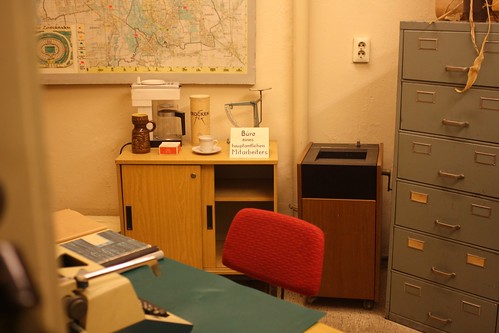
Note: this post written on March 19 for posting after we return. We arrived at Leipzig surprisingly about 5 minutes late on Wednesday morning. My friend Brad was at the Leipzig Hauptbahnhof (central stration) to meet us. As we walked through the city with him, he commented that I hadn t yet tried Currywurst, and there was a stand selling them with different levels of spiciness. I tried one and liked it; Terah was afraid to touch them. After a light lunch with Brad and Anna, we went back into town and saw the V lkerschlachtdenkmal (Monument to the Battle of the Nations). We were warned that it was weird and ugly. And when we arrived, I noticed that it was enormous. And, well, somewhat ugly. And, yes, weird. IMG_2681 After that, we walked through the old trade fair grounds. Leipzig has a long history as a trade center, and after they built the new trade fair grounds, the old ones were reused for other things except for the old Soviet building, which is now both gaudy and abandoned. We picked up Fritzi, who is a very cute 4 years old, from preschool and returned to their house for supper. After that, Brad and I went back into town, intending to hear a reading at the old city pool. When we realized it was a different day, we walked around the city center for awhile and then had a beer at a yes combination cafe/laundromat. Thursday was our day to explore the city. Brad showed us a couple of buildings in the university, including the library, then dropped us off at St. Thomaskirche. That s the church where J. S. Bach was music director for many years, and was buried. Like so many, it was impressive in its height and history. IMG_2703 Next we went to the Stasi museum. The Stasi were the feared and powerful East German secret police during the Communist times. The museum itself was housed in the former Stasi headquarters for Leipzig and was involved with the history of the overthrow of the Communists. The museum covered a lot of the history of the Stasi, including its frantic last days during the 1989 revolution. The level of spying on people was incredible and sophisticated, and they tried to destroy records as the overthrow of the government was imminent. One of the offices in the inner part of the building was left untouched from the Communist years, right down to the typewriter and coffee machine. IMG_2717 After that, we went to the Altes Rathaus (old city hall or townhouse, built in 1556) to do a bit of shopping. Terah was wanting some souvenirs, and I had spotted a shop I thought she might like when walking through the city with Brad the night before. We had already bought some souvenirs at the Schloss Charlottenburg museum store in Berlin (some East German-style crosswalk fridge magnets, and a decorative egg), but wanted something a bit nicer for us and were on the lookout for gifts for others too. We wound up buying a wood carved church scene with a woven wheat tree for us, and another item for others. The shopkeeper spoke no English, and my German vocabulary is small, but we managed to communicate the question of whether or not she could wrap it up in a box for our trip home and she could, and did. Excellent. (I didn t know how to ask about box, but knew how to say that we were Americans, and with a fair bit of gesturing all around, managed to get the idea across.) Then we went in the Altes Rathaus itself, which was both a museum and an interesting cultural experience. We bought our tickets at the booth downstairs, then went upstairs to the entrance. We asked for the English audio guide, which is very common at museums in Germany. (They are small digital audio players that contain recorded information; each room or display has a number you can key in to hear about it in your own language.) We got it, and were told in incredible detail how to use it, even though they are quite easy to figure out and we had used them before. The museum employee told us where the audio tour starts, and in what order it usually goes, which was an effort for her given her limited English. But we all understood and went on our way. It wasn t even 5 minutes later when she had left her desk and came over to us. She was slightly alarmed at two things: one that we didn t have the volume at full blast (which was loud enough for the entire room to hear), and secondly that we weren t looking at the exhibits in the proper order. Never mind that it s easy enough to pull up the audio information about any room just by keying in the number posted in it, I guess. Anyhow, we sort of inwardly shrugged, let her turn the volume up to potentially disturbing the other visitors level, and went through the museum in the order she wanted us to. (Note that this wasn t a museum where there is a one-way flow of traffic or something; you walk into one exhibit, back to the main hall, and then pick your next one.) So we went through the rest of the museum with our English audioguide blaring throughout the large, echoing, wood rooms, feeling a bit rude to the other visitors (maybe 5 of them while we were there) due to its volume. Anyhow, the Altes Rathaus was beautiful and interesting, covering mainly the pre-industrial history of Leipzig. We learned about some of the guilds, the city treasury (vault), and where the town council/parliament met along with rich merchants. There were about as many museum guards as visitors there, and one or two of them sort of followed us around, pointing out the large and completely obvious signs with audio guide numbers in the rooms for us. They are serious about their audio guides in Leipzig. I m glad we went, and I m glad we had the experience we did, too. Terah told me later that she felt reprimanded about the audio guide and visiting order. My take on it was a bit different: the museum is impressive and interesting, but obviously not visited by tourists as much as museums in other cities, or even touristy sites like Thomaskirche in Leipzig. I think they they noticed two people, obviously very foreign (speaking only a little German, and with an American accent) with an interest in their city s history, and took pride in making sure we got the most of our visit and learned as much as possible about something they care about. Here is the main hall of the Altes Rathaus. IMG_2727 We met up with Brad in a cafe near St. Thomaskirche for coffee and cake, then it was on to St. Nikolaikirche (the Church of St. Nicholas), the other large church in town. We stepped out of a passageway to face the large building, and walked in. The interior was decorated in pastels, and was also beautiful and historic. I can t get enough of that sort of building, I think. This building was especially important because it was the site of organizing for the Monday evening protests against the Communist government in 1989. People met at the church, sang a few hymns (to qualify it as a religious service, perhaps), then organized their protest for the evening. Sometimes they would wind through city streets and put flowers at the Stasi headquarters steps, and once the citizens actually overtook the Stasi headquarters. IMG_2745 After awhile we grabbed a bit more for lunch: a pretzel for Terah and a Currywurst for me. (This one wasn t spicy and wasn t all that good.) Then we went to the GDR museum, which was large and interesting, but unfortunately for us, completely in German with no English guide available. That evening, we went to a Bach concert at the Leipzig Gewandhaus, celebrating Bach s 325th birthday. That was fun, and a neat experience with such good music in a very nice venue. The program included Bach s Suite for Orchestra no. 1 in C Major (BWV 1066), Concerto for Violin no. 2 in E major (BWV 1042), Ich habe genug (BWV 82), and Suite for Orchestra no. 4 in D major (BWV 1069). Sir Roger Norrington was conducting, and was rather fun and atypical to watch. He had the audience chuckling a few times with his minimalist conducting or perhaps his flamboyant gestures. Anyhow, the music was excellent and the tickets included free passage on the public transit system 3 hours before and after the concert a nice touch. Due to our schedule, we didn t spend much time with Fritzi, but we did get to play with her a bit. She likes to pretend to be a shopkeeper, and had her store all ready to lay out. We would ask her for some items, which she d put in a basket for us, and then of course there would be a child s twist: we d get our items, and she d pay us for them too. Terah and I brought some books for Fritzi. The particularly enjoyed Goodnight Moon because inside it is an picture of The Runaway Bunny, which she already had. Fritzi chose one of her books to give to Jacob it was a German book (Maulwurf) based on a Czech cartoon mole. That was nice of her, and Jacob really liked it (I ll write about that later). We had a good time in Leipzig, and I was getting fairly good at navigating downtown and with the trams and then, of course, it was time to move on. So Friday morning we caught our 7:50 train from the Leipzig Hauptbahnhof. We took the ICE train to Dresden, then walked a few feet to get onto the EC to Prague. That was a bit of a funny experience. The ICE trains are all sleek, modern, meticulously maintained, and the passengers tend to be very quiet. Talking is barely above a whisper, and people seem alarmed if their cell phone rings, even outside the quiet car. The EC passenger car appears to have been built, or last renovated, in the 1970s, and may have been Hungarian. The seats and curtains are old and faded; some of the seat backs have rips in the vinyl headrests. People were talking or eating loudly, in a very different setting than on the ICE train. As we rode along, we were on the right side the river Elbe for many miles. The scenery was beautiful, with small houses in the river valley, and the occasional house up in the hillside. At one point (a bit before we passed through K nigstein on the way to the Bad Schandau stop), we spotted what looked like an old walled city up on the hill. I figured out later that it was Festung K nigstein (K nigstein Fortress). Update: I forgot to mention a couple of things about Leipzig. One was our walk through a forest yes, a forest in the city. That was a nifty, quiet, and pleasant surprise. Secondly was seeing all the DDR apartment blocks, where the apartments evidently were quite literally blocks. It is interesting to see the Communist architecture.

26 March 2010

John Goerzen: Trip part 3: L beck

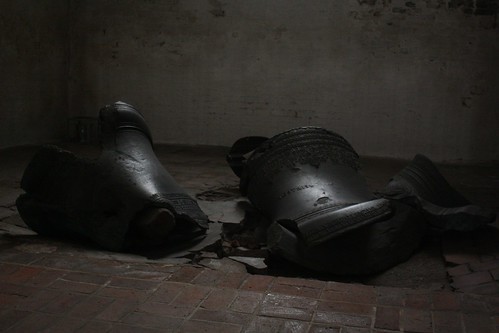
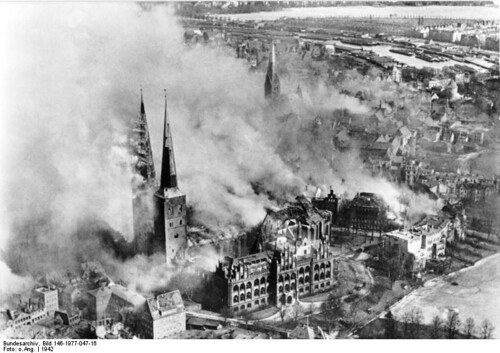
Note: This post was written in March 14-15 and posted after our return. When I think about L beck, the first thing that strikes me is the feeling of history underfoot. It struck me most when we set foot inside the Marienkirche. I had never quite felt a wave of a feeling of stepping back in time like that before. The stones on the floor were uneven and imperfect. L beck has had a wet and snowy winter, so the city had spread sand everywhere: sidewalks and roads. Walking into any grand church, I could hear the sound of sand under the shoes of everyone nearby, and feel it under my own shoes. I think I will long associate with L beck the feeling of walking into a grand old church, looking up at the top of the old building at seemingly impossible heights, while feeling the grit of sand and uneven stone beneath my feet. IMG_2643 Marienkirche isn t perfect, like some American churches I ve been in, such as the Basilica of Notre Dame. It doesn t have a lot of gold, either, and both of these attributes are wonderful. Look at a column of bricks, and you can see that each brick isn t exactly like its neighbor, and the entire column isn t perfectly straight. Lots of things in L beck are so old that they aren t perfectly straight, and it made me think that our American notion of always having to fix such things might be somewhat off sometimes. IMG_2629 Look up, and you see the frescos from the 1300s, revealed after many years after the building was struck by an allied bombing raid in 1942. This heavily damaged the building and knocked down plaster from the walls and ceiling, revealing the old artwork. Many parts of Marienkirche were lost as a result of the bombing, which perhaps adds to its slightly sparse and ancient feel. The church bells were sadly melted and crashed to the ground due to the bombing, and have been left exactly where they fell as a memorial. IMG_2641 Look down, and you see the uneven floor, and the concrete slabs above where important people were buried under the floor an attribute common to many of the churches we visited. It was common to see dates of graves from the 1600s and 1700s, though in some places it would go as far back as the 900s. The main part of the church has no heating or cooling, and visiting it on a day just a bit above freezing adds to the feeling of, well, old. Marienkirche has to be my favorite sight in L beck. Walking around the city, I get a similar feel. Many streets and sidewalks are made of stone. The streets that weren t damaged in the war have rows of beautiful old facades. Walk down many streets, and every so often I d see a little tunnel ( just wide enough for a coffin ) that goes under the street-facing houses to a nice little inner courtyard. These are open to the public, but tend to be very quiet and somewhat private. In the courtyard are smaller houses, which would have originally been used by the less wealthy. We also saw the L beck Dom (cathedral), which had a small museum about the destruction due to the Royal Air Force bombing in 1942. It was very sad to see the photo of the Dom in ruins, still smoking, even now. Burning L beck Cathedral after an air raid in 1942 I can only imagine what it must have felt like to residents of L beck to wake up to see many of their priceless centuries-old landmarks and places of worship so horribly destroyed and all of this for little strategic purpose really focused on the morale of the enemy civil population . It s sad that the allies would do such a short-sighted and terrible thing. Europeans have long had to live with the legacy of war upon war, while we Americans have rarely had to see the consequences of war up close. I think it would be good for more of us to visit these sites and come up face to face with what a bomb can do, and then perhaps we will be more judicious with them in the future. Shifting gears now to where we stayed: Andreas & Sigrid, with whom we stayed, have a beautiful 500-year-old house, with lots of original wood beams exposed, and some very old paintings on the walls and ceilings. Nearby were excellent bakeries and a chocolate shop. Terah and I visited it today and bought some very good chocolate. And this brings me to the second thing I ll remember: Andreas & Sigrid s children, Lukas and Rahel. Now, Terah knows no German, I know only a little bit, and the children know no English. So it was a bit slow getting to know each other to start out, but we managed to work around the communication barrier and had a great time. Terah played board games with Rahel, while with me, she kept inventing games to play: hiding somewhere, saying Hallo! , and laughing at how many unsuccessful attempts I might make to find her. I showed Lukas the camera on my Droid, which he used a lot, though a racing game on Terah s iPod Touch was more exciting. They both enjoyed looking at videos of American trains a bit, but especially pictures of our house and yard with Jacob and Oliver. They tried to teach me the German words for things, and also made futile attempts to correct my pronunciation! When we were leaving today, Rahel came over and gave me a kiss on the hand, then the same to Terah s hand, then a little kiss on one of our suitcases. It was touching and sweet. This was one of those experiences no guidebook prepared me for, and no tour bus would have provided. It is something neat to make friends with children despite the large language barrier. On to the rest of the visit We had arrived a little late into Hamburg. After getting our bags and some Euros at an ATM, the next step was to find the bus to L beck. No signs for it were evident, so I found an information desk. The person at the desk was carrying on a conversation in German with the person ahead of me in line. I figured an information desk person in a busy airport would speak English, and was all ready to ask Sprechen Sie Englisch? , but when I walked up, he got a polite smile, and said, Good morning! How can I help? Guess I m obvious. He directed me to the bus, gave me a brochure about it, and told me what time it would leave. Terah and I found the spot to wait, and for a moment I stepped inside the airport terminal. Terah won t let me forget that someone came up to her and asked a question in German, whereas I was spoken to in English. Anyhow, we found the bus, managed to communicate with the driver that doesn t speak English, and sat next to the friendly person that was talking to Terah. He turned out to be a violin player from Munich, and we had a great conversation for the next hour he asking questions about the USA, us asking questions about Germany and Munich. At one point, he commented, You two are so open minded and you re also Americans! He sounded surprised. We exchanged email addresses at the train station. Andreas found us there, and we walked through the city to his house, with him pointing out the sights along the way. L beck is a beautiful city, and though it was damaged in World War II, much of the really old parts still remain. The famous Holstentor Gate has a museum inside, which was fascinating to visit. On Sunday, we went to church with the family we were staying with, Andreas helpfully translating for us. There I met a British Python programmer, which was fun. His wife is a social worker, which was fun for Terah. Monday it was time to get on the train to Berlin. We again walked through a cold and rainy city to the Hauptbahnhof, ready to head to Berlin. There we got on a train to Hamburg, then an ICE train to Berlin. Despite having just a few minutes for a connection in Hamburg, it all went perfectly smoothly. The train left Leipzig about 10 seconds late the clock inside turned over to the minute, then the doors closed and we were off. Impressive. Note: the rest of my photos from L beck are available on Flickr.

24 March 2010

John Goerzen: Trip part 1: Kansas to Indiana

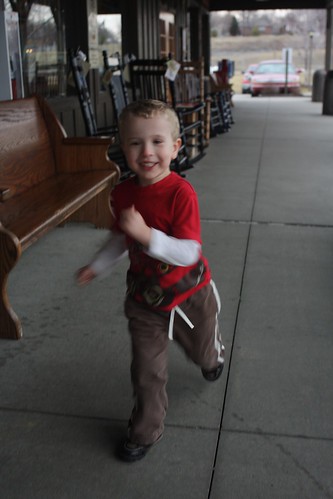
Note: This post was written March 12, and posting was delayed until our return home. This is the first part of our trip: driving from Kansas to Indiana with Jacob and Oliver. From Indiana, we ll be flying to Germany while the boys stay with their grandparents. We normally don t like long road trips. Our preferred way to travel is by train. By air is second, and car is last. But this time, driving was all that made sense. We planned to make the 11-hour drive in two days to give the boys more of a chance to get out of the car and run around. It s always a bit demoralizing heading east from our place. You drive at highway speeds for an hour and are barely one county over. We left at about noon and made it as far as Kansas City before our first stop much to our surprise. We ate at a Cracker Barrel there. Afterwords, Jacob loved running in front of the restaurant. IMG_2507 Meanwhile, Oliver chilled on a wooden bench. IMG_2494 Jacob was excited to find this chair. He said Here is a chair just the size of me! IMG_2489 We spent the night in a hotel on the eastern edge of the metro area. Then Thursday hit the road again. We stopped for a mid-morning snack, then ate lunch at Pizza Hut. Jacob ran around in the grass outside again. Jacob invented a new game with me. He d ask, How will we get there? I was supposed to guess. With a pickup? No With a boat? No Eventually he d come up with a silly answer: We ll ride a pile of bricks there! or We ll ride on top of a stop sign! Then he d sit there laughing for a little bit. Pretty soon: Hey dad. How will we get there? We had a few toy-throwing episodes, but overall Jacob did very well. Oliver did even better. He slept a good part of the way, and happily watched Jacob for most of the rest. The car trip went well. This morning, it s time to get ready to head to the airport, and to break the news to Jacob that we ll be gone for a few days. We ve learned that he worries a lot about change if he knows about it too much in advance, finding it hard to process and understand, so we ll tell him after he wakes up this morning. Then off to the airport for our flight to Newark. Then we get to sit around in New Jersey for a few hours before our 7.5-hour flight to Hamburg.

10 March 2010

John Goerzen: Numerous Updates

It s been awhile since I ve posted some family/home updates, so here they are, sorta random-like Jacob is 3.5 now, and Oliver is about 8 months old at this point. Jacob Jacob has a few trends going on lately: pretending to be a cat, and inventing new games to play. He has one game he likes to play with me called tunnels and slippers. He will have me sit on the couch, put my feet up on the footstool, and crawl on top of my legs. He ll want me to bounce him, then he can crawl underneath the tunnel. The slippers part came because he started to steal my slippers one time during winter. He d struggle furiously to get it off, then shriek with delight as he ran away, listing to my indignation at having a cold foot now. Then I was supposed to run after him, pick him up in the air, and get the slipper back. Here he is, trying to steal a slipper while I happened to be holding a camera: img_2345.jpg He s said quite a few memorable quotes this winter: Dec. 8: Jacob looked outside this morning and yelled, WOW! Look at that! , ran across the room and yelled, MOM! WOW! There is snow outside this window too! WOW! Snow is ALL OVER THE PLACE! January: When told his grandparents were going back to Indiana: The kitty doesn t like that. (the pretending to be a cat thing) The next morning when he remembered they were gone: Oh. My kitty is so very sad now. February: My name is kitty. Jacob Cat! March: I didn t realize the basketball could go so far! He s been starting to make his first attempts at sounding out words. He s been interested in 2- and 3-digit numbers, trying to figure out how to tell time, and asking me the German words for all sorts of things. (And showing some disappointment with my German vocabulary.) Jacob talks about Oliver as a sweet baby, and is often very caring about him. Jacob wants to make sure Oliver has *plenty* of toys. Though there have been some times when Jacob has pushed Oliver over. Here s the Christmas photo of the two of them: img_2367r And another: img_2357.jpg Jacob has also started to pick up an interest in singing: his favorite song is one that he made up, and it goes Engine, engine, passenger car I still sing a song to Jacob at bedtime each night, but Home On the Range doesn t cut it anymore. No, now I have a make up a song on the spot on a topic of Jacob s choosing each night. Last night he chose a song about the ceiling light and the smoke detector. Other nights, it s been about his toy butterfly, his night light, various smoke detectors (that s a popular one), or something from his day. Oliver img_2371.jpg Oliver recently has started being able to sit up by himself. He can also scoot all over the room. I think he s saying dad , but Terah disagrees and thinks he s just babbling. Her case wasn t helped the day I asked him, Are you saying Dad? He got a big smile after the question and laughed at me. He loves playing peek-a-boo, playing with us or playing by himself. Oliver has been eating the mashed-up baby food for awhile. Terah recently gave him a rice puff, and he put it in his mouth but wasn t sure what to do with it. He has been taking quite an interest in watching the rest of us eat, though, and sits at the table with us in his high chair.

10 December 2009

John Goerzen: Being a Dad at Thanksgiving

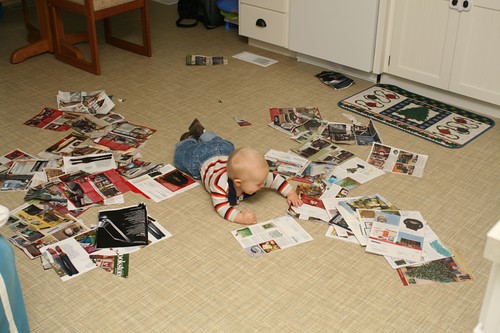
Over Thanksgiving this year, we took a train trip to visit Terah s family in Indiana. Here s the story of the trip. The Train to Indiana Our last train trip (to Chicago) was in May, before Oliver was born. Jacob always has enjoyed the train, but this time wow. We told Jacob about the trip the day before we were to leave. Several times in the day, he d get a sly smile, and ask, What are we going to do? Terah or I would spell out the day s activities, and when we d get close to the part where I d wake him up at night and we d go to the train station, he d have a big smile. The big hour (2AM) arrived and Jacob woke up while Terah was putting his shoes on. I was there a moment later. Normally Jacob is terribly grumpy after waking up, even more so if somebody else woke him up. That day, I saw a very groggy-looking boy. I asked him, Jacob, are you ready to go to the train station? He answered, YEAH! while rubbing his eyes. Dad, let s go! We had Amtrak s family bedroom for the first time this trip, and it worked out great. Jacob actually slept, despite his extreme excitement. He d been talking about eating in the diner car for quite some time, and was really excited when breakfast time rolled around. We sat down, and he pressed his nose up against the window right away. He counted the freight trains the he saw, pointed out train tracks and crossing guard lights , noticed barns and trucks, and gave us frequent updates on how fast we were going. His voice was high-pitched from excitement, and sometimes we d have a running commentary we could barely interrupt, and other times he d sit there silently just soaking it all in. But he didn t eat. He didn t want to turn his head away from the window for a second to take a bite. I kept reminding him to take a bite, and finally, fearing he d be really hungry as soon as we went back to our room, fed him a few bites for the first time in ages. I don t believe he realized that happened. He just opened his mouth by reflex and once I had to tell him to close his mouth around the fork that was in it. It was much the same story for lunch, and for dinner on the train though less so for dinner since it was dark outside. At dinner, a man sitting across the aisle from us said, If you weren t getting your meal free [since we're in the sleeper], I d buy it for you. Your boys are amazingly well-behaved! I thanked him politely Jacob and Oliver both were doing well but didn t really think it was that unusual. Oliver and Jacob were both big hits on the train. They got smiles from so many people on board and in the stations. Several of the dining car staff seemed to linger at our table longer than elsewhere, looking at them (and especially Oliver). Oliver slept well on the train: img_2240.jpg And here are a couple of typical Jacob photos: img_2244.jpg img_2241.jpg In Indiana I ve got to start this out with one of the family gatherings at Terah s aunt s house. They have a large kids area in their basement, and a swingset with a slide outside. Jacob loved all of this, and spent hours playing with me. Sometimes if I d go upstairs with the adults, I d hear Jacob s voice from the basement a few minutes later: DAAAAAD!!!! Shall you come back downstairs? DAAAD! And, of course, it s hard to resist a 3-year-old that wants to play with me, so I inevitably would. We played air hockey Jacob shrieked with delight whenever anybody scored a goal in any way. At one point, he stood up, looked around, and said, Hmmm. Where are all the trains? Apparently he expected every home to be stocked with toy trains, and this one wasn t. A few seconds later, he was all excited. He ran over to a toy semi, and said, I will use the semi train! Outside the short slide had a ladder going up to it. I held Jacob s hands while he climbed up the first few times, but I knew he could do it himself. I started helping him less and less, and eventually refused to help him at all. He was rather frustrated with that for a moment, but a couple times later, climbed up and said, Dad, I got up here all by myself! A few times later, it looked like he was having trouble, so I tried to help, and got shooed away with, No, dad! I can do it. The best moment of the weekend came during the drive back to Terah s mom s house where we were staying. Terah was driving, and I heard Jacob say, Shall you come closer? Not sure how to do that from the front seat of the car, I reached my hand back there and he held it. He held one or the other of my hands for 20 minutes until he fell asleep in the car. It s funny what feeling needed by a 3-year-old makes a person feel, but that was surely a happy day. Jacob got to see all of his Indiana grandparents on this trip, and loved playing with them. He especially liked using a perfect red train (his words!) he drug home from the nursery at church on Sunday, and a child-sized tent in the basement. I m not sure how many times I heard Gampa Mike! Shall we go to the basement? that weekend. One point he wanted me to come down to see it and play with him, so I did. Then he decided we all needed to be down there, and told me I ll go pick up mom. I ll be right back. Stay downstairs, dad. Fearing that Terah wouldn t know what to do when Jacob attempted to pick her up , I tried to discreetly follow at a distance. That was no match for a 3-year-old. He looked back at me from the top of the stairs, pointed an accusing finger at me, lowered his voice, and said, Dad. Stay. Terah and I spent a day in South Bend and stayed at the Oliver Inn while Jacob and Oliver got some time to themselves with their grandparents. We had dinner at the beautiful Tippecanoe Place, just next door. The Trip Home We had a few hours in downtown Chicago on our way home. We went and ate at a small Indian restaurant. Jacob kept alternating between three things: This food is very spicy! I like spicy food. I need another drink! A little while later, Terah decided we should have some dessert. So she and Oliver stayed in the waiting area while Jacob and I went asporing (exploring) to find something. We walked a block or two to the nearest Dunkin Donuts, then to a Starbucks, and then back. Jacob carried the sack of donuts, guarding them so carefully that I was afraid he might smash them. (They were cream-filled so that wouldn t have been good.) He had a lot of fun exploring Chicago Union Station, and also enjoyed walking in Chicago (though not quite as much; it was all a little too loud for him.) In the train station, he loved the escalators. Up and down we went, whenever we wouldn t get in people s way. I had to eventually drag him away from them as I was getting a little self-conscious at all the people standing around watching us repeatedly go up and down the escalators. Jacob has found a 3-year-old way to express his feelings: he ll pretend to be a kitty, and say the kitty is sad or something like it. All day he had been saying the kitty is hungry. He hadn t had a big breakfast, but he had plenty of opportunity to eat at lunch, and a snack. We were a bit confused, but I think we finally figured it out on the train back to Kansas. We didn t have time to eat breakfast in the diner on the train from South Bend to Chicago, so Jacob missed out on the dining car then, and I think he was disappointed or confused about that. Once we had dinner in the dining car, he was happier. Since we ve been back home, he s been talking about our next train trip. He says which suitcases we ll take, that we ll eat in the diner, that it will be a night train we take, and generally is still very excited about it. It was a fun trip.

15 November 2009

John Goerzen: Jacob and I Visit Wichita

Today didn t exactly go as planned. Terah woke up feeling sick, and by mid-morning was really wanting a nap. Not that that is likely to happen with a 3-year-old and a 4-month-old in the house. I needed to visit the WSU bookstore sometime anyhow, so I suggested I d take Jacob to Wichita for awhile. Jacob had been talking of seeing the trains again for awhile, so he chose these overalls for the day: 2009-11-14 11.23.26.jpg He wanted me to sing Home On The Range several times as we drove. We stopped at WSU first, and he enjoyed running down the wide sidewalks and trying to hide behind bushes. Then it was on to lunch at HuHot Mongolian Grill. Jacob chose his own ingredients (with some help from me). He chose fish, which noodles he wanted, and of course had some baby corn and carrots. He got a full bowl of ingredients, and of course his favorite part was watching them grill it. He polished off most of his plate, too. 2009-11-14 13.28.22.jpg He had been talking about ice cream all day. In fact, mention Wichita to Jacob, and he ll almost immediately say, Shall we get some ice cream? I wonder who he gets that from Terah usually takes him to Cold Stone Creamery, but we didn t have enough time to go there. So we went to The Old Mill Tasy Shop, something of along-time local legend in downtown Wichita. Jacob enjoyed noticing that the old brick wall had holes in it while they scooped out his chocolate ice cream and my strawberry sundae. He was too busy devouring his ice cream to notice it came in a metal bowl until I pointed it out to him. 2009-11-14 14.16.43.jpg Then it was off to the Great Plains Transportation Museum. It was a quiet afternoon in November; not the packed crowd like the last time we were there. He went for the old Santa Fe diesel passenger locomotive first (which he insists is a freight train ). Of course you get to go inside almost everything, and he enjoyed going inside that one, sitting on the engineer s chair, and playing with handles and knobs. We went in several of the cabooses, and he noticed the train potty in one. It s the old open to the ground type, and if you look down inside it, you see the rocks that are underneath the caboose. Jacob thought it was very interesting that the train potty has rocks in it. The museum is right next to some active freight tracks, and Jacob was very much hoping that there d be a freight train going past. He wasn t disappointed; we saw two, plus an airplane and a helicopter. A successful visit, I d say. <object classid="clsid:D27CDB6E-AE6D-11cf-96B8-444553540000" data="http://www.flickr.com/apps/video/stewart.swf?v=71377" height="267" type="application/x-shockwave-flash" width="400"><param name="flashvars" value="intl_lang=en-us&amp;photo_secret=8517185815&amp;photo_id=4104904370"><param name="movie" value="http://www.flickr.com/apps/video/stewart.swf?v=71377"><param name="bgcolor" value="#000000"><param name="allowFullScreen" value="true"><embed allowfullscreen="true" bgcolor="#000000" flashvars="intl_lang=en-us&amp;photo_secret=8517185815&amp;photo_id=4104904370" height="267" src="http://www.flickr.com/apps/video/stewart.swf?v=71377" type="application/x-shockwave-flash" width="400"></embed></object> So I didn t really get done anything I had planned to today, but in spite of being behind on stuff, it s a better day than I had planned. I really enjoy going off and doing things with Jacob. While we were eating lunch, I asked him if he had fun at the bookstore. Yeah! I have fun EVERYWHERE! What a fun perspective, huh?

8 April 2009

John Goerzen: Goodbye

Jacob has lately been telling us gate gamma kassen so sick (Great Grandma Klassen is so sick), after his visit to the hospital, and it s true. Today started normal enough, but by 2:45 I got an email from my mom, saying that grandma had taken yet another turn for the worse; her pulse was racing, her temperature feverish, and her breathing shallow and difficult. The last grandchild that was going to be there made it, and got the last flicker of recognition from grandma. I wrapped some things up at work. Then I made the short drive from work to the nursing home, and got there just after 4. I went in to her room there, and it was full of family. Two of her children were singing her favorite hymns. I can never forget my uncle s deep bass voice as he stood at her bedside, holding her arm, while my aunt patted her head, both of them singing. Grandma s only remaining sibling, her younger brother Melvin, sat on the other side of the bed, looking on. Grandma s white table and chairs, which were in grandma and grandpa s house as long as I can remember, and followed grandma through all of the four other places she lived in the last years of her life, were in her room at the nursing home too. It always felt like home to be with grandma and those familiar things that she always took with her. Despite what was happening, I was glad she was back at home. My uncle motioned me over to her bedside, and I took her hand for a few minutes. It felt cold and weak; for the first time, she didn t grab my hand at all. A nurse came in to check oxygen saturation, but the machine wasn t able to get a reading due to poor circulation to her hand. She wasn t able to get a heart rate either because the heart was racing so fast. She discussed briefly whether the family wanted them to continue giving her oxygen, and they decided that they would, for her comfort. My uncle and aunt kept singing. I blew my nose and dabbed at my eyes, and there were hugs all around. And just a few minutes later, grandma peacefully stopped breathing, maybe 20 minutes after I had arrived. They went to get the nurse, who came back to listen to grandma s heart again, though we knew what she would find. She took the stethoscope off, and she almost lost her composure, but managed to say you can turn the oxygen off now. Several people gave grandma a last hug. After a few minutes with just the family, they told the nurses to go ahead and call the funeral home. That set off a lot of activity making arrangements for the next few days, funeral plans, and the like. I stepped back into grandma s room a few times, while the family was in the sitting area right outside it discussing. I looked around at the family photos on the wall, the old table and chairs, the recliner. Now, these are the things that were grandma s. It didn t feel like home anymore. Terah and Jacob were stuck at home Terah s car was at the mechanic for repair today. I called to give her the news. She wanted to come to be with the family, but I didn t really want to leave. She tried calling some friends to see if they could give her a lift to the mechanic, but not one of them was available. I talked to her again and suggested she just call the mechanic. She wasn t even halfway through describing the situation when he interrupted with, We ll have it at your place right away! Well, I don t expect you to have to do that, or you could certainly wait until you close. Nope, this isn t your average community, we ll bring it right over. You should be there. Grandma has enjoyed a simple life and had requested a simple death: no extraordinary measures at the end of life, no embalming either. So, by law, the burial must happen within 24 hours of death, and will be tomorrow. After all the arrangements, people realized nobody had supper yet. We went to the quickest available option pizza and ate there. It was paid for out of grandma s remaining money the last meal of so many that she provided for her family over the years. It was a happy meal. As I drove home, NPR news was on the radio. There were the same stories we hear all the time: the economy, the mideast, the president. Normally I m interested, but today I shut it off. Today is different. Tomorrow, for the second time in four years, I will help carry a grandparent s casket a few days before Easter. I ll end tonight with this photo. It was taken soon after Jacob was born. Grandma came to the hospital and held him. That smile sums her up perfectly. img_4965r.jpg

18 February 2009

John Goerzen: How To Think About Compression, Part 2

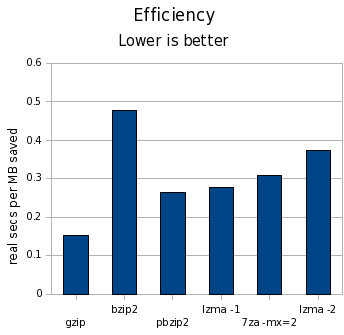
Yesterday, I posted part 1 of how to think about compression. If you haven t read it already, take a look now, so this post makes sense. Introduction In the part 1 test, I compressed a 6GB tar file with various tools. This is a good test if you are writing an entire tar file to disk, or if you are writing to tape. For part 2, I will be compressing each individual file contained in that tarball individually. This is a good test if you back up to hard disk and want quick access to your files. Quite a few tools take this approach rdiff-backup, rdup, and backuppc are among them. We can expect performance to be worse both in terms of size and speed for this test. The compressor tool will be executed once per file, instead of once for the entire group of files. This will magnify any startup costs in the tool. It will also reduce compression ratios, because the tools won t have as large a data set to draw on to look for redundancy. To add to that, we have the block size of the filesystem 4K on most Linux systems. Any file s actual disk consumption is always rounded up to the next multiple of 4K. So a 5-byte file takes up the same amount of space as a 3000-byte file. (This behavior is not unique to Linux.) If a compressor can t shrink enough space out of a file to cross at least one 4K barrier, it effectively doesn t save any disk space. On the other hand, in certain situations, saving one byte of data could free 4K of disk space. So, for the results below, I use du to calculate disk usage, which reflects the actual amount of space consumed by files on disk. The Tools Based on comments in part 1, I added tests for lzop and xz to this iteration. I attempted to test pbzip2, but it would have taken 3 days to complete, so it is not included here more on that issue below. The Numbers Let s start with the table, using the same metrics as with part 1:
Tool MB saved Space vs. gzip Time vs. gzip Cost
gzip 3081 100.00% 100.00% 0.41
gzip -1 2908 104.84% 82.34% 0.36
gzip -9 3091 99.72% 141.60% 0.58
bzip2 3173 97.44% 201.87% 0.81
bzip2 -1 3126 98.75% 182.22% 0.74
lzma -1 3280 94.44% 163.31% 0.63
lzma -2 3320 93.33% 217.94% 0.83
xz -1 3270 94.73% 176.52% 0.68
xz -2 3309 93.63% 200.05% 0.76
lzop -1 2508 116.01% 77.49% 0.39
lzop -2 2498 116.30% 76.59% 0.39
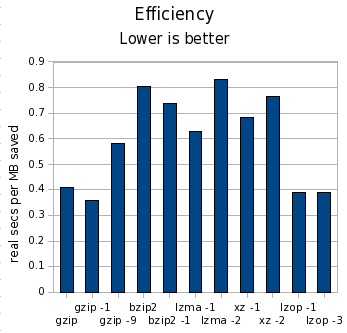
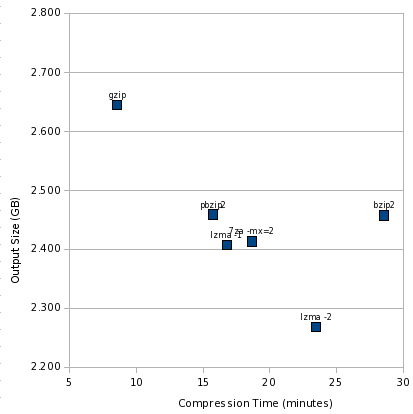
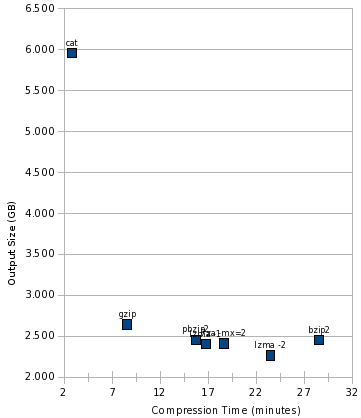
As before, in the MB saved column, higher numbers are better; in all other columns, lower numbers are better. I m using clock seconds here on a dual-core machine. The cost column is clock seconds per MB saved. Let s draw some initial conclusions: The Pretty Charts Now, let s look at an illustration of this. As before, the sweet spot is the lower left, and the worst spot is the upper right. First, let s look at the compression tools themselves: compress2-zoomed At the extremely fast, but not as good compression, end is lzop. gzip is still the balanced performer, bzip2 still looks really bad, and lzma -1 is still the best high-compression performer. Now, let s throw cat into the mix: compress2-big Here s something notable, that this graph makes crystal clear: lzop was just as fast as cat. In other words, it is likely that lzop was faster than the disk, and using lzop compression would be essentially free in terms of time consumed. And finally, look at the cost: compress2-efficiency What happened to pbzip2? I tried the parallel bzip2 implementation just like last time, but it ran extremely slow. Interestingly, pbzip2 < notes.txt > notes.txt.bz2 took 1.002 wall seconds, but pbzip2 notes.txt finished almost instantaneously. This 1-second startup time for pbzip2 was a killer, and the test would have taken more than 3 days to complete. I killed it early and omitted it from my results. Hopefully this bug can be fixed. I didn t expect pbzip2 to help much in this test, and perhaps even to see a slight degradation, but not like THAT. Conclusions As before, the difference in time was far more significant than the difference in space. By compressing files individually, we lost about 400MB (about 7%) space compared to making a tar file and then combining that. My test set contained 270,101 files. gzip continues to be a strong all-purpose contender, posting fast compression time and respectable compression ratios. lzop is a very interesting tool, running as fast as cat and yet turning in reasonable compression though 25% worse than gzip on its default settings. gzip -1 was almost as fast, though, and compressed better. If gzip weren t fast enough with -6, I d be likely to try gzip -1 before using lzop, since the gzip format is far more widely supported, and that s important to me for backups. These results still look troubling for bzip2. lzma -1 continued to turn in far better times and compression ratios that bzip2. Even bzip2 -1 couldn t match the speed of lzma -1, and compressed barely better than gzip. I think bzip2 would be hard-pressed to find a comfortable niche anywhere by now. As before, you can download my spreadsheet with all the numbers behind these charts and the table.

17 February 2009

John Goerzen: How To Think About Compression

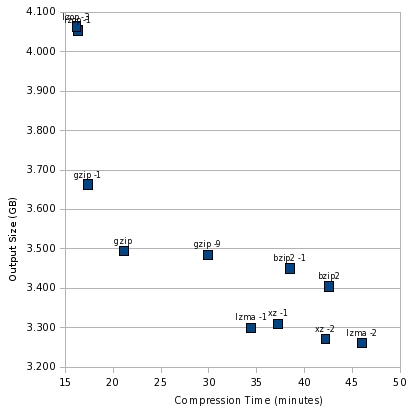
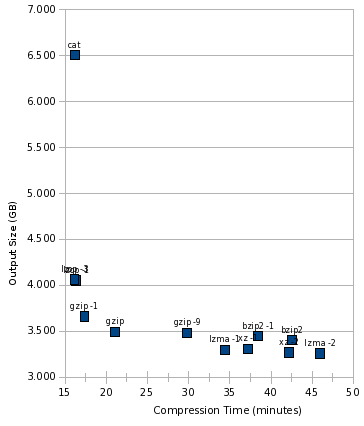
and the case against bzip2 Compression is with us all the time. I want to talk about general-purpose lossless compression here. There is a lot of agonizing over compression ratios: the size of output for various sizes of input. For some situations, this is of course the single most important factor. For instance, if you re Linus Torvalds putting your code out there for millions of people to download, the benefit of saving even a few percent of file size is well worth the cost of perhaps 50% worse compression performance. He compresses a source tarball once a month maybe, and we are all downloading it thousands of times a day. On the other hand, when you re doing backups, the calculation is different. Your storage media costs money, but so does your CPU. If you have a large photo collection or edit digital video, you may create 50GB of new data in a day. If you use a compression algorithm that s too slow, your backup for one day may not complete before your backup for the next day starts. This is even more significant a problem when you consider enterprises backing up terabytes of data each day. So I want to think of compression both in terms of resulting size and performance. Onward Starting Point I started by looking at the practical compression test, which has some very useful charts. He has charted savings vs. runtime for a number of different compressors, and with the range of different settings for each. If you look at his first chart, you ll notice several interesting things: All this was very interesting, but had one limitation: it applied only to the gimp source tree, which is something of a best-case scenario for compression tools. A 6GB Test
I wanted to try something a bit more interesting. I made an uncompressed tar file of /usr on my workstation, which comes to 6GB of data. My /usr contains highly compressible data such as header files and source code, ELF binaries and libraries, already-compressed documentation files, small icons, and the like. It is a large, real-world mix of data. In fact, every compression comparison I saw was using data sets less than 1GB in size hardly representative of backup workloads. Let s start with the numbers:
Tool MB saved Space vs. gzip Time vs. gzip Cost
gzip 3398 100.00% 100.00% 0.15
bzip2 3590 92.91% 333.05% 0.48
pbzip2 3587 92.99% 183.77% 0.26
lzma -1 3641 91.01% 195.58% 0.28
lzma -2 3783 85.76% 273.83% 0.37
In the MB saved column, higher numbers are better; in all other columns, lower numbers are better. I m using clock seconds here on a dual-core machine. The cost column is clock seconds per MB saved. What does this tell us? Some Pretty Charts First, let s see how the time vs. size numbers look: compress-zoomed Like the other charts, the best area is the lower left, and worst is upper right. It s clear we have two outliers: gzip and bzip2. And a cluster of pretty similar performers. This view somewhat magnifies the differences, though. Let s add cat to the mix: compress-big And finally, look at the cost: compress-efficiency Conclusions First off, the difference in time is far larger than the difference in space. We re talking a difference of 15% at the most in terms of space, but orders of magnitude for time. I think this pretty definitively is a death knell for bzip2. lzma -1 can achieve better compression in significantly less time, and lzma -2 can achieve significantly better compression in a little less time. pbzip2 can help even that out in terms of clock time on multicore machines, but 7za already has a parallel LZMA implementation, and it seems only a matter of time before /usr/bin/lzma gets it too. Also, if I were to chart CPU time, the numbers would be even less kind to pbzip2 than to bzip2. bzip2 does have some interesting properties, such as resetting everything every 900K, which could provide marginally better safety than any other compressor here though I don t know if lzma provides similar properties, or could. I think a strong argument remains that gzip is most suitable for backups in the general case. lzma -1 makes a good contender when space is at more of a premium. bzip2 doesn t seem to make a good contender at all now that we have lzma. I have also made my spreadsheet (OpenOffice format) containing the raw numbers and charts available for those interested. Update Part 2 of this story is now available, which considers more compression tools, and looks at performance compressing files individually rather than the large tar file.

19 November 2008

John Goerzen: Jacob Update

Let’s start with a photo: img_5563r.jpg That’s Jacob over at the pumpkin patch near us. He found something to inspect, and spent awhile doing it. As he does. He’s taken a liking to our cat, Nash. Jacob calls him “cat Nash”. Never just “Nash”. When we get home from somewhere, if the cat is around, Jacob will say, “Hi cat Nash! Hi cat Nash!” Then he’ll bend over, touch his head to Nash’s back, and try to give him a hug. Nash, surprisingly, doesn’t mind this. Jacob enjoys being a part of — well, everything. He will repeat back new words and phrases, trying to learn how to say them, even if he doesn’t understand what they mean yet. His favorite recent outdoor discovery is that grain silos are all over the place. He’ll point them out excitedly as we drive down the road. I had never noticed just how many there are. One day, he pointed at a water tower and said “SILO!” I understood why he said that, but I told him it was a water tower. He remembered that, and learned to tell them apart in a day or two. Then one morning he surprised me with, “Water tower. Water inside.” How he figured that out, I don’t know. img_5446r.jpg There’s another photo of him at the pumpkin patch. The other day, I accidentally triggered our smoke alarms while checking one for a battery. After that, Jacob loved to say “BEEP! BEEP!” Sometimes followed by “Smoke larm. Hurt ears.” We learned how to say BEEP BEEP loud and also quiet. He’s certainly a lot of fun at this age.

20 September 2008

John Goerzen: 55 Miles on a Bicycle, 1 on a Mower

Today was the MCC Flatlander bike ride, or as Terah put it, the day we build a cistern with our bicycles.

I've never gone this far on a bike in a single day before. I rode 35 miles for the Flatlander, plus I rode to and from home, for a total of 55 miles (88km). When I got home, I was sore pretty much all over. But it was a good experience, and I'll surely do it again next year.

Yesterday evening, I was getting our bikes ready. I noticed that Terah's bike had a problem: a large gouge that had punctured the tube and ripped apart part of the tire. I had a spare tube on hand, but not a spare tire, and it was too late to get one. I went inside to discuss it with Terah. After a few minutes of pondering, she remembered that the local bike shop I go to was a sponsor of the Flatlander -- maybe if I call before they close, they'd bring one. I called, the owner happened to answer. I explained the situation, and she said, "Of COURSE will get you all fixed up! Look for me at just after 7." I gave her the tire specs, and sure enough, there she was this morning. She also did the repair and tossed in a free tube. I'm continuing to be a big fan of Bicycle Pedaler.

Here's my shirt tag for the day:

My tag from the MCC Flatlander ride

So after I got home, the lawn was way overdue for some mowing. Hence the extra mile on a mower.

20 August 2008

John Goerzen: From Dell, a Uniquely Terrible Experience

Ah, Dell. Seeming inventors of the tech support pit of bureaucratic indifferences, inventors of the flamingo pink Inspiron, perpetrators of fraud in New York...

I have, for over a year now, been on a crusade trying to get them to stop sending me their Dell Home and Home Office catalog to my mailbox. It has been a bundle of fun, let me tell you.

They have a nice-sounding privacy policy. It says you can opt out of all their mailings by filling out a form online. Yeah, good luck with that. First of all, there are different forms for different departments at Dell. I've filled out them all, multiple times. They do nothing whatsoever. Perhaps they use them as lists of known-good addresses to send new advertisements to, rather than lists of people to remove. Oh well.

Now, unfortunately I feel compelled to bore you with the saga so far, involving telephone hang-ups, broken privacy policies, and the like. But there is a silver lining at the end, in which I submitted a request to the postal service asking them to block Dell from sending me any more mail, and it appears that they are very likely to violate Federal Law any day now.

I have called them about it. Dealt with the old "let me transfer you to the correct department" then hang up on me ploy. Spoken to people that have promised up and down that I'll be off their list in 30-60 days. It's always 30-60 days, isn't it? Very convenient that I can't tell for 2 months whether or not they've processed my request.

I've tried their online chat. One of my attempts went like this:

Session Started with Agent (Sneha Ranga)

Agent (Sneha Ranga): "Due to circumstances that have affected Dell Communications I am temporarily unable to pull up any information. The down time is temporary. We apologize for the inconvenience, as we value your time as a customer. Please contact us back after an hour."

Session Ended


Ah Dell, only you could reach such a pinnacle of customer service. /kicking someone out of a chat room before they have a chance to say a word.

Finally, last fall, I blogged about the situation (that's the link above). Debbie from Dell red the post and emailed me. Great, I thought. She asked for my address information and catalog information and sent me a removal confirmation:


From: Debbie@Dell.com
Date: Thu, 18 Oct 2007 13:08:18 -0500
To: jgoerzen@complete.org
Subject: RE: Dell mailing list

Thank you, Mr. Goerzen, your request to have the below address
information removed from our marketing lists has been received:

[ my address here ]

We will process your request promptly. However, it may take several
weeks for some changes to take effect. If you are still receiving
catalogs after thirty (30) days feel free to email me. Sorry for any
inconvenience you may have experienced.

Thank you,
Debbie


So that was October. In December, I replied to that message, saying: "I received another mailing today, and it's been nearly 2 months since your initial message. If there's anything further you can do, I'd appreciate it." Debbie said, "I am very sorry Mr. Goerzen, I will resubmit your request." Guess how successful that was.

So in February, I manage to figure out a way to send in a support ticket without having a Dell system serial number. I wrote:

I keep getting your Dell Home and Home Office catalog. I have tried for months to get off your mailing list. I have called in, talked to people in multiple departments, who have promised to remove me from the list. I have contacted you online. NOTHING IS HELPING. This has gone on for MONTHS.

PLEASE NEVER SEND ME MAIL AGAIN, EVER, AND DO NOT RENT OR SHARE MY NAME.

My address is above.

The code on the mailing I received is: [ snipped ]


The form letter I got back said:

If you are currently receiving our catalog or mailings and would like to be removed, please visit the following web page and select the appropriate link under the "Opt-out of direct mail, phone or fax communications" heading: http://www.dell.com/OptOut


I replied, saying that form didn't work. Guess what I got back?

Thank you for signing up for Dell Email Subscriptions. Please save this email for your records.


Yes, that's right. Asking them to take me off their postal mailing lists got them to PUT ME ON their email lists. ARGH.

So they eventually manage to correctly take me off the email list, and of course promise to do the same with the postal list. This back in February.

I contacted them again in March and July, only to have a similar stupidity-laced run-in with clueless form-answer-laden Dell support reps. Each one claimed to have now, finally, and permanently removed me from the list. It never happened, and none of them lifted a finger to find out way, and no amount of begging could make them.

So, here's the good part.

Junkbusters has spent years educating people on how to get rid of unwanted mail, and documents getting a prohibitory order against the sender. It was originally designed for people that didn't want to receive obscene advertising mailings, but thanks to the happy fact that one non-adult-mailer challenged a prohibitory order all the way to the Supreme Court, you can now get prohibitory order against anyone. Yes, even Dell. (The supreme court's ruling even gave an example: you can prohibit a clothing catalog if you want.)

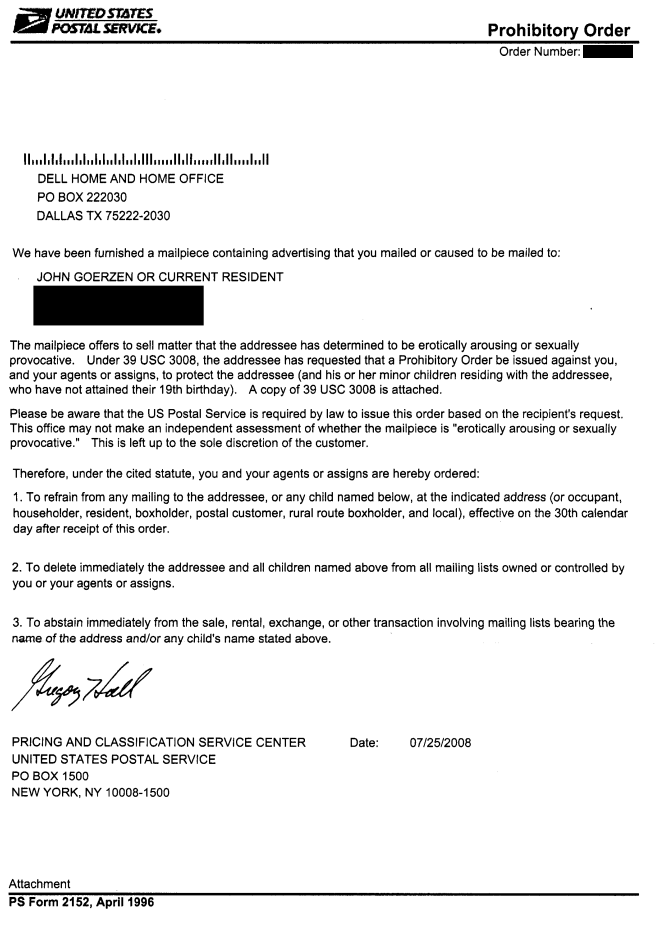
And last month, that's exactly what I did. The USPS sent me back a copy of the letter they sent to Dell, as well as a second page with instructions on reporting violations. Here's the letter they sent to Dell:

dell-usps

Somehow I get a chuckle over some Dell mail clerk trying to figure out how an 11-pound laptop is sexually provocative.

From August 25 on, it is a federal offense for Dell to send me another Home and Home Office catalog. This is a branch of criminal law, not civil law. That is, it's the maybe-go-to-jail branch of law.

How disappointed I was to receive yet another catalog from them today. If only they had waited 5 more days, I could have turned them in now.

Oh well. There's always next month's catalog. Let's just hope the clerk that received the USPS letter removed my name with a better system than everyone else at Dell uses, eh?

6 July 2008

John Goerzen: Look out Nebraska, Here Comes Jacob!

img_5195.jpg

This weekend, the three of us got in the car and drove up to Tekamah, NE for Blogstock 08 at Cliff's. That's Jacob when we were stopped at a park halfway there. Sure looks like he's about to do something ornery, doesn't it? I think he looks even more ornery than the photo of Cliff. That's saying something.

We all really enjoyed Blogstock. Ralph, Cliff, and the rest of the Morrows sure know how to have an event. Ralph said that Cliff's BBQ smoked chicken is the best we'll ever have, and he may just have been right.

I'm going to include a few of my photos in this post; you can see all of my 200+ Blogstock photos on Flickr. (In case anyone else uploads Blogstock photos, you might tag them blogstock08).

Jacob had a blast, and I think he took special pleasure in keeping Terah and me busy. I recall saying something like this, all strung together:

"Jacob, please stop throwing dirt at the cat. That cat doesn't like to have dirt thrown on it. Jacob, stop throwing grass on the cat. Jacob, stop hitting the cat. The cat doesn't like to be hit. Can you pet the cat gently like this? Good job! Jacob, stop sitting on the cat. That hurts the cat. Stop throwing dirt at the cat. Would you like to go play in the corn?"

The Morrow cat was the most tolerant cat I've ever seen, and didn't really seem to mind having a toddler sit on its head. However, we noticed this morning that Jacob's legs mysteriously have some scratches that look very much like cat scratches. We didn't see anything happen, and Jacob didn't come crying to us or anything. I suspect the cat found a way to communicate that it doesn't very much like to have someone sit on it. I also suspect that Jacob understood the message.

img_4996.jpg

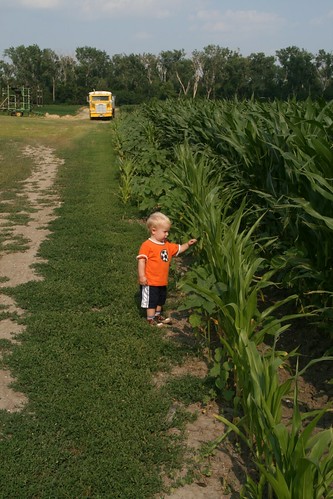
As for corn -- Jacob loves corn. He first noticed it within the past week or two, and always gets excited when we drove past some. He calls it "koh!", and particularly tall corn is "koh-koh" or "ah-koh". Cliff has tall corn, and when I first asked Jacob if he wanted to see it, he immediately stopped pestering the cat, yelled "KOOHHHHH!!! KOH KOH KOH KOH!!!" and started running towards it. He started by carefully inspecting the corn from the edge of the field. (I can't help but thinking he looks a bit like is great-grandpa Yoder in this picture.) I can almost hear him saying "yep, this corn looks pretty good" in a couple of years.

img_5051.jpg

The real fun begins when you get into the corn, apparently. With a little bit of holding my hand to balance while walking over the rows of dirt, he'd get between the rows of corn and have a blast. That means mainly picking up a full handful of dirt, running to another random corn plant somewhere, throwing the dirt in the general direction of the corn, and cackling like this was the best thing ever. I had to watch out with the camera, because I didn't really care for it to be hit by dirt, and well, I was in the general direction of corn, too.

img_5062.jpg

And, in case you didn't know, having fun in the corn is serious business.

Now, what can a toddler possibly do after playing in the corn, eating some cherries off a tree, and smearing some dirt on his face with cherry juice?

img_5088.jpg

Well, plan his next activity, of course! From the look on his face, it will be another one to keep Terah and me busy.

Jacob seemed to get along really well with everyone. But Ralph said that everytime he came close, Jacob would give him a nasty glare. Here's Ralph holding Jacob. Was this the look, Ralph?

img_5078.jpg

Or maybe it was this:

img_5116.jpg

Friday evening, Cliff and Ralph made up some great hamburgers, hot dogs, and sausages. We all ate under the big tent, and had a nice time visiting. It was sort of an unusual thing -- meeting people you already know for the first time -- but very nice. We left somewhere around 8. Jacob enjoyed the hotel room, too.

img_5027r.jpg

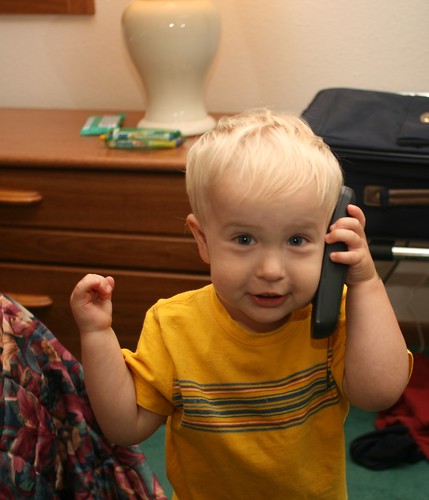
That's Jacob talking on the telephone. Well, I would normally use it as a TV remote, but to Jacob it looks like a phone, so a phone it is. (I can see his point.) This is Jacob answering the phone by saying Hi! Jacob's word for a phone, by the way, is "hi." He'll find a remote by the TV in the room, point to it, and yell "hi!"

Jacob's usual bedtime is 6:30PM. He normally falls asleep fairly easily and sleeps soundly until 6:30AM. Well, we got him in bed well after 6:30PM. Then he made the discovery that the hotel crib/playpen has a mattress that is not attached to the bottom like our mattresses at home are. This was good for at least an hour of excited playing. As Terah and I were trying to sleep, we'd hear these cackles from Jacob's crib, and the noises of a very active boy. I'd peek around and see him using the mattress as a tent, as a peek-a-boo toy, or just as something to throw. I think he fell asleep at about 11.

And woke up promptly at 6:30 on Saturday, just like clockwork, ready to make some phone calls and start the day.

Now, just a tidbit for anyone that doesn't have kids: a toddler, low on sleep, and endless excitement all combine to make for busy parents. Jacob did pretty well, and got in a good long nap in the afternoon. We did take several trips to the corn field.

For most of us, Saturday was a day for brunch, for sitting around and visiting under the tent, for horse rides, and maybe a massage for those that wanted it. Terah got to ride a horse, and Jacob got to ride a pony, too.

For Jacob, it was a day to make new friends, too.

img_5095.jpg

I took this picture just a second after she had given him a hug. I was just a little too slow whipping out the camera.

But when it comes to cherry picking, it's all serious business once again.

img_5098.jpg

Jacob loved eating these sour cherries. At first, he would pick one cherry off the tree, run over to the tent, give it to Terah for her to get the pit out, eat it, then go back to the tree for another one. He must have decided this was inefficient not long after I did. After a few roundtrips, he started trying to get the closest adult, whoever that might be, to pit the cherry for him. When he found one that would do it, he'd keep bringing cherries back to that person.

And then he was under the tree for a long time. Terah and I noticed, and had a conversation about just how many cherry pits it's OK to swallow. But when I checked it out, I found out that Jacob had figured out how to pit cherries himself. He did lose about half a cherry each time he did it, but I guess that was more efficient than pestering adults to do it for him. Though it may have also worked to carry two cherries to the tent at a time.

img_5123.jpg

Late in the afternoon, Cliff started up the smoker for the chicken. He had rented a big smoker for the occasion, but it wasn't working, so he made do with his regular smoker, ovens for the corn, and an array of dutch ovens or side grills for everything else. I couldn't keep track of it all, and I was just watching, but somehow it all turned out perfect.

img_5140.jpg

While the chicken was cooking, Ralph and son-of-Ralph (SOR) were having a conversation and patting their bellies. I couldn't hear, and didn't ask questions, so I'm choosing to believe that they were discussing how many pieces of chicken they could eat. When they heard my camera click, Ralph said, "He didn't just take a photo, did he?" Thereby guaranteeing a spot on my blog.

I had the distinction, I think, of being the least-read blogger at Blogstock. I can't quite remember how many times I'd meet someone, and they'd say, "Oh, you're the computer guy, right? I tried reading your blog, but I didn't understand it, sorry!" Completely understandable, I assure you!

After dinner Saturday, we talked about how we got started blogging (hi, Marty and Andy if you're reading), why we were there. Cliff said some very kind things about Terah and me, which really meant a lot.

Later, Cliff told me how Terah showed up in the kitchen with her tray of deviled eggs. Cliff saw them, and said, "Terah, I love you." Later, Cliff said "I love you" to someone else. From the next room, Terah piped up, "What food did she bring?"

Saturday evening, Terah took her horse ride. Jacob was quite tired by that point, and threw a tantrum about not being able to go with mom and ride a horse, too. We were talking about it when Rachel came over. Jacob asked her to pick him up, she did, and he instantly stopped fussing. Maybe it was a "so there" to me, since I had been holding him a minute before, and he took the opportunity to scream in my ear. But in any case, Jacob loved Rachel. She let him sit on a pony, carried him all around the yard, and he managed to hold it together until Terah came back at 9:30.

Saturday evening it was time for goodbyes. We all had a blast and I'm sure we'll do this again. If you weren't there, here's what Blogstock looks like:

img_4991.jpg

A bunch of friends sitting around chatting under a tent pretty well sums it up.

(There was a full tent of people; some were just elsewhere when this particular photo was taken.)

Jacob shared his thoughts on the whole trip on the way home, too. Well put, Jacob.

img_5202.jpg

24 May 2008

John Goerzen: How to Start Bicycling to Work

Yesterday, I wrote about bicycling to work, pointing out that it's a safe, inexpensive, way for many people (including office workers without access to showers) to get to work. There were a lot of thoughtful comments there too.

Today I'd like to provide some tips for getting started commuting on a bicycle. As I'm just getting started on this, these are mainly things I've learned from poking around online, so I'll be including lots of links.

The Bicycle

This varies from person to person, but as a general rule: if you have a very short ride -- say a mile or less -- you can probably just use any old bike and a bicycling helmet. Don't try to use a motorcycle helmet. It won't vent your head, so you could overheat. Also, it won't be comfortable.

Most people will have a longer ride and will want to get a bike that works specifically for them. Each model of bicycle comes in different frame sizes. It's important to get a bicycle that is the right size for you. Also, you'll want to get a quality bicycle that will let you be fast and won't break down along the way.

For all these reasons, I -- and every single other person I've ever seen talk about this -- highly recommend that you buy your bicycle from a bicycle shop. Don't buy a bicycle from a "big box" store like Walmart or Target. They may be cheaper up front, but you'll pay for it in the long run because they won't last as long, won't fit you as well, and may even be unsafe. Bike shop staff will help you find a bike that fits you, which is important for avoiding aches and pains and even injury. They'll be able to help you find appropriate accessories for your bike, as well as repair it. Here is a helpful article on this topic, written by a bike shop.

Generally speaking, bike shops can repair bikes bought at any other bike shops. However, they can instantly recognize bikes bought at big box stores. Many will repair those too, but some refuse to work on some of those bikes on the grounds that it is impossible to bring them to the level of service they expect their mechanics to do.

Aches and Pains

With any sport, when you start it, you can expect a little bit of aches and pains at first, as you start using muscles that you may not have really used at first. Bicycling is no exception, but it's easy to deal with.

Your first stop if you have aches and pains might be the where does it hurt page. It provides detailed, helpful advice. There are also some common things that go wrong for people.

First on the list is wrong size of bike or improper adjustment of your bike. You want a bike frame that is the right size for you, and you want the seat and handlebars adjusted properly for you. A bike shop can help you get this done easily. If your feet can reach the ground while you're on the seat, you almost certainly have the seat too low, which is a common mistake.

Sometimes the way you position yourself on the bike, or your technique, could be to blame.

Also, clothing can be a problem. A good place to start here is with some cycling shorts. Another common complaint from new cyclists appears to be blisters on the feet. This can be caused by improper positioning on the pedals, or by using the wrong type of sock. Typical socks absorb moisture and trap it next to the skin; bicycling socks will wick it away and let it evaporate. In fact, cycling clothes: socks, shorts, and jerseys (shirts) are all designed to wick moisture away from you and let it evaporate, which keeps you cooler and more comfortable. Bicycling gloves are cheap and can help your hands stay comfortable.

Expense

You can easily save thousands of dollars by riding a bicycle instead of driving a car. Bicycles do need periodic maintenance, just like a car. Usually you can do a lot of that yourself. It probably will pay off to take your bike in to the shop for an annual tuneup. If you have no bicycling equipment at all, and buy your equipment at a bike shop new, you can probably get started for around $500. Even that will probably pay for itself in less than a year if you average riding your bike at least a few times a week.

Safety

Safety on a bicycle can usually be summed up with three rules: be visible, be predictable, and ride with traffic.

Unless there are dedicated bicycle-only lanes or paths, the safest way (in the United States) to ride your bike is on the road, riding with traffic (acting like a car). Don't ride on a sidewalk, and never ride against traffic. This may sound counter-intuitive, but it is backed up by solid research. It all has to do with being predictable. Nobody is looking for something the speed of a bicycle to emerge from a sidewalk to cross a road or driveway. Sidewalks often aren't that visible and frequently don't provide enough room to pass. Sidewalk-riding cyclists get into accidents all the time with cars backing pulling out of driveways, making turns, or even just driving down a road where the cyclist cuts in front of them to cross a street.

A great book for learning how to ride in traffic can be viewed free online: the Bicycling Street Smarts book. There are also some safety videos online that are helpful.

Staying visible is certainly important. In some places, like cities where cyclists are common, drivers are going to be on the lookout for you already. In my case, I'm riding on rural roads that have some hills, where cyclists are rare, so I'm putting extra effort into this.

Staying visible in the day or at night starts with high-visibility clothing. A "screaming yellow" jersey or an ANSI safety reflective vest (less than $10) are good ways to do that. Several people recommend a Cateye TL-LD1100 flashing tail light for use at night, or even for daytime use when visibility is critical (such as my situation). If you will ever ride at night, laws require you to have the proper reflectors on your bike. And, you must also have a white headlight that does not cover up your front reflector (in some locations, you may also be required to have a red tail light that doesn't cover up your reflector). Companies like Cateye carry those products as well.

Other tips: avoid drainage covers; they sometimes have slats that a bicycle tire could fall into.

Accessories

Here are some suggestions you might consider as a commuter.

Start with pannier bags. They mount over your rear tire and are cooler for you than a backpack because your back can still breathe. They're more aerodynamic than a front basket. You can get bags suitable for carrying papers, laptops, a change of clothes, etc.

Next on your list might be a bicycle lock, to help keep it from being stolen. Your local bike shop can make suggestions here.

You might want to consider a spare inner tube (about $5) and tire-changing tools (also about $5) to carry with you in your bag. You wouldn't want to have to walk 5 miles if you get a flat.

Along with that goes an air pump. I suggest a frame pump -- it's a small pump that can clip on to your bicycle's frame, so you always have it handy. Obviously you will need this if you have to change a tube, but it could be handy even if you don't.

You can find some more suggestions from bicycling.about.com and from Mike or your local bike shop.

Where to buy

Besides your local bike shop, you can buy a lot of accessories online. I wouldn't suggest buying a bicycle online, because you really want to get a good fit at a bike shop.

When I asked at bikeforums.net, readers suggested three online stores:

www.pricepoint.com
www.bikenashbar.com
www.performancebike.com

You can also find some bicycling accessories at general-purpose stores like Amazon or sporting goods stores like REI. I personally wouldn't recommend local "big box" sporting goods stores any more than I would Walmart or Target for this stuff, though.

More info

For more information, check out my bicycling links at del.icio.us.

19 February 2008

John Goerzen: Registrar Dynadot Conspires to Help Take Down Wikileaks?

Yesterday, Wired ran a story on the Cayman Islands bank that got Wikileaks.org blocked. This story said, in part:

When the bank's lawyers indicated they would be filing a suit, she asked them to tell her where so that Wikileaks could find an attorney in the appropriate jurisdiction to represent it. She says the lawyers refused to tell her. Two and a half weeks later, the bank filed a restraining order against Dynadot and Wikileaks in San Francisco. Wikileaks received notice only a few hours before the case went to a judge who accepted the agreement between Dynadot and the bank.


(emphasis mine)

Now, Dynadot and this Cayman Islands bank apparently had an agreement to block wikileaks.org already. Not only did Dynadot effectively take wikileaks.org down, but also they "lock(ed) the wikileaks.org domain name to prevent transfer of the domain name to a different domain registrar." The U.S. Disctrict Court for Northern California issued this injunction without ever giving Wikileaks a chance to respond. The bank only filed the request against Dynadot. Apparently Wikileaks received notification that this was going to happen only 6 hours before the hearing (an incredibly short time in legal terms), nowhere near enough time to prepare a case.

Now, the reason I post this is because I have looked at Dynadot as a registrar before. They have good prices and a whois privacy service that makes sense: where you remain the owner of record, making it easier if you need to transfer the domain or prove your ownership of it.

But before signing up, I read their AUP carefully. Among many alarming things, I noticed this paragraph:

You further agree that Dynadot, in its sole discretion and without liability to You for any resulting loss or damages, may take immediate corrective action, including, but not limited to, removal of all or a portion of Your domain services and/or deletion, suspension, cancellation, termination, or other interruption of domain services or Your customer account with Dynadot, at any time during the term of this Agreement, in the event of notice of any possible violation of this Agreement by You or Your end users, or if such service or account is used in association with morally objectionable activities, or for any reason whatsoever. In such cases, any and all fees paid to Dynadot will be non-refundable and ineligible for account credit.


So, I thought I would write to them about it. Here is an excerpt from their response:

We always conduct an investigation before taking action against a domain. We will give you a chance to respond to the complaints.


From Wired's story, it doesn't look like that really happened. The US Government has already issued advisories about Cayman Islands banks, and it is unclear (to me at least) what law Wikileaks broke, or how Dynadot could find their actions of exposing fraud "morally objectionable". What's more, collaborating with the bank to get a takedown order written, but not talking to Wikileaks, seems to go against their statements to me (assuming again that the Wired story is accurate).
Here is my entire mail. You may also find archive.org's copy of the AUP from last July to be helpful. (I wrote the email in November, and they've added some sections since then, so the section numbers don't necessarily match up)

Subject: Re: SITE: Questions about your AUP
From: Dynadot Info <info@dynadot.com>
Date: Sat, 3 Nov 2007 13:42 -0800
To: jgoerzen@complete.org

Hello,
Thank you for your email. Responses are below.
Best Regards,
Dynadot Staff
--------------------------------------------------
DYNADOT... $8.99 domain names... $1/mo. web hosting
http://www.dynadot.com
Hi,
I currently have several domains being hosted with Gandi.  I have long been looking for someone that can provide a level of privacy for my whois data in a sane way.  I think Dynadot is the first I've seen that looks like it can do that and still be affordable.
In preparation to transfer over a first test domain, I read your AUP and frankly am quite troubled by what I saw.  I hope that you can allay my fears.
In section 4 of part 2, the last paragraph states that Dynadot "for any reason whatsoever" may delete, cancel, or terminate my domain services or customer account.  It also lists "notice of possible violation" as a justification for that.  That makes me even more nervous -- any random person could send you an email claiming something nefarious is happing with my domain name, and I'm agreeing to just let you delete it because of that?

We always conduct an investigation before taking action against a domain. We will give you a chance to respond to the complaints. 
A very similar clause appears in section 7 of part 1 ("cancellation of services").  It goes on to cast a very broad net around objectionable material and says that Dynadot decides what's objectionable.  Now, if you go to my website at www.complete.org or blog at changelog.complete.org, you'll see I'm an upstanding netizen.  But the AUP says that things that "are designed to or effectively... embarrass" third parties could get my domain cancelled.  So if I post a review of Vista that says I think Microsoft did a poor job of engineering, would my account be yanked if one of their engineers complained?  What if I (legally!) linked to a Comedy Central sketch using real TV footage to mock George W. Bush or Hillary Clinton?

The cases you described above would never happen with us. Complaining about Microsoft or making fun of George Bush are protected free speech. The service agreement is designed to give us some flexibility in dealing with customers that break the law. 
I'm particularly concerned about this because apparently DynaDot felt it worthwhile to try to take down the website of someone that found a security hole: http://www.jhuskisson.com/friends/dynadot-fights-back-bans-nick-from-everything
While I wouldn't condone step-by-step cracking instructions in most cases, this is concerning to me.

He was posting a step by step guide to hacking our website, which is illegal. The hack did not work, but we noticed an upsurge in strange activity in our logs, so we requested the hacking guide be taken down. 
Finally, item (i) under the Domain Privacy Service section says that you could immediately reveal all my information upon the receipt of merely a *claim* (not even a court order), even if it's invalid.  But I thought that NOT doing this was what you were saying made your service better, over at http://www.dynadot.com/resource/article/qa.html?aid=0

Once again we need to build some flexibility into our service agreement to deal with people who use their domains for criminal activity. Otherwise we could be liable for the damages that they cause to others. So far, we have never dropped anyones privacy except in the few cases we were forced to by a FBI subpoena.
I know this is a long message, and I appreciate your time.  I really do want to use your service, but -- no offense intended -- I want to make sure I'm not dealing with scammers first, and from reading the AUP, I'm not so sure!

No offence taken. I will email our counsel to see if we can tighten up the agreement a bit. 
-- John Goerzen

11 February 2008

Joachim Breitner: How to fork privately

A few days ago, I asked how to fork a debian package privately. I got some repsonses by comments, e-Mail and other blog posts, and I want to summarize the tools that were suggested. I have not really tried them, just looked at the webpages, the documentation or the sourcecode. I m only including Debian-specific solutions, as using Gentoo might be nice, but is out of scope here :-)I also deleted half the text before saving it, and I hate rewriting stuff, so it might be a bit terse.debtooEddy Petri or tells me about his three year old project debtoo, which wants to bring a Gentoo-like experience to Debian. While it probably provides what I need, it feels too big in that it has a more general aim than what I m looking for. It is not in Debian and not actively developed in the last two years.srcinstEddy also tells me about srcinst, which is a small haskell program written by jgoerzen in 2005. This is more a proof-of-concept that builds a package and all necessariy build-dependencies without using a binary package, but does not allow for patches to be applied. It is in Debian, actively maintained, but not developed, and barely documented (just an IRC log).apt-buildA similar tool and also in Debian is apt-build. This package is created to compile packages for optimization (as it asks half a dozend compiler-flag-questions with DebConf during the installation). It allows the user to apply a patch to the source, but it has to be passed as a command line option, and patches seem not to be tracked. Not much development in the last year, and not much documentation.debpatchNot to be confused with the program in the debdelta package is the debpatch tool by Victor Hsieh which Carsten Hey told me about. Also written in 2005, this comes closest to what I want. For every package you want to modify, you can configure it to apply patches to the source, to add patches to the debian/patches directory or to statically replace files in the generated binary and puts it in a local apt repository. No code yet to track new versions of the packages and no support for pbuilder though. This perl script is not yet in Debian, but is available as a Debian package and seems to have seen some development in the last years. Quick Googleing does not return any user reports; has any already tried this?customdebSomewhat in this direction goes the script that I wrote two weeks ago for a totally different project, customdeb, but it is aimed at binary debian files exclusively, and debpatch already supports replacing files in the binary package.Summary I found a few projects that go in a similar direction, and one that seems to fit my needs quite well. All of them are not widely used and in a very early state of development. I m actually surprised that this is not a itch more people had to scratch! I will have a closer look at debpatch when I find the time and maybe, if found useful, see if it can be included in Debian probably after a name change, since we already have a debpatch binary.
Joachim Breitner: Ways to fork privately

A few days ago, I asked how to fork a debian package privately. I got some repsonses by comments, e-Mail and other blog posts, and I want to summarize the tools that were suggested. I have not really tried them, just looked at the webpages, the documentation or the sourcecode. I m only including Debian-specific solutions, as using Gentoo might be nice, but is out of scope here :-)I also deleted half the text before saving it, and I hate rewriting stuff, so it might be a bit terse.debtooEddy Petri or tells me about his three year old project debtoo, which wants to bring a Gentoo-like experience to Debian. While it probably provides what I need, it feels too big in that it has a more general aim than what I m looking for. It is not in Debian and not actively developed in the last two years.srcinstEddy also tells me about srcinst, which is a small haskell program written by jgoerzen in 2005. This is more a proof-of-concept that builds a package and all necessariy build-dependencies without using a binary package, but does not allow for patches to be applied. It is in Debian, actively maintained, but not developed, and barely documented (just an IRC log).apt-buildA similar tool and also in Debian is apt-build. This package is created to compile packages for optimization (as it asks half a dozend compiler-flag-questions with DebConf during the installation). It allows the user to apply a patch to the source, but it has to be passed as a command line option, and patches seem not to be tracked. Not much development in the last year, and not much documentation.debpatchNot to be confused with the program in the debdelta package is the debpatch tool by Victor Hsieh which Carsten Hey told me about. Also written in 2005, this comes closest to what I want. For every package you want to modify, you can configure it to apply patches to the source, to add patches to the debian/patches directory or to statically replace files in the generated binary and puts it in a local apt repository. No code yet to track new versions of the packages and no support for pbuilder though. This perl script is not yet in Debian, but is available as a Debian package and seems to have seen some development in the last years. Quick Googleing does not return any user reports; has any already tried this?customdebSomewhat in this direction goes the script that I wrote two weeks ago for a totally different project, customdeb, but it is aimed at binary debian files exclusively, and debpatch already supports replacing files in the binary package.apt-srcAlso a related tool Carsten Hey told me about is apt-src. This tool wants to provide apt-like features for source packages. It allows you to install sources somewhere, upgrade the source and build binary packages from them. It does not really hide the sources from the user and seems to be created for people who want to work with the source somehow. If you have local changes to the sources, it can try to merge them with the new version, but these changes are not kept as a separate patch but only as implicit changes. If that were different, it would seem be a very nice tool. It s written by Joey Hess he abondonned it in 2004. Since then, not much development has happened.debnestYet another approach is taken by debnest, which Peter Makholm took over. Here, you create a full debian source package with a debian/ directory containing a control and rule file etc., but besides the debian/ directory, it contains just the packed sources (.dsc et al) from another package. In your debian/rules, you can specify your changes. I can see no support for tracking new versions of the inner package, but at least this project is maintained and in Debian.Summary I found a few projects that go in a similar direction, and one that seems to fit my needs quite well. All of them are not widely used and in a very early state of development, and it seems to be something people start to work on and quickly lose interest. I m actually surprised that this is not a itch more people had to scratch! I will have a closer look at debpatch when I find the time and maybe, if found useful, see if it can be included in Debian probably after a name change, since we already have a debpatch binary. Or maybe I should try to add support for what I need to apt-src, which seems to be the most advanced of all these programs, although it s unmaintained longer than the others exist.Update: Added apt-src.Update 2: Added debnest;
17 December 2007

John Goerzen: Ice Photos

For those of you wanting to see some pictures from the recent ice storm, here you go.

The morning:

img_4166.jpg

This bush sorta got short and flat:

img_4173.jpg

A tree branch:

img_4183.jpg

And another:

img_4185.jpg

Then, at noon:

img_4200.jpg

Then the snow came:

img_4229.jpg

If you have trouble finding the driveway... well, good thing we've got reflectors.

img_4253.jpg

The rental generator that kept us warmish:

img_4262.jpg

More snow:

img_4287.jpg

You can also see the whole set on flickr.

1 December 2007

John Goerzen: Attention Junkmailers

We love to hear from you. I'm sure that's what you're thinking, anyway, as you prepare volumes of paper to send to our mailbox.

But just so you know, let me explain just how much we love the material you send us.

When we get one of your catalogs, it will get added to the junk mail pile. Every so often, I will go through this pile. I will contact the company behind each and every mailing, asking them to remove me from their list and not rent my name further. If I have extra time, I will probably also write that note on your postage-paid envelope and pop it in the mailbox. I will also add your name to my list of companies that send me junk mail, so I can avoid doing business with you in the future. If you have sent me junk mail in the past, rest assured that I will find some creatively enjoyable way of dealing with your refusal to honor my removal request.

After I have processed your piece of artfully-crafted handiwork, possibly trying to sell me pink laptops or a shirt with the word "femail" on it -- whatever that means -- I will deposit your catalog, along with dozens of other similar catalogs, on the kitchen floor.

This is when the real fun begins, because now it's Jacob's turn to process them.

He will usually start by ripping out every page from the catalog. He'll start slowly and carefully, ripping out pages one at a time, savoring the wonderful rrrrriiiiippppp noise as he goes. But then he'll get faster, going for two pages at a time, then more, until finally he just will lunge for paper by the handful to crush, tear, or otherwise mutilate.

After that, there are many things he might do to your fine piece of unsolicited advertising. Perhaps he will enjoy drooling on it -- a satisfying fate for your 4-color catalog, don't you think? Or perhaps he will grab some of your pages, carefully emblazoned with your logo, and tear them into as many tiny bits as he can. Or maybe he will simply gather your work together on the floor, then spin himself around on top of it, scattering the remnants as far and wide as possible, cackling all the while. He may also smear bits of food on them if he ate recently, or perhaps he will simply resume tearing pages apart.

But whatever he does, rest assured that he will treat your catalog with the care and attention it deserves. No catalog will survive intact, and as many pages as possible will be ripped apart and left in bits. He does, after all, have a great attention to detail.

After Jacob is done, we will gather up what remains and put it all in our recycling container.

Oh, and under no circumstances will we actually make a purchase from your catalog.

Here are two pictures of the scene.

img_4160.jpg

Notice the careful concentration in this photo. Obviously he knows that Dell has been ignoring my removal requests for some time, and is taking note to tear their pages into the smallest possible bits.

But it's not all hard work -- processing your catalogs is fun, too.

img_4163.jpg

Next.

Previous.