CAdES is a digital signature
standard that is used and sometimes mandated, by the Italian Public
Administration.
To be able to do my job, I own a Carta Nazionale dei Servizi
(CNS) with which I
can generate legally binding signatures. Now comes the problem of finding a
software to do it.
Infocamere Firma4NG
InfoCamere are distributing a
software called Firma4NG,
with a Linux option, which, I'm pleased to say, seems to work just fine.
Autofirma
AutoFirma is a Java
software for digital signatures distributed by the Spanish government, which
has a Linux version.
It is licensed as GPL-2+ EUPL-1.1, and the source seems to be
here.
While my Spanish is decent I lack jargon for this specific field, and I didn't
manage to make it work with my CNS.
Autogram
Andrej Shadura pointed me to Autogram,
a Slovakian software for digital signatures, licensed under the EUPL-1.2.
The interface is still only in Slovakian, so tried it but I didn't go very far
in trying to make it work.
OpenSSL
In trixie, openssl is almost, but not quite, able to do it. Here's as far as I've got.
Install opensc
apt install opensc
Test if you can access the smart card with:
pkcs11-tool--list-objects[-l]
You can find other pkcs11-tool examples here
Set up a pkcs11 provider for openssl
See PKCS11 URI documentation here.
Install the PKCS11 engine for openssl
apt install libengine-pkcs11-openssl
It looks like providers replaced
engines, and
this would not be needed, but I couldn't find a way to convince openssl to work
without this.
Sign a document
It verifies correctly using the Austrian verification system.
All the Italian verification
systems
I tried, however, complain that, although the signature is valid, the
certificate is emitted by an unqualified CA and the certificate revocation
information cannot be found.
PAdES
When signing PDF files, the PAdES
standard is sometimes accepted.
LibreOffice is able to generate PAdES signatures using the "File / Digital
signatures " menu, and provided the smart card is in the reader it is able to
use it. Both LibreOffice and Okular can verify that the signature is indeed
there.
However, when trying to validate the signature using Italian validators, I get
the same complaints about unqualified CAs and missing revocation information.
Wall of shame
Dike GoSign
Infocert (now Tinexta) used to
distribute a software called "Dike GoSign" that worked on Ubuntu, which I used
on a completely isolated VM, and it was awful but it worked.
I had to regenerate the VM for it, and discovered that the version they
distribute now will refuse to work unless one signs in online with a Tinexta
account. From the same company that asks you to install their own root
certifiactes
to use their digital signature system.
Gross.
Dropped.
Aruba Sign
Aruba used to distribute a
software called Aruba Sign, which also worked on Ubuntu.
Ubuntu support has been discontinued, and they now only offer support for
Windows or Mac.
Yuck. Dropped.
Today marks both a milestone and a turning point in my journey with open source software. I m proud to announce the release of KDE Gear 25.08.0 as my final snap package release. You can find all the details about this exciting update at the official KDE announcement.
After much reflection and with a heavy heart, I ve made the difficult decision to retire from most of my open source software work, including snap packaging. This wasn t a choice I made lightly it comes after months of rejections and silence in an industry I ve loved and called home for over 20 years.
Passing the Torch
While I m stepping back, I m thrilled to share that the future of KDE snaps is in excellent hands. Carlos from the Neon team has been working tirelessly to set up snaps on the new infrastructure that KDE has made available. This means building snaps in KDE CI is now possible a significant leap forward for the ecosystem. I ll be helping Carlos get the pipelines properly configured to ensure a smooth transition.
Staying Connected (But Differently)
Though I m stepping away from most development work, I won t be disappearing entirely from the communities that have meant so much to me:
Kubuntu: I ll remain available as a backup, though Rik is doing an absolutely fabulous job getting the latest and greatest KDE packages uploaded. The distribution is in capable hands.
Ubuntu Community Council: I m continuing my involvement here because I ve found myself genuinely enjoying the community side of things. There s something deeply fulfilling about focusing on the human connections that make these projects possible.
Debian: I ll likely be submitting for emeritus status, as I haven t had the time to contribute meaningfully and want to be honest about my current capacity.
The Reality Behind the Decision
This transition isn t just about career fatigue it s about financial reality. I ve spent too many years working for free while struggling to pay my bills. The recent changes in the industry, particularly with AI transforming the web development landscape, have made things even more challenging. Getting traffic to websites now requires extensive social media work and marketing all expected to be done without compensation.
My stint at webwork was good while it lasted, but the changing landscape has made it unsustainable. I ve reached a point where I can t continue doing free work when my family and I are struggling financially. It shouldn t take breaking a limb to receive the donations needed to survive.
A Career That Meant Everything
These 20+ years in open source have been the defining chapter of my professional life. I ve watched communities grow, technologies evolve, and witnessed firsthand the incredible things that happen when passionate people work together. The relationships I ve built, the problems we ve solved together, and the software we ve created have been deeply meaningful.
But I also have to be honest about where I stand today: I cannot compete in the current job market. The industry has changed, and despite my experience and passion, the opportunities just aren t there for someone in my situation.
Looking Forward
Making a career change after two decades is terrifying, but it s also necessary. I need to find a path that can provide financial stability for my family while still allowing me to contribute meaningfully to the world.
If you ve benefited from my work over the years and are in a position to help during this transition, I would be forever grateful for any support. Every contribution, no matter the size, helps ease this difficult period: https://gofund.me/a9c55d8f
Thank You
To everyone who has collaborated with me, tested my packages, filed bug reports, offered encouragement, or simply used the software I ve helped maintain thank you. You ve made these 20+ years worthwhile, and you ve been part of something bigger than any individual contribution.
The open source world will continue to thrive because it s built on the collective passion of thousands of people like Carlos, Rik, and countless others who are carrying the torch forward. While my active development days are ending, the impact of this community will continue long into the future.
With sincere gratitude and fond farewells,
Scarlett Moore
Utkarsh Gupta
did 15.0h (out of 1.0h assigned and 14.0h from previous period).
Evolution of the situation
In July, we released 24 DLAs.
Notable security updates:
angular.js, prepared by Bastien Roucari s, fixes multiple vulnerabilities including input sanitization and potential regular expression denial of service (ReDoS)
tomcat9, prepared by Markus Koschany, fixes an assortment of vulnerabilities
mediawiki, prepared by Guilhem Moulin, fixes several information disclosure and privilege escalation vulnerabilities
php7.4, prepared by Guilhem Moulin, fixes several server side request forgery and denial of service vulnerabilities
This month s contributions from outside the regular team include an update to thunderbird, prepared by Christoph Goehre (the package maintainer).
LTS Team members also contributed updates of the following packages:
commons-beanutils (to stable and unstable), prepared by Adrian Bunk
djvulibre (to oldstable, stable, and unstable), prepared by Adrian Bunk
git (to stable), prepared by Adrian Bunk
redis (to oldstable), prepared by Chris Lamb
libxml2 (to oldstable), prepared by Guilhem Moulin
commons-vfs (to oldstable), prepared by Daniel Leidert
Additionally, LTS Team member Santiago Ruano Rinc n proposed and implemented an improvement to the debian-security-support package. This package is available so that interested users can quickly determine if any installed packages are subject to limited security support or are excluded entirely from security support. However, there was not previously a way to identify explicitly supported packages, which has become necessary to note exceptions to broad exclusion policies (e.g., those which apply to substantial package groups, like modules belonging to the Go and Rust language ecosystems). Santiago s work has enabled the notation of exceptions to these exclusions, thus ensuring that users of debian-security-support have accurate status information concerning installed packages.
DebCamp 25 Security Tracker Sprint
The previously announced security tracker sprint took place at DebCamp from 7-13 July. Participants included 8 members of the standing LTS Team, 2 active Debian Developers with an interest in LTS, 3 community members, and 1 member of the Debian Security Team (who provided guidance and reviews on proposed changes to the security tracker); participation was a mix of in person at the venue in Brest, France and remote. During the days of the sprint, the team tackled a wide range of bugs and improvements, mostly targeting the security tracker.
The sprint participants worked on the following items:
Continued work (which was in progress prior to the sprint) on improved tooling to support security releases of packages from language ecosystems that rely heavily on static linking
As can be seen from the above list, only a small number of changes were brought to completion during the sprint week itself. Given the very compressed timeframe involved, the broad scope of tasks which were under consideration, and the highly sensitive data managed by the security tracker, this is not entirely unexpected and in no way diminishes the great work done by the sprint participants. The LTS Team would especially like to thank Salvatore Bonaccorso of the Debian Security Team for making himself available throughout the sprint to answer questions, for providing guidance on the work, and for helping the work by reviewing and merging the MRs which were able to merged during the sprint itself.
In the weeks that follow the sprint, the team will continue working towards completing the in progress items.
Thanks to our sponsors
Sponsors that joined recently are in bold.
LWN wrote an article which opens with the assertion "Linux users who have Secure Boot enabled on their systems knowingly or unknowingly rely on a key from Microsoft that is set to expire in September". This is, depending on interpretation, either misleading or just plain wrong, but also there's not a good source of truth here, so.
First, how does secure boot signing work? Every system that supports UEFI secure boot ships with a set of trusted certificates in a database called "db". Any binary signed with a chain of certificates that chains to a root in db is trusted, unless either the binary (via hash) or an intermediate certificate is added to "dbx", a separate database of things whose trust has been revoked[1]. But, in general, the firmware doesn't care about the intermediate or the number of intermediates or whatever - as long as there's a valid chain back to a certificate that's in db, it's going to be happy.
That's the conceptual version. What about the real world one? Most x86 systems that implement UEFI secure boot have at least two root certificates in db - one called "Microsoft Windows Production PCA 2011", and one called "Microsoft Corporation UEFI CA 2011". The former is the root of a chain used to sign the Windows bootloader, and the latter is the root used to sign, well, everything else.
What is "everything else"? For people in the Linux ecosystem, the most obvious thing is the Shim bootloader that's used to bridge between the Microsoft root of trust and a given Linux distribution's root of trust[2]. But that's not the only third party code executed in the UEFI environment. Graphics cards, network cards, RAID and iSCSI cards and so on all tend to have their own unique initialisation process, and need board-specific drivers. Even if you added support for everything on the market to your system firmware, a system built last year wouldn't know how to drive a graphics card released this year. Cards need to provide their own drivers, and these drivers are stored in flash on the card so they can be updated. But since UEFI doesn't have any sandboxing environment, those drivers could do pretty much anything they wanted to. Someone could compromise the UEFI secure boot chain by just plugging in a card with a malicious driver on it, and have that hotpatch the bootloader and introduce a backdoor into your kernel.
This is avoided by enforcing secure boot for these drivers as well. Every plug-in card that carries its own driver has it signed by Microsoft, and up until now that's been a certificate chain going back to the same "Microsoft Corporation UEFI CA 2011" certificate used in signing Shim. This is important for reasons we'll get to.
The "Microsoft Windows Production PCA 2011" certificate expires in October 2026, and the "Microsoft Corporation UEFI CA 2011" one in June 2026. These dates are not that far in the future! Most of you have probably at some point tried to visit a website and got an error message telling you that the site's certificate had expired and that it's no longer trusted, and so it's natural to assume that the outcome of time's arrow marching past those expiry dates would be that systems will stop booting. Thankfully, that's not what's going to happen.
First up: if you grab a copy of the Shim currently shipped in Fedora and extract the certificates from it, you'll learn it's not directly signed with the "Microsoft Corporation UEFI CA 2011" certificate. Instead, it's signed with a "Microsoft Windows UEFI Driver Publisher" certificate that chains to the "Microsoft Corporation UEFI CA 2011" certificate. That's not unusual, intermediates are commonly used and rotated. But if we look more closely at that certificate, we learn that it was issued in 2023 and expired in 2024. Older versions of Shim were signed with older intermediates. A very large number of Linux systems are already booting certificates that have expired, and yet things keep working. Why?
Let's talk about time. In the ways we care about in this discussion, time is a social construct rather than a meaningful reality. There's no way for a computer to observe the state of the universe and know what time it is - it needs to be told. It has no idea whether that time is accurate or an elaborate fiction, and so it can't with any degree of certainty declare that a certificate is valid from an external frame of reference. The failure modes of getting this wrong are also extremely bad! If a system has a GPU that relies on an option ROM, and if you stop trusting the option ROM because either its certificate has genuinely expired or because your clock is wrong, you can't display any graphical output[3] and the user can't fix the clock and, well, crap.
The upshot is that nobody actually enforces these expiry dates - here's the reference code that disables it. In a year's time we'll have gone past the expiration date for "Microsoft Windows UEFI Driver Publisher" and everything will still be working, and a few months later "Microsoft Windows Production PCA 2011" will also expire and systems will keep booting Windows despite being signed with a now-expired certificate. This isn't a Y2K scenario where everything keeps working because people have done a huge amount of work - it's a situation where everything keeps working even if nobody does any work.
So, uh, what's the story here? Why is there any engineering effort going on at all? What's all this talk of new certificates? Why are there sensationalist pieces about how Linux is going to stop working on old computers or new computers or maybe all computers?
Microsoft will shortly start signing things with a new certificate that chains to a new root, and most systems don't trust that new root. System vendors are supplying updates[4] to their systems to add the new root to the set of trusted keys, and Microsoft has supplied a fallback that can be applied to all systems even without vendor support[5]. If something is signed purely with the new certificate then it won't boot on something that only trusts the old certificate (which shouldn't be a realistic scenario due to the above), but if something is signed purely with the old certificate then it won't boot on something that only trusts the new certificate.
How meaningful a risk is this? We don't have an explicit statement from Microsoft as yet as to what's going to happen here, but we expect that there'll be at least a period of time where Microsoft signs binaries with both the old and the new certificate, and in that case those objects should work just fine on both old and new computers. The problem arises if Microsoft stops signing things with the old certificate, at which point new releases will stop booting on systems that don't trust the new key (which, again, shouldn't happen). But even if that does turn out to be a problem, nothing is going to force Linux distributions to stop using existing Shims signed with the old certificate, and having a Shim signed with an old certificate does nothing to stop distributions signing new versions of grub and kernels. In an ideal world we have no reason to ever update Shim[6] and so we just keep on shipping one signed with two certs.
If there's a point in the future where Microsoft only signs with the new key, and if we were to somehow end up in a world where systems only trust the old key and not the new key[7], then those systems wouldn't boot with new graphics cards, wouldn't be able to run new versions of Windows, wouldn't be able to run any Linux distros that ship with a Shim signed only with the new certificate. That would be bad, but we have a mechanism to avoid it. On the other hand, systems that only trust the new certificate and not the old one would refuse to boot older Linux, wouldn't support old graphics cards, and also wouldn't boot old versions of Windows. Nobody wants that, and for the foreseeable future we're going to see new systems continue trusting the old certificate and old systems have updates that add the new certificate, and everything will just continue working exactly as it does now.
Conclusion: Outside some corner cases, the worst case is you might need to boot an old Linux to update your trusted keys to be able to install a new Linux, and no computer currently running Linux will break in any way whatsoever.
[1] (there's also a separate revocation mechanism called SBAT which I wrote about here, but it's not relevant in this scenario)
[2] Microsoft won't sign GPLed code for reasons I think are unreasonable, so having them sign grub was a non-starter, but also the point of Shim was to allow distributions to have something that doesn't change often and be able to sign their own bootloaders and kernels and so on without having to have Microsoft involved, which means grub and the kernel can be updated without having to ask Microsoft to sign anything and updates can be pushed without any additional delays
[3] It's been a long time since graphics cards booted directly into a state that provided any well-defined programming interface. Even back in 90s, cards didn't present VGA-compatible registers until card-specific code had been executed (hence DEC Alphas having an x86 emulator in their firmware to run the driver on the card). No driver? No video output.
[4] There's a UEFI-defined mechanism for updating the keys that doesn't require a full firmware update, and it'll work on all devices that use the same keys rather than being per-device
[5] Using the generic update without a vendor-specific update means it wouldn't be possible to issue further updates for the next key rollover, or any additional revocation updates, but I'm hoping to be retired by then and I hope all these computers will also be retired by then
[6] I said this in 2012 and it turned out to be wrong then so it's probably wrong now sorry, but at least SBAT means we can revoke vulnerable grubs without having to revoke Shim
[7] Which shouldn't happen! There's an update to add the new key that should work on all PCs, but there's always the chance of firmware bugs
It's Sunday and I'm now sitting in the train from Brest to Paris where I will be changing to Germany, on the way back from the annual Debian conference. A full week of presentations, discussions, talks and socializing is laying behind me and my head is still spinning from the intensity.
Pollito and the gang of DebConf mascots wearing their conference badges (photo: Christoph Berg)
Table of Contents
Sunday, July 13th
It started last Sunday with traveling to the conference. I got on the Eurostar in Duisburg and we left on time, but even before reaching Cologne, the train was already one hour delayed for external reasons, collecting yet another hour between Aachen and Liege for its own technical problems. "The train driver is working on trying to fix the problem." My original schedule had well over two hours for changing train stations in Paris, but being that late, I missed the connection to Brest in Montparnasse. At least in the end, the total delay was only one hour when finally arriving at the destination. Due to the French julliet quatorze fireworks approaching, buses in Brest were rerouted, but I managed to catch the right bus to the conference venue, already meeting a few Debian people on the way.
The conference was hosted at the IMT Atlantique Brest campus, giving the event a nice university touch. I arrived shortly after 10 in the evening and after settling down a bit, got on one of the "magic" buses for transportation to the camping site where half of the attendees where stationed. I shared a mobile home with three other Debianites, where I got a small room for myself.
Monday, July 14th
Next morning, we took the bus back to the venue with a small breakfast and the opening session where Enrico Zini invited me to come to his and Nicolas Dandrimont's session about Debian community governance and curation, which I gladly did. Many ideas about conflict moderation and community steering were floated around. I hope some of that can be put into effect to make flamewars on the mailing lists less heated and more directed. After that, I attended Olly Betts' "Stemming with Snowball" session, which is the stemmer used also in PostgreSQL. Text search is one of the areas in PostgreSQL that I never really looked closely at, including the integration into the postgresql-common package, so it was nice to get more information about that.
In preparation for the conference, a few of us Ham radio operators in Debian had decided to bring some radio gear to DebConf this year in order to perhaps spark more interest for our hobby among the fellow geeks. In the afternoon after the talks, I found a quieter spot just outside of the main hall and set up a shortwave antenna by attaching a 10m mast to one of the park benches there. The 40m band was still pretty much closed, but I could work a few stations from England, just across the channel from Bretagne, answering questions from interested passing-by Debian people between the contacts. Over time, the band opened and more European stations got into the log.
F/DF7CB in Brest (photo: Evangelos Ribeiro Tzaras)
Tuesday, July 15th
Tuesday started with Helmut Grohne's session about "Reviving (un)schroot". The schroot program has been Debian's standard way of managing build chroots for a long time, but it is more and more being regarded as obsolete with all kinds of newer containerization and virtualization technologies taking over. Since many bits of Debian infrastructure depend on schroot, and its user interface is still very useful, Helmut reimplemented it using Linux namespaces and the "unshare" systemcall. I had already worked with him at the Hamburg Minidebconf to replace the apt.postgresql.org buildd machinery with the new system, but we were not quite there yet (network isolation is nice, but we still sometimes need proper networking), so it was nice to see the effort is still progressing and I will give his new scripts a try when I'm back home.
Next, Stefano Rivera and Colin Watson presented Debusine, a new package repository and workflow management system. It looks very promising for anyone running their own repository, so perhaps yet another bit of apt.postgresql.org infrastructure to replace in the future. After that, I went to the Debian LTS BoF session by Santiago Ruano Rinc n and Bastien Roucari s - Debian releases plus LTS is what we are covering with apt.postgresql.org. Then there were bits from the DPL (Debian Project Leader), and a session moderated by Stefano Rivera interesting to me as a member of the Debian Technical Committee on the future structure of the packages required for cross-building in Debian, a topic which had been brought to TC a while ago. I am happy that we could resolve the issue without having to issue a formal TC ruling as the involved parties (kernel, glibc, gcc and the cross-build people) found a promising way forward themselves. DebConf is really a good way to get such issues unstuck.
Ten years ago at the 2015 Heidelberg DebConf, Enrico had given a seminal "Semi-serious stand-up comedy" talk, drawing parallels between the Debian Open Source community and the BDSM community - "People doing things consensually together". (Back then, the talk was announced as "probably unsuitable for people of all ages".) With his unique presentation style and witty insights, the session made a lasting impression on everyone attending. Now, ten years later (and he and many in the audience being ten years older), he gave an updated version of it. We are now looking forward to the sequel in 2035. The evening closed with the famous DebConf tradition of the Cheese & Wine party in a old fort next to the coast, just below the conference venue. Even when he's a fellow Debian Developer, Ham and also TC member, I had never met Paul Tagliamonte in person before, but we spent most of the evening together geeking out on all things Debian and Ham radio.
The northern coast of Ushant (photo: Christoph Berg)
Wednesday, July 16th
Wednesday already marked the end of the first half of the week, the day of the day trips. I had chosen to go to Ouessant island (Ushant in English) which marks the Western end of French mainland and hosts one of the lighthouses yielding the way into the English channel. The ferry trip included surprisingly big waves which left some participants seasick, but everyone recovered fast. After around one and a half hours we arrived, picked up the bicycles, and spent the rest of the day roaming the island. The weather forecast was originally very cloudy and 18 C, but over noon this turned into sunny and warm, so many got an unplanned sunburn. I enjoyed the trip very much - it made up for not having time visiting the city during the week. After returning, we spent the rest of the evening playing DebConf's standard game, Mao (spoiler alert: don't follow the link if you ever intend to play).
Having a nice day (photo: Christoph Berg)
Thursday, July 17th
The next day started with the traditional "Meet the Technical Committee" session. This year, we trimmed the usual slide deck down to remove the boring boilerplate parts, so after a very short introduction to the work of the committee by our chairman Matthew Vernon, we opened up the discussion with the audience, with seven (out of 8) TC members on stage. I think the format worked very well, with good input from attendees. Next up was "Don't fear the TPM" by Jonathan McDowell. A common misconception in the Free Software community is that the TPM is evil DRM hardware working against the user, but while it could be used in theory that way, the necessary TPM attestations seem to impossible to attain in practice, so that wouldn't happen anyway. Instead, it is a crypto coprocessor present in almost all modern computers that can be used to hold keys, for example to be used for SSH. It will also be interesting to research if we can make use of it for holding the Transparent Data Encryption keys for CYBERTEC's PostgreSQL Enterprise Edition.
Aigars Mahinovs then directed everyone in place for the DebConf group picture, and Lucas Nussbaum started a discussion about archive-wide QA tasks in Debian, an area where I did a lot of work in the past and that still interests me. Antonio Terceiro and Paul Gevers followed up with techniques to track archive-wide rebuilding and testing of packages and in turn filing a lot of bugs to track the problems. The evening ended with the conference dinner, again in the fort close by the coast. DebConf is good for meeting new people, and I incidentally ran into another Chris, who happened to be one of the original maintainers of pgaccess, the pre-predecessor of today's pgadmin. I admit still missing this PostgreSQL frontend for its simplicity and ability to easily edit table data, but it disappeared around 2004.
Friday, July 18th
On Friday, I participated in discussion sessions around contributors.debian.org (PostgreSQL is planning to set up something similar) and the New Member process which I had helped to run and reform a decade or two ago. Agathe Porte (also a Ham radio operator, like so many others at the conference I had no idea of) then shared her work on rust-rewriting the slower parts of Lintian, the Debian package linter. Craig Small talked about "Free as in Bytes", the evolution of the Linux procps free command. Over the time and many kernel versions, the summary numbers printed became better and better, but there will probably never be a version that suits all use cases alike. Later over dinner, Craig (who is also a TC member) and I shared our experiences with these numbers and customers (not) understanding them. He pointed out that for PostgreSQL and looking at used memory in the presence of large shared memory buffers, USS (unique set size) and PSS (proportional set size) should be more realistic numbers than the standard RSS (resident set size) that the top utility is showing by default.
Antonio Terceiro and Paul Gevers again joined to lead a session, now on ci.debian.net and autopkgtest, the test driver used for running tests on packages after then have been installed on a system. The PostgreSQL packages are heavily using this to make sure no regressions creep in even after builds have successfully completed and test re-runs are rescheduled periodically. The day ended with Bdale Garbee's electronics team BoF and Paul Tagliamonte and me setting up the radio station in the courtyard, again answering countless questions about ionospheric conditions and operating practice.
Saturday, July 19th
Saturday was the last conference day. In the first session, Nikos Tsipinakis and Federico Vaga from CERN announced that the LHC will be moving to Debian for the accelerator's frontend computers in their next "long shutdown" maintenance period in the next year. CentOS broke compatibility too often, and Debian trixie together with the extended LTS support will cover the time until the next long shutdown window in 2035, until when the computers should have all been replaced with newer processors covering higher x86_64 baseline versions. The audience was very delighted to hear that Debian is now also being used in this prestige project.
Ben Hutchings then presented new Linux kernel features. Particularly interesting for me was the support for atomic writes spanning more than one filesystem block. When configured correctly, this would mean PostgreSQL didn't have to record full-page images in the WAL anymore, increasing throughput and performance. After that, the Debian ftp team discussed ways to improve review of new packages in the archive, and which of their processes could be relaxed with new US laws around Open Source and cryptography algorithms export. Emmanuel Arias led a session on Salsa CI, Debian's Gitlab instance and standard CI pipeline. (I think it's too slow, but the runners are not under their control.) Julian Klode then presented new features in APT, Debian's package manager. I like the new display format (and a tiny bit of that is also from me sending in wishlist bugs).
In the last round of sessions this week, I then led the Ham radio BoF with an introduction into the hobby and how Debian can be used. Bdale mentioned that the sBitx family of SDR radios is natively running Debian, so stock packages can be used from the radio's touch display. We also briefly discussed his involvement in ARDC and the possibility to get grants from them for Ham radio projects. Finally, DebConf wrapped up with everyone gathering in the main auditorium and cheering the organizers for making the conference possible and passing Pollito, the DebConf mascot, to the next organizer team.
Pollito on stage (photo: Christoph Berg)
Sunday, July 20th
Zoom back to the train: I made it through the Paris metro and I'm now on the Eurostar back to Germany. It has been an intense week with all the conference sessions and meeting all the people I had not seen so long. There are a lot of new ideas to follow up on both for my Debian and PostgreSQL work. Next year's DebConf will take place in Santa Fe, Argentina. I haven't yet decided if I will be going, but I can recommend the experience to everyone!
The post The Debian Conference 2025 in Brest appeared first on CYBERTEC PostgreSQL Services & Support.
The Dragon's Banker is a self-published stand-alone fantasy novel,
set in a secondary world with roughly Renaissance levels of technology and
primarily alchemical magic. The version I read includes an unrelated
novelette, "Forego Quest." I have the vague impression that this novel
shares a world with other fantasy novels by the same author, but I have
not read them and never felt like I was missing something important.
Sailor Kelstern is a merchant banker. He earns his livelihood by financing
caravans and sea voyages and taking a cut of the profits. He is not part
of the primary banking houses of the city; instead, he has a small,
personal business with a loyal staff that looks for opportunities the
larger houses may have overlooked. As the story opens, he has fallen on
hard times due in part to a spectacular falling-out with a previous client
and is in desperate need of new opportunities. The jewel-bedecked Lady
Arkelai and her quest for private banking services for her father, Lord
Alkazarian, may be exactly what he needs. Or it may be a dangerous trap;
Sailor has had disastrous past experience with nobles attempting to
strong-arm him into their service.
Unbeknownst to Sailor, Lord Alkazarian is even more dangerous than he
first appears. He is sitting on a vast hoard of traditional riches whose
value is endangered by the rise of new-fangled paper money. He is not at
all happy about this development. He is also a dragon.
I, and probably many other people who read this book, picked it up because
it was recommended by Matt Levine as a fantasy about finance instead of
the normal magical adventuring. I knew it was self-published going in, so
I wasn't expecting polished writing. My hope was for interesting finance
problems in a fantasy context, similar to the kind of things Matt Levine's
newsletter is about: schemes for financing risky voyages, complications
around competing ideas of money, macroeconomic risks from dragon hoards,
complex derivatives, principal-agent problems, or something similar that
goes beyond the (annoyingly superficial) treatment of finance in most
fantasy novels.
Unfortunately, what I got was a rather standard fantasy setting and a plot
that revolves mostly around creative uses for magical devices, some
conventional political skulduggery, and a lot of energetic but rather
superficial business hustling. The protagonist is indeed a merchant banker
who is in no way a conventional fantasy hero (one of the most taxing parts
of Sailor's occasional visits to the dragon is the long hike down to the
hoard, or rather the long climb back out), but the most complex financial
instrument that appears in this book is straightforward short-selling.
Alas. I was looking forward to the book that I hoped this was.
Given my expectations, this was a disappointment. I kept waiting for the
finances to get more complicated and interesting, and that kept not
happening. Without that expectation, this is... okay, I guess. The writing
is adequate but kind of stilted, presumably in an effort to make it sound
slightly archaic, and has a strong self-published feel. Sailor is not a
bad protagonist, but neither is he all that memorable. I did like some of
the world-building, which has an attention to creative uses of bits of
magic that readers who like gadget fantasy may appreciate. There are a lot
of plot conveniences and coincidences, though, and very little of this is
going to feel original to a long-time fantasy reader.
Putting some of the complexity of real Renaissance banking and finance
systems into a fantasy world is a great idea, but I've yet to read one
that lived up to the potential of the premise. (Neal Stephenson's
Baroque Cycle comes the closest; unfortunately,
the non-economic parts of that over-long series are full of Stephenson's
worst writing habits.) Part of the problem is doubtless that I am
reasonably well-read in economics, so my standards are high. Maybe the
average reader would be content with a few bits on the perils of
investment, a simple treatment of trust in currency, and a mention or two
of short-selling, which is what you get in this book.
I am not altogether sorry that I read this, but I wouldn't recommend it. I
encourage Matt Levine to read more genre fiction and find some novels with
more interesting financial problems!
"Forego Quest": This included novelette, on the other hand, was
surprisingly good and raised my overall rating for the book by a full
point.
Arturus Kingson is the Chosen One. He is not the Chosen One of a single
prophecy or set of prophecies; no, he's the Chosen One of, apparently, all
of them, no matter how contradictory, and he wants absolutely nothing to
do with any of them. Magical swords litter his path. He has so many scars
and birthmarks that they look like a skin condition. Beautiful women
approach him in bars. Mysterious cloaked strangers die dramatically in
front of him. Owls try to get into his bedroom window. It's all very
exhausting, since the universe absolutely refuses to take no for an
answer.
There isn't much more to the story than this, but Warren writes it in the
first person with just the right tone of exasperated annoyance and gives
Arturus a real problem to solve and enough of a plot to provide some
structure. I'm usually not a fan of parody stories because too many of
them feel like juvenile slapstick. This one is sarcastic instead, which is
much more to my taste.
"Forego Quest" goes on perhaps a bit too long, and the ending was not as
successful as the rest of the book, but this was a lot of fun and made me
laugh. (7)
Rating: 6 out of 10
Update on 2025-07-28: added note about Debian 13/trixie support for OpenVox (thanks, Ben Ford!)
Debian v13 with codename trixie is scheduled to be published as new stable release on 9th of August 2025.
I was the driving force at several of my customers to be well prepared for the upcoming stable release (my efforts for trixie started in August 2024). On the one hand, to make sure packages we care about are available and actually make it into the release. On the other hand, to ensure there are no severe issues that make it into the release and to get proper and working upgrades. So far everything is looking pretty well and working fine, the efforts seemed to have payed off. :)
As usual with major upgrades, there are some things to be aware of, and hereby I m starting my public notes on trixie that might be worth for other folks. My focus is primarily on server systems and looking at things from a sysadmin perspective.
Further readings
As usual start at the official Debian release notes, make sure to especially go through What s new in Debian 13 + issues to be aware of for trixie (strongly recommended read!).
Package versions
As a starting point, let s look at some selected packages and their versions in bookworm vs. trixie as of 2025-07-20 (mainly having amd64 in mind):
Package
bookworm/v12
trixie/v13
ansible
2.14.3
2.19.0
apache
2.4.62
2.4.64
apt
2.6.1
3.0.3
bash
5.2.15
5.2.37
ceph
16.2.11
18.2.7
docker
20.10.24
26.1.5
dovecot
2.3.19
2.4.1
dpkg
1.21.22
1.22.21
emacs
28.2
30.1
gcc
12.2.0
14.2.0
git
2.39.5
2.47.2
golang
1.19
1.24
libc
2.36
2.41
linux kernel
6.1
6.12
llvm
14.0
19.0
lxc
5.0.2
6.0.4
mariadb
10.11
11.8
nginx
1.22.1
1.26.3
nodejs
18.13
20.19
openjdk
17.0
21.0
openssh
9.2p1
10.0p1
openssl
3.0
3.5
perl
5.36.0
5.40.1
php
8.2+93
8.4+96
podman
4.3.1
5.4.2
postfix
3.7.11
3.10.3
postgres
15
17
puppet
7.23.0
8.10.0
python3
3.11.2
3.13.5
qemu/kvm
7.2
10.0
rsync
3.2.7
3.4.1
ruby
3.1
3.3
rust
1.63.0
1.85.0
samba
4.17.12
4.22.3
systemd
252.36
257.7-1
unattended-upgrades
2.9.1
2.12
util-linux
2.38.1
2.41
vagrant
2.3.4
2.3.7
vim
9.0.1378
9.1.1230
zsh
5.9
5.9
Misc unsorted
The asterisk package once again didn t make it into trixie (see #1031046)
The new debian-repro-status package provides the identically named command-line tool debian-repro-status to query the reproducibility status of your installed Debian packages
The Grml live system project provided further of their packages into Debian. Available as of trixie are now also grml-keyring (OpenPGP certificates used for signing the Grml repositories), grml-hwinfo (a tool which collects information of the hardware ) + grml-paste (command line interface for paste.debian.net)
If you use pacemaker, be aware that its fence-agents package is now a transitional package. All the fence-agents got split into separate packages (fence-agents-$whatever). If you want to have all the fence-agents available, make sure to install the fence-agents-all package. If you have Recommends disabled, you definitely should be aware of this.
support for colors (f.e. green for installs/upgrades, yellow for downgrades, red for removals, can be disabled via &dash&dashno-color, APT_NO_COLOR=1 or NO_COLOR=1 and customized via e.g. APT::Color::Action::Install cyan )
organizes output in more readable sections and shows removals more prominently
the new apt modernize-sources command converts /etc/apt/sources.list.d/*.list files into the new .sources format (AKA DEB822)
the new apt distclean command removes all files under $statedir/lists except Release, Release.gpg, and InRelease (it can be used for example, when finalizing images distributed to users)
new configuration option APT::NeverAutoRemove::KernelCount for keeping a configurable amount of kernels, f.e. setting APT::NeverAutoRemove::KernelCount 3 will keep 3 kernels (including the running, and most recent)
new command line option &dash&dashsnapshot, and configuration option APT::Snapshot, controlling the snapshot chosen for archives with Snapshot: enable
new command line option &dash&dashupdate to run the update command before the specified command, like apt &dash&dashupdate install zsh, apt &dash&dashupdate remove foobar or apt &dash&dashupdate safe-upgrade
apt-key is gone, and there s no replacement for it available (if you need an interface for listing present keys)
systemd
systemd got upgraded from v252.36-1~deb12u1 to 257.7-1 and there are lots of changes.
Be aware that systemd v257 has a new net.naming_scheme, v257 being PCI slot number is now read from firmware_node/sun sysfs file. The naming scheme based on devicetree aliases was extended to support aliases for individual interfaces of controllers with multiple ports. This might affect you, see e.g. #1092176 and #1107187, the Debian Wiki provides further useful information.
There are new systemd tools available:
run0: temporarily and interactively acquire elevated or different privileges (serves a similar purpose as sudo)
systemd-ac-power: Report whether we are connected to an external power source
systemd-vpick: Resolve paths to .v/ versioned directories
varlinkctl: Introspect with and invoke Varlink services
The tools provided by systemd gained several new options:
busctl: new option &dash&dashlimit&dashmessages=NUMBER (Stop monitoring after receiving the specified number of message)
hostnamectl: new option &dashj (same as &dash&dashjson=pretty on tty, &dash&dashjson=short otherwise)
journalctl: new options &dash&dashimage&dashpolicy=POLICY (Specify disk image dissection policy), &dash&dashinvocation=ID (Show logs from the matching invocation ID), &dashI (Show logs from the latest invocation of unit), &dash&dashexclude-identifier=STRING (Hide entries with the specified syslog identifier),&dash&dashtruncate-newline (Truncate entries by first newline character), &dash&dashlist-invocations (Show invocation IDs of specified unit), &dash&dashlist-namespaces (Show list of journal namespaces)
localectl: new option &dash&dashfull (Do not ellipsize output)
loginctl: new options &dash&dashjson=MODE (Generate JSON output for list-sessions/users/seats) + &dashj (Same as &dash&dashjson=pretty on tty, &dash&dashjson=short otherwise)
networkctl: new commands edit FILES DEVICES (Edit network configuration files), cat [FILES DEVICES ] (Show network configuration files), mask FILES (Mask network configuration files) + unmask FILES (Unmask network configuration files) + persistent-storage BOOL (Notify systemd-networkd if persistent storage is ready), and new options &dash&dashno-ask-password (Do not prompt for password), &dash&dashno-reload (Do not reload systemd-networkd or systemd-udevd after editing network config), &dash&dashdrop-in=NAME (Edit specified drop-in instead of main config file), &dash&dashruntime (Edit runtime config files) + &dash&dashstdin (Read new contents of edited file from stdin)
systemctl new commands list-paths [PATTERN] (List path units currently in memory, ordered by path), whoami [PID ] (Return unit caller or specified PIDs are part of), soft-reboot (Shut down and reboot userspace) + sleep (Put the system to sleep), and new options &dash&dashcapsule=NAME (Connect to service manager of specified capsule), &dash&dashbefore (Show units ordered before with list-dependencies ), &dash&dashafter (Show units ordered after with list-dependencies ), &dash&dashkill-value=INT (Signal value to enqueue), &dash&dashno-warn (Suppress several warnings shown by default), &dash&dashmessage=MESSAGE (Specify human readable reason for system shutdown), &dash&dashimage&dashpolicy=POLICY (Specify disk image dissection policy), &dash&dashreboot&dashargument=ARG (Specify argument string to pass to reboot()), &dash&dashdrop-in=NAME (Edit unit files using the specified drop-in file name), &dash&dashwhen=TIME (Schedule halt/power-off/reboot/kexec action after a certain timestamp) + &dash&dashstdin (Read
new contents of edited file from stdin)
systemd-analyze new commands architectures [NAME ] (List known architectures), smbios11 (List strings passed via SMBIOS Type #11), image-policy POLICY (Analyze image policy string), fdstore SERVICE (Show file descriptor store contents of service), malloc [D-BUS SERVICE ] (Dump malloc stats of a D-Bus service), has-tpm2 (Report whether TPM2 support is available), pcrs [PCR ] (Show TPM2 PCRs and their names) + srk [>FILE] (Write TPM2 SRK (to FILE)) and new options &dash&dashno-legend (Disable column headers and hints in plot with either &dash&dashtable or &dash&dashjson=), &dash&dashinstance=NAME (Specify fallback instance name for template units), &dash&dashunit=UNIT (Evaluate conditions and asserts of unit), &dash&dashtable (Output plot s raw time data as a table), &dash&dashscale-svg=FACTOR (Stretch x-axis of plot by FACTOR (default: 1.0)), &dash&dashdetailed (Add more details to SVG plot), &dash&dashtldr (Skip comments and empty lines), &dash&dashimage
-policy=POLICY (Specify disk image dissection policy) + &dash&dashmask (Parse parameter as numeric capability mask)
systemd-ask-password: new options &dash&dashuser (Ask only our own user s agents) + &dash&dashsystem (Ask agents of the system and of all users)
systemd-cat: new option &dash&dashnamespace=NAMESPACE (Connect to specified journal namespace)
systemd-creds: new options &dash&dashuser (Select user-scoped credential encryption), &dash&dashuid=UID (Select user for scoped credentials) + &dash&dashallow-null (Allow decrypting credentials with empty key)
systemd-detect-virt: new options &dash&dashcvm (Only detect whether we are run in a confidential VM) + &dash&dashlist-cvm (List all known and detectable types of confidential virtualization)
systemd-firstboot: new options &dash&dashimage-policy=POLICY (Specify disk image dissection policy), &dash&dashkernel-command-line=CMDLINE (Set kernel command line) + &dash&dashreset (Remove existing files)
systemd-id128: new commands var-partition-uuid (Print the UUID for the /var/ partition) + show [NAME UUID] (Print one or more UUIDs), and new options &dash&dashno-pager (Do not pipe output into a pager), &dash&dashno-legend (Do not show the headers and footers), &dash&dashjson=FORMAT (Output inspection data in JSON), &dashj (Equivalent to &dash&dashjson=pretty (on TTY) or &dash&dashjson=short (otherwise)) + &dashP &dash&dashvalue (Only print the value)
systemd-inhibit: new option &dash&dashno-ask-password (Do not attempt interactive authorization)
systemd-machine-id-setup: new option &dash&dashimage-policy=POLICY (Specify disk image dissection policy)
systemd-mount: new options &dash&dashjson=pretty short off (Generate JSON output) + &dash&dashtmpfs (Create a new tmpfs on the mount point)
systemd-notify: new options &dash&dashreloading (Inform the service manager about configuration reloading), &dash&dashstopping (Inform the service manager about service shutdown), &dash&dashexec (Execute command line separated by ; once done), &dash&dashfd=FD (Pass specified file descriptor with along with message) + &dash&dashfdname=NAME (Name to assign to passed file descriptor(s))
systemd-path: new option &dash&dashno-pager (Do not pipe output into a pager)
systemd-run: new options &dash&dashexpand-environment=BOOL (Control expansion of environment variables), &dash&dashjson=pretty short off (Print unit name and invocation id as JSON), &dash&dashignore-failure (Ignore the exit status of the invoked process) + &dash&dashbackground=COLOR (Set ANSI color for background)
systemd-sysext: new options &dash&dashmutable=yes no auto import ephemeral ephemeral-import (Specify a mutability mode of the merged hierarchy), &dash&dashno-reload (Do not reload the service manager), &dash&dashimage-policy=POLICY (Specify disk image dissection policy) + &dash&dashnoexec=BOOL (Whether to mount extension overlay with noexec)
systemd-sysusers: new options &dash&dashtldr (Show non-comment parts of configuration) + &dash&dashimage-policy=POLICY (Specify disk image dissection policy)
systemd-tmpfiles: new command &dash&dashpurge(Delete files and directories marked for creation in specified configuration files (careful!)), and new options &dash&dashuser (Execute user configuration), &dash&dashtldr (Show non-comment parts of configuration files), &dash&dashgraceful (Quietly ignore unknown users or groups), &dash&dashimage-policy=POLICY (Specify disk image dissection policy) + &dash&dashdry-run (Just print what would be done)
systemd-umount: new options &dash&dashjson=pretty short off (Generate JSON output) + &dash&dashtmpfs (Create a new tmpfs on the mount point)
timedatectl: new commands ntp-servers INTERFACE SERVER (Set the interface specific NTP servers) + revert INTERFACE (Revert the interface specific NTP servers) and new option &dashP NAME (Equivalent to &dash&dashvalue &dash&dashproperty=NAME)
Debian s systemd ships new binary packages:
systemd-boot-efi-amd64-signed (Tools to manage UEFI firmware updates (signed))
systemd-cryptsetup (Provides cryptsetup, integritysetup and veritysetup utilities)
systemd-netlogd (journal message forwarder)
systemd-repart (Provides the systemd-repart and systemd-sbsign utilities)
systemd-standalone-shutdown (standalone shutdown binary for use in exitrds)
systemd-ukify (tool to build Unified Kernel Images)
Linux Kernel
The trixie release ships a Linux kernel based on latest longterm version 6.12. As usual there are lots of changes in the kernel area, including better hardware support, and this might warrant a separate blog entry. To highlight some changes with Debian trixie:
New Debian package linux-bpf-dev, providing the header file for BPF CO-RE builds
New Debian package intel-sdsi, Intel On Demand (SDSi) provisioning tool
New Debian package virtme-ng, providing helper scripts to easily test a Linux kernel on a QEMU VM
See Kernelnewbies.org for further changes between kernel versions.
Configuration management
For puppet users, Debian provides the puppet-agent (v8.10.0), puppetserver (v8.7.0) and puppetdb (v8.4.1) packages. Puppet s upstream does not provide packages for trixie, yet. Given how long it took them for Debian bookworm, and with their recent Plans for Open Source Puppet in 2025, it s unclear when (and whether at all) we might get something. As a result of upstream behavior, also the OpenVox project evolved, and they already provide Debian 13/trixie support (https://apt.voxpupuli.org/openvox8-release-debian13.deb). FYI: the AIO puppet-agent package for bookworm (v7.34.0-1bookworm) so far works fine for me on Debian/trixie. Be aware that due to the apt-key removal you need a recent version of the puppetlabs-apt for usage with trixie. The puppetlabs-ntp module isn t yet ready for trixie (regarding ntp/ntpsec), if you should depend on that.
ansible is available and made it with version 2.19 into trixie.
Prometheus stack
Prometheus server was updated from v2.42.0 to v2.53, and all the exporters that got shipped with bookworm are still around (in more recent versions of course). Trixie gained some new exporters:
Virtualization
docker (v26.1.5), ganeti (v3.1.0), libvirt (v11.3.0, be aware of significant changes to libvirt packaging), lxc (v6.0.4), podman (v5.4.2), openstack (see openstack-team on Salsa), qemu/kvm (v10.0.2), xen (v4.20.0) are all still around.
Proxmox already announced their PVE 9.0 BETA, being based on trixie and providing 6.14.8-1 kernel, QEMU 10.0.2, LXC 6.0.4, OpenZFS 2.3.3.
Vagrant is available in version 2.3.7, but Vagrant upstream does not provide packages for trixie yet. Given that HashiCorp adopted the BSL, the future of vagrant in Debian is unclear.
If you re relying on VirtualBox, be aware that upstream doesn t provide packages for trixie, yet. VirtualBox is available from Debian/unstable (version 7.1.12-dfsg-1 as of 2025-07-20), but not shipped with stable release since quite some time (due to lack of cooperation from upstream on security support for older releases, see #794466). Be aware that starting with Linux kernel 6.12, KVM initializes virtualization on module loading by default. This prevents VirtualBox VMs from starting. In order to avoid this, either add kvm.enable_virt_at_load=0 parameter into kernel command line or unload the corresponding kvm_intel / kvm_amd module.
If you want to use Vagrant with VirtualBox on trixie, be aware that Debian s vagrant package as present in trixie doesn t support the VirtualBox package version 7.1 as present in Debian/unstable (manually patching vagrant s meta.rb and rebuilding the package without Breaks: virtualbox (>= 7.1) is known to be working).
util-linux
The are plenty of new options available in the tools provided by util-linux:
blkdiscard: new option &dash&dashquiet (suppress warning messages)
blockdev: new options &dash&dashgetdiskseq (get disk sequence number) + &dash&dashgetzonesz (get zone size)
dmesg: new option &dash&dashkmsg-file (use the file in kmsg format), new &dash&dashtime-format argument raw
findmnt: new options &dash&dashlist-columns (list the available columns), &dash&dashdfi (imitate the output of df(1) with -i option), &dash&dashid (filter by mount node ID), &dash&dashfilter (apply display filter) + &dash&dashuniq-id (filter by
mount node 64-bit ID)
fstrim: new option -types . (limit the set of filesystem types)
hardlink: new options &dash&dashrespect-dir (directory names have to be identical), &dash&dashexclude-subtree (regular expression to exclude directories), &dash&dashprioritize-trees (files found in the earliest specified top-level directory have higher priority), &dash&dashlist-duplicates (print every group of duplicate files), &dash&dashmount (stay within the same filesystem) + &dash&dashzero (delimit output with NULs instead of newlines)
ipcmk: new options &dash&dashposix-shmem (create POSIX shared memory segment of size), &dash&dashposix-semaphore (create POSIX semaphore), &dash&dashposix-mqueue (create POSIX message queue) + &dash&dashname (name of the POSIX resource)
ipcrm: new options &dash&dashposix-shmem (remove POSIX shared memory segment by name), &dash&dashposix-mqueue (remove POSIX message queue by name), &dash&dashposix-semaphore (remove POSIX semaphore by name) + &dash&dashall= (remove all in specified category)
lsblk: new options &dash&dashct-filter (restrict the next counter), &dash&dashct (define a custom counter), &dash&dashhighlight (colorize lines matching the expression), &dash&dashlist-columns (list the available columns), &dash&dashnvme (output info about NVMe devices), &dash&dashproperties-by (methods used to gather data), &dash&dashfilter (print only lines matching the expression), &dash&dashvirtio (output info about virtio devices)
lscpu: new options &dash&dashraw (use raw output format (for -e, -p and -C)) + &dash&dashhierarchic= (use subsections in summary (auto, never, always))
lslocks: new option &dash&dashlist-columns (list the available columns)
lslogins: new option &dash&dashlastlog2 (set an alternate path for lastlog2)
lsns: new options &dash&dashpersistent (namespaces without processes), &dash&dashfilter (apply display filter) + &dash&dashlist-columns (list the available columns)
mkswap: new options &dash&dashendianness= (specify the endianness to use (native, little or big)), &dash&dashoffset (specify the offset in the device), &dash&dashsize (specify the size of a swap file in bytes) + &dash&dashfile (create a swap file)
namei: &dash&dashcontext (print any security context of each file)
nsenter: new options &dash&dashnet-socket (enter socket s network namespace), &dash&dashuser-parent (enter parent user namespace), &dash&dashkeep-caps (retain capabilities granted in user namespaces), &dash&dashenv (inherit environment variables from tar get process) + &dash&dashjoin-cgroup (join the cgroup of the target process)
runuser: new option &dash&dashno-pty (do not create a new pseudo-terminal)
setarch: new option &dash&dashshow= (show current or specific personality and exit)
setpriv: new options &dash&dashptracer (allow ptracing from the given process), &dash&dashlandlock-access (add Landlock access), &dash&dashlandlock-rule (add Landlock rule) + &dash&dashseccomp-filter (load seccomp filter from file)
su: new option &dash&dashno-pty (do not create a new pseudo-terminal)
unshare: new option &dash&dashload-interp ( load binfmt definition in the namespace)
whereis: new option -g (interpret name as glob (pathnames pattern))
wipefs: new argument option feature for &dash&dashbackup= option to specify directory (instead of default $HOME)
zramctl: new option &dash&dashalgorithm-params (algorithm parameters to use)
Now no longer present in util-linux as of trixie:
addpart (tell the kernel about the existence of a specified partition): use partx instead
delpart (tell the kernel to forget about a specified partition): use partx instead
last (show a listing of last logged in users, binary got moved to wtmpdb), lastb (show a listing of last logged in users), mesg (control write access of other users to your terminal), utmpdump (dump UTMP and WTMP files in raw format): see Debian release notes for details
coresched: manage core scheduling cookies for tasks
enosys: utility to make syscalls fail with ENOSYS
exch: atomically exchanges paths between two files
fadvise: utility to use the posix_fadvise system call
pipesz: set or examine pipe buffer sizes and optionally execute command.
waitpid: utility to wait for arbitrary processes
OpenSSH
OpenSSH was updated from v9.2p1 to 10.0p1-5, so if you re interested in all the changes, check out the release notes between those versions (9.3, 9.4, 9.5, 9.6, 9.7, 9.8, 9.9 + 10.0).
Let s highlight some notable behavior changes in Debian:
add support for reading ED25519 private keys in PEM PKCS8 format. Previously only the OpenSSH private key format was supported.
the new hybrid post-quantum algorithm mlkem768x25519-sha256 (based on the FIPS 203 Module-Lattice Key Encapsulation mechanism (ML-KEM) combined with X25519 ECDH) is now used by default for key agreement. This algorithm is considered to be safe against attack by quantum computers, is guaranteed to be no less strong than the popular curve25519-sha256 algorithm, has been standardised by NIST and is considerably faster than the previous default.
the ssh-agent will now delete all loaded keys when signaled with SIGUSR1. This allows deletion of keys without having access to $SSH_AUTH_SOCK.
support systemd-style socket activation in ssh-agent using the LISTEN_PID/LISTEN_FDS mechanism. Activated when these environment variables are set, the agent is started with the -d or -D option and no socket path is set.
add a sshd -G option that parses and prints the effective configuration without attempting to load private keys and perform other checks. (This allows usage of the option before keys have been generated and for configuration evaluation and verification by unprivileged users.)
add support for configuration tags to ssh(1). This adds a ssh_config(5) Tag directive and corresponding Match tag predicate that may be used to select blocks of configuration.
add a match localnetwork predicate. This allows matching on the addresses of available network interfaces and may be used to vary the effective client configuration based on network location.
add a %j token that expands to the configured ProxyJump hostname
add support for Match sessiontype to ssh_config. Allows matching on the type of session initially requested, either shell for interactive sessions, exec for command execution sessions, subsystem for subsystem requests, such as sftp, or none for transport/forwarding-only sessions.
allow glob(3) patterns to be used in sshd_config AuthorizedKeysFile and AuthorizedPrincipalsFile directives.
Thanks to everyone involved in the release, looking forward to trixie + and happy upgrading!
Let s continue with working towards Debian/forky. :)
So, for the first year, this year s DebConf had the DebConf Academic Track ,
that is, content for a one-day-long set of short sessions, for which of them
there was a written article presenting the content often with a very academic
format, but not necessarily. I hope that for future DebConfs we will continue to
hold this track, and that we can help bridge the gap: to get people that are
not usually from the academic / universitary prepare content that will be
formally expressed and included in a long-lasting, indexed book of
proceedings. We did have (informal) proceedings in many of the early DebConfs,
and I m very happy to regain that, but with 20 years of better practices.
Anyway, of course, I took the opportunity to join this experiment, and together
with my Mexican colleague Tzolkin Gardu o who is finishing her PhD here in
France (or should I say, second to her, as she is the true leading author of our
work). And here you can see the paper we submitted to the DebConf Academic
Track, which will be published soon:
A retrieval-augmented-generation pipeline to help users query system-provided
documentation
The corresponding source code is all available at Tzolkin s
repository in GitHub.
So, what is it about, in shorter words and layman terms?
Debian has lots of documentation, but lacks in discoverability. We targetted our
venerable manpages: It is well known that manpages are relevant, well-organized
documentation describing how to use each of the binaries we ship in Debian. Eric
Raymond wrote in his well-known essay The Art of Unix Programming
(2003)
that the Unix cultural style is telegraphic but complete. It does not hold you
by the hand, but it usualy points in the right direction.
Our original intent was to digest all of the information in our manpages, but we
narrowed it to only the first section of the manual due to the limitations of
the hardware a good friend lent us to play with LLMs. We took four different
base, redistributable (although, yes, non-DFSG-free) Large Language Models
downloaded from HuggingFace (T5-small, MiniLM-L6-v2, BGE-small-en and
Multilingual-e5-small), and trained them with the 34579 pages found inside
/usr/share/man/man1 of all of the existing Debian packages. We did some
interesting fine-tuning (for further details, please refer to the paper itself
or to our GitHub repository.
The idea is to present an interactive tool that udnerstand natural language
queries, and answers with the specific manpage to which they better relate
(I d like to say they answer best , but Tzolkin has repeatedly tried to correct
my understanding of the resulting vectorial distances).
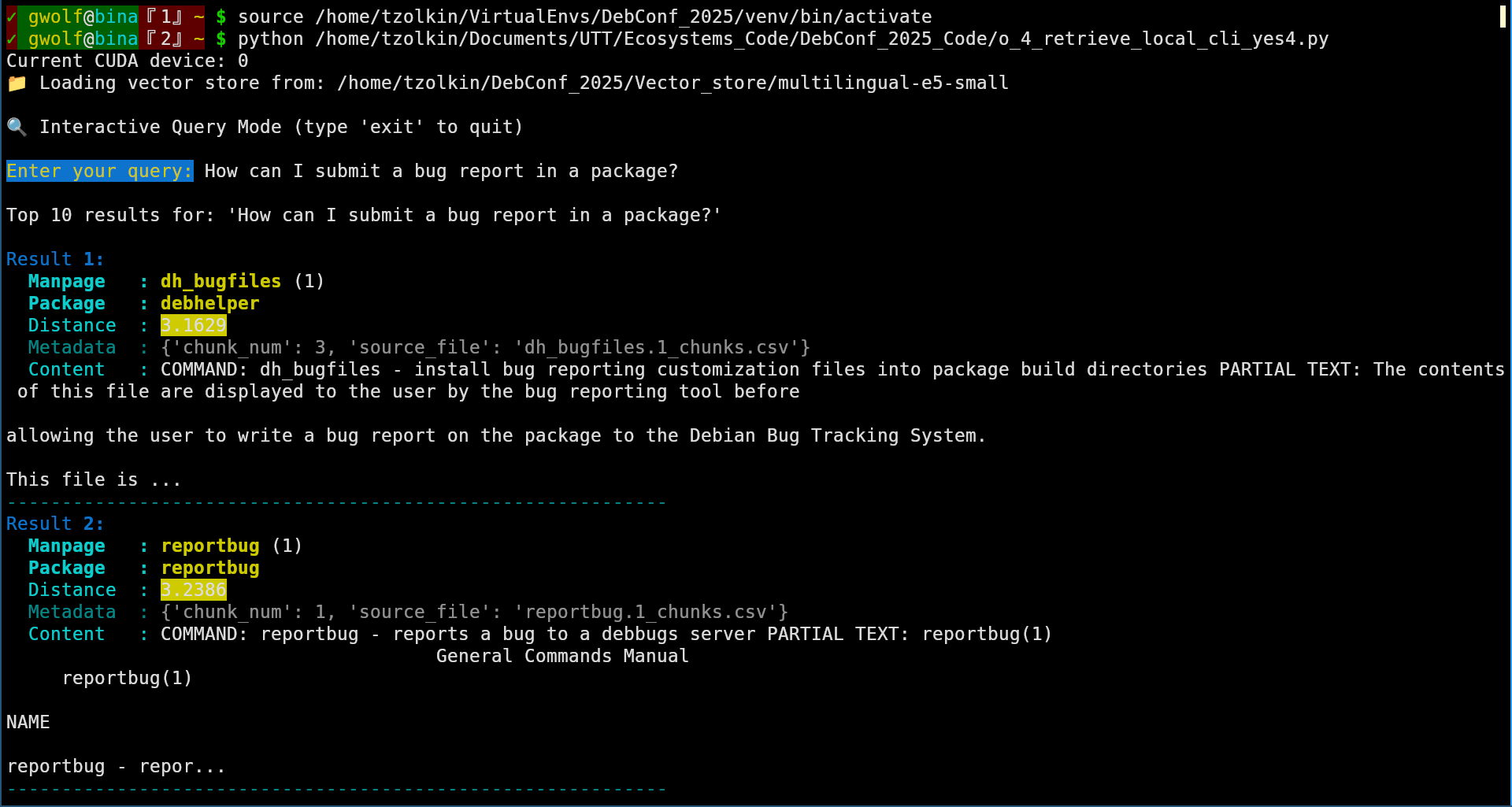
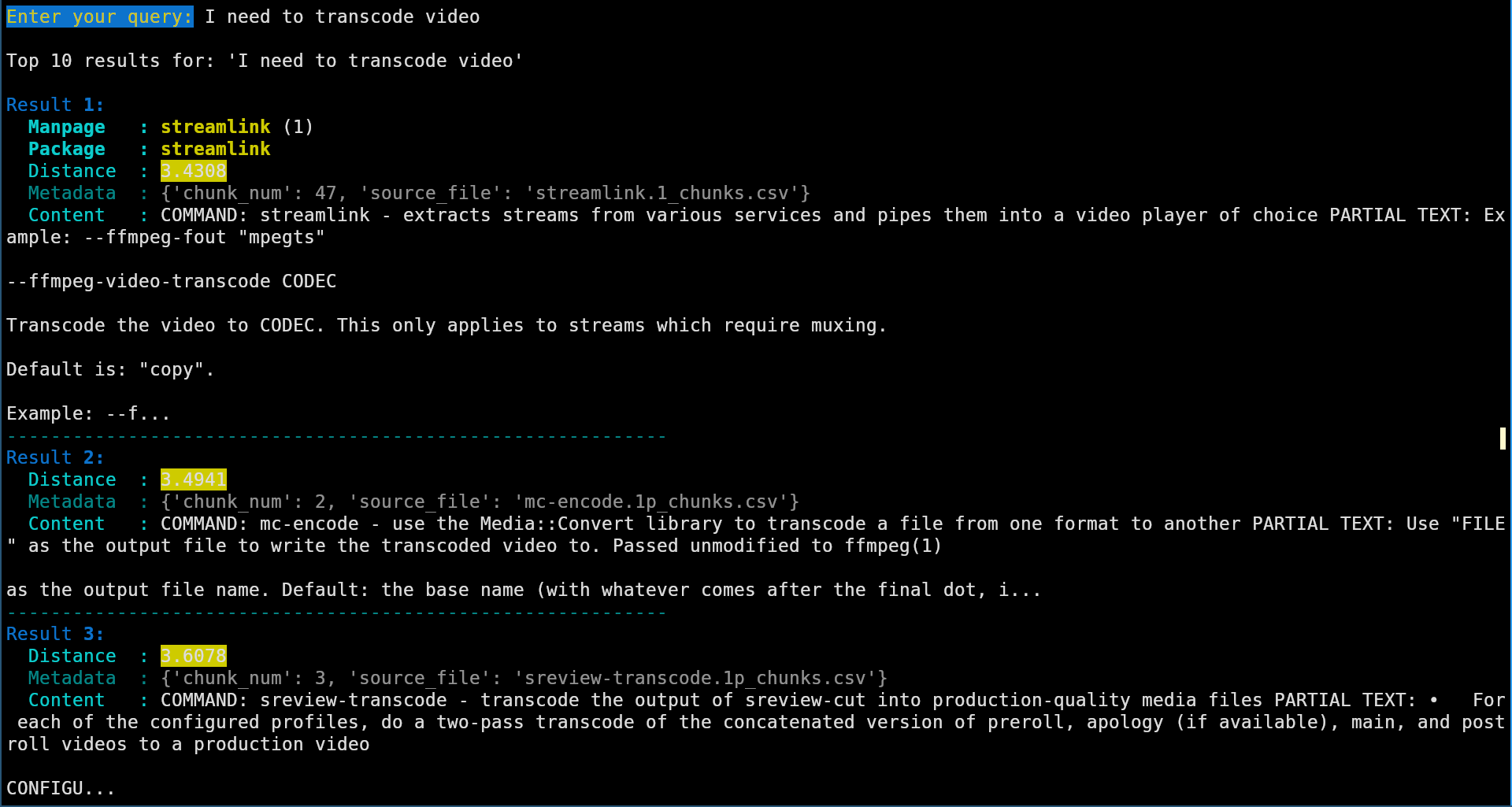
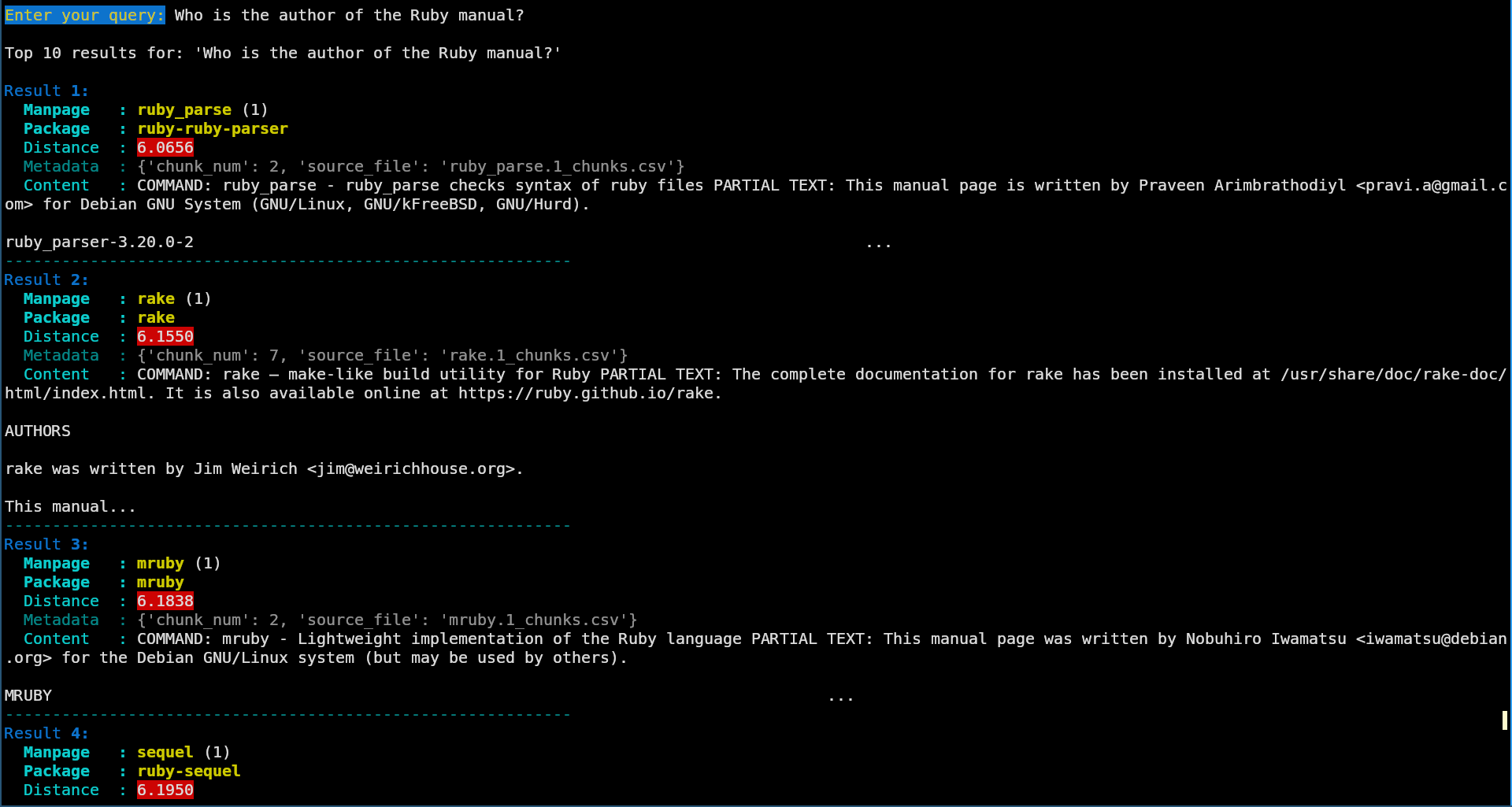
I had prepared some images to present as interaction examples, but I ll wrap up
this post with something even better So, this is what you would get with the
following queries:
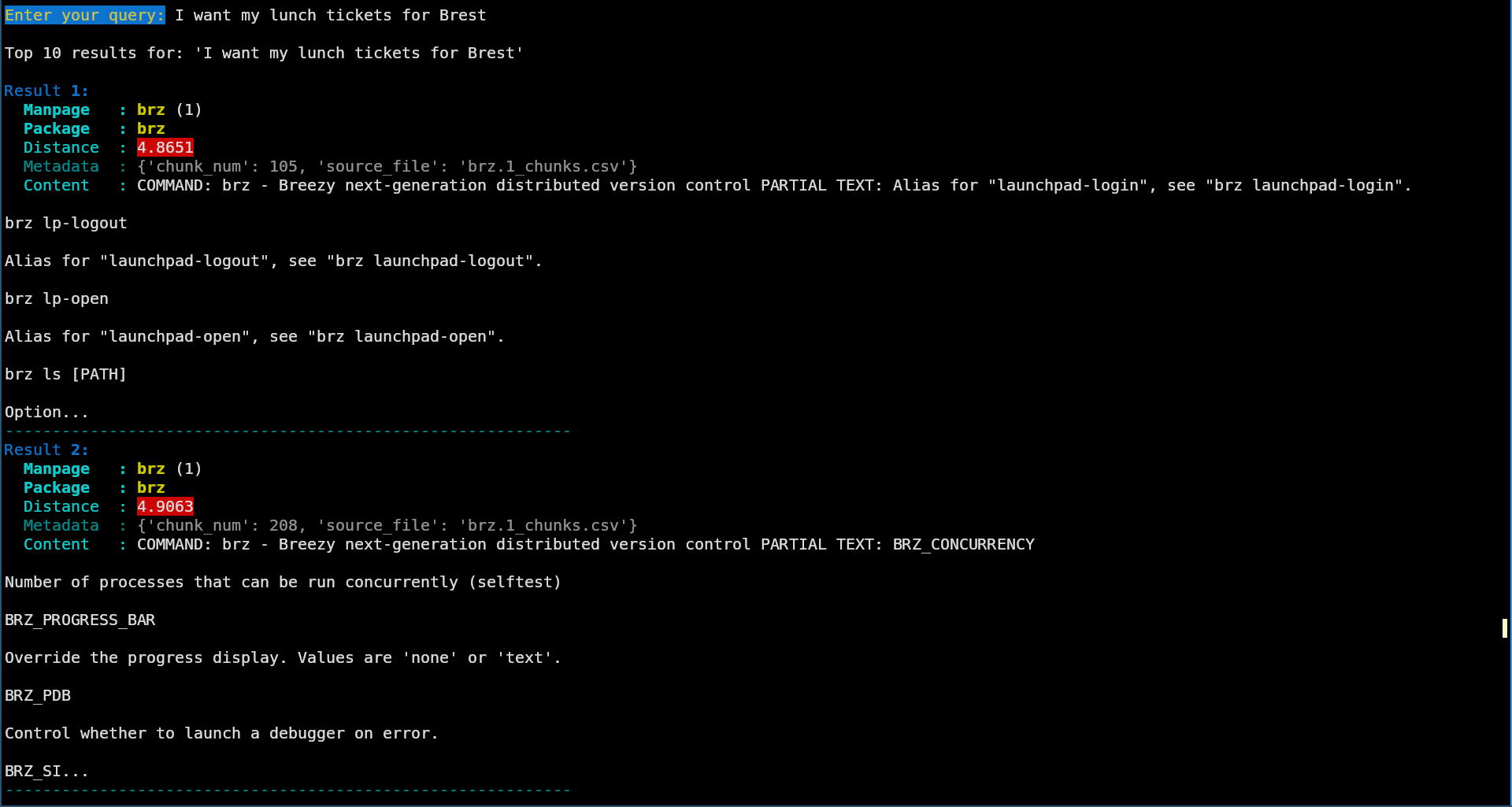
Of course, garbage-in means garbage-out. LLMs cannot tell you I don t have an
answer for you , so you get hallucinations (or at least, irrelevant answers):
I want my lunch tickets for
Brest. Guess I was
hungry when working my examples
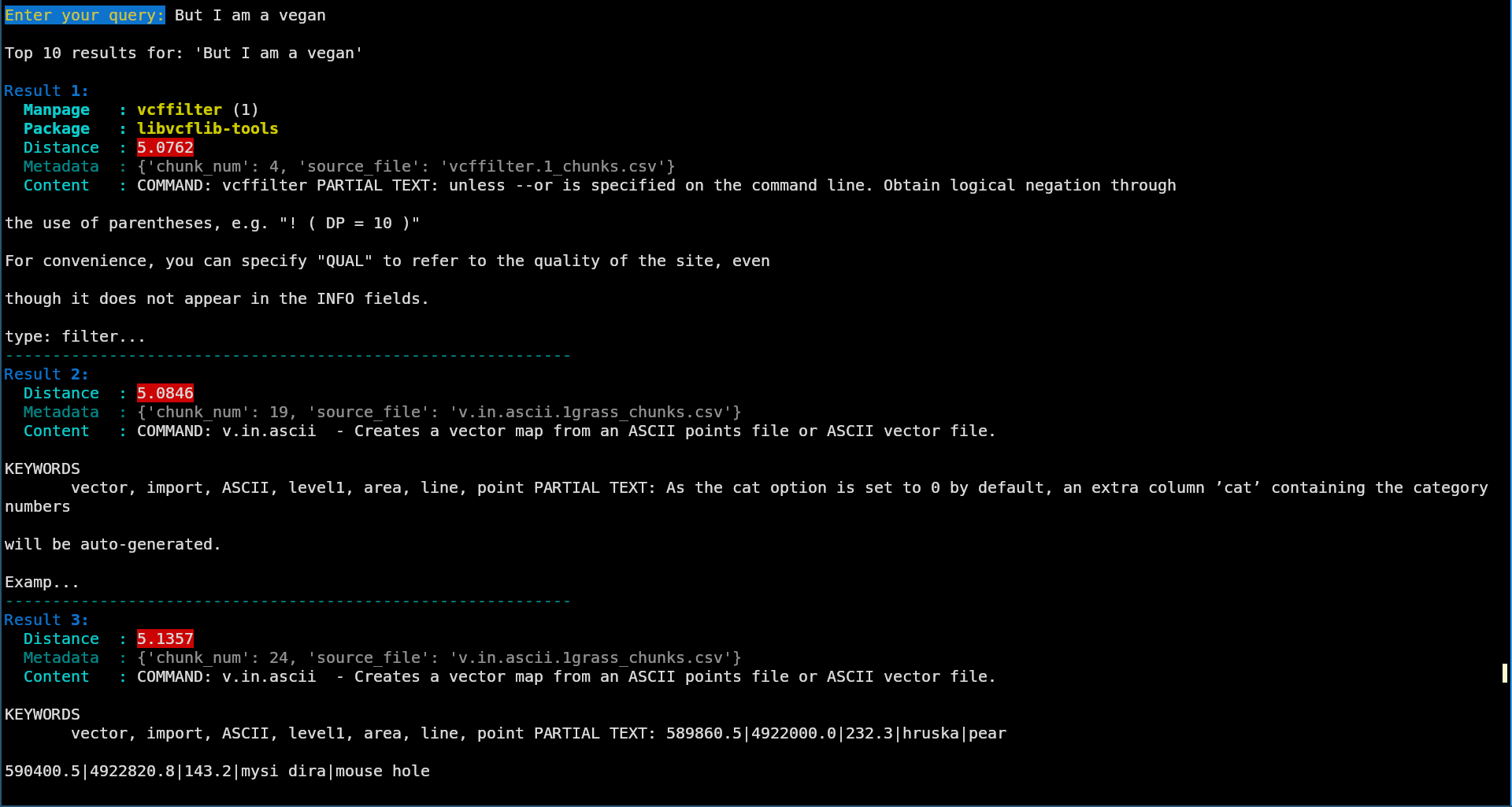
But I am a vegan, going
on with the silliness Anyway, do take note that, although it is not
directly relatable, the reported distance is very large, so the model does
tell me in a way these are my best results, but I wouldn t trust them too
much .
We were happy to present like this. During DebCamp, however, I was able to
devote some time to translating my client into a Web-accessible system. Do note
that it s a bit brittle, and might break now and then. But you are welcome to
play with it!
Play with the Web interface for our RAG for Debian
manuals!
I find it worth sharing that, while we used quite a bit of GPU for the training
(not too much a couple of nights on an old-although-powerful nVidia 1070 card
lent to us by the Felipe Esquivel Fund for Science and Cultural Support), all
querying takes place in the CPU, and I usually get between 0.1 and 0.3 seconds
per query. My server s architecture is far from rock-solid, and it can break now
and then but at least it should respawn upon failure And it should at
least be available there for a couple of weeks into August.
Anyway, this has been a very interesting journey getting my toes wet in the
waters of LLM, and while current results are a bit crude, I think this can be
made into an interesting tool for Debian exploration.
DebConf25, the 26th edition of the Debian
conference is taking place in Brest Campus of
IMT Atlantique Bretagne-Pays de la Loire,
France. We appreciate the organizers for their hard work, and hope this event
will be highly beneficial for those who attend in person as well as online.
This event would not be possible without the help from our generous sponsors.
We would like to warmly welcome the sponsors of DebConf 25, and introduce them to
you.
We have five Platinum sponsors.
Our first Platinum sponsor is Infomaniak.
Infomaniak is Switzerland s leading developer of Web technologies. With
operations all over Europe and based exclusively in Switzerland, the company
designs and manages its own data centers powered by 100% renewable energy,
and develops all its solutions locally, without outsourcing. With millions of
users and the trust of public and private organizations across Europe - such
as RTBF, the United Nations, central banks, over 3,000 radio and TV stations,
as well as numerous cities and security bodies - Infomaniak stands for
sovereign, sustainable and independent digital technology. The company offers
a complete suite of collaborative tools, cloud hosting, streaming, marketing
and events solutions, while being owned by its employees and self-financed
exclusively by its customers.
Proxmox is the second Platinum sponsor.
Proxmox develops powerful, yet easy-to-use Open Source server software. The
product portfolio from Proxmox, including server virtualization, backup,
and email security, helps companies of any size, sector, or industry to
simplify their IT infrastructures. The Proxmox solutions are built on Debian,
we are happy that they give back to the community by sponsoring DebConf25.
Viridien is our third Platinum sponsor.
Viridien is an advanced technology, digital and Earth data company that
pushes the boundaries of science for a more prosperous and sustainable future.
Viridien has been using Debian-based systems to power most of its HPC
infrastructure and its cloud platform since 2009 and currently employs two
active Debian Project Members.
EDF is our fourth Platinum sponsor.
EDF is a leading global utility company focused on low-carbon power
generation. The group uses advanced engineering and scientific computing
tools to drive innovation and efficiency in its operations, especially in
nuclear power plant design and safety assessment.
Since 2003, the EDF Group has been using Debian as its main scientific
computing environment. Debian's focus on stability and reproducibility
ensures that EDF's calculations and simulations produce consistent and
accurate results.
AMD is our fifth Platinum sponsor.
The AMD ROCm platform includes programming models, tools, compilers,
libraries, and runtimes for AI and HPC solution development on AMD GPUs.
Debian is an officially supported platform for AMD ROCm and a growing
number of components are now included directly in the Debian distribution.
For more than 55 years AMD has driven innovation in high-performance
computing, graphics and visualization technologies.
AMD is deeply committed to supporting and contributing to open-source
projects, foundations, and open-standards organizations, taking pride in
fostering innovation and collaboration within the open-source community.
Our Gold sponsors are:
Ubuntu,
the Operating System delivered by Canonical.
Freexian,
a services company specialized in Free Software and in particular Debian
GNU/Linux, covering consulting, custom developments, support and training.
Lenovo,
a global technology leader manufacturing a wide portfolio of connected
products including smartphones, tablets, PCs and workstations as well as
AR/VR devices, smart home/office and data center solutions.
Collabora, a global consultancy delivering
Open Source software solutions to the commercial world.
Vyos Networks provides a free routing platform that
competes directly with other commercially available solutions and VyOS is an
open source network operating system based on Debian.
Our Silver sponsors are:
Google, one of the largest technology companies in
the world, providing a wide range of Internet-related services and products
such as online advertising technologies, search, cloud computing, software,
and hardware.
Arm: leading technology provider of processor
IP, Arm powered solutions have been supporting innovation for
more than 30 years and are deployed in over 280 billion chips to date.
Siemens is a technology company
focused on industry, infrastructure and transport.
Linagora develops ethical Free and Open Source
Software, supports Open Source products that helps humans and boosts digital
progress. They promote Free Software in France.
Pexip brings the ease of commercial video
platforms to secure and sovereign environments without compromising control
or performance.
Sipgate offers cloud telephony that automates
routine tasks, recognizes customer needs, and enables deep CRM
integrations.
evolix is a french company specialized in Hosting
and Managed Services Provider (MSP) working only with Open Source softwares.
Civil Infrastructure Platform,
a collaborative project hosted by the Linux Foundation, establishing an open
source base layer of industrial grade software.
credativ: a consulting and services company
offering comprehensive services and technical support for the implementation
and operation of Open Source Software in business applications.
Wind River is a leader in delivering the
highest levels of secure, safe, and reliable solutions for mission-critical
intelligent systems.
NovaCustom is a company that lets you
configure your own laptop with various hardware and software options,
focusing on privacy and security.
Microsoft who enables
digital transformation for the era of an intelligent cloud and an intelligent
edge. Its mission is to empower every person and every organization on the
planet to achieve more.
McKay Brothers is the acknowledged
leader in providing extreme low latency microwave private bandwidth for firms
trading in financial markets.
Matanel Foundation, whose first concern is to
preserve the cohesion of a society and a nation plagued by divisions.
Qualcomm Technologies
one of the world's leading companies in field of mobile technology, sponsors
and contributes to Open Source developer communities that drive collaboration.
A special thanks to the
IMT Atlantique Bretagne-Pays de la Loire,
our Venue Partner and our Network Partner ResEl!
Thanks to all our sponsors for their support!
Their contributions enable a diverse global community of Debian developers and
maintainers to collaborate, support one another, and share knowledge at
DebConf25.
Tobias Frost
did 2.5h (out of 12.0h assigned), thus carrying over 9.5h to the next month.
Evolution of the situation
In June, we released 35 DLAs.
Notable security updates:
mariadb-10.5, prepared by Otto Kek l inen, fixes vulnerabilities which could result in denial of service, information disclosure, or unauthorized data modification
python-django, prepared by Chris Lamb, fixes vulnerabilities which would result in log injection or denial of service
webkit2gtk, prepared by Emilio Pozuelo Monfort, fixes many vulnerabilities which could results in a wide range of issues
xorg-server, prepared by Emilio Pozuelo Monfort, fixes multiple vulnerabilities which may result in privilege escalation
sudo, prepared by Thorsten Alteholz, fixes a vulnerability which could result in privilege escalation
Notable non-security updates:
debian-security-support, prepared by Santiago Ruano Rinc n, updates status of packages which receive limited security support or which have reached the end of security support
dns-root-data, prepared by Sylvain Beucler, updates the DNSSEC trust anchors
This month s contributions from outside the regular team include the mariadb-10.5 update mentioned above, prepared by Otto Kek l inen (the package maintainer); an update to libfile-find-rule-perl, prepared by Salvatore Bonaccorso (a member of the Debian Security Team); an update to activemq, prepared by Emmanuel Arias (a maintainer of the package).
Additionally, LTS Team members contributed stable updates of the following packages:
curl, prepared by Carlos Henrique Lima Melara
python-tornado, prepared by Daniel Leidert
python-flask-cors, prepared by Daniel Leidert
common-vfs, prepared by Daniel Leidert
cjson, prepared by Adrian Bunk
icu, prepared by Adrian Bunk
node-tar-fs, prepared by Adrian Bunk
rar, prepared by Adrian Bunk
Something of particular noteworthiness is that LTS contributor Carlos Henrique Lima Melara discovered a regression in the upstream fix for CVE-2023-2753 in curl. The corrective action which he took included providing a patch to upstream, uploading a stable update of curl, and further updating the version of curl in LTS.
DebConf, the annual Debian Conference, is coming up in July and, as is customary each year, the week preceding the conference will feature an event called DebCamp. The DebCamp week provides an opportunity for teams and other interested groups/individuals to meet together in person in the same venue as the conference itself, with the purpose of doing focused work, often called sprints . LTS coordinator Roberto C. S nchez has announced that the LTS Team is planning to hold a sprint primarily focused on the Debian security tracker and the associated tooling used by the LTS Team and the Debian Security Team.
Thanks to our sponsors
Sponsors that joined recently are in bold.
There are many negative articles about AI (which is not about actual Artificial Intelligence also known as AGI ). Which I think are mostly overblown and often ridiculous.
Resource Usage
Complaints about resource usage are common, training Llama 3.1 could apparently produce as much pollution as 10,000 round trips by car between Los Angeles and New York City . That s not great but when you compare to the actual number of people doing such drives in the US and the number of people taking commercial flights on that route it doesn t seem like such a big deal. Apparently commercial passenger jets cause CO2 emissions per passenger about equal to a car with 2 people. Why is it relevant whether pollution comes from running servers, driving cars, or steel mills? Why not just tax polluters for the damage they do and let the market sort it out? People in the US make a big deal about not being communist, so why not have a capitalist solution, make it more expensive to do undesirable things and let the market sort it out?
ML systems are a less bad use of compute resources than Bitcoin, at least ML systems give some useful results while Bitcoin has nothing good going for it.
The Dot-Com Comparison
People often complain about the apparent impossibility of AI companies doing what investors think they will do. But this isn t anything new, that all happened before with the dot com boom . I m not the first person to make this comparison, The Daily WTF (a high quality site about IT mistakes) has an interesting article making this comparison [1]. But my conclusions are quite different.
The result of that was a lot of Internet companies going bankrupt, the investors in those companies losing money, and other companies then bought up their assets and made profitable companies. The cheap Internet we now have was built on the hardware from bankrupt companies which was sold for far less than the manufacture price. That allowed it to scale up from modem speeds to ADSL without the users paying enough to cover the purchase of the infrastructure. In the early 2000s I worked for two major Dutch ISPs that went bankrupt (not my fault) and one of them continued operations in the identical manner after having the stock price go to zero (I didn t get to witness what happened with the other one). As far as I m aware random Dutch citizens and residents didn t suffer from this and employees just got jobs elsewhere.
There are good things being done with ML systems and when companies like OpenAI go bankrupt other companies will buy the hardware and do good things.
NVidia isn t ever going to have the future sales that would justify a market capitalisation of almost 4 Trillion US dollars. This market cap can support paying for new research and purchasing rights to patented technology in a similar way to the high stock price of Google supported buying YouTube, DoubleClick, and Motorola Mobility which are the keys to Google s profits now.
The Real Upsides of ML
Until recently I worked for a company that used ML systems to analyse drivers for signs of fatigue, distraction, or other inappropriate things (smoking which is illegal in China, using a mobile phone, etc). That work was directly aimed at saving human lives with a significant secondary aim of saving wear on vehicles (in the mining industry drowsy drivers damage truck tires and that s a huge business expense).
There are many applications of ML in medical research such as recognising cancer cells in tissue samples.
There are many less important uses for ML systems, such as recognising different types of pastries to correctly bill bakery customers technology that was apparently repurposed for recognising cancer cells.
The ability to recognise objects in photos is useful. It can be used for people who want to learn about random objects they see and could be used for helping young children learn about their environment. It also has some potential for assistance for visually impaired people, it wouldn t be good for safety critical systems (don t cross a road because a ML system says there are no cars coming) but could be useful for identifying objects (is this a lemon or a lime). The Humane AI pin had some real potential to do good things but there wasn t a suitable business model [2], I think that someone will develop similar technology in a useful way eventually.
Even without trying to do what the Humane AI Pin attempted, there are many ways for ML based systems to assist phone and PC use.
ML systems allow analysing large quantities of data and giving information that may be correct. When used by a human who knows how to recognise good answers this can be an efficient way of solving problems. I personally have solved many computer problems with the help of LLM systems while skipping over many results that were obviously wrong to me. I believe that any expert in any field that is covered in the LLM input data could find some benefits from getting suggestions from an LLM. It won t necessarily allow them to solve problems that they couldn t solve without it but it can provide them with a set of obviously wrong answers mixed in with some useful tips about where to look for the right answers.
Jobs and Politics
Noema Magazine has an insightful article about how AI can allow different models of work which can enlarge the middle class [3].
I don t think it s reasonable to expect ML systems to make as much impact on society as the industrial revolution, and the agricultural revolutions which took society from more than 90% farm workers to less than 5%. That doesn t mean everything will be fine but it is something that can seem OK after the changes have happened. I m not saying apart from the death and destruction everything will be good , the death and destruction are optional. Improvements in manufacturing and farming didn t have to involve poverty and death for many people, improvements to agriculture didn t have to involve overcrowding and death from disease. This was an issue of political decisions that were made.
The Real Problems of ML
Political decisions that are being made now have the aim of making the rich even richer and leaving more people in poverty and in many cases dying due to being unable to afford healthcare. The ML systems that aim to facilitate such things haven t been as successful as evil people have hoped but it will happen and we need appropriate legislation if we aren t going to have revolutions.
There are documented cases of suicide being inspired by Chat GPT systems [4]. There have been people inspired towards murder by ChatGPT systems but AFAIK no-one has actually succeeded in such a crime yet. There are serious issues that need to be addressed with the technology and with legal constraints about how people may use it. It s interesting to consider the possible uses of ChatGPT systems for providing suggestions to a psychologist, maybe ChatGPT systems could be used to alleviate mental health problems.
The cases of LLM systems being used for cheating on assignments etc isn t a real issue. People have been cheating on assignments since organised education was invented.
There is a real problem of ML systems based on biased input data that issue decisions that are the average of the bigotry of the people who provided input. That isn t going to be worse than the current situation of bigoted humans making decisions based on hate and preconceptions but it will be more insidious. It is possible to search for that so for example a bank could test it s mortgage approval ML system by changing one factor at a time (name, gender, age, address, etc) and see if it changes the answer. If it turns out that the ML system is biased on names then the input data could have names removed. If it turns out to be biased about address then there could be weights put in to oppose that.
For a long time there has been excessive trust in computers. Computers aren t magic they just do maths really fast and implement choices based on the work of programmers who have all the failings of other humans. Excessive trust in a rule based system is less risky than excessive trust in a ML system where no-one really knows why it makes the decisions it makes.
Self driving cars kill people, this is the truth that Tesla stock holders don t want people to know.
Companies that try to automate everything with AI are going to be in for some nasty surprises. Getting computers to do everything that humans do in any job is going to be a large portion of an actual intelligent computer which if it is achieved will raise an entirely different set of problems.
I ve previously blogged about ML Security [5]. I don t think this will be any worse than all the other computer security problems in the long term, although it will be more insidious.
How Will It Go?
Companies spending billions of dollars without firm plans for how to make money are going to go bankrupt no matter what business they are in. Companies like Google and Microsoft can waste some billions of dollars on AI Chat systems and still keep going as successful businesses. Companies like OpenAI that do nothing other than such chat systems won t go well. But their assets can be used by new companies when sold at less than 10% the purchase price.
Companies like NVidia that have high stock prices based on the supposed ongoing growth in use of their hardware will have their stock prices crash. But the new technology they develop will be used by other people for other purposes. If hospitals can get cheap diagnostic ML systems because of unreasonable investment into AI then that could be a win for humanity.
Companies that bet their entire business on AI even when it s not necessarily their core business (as Tesla has done with self driving) will have their stock price crash dramatically at a minimum and have the possibility of bankruptcy. Having Tesla go bankrupt is definitely better than having people try to use them as self driving cars.
Maharashtra is a state here in India, which has Mumbai, the financial capital of India, as its capital. maharashtra.gov.in is the official website of the State Government of Maharashtra. We re going to talk about authoritative name servers serving it (and bunch of child zones under maharashtra.gov.in).
Here s a simple trace for the main domain:
$ dig +trace maharashtra.gov.in
; <<>> DiG 9.18.33-1~deb12u2-Debian <<>> +trace maharashtra.gov.in
;; global options: +cmd
.            33128    IN    NS    j.root-servers.net.
.            33128    IN    NS    h.root-servers.net.
.            33128    IN    NS    l.root-servers.net.
.            33128    IN    NS    k.root-servers.net.
.            33128    IN    NS    i.root-servers.net.
.            33128    IN    NS    g.root-servers.net.
.            33128    IN    NS    f.root-servers.net.
.            33128    IN    NS    e.root-servers.net.
.            33128    IN    NS    b.root-servers.net.
.            33128    IN    NS    d.root-servers.net.
.            33128    IN    NS    c.root-servers.net.
.            33128    IN    NS    m.root-servers.net.
.            33128    IN    NS    a.root-servers.net.
.            33128    IN    RRSIG    NS 8 0 518400 20250704050000 20250621040000 53148 . pGxGZftwj+6VNTSQtstTKVN95Z7/b5Q8GSjRCXI68GoVYbVai9HNelxs OGIRKL4YmSrsiSsndXuEsBuvL9QvQ+qbybNLkekJUAiicKYNgr3KM3+X 69rsS9KxHgT2T8/oqG8KN8EJLJ8VkuM2PJ2HfSKijtF7ULtgBbERNQ4i u2I/wQ7elOyeF2M76iEOa7UGhgiBHSBqPulsbpnB//WbKL71yyFhWSk0 tiFEPuZM+iLrN2qBsElriF4kkw37uRHq8sSGcCjfBVdkpbb3/Sb3sIgN /zKU17f+hOvuBQTDr5qFIymqGAENA5UZ2RQjikk6+zK5EfBUXNpq1+oo 2y64DQ==
;; Received 525 bytes from 9.9.9.9#53(9.9.9.9) in 3 ms
in.            172800    IN    NS    ns01.trs-dns.com.
in.            172800    IN    NS    ns01.trs-dns.net.
in.            172800    IN    NS    ns10.trs-dns.org.
in.            172800    IN    NS    ns10.trs-dns.info.
in.            86400    IN    DS    48140 8 2 5EE4748C2069B99C98BC39A56881A64AF17CC78711E6297D43AC5A4F 4B5BB6E5
in.            86400    IN    RRSIG    DS 8 1 86400 20250704050000 20250621040000 53148 . jkCotYosapreoKKPvr9zPOEDECYVe9OtJLjkQbFfTin8uYbm/kdWzieW CkN5sabif5IHTFU4FEVOShfu4DFeUolhNav56TPKjGqEGjQ7qCghpqTj dNN4iY2s8BcJ2ujHwhm6HRfdbQRVoKYQ73UUZ+oWSute6lXWHE9+Snk2 1ZCAYPdZ2s1s7NZhrZW2YXVw/nHIcRl/rHqWIQ9sgUlsd6MwmahcAAG+ v15HG9Q48rCG1A2gJlJPbxWpVe0EUEu8LzDsp+ORqy1pHhzgJynrJHJz qMiYU0egv2j7xVPSoQHXjx3PG2rsOLNnqDBYCA+piEXOLsY3d+7c1SZl w9u66g==
;; Received 679 bytes from 199.7.83.42#53(l.root-servers.net) in 3 ms
maharashtra.gov.in.    900    IN    NS    ns8.maharashtra.gov.in.
maharashtra.gov.in.    900    IN    NS    ns9.maharashtra.gov.in.
maharashtra.gov.in.    900    IN    NS    ns10.maharashtra.gov.in.
maharashtra.gov.in.    900    IN    NS    ns18.maharashtra.gov.in.
maharashtra.gov.in.    900    IN    NS    ns20.maharashtra.gov.in.
npk19skvsdmju264d4ono0khqf7eafqv.gov.in. 300 IN    NSEC3 1 1 0 - P0KKR4BMBGLJDOKBGBI0KDM39DSM0EA4 NS SOA MX TXT RRSIG DNSKEY NSEC3PARAM
npk19skvsdmju264d4ono0khqf7eafqv.gov.in. 300 IN    RRSIG NSEC3 8 3 300 20250626140337 20250528184339 48544 gov.in. Khcq3n1Jn34HvuBEZExusVqoduEMH6DzqkWHk9dFkM+q0RVBYBHBbW+u LsSnc2/Rqc3HAYutk3EZeS+kXVF07GA/A486dr17Hqf3lHszvG/MNT/s CJfcdrqO0Q8NZ9NQxvAwWo44bCPaECQV+fhznmIaVSgbw7de9xC6RxWG ZFcsPYwYt07yB5neKa99RlVvJXk4GHX3ISxiSfusCNOuEKGy5cMxZg04 4PbYsP0AQNiJWALAduq2aNs80FQdWweLhd2swYuZyfsbk1nSXJQcYbTX aONc0VkYFeEJzTscX8/wNbkJeoLP0r/W2ebahvFExl3NYpb7b2rMwGBY omC/QA==
npk19skvsdmju264d4ono0khqf7eafqv.gov.in. 300 IN    RRSIG NSEC3 13 3 300 20250718144138 20250619135610 22437 gov.in. mbj7td3E6YE7kIhYoSlDTZR047TXY3Z60NY0aBwU7obyg5enBQU9j5nl GUxn9zUiwVUzei7v5GIPxXS7XDpk7g==
6bflkoouitlvj011i2mau7ql5pk61sks.gov.in. 300 IN    NSEC3 1 1 0 - 78S0UO5LI1KV1SVMH1889FHUCNC40U6T TXT RRSIG
6bflkoouitlvj011i2mau7ql5pk61sks.gov.in. 300 IN    RRSIG NSEC3 8 3 300 20250626133905 20250528184339 48544 gov.in. M2yPThQpX0sEf4klooQ06h+rLR3e3Q/BqDTSFogyTIuGwjgm6nwate19 jGmgCeWCYL3w/oxsg1z7SfCvDBCXOObH8ftEBOfLe8/AGHAEkWFSu3e0 s09Ccoz8FJiCfBJbbZK5Vf4HWXtBLfBq+ncGCEE24tCQLXaS5cT85BxZ Zne6Y6u8s/WPgo8jybsvlGnL4QhIPlW5UkHDs7cLLQSwlkZs3dwxyHTn EgjNWClhghGXP9nlvOlnDjUkmacEYeq5ItnCQjYPl4uwh9fBJ9CD/8LV K+Tn3+dgqDBek6+2HRzjGs59NzuHX8J9wVFxP7/nd+fUgaSgz+sST80O vrXlHA==
6bflkoouitlvj011i2mau7ql5pk61sks.gov.in. 300 IN    RRSIG NSEC3 13 3 300 20250718141148 20250619135610 22437 gov.in. raWzWsQnPkXYtr2v1SRH/fk2dEAv/K85NH+06pNUwkxPxQk01nS8eYlq BPQ41b26kikg8mNOgr2ULlBpJHb1OQ==
couldn't get address for 'ns18.maharashtra.gov.in': not found
couldn't get address for 'ns20.maharashtra.gov.in': not found
;; Received 1171 bytes from 2620:171:813:1534:8::1#53(ns10.trs-dns.org) in 0 ms
;; communications error to 10.187.202.24#53: timed out
;; communications error to 10.187.202.24#53: timed out
;; communications error to 10.187.202.24#53: timed out
;; communications error to 10.187.202.28#53: timed out
;; communications error to 10.187.203.201#53: timed out
;; no servers could be reached
Quick takeaways:
5 authoritative NS are listed ie:
ns8.maharashtra.gov.in.
ns9.maharashtra.gov.in.
ns10.maharashtra.gov.in.
ns18.maharashtra.gov.in.
ns20.maharashtra.gov.in.
No address (no A/AAAA records) could be found for ns18.maharashtra.gov.in and ns20.maharashtra.gov.in. Internet Archive snapshots for bgp.tools at time of writing NS18 and NS20.
communications error to 10.187.202.24#53: timed out , communications error to 10.187.202.28#53: timed out and communications error to 10.187.203.201#53: timed out is likely due to RFC 1918 records for NS. Ofcourse, they will never respond on public internet.
Not in trace, but NS10 has private or empty A/AAAA record against it (detailed further down).
The query resolution failed with no servers could be reached ie we didn t recieved any A/AAAA record for that query.
It s a hit or miss for this DNS query resolution.
Looking at in zone data
Let s look at NS added in zone itself (with 9.9.9.9):
$ dig ns maharashtra.gov.in
; <<>> DiG 9.18.33-1~deb12u2-Debian <<>> ns maharashtra.gov.in
;; global options: +cmd
;; Got answer:
;; ->>HEADER<<- opcode: QUERY, status: NOERROR, id: 172
;; flags: qr rd ra; QUERY: 1, ANSWER: 2, AUTHORITY: 0, ADDITIONAL: 3
;; OPT PSEUDOSECTION:
; EDNS: version: 0, flags:; udp: 1232
;; QUESTION SECTION:
;maharashtra.gov.in.        IN    NS
;; ANSWER SECTION:
maharashtra.gov.in.    300    IN    NS    ns8.maharashtra.gov.in.
maharashtra.gov.in.    300    IN    NS    ns9.maharashtra.gov.in.
;; ADDITIONAL SECTION:
ns9.maharashtra.gov.in.    300    IN    A    10.187.202.24
ns8.maharashtra.gov.in.    300    IN    A    10.187.202.28
;; Query time: 180 msec
;; SERVER: 9.9.9.9#53(9.9.9.9) (UDP)
;; WHEN: Sat Jun 21 23:00:49 IST 2025
;; MSG SIZE  rcvd: 115
Pay special attention to ADDITIONAL SECTION . Running dig ns9.maharashtra.gov.in and dig ns8.maharashtra.gov.in, return RFC 1918 ie these private addresses. This is coming from zone itself, so in zone A records of NS8 and NS9 point to 10.187.202.28 and 10.187.202.24 respectively.
Cloudflare s 1.1.1.1 has a slightly different version:
$ dig ns maharashtra.gov.in @ns01.trs-dns.net.
; <<>> DiG 9.18.36 <<>> ns maharashtra.gov.in @ns01.trs-dns.net.
;; global options: +cmd
;; Got answer:
;; ->>HEADER<<- opcode: QUERY, status: NOERROR, id: 56535
;; flags: qr rd; QUERY: 1, ANSWER: 0, AUTHORITY: 5, ADDITIONAL: 6
;; WARNING: recursion requested but not available
;; OPT PSEUDOSECTION:
; EDNS: version: 0, flags:; udp: 1232
; COOKIE: f13027aa39632404010000006856fa2a9c97d6bbc973ba4f (good)
;; QUESTION SECTION:
;maharashtra.gov.in.        IN    NS
;; AUTHORITY SECTION:
maharashtra.gov.in.    900    IN    NS    ns8.maharashtra.gov.in.
maharashtra.gov.in.    900    IN    NS    ns18.maharashtra.gov.in.
maharashtra.gov.in.    900    IN    NS    ns10.maharashtra.gov.in.
maharashtra.gov.in.    900    IN    NS    ns9.maharashtra.gov.in.
maharashtra.gov.in.    900    IN    NS    ns20.maharashtra.gov.in.
;; ADDITIONAL SECTION:
ns20.maharashtra.gov.in. 900    IN    A    52.183.143.210
ns18.maharashtra.gov.in. 900    IN    A    35.154.30.166
ns10.maharashtra.gov.in. 900    IN    A    164.100.128.234
ns9.maharashtra.gov.in.    900    IN    A    103.23.150.89
ns8.maharashtra.gov.in.    900    IN    A    103.23.150.88
;; Query time: 28 msec
;; SERVER: 64.96.2.1#53(ns01.trs-dns.net.) (UDP)
;; WHEN: Sun Jun 22 00:00:02 IST 2025
;; MSG SIZE  rcvd: 248
The ADDITIONAL SECTION gives a completely different picture (different from in zone NSes).
Maybe this was how it was supposed to be, but none of the IPs listed for NS10, NS18 and NS20 are responding to any DNS query.
Assuming NS8 as 103.23.150.88 and NS9 as 103.23.150.89, checking SOA on each gives following:
NS8 (which is marked as primary in SOA) has serial 2013116777 and NS9 is on serial 2013116757, so looks like the sync (IXFR/AXFR) between primary and secondary is broken. That s why NS8 and NS9 are serving different responses, evident from the following:
This is the reason for difference in 1.1.1.1 and 9.9.9.9 responses in previous section.
To summarize:
Primary and secondary NS aren t in sync. Serials aren t matching, while NS8 and NS9 are responding differently for same queries.
NSes have A records with private address, not reachable on the internet, so lame servers.
Incomplete NS address, not even FQDN in some cases.
Difference between NS delegated in parent zone and NS added in actual zone.
Name resolution works in very particular order (in my initial trace it failed).
Initially, I thought of citing RFCs, but I don t really think it s even required.
1.1.1.1, 8.8.8.8 and 9.9.9.9 are handling (lame servers, this probelm) well, handing out the A record for the main website, so dig maharashtra.gov.in would mostly pass and that was the reason I started this post with +trace to recurse the complete zone to show the problem.
For later reference:
Email to SOA address
I have sent the following email to address listed in SOA:
Subject - maharashtra.gov.in authoritative DNS servers not reachable
Hello,
I wanted to highlight the confusing state of maharashtra.gov.in authoritative DNS servers.
Parent zone list following as name servers for your DNS zone:
ns8.maharashtra.gov.in.
ns18.maharashtra.gov.in.
ns10.maharashtra.gov.in.
ns9.maharashtra.gov.in.
ns20.maharashtra.gov.in.
Out of these, ns18 and ns20 don t have public A/AAAA records and are thus not reachable.
ns10 keeps on shuffling between NO A record and 10.187.203.201 (private, not reachable address).
ns8 keeps on shuffling between 103.23.150.88 and 10.187.202.28 (private, not reachable address).
ns9 keeps on shuffling between 103.23.150.89 and 10.187.202.24 (private, not reachable address).
These are leading to long, broken, or no DNS resolution for the website(s).
Can you take a look at the problem?
Regards,
Sahil
I ll update here if I get a response. Hopefully, they ll listen and fix their problem.
Hello everyone! I am Kurva Prashanth, Interested in the lower level working of system software, CPUs/SoCs and Hardware design. I was introduced to Open Hardware and Embedded Linux while studying electronics and embedded systems as part of robotics coursework. Initially, I did not pay much attention to it and quickly moved on. However, a short talk on Liberating SBCs using Debian by Yuvraj at MiniDebConf India, 2021 caught my interest. The talk focused on Open Hardware platforms such as Olimex and BeagleBone Black, as well as the Debian distributions tailored for these ARM-based single-board computers has intrigued me to delve deeper into the realm of Open Hardware and Embedded Linux.
These days I m trying to improve my abilities to contribute to Debian and Linux Kernel development. Before finding out about the Google Summer of Code project, I had already started my journey with Debian. I extensively used Debian system build tools(debootstrap, sbuild, deb-build-pkg, qemu-debootstrap) for Building Debian Image for Bela Cape a real-time OS for music making to achieve extremely fast audio and sensor processing times. In 2023, I had the opportunity to attend DebConf23 in Kochi, India - thanks to Nilesh Patra (@nilesh) and I met Hector Oron (@zumbi) over dinner at DebConf23 and It was nice talking about his contributions/work at Debian on armhf port and Debian System Administration that conversation got me interested in knowing more about Debian ARM, Installer and I found it fascinating that EmDebian was once a external project bringing Debian to embedded systems and now, Debian itself can be run on many embedded systems. And, also during DebCamp I got Introduced to PGP/GPG keys and the web of trust by Carlos Henrique Lima Melara (@charles) I learned how to use and generate GPG keys. After DebConf23 I tried debian packaging and
I miserably failed to get sponsorship for a python library I packaged.
I came across the Debian project for this year s Google Summer of Code and found the project titled Make Debian for Raspberry Pi Build Again quite interesting to me and applied. Gladly, on May 8th, I received an acceptance e-mail from GSoC. I got excited that I ll spend the summer working on something that I like doing.
I am thrilled to be part of this project and I am super excited for the summer of 25. I m looking forward to work on what I most like, new connections and learning opportunities.
So, let me talk a bit more about my project. I will be working on to Make Debian for Raspberry Pi SBC s under the guidance of Gunnar Wolf (@gwolf). In this post, I will describe the project I will be working on.
Why make Debian for Raspberry Pi build again?
There is an available set of images for running Debian in Raspberry Pi computers (all models below the 5 series)! However, the maintainer severely lacking time to take care for them; called for help for somebody to adopt them, but have not been successful. The image generation scripts might have bitrotted a bit, but it is mostly all done. And there is a lot of interest and use still in having the images freshly generated and decently tested! This GSoC project is about getting the [https://raspi.debian.net/ Raspberry Pi Debian images] site working reliably, daily-built images become automatic again and ideally making it easily deployable to be run in project machines and migrating exsisting hosting infrastructure to Debian.
How much it differ from Debian build process?
While the goal is to stay as close as possible to the Debian build process, Raspberry Pi boards require some necessary platform-specific changes primarily in the early boot sequence and firmware handling.
Unlike typical Debian systems, Raspberry Pi boards depend on a non-standard bootloader and use non-free firmware (raspi-firmware), Introducing some hardware-specific differences in the initialization process.
These differences are largely confined to the early boot and hardware initialization stages. Once the system boots, the userspace remains closely aligned with a typical Debian install, using Debian packages.
The current modifications are required due to non-free firmware. However, several areas merit review: but there are a few parts that might be worth changing.
Boot flow: Transitioning to a U-Boot based boot process (as used in
Debian installer images for many other SBCs) would reduce divergence
and better align with Debian Installer.
Current scripts/workarounds: Some existing hacks may now be
redundant with recent upstream support and could be removed.
Board-specific images: Shift to architecture-specific base images
with runtime detection could simplify builds and reduce duplication.
Debian already already building SD card images for a wide range of SBCs (e.g., BeagleBone, BananaPi, OLinuXino, Cubieboard, etc.) installer-arm64/images/u-boot and installer-armhf/images/u-boot, a similar approach for Raspberry Pi could improve maintainability and consistency with Debian s broader SBC support.
Quoted from Mail Discussion Thread with Mentor (Gunnar Wolf)
"One direction we wanted to explore was whether we should still be
building one image per family, or whether we could instead switch to
one image per architecture (armel, armhf, arm64). There were some
details to iron out as RPi3 and RPi4 were quite different, but I think
it will be similar to the differences between the RPi 0 and 1, which
are handled at first-boot time. To understand what differs between
families, take a look at Cyril Brulebois generate-recipe (in the
repo), which is a great improvement over the ugly mess I had before he
contributed it"
In this project, I intend to to build one image per architecture (armel, armhf, arm64) rather than continuing with the current model of building one image per board. This change simplifies image
management, reduces redundancy, and leverages dynamic configuration at boot time to support all supported boards within each architecture. By using U-Boot and flash-kernel, we can detect the board type and configure kernel parameters, DTBs, and firmware during the first boot, reducing duplication across images and simplifying the maintenance burden and we can also generalize image creation while still supporting board-specific behavior at runtime. This method aligns with existing practices in the DebianInstaller team and aligns with Debian s long-term maintainability goals and better leverages upstream capabilities, ensuring a consistent and scalable boot experience.
To streamline and standardize the process of building bootable Debian images for Raspberry Pi devices, I proposed a new workflow that leverages U-Boot and flash-kernel Debian packages. This provides a clean, maintainable, and reproducible way to generate images for armel, armhf and arm64 boards. The workflow is vmdb2, a lightweight, declarative tool designed to automate the creation of disk images. A typical vmdb2 recipe defines the disk layout, base system installation (via debootstrap), architecture-specific packages, and any custom post-install hooks and the image should includes U-Boot (the u-boot-rpi package), flash-kernel, and a suitable Debian kernel package like linux-image-arm64 or linux-image-armmp.
U-Boot serves as the platform s bootloader and is responsible for loading the kernel and initramfs. Unlike Raspberry Pi s non-free firmware/proprietary bootloader, U-Boot provides an open and scriptable interface, allowing us to follow a more standard Debian boot process. It can be configured to boot using either an extlinux.conf or a boot.scr script generated automatically by flash-kernel. The role of flash-kernel is to bridge Debian s kernel installation system with the specifics of embedded bootloaders like U-Boot. When installed, it automatically copies the kernel image, initrd, and device tree blobs (DTBs) to the /boot partition. It also generates the necessary boot.scr script if the board configuration demands it. To work correctly, flash-kernel requires that the target machine be identified via /etc/flash-kernel/machine, which must correspond to an entry in its internal machine database.\ Once the vmdb2 build is complete, the resulting image will contain a fully configured bootable system with all necessary boot components correctly installed. The image can be flashed to an SD card and used to boot on the intended device without additional manual configuration. Because all key packages (U-Boot, kernel, flash-kernel) are managed through Debian s package system, kernel updates and boot script regeneration are handled automatically during system upgrades.
Current Workflow: Builds one Image per family
The current vmdb2 recipe uses the Raspberry Pi GPU bootloader provided via the raspi-firmware package. This is the traditional boot process followed by Raspberry Pi OS, and it s tightly coupled with firmware files like bootcode.bin, start.elf, and fixup.dat. These files are installed to /boot/firmware, which is mounted from a FAT32 partition
labeled RASPIFIRM. The device tree files (*.dtb) are manually copied from /usr/lib/linux-image-*-arm64/broadcom/ into this partition.
The kernel is installed via the linux-image-arm64 package, and the boot arguments are injected by modifying /boot/firmware/cmdline.txt using sed commands. Booting depends on the root partition being labeled RASPIROOT, referenced through that file. There is no bootloader like UEFI-based or U-Boot involved the Raspberry Pi firmware directly loads the kernel, which is standard for Raspberry Pi boards.
- apt: install
  packages:
    ...
    - raspi-firmware
The boot partition contents and kernel boot setup are tightly controlled via scripting in the recipe.
Limitations of Current Workflow: While this setup works, it is
Proprietary and Raspberry Pi specific It relies on the
closed-source GPU bootloader the raspi-firmware package, which is
tightly coupled to specific Raspberry Pi models.
Manual DTB handling Device tree files are manually copied and
hardcoded, making upgrades or board-specific changes error-prone.
Not easily extendable to future Raspberry Pi boards Any change in
bootloader behavior (as seen in the Raspberry Pi 5, which introduces
a more flexible firmware boot process) would require significant
rework.
No UEFI-based/U-Boot The current method bypasses the standard
bootloader layers, making it inconsistent with other Debian ARM
platforms and harder to maintain long-term.
As Raspberry Pi firmware and boot processes evolve, especially with the introduction of Pi 5 and potentially Pi 6, maintaining compatibility will require more flexibility - something best delivered by adopting U-Boot and flash-kernel.
New Workflow: Building Architecture-Specific Images with vmdb2, U-Boot, flash-kernel, and Debian Kernel
This workflow outlines an improved approach to generating bootable Debian images architecture specific, using vmdb2, U-Boot, flash-kernel, and Debian kernels and also to move away from Raspberry Pi s proprietary bootloader to a fully open-source boot process which improves maintainability, consistency, and cross-board support.
New Method: Shift to U-Boot + flash-kernel
U-Boot (via Debian su-boot-rpi package) and flash-kernel bring
the image building process closer to how Debian officially boots ARM devices. flash-kernel integrates with the system s initramfs and kernel packages to install bootloaders, prepare boot.scr or extlinux.conf, and copy kernel/initrd/DTBs to /boot in a format that U-Boot expects. U-Boot will be used as a second-stage bootloader, loaded by the Raspberry Pi s built-in firmware. Once U-Boot is in place, it will read standard boot scripts ( boot.scr) generated by flash-kernel, providing a Debian-compatible and board-flexible solution.
Extending YAML spec for vmdb2 build with U-Boot and flash-kernel
To improve an existing vmdb2 YAML spec(https://salsa.debian.org/raspi-team/image-specs/raspi_master.yaml), to integrate U-Boot, flash-kernel, and the architecture-specific Debian kernel into the image build process. By incorporating u-boot-rpi and flash-kernel from Debian packages, alongside the standard initramfs-tools, we align the image closer to Debian best practices while supporting both armhf and arm64 architectures.
Below are key additions and adjustments needed in a vmdb2 YAML spec to support the workflow: Install U-Boot, flash-kernel, initramfs-tools and the architecture-specific Debian kernel.
- apt: install
  packages:
    - u-boot-rpi
    - flash-kernel
    - initramfs-tools
    - linux-image-arm64 # or linux-image-armmp for armhf
  tag: tag-root
Replace linux-image-arm64 with the correct kernel package for specific target architecture. These packages should be added under the tag-root section in YAML spec for vmdb2 build recipe. This ensures that the necessary bootloader, kernel, and initramfs tools are included and properly configured in the image.
Configure Raspberry Pi firmware to Load U-Boot
Install the U-Boot binary as kernel.img in /boot/firmware we can also download and build U-Boot from source, but Debian provides tested binaries.
This makes the RPi firmware load u-boot.bin instead of the Linux kernel directly.
Set Up flash-kernel for Debian-style Boot
flash-kernel integrates with initramfs-tools and writes boot config suitable for U-Boot. We need to make sure /etc/flash-kernel/db contains an entry for board (most Raspberry Pi boards already supported in Bookworm).
Set up /etc/flash-kernel.conf with:
This allows flash-kernel to write an extlinux.conf or boot.scr into /boot/firmware.
Clean up Proprietary/Non-Free Firmware Bootflow
Remove the direct kernel loading flow:
This still depends on the Raspberry Pi firmware to start, but it
only loads U-Boot, not Linux kernel.
U-Boot gives you more flexibility (e.g., networking, boot menus,
signed boot).
Using flash-kernel ensures kernel updates are handled the Debian Installer
way.
Test with a serial console (enable_uart=1) in case HDMI doesn t
show early boot logs.
Advantage of New Workflow
Replaces the proprietary Raspberry Pi bootloader with upstream
U-Boot.
Debian-native tooling Uses flash-kernel and initramfs-tools to
manage boot configuration.
Consistent across boards Works for both armhf and arm64, unifying
the image build process.
Easier to support new boards Like the Raspberry Pi 5 and future
models.
This transition will standardize a bit image-building process, making it aligned with upstream Debian Installer workflows.
vmdb2 configuration for arm64 using u-boot and flash-kernelNOTE: This is a baseline example and may require tuning.
# Raspberry Pi arm64 image using U-Boot and flash-kernel
steps:
# ... (existing mkimg, partitions, mount, debootstrap, etc.) ...
# Install U-Boot, flash-kernel, initramfs-tools and architecture specific kernel
- apt: install
packages:
- u-boot-rpi
- flash-kernel
- initramfs-tools
- linux - image - arm64 # or linux - image - armmp for armhf
tag: tag-root
# Install U-Boot binary as kernel.img in firmware partition
- shell:
cp /usr/lib/u-boot/rpi_arm64 /u-boot.bin $ ROOT? /boot/firmware/kernel.img
echo "enable_uart=1" >> $ ROOT? /boot/firmware/config.txt
root-fs: tag-root
# Configure flash-kernel for Raspberry Pi
- create-file: /etc/flash-kernel.conf
contents:
MACHINE="Generic Raspberry Pi ARM64"
BOOTPART="/dev/disk/by-label/RASPIFIRM"
ROOTPART="/dev/disk/by-label/RASPIROOT"
unless: rootfs_unpacked
# Remove direct kernel boot files from Raspberry Pi firmware
- shell:
    rm -f $ ROOT? /boot/firmware/vmlinuz*
    rm -f $ ROOT? /boot/firmware/initrd.img*
    rm -f $ ROOT? /boot/firmware/cmdline.txt
  root-fs: tag-root
# flash-kernel will manage boot scripts and extlinux.conf
# Rest of image build continues...
Required Changes to Support Raspberry Pi Boards in Debian (flash-kernel + U-Boot)
Overview of Required Changes
Component
Required Task
Debian U-Boot Package
Add build target for rpi_arm64 in u-boot-rpi. Optionally deprecate legacy 32-bit targets.
Debian flash-kernel Package
Add or verify entries in db/all.db for Pi 4, Pi 5, Zero 2W, CM4. Ensure boot script generation works via bootscr.uboot-generic.
Debian Kernel
Ensure DTBs are installed at /usr/lib/linux-image-<version>/ and available for flash-kernel to reference.
flash-kernel
Already Supported Boards in flash-kernel Debian Package
https://sources.debian.org/src/flash-kernel/3.109/db/all.db/#L1700
Model
Arch
DTB-Id
Raspberry Pi 1 A/B/B+, Rev2
armel
bcm2835-*
Raspberry Pi CM1
armel
bcm2835-rpi-cm1-io1.dtb
Raspberry Pi Zero/Zero W
armel
bcm2835-rpi-zero*.dtb
Raspberry Pi 2B
armhf
bcm2836-rpi-2-b.dtb
Raspberry Pi 3B/3B+
arm64
bcm2837-*
Raspberry Pi CM3
arm64
bcm2837-rpi-cm3-io3.dtb
Raspberry Pi 400
arm64
bcm2711-rpi-400.dtb
uboot
Already Supported Boards in Debian U-Boot Package
https://salsa.debian.org/installer-team/flash-kernel/-/blob/master/db/all.db
arm64
Model Arch Upstream Defconfig Debian Target
- - -
Raspberry Pi 3B arm64 rpi_3_defconfigrpi_3
Raspberry Pi 4B arm64 rpi_4_defconfigrpi_4
Raspberry Pi 3B/3B+/CM3/CM3+/4B/CM4/400/5B/Zero 2W arm64 rpi_arm64_defconfigrpi_arm64
armhf
Model Arch Upstream Defconfig Debian Target
- - -
Raspberry Pi 2 armhf rpi_2_defconfigrpi_2
Raspberry Pi 3B (32-bit) armhf rpi_3_32b_defconfigrpi_3_32b
Raspberry Pi 4B (32-bit) armhf rpi_4_32b_defconfigrpi_4_32b
armel
Model Arch Upstream Defconfig Debian Target
- - -
Raspberry Pi armel rpi_defconfigrpi
Raspberry Pi 1/Zero armel rpi_0_wrpi_0_w
These boards are already defined in debian/rules under the u-boot-rpi source package and generates usable U-Boot binaries for corresponding Raspberry Pi models.
To-Do: Add Missing Board Support to U-Boot and flash-kernel in Debian
Several Raspberry Pi models are missing from the Debian U-Boot and flash-kernel packages, even though upstream support and DTBs exist in the Debian kernel but are missing entries in the flash-kernel database to enable support for bootloader installation and initrd handling.
Boards Not Yet Supported in flash-kernel Debian Package
Model
Arch
DTB-Id
Raspberry Pi 3A+ (32 & 64 bit)
armhf, arm64
bcm2837-rpi-3-a-plus.dtb
Raspberry Pi 4B (32 & 64 bit)
armhf, arm64
bcm2711-rpi-4-b.dtb
Raspberry Pi CM4
arm64
bcm2711-rpi-cm4-io.dtb
Raspberry Pi CM 4S
arm64
-
Raspberry Zero 2 W
arm64
bcm2710-rpi-zero-2-w.dtb
Raspberry Pi 5
arm64
bcm2712-rpi-5-b.dtb
Raspberry Pi CM5
arm64
-
Raspberry Pi 500
arm64
-
Boards Not Yet Supported in Debian U-Boot Package
Model
Arch
Upstream defconfig(s)
Raspberry Pi 3A+/3B+
arm64
-, rpi_3_b_plus_defconfig
Raspberry Pi CM 4S
arm64
-
Raspberry Pi 5
arm64
-
Raspberry Pi CM5
arm64
-
Raspberry Pi 500
arm64
-
So, what next?
During the Community Bonding Period, I got hands-on with workflow improvements, set up test environments, and began reviewing Raspberry Pi support in Debian s U-Boot and flash-kernel and these are the logs of the project, where I provide weekly reports on the work done. You can check here: Community Bonding Period logs.
My next steps include submitting patches to the u-boot and flash-kernel packages to ensure all missing Raspberry Pi entries are built and shipped. And, also to confirm the kernel DTB installation paths and make sure the necessary files are included for all Raspberry Pi variants. Finally, plan to validate changes with test builds on Raspberry Pi hardware.
In parallel, I m organizing my tasks and setting up my environment to contribute more effectively. It s been exciting to explore how things work under the hood and to prepare for a summer of learning and contributing to this great community.
The Internet has changed a lot in the last 40+ years. Fads have come and gone.
Network protocols have been designed, deployed, adopted, and abandoned.
Industries have come and gone. The types of people on the internet have changed
a lot. The number of people on the internet has changed a lot, creating an
information medium unlike anything ever seen before in human history. There s a
lot of good things about the Internet as of 2025, but there s also an
inescapable hole in what it used to be, for me.
I miss being able to throw a site up to send around to friends to play with
without worrying about hordes of AI-feeding HTML combine harvesters DoS-ing my
website, costing me thousands in network transfer for the privilege. I miss
being able to put a lightly authenticated game server up and not worry too much
at night wondering if that process is now mining bitcoin. I miss being able
to run a server in my home closet. Decades of cat and mouse games have rendered
running a mail server nearly impossible. Those who are brave enough to try
are met with weekslong stretches of delivery failures and countless hours
yelling ineffectually into a pipe that leads from the cheerful lobby of some
disinterested corporation directly into a void somewhere 4 layers below ground
level.
I miss the spirit of curiosity, exploration, and trying new things. I miss
building things for fun without having to worry about being too successful,
after which security offices start demanding my supplier paperwork in
triplicate as heartfelt thanks from their engineering teams. I miss communities
that are run because it is important to them, not for ad revenue. I miss
community operated spaces and having more than four websites that are all full
of nothing except screenshots of each other.
Every other page I find myself on now has an AI generated click-bait title,
shared for rage-clicks all brought-to-you-by-our-sponsors completely covered
wall-to-wall with popup modals, telling me how much they respect my privacy,
with the real content hidden at the bottom bracketed by deceptive ads served by
companies that definitely know which new coffee shop I went to last month.
This is wrong, and those who have seen what was know it.
I can t keep doing it. I m not doing it any more. I reject the notion that
this is as it needs to be. It is wrong. The hole left in what the Internet used
to be must be filled. I will fill it.
What comes before part b?
Throughout the 2000s, some of my favorite memories were from LAN parties at my
friends places. Dragging your setup somewhere, long nights playing games,
goofing off, even building software all night to get something working being
able to do something fiercely technical in the context of a uniquely social
activity. It wasn t really much about the games or the projects it was an
excuse to spend time together, just hanging out. A huge reason I learned so
much in college was that campus was a non-stop LAN party we could freely
stand up servers, talk between dorms on the LAN, and hit my dorm room computer
from the lab. Things could go from individual to social in the matter of
seconds. The Internet used to work this way my dorm had public IPs handed out
by DHCP, and my workstation could serve traffic from anywhere on the internet.
I haven t been back to campus in a few years, but I d be surprised if this were
still the case.
In December of 2021, three of us got together and connected our houses together
in what we now call The Promised LAN. The idea is simple fill the hole we feel
is gone from our lives. Build our own always-on 24/7 nonstop LAN party. Build a
space that is intrinsically social, even though we re doing technical things.
We can freely host insecure game servers or one-off side projects without
worrying about what someone will do with it.
Over the years, it s evolved very slowly we haven t pulled any all-nighters.
Our mantra has become old growth , building each layer carefully. As of May
2025, the LAN is now 19 friends running around 25 network segments. Those 25
networks are connected to 3 backbone nodes, exchanging routes and IP traffic
for the LAN. We refer to the set of backbone operators as The Bureau of LAN
Management . Combined decades of operating critical infrastructure has
driven The Bureau to make a set of well-understood, boring, predictable,
interoperable and easily debuggable decisions to make this all happen.
Nothing here is exotic or even technically interesting.
Applications of trusting trust
The hardest part, however, is rejecting the idea that anything outside our own
LAN is untrustworthy nearly irreversible damage inflicted on us by the
Internet. We have solved this by not solving it. We strictly control
membership the absolute hard minimum for joining the LAN requires 10 years of
friendship with at least one member of the Bureau, with another 10 years of
friendship planned. Members of the LAN can veto new members even if all other
criteria is met. Even with those strict rules, there s no shortage of friends
that meet the qualifications but we are not equipped to take that many folks
on. It s hard to join -both socially and technically. Doing something malicious
on the LAN requires a lot of highly technical effort upfront, and it would
endanger a decade of friendship. We have relied on those human, social,
interpersonal bonds to bring us all together. It s worked for the last 4 years,
and it should continue working until we think of something better.
We assume roommates, partners, kids, and visitors all have access to The
Promised LAN. If they re let into our friends' network, there is a level of
trust that works transitively for us I trust them to be on mine. This LAN is
not for security , rather, the network border is a social one. Benign
hacking in the original sense of misusing systems to do fun and interesting
things is encouraged. Robust ACLs and firewalls on the LAN are, by definition,
an interpersonal not technical failure. We all trust every other network
operator to run their segment in a way that aligns with our collective values
and norms.
Over the last 4 years, we ve grown our own culture and fads around half of the
people on the LAN have thermal receipt printers with open access, for printing
out quips or jokes on each other s counters. It s incredible how much network
transport and a trusting culture gets you there s a 3-node IRC network, exotic
hardware to gawk at, radios galore, a NAS storage swap, LAN only email, and
even a SIP phone network of redphones .
DIY
We do not wish to, nor will we, rebuild the internet. We do not wish to, nor
will we, scale this. We will never be friends with enough people, as hard as we
may try. Participation hinges on us all having fun. As a result, membership
will never be open, and we will never have enough connected LANs to deal with
the technical and social problems that start to happen with scale. This is a
feature, not a bug.
This is a call for you to do the same. Build your own LAN. Connect it with
friends homes. Remember what is missing from your life, and fill it in. Use
software you know how to operate and get it running. Build slowly. Build your
community. Do it with joy. Remember how we got here. Rebuild a community space
that doesn t need to be mediated by faceless corporations and ad revenue. Build
something sustainable that brings you joy. Rebuild something you use daily.
Bring back what we re missing.
Utkarsh Gupta
did 1.0h (out of 15.0h assigned), thus carrying over 14.0h to the next month.
Evolution of the situation
In May, we released 54 DLAs.
The LTS Team was particularly active in May, publishing a higher than normal number of advisories, as well as helping with a wide range of updates to packages in stable and unstable, plus some other interesting work. We are also pleased to welcome several updates from contributors outside the regular team.
Notable security updates:
containerd, prepared by Andreas Henriksson, fixes a vulnerability that could cause containers launched as non-root users to be run as root
libapache2-mod-auth-openidc, prepared by Moritz Schlarb, fixes a vulnerability which could allow an attacker to crash an Apache web server with libapache2-mod-auth-openidc installed
request-tracker4, prepared by Andrew Ruthven, fixes multiple vulnerabilities which could result in information disclosure, cross-site scripting and use of weak encryption for S/MIME emails
postgresql-13, prepared by Bastien Roucari s, fixes an application crash vulnerability that could affect the server or applications using libpq
dropbear, prepared by Guilhem Moulin, fixes a vulnerability which could potentially result in execution of arbitrary shell commands
openjdk-17, openjdk-11, prepared by Thorsten Glaser, fixes several vulnerabilities, which include denial of service, information disclosure or bypass of sandbox restrictions
glibc, prepared by Sean Whitton, fixes a privilege escalation vulnerability
Notable non-security updates:
wireless-regdb, prepared by Ben Hutchings, updates information reflecting changes to radio regulations in many countries
This month s contributions from outside the regular team include the libapache2-mod-auth-openidc update mentioned above, prepared by Moritz Schlarb (the maintainer of the package); the update of request-tracker4, prepared by Andrew Ruthven (the maintainer of the package); and the updates of openjdk-17 and openjdk-11, also noted above, prepared by Thorsten Glaser.
Additionally, LTS Team members contributed stable updates of the following packages:
rubygems and yelp/yelp-xsl, prepared by Lucas Kanashiro
simplesamlphp, prepared by Tobias Frost
libbson-xs-perl, prepared by Roberto C. S nchez
fossil, prepared by Sylvain Beucler
setuptools and mydumper, prepared by Lee Garrett
redis and webpy, prepared by Adrian Bunk
xrdp, prepared by Abhijith PA
tcpdf, prepared by Santiago Ruano Rinc n
kmail-account-wizard, prepared by Thorsten Alteholz
Other contributions were also made by LTS Team members to packages in unstable:
proftpd-dfsg DEP-8 tests (autopkgtests) were provided to the maintainer, prepared by Lucas Kanashiro
a regular upload of libsoup2.4, prepared by Sean Whitton
a regular upload of setuptools, prepared by Lee Garrett
Freexian, the entity behind the management of the Debian LTS project, has been working for some time now on the development of an advanced CI platform for Debian-based distributions, called Debusine. Recently, Debusine has reached a level of feature implementation that makes it very usable. Some members of the LTS Team have been using Debusine informally, and during May LTS coordinator Santiago Ruano Rinc n has made a call for the team to help with testing of Debusine, and to help evaluate its suitability for the LTS Team to eventually begin using as the primary mechanism for uploading packages into Debian. Team members who have started using Debusine are providing valuable feedback to the Debusine development team, thus helping to improve the platform for all users. Actually, a number of updates, for both bullseye and bookworm, made during the month of May were handled using Debusine, e.g. rubygems s DLA-4163-1.
By the way, if you are a Debian Developer, you can easily test Debusine following the instructions found at https://wiki.debian.org/DebusineDebianNet.
DebConf, the annual Debian Conference, is coming up in July and, as is customary each year, the week preceding the conference will feature an event called DebCamp. The DebCamp week provides an opportunity for teams and other interested groups/individuals to meet together in person in the same venue as the conference itself, with the purpose of doing focused work, often called sprints . LTS coordinator Roberto C. S nchez has announced that the LTS Team is planning to hold a sprint primarily focused on the Debian security tracker and the associated tooling used by the LTS Team and the Debian Security Team.
Thanks to our sponsors
Sponsors that joined recently are in bold.
In this post, I demonstrate the optimal workflow for creating new Debian packages in 2025, preserving the upstream git history. The motivation for this is to lower the barrier for sharing improvements to and from upstream, and to improve software provenance and supply-chain security by making it easy to inspect every change at any level using standard git tooling.
Key elements of this workflow include:
Using a Git fork/clone of the upstream repository as the starting point for creating Debian packaging repositories.
Consistent use of the same git-buildpackage commands, with all package-specific options in gbp.conf.
Pristine-tar and upstream signatures for supply-chain security.
Use of Files-Excluded in the debian/copyright file to filter out unwanted files in Debian.
Patch queues to easily rebase and cherry-pick changes across Debian and upstream branches.
Efficient use of Salsa, Debian s GitLab instance, for both automated feedback from CI systems and human feedback from peer reviews.
To make the instructions so concrete that anyone can repeat all the steps themselves on a real package, I demonstrate the steps by packaging the command-line tool Entr. It is written in C, has very few dependencies, and its final Debian source package structure is simple, yet exemplifies all the important parts that go into a complete Debian package:
Creating a new packaging repository and publishing it under your personal namespace on salsa.debian.org.
Using dh_make to create the initial Debian packaging.
Posting the first draft of the Debian packaging as a Merge Request (MR) and using Salsa CI to verify Debian packaging quality.
Running local builds efficiently and iterating on the packaging process.
Create new Debian packaging repository from the existing upstream project git repository
First, create a new empty directory, then clone the upstream Git repository inside it:
Using a clean directory makes it easier to inspect the build artifacts of a Debian package, which will be output in the parent directory of the Debian source directory.
The extra parameters given to git clone lay the foundation for the Debian packaging git repository structure where the upstream git remote name is upstreamvcs. Only the upstream main branch is tracked to avoid cluttering git history with upstream development branches that are irrelevant for packaging in Debian.
Next, enter the git repository directory and list the git tags. Pick the latest upstream release tag as the commit to start the branch upstream/latest. This latest refers to the upstream release, not the upstream development branch. Immediately after, branch off the debian/latest branch, which will have the actual Debian packaging files in the debian/ subdirectory.
shellcd entr
git tag # shows the latest upstream release tag was '5.6'
git checkout -b upstream/latest 5.6
git checkout -b debian/latest
cd entr
git tag # shows the latest upstream release tag was '5.6'git checkout -b upstream/latest 5.6
git checkout -b debian/latest
At this point, the repository is structured according to DEP-14 conventions, ensuring a clear separation between upstream and Debian packaging changes, but there are no Debian changes yet. Next, add the Salsa repository as a new remote which called origin, the same as the default remote name in git.
This is an important preparation step to later be able to create a Merge Request on Salsa that targets the debian/latest branch, which does not yet have any debian/ directory.
Launch a Debian Sid (unstable) container to run builds in
To ensure that all packaging tools are of the latest versions, run everything inside a fresh Sid container. This has two benefits: you are guaranteed to have the most up-to-date toolchain, and your host system stays clean without getting polluted by various extra packages. Additionally, this approach works even if your host system is not Debian/Ubuntu.
cd ..
podman run --interactive --tty --rm --shm-size=1G --cap-add SYS_PTRACE \
--env='DEB*' --volume=$PWD:/tmp/test --workdir=/tmp/test debian:sid bash
Note that the container should be started from the parent directory of the git repository, not inside it. The --volume parameter will loop-mount the current directory inside the container. Thus all files created and modified are on the host system, and will persist after the container shuts down.
Once inside the container, install the basic dependencies:
Automate creating the debian/ files with dh-make
To create the files needed for the actual Debian packaging, use dh_make:
shell# dh_make --packagename entr_5.6 --single --createorig
Maintainer Name : Otto Kek l inen
Email-Address : otto@debian.org
Date : Sat, 15 Feb 2025 01:17:51 +0000
Package Name : entr
Version : 5.6
License : blank
Package Type : single
Are the details correct? [Y/n/q]
Done. Please edit the files in the debian/ subdirectory now.
# dh_make --packagename entr_5.6 --single --createorigMaintainer Name : Otto Kek l inen
Email-Address : otto@debian.org
Date : Sat, 15 Feb 2025 01:17:51 +0000
Package Name : entr
Version : 5.6
License : blank
Package Type : single
Are the details correct? [Y/n/q]Done. Please edit the files in the debian/ subdirectory now.
Due to how dh_make works, the package name and version need to be written as a single underscore separated string. In this case, you should choose --single to specify that the package type is a single binary package. Other options would be --library for library packages (see libgda5 sources as an example) or --indep (see dns-root-data sources as an example). The --createorig will create a mock upstream release tarball (entr_5.6.orig.tar.xz) from the current release directory, which is necessary due to historical reasons and how dh_make worked before git repositories became common and Debian source packages were based off upstream release tarballs (e.g. *.tar.gz).
At this stage, a debian/ directory has been created with template files, and you can start modifying the files and iterating towards actual working packaging.
shellgit add debian/
git commit -a -m "Initial Debian packaging"
git add debian/
git commit -a -m "Initial Debian packaging"
Review the files
The full list of files after the above steps with dh_make would be:
You can browse these files in the demo repository.
The mandatory files in the debian/ directory are:
changelog,
control,
copyright,
and rules.
All the other files have been created for convenience so the packager has template files to work from. The files with the suffix .ex are example files that won t have any effect until their content is adjusted and the suffix removed.
For detailed explanations of the purpose of each file in the debian/ subdirectory, see the following resources:
The Debian Policy Manual: Describes the structure of the operating system, the package archive and requirements for packages to be included in the Debian archive.
The Developer s Reference: A collection of best practices and process descriptions Debian packagers are expected to follow while interacting with one another.
Debhelper man pages: Detailed information of how the Debian package build system works, and how the contents of the various files in debian/ affect the end result.
As Entr, the package used in this example, is a real package that already exists in the Debian archive, you may want to browse the actual Debian packaging source at https://salsa.debian.org/debian/entr/-/tree/debian/latest/debian for reference.
Most of these files have standardized formatting conventions to make collaboration easier. To automatically format the files following the most popular conventions, simply run wrap-and-sort -vast or debputy reformat --style=black.
Identify build dependencies
The most common reason for builds to fail is missing dependencies. The easiest way to identify which Debian package ships the required dependency is using apt-file. If, for example, a build fails complaining that pcre2posix.h cannot be found or that libcre2-posix.so is missing, you can use these commands:
The output above implies that the debian/control should be extended to define a Build-Depends: libpcre2-dev relationship.
There is also dpkg-depcheck that uses strace to trace the files the build process tries to access, and lists what Debian packages those files belong to. Example usage:
shelldpkg-depcheck -b debian/rules build
dpkg-depcheck -b debian/rules build
Build the Debian sources to generate the .deb package
After the first pass of refining the contents of the files in debian/, test the build by running dpkg-buildpackage inside the container:
shelldpkg-buildpackage -uc -us -b
dpkg-buildpackage -uc -us -b
The options -uc -us will skip signing the resulting Debian source package and other build artifacts. The -b option will skip creating a source package and only build the (binary) *.deb packages.
The output is very verbose and gives a large amount of context about what is happening during the build to make debugging build failures easier. In the build log of entr you will see for example the line dh binary --buildsystem=makefile. This and other dh commands can also be run manually if there is a need to quickly repeat only a part of the build while debugging build failures.
To see what files were generated or modified by the build simply run git status --ignored:
shell$ git status --ignored
On branch debian/latest
Untracked files:
(use "git add <file>..." to include in what will be committed)
debian/debhelper-build-stamp
debian/entr.debhelper.log
debian/entr.substvars
debian/files
Ignored files:
(use "git add -f <file>..." to include in what will be committed)
Makefile
compat.c
compat.o
debian/.debhelper/
debian/entr/
entr
entr.o
status.o
$ git status --ignored
On branch debian/latest
Untracked files:
(use "git add <file>..." to include in what will be committed) debian/debhelper-build-stamp
debian/entr.debhelper.log
debian/entr.substvars
debian/files
Ignored files:
(use "git add -f <file>..." to include in what will be committed) Makefile
compat.c
compat.o
debian/.debhelper/
debian/entr/
entr
entr.o
status.o
Re-running dpkg-buildpackage will include running the command dh clean, which assuming it is configured correctly in the debian/rules file will reset the source directory to the original pristine state. The same can of course also be done with regular git commands git reset --hard; git clean -fdx. To avoid accidentally committing unnecessary build artifacts in git, a debian/.gitignore can be useful and it would typically include all four files listed as untracked above.
After a successful build you would have the following files:
The contents of debian/entr are essentially what goes into the resulting entr_5.6-1_amd64.deb package. Familiarizing yourself with the majority of the files in the original upstream source as well as all the resulting build artifacts is time consuming, but it is a necessary investment to get high-quality Debian packages.
There are also tools such as Debcraft that automate generating the build artifacts in separate output directories for each build, thus making it easy to compare the changes to correlate what change in the Debian packaging led to what change in the resulting build artifacts.
Re-run the initial import with git-buildpackage
When upstreams publish releases as tarballs, they should also be imported for optimal software supply-chain security, in particular if upstream also publishes cryptographic signatures that can be used to verify the authenticity of the tarballs.
To achieve this, the files debian/watch, debian/upstream/signing-key.asc, and debian/gbp.conf need to be present with the correct options. In the gbp.conf file, ensure you have the correct options based on:
Does upstream release tarballs? If so, enforce pristine-tar = True.
Does upstream sign the tarballs? If so, configure explicit signature checking with upstream-signatures = on.
Does upstream have a git repository, and does it have release git tags? If so, configure the release git tag format, e.g. upstream-vcs-tag = %(version%~%.)s.
To validate that the above files are working correctly, run gbp import-orig with the current version explicitly defined:
shell$ gbp import-orig --uscan --upstream-version 5.6
gbp:info: Launching uscan...
gpgv: Signature made 7. Aug 2024 07.43.27 PDT
gpgv: using RSA key 519151D83E83D40A232B4D615C418B8631BC7C26
gpgv: Good signature from "Eric Radman <ericshane@eradman.com>"
gbp:info: Using uscan downloaded tarball ../entr_5.6.orig.tar.gz
gbp:info: Importing '../entr_5.6.orig.tar.gz' to branch 'upstream/latest'...
gbp:info: Source package is entr
gbp:info: Upstream version is 5.6
gbp:info: Replacing upstream source on 'debian/latest'
gbp:info: Running Postimport hook
gbp:info: Successfully imported version 5.6 of ../entr_5.6.orig.tar.gz
$ gbp import-orig --uscan --upstream-version 5.6
gbp:info: Launching uscan...
gpgv: Signature made 7. Aug 2024 07.43.27 PDT
gpgv: using RSA key 519151D83E83D40A232B4D615C418B8631BC7C26
gpgv: Good signature from "Eric Radman <ericshane@eradman.com>"gbp:info: Using uscan downloaded tarball ../entr_5.6.orig.tar.gz
gbp:info: Importing '../entr_5.6.orig.tar.gz' to branch 'upstream/latest'...
gbp:info: Source package is entr
gbp:info: Upstream version is 5.6
gbp:info: Replacing upstream source on 'debian/latest'gbp:info: Running Postimport hook
gbp:info: Successfully imported version 5.6 of ../entr_5.6.orig.tar.gz
As the original packaging was done based on the upstream release git tag, the above command will fetch the tarball release, create the pristine-tar branch, and store the tarball delta on it. This command will also attempt to create the tag upstream/5.6 on the upstream/latest branch.
Import new upstream versions in the future
Forking the upstream git repository, creating the initial packaging, and creating the DEP-14 branch structure are all one-off work needed only when creating the initial packaging.
Going forward, to import new upstream releases, one would simply run git fetch upstreamvcs; gbp import-orig --uscan, which fetches the upstream git tags, checks for new upstream tarballs, and automatically downloads, verifies, and imports the new version. See the galera-4-demo example in the Debian source packages in git explained post as a demo you can try running yourself and examine in detail.
You can also try running gbp import-orig --uscan without specifying a version. It would fetch it, as it will notice there is now Entr version 5.7 available, and import it.
Build using git-buildpackage
From this stage onwards you should build the package using gbp buildpackage, which will do a more comprehensive build.
shellgbp buildpackage -uc -us
gbp buildpackage -uc -us
The git-buildpackage build also includes running Lintian to find potential Debian policy violations in the sources or in the resulting .deb binary packages. Many Debian Developers run lintian -EviIL +pedantic after every build to check that there are no new nags, and to validate that changes intended to previous Lintian nags were correct.
Open a Merge Request on Salsa for Debian packaging review
Getting everything perfectly right takes a lot of effort, and may require reaching out to an experienced Debian Developers for review and guidance. Thus, you should aim to publish your initial packaging work on Salsa, Debian s GitLab instance, for review and feedback as early as possible.
For somebody to be able to easily see what you have done, you should rename your debian/latest branch to another name, for example next/debian/latest, and open a Merge Request that targets the debian/latest branch on your Salsa fork, which still has only the unmodified upstream files.
If you have followed the workflow in this post so far, you can simply run:
git checkout -b next/debian/latest
git push --set-upstream origin next/debian/latest
Open in a browser the URL visible in the git remote response
Write the Merge Request description in case the default text from your commit is not enough
Mark the MR as Draft using the checkbox
Publish the MR and request feedback
Once a Merge Request exists, discussion regarding what additional changes are needed can be conducted as MR comments. With an MR, you can easily iterate on the contents of next/debian/latest, rebase, force push, and request re-review as many times as you want.
While at it, make sure the Settings > CI/CD page has under CI/CD configuration file the value debian/salsa-ci.yml so that the CI can run and give you immediate automated feedback.
For an example of an initial packaging Merge Request, see https://salsa.debian.org/otto/entr-demo/-/merge_requests/1.
Open a Merge Request / Pull Request to fix upstream code
Due to the high quality requirements in Debian, it is fairly common that while doing the initial Debian packaging of an open source project, issues are found that stem from the upstream source code. While it is possible to carry extra patches in Debian, it is not good practice to deviate too much from upstream code with custom Debian patches. Instead, the Debian packager should try to get the fixes applied directly upstream.
Using git-buildpackage patch queues is the most convenient way to make modifications to the upstream source code so that they automatically convert into Debian patches (stored at debian/patches), and can also easily be submitted upstream as any regular git commit (and rebased and resubmitted many times over).
First, decide if you want to work out of the upstream development branch and later cherry-pick to the Debian packaging branch, or work out of the Debian packaging branch and cherry-pick to an upstream branch.
The example below starts from the upstream development branch and then cherry-picks the commit into the git-buildpackage patch queue:
shellgit checkout -b bugfix-branch master
nano entr.c
make
./entr # verify change works as expected
git commit -a -m "Commit title" -m "Commit body"
git push # submit upstream
gbp pq import --force --time-machine=10
git cherry-pick <commit id>
git commit --amend # extend commit message with DEP-3 metadata
gbp buildpackage -uc -us -b
./entr # verify change works as expected
gbp pq export --drop --commit
git commit --amend # Write commit message along lines "Add patch to .."
git checkout -b bugfix-branch master
nano entr.c
make
./entr # verify change works as expectedgit commit -a -m "Commit title" -m "Commit body"git push # submit upstreamgbp pq import --force --time-machine=10git cherry-pick <commit id>
git commit --amend # extend commit message with DEP-3 metadatagbp buildpackage -uc -us -b
./entr # verify change works as expectedgbp pq export --drop --commit
git commit --amend # Write commit message along lines "Add patch to .."
The example below starts by making the fix on a git-buildpackage patch queue branch, and then cherry-picking it onto the upstream development branch:
These can be run at any time, regardless if any debian/patches existed prior, or if existing patches applied cleanly or not, or if there were old patch queue branches around. Note that the extra -b in gbp buildpackage -uc -us -b instructs to build only binary packages, avoiding any nags from dpkg-source that there are modifications in the upstream sources while building in the patches-applied mode.
Programming-language specific dh-make alternatives
As each programming language has its specific way of building the source code, and many other conventions regarding the file layout and more, Debian has multiple custom tools to create new Debian source packages for specific programming languages.
Notably, Python does not have its own tool, but there is an dh_make --python option for Python support directly in dh_make itself. The list is not complete and many more tools exist. For some languages, there are even competing options, such as for Go there is in addition to dh-make-golang also Gophian.
When learning Debian packaging, there is no need to learn these tools upfront. Being aware that they exist is enough, and one can learn them only if and when one starts to package a project in a new programming language.
The difference between source git repository vs source packages vs binary packages
As seen in earlier example, running gbp buildpackage on the Entr packaging repository above will result in several files:
The entr_5.6-1_amd64.deb is the binary package, which can be installed on a Debian/Ubuntu system. The rest of the files constitute the source package. To do a source-only build, run gbp buildpackage -S and note the files produced:
The source package files can be used to build the binary .deb for amd64, or any architecture that the package supports. It is important to grasp that the Debian source package is the preferred form to be able to build the binary packages on various Debian build systems, and the Debian source package is not the same thing as the Debian packaging git repository contents.
If the package is large and complex, the build could result in multiple binary packages. One set of package definition files in debian/ will however only ever result in a single source package.
Option to repackage source packages with Files-Excluded lists in the debian/copyright file
Some upstream projects may include binary files in their release, or other undesirable content that needs to be omitted from the source package in Debian. The easiest way to filter them out is by adding to the debian/copyright file a Files-Excluded field listing the undesired files. The debian/copyright file is read by uscan, which will repackage the upstream sources on-the-fly when importing new upstream releases.
For a real-life example, see the debian/copyright files in the Godot package that lists:
The resulting repackaged upstream source tarball, as well as the upstream version component, will have an extra +ds to signify that it is not the true original upstream source but has been modified by Debian:
godot_4.3+ds.orig.tar.xz
godot_4.3+ds-1_amd64.deb
godot_4.3+ds.orig.tar.xz
godot_4.3+ds-1_amd64.deb
Creating one Debian source package from multiple upstream source packages also possible
In some rare cases the upstream project may be split across multiple git repositories or the upstream release may consist of multiple components each in their own separate tarball. Usually these are very large projects that get some benefits from releasing components separately. If in Debian these are deemed to go into a single source package, it is technically possible using the component system in git-buildpackage and uscan. For an example see the gbp.conf and watch files in the node-cacache package.
Using this type of structure should be a last resort, as it creates complexity and inter-dependencies that are bound to cause issues later on. It is usually better to work with upstream and champion universal best practices with clear releases and version schemes.
When not to start the Debian packaging repository as a fork of the upstream one
Not all upstreams use Git for version control. It is by far the most popular, but there are still some that use e.g. Subversion or Mercurial. Who knows maybe in the future some new version control systems will start to compete with Git. There are also projects that use Git in massive monorepos and with complex submodule setups that invalidate the basic assumptions required to map an upstream Git repository into a Debian packaging repository.
In those cases one can t use a debian/latest branch on a clone of the upstream git repository as the starting point for the Debian packaging, but one must revert the traditional way of starting from an upstream release tarball with gbp import-orig package-1.0.tar.gz.
Conclusion
Created in August 1993, Debian is one of the oldest Linux distributions. In the 32 years since inception, the .deb packaging format and the tooling to work with it have evolved several generations. In the past 10 years, more and more Debian Developers have converged on certain core practices evidenced by https://trends.debian.net/, but there is still a lot of variance in workflows even for identical tasks. Hopefully, you find this post useful in giving practical guidance on how exactly to do the most common things when packaging software for Debian.
Happy packaging!
In this post, I demonstrate the optimal workflow for creating new Debian packages in 2025, preserving the upstream git history. The motivation for this is to lower the barrier for sharing improvements to and from upstream, and to improve software provenance and supply-chain security by making it easy to inspect every change at any level using standard git tooling.
Key elements of this workflow include:
Using a Git fork/clone of the upstream repository as the starting point for creating Debian packaging repositories.
Consistent use of the same git-buildpackage commands, with all package-specific options in gbp.conf.
Pristine-tar and upstream signatures for supply-chain security.
Use of Files-Excluded in the debian/copyright file to filter out unwanted files in Debian.
Patch queues to easily rebase and cherry-pick changes across Debian and upstream branches.
Efficient use of Salsa, Debian s GitLab instance, for both automated feedback from CI systems and human feedback from peer reviews.
To make the instructions so concrete that anyone can repeat all the steps themselves on a real package, I demonstrate the steps by packaging the command-line tool Entr. It is written in C, has very few dependencies, and its final Debian source package structure is simple, yet exemplifies all the important parts that go into a complete Debian package:
Creating a new packaging repository and publishing it under your personal namespace on salsa.debian.org.
Using dh_make to create the initial Debian packaging.
Posting the first draft of the Debian packaging as a Merge Request (MR) and using Salsa CI to verify Debian packaging quality.
Running local builds efficiently and iterating on the packaging process.
Create new Debian packaging repository from the existing upstream project git repository
First, create a new empty directory, then clone the upstream Git repository inside it:
Using a clean directory makes it easier to inspect the build artifacts of a Debian package, which will be output in the parent directory of the Debian source directory.
The extra parameters given to git clone lay the foundation for the Debian packaging git repository structure where the upstream git remote name is upstreamvcs. Only the upstream main branch is tracked to avoid cluttering git history with upstream development branches that are irrelevant for packaging in Debian.
Next, enter the git repository directory and list the git tags. Pick the latest upstream release tag as the commit to start the branch upstream/latest. This latest refers to the upstream release, not the upstream development branch. Immediately after, branch off the debian/latest branch, which will have the actual Debian packaging files in the debian/ subdirectory.
shellcd entr
git tag # shows the latest upstream release tag was '5.6'
git checkout -b upstream/latest 5.6
git checkout -b debian/latest
cd entr
git tag # shows the latest upstream release tag was '5.6'git checkout -b upstream/latest 5.6
git checkout -b debian/latest
At this point, the repository is structured according to DEP-14 conventions, ensuring a clear separation between upstream and Debian packaging changes, but there are no Debian changes yet. Next, add the Salsa repository as a new remote which called origin, the same as the default remote name in git.
This is an important preparation step to later be able to create a Merge Request on Salsa that targets the debian/latest branch, which does not yet have any debian/ directory.
Launch a Debian Sid (unstable) container to run builds in
To ensure that all packaging tools are of the latest versions, run everything inside a fresh Sid container. This has two benefits: you are guaranteed to have the most up-to-date toolchain, and your host system stays clean without getting polluted by various extra packages. Additionally, this approach works even if your host system is not Debian/Ubuntu.
cd ..
podman run --interactive --tty --rm --shm-size=1G --cap-add SYS_PTRACE \
 --env='DEB*' --volume=$PWD:/tmp/test --workdir=/tmp/test debian:sid bash
Note that the container should be started from the parent directory of the git repository, not inside it. The --volume parameter will loop-mount the current directory inside the container. Thus all files created and modified are on the host system, and will persist after the container shuts down.
Once inside the container, install the basic dependencies:
Automate creating the debian/ files with dh-make
To create the files needed for the actual Debian packaging, use dh_make:
shell# dh_make --packagename entr_5.6 --single --createorig
Maintainer Name : Otto Kek l inen
Email-Address : otto@debian.org
Date : Sat, 15 Feb 2025 01:17:51 +0000
Package Name : entr
Version : 5.6
License : blank
Package Type : single
Are the details correct? [Y/n/q]
Done. Please edit the files in the debian/ subdirectory now.
# dh_make --packagename entr_5.6 --single --createorigMaintainer Name : Otto Kek l inen
Email-Address : otto@debian.org
Date : Sat, 15 Feb 2025 01:17:51 +0000
Package Name : entr
Version : 5.6
License : blank
Package Type : single
Are the details correct? [Y/n/q]Done. Please edit the files in the debian/ subdirectory now.
Due to how dh_make works, the package name and version need to be written as a single underscore separated string. In this case, you should choose --single to specify that the package type is a single binary package. Other options would be --library for library packages (see libgda5 sources as an example) or --indep (see dns-root-data sources as an example). The --createorig will create a mock upstream release tarball (entr_5.6.orig.tar.xz) from the current release directory, which is necessary due to historical reasons and how dh_make worked before git repositories became common and Debian source packages were based off upstream release tarballs (e.g. *.tar.gz).
At this stage, a debian/ directory has been created with template files, and you can start modifying the files and iterating towards actual working packaging.
shellgit add debian/
git commit -a -m "Initial Debian packaging"
git add debian/
git commit -a -m "Initial Debian packaging"
Review the files
The full list of files after the above steps with dh_make would be:
You can browse these files in the demo repository.
The mandatory files in the debian/ directory are:
changelog,
control,
copyright,
and rules.
All the other files have been created for convenience so the packager has template files to work from. The files with the suffix .ex are example files that won t have any effect until their content is adjusted and the suffix removed.
For detailed explanations of the purpose of each file in the debian/ subdirectory, see the following resources:
The Debian Policy Manual: Describes the structure of the operating system, the package archive and requirements for packages to be included in the Debian archive.
The Developer s Reference: A collection of best practices and process descriptions Debian packagers are expected to follow while interacting with one another.
Debhelper man pages: Detailed information of how the Debian package build system works, and how the contents of the various files in debian/ affect the end result.
As Entr, the package used in this example, is a real package that already exists in the Debian archive, you may want to browse the actual Debian packaging source at https://salsa.debian.org/debian/entr/-/tree/debian/latest/debian for reference.
Most of these files have standardized formatting conventions to make collaboration easier. To automatically format the files following the most popular conventions, simply run wrap-and-sort -vast or debputy reformat --style=black.
Identify build dependencies
The most common reason for builds to fail is missing dependencies. The easiest way to identify which Debian package ships the required dependency is using apt-file. If, for example, a build fails complaining that pcre2posix.h cannot be found or that libcre2-posix.so is missing, you can use these commands:
The output above implies that the debian/control should be extended to define a Build-Depends: libpcre2-dev relationship.
There is also dpkg-depcheck that uses strace to trace the files the build process tries to access, and lists what Debian packages those files belong to. Example usage:
shelldpkg-depcheck -b debian/rules build
dpkg-depcheck -b debian/rules build
Build the Debian sources to generate the .deb package
After the first pass of refining the contents of the files in debian/, test the build by running dpkg-buildpackage inside the container:
shelldpkg-buildpackage -uc -us -b
dpkg-buildpackage -uc -us -b
The options -uc -us will skip signing the resulting Debian source package and other build artifacts. The -b option will skip creating a source package and only build the (binary) *.deb packages.
The output is very verbose and gives a large amount of context about what is happening during the build to make debugging build failures easier. In the build log of entr you will see for example the line dh binary --buildsystem=makefile. This and other dh commands can also be run manually if there is a need to quickly repeat only a part of the build while debugging build failures.
To see what files were generated or modified by the build simply run git status --ignored:
shell$ git status --ignored
On branch debian/latest
Untracked files:
(use "git add <file>..." to include in what will be committed)
debian/debhelper-build-stamp
debian/entr.debhelper.log
debian/entr.substvars
debian/files
Ignored files:
(use "git add -f <file>..." to include in what will be committed)
Makefile
compat.c
compat.o
debian/.debhelper/
debian/entr/
entr
entr.o
status.o
$ git status --ignored
On branch debian/latest
Untracked files:
(use "git add <file>..." to include in what will be committed)
debian/debhelper-build-stamp
debian/entr.debhelper.log
debian/entr.substvars
debian/files
Ignored files:
(use "git add -f <file>..." to include in what will be committed)
Makefile
compat.c
compat.o
debian/.debhelper/
debian/entr/
entr
entr.o
status.o
Re-running dpkg-buildpackage will include running the command dh clean, which assuming it is configured correctly in the debian/rules file will reset the source directory to the original pristine state. The same can of course also be done with regular git commands git reset --hard; git clean -fdx. To avoid accidentally committing unnecessary build artifacts in git, a debian/.gitignore can be useful and it would typically include all four files listed as untracked above.
After a successful build you would have the following files:
The contents of debian/entr are essentially what goes into the resulting entr_5.6-1_amd64.deb package. Familiarizing yourself with the majority of the files in the original upstream source as well as all the resulting build artifacts is time consuming, but it is a necessary investment to get high-quality Debian packages.
There are also tools such as Debcraft that automate generating the build artifacts in separate output directories for each build, thus making it easy to compare the changes to correlate what change in the Debian packaging led to what change in the resulting build artifacts.
Re-run the initial import with git-buildpackage
When upstreams publish releases as tarballs, they should also be imported for optimal software supply-chain security, in particular if upstream also publishes cryptographic signatures that can be used to verify the authenticity of the tarballs.
To achieve this, the files debian/watch, debian/upstream/signing-key.asc, and debian/gbp.conf need to be present with the correct options. In the gbp.conf file, ensure you have the correct options based on:
Does upstream release tarballs? If so, enforce pristine-tar = True.
Does upstream sign the tarballs? If so, configure explicit signature checking with upstream-signatures = on.
Does upstream have a git repository, and does it have release git tags? If so, configure the release git tag format, e.g. upstream-vcs-tag = %(version%~%.)s.
To validate that the above files are working correctly, run gbp import-orig with the current version explicitly defined:
shell$ gbp import-orig --uscan --upstream-version 5.6
gbp:info: Launching uscan...
gpgv: Signature made 7. Aug 2024 07.43.27 PDT
gpgv: using RSA key 519151D83E83D40A232B4D615C418B8631BC7C26
gpgv: Good signature from "Eric Radman <ericshane@eradman.com>"
gbp:info: Using uscan downloaded tarball ../entr_5.6.orig.tar.gz
gbp:info: Importing '../entr_5.6.orig.tar.gz' to branch 'upstream/latest'...
gbp:info: Source package is entr
gbp:info: Upstream version is 5.6
gbp:info: Replacing upstream source on 'debian/latest'
gbp:info: Running Postimport hook
gbp:info: Successfully imported version 5.6 of ../entr_5.6.orig.tar.gz
$ gbp import-orig --uscan --upstream-version 5.6
gbp:info: Launching uscan...
gpgv: Signature made 7. Aug 2024 07.43.27 PDT
gpgv: using RSA key 519151D83E83D40A232B4D615C418B8631BC7C26
gpgv: Good signature from "Eric Radman <ericshane@eradman.com>"gbp:info: Using uscan downloaded tarball ../entr_5.6.orig.tar.gz
gbp:info: Importing '../entr_5.6.orig.tar.gz' to branch 'upstream/latest'...
gbp:info: Source package is entr
gbp:info: Upstream version is 5.6
gbp:info: Replacing upstream source on 'debian/latest'gbp:info: Running Postimport hook
gbp:info: Successfully imported version 5.6 of ../entr_5.6.orig.tar.gz
As the original packaging was done based on the upstream release git tag, the above command will fetch the tarball release, create the pristine-tar branch, and store the tarball delta on it. This command will also attempt to create the tag upstream/5.6 on the upstream/latest branch.
Import new upstream versions in the future
Forking the upstream git repository, creating the initial packaging, and creating the DEP-14 branch structure are all one-off work needed only when creating the initial packaging.
Going forward, to import new upstream releases, one would simply run git fetch upstreamvcs; gbp import-orig --uscan, which fetches the upstream git tags, checks for new upstream tarballs, and automatically downloads, verifies, and imports the new version. See the galera-4-demo example in the Debian source packages in git explained post as a demo you can try running yourself and examine in detail.
You can also try running gbp import-orig --uscan without specifying a version. It would fetch it, as it will notice there is now Entr version 5.7 available, and import it.
Build using git-buildpackage
From this stage onwards you should build the package using gbp buildpackage, which will do a more comprehensive build.
shellgbp buildpackage -uc -us
gbp buildpackage -uc -us
The git-buildpackage build also includes running Lintian to find potential Debian policy violations in the sources or in the resulting .deb binary packages. Many Debian Developers run lintian -EviIL +pedantic after every build to check that there are no new nags, and to validate that changes intended to previous Lintian nags were correct.
Open a Merge Request on Salsa for Debian packaging review
Getting everything perfectly right takes a lot of effort, and may require reaching out to an experienced Debian Developers for review and guidance. Thus, you should aim to publish your initial packaging work on Salsa, Debian s GitLab instance, for review and feedback as early as possible.
For somebody to be able to easily see what you have done, you should rename your debian/latest branch to another name, for example next/debian/latest, and open a Merge Request that targets the debian/latest branch on your Salsa fork, which still has only the unmodified upstream files.
If you have followed the workflow in this post so far, you can simply run:
git checkout -b next/debian/latest
git push --set-upstream origin next/debian/latest
Open in a browser the URL visible in the git remote response
Write the Merge Request description in case the default text from your commit is not enough
Mark the MR as Draft using the checkbox
Publish the MR and request feedback
Once a Merge Request exists, discussion regarding what additional changes are needed can be conducted as MR comments. With an MR, you can easily iterate on the contents of next/debian/latest, rebase, force push, and request re-review as many times as you want.
While at it, make sure the Settings > CI/CD page has under CI/CD configuration file the value debian/salsa-ci.yml so that the CI can run and give you immediate automated feedback.
For an example of an initial packaging Merge Request, see https://salsa.debian.org/otto/entr-demo/-/merge_requests/1.
Open a Merge Request / Pull Request to fix upstream code
Due to the high quality requirements in Debian, it is fairly common that while doing the initial Debian packaging of an open source project, issues are found that stem from the upstream source code. While it is possible to carry extra patches in Debian, it is not good practice to deviate too much from upstream code with custom Debian patches. Instead, the Debian packager should try to get the fixes applied directly upstream.
Using git-buildpackage patch queues is the most convenient way to make modifications to the upstream source code so that they automatically convert into Debian patches (stored at debian/patches), and can also easily be submitted upstream as any regular git commit (and rebased and resubmitted many times over).
First, decide if you want to work out of the upstream development branch and later cherry-pick to the Debian packaging branch, or work out of the Debian packaging branch and cherry-pick to an upstream branch.
The example below starts from the upstream development branch and then cherry-picks the commit into the git-buildpackage patch queue:
shellgit checkout -b bugfix-branch master
nano entr.c
make
./entr # verify change works as expected
git commit -a -m "Commit title" -m "Commit body"
git push # submit upstream
gbp pq import --force --time-machine=10
git cherry-pick <commit id>
git commit --amend # extend commit message with DEP-3 metadata
gbp buildpackage -uc -us -b
./entr # verify change works as expected
gbp pq export --drop --commit
git commit --amend # Write commit message along lines "Add patch to .."
git checkout -b bugfix-branch master
nano entr.c
make
./entr # verify change works as expectedgit commit -a -m "Commit title" -m "Commit body"git push # submit upstreamgbp pq import --force --time-machine=10git cherry-pick <commit id>
git commit --amend # extend commit message with DEP-3 metadatagbp buildpackage -uc -us -b
./entr # verify change works as expectedgbp pq export --drop --commit
git commit --amend # Write commit message along lines "Add patch to .."
The example below starts by making the fix on a git-buildpackage patch queue branch, and then cherry-picking it onto the upstream development branch:
These can be run at any time, regardless if any debian/patches existed prior, or if existing patches applied cleanly or not, or if there were old patch queue branches around. Note that the extra -b in gbp buildpackage -uc -us -b instructs to build only binary packages, avoiding any nags from dpkg-source that there are modifications in the upstream sources while building in the patches-applied mode.
Programming-language specific dh-make alternatives
As each programming language has its specific way of building the source code, and many other conventions regarding the file layout and more, Debian has multiple custom tools to create new Debian source packages for specific programming languages.
Notably, Python does not have its own tool, but there is an dh_make --python option for Python support directly in dh_make itself. The list is not complete and many more tools exist. For some languages, there are even competing options, such as for Go there is in addition to dh-make-golang also Gophian.
When learning Debian packaging, there is no need to learn these tools upfront. Being aware that they exist is enough, and one can learn them only if and when one starts to package a project in a new programming language.
The difference between source git repository vs source packages vs binary packages
As seen in earlier example, running gbp buildpackage on the Entr packaging repository above will result in several files:
The entr_5.6-1_amd64.deb is the binary package, which can be installed on a Debian/Ubuntu system. The rest of the files constitute the source package. To do a source-only build, run gbp buildpackage -S and note the files produced:
The source package files can be used to build the binary .deb for amd64, or any architecture that the package supports. It is important to grasp that the Debian source package is the preferred form to be able to build the binary packages on various Debian build systems, and the Debian source package is not the same thing as the Debian packaging git repository contents.
If the package is large and complex, the build could result in multiple binary packages. One set of package definition files in debian/ will however only ever result in a single source package.
Option to repackage source packages with Files-Excluded lists in the debian/copyright file
Some upstream projects may include binary files in their release, or other undesirable content that needs to be omitted from the source package in Debian. The easiest way to filter them out is by adding to the debian/copyright file a Files-Excluded field listing the undesired files. The debian/copyright file is read by uscan, which will repackage the upstream sources on-the-fly when importing new upstream releases.
For a real-life example, see the debian/copyright files in the Godot package that lists:
The resulting repackaged upstream source tarball, as well as the upstream version component, will have an extra +ds to signify that it is not the true original upstream source but has been modified by Debian:
godot_4.3+ds.orig.tar.xz
godot_4.3+ds-1_amd64.deb
godot_4.3+ds.orig.tar.xz
godot_4.3+ds-1_amd64.deb
Creating one Debian source package from multiple upstream source packages also possible
In some rare cases the upstream project may be split across multiple git repositories or the upstream release may consist of multiple components each in their own separate tarball. Usually these are very large projects that get some benefits from releasing components separately. If in Debian these are deemed to go into a single source package, it is technically possible using the component system in git-buildpackage and uscan. For an example see the gbp.conf and watch files in the node-cacache package.
Using this type of structure should be a last resort, as it creates complexity and inter-dependencies that are bound to cause issues later on. It is usually better to work with upstream and champion universal best practices with clear releases and version schemes.
When not to start the Debian packaging repository as a fork of the upstream one
Not all upstreams use Git for version control. It is by far the most popular, but there are still some that use e.g. Subversion or Mercurial. Who knows maybe in the future some new version control systems will start to compete with Git. There are also projects that use Git in massive monorepos and with complex submodule setups that invalidate the basic assumptions required to map an upstream Git repository into a Debian packaging repository.
In those cases one can t use a debian/latest branch on a clone of the upstream git repository as the starting point for the Debian packaging, but one must revert the traditional way of starting from an upstream release tarball with gbp import-orig package-1.0.tar.gz.
Conclusion
Created in August 1993, Debian is one of the oldest Linux distributions. In the 32 years since inception, the .deb packaging format and the tooling to work with it have evolved several generations. In the past 10 years, more and more Debian Developers have converged on certain core practices evidenced by https://trends.debian.net/, but there is still a lot of variance in workflows even for identical tasks. Hopefully, you find this post useful in giving practical guidance on how exactly to do the most common things when packaging software for Debian.
Happy packaging!
A popular topic of public conversation in 2025 is balance. How do we balance budgets, how do we balance entities, and how do we balance perspectives? How do we balance the right of free expression with our ability to effectively convey a message?Here s another popular topic of conversation AI. What is it? What does it do?I m going to give you some resources, as someone who first learned the inner workings of AI about ten years ago.I ll start with the presentation I gave in middle school. Our objective was to give a presentation on a topic of our choice, and we would be graded on our ability to give a presentation. Instead of talking about specific things or events, I talked about the broader idea of fully establishing an artificial form of intelligence.This is the video I used as a basis for that presentation:https://medium.com/media/21d2427a502b7c7cb669220e2e3478c8/hrefNot only did I explain exactly how this specific video game worked, it helped me understand machine learning and genetic algorithms. If I m recalling correctly, the actual title of my presentation had to do with genetic algorithms specifically.In the presentation, I specifically tied in Darwin s readings on evolution (of course, I had to keep it secular ), directly relating the information I learned about evolution in science class into a presentation about what would become AI. But Simon, the title of that video says Machine Learning. Do you have your glasses on?!? Yes, yes I do. It took me a few years to watch this space evolve, as I focused on other portions of the open source world. This changed when I attended SCaLE 21x. At that conference, the product manager for AI at Canonical (apologies if I m misquoting your exact title) gave a presentation on how she sees this space evolving. It s a must watch, in my opinion:https://medium.com/media/a13b2e46fc8acaa3bebf01a7f7bdeebb/hrefThis comprehensive presentation really covers the entire space, and does an excellent job at giving the whole picture.The short of it is this calling everything AI is inaccurate. Using AI for everything under the sun also isn t accurate. Speaking of the sun, it will get us if we don t find a sustainable way to get all that energy we ll need.I also read a paper on this issue, which I believe ties it together nicely. Published in June 2024, it s titled Situational Awareness The Decade Aheadand does an excellent job in predicting how this space will evolve. So far, it s been very accurate.The reason I m explaining this is fairly simple. In 2025, I still don t think many people have taken the time to dig into the content. From many conversations I ve heard, including one I took notes on in an entirely personal capacity, I m finding that not many people have a decent idea for where this space is going.It s been researched! :)If someone can provide a dissent for this view of the artificial intelligence space in the comments, I d be more than happy to hear it. Here s where I think this connects to the average person Many of the open source companies right now, without naming names, are focusing too much on the corporate benefits of AI. Yes, AI will be an incredibly useful tool for large organizations, and it will have a great benefit for how we conduct business over the course of the next decade. But do we have enough balance?Before you go all-in on AI, just do your research, please. Take a look at your options, and choose one that is correctly calibrated with the space as you see it.Lastly, when I talk about AI, I always bring up Orwell. I m a very firm, strong believer in free speech. AI must not be used to censor content, and the people who design your AI stack are very important. Look at which one of the options, as a company, enforces a diversity policy that is consistent with your values. The values of that company will carry over into its product. If you think I m wrong about this point, seriously, go read 1984 by George Orwell a few times over. You ll get the picture on what we re looking to avoid.In short, there s no need to over-complicate AI to those who don t understand it. Use the video game example. It s simple, and it works. Try using that same sentiment in your messaging, too. Appealing to both companies and individual users, together, should be important for open source companies, especially those with a large user base.I wish you all well. If you re getting to the end of this post and you re mad at me, sorry about that. Go re-read 1984 just one more time, please. ;)
Evolution of the situation
In April, we released 46 DLAs.
Notable security updates:
jetty9, prepared by Markus Koschany, fixes an information disclosure and potential remote code execution vulnerability
zabbix, prepared by Tobias Frost, fixes several vulnerabilities, encompassing denial of service, information disclosure or remote code inclusion
glibc, prepared by Sean Whitton, fixes a buffer overflow vulnerability
Notable non-security updates:
tzdata, prepared by Emilio Pozuelo Monfort, brings the latest timezone database release
php-horde-editor and php-horde-imp, prepared by Sylvain Beucler, have been updated to switch from CKEditor v3, which is EOL, to CKEditor v4; this builds upon work done last month by Sylvain and Bastien for the complete removal of ckeditor3
distro-info-data, prepared by Stefano Rivera, adds information concerning future Debian and Ubuntu releases
The LTS team continues to welcome the collaboration of maintainers and other interested parties from outside the regular team. In April, we had external updates contributed by: Yadd - lemonldap-ng and Moritz Schlarb - libapache2-mod-auth-openidc
A point release of the current stable Debian 12 (codename bookworm ) is planned for mid-May and several LTS contributors have prepared packages for this update, many of them prepared in conjunction with related LTS updates of the same packages:
glib2.0, haproxy, imagemagick, poppler, and python-h11, prepared by Adrian Bunk
rubygems, prepared by Lucas Kanashiro
ruby3.1 (in collaboration with Lucas Kanashiro), twitter-bootstrap3, twitterboot-strap4, wpa, and erlang, prepared by Bastien Roucari s (corresponding updates of twitter-bootstrap3 and twitter-bootstrap4 were also uploaded to Debian unstable)
abseil, prepared by Tobias Frost (a corresponding update was also uploaded to Debian unstable)
vips, prepared by Guilhem Moulin
Additional updates of ruby3.3 and rubygems were prepared for Debian unstable by Lucas Kanashiro.
And finally, a highlight of our continued commitment to enhancing long term support efforts in upstream projects. Freexian, as the primary entity behind the management and execution of the LTS project, has partnered with Invisible Things Lab to extend the upstream security support of Xen 4.17, which is shipped in Debian 12 bookworm (the current stable release). This partnership will result in significantly improved lifecycle support for users of Xen on bookworm, and members of the LTS team will play a part in this endeavour. The Freexian announcement has additional details.
Thanks to our sponsors
Sponsors that joined recently are in bold.

 Like each month, have a look at the work funded by
 LWN wrote
 It's Sunday and I'm now sitting in the train from Brest to Paris where I will be changing to Germany, on the way back from the
 Pollito and the gang of DebConf mascots wearing their conference badges (photo: Christoph Berg)
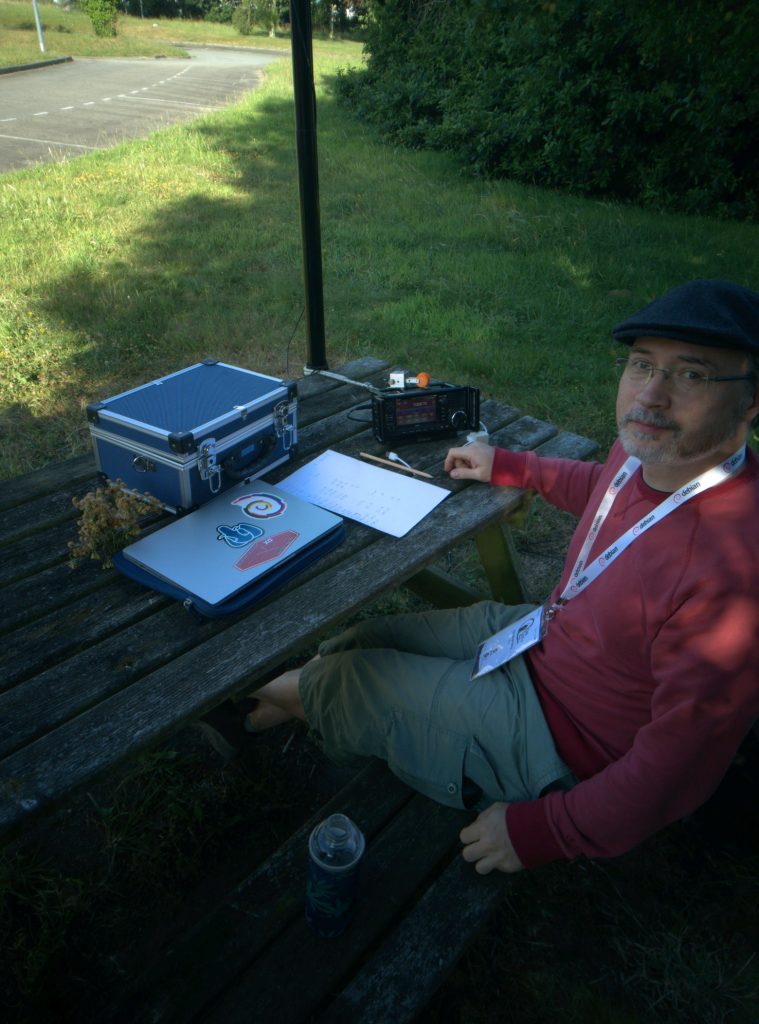 F/DF7CB in Brest (photo: Evangelos Ribeiro Tzaras)
 The northern coast of Ushant (photo: Christoph Berg)
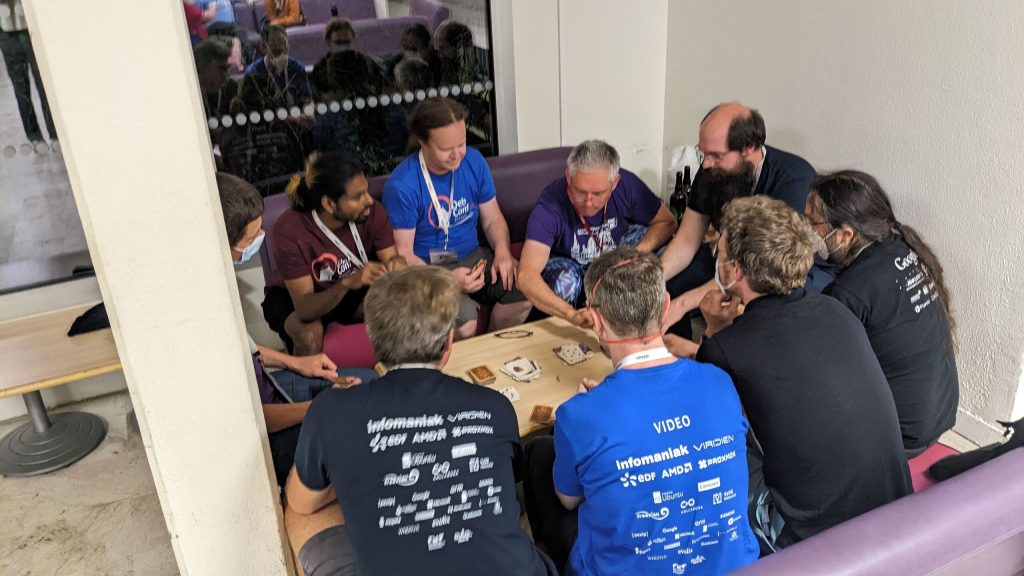 Having a nice day (photo: Christoph Berg)
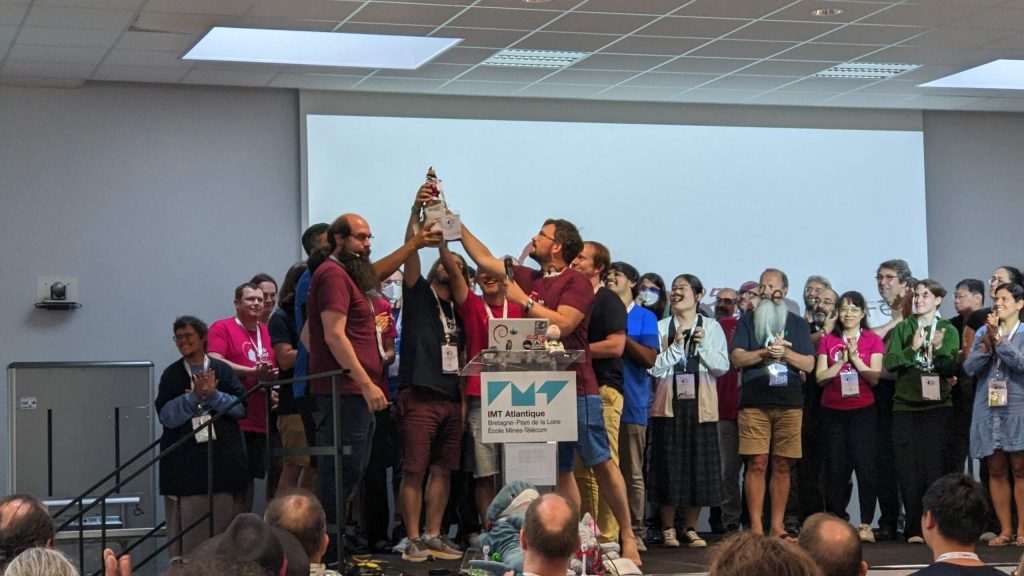 Pollito on stage (photo: Christoph Berg)

 So, for the first year, this year s DebConf had the DebConf Academic Track ,
that is, content for a one-day-long set of short sessions, for which of them
there was a written article presenting the content often with a very academic
format, but not necessarily. I hope that for future DebConfs we will continue to
hold this track, and that we can help bridge the gap: to get people that are
not usually from the academic / universitary prepare content that will be
formally expressed and included in a long-lasting, indexed book of
proceedings. We did have (informal) proceedings in many of the early DebConfs,
and I m very happy to regain that, but with 20 years of better practices.
Anyway, of course, I took the opportunity to join this experiment, and together
with my Mexican colleague Tzolkin Gardu o who is finishing her PhD here in
France (or should I say, second to her, as she is the true leading author of our
work). And here you can see the paper we submitted to the DebConf Academic
Track, which will be published soon:


 The Internet has changed a lot in the last 40+ years. Fads have come and gone.
Network protocols have been designed, deployed, adopted, and abandoned.
Industries have come and gone. The types of people on the internet have changed
a lot. The number of people on the internet has changed a lot, creating an
information medium unlike anything ever seen before in human history. There s a
lot of good things about the Internet as of 2025, but there s also an
inescapable hole in what it used to be, for me.
I miss being able to throw a site up to send around to friends to play with
without worrying about hordes of AI-feeding HTML combine harvesters DoS-ing my
website, costing me thousands in network transfer for the privilege. I miss
being able to put a lightly authenticated game server up and not worry too much
at night wondering if that process is now mining bitcoin. I miss being able
to run a server in my home closet. Decades of cat and mouse games have rendered
running a mail server nearly impossible. Those who are brave enough to try
are met with weekslong stretches of delivery failures and countless hours
yelling ineffectually into a pipe that leads from the cheerful lobby of some
disinterested corporation directly into a void somewhere 4 layers below ground
level.
I miss the spirit of curiosity, exploration, and trying new things. I miss
building things for fun without having to worry about being too successful,
after which security offices start demanding my supplier paperwork in
triplicate as heartfelt thanks from their engineering teams. I miss communities
that are run because it is important to them, not for ad revenue. I miss
community operated spaces and having more than four websites that are all full
of nothing except screenshots of each other.
Every other page I find myself on now has an AI generated click-bait title,
shared for rage-clicks all brought-to-you-by-our-sponsors completely covered
wall-to-wall with popup modals, telling me how much they respect my privacy,
with the real content hidden at the bottom bracketed by deceptive ads served by
companies that definitely know which new coffee shop I went to last month.
This is wrong, and those who have seen what was know it.
I can t keep doing it. I m not doing it any more. I reject the notion that
this is as it needs to be. It is wrong. The hole left in what the Internet used
to be must be filled. I will fill it.

 In this post, I demonstrate the optimal workflow for creating new Debian packages in 2025, preserving the upstream git history. The motivation for this is to lower the barrier for sharing improvements to and from upstream, and to improve software provenance and supply-chain security by making it easy to inspect every change at any level using standard git tooling.
Key elements of this workflow include:
 In this post, I demonstrate the optimal workflow for creating new Debian packages in 2025, preserving the upstream git history. The motivation for this is to lower the barrier for sharing improvements to and from upstream, and to improve software provenance and supply-chain security by making it easy to inspect every change at any level using standard git tooling.
Key elements of this workflow include:
 A popular topic of public conversation in 2025 is balance. How do we balance budgets, how do we balance entities, and how do we balance perspectives? How do we balance the right of free expression with our ability to effectively convey a message?Here s another popular topic of conversation AI. What is it? What does it do?I m going to give you some resources, as someone who first learned the inner workings of AI about ten years ago.I ll start with the presentation I gave in middle school. Our objective was to give a presentation on a topic of our choice, and we would be graded on our ability to give a presentation. Instead of talking about specific things or events, I talked about the broader idea of fully establishing an artificial form of intelligence.This is the video I used as a basis for that presentation: