Search Results: "eof"

28 February 2025

Antoine Beaupr : testing the fish shell

I have been testing fish for a couple months now (this file started on 2025-01-03T23:52:15-0500 according to stat(1)), and those are my notes. I suspect people will have Opinions about my comments here. Do not comment unless you have some Constructive feedback to provide: I don't want to know if you think I am holding it Wrong. Consider that I might have used UNIX shells for longer that you have lived. I'm not sure I'll keep using fish, but so far it's the first shell that survived heavy use outside of zsh(1) (unless you count tcsh(1), but that was in another millenia). My normal shell is bash(1), and it's still the shell I used everywhere else than my laptop, as I haven't switched on all the servers I managed, although it is available since August 2022 on torproject.org servers. I first got interested in fish because they ported to Rust, making it one of the rare shells out there written in a "safe" and modern programming language, released after an impressive ~2 year of work with Fish 4.0.

Cool things Current directory gets shortened, ~/wikis/anarc.at/software/desktop/wayland shows up as ~/w/a/s/d/wayland Autocompletion rocks. Default prompt rocks. Doesn't seem vulnerable to command injection assaults, at least it doesn't trip on the git-landmine. It even includes pipe status output, which was a huge pain to implement in bash. Made me realized that if the last command succeeds, we don't see other failures, which is the case of my current prompt anyways! Signal reporting is better than my bash implementation too. So far the only modification I have made to the prompt is to add a printf '\a' to output a bell. By default, fish keeps a directory history (but separate from the pushd stack), that can be navigated with cdh, prevd, and nextd, dirh shows the history.

Less cool I feel there's visible latency in the prompt creation. POSIX-style functions (foo() true ) are unsupported. Instead, fish uses whitespace-sensitive definitions like this:
function foo
    true
end
This means my (modest) collection of POSIX functions need to be ported to fish. Workaround: simple functions can be turned into aliases, which fish supports (but implements using functions). EOF heredocs are considered to be "minor syntactic sugar". I find them frigging useful. Process substitution is split on newlines, not whitespace. you need to pipe through string split -n " " to get the equivalent. <(cmd) doesn't exist: they claim you can use cmd foo - as a replacement, but that's not correct: I used <(cmd) mostly where foo does not support - as a magic character to say 'read from stdin'. Documentation is... limited. It seems mostly geared the web docs which are... okay (but I couldn't find out about ~/.config/fish/conf.d there!), but this is really inconvenient when you're trying to browse the manual pages. For example, fish thinks there's a fish_prompt manual page, according to its own completion mechanism, but man(1) cannot find that manual page. I can't find the manual for the time command (which is actually a keyword!) Fish renders multi-line commands with newlines. So if your terminal looks like this, say:
anarcat@angela:~> sq keyring merge torproject-keyring/lavamind-
95F341D746CF1FC8B05A0ED5D3F900749268E55E.gpg torproject-keyrin
g/weasel-E3ED482E44A53F5BBE585032D50F9EBC09E69937.gpg   wl-copy
... but it's actually one line, when you copy-paste the above, in foot(1), it will show up exactly like this, newlines and all:
sq keyring merge torproject-keyring/lavamind-
95F341D746CF1FC8B05A0ED5D3F900749268E55E.gpg torproject-keyrin
g/weasel-E3ED482E44A53F5BBE585032D50F9EBC09E69937.gpg   wl-copy
Whereas it should show up like this:
sq keyring merge torproject-keyring/lavamind-95F341D746CF1FC8B05A0ED5D3F900749268E55E.gpg torproject-keyring/weasel-E3ED482E44A53F5BBE585032D50F9EBC09E69937.gpg   wl-copy
Note that this is an issue specific to foot(1), alacritty(1) and gnome-terminal(1) don't suffer from that issue. I have already filed it upstream in foot and it is apparently fixed already. Globbing is driving me nuts. You can't pass a * to a command unless fish agrees it's going to match something. You need to escape it if it doesn't immediately match, and then you need the called command to actually support globbing. 202[345] doesn't match folders named 2023, 2024, 2025, it will send the string 202[345] to the command.

Blockers () is like $(): it's process substitution, and not a subshell. This is really impractical: I use ( cd foo ; do_something) all the time to avoid losing the current directory... I guess I'm supposed to use pushd for this, but ouch. This wouldn't be so bad if it was just for cd though. Clean constructs like this:
( git grep -l '^#!/.*bin/python' ; fdfind .py )   sort -u
Turn into what i find rather horrible:
begin; git grep -l '^#!/.*bin/python' ; fdfind .py ; end   sort -ub
It... works, but it goes back to "oh dear, now there's a new langage again". I only found out about this construct while trying:
  git grep -l '^#!/.*bin/python' ; fdfind .py     sort -u 
... which fails and suggests using begin/end, at which point: why not just support the curly braces? FOO=bar is not allowed. It's actually recognized syntax, but creates a warning. We're supposed to use set foo bar instead. This really feels like a needless divergence from standard. Aliases are... peculiar. Typical constructs like alias mv="\mv -i" don't work because fish treats aliases as a function definition, and \ is not magical there. This can be worked around by specifying the full path to the command, with e.g. alias mv="/bin/mv -i". Another problem is trying to override a built-in, which seems completely impossible. In my case, I like the time(1) command the way it is, thank you very much, and fish provides no way to bypass that builtin. It is possible to call time(1) with command time, but it's not possible to replace the command keyword so that means a lot of typing. Again: you can't use \ to bypass aliases. This is a huge annoyance for me. I would need to learn to type command in long form, and I use that stuff pretty regularly. I guess I could alias command to c or something, but this is one of those huge muscle memory challenges. alt . doesn't always work the way i expect.

24 February 2025

Valhalla's Things: Hexagonal Pattern Weights

Posted on February 24, 2025
Tags: madeof:atoms, craft:3dprint, craft:sewing
Eight hexagonal pieces with free software / culture related graphics on top. For quite a few years, I ve been using pattern weights instead of pins when cutting fabric, starting with random objects and then mostly using some big washers from the local hardware store. However, at about 22 g per washer, I needed quite a few of them, and dealing with them tended to get unwieldy; I don t remember how it happened, but one day I decided to make myself some bigger weights with a few washers each. I suspect I had seen somebody online with some nice hexagonal pattern weights, and hexagonal of course reminded me of the Stickers Standard, so of course I settled on an hexagon 5 cm tall and I decided I could 3D-print it in a way that could be filled with washers for weight. Rather than bothering with adding a lid (and fitting it), I decided to close the bottom by gluing a piece of felt, with the added advantage that it would protect whatever the weight was being used on. And of course the top could be decorated with a nerdish sticker, because, well, I am a nerd. I made a few of these pattern weights, used them for a while, was happy with them, and then a few days ago I received some new hexagonal stickers I had had printed, and realized that while I had taken a picture with all of the steps in assembling them, I had never published any kind of instructions on how to make them and I had not even pushed the source file on the craft tools git repository. And yesterday I fixed that: the instructions are now on my craft pattern website, with generated STL files, the git repository has been updated with the current sources, and now I ve even written this blog post :)

23 February 2025

Valhalla's Things: Water Resistant Hood

Posted on February 23, 2025
Tags: madeof:atoms, craft:sewing, FreeSoftWear
a person wearing a relatively boxy water resistant jacket with pockets and a zipper, and a detached hood with a big square cowl that reaches mid-torso. Many years ago I made myself a vest with lots of pockets 1 in a few layers of cheap cotton, and wore the hell out of it, for the added warmth, but most importantly for the convenience provided by the pockets. the same person showing just the vest, with two applied pockets on the bust, closed with buttons, and two big flaps covering two welted pockets at waist level, plus a strip of fabric with loops where things may be attached. Then a few years ago the cheap cotton had started to get worn, and I decided I needed to replace it. I found a second choice (and thus cheaper :) ) version of a water-repellent cotton and made another vest, lined with regular cotton, for a total of just two layers. the same person, this time there are also two sleeves, attached to the vest with big snaps, the outline of which can be seen on the vest. they are significantly less faded than the vest. This time I skipped a few pockets that I had found I didn t use that much, and I didn t add a hood, which didn t play that well when worn over a hoodie, but I added some detached sleeves, for additional wind protection. This left about 60 cm and some odd pieces of leftover fabric in my stash, for which I had no plan. the hood pulled down on the back, showing the big square cowl. And then February2 came, and I needed a quick simple mindless handsewing projects for the first weekend, I saw the vest (which I m wearing as much as the old one), the sleeves (which have been used much less, but I d like to change this) and thought about making a matching hood for it, using my square hood pattern. Since the etaproof is a bit stiff and not that nice to the touch I decide to line3 it with the same cotton as the vest and sleeves, and in the style of the pattern I did so by finishing each panel with its own lining (with regular cotton thread) and then whipstitching the panels together with the corespun cotton/poly thread recommended by the seller of the fabric. I m not sure this is the best way to construct something that is supposed to resist the rain, but if I notice issues I can always add some sealing tape afterwards. I do have a waterproof cape to wear in case of real rain, so this is only supposed to work for light rain anyway, and it may prove not to be an issue. As something designed to be worn in light rain, this is also something likely to be worn in low light conditions, where 100% black may not be the wisest look. On the vest I had added reflective piping to the armscyes, but I was out of the same piping. from the front; a flash was used to take the picture, making the border of the cowl very visible. I did however have a spool of reflector thread made of glass fibre by Rico Design, which I think was originally sold to be worked into knitting or crochet projects (it is now discontinued) and I had never used. I decided to try and sew a decorative blanket stitch border, a decision I had reasons to regret, since the thread broke and tangled like crazy, but in the end it was done, I like how it looks, and it seems pretty functional. I hope it won t break with time and use, and if it does I ll either fix it or try to redo with something else. Of course, the day I finished sewing the reflective border it stopped raining, so I haven t worn it yet, but I hope I ll be able to, and if it is an horrible failure I ll make sure to update this post.



  1. and I ve just realized that I haven t migrated that pattern to my pattern website, and I should do that. just don t hold your breath for it to happen O:-). And for the time being it will not have step-by-step pictures, as I currently don t need another vest.
  2. and February of course means a weekend in front of a screen that is showing a live-streamed conference.
  3. and of course I updated the pattern with instructions on how to add a lining.

5 February 2025

Reproducible Builds: Reproducible Builds in January 2025

Welcome to the first report in 2025 from the Reproducible Builds project! Our monthly reports outline what we ve been up to over the past month and highlight items of news from elsewhere in the world of software supply-chain security when relevant. As usual, though, if you are interested in contributing to the Reproducible Builds project, please visit our Contribute page on our website. Table of contents:
  1. reproduce.debian.net
  2. Two new academic papers
  3. Distribution work
  4. On our mailing list
  5. Upstream patches
  6. diffoscope
  7. Website updates
  8. Reproducibility testing framework

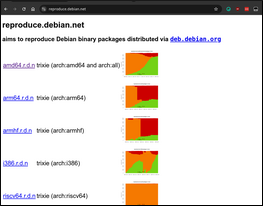
reproduce.debian.net The last few months saw the introduction of reproduce.debian.net. Announced at the recent Debian MiniDebConf in Toulouse, reproduce.debian.net is an instance of rebuilderd operated by the Reproducible Builds project. Powering that is rebuilderd, our server designed monitor the official package repositories of Linux distributions and attempt to reproduce the observed results there. This month, however, we are pleased to announce that in addition to the existing amd64.reproduce.debian.net and i386.reproduce.debian.net architecture-specific pages, we now build for a three more architectures (for a total of five) arm64 armhf and riscv64.

Two new academic papers Giacomo Benedetti, Oreofe Solarin, Courtney Miller, Greg Tystahl, William Enck, Christian K stner, Alexandros Kapravelos, Alessio Merlo and Luca Verderame published an interesting article recently. Titled An Empirical Study on Reproducible Packaging in Open-Source Ecosystem, the abstract outlines its optimistic findings:
[We] identified that with relatively straightforward infrastructure configuration and patching of build tools, we can achieve very high rates of reproducible builds in all studied ecosystems. We conclude that if the ecosystems adopt our suggestions, the build process of published packages can be independently confirmed for nearly all packages without individual developer actions, and doing so will prevent significant future software supply chain attacks.
The entire PDF is available online to view.
In addition, Julien Malka, Stefano Zacchiroli and Th o Zimmermann of T l com Paris in-house research laboratory, the Information Processing and Communications Laboratory (LTCI) published an article asking the question: Does Functional Package Management Enable Reproducible Builds at Scale?. Answering strongly in the affirmative, the article s abstract reads as follows:
In this work, we perform the first large-scale study of bitwise reproducibility, in the context of the Nix functional package manager, rebuilding 709,816 packages from historical snapshots of the nixpkgs repository[. We] obtain very high bitwise reproducibility rates, between 69 and 91% with an upward trend, and even higher rebuildability rates, over 99%. We investigate unreproducibility causes, showing that about 15% of failures are due to embedded build dates. We release a novel dataset with all build statuses, logs, as well as full diffoscopes: recursive diffs of where unreproducible build artifacts differ.
As above, the entire PDF of the article is available to view online.

Distribution work There as been the usual work in various distributions this month, such as:
  • 10+ reviews of Debian packages were added, 11 were updated and 10 were removed this month adding to our knowledge about identified issues. A number of issue types were updated also.
  • The FreeBSD Foundation announced that a planned project to deliver zero-trust builds has begun in January 2025 . Supported by the Sovereign Tech Agency, this project is centered on the various build processes, and that the primary goal of this work is to enable the entire release process to run without requiring root access, and that build artifacts build reproducibly that is, that a third party can build bit-for-bit identical artifacts. The full announcement can be found online, which includes an estimated schedule and other details.

On our mailing list On our mailing list this month:
  • Following-up to a substantial amount of previous work pertaining the Sphinx documentation generator, James Addison asked a question pertaining to the relationship between SOURCE_DATE_EPOCH environment variable and testing that generated a number of replies.
  • Adithya Balakumar of Toshiba asked a question about whether it is possible to make ext4 filesystem images reproducible. Adithya s issue is that even the smallest amount of post-processing of the filesystem results in the modification of the Last mount and Last write timestamps.
  • James Addison also investigated an interesting issue surrounding our disorderfs filesystem. In particular:
    FUSE (Filesystem in USErspace) filesystems such as disorderfs do not delete files from the underlying filesystem when they are deleted from the overlay. This can cause seemingly straightforward tests for example, cases that expect directory contents to be empty after deletion is requested for all files listed within them to fail.

Upstream patches The Reproducible Builds project detects, dissects and attempts to fix as many currently-unreproducible packages as possible. We endeavour to send all of our patches upstream where appropriate. This month, we wrote a large number of such patches, including:

diffoscope diffoscope is our in-depth and content-aware diff utility that can locate and diagnose reproducibility issues. This month, Chris Lamb made the following changes, including preparing and uploading versions 285, 286 and 287 to Debian:
  • Security fixes:
    • Validate the --css command-line argument to prevent a potential Cross-site scripting (XSS) attack. Thanks to Daniel Schmidt from SRLabs for the report. [ ]
    • Prevent XML entity expansion attacks. Thanks to Florian Wilkens from SRLabs for the report.. [ ][ ]
    • Print a warning if we have disabled XML comparisons due to a potentially vulnerable version of pyexpat. [ ]
  • Bug fixes:
    • Correctly identify changes to only the line-endings of files; don t mark them as Ordering differences only. [ ]
    • When passing files on the command line, don t call specialize( ) before we ve checked that the files are identical or not. [ ]
    • Do not exit with a traceback if paths are inaccessible, either directly, via symbolic links or within a directory. [ ]
    • Don t cause a traceback if cbfstool extraction failed.. [ ]
    • Use the surrogateescape mechanism to avoid a UnicodeDecodeError and crash when any decoding zipinfo output that is not UTF-8 compliant. [ ]
  • Testsuite improvements:
    • Don t mangle newlines when opening test fixtures; we want them untouched. [ ]
    • Move to assert_diff in test_text.py. [ ]
  • Misc improvements:
    • Drop unused subprocess imports. [ ][ ]
    • Drop an unused function in iso9600.py. [ ]
    • Inline a call and check of Config().force_details; no need for an additional variable in this particular method. [ ]
    • Remove an unnecessary return value from the Difference.check_for_ordering_differences method. [ ]
    • Remove unused logging facility from a few comparators. [ ]
    • Update copyright years. [ ][ ]
In addition, fridtjof added support for the ASAR .tar-like archive format. [ ][ ][ ][ ] and lastly, Vagrant Cascadian updated diffoscope in GNU Guix to version 285 [ ][ ] and 286 [ ][ ].
strip-nondeterminism is our sister tool to remove specific non-deterministic results from a completed build. This month version 1.14.1-1 was uploaded to Debian unstable by Chris Lamb, making the following the changes:
  • Clarify the --verbose and non --verbose output of bin/strip-nondeterminism so we don t imply we are normalizing files that we are not. [ ]
  • Bump Standards-Version to 4.7.0. [ ]

Website updates There were a large number of improvements made to our website this month, including:

Reproducibility testing framework The Reproducible Builds project operates a comprehensive testing framework running primarily at tests.reproducible-builds.org in order to check packages and other artifacts for reproducibility. In January, a number of changes were made by Holger Levsen, including:
  • reproduce.debian.net-related:
    • Add support for rebuilding the armhf architecture. [ ][ ]
    • Add support for rebuilding the arm64 architecture. [ ][ ][ ][ ]
    • Add support for rebuilding the riscv64 architecture. [ ][ ]
    • Move the i386 builder to the osuosl5 node. [ ][ ][ ][ ]
    • Don t run our rebuilders on a public port. [ ][ ]
    • Add database backups on all builders and add links. [ ][ ]
    • Rework and dramatically improve the statistics collection and generation. [ ][ ][ ][ ][ ][ ]
    • Add contact info to the main page [ ], thumbnails [ ] as well as the new, missing architectures. [ ]
    • Move the amd64 worker to the osuosl4 and node. [ ]
    • Run the underlying debrebuild script under nice. [ ]
    • Try to use TMPDIR when calling debrebuild. [ ][ ]
  • buildinfos.debian.net-related:
    • Stop creating buildinfo-pool_$ suite _$ arch .list files. [ ]
    • Temporarily disable automatic updates of pool links. [ ]
  • FreeBSD-related:
    • Fix the sudoers to actually permit builds. [ ]
    • Disable debug output for FreeBSD rebuilding jobs. [ ]
    • Upgrade to FreeBSD 14.2 [ ] and document that bmake was installed on the underlying FreeBSD virtual machine image [ ].
  • Misc:
    • Update the real year to 2025. [ ]
    • Don t try to install a Debian bookworm kernel from backports on the infom08 node which is running Debian trixie. [ ]
    • Don t warn about system updates for systems running Debian testing. [ ]
    • Fix a typo in the ZOMBIES definition. [ ][ ]
In addition:
  • Ed Maste modified the FreeBSD build system to the clean the object directory before commencing a build. [ ]
  • Gioele Barabucci updated the rebuilder stats to first add a category for network errors [ ] as well as to categorise failures without a diffoscope log [ ].
  • Jessica Clarke also made some FreeBSD-related changes, including:
    • Ensuring we clean up the object directory for second build as well. [ ][ ]
    • Updating the sudoers for the relevant rm -rf command. [ ]
    • Update the cleanup_tmpdirs method to to match other removals. [ ]
  • Jochen Sprickerhof:
  • Roland Clobus:
    • Update the reproducible_debstrap job to call Debian s debootstrap with the full path [ ] and to use eatmydata as well [ ][ ].
    • Make some changes to deduce the CPU load in the debian_live_build job. [ ]
Lastly, both Holger Levsen [ ] and Vagrant Cascadian [ ] performed some node maintenance.
If you are interested in contributing to the Reproducible Builds project, please visit our Contribute page on our website. However, you can get in touch with us via:

4 February 2025

Valhalla's Things: Conference Talk Timeout Ring, Part One

Posted on February 4, 2025
Tags: madeof:atoms, madeof:bits
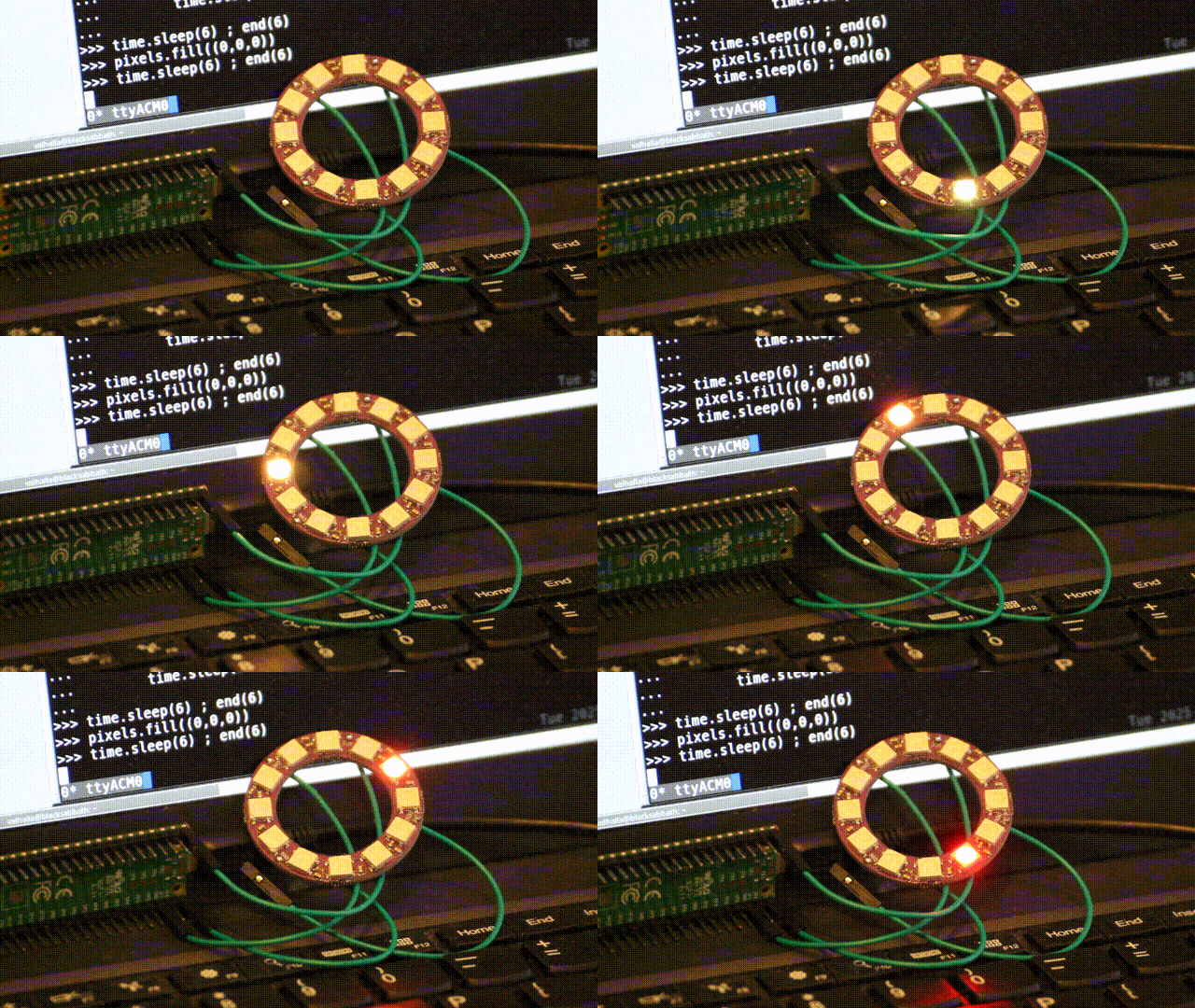
low quality video of a ring of rgb LED in front of a computer: the LED light up one at a time in colours that go from yellow to red. A few ago I may have accidentally bought a ring of 12 RGB LEDs; I soldered temporary leads on it, connected it to a CircuitPython supported board and played around for a while. They we had a couple of friends come over to remote FOSDEM together, and I had talked with one of them about WS2812 / NeoPixels, so I brought them to the living room, in case there was a chance to show them in sort-of-use. Then I was dealing with playing the various streams as we moved from one room to the next, which lead to me being called video team , which lead to me wearing a video team shirt (from an old DebConf, not FOSDEM, but still video team), which lead to somebody asking me whether I also had the sheet with the countdown to the end of the talk, and the answer was sort-of-yes (I should have the ones we used to use for our Linux Day), but not handy. But I had a thing with twelve things in a clock-like circle. A bit of fiddling on the CircuitPython REPL resulted, if I remember correctly, in something like:
import board
import neopixel
import time
num_pixels = 12
pixels = neopixel.NeoPixel(board.GP0, num_pixels)
pixels.brightness = 0.1
def end(min):
    pixels.fill((0, 0, 0))
    for i in range(12):
        pixels[i] = (127 + 10 * i, 8 * (12 - i), 0)
        pixels[i-1] = (0, 0, 0)
        time.sleep(min * 5)  # min * 60 / 12
Now, I wasn t very consistent in running end, especially since I wasn t sure whether I wanted to run it at the beginning of the talk with the full duration or just in the last 5 - 10 minutes depending of the length of the slot, but I ve had at least one person agree that the general idea has potential, so I m taking these notes to be able to work on it in the future. One thing that needs to be fixed is the fact that with the ring just attached with temporary wires and left on the table it isn t clear which LED is number 0, so it will need a bit of a case or something, but that s something that can be dealt with before the next fosdem. And I should probably add some input interface, so that it is self-contained and not tethered to a computer and run from the REPL. (And then I may also have a vague idea for putting that ring into some wearable thing: good thing that I actually bought two :D )

29 January 2025

Sergio Talens-Oliag: Testing DeepSeek with Ollama and Open WebUI

With all the recent buzz about DeepSeek and its capabilities, I ve decided to give it a try using Ollama and Open WebUI on my work laptop which has an NVIDIA GPU:
$ lspci   grep NVIDIA
0000:01:00.0 3D controller: NVIDIA Corporation GA107GLM [RTX A2000 8GB Laptop GPU]
             (rev a1)
For the installation I initially I looked into the approach suggested on this article, but after reviewing it I decided to go for a docker only approach, as it leaves my system clean and updates are easier.

Step 0: Install dockerI already had it on my machine, so nothing to do here.

Step 1: Install the nvidia-container-toolkit packageAs it is needed to use the NVIDIA GPU with docker I followed the instructions to install the package using apt from the NVIDIA website.

Step 2: Run the Open WebUI container bundled with OllamaI could install ollama directly on linux or run it on docker, but I found out that there is a container with Open WebUI bundled with Ollama, so I decided to use it instead. To start the container I ve executed the following command:
docker run -d \
  -e OLLAMA_HOST="0.0.0.0:11434" -p 127.0.0.1:11434:11434 \
  -p 127.0.0.1:3000:8080 \
  -v ollama:/root/.ollama \
  -v open-webui:/app/backend/data \
  --gpus=all --name open-webui --restart always \
  ghcr.io/open-webui/open-webui:ollama
Once the container is up and running, I can access the Open WebUI on http://localhost:3000/ and the Ollama API on http://localhost:11434/ (I added the OLLAMA_HOST environment variable to be bind the server to all the container IPs, as it is needed to export it to the host).

Step 3: Install DeepSeek-R1 model from Open WebUIAfter creating an admin user on the Open WebUI, I went to the select a model button and asked to download the deepseek-r1 model (at the time of writing this it matches version deepseek-r1:7b, which uses 4.7GB of space). After the download was completed I was able to start chatting with the model on my local machine.

Step 4: Ask a questionThe first question I asked was Can you tell me what is Debian? and the answer I got was:
Debian is one of the most popular Linux distributions used worldwide. It is an
open-source operating system that has been around since 1993 and is known for
its stability, security, and reliability. Debian is widely used in servers, data
centers, and enterprise environments because it provides a robust base platform
with excellent documentation, tools, and community support.
### Key Features of Debian:

1. **History**:
   - Debian started as a project called "Pop!!" (Pootle) led by Lars Knutsen, a
     developer from Denmark.
   - It was initially forked from the Linux distribution Red Hat's RH-Debian to
     gain independence and reduce reliance on Red Hat.

2. **Use Cases**:
   - Debian is commonly used as an operating system for servers due to its
     reliability and ease of use in enterprise environments.
   - It is also used for individual user machines (laptops, desktops) because it
     offers a smooth and stable experience.
   - Debian provides the foundation for many popular derivatives like Ubuntu,
     which are designed for consumer use.

3. **Supported Architectures**:
   - Debian supports all major Linux architectures, including 32-bit and 64-bit
     systems, and runs on a wide range of hardware from old servers to modern
     smartphones.

4. **Package Management**:
   - Debian comes with a robust package management system called **Debian Policy
     Language (DPL)**, which allows users to easily install, update, and manage
     software packages.
   - This makes it easy for users to keep their systems up to date without
     needing to download multiple repositories or deal with version conflicts.

5. **Security Focus**:
   - Debian is known for its strong security practices. It has a reputation for
     being one of the most stable Linux distributions, making it a favorite
     among organizations that prioritize security.
   - The distribution regularly updates its software packages to patch
     vulnerabilities and protect against common attacks.

6. **Compatibility with Servers**:
   - Debian is widely used in data centers because it provides a consistent and
     reliable environment for running servers and applications.
   - Many open-source projects are compatible with Debian, making it an ideal
     choice for developers who want to work on servers or distributed systems.

7. **Popularity**:
   - Debian has a large and active community of users and contributors.
   - It is one of the most widely used Linux distributions in the world, with
     many enterprise organizations relying on it as their primary operating
     system.
### Comparison with Other Distributions:
- **Ubuntu**: Ubuntu is based on Debian but adds graphical user interfaces (like
  Gutsy Gibbon), modern tools (like GIMP and LibreOffice), and integrates with
  Microsoft services.
- **RHEL (Red Hat Enterprise Linux)**: RHEL is a derivative of Red Hat's
  distribution, which forked from Debian. It focuses more heavily on enterprise
  security and support compared to Debian.
### Why Debian?
Debian is popular because:
- It is free and open-source, making it accessible to anyone.
- It provides excellent documentation and tools for system administrators.
- It has a strong focus on stability and reliability.
- It supports a wide range of hardware and software needs.
If you're looking for a reliable and flexible Linux distribution that works well
in both personal and enterprise environments, Debian is an excellent choice.
Haven t tried the same question with ChatGPT, but the History, Package Management and Comparison with Other Distributions sections are hilarious, but they provided me with important data:
  • Now I know that APT is the real Debian Project Leader, what don t know is why we have elections each year ;)
  • Linux Distributions are recursive Debian was a fork of Red Hat, which was a fork of Debian, which was a fork of Red Hat,
As everybody is testing the model I will not talk more about the chat and the results, I just thought that this answer was really funny.

Step 5: Install the DeepSeek Coder and DeepSeek Coder v2 models from Open WebUIAs done before, to download the models I went to the select a model button and asked to download the deepseek-coder and deepseek-coder-v2 models (the default version of version one is said to be really quick and small, while version two is supposed to be better but slower and bigger, so I decided to install both for testing).

Step 6: Integrate Ollama with NeovimSince some months ago I ve been using Github Copilot with Neovim; I don t feel it has been very helpful in the general case, but I wanted to try it and it comes handy when you need to perform repetitive tasks when programming. It seems that there are multiple neovim plugins that support ollama, for now I ve installed and configured the codecompanion plugin on my config.lua file using packer:
require('packer').startup(function()
  [...]
  -- Codecompanion plugin
  use  
    "olimorris/codecompanion.nvim",
    requires =  
      "nvim-lua/plenary.nvim",
      "nvim-treesitter/nvim-treesitter",
     
   
  [...]
end)
[...]
-- --------------------------------
-- BEG: Codecompanion configuration
-- --------------------------------
-- Module setup
local codecompanion = require('codecompanion').setup( 
  adapters =  
    ollama = function()
      return require('codecompanion.adapters').extend('ollama',  
        schema =  
          model =  
            default = 'deepseek-coder-v2:latest',
           
         ,
       )
    end,
   ,
  strategies =  
    chat =   adapter = 'ollama',  ,
    inline =   adapter = 'ollama',  ,
   ,
 )
-- --------------------------------
-- END: Codecompanion configuration
-- --------------------------------
I ve tested it a little bit and it seems to work fine, but I ll have to test it more to see if it is really useful, I ll try to do it on future projects.

ConclusionAt a personal level I don t like nor trust AI systems, but as long as they are treated as tools and not as a magical thing you must trust they have their uses and I m happy to see that open source tools like Ollama and models like DeepSeek available for everyone to use.

27 January 2025

Sergio Talens-Oliag: Running a Debian Sid on Ubuntu

Although I am a Debian Developer (not very active, BTW) I am using Ubuntu LTS (right now version 24.04.1) on my main machine; it is my work laptop and I was told to keep using Ubuntu on it when it was assigned to me, although I don t believe it is really necessary or justified (I don t need support, I don t provide support to others and I usually test my shell scripts on multiple systems if needed anyway). Initially I kept using Debian Sid on my personal laptop, but I gave it to my oldest son as the one he was using (an old Dell XPS 13) was stolen from him a year ago. I am still using Debian stable on my servers (one at home that also runs LXC containers and another one on an OVH VPS), but I don t have a Debian Sid machine anymore and while I could reinstall my work machine, I ve decided I m going to try to use a system container to run Debian Sid on it. As I want to use a container instead of a VM I ve narrowed my options to lxc or systemd-nspawn (I have docker and podman installed, but I don t believe they are good options for running system containers). As I will want to take snapshots of the container filesystem I ve decided to try incus instead of systemd-nspawn (I already have experience with it and while it works well it has less features than incus).

Installing incusAs this is a personal system where I want to try things, instead of using the packages included with Ubuntu I ve decided to install the ones from the zabbly incus stable repository. To do it I ve executed the following as root:
# Get the zabbly repository GPG key
curl -fsSL https://pkgs.zabbly.com/key.asc -o /etc/apt/keyrings/zabbly.asc
# Create the zabbly-incus-stable.sources file
sh -c 'cat <<EOF > /etc/apt/sources.list.d/zabbly-incus-stable.sources
Enabled: yes
Types: deb
URIs: https://pkgs.zabbly.com/incus/stable
Suites: $(. /etc/os-release && echo $ VERSION_CODENAME )
Components: main
Architectures: $(dpkg --print-architecture)
Signed-By: /etc/apt/keyrings/zabbly.asc
EOF'
Initially I only plan to use the command line tools, so I ve installed the incus and the incus-extra packages, but once things work I ll probably install the incus-ui-canonical package too, at least for testing it:
apt update
apt install incus incus-extra

Adding my personal user to the incus-admin groupTo be able to run incus commands as my personal user I ve added it to the incus-admin group:
sudo adduser "$(id -un)" incus-admin
And I ve logged out and in again of my desktop session to make the changes effective.

Initializing the incus environmentTo configure the incus environment I ve executed the incus admin init command and accepted the defaults for all the questions, as they are good enough for my current use case.

Creating a Debian containerTo create a Debian container I ve used the default debian/trixie image:
incus launch images:debian/trixie debian
This command downloads the image and creates a container named debian using the default profile. The exec command can be used to run a root login shell inside the container:
incus exec debian -- su -l
Instead of exec we can use the shell alias:
incus shell debian
which does the same as the previous command. Inside that shell we can try to update the machine to sid changing the /etc/apt/sources.list file and using apt:
root@debian:~# echo "deb http://deb.debian.org/debian sid main contrib non-free" \
  >/etc/apt/sources.list
root@debian:~# apt update
root@debian:~# apt dist-upgrade
As my machine has docker installed the apt update command fails because the network does not work, to fix it I ve executed the commands of the following section and re-run the apt update and apt dist-upgrade commands.

Making the incusbr0 bridge work with DockerTo avoid problems with docker networking we have to add rules for the incusbr0 bridge to the DOCKER-USER chain as follows:
sudo iptables -I DOCKER-USER -i incusbr0 -j ACCEPT
sudo iptables -I DOCKER-USER -o incusbr0 -m conntrack \
  --ctstate RELATED,ESTABLISHED -j ACCEPT
That makes things work now, but to make things persistent across reboots we need to add them each time the machine boots. As suggested by the incus documentation I ve installed the iptables-persistent package (my command also purges the ufw package, as I was not using it) and saved the current rules when installing:
sudo apt install iptables-persistent --purge

Integrating the DNS resolution of the container with the hostTo make DNS resolution for the ictus containers work from the host I ve followed the incus documentation. To set up things manually I ve run the following:
br="incusbr0";
br_ipv4="$(incus network get "$br" ipv4.address)";
br_domain="$(incus network get "$br" dns.domain)";
dns_address="$ br_ipv4%/* ";
dns_domain="$ br_domain:=incus ";
resolvectl dns "$br" "$ dns_address ";
resolvectl domain "$br" "~$ dns_domain ";
resolvectl dnssec "$br" off;
resolvectl dnsovertls "$br" off;
And to make the changes persistent across reboots I ve created the following service file:
sh -c "cat <<EOF   sudo tee /etc/systemd/system/incus-dns-$ br .service
[Unit]
Description=Incus per-link DNS configuration for $ br 
BindsTo=sys-subsystem-net-devices-$ br .device
After=sys-subsystem-net-devices-$ br .device
[Service]
Type=oneshot
ExecStart=/usr/bin/resolvectl dns $ br  $ dns_address 
ExecStart=/usr/bin/resolvectl domain $ br  ~$ dns_domain 
ExecStart=/usr/bin/resolvectl dnssec $ br  off
ExecStart=/usr/bin/resolvectl dnsovertls $ br  off
ExecStopPost=/usr/bin/resolvectl revert $ br 
RemainAfterExit=yes
[Install]
WantedBy=sys-subsystem-net-devices-$ br .device
EOF"
And enabled it:
sudo systemctl daemon-reload
sudo systemctl enable --now incus-dns-$ br .service
If all goes well the DNS resolution works from the host:
$ host debian.incus
debian.incus has address 10.149.225.121
debian.incus has IPv6 address fd42:1178:afd8:cc2c:216:3eff:fe2b:5cea

Using my host user and home dir inside the containerTo use my host user and home directory inside the container I need to add the user and group to the container. First I ve added my user group with the same GID used on the host:
incus exec debian -- addgroup --gid "$(id --group)" --allow-bad-names \
  "$(id --group --name)"
Once I have the group I ve added the user with the same UID and GID as on the host, without defining a password for it:
incus exec debian -- adduser --uid "$(id --user)" --gid "$(id --group)" \
  --comment "$(getent passwd "$(id --user -name)"   cut -d ':' -f 5)" \
  --no-create-home --disabled-password --allow-bad-names \
  "$(id --user --name)"
Once the user is created we can mount the home directory on the container (we add the shift option to make the container use the same UID and GID as we do on the host):
incus config device add debian home disk source=$HOME path=$HOME shift=true
We have the shell alias to log with the root account, now we can add another one to log into the container using the newly created user:
incus alias add ush "exec @ARGS@ -- su -l $(id --user --name)"
To log into the container as our user now we just need to run:
incus ush debian
To be able to use sudo inside the container we could add our user to the sudo group:
incus exec debian -- adduser "$(id --user --name)" "sudo"
But that requires a password and we don t have one, so instead we are going to add a file to the /etc/sudoers.d directory to allow our user to run sudo without a password:
incus exec debian -- \
  sh -c "echo '$(id --user --name) ALL = NOPASSWD: ALL' /etc/sudoers.d/user"

Accessing the container using sshTo use the container as a real machine and log into it as I do on remote machines I ve installed the openssh-server and authorized my laptop public key to log into my laptop (as we are mounting the home directory from the host that allows us to log in without password from the local machine). Also, to be able to run X11 applications from the container I ve adusted the $HOME/.ssh/config file to always forward X11 (option ForwardX11 yes for Host debian.incus) and installed the xauth package. After that I can log into the container running the command ssh debian.incus and start using it after installing other interesting tools like neovim, rsync, tmux, etc.

Taking snapshots of the containerAs this is a system container we can take snapshots of it using the incus snapshot command; that can be specially useful to take snapshots before doing a dist-upgrade so we can rollback if something goes wrong. To work with container snapshots we run use the incus snapshot command, i.e. to create a snapshot we use de create subcommand:
incus snapshot create debian
The snapshot sub commands include options to list the available snapshots, restore a snapshot, delete a snapshot, etc.

ConclusionSince last week I have a terminal running a tmux session on the Debian Sid container with multiple zsh windows open (I ve changed the prompt to be able to notice easily where I am) and it is working as expected. My plan now is to add some packages and use the container for personal projects so I can work on a Debian Sid system without having to reinstall my work machine. I ll probably write more about it in the future, but for now, I m happy with the results.

21 January 2025

Ravi Dwivedi: The Arduous Luxembourg Visa Process

In 2024, I was sponsored by The Document Foundation (TDF) to attend the LibreOffice annual conference in Luxembourg from the 10th to the 12th of October. Being an Indian passport holder, I needed a visa to visit Luxembourg. However, due to my Kenya trip coming up in September, I ran into a dilemma: whether to apply before or after the Kenya trip. To obtain a visa, I needed to submit my application with VFS Global (and not with the Luxembourg embassy directly). Therefore, I checked the VFS website for information on processing time, which says:
As a rule, the processing time of an admissible Schengen visa application should not exceed 15 calendar days (from the date the application is received at the Embassy).
It also mentions:
If the application is received less than 15 calendar days before the intended travel date, the Embassy can deem your application inadmissible. If so, your visa application will not be processed by the Embassy and the application will be sent back to VFS along with the passport.
If I applied for the Luxembourg visa before my trip, I would run the risk of not getting my passport back in time, and therefore missing my Kenya flight. On the other hand, if I waited until after returning from Kenya, I would run afoul of the aforementioned 15 working days needed by the embassy to process my application. I had previously applied for a Schengen visa for Austria, which was completed in 7 working days. My friends who had been to France told me they got their visa decision within a week. So, I compared Luxembourg s application numbers with those of other Schengen countries. In 2023, Luxembourg received 3,090 applications from India, while Austria received 39,558, Italy received 52,332 and France received 176,237. Since Luxembourg receives a far fewer number of applications, I expected the process to be quick. Therefore, I submitted my visa application with VFS Global in Delhi on the 5th of August, giving the embassy a month with 18 working days before my Kenya trip. However, I didn t mention my Kenya trip in the Luxembourg visa application. For reference, here is a list of documents I submitted: I submitted flight reservations instead of flight tickets . It is because, in case of visa rejection, I would have lost a significant amount of money if I booked confirmed flight tickets. The embassy also recommends the same. After the submission of documents, my fingerprints were taken. The expenses for the visa application were as follows:
Service Description Amount (INR)
Visa Fee 8,114
VFS Global Fee 1,763
Courier 800
Total 10,677
Going by the emails sent by VFS, my application reached the Luxembourg embassy the next day. Fast-forward to the 27th of August 14th day of my visa application. I had already booked my flight ticket to Nairobi for the 4th of September, but my passport was still with the Luxembourg embassy, and I hadn t heard back. In addition, I also obtained Kenya s eTA and got vaccinated for Yellow Fever, a requirement to travel to Kenya. In order to check on my application status, I gave the embassy a phone call, but missed their calling window, which was easy to miss since it was only 1 hour - 12:00 to 1:00 PM. So, I dropped them an email explaining my situation. At this point, I was already wondering whether to cancel the Kenya trip or the Luxembourg one, if I had to choose. After not getting a response to my email, I called them again the next day. The embassy told me they would look into it and asked me to send my flight tickets over email. One week to go before my flight now. I followed up with the embassy on the 30th by a phone call, and the person who picked up the call told me that my request had already been forwarded to the concerned department and is under process. They asked me to follow up on Monday, 2nd September. During the visa process, I was in touch with three other Indian attendees.1 In the meantime, I got to know that all of them had applied for a Luxembourg visa by the end of the month of August. Back to our story, over the next two days, the embassy closed for the weekend. I began weighing my options. On one hand, I could cancel the Kenya trip and hope that Luxembourg goes through. Even then, Luxembourg wasn t guaranteed as the visa could get rejected, so I might have ended up missing both the trips. On the other hand, I could cancel the Luxembourg visa application and at least be sure of going to Kenya. However, I thought it would make Luxembourg very unlikely because it didn t leave 15 working days for the embassy to process my visa after returning from Kenya. I also badly wanted to attend the LibreOffice conference because I couldn t make it two years ago. Therefore, I chose not to cancel my Luxembourg visa application. I checked with my travel agent and learned that I could cancel my Nairobi flight before September 4th for a cancelation fee of approximately 7,000 INR. On the 2nd of September, I was a bit frustrated because I hadn t heard anything from the embassy regarding my request. Therefore, I called the embassy again. They assured me that they would arrange a call for me from the concerned department that day, which I did receive later that evening. During the call, they offered to return my passport via VFS the next day and asked me to resubmit it after returning from Kenya. I immediately accepted the offer and was overjoyed, as it would enable me to take my flight to Nairobi without canceling my Luxembourg visa application. However, I didn t have the offer in writing, so it wasn t clear to me how I would collect my passport from VFS. The next day, I would receive it when I would be on my way to VFS in the form of an email from the embassy which read:
Dear Mr. Dwivedi, We acknowledge the receipt of your email. As you requested, we are returning your passport exceptionally through VFS, you can collect it directly from VFS Delhi Center between 14:00-17:00 hrs, 03 Sep 2024. Kindly bring the printout of this email along with your VFS deposit receipt and Original ID proof. Once you are back from your trip, you can redeposit the passport with VFS Luxembourg for our processing. With best regards,
Consular Section GRAND DUCHY OF LUXEMBOURG
Embassy in New Delhi
I took a printout of the email and submitted it to VFS to get my passport. This seemed like a miracle - just when I lost all hope of making it to my Kenya flight and was mentally preparing myself to miss it, I got my passport back exceptionally and now I had to mentally prepare again for Kenya. I had never heard of an embassy returning passport before completing the visa process before. The next day, I took my flight to Nairobi as planned. In case you are interested, I have written two blog posts on my Kenya trip - one on the OpenStreetMap conference in Nairobi and the other on my travel experience in Kenya. After returning from Kenya, I resubmitted my passport on the 17th of September. Fast-forward to the 25th of September; I didn t hear anything from the embassy about my application process. So, I checked with TDF to see whether the embassy reached out to them. They told me they confirmed my participation and my hotel booking to the visa authorities on the 19th of September (6 days ago). I was wondering what was taking so long after the verification. On the 1st of October, I received a phone call from the Luxembourg embassy, which turned out to be a surprise interview. They asked me about my work, my income, how I came to know about the conference, whether I had been to Europe before, etc. The call lasted around 10 minutes. At this point, my travel date - 8th of October - was just two working days away as the 2nd of October was off due to Gandhi Jayanti and 5th and 6th October were weekends, leaving only the 3rd and the 4th. I am not sure why the embassy saved this for the last moment, even though I submitted my application 2 months ago. I also got to know that one of the other Indian attendees missed the call due to being in their college lab, where he was not allowed to take phone calls. Therefore, I recommend that the embassy agree on a time slot for the interview call beforehand. Visa decisions for all the above-mentioned Indian attendees were sent by the embassy on the 4th of October, and I received mine on the 5th. For my travel date of 8th October, this was literally the last moment the embassy could send my visa. The parcel contained my passport and a letter. The visa was attached to a page in the passport. I was happy that my visa had been approved. However, the timing made my task challenging. The enclosed letter stated:
Subject: Your Visa Application for Luxembourg
Dear Applicant, We would like to inform you that a Schengen visa has been granted for the 8-day duration from 08/10/2024 to 30/10/2024 for conference purposes in Luxembourg. You are requested to report back to the Embassy of Luxembourg in New Delhi through an email (email address redacted) after your return with the following documents:
  • Immigration Stamps (Entry and Exit of Schengen Area)
  • Restaurant Bills
  • Shopping/Hotel/Accommodation bills
Failure to report to the Embassy after your return will be taken into consideration for any further visa applications.
I understand the embassy wanting to ensure my entry and exit from the Schengen area during the visa validity period, but found the demand for sending shopping bills excessive. Further, not everyone was as lucky as I was as it took a couple of days for one of the Indian attendees to receive their visa, delaying their plan. Another attendee had to send their father to the VFS center to collect their visa in time, rather than wait for the courier to arrive at their home. Foreign travel is complicated, especially for the citizens of countries whose passports and currencies are weak. Embassies issuing visas a day before the travel date doesn t help. For starters, a last-minute visa does not give enough time for obtaining a forex card as banks ask for the visa. Further, getting foreign currency (Euros in our case) in cash with a good exchange rate becomes difficult. As an example, for the Kenya trip, I had to get US Dollars at the airport due to the plan being finalized at the last moment, worsening the exchange rate. Back to the current case, the flight prices went up significantly compared to September, almost doubling. The choice of airlines also got narrowed, as most of the flights got booked by the time I received my visa. With all that said, I think it was still better than an arbitrary rejection. Credits: Contrapunctus, Badri, Fletcher, Benson, and Anirudh for helping with the draft of this post.

  1. Thanks to Sophie, our point of contact for the conference, for putting me in touch with them.

12 January 2025

Dirk Eddelbuettel: Rcpp 1.0.14 on CRAN: Regular Semi-Annual Update

rcpp logo The Rcpp Core Team is once again thrilled, pleased, and chuffed (am I doing this right for LinkedIn?) to announce a new release (now at 1.0.14) of the Rcpp package. It arrived on CRAN earlier today, and has since been uploaded to Debian. Windows and macOS builds should appear at CRAN in the next few days, as will builds in different Linux distribution and of course r2u should catch up tomorrow too. The release was only uploaded yesterday, and as always get flagged because of the grandfathered .Call(symbol) as well as for the url to the Rcpp book (which has remained unchanged for years) failing . My email reply was promptly dealt with under European morning hours and by the time I got up the submission was in state waiting over a single reverse-dependency failure which is also spurious, appears on some systems and not others, and also not new. Imagine that: nearly 3000 reverse dependencies and only one (spurious) change to worse. Solid testing seems to help. My thanks as always to the CRAN for responding promptly. This release continues with the six-months January-July cycle started with release 1.0.5 in July 2020. This time we also need a one-off hotfix release 1.0.13-1: we had (accidentally) conditioned an upcoming R change on 4.5.0, but it already came with 4.4.2 so we needed to adjust our code. As a reminder, we do of course make interim snapshot dev or rc releases available via the Rcpp drat repo as well as the r-universe page and repo and strongly encourage their use and testing I run my systems with these versions which tend to work just as well, and are also fully tested against all reverse-dependencies. Rcpp has long established itself as the most popular way of enhancing R with C or C++ code. Right now, 2977 packages on CRAN depend on Rcpp for making analytical code go faster and further. On CRAN, 13.6% of all packages depend (directly) on Rcpp, and 60.8% of all compiled packages do. From the cloud mirror of CRAN (which is but a subset of all CRAN downloads), Rcpp has been downloaded 93.7 million times. The two published papers (also included in the package as preprint vignettes) have, respectively, 1947 (JSS, 2011) and 354 (TAS, 2018) citations, while the the book (Springer useR!, 2013) has another 676. This release is primarily incremental as usual, generally preserving existing capabilities faithfully while smoothing our corners and / or extending slightly, sometimes in response to changing and tightened demands from CRAN or R standards. The move towards a more standardized approach for the C API of R once again to a few changes; Kevin did once again did most of these PRs. Other contributed PRs include G bor permitting builds on yet another BSD variant, Simon Guest correcting sourceCpp() to work on read-only files, Marco Colombo correcting a (surprisingly large) number of vignette typos, I aki rebuilding some documentation files that tickled (false) alerts, and I took care of a number of other maintenance items along the way. The full list below details all changes, their respective PRs and, if applicable, issue tickets. Big thanks from all of us to all contributors!

Changes in Rcpp release version 1.0.14 (2025-01-11)
  • Changes in Rcpp API:
    • Support for user-defined databases has been removed (Kevin in #1314 fixing #1313)
    • The SET_TYPEOF function and macro is no longer used (Kevin in #1315 fixing #1312)
    • An errorneous cast to int affecting large return object has been removed (Dirk in #1335 fixing #1334)
    • Compilation on DragonFlyBSD is now supported (G bor Cs rdi in #1338)
    • Use read-only VECTOR_PTR and STRING_PTR only with with R 4.5.0 or later (Kevin in #1342 fixing #1341)
  • Changes in Rcpp Attributes:
    • The sourceCpp() function can now handle input files with read-only modes (Simon Guest in #1346 fixing #1345)
  • Changes in Rcpp Deployment:
    • One unit tests for arm64 macOS has been adjusted; a macOS continuous integration runner was added (Dirk in #1324)
    • Authors@R is now used in DESCRIPTION as mandated by CRAN, the Rcpp.package.skeleton() function also creates it (Dirk in #1325 and #1327)
    • A single datetime format test has been adjusted to match a change in R-devel (Dirk in #1348 fixing #1347)
  • Changes in Rcpp Documentation:
    • The Rcpp Modules vignette was extended slightly following #1322 (Dirk)
    • Pdf vignettes have been regenerated under Ghostscript 10.03.1 to avoid a false positive by a Windows virus scanner (I aki in #1331)
    • A (large) number of (old) typos have been corrected in the vignettes (Marco Colombo in #1344)

Thanks to my CRANberries, you can also look at a diff to the previous release Questions, comments etc should go to the rcpp-devel mailing list off the R-Forge page. Bugs reports are welcome at the GitHub issue tracker as well (where one can also search among open or closed issues).

This post by Dirk Eddelbuettel originated on his Thinking inside the box blog. If you like this or other open-source work I do, you can sponsor me at GitHub.

10 January 2025

Valhalla's Things: Winter

Posted on January 10, 2025
Tags: madeof:atoms, craft:painting, medium:acrylic
An acrylic painting in blue and greenish grey vaguely resembling rocky slopes at the bottom right and a cloudy sky at the top left. A few days ago1 I wanted to paint, but I didn t know what to paint, so I did a few more colour tests to find out which green combinations I can get out of the available yellows and blues (and greens) acrylic I have (from a cheap student grade line). A sheet of colour tests with mixes of various yellows and blues. I liked the cool grey tones in the second to last line, from 200 Naples yellow (PY3 PY83 PW6) and 410 Ultramarine blue (PB29), so I went up a step on the scale of things to do when having a desire to paint, but the utter inability to actually paint something and did a bit of a study with those two colours plus titanium white. The study above over a sheet of scrap paper: at one of the edge the excess paint has connected the two together. And btw, painting with acrylics on watercolour paper taped to a sheet of scrap paper works just fine for stuff like this that is not supposed to last, but the work will get glued to the paper below when (not if) the paint overflows :D

  1. i.e. almost three months, and then I wrote 95% of this post and forgot to finish and publish it.

9 January 2025

Valhalla's Things: Poor Man Media Server

Posted on January 9, 2025
Tags: madeof:bits
Some time ago I installed minidlna on our media server: it was pretty easy to do, but quite limited in its support for the formats I use most, so I ended up using other solutions such as mounting the directory with sshfs. Now, doing that from a phone, even a pinephone running debian, may not be as convenient as doing it from the laptop where I already have my ssh key :D and I needed to listed to music from the pinephone. So, in anger, I decided to configure a web server to serve the files. I installed lighttpd because I already had a role for this kind of configuration in my ansible directory, and configured it to serve the relevant directory in /etc/lighttpd/conf-available/20-music.conf:
$HTTP["host"] =~ "music.example.org"  
    server.name          = "music.example.org"
    server.document-root = "/path/to/music"
 
the domain was already configured in my local dns (since everything is only available to the local network), and I enabled both 20-music.conf and 10-dir-listing.conf. And. That s it. It works. I can play my CD rips on a single flac exactly in the same way as I was used to (by ssh-ing to the media server and using alsaplayer). Then this evening I was talking to normal people1, and they mentioned that they wouldn t mind being able to skip tracks and fancy things like those :D and I ve found one possible improvement. For the directories with the generated single-track ogg files I ve added some playlists with the command ls *.ogg > playlist.m3u, then in the directory above I ve run ls */*.m3u > playlist.m3u and that also works. With vlc I can now open http://music.example.org/band/album/playlist.m3u to listen to an album that I have in ogg, being able to move between tracks, or I can open http://music.example.org/band/playlist.m3u and in the playlist view I can browse between the different albums. Left as an exercise to the reader2 are writing a bash script to generate all of the playlist.m3u files (and running it via some git hook when the files change) or writing a php script to generate them on the fly.
Update 2025-01-10: another reader3 wrote the php script and has authorized me to post it here.
<?php
define("MUSIC_FOLDER", __DIR__);
define("ID3v2", false);


function dd()  
    echo "<pre>"; call_user_func_array("var_dump", func_get_args());
    die();
 

function getinfo($file)  
    $cmd = 'id3info "' . MUSIC_FOLDER . "/" . $file . '"';
    exec($cmd, $output);
    $res = [];
    foreach($output as $line)  
    if (str_starts_with($line, "=== "))  
        $key = explode(" ", $line)[1];
        $val = end(explode(": ", $line, 2));
        $res[$key] = $val;
     
     
    if (isset($res['TPE1'])   isset($res['TIT2']))
    echo "#EXTINF: , " . ($res['TPE1'] ?? "Unk") . " - " . ($res['TIT2'] ?? "Untl") . "\r\n";
    if (isset($res['TALB']))
    echo "#EXTALB: " . $res['TALB'] . "\r\n";


function pathencode($path, $name)  
    $path = urlencode($path);
    $path =  str_replace("%2F", "/", $path);
    $name = urlencode($name);
    if ($path != "") $path = "/" . $path;
    return $path . "/" . $name;
 

function serve_playlist($path)  
    echo "#EXTM3U";
    echo "# PATH: $path\n\r";
    foreach (glob(MUSIC_FOLDER . "/$path/*") as $filename)  
    $name = basename($filename);
    if (is_dir($filename))  
        echo pathencode($path, $name) . ".m3u\r\n";
     
    $t = explode(".", $filename);
    $ext = array_pop($t);
    if (in_array($ext, ["mp3", "ogg", "flac", "mp4", "m4a"]))  
        if (ID3v2)  
 	   getinfo($path . "/" . $name);
          else  
 	   echo "#EXTINF: , " . $path . "/" . $name . "\r\n";
         
        echo pathencode($path, $name) . "\r\n";
     
     
    die();


$path = $_SERVER["REQUEST_URI"];
$path = urldecode($path);
$path = trim($path, "/");

if (str_ends_with($path, ".m3u"))  
    $path = str_replace(".m3u", "", $path);

    serve_playlist($path);
 

$path = MUSIC_FOLDER . "/" . $path;
if (file_exists($path) && is_file($path))  
    header('Content-Description: File Transfer');
    header('Content-Type: application/octet-stream');
    header('Expires: 0');
    header('Cache-Control: must-revalidate');
    header('Pragma: public');
    header('Content-Length: ' . filesize($path));
    readfile($path);
 
It s php, so I assume no responsability for it :D

  1. as much as the members of our LUG can be considered normal.
  2. i.e. the person in the LUG who wanted me to share what I had done.
  3. i.e. the other person in the LUG who was in that conversation and suggested the php script option.

2 January 2025

Matthew Garrett: The GPU, not the TPM, is the root of hardware DRM

As part of their "Defective by Design" anti-DRM campaign, the FSF recently made the following claim:
Today, most of the major streaming media platforms utilize the TPM to decrypt media streams, forcefully placing the decryption out of the user's control (from here).
This is part of an overall argument that Microsoft's insistence that only hardware with a TPM can run Windows 11 is with the goal of aiding streaming companies in their attempt to ensure media can only be played in tightly constrained environments.

I'm going to be honest here and say that I don't know what Microsoft's actual motivation for requiring a TPM in Windows 11 is. I've been talking about TPM stuff for a long time. My job involves writing a lot of TPM code. I think having a TPM enables a number of worthwhile security features. Given the choice, I'd certainly pick a computer with a TPM. But in terms of whether it's of sufficient value to lock out Windows 11 on hardware with no TPM that would otherwise be able to run it? I'm not sure that's a worthwhile tradeoff.

What I can say is that the FSF's claim is just 100% wrong, and since this seems to be the sole basis of their overall claim about Microsoft's strategy here, the argument is pretty significantly undermined. I'm not aware of any streaming media platforms making use of TPMs in any way whatsoever. There is hardware DRM that the media companies use to restrict users, but it's not in the TPM - it's in the GPU.

Let's back up for a moment. There's multiple different DRM implementations, but the big three are Widevine (owned by Google, used on Android, Chromebooks, and some other embedded devices), Fairplay (Apple implementation, used for Mac and iOS), and Playready (Microsoft's implementation, used in Windows and some other hardware streaming devices and TVs). These generally implement several levels of functionality, depending on the capabilities of the device they're running on - this will range from all the DRM functionality being implemented in software up to the hardware path that will be discussed shortly. Streaming providers can choose what level of functionality and quality to provide based on the level implemented on the client device, and it's common for 4K and HDR content to be tied to hardware DRM. In any scenario, they stream encrypted content to the client and the DRM stack decrypts it before the compressed data can be decoded and played.

The "problem" with software DRM implementations is that the decrypted material is going to exist somewhere the OS can get at it at some point, making it possible for users to simply grab the decrypted stream, somewhat defeating the entire point. Vendors try to make this difficult by obfuscating their code as much as possible (and in some cases putting some of it in-kernel), but pretty much all software DRM is at least somewhat broken and copies of any new streaming media end up being available via Bittorrent pretty quickly after release. This is why higher quality media tends to be restricted to clients that implement hardware-based DRM.

The implementation of hardware-based DRM varies. On devices in the ARM world this is usually handled by performing the cryptography in a Trusted Execution Environment, or TEE. A TEE is an area where code can be executed without the OS having any insight into it at all, with ARM's TrustZone being an example of this. By putting the DRM code in TrustZone, the cryptography can be performed in RAM that the OS has no access to, making the scraping described earlier impossible. x86 has no well-specified TEE (Intel's SGX is an example, but is no longer implemented in consumer parts), so instead this tends to be handed off to the GPU. The exact details of this implementation are somewhat opaque - of the previously mentioned DRM implementations, only Playready does hardware DRM on x86, and I haven't found any public documentation of what drivers need to expose for this to work.

In any case, as part of the DRM handshake between the client and the streaming platform, encryption keys are negotiated with the key material being stored in the GPU or the TEE, inaccessible from the OS. Once decrypted, the material is decoded (again either on the GPU or in the TEE - even in implementations that use the TEE for the cryptography, the actual media decoding may happen on the GPU) and displayed. One key point is that the decoded video material is still stored in RAM that the OS has no access to, and the GPU composites it onto the outbound video stream (which is why if you take a screenshot of a browser playing a stream using hardware-based DRM you'll just see a black window - as far as the OS can see, there is only a black window there).

Now, TPMs are sometimes referred to as a TEE, and in a way they are. However, they're fixed function - you can't run arbitrary code on the TPM, you only have whatever functionality it provides. But TPMs do have the ability to decrypt data using keys that are tied to the TPM, so isn't this sufficient? Well, no. First, the TPM can't communicate with the GPU. The OS could push encrypted material to it, and it would get plaintext material back. But the entire point of this exercise was to avoid the decrypted version of the stream from ever being visible to the OS, so this would be pointless. And rather more fundamentally, TPMs are slow. I don't think there's a TPM on the market that could decrypt a 1080p stream in realtime, let alone a 4K one.

The FSF's focus on TPMs here is not only technically wrong, it's indicative of a failure to understand what's actually happening in the industry. While the FSF has been focusing on TPMs, GPU vendors have quietly deployed all of this technology without the FSF complaining at all. Microsoft has enthusiastically participated in making hardware DRM on Windows possible, and user freedoms have suffered as a result, but Playready hardware-based DRM works just fine on hardware that doesn't have a TPM and will continue to do so.

comment count unavailable comments

16 December 2024

Dirk Eddelbuettel: #45: Some r-ci Updates

market monitor Welcome to post 45 in the $R^4 series! We introduced r-ci here in post #32 here nearly four years ago. It has found pretty widespread use and adoption, and we received a few kind words then (in the linked issue) and also more recently (in a follow-up comment) from which we merrily quote:
[ ] almost 3 years later on and I have had zero problems with this CI setup. For people who want reliable R software, resources like these are invaluable.
And while we followed up with post #41 about r2u for simple continuous integration, we may not have posted when we based r-ci on r2u (for the obvious Linux usage case). So let s make time now for a (comparitively smaller) update, and an update usage examples. We made two changes in the last few days. One is a (obvious in hindsight) simplification. Given that the bootstrap step was always executed, and needed no parameters, we pulled it into a new aggregated setup simply called r-ci that includes it so that it can be omitted as a step in the yaml file. Second, we recently needed Fortran on macOS too, and realized it was not installed by default so we just added that too. With that a real and used example is now as simple as the screenshot to the left (and hence one paragraph shorter). The trained eye will no doubt observe that there is nothing specific to a given repo. And that is basically the key feature: we can simply copy this file around and get fast and easy and reliable CI by taking advantage of the underlying robustness of r2u solving all dependency automagically and reliably. The option to enable macOS is also solid and compelling as the GitHub runners are fast (but more expensive in how the count against the limit of minutes so again a tradeoff to make), as is the option to run coverage if one so desires. Some of my repos do too. Take a look at the r-ci website which has more examples for the other supported CI servics it can used with, and feel free to ask questions as issue in the repo.

This post by Dirk Eddelbuettel originated on his Thinking inside the box blog. If you like this or other open-source work I do, you can now sponsor me at GitHub. Please report excessive re-aggregation in third-party for-profit settings.

10 December 2024

Emmanuel Kasper: Too many open files in Minikube Pod

Right now playing with minikube, to run a three nodes highly available Kubernetes control plane. I am using the docker driver of minikube, so each Kubernetes node component is running inside a docker container, instead of using full blown VMs. In my experience this works better than Kind, as using Kind you cannot correctly restart a cluster deployed in highly available mode. This is the topology of the cluster:
$ minikube node list 
minikube        192.168.49.2
minikube-m02    192.168.49.3
minikube-m03    192.168.49.4
Each kubernetes node is actually a docker container:
$ docker ps
CONTAINER ID   IMAGE                                 COMMAND                  CREATED          STATUS         PORTS                                                                                                                                  NAMES
977046487e5e   gcr.io/k8s-minikube/kicbase:v0.0.45   "/usr/local/bin/entr "   31 minutes ago   Up 6 minutes   127.0.0.1:32812->22/tcp, 127.0.0.1:32811->2376/tcp, 127.0.0.1:32810->5000/tcp, 127.0.0.1:32809->8443/tcp, 127.0.0.1:32808->32443/tcp   minikube-m03
8be3549f0c4c   gcr.io/k8s-minikube/kicbase:v0.0.45   "/usr/local/bin/entr "   31 minutes ago   Up 6 minutes   127.0.0.1:32807->22/tcp, 127.0.0.1:32806->2376/tcp, 127.0.0.1:32805->5000/tcp, 127.0.0.1:32804->8443/tcp, 127.0.0.1:32803->32443/tcp   minikube-m02
4b39f1c47c23   gcr.io/k8s-minikube/kicbase:v0.0.45   "/usr/local/bin/entr "   31 minutes ago   Up 6 minutes   127.0.0.1:32802->22/tcp, 127.0.0.1:32801->2376/tcp, 127.0.0.1:32800->5000/tcp, 127.0.0.1:32799->8443/tcp, 127.0.0.1:32798->32443/tcp   minikube
The whole list of pods running in the cluster is as this:
$ minikube kubectl -- get pods --all-namespaces
kube-system   coredns-6f6b679f8f-85n9l               0/1     Running   1 (44s ago)   3m32s
kube-system   coredns-6f6b679f8f-pnhxv               0/1     Running   1 (44s ago)   3m32s
kube-system   etcd-minikube                          1/1     Running   1 (44s ago)   3m37s
kube-system   etcd-minikube-m02                      1/1     Running   1 (42s ago)   3m21s
...
kube-system   kube-proxy-84gm6                       0/1     Error     1 (31s ago)   3m4s
There is this container in Error status, let us check the logs
$ minikube kubectl -- logs -n kube-system kube-proxy-84gm6
E1210 11:50:42.117036       1 run.go:72] "command failed" err="failed complete: too many open files"
This can be fixed by increasing the number of inotify watchers:
# cat > /etc/sysctl.d/minikube.conf <<EOF
fs.inotify.max_user_watches = 524288
fs.inotify.max_user_instances = 512
EOF
# sysctl --system
...
* Applying /etc/sysctl.d/minikube.conf ...
* Applying /etc/sysctl.conf ...
...
fs.inotify.max_user_watches = 524288
fs.inotify.max_user_instances = 512
Restart the cluster
$ minikube stop
$ minikube start 
$ minikube kubectl -- get pods --all-namespaces   grep Error
$

Russ Allbery: 2024 book haul

I haven't made one of these posts since... last year? Good lord. I've therefore already read and reviewed a lot of these books. Kemi Ashing-Giwa The Splinter in the Sky (sff)
Moniquill Blackgoose To Shape a Dragon's Breath (sff)
Ashley Herring Blake Delilah Green Doesn't Care (romance)
Ashley Herring Blake Astrid Parker Doesn't Fail (romance)
Ashley Herring Blake Iris Kelly Doesn't Date (romance)
Molly J. Bragg Scatter (sff)
Sarah Rees Breenan Long Live Evil (sff)
Michelle Browne And the Stars Will Sing (sff)
Steven Brust Lyorn (sff)
Miles Cameron Beyond the Fringe (sff)
Miles Cameron Deep Black (sff)
Haley Cass Those Who Wait (romance)
Sylvie Cathrall A Letter to the Luminous Deep (sff)
Ta-Nehisi Coates The Message (non-fiction)
Julie E. Czerneda To Each This World (sff)
Brigid Delaney Reasons Not to Worry (non-fiction)
Mar Delaney Moose Madness (sff)
Jerusalem Demsas On the Housing Crisis (non-fiction)
Michelle Diener Dark Horse (sff)
Michelle Diener Dark Deeds (sff)
Michelle Diener Dark Minds (sff)
Michelle Diener Dark Matters (sff)
Elaine Gallagher Unexploded Remnants (sff)
Bethany Jacobs These Burning Stars (sff)
Bethany Jacobs On Vicious Worlds (sff)
Micaiah Johnson Those Beyond the Wall (sff)
T. Kingfisher Paladin's Faith (sff)
T.J. Klune Somewhere Beyond the Sea (sff)
Mark Lawrence The Book That Wouldn't Burn (sff)
Mark Lawrence The Book That Broke the World (sff)
Mark Lawrence Overdue (sff)
Mark Lawrence Returns (sff collection)
Malinda Lo Last Night at the Telegraph Club (historical)
Jessie Mihalik Hunt the Stars (sff)
Samantha Mills The Wings Upon Her Back (sff)
Lyda Morehouse Welcome to Boy.net (sff)
Cal Newport Slow Productivity (non-fiction)
Naomi Novik Buried Deep and Other Stories (sff collection)
Claire O'Dell The Hound of Justice (sff)
Keanu Reeves & China Mi ville The Book of Elsewhere (sff)
Kit Rocha Beyond Temptation (sff)
Kit Rocha Beyond Jealousy (sff)
Kit Rocha Beyond Solitude (sff)
Kit Rocha Beyond Addiction (sff)
Kit Rocha Beyond Possession (sff)
Kit Rocha Beyond Innocence (sff)
Kit Rocha Beyond Ruin (sff)
Kit Rocha Beyond Ecstasy (sff)
Kit Rocha Beyond Surrender (sff)
Kit Rocha Consort of Fire (sff)
Geoff Ryman HIM (sff)
Melissa Scott Finders (sff)
Rob Wilkins Terry Pratchett: A Life with Footnotes (non-fiction)
Gabrielle Zevin Tomorrow, and Tomorrow, and Tomorrow (mainstream)
That's a lot of books, although I think I've already read maybe a third of them? Which is better than I usually do.

12 November 2024

Paul Tagliamonte: Complex for Whom?

In basically every engineering organization I ve ever regarded as particularly high functioning, I ve sat through one specific recurring conversation which is not a conversation about complexity . Things are good or bad because they are or aren t complex, architectures needs to be redone because it s too complex some refactor of whatever it is won t work because it s too complex. You may have even been a part of some of these conversations or even been the one advocating for simple light-weight solutions. I ve done it. Many times. Rarely, if ever, do we talk about complexity within its rightful context complexity for whom. Is a solution complex because it s complex for the end user? Is it complex if it s complex for an API consumer? Is it complex if it s complex for the person maintaining the API service? Is it complex if it s complex for someone outside the team maintaining it to understand? Complexity within a problem domain I ve come to believe, is fairly zero-sum there s a fixed amount of complexity in the problem to be solved, and you can choose to either solve it, or leave it for those downstream of you to solve that problem on their own. That being said, while I believe there is a lower bound in complexity to contend with for a problem, I do not believe there is an upper bound to the complexity of solutions possible. It is always possible, and in fact, very likely that teams create problems for themselves while trying to solve a problem. The rest of this post is talking to the lower bound. When getting feedback on an early draft of this blog post, I ve been informed that Fred Brooks coined a term for what I call lower bound complexity Essential Complexity , in the paper No Silver Bullet Essence and Accident in Software Engineering , which is a better term and can be used interchangeably.

Complexity Culture In a large enough organization, where the team is high functioning enough to have and maintain trust amongst peers, members of the team will specialize. People will begin to engage with subsets of the work to be done, and begin to have their efficacy measured against that part of the organization s problems. Incentives shift, and over time it becomes increasingly likely that two engineers may have two very different priorities when working on the same system together. Someone accountable for uptime and tasked with responding to outages will begin to resist changes. Someone accountable for rapidly delivering features will resist gates between them and their users. Companies (either wittingly or unwittingly) will deal with this by tasking engineers with both production (feature development) and operational tasks (maintenance), so the difference in incentives isn t usually as bad as it could be. When we get a bunch of folks from far-flung corners of an organization in a room, fire up a slide deck and throw up some aspirational to-be architecture diagram in order to get a sign-off to solve some problem (be it someone needs a credible promotion packet, new feature needs to get delivered, or the system has begun to fail and needs fixing), the initial reaction will, more often than I d like, start to devolve into a discussion of how this is going to introduce a bunch of complexity, going to be hard to maintain, why can t you make it less complex? Right around here is when I start to try and contextualize the conversation happening around me understand what complexity is that being discussed, and understand who is taking on that burden. Think about who should be owning that problem, and work through the tradeoffs involved. Is it best solved here, or left to consumers (be them other systems, developers, or users). Should something become an API call s optional param, taking on all the edge-cases and on, or should users have to implement the logic using the data you return (leaving everyone else to take on all the edge-cases and maintenance)? Should you process the data, or require the user to preprocess it for you? Frequently it s right to make an active and explicit decision to simplify and leave problems to be solved downstream, since they may not actually need to be solved or perhaps you expect consumers will want to own the specifics of how the problem is solved, in which case you leave lots of documentation and examples. Many other times, especially when it s something downstream consumers are likely to hit, it s best solved internal to the system, since the only thing that can come of leaving it unsolved are bugs, frustration and half-correct solutions. This is a grey-space of tradeoffs, not a clear decision tree. No one wants the software manifestation of a katamari ball or a junk drawer, nor does anyone want a half-baked service unable to handle the simplest use-case.

Head-in-sand as a Service Popoffs about how complex something is, are, to a first approximation, best understood as meaning complicated for the person making comments . A lot of the #thoughtleadership believe that an AWS hosted EKS k8s cluster running images built by CI talking to an AWS hosted PostgreSQL RDS is not complex. They re right. Mostly right. This is less complex less complex for them. It s not, however, without complexity and its own tradeoffs it s just complexity that they do not have to deal with. Now they don t have to maintain machines that have pesky operating systems or hard drive failures. They don t have to deal with updating the version of k8s, nor ensuring the backups work. No one has to push some artifact to prod manually. Deployments happen unattended. You click a button and get a cluster. On the other hand, developers outside the ops function need to deal with troubleshooting CI, debugging access control rules encoded in turing complete YAML, permissions issues inside the cluster due to whatever the fuck a service mesh is, everyone needs to learn how to use some k8s tools they only actually use during a bad day, likely while doing some x.509 troubleshooting to connect to the cluster (an internal only endpoint; just port forward it) not to mention all sorts of rules to route packets to their project (a single repo s binary being run in 3 containers on a single vm host). Beyond that, there s the invisible complexity complexity on the interior of a service you depend on. I think about the dozens of teams maintaining the EKS service (which is either run on EC2 instances, or alternately, EC2 instances in a trench coat, moustache and even more shell scripts), the RDS service (also EC2 and shell scripts, but this time accounting for redundancy, backups, availability zones), scores of hypervisors pulled off the shelf (xen, kvm) smashed together with the ones built in-house (firecracker, nitro, etc) running on hardware that has to be refreshed and maintained continuously. Every request processed by network ACL rules, AWS IAM rules, security group rules, using IP space announced to the internet wired through IXPs directly into ISPs. I don t even want to begin to think about the complexity inherent in how those switches are designed. Shitloads of complexity to solve problems you may or may not have, or even know you had. What s more complex? An app running in an in-house 4u server racked in the office s telco closet in the back running off the office Verizon line, or an app running four hypervisors deep in an AWS datacenter? Which is more complex to you? What about to your organization? In total? Which is more prone to failure? Which is more secure? Is the complexity good or bad? What type of Complexity can you manage effectively? Which threaten the system? Which threaten your users?

COMPLEXIVIBES This extends beyond Engineering. Decisions regarding what tools are we able to use be them existing contracts with cloud providers, CIO mandated SaaS products, a list of the only permissible open source projects will incur costs in terms of expressed complexity . Pinning open source projects to a fixed set makes SBOM production less complex . Using only one SaaS provider s product suite (even if its terrible, because it has all the types of tools you need) makes accreditation less complex . If all you have is a contract with Pauly T s lowest price technically acceptable artisinal cloudary and haberdashery, the way you pay for your compute is less complex for the CIO shop, though you will find yourself building your own hosted database template, mechanism to spin up a k8s cluster, and all the operational and technical burden that comes with it. Or you won t and make it everyone else s problem in the organization. Nothing you can do will solve for the fact that you must now deal with this problem somewhere because it was less complicated for the business to put the workloads on the existing contract with a cut-rate vendor. Suddenly, the decision to reduce complexity because of an existing contract vehicle has resulted in a huge amount of technical risk and maintenance burden being onboarded. Complexity you would otherwise externalize has now been taken on internally. With a large enough organizations (specifically, in this case, i m talking about you, bureaucracies), this is largely ignored or accepted as normal since the personnel cost is understood to be free to everyone involved. Doing it this way is more expensive, more work, less reliable and less maintainable, and yet, somehow, is, in a lot of ways, less complex to the organization. It s particularly bad with bureaucracies, since screwing up a contract will get you into much more trouble than delivering a broken product, leaving basically no reason for anyone to care to fix this. I can t shake the feeling that for every story of technical mandates gone awry, somewhere just out of sight there s a decisionmaker optimizing for what they believe to be the least amount of complexity least hassle, fewest unique cases, most consistency as they can. They freely offload complexity from their accreditation and risk acceptance functions through mandates. They will never have to deal with it. That does not change the fact that someone does.

TC;DR (TOO COMPLEX; DIDN T REVIEW) We wish to rid ourselves of systemic Complexity after all, complexity is bad, simplicity is good. Removing upper-bound own-goal complexity ( accidental complexity in Brooks s terms) is important, but once you hit the lower bound complexity, the tradeoffs become zero-sum. Removing complexity from one part of the system means that somewhere else maybe outside your organization or in a non-engineering function must grow it back. Sometimes, the opposite is the case, such as when a previously manual business processes is automated. Maybe that s a good idea. Maybe it s not. All I know is that what doesn t help the situation is conflating complexity with everything we don t like legacy code, maintenance burden or toil, cost, delivery velocity.
  • Complexity is not the same as proclivity to failure. The most reliable systems I ve interacted with are unimaginably complex, with layers of internal protection to prevent complete failure. This has its own set of costs which other people have written about extensively.
  • Complexity is not cost. Sometimes the cost of taking all the complexity in-house is less, for whatever value of cost you choose to use.
  • Complexity is not absolute. Something simple from one perspective may be wildly complex from another. The impulse to burn down complex sections of code is helpful to have generally, but sometimes things are complicated for a reason, even if that reason exists outside your codebase or organization.
  • Complexity is not something you can remove without introducing complexity elsewhere. Just as not making a decision is a decision itself; choosing to require someone else to deal with a problem rather than dealing with it internally is a choice that needs to be considered in its full context.
Next time you re sitting through a discussion and someone starts to talk about all the complexity about to be introduced, I want to pop up in the back of your head, politely asking what does complex mean in this context? Is it lower bound complexity? Is this complexity desirable? Is what they re saying mean something along the lines of I don t understand the problems being solved, or does it mean something along the lines of this problem should be solved elsewhere? Do they believe this will result in more work for them in a way that you don t see? Should this not solved at all by changing the bounds of what we should accept or redefine the understood limits of this system? Is the perceived complexity a result of a decision elsewhere? Who s taking this complexity on, or more to the point, is failing to address complexity required by the problem leaving it to others? Does it impact others? How specifically? What are you not seeing? What can change? What should change?

10 November 2024

Reproducible Builds: Reproducible Builds in October 2024

Welcome to the October 2024 report from the Reproducible Builds project. Our reports attempt to outline what we ve been up to over the past month, highlighting news items from elsewhere in tech where they are related. As ever, if you are interested in contributing to the project, please visit our Contribute page on our website. Table of contents:
  1. Beyond bitwise equality for Reproducible Builds?
  2. Two Ways to Trustworthy at SeaGL 2024
  3. Number of cores affected Android compiler output
  4. On our mailing list
  5. diffoscope
  6. IzzyOnDroid passed 25% reproducible apps
  7. Distribution work
  8. Website updates
  9. Reproducibility testing framework
  10. Supply-chain security at Open Source Summit EU
  11. Upstream patches

Beyond bitwise equality for Reproducible Builds? Jens Dietrich, Tim White, of Victoria University of Wellington, New Zealand along with Behnaz Hassanshahi and Paddy Krishnan of Oracle Labs Australia published a paper entitled Levels of Binary Equivalence for the Comparison of Binaries from Alternative Builds :
The availability of multiple binaries built from the same sources creates new challenges and opportunities, and raises questions such as: Does build A confirm the integrity of build B? or Can build A reveal a compromised build B? . To answer such questions requires a notion of equivalence between binaries. We demonstrate that the obvious approach based on bitwise equality has significant shortcomings in practice, and that there is value in opting for alternative notions. We conceptualise this by introducing levels of equivalence, inspired by clone detection types.
A PDF of the paper is freely available.

Two Ways to Trustworthy at SeaGL 2024 On Friday 8th November, Vagrant Cascadian will present a talk entitled Two Ways to Trustworthy at SeaGL in Seattle, WA. Founded in 2013, SeaGL is a free, grassroots technical summit dedicated to spreading awareness and knowledge about free source software, hardware and culture. Vagrant s talk:
[ ] delves into how two project[s] approaches fundamental security features through Reproducible Builds, Bootstrappable Builds, code auditability, etc. to improve trustworthiness, allowing independent verification; trustworthy projects require little to no trust. Exploring the challenges that each project faces due to very different technical architectures, but also contextually relevant social structure, adoption patterns, and organizational history should provide a good backdrop to understand how different approaches to security might evolve, with real-world merits and downsides.

Number of cores affected Android compiler output Fay Stegerman wrote that the cause of the Android toolchain bug from September s report that she reported to the Android issue tracker has been found and the bug has been fixed.
the D8 Java to DEX compiler (part of the Android toolchain) eliminated a redundant field load if running the class s static initialiser was known to be free of side effects, which ended up accidentally depending on the sharding of the input, which is dependent on the number of CPU cores used during the build.
To make it easier to understand the bug and the patch, Fay also made a small example to illustrate when and why the optimisation involved is valid.

On our mailing list On our mailing list this month:

diffoscope diffoscope is our in-depth and content-aware diff utility that can locate and diagnose reproducibility issues. This month, Chris Lamb made the following changes, including preparing and uploading versions 279, 280, 281 and 282 to Debian:
  • Ignore errors when listing .ar archives (#1085257). [ ]
  • Don t try and test with systemd-ukify in the Debian stable distribution. [ ]
  • Drop Depends on the deprecated python3-pkg-resources (#1083362). [ ]
In addition, Jelle van der Waa added support for Unified Kernel Image (UKI) files. [ ][ ][ ] Furthermore, Vagrant Cascadian updated diffoscope in GNU Guix to version 282. [ ][ ]

IzzyOnDroid passed 25% reproducible apps The IzzyOnDroid project has reached a good milestone by reaching over 25% of the ~1,200 Android apps provided by their repository (of official APKs built by the original application developers) having been confirmed to be reproducible by a rebuilder.

Distribution work In Debian this month:
  • Holger Levsen uploaded devscripts version 2.24.2, including many changes to the debootsnap, debrebuild and reproducible-check scripts. This is the first time that debrebuild actually works (using sbuild s unshare backend). As part of this, Holger also fixed an issue in the reproducible-check script where a typo in the code led to incorrect results [ ]
  • Recently, a news entry was added to snapshot.debian.org s homepage, describing the recent changes that made the system stable again:
    The new server has no problems keeping up with importing the full archives on every update, as each run finishes comfortably in time before it s time to run again. [While] the new server is the one doing all the importing of updated archives, the HTTP interface is being served by both the new server and one of the VM s at LeaseWeb.
    The entry list a number of specific updates surrounding the API endpoints and rate limiting.
  • Lastly, 12 reviews of Debian packages were added, 3 were updated and 18 were removed this month adding to our knowledge about identified issues.
Elsewhere in distribution news, Zbigniew J drzejewski-Szmek performed another rebuild of Fedora 42 packages, with the headline result being that 91% of the packages are reproducible. Zbigniew also reported a reproducibility problem with QImage. Finally, in openSUSE, Bernhard M. Wiedemann published another report for that distribution.

Website updates There were an enormous number of improvements made to our website this month, including:
  • Alba Herrerias:
    • Improve consistency across distribution-specific guides. [ ]
    • Fix a number of links on the Contribute page. [ ]
  • Chris Lamb:
  • hulkoba
  • James Addison:
    • Huge and significant work on a (as-yet-merged) quickstart guide to be linked from the homepage [ ][ ][ ][ ][ ]
    • On the homepage, link directly to the Projects subpage. [ ]
    • Relocate dependency-drift notes to the Volatile inputs page. [ ]
  • Ninette Adhikari:
    • Add a brand new Success stories page that highlights the success stories of Reproducible Builds, showcasing real-world examples of projects shipping with verifiable, reproducible builds . [ ][ ][ ][ ][ ][ ]
  • Pol Dellaiera:
    • Update the website s README page for building the website under NixOS. [ ][ ][ ][ ][ ]
    • Add a new academic paper citation. [ ]
Lastly, Holger Levsen filed an extensive issue detailing a request to create an overview of recommendations and standards in relation to reproducible builds.

Reproducibility testing framework The Reproducible Builds project operates a comprehensive testing framework running primarily at tests.reproducible-builds.org in order to check packages and other artifacts for reproducibility. In October, a number of changes were made by Holger Levsen, including:
  • Add a basic index.html for rebuilderd. [ ]
  • Update the nginx.conf configuration file for rebuilderd. [ ]
  • Document how to use a rescue system for Infomaniak s OpenStack cloud. [ ]
  • Update usage info for two particular nodes. [ ]
  • Fix up a version skew check to fix the name of the riscv64 architecture. [ ]
  • Update the rebuilderd-related TODO. [ ]
In addition, Mattia Rizzolo added a new IP address for the inos5 node [ ] and Vagrant Cascadian brought 4 virt nodes back online [ ].

Supply-chain security at Open Source Summit EU The Open Source Summit EU took place recently, and covered plenty of topics related to supply-chain security, including:

Upstream patches The Reproducible Builds project detects, dissects and attempts to fix as many currently-unreproducible packages as possible. We endeavour to send all of our patches upstream where appropriate. This month, we wrote a large number of such patches, including:

Finally, If you are interested in contributing to the Reproducible Builds project, please visit our Contribute page on our website. However, you can get in touch with us via:

24 October 2024

Valhalla's Things: Asemic Writing, a Zine

Posted on October 24, 2024
Tags: madeof:atoms, madeof:bits, craft:zine
An open booklet with lines that look like some kind of cursive non-alphabetic script, framed by a border in the same script and four symbols in the corners. I have no idea either. The front of that booklet, with three lines of fake text in different sizes and a circle of the same. Happy Maladay1 to those who celebrate it, I guess.
A template on white paper with pencil lines where text is supposed to go. Multiple A4 sheet of tracing paper with fake text, plus an A6 sheet and a white A6 sheet with a stamp impression. If you care about the how, it started as china ink on tracing paper, with the help of a template (and a correction sheet for one page where I used the wrong line on the template). alt A rubber stamp was carved with the author s signature and stamped on white paper because the ink from the pad wasn t working well on tracing paper. Then everything was scanned (with the correction on top of the wrong page) asemic_zine_scans.tar. Imported in Inkscape and traced asemic_zine_svg.tar. Printed, cut in half, folded and stapled. The magenta lines weren t by design, but are there because my printer is currently2 cursed. And finally, asemic_zine.pdf was created, joining the pages together with pdfjam, for convenience in case somebody wants to download the full thing. All the .tar and .pdf downloads from this page are released under the WTFPL, or All Rites Reversed..
  1. it s still technically Maladay when I write this, even if by the time you ll get this it s probably the 6th of The Aftermath.
  2. I mean, all printers are always cursed, but at different times they can be cursed in different and novel ways.

20 October 2024

Bits from Debian: Ada Lovelace Day 2024 - Interview with some Women in Debian

Alt Ada Lovelace portrait Ada Lovelace Day was celebrated on October 8 in 2024, and on this occasion, to celebrate and raise awareness of the contributions of women to the STEM fields we interviewed some of the women in Debian. Here we share their thoughts, comments, and concerns with the hope of inspiring more women to become part of the Sciences, and of course, to work inside of Debian. This article was simulcasted to the debian-women mail list. Beatrice Torracca 1. Who are you? I am Beatrice, I am Italian. Internet technology and everything computer-related is just a hobby for me, not my line of work or the subject of my academic studies. I have too many interests and too little time. I would like to do lots of things and at the same time I am too Oblomovian to do any. 2. How did you get introduced to Debian? As a user I started using newsgroups when I had my first dialup connection and there was always talk about this strange thing called Linux. Since moving from DR DOS to Windows was a shock for me, feeling like I lost the control of my machine, I tried Linux with Debian Potato and I never strayed away from Debian since then for my personal equipment. 3. How long have you been into Debian? Define "into". As a user... since Potato, too many years to count. As a contributor, a similar amount of time, since early 2000 I think. My first archived email about contributing to the translation of the description of Debian packages dates 2001. 4. Are you using Debian in your daily life? If yes, how? Yes!! I use testing. I have it on my desktop PC at home and I have it on my laptop. The desktop is where I have a local IMAP server that fetches all the mails of my email accounts, and where I sync and back up all my data. On both I do day-to-day stuff (from email to online banking, from shopping to taxes), all forms of entertainment, a bit of work if I have to work from home (GNU R for statistics, LibreOffice... the usual suspects). At work I am required to have another OS, sadly, but I am working on setting up a Debian Live system to use there too. Plus if at work we start doing bioinformatics there might be a Linux machine in our future... I will of course suggest and hope for a Debian system. 5. Do you have any suggestions to improve women's participation in Debian? This is a tough one. I am not sure. Maybe, more visibility for the women already in the Debian Project, and make the newcomers feel seen, valued and welcomed. A respectful and safe environment is key too, of course, but I think Debian made huge progress in that aspect with the Code of Conduct. I am a big fan of promoting diversity and inclusion; there is always room for improvement. Ileana Dumitrescu (ildumi) 1. Who are you? I am just a girl in the world who likes cats and packaging Free Software. 2. How did you get introduced to Debian? I was tinkering with a computer running Debian a few years ago, and I decided to learn more about Free Software. After a search or two, I found Debian Women. 3. How long have you been into Debian? I started looking into contributing to Debian in 2021. After contacting Debian Women, I received a lot of information and helpful advice on different ways I could contribute, and I decided package maintenance was the best fit for me. I eventually became a Debian Maintainer in 2023, and I continue to maintain a few packages in my spare time. 4. Are you using Debian in your daily life? If yes, how? Yes, it is my favourite GNU/Linux operating system! I use it for email, chatting, browsing, packaging, etc. 5. Do you have any suggestions to improve women's participation in Debian? The mailing list for Debian Women may attract more participation if it is utilized more. It is where I started, and I imagine participation would increase if it is more engaging. Kathara Sasikumar (kathara) 1. Who are you? I'm Kathara Sasikumar, 22 years old and a recent Debian user turned Maintainer from India. I try to become a creative person through sketching or playing guitar chords, but it doesn't work! xD 2. How did you get introduced to Debian? When I first started college, I was that overly enthusiastic student who signed up for every club and volunteered for anything that crossed my path just like every other fresher. But then, the pandemic hit, and like many, I hit a low point. COVID depression was real, and I was feeling pretty down. Around this time, the FOSS Club at my college suddenly became more active. My friends, knowing I had a love for free software, pushed me to join the club. They thought it might help me lift my spirits and get out of the slump I was in. At first, I joined only out of peer pressure, but once I got involved, the club really took off. FOSS Club became more and more active during the pandemic, and I found myself spending more and more time with it. A year later, we had the opportunity to host a MiniDebConf at our college. Where I got to meet a lot of Debian developers and maintainers, attending their talks and talking with them gave me a wider perspective on Debian, and I loved the Debian philosophy. At that time, I had been distro hopping but never quite settled down. I occasionally used Debian but never stuck around. However, after the MiniDebConf, I found myself using Debian more consistently, and it truly connected with me. The community was incredibly warm and welcoming, which made all the difference. 3. How long have you been into Debian? Now, I've been using Debian as my daily driver for about a year. 4. Are you using Debian in your daily life? If yes, how? It has become my primary distro, and I use it every day for continuous learning and working on various software projects with free and open-source tools. Plus, I've recently become a Debian Maintainer (DM) and have taken on the responsibility of maintaining a few packages. I'm looking forward to contributing more to the Debian community Rhonda D'Vine (rhonda) 1. Who are you? My name is Rhonda, my pronouns are she/her, or per/pers. I'm 51 years old, working in IT. 2. How did you get introduced to Debian? I was already looking into Linux because of university, first it was SuSE. And people played around with gtk. But when they packaged GNOME and it just didn't even install I looked for alternatives. A working colleague from back then gave me a CD of Debian. Though I couldn't install from it because Slink didn't recognize the pcmcia drive. I had to install it via floppy disks, but apart from that it was quite well done. And the early GNOME was working, so I never looked back. 3. How long have you been into Debian? Even before I was more involved, a colleague asked me whether I could help with translating the release documentation. That was my first contribution to Debian, for the slink release in early 1999. And I was using some other software before on my SuSE systems, and I wanted to continue to use them on Debian obviously. So that's how I got involved with packaging in Debian. But I continued to help with translation work, for a long period of time I was almost the only person active for the German part of the website. 4. Are you using Debian in your daily life? If yes, how? Being involved with Debian was a big part of the reason I got into my jobs since a long time now. I always worked with maintaining Debian (or Ubuntu) systems. Privately I run Debian on my laptop, with occasionally switching to Windows in dual boot when (rarely) needed. 5. Do you have any suggestions to improve women's participation in Debian? There are factors that we can't influence, like that a lot of women are pushed into care work because patriarchal structures work that way, and don't have the time nor energy to invest a lot into other things. But we could learn to appreciate smaller contributions better, and not focus so much on the quantity of contributions. When we look at longer discussions on mailing lists, those that write more mails actually don't contribute more to the discussion, they often repeat themselves without adding more substance. Through working on our own discussion patterns this could create a more welcoming environment for a lot of people. Sophie Brun (sophieb) 1. Who are you? I'm a 44 years old French woman. I'm married and I have 2 sons. 2. How did you get introduced to Debian? In 2004 my boyfriend (now my husband) installed Debian on my personal computer to introduce me to Debian. I knew almost nothing about Open Source. During my engineering studies, a professor mentioned the existence of Linux, Red Hat in particular, but without giving any details. I learnt Debian by using and reading (in advance) The Debian Administrator's Handbook. 3. How long have you been into Debian? I've been a user since 2004. But I only started contributing to Debian in 2015: I had quit my job and I wanted to work on something more meaningful. That's why I joined my husband in Freexian, his company. Unlike most people I think, I started contributing to Debian for my work. I only became a DD in 2021 under gentle social pressure and when I felt confident enough. 4. Are you using Debian in your daily life? If yes, how? Of course I use Debian in my professional life for almost all the tasks: from administrative tasks to Debian packaging. I also use Debian in my personal life. I have very basic needs: Firefox, LibreOffice, GnuCash and Rhythmbox are the main applications I need. Sruthi Chandran (srud) 1. Who are you? A feminist, a librarian turned Free Software advocate and a Debian Developer. Part of Debian Outreach team and DebConf Committee. 2. How did you get introduced to Debian? I got introduced to the free software world and Debian through my husband. I attended many Debian events with him. During one such event, out of curiosity, I participated in a Debian packaging workshop. Just after that I visited a Tibetan community in India and they mentioned that there was no proper Tibetan font in GNU/Linux. Tibetan font was my first package in Debian. 3. How long have you been into Debian? I have been contributing to Debian since 2016 and Debian Developer since 2019. 4. Are you using Debian in your daily life? If yes, how? I haven't used any other distro on my laptop since I got introduced to Debian. 5. Do you have any suggestions to improve women's participation in Debian? I was involved with actively mentoring newcomers to Debian since I started contributing myself. I specially work towards reducing the gender gap inside the Debian and Free Software community in general. In my experience, I believe that visibility of already existing women in the community will encourage more women to participate. Also I think we should reintroduce mentoring through debian-women. T ssia Cam es Ara jo (tassia) 1. Who are you? T ssia Cam es Ara jo, a Brazilian living in Canada. I'm a passionate learner who tries to push myself out of my comfort zone and always find something new to learn. I also love to mentor people on their learning journey. But I don't consider myself a typical geek. My challenge has always been to not get distracted by the next project before I finish the one I have in my hands. That said, I love being part of a community of geeks and feel empowered by it. I love Debian for its technical excellence, and it's always reassuring to know that someone is taking care of the things I don't like or can't do. When I'm not around computers, one of my favorite things is to feel the wind on my cheeks, usually while skating or riding a bike; I also love music, and I'm always singing a melody in my head. 2. How did you get introduced to Debian? As a student, I was privileged to be introduced to FLOSS at the same time I was introduced to computer programming. My university could not afford to have labs in the usual proprietary software model, and what seemed like a limitation at the time turned out to be a great learning opportunity for me and my colleagues. I joined this student-led initiative to "liberate" our servers and build LTSP-based labs - where a single powerful computer could power a few dozen diskless thin clients. How revolutionary it was at the time! And what an achievement! From students to students, all using Debian. Most of that group became close friends; I've married one of them, and a few of them also found their way to Debian. 3. How long have you been into Debian? I first used Debian in 2001, but my first real connection with the community was attending DebConf 2004. Since then, going to DebConfs has become a habit. It is that moment in the year when I reconnect with the global community and my motivation to contribute is boosted. And you know, in 20 years I've seen people become parents, grandparents, children grow up; we've had our own child and had the pleasure of introducing him to the community; we've mourned the loss of friends and healed together. I'd say Debian is like family, but not the kind you get at random once you're born, Debian is my family by choice. 4. Are you using Debian in your daily life? If yes, how? These days I teach at Vanier College in Montr al. My favorite course to teach is UNIX, which I have the pleasure of teaching mostly using Debian. I try to inspire my students to discover Debian and other FLOSS projects, and we are happy to run a FLOSS club with participation from students, staff and alumni. I love to see these curious young minds put to the service of FLOSS. It is like recruiting soldiers for a good battle, and one that can change their lives, as it certainly did mine. 5. Do you have any suggestions to improve women's participation in Debian? I think the most effective way to inspire other women is to give visibility to active women in our community. Speaking at conferences, publishing content, being vocal about what we do so that other women can see us and see themselves in those positions in the future. It's not easy, and I don't like being in the spotlight. It took me a long time to get comfortable with public speaking, so I can understand the struggle of those who don't want to expose themselves. But I believe that this space of vulnerability can open the way to new connections. It can inspire trust and ultimately motivate our next generation. It's with this in mind that I publish these lines. Another point we can't neglect is that in Debian we work on a volunteer basis, and this in itself puts us at a great disadvantage. In our societies, women usually take a heavier load than their partners in terms of caretaking and other invisible tasks, so it is hard to afford the free time needed to volunteer. This is one of the reasons why I bring my son to the conferences I attend, and so far I have received all the support I need to attend DebConfs with him. It is a way to share the caregiving burden with our community - it takes a village to raise a child. Besides allowing us to participate, it also serves to show other women (and men) that you can have a family life and still contribute to Debian. My feeling is that we are not doing super well in terms of diversity in Debian at the moment, but that should not discourage us at all. That's the way it is now, but that doesn't mean it will always be that way. I feel like we go through cycles. I remember times when we had many more active female contributors, and I'm confident that we can improve our ratio again in the future. In the meantime, I just try to keep going, do my part, attract those I can, reassure those who are too scared to come closer. Debian is a wonderful community, it is a family, and of course a family cannot do without us, the women. These interviews were conducted via email exchanges in October, 2024. Thanks to all the wonderful women who participated in this interview. We really appreciate your contributions in Debian and to Free/Libre software.

1 October 2024

Ravi Dwivedi: State of the Map Conference in Kenya

Last month, I traveled to Kenya to attend a conference called State of the Map 2024 ( SotM for short), which is an annual meetup of OpenStreetMap contributors from all over the world. It was held at the University of Nairobi Towers in Nairobi, from the 6th to the 8th of September.
University of Nairobi.
I have been contributing to OpenStreetMap for the last three years, and this conference seemed like a great opportunity to network with others in the community. As soon as I came across the travel grant announcement, I jumped in and filled the form immediately. I was elated when I was selected for the grant and couldn t wait to attend. The grant had an upper limit of 1200 and covered food, accommodation, travel and miscellaneous expenses such as visa fee. Pre-travel tasks included obtaining Kenya s eTA and getting a yellow fever vaccine. Before the conference, Mikko from the Humanitarian OpenStreetMap Team introduced me to Rabina and Pragya from Nepal, Ibtehal from Bangladesh, and Sajeevini from Sri Lanka. We all booked the Nairobi Transit Hotel, which was within walking distance of the conference venue. Pragya, Rabina, and I traveled together from Delhi to Nairobi, while Ibtehal was my roommate in the hotel.
Our group at the conference.
The venue, University of Nairobi Towers, was a tall building and the conference was held on the fourth, fifth and sixth floors. The open area on the fifth floor of the building had a nice view of Nairobi s skyline and was a perfect spot for taking pictures. Interestingly, the university had a wing dedicated to Mahatma Gandhi, who is regarded in India as the Father of the Nation.
View of Nairobi's skyline from the open area on the fifth floor.

A library in Mahatma Gandhi wing of the University of Nairobi.
The diversity of the participants was mind-blowing, with people coming from a whopping 54 countries. I was surprised to notice that I was the only participant traveling from India, despite India having a large OpenStreetMap community. That said, there were two other Indian participants who traveled from other countries. I finally got to meet Arnalie (from the Phillipines) and Letwin (from Zimbabwe), both of whom I had only met online before. I had met Anisa (from Albania) earlier during DebConf 2023. But I missed Mikko and Honey from the Humanitarian OpenStreetMap Team, whom I knew from the Open Mapping Guru program. I learned about the extent of OSM use through Pragya and Rabina s talk; about the logistics of running the OSM Board, in the OSMF (OpenStreetMap Foundation) session; about the Youth Mappers from Sajeevini, about the OSM activities in Malawi from Priscilla Kapolo, and about mapping in Zimbabwe from Letwin. However, I missed Ibtehal s lightning session. The ratio of women speakers and participants at the conference was impressive, and I hope we can get such gender representation in our Delhi/NCR mapping parties.
One of the conference halls where talks took place.
Outside of talks, the conference also had lunch and snack breaks, giving ample time for networking with others. In the food department, there were many options for a lacto-ovo vegetarian like myself, including potatoes, rice, beans, chips etc. I found out that the milk tea in Kenya (referred to as white tea ) is usually not as strong compared to India, so I switched to coffee (which is also called white coffee when taken with milk). The food wasn t spicy, but I can t complain :) Fruit juices served as a nice addition to lunch.
One of the lunch meals served during the conference.

At the end of the second day of the conference, there was a surprise in store for us a bus ride to the Bao Box restaurant. The ride gave us the experience of a typical Kenyan matatu (privately-owned minibuses used as share taxis), complete with loud rap music. I remember one of the songs being Kraff s Nursery Rhymes. That day, I was wearing an original Kenyan cricket jersey - one that belonged to Dominic Wesonga, who represented Kenya in four ODIs. This confused Priscilla Kapolo, who asked if I was from Kenya! Anyway, while it served as a good conversation starter, it didn t attract as much attention as I expected :) I had some pizza and chips there, and later some drinks with Ibtehal. After the party, Piyush went with us to our hotel and we played a few games of UNO.
Minibus which took us from the university to Bao Box restaurant.

This minibus in the picture gave a sense of a real matatu.
I am grateful to the organizers Laura and Dorothea for introducing me to Nikhil when I was searching for a companion for my post-conference trip. Nikhil was one of the aforementioned Indian participants, and a wildlife lover. We had some nice conversations; he wanted to go to the Masai Maara Natural Reserve, but it was too expensive for me. In addition, all the safaris were multi-day affairs, and I wasn t keen on being around wildlife for that long. Eventually I chose to go my own way, exploring the coastal side and visiting Mombasa. While most of the work regarding the conference was done using free software (including the reimbursement form and Mastodon announcements), I was disappointed by the use of WhatsApp for coordination with the participants. I don t use WhatsApp and so was left out. WhatsApp is proprietary software (they do not provide the source code) and users don t control it. It is common to highlight that OpenStreetMap is controlled by users and the community, rather than a company - this should apply to WhatsApp as well. My suggestion is to use XMPP, which shares similar principles with OpenStreetMap, as it is privacy-respecting, controlled by users, and powered by free software. I understand the concern that there might not be many participants using XMPP already. Although it is a good idea to onboard people to free software like XMPP, we can also create a Matrix group, and bridge it with both the XMPP group and the Telegram group. In fact, using Matrix and bridging it with Telegram is how I communicated with the South Asian participants. While it s not ideal - as Telegram s servers are proprietary and centralized - but it s certainly much better than creating a WhatsApp-only group. The setup can be bridged with IRC as well. On the other hand, self-hosted mailing lists for participants is also a good idea. Finally, I would like to thank SotM for the generous grant, enabling me to attend this conference, meet the diverse community behind OSM and visit the beautiful country of Kenya. Stay tuned for the blog post on Kenya trip. Thanks to Sahilister, Contrapunctus, Snehal and Badri for reviewing the draft of this blog post before publishing.

Next.

Previous.