Search Results: "ean"

11 August 2026

Freexian Collaborators: Debian Contributions: DebConf 26 organization, d-i VLAN support and more! (by Anupa Ann Joseph)

Debian Contributions: 2026-07 Contributing to Debian is part of Freexian s mission. This article covers the latest achievements of Freexian and their collaborators. All of this is made possible by organizations subscribing to our Long Term Support contracts and consulting services.

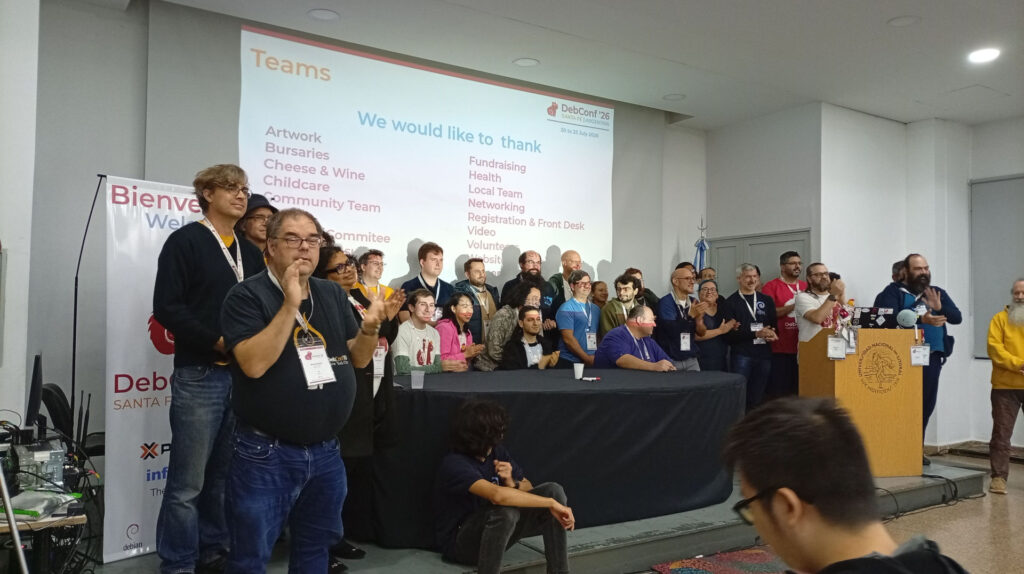
DebConf 26 organization, by Lucas Kanashiro, Santiago Ruano Rinc n, Stefano Rivera and Antonio Terceiro The 27th Annual Debian Conference was held in Santa Fe, Argentina, and several Freexian fellows were quite busy by being involved in the organization team.
  • Santiago continued helping with duties related to the local team, e.g. preparing or proof-reading some announcements, reviewing the proposed food and the menus for the different diet required.
  • During the conference, Kanashiro and Santiago also carried over tasks related to the content of the conference, including updating the schedule as it became necessary during the event.
  • Stefano worked within the core video team, setting up equipment in talk rooms and coordinating the live video streaming. Stefano also supported the front desk and local organisers as a website developer and conference book-keeper.
  • Antonio kept working on website maintenance, specially in support of the content team. During DebConf he also ran a hands-on workshop to help interested contributors get started with developing the DebConf websites.

d-i VLAN support, by Colin Watson In environments that use IEEE 802.1Q VLANs, some hosts (such as routers attached to trunk ports) may need to apply VLAN tags themselves rather than relying on switches to do so. There has been a long-running request to add support for these to the Debian installer with a proposed patch set put together by several people over the years, and a Freexian customer asked us to help get this over the line. Colin reviewed the latest version of the patch set, applied a number of corrections, added Netplan support, spent some time testing a variety of possible paths through the installer, and landed this. There s also now documentation for this in the next version of the installation guide.

Miscellaneous contributions
  • Carles wrote documentation for installing Mailman3 and migrating from Mailman2. Added it into Mailman3 upstream documentation.
  • Carles, using po-debconf-manager: reviewed 2 packages, submitted 2 packages
  • Carles organized Catalan translation update. Created a Debian Wiki page to have an overview of the work / coordination during next months. Reviewed and submitted some pages.
  • Carles improved the documentation for building the debian.org Web in MR 1154 and MR 1557. Fixed debian-reference documentation. Added sections on Mutt Wiki page (handling of mailto, viewing HTML parts web browser), update and improve bash-completion Wiki page. Added a troubleshooting section in Signal Wiki.
  • Thorsten did another upload of hplip to fix RC bugs. He also spent some time taking care of older bugs. Most of the time such bugs had been fixed in a previous upload but haven t been closed in the BTS. He also uploaded a new upstream version of foomatic-db. Last but not least, he gave some user support with the package epson-inkjet-printer-escpr. There seems to be a new software available for Epson printers. Unfortunately the license is not compatible with DFSG and so this software will never make it into Debian.
  • During DebCamp 26, the Golang team had a dedicated Sprint to transition the Golang toolchain (namely on dh-golang) to make builds aware of the module defined upstream with the aim of solving important issues. To help in these efforts, Santiago made changes in the Salsa CI pipeline and documented on how to use it to check if a package requires adjustments after the toolchain update.
  • Santiago continued co-mentoring Aryan Karamtoth on the Linux livepatching project, specifically providing feedback about the implementation of dlp-tools.
  • Stefano reviewed and merged a migration of Debian reimbursements from wkhtmltopdf to weasyprint, unblocking an upgrade to Debian trixie.
  • Stefano s cPython upstream merge request adding multiarch tags to stable ABI extensions was finally merged.
  • Stefano iterated on his upstream cPython merge request to add CI coverage for Debian s multi-arch expectations.
  • Stefano uploaded Python 3.15.0 beta 4 to Debian experimental.
  • Stefano uploaded Python 3.13 to trixie, fixing a regression in a previous trixie point update he made.
  • Helmut continued to report undeclared file conflicts.
  • Helmut sent patches for three cross build failures.
  • Helmut proposed a MR to port piuparts to pathlib.
  • Antonio has done quite some work on Debian CI, including rebuilding the Debian CI armhf/armel worker VMs, and releasing debci 4.2, implementing a backup scheme, and several improvements to the codebase such as improving the incus-lxc backend in preparation for switching to the upcoming switch to using it by default as announced in the latest bits from the ci.debian.net operators.
  • Emilio helped with transitions, particularly with Python 3.14 as default and Perl 5.42. During the Perl transition, an issue was identified with how britney schedules autopkgtests for binNMUs, and that testing was reverted for the time being.
  • Colin restructured openssh-* binary packages to better support the upcoming GSS-API package split. This caused several autopkgtest regressions in other packages because openssh-server no longer depends on openssh-client, all of which have fixes either pending review or merged now.
  • Lucas started a discussion around the creation of a Debian packaging video course for newcomers in the context of the Outreach team.
  • Lucas reviewed some contributions to ruby3.4 and provided feedback.
  • Anupa worked with Jean-Pierre Giraud on the point release announcements for Debian 13.6 and Debian 12.15.
  • Anupa joined Jean-Pierre Giraud to prepare the Micronews for DebConf 26 press coverage.

9 August 2026

Reproducible Builds: Reproducible Builds in July 2026

Welcome to the July 2026 report from the Reproducible Builds project! In our reports, we try to outline the most important things that we have been up to over the past month. As a quick recap about what problem our project intends to solve, whilst anyone may inspect the source code of free software for malicious flaws, almost all software is distributed to end users as pre-compiled binaries. The motivation behind the reproducible builds effort is to ensure no flaws have been introduced during this compilation process by promising identical results are always generated from a given source, thus allowing multiple third-parties to come to a consensus on whether a build was compromised or not. If you are interested in contributing to the project, please visit the Contribute page on our website. In this month s report, we cover:

  1. Tool development
  2. Distribution work
  3. Three new scholarly papers
  4. Patches
  5. Misc news

Tool development diffoscope is our in-depth and content-aware diff utility that can locate and diagnose reproducibility issues. This month, Chris Lamb made the following changes, including preparing and uploading versions 324, 325 and 326 to Debian:
  • Fix tests to work with zipdetails 4.0008. (#1141359)
  • Bump debhelper compatibility level to 13. [ ]
  • Update copyright years. [ ]
In addition, Paul Spooren made changes to allow trailing garbage in Gzip files [ ] and Vagrant Cascadian added an external tool reference for the pedump binary to use the mono package under GNU Guix. [ ]
disorderfs is our FUSE-based filesystem that deliberately introduces non-determinism into system calls to reliably flush out reproducibility issues. This month, Christelle Gloor added the option to sort by ctime as returned by the lstat(2) syscall. [ ], which Chris Lamb uploaded whilst bumping the Standards-Version to version 4.7.4 [ ]. Bernhard Wiedemann also updated disorderfs to version 0.7.0 in openSUSE.
Yet again, there were a number of improvements made to our website this month as well. For example, Chris Lamb, by request of Digital Ocean, changed the target of a referral link so that they can manage incoming referrers [ ] and pushed a number of changes to the Tools page [ ].

Distribution work In Debian this month, 32 reviews of Debian packages were added, 26 were updated and a total of 21 were removed this month, adding to our extensive knowledge about identified issues. A number of issue types were added by Chris Lamb, including:
  • python_towncrier_build_date [ ][ ]
  • log_files_installed_in_package [ ]
  • fontforge_varies_by_timezone [ ][ ]
Chris also added a further note for the build_date_in_manpage_generated_by_spf13_cobra issue. [ ]
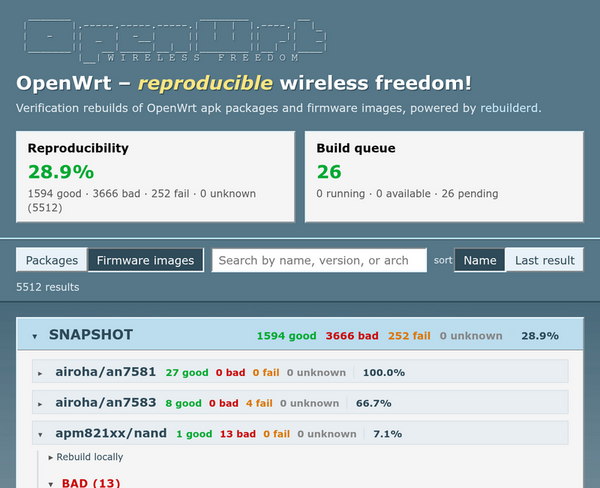
In addition, there is a new page showing verification rebuilds of OpenWrt APK packages and firmware images, powered by rebuilderd:

Three new scholarly papers Yan Li, Nan Jiang, Qihang Zhou, Shaowen Xu, Yamin Xie and Xiaoqi Jia of the Chinese Academy of Sciences published a paper titled VCAligner: Aligning Source Distribution Versions with Upstream Git Commits to Secure Supply Chain:
We present VCAligner, a content-based alignment methodology that constructs inverted indexes over VCS histories to precisely map released artifacts to their originating commits, independent of fragile version tags. We evaluated VCAligner on a dataset of 2,984 verifiable PyPI packages derived from the 4,000 most-downloaded projects linked to public GitHub upstreams. Our results reveal a critical weakness in conventional tag-based heuristics: while they appear effective on 85% of the dataset, the residual 15% failure rate generates a catastrophic downstream audit workload of over 10.3 million commits. In contrast, VCAligner reduces this burden by two orders of magnitude ( 158 ), bounding the total workload to under 65,000 commits. Furthermore, we provide the large-scale characterization of Packaging Noise, classifying artifact divergence into structural additions (Path Phantoms) and content mutations (Blob Phantoms), thereby isolating the distinct attack surfaces of malicious injection and code tampering.

Jens Dietrich and Spencer Sun from the Victoria University of Wellington together with Tim W. White and Behnaz Hassanshahi from Oracle Inc pre-published their paper No Snake Oil: Verifying Python Package Builds (PDF):
Python has become the default language for interacting with AI, with packages being distributed through registries like the Python Package Index (PyPI). This creates a need to analyse supply chains comprising such packages. One such analysis is to rebuild packages in order to identify compromised builds injecting malware. Independent rebuilds in hardened environments have the added advantage that they can generate and record provenance in order to increase the trustworthiness of packages. Two tools that are designed to automate such rebuilds and run them at scale are macaron and oss-rebuild. We study 12,180 popular releases from PyPI and find that the byte-for-byte equivalence rate is generally low. We analyse the reasons why they produce different wheels, and find that equivalence between the original and rebuilt wheels can often still be established, preserving most of the guarantees users expect from rebuildable releases. We present and evaluate daleq4py, a tool to establish the equivalence of Python wheels through the kernel of a normalisation function that is based on provenance-preserving datalog rules. Experimental results show that daleq4py substantially expands the set of rebuilds that can be accepted as equivalent. Although only 15.4% of macaron rebuilds and 19.1% of oss-rebuild rebuilds are byte-for-byte identical to the published PyPI wheels, daleq4py establishes wheel equivalence for 60.2% and 78.9% of source-equivalent rebuilds, respectively.

Denise Nanni, Julien Malka, Stefano Zacchiroli and Th o Zimmermann from T l com Paris together with Gabriele D Angelo from the University of Bologna pre-published their paper Understanding Build Reproducibility in the F-Droid Ecosystem (PDF), which was accepted at the 2026 ACM Conference on Reproducibility and Replicability:
The security of open source applications benefits considerably from the possibility of rebuilding their source and verifying the output. F-Droid, a prominent distribution for open source Android applications, systematically rebuilds them from source and tests their bitwise reproducibility at app publishing time. However, F-Droid offers no guarantee that app reproducibility will continue to hold in the future. As software ecosystems evolve, reproducibility may degrade, with potential negative consequences for software preservation and security. We present the first empirical study of build reproducibility in the F-Droid app ecosystem. Analyzing historical reproducibility logs, we find that the overall bitwise reproducibility rate has been steadily increasing over time (as new versions of apps are published). We then evaluate how reproducibility holds in time for fixed app versions, by attempting to rebuild 18 904 app versions that F-Droid had previously confirmed bitwise reproducible, published between September 2018 and February 2026, achieving an 83% rebuild success rate, and identify missing dependencies as the dominant cause of failure, accounting for 76% of non-rebuildable cases. Among successfully rebuilt apps, 94% are also bitwise reproducible-i.e., they still yield bitwise identical artifacts upon rebuild. Together, these results show that while bitwise reproducibility largely holds for apps that can be rebuilt, rebuildability itself is highly sensitive to temporal decay.

Patches The Reproducible Builds project detects, dissects and attempts to fix as many currently-unreproducible packages as possible. We endeavour to send all of our patches upstream where applicable or possible. This month, we wrote a large number of such patches, including:

Misc news On our mailing list this month, Colin Winter of Markovian Protocol wrote to our mailing list on the topic of Reproducible verification for retained logs:
Reproducible builds remove trust in the builder: anyone re-derives the same artifact from the same source, byte for byte. The same shape applies one layer over, to a retained record. Most record-keeping regimes (the EU AI Act s Article 12 logging is the current example) require that events be recorded and logs retained, but not that a retained log be verifiable, by a party who was not present, as unaltered and existing when claimed. That leaves an integrity obligation resting on trusting the party being audited.
(Full thread)

Finally, if you are interested in contributing to the Reproducible Builds project, please visit our Contribute page on our website. However, you can get in touch with us via:

6 August 2026

Gunnar Wolf: Subscription Bombing Email under Attack

This post is an unpublished review for Subscription Bombing Email under Attack
One of the most important inputs one can have when designing a response strategy against a security attack is a good characterization. This article describes a relatively newly described attack mode (subscription bombing), hypothetizes on the motivations that can lie behind it, and presents some countermeasures that can be taken by different actors to reduce its impact. At its core, suscription bombing is a classical reflection attack: it uses a third party service so that the answer to a relatively simple request is amplified and results in a distributed denial of service (DDoS) for the victim. And, as with most DDoS attacks, its effectivity lies in that there is not much a person can do against traffic coming from seemingly random different providers all around the world. The core differentiatof for subscription bombing is that the attack s victim is not a network port, but an individual s e-mail address. The attacker builds a database of service providers that allow interested users to sign up for newsletter on their activities, or a mailing list, or even just to create a new account on a given Web system. This action will generate a (seemingly legitimate) confirmation mail sent to the victim. But the attacker scripts together hundreds of thousands of such request, creating a deluge of confirmation mails sent to the unsuspecting victim. The authors explain the goals an attacker might pursue by performing this kind of attack. They suppose this can be due to harassment (a disgruntled employee being denied a salary raise, a political adversary, or even a romantic ex-partner wanting to inconvenience the victim s use of their e-mail). More worryingly, the attack can be used as a distraction: by sending a high volume of mails in a controlled timeframe, the attacker can reduce the probability of the victim noticing a specific attack warning them of, i.e., financial fraud, unwanted purchases, or break-in attempts into their accounts. Attacks targetting mailboxes at private mail servers can also lead to overloading an account s limit, causing it to reject mails after the attack is delivered and before the folder is cleaned. And it can also pave the way for follow-up, targetted deception attacks, where the attackers call the victim pretending to be the company s IT department, and get them to install a remote desktop monitoring and management tool, with which they can effectively seize control of the victim s data. To do this, they present a study they made over 24 cases of victims, from which 47,970 total e-mails were received between October and December 2024, with individual attacks receiving between 81 and 3,387 e-mails per hour, from where they presented several descriptive analysis. The authors explored cyber criminal s offers on underground websites, comparing flooding services and pricing schemes. Finally, mitigation strategies are discussed. Mitigation is quite problematic, as none of the mail servers is acting in either a hostile way or lacking permissions they are performing just the task they should. The authors suggest four mitigation strategies for mail server operators to reduce the burden on their users, although none of them is easily automatizab (rate-limit the number of emails a given inbox can receive from previously unseen senders; educate users about this kind of attacks; group similar newsletter or account reset mails during active attacks; and automatically unsubscribe or bounce newsletter messages when a surge is detected). They also recommend newsletter providers and services accepting the unrestricted creation of user accounts to provide some hardening to increase the effort wrongdoers need to spend to abuse their services, such as requiring CAPTCHAs or requiring users to take several steps before requesting a subscription, although they recognize this adds friction to the process providers are most interested in providing; filtering and triaging known-good and known-bad domains, although this is hard to implement on a preemptive fashion, and adhering to easy unsubscription standards, such as easily identifiable headers with which mass unsubscription could be performed more easily victims, instead of hunting for the right places to click, potentially even in mails written in an unknown language. The described problem is interesting, and properly tackling it can be a game changer for many users who will suffer this kind of abuse, and the article is easy to read and soundly supports its claims.

4 August 2026

Dirk Eddelbuettel: #058: Reverse Dependencies Made Easy, Fast, Reliable

Welcome to post 58 in the R4 series. R and the CRAN repositories maintain a very high level of what we might call quality assurrance by requiring that newly-added code does not break any existing dependencies. This is frequently called a reverse-dependency check . For any given CRAN package one can quickly determine it reverse dependencies. Calling tools::package_dependencies(pkgName, reverse=TRUE) will for a scalar or vector-valued argument return a named list with the reverse dependencies. It is then a matter of looping over this list. There are helper functions in base R as well as in contributed packages on and off CRAN. I also wrote my own with package prrd which, while possibly a wee bit specialised and under-documented has served me well to check on Rcpp and related packages which can indeed have a large number of reverse dependencies. I recently looked into one of these contributed runner packages, and while I will refrain from naming its implementation language let me just mention that the term cargo cult may be a real thing here. What go me interested in this was the fact that if one has a simple-to-use runner then the fact that r2u makes it fast, easy, reliable: pick all three (to borrow its slogan) to deal with actual depencies if Ubuntu has indeed been selected as the host. We will maintain the position that if you can in fact integrate with the system-wide package management then any alternative per-repo package management approach not doing so will likely be dominated by an approach that does integrate with the system facilities. Which is what precisely what r2u does, and offers. And why it is used enough to by now have shipped eighty eight million binary packages. So I tested it for the reverse-dependency check task. What I learned by looking into the (much more complicated) runner was that it at the end of the day it hands the actual task of running the reverse dependecies off to a helper function rev_check that is part of the xfun package by Yuhui. I quickly found that besides xfun we would also need its suggested dependency tinytex which in turn would error unless the tlmgr binary was present. So as the sole requirement (on an Ubuntu system with r2u) turns out to be
$ apt install r-cran-xfun r-cran-tinytex texlive-base
where we do it all in one apt call (as root in the container). (Given r2u we could also call install.packages(c("xfun","tinytext")) followed by apt install texlive-base but it is simpler for this setup step to be just one call). With that we are basically done. I did this (twice) using a rocker/r2u container with r2u preinstalled, mounting a local work and scrap directory for the container. In it we expand the package to be tested (i.e. tar xaf pkgName_*tar.gz for a given source package pkgName from CRAN) and then just call with the package name and expanded direcrtory. I.e. I used this call to test my package AsioHeaders (which has just three reverse dependencies) to both name it and to point to the expanded source directory created for this purposed:
> system.time( res <- xfun::rev_check("AsioHeaders", src="AsioHeaders") )
## ... earlier output omitted for brevity here ...
   user  system elapsed 
 35.732   3.333 149.683 
> res
   httpgd ipaddress websocket 
        0         0         0 
> 
and about a good two minutes later I would get the timing result and the summary in variable res. As I checked the current CRAN version, the check was as expected free of concerns or issues. To support this, r2u did indeed go off and install about sixty seven binary packages (and the total includes all binary dependencies fully resolved) delivering on the just works promise by the r2u documentation. As another check, I did the same for RcppAnnoy which has seven reverse dependencies and needed about two hundred CRAN packages to be installed. The full test took just over four minutes with the timing function reporting some nice gains from parallelisation as total user compute time was on the order of just under eight minutes. Again, test results were clean and free of worries as expected:
> system.time( res <- xfun::rev_check("RcppAnnoy", src="RcppAnnoy") )
## ... earlier output omitted for brevity here ...
   user  system elapsed 
471.765 378.220 266.855 
> res
   bbknnR  bigANNOY  blocking     scDHA    Seurat      uwot VectrixDB 
        0         0         0         0         0         0         0 
> 
Overall this was a rather useful quick excursion as it demonstrates that - existing functions can be used to orchestrate a reverse dependency check - with reasonable dependency scale we can do this on a single machine quite easily taking advantage of parallel computing on multi-core machines - using r2u gives us fast, easy, reliable package installation making testing of packages we might not otherwise use or know a breeze - doing this in an ephemeral Docker container facilitates easy build-up of required resources and leaves no side effects behind which might affect our normal development environment

This post by Dirk Eddelbuettel originated on his Thinking inside the box blog. If you like this or other open-source work I do, you can now sponsor me at GitHub.

Anuradha Weeraman: Plan 9 from Bell Labs, the little OS that could

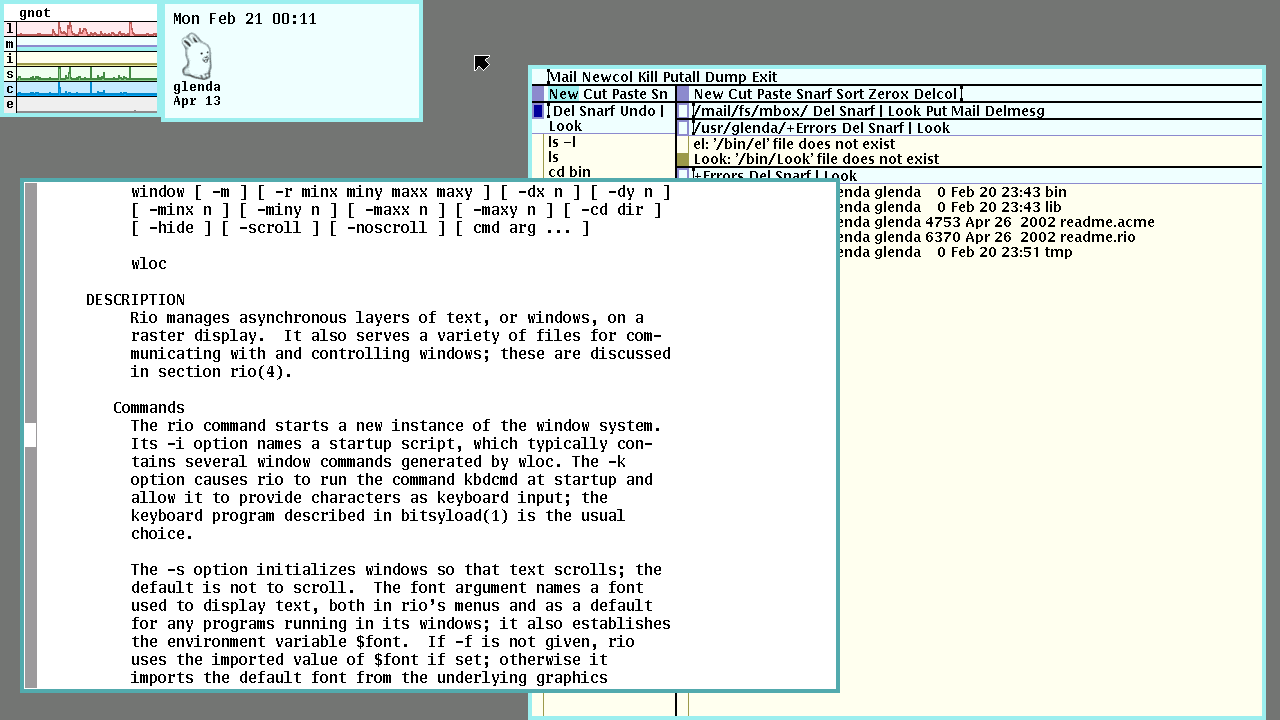
Plan 9 Fourth Edition showing the rio windowing systemScreenshot by VulcanSphere via Wikimedia Commons MIT License
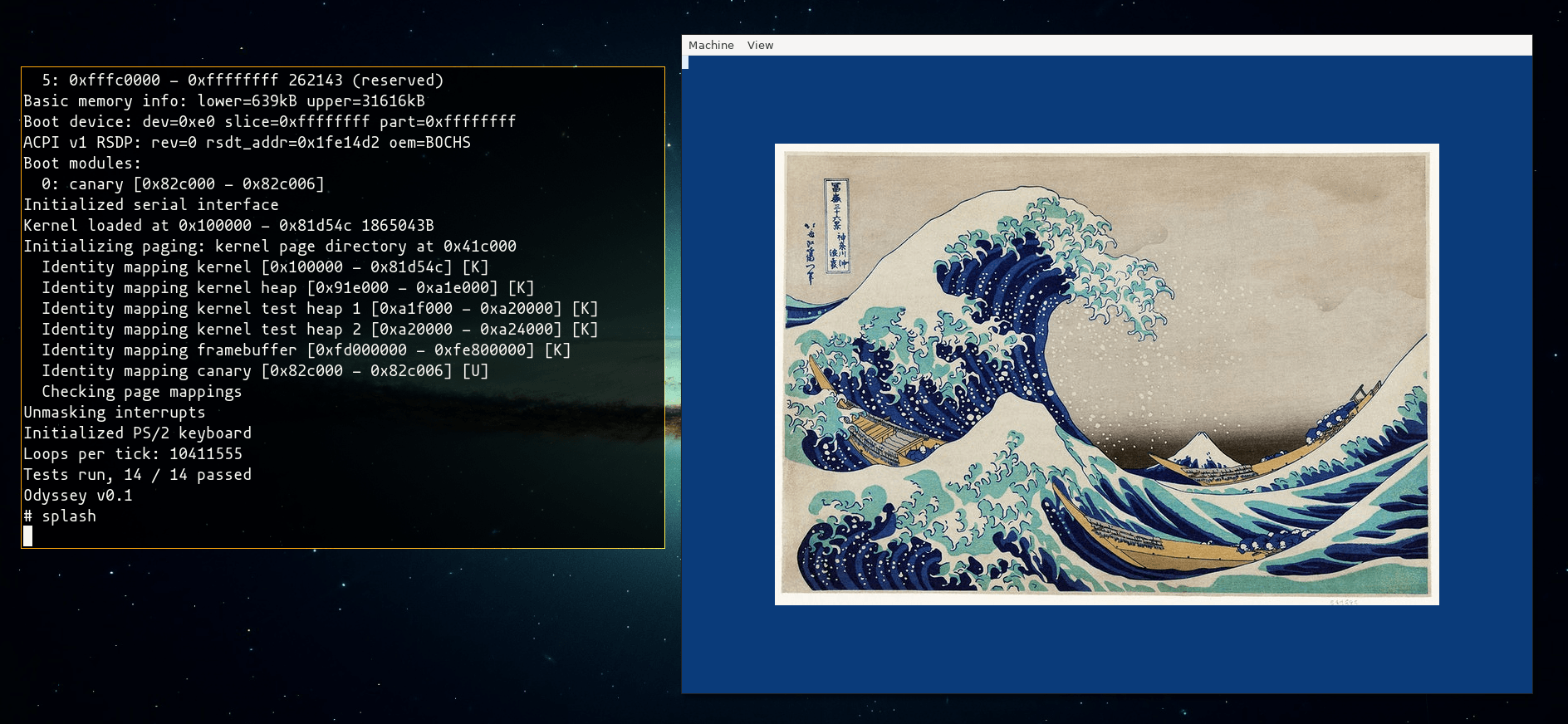
I first heard of Plan 9 from my friend Vajra in 1999 or so, as we were distro-hopping on early Linux distributions and trying to find our way. Vajra is now a Nebula Award-winning science fiction author - have a look at his work. We had just been through Tom's Root Boot, a UNIX-like operating system crammed into a single floppy, and through it discovered a whole new world outside of DOS 6.22. Combing through old UNIX manuals, we went in search of the perfect OS, through Slackware, Caldera, TurboLinux, SUSE and Red Hat. I finally settled on Debian, which lived up to everything I stood for. Plan 9 was distinct. It came out of the Computing Sciences Research Center at Bell Labs, built by Rob Pike, Ken Thompson, Dave Presotto and Phil Winterbottom, with Dennis Ritchie heading the department. The name is a joke at their own expense, borrowed from Ed Wood's 1959 Plan 9 from Outer Space, routinely nominated as the worst film ever made. Thompson and Ritchie had, of course, built the original UNIX; it almost seemed as if they were building a new OS from the lessons learnt from building it - which was in turn built on the lessons from Multics. I remember the awe I felt playing around with Plan 9, and I've not been able to replicate it since. Plan 9 was different in a couple of fundamental ways: per-process namespaces, and a protocol that abstracted locality of resources to processes. As a consequence of these core primitives, the OS surface area was distinctly small. The entire system from the core kernel, to the system call interface, to the compiler, linker and shell was reduced to a form small enough that a single developer could hold it in their head. Lessons from the implementation of UNIX helped the designers make the system leaner, and in Ken Thompson's words, it's the "best operating system out except that it doesn't have the apps that everybody demands" [1]. It also took the concept of "everything is a file" in UNIX to a whole new level. The network stack is a filesystem (/net), processes are files, the display is a file (/dev/draw). Because every resource speaks 9P and every process has its own namespace, you can mount another machine's /net into your namespace and your program makes network calls through that machine's stack without knowing or caring. No sockets API, no RPC layer, just ordinary file system operations through a simple system call interface. Some would say that OS research is dead, and that backwards-compatibility and POSIX killed it. Rob Pike himself argued as much in his 2000 talk, "Systems Software Research is Irrelevant" - but we didn't care at the time. There was so much happening that we didn't have time to take it all in. And then Linux happened, and Software Freedom became a focal point (more on that in a later post). In the summer of 2020, with the world deep in Covid lockdowns, I decided to build a toy operating system, just to try my hand at the the thing that I had always wanted to do. I spent three feverish months working on Odyssey and, looking back, it is perhaps the most fun I have ever had. I would not dare compare it to the magnum opus that is Plan 9, but it gave me perspective: how hard it is to build an OS from scratch, and above all, how fun it is to build an OS from scratch, and why the original creators kept coming back to the same problem. The highlight of those three months was booting the OS and watching it render "The Great Wave off Kanagawa". Nothing in my professional achievements to date captures what that meant to me.
Odyssey rendering The Great Wave off Kanagawa during boot Odyssey displaying "The Great Wave Off Kanagawa"
Decades on from the first time I booted Plan 9, I look back with nothing but awe and respect for the creators of this little operating system and marvel at the foresight that went into it. While many readers will not have heard of Plan 9, they have almost certainly worked with the ideas that came from it: 9P (if you ever used the Windows Subsystem for Linux), UTF-8 (if you ever used any modern operating system), per-process namespaces (if you've ever run a container), Go (whose assembler still uses Plan 9 syntax). Plan 9 still lives on in 9front, a community-maintained fork. Separately, Yoann Padioleau [2] has produced a set of annotated books at principia-softwarica.org, presenting the Plan 9 source in the spirit of Donald Knuth's literate programming - an admirable effort to introduce new readers to the art of operating systems engineering. Pike thought systems research had become irrelevant, and Thompson thought Plan 9 would never "make it" [1]. Both were right about the industry, but may have been pessimistic about the impact. The system lost as a product but won as a set of ideas, assimilated one at a time by modern operating systems. Success is not always measured by popularity. The mark that Plan 9 left behind is greater than what's reflected in its current user base. To me, Plan 9 will always be the OS that punched above its weight class, the little OS that could. References [1] Ken Thompson Interview, March 6, 2024 [2] Yoann Padioleau Principia Softwarica, May 9, 2026

3 August 2026

Bernhard R. Link: I learned something new about URLs today

Today I stumbled over some behavior that I found quite surprising:
$ ipython3 -c 'import httpx;print(httpx.URL("https://example.com/foo/bar/../../baz"))'
https://example.com/baz
Even more surprising that behavior is actually standards-compliant, even mandated by RFC 3986. The underlying motivation is relative reverences. If some resource reachable by "https://example.com/foo/bar" references another resource relatively as "../../baz" then this is of course the intended result. Getting from this problem to what RFC 3986 suggests might be surprising in the result, but somewhat understandable if you look at the consequences of that problem: Giving the path components ".." (and ".") special meaning at the start of the relative reference means that if you allowed them in absolute URLs those would be impossible (or at least very convoluted) to address as relative URLs. So RFC 3986 describes a way to handle them everywhere: Just join the path of the base URL and the path of the relative reference and normalize the result. Or normalize the absolute on either side if only that is to be taken. This makes things very convenient: Multiple reference URLs can just be joined without special handling for relative references starting with dots, making writing applications handling them easier. Programmers don't have to care how to handle relative references and can just join everything in whatever way they want. For maximum elegance there is still some corner case left: What happens if an absolute URL has a path starting with double-dot components? Or an relative path starting with more of them then the base URL's path has components. You just ignore them:
$ ipython3 -c 'import httpx;print(httpx.URL("https://example.com/../../baz"))'
https://example.com/baz
With that last point every URL is valid and has well-defined meaning. Handling relative references and relative paths is very easy and convenient. So this shows a high regard for simplicity, elegance and convenience. And a total and uncompromising disregard of security. After all the most convenient it is for an attacker; If they are allowed to supply a path component for a request a system does in their behalf, then they can easily escape anything they were supposed to be limited to. The ignoring of dots at the start means they don't even have to know exactly how deep their request is:
$ python3 -c 'import httpx;print(httpx.URL("https://example.com/public/api/public/resources/harmless/../../../../../../../../../internal/data"))'
https://example.com/internal/data
So even if the resource server securely handles request (unless you consider not having any way to lower your permissions for one request to a specific subset), your fully RFC conforming client library will already request the permission they should not have permission for. Even worse dots are usually not characters you can easily forbid so once slashes are to be allowed things get complicated. There also would have been a simple, elegant and secure way: Consider every path element ".." or "." in an (absolute) URL an error. Define a reference resolution that allows the relative reference to only start with "./" or one or multiple "../" and consider every appearance of a dot or two dots as path components after than an error. Everything joining two paths has to either use an implementation of that path joining algorithm, but only if they want to joins paths in the potentially dangerous way allowing leading "../". Otherwise they can just use the normal join and even if an attacker gets those dots that will just cause the generated URL to be rejected as invalid. Of course using a secure implementation is now even more inconvenient thanks to RFC 3986 being around: If you have no control over the generator of relative references, it is always possible that they generate relative references with ".." components after non-dot components. And if you check all code to properly filter out "/../", keep in mind that convienence does not stop there. After all it is not unheared of for server implementations to helpfully normalize unicode characters, too, or translate them to their nearest ASCII equivalents. Or translate percent escaped characters back before doing path splitting. Or you might think there was some unicode codepoints between those two dots, but they that those were some meaningless control characters that can be omitted. So you need some really restrictive allow lists...

John Goerzen: Celebrating 45 Years of Kermit with the First New C-Kermit Release in 15 Years (and working with a decades-old C codebase)

1981 was a different time for computing. It was expensive (both hardware and software), and it was far from a given that machines from one vendor would be able to talk to those from another. In fact, Columbia University had just such a problem, so in 1981, Frank da Cruz and Bill Catchings designed a serial protocol they called Kermit. Because of the many quirks of the DEC-20 and IBM mainframes, the Kermit protocol was highly adaptable from the start: able to handle systems that had trouble processing more than 96 bytes of data at once, able to transfer 8-bit files over 7-bit links, able to translate between character sets (ASCII and EBCDIC then; now also various Unicodes), and of course, handling of error-prone serial links. Kermit spread rapidly; by 1982, Kermit had been ported to MS-DOS and Unix. Eventually, C-Kermit (an implementation of Kermit in C) became the flagship Kermit. It gained TCP support, an interactive CLI, a powerful scripting language (with features from the shell, Lisp, and expect), and optimizations for today s high-speed links, such as jumbo packets, sliding windows, and streaming modes. Along the way, Kermit flew on the International Space Station, ran data collection from sensors during hurricanes, and many other uses including postal systems, Boeing 787 manufacturing, and more. Today, I use it as a powerful ssh wrapper (letting me easily transfer files through multiple nested ssh, sudo, su, etc. commands), a BBS client, to exchange data with me HP 48GX calculator, and so on. It s also used today to transmit firmware updates to embedded devices. And, of course, anyone that works with vintage systems is likely to use Kermit at some point. It wouldn t be until the late 1990s that the TCP/IP stack was finally adopted by most OS vendors, establishing something of a common basis for communication. Of course, we assume this today. Though transferring large files between OSs (say, Linux, Windows, MacOS, Android, iPad, etc.) is still a challenge, even though they all speak TCP/IP! I find that the easiest way to get large files from two computers is to spin up Kermit (see ckwin for a Windows fork of C-Kermit) and just set up a TCP connection over the LAN. In fact, I added a new show interfaces command in C-Kermit 11, making it easy to see your system s local IPs. For most of its history, Columbia s Kermit project was self-funded. Columbia charged for commercial use, which limited its inclusion in Linux distributions. In 2011, 30 years after its founding, Columbia canceled the Kermit Project and released C-Kermit as Open Source under a BSD license. Frank da Cruz, who had still been working with the Kermit project all those years, volunteered to continue maintaining Kermit outside Columbia, and continued development with alpha and beta releases through his retirement from the project in 2025. I dive into this C codebase As Debian maintainer of Kermit, I noticed some areas where it wasn t matching modern expectations. One area was, not surprising for a project of its age, security. Another area was that its character set or line-ending conversions are usually not desired now; we are used to byte-identical binary transfers, and the defaults caused confusion and even some rare instances of data corruption. So I started making a few patches last year. I ve worked with old C codebases before, such as Varnish. I ve generally hated it. You usually find a mix of bad and terrible practices, unclear memory management, and so forth. But I ve been living in the C-Kermit codebase for a few months now, and I enjoy it. Yes, this thing is still designed to build on VMS, OS/2, and with compilers that haven t heard of ANSI and those that require modern practices. (That em-dash was mine; I knew how to use them before LLMs existed and I m not going to stop just because LLMs have copied people like me! No AI was used for this post.) The there is an elegance in all of that. As I worked, I fixed a bunch more potential security issues, both with memory safety and with protecting against a malicious remote in roughly the same manner that some patches to scp did a few years back. I added IPv6 support, of course conditionally compiled because some systems C-Kermit builds on have never heard of IPv6 and never will. (And, of course, with fallback algorithms at runtime for systems that have IPv6 support but not IPv6 connectivity.) I added unit tests and Python-based end-to-end tests, running nearly 2000 test cases in total. Along the way, I found and fixed a number of bugs going back decades. I learned about FIONREAD being broken on macOS, about NetBSD s bugs in the pty driver, and fixed bugs in the Kermit protocol implementation itself. I added compatibility tests with the gkermit and ekermit (embedded) implementations, as well as the last full release, C-Kermit 9.0.302 from 2011 (which was difficult to get compiled on a modern system). There is an extensive changelog describing all the improvements in C-Kermit 11. C-Kermit development had never really used a VCS at any point, though Kermit veteran Jeffrey Altman imported historical releases into a Git repo, along with some patches that hadn t made it into a release (which I also pulled in.) There was a lot of disabled code behind COMMENT, along with commentary describing why it was no longer used. With Git, we would now generally just remove the old code and explain why in a commit message. I went through and did so with a lot of it, meaning that, at last check, C-Kermit actually has fewer lines of code now than it used to. Towards a new release It became apparent pretty quickly that I was making more changes than would make sense as a Debian patch series. Not only that, but they would be more widely applicable to more than just Debian and Ubuntu users. As Linux and BSD distributions were running everything from the last non-beta release (2011 s 9.0.302) to the last beta release (about 1.5 years ago), depending on their different policies about running betas, even sharing patches in a useful fashion was going to be quite difficult. So, I spun up a project at Open Kermit to coordinate future development in the open and keep Kermit going. With modern CI, I run that test suite on Linux (x86_64 and arm64), macOS, FreeBSD, NetBSD, and OpenBSD. It builds binary releases on all those platforms, plus a statically-linked Linux binary built with musl libc. You can download the latest C-Kermit release, and of course contribute to C-Kermit and its website. Dedication Frank da Cruz was directly involved with Kermit for 44 years. I m not aware of any other Open Source project founder being involved for so long. Richard Stallman started working on GNU Emacs in 1984, 3 years after Frank started working on Kermit, but Richard hasn t been in that role since around 2008. Accordingly, C-Kermit 11 bears this dedication:
I dedicate this release of C-Kermit to Frank da Cruz. Frank was directly involved with Kermit for 44 years, from its initial design in 1981 all the way through 2025. He maintained Kermit as an Open Source project after Columbia University ended its sponsorship. I know of no other Open Source project where the founder remains so personally involved for so long. When Kermit was begun, transfers between different hardware and operating systems were difficult or impossible. Frank helped build a bridge. Kermit glued systems together, from the International Space Station to pocket calculators, and set a new standard for interoperability. It continues to do so. Kermit is still one of the quietly-working pillars of computing today, enabling everything from firmware upgrades to radios. And, yes, it still reliably transfers files over serial lines. As we start to spend a lot of time in the Kermit codebase, we do so standing on the shoulders of a giant. Thanks, Frank, for your decades of work on Kermit. John Goerzen, July 2026

2 August 2026

Russ Allbery: Term::ANSIColor v6.0.0 TRIAL release

Yesterday, I uploaded Term::ANSIColor v6.0.0-TRIAL to CPAN for early testing. This release will raise the minimum required Perl version to 5.12, dropping support for Perl 5.8 and 5.10. When I did the same with podlators a couple of years ago, it upset a few people and one of them asked me to make this sort of test release in the future. Hopefully this will help. I have not run the normal release machinery and haven't archived this release in the normal places, since I intend it to be transient. It's only on CPAN, where people can retrieve it for testing. Once v6.0.0 is released, few traces of this TRIAL release will be left. This doesn't appear to be how other people use the TRIAL mechanism, but it felt more comfortable to me. If I have to make substantial changes, I'll consider changing my approach. I plan on turning this into the v6.0.0 release in about a month or two, hopefully with only documentation changes. Term::ANSIColor is a "very upstream" core module with a lot of dependencies, and CPAN (unlike some of the archives that followed it, such as PyPI) doesn't support conditionally retrieving packages based on the current Perl version. This release may therefore be disruptive for people who are still trying to support Perl 5.8 and 5.10, since CPAN installation tools may attempt to install an incompatible Term::ANSIColor version. I'm sad that this will be the result, since I know some people still care about those versions. I'm pressing forward with updating my Perl modules anyway, though. I realized that honoring other people's desire for stability to such a degree that I was unable to use Perl features added more than 15 years ago was destroying my motivation to work on these Perl modules at all. So I've decided on a very slow and gradual approach where I'm going to keep pushing the minimum supported version forward but try to give people a lot of warning. Personally, I think it's time to let ancient versions of Perl go and follow the Lyon Amendment about supported Perl versions. When we're talking installing new modules for software released more than 15 years ago, we're talking about special limited environments and retrocomputing more than what I would consider routine software maintenance. Those tasks should expect to need different tools and a different workflow so that they can pin historical versions. Since this isn't something I'm personally interested in, my willingness to expend time and energy to assist is limited. As you can probably tell, I still feel nervous about pressing forward in this way, but I think this is the approach that lets me continue to enjoy maintaining these Perl modules. It's been 29 years for Term::ANSIColor, but I still enjoy fixing bugs in it and putting out a new release from time to time, particularly if I can clean up the code a bit each time I touch it.

31 July 2026

Russ Allbery: Review: Painting the Blues in Gretna Green

Review: Painting the Blues in Gretna Green, by Linzi Day
Series: Midlife Recorder #2
Publisher: Linzi Day
Copyright: November 2022
ISBN: 9798360228431
Format: Kindle
Pages: 577
Painting the Blues in Gretna Green is a self-published fantasy novel and the second in the Midlife Recorder series. It picks up immediately after the end of Midlife in Gretna Green. I also read it almost immediately after, so I didn't pay attention to how good the recap of previous events was. As before, this is urban fantasy except not urban. Day calls it paranormal women's fantasy, which I suppose is as good of a genre label as any. The other book I can think of off-hand that would go into that genre would be Nancy Springer's Larque on the Wing, although it is considerably more literary. I suspect I'm going to read this whole series and it's going to be impossible to review these books without talking about Niki's job, so I'm not going to treat that as a spoiler. It's fairly well-advertised in the marketing for the book, so that feels justified. If you're particularly averse to any spoilers, though, you may want to stop reading here until you've gotten to the reveal in the first book. Niki is now officially the Recorder, with the power, advice book, and sentient house to go with it. She's about to face her first test in managing interworld politics: There's something amiss in the world of the Picts. Her allies are dropping hints, there's a petition from a group on the Pict world that she can't make sense of, and although she likes the queen of the Picts, there is a great deal of tension beneath the surface that she doesn't understand. Meanwhile, after the incompetent disaster that she uncovered in the first book, Niki is determined to pick her new staff by her own criteria. The second book leans even harder into giving Niki both a tangled mess created by previous incompetence and enough power to fix it. Watching that happen is very satisfying, particularly when it involves surprising people who are rather too used to getting their own way. I was somewhat less convinced that Niki is getting the right training to make the decisions that she's making. Diplomacy and staff management are real skills that one needs to learn, not just wing on vibes and gut instinct. My love of competence porn occasionally wishes that Niki had a bit more structure around her competence. We do at least get a new fictional self-help book on how to rule that contributes the quotes that open each chapter. Not the ethics and management training that I would have chosen, but it's something! In defense of Niki's technique, it becomes clear in this book that the last few recorders have been far too cautious, conservative, and content with a status quo that involved a minimum of work. One of the delights of this book is that Niki thinks power exists to be used to fix things and is determined to use it, not just sit on it. I had more suspension of disbelief issues with this book than with the first some of the problems Niki is solving seem far too obvious to have been in stasis for this long while also having this easy of a solution, and the level of political power given to the Recorder is a bit unbelievable but it is so satisfying to see Niki cajole and bully people into being sensible. I have no idea if this is intentional on Day's part, but I will not be at all surprised if adult-diagnosed ADHD comes up at some point in this series. The way that Niki's focus jumps, her tendency to veer between focusing on a problem and forgetting about it, and something about the way she switches between trains of thought or misses important context because she's jumping to conclusions is making me wonder. This, to be clear, is not a complaint; I think it makes Niki more relatable and more interesting. It's a good thing that she has a sentient house to serve as her assistant. The glee with which she's delegating any task that involves keeping track of details or following up with other people feels like a bit of an indicator by itself. I did get a bit frustrated with the plot structure of this book. Niki keeps mentioning that a critical petition submitted to her office makes no sense, but it takes half of this (rather long) book before she finally explains to anyone else, even the reader, what's deficient about it. The excuse within the book is that she's having a rather busy day, but by the third time Niki mentions and then fails to do anything about the petition, I was wishing Day would stop bringing it up until she was ready for that part of the plot. This, as with a few issues in the previous book, feels partly like an editing problem. There is something joyful in indulgent, sprawling books, but only up to the point where they become repetitive. Painting the Blues was right at that line, and once again I wish someone had helped Day trim about fifty pages out of it. All that said, and despite having more quibbles with this book than the previous one, this continues to be great fun. It's satisfying wish-fulfillment about fixing long-standing problems and having the power to not have to put up with abusive nonsense and ridiculous bullshit, and I am so here for that. I hope Niki realizes she's eventually going to need more refined skills than a heart-to-heart over wine, but she's learning on the job and I'm happily along for the ride. She's also capable of recognizing skill in other people, and that goes a long way. Recommended if you liked the first one and are in the mood for another fantasy of "no, we're not going to leave it that way, we're going to fix that right now." Followed by Ties that Bond in Gretna Green. Rating: 7 out of 10

Otto Kek l inen: Estonia, the country of the fit and the wit

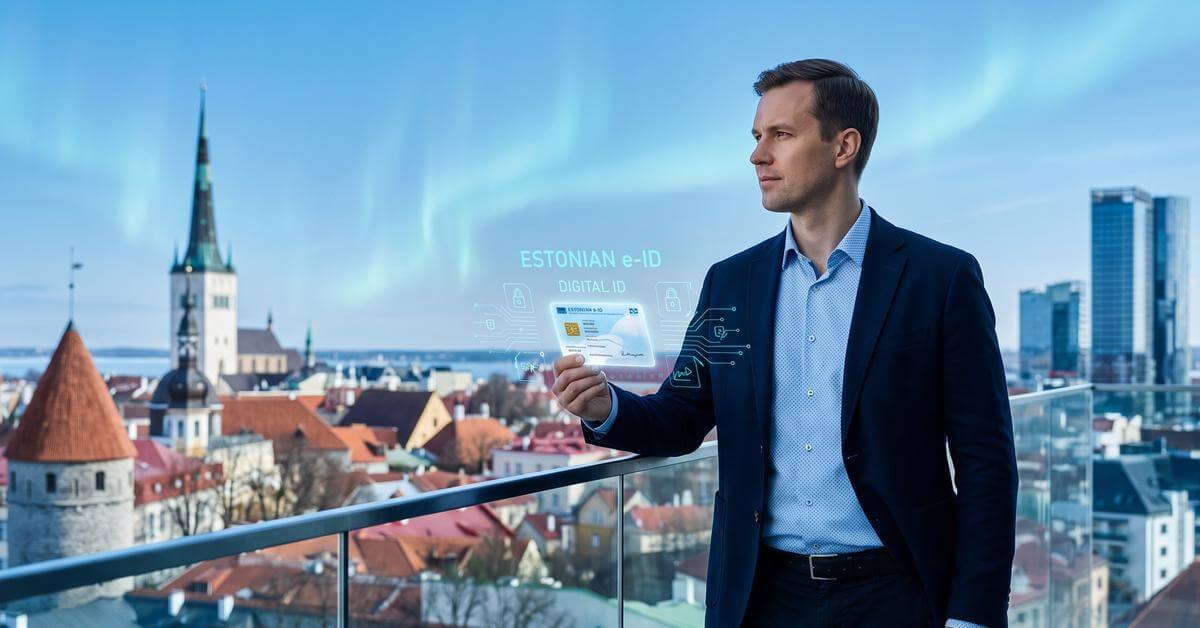
Featured image of post Estonia, the country of the fit and the witWhile many Western democracies seem to be in a state of decay and are no longer the safe, civilized and prosperous countries they once were, there are still some European countries that are governed well. One of those that stand out is Estonia. Estonia is probably most well known for multiple software companies that originated from there, such as Wise, Bolt, Pipedrive and Skype. The government itself is also famous for being early in issuing government IDs with an embedded smart chip for online authentication already in the 1990s. Via the national portal at eesti.ee all residents can access extensive eServices ranging from viewing their health benefits to filing taxes. Estonia has also been running an e-Residency program since 2014, where they issue digital ID cards to foreigners, making it easy for them to remotely log into the government portals and for example, establish businesses, file annual reports and so forth. Note that the e-Residency is not a path to physical residency. Estonia does, however, have a separate Digital Nomad visa program that makes it easy for non-EU citizens to also physically establish themselves in Estonia, assuming, of course, you meet the criteria, which includes, among others, a minimum monthly income of 3960 from outside Estonia. EU citizens naturally have free mobility inside the EU and can simply get an apartment and register as a resident in Estonia if they so choose. And there are plenty of reasons to do so.

Estonians value health, education and entrepreneurship I moved to Estonia about one and a half years ago. In my observations Estonia strikes me as a country that values health, education (in particular programming and natural sciences) and entrepreneurship highly. I don t know how Estonians achieve it, but they look pretty fit and rarely obese. Estonia has rye bread and sauna in their culture just like Finland, and in addition the flat terrain and well-planned bike routes and extensive network of parks (and pull-up bars everywhere) seem to create an environment where it is easy to live in a healthier way. The consumption of processed foods and candy also seems relatively low among Estonians. The gym chain MyFitness also seems to be present everywhere. Even the Tallinn airport has a calisthenics workout station right at the departure gates, which anyone is free to use while waiting for their flight to take off. One of the top longevity influencers in Europe, Siim Land, is Estonian. Estonia has lots of good bike paths, parks and outdoor gyms There is even a calisthenics station with pull-up bar and more at the departure gates at Tallinn airport Estonians also seem to value the school system highly. The government has been actively raising teacher pay and has a stated goal of reaching 120% of the national average by 2027. The students are also expected to value the education and respect their teachers. According to the TALIS 2024 survey (OECD s international teacher survey), Estonian teachers spend significantly more time on actual teaching and learning and waste less time on interruptions or keeping classroom order compared to the OECD average. This is among the highest rates internationally, meaning they spend relatively little time on maintaining order or dealing with disruptions. While the international education benchmark PISA scores have been dropping globally, Estonia has consistently been climbing the ranks in past decades. In the latest PISA study (from 2022), Estonia ranked number one in Europe for reading, mathematics and science. In the overall results, Estonia ranked seventh globally, only behind countries such as Japan, Korea and Singapore. Valuing entrepreneurship is evident in how the taxation system is set up in Estonia. Famously, in Estonia, companies can defer taxes on annual earnings and reinvest all of their profit in growing the company. Taxes are due only later, when paid out from the company, for example as dividends. For individuals, receiving dividends from any Estonian or foreign company is tax-free as long as the company paying dividends already paid corporate tax on the same income. The tax system is also very simple. For all individuals, all types of income, including salary and capital gains, are always taxed at a flat rate of 22%. This removes the incentive for anyone to try to convert income into different types, setting up holding company structures and other optimizations as there is no gain. All entrepreneurs can simply focus on growing their business and forget extra bureaucracy. There is also no marginal tax rate cliff to stop working at everyone is encouraged to always try to produce as much value as they can. A simple tax system is also reflected in the fact that anyone can easily read all tax rules that apply to individuals in plain English on the Estonian tax authority website, and one does not need to hire any accountants simply to file taxes. Estonia also has a very straightforward investment account system: any person can freely open a self-directed investment account at any brokerage at no extra cost and report it as such to the tax authority, and then use it to save for an apartment, retirement, or other purposes, and defer all income taxes until withdrawal. There are no caps or time limits, and all residents are encouraged to save and invest as much as they can and thus take responsibility for their own wealth accumulation. It seems that culturally Estonians respect people who are active and progress in their careers and businesses more than in other countries. Unlike in Finland, successful people are admired and living on government welfare is not romanticized. At the same time, the government benefits are less generous so people can t live comfortably on them and, for example, many of the asylum seekers Estonia accepted have since left on their own initiative to other European countries in search of better benefits.

Low crime, high trust Another thing that strikes me when walking the streets of Tallinn is that there are no drug addicts, beggars, thugs or the like. The difference compared to, for example, Vancouver (where I lived previously) is stark. In public buildings, people leave their coats and bags hanging in the lobby while visiting. Private houses and apartment block yards are not fenced. In my building, I noticed people even leave their bikes unlocked in the bike shed. I have also seen the staff of a coffee stall in a shopping mall going for a break and leaving everything unattended, not worrying that anyone would take anything while the staff is away. Nobody is stealing anything from the unattended coffee shop while staff is having a break at  lemiste shopping mall This is not just my personal experience. According to the Numbeo crime index, Estonia has one of the lowest crime rates in the world. Also, comparing drug and property crime stats, for example, Finland has twice as much crime per capita, and places like Vancouver in Canada almost five times more. I don t have any clear explanation for why crime is so much lower in Estonia, but some suggest that higher social cohesion and lower levels of welfare contribute to people standing to lose more if they behave antisocially. Compared to Finland, Estonia also more readily jails repeat offenders, and those who are put on trial will experience a swifter court process thanks to simplified legal processes and more efficient governance.

Moving to Estonia: quick checklist Moving to Estonia is very easy for any EU citizen, in particular if your work is not location-dependent (e.g., remote work or an online business) and you are simply looking for the cleanest and safest environment to live in. First, check into a hotel in Tallinn, check out various neighborhoods to figure out what area you like (my favorites are Kalaranna, Kalamaja, Noblessner and Volta) and start browsing available apartments in English at kv.ee. Most professionals speak fluent English, so there should not be any difficulty in reaching out to people by email or phone. Tallinn is famous for the old town The economic boom of recent decades created a lot of new construction, with Kalaranna being among the newest areas The next step is to buy a local prepaid SIM card at e.g., an R-Kiosk or a convenience store as signing up for other matters later on will require an Estonian phone number. Once you have an apartment and e.g., signed a rental agreement, you can register in the population registry online. After that, you have proof you are a local resident with an address and telephone number in Estonia. With local resident status, you can go to the police station to get a local ID card. Don t bother scheduling an appointment, just go to the Tammesaare police station in Tallinn, take a queue number and wait. Once it is your turn, they will guide you on how to use the photo booth, fingerprint registration device, and file your application. A few days later you will receive an email confirming whether your application was accepted, and after a few more days, you will get another email notifying you that your ID card has been printed and is available for pick-up at the same location. This will also be your first practical experience of how fast and efficient the government in Estonia is. Once you have the local ID card, you can use the smart card feature to log into all the government eServices and sort out the rest of the relocation process, such as registering tax residency and getting a family doctor. The main eServices portal in Estonia: eesti.ee
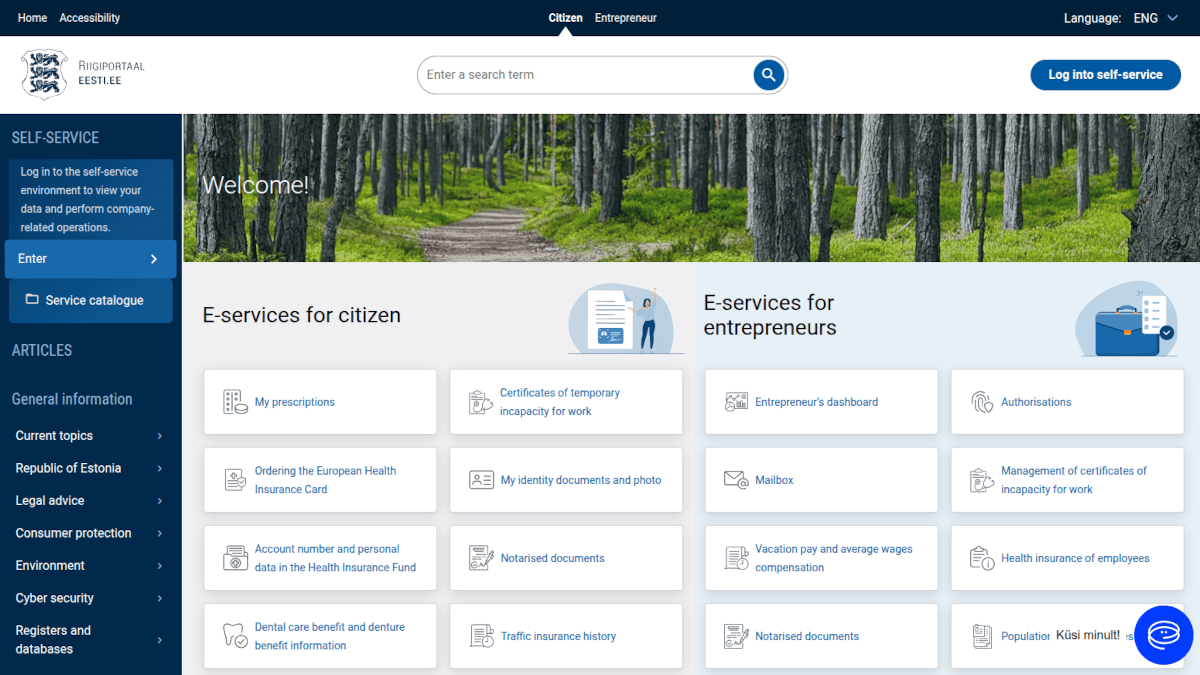
How did Estonia evolve to be like this? After Estonia regained its independence after the fall of the Soviet Union in 1991, the first elected government in 1992 was led by a very progressive 31-year-old Prime Minister Mart Laar, who managed to set up some very good policies and laid the foundation of a society that has evolved well in the decades since. Estonia was very lucky to have people in power in the 1990s who didn t simply copy what other Western countries were doing, but who tried to think about things from first principles and create Estonia s own model for efficient and fair governance. As a post-Soviet country, the population had also been vaccinated against overly socialist and unrealistic ideals, and everyone had a healthy distrust of the government s ability to solve problems and emphasis was placed on people s liberty to work for themselves as they best see fit. The improvement in living standards over the past 35+ years has also been witnessed by the population, and voting behavior supports keeping the country on the same trajectory. General living standards still continue to improve as the nominal wage growth sits at around 6%, clearly above the annual inflation rate of about 3%. In 2026, the Estonian economy is expected to grow about 2.4%, which is faster than the EU average. The growth in Estonia is not the result of any accounting tricks - Estonia is part of the euro and can t print its own currency, nor has it been funding the public sector with excessive debt. With a 24% debt-to-GDP ratio, Estonia consistently ranks as one of the most responsibly managed countries among advanced Western economies. As wages in Estonia soon catch up with the EU average, and higher defence spending has forced the government to raise taxes in recent years, the economic growth that Estonia has enjoyed for 35+ years since it exited the Soviet Union might slow down a bit in future years. The policies that fueled this growth in living standards, however, are likely to stay.

The tiger leap There is one specific government policy in Estonia s history that I think should be highlighted in particular. Estonia was very progressive by announcing the Tiigrih pe (Tiger Leap) program in 1996 with the goal of equipping all schools with computers and teaching all students the basics of programming. This surely had a large influence on why Estonia has so many successful software companies, why the government eServices are so mature that even neighboring countries like Finland are striving to copy the Estonian government s IT architecture called X-road. The Tiigrih pe project was originally suggested in the mid-1990s by Toomas Hendrik Ilves, then ambassador of Estonia to the United States, Canada and Mexico, and later President of Estonia in 2006 2016. While he was a psychologist by education, he was also a self-taught amateur programmer and used his political influence to promote sensible adoption of information technology in both Estonia and the EU. The history of Estonia has several prominent figures who were not lawyers by profession but engineers, scientists and historians who were very practical in their political decisions, which I think is now reflected in how government processes were formed. The video below shows how the Estonian government advertises itself and what values they choose to highlight:

Should other countries adopt policies from Estonia? Of course, not everything is perfect in Estonia either. The fertility rate of 1.16 in Estonia is very low. This trend is present globally, but in Estonia it is way below the EU average. Also, the service culture is something that needs to improve in Estonia. While services are in general fast and efficient, the attitude of people working in cafes and stores does not reflect a willingness to fill in gaps if the standard process falls short, nor are visitors actively made to feel welcome as individual humans, but are treated as mere process inputs. However, many of the things listed earlier I think should be studied by policymakers elsewhere. Societies are complex systems and there is of course no guarantee that copying a single policy to another country with different ethnicities, history and ingrained culture would lead to the same policy outcomes. But considering that Estonia is a small country without favorable geography and no natural resources, and that it started out from a place of total chaos, low economic activity and high crime in 1992 to rise to what it is now in 2026, the success it has seen is surely largely a result of good policies, governance and culture that other countries can and should mimic.

30 July 2026

Russ Allbery: Review: In the House of Aryaman, a Lonely Signal Burns

Review: In the House of Aryaman, a Lonely Signal Burns, by Elizabeth Bear
Series: Sub-Inspector Ferron Mysteries #1
Publisher: Sobbing Squonk Press
Copyright: 2012
Printing: 2018
ISBN: 0-9863735-1-6
Format: Kindle
Pages: 73
In the House of Aryaman, a Lonely Signal Burns is a science fiction police procedural set in relatively near-future India. This novella was originally published in Asimov's SF and collected in several anthologies as well as Bear's Shuggoths in Bloom collection, which I have on my shelf but have not yet read. I probably should have checked that before I got another copy. It is the first story of a series in the sense that there is an Audible-only sequel available. Like many police procedurals, this one opens with a crime scene. Sub-Inspector Ferron and her partner are inspecting a tube of human meat in the middle of the rug of a luxurious apartment in Bengaluru. The tube is apparently the remains of one Dexter Coffin, an American with a high tech workspace who was apparently mangled beyond recognition in his locked apartment near a table set for two. Dexter's cat is a witness. In this future world of cats enhanced with limited language skills, this would have been very useful, but the cat's memory was apparently wiped. Ferron will have to get to the bottom of the mystery some other way. Also, she apparently now has a new cat. Meanwhile, Ferron is worrying about her partner's mental health, her partner is worrying about her use of stimulants to stay on duty for this murder investigation, and Ferron's mother is harassing her for money to pay the bills of her virtual reality addiction. Her job is a good distraction from other problems she'd rather not deal with. I am trying to come up with something insightful to say about this story, and I'm not having much success. It's a police procedural with a bit of a science fiction twist. The characters are fine but not, at least for me, particularly engaging. There is some deft world-building, but nothing that grabbed my attention or made me desperate to read more stories in this world. Perhaps the most interesting part of the background, and the reason why I picked up this novella, is that this is the universe that eventually becomes the setting of the White Space series. There is an early version of right-minding handled entirely through medicine without the later invention of the fox implant, and there are some signs that humanity is slowly digging itself out of the hole of climate change and antisocial behavior that it had dug. I found this mildly interesting, but it doesn't add much to the later series and is very skippable. The source of the title is a bright light originating in the Andromeda galaxy, which is contained in Uttara Bh drapad in Vedic astrology. Ferron says this is under the influence of the god Aryaman. This is unrelated to the plot; it's just a background event that prompts some introspective musing from Ferron at the end of the story. It's a nice moment, but I would have been more interested in the full story of first contact between Earth and the Synarche. This was a mildly pleasant way to spend a few hours and I'm already forgetting all of the details. It's a competent story, but not one I feel a need to recommend to others. Followed by A Blessing of Unicorns, which appears to be an Audible audiobook exclusive. Rating: 6 out of 10

29 July 2026

Joey Hess: my harddrive is probably not full

I enjoyed reading this post by Marginalia "Your harddrive is probably full"

You can construct an entropic argument that there are simply more ways for a harddrive to be full than ways in which it can be empty.
Of course it made me check how full my laptop drive is, and indeed it was more than 75% full, as predicted. But, I almost never feel that my hard drive is full. I can very easily free up almost any amount of disk space at any time, without any thought. While writing this blog post, I ran a single command and now my harddrive is 50% empty.
The other part of the equation is that a full disk isn t a problem until it s so full you can t put more stuff on it, and at the point it s so irredeemably cluttered that when you do clean it up, you only have the patience to clean up enough to bide your time, judging the fate of every file on the harddrive is simply too much work.
Why doesn't this apply to me? Because I have put in the up-front thought to organize things, so that I never have to do that anymore. I have 3 categories of files that I can remove at any time I need more space, without any thought:
  1. Any files that are stored in git-annex. This is one of git-annex's superpowers; you can git-annex drop any file and stop it using disk space, but the file is still there (as a broken symlink) so you don't risk losing or forgetting about it.
  2. Caches.
  3. Files in ~/tmp/, which is reserved for any files I only want to have a passing acquaintance with. If I'm not comfortable with something being deleted at any time, I don't put it there.
Not only do I only have these 3 categories, these are the only 3 categories for everything except OS files and files I have decided I never want to remove (eg dotfiles and other files stored in git repos). Computer scientists invented caches (and of course cache invalidation is no problem lol) so I only needed to learn about that one. Unix gave me /tmp/ as an example that I long ago used as the basis for the rules for my ~/tmp/. I hope that git-annex might also serve as an example that moving files between drives is not the best way to manage disk space use.

Russ Allbery: Review: Midlife in Gretna Green

Review: Midlife in Gretna Green, by Linzi Day
Series: Midlife Recorder #1
Publisher: Linzi Day
Copyright: July 2022
ISBN: 9798837010774
Format: Kindle
Pages: 464
Midlife in Gretna Green is a self-published fantasy novel. It's urban fantasy in the sense that it's set in our world but with magic that most people don't know about, but the primary setting is a parish in rural Scotland and therefore the genre is not urban in that sense. It was Linzi Day's published first novel. As the story opens, Niki McKnight is a widow in Manchester, England with a job in the Register Office she likes, a boss she hates, and a Bichon Frise dog she adores. In the year since her husband Nick died, she's put her life on hold and made as few decisions as possible, despite some concerned pushing from her best friend Aysha. The death of her grandmother is not entirely unexpected, but her inheritance is about to upend her life. Niki assumes that her grandmother has a modest cottage and a small estate, and therefore being the named heir will mostly involve cleaning up the details of a modest life. She is caught by surprise by a requirement in the will that she live in Gretna Green for a year and a day in order to inherit. Her initial reaction is to treat this as an absurd impossibility given her life and job in Manchester, but she slowly realizes something strange is going on. Her grandmother's lawyer is lying to her, he refuses to tell her the value of the estate and seems to think it's more valuable than she expected, and her grandmother's tiny cottage does not seem to be following the seasons of the rest of the world. There is something magical at work. I will not spoil the rest of the reveal. I will say that this is a magical house book because, if you are anything like me, that is why you will want to read this series. There are not enough magical house books, and this is one of the better kind that allow the house to be a full speaking character. Midlife in Gretna Green is an unapologetic fantasy of personal agency. Niki starts the novel with a miserable manager, a messy pile of unread mail she doesn't want to deal with, and a lot of personal emotional baggage. She gets handed a position that requires and rewards standing up for herself and being decisive. It comes with a pile of unresolved but not horribly complex problems that were waiting for someone who would listen, make sensible decisions, and treat other people with respect. Oh, and there are a few assholes in the way, but they seriously underestimate the power she has to put a stop to their bullshit. This is the sort of book that traditional publishers tended not to buy (although Day apparently did get an offer for this one and turned it down), and I'm not sure why. Editors thought protagonists should have to work harder for their payoff? Some lingering Calvinist dourness in English language publishing mistrusted triumphant books? Obvious wish fulfillment was considered embarrassing or low-class and thus didn't warrant publication? This didn't apply to the endless bildungsromans about magically talented boys, so some level of sexism was probably in play. Maybe this is finally changing? It reminds me of the bias against romance novels and their guaranteed happily ever after, and in the case of romance there was too much money for publishers to leave it on the table. In any case, the growth of self-publishing has created an alternative market that let these books reach an audience and I for one am here for it. A lot of wish-fulfillment books, and a lot of self-published books, are not very good, but the ones that have a spark of originality and character can be a delight worth tolerating the somewhat rocky editing and pacing problems that a full editorial staff might have cleaned up.
I loved reading books about kickass women who took no crap and fixed their lives up exactly how they wanted them to be. But how did they get to be that way? They always started out awesome in the books. Seriously, did they kick ass at sixteen? Or did their superpower kickassery not kick in until they were thirty? Forty? If so, then I was screwed. Would I need to wait till I was fifty or until a genie arrived offering wishes? I already felt as if I d spent my whole life waiting for something wild and wonderful to happen.
Niki is a Specific Type to a somewhat hilarious degree, and I'm not sure if Day is playing into that intentionally or if she's projecting herself into the book. The amount of self-insertion is not zero: Day also lives in Gretna Green, owns a Bichon Frise, and worked as an assistant registrar and civil celebrant. Niki also drinks wine regularly, has a psychic gift, occasionally reads tarot cards, is an accommodating pushover at work who struggles to say no to her abusive boss, has impostor syndrome problems, and swears by a fictional self-help book about grief that provides the quotes at the starts of chapters. There is a cat, because of course there's a cat. (The fictional self-help book is a spot-on parody played entirely straight in the story. I think Day is having some fun with the reader? I can't tell!) This is what I mean by unapologetic. It's easy to read Niki as a stereotype, but she's a stereotype a lot of real people can identify with and there's something highly satisfying in watching her find her footing. I like wish fulfillment books; it's fun to see someone's wishes come true! Particularly in the year of 2026, there's something immensely satisfying in seeing an ordinary, insecure person get a massive amount of power and use it to make the world better. I don't need everything to be hard, fraught, and laden with costs in fiction, although I wouldn't want every book I read to be like this. Also, the world building is great. It's not polished; there's a bit of a grab bag feeling to it, I'm dubious the magic system has any underlying rigorous rule set, and Niki's powers, once she has access to them, are more of a semi-sentient genie than a skill she has to learn with hard practice. But the magic is fun. The sentient house is one of the best characters, particularly after Niki realizes how underused it has been, and I am a sucker for any good sentient house book. The cat is a far more interesting character than I first thought she would be. And Niki's new magical job is more complicated and less typical than the normal Celtic-inspired fantasy that I thought it was going to be at first. My primary warning about this book is that Niki starts out beaten down and grieving her dead husband, and it took me about five pages to decide that her dead husband was a complete piece of shit who was not worth any of the grief Niki puts into him. She also doesn't stand up for herself for the first hundred pages or so, which made me want to yell at the book a few times. Both of these problems go away farther into the book, and Niki does eventually figure out that Nick was abusive trash, but I was relieved when the "make endless excuses for worthless men" portion of the story was finally over. You have to stick with it until Niki gets brave enough to try being the protagonist; once that happens, it becomes great fun. It is fairly obvious that Midlife in Gretna Green was self-published, and I wish it had gotten the editing that it deserved. My copy had a couple of obvious formatting errors, the plot veers about more than was strictly necessary, and I think a careful editing pass could have tightened the writing by about fifty pages or so without losing any important detail. If that sort of thing bothers you, make sure you're in self-published fiction mode before starting this one. But it also has that irrepressible, bubbling-with-ideas feeling of a book where nothing has suppressed the author's enthusiasm. It's a very grabby book; once Niki starts embracing her new life, I could barely put it down. If you're in the mood for a good fantasy wish-fulfillment story that has no romance and a whole lot of "why are things run this way, no, we're changing that," highly recommended. I had so much fun with this book, and the series is currently making the rounds of my whole family. Don't read this when you're looking for something challenging and literary and deep; save it for when you desperately want to watch someone just fix something for once, damn it. Followed by Painting the Blues in Gretna Green, which I have already read, breaking my usual rule of writing reviews before reading the next book in a series. Rating: 8 out of 10

27 July 2026

Jonathan Carter: DebConf26 Santa Fe, Argentina

TL;DR: What a great DebConf! I managed to recharge my Debian batteries, and my talks / BoF sessions all went fine. Already looking forward to DebConf in Japan next year!

DebCamp

The evening before DebCamp started, we had a nice bbq (we taught some locals to call it a braai at an organiser s house and went for a walk around the river as the sun set. It was a very peaceful lead-in to DebCamp.

  • I set up and sent out the call for Forky desktop artwork:
  • Had many nice discussions about various Debian topics with all the Debian people around. It s really fun being around people who are natural problem solvers who care deeply about both technical and social issues. At one point Jonas told me Holy shit, these people are motivated! and I appreciate that so much too!

Debian LTS wine

  • Most of my DebCamp was dedicated to preparing for my demo and main talk that followed at DebConf.
  • Sadly, we had no loopy this year, I just didn t have the time, and the people who stepped up to help last year were either overwhelmed with other issues or couldn t make it. I ll try to make it happen again for next year by kicking it off long before DC27.

View of Santa Fe city from hotel

DebConf

Talk Is it even possible to build a truly universal system installer?

In this talk I do a very quick comparison of system installers based on my experience with them. It s hard to directly compare all of them, since there are so many, and each have their own niche that they attempt to satisfy.

I also introduce Yasi my attempt to answer the question of whether we could build a universal installer, which can also better cover advanced installations, automated installations and niche setups.

It s very early days for the project, and I didn t quite feel ready to share the code with the world, but it was nice that I did a quick demo where I could install a Debian system and the resulting system actually booted up. *phew*.

This is also going to be my main focus for the mid-term future. I aim to have all the basic partitioning options working by the time Debian 14 (Forky) is released, and by the time Debian 15 is released, I have a long list of features that I aim to have working. So, my timeline for having something that s generally useful is around a year from now, and in around 3 years it should be a fully fledged installer that should cover a very large amount of Debian use cases and architectures.

Day Trip

For the day trip, we did a tour across Santa Fe, visited Constituci n de la Naci n Argentina, had lunch where we tried various dishes based on local fish from the river, and then went on a boat ride on the river.

BoF Sessions:

Funding in Free Software Projects: I initially registered this BoF because I m increasingly concerned about how upstreams are asking for donations in their software. I increased the scope to talk about funding in free software in general. It followed Marga s talk about funding, which focussed more about how developers are funded in general. We didn t dive very deep into this, but we certainly need some further discussion (and action) on this within Debian.

Debian Social Team: My most important issue for this team is a carry-over from last year, I want to set up barman (packaged in Debian) for live postgres syncing for our larger databases. For the smaller DBs, doing a daily dump is quite cheap. But for Matrix, it s very expensive in terms if i/o and CPU, so it would be ideal to do less regular complete dumps and use live replication for the first line of redundancy instead.

Images Team: I wasn t initially planning to say much during this session, I have some ideas to reduce both size and count of images, without losing any benefits, but I don t have any work to show for that yet. I ended up talking a lot more than I anticipated, the topics covered were quite good and representative of the current state of Debian images built. I don t have time to create a full summary, so I suggest checking the etherpad / video recording if you re interested.

Some more wine variety during the conference dinner

Debianites in the main hacklab

Rosario

I m spending two days in Rosario before I head home. Exploring a bit, catching up with sleep, finishing this blog post, signing keys and exploring some ideas I made note of during DebConf.

Thank you to the DebConf26 Team!

It was a little surreal not being part of any DebConf team for the first time ever, I ve just been too focussed on getting Yasi ready for my talk (no regrets!). I hope to be more involved again next year, in the meantime, I m very grateful to everyone who has made this happen, you did a stellar job! I hope to see many of you again next year in Japan!

24 July 2026

Russell Coker: Thinkpad X1 Carbon Gen6 Again

My Current Thinkpad In 2018 I reviewed a Thinkpad X1 Carbon Gen6 that was assigned to me for work [1]. In April last year I wrote about the failings of my Thinkpad Yoga Gen 3 and how I was going back to the Thinkpad X1 Carbon Gen5 [2]. The Gen5 in question has 8G of RAM and a 1920*1080 display compared to 16G and 2560*1440 for the Yoga but runs reliably on battery without crashing. The Yoga in question has been used by relatives who don t need to do much when on battery and is currently being used by a relative who runs Windows so the occasional crash is something they are used to. In mid last year I bought a Thinkpad X1 Carbon Gen6 for $350 which has 16G of RAM and a 2560*1440 display. The higher resolution display is a significant benefit and while 8G of RAM is still usable for medium to heavy Linux desktop use it does cause problems sometimes. The new laptop I now have is significantly better than the one I had for work in 2018! I realised that my previous review of that laptop was incorrect in one aspect, there are two USB-C ports it s just that one may be covered by a rubber stopper when you get it. When I received this one the Ethernet dongle port was covered by a rubber stopper and the seller was unaware of the possibility of using a dongle and didn t have such a dongle. It s not a big deal as I have a collection of USB Ethernet devices but would still be handy to have while not worth the $20 it costs to buy one (a 2.5Gbit USB Ethernet device cost me $16 two years ago). Laptop Displays Today I saw a Thinkpad X1 Carbon Gen9 with 3840*2400 display and 16G of RAM for $550 on Facebook marketplace, which is a very tempting deal. 3840*2400 is 2.5* as many pixels as 2560*1440 while 2560*1440 is only 77% more pixels than 1920*1080. So if my eyes were able to properly distinguish pixels that that high DPI then the benefits of getting the 3840*2400 laptop would be greater than going to what I currently have from FullHD. But as a 1440p display in a 14 form factor is already past the stage where I can see individual pixels the benefits of 4K are more about making curves more rounded which improves readability and allows slightly smaller font sizes but doesn t give anything like the benefits that going from a FullHD desktop monitor to a 4K desktop monitor. Also I have different usage patterns for my laptop than for my desktop. I use my laptop for reading blog posts and ebooks for which even FullHD would be fine as the amount of text that can be usefully displayed on screen isn t that great. I also use my laptop for emergency sysadmin work, ssh to a server to restart a daemon, run ping while changing network hardware, and other things where I don t have a lot of text on screen. I also use my laptop for light coding tasks while watching TV. It s not possible to effectively do complex debugging tasks while watching TV or while using a small screen. But a very large portion of coding time is spent dealing with things like testing builds with different versions of libraries, applying patches to a new upstream release of software, fixing issues related to functions being renamed, testing to see if a new version has really fixed a bug it s supposed to fix, and other things that don t require a lot of skill. I am not claiming that 4K displays aren t great for laptops. Merely that at the current time it s not worth $550 of my money. Future Thinkpads I like the Thinkpad X1 Carbon line and plan to continue buying them as they get cheap. The Gen11 is the first one to have a minimum of 16G of RAM, the reason this is important to me is that the ones I buy aren t the lowest model because I want more than the minimum display resolution. As people who get above the minimum spec in one area tend to get above the minimum in others that means that there will be plenty of Gen11s on the market with 32G of RAM when I m ready to buy one of that era. Presumably by that time Linux software will have become more bloated and make me want more RAM. Yes soldered RAM has some downsides, but if you want an ultra-light laptop it s a trade-off you need to deal with. One problem with the Gen11 is that the maximum display resolution is 2880*1800, it s still a reasonable improvement over what I ve currently got but not close to the 4K I desire. The Gen12 has support for 8K display at 60Hz over Thunderbolt which is nice. By the time the Gen12 is in my price range it s quite likely that I will have a monitor with higher than 5120*2160 resolution (the maximum video out resolution of Gen11 and previous models in the Thinkpad X1 Carbon range) on my desk. The Gen13 still has 2880*1800 as the maximum resolution but has OLED as an option. So it looks like a Gen9 or Gen10 may be ideal for me as they are the last ones in the Thinkpad X1 Carbon series to support 4K displays. Another option is the Thinkpad Yoga Gen8 which is of the same era as the Thinkpad X1 Carbon Gen11 but has a 3840*2400 OLED touch screen, I might be able to get one of those cheap with the touch screen damaged.

22 July 2026

Freexian Collaborators: Monthly report about Debian Long Term Support, June 2026 (by Thorsten Alteholz)

The Debian LTS Team, funded by [Freexian s Debian LTS offering] (https://www.freexian.com/lts/debian/), is pleased to report its activities for June.

Activity summary During the month of June, 20 contributors have been paid to work on Debian LTS (links to individual contributor reports are located below). The team released 48 DLAs fixing 231 CVEs. Debian 12 ( bookworm ) has been handed over to the LTS Team on June 11th. During this handover Sylvain helped to update relevant tools and documentation. If you benefit from Debian, especially during the full 5-year lifecycle, please consider subscribing as a sponsor of Debian LTS: https://www.freexian.com/lts/debian/. Moreover, Debian 11 ( bullseye ) will reach the end of the Debian LTS period on August 31st. After that, Freexian will continue the security support under the Extended LTS offer. The team published several notable updates:
  • haveged update (DLA-4616-1), prepared by Thorsten, to address local privilege escalation.
  • tomcat9 update (DLA-4619-1), prepared by Markus, to address, among others, an authentication bypass.
  • apache2 update (DLA-4620-1), prepared by Bastien, to address a HTTP/2 bomb.
  • apache2 update (DLA-4629-1), prepared by Bastien, to address, among others, remote code execution and privilege escalation.
  • libinput update (DLA-4626-1), prepared by Santiago, to address local privilege escalation and arbitrary code execution.
  • asterisk update (DLA-4631-1), prepared by Thorsten, to address, among others, wrong processing of invalid or untrusted certificates.
  • nginx update (DLA-4634-1), prepared by Charles, to address a remote code execution and denial of service.
  • firefox-esr update (DLA-4635-1), prepared by Emilio, to address dozens of CVEs, among other things, related to arbitrary code execution and privilege escalation.
  • thunderbird update (DLA-4636-1), prepared by Emilio, to address dozens of CVEs, among other things, related to arbitrary code execution.
  • chromium update (DLA-4654-1), prepared by Emilio, to address dozens of CVEs, among other things, related to arbitrary code execution.
Contributions from outside the LTS Team: We are greatly thankful for the contributions from people outside the LTS Team:
  • Salvatore Bonaccorso prepared a libhttp-daemon-perl update, that was released by Santiago as DLA-4639-1.
  • Salvatore also directly uploaded libgd-perl DLA-4638-1 and libconfig-inifiles-perl DLA-4637-1.
  • Peter Palfrader prepared a tor update, that was released by Santiago as DLA-4656-1.
  • Pieter Lenaerts prepared a beets update, that was released by Emmanuel as DLA-4641-1.
  • Noah Meyerhans prepared a cloud-init update DLA-4645-1.
The LTS Team has also contributed with updates to the latest Debian releases:
  • Besides publishing DLA-4642-1 for package u-boot Andreas also prepared an NMU for an upload to sid and prepared a stable-proposed-update (SPU) bug for trixie, which was already acknowledged by a stable release manager (SRM).
  • Andreas also prepared an upload of package atril for trixie, which was handled by the security team as DSA-6349-1.
  • Besides publishing DLA-4620-1 for package apache Bastien also prepared an upload for trixie, which was handled by the security team as DSA-6323-1.
  • Tobi uploaded package mesa to trixie and bookworm.
  • Thorsten fixed some (not security related but RC) issues in package dahdi-linux. This was in preparation to fix lots of security issues in asterisk. Unfortunately the maintainer ignored the corresponding debdiff and prefered to upload a new upstream version. Anyway, the concerns of the security team about security support of asterisk could be overcome and asterisk can migrate to tesing and again be part of a Debian release.

Individual Debian LTS contributor reports

Thanks to our sponsors Sponsors that joined recently are in bold.

19 July 2026

Russell Coker: ECC and DDR5

Hamming Codes ECC RAM corrects errors that occur in memory before it gets to the CPU. The most common form of ECC is the Hamming Code [1] which when it has R redundant bits can correct single bit errors and detect double-bit errors in messages with 2^R-R-1 bits of data. For PC use that means if you want to protect 32bits of data you need R=6 and with 64bits you need R=7. The standard for DDR4 and similar RAM is 72 bits of data width on the bus and Hamming codes to correct single bit errors and detect double bit errors for 65bits of data. The computers we use have 64bits of data so that allows an extra bit that could be an extra parity, I don t know what if anything is done with this extra bit. RDIMM vs UDIMM One point of confusion in such things is the difference between Registered memory AKA RDIMMs [2] and regular PC/laptop memory which is often referred to as UDIMMs. The register is just a buffer which due to complex issues that aren t relevant to this post means that DIMMs can be larger and you can have more DIMMs in a system but latency may be slightly worse. It is technically quite possible to create RDIMMs without ECC (64bits wide instead of 72) but I have never seen a system that used such RAM. I have used more than a few systems with ECC UDIMMs and I recommend avoiding them if convenient as ECC UDIMMs are expensive on the second hand market while ECC RDIMMs can get very cheap. There are servers with ECC RDIMMs that are very unsuitable for home use (such as dual-CPU 1RU servers which are very noisy) so once they are past the 5 year tax write-off period the server chassis gets sent to ewaste and the RAM goes on the second hand market, the glut of RAM without systems to use it forces the price down. For the systems most commonly seen there are RDIMM systems with ECC and UDIMM systems without ECC. Chipkill If every bit in RAM was independent of every other bit then the basic Hamming code would solve most problems. However multiple bits in the same chip may be affected by the same problem, or one chip on the DIMM might entirely fail. With every RDIMM having 18 or 36 DRAM chips there are 2 or 4 bits per chip. On DIMMs with 36 DRAM chips one chip could fail and have the errors reliably detected with a Hamming code. On DIMMs with 18 DRAM chips one failed chip can t necessarily be detected with Hamming codes. IBM trademarked the term ChipKill for ECC systems which can cope with a single DRAM chip failing [3]. This is referred to as Advanced ECC on Dell and HP servers which require an even number of DIMMs. If anyone knows what coding method is used for ChipKill type systems then please let me know. Systems with advanced ECC also often have features like hot-spare for RAM and RAID-1 type functionality which is interesting but not something most people who read my blog will ever want to use. DDR5 DDR5 has on-die ECC to deal with the increased error incidence from smaller and faster memory [4], this is specified as 8 bits of error correction per 128 bits of data which implies basic Hamming codes. The on-die ECC is not a replacement for regular ECC, it s a mitigation for new problems introduced. My experience of memory errors is that the majority of repeatable errors (where a system would get an error with Memtest86+ or an ECC error report repeatedly) were DIMM seating issues, I could unplug and reinsert the DIMM in question and then the same tests would pass. Those errors would not be affected by on-die ECC. One thing that concerns me is the possibility of on-die ECC interacting with ECC on the motherboard and reducing it s effectiveness. I haven t been able to find out enough about how this works to determine if that s the case. My concern is that an error of 3+ bits that s corrected with a basic Hamming code might be more likely to create an error condition that Advanced ECC can t fix than the original error. Currently the best published research on the effectiveness of ECC on RAM errors is the Google paper published in 2009 which is based on DDR and DDR2 RAM [5]. So I don t expect that we will see published research about even DDR4 ECC any time soon. I presume that Google and the other cloud providers are still doing such research and providing the information to DRAM vendors under NDA so we have to just hope that the DRAM vendors do what s required to make things work correctly and allow us to buy products based on that research. DDR5 EC4 vs EC8 DDR5 supports 2*32bit subchannels instead of just supporting 64bit words [6]. For DDR5 ECC RAM there are variants EC4 which has 36bits of data per subchannel and EC8 which has 40 bits. EC8 allows Hamming codes on each subchannel indepdendently. I haven t found a reference on how exactly EC4 works, it could be reading 64bits at a time (not taking advantage of the subchannels) to use Hamming codes or it could have 1 parity bit for each subchannel and just assume that there s no need to check Hamming codes unless the subchannel parity fails. EC8 allows full Hamming code checks on 32bits of data and presumably ChipKill on 64bits. It s widely claimed that all DDR5 RDIMMs are EC8 and all DDR5 ECC UDIMMs are EC4. A quick search on ebay turned up adverts for EC4 and EC8 RDIMMs and links to apparently reliable sites confirming that some of the RDIMMs are EC4. There are reports of EC8 UDIMMs even though I couldn t find any advertised. This seems to mirror the situation with DDR4 where non-ECC RDIMMs are apparently available somewhere and ECC UDIMMs are something I ve used a few times but most people have never seen. I then searched for information on what servers support. The Dell R760 server supports both EC4 and EC8 RDIMMs but you can t have both in the same system. The existence of EC4 DIMMs is wrong. They shouldn t make substandard gear, the manufacturing price difference between 72 and 80 bit wide DIMMs isn t going to be great and the end result is some systems with inadequate specs and extra difficulty in upgrading systems with more things to check for compatibility. Why ECC is Needed Here s an interesting article about Mozilla s claim that 15% of Firefox crashes are due to RAM hardware errors [7], this seems to be based on repeatable errors and therefore won t count errors where a bit flip happens once a day or less. Some years ago I reported a BTRFS corruption issue on my desktop PC to the BTRFS developers and one of them stated that the corruption in question didn t match any pattern expected from a BTRFS bug and recommended that I run Memtest86+. The memory test revealed that I was getting about one memory corruption per 5 hours so if I had used Firefox on that system any crashes probably wouldn t have been regarded as hardware errors with RAM. Those errors caused filesystem corruption and some data loss, if I hadn t been using BTRFS that could have gone unnoticed for years. On another occasion I had a VM I was using for testing software I was developing that had some unexpected errors. After working on it for a day I had shared the errors with a mailing list of other developers who also spent some time investigating it. Eventually I began to suspect a hardware problem, I went on site and when I rebooted the system to run Memtest86+ it didn t even boot as it had errors that stopped the BIOS from even working correctly. It was strange that the system was apparently working correctly and restarting the KVM VM resulted in the same errors happening in the same code and nothing else on the VM apparently having a problem. It turned out that the system had a motherboard problem that made all but one of the DIMM sockets unusable so I ended up sending it to e-waste. That wasted a day of my time and some hours of other people s time. Presumably on other occasions developer time is wasted due to hardware errors and no-one even realises. What Society Needs We need ECC RAM to be more widely used. Ideally we would have some government action to force this given the ongoing cost to society in corrupted data and lost time due to RAM hardware errors. I think that at minimum we need sufficient taxes on non-ECC RAM (and EC4 RAM for DDR5) to make it more expensive when bought new than ECC RAM. We need to have greater knowledge of the benefits of ECC RAM among computer experts, people need to recommend that computers be purchased with ECC RAM whenever possible and that systems which can t have ECC RAM (laptops and phones) shouldn t be used for storing important data. We need to avoid silly things like having so many variants of RAM to confuse people and make it needlessly difficult to get ECC RAM working.

15 July 2026

Freexian Collaborators: Debian Contributions: Python 3.14 as default transition, DebConf 26 preparations, debvm, pconr and more! (by Anupa Ann Joseph)

Debian Contributions: 2026-06 Contributing to Debian is part of Freexian s mission. This article covers the latest achievements of Freexian and their collaborators. All of this is made possible by organizations subscribing to our Long Term Support contracts and consulting services.

Python 3.14 as default transition, by Stefano Rivera Debian has had Python 3.13 and 3.14 in unstable and testing since December 2025, with Python 3.13 as the default version (/usr/bin/python3 = 3.13). This gave time for packages to implement support and detect issues in their test suites. A slot to transition to 3.14 as default was requested from the release team in March, and they indicated that we would likely be able to schedule it in late June. In preparation, Stefano reviewed the open bugs against Python interpreters and squashed some in uploads of the latest point releases of Python: 3.13.14 and 3.14.6. Also in June, Python 3.15.0 beta 2 and beta 3 released. Stefano uploaded these to Debian experimental. The 3.15 betas were reason to attempt to revive review of a blocked upstream patch to support Debian multiarch in stable ABI Python extensions, now that Python 3.15 is adding a new stable ABI abi3t.

DebConf 26 preparations, by Stefano Rivera, Antonio Terceiro, Lucas Kanashiro, Santiago Ruano Rinc n and Anupa Ann Joseph DebConf 26, the annual Debian Developer Conference, is being held in Santa Fe, Argentina, in July. Stefano Rivera, Antonio Terceiro, Lucas Kanashiro, Santiago Ruano and Anupa Ann Joseph contributed to the preparations for the event.
  • As usual, Stefano has been supporting the conference website and registration, helping the local team to get accurate data on attendee numbers.
  • Antonio has been supporting the conference website and helping the content team to put together the conference schedule.
  • Santiago has been helping the local team on different topics regarding logistics.
  • Anupa assisted with the accommodation arrangements for DebCamp and DebConf, working alongside Nattie.
  • Lucas has been coordinating the conference schedule and communicating with some speakers.

debvm, by Helmut Grohne The debvm tool used for creating and running ephemeral virtual machines saw a number of small improvements. The requirement of having a filesystem label has been removed in favor of using a uuid and /etc/fstab is no longer created. A memory balloon is enabled by default and this enables qemu to automatically release free guest memory to the host. Booting Ubuntu VMs regressed as a result of their use of uutils and has been fixed. The --architecture flag is back to be able to better support Hurd, which is a work-in-progress of Johannes Schauer Marin Rodrigues. Thanks to Jochen Sprickerhof, you can more easily create VMs for autopkgtest-virt-qemu using --hook-dir=/usr/share/mmdebstrap/hooks/autopkgtest-create-qemu. There also are a few documentation and error message improvements. All of this is pending in git waiting to be uploaded once development slows down. While booting a machine from virtiofsd succeeded, turning the proof-of-concept into production remains for later.

pconr, by Helmut Grohne At DebConf25, Helmut reported on a schroot substitute called unschroot. The second iteration uses varlink IPC to construct a container. That varlink API is now separated into a new project called programmable container runtime. It is meant to provide more flexibility in constructing containers than established solutions such as the unshare command from util-linux, bubblewrap or podman provide while still managing repetitive complexity such as process orchestration for the developer. A new example that uses this infrastructure is a better containment for mmdebstrap eliminating chroot escape. There also is an asyncvarlink/0.3.2 release taking steps to become more maintainable in Debian to eventually get pconr into Debian.

Miscellaneous contributions
  • Stefano did routine uploads (mostly new upstream versions) of python-pip, python-pipx, hatchling, dh-python, beautifulsoup4, python-virtualenv, python-mitogen.
  • Stefano uploaded a snowball mini-transition: snowball, snowball-data, and pystemmer
  • Stefano did some debian.net team admin, setting up a container and later a VM for vote.debian.net.
  • Stefano responded to a semi-escalation to the Debian Technical Committee, after some communication between an upstream, a bug reporter, and a Debian package maintainer went sideways and got heated.
  • Emilio managed several transitions, and filed bugs against the few remaining GCC 13 rdeps.
  • Antonio did salsa maintenance work, debugging service issues, approving user registrations, and processing support requests.
  • Antonio worked on Debian CI maintenance, including but not limited to deploying new armhf and armel workers, fixing bugs and preparing an upcoming release of debci.
  • Antonio did several maintenance tasks for MiniDebConf websites.
  • Antonio uploaded ruby-bunny, ruby-sinatra and ruby-mustermann, fixing a few FTBFS bugs among them.
  • Carles using po-debconf-manager: Reviewed Catalan translations for 5 packages, submitted 6 packages. Added a draft blog/update about the po-debconf-manager project.
  • Carles submitted a new Geeqie Catalan translation: it had accumulated a large number of untranslated strings over the last 4 years.
  • Carles contributed to the Debian wiki: improved documentation for the Framework Laptop and added a new section Battery charging control (after doing some debugging and testing). He wrote a page about Signal Desktop. Carles started looking at testing/documenting Mailman2 -> Mailman3 migration.
  • Carles, in relation to the migration process, double checked old pages without relevant information in the Debian wiki.
  • Thorsten did another upload of package hplip to fix some bugs.
  • In the context of the Google Summer of Code 2026 project, Santiago continued co-mentoring Aryan Karamtoth, who is working on the Linux live-patching project. As part of the team, Santiago guided Aryan to help design the different workflows and to study the different tools available, including the upstream klp-build (that was introduced in v6.19), and compare it with SUSE s klp-build.
  • Colin clarified the bug tracking system s documentation to indicate that maintainers may sometimes reasonably ask users to file bugs upstream themselves.
  • Colin fixed 15 packages for pytest 9.1.
  • Colin fixed a depthcharge-tools regression with Python 3.14 as default that broke debian-installer builds.
  • Helmut continued to report undeclared file conflicts and correspond about them.
  • Helmut wrote patches for strace to enable cross building and a 32bit personality on arm64.
  • Helmut continued maintaining rebootstrap working fixing build failures in fontconfig, gettext and sqlite3 as well as changing the way packages from gcc builds are installed to better serve a need reported by Samuel Thibault.

12 July 2026

Kentaro Hayashi: Try to build Mozc with Bazel 7.7.1

Introduction Recently, I've got a chance to try building Mozc (Most famous Japanese input method editor) with Bazel. As you know, recently newer Bazel related packages were landed into debian/unstable. Then now I'm planning to update Mozc from 2.29.5160.102 to 3.33.6133.

Background story about Mozc and Debian The upstream of Mozc had released 3.34.6239, but on Debian, we stick to Mozc 2.29.5160.102. Mozc requires newer Bazel but we only had Bazel 4.2.3 at that time on Debian, so even though the upstream of Mozc switched from GYP to Bazel, we had patched Mozc with GYP based package. We even did make an effort to restore build options that had been already removed. :-( And needed to migrate from GTK2 renderer to GTK3 renderer. That is why the version of Mozc is diverged from upstream on Debian.
  • 2.29.5160.102 (Now on Debian)
  • 2.29.5268.102
  • 2.29.5374.102
  • 2.29.5544.102
  • 2.30.5544.102
  • 2.31.5712.102
  • 2.31.5851.102
  • 2.32.5994.102
  • 3.33.6089
  • 3.33.6133 (Target to upgrade for)
  • 3.34.6239

How to switch from GYP to Bazel? At first, we needed to decide what Mozc version to work with it. Now latest version of Mozc is 3.34.x, but it requires Bazel 9.x. Please recall that Bazel 7.7.1 was introduced Debian/unstable. And more, newer dependency libraries are required. You might feel that target version (3.33.6133) is too high from 2.29.5160.102, but if we upgrade to more older Mozc, it means that it requires to backport Mozc to older libabsl compatible codes and so on. That is why Mozc 3.33.6133 was chosen. Even once the target version has been decided, you can't let your guard down. There are many technical tasks to solve.
  • Revisit patch sets to apply
  • Porting uim mozc patch and fix FTBFS
  • Porting fcitx5 mozc patch and fix FTBFS
  • Fix src/third_party vendoring
  • Switch from GYP to Bazel build systems
  • ...
At least, it will likely require several rounds of testing in the Debian experimental.

Conclusion Currently, gbp buildpackge has succeeded finally on local machine, but need to tidy and cleanup stuffs. I didn't know packaging with Bazel best practice yet, to remove many third party vendor/ bundles, I've found that it requires pile of patch to eliminate them. In the current version of Debian, as a one of build system, further work such as support from debhelper - will be needed. I'll file working progress on #1085173

11 July 2026

Reproducible Builds: Reproducible Builds in June 2026

Welcome to the June 2026 report from the Reproducible Builds project! In these reports, we outline the most important things that we have been up to over the past month. As a quick recap about what problem our project intends to solve, whilst anyone may inspect the source code of free software for malicious flaws, almost all software is distributed to end users as pre-compiled binaries. The motivation behind the reproducible builds effort is to ensure no flaws have been introduced during this compilation process by promising identical results are always generated from a given source, thus allowing multiple third-parties to come to a consensus on whether a build was compromised or not. If you are interested in contributing to the project, please visit our Contribute page on our website. In this month s report, we cover:

  1. Only installing reproducible packages with repro-threshold
  2. Distribution work
  3. diffoscope development
  4. From our mailing list
  5. Documentation updates
  6. Patches
  7. Four new scholarly papers


Only installing reproducible packages with repro-threshold A very interesting demonstration is now available showing how you might configure your Debian system to only install packages that have been reproduced by m/n rebuilders. This is implemented via a reproduced+https:// APT transport ( a mechanism for communicating between the APT client and its repository source commonly HTTP):
Every package download is intercepted by repro-threshold, which queries two independent rebuilders for a signed attestation before allowing installation to proceed. [It] is important to note that [an] install will only succeed if all package dependencies are also reproducible.
The demo gives examples of how to quickly experiment with this using a Docker container.

Distribution work In Debian this month: The IzzyOnDroid Android APK repository reached its next milestone this month, now covering 2 out of every 3 apps (66.7%) with reproducible builds. Their documentation for debugging and fixing failed builds has steadily grown as well. More clients have picked up showing reproducibility results (e.g. Droid-ify), and Neo Store now can be configured to stick to only reproducible applications. Further, an independent builder has been added to the build farm, increasing the trust level even more as APK builds can have multiple confirmations now. At the same time, IzzyOnDroid s rbtlog got several new features. The most outstanding is caching for frequently used resources such as reproducible-apk-tools, command-line tools and NodeJS in order to counter ongoing issues with GitHub availability, while at the same time saving bandwidth and build time. This change also enables some other some smaller enhancements such as being able to configure build timeouts per recipe for those builds running longer than the average, release pattern filtering for update checks or having a field for maintainer notes to shortly summing up e.g. why a reproducible build failed.
Lastly, Bernhard M. Wiedemann posted another openSUSE monthly update for their reproducibility work there.

diffoscope development diffoscope is our in-depth and content-aware diff utility that can locate and diagnose reproducibility issues. This month, Chris Lamb made the following changes, including preparing and uploading versions 319, 320, 321, 322 and 323 to Debian:
  • Debian adds an extra Flags: line in the output of ocamlobjinfo, so adjust the test for cross-distribution compatibility. [ ]
  • Bump debhelper compatibility level to 14. [ ]
  • Fix compatibility with Ocaml 5.4.1. [ ]
  • Use --long-form-style arguments when calling apktool in order to support apktool version 3. [ ]
  • Support Androguard version 4 and previous versions at the same time. [ ]
  • Update copyright years. [ ]
In addition, Jochen Sprickerhof added better header detection for the Sphinx documentation system [ ], Michael Daniels fixed the tests when run with zipdetails version 4.006 [ ] and Zbigniew J drzejewski-Szmek added a version of the deprecated os.path.commonprefix method [ ]. In addition, Vagrant Cascadian updated diffoscope in GNU Guix to version 321 and 323.
Chris Lamb also made the following changes to strip-nondeterminism, our tool to remove specific non-deterministic results from a completed build:
  • Skip symlinks when manually called via /usr/bin/strip-nondeterminism. (#1139000)
  • Update debian/watch format. [ ]
  • Drop Rules-Requires-Root: no and Priority: optional fields. [ ]
  • Bump Standards-Version to version 4.7.4. [ ]

From our mailing list On our mailing list this month:
  • kpcyrd posted to our mailing list regarding the waves of malware uploads to aur.archlinux.org . Curiously, every incident I looked at used npmjs.com for malware delivery , specifically where the npm package includes an (automatically executed) preinstall script that is an ELF binary.
  • kpcyrd also announced the release of debian-repro-status version 0.4.0, a tool written to give you an approximate idea of how viable it would be to enforce a reproducible packages only update policy for the computer system you ve built :
    The change updates dependencies to the latest versions, and adds support for multiple -H options, to query results from multiple rebuilderd instances. The results are also now fetched concurrently.
  • kpcyrd also reported that, whilst taking a screenshot for the above release, they noticed that the debian:sid container now is 100% reproducible.
  • Finally, kpcyrd also created a pull request against the add-determinism package to update the itertools and zip Python dependencies.

Documentation updates Yet again, there were a number of improvements made to our website this month including:
  • Chris Lamb added a reminder re. using the UTC variants of the Javascript Date methods. [ ]
  • Mattia Rizzolo moved OTF to the old sponsors list. Thank you for your support!. [ ]
  • kpcyrd updated the Rust documentation to recommend using the --release argument for consistency. [ ]

Patches The Reproducible Builds project detects, dissects and attempts to fix as many currently-unreproducible packages as possible. We endeavour to send all of our patches upstream where applicable or possible. This month, we wrote a large number of such patches, including:

Four new scholarly papers Kenichiro Muto and Kuniyasu Suzaki of the Institute of Information Security in Yokohama, Japan published an interesting paper this month titled Attestable Build Chain: Enabling Trust in Reproducible Builds (PDF). Their abstract is as follows: Ensuring trust in software supply chains requires verifying not only artifacts but also the processes that produce them. Although Reproducible Builds (R-B) require rebuilding to validate artifacts, they cannot verify whether the build was executed with the intended toolchain and inputs and may reproduce unintended or compromised builds without detection. We present Attestable Build Chain, a framework for externally verifying build-time execution without rebuilding. Rather than preventing compromise, it provides verifiable, tamper-evident evidence of actual build-time execution, enabling verification of build process integrity from observed file accesses during the build. [ ]
Julien Malka, Stefano Zacchiroli and Th o Zimmermann published a 50-page report detailing A Decade of Software Reproducibility in the Nix Package Ecosystem:
We find that functional package management enables extremely high rebuildability over time (near-universal ability to reconstitute historical build environments and rebuild software packages), while bitwise reproducibility has steadily improved and reaches a high point in recent years (up to 93% in 2024). Early years show substantially lower bitwise reproducibility, indicating that functional package management alone does not guarantee bitwise-identical outputs, and that the observed high level of bitwise reproducibility is not solely due to the package management approach. Common causes of unreproducibility, both in the rebuildability and bitwise reproducibility dimensions, include management of dates in build and test processes; we quantify their prevalence and other common causes using manual analysis of logs of rebuild failures and automated analysis of diffoscope.
A PDF of their report is available online
Tim Bastin of L3montree GmbH and Jacek Galowicz of Applicative Systems GmbH from DevGuard published a paper detailing How We Built a Sovereign, Reproducible Container Supply Chain for DevGuard:
This paper presents how the DevGuard project rebuilt its OCI container pipeline around reproducible Nix builds and independent dual-platform digest verification. DevGuard images are built hermetically from pinned source revisions, signed with Sigstore/Cosign, and verified through digest comparison across GitHub Actions and sovereign GitLab infrastructure hosted on container.gov.de. We describe the practical integration of reproducible OCI image builds into existing CI/CD workflows and argue that independently reproducible container digests provide a stronger integrity guarantee against build tampering than provenance alone. The paper further discusses remaining trust assumptions and the relevance of sovereign build infrastructure for government and regulated environments.

Finally, Yiseul Choi, Junga Kim, Jun-Ho Hong and Seongmin Kim of the Department of Convergence Security Engineering at the Sungshin Women s University in Seoul, Korea titled Attestation-based verification of SBOM integrity via consumer-side reproducibility:
Software bills of materials (SBOMs) support supply chain transparency, but they do not prove that a delivered SBOM reproducibly corresponds to its software artifact. Existing signing and provenance mechanisms protect integrity and traceability, yet lack consumer-side reproducible verification. We propose an SBOM integrity verification framework combining procedure disclosure, consumer-side reproduction, authority-generated reference evidence, and digest comparison. A trusted authority records a reference digest, and consumers compare it with locally reproduced and delivered SBOM digests. Experiments on 100 real-world container images show detection of artifact tampering, SBOM substitution, distribution modification, and adaptive tampering beyond signature-based approaches


Finally, if you are interested in contributing to the Reproducible Builds project, please visit our Contribute page on our website. However, you can get in touch with us via:

Next.

Previous.