Reproducible builds folks: Reproducible Builds: week 114 in Stretch cycle
Here's what happened in the Reproducible
Builds effort between Sunday June 25 and
Saturday July 1 2017:
Upcoming and past events
Our next IRC meeting is scheduled for July 6th at 17:00 UTC (agenda). Topics to be discussed include an update on our next Summit, a potential NMU campaign, a press release for buster, branding, etc.
Toolchain development and fixes
- James McCoy reviewed and merged Ximin Luo's script debpatch into the devscripts Git repository. This is useful for rebasing our patches onto new versions of Debian packages.
- Adrian Bunk:
- Chris Lamb:
- openmpi
- gtk-doc fixed by sorting directory listings
- samba
- TeX
- nedit
- criu
- tvheadend sort
- tvheadend date
- cfengine
- Adrian Bunk (68)
- Daniel Schepler (1)
- Michael Hudson-Doyle (1)
- Scott Kitterman (6)
- Daniel Shahaf:
- Mattia Rizzolo:
- Ximin Luo:
- Fix a progressbar failure
- Put the 400MB "fsimage" cache in a more obvious place
- Fix CI tests under Python 3.6
- Add a --exclude-directory-metadata option. (Closes: #866241)
- Raise warning for getfacl. Remove a redundant try-clause
- Fix recursive indentation of headers
- Use a loop rather than recursion
- In html-dir mode, put css/icon in separate files to avoid duplication
- diffcontrol UI tweaks
- Split index pages up if they get too big
- Vagrant Cascadian working on testing Debian:
- Upgraded the 27
armhfbuild machines to stretch. - Fix mtu check to only display status when eth0 is present.
- Upgraded the 27
- Helmut Grohne worked on testing Debian:
- Limit diffoscope memory usage to 10GB virtual per process. It currently tends to use 50GB virtual, 36GB resident which is bad for everything else sharing the machine. (This is #865660)
- Alexander Couzens working on testing LEDE:
- Add multiple architectures / targets.
- Limit LEDE and OpenWrt jobs to only allow one build at the same time using the jenkins build blocker plugin.
- Move
git log -1 > .htmlto node document environment(). - Update TODOs.
- Mattia Rizzolo working on testing Debian:
- Updated the maintenance script for
postgresql-9.6. - Restored the postgresql database from backup after Holger accidently purged it.
- Updated the maintenance script for
- Holger Levsen working on:
- Merging all the above commits.
- Added a check for (known) Jenkins zombie jobs and report them. (This is an long known problem with jenkins; deleted jobs sometimes come back )
- Upgraded the remaining
amd64nodes tostretch. - Accidentially purged
postgres-9.4from jenkins, so we could test our backups
- Updated our stretch upgrade TODOs.


 Debian has many years of history, about 25 years already.
With such a long travel over the continous field of developing our Universal
Operating System, some myths, false accusations and bad reputation has arisen.
Today I had the opportunity to discuss this topic, I was invited to give a
Debian talk in the
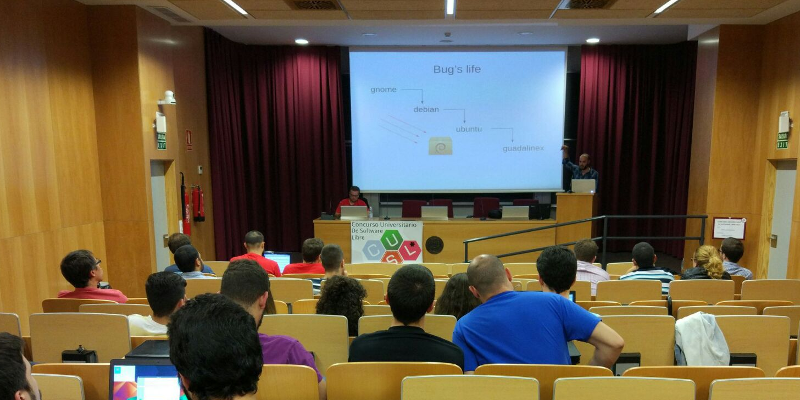 myth #1: Debian is old software
Please, use testing or stable-backports. If you use Debian stable your system
will in fact be stable and that means: updates contain no new software but
only fixes.
myth #2: Debian is slow
We compile and build most of our packages with industry-standard compilers and
options. I don t see a significant difference on how fast linux kernel or
mysql run in a CentOS or in Debian.
myth #3: Debian is difficult
I already discussed about this issue back in
 Welcome to gambaru.de. Here is my monthly report that covers what I have been doing for Debian. If you re interested in Java, Games and LTS topics, this might be interesting for you.
Debian Android

 I recently dug through my history of involvement with TeX (Live), and found out that in January there are a lot of anniversaries I should celebrate: 14 years ago I started building binaries for
 Those of you not interested in boring and melancholic look-back onto history can safely skip reading this one. For those a bit interested in the history of TeX in Debian, please read on.
Debian releases and TeX systems
The TeX system of choice has been for long years
 Development over the years
TeX Live 2005 was just another TeX system but not the preferred one in Debian Etch and beyond. But then in May 2006, Thomas Esser announced the end of development of teTeX, which cleared the path for TeX Live as main TeX system in Debian (and the world!). The next release of Debian, Lenny (1/2009), already carried only TeX Live. Unfortunately it was only TeX Live 2007 and not 2008, mostly due to me having been involved in rewriting the upstream infrastructure based on Debian package files instead of the notorious xml files. This took quite a lot of attention and time from Debian away to upstream development, but this will be discussed in a different post.
Similarly, the release of TeX Live included in Debian Squeeze (released 2/2011) was only TeX Live 2009 (instead of 2010), but since then (Wheezy and Jessie) the releases of TeX Live in Debian were always the latest released ones.
Current status
Since about 2013 I am trying to keep a regular schedule of new TeX Live packages every month. These helps me to keep up with the changes in upstream packaging and reduces the load of packaging a new release of TeX Live. It also bring to users of unstable and testing a very up-to-date TeX system, where packages at most lack 1 month of behind the TeX Live net updates.
Future
As most of the readers here know, besides caring for TeX (Live) and related packages in Debian, I am also responsible for the TeX Live Manager (tlmgr) and most of upstream s infrastructure including network distribution. Thus, my (spare, outside work) time needs to be distributed between all these projects (and some others) which leaves less and less time for Debian packaging. Fortunately the packaging is in a state that making regular updates once a month is less of a burden, since most steps are automatized. What is still a bit of a struggle is adapting the binary package (




 The Independent reports that David Cameron
