Search Results: "bod"

20 April 2026

Russ Allbery: Review: Surface Detail

Review: Surface Detail, by Iain M. Banks
Publisher: Orbit
Copyright: October 2010
Printing: May 2011
ISBN: 0-316-12341-2
Format: Trade paperback
Pages: 627
Surface Detail is the ninth novel in Banks's Culture science fiction (literary space opera?) series. As with most of the Culture novels, it can be read in any order, although this isn't the best starting point. There is an Easter egg reference to Use of Weapons that would be easier to notice if you have read that book recently, but which is not that important to the story. Lededje Y'breq is an Indented Intagliate from the Sichultian Enablement. Her body is patterned from her skin down to her bones, covered with elaborate markings similar to tattoos that extend to her internal organs. As an intagliate, she is someone's property. In her case, she is the property of Joller Veppers, the richest man in the Enablement and her father's former business partner. Intagliates are a tradition of great cultural pride in the Enablement. They are a living representation of the seriousness with which debts and honor are taken, up to and including one's not-yet-born children becoming the property of one's debtor. Such children are decorated as living works of art of the highest skill and technical sophistication; after all, the Enablement are not barbarians. As the story opens, Lededje is attempting, not for the first time, to escape. This attempt is successful in an unexpected way. Prin and Chay are Pavulean researchers and academics who, as this story opens, are in Hell. They are not dead; they have infiltrated the Hell that Pavuleans are shown to scare them into proper behavior in order to prove that it is not an illusion and their society does indeed torture people in an afterlife, in more awful ways than people dare imagine. They have reached the portal through which temporary visitors exit, hoping to escape with firm evidence of the existence and horrors of the Pavulean afterlife. They will not be entirely successful. Yime Nsokyi is a Culture agent for Quietus, the part of Contact that concerns itself with the dead. Many advanced societies throughout the galaxy have invented and reinvented the ability to digitize a mind and then run it in a virtual environment. Once a society can capture the minds of every person in that society from that point forward, it faces the question of whether to do so and, if it does, what to do with those minds. More specifically, it faces the moral question of whether to punish the minds of people who were horrible in life. It faces the question of whether to create Hell. Vatueil is a soldier in a contestation, a limited and carefully monitored virtual war. The purpose of that war game is to, once and for all, resolve the question of whether civilizations should be allowed to create Hells. Some civilizations consider them integral to their religion or self-conception. Others consider them morally abhorrent, and that conflict was in danger of spilling over into war in the Real. Hence the War in Heaven: Both sides committed to fight in a virtual space under specific and structured rules, and the winner decides the fate of the galaxy's Hells. Vatueil is fighting for the anti-Hell side. The anti-Hell side is losing. There are very few authors who were better at big-idea science fiction than Iain M. Banks. I've been reading a few books about AI ships and remembered that I had two unread Culture novels that I was saving. It felt like a good time to lose myself in something sprawling. Surface Detail does sprawl. Even by Banks's standards, there was an impressive amount of infodumping in this book. Banks always has huge and lovingly described set pieces, and this book is no exception, but there are also paragraphs and pages of background and cultural musings and galactic politics. We are introduced to not one but three new Contact divisions; as well as the already-mentioned Quietus, there is Numina, which concerns itself with the races that have sublimed (transcended), and Restoria, which deals with hegemonizing swarms (grey goo nanotech, paperclip maximizers, and their equivalents). Infodumping is both a feature and a bane of big-idea science fiction, and it helps to be in the right mood. It also helps if the info being dumped is interesting, and this is where Banks shines. This is a huge, sprawling book, but it deals with some huge, sprawling questions and it has interesting and non-reductive thoughts about them. The problems posed by the plot come with history, failed solutions, multi-sided political disputes, strategies and tactics of varying morality and efficacy, and an effort to wrestle with the irreducible complexity of trying to resolve political and ethical disagreements in a universe full of profound disagreements and moral systems that one cannot simply steamroll. It also helps that the characters are interesting, even when they're not likable. Surface Detail has one fully hissable villain (Veppers) as a viewpoint character, but even Veppers is interesting in a "let me check the publication date to see if Banks was aware of Peter Thiel" sort of way. The Culture ships, of which there are several in this story, tend towards a gently sarcastic kindness that I find utterly charming. Lededje provides the compelling motive force of someone who has no involvement in the broader philosophical questions and instead intends to resolve one specific problem through lethal violence. Vatueil and Yime were a bit bland in personality, more exposition generators than characters I warmed to, but their roles and therefore the surrounding exposition were fascinating enough that I still enjoyed their sections. I'm sure this is not an original observation, but I was struck reading this book in the first half of 2026 that the Culture functions as an implementation of what the United States likes to think it is but has never been. It has a strong sense of shared ethics and moral principles, it tries to export them to the rest of the galaxy through example, persuasion, and careful meddling, but it tries to follow some combination of pragmatic and moral rules while doing so, partly to avoid a backlash and partly to avoid becoming its own sort of hegemonizing swarm. That is a powerfully attractive vision of how to be an advanced civilization, and the fact that every hegemon that has claimed that mantle has behaved appallingly just makes it more intriguing as a fictional concept. In this book, like in many Culture books, the Culture is painfully aware of the failure modes of meddling, and the story slowly reveals the effort the Culture put into staying just on a defensible side of their own moral lines. This is, in a sense, a Prime Directive story, but with a level of hard-nosed pragmatism and political sophistication that the endless Star Trek Prime Directive episodes never reach. Surface Detail does tend to sprawl, and I'm not sure Banks pulled together all the pieces of the plot. For example, if there was a point to the subplot involving the Unfallen Bulbitian, it was lost on me. (There is always a possibility with Banks that I wasn't paying close enough attention.) But the descriptions are so elaborate and the sense of politics and history are so deep that I was never bored, even when following a plot thread that meandered off into apparent irrelevance. The main plot line comes to a satisfying conclusion that may be even more biting social commentary today than it was in 2010. A large part of the plot does involve Hell, so a warning for those who haven't read much Banks: He adores elaborate descriptions of body horror and physical torture. The sections involving Prin and Chay are rather grim and horrific, probably a bit worse than Dante's Inferno. I have a low tolerance for horror and I was able to read past and around the worst bits, but be warned that Banks indulges his love for the painfully grotesque quite a bit. This was great, and exactly what I was hoping for when I picked it up. It's not the strongest Culture novel (for me, that's either The Player of Games or Excession), but it's one of the better ones. Highly recommended, although if you're new to the Culture, I would start with one of the earlier books that provide a more gradual introduction to the Culture and Special Circumstances. Followed, in the somewhat disconnected Culture series sense, by The Hydrogen Sonata. Content warnings: Rape (largely off-screen), graphic violence, lots of Bosch-style grotesque torture, and a lot of Veppers being a thoroughly awful human being as a viewpoint character. Rating: 8 out of 10
19 April 2026

Russ Allbery: Review: Collision Course

Review: Collision Course, by Michelle Diener
Series: Class 5 #6
Publisher: Eclipse
Copyright: November 2024
ISBN: 1-7637844-0-1
Format: Kindle
Pages: 289
Collision Course is the sixth novel in the Class 5 science fiction series and the first that doesn't use the Dark X naming convention. There are lots of spoilers in this story for the earlier books, but you don't have to remember all the details of previous events. Like the novella, Dark Ambitions, this novel returns to Rose, Sazo, and Dav instead of introducing another Earth woman and Class 5 ship. In Dark Class, Ellie discovered an interesting artifact of a previously-unknown space-faring civilization. Rose, Sazo, and Dav are on their way to make first contact when, during a routine shuttle flight between the Class 5 and Dav's Grih military ship, Rose is abducted. The aliens they came to contact have an aggressive, leverage-based negotiating strategy. They're also in the middle of a complicated war with more sides than are readily apparent. What I liked most about Dark Horse, the first book of this series and our introduction to Rose, was the revealed ethical system and a tense plot that hinged primarily on establishing mutual trust when there were excellent reasons for the characters to not trust each other. As the series has continued, I think the plots have become more complicated but the ethical dilemmas and revealing moments of culture shock have become less common. That is certainly true of Collision Course; this is science fiction as thriller, with a complex factional conflict, a lot of events, more plot reversals than the earlier books, but also less ethics and philosophy. I'm not sure if this is a complaint. I kind of miss the ethics and philosophy, but Diener also hasn't had much new to say for the past few books. The plot of Collision Course is quite satisfyingly twisty for a popcorn-style science fiction series. I was kept guessing about the merits of some of the factions quite late into the book, although admittedly I was in the mood for light entertainment and was not trying too hard to figure out where the book was going. I did read nearly the entire book in one sitting and stayed up until 2am to finish it, which is a solid indication that something Diener was doing worked. I do have quibbles, though. One is that the ending is a bit unsatisfying. Like Sazo, I was getting quite annoyed at the people capturing (and recapturing) Rose and would have enjoyed somewhat more decisive consequences. Also, and here I have to be vague to avoid spoilers, I was expecting a bit more of a redemption arc for one of the players in the multi-sided conflict. The ending I did get was believable but rather sad, and I wish Diener had either chosen a different outcome (this is light happily-ever-after science fiction, after all) or wrestled more directly with the implications. There were a bit too many "wait, one more thing" ending reversals and not quite enough emotional payoff for me. The other quibble is that Collision Course was a bit too damsel in distress for this series. Rose is pregnant, which Diener uses throughout the book as a way to raise the stakes of the plot and also make Rose more annoyed but also less capable than she was in her earlier novel. Both Sazo and Dav are in full heroic rescue mode, and while Diener still ensures Rose is primarily responsible for her own fate, there is some "military men attempt to protect the vulnerable woman" here. One of the things I like about this series is that it does not use that plot, so while the balance between Rose rescuing herself and other people rescuing her is still tilted towards Rose, I would have liked this book more if Rose were in firmer control of events. I will mostly ignore the fact that a human and a Grih sexually reproducing makes little to no biological sense, since Star Trek did similar things routinely and it's an established genre trope. But I admit that it still annoys me a bit that the alien hunk is essentially human except that he's obsessed with Rose's singing and has pointy ears. Diener cares about Rose's pregnancy a lot more than I did, which added to my mild grumpiness at how often it came up. Overall, this was fine. I prefer a bit more of a protagonist discovering how powerful she is by making ingenious use of the ethical dilemmas her captors have trapped themselves in, and a bit less of Rose untangling a complicated political situation by getting abducted by every player serially, but it still kept the pages turning. Any book that is sufficiently engrossing for me to read straight through is working at some level. Collision Course was highly readable, undemanding, and distracting, which is what I was looking for when I read it. I would put it about middle of pack in the series. If Rose's pregnancy is more interesting to you than it was to me, that might push it a bit higher. If you have gotten this far in the series, you will probably enjoy this, although it does feel like Diener is running out of new things to say about this universe. That's unfortunate given the number of threads about AI sentience and rights that could still be followed, but I think tracing them properly would require more philosophical meat than Diener intends for these books. Which is why the next book I grabbed was a Culture novel. Currently this is the final book in the Class 5 series, but there is no inherent reason why Diener couldn't write more of them. Rating: 7 out of 10

18 April 2026

Valhalla's Things: Pizza!

Posted on April 18, 2026
Tags: madeof:atoms, craft:cooking
This post contains a bit of consumerism and is full of references to commercial products, none of which caused me to receive any money nor non-monetary compensation. This post has also been written after eating in one meal the amount of bread-like stuff that we usually have in more than 24 hours. I ve been baking bread since a long time ago. I don t know exactly when, but probably it was the early 2000s or so, and remained a regular-ish thing until 2020, when it became an extremely regular thing, as in I believe I bake bread on average every other day. In the before times, I ve had a chance to bake pizza in a wood fired oven a few times: a friend had one and would offer the house, my partner would mind the fire, and I would get there with the dough and prepare the pizza. Now that we have moved to a new house, we don t have a good and convenient place for a proper wood fired oven in masonry, but we can use one of the portable ones, and having dealt with more urgent expenses, I decided that just before the potential collapse of the global economy was a good time as any to buy the oven I had been looking at since we found this house. I decided to get an Ooni Karu 2, having heard good things about the brand, and since it looked like a good balance between size and portability. I also didn t consider their gas fired ovens (nor did I buy the gas burner) because I m trying to get rid of gas, not add stuff that uses it, and I didn t get an electric one because I m not at all unhappy with the bakery-style pizza we make in our regular oven, and I have to admit we also wanted to play with fire1. We also needed an outdoor table suitable to use the oven on and store it. Here I looked for inspiration at the Ooni tables (and for cheaper alternatives in the same style), but my mother who shares the outdoor area with us wasn t happy with the idea of steel2. And then I was browsing the modern viking shores, and found that there was a new piece in the N MMAR series my mother likes (and of which we already have some reclining chairs): a kitchen unit in wood with a steel top. At first I expected to just skip the back panel, since it would be in the way when using the oven, but then I realized that it could probably be assembled upside down, down from the top between the table legs, and we decided to try that option. This week everything had arrived, and we could try it. Yesterday evening, after dinner (around 21, I think) I prepared the dough with the flour I usually use for bakery-style pizza: Farina di Grano Tenero Tipo 0 PANE (320 - 340 W); since I wanted to make things easier for myself I only used 55% hydration, so the recipe was:
  • 1 kg flour
  • 550 g water
  • 2 g dry yeast
  • 12 g salt
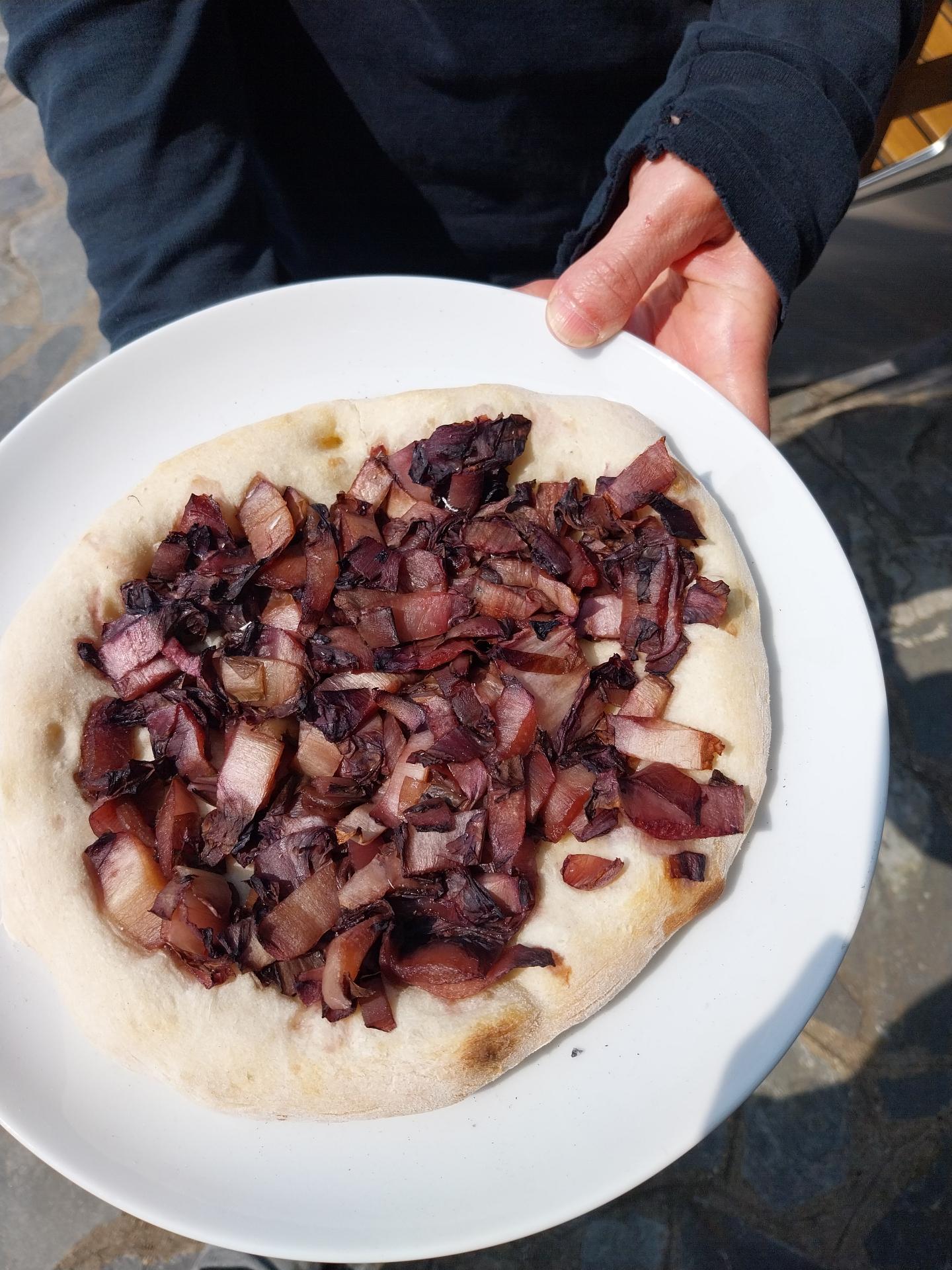
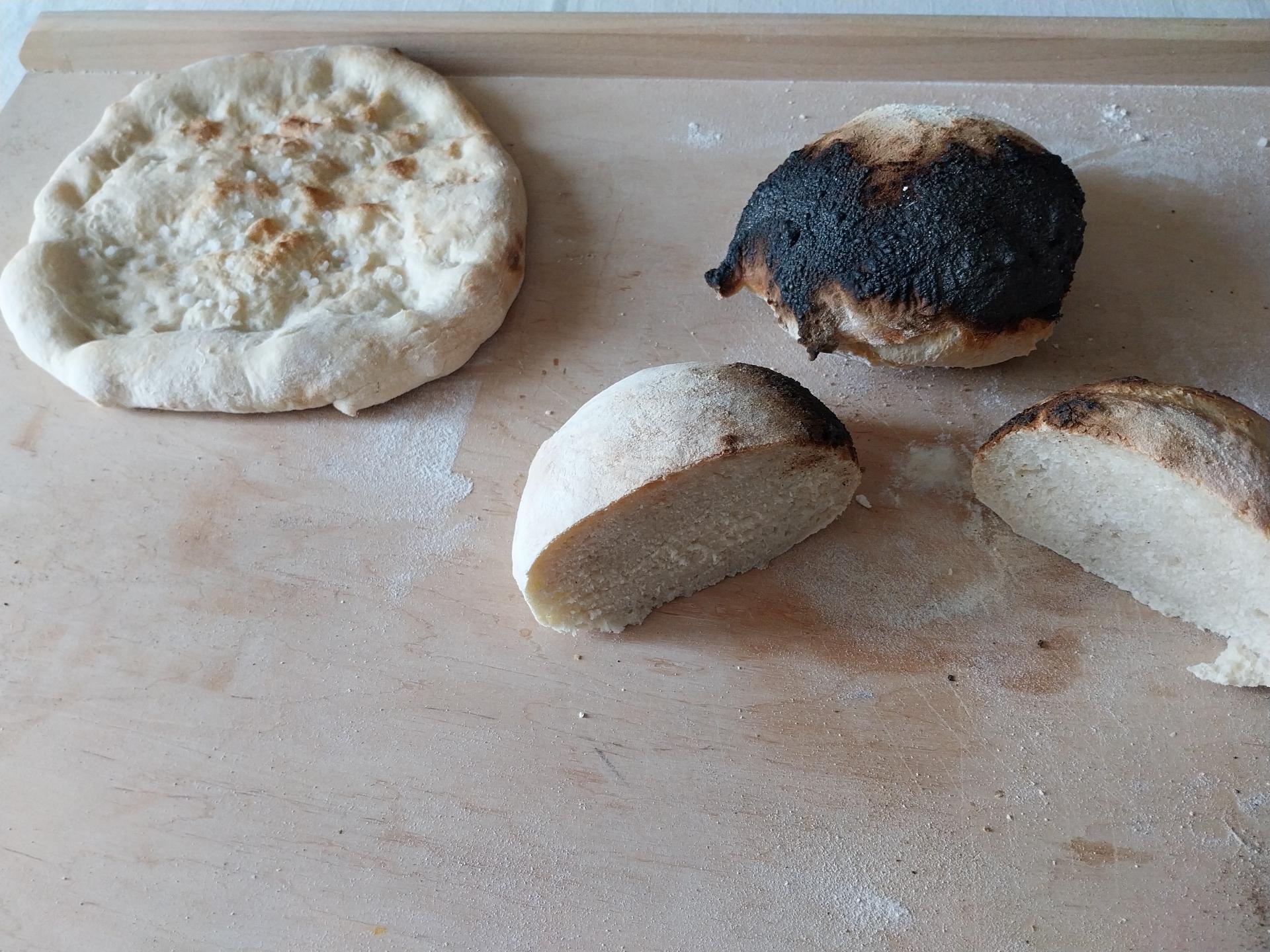
The next time I think I ll try with one of my other staples: Molino Bogetto etichetta blu (260/280 W) Then this morning we assembled the N MMAR , then I divided the dough in eight balls, put them in a covered but not sealed container 3, well floured with rice flour and then we fired the oven (as in: my partner did, I looked for a short while and then set the table and stuff), using charcoal, because we already had some, and could conveniently get more at the supermarket. When the oven had reached temperatures in the orange range4 I stretched the smallest ball out, working on my wooden peel, sprayed it with water5, sprinkled it with coarse salt and put it in the oven. After 30 seconds I turned it around with the new metal peel, then again after 30 seconds, and then I lost count of how many times I repeated this6, but it was probably 2 or 3 minutes until it looked good. A flatbread on a regular plate: it's only a bit more than half the plate in diameter, puffed up near the borders and thin in the middle, and only lightly browned in places, not burnt. It's sitting on the lower shelf of a wooden table. And it was good. The kind of pizza that is quite soft, especially near the borders. We ate it with fresh mozzarella and tomatoes, and then made another one the same way, to finish the mozzarella. Another flatbread on the same plate, this time it's about 4 cm smaller than the plate on all sides, and it's covered with brownish-red chopped up vegetables. This was supposed to be our lunch, but we decided to try one with some leftover cooked radicchio, and that also worked quite nicely. And finally, we decided we needed to try a more classical pizza, with tomato sauce and cured meat, of which we forgot to take pictures. Up to here we had eaten about half of the dough, and we were getting full: I had prepared significantly more than what I expected to eat, to be able to accidentally burn some, but also with the idea to bake something else to be eaten later. So I made two more focaccias with just water and salt, and then I tried to cook some bread with what I expected to be residual heat. Another flatbread with coarse salt and two bread rolls, one of which is completely carbonized on one side. The other one has been cut, and while it has a carbonized spot, it is also well cooked in the middle, and perfectly edible. Except that the oven was getting a bit too cold, so my partner added some charcoal, and when I put the last two unflattened balls right at the back of the oven where it was still warmer, that side carbonized. After 5 minutes I moved them to the middle of the oven, and turned them, and then after another turn and 5 more minutes they were ready. And other than the burnt crust, they were pretty edible. So, the thoughts after our first experience. Everybody around the table (my SO, my mother and me) was quite happy with the results, and they are different enough from the ones I could get with the regular oven. As I should have expected, it s much faster than a masonry oven, both in getting to temperature and in cooling down: my plan for residual heat bread cooking will have to be adjusted with experience. We were able to get it hot enough, but not as hot as it s supposed to be able to get: we suspect that using just charcoal may have influenced it, and next week we ll try to get some wood, and try with a mix. As for the recipe, dividing the dough in eight parts worked quite well: maybe the pizzas are a bit on the smaller side, but since they come one at a time it s more convenient to cut and share them, and maybe make a couple more at the end. Of course, I ll want to try different recipes, for different styles of pizzas (including some almost-trademark-violating ones) and for other types of flatbread. I expect it won t be hard to find volunteers to help us with the experiments. :D
  1. any insinuation that there may have been considerations of having a way to have freshly baked bread in case of a prolonged blackout may or may not be based on reality. But it wasn t the only or even the main reason.
  2. come on! it s made of STEEL. how can it be not good? :D
  3. IKEA 365+ 3.1 glass, the one that is 32 cm 21 cm 9 cm; it was just big enough for the amount of dough, and then I covered it with a lid that is missing the seal.
  4. why did they put a thermometer on it, and not add labels with the actual temperature? WHY???
  5. if you don t have dietary restrictions a bit of olive oil would taste even better.
  6. numbers above 2 are all basically the same, right?

15 April 2026

Paul Tagliamonte: designing arf, an sdr iq encoding format

Interested in future updates? Follow me on mastodon at @paul@soylent.green. Posts about hz.tools will be tagged #hztools.

Want to jump right to the draft? I'll be maintaining ARF going forward at /draft-tagliamonte-arf-00.txt.
It s true processing data from software defined radios can be a bit complex which tends to keep all but the most grizzled experts and bravest souls from playing with it. While I wouldn t describe myself as either, I will say that I ve stuck with it for longer than most would have expected of me. One of the biggest takeaways I have from my adventures with software defined radio is that there s a lot of cool crossover opportunity between RF and nearly every other field of engineering. Fairly early on, I decided on a very light metadata scheme to track SDR captures, called rfcap. rfcap has withstood my test of time, and I can go back to even my earliest captures and still make sense of what they are IQ format, capture frequencies, sample rates, etc. A huge part of this was the simplicity of the scheme (fixed-lengh header, byte-aligned to supported capture formats), which made it roughly as easy to work with as a raw file of IQ samples. However, rfcap has a number of downsides. It s only a single, fixed-length header. If the frequency of operation changed during the capture, that change is not represented in the capture information. It s not possible to easily represent mulit-channel coherent IQ streams, and additional metadata is condemned to adjacent text files.

ARF (Archive of RF) A few years ago, I needed to finally solve some of these shortcomings and tried to see if a new format would stick. I sat down and wrote out my design goals before I started figuring out what it looked like. First, whatever I come up with must be capable of being streamed and processed while being streamed. This includes streaming across the network or merely written to disk as it s being created. No post-processing required. This is mostly an artifact of how I ve built all my tools and how I intereact with my SDRs. I use them extensively over the network (both locally, as well as remotely by friends across my wider lan). This decision sometimes even prompts me to do some crazy things from time to time. I need actual, real support for multiple IQ channels from my multi-channel SDRs (Ettus, Kerberos/Kracken SDR, etc) for playing with things like beamforming. My new format must be capable of storing multiple streams in a single capture file, rather than a pile of files in a directory (and hope they re aligned). Finally, metadata must be capable of being stored in-band. The initial set of metadata I needed to formalize in-stream were Frequency Changes and Discontinuities. Since then, ARF has grown a few more. After getting all that down, I opted to start at what I thought the simplest container would look like, TLV (tag-length-value) encoded packets. This is a fairly well trodden path, and used by a bunch of existing protocols we all know and love. Each ARF file (or stream) was a set of encoded packets (sometimes called data units in other specs). This means that unknown packet types may be skipped (since the length is included) and additional data can be added after the existing fields without breaking existing decoders.
tag
length
value
Heads up! Once this is posted, I'm not super likely to update this page. Once this goes out, the latest stable copy of the ARF spec is maintained at draft-tagliamonte-arf-00.txt. This page may quickly become out of date, so if you're actually interested in implementing this, I've put a lot of effort into making the draft comprehensive, and I plan to maintain it as I edit the format.
Unlike a traditional TLV structure, I opted to add flags to the top-level packet. This gives me a bit of wiggle room down the line, and gives me a feature that I like from ASN.1 a critical bit. The critical bit indicates that the packet must be understood fully by implementers, which allows future backward incompatible changes by marking a new packet type as critical. This would only really be done if something meaningfully changed the interpretation of the backwards compatible data to follow.
Flag Description
0x01Critical (tag must be understood)
Within each Packet is a tag field. This tag indicates how the contents of the value field should be interpreted.
Tag ID Description
0x01Header
0x02Stream Header
0x03Samples
0x04Frequency Change
0x05Timing
0x06Discontinuity
0x07Location
0xFEVendor Extension
In order to help with checking the basic parsing and encoding of this format, the following is an example packet which should parse without error.
 00, // tag (0; no subpacket is 0 yet)
 00, // flags (0; no flags)
 00, 00 // length (0; no data)
 // data would go here, but there is none
Additionally, throughout the rest of the subpackets, there are a few unique and shared datatypes. I document them all more clearly in the draft, but to quickly run through them here too:

UUID This field represents a globally unique idenfifer, as defined by RFC 9562, as 16 raw bytes.

Frequency Data encoded in a Frequency field is stored as microhz (1 Hz is stored as 1000000, 2 Hz is stored as 2000000) as an unsigned 64 bit integer. This has a minimum value of 0 Hz, and a maximum value of 18446744073709551615 uHz, or just above 18.4 THz. This is a bit of a tradeoff, but it s a set of issues that I would gladly contend with rather than deal with the related issues with storing frequency data as a floating point value downstream. Not a huge factor, but as an aside, this is also how my current generation SDR processing code (sparky) stores Frequency data internally, which makes conversion between the two natural.

IQ samples ARF supports IQ samples in a number of different formats. Part of the idea here is I want it to be easy for capturing programs to encode ARF for a specific radio without mandating a single iq format representation. For IQ types with a scalar value which takes more than a single byte, this is always paired with a Byte Order field, to indicate if the IQ scalar values are little or big endian.
ID Name Description
0x01f32interleaved 32 bit floating point scalar values
0x02i8 interleaved 8 bit signed integer scalar values
0x03i16interleaved 16 bit signed integer scalar values
0x04u8 interleaved 8 bit unsigned integer scalar values
0x05f64interleaved 64 bit floating point scalar values
0x06f16interleaved 16 bit floating point scalar values

Stream Header Immediately after the arf Header, some number of Stream Headers follow. There must be exactly the same number of Stream Header packets as are indicated by the num streams field of the Header. This has the nice effect of enabling clients to read all the stream headers without requiring buffering of unread packets from the stream.
id
flags
fmt
bo
rate
freq
guid
site
In order to help with checking the basic parsing and encoding of this format, the following is an example stream header subpacket (when encoded or decoded this will be found inside an ARF packet as described above) which should parse without error, with known values.
00, 01, // id (1)
00, 00, 00, 00, 00, 00, 00, 00, // flags
01, // format (float32)
01, // byte order (Little Endian)
00, 00, 01, d1, a9, 4a, 20, 00, // rate (2 MHz)
00, 00, 5a, f3, 10, 7a, 40, 00, // frequency (100 MHz)

// guid (7b98019d-694e-417a-8f18-167e2052be4d)
7b, 98, 01, 9d, 69, 4e, 41, 7a,
8f, 18, 16, 7e, 20, 52, be, 4d,

// site_id (98c98dc7-c3c6-47fe-bc05-05fb37b2e0db)
98, c9, 8d, c7, c3, c6, 47, fe,
bc, 05, 05, fb, 37, b2, e0, db,

Samples Block of IQ samples in the format indicated by this stream s format and byte_order field sent in the related Stream Header.
id
iq samples
In order to help with checking the basic parsing and encoding of this format, the following is an samples subpacket (when encoded or decoded this will be found inside an ARF packet as described above). The IQ values here are notional (and are either 2 8 bit samples, or 1 16 bit sample, depending on what the related Stream Header was).
01, // id
ab, cd, ab, cd, // iq samples

Frequency Change The center frequency of the IQ stream has changed since the Stream Header or last Frequency Change has been sent. This is useful to capture IQ streams that are jumping around in frequency during the duration of the capture, rather than starting and stopping them.
id
frequency
In order to help with checking the basic parsing and encoding of this format, the following is a frequency change subpacket (when encoded or decoded this will be found inside an ARF packet as described above).
01, // id
00, 00, b5, e6, 20, f4, 80, 00 // frequency (200 MHz)

Discontinuity Since the last Samples packet for this stream, samples have been dropped or not encoded to this stream. This can be used for a stream that has dropped samples for some reason, a large gap (radio was needed for something else), or communicating iq snippits .
id
In order to help with checking the basic parsing and encoding of this format, the following is a discontinuity subpacket (when encoded or decoded this will be found inside an ARF packet as described above).
01, // id

Location Up-to-date location as of this moment of the IQ stream, usually from a GPS. This allows for in-band geospatial information to be marked in the IQ stream. This can be used for all sorts of things (detected IQ packet snippits aligned with a time and location or a survey of rf noise in an area)
flags
sys
lat
long
el
accuracy
The sys field indicates the Geodetic system to be used for the provided latitude, longitude and elevation fields. The full list of supported geodetic systems is currently just WGS84, but in case something meaningfully changes in the future, it d be nice to migrate forward. Unfortunately, being a bit of a coward here, the accuracy field is a bit of a cop-out. I d really rather it be what we see out of kinematic state estimation tools like a kalman filter, or at minimum, some sort of ellipsoid. This is neither of those - it s a perfect sphere of error where we pick the largest error in any direction and use that. Truthfully, I can t be bothered to model this accurately, and I don t want to contort myself into half-assing something I know I will half-ass just because I know better.
System Description
0x01 WGS84 - World Geodetic System 1984
In order to help with checking the basic parsing and encoding of this format, the following is a location subpacket (when encoded or decoded this will be found inside an ARF packet as described above).
00, 00, 00, 00, 00, 00, 00, 00, // flags
01, // system (wgs84)
3f, f3, be, 76, c8, b4, 39, 58, // latitude (1.234)
40, 02, c2, 8f, 5c, 28, f5, c3, // longitude (2.345)
40, 59, 00, 00, 00, 00, 00, 00, // elevation (100)
40, 24, 00, 00, 00, 00, 00, 00 // accuracy (10)

Vendor Extension In addition to the fields I put in the spec, I expect that I may need custom packet types I can t think of now. There s all sorts of useful data that could be encoded into the stream, so I d rather there be an officially sanctioned mechanism that allows future work on the spec without constraining myself. Just an example, I ve used a custom subpacket to create test vectors, the data is encoded into a Vendor Extension, followed by the IQ for the modulated packet. If the demodulated data and in-band original data don t match, we ve regressed. You could imagine in-band speech-to-text, antenna rotator azimuth information, or demodulated digital sideband data (like FM HDR data) too. Or even things I can t even think of!
id
data
In order to help with checking the basic parsing and encoding of this format, the following is a vendor extension subpacket (when encoded or decoded this will be found inside an ARF packet as described above).
// extension id (b24305f6-ff73-4b7a-ae99-7a6b37a5d5cd)
b2, 43, 05, f6, ff, 73, 4b, 7a,
ae, 99, 7a, 6b, 37, a5, d5, cd,

// data (0x01, 0x02, 0x03, 0x04, 0x05)
01, 02, 03, 04, 05

Tradeoffs The biggest tradeoff that I m not entirely happy with is limiting the length of a packet to u16 65535 bytes. Given the u8 sample header, this limits us to 8191 32 bit sample pairs at a time. I wound up believing that the overhead in terms of additional packet framing is worth it because always encoding 4 byte lengths felt like overkill, and a dynamic length scheme ballooned codepaths in the decoder that I was trying to keep as easy to change as possible as I worked with the format.

12 April 2026

Russ Allbery: Review: The Teller of Small Fortunes

Review: The Teller of Small Fortunes, by Julie Leong
Publisher: Ace
Copyright: November 2024
ISBN: 0-593-81590-4
Format: Kindle
Pages: 324
The Teller of Small Fortunes is a cozy found-family fantasy with a roughly medieval setting. It was Julie Leong's first novel. Tao is a traveling teller of small fortunes. In her wagon, pulled by her friendly mule Laohu, she wanders the small villages of Eshtera and reads the trivial fortunes of villagers in the tea leaves. An upcoming injury, a lost ring, a future kiss, a small business deal... she looks around the large lines of fate and finds the small threads. After a few days, she moves on, making her solitary way to another village. Tao is not originally from Eshtera. She is Shinn, which means she encounters a bit of suspicion and hostility mixed with the fascination of the exotic. (Language and culture clues lead me to think Shinara is intended to be this world's not-China, but it's not a direct mapping.) Tao uses the fascination to help her business; fortune telling is more believable from someone who seems exotic. The hostility she's learned to deflect and ignore. In the worst case, there's always another village. If you've read any cozy found-family novels, you know roughly what happens next. Tao encounters people on the road and, for various reasons, they decide to travel together. The first two are a massive mercenary (Mash) and a semi-reformed thief (Silt), who join Tao somewhat awkwardly after Tao gives Mash a fortune that is far more significant than she intended. One town later, they pick up an apprentice baker best known for her misshapen pastries. They also collect a stray cat, because of course they do. It's that sort of book. For me, this sort of novel lives or dies by the characters, so it's good news that I liked Tao and enjoyed spending time with her. She's quiet, resilient, competent, and self-contained, with a difficult past and some mysteries and emotions the others can draw over time. She's also thoughtful and introspective, which means the tight third-person narration that almost always stays on Tao offers emotional growth to mull over. I also liked Kina (the baker) and Mash; they're a bit more obvious and straightforward, but Kina adds irrepressible energy and Mash is a good example of the sometimes-gruff soldier with a soft heart. Silt was a bit more annoying and I never entirely warmed to him, but he's tolerable and does get a bit of much-needed (if superficial) character development. It takes some time for the reader to learn about the primary conflict of the story (Tao does not give up her secrets quickly), so I won't spoil it, but I thought it worked well. I was momentarily afraid the story would develop a clear villain, but Leong has some satisfying alternate surprises in store. The ending was well-done, although it is very happily-ever-after in a way that may strike some readers as too neat. The Teller of Small Fortunes aims for a quiet and relaxed mood rather than forcing character development through difficult choices; it's a fine aim for a novel, but it won't match everyone's mood. I liked the world-building, although expect small and somewhat disconnected details rather than an overarching theory of magic. Tao's ability gets the most elaboration, for obvious reasons, and I liked how Leong describes it and explores its consequences. Most of the attention in the setting is on the friction, wistfulness, and small reminders of coming from a different culture than everyone around you, but so long ago that you are not fully a part of either world. This, I thought, was very well-done and is one of the places where the story is comfortable with complex feelings and doesn't try to reach a simplifying conclusion. There is one bit of the story that felt like it was taken directly out of a Dungeons & Dragons campaign to a degree that felt jarring, but that was the only odd world-building note. This book felt like a warm cup of tea intended to comfort and relax, without large or complex thoughts about the world. It's not intended to be challenging; there are a few plot twists I didn't anticipate, but nothing that dramatic, and I doubt anyone will be surprised by the conclusions it reaches. It's a pleasant time with some nice people and just enough tension and mystery to add some motivation to find out what happens next. If that's what you're in the mood for, recommended. If you want a book that has Things To Say or will put you on the edge of your seat, maybe save this one for another mood. All the on-line sources I found for this book call it a standalone, but The Keeper of Magical Things is set in the same world, so I would call it a loose series with different protagonists. The Teller of Small Fortunes is a complete story in one book, though. Rating: 7 out of 10

6 April 2026

Thorsten Alteholz: My Debian Activities in March 2026

Debian LTS/ELTS This was my hundred-forty-first month that I did some work for the Debian LTS initiative, started by Raphael Hertzog at Freexian. During my allocated time I uploaded or worked on: I also worked on the check-advisories script and proposed a fix for cases where issues would be assigned to the coordinator instead of the person who forgot doing something. I also did some work for a kernel update and packages snapd and ldx on security-master and attended the monthly LTS/ELTS meeting. Last but not least I started to work on gst-plugins-bad1.0 Debian Printing This month I uploaded a new upstream versions: Several packages take care of group lpadmin in their maintainer scripts. With the upload of version 260.1-1 of systemd there is now a central package (systemd systemd-standalone-sysusers systemd-sysusers) that takes care of this. Other dependencies like adduser can now be dropped. This work is generously funded by Freexian! Debian Lomiri This month I continued to work on unifying packaging on Debian and Ubuntu. This makes it easier to work on those packages independent of the used platform. I am also able to upload Debian packages to the corresponding Ubuntu PPA now. A small bug had to be fixed in the python script to allow the initial configuration in Launchpad. This work is generously funded by Fre(i)e Software GmbH! Debian Astro This month I uploaded a new upstream version or a bugfix version of: I also uploaded lots of indi-drivers (libplayerone, libsbig, libricohcamerasdk, indi-asi, indi-eqmod, indi-fishcamp, indi-inovaplx, indi-pentax, indi-playerone, indi-sbig, indi-mi, libahp-xc, indi-aagcloudwatcher, indi-aok, indi-apogee, libapogee3, indi-nightscape, libasi, libinovasdk, libmicam, indi-avalon, indi-beefocus, indi-bresserexos2, indi-dsi, indi-ffmv, indi-fli, indi-gige, info-gphoto, indi-gpsd, indi-gpsnmea, indi-limesdr, indi-maxdomeii, indi-mgen, indi-rtklib, indi-shelyak, indi-starbook, indi-starbookten, indi-talon6, indi-weewx-json, indi-webcam, indi-orion-ssg3, indi-armadillo-playtypus ) to experimental to make progress with the indi-transition. No problems with those drivers appeared and the next step would be the upload of indi version 2.x to unstable. I hope this will happen soon, as new drivers are already waiting in the pipeline. There have been also four packages, that migrated to the official indi package and are no longer needed as 3rdparty drivers (indi-astrolink4, indi-astromechfoc, indi-dreamfocuser, indi-spectracyber). While working on these packages, I thought about testing them. Unfortunately I don t have enough hardware to really check out every package, so I can upload most of them only as is. In case anybody is interested in a better testing coverage and me being able to provide upstream patches, I would be very glad about hardware donations. Debian IoT This month I uploaded a new upstream version or a bugfix version of: Debian Mobcom This month I uploaded a new upstream version or a bugfix version of: misc This month I uploaded a new upstream version or a bugfix version of: I also sponsored the upload of Matomo. Thanks a lot to William for preparing the package.

1 April 2026

Matthew Garrett: Self hosting as much of my online presence as practical

Because I am bad at giving up on things, I ve been running my own email server for over 20 years. Some of that time it s been a PC at the end of a DSL line, some of that time it s been a Mac Mini in a data centre, and some of that time it s been a hosted VM. Last year I decided to bring it in house, and since then I ve been gradually consolidating as much of the rest of my online presence as possible on it. I mentioned this on Mastodon and a couple of people asked for more details, so here we are. First: my ISP doesn t guarantee a static IPv4 unless I m on a business plan and that seems like it d cost a bunch more, so I m doing what I described here: running a Wireguard link between a box that sits in a cupboard in my living room and the smallest OVH instance I can, with an additional IP address allocated to the VM and NATted over the VPN link. The practical outcome of this is that my home IP address is irrelevant and can change as much as it wants - my DNS points at the OVH IP, and traffic to that all ends up hitting my server. The server itself is pretty uninteresting. It s a refurbished HP EliteDesk which idles at 10W or so, along 2TB of NVMe and 32GB of RAM that I found under a pile of laptops in my office. We re not talking rackmount Xeon levels of performance, but it s entirely adequate for everything I m doing here. So. Let s talk about the services I m hosting.

Web This one s trivial. I m not really hosting much of a website right now, but what there is is served via Apache with a Let s Encrypt certificate. Nothing interesting at all here, other than the proxying that s going to be relevant later.

Email Inbound email is easy enough. I m running Postfix with a pretty stock configuration, and my MX records point at me. The same Let s Encrypt certificate is there for TLS delivery. I m using Dovecot as an IMAP server (again with the same cert). You can find plenty of guides on setting this up. Outbound email? That s harder. I m on a residential IP address, so if I send email directly nobody s going to deliver it. Going via my OVH address isn t going to be a lot better. I have a Google Workspace, so in the end I just made use of Google s SMTP relay service. There s various commerical alternatives available, I just chose this one because it didn t cost me anything more than I m already paying.

Blog My blog is largely static content generated by Hugo. Comments are Remark42 running in a Docker container. If you don t want to handle even that level of dynamic content you can use a third party comment provider like Disqus.

Mastodon I m deploying Mastodon pretty much along the lines of the upstream compose file. Apache is proxying /api/v1/streaming to the websocket provided by the streaming container and / to the actual Mastodon service. The only thing I tripped over for a while was the need to set the X-Forwarded-Proto header since otherwise you get stuck in a redirect loop of Mastodon receiving a request over http (because TLS termination is being done by the Apache proxy) and redirecting to https, except that s where we just came from. Mastodon is easily the heaviest part of all of this, using around 5GB of RAM and 60GB of disk for an instance with 3 users. This is more a point of principle than an especially good idea.

Bluesky I m arguably cheating here. Bluesky s federation model is quite different to Mastodon - while running a Mastodon service implies running the webview and other infrastructure associated with it, Bluesky has split that into multiple parts. User data is stored on Personal Data Servers, then aggregated from those by Relays, and then displayed on Appviews. Third parties can run any of these, but a user s actual posts are stored on a PDS. There are various reasons to run the others, for instance to implement alternative moderation policies, but if all you want is to ensure that you have control over your data, running a PDS is sufficient. I followed these instructions, other than using Apache as the frontend proxy rather than nginx, and it s all been working fine since then. In terms of ensuring that my data remains under my control, it s sufficient.

Backups I m using borgmatic, backing up to a local Synology NAS and also to my parents home (where I have another HP EliteDesk set up with an equivalent OVH IPv4 fronting setup). At some point I ll check that I m actually able to restore them.

Conclusion Most of what I post is now stored on a system that s happily living under a TV, but is available to the rest of the world just as visibly as if I used a hosted provider. Is this necessary? No. Does it improve my life? In no practical way. Does it generate additional complexity? Absolutely. Should you do it? Oh good heavens no. But you can, and once it s working it largely just keeps working, and there s a certain sense of comfort in knowing that my online presence is carefully contained in a small box making a gentle whirring noise.

31 March 2026

Russ Allbery: Review: Code Blue Emergency

Review: Code Blue Emergency, by James White
Series: Sector General #7
Publisher: Orb
Copyright: 1987
Printing: May 2003
ISBN: 0-7653-0663-8
Format: Trade paperback
Pages: 252
Code Blue Emergency (annoying em-dash in original title) is the seventh book of James White's Sector General science fiction series about a vast multi-species hospital station. While there are some references to (and spoilers for) earlier books in the series, you don't have to remember the previous books to read this one. I had no trouble despite a nine-year gap. I read this as part of the Orb General Practice omnibus, which collects this novel and The Genocidal Healer. Cha Thrat is a Sommaradvan warrior-surgeon, member of a newly-discovered species that is beginning the process of contact with the Federation. She saved a Monitor corps human after an accident on her world, performing some some highly competent surgery on a species she had never seen before. That plus her somewhat outcast status on her own world due to her very traditional attitude towards medical ethics led Sector General to extend an offer of medical internship, and led her to leap into the unknown by accepting. This may have been a mistake; there is a great deal that Sector General does not understand about Sommaradvan medical ethics. This series entry is another proper (if somewhat episodic) novel and the first book of the series that doesn't primarily focus on Conway. He makes an appearance in his new role as Diagnostician, but only as a supporting character. Code Blue Emergency is told in the tight third-person perspective of Cha Thrat, an alien who finds many things about Sector General baffling, confusing, and ethically troubling (and who therefore provides a good reader surrogate for reintroducing the basics of how the hospital works). Using an alien viewpoint is a more sophisticated narrative technique than White has used previously. I'm glad he tried it, and it mostly works, although I have some complaints. Cha Thrat comes from the middle caste of a strictly hierarchical society of three castes, but is also immensely stubborn and used to a medical system in which doctors take sole responsibility for their patients. This creates a lot of cultural conflicts, and I do enjoy science fiction where the human attitudes are portrayed as the strange ones, but the cultural analysis offered by this novel is not very deep. The pattern of this book is for Cha Thrat to stumble into a successful approach to a problem while being either oblivious to or hostile to the normal hierarchical structure expected of medical trainees. This is believable as far as it goes. She is a skilled and intelligent doctor with some good instincts and a strong commitment to patient care, but is also culturally inclined to not ask for help. It makes sense for that to be a serious problem in a hospital. Unfortunately, no one says this directly. Sector General staff get quite upset in ways that seem more territorial than oriented towards patient safety, no one directly explains to Cha Thrat why following a process is important or shows examples of what could go wrong, and plot armor means that her mistakes usually have positive outcomes. One can extrapolate the reasons why she is not a good medical student, but the reader is forced to do the extrapolation. This is the sort of book where the narration makes clear there are unresolved cultural clashes that are going to cause problems but hides the details. To Cha Thrat, her perspective is so obvious she never bothers to explain it to the reader, so the specifics come as a surprise. As with the alien perspective, I've seen this technique used with more subtlety and sophistication in other books, but White's version mostly works. Cha Thrat is a sympathetic protagonist because she is truly trying to take the most ethical and empathetic action in every situation and is clearly competent. Most of my frustration as a reader, ironically, lands on the other Sector General doctors who seem to make little to no effort to understand her perspective when she fails to conform to their expectations. This is believable in the abstract, but the whole point of Sector General is that they're supposed to be wiser about interspecies difference than this. Also, sometimes their reactions just seem petty. Cha Thrat has a very hierarchical concept of medicine that matches the social classes of her culture. For her, the highest tier of doctor are wizards who treat rulers, because the work of rulers is mostly mental and intellectual and therefore the diseases of rulers are treated with magic spells performed with words to reshape their thinking rather than surgery on their bodies. O'Mara and the other Sector General psychologists take great offense at this, muttering about being called witch doctors, which I found completely absurd. This is a comprehensible, if odd, description of psychology from a wholly alien species. Surely one's first reaction should be that words like "wizard" or "magic" are translation errors. Don't get offended; look to see if the underlying substance matches, which it clearly does. Apart from cultural and psychological clashes, Code Blue Emergency has the standard episodic Sector General structure of interesting medical mysteries that require lateral thinking. I find this sort of puzzle story satisfying, particularly given the firm belief of every character in an essentially pacifist and empathetic approach to even the most alien of creatures. This determined non-violence is one of the more interesting things about this series, and it continues here. White does tend towards both biological and gender essentialism for everyone other than the protagonist and main supporting characters, but he seemed to be walking back some of the more outrageous limitations on women that appeared in previous books. There is still some nonsense in here about how females of any species can't be Diagnosticians, but then Cha Thrat, who is female, seems to violate the justification for that rule over the course of this novel (sadly without comment). Perhaps he's setting up for proving Sector General wrong about this prejudice. I picked this up after reading Elizabeth Bear's Machine, which is essentially a (better written) Sector General novel that got me in the mood for reading more. I wouldn't give Code Blue Emergency any awards, but it delivered exactly what I was looking for. This series is not as deep or well-written as some more recent SF, but it is reliably itself and reliably entertaining. There are worse things in a series. Recommended if you're in the mood for alien ER in space. The omnibus edition that I read has an introduction to both novels by John Clute. It does add some interesting insights, but (as is somewhat typical for Clute) it also spoils parts of both books. You may want to read it after you read the novels. Followed by The Genocidal Healer. Rating: 7 out of 10

30 March 2026

Jamie McClelland: Mailman3 has 2 databases. Whoops.

At May First we have been carefully planning our migration of about 1200 lists from mailman2 to mailman3 for almost six months now. We did a lot of user communications, had several months of beta testing with a handful of lists ported over, and everything was looking good. So we kicked off the migration! But, about 15% of the way through I started seeing sqlite lock errors. Wait, what? I carefully re-configured mailman3 to use postgres, not sqlite. Well, yes, but apparently that was for the database managing the email list configuration, not the database powering the django web app, which, incidentally, also includes hundresds of gigabytes of archives. In other words, the one we really need in postgres, not sqlite.

Moving from sqlite to postgres Well that sucks. We immediately stopped the migration to deal with this. I noticed that the web is full of useful django instructions on how to migrate your database from one database to antoher. However, if you read the fine print, those convenient looking dumpdata loaddata workflows are designed to move the table definitions and a small amount of data. In our case, even after just 15% of our lists moved, our sqlite database was about 30GB. I considered some of the hacks to manage memory and try to run this via django, but eventually decided that pgloader was a more robust option. This option also allowed me to more easily test things out on a copy of our sqlite database (made while mailman was turned off). This way I could migrate and re-migrate the sqlite database over and over without impacting our live installation until I was satisfied it was all working. My first decision was to opt out of pgloader s schema creation. I used django s schema creation tool by:
  • Turning off mailman3 and mailman3-web and changing the mailman web configuration to use the new postgresql database.
  • Running mailman-web migrate
  • Changing the mailman web configuration back to sqlite and starting everything again.
Note: I tried just adding new database settings in the mailman web configuration indexed to new - django has the ability to define different databases by name, then you can run mailman-web migrate --database new. But, during the migration, I caught django querying the sqlite database for some migrations that required referencing existing fields (specifically hyperkitty s 0003_thread_starting_email). I didn t want any of these steps to touch the live database so I opted for the cleaner approach. Once I had a clean postgres schema, I dumped it so I could easily return to this spot. Next I started working on our pgloader load file. After a lot of trial and error, I ended with:
LOAD DATABASE
    FROM sqlite:///var/lib/mailman3/sqlite-postgres-migration/mailman3web.clean.backup.db
    INTO postgresql://mailmanweb:xxxxxxxxxxx@localhost:5432/mailmanweb

WITH data only,
    reset sequences,
    include no drop,
    disable triggers,
    create no tables,
    batch size = 5MB,
    batch rows = 500,
    prefetch rows = 50,
    workers = 2,
    concurrency = 1

SET work_mem to '64MB',
    maintenance_work_mem to '512MB'

CAST type datetime to timestamptz drop default drop not null,
    type date to date drop default drop not null,
    type int when (= precision 1) to boolean using tinyint-to-boolean,
    type text to varchar using remove-null-characters;
The batch, prefetch, workers and concurreny settings are all there to ensure memory doesn t blow up. I also discovered that I had to make some changes to the schema before loading data. Mostly truncating tables that the django migrate command populated to avoid duplicate key errors:
TRUNCATE TABLE django_migrations CASCADE;
TRUNCATE TABLE django_content_type CASCADE;
TRUNCATE TABLE auth_permission CASCADE;
TRUNCATE TABLE django_site CASCADE;
And also, I had to change a column type. Apparently the mailman import process allowed an attachment file name that exceeds the limit for postgres, but was allowed into sqlite:
ALTER TABLE hyperkitty_attachment ALTER COLUMN name TYPE text
When pgloader runs, we still get a lot of warnings from pgloader, which wants to cast columns differently than django does. These are harmless (I was able to import the data without a problem). And there are still a lot of warnings along the lines of:
2026-03-30T14:08:01.691990Z WARNING PostgreSQL warning: constraint hyperkitty_vote_email_id_73a50f4d_fk_hyperkitty_email_id of relation hyperkitty_vote does not exist, skipping
These are harmless as well. They appear because disable triggers disables foreign key constraints. Without it, we wouldn t be able to load tables that require values in tables that have not yet been populated. After all the tweaking, the import of our 30GB sqlite database took about 40 minutes.

Final Steps I think the reset sequences from pgloader should take care of this, but just in case:
mailman-web sqlsequencereset hyperkitty mailman_django auth   mailman-web dbshell
And, just to ensure postgres is optimized, run this in the psql shell:
ANALYZE VERBOSE;

Last thoughts I understand very well all the decisions the mailman3 devs made in designing the next version of mailman, and if I was in the same place I may have made them the same ones. For example, separating the code running the mailing list from the code managing the archives and the web interface makes perfectly good sense - many people might want to run just the mailing list part without a web interface. And building the web interface in django makes a lot of sense as well - why re-invent the wheel? I m sure a lot of time and effort was saved by simply using the built in features you get for free with django. But the unfortunate consequence of these decisions is that sys admins have a much harder time. Almost everyone wants the email lists along with the web interface and the archives. But nobody wants two different configuration files with different syntaxes and logic, not to mention two different command lines to use for maintenance and configuration with completely different APIs. Trying to understand how to change a default template or set list defaults requires a lot of research and usually you have to write a python script to do it. I have finally come to the conclusion that mailman2 is designed for sys admins, while mailman3 is designed for developers. Despite these short comings, I am impressed with the community and their quick and friendly responses to the questions of a confused sys admin. That might be more valuable than anything else.

Russ Allbery: Review: The Cloak and Its Wizard

Review: The Cloak and Its Wizard, by R.Z. Nicolet
Publisher: UpLit Press
Copyright: February 2026
ISBN: 1-917849-15-X
Format: Kindle
Pages: 423
The Cloak and Its Wizard is a standalone (at least so far) urban fantasy superhero (sort of) novel. R.Z. Nicolet is the marketing pseudonym for Rachel Reddick. This is her first novel.
I'm picky about wizards. The wizards themselves will complain about that, but of course I'm picky. When I choose a wizard, barring utter abandonment of moral scruples, it's a till-death-do-us-part situation. (Their death, not mine. I'm the next best thing to indestructible.)
The Cloak of Sunset and Starlight is a major artifact, meaning that it has its own preferences and is capable of independent action. It has been sitting in a glass case in the wizards' library for about a hundred years, waiting for someone interesting. (Well, mostly sitting. Occasionally it sneaks out to eavesdrop or move the books around.) Veronica Noble is interesting. She's older than most initiates, thoughtful, observant, and clearly had some mundane career before joining the Order. Her aura is appealing, and her mental shields and resistance to influence are intriguing. Normally, the Cloak would take its time investigating a new potential wizard, but the Sword was making thoughtful rattling sounds, and no way is the Cloak going to let the Sword claim her first. Time to choose a new wizard!
It was nice, being draped over warm shoulders, and feeling a heartbeat again. I could tell she closed her eyes without even looking. She sighed. "I just got picked by the intransigent one, didn't I?"
The last time I picked a book from the Big Idea feature in Scalzi's Whatever blog, it didn't go that well, but if you're going to write a book specifically for me, I'm going to read it. There are very few tropes of SFF that I love more than intelligent companion objects, and Nicolet's introduction to the story was compelling. So I gave this book discovery method another chance. I'm glad I did, because this was exactly what I was in the mood for and a delight from cover to cover. Veronica Noble is not a typical wizard. She's a surgeon and was quite happy to be a surgeon until an unexpected encounter with a magical creature killed her brother. The forgetting spell cast by the wizards who came to handle the Cassandra wyrm didn't work on her, so she was dragged reluctantly into the secret magical world of the Order. This long-lived society of wizards quietly defends the world against magical intrusions from other planes of existence. Now she's a wizard with a magical cloak, which she is not at all sure she wants. Veronica is not the protagonist, though. The Cloak of Sunset and Starlight is. As far as it is concerned, its job is to assist its wizard, enjoy watching interesting feats of magic, and look fabulous doing so. It's protective, dramatic, rather vain, endlessly curious, easily bored, and intensely loyal. When it becomes clear that the Order has some serious problems, the Cloak knows what side it's on. This sounds a bit like urban fantasy, so I was surprised when the first superheroes showed up, although given the explicit Doctor Strange inspiration I probably should have expected them. The Order and the superheroes do not mix, at least at the start of the novel. The wizards view the superheroes as a loud and irritating intrusion and hide magical activities from them the same as they do the rest of the world. Veronica's opening opinion on superheroes is based on being a trauma surgeon in a hospital dealing with the aftermath of their fights (which makes me wonder if the author has read Hench, although the idea is older than that book). As with the Order, the role of superheroes in this world gets more complicated as the plot develops. There is a surprising amount of plot and some very nice world-building here, including multiple twists that I was not expecting. Veronica is the sort of stubborn and deeply ethical person who will not leave a problem alone if she has the ability to fix it, which is a good recipe for getting deeper and deeper into a complex plot. She's believable as a surgeon: somewhat taciturn, calm in emergencies, detail-oriented, methodical, and not at all dramatic. This makes the Cloak a perfect foil and complement. Watching their partnership develop was very satisfying. This is a sidekick novel, and like the best sidekick novels it makes the not-protagonist more interesting and more relatable by showing them from an outside and skewed perspective. Piecing together what Veronica must be thinking is part of the fun, as is sharing the Cloak's protectiveness towards her as it becomes clear how much she's been through and how good of a person she is. The Cloak's personality was a little too much like a cat for me I would have preferred a more unique viewpoint, fewer cat-coded shenanigans, and a bit less of the running laundry machine joke. But that's a quibble. Its endless curiosity drives the plot forward and uncovers more of the world-building, and I just love reading stories from the perspective of this sort of loyal and protective magical creature. I had so much fun with this book. It's a popcorn sort of book, and I thought the ending sputtered a little, but overall it was great. Parts of it could have been designed in a lab to appeal to me specifically, so I'm not sure if other people will enjoy it as much, but its hit rate with my friends so far has been good. Highly recommended, and I will be watching for any further novels from Nicolet. The Cloak and Its Wizard reaches a satisfying conclusion and doesn't advertise itself as part of a series, but there is room for a sequel. If Nicolet ever writes one, I'd read it. Rating: 8 out of 10

29 March 2026

Russ Allbery: Review: The Sovereign

Review: The Sovereign, by C.L. Clark
Series: Magic of the Lost #3
Publisher: Orbit
Copyright: September 2025
ISBN: 0-316-54286-5
Format: Kindle
Pages: 575
The Sovereign is the third and concluding book of C.L. Clark's Magic of the Lost high fantasy trilogy. I recommend reading the books of this series close together, since there are a lot of characters and a lot of continuity between books that is helpful to remember, but it was not quite as difficult this time to remember where the story left off. At the end of The Faithless, the political situation in Balladaire (not-France) was more stable, but the threat of a plague lay on the horizon. That threat arrives in earnest in this book, along with new threats from both Balladaire's former colonial conscript soldiers and from neighboring Taargen (not-Germany, sort of, although the parallel isn't as close). Luca and Touraine have finally admitted that they're deeply in love, but they are still very different people with different goals and ethics. Luca is determined to do anything necessary to save her kingdom, but her definition of her kingdom is sharp and brittle. Touraine is torn between far too many loyalties, plus the lingering worry that her morals and Luca's may not be compatible. I think the hardest part of this sort of series is finding an ending the reader will find satisfying. This one, unfortunately, did not work for me, but that may be more due to personal preference than objective flaws. There have been two threads through this series: an improbable romance embedded in a network of complex personal relationships, and a political commentary on colonialism and post-colonial wars. I was enjoying the former, but it was the latter that felt fresh and interesting to me. The plot threads in The Faithless outside of Balladaire expanded that complexity, and I was hoping the final volume would continue in that direction. How could a colonial power atone for its history? How does the former colony establish its own governance? Is there a path to freedom without violence? Are attempts to chart a more moral course doomed to open lines of attack for one's other enemies? It's clear that Clark was thinking about similar themes, but The Sovereign narrows the field instead of widens it, restricts the political options, and then resolves most questions in a massive war. This is not that surprising of a conclusion, but it's one that I found unsatisfying and, honestly, a little boring. Yes, one way to resolve all the competing tensions is for everyone to try to kill each other and whoever survives wins, and historically that's one of the more likely outcomes, but that ending doesn't wrestle with the politics as much as it collapses them. Clark instead focuses this concluding volume on the romance, which becomes even more fraught, tragic, and dramatic than it was in previous books (and that's saying something). The hard questions of divided loyalties and moral conflicts are mostly framed by questions about Touraine's loyalty to Luca and Luca's trust of Touraine. This is all very Shakespearean, full of hard choices, sudden reversals, miscommunication, and a very deep conflict between Luca's realpolitik and Touraine's stubborn personal morality. If this is what you were reading the series for, if you were hoping for a maximum-drama sapphic relationship, you may thoroughly enjoy this. I thought it had its moments, but I wish they had been balanced by more moments of cool-headed practicality and creative political ingenuity. My biggest frustration with this ending is that the characters largely stop doing politics. The political complexity was the strength of both The Unbroken and The Faithless: People who intensely dislike each other negotiate because there is something larger to be gained, personal decisions made without considering the political ramifications have costs, and multiple characters are trying hard to find a way to turn a nasty, exploitative world into something better without simply killing everyone who disagrees. Many of the characters were objectively bad at politics, inexperienced and immature, but they stumbled or dragged or fought their way into political solutions anyway. I thought Clark moved too far away from that in The Sovereign. Everyone goes deep into their own emotions and desire for vengeance or conquest or revolution and stops compromising. To a depressingly large extent, the story is resolved by killing everyone who disagrees. I think the story is poorer for it. One of the other threads of the series is Balladairan magic, or rather its odd absence. Luca has one understanding of it, the rebels introduced in The Faithless have a different understanding of it, and its pursuit is set up as critical to resolving the threat of a plague. We do get an explanation of sorts, but it's not as complete or as satisfying as I was hoping, and the symbolism of Balladaire's missing magic is left frustratingly murky. For me, this has some of the same problems as the political conclusion: I wanted an intellectual catharsis alongside the emotional catharsis, but that was not the direction Clark was taking the story. I like reading about these characters. All of Luca, Touraine, and Pruett are complex, comprehensible, flawed, and often intriguing. But my favorite character in the story, the person I latched on to as an emotional path through the story, was Sabine. Her refreshingly straightforward loyalty and lack of drama was a breath of fresh air. She has some great moments in this book, but there too I got wrong-footed by the direction Clark went with her arc and found its conclusion deeply unsatisfying. I'm not sure how many of these complaints are because of missed opportunities in the novel, how many were due to a mismatch of taste, and how many were due to not being in the right mood to read this conclusion. I'm sure that it didn't help that I read this simultaneous with another novel in which the characters were always miserable, or that I read it in early 2026 with, uh, all that entails. I suspect that if you came away from the first two books invested in the messy romance and wanting MOAR DRAMA, you may get exactly what you were hoping for. That, sadly, was not what I was hoping for. I can't really recommend this. I thought it dragged in places and didn't deliver the ending I wanted. But it has some great moments, it does wrap up the threads of the trilogy as advertised, and at least the romance gets a dramatic climax worthy of the tension that has been built through the previous books. If that matches what you were enjoying in the previous books, you may well enjoy this more than I did. Rating: 5 out of 10

24 March 2026

Russ Allbery: Review: A Shadow in Summer

Review: A Shadow in Summer, by Daniel Abraham
Series: Long Price Quartet #1
Publisher: Tor
Copyright: March 2006
ISBN: 0-7653-1340-5
Format: Hardcover
Pages: 331
A Shadow in Summer is a high fantasy novel, the first of (as the name implies) a completed four-book series. Daniel Abraham is perhaps better known as half of the writing pair behind James S.A. Corey, author of the Expanse series. This was his first novel. Otah was the sixth son of a Khai, sent like many of the unwanted later children of the powerful to learn the secrets of the andat and be trained as a poet. He learned his lessons well enough to reject the school and its teachings and walk away. Amat Kyaan has worked her way up from nothing to become the senior overseer of the foreign Galtic House Wilsin in the sun-drenched port city of Saraykeht. Liat is her apprentice, distracted by young love. Maati is a new apprentice poet, having endured his training and sent to learn from Heshai how to eventually hold the andat Removing-The-Part-That-Continues, better known as Seedless. None of them know they will find themselves entangled in a plot to destroy the poet of Saraykeht and, through him, the city's most potent economic tool. A poet in this world is not what we would think of a poet. They are, in essence, magical slave-drivers who capture the essence of an andat, a spirit embodying an idea that is coerced into the prison of volition and obedience by the poet. The andat Seedless, the embodiment of the concept of removing the spark of life, is central to the economic wealth of Saraykeht in a way that is startling in its simplicity: Seedless can remove the seeds from a warehouse full of cotton at a thought. This gives Saraykeht a massive productivity advantage in the cotton trade. Seedless is also a powerful potential weapon. What he can do to cotton, he could as easily do to any other crop, or to people. The Galts are not fond of the independence and power of Saraykeht, but as long as the city controls a powerful andat, they do not dare to attack it directly. Indirectly, though... that's another matter. This is one of those fantasy novels with meticulous and thoughtful world-building, careful and evocative prose, and a complex ensemble cast of interesting characters that the novel then attempts to make utterly miserable and complicit in their own misery. There should be a name for this style of writing. It's not tragedy because the ending is not tragic, precisely. It's not magic realism; the andats are openly magical, which makes this clearly high fantasy. But Abraham approaches the story from the type of realist frame that considers the pain and desperation of the characters to be more interesting than their ability to overcome challenges. Amat starts the story as an admirable, sharp-witted expert manager, so her life is destroyed and she's subjected to sexual violence. Heshai loathes himself and veers between a tragic figure and a wastrel as the story systematically undermines opportunities for redemption. Maati is young and idealistic, so of course every character in the book sets out to crush his idealism under the weight of unforeseen consequences. There is a sad and depressing love triangle, because this is exactly the sort of book that has a sad and depressing love triangle. At the end of the novel, everyone who survives is older and wiser in the sense that some stories seem to think wisdom comes from the accumulation of trauma. I find books like this so immensely frustrating because their merits are so clear. The world-building is careful and detailed in a way that includes economic systems, unlike so much fantasy. It is full of small, intriguing touches, such as the use of posture and gesture to communicate the emotional valence of one's words. Abraham understands the moral implications of poets and andats and the story tackles them head-on. The writing flows beautifully and gave me a strong sense of the city. I wanted to like this book for the obvious skill that went into it, and sometimes I even managed. And yet, it's taken me three months to finish A Shadow in Summer because I simply do not want to spend this much time around miserable people. I would get through one or two chapters in a night and then wanted to read something happy or defiant or heroic, rather than watching slow-motion train wrecks intermixed with desperate attempts to navigate stifling layers of immoral systems. It's not that the story lacks a moral compass. The characters are sincerely trying to make the world a better place, with some success. It even delivers a happy ending of sorts. But so much of the journey was watching the lives of the characters fall apart. I am completely unsurprised that some people loved this book. I'm still intrigued enough by the world-building that I'm half-tempted to try to read the sequel even after having to drag myself through this one. I had a similar reaction to Abraham's The Dragon's Path, though, so I think Abraham is just not for me. I may get back to the Expanse at some point, but having to drag myself through both of his solo novels I've tried, in two different series, probably indicates an incompatibility between author and reader. That's a shame, given the quality of the writing. Followed by A Betrayal in Winter. Content notes: Sexual and reproductive violence as significant plot elements. Rating: 6 out of 10

23 March 2026

Marco d'Itri: systemd has not implemented age verification

This needs to be clear: systemd is under attack by a trolling campaign orchestrated by fascist elements. Nobody is forced to like or use systemd, but anybody who wants to pick a side should know the facts. Recently, the free software Nazi bar crowd styling themselves as "concerned citizens" has tried to start a moral panic by saying that systemd is implementing age verification checks or that somehow it will require providing personally identifiable information. This is a lie: the facts are simply that the systemd users database has gained an optional "date of birth" field, which the desktop environments may use or not as they deem appropriate. Of course there is no "identity verification" or requirements to provide any data, which in any case would not be shared beyond authorized local applications. While the multiple recent bills proposing that general purpose operating systems implement age verification mechanisms are often concerning, both from a social and technical point of view, this is not the topic being discussed here. They are often suboptimal, but for a long time I have been opposing attempts to implement parental control at the network level and argued that it should be managed locally, by parents on their own machines: I cannot see why I should outright reject an attempt to implement the infrastructure to do that. If we want to keep age-appropriate controls out of the hands of centralized authorities, the alternative is giving families the means to manage it themselves: this is what this field enables. Whether desktop environments use it for parental controls, for birthday reminders, or for nothing at all, is their users' decision. By the way, the original UNIX users database has allowed storing PII in the GECOS field since it was invented in the '70s. Similar fields are also specified by many popular LDAP schemes: adding such an optional field is consistent with the UNIX tradition. And while we are at it, let's also refute the other smear campaign started by the same people: the systemd project is not accepting "AI slop". What happened is that a documentation file for the benefit of coding agents was added to the repository. To be clear: agents still cannot submit merge requests. The file itself remarks that all contributions must be reviewed in detail by humans, and this is basically the same policy used by the Linux kernel.
Russ Allbery: Review: Dark Class

Review: Dark Class, by Michelle Diener
Series: Class 5 #5
Publisher: Eclipse
Copyright: 2022
ISBN: 0-6454658-2-8
Format: Kindle
Pages: 349
Dark Class is the fifth novel (not counting the skippable novella) in Michelle Diener's Class 5 romantic science fiction series. As with the previous novels, this follows romance series conventions: There are new protagonists, but characters from the previous books make an appearance. It's helpful but not that necessary to remember the details of the previous books; the necessary background is explained enough to follow the story. By now, series readers know the formula. Yet another Earth woman was secretly abducted by the Tecran, encounters a Class 5 ship, and finds a way to be surprisingly dangerous and politically destabilizing. This time, Ellie has been mostly unconscious since her abduction and awakes in a secret Tecran base after the Tecran have all been murdered. There is a Class 5 AI involved, but not a full ship; instead, Dark Class picks up (or, arguably, manufactures) a loose end from Dark Minds. Other than that break from the formula, you know what to expected by now: a hunky Grih, a tricky political standoff, a protective Class 5, a slow-burn romance, and a surprisingly capable protagonist who upends politics through plucky grit and refusal to tolerate poor treatment. Oh, and a new selection of salvaged clothing and weapons to make Ellie beautiful and surprisingly dangerous. If you are this far into the series, you probably like the formula. That's my position. I don't care about the romance, but something about the prisoner to threat evolution of the kidnapped protagonists and the growing friendship with an AI makes me happy. This is not great literature, but it is reliably entertaining with a guaranteed victorious protagonist and happy ending, making it a comfortable break from more difficult books with emotionally wrenching scenes. Dark Class is one of the better executions of the formula because it has long stretches of my favorite parts of these books: exploration of mostly-abandoned surroundings for neat gadgets while the AI and the protagonist slowly build a relationship of mutual respect. This book has bonus drones with minds of their own and an enigmatic alien spaceship that provides a fun mid-novel twist. The Tecran and the Grih repeatedly underestimate Ellie and are caught by surprise at dramatically satisfying moments. It's just fun to read, and I save this series for when I need that type of book. As with the other books of the series, Diener's writing is serviceable but not great. She repeats herself, uses way too many paragraph breaks for emphasis, and is not going to win any literary awards for prose quality. The series is in the upper half of self-published works, and I've certainly read worse, but either the formula will click with you or it won't. If it doesn't, the prose is not going to salvage the book. There is some development of the series plot, but it's mostly predictable fallout from Dark Matters. This book is mostly tactical and smaller in scale. I am a little curious where Diener is going with political developments, since the accumulated Earth women and Class 5 ships are in some danger of becoming a sort of shadow government through sheer military power, but I'm dubious this series will have enough political sophistication to dig into the implications. It's best enjoyed as small-scale episodic wish fulfillment for female protagonists, and that's good enough for me. If you've read this far in the series, recommended; this is one of the stronger entries. Followed by Collision Course, which breaks the title convention for the series. Rating: 7 out of 10

21 March 2026

Matthew Garrett: SSH certificates and git signing

When you re looking at source code it can be helpful to have some evidence indicating who wrote it. Author tags give a surface level indication, but it turns out you can just lie and if someone isn t paying attention when merging stuff there s certainly a risk that a commit could be merged with an author field that doesn t represent reality. Account compromise can make this even worse - a PR being opened by a compromised user is going to be hard to distinguish from the authentic user. In a world where supply chain security is an increasing concern, it s easy to understand why people would want more evidence that code was actually written by the person it s attributed to. git has support for cryptographically signing commits and tags. Because git is about choice even if Linux isn t, you can do this signing with OpenPGP keys, X.509 certificates, or SSH keys. You re probably going to be unsurprised about my feelings around OpenPGP and the web of trust, and X.509 certificates are an absolute nightmare. That leaves SSH keys, but bare cryptographic keys aren t terribly helpful in isolation - you need some way to make a determination about which keys you trust. If you re using someting like GitHub you can extract that information from the set of keys associated with a user account1, but that means that a compromised GitHub account is now also a way to alter the set of trusted keys and also when was the last time you audited your keys and how certain are you that every trusted key there is still 100% under your control? Surely there s a better way.

SSH Certificates And, thankfully, there is. OpenSSH supports certificates, an SSH public key that s been signed by some trusted party and so now you can assert that it s trustworthy in some form. SSH Certificates also contain metadata in the form of Principals, a list of identities that the trusted party included in the certificate. These might simply be usernames, but they might also provide information about group membership. There s also, unsurprisingly, native support in SSH for forwarding them (using the agent forwarding protocol), so you can keep your keys on your local system, ssh into your actual dev system, and have access to them without any additional complexity. And, wonderfully, you can use them in git! Let s find out how.

Local config There s two main parameters you need to set. First,
1
git config set gpg.format ssh
because unfortunately for historical reasons all the git signing config is under the gpg namespace even if you re not using OpenPGP. Yes, this makes me sad. But you re also going to need something else. Either user.signingkey needs to be set to the path of your certificate, or you need to set gpg.ssh.defaultKeyCommand to a command that will talk to an SSH agent and find the certificate for you (this can be helpful if it s stored on a smartcard or something rather than on disk). Thankfully for you, I ve written one. It will talk to an SSH agent (either whatever s pointed at by the SSH_AUTH_SOCK environment variable or with the -agent argument), find a certificate signed with the key provided with the -ca argument, and then pass that back to git. Now you can simply pass -S to git commit and various other commands, and you ll have a signature.

Validating signatures This is a bit more annoying. Using native git tooling ends up calling out to ssh-keygen2, which validates signatures against a file in a format that looks somewhat like authorized-keys. This lets you add something like:
1
* cert-authority ssh-rsa AAAA 
which will match all principals (the wildcard) and succeed if the signature is made with a certificate that s signed by the key following cert-authority. I recommend you don t read the code that does this in git because I made that mistake myself, but it does work. Unfortunately it doesn t provide a lot of granularity around things like Does the certificate need to be valid at this specific time and Should the user only be able to modify specific files and that kind of thing, but also if you re using GitHub or GitLab you wouldn t need to do this at all because they ll just do this magically and put a verified tag against anything with a valid signature, right? Haha. No. Unfortunately while both GitHub and GitLab support using SSH certificates for authentication (so a user can t push to a repo unless they have a certificate signed by the configured CA), there s currently no way to say Trust all commits with an SSH certificate signed by this CA . I am unclear on why. So, I wrote my own. It takes a range of commits, and verifies that each one is signed with either a certificate signed by the key in CA_PUB_KEY or (optionally) an OpenPGP key provided in ALLOWED_PGP_KEYS. Why OpenPGP? Because even if you sign all of your own commits with an SSH certificate, anyone using the API or web interface will end up with their commits signed by an OpenPGP key, and if you want to have those commits validate you ll need to handle that. In any case, this should be easy enough to integrate into whatever CI pipeline you have. This is currently very much a proof of concept and I wouldn t recommend deploying it anywhere, but I am interested in merging support for additional policy around things like expiry dates or group membership.

Doing it in hardware Of course, certificates don t buy you any additional security if an attacker is able to steal your private key material - they can steal the certificate at the same time. This can be avoided on almost all modern hardware by storing the private key in a separate cryptographic coprocessor - a Trusted Platform Module on PCs, or the Secure Enclave on Macs. If you re on a Mac then Secretive has been around for some time, but things are a little harder on Windows and Linux - there s various things you can do with PKCS#11 but you ll hate yourself even more than you ll hate me for suggesting it in the first place, and there s ssh-tpm-agent except it s Linux only and quite tied to Linux. So, obviously, I wrote my own. This makes use of the go-attestation library my team at Google wrote, and is able to generate TPM-backed keys and export them over the SSH agent protocol. It s also able to proxy requests back to an existing agent, so you can just have it take care of your TPM-backed keys and continue using your existing agent for everything else. In theory it should also work on Windows3 but this is all in preparation for a talk I only found out I was giving about two weeks beforehand, so I haven t actually had time to test anything other than that it builds. And, delightfully, because the agent protocol doesn t care about where the keys are actually stored, this still works just fine with forwarding - you can ssh into a remote system and sign something using a private key that s stored in your local TPM or Secure Enclave. Remote use can be as transparent as local use.

Wait, attestation? Ah yes you may be wondering why I m using go-attestation and why the term attestation is in my agent s name. It s because when I m generating the key I m also generating all the artifacts required to prove that the key was generated on a particular TPM. I haven t actually implemented the other end of that yet, but if implemented this would allow you to verify that a key was generated in hardware before you issue it with an SSH certificate - and in an age of agentic bots accidentally exfiltrating whatever they find on disk, that gives you a lot more confidence that a commit was signed on hardware you own.

Conclusion Using SSH certificates for git commit signing is great - the tooling is a bit rough but otherwise they re basically better than every other alternative, and also if you already have infrastructure for issuing SSH certificates then you can just reuse it4 and everyone wins.

  1. Did you know you can just download people s SSH pubkeys from github from https://github.com/<username>.keys? Now you do
  2. Yes it is somewhat confusing that the keygen command does things other than generate keys
  3. This is more difficult than it sounds
  4. And if you don t, by implementing this you now have infrastructure for issuing SSH certificates and can use that for SSH authentication as well.

Ravi Dwivedi: Vietnam Trip

Before reaching Vietnam Continuing from the last post, Badri and I took a flight from the Brunei International Airport to Kuala Lumpur on the 12th of December 2024. We reached Kuala Lumpur in the evening. After arriving at the airport, we went through immigration. In a previous post, I mentioned that we had put our stuff in lockers at the TBS bus terminal in Kuala Lumpur. Therefore, we had to go there. The locker was automated and required us to enter the PIN we had set. Upon entering the PIN, the locker wasn t getting unlocked. After trying this for 10-15 minutes without any luck, we tried getting some help as there the lockers weren t under supervision. So, I roamed around and found a staff member, reporting that our lockers weren t getting unlocked. They called the person who was in-charge of the lockers. He came to us in a few minutes and used their admin access to open the locker. We were supposed to pay for using the lockers by putting the banknotes inside through a slot. However, as the machine wasn t working, we gave the amount for the use of our locker service to that person instead. We soon went back to the KL airport to catch our morning flight to Ho Chi Minh City in Vietnam. At the flight counter, we were afraid we would have to pay extra as our luggage surpassed the allowed weight limit. This one was also a budget airline AirAsia and our tickets didn t include a check-in bag. Generally, passengers from countries requiring a visa to visit Vietnam (such as India) require going to the airline and showing their visa to get the boarding pass. However, when we went to the AirAsia counter at the Kuala Lumpur airport, they didn t weigh our bags and asked us to get our boarding passes from an automated kiosk. So, we got our boarding passes printed and proceeded to the airport security. While clearing the airport security, a lotion I bought from Singapore was confiscated because it was 200 mL, exceeding the limit of 100 mL per bottle. Had that 200 mL liquid been in two different bottles of 100 mL each, I would have been allowed to take it in my carry-on bag, but a single 200 mL bottle wasn t! I was allowed to keep it in the check-in bag, but I didn t have it included in my ticket. Huh, airports and their weird rules :( The lotion was an expensive one, so having it thrown away did ruin my mood.

Overview We started our Vietnam trip from Ho Chi Minh City in the south on the 13th of December 2024 and finished it in Hanoi in the north on the 20th of December. We traveled from Ho Chi Minh City to Hanoi mostly by train, except for a hundred or so kilometers by bus, in chunks. On the way, we visited Nha Trang, Hoi An, and Hue. The distance between Ho Chi Minh City and Hanoi is 1700 km. For your reference, here are those places labeled on Vietnam s map.
Vietnam map with Ho Chi Minh City, Nha Trang, Hoi An, Hue and Hanoi labeled. A map of Vietnam with points of places we went to labeled. CARTO MAPTILER OPENSTREETMAP
Ho Chi Minh City We landed in Ho Chi Minh City early morning on the 13th of December 2024. I was tired and sleepy as I hadn t gotten a good night s sleep. After going through immigration, we went to a currency exchange counter to get Vietnamese Dong. Unlike other countries on this trip, money exchange counters in Vietnam didn t accept Indian rupees. Therefore, we exchanged euros to get Vietnamese dong at the airport. After getting out of the airport, we took a bus to the city center. It was 15,000 dongs approximately 50 Indian rupees. Our plan was to meet Badri s friend and stay the night at his apartment. So we went to a caf nearby and bought a coffee for each of us for 75,000 dongs. We went upstairs and sat for a while. The Wi-Fi password was mentioned on our bill. During the trip, I found out about the caf culture of Vietnam. They have their own coffee brands (such as Highlands Coffee), and you can sit down at any of the caf s for work or wait for the rain to stop. It rained a lot while we were there, so we did use these caf s for that purpose. Badri s friend met us there, and we roamed around the area a bit, which included roaming inside a beautiful park. Then Badri s friend took us to a restaurant. Because I do not eat meat, he took us to a vegan restaurant. Having been to four Southeast Asian countries at this point (excluding Vietnam), I was under the impression that there wouldn t be a lot of things for my diet in Vietnam.
A picture of the park we roamed around in Ho Chi Minh City. A picture of the park we roamed around in Ho Chi Minh City. Photo by Ravi Dwivedi, released under CC-BY-SA 4.0.

However, I was pleasantly surprised at the restaurant. I found all the dishes to be tasty, especially their signature noodles called Pho. I liked another dish so much that I tracked down the restaurant again with Badri using the geotagged image of the bill I had taken earler to have it again. As a tip for vegans coming to Vietnam, the places having the letters Chay (without any accented letters) in their name are vegan only.
A building This is the restaurant Badri s friend took us to. Photo by Ravi Dwivedi, released under CC-BY-SA 4.0.
An item in the restaurant One of the dishes we had in the restaurant. This one was especially tasty. Photo by Ravi Dwivedi, released under CC-BY-SA 4.0.
One of the dishes we had in the restaurant. Photo by Ravi Dwivedi, released under CC-BY-SA 4.0. One of the dishes we had in the restaurant. Photo by Ravi Dwivedi, released under CC-BY-SA 4.0.
Noodles in a bowl dipped in soup These noodles are called Pho and are very popular in Vietnam. Photo by Ravi Dwivedi, released under CC-BY-SA 4.0.

In the night, we went to a supermarket where I got myself some oranges and guavas. Then, we went to a Japanese restaurant where I didn t have anything, as there was no vegetarian option available for me. Then we took a free bus to the place to Badri s friend s apartment. The construction company that built the apartment also runs this free bus service from their residential area to different parts of the city as a way of promoting their apartments. Anyone can take the bus, not just residents. The next day, we took the free bus back to the city center and checked in to a hostel for a night. We took two beds in dormitories, which were 88,000 dongs (270 rupees) for each bed for a night. In Vietnam, if you can spend around 300 rupees per night, you can get a bed in a decent hostel.

Train from Ho Chi Minh City to Nha Trang On the night of the 15th of December 2024, we boarded a train from Ho Chi Minh City to Nha Trang. The ticket for each of us was 519,000 dongs (1600 Indian rupees). The train name was SNT2. When we reached the Ho Chi Minh City train station, we noticed that the station was rather small by Indian standards. After entering the train station, we went inside to the first platform, where the tickets were checked by a staff member. Ho Chi Minh City was the originating station for our train, so our train was already standing at the station. We had to cross the railway tracks on foot to reach the platform our train was on. Then we located our coach, where a ticket inspector was standing at the gate. He let us in after checking our tickets. In all these instances, we just had to show our digital boarding pass which we had received by email. Unlike Indian trains, the train didn t have side berths. Additionally, I liked the fact that it had a dedicated space to put our bags in, which was very convenient. The train departed from Ho Chi Minh City at 21:05 and arrived in Nha Trang at 05:30 in the morning.
Interior of our train coach. Trains in Vietnam don&rsquo;t have side berths, unlike India. Photo by Ravi Dwivedi, released under CC-BY-SA 4.0. Interior of our train coach. Trains in Vietnam don t have side berths, unlike India. Photo by Ravi Dwivedi, released under CC-BY-SA 4.0.
A picture of the berths from our coach. It had three tiers, similar to a 3 AC coach in Indian trains. Photo by Ravi Dwivedi, released under CC-BY-SA 4.0. A picture of the berths from our coach. It had three tiers, similar to a 3 AC coach in Indian trains. Photo by Ravi Dwivedi, released under CC-BY-SA 4.0.
The train had a cabin to put the bags in. Photo by Ravi Dwivedi, released under CC-BY-SA 4.0. The train had a cabin to put the bags in. Photo by Ravi Dwivedi, released under CC-BY-SA 4.0.

Nha Trang train station. Photo by Ravi Dwivedi, released under CC-BY-SA 4.0. Nha Trang train station. Photo by Ravi Dwivedi, released under CC-BY-SA 4.0.

Nha Trang Nha Trang is a coastal place, and we planned to go to a beach. We figured out that the bus to the airport goes can drop us near the beach. Therefore, we went to the bus station to get to the airport bus. The bus station was walking distance from the railway station. So, we decided to walk. On the way, we stopped at a small shop for a coffee. The shop also gave a complimentary cup of green tea along with the coffee. I found out later that it is common for local shops to give a cup of complimentary green tea in Vietnam.
A cup of coffee and a cup of green tea. I got a complimentary cup of green tea along with coffee in Nha Trang. In this trip, Badri and I found out that this is customary at local places in Vietnam. Photo by Ravi Dwivedi, released under CC-BY-SA 4.0.
Soon we reached the bus station and took a bus to the beach. It was 65,000 dongs ( 200). After getting down from the bus, I had coconut water and some eggs at a small local place.
Eggs on a pan. Eggs being cooked on a pan for my order. Photo by Ravi Dwivedi, released under CC-BY-SA 4.0.
Then we went to the beach, but nobody else was there. We spent some time there and went back to the place where the bus dropped us as it started raining. We couldn t find a bus for some time. A taxi driver approached us and agreed to take us to the city center for 200,000 dongs ( 650). For reference, the place where he dropped us was 35 km from the place we took the taxi. Taxi fares in Vietnam were also cheap!
The beach we went to in Nha Trang. Photo by Ravi Dwivedi, released under CC-BY-SA 4.0. The beach we went to in Nha Trang. Photo by Ravi Dwivedi, released under CC-BY-SA 4.0.
Nha Trang was a beautiful place, and so we roamed around for a while. Then we stopped at a Highlands Coffee branch for a while. Since Christmas was coming up, the caf had a Christmas tree, and I liked the Christmas vibes. They were playing Mariah Carey s All I Want for Christmas Is You.
This one was shot in the city center. In this trip, Badri and I found out that this is customary at local places in Vietnam. Photo by Ravi Dwivedi, released under CC-BY-SA 4.0. This one was shot in the city center. In this trip, Badri and I found out that this is customary at local places in Vietnam. Photo by Ravi Dwivedi, released under CC-BY-SA 4.0.
Inside a Highlands Coffee cafe in Nha Trang. Photo by Ravi Dwivedi, released under CC-BY-SA 4.0. Inside a Highlands Coffee cafe in Nha Trang. Photo by Ravi Dwivedi, released under CC-BY-SA 4.0.

A coffee I got from Highlands Coffee in Nha Trang. Photo by Ravi Dwivedi, released under CC-BY-SA 4.0. A coffee I got from Highlands Coffee in Nha Trang. Photo by Ravi Dwivedi, released under CC-BY-SA 4.0.
During the evening, we went to a local place to eat. The place mentioned Chay in its name, and you know what it means it was a vegan place. There was a man there and no other customers. I don t remember the names of the dishes we ordered, but it was a bowl of soupy noodles and a bowl of dry noodles. They were very tasty. To top that off, the meal was a total of 55,000 dongs ( 180) for both of us. The host was welcoming and friendly. We had a nice conversation with the host. In Vietnam, restaurants give chopsticks to eat noodles. While Badri was good at using them, I wasn t. So, the host of this restaurant helped me in using chopsticks. Although my technique was not perfect and I take a bit of time, I could now eat solely with chopsticks.
The restaurant we went to in Nha Trang. The word Chay in the name means it was a vegan restaurant. Photo by Ravi Dwivedi, released under CC-BY-SA 4.0. The restaurant we went to in Nha Trang. The word Chay in the name means it was a vegan restaurant. Photo by Ravi Dwivedi, released under CC-BY-SA 4.0.
Soupy noodles we got at that restaurant. Photo by Ravi Dwivedi, released under CC-BY-SA 4.0. Soupy noodles we got at that restaurant. Photo by Ravi Dwivedi, released under CC-BY-SA 4.0.
Dry noodles we got at that restaurant. Photo by Ravi Dwivedi, released under CC-BY-SA 4.0. Dry noodles we got at that restaurant. Photo by Ravi Dwivedi, released under CC-BY-SA 4.0.
Our plan was to take a night bus to Hoi An, and we were hoping to find a bus stand. However, we couldn t find one. Asking around about the pickup location of the Hoi An bus led us to many different locations. Finally, we ended up at a bus booking agency s office where we found out that there were no tickets available for Hoi An. At this point, we gave up on booking the bus and searched for trains instead. As we didn t have a local SIM, we asked the agency to let us connect to their Wi-Fi so that we could look for trains. They were kind enough to let us do that. It also seemed like they were going to close the office in like 10 minutes. Unfortunately, all the sleeper berths were booked from Nha Trang till Hoi An on the next train with only seating berths being available. It takes around 10 hours, so I wasn t comfortable traveling on seating berths. Here I came up with the idea to look for sleeper berths from an intermediate stop. Fortunately, there were sleeper berths available from the next stop, Ninh H a. Therefore, we booked a seating berth from Nha Trang to Ninh H a and a sleeper berth from Ninh H a to Tr Ki u (the nearest railway station from Hoi An). The train name was SE6, and it was a total of 500,000 dongs per person ( 1600 per person). So, we went to the Nha Trang railway station and boarded the train. We had to spend 40 minutes seated for the train to reach the next stop before we could go to our sleeper berths. Badri had some friendly co-passengers on that trip who gave him Saigon beer and some crispy papad-like thing. They offered me as well, but I thought it was non-veg, so I declined it.

Hoi An On the morning of 17th December 2024, we got down at the Tr Ki u station at around 09:30. Our hostel was in Hoi An, which was around 22 km from the station. There was no public transport to get there. Instead, there was a taxi driver at the train platform. We told him the name of our hostel, and he quoted 270,000 dongs (around 850). We said it was too expensive for us, so he agreed to bargain at 250,000 dongs. At this point, we told him that we could give him no more than 200,000 dongs, but he didn t agree. Badri tried a trick. He asked the driver to show us prices in the Grab app (a popular taxi booking app in Southeast Asia). Unfortunately, the Grab app showed 258,000 dongs, which was more than the fare the driver agreed to. So we walked away as if we had so many options (we didn t!) to reach the hostel. We got out of the station and stopped at a small shop outside to have some coffee. As is customary in Vietnam, we got a complimentary green tea here as well.
This was the place we had our coffee in Tra Kieu. Photo by Ravi Dwivedi, released under CC-BY-SA 4.0. This was the place we had our coffee in Tra Kieu. Photo by Ravi Dwivedi, released under CC-BY-SA 4.0.

That taxi driver also joined us and sat in that shop. He started talking with the locals in the shop in the local language. The taxi driver was insistent on taking us to Hoi An for 250,000 dongs. At this point, Badri told the taxi driver (by the use of translation software) that we usually use public transport during our trips, and we aren t used to paying high prices to get around. So, he can drop us somewhere in Hoi An for 200,000 dongs as we don t mind walking a bit to reach our hotel. After reading this, the taxi driver agreed to take us to our hostel for 200,000 dongs ( 660). He also had me take a picture with Badri after this. I think such a bargain tactic would not work in India.
Photo of Badri with taxi driver. Photo by Ravi Dwivedi, released under CC-BY-SA 4.0. Photo of Badri with taxi driver. Photo by Ravi Dwivedi, released under CC-BY-SA 4.0.
The nice thing we noticed in Vietnam is, once bargaining is done and the deal is settled, people don t try to bargain more or keep on talking about the subject. Before the deal, the driver was being somewhat insistent and argumentative, but after the deal was done, it was as if no argument had happened at all.
A picture of Tra Kieu area near the train station we got down at. Photo by Ravi Dwivedi, released under CC-BY-SA 4.0. A picture of Tra Kieu area near the train station we got down at. Photo by Ravi Dwivedi, released under CC-BY-SA 4.0.
We were treated to some beautiful scenery on the way to our hostel. Soon we reached our place and completed all the formalities for checking-in. During the time our room was being prepared for check-in, we had an egg sandwich with coffee in the hotel. I found the egg sandwich very tasty. The bread looked like the French baguette. The hostel was 240 per night for each of us. The name of the hostel was Bana Spa. We liked staying here and we can recommend it if you find yourself there. It is operated by a family.
Our breakfast in Hoi An. Photo by Ravi Dwivedi, released under CC-BY-SA 4.0. Our breakfast in Hoi An. Photo by Ravi Dwivedi, released under CC-BY-SA 4.0.
A photo of the hostel we stayed in Hoi An. Photo by Ravi Dwivedi, released under CC-BY-SA 4.0. A photo of the hostel we stayed in Hoi An. Photo by Ravi Dwivedi, released under CC-BY-SA 4.0.
We also rented a bicycle for each of us 25,000 dongs per day ( 80) and explored the old town during the evening. Hoi An is popular for Vietnamese silk. Tourists come here to buy fabric and get it done by the tailor. The buildings here looked old, and they were painted in yellow with a gabled roof.
Typical yellow house with gabled roof in Hoi An old town. Photo by Ravi Dwivedi, released under CC-BY-SA 4.0. Typical yellow house with gabled roof in Hoi An old town. Photo by Ravi Dwivedi, released under CC-BY-SA 4.0.

Here, I also had egg coffee for the first time, and I liked it. Egg coffee is a delicacy of Hanoi, but you can get it in other parts of Vietnam. If you find yourself in Vietnam, then I recommend you try egg coffee. We also bought some cool T-shirts and other souvenirs, such as a Vietnamese hat, from here.
Egg coffee I had in Hoi An. Photo by Ravi Dwivedi, released under CC-BY-SA 4.0. Egg coffee I had in Hoi An. Photo by Ravi Dwivedi, released under CC-BY-SA 4.0.

Hue The next day the 18th of December 2024 we went to Hue by bus. As we could not take a bus on our own in Nha Trang, we asked the hostel to book it for us this time. We booked it a day before, and they told us to be ready by 07:00 in the morning. At 07:00, a minibus arrived, which took us to a bus agency s office. There we waited for a few minutes and got into the bus to Hue. The bus had sleeper seats, so I took the opportunity to catch some sleep. The ride was comfortable, so I am assuming the roads were good. In a couple of hours, we reached Hue. Again, we went to Highlands Coffee to have some coffee, charge our phones, and use the internet, not to mention using the bathrooms. During the afternoon, we went to a local restaurant named Qu n Chay Thanh Li u. It was a vegan restaurant (remember the thing I mentioned earlier about Chay being in the name?). On the way, we had a steamed dumpling shaped like a momo called banh bao from a street vendor. It wasn t very good, but I found it worthwhile.
Bahn Bao in Hue. Photo by Ravi Dwivedi, released under CC-BY-SA 4.0. Bahn Bao in Hue. Photo by Ravi Dwivedi, released under CC-BY-SA 4.0.
At the restaurant, we ordered a hot pot. First, they brought noodles and a gas stove. Then came the stock and our gas stove was turned on. The stock was kept simmering on the stove. Then, we had it bit by bit with the noodles. A big hot pot at this place costs 50,000 dongs ( 170). Then we had b nh cu n. These were steamed rolls made of rice flour for 10,000 dongs ( 33).
Hot Pot. Photo by Ravi Dwivedi, released under CC-BY-SA 4.0. Hot Pot. Photo by Ravi Dwivedi, released under CC-BY-SA 4.0.

Added soup to the noodles. Photo by Ravi Dwivedi, released under CC-BY-SA 4.0. Added soup to the noodles. Photo by Ravi Dwivedi, released under CC-BY-SA 4.0.
Steamed rolls made of rice flour. Photo by Ravi Dwivedi, released under CC-BY-SA 4.0. Steamed rolls made of rice flour. Photo by Ravi Dwivedi, released under CC-BY-SA 4.0.
Restaurants in Vietnam usually add photos of the meals in their menu or write a description in English. So, even though the dish names were Vietnamese, we had no problems in ordering food there. In addition, all the places we went to provided free Wi-Fi. They either mention the Wi-Fi password on the bill, on the menu or paste it on the wall. This made our trip smoother without getting a local SIM.
Menu from a restaurant in Ho Chi Minh City with detailed description of the food. Photo by Ravi Dwivedi, released under CC-BY-SA 4.0. Menu from a restaurant in Ho Chi Minh City with detailed description of the food. Photo by Ravi Dwivedi, released under CC-BY-SA 4.0.

Then we slowly walked towards the railway station, as we had a night train to Hanoi. We had egg coffee in a cafe. Near the railway station, we had a b nh m (egg sandwich). As for sightseeing, we had plans to visit a couple of places in Hue, but we ended up spending all our time inside sheltered spaces due to heavy rain. We had booked the train SE20 for Hanoi, which had a departure time of 20:41 from Hue. This one was 948,000 dongs ( 3100) for myself and 870,000 dongs ( 2900) for Badri. My ticket was pricier than Badri s because I got a lower berth. Our train was late by half an hour, so we waited in the common area of the station. After the train arrived, we got inside and took our seats. The cabin had four berths two upper and two lower, similar to India s First AC class. The ticket inspector came to us and offered us the whole cabin (two additional berths) for 300,000 dongs ( 1,000), which we declined. However, this hinted at the other two seats not being reserved. Eventually, we had the whole cabin to ourselves, as nobody else showed up for the other two berths. It was a 14-hour journey, and I got a good sleep.
Our berths in the train. Photo by Ravi Dwivedi, released under CC-BY-SA 4.0. Our berths in the train. Photo by Ravi Dwivedi, released under CC-BY-SA 4.0.

Hanoi On the morning of the 19th of December 2024, we reached Vietnam s capital, Hanoi. We had booked a private hotel room for 800. It was 1 km from the Hanoi Airport. However, it was pretty far from the railway station. So, we roamed around in the city and went to the hotel in the evening. First, we walked to a place and had egg coffee with egg sandwiches. Then we went to Hanoi Train Street, which was walking distance from the train station. After clicking some pictures at the train street, we went to a museum nearby. Upon reaching there, we found out that it was closed.
Egg coffee in Hanoi. Photo by Ravi Dwivedi, released under CC-BY-SA 4.0. Egg coffee in Hanoi. Photo by Ravi Dwivedi, released under CC-BY-SA 4.0.
Hanoi train street is a tourist attraction in Hanoi. Photo by Ravi Dwivedi, released under CC-BY-SA 4.0. Hanoi train street is a tourist attraction in Hanoi. Photo by Ravi Dwivedi, released under CC-BY-SA 4.0.
Then we went shopping for jackets, as Hanoi was cold compared to other parts of Vietnam we had been to, and since many of them are manufactured in Vietnam, we thought they would be cheaper. I liked some jackets, but they were not my size. Eventually, we didn t buy anything at the clothes shop. In the evening, I bought a Vietnamese-styled phin coffee filter and coffee powder from Highlands Coffee. We spent a lot of time in their cafes, so it made sense to buy some souvenirs from there. Badri bought a few coffee filters for his family at Trung Nguyen, where I also bought another filter. We had dinner at a local place where we had pho and banh it. Bahn it was served packed in banana leaves and it was made of sticky rice.
A picture of pho we had in Hanoi. Photo by Ravi Dwivedi, released under CC-BY-SA 4.0. A picture of pho we had in Hanoi. Photo by Ravi Dwivedi, released under CC-BY-SA 4.0.

Bahn it is served packed in banana leaves. Photo by Ravi Dwivedi, released under CC-BY-SA 4.0. Bahn it is served packed in banana leaves. Photo by Ravi Dwivedi, released under CC-BY-SA 4.0.
Bahn it. Photo by Ravi Dwivedi, released under CC-BY-SA 4.0. Bahn it. Photo by Ravi Dwivedi, released under CC-BY-SA 4.0.
Next, we went to Hanoi railway station to catch a bus to the airport since our hotel was 1 km from the airport. The locals there helped us take the bus. It took like an hour to get to the airport. We saw on OpenStreetMap that we can take a bus from there to the hotel, but we could not find it. So we walked to our hotel instead. It was a decent hotel room for 800 for a night. We went outside to explore the area and had egg sandwiches and egg coffee at a local place. Again, we were given a complimentary green tea. We went to this place like three times. We had practically become regulars by the time we left. The next day 20th of December 2024 we took a bus to the airport and boarded our flight to Delhi. Credits: Thanks Badri, Kishy and Richard for proofreading.

C.J. Collier: The WWW::Mechanize::Chrome Saga: A Comprehensive Narrative of PR #104

The
WWW::Mechanize::Chrome Saga: A Comprehensive Narrative of PR #104 This document synthesizes the extensive work performed from March
13th to March 20th, 2026, to harden, stabilize, and refactor the
WWW::Mechanize::Chrome library and its test suite. This
effort involved deep dives into asynchronous programming,
platform-specific bug hunting, and strategic architectural
decisions.

Part I:
The Quest for Cross-Platform Stability (March 13 16) The initial phase of work focused on achieving a green test suite
across a variety of Linux distributions and preparing for a new release.
This involved significant hardening of the library to account for
different browser versions, OS-level security restrictions, and
filesystem differences.

Key Milestones &
Engineering Decisions:
  • Fedora & RHEL-family Success: A major effort
    was undertaken to achieve a 100% pass rate on modern Fedora 43 and
    CentOS Stream 10. This required several key engineering decisions to
    handle modern browser behavior:
    • Decision: Implement Asynchronous DOM Serialization
      Fallback. Synchronous fallbacks in an async context are
      dangerous. To prevent Resource was not cached errors during
      saveResources, we implemented a fully asynchronous fallback
      in _saveResourceTree. By chaining
      _cached_document with DOM.getOuterHTML
      messages, we can reconstruct document content without blocking the event
      loop, even if Chromium has evicted the resource from its cache. This
      also proved resilient against Fedora s security policies, which often
      block file:// access.
    • Decision: Truncate Filenames for Cross-Platform
      Safety. To avoid File name too long errors,
      especially on Windows where the MAX_PATH limit is 260
      characters, filenameFromUrl was hardened. The filename
      truncation was reduced to a more conservative 150
      characters, leaving ample headroom for deeply nested CI
      temporary directories. Logic was also added to preserve file extensions
      during truncation and to sanitize backslashes from URI paths.
    • Decision: Expand Browser Discovery Paths. To
      support RHEL-based systems out-of-the-box, the
      default_executable_names was expanded to include
      headless_shell and search paths were updated to include
      /usr/lib64/chromium-browser/.
    • Decision: Mitigate Race Conditions with Stabilization Waits
      and Resilient Fetching. On fast systems,
      DOM.documentUpdated events could invalidate
      nodeIds immediately after navigation, causing XPath queries
      to fail with Could not find node with given id . A small stabilization
      sleep(0.25s) was added after page loads to ensure the DOM
      is settled. Furthermore, the asynchronous DOM fetching loop was hardened
      to gracefully handle these errors by catching protocol errors and
      returning an empty string for any node that was invalidated during
      serialization, ensuring the overall process could complete.
  • Windows Hardening:
    • Decision: Adopt Platform-Aware Watchdogs. The test
      suite s reliance on ualarm was a blocker for Windows, where
      it is not implemented. The t::helper::set_watchdog function
      was refactored to use standard alarm() (seconds) on Windows
      and ualarm (microseconds) on Unix-like systems, enabling
      consistent test-level timeout enforcement.
  • Version 0.77 Release:
    • Decision: Adopt SOP for Version Synchronization.
      The project maintains duplicate version strings across 24+ files. A
      Standard Operating Procedure was adopted to use a batch-replacement tool
      to update all sub-modules in lib/ and to always run
      make clean and perl Makefile.PL to ensure
      META.json and META.yml reflect the new
      version. After achieving stability on Linux, the project version was
      bumped to 0.77.
  • Infrastructure & Strategic Work:
    • The ad2 Windows Server 2025 instance was restored and
      optimized, with Active Directory demoted and disk I/O performance
      improved.
    • A strategic proposal for the Heterogeneous Directory
      Replication Protocol (HDRP) was drafted and published.

Part II: The
Great Async Refactor (March 17 18) Despite success on Linux, tests on the slow ad2 Windows
host were still plagued by intermittent, indefinite hangs. This
triggered a fundamental architectural shift to move the library s core
from a mix of synchronous and asynchronous code to a fully non-blocking
internal API.

Key Milestones &
Engineering Decisions:
  • Decision: Expose a _future API.
    Instead of hardcoding timeouts in the library, the core strategy was to
    refactor all blocking methods (xpath, field,
    get, etc.) into thin wrappers around new non-blocking
    ..._future counterparts. This moved timeout management to
    the test harness, allowing for flexible and explicit handling of
    stalls.
    # Example library implementation
    sub xpath($self, $query, %options)  
        return $self->xpath_future($query, %options)->get;
     
    
    sub xpath_future($self, $query, %options)  
        # Async implementation using $self->target->send_message(...)
     
  • Decision: Centralize Test Hardening in a Helper.
    A dedicated test library, t/lib/t/helper.pm, was created to
    contain all stabilization logic. Safe wrappers (safe_get,
    safe_xpath) were implemented there, using
    Future->wait_any to race asynchronous operations against
    a timeout, preventing tests from hanging.
    # Example test helper implementation
    sub safe_xpath  
        my ($mech, $query, %options) = @_;
        my $timeout = delete $options timeout    5;
        my $call_f = $mech->xpath_future($query, %options);
        my $timeout_f = $mech->sleep_future($timeout)->then(sub   Future->fail("Timeout")  );
        return Future->wait_any($call_f, $timeout_f)->get;
     
  • Decision: Refactor Node Attribute Cache.
    Investigations into flaky checkbox tests (t/50-tick.t)
    revealed that WWW::Mechanize::Chrome::Node was storing
    attributes as a flat list ([key, val, key, val]), which was
    inefficient for lookups and individual updates. The cache was refactored
    to definitively use a HashRef, providing O(1) lookups
    and enabling atomic dual-updates where both the browser property (via
    JS) and the internal library attribute are synchronized
    simultaneously.
  • Decision: Implement Self-Cancelling Socket
    Watchdog. On Windows, traditional watchdog processes often
    failed to detect parent termination, leading to 60-second hangs after
    successful tests. We implemented a new socket-based watchdog in
    t::helper that listens on an ephemeral port; the background
    process terminates immediately when the parent socket closes,
    eliminating these cumulative delays.
  • Decision: Deep Recursive Refactoring & Form
    Selection. To make the API truly non-blocking, the entire
    internal call stack had to be refactored. For example, making
    get_set_value_future non-blocking required first making its
    dependency, _field_by_name, asynchronous. This culminated
    in refactoring the entire form selection API (form_name,
    form_id, etc.) to use the new asynchronous
    _future lookups, which was a key step in mitigating the
    Windows deadlocks.
  • Decision: Fix Critical Regressions & Memory
    Cycles.
    • Evaluation Normalization: Implemented a
      _process_eval_result helper to centralize the parsing of
      results from Runtime.evaluate. This ensures consistent
      handling of return values and exceptions between synchronous
      (eval_in_page) and asynchronous (eval_future)
      calls.
    • Memory Cycle Mitigation: A significant memory
      leak was discovered where closures attached to CDP event futures (like
      for asynchronous body retrieval) would capture strong references to
      $self and the $response object, creating a
      circular reference. The established rule is to now always use
      Scalar::Util::weaken on both $self and any
      other relevant objects before they are used inside a
      ->then block that is stored on an object.
    • Context Propagation (wantarray): A
      major regression was discovered where Perl s wantarray
      context, which distinguishes between scalar and list context, was lost
      inside asynchronous Future->then blocks. This caused
      methods like xpath to return incorrect results (e.g., a
      count instead of a list of nodes). The solution was to adopt the Async
      Context Pattern : capture wantarray in the synchronous
      wrapper, pass it as an option to the _future method, and
      then use that captured value inside the future s final resolution
      block.
      # Synchronous Wrapper
      sub xpath($self, $query, %options)  
          $options  wantarray   = wantarray; # 1. Capture
          return $self->xpath_future($query, %options)->get; # 2. Pass
       
      
      # Asynchronous Implementation
      sub xpath_future($self, $query, %options)  
          my $wantarray = delete $options  wantarray  ; # 3. Retrieve
          # ... async logic ...
          return $doc->then(sub  
              if ($wantarray)   # 4. Respect
                  return Future->done(@results);
                else  
                  return Future->done($results[0]);
               
           );
       
    • Asynchronous Body Retrieval & Robust Content
      Fallbacks: Fixed a bug where decoded_content()
      would return empty strings by ensuring it awaited a
      __body_future. This was implemented by storing the
      retrieval future directly on the response object
      ($response-> __body_future ). To make this more robust,
      a tiered strategy was implemented: first try to get the content from the
      network response, but if that fails (e.g., for about:blank
      or due to cache eviction), fall back to a JavaScript
      XMLSerializer to get the live DOM content.
    • Signature Hardening: Fixed Too few arguments
      errors when using modern Perl signatures with
      Future->then. Callbacks were updated to use optional
      parameters (sub($result = undef) ... ) to gracefully
      handle futures that resolve with no value.
    • XHTML Split-Brain Bug: Resolved a
      long-standing Chromium bug (40130141) where content provided via
      setDocumentContent is parsed differently than content
      loaded from a URL. A workaround was implemented: for XHTML documents,
      WMC now uses a JavaScript-based XPath evaluation
      (document.evaluate) against the live DOM, bypassing the
      broken CDP search mechanism.

Derived Architectural Rules
& SOPs:
  • Rule: Always provide _future variants.
    Every library method that interacts with the browser via CDP must have a
    non-blocking asynchronous counterpart.
  • Rule: Centralize stabilization in the test layer.
    All timeout and retry logic should reside in the test harness
    (t/lib/t/helper.pm), not in the core library.
  • Rule: Explicitly propagate wantarray
    context. Synchronous wrappers must capture the caller s context
    and pass it down the Future chain to ensure correct
    scalar/list behavior.
  • Rule: The entire call chain must be asynchronous.
    To enable non-blocking timeouts, even a single hidden blocking call in
    an otherwise asynchronous method will cause a stall.
  • SOP: Reduce Library Noise. Diagnostic messages
    (warn, note, diag) should be
    removed from library code before commits. All such messages should be
    converted to use the internal $self->log('debug', ...)
    mechanism, ensuring a clean TAP output for CI systems.

Part III: The
MutationObserver Saga (March 19) With most of the library refactored to be asynchronous, one stubborn
test, t/65-is_visible.t, continued to fail with timeouts.
This led to an ambitious, but ultimately unsuccessful, attempt to
replace the wait_until_visible polling logic with a more
modern MutationObserver.

Key Milestones & Challenges:
  • The Theory: The goal was to replace an inefficient
    repeat sleep loop with an event-driven
    MutationObserver in JavaScript that would notify Perl
    immediately when an element s visibility changed.
  • Implementation & Cascade Failure: The
    implementation proved incredibly difficult and introduced a series of
    new, hard-to-diagnose bugs:
    1. An incorrect function signature for
      callFunctionOn_future.
    2. A critical unit mismatch, passing seconds from Perl to JavaScript s
      setTimeout, which expected milliseconds.
    3. A fundamental hang where the MutationObserver s
      JavaScript Promise would never resolve, even after the
      underlying DOM element changed.
  • Debugging Maze: Multiple attempts to fix the
    checkVisibility JavaScript logic inside the observer
    callback, including making it more robust by adding DOM tree traversal
    and extensive console.log tracing, failed to resolve the
    hang. This highlighted the opacity and difficulty of debugging complex,
    cross-language asynchronous interactions, especially when dealing with
    low-level browser APIs.

Procedural Learning:
Granular Edits The effort was plagued by procedural missteps in using automated
file-editing tools. Initial attempts to replace large code blocks in a
single operation led to accidental code loss and match failures.
  • Decision: Adopt Delete, then Add Workflow.
    Following forceful user correction, a new SOP was established for all
    future modifications:
    1. Isolate: Break the file into small, manageable
      chunks (e.g., 250 lines).
    2. Delete: Perform a delete operation by replacing
      the old code block with an empty string.
    3. Add: Perform an add operation by inserting the
      new code into the empty space.
    4. Verify: Verifying each atomic step before
      proceeding. This granular process, while slower, ensured surgical
      precision and regained technical control over the large
      Chrome.pm module.
The consistent failure of the MutationObserver approach
eventually led to the decision to abandon it in favor of stabilizing the
original, more transparent implementation.

Part IV:
Reversion and Final Stabilization (March 20) After exhausting all reasonable attempts to fix the
MutationObserver, a strategic decision was made to revert
to the simpler, more transparent polling implementation and fix it
correctly. This proved to be the correct path to a stable solution.

Key Milestones &
Engineering Decisions:
  • Decision: Perform Strategic Reversion. The
    MutationObserver implementation, when integrated via
    callFunctionOn_future with awaitPromise,
    proved fundamentally unstable. Its JavaScript promise would consistently
    fail to resolve, causing indefinite hangs. A decision was made to
    revert all MutationObserver code from
    WWW::Mechanize::Chrome.pm and restore the original
    repeat sleep polling mechanism. A stable,
    understandable solution was prioritized over an elegant but broken
    one.
  • Decision: Correct Timeout Delegation in the
    Harness. The root cause of the original timeout failure was
    identified as a race condition in the t/lib/t/helper.pm
    test harness. The safe_wait_until_* wrappers were
    implementing their own timeout (via wait_any and
    sleep_future) that raced against the underlying polling
    function s internal timeout. This led to intermittent failures on slow
    machines. The helpers were refactored to delegate all timeout
    management to the library s polling functions, ensuring a
    single, authoritative timer controlled the operation.
  • Decision: Optimize Polling Performance. At the
    user s request, the polling interval was reduced from 300ms to
    150ms. This modest performance improvement reduced the
    test suite s wallclock execution time by over a second while maintaining
    stability.
  • Decision: Tune Test Watchdogs. The global watchdog
    timeout was adjusted to 12 seconds, specifically calculated as 1.5x the
    observed real execution time of the optimized test. This provides a
    data-driven safety margin for CI.

Part
V: The Last Bug A Platform-Specific Memory Leak (March 20) With all other tests passing, a single memory leak failure in
t/78-memleak.t persisted, but only on the Windows
ad2 environment. This required a different approach than
the timeout fixes.

Key Milestones:
  • The Bug: A strong reference cycle involving the
    on_dialog event listener was not being broken on Windows,
    despite multiple attempts to fix it. Fixes that worked on Linux (such as
    calling on_dialog(undef) in DESTROY) were not
    sufficient on the Windows host.
  • The Diagnosis: The issue was determined to be a
    deep, platform-specific interaction between Perl s garbage collector,
    the IO::Async event loop implementation on Windows, and the
    Test::Memory::Cycle module. The cycle report was identical
    on both platforms, but the cleanup behavior was different.
  • Failed Attempts: A series of increasingly
    aggressive fixes were attempted to break the cycle, including:
    1. Moving the on_dialog(undef) call from
      close() to DESTROY().
    2. Explicitly deleteing the listener and callback
      properties from the object hash in DESTROY.
    3. Swapping between $self->remove_listener and
      $self->target->unlisten in a mistaken attempt to find
      the correct un-registration method.
  • Pragmatic Solution: After exhausting all reasonable
    code-level fixes without a resolution on Windows, the user opted to mark
    the failing test as a known issue for that specific platform.
  • Final Fix: The single failing test in
    t/78-memleak.t was wrapped in a conditional
    TODO block that only executes on Windows
    (if ($^O =~ /MSWin32/i)), formally acknowledging the bug
    without blocking the build. This allows the test suite to pass in CI
    environments while flagging the issue for future, deeper
    investigation.

Part VI: CI Hardening (March
20) A final failure in the GitHub Actions CI environment revealed one
last configuration flaw.

Key Milestones:
  • The Bug: The CI was running
    prove --nocount --jobs 3 -I local/ -bl xt t directly. This
    command was missing the crucial -It/lib include path, which
    is necessary for test files to locate the t::helper module.
    This resulted in nearly all tests failing with
    Can't locate t/helper.pm in @INC.
  • The Investigation: An analysis of
    Makefile.PL revealed a custom MY::test block
    specifically designed to inject the -It/lib flag into the
    make test command. This confirmed that
    make test is the correct, canonical way to run the test
    suite for this project.
  • The Fix: The
    .github/workflows/linux.yml file was modified to replace
    the direct prove call with make test in the
    Run Tests step. This ensures the CI environment runs the
    tests in the exact same way as a local developer, with all necessary
    include paths correctly configured by the project s build system.

Final Outcome After this long and arduous journey, the
WWW::Mechanize::Chrome test suite is now stable and
passing on all targeted platforms, with known
platform-specific issues clearly documented in the code. The project is
in a vastly more robust and reliable state.

19 March 2026

Otto Kek l inen: Automated security validation: How 7,000+ tests shaped MariaDB's new AppArmor profile

Featured image of post Automated security validation: How 7,000+ tests shaped MariaDB's new AppArmor profileLinux kernel security modules provide a good additional layer of security around individual programs by restricting what they are allowed to do, and at best block and detect zero-day security vulnerabilities as soon as anyone tries to exploit them, long before they are widely known and reported. However, the challenge is how to create these security profiles without accidentally also blocking legitimate actions. For MariaDB in Debian and Ubuntu, a new AppArmor profile was recently created by leveraging the extensive test suite with 7000+ tests, giving good confidence that AppArmor is unlikely to yield false positive alerts with it. AppArmor is a Mandatory Access Control (MAC) system, meaning that each process controlled by AppArmor has a sort of an allowlist called profile that defines all capabilities and file paths a program can access. If a program tries to do something not covered by the rules in its AppArmor profile, the action will be denied on the Linux kernel level and a warning logged in the system journal. This additional security layer is valuable because even if a malicious user found a security vulnerability some day in the future, the AppArmor profile severely restricts the ability to exploit it and gain access to the operating system. AppArmor was originally developed by Novell for use in SUSE Linux, but nowadays the main driver is Canonical and AppArmor is extensively used in Ubuntu and Debian, and many of their derivatives (e.g. Linux Mint, Pop!_OS, Zorin OS) and in Arch. AppArmor s benefit compared to the main alternative SELinux (used mainly in the RedHat/Fedora ecosystem) is that AppArmor is easier to manage. AppArmor continues to be actively developed, with new major version 5.0 expected to arrive soon. I also have some personal history contributing some notification handler scripts in Python and I also created the website that AppArmor.net still runs.

Regular review of denials in the system log required Any system administrator using Debian/Ubuntu needs to know how to check for AppArmor denials. The point of using AppArmor is kind of moot if nobody is checking the denials. When AppArmor blocks an action, it logs the event to the system audit or kernel logs. Understanding these logs is crucial for troubleshooting custom configurations or identifying potential security incidents. To view recent denials, check /var/log/audit/audit.log or run journalctl -ke --grep=apparmor. A typical denial entry for MariaDB will look like this (split across multiple lines for legibility):
msg=audit(1700000000.123:456): apparmor="DENIED" operation="open"
profile="/usr/sbin/mariadbd" name="/custom/data/path/test.ibd" pid=1234
comm="mariadbd" requested_mask="r" denied_mask="r" fsuid=1000 ouid=0
How to interpret this output:
  • msg=audit( ): The audit timestamp and event serial number.
  • apparmor= DENIED : Indicates AppArmor blocked the action.
  • operation: The action being attempted (e.g., open, mknod, file_mmap, file_perm).
  • profile: The specific AppArmor profile that triggered the denial (in this case the /usr/sbin/mariadbd profile).
  • name: The file path or resource that was blocked. In the example above, a custom data path was denied access because it wasn t defined in the profile s allowed abstractions.
  • comm: The command name that triggered the denial (here mariadbd).
  • requested_mask / denied_mask: Shows the permissions requested (e.g., r for read, w for write).
  • pid: The process ID.
  • fsuid: The user ID of the process attempting the action.
  • ouid: The owner user ID of the target file.
If an action seems legit and should not be denied, the sysadmin needs to update the existing rules at /etc/apparmor.d/ or drop a local customization file in at /etc/apparmor.d/local/. If the denied action looks malicious, the sysadmin should start a security investigation and if needed report a suspected zero-day vulnerability to the upstream software vendor (e.g. Ubuntu customers to Canonical, or MariaDB customers to MariaDB).

AppArmor in MariaDB - not a novel thing, and not easy to implement well Based on old bug reports, there was an AppArmor profile already back in 2011, but it was removed in MariaDB 5.1.56 due to backlash from users running into various issues. A new profile was created in 2015, but kept opt-in only due to the risk of side effects. It likely had very few users and saw minimal maintenance, getting only a handful of updates in the past 10 years. The primary challenge in using mandatory access control systems with MariaDB lies in the sheer breadth of MariaDB s operational footprint with diverse storage engines and plugins. Also the code base in MariaDB assumes that system calls to Linux always work which they do under normal circumstances and do not handle errors well if AppArmor suddenly denies a system call. MariaDB is also a large and complex piece of software to run and operate, and it can be very challenging for system administrators to root-cause that a misbehavior in their system was due to AppArmor blocking a single syscall. Ironically, AppArmor is most beneficial exactly due to the same reasons for MariaDB. The larger and more complex a software is, the larger are the odds of a security vulnerability arising between the various components. And AppArmor profile helps reduce this complexity down to a single access list. Over the years there has been users requesting to get the AppArmor profile back, such as Debian Bug#875890 since 2017. The need was raised recently again by the Ubuntu security team during the MariaDB Ubuntu main inclusion review in 2025, which prompted a renewed effort by Debian/Ubuntu developers, mainly myself and Aquila Macedo, with upstream MariaDB assistance from Daniel Black.

A fresh approach: leverage the MariaDB test suite for automated testing and the open source community for reviews The key to creating a robust AppArmor profile is the ability to know in detail what is expected and normal behavior of the system. One could in theory read all of the source code in MariaDB, but with over two million lines, it is of course not feasible in practice. However, MariaDB does have a very extensive 7000+ test suite, and running it should trigger most code paths in MariaDB. Utilizing the test suite was key in creating the new AppArmor profile for MariaDB: we installed MariaDB on a Ubuntu system, enabled AppArmor in complain mode and iterated on the allowlist by running the full mariadb-test-run with all MariaDB plugins and features enabled until we had a comprehensive yet clean list of rules. To be extra diligent, we also reworked the autopkgtest for MariaDB in Debian and Ubuntu CI systems to run with the AppArmor profile enabled and to print all AppArmor notices at the end of the run, making it easy to detect now and in the future if the MariaDB test suite triggers any AppArmor denials. If any test fails, the release would not get promoted further, protecting users from regressions. While developing and triggering manual test runs we used the maximal achievable test suite with 7177 tests. The test is however so extensive it takes over two hours to run, and it also has some brittle tests, so the standard test run in Debian and Ubuntu autopkgtest is limited just to MariaDB s main suite with about 1000 tests. Having some tests fail while testing the AppArmor profile was not a problem, because we didn t need all the tests to pass we merely needed them to run as many code paths as possible to see if they run any system calls not accounted for in the AppArmor profile. Note that extending the profile was not just mechanical copying of log messages to the profile. For example, even though a couple of tests involve running the dash shell, we decided to not allow it, as it opens too much of a path for a potential exploit to access the operating system. The result of this effort is a modernized, robust profile that is now production-ready. Those interested in the exact technical details can read the Debian Bug#1130272 and the Merge Request discussions at salsa.debian.org, which hosts the Debian packaging source code.

Now available in Debian unstable, soon Ubuntu feedback welcome! Even though the file is just 200 lines long, the work to craft it spanned several weeks. To minimize risk we also did a gradual rollout by releasing the first new profile version in complain mode, so AppArmor only logs would-be-denials without blocking anything. The AppArmor profile was switched to enforce mode only in the very latest MariaDB revision 1:11.8.6-4 in Debian, and a NEWS item issued to help increase user awareness of this change. It is also slated for the upcoming Ubuntu 26.04 Resolute Raccoon release next month, providing out-of-the-box hardening for the wider ecosystem. While automated testing is extensive, it cannot simulate everything. Most notably various complicated replication topologies and all Galera setups are likely not covered. Thus, I am calling on the community to deploy this profile and monitor for any audit denials in the kernel logs. If you encounter unexpected behavior or legitimate denials, please submit a bug report via the Debian Bug Tracking System. To ensure you are running the latest MariaDB version, run apt install --update --yes mariadb-server. To view the latest profile rules, run cat /etc/apparmor.d/mariadbd and to see if it is enforced review the output of aa-status. To quickly check if there were any AppArmor denials, simply run journalctl -k grep -i apparmor grep -i mariadb.

Systemd hardening also adopted as security features keep evolving For those interested in MariaDB security hardening, note that also new systemd hardening options were rolled out in Debian/Ubuntu recently. Note that Debian and Ubuntu are mainly volunteer-driven open source developer communities, and if you find this topic interesting and you think you have the necessary skills, feel free to submit your improvement ideas as Merge Requests at salsa.debian.org/mariadb-team. If your improvement suggestions are not Debian/Ubuntu specific, please submit them directly to upstream at GitHub.com/MariaDB.

16 March 2026

Jonathan Dowland: My Prusa Mini+ is broken

my prints kept turning into gunge my prints kept turning into gunge
View of heatblock, with snapped nozzle View of heatblock, with snapped nozzle
Oh dear! I've been suffering print reliability issues on my Prusa Mini+ for quite a while, roughly since they introduced Input Shaping (although that might not be the culprit). Whilst trying different things to resolve it, I managed to sheer off the brass nozzle within the heatblock. I now have half the nozzle stuck in the ratchet spanner, and half in the heatblock. What to do next? I can try and get the nozzle out of the heatblock, by screwing something into it or using an extraction screw. I've been warned this could be messy and dangerous. Less risky might be to change out the whole heatblock. They don't seem to be expensive. Back in FOSDEM I asked the Prusa folks what cool projects I could do with the Mini+ they looked a little blank (I think the Mini+ is now a somewhat forgotten product) but they did say somebody had managed to port over the "Nextruder" from the more recent Prusa XL/MK4. I could take a look at that. Another thing I've always wanted to explore (although I had intended it to be temporary/reversible) was converting it into a plotter, for plotter art. Somehow this is my first 3d printing blog post in over a year. The printables.com feed I linked to is still going, I'm happy to report (as is the one I wrote but didn't publish, slightly more surprisingly)

Russ Allbery: Review: The Martian Contingency

Review: The Martian Contingency, by Mary Robinette Kowal
Series: Lady Astronaut #4
Publisher: Tor
Copyright: 2025
ISBN: 1-250-23703-3
Format: Kindle
Pages: 390
The Martian Contingency is the fourth book of the mostly-realistic science fiction alternate history series that began with the novelette "The Lady Astronaut of Mars" and the novel The Calculating Stars. It returns to Elma York as the main character, covering her second trip to Mars after the events of The Fated Sky. It's helpful to remember the events of the previous two books to follow some of the plot. Elma is back on Mars, this time as second in command. The immediate goal of the second Mars mission is to open more domes and land additional crew currently in orbit, creating the first permanent human settlement on Mars. The long-term goal is to set up Mars as a refuge in case the greenhouse effect caused by the meteor strike in The Calculating Stars continues to spiral out of control. Elma is anxious and not looking forward to being partly in charge, particularly since her position is partly due to her fame with the public (and connection with the American president). She'd rather just be a pilot. But she'll do what the mission needs from her, and at least this time her husband is with her on Mars. As one might expect from earlier installments of this series, The Martian Contingency starts with the details and rhythms of life in a dangerous, highly technical, and mission-driven scientific environment: hard science fiction of the type most closely modeled on NASA and real space missions. Given that this is aimed at permanent Mars colonies that would theoretically have to be independent of Earth, it requires a huge amount of suspension of disbelief for the premise, but Kowal at least tries for verisimilitude in the small details. I am not an expert in early space program technology (Kowal's alternate history diverges into a greatly accelerated space program in the 1950s and, for example, uses female mathematicians for most calculations), so I don't know how successful this is, but it feels crunchy and believable. As with the previous books, though, this is not just a day in the life of an astronaut. There's something wrong, something that happened during the first Mars expedition while Elma was in orbit and left odd physical clues, and no one is willing to talk about it. Elma is just starting to poke around before the politics at home go off the rails (again), exacerbated by a cringe-worthy social error by Elma herself, and she once again has to navigate egregious sexism and political meddling in a highly dangerous environment a long way from home. It is a little surprising that I like this series as much as I do. I don't particularly care for pseudo-realistic science fiction, although I admit there is something deeply satisfying about reading about people following checklists properly. The idea of permanent Mars colonies as an escape from a doomed Earth is unbelievable and deeply silly, but Kowal locked herself into that alternate future with "The Lady Astronaut of Mars," which is still set in the future of all of the books so far. A primary conflict in each of the books comes from the egregious sexism and racism of a culture based on 1950s American attitudes towards both, and the amount of progress Elma can make against either is limited, contingent, and constantly compromised. And yet. At its best, this series is excellent competence porn, both in the spirit of the Apollo 13 movie and for the navigation of social and political obstacles and idiocy. Elma is highly competent in a believable and sympathetic way, with strengths, weaknesses, and an ongoing struggle with anxiety. There is something rewarding in watching people solve problems and eventually triumph by being professional, careful, principled, and creative. It's enough to make a good book, even if I am not that interested in the setting and technology. As with the rest of the series, this will not be for everyone. You have to be up for reading about a lot of truly awful sexism and racism without the payoff of a complete triumph. This is a system that Elma navigates, not overthrows, and that's not going to be enough for some readers. You also have to accept the premise of a Mars colony, which in an otherwise hard science fiction novel is a bit much despite Kowal's attempts to acknowledge some of the difficulties. But if you don't mind that drawbacks, this series continues to be an opportunity to read about people being quietly and professionally competent. This is not my favorite entry, mostly because Elma makes a rather humiliating mistake that's central to the plot and has a lot of after-effects (and therefore a lot of time in the spotlight), and because there is rather a lot of discussion of sexuality that felt childish to me. The intent was to try to capture the way people in the 1950s talked about sex, and perhaps Kowal was successful in that, but I didn't enjoy the experience. But I still found myself pulled into the plot and happily rooting for the characters, even though a reader of "The Lady Astronaut of Mars" has a pretty good idea of how everything will turn out. If you liked the series so far, recommended, although I doubt it will be the favorite entry for most readers. If you did not like the earlier books of the series, this one will not change your mind. Content notes: Way, way too much detailed discussion of an injury to a fingernail than I wanted to read, as well as some other rather explicit description of physical injury. Reproductive health care through the lens of the 1950s, so, uh, yeah. A whole lot of sexism, racism, and other forms of discrimination that is mostly worked around rather than confronted. Rating: 7 out of 10

Next.

Previous.