Russ Allbery: Review: Surface Detail
| Publisher: | Orbit |
| Copyright: | October 2010 |
| Printing: | May 2011 |
| ISBN: | 0-316-12341-2 |
| Format: | Trade paperback |
| Pages: | 627 |
| Publisher: | Orbit |
| Copyright: | October 2010 |
| Printing: | May 2011 |
| ISBN: | 0-316-12341-2 |
| Format: | Trade paperback |
| Pages: | 627 |

~/.config/user-dirs.dirs configuration file.
If you are a system administrator or distribution vendor and want to set default locations for the default XDG directories, you can edit the /etc/xdg/user-dirs.defaults file to set global defaults that affect all users on the system (users can still adjust the settings however they like though).
xdg-user-dirs brings full support for the Meson build system (dropping Automake), translation updates, and some robustness improvements to its code. We also fixed the arbitrary code execution from unsanitized input bug that the Arch Linux Wiki mentions here for the xdg-user-dirs utility, by replacing the shell script with a C binary.
Thanks to everyone who contributed to this release!
- A lot
- Everyone has a few universal basic qualities, and some special qualities. To me life is pursuit of exploring world based on those qualities and maturing those qualities as one goes on about exploring world/life with those qualities.
Discovering and enhancing experiences as one goes through them.
- life is endless suffering
- my answer might change daily, but this is what I ve noticed and feel recently. Life is a spectrum with two distinct ends: what we control and what we don t. At birth, the spectrum is largely tilted toward control, but throughout our lives, it gradually shifts toward the other side. Ultimately, as we approach death, we lose all control over any aspect of our existence, reaching the other end of the spectrum.
tho this isn t universal, privilege plays a huge part in what you control tho i believe it holds true for the majority
but yeah man, meaning and purpose are dynamic, it s in their nature to change i can give you a different answer this evening itself xD
- Funeral Monologue from Synecdoche, New York. https://www.youtube.com/watch?v=Z9PzSNy3xj0
- Zindagi ek nadiya hai, Aur mujhe tairna nahi aata
(translation - Life is a river, and I don t know how to swim)
On a more serious note, Life is what you make it out for yourself. The only established truth is that it will end. We can never know if there is something after or if there was something before. So try to live a life that you feel aspired by? But this question was beautifully answered by that book which you had about that dying professor
(Me - He was talking about Tuesday s with Morrie)
- My answer is 42
- One, it s living on your own terms, you define everything for yourself, success, normal, whatever. You get to curate your version of it no matter the societal norms.
It s an accumulation of experiences - friends, parents, work, activities, doing shit loads. Sab try karo- travel, zumba, art, music, workout, sports, dil kara ye karna hai karlo. (translation - If your heart wants to do it, just do it.)
Then I think relationships - all that you ve nurtured, people forget maintaining people because of work. It takes efforts to keep people in your life, everyone that comes has a place in yours, how well thats stays is upto you. You also get to curate your people, who stays who don t. Family toh hai hi (translation - family is there) but everyone else that comes along can make it pretty good.
So I don t want to be 50 and be like chalo ab kuch apne liye karte hai (translation - Come on, now let s do something for ourselves) Do whatever shit you want today. Not everything costs money, and if it does get thrifty
But do keep healthy while doing all of that
- Being alive so that my daughter can grow up and i can help raising her kids as well. Raising kids without mother is tough :P
- Definitively, I feel like Life is a by product of proteins and energy working together. But in a more personal sense, Life is a dumb joke played onto us. It s a rat race. But rats exists because of life and then it becomes a chicken-egg problem
Honestly, I don t give good answers to life questions. I m generally the one asking
Life can be like a box of chocolates, you don t know what you re gonna get untill you experience the chocolate(assuming the chocolates are heterogenous and contains a mix of everything)
Camus once said, Life is a revolt , and one of his students added more spice to it like Life is a revolt against the meaninglessness of existence"
I kinda feel like Life is the pursuit of every person s search for meaning
- Imprisonment waiting for execution
I have one more thought while we are on the topic , game with pre defined starting position and predefined destination , path to reach is a maze
- A phase where you can have a really good time or really bad one, usually the mix of both. A phase where you are prisoner to responsibility and materialistic wants.
It s a hell for you, where you try to create heaven for others. Being born was never your choice, but ending is always in your hands but you are a prisoner. You fear that leaving this world behind will destroy the heavens you created for others and they will be back to hell. But eventually everyone moves on watching the hourglass of their life.
Once you are left with no desires or no one to create heavens for, you look arround yourself. You see everyone chasing something, everyone scared of their limitted life time sliping away yet you want it to end sooner.
Doesn t matter if it was all good till now, or all bad. The other half is waiting for redemption. If it was all good, it s best time to die don t wait for the bad to start. If was all bad, it s still the best time to die what if it was the good one and more worst is waiting for you. We desire to be remembered, yet we want to free from this loop of suffering.
Someone once said, life is a suffering, chose your sufferings.
- Life to me is to live without regrets and live with freedom.
Life is always unpredictable and this unpredictability makes it more interesting and worth it.
- As of now, for the state of mind that I am in , I think for me life is about subtle struggle, subtle inconveniences and yet moving forward cause that s all I know.
I am not sure if any of this has any meaning, but sometimes I feel I was born of a purpose and that the universe has my back.
For me it s about raising my consciousness, understanding people to their depths, gaining moderate material success and helping people to some extend.
I have tried to seek a grander meaning but I have failed.
Life for me is what I make out it.
In my times of great success i rarely think about life for I am busy enjoying it, whatever you may call that state of mind.
- For me its the little things that you enjoy with YOUR people
- Life to me is about living and loving, and doing it in a way that sustains. It s the people who shape you, the work you get absorbed in, the quiet moments in between. There s also the wanting, the drive to figure out what s worth going after and how to get there, but that s just one part of it, not the point of it. And none of it happens in a vacuum. I m aware of the privileges that let me live this way, and I try to hold on to that gratitude. In the end, life has both a material and a non-material side, and a lot of what we do is chasing material things in an attempt to satisfy something non-material within us
- Mere liye (translation - for me) life is staying at my home and studying random economics papers. That s when I enjoy myself the most.
- Very complicated
Some days I wish this life never ended and some time I feel it would be better if it stopped at that moment.
It all depends on the events that happen in the so called life .
So life to me is a string of events that happen anyway and you get to make some decisions which can turn it in any direction and then you wonder how did that happen.
- not forgetting to breathe, learn, eat, game, take a good shit, love, sleep.
- To be honest it changed with time! At 19 it was about freedom, wasn t sure what freedom meant but i wanted that! To be free from everything, maybe because parents still controlled a part of my life. Then came 22-24 where i was working, trying to figure out what i want, the meaning changed from freedom to living for myself. To earn more, to be greedy about myself and pursue whatever would help me gain more steps in my career.
Came my mba life, switched my life from doing for myself to trying everything out to have no regrets. Life meaning was just about living with no regrets, invested, gambled, did everything to earn that tag of yeah, have tried that . Now it has all switched to, it was all just a fake facade. Life turned to having a meaningful life rather than finding meaning in what i am doing. Living for people around me, chhoti chhoti cheezo m khushi (translation - happiness in small things(?)) isn t really a topic of conversation but more of happy thing for me. So it changed, and m quite happy to be honest. Life did show me a lot of failures, but was privileged enough to face those failures. Gained a lot of learnings if not money
Hopeful for more learnings and change meaning of life with time
- A task.
- You have different answers at different times You learn different meanings at different times When you are studying, basically it is about job, finding a partner then it becomes, house, car other things based on your income in between, there can be passion too
Free Software was a passion, electoral politics too, but both kind of faded and I want cooperative and user driven development now (prav - something that motivates me every day) and these days learning Chinese and watching Cdrama takes a huge part of my leisure time it is heavily subjective and also influences by previous experiences people around you, how much influence they have on you
it also depends on if they had to struggle in their life or not, for some life did not give much troubles and trouble itself can be relative people who never had to struggle may find even smallest challenges as troubles like if you own a car, your worry is finding a parking slot
- I am too young to think about lyfe
- A ticket to see the show on earth, I guess
I guess life is different depending on the mood. It is a very broad question.
(Me - What is it in this present mood?)
Learning stuff (like I am learning a new language) and being happy but also to regulate emotions in a world where being optimistic is getting harder each day.
Life is also having a unique set of glasses you wear. Both in terms of looking from your eyeballs and your psychological perspective. Both are unique and cannot be replicated.
It is interesting what people on their deathbed think of life. If I know I am dying, my perspective would change a whole lot.
Life is finishing reading books while we are alive
Life is sleeping after a good XMPP chat
- Dukh dard peeda (translation - surrow pain suffering)
- uhh to word it? life is just like a journey from A to somewhere and its all about what paths you take and what line you get on to me, just a series of short adventures that all connect to a larger sequence until you can t have any more adventures-
(Me - eee, THE END. drop dead, like a coin)
yeaaaah- I am not really for spirituality of an afterlife, to me life just ends at some point, after which point there fails to remain a discernable you, and some X time after which, you will be last remembered, try to make that last time a good one I guess?
(Me - no soul?)
uhhh not in the way most people think of it i guess?
theres just a lot ofyous, theres the physical you, there is the idea of you, there is the expectation of you, and one of the undefinable you I would label as the soul maybe? like the part thats not physically you, but also certainly you
(Me - can t say I understood part, but I get you in this sense)
mhm- well its about just questioning who you are more so questioning what life is-, I have sadly spent way too much time trying to figure that out
- Making the best of the time you have
- living a full range of experiences and embracing the good ones, seeing all that the world has to offer. In the end we were always just stardust. Might as well enjoy it when we are stardust with a consciousness of our own.
- For some reason or the Universe s /dev/random I was born here as a biological being, and from my experience I understood living is hard and the best way to live is by embracing it. Loving everyone and everything around you. Be happy and joyful until you naturally say good bye to this world.
- Life is being fucked by everything and you just have to figure out and try to stick to the things worth being fucked forNote: Following was transcribed from a audio message.
- There are five conditions to become a life to survive in the environment. I think there s five conditions by the biological definitions and reproduction is one of the factor virus is not considered a life form because it cannot reproduce on its own but technically it s kind of a life because it reproduces using the DNA ability this is the biological definition. Do you want a philosophical definition?I m grateful for all the replies, outlooks, and subsequent conversations I got to have after this question with everyone. After all, it was a deeply personal question. It does fit in nicely with my definition of life:
My definition is kind of the same except that you get life experiences along with it as a human. Extra benefits is that you are not an NPC. All other organisms are NPCs. But humans can interpret the world and change it to their liking. That is life in the case of a human. But then many humans are mostly NPCs. But they still can change the life. Okay, fuck this. Where is this even going?
A human is an exception in the case of life, because human is not an NPC. Human can interrupt the world, human can change it to its liking, which is why we are such a successful organism on this planet. That is life to me. That s a human. But all of this is kind of meaningless, because the biological impurity of a human being still exists, so you still have the urges to reproduce, which kind of makes it like just another organism. But then, humans are yet to evolve to overcome that biological imperative.
dnf swap -y libcurl-minimal libcurl-full
dnf swap -y curl-minimal curl-full
curl --http3-only https://example.com
(HTTP/3 is only enabled in the curl -full builds)
Or, if you would like to try it out in a container:
podman run amazonlinux:2023 /bin/sh -c 'dnf upgrade -y --releasever=latest && dnf swap -y libcurl-minimal libcurl-full && dnf swap -y curl-minimal curl-full && curl --http3-only https://example.com'
For a list of test endpoints, you can refer to
https://bagder.github.io/HTTP3-test/
--http3 or --http3-only.
| Series: | Long Price Quartet #1 |
| Publisher: | Tor |
| Copyright: | March 2006 |
| ISBN: | 0-7653-1340-5 |
| Format: | Hardcover |
| Pages: | 331 |
WWW::Mechanize::Chrome library and its test suite. ThisResource was not cached errors duringsaveResources, we implemented a fully asynchronous fallback_saveResourceTree. By chaining_cached_document with DOM.getOuterHTMLfile:// access.File name too long errors,MAX_PATH limit is 260filenameFromUrl was hardened. The filenamedefault_executable_names was expanded to includeheadless_shell and search paths were updated to include/usr/lib64/chromium-browser/.DOM.documentUpdated events could invalidatenodeIds immediately after navigation, causing XPath queriessleep(0.25s) was added after page loads to ensure the DOMualarm was a blocker for Windows, wheret::helper::set_watchdog functionalarm() (seconds) on Windowsualarm (microseconds) on Unix-like systems, enablinglib/ and to always runmake clean and perl Makefile.PL to ensureMETA.json and META.yml reflect the newad2 Windows Server 2025 instance was restored andad2 Windows_future API.xpath, field,get, etc.) into thin wrappers around new non-blocking..._future counterparts. This moved timeout management tot/lib/t/helper.pm, was created tosafe_get,safe_xpath) were implemented there, usingFuture->wait_any to race asynchronous operations against# Example test helper implementation
sub safe_xpath
my ($mech, $query, %options) = @_;
my $timeout = delete $options timeout 5;
my $call_f = $mech->xpath_future($query, %options);
my $timeout_f = $mech->sleep_future($timeout)->then(sub Future->fail("Timeout") );
return Future->wait_any($call_f, $timeout_f)->get;
t/50-tick.t)WWW::Mechanize::Chrome::Node was storing[key, val, key, val]), which wast::helper that listens on an ephemeral port; the backgroundget_set_value_future non-blocking required first making its_field_by_name, asynchronous. This culminatedform_name,form_id, etc.) to use the new asynchronous_future lookups, which was a key step in mitigating the_process_eval_result helper to centralize the parsing ofRuntime.evaluate. This ensures consistenteval_in_page) and asynchronous (eval_future)$self and the $response object, creating aScalar::Util::weaken on both $self and any->then block that is stored on an object.
wantarray): AwantarrayFuture->then blocks. This causedxpath to return incorrect results (e.g., awantarray in the synchronous_future method, and# Synchronous Wrapper
sub xpath($self, $query, %options)
$options wantarray = wantarray; # 1. Capture
return $self->xpath_future($query, %options)->get; # 2. Pass
# Asynchronous Implementation
sub xpath_future($self, $query, %options)
my $wantarray = delete $options wantarray ; # 3. Retrieve
# ... async logic ...
return $doc->then(sub
if ($wantarray) # 4. Respect
return Future->done(@results);
else
return Future->done($results[0]);
);
decoded_content()__body_future. This was implemented by storing the$response-> __body_future ). To make this more robust,about:blankXMLSerializer to get the live DOM content.
Future->then. Callbacks were updated to use optionalsub($result = undef) ... ) to gracefullysetDocumentContent is parsed differently than contentdocument.evaluate) against the live DOM, bypassing the_future variants.t/lib/t/helper.pm), not in the core library.wantarrayFuture chain to ensure correctwarn, note, diag) should be$self->log('debug', ...)MutationObserver Saga (March 19)
With most of the library refactored to be asynchronous, one stubbornt/65-is_visible.t, continued to fail with timeouts.wait_until_visible polling logic with a moreMutationObserver.
repeat sleep loop with an event-drivenMutationObserver in JavaScript that would notify PerlcallFunctionOn_future.setTimeout, which expected milliseconds.MutationObserver sPromise would never resolve, even after thecheckVisibility JavaScript logic inside the observerconsole.log tracing, failed to resolve theChrome.pm module.MutationObserver approachMutationObserver, a strategic decision was made to revertMutationObserver implementation, when integrated viacallFunctionOn_future with awaitPromise,MutationObserver code fromWWW::Mechanize::Chrome.pm and restore the originalrepeat sleep polling mechanism. A stable,t/lib/t/helper.pmsafe_wait_until_* wrappers werewait_any andsleep_future) that raced against the underlying pollingt/78-memleak.t persisted, but only on the Windowsad2 environment. This required a different approach thanon_dialog event listener was not being broken on Windows,on_dialog(undef) in DESTROY) were notIO::Async event loop implementation on Windows, and theTest::Memory::Cycle module. The cycle report was identicalon_dialog(undef) call fromclose() to DESTROY().deleteing the listener and callbackDESTROY.$self->remove_listener and$self->target->unlisten in a mistaken attempt to findt/78-memleak.t was wrapped in a conditionalTODO block that only executes on Windowsif ($^O =~ /MSWin32/i)), formally acknowledging the bugprove --nocount --jobs 3 -I local/ -bl xt t directly. This-It/lib include path, whicht::helper module.Can't locate t/helper.pm in @INC.Makefile.PL revealed a custom MY::test block-It/lib flag into themake test command. This confirmed thatmake test is the correct, canonical way to run the test.github/workflows/linux.yml file was modified to replaceprove call with make test in theRun Tests step. This ensures the CI environment runs theWWW::Mechanize::Chrome test suite is now stable and
Linux kernel security modules provide a good additional layer of security around individual programs by restricting what they are allowed to do, and at best block and detect zero-day security vulnerabilities as soon as anyone tries to exploit them, long before they are widely known and reported. However, the challenge is how to create these security profiles without accidentally also blocking legitimate actions. For MariaDB in Debian and Ubuntu, a new AppArmor profile was recently created by leveraging the extensive test suite with 7000+ tests, giving good confidence that AppArmor is unlikely to yield false positive alerts with it.
AppArmor is a Mandatory Access Control (MAC) system, meaning that each process controlled by AppArmor has a sort of an allowlist called profile that defines all capabilities and file paths a program can access. If a program tries to do something not covered by the rules in its AppArmor profile, the action will be denied on the Linux kernel level and a warning logged in the system journal. This additional security layer is valuable because even if a malicious user found a security vulnerability some day in the future, the AppArmor profile severely restricts the ability to exploit it and gain access to the operating system.
AppArmor was originally developed by Novell for use in SUSE Linux, but nowadays the main driver is Canonical and AppArmor is extensively used in Ubuntu and Debian, and many of their derivatives (e.g. Linux Mint, Pop!_OS, Zorin OS) and in Arch. AppArmor s benefit compared to the main alternative SELinux (used mainly in the RedHat/Fedora ecosystem) is that AppArmor is easier to manage. AppArmor continues to be actively developed, with new major version 5.0 expected to arrive soon.
I also have some personal history contributing some notification handler scripts in Python and I also created the website that AppArmor.net still runs.
/var/log/audit/audit.log or run journalctl -ke --grep=apparmor.
A typical denial entry for MariaDB will look like this (split across multiple lines for legibility):
msg=audit(1700000000.123:456): apparmor="DENIED" operation="open"
profile="/usr/sbin/mariadbd" name="/custom/data/path/test.ibd" pid=1234
comm="mariadbd" requested_mask="r" denied_mask="r" fsuid=1000 ouid=0open, mknod, file_mmap, file_perm)./usr/sbin/mariadbd profile).mariadbd).r for read, w for write)./etc/apparmor.d/ or drop a local customization file in at /etc/apparmor.d/local/. If the denied action looks malicious, the sysadmin should start a security investigation and if needed report a suspected zero-day vulnerability to the upstream software vendor (e.g. Ubuntu customers to Canonical, or MariaDB customers to MariaDB).
complain mode and iterated on the allowlist by running the full mariadb-test-run with all MariaDB plugins and features enabled until we had a comprehensive yet clean list of rules.
To be extra diligent, we also reworked the autopkgtest for MariaDB in Debian and Ubuntu CI systems to run with the AppArmor profile enabled and to print all AppArmor notices at the end of the run, making it easy to detect now and in the future if the MariaDB test suite triggers any AppArmor denials. If any test fails, the release would not get promoted further, protecting users from regressions.
While developing and triggering manual test runs we used the maximal achievable test suite with 7177 tests. The test is however so extensive it takes over two hours to run, and it also has some brittle tests, so the standard test run in Debian and Ubuntu autopkgtest is limited just to MariaDB s main suite with about 1000 tests. Having some tests fail while testing the AppArmor profile was not a problem, because we didn t need all the tests to pass we merely needed them to run as many code paths as possible to see if they run any system calls not accounted for in the AppArmor profile.
Note that extending the profile was not just mechanical copying of log messages to the profile. For example, even though a couple of tests involve running the dash shell, we decided to not allow it, as it opens too much of a path for a potential exploit to access the operating system.
The result of this effort is a modernized, robust profile that is now production-ready. Those interested in the exact technical details can read the Debian Bug#1130272 and the Merge Request discussions at salsa.debian.org, which hosts the Debian packaging source code.
complain mode, so AppArmor only logs would-be-denials without blocking anything. The AppArmor profile was switched to enforce mode only in the very latest MariaDB revision 1:11.8.6-4 in Debian, and a NEWS item issued to help increase user awareness of this change. It is also slated for the upcoming Ubuntu 26.04 Resolute Raccoon release next month, providing out-of-the-box hardening for the wider ecosystem.
While automated testing is extensive, it cannot simulate everything. Most notably various complicated replication topologies and all Galera setups are likely not covered. Thus, I am calling on the community to deploy this profile and monitor for any audit denials in the kernel logs. If you encounter unexpected behavior or legitimate denials, please submit a bug report via the Debian Bug Tracking System.
To ensure you are running the latest MariaDB version, run apt install --update --yes mariadb-server. To view the latest profile rules, run cat /etc/apparmor.d/mariadbd and to see if it is enforced review the output of aa-status. To quickly check if there were any AppArmor denials, simply run journalctl -k grep -i apparmor grep -i mariadb.
Another minor maintenance release version 0.1.4 of package RcppClassicExamples

arrived earlier today on CRAN,
and has been built for r2u. This package
illustrates usage of the old and otherwise deprecated initial Rcpp API
which no new projects should use as the normal and current Rcpp API is so much better.
This release, the first in two and half years, mostly aids Rcpp in moving from
Rf_error() to Rcpp::stop() for better
behaviour under error conditions or excections. A few other things were
updated in the interim such as standard upgrade to continuous
integration, use of Authors@R, and switch to static linking and an
improved build to support multiple macOS architectures.
No new code or features. Full details below. And as a reminder, don t
use the old RcppClassic use Rcpp
instead.
Thanks to CRANberries, you can also look at a diff to the previous release.Changes in version 0.1.4 (2026-03-16)
- Continuous integration has been updated several times
- DESCRIPTION now uses Authors@R
- Static linking is enforced, RcppClassic (>= 0.9.14) required
- Calls to
Rf_error()have been replaced withRcpp::stop()- Updated versioned dependencies
This post by Dirk Eddelbuettel originated on his Thinking inside the box blog. If you like this or other open-source work I do, you can now sponsor me at GitHub.
What led to this experiment? Well, for one, Well, for one, there was a thought
shared by Andrej Karpathy regarding the shift towards "Agentic" workflows.

"The future of software is not just 'tools', but 'agents' that can navigate complex tasks on your behalf."Recently, I spoke with Ritesh, who mentioned his success using the Gemini CLI to debug an idle power drain issue on his laptop. I wanted to experiment with this myself, and I had the perfect use case: configuring the Hyprland Window Manager on my aging laptop. The machine is nearly eight years old with 12GB of RAM (upgraded from the original 4GB). I found that GNOME and KDE were becoming overkill, often leading to system freezes when running multiple AI-powered IDEs like Antigravity and VS Code with Co-pilot. Coincidentally, I noticed my Jio number had a "Google One 2TB" and "Google AI Premium" plan available to claim. I claimed it, and now here I am, experimenting with the Gemini CLI.
npm install -g @google/gemini-cliNext, we need to create a context for Gemini a set of instructions for it to follow throughout the project. This is managed via a GEMINI.md file. I went to Google Gemini, explained my requirements, and asked it to generate one for me. My requirements were:
# Role: Hyprland Configuration Specialist (Minimalist & High-Performance)
You are a Linux Systems Engineer specializing in migrating users from heavy
Desktop Environments to minimalist, tiling-based Wayland sessions on Debian.
Your goal is to maximize available RAM for heavy applications while maintaining
essential desktop features.
## 1. Environment & Persona
- **Target OS:** Debian (Linux)
- **Target WM:** Hyprland
- **Hardware:** ThinkPad E470 (i5-7th Gen, 12GB RAM)
- **User Profile:** Emacs user, prioritizes "anti-gravity" (zero bloat).
- **Tone:** Technical, concise, and security-conscious.
## 2. Core Functional Requirements
- **Status Bar:** waybar (with CPU, RAM, Network, and Battery icons).
- **Wallpaper:** swww or hyprpaper .
- **Screen Lock:** hyprlock + hypridle .
- **Input Mapping:** Swap Control and Caps Lock ( kb_options = ctrl:nocaps ).
## 3. Operational Constraints
- **Permission First:** Ask before using sudo or writing outside the work directory.
- **Inspection:** Use hyprctl , lsmod , or gsettings for compatibility checks.
- **Artifact Management:** Update MEMORY.md after every major step.
Read MEMORY.md and GEMINI.md. Based on my hardware, give me a shell script to inspect my current GNOME environment so we can start replicating the session basics.
Another maintenance release of the RcppCNPy
package arrived on CRAN today,
and has already been built as an r2u binary. RcppCNPy
provides R with read and write access to NumPy files thanks to the cnpy library by Carl Rogers
along with Rcpp for the glue to R.
The changes are minor and similar to other recent changes. We aid Rcpp in the transition away from calling
Rf_error() by relying in Rcpp::stop() which
has better behaviour and unwinding when errors or exceptions are
encountered. So once again no user-facing changes. Full details are
below.
CRANberries also provides a diffstat report for the latest release. As always, feedback is welcome and the best place to start a discussion may be the GitHub issue tickets page. If you like this or other open-source work I do, you can now sponsor me at GitHub.Changes in version 0.2.15 (2026-03-13)
- Replaced Rf_error with Rcpp::stop in three files
- Maintenance updates to continuous integration
This post by Dirk Eddelbuettel originated on his Thinking inside the box blog. Please report excessive re-aggregation in third-party for-profit settings.
Welcome to the February 2026 report from the Reproducible Builds project!
These reports outline what we ve been up to over the past month, highlighting items of news from elsewhere in the increasingly-important area of software supply-chain security. As ever, if you are interested in contributing to the Reproducible Builds project, please see the Contribute page on our website.
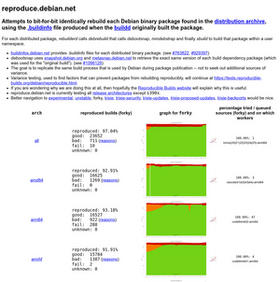
The last year has seen the introduction, development and deployment of reproduce.debian.net. In technical terms, this is an instance of rebuilderd, our server designed monitor the official package repositories of Linux distributions and attempt to reproduce the observed results there.
This month, however, Holger Levsen added suite-based navigation (eg. Debian trixie vs forky) to the service (in addition to the already existing architecture based navigation) which can be observed on, for instance, the Debian trixie-backports or trixie-security pages.
diffoscope is our in-depth and content-aware diff utility that can locate and diagnose reproducibility issues. This month, Chris Lamb made a number of changes, including preparing and uploading versions, 312 and 313 to Debian.
In particular, Chris updated the post-release deployment pipeline to ensure that the pipeline does not fail if the automatic deployment to PyPI fails [ ]. In addition, Vagrant Cascadian updated an external reference for the 7z tool for GNU Guix. [ ]. Vagrant Cascadian also updated diffoscope in GNU Guix to version 312 and 313.
In Debian this month:
sbom-toolkit package was uploaded, which provides a collection of scripts for generating SBOM. This is the tooling used in Apertis to generate the Licenses SBOM and the Build Dependency SBOM. It also includes dh-setup-copyright, a Debhelper addon to generate SBOMs from DWARF debug information, which are extracted from DWARF debug information by running dwarf2sources on every ELF binaries in the package and saving the output.
Lastly, Bernhard M. Wiedemann posted another openSUSE monthly update for their work there.
pimsync in the GNU Guix review process
50.beta regressed in reproducibility compared to 49.0. Specifically, the new generated .oga files differ in their Serial No. and Checksum [fields] . However, Jeremy ended up fixing the issue by replacing ffmpeg with oggenc.
archlinux-dev-public mailing list on our mailing list this month after a discussion at our latest Summit meeting on the topic of Link-Time Optimisation (LTO) specifically on the reasons why LTO often needs to be disabled in relation to Arch Linux s approach to binary hardening.
0) may materially differ from using SOURCE_DATE_EPOCH) when a situation demands the use of a fixed timestamp.
pnut, a C compiler capable of bootstrapping itself and TCC from any POSIX-compliant shell and human-readable source files.
bitsnpicas.fonts-topaz-unicode.bitsnpicas.
Once again, there were a number of improvements made to our website this month including:
repro-build to the Tools page. [ ]
.properties files. [ ]
Julien Malka and Arnout Engelen published a paper titled Lila: Decentralized Build Reproducibility Monitoring for the Functional Package Management Model:
[While] recent studies have shown that high reproducibility rates are achievable at scale demonstrated by the Nix ecosystem achieving over 90% reproducibility on more than 80,000 packages the problem of effective reproducibility monitoring remains largely unsolved. In this work, we address the reproducibility monitoring challenge by introducing Lila, a decentralized system for reproducibility assessment tailored to the functional package management model. Lila enables distributed reporting of build results and aggregation into a reproducibility database [ ].A PDF of their paper is available online.
Javier Ron and Martin Monperrus of KTH Royal Institute of Technology, Sweden, also published a paper, titled Verifiable Provenance of Software Artifacts with Zero-Knowledge Compilation:
Verifying that a compiled binary originates from its claimed source code is a fundamental security requirement, called source code provenance. Achieving verifiable source code provenance in practice remains challenging. The most popular technique, called reproducible builds, requires difficult matching and reexecution of build toolchains and environments. We propose a novel approach to verifiable provenance based on compiling software with zero-knowledge virtual machines (zkVMs). By executing a compiler within a zkVM, our system produces both the compiled output and a cryptographic proof attesting that the compilation was performed on the claimed source code with the claimed compiler. [ ]A PDF of the paper is available online.
Oreofe Solarin of Department of Computer and Data Sciences, Case Western Reserve University, Cleveland, Ohio, USA, published It s Not Just Timestamps: A Study on Docker Reproducibility:
Reproducible container builds promise a simple integrity check for software supply chains: rebuild an image from its Dockerfile and compare hashes. We built a Docker measurement pipeline and apply it to a stratified sample of 2,000 GitHub repositories that contained a Dockerfile. We found that only 56% produce any buildable image, and just 2.7% of those are bitwise reproducible without any infrastructure configurations. After modifying infrastructure configurations, we raise bitwise reproducibility by 18.6%, but 78.7% of buildable Dockerfiles remain non-reproducible.A PDF of Oreofe s paper is available online.
Lastly, Jens Dietrich and Behnaz Hassanshahi published On the Variability of Source Code in Maven Package Rebuilds:
[In] this paper we test the assumption that the same source code is being used [by] alternative builds. To study this, we compare the sources released with packages on Maven Central, with the sources associated with independently built packages from Google s Assured Open Source and Oracle s Build-from-Source projects. [ ]A PDF of their paper is available online.
#reproducible-builds on irc.oftc.net.
rb-general@lists.reproducible-builds.org
Another minor maintenance release for the RcppBDT
package is now on CRAN, and had
been built as binary for r2u.
The RcppBDT
package is an early adopter of Rcpp
and was one of the first packages utilizing Boost and its Date_Time
library. The now more widely-used package anytime is a
direct descentant of RcppBDT.
This release is again primarily maintenance. We aid Rcpp in the transition away from calling
Rf_error() by relying in Rcpp::stop() which
has better behaviour and unwinding when errors or exceptions are
encountered. No feature or interface changes.
The NEWS entry follows:
Courtesy of my CRANberries, there is also a diffstat report for this release. For questions, suggestions, or issues please use the issue tracker at the GitHub repo.Changes in version 0.2.8 (2026-03-12)
- Replaced Rf_error with Rcpp::stop in three files
- Maintenance updates to continuous integration
This post by Dirk Eddelbuettel originated on his Thinking inside the box blog. If you like this or other open-source work I do, you can now sponsor me at GitHub.
Another maintenance release of our RcppDE package arrived
at CRAN, and has been built for
r2u. RcppDE is a port
of DEoptim, a
package for derivative-free optimisation using differential evolution,
from plain C to C++. By using RcppArmadillo the
code became a lot shorter and more legible. Our other main contribution
is to leverage some of the excellence we get for free from using Rcpp, in particular the ability to
optimise user-supplied compiled objective functions which can
make things a lot faster than repeatedly evaluating interpreted
objective functions as DEoptim does (and
which, in fairness, most other optimisers do too). The gains can be
quite substantial.
This release is again maintenance. We aid Rcpp in the transition away from calling
Rf_error() by relying in Rcpp::stop() which
has better behaviour and unwinding when errors or exceptions are
encountered. We also overhauled the references in the vignette, added an
Armadillo version getter and made the regular updates to continuous
integration.
Courtesy of my CRANberries, there
is also a diffstat
report. More detailed information is on the RcppDE page,
or the repository.
This post by Dirk Eddelbuettel originated on his Thinking inside the box blog. If you like this or other open-source work I do, you can sponsor me at GitHub.
Vcs-Git at it. However:
debian/, or something even stranger.
debian/1.2.3-7 tag on salsa corresponds precisely to what was actually uploaded. dput-based tooling (such as gbp buildpackage) doesn t cross-check the .dsc against git.
Vcs-Git and Salsa to build a Debian derivative? You could not.
tag2upload and dgit do solve this problem. When you upload, they:
archive/debian/1.2.3-7 tag to a single central git depository, *.dgit.debian.org;
Dgit field in .dsc so that clients can tell (using the ftpmaster API) that this was a git-based upload, what the corresponding git objects are, and where to find them.
dgit clone, as advertised in e.g. dgit-user(7). For dput-based uploads, it falls back to importing the source package.)
Adopting tag2upload - the minimal change
tag2upload is a substantial incremental improvement to many existing workflows. git-debpush is a drop-in replacement for building, signing, and uploading the source package.
So, you can just adopt it without completely overhauling your packaging practices. You and your co-maintainers can even mix-and-match tag2upload, dgit, and traditional approaches, for the same package.
Start with the wiki page and git-debpush(1) (ideally from forky aka testing).
You don t need to do any of the other things recommended in this article.
Overhauling your workflow, using advanced git-first tooling
The rest of this article is a guide to adopting the best and most advanced git-based tooling for Debian packaging.
Assumptions
gbp pq and/or quilt, and often used with git-buildpackage. You previously used gbp import-orig.
origin remote set to Salsa.
master. Personally I think we should use main but changing your main branch name is outside the scope of this article.
rationale Much traditional Debian tooling like
quiltandgbp pquses the patches-unapplied branch format, which stores the delta as patch files indebian/patches/, in a git tree full of unmodified upstream files. This is clumsy to work with, and can even be an alarming beartrap for Debian outsiders.
git merge when merging from upstream.
This is appropriate if your package has no or very few upstream changes. It is a good approach if the Debian maintainers and upstream maintainers work very closely, so that any needed changes for Debian are upstreamed quickly, and any desired behavioural differences can be arranged by configuration controlled from within debian/.
This is the approach documented more fully in our workflow tutorial dgit-maint-merge(7).
First, establish which upstream git tag corresponds to the version currently in Debian. From the sake of readability, I m going to pretend that upstream version isrationale Many maintainers have been importing upstream tarballs into git, for example by using
gbp import-orig. But in reality the upstream tarball is an intermediate build product, not (just) source code. Using tarballs rather than git exposes us to additional supply chain attacks; indeed, the key activation part of the xz backdoor attack was hidden only in the tarball! git offers better traceability than so-called pristine upstream tarballs. (The word pristine is even a joke by the author of pristine-tar!)
1.2.3, and that upstream tagged it v1.2.3.
Edit debian/watch to contain something like this:
version=4
opts="mode=git" https://codeberg.org/team/package refs/tags/v(\d\S*)You may need to adjust the regexp, depending on your upstream s tag name convention. If debian/watch had a files-excluded, you ll need to make a filtered version of upstream git.
Probably, the currentrationale We need some upstream tarball for the
3.0 (quilt)source format to work with. It needs to correspond to the git commit we re using as our upstream. We don t need or want to use a tarball from upstream for this. The.origis just needed so a nice legacy Debian source package (.dsc) can be generated.
.orig in the Debian archive, is an upstream tarball, which may be different to the output of git-archive and possibly even have different contents to what s in git. The legacy archive has trouble with differing .origs for the same upstream version .
So we must until the next upstream release change our idea of the upstream version number. We re going to add +git to Debian s idea of the upstream version. Manually make a tag with that name:
git tag -m "Compatibility tag for orig transition" v1.2.3+git v1.2.3~0
git push origin v1.2.3+gitIf you are doing the packaging overhaul at the same time as a new upstream version, you can skip this part.
git branch -f old-master # make a note of the old git representation
git reset --hard v1.2.3 # go back to the real upstream git tag
git checkout old-master :debian # take debian/* from old-master
git commit -m "Re-import Debian packaging on top of upstream git"
git merge --allow-unrelated-histories -s ours -m "Make fast forward from tarball-based history" old-master
git branch -d old-master # it's incorporated in our history nowIf there are any patches, manually apply them to your main branch with git am, and delete the patch files (git rm -r debian/patches, and commit). (If you ve chosen this workflow, there should be hardly any patches,)
rationale These are some pretty nasty git runes, indeed. They re needed because we want to restart our Debian packaging on top of a possibly quite different notion of what the upstream is.
git-debrebase -fdiverged convert-from-gbp upstream/1.2.3
git-debrebase -fdiverged -fupstream-not-ff new-upstream 1.2.3+gitIf you had patches which patched generated files which are present only in the upstream tarball, and not in upstream git, you will encounter rebase conflicts. You can drop hunks editing those files, since those files are no longer going to be part of your view of the upstream source code at all.
rationale The force option
-fupstream-not-ffwill be needed this one time because your existing Debian packaging history is (probably) not based directly on the upstream history.-fdivergedmay be needed because git-debrebase might spot that your branch is not based on dgit-ish git history.
dgit fetch
git show dgit/dgit/sid:debian/changelog
# check that you have the same version number
git merge -s ours --allow-unrelated-histories -m 'Declare fast forward from pre-git-based history' dgit/dgit/sidChange the source format
Delete any existing debian/source/options and/or debian/source/local-options.
debian/source/format to 1.0. Add debian/source/options containing -sn.
rationale We are using the 1.0 native source format. This is the simplest possible source format - just a tarball. We would prefer 3.0 (native) , which has some advantages, but dpkg-source between 2013 (wheezy) and 2025 (trixie) inclusive unjustifiably rejects this configuration. You may receive bug reports from over-zealous folks complaining about the use of the 1.0 source format. You should close such reports, with a reference to this article and to #1106402.
debian/source/format contains 3.0 (quilt).
README.source to at least mention dgit-maint-merge(7) or dgit-maint-debrebase(7), and to tell people not to try to edit or create anything in debian/patches/. Consider saying that uploads should be done via dgit or tag2upload.
Check that your Vcs-Git is correct in debian/control. Consider deleting or pruning debian/gbp.conf, since it isn t used by dgit, tag2upload, or git-debrebase.
debian/changelog about the git packaging change.
git-debrebase new-upstream will have added a new upstream version stanza to debian/changelog. Edit that so that it instead describes the packaging change. (Don t remove the +git from the upstream version number there!)
rationale Squashing could destroy your carefully-curated delta queue. It would also disrupt git-debrebase s git branch structure.
debian/salsa-ci.yml containing
include:
- https://salsa.debian.org/salsa-ci-team/pipeline/raw/master/recipes/debian.ymlIn your Salsa repository, under Settings / CI/CD , expand General Pipelines and set CI/CD configuration file to debian/salsa-ci.yml.
rationale Your project may have an upstream CI config in
.gitlab-ci.yml. But you probably want to run the Debian Salsa CI jobs. You can add various extra configuration todebian/salsa-ci.ymlto customise it. Consult the Salsa CI docs.
debian/salsa-ci.yml:
.git-debrebase-prepare: &git-debrebase-prepare
# install the tools we'll need
- apt-get update
- apt-get --yes install git-debrebase git-debpush
# git-debrebase needs git user setup
- git config user.email "salsa-ci@invalid.invalid"
- git config user.name "salsa-ci"
# run git-debrebase make-patches
# https://salsa.debian.org/salsa-ci-team/pipeline/-/issues/371
- git-debrebase --force
- git-debrebase --noop-ok make-patches
# make an orig tarball using the upstream tag, not a gbp upstream/ tag
# https://salsa.debian.org/salsa-ci-team/pipeline/-/issues/541
- git-deborig
.build-definition: &build-definition
extends: .build-definition-common
before_script: *git-debrebase-prepare
build source:
extends: .build-source-only
before_script: *git-debrebase-prepare
variables:
# disable shallow cloning of git repository. This is needed for git-debrebase
GIT_DEPTH: 0rationale Unfortunately the Salsa CI pipeline currently lacks proper support for git-debrebase (salsa-ci#371) and has trouble directly using upstream git for orig tarballs (#salsa-ci#541). These runes were based on those in the Xen package. You should subscribe to the tickets #371 and #541 so that you can replace the clone-and-hack when proper support is merged.
master. Set Allowed to merge to Maintainers . Set Allowed to push and merge to No one . Leave Allow force push disabled.
This means that the only way to land anything on your mainline is via a Merge Request. When you make a Merge Request, gitlab will offer Set to auto-merge . Use that.
gitlab won t normally merge an MR unless CI passes, although you can override this on a per-MR basis if you need to.
(Sometimes, immediately after creating a merge request in gitlab, you will see a plain Merge button. This is a bug. Don t press that. Reload the page so that Set to auto-merge appears.)
autopkgtests
Ideally, your package would have meaningful autopkgtests (DEP-8 tests) This makes Salsa CI more useful for you, and also helps detect and defend you against regressions in your dependencies.
The Debian CI docs are a good starting point. In-depth discussion of writing autopkgtests is beyond the scope of this article.
Day-to-day work
With this capable tooling, most tasks are much easier.
Making changes to the package
Make all changes via a Salsa Merge Request. So start by making a branch that will become the MR branch.
On your MR branch you can freely edit every file. This includes upstream files, and files in debian/.
For example, you can:
git cherry-pick an upstream commit.
git am a patch from a mailing list or from the Debian Bug System.
git revert an earlier commit, even an upstream one.
git-rebase to squash/edit/combine/reorder commits.
git-debrebase -i to squash/edit/combine/reorder commits. When you are happy, run git-debrebase conclude.
Do not edit debian/patches/. With git-debrebase, this is purely an output. Edit the upstream files directly instead. To reorganise/maintain the patch queue, use git-debrebase -i to edit the actual commits.
apt-get build-dep .
dpkg-buildpackage -uc -bIdeally this will leave git status clean, with no modified or un-ignored untracked files. If it shows untracked files, add them to .gitignore or debian/.gitignore as applicable.
If it dirties the tree, consider trying to make it stop doing that. The easiest way is probably to build out-of-tree, if supported upstream. If this is too difficult, you can leave the messy build arrangements as they are, but you ll need to be disciplined about always committing, using git clean and git reset, and so on.
For formal binaries builds, including for testing, use dgit sbuild as described below for uploading to NEW.
Uploading to Debian
Start an MR branch for the administrative changes for the release.
Document all the changes you re going to release, in the debian/changelog.
dgit fetch sid
gbp dch --ignore-branch --since=dgit/dgit/sid --git-log=^upstream/main(For the first upload after switching to using tag2upload or dgit you needrationale
--ignore-branchis needed because gbp dch wrongly thinks you ought to be running this onmaster, but of course you re running it on your MR branch. The--git-log=^upstream/mainexcludes all upstream commits from the listing used to generate the changelog. (I m assuming you have anupstreamremote and that you re basing your work on theirmainbranch.) If there was a new upstream version, you ll usually want to write a single line about that, and perhaps summarise anything really important.
--since=debian/1.2.3-1, where 1.2.3-1 is your previous DEP-14 tag, because dgit/dgit/sid will be a dsc import, not your actual history.)
UNRELEASED to the target suite, and finalise the changelog. (Note that dch will insist that you at least save the file in your editor.)
dch -r
git commit -m 'Finalise for upload' debian/changelogMake an MR of these administrative changes, and merge it. (Either set it to auto-merge and wait for CI, or if you re in a hurry double-check that it really is just a changelog update so that you can be confident about telling Salsa to Merge unverified changes .)
Now you can perform the actual upload:
git checkout master
git pull --ff-only # bring the gitlab-made MR merge commit into your local treegit-debpushgit-debpush --quilt=linear--quilt=linear is needed only the first time, but it is very important that first time, to tell the system the correct git branch layout.
dgit can help take care of the build and upload for you:
Prepare the changelog update and merge it, as above. Then:
git-deborig
git-debrebase quickrationale Source package format 3.0 (quilt), which is what I m recommending here for use with git-debrebase, needs an orig tarball; it would also be needed for 1.0-with-diff.
dgit sbuild
dgit push-builtNew upstream version Find the new upstream version number and corresponding tag. (Let s suppose it srationale You don t have to use
dgit sbuild, but it is usually convenient to do so, because unlike sbuild, dgit understands git. Also it works around a gitignore-related defect in dpkg-source.
1.2.4.) Check the provenance:
git verify-tag v1.2.4rationale Not all upstreams sign their git tags, sadly. Sometimes encouraging them to do so can help. You may need to use some other method(s) to check that you have the right git commit for the release.
git merge v1.2.4
dch -v1.2.4-1 'New upstream release.'git debrebase mew-upstream 1.2.4git merge or git (deb)rebase.
After you ve completed the merge, test your package and make any further needed changes. When you have it working in a local branch, make a Merge Request, as above.
Sponsorship
git-based sponsorship is super easy! The sponsee can maintain their git branch on Salsa, and do all normal maintenance via gitlab operations.
When the time comes to upload, the sponsee notifies the sponsor that it s time. The sponsor fetches and checks out the git branch from Salsa, does their checks, as they judge appropriate, and when satisfied runs git-debpush.
As part of the sponsor s checks, they might want to see all changes since the last upload to Debian:
dgit fetch sid
git diff dgit/dgit/sid..HEADOr to see the Debian delta of the proposed upload:
git verify-tag v1.2.3
git diff v1.2.3..HEAD ':!debian'git log -p v1.2.3..HEAD ':!debian'Don t look at debian/patches/. It can be absent or out of date.
dgit fetch sid
git diff master...dgit/dgit/sidIf the NMUer used dgit, then git log dgit/dgit/sid will show you the commits they made.
Normally the best thing to do is to simply merge the NMU, and then do any reverts or rework in followup commits:
git merge dgit/dgit/sidgit-debrebase quick at this stage, to check that the merge went OK and the package still has a lineariseable delta queue.
1.2.3-7, you can go back and see the NMU diff again with:
git diff debian/1.2.3-7...dgit/dgit/siddebian/patches/. Normally it s best to filter them out with git diff ... ':!debian/patches'
If you d prefer to read the changes to the delta queue as an interdiff (diff of diffs), you can do something like
git checkout debian/1.2.3-7
git-debrebase --force make-patches
git diff HEAD...dgit/dgit/sid -- :debian/patchesto diff against a version with debian/patches/ up to date. (The NMU, in dgit/dgit/sid, will necessarily have the patches already up to date.)
Initial filteringrationale Yes, this will end up including the non-free files in the git history, on official Debian servers. That s OK. What s forbidden is non-free material in the Debianised git tree, or in the source packages.
git checkout -b upstream-dfsg v1.2.3
git rm nonfree.exe
git commit -m "upstream version 1.2.3 DFSG-cleaned"
git tag -s -m "upstream version 1.2.3 DFSG-cleaned" v1.2.3+ds1
git push origin upstream-dfsgAnd now, use 1.2.3+ds1, and the filtered branch upstream-dfsg, as the upstream version, instead of 1.2.3 and upstream/main. Follow the steps for Convert the git branch or New upstream version, as applicable, adding +ds1 into debian/changelog.
If you missed something and need to filter out more a nonfree files, re-use the same upstream-dfsg branch and bump the ds version, eg v1.2.3+ds2.
Subsequent upstream releases
git checkout upstream-dfsg
git merge v1.2.4
git rm additional-nonfree.exe # if any
git commit -m "upstream version 1.2.4 DFSG-cleaned"
git tag -s -m "upstream version 1.2.4 DFSG-cleaned" v1.2.4+ds1
git push origin upstream-dfsgRemoving files by pattern
If the files you need to remove keep changing, you could automate things with a small shell script debian/rm-nonfree containing appropriate git rm commands. If you use git rm -f it will succeed even if the git merge from real upstream has conflicts due to changes to non-free files.
Common issuesrationale Ideally
uscan, which has a way of representing DFSG filtering patterns indebian/watch, would be able to do this, but sadly the relevant functionality is entangled with uscan s tarball generation.
.gitattributes to modify files as they are checked out.
Normally this doesn t cause a problem so long as any orig tarballs are generated the same way (as they will be by tag2upload or git-deborig). But if the package or build system relies on them, you may need to institute some workarounds, or, replicate the effect of the gitattributes as commits in git.
git rm the submodule.
gbp pq and/or quilt with a patches-unapplied branch.
gbp pq, manual use of quilt, git-dpm and so on.
--noop-ok to the Salsa CI runes. Thanks to Charlemagne Lasse for the report. Apologies if this causes Debian Planet to re-post this article as if it were new.
services: loki: # expose: - 3100/tcp labels: - traefik.enable=true - traefik.http.routers.loki.rule=PathPrefix( /loki )
/loki to its first exposed port. Colocating Traefik configuration
with the service definition is attractive. How do we achieve the same for
Prometheus metrics?
discovery.docker component. Just like Traefik,
it connects to the Docker socket.1 With a few relabeling rules, we teach
it to use Docker labels to locate and scrape metrics.
We define three labels on each service:
metrics.enable set to true enables metrics collection,metrics.port specifies the port exposing the Prometheus endpoint, andmetrics.path specifies the path to the metrics endpoint.metrics.port is mandatory. Otherwise,
it defaults to the only exposed port. The default value for metrics.path is
/metrics. The Loki service from earlier becomes:
services: loki: # expose: - 3100/tcp labels: - traefik.enable=true - traefik.http.routers.loki.rule=PathPrefix( /loki ) - metrics.enable=true - metrics.path=/loki/metrics
discovery.docker "docker" host = "unix:///var/run/docker.sock" refresh_interval = "30s" filter name = "label" values = ["com.docker.compose.project=akvorado"]
filter block restricts discovery to containers belonging
to the akvorado project, avoiding interference with unrelated containers on
the same host. For each discovered container, Alloy produces a target with
labels such as __meta_docker_container_label_metrics_port for the
metrics.port Docker label.
metrics.enable
set to true:
discovery.relabel "prometheus" targets = discovery.docker.docker.targets // Keep only targets with metrics.enable=true rule source_labels = ["__meta_docker_container_label_metrics_enable"] regex = true action = "keep" //
metrics.port:
// When metrics.port is set, override __address__. rule source_labels = ["__address__", "__meta_docker_container_label_metrics_port"] regex = (.+):\d+;(.+) target_label = "__address__" replacement = "$1:$2"
host network mode. When
__meta_docker_network_name equals host, Alloy rewrites the address to
host.docker.internal instead of localhost:3
// When host networking, override __address__ to host.docker.internal. rule source_labels = ["__meta_docker_container_label_metrics_port", "__meta_docker_network_name"] regex = (.+);host target_label = "__address__" replacement = "host.docker.internal:$1"
rule source_labels = ["__meta_docker_container_label_com_docker_compose_service"] regex = (.+)(?:-\d+)? target_label = "job" rule source_labels = ["__address__"] regex = (.+):\d+ target_label = "instance"
metrics.path, Alloy uses it. Otherwise, it defaults to
/metrics:
rule source_labels = ["__meta_docker_container_label_metrics_path"] regex = (.+) target_label = "__metrics_path__" rule source_labels = ["__metrics_path__"] regex = "" target_label = "__metrics_path__" replacement = "/metrics"
prometheus.scrape "docker" targets = discovery.relabel.prometheus.output forward_to = [prometheus.remote_write.default.receiver] scrape_interval = "30s" prometheus.remote_write "default" endpoint url = "http://prometheus:9090/api/v1/write"
prometheus.scrape periodically fetches metrics from the discovered targets.
prometheus.remote_write sends them to Prometheus.
prometheus.exporter.redis "docker" redis_addr = "redis:6379" discovery.relabel "redis" targets = prometheus.exporter.redis.docker.targets rule target_label = "job" replacement = "redis" prometheus.scrape "redis" targets = discovery.relabel.redis.output forward_to = [prometheus.remote_write.default.receiver] scrape_interval = "30s"
prometheus.exporter.kafka "docker" kafka_uris = ["kafka:9092"] discovery.relabel "kafka" targets = prometheus.exporter.kafka.docker.targets rule target_label = "job" replacement = "kafka" prometheus.scrape "kafka" targets = discovery.relabel.kafka.output forward_to = [prometheus.remote_write.default.receiver] scrape_interval = "30s"
job label explicitly since no Docker metadata can
provide it.
docker-compose.yml, just like adding a Traefik
route. Alloy picks it up automatically. You can apply the same pattern with
another discovery method, like discovery.kubernetes,
discovery.scaleway, or discovery.http.
extra_hosts:
["host.docker.internal:host-gateway"] in its definition.
Hello world
. I m Hellen Chemtai, an intern at Outreachy working with the Debian OpenQA team on Images Testing. This is the final week of the internship. This is just a start for me as I will continue contributing to the community .I am grateful for the opportunity to work with the Debian OpenQA team as an Outreachy intern. I have had the best welcoming team to Open Source.
I have been working on network install and live images tasks :
I have enjoyed working on testing both live images and net install images. This was one of the goals that I had highlighted in my application. I have also been working with fellow contributors in this project.
As I had stated , I have had the best welcoming team to Open Source . They have been working with me and ensuring I have the proper resources for contributions. I am grateful to my three mentors and the work they have done.
I wish to learn more with the team. On my to do list, I would like to gain more skills on ports and packages so to contribute more technically. I have enjoyed working on the tasks and learning
The automated tests done by the team help the community in some of the following examples:
I have also networked with the greater community and other contributors. During the contribution phase, I found many friends who were learning together with me . I hope to continue networking with the community and continue learning.
This is a copy of an email I used to send internally at work and now made public. I'm not sure I'll make a habit of posting it here, especially not twice a year, unless people really like it. Right now, it's mostly here to keep with my current writing spree going.This is your bi-yearly reminder that time is changing soon!
Spring forward, fall backwards.This northern-centric (sorry!) proverb says that clocks will move forward by an hour this "spring", after moving backwards last "fall". This is why we lose an hour of work, sorry, sleep. It sucks, to put it bluntly. I want it to stop and will keep writing those advisories until it does. To see where and when, we, unfortunately, still need to go into politics.
When the Free Software movement started in the 1980s, most of the world
had just made a transition from free university-written software to
non-free, proprietary, company-written software. Because of that, the
initial ethical standpoint of the Free Software foundation was that it's
fine to run a non-free operating system, as long as all the software you
run on that operating system is free.
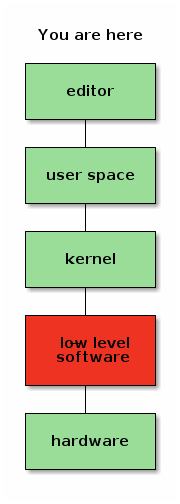
Initially this was just the
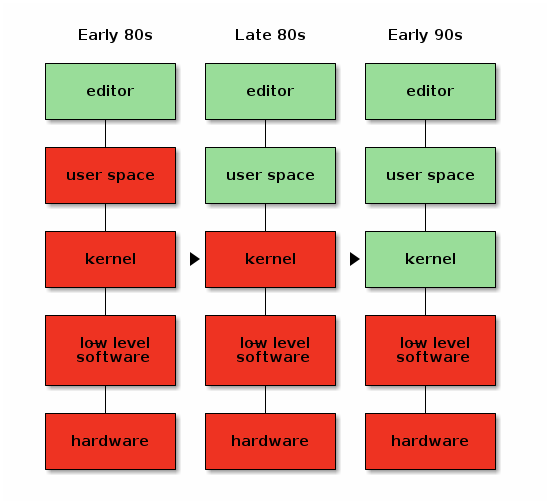
editor.
But as time went on, and the FSF managed to write more and more parts of
the software stack, their ethical stance moved with the times. This was
a, very reasonable, pragmatic stance: if you don't accept using a
non-free operating system and there isn't a free operating system yet,
then obviously you can't write that free operating system, and the
world won't move towards a point where free operating systems exist.
In the early 1990s, when
Linus initiated the
Linux kernel, the situation reached the point where the original dream
of a fully free software stack was complete.
Or so it would appear.
Because, in fact, this was not the case. Computers are physical objects,
composed of bits of technology that we refer to as "hardware", but in
order for these bits of technology to communicate with other bits of
technology in the same computer system, they need to interface with
each other, usually using some form of bus protocol. These bus protocols
can get very complicated, which means that a bit of software is required
in order to make all the bits communicate with each other properly.
Generally, this software is referred to as "firmware", but don't let
that name deceive you; it's really just a bit of low-level software that
is very specific to one piece of hardware. Sometimes it's written in an
imperative high-level language; sometimes it's just a set of very simple
initialization vectors. But whatever the case might be, it's always a
bit of software.
And although we largely had a free system, this bit of low-level
software was not yet free.
Initially, storage was expensive, so computers couldn't store as much
data as today, and so most of this software was stored in ROM chips on
the exact bits of hardware they were meant for. Due to this fact, it was
easy to deceive yourself that the firmware wasn't there, because you
never directly interacted with it. We knew it was there; in fact, for
some larger pieces of this type of
software it was possible, even in
those days, to install updates. But that was rarely if ever done at the
time, and it was easily forgotten.
And so, when the free software movement slapped itself on the back and
declared victory when a fully free operating system was available, and
decided that the work of creating a free software environment was
finished, that only keeping it recent was further required, and that we
must reject any further non-free encroachments on our fully free
software stack, the free software movement was deceiving itself.
Because a computing environment can never be fully free if the
low-level pieces of software that form the foundations of that computing
environment are not free. It would have been one thing if the Free
Software Foundation declared it ethical to use non-free low-level
software on a computing environment if free alternatives were not
available. But unfortunately, they did not.
In fact, something very strange happened.
In order for some free software hacker to be able to write a free
replacement for some piece of non-free software, they obviously need to
be able to actually install that theoretical free replacement. This
isn't just a random thought; in fact it has
happened.
Now, it's possible to install software on a piece of rewritable storage
such as flash memory inside the hardware and boot the hardware from
that, but if there is a bug in your software -- not at all unlikely if
you're trying to write software for a piece of hardware that you don't
have documentation for -- then it's not unfathomable that the
replacement piece of software will not work, thereby reducing your
expensive piece of technology to something about as useful as a
paperweight.
Here's the good part.
In the late 1990s and early 2000s, the bits of technology that made up
computers became so complicated, and the storage and memory available to
computers so much larger and cheaper, that it became economically more
feasible to create a small, tiny, piece of software stored in a ROM chip
on the hardware, with just enough knowledge of the bus protocol to
download the rest from the main computer.
This is awesome for free software. If you now write a replacement for
the non-free software that comes with the hardware, and you make a
mistake, no wobbles! You just remove power from the system, let the DRAM
chips on the hardware component fully drain, return power, and try
again. You might still end up with a brick of useless silicon if some
of the things you sent to your technology make it do things that it was
not designed to do and therefore you burn through some critical bits of
metal or plastic, but the chance of this happening is significantly
lower than the chance of you writing something that impedes the boot
process of the piece of hardware and you are unable to fix it because
the flash is overwritten. There is anecdotal
evidence
that there are free software hackers out there who do so. So, yay,
right? You'd think the Free Software foundation would jump at the
possibility to get more free software? After all, a large part of why we
even have a Free Software Foundation in the first place, was because of
some piece of hardware that was
misbehaving,
so you would think that the foundation's founders would understand the
need for hardware to be controlled by software that is free.
The strange thing, what has always been strange to me, is that this is
not what happened.
The Free Software Foundation instead decided that non-free software on
ROM or flash chips is fine, but non-free software -- the very same
non-free software, mind -- that touches the general storage device that
you as a user use, is not. Never mind the fact that the non-free
software is always there, whether it sits on your storage device or not.
Misguidedness aside, if some people decide they would rather not update
the non-free software in their hardware and use the hardware with the
old and potentially buggy version of the non-free software that it came
with, then of course that's their business.
Unfortunately, it didn't quite stop there. If it had, I wouldn't have
written this blog post.
You see, even though the Free Software Foundation was about Software,
they decided that they needed to create a hardware
certification program. And this hardware
certification program ended up embedding the strange concept that if
something is stored in ROM it's fine, but if something is stored on a
hard drive it's not. Same hardware, same software, but different
storage. By that logic, Windows respects your freedom as long as the
software is written to ROM. Because this way, the Free Software
Foundation could come to a standstill and pretend they were still living
in the 90s.
An unfortunate result of the "RYF" program is that it means that
companies who otherwise would have been inclined to create hardware that
was truly free, top to bottom, are now more incentivised by the RYF
program to create hardware in which the non-free low-level software
can't be replaced.
Meanwhile, the rest of the world did not pretend to still be living in
the nineties, and free hardware communities now exist. Because of how
the FSF has marketed themselves out of the world, these communities call
themselves "Open Hardware" communities, rather than "Free Hardware"
ones, but the principle is the same: the designs are there, if you have
the skill you can modify it, but you don't have to.
In the mean time, the open hardware community has evolved to a point
where even CPUs are designed in
the open, which you can design your own version of.
But not all hardware can be implemented as RISC-V, and so if you want a
full system that builds RISC-V you may still need components of the
system that were originally built for other architectures but that would
work with RISC-V, such as a network card or a GPU. And because the FSF
has done everything in their power to disincentivise people who would
otherwise be well situated to build free versions of the low-level
software required to support your hardware, you may now be in the weird
position where we seem to have somehow skipped a step.
My own suspicion is that the universe is not only queerer than we suppose, but queerer than we can suppose.-- J.B.S. Haldane (comments for this post will not pass moderation. Use your own blog!)
Note: I have not published blog posts about my academic papers over the past few years. To ensure that my blog contains a more comprehensive record of my published papers and to surface these for folks who missed them, I will be periodically (re)publishing blog posts about some older published projects. This post is closely based on a previously published post by Zarine Kharazian on the Community Data Science Blog.
For nearly a decade, the Croatian language version of Wikipedia was run by a cabal of far-right nationalists who edited articles in ways that promoted fringe political ideas and involved cases of historical revisionism related to the Usta e regime, a fascist movement that ruled the Nazi puppet state called the Independent State of Croatia during World War II. This cabal seized complete control of the encyclopedia s governance, banned and blocked those who disagreed with them, and operated a network of fake accounts to create the appearance of grassroots support for their policies.
Thankfully, Croatian Wikipedia appears to be an outlier. Though both the Croatian and Serbian language editions have been documented to contain nationalist bias and historical revisionism, Croatian Wikipedia seems unique among Wikipedia editions in the extent to which its governance institutions were captured by a small group of users.
The situation in Croatian Wikipedia was well documented and is now largely fixed, but we still know very little about why it was taken over, while other language editions seem to have rebuffed similar capture attempts. In a paper published in the Proceedings of the ACM: Human-Computer Interaction (CSCW), Zarine Kharazian, Kate Starbird, and I present an interview-based study that provides an explanation for why Croatian was captured while several other editions facing similar contexts and threats fared better.
The conceptual model from our paper, visualizing possible institutional configurations among Wikipedia projects that affect the risk of governance capture. Citation for the full paper: Kharazian, Zarine, Kate Starbird, and Benjamin Mako Hill. 2024. Governance Capture in a Self-Governing Community: A Qualitative Comparison of the Croatian, Serbian, Bosnian, and Serbo-Croatian Wikipedias. Proceedings of the ACM on Human-Computer Interaction 8 (CSCW1): 61:1-61:26. https://doi.org/10.1145/3637338.
This blog post and the paper it describes are collaborative work by Zarine Kharazian, Benjamin Mako Hill, and Kate Starbird.
The AI hype is based on the assumption that the frontier AI labs are producing better and better foundational models at an accelerating pace. Is that really true, or are people just in sort of a mass psychosis because AI models have become so good at mimicking human behavior that we unconsciously attribute increasing intelligence to them? I decided to conduct a mini-benchmark of my own to find out if the latest and greatest AI models are actually really good or not.
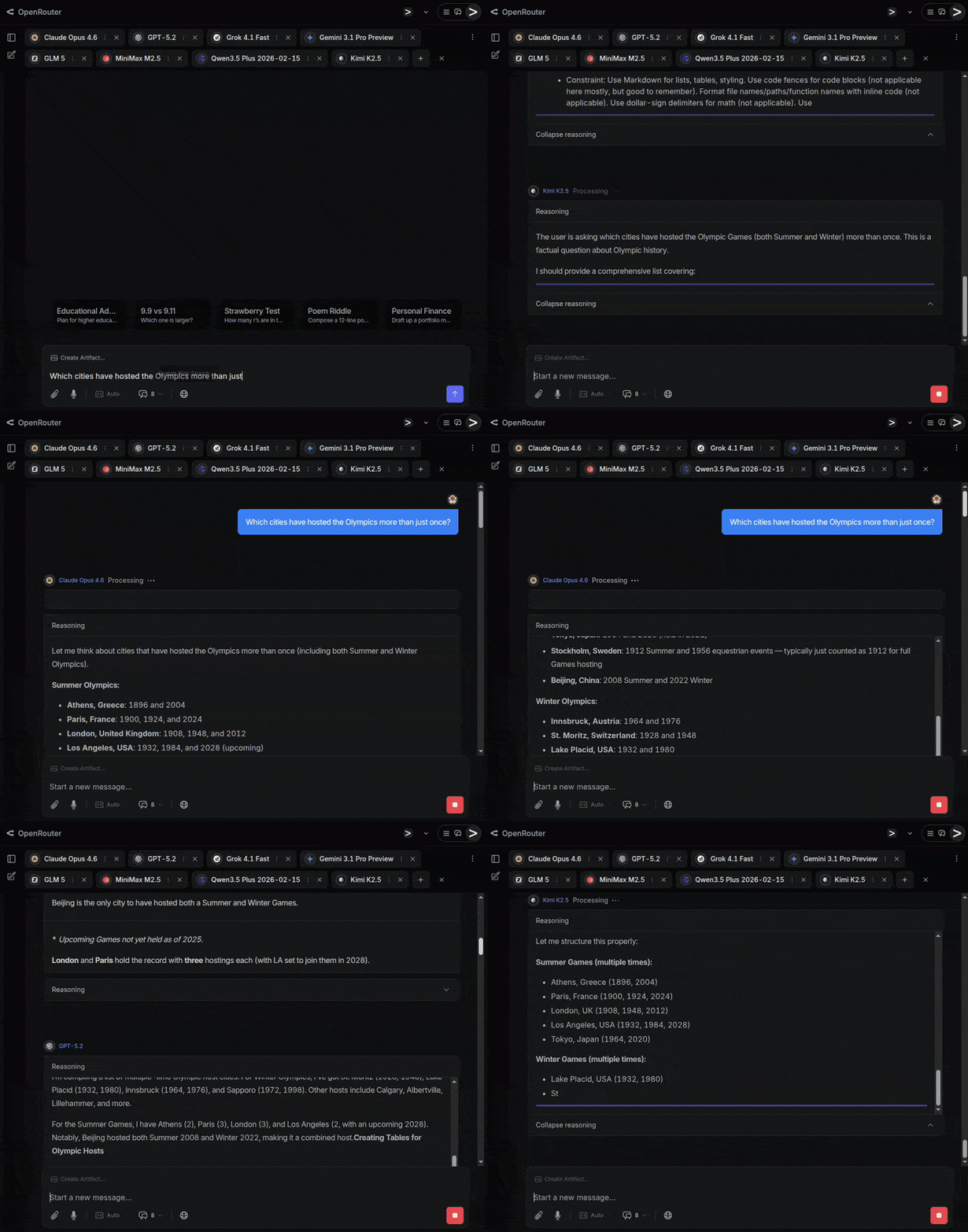
Common for all the test questions is that they are fairly straightforward and have a clear answer, yet the answer isn t common knowledge or statistically the most obvious one, and instead requires a bit of reasoning to get correct.
Some of these questions are also based on myself witnessing a flagship model failing miserably to answer it.

While Gemini and Grok were among the three models not falling into this trap, the response from Claude was exemplary good:
I have seen Grok do something similar before, which in fact inspired me to include this question in my mini-benchmark.
GPT got a bit further, but for Hindi, Arabic and Bengali it listed the numerals in local script, not the number words. Gemini, GLM and Kimi gave a complete and correct answer as a list, while the absolute best answer and presentation was by Claude, that gave the table below:

Claude Opus 4.6 10 Most Commonly Spoken Languages (by Total Speakers)Note: Rankings are based on estimated total speakers (native + non-native). Rankings can vary depending on the source and methodology used.
# Language 1 2 3 4 5 1 English One Two Three Four Five 2 Mandarin Chinese (y ) ( r) (s n) (s ) (w ) 3 Hindi (ek) (do) (t n) (ch r) (p ch) 4 Spanish Uno Dos Tres Cuatro Cinco 5 French Un Deux Trois Quatre Cinq 6 Arabic (w id) (ithn n) (thal tha) (arba a) (khamsa) 7 Bengali (ek) (dui) (tin) (ch r) (p ch) 8 Portuguese Um Dois Tr s Quatro Cinco 9 Russian (odin) (dva) (tri) (chetyre) (pyat') 10 Japanese (ichi) (ni) (san) (shi) (go)
A human can easily count that there are 10 rows and 30+ columns in the grid, but because the picture resolution isn t good enough, the exact number of columns can t be counted, and the answer should be that there are at least 300 launch pads in the picture.
GPT and Grok both guessed the count is zero. Instead of hallucinating some number they say zero, but it would have been better to not give any number at all, and just state that they are unable to perform the task. Gemini gave as its answer 101 , which is quite odd, but reading the reasoning section, it seems to have tried counting items in the image without reasoning much about what it is actually counting and that there is clearly a grid that can make the counting much easier. Both Qwen and Kimi state they can see four parallel structures, but are unable to count drone launch pads.
The absolutely best answer was given by Claude, which counted 10-12 rows and 30-40+ columns, and concluded that there must be 300-500 drone launch pads. Very close to best human level - impressive!
This question applied only to multi-modal models that can see images, so GLM and MinMax could not give any response.
$ SH_SCRIPTS="$(mktemp; grep -Irnw debian/ -e '^#!.*/sh' sort -u cut -d ':' -f 1 true)"
$ shellcheck -x --enable=all --shell=sh "$SH_SCRIPTS"
/tmp/tmp.xQOpI5Nljx
debian/tests/integration-tests: /tmp/tmp.xQOpI5Nljx
debian/tests/integration-tests: openBinaryFile: does not exist (No such file or directory)$SH_SCRIPTS, resulting in the entire multi-line string being passed as a single argument to shellcheck. So instead of receiving two separate file paths, shellcheck tries to open one file literally named /tmp/tmp.xQOpI5Nljx\ndebian/tests/integration-tests.
Incorrect argument expansion is fairly easy for an experienced human programmer to notice, but tricky for an LLM. Indeed, Grok, MinMax, and Qwen fell for this trap and focused on the mktemp, assuming it somehow fails to create a file. Interestingly GLM fails to produce an answer at all, as the reasoning step seems to be looping, thinking too much about the missing file, but not understanding why it would be missing when there is nothing wrong with how mktemp is executed.
Claude, Gemini, and Kimi immediately spot the real root cause of passing the variable quoted and suggested correct fixes that involve either removing the quotes, or using Bash arrays or xargs in a way that makes the whole command also handle correctly filenames with spaces in them.
| Model | Sports | Economics | Emoji | Languages | Visual | Shell | Score |
|---|---|---|---|---|---|---|---|
| Claude Opus 4.6 | 6/6 | ||||||
| GPT-5.2 | ~ | 2.5/6 | |||||
| Grok 4.1 | 3/6 | ||||||
| Gemini 3.1 Pro | 5/6 | ||||||
| GLM 5 | ? | N/A | 3/5 | ||||
| MinMax M2.5 | N/A | 1/5 | |||||
| Qwen3.5 Plus | ~ | 2.5/6 | |||||
| Kimi K2.5 | 4/6 |
Next.