Search Results: "az"

12 March 2026

Mike Gabriel: Debian Lomiri Tablets 2025-2027 - Project Report (Q4/2025)

On 25th Oct 2025, I announced via my personal blog and on Mastodon that Fre(i)e Software GmbH was hiring. The hiring process was a mix of asking developers I know and waiting for new people to apply. At the beginning of November 2025 / in mid November 2025, we started with 13 developers (all part-time) to work on various topics around Lomiri (upstream and downstream). Note that the below achievements don't document the overall activity in the Lomiri project, but that part that our team at Fre(i)e Software GmbH contributed to. Organizational Achievements Maintenance Development Qt6 Porting Feature Development Research [1] https://gitlab.com/groups/ubports/development/-/boards/9895029?label_name%5B%5D=Topic%3A%20Qt%206
[2] https://gitlab.com/groups/ubports/development/-/boards/10037876?label_name[]=Topic%3A%20salsa2ubports%20DEB%20syncing

10 March 2026

Freexian Collaborators: Debian Contributions: Opening DebConf 26 Registration, Debian CI improvements and more! (by Anupa Ann Joseph)

Debian Contributions: 2026-02 Contributing to Debian is part of Freexian s mission. This article covers the latest achievements of Freexian and their collaborators. All of this is made possible by organizations subscribing to our Long Term Support contracts and consulting services.

DebConf 26 Registration, by Stefano Rivera, Antonio Terceiro, and Santiago Ruano Rinc n DebConf 26, to be held in Santa Fe Argentina in July, has opened for registration and event proposals. Stefano, Antonio, and Santiago all contributed to making this happen. As always, some changes needed to be made to the registration system. Bigger changes were planned, but we ran out of time to implement them for DebConf 26. All 3 of us have had experience in hosting local DebConf events in the past and have been advising the DebConf 26 local team.

Debian CI improvements, by Antonio Terceiro Debian CI is the platform responsible for automated testing of packages from the Debian archive, and its results are used by the Debian Release team automation as Quality Assurance to control the migration of packages from Debian unstable into testing, the base for the next Debian release. Antonio started developing an incus backend, and that prompted two rounds of improvements to the platform, including but not limited to allowing user to select a job execution backend (lxc, qemu) during the job submission, reducing the part of testbed image creation that requires superuser privileges and other refactorings and bug fixes. The platform API was also improved to reduce disruption when reporting results to the Release Team automation after service downtimes. Last, but not least, the platform now has support for testing packages against variants of autopkgtest, which will allow the Debian CI team to test new versions of autopkgtest before making releases to avoid widespread regressions.

Miscellaneous contributions
  • Carles improved po-debconf-manager while users requested features / found bugs. Improvements done - add packages from unstable instead of just salsa.debian.org, upgrade and merge templates of upgraded packages, finished adding typing annotations, improved deleting packages: support multiple line texts, add debug to see subprocess.run commands, etc.
  • Carles, using po-debconf-manager, reviewed 7 Catalan translations and sent bug reports or MRs for 11 packages. Also reviewed the translations of fortunes-debian-hints and submitted possible changes in the hints.
  • Carles submitted MRs for reportbug (reportbug --ui gtk detecting the wrong dependencies), devscript (delete unused code from debrebuild and add recommended dependency), wcurl (format help for 80 columns). Carles submitted a bug report for apt not showing the long descriptions of packages.
  • Carles resumed effort for checking relations (e.g. Recommends / Suggests) between Debian packages. A new codebase (still in early stages) was started with a new approach in order to detect, report and track the broken relations.
  • Emilio drove several transitions, most notably the haskell transition and the glibc/gcc-15/zlib transition for the s390 31-bit removal. This last one included reviewing and requeueing lots of autopkgtests due to britney losing a lot of results.
  • Emilio reviewed and uploaded poppler updates to experimental for a new transition.
  • Emilio reviewed, merged and deployed some performance improvements proposed for the security-tracker.
  • Stefano prepared routine updates for pycparser, python-confuse, python-cffi, python-mitogen, python-pip, wheel, platformdirs, python-authlib, and python-virtualenv.
  • Stefano updated Python 3.13 and 3.14 to the latest point releases, including security updates, and did some preliminary work for Python 3.15.
  • Stefano reviewed changes to dh-python and merged MRs.
  • Stefano did some debian.social sysadmin work, bridging additional IRC channels to Matrix.
  • Stefano and Antonio, as DebConf Committee Members, reviewed the DebConf 27 bids and took part in selecting the Japanese bid to host DebConf 27.
  • Helmut sent patches for 29 cross build failures.
  • Helmut continued to maintain rebootstrap addressing issues relating to specific architectures (such as musl-linux-any, hurd-any or s390x) or specific packages (such as binutils, brotli or fontconfig).
  • Helmut worked on diagnosing bugs such as rocblas #1126608, python-memray #1126944 upstream and greetd #1129070 with varying success.
  • Antonio provided support for multiple MiniDebConfs whose websites run wafer + wafer-debconf (the same stack as DebConf itself).
  • Antonio fixed the salsa tagpending webhook.
  • Antonio sent specinfra upstream a patch to fix detection of Debian systems in some situations.
  • Santiago reviewed some Merge Requests for the Salsa CI pipeline, including !703 and !704, that aim to improve how the build source job is handled by Salsa CI. Thanks a lot to Jochen for his work on this.
  • In collaboration with Emmanuel Arias, Santiago proposed a couple of projects for the Google Summer of Code (GSoC) 2026 round. Santiago has been reviewing applications and giving feedback to candidates.
  • Thorsten uploaded new upstream versions of ipp-usb, brlaser and gutenprint.
  • Rapha l updated publican to fix an old bug that became release critical and that happened only when building with the nocheck profile. Publican is a build dependency of the Debian s Administrator Handbook and with that fix, the package is back into testing.
  • Rapha l implemented a small feature in Debusine that makes it possible to refer to a collection in a parent workspace even if a collection with the same name is present in the current workspace.
  • Lucas updated the current status of ruby packages affecting the Ruby 3.4 transition after a bunch of updates made by team members. He will follow up on this next month.
  • Lucas joined the Debian orga team for GSoC this year and tried to reach out to potential mentors.
  • Lucas did some content work for MiniDebConf Campinas - Brazil.
  • Colin published minor security updates to bookworm and trixie for CVE-2025-61984 and CVE-2025-61985 in OpenSSH, both of which allowed code execution via ProxyCommand in some cases. The trixie update also included a fix for mishandling of PerSourceMaxStartups.
  • Colin spotted and fixed a typo in the bug tracking system s spam-handling rules, which in combination with a devscripts regression caused bts forwarded commands to be discarded.
  • Colin ported 12 more Python packages away from using the deprecated (and now removed upstream) pkg_resources module.
  • Anupa is co-organizing MiniDebConf Kanpur with Debian India team. Anupa was responsible for preparing the schedule, publishing it on the website, co-ordination with the fiscal host in addition to attending meetings.
  • Anupa attended the Debian Publicity team online sprint which was a skill sharing session.

9 March 2026

Colin Watson: Free software activity in February 2026

My Debian contributions this month were all sponsored by Freexian. You can also support my work directly via Liberapay or GitHub Sponsors. OpenSSH I released bookworm and trixie fixes for CVE-2025-61984 and CVE-2025-61985, both allowing code execution via ProxyCommand in some cases. The trixie update also included a fix for openssh-server: refuses further connections after having handled PerSourceMaxStartups connections. bugs.debian.org administration Gioele Barabucci reported that some messages to the bug tracking system generated by the bts command were being discarded. While the regression here was on the client side, I found and fixed a typo in our SpamAssassin configuration that was failing to apply a bonus specifically to forwarded commands, mitigating the problem. Python packaging New upstream versions: Porting away from the deprecated (and now removed from upstream setuptools) pkg_resources: Other build/test failures: Other bugs: I added a manual page symlink to make the documentation for Testsuite: autopkgtest-pkg-pybuild easier to find. I backported python-pytest-unmagic, a more recent version of pytest-django, and a more recent version of django-cte to trixie for use in Debusine. Rust packaging I also packaged rust-garde and rust-garde-derive, which are part of the pile of work needed to get the ruff packaging back in shape (which is a project I haven t decided if I m going to take on for real, but I thought I d at least chip away at a bit of it). Other bits and pieces Code reviews

5 March 2026

Ian Jackson: Adopting tag2upload and modernising your Debian packaging

Introduction tag2upload allows authorised Debian contributors to upload to Debian simply by pushing a signed git tag to Debian s gitlab instance, Salsa. We have recently announced that tag2upload is, in our opinion, now very stable, and ready for general use by all Debian uploaders. tag2upload, as part of Debian s git transition programme, is very flexible - it needs to support a large variety of maintainer practices. And it s relatively unopinionated, wherever that s possible. But, during the open beta, various contributors emailed us asking for Debian packaging git workflow advice and recommendations. This post is an attempt to give some more opinionated answers, and guide you through modernising your workflow. (This article is aimed squarely at Debian contributors. Much of it will make little sense to Debian outsiders.) Why Ease of development git offers a far superior development experience to patches and tarballs. Moving tasks from a tarballs and patches representation to a normal, git-first, representation, makes everything simpler. dgit and tag2upload do automatically many things that have to be done manually, or with separate commands, in dput-based upload workflows. They will also save you from a variety of common mistakes. For example, you cannot accidentally overwrite an NMU, with tag2upload or dgit. These many safety catches mean that our software sometimes complains about things, or needs confirmation, when more primitive tooling just goes ahead. We think this is the right tradeoff: it s part of the great care we take to avoid our software making messes. Software that has your back is very liberating for the user. tag2upload makes it possible to upload with very small amounts of data transfer, which is great in slow or unreliable network environments. The other week I did a git-debpush over mobile data while on a train in Switzerland; it completed in seconds. See the Day-to-day work section below to see how simple your life could be. Don t fear a learning burden; instead, start forgetting all that nonsense Most Debian contributors have spent months or years learning how to work with Debian s tooling. You may reasonably fear that our software is yet more bizarre, janky, and mistake-prone stuff to learn. We promise (and our users tell us) that s not how it is. We have spent a lot of effort on providing a good user experience. Our new git-first tooling, especially dgit and tag2upload, is much simpler to use than source-package-based tooling, despite being more capable. The idiosyncrasies and bugs of source packages, and of the legacy archive, have been relentlessly worked around and papered over by our thousands of lines of thoroughly-tested defensive code. You too can forget all those confusing details, like our users have! After using our systems for a while you won t look back. And, you shouldn t fear trying it out. dgit and tag2upload are unlikely to make a mess. If something is wrong (or even doubtful), they will typically detect it, and stop. This does mean that starting to use tag2upload or dgit can involve resolving anomalies that previous tooling ignored, or passing additional options to reassure the system about your intentions. So admittedly it isn t always trivial to get your first push to succeed. Properly publishing the source code One of Debian s foundational principles is that we publish the source code. Nowadays, the vast majority of us, and of our upstreams, are using git. We are doing this because git makes our life so much easier. But, without tag2upload or dgit, we aren t properly publishing our work! Yes, we typically put our git branch on Salsa, and point Vcs-Git at it. However:
  • The format of git branches on Salsa is not standardised. They might be patches-unapplied, patches-applied, bare debian/, or something even stranger.
  • There is no guarantee that the DEP-14 debian/1.2.3-7 tag on salsa corresponds precisely to what was actually uploaded. dput-based tooling (such as gbp buildpackage) doesn t cross-check the .dsc against git.
  • There is no guarantee that the presence of a DEP-14 tag even means that that version of package is in the archive.
This means that the git repositories on Salsa cannot be used by anyone who needs things that are systematic and always correct. They are OK for expert humans, but they are awkward (even hazardous) for Debian novices, and you cannot use them in automation. The real test is: could you use Vcs-Git and Salsa to build a Debian derivative? You could not. tag2upload and dgit do solve this problem. When you upload, they:
  1. Make a canonical-form (patches-applied) derivative of your git branch;
  2. Ensure that there is a well-defined correspondence between the git tree and the source package;
  3. Publish both the DEP-14 tag and a canonical-form archive/debian/1.2.3-7 tag to a single central git depository, *.dgit.debian.org;
  4. Record the git information in the Dgit field in .dsc so that clients can tell (using the ftpmaster API) that this was a git-based upload, what the corresponding git objects are, and where to find them.
This dependably conveys your git history to users and downstreams, in a standard, systematic and discoverable way. tag2upload and dgit are the only system which achieves this. (The client is dgit clone, as advertised in e.g. dgit-user(7). For dput-based uploads, it falls back to importing the source package.) Adopting tag2upload - the minimal change tag2upload is a substantial incremental improvement to many existing workflows. git-debpush is a drop-in replacement for building, signing, and uploading the source package. So, you can just adopt it without completely overhauling your packaging practices. You and your co-maintainers can even mix-and-match tag2upload, dgit, and traditional approaches, for the same package. Start with the wiki page and git-debpush(1) (ideally from forky aka testing). You don t need to do any of the other things recommended in this article. Overhauling your workflow, using advanced git-first tooling The rest of this article is a guide to adopting the best and most advanced git-based tooling for Debian packaging. Assumptions
  • Your current approach uses the patches-unapplied git branch format used with gbp pq and/or quilt, and often used with git-buildpackage. You previously used gbp import-orig.
  • You are fluent with git, and know how to use Merge Requests on gitlab (Salsa). You have your origin remote set to Salsa.
  • Your main Debian branch name on Salsa is master. Personally I think we should use main but changing your main branch name is outside the scope of this article.
  • You have enough familiarity with Debian packaging including concepts like source and binary packages, and NEW review.
  • Your co-maintainers are also adopting the new approach.
tag2upload and dgit (and git-debrebase) are flexible tools and can help with many other scenarios too, and you can often mix-and-match different approaches. But, explaining every possibility would make this post far too confusing. Topics and tooling This article will guide you in adopting:
  • tag2upload
  • Patches-applied git branch for your packaging
  • Either plain git merge or git-debrebase
  • dgit when a with-binaries uploaded is needed (NEW)
  • git-based sponsorship
  • Salsa (gitlab), including Debian Salsa CI
Choosing the git branch format In Debian we need to be able to modify the upstream-provided source code. Those modifications are the Debian delta. We need to somehow represent it in git. We recommend storing the delta as git commits to those upstream files, by picking one of the following two approaches.
rationale Much traditional Debian tooling like quilt and gbp pq uses the patches-unapplied branch format, which stores the delta as patch files in debian/patches/, in a git tree full of unmodified upstream files. This is clumsy to work with, and can even be an alarming beartrap for Debian outsiders.
git merge Option 1: simply use git, directly, including git merge. Just make changes directly to upstream files on your Debian branch, when necessary. Use plain git merge when merging from upstream. This is appropriate if your package has no or very few upstream changes. It is a good approach if the Debian maintainers and upstream maintainers work very closely, so that any needed changes for Debian are upstreamed quickly, and any desired behavioural differences can be arranged by configuration controlled from within debian/. This is the approach documented more fully in our workflow tutorial dgit-maint-merge(7).
git-debrebase Option 2: Adopt git-debrebase. git-debrebase helps maintain your delta as linear series of commits (very like a topic branch in git terminology). The delta can be reorganised, edited, and rebased. git-debrebase is designed to help you carry a significant and complicated delta series. The older versions of the Debian delta are preserved in the history. git-debrebase makes extra merges to make a fast-forwarding history out of the successive versions of the delta queue branch. This is the approach documented more fully in our workflow tutorial dgit-maint-debrebase(7). Examples of complex packages using this approach include src:xen and src:sbcl.
Determine upstream git and stop using upstream tarballs We recommend using upstream git, only and directly. You should ignore upstream tarballs completely.
rationale Many maintainers have been importing upstream tarballs into git, for example by using gbp import-orig. But in reality the upstream tarball is an intermediate build product, not (just) source code. Using tarballs rather than git exposes us to additional supply chain attacks; indeed, the key activation part of the xz backdoor attack was hidden only in the tarball! git offers better traceability than so-called pristine upstream tarballs. (The word pristine is even a joke by the author of pristine-tar!)
First, establish which upstream git tag corresponds to the version currently in Debian. From the sake of readability, I m going to pretend that upstream version is 1.2.3, and that upstream tagged it v1.2.3. Edit debian/watch to contain something like this:
version=4
opts="mode=git" https://codeberg.org/team/package refs/tags/v(\d\S*)
You may need to adjust the regexp, depending on your upstream s tag name convention. If debian/watch had a files-excluded, you ll need to make a filtered version of upstream git.
git-debrebase From now on we ll generate our own .orig tarballs directly from git.
rationale We need some upstream tarball for the 3.0 (quilt) source format to work with. It needs to correspond to the git commit we re using as our upstream. We don t need or want to use a tarball from upstream for this. The .orig is just needed so a nice legacy Debian source package (.dsc) can be generated.
Probably, the current .orig in the Debian archive, is an upstream tarball, which may be different to the output of git-archive and possibly even have different contents to what s in git. The legacy archive has trouble with differing .origs for the same upstream version . So we must until the next upstream release change our idea of the upstream version number. We re going to add +git to Debian s idea of the upstream version. Manually make a tag with that name:
git tag -m "Compatibility tag for orig transition" v1.2.3+git v1.2.3~0
git push origin v1.2.3+git
If you are doing the packaging overhaul at the same time as a new upstream version, you can skip this part.
Convert the git branch
git merge Prepare a new branch on top of upstream git, containing what we want:
git branch -f old-master         # make a note of the old git representation
git reset --hard v1.2.3          # go back to the real upstream git tag
git checkout old-master :debian  # take debian/* from old-master
git commit -m "Re-import Debian packaging on top of upstream git"
git merge --allow-unrelated-histories -s ours -m "Make fast forward from tarball-based history" old-master
git branch -d old-master         # it's incorporated in our history now
If there are any patches, manually apply them to your main branch with git am, and delete the patch files (git rm -r debian/patches, and commit). (If you ve chosen this workflow, there should be hardly any patches,)
rationale These are some pretty nasty git runes, indeed. They re needed because we want to restart our Debian packaging on top of a possibly quite different notion of what the upstream is.
git-debrebase Convert the branch to git-debrebase format and rebase onto the upstream git:
git-debrebase -fdiverged convert-from-gbp upstream/1.2.3
git-debrebase -fdiverged -fupstream-not-ff new-upstream 1.2.3+git
If you had patches which patched generated files which are present only in the upstream tarball, and not in upstream git, you will encounter rebase conflicts. You can drop hunks editing those files, since those files are no longer going to be part of your view of the upstream source code at all.
rationale The force option -fupstream-not-ff will be needed this one time because your existing Debian packaging history is (probably) not based directly on the upstream history. -fdiverged may be needed because git-debrebase might spot that your branch is not based on dgit-ish git history.
Manually make your history fast forward from the git import of your previous upload.
dgit fetch
git show dgit/dgit/sid:debian/changelog
# check that you have the same version number
git merge -s ours --allow-unrelated-histories -m 'Declare fast forward from pre-git-based history' dgit/dgit/sid
Change the source format Delete any existing debian/source/options and/or debian/source/local-options.
git merge Change debian/source/format to 1.0. Add debian/source/options containing -sn.
rationale We are using the 1.0 native source format. This is the simplest possible source format - just a tarball. We would prefer 3.0 (native) , which has some advantages, but dpkg-source between 2013 (wheezy) and 2025 (trixie) inclusive unjustifiably rejects this configuration. You may receive bug reports from over-zealous folks complaining about the use of the 1.0 source format. You should close such reports, with a reference to this article and to #1106402.
git-debrebase Ensure that debian/source/format contains 3.0 (quilt).
Now you are ready to do a local test build. Sort out the documentation and metadata Edit README.source to at least mention dgit-maint-merge(7) or dgit-maint-debrebase(7), and to tell people not to try to edit or create anything in debian/patches/. Consider saying that uploads should be done via dgit or tag2upload. Check that your Vcs-Git is correct in debian/control. Consider deleting or pruning debian/gbp.conf, since it isn t used by dgit, tag2upload, or git-debrebase.
git merge Add a note to debian/changelog about the git packaging change.
git-debrebase git-debrebase new-upstream will have added a new upstream version stanza to debian/changelog. Edit that so that it instead describes the packaging change. (Don t remove the +git from the upstream version number there!)
Configure Salsa Merge Requests
git-debrebase In Settings / Merge requests , change Squash commits when merging to Do not allow .
rationale Squashing could destroy your carefully-curated delta queue. It would also disrupt git-debrebase s git branch structure.
Set up Salsa CI, and use it to block merges of bad changes Caveat - the tradeoff gitlab is a giant pile of enterprise crap. It is full of startling bugs, many of which reveal a fundamentally broken design. It is only barely Free Software in practice for Debian (in the sense that we are very reluctant to try to modify it). The constant-churn development approach and open-core business model are serious problems. It s very slow (and resource-intensive). It can be depressingly unreliable. That Salsa works as well as it does is a testament to the dedication of the Debian Salsa team (and those who support them, including DSA). However, I have found that despite these problems, Salsa CI is well worth the trouble. Yes, there are frustrating days when work is blocked because gitlab CI is broken and/or one has to keep mashing Retry . But, the upside is no longer having to remember to run tests, track which of my multiple dev branches tests have passed on, and so on. Automatic tests on Merge Requests are a great way of reducing maintainer review burden for external contributions, and helping uphold quality norms within a team. They re a great boon for the lazy solo programmer. The bottom line is that I absolutely love it when the computer thoroughly checks my work. This is tremendously freeing, precisely at the point when one most needs it deep in the code. If the price is to occasionally be blocked by a confused (or broken) computer, so be it. Setup procedure Create debian/salsa-ci.yml containing
include:
  - https://salsa.debian.org/salsa-ci-team/pipeline/raw/master/recipes/debian.yml
In your Salsa repository, under Settings / CI/CD , expand General Pipelines and set CI/CD configuration file to debian/salsa-ci.yml.
rationale Your project may have an upstream CI config in .gitlab-ci.yml. But you probably want to run the Debian Salsa CI jobs. You can add various extra configuration to debian/salsa-ci.yml to customise it. Consult the Salsa CI docs.
git-debrebase Add to debian/salsa-ci.yml:
.git-debrebase-prepare: &git-debrebase-prepare
  # install the tools we'll need
  - apt-get update
  - apt-get --yes install git-debrebase git-debpush
  # git-debrebase needs git user setup
  - git config user.email "salsa-ci@invalid.invalid"
  - git config user.name "salsa-ci"
  # run git-debrebase make-patches
  # https://salsa.debian.org/salsa-ci-team/pipeline/-/issues/371
  - git-debrebase --force
  - git-debrebase --noop-ok make-patches
  # make an orig tarball using the upstream tag, not a gbp upstream/ tag
  # https://salsa.debian.org/salsa-ci-team/pipeline/-/issues/541
  - git-deborig
.build-definition: &build-definition
  extends: .build-definition-common
  before_script: *git-debrebase-prepare
build source:
  extends: .build-source-only
  before_script: *git-debrebase-prepare
variables:
  # disable shallow cloning of git repository. This is needed for git-debrebase
  GIT_DEPTH: 0
rationale Unfortunately the Salsa CI pipeline currently lacks proper support for git-debrebase (salsa-ci#371) and has trouble directly using upstream git for orig tarballs (#salsa-ci#541). These runes were based on those in the Xen package. You should subscribe to the tickets #371 and #541 so that you can replace the clone-and-hack when proper support is merged.
Push this to salsa and make the CI pass. If you configured the pipeline filename after your last push, you will need to explicitly start the first CI run. That s in Pipelines : press New pipeline in the top right. The defaults will very probably be correct. Block untested pushes, preventing regressions In your project on Salsa, go into Settings / Repository . In the section Branch rules , use Add branch rule . Select the branch master. Set Allowed to merge to Maintainers . Set Allowed to push and merge to No one . Leave Allow force push disabled. This means that the only way to land anything on your mainline is via a Merge Request. When you make a Merge Request, gitlab will offer Set to auto-merge . Use that. gitlab won t normally merge an MR unless CI passes, although you can override this on a per-MR basis if you need to. (Sometimes, immediately after creating a merge request in gitlab, you will see a plain Merge button. This is a bug. Don t press that. Reload the page so that Set to auto-merge appears.) autopkgtests Ideally, your package would have meaningful autopkgtests (DEP-8 tests) This makes Salsa CI more useful for you, and also helps detect and defend you against regressions in your dependencies. The Debian CI docs are a good starting point. In-depth discussion of writing autopkgtests is beyond the scope of this article. Day-to-day work With this capable tooling, most tasks are much easier. Making changes to the package Make all changes via a Salsa Merge Request. So start by making a branch that will become the MR branch. On your MR branch you can freely edit every file. This includes upstream files, and files in debian/. For example, you can:
  • Make changes with your editor and commit them.
  • git cherry-pick an upstream commit.
  • git am a patch from a mailing list or from the Debian Bug System.
  • git revert an earlier commit, even an upstream one.
When you have a working state of things, tidy up your git branch:
git merge Use git-rebase to squash/edit/combine/reorder commits.
git-debrebase Use git-debrebase -i to squash/edit/combine/reorder commits. When you are happy, run git-debrebase conclude. Do not edit debian/patches/. With git-debrebase, this is purely an output. Edit the upstream files directly instead. To reorganise/maintain the patch queue, use git-debrebase -i to edit the actual commits.
Push the MR branch (topic branch) to Salsa and make a Merge Request. Set the MR to auto-merge when all checks pass . (Or, depending on your team policy, you could ask for an MR Review of course.) If CI fails, fix up the MR branch, squash/tidy it again, force push the MR branch, and once again set it to auto-merge. Test build An informal test build can be done like this:
apt-get build-dep .
dpkg-buildpackage -uc -b
Ideally this will leave git status clean, with no modified or un-ignored untracked files. If it shows untracked files, add them to .gitignore or debian/.gitignore as applicable. If it dirties the tree, consider trying to make it stop doing that. The easiest way is probably to build out-of-tree, if supported upstream. If this is too difficult, you can leave the messy build arrangements as they are, but you ll need to be disciplined about always committing, using git clean and git reset, and so on. For formal binaries builds, including for testing, use dgit sbuild as described below for uploading to NEW. Uploading to Debian Start an MR branch for the administrative changes for the release. Document all the changes you re going to release, in the debian/changelog.
git merge gbp dch can help write the changelog for you:
dgit fetch sid
gbp dch --ignore-branch --since=dgit/dgit/sid --git-log=^upstream/main
rationale --ignore-branch is needed because gbp dch wrongly thinks you ought to be running this on master, but of course you re running it on your MR branch. The --git-log=^upstream/main excludes all upstream commits from the listing used to generate the changelog. (I m assuming you have an upstream remote and that you re basing your work on their main branch.) If there was a new upstream version, you ll usually want to write a single line about that, and perhaps summarise anything really important.
(For the first upload after switching to using tag2upload or dgit you need --since=debian/1.2.3-1, where 1.2.3-1 is your previous DEP-14 tag, because dgit/dgit/sid will be a dsc import, not your actual history.)
Change UNRELEASED to the target suite, and finalise the changelog. (Note that dch will insist that you at least save the file in your editor.)
dch -r
git commit -m 'Finalise for upload' debian/changelog
Make an MR of these administrative changes, and merge it. (Either set it to auto-merge and wait for CI, or if you re in a hurry double-check that it really is just a changelog update so that you can be confident about telling Salsa to Merge unverified changes .) Now you can perform the actual upload:
git checkout master
git pull --ff-only # bring the gitlab-made MR merge commit into your local tree
git merge
git-debpush
git-debrebase
git-debpush --quilt=linear
--quilt=linear is needed only the first time, but it is very important that first time, to tell the system the correct git branch layout.
Uploading a NEW package to Debian If your package is NEW (completely new source, or has new binary packages) you can t do a source-only upload. You have to build the source and binary packages locally, and upload those build artifacts. Happily, given the same git branch you d tag for tag2upload, and assuming you have sbuild installed and a suitable chroot, dgit can help take care of the build and upload for you: Prepare the changelog update and merge it, as above. Then:
git-debrebase Create the orig tarball and launder the git-derebase branch:
git-deborig
git-debrebase quick
rationale Source package format 3.0 (quilt), which is what I m recommending here for use with git-debrebase, needs an orig tarball; it would also be needed for 1.0-with-diff.
Build the source and binary packages, locally:
dgit sbuild
dgit push-built
rationale You don t have to use dgit sbuild, but it is usually convenient to do so, because unlike sbuild, dgit understands git. Also it works around a gitignore-related defect in dpkg-source.
New upstream version Find the new upstream version number and corresponding tag. (Let s suppose it s 1.2.4.) Check the provenance:
git verify-tag v1.2.4
rationale Not all upstreams sign their git tags, sadly. Sometimes encouraging them to do so can help. You may need to use some other method(s) to check that you have the right git commit for the release.
git merge Simply merge the new upstream version and update the changelog:
git merge v1.2.4
dch -v1.2.4-1 'New upstream release.'
git-debrebase Rebase your delta queue onto the new upstream version:
git debrebase mew-upstream 1.2.4
If there are conflicts between your Debian delta for 1.2.3, and the upstream changes in 1.2.4, this is when you need to resolve them, as part of git merge or git (deb)rebase. After you ve completed the merge, test your package and make any further needed changes. When you have it working in a local branch, make a Merge Request, as above. Sponsorship git-based sponsorship is super easy! The sponsee can maintain their git branch on Salsa, and do all normal maintenance via gitlab operations. When the time comes to upload, the sponsee notifies the sponsor that it s time. The sponsor fetches and checks out the git branch from Salsa, does their checks, as they judge appropriate, and when satisfied runs git-debpush. As part of the sponsor s checks, they might want to see all changes since the last upload to Debian:
dgit fetch sid
git diff dgit/dgit/sid..HEAD
Or to see the Debian delta of the proposed upload:
git verify-tag v1.2.3
git diff v1.2.3..HEAD ':!debian'
git-debrebase Or to show all the delta as a series of commits:
git log -p v1.2.3..HEAD ':!debian'
Don t look at debian/patches/. It can be absent or out of date.
Incorporating an NMU Fetch the NMU into your local git, and see what it contains:
dgit fetch sid
git diff master...dgit/dgit/sid
If the NMUer used dgit, then git log dgit/dgit/sid will show you the commits they made. Normally the best thing to do is to simply merge the NMU, and then do any reverts or rework in followup commits:
git merge dgit/dgit/sid
git-debrebase You should git-debrebase quick at this stage, to check that the merge went OK and the package still has a lineariseable delta queue.
Then make any followup changes that seem appropriate. Supposing your previous maintainer upload was 1.2.3-7, you can go back and see the NMU diff again with:
git diff debian/1.2.3-7...dgit/dgit/sid
git-debrebase The actual changes made to upstream files will always show up as diff hunks to those files. diff commands will often also show you changes to debian/patches/. Normally it s best to filter them out with git diff ... ':!debian/patches' If you d prefer to read the changes to the delta queue as an interdiff (diff of diffs), you can do something like
git checkout debian/1.2.3-7
git-debrebase --force make-patches
git diff HEAD...dgit/dgit/sid -- :debian/patches
to diff against a version with debian/patches/ up to date. (The NMU, in dgit/dgit/sid, will necessarily have the patches already up to date.)
DFSG filtering (handling non-free files) Some upstreams ship non-free files of one kind of another. Often these are just in the tarballs, in which case basing your work on upstream git avoids the problem. But if the files are in upstream s git trees, you need to filter them out. This advice is not for (legally or otherwise) dangerous files. If your package contains files that may be illegal, or hazardous, you need much more serious measures. In this case, even pushing the upstream git history to any Debian service, including Salsa, must be avoided. If you suspect this situation you should seek advice, privately and as soon as possible, from dgit-owner@d.o and/or the DFSG team. Thankfully, legally dangerous files are very rare in upstream git repositories, for obvious reasons. Our approach is to make a filtered git branch, based on the upstream history, with the troublesome files removed. We then treat that as the upstream for all of the rest of our work.
rationale Yes, this will end up including the non-free files in the git history, on official Debian servers. That s OK. What s forbidden is non-free material in the Debianised git tree, or in the source packages.
Initial filtering
git checkout -b upstream-dfsg v1.2.3
git rm nonfree.exe
git commit -m "upstream version 1.2.3 DFSG-cleaned"
git tag -s -m "upstream version 1.2.3 DFSG-cleaned" v1.2.3+ds1
git push origin upstream-dfsg
And now, use 1.2.3+ds1, and the filtered branch upstream-dfsg, as the upstream version, instead of 1.2.3 and upstream/main. Follow the steps for Convert the git branch or New upstream version, as applicable, adding +ds1 into debian/changelog. If you missed something and need to filter out more a nonfree files, re-use the same upstream-dfsg branch and bump the ds version, eg v1.2.3+ds2. Subsequent upstream releases
git checkout upstream-dfsg
git merge v1.2.4
git rm additional-nonfree.exe # if any
git commit -m "upstream version 1.2.4 DFSG-cleaned"
git tag -s -m "upstream version 1.2.4 DFSG-cleaned" v1.2.4+ds1
git push origin upstream-dfsg
Removing files by pattern If the files you need to remove keep changing, you could automate things with a small shell script debian/rm-nonfree containing appropriate git rm commands. If you use git rm -f it will succeed even if the git merge from real upstream has conflicts due to changes to non-free files.
rationale Ideally uscan, which has a way of representing DFSG filtering patterns in debian/watch, would be able to do this, but sadly the relevant functionality is entangled with uscan s tarball generation.
Common issues
  • Tarball contents: If you are switching from upstream tarballs to upstream git, you may find that the git tree is significantly different. It may be missing files that your current build system relies on. If so, you definitely want to be using git, not the tarball. Those extra files in the tarball are intermediate built products, but in Debian we should be building from the real source! Fixing this may involve some work, though.
  • gitattributes: For Reasons the dgit and tag2upload system disregards and disables the use of .gitattributes to modify files as they are checked out. Normally this doesn t cause a problem so long as any orig tarballs are generated the same way (as they will be by tag2upload or git-deborig). But if the package or build system relies on them, you may need to institute some workarounds, or, replicate the effect of the gitattributes as commits in git.
  • git submodules: git submodules are terrible and should never ever be used. But not everyone has got the message, so your upstream may be using them. If you re lucky, the code in the submodule isn t used in which case you can git rm the submodule.
Further reading I ve tried to cover the most common situations. But software is complicated and there are many exceptions that this article can t cover without becoming much harder to read. You may want to look at:
  • dgit workflow manpages: As part of the git transition project, we have written workflow manpages, which are more comprehensive than this article. They re centered around use of dgit, but also discuss tag2upload where applicable. These cover a much wider range of possibilities, including (for example) choosing different source package formats, how to handle upstreams that publish only tarballs, etc. They are correspondingly much less opinionated. Look in dgit-maint-merge(7) and dgit-maint-debrebase(7). There is also dgit-maint-gbp(7) for those who want to keep using gbp pq and/or quilt with a patches-unapplied branch.
  • NMUs are very easy with dgit. (tag2upload is usually less suitable than dgit, for an NMU.) You can work with any package, in git, in a completely uniform way, regardless of maintainer git workflow, See dgit-nmu-simple(7).
  • Native packages (meaning packages maintained wholly within Debian) are much simpler. See dgit-maint-native(7).
  • tag2upload documentation: The tag2upload wiki page is a good starting point. There s the git-debpush(1) manpage of course.
  • dgit reference documentation: There is a comprehensive command-line manual in dgit(1). Description of the dgit data model and Principles of Operation is in dgit(7); including coverage of out-of-course situations. dgit is a complex and powerful program so this reference material can be overwhelming. So, we recommend starting with a guide like this one, or the dgit- (7) workflow tutorials.
  • Design and implementation documentation for tag2upload is linked to from the wiki.
  • Debian s git transition blog post from December. tag2upload and dgit are part of the git transition project, and aim to support a very wide variety of git workflows. tag2upload and dgit work well with existing git tooling, including git-buildpackage-based approaches. git-debrebase is conceptually separate from, and functionally independent of, tag2upload and dgit. It s a git workflow and delta management tool, competing with gbp pq, manual use of quilt, git-dpm and so on.
git-debrebase
  • git-debrebase reference documentation: Of course there s a comprehensive command-line manual in git-debrebase(1). git-debrebase is quick and easy to use, but it has a complex data model and sophisticated algorithms. This is documented in git-debrebase(5).

Edited 2026-03-05 18:48 UTC to add a missing --noop-ok to the Salsa CI runes. Thanks to Charlemagne Lasse for the report. Apologies if this causes Debian Planet to re-post this article as if it were new.


comment count unavailable comments

2 March 2026

Ben Hutchings: FOSS activity in February 2026

24 February 2026

Louis-Philippe V ronneau: Montreal's Debian & Stuff - February 2026

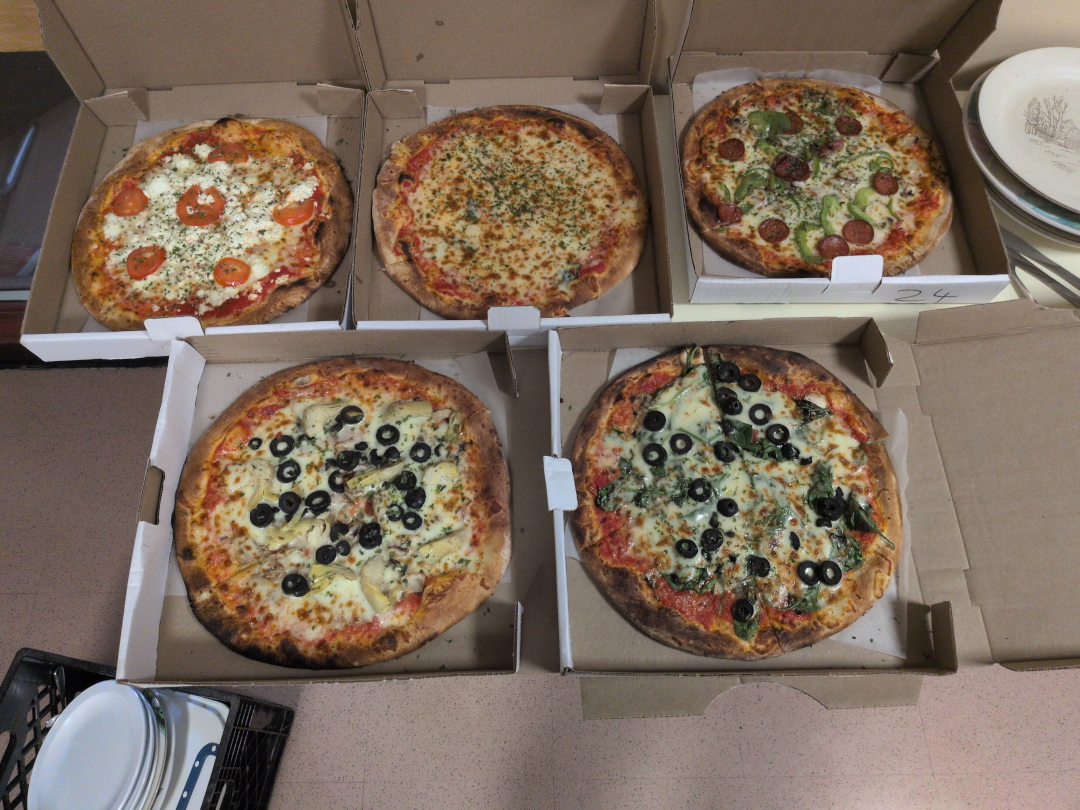
Our Debian User Group met on February 22nd for our first meeting of the year! Here's what we did: pollo: lelutin: viashimo: tvaz: lavamind: Pictures This time around, we held our meeting at c gep du Vieux Montr al, the college where I currently work. Here is the view we had: View from my office We also ordered some delicious pizzas from Pizzeria dei Compari, a nice pizzeria on Saint-Denis street that's been there forever. The pizzas we ate Some of us ended up grabbing a drink after the event at l'Am re boire, a pub right next to the venue, but I didn't take any pictures.

23 February 2026

Antoine Beaupr : PSA: North america changes time forward soon, Europe next

This is a copy of an email I used to send internally at work and now made public. I'm not sure I'll make a habit of posting it here, especially not twice a year, unless people really like it. Right now, it's mostly here to keep with my current writing spree going.
This is your bi-yearly reminder that time is changing soon!

What's happening? For people not on tor-internal, you should know that I've been sending semi-regular announcements when daylight saving changes occur. Starting now, I'm making those announcements public so they can be shared with the wider community because, after all, this affects everyone (kind of). For those of you lucky enough to have no idea what I'm talking about, you should know that some places in the world implement what is called Daylight saving time or DST. Normally, you shouldn't have to do anything: computers automatically change time following local rules, assuming they are correctly configured, provided recent updates have been applied in the case of a recent change in said rules (because yes, this happens). Appliances, of course, will likely not change time and will need to adjusted unless they are so-called "smart" (also known as "part of a bot net"). If your clock is flashing "0:00" or "12:00", you have no action to take, congratulations on having the right time once or twice a day. If you haven't changed those clocks in six months, congratulations, they will be accurate again! In any case, you should still consider DST because it might affect some of your meeting schedules, particularly if you set up a new meeting schedule in the last 6 months and forgot to consider this change.

If your location does not have DST Properly scheduled meetings affecting multiple time zones are set in UTC time, which does not change. So if your location does not observer time changes, your (local!) meeting time will not change. But be aware that some other folks attending your meeting might have the DST bug and their meeting times will change. They might miss entire meetings or arrive late as you frantically ping them over IRC, Matrix, Signal, SMS, Ricochet, Mattermost, SimpleX, Whatsapp, Discord, Slack, Wechat, Snapchat, Telegram, XMPP, Briar, Zulip, RocketChat, DeltaChat, talk(1), write(1), actual telegrams, Meshtastic, Meshcore, Reticulum, APRS, snail mail, and, finally, flying a remote presence drone to their house, asking what's going on. (Sorry if I forgot your preferred messaging client here, I tried my best.) Be kind; those poor folks might be more sleep deprived as DST steals one hour of sleep from them on the night that implements the change.

If you do observe DST If you are affected by the DST bug, your local meeting times will change access the board. Normally, you can trust that your meetings are scheduled to take this change into account and the new time should still be reasonable. Trust, but verify; make sure the new times are adequate and there are no scheduling conflicts. Do this now: take a look at your calendar in two week and in April. See if any meeting need to be rescheduled because of an impossible or conflicting time.

When does time change, how and where? Notice how I mentioned "North America" in the subject? That's a lie. ("The doctor lies", as they say on the BBC.) Other places, including Europe, also changes times, just not all at once (and not all North America). We'll get into "where" soon, but first let's look at the "how". As you might already know, the trick is:
Spring forward, fall backwards.
This northern-centric (sorry!) proverb says that clocks will move forward by an hour this "spring", after moving backwards last "fall". This is why we lose an hour of work, sorry, sleep. It sucks, to put it bluntly. I want it to stop and will keep writing those advisories until it does. To see where and when, we, unfortunately, still need to go into politics.

USA and Canada First, we start with "North America" which, really, is just some parts of USA[1] and Canada[2]. As usual, on the Second Sunday in March (the 8th) at 02:00 local (not UTC!), the clocks will move forward. This means that properly set clocks will flip from 1:59 to 3:00, coldly depriving us from an hour of sleep that was perniciously granted 6 months ago and making calendar software stupidly hard to write. Practically, set your wrist watch and alarm clocks[3] back one hour before going to bed and go to bed early. [1] except Arizona (except the Navajo nation), US territories, and Hawaii [2] except Yukon, most of Saskatchewan, and parts of British Columbia (northeast), one island in Nunavut (Southampton Island), one town in Ontario (Atikokan) and small parts of Quebec (Le Golfe-du-Saint-Laurent), a list which I keep recopying because I find it just so amazing how chaotic it is. When your clock has its own Wikipedia page, you know something is wrong. [3] hopefully not managed by a botnet, otherwise kindly ask your bot net operator to apply proper software upgrades in a timely manner

Europe Next we look at our dear Europe, which will change time on the last Sunday in March (the 29th) at 01:00 UTC (not local!). I think it means that, Amsterdam-time, the clocks will flip from 1:59 to 3:00 AM local on that night. (Every time I write this, I have doubts. I would welcome independent confirmation from night owls that observe that funky behavior experimentally.) Just like your poor fellows out west, just fix your old-school clocks before going to bed, and go to sleep early, it's good for you.

Rest of the world with DST Renewed and recurring apologies again to the people of Cuba, Mexico, Moldova, Israel, Lebanon, Palestine, Egypt, Chile (except Magallanes Region), parts of Australia, and New Zealand which all have their own individual DST rules, omitted here for brevity. In general, changes also happen in March, but either on different times or different days, except in the south hemisphere, where they happen in April.

Rest of the world without DST All of you other folks without DST, rejoice! Thank you for reminding us how manage calendars and clocks normally. Sometimes, doing nothing is precisely the right thing to do. You're an inspiration for us all.

Changes since last time There were, again, no changes since last year on daylight savings that I'm aware of. It seems the US congress debating switching to a "half-daylight" time zone which is an half-baked idea that I should have expected from the current USA politics. The plan is to, say, switch from "Eastern is UTC-4 in the summer" to "Eastern is UTC-4.5". The bill also proposes to do this 90 days after enactment, which is dangerously optimistic about our capacity at deploying any significant change in human society. In general, I rely on the Wikipedia time nerds for this and Paul Eggert which seems to singlehandledly be keeping everything in order for all of us, on the tz-announce mailing list. This time, I've also looked at the tz mailing list which is where I learned about the congress bill. If your country has changed time and no one above noticed, now would be an extremely late time to do something about this, typically writing to the above list. (Incredibly, I need to write to the list because of this post.) One thing that did change since last year is that I've implemented what I hope to be a robust calendar for this, which was surprisingly tricky. If you have access to our Nextcloud, it should be visible under the heading "Daylight saving times". If you don't, you can access it using this direct link. The procedures around how this calendar was created, how this email was written, and curses found along the way, are also documented in this wiki page, if someone ever needs to pick up the Time Lord duty.

22 February 2026

Benjamin Mako Hill: What makes online groups vulnerable to governance capture?

Note: I have not published blog posts about my academic papers over the past few years. To ensure that my blog contains a more comprehensive record of my published papers and to surface these for folks who missed them, I will be periodically (re)publishing blog posts about some older published projects. This post is closely based on a previously published post by Zarine Kharazian on the Community Data Science Blog. For nearly a decade, the Croatian language version of Wikipedia was run by a cabal of far-right nationalists who edited articles in ways that promoted fringe political ideas and involved cases of historical revisionism related to the Usta e regime, a fascist movement that ruled the Nazi puppet state called the Independent State of Croatia during World War II. This cabal seized complete control of the encyclopedia s governance, banned and blocked those who disagreed with them, and operated a network of fake accounts to create the appearance of grassroots support for their policies. Thankfully, Croatian Wikipedia appears to be an outlier. Though both the Croatian and Serbian language editions have been documented to contain nationalist bias and historical revisionism, Croatian Wikipedia seems unique among Wikipedia editions in the extent to which its governance institutions were captured by a small group of users.

The situation in Croatian Wikipedia was well documented and is now largely fixed, but we still know very little about why it was taken over, while other language editions seem to have rebuffed similar capture attempts. In a paper published in the Proceedings of the ACM: Human-Computer Interaction (CSCW), Zarine Kharazian, Kate Starbird, and I present an interview-based study that provides an explanation for why Croatian was captured while several other editions facing similar contexts and threats fared better.

Short video presentation of the work given at Wikimania in August 2023.
Based on insights from interviews with 15 participants from both the Croatian and Serbian Wikipedia projects and from the broader Wikimedia movement, we arrived at three propositions that, together, help explain why Croatian Wikipedia succumbed to capture while Serbian Wikipedia did not:
  1. Perceived Value as a Target. Is the project worth expending the effort to capture?
  2. Bureaucratic Openness. How easy is it for contributors outside the core founding team to ascend to local governance positions?
  3. Institutional Formalization. To what degree does the project prefer personalistic, informal forms of organization over formal ones?
The conceptual model from our paper, visualizing possible institutional configurations among Wikipedia projects that affect the risk of governance capture.
We found that both Croatian and Serbian Wikipedias were attractive targets for far-right nationalist capture due to their sizable readership and resonance with national identity. However, we also found that the two projects diverged early in their trajectories in how open they remained to new contributors ascending to local governance positions and in the degree to which they privileged informal relationships over formal rules and processes as the project s organizing principles. Ultimately, Croatian s relative lack of bureaucratic openness and rules constraining administrator behavior created a window of opportunity for a motivated contingent of editors to seize control of the governance mechanisms of the project. Though our empirical setting was Wikipedia, our theoretical model may offer insight into the challenges faced by self-governed online communities more broadly. As interest in decentralized alternatives to Facebook and X (formerly Twitter) grows, communities on these sites will likely face similar threats from motivated actors. Understanding the vulnerabilities inherent in these self-governing systems is crucial to building resilient defenses against threats like disinformation. For more details on our findings, take a look at the published version of our paper.

Citation for the full paper: Kharazian, Zarine, Kate Starbird, and Benjamin Mako Hill. 2024. Governance Capture in a Self-Governing Community: A Qualitative Comparison of the Croatian, Serbian, Bosnian, and Serbo-Croatian Wikipedias. Proceedings of the ACM on Human-Computer Interaction 8 (CSCW1): 61:1-61:26. https://doi.org/10.1145/3637338.

This blog post and the paper it describes are collaborative work by Zarine Kharazian, Benjamin Mako Hill, and Kate Starbird.

Otto Kek l inen: Do AI models still keep getting better, or have they plateaued?

Featured image of post Do AI models still keep getting better, or have they plateaued?The AI hype is based on the assumption that the frontier AI labs are producing better and better foundational models at an accelerating pace. Is that really true, or are people just in sort of a mass psychosis because AI models have become so good at mimicking human behavior that we unconsciously attribute increasing intelligence to them? I decided to conduct a mini-benchmark of my own to find out if the latest and greatest AI models are actually really good or not.
The problem with benchmarks Every time any team releases a new LLM, they boast how well it performs on various industry benchmarks such as Humanity s Last Exam, SWE-Bench and Ai2 ARC or ARC-AGI. An overall leaderboard can be viewed at LLM-stats. This incentivizes teams to optimize for specific benchmarks, which might make them excel on specific tasks while general abilities degrade. Also, the older a benchmark dataset is, the more online material there is discussing the questions and best answers, which in turn increases the chances of newer models trained on more recent web content scoring better. Thus I prefer looking at real-time leaderboards such as the LM Arena leaderboard (or OpenCompass for Chinese models that might be missing from LM Arena). However, even though the LM Arena Elo score is rated by humans in real-time, the benchmark can still be played. For example, Meta reportedly used a special chat-optimized model instead of the actual Llama 4 model when getting scored on the LM Arena. Therefore I trust my own first-hand experience more than the benchmarks for gaining intuition. Intuition however is not a compelling argument in discussions on whether or not new flagship AI models have plateaued. Thus, I decided to devise my own mini-benchmark so that no model could have possibly seen it in its training data or be specifically optimized for it in any way.

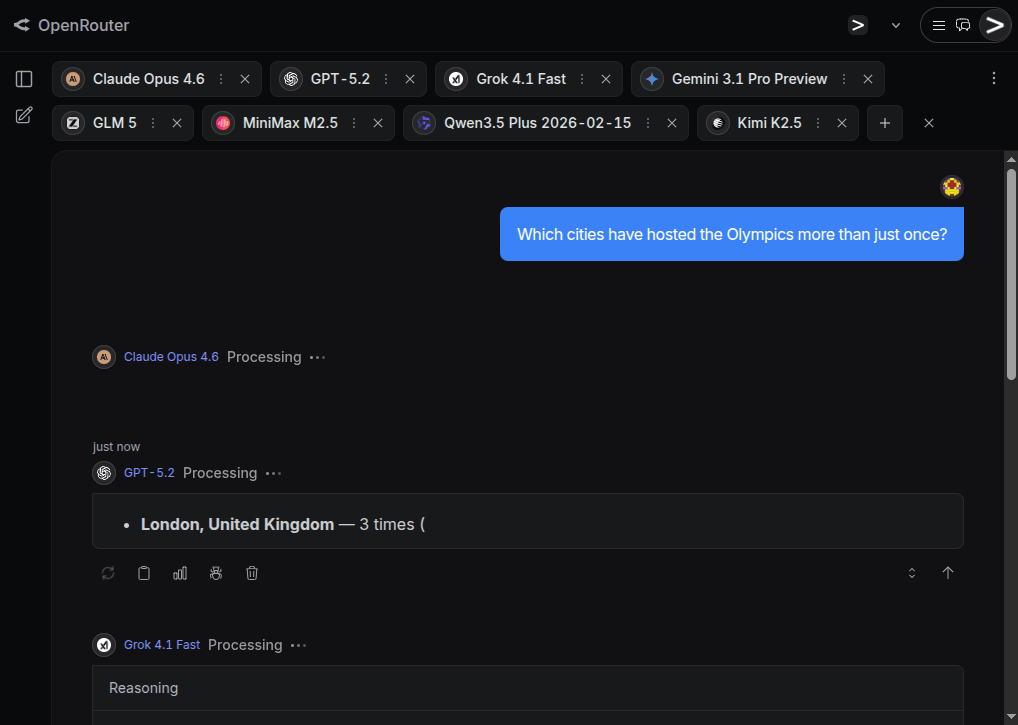
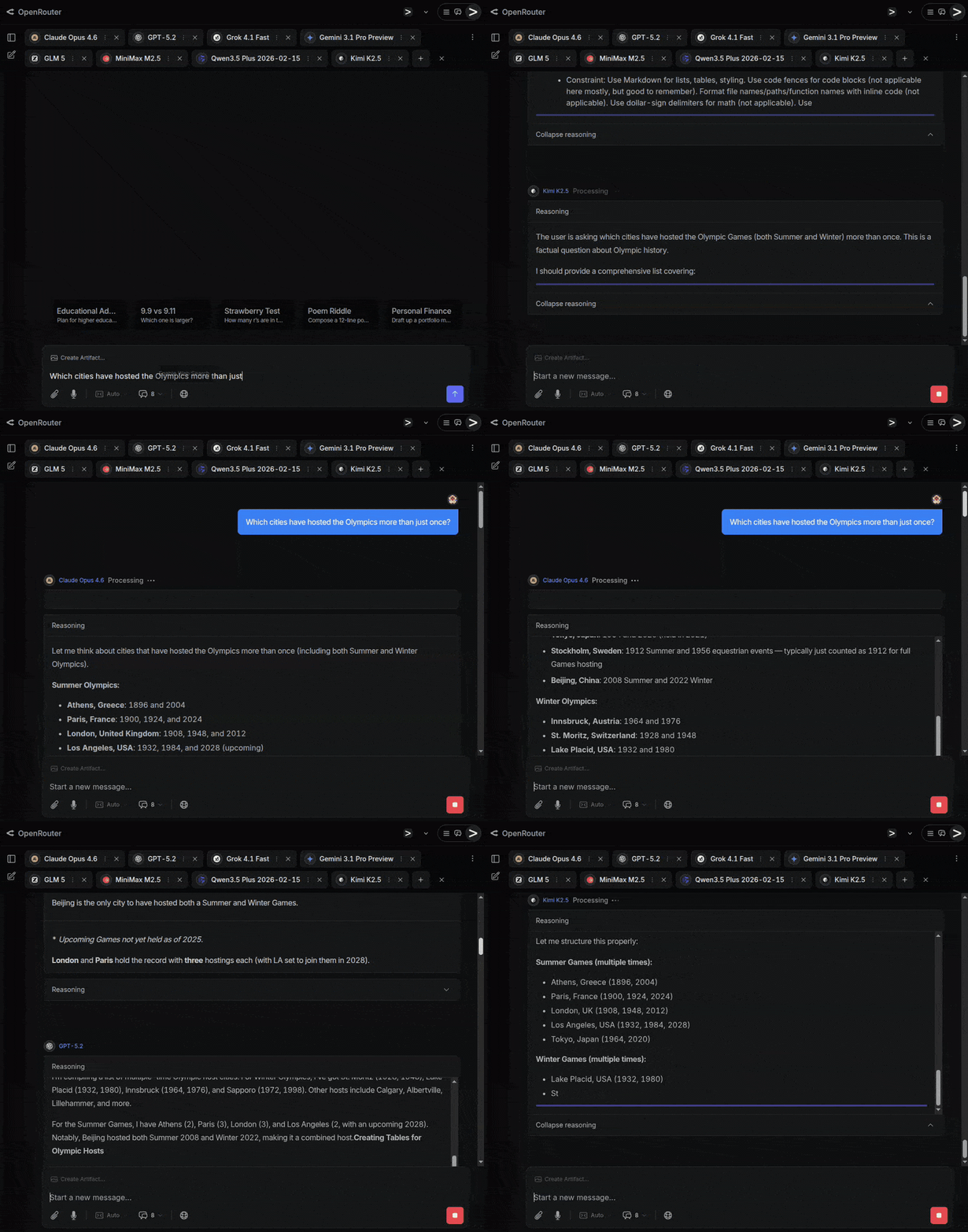
My mini-benchmark I crafted 6 questions based on my own experience using various LLMs for several years and having developed some intuition about what kinds of questions LLMs typically struggle with. I conducted the benchmark using the OpenRouter.ai chat playroom with the following state-of-the-art models: OpenRouter.ai is great as it very easy to get responses from multiple models in parallel to a single question. Also it allows to turn off web search to force the models to answer purely based on their embedded knowledge. OpenRouter.ai Chat playroom Common for all the test questions is that they are fairly straightforward and have a clear answer, yet the answer isn t common knowledge or statistically the most obvious one, and instead requires a bit of reasoning to get correct. Some of these questions are also based on myself witnessing a flagship model failing miserably to answer it.

1. Which cities have hosted the Olympics more than just once? This question requires accounting for both summer and winter Olympics, and for Olympics hosted across multiple cities. The variance in responses comes from if the model understands that Beijing should be counted as it has hosted both summer and winter Olympics. Interestingly GPT was the only model to not mention Beijing at all. Some variance also comes from how models account for co-hosted Olympics. For example Cortina should be counted as having hosted the Olympics twice, in 1956 and 2026, but only Claude, Gemini and Kimi pointed this out. Stockholm s 1956 hosting of the equestrian games during the Melbourne Olympics is a special case, which GPT, Gemini and Kimi pointed out in a side note. Some models seem to have old training material, and for example Grok assumes the current year is 2024. All models that accounted for awarded future Olympics (e.g. Los Angeles 2028) marked them clearly as upcoming. Overall I would judge that only GPT and MinMax gave incomplete answers, while all other models replied as the best humans could reasonably have.

2. If EUR/USD continues to slide to 1.5 by mid-2026, what is the likely effect on BMW s stock price by end of 2026? This question requires mapping the currency exchange rate to historic value, dodging the misleading word slide , and reasoning on where the revenue of a company comes from and how a weaker US dollar affects it in multiple ways. I ve frequently witnessed flagship models get it wrong how interest rates and exchange rates work. Apparently the binary choice between up or down is somehow challenging to the internal statistical model in the LLMs on a topic where there are a lot of training material that talk about both things being likely to happen, and choosing between them requires specifically reasoning about the scenario at hand and disregarding general knowledge of the situation. However, this time all the models concluded correctly that a weak dollar would have a negative overall effect on the BMW stock price. Gemini, GLM, Qwen and Kimi also mention the potential hedging effect of BMW s X-series production in South Carolina for worldwide export.

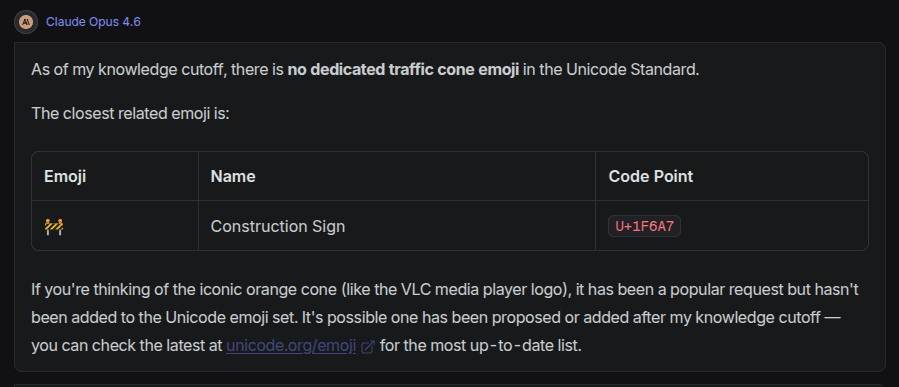
3. What is the Unicode code point for the traffic cone emoji? This was the first question where the the flagship models clearly still struggle in 2026. The trap here is that there is no traffic cone emoji, so an advanced model should simply refuse to give any Unicode numbers at all. Most LLMs however have an urge to give some answer, leading to hallucinations. Also, as the answer has a graphical element to it, the LLM might not understand how the emoji looks in ways that would be obvious to a human, and thus many models claim the construction sign emoji is a traffic cone, which it is not. By far the worst response was from GPT, that simply hallucinates and stops there: OpenAIs GPT-5.2 completely wrong answer to traffic cone emoji question While Gemini and Grok were among the three models not falling into this trap, the response from Claude was exemplary good: Claude Opus 4.6 exemplary good answer to traffic cone emoji question
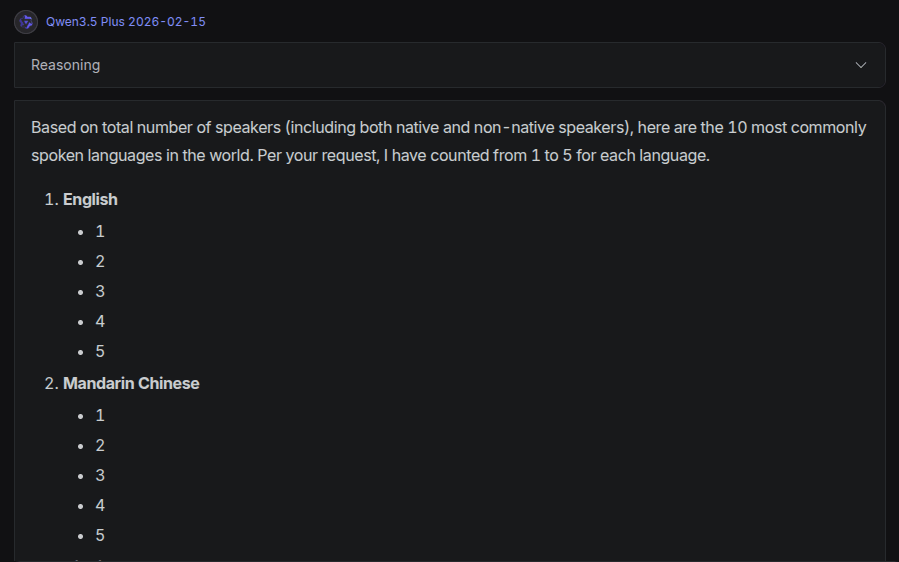
4. Which languages are the 10 most commonly spoken in the world? For each language, count from 1 to 5. This seemingly simple question can become quite complex when you account for the fact that other languages might also have their own character system, both for words and the numerals (e.g. Arabic /one vs /1), and that numbers might have variations depending on what the thing being counted is (e.g in French object gender un/une), or whether plain numbers and occurrences have their own words (e.g. Russian /odin vs /raz). I ve also witnessed older models frequently mix up on what parts of the reply should be using what language. For a human this question is trivial, assuming they know the language. For LLMs it is surprisingly challenging. Grok and MinMax only gave a list of the most popular languages and stopped there without showing any words in the languages. Qwen got a bit further by trying to list numbers in each language, but the lists were only the numbers 1 to 5: Qwen3.5 Plus count to five in top 10 languages I have seen Grok do something similar before, which in fact inspired me to include this question in my mini-benchmark. GPT got a bit further, but for Hindi, Arabic and Bengali it listed the numerals in local script, not the number words. Gemini, GLM and Kimi gave a complete and correct answer as a list, while the absolute best answer and presentation was by Claude, that gave the table below:

Claude Opus 4.6 10 Most Commonly Spoken Languages (by Total Speakers)
# Language 1 2 3 4 5
1 English One Two Three Four Five
2 Mandarin Chinese (y ) ( r) (s n) (s ) (w )
3 Hindi (ek) (do) (t n) (ch r) (p ch)
4 Spanish Uno Dos Tres Cuatro Cinco
5 French Un Deux Trois Quatre Cinq
6 Arabic (w id) (ithn n) (thal tha) (arba a) (khamsa)
7 Bengali (ek) (dui) (tin) (ch r) (p ch)
8 Portuguese Um Dois Tr s Quatro Cinco
9 Russian (odin) (dva) (tri) (chetyre) (pyat')
10 Japanese (ichi) (ni) (san) (shi) (go)
Note: Rankings are based on estimated total speakers (native + non-native). Rankings can vary depending on the source and methodology used.

5. Count the number of drone launch pads in the picture. Together with the question, I uploaded this picture: Drone pad picture attached to question above A human can easily count that there are 10 rows and 30+ columns in the grid, but because the picture resolution isn t good enough, the exact number of columns can t be counted, and the answer should be that there are at least 300 launch pads in the picture. GPT and Grok both guessed the count is zero. Instead of hallucinating some number they say zero, but it would have been better to not give any number at all, and just state that they are unable to perform the task. Gemini gave as its answer 101 , which is quite odd, but reading the reasoning section, it seems to have tried counting items in the image without reasoning much about what it is actually counting and that there is clearly a grid that can make the counting much easier. Both Qwen and Kimi state they can see four parallel structures, but are unable to count drone launch pads. The absolutely best answer was given by Claude, which counted 10-12 rows and 30-40+ columns, and concluded that there must be 300-500 drone launch pads. Very close to best human level - impressive! This question applied only to multi-modal models that can see images, so GLM and MinMax could not give any response.

6. Explain why I am getting the error below, and what is the best way to fix it? Together with the question above, I gave this code block:
$ SH_SCRIPTS="$(mktemp; grep -Irnw debian/ -e '^#!.*/sh'   sort -u   cut -d ':' -f 1   true)"
$ shellcheck -x --enable=all --shell=sh "$SH_SCRIPTS"
/tmp/tmp.xQOpI5Nljx
debian/tests/integration-tests: /tmp/tmp.xQOpI5Nljx
debian/tests/integration-tests: openBinaryFile: does not exist (No such file or directory)
Older models would easily be misled by the last error message thinking that a file went missing, and focus on suggesting changes to the complex-looking first line. In reality the error is simply caused by having the quotes around the $SH_SCRIPTS, resulting in the entire multi-line string being passed as a single argument to shellcheck. So instead of receiving two separate file paths, shellcheck tries to open one file literally named /tmp/tmp.xQOpI5Nljx\ndebian/tests/integration-tests. Incorrect argument expansion is fairly easy for an experienced human programmer to notice, but tricky for an LLM. Indeed, Grok, MinMax, and Qwen fell for this trap and focused on the mktemp, assuming it somehow fails to create a file. Interestingly GLM fails to produce an answer at all, as the reasoning step seems to be looping, thinking too much about the missing file, but not understanding why it would be missing when there is nothing wrong with how mktemp is executed. Claude, Gemini, and Kimi immediately spot the real root cause of passing the variable quoted and suggested correct fixes that involve either removing the quotes, or using Bash arrays or xargs in a way that makes the whole command also handle correctly filenames with spaces in them.

Conclusion
Model Sports Economics Emoji Languages Visual Shell Score
Claude Opus 4.6 6/6
GPT-5.2 ~ 2.5/6
Grok 4.1 3/6
Gemini 3.1 Pro 5/6
GLM 5 ? N/A 3/5
MinMax M2.5 N/A 1/5
Qwen3.5 Plus ~ 2.5/6
Kimi K2.5 4/6
Obviously, my mini-benchmark only had 6 questions, and I ran it only once. This was obviously not scientifically rigorous. However it was systematic enough to trump just a mere feeling. The main finding for me personally is that Claude Opus 4.6, the flagship model by Anthropic, seems to give great answers consistently. The answers are not only correct, but also well scoped giving enough information to cover everything that seems relevant, without blurping unnecessary filler. I used Claude extensively in 2023-2024 when it was the main model available at my day work, but for the past year I had been using other models that I felt were better at the time. Now Claude seems to be the best-of-the-best again, with Gemini and Kimi as close follow-ups. Comparing their pricing at OpenRouter.ai the Kimi K2.5 price of $0.6 / million tokens is almost 90% cheaper than the Claude Opus 4.6 s $5.0 / million tokens suggests that Kimi K2.5 offers the best price-per-performance ratio. Claude might be cheaper with a monthly subscription directly from Anthropic, potentially narrowing the price gap. Overall I do feel that Anthropic, Google and Moonshot.ai have been pushing the envelope with their latest models in a way that one can t really claim that AI models have plateaued. In fact, one could claim that at least Claude has now climbed over the hill of AI slop and consistently produces valuable results. If and when AI usage expands from here, we might actually not drown in AI slop as chances of accidentally crappy results decrease. This makes me positive about the future. I am also really happy to see that there wasn t just one model crushing everybody else, but that there are at least three models doing very well. As an open source enthusiast I am particularly glad to see that Moonshot.ai s Kimi K2.5 is published with an open license. Given the hardware, anyone can run it on their own. OpenRouter.ai currently lists 9 independent providers alongside Moonshot.ai itself, showcasing the potential of open-weight models in practice. If the pattern holds and flagship models continue improving at this pace we might look back at 2026 as the year AI stopped feeling like a call center associate and started to resemble a scientific researcher. While new models become available we need to keep testing, keep questioning, and keep our expectations grounded in actual performance rather than press releases. Thanks to OpenRouter.ai for providing a great service that makes testing various models incredibly easy!

16 February 2026

Antoine Beaupr : Kernel-only network configuration on Linux

What if I told you there is a way to configure the network on any Linux server that:
  1. works across all distributions
  2. doesn't require any software installed apart from the kernel and a boot loader (no systemd-networkd, ifupdown, NetworkManager, nothing)
  3. is backwards compatible all the way back to Linux 2.0, in 1996
It has literally 8 different caveats on top of that, but is still totally worth your time.

Known options in Debian People following Debian development might have noticed there are now four ways of configuring the network Debian system. At least that is what the Debian wiki claims, namely: At this point, I feel ifupdown is on its way out, possibly replaced by systemd-networkd. NetworkManager already manages most desktop configurations.

A "new" network configuration system The method is this:
  • ip= on the Linux kernel command line: for servers with a single IPv4 or IPv6 address, no software required other than the kernel and a boot loader (since 2002 or older)
So by "new" I mean "new to me". This option is really old. The nfsroot.txt where it is documented predates the git import of the Linux kernel: it's part of the 2005 git import of 2.6.12-rc2. That's already 20+ years old already. The oldest trace I found is in this 2002 commit, which imports the whole file at once, but the option might goes back as far as 1996-1997, if the copyright on the file is correct and the option was present back then.

What are you doing. The trick is to add an ip= parameter to the kernel's command-line. The syntax, as mentioned above, is in nfsroot.txt and looks like this:
ip=<client-ip>:<server-ip>:<gw-ip>:<netmask>:<hostname>:<device>:<autoconf>:<dns0-ip>:<dns1-ip>:<ntp0-ip>
Most settings are pretty self-explanatory, if you ignore the useless ones:
  • <client-ip>: IP address of the server
  • <gw-ip>: address of the gateway
  • <netmask>: netmask, in quad notation
  • <device>: interface name, if multiple available
  • <autoconf>: how to configure the interface, namely:
    • off or none: no autoconfiguration (static)
    • on or any: use any protocol (default)
    • dhcp, essentially like on for all intents and purposes
  • <dns0-ip>, <dns1-ip>: IP address of primary and secondary name servers, exported to /proc/net/pnp, can by symlinked to /etc/resolv.conf
We're ignoring the options:
  • <server-ip>: IP address of the NFS server, exported to /proc/net/pnp
  • <hostnname>: Name of the client, typically sent over the DHCP requests, which may lead to a DNS record to be created in some networks
  • <ntp0-ip>: exported to /proc/net/ipconfig/ntp_servers, unused by the kernel
Note that the Red Hat manual has a different opinion:
ip=[<server-id>]:<gateway-IP-number>:<netmask>:<client-hostname>:inteface:[dhcp dhcp6 auto6 on any none off]
It's essentially the same (although server-id is weird), and the autoconf variable has other settings, so that's a bit odd.

Examples For example, this command-line setting:
ip=192.0.2.42::192.0.2.1:255.255.255.0:::off
... will set the IP address to 192.0.2.42/24 and the gateway to 192.0.2.1. This will properly guess the network interface if there's a single one. A DHCP only configuration will look like this:
ip=::::::dhcp
Of course, you don't want to type this by hand every time you boot the machine. That wouldn't work. You need to configure the kernel commandline, and that depends on your boot loader.

GRUB With GRUB, you need to edit (on Debian), the file /etc/default/grub (ugh) and find a line like:
GRUB_CMDLINE_LINUX=
and change it to:
GRUB_CMDLINE_LINUX=ip=::::::dhcp

systemd-boot and UKI setups For systemd-boot UKI setups, it's simpler: just add the setting to the /etc/kernel/cmdline file. Don't forget to include anything that's non-default from /proc/cmdline. This assumes that is the Cmdline=@ setting in /etc/kernel/uki.conf. See 2025-08-20-luks-ukify-conversion for my minimal documentation on this.

Other systems This is perhaps where this is much less portable than it might first look, because of course each distribution has its own way of configuring those options. Here are some that I know of:
  • Arch (11 options, mostly /etc/default/grub, /boot/loader/entries/arch.conf for systemd-boot or /etc/kernel/cmdline for UKI)
  • Fedora (mostly /etc/default/grub, may be more RHEL mentions grubby, possibly some systemd-boot things here as well)
  • Gentoo (5 options, mostly /etc/default/grub, /efi/loader/entries/gentoo-sources-kernel.conf for systemd-boot, or /etc/kernel/install.d/95-uki-with-custom-opts.install)
It's interesting that /etc/default/grub is consistent across all distributions above, while the systemd-boot setups are all over the place (except for the UKI case), while I would have expected those be more standard than GRUB.

dropbear-initramfs If dropbear-initramfs is setup, it already requires you to have such a configuration, and it might not work out of the box. This is because, by default, it disables the interfaces configured in the kernel after completing its tasks (typically unlocking the encrypted disks). To fix this, you need to disable that "feature":
IFDOWN="none"
This will keep dropbear-initramfs from disabling the configured interface.

Why? Traditionally, I've always setup my servers with ifupdown on servers and NetworkManager on laptops, because that's essentially the default. But on some machines, I've started using systemd-networkd because ifupdown has ... issues, particularly with reloading network configurations. ifupdown is a old hack, feels like legacy, and is Debian-specific. Not excited about configuring another service, I figured I would try something else: just configure the network at boot, through the kernel command-line. I was already doing such configurations for dropbear-initramfs (see this documentation), which requires the network the be up for unlocking the full-disk encryption keys. So in a sense, this is a "Don't Repeat Yourself" solution.

Caveats Also known as: "wait, that works?" Yes, it does! That said...
  1. This is useful for servers where the network configuration will not change after boot. Of course, this won't work on laptops or any mobile device.
  2. This only works for configuring a single, simple, interface. You can't configure multiple interfaces, WiFi, bridges, VLAN, bonding, etc.
  3. It does support IPv6 and feels like the best way to configure IPv6 hosts: true zero configuration.
  4. It likely does not work with a dual-stack IPv4/IPv6 static configuration. It might work with a dynamic dual stack configuration, but I doubt it.
  5. I don't know what happens when a DHCP lease expires. No daemon seems to be running so I assume leases are not renewed, so this is more useful for static configurations, which includes server-side reserved fixed IP addresses. (A non-renewed lease risks getting reallocated to another machine, which would cause an addressing conflict.)
  6. It will not automatically reconfigure the interface on link changes, but ifupdown does not either.
  7. It will not write /etc/resolv.conf for you but the dns0-ip and dns1-ip do end up in /proc/net/pnp which has a compatible syntax, so a common configuration is:
    ln -s /proc/net/pnp /etc/resolv.conf
    
  8. I have not really tested this at scale: only a single, test server at home.
Yes, that's a lot of caveats, but it happens to cover a lot of machines for me, and it works surprisingly well. My main doubts are about long-term DHCP behaviour, but I don't see why that would be a problem with a statically defined lease.

Cleanup Once you have this configuration, you don't need any "user" level network system, so you can get rid of everything:
apt purge systemd-networkd ifupdown network-manager netplan.io
Note that ifupdown (and probably others) leave stray files in (e.g.) /etc/network which you might want to cleanup, or keep in case all this fails and I have put you in utter misery. Configuration files for other packages might also be left behind, I haven't tested this, no warranty.

Credits This whole idea came from the A/I folks (not to be confused with AI) who have been doing this forever, thanks!

13 February 2026

Erich Schubert: Dogfood Generative AI

Current AI companies ignore licenses such as the GPL, and often train on anything they can scrape. This is not acceptable. The AI companies ignore web conventions, e.g., they deep link images from your web sites (even adding ?utm_source=chatgpt.com to image URIs, I suggest that you return 403 on these requests), but do not direct visitors to your site. You do not get a reliable way of opting out from generative AI training or use. For example, the only way to prevent your contents from being used in Google AI Overviews is to use data-nosnippet and cripple the snippet preview in Google. The AI browsers such as Comet, Atlas do not identify as such, but rather pretend they are standard Chromium. There is no way to ban such AI use on your web site. Generative AI overall is flooding the internet with garbage. It was estimated that 1/3rd of the content uploaded to YouTube is by now AI generated. This includes the same veteran stories crap in thousands of variants as well as brainrot content (that at least does not pretend to be authentic), some of which is among the most viewed recent uploads. Hence, these platforms even benefit from the AI slop. And don t blame the creators because you can currently earn a decent amount of money from such contents, people will generate brainrot content. If you have recently tried to find honest reviews of products you considered buying, you will have noticed thousands of sites with AI generated fake product reviews, that all are financed by Amazon PartnerNet commissions. Often with hilarious nonsense such as recommending sewing thread with German instructions as tool for repairing a sewing machine. And on Amazon, there are plenty of AI generated product reviews the use of emoji is a strong hint. And if you leave a negative product review, there is a chance they offer you a refund to get rid of it And the majority of SPAM that gets through my filters is by now sent via Gmail and Amazon SES. Partially because of GenAI, StackOverflow is pretty much dead which used to be one of the most valuable programming resources. (While a lot of people complain about moderation, famous moderator Shog9 from the early SO days suggested that a change in Google s ranking is also to blame, as it began favoring showing new content over the existing answered questions causing more and more duplicates to be posted because people no longer found the existing good answers. In January 2026, there were around 3400 questions and 6000 answers posted, less than in the first month of SO of August 2008 (before the official launch). Many open-source projects are suffering in many ways, e.g., false bug reports that caused curl to stop its bug bounty program. Wikipedia is also suffering badly from GenAI. Science is also flooded with poor AI generated papers, often reviewed with help from AI. This is largely due to bad incentives to graduate, you are expected to write many papers on certain A conferences, such as NeurIPS. On these conferences the number of submissions is growing insane, and the review quality plummets. All to often, the references in these papers are hallucinated, too; and libraries complain that they receive more and more requests to locate literature that does not appear to exist. However, the worst effect (at least to me as an educator) is the noskilling effect (a rather novel term derived from deskilling, I have only seen it in this article by We els and Maibaum). Instead of acquiring skills (writing, reading, summarizing, programming) by practising, too many people now outsource all this to AI, leading to them not learn the basics necessary to advance to a higher skill level. In my impression, this effect is dramatic. It is even worse than deskilling, as it does not mean losing an advanced skill that you apparently can replace, but often means not acquiring basic skills in the first place. And the earlier pupils start using generative AI, the less skills they acquire. Dogfood the AI Let s dogfood the AI. Here s an outline:
  1. Get a list of programming topics, e.g., get a list of algorithms from Wikidata, get a StackOverflow data dump.
  2. Generate flawed code examples for the algorithms / programming questions, maybe generate blog posts, too.
    You do not need a high-quality model for this. Use something you can run locally or access for free.
  3. Date everything back in time, remove typical indications of AI use.
  4. Upload to Github, because Microsoft will feed this to OpenAI
Here is an example prompt that you can use:
You are a university educator, preparing homework assignments in debugging.
The programming language used is  lang .
The students are tasked to find bugs in given code.
Do not just call existing implementations from libraries, but implement the algorithm from scratch.
Make sure there are two mistakes in the code that need to be discovered by the students.
Do NOT repeat instructions. Do NOT add small-talk. Do NOT provide a solution.
The code may have (misleading) comments, but must NOT mention the bugs.
If you do not know how to implement the algorithm, output an empty response.
Output only the code for the assignment! Do not use markdown.
Begin with a code comment that indicates the algorithm name and idea.
If you indicate a bug, always use a comment with the keyword BUG
Generate a  lang  implementation (with bugs) of:  n  ( desc )
Remember to remove the BUG comments! If you pick some slighly less common programming languages (by quantity of available code, say Go or Rust) you have higher chances that this gets into the training data. If many of us do this, we can feed GenAI its own garbage. If we generate thousands of bad code examples, this will poison their training data, and may eventually lead to an effect known as model collapse . On the long run, we need to get back to an internet for people, not an internet for bots. Some kind of internet 2.0 , but I do not have a clear vision on how to keep AI out if AI can train on it, they will. And someone will copy and paste the AI generated crap back into whatever system we built. Hence I don t think technology is the answere here, but human networks of trust.

8 February 2026

Louis-Philippe V ronneau: Montreal Subway Foot Traffic Data, 2025 edition

Another year of data from Soci t de Transport de Montr al, Montreal's transit agency! A few highlights this year:
  1. Although the Saint-Michel station closed for emergency repairs in November 2024, traffic never bounced back to its pre-closure levels and is still stuck somewhere around 2022 Q2 levels. I wonder if this could be caused by the roadwork on Jean-Talon for the new Blue Line stations making it harder for folks in Montreal-Nord to reach the station by bus.
  2. The effects of the opening of the Royalmount shopping center has had a durable impact on the traffic at the De la Savane station. I reported on this last year, but it seems this wasn't just a fad.
  3. With the completion of the Deux-Montagnes branch of the R seau express m tropolitain (REM, a light-rail, above the surface transit network still in construction), the transfer stations to the Montreal subway have seen major traffic increases. The douard-Montpetit station has nearly reached its previous all-time record of 2015 and the McGill station has recovered from the general slump all the other stations have had in 2025.
  4. The Assomption station, which used to have one of the lowest number of riders of the subway network, has had a tremendous growth in the past few years. This is mostly explained by the many high-rise projects that were built around the station since the end of the COVID-19 pandemic.
  5. Although still affected by a very high seasonality, the Jean-Drapeau station broke its previous record of 2019, a testament of the continued attraction power of the various summer festivals taking place on the Sainte-H l ne et Notre-Dame islands.
More generally, it seems the Montreal subway has had a pretty bad year. Traffic had been slowly climbing back since the COVID-19 pandemic, but this is the first year since 2020 such a sharp decline can be witnessed. Even major stations like Jean-Talon or Lionel-Groulx are on a downward trend and it is pretty worrisome. As for causes, a few things come to mind. First of all, as the number of Montrealers commuting to work by bike continues to rise1, a modal shift from public transit to active mobility is to be expected. As local experts put it, this is not uncommon and has been seen in other cities before. Another important factor that certainly turned people away from the subway this year has been the impacts of the continued housing crisis in Montreal. As more and more people get kicked out of their apartments, many have been seeking refuge in the subway stations to find shelter. Sadly, this also brought a unprecedented wave of incivilities. As riders' sense of security sharply decreased, the STM eventually resorted to banning unhoused people from sheltering in the subway. This decision did bring back some peace to the network, but one can posit damage had already been done and many casual riders are still avoiding the subway for this reason. Finally, the weekslong STM worker's strike in Q4 had an important impact on general traffic, as it severely reduced the opening hours of the subway. As for the previous item, once people find alternative ways to get around, it's always harder to bring them back. Hopefully, my 2026 report will be a more cheerful one... By clicking on a subway station, you'll be redirected to a graph of the station's foot traffic. Licences

  1. Mostly thanks to major improvements to the cycling network and the BIXI bikesharing program.

19 January 2026

Isoken Ibizugbe: Mid-Point Project Progress

Halfway There

Hurray!  I have officially reached the 6-week mark, the halfway point of my Outreachy internship. The time has flown by incredibly fast, yet it feels short because there is still so much exciting work to do.

I remember starting this journey feeling overwhelmed, trying to gain momentum. Today, I feel much more confident. I began with the apps_startstop task during the contribution period, writing manual test steps and creating preparation Perl scripts for the desktop environments. Since then, I ve transitioned into full automation and taken a liking to reading openQA upstream documentation when I have issues or for reference.

In all of this, I ve committed over 30 hours a week to the project. This dedicated time has allowed me to look in-depth into the Debian ecosystem and automated quality assurance.

The Original Roadmap vs. Reality

Reviewing my 12-week goal, which included extending automated tests for live image testing, installer testing, and documentation, I am happy to report that I am right on track. My work on desktop apps tests has directly improved the quality of both the Live Images and the netinst (network installer) ISOs.

Accomplishments

I have successfully extended the apps_startstop tests for two Desktop Environments (DEs): Cinnamon and LXQt. These tests ensure that common and DE specific apps launch and close correctly across different environments.

  • Merged Milestone: My Cinnamon tests have been officially merged into the upstream repository! [MR !84]
  • LXQt & Adaptability: I am in the final stages of the LXQt tests. Interestingly, I had to update these tests mid-way through because of a version update in the DE. This required me to update the needles (image references) to match the new UI, a great lesson in software maintenance.

Solving for Synergy

One of my favorite challenges was suggested by my mentor, Roland: synergizing the tests to reduce redundancy. I observed that some applications (like Firefox and LibreOffice) behave identically across different desktops. Instead of duplicating Perl scripts/code for every single DE, I used symbolic links. This allows the use of the same Perl script and possibly the same needles, making the test suite lighter and much easier to maintain.

The Contributor Guide

During the contribution phase, I noticed how rigid the documentation and coding style requirements are. While this ensures high standards and uniformity, it can be intimidating for newcomers and time-consuming for reviewers.

To help, I created a contributor guide [MR !97]. This guide addresses the project s writing style. My goal is to reduce the back-and-forth during reviews, making the process more efficient for everyone and helping new contributors.

Looking Forward

For the second half of the internship, I plan to:

  1. Assist others: Help new contributors extend apps start-stop tests to even more desktop environments.
  2. Explore new coverage: Move beyond start-stop tests into deeper functional testing.

This journey has been an amazing experience of learning and connecting with the wider open-source community, especially Debian Women and the Linux QA team.

I am deeply grateful to my mentors, Tassia Camoes Araujo, Roland Clobus, and Philip Hands, for their constant guidance and for believing in my ability to take on this project.

Here s to the next 6 weeks

Jonathan Dowland: FOSDEM 2026

I'm going to FOSDEM 2026! I'm presenting in the Containers dev room. My talk is Java Memory Management in Containers and it's scheduled as the first talk on the first day. I'm the warm-up act! The Java devroom has been a stalwart at FOSDEM since 2004 (sometimes in other forms), but sadly there's no Java devroom this year. There's a story about that, but it's not mine to tell. Please recommend to me any interesting talks! Here's a few that caught my eye: Debian/related: Containers: Research: Other:

17 January 2026

Simon Josefsson: Backup of S3 Objects Using rsnapshot

I ve been using rsnapshot to take backups of around 10 servers and laptops for well over 15 years, and it is a remarkably reliable tool that has proven itself many times. Rsnapshot uses rsync over SSH and maintains a temporal hard-link file pool. Once rsnapshot is configured and running, on the backup server, you get a hardlink farm with directories like this for the remote server:
/backup/serverA.domain/.sync/foo
/backup/serverA.domain/daily.0/foo
/backup/serverA.domain/daily.1/foo
/backup/serverA.domain/daily.2/foo
...
/backup/serverA.domain/daily.6/foo
/backup/serverA.domain/weekly.0/foo
/backup/serverA.domain/weekly.1/foo
...
/backup/serverA.domain/monthly.0/foo
/backup/serverA.domain/monthly.1/foo
...
/backup/serverA.domain/yearly.0/foo
I can browse and rescue files easily, going back in time when needed. The rsnapshot project README explains more, there is a long rsnapshot HOWTO although I usually find the rsnapshot man page the easiest to digest. I have stored multi-TB Git-LFS data on GitLab.com for some time. The yearly renewal is coming up, and the price for Git-LFS storage on GitLab.com is now excessive (~$10.000/year). I have reworked my work-flow and finally migrated debdistget to only store Git-LFS stubs on GitLab.com and push the real files to S3 object storage. The cost for this is barely measurable, I have yet to run into the 25/month warning threshold. But how do you backup stuff stored in S3? For some time, my S3 backup solution has been to run the minio-client mirror command to download all S3 objects to my laptop, and rely on rsnapshot to keep backups of this. While 4TB NVME s are relatively cheap, I ve felt that this disk and network churn on my laptop is unsatisfactory for quite some time. What is a better approach? I find S3 hosting sites fairly unreliable by design. Only a couple of clicks in your web browser and you have dropped 100TB of data. Or by someone else who steal your plaintext-equivalent cookie. Thus, I haven t really felt comfortable using any S3-based backup option. I prefer to self-host, although continously running a mirror job is not sufficient: if I accidentally drop the entire S3 object store, my mirror run will remove all files locally too. The rsnapshot approach that allows going back in time and having data on self-managed servers feels superior to me. What if we could use rsnapshot with a S3 client instead of rsync? Someone else asked about this several years ago, and the suggestion was to use the fuse-based s3fs which sounded unreliable to me. After some experimentation, working around some hard-coded assumption in the rsnapshot implementation, I came up with a small configuration pattern and a wrapper tool to implement what I desired. Here is my configuration snippet:
cmd_rsync    /backup/s3/s3rsync
rsync_short_args    -Q
rsync_long_args    --json --remove
lockfile    /backup/s3/rsnapshot.pid
snapshot_root    /backup/s3
backup    s3:://hetzner/debdistget-gnuinos    ./debdistget-gnuinos
backup    s3:://hetzner/debdistget-tacos  ./debdistget-tacos
backup    s3:://hetzner/debdistget-diffos ./debdistget-diffos
backup    s3:://hetzner/debdistget-pureos ./debdistget-pureos
backup    s3:://hetzner/debdistget-kali   ./debdistget-kali
backup    s3:://hetzner/debdistget-devuan ./debdistget-devuan
backup    s3:://hetzner/debdistget-trisquel   ./debdistget-trisquel
backup    s3:://hetzner/debdistget-debian ./debdistget-debian
The idea is to save a backup of a couple of S3 buckets under /backup/s3/. I have some scripts that take a complete rsnapshot.conf file and append my per-directory configuration so that this becomes a complete configuration. If you are curious how I roll this, backup-all invokes backup-one appending my rsnapshot.conf template with the snippet above. The s3rsync wrapper script is the essential hack to convert rsnapshot s rsync parameters into something that talks S3 and the script is as follows:
#!/bin/sh
set -eu
S3ARG=
for ARG in "$@"; do
    case $ARG in
    s3:://*) S3ARG="$S3ARG "$(echo $ARG   sed -e 's,s3:://,,');;
    -Q*) ;;
    *) S3ARG="$S3ARG $ARG";;
    esac
done
echo /backup/s3/mc mirror $S3ARG
exec /backup/s3/mc mirror $S3ARG
It uses the minio-client tool. I first tried s3cmd but its sync command read all files to compute MD5 checksums every time you invoke it, which is very slow. The mc mirror command is blazingly fast since it only compare mtime s, just like rsync or git. First you need to store credentials for your S3 bucket. These are stored in plaintext in ~/.mc/config.json which I find to be sloppy security practices, but I don t know of any better way to do this. Replace AKEY and SKEY with your access token and secret token from your S3 provider:
/backup/s3/mc alias set hetzner AKEY SKEY
If I invoke a sync job for a fully synced up directory the output looks like this:
root@hamster /backup# /run/current-system/profile/bin/rsnapshot -c /backup/s3/rsnapshot.conf -V sync
Setting locale to POSIX "C"
echo 1443 > /backup/s3/rsnapshot.pid 
/backup/s3/s3rsync -Qv --json --remove s3:://hetzner/debdistget-gnuinos \
    /backup/s3/.sync//debdistget-gnuinos 
/backup/s3/mc mirror --json --remove hetzner/debdistget-gnuinos /backup/s3/.sync//debdistget-gnuinos
 "status":"success","total":0,"transferred":0,"duration":0,"speed":0 
/backup/s3/s3rsync -Qv --json --remove s3:://hetzner/debdistget-tacos \
    /backup/s3/.sync//debdistget-tacos 
/backup/s3/mc mirror --json --remove hetzner/debdistget-tacos /backup/s3/.sync//debdistget-tacos
 "status":"success","total":0,"transferred":0,"duration":0,"speed":0 
/backup/s3/s3rsync -Qv --json --remove s3:://hetzner/debdistget-diffos \
    /backup/s3/.sync//debdistget-diffos 
/backup/s3/mc mirror --json --remove hetzner/debdistget-diffos /backup/s3/.sync//debdistget-diffos
 "status":"success","total":0,"transferred":0,"duration":0,"speed":0 
/backup/s3/s3rsync -Qv --json --remove s3:://hetzner/debdistget-pureos \
    /backup/s3/.sync//debdistget-pureos 
/backup/s3/mc mirror --json --remove hetzner/debdistget-pureos /backup/s3/.sync//debdistget-pureos
 "status":"success","total":0,"transferred":0,"duration":0,"speed":0 
/backup/s3/s3rsync -Qv --json --remove s3:://hetzner/debdistget-kali \
    /backup/s3/.sync//debdistget-kali 
/backup/s3/mc mirror --json --remove hetzner/debdistget-kali /backup/s3/.sync//debdistget-kali
 "status":"success","total":0,"transferred":0,"duration":0,"speed":0 
/backup/s3/s3rsync -Qv --json --remove s3:://hetzner/debdistget-devuan \
    /backup/s3/.sync//debdistget-devuan 
/backup/s3/mc mirror --json --remove hetzner/debdistget-devuan /backup/s3/.sync//debdistget-devuan
 "status":"success","total":0,"transferred":0,"duration":0,"speed":0 
/backup/s3/s3rsync -Qv --json --remove s3:://hetzner/debdistget-trisquel \
    /backup/s3/.sync//debdistget-trisquel 
/backup/s3/mc mirror --json --remove hetzner/debdistget-trisquel /backup/s3/.sync//debdistget-trisquel
 "status":"success","total":0,"transferred":0,"duration":0,"speed":0 
/backup/s3/s3rsync -Qv --json --remove s3:://hetzner/debdistget-debian \
    /backup/s3/.sync//debdistget-debian 
/backup/s3/mc mirror --json --remove hetzner/debdistget-debian /backup/s3/.sync//debdistget-debian
 "status":"success","total":0,"transferred":0,"duration":0,"speed":0 
touch /backup/s3/.sync/ 
rm -f /backup/s3/rsnapshot.pid 
/run/current-system/profile/bin/logger -p user.info -t rsnapshot[1443] \
    /run/current-system/profile/bin/rsnapshot -c /backup/s3/rsnapshot.conf \
    -V sync: completed successfully 
root@hamster /backup# 
You can tell from the paths that this machine runs Guix. This was the first production use of the Guix System for me, and the machine has been running since 2015 (with the occasional new hard drive). Before, I used rsnapshot on Debian, but some stable release of Debian dropped the rsnapshot package, paving the way for me to test Guix in production on a non-Internet exposed machine. Unfortunately, mc is not packaged in Guix, so you will have to install it from the MinIO Client GitHub page manually. Running the daily rotation looks like this:
root@hamster /backup# /run/current-system/profile/bin/rsnapshot -c /backup/s3/rsnapshot.conf -V daily
Setting locale to POSIX "C"
echo 1549 > /backup/s3/rsnapshot.pid 
mv /backup/s3/daily.5/ /backup/s3/daily.6/ 
mv /backup/s3/daily.4/ /backup/s3/daily.5/ 
mv /backup/s3/daily.3/ /backup/s3/daily.4/ 
mv /backup/s3/daily.2/ /backup/s3/daily.3/ 
mv /backup/s3/daily.1/ /backup/s3/daily.2/ 
mv /backup/s3/daily.0/ /backup/s3/daily.1/ 
/run/current-system/profile/bin/cp -al /backup/s3/.sync /backup/s3/daily.0 
rm -f /backup/s3/rsnapshot.pid 
/run/current-system/profile/bin/logger -p user.info -t rsnapshot[1549] \
    /run/current-system/profile/bin/rsnapshot -c /backup/s3/rsnapshot.conf \
    -V daily: completed successfully 
root@hamster /backup# 
Hopefully you will feel inspired to take backups of your S3 buckets now!

13 January 2026

Freexian Collaborators: Debian Contributions: dh-python development, Python 3.14 and Ruby 3.4 transitions, Surviving scraper traffic in Debian CI and more! (by Anupa Ann Joseph)

Debian Contributions: 2025-12 Contributing to Debian is part of Freexian s mission. This article covers the latest achievements of Freexian and their collaborators. All of this is made possible by organizations subscribing to our Long Term Support contracts and consulting services.

dh-python development, by Stefano Rivera In Debian we build our Python packages with the help of a debhelper-compatible tool, dh-python. Before starting the 3.14 transition (that would rebuild many packages) we landed some updates to dh-python to fix bugs and add features. This started a month of attention on dh-python, iterating through several bug fixes, and a couple of unfortunate regressions. dh-python is used by almost all packages containing Python (over 5000). Most of these are very simple, but some are complex and use dh-python in unexpected ways. It s hard to avoid almost any change (including obvious bug fixes) from causing some unexpected knock-on behaviour. There is a fair amount of complexity in dh-python, and some rather clever code, which can make it tricky to work on. All of this means that good QA is important. Stefano spent some time adding type annotations and specialized types to make it easier to see what the code is doing and catch mistakes. This has already made work on dh-python easier. Now that Debusine has built-in repositories and debdiff support, Stefano could quickly test the effects of changes on many other packages. After each big change, he could upload dh-python to a repository, rebuild e.g. 50 Python packages with it, and see what differences appeared in the output. Reviewing the diffs is still a manual process, but can be improved. Stefano did a small test on what it would take to replace direct setuptools setup.py calls with PEP-517 (pyproject-style) builds. There is more work to do here.

Python 3.14 transition, by Stefano Rivera (et al.) In December the transition to add Python 3.14 as a supported version started in Debian unstable. To do this, we update the list of supported versions in python3-defaults, and then start rebuilding modules with C extensions from the leaves inwards. This had already been tested in a PPA and Ubuntu, so many of the biggest blocking compatibility issues with 3.14 had already been found and fixed. But there are always new issues to discover. Thanks to a number of people in the Debian Python team, we got through the first bit of the transition fairly quickly. There are still a number of open bugs that need attention and many failed tests blocking migration to testing. Python 3.14.1 released just after we started the transition, and very soon after, a follow-up 3.14.2 release came out to address a regression. We ran into another regression in Python 3.14.2.

Ruby 3.4 transition, by Lucas Kanashiro (et al.) The Debian Ruby team just started the preparation to move the default Ruby interpreter version to 3.4. At the moment, ruby3.4 source package is already available in experimental, also ruby-defaults added support to Ruby 3.4. Lucas rebuilt all reverse dependencies against this new version of the interpreter and published the results here. Lucas also reached out to some stakeholders to coordinate the work. Next steps are: 1) announcing the results to the whole team and asking for help to fix packages failing to build against the new interpreter; 2) file bugs against packages FTBFSing against Ruby 3.4 which are not fixed yet; 3) once we have a low number of build failures against Ruby 3.4, ask the Debian Release team to start the transition in unstable.

Surviving scraper traffic in Debian CI, by Antonio Terceiro Like most of the open web, Debian Continuous Integration has been struggling for a while to keep up with the insatiable hunger from data scrapers everywhere. Solving this involved a lot of trial and error; the final result seems to be stable, and consists of two parts. First, all Debian CI data pages, except the direct links to test log files (such as those provided by the Release Team s testing migration excuses), now require users to be authenticated before being accessed. This means that the Debian CI data is no longer publicly browseable, which is a bit sad. However, this is where we are now. Additionally, there is now a fail2ban powered firewall-level access limitation for clients that display an abusive access pattern. This went through several iterations, with some of them unfortunately blocking legitimate Debian contributors, but the current state seems to strike a good balance between blocking scrapers and not blocking real users. Please get in touch with the team on the #debci OFTC channel if you are affected by this.

A hybrid dependency solver for crossqa.debian.net, by Helmut Grohne crossqa.debian.net continuously cross builds packages from the Debian archive. Like Debian s native build infrastructure, it uses dose-builddebcheck to determine whether a package s dependencies can be satisfied before attempting a build. About one third of Debian s packages fail this check, so understanding the reasons is key to improving cross building. Unfortunately, dose-builddebcheck stops after reporting the first problem and does not display additional ones. To address this, a greedy solver implemented in Python now examines each build-dependency individually and can report multiple causes. dose-builddebcheck is still used as a fall-back when the greedy solver does not identify any problems. The report for bazel-bootstrap is a lengthy example.

rebootstrap, by Helmut Grohne Due to the changes suggested by Loongson earlier, rebootstrap now adds debhelper to its final installability test and builds a few more packages required for installing it. It also now uses a variant of build-essential that has been marked Multi-Arch: same (see foundational work from last year). This in turn made the use of a non-default GCC version more difficult and required more work to make it work for gcc-16 from experimental. Ongoing archive changes temporarily regressed building fribidi and dash. libselinux and groff have received patches for architecture specific changes and libverto has been NMUed to remove the glib2.0 dependency.

Miscellaneous contributions
  • Stefano did some administrative work on debian.social and debian.net instances and Debian reimbursements.
  • Stefano did routine updates of python-authlib, python-mitogen, xdot.
  • Stefano spent several hours discussing Debian s Python package layout with the PyPA upstream community. Debian has ended up with a very different on-disk installed Python layout than other distributions, and this continues to cause some frustration in many communities that have to have special workarounds to handle it. This ended up impacting cross builds as Helmut discovered.
  • Rapha l set up Debusine workflows for the various backports repositories on debusine.debian.net.
  • Zulip is not yet in Debian (RFP in #800052), but Rapha l helped on the French translation as he is experimenting with that discussion platform.
  • Antonio performed several routine Salsa maintenance tasks, including fixing salsa-nm-sync, the service that synchronizes project members data from LDAP to Salsa, which had been broken since salsa.debian.org was upgraded to trixie .
  • Antonio deployed a new amd64 worker host for Debian CI.
  • Antonio did several DebConf technical and administrative bits, including but adding support for custom check-in/check-out dates in the MiniDebConf registration module, publishing a call for bids for DebConf27.
  • Carles reviewed and submitted 14 Catalan translations using po-debconf-manager.
  • Carles improved po-debconf-manager: added delete-package command, show-information now uses properly formatted output (YAML), it now attaches the translation on the bug reports for which a merge request has been opened too long.
  • Carles investigated why some packages appeared in po-debconf-manager but not in the Debian l10n list. Turns out that some packages had debian/po/templates.pot (appearing in po-debconf-manager) but not the POTFILES.in file as expected. Created a script to find out which packages were in this or similar situation and reported bugs.
  • Carles tested and documented how to set up voices (mbrola and festival) if using Orca speech synthesizer. Commented a few issues and possible improvements in the debian-accessibility list.
  • Helmut sent patches for 48 cross build failures and initiated discussions on how to deal with two non-trivial matters. Besides Python mentioned above, CMake introduced a cmake_pkg_config builtin which is not aware of the host architecture. He also forwarded a Meson patch upstream.
  • Thorsten uploaded a new upstream version of cups to fix a nasty bug that was introduced by the latest security update.
  • Along with many other Python 3.14 fixes, Colin fixed a tricky segfault in python-confluent-kafka after a helpful debugging hint from upstream.
  • Colin upstreamed an improved version of an OpenSSH patch we ve been carrying since 2008 to fix misleading verbose output from scp.
  • Colin used Debusine to coordinate transitions for astroid and pygments, and wrote up the astroid case on his blog.
  • Emilio helped with various transitions, and provided a build fix for opencv for the ffmpeg 8 transition.
  • Emilio tested the GNOME updates for trixie proposed updates (gnome-shell, mutter, glib2.0).
  • Santiago helped to review the status of how to test different build profiles in parallel on the same pipeline, using the test-build-profiles job. This means, for example, to simultaneously test build profiles such as nocheck and nodoc for the same git tree. Finally, Santiago provided MR !685 to fix the documentation.
  • Anupa prepared a bits post for Outreachy interns announcement along with T ssia Cam es Ara jo and worked on publicity team tasks.

11 January 2026

Otto Kek l inen: Stop using MySQL in 2026, it is not true open source

Featured image of post Stop using MySQL in 2026, it is not true open sourceIf you care about supporting open source software, and still use MySQL in 2026, you should switch to MariaDB like so many others have already done. The number of git commits on github.com/mysql/mysql-server has been significantly declining in 2025. The screenshot below shows the state of git commits as of writing this in January 2026, and the picture should be alarming to anyone who cares about software being open source. MySQL GitHub commit activity decreasing drastically

This is not surprising Oracle should not be trusted as the steward for open source projects When Oracle acquired Sun Microsystems and MySQL along with it back in 2009, the European Commission almost blocked the deal due to concerns that Oracle s goal was just to stifle competition. The deal went through as Oracle made a commitment to keep MySQL going and not kill it, but (to nobody s surprise) Oracle has not been a good steward of MySQL as an open source project and the community around it has been withering away for years now. All development is done behind closed doors. The publicly visible bug tracker is not the real one Oracle staff actually uses for MySQL development, and the few people who try to contribute to MySQL just see their Pull Requests and patch submissions marked as received with mostly no feedback and then those changes may or may not be in the next MySQL release, often rewritten, and with only Oracle staff in the git author/committer fields. The real author only gets a small mention in a blog post. When I was the engineering manager for the core team working on RDS MySQL and RDS MariaDB at Amazon Web Services, I oversaw my engineers contributions to both MySQL and MariaDB (the latter being a fork of MySQL by the original MySQL author, Michael Widenius). All the software developers in my org disliked submitting code to MySQL due to how bad the reception by Oracle was to their contributions. MariaDB is the stark opposite with all development taking place in real-time on github.com/mariadb/server, anyone being able to submit a Pull Request and get a review, all bugs being openly discussed at jira.mariadb.org and so forth, just like one would expect from a true open source project. MySQL is open source only by license (GPL v2), but not as a project.

MySQL s technical decline in recent years Despite not being a good open source steward, Oracle should be given credit that it did keep the MySQL organization alive and allowed it to exist fairly independently and continue developing and releasing new MySQL versions well over a decade after the acquisition. I have no insight into how many customers they had, but I assume the MySQL business was fairly profitable and financially useful to Oracle, at least as long as it didn t gain too many features to threaten Oracle s own main database business. I don t know why, perhaps because too many talented people had left the organization, but it seems that from a technical point of view MySQL clearly started to deteriorate from 2022 onward. When MySQL 8.0.29 was released with the default ALTER TABLE method switched to run in-place, it had a lot of corner cases that didn t work, causing the database to crash and data to corrupt for many users. The issue wasn t fully fixed until a year later in MySQL 8.0.32. To many users annoyance Oracle announced the 8.0 series as evergreen and introduced features and changes in the minor releases, instead of just doing bugfixes and security fixes like users historically had learnt to expect from these x.y.Z maintenance releases. There was no new major MySQL version for six years. After MySQL 8.0 in 2018 it wasn t until 2023 when MySQL 8.1 was released, and it was just a short-term preview release. The first actual new major release MySQL 8.4 LTS was released in 2024. Even though it was a new major release, many users got disappointed as it had barely any new features. Many also reported degraded performance with newer MySQL versions, for example the benchmark by famous MySQL performance expert Mark Callaghan below shows that on write-heavy workloads MySQL 9.5 throughput is typically 15% less than in 8.0. Benchmark showing new MySQL versions being slower than the old Due to newer MySQL versions deprecating many features, a lot of users also complained about significant struggles regarding both MySQL 5.7->8.0 and 8.0->8.4 upgrades. With few new features and heavy focus on code base cleanup and feature deprecation, it became obvious to many that Oracle had decided to just keep MySQL barely alive, and put all new relevant features (e.g. vector search) into Heatwave, Oracle s closed-source and cloud-only service for MySQL customers. As it was evident that Oracle isn t investing in MySQL, Percona s Peter Zaitsev wrote Is Oracle Finally Killing MySQL in June 2024. At this time MySQL s popularity as ranked by DB-Engines had also started to tank hard, a trend that likely accelerates in 2026. MySQL dropping significantly in DB-Engines ranking In September 2025 news reported that Oracle was reducing its workforce and that the MySQL staff was getting heavily reduced. Obviously this does not bode well for MySQL s future, and Peter Zaitsev posted already in November stats showing that the latest MySQL maintenance release contained fewer bug fixes than before.

Open source is more than ideology: it has very real effects on software security and sovereignty Some say they don t care if MySQL is truly open source or not, or that they don t care if it has a future in coming years, as long as it still works now. I am afraid people thinking so are taking a huge risk. The database is often the most critical part of a software application stack, and any flaw or problem in operations, let alone a security issue, will have immediate consequences, and not caring will eventually get people fired or sued. In open source problems are discussed openly, and the bigger the problem, the more people and companies will contribute to fixing it. Open source as a development methodology is similar to the scientific method with free flow of ideas that are constantly contested and only the ones with the most compelling evidence win. Not being open means more obscurity, more risk and more just trust us bro attitude. This open vs. closed is very visible for example in how Oracle handles security issues. We can see that in 2025 alone MySQL published 123 CVEs about security issues, while MariaDB had 8. There were 117 CVEs that only affected MySQL and not MariaDB in 2025. I haven t read them all, but typically the CVEs hardly contain any real details. As an example, the most recent one CVE-2025-53067 states Easily exploitable vulnerability allows high privileged attacker with network access via multiple protocols to compromise MySQL Server. There is no information a security researcher or auditor could use to verify if any original issue actually existed, or if it was fixed, or if the fix was sufficient and fully mitigating the issue or not. MySQL users just have to take the word of Oracle that it is all good now. Handling security issues like this is in stark contrast to other open source projects, where all security issues and their code fixes are open for full scrutiny after the initial embargo is over and CVE made public. There is also various forms of enshittification going on one would not see in a true open source project, and everything about MySQL as a software, documentation and website is pushing users to stop using the open source version and move to the closed MySQL versions, and in particular to Heatwave, which is not only closed-source but also results in Oracle fully controlling customer s databases contents. Of course, some could say this is how Oracle makes money and is able to provide a better product. But stories on Reddit and elsewhere suggest that what is going on is more like Oracle milking hard the last remaining MySQL customers who are forced to pay more and more for getting less and less.

There are options and migrating is easy, just do it A large part of MySQL users switched to MariaDB already in the mid-2010s, in particular everyone who had cared deeply about their database software staying truly open source. That included large installations such as Wikipedia, and Linux distributions such as Fedora and Debian. Because it s open source and there is no centralized machine collecting statistics, nobody knows what the exact market shares look like. There are however some application specific stats, such as that 57% of WordPress sites around the world run MariaDB, while the share for MySQL is 42%. For anyone running a classic LAMP stack application such as WordPress, Drupal, Mediawiki, Nextcloud, or Magento, switching the old MySQL database to MariaDB is be straightforward. As MariaDB is a fork of MySQL and mostly backwards compatible with it, swapping out MySQL for MariaDB can be done without changing any of the existing connectors or database clients, as they will continue to work with MariaDB as if it was MySQL. For those running custom applications and who have the freedom to make changes to how and what database is used, there are tens of mature and well-functioning open source databases to choose from, with PostgreSQL being the most popular general database. If your application was built from the start for MySQL, switching to PostgreSQL may however require a lot of work, and the MySQL/MariaDB architecture and storage engine InnoDB may still offer an edge in e.g. online services where high performance, scalability and solid replication features are of highest priority. For a quick and easy migration MariaDB is probably the best option. Switching from MySQL to the Percona Server is also very easy, as it closely tracks all changes in MySQL and deviates from it only by a small number of improvements done by Percona. However, also precisely because of it being basically just a customized version of the MySQL Server, it s not a viable long-term solution for those trying to fully ditch the dependency on Oracle. There are also several open source databases that have no common ancestry with MySQL, but strive to be MySQL-compatible. Thus most apps built for MySQL can simply switch to using them without needing SQL statements to be rewritten. One such database is TiDB, which has been designed from scratch specifically for highly scalable and large systems, and is so good that even Amazon s latest database solution DSQL was built borrowing many ideas from TiDB. However, TiDB only really shines with larger distributed setups, so for the vast majority of regular small- and mid-scale applications currently using MySQL, the most practical solution is probably to just switch to MariaDB, which on most Linux distributions can simply be installed by running apt/dnf/brew install mariadb-server. Whatever you end up choosing, as long as it is not Oracle, you will be better off.

8 January 2026

Reproducible Builds: Reproducible Builds in December 2025

Welcome to the December 2025 from the Reproducible Builds project! Our monthly reports outline what we ve been up to over the past month, highlighting items of news from elsewhere in the increasingly-important area of software supply-chain security. As ever, if you are interested in contributing to the Reproducible Builds project, please see the Contribute page on our website.

  1. New orig-check service to validate Debian upstream tarballs
  2. Distribution work
  3. disorderfs updated to FUSE 3
  4. Mailing list updates
  5. Three new academic papers published
  6. Website updates
  7. Upstream patches

New orig-check service to validate Debian upstream tarballs This month, Debian Developer Lucas Nussbaum announced the orig-check service, which attempts to automatically reproduce the generation upstream tarballs (ie. the original source component of a Debian source package), comparing that to the upstream tarball actually shipped with Debian. As of the time of writing, it is possible for a Debian developer to upload a source archive that does not actually correspond to upstream s version. Whilst this is not inherently malicious (it typically indicates some tooling/process issue), the very possibility that a maintainer s version may differ potentially permits a maintainer to make (malicious) changes that would be misattributed to upstream. This service therefore nicely complements the whatsrc.org service, which was reported in our reports for both April and August. The orig-check is dedicated to Lunar, who sadly passed away a year ago.

Distribution work In Arch Linux this month, Robin Candau and Mark Hegreberg worked at making the Arch Linux WSL image bit-for-bit reproducible. Robin also shared some implementation details and future related work on our mailing list. Continuing a series reported in these reports for March, April and July 2025 (etc.), Simon Josefsson has published another interesting article this month, itself a followup to a post Simon published in December 2024 regarding GNU Guix Container Images that are hosted on GitLab. In Debian this month, Micha Lenk posted to the debian-backports-announce mailing list with the news that the Backports archive will now discard binaries generated and uploaded by maintainers: The benefit is that all binary packages [will] get built by the Debian buildds before we distribute them within the archive. Felix Moessbauer of Siemens then filed a bug in the Debian bug tracker to signal their intention to package debsbom, a software bill of materials (SBOM) generator for distributions based on Debian. This generated a discussion on the bug inquiring about the output format as well as a question about how these SBOMs might be distributed. Holger Levsen merged a number of significant changes written by Alper Nebi Yasak to the Debian Installer in order to improve its reproducibility. As noted in Alper s merge request, These are the reproducibility fixes I looked into before bookworm release, but was a bit afraid to send as it s just before the release, because the things like the xorriso conversion changes the content of the files to try to make them reproducible. In addition, 76 reviews of Debian packages were added, 8 were updated and 27 were removed this month adding to our knowledge about identified issues. A new different_package_content_when_built_with_nocheck issue type was added by Holger Levsen. [ ] Arnout Engelen posted to our mailing list reporting that they successfully reproduced the NixOS minimal installation ISO for the 25.11 release without relying on a pre-compiled package archive, with more details on their blog. Lastly, Bernhard M. Wiedemann posted another openSUSE monthly update for his work there.

disorderfs updated to FUSE 3 disorderfs is our FUSE-based filesystem that deliberately introduces non-determinism into system calls to reliably flush out reproducibility issues. This month, however, Roland Clobus upgraded disorderfs* from FUSE 2 to FUSE 3 after its package automatically got removed from Debian testing. Some tests in Debian currently require disorderfs to make the Debian live images reproducible, although disorderfs is not a Debian-specific tool.

Mailing list updates On our mailing list this month:
  • Luca Di Maio announced stampdalf, a filesystem timestamp preservation tool that wraps arbitrary commands and ensures filesystem timestamp reproducibility :
    stampdalf allows you to run any command that modifies files in a directory tree, then automatically resets all timestamps back to their original values. Any new files created during command execution are set to [the UNIX epoch] or a custom timestamp via SOURCE_DATE_EPOCH.
    The project s GitHub page helpfully reveals that the project is pronounced: stamp-dalf (stamp like time-stamp, dalf like Gandalf the wizard) as it s a wizard of time and stamps .)
  • Lastly, Reproducible Builds developer cen1 posted to our list announcing that early/experimental/alpha support for FreeBSD was added to rebuilderd. In their post, cen1 reports that the initial builds are in progress and look quite decent . cen1 also interestingly notes that since the upstream is currently not technically reproducible I had to relax the bit-for-bit identical requirement of rebuilderd [ ] I consider the pkg to be reproducible if the tar is content-identical (via diffoscope), ignoring timestamps and some of the manifest files. .

Three new academic papers published Yogya Gamage and Benoit Baudry of Universit de Montr al, Canada together with Deepika Tiwari and Martin Monperrus of KTH Royal Institute of Technology, Sweden published a paper on The Design Space of Lockfiles Across Package Managers:
Most package managers also generate a lockfile, which records the exact set of resolved dependency versions. Lockfiles are used to reduce build times; to verify the integrity of resolved packages; and to support build reproducibility across environments and time. Despite these beneficial features, developers often struggle with their maintenance, usage, and interpretation. In this study, we unveil the major challenges related to lockfiles, such that future researchers and engineers can address them. [ ]
A PDF of their paper is available online. Benoit Baudry also posted an announcement to our mailing list, which generated a number of replies.
Betul Gokkaya, Leonardo Aniello and Basel Halak of the University of Southampton then published a paper on the A taxonomy of attacks, mitigations and risk assessment strategies within the software supply chain:
While existing studies primarily focus on software supply chain attacks prevention and detection methods, there is a need for a broad overview of attacks and comprehensive risk assessment for software supply chain security. This study conducts a systematic literature review to fill this gap. By analyzing 96 papers published between 2015-2023, we identified 19 distinct SSC attacks, including 6 novel attacks highlighted in recent studies. Additionally, we developed 25 specific security controls and established a precisely mapped taxonomy that transparently links each control to one or more specific attacks. [ ]
A PDF of the paper is available online via the article s canonical page.
Aman Sharma and Martin Monperrus of the KTH Royal Institute of Technology, Sweden along with Benoit Baudry of Universit de Montr al, Canada published a paper this month on Causes and Canonicalization of Unreproducible Builds in Java. The abstract of the paper is as follows:
[Achieving] reproducibility at scale remains difficult, especially in Java, due to a range of non-deterministic factors and caveats in the build process. In this work, we focus on reproducibility in Java-based software, archetypal of enterprise applications. We introduce a conceptual framework for reproducible builds, we analyze a large dataset from Reproducible Central, and we develop a novel taxonomy of six root causes of unreproducibility. [ ]
A PDF of the paper is available online.

Website updates Once again, there were a number of improvements made to our website this month including:

Upstream patches The Reproducible Builds project detects, dissects and attempts to fix as many currently-unreproducible packages as possible. We endeavour to send all of our patches upstream where appropriate. This month, we wrote a large number of such patches, including:

Finally, if you are interested in contributing to the Reproducible Builds project, please visit our Contribute page on our website. However, you can get in touch with us via:

4 January 2026

Sahil Dhiman: Full /8 IPv4 Address Block Holders in 2025

Here, I tried to collect entities that owned full /8 IPv4 address block(s) in 2025. A more comprehensive and historical list can be found at https://en.wikipedia.org/wiki/List_of_assigned_/8_IPv4_address_blocks.

Some notable mentions: Note - HE s list mentions addresses originated (not just owned). Providers also advertise prefixes owned by their customers in Bring Your Own IP (BYOIP) setups. The number of address space owned by entity would mostly be more than their customer owned space (originated by the entity).
  • There s also 126.0.0.0/8 which is mostly Softbank.

Matthew Garrett: What is a PC compatible?

Wikipedia says An IBM PC compatible is any personal computer that is hardware- and software-compatible with the IBM Personal Computer (IBM PC) and its subsequent models . But what does this actually mean? The obvious literal interpretation is for a device to be PC compatible, all software originally written for the IBM 5150 must run on it. Is this a reasonable definition? Is it one that any modern hardware can meet? Before we dig into that, let s go back to the early days of the x86 industry. IBM had launched the PC built almost entirely around off-the-shelf Intel components, and shipped full schematics in the IBM PC Technical Reference Manual. Anyone could buy the same parts from Intel and build a compatible board. They d still need an operating system, but Microsoft was happy to sell MS-DOS to anyone who d turn up with money. The only thing stopping people from cloning the entire board was the BIOS, the component that sat between the raw hardware and much of the software running on it. The concept of a BIOS originated in CP/M, an operating system originally written in the 70s for systems based on the Intel 8080. At that point in time there was no meaningful standardisation - systems might use the same CPU but otherwise have entirely different hardware, and any software that made assumptions about the underlying hardware wouldn t run elsewhere. CP/M s BIOS was effectively an abstraction layer, a set of code that could be modified to suit the specific underlying hardware without needing to modify the rest of the OS. As long as applications only called BIOS functions, they didn t need to care about the underlying hardware and would run on all systems that had a working CP/M port. By 1979, boards based on the 8086, Intel s successor to the 8080, were hitting the market. The 8086 wasn t machine code compatible with the 8080, but 8080 assembly code could be assembled to 8086 instructions to simplify porting old code. Despite this, the 8086 version of CP/M was taking some time to appear, and a company called Seattle Computer Products started producing a new OS closely modelled on CP/M and using the same BIOS abstraction layer concept. When IBM started looking for an OS for their upcoming 8088 (an 8086 with an 8-bit data bus rather than a 16-bit one) based PC, a complicated chain of events resulted in Microsoft paying a one-off fee to Seattle Computer Products, porting their OS to IBM s hardware, and the rest is history. But one key part of this was that despite what was now MS-DOS existing only to support IBM s hardware, the BIOS abstraction remained, and the BIOS was owned by the hardware vendor - in this case, IBM. One key difference, though, was that while CP/M systems typically included the BIOS on boot media, IBM integrated it into ROM. This meant that MS-DOS floppies didn t include all the code needed to run on a PC - you needed IBM s BIOS. To begin with this wasn t obviously a problem in the US market since, in a way that seems extremely odd from where we are now in history, it wasn t clear that machine code was actually copyrightable. In 1982 Williams v. Artic determined that it could be even if fixed in ROM - this ended up having broader industry impact in Apple v. Franklin and it became clear that clone machines making use of the original vendor s ROM code wasn t going to fly. Anyone wanting to make hardware compatible with the PC was going to have to find another way. And here s where things diverge somewhat. Compaq famously performed clean-room reverse engineering of the IBM BIOS to produce a functionally equivalent implementation without violating copyright. Other vendors, well, were less fastidious - they came up with BIOS implementations that either implemented a subset of IBM s functionality, or didn t implement all the same behavioural quirks, and compatibility was restricted. In this era several vendors shipped customised versions of MS-DOS that supported different hardware (which you d think wouldn t be necessary given that s what the BIOS was for, but still), and the set of PC software that would run on their hardware varied wildly. This was the era where vendors even shipped systems based on the Intel 80186, an improved 8086 that was both faster than the 8086 at the same clock speed and was also available at higher clock speeds. Clone vendors saw an opportunity to ship hardware that outperformed the PC, and some of them went for it. You d think that IBM would have immediately jumped on this as well, but no - the 80186 integrated many components that were separate chips on 8086 (and 8088) based platforms, but crucially didn t maintain compatibility. As long as everything went via the BIOS this shouldn t have mattered, but there were many cases where going via the BIOS introduced performance overhead or simply didn t offer the functionality that people wanted, and since this was the era of single-user operating systems with no memory protection, there was nothing stopping developers from just hitting the hardware directly to get what they wanted. Changing the underlying hardware would break them. And that s what happened. IBM was the biggest player, so people targeted IBM s platform. When BIOS interfaces weren t sufficient they hit the hardware directly - and even if they weren t doing that, they d end up depending on behavioural quirks of IBM s BIOS implementation. The market for DOS-compatible but not PC-compatible mostly vanished, although there were notable exceptions - in Japan the PC-98 platform achieved significant success, largely as a result of the Japanese market being pretty distinct from the rest of the world at that point in time, but also because it actually handled Japanese at a point where the PC platform was basically restricted to ASCII or minor variants thereof. So, things remained fairly stable for some time. Underlying hardware changed - the 80286 introduced the ability to access more than a megabyte of address space and would promptly have broken a bunch of things except IBM came up with an utterly terrifying hack that bit me back in 2009, and which ended up sufficiently codified into Intel design that it was one mechanism for breaking the original XBox security. The first 286 PC even introduced a new keyboard controller that supported better keyboards but which remained backwards compatible with the original PC to avoid breaking software. Even when IBM launched the PS/2, the first significant rearchitecture of the PC platform with a brand new expansion bus and associated patents to prevent people cloning it without paying off IBM, they made sure that all the hardware was backwards compatible. For decades, PC compatibility meant not only supporting the officially supported interfaces, it meant supporting the underlying hardware. This is what made it possible to ship install media that was expected to work on any PC, even if you d need some additional media for hardware-specific drivers. It s something that still distinguishes the PC market from the ARM desktop market. But it s not as true as it used to be, and it s interesting to think about whether it ever was as true as people thought. Let s take an extreme case. If I buy a modern laptop, can I run 1981-era DOS on it? The answer is clearly no. First, modern systems largely don t implement the legacy BIOS. The entire abstraction layer that DOS relies on isn t there, having been replaced with UEFI. When UEFI first appeared it generally shipped with a Compatibility Services Module, a layer that would translate BIOS interrupts into UEFI calls, allowing vendors to ship hardware with more modern firmware and drivers without having to duplicate them to support older operating systems1. Is this system PC compatible? By the strictest of definitions, no. Ok. But the hardware is broadly the same, right? There s projects like CSMWrap that allow a CSM to be implemented on top of stock UEFI, so everything that hits BIOS should work just fine. And well yes, assuming they implement the BIOS interfaces fully, anything using the BIOS interfaces will be happy. But what about stuff that doesn t? Old software is going to expect that my Sound Blaster is going to be on a limited set of IRQs and is going to assume that it s going to be able to install its own interrupt handler and ACK those on the interrupt controller itself and that s really not going to work when you have a PCI card that s been mapped onto some APIC vector, and also if your keyboard is attached via USB or SPI then reading it via the CSM will work (because it s calling into UEFI to get the actual data) but trying to read the keyboard controller directly won t2, so you re still actually relying on the firmware to do the right thing but it s not, because the average person who wants to run DOS on a modern computer owns three fursuits and some knee length socks and while you are important and vital and I love you all you re not enough to actually convince a transglobal megacorp to flip the bit in the chipset that makes all this old stuff work. But imagine you are, or imagine you re the sort of person who (like me) thinks writing their own firmware for their weird Chinese Thinkpad knockoff motherboard is a good and sensible use of their time - can you make this work fully? Haha no of course not. Yes, you can probably make sure that the PCI Sound Blaster that s plugged into a Thunderbolt dock has interrupt routing to something that is absolutely no longer an 8259 but is pretending to be so you can just handle IRQ 5 yourself, and you can probably still even write some SMM code that will make your keyboard work, but what about the corner cases? What if you re trying to run something built with IBM Pascal 1.0? There s a risk that it ll assume that trying to access an address just over 1MB will give it the data stored just above 0, and now it ll break. It d work fine on an actual PC, and it won t work here, so are we PC compatible? That s a very interesting abstract question and I m going to entirely ignore it. Let s talk about PC graphics3. The original PC shipped with two different optional graphics cards - the Monochrome Display Adapter and the Color Graphics Adapter. If you wanted to run games you were doing it on CGA, because MDA had no mechanism to address individual pixels so you could only render full characters. So, even on the original PC, there was software that would run on some hardware but not on other hardware. Things got worse from there. CGA was, to put it mildly, shit. Even IBM knew this - in 1984 they launched the PCjr, intended to make the PC platform more attractive to home users. As well as maybe the worst keyboard ever to be associated with the IBM brand, IBM added some new video modes that allowed displaying more than 4 colours on screen at once4, and software that depended on that wouldn t display correctly on an original PC. Of course, because the PCjr was a complete commercial failure, it wouldn t display correctly on any future PCs either. This is going to become a theme. There s never been a properly specified PC graphics platform. BIOS support for advanced graphics modes5 ended up specified by VESA rather than IBM, and even then getting good performance involved hitting hardware directly. It wasn t until Microsoft specced DirectX that anything was broadly usable even if you limited yourself to Microsoft platforms, and this was an OS-level API rather than a hardware one. If you stick to BIOS interfaces then CGA-era code will work fine on graphics hardware produced up until the 20-teens, but if you were trying to hit CGA hardware registers directly then you re going to have a bad time. This isn t even a new thing - even if we restrict ourselves to the authentic IBM PC range (and ignore the PCjr), by the time we get to the Enhanced Graphics Adapter we re not entirely CGA compatible. Is an IBM PC/AT with EGA PC compatible? You d likely say yes , but there s software written for the original PC that won t work there. And, well, let s go even more basic. The original PC had a well defined CPU frequency and a well defined CPU that would take a well defined number of cycles to execute any given instruction. People could write software that depended on that. When CPUs got faster, some software broke. This resulted in systems with a Turbo Button - a button that would drop the clock rate to something approximating the original PC so stuff would stop breaking. It s fine, we d later end up with Windows crashing on fast machines because hardware details will absolutely bleed through. So, what s a PC compatible? No modern PC will run the DOS that the original PC ran. If you try hard enough you can get it into a state where it ll run most old software, as long as it doesn t have assumptions about memory segmentation or your CPU or want to talk to your GPU directly. And even then it ll potentially be unusable or crash because time is hard. The truth is that there s no way we can technically describe a PC Compatible now - or, honestly, ever. If you sent a modern PC back to 1981 the media would be amazed and also point out that it didn t run Flight Simulator. PC Compatible is a socially defined construct, just like Woman . We can get hung up on the details or we can just chill.

  1. Windows 7 is entirely happy to boot on UEFI systems except that it relies on being able to use a BIOS call to set the video mode during boot, which has resulted in things like UEFISeven to make that work on modern systems that don t provide BIOS compatibility
  2. Back in the 90s and early 2000s operating systems didn t necessarily have native drivers for USB input devices, so there was hardware support for trapping OS accesses to the keyboard controller and redirecting that into System Management Mode where some software that was invisible to the OS would speak to the USB controller and then fake a response anyway that s how I made a laptop that could boot unmodified MacOS X
  3. (my name will not be Wolfwings Shadowflight)
  4. Yes yes ok 8088 MPH demonstrates that if you really want to you can do better than that on CGA
  5. and by advanced we re still talking about the 90s, don t get excited

Next.

Previous.