Search Results: "anbe"

8 January 2026

Dirk Eddelbuettel: RcppCCTZ 0.2.14 on CRAN: New Upstream, Small Edits

A new release 0.2.14 of RcppCCTZ is now on CRAN, in Debian and built for r2u. RcppCCTZ uses Rcpp to bring CCTZ to R. CCTZ is a C++ library for translating between absolute and civil times using the rules of a time zone. In fact, it is two libraries. One for dealing with civil time: human-readable dates and times, and one for converting between between absolute and civil times via time zones. And while CCTZ is made by Google(rs), it is not an official Google product. The RcppCCTZ page has a few usage examples and details. This package was the first CRAN package to use CCTZ; by now several others packages (four the last time we counted) include its sources too. Not ideal, but beyond our control. This version updates to a new upstream release, and brings some small local edits. CRAN and R-devel were stumbled over us still mentioning C++11 in SystemRequirements (yes, this package is old enough for that to have mattered once). As that is a false positive the package compiles well under any recent standard we removed the mention. The key changes since the last CRAN release are summarised below.

Changes in version 0.2.14 (2026-01-08)
  • Synchronized with upstream CCTZ (Dirk in #46).
  • Explicitly enumerate files to be compiled in src/Makevars* (Dirk in #47)

Courtesy of my CRANberries, there is a diffstat report relative to to the previous version. More details are at the RcppCCTZ page; code, issue tickets etc at the GitHub repository.

This post by Dirk Eddelbuettel originated on his Thinking inside the box blog. If you like this or other open-source work I do, you can sponsor me at GitHub.

Dirk Eddelbuettel: RcppSpdlog 0.0.24 on CRAN: New Upstream

Version 0.0.24 of RcppSpdlog arrived on CRAN today, has been been uploaded to Debian, and also been built for r2u. This follows an upstream release on Sunday which we incorporated immediately, but CRAN was still closed for the winter break until yesterday. RcppSpdlog bundles spdlog, a wonderful header-only C++ logging library with all the bells and whistles you would want that was written by Gabi Melman, and also includes fmt by Victor Zverovich. You can learn more at the nice package documention site. This release updates the code to the version 1.17.0 of spdlog which was released yesterday morning, and includes version 12.1.0 of fmt. No other changes besides tweaks to the documentation site (that was updated to using altdoc last release) have been made. The NEWS entry for this release follows.

Changes in RcppSpdlog version 0.0.24 (2026-01-07)
  • Upgraded to upstream release spdlog 1.17.0 (including fmt 12.1.0)

Courtesy of my CRANberries, there is also a diffstat report detailing changes. More detailed information is on the RcppSpdlog page, or the package documention site.

This post by Dirk Eddelbuettel originated on his Thinking inside the box blog. If you like this or other open-source work I do, you can sponsor me at GitHub.

18 December 2025

Dirk Eddelbuettel: dang 0.0.17: New Features, Plus Maintenance

dang image A new release of my mixed collection of things package dang package arrived at CRAN earlier today. The dang package regroups a few functions of mine that had no other home as for example lsos() from a StackOverflow question from 2009 (!!), the overbought/oversold price band plotter from an older blog post, the market monitor blogged about as well as the checkCRANStatus() function tweeted about by Tim Taylor. And more so take a look. This release retires two functions: the social media site nobody ever visits anymore shut down its API too, so no way to mute posts by a given handle. Similarly, the (never official) ability by Google to supply financial data is no more, so the function to access data this way is gone too. But we also have two new ones: one that helps with CRAN entries for ORCiD ids, and another little helper to re-order microbenchmark results by summary column (defaulting to the median). Other than the usual updates to continuous integrations, as well as a switch to Authors@R which will result in CRAN nagging me less about this, and another argument update. The detailed NEWS entry follows.

Changes in version 0.0.17 (2025-12-18)
  • Added new funtion reorderMicrobenchmarkResults with alias rmr
  • Use tolower on email argument to checkCRANStatus
  • Added new function cranORCIDs bootstrapped from two emails by Kurt Hornik
  • Switched to using Authors@R in DESCRIPTION and added ORCIDs where available
  • Switched to r-ci action with included bootstrap step; updated updated the checkout action (twice); added (commented-out) log accessor
  • Removed googleFinanceData as the (unofficial) API access point no longer works
  • Removed muteTweeters because the API was turned off

Via my CRANberries, there is a comparison to the previous release. For questions or comments use the the issue tracker at the GitHub repo.

This post by Dirk Eddelbuettel originated on his Thinking inside the box blog. If you like this or other open-source work I do, you can sponsor me at GitHub.

17 December 2025

Dirk Eddelbuettel: RcppArmadillo 15.2.3-1 on CRAN: Upstream Update

armadillo image Armadillo is a powerful and expressive C++ template library for linear algebra and scientific computing. It aims towards a good balance between speed and ease of use, has a syntax deliberately close to Matlab, and is useful for algorithm development directly in C++, or quick conversion of research code into production environments. RcppArmadillo integrates this library with the R environment and language and is widely used by (currently) 1272 other packages on CRAN, downloaded 43.2 million times (per the partial logs from the cloud mirrors of CRAN), and the CSDA paper (preprint / vignette) by Conrad and myself has been cited 661 times according to Google Scholar. This versions updates to the 15.2.3 upstream Armadillo release from yesterday. It brings minor changes over the RcppArmadillo 15.2.2 release made last month (and described in this post). As noted previously, and due to both the upstream transition to C++14 coupled with the CRAN move away from C++11, the package offers a transition by allowing packages to remain with the older, pre-15.0.0 legacy Armadillo yet offering the current version as the default. If and when CRAN will have nudged (nearly) all maintainers away from C++11 (and now also C++14 !!) we can remove the fallback. Our offer to help with the C++ modernization still stands, so please get in touch if we can be of assistance. As a reminder, the meta-issue #475 regroups all the resources for the C++11 transition. There were no R-side changes in this release. The detailed changes since the last release follow.

Changes in RcppArmadillo version 15.2.3-1 (2025-12-16)
  • Upgraded to Armadillo release 15.2.3 (Medium Roast Deluxe)
    • Faster .resize() for vectors
    • Faster repcube()

Courtesy of my CRANberries, there is a diffstat report relative to previous release. More detailed information is on the RcppArmadillo page. Questions, comments etc should go to the rcpp-devel mailing list off the Rcpp R-Forge page.

This post by Dirk Eddelbuettel originated on his Thinking inside the box blog. If you like this or other open-source work I do, you can sponsor me at GitHub.

14 December 2025

Dirk Eddelbuettel: BH 1.90.0-1 on CRAN: New Upstream

Boost Boost is a very large and comprehensive set of (peer-reviewed) libraries for the C++ programming language, containing well over one hundred individual libraries. The BH package provides a sizeable subset of header-only libraries for (easier, no linking required) use by R. It is fairly widely used: the (partial) CRAN mirror logs (aggregated from the cloud mirrors) show over 41.5 million package downloads. Version 1.90.0 of Boost was released a few days ago following the regular Boost release schedule of April, August and December releases. As before, we packaged it almost immediately and started testing following our annual update cycle which strives to balance being close enough to upstream and not stressing CRAN and the user base too much. The reverse depends check revealed only one really minor issue among the over three hundred direct reverse dependencies. And that issue was addressed yesterday within hours by a truly responsove maintainer (and it helped that a related issue had been addressed months earlier with version 1.89.). So big thanks to Jean-Romain Roussel for the prompt fix, and to Andrew Johnson for the earlier test with 1.89.0. As last year with 1.87.0, no new Boost libraries were added to BH so the (considerable) size is more or less unchanged. It lead to CRAN doing a manual inspection but as there were no other issues it sailed through as is now in the CRAN repository. The short NEWS entry follows.

Changes in version 1.90.0-1 (2025-12-13)
  • Upgrade to Boost 1.90.0, patched as usual to comment-out diagnostic suppression messages per the request of CRAN
  • Minor upgrades to continuous integration

Via my CRANberries, there is a diffstat report relative to the previous release. Comments and suggestions about BH are welcome via the issue tracker at the GitHub repo.

This post by Dirk Eddelbuettel originated on his Thinking inside the box blog. If you like this or other open-source work I do, you can now sponsor me at GitHub.

26 November 2025

Dirk Eddelbuettel: tidyCpp 0.0.8 on CRAN: Maintenance

Another maintenance release of the tidyCpp package arrived on CRAN this morning, the first in about two years. The packages offers a clean C++ layer (as well as one small C++ helper class) on top of the C API for R which aims to make use of this robust (if awkward) C API a little easier and more consistent. See the (now updated, see below) vignette for motivating examples. This release contains mostly internal upkeep of the usual type: refreshing continuous integration, updating links, switching to Authors@R. But as we wrap the C API of R here too, changes made in R-devel this week affected the two reverse-dependencies (i.e. downstream ) packages (of mine) using this. So we commented-out the definitions for the five now-hidden accessors so that these downstream packages can build again under R-devel. The NEWS entry follows.

Changes in tidyCpp version 0.0.8 (2025-11-25)
  • Updated continuous integration setup several times
  • Updated README.md documentation with link to R API site
  • Updated example snippets to use of Protect
  • Updated documentation in defines.h header
  • Updated internals.h header reflecting in R API changes

As it happens, hours after the release at CRAN a helpful issue ticket was opened detailing more than a handful of typos in the vignette. This has been corrected, and I am not exporting the vignette via GitHub Pages so the motivating examples vignette contains the corrections. Thanks to my CRANberries, there is also a diffstat report for this release. For questions, suggestions, or issues please use the issue tracker at the GitHub repo. If you like this or other open-source work I do, you can now sponsor me at GitHub.

This post by Dirk Eddelbuettel originated on his Thinking inside the box blog. Please report excessive re-aggregation in third-party for-profit settings.

24 November 2025

Dirk Eddelbuettel: RcppQuantuccia 0.1.3 on CRAN: Micro Maintenance

A minor release of RcppQuantuccia arrived on CRAN moments ago. RcppQuantuccia started from the Quantuccia header-only subset / variant of QuantLib which it brings it to R. This project validated the idea of making the calendaring functionality of QuantLib available in a more compact and standalone project which we now do with qlcal which can be seen as a successor package to this earlier package. qlcal tracks QuantLib (releases) closely and provides approximately quarterly updates. Switching to using qlcal is generally recommended. This release, the first in almost exactly two years, only updates internals (as detailed below). Notably it switches to Authors@R to avoid a nag from CRAN on two platforms. The complete list changes for this release follows.

Changes in version 0.1.3 (2025-11-24)
  • A badge URL and link have been updated in README.md
  • The continuous integration sript switched first to r-ci-setup and then to the r-ci action with embedded setup
  • The DESCRIPTION file now uses Authors@R

Courtesy of CRANberries, there is also a diffstat report relative to the previous release. More information is on the RcppQuantuccia page. Issues and bugreports should go to the GitHub issue tracker. If you like this or other open-source work I do, you can now sponsor me at GitHub.

This post by Dirk Eddelbuettel originated on his Thinking inside the box blog. Please report excessive re-aggregation in third-party for-profit settings.

22 November 2025

Dirk Eddelbuettel: RcppArmadillo 15.2.2-1 on CRAN: Upstream Update, OpenMP Updates

armadillo image Armadillo is a powerful and expressive C++ template library for linear algebra and scientific computing. It aims towards a good balance between speed and ease of use, has a syntax deliberately close to Matlab, and is useful for algorithm development directly in C++, or quick conversion of research code into production environments. RcppArmadillo integrates this library with the R environment and language and is widely used by (currently) 1286 other packages on CRAN, downloaded 42.6 million times (per the partial logs from the cloud mirrors of CRAN), and the CSDA paper (preprint / vignette) by Conrad and myself has been cited 659 times according to Google Scholar. This versions updates to the 15.2.2 upstream Armadillo release made two days ago. It brings a few changes over the RcppArmadillo 15.2.0 release made only to GitHub (and described in this post), and of course even more changes relative to the last CRAN release described in this earlier post. As described previously, and due to both the upstream transition to C++14 coupled with the CRAN move away from C++11, the package offers a transition by allowing packages to remain with the older, pre-15.0.0 legacy Armadillo yet offering the current version as the default. During the transition we did not make any releases to CRAN allowing both the upload cadence to settle back to the desired about six in six months that the CRAN Policy asks for, and for packages to adjust to any potential changes. Most affected packages have done so (as can be seen in the GitHub issues #489 and #491) which is good to see. We appreciate all the work done by the respective package maintainers. A number of packages are still under a (now formally expired) deadline at CRAN and may get removed. Our offer to help where we can still stands, so please get in touch if we can be of assistance. As a reminder, the meta-issue #475 regroups all the resources for the transition. With respect to changes in the package, we once more overhauled the OpenMP detection and setup, following the approach take by package data.table but sticking with an autoconf-based configure. The detailed changes since the last CRAN release follow.

Changes in RcppArmadillo version 15.2.2-1 (2025-11-21)
  • Upgraded to Armadillo release 15.2.2 (Medium Roast Deluxe)
    • Improved reproducibility of random number generation when using OpenMP
  • Skip a unit test file under macOS as complex algebra seems to fail under newer macOS LAPACK setting
  • Further OpenMP detection rework for macOS (Dirk in #497, #499)
  • Define ARMA_CRIPPLED_LAPACK on Windows only if 'LEGACY' Armadillo selected

Changes in RcppArmadillo version 15.2.1-0 (2025-10-28) (GitHub Only)
  • Upgraded to Armadillo release 15.2.1 (Medium Roast Deluxe)
    • Faster handling of submatrices with one row
  • Improve OpenMP detection (Dirk in #495 fixing #493)

Changes in RcppArmadillo version 15.2.0-0 (2025-10-20) (GitHub Only)
  • Upgraded to Armadillo release 15.2.0 (Medium Roast Deluxe)
    • Added rande() for generating matrices with elements from exponential distributions
    • shift() has been deprecated in favour of circshift(), for consistency with Matlab/Octave
    • Reworked detection of aliasing, leading to more efficient compiled code
  • OpenMP detection in configure has been simplified

Courtesy of my CRANberries, there is a diffstat report relative to previous release. More detailed information is on the RcppArmadillo page. Questions, comments etc should go to the rcpp-devel mailing list off the Rcpp R-Forge page.

This post by Dirk Eddelbuettel originated on his Thinking inside the box blog. If you like this or other open-source work I do, you can sponsor me at GitHub.

19 November 2025

Dirk Eddelbuettel: digest 0.6.39 on CRAN: Micro Update

Release 0.6.39 of the digest package arrived at CRAN today and has also been uploaded to Debian. digest creates hash digests of arbitrary R objects. It can use a number different hashing algorithms (md5, sha-1, sha-256, sha-512, crc32, xxhash32, xxhash64, murmur32, spookyhash, blake3,crc32c, xxh3_64 and xxh3_128), and enables easy comparison of (potentially large and nested) R language objects as it relies on the native serialization in R. It is a mature and widely-used package (with 86.8 million downloads just on the partial cloud mirrors of CRAN which keep logs) as many tasks may involve caching of objects for which it provides convenient general-purpose hash key generation to quickly identify the various objects. As noted last week in the 0.6.38 release note, hours after it was admitted to CRAN, I heard from the ever-so-tireless Brian Ripley about an SAN issue on arm64 only (and apparently non-reproducible elsewhere). He kindly provided a fix; it needed a cast. Checking this on amd64 against our Rocker-based ASAN and UBSAN containers (where is remains impossible to replicate, this issue is apparently known for some arm64 issues) another micro-issue (of a missing final argument NULL missing in one .Call()) was detected. Both issues were fixed the same day, and constitute the only change here. I merely waited a week to avoid a mechanical nag triggered when release happen within a week. My CRANberries provides a summary of changes to the previous version. For questions or comments use the issue tracker off the GitHub repo. For documentation (including the changelog) see the documentation site. If you like this or other open-source work I do, you can now sponsor me at GitHub.

This post by Dirk Eddelbuettel originated on his Thinking inside the box blog. Please report excessive re-aggregation in third-party for-profit settings.

Dirk Eddelbuettel: #055: More Frequent r2u Updates

Welcome to post 55 in the R4 series. r2u brings CRAN packages for R to Ubuntu. We mentioned it in the R4 series within the last year in posts #54 about faster CI, #48 about the r2u keynote at U Mons, #47 reviewing r2u it at its third birthday, #46 about adding arm64 support, and #44 about the r2u for mlops talk. Today brings news of an important (internal) update. Following both the arm64 builds as well as the last bi-annual BioConductor package update (and the extension of BioConductor coverage to arm64), more and more of our build setup became automated at GitHub. This has now been unified. We dispatch builds for amd64 packages for jammy (22.04) and noble (24.04) (as well as for the arm64 binaries for noble ) from the central build repository and enjoy the highly parallel build of the up to fourty available GitHub Runners. In the process we also switched fully to source builds. In the past, we had relied on p3m.dev (formerly known as ppm and rspm) using its binaries. These so-called naked binaries are what R produces when called as R CMD INSTALL --build. They are portable with the same build architecture and release, but do not carry packaging information. Now, when a Debian or Ubuntu .deb binary is built, the same step of R CMD INSTALL --build happens. So our earlier insight was to skip the compilation step, use the p3m binary, and then wrap the remainder of a complete package around it. Which includes the all-important dependency information for both the R package relations (from hard Depends / Imports / LinkingTo or soft Suggests declarations) as well as the shared library dependency resolution we can do when building for a Linux distribution. That served us well, and we remain really grateful for the p3m.dev build service. But it also meant were dependending on the clock and cadence of p3m.dev. Which was not really a problem when it ran reliably daily, and early too, included weekends, and showed a timestamp of last updates. By now it is a bit more erratic, frequently late, skips weekends more regularly and long stopped showing when it was last updated. Late afternoon releases reflecting the CRAN updates ending one and half-days earlier is still good, it s just not all that current. Plus there was always the very opaque occurrencem where maybe one in 50 packages or so would not even be provided as a binary so we had to build it anyway the fallback always existing, and was used for both BioConductor (no binaries) and arm64 (no binaries at first, this now changed). So now we just build packages the standard way, albeit as GitHub Actions. In doing so we can ignore p3m.dev, and rather follow the CRAN clock and cadence (as for example CRANberries does), and can update several times a day. For example early this morning (Central time) we ran update for the then-new 28 source packages resulting in 28 jammy and 36 noble binary packages; right now in mid-afternoon we are running another build for 37 source packages resuling in 37 jammy and 47 noble packages. (Packages without a src/ directory and hence no compilation can be used across amd64 and arm64; those that do have src/ are rebuilt for arm64 hence the different sets of jammy and noble packages as only the latter has arm64 now.) This gets us packages from this morning into r2u which p3m.dev should have by tomorrow afternoon or so. And with that r2u remains Fast. Easy. Reliable. Pick all three! and also a little more predictable and current in its delivery. What s not to like?

This post by Dirk Eddelbuettel originated on his Thinking inside the box blog. If you like this or other open-source work I do, you can now sponsor me at GitHub.

12 November 2025

Dirk Eddelbuettel: digest 0.6.38 on CRAN: Several Updates

Release 0.6.38 of the digest package arrived at CRAN today and has also been uploaded to Debian. digest creates hash digests of arbitrary R objects. It can use a number different hashing algorithms (md5, sha-1, sha-256, sha-512, crc32, xxhash32, xxhash64, murmur32, spookyhash, blake3,crc32c, xxh3_64 and xxh3_128), and enables easy comparison of (potentially large and nested) R language objects as it relies on the native serialization in R. It is a mature and widely-used package (with 86.8 million downloads just on the partial cloud mirrors of CRAN which keep logs) as many tasks may involve caching of objects for which it provides convenient general-purpose hash key generation to quickly identify the various objects. This release, the first in about fifteen months, updates a number of items. Carl Pearson suggested, and lead, a cleanup of the C API in order to make more of the functionality accessibly at the source level of other packages. This is ongoing / not yet complete but lead to several nice internal cleanups, mostly done by Carl. Several typos were corrected, mostly in Rd files, by Bill Denney, who also improved the test coverage statistics. Thierry Onkelinx and I improved the sha1 functionality. Sergey Fedorov improved an endianness check that matter for his work on PowerPC. I updated the blake3 hasher, expanded the set of ORCID IDs for listed contributors, updated the continuous integration setup, reinstated code coverage reports, refreshed / converted the documentation site setup, and made general updates and edits to the documentation. The release was prepared a week ago, and held up a few days until an affected package was updated: it requested raw returns where none were previously delivered (for xxhash64) but now are so it needed to not reqest them. It was then seen that another package made some assumptions about our DESCRIPTION file; this has been addressed at its end via a pull request we submitted (that remains unmerged). This delayed processing at CRAN for a few days and as it happens, hours after the packages was updated at CRAN today I heard from the ever-so-tireless Brian Ripley about an SAN issue on arm64 only. He kindly provided a fix; it needed a cast. Checking this on amd64 against our Rocker-based ASAN and UBSAN containers (where is remains impossible to replicate, this issue is apparently known for some arm64 issues) another micro-issue (of a missing final argument NULL missing in one .Call()) was detected. I plan to fix both of these in a follow-up release next week. My CRANberries provides a summary of changes to the previous version. For questions or comments use the issue tracker off the GitHub repo. For documentation (including the changelog) see the documentation site. If you like this or other open-source work I do, you can now sponsor me at GitHub.

This post by Dirk Eddelbuettel originated on his Thinking inside the box blog. Please report excessive re-aggregation in third-party for-profit settings.

4 November 2025

Dirk Eddelbuettel: RcppCNPy 0.2.14 on CRAN: Minor Maintenance

Another (again somewhat minor) maintenance release of the RcppCNPy package arrived on CRAN just now. RcppCNPy provides R with read and write access to NumPy files thanks to the cnpy library by Carl Rogers along with Rcpp for the glue to R. The changes are all minor chores. As R now checks usage of packages in demos, we added the rbenchmark to Suggests: in DESCRIPTION. We refreshed the main continuous integration script for a minor update, and also replaced one URL in a badge to avoid a timeout during checks at CRAN. So nothing user-facing this time! Full details are below.

Changes in version 0.2.14 (2024-11-03)
  • The rbenchmark package is now a Suggests: as it appears in demo
  • The continuous integration setup now uses r-ci with its embedded setup step
  • The URL used for the GPL-2 is now the R Project copy

CRANberries also provides a diffstat report for the latest release. As always, feedback is welcome and the best place to start a discussion may be the GitHub issue tickets page. If you like this or other open-source work I do, you can now sponsor me at GitHub.

This post by Dirk Eddelbuettel originated on his Thinking inside the box blog. Please report excessive re-aggregation in third-party for-profit settings.

14 October 2025

Dirk Eddelbuettel: qlcal 0.0.17 on CRAN: Regular Update

The seventeenth release of the qlcal package arrivied at CRAN today, once again following a QuantLib release as 1.40 came out this morning. qlcal delivers the calendaring parts of QuantLib. It is provided (for the R package) as a set of included files, so the package is self-contained and does not depend on an external QuantLib library (which can be demanding to build). qlcal covers over sixty country / market calendars and can compute holiday lists, its complement (i.e. business day lists) and much more. Examples are in the README at the repository, the package page, and course at the CRAN package page. This releases mainly synchronizes qlcal with the QuantLib release 1.40. Only one country calendar got updated; the diffstat looks larger as the URL part of the copyright got updated throughout. We also updated the URL for the GPL-2 badge: when CRAN checks this, they always hit a timeout as the FSF server possibly keeps track of incoming requests; we now link to version from the R Licenses page to avoid this.

Changes in version 0.0.17 (2025-07-14)
  • Synchronized with QuantLib 1.40 released today
  • Calendar updates for Singapore
  • URL update in README.md

Courtesy of my CRANberries, there is a diffstat report for this release. See the project page and package documentation for more details, and more examples.

This post by Dirk Eddelbuettel originated on his Thinking inside the box blog. If you like this or other open-source work I do, you can sponsor me at GitHub.

12 October 2025

Dirk Eddelbuettel: RcppSpdlog 0.0.23 on CRAN: New Upstream

Version 0.0.23 of RcppSpdlog arrived on CRAN today (after a slight delay) and has been uploaded to Debian. RcppSpdlog bundles spdlog, a wonderful header-only C++ logging library with all the bells and whistles you would want that was written by Gabi Melman, and also includes fmt by Victor Zverovich. You can learn more at the nice package documention site. This release updates the code to the version 1.16.0 of spdlog which was released yesterday morning, and includes version 1.12.0 of fmt. We also converted the documentation site to now using mkdocs-material to altdoc (plus local style and production tweaks) rather than directly. I updated the package yesterday morning when spdlog was updated. But the passage was delayed for a day at CRAN as their machines still times out hitting the GPL-2 URL from the README.md badge, leading to a human to manually check the log assert the nothingburgerness of it. This timeout does not happen to me locally using the corresponding URL checker package. I pondered this in a r-package-devel thread and may just have to switch to using the R Project URL for the GPL-2 as this is in fact recurrning. The NEWS entry for this release follows.

Changes in RcppSpdlog version 0.0.23 (2025-10-11)
  • Upgraded to upstream release spdlog 1.16.0 (including fmt 12.0)
  • The mkdocs-material documentation site is now generated via altdoc

Courtesy of my CRANberries, there is also a diffstat report detailing changes. More detailed information is on the RcppSpdlog page, or the package documention site.

This post by Dirk Eddelbuettel originated on his Thinking inside the box blog. If you like this or other open-source work I do, you can sponsor me at GitHub.

8 October 2025

Dirk Eddelbuettel: RPushbullet 0.3.5: Mostly Maintenance

RPpushbullet demo A new version 0.3.5 of the RPushbullet package arrived on CRAN. It marks the first release in 4 1/2 years for this mature and feature-stable package. RPushbullet interfaces the neat Pushbullet service for inter-device messaging, communication, and more. It lets you easily send (programmatic) alerts like the one to the left to your browser, phone, tablet, or all at once. This releases reflects mostly internal maintenance and updates to the documentation site, to continuous integration, to package metadata, and one code robustitication. See below for more details.

Changes in version 0.3.5 (2025-10-08)
  • URL and BugReports fields have been added to DESCRIPTION
  • The pbPost function deals more robustly with the case of multiple target emails
  • The continuous integration and the README badge have been updated
  • The DESCRIPTION file now use Authors@R
  • The (encrypted) unit test configuration has been adjusted to reflect the current set of active devices
  • The mkdocs-material documentation site is now generated via altdoc

Courtesy of my CRANberries, there is a diffstat report relative to previous release. More detailed information is on the repo where comments and suggestions are welcome.

This post by Dirk Eddelbuettel originated on his Thinking inside the box blog. If you like this or other open-source work I do, you can sponsor me at GitHub.

2 October 2025

Dirk Eddelbuettel: tinythemes 0.0.4 at CRAN: Micro Maintenance

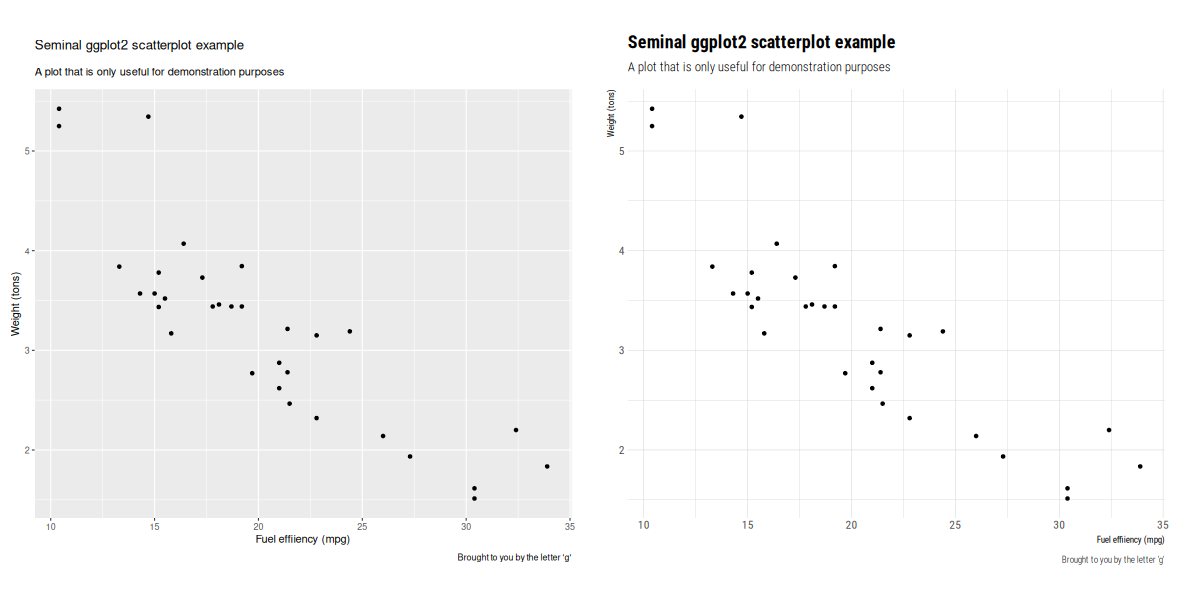
tinythemes demo A tiniest of tiny violins micro maintenance release 0.0.4 of our tinythemes arrived on CRAN today. tinythemes provides the theme_ipsum_rc() function from hrbrthemes by Bob Rudis in a zero (added) dependency way. A simple example is (also available as a demo inside the package) contrasts the default style (on the left) with the one added by this package (on the right): This version adjusts to the fact that hrbrthemes is no longer on CRAN so the help page cannot link to its documentation. No other changes were made. The set of changes since the last release follows.

Changes in tinythemes version 0.0.4 (2025-10-02)
  • No longer \link to now-archived hrbrthemes

Courtesy of my CRANberries, there is a diffstat report relative to previous release. More detailed information is on the repo where comments and suggestions are welcome.

This post by Dirk Eddelbuettel originated on his Thinking inside the box blog. If you like this or other open-source work I do, you can sponsor me at GitHub.

25 September 2025

Dirk Eddelbuettel: tint 0.1.6 on CRAN: Maintenance

A new version 0.1.6 of the tint package arrived at CRAN today. tint provides a style not unlike Tufte for use in html and pdf documents created from markdown. The github repo shows several examples in its README, more as usual in the package documentation. This release addresses a small issue where in pdf mode, pandoc (3.2.1 or newer) needs a particular macros defined when static (premade) images or figure files are included. No other changes.

Changes in tint version 0.1.6 (2025-09-25)
  • An additional LaTeX command needed by pandoc (>= 3.2.1) has been defined for the two pdf variants.

Courtesy of my CRANberries, there is a diffstat report relative to previous release. More information is on the tint page. For questions or comments use the issue tracker off the GitHub repo.

This post by Dirk Eddelbuettel originated on his Thinking inside the box blog. If you like this or other open-source work I do, you can sponsor me at GitHub.

21 September 2025

Dirk Eddelbuettel: rcppmlpackexamples 0.0.1 on CRAN: New Package

mlpack is a fabulous project providing countless machine learning algorithms in clean and performant C++ code as a header-only library. This gives both high performance and the ability to run the code in resource-constrained environment such as embedded systems. Bindings to a number of other languages are available, and an examples repo provides examples. The project also has a mature R package on CRAN which offers the various algorithms directly in R. Sometimes, however, one might want to use the header-only C++ code in another R package. How to do that was not well documented. A user alerted me by email to this fact a few weeks ago, and this lead to both an updated mlpack release at CRAN and this package. In short, we show via three complete examples how to access the mlpack code in C++ code in this package, offering a re-usable stanza to start a different package from. The only other (header-only) dependencies are provided by CRAN packages RcppArmadillo and RcppEnsmallen wrapping, respectively, the linear algebra and optimization libraries used by mlpack. Courtesy of my CRANberries, there is also a a new package note (no diffstat report yet). More detailed information is on the rcppmlpackexamples page, or the github repo.

This post by Dirk Eddelbuettel originated on his Thinking inside the box blog. If you like this or other open-source work I do, you can sponsor me at GitHub.

19 September 2025

Dirk Eddelbuettel: RcppArmadillo 15.0.2-2 on CRAN: Transition to Armadillo 15

armadillo image Armadillo is a powerful and expressive C++ template library for linear algebra and scientific computing. It aims towards a good balance between speed and ease of use, has a syntax deliberately close to Matlab, and is useful for algorithm development directly in C++, or quick conversion of research code into production environments. RcppArmadillo integrates this library with the R environment and language and is widely used by (currently) 1261 other packages on CRAN, downloaded 41.4 million times (per the partial logs from the cloud mirrors of CRAN), and the CSDA paper (preprint / vignette) by Conrad and myself has been cited 647 times according to Google Scholar. This versions updates the 15.0.2-1 release from last week. Following fairly extensive email discussions with CRAN, we are now accelerating the transition to Armadillo. When C++14 or newer is used (which after all is the default since R 4.1.0 released May 2021, see WRE Section 1.2.4), or when opted into, the newer Armadillo is selected. If on the other hand either C++11 is still forced, or the legacy version is explicitly selected (which currently one package at CRAN does), then Armadillo 14.6.3 is selected. Most packages will not see a difference and automatically switch to the newer Armadillo. However, some packages will see one or two types of warning. First, if C++11 is still actively selected via for examples CXX_STD then CRAN will nudge a change to a newer compilation standard (as they have been doing for some time already). Preferably the change should be to simply remove the constraint and let R pick the standard based on its version and compiler availability. These days that gives us C++17 in most cases; see WRE Section 1.2.4 for details. (Some packages may need C++14 or C++17 or C++20 explicitly and can also do so.) Second, some packages may see a deprecation warning. Up until Armadillo 14.6.3, the package suppressed these and you can still get that effect by opting into that version by setting -DARMA_USE_LEGACY. (However this route will be sunset eventually too.) But one really should update the code to the non-deprecated version. In a large number of cases this simply means switching from using arma::is_finite() (typically called on a scalar double) to calling std::isfinite(). But there are some other cases, and we will help as needed. If you maintain a package showing deprecation warnings, and are lost here and cannot workout the conversion to current coding styles, please open an issue at the RcppArmadillo repository (i.e. here) or in your own repository and tag me. I will also reach out to the maintainers of a smaller set of packages with more than one reverse dependency. A few small changes have been made internal packaging and documentation, a small synchronization with upstream for two commits since the 15.0.2 release, as well as a link to the ldlasb2 repository and its demonstration regarding some ill-stated benchmarks done elsewhere. The detailed changes since the last CRAN release follow.

Changes in RcppArmadillo version 15.0.2-2 (2025-09-18)
  • Minor update to skeleton Makevars,Makevars.win
  • Update README.md to mention ldlasb2 repository
  • Minor documentation update (#487)
  • Synchronized with Armadillo upstream (#488)
  • Refine Armadillo version selection in coordination with CRAN maintainers to support transition towards Armadillo 15.0.*

Courtesy of my CRANberries, there is a diffstat report relative to previous release. More detailed information is on the RcppArmadillo page. Questions, comments etc should go to the rcpp-devel mailing list off the Rcpp R-Forge page.

This post by Dirk Eddelbuettel originated on his Thinking inside the box blog. If you like this or other open-source work I do, you can sponsor me at GitHub.

14 September 2025

Dirk Eddelbuettel: RcppSimdJson 0.1.14 on CRAN: New Upstream Major

A brand new release 0.1.14 of the RcppSimdJson package is now on CRAN. RcppSimdJson wraps the fantastic and genuinely impressive simdjson library by Daniel Lemire and collaborators. Via very clever algorithmic engineering to obtain largely branch-free code, coupled with modern C++ and newer compiler instructions, it results in parsing gigabytes of JSON parsed per second which is quite mindboggling. The best-case performance is faster than CPU speed as use of parallel SIMD instructions and careful branch avoidance can lead to less than one cpu cycle per byte parsed; see the video of the talk by Daniel Lemire at QCon. This version includes the new major upstream release 4.0.0 with major new features including a builder for creating JSON from the C++ side objects. This is something a little orthogonal to the standard R usage of the package to parse and load JSON data but could still be of interest to some. The short NEWS entry for this release follows.

Changes in version 0.1.14 (2025-09-13)
  • simdjson was upgraded to version 4.0.0 (Dirk in #96
  • Continuous integration now relies a token for codecov.io

Courtesy of my CRANberries, there is also a diffstat report for this release. For questions, suggestions, or issues please use the issue tracker at the GitHub repo.

This post by Dirk Eddelbuettel originated on his Thinking inside the box blog. If you like this or other open-source work I do, you can now sponsor me at GitHub.

Next.

Previous.