Search Results: "ah"

27 March 2026

Samuel Henrique: I use curl with ECH btw (in Debian)

tl;dr This is an experimental feature that, for the first time, brings full ECH support to curl on Debian using OpenSSL. Starting with curl 8.19.0-3+exp2 (Debian Experimental), you can now use ECH, with HTTPS-RR and DoH for maximum privacy. curl 8.19.0-3+exp2 is quite fresh at the time of writing, bear in mind that your repository might not have synced the package yet, all mirrors should have it by March 27th 14:00 UTC.
# defo.ie is a test server that confirms whether ECH was successfully used
curl -v --ech hard https://defo.ie/ech-check.php
# For Encrypted Client Hello (ECH) + DNS over HTTPS (DoH)
curl -v --ech hard --doh-url https://1.1.1.1/dns-query https://defo.ie/ech-check.php
"--ech hard" tells curl to refuse the connection entirely if ECH cannot be negotiated. Or, if you would like to try it out in a container:
podman run debian:experimental /bin/bash -c 'apt install --update -t experimental -y curl && curl -v --ech hard --doh-url https://1.1.1.1/dns-query https://defo.ie/ech-check.php'
(in case you haven't noticed, apt now has the --update option for the upgrade and install commands)

For Privacy CloudFlare calls it "the last puzzle piece to privacy" in their must-read announcement: https://blog.cloudflare.com/announcing-encrypted-client-hello/. Encrypted Client Hello (rfc9849) encrypts the "which website are you connecting to?" part of the TLS handshake that was previously visible in plaintext. HTTPS-RR (rfc9460) is a DNS record type that publishes connection parameters for a service, including the public key clients need to perform ECH. DNS Over HTTPS (rfc8484) encrypts DNS queries by tunneling them over HTTPS, hiding what domains you're looking up from network observers. When all three operate together over a CDN with shared IP space, the target domain name is hidden from passive observers; the HTTPS-RR record is queried over DoH in order to retrieve the ECH key (rfc9848) for the TLS handshake. Seems like quite an important feature, and in fact the major browsers have it enabled for some time now, the trick is that they do not use OpenSSL (Chrome uses BoringSSL and Firefox uses NSS). For everyone else, the only option is to patch OpenSSL or wait until 4.0.0 is released, and so part of the reason Debian is the first distro to enable it (curl + OpenSSL + ECH) is that the OpenSSL maintainer (Sebastian Andrzej Siewior) packaged the alpha release just 3 days after it was published. Do not forget that ECH support is experimental and currently relies on the alpha release of OpenSSL.

wcurl Gets It Too Considering wcurl is just a wrapper on curl, it gets the feature for free:
wcurl --curl-options="--ech hard --doh-url https://1.1.1.1/dns-query" $URL
If you're using wcurl, you don't want to have to set parameters, this is just to show that the feature is there and if you have a .curlrc file, it can enable the feature seamlessly.

Other Debian Releases Given the ECH feature requires OpenSSL >= 4, it will not make it to Debian 13, having a small chance of going to Debian 13 Backports (emphasis on small). It should get to Debian Unstable and Debian Testing within the next couple of months as the OpenSSL GA release happens and gets packaged, but you should be able to install the package from Experimental in your Unstable and Testing systems without issues. It will also be in Debian 14 once it becomes the new Stable.

Shoulders of Giants Stephen Farrell's presentation from OpenSSL Conference 2025 has a lot of background on the work involved: Encrypted Client Hello Lessons learned from trying to do something that was probably too complicated They have been working on implementing ECH in open-source projects for years, something as big as this doesn't happen without lots of people dedicating both their paid and free times over it. I ended up being the person who enabled it on Debian, which was pretty much the least amount of work between everyone involved, but hey it's fun flipping the switch and telling you about it.

Background Since 2025, the curl developers started organizing an yearly meeting with all maintainers of curl in Operating Systems. The 2026 edition happened in March 26th: https://github.com/curl/curl/wiki/curl-distro-discussion-2026. Attendance was really good, and as you can imagine one of the topics of discussion was ECH, in which it was pointed out that having OpenSSL 4 was the main requirement but besides it nothing unusual was needed. In Debian Experimental, we have been enabling HTTPS-RR since March 2025, and OpenSSL 4.0.0 alpha was packaged just recently (2026-03-13) by Sebastian Andrzej Siewior, it's time for the next step. The curl distro meeting was just the motivation I needed to go ahead and enable it in Debian Experimental, so as part of our Debian Brasil Weekly Meetings I've prepared and uploaded the changes, while Carlos Henrique Lima Melara worked on addressing a recent test regression for Debian Unstable. Unfortunately sergiodj couldn't join and I'm sure he's jealous of the hacking session now.

Appendix While writing this, I've noticed one of the authors of the CloudFlare blogpost is the previous curl maintainer on Debian; Alessandro Ghedini let me take over the maintenance back in 2021 and today curl is maintained by a team of 4 people, it's nice to see Alessandro's involvement.

24 March 2026

Russ Allbery: Review: A Shadow in Summer

Review: A Shadow in Summer, by Daniel Abraham
Series: Long Price Quartet #1
Publisher: Tor
Copyright: March 2006
ISBN: 0-7653-1340-5
Format: Hardcover
Pages: 331
A Shadow in Summer is a high fantasy novel, the first of (as the name implies) a completed four-book series. Daniel Abraham is perhaps better known as half of the writing pair behind James S.A. Corey, author of the Expanse series. This was his first novel. Otah was the sixth son of a Khai, sent like many of the unwanted later children of the powerful to learn the secrets of the andat and be trained as a poet. He learned his lessons well enough to reject the school and its teachings and walk away. Amat Kyaan has worked her way up from nothing to become the senior overseer of the foreign Galtic House Wilsin in the sun-drenched port city of Saraykeht. Liat is her apprentice, distracted by young love. Maati is a new apprentice poet, having endured his training and sent to learn from Heshai how to eventually hold the andat Removing-The-Part-That-Continues, better known as Seedless. None of them know they will find themselves entangled in a plot to destroy the poet of Saraykeht and, through him, the city's most potent economic tool. A poet in this world is not what we would think of a poet. They are, in essence, magical slave-drivers who capture the essence of an andat, a spirit embodying an idea that is coerced into the prison of volition and obedience by the poet. The andat Seedless, the embodiment of the concept of removing the spark of life, is central to the economic wealth of Saraykeht in a way that is startling in its simplicity: Seedless can remove the seeds from a warehouse full of cotton at a thought. This gives Saraykeht a massive productivity advantage in the cotton trade. Seedless is also a powerful potential weapon. What he can do to cotton, he could as easily do to any other crop, or to people. The Galts are not fond of the independence and power of Saraykeht, but as long as the city controls a powerful andat, they do not dare to attack it directly. Indirectly, though... that's another matter. This is one of those fantasy novels with meticulous and thoughtful world-building, careful and evocative prose, and a complex ensemble cast of interesting characters that the novel then attempts to make utterly miserable and complicit in their own misery. There should be a name for this style of writing. It's not tragedy because the ending is not tragic, precisely. It's not magic realism; the andats are openly magical, which makes this clearly high fantasy. But Abraham approaches the story from the type of realist frame that considers the pain and desperation of the characters to be more interesting than their ability to overcome challenges. Amat starts the story as an admirable, sharp-witted expert manager, so her life is destroyed and she's subjected to sexual violence. Heshai loathes himself and veers between a tragic figure and a wastrel as the story systematically undermines opportunities for redemption. Maati is young and idealistic, so of course every character in the book sets out to crush his idealism under the weight of unforeseen consequences. There is a sad and depressing love triangle, because this is exactly the sort of book that has a sad and depressing love triangle. At the end of the novel, everyone who survives is older and wiser in the sense that some stories seem to think wisdom comes from the accumulation of trauma. I find books like this so immensely frustrating because their merits are so clear. The world-building is careful and detailed in a way that includes economic systems, unlike so much fantasy. It is full of small, intriguing touches, such as the use of posture and gesture to communicate the emotional valence of one's words. Abraham understands the moral implications of poets and andats and the story tackles them head-on. The writing flows beautifully and gave me a strong sense of the city. I wanted to like this book for the obvious skill that went into it, and sometimes I even managed. And yet, it's taken me three months to finish A Shadow in Summer because I simply do not want to spend this much time around miserable people. I would get through one or two chapters in a night and then wanted to read something happy or defiant or heroic, rather than watching slow-motion train wrecks intermixed with desperate attempts to navigate stifling layers of immoral systems. It's not that the story lacks a moral compass. The characters are sincerely trying to make the world a better place, with some success. It even delivers a happy ending of sorts. But so much of the journey was watching the lives of the characters fall apart. I am completely unsurprised that some people loved this book. I'm still intrigued enough by the world-building that I'm half-tempted to try to read the sequel even after having to drag myself through this one. I had a similar reaction to Abraham's The Dragon's Path, though, so I think Abraham is just not for me. I may get back to the Expanse at some point, but having to drag myself through both of his solo novels I've tried, in two different series, probably indicates an incompatibility between author and reader. That's a shame, given the quality of the writing. Followed by A Betrayal in Winter. Content notes: Sexual and reproductive violence as significant plot elements. Rating: 6 out of 10

21 March 2026

Matthew Garrett: SSH certificates and git signing

When you re looking at source code it can be helpful to have some evidence indicating who wrote it. Author tags give a surface level indication, but it turns out you can just lie and if someone isn t paying attention when merging stuff there s certainly a risk that a commit could be merged with an author field that doesn t represent reality. Account compromise can make this even worse - a PR being opened by a compromised user is going to be hard to distinguish from the authentic user. In a world where supply chain security is an increasing concern, it s easy to understand why people would want more evidence that code was actually written by the person it s attributed to. git has support for cryptographically signing commits and tags. Because git is about choice even if Linux isn t, you can do this signing with OpenPGP keys, X.509 certificates, or SSH keys. You re probably going to be unsurprised about my feelings around OpenPGP and the web of trust, and X.509 certificates are an absolute nightmare. That leaves SSH keys, but bare cryptographic keys aren t terribly helpful in isolation - you need some way to make a determination about which keys you trust. If you re using someting like GitHub you can extract that information from the set of keys associated with a user account1, but that means that a compromised GitHub account is now also a way to alter the set of trusted keys and also when was the last time you audited your keys and how certain are you that every trusted key there is still 100% under your control? Surely there s a better way.

SSH Certificates And, thankfully, there is. OpenSSH supports certificates, an SSH public key that s been signed by some trusted party and so now you can assert that it s trustworthy in some form. SSH Certificates also contain metadata in the form of Principals, a list of identities that the trusted party included in the certificate. These might simply be usernames, but they might also provide information about group membership. There s also, unsurprisingly, native support in SSH for forwarding them (using the agent forwarding protocol), so you can keep your keys on your local system, ssh into your actual dev system, and have access to them without any additional complexity. And, wonderfully, you can use them in git! Let s find out how.

Local config There s two main parameters you need to set. First,
1
git config set gpg.format ssh
because unfortunately for historical reasons all the git signing config is under the gpg namespace even if you re not using OpenPGP. Yes, this makes me sad. But you re also going to need something else. Either user.signingkey needs to be set to the path of your certificate, or you need to set gpg.ssh.defaultKeyCommand to a command that will talk to an SSH agent and find the certificate for you (this can be helpful if it s stored on a smartcard or something rather than on disk). Thankfully for you, I ve written one. It will talk to an SSH agent (either whatever s pointed at by the SSH_AUTH_SOCK environment variable or with the -agent argument), find a certificate signed with the key provided with the -ca argument, and then pass that back to git. Now you can simply pass -S to git commit and various other commands, and you ll have a signature.

Validating signatures This is a bit more annoying. Using native git tooling ends up calling out to ssh-keygen2, which validates signatures against a file in a format that looks somewhat like authorized-keys. This lets you add something like:
1
* cert-authority ssh-rsa AAAA 
which will match all principals (the wildcard) and succeed if the signature is made with a certificate that s signed by the key following cert-authority. I recommend you don t read the code that does this in git because I made that mistake myself, but it does work. Unfortunately it doesn t provide a lot of granularity around things like Does the certificate need to be valid at this specific time and Should the user only be able to modify specific files and that kind of thing, but also if you re using GitHub or GitLab you wouldn t need to do this at all because they ll just do this magically and put a verified tag against anything with a valid signature, right? Haha. No. Unfortunately while both GitHub and GitLab support using SSH certificates for authentication (so a user can t push to a repo unless they have a certificate signed by the configured CA), there s currently no way to say Trust all commits with an SSH certificate signed by this CA . I am unclear on why. So, I wrote my own. It takes a range of commits, and verifies that each one is signed with either a certificate signed by the key in CA_PUB_KEY or (optionally) an OpenPGP key provided in ALLOWED_PGP_KEYS. Why OpenPGP? Because even if you sign all of your own commits with an SSH certificate, anyone using the API or web interface will end up with their commits signed by an OpenPGP key, and if you want to have those commits validate you ll need to handle that. In any case, this should be easy enough to integrate into whatever CI pipeline you have. This is currently very much a proof of concept and I wouldn t recommend deploying it anywhere, but I am interested in merging support for additional policy around things like expiry dates or group membership.

Doing it in hardware Of course, certificates don t buy you any additional security if an attacker is able to steal your private key material - they can steal the certificate at the same time. This can be avoided on almost all modern hardware by storing the private key in a separate cryptographic coprocessor - a Trusted Platform Module on PCs, or the Secure Enclave on Macs. If you re on a Mac then Secretive has been around for some time, but things are a little harder on Windows and Linux - there s various things you can do with PKCS#11 but you ll hate yourself even more than you ll hate me for suggesting it in the first place, and there s ssh-tpm-agent except it s Linux only and quite tied to Linux. So, obviously, I wrote my own. This makes use of the go-attestation library my team at Google wrote, and is able to generate TPM-backed keys and export them over the SSH agent protocol. It s also able to proxy requests back to an existing agent, so you can just have it take care of your TPM-backed keys and continue using your existing agent for everything else. In theory it should also work on Windows3 but this is all in preparation for a talk I only found out I was giving about two weeks beforehand, so I haven t actually had time to test anything other than that it builds. And, delightfully, because the agent protocol doesn t care about where the keys are actually stored, this still works just fine with forwarding - you can ssh into a remote system and sign something using a private key that s stored in your local TPM or Secure Enclave. Remote use can be as transparent as local use.

Wait, attestation? Ah yes you may be wondering why I m using go-attestation and why the term attestation is in my agent s name. It s because when I m generating the key I m also generating all the artifacts required to prove that the key was generated on a particular TPM. I haven t actually implemented the other end of that yet, but if implemented this would allow you to verify that a key was generated in hardware before you issue it with an SSH certificate - and in an age of agentic bots accidentally exfiltrating whatever they find on disk, that gives you a lot more confidence that a commit was signed on hardware you own.

Conclusion Using SSH certificates for git commit signing is great - the tooling is a bit rough but otherwise they re basically better than every other alternative, and also if you already have infrastructure for issuing SSH certificates then you can just reuse it4 and everyone wins.

  1. Did you know you can just download people s SSH pubkeys from github from https://github.com/<username>.keys? Now you do
  2. Yes it is somewhat confusing that the keygen command does things other than generate keys
  3. This is more difficult than it sounds
  4. And if you don t, by implementing this you now have infrastructure for issuing SSH certificates and can use that for SSH authentication as well.

Ravi Dwivedi: Vietnam Trip

Before reaching Vietnam Continuing from the last post, Badri and I took a flight from the Brunei International Airport to Kuala Lumpur on the 12th of December 2024. We reached Kuala Lumpur in the evening. After arriving at the airport, we went through immigration. In a previous post, I mentioned that we had put our stuff in lockers at the TBS bus terminal in Kuala Lumpur. Therefore, we had to go there. The locker was automated and required us to enter the PIN we had set. Upon entering the PIN, the locker wasn t getting unlocked. After trying this for 10-15 minutes without any luck, we tried getting some help as there the lockers weren t under supervision. So, I roamed around and found a staff member, reporting that our lockers weren t getting unlocked. They called the person who was in-charge of the lockers. He came to us in a few minutes and used their admin access to open the locker. We were supposed to pay for using the lockers by putting the banknotes inside through a slot. However, as the machine wasn t working, we gave the amount for the use of our locker service to that person instead. We soon went back to the KL airport to catch our morning flight to Ho Chi Minh City in Vietnam. At the flight counter, we were afraid we would have to pay extra as our luggage surpassed the allowed weight limit. This one was also a budget airline AirAsia and our tickets didn t include a check-in bag. Generally, passengers from countries requiring a visa to visit Vietnam (such as India) require going to the airline and showing their visa to get the boarding pass. However, when we went to the AirAsia counter at the Kuala Lumpur airport, they didn t weigh our bags and asked us to get our boarding passes from an automated kiosk. So, we got our boarding passes printed and proceeded to the airport security. While clearing the airport security, a lotion I bought from Singapore was confiscated because it was 200 mL, exceeding the limit of 100 mL per bottle. Had that 200 mL liquid been in two different bottles of 100 mL each, I would have been allowed to take it in my carry-on bag, but a single 200 mL bottle wasn t! I was allowed to keep it in the check-in bag, but I didn t have it included in my ticket. Huh, airports and their weird rules :( The lotion was an expensive one, so having it thrown away did ruin my mood.

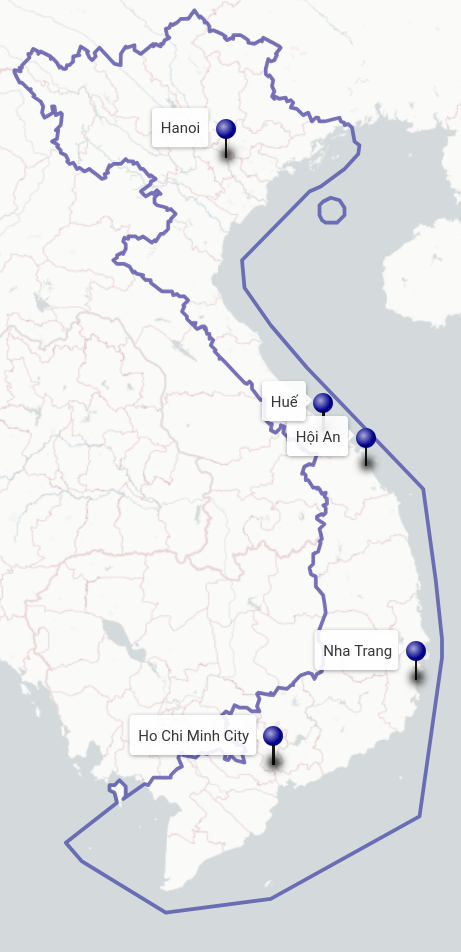
Overview We started our Vietnam trip from Ho Chi Minh City in the south on the 13th of December 2024 and finished it in Hanoi in the north on the 20th of December. We traveled from Ho Chi Minh City to Hanoi mostly by train, except for a hundred or so kilometers by bus, in chunks. On the way, we visited Nha Trang, Hoi An, and Hue. The distance between Ho Chi Minh City and Hanoi is 1700 km. For your reference, here are those places labeled on Vietnam s map.
Vietnam map with Ho Chi Minh City, Nha Trang, Hoi An, Hue and Hanoi labeled. A map of Vietnam with points of places we went to labeled. CARTO MAPTILER OPENSTREETMAP

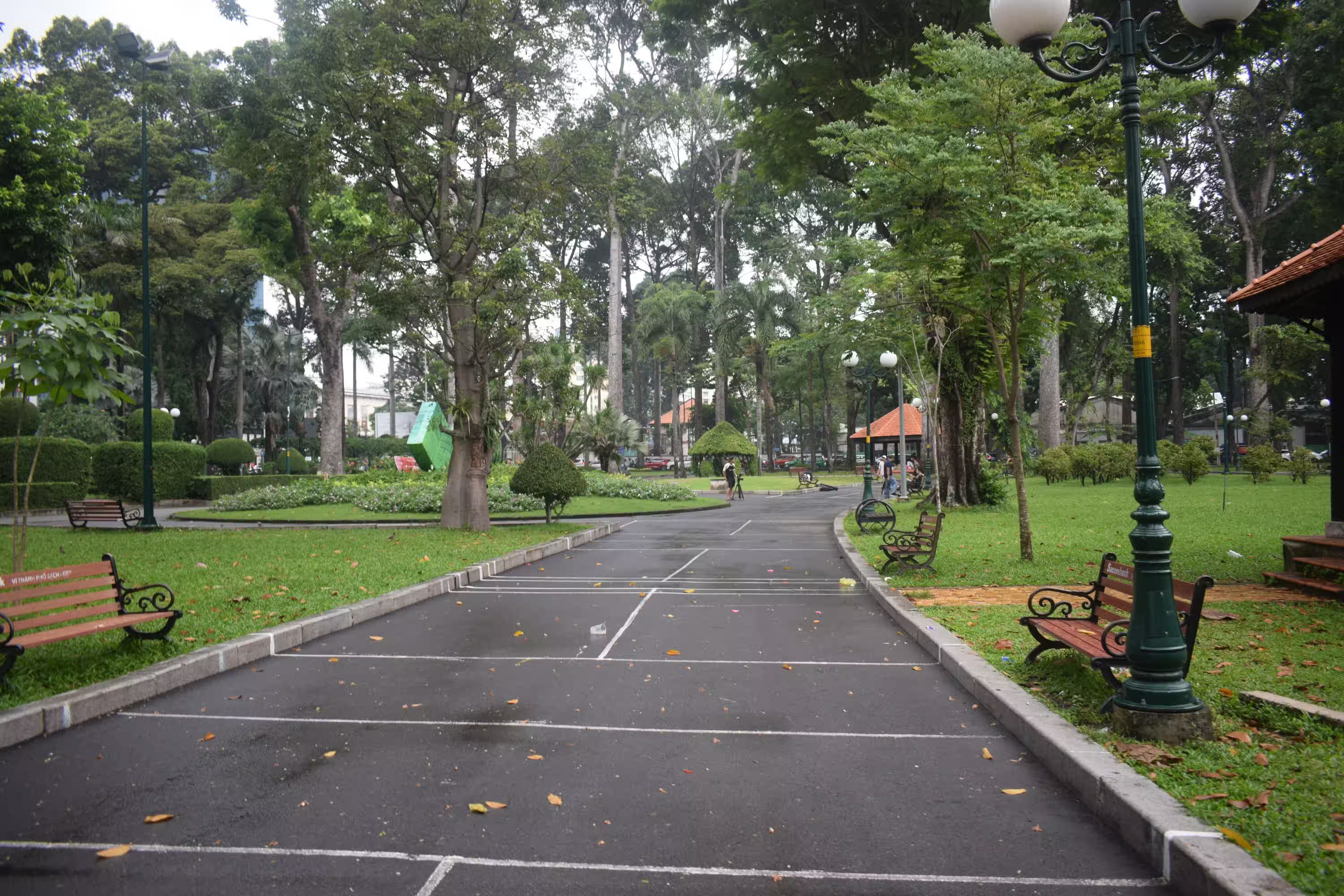
Ho Chi Minh City We landed in Ho Chi Minh City early morning on the 13th of December 2024. I was tired and sleepy as I hadn t gotten a good night s sleep. After going through immigration, we went to a currency exchange counter to get Vietnamese Dong. Unlike other countries on this trip, money exchange counters in Vietnam didn t accept Indian rupees. Therefore, we exchanged euros to get Vietnamese dong at the airport. After getting out of the airport, we took a bus to the city center. It was 15,000 dongs approximately 50 Indian rupees. Our plan was to meet Badri s friend and stay the night at his apartment. So we went to a caf nearby and bought a coffee for each of us for 75,000 dongs. We went upstairs and sat for a while. The Wi-Fi password was mentioned on our bill. During the trip, I found out about the caf culture of Vietnam. They have their own coffee brands (such as Highlands Coffee), and you can sit down at any of the caf s for work or wait for the rain to stop. It rained a lot while we were there, so we did use these caf s for that purpose. Badri s friend met us there, and we roamed around the area a bit, which included roaming inside a beautiful park. Then Badri s friend took us to a restaurant. Because I do not eat meat, he took us to a vegan restaurant. Having been to four Southeast Asian countries at this point (excluding Vietnam), I was under the impression that there wouldn t be a lot of things for my diet in Vietnam.
A picture of the park we roamed around in Ho Chi Minh City. A picture of the park we roamed around in Ho Chi Minh City. Photo by Ravi Dwivedi, released under CC-BY-SA 4.0.
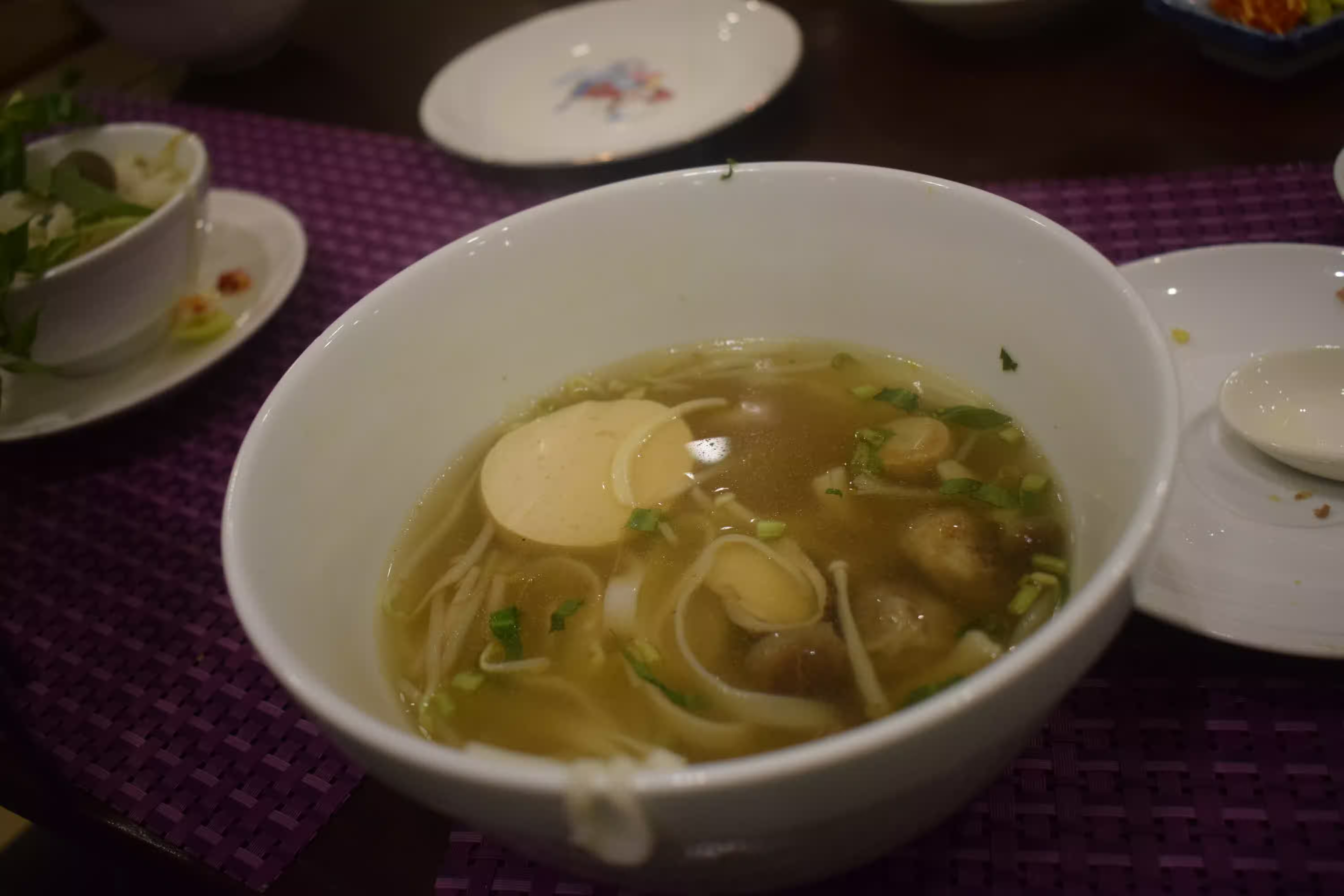
However, I was pleasantly surprised at the restaurant. I found all the dishes to be tasty, especially their signature noodles called Pho. I liked another dish so much that I tracked down the restaurant again with Badri using the geotagged image of the bill I had taken earler to have it again. As a tip for vegans coming to Vietnam, the places having the letters Chay (without any accented letters) in their name are vegan only.
A building This is the restaurant Badri s friend took us to. Photo by Ravi Dwivedi, released under CC-BY-SA 4.0.
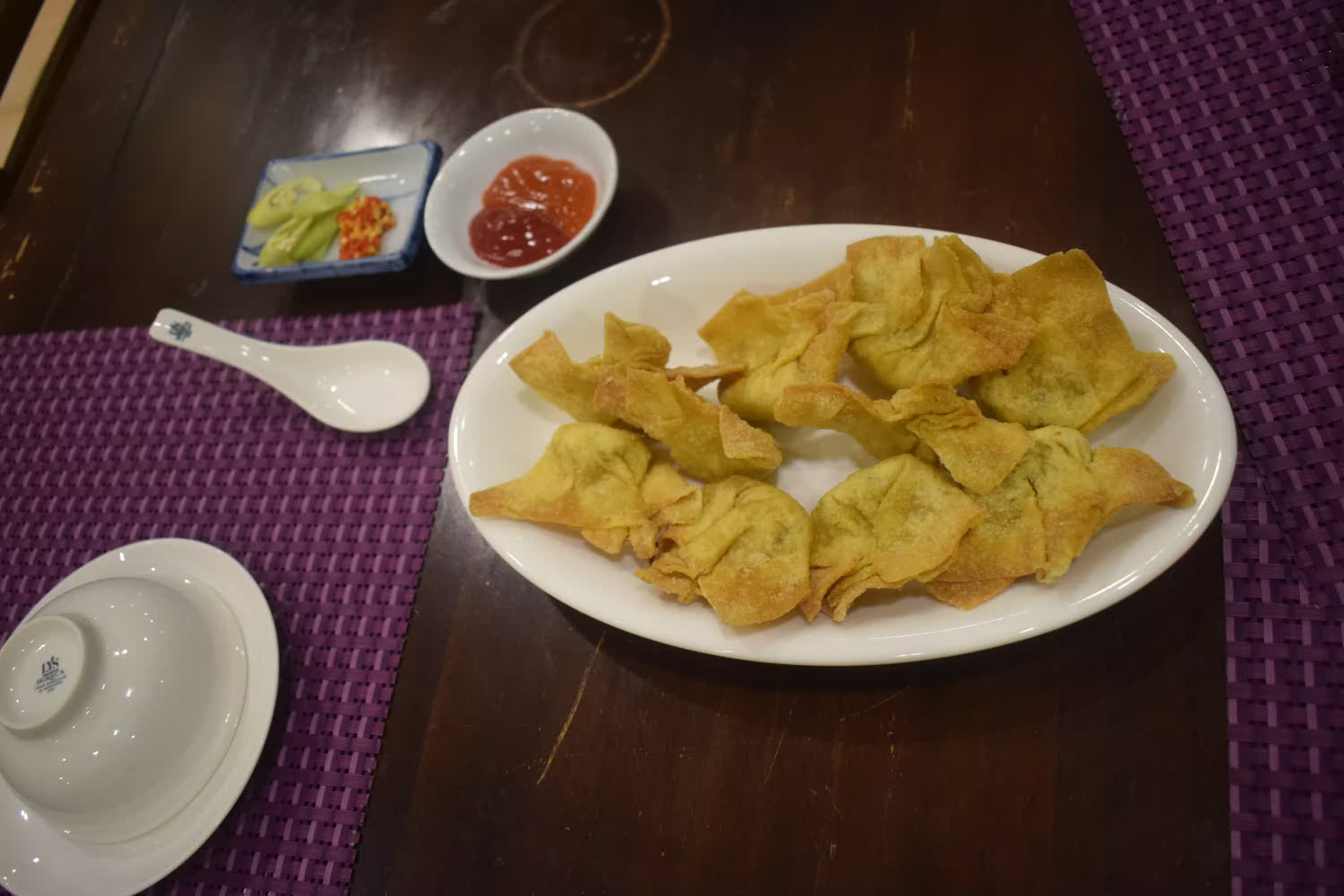
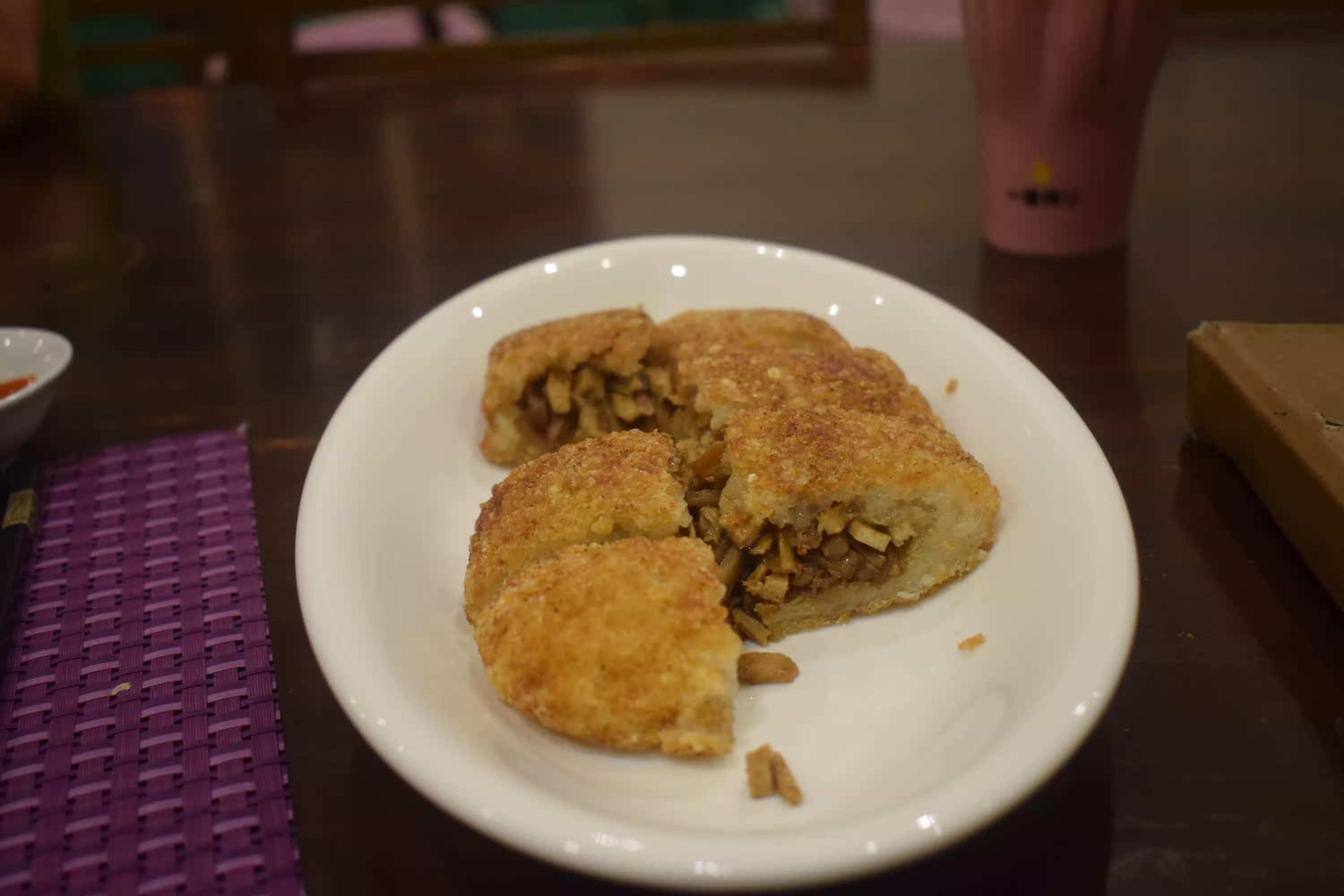
An item in the restaurant One of the dishes we had in the restaurant. This one was especially tasty. Photo by Ravi Dwivedi, released under CC-BY-SA 4.0.
One of the dishes we had in the restaurant. Photo by Ravi Dwivedi, released under CC-BY-SA 4.0. One of the dishes we had in the restaurant. Photo by Ravi Dwivedi, released under CC-BY-SA 4.0.
Noodles in a bowl dipped in soup These noodles are called Pho and are very popular in Vietnam. Photo by Ravi Dwivedi, released under CC-BY-SA 4.0.
In the night, we went to a supermarket where I got myself some oranges and guavas. Then, we went to a Japanese restaurant where I didn t have anything, as there was no vegetarian option available for me. Then we took a free bus to the place to Badri s friend s apartment. The construction company that built the apartment also runs this free bus service from their residential area to different parts of the city as a way of promoting their apartments. Anyone can take the bus, not just residents. The next day, we took the free bus back to the city center and checked in to a hostel for a night. We took two beds in dormitories, which were 88,000 dongs (270 rupees) for each bed for a night. In Vietnam, if you can spend around 300 rupees per night, you can get a bed in a decent hostel.

Train from Ho Chi Minh City to Nha Trang On the night of the 15th of December 2024, we boarded a train from Ho Chi Minh City to Nha Trang. The ticket for each of us was 519,000 dongs (1600 Indian rupees). The train name was SNT2. When we reached the Ho Chi Minh City train station, we noticed that the station was rather small by Indian standards. After entering the train station, we went inside to the first platform, where the tickets were checked by a staff member. Ho Chi Minh City was the originating station for our train, so our train was already standing at the station. We had to cross the railway tracks on foot to reach the platform our train was on. Then we located our coach, where a ticket inspector was standing at the gate. He let us in after checking our tickets. In all these instances, we just had to show our digital boarding pass which we had received by email. Unlike Indian trains, the train didn t have side berths. Additionally, I liked the fact that it had a dedicated space to put our bags in, which was very convenient. The train departed from Ho Chi Minh City at 21:05 and arrived in Nha Trang at 05:30 in the morning.
Interior of our train coach. Trains in Vietnam don&rsquo;t have side berths, unlike India. Photo by Ravi Dwivedi, released under CC-BY-SA 4.0. Interior of our train coach. Trains in Vietnam don t have side berths, unlike India. Photo by Ravi Dwivedi, released under CC-BY-SA 4.0.
A picture of the berths from our coach. It had three tiers, similar to a 3 AC coach in Indian trains. Photo by Ravi Dwivedi, released under CC-BY-SA 4.0. A picture of the berths from our coach. It had three tiers, similar to a 3 AC coach in Indian trains. Photo by Ravi Dwivedi, released under CC-BY-SA 4.0.
The train had a cabin to put the bags in. Photo by Ravi Dwivedi, released under CC-BY-SA 4.0. The train had a cabin to put the bags in. Photo by Ravi Dwivedi, released under CC-BY-SA 4.0.
Nha Trang train station. Photo by Ravi Dwivedi, released under CC-BY-SA 4.0. Nha Trang train station. Photo by Ravi Dwivedi, released under CC-BY-SA 4.0.

Nha Trang Nha Trang is a coastal place, and we planned to go to a beach. We figured out that the bus to the airport goes can drop us near the beach. Therefore, we went to the bus station to get to the airport bus. The bus station was walking distance from the railway station. So, we decided to walk. On the way, we stopped at a small shop for a coffee. The shop also gave a complimentary cup of green tea along with the coffee. I found out later that it is common for local shops to give a cup of complimentary green tea in Vietnam.
A cup of coffee and a cup of green tea. I got a complimentary cup of green tea along with coffee in Nha Trang. In this trip, Badri and I found out that this is customary at local places in Vietnam. Photo by Ravi Dwivedi, released under CC-BY-SA 4.0.
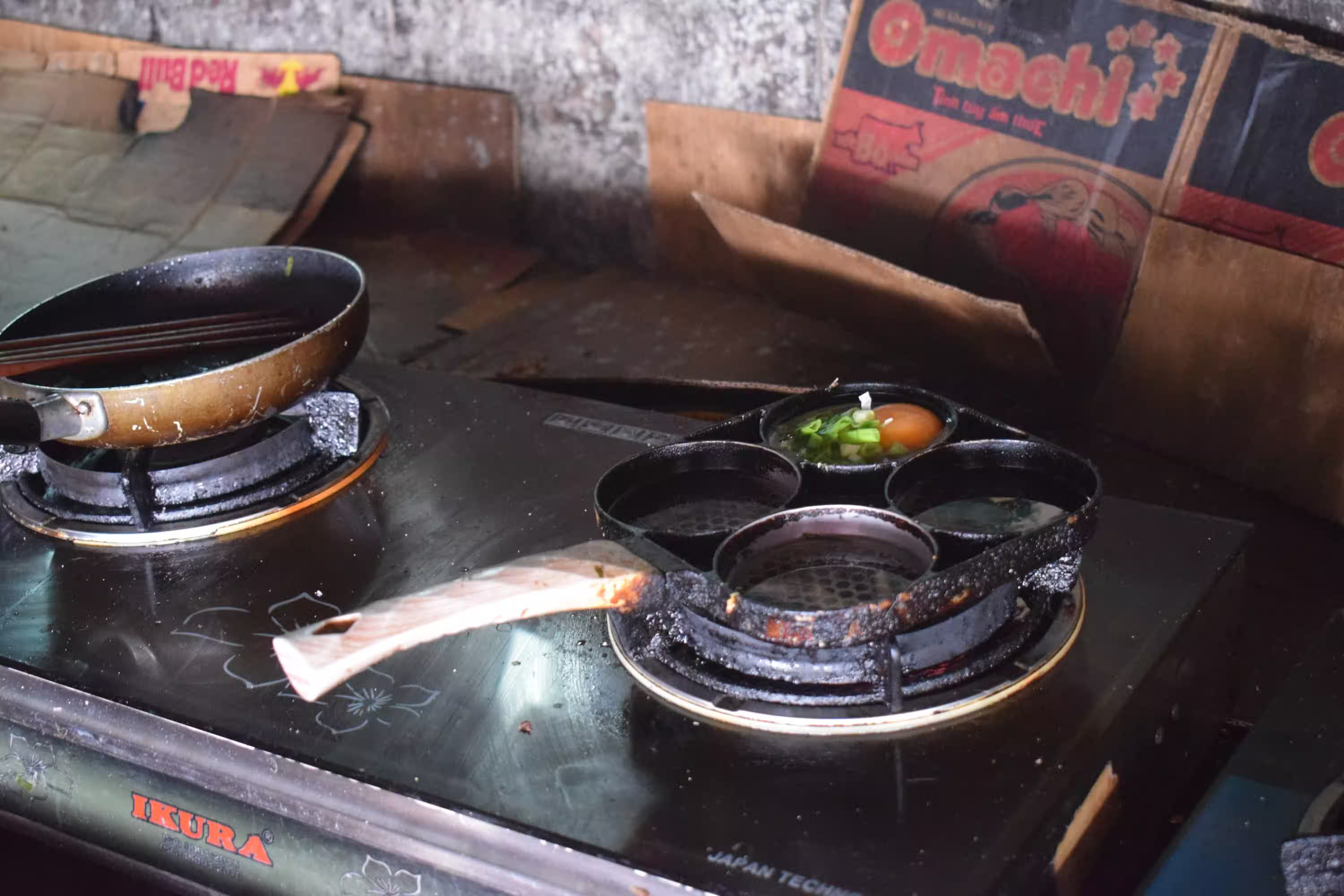
Soon we reached the bus station and took a bus to the beach. It was 65,000 dongs ( 200). After getting down from the bus, I had coconut water and some eggs at a small local place.
Eggs on a pan. Eggs being cooked on a pan for my order. Photo by Ravi Dwivedi, released under CC-BY-SA 4.0.
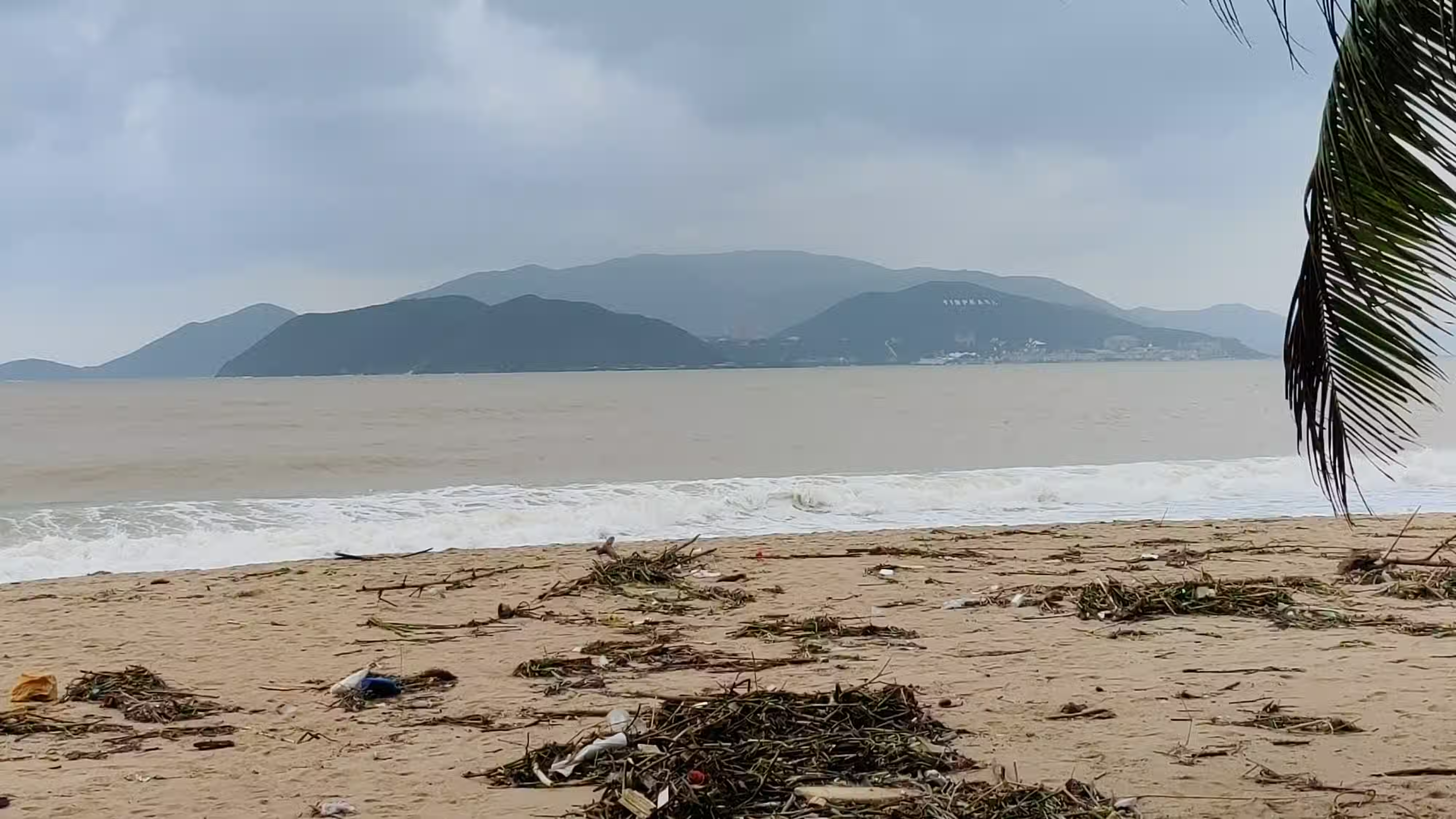
Then we went to the beach, but nobody else was there. We spent some time there and went back to the place where the bus dropped us as it started raining. We couldn t find a bus for some time. A taxi driver approached us and agreed to take us to the city center for 200,000 dongs ( 650). For reference, the place where he dropped us was 35 km from the place we took the taxi. Taxi fares in Vietnam were also cheap!
The beach we went to in Nha Trang. Photo by Ravi Dwivedi, released under CC-BY-SA 4.0. The beach we went to in Nha Trang. Photo by Ravi Dwivedi, released under CC-BY-SA 4.0.
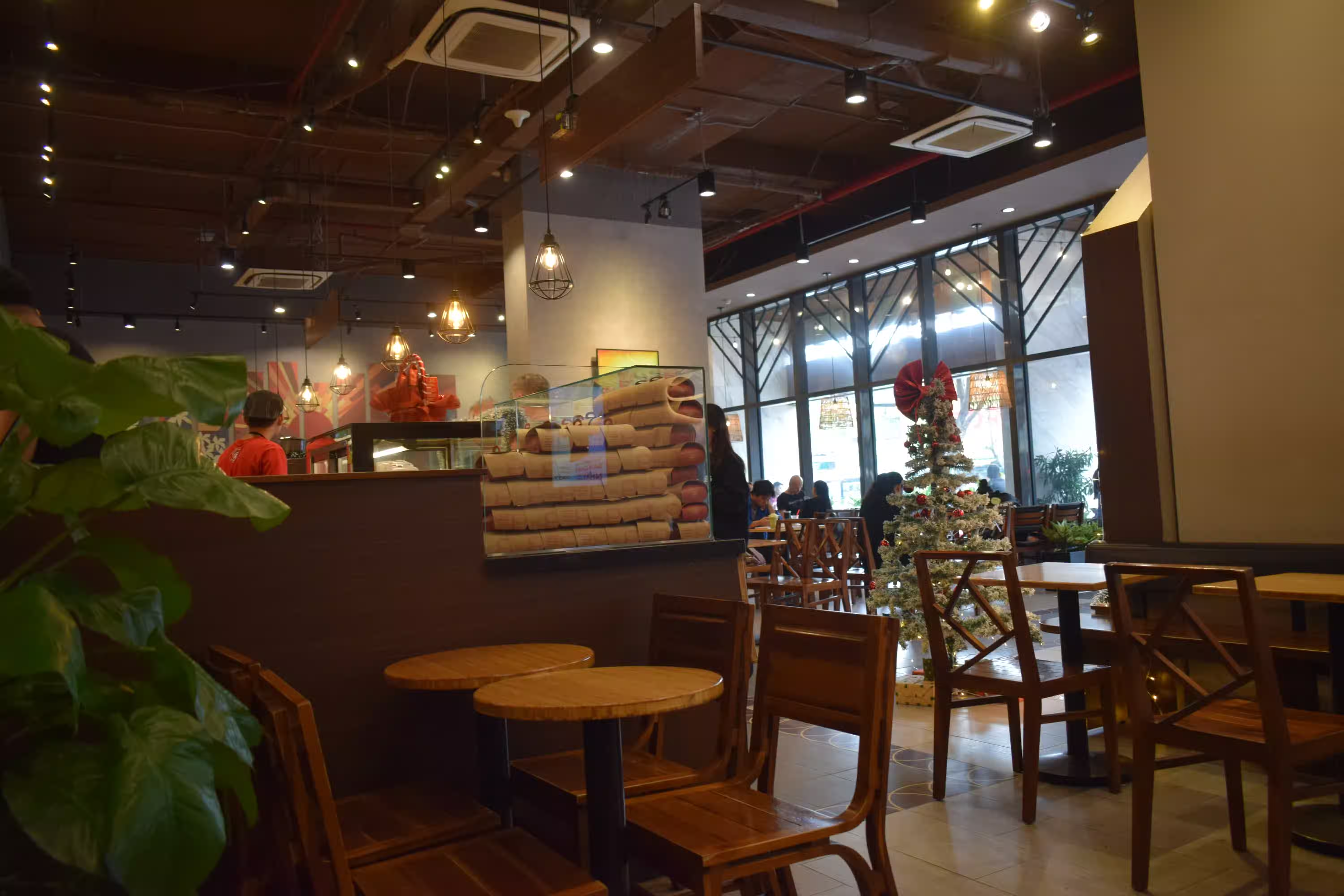
Nha Trang was a beautiful place, and so we roamed around for a while. Then we stopped at a Highlands Coffee branch for a while. Since Christmas was coming up, the caf had a Christmas tree, and I liked the Christmas vibes. They were playing Mariah Carey s All I Want for Christmas Is You.
This one was shot in the city center. In this trip, Badri and I found out that this is customary at local places in Vietnam. Photo by Ravi Dwivedi, released under CC-BY-SA 4.0. This one was shot in the city center. In this trip, Badri and I found out that this is customary at local places in Vietnam. Photo by Ravi Dwivedi, released under CC-BY-SA 4.0.
Inside a Highlands Coffee cafe in Nha Trang. Photo by Ravi Dwivedi, released under CC-BY-SA 4.0. Inside a Highlands Coffee cafe in Nha Trang. Photo by Ravi Dwivedi, released under CC-BY-SA 4.0.
A coffee I got from Highlands Coffee in Nha Trang. Photo by Ravi Dwivedi, released under CC-BY-SA 4.0. A coffee I got from Highlands Coffee in Nha Trang. Photo by Ravi Dwivedi, released under CC-BY-SA 4.0.
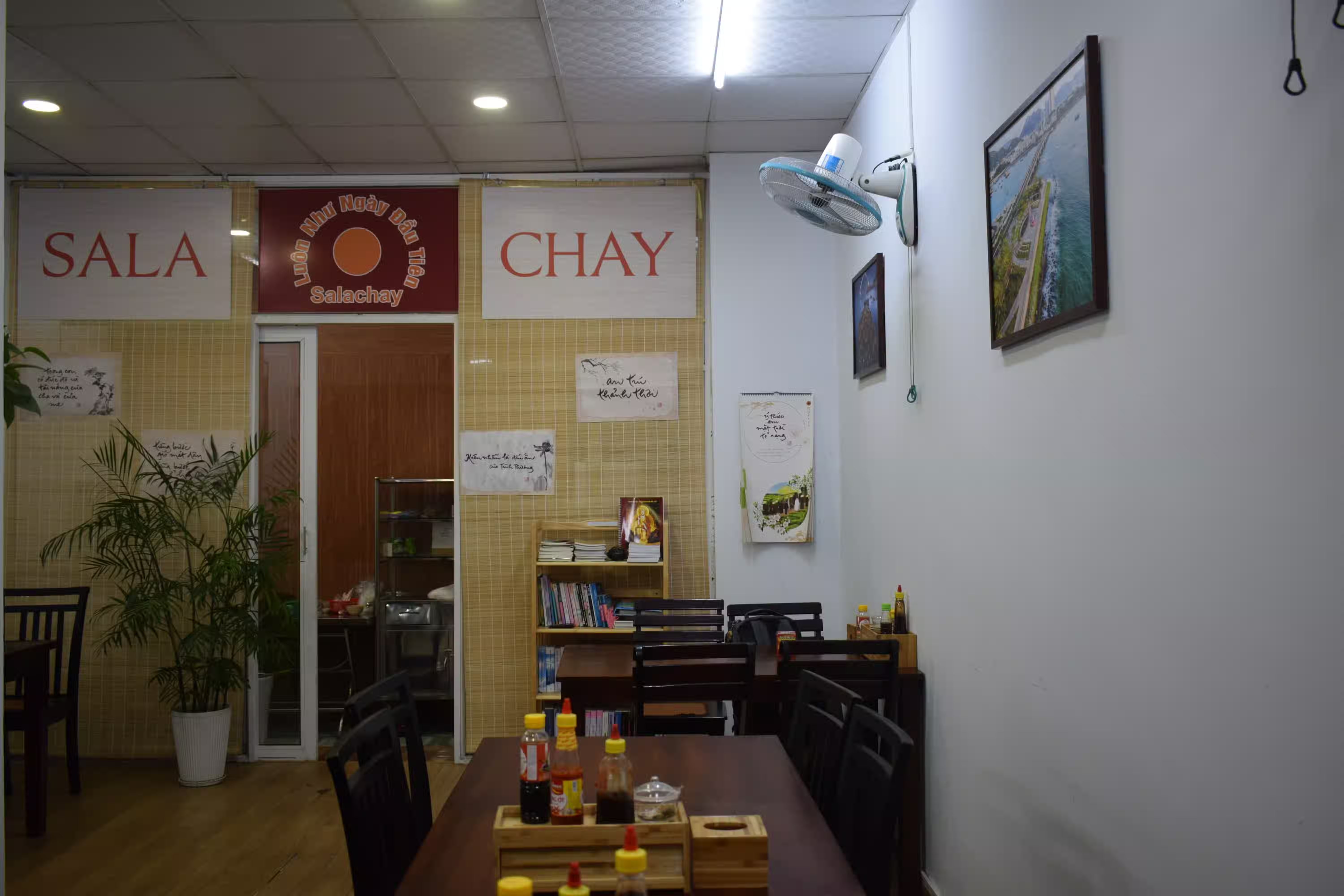
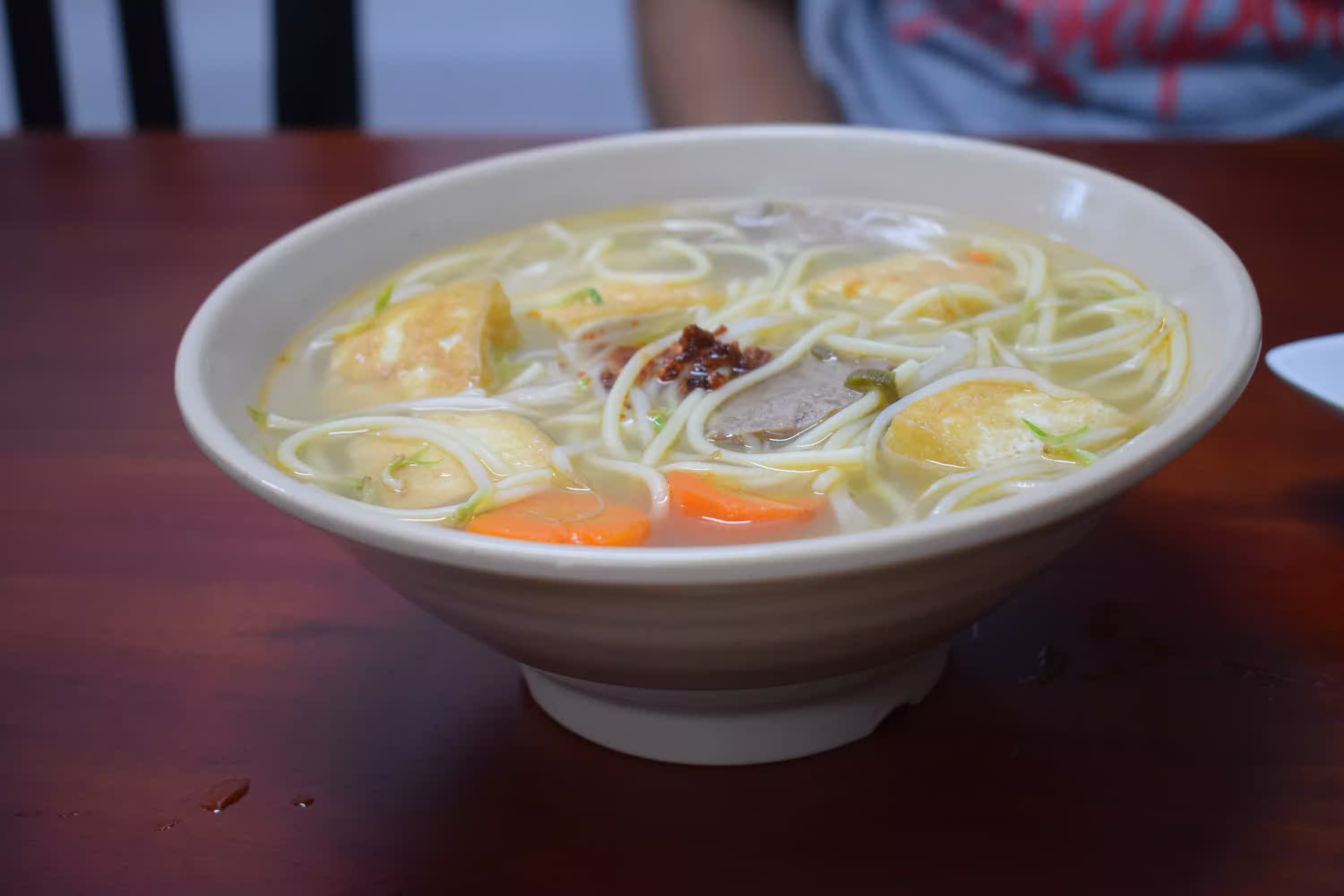
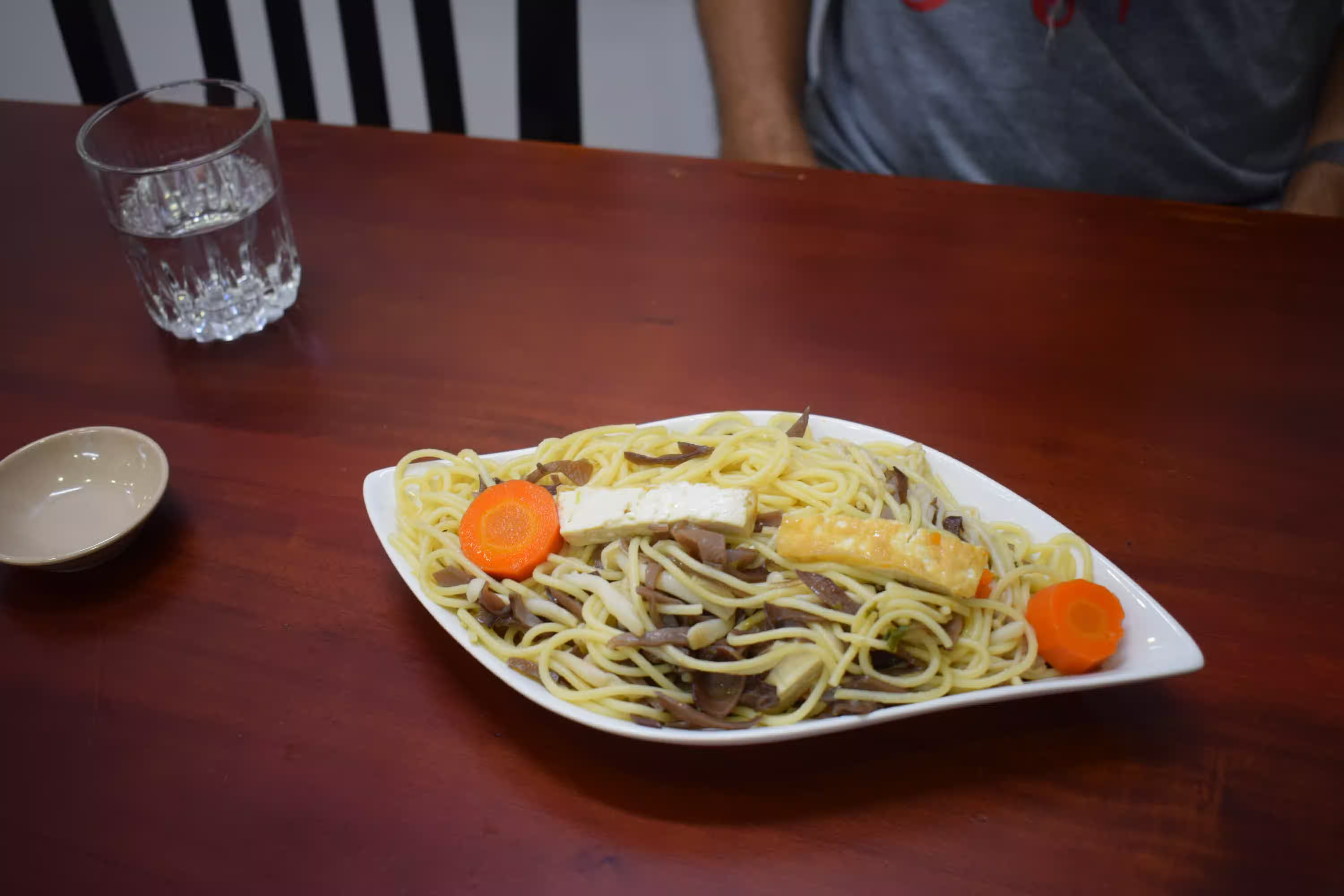
During the evening, we went to a local place to eat. The place mentioned Chay in its name, and you know what it means it was a vegan place. There was a man there and no other customers. I don t remember the names of the dishes we ordered, but it was a bowl of soupy noodles and a bowl of dry noodles. They were very tasty. To top that off, the meal was a total of 55,000 dongs ( 180) for both of us. The host was welcoming and friendly. We had a nice conversation with the host. In Vietnam, restaurants give chopsticks to eat noodles. While Badri was good at using them, I wasn t. So, the host of this restaurant helped me in using chopsticks. Although my technique was not perfect and I take a bit of time, I could now eat solely with chopsticks.
The restaurant we went to in Nha Trang. The word Chay in the name means it was a vegan restaurant. Photo by Ravi Dwivedi, released under CC-BY-SA 4.0. The restaurant we went to in Nha Trang. The word Chay in the name means it was a vegan restaurant. Photo by Ravi Dwivedi, released under CC-BY-SA 4.0.
Soupy noodles we got at that restaurant. Photo by Ravi Dwivedi, released under CC-BY-SA 4.0. Soupy noodles we got at that restaurant. Photo by Ravi Dwivedi, released under CC-BY-SA 4.0.
Dry noodles we got at that restaurant. Photo by Ravi Dwivedi, released under CC-BY-SA 4.0. Dry noodles we got at that restaurant. Photo by Ravi Dwivedi, released under CC-BY-SA 4.0.
Our plan was to take a night bus to Hoi An, and we were hoping to find a bus stand. However, we couldn t find one. Asking around about the pickup location of the Hoi An bus led us to many different locations. Finally, we ended up at a bus booking agency s office where we found out that there were no tickets available for Hoi An. At this point, we gave up on booking the bus and searched for trains instead. As we didn t have a local SIM, we asked the agency to let us connect to their Wi-Fi so that we could look for trains. They were kind enough to let us do that. It also seemed like they were going to close the office in like 10 minutes. Unfortunately, all the sleeper berths were booked from Nha Trang till Hoi An on the next train with only seating berths being available. It takes around 10 hours, so I wasn t comfortable traveling on seating berths. Here I came up with the idea to look for sleeper berths from an intermediate stop. Fortunately, there were sleeper berths available from the next stop, Ninh H a. Therefore, we booked a seating berth from Nha Trang to Ninh H a and a sleeper berth from Ninh H a to Tr Ki u (the nearest railway station from Hoi An). The train name was SE6, and it was a total of 500,000 dongs per person ( 1600 per person). So, we went to the Nha Trang railway station and boarded the train. We had to spend 40 minutes seated for the train to reach the next stop before we could go to our sleeper berths. Badri had some friendly co-passengers on that trip who gave him Saigon beer and some crispy papad-like thing. They offered me as well, but I thought it was non-veg, so I declined it.

Hoi An On the morning of 17th December 2024, we got down at the Tr Ki u station at around 09:30. Our hostel was in Hoi An, which was around 22 km from the station. There was no public transport to get there. Instead, there was a taxi driver at the train platform. We told him the name of our hostel, and he quoted 270,000 dongs (around 850). We said it was too expensive for us, so he agreed to bargain at 250,000 dongs. At this point, we told him that we could give him no more than 200,000 dongs, but he didn t agree. Badri tried a trick. He asked the driver to show us prices in the Grab app (a popular taxi booking app in Southeast Asia). Unfortunately, the Grab app showed 258,000 dongs, which was more than the fare the driver agreed to. So we walked away as if we had so many options (we didn t!) to reach the hostel. We got out of the station and stopped at a small shop outside to have some coffee. As is customary in Vietnam, we got a complimentary green tea here as well.
This was the place we had our coffee in Tra Kieu. Photo by Ravi Dwivedi, released under CC-BY-SA 4.0. This was the place we had our coffee in Tra Kieu. Photo by Ravi Dwivedi, released under CC-BY-SA 4.0.
That taxi driver also joined us and sat in that shop. He started talking with the locals in the shop in the local language. The taxi driver was insistent on taking us to Hoi An for 250,000 dongs. At this point, Badri told the taxi driver (by the use of translation software) that we usually use public transport during our trips, and we aren t used to paying high prices to get around. So, he can drop us somewhere in Hoi An for 200,000 dongs as we don t mind walking a bit to reach our hotel. After reading this, the taxi driver agreed to take us to our hostel for 200,000 dongs ( 660). He also had me take a picture with Badri after this. I think such a bargain tactic would not work in India.
Photo of Badri with taxi driver. Photo by Ravi Dwivedi, released under CC-BY-SA 4.0. Photo of Badri with taxi driver. Photo by Ravi Dwivedi, released under CC-BY-SA 4.0.
The nice thing we noticed in Vietnam is, once bargaining is done and the deal is settled, people don t try to bargain more or keep on talking about the subject. Before the deal, the driver was being somewhat insistent and argumentative, but after the deal was done, it was as if no argument had happened at all.
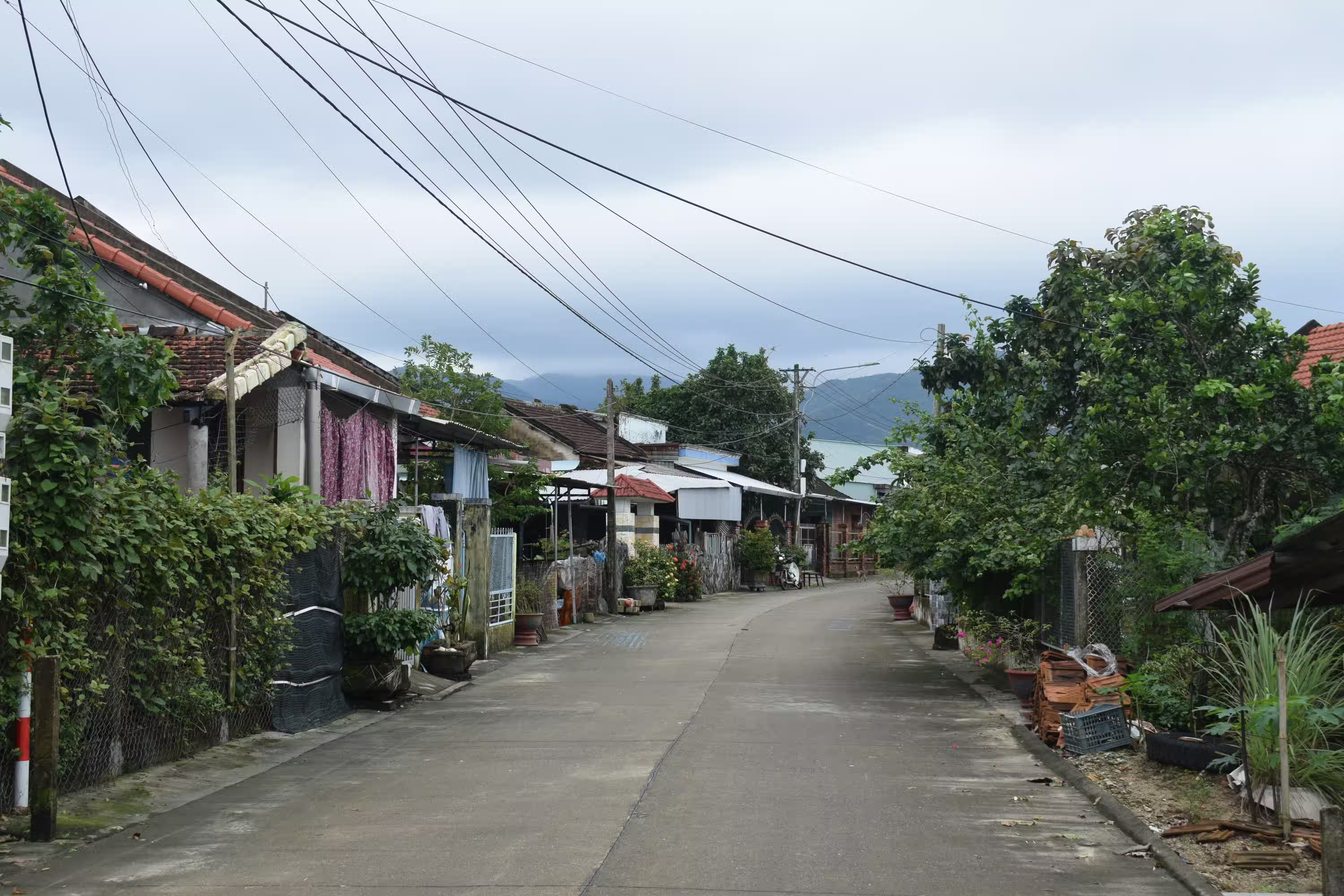
A picture of Tra Kieu area near the train station we got down at. Photo by Ravi Dwivedi, released under CC-BY-SA 4.0. A picture of Tra Kieu area near the train station we got down at. Photo by Ravi Dwivedi, released under CC-BY-SA 4.0.
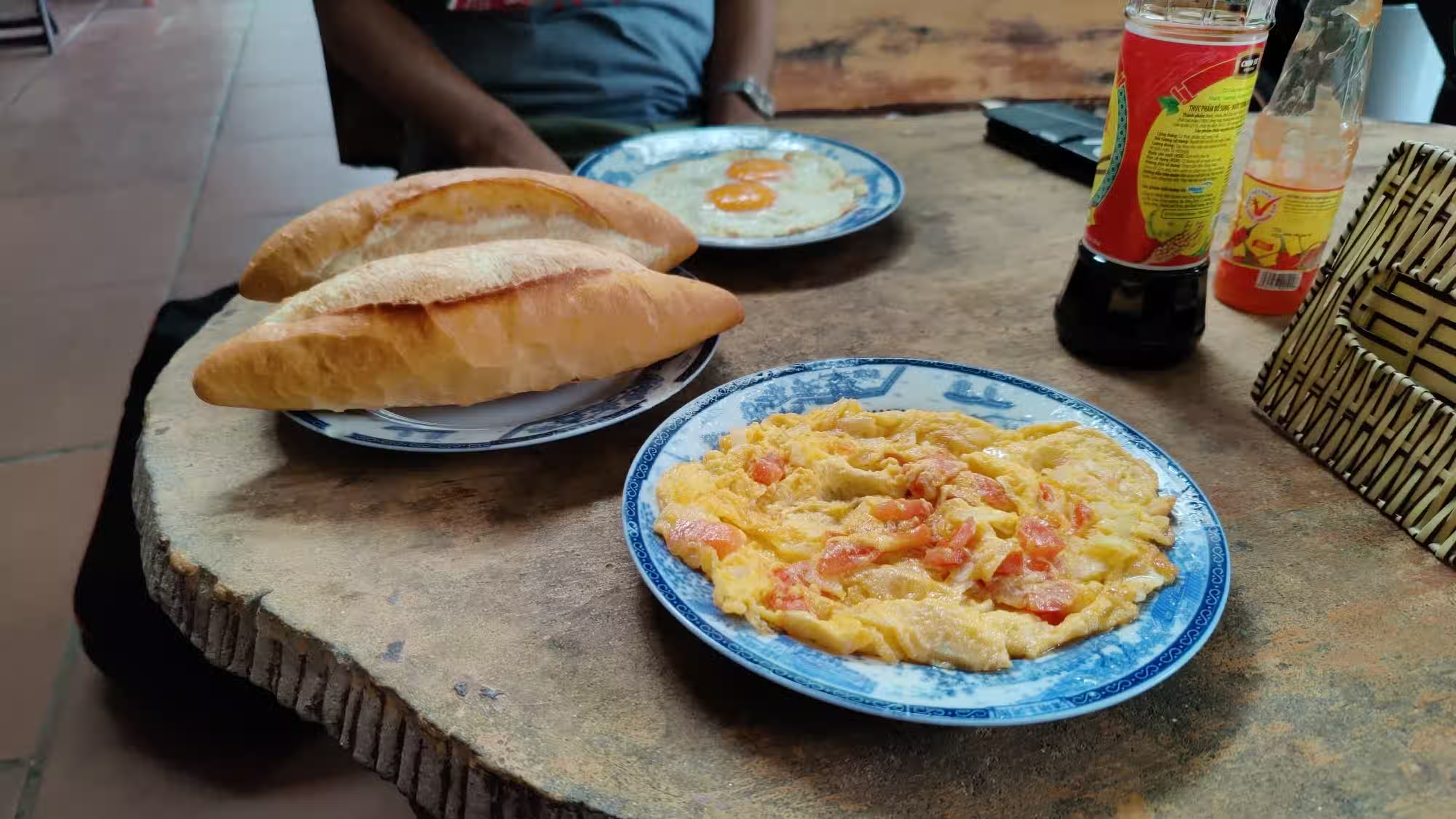
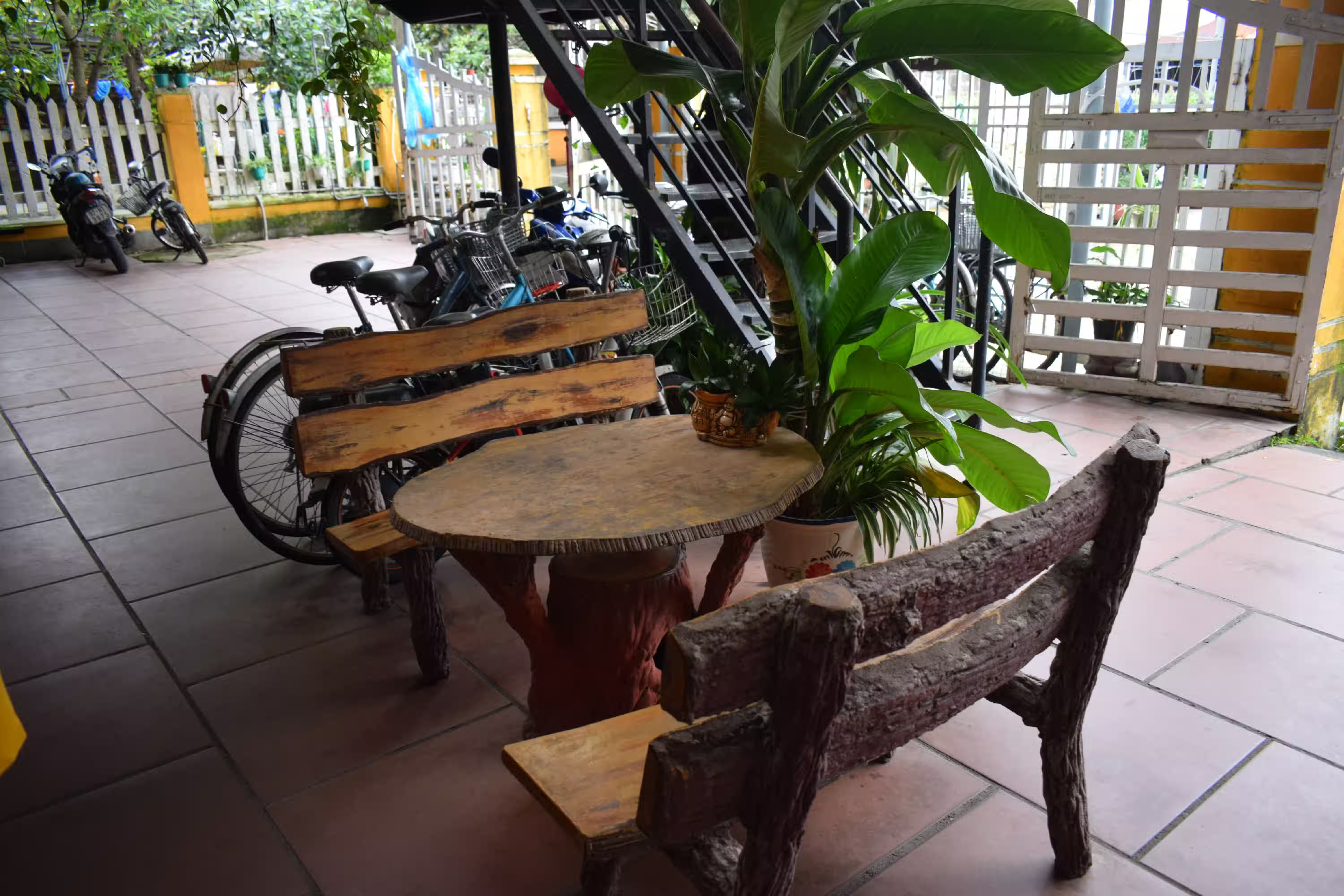
We were treated to some beautiful scenery on the way to our hostel. Soon we reached our place and completed all the formalities for checking-in. During the time our room was being prepared for check-in, we had an egg sandwich with coffee in the hotel. I found the egg sandwich very tasty. The bread looked like the French baguette. The hostel was 240 per night for each of us. The name of the hostel was Bana Spa. We liked staying here and we can recommend it if you find yourself there. It is operated by a family.
Our breakfast in Hoi An. Photo by Ravi Dwivedi, released under CC-BY-SA 4.0. Our breakfast in Hoi An. Photo by Ravi Dwivedi, released under CC-BY-SA 4.0.
A photo of the hostel we stayed in Hoi An. Photo by Ravi Dwivedi, released under CC-BY-SA 4.0. A photo of the hostel we stayed in Hoi An. Photo by Ravi Dwivedi, released under CC-BY-SA 4.0.
We also rented a bicycle for each of us 25,000 dongs per day ( 80) and explored the old town during the evening. Hoi An is popular for Vietnamese silk. Tourists come here to buy fabric and get it done by the tailor. The buildings here looked old, and they were painted in yellow with a gabled roof.
Typical yellow house with gabled roof in Hoi An old town. Photo by Ravi Dwivedi, released under CC-BY-SA 4.0. Typical yellow house with gabled roof in Hoi An old town. Photo by Ravi Dwivedi, released under CC-BY-SA 4.0.
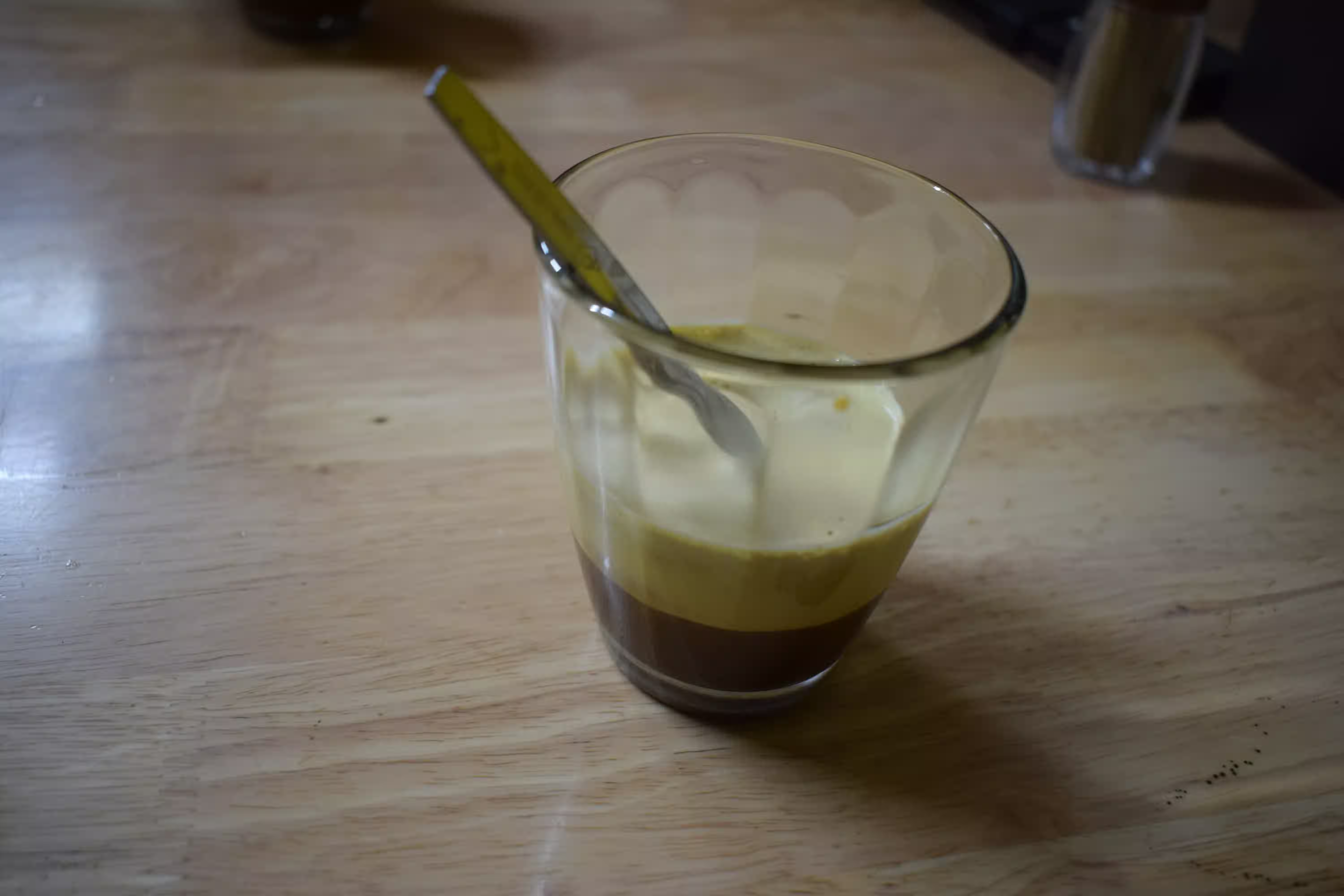
Here, I also had egg coffee for the first time, and I liked it. Egg coffee is a delicacy of Hanoi, but you can get it in other parts of Vietnam. If you find yourself in Vietnam, then I recommend you try egg coffee. We also bought some cool T-shirts and other souvenirs, such as a Vietnamese hat, from here.
Egg coffee I had in Hoi An. Photo by Ravi Dwivedi, released under CC-BY-SA 4.0. Egg coffee I had in Hoi An. Photo by Ravi Dwivedi, released under CC-BY-SA 4.0.

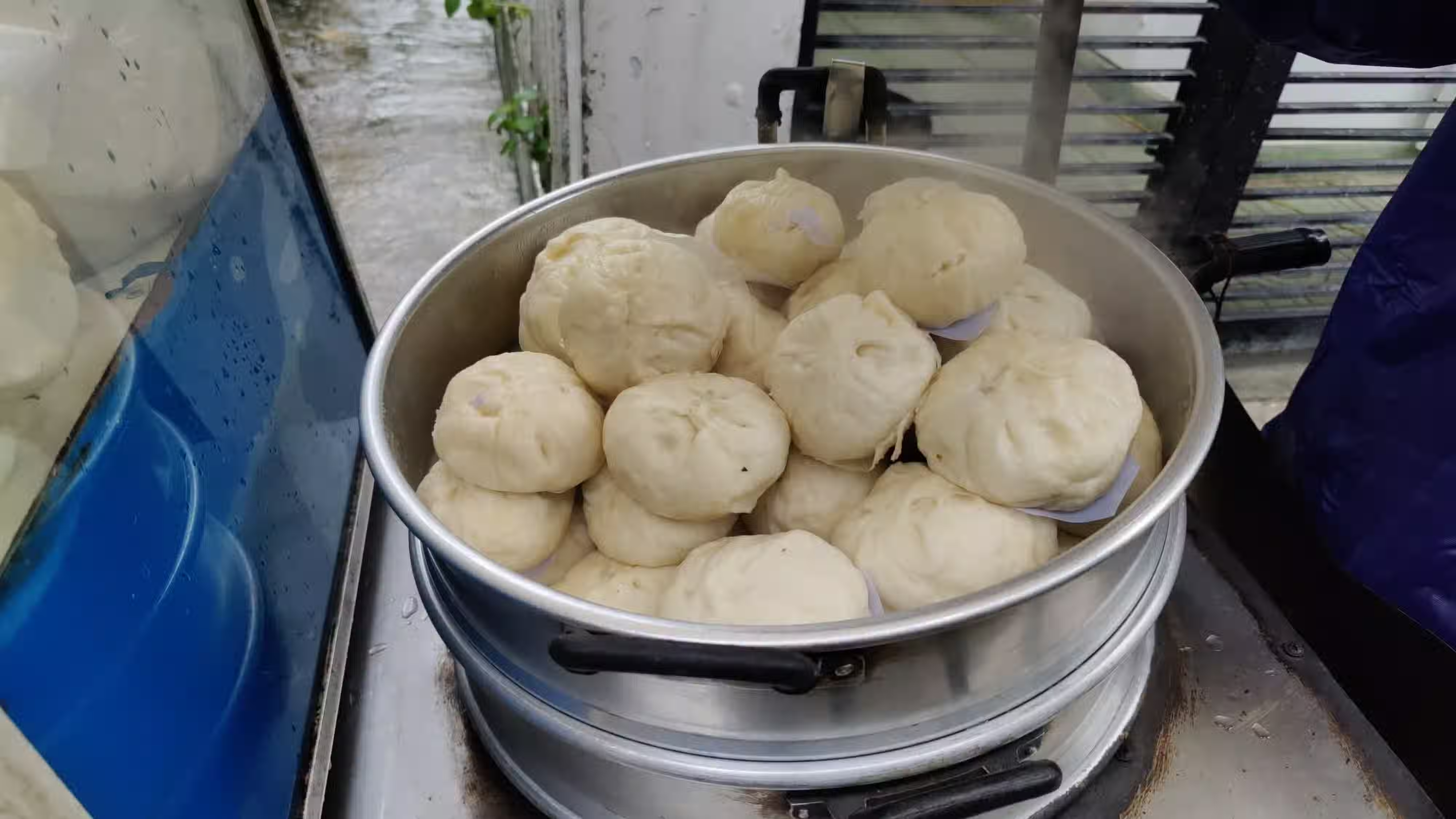
Hue The next day the 18th of December 2024 we went to Hue by bus. As we could not take a bus on our own in Nha Trang, we asked the hostel to book it for us this time. We booked it a day before, and they told us to be ready by 07:00 in the morning. At 07:00, a minibus arrived, which took us to a bus agency s office. There we waited for a few minutes and got into the bus to Hue. The bus had sleeper seats, so I took the opportunity to catch some sleep. The ride was comfortable, so I am assuming the roads were good. In a couple of hours, we reached Hue. Again, we went to Highlands Coffee to have some coffee, charge our phones, and use the internet, not to mention using the bathrooms. During the afternoon, we went to a local restaurant named Qu n Chay Thanh Li u. It was a vegan restaurant (remember the thing I mentioned earlier about Chay being in the name?). On the way, we had a steamed dumpling shaped like a momo called banh bao from a street vendor. It wasn t very good, but I found it worthwhile.
Bahn Bao in Hue. Photo by Ravi Dwivedi, released under CC-BY-SA 4.0. Bahn Bao in Hue. Photo by Ravi Dwivedi, released under CC-BY-SA 4.0.
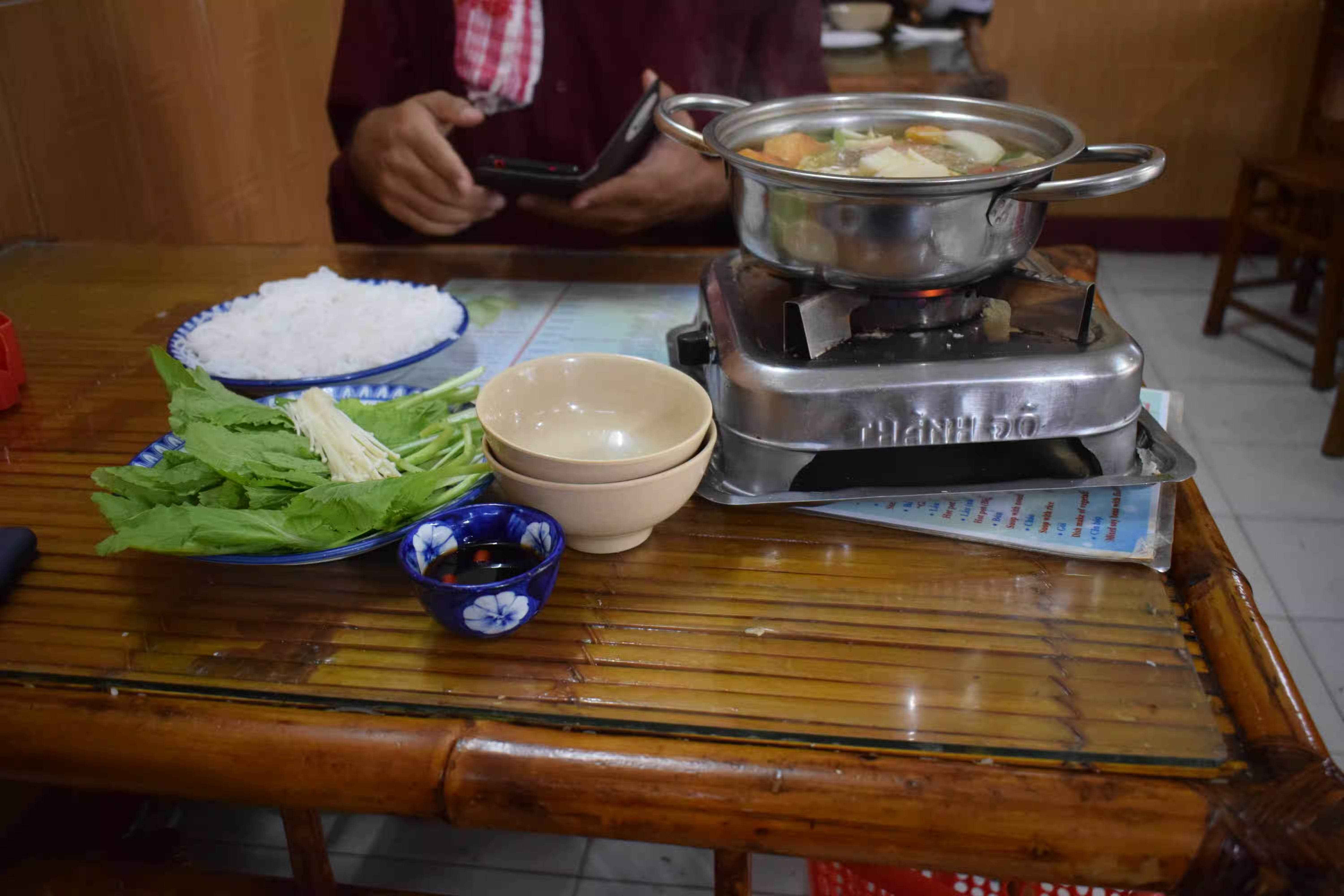
At the restaurant, we ordered a hot pot. First, they brought noodles and a gas stove. Then came the stock and our gas stove was turned on. The stock was kept simmering on the stove. Then, we had it bit by bit with the noodles. A big hot pot at this place costs 50,000 dongs ( 170). Then we had b nh cu n. These were steamed rolls made of rice flour for 10,000 dongs ( 33).
Hot Pot. Photo by Ravi Dwivedi, released under CC-BY-SA 4.0. Hot Pot. Photo by Ravi Dwivedi, released under CC-BY-SA 4.0.
Added soup to the noodles. Photo by Ravi Dwivedi, released under CC-BY-SA 4.0. Added soup to the noodles. Photo by Ravi Dwivedi, released under CC-BY-SA 4.0.
Steamed rolls made of rice flour. Photo by Ravi Dwivedi, released under CC-BY-SA 4.0. Steamed rolls made of rice flour. Photo by Ravi Dwivedi, released under CC-BY-SA 4.0.
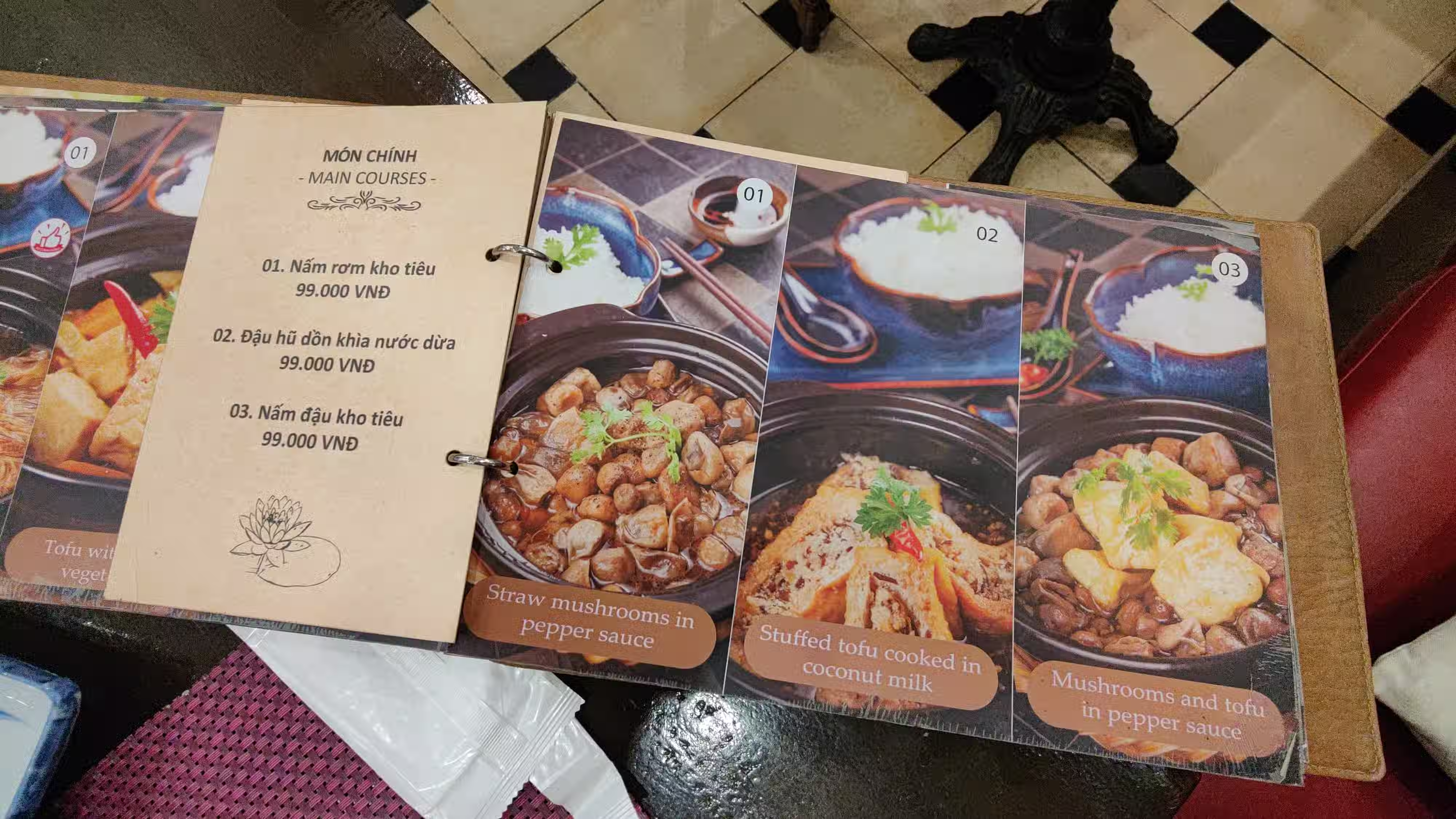
Restaurants in Vietnam usually add photos of the meals in their menu or write a description in English. So, even though the dish names were Vietnamese, we had no problems in ordering food there. In addition, all the places we went to provided free Wi-Fi. They either mention the Wi-Fi password on the bill, on the menu or paste it on the wall. This made our trip smoother without getting a local SIM.
Menu from a restaurant in Ho Chi Minh City with detailed description of the food. Photo by Ravi Dwivedi, released under CC-BY-SA 4.0. Menu from a restaurant in Ho Chi Minh City with detailed description of the food. Photo by Ravi Dwivedi, released under CC-BY-SA 4.0.
Then we slowly walked towards the railway station, as we had a night train to Hanoi. We had egg coffee in a cafe. Near the railway station, we had a b nh m (egg sandwich). As for sightseeing, we had plans to visit a couple of places in Hue, but we ended up spending all our time inside sheltered spaces due to heavy rain. We had booked the train SE20 for Hanoi, which had a departure time of 20:41 from Hue. This one was 948,000 dongs ( 3100) for myself and 870,000 dongs ( 2900) for Badri. My ticket was pricier than Badri s because I got a lower berth. Our train was late by half an hour, so we waited in the common area of the station. After the train arrived, we got inside and took our seats. The cabin had four berths two upper and two lower, similar to India s First AC class. The ticket inspector came to us and offered us the whole cabin (two additional berths) for 300,000 dongs ( 1,000), which we declined. However, this hinted at the other two seats not being reserved. Eventually, we had the whole cabin to ourselves, as nobody else showed up for the other two berths. It was a 14-hour journey, and I got a good sleep.
Our berths in the train. Photo by Ravi Dwivedi, released under CC-BY-SA 4.0. Our berths in the train. Photo by Ravi Dwivedi, released under CC-BY-SA 4.0.

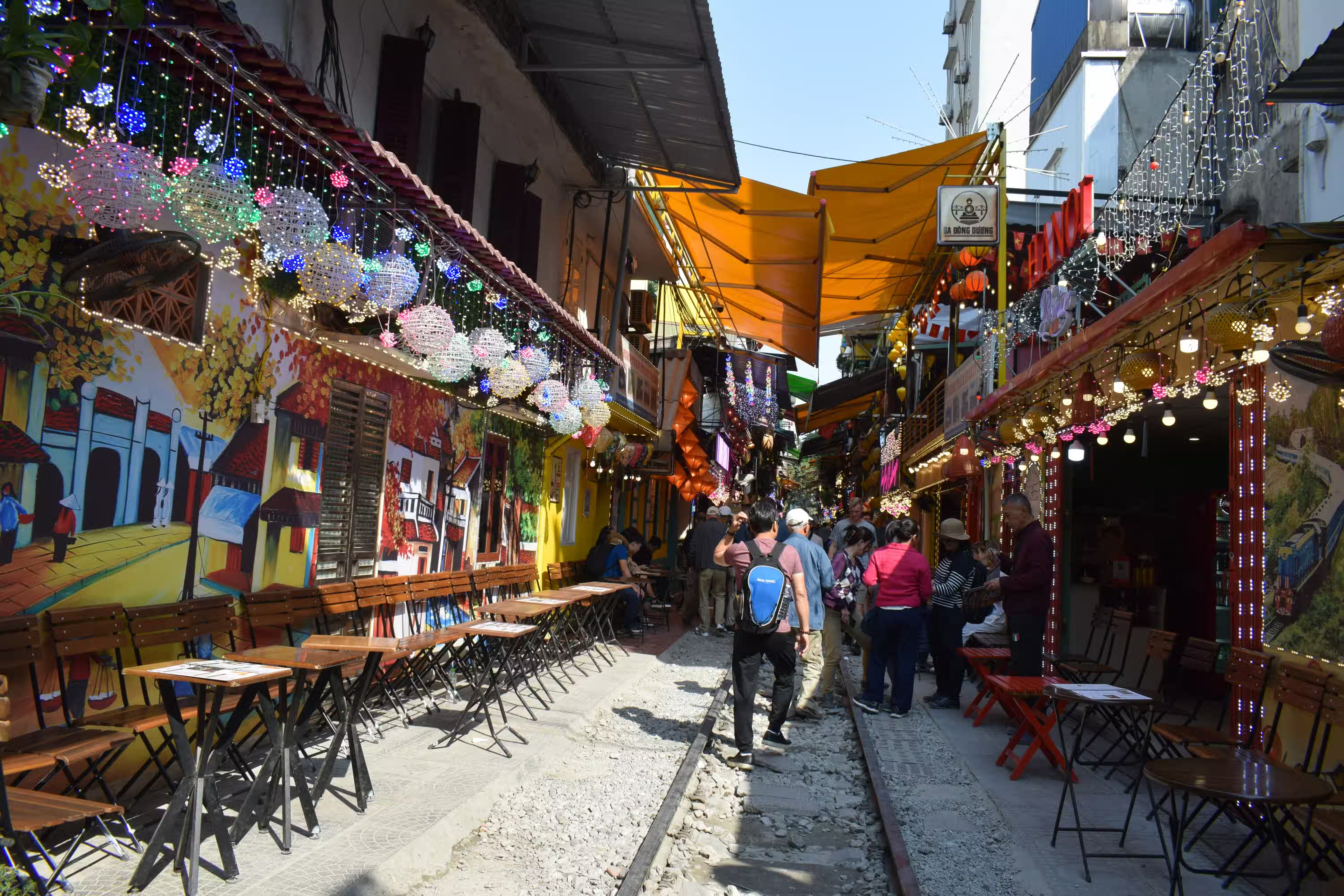
Hanoi On the morning of the 19th of December 2024, we reached Vietnam s capital, Hanoi. We had booked a private hotel room for 800. It was 1 km from the Hanoi Airport. However, it was pretty far from the railway station. So, we roamed around in the city and went to the hotel in the evening. First, we walked to a place and had egg coffee with egg sandwiches. Then we went to Hanoi Train Street, which was walking distance from the train station. After clicking some pictures at the train street, we went to a museum nearby. Upon reaching there, we found out that it was closed.
Egg coffee in Hanoi. Photo by Ravi Dwivedi, released under CC-BY-SA 4.0. Egg coffee in Hanoi. Photo by Ravi Dwivedi, released under CC-BY-SA 4.0.
Hanoi train street is a tourist attraction in Hanoi. Photo by Ravi Dwivedi, released under CC-BY-SA 4.0. Hanoi train street is a tourist attraction in Hanoi. Photo by Ravi Dwivedi, released under CC-BY-SA 4.0.
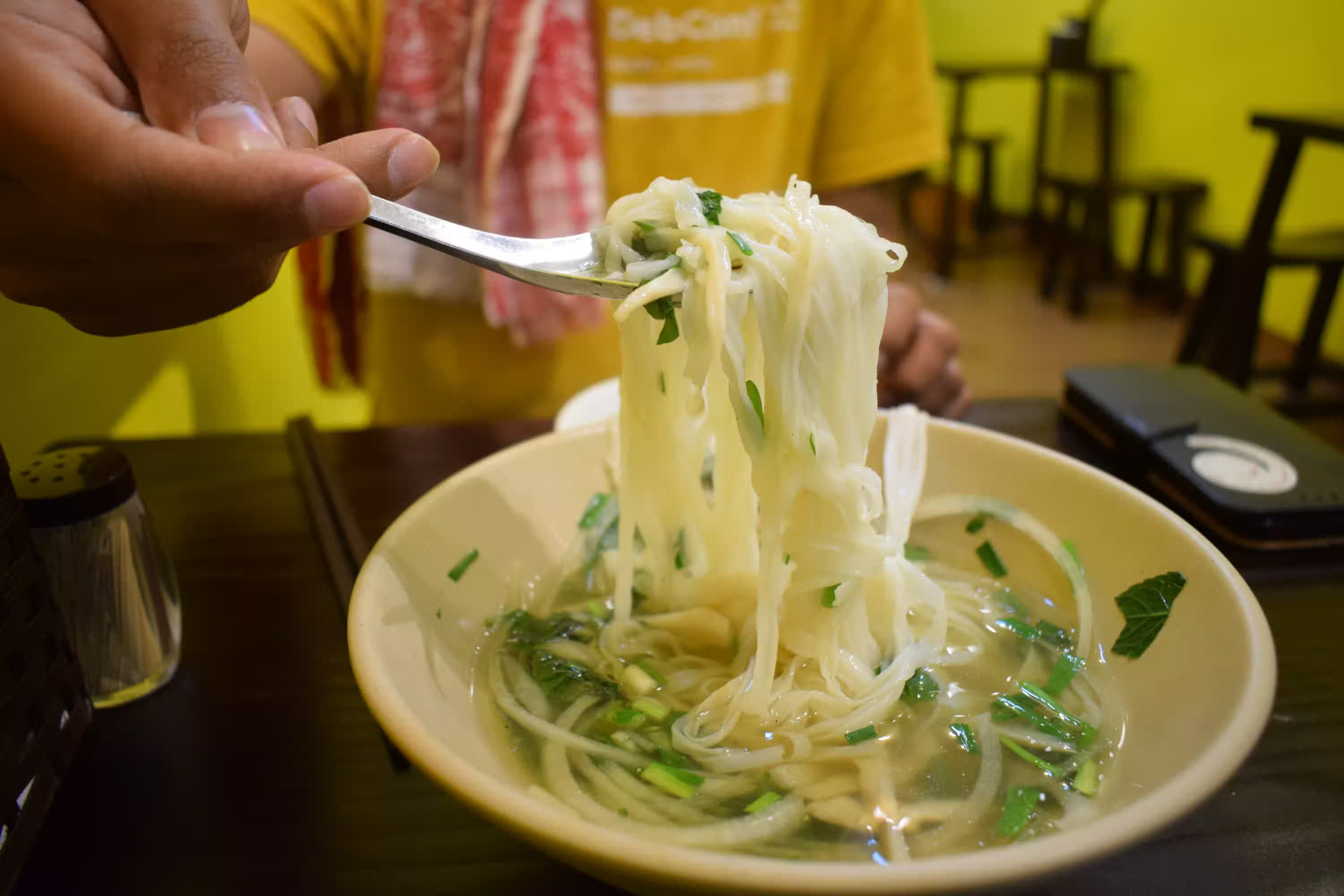
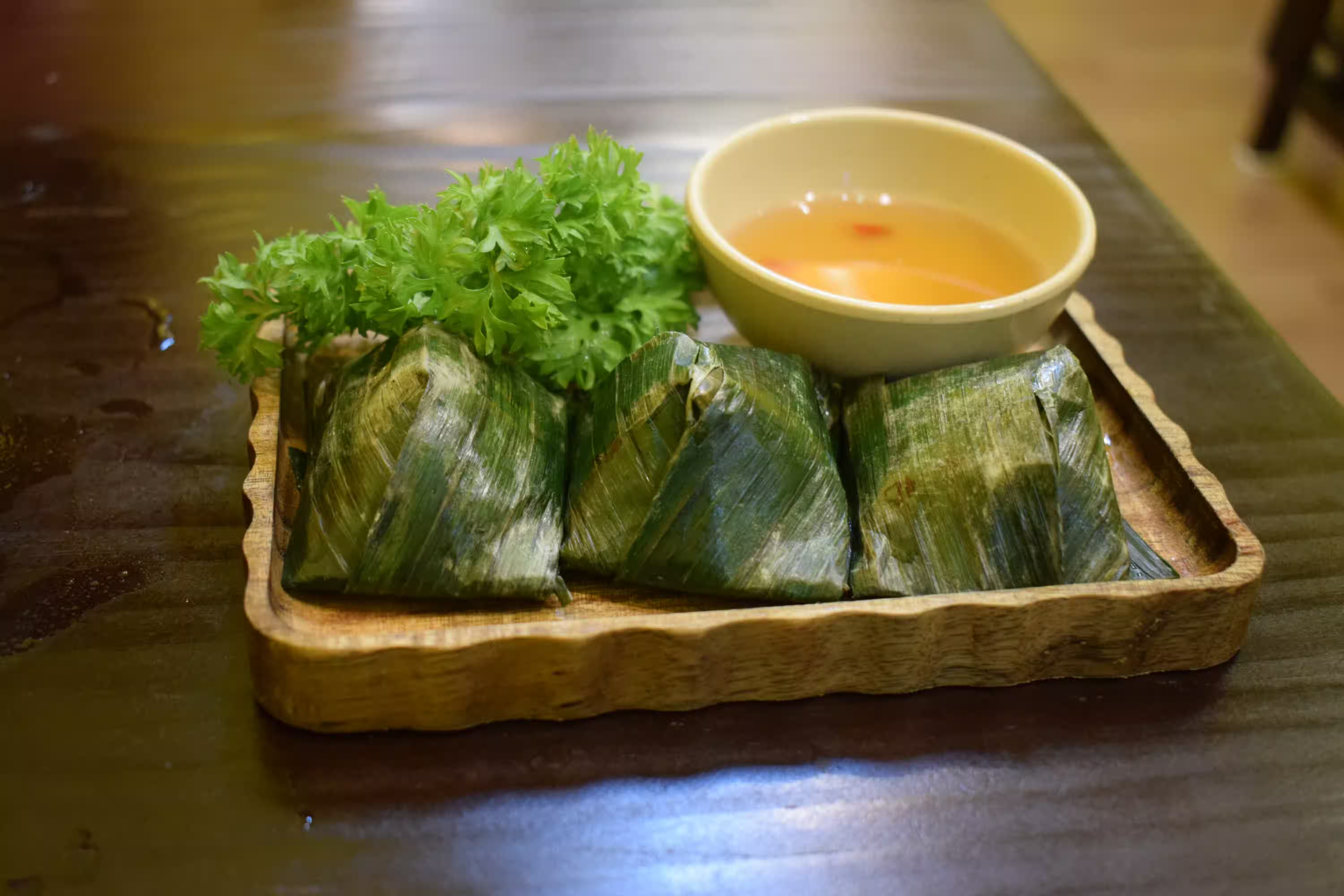
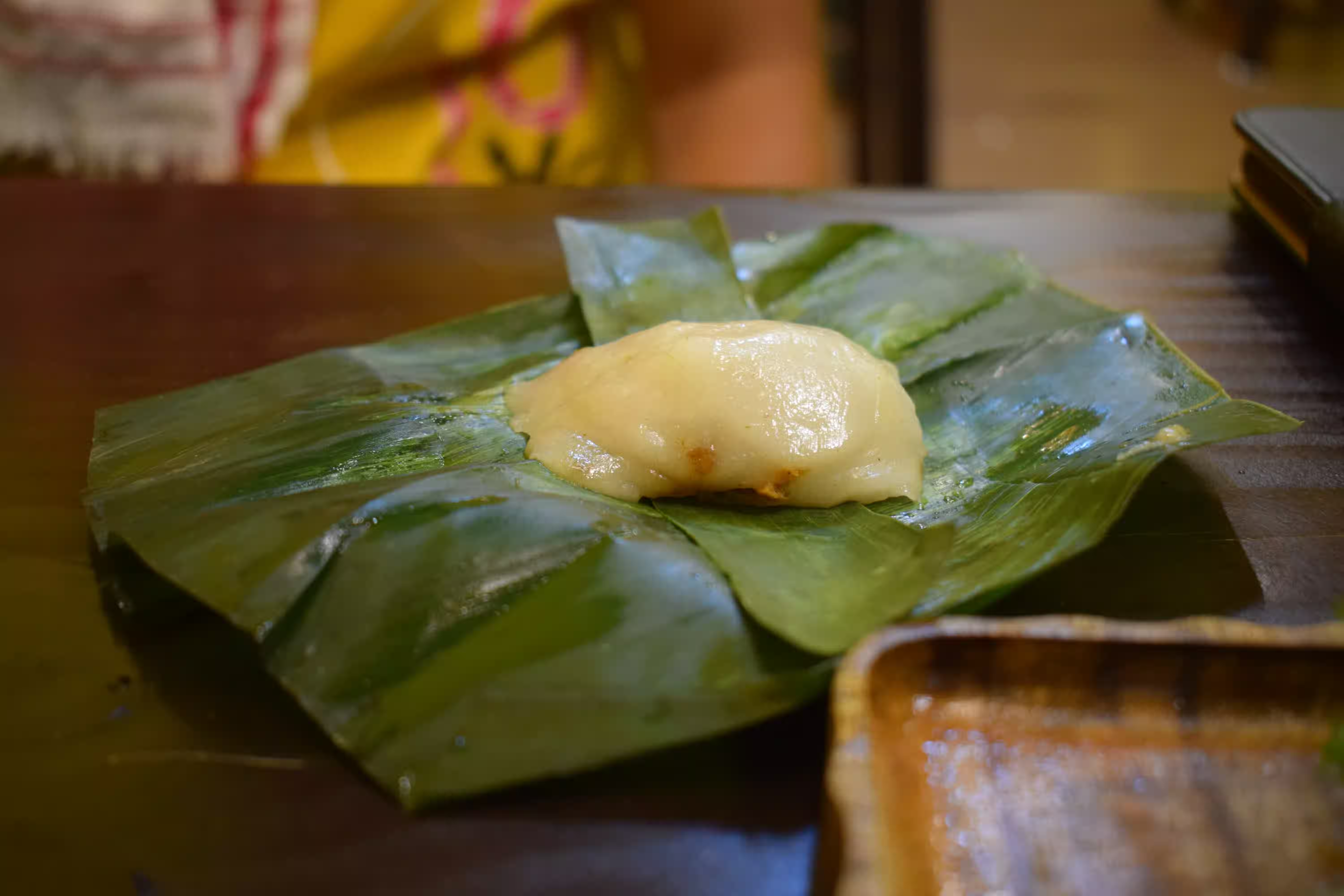
Then we went shopping for jackets, as Hanoi was cold compared to other parts of Vietnam we had been to, and since many of them are manufactured in Vietnam, we thought they would be cheaper. I liked some jackets, but they were not my size. Eventually, we didn t buy anything at the clothes shop. In the evening, I bought a Vietnamese-styled phin coffee filter and coffee powder from Highlands Coffee. We spent a lot of time in their cafes, so it made sense to buy some souvenirs from there. Badri bought a few coffee filters for his family at Trung Nguyen, where I also bought another filter. We had dinner at a local place where we had pho and banh it. Bahn it was served packed in banana leaves and it was made of sticky rice.
A picture of pho we had in Hanoi. Photo by Ravi Dwivedi, released under CC-BY-SA 4.0. A picture of pho we had in Hanoi. Photo by Ravi Dwivedi, released under CC-BY-SA 4.0.
Bahn it is served packed in banana leaves. Photo by Ravi Dwivedi, released under CC-BY-SA 4.0. Bahn it is served packed in banana leaves. Photo by Ravi Dwivedi, released under CC-BY-SA 4.0.
Bahn it. Photo by Ravi Dwivedi, released under CC-BY-SA 4.0. Bahn it. Photo by Ravi Dwivedi, released under CC-BY-SA 4.0.
Next, we went to Hanoi railway station to catch a bus to the airport since our hotel was 1 km from the airport. The locals there helped us take the bus. It took like an hour to get to the airport. We saw on OpenStreetMap that we can take a bus from there to the hotel, but we could not find it. So we walked to our hotel instead. It was a decent hotel room for 800 for a night. We went outside to explore the area and had egg sandwiches and egg coffee at a local place. Again, we were given a complimentary green tea. We went to this place like three times. We had practically become regulars by the time we left. The next day 20th of December 2024 we took a bus to the airport and boarded our flight to Delhi. Credits: Thanks Badri, Kishy and Richard for proofreading.

16 March 2026

Russ Allbery: Review: The Martian Contingency

Review: The Martian Contingency, by Mary Robinette Kowal
Series: Lady Astronaut #4
Publisher: Tor
Copyright: 2025
ISBN: 1-250-23703-3
Format: Kindle
Pages: 390
The Martian Contingency is the fourth book of the mostly-realistic science fiction alternate history series that began with the novelette "The Lady Astronaut of Mars" and the novel The Calculating Stars. It returns to Elma York as the main character, covering her second trip to Mars after the events of The Fated Sky. It's helpful to remember the events of the previous two books to follow some of the plot. Elma is back on Mars, this time as second in command. The immediate goal of the second Mars mission is to open more domes and land additional crew currently in orbit, creating the first permanent human settlement on Mars. The long-term goal is to set up Mars as a refuge in case the greenhouse effect caused by the meteor strike in The Calculating Stars continues to spiral out of control. Elma is anxious and not looking forward to being partly in charge, particularly since her position is partly due to her fame with the public (and connection with the American president). She'd rather just be a pilot. But she'll do what the mission needs from her, and at least this time her husband is with her on Mars. As one might expect from earlier installments of this series, The Martian Contingency starts with the details and rhythms of life in a dangerous, highly technical, and mission-driven scientific environment: hard science fiction of the type most closely modeled on NASA and real space missions. Given that this is aimed at permanent Mars colonies that would theoretically have to be independent of Earth, it requires a huge amount of suspension of disbelief for the premise, but Kowal at least tries for verisimilitude in the small details. I am not an expert in early space program technology (Kowal's alternate history diverges into a greatly accelerated space program in the 1950s and, for example, uses female mathematicians for most calculations), so I don't know how successful this is, but it feels crunchy and believable. As with the previous books, though, this is not just a day in the life of an astronaut. There's something wrong, something that happened during the first Mars expedition while Elma was in orbit and left odd physical clues, and no one is willing to talk about it. Elma is just starting to poke around before the politics at home go off the rails (again), exacerbated by a cringe-worthy social error by Elma herself, and she once again has to navigate egregious sexism and political meddling in a highly dangerous environment a long way from home. It is a little surprising that I like this series as much as I do. I don't particularly care for pseudo-realistic science fiction, although I admit there is something deeply satisfying about reading about people following checklists properly. The idea of permanent Mars colonies as an escape from a doomed Earth is unbelievable and deeply silly, but Kowal locked herself into that alternate future with "The Lady Astronaut of Mars," which is still set in the future of all of the books so far. A primary conflict in each of the books comes from the egregious sexism and racism of a culture based on 1950s American attitudes towards both, and the amount of progress Elma can make against either is limited, contingent, and constantly compromised. And yet. At its best, this series is excellent competence porn, both in the spirit of the Apollo 13 movie and for the navigation of social and political obstacles and idiocy. Elma is highly competent in a believable and sympathetic way, with strengths, weaknesses, and an ongoing struggle with anxiety. There is something rewarding in watching people solve problems and eventually triumph by being professional, careful, principled, and creative. It's enough to make a good book, even if I am not that interested in the setting and technology. As with the rest of the series, this will not be for everyone. You have to be up for reading about a lot of truly awful sexism and racism without the payoff of a complete triumph. This is a system that Elma navigates, not overthrows, and that's not going to be enough for some readers. You also have to accept the premise of a Mars colony, which in an otherwise hard science fiction novel is a bit much despite Kowal's attempts to acknowledge some of the difficulties. But if you don't mind that drawbacks, this series continues to be an opportunity to read about people being quietly and professionally competent. This is not my favorite entry, mostly because Elma makes a rather humiliating mistake that's central to the plot and has a lot of after-effects (and therefore a lot of time in the spotlight), and because there is rather a lot of discussion of sexuality that felt childish to me. The intent was to try to capture the way people in the 1950s talked about sex, and perhaps Kowal was successful in that, but I didn't enjoy the experience. But I still found myself pulled into the plot and happily rooting for the characters, even though a reader of "The Lady Astronaut of Mars" has a pretty good idea of how everything will turn out. If you liked the series so far, recommended, although I doubt it will be the favorite entry for most readers. If you did not like the earlier books of the series, this one will not change your mind. Content notes: Way, way too much detailed discussion of an injury to a fingernail than I wanted to read, as well as some other rather explicit description of physical injury. Reproductive health care through the lens of the 1950s, so, uh, yeah. A whole lot of sexism, racism, and other forms of discrimination that is mostly worked around rather than confronted. Rating: 7 out of 10

Freexian Collaborators: Monthly report about Debian Long Term Support, February 2026 (by Thorsten Alteholz)

The Debian LTS Team, funded by [Freexian s Debian LTS offering] (https://www.freexian.com/lts/debian/), is pleased to report its activities for February.

Activity summary During the month of February, 20 contributors have been paid to work on Debian LTS (links to individual contributor reports are located below). The team released 35 DLAs fixing 527 CVEs. We also welcomed Arnaud Rebillout to the team and had to say farewell to Roberto, who left the team after more than nine years as part of it. The team continued preparing security updates in its usual rhythm. Beyond the updates targeting Debian 11 ( bullseye ), which is the current release under LTS, the team also proposed updates for more recent releases (Debian 12 ( bookworm ) and Debian 13 ( trixie )), including Debian unstable. Notable security updates:
  • Guilhem Moulin prepared DLA 4492-1 for gnutls28 to fix vulnerabilities which may lead to Denial of Service.
  • Utkarsh Gupta prepared DLA 4464-1 for xrdp, to fix a a vulnerability that could allow remote attackers to execute arbitrary code on the target system.
  • Emilio Pozuelo Monfort prepared DLA-4465-1 to replace ClamAV 1.0 with ClamAV 1.4. This latter is the current LTS version supported by upstream.
  • Markus Koschany prepared DLA 4468-1 for tomcat9, to fix a vulnerability that can be used to bypass security constraints.
  • Santiago Ruano Rinc n prepared DLA 4471-1 to update package debian-security-support, the Debian security coverage checker.
  • Bastien Roucari s prepared DLA 4473-1 for zabbix, to fix a potential remote code execution vulnerability.
  • Paride Legovini prepared DLA 4478-1 for tcpflow, to fix a vulnerability that might result in DoS and potentially code execution.
  • Thorsten Alteholz prepared DLA 4477-1 for munge, to fix a vulnerability which may allow local users to leak the MUNGE cryptographic key and forge arbitrary credentials.
  • Ben Hutchings prepared DLA 4475-1 and DLA 4476-1 for Linux kernel updates.
  • Chris Lamb prepared DLA 4482-1 for ceph, to fix SSL certificate checking in the Python bindings.
  • Andreas Henriksson prepared DLA 4491-1 to fix vulnerabilities in glib2.0, which could result in denial of service, memory corruption or potentially arbitrary code execution.
Contributions from outside the LTS Team:
  • The update of nova was prepared by the maintainer, Thomas Goirand. The corresponding DLA 4486-1 was published by Carlos Henrique Lima Melara.
  • The updates of thunderbird were prepared by the maintainer Christoph Goehre. The corresponding DLA 4466-1 and DLA 4495-1 was published by Emilio Pozuelo Monfort.
The LTS Team has also contributed with updates to the latest Debian releases:
  • Jochen prepared a point update of wireshark for bookworm (#1127945).
  • Jochen prepared point updates of erlang for trixie (#1127606) and bookworm (#1127607).
  • Bastien helped preparing DSA 6160-1 for netty and uploaded a fixed package to unstable.
  • Bastien prepared a point update of zabbix for trixie (#1127437).
  • Tobias prepared a point update of modsecurity-crs for bookworm (#1128655).
  • Tobias prepared a point update of busybox for bookworm (#1129503).
  • Tobias helped preparing DSA 6138-1 for libpng1.6.
  • Daniel prepared point updates of python-authlib for trixie (#1129477) and bookworm (#1129246).
  • Ben uploaded several Linux kernel packages to trixie-backports and bookworm-backports.
  • Ben prepared point updates of wireless-regdb for trixie and bookworm.
Other than the work related to updates, Sylvain made several improvements to the documentation and tooling used by the team. Some milestones in the lifecycle of two Debian releases are just around the corner. The support of Debian 12 will be handed over to the LTS team on June 11th 2026. After August 31st, support for Debian 11 will move from Debian LTS to ELTS managed by Freexian.

Individual Debian LTS contributor reports

Thanks to our sponsors Sponsors that joined recently are in bold.

15 March 2026

Russell Coker: The Difference Between Email and Instant Messaging

Introduction With various forms of IM becoming so prevalent and a lot of communication that used to be via email happening via IM I ve been thinking about the differences between Email and IM. I think it s worth comparing them not for the purpose of convincing people to use one or the other (most people will use whatever is necessary to communicate with the people who are important to them) but for the purpose of considering ways to improve them and use them more effectively. Also I don t think that users of various electronic communications systems have had a free choice in what to use for at least 25 years and possibly much longer depending on how you define a free choice. What you use is determined by who you want to communicate with and by what systems are available in your region. So there s no possibility of an analysis of this issue giving a result of let s all change what we use as almost everyone lacks the ability to make a choice. What the Difference is Not The name Instant Messaging implies that it is fast, and probably faster than other options. This isn t necessarily the case, when using a federated IM system such as Matrix or Jabber there can be delays while the servers communicate with each other. Email used to be a slow communication method, in the times of UUCP and Fidonet email there could be multiple days of delay in sending email. In recent times it s expected that email is quite fast, many web sites have options for authenticating an email address which have to be done within 5 minutes so the common expectation seems to be that all email is delivered to the end user in less than 5 minutes. When an organisation has a mail server on site (which is a common configuration choice for a small company) the mail delivery can be faster than common IM implementations. The Wikipedia page about Instant Messaging [1] links to the Wikipedia page about Real Time Computing [2] which is incorrect. Most IM systems are obviously designed for minimum average delays at best. For most software it s not a bad thing to design for the highest performance on average and just let users exercise patience when they get an unusual corner case that takes much longer than expected. If an IM message takes a few minutes to arrive then that s life on the Internet which was the catchphrase of an Australian Internet entrepreneur in the 90s that infuriated some of his customers. Protocol and Data Format Differences Data Formats Email data contains the sender, one or more recipients, some other metadata (time, subject, etc), and the message body. The recipients are typically an arbitrary list of addresses which can only be validated by the destination mail servers. The sender addresses weren t validated in any way and are now only minimally validated as part of anti-spam measures. IM data is sent through predefined connections called rooms or channels. When an IM message is sent to a room it can tag one or more members of the room to indicate that they may receive a special notification of the message. In many implementations it s possible to tag a user who isn t in the room which may result in them being invited to the room. But in IM there is no possibility to add a user to the CC list for part of a discussion and then just stop CCing messages to them later on in the discussion. Protocols Internet email is a well established system with an extensive user base. Adding new mandatory features to the protocols isn t viable because many old systems won t be updated any time soon. So while it is possible to send mail that s SSL encrypted and has a variety of authentication mechanisms that isn t something that can be mandatory for all email. Most mail servers are configured to use the SSL option if it s available but send in cleartext otherwise, so a hostile party could launch a Man In the Middle (MITM) attack and pretend to be the mail server in question but without SSL support. Modern IM protocols tend to be based on encryption, even XMPP (Jabber) which is quite an old IM protocol can easily be configured to only support encrypted messaging and it s reasonable to expect that all other servers that will talk to you will at least support SSL. Even for an IM system that is run by a single company the fact that communication with the servers is encrypted by SSL makes it safer than most email. A security model of this can only be read by you, me, and the staff at an American corporation isn t the worst type of Internet security. The Internet mail infrastructure makes no attempt to send mail in order and the design of the Simple Mail Transfer Protocol (SMTP) means that a network problem after a message has been sent but before the recipient has confirmed receipt will mean that the message is duplicated and this is not considered to be a problem. The IM protocols are designed to support reliable ordered transfer of messages and Matrix (the most recently designed IM protocol) has cryptographic connections between users. Forgery For most email systems there is no common implementation that prevents forging email. For Internet email transferred via SMTP it s possible to use technologies like SPF and DKIM/DMARC to make recipients aware of attempts at forgery, but many recipient systems will still allow email that fails such checks to be delivered. The default configuration tends to be permitting everything and all of the measures to prevent forgery require extra configuration work and often trade-offs as some users desire features that go against security. The default configuration of most mail servers doesn t even prevent trivial forgeries of email from the domain(s) owned by that server. For evidence check the SPF records of some domains that you communicate with and see if they end with -all (to block email from bad sources), ~all (to allow email from bad sources through after possibly logging an error), ?all (to be neutral on mail from unknown sources, or just lack a SPF record entirely. The below shows that of the the top four mail servers in the world only outlook.com has a policy to reject mail from bad sources.
# dig -t txt _spf.google.com grep spf1
_spf.google.com.	300	IN	TXT	"v=spf1 ip4:74.125.0.0/16 ip4:209.85.128.0/17 ip6:2001:4860:4864::/56 ip6:2404:6800:4864::/56 ip6:2607:f8b0:4000::/36 ip6:2800:3f0:4000::/36 ip6:2a00:1450:4000::/36 ip6:2c0f:fb50:4000::/36 ~all"
# dig -t txt outlook.com grep spf1
outlook.com.		126	IN	TXT	"v=spf1 include:spf2.outlook.com -all"
# dig -t txt _spf.mail.yahoo.com grep spf1
_spf.mail.yahoo.com.	1800	IN	TXT	"v=spf1 ptr:yahoo.com ptr:yahoo.net ip4:34.2.71.64/26 ip4:34.2.75.0/26 ip4:34.2.84.64/26 ip4:34.2.85.64/26 ip4:34.2.64.0/22 ip4:34.2.68.0/23 ip4:34.2.70.0/23 ip4:34.2.72.0/22 ip4:34.2.78.0/23 ip4:34.2.80.0/23 ip4:34.2.82.0/23 ip4:34.2.84.0/24 ip4:34.2.86.0" "/23 ip4:34.2.88.0/23 ip4:34.2.90.0/23 ip4:34.2.92.0/23 ip4:34.2.85.0/24 ip4:34.2.94.0/23 ?all"
# dig -t txt icloud.com grep spf1
icloud.com.		3586	IN	TXT	"v=spf1 ip4:17.41.0.0/16 ip4:17.58.0.0/16 ip4:17.142.0.0/15 ip4:17.57.155.0/24 ip4:17.57.156.0/24 ip4:144.178.36.0/24 ip4:144.178.38.0/24 ip4:112.19.199.64/29 ip4:112.19.242.64/29 ip4:222.73.195.64/29 ip4:157.255.1.64/29" " ip4:106.39.212.64/29 ip4:123.126.78.64/29 ip4:183.240.219.64/29 ip4:39.156.163.64/29 ip4:57.103.64.0/18" " ip6:2a01:b747:3000:200::/56 ip6:2a01:b747:3001:200::/56 ip6:2a01:b747:3002:200::/56 ip6:2a01:b747:3003:200::/56 ip6:2a01:b747:3004:200::/56 ip6:2a01:b747:3005:200::/56 ip6:2a01:b747:3006:200::/56 ~all"
In most IM systems there is a strong connection between people who communicate. If I send you two direct messages they will appear in the same room, and if someone else tries forging messages from me (EG by replacing the c and e letters in my address with Cyrillic letters that look like them or by mis-spelling my name) a separate room will be created and it will be obvious that something unexpected is happening. Protecting against the same attacks in email requires the user carefully reading the message, given that it s not uncommon for someone to start a message to me with Hi Russel (being unable to correctly copy my name from the To: field of the message they are writing) it s obvious that any security measure relying on such careful reading will fail. The IM protections against casual forgery also apply to rooms with multiple users, a new user can join a room for the purpose of spamming but they can t send a casual message impersonating a member of the room. A user can join a Matrix room I m in with the name Russell from another server but the potential for confusion will be minimised by a message notifying everyone that another Russell has joined the room and the list of users will show two Russells. For email the protections against forgery when sending to a list server are no different than those when sending to an individual directly which means very weak protections. Authenticating the conversation context once as done with IM is easier and more reliable than authenticating each message independently. Is Email Sucking the Main Technical Difference? It seems that the problems with forgery, spam, and general confusion when using email are a large part of the difference between email and IM. But in terms of technical issues the fact that email has significantly more users (if only because you need an email account to sign up for an IM system) is a major difference. Internet email is currently a universal system (apart from when it breaks from spam) and it has historically been used to gateway to other email systems like Fidonet, Uucp, and others. The lack of tight connection between parties that exchange messages in email makes it easier to bridge between protocols but harder to authenticate communication. Most of the problems with Internet email are not problems for everyone at all times, they are technical trade-offs that work well for some situations and for some times. Unfortunately many of those trade-offs are for things that worked well 25+ years ago. The GUI From a user perspective there doesn t have to be a great difference between email and IM. Email is usually delivered quickly enough to be in the same range as IM. The differences in layout between IM client software and email client software is cosmetic, someone could write an email client that organises messages in the same way as Slack or another popular IM system such that the less technical users wouldn t necessarily know the difference. The significant difference in the GUI for email and IM software was a design choice. Conversation Organisation The most significant difference in the operation of email and IM at the transport level is the establishment of connections in IM. Another difference is the fact that there are no standards implemented for the common IM implementations to interoperate which is an issue of big corporations creating IM systems and deliberately making them incompatible. The methods for managing email need to be improved. Having an inbox that s an unsorted mess of mail isn t useful if you want to track one discussion, breaking it out into different sub folders for common senders (similar to IM folders for DMs) as a standard feature without having to setup rules for each sender would be nice. Someone could design an email program with multiple layouts, one being the traditional form (which seems to be copied from Eudora [3]) and one with the inbox (or other folders) split up into conversations. There are email clients that support managing email threads which can be handy in some situations but often isn t the best option for quickly responding to messages that arrived recently. Archiving Most IM systems have no method for selectively archiving messages, there s a request open for a bookmark function in Matrix and there s nothing stopping a user from manually copying a message. But there s nothing like the convenient ability to move email to an archive folder in most IM systems. Without good archiving IM is a transient medium. This is OK for conversations but not good for determining the solutions to technical problems unless there is a Wiki or other result which can be used without relying on archives. Composing Messages In a modern email client when sending a message it prompts you for things that it considers complete, so if you don t enter a Subject or have the word attached in the message body but no file is attached to the message then it will prompt you to confirm that you aren t making a mistake. In an IM client the default is usually that pressing ENTER sends the message so every paragraph is a new message. IM clients are programmed to encourage lots of short messages while email clients are programmed to encourage more complete messages. Social Issues Quality The way people think about IM and email is very different, as one example there was never a need for a site like nohello.net for email. The idea that it s acceptable to use even lower quality writing in IM than people tend to use in email seems to be a major difference between the communication systems. It can be a good thing to have a chatty environment with messages that are regarded as transient for socialising, but that doesn t seem ideal for business use. Ownership Email is generally regarded as being comparable to physical letters. It is illegal and widely considered to be socially wrong to steal a letter from someone s letterbox if you regret sending it. In email the only unsend function I m aware of is that in Microsoft software which is documented to only work within the same organisation, and that only works if the recipient hasn t read the message. The message is considered to be owned by the recipient. But for IM it s a widely supported and socially acceptable function to delete or edit messages that have been sent. The message is regarded as permanently the property of the sender. What Should We Do? Community Creators When creating a community (and I use this in the broadest sense including companies) you should consider what types of communication will work well. When I started the Flounder group [4] I made a deliberate decision that non-free communication systems go against the aim of the group, I started it with a mailing list and then created a Matrix room which became very popular. Now the list hardly gets any use. It seems that most of the communication in the group is fairly informal and works better with IM. Does it make sense to use both? Should IM systems be supplemented with other systems that facilitate more detail such as a Wiki or a Lemmy room/instance [5] to cover the lack of long form communication? I have created a Lemmy room for Flounder but it hasn t got much interest so far. It seems that almost no-one makes a strategic decision about such issues. Software Developers It would be good to have the same options for archiving IM as there are for email. Also some options to encourage quality in IM communication similar to the way email clients want confirmation before sending messages without a subject or that might be missing an attachment. It would also be good to have better options for managing conversations in email. The Inbox as currently used is good for some things but a button to switch between that and a conversation view would be good. There are email clients that allow selecting message sort order and aggregation (kmail has a good selection of options) but they are designed for choosing a single setup that you like not between multiple views based on the task you are doing. It would be good to have links between different communication systems, if users had the option of putting their email address in their IM profile it would make things much easier. Having entirely separate systems for email and IM isn t good for users. Users The overall communications infrastructure could be improved if more people made tactical decisions about where and how to communicate. Keep the long messages to email and the chatty things to IM. Also for IM just do the communication not start with hello . To discourage wasting time I generally don t reply to messages that just say hello unless it s the first ever IM from someone. Conclusion A large part of the inefficiencies in electronic communication are due to platforms and usage patterns evolving with little strategic thought. The only apparent strategic thought is coming from corporations that provide IM services and have customer lock in at the core of their strategies. Free software developers have done great work in developing software to solve tactical problems but the strategies of large scale communications aren t being addressed. Email is loosely coupled and universal while IM is tightly coupled, authenticated, and often siloed. This makes email a good option for initial contact but a risk for ongoing discussions. There is no great solution to these issues as they are largely a problem due to the installed user base. But I think we can mitigate things with some GUI design changes and strategic planning of communication.

13 March 2026

Jonathan Dowland: debian swirl font glyph

When I wrote about the redhat logo in a shell prompt, a commenter said it would be nice to achieve something similar for Debian, and suggested " " (U+1F365 FISH CAKE WITH SWIRL DESIGN) which, in some renderings, looks to have a red swirl on top. This is not bad, but I thought we could do better. On Apple systems, the character " " (U+F8FF) displays as the corporate Apple logo. That particular unicode code point is reserved: systems are free to use it for something private and internal, but other systems won't use it for the same thing. So if an Apple user tries to send a document with that character in it to someone else, they won't see the Apple unless they are also viewing it on an Apple computer. (Some folks use it for Klingon). Here's a font that maps the Debian swirl to the same code point. It's covered by the Debian logo license terms. Nerd Font maps the Debian swirl logo to codepoints e77d, f306, ebc5 and f08da (all of which are also in the Private Use Area). I've gone ahead and mapped it to all those points but the last one (simply because I couldn't find it in FontForge.) Note that, unless your recipients have this font, or the Nerd Font, or similar set up, they aren't going to see the swirl. But enjoy it for private use. Getting your system to actually use the font is, I'm afraid, left as an exercise for the reader (but feel free to leave comments) Thanks to mirabilos for chatting to me about this back in 2019. It's taken me that long to get this blog post out of draft!

Sven Hoexter: container image with ECH enabled curl

As an opportunity to rewire my brain from "docker" to "podman" and "buildah" I started to create an image build with an ECH enabled curl at https://gitlab.com/hoexter/ech. Not sure if it helps anyone, but setup should be like this:
git clone https://gitlab.com/hoexter-experiments/ech
cd ech
buildah build --layers -f Dockerfile -t echtest
podman run -ti echtest /usr/local/bin/curl \
  --ech true --doh-url https://one.one.one.one/dns-query \
  https://crypto.cloudflare.com/cdn-cgi/trace.cgi
fl=48f121
h=crypto.cloudflare.com
ip=2.205.251.187
ts=1773410985.168
visit_scheme=https
uag=curl/8.19.0
colo=DUS
sliver=none
http=http/2
loc=DE
tls=TLSv1.3
sni=encrypted
warp=off
gateway=off
rbi=off
kex=X25519
It also builds nginx and you can use that for a local test within the image. More details in the README.

12 March 2026

Reproducible Builds: Reproducible Builds in February 2026

Welcome to the February 2026 report from the Reproducible Builds project! These reports outline what we ve been up to over the past month, highlighting items of news from elsewhere in the increasingly-important area of software supply-chain security. As ever, if you are interested in contributing to the Reproducible Builds project, please see the Contribute page on our website.

  1. reproduce.debian.net
  2. Tool development
  3. Distribution work
  4. Miscellaneous news
  5. Upstream patches
  6. Documentation updates
  7. Four new academic papers

reproduce.debian.net The last year has seen the introduction, development and deployment of reproduce.debian.net. In technical terms, this is an instance of rebuilderd, our server designed monitor the official package repositories of Linux distributions and attempt to reproduce the observed results there. This month, however, Holger Levsen added suite-based navigation (eg. Debian trixie vs forky) to the service (in addition to the already existing architecture based navigation) which can be observed on, for instance, the Debian trixie-backports or trixie-security pages.

Tool development diffoscope is our in-depth and content-aware diff utility that can locate and diagnose reproducibility issues. This month, Chris Lamb made a number of changes, including preparing and uploading versions, 312 and 313 to Debian. In particular, Chris updated the post-release deployment pipeline to ensure that the pipeline does not fail if the automatic deployment to PyPI fails [ ]. In addition, Vagrant Cascadian updated an external reference for the 7z tool for GNU Guix. [ ]. Vagrant Cascadian also updated diffoscope in GNU Guix to version 312 and 313.

Distribution work In Debian this month:
  • 26 reviews of Debian packages were added, 5 were updated and 19 were removed this month adding to our extensive knowledge about identified issues.
  • A new debsbom package was uploaded to unstable. According to the package description, this package generates SBOMs (Software Bill of Materials) for distributions based on Debian in the two standard formats, SPDX and CycloneDX. The generated SBOM includes all installed binary packages and also contains Debian Source packages.
  • In addition, a sbom-toolkit package was uploaded, which provides a collection of scripts for generating SBOM. This is the tooling used in Apertis to generate the Licenses SBOM and the Build Dependency SBOM. It also includes dh-setup-copyright, a Debhelper addon to generate SBOMs from DWARF debug information, which are extracted from DWARF debug information by running dwarf2sources on every ELF binaries in the package and saving the output.
Lastly, Bernhard M. Wiedemann posted another openSUSE monthly update for their work there.

Miscellaneous news

Upstream patches The Reproducible Builds project detects, dissects and attempts to fix as many currently-unreproducible packages as possible. We endeavour to send all of our patches upstream where appropriate. This month, we wrote a large number of such patches, including:

Documentation updates Once again, there were a number of improvements made to our website this month including:

Four new academic papers Julien Malka and Arnout Engelen published a paper titled Lila: Decentralized Build Reproducibility Monitoring for the Functional Package Management Model:
[While] recent studies have shown that high reproducibility rates are achievable at scale demonstrated by the Nix ecosystem achieving over 90% reproducibility on more than 80,000 packages the problem of effective reproducibility monitoring remains largely unsolved. In this work, we address the reproducibility monitoring challenge by introducing Lila, a decentralized system for reproducibility assessment tailored to the functional package management model. Lila enables distributed reporting of build results and aggregation into a reproducibility database [ ].
A PDF of their paper is available online.
Javier Ron and Martin Monperrus of KTH Royal Institute of Technology, Sweden, also published a paper, titled Verifiable Provenance of Software Artifacts with Zero-Knowledge Compilation:
Verifying that a compiled binary originates from its claimed source code is a fundamental security requirement, called source code provenance. Achieving verifiable source code provenance in practice remains challenging. The most popular technique, called reproducible builds, requires difficult matching and reexecution of build toolchains and environments. We propose a novel approach to verifiable provenance based on compiling software with zero-knowledge virtual machines (zkVMs). By executing a compiler within a zkVM, our system produces both the compiled output and a cryptographic proof attesting that the compilation was performed on the claimed source code with the claimed compiler. [ ]
A PDF of the paper is available online.
Oreofe Solarin of Department of Computer and Data Sciences, Case Western Reserve University, Cleveland, Ohio, USA, published It s Not Just Timestamps: A Study on Docker Reproducibility:
Reproducible container builds promise a simple integrity check for software supply chains: rebuild an image from its Dockerfile and compare hashes. We built a Docker measurement pipeline and apply it to a stratified sample of 2,000 GitHub repositories that contained a Dockerfile. We found that only 56% produce any buildable image, and just 2.7% of those are bitwise reproducible without any infrastructure configurations. After modifying infrastructure configurations, we raise bitwise reproducibility by 18.6%, but 78.7% of buildable Dockerfiles remain non-reproducible.
A PDF of Oreofe s paper is available online.
Lastly, Jens Dietrich and Behnaz Hassanshahi published On the Variability of Source Code in Maven Package Rebuilds:
[In] this paper we test the assumption that the same source code is being used [by] alternative builds. To study this, we compare the sources released with packages on Maven Central, with the sources associated with independently built packages from Google s Assured Open Source and Oracle s Build-from-Source projects. [ ]
A PDF of their paper is available online.

Finally, if you are interested in contributing to the Reproducible Builds project, please visit our Contribute page on our website. However, you can get in touch with us via:

6 March 2026

Thorsten Alteholz: My Debian Activities in February 2026

Debian LTS/ELTS This was my hundred-fortieth month that I did some work for the Debian LTS initiative, started by Raphael Hertzog at Freexian. During my allocated time I uploaded or worked on: Some CVEs could be marked as not-affected for one or all LTS/ELTS-releases. I also worked on package evolution-data-server and attended the monthly LTS/ELTS meeting. Debian Printing This month I uploaded a new upstream versions: This work is generously funded by Freexian! Debian Lomiri This month I continued to worked on unifying packaging on Debian and Ubuntu. This makes it easier to work on those packages independent of the used platform. This work is generously funded by Fre(i)e Software GmbH! Debian Astro This month I uploaded a new upstream version or a bugfix version of: Debian IoT This month I uploaded a new upstream version or a bugfix version of: Unfortunately development of openoverlayrouter finally stopped, so I had to remove this package from the archive. Debian Mobcom This month I uploaded a new upstream version or a bugfix version of: misc This month I uploaded a new upstream version or a bugfix version of: I also sponsored the upload of some Matomo dependencies. Thanks a lot to William for preparing the packages

Russell Coker: Links March 2026

Krebs has an interesting article about the Kimwolf botnet which uses residential proxy relay services [1]. cory Doctorow wrote an insightful blog post about code being a liability not an asset [2]. Aigars Mahinovs wrote an interesting review of the BMW i4 M50 xDrive and the BMW i5 eDrive40 which seem like very impressive vehicles [3]. I was wondering what BMW would do now that all the features they had in the 90s have been copied by cheaper brands but they have managed to do new and exciting things. Arstechnica has an interesting article about the recently declassified JUMPSEAT surveillance satellites that ran from 1971 to 1987 [4]. Cory Doctorow wrote an interesting blog post about OgApp which briefly allowed viewing Instagram without ads and the issues of US corporations misusing EU copyright law [5]. ZDNet has an interesting article about new planned developments for the web of trust for Linux kernel coders (and others) [6]. Last month India had a 300 million person strike, we need more large scale strikes against governments that support predatory corporations [7]. Techdirt has an insightful article on the ways the fascism is bad for innovation and a market based economy [8]. The Acknowledgements section from the Scheme Shell (scsh) reference is epic [9]. Vice has an insightful article on research about do your own research and how simple Google searches tend to reinforce conspiracy theories [10]. A problem with Google is that it s most effective if you already know the answer. Issendai has an interesting and insightful series of blog posts about estranged parents forums which seems a lot like Incel forums in the way they promote abuse [11]. Caitlin Johnstone wrote an interesting article about how the empire caused the rebirth of a real counterculture by their attempts to coerce support for Israeli atrocities [12]. Radley Balko wrote an interesting article about the courage to be decent concerning the Trump regime s attempts to scare lawyers into cooperating with them [13]. Terry Tan wrote a useful resource on the API for Google search, this could be good for shell scripts and for 3rd party programs that launch a search [14]. The Proof has an interesting article about eating oysters and mussels as a vegan [15]. All Things Linguistic has an interesting and amusing post about Yoda s syntax in non-English languages [16].

5 March 2026

Ian Jackson: Adopting tag2upload and modernising your Debian packaging

Introduction tag2upload allows authorised Debian contributors to upload to Debian simply by pushing a signed git tag to Debian s gitlab instance, Salsa. We have recently announced that tag2upload is, in our opinion, now very stable, and ready for general use by all Debian uploaders. tag2upload, as part of Debian s git transition programme, is very flexible - it needs to support a large variety of maintainer practices. And it s relatively unopinionated, wherever that s possible. But, during the open beta, various contributors emailed us asking for Debian packaging git workflow advice and recommendations. This post is an attempt to give some more opinionated answers, and guide you through modernising your workflow. (This article is aimed squarely at Debian contributors. Much of it will make little sense to Debian outsiders.) Why Ease of development git offers a far superior development experience to patches and tarballs. Moving tasks from a tarballs and patches representation to a normal, git-first, representation, makes everything simpler. dgit and tag2upload do automatically many things that have to be done manually, or with separate commands, in dput-based upload workflows. They will also save you from a variety of common mistakes. For example, you cannot accidentally overwrite an NMU, with tag2upload or dgit. These many safety catches mean that our software sometimes complains about things, or needs confirmation, when more primitive tooling just goes ahead. We think this is the right tradeoff: it s part of the great care we take to avoid our software making messes. Software that has your back is very liberating for the user. tag2upload makes it possible to upload with very small amounts of data transfer, which is great in slow or unreliable network environments. The other week I did a git-debpush over mobile data while on a train in Switzerland; it completed in seconds. See the Day-to-day work section below to see how simple your life could be. Don t fear a learning burden; instead, start forgetting all that nonsense Most Debian contributors have spent months or years learning how to work with Debian s tooling. You may reasonably fear that our software is yet more bizarre, janky, and mistake-prone stuff to learn. We promise (and our users tell us) that s not how it is. We have spent a lot of effort on providing a good user experience. Our new git-first tooling, especially dgit and tag2upload, is much simpler to use than source-package-based tooling, despite being more capable. The idiosyncrasies and bugs of source packages, and of the legacy archive, have been relentlessly worked around and papered over by our thousands of lines of thoroughly-tested defensive code. You too can forget all those confusing details, like our users have! After using our systems for a while you won t look back. And, you shouldn t fear trying it out. dgit and tag2upload are unlikely to make a mess. If something is wrong (or even doubtful), they will typically detect it, and stop. This does mean that starting to use tag2upload or dgit can involve resolving anomalies that previous tooling ignored, or passing additional options to reassure the system about your intentions. So admittedly it isn t always trivial to get your first push to succeed. Properly publishing the source code One of Debian s foundational principles is that we publish the source code. Nowadays, the vast majority of us, and of our upstreams, are using git. We are doing this because git makes our life so much easier. But, without tag2upload or dgit, we aren t properly publishing our work! Yes, we typically put our git branch on Salsa, and point Vcs-Git at it. However:
  • The format of git branches on Salsa is not standardised. They might be patches-unapplied, patches-applied, bare debian/, or something even stranger.
  • There is no guarantee that the DEP-14 debian/1.2.3-7 tag on salsa corresponds precisely to what was actually uploaded. dput-based tooling (such as gbp buildpackage) doesn t cross-check the .dsc against git.
  • There is no guarantee that the presence of a DEP-14 tag even means that that version of package is in the archive.
This means that the git repositories on Salsa cannot be used by anyone who needs things that are systematic and always correct. They are OK for expert humans, but they are awkward (even hazardous) for Debian novices, and you cannot use them in automation. The real test is: could you use Vcs-Git and Salsa to build a Debian derivative? You could not. tag2upload and dgit do solve this problem. When you upload, they:
  1. Make a canonical-form (patches-applied) derivative of your git branch;
  2. Ensure that there is a well-defined correspondence between the git tree and the source package;
  3. Publish both the DEP-14 tag and a canonical-form archive/debian/1.2.3-7 tag to a single central git depository, *.dgit.debian.org;
  4. Record the git information in the Dgit field in .dsc so that clients can tell (using the ftpmaster API) that this was a git-based upload, what the corresponding git objects are, and where to find them.
This dependably conveys your git history to users and downstreams, in a standard, systematic and discoverable way. tag2upload and dgit are the only system which achieves this. (The client is dgit clone, as advertised in e.g. dgit-user(7). For dput-based uploads, it falls back to importing the source package.) Adopting tag2upload - the minimal change tag2upload is a substantial incremental improvement to many existing workflows. git-debpush is a drop-in replacement for building, signing, and uploading the source package. So, you can just adopt it without completely overhauling your packaging practices. You and your co-maintainers can even mix-and-match tag2upload, dgit, and traditional approaches, for the same package. Start with the wiki page and git-debpush(1) (ideally from forky aka testing). You don t need to do any of the other things recommended in this article. Overhauling your workflow, using advanced git-first tooling The rest of this article is a guide to adopting the best and most advanced git-based tooling for Debian packaging. Assumptions
  • Your current approach uses the patches-unapplied git branch format used with gbp pq and/or quilt, and often used with git-buildpackage. You previously used gbp import-orig.
  • You are fluent with git, and know how to use Merge Requests on gitlab (Salsa). You have your origin remote set to Salsa.
  • Your main Debian branch name on Salsa is master. Personally I think we should use main but changing your main branch name is outside the scope of this article.
  • You have enough familiarity with Debian packaging including concepts like source and binary packages, and NEW review.
  • Your co-maintainers are also adopting the new approach.
tag2upload and dgit (and git-debrebase) are flexible tools and can help with many other scenarios too, and you can often mix-and-match different approaches. But, explaining every possibility would make this post far too confusing. Topics and tooling This article will guide you in adopting:
  • tag2upload
  • Patches-applied git branch for your packaging
  • Either plain git merge or git-debrebase
  • dgit when a with-binaries uploaded is needed (NEW)
  • git-based sponsorship
  • Salsa (gitlab), including Debian Salsa CI
Choosing the git branch format In Debian we need to be able to modify the upstream-provided source code. Those modifications are the Debian delta. We need to somehow represent it in git. We recommend storing the delta as git commits to those upstream files, by picking one of the following two approaches.
rationale Much traditional Debian tooling like quilt and gbp pq uses the patches-unapplied branch format, which stores the delta as patch files in debian/patches/, in a git tree full of unmodified upstream files. This is clumsy to work with, and can even be an alarming beartrap for Debian outsiders.
git merge Option 1: simply use git, directly, including git merge. Just make changes directly to upstream files on your Debian branch, when necessary. Use plain git merge when merging from upstream. This is appropriate if your package has no or very few upstream changes. It is a good approach if the Debian maintainers and upstream maintainers work very closely, so that any needed changes for Debian are upstreamed quickly, and any desired behavioural differences can be arranged by configuration controlled from within debian/. This is the approach documented more fully in our workflow tutorial dgit-maint-merge(7).
git-debrebase Option 2: Adopt git-debrebase. git-debrebase helps maintain your delta as linear series of commits (very like a topic branch in git terminology). The delta can be reorganised, edited, and rebased. git-debrebase is designed to help you carry a significant and complicated delta series. The older versions of the Debian delta are preserved in the history. git-debrebase makes extra merges to make a fast-forwarding history out of the successive versions of the delta queue branch. This is the approach documented more fully in our workflow tutorial dgit-maint-debrebase(7). Examples of complex packages using this approach include src:xen and src:sbcl.
Determine upstream git and stop using upstream tarballs We recommend using upstream git, only and directly. You should ignore upstream tarballs completely.
rationale Many maintainers have been importing upstream tarballs into git, for example by using gbp import-orig. But in reality the upstream tarball is an intermediate build product, not (just) source code. Using tarballs rather than git exposes us to additional supply chain attacks; indeed, the key activation part of the xz backdoor attack was hidden only in the tarball! git offers better traceability than so-called pristine upstream tarballs. (The word pristine is even a joke by the author of pristine-tar!)
First, establish which upstream git tag corresponds to the version currently in Debian. From the sake of readability, I m going to pretend that upstream version is 1.2.3, and that upstream tagged it v1.2.3. Edit debian/watch to contain something like this:
version=4
opts="mode=git" https://codeberg.org/team/package refs/tags/v(\d\S*)
You may need to adjust the regexp, depending on your upstream s tag name convention. If debian/watch had a files-excluded, you ll need to make a filtered version of upstream git.
git-debrebase From now on we ll generate our own .orig tarballs directly from git.
rationale We need some upstream tarball for the 3.0 (quilt) source format to work with. It needs to correspond to the git commit we re using as our upstream. We don t need or want to use a tarball from upstream for this. The .orig is just needed so a nice legacy Debian source package (.dsc) can be generated.
Probably, the current .orig in the Debian archive, is an upstream tarball, which may be different to the output of git-archive and possibly even have different contents to what s in git. The legacy archive has trouble with differing .origs for the same upstream version . So we must until the next upstream release change our idea of the upstream version number. We re going to add +git to Debian s idea of the upstream version. Manually make a tag with that name:
git tag -m "Compatibility tag for orig transition" v1.2.3+git v1.2.3~0
git push origin v1.2.3+git
If you are doing the packaging overhaul at the same time as a new upstream version, you can skip this part.
Convert the git branch
git merge Prepare a new branch on top of upstream git, containing what we want:
git branch -f old-master         # make a note of the old git representation
git reset --hard v1.2.3          # go back to the real upstream git tag
git checkout old-master :debian  # take debian/* from old-master
git commit -m "Re-import Debian packaging on top of upstream git"
git merge --allow-unrelated-histories -s ours -m "Make fast forward from tarball-based history" old-master
git branch -d old-master         # it's incorporated in our history now
If there are any patches, manually apply them to your main branch with git am, and delete the patch files (git rm -r debian/patches, and commit). (If you ve chosen this workflow, there should be hardly any patches,)
rationale These are some pretty nasty git runes, indeed. They re needed because we want to restart our Debian packaging on top of a possibly quite different notion of what the upstream is.
git-debrebase Convert the branch to git-debrebase format and rebase onto the upstream git:
git-debrebase -fdiverged convert-from-gbp upstream/1.2.3
git-debrebase -fdiverged -fupstream-not-ff new-upstream 1.2.3+git
If you had patches which patched generated files which are present only in the upstream tarball, and not in upstream git, you will encounter rebase conflicts. You can drop hunks editing those files, since those files are no longer going to be part of your view of the upstream source code at all.
rationale The force option -fupstream-not-ff will be needed this one time because your existing Debian packaging history is (probably) not based directly on the upstream history. -fdiverged may be needed because git-debrebase might spot that your branch is not based on dgit-ish git history.
Manually make your history fast forward from the git import of your previous upload.
dgit fetch
git show dgit/dgit/sid:debian/changelog
# check that you have the same version number
git merge -s ours --allow-unrelated-histories -m 'Declare fast forward from pre-git-based history' dgit/dgit/sid
Change the source format Delete any existing debian/source/options and/or debian/source/local-options.
git merge Change debian/source/format to 1.0. Add debian/source/options containing -sn.
rationale We are using the 1.0 native source format. This is the simplest possible source format - just a tarball. We would prefer 3.0 (native) , which has some advantages, but dpkg-source between 2013 (wheezy) and 2025 (trixie) inclusive unjustifiably rejects this configuration. You may receive bug reports from over-zealous folks complaining about the use of the 1.0 source format. You should close such reports, with a reference to this article and to #1106402.
git-debrebase Ensure that debian/source/format contains 3.0 (quilt).
Now you are ready to do a local test build. Sort out the documentation and metadata Edit README.source to at least mention dgit-maint-merge(7) or dgit-maint-debrebase(7), and to tell people not to try to edit or create anything in debian/patches/. Consider saying that uploads should be done via dgit or tag2upload. Check that your Vcs-Git is correct in debian/control. Consider deleting or pruning debian/gbp.conf, since it isn t used by dgit, tag2upload, or git-debrebase.
git merge Add a note to debian/changelog about the git packaging change.
git-debrebase git-debrebase new-upstream will have added a new upstream version stanza to debian/changelog. Edit that so that it instead describes the packaging change. (Don t remove the +git from the upstream version number there!)
Configure Salsa Merge Requests
git-debrebase In Settings / Merge requests , change Squash commits when merging to Do not allow .
rationale Squashing could destroy your carefully-curated delta queue. It would also disrupt git-debrebase s git branch structure.
Set up Salsa CI, and use it to block merges of bad changes Caveat - the tradeoff gitlab is a giant pile of enterprise crap. It is full of startling bugs, many of which reveal a fundamentally broken design. It is only barely Free Software in practice for Debian (in the sense that we are very reluctant to try to modify it). The constant-churn development approach and open-core business model are serious problems. It s very slow (and resource-intensive). It can be depressingly unreliable. That Salsa works as well as it does is a testament to the dedication of the Debian Salsa team (and those who support them, including DSA). However, I have found that despite these problems, Salsa CI is well worth the trouble. Yes, there are frustrating days when work is blocked because gitlab CI is broken and/or one has to keep mashing Retry . But, the upside is no longer having to remember to run tests, track which of my multiple dev branches tests have passed on, and so on. Automatic tests on Merge Requests are a great way of reducing maintainer review burden for external contributions, and helping uphold quality norms within a team. They re a great boon for the lazy solo programmer. The bottom line is that I absolutely love it when the computer thoroughly checks my work. This is tremendously freeing, precisely at the point when one most needs it deep in the code. If the price is to occasionally be blocked by a confused (or broken) computer, so be it. Setup procedure Create debian/salsa-ci.yml containing
include:
  - https://salsa.debian.org/salsa-ci-team/pipeline/raw/master/recipes/debian.yml
In your Salsa repository, under Settings / CI/CD , expand General Pipelines and set CI/CD configuration file to debian/salsa-ci.yml.
rationale Your project may have an upstream CI config in .gitlab-ci.yml. But you probably want to run the Debian Salsa CI jobs. You can add various extra configuration to debian/salsa-ci.yml to customise it. Consult the Salsa CI docs.
git-debrebase Add to debian/salsa-ci.yml:
.git-debrebase-prepare: &git-debrebase-prepare
  # install the tools we'll need
  - apt-get update
  - apt-get --yes install git-debrebase git-debpush
  # git-debrebase needs git user setup
  - git config user.email "salsa-ci@invalid.invalid"
  - git config user.name "salsa-ci"
  # run git-debrebase make-patches
  # https://salsa.debian.org/salsa-ci-team/pipeline/-/issues/371
  - git-debrebase --force
  - git-debrebase --noop-ok make-patches
  # make an orig tarball using the upstream tag, not a gbp upstream/ tag
  # https://salsa.debian.org/salsa-ci-team/pipeline/-/issues/541
  - git-deborig
.build-definition: &build-definition
  extends: .build-definition-common
  before_script: *git-debrebase-prepare
build source:
  extends: .build-source-only
  before_script: *git-debrebase-prepare
variables:
  # disable shallow cloning of git repository. This is needed for git-debrebase
  GIT_DEPTH: 0
rationale Unfortunately the Salsa CI pipeline currently lacks proper support for git-debrebase (salsa-ci#371) and has trouble directly using upstream git for orig tarballs (#salsa-ci#541). These runes were based on those in the Xen package. You should subscribe to the tickets #371 and #541 so that you can replace the clone-and-hack when proper support is merged.
Push this to salsa and make the CI pass. If you configured the pipeline filename after your last push, you will need to explicitly start the first CI run. That s in Pipelines : press New pipeline in the top right. The defaults will very probably be correct. Block untested pushes, preventing regressions In your project on Salsa, go into Settings / Repository . In the section Branch rules , use Add branch rule . Select the branch master. Set Allowed to merge to Maintainers . Set Allowed to push and merge to No one . Leave Allow force push disabled. This means that the only way to land anything on your mainline is via a Merge Request. When you make a Merge Request, gitlab will offer Set to auto-merge . Use that. gitlab won t normally merge an MR unless CI passes, although you can override this on a per-MR basis if you need to. (Sometimes, immediately after creating a merge request in gitlab, you will see a plain Merge button. This is a bug. Don t press that. Reload the page so that Set to auto-merge appears.) autopkgtests Ideally, your package would have meaningful autopkgtests (DEP-8 tests) This makes Salsa CI more useful for you, and also helps detect and defend you against regressions in your dependencies. The Debian CI docs are a good starting point. In-depth discussion of writing autopkgtests is beyond the scope of this article. Day-to-day work With this capable tooling, most tasks are much easier. Making changes to the package Make all changes via a Salsa Merge Request. So start by making a branch that will become the MR branch. On your MR branch you can freely edit every file. This includes upstream files, and files in debian/. For example, you can:
  • Make changes with your editor and commit them.
  • git cherry-pick an upstream commit.
  • git am a patch from a mailing list or from the Debian Bug System.
  • git revert an earlier commit, even an upstream one.
When you have a working state of things, tidy up your git branch:
git merge Use git-rebase to squash/edit/combine/reorder commits.
git-debrebase Use git-debrebase -i to squash/edit/combine/reorder commits. When you are happy, run git-debrebase conclude. Do not edit debian/patches/. With git-debrebase, this is purely an output. Edit the upstream files directly instead. To reorganise/maintain the patch queue, use git-debrebase -i to edit the actual commits.
Push the MR branch (topic branch) to Salsa and make a Merge Request. Set the MR to auto-merge when all checks pass . (Or, depending on your team policy, you could ask for an MR Review of course.) If CI fails, fix up the MR branch, squash/tidy it again, force push the MR branch, and once again set it to auto-merge. Test build An informal test build can be done like this:
apt-get build-dep .
dpkg-buildpackage -uc -b
Ideally this will leave git status clean, with no modified or un-ignored untracked files. If it shows untracked files, add them to .gitignore or debian/.gitignore as applicable. If it dirties the tree, consider trying to make it stop doing that. The easiest way is probably to build out-of-tree, if supported upstream. If this is too difficult, you can leave the messy build arrangements as they are, but you ll need to be disciplined about always committing, using git clean and git reset, and so on. For formal binaries builds, including for testing, use dgit sbuild as described below for uploading to NEW. Uploading to Debian Start an MR branch for the administrative changes for the release. Document all the changes you re going to release, in the debian/changelog.
git merge gbp dch can help write the changelog for you:
dgit fetch sid
gbp dch --ignore-branch --since=dgit/dgit/sid --git-log=^upstream/main
rationale --ignore-branch is needed because gbp dch wrongly thinks you ought to be running this on master, but of course you re running it on your MR branch. The --git-log=^upstream/main excludes all upstream commits from the listing used to generate the changelog. (I m assuming you have an upstream remote and that you re basing your work on their main branch.) If there was a new upstream version, you ll usually want to write a single line about that, and perhaps summarise anything really important.
(For the first upload after switching to using tag2upload or dgit you need --since=debian/1.2.3-1, where 1.2.3-1 is your previous DEP-14 tag, because dgit/dgit/sid will be a dsc import, not your actual history.)
Change UNRELEASED to the target suite, and finalise the changelog. (Note that dch will insist that you at least save the file in your editor.)
dch -r
git commit -m 'Finalise for upload' debian/changelog
Make an MR of these administrative changes, and merge it. (Either set it to auto-merge and wait for CI, or if you re in a hurry double-check that it really is just a changelog update so that you can be confident about telling Salsa to Merge unverified changes .) Now you can perform the actual upload:
git checkout master
git pull --ff-only # bring the gitlab-made MR merge commit into your local tree
git merge
git-debpush
git-debrebase
git-debpush --quilt=linear
--quilt=linear is needed only the first time, but it is very important that first time, to tell the system the correct git branch layout.
Uploading a NEW package to Debian If your package is NEW (completely new source, or has new binary packages) you can t do a source-only upload. You have to build the source and binary packages locally, and upload those build artifacts. Happily, given the same git branch you d tag for tag2upload, and assuming you have sbuild installed and a suitable chroot, dgit can help take care of the build and upload for you: Prepare the changelog update and merge it, as above. Then:
git-debrebase Create the orig tarball and launder the git-derebase branch:
git-deborig
git-debrebase quick
rationale Source package format 3.0 (quilt), which is what I m recommending here for use with git-debrebase, needs an orig tarball; it would also be needed for 1.0-with-diff.
Build the source and binary packages, locally:
dgit sbuild
dgit push-built
rationale You don t have to use dgit sbuild, but it is usually convenient to do so, because unlike sbuild, dgit understands git. Also it works around a gitignore-related defect in dpkg-source.
New upstream version Find the new upstream version number and corresponding tag. (Let s suppose it s 1.2.4.) Check the provenance:
git verify-tag v1.2.4
rationale Not all upstreams sign their git tags, sadly. Sometimes encouraging them to do so can help. You may need to use some other method(s) to check that you have the right git commit for the release.
git merge Simply merge the new upstream version and update the changelog:
git merge v1.2.4
dch -v1.2.4-1 'New upstream release.'
git-debrebase Rebase your delta queue onto the new upstream version:
git debrebase mew-upstream 1.2.4
If there are conflicts between your Debian delta for 1.2.3, and the upstream changes in 1.2.4, this is when you need to resolve them, as part of git merge or git (deb)rebase. After you ve completed the merge, test your package and make any further needed changes. When you have it working in a local branch, make a Merge Request, as above. Sponsorship git-based sponsorship is super easy! The sponsee can maintain their git branch on Salsa, and do all normal maintenance via gitlab operations. When the time comes to upload, the sponsee notifies the sponsor that it s time. The sponsor fetches and checks out the git branch from Salsa, does their checks, as they judge appropriate, and when satisfied runs git-debpush. As part of the sponsor s checks, they might want to see all changes since the last upload to Debian:
dgit fetch sid
git diff dgit/dgit/sid..HEAD
Or to see the Debian delta of the proposed upload:
git verify-tag v1.2.3
git diff v1.2.3..HEAD ':!debian'
git-debrebase Or to show all the delta as a series of commits:
git log -p v1.2.3..HEAD ':!debian'
Don t look at debian/patches/. It can be absent or out of date.
Incorporating an NMU Fetch the NMU into your local git, and see what it contains:
dgit fetch sid
git diff master...dgit/dgit/sid
If the NMUer used dgit, then git log dgit/dgit/sid will show you the commits they made. Normally the best thing to do is to simply merge the NMU, and then do any reverts or rework in followup commits:
git merge dgit/dgit/sid
git-debrebase You should git-debrebase quick at this stage, to check that the merge went OK and the package still has a lineariseable delta queue.
Then make any followup changes that seem appropriate. Supposing your previous maintainer upload was 1.2.3-7, you can go back and see the NMU diff again with:
git diff debian/1.2.3-7...dgit/dgit/sid
git-debrebase The actual changes made to upstream files will always show up as diff hunks to those files. diff commands will often also show you changes to debian/patches/. Normally it s best to filter them out with git diff ... ':!debian/patches' If you d prefer to read the changes to the delta queue as an interdiff (diff of diffs), you can do something like
git checkout debian/1.2.3-7
git-debrebase --force make-patches
git diff HEAD...dgit/dgit/sid -- :debian/patches
to diff against a version with debian/patches/ up to date. (The NMU, in dgit/dgit/sid, will necessarily have the patches already up to date.)
DFSG filtering (handling non-free files) Some upstreams ship non-free files of one kind of another. Often these are just in the tarballs, in which case basing your work on upstream git avoids the problem. But if the files are in upstream s git trees, you need to filter them out. This advice is not for (legally or otherwise) dangerous files. If your package contains files that may be illegal, or hazardous, you need much more serious measures. In this case, even pushing the upstream git history to any Debian service, including Salsa, must be avoided. If you suspect this situation you should seek advice, privately and as soon as possible, from dgit-owner@d.o and/or the DFSG team. Thankfully, legally dangerous files are very rare in upstream git repositories, for obvious reasons. Our approach is to make a filtered git branch, based on the upstream history, with the troublesome files removed. We then treat that as the upstream for all of the rest of our work.
rationale Yes, this will end up including the non-free files in the git history, on official Debian servers. That s OK. What s forbidden is non-free material in the Debianised git tree, or in the source packages.
Initial filtering
git checkout -b upstream-dfsg v1.2.3
git rm nonfree.exe
git commit -m "upstream version 1.2.3 DFSG-cleaned"
git tag -s -m "upstream version 1.2.3 DFSG-cleaned" v1.2.3+ds1
git push origin upstream-dfsg
And now, use 1.2.3+ds1, and the filtered branch upstream-dfsg, as the upstream version, instead of 1.2.3 and upstream/main. Follow the steps for Convert the git branch or New upstream version, as applicable, adding +ds1 into debian/changelog. If you missed something and need to filter out more a nonfree files, re-use the same upstream-dfsg branch and bump the ds version, eg v1.2.3+ds2. Subsequent upstream releases
git checkout upstream-dfsg
git merge v1.2.4
git rm additional-nonfree.exe # if any
git commit -m "upstream version 1.2.4 DFSG-cleaned"
git tag -s -m "upstream version 1.2.4 DFSG-cleaned" v1.2.4+ds1
git push origin upstream-dfsg
Removing files by pattern If the files you need to remove keep changing, you could automate things with a small shell script debian/rm-nonfree containing appropriate git rm commands. If you use git rm -f it will succeed even if the git merge from real upstream has conflicts due to changes to non-free files.
rationale Ideally uscan, which has a way of representing DFSG filtering patterns in debian/watch, would be able to do this, but sadly the relevant functionality is entangled with uscan s tarball generation.
Common issues
  • Tarball contents: If you are switching from upstream tarballs to upstream git, you may find that the git tree is significantly different. It may be missing files that your current build system relies on. If so, you definitely want to be using git, not the tarball. Those extra files in the tarball are intermediate built products, but in Debian we should be building from the real source! Fixing this may involve some work, though.
  • gitattributes: For Reasons the dgit and tag2upload system disregards and disables the use of .gitattributes to modify files as they are checked out. Normally this doesn t cause a problem so long as any orig tarballs are generated the same way (as they will be by tag2upload or git-deborig). But if the package or build system relies on them, you may need to institute some workarounds, or, replicate the effect of the gitattributes as commits in git.
  • git submodules: git submodules are terrible and should never ever be used. But not everyone has got the message, so your upstream may be using them. If you re lucky, the code in the submodule isn t used in which case you can git rm the submodule.
Further reading I ve tried to cover the most common situations. But software is complicated and there are many exceptions that this article can t cover without becoming much harder to read. You may want to look at:
  • dgit workflow manpages: As part of the git transition project, we have written workflow manpages, which are more comprehensive than this article. They re centered around use of dgit, but also discuss tag2upload where applicable. These cover a much wider range of possibilities, including (for example) choosing different source package formats, how to handle upstreams that publish only tarballs, etc. They are correspondingly much less opinionated. Look in dgit-maint-merge(7) and dgit-maint-debrebase(7). There is also dgit-maint-gbp(7) for those who want to keep using gbp pq and/or quilt with a patches-unapplied branch.
  • NMUs are very easy with dgit. (tag2upload is usually less suitable than dgit, for an NMU.) You can work with any package, in git, in a completely uniform way, regardless of maintainer git workflow, See dgit-nmu-simple(7).
  • Native packages (meaning packages maintained wholly within Debian) are much simpler. See dgit-maint-native(7).
  • tag2upload documentation: The tag2upload wiki page is a good starting point. There s the git-debpush(1) manpage of course.
  • dgit reference documentation: There is a comprehensive command-line manual in dgit(1). Description of the dgit data model and Principles of Operation is in dgit(7); including coverage of out-of-course situations. dgit is a complex and powerful program so this reference material can be overwhelming. So, we recommend starting with a guide like this one, or the dgit- (7) workflow tutorials.
  • Design and implementation documentation for tag2upload is linked to from the wiki.
  • Debian s git transition blog post from December. tag2upload and dgit are part of the git transition project, and aim to support a very wide variety of git workflows. tag2upload and dgit work well with existing git tooling, including git-buildpackage-based approaches. git-debrebase is conceptually separate from, and functionally independent of, tag2upload and dgit. It s a git workflow and delta management tool, competing with gbp pq, manual use of quilt, git-dpm and so on.
git-debrebase
  • git-debrebase reference documentation: Of course there s a comprehensive command-line manual in git-debrebase(1). git-debrebase is quick and easy to use, but it has a complex data model and sophisticated algorithms. This is documented in git-debrebase(5).


Edited 2026-03-05 18:48 UTC to add a missing --noop-ok to the Salsa CI runes. Thanks to Charlemagne Lasse for the report. Apologies if this causes Debian Planet to re-post this article as if it were new.


comment count unavailable comments

2 March 2026

Valhalla's Things: A Pen Case (or a Few)

Posted on March 2, 2026
Tags: madeof:atoms, FreeSoftWear, craft:sewing
A pen case made of two pieces of a relatively stiff black material with a flat base and three separate channels on top, plus a flap covering everything and a band to keep the flap closed; there is visible light blue stitching all around the channels. For my birthday, I ve bought myself a fancy new expensive1 fountain pen. A two slot pen case in the same material as above, but brown: the flap is too short to cover the pens, and there isn't a band to keep it closed. Such a fancy pen, of course requires a suitable case: I couldn t use the failed prototype of a case I ve been keeping my Preppys in, so I had to get out the nice vegetable tanned leather Yeah, nope, I don t have that (yet). I got out the latex and cardboard material that is sold as a (cheaper) leather substitute, doesn t look like leather at all, but is quite nice (and easy) to work with. The project is not vegan anyway, because I used waxed linen thread, waxing it myself with a lot of very nicely smelling beeswax. a case similar to the one above, but this one only has two slots, and there is a a Faber Castell pen nested on top of the case between the two slots. Here the stitches are white, and in a coarser thread. I got the measurements2 from the less failed prototype where I keep my desktop pens, and this time I made a proper pattern I could share online, under the usual Free Culture license. A case like the one above, except that the stitches are in black, and not as regular. This one has also been scrunched up a bit for a different look, and now the band is a bit too wide. From the width of the material I could conveniently cut two cases, so that s what I did, started sewing the first one, realized that I got the order of stitching wrong, and also that if I used light blue thread instead of the black one it would look nice, and be easier to see in the pictures for the published pattern, started sewing the second one, and kept alternating between the two, depending on the availability of light for taking pictures. The open pen case, showing two pens, a blue Preppy and a gunmetal Plaisir cosily nested in the two outer slots, while the middle slot is ominously empty. One of the two took the place of my desktop one, where I had one more pen than slots, and one of the old prototypes was moved to keep my bedside pen, and the other new case was used for the new pen in my handbag, together with a Preppy, and now I have a free slot and you can see how this is going to go wrong, right? :D

  1. 16 . plus a 9 converter, and another 6 pen to get the EF nib from, since it wasn t available for the expensive pen.
  2. I have them written down somewhere. I couldn t find them. So I measured the real thing, with some approximation.

25 February 2026

Sahil Dhiman: Publicly Available NKN Data Traffic Graphs

National Knowledge Network (NKN) is one of India s main National Research and Educational Network (NREN). The other being the less prevalent Education and Research Network (ERNET). This post grew out of this Mastodon thread where I kept on adding various public graphs (from various global research and educational entities) that peer or connect with NKN. This was to get some purview about traffic data between them and NKN.

CERN CERN, birthplace of the World Wide Web (WWW) and home of the Large Hadron Collider (LHC). India participates in the LHCONE project, which carries LHC data over these links for scientific research purposes. This presentation from Vikas Singhal from Variable Energy Cyclotron Centre (VECC), Kolkata, at the 8th Asian Tier Center Forum in 2024 gives some details.

G ANT G ANT is pan European Union s collaboration of NRENs.

LEARN Lanka Education and Research Network (LEARN) is Sri Lanka s NREN.

NORDUnet NREN for Nordic countries. I couldn t find any public live data transfer graphs from NKN side. If you know any other graphs, do let me know.

21 February 2026

Thomas Goirand: Seamlessly upgrading a production OpenStack cluster in 4 hours : with 2k lines shell script


tl;dr: To the question: what does it take to upgrade OpenStack , my personal answer is: less than 2K lines of dash script. I ll here describe its internals, and why I believe it is the correct solution. Why writing this blog post During FOSSDEM 2024, I was asked how to you handle upgrades . I answered with a big smile and a short with a very small shell script as I couldn t explain in 2 minutes how it was done. Just saying it is great this way doesn t help giving readers enough hints to be trusted. Why and how did I do it the right way ? This blog post is an attempt to reply better to this question more deeply. Upgrading OpenStack in production I wrote this script maybe a 2 or 3 years ago. Though I m only blogging about it today, because I did such an upgrade in a public cloud in production last Thuesday evening (ie: the first region of the Infomaniak public cloud). I d say the cluster is moderately large (as of today: about 8K+ VMs running, 83 compute nodes, 12 network nodes, for a total of 10880 physical CPU cores and 125 TB of RAM if I only count the compute servers). It took only 4 hours to do the upgrade (though I already wore some more code to speed this up for the next time ). It went super smooth without a glitch. I mostly just sat, reading the script output and went to bed once it finished running. The next day, all my colleagues at Infomaniak were nicely congratulating me that it went that smooth (a big thanks to all of you who did). I couldn t dream of an upgrade that smooth! :) Still not impressed? Boring read? Yeah let s dive into more technical details. Intention behind the implementation My script isn t perfect. I wont ever pretend it is. But at least, it does minimize down time of every OpenStack service. It also is a by the book implementation of what s written in the OpenStack doc, following every upstream advice. As a result, it is fully seamless for some OpenStack services, and as HA as OpenStack can be for others. The upgrade process is of course idempotent and can be re-run in case of failure. Here s why. General idea My upgrade script does thing in a certain order, respecting what is documented about upgrades in the OpenStack documentation. It basically does: Installing dependencies The first thing the upgrade script does is: For this last thing, a static list of all needed dependency upgrade is maintained between each release of OpenStack, and for each type of nodes. Then for all packages in this list, the script checks with dpkg-query that the package is really installed, and with apt-cache policy that it really is going to be upgraded (Maybe there s an easier way to do this?). This way, no package is marked as manually installed by mistake during the upgrade process. This ensure that apt-get purge autoremove really does what it should, and that the script is really idempotent. The idea then, is that once all dependencies are installed, upgrading and restarting leaf packages (ie: OpenStack services like Nova, Glance, Cinder, etc.) is very fast, because the apt-get command doesn t need to install all dependencies. So at this point, doing apt-get install python3-cinder for example (which will also, thanks to dependencies, upgrade cinder-api and cinder-scheduler, if it s in a controller node) only takes a few seconds. This principle applies to all nodes (controller nodes, network nodes, compute nodes, etc.), which helps a lot speeding-up the upgrade and reduce unavailability. hapc At its core, the oci-cluster-upgrade-openstack-release script uses haproxy-cmd (ie: /usr/bin/hapc) to drain each API server to-be-upgraded from haproxy. Hapc is a simple Python wrapper around the haproxy admin socket: it sends command to it with an easy to understand CLI. So it is possible to reliably upgrade one API service only after it s drained away. Draining means one just wait for the last query to finish and the client to disconnect from http before giving the backend server some more queries. If you do not know hapc / haproxy-cmd, I recommend trying it: it s going to be hard for you to stop using it once you tested it. Its bash-completion script makes it VERY easy to use, and it is helpful in production. But not only: it is also nice to have when writing this type of upgrade script. Let s dive into haproxy-cmd. Example on how to use haproxy-cmd Let me show you. First, ssh one of the 3 controller and search where the virtual IP (VIP) is located with crm resource locate openstack-api-vip or with a (more simple) crm status . Let s ssh that server who got the VIP, and now, let s drain it away from haproxy. $ hapc list-backends
$ hapc drain-server --backend glancebe --server cl1-controller-1.infomaniak.ch --verbose --wait --timeout 50
$ apt-get install glance-api
$ hapc enable-server --backend glancebe --server cl1-controller-1.infomaniak.ch
Upgrading the control plane My upgrade script leverages hapc just like above. For each OpenStack project, it s done in this order on the first node holding the VIP: Starting at [1], the risk is that other nodes may have a new version of the database schema, but an old version of the code that isn t compatible with it. But it doesn t take long, because the next step is to take care of the other (usually 2) nodes of the OpenStack control plane: So while there s technically zero down time, still some issues between [1] and [2] above may happen because of the new DB schema and the old code (both for API and other services) are up and running at the same time. It is however supposed to be rare cases (some OpenStack project don t even have db change between some OpenStack releases, and it often continues to work on most queries with the upgraded db), and the cluster will be like that for a very short time, so that s fine, and better than an full API down time. Satellite services Then there s satellite services, that needs to be upgraded. Like Neutron, Nova, Cinder. Nova is the least offender as it has all the code to rewrite Json object schema on-the-fly so that it continues to work during an upgrade. Though it s a known issue that Cinder doesn t have the feature (last time I checked), and it s also probably the same for Neutron (maybe recent-ish versions of OpenStack do use oslo.versionnedobjects ?). Anyways, upgrade on these nodes are done just right after the control plane for each service. Parallelism and upgrade timings As we re dealing with potentially hundreds of nodes per cluster, a lot of operations are performed in parallel. I choose to simply use the & shell thingy with some wait shell stuff so that not too many jobs are done in parallel. For example, when disabling SSH on all nodes, this is done 24 nodes at a time. Which is fine. And the number of nodes is all depending on the type of thing that s being done. For example, while it s perfectly OK to disable puppet on 24 nodes at the same time, but it is not OK to do that with Neutron services. In fact, each time a Neutron agent is restarted, the script explicitly waits for 30 seconds. This conveniently avoids a hailstorm of messages in RabbitMQ, and neutron-rpc-server to become too busy. All of these waiting are necessary, and this is one of the reasons why can sometimes take that long to upgrade a (moderately big) cluster. Not using config management tooling Some of my colleagues would have prefer that I used something like Ansible. Whever, there s no reason to use such tool if the idea is just to perform some shell script commands on every servers. It is a way more efficient (in terms of programming) to just use bash / dash to do the work. And if you want my point of view about Ansible: using yaml for doing such programming would be crasy. Yaml is simply not adapted for a job where if, case, and loops are needed. I am well aware that Ansible has workarounds and it could be done, but it wasn t my choice.

17 February 2026

Russell Coker: Links February 2026

Charles Stross has a good theory of why AI is being pushed on corporations, really we need to just replace CEOs with LLMs [1]. This disturbing and amusing article describes how an Open AI investor appears to be having psychological problems releated to SCP based text generated by ChatGPT [2]. Definitely going to be a recursive problem as people who believe in it invest in it. interesting analysis of dbus and design for a more secure replacement [3]. Scott Jenson gave an insightful lecture for Canonical about future potential developments in the desktop UX [4]. Ploum wrote an insightful article about the problems caused by the Github monopoly [5]. Radicale sounds interesting. Niki Tonsky write an interesting article about the UI problems with Tahoe (latest MacOS release) due to trying to make an icon for everything [6]. They have a really good writing style as well as being well researched. Fil-C is an interesting project to compile C/C++ programs in a memory safe way, some of which can be considered a software equivalent of CHERI [7]. Brian Krebs wrote a long list of the ways that Trump has enabled corruption and a variety of other crimes including child sex abuse in the last year [8]. This video about designing a C64 laptop is a masterclass in computer design [9]. Salon has an interesting article about the abortion thought experiment that conservatives can t handle [10]. Ron Garrett wrote an insightful blog post about abortion [11]. Bruce Schneier and Nathan E. Sanders wrote an insightful article about the potential of LLM systems for advertising and enshittification [12]. We need serious legislation about this ASAP!

Freexian Collaborators: Monthly report about Debian Long Term Support, January 2026 (by Santiago Ruano Rinc n)

The Debian LTS Team, funded by Freexian s Debian LTS offering, is pleased to report its activities for January.

Activity summary During the month of January, 20 contributors have been paid to work on Debian LTS (links to individual contributor reports are located below). The team released 33 DLAs fixing 216 CVEs. The team continued preparing security updates in its usual rhythm. Beyond the updates targeting Debian 11 ( bullseye ), which is the current release under LTS, the team also proposed updates for more recent releases (Debian 12 ( bookworm ) and Debian 13 ( trixie )), including Debian unstable. We highlight several notable security updates here below. Notable security updates:
  • python3.9, prepared by Andrej Shadura (DLA-4455-1), fixing multiple vulnerabilities in the Python interpreter.
  • php, prepared by Guilhem Moulin (DLA-4447-1), fixing two vulnerabilities that could yield to request forgery or denial of service.
  • apache2, prepared by Bastien Roucari s DLA-4452-1, fixing four CVEs.
  • linux-6.1, prepared by Ben Hutchings (DLA-4436-1), as a regular update of the linux 6.1 backport to Debian 11.
  • python-django, prepared by Chris Lamb (DLA-4458-1), resolving multiple vulnerabilities.
  • firefox-esr prepared by Emilio Pozuelo Monfort (DLA-4439-1)
  • gnupg2, prepared by Roberto S nchez (DLA-4437-1), fixing multiple issues, including CVE-2025-68973 that could potentially be exploited to execute arbitrary code.
  • apache-log4j2, prepared by Markus Koschany (DLA-4444-1)
  • ceph, prepared by Utkarsh Gupta (DLA-4460-1)
  • inetutils, prepared by Andreas Henriksson (DLA-4453-1), fixing an authentication bypass in telnetd.
Moreover, Sylvain Beucler studied the security support status of p7zip, a fork of 7zip that has become unmaintained upstream. To avoid letting the users continue using an unsupported package, Sylvain has investigated a path forward in collaboration with the security team and the 7zip maintainer, looking to replace p7zip with 7zip. It is to note however that 7zip developers don t reveal the information about the patches that fix CVEs, making it difficult to backport single patches to fix vulnerabilities in Debian released versions. Contributions from outside the LTS Team: Thunderbird, prepared by maintainer Christoph Goehre. The DLA (DLA-4442-1) was published by Emilio. The LTS Team has also contributed with updates to the latest Debian releases:
  • Bastien uploaded gpsd to unstable, and proposed updates for trixie #1126121 and bookworm #1126168 to fix two CVEs.
  • Bastien also prepared the imagemagick updates for trixie and bookworm, released as DSA-6111-1, along with the bullseye update DLA-4448-1.
  • Chris proposed a trixie point update for python-django (#112646), and the work for bookworm was completed in February (#1079454). The longstanding bookworm update required tracking down a regression in the django-storages packages.
  • Markus prepared tomcat10 updates for trixie and bookworm (DSA-6120-1), and tomcat11 for trixie (DSA-6121-1)
  • Thorsten Alteholz prepared bookworm point updates for zvbi (#1126167) to fix five CVEs; taglib (#1126273) to fix one CVE; and libuev (#1126370) to fix one CVE.
  • Utkarsh prepared an unstable update of node-lodash to fix one CVE.
Other than the work related to updates, Sylvain made several improvements to the documentation and tooling used by the team.

Individual Debian LTS contributor reports

Thanks to our sponsors Sponsors that joined recently are in bold.

8 February 2026

Thorsten Alteholz: My Debian Activities in January 2026

Debian LTS/ELTS This was my hundred-thirty-ninth month that I did some work for the Debian LTS initiative, started by Raphael Hertzog at Freexian (as the LTS- and ELTS-teams have been merged now, there is only one paragraph left for both activities). During my allocated time I uploaded or worked on: I also attended the monthly LTS/ELTS meeting. While working on updates, I stumbled upon packages, whose CVEs have been postponed for a long time and their CVSS score was rather high. I wonder whether one should pay more attention to postponed issues, otherwise one could have already marked them as ignored. Debian Printing Unfortunately I didn t found any time to work on this topic. Debian Lomiri This month I worked on unifying packaging on Debian and Ubuntu. This makes it easier to work on those packages independent of the used platform. This work is generously funded by Fre(i)e Software GmbH! Debian Astro This month I uploaded a new upstream version or a bugfix version of: Debian IoT Unfortunately I didn t found any time to work on this topic. Debian Mobcom Unfortunately I didn t found any time to work on this topic. misc This month I uploaded a new upstream version or a bugfix version of: Unfortunately this month I was distracted from my normal Debian work by other unpleasant things, so that the paragraphs above are mostly empty. I now have to think about how many of my spare time I am able to dedicate to Debian in the future.

2 February 2026

Paul Tagliamonte: Paging all Radio Curious Hackers

After years of thinking about and learning about how radios work, I figured it was high-time to start to more aggressively share the things i ve been learning. I had a ton of fun at DistrictCon year 0, so it was a pretty natural place to pitch an RF-focused introductory talk. I was selected for Year 1, and able to give my first ever RF related talk about how to set off restaurant pagers (including one on stage!) by reading and writing IQ directly using a little bit of stdlib only Python. This talk is based around the work I ve written about previously (here, here and here), but the all-in-one form factor was something I was hoping would help encourage folks out there to take a look under the hood of some of the gear around them. (In case the iframe above isn t working, direct link to the YouTube video recording is here) I ve posted my slides from the talk at PARCH.pdf to hopefully give folks some time to flip through them directly. All in all, the session was great It was truely humbling to see so many folks interested in hearing me talk about radios. I had a bit of an own-goal in picking a 20 minute form-factor, so the talk is paced wrong (it feels like it went way too fast). Hopefully being able to see the slides and pause the video is helpful. We had a short ad-hoc session after where I brought two sets of pagers and my power switch; but unfortunately we didn t have anyone who was able to trigger any of the devices on their own (due to a mix of time between sessions and computer set-up). Hopefully it was enough to get folks interested in trying this on their own!

Next.

Previous.