Search Results: "agx"

13 October 2012

Guido G nther: Preseeding Debian virtual machines with virt-install

Interactively installing Debian virtual machines with virt-install without having to download anything in advance can already be done by pointing it to a Debian mirror via --location. But you can also add files to the initrd after downloading using --initrd-inject. Upstreams intended use is for kickstart files but we can also feed it a preseed.cfg to automate the whole installation:
virt-install --connect=qemu:///system \
             --location=http://ftp.us.debian.org/debian/dists/stable/main/installer\-i386 \
             --initrd-inject=/path/to/preseed.cfg \
             --extra-args="auto" \
             --name d-i --ram=512 \
             --disk=pool=default,size=5,format=qcow2,bus=virtio
preseed.cfg is a regular preseed file (as described in the Debian Wiki) in your local filesystem. I'm using this one for Squeeze and Wheezy VMs. It must be named preseed.cfg in order for d-i to pick it up from the initrd. This also works for URLs like qemu+ssh://<remotehost>/system/ since virt-install uses libvirt's streaming API to upload the kernel and modified initrd to the remote host. In case you're running this on an i386 you'll need this fix which already sits in experimental. This blog is flattr enabled.

11 April 2012

Guido G nther: Bits from the 5th Debian Groupware Meeting

This went out to d-d-a already but I figured that this might be of interest here too: The fifth Debian Groupware Meeting was held in the LinuxHotel, Essen, Germany. Eight persons attended which is an all time high! This is a short summary of what happened during the weekend:

24 February 2012

Guido G nther: Iodine plugin for network-manager

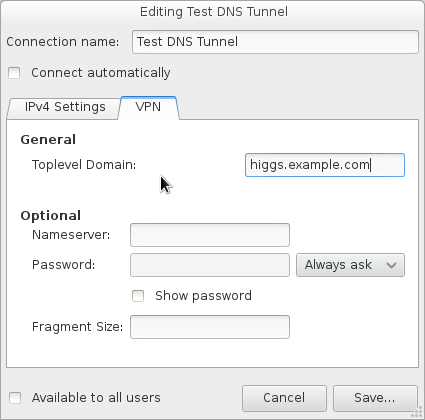
During FOSDEM I finally got around to hack on a iodine plugin for network manager. Given a suitably prepared server on the other end this allows you to tunnel connections over DNS when all other traffic is firewalled. The basic configuration only needs the domain name set: Network Manager Iodine Configuration You can grab the sources from git.gnome.org, a Debian package is also available. This blog is flattr enabled.

26 January 2012

Guido G nther: git-buildpackage in experimental

I've started uploading snapshots of git-buildpackage to experimental recently. Here's a short list of what changed over the version in wheezy and sid: This blog is flattr enabled.

28 December 2011

Guido G nther: GNOME Prepaid Manager 0.0.3

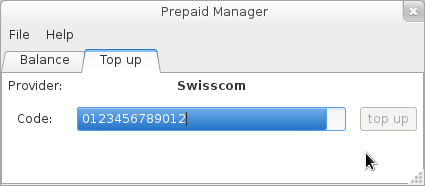
A recent trip to Switzerland made me dig out my prepaid card for UMTS usage again. This resulted in some minor enhancements for Prepaid Manager. The new release handles disabled and missing modems more reliably. It also has some visual feedback if we know the length of the top up code: GNOME Prepaid Manager screenshot This blog is flattr enabled.

13 November 2011

Guido G nther: Testing libvirt and KVM/QEMU with libvirt-tck

Debian's libvirt in unstable finally passes the Technology Compatibility Kit (libvirt-tck) for qemu:///system:
Files=59, Tests=1579, 315 wallclock secs ( 0.77 usr  1.02 sys + 31.40 cusr 10.14 csys = 43.33 CPU)
Result: PASS
We're running libvirt's internal test suite since 0.9.0 but this doesn't launch any real virtual machines to check things like suspend, resume, snapshotting, migration and it doesn't create storage pools and volumes or networks. This means a lot of testing was done manually with each release. libvirt-tck provides a framework to perform these kinds of integration testing between libvirt and it's drivers, comes with hundreds of testcases already and it's easy to set up since it's available in experimental:
apt-get install -t experimental libvirt-tck
Edit /etc/libvirt-tck/default.cfg if you don't want to use the default connection URI. Then just run libvirt-tck:
libvirt-tck
Since this is supposed to stress libvirtd and the hypervisor and since it creates and deletes storage pools, networks and virtual machines it's recommended to run this on a dedicated system to make sure the tests don't blow away any precious config. If a test fails one can debug that single test using:
LIBVIRT_TCK_CONFIG=/etc/libvirt-tck/default.cfg prove --verbose /usr/share/libvirt-tck/tests/hooks/051-daemon-hook.t
This already revealed errors in our package like a missing parted build dependency breaking the creation of disk based storage pools, bugs in libvirt, crashes in QEMU and minor errors in the test suite itself. We're currently cheating a bit since the tests for hooks and nwfilter are currently disabled due to license problems with the used Perl modules. libvirt-tck can easily be integrated into Jenkins since it can now use libtap-formatter-junit-perl to generate JUnit XML. To do so simply configure a free-style software project to execute these commands:
rm -f libvirt-tck.xml
sudo libvirt-tck --timer --format junit --force > libvirt-tck.xml
allow Jenkins to run libvirt-tck as root
jenkins ALL=(ALL) NOPASSWD: /usr/bin/libvirt-tck --timer --format junit --force
and configure it to publish a JUnit test result report. Currently I'm only running the tests for qemu:///system so any help running and debugging this for LXC, VirtualBox or XEN is very welcome. Many thanks go to Salvatore Bonaccorso for packaging the missing Perl modules needed by libvirt-tck.

14 August 2011

Guido G nther: GNOME Prepaid Manager 0.0.2

The new release switches to GDBus and adds an application icon. Together with the recently released Modem Manager 0.5 it's now able to fetch the balance information via USSD on Huawei and ZTE modems as well. GNOME Prepaid Manager Icon This blog is flattr enabled.

29 July 2011

Guido G nther: Puppet Git Hooks

During todays very interesting Puppet Skills Exchange given by Christian Hofstaedtler at Debconf 11 it was recommended to syntax check puppet manifests in git commit hooks. Since I wanted to do the same some time ago and I couldn't find anything that does manifests, ruby and erb I wrote some hooks that can be either used on commit or on the remote site when receiving the update. The git archive of this can be found at:
git clone git://honk.sigxcpu.org/git/puppet-helpers.git
This blog is flattr enabled.

24 June 2011

Guido G nther: Squeeze Debian Installer Images for SGI Indy and SGI O2

Due to two totally different bugs in tip22 the d-i netinstall images for IP22 (SGI Indy) and IP32 (SGI O2) won't boot the installer correctly. Tip22 is responsible for merging a minimal loader, kernel and initramfs into a single ELF or ECOFF binary, depending on the architecture. This can then be fetched by the machine's ARC PROM via tftp. A fixed tip22 has been uploaded to unstable and updated images are available from here until we can get this fixed via stable-proposed-updates. This blog is flattr enabled.

31 May 2011

Guido G nther: GNOME Prepaid Manager, ModemManager and Huawei modems

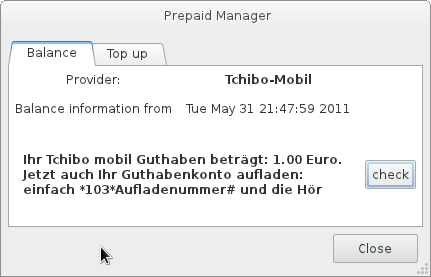
I've made a first release of GNOME Prepaid Manager a couple of days ago after switching to GTK+3, GSettings and PyGObject's GObject introspection but it still wasn't that useful since the very common Huawei chipsets (present in many UMTS USB sticks) weren't working due to some missing code in ModemManager. GNOME Prepaid Manager screenshot Thanks to Dan's great description I just got around to add that which should make ppm useful to more people. This blog is flattr enabled.

12 April 2011

Guido G nther: Bits from the 4th Debian groupware meeting

This went out to d-d-a a couple of days ago already but I figured that this might be of interest here too: The fourth Debian Groupware Meeting was held in the LinuxHotel, Essen, Germany. This is a short summary of what happened during the weekend:

11 March 2011

Guido G nther: git-buildpackage tip #4: creating remote repositories

In order to ease creation of remote repositories to publish your Debian packaging work git-buildpackage ships gbp-create-remote-repo: If you run
gbp-create-remote-repo --remote-url-pattern='ssh://git.debian.org/home/users/agx/public_git/%(pkg)s.git'
from inside a git repository it will create a remote repository on git.debian.org in the given directory, push your debian, upstream and pristine-tar branches into it and set up branch tracking so you can easily use gbp-pull or git pull to update your local repository from there. '%(pkg)s' will be replaced by the source packages name. If you want to be more explicit you can use:
gbp-create-remote-repo --remote-url-pattern='ssh://git.debian.org/home/users/agx/public_git/foo.git'
so no substitution will take place. In case you only want to push to that repository but not pull from there you can use the --no-track option so gbp-create-repo won't set up any branch tracking. If you specify the remote-url-pattern via gbp.conf calling:
gbp-create-remote-repo
is enough to create a repo on your favorite git server. The default is to create new repositories in the collab-maint repository on alioth.debian.org. This feature is available in your $PATH since 0.5.16 (it was shipped in examples/ before) and was inspired by the Debian OCaml Maintainers dom-new-git-repo work. This blog is flattr enabled.

23 January 2011

Guido G nther: git-buildpackage tip #3: disabling desktop notifications

Since waiting for long running builds is boring and having to check if the build already finished distracts one from doing other stuff, git-buildpackage 0.5.16 reports the build status of a package via desktop notifications if python-notify is installed: notification with gnome-shell notification To disable this feature use:
[git-buildpackage]
notify = off
in your ~/.gbp.conf. This blog is flattr enabled.

24 August 2010

Guido G nther: Using git svn and git-buildpackage to build packages maintained in Subversion

Many team maintained packages in Debian are maintained in Subversion which makes a lot of sense if people agreed on a common workflow. If you want to use git to work on these packages you can still do so with a bit of configuration without changing anything for the other team members. Let's take system-config-printer as example. git-svn can be used to checkout the svn repository:
git svn clone svn+ssh://svn.debian.org/svn/pkg-gnome/ -T packages/unstable/system-config-printer -t tags/system-config-printer system-config-printer
Since the pkg-gnome team keeps all the packages in one huge SVN repository and splits the directories by release first and then by package the above command uses -T to point git-svn to system-config-printer's trunk and -t to point it to the tags directory. In simpler repositories where trunk, branches and tags are subdirectories of the same base directory using --stdlayout instead is enough. Since in SVN based packaging the upstream sources usually aren't kept in the repository git-buildpackage needs to know where to find them and how to combine things in the build-directory:
cd system-config-printer
cat <<EOF >.git/gbp.conf
[git-buildpackage]
# Build in a separate build-area
export-dir = ../build-area/
# Look for tarballs in ../tarballs
tarball-dir = ../tarballs/
# Overlay the upstream sources on top of it
overlay = True
# Don't use pristine-tar
pristine-tar = False
# Compression type of the tarball
compression = bzip2
Like with svn-buildpackage the orig-tarball is expected to be found in ../tarballs where you should put it now e.g. using the get-orig-source target of debian/rules (yes, git-buildpackage should support this implicitly). You can then work on the package as usual using all the nifty git commands like git-rebase, etc. and build the package (in this case using git-pbuilder):
git-buildpackage --git-pbuilder
or if you don't want to export the current branch's HEAD of your git repository but your working copy (which might contain uncommitted changes) to the build-area instead use:
git-buildpackage --git-pbuilder --git-export=WC
The built packages can then be found in ../build-area. Once the package is ready pushing the changes into the SVN remote repository is as simple as:
git svn dcommit
git svn tag -m"Tagging system-config-printer (1.2.3-0.2)" 1.2.3-0.2
The last command appropriately tags the new version. This saves a bit of typing. In order to fetch changes others have made use:
git svn rebase
Flattr this

21 August 2010

Guido G nther: Back from Debconf 10

Chris reports back to Debian duty:
Since one week I'm back from NYC where I enjoyed a very nice Debconf. It was my second one after last year in C ceres. When I unpacked all my luggage - three weeks in the US need some stuff - I found these cute green guys between my clothes. Did they break their UFO and use my airplane to travel with me? Anyway. Thanks to all who made Debconf10 in New York possible. It was a great conference! And last but not least: "Happy Squeeze Freeze"'
I too enjoyed DC10 a lot.
cute green guys

13 June 2010

Guido G?nther: Slides of git-buildpackage talk at Mini Debconf 2010 in Berlin

The slides of my talk about git-buildpackage at the Mini Debconf 2010 in Berlin are now available. It was a great conference that I really enjoyed being at. Thanks a lot to all who made that event possible and happen!

13 April 2010

Guido G?nther: Simple git data provider for Zeitgeist

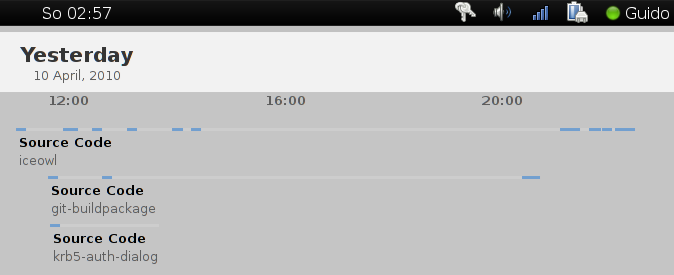
gnome-activity-journal recently entered Debian and it could become a great tool to keep track of hacking activities. The underlying zeitgeist can log these and other events and make the information available via DBus. I couldn't find a data provider that feeds the information about Git commits to it so I wrote a simple post commit hook. This way one can easily see when one worked on a source repository: gnome-activity-journal Now is there a nice way to store additional information like current branch or commit message along with that?

23 January 2010

Guido G nther: Iceowl extensions 1.0b1 in experimental

Release 1.0beta1 of Iceowl-extension (also known as Lightning), the calendaring extensions for Icedove, is now available in experimental. This version works with Icedove 3.0.1 which also lives in experimental at the moment. Open TODOs for Iceowl: Iceowl's current packaging git is here:
http://git.debian.org/?p=users/agx/iceowl.git
Any help on the above issues is greatly appreciated. Other open tasks that need fixing in order to get things in shape for Squeeze:

10 November 2008

Riku Voipio: When Linux doesn't mean freedom

I actually think it's a bit of an insult if people think of Motorola's EZX or MAGX (and now Android) phones as "Linux phones". Because all the freedoms of Linux (writing native applications against native Linux APIs that Linux developers know and love, being able to do Linux [kernel] development) are stripped.
-
http://laforge.gnumonks.org/weblog/2008/10/23/#20081023-android">
http://laforge.gnumonks.org/weblog/2008/10/23/#20081023-android">Harald Welte


This is something that has worried me too for quite a while. For years we have now had Linux phones available in form or another (well, mostly in far away countries you happen not to be at). Yet with the exception of openmoko none of them allow native application development. Yet all the same time you can go to the nearest phone shop and grab HTC windows CE phone or a Nokia Symbian phone, which actually give you the freedom to writing and running your own software on them.

Now we have the situation that HTC's most locked device* is their only Linux device - The Android G1.

Incidentally, you can install Debian/armel on T-mobile G1, but only until Google engineers manage to fix the hole that gives you r00t.

*The only one that doesn't allow native app development.

18 June 2008

MJ Ray: 7 Reasons Why Firefox 3 Download Day Sucks

Download Day 2008
  1. It's every where on TV and in print, even in Esperanto, which doesn't even have an official translation - only a third-party add-on Esperanto language pack.
  2. It was late even for the US and after most of Europe finished work AFAIK.
  3. There's no official bittorrent.
  4. There's no link to the source code from the main download page as far as I can tell. It may be mostly free software, but it feels like MozCorp don't want pesky users changing things.
  5. It brings more changes for webmasters (which is another reason I code to standards whenever possible, but I bet some of the free software web applications we use will need upgrades).
  6. It might be the "most stupid world record ever" (or at least useless) and comes just as some browsers move away from the Gecko engine.
  7. ...and all this irritation came before I've even built and installed the damn thing!
Seriously: the browser looks like a big improvement from Firefox 2, but there are so many niggles with this download day idea...

Next.

Previous.