Search Results: "Stefano Zacchiroli"

5 August 2012

Stefano Zacchiroli: bits from the DPL for July 2012

Monthly DPL bits, fresh from the oven.
Tip to feel good about the release #476: before reading this, grab and fix one of the RC bugs affecting Wheezy. Done? Now you're ready for a slightly less exciting report of DPL activities. Highlights Assets Logo & trademark Note that the actual logo relicensing should be done by SPI, via their board, upon request of mine (as Debian Project liaison). We won't make it for the next SPI board meeting, as it is on 4 days away. But we can aim for the subsequent meeting, on September 13th. If all goes well (big "if"), we will enjoy a DFSG-free logo after that date. Internal organization Recent flurry of re-organization in the tech-ctte --- which I somewhat triggered pushing for periodic meetings --- seems to be proceeding well. I'm very happy about it, as we all need to trust that tech-ctte decisions will be not only sound, but also prompt. If you're interested into this topic, some recent evidence of the ongoing reorganization and its result can be found in their DebConf12 BoF, minutes of the last meeting, a set of forthcoming GRs, and the recent great decision of posting decisions results to d-d-a (as it happened for node/nodejs). Kudos to tech-ctte members for the recent activism! I haven't worked on it myself directly, but I highlight Enrico's work on server side archival of NM conversations. It has the potential of enabling automatic detection of stuck NM processes. I'm a bit rusty as AM now, but I think missing that ability is one of the main remaining causes of frustration when joining Debian. So, if you are an AM, please opt-in and use this feature with your appicants. If you are not an AM why not? :-) Miscellanea Some misc legal stuff: and some misc "political" stuff: Happy RC bug squashing,
Cheers.
PS the boring day-to-day activity log for July 2012 is available at master:/srv/leader/news/bits-from-the-DPL.txt.201207

6 July 2012

Stefano Zacchiroli: DebConf BoF HOWTO - redux - redux

If you're organizing a DebConf12, and especially if you're new to it, please have a look at the DebConf BoF HOWTO. One of its main take away messages is: don't be exclusive, think of the kittens. Since last year, and to the might powers of DSA (and their kittens), we now have a more stable place for the gobby server: gobby.debian.org. I've just amended the howto to point to that, and updated the info about which gobby package to use (nowadays clarified, thanks to Phil). Enjoy your BoF-s!

4 July 2012

Stefano Zacchiroli: bits from the DPL for June 2012

Monthly DPL bits, fresh from the oven^W^W^W hot from DebConf12, and just posted to d-d-a.
Howdy from DebConf12. It's hot, but it's also time to bother you again with a (not so) brief DPL activity report, this time for June 2012. Time-based freeze: DONE, short freeze: TODO Two highlights for this month. First, you've probably noticed Wheezy is now frozen, YAY. This is huge achievement for the release, but also for the project. It's the first time we do a time-based freeze, and it took some quite heated discussion at the beginning of the release cycle to decide to do this. And we did it properly: respecting the planned month and narrowing down the period later. This exercise has hopefully helped both DDs in their package planning and our upstreams in targeting Wheezy with stable releases of their software. Kudos to the release team for their coordination work! Now we've the second part still TODO: releasing Wheezy, without RC bugs, with a freeze period as short as possible. See the beginning of my last "bits from the DPL" mail for my usual song and dance :-P on how to deliver that, together. DebConf12 A lot of us will attend DebConf12. Enjoy it! ... and take the chance to both have fun and make great plans for Debian's future. But remember that "if it didn't happen on a mailing list, it didn't happen". Not all of us will be lucky enough to attend DebConf (in person or remotely). Make sure that those who don't can take part in your team decisions and get informed of what is going to happen here. Politics Zack's spring tour I spent a significant part of June doing Debian talks ins some sort of "spring tour" between Italy and France. In particular: Many thanks to the organizers of these events for inviting and sponsoring me (as well as other Debian people, in the ESRF case) and for their interest in Debian. Sprints Assets Discussions Some relevant discussions for project evolution has been going on in June and I took part into them. You might want to have a look at them: Misc Cheers.
PS the boring day-to-day activity log for June is available at master:/srv/leader/news/bits-from-the-DPL.txt.201206

2 July 2012

Stefano Zacchiroli: DebConf no sporran 12

It's that time of the year again. No, not only the Debian biyearly freeze that has just happened, again (YAY!). It's DebConf time again. Yesterday night I arrived in Managua, Nicaragua, for DebConf12. I'm still jetlagged a bit, but the first impression is great. And that impression is also very green, shockingly green. The city is gorgeous: full of trees and plants (well, at least compared to my metropolitan European standards), and the campus of Universidad Centroamericana where the conference is hosted is even more so. Also, it's a great pleasure to have DebConf in an university campus where students are still swarming. My only reason for sadness thus far. While I did bring my traditional Debian kilt at DebConf, I discovered this morning that I forgot my sporran at home :-(
So if you don't see me wearing my kilt at this DebConf often, that's why

16 June 2012

Vincent Bernat: GPG Key Transition Statement 2012

I am transitioning my GPG key from an old 1024-bit DSA key to a new 4096-bit RSA key. The old key will continue to be valid for some time but I prefer all new correspondance to be encrypted with the new key. I will be making all signatures going forward with the new key. I have followed the excellent tutorial from Daniel Kahn Gillmor which also explains why this migration is needed. The only step that I did not execute is issuing a new certification for keys I have signed in the past. I did not find any search engine to tell me which key I have signed. Here is the signed transition statement (I have stolen it from Zack):
-----BEGIN PGP SIGNED MESSAGE-----
Hash: SHA256,SHA1
I am transitioning GPG keys from an old 1024-bit DSA key to a new
4096-bit RSA key.  The old key will continue to be valid for some
time, but I prefer all new correspondance to be encrypted in the new
key, and will be making all signatures going forward with the new key.
This transition document is signed with both keys to validate the
transition.
If you have signed my old key, I would appreciate signatures on my new
key as well, provided that your signing policy permits that without
reauthenticating me.
The old key, which I am transitional away from, is:
  pub   1024D/F22A794E 2001-03-23
      Key fingerprint = 5854 AF2B 65B2 0E96 2161  E32B 285B D7A1 F22A 794E
The new key, to which I am transitioning, is:
  pub   4096R/353525F9 2012-06-16 [expires: 2014-06-16]
      Key fingerprint = AEF2 3487 66F3 71C6 89A7  3600 95A4 2FE8 3535 25F9
To fetch the full new key from a public key server using GnuPG, run:
  gpg --keyserver keys.gnupg.net --recv-key 95A42FE8353525F9
If you have already validated my old key, you can then validate that
the new key is signed by my old key:
  gpg --check-sigs 95A42FE8353525F9
If you then want to sign my new key, a simple and safe way to do that
is by using caff (shipped in Debian as part of the "signing-party"
package) as follows:
  caff 95A42FE8353525F9
Please contact me via e-mail at <vincent@bernat.im> if you have any
questions about this document or this transition.
  Vincent Bernat
  vincent@bernat.im
  16-06-2012
-----BEGIN PGP SIGNATURE-----
Version: GnuPG v1.4.12 (GNU/Linux)
iQIcBAEBCAAGBQJP3LchAAoJEJWkL+g1NSX5fV0P/iEjcLp7EOky/AVkbsHxiV30
KId7aYmcZRLJpvLZPz0xxThZq2MTVhX+SdiPcrSTa8avY8Kay6gWjEK0FtB+72du
3RxhVYDqEQtrhUmIY2jOVyw9c0vMJh4189J+8iJ5HGQo9SjFEuRrP9xxNTv3OQD5
fRTMUBMC3q1/KcuhPA8ULp4L1OS0xTksRfvs6852XDfSJIZhsYxYODWpWqLsGEcu
DhQ7KHtbOUwjwsoiURGnjwdiFpbb6/9cwXeD3/GAY9uNHxac6Ufi4J64bealuPXi
O4GgG9cEreBTkPrUsyrHtCYzg43X0q4B7TSDg27j0xm+xd+jW/d/0AlBHPXcXemc
b+pw09qLOwQWbsd6d4bx22VXI75btSFs8HwR9hKHBeOAagMHz+AVl5pLXo2rYoiH
34fR1HWqyRdT3bCt19Ys1N+d0fznsZNFOMC+l23QyptOoMz7t7vZ6GbB20ExafrW
+gi7r1sV/6tb9sYMcVV2S3XT003Uwg8PXajyOnFHxPsMoX9zsk1ejo3lxkkTZs0H
yLZtUj3iZ3yX9e2yfv3eOxitR4+bIntEbMecnTI9xJn+33QTz/pWBqg9uDosqzUo
UoQtc6WVn9x3Zsi7aneDYcp06ZdphgsyWhgiLIhQG9MAK9wKthKiZv8DqGYDOsKt
WwpQFvns33e5x4SM4KxXiEYEARECAAYFAk/ctyEACgkQKFvXofIqeU5YLwCdFhEL
P7vpUJA2zv9+dpPN5GLfBlcAn0mDGJcjJpYZl/+aXEnP/8cE0day
=0QnC
-----END PGP SIGNATURE-----
For easier access, I have also published it in text format. You can check it with:
$ gpg --keyserver keys.gnupg.net --recv-key 95A42FE8353525F9
gpg: requesting key 353525F9 from hkp server keys.gnupg.net
gpg: key 353525F9: "Vincent Bernat <bernat@luffy.cx>" not changed
gpg: Total number processed: 1
gpg:              unchanged: 1
$ curl http://vincent.bernat.im/media/files/key-transition-2012.txt   \
>       gpg --verify
To avoid signing/encrypting with the old key who share the same email addresses than the new one, I have saved it, removed it from the keyring and added it again. The new key is now first in both the secret and the public keyrings and will be used whenever the appropriate email address is requested.
$ gpg --export-secret-keys F22A794E > ~/tmp/secret
$ gpg --export F22A794E > ~/tmp/public
$ gpg --delete-secret-key F22A794
sec  1024D/F22A794E 2001-03-23 Vincent Bernat <bernat@luffy.cx>
Delete this key from the keyring? (y/N) y
This is a secret key! - really delete? (y/N) y
$ gpg --delete-key F22A794E
pub  1024D/F22A794E 2001-03-23 Vincent Bernat <bernat@luffy.cx>
Delete this key from the keyring? (y/N) y
$ gpg --import ~/tmp/public
gpg: key F22A794E: public key "Vincent Bernat <bernat@luffy.cx>" imported
gpg: Total number processed: 1
gpg:               imported: 1
gpg: 3 marginal(s) needed, 1 complete(s) needed, classic trust model
gpg: depth: 0  valid:   2  signed:   0  trust: 0-, 0q, 0n, 0m, 0f, 2u
gpg: next trustdb check due at 2014-06-16
$ gpg --import ~/tmp/secret
gpg: key F22A794E: secret key imported
gpg: key F22A794E: "Vincent Bernat <bernat@luffy.cx>" not changed
gpg: Total number processed: 1
gpg:              unchanged: 1
gpg:       secret keys read: 1
gpg:   secret keys imported: 1
$ rm ~/tmp/public ~/tmp/secret
$ gpg --edit-key F22A794E
[...]
gpg> trust
[...]
Please decide how far you trust this user to correctly verify other users' keys
(by looking at passports, checking fingerprints from different sources, etc.)
  1 = I don't know or won't say
  2 = I do NOT trust
  3 = I trust marginally
  4 = I trust fully
  5 = I trust ultimately
  m = back to the main menu
Your decision? 5
Do you really want to set this key to ultimate trust? (y/N) y
I now need to gather some signatures for the new key. If this is appropriate for you, please sign the new key if you signed the old one.

9 June 2012

Stefano Zacchiroli: bits from the DPL for May 2012

Just posted to d-d-a, here are the monthly DPL bits.
Dear project members,
here's the periodic report of what has happened in DPL land, this time during May 2012. It's briefer than usual, as this year I've enjoyed the lovely French habit of frequent holidays during the month of May. Highlight First highlight for this month is an invitation to us all. We're now in June and the Wheezy freeze is literally a few days away. The RC bugs count is moving in the right direction, but it's still stellar if we want to ensure a short freeze. And a short freeze is of paramount importance: it'll reduce the time during which we can't implement great plans for the future, increase the "freshness" of software we'll ship with Wheezy, and reduce the inconveniences for those who run the testing suite due to its nice "rolling" feature. So please set out some regular time to do RC bug squashing, by providing patches and doing NMUs. Releasing Wheezy is not something that could be outsourced to the Release Team, it's a collective responsibility that kicks in as soon as our own packages are RC bug free (which they already are, right? :-)) The second highlight is more on the internal structure camp. As mentioned last month, I've discussed with the tech-ctte insisting a bit to set up periodic IRC meetings, to ensure outstanding issues get periodically reviewed. At the end of May the first IRC meeting has happened, and has been very productive. See the minutes. Another one has been scheduled, trying to setup a monthly cadence, for the end of June. Many thanks to all tech-ctte members who have took part in and helped with the meeting organization. Communication I've given an interview to iTWire, answering a number of questions about several past and future Debian challenges. Discussions The ongoing discussion to harmonize packaging of multimedia software between the official Debian archive and the unofficial debian-multimedia.org archive (dmo) has progressed. I've tried to help the two groups reaching an agreement on which packages belong where, so that both duplicate packaging efforts and user inconveniences are minimized. That seems not to have worked and dmo maintainers have simply announced that they will move away from the current domain name to a new one that does not include "debian" in its name. Sprints There will be a Debian Science sprint in June, co-located with the broader Debian Science event organized by European Synchrotron Radiation Facility (ESRF) in Grenoble. I've confirmed my attendance for the opening talk of the conference day. ESRF organizers have kindly sponsored travel for all Debian attendees, many thanks to them! Another sprint will happen next week-end in Paris, this time by the i18n/l10n team. I've approved the corresponding tentative budget for travel sponrship for ~2'000 EUR. Other expenses Hardware replacement plans go on. We've ordered SSDs (for ~3'000 CAD) for recently bought machines meant to replace bugs-mirror, bugs-master, and udd. On the "small emergencies" front, we also had to replace failing disks on wagner (1/2 of alioth), for as little as 100 GBP. Miscellanea Happy Wheezy freeze,
and RC bugs squashing!
PS the boring day-to-day activity log for May is available at master:/srv/leader/news/bits-from-the-DPL.txt.201205

6 May 2012

Stefano Zacchiroli: overlapping bits from the DPL for April 2012

Just posted to d-d-a, here is the monthly report about my DPL activities.
Dear project members,
last bits of the past DPL term and first bits of the current term, all in one. Here is a report of what has happened in DPL land last April. Highlight: call for DPL helpers Before the report, though, let me point out that your friendly neighborhood DPL could use some help. As discussed during campaign, there are some intrinsic transparency and scalability limits in the DPL institution, when run by a single person. Before trying something new to fix that, I'd like to give a last try to an old "tactic": calling for help. If you're considering running for DPL or if you're simply interested in the job the DPL does and willing to help with that, please let me know. Ideally, if I find a group of people I'm happy to work with, I'd like to set up periodic IRC meetings with all "DPL helpers" to publicly discuss items in the DPL agenda and share the work-load. Ongoing discussions A big topic of last month has been the proposal by Francesca Ciceri to publish a diversity statement for the Debian Project. After a lively discussion on -project, we reached consensus on a text, and I've been happy to help with that. To finalize statement publication we now need to vote on it with a GR. I've helped drafting a corresponding GR proposal that has already been posted to -vote by Francesca. A final one, looking for seconds, will be posted there soon. Wrapping up March discussions on a revenue sharing agreement with DuckDuckGo, I've announced my intention to finalize the agreement and have done so shortly thereafter. The Iceweasel maintainer has deployed the corresponding search engine query string and other web browser maintainers could do the same, if they want to. In April I've also spent some time to move forward the long running conflict on Python maintenance, reported to the tech-ctte more than 2 years ago. With the help of people on the -python mailing list, I've now submitted to the tech-ctte an up to date list of potential maintenance teams. I hope the tech-ctte now have all the information needed to come to a decision. Speaking of which, I'm also discussing with tech-ctte members the possibility of having periodic ctte meetings; the idea is to ensure that outstanding issues are periodically reassessed, improving the reliability of tech-ctte decision times. I've also discussed at length with members of the pkg-multimedia-maintainers team the relationships with the unofficial debian-multimedia.org (d-m.o) repository, that have been a cause of tension for Debian multimedia users and maintainers for quite some time. On behalf of the team and of the Project I've now reached out to the d-m.o maintainer, hoping to come to some sort of amicable agreement on which packages belong where. Hardware replacement As anticipated in last report, I've started approving hardware purchases to implement the yearly hardware replacement plan prepared by DSA. During April I've approved requests to buy servers to replace the machines running the bugs-master, bugs-mirror, and UDD services. The total expected expenditure is about 15'000 USD. Communication I've delivered my classic Debian "18^W 19 years" talk at UNIVPM, a polytechnic university in center Italy; slides are available. I've then been contacted by people from the European Synchrotoron in Grenoble who, beside having recently migrated their infrastructure to Debian, are looking into organizing a workshop on Debian usage for large science facilities. I've been happy to help out providing a list of potential topics and speakers for the event. Also as anticipated last month, the Debian Project has been present at the OpenStack summit. Loic Dachary has represented Debian at the event and provided a nice report about his experience there. Speaking of which, I've also coordinated a news release about the availability of cloud technologies in Wheezy, taking the chance to point out the relationships between what Debian stands for and the ability to deploy your own private cloud. Sprints April has been a rather calm month on the sprint front, with the notable exception of the I18n team who is organizing a sprint for June in Paris. Miscellanea Thanks for reading thus far,
HDH! (Happy Debian Hacking)
PS the boring day-to-day activity log for April is available at master:/srv/leader/news/bits-from-the-DPL.txt.201204

27 April 2012

Stefano Zacchiroli: interview for la Repubblica

Debian, free software, and critical consumption As mentioned in my last report, about a month ago I've been interviewed (in Italian) for la Repubblica, a major general-interest Italian newspaper. Matteo Cortese has kindly contributed an English translation of the interview (thanks!), which I've just made available. If you're a Free Software enthusiast, there is probably nothing new in there for you. But for a different public the story is quite another. In many countries it is still very difficult to find room on general-interest newspapers to explain why Free Software matter to people, and how not caring about it will lead consumers to progressively lose their rights while software become more and more common in the stuff they buy. So many thanks to journalist like Giulia Belardelli who show a genuine interest in these topics and try to bring them "to the masses".

Pietro Abate: Learning from the Future of Component Repositories - CBSE 2012

Learning from the Future of Component Repositories ( Pietro Abate, Roberto Di Cosmo, Ralf Treinen and Stefano Zacchiroli ) has been accepted to be presented at CBSE 2012 (26-28 June, Bertinoro, Italy)

Abstract
  An important aspect of the quality assurance of large component repositories
  is the logical coherence of component metadata. We argue that it is possible
  to identify certain classes of such problems by checking relevant properties
  of the possible future repositories into which the current
  repository may evolve. In order to make a complete analysis of all possible
  futures effective however, one needs a way to construct a finite set of
  representatives of this infinite set of potential futures. We define a class
  of properties for which this can be done.
  We illustrate the practical usefulness of the approach with two quality
  assurance applications: (i) establishing the amount of  forced upgrades''
  induced by introducing new versions of existing components in a repository,
  and (ii) identifying outdated components that need to be upgraded in order to
  ever be installable in the future. For both applications we provide
  experience reports obtained on the Debian distribution.
The tools presented in this paper (outdated and challenges) are already in Debian as part of the 'dose-extra' package.

22 April 2012

Stefano Zacchiroli: deferred bits from the DPL for March 2012

Posted a week ago, already deferred back then, this report is even more deferred now! But as there are people interest in knowing what the "DPL job" is about even among non debian-devel-announce subscribers, here is a blog-conveyed reproduction, for the records.
Dear project members,
here is my monthly DPL activity report, this time for last March. It is delayed by a couple of weeks because, myself being both incumbent and candidate DPL, I preferred not to use d-d-a during the voting period unless really needed. Apologies for the delay (or the unneeded paranoia, you name it). As a side effect of the delay, the results of the DPL election are now known. I'd like to thank all the people who took part in the elections: voters, people who asked questions on -vote, the secretary, and obviously Gergely and Wouter, without whom the campaign wouldn't have allowed to discuss relevant aspects of Debian "politics". Thanks for your trust. I'll do my best to match your expectations. ... and just to remind you what you've just asked for, here goes the BigMonthlyBlurb! Highlight: long-term hardware replacement planning The highlight for this month is long term planning of hardware replacement. It's something I've been discussing with DSA for quite a while and on which DSA has worked hard during the recent sprint. As a result, we now have a quite ambitious 5-year hardware replacement plan that will guarantee that all machines in production are under warranty at any given time (with the nice side effect of generally better performances, as they go hand in hand with newer hardware). The current estimated cost per year is 29'000 USD. That does not yet include buildds and porter-boxes, so it is expected to increase a bit to cover all our hardware needs. But we expect it not increase too much, as we tend to get explicit hardware donations to cover arch-specific needs. Given the current state of Debian finances and donation trends, the plan looks sustainable for at least 2-3 years. But this assessment still needs to be refined as soon as, together with the auditors, we'll manage to obtain the history of past Debian transactions, in particular from SPI. We've been waiting for this for about 5 months now, but I'm positive it could become a reality in the next weeks. In the meantime, it is surely safe to start with the plan for the next 1-1.5 years, so I'll give green light to DSA for the first acquisitions as soon as they're ready for it. When implemented, this plan will increase our ability to rely on hardware. But it also means we will need to become a bit more organized about fund-raising. The discussion started with the sprint report has some insights about how to do that. As part of this, we'll also need to share resources (e.g. contact databases, people, etc.) among the yearly DebConf fund-raising initiatives and the initiatives mentioned in the aforementioned discussion. Ongoing discussions Summer of Code Debian has been accepted as an organization for the Google Summer of Code. At the time these bits go out, the student application deadline has also elapsed. In March I've contributed a few project ideas and chased potential mentors for them, when I thought the project could be important for Debian and the prospective student. I'm happy that one (a dak building block needed for the implementation of PPAs and more) has found both mentors and students. We'll see if any of the corresponding student proposal is retained and how it goes. Communication I've given an interview, about Debian and Free Software in general, to La Repubblica, one of the major newspapers in Italy. The interview is available online, but only in Italian. If some kind (and Italian-speaking) soul would like to translate it into English, I'll be happy to publish the translation as well. (update 22/04/2012: Matteo Cortese has contributed an English translation of the interview, which I'll make available shortly) Legal stuff In order to transfer ownership of the Debian trademark in Japan to SPI, I've contacted the current owners (all Japanese Debian Developers or contributors) to do the needed paperwork. I've been blessed by the help of Kenshi Muto that has taken the matter in his hands. He is now navigating through Japanese trademark procedures, a subject neither myself nor SPI lawyers were familiar with. Thanks also to Jonathan McDowell who has done the needed paperwork, SPI-side. Sprints Plenty of sprints and sprint reports in March!: Debian Med, DSA, DAM/FrontDesk. Everything should also be available from the wiki sprint page where you can find info to organize your team sprint. Assets miscellanea Cheers.
PS the boring day-to-day activity log for March is available at master:/srv/leader/news/bits-from-the-DPL.txt.201203

5 April 2012

MJ Ray: Debian Project Leader Election 2012

Voting is open in the Debian Project Leader Elections 2012 So now I need to figure out who to vote for. This year I didn t take part in the discussions (all my spare time was bought, basically). The platforms are linked from the Debian Project Leader Elections 2012 page above and the key discussions were: Thanks to everyone who asked these great questions. So, what do you think?

31 March 2012

Stefano Zacchiroli: mutt-notmuch is dead

long life to notmuch-mutt As a consequence, no further separate releases of mutt-notmuch will be made. Future releases (of notmuch-mutt) will happen as part of notmuch. In other news, several changes have been implemented in notmuch-mutt wrt mutt-notmuch 0.2:
Many thanks to David Bremner (for shepherding my changes in) and to Ben Boeckel (whose desire to package mutt-notmuch in Fedora made me kick Debian bug #628018, this time for real).

14 March 2012

Stefano Zacchiroli: not a catchy headline

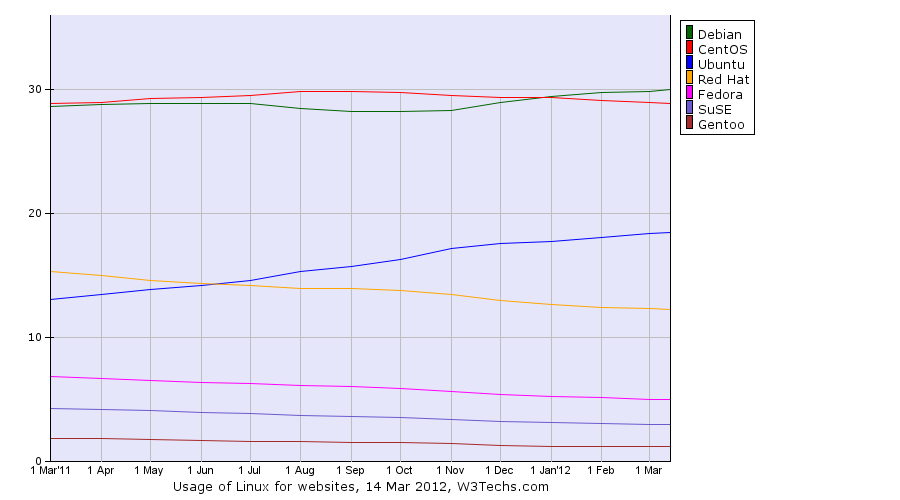
As we're doing trends today, I got curious about Debian. I don't particularly care about popularity contests other than popcon, and Debian choices surely aren't driven by them. But hey, curiosity is curiosity, right? So, here are today's w3techs trends for websites using GNU/Linux, with all lines shown:
Debian: 30%; CentOS: 28,9%; Ubuntu: 18,4%; Red Hat: 12,2%; Fedora: 5%; SuSE: 3%; Gentoo: 1,2%
(As thou shall always read methodologies before stats, here is the technologies overview page.) Debian is the top entrant with 30% of the websites using GNU/Linux. What I find interesting is that Debian has jumped at first place in January 2012, significantly after the release of our current stable release, Squeeze, that dates back to February 2011. It is also interesting to see community distros (Debian and CentOS) starkly ahead of commercially backed distros. That is what I find most fascinating about our projects. Whether that will remain the case or not is, for me, one of the big questions of the decade for the self-determination of Free Software communities.

12 March 2012

Stefano Zacchiroli: debian contributions to the linux kernel

The statistics of the "who wrote Linux x.y.z" series date back to at least 2.6.20. According to my experience talking with users and Free Software enthusiasts, those statistics really make a dent in the public perception of who is giving back upstream. Obviously, one should not take a single upstream, even if it is as important as the Linux kernel, as a measure of how much a given Free Software entity is giving back upstream overall. But users still seem to be fascinated by them. As a result, I have often had to answer the question: why Debian doesn't show up on those statistics?. My answer has always been something along the lines that Debian Developers who maintain Linux kernel packages, the almighty Debian Kernel Team, do that mostly as part of their volunteer engagement in Debian. As a consequence, they do not earmark their contributions as if they worked for a company and they add up to the hobbyist count instead (although you can you can routinely spot individual Debian Kernel Team members among the most active contributors for specific Linux releases). The above is the true and honest answer. But every time I've given it, I couldn't help feeling that the user who asked went home with a "yeah, well" afterthought. If you don't want to take my word of it, fine. Here is what Greg K-H had to say about Debian contributions in a recent blog post about the stable Linux kernel:
I would personally like to thank the Debian kernel developers, specifically Ben Hutchings, Maximilian Attems, Dann Frazier, Bastian Blank, and Moritz Muehlenhoff. They went above and beyond what any "normal" developer would have done, ferreting patches out of the kernel.org releases and the different vendor kernels and bug tracking systems, backporting them to the 2.6.32 kernel, testing, and then forwarding them on to me. Their dedication to their user community is amazing for such a "volunteer" group of developers. I firmly believe that without their help, the 2.6.32 kernel would not have been the success that it was. The users of Red Hat and SuSE products owe them a great debt. Buy them a beer the next time you see them, they more than deserve it.
I'll take good care of following his wise advice. Please do the same.
(Thanks to Sylvestre for pointing me to Greg's blog post.)

4 March 2012

Stefano Zacchiroli: bits from the DPL for February 2012

Released a few hours ago, here is the monthly report of DPL activities for February 2012.
Howdy, dear Project Members,
here's another round of updates about what has happened in DPL land, this time during February 2012. Highlights Quit a bit of highlights for this month: Talks, interviews, and the like Sprints Plenty of sprints related news! It would be amazing to have an average of one sprint per month for 2012, and we're on good track for it. If you want to help, organize one for your team as documented on the wiki. Legal stuff Appointments In addition to the GSoC admins delegation (see above), I've agreed with former secretary Kurt Roeckx to reappoint him as a secretary for another year. Many thanks, Kurt! Miscellaneous Happy Debian hacking.
PS as usual, the boring day-to-day activity log is available at master:/srv/leader/news/bits-from-the-DPL.*

18 February 2012

Stefano Zacchiroli: GPL-d Debian software skew (?)

At FOSDEM, John Sullivan delivered an interesting talk titled Is copyleft being framed? to verify alleged claims on the decline of GPL-d software. (Slides are available.) The crux of the talk is the analysis he performed on the Debian archive to discover the amount of software we distribute that is covered by GPL, LGPL, or AGPL ("GPL-d" for short in the remainder). John's talk steps in an interesting and long running debate (a recent summary of which is available in this ITWire article). The most interesting part is the discrepancy among John's results and Blackduck's, which are often used to argue how the popularity of the GPL license is declining. That might be the case. Or not. The more analyses we do to find it out, the better. The underlying assumption on John's work is that Debian is a representative sample of the Free Software out there, which I think is a reasonable assumption. I find the analysis presented in the talk completely satisfactorily from a purely scientific point of view. The same cannot be said about Blackduck's result: both their methods and data are secret, making it impossible to reproduce their experiments. Highly unscientific. Still, John's results are surprising: as much as 87 percent of Lenny's packages and 93 percent of Squeeze's are GPL-d. That seems a lot. Puzzled about that, John discussed with me the issue before his talk, in search for pitfalls in his methods or data. Finding none, I pointed him to the almighty DktrKranz for some extra review; who found nothing either. To stay on the safe side, even during his talk John called for independent reviews of his results. What could be wrong? The tool used to gather the data is license-count from the debian-policy package. Input data are the debian/copyright files of all Debian source packages. If license-count is not bugged, our debian/copyright files might be. One thing that occurred to me only a few days ago is the habit of declaring a different license for Debian packaging (the files under debian/) than the software being packaged itself. That's a bad habit because it might cause unwanted license mixtures via patches that live under debian/ but I've seen several occurrences of it in the Debian archive. For name and (self-)shame: I've also been guilty of it in the past, when I was young . Is that reason enough to skew results and overestimate GPL-d software? I don't think so, I hope not, but ultimately I don't know. It'd be nice to rule out the possibility entirely. So if anyone is willing to do some sampling of affected debian/copyright files and propose patches for license-count to exclude those "false positives", please shout. (As a bonus point: that would also help to take more sound decision for the typical use case of license-count, i.e. deciding when a license should be added to /usr/share/common-licenses.) Other independent reviews of the results are equally welcome. Note: the above, as well as John's analysis, would be a trivial exercise if DEP-5 were already widely deployed in the Debian archive.
Update: add link to John's slides
Update 19/02/2012: Russ Allbery, author of license-count, posted a way more likely cause of data skew in John's analysis: double counting among the different types of copyleft licenses

11 February 2012

Stefano Zacchiroli: mutt-notmuch 0.2

My mutt-notmuch hack seems to be a quite popular way to integrate Mutt with notmuch. As a nice consequence, my (indexed!) inbox attracts patches from mutt-notmuch users eager to improve it. Collecting some of them, I've just tagged mutt-notmuch 0.2 with the following changes: Many thanks to Scott Barker, Christine Spang, David Newgas, and Ryan Kavanagh for the above patches. While I was at it, I've also moved mutt-notmuch repository to Gitorious. Git self-hosting is nice, but either you move to something like gitolite (which I didn't have time to setup and tune ATM) or you're stuck without merge requests which are quite nice. (Why not Github? Because.) If you're using mutt-notmuch you might also be interested in the discussion of libnotmuch support in mutt. I'd love to see that landing in mutt and be able to throw away mutt-notmuch entirely, but that seems a bit premature as of yet.

4 February 2012

Stefano Zacchiroli: bits from the DPL for January 2012

Fresh from the oven, monthly report of what I've been working on as DPL during January 2012.
Dear Developers,
here is another monthly report of what happened in DPL-land, this time for January 2012. There's quite a bit to report about --- including an insane amount of legal-ish stuff --- so please bear with me. Or not. Legal stuff Most of the above wouldn't have been possible without the precious help of folks at SFLC working for SPI and Debian. Be sure to thank SFLC for what they're doing for us and many other Free Software projects. Coordination Nobody stepped up to coordinate the artwork collection for Wheezy I've mentioned last month, so I've tried to do a little bit of that myself. The -publicity team is now preparing the call for artwork and hopefully we'll send it out RSN. In case you want to help, there is still a lot of room for that; just show up on the debian-desktop mailing list. Sprints A Debian Med sprint has happened in January, and Andreas Tille has provided a nice and detailed report about it. Some more sprints are forthcoming this spring, how about yours? Money Important stuff going on Other important stuff has been going on in various area of the project in January. I'd like to point your attention to a couple of things: Miscellanea In the unlikely case you've read thus far, thanks for your attention! Happy Debian hacking.
PS as usual, the boring day-to-day activity log is available at master:/srv/leader/news/bits-from-the-DPL.*

3 February 2012

Stefano Zacchiroli: fosdem 2012

In less then 2 hours I'll leave for the Paris Nord station to catch a train headed to Bruxelles Midi. Plan of the week-end: attend and enjoy FOSDEM 2012!. I haven't submitted any talk for this year FOSDEM edition, but I've been invited (and gladly accepted) to join the round table on working with contributor communities on Sunday. I'm positive it will be a nice occasion to share ideas on how to structure local user groups around the world. Beside that, I plan to attend several talks of the cross-distribution, legal issues devrooms, hang around the Debian booth, as well as discuss many topics with people and friends from all over the Free Software multiverse. Too bad I'm still recovering from a recent minor health issue; I won't be able to get the most out of today's beer event. But I'll attend nonetheless, see you there?

24 January 2012

Stefano Zacchiroli: hardware sponsorship for Debian Developers

A few days ago Yves-Alexis Perez asked me how many hardware sponsorship request I usually get from Debian Developers, that is how many people ask me to use Debian money to buy material that can improve their work on Debian and indirectly Debian itself. The answer is "too few".
Making it easier for our developers to improve Debian is a worthwhile investment of money donated to Debian. Of course such a use of money should be motivated (i.e. you should be able to justify how the material you're asking for would improve Debian and why it should be Debian paying for it) and transparent (i.e. you should periodically report about what you're doing with material that Debian has bought for you to use). The above two principles are what I've tried to convey in a new section of the sponsoring guidelines wiki page I've been maintaining for a while. Comments and improvements highly welcome! Equally welcome are advocacy messages for hardware sponsoring to other fellow Developers, as suggested by Corsac.

Next.

Previous.