Search Results: "Julian Andres Klode"

19 April 2011

Julian Andres Klode: this week: apt 0.8.14 (regex pinning), stable updates, and bug triaging

python-apt 0.8.0~exp2 bug fix release On Tuesday, I uploaded python-apt 0.8.0~exp2 to experimental, fixing about 10 bugs reported in Ubuntu and Debian bug trackers. It should know even convert integers correctly on all architectures, previously we could have passed long via varargs where int was expected. Bugs Until Thursday, I went through the bug list in Launchpad and closed/fixed/reassigned/merged about 100 bugs in APT and python-apt. APT & python-apt updates for squeeze Today, I uploaded updates of apt and python-apt to stable. They include support for xz and parsing multi-arch dependencies, as wanted by ftpmasters. APT 0.8.14 and wildcards/regular expression pinning Today, I uploaded apt 0.8.14 to Debian unstable, introducing support for pinning using glob() like Syntax and POSIX extended regular expressions. Let s say we want to pin all packages starting with gnome or kde to 990. The following example does this, using glob-like patterns for gnome, and a regular expression enclosed in / for kde:

Package: gnome* /^kde/
Pin: release a=experimental
Pin-Priority: 990
This closes 10-year-old Bug#121132 in Debian. Have fun with this feature, but please note that it may not be the fastest thing on earth, as it checks every package in the cache on initialization of such queries, which may take a few 10 ms. Since some time already, it s also possible to use such expressions for the Pin field. Thus users of Ubuntu releases could use the following piece of preferences to pin all packages in archives starting with lucid (e.g. lucid, lucid-updates) to 990:

Package: *
Pin: release a=lucid*
Pin-Priority: 990
Those types of pins do not have the negative performance impact of complex expressions in the Package header, as they are only checked against a smaller set of packages, or if Package: * , simply checked against the package files in the cache.
Filed under: Debian

8 April 2011

Julian Andres Klode: this week: dh-autoreconf 3, and APT-related things

Internship / APT stuff This week was a rather busy week. I m currently doing a (unpaid) 1 month internship as part of my education. Thanks to Michael Vogt and his boss at Canonical Ltd, this internship takes place in IRC and is dedicated to Debian and Ubuntu stuff, primarily APT-related things. The first two days were spent on multi-arch support in python-apt: On Monday, I released python-apt 0.7.100.3, introducing initial minimal multi-arch support (just enough to not break anymore, but no really new multi-arch-specific API). This release is also the base for the version going to be shipped in Ubuntu natty, which is one of the reasons to keep the changes such minimal. I also fixed an RC bug related to Python 3.2 modules in python-apt, and implemented nocheck build option and disabled test errors on hurd. On Tuesday, I released python-apt 0.8.0~exp1 to experimental. This release now has the old-style non-PEP8 API disabled and also introduces improved multi-arch support, by introducing bindings for APT s GrpIterator class, and supporting indexing the cache by (name, architecture) tuples. On Wednesday, I noticed a strange bug in APT (via python-apt s test suite) where what the cache considered the native architecture was not the configured one. David Kalnischkies and I debugged the problem, and he found the source of the problem and implemented a fix in his branch of APT. I also introduced multi-arch support for the aptsources module, fixed all Python 3.2 ResourceWarnings in python-apt, and prepared an NMU for python-debian, to adjust it to python-apt s new API. I also took over maintenance of software-properties in Debian, and did two uploads there (rebased on the Ubuntu package), both with python-apt 0.8 API support. On Thursday, I shifted a bit more to the Ubuntu side and fixed several bugs in APT and aptdaemon, resulting in the aptdaemon 0.41+bzr614-0ubuntu2 upload and apt 0.8.13.3ubuntu2. I also fixed software-properties KDE version in Debian, as I broke it the previous day. Today, on Friday, I fixed one more bug in APT. APT now treats Release files that cannot be verified identical to Release files without signature, that is, they are actually parsed now (no more missing Origin fields) see LP: #704595. dh-autoreconf 3 I uploaded dh-autoreconf 3, fixing all bugs in the BTS except for one (if someone knows why autopoint depends on git, please tell me, and I may fix this bug as well). For those who don t know dh-autoreconf, it is a tool to run autoreconf automatically during the package build, so no need for manual cleanup or autoreconf patches. I now thought about adding the option to automatically patch ltmain.sh to dh-autoreconf. As many know, ltmain.sh does not work correctly with -Wl, as-needed. Now, if the libtool maintainer cooperates and provides a patch file in the libtool binary package, dh-autoreconf could automatically apply it during build-time, thus fixing this problem as well. GNOME 3 I m now running GNOME 3, or the parts of it we have in Debian. Next week We ll probably see python-apt 0.8.0~exp2 next week with more improved multi-arch support and other fixes.
Filed under: Debian

21 January 2011

Raphaël Hertzog: People behind Debian: Michael Vogt, synaptic and APT developer

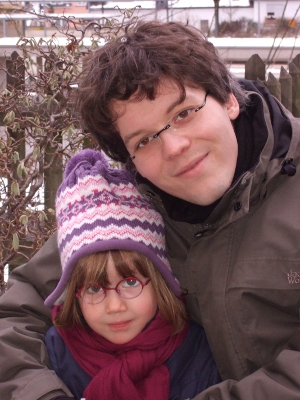
Michael and his daughter Marie

Michael has been around for more than 10 years and has always contributed to the APT software family. He s the author of the first real graphical interface to APT synaptic. Since then he created software-center as part of his work for Ubuntu. Being the most experienced APT developer, he s naturally the coordinator of the APT team. Check out what he has to say about APT s possible evolutions. My questions are in bold, the rest is by Michael. Who are you? My name is Michael Vogt, I m married and have two little daughters. We live in Germany (near to Trier) and I work for Canonical as a software developer. I joined Debian as a developer in early 2000 and started to contribute to Ubuntu in 2004. What s your biggest achievement within Debian or Ubuntu? I can not decide on a single one so I will just be a bit verbose. From the very beginning I was interested in improving the package manager experience and the UI on top for our users. I m proud of the work I did with synaptic. It was one of the earliest UIs on top of apt. Because of my work on synaptic I got into apt development as well and fixed bugs there and added new features. I still do most of the uploads here, but nowadays David Kalnischkies is the most active developer. I also wrote a bunch of tools like gdebi, update-notifier, update-manager, unattended-upgrade and software-properties to make the update/install situation for the user easier to deal with. Most of the tools are written in python so I added a lot of improvements to python-apt along the way, including the initial high level apt interface and a bunch of missing low-level apt_pkg features. Julian Andres Klode made a big push in this area recently and thanks to his effort the bindings are fully complete now and have good documentation. My most recent project is software-center. Its aim is to provide a UI strongly targeted for end-users. The goal of this project is to make finding and installing software easy and beautiful. We have a fantastic collection of software to offer and software-center tries to present it well (including screenshots, instant search results and soon ratings&reviews). This builds on great foundations like aptdaemon by Sebastian Heinlein, screenshots.debian.net by Christoph Haas, ddtp.debian.org by Michael Bramer, apt-xapian-index by Enrico Zini and many others (this is what I love about free software, it usually adds , rarely takes away ). What are your plans for Debian Wheezy? For apt I would love to see a more plugable architecture for the acquire system. It would be nice to be able to make apt-get update (and the frontends that use this from libapt) be able to download additional data (like debtags or additional index file that contains more end-user targeted information). I also want to add some scripts so that apt (optionally) creates btrfs snapshots on upgrade and provide some easy way to rollback in case of problems. There is also some interesting work going on around making the apt problem resolver a more plugable part. This way we should be able to do much faster development. software-center will get ratings&reviews in the upstream branch, I really hope we can get that into Wheezy. If you could spend all your time on Debian, what would you work on? In that case I would start with a refactor of apt to make it more robust about ABI breaks. It would be possible to move much faster once this problem is solved (its not even hard, it just need to be done). Then I would add a more complete testsuite. Another important problem to tackle is to make maintainer scripts more declarative. I triaged a lot of upgrade bug reports (mostly in ubuntu though) and a lot of them are caused by maintainer script failures. Worse is that depending on the error its really hard for the user to solve the problem. There is also a lot of code duplication. Having a central place that contains well tested code to do these jobs would be more robust. Triggers help us a lot here already, but I think there is still more room for improvement. What s the biggest problem of Debian? That s a hard question :) I mostly like Debian the way it is. What frustrated me in the past were flamewars that could have been avoided. To me being respectful to each other is important, I don t like flames and insults because I like solving problems and fighting like this rarely helps that. The other attitude I don t like is to blame people and complain instead of trying to help and be positive (the difference between it sucks because it does not support $foo instead of it would be so helpful if we had $foo because it enables me to let me do $bar ). For a long time, I had the feeling you were mostly alone working on APT and were just ensuring that it keeps working. Did you also had this feeling and are things better nowadays ? I felt a bit alone sometimes :) That being said, there were great people like Eugene V. Lyubimkin and Otavio Salvador during my time who did do a lot of good work (especially at release crunch times) and helped me with the maintenance (but got interested in other area than apt later). And now we have the unstoppable David Kalnischkies and Julian Andres Klode. Apt is too big for a single person, so I m very happy that especially David is doing superb work on the day-to-day tasks and fixes (plus big project like multiarch and the important but not very thankful testsuite work). We talk about apt stuff almost daily, doing code reviews and discuss bugs. This makes the development process much more fun and healthy. Julian Andres Klode is doing interesting work around making the resolver more plugable and Christian Perrier is as tireless as always when it comes to the translations merging. I did a quick grep over the bzr log output (including all branch merges) and count around ~4300 total commits (including all revisions of branches merged). Of that there ~950 commits from me plus an additional ~500 merges. It was more than just ensuring that it keeps working but I can see where this feeling comes from as I was never very verbose. Apt also was never my only project, I am involved in other upstream work like synaptic or update-manager or python-apt etc). This naturally reduced the time available to hack on apt and spend time doing the important day-to-day bug triage, response to mailing list messages etc. One the python-apt side Julian Andres Klode did great work to improve the code and the documentation. It s a really nice interface and if you need to do anything related to packages and love python I encourage you to try it. Its as simple as:
import apt
cache = apt.Cache()
cache["update-manager"].mark_install()
cache.commit()
Of course you can do much more with it (update-manager, software-center and lots of more tools use it). With pydoc apt you can get a good overview. The apt team always welcomes contributors. We have a mailing list and a irc channel and it s a great opportunity to solve real world problems. It does not matter if you want to help triage bugs or write documentation or write code, we welcome all contributors. You re also an Ubuntu developer employed by Canonical. Are you satisfied with the level of cooperation between both projects? What can we do to get Ubuntu to package new applications developed by Canonical directly in Debian? Again a tricky question :) When it comes to cooperation there is always room for improvement. I think (with my Canonical hat on) we do a lot better than we did in the past. And it s great to see the current DPL coming to Ubuntu events and talking about ways to improve the collaboration. One area that I feel that Debian would benefit is to be more positive about NMUs and shared source repositories (collab-maint and LowThresholdNmu are good steps here). The lower the cost is to push a patch/fix (e.g. via direct commit or upload) the more there will be. When it comes to getting packages into Debian I think the best solution is to have a person in Debian as a point of contact to help with that. Usually the amount of work is pretty small as the software will have a debian/* dir already with useful stuff in it. But it helps me a lot to have someone doing the Debian uploads, responding to the bugmail etc (even if the bugmail is just forwarded as upstream bugreports :) IMO it is a great opportunity especially for new packagers as they will not have to do a lot of packaging work to get those apps into Debian. This model works very well for me for e.g. gdebi (where Luca Falavigna is really helpful on the Debian side). Is there someone in Debian that you admire for his contributions? There are many people I admire. Probably too many to mention them all. I always find it hard to single out individual people because the project as a whole can be so proud of their achievements. The first name that comes to my mind is Jason Gunthorpe (the original apt author) who I ve never met. The next is Daniel Burrows who I met and was inspired by. David Kalnischkies is doing great work on apt. From contributing his first (small) patch to being able to virtually fix any problem and adding big features like multiarch support in about a year. Sebastian Heinlein for aptdaemon. Christian Perrier has always be one of my heroes because he cares so much about i18n. Christoph Haas for screenshots.debian.net, Michael Bramer for his work on debian translated package descriptions.
Thank you to Michael for the time spent answering my questions. I hope you enjoyed reading his answers as I did. Subscribe to my newsletter to get my monthly summary of the Debian/Ubuntu news and to not miss further interviews. You can also follow along on Identi.ca, Twitter and Facebook.

4 comments Liked this article? Click here. My blog is Flattr-enabled.

10 December 2010

Julian Andres Klode: sbuild on a tmpfs

As some already know, is that I use sbuild to build all my packages in clean chroot environments. For this, I use the aufs mode of schroot, that allows you to setup a chroot with one read-only base directory and one writeable overlay where changes are written to. One thing I had problems with was the time required to install build dependencies due to disk I/O. Given that I have 4G RAM in my computer, I decided to use a tmpfs as the writable overlay. For those of you who want to do the same, putting the following in /etc/fstab makes it work:
overlay                     /var/lib/schroot/union/overlay tmpfs         defaults                    0       0
Build times are much faster this way because all write I/O is directed to the RAM
Filed under: Debian

14 November 2010

Julian Andres Klode: Vettel world champion

Vettel made it F1 World Champion 2010.
Filed under: Uncategorized

26 October 2010

Julian Andres Klode: simple code clang creates 1600x faster executable than gcc

The following program, compiled with clang 1.1, runs 500 times faster than the gcc4.5-compiled code (in both cases with -O2):
#include <stdio.h>
#define len 1000000000L
unsigned long f(unsigned long a, unsigned long b) __attribute__((noinline));
int main()
 
    printf("%lu\n", f(0, 2*len));
    return 0;
 
unsigned long f(unsigned long a, unsigned long b)
 
    unsigned long sum = 0;
    for (; a < b; a++)
        sum += a;
    return sum;
 
Now, I would be interested to see what s happening here. I took a look at the assembler code both compilers create, but the only thing I found out so far is that gcc s assembly is easier to understand 50 lines (gcc) vs 134 lines (clang). If someone knows the answer, please tell me. Also see http://lwn.net/Articles/411776/ for a C++ version that calls f() via boost::thread. Update: I also reported a bug at http://gcc.gnu.org/bugzilla/show_bug.cgi?id=46186.
Filed under: General

22 October 2010

Julian Andres Klode: FAIL: Arch Linux switch python executable to Python 3

Today, I got an email from an user of one of my Python scripts asking why the script t does not work on Arch Linux anymore. As it turns out, the Arch Linux team decided to switch /usr/bin/python to Python 3.0 and use python2 for Python 2.X versions. By doing this, they decided to make their distribution incompatible to almost any Python script in the world. Arch Linux s decision to diverge from the rest of the world that uses python for Python 2.X and python3 for Python 3.X is stupid. And doing this without updating reverse dependencies beforehand and thus breaking packages in their own distribution is insane. In the end this means that if you use Arch Linux, you should consider switching to a distribution that does things the right way: Debian. You can also switch to Ubuntu, that s normally just a bit less right (= faster). But using a distribution that does those crazy things in such an irresponsible way is really insane. Really, how can they be so stupid in the Arch world?
Filed under: Python

20 October 2010

Julian Andres Klode: The Three Levels of Package Management

In today s Linux distributions, there are usually two to three levels of package management. In this blog post, I will explain the three levels of package management. 1. Local (dpkg, rpm) The first level of package management is the local level. This level consists of package management tools that install and/or remove packages via package archives such as .deb or .rpm files and a database of the local s system state. 2. Connected (APT, YUM, Smart) The second level of package management is the connected level. In this level, tools are fetching packages and information about them from (remote) locations known as repositories or sources . A level 2 package manager is usually built on top of a level 1 package manager, for example, APT uses dpkg but there are also cases where one tool is both, such as opkg. 3. Abstract (PackageKit, Smart) A level 3 package manager is a tool that supports different level 1 package managers via one generic interface. It may be implemented on top of a level 2 package manager (PackageKit), or may be implemented directly in level 2 (Smart). Conclusion: Merge Level 2 and 3 Most level 2 package managers share a great deal of tasks, such as solving dependency problems. Merging level 2 package management and level 3 package management would enable us to reduce the number of dependency problem solvers and combine our efforts into a few package managers. Such an implementation would need to be written in C and support all common level 1 package managers in order to be successful. As some might have guessed, this is what I plan to do with the project codenamed APT2, although work is not progressing very fast. PS: Back from vacation I spent the more than the complete last week in (mostly rainy) Corfu, Greece and am now getting back to my usual development stuff. I have already processed my news & blogs backlog (1000+ messages) and will now start with my email backlog, so don t be angry if the answer to your email takes some time.
Filed under: APT2, General

30 August 2010

Julian Andres Klode: Google Public DNS blocks wikileaks.org (Update: No, they don t)

It seems that Google is blocking wikileaks.org in its Public DNS servers (8.8.8.8 and 8.8.4.4):
; <<>> DiG 9.7.1-P2 <<>> @8.8.8.8 wikileaks.org ; (1 server found) ;; global options: +cmd ;; Got answer: ;; ->>HEADER<<- opcode: QUERY, status: SERVFAIL, id: 50227 ;; flags: qr rd ra; QUERY: 1, ANSWER: 0, AUTHORITY: 0, ADDITIONAL: 0 ;; QUESTION SECTION: ;wikileaks.org. IN A ;; Query time: 2457 msec ;; SERVER: 8.8.8.8#53(8.8.8.8) ;; WHEN: Fri Aug 27 18:10:43 2010 ;; MSG SIZE rcvd: 31
Update: Sorry Google, for me doubting you. As it turns out, you did no evil, you were just a bit slower than the others.
Filed under: General

27 August 2010

Julian Andres Klode: Google Public DNS blocks wikileaks.org

It seems that Google is blocking wikileaks.org in its Public DNS servers (8.8.8.8 and 8.8.4.4):
; <<>> DiG 9.7.1-P2 <<>> @8.8.8.8 wikileaks.org ; (1 server found) ;; global options: +cmd ;; Got answer: ;; ->>HEADER<<- opcode: QUERY, status: SERVFAIL, id: 50227 ;; flags: qr rd ra; QUERY: 1, ANSWER: 0, AUTHORITY: 0, ADDITIONAL: 0 ;; QUESTION SECTION: ;wikileaks.org. IN A ;; Query time: 2457 msec ;; SERVER: 8.8.8.8#53(8.8.8.8) ;; WHEN: Fri Aug 27 18:10:43 2010 ;; MSG SIZE rcvd: 31

Filed under: General

13 August 2010

Julian Andres Klode: APT2 is now UPS

APT2 is now called UPS (Universal Package System). The name is inspired by the company that delivers packages in those brown trucks and from the Image Packaging System (IPS) of OpenSolaris; and mvo writing ups after I proposed upt ( ber package tool) in IRC. It s definitely better than my first thought which was moo (and libmoo). Update: OK, let s cancel this rename insanity.
Filed under: APT2

11 August 2010

Julian Andres Klode: APT2 this time in C

As I wrote a few hours ago on deity@l.d.o (see http://lists.debian.org/deity/2010/08/msg00057.html), APT2 is back again. The first time, I tried Vala; but this time I wrote it in C (with the help of GLib, but no GObject) and the cache uses GVariant instead of an SQLite database. It s really basic at the moment (no solver, package installation/removal), but it will improve. Read operation should be faster than with APT, although writes are slower (this will be fixed by reusing unchanged parts of the cache). See the announcement for further information.
Filed under: APT2

9 July 2010

Julian Andres Klode: Nokia/Intel/Google/Canonical openness and professionality in MeeGo, Android, Ubuntu

MeeGo (Nokia/Intel): Openness does not seem to be very important for Nokia and Intel. They develop their stuff behind closed doors and then do a large code drop (once dropped, stuff gets developed in the open). In terms of professionality, it does not look much better: If you look at the meego-dev mailing list, you feel like you are in some kind of a kindergarten for open source developers Things like HTML emails and top-posting appear to be completely normal for them, they don t even follow the basic rules for emails and they also appear to ignore any advice on this topic. Oh, and writing a platform in GTK+ while pushing Qt as the supported toolset is not a good idea. Android (Google): The situation with Android appears to be even worse. Google keeps an internal development tree and the only time the public sees changes is when a new release is coming and Google does a new code drop. Such a behavior is not acceptable. Ubuntu (Canonical): Canonical does an outstanding job on openness. Canonical employees develop their software completely in the open, and there are no big code drops. They basically have no competitive advantage and allow you to use their work for your own project before they use it themselves. Canonical employees basically behave like normal free software developers doing stuff in his free time, the only exception being that they are paid for it. Most Canonical employees also know how to behave on mailing lists and do not post HTML emails or do top-posting. There are of course also other people: The design process of the Ubuntu font on the other hand is a disaster, with the font being created using proprietary software running on Windows; for a free software company, that s not acceptable (such persons should probably not be hired at all). Furthermore, the quality of Ubuntu packages is often bad when compared to the quality of a Debian package (especially in terms of API documentation of Canonical-created software); a result of vastly different development cycles and different priorities. On a scale from 0 to 15 (15 being the best), Nokia/Intel receive 5 points ( D in U.S. grades), Google receives 3 points ( F in U.S. grades), and Canonical receives 12 points ( B in U.S. grades). Please note that those grades only apply for the named projects, the companies may behave better or worse in other projects. Final tips for the companies:
Filed under: General, Ubuntu

Julian Andres Klode: Build systems

In the past weeks, I was looking at several build systems. As it turned out, there is not a single sane generic build system out there. Autotools: Autotools are ugly, slow, and require an immense amount of code copies in the source tree. WAF: WAF is not as ugly as autools and it s faster and does not generate Makefiles or stuff like this. But it has serious issues: It requires one to copy it to the source tarball, has no stable API, and requires Python for building. Furthermore, support for unit testing is broken: It runs the unit tests, but does not abort the build process if the tests fail and does not display why the tests fail. CMake: The syntax is ugly, it generates Makefiles, and support for pkg-config seems to be very very basic. So how should a build system look like? So, why is there no sane build system?
Filed under: General

5 July 2010

Julian Andres Klode: Review: Lenovo ThinkPad Edge 15

Wednesday, after some weeks with a flickering screen (or more precisely, something is causing GTK+ to redraw and the kernel to print ^@ in the terminal when you touch the screen, see http://jak-linux.org/tmp/20100628_002.mp4) in my 3 years old HP Compaq 6720s (which seems to be a software-hardware combination problem, at least it works in Ubuntu); I decided to buy a new laptop. It took me a few minutes to find the Lenovo ThinkPad Edge 15 NVL7VGE; which I ordered at notebooksbilliger.de at around 14:30 CEST using Express. On Thursday morning at 6:40 CEST, the device arrived. The laptop features an Intel Core i5 430 M processor with integrated graphics, 4 GiB of RAM, 320 GB hard disk storage, matte screen, and of course a TrackPoint. The machine comes pre-installed with Windows 7 Professional which is not very nice (and Lenovo does not take Windows licenses back). I booted Ubuntu 10.04 from an USB disk which worked a few times, but not always, so I upgraded the BIOS to make USB booting reliable (as Lenovo published multiple BIOS updates already, one fixing this USB booting issue). The first step was booting Ubuntu 10.04 from an USB hard disk to check the Linux support. Using Ubuntu, everything worked out of the box, including stuff like HDMI audio support or output switching. An exception may be the DVD drive, which only works if you set the SATA mode to compatibility. Non-DVD media also works in AHCI mode, but only if you start with a disc inserted in the drive. Playing DVDs requires setting a region code using setregion(8) [otherwise they do not work at all] and SATA compatibility mode [otherwise they only work partially]. Another issue is the HDMI output, as the TV is not correctly detected and some parts at the top and the bottom of the image are missing (that is, the GNOME panels) (but that happens with different screens and ATI cards as well). Oh, and closing the lid with a screen attached and the internal screen disabled works only as long as you do not open it again, because that causes the GPU to stop. On the input side, we have one keyboard, one TrackPoint, and a touch pad. All of them work out of the box, but they have a few problems on the hardware side: The cursor keys on the keyboard are incredibly small and the touchpad is very large. The keyboard is different from the one in the HP Compaq: First of all, there is space between the keys (like Apple keyboards); and secondly, you need to apply more pressure in order to use the keys. The device feels more solid than the HP Compaq 6720s, especially touching the screen does not change the colors on the screen. I don t know how long the keyboard will last, but I hope that I will still have symbols on them in 5 months (which was not the case for the HP Compaq 6720s keyboard). Power consumption is another interesting point. When the device is idle and the screen is disabled, the device seems to consume about 10W. With screen enabled, consumption varies between 13W (idle) 35W (building source code); if the values received via ACPI are correct. The device ships with a 48 Wh battery which after some time was displayed as 53 Wh in gnome-power-statistics (only the when loaded state, capacity is displayed as 47.5Wh). According to Lenovo, the laptop lasts 4.5 hours on battery, meaning consumption of 47.5 Wh / 4.5 h = 10.5 Wh which is a bit overly optimistic if you want to work on the device. After checking everything, I took over my Debian sid installation from my old laptop (which I installed in 2008). It runs happely now, although I still need to get accustomed to the new keyboard and the large touch pad. All in all, the price of 765 I paid for the device seems to be OK. Now I only need to remove the Windows 7 sticker and hope that the device lasts long enough until I want to buy a new one (probably 2013, if the aliens don t invade us 2012).
Filed under: General

30 May 2010

Julian Andres Klode: 0 14

So, yesterday was my 0 14 (20th) birthday and Germany won the Eurovision Song Contest 2010. Next up is Formula One in Turkey and Sebastian Vettel starting from position 3, hopefully he manages to overtake Hamilton and Webber and win this race. Let s see
Filed under: General

20 April 2010

Julian Andres Klode: GNOME Icon Theme 2.30 looks really ugly

The 2.30 version of gnome-icon-theme is really one of the worst icon themes I ve ever seen in the last years. First of all, it does not fit into the system due to the colors chosen. I was always satisfied with the GNOME icon theme, but with the 2.30 release I can t use it anymore since it makes my system look like a piece of sh**. Secondly, it just does not fit with the tango icon theme. I m currently using the tango icon theme on my laptop, and after installing g-i-t 2.30, some logos suddenly started to turn black and they just did not fit anymore. For now, I downgraded gnome-icon-theme to 2.28 to have a usable UI again. But once there are new icons in gnome-icon-theme I will be lost. Hopefully someone with a sense for UI design will fix this design hell created by the idiots those who created this icon theme. We don t need a 90s icon theme. Update: Here s one problem, the network icon just does not fit:
(not under the same license as the blog, due to legal reasons). Update 2: I don t like changes, but after a months or so I will probably accept it. Anyway, Google did even worse things with reordering the icons in Chromium 5. Previously, all actions were on the left (IIRC); now some are on the left, and some in the input box. Anyway, I replaced the idiots with those now, as some people felt this was overly offensive. Update 3: I just filed two bugs at gnome.org: 616324 and 616325. Others will probably follow.
Filed under: General

Julian Andres Klode: Python 3.1 bug: Objects in modules (m_size=-1) not deallocated

Last year, in July, I reported an issue to Python s issue tracker. This issue can be seen at http://bugs.python.org/issue6483. Since then, there has been no action on this bug from the developers. The bug describes that every object stored in a module will not be deallocated if the module is deallocated and it s m_size = -1 (which it should be if the module has no state). The problem seems to be that Python copies the dictionary of the module but forgets to decrease the reference count of the copy when the module is deallocated. This bug may have serious impact if objects are stored in the module which write status to a file when they are deallocated, because the deallocation functions are never called.
Filed under: Python

2 March 2010

Julian Andres Klode: Google Street View in Germany

I wonder why the federal minister for consumer protection (hopefully a good enough translation for Verbraucherschutzministerin ) Ilse Aigner has concerns about Street View, because those concerns are completely unrelated to protecting the consumer, because the consumer is the one viewing the images in the browser, and not the person being photographed. I have no reason to believe that Google Street View is illegal, I see no difference between a photo taken by a company and a photo taken by a single person. If Google Street View were illegal, distribution of every picture taken in the public would have to be considered illegal as well. And creating laws limiting the height at which the camera is placed to e.g. 1.8 meters sounds like discriminating against persons who are e.g. 1.85 meters ( You re too tall, you re not allowed to take a picture ). More information about this topic can be found on e.g. http://www.spiegel.de/international/germany/0,1518,676616,00.html.
Filed under: General

15 February 2010

Julian Andres Klode: Maemo + Moblin = MeeGo = Failure


Today, Nokia and Intel announced the merge of Maemo and Moblin into the MeeGo project. This is sad, because it will end the era of the Debian-based mobile operating system Maemo and replace it with a system using RPM and probably some other evil stuff as well. In fact, dpkg & apt-get where two of my main reasons to buy the N900. And another question is why yet another name. Moblin was already a well-known name and they shouldn t have changed the name just because they switch the servers and add some Nokia developers. Furthermore, does this all mean that there will be no Maemo 6? What will happen to the Maemo users on the N900, will it be possible for them to use MeeGo? Maybe this is the time to start a new project, Debian Mobile. Debian Mobile would take the MeeGo experience and apply it to a Debian system. This would probably the best mobile operating system ever, being backed by Debian s large repositories with thousands of software packages. Filed under: Debian

Next.

Previous.