Search Results: "Joachim Breitner"

14 October 2015

Joachim Breitner: Constructing a list in a monad revisited

Two years ago, I discussed various ways of constructing a list in a Monad (or, more specifically, in IO) in Haskell, and compared their merits in terms of elegance, stack usage, number of traversals of the list and run-time efficiency. Recently, two blog posts discussed the issue further and proposed new, more daring alternatives. Neil Mitchell breaks through the abstraction provided by IO, duplicates the world and traverses the list twice, and obtains a speed-up for long lists. Twarn van Laarhoven went even further and wrote custom C-- code to destructively update the tail-pointer of the list cell to be able to create the list completely evaluated on the first start. This basically answers my question from two years ago:
I m still wondering: What would be required from Haskell, GHC or the monads in question to have a fully satisfactory solution here, i.e. one that is as fast as the naive recursion, as stack efficient as the difference list solution, and allocates no thunks, only list cells?
He also has a variant with a slightly nicer interface around holes , i.e. explicit objects on the heap that can later be replaced by indirections. Obviously, both approaches are very unsafe. I took this as an opportunity to redo my benchmark measurements, and include their variants (named escapeIO, hackIO and holeIO). The following table omits the variants with quadratic performance, as I ran it on longer lists now:
Variant 10^0 10^1 10^2 10^3 10^4 10^5 10^6
accumReverse 37ns 153ns 1134ns 12 s 208 s 8540 s 97ms
recursion 29ns 139ns 680ns 6790ns 160 s 6441 s 76ms
replicateM 26ns 126ns 677ns 6785ns 168 s 6314 s 78ms
accumDList 35ns 165ns 995ns 10 s 190 s 9706 s 100ms
streams 27ns 136ns 691ns 6788ns 173 s 5771 s 75ms
unsafeInterleave 60ns 329ns 2804ns 28 s 373 s 5605 s 57ms
listFix 51ns 412ns 4109ns 56 s 2761 s 42ms 445ms
escapeIO 41ns 187ns 1808ns 16 s 234 s 4409 s 45ms
hackIO 30ns 152ns 1199ns 11 s 140 s 3701 s 42ms
holeIO 40ns 222ns 1725ns 17 s 218 s 4446 s 53ms
The following graph shows that around 10000, the naive approaches become much slower and the fancy hacks pay of, with Twarn s tail-pointer-updating code performing the best: I would really like to see a package that provides a API like Twarn s holes, either in this raw unsafe variant (but with the garbage collector related code checked), or with a safe API using type hackery similar to the ST monad that ensures that after normal code gets its hands on a term possibly involving holes, the holes may no longer be modified. I have put the code and results on GitHub.

12 October 2015

Joachim Breitner: Incredible Proof Machine put to the test

I m currently on the way home, returning from a four-day workshop for high school students; ages 13 to 20, grade 9 to 13. My goal was to teach them something about proofs and logic, in a ambitiously formal and abstract way. For this workshop, I created a computer program called The Incredible Proof Machine that allows the kids to explore creating a proof, by placing blocks on a canvas and drawing connections between them (see my previous blog post for an introduction). Subtracting time spent on on breaks, organizational stuff, the time the student needed to prepare a final presentation, I think we were working for a total of 14 hours, during which we covered propositional logic. I generally let the students explore and try to solve the tasks of one session mostly on their own, followed by a common discussion of what they have just done, what it means why it makes sense etc. The sessions were: assumptions and conclusions in general, with conjunction; implication; disjunction; falsum and tertium non datur. We also briefly discussed paper proofs with the student: how they look, and how they relate to the Proof Machine proofs. We had some lecture notes that we handed out pice-wise after each session. The sections were mildly1 password-protected to avoid that the quicker students would work ahead, thus keeping the group together. One or two of the 13 students were doing very well and eventually, I gave them the passwords to the predicate logic section and let them work them on them on their own. The quickest managed to solve almost all of these as well, but (as far I as I can tell) without a deeper understanding of the quantifiers, and more a mechanical intuition. As expected, the students were able to solve most of the exercises, even when a proper understanding of the logical semantics was not yet fully developed. This was by design: I believe that this way it was more motivating and encouraging, as they could make it work , compared to a more traditional approach of first throwing a lot of theory at them and then expecting them to apply it. This was confirmed by their feedback after the workshop. I was happy with my implementation. The students immediately could work with it with very few hick-ups, and only one minor bug occurred2, which I could fix on the spot. Having everything run on in the browser was a big plus, given that we had no stable internet connection for everyone: Once the Incredible Proof Machine was loaded, the student could continue to work offline. Personally, I find that the UI is occasionally too sluggish, especially on the weaker laptops, but it seems that the students did not seem to mind. Some students tried to connect outputs with outputs or inputs with inputs and the visualization did make it clearly visible that such a link is not actually connected to the block. The predicate logic part is a bit less convincing, with e.g. scoping of local constants not easily understood. I would say that this part would work better if some explanation is given before the students start working on the more involved rules. Our room was equipped with a smartboard, and I was delighted when I found out, mostly by accident, that I could actually use my finger to drag the blocks of the proof and to draw connections. This not only gave me a Minority Report -like feeling, but also meant that it was much easier for the students to follow my explanations when they could just watch my hand, instead of trying to locate the mouse pointer on a regular projector. I m generally doubtful whether such fancy technological toys are useful in the class room, but in this case at least I liked it. The ability to scribble anywhere on the screen was occasionally a plus as well. All in all I believe the Proof Machine was a useful tool, and I am sure that without it, it would have been tricky to have students voluntarily spend 14 hours on such a relatively dry and abstract topic. Given the amount of work that went into the development, I hope that this will not be the last occasion where it is put to good use. So if you have to teach formal logic and natural deduction-style proofs, you are welcome to use the Incredible Proof Machine to get your students excited. It is purely static, i.e. needs no special server-side infrastructure, and you can define your own logic (i.e. proof rules), sessions and tasks. Also, there are a few interesting way in which the Proof Machine could be extended. In particular, I d like it to be able to generate a normal , natural-language proof from a given proof even if it will sound a bit mechanical and then use hover-highlight effects to relate the formulas and sentences in the text proof to the connections and blocks in the graphical proof. Contributions are welcome!

  1. JavaScript based with no crypto or even obfuscation in the code.
  2. Due to differences between the task specification as given in the code, and the task specification when normalizing the syntax of the terms, the proofs that the students created were lost when they re-loaded the page.

24 September 2015

Joachim Breitner: The Incredible Proof Machine

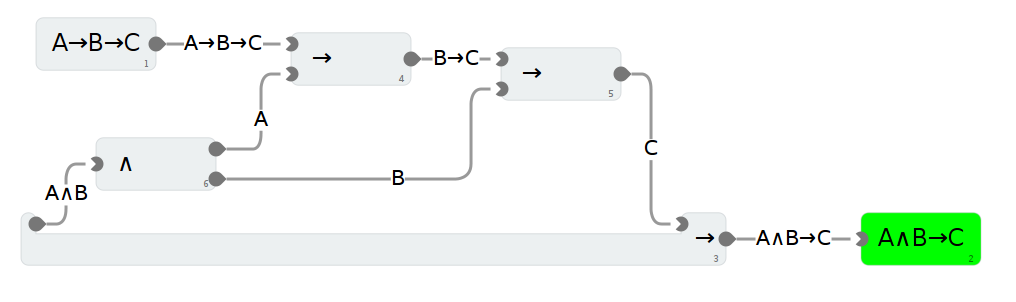
In a few weeks, I will have the opportunity to offer a weekend workshop to selected and motivated high school students1 to a topic of my choice. My idea is to tell them something about logic, proofs, and the joy of searching and finding proofs, and the gratification of irrevocable truths. While proving things on paper is already quite nice, it is much more fun to use an interactive theorem prover, such as Isabelle, Coq or Agda: You get immediate feedback, you can experiment and play around if you are stuck, and you get lots of small successes. Someone2 once called interactive theorem proving the worlds most geekiest videogame . Unfortunately, I don t think one can get high school students without any prior knowledge in logic, or programming, or fancy mathematical symbols, to do something meaningful with a system like Isabelle, so I need something that is (much) easier to use. I always had this idea in the back of my head that proving is not so much about writing text (as in normally written proofs) or programs (as in Agda) or labeled statements (as in Hilbert-style proofs), but rather something involving facts that I have proven so far floating around freely, and way to combine these facts to new facts, without the need to name them, or put them in a particular order or sequence. In a way, I m looking for labVIEW wrestled through the Curry-Horward-isomorphism. Something like this:
A proof of implication currying

A proof of implication currying

So I set out, rounded up a few contributors (Thanks!), implemented this, and now I proudly present: The Incredible Proof Machine3 This interactive theorem prover allows you to do perform proofs purely by dragging blocks (representing proof steps) onto the paper and connecting them properly. There is no need to learn syntax, and hence no frustration about getting that wrong. Furthermore, it comes with a number of example tasks to experiment with, so you can simply see it as a challenging computer came and work through them one by one, learning something about the logical connectives and how they work as you go. For the actual workshop, my plan is to let the students first try to solve the tasks of one session on their own, let them draw their own conclusions and come up with an idea of what they just did, and then deliver an explanation of the logical meaning of what they did. The implementation is heavily influenced by Isabelle: The software does not know anything about, say, conjunction ( ) and implication ( ). To the core, everything is but an untyped lambda expression, and when two blocks are connected, it does unification4 of the proposition present on either side. This general framework is then instantiated by specifying the basic rules (or axioms) in a descriptive manner. It is quite feasible to implement other logics or formal systems on top of this as well. Another influence of Isabelle is the non-linear editing: You neither have to create the proof in a particular order nor have to manually manage a proof focus . Instead, you can edit any bit of the proof at any time, and the system checks all of it continuously. As always, I am keen on feedback. Also, if you want to use this for your own teaching or experimenting needs, let me know. We have a mailing list for the project, the code is on GitHub, where you can also file bug reports and feature requests. Contributions are welcome! All aspects of the logic are implemented in Haskell and compiled to JavaScript using GHCJS, the UI is plain hand-written and messy JavaScript code, using JointJS to handle the graph interaction. Obviously, there is still plenty that can be done to improve the machine. In particular, the ability to create your own proof blocks, such as proof by contradiction, prove them to be valid and then use them in further proofs, is currently being worked on. And while the page will store your current progress, including all proofs you create, in your browser, it needs better ways to save, load and share tasks, blocks and proofs. Also, we d like to add some gamification, i.e. achievements ( First proof by contradiction , 50 theorems proven ), statistics, maybe a share theorem on twitter button. As the UI becomes more complicated, I d like to investigating moving more of it into Haskell world and use Functional Reactive Programming, i.e. Ryan Trickle s reflex, to stay sane. Customers who liked The Incredible Proof Machine might also like these artifacts, that I found while looking whether something like this exists:

  1. Students with migration background supported by the START scholarship
  2. Does anyone know the reference?
  3. We almost named it Proofcraft , which would be a name our current Minecraft-wild youth would appreciate, but it is alreay taken by Gerwin Kleins blog. Also, the irony of a theorem prover being in-credible is worth something.
  4. Luckily, two decades ago, Tobias Nipkow published a nice implementation of higher order pattern unification as ML code, which I transliterated to Haskell for this project.

22 August 2015

Joachim Breitner: Quickest path to a local apt repository

As I m writing this, DebConf 15 is coming to an end. I spend most of my time improving the situation of the Haskell Packages in Debian, by improving the tooling and upgrading our packages to match Stackage 3.0 and build against GHC 7.10. But that is mostly of special interest (see this mail for a partial summary), so I d like to use this post to advertise a very small and simple package I just uploaded to Debian: During one of the discussion here I noticed that it is rather tricky to make a locally built package available to apt-get. The latest version in unstable allows one to install a debian package simply by running apt-get install on it, but in some cases, e.g. when you want a convenient way to list all packages that you made available for local use, this is insufficient. So the usual approach is to create a local apt repository with your packages. Which is non-trivial: You can use dpkg-scanpackage, apt-ftparchive or reprepro. You need to create the directories, run the commands, add the repository to your local sources. You need to worry about signing it or setting the right options to make apt-get accept it without signing. It is precisely this work that my new package local-apt-repository automates for you: Once it is installed, you simply drop the .deb file into /srv/local-apt-repository/ and after the next apt-get update the package can be installed like any other package from the archive. I chose to use the advanced features that systemd provides namely activation upon path changes so works best with systemd as the init system. If you want to contribute, or test it before it passes the NEW queue, check out the git repository.

3 August 2015

Lunar: Reproducible builds: week 14 in Stretch cycle

What happened in the reproducible builds effort this week: Toolchain fixes akira submitted a patch to make cdbs export SOURCE_DATE_EPOCH. She uploded a package with the enhancement to the experimental reproducible repository. Packages fixed The following 15 packages became reproducible due to changes in their build dependencies: dracut, editorconfig-core, elasticsearch, fish, libftdi1, liblouisxml, mk-configure, nanoc, octave-bim, octave-data-smoothing, octave-financial, octave-ga, octave-missing-functions, octave-secs1d, octave-splines, valgrind. The following packages became reproducible after getting fixed: Some uploads fixed some reproducibility issues but not all of them: In contrib, Dmitry Smirnov improved libdvd-pkg with 1.3.99-1-1. Patches submitted which have not made their way to the archive yet: reproducible.debian.net Four armhf build hosts were provided by Vagrant Cascadian and have been configured to be used by jenkins.debian.net. Work on including armhf builds in the reproducible.debian.net webpages has begun. So far the repository comparison page just shows us which armhf binary packages are currently missing in our repo. (h01ger) The scheduler has been changed to re-schedule more packages from stretch than sid, as the gcc5 transition has started This mostly affects build log age. (h01ger) A new depwait status has been introduced for packages which can't be built because of missing build dependencies. (Mattia Rizzolo) debbindiff development Finally, on August 31st, Lunar released debbindiff 27 containing a complete overhaul of the code for the comparison stage. The new architecture is more versatile and extensible while minimizing code duplication. libarchive is now used to handle cpio archives and iso9660 images through the newly packaged python-libarchive-c. This should also help support a couple other archive formats in the future. Symlinks and devices are now properly compared. Text files are compared as Unicode after being decoded, and encoding differences are reported. Support for Sqlite3 and Mono/.NET executables has been added. Thanks to Valentin Lorentz, the test suite should now run on more systems. A small defiency in unquashfs has been identified in the process. A long standing optimization is now performed on Debian package: based on the content of the md5sums control file, we skip comparing files with matching hashes. This makes debbindiff usable on packages with many files. Fuzzy-matching is now performed for files in the same container (like a tarball) to handle renames. Also, for Debian .changes, listed files are now compared without looking the embedded version number. This makes debbindiff a lot more useful when comparing different versions of the same package. Based on the rearchitecturing work has been done to allow parallel processing. The branch now seems to work most of the time. More test needs to be done before it can be merged. The current fuzzy-matching algorithm, ssdeep, has showed disappointing results. One important use case is being able to properly compare debug symbols. Their path is made using the Build ID. As this identifier is made with a checksum of the binary content, finding things like CPP macros is much easier when a diff of the debug symbols is available. Good news is that TLSH, another fuzzy-matching algorithm, has been tested with much better results. A package is waiting in NEW and the code is ready for it to become available. A follow-up release 28 was made on August 2nd fixing content label used for gzip2, bzip2 and xz files and an error on text files only differing in their encoding. It also contains a small code improvement on how comments on Difference object are handled. This is the last release name debbindiff. A new name has been chosen to better reflect that it is not a Debian specific tool. Stay tuned! Documentation update Valentin Lorentz updated the patch submission template to suggest to write the kind of issue in the bug subject. Small progress have been made on the Reproducible Builds HOWTO while preparing the related CCCamp15 talk. Package reviews 235 obsolete reviews have been removed, 47 added and 113 updated this week. 42 reports for packages failing to build from source have been made by Chris West (Faux). New issue added this week: haskell_devscripts_locale_substvars. Misc. Valentin Lorentz wrote a script to report packages tested as unreproducible installed on a system. We encourage everyone to run it on their systems and give feedback!

9 July 2015

Simon Kainz: DUCK challenge: week 1

After announcing the DUCK challenge last week the following packages were fixed and uploaded into unstable: A big "Thank You" to you. The list of the fixed and updated packages is availabe here. I will try to update this ~daily. If I missed one of your uploads, please drop me a line. There is still lots of time till the end of DebConf15 and the end of the DUCK Challenge, so please get involved.

22 June 2015

Lunar: Reproducible builds: week 8 in Stretch cycle

What happened about the reproducible builds effort this week: Toolchain fixes Andreas Henriksson has improved Johannes Schauer initial patch for pbuilder adding support for build profiles. Packages fixed The following 12 packages became reproducible due to changes in their build dependencies: collabtive, eric, file-rc, form-history-control, freehep-chartableconverter-plugin , jenkins-winstone, junit, librelaxng-datatype-java, libwildmagic, lightbeam, puppet-lint, tabble. The following packages became reproducible after getting fixed: Some uploads fixed some reproducibility issues but not all of them: Patches submitted which have not made their way to the archive yet: reproducible.debian.net Bugs with the ftbfs usertag are now visible on the bug graphs. This explain the recent spike. (h01ger) Andreas Beckmann suggested a way to test building packages using the funny paths that one can get when they contain the full Debian package version string. debbindiff development Lunar started an important refactoring introducing abstactions for containers and files in order to make file type identification more flexible, enabling fuzzy matching, and allowing parallel processing. Documentation update Ximin Luo detailed the proposal to standardize environment variables to pass a reference source date to tools that needs one (e.g. documentation generator). Package reviews 41 obsolete reviews have been removed, 168 added and 36 updated this week. Some more issues affecting packages failing to build from source have been identified. Meetings Minutes have been posted for Tuesday June 16th meeting. The next meeting is scheduled Tuesday June 23rd at 17:00 UTC. Presentations Lunar presented the project in French during Pas Sage en Seine in Paris. Video and slides are available.

20 June 2015

Joachim Breitner: Running circle-packing in the Browser, now using GHCJS

Quite a while ago, I wrote a small Haskell library called circle-packing to pack circles in a tight arrangement. Back then, I used the Haskell to JavaScript compiler fay to create a pretty online demo of that library, and shortly after, I create the identical demo using haste (another Haskell to JavaScript compiler). The main competitor of these two compilers, and the most promising one, is GHCJS. Back then, it was too annoying to install. But after two years, things have changed, and it only takes a few simple commands to get GHCJS running, so I finally created the circle packing demo in a GHCJS variant. Quick summary: Cabal integration is very good (like haste, but unline fay), interfacing JavaScript is nice and easy (like fay, but unlike haste), and a quick check seems to indicate that it is faster than either of these two. I should note that I did not update the other two demos, so they represent the state of fay and haste back then, respectively. With GHCJS now available at my fingertips, maybe I will produce some more Haskell to be run in your browser. For example, I could port FrakView, a GUI program to render, expore and explain iterated function systems, from GTK to HTML.

Lunar: Reproducible builds: week 4 in Stretch cycle

What happened about the reproducible builds effort for this week: Toolchain fixes Lunar rebased our custom dpkg on the new release, removing a now unneeded patch identified by Guillem Jover. An extra sort in the buildinfo generator prevented a stable order and was quickly fixed once identified. Mattia Rizzolo also rebased our custom debhelper on the latest release. Packages fixed The following 30 packages became reproducible due to changes in their build dependencies: animal-sniffer, asciidoctor, autodock-vina, camping, cookie-monster, downthemall, flashblock, gamera, httpcomponents-core, https-finder, icedove-l10n, istack-commons, jdeb, libmodule-build-perl, libur-perl, livehttpheaders, maven-dependency-plugin, maven-ejb-plugin, mozilla-noscript, nosquint, requestpolicy, ruby-benchmark-ips, ruby-benchmark-suite, ruby-expression-parser, ruby-github-markup, ruby-http-connection, ruby-settingslogic, ruby-uuidtools, webkit2gtk, wot. The following packages became reproducible after getting fixed: Some uploads fixed some reproducibility issues but not all of them: Patches submitted which did not make their way to the archive yet: Also, the following bugs have been reported: reproducible.debian.net Holger Levsen made several small bug fixes and a few more visible changes: strip-nondeterminism Version 0.007-1 of strip-nondeterminism the tool to post-process various file formats to normalize them has been uploaded by Holger Levsen. Version 0.006-1 was already in the reproducible repository, the new version mainly improve the detection of Maven's pom.properties files. debbindiff development At the request of Emmanuel Bourg, Reiner Herrmann added a comparator for Java .class files. Documentation update Christoph Berg created a new page for the timestamps in manpages created by Doxygen. Package reviews 93 obsolete reviews have been removed, 76 added and 43 updated this week. New identified issues: timestamps in manpages generated by Doxygen, modification time differences in files extracted by unzip, tstamp task used in Ant build.xml, timestamps in documentation generated by ASDocGen. The description for build id related issues has been clarified. Meetings Holger Levsen announced a first meeting on Wednesday, June 3rd, 2015, 19:00 UTC. The agenda is amendable on the wiki. Misc. Lunar worked on a proof-of-concept script to import the build environment found in .buildinfo files to UDD. Lucas Nussbaum has positively reviewed the proposed schema. Holger Levsen cleaned up various experimental toolchain repositories, marking merged brances as such.

15 June 2015

Lunar: Reproducible builds: week 7 in Stretch cycle

What happened about the reproducible builds effort for this week: Presentations On June 7th, Reiner Herrmann presented the project at the Gulaschprogrammiernacht 15 in Karlsruhe, Germany. Video and audio recordings in German are available, and so are the slides in English. Toolchain fixes Daniel Kahn Gillmor's report on help2man started a discussion with Brendan O'Dea and Ximin Luo about standardizing a common environment variable that would provide a replacement for an embedded build date. After various proposals and research by Ximin about date handling in several programming languages, the best solution seems to define SOURCE_DATE_EPOCH with a value suitable for gmtime(3).
  1. Martin Borgert wondered if Sphinx could be changed in a way that would avoid having to tweak debian/rules in packages using it to produce HTML documentation.
Daniel Kahn Gillmor opened a new report about icont producing unreproducible binaries. Packages fixed The following 32 packages became reproducible due to changes in their build dependencies: agda, alex, c2hs, clutter-1.0, colorediffs-extension, cpphs, darcs-monitor, dispmua, haskell-curl, haskell-glfw, haskell-glib, haskell-gluraw, haskell-glut, haskell-gnutls, haskell-gsasl, haskell-hfuse, haskell-hledger-interest, haskell-hslua, haskell-hsqml, haskell-hssyck, haskell-libxml-sax, haskell-openglraw, haskell-readline, haskell-terminfo, haskell-x11, jarjar-maven-plugin, kxml2, libcgi-struct-xs-perl, libobject-id-perl, maven-docck-plugin, parboiled, pegdown. The following packages became reproducible after getting fixed: Some uploads fixed some reproducibility issues but not all of them: Patches submitted which did not make their way to the archive yet: reproducible.debian.net A new variation to better notice when a package captures the environment has been introduced. (h01ger) The test on Debian packages works by building the package twice in a short time frame. But sometimes, a mirror push can happen between the first and the second build, resulting in a package built in a different build environment. This situation is now properly detected and will run a third build automatically. (h01ger) OpenWrt, the distribution specialized in embedded devices like small routers, is now being tested for reproducibility. The situation looks very good for their packages which seems mostly affected by timestamps in the tarball. System images will require more work on debbindiff to be better understood. (h01ger) debbindiff development Reiner Herrmann added support for decompling Java .class file and .ipk package files (used by OpenWrt). This is now available in version 22 released on 2015-06-14. Documentation update Stephen Kitt documented the new --insert-timestamp available since binutils-mingw-w64 version 6.2 available to insert a ready-made date in PE binaries built with mingw-w64. Package reviews 195 obsolete reviews have been removed, 65 added and 126 updated this week. New identified issues: Misc. Holger Levsen reported an issue with the locales-all package that Provides: locales but is actually missing some of the files provided by locales. Coreboot upstream has been quick to react after the announcement of the tests set up the week before. Patrick Georgi has fixed all issues in a couple of days and all Coreboot images are now reproducible (without a payload). SeaBIOS is one of the most frequently used payload on PC hardware and can now be made reproducible too. Paul Kocialkowski wrote to the mailing list asking for help on getting U-Boot tested for reproducibility. Lunar had a chat with maintainers of Open Build Service to better understand the difference between their system and what we are doing for Debian.

1 June 2015

Joachim Breitner: ZuriHac 2015

Last weekend, I attended ZuriHac 2015, which was, as always, a pleasant event. I did not actually do a lot, besides some maintenance of Debian Haskell packages, but had some nice chats. It is always very motivating to hear that people read my blog, or that they found my talk (such as the Haskell Bytes talk at Galois) helpful. My plan was to work on gipeda and perf.haskell.org. I did not do much until an hour before I had to leave, when Lennard Kolmodin came around and I showed him the software. He liked it so far, so we quickly set up an instance of gipeda for the binary library. It is not finished yet, as more benchmarks need to be extracted from the build log. That was motivating, and I got further ideas to implement during the train ride back. If only that had happened earlier during the weekend...

26 April 2015

Joachim Breitner: Fifth place in Godingame World Cup

Last evening, Codingame held a Programming World Cup titled There is no Spoon . The format is that within four hours, you get to write a program that solves a given task. Submissions are first rated by completeness (there are 13 test inputs that you can check your code again, and further hidden tests that will only be checked after submission) and then by time of submission. You can only submit your code once. What I like about Codingame is that they support a great number of programming languages in their Web- IDE , including Haskell. I had nothing better to do yesterday, so I joined. I was aiming for a good position in the Haskell-specific ranking. After nearly two hours my code completed all the visible test cases and I submitted. I figured that this was a reasonable time to do so, as it was half-time and there are supposed to be two challenges. I turned out that the first, quite small task, which felt like a warm-up or qualification puzzle, was the first of those two, and that therefore I was done, and indeed the 5th fastest to complete a 100% solution! With only less than 5 minutes difference to the 3rd, money-winning place if I had known I had such a chance, I had started on time... Having submitted the highest ranked Haskell code, I will get a T-Shirt. I also defended Haskell s reputation as an efficient programming language, ranked third in the contest, after C++ (rank 1) and Java (rank 2), but before PHP (9), C# (10) and Python (11), listing only those that had a 100% solution. The task, solving a Bridges puzzle, did not feel like a great fit for Haskell at first. I was juggling Data.Maps around where otherwise I d simple attach attributes to object, and a recursive function simulated nothing but a plain loop. But it played off the moment I had to implement guessing parts of the solution, trying what happens and backtracking when it did not work: With all state in parameters and pure code it was very simple to get a complete solution. My code is of course not very polished, and having the main loop live in the IO monad just to be able to print diagnostic commands is a bit ugly. The next, Lord of the Ring-themed world cup will be on June 27th. Maybe we will see more than 18 Haskell entries then?

15 April 2015

Joachim Breitner: Talk and Article on Monads for Reverse Engineering

In a recent project of mine, a tool to analyze and create files for the Ravensburger Tiptoi pen, I used two interesting Monads with good results: As that s quite neat, I write a blog post for the German blog funktionale-programmierung.de about it, and also held a talk at the Karlsruhe functional programmers group. If you know some German, enjoy; if not, wait until I have a reason to hold the talk in English. (As a matter of fact, I did hold the talk in English, but only spontaneously, so the text is in German only so far.)

28 March 2015

Joachim Breitner: An academic birthday present

Yesterday, which happened to be my 30th birthday, a small package got delivered to my office: The printed proceedings of last year's Trends in Functional Programming conference, where I published a paper on Call Arity (preprint). Although I doubt the usefulness of printed proceedings, it was a nicely timed birthday present. Looking at the rather short table of contents only 8 papers, after 27 presented and 22 submitted I thought that this might mean that, with some luck, I might have chances to get the Best student paper award , which I presumed to be announced at the next iteration of the conference. For no particular reason I was leisurely browsing through the book, and started to read the preface. And what do I read there?
Among the papers selected for these proceedings, two papers stood out. The award for Best Student Paper went to Joachim Breitner for his paper entitled Call Arity, and the award for Best Paper Overall went to Edwin Brady for his paper entitled Resource-dependent Algebraic Effects. Congratulations!
Now, that is a real nice birthday present! Not sure if I even would have found out about it, had I not have thrown a quick glance at page V... I hope that it is a good omen for my related ICFP'15 submission.

25 February 2015

Joachim Breitner: DarcsWatch End-Of-Life d

Almost seven years ago, at a time when the VCS wars have not even properly started yet, GitHub was seven days old and most Haskell related software projects were using Darcs as their version control system of choice, when you submitted a patch, you simply ran darcs send and mail with your changes would be sent to the right address, e.g. the maintainer or a mailing list. This was almost as convenient as Pull Requests are on Github now, only that it was tricky to keep track of what was happening with the patch, and it would be easy to forget to follow up on it. So back then I announced DarcsWatch: A service that you could CC in your patch submitting mail, which then would monitor the repository and tell you about the patches status, i.e. whether it was applied or obsoleted by another patch. Since then, it quitely did its work without much hickups. But by now, a lot of projects moved away from Darcs, so I don t really use it myself any more. Also, its Darcs patch parser does not like every submissions by a contemporary darcs, so it is becoming more and more unreliable. I asked around on the xmonad and darcs mailing lists if others were still using it, and noboy spoke up. Therefore, after seven years and 4660 monitored patches, I am officially ceasing to run DarcsWatch. The code and data is still there, so if you believe this was a mistake, you can still speak up -- but be prepared to be asked to take over maintaining it. I have a disklike for actually deleting data, so I ll keep the static parts of DarcsWatch web page in the current state running. I d like to thank the guys from spiny.org.uk for hosting DarcsWatch on urching for the last 5 years.

1 November 2014

Joachim Breitner: Can one recommend Debian stable to Desktop users?

My significant other is running Debian stable on her laptop, and it has worked fine for quite a while. But since a week or two, she could not access her University IMAP account via Evolution. Obviously quite a showstopper! Today I had a closer look, and my suspicion was that the University changed their SSL configuration due to the recent POODLE attack and that Evolution was incompatible with that. After some more searching, I found that Ubuntu had applied a patch, originally from Fedora, two weeks ago. For Debian, there is a bug report but no sign of action. So I fetched the sources, applied the patch, built the package, installed it and things were working again. Yay for that! But this is obviously not the best way to handle such issues. I know that Debian is volunteer driven and we often lack the manpower for certain things, so I don t want to rant about this particular issue. I also continue to be a happy user of Debian unstable on my laptop, and Debian stable on my servers. But I seriously wonder: Can I really recommend Debian stable to users, for their laptops and desktops? If not, what are the alternatives? Ubuntu obviously comes to mind, having some full-time staff for such issues... But that would be giving up on promoting Debian as the universal operating system. Update (2010-11-3): Laney just uploaded a fixed package. Thanks!

14 October 2014

Joachim Breitner: Switching to systemd-networkd

Ever since I read about systemd-networkd being in the making I was looking forward to try it out. I kept watching for the package to appear in Debian, or at least ITP bugs. A few days ago, by accident, I noticed that I already have systemd-networkd on my machine: It is simply shipped with the systemd package! My previous setup was a combination of ifplugd to detect when I plug or unplug the ethernet cable with a plain DHCP entry in /etc/network/interface. A while ago I was using guessnet to do a static setup depending on where I am, but I don t need this flexibility any more, so the very simple approach with systemd-networkd is just fine with me. So after stopping ifplugd and
$ cat > /etc/systemd/network/eth.network <<__END__
[Match]
Name=eth0
[Network]
DHCP=yes
__END__
$ systemctl enable systemd-networkd
$ systemctl start systemd-networkd
I was ready to go. Indeed, systemd-networkd, probably due to the integrated dhcp client, felt quite a bit faster than the old setup. And what s more important (and my main motivation for the switch): It did the right thing when I put it to sleep in my office, unplug it there, go home, plug it in and wake it up. ifplugd failed to detect this change and I often had to manually run ifdown eth0 && ifup eth0; this now works. But then I was bitten by what I guess some people call the viral nature of systemd: systemd-networkd would not update /etc/resolve.conf, but rather relies on systemd-resolved. And that requires me to change /etc/resolve.conf to be a symlink to /run/systemd/resolve/resolv.conf. But of course I also use my wireless adapter, which, at that point, was still managed using ifupdown, which would use dhclient which updates /etc/resolve.conf directly. So I investigated if I can use systemd-networkd also for my wireless account. I am not using NetworkManager or the like, but rather keep wpa_supplicant running in roaming mode, controlled from ifupdown (not sure how that exactly works and what controls what, but it worked). I found out that this setup works just fine with systemd-networkd: I start wpa_supplicant with this service file (which I found in the wpasupplicant repo, but not yet in the Debian package):
[Unit]
Description=WPA supplicant daemon (interface-specific version)
Requires=sys-subsystem-net-devices-%i.device
After=sys-subsystem-net-devices-%i.device
[Service]
Type=simple
ExecStart=/sbin/wpa_supplicant -c/etc/wpa_supplicant/wpa_supplicant-%I.conf -i%I
[Install]
Alias=multi-user.target.wants/wpa_supplicant@%i.service
Then wpa_supplicant will get the interface up and down as it goes, while systemd-networkd, equipped with
[Match]
Name=wlan0
[Network]
DHCP=yes
does the rest. So suddenly I have a system without /etc/init.d/networking and without ifup. Feels a bit strange, but also makes sense. I still need to migrate how I manage my UMTS modem device to that model. The only thing that I m missing so far is a way to trigger actions when the network configuration has changes, like I could with /etc/network/if-up.d/ etc. I want to run things like killall -ALRM tincd and exim -qf. If you know how to do that, please tell me, or answer over at Stack Exchange.

Joachim Breitner: Switching to sytemd-networkd

Ever since I read about sytemd-networkd being in the making I was looking forward to try it out. I kept watching for the package to appear in Debian, or at least ITP bugs. A few days ago, by accident, I noticed that I already have systemd-networkd on my machine: It is simply shipped with the systemd package! My previous setup was a combination of ifplugd to detect when I plug or unplug the ethernet cable with a plain DHCP entry in /etc/network/interface. A while ago I was using guessnet to do a static setup depending on where I am, but I don t need this flexibility any more, so the very simple approach with systemd-networkd is just fine with me. So after stopping ifplugd and
$ cat > /etc/systemd/network/eth.network <<__END__
[Match]
Name=eth0
[Network]
DHCP=yes
__END__
$ systemctl enable systemd-networkd
$ systemctl start systemd-networkd
I was ready to go. Indeed, systemd-networkd, probably due to the integrated dhcp client, felt quite a bit faster than the old setup. And what s more important (and my main motivation for the switch): It did the right thing when I put it to sleep in my office, unplug it there, go home, plug it in and wake it up. ifplugd failed to detect this change and I often had to manually run ifdown eth0 && ifup eth0; this now works. But then I was bitten by what I guess some people call the viral nature of systemd: sytemd-networkd would not update /etc/resolve.conf, but rather relies on systemd-resolved. And that requires me to change /etc/resolve.conf to be a symlink to /run/systemd/resolve/resolv.conf. But of course I also use my wireless adapter, which, at that point, was still managed using ifupdown, which would use dhclient which updates /etc/resolve.conf directly. So I investigated if I can use systemd-networkd also for my wireless account. I am not using NetworkManager or the like, but rather keep wpa_supplicant running in roaming mode, controlled from ifupdown (not sure how that exactly works and what controls what, but it worked). I found out that this setup works just fine with systemd-networkd: I start wpa_supplicant with this service file (which I found in the wpasupplicant repo, but not yet in the Debian package):
[Unit]
Description=WPA supplicant daemon (interface-specific version)
Requires=sys-subsystem-net-devices-%i.device
After=sys-subsystem-net-devices-%i.device
[Service]
Type=simple
ExecStart=/sbin/wpa_supplicant -c/etc/wpa_supplicant/wpa_supplicant-%I.conf -i%I
[Install]
Alias=multi-user.target.wants/wpa_supplicant@%i.service
Then wpa_supplicant will get the interface up and down as it goes, while systemd-networkd, equipped with
[Match]
Name=wlan0
[Network]
DHCP=yes
does the rest. So suddenly I have a system without /etc/init.d/networking and without ifup. Feels a bit strange, but also makes sense. I still need to migrate how I manage my UMTS modem device to that model. The only thing that I m missing so far is a way to trigger actions when the network configuration has changes, like I could with /etc/network/if-up.d/ etc. I want to run things like killall -ALRM tincd and exim -qf. If you know how to do that, please tell me, or answer over at Stack Exchange.

7 October 2014

Joachim Breitner: New website layout

After 10 years I finally got around to re-decorating my website. One reason was ICFP, where just too many people told me that I don t look like on my old website any more (which is very true). Another reason was that I was visting my brother, who is very good at web design (check out his portfolio), who could help me a bit. I wanted something practical and maybe a bit staid, so I drew inspiration from typical Latex typography, and also from Edward Z. Yang s blog: A serif font (Utopia) for the main body, justified and hyphenated text. Large section headers in a knobbly bold sans-serif font (Latin Modern Sans, which reasonably resembles Computer Modern). To intensify that impression, I put the main text on a white box that lies like a paper on the background. As a special gimmic the per-page navigation (or, in the case of the blog, the list of categories) is marked up like a figure in a paper. Of course this would be very dire without a suitable background. I really like the procedural art by Jared Tarbell, espcially substrate and interAggregate. Both have been turned into screensavers shipped with xscreensaver, so I hacked the substrate code to generate a seamless tile and took a screenshot of the result. I could not make up my mind yet how dense it has to be to look good, so I for every page I randomly pick one of six variants randomly for now. I simplified the navigation a bit. The old News section has been removed recently already. The Links section is gone I guess link lists on homepages are so 90s. The section Contact and About me are merged and awaiting some cleanup. The link to the satire news Heisse News is demoted to a mention on the Contents section. This hopefully helps to make the site navigatable on mobile devices (the old homepage was unusable). CSS media queries adjust the layout slightly on narrow screens, and separately for print devices. Being the nostaltic I am, I still keep the old design, as well as the two designs before that, around and commented their history.

Joachim Breitner: ghc-heap-view for GHC 7.8

Since the last release of ghc-heap-view, which was compatible with GHC-7.6, I got 8 requests for a GHC-7.8 compatible version. I started working on it in January, but got stuck and then kept putting it off. Today, I got the ninths request, and I did not want to wait for the tenth, so I finally finished the work and you can use the new ghc-heap-view-0.5.2 with GHC-7.8. I used this chance to migrate its source repository from Darcs to git (mirrored on GitHub), so maybe this means that when 7.10 comes out, the requests to update it come with working patches :-). I also added a small test script so that travis can check it: ghc-heap-view I did not test it very thoroughly yet. In particular, I did not test whether ghc-vis works as expected. I still think that the low-level interface that ghc-heap-view creates using custom Cmm code should move into GHC itself, so that it does not break that easily, but I still did not get around to propose a patch for that.

Next.

Previous.