Search Results: "Ian Wienand"

23 August 2008

Ian Wienand: Spice hacking

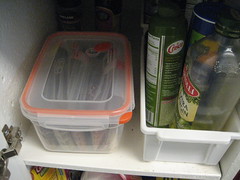
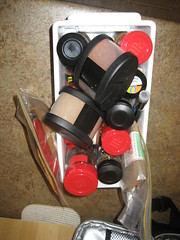
Sick of a ridiculous pile of tiny bottles falling everywhere in your cupboard? Spice Hacking Many people will sell you many expensive solutions. However, I think we've hit on something cheap, effective and practical; zip-lock bags in a deep tub, labelled with sticky tags. Spice Hacking Spice Hacking

7 August 2008

Ian Wienand: How to find the current glibc version

A recent post reminded me of a problem I once had; determine the glibc version and its support for various things. There's actually a little known but useful confstr call defined for just this sort of thing. Here's a minimal example:
#include <stdio.h>
#include <unistd.h>
#include <alloca.h>
#include <string.h>
int main (void)
 
        size_t n = confstr (_CS_GNU_LIBC_VERSION, NULL, 0);
        if (n > 0)
         
                char *buf = alloca (n);
                confstr (_CS_GNU_LIBC_VERSION, buf, n);
                printf("%s\n", buf);
         
        return 0;
 
man confstr has all the details. If you don't need it in your program, you can also just run /lib/libc/so.6 and it will print out it's version info, e.g.
$ /lib/libc.so.6
GNU C Library stable release version 2.7, by Roland McGrath et al.
Copyright (C) 2007 Free Software Foundation, Inc.
This is free software; see the source for copying conditions.
There is NO warranty; not even for MERCHANTABILITY or FITNESS FOR A
PARTICULAR PURPOSE.
Compiled by GNU CC version 4.3.1 20080523 (prerelease).
Compiled on a Linux >>2.6.24.4<< system on 2008-06-02.
Available extensions:
	crypt add-on version 2.1 by Michael Glad and others
	GNU Libidn by Simon Josefsson
	Native POSIX Threads Library by Ulrich Drepper et al
	BIND-8.2.3-T5B
For bug reporting instructions, please see:
<http://www.gnu.org/software/libc/bugs.html>.
There's also another glibc trick that often comes in useful; the LD_DEBUG environment variable. Start with help and you can get more details from there.
$ LD_DEBUG=help ls
Valid options for the LD_DEBUG environment variable are:
  libs        display library search paths
  reloc       display relocation processing
  files       display progress for input file
  symbols     display symbol table processing
  bindings    display information about symbol binding
  versions    display version dependencies
  all         all previous options combined
  statistics  display relocation statistics
  unused      determined unused DSOs
  help        display this help message and exit
To direct the debugging output into a file instead of standard output
a filename can be specified using the LD_DEBUG_OUTPUT environment variable.

7 July 2008

Ian Wienand: Whoda' thunk it!

I learned a new word today, thunk. At first, given the context, I thought it meant text (as in program code) hunk, but the Hacker's Dictionary suggests it's actually more a term for a closure. For those not familiar with what a closure is, it's a "thunk" of encapsulated code created by the compiler which is dynamically generated and managed. Stealing the Wikipedia example: Closures Nested functions are probably the closest thing to a closure you can get with C (I've talked about nested functions and trampolines before). However, because the stack disappears it's not nearly as useful, I think the term for these is lexical closures, because it's basically a way to share some stack and restrict name-spaces. Amusingly, the code using the term "thunk" was assembler, so my first search was for thunk gas (as in GNU Assembler). This of course lead to endless articles on the high price of gas — a non-renewable fossil fuel running out and capitalists realising inelastic demand can be used to line their pockets? Whoda' thunk it!

6 July 2008

Ian Wienand: Netgear WG311 shielding

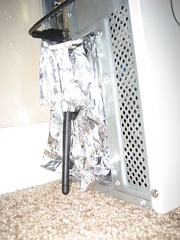
I recently picked up the Netgear WG311 V3 very cheap from Office Depot. The card seems to work fine with ndiswrapper; there are other guides on getting it working. The first problem was the reception was, in a word, rubbish. After putting the box back in it's usual home the house wireless was lucky to get a 7/100 signal rating. I found a work-around while the cheap external antenna I ordered is arriving; shield the antenna with foil. This increased signal to between 30-40/100, a considerable boost making it actually useful. Cheap RF Shielding The second problem was coming to terms with wpa_supplicant, of which the details often become very confusing very quickly. Here's the Debian 2-second guide for a simple, standard WPA network I was looking for:
  1. Add to /etc/network/interfaces
    iface wlan0 inet dhcp
    # Useful with ifup -v 
    #    wpa-debug-level 3
         wpa-conf /etc/wpa_supplicant.conf
    
  2. /etc/wpa_supplicant.conf should look like:
    network= 
            ssid="your_ssid"
            psk="your_password"
            key_mgmt=WPA-PSK
            proto=WPA


22 May 2008

Ian Wienand: Sending arbitrary keys through xtightvnc

Although it's not particularly clear, a neat feature of xtightvnc is the ability to modify the pop-up menu that appears when you press F8 to send arbitrary keystrokes. The trick is overriding some of the X11 resources of the file. If you have a look in /etc/X11/app-defaults/Vncviewer (make sure you have a recent package) you can see the default keybindings for the popup menu, which are a good template. Assuming you want to keep them all, you can add your own buttons by starting at button 9 and re-defining the total button count in your ~/.Xresources:
xtightvncviewer*popupButtonCount: 11
xtightvncviewer*popup*button9.label: Alt-F1
xtightvncviewer*popup*button9.translations: #override\n\
                                            <Btn1Down>,<Btn1Up>: \
                                            SendRFBEvent(keydown,Alt_L) \
                                            SendRFBEvent(keydown,F1) \
                                            SendRFBEvent(keyup, F1) \
                                            SendRFBEvent(keyup, Alt_L)
xtightvncviewer*popup*button10.label: Alt-F2
xtightvncviewer*popup*button10.translations: #override\n\
                                            <Btn1Down>,<Btn1Up>: \
                                            SendRFBEvent(keydown,Alt_L) \
                                            SendRFBEvent(keydown,F2) \
                                            SendRFBEvent(keyup, F2) \
                                            SendRFBEvent(keyup, Alt_L)
xtightvncviewer*popup*button11.label: Alt-F12
xtightvncviewer*popup*button11.translations: #override\n\
                                            <Btn1Down>,<Btn1Up>: \
                                            SendRFBEvent(keydown,Alt_L) \
                                            SendRFBEvent(keydown,F12) \
Make sure you merge this with xrdb -merge ~/.Xresources if you don't want to bother logging out and in. This way I can easily send Alt-F1, etc. through to the other side; useful for things like switching virtual terminals in VMware workstation running remotely. I imagine if you were insane you could do all sorts of other tricks too!

25 April 2008

Ian Wienand: Conditional Operator Harmful ? yes : no

It seems existing versions of gcc don't warn when you use an assignment as a truth value as the first operand to the conditional operator. For example:
int fn(int i)
 
	return (i = 0x20) ? 0x40 : 0x80;
 
Presumably you meant ==, but unfortunately that does not warn with gcc (maybe it will one day). We can use the tree dumping mechanisms (previously mentioned here) to confirm our problem. For the following function gcc creates:
fn (i)
 
  int D.1541;
  int iftmp.0;
  i = 32;
  if (1)
     
      iftmp.0 = 64;
     
  else
     
      iftmp.0 = 128;
     
  D.1541 = iftmp.0;
  return D.1541;
 
As you can see, this isn't the result we wanted. This can be quite nasty if you use the conditional operator in a hidden fashion; for example behind an assert. A common idiom is:
#define ASSERT(x) (x) ? : fail()
/* programmer now subsitutes a == for */
ASSERT(x = y);
You'll currently get no warning you've slipped up and used the assert wrong. Moral of the story: a quick audit of your code might turn up some surprising uses! However, in this case, the Intel compiler picks this one up:
$ icc -c test.c
test.c(3): warning #187: use of "=" where "==" may have been intended
  	   return (i = 0x20) ? 0x40 : 0x80;
Although it's often not trivial to move to another compiler, as a rule I would recommend trying alternative compilers for your code as it's a great sanity check.

10 April 2008

Ian Wienand: Tips and tricks for your E3 Visa

Having recently been through the process, I've managed to come out the other-side with some some advice for anyone taking this on.
  • If anything really stuffs up you'll have to enter the US immigration services, which is no fun. If this happens to you in the Bay Area go straight to the San Francisco office; the San Jose office doesn't have deferred inspections so you'll probably just have to go there anyway.
  • Your dependent on the E3D Visa will need to fill out an I-765 work authorisation form. This will take up to 3 months to process; you can find out the approximate queue time here. The form doesn't appear to have been updated for E3D; I would strongly recommend getting a lawyer to file it for you so you don't stuff it up. Budget about $400. After this has been processed, the dependent will then need to file for a SSN before they can be paid.
  • Tax is a black-art. In California expect to pay something like 20-25% federal, 10% state and up to 7% more for Medicare and social security. Expect another $80/month for health insurance.
  • You can get a bank account without a SSN easily. A good way to transfer money is OzForex, but watch out for fees on the US side (you may have to do wire-transfers which cost about $10 a go, though some banks have bill-pay). The country still runs on cheques for some reason.
  • You can rent without a SSN, but it will cost you. Budget for 2 months extra rent as deposits and paying ahead.
  • A car lease is probably a good way to go. Finance will usually look at your visa and only give you a two-year loan, and with no credit that will be at a very high interest rate. In California you can get a 2 year lease on a base model new car (sticker price ~$17,000) drive-away for a down-payment of about $2500 and then $250/month plus taxes. Insurance will be about $120/month on-top of that. The beauty is you just give it back when you go home. For long holiday trips SUV rental may contribute to global warming, but is a very comfortable way to see the country.
  • In California you'll need to book in for a driving test to get a license; you can't do this in a rental car but some local driving schools offer a short introduction course and then let you use their car for the test.
  • If you're living in temporary accommodation without great facilities Dream Dinners is a good way to easily get some meals together.
  • In the Bay Area, Yelp is an awesome resource.
  • Comcast make Telstra look like a well-run, efficient and customer focused organisation!
  • Feel free to drop me a line if you're thinking of taking an opportunity and have any questions.

    21 March 2008

    Ian Wienand: Grace Wifi Radio Review

    I recently purchased a Grace ITC-IR1000 Wifi Radio from Beach Audio. Grace ITC-IR1000 Wifi Radio There seem to be a number of competing products available at the moment, and it seems they are all based on the Reciva internet radio platform. This appears to be an ARM based system running Linux (checkout the GPL compliance area). It has built-in wireless, so connects up directly to your 802.11 network. It supports WEP and WPA; entering the WPA key is a little like entering your high score on an arcade game with a built-in scrolling alphabet. It supports all sorts of codecs, including the most important Real, WMA and MP3. Once on the network, it contacts Reciva service (free) to update and download channel lists. Once there, you can select stations filtered by region (Europe, Oceania, etc) then country. There are literally thousands to choose from, and users can contribute streams which are filtered by Reciva and added to the database periodically. An excellent feature is the ability to log-in to the website and both build favourite lists and add your own personal streams. You then register your radio's serial number with the website and on the next channel update you get access to your lists. It also offers you the opportunity to connect to a local PC to stream music from folders there; I haven't looked into this feature at all. Overall, it's a great device. The audio quality is great, and it seems to have at least a little sub-woofer built in. It has some nice features; 5 of the buttons on the front are quick access preset buttons, just hold it down when you are listening to the station and it remembers it. It supports a wide range of streams, the interface is simple to understand, it keeps the clock via NTP and directly connecting to the wireless is great. My ideal application is for a bedside clock radio, so I can listen to .au radio as I go to sleep and wake up. It has an inbuilt back-lit clock, sleep timer and alarm system, but they all take a bit of fiddling. The buttons are small and black, which doesn't help in the dark, and most access is done via the big scroll wheel which you press to make a selection (think iPod). However, the resistance of the rubber pads is less than that the pressure required to push the button in, so it really takes two hands. This means when you want to setup an alarm and put on the sleep timer as you go to bed there is a bit of fiddling through menus, etc. Also, as it is playing the clock seems to go away. Initially I had a problem with firewall ports, but it doesn't seem a big issue on the forums so it must have just been me. I also wonder what happens when Reciva go out of business, because all the tuning happens via their website. Something similar happened when 3com Audrey support was dropped; it then became a matter of faking DNS replies. Sniffing the protocol might be fun :) All in all, although it sounds a little silly, if you know what you want it for this is a great little system. I imagine any expat will get their money's worth listening to home radio stations. If you're only interested in local radio, I'd still suggest the best thing is still probably (surprise, surprise) a radio. It leaves a little to be desired as a bedside radio but is otherwise a very nice toy!

    4 March 2008

    Ian Wienand: Setting up an iPhone via prepay

    Just a quick note for Google on setting up a newly purchased iPhone on an AT&T GoPhone pre-pay plan, rather than the contract plan. Although the plans kind of suck, you might like to do this if you don't have a social security number or credit history. Several forums mention using an all-9's SSN or an all 1's SSN in the signup field. As of 4th March, 2008, these are not working. You need a different SSN which can be provided by AT&T (a hint, it has a lot of 1's and a 4, although I get the feeling they change this as too many people discover it). This will have the effect of failing the credit check, and even though you have to go through and agree to all the contract terms it will then present you with prepay options. Hopefully that saves some people time setting up their new iPhone!

    Ian Wienand: Forwarding VNC via ssh, or finding the PID of a running ssh

    I found a few people asking how to automate scripts using ssh with the -f option but not many solutions. Th -f option makes the ssh process fork into the background once started, but since it doesn't give you it's PID it becomes hard to kill it once the script ends. The solution is to setup a control channel with -M. This allows you to communicate to the ssh process and close it down when your process finishes. For example, here is how I open a VNC connection to my desktop at work, which involves going through a corporate ssh firewall box.
    ssh -M -S /tmp/vncssh-firewall.ctl -L 2022:desktop.internal.company.com:22 -f -N username@firewall.company.com
    ssh -M -S /tmp/vncssh-localhost.ctl -N -p 2022 -L 5901:localhost:5901 -f -N username@localhost
    xtightvncviewer -encodings tight localhost:1
    ssh -S /tmp/vncssh-firewall.ctl -O exit localhost
    ssh -S /tmp/vncssh-localhost.ctl -O exit firewall.company.com
    

    5 February 2008

    Ian Wienand: How not to move an iTunes library

    I now have several tips on how not to move an iTunes library from a Windows machine to a Mac. The presmise is simple; firstly request iTunes consolidate the library on the source machine and then move the c:\Documents and Settings\username\My Music\iTunes folder to ~/Music/iTunes on the Mac. So, what I would reccommend not to do: What I would recommend is using the 7-Zip utility to create an uncompressed archive of the directory on a NTFS formatted disk (for large file sizes) and then unarchiving it on OSX at the other end. This reliably handled all the crazy file names and the migrated library works perfectly.

    4 February 2008

    Ian Wienand: CDBS and .install files

    Last night, after dropping a package from a control file, I was wondering why my package.install file for the remaining package seemed to be ignored (upstream installs a bunch of stuff that I don't want installed in the Debian package; the symptom was all that junk was making its way into the package). Turns out it comes down to the following logic in CDBS:
    ifeq ($(words $(DEB_ALL_PACKAGES)),1)
            DEB_DESTDIR = $(CURDIR)/debian/$(strip $(DEB_ALL_PACKAGES))/
    else
            DEB_DESTDIR = $(CURDIR)/debian/tmp/
    endif
    
    i.e. if there is only one package, then by default install in debian/package. Therefore whatever make install does is what you end up with in your package. Although I can see the reasoning behind this, it wasn't what I wanted since I need the package installed into a temporary location (i.e. debian/tmp) which then uses a .install file to pull out only those files I want. The solution is simple, override DEB_DESTDIR to $(CURDIR)/debian/tmp/ in rules. I hope this saves someone the half hour or so I spent investigating why my install file was "corrupt"!

    1 February 2008

    Ian Wienand: Compare and Swap with PIC

    Our Dear Leader Sam Hocevar has previously blogged about PIC and inline ASM. Today I came across a sort of extension to this problem. Consider the following code, which implements a double word compare and swap using the x86 cmpxchg8b instruction (for a bonus you can lock it to make it atomic).
    #include <stdio.h>
    typedef struct double_word_t  
    	int a;
    	int b;
      double_word;
    /* atomically compare old and mem, if they are the same then copy new
       back to mem */
    int compare_and_swap(double_word *mem,
    		     double_word old,
    		     double_word new)  
    	char result;
    	__asm__ __volatile__("lock; cmpxchg8b %0; setz %1;"
    			     : "=m"(*mem), "=q"(result)
    			     : "m"(*mem), "d" (old.b), "a" (old.a),
    			       "c" (new.b), "b" (new.a)
    			     : "memory");
    	return (int)result;
     
    int main(void)
     
    	double_word w =  .a = 0, .b = 0 ;
    	double_word old =  .a = 17, .b = 42 ;
    	double_word new =  .a = 12, .b = 13 ;
    	/* old != w, therefore nothing happens */
    	compare_and_swap(&w, old, new);
    	printf("Should fail -> (%d,%d)\n", w.a, w.b);
    	/* old == w, therefore w = new */
    	old.a = 0; old.b = 0;
    	compare_and_swap(&w, old, new);
    	printf("Should work  -> (%d,%d)\n", w.a, w.b);
    	return 0;
     
    
    This type of CAS can be used to implement lock-free algorithms (I've previously blogged about that sort of thing). The problem is that the cmpxchg8b uses the ebx register, i.e. pseudo code looks like:
    if(EDX:EAX == Destination)  
        ZF = 1;
        Destination = ECX:EBX;
     
    else  
        ZF = 0;
        EDX:EAX = Destination;
     
    
    PIC code reserves ebx for internal use, so if you try to compile that with -fPIC you will get an error about not being able to allocate ebx. A first attempt to create a PIC friendly version would simply save and restore ebx and not gcc anything about it, something like:
      __asm__ __volatile__("pushl %%ebx;"   /* save ebx used for PIC GOT ptr */
    		       "movl %6,%%ebx;" /* move new_val2 to %ebx */
    		       "lock; cmpxchg8b %0; setz %1;"
    		       "pop %%ebx;"     /* restore %ebx */
    	    	       : "=m"(*mem), "=q"(result)
    		       : "m"(*mem), "d" (old.b), "a" (old.a),
    		         "c" (new.b), "m" (new.a) : "memory");
    
    Unfortunately, this isn't a generic solution. It works fine with the PIC case, because gcc will not allocate ebx for anything else. But in the non-PIC case, there is a chance that ebx will be used for addr. This would cause a probably fairly tricky bug to track down! The solution is to use the #if __PIC__ directive to either tell gcc you're clobbering ebx in the non-PIC case, or just keep two versions around; one that saves and restores ebx for PIC and one that doesn't.

    28 January 2008

    Ian Wienand: A cool laptop

    Or, a modern guide to CPU frequency scaling with Linux. Having setup my laptop long ago, I had a strange hybrid of daemons running all trying to scale the frequency of my laptop periodically based on a myriad of different situations. Having decided to fix this, it appears the simplest approach is, as usual, the best. The way of the future appears to be to let the kernel do all the work with the ondemand govener. The cpufrequtils Debian package will arrange this for you on boot and by default should just work, although you can of course tweak parameters like minimum speed to decrease to and so forth. You can use the cpufreq-set utility to fiddle with settings, or just go into /sys/devices/system/cpu/cpuN/cpufreq/ to tweak them by hand. The many available daemons (cpufreqd, powernowd, etc.) appear to be largely redundant and are probably best removed. This dropped the temperature of my laptop about 10 degrees C and, apart from a much cooler lap, is so far imperceptible.

    20 January 2008

    Ian Wienand: 5 Second VPN

    I was recently on a wireless network I trust even less than I usually trust wireless networks, so was looking for a way to ensure a little more security. I've previously setup a PPTP tunnel, but that server is on a boat heading to San Francisco so that was not an option. I have a linode with a generous bandwidth limit, so my first thought was to set that up and route through it with OpenVPN. It started getting a bit complicated and didn't work out-of-the-box with NetworkManager so I gave up. Then I found that ssh has a really nifty -D option to implement a SOCKS5 proxy. Therefore all I needed to do was ssh -D localhost:8080 remote.box and then setup Firefox to use localhost:8080 as a SOCKS proxy server. But it gets better; I did wonder if my DNS requests were leaking onto the local network, which a quick packet sniff confirmed. It turns out with SOCKS5 all you need to is go to the Firefox about:config page and turn on network.proxy.socks_remote_dns and DNS is tunnelled too. Since my mail already comes and goes via encrypted channels, this zero maintenance approach pretty much wraps up everything I need from a VPN solution!

    16 January 2008

    Ian Wienand: 2GiB in Dell X1

    Although the documenation doesn't mention it, I just tried a 2GiB SO-DIMM in my Dell X1 laptop and it works fine, although it does seem to lose the inbuilt 256MiB. The chip I got was a 2GiB PC2-5300 CL5 200 Pin SODIMM which has the bonus of also being sligtly faster than what I had before.
    Old : 1196 MB in  2.00 seconds = 598.21 MB/sec
    New : 1344 MB in  2.00 seconds = 671.89 MB/sec
    
    To install, you only need undo the screws marked with "K" and then flip the keyboard up (crappy photo). It required a bit of force to seat the DIMM properly, at first I thought it wasn't working but a bit of a push and it was fine. If I could afford a solid state drive, I rekon I could rename my new memory enhanced laptop a "Dell Air"!

    3 January 2008

    Ian Wienand: 24 Technobabble

    I was watching 24 the other day and (without giving anything away) Edgar Styles had to "patch a system call" to save the world. After chiding his assistant for giving him the wrong opcode for a "load A, conditional" the following briefly appears on the screen. The
system call that saved the world It's actually a pretty good piece of technobabble. The register names and use of 0x80 suggest whoever wrote this has at least some familiarlity with x86 assembley. It would have been slightly better if they called the "microshell" a "microkernel" and put the system call in eax before calling the interrupt, but if you belive Jack's amazing ability to get cell phone reception then it's only a small issue!

    2 January 2008

    Ian Wienand: 24 Technobabble

    I was watching 24 the other day and (without giving anything away) Edgar Stiles had to "patch a system call" to save the world. After chiding his assistant for giving him the wrong opcode for a "load A, conditional" the following briefly appears on the screen. The
system call that saved the world It's actually a pretty good piece of technobabble. The register names and use of 0x80 suggest whoever wrote this has at least some familiarity with x86 assembly. It would have been slightly better if they called the "microshell" a "microkernel" and put the system call in eax before calling the interrupt, but if you believe Jack's amazing ability to get cell phone reception then it's only a small issue!

    21 December 2007

    Ian Wienand: Playing with the x86 PMU

    A discussion about commas lead to an excuse to have a play with the IA-32 processor performance managment unit (PMU). To start, take two versions of a program to count the number of commas in a text file — one in C and one in Python. The C one runs faster on the input data set of ~60MiB of random data, but why? The CPU performance monitors give are the key to getting some idea of where the programs spend their time. I like to use perfmon2 because it's what I know, but Oprofile can do it too. All the available events for IA-32 are described in the manual; I currently of no better way of finding out about them than just reading it. On Itanium I reccommend Caliper which, for the most common situations, does most of the work for you and presents it in a nice report. Intel's Vtune also does a similar thing. The first thing to investigate is if the CPU is getting enough instructions to keep busy. The IFU_MEM_STALL metric is a good place to start as it is triggered when the instruction fetch pipeline is stalled, presumably waiting on either the ITLB or the trace buffer (Icache).
    $ pfmon -e CPU_CLK_UNHALTED,IFU_MEM_STALL ./comma < ./randomcommas
    340559375 CPU_CLK_UNHALTED
       192115 IFU_MEM_STALL
    $ pfmon -e CPU_CLK_UNHALTED,IFU_MEM_STALL python -Sc "import sys; print sum(l.count(',') for l in sys.stdin)" < ./randomcommas
    1287100
    4571257047 CPU_CLK_UNHALTED
     71981750 IFU_MEM_STALL
    
    That works out to 0.05% of total cycles for the C version and 1.5% for the Python version, neither of which sets off immediate warning bells. If it did, we could start drilling down to things like the L2_IFETCH and ITLB_MISS events, or the BR_* branch events to try and see why the CPU is having to wait to get its next instruction. Next it is useful to find the CPI (cycles per instruction). This is calculated by the ratio of retired instructions against the number of CPU cycles; since a superscalar machine can issue more than one instruction per cycle this should ideally be much greater than 1 (for example, an Itanium can execute up to 6 instructions each cycle).
    $ pfmon -e INST_RETIRED,CPU_CLK_UNHALTED ./comma < ./randomcommas
    542953593 INST_RETIRED
    340612036 CPU_CLK_UNHALTED
    $ pfmon -e INST_RETIRED,CPU_CLK_UNHALTED python -Sc "import sys; print sum(l.count(',') for l in sys.stdin)" < ./randomcommas
    1194455205 INST_RETIRED
    4569931735 CPU_CLK_UNHALTED
    
    This works out at a CPI of 1.59 for the C version and 0.26 for the Python version. The Python version is clearly spending a lot of time waiting, because it isn't even able to issue one instruction every cycle. At this point it seems the CPU has enough instructions to do, but it is sitting around waiting to get through those instructions. This suggests the waiting is related to getting data from the cache. The load and store requests from the L2 cache are accounted to the L2_LD and L2_ST events respectively. These have the ability to mask out cache lines in different states of the MESI protocol, but for this we don't care so just ask pfmon to show us everything.
    $ pfmon -e L2_LD:M:E:S:I,L2_ST:M:E:S:I ./comma < randomcommas 
    102505 L2_LD:M:E:S:I
       167 L2_ST:M:E:S:I
    $ pfmon -e L2_LD:M:E:S:I,L2_ST:M:E:S:I python -Sc "import sys; print sum(l.count(',') for l in sys.stdin)" < ./randomcommas
    3278774 L2_LD:M:E:S:I
      10457 L2_ST:M:E:S:I
    
    This shows us that the Python version does quite a few more stores than the C counterpart. Considering this program should simply be reading the input stream and counting the number of commas, we do not expect much store traffic at all. This suggests the Python version is doing some extra copying, for whatever reason (maybe some Python expert can pinpoint it?). We can drill down a bit more into the memory related latencies. The DCU_LINES_IN event gives the total number of lines allocated in the cache. Another event, DCU_MISS_OUTSTANDING, gives a weighted measure of the cycles spent waiting for a cache line to be brought in. Each cycle spent waiting is weighted by the number of outstanding cache misses (I think the Pentium M I'm using can have up to 4 cache miss requests outstanding at once) and has some caveats, but can be considered a rough estimate of the time spent waiting for a cache line to be brought in. Therefore divding DCU_MISS_OUTSTANDING by DCU_LINES_IN gives us an approximate metric of how long a cache miss takes.
    $ pfmon -e DCU_MISS_OUTSTANDING,DCU_LINES_IN ./comma < randomcommas 
    769736 DCU_MISS_OUTSTANDING
    102387 DCU_LINES_IN
    $ pfmon -e DCU_MISS_OUTSTANDING,DCU_LINES_IN python -Sc "import sys; print sum(l.count(',') for l in sys.stdin)" < ./randomcommas
    99810150 DCU_MISS_OUTSTANDING
     4240179 DCU_LINES_IN
    
    So that works out to 7.5 cycles for the C version and 23 cycles for the Python version. This seems to strongly suggest that it is memory traffic that is weighing the Python version down. That is only the initial phase; the results give a high level idea of why one program is running slower than the other. The initial analysis phase generally consists of taking the ratios of certain events to try and get some idea in your head of what the program is doing. Then comes the really hard work; drilling down to figure out how to fix it! Some useful references:
    15 November 2007

    Ian Wienand: Truth in names

    What is it with the price of cables? Even leaving aside patently absurd enhancements such as gold plated optical connectors, who is buying all these ridiculously overpriced Monster cables? Thus when purchasing a new cable today it was a pleasant surprise to find a cable company who are happy to state their business model prominently in their name: ConCord. The only thing that would have made it better was if their tag line was "we're screwing you for this cable, but at least we're telling you straight up". ConCord;
we're screwing you for this cable, but at least we tell you straight
up It reminded me of the apt rename of the UNSW student centre to the NewSouth Q, which I assume was done to more accurately describe its function as a gigantic queue (though they might as well have gone the whole way and called it the "NewSouth QForAnHourAndWellSayWeCantHelpYouAndYouNeedToStandInThisOtherQ").

    Next.

    Previous.