Search Results: "Chris Lamb"

21 March 2025

Reproducible Builds (diffoscope): diffoscope 291 released

The diffoscope maintainers are pleased to announce the release of diffoscope version 291. This version includes the following changes:
[ Chris Lamb ]
* Make two required adjustments for the new version of the src:file package:
  - file(1) version 5.46 now emits "XHTML document" for .xhtml files, such as
    those found nested within our .epub tests. Therefore, match this string
    when detecting XML files. This was causing an FTBFS due to inconsistent
    indentation in diffoscope's output.
  - Require the new, upcoming, version of file(1) for a quine-related
    testcase after adjusting the expected output. Previous versions of
    file(1) had a duplicated "last modified, last modified" string for some
    Zip archives that has now been removed.
* Add a missing subprocess import.
* Bump Standards-Version to 4.7.2.

You find out more by visiting the project homepage.

5 March 2025

Reproducible Builds: Reproducible Builds in February 2025

Welcome to the second report in 2025 from the Reproducible Builds project. Our monthly reports outline what we ve been up to over the past month, and highlight items of news from elsewhere in the increasingly-important area of software supply-chain security. As usual, however, if you are interested in contributing to the Reproducible Builds project, please visit our Contribute page on our website. Table of contents:
  1. Reproducible Builds at FOSDEM 2025
  2. Reproducible Builds at PyCascades 2025
  3. Does Functional Package Management Enable Reproducible Builds at Scale?
  4. reproduce.debian.net updates
  5. Upstream patches
  6. Distribution work
  7. diffoscope & strip-nondeterminism
  8. Website updates
  9. Reproducibility testing framework

Reproducible Builds at FOSDEM 2025 Similar to last year s event, there was considerable activity regarding Reproducible Builds at FOSDEM 2025, held on on 1st and 2nd February this year in Brussels, Belgium. We count at least four talks related to reproducible builds. (You can also read our news report from last year s event in which Holger Levsen presented in the main track.)
Jelle van der Waa, Holger Levsen and kpcyrd presented in the Distributions track on A Tale of several distros joining forces for a common goal. In this talk, three developers from two different Linux distributions (Arch Linux and Debian), discuss this goal which is, of course, reproducible builds. The presenters discuss both what is shared and different between the two efforts, touching on the history and future challenges alike. The slides of this talk are available to view, as is the full video (30m02s). The talk was also discussed on Hacker News.
Zbigniew J drzejewski-Szmek presented in the ever-popular Python track a on Rewriting .pyc files for fun and reproducibility, i.e. the bytecode files generated by Python in order to speed up module imports: It s been known for a while that those are not reproducible: on different architectures, the bytecode for exactly the same sources ends up slightly different. The slides of this talk are available, as is the full video (28m32s).
In the Nix and NixOS track, Julien Malka presented on the Saturday asking How reproducible is NixOS: We know that the NixOS ISO image is very close to be perfectly reproducible thanks to reproducible.nixos.org, but there doesn t exist any monitoring of Nixpkgs as a whole. In this talk I ll present the findings of a project that evaluated the reproducibility of Nixpkgs as a whole by mass rebuilding packages from revisions between 2017 and 2023 and comparing the results with the NixOS cache. Unfortunately, no video of the talk is available, but there is a blog and article on the results.
Lastly, Simon Tournier presented in the Open Research track on the confluence of GNU Guix and Software Heritage: Source Code Archiving to the Rescue of Reproducible Deployment. Simon s talk describes design and implementation we came up and reports on the archival coverage for package source code with data collected over five years. It opens to some remaining challenges toward a better open and reproducible research. The slides for the talk are available, as is the full video (23m17s).

Reproducible Builds at PyCascades 2025 Vagrant Cascadian presented at this year s PyCascades conference which was held on February 8th and 9th February in Portland, OR, USA. PyCascades is a regional instance of PyCon held in the Pacific Northwest. Vagrant s talk, entitled Re-Py-Ducible Builds caught the audience s attention with the following abstract:
Crank your Python best practices up to 11 with Reproducible Builds! This talk will explore Reproducible Builds by highlighting issues identified in Python projects, from the simple to the seemingly inscrutable. Reproducible Builds is basically the crazy idea that when you build something, and you build it again, you get the exact same thing or even more important, if someone else builds it, they get the exact same thing too.
More info is available on the talk s page.

Does Functional Package Management Enable Reproducible Builds at Scale? On our mailing list last month, Julien Malka, Stefano Zacchiroli and Th o Zimmermann of T l com Paris in-house research laboratory, the Information Processing and Communications Laboratory (LTCI) announced that they had published an article asking the question: Does Functional Package Management Enable Reproducible Builds at Scale? (PDF). This month, however, Ludovic Court s followed up to the original announcement on our mailing list mentioning, amongst other things, the Guix Data Service and how that it shows the reproducibility of GNU Guix over time, as described in a GNU Guix blog back in March 2024.

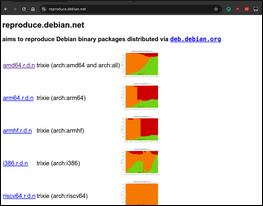
reproduce.debian.net updates The last few months have seen the introduction of reproduce.debian.net. Announced first at the recent Debian MiniDebConf in Toulouse, reproduce.debian.net is an instance of rebuilderd operated by the Reproducible Builds project. Powering this work is rebuilderd, our server which monitors the official package repositories of Linux distributions and attempt to reproduce the observed results there. This month, however, Holger Levsen:
  • Split packages that are not specific to any architecture away from amd64.reproducible.debian.net service into a new all.reproducible.debian.net page.
  • Increased the number of riscv64 nodes to a total of 4, and added a new amd64 node added thanks to our (now 10-year sponsor), IONOS.
  • Discovered an issue in the Debian build service where some new incoming build-dependencies do not end up historically archived.
  • Uploaded the devscripts package, incorporating changes from Jochen Sprickerhof to the debrebuild script specifically to fix the handling the Rules-Requires-Root header in Debian source packages.
  • Uploaded a number of Rust dependencies of rebuilderd (rust-libbz2-rs-sys, rust-actix-web, rust-actix-server, rust-actix-http, rust-actix-server, rust-actix-http, rust-actix-web-codegen and rust-time-tz) after they were prepared by kpcyrd :
Jochen Sprickerhof also updated the sbuild package to:
  • Obey requests from the user/developer for a different temporary directory.
  • Use the root/superuser for some values of Rules-Requires-Root.
  • Don t pass --root-owner-group to old versions of dpkg.
and additionally requested that many Debian packages are rebuilt by the build servers in order to work around bugs found on reproduce.debian.net. [ ][[ ][ ]
Lastly, kpcyrd has also worked towards getting rebuilderd packaged in NixOS, and Jelle van der Waa picked up the existing pull request for Fedora support within in rebuilderd and made it work with the existing Koji rebuilderd script. The server is being packaged for Fedora in an unofficial copr repository and in the official repositories after all the dependencies are packaged.

Upstream patches The Reproducible Builds project detects, dissects and attempts to fix as many currently-unreproducible packages as possible. We endeavour to send all of our patches upstream where appropriate. This month, we wrote a large number of such patches, including:

Distribution work There as been the usual work in various distributions this month, such as: In Debian, 17 reviews of Debian packages were added, 6 were updated and 8 were removed this month adding to our knowledge about identified issues.
Fedora developers Davide Cavalca and Zbigniew J drzejewski-Szmek gave a talk on Reproducible Builds in Fedora (PDF), touching on SRPM-specific issues as well as the current status and future plans.
Thanks to an investment from the Sovereign Tech Agency, the FreeBSD project s work on unprivileged and reproducible builds continued this month. Notable fixes include:
The Yocto Project has been struggling to upgrade to the latest Go and Rust releases due to reproducibility problems in the newer versions. Hongxu Jia tracked down the issue with Go which meant that the project could upgrade from the 1.22 series to 1.24, with the fix being submitted upstream for review (see above). For Rust, however, the project was significantly behind, but has made recent progress after finally identifying the blocking reproducibility issues. At time of writing, the project is at Rust version 1.82, with patches under review for 1.83 and 1.84 and fixes being discussed with the Rust developers. The project hopes to improve the tests for reproducibility in the Rust project itself in order to try and avoid future regressions. Yocto continues to maintain its ability to binary reproduce all of the recipes in OpenEmbedded-Core, regardless of the build host distribution or the current build path.
Finally, Douglas DeMaio published an article on the openSUSE blog on announcing that the Reproducible-openSUSE (RBOS) Project Hits [Significant] Milestone. In particular:
The Reproducible-openSUSE (RBOS) project, which is a proof-of-concept fork of openSUSE, has reached a significant milestone after demonstrating a usable Linux distribution can be built with 100% bit-identical packages.
This news was also announced on our mailing list by Bernhard M. Wiedemann, who also published another report for openSUSE as well.

diffoscope & strip-nondeterminism diffoscope is our in-depth and content-aware diff utility that can locate and diagnose reproducibility issues. This month, Chris Lamb made the following changes, including preparing and uploading versions 288 and 289 to Debian:
  • Add asar to DIFFOSCOPE_FAIL_TESTS_ON_MISSING_TOOLS in order to address Debian bug #1095057) [ ]
  • Catch a CalledProcessError when calling html2text. [ ]
  • Update the minimal Black version. [ ]
Additionally, Vagrant Cascadian updated diffoscope in GNU Guix to version 287 [ ][ ] and 288 [ ][ ] as well as submitted a patch to update to 289 [ ]. Vagrant also fixed an issue that was breaking reprotest on Guix [ ][ ]. strip-nondeterminism is our sister tool to remove specific non-deterministic results from a completed build. This month version 1.14.1-2 was uploaded to Debian unstable by Holger Levsen.

Website updates There were a large number of improvements made to our website this month, including:

Reproducibility testing framework The Reproducible Builds project operates a comprehensive testing framework running primarily at tests.reproducible-builds.org in order to check packages and other artifacts for reproducibility. In January, a number of changes were made by Holger Levsen, including:
  • reproduce.debian.net-related:
    • Add a helper script to manually schedule packages. [ ][ ][ ][ ][ ]
    • Fix a link in the website footer. [ ]
    • Strip the emojis from package names on the manual rebuilder in order to ease copy-and-paste. [ ]
    • On the various statistics pages, provide the number of affected source packages [ ][ ] as well as provide various totals [ ][ ].
    • Fix graph labels for the various architectures [ ][ ] and make them clickable too [ ][ ][ ].
    • Break the displayed HTML in blocks of 256 packages in order to address rendering issues. [ ][ ]
    • Add monitoring jobs for riscv64 archicture nodes and integrate them elsewhere in our infrastructure. [ ][ ]
    • Add riscv64 architecture nodes. [ ][ ][ ][ ][ ]
    • Update much of the documentation. [ ][ ][ ]
    • Make a number of improvements to the layout and style. [ ][ ][ ][ ][ ][ ][ ]
    • Remove direct links to JSON and database backups. [ ]
    • Drop a Blues Brothers reference from frontpage. [ ]
  • Debian-related:
    • Deal with /boot/vmlinuz* being called vmlinux* on the riscv64 architecture. [ ]
    • Add a new ionos17 node. [ ][ ][ ][ ][ ]
    • Install debian-repro-status on all Debian trixie and unstable jobs. [ ]
  • FreeBSD-related:
    • Switch to run latest branch of FreeBSD. [ ]
  • Misc:
    • Fix /etc/cron.d and /etc/logrotate.d permissions for Jenkins nodes. [ ]
    • Add support for riscv64 architecture nodes. [ ][ ]
    • Grant Jochen Sprickerhof access to the o4 node. [ ]
    • Disable the janitor-setup-worker. [ ][ ]
In addition:
  • kpcyrd fixed the /all/api/ API endpoints on reproduce.debian.net by altering the nginx configuration. [ ]
  • James Addison updated reproduce.debian.net to display the so-called bad reasons hyperlink inline [ ] and merged the Categorized issues links into the Reproduced builds column [ ].
  • Jochen Sprickerhof also made some reproduce.debian.net-related changes, adding support for detecting a bug in the mmdebstrap package [ ] as well as updating some documentation [ ].
  • Roland Clobus continued their work on reproducible live images for Debian, making changes related to new clustering of jobs in openQA. [ ]
And finally, both Holger Levsen [ ][ ][ ] and Vagrant Cascadian performed significant node maintenance. [ ][ ][ ][ ][ ]
If you are interested in contributing to the Reproducible Builds project, please visit our Contribute page on our website. However, you can get in touch with us via:

21 February 2025

Reproducible Builds (diffoscope): diffoscope 289 released

The diffoscope maintainers are pleased to announce the release of diffoscope version 289. This version includes the following changes:
[ Chris Lamb ]
* Catch CalledProcessError when calling html2text.
* Update copyright years.
You find out more by visiting the project homepage.

14 February 2025

Freexian Collaborators: Monthly report about Debian Long Term Support, January 2025 (by Roberto C. S nchez)

Like each month, have a look at the work funded by Freexian s Debian LTS offering.

Debian LTS contributors In January, 20 contributors have been paid to work on Debian LTS, their reports are available:
  • Abhijith PA did 8.0h (out of 14.0h assigned), thus carrying over 6.0h to the next month.
  • Adrian Bunk did 36.5h (out of 47.75h assigned and 52.25h from previous period), thus carrying over 63.5h to the next month.
  • Andrej Shadura did 11.0h (out of 11.0h assigned and 4.0h from previous period), thus carrying over 4.0h to the next month.
  • Arturo Borrero Gonzalez did 9.0h (out of 10.0h assigned), thus carrying over 1.0h to the next month.
  • Bastien Roucari s did 22.0h (out of 22.0h assigned).
  • Ben Hutchings did 8.0h (out of 21.0h assigned and 3.0h from previous period), thus carrying over 16.0h to the next month.
  • Chris Lamb did 18.0h (out of 18.0h assigned).
  • Daniel Leidert did 20.0h (out of 23.0h assigned and 3.0h from previous period), thus carrying over 6.0h to the next month.
  • Emilio Pozuelo Monfort did 34.0h (out of 7.0h assigned and 27.75h from previous period), thus carrying over 0.75h to the next month.
  • Guilhem Moulin did 3.25h (out of 20.0h assigned), thus carrying over 16.75h to the next month.
  • Jochen Sprickerhof did 23.0h (out of 15.0h assigned and 8.0h from previous period).
  • Lee Garrett did 15.75h (out of 8.5h assigned and 51.5h from previous period), thus carrying over 44.25h to the next month.
  • Lucas Kanashiro did 8.0h (out of 32.0h assigned and 32.0h from previous period), thus carrying over 56.0h to the next month.
  • Markus Koschany did 40.0h (out of 40.0h assigned).
  • Roberto C. S nchez did 14.75h (out of 13.5h assigned and 10.5h from previous period), thus carrying over 9.25h to the next month.
  • Santiago Ruano Rinc n did 21.75h (out of 18.75h assigned and 6.25h from previous period), thus carrying over 3.25h to the next month.
  • Sean Whitton did 8.5h (out of 8.5h assigned).
  • Sylvain Beucler did 10.5h (out of 0.0h assigned and 49.5h from previous period), thus carrying over 39.0h to the next month.
  • Thorsten Alteholz did 11.0h (out of 11.0h assigned).
  • Tobias Frost did 12.0h (out of 12.0h assigned).

Evolution of the situation In January, we have released 33 DLAs. There were numerous security and non-security updates to Debian 11 (codename bullseye ) during January.
  • Notable security updates:
    • rsync, prepared by Thorsten Alteholz, fixed several CVEs (including information leak and path traversal vulnerabilities)
    • tomcat9, prepared by Markus Koschany, fixed several CVEs (including denial of service and information disclosure vulnerabilities)
    • ruby2.7, prepared by Bastien Roucari s, fixed several CVEs (including denial of service vulnerabilities)
    • tiff, prepared by Adrian Bunk, fixed several CVEs (including NULL ptr, buffer overflow, use-after-free, and segfault vulnerabilities)
  • Notable non-security updates:
    • linux-6.1, prepared by Ben Hutchings, has been packaged for bullseye (this was done specifically to provide a supported upgrade path for systems that currently use kernel packages from the bullseye-backports suite)
    • debian-security-support, prepared by Santiago Ruano Rinc n, which formalized the EOL of intel-mediasdk and node-matrix-js-sdk
In addition to the security and non-security updates targeting bullseye , various LTS contributors have prepared uploads targeting Debian 12 (codename bookworm ) with fixes for a variety of vulnerabilities. Abhijith PA prepared an upload of puma; Bastien Roucari s prepared an upload of node-postcss with fixes for data processing and denial of service vulnerabilities; Daniel Leidert prepared updates for setuptools, python-asyncssh, and python-tornado; Lee Garrett prepared an upload of ansible-core; and Guilhem Moulin prepared updates for python-urllib3, sqlparse, and opensc. Santiago Ruano Rinc n also worked on tracking and filing some issues about packages that need an update in recent releases to avoid regressions on upgrade. This relates to CVEs that were fixed in buster or bullseye, but remain open in bookworm. These updates, along with Santiago s work on identifying and tracking similar issues, underscore the LTS Team s commitment to ensuring that the work we do as part of LTS also benefits the current Debian stable release. LTS contributor Sean Whitton also prepared an upload of jinja2 and Santiago Ruano Rinc n prepared an upload of openjpeg2 for Debian unstable (codename sid ), as part of the LTS Team effort to assist with package uploads to unstable.

Thanks to our sponsors Sponsors that joined recently are in bold.

7 February 2025

Reproducible Builds (diffoscope): diffoscope 288 released

The diffoscope maintainers are pleased to announce the release of diffoscope version 288. This version includes the following changes:
[ Chris Lamb ]
* Add 'asar' to DIFFOSCOPE_FAIL_TESTS_ON_MISSING_TOOLS. (Closes: #1095057)
* Update minimal 'black' version.
* Update copyright years.
You find out more by visiting the project homepage.

5 February 2025

Reproducible Builds: Reproducible Builds in January 2025

Welcome to the first report in 2025 from the Reproducible Builds project! Our monthly reports outline what we ve been up to over the past month and highlight items of news from elsewhere in the world of software supply-chain security when relevant. As usual, though, if you are interested in contributing to the Reproducible Builds project, please visit our Contribute page on our website. Table of contents:
  1. reproduce.debian.net
  2. Two new academic papers
  3. Distribution work
  4. On our mailing list
  5. Upstream patches
  6. diffoscope
  7. Website updates
  8. Reproducibility testing framework

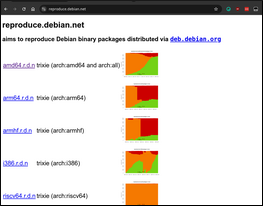
reproduce.debian.net The last few months saw the introduction of reproduce.debian.net. Announced at the recent Debian MiniDebConf in Toulouse, reproduce.debian.net is an instance of rebuilderd operated by the Reproducible Builds project. Powering that is rebuilderd, our server designed monitor the official package repositories of Linux distributions and attempt to reproduce the observed results there. This month, however, we are pleased to announce that in addition to the existing amd64.reproduce.debian.net and i386.reproduce.debian.net architecture-specific pages, we now build for a three more architectures (for a total of five) arm64 armhf and riscv64.

Two new academic papers Giacomo Benedetti, Oreofe Solarin, Courtney Miller, Greg Tystahl, William Enck, Christian K stner, Alexandros Kapravelos, Alessio Merlo and Luca Verderame published an interesting article recently. Titled An Empirical Study on Reproducible Packaging in Open-Source Ecosystem, the abstract outlines its optimistic findings:
[We] identified that with relatively straightforward infrastructure configuration and patching of build tools, we can achieve very high rates of reproducible builds in all studied ecosystems. We conclude that if the ecosystems adopt our suggestions, the build process of published packages can be independently confirmed for nearly all packages without individual developer actions, and doing so will prevent significant future software supply chain attacks.
The entire PDF is available online to view.
In addition, Julien Malka, Stefano Zacchiroli and Th o Zimmermann of T l com Paris in-house research laboratory, the Information Processing and Communications Laboratory (LTCI) published an article asking the question: Does Functional Package Management Enable Reproducible Builds at Scale?. Answering strongly in the affirmative, the article s abstract reads as follows:
In this work, we perform the first large-scale study of bitwise reproducibility, in the context of the Nix functional package manager, rebuilding 709,816 packages from historical snapshots of the nixpkgs repository[. We] obtain very high bitwise reproducibility rates, between 69 and 91% with an upward trend, and even higher rebuildability rates, over 99%. We investigate unreproducibility causes, showing that about 15% of failures are due to embedded build dates. We release a novel dataset with all build statuses, logs, as well as full diffoscopes: recursive diffs of where unreproducible build artifacts differ.
As above, the entire PDF of the article is available to view online.

Distribution work There as been the usual work in various distributions this month, such as:
  • 10+ reviews of Debian packages were added, 11 were updated and 10 were removed this month adding to our knowledge about identified issues. A number of issue types were updated also.
  • The FreeBSD Foundation announced that a planned project to deliver zero-trust builds has begun in January 2025 . Supported by the Sovereign Tech Agency, this project is centered on the various build processes, and that the primary goal of this work is to enable the entire release process to run without requiring root access, and that build artifacts build reproducibly that is, that a third party can build bit-for-bit identical artifacts. The full announcement can be found online, which includes an estimated schedule and other details.

On our mailing list On our mailing list this month:
  • Following-up to a substantial amount of previous work pertaining the Sphinx documentation generator, James Addison asked a question pertaining to the relationship between SOURCE_DATE_EPOCH environment variable and testing that generated a number of replies.
  • Adithya Balakumar of Toshiba asked a question about whether it is possible to make ext4 filesystem images reproducible. Adithya s issue is that even the smallest amount of post-processing of the filesystem results in the modification of the Last mount and Last write timestamps.
  • James Addison also investigated an interesting issue surrounding our disorderfs filesystem. In particular:
    FUSE (Filesystem in USErspace) filesystems such as disorderfs do not delete files from the underlying filesystem when they are deleted from the overlay. This can cause seemingly straightforward tests for example, cases that expect directory contents to be empty after deletion is requested for all files listed within them to fail.

Upstream patches The Reproducible Builds project detects, dissects and attempts to fix as many currently-unreproducible packages as possible. We endeavour to send all of our patches upstream where appropriate. This month, we wrote a large number of such patches, including:

diffoscope diffoscope is our in-depth and content-aware diff utility that can locate and diagnose reproducibility issues. This month, Chris Lamb made the following changes, including preparing and uploading versions 285, 286 and 287 to Debian:
  • Security fixes:
    • Validate the --css command-line argument to prevent a potential Cross-site scripting (XSS) attack. Thanks to Daniel Schmidt from SRLabs for the report. [ ]
    • Prevent XML entity expansion attacks. Thanks to Florian Wilkens from SRLabs for the report.. [ ][ ]
    • Print a warning if we have disabled XML comparisons due to a potentially vulnerable version of pyexpat. [ ]
  • Bug fixes:
    • Correctly identify changes to only the line-endings of files; don t mark them as Ordering differences only. [ ]
    • When passing files on the command line, don t call specialize( ) before we ve checked that the files are identical or not. [ ]
    • Do not exit with a traceback if paths are inaccessible, either directly, via symbolic links or within a directory. [ ]
    • Don t cause a traceback if cbfstool extraction failed.. [ ]
    • Use the surrogateescape mechanism to avoid a UnicodeDecodeError and crash when any decoding zipinfo output that is not UTF-8 compliant. [ ]
  • Testsuite improvements:
    • Don t mangle newlines when opening test fixtures; we want them untouched. [ ]
    • Move to assert_diff in test_text.py. [ ]
  • Misc improvements:
    • Drop unused subprocess imports. [ ][ ]
    • Drop an unused function in iso9600.py. [ ]
    • Inline a call and check of Config().force_details; no need for an additional variable in this particular method. [ ]
    • Remove an unnecessary return value from the Difference.check_for_ordering_differences method. [ ]
    • Remove unused logging facility from a few comparators. [ ]
    • Update copyright years. [ ][ ]
In addition, fridtjof added support for the ASAR .tar-like archive format. [ ][ ][ ][ ] and lastly, Vagrant Cascadian updated diffoscope in GNU Guix to version 285 [ ][ ] and 286 [ ][ ].
strip-nondeterminism is our sister tool to remove specific non-deterministic results from a completed build. This month version 1.14.1-1 was uploaded to Debian unstable by Chris Lamb, making the following the changes:
  • Clarify the --verbose and non --verbose output of bin/strip-nondeterminism so we don t imply we are normalizing files that we are not. [ ]
  • Bump Standards-Version to 4.7.0. [ ]

Website updates There were a large number of improvements made to our website this month, including:

Reproducibility testing framework The Reproducible Builds project operates a comprehensive testing framework running primarily at tests.reproducible-builds.org in order to check packages and other artifacts for reproducibility. In January, a number of changes were made by Holger Levsen, including:
  • reproduce.debian.net-related:
    • Add support for rebuilding the armhf architecture. [ ][ ]
    • Add support for rebuilding the arm64 architecture. [ ][ ][ ][ ]
    • Add support for rebuilding the riscv64 architecture. [ ][ ]
    • Move the i386 builder to the osuosl5 node. [ ][ ][ ][ ]
    • Don t run our rebuilders on a public port. [ ][ ]
    • Add database backups on all builders and add links. [ ][ ]
    • Rework and dramatically improve the statistics collection and generation. [ ][ ][ ][ ][ ][ ]
    • Add contact info to the main page [ ], thumbnails [ ] as well as the new, missing architectures. [ ]
    • Move the amd64 worker to the osuosl4 and node. [ ]
    • Run the underlying debrebuild script under nice. [ ]
    • Try to use TMPDIR when calling debrebuild. [ ][ ]
  • buildinfos.debian.net-related:
    • Stop creating buildinfo-pool_$ suite _$ arch .list files. [ ]
    • Temporarily disable automatic updates of pool links. [ ]
  • FreeBSD-related:
    • Fix the sudoers to actually permit builds. [ ]
    • Disable debug output for FreeBSD rebuilding jobs. [ ]
    • Upgrade to FreeBSD 14.2 [ ] and document that bmake was installed on the underlying FreeBSD virtual machine image [ ].
  • Misc:
    • Update the real year to 2025. [ ]
    • Don t try to install a Debian bookworm kernel from backports on the infom08 node which is running Debian trixie. [ ]
    • Don t warn about system updates for systems running Debian testing. [ ]
    • Fix a typo in the ZOMBIES definition. [ ][ ]
In addition:
  • Ed Maste modified the FreeBSD build system to the clean the object directory before commencing a build. [ ]
  • Gioele Barabucci updated the rebuilder stats to first add a category for network errors [ ] as well as to categorise failures without a diffoscope log [ ].
  • Jessica Clarke also made some FreeBSD-related changes, including:
    • Ensuring we clean up the object directory for second build as well. [ ][ ]
    • Updating the sudoers for the relevant rm -rf command. [ ]
    • Update the cleanup_tmpdirs method to to match other removals. [ ]
  • Jochen Sprickerhof:
  • Roland Clobus:
    • Update the reproducible_debstrap job to call Debian s debootstrap with the full path [ ] and to use eatmydata as well [ ][ ].
    • Make some changes to deduce the CPU load in the debian_live_build job. [ ]
Lastly, both Holger Levsen [ ] and Vagrant Cascadian [ ] performed some node maintenance.
If you are interested in contributing to the Reproducible Builds project, please visit our Contribute page on our website. However, you can get in touch with us via:

31 January 2025

Reproducible Builds (diffoscope): diffoscope 287 released

The diffoscope maintainers are pleased to announce the release of diffoscope version 287. This version includes the following changes:
[ Chris Lamb ]
* Drop an unused subprocess import.
* Update copyright years.
[ fridtjof ]
* Add ASAR comparator.
You find out more by visiting the project homepage.

24 January 2025

Reproducible Builds (diffoscope): diffoscope 286 released

The diffoscope maintainers are pleased to announce the release of diffoscope version 286. This version includes the following changes:
[ Chris Lamb ]
* Bug fixes:
  - When passing files on the command line, don't call specialize(..) before
    we've checked that the files are identical. In the worst case, this was
    resulting in spinning up binwalk and extracting two entire filesystem
    images merely to confirm that they were indeed filesystem images..
    before simply concluding that they were identical anyway.
  - Do not exit with a traceback if paths are inaccessible, either directly,
    via symbolic links or within a directory. (Closes: #1065498)
  - Correctly identify changes to only the line-endings of files; don't mark
    them as "Ordering differences only".
  - Use the "surrogateescape" mechanism of str. decode,encode  to avoid a
    UnicodeDecodeError and crash when decoding zipinfo output that is not
    valid UTF-8. (Closes: #1093484)
* Testsuite changes:
  - Don't mangle newlines when opening test fixtures; we want them untouched.
  - Move to assert_diff in test_text.py.
* Misc:
  - Remove unnecessary return value from check_for_ordering_differences in
    the Difference class.
  - Drop an unused function in iso9600.py
  - Inline a call/check of Config().force_details; no need for an additional
    variable.
You find out more by visiting the project homepage.

17 January 2025

Reproducible Builds (diffoscope): diffoscope 285 released

The diffoscope maintainers are pleased to announce the release of diffoscope version 285. This version includes the following changes:
[ Chris Lamb ]
* Validate --css command-line argument. Thanks to Daniel Schmidt @ SRLabs for
  the report. (Closes: #396)
* Prevent XML entity expansion attacks through vulnerable versions of
  pyexpat. Thanks to Florian Wilkens @ SRLabs for the report. (Closes: #397)
* Print a warning if we have disabled XML comparisons due to a potentially
  vulnerable version of pyexpat.
* Remove (unused) logging facility from a few comparators.
* Update copyright years.
You find out more by visiting the project homepage.

13 January 2025

Freexian Collaborators: Monthly report about Debian Long Term Support, December 2024 (by Roberto C. S nchez)

Like each month, have a look at the work funded by Freexian s Debian LTS offering.
Debian LTS contributors In December, 19 contributors have been paid to work on Debian LTS, their reports are available:
  • Abhijith PA did 14.0h (out of 14.0h assigned).
  • Adrian Bunk did 47.75h (out of 53.0h assigned and 47.0h from previous period), thus carrying over 52.25h to the next month.
  • Andrej Shadura did 6.0h (out of 17.0h assigned and -7.0h from previous period after hours given back), thus carrying over 4.0h to the next month.
  • Bastien Roucari s did 22.0h (out of 22.0h assigned).
  • Ben Hutchings did 15.0h (out of 0.0h assigned and 18.0h from previous period), thus carrying over 3.0h to the next month.
  • Chris Lamb did 18.0h (out of 18.0h assigned).
  • Daniel Leidert did 23.0h (out of 17.0h assigned and 9.0h from previous period), thus carrying over 3.0h to the next month.
  • Emilio Pozuelo Monfort did 32.25h (out of 40.5h assigned and 19.5h from previous period), thus carrying over 27.75h to the next month.
  • Guilhem Moulin did 22.5h (out of 9.75h assigned and 12.75h from previous period).
  • Jochen Sprickerhof did 2.0h (out of 3.5h assigned and 6.5h from previous period), thus carrying over 8.0h to the next month.
  • Lee Garrett did 8.5h (out of 14.75h assigned and 45.25h from previous period), thus carrying over 51.5h to the next month.
  • Lucas Kanashiro did 32.0h (out of 10.0h assigned and 54.0h from previous period), thus carrying over 32.0h to the next month.
  • Markus Koschany did 40.0h (out of 20.0h assigned and 20.0h from previous period).
  • Roberto C. S nchez did 13.5h (out of 6.75h assigned and 17.25h from previous period), thus carrying over 10.5h to the next month.
  • Santiago Ruano Rinc n did 18.75h (out of 24.75h assigned and 0.25h from previous period), thus carrying over 6.25h to the next month.
  • Sean Whitton did 6.0h (out of 2.0h assigned and 4.0h from previous period).
  • Sylvain Beucler did 10.5h (out of 21.5h assigned and 38.5h from previous period), thus carrying over 49.5h to the next month.
  • Thorsten Alteholz did 11.0h (out of 11.0h assigned).
  • Tobias Frost did 12.0h (out of 12.0h assigned).

Evolution of the situation In December, we have released 29 DLAs. The LTS Team has published updates to several notable packages. Contributor Guilhem Moulin published an update of php7.4, a widely-used open source general purpose scripting language, which addressed denial of service, authorization bypass, and information disclosure vulnerabilities. Contributor Lucas Kanashiro published an update of clamav, an antivirus toolkit for Unix and Linux, which addressed denial of service and authorization bypass vulnerabilities. Finally, contributor Tobias Frost published an update of intel-microcode, the microcode for Intel microprocessors, which well help to ensure that processor hardware is protected against several local privilege escalation and local denial of service vulnerabilities. Beyond our customary LTS package updates, the LTS Team has made contributions to Debian s stable bookworm release and its experimental section. Notably, contributor Lee Garrett published a stable update of dnsmasq. The LTS update was previously published in November and in December Lee continued working to bring the same fixes (addressing the high profile KeyTrap and NSEC3 vulnerabilities) to the dnsmasq package in Debian bookworm. This package was accepted for inclusion in the Debian 12.9 point release scheduled for January 2025. Addititionally, contributor Sean Whitton provided assistance, via upload sponsorships, to the Debian maintainers of xen. This assistance resulted in two uploads of xen into Debian s experimental section, which will contribute to the next Debian stable release having a version of xen with better longterm support from the upstream development team.

Thanks to our sponsors Sponsors that joined recently are in bold.

9 January 2025

Reproducible Builds: Reproducible Builds in December 2024

Welcome to the December 2024 report from the Reproducible Builds project! Our monthly reports outline what we ve been up to over the past month and highlight items of news from elsewhere in the world of software supply-chain security when relevant. As ever, however, if you are interested in contributing to the Reproducible Builds project, please visit our Contribute page on our website. Table of contents:
  1. reproduce.debian.net
  2. debian-repro-status
  3. On our mailing list
  4. Enhancing the Security of Software Supply Chains
  5. diffoscope
  6. Supply-chain attack in the Solana ecosystem
  7. Website updates
  8. Debian changes
  9. Other development news
  10. Upstream patches
  11. Reproducibility testing framework

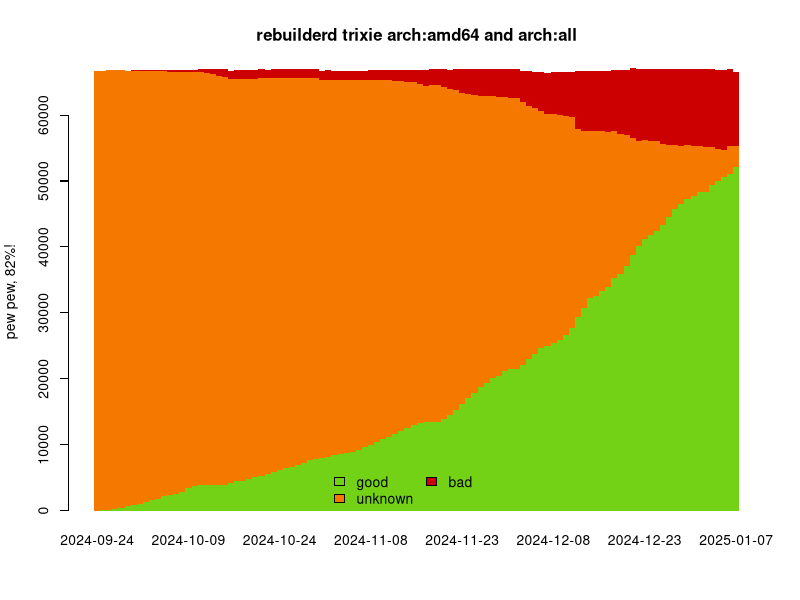
reproduce.debian.net Last month saw the introduction of reproduce.debian.net. Announced at the recent Debian MiniDebConf in Toulouse, reproduce.debian.net is an instance of rebuilderd operated by the Reproducible Builds project. rebuilderd is our server designed monitor the official package repositories of Linux distributions and attempts to reproduce the observed results there. This month, however, we are pleased to announce that not only does the service now produce graphs, the reproduce.debian.net homepage itself has become a start page of sorts, and the amd64.reproduce.debian.net and i386.reproduce.debian.net pages have emerged. The first of these rebuilds the amd64 architecture, naturally, but it also is building Debian packages that are marked with the no architecture label, all. The second builder is, however, only rebuilding the i386 architecture. Both of these services were also switched to reproduce the Debian trixie distribution instead of unstable, which started with 43% of the archive rebuild with 79.3% reproduced successfully. This is very much a work in progress, and we ll start reproducing Debian unstable soon. Our i386 hosts are very kindly sponsored by Infomaniak whilst the amd64 node is sponsored by OSUOSL thank you! Indeed, we are looking for more workers for more Debian architectures; please contact us if you are able to help.

debian-repro-status Reproducible builds developer kpcyrd has published a client program for reproduce.debian.net (see above) that queries the status of the locally installed packages and rates the system with a percentage score. This tool works analogously to arch-repro-status for the Arch Linux Reproducible Builds setup. The tool was packaged for Debian and is currently available in Debian trixie: it can be installed with apt install debian-repro-status.

On our mailing list On our mailing list this month:
  • Bernhard M. Wiedemann wrote a detailed post on his long journey towards a bit-reproducible Emacs package. In his interesting message, Bernhard goes into depth about the tools that they used and the lower-level technical details of, for instance, compatibility with the version for glibc within openSUSE.
  • Shivanand Kunijadar posed a question pertaining to the reproducibility issues with encrypted images. Shivanand explains that they must use a random IV for encryption with AES CBC. The resulting artifact is not reproducible due to the random IV used. The message resulted in a handful of replies, hopefully helpful!
  • User Danilo posted an in interesting question related to their attempts in trying to achieve reproducible builds for Threema Desktop 2.0. The question resulted in a number of replies attempting to find the right combination of compiler and linker flags (for example).
  • Longstanding contributor David A. Wheeler wrote to our list announcing the release of the Census III of Free and Open Source Software: Application Libraries report written by Frank Nagle, Kate Powell, Richie Zitomer and David himself. As David writes in his message, the report attempts to answer the question what is the most popular Free and Open Source Software (FOSS)? .
  • Lastly, kpcyrd followed-up to a post from September 2024 which mentioned their desire for someone to implement a hashset of allowed module hashes that is generated during the kernel build and then embedded in the kernel image , thus enabling a deterministic and reproducible build. However, they are now reporting that somebody implemented the hash-based allow list feature and submitted it to the Linux kernel mailing list . Like kpcyrd, we hope it gets merged.

Enhancing the Security of Software Supply Chains: Methods and Practices Mehdi Keshani of the Delft University of Technology in the Netherlands has published their thesis on Enhancing the Security of Software Supply Chains: Methods and Practices . Their introductory summary first begins with an outline of software supply chains and the importance of the Maven ecosystem before outlining the issues that it faces that threaten its security and effectiveness . To address these:
First, we propose an automated approach for library reproducibility to enhance library security during the deployment phase. We then develop a scalable call graph generation technique to support various use cases, such as method-level vulnerability analysis and change impact analysis, which help mitigate security challenges within the ecosystem. Utilizing the generated call graphs, we explore the impact of libraries on their users. Finally, through empirical research and mining techniques, we investigate the current state of the Maven ecosystem, identify harmful practices, and propose recommendations to address them.
A PDF of Mehdi s entire thesis is available to download.

diffoscope diffoscope is our in-depth and content-aware diff utility that can locate and diagnose reproducibility issues. This month, Chris Lamb made the following changes, including preparing and uploading versions 283 and 284 to Debian:
  • Update copyright years. [ ]
  • Update tests to support file 5.46. [ ][ ]
  • Simplify tests_quines.py::test_ differences,differences_deb to simply use assert_diff and not mangle the test fixture. [ ]

Supply-chain attack in the Solana ecosystem A significant supply-chain attack impacted Solana, an ecosystem for decentralised applications running on a blockchain. Hackers targeted the @solana/web3.js JavaScript library and embedded malicious code that extracted private keys and drained funds from cryptocurrency wallets. According to some reports, about $160,000 worth of assets were stolen, not including SOL tokens and other crypto assets.

Website updates Similar to last month, there was a large number of changes made to our website this month, including:
  • Chris Lamb:
    • Make the landing page hero look nicer when the vertical height component of the viewport is restricted, not just the horizontal width.
    • Rename the Buy-in page to Why Reproducible Builds? [ ]
    • Removing the top black border. [ ][ ]
  • Holger Levsen:
  • hulkoba:
    • Remove the sidebar-type layout and move to a static navigation element. [ ][ ][ ][ ]
    • Create and merge a new Success stories page, which highlights the success stories of Reproducible Builds, showcasing real-world examples of projects shipping with verifiable, reproducible builds. These stories aim to enhance the technical resilience of the initiative by encouraging community involvement and inspiring new contributions. . [ ]
    • Further changes to the homepage. [ ]
    • Remove the translation icon from the navigation bar. [ ]
    • Remove unused CSS styles pertaining to the sidebar. [ ]
    • Add sponsors to the global footer. [ ]
    • Add extra space on large screens on the Who page. [ ]
    • Hide the side navigation on small screens on the Documentation pages. [ ]

Debian changes There were a significant number of reproducibility-related changes within Debian this month, including:
  • Santiago Vila uploaded version 0.11+nmu4 of the dh-buildinfo package. In this release, the dh_buildinfo becomes a no-op ie. it no longer does anything beyond warning the developer that the dh-buildinfo package is now obsolete. In his upload, Santiago wrote that We still want packages to drop their [dependency] on dh-buildinfo, but now they will immediately benefit from this change after a simple rebuild.
  • Holger Levsen filed Debian bug #1091550 requesting a rebuild of a number of packages that were built with a very old version of dpkg.
  • Fay Stegerman contributed to an extensive thread on the debian-devel development mailing list on the topic of Supporting alternative zlib implementations . In particular, Fay wrote about her results experimenting whether zlib-ng produces identical results or not.
  • kpcyrd uploaded a new rust-rebuilderd-worker, rust-derp, rust-in-toto and debian-repro-status to Debian, which passed successfully through the so-called NEW queue.
  • Gioele Barabucci filed a number of bugs against the debrebuild component/script of the devscripts package, including:
    • #1089087: Address a spurious extra subdirectory in the build path.
    • #1089201: Extra zero bytes added to .dynstr when rebuilding CMake projects.
    • #1089088: Some binNMUs have a 1-second offset in some timestamps.
  • Gioele Barabucci also filed a bug against the dh-r package to report that the Recommends and Suggests fields are missing from rebuilt R packages. At the time of writing, this bug has no patch and needs some help to make over 350 binary packages reproducible.
  • Lastly, 8 reviews of Debian packages were added, 11 were updated and 11 were removed this month adding to our knowledge about identified issues.

Other development news In other ecosystem and distribution news:
  • Lastly, in openSUSE, Bernhard M. Wiedemann published another report for the distribution. There, Bernhard reports about the success of building R-B-OS , a partial fork of openSUSE with only 100% bit-reproducible packages. This effort was sponsored by the NLNet NGI0 initiative.

Upstream patches The Reproducible Builds project detects, dissects and attempts to fix as many currently-unreproducible packages as possible. We endeavour to send all of our patches upstream where appropriate. This month, we wrote a large number of such patches, including:

Reproducibility testing framework The Reproducible Builds project operates a comprehensive testing framework running primarily at tests.reproducible-builds.org in order to check packages and other artifacts for reproducibility. In November, a number of changes were made by Holger Levsen, including:
  • reproduce.debian.net-related:
    • Add a new i386.reproduce.debian.net rebuilder. [ ][ ][ ][ ][ ][ ]
    • Make a number of updates to the documentation. [ ][ ][ ][ ][ ]
    • Run i386.reproduce.debian.net run on a public port to allow external workers. [ ]
    • Add a link to the /api/v0/pkgs/list endpoint. [ ]
    • Add support for a statistics page. [ ][ ][ ][ ][ ][ ]
    • Limit build logs to 20 MiB and diffoscope output to 10 MiB. [ ]
    • Improve the frontpage. [ ][ ]
    • Explain that we re testing arch:any and arch:all on the amd64 architecture, but only arch:any on i386. [ ]
  • Misc:
    • Remove code for testing Arch Linux, which has moved to reproduce.archlinux.org. [ ][ ]
    • Don t install dstat on Jenkins nodes anymore as its been removed from Debian trixie. [ ]
    • Prepare the infom08-i386 node to become another rebuilder. [ ]
    • Add debug date output for benchmarking the reproducible_pool_buildinfos.sh script. [ ]
    • Install installation-birthday everywhere. [ ]
    • Temporarily disable automatic updates of pool links on buildinfos.debian.net. [ ]
    • Install Recommends by default on Jenkins nodes. [ ]
    • Rename rebuilder_stats.py to rebuilderd_stats.py. [ ]
    • r.d.n/stats: minor formatting changes. [ ]
    • Install files under /etc/cron.d/ with the correct permissions. [ ]
and Jochen Sprickerhof made the following changes: Lastly, Gioele Barabucci also classified packages affected by 1-second offset issue filed as Debian bug #1089088 [ ][ ][ ][ ], Chris Hofstaedtler updated the URL for Grml s dpkg.selections file [ ], Roland Clobus updated the Jenkins log parser to parse warnings from diffoscope [ ] and Mattia Rizzolo banned a number of bots and crawlers from the service [ ][ ].
If you are interested in contributing to the Reproducible Builds project, please visit our Contribute page on our website. However, you can get in touch with us via:

31 December 2024

Chris Lamb: Favourites of 2024

Here are my favourite books and movies that I read and watched throughout 2024. It wasn't quite the stellar year for books as previous years: few of those books that make you want to recommend and/or buy them for all your friends. In subconscious compensation, perhaps, I reread a few classics (e.g. True Grit, Solaris), and I'm almost finished my second read of War and Peace.

Books

Elif Batuman: Either/Or (2022) Stella Gibbons: Cold Comfort Farm (1932) Michel Faber: Under The Skin (2000) Wallace Stegner: Crossing to Safety (1987) Gustave Flaubert: Madame Bovary (1857) Rachel Cusk: Outline (2014) Sara Gran: The Book of the Most Precious Substance (2022) Anonymous: The Railway Traveller s Handy Book (1862) Natalie Hodges: Uncommon Measure: A Journey Through Music, Performance, and the Science of Time (2022)Gary K. Wolf: Who Censored Roger Rabbit? (1981)

Films Recent releases

Seen at a 2023 festival. Disappointments this year included Blitz (Steve McQueen), Love Lies Bleeding (Rose Glass), The Room Next Door (Pedro Almod var) and Emilia P rez (Jacques Audiard), whilst the worst new film this year was likely The Substance (Coralie Fargeat), followed by Megalopolis (Francis Ford Coppola), Unfrosted (Jerry Seinfeld) and Joker: Folie Deux (Todd Phillips).
Older releases ie. Films released before 2023, and not including rewatches from previous years. Distinctly unenjoyable watches included The Island of Dr. Moreau (John Frankenheimer, 1996), Southland Tales (Richard Kelly, 2006), Any Given Sunday (Oliver Stone, 1999) & The Hairdresser s Husband (Patrice Leconte, 19990). On the other hand, unforgettable cinema experiences this year included big-screen rewatches of Solaris (Andrei Tarkovsky, 1972), Blade Runner (Ridley Scott, 1982), Apocalypse Now (Francis Ford Coppola, 1979) and Die Hard (John McTiernan, 1988).

13 December 2024

Freexian Collaborators: Monthly report about Debian Long Term Support, November 2024 (by Roberto C. S nchez)

Like each month, have a look at the work funded by Freexian s Debian LTS offering.
Debian LTS contributors In November, 20 contributors have been paid to work on Debian LTS, their reports are available:
  • Abhijith PA did 14.0h (out of 6.0h assigned and 8.0h from previous period).
  • Adrian Bunk did 53.0h (out of 15.0h assigned and 85.0h from previous period), thus carrying over 47.0h to the next month.
  • Andrej Shadura did 7.0h (out of 7.0h assigned).
  • Arturo Borrero Gonzalez did 1.0h (out of 10.0h assigned), thus carrying over 9.0h to the next month.
  • Bastien Roucari s did 20.0h (out of 20.0h assigned).
  • Ben Hutchings did 0.0h (out of 24.0h assigned), thus carrying over 24.0h to the next month.
  • Chris Lamb did 18.0h (out of 18.0h assigned).
  • Daniel Leidert did 17.0h (out of 26.0h assigned), thus carrying over 9.0h to the next month.
  • Emilio Pozuelo Monfort did 40.5h (out of 60.0h assigned), thus carrying over 19.5h to the next month.
  • Guilhem Moulin did 7.25h (out of 7.5h assigned and 12.5h from previous period), thus carrying over 12.75h to the next month.
  • Jochen Sprickerhof did 3.5h (out of 10.0h assigned), thus carrying over 6.5h to the next month.
  • Lee Garrett did 14.75h (out of 15.25h assigned and 44.75h from previous period), thus carrying over 45.25h to the next month.
  • Lucas Kanashiro did 10.0h (out of 54.0h assigned and 10.0h from previous period), thus carrying over 54.0h to the next month.
  • Markus Koschany did 20.0h (out of 40.0h assigned), thus carrying over 20.0h to the next month.
  • Roberto C. S nchez did 6.75h (out of 9.75h assigned and 14.25h from previous period), thus carrying over 17.25h to the next month.
  • Santiago Ruano Rinc n did 24.75h (out of 23.5h assigned and 1.5h from previous period), thus carrying over 0.25h to the next month.
  • Sean Whitton did 2.0h (out of 6.0h assigned), thus carrying over 4.0h to the next month.
  • Sylvain Beucler did 21.5h (out of 9.5h assigned and 50.5h from previous period), thus carrying over 38.5h to the next month.
  • Thorsten Alteholz did 11.0h (out of 11.0h assigned).
  • Tobias Frost did 12.0h (out of 10.5h assigned and 1.5h from previous period).

Evolution of the situation In November, we have released 38 DLAs. The LTS coordinators, Roberto and Santiago, delivered a talk at the Mini-DebConf event in Toulouse, France. The title of the talk was How LTS goes beyond LTS . The talk covered work done by the LTS Team during the past year. This included contributions related to individual packages in Debian (such as tomcat, jetty, radius, samba, apache2, ruby, and many others); improvements to tooling and documentation useful to the Debian project as a whole; and contributions to upstream work (apache2, freeimage, node-dompurify, samba, and more). Additionally, several contributors external to the LTS Team were highlighted for their contributions to LTS. Readers are encouraged to watch the video of the presentation for a more detailed review of various ways in which the LTS team has contributed more broadly to the Debian project and to the free software community during the past year. We wish to specifically thank Salvatore (of the Debian Security Team) for swiftly handling during November the updates of needrestart and libmodule-scandeps-perl, both of which involved arbitrary code execution vulnerabilities. We are happy to see increased involvement in LTS work by contributors from outside the formal LTS Team. The work of the LTS Team in November was otherwise unremarkable, encompassing the customary triage, development, testing, and release of numerous DLAs, along with some associated contributions to related packages in stable and unstable.

Thanks to our sponsors Sponsors that joined recently are in bold.

6 December 2024

Reproducible Builds (diffoscope): diffoscope 284 released

The diffoscope maintainers are pleased to announce the release of diffoscope version 284. This version includes the following changes:
[ Chris Lamb ]
* Simplify tests_quines.py::test_ differences,differences_deb  to use
  assert_diff and not mangle the expected test output.
* Update some tests to support file(1) version 5.46.
  (Closes: reproducible-builds/diffoscope#395)
You find out more by visiting the project homepage.

5 December 2024

Reproducible Builds: Reproducible Builds in November 2024

Welcome to the November 2024 report from the Reproducible Builds project! Our monthly reports outline what we ve been up to over the past month and highlight items of news from elsewhere in the world of software supply-chain security where relevant. As ever, if you are interested in contributing to the Reproducible Builds project, please visit our Contribute page on our website. Table of contents:
  1. Reproducible Builds mourns the passing of Lunar
  2. Introducing reproduce.debian.net
  3. New landing page design
  4. SBOMs for Python packages
  5. Debian updates
  6. Reproducible builds by default in Maven 4
  7. PyPI now supports digital attestations
  8. Dependency Challenges in OSS Package Registries
  9. Zig programming language demonstrated reproducible
  10. Website updates
  11. Upstream patches
  12. Misc development news
  13. Reproducibility testing framework

Reproducible Builds mourns the passing of Lunar The Reproducible Builds community sadly announced it has lost its founding member, Lunar. J r my Bobbio aka Lunar passed away on Friday November 8th in palliative care in Rennes, France. Lunar was instrumental in starting the Reproducible Builds project in 2013 as a loose initiative within the Debian project. He was the author of our earliest status reports and many of our key tools in use today are based on his design. Lunar s creativity, insight and kindness were often noted. You can view our full tribute elsewhere on our website. He will be greatly missed.

Introducing reproduce.debian.net In happier news, this month saw the introduction of reproduce.debian.net. Announced at the recent Debian MiniDebConf in Toulouse, reproduce.debian.net is an instance of rebuilderd operated by the Reproducible Builds project. rebuilderd is our server designed monitor the official package repositories of Linux distributions and attempts to reproduce the observed results there. In November, reproduce.debian.net began rebuilding Debian unstable on the amd64 architecture, but throughout the MiniDebConf, it had attempted to rebuild 66% of the official archive. From this, it could be determined that it is currently possible to bit-for-bit reproduce and corroborate approximately 78% of the actual binaries distributed by Debian that is, using the .buildinfo files hosted by Debian itself. reproduce.debian.net also contains instructions how to setup one s own rebuilderd instance, and we very much invite everyone with a machine to spare to setup their own version and to share the results. Whilst rebuilderd is still in development, it has been used to reproduce Arch Linux since 2019. We are especially looking for installations targeting Debian architectures other than i386 and amd64.

New landing page design As part of a very productive partnership with the Sovereign Tech Fund and Neighbourhoodie, we are pleased to unveil our new homepage/landing page. We are very happy with our collaboration with both STF and Neighbourhoodie (including many changes not directly related to the website), and look forward to working with them in the future.

SBOMs for Python packages The Python Software Foundation has announced a new cross-functional project for SBOMs and Python packages . Seth Michael Larson writes that the project is specifically looking to solve these issues :
  • Enable Python users that require SBOM documents (likely due to regulations like CRA or SSDF) to self-serve using existing SBOM generation tools.
  • Solve the phantom dependency problem, where non-Python software is bundled in Python packages but not recorded in any metadata. This makes the job of software composition analysis (SCA) tools difficult or impossible.
  • Make the adoption work by relevant projects such as build backends, auditwheel-esque tools, as minimal as possible. Empower users who are interested in having better SBOM data for the Python projects they are using to be able to contribute engineering time towards that goal.
A GitHub repository for the initiative is available, and there are a number of queries, comments and remarks on Seth s Discourse forum post.

Debian updates There was significant development within Debian this month. Firstly, at the recent MiniDebConf in Toulouse, France, Holger Levsen gave a Debian-specific talk on rebuilding packages distributed from ftp.debian.org that is to say, how to reproduce the results from the official Debian build servers: Holger described the talk as follows:
For more than ten years, the Reproducible Builds project has worked towards reproducible builds of many projects, and for ten years now we have build Debian packages twice with maximal variations applied to see if they can be build reproducible still. Since about a month, we ve also been rebuilding trying to exactly match the builds being distributed via ftp.debian.org. This talk will describe the setup and the lessons learned so far, and why the results currently are what they are (spoiler: they are less than 30% reproducible), and what we can do to fix that.
The Debian Project Leader, Andreas Tille, was present at the talk and remarked later in his Bits from the DPL update that:
It might be unfair to single out a specific talk from Toulouse, but I d like to highlight the one on reproducible builds. Beyond its technical focus, the talk also addressed the recent loss of Lunar, whom we mourn deeply. It served as a tribute to Lunar s contributions and legacy. Personally, I ve encountered packages maintained by Lunar and bugs he had filed. I believe that taking over his packages and addressing the bugs he reported is a meaningful way to honor his memory and acknowledge the value of his work.
Holger s slides and video in .webm format are available.
Next, rebuilderd is the server to monitor package repositories of Linux distributions and attempt to reproduce the observed results. This month, version 0.21.0 released, most notably with improved support for binNMUs by Jochen Sprickerhof and updating the rebuilderd-debian.sh integration to the latest debrebuild version by Holger Levsen. There has also been significant work to get the rebuilderd package into the Debian archive, in particular, both rust-rebuilderd-common version 0.20.0-1 and rust-rust-lzma version 0.6.0-1 were packaged by kpcyrd and uploaded by Holger Levsen. Related to this, Holger Levsen submitted three additional issues against rebuilderd as well:
  • rebuildctl should be more verbose when encountering issues. [ ]
  • Please add an option to used randomised queues. [ ]
  • Scheduling and re-scheduling multiple packages at once. [ ]
and lastly, Jochen Sprickerhof submitted one an issue requested that rebuilderd downloads the source package in addition to the .buildinfo file [ ] and kpcyrd also submitted and fixed an issue surrounding dependencies and clarifying the license [ ]
Separate to this, back in 2018, Chris Lamb filed a bug report against the sphinx-gallery package as it generates unreproducible content in various ways. This month, however, Dmitry Shachnev finally closed the bug, listing the multiple sub-issues that were part of the problem and how they were resolved.
Elsewhere, Roland Clobus posted to our mailing list this month, asking for input on a bug in Debian s ca-certificates-java package. The issue is that the Java key management tools embed timestamps in its output, and this output ends up in the /etc/ssl/certs/java/cacerts file on the generated ISO images. A discussion resulted from Roland s post suggesting some short- and medium-term solutions to the problem.
Holger Levsen uploaded some packages with reproducibility-related changes:
Lastly, 12 reviews of Debian packages were added, 5 were updated and 21 were removed this month adding to our knowledge about identified issues in Debian.

Reproducible builds by default in Maven 4 On our mailing list this month, Herv Boutemy reported the latest release of Maven (4.0.0-beta-5) has reproducible builds enabled by default. In his mailing list post, Herv mentions that this story started during our Reproducible Builds summit in Hamburg , where he created the upstream issue that builds on a multi-year effort to have Maven builds configured for reproducibility.

PyPI now supports digital attestations Elsewhere in the Python ecosystem and as reported on LWN and elsewhere, the Python Package Index (PyPI) has announced that it has finalised support for PEP 740 ( Index support for digital attestations ). Trail of Bits, who performed much of the development work, has an in-depth blog post about the work and its adoption, as well as what is left undone:
One thing is notably missing from all of this work: downstream verification. [ ] This isn t an acceptable end state (cryptographic attestations have defensive properties only insofar as they re actually verified), so we re looking into ways to bring verification to individual installing clients. In particular, we re currently working on a plugin architecture for pip that will enable users to load verification logic directly into their pip install flows.
There was an in-depth discussion on LWN s announcement page, as well as on Hacker News.

Dependency Challenges in OSS Package Registries At BENEVOL, the Belgium-Netherlands Software Evolution workshop in Namur, Belgium, Tom Mens and Alexandre Decan presented their paper, An Overview and Catalogue of Dependency Challenges in Open Source Software Package Registries . The abstract of their paper is as follows:
While open-source software has enabled significant levels of reuse to speed up software development, it has also given rise to the dreadful dependency hell that all software practitioners face on a regular basis. This article provides a catalogue of dependency-related challenges that come with relying on OSS packages or libraries. The catalogue is based on the scientific literature on empirical research that has been conducted to understand, quantify and overcome these challenges. [ ]
A PDF of the paper is available online.

Zig programming language demonstrated reproducible Motiejus Jak ty posted an interesting and practical blog post on his successful attempt to reproduce the Zig programming language without using the pre-compiled binaries checked into the repository, and despite the circular dependency inherent in its bootstrapping process. As a summary, Motiejus concludes that:
I can now confidently say (and you can also check, you don t need to trust me) that there is nothing hiding in zig1.wasm [the checked-in binary] that hasn t been checked-in as a source file.
The full post is full of practical details, and includes a few open questions.

Website updates Notwithstanding the significant change to the landing page (screenshot above), there were an enormous number of changes made to our website this month. This included:
  • Alex Feyerke and Mariano Gim nez:
    • Dramatically overhaul the website s landing page with new benefit cards tailored to the expected visitors to our website and a reworking of the visual hierarchy and design. [ ][ ][ ][ ][ ][ ][ ][ ][ ][ ]
  • Bernhard M. Wiedemann:
    • Update the System images page to document the e2fsprogs approach. [ ]
  • Chris Lamb:
  • FC (Fay) Stegerman:
    • Replace more inline markdown with HTML on the Success stories page. [ ]
    • Add some links, fix some other links and correct some spelling errors on the Tools page. [ ]
  • Holger Levsen:
    • Add a historical presentation ( Reproducible builds everywhere eg. in Debian, OpenWrt and LEDE ) from October 2016. [ ]
    • Add jochensp and Oejet to the list of known contributors. [ ][ ]
  • Julia Kr ger:
  • Ninette Adhikari & hulkoba:
    • Add/rework the list of success stories into a new page that clearly shows milestones in Reproducible Builds. [ ][ ][ ][ ][ ][ ]
  • Philip Rinn:
    • Import 47 historical weekly reports. [ ]
  • hulkoba:
    • Add alt text to almost all images (!). [ ][ ]
    • Fix a number of links on the Talks . [ ][ ]
    • Avoid so-called ghost buttons by not using <button> elements as links, as the affordance of a <button> implies an action with (potentially) a side effect. [ ][ ]
    • Center the sponsor logos on the homepage. [ ]
    • Move publications and generate them instead from a data.yml file with an improved layout. [ ][ ]
    • Make a large number of small but impactful stylisting changes. [ ][ ][ ][ ]
    • Expand the Tools to include a number of missing tools, fix some styling issues and fix a number of stale/broken links. [ ][ ][ ][ ][ ][ ]

Upstream patches The Reproducible Builds project detects, dissects and attempts to fix as many currently-unreproducible packages as possible. We endeavour to send all of our patches upstream where appropriate. This month, we wrote a large number of such patches, including:

Misc development news

Reproducibility testing framework The Reproducible Builds project operates a comprehensive testing framework running primarily at tests.reproducible-builds.org in order to check packages and other artifacts for reproducibility. In November, a number of changes were made by Holger Levsen, including:
  • reproduce.debian.net-related changes:
    • Create and introduce a new reproduce.debian.net service and subdomain [ ]
    • Make a large number of documentation changes relevant to rebuilderd. [ ][ ][ ][ ][ ]
    • Explain a temporary workaround for a specific issue in rebuilderd. [ ]
    • Setup another rebuilderd instance on the o4 node and update installation documentation to match. [ ][ ]
    • Make a number of helpful/cosmetic changes to the interface, such as clarifying terms and adding links. [ ][ ][ ][ ][ ]
    • Deploy configuration to the /opt and /var directories. [ ][ ]
    • Add an infancy (or alpha ) disclaimer. [ ][ ]
    • Add more notes to the temporary rebuilderd documentation. [ ]
    • Commit an nginx configuration file for reproduce.debian.net s Stats page. [ ]
    • Commit a rebuilder-worker.conf configuration for the o5 node. [ ]
  • Debian-related changes:
    • Grant jspricke and jochensp access to the o5 node. [ ][ ]
    • Build the qemu package with the nocheck build flag. [ ]
  • Misc changes:
    • Adapt the update_jdn.sh script for new Debian trixie systems. [ ]
    • Stop installing the PostgreSQL database engine on the o4 and o5 nodes. [ ]
    • Prevent accidental reboots of the o4 node because of a long-running job owned by josch. [ ][ ]
In addition, Mattia Rizzolo addressed a number of issues with reproduce.debian.net [ ][ ][ ][ ]. And lastly, both Holger Levsen [ ][ ][ ][ ] and Vagrant Cascadian [ ][ ][ ][ ] performed node maintenance.
If you are interested in contributing to the Reproducible Builds project, please visit our Contribute page on our website. However, you can get in touch with us via:

12 November 2024

Freexian Collaborators: Monthly report about Debian Long Term Support, October 2024 (by Roberto C. S nchez)

Like each month, have a look at the work funded by Freexian s Debian LTS offering.
Debian LTS contributors In October, 20 contributors have been paid to work on Debian LTS, their reports are available:
  • Abhijith PA did 6.0h (out of 7.0h assigned and 7.0h from previous period), thus carrying over 8.0h to the next month.
  • Adrian Bunk did 15.0h (out of 87.0h assigned and 13.0h from previous period), thus carrying over 85.0h to the next month.
  • Arturo Borrero Gonzalez did 10.0h (out of 10.0h assigned).
  • Bastien Roucari s did 20.0h (out of 20.0h assigned).
  • Ben Hutchings did 4.0h (out of 0.0h assigned and 4.0h from previous period).
  • Chris Lamb did 18.0h (out of 18.0h assigned).
  • Daniel Leidert did 29.0h (out of 26.0h assigned and 3.0h from previous period).
  • Emilio Pozuelo Monfort did 60.0h (out of 23.5h assigned and 36.5h from previous period).
  • Guilhem Moulin did 7.5h (out of 19.75h assigned and 0.25h from previous period), thus carrying over 12.5h to the next month.
  • Lee Garrett did 15.25h (out of 0.0h assigned and 60.0h from previous period), thus carrying over 44.75h to the next month.
  • Lucas Kanashiro did 10.0h (out of 10.0h assigned and 10.0h from previous period), thus carrying over 10.0h to the next month.
  • Markus Koschany did 40.0h (out of 40.0h assigned).
  • Ola Lundqvist did 14.5h (out of 6.5h assigned and 17.5h from previous period), thus carrying over 9.5h to the next month.
  • Roberto C. S nchez did 9.75h (out of 24.0h assigned), thus carrying over 14.25h to the next month.
  • Santiago Ruano Rinc n did 23.5h (out of 25.0h assigned), thus carrying over 1.5h to the next month.
  • Sean Whitton did 6.25h (out of 1.0h assigned and 5.25h from previous period).
  • Stefano Rivera did 1.0h (out of 0.0h assigned and 10.0h from previous period), thus carrying over 9.0h to the next month.
  • Sylvain Beucler did 9.5h (out of 16.0h assigned and 44.0h from previous period), thus carrying over 50.5h to the next month.
  • Thorsten Alteholz did 11.0h (out of 11.0h assigned).
  • Tobias Frost did 10.5h (out of 12.0h assigned), thus carrying over 1.5h to the next month.

Evolution of the situation In October, we have released 35 DLAs. Some notable updates prepared in October include denial of service vulnerability fixes in nss, regression fixes in apache2, multiple fixes in php7.4, and new upstream releases of firefox-esr, openjdk-17, and opendk-11. Additional contributions were made for the stable Debian 12 bookworm release by several LTS contributors. Arturo Borrero Gonzalez prepared a parallel update of nss, Bastien Roucari s prepared a parallel update of apache2, and Santiago Ruano Rinc n prepared updates of activemq for both LTS and Debian stable. LTS contributor Bastien Roucari s undertook a code audit of the cacti package and in the process discovered three new issues in node-dompurity, which were reported upstream and resulted in the assignment of three new CVEs. As always, the LTS team continues to work towards improving the overall sustainability of the free software base upon which Debian LTS is built. We thank our many committed sponsors for their ongoing support.

Thanks to our sponsors Sponsors that joined recently are in bold.

10 November 2024

Reproducible Builds: Reproducible Builds in October 2024

Welcome to the October 2024 report from the Reproducible Builds project. Our reports attempt to outline what we ve been up to over the past month, highlighting news items from elsewhere in tech where they are related. As ever, if you are interested in contributing to the project, please visit our Contribute page on our website. Table of contents:
  1. Beyond bitwise equality for Reproducible Builds?
  2. Two Ways to Trustworthy at SeaGL 2024
  3. Number of cores affected Android compiler output
  4. On our mailing list
  5. diffoscope
  6. IzzyOnDroid passed 25% reproducible apps
  7. Distribution work
  8. Website updates
  9. Reproducibility testing framework
  10. Supply-chain security at Open Source Summit EU
  11. Upstream patches

Beyond bitwise equality for Reproducible Builds? Jens Dietrich, Tim White, of Victoria University of Wellington, New Zealand along with Behnaz Hassanshahi and Paddy Krishnan of Oracle Labs Australia published a paper entitled Levels of Binary Equivalence for the Comparison of Binaries from Alternative Builds :
The availability of multiple binaries built from the same sources creates new challenges and opportunities, and raises questions such as: Does build A confirm the integrity of build B? or Can build A reveal a compromised build B? . To answer such questions requires a notion of equivalence between binaries. We demonstrate that the obvious approach based on bitwise equality has significant shortcomings in practice, and that there is value in opting for alternative notions. We conceptualise this by introducing levels of equivalence, inspired by clone detection types.
A PDF of the paper is freely available.

Two Ways to Trustworthy at SeaGL 2024 On Friday 8th November, Vagrant Cascadian will present a talk entitled Two Ways to Trustworthy at SeaGL in Seattle, WA. Founded in 2013, SeaGL is a free, grassroots technical summit dedicated to spreading awareness and knowledge about free source software, hardware and culture. Vagrant s talk:
[ ] delves into how two project[s] approaches fundamental security features through Reproducible Builds, Bootstrappable Builds, code auditability, etc. to improve trustworthiness, allowing independent verification; trustworthy projects require little to no trust. Exploring the challenges that each project faces due to very different technical architectures, but also contextually relevant social structure, adoption patterns, and organizational history should provide a good backdrop to understand how different approaches to security might evolve, with real-world merits and downsides.

Number of cores affected Android compiler output Fay Stegerman wrote that the cause of the Android toolchain bug from September s report that she reported to the Android issue tracker has been found and the bug has been fixed.
the D8 Java to DEX compiler (part of the Android toolchain) eliminated a redundant field load if running the class s static initialiser was known to be free of side effects, which ended up accidentally depending on the sharding of the input, which is dependent on the number of CPU cores used during the build.
To make it easier to understand the bug and the patch, Fay also made a small example to illustrate when and why the optimisation involved is valid.

On our mailing list On our mailing list this month:

diffoscope diffoscope is our in-depth and content-aware diff utility that can locate and diagnose reproducibility issues. This month, Chris Lamb made the following changes, including preparing and uploading versions 279, 280, 281 and 282 to Debian:
  • Ignore errors when listing .ar archives (#1085257). [ ]
  • Don t try and test with systemd-ukify in the Debian stable distribution. [ ]
  • Drop Depends on the deprecated python3-pkg-resources (#1083362). [ ]
In addition, Jelle van der Waa added support for Unified Kernel Image (UKI) files. [ ][ ][ ] Furthermore, Vagrant Cascadian updated diffoscope in GNU Guix to version 282. [ ][ ]

IzzyOnDroid passed 25% reproducible apps The IzzyOnDroid project has reached a good milestone by reaching over 25% of the ~1,200 Android apps provided by their repository (of official APKs built by the original application developers) having been confirmed to be reproducible by a rebuilder.

Distribution work In Debian this month:
  • Holger Levsen uploaded devscripts version 2.24.2, including many changes to the debootsnap, debrebuild and reproducible-check scripts. This is the first time that debrebuild actually works (using sbuild s unshare backend). As part of this, Holger also fixed an issue in the reproducible-check script where a typo in the code led to incorrect results [ ]
  • Recently, a news entry was added to snapshot.debian.org s homepage, describing the recent changes that made the system stable again:
    The new server has no problems keeping up with importing the full archives on every update, as each run finishes comfortably in time before it s time to run again. [While] the new server is the one doing all the importing of updated archives, the HTTP interface is being served by both the new server and one of the VM s at LeaseWeb.
    The entry list a number of specific updates surrounding the API endpoints and rate limiting.
  • Lastly, 12 reviews of Debian packages were added, 3 were updated and 18 were removed this month adding to our knowledge about identified issues.
Elsewhere in distribution news, Zbigniew J drzejewski-Szmek performed another rebuild of Fedora 42 packages, with the headline result being that 91% of the packages are reproducible. Zbigniew also reported a reproducibility problem with QImage. Finally, in openSUSE, Bernhard M. Wiedemann published another report for that distribution.

Website updates There were an enormous number of improvements made to our website this month, including:
  • Alba Herrerias:
    • Improve consistency across distribution-specific guides. [ ]
    • Fix a number of links on the Contribute page. [ ]
  • Chris Lamb:
  • hulkoba
  • James Addison:
    • Huge and significant work on a (as-yet-merged) quickstart guide to be linked from the homepage [ ][ ][ ][ ][ ]
    • On the homepage, link directly to the Projects subpage. [ ]
    • Relocate dependency-drift notes to the Volatile inputs page. [ ]
  • Ninette Adhikari:
    • Add a brand new Success stories page that highlights the success stories of Reproducible Builds, showcasing real-world examples of projects shipping with verifiable, reproducible builds . [ ][ ][ ][ ][ ][ ]
  • Pol Dellaiera:
    • Update the website s README page for building the website under NixOS. [ ][ ][ ][ ][ ]
    • Add a new academic paper citation. [ ]
Lastly, Holger Levsen filed an extensive issue detailing a request to create an overview of recommendations and standards in relation to reproducible builds.

Reproducibility testing framework The Reproducible Builds project operates a comprehensive testing framework running primarily at tests.reproducible-builds.org in order to check packages and other artifacts for reproducibility. In October, a number of changes were made by Holger Levsen, including:
  • Add a basic index.html for rebuilderd. [ ]
  • Update the nginx.conf configuration file for rebuilderd. [ ]
  • Document how to use a rescue system for Infomaniak s OpenStack cloud. [ ]
  • Update usage info for two particular nodes. [ ]
  • Fix up a version skew check to fix the name of the riscv64 architecture. [ ]
  • Update the rebuilderd-related TODO. [ ]
In addition, Mattia Rizzolo added a new IP address for the inos5 node [ ] and Vagrant Cascadian brought 4 virt nodes back online [ ].

Supply-chain security at Open Source Summit EU The Open Source Summit EU took place recently, and covered plenty of topics related to supply-chain security, including:

Upstream patches The Reproducible Builds project detects, dissects and attempts to fix as many currently-unreproducible packages as possible. We endeavour to send all of our patches upstream where appropriate. This month, we wrote a large number of such patches, including:

Finally, If you are interested in contributing to the Reproducible Builds project, please visit our Contribute page on our website. However, you can get in touch with us via:

25 October 2024

Reproducible Builds (diffoscope): diffoscope 282 released

The diffoscope maintainers are pleased to announce the release of diffoscope version 282. This version includes the following changes:
[ Chris Lamb ]
* Ignore errors when listing .ar archives. (Closes: #1085257)
* Update copyright years.
You find out more by visiting the project homepage.

18 October 2024

Reproducible Builds (diffoscope): diffoscope 281 released

The diffoscope maintainers are pleased to announce the release of diffoscope version 281. This version includes the following changes:
[ Chris Lamb ]
* Don't try and test with systemd-ukify within Debian stable.
[ Jelle van der Waa ]
* Add support for UKI files.
You find out more by visiting the project homepage.

11 October 2024

Reproducible Builds (diffoscope): diffoscope 280 released

The diffoscope maintainers are pleased to announce the release of diffoscope version 280. This version includes the following changes:
[ Chris Lamb ]
* Drop Depends on deprecated python3-pkg-resources. (Closes: #1083362)
You find out more by visiting the project homepage.

Next.

Previous.