Search Results: "will"

13 July 2012

Matthew Garrett: Microsoft's ill-chosen magic constants

Paolo Bonzini noticed something a little awkward in the Linux kernel support code for Microsoft's HyperV virtualisation environment - specifically, that the magic constant passed through to the hypervisor was "0xB16B00B5", or, in English, "BIG BOOBS". It turns out that this isn't an exception - when the code was originally submitted it also contained "0x0B00B135". That one got removed when the Xen support code was ripped out.

At the most basic level it's just straightforward childish humour, and the use of vaguely-English strings in magic hex constants is hardly uncommon. But it's also specifically male childish humour. Puerile sniggering at breasts contributes to the continuing impression that software development is a boys club where girls aren't welcome. It's especially irritating in this case because Azure may depend on this constant, so changing it will break things.

So, full marks, Microsoft. You've managed to make the kernel more offensive to half the population and you've made it awkward for us to rectify it.

comment count unavailable comments

Russell Coker: Some Proprietary Platform Issues

Android vs iPad I m currently in discussions with a client about a potential future project which involves a tablet computer talking to some electronic equipment. The options are an Android tablet and an iPad. One advantage of Android is that it runs on devices of all shapes and sizes, so we can choose a device that fits the need rather than designing everything around the iPad. But the real problem with iPad is Apple. To run an app on an iPad you need to submit it to Apple, hopefully get it accepted into the App Market, then install it. This process causes some delay, a minor fee, and has the potential to derail the project if Apple doesn t accept the app on the first try. With Android there is no need to even deal with Google, the app can be installed directly without the Google Play store. I may end up working with an iPad (which admittedly is really nice hardware), but it seems most likely that the project in question will run on Android only. Windows vs Linux and Apple OS/X One of my clients recently paid a web development company to redevelop his web site. I turned out that the web developers in question only knew how to develop for Windows and my client didn t discover this until too late. Now a site that s currently using a small fraction of the resources on a $80 per month Linode instance will run on a Windows virtual server costing $300 per month (which includes SQL server license). The Windows virtual server will probably be managed (because my client uses only Apple and Linux systems and doesn t employ anyone with Windows skills) which adds an extra $100 per month. If the server isn t managed then they will have to hire someone to apply patches and that won t necessarily be cheaper. So using Windows is going to cost my client an extra $400 per month when compared to the possibility of running a Linux system on the existing virtual server. Even if my client had someone with Windows skills to run the server it would still be an extra $300 per month. If the NBN was available then my client could run a Windows server in their office, but it s not yet available in their area. Even for a company that employs people with more Windows skills than Linux skills there are still economic factors in favor of Linux due to smaller hardware requirements and the lack of license fees for all the core software (OS, database server, web server, etc). Summary These anecdotes aren t unusual, it s the sort of thing that happens all the time. Sometimes the result is good (EG avoiding the iPad), sometimes it isn t (being stuck with a proprietary web service). I think I ll have to suggest to my clients that every contract have a no proprietary software clause. Contracts can be amended if there is a reason, but it seems best to make a preemptive strike against companies that sneak proprietary software in and cause significant unexpected expense and difficulty. Related posts:
  1. The Lenovo U1 Hybrid an example of how Proprietary OSs Suck Lenovo have announced their innovative new U1 Hybrid laptop [1]....
  2. My Prediction for the iPhone I have previously written about how I refused an offer...
  3. Liberty and Mobile Phones I own two mobile phones at the moment, I use...

Matthew Garrett: A 12pt font should look useful everywhere

In the past I used to argue that accurate desktop DPI was important, since after all otherwise you could print out a 12 point font and hold up the sheet of paper to your monitor and it would be different. I later gave up on the idea that accurate DPI measurement was generally useful to the desktop, but there's still something seductively attractive about the idea that a 12 point font should be the same everywhere, and someone recently wrote about that. Like many seductively attractive ideas it's actually just trying to drug you and steal your kidneys, so here's why it's a bad plan.

Solutions solve problems. Before we judge whether a solution is worthwhile or not, we need to examine the problem that it's solving. "My 12pt font looks different depending on the DPI of my display" isn't a statement of a problem, it's a statement of fact. How do we turn it into a problem? "My 12pt font looks different depending on which display I'm using and so it's hard to judge what it'll look like on paper" is a problem. Way back in prehistory when Apple launched the original Mac, they defined 72dpi as their desktop standard because the original screen was approximately 72dpi. Write something on a Mac, print it and hold the paper up to the monitor and the text would be the same size. This sounds great! Except that (1) this is informative only if your monitor is the same distance away as your reader will be from the paper, and (2) even in the classic Mac period of the late 80s and early 90s, Mac monitors varied between 66 and 80dpi and so this was already untrue. It turns out that this isn't a real problem. It's arguably useful for designers to be able to scale their screen contents to match a sheet of paper the same distance away, but that's still not how they'll do most of their work. And it's certainly not an argument for enforcing this on the rest of the UI.

So "It'll look different on the screen and paper" isn't really a problem, and so that's not what this is a solution for. Let's find a different problem. Here's one - "I designed a UI that works fine on 100DPI displays but is almost unusable on 200DPI displays". This problem is a much better one to solve, because it actually affects real people rather than the dying breed who have to care about what things look like when turned into ink pasted onto bits of dead tree. And it sounds kind of like designing UIs to be resolution independent would be a great solution to this. Instead of drawing a rectangle that's 100 pixels wide, let me draw one that's one inch wide. That way it'll look identical on 100dpi and 200dpi systems, and now I can celebrate with three lines of coke and wake up with $5,000 of coffee table made out of recycled cinema posters or whatever it is that designers do these days. A huge pile of money from Google will be turning up any day now.

Stop. Do not believe this.

Websites have been the new hotness for a while now, so let's apply this to them. Let's imagine a world in which the New York Times produced an electronic version in the form of a website, and let's imagine that people viewed this website on both desktops and phones. In this world the website indicates that content should be displayed in a 12pt font, and that both the desktop and phone software stacks render this to an identical size, and as such the site would look identical if the desktop's monitor and the phone were the same distance away from me.

The flaw in this should be obvious. If I'm reading something on my phone then the screen is a great deal closer to me than my desktop's monitor usually is. If the fonts are rendered identically on both then the text on my phone will seem unnecessarily large and I won't get to see as much content. I'll end up zooming out and now your UI is smaller than you expected it to be, and if your design philosophy was based on the assumption that the UI would be identical on all displays then there's probably now a bunch of interface that's too small for me to interact with. Congratulations. I hate you.

So "Let's make our fonts the same size everywhere" doesn't solve the problem, because you still need to be aware of how different devices types are used differently and ensure that your UI works on all of them. But hey, we could special case that - let's have different device classes and provide different default font sizes for each of them. We'll render in 12pt on desktops and 7pt on phones. Happy now?

Not really, because it still makes this basic assumption that people want their UI to look identical across different machines with different DPI. Some people do buy high-DPI devices because they want their fonts to look nicer, and the approach Apple have taken with the Retina Macbook Pro is clearly designed to cater to that group. But other people buy high-DPI devices because they want to be able to use smaller fonts and still have them be legible, and they'll get annoyed if all their applications just make the UI larger to compensate for their increased DPI. And let's not forget the problem of wildly differing displays on the same hardware. If I have a window displaying a 12pt font on my internal display and then drag that window to an attached projector, what size should that font be? If you say 12pt then I really hope that this is an accurate representation of your life, because I suspect most people have trouble reading a screen of 12pt text from the back of an auditorium.

That covers why I think this approach is wrong. But how about why it's dangerous? Once you start designing with the knowledge that your UI will look the same everywhere, you start enforcing that assumption in your design. 12pt text will look the same everywhere, so there's no need to support other font sizes. And just like that you've set us even further back in terms of accessibility support, because anyone who actually needs to make the text bigger only gets to do so if they also make all of your other UI elements bigger. Full marks. Dismissed.

The only problem "A 12pt font should be the same everywhere" solves is "A 12pt font isn't always the same size". The problem people assume it solves is "It's difficult to design a UI that is appropriate regardless of display DPI", and it really doesn't. Computers aren't sheets of paper, and a real solution to the DPI problem needs to be based on concepts more advanced than one dating back to the invention of the printing press. Address the problem, not your assumption of what the problem is.

comment count unavailable comments

12 July 2012

Richard Hartmann: Do what I mean

And I still get into arguments about why I prefer apt-get over aptitude... Sometimes, stupid is good.
# apt-get update
[...get Debian sid package list...]
# aptitude install libdbd-csv-perl
The following NEW packages will be installed:
  libdbd-csv-perl libparams-util-perl a  libsql-statement-perl a  libtext-csv-xs-perl a 
The following packages will be upgraded:
  libdbi-perl perl perl-base perl-modules
4 packages upgraded, 4 newly installed, 0 to remove and 1459 not upgraded.
Need to get 9,845 kB of archives. After unpacking 1,069 kB will be used.
The following packages have unmet dependencies:
  libperl5.14: Depends: perl-base (= 5.14.2-7) but 5.14.2-12 is to be installed.
The following actions will resolve these dependencies:
      Remove the following packages:
1)      elinks
2)      irssi
3)      irssi-scripts
4)      libperl5.14
5)      perlmagick
6)      vim-gtk
7)      xchat
      Leave the following dependencies unresolved:
8)      elinks-data recommends elinks (= 0.12~pre5-7)
9)      vim-gui-common recommends vim-gnome   vim-gtk   vim-athena
10)     xchat-common recommends xchat
11)     inkscape recommends perlmagick
Accept this solution? [Y/n/q/?] ^C
# apt-get install libdbd-csv-perl
Reading package lists... Done
Building dependency tree
Reading state information... Done
The following extra packages will be installed:
  libdbi-perl libparams-util-perl libperl5.14 libsql-statement-perl libtext-csv-xs-perl perl perl-base perl-modules
The following NEW packages will be installed:
  libdbd-csv-perl libparams-util-perl libsql-statement-perl libtext-csv-xs-perl
The following packages will be upgraded:
  libdbi-perl libperl5.14 perl perl-base perl-modules
5 upgraded, 4 newly installed, 0 to remove and 1458 not upgraded.
Need to get 10.6 MB of archives.
After this operation, 1,081 kB of additional disk space will be used.
Do you want to continue [Y/n]?
Get:1 http://ftp5.gwdg.de/pub/linux/debian/debian/ unstable/main perl i386 5.14.2-12 [3,701 kB]
Get:2 http://ftp5.gwdg.de/pub/linux/debian/debian/ unstable/main libperl5.14 i386 5.14.2-12 [731 kB]
Get:3 http://ftp5.gwdg.de/pub/linux/debian/debian/ unstable/main perl-base i386 5.14.2-12 [1,494 kB]
Get:4 http://ftp5.gwdg.de/pub/linux/debian/debian/ unstable/main perl-modules all 5.14.2-12 [3,438 kB]
Get:5 http://ftp5.gwdg.de/pub/linux/debian/debian/ unstable/main libtext-csv-xs-perl i386 0.90-1 [73.1 kB]
Get:6 http://ftp5.gwdg.de/pub/linux/debian/debian/ unstable/main libdbi-perl i386 1.622-1 [897 kB]
Get:7 http://ftp5.gwdg.de/pub/linux/debian/debian/ unstable/main libparams-util-perl i386 1.07-1 [25.4 kB]
Get:8 http://ftp5.gwdg.de/pub/linux/debian/debian/ unstable/main libsql-statement-perl all 1.33-1 [179 kB]
Get:9 http://ftp5.gwdg.de/pub/linux/debian/debian/ unstable/main libdbd-csv-perl all 0.3500-1 [36.4 kB]
Fetched 10.6 MB in 10s (980 kB/s)
Retrieving bug reports... Done
Parsing Found/Fixed information... Done
Reading changelogs... Done
(Reading database ... 278465 files and directories currently installed.)
Preparing to replace perl 5.14.2-7 (using .../perl_5.14.2-12_i386.deb) ...
Unpacking replacement perl ...
Preparing to replace libperl5.14 5.14.2-7 (using .../libperl5.14_5.14.2-12_i386.deb) ...
Unpacking replacement libperl5.14 ...
Preparing to replace perl-base 5.14.2-7 (using .../perl-base_5.14.2-12_i386.deb) ...
Unpacking replacement perl-base ...
Processing triggers for man-db ...
Setting up perl-base (5.14.2-12) ...
(Reading database ... 278465 files and directories currently installed.)
Preparing to replace perl-modules 5.14.2-7 (using .../perl-modules_5.14.2-12_all.deb) ...
Unpacking replacement perl-modules ...
Selecting previously unselected package libtext-csv-xs-perl.
Unpacking libtext-csv-xs-perl (from .../libtext-csv-xs-perl_0.90-1_i386.deb) ...
Preparing to replace libdbi-perl 1.617-1 (using .../libdbi-perl_1.622-1_i386.deb) ...
Unpacking replacement libdbi-perl ...
Selecting previously unselected package libparams-util-perl.
Unpacking libparams-util-perl (from .../libparams-util-perl_1.07-1_i386.deb) ...
Selecting previously unselected package libsql-statement-perl.
Unpacking libsql-statement-perl (from .../libsql-statement-perl_1.33-1_all.deb) ...
Selecting previously unselected package libdbd-csv-perl.
Unpacking libdbd-csv-perl (from .../libdbd-csv-perl_0.3500-1_all.deb) ...
Processing triggers for man-db ...
Setting up libperl5.14 (5.14.2-12) ...
Setting up perl-modules (5.14.2-12) ...
Setting up perl (5.14.2-12) ...
Setting up libtext-csv-xs-perl (0.90-1) ...
Setting up libdbi-perl (1.622-1) ...
Setting up libparams-util-perl (1.07-1) ...
Setting up libsql-statement-perl (1.33-1) ...
Setting up libdbd-csv-perl (0.3500-1) ...
#

And don't get me started about waiting for aptitude *upgrade to resolve its dependency graph...

Christian Perrier: DebConf running: stages 8 and 9

I failed. I didn't go running the day after the Cheese and Wine party (tuesday). I wonder why...:-) Indeed, I was feeling well, but slightly tired and I woke up at 8am, which means that I would have to go out quite late, in the heat...and run while feeling tired. And something I have learnt in all my running activities is that when one feels not in shape, better not insist. This is where injuries can come. Moreover, the next day was meant to be the Day Trip, with a goal for me: climb the Cerro negro volcano as fast as I can, training with my sticks for difficult climbs, in the heat...in the perspective of future races I would like to do in French Alps, in the upcoming years (such as La Montagn'hard : I recommend watching the video). Sadly, a landslide has cut the road 2km away from the starting point and, despite my desperate attempts to still form a group of "strong people" to go there and do the extra 4km walk anyway....we later learned that the entire road to Cerro Negro is closed and we'd have no chance to go on it. That infortunate, though I hopefully have another chance in the upcoming two weeks, where I'm supposed to come back and climb the volcano with Elizabeth (but, I of course will not leave my beloved one alone on a volcano!). So, I ended up staying on the beach at Las Pe itas. And, as I explained to No l, on days where I *decided* to run, I *need* to run. It's like a drug as you'd guess. So, I went running on the beach..:-). In the early afternoon, during a very hot day (probably the best weather we ever had, which makes me even more regret "my" volcano), about 34 C, no shade...and some wind, and sand...:-) Running on the beach is not as hard as one would imagine as long as you stay at the limit of the water, where the sand is compact. Indeed, this is even good for articulations as the sand soil is of course soft and absorbs impacts. The only drawback is that this beach is quite not so flat and this is sometimes like running across a hill all time long. Anyway, I went north up to Poneloya, up to the point where a river blocks the path along the beach, then I headed back. I had originally the intent to continue south-east, past the place where we were, up to the start of Juan Venaco island. However, the face wind when comign back, as well as the very hot sun, really achieved me....and I decided it would be wiser to stop. I however couldn't resist running IN the waves, which means I now have very humid shoes (but I have two pairs of those...:-)) Today (Thursday), was a more standard run in Managua, with No l and Ralf. We once again went to the South suburbs hills. All three of us were suite tired as it seems, so we chose a quite slow pace and, still, the climb was not that easy. We went the same way I went with Ralf a few days ago, but we didn't enter the "dogs path" this time, but rather tried to continue the road south. After 4.5 km, we had however to stop because the path didn't go further and, anyway, I think it was enough for all of us..:-) The way back, we tried another way, which was not particularly touristic (close to the National Soccer Stadium....a not so impressive stadium, but soccer is not the national sport here in Nicaragua, where people are more in base-ball or boxing). Both GPS traces: See you tomorrow for yet another GPS trace..:-)

Ritesh Raj Sarraf: Reporting bugs with Apport

So yet another bug reporting tool. :-)When I prepared Apport for Debian, I wasn't sure how it will look going forward. If you look at the current one lying in experimental, it just detects your crashes and pops up in your systray. It doesn't have the mechanism to interact with BTS.So, like the title of this post says, this is the first worthy feature for Apport in the context of Debian.Apport Detail ReportNothing special here. You would have seen a similar window before if you have installed apport. What changes with this release is, that now, when you check the Send an error report to help fix this problem, it will really file a bug report on the BTS.Here's what the emailed bug report will look like:
Package: leafnode
Version: 2.0.0.alpha20090406a-1
=============================
ProblemType: Crash
Architecture: amd64
Date: Tue Jul  3 00:08:02 2012
Dependencies:
 adduser 3.113+nmu3
 base-passwd 3.5.24
 cron 3.0pl1-123
 debconf 1.5.44
 debianutils 4.3.1
 dpkg 1.16.4.3
 gcc-4.7-base 4.7.1-2
 libbz2-1.0 1.0.6-3
 libc-bin 2.13-33
 libc6 2.13-33
 libclass-isa-perl 0.36-3
 libdb5.1 5.1.29-4
 libfile-copy-recursive-perl 0.38-1
 libgcc1 1:4.7.1-2
 libgdbm3 1.8.3-11
 liblzma5 5.1.1alpha+20120614-1
 libpam-modules 1.1.3-7.1
 libpam-modules-bin 1.1.3-7.1
 libpam-runtime 1.1.3-7.1
 libpam0g 1.1.3-7.1
 libpcre3 1:8.30-5
 libpopt0 1.16-7
 libselinux1 2.1.9-5
 libsemanage-common 2.1.6-6
 libsemanage1 2.1.6-6
 libsepol1 2.1.4-3
 libswitch-perl 2.16-2
 libustr-1.0-1 1.0.4-3
 libwrap0 7.6.q-23
 logrotate 3.8.1-4
 lsb-base 4.1+Debian7 [modified: lib/lsb/init-functions]
 multiarch-support 2.13-33
 netbase 5.0
 openbsd-inetd 0.20091229-2
 passwd 1:4.1.5.1-1
 perl 5.14.2-12
 perl-base 5.14.2-12
 perl-modules 5.14.2-12
 sensible-utils 0.0.7
 tar 1.26-4
 tcpd 7.6.q-23
 update-inetd 4.43
 zlib1g 1:1.2.7.dfsg-13
Disassembly:
 => 0x7f8e69738475 <*__GI_raise+53>:	cmp    $0xfffffffffffff000,%rax
    0x7f8e6973847b <*__GI_raise+59>:	ja     0x7f8e69738492 <*__GI_raise+82>
    0x7f8e6973847d <*__GI_raise+61>:	repz retq 
    0x7f8e6973847f <*__GI_raise+63>:	nop
    0x7f8e69738480 <*__GI_raise+64>:	test   %eax,%eax
    0x7f8e69738482 <*__GI_raise+66>:	jg     0x7f8e69738465 <*__GI_raise+37>
    0x7f8e69738484 <*__GI_raise+68>:	test   $0x7fffffff,%eax
    0x7f8e69738489 <*__GI_raise+73>:	jne    0x7f8e697384a2 <*__GI_raise+98>
    0x7f8e6973848b <*__GI_raise+75>:	mov    %esi,%eax
    0x7f8e6973848d <*__GI_raise+77>:	nopl   (%rax)
    0x7f8e69738490 <*__GI_raise+80>:	jmp    0x7f8e69738465 <*__GI_raise+37>
    0x7f8e69738492 <*__GI_raise+82>:	mov    0x34e97f(%rip),%rdx        # 0x7f8e69a86e18
    0x7f8e69738499 <*__GI_raise+89>:	neg    %eax
    0x7f8e6973849b <*__GI_raise+91>:	mov    %eax,%fs:(%rdx)
    0x7f8e6973849e <*__GI_raise+94>:	or     $0xffffffff,%eax
    0x7f8e697384a1 <*__GI_raise+97>:	retq
DistroRelease: Debian 7.0
ExecutablePath: /usr/sbin/fetchnews
ExecutableTimestamp: 1265584779
Package: leafnode 2.0.0.alpha20090406a-1
PackageArchitecture: amd64
ProcCmdline: /usr/sbin/fetchnews
ProcCwd: /
ProcEnviron:
 LANGUAGE=en_US:en
 LC_TIME=en_IN.UTF-8
 LC_MONETARY=en_IN.UTF-8
 PATH=(custom, no user)
 LC_ADDRESS=en_IN.UTF-8
 LANG=en_US.UTF-8
 LC_TELEPHONE=en_IN.UTF-8
 LC_NAME=en_IN.UTF-8
 SHELL=/bin/sh
 LC_MEASUREMENT=en_IN.UTF-8
 LC_NUMERIC=en_IN.UTF-8
 LC_PAPER=en_IN.UTF-8
ProcMaps:
 00400000-00421000 r-xp 00000000 08:06 4464934                            /usr/sbin/fetchnews
 00621000-00622000 rw-p 00021000 08:06 4464934                            /usr/sbin/fetchnews
 00622000-00623000 rw-p 00000000 00:00 0 
 00be4000-00c05000 rw-p 00000000 00:00 0                                  [heap]
 7f8e68edc000-7f8e68eef000 r-xp 00000000 08:06 1179776                    /lib/x86_64-linux-gnu/libresolv-2.13.so
 7f8e68eef000-7f8e690ee000 ---p 00013000 08:06 1179776                    /lib/x86_64-linux-gnu/libresolv-2.13.so
 7f8e690ee000-7f8e690ef000 r--p 00012000 08:06 1179776                    /lib/x86_64-linux-gnu/libresolv-2.13.so
 7f8e690ef000-7f8e690f0000 rw-p 00013000 08:06 1179776                    /lib/x86_64-linux-gnu/libresolv-2.13.so
 7f8e690f0000-7f8e690f2000 rw-p 00000000 00:00 0 
 7f8e690f2000-7f8e690f7000 r-xp 00000000 08:06 1180036                    /lib/x86_64-linux-gnu/libnss_dns-2.13.so
 7f8e690f7000-7f8e692f6000 ---p 00005000 08:06 1180036                    /lib/x86_64-linux-gnu/libnss_dns-2.13.so
 7f8e692f6000-7f8e692f7000 r--p 00004000 08:06 1180036                    /lib/x86_64-linux-gnu/libnss_dns-2.13.so
 7f8e692f7000-7f8e692f8000 rw-p 00005000 08:06 1180036                    /lib/x86_64-linux-gnu/libnss_dns-2.13.so
 7f8e692f8000-7f8e692fa000 r-xp 00000000 08:06 1183392                    /lib/libnss_mdns4_minimal.so.2
 7f8e692fa000-7f8e694f9000 ---p 00002000 08:06 1183392                    /lib/libnss_mdns4_minimal.so.2
 7f8e694f9000-7f8e694fa000 rw-p 00001000 08:06 1183392                    /lib/libnss_mdns4_minimal.so.2
 7f8e694fa000-7f8e69505000 r-xp 00000000 08:06 1180055                    /lib/x86_64-linux-gnu/libnss_files-2.13.so
 7f8e69505000-7f8e69704000 ---p 0000b000 08:06 1180055                    /lib/x86_64-linux-gnu/libnss_files-2.13.so
 7f8e69704000-7f8e69705000 r--p 0000a000 08:06 1180055                    /lib/x86_64-linux-gnu/libnss_files-2.13.so
 7f8e69705000-7f8e69706000 rw-p 0000b000 08:06 1180055                    /lib/x86_64-linux-gnu/libnss_files-2.13.so
 7f8e69706000-7f8e69883000 r-xp 00000000 08:06 1179700                    /lib/x86_64-linux-gnu/libc-2.13.so
 7f8e69883000-7f8e69a83000 ---p 0017d000 08:06 1179700                    /lib/x86_64-linux-gnu/libc-2.13.so
 7f8e69a83000-7f8e69a87000 r--p 0017d000 08:06 1179700                    /lib/x86_64-linux-gnu/libc-2.13.so
 7f8e69a87000-7f8e69a88000 rw-p 00181000 08:06 1179700                    /lib/x86_64-linux-gnu/libc-2.13.so
 7f8e69a88000-7f8e69a8d000 rw-p 00000000 00:00 0 
 7f8e69a8d000-7f8e69a95000 r-xp 00000000 08:06 1180031                    /lib/x86_64-linux-gnu/libcrypt-2.13.so
 7f8e69a95000-7f8e69c94000 ---p 00008000 08:06 1180031                    /lib/x86_64-linux-gnu/libcrypt-2.13.so
 7f8e69c94000-7f8e69c95000 r--p 00007000 08:06 1180031                    /lib/x86_64-linux-gnu/libcrypt-2.13.so
 7f8e69c95000-7f8e69c96000 rw-p 00008000 08:06 1180031                    /lib/x86_64-linux-gnu/libcrypt-2.13.so
 7f8e69c96000-7f8e69cc4000 rw-p 00000000 00:00 0 
 7f8e69cc4000-7f8e69cc6000 r-xp 00000000 08:06 1180047                    /lib/x86_64-linux-gnu/libdl-2.13.so
 7f8e69cc6000-7f8e69ec6000 ---p 00002000 08:06 1180047                    /lib/x86_64-linux-gnu/libdl-2.13.so
 7f8e69ec6000-7f8e69ec7000 r--p 00002000 08:06 1180047                    /lib/x86_64-linux-gnu/libdl-2.13.so
 7f8e69ec7000-7f8e69ec8000 rw-p 00003000 08:06 1180047                    /lib/x86_64-linux-gnu/libdl-2.13.so
 7f8e69ec8000-7f8e69ed5000 r-xp 00000000 08:06 1179893                    /lib/x86_64-linux-gnu/libpam.so.0.83.0
 7f8e69ed5000-7f8e6a0d4000 ---p 0000d000 08:06 1179893                    /lib/x86_64-linux-gnu/libpam.so.0.83.0
 7f8e6a0d4000-7f8e6a0d5000 r--p 0000c000 08:06 1179893                    /lib/x86_64-linux-gnu/libpam.so.0.83.0
 7f8e6a0d5000-7f8e6a0d6000 rw-p 0000d000 08:06 1179893                    /lib/x86_64-linux-gnu/libpam.so.0.83.0
 7f8e6a0d6000-7f8e6a112000 r-xp 00000000 08:06 1182916                    /lib/x86_64-linux-gnu/libpcre.so.3.13.1
 7f8e6a112000-7f8e6a312000 ---p 0003c000 08:06 1182916                    /lib/x86_64-linux-gnu/libpcre.so.3.13.1
 7f8e6a312000-7f8e6a313000 rw-p 0003c000 08:06 1182916                    /lib/x86_64-linux-gnu/libpcre.so.3.13.1
 7f8e6a313000-7f8e6a333000 r-xp 00000000 08:06 1180134                    /lib/x86_64-linux-gnu/ld-2.13.so
 7f8e6a503000-7f8e6a507000 rw-p 00000000 00:00 0 
 7f8e6a530000-7f8e6a532000 rw-p 00000000 00:00 0 
 7f8e6a532000-7f8e6a533000 r--p 0001f000 08:06 1180134                    /lib/x86_64-linux-gnu/ld-2.13.so
 7f8e6a533000-7f8e6a534000 rw-p 00020000 08:06 1180134                    /lib/x86_64-linux-gnu/ld-2.13.so
 7f8e6a534000-7f8e6a535000 rw-p 00000000 00:00 0 
 7fffbc06e000-7fffbc08f000 rw-p 00000000 00:00 0                          [stack]
 7fffbc1ff000-7fffbc200000 r-xp 00000000 00:00 0                          [vdso]
 ffffffffff600000-ffffffffff601000 r-xp 00000000 00:00 0                  [vsyscall]
ProcStatus:
 Name:	fetchnews
 State:	S (sleeping)
 Tgid:	6872
 Pid:	6872
 PPid:	6871
 TracerPid:	0
 Uid:	9	9	9	9
 Gid:	9	9	9	9
 FDSize:	64
 Groups:	9 
 VmPeak:	   21440 kB
 VmSize:	   21276 kB
 VmLck:	       0 kB
 VmPin:	       0 kB
 VmHWM:	     984 kB
 VmRSS:	     984 kB
 VmData:	     380 kB
 VmStk:	     136 kB
 VmExe:	     132 kB
 VmLib:	    2132 kB
 VmPTE:	      64 kB
 VmSwap:	       0 kB
 Threads:	1
 SigQ:	0/23227
 SigPnd:	0000000000000000
 ShdPnd:	0000000000000000
 SigBlk:	0000000000000000
 SigIgn:	0000000000000000
 SigCgt:	0000000000000000
 CapInh:	0000000000000000
 CapPrm:	0000000000000000
 CapEff:	0000000000000000
 CapBnd:	ffffffffffffffff
 Cpus_allowed:	f
 Cpus_allowed_list:	0-3
 Mems_allowed:	00000000,00000001
 Mems_allowed_list:	0
 voluntary_ctxt_switches:	6
 nonvoluntary_ctxt_switches:	1
Registers:
 rax            0x0	0
 rbx            0x0	0
 rcx            0xffffffffffffffff	-1
 rdx            0x6	6
 rsi            0x1ad8	6872
 rdi            0x1ad8	6872
 rbp            0x0	0x0
 rsp            0x7fffbc08d4f8	0x7fffbc08d4f8
 r8             0x7f8e6a504700	140249645729536
 r9             0x6d6f642064656966	7885631562835126630
 r10            0x8	8
 r11            0x246	582
 r12            0x0	0
 r13            0x7fffbc08d920	140736348084512
 r14            0x0	0
 r15            0x0	0
 rip            0x7f8e69738475	0x7f8e69738475 <*__GI_raise+53>
 eflags         0x246	[ PF ZF IF ]
 cs             0x33	51
 ss             0x2b	43
 ds             0x0	0
 es             0x0	0
 fs             0x0	0
 gs             0x0	0
Signal: 6
SourcePackage: leafnode
Stacktrace:
 #0  0x00007f8e69738475 in *__GI_raise (sig=<optimized out>) at ../nptl/sysdeps/unix/sysv/linux/raise.c:64
         pid = <optimized out>
         selftid = <optimized out>
 #1  0x00007f8e6973b6f0 in *__GI_abort () at abort.c:92
         act =  __sigaction_handler =  sa_handler = 0x7f8e69850d3d, sa_sigaction = 0x7f8e69850d3d , sa_mask =  __val =  140736348083740, 140249634747968, 0, 0, 140736348084512, 140249631083424, 140249645738440, 0, 4294967295, 206158430232, 1, 6427272, 0, 0, 0, 0 , sa_flags = 1781664242, sa_restorer = 0x1 
         sigs =  __val =  32, 0 <repeats 15 times> 
 #2  0x0000000000416292 in ?? ()
 No symbol table info available.
 #3  0x0000000000411c80 in ?? ()
 No symbol table info available.
 #4  0x0000000000406952 in ?? ()
 No symbol table info available.
 #5  0x00007f8e69724ead in __libc_start_main (main=<optimized out>, argc=<optimized out>, ubp_av=<optimized out>, init=<optimized out>, fini=<optimized out>, rtld_fini=<optimized out>, stack_end=0x7fffbc08d918) at libc-start.c:228
         result = <optimized out>
         unwind_buf =  cancel_jmp_buf =  jmp_buf =  0, 498162418289285118, 4206480, 140736348084512, 0, 0, -498021567843461122, -435434157313288194 , mask_was_saved = 0 , priv =  pad =  0x0, 0x0, 0x418360, 0x7fffbc08d928 , data =  prev = 0x0, cleanup = 0x0, canceltype = 4293472 
         not_first_call = <optimized out>
 #6  0x0000000000402fb9 in ?? ()
 No symbol table info available.
 #7  0x00007fffbc08d918 in ?? ()
 No symbol table info available.
 #8  0x000000000000001c in ?? ()
 No symbol table info available.
 #9  0x0000000000000001 in ?? ()
 No symbol table info available.
 #10 0x00007fffbc08ee96 in ?? ()
 No symbol table info available.
 #11 0x0000000000000000 in ?? ()
 No symbol table info available.
StacktraceTop:
 ?? ()
 ?? ()
 ?? ()
 __libc_start_main (main=<optimized out>, argc=<optimized out>, ubp_av=<optimized out>, init=<optimized out>, fini=<optimized out>, rtld_fini=<optimized out>, stack_end=0x7fffbc08d918) at libc-start.c:228
 ?? ()
ThreadStacktrace:
 .
 Thread 1 (LWP 6872):
 #0  0x00007f8e69738475 in *__GI_raise (sig=<optimized out>) at ../nptl/sysdeps/unix/sysv/linux/raise.c:64
         pid = <optimized out>
         selftid = <optimized out>
 #1  0x00007f8e6973b6f0 in *__GI_abort () at abort.c:92
         act =  __sigaction_handler =  sa_handler = 0x7f8e69850d3d, sa_sigaction = 0x7f8e69850d3d , sa_mask =  __val =  140736348083740, 140249634747968, 0, 0, 140736348084512, 140249631083424, 140249645738440, 0, 4294967295, 206158430232, 1, 6427272, 0, 0, 0, 0 , sa_flags = 1781664242, sa_restorer = 0x1 
         sigs =  __val =  32, 0 <repeats 15 times> 
 #2  0x0000000000416292 in ?? ()
 No symbol table info available.
 #3  0x0000000000411c80 in ?? ()
 No symbol table info available.
 #4  0x0000000000406952 in ?? ()
 No symbol table info available.
 #5  0x00007f8e69724ead in __libc_start_main (main=<optimized out>, argc=<optimized out>, ubp_av=<optimized out>, init=<optimized out>, fini=<optimized out>, rtld_fini=<optimized out>, stack_end=0x7fffbc08d918) at libc-start.c:228
         result = <optimized out>
         unwind_buf =  cancel_jmp_buf =  jmp_buf =  0, 498162418289285118, 4206480, 140736348084512, 0, 0, -498021567843461122, -435434157313288194 , mask_was_saved = 0 , priv =  pad =  0x0, 0x0, 0x418360, 0x7fffbc08d928 , data =  prev = 0x0, cleanup = 0x0, canceltype = 4293472 
         not_first_call = <optimized out>
 #6  0x0000000000402fb9 in ?? ()
 No symbol table info available.
 #7  0x00007fffbc08d918 in ?? ()
 No symbol table info available.
 #8  0x000000000000001c in ?? ()
 No symbol table info available.
 #9  0x0000000000000001 in ?? ()
 No symbol table info available.
 #10 0x00007fffbc08ee96 in ?? ()
 No symbol table info available.
 #11 0x0000000000000000 in ?? ()
 No symbol table info available.
Title: fetchnews crashed with SIGABRT in __libc_start_main()
Uname: Linux 3.4-trunk-amd64 x86_64
UserGroups: 
The first 2 lines should be enough for the BTS server to file the bug report to the correct package and against the correct version.If you paid attention in the screen shot and the email report, you will notice that the email report does not include the CoreDump section. This was knocked off intentionally as we currently might not need it. If there is a need, the data is always available on the user's apport database, and the dev/user and seek it on a need basis. But in case, if a day comes when we really want it, that too is possible. The same email report will have the CoreDump seciton with a section like the following:
CoreDump: base64 
H4sICAAAAAAC/0NvcmVEdW1wAOx9C0AU1f7/7LLAggirouF7VDQ0xcVXWGqLoq4Kur6KMmV5CoqwwqJYVquggYqhlVm3B3mt7OWlbnXtZeubHtfobc9Lb6xUemiU5f7PmfkcmBl3VMzbvff3Px89fPb7nfOeM2fOOfOdMzeNT5pgNBgEBpMwRmiRBMEmnA6bEC8MbfYvI6eN4BePBfvX0zQC6Q9RJyULY6NKpuGC6A8rO56uE07wH44lI7YynINlc6cmnFE3n1L5nNB7j+Ssv8lPelbDaeEkuBCu8ag6HENjz9PCmZTh6sNz/aanVz4PS6+V4aoQTohQhxM1rK2XGoQTI/yn5xD814sX4VyacGerFxbOObh15atj6Z17OKl89Qjn0Qkn6pSvEeGqB59z+YKU4aqmtS6fQgDS0wlXo5NPC8I5HK07DyyczdW68yCy9FytK58V4Zw64eou8l8+G8JZy/2Xj51Abfmaw21Th7Np+LTrD+Fc21p5/SGcRxPOoX8dye0T4ep00vPotU92Hh5u3Xln4Wwvt6587A7jaGU4C8I5X/afz3qd/pqFs73WuutWZOm91rr20hzuu9aVz4pwru9adz3YEM6jE65Op3wOdh6OtO68s3C2tgtaVT4nS+/cw0nlc7H61AnnDfBfPg/Cie0WnOv5C1KFi2tdPqsQzqoTTtAZ91SzcI4Frepf6tlIbeaCc71PyyECcXxm686fBeGsrQwnIpytleGsCFcX9IJPVT6jmrXnwRHM2q863NnOn5MNbJ0+irOFo2EcBjn8uGkzxgvN/ZuMID8t7lAXQXiPuHfhLjTE983qMmswAVVmhpydm5UpZhYsEiaq254PCFLkW8nfQF9cViT1HUM18Te9LefjEhahJv6zgV3DtI7LMaJhdSzMwMFo+cIIgdPWbXaWOyMnP2tpEbwPLi4qHFyUnps/uPmI+EfqOhBD/SBF3nq19J1S+VmT8Z389iVVm8CBdhAzwQHNl 7xNNReLV6SpPH/NUzH0OWZNHkPAVYPl+Npo9GEaua1GDtfIF2ni7wz+5QP5fOOOIXxxTJYjWPgP/bfLQHSLRkUd3hTgv749PWm7FP7r0FcDP15U/cmO9fL4jLFNgzkaiBr4zwWL//QaYtey3vH/NtBrxEbbBHFJk6bOTuFt4v9cmwj4N/vn4ODg4ODg4ODg4OD4/wE3aZ7/G/H8n60B2aDfFmVs9kOf/5vJ325CV2n+HSgol59tKvYiasZmxRzNJCeIhG0q7gY1Y4OCA1UlsKl4b5hRxWxhu2Vdmq0Dp6vYi8UxS5SgCmdEuBiEi4F

Now, Is this going to be useful? Will we get flooded with bug reports?
 
Usefulness: I think this will uncover many bugs that might be getting unnoticed today. Take this example itself. This bug was detect against the leafnode package's fetchnews binary. That binary does a quiet job in the background, fetching news. I never was aware that it had been crashing. As a system-wide monitoring tool, apport was able to detect, trap and inform the user of the crash. So I think this will be useful and improve the overall quality.
Abuse/Flood: This is something I can't predict. Perhaps it will bring in challenges if people just blindly click on the Send Report button. One option can be to have the "Send Report" checkbox unchecked by default. That'll hopefully lower down the possibilities.
 
What do you think? Let me know your comments.
This change will soon be pushed to apport in experimental. Hopefully this weekend.
 
I want to wrap up this post with a Thank You note to Martin Pitt and his team who created Apport, and with such simplicity. It took me 30 lines of code to adapt it to Debian. My intent with Apport is to keep the changes to the minimum so that we can always leverage new features and fixes that Apport brings in. So, as far as I'll try, there will be no drift from its original shape.
Categories:
Keywords:

11 July 2012

Andrew Pollock: [tech] Polar epically anti-developer? A product review of the Polar WearLink + transmitter with Bluetooth

Continuing in my better running through technology phase that I'm currently going through, I got all excited when I discovered that Polar make a Bluetooth-enabled heart rate monitor chest strap. Prior to this, I'd be lamenting how there wasn't a large choice of ANT+ enabled Android phones (to my knowledge there's just something Sony makes) So I got all excited and ordered a strap and it arrived today. This is my initial review (I haven't gone running with it yet, I've just had a tinker) I'll start with the bad first
the battery cover is a bit dicky
I took the battery cover off to confirm it came with a battery and then had a whale of a time getting it back on. I haven't managed to get it on as flush with the back as before I took it off. This appears to be a common complaint in the Amazon product reviews also.
hard to tell what its auto off timeout is, whether it's on, etc
Basically there's a large lack of feedback as to what's going on. Is it on or off? Is it wet enough to turn itself on? Is it reading a heart rate, or is the Bluetooth pairing just not working? The most accurate way I've found to determine if it's "working" or not is to unpair it and then repair it again. If you get a PIN prompt it's talking. By accident, I've found indications that it will turn itself off after not reading a heart rate for 10 minutes, and to reset it, you detach it and wait 30 seconds and reattach it. This would have been good information to include in the manual
Now for the good
reasonable Android app support
Heart Rate Monitor for Polar claims to support it, but I haven't managed to get it to do anything useful yet. I was pleasantly surprised to discover that My Tracks has support for it. Noom CardioTrainer is one that I was already trying out alongside Strava Run (which doesn't have support for it). There's also Sports Tracker and Endomondo. The UI for both of these also show the battery level. I've found that trying to have multiple apps reading the heart rate monitor simultaneously seems to be an exercise in fail, and that the Sports Tracker app seems to start a background service which subsequently causes all sorts of problems for any of the other apps started after it has started.
And the ugly Looking back at all the Amazon product reviews, they're pretty much split equally between 5 stars and 1 stars. The product seems to either work flawlessly or absolutely dreadfully. I was beginning to think I was in the latter group and that I'd bought a white elephant, but now that I've gotten to the bottom of the idiosyncrasies of talking to it from Android, it seems to be behaving fairly reliably. Talking to it from Linux, and the reason behind the title of this post One of the first things I tried doing after Android was being initially flaky for me, was to try and talk to it from a Linux laptop. This proved fairly straightforward using rfcomm. I didn't get anything human readable out of it though. Being curious as to how these Android apps were able to decode the data, I went looking for some API documentation, and a Google search led me to this sad forum discussion. So the API information is not freely available, and their CEO personally signs off on who gets access to it. How ludicrous. Do they want to sell product or not? That said, I did also find this blog post which, courtesy of the aforementioned Open Source My Tracks Android app, lays it all out for you. So them being all anti-development with their information is kind of pointless. Polar's website doesn't mention anything about their management, so I have no idea who their CEO even is. Wikipedia is also none the wiser. I'm looking forward to going for a run tomorrow and seeing how this thing pans out.

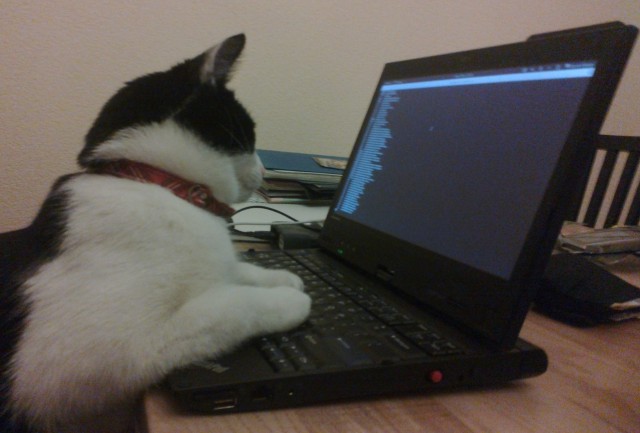
Sjoerd Simons: Hacker Cat

It appears I didn't get around to make any blogposts this year, so to fix that and given that that the internet can always use more pictures of cats: Hacker cat What Zappa was working on will likely always remain a mystery.

Dirk Eddelbuettel: Getting numpy data into R -- Take Two

A couple of days ago, I had posted a short Python script to convert numpy files into a simple binary format which R can read quickly. Nice, but still needing an extra file. Shortly thereafter, I found Carl Rogers cnpy library which makes reading and writing numpy files from C++ a breeze, and I quickly wrapped this up into a new package RcppCNPy which was released a few days ago. This post will show a quick example, also summarized in the short pdf vignette describing the package, and provided as a demo within the package.
R> library(RcppCNPy)
Loading required package: Rcpp
R> library(rbenchmark)
R> 
R> n <- 1e5
R> k <- 50
R> 
R> M <- matrix(seq(1.0, n*k, by=1.0), n, k)
R> 
R> txtfile <- tempfile(fileext=".txt")
R> write.table(M, file=txtfile)
R> 
R> pyfile <- tempfile(fileext=".py")
R> npySave(pyfile, M)
R> 
R> pygzfile <- tempfile(fileext=".py")
R> npySave(pygzfile, M)
R> system(paste("gzip -9", pygzfile))
R> pygzfile <- paste(pygzfile, ".gz", sep="")
R> 
R> 
We first load the new package (as well as the rbenchmark package used for the benchmarking example) into R. We then create a large matrix of 100,000 rows and 50 columns. Not quite big data by any stretch, but large enough for ascii reading to be painfully slow. We also write two npy files and compress the second one. Next, we use the benchmark function to time the three approaches:
R> res <- benchmark(read.table(txtfile),
+                  npyLoad(pyfile),
+                  npyLoad(pygzfile),
+                  order="relative",
+                  columns=c("test", "replications", "elapsed", "relative"),
+                  replications=10)
R> print(res)
                 test replications elapsed relative
2     npyLoad(pyfile)           10   1.241  1.00000
3   npyLoad(pygzfile)           10   3.098  2.49637
1 read.table(txtfile)           10  96.744 77.95649
R> 
As shown by this example, loading a numpy file directly beats the pants off reading the data from ascii: it is about 78 times faster. Reading a compressed file is somewhat slower as the data stream has to be passed through the uncompressor provide by the zlib library. So instead of reading a binary blob in one go (once the file header has been parsed) we have to operate piecemeal---which is bound to be slower. It does however save in storage space (and users can make this tradeoff between speed and size) and is still orders of magnitude faster than parsing the ascii file. Finally, and not shown here, we unlink the temporary files. Summing up, this post demonstrated how the RcppCNPy package can be a useful to access data in numpy files (which may even be compressed). Data can also be written from R to be accessed later by numpy.

Paul Tagliamonte: The "hell-server"

I s pose a better name would be How to preform automated deep-source checks I ve pushed the code to paultag/qlight, and it s just for personal use at the moment. It s built to use paultag/sb around sbuild. Basically, it preforms a crudload of tests such as licensecheck, suspicious-source, pyflakes, bashisms, cppcheck, php in linter mode, and a ton of other checks. You can see a large majority of them in the source file. The batch runner is a singleton , so it s safely called more then once. It s running on a 5-minute cron, and I ve configured a dput target to push it into it s queue & run the enqueue script. Here s some example output from a random package I had lying around:
  ===== build status =====
sbo-run-clang  successful
sbo-run-gcc  successful
  ===== global status =====
Ran plugin extract, exit code 0
Ran plugin watch, exit code 0
Ran plugin licensecheck, exit code 0
Ran plugin validate-source, exit code 0
Ran plugin build, exit code 0
Ran plugin descr, exit code 0
Ran plugin lintian, exit code 0
  ===== descr =====
I: PT: Does this sound right? "gbemol is/are a(n) Graphical frontend for the Music Player Daemon (MPD)"
  ===== piuparts =====
   [last 20 lines]
  ===== licenses =====
BSD (3 clause) 
GPL (v2 or later) 
GPL (v2 or later) GENERATED FILE
GPL (v2 or later) (with incorrect FSF address) 
LGPL (v2 or later) (with incorrect FSF address) 
*No copyright* GPL (v2 or later) 
*No copyright* UNKNOWN
  ===== lintian =====
I: gbemol: spelling-error-in-binary usr/bin/gbemol Wheter Whether
W: gbemol: hardening-no-relro usr/bin/gbemol
I: gbemol: spelling-error-in-manpage usr/share/man/man1/gbemol.1.gz allows to allows one to
  ===== watch =====
-- Scanning for watchfiles in .
-- Found watchfile in ./debian
-- In debian/watch, processing watchfile line:
   http://sf.net/gbemol/gbemol-(.*)\.tar.gz
-- Found the following matching hrefs:
     gbemol-0.3.tar.gz
     gbemol-0.3.1.tar.gz
     gbemol-0.3.2.tar.gz
Newest version on remote site is 0.3.2, local version is 0.3.2
 => Package is up to date
-- Scan finished
  ===== source issues =====
suspicious-source:
bashisms:
script ./ltmain.sh does not appear to have a #! interpreter line;
you may get strange results
possible bashism in ./ltmain.sh line 368 ($RANDOM):
        my_tmpdir="$ my_template -$ RANDOM-0 $$"
error: ./ltmain.sh: Unterminated quoted string found, EOF reached. Wanted: <">
pyflakes:
cppcheck:
[src/gbemol-utils.c:167]: (error) Memory leak: path
[src/libmpdclient.c:1654]: (error) Possible null pointer dereference: output - otherwise it is redundant to check if output is null at line 1663
[src/libmpdclient.c:1655]: (error) Possible null pointer dereference: output - otherwise it is redundant to check if output is null at line 1663
[src/libmpdclient.c:1656]: (error) Possible null pointer dereference: output - otherwise it is redundant to check if output is null at line 1663
[src/libmpdclient.c:1664]: (error) Possible null pointer dereference: output - otherwise it is redundant to check if output is null at line 1663
phplint:
desktop validate:
.//.pc/desktop_file.patch/gbemol.desktop: warning: key "Encoding" in group "Desktop Entry" is deprecated
.//.pc/desktop_file.patch/gbemol.desktop: error: (will be fatal in the future): value "gbemol.png" for key "Icon" in group "Desktop Entry" is an icon name with an extension, but there should be no extension as described in the Icon Theme Specification if the value is not an absolute path
.//.pc/desktop_file.patch/gbemol.desktop: warning: value "Application;AudioVideo;Player;" for key "Categories" in group "Desktop Entry" contains a deprecated value "Application"
mp3check:
mp3val:
fontlint:
ftvalid:
msgfmt:
POFileChecker:
POFileSpell:
pngcheck:
jpeginfo:
ogginfo:
oggz-validate:
xmllint:
lacheck:
jslint:
check for environ calls to home:
check for use of /tmp:
./intltool-extract.in:    $OUTFILE     = "./tmp/$OUTFILE.h"
check for use of system():
./aclocal.m4:    lt_ld_extra= awk '/^include /   system(sprintf("cd /etc; cat %s 2>/dev/null", \[$]2)); skip = 1;     if (!skip) print \[$]0; skip = 0;  ' < /etc/ld.so.conf   $SED -e 's/#.*//;/^[  ]*hwcap[    ]/d;s/[:,  ]/ /g;s/=[^=]*$//;s/=[^= ]* / /g;/^$/d'   tr '\n' ' ' 
./intltool-merge.in:    return 1 if ((-x $file) or (system("$file -l >$devnull") == 0));
./intltool-merge.in:    system ("$iconv -f $encoding -t UTF-8 <$devnull 2>$devnull");
./intltool-update.in:    return 1 if ((-x $file) or (system("$file --version >$devnull") == 0));
./intltool-update.in:          system ($EXTRACT, "--update", "--srcdir=$SRCDIR",
./intltool-update.in:          system ($EXTRACT, "--update", "--type=$gettext_type", 
./intltool-update.in:    system ("$MSGMERGE", "-o", $outfile, $infile, "$MODULE.pot");
./intltool-update.in:    system ("$MSGFMT", "-o", "$devnull", "--verbose", $output_file);
./intltool-update.in:   system ("$MSGFMT", "-o", "$devnull", "--verbose", "$SRCDIR/$lang.po");
./configure:    lt_ld_extra= awk '/^include /   system(sprintf("cd /etc; cat %s 2>/dev/null", \$2)); skip = 1;     if (!skip) print \$0; skip = 0;  ' < /etc/ld.so.conf   $SED -e 's/#.*//;/^[   ]*hwcap[    ]/d;s/[:,  ]/ /g;s/=[^=]*$//;s/=[^= ]* / /g;/^$/d'   tr '\n' ' ' 
./intltool-extract.in:        system ("mkdir -p $dirname");
./intltool-extract.in:        system("mkdir tmp/"); 
./debian/gbemol.1:the \fBDebian\fP system (but may be used by others).  Permission is 
./debian/manpage.sgml:      the &debian; system (but may be used by others).  Permission is
  ===== sbo-run-clang.log warnings =====
update-binfmts: warning: unable to close /proc/sys/fs/binfmt_misc/register: Invalid argument
update-binfmts: warning: unable to enable binary format python2.6
dpkg-source: warning: extracting unsigned source package (gbemol_0.3.2-2.dsc)
dpkg-buildpackage: warning: using a gain-root-command while being root
gbemol-preferences.c:483:13: warning: 'gbemol_preferences_load_spin' defined but not used [-Wunused-function]
gbemol-net.c:60:11: warning: variable 'res' set but not used [-Wunused-but-set-variable]
dpkg-shlibdeps: warning: package could avoid a useless dependency if debian/gbemol/usr/bin/gbemol was not linked against libfontconfig.so.1 (it uses none of the library's symbols).
dpkg-shlibdeps: warning: package could avoid a useless dependency if debian/gbemol/usr/bin/gbemol was not linked against libatk-1.0.so.0 (it uses none of the library's symbols).
dpkg-shlibdeps: warning: package could avoid a useless dependency if debian/gbemol/usr/bin/gbemol was not linked against librt.so.1 (it uses none of the library's symbols).
dpkg-shlibdeps: warning: package could avoid a useless dependency if debian/gbemol/usr/bin/gbemol was not linked against libgio-2.0.so.0 (it uses none of the library's symbols).
dpkg-shlibdeps: warning: package could avoid a useless dependency if debian/gbemol/usr/bin/gbemol was not linked against libcairo.so.2 (it uses none of the library's symbols).
dpkg-shlibdeps: warning: package could avoid a useless dependency if debian/gbemol/usr/bin/gbemol was not linked against libpango-1.0.so.0 (it uses none of the library's symbols).
dpkg-shlibdeps: warning: package could avoid a useless dependency if debian/gbemol/usr/bin/gbemol was not linked against libpangocairo-1.0.so.0 (it uses none of the library's symbols).
dpkg-shlibdeps: warning: package could avoid a useless dependency if debian/gbemol/usr/bin/gbemol was not linked against libfreetype.so.6 (it uses none of the library's symbols).
dpkg-shlibdeps: warning: package could avoid a useless dependency if debian/gbemol/usr/bin/gbemol was not linked against libpangoft2-1.0.so.0 (it uses none of the library's symbols).
dpkg-gencontrol: warning: File::FcntlLock not available; using flock which is not NFS-safe
     + add misc-depends to fix lintian warning.
  ===== sbo-run-gcc.log warnings =====
dpkg-source: warning: extracting unsigned source package (gbemol_0.3.2-2.dsc)
dpkg-buildpackage: warning: using a gain-root-command while being root
gbemol-preferences.c:483:13: warning: 'gbemol_preferences_load_spin' defined but not used [-Wunused-function]
gbemol-net.c:60:11: warning: variable 'res' set but not used [-Wunused-but-set-variable]
dpkg-shlibdeps: warning: package could avoid a useless dependency if debian/gbemol/usr/bin/gbemol was not linked against libfontconfig.so.1 (it uses none of the library's symbols).
dpkg-shlibdeps: warning: package could avoid a useless dependency if debian/gbemol/usr/bin/gbemol was not linked against libatk-1.0.so.0 (it uses none of the library's symbols).
dpkg-shlibdeps: warning: package could avoid a useless dependency if debian/gbemol/usr/bin/gbemol was not linked against librt.so.1 (it uses none of the library's symbols).
dpkg-shlibdeps: warning: package could avoid a useless dependency if debian/gbemol/usr/bin/gbemol was not linked against libgio-2.0.so.0 (it uses none of the library's symbols).
dpkg-shlibdeps: warning: package could avoid a useless dependency if debian/gbemol/usr/bin/gbemol was not linked against libcairo.so.2 (it uses none of the library's symbols).
dpkg-shlibdeps: warning: package could avoid a useless dependency if debian/gbemol/usr/bin/gbemol was not linked against libpango-1.0.so.0 (it uses none of the library's symbols).
dpkg-shlibdeps: warning: package could avoid a useless dependency if debian/gbemol/usr/bin/gbemol was not linked against libpangocairo-1.0.so.0 (it uses none of the library's symbols).
dpkg-shlibdeps: warning: package could avoid a useless dependency if debian/gbemol/usr/bin/gbemol was not linked against libfreetype.so.6 (it uses none of the library's symbols).
dpkg-shlibdeps: warning: package could avoid a useless dependency if debian/gbemol/usr/bin/gbemol was not linked against libpangoft2-1.0.so.0 (it uses none of the library's symbols).
dpkg-gencontrol: warning: File::FcntlLock not available; using flock which is not NFS-safe
     + add misc-depends to fix lintian warning.
Not as interesting as it can get, but still pretty cool. Andrea, I swear I m not picking on you :) More to come later (hopefully) :)

10 July 2012

Arnaud Quette: Definitive solution to IPMI over LAN with Dell iDrac Express

I have this bunch of Dell R610, with iDrac6 Express management cards. I used these, among other things, for developing IPMI support in NUT and working on Infrastructure & Cloud power management. But that's the topic of another post (still, if you're interested in, check this and that). The thing is that this "IPMI" monitoring development has been limited to local support (Ie, power supplies can't be monitored remotely by the nut-ipmipsu driver), due to an issue : any attempt to enable IPMI access over the network was miserably failing! Well, these attempts were limited to a couple of 15 minutes runs, without plain motivation, almost a year ago. The various firmwares were up to date (iDrac 1.70, ...) , everything was running and configured fine, locally. But still... no IPMI available through the network! Looking on the Net, I've learned that many Dell customers with iDrac Express cards, were having the same issue. Dell support seems to have replaced tons of motherboards! There, I switched to other things, and time has passed.... A good year later (last week), I decided that it was time to get back on this. And I've found the solution there Incredible: this was due to a 'bug' in the Broadcom NetXtreme II LoM (LAN on Motherboad) firmware! I've not had time to dig this issue in depth, but here is a base explanation, for what it's worth: Some LoM initial self tests are failing. Thus, the LoM are not switched to the managed mode, and can't actually be available for BMC management (thus no IPMI over the network). In my case, the tests were wrongly failing at 'A07', a test which tries to establish a Gigabit connection! Strangely, all these servers are connected on a Gb switch! Not a fully satisfactory answer, but that said, there is a solution, and I've not much time to pour into this investigation (comments may always change my mind though!). So here is a comprehensive procedure to fix this, from your Linux system, and using FreeDOS:
$ mkfs.msdos /dev/sdX1
Note: 'X' is to be replaced by the exact name of your USB key. An hint: call 'tail -f /var/log/syslog" and unplug / replug your USB key. You will see some entries like "...sdb Attached SCSI removable disk". So, there, it's "sdb".
$ qemu -boot a -fda balder10.img -hda /dev/sdX A:\> sys c: A:\> xcopy /E /N a: c:
Note that you will need "root" privileges.
$ qemu -hda /dev/sdX
$ unzip Bcom_LAN_14.2.x_DOSUtilities_A03.exe
c:\ uxdiag -t abcd mfw 1
For what it's worth (again), I just hope that it will be useful to others... I will now prepare another post using using FreeIPMI to manage your servers, the GNU way... cheers,
-- Arno Thanks to Jordi Clariana, his enlightening post, Daniel for this one, Aur lien was motivating me again in solving this iDrac Express issue and Al Chu (FreeIPMI project leader) for all his invaluable help on IPMI.

Gunnar Wolf: From DebCamp to DebConf through cheese, wine and an intro track

One week. One long week. One beautiful week. One of the two major weeks of the year has passed since my previous post. Surely, we are in the middle of the two Major Weeks of the year, in the yearly schedule I have upheld for almost(!) ten years: DebConf+DebCamp. Yesterday, DebConf officially started. For the first time ever, we had a DebConf track targetted at the local (for a wide definition of local: All of the Central American countries) communities, which I chaired. We had the following talk lineup during this track: I believe it was a great success, and I hope the talks are useful in the future. They will be put online soon thanks to the tireless work of our work team. Today we sadly lost the presence of our DPL due to very happy circumstances he will surely announce himself. But DebConf will continue nevertheless - And proof of that is our anual, great, fun and inviting Cheese and Wine Party! After a series of organizational hiccups I hope nobody notices (oops, was I supposed not to say this?), today we had a beautiful, fun and most successful cheese and wine party, as we have had year after year since 2005. As many other people, we did our humble contribution for this party to be the success it deserves. There is lots of great cheeses, great wines, and much other great stuff we have to thank to each of the individuals who made this C&W party the success it was. Yes, it might be among the least-academic parts of our conference, but at the same time, it's one of its most cherished -and successful- traditions. And above all else, we have to thank our Great Leader^W^WCheeseMaster (who we still need to convince to play by our Great Leader's mandates - And no, I don't mean Zack here!) Hugs and thanks to my good and dear friend Christian Perrier for giving form to one of DebConf's social traditions that makes it so unique, so different from every other academic or communitary conference I have ever been part of. We still have most of the week to go. And if you are not in Managua (and are not coming soon), you can follow our activities following our video streams. Remember, debian/rules, now more than ever! And even given the (perpetual) heat in Managua: Wheezy is frozen, whee! [ all photos here taken by regina ]
AttachmentSize
100_2110.JPG1.53 MB
100_2119.JPG1.49 MB
100_2121.JPG1.52 MB
100_2135.JPG1.49 MB
100_2144.JPG1.11 MB
100_2146.JPG1.53 MB
100_2145.JPG1.08 MB
100_2122.JPG1.51 MB

Gerfried Fuchs: Mermaids Reloaded

It's almost seven years now since I wrote/published Mermaids. It was an important step in my life, confessing publicly what I've found out about myself, how I feel and identify myself. It definitely has been a certain turning point in my life. A year later, there was the Debconf6 in Mexico, which was just as important. I was wearing a skirt for the first time, and that for the whole duration of the two weeks. It was an enormous feeling of freedom, and I knew I was feeling at home. That was also the time I shaved off my beard. And since? Well, I sort of limited myself to these two weeks every year. Debconf is my haven, Debconf is my home. Here I allow myself to be myself. Debian is my family. And like in every family, there are people who won't understand, but that doesn't matter. I feel comfortable to express myself in this crowd in the way I feel. Being abroad seems to help with the confidence, and it seems like it also shines through. I haven't had lots of strange looks. To the contrary, when I went with a skirt to a homosexual acceptance event at home in Vienna, there was a group of gays who were pointing and laughing. Quite an interesting experience, one would assume that people who are wanting more acceptance would be more acceptable and tolerant themselves... But, I don't think I will ever take the step toward actually turning my body into a female one. It was an important step for me to find out about my inner self, and it actually managed to make me accept my male body; even though I can totally relate to people not being able to understand this both people not in the situation and people being in the situation and needing the physical adjustment to be able to be happy again. But this is what and how I am: Contents may vary from packaging. This though has an inherited problem: as I am not (usually) heading for a female appearance (besides my skirt during Debconf), people keep addressing me with a male pronoun, even, or rather especially when using my nick Rhonda. This is something that I consider a fair bit disturbing, especially when it comes from people that I consider to address with the term friends. One would assume that people who you share a fair bit of private life with would be the ones who can understand and relate better than others. But that's where we are, and I also can understand the troubles: I'm not giving them much visual help for fixing their thoughts. I found the confidence in my body, and like most of you know, I have a son I dearly love (and miss like hell these two weeks), so I know how to use the tools it comes with, frankly spoken. But I won't go the road to adjust my body to be a female one instead, just to convince people that I really am the female person that I identify as. It might be hard for you to understand that, it might be hard for you to accept it it is also hard for me, to fight for the acceptance that I thought are an inherent part of the term friendship. I have deepest respect for the people who feel the requirement and have the strength to adjust their body to their mind. It though just isn't the road for me. I already have enough uncertainties in my life to cope with, and I don't need another one to deal with, related to that I might not be able to accept my body after the transition than I am able to accept it now. It's just not important enough for me to find my place. My place is here, my home is Debconf.

/personal permanent link Comments: 4 Flattr this

9 July 2012

Arnaud Quette: Hello Planet Debian

Hey fellows Debian lovers, and old friends reading this, after more than a decade serving Debian, our greatest and beloved OS, I've finally decided to start blogging. Please, bear with me, I'm still very new at blogging. Thus, constructive comments and mails are welcome ;-) So here we actually go with the usual 'quick introduction post': I'm Arnaud Quette, 36 years old, and Debian developer since 2001. I'm leading the upstream project called 'NUT' (Network UPS Tools project) since 2005, and I'm a Free Software hacker since 1997 (incomplete list of contribs and linkedIn profile). I'm working at Eaton, a Debian partner participating in the power protection of our Debian infrastructure (FTP masters and Alioth). If you're a Debian admin, and feel Eaton can help, drop me a mail. My main Opensource contribution, for some years, is to lead 'NUT', and the related power management developments and distribution. As such, I also ensure that all this work lands finely in Debian, and is useful and reliable to users. In the past, I've also been working on some Media Center packages (Coherence UPnP, moovida, LIRC, ...), Synaptics touchpads app and some more. Here is the current list of maintained and co-maintained packages, though not up to date. It's not always that easy to balance between upstream lead and the numerous developments on one hand, and Debian packaging and support on the other hand... Not counting real life and the many others responsibilities I have. Just forgive me for the time it has taken (and is still taking, sometimes) to update my various packages. Just remember that I'm always doing my best :-) So dear Planet Debian readers, I'll be bothering you with some news on power management and GreenIT in Debian. There will be both upstream and Debian developments and releases info, so that you all can react. There may probably be some diversion, on other Debian related topics, one way or another... All this will depend on your feedback, and the balance with my available time and pleasure to share with you these few tech bits. cheers,
Arnaud

Julien Danjou: Logitech K750 keyboard and Unifying Receiver Linux support

A year ago, I bought a Logitech Wireless Solar Keyboard K750. I'm particularly picky on keyboards, but this one is good. It has an incredible useful feature: while being wireless, it has no need for disposable or rechargeable batteries, it uses solar power! Logitech Wireless Solar Keyboard K750 My problem is that there's obviously no way to know the battery status from Linux, the provided application only working on Windows. And one dark night, while fragging on QuakeLive, my keyboard stopped working: it had no battery left. This activity being quite energy consuming, it emptied the whole battery. Someone should write code to get the battery status and light meter from Linux: challenge accepted! How the keyboard works Logitech Unifying Receiver This keyboard, like many of the new wireless devices from Logitech, uses the Unifying interface. It's an USB receiver that can be attached up to 6 differents devices (mouse, keyboards ). On old Linux kernel, the Unifying receiver is recognized as only one keyboard and/or one mouse device. Recently, a driver called hid-logitech-dj has been added to the Linux kernel. With this driver, each device attached to the receiver is recognized as one different device. What the Logitech application does Logitech Solar App The Logitech application under Windows works that way: you launch it, and it displays the battery charge level. On the keyboard, there's a special "light" button (up right). When pressed, a LED will light up on the keyboard: green if the keyboard is receiving enough light and is charging, red if the keyboard does not receive enough light and is therefore discharging. Pushing this same button while the application is running will makes the light meter activated: the application will tell you how much lux your keyboard is receiving. Let's reverse engineer this As far as I know, there's nothing in the USB HID protocol that handles this kind of functionality (battery status, light meter ) in a standard way. So the first task to accomplish is, unfortunately, to reverse engineer the program. I discovered a bit too late that Drew Fisher did a good presentation on USB reverse engineering at 28c3. You might want to take a look at it if you want to reverse engineer on USB. I did not need it, but I learned a few things. Anyway, my plan was the following: run the Logitech application inside a virtual machine running Windows, give it direct access to the USB keyboard, and sniff what happens on the USB wire. To achieve that, you need a virtual machine emulator that can do USB pass-through. Both KVM and VirtualBox can do that, but VirtualBox works much better with USB and allow hot(un)plugging of devices, so I used it. To sniff what happens on the USB, you need to load the usbmon Linux kernel module. Simply doing modprobe usbmon will work. You can then use Wireshark which know how to use usbmon devices and understand the USB protocol. USB stuff you need to know You don't need to know much about USB to understand what I'll write about below, but for the sake of comprehensibility I'll write a couple of things here before jumping in. To communicate with an USB device, we communicate with one of its endpoints. Endpoints are regrouped into an interface. Interfaces are regrouped into a configuration. A device might contains one or several configurations. There's also several types of packets in the USB wire protocol, and at least two of them interest us there, they are: All of this and more is well (and better) explained in the chapter 13 of Linux Device Drivers, Third Edition. Sniffed data Once everything was set-up, I ran my beloved Wireshark. There's a an URB of type interrupt sent each time you press any key with some data in it. Therefore I advise you to plug another keyboard (or use the laptop keyboard if you're doing this on a laptop), otherwise you'll get crazy trying to sniff the keyboard you're typing on. At this point, just launching the application does a bunch of USB traffic. Pressing the "light" button on the keyboard makes even more USB packets coming in and out. Here's the interesting packets that I noticed once I excluded the noise: With all this, the next step was clear: understand the packets and reproduce that exchange under Linux. What the packets mean The "go for the light meter" packet The packet sent from the computer to the keyboard is the following. <figure>
Frame 17: 71 bytes on wire (568 bits), 71 bytes captured (568 bits)
    Frame Length: 71 bytes (568 bits)
    Capture Length: 71 bytes (568 bits)
USB URB
    URB id: 0xffff880161997240
    URB type: URB_SUBMIT ('S')
    URB transfer type: URB_CONTROL (0x02)
    Endpoint: 0x00, Direction: OUT
        0... .... = Direction: OUT (0)
        .000 0000 = Endpoint value: 0
    Device: 6
    URB bus id: 1
    Device setup request: relevant (0)
    Data: present (0)
    URB sec: 1340124450
    URB usec: 495643
    URB status: Operation now in progress (-EINPROGRESS) (-115)
    URB length [bytes]: 7
    Data length [bytes]: 7
    [Response in: 18]
    [bInterfaceClass: HID (0x03)]
    URB setup
        bmRequestType: 0x21
            0... .... = Direction: Host-to-device
            .01. .... = Type: Class (0x01)
            ...0 0001 = Recipient: Interface (0x01)
    bRequest: SET_REPORT (0x09)
    wValue: 0x0210
        ReportID: 16
        ReportType: Output (2)
    wIndex: 2
    wLength: 7
0000  40 72 99 61 01 88 ff ff 53 02 00 06 01 00 00 00   @r.a....S.......
0010  22 ad e0 4f 00 00 00 00 1b 90 07 00 8d ff ff ff   "..O............
0020  07 00 00 00 07 00 00 00 21 09 10 02 02 00 07 00   ........!.......
0030  00 00 00 00 00 00 00 00 00 00 00 00 00 00 00 00   ................
0040  10 01 09 03 78 01 00                              ....x..
</figure> What's here interesting is the last part representing the data. wLength says that the length of the data is 7 bytes, so let's take a look at those 7 bytes: 10 01 09 03 78 01 00. Well, actually, you can't decode them like that, unless you're a freak or a Logitech engineer. And I have actually no idea what they mean. But sending this to the keyboard will trigger an interesting thing: the keyboard will start sending URB interrupt with some data without you pressing any more key. The "light meter and battery values" packet This is most interesting packet. This is the one sent by the keyboard to the host and that contains the data we want to retrieve. <figure>
Frame 1467: 84 bytes on wire (672 bits), 84 bytes captured (672 bits)
    Frame Length: 84 bytes (672 bits)
    Capture Length: 84 bytes (672 bits)
USB URB
    URB id: 0xffff88010c43c380
    URB type: URB_COMPLETE ('C')
    URB transfer type: URB_INTERRUPT (0x01)
    Endpoint: 0x83, Direction: IN
        1... .... = Direction: IN (1)
        .000 0011 = Endpoint value: 3
    Device: 2
    URB bus id: 6
    Device setup request: not relevant ('-')
    Data: present (0)
    URB sec: 1334953309
    URB usec: 728740
    URB status: Success (0)
    URB length [bytes]: 20
    Data length [bytes]: 20
    [Request in: 1466]
    [Time from request: 0.992374000 seconds]
    [bInterfaceClass: Unknown (0xffff)]
Leftover Capture Data: 1102091039000c061d474f4f4400000000000000
0000  80 c3 43 0c 01 88 ff ff 43 01 83 02 06 00 2d 00   ..C.....C.....-.
0010  5d c5 91 4f 00 00 00 00 a4 1e 0b 00 00 00 00 00   ]..O............
0020  14 00 00 00 14 00 00 00 00 00 00 00 00 00 00 00   ................
0030  02 00 00 00 00 00 00 00 00 02 00 00 00 00 00 00   ................
0040  11 02 09 10 39 00 0c 06 1d 47 4f 4f 44 00 00 00   ....9....GOOD...
0050  00 00 00 00                                       ....
</figure> This packets come in regularly (1 per second) on the wire for some time once you sent the "go for the light meter" packet. At one point they are emitted less often and do not contain the value for the light meter anymore, suggesting that the control packet sent earlier triggers the activation of the light meter for a defined period. Now you probably wonder where the data are in this. They're in the 20 bytes leftover in the capture data part, indicated by Wireshark, at the end of the packet: 11 02 09 10 39 00 0c 06 1d 47 4f 4f 44 00 00 00 00 00 00 00. Fortunately, it was easy to decode. Knowing we're looking for 2 values (battery charge and light meter), we just need to observe and compare the packet emitted on the wire with the values displayed by the Logitech Solar App. To achieve this, I looked both at the Logitech Solar App and Wireshark while bringing more and more light near the keyboard, increasing the lux value received by the meter on the Solar App, and saw that the fields represented in blue (see below) where changing in Wireshark. Since 2 bytes were changing, I guessed that it was coded on 16 bits, and therefore it was easy to correlate the value with the Solar App. <figure>
[ ....9....GOOD....... ]
11 02 09 10 39 00 0c 06 1d 47 4f 4f 44 00 00 00 00 00 00 00
4 bytes - 1 byte for battery charge - 2 bytes for light meter - 2 bytes - 4 bytes for GOOD - 7 bytes
</figure> In this example, the battery has a charge of 0x39 = 57 % and the light meter receives 0x0c = 12 lux of light. It's basically dark, and that makes sense: it was night and the light was off in my office, the only light being the one coming from my screen. I've no idea what the GOOD part of the packet is about, but it's present in every packet and it's actually very handy to recognize such a packet. Therefore I'm considering this as some sort of useful mark for now. For the other bytes, they were always the same (0x11 0x2 0x9 0x10 at the beginning, 7 times 0x00 at the end). The 2 bytes between the light meter and GOOD probably mean something, but I've no idea what for now. Building our solar app Now we've enough information to build our own very basic solar application. We know how to triggers the light meter, and we know how to decode the packets. We're going to write a small application using libusb. Here's a quick example. It's not perfect and does not check for error codes, be careful. <figure>
/* Written by Julien Danjou <julien> in 2012 */
#include <linux/hid.h>
#include <libusb.h>
#include <stdio.h>
#include <stdlib.h>
#include <string.h>
int main(void)
 
    libusb_context *ctx;
    libusb_init(&ctx);
    libusb_set_debug(ctx, 3);
    /* Look at the keyboard based on vendor and device id */
    libusb_device_handle *device_handle = libusb_open_device_with_vid_pid(ctx, 0x046d, 0xc52b);
    fprintf(stderr, "Found keyboard 0x%p\n", device_handle);
    libusb_device *device = libusb_get_device(device_handle);
    struct libusb_device_descriptor desc;
    libusb_get_device_descriptor(device, &desc);
    for(uint8_t config_index = 0; config_index < desc.bNumConfigurations; config_index++)
     
        struct libusb_config_descriptor *config;
        libusb_get_config_descriptor(device, config_index, &config);
        /* We know we want interface 2 */
        int iface_index = 2;
        const struct libusb_interface *iface = &config->interface[iface_index];
        for (int altsetting_index = 0; altsetting_index < iface->num_altsetting; altsetting_index++)
         
            const struct libusb_interface_descriptor *iface_desc = &iface->altsetting[al>tsetting_index];
            if (iface_desc->bInterfaceClass == LIBUSB_CLASS_HID)
             
                libusb_detach_kernel_driver(device_handle, iface_index);
                libusb_claim_interface(device_handle, iface_index);
                unsigned char ret[65535];
                unsigned char payload[] = "\x10\x02\x09\x03\x78\x01\x00";
                if(libusb_control_transfer(device_handle,
                                           LIBUSB_REQUEST_TYPE_CLASS   LIBUSB_RECIPIENT_INTERFACE,
                                           HID_REQ_SET_REPORT,
                                           0x0210, iface_index, payload, sizeof(payload) - 1, 10000))
                 
                    int actual_length = 0;
                    while(actual_length != 20   strncmp((const char *) &ret[9], "GOOD", 4))
                        libusb_interrupt_transfer(device_handle,
                                                  iface_desc->endpoint[0].bEndpointAddress,
                                                  ret, sizeof(ret), &actual_length, 100000);
                    uint16_t lux = ret[5] << 8   ret[6];
                    fprintf(stderr, "Charge: %d %%\nLight: %d lux\n", ret[4], lux);
                 
                libusb_release_interface(device_handle, iface_index);
                libusb_attach_kernel_driver(device_handle, iface_index);


    libusb_close(device_handle);
    libusb_exit(ctx);
 
</figure> What the program is doing is the following: This gives the following:
Found keyboard 0x0x24ec8e0
Charge: 64 %
Light: 21 lux
Challenge accomplished! To be continued Unfortunately, this approach has at least one major drawback. We have to disconnect the Logitech Unifying Receiver from the kernel. That means that while we're waiting for the packet, we're dropping packets corresponding to other events from every connected device (key presses, pointer motions ). In order to solve that, I sent a request for help on the linux-input mailing list. That way, I learned that Logitech is actually using the HID++ protocol to communicate with the devices using the Unifying Receiver. Lars-Dominik Braun managed to get the HID++ specifications from Logitech and published them with their authorization. This opens a whole new world. With that document, I may be able to understand the part I reverse engineered and convert this to a more useful and generic library using the hidraw interface (so we don't have to disconnect the devices from the kernel driver).

DebConf team: Many thanks and kudos to the videoteam! (Posted by Holger Levsen)

Thanks to the awesome work of a lot of people (some not even here), this time we did the setup in one day less then previous years, and IMHO it was mostly rather very relaxed and efficient as well!
As you probably will know already, the streams are linked on the DebConf12 webpage and the recordings will be linked there, too, when they are ready. The scheduled release for that is tomorrow evening localtime, we ll see if we can deliver :-)
To make this happen, there will be a video training session tomorrow morning at 11:00 in talkroom 2, Roberto Ter n. The training will cover both the live session setup and the reviewing workflow and is definitly still open for new members!
So once again (one cannot say it enough, so please express your thanks as well) muchisimas gracias to all members of the dc12 videoteam! As Biella once said, you re ninjas!
Last and definitly not least, many thanks to our equipment sponsors too (HP, IRILL, Debian and individuals)!
cheers, a very happy h01ger!

Benjamin Mako Hill: Wiki Conferencing

I am in Berlin for the Wikipedia Academy, a very cool hybrid free culture community plus refereed academic conference organized, in part, by Wikimedia Deutschland. On Friday, I was very excited to have been invited to give the conference's opening keynote based on my own hybrid take on learning from failures in peer production and incorporating a bunch of my own research. Today, I was on a panel at the conference about free culture and sharing practices. I'll post talks materials and videos when the conference puts them online. I will be in Berlin for the next week or so before I head to directly to Washington, DC for Wikimania between the 11th and 15th. I'll be giving three talks there: Between then and now, I'm taking the next week in Berlin to catch up on work, and with friends. If you're in either place and want to meet up, please get in touch and lets try to arrange something.

Russell Coker: Breaking SATA Connectors

I ve just broken my second SATA connector. This isn t a lot considering the number of hard drives I ve worked with, but it s still really annoying as I generally don t break things. The problem is that unplugging a SATA cable requires pushing a little clip, this isn t overly difficult but it unfortunately doesn t fit well with habits formed from previous hardware. The power cables used for hard drives based on the ST-506 interface which was copied for the IDE interface was large and had a fairly tight fit. Removing such a cable requires a significant amount of force which is about the same as the amount of force required to break a SATA connector. When I first started using PCs a reasonably configured AT system cost over $5,000 (maybe something like $10,000 in today s money). With that sort of price hardly anyone had a set of test PCs. When hardware prices dropped such that hard drives of reasonable size became reasonably affordable on the second-hand market I bought more disks and used some for extra storage and some for testing software. As there was nothing like VMWare for testing OS images the way to test a new OS was to plug in a different hard drive and boot it. So I got a lot of practice at removing IDE power cables with as much force as was necessary. Now I own a pile of test PCs, SATA disks less than 100G are free, I use Xen for a lot of my testing, and generally I have much less need to swap hard drives around. In most situations in which I would swap hard drives in the 90 s I will now swap PCs and I have piles of PCs ready for this purpose. So I haven t had enough practice with SATA disks to develop habits for safely removing them. So far this lack of habit development has resulted in damaging two disks due to changing drives while not concentrating enough. Fortunately duct-tape works well for holding a SATA connector in place when the plastic that attaches to the clip is broken. Related posts:
  1. Strange SATA Disk Performance Below is a GNUPlot graph of ZCAV output from a...
  2. Vibration and Strange SATA Performance Almost two years ago I blogged about a strange performance...
  3. Dell PowerEdge T105 Today I received a Dell PowerEDGE T105 for use by...

Russell Coker: Postfwd and Local Only Email

Over a year ago when I was considering my first Android phone purchase I setup a test account on my mail server so that I could test email clients on phones and tablets. I used a short password because I didn t want to type a lot on small screens and because typing a password into a random system owned by someone else isn t particularly secure anyway. Then I forgot about the account until I noticed that my mail server was sending out spam. Next time I setup such a test account I ll put rules similar to the following in my Postfwd [1] configuration to stop Postfix from sending such messages. That will prevent the test account from receiving mail from outside or sending mail out of the server. The former is optional (getting a few thousand spam messages in an unused test account is no big deal) but the latter is needed to prevent getting my server blacklisted. id=R_test_recipient ; recipient==test@coker.com.au ; sender!~.*@coker.com.au ; action=REJECT
id=R_test_sender ; sender==test@coker.com.au ; recipient!~.*@coker.com.au ; action=REJECT Related posts:
  1. email disclaimers Andre Pang blogs about the annoyance of email disclaimers. For...
  2. Email Passwords I was doing some routine sysadmin work for a client...
  3. Some Postfix Scripts for dealing with Outbound Spamming I ve just written some small scripts to help me manage...

Joey Hess: debian-cd work at DebCamp

I've been working the past two days on debian-cd, which was the main thing (besides git-annex assistant) I planned to work on at DebCamp. Yesterday, Steve McIntyre and I cleaned up some cruft in debian-cd's package lists. This freed somewhere in the area of 30 mb. I also took a grep through d-i and made sure the CDs include packages that d-i can optionally install in some situations. Today, I investigated how Recommends are ordered on the CD, and concluded it's as close to optimal as can be easily achieved. So was not able to save space there, but I did find a way to reorganize the desktop task that avoids needing to include a lot of printing stuff and some other stuff on the first CD. While that helped some, it still didn't get either Gnome or Kde to entirely fit, so getting there will probably involve rebuilding 100 or so packages with xz, if someone decides to do that. So it's stil TBD whether Gnome or Kde will fit on a single CD in Debian wheezy. At this point I think most of us are getting tired of fighting this increasingly losing battle every release, and so other options like only having a desktop DVD are looking more appealing, as they solve the problem long-term. This would also free up the first CD for other interesting use cases, perhaps xfce, or perhaps a CD targeted at server users, and/or containing high-popularity non-desktop packages.

Next.

Previous.