Search Results: "sto"

15 January 2011

Matthew Garrett: In other news

I'm thrilled to discover that GNU-Darwin, which carried the bold claim that "GNU-Darwin aims to be the most free software distribution", distributes copies of the XNU source code with Apple's additional license rider of "The rights granted to you under the License may not be used to create, or enable the creation or redistribution of, unlawful or unlicensed copies of an Apple operating system, or to circumvent, violate, or enable the circumvention or violation of, any terms of an Apple operating system software license agreement", which certainly sounds like a restriction of use to me.

Free software's awfully like sausages - wonderfully tasty, but sometimes you suddenly discover that you've been eating sheep nostrils for the past 15 years of your life. The typical direction is realising that you've build your entire business model on something that you're actually legally obliged to give to your customers and now they're actually trying to assert their rights, but sometimes people make assumptions about freedom that don't hold. Apple last released a free version of their kernel source in 2006. Everything since then has been encumbered by additional use restrictions.

Still, much better than Microsoft - huge portions of the OS source code are available for anyone to download, examine, modify and rebuild. Apple's to be commended for dropping so much code to the community despite it having bought them almost nothing in return. But if anyone from Apple's reading, I'd love to fix up the thermal handling on your hardware under Linux. I suspect we're doing something horrible to your machines, but I don't really know what yet.

14 January 2011

Jordi Mallach: New project to discuss

Reading Scott's recent announcement on his move to Google was both surprising and a pleasure. Surprising, because it'll take time to stop associating his name to Ubuntu, Canonical, and the nice experiences I had while I worked with them. A pleasure, because his blog post was full of reminiscences of the very early days of a project that ended up being way more successful in just a few years than probably anyone in the Oxford conference could imagine. Scott, best of luck for this new adventure! Scott's write-up includes a sentence that made me remember I had been wanting to write a blog post related to all of this, but was pending Mark Shuttleworth's permission for posting:
Ok, Mark wasn t really a Nigerian 419 scammer, but some people did discard his e-mail as spam! Scott James Remnant
Many know the story of how I ended not being part of the Super-Secret-Debian-Startup Scott mentions. I even wrote about it in a blog post, 3 years ago:
[...] nothing beats the next email which sat for some dramatic 6 months in my messy inbox until I found out in the worst of the possible scenarios. Let's go back to late February, 2004, when I had no job, and I didn't have a clue on what to do with my life.
From: Mark Shuttleworth <mark@hbd.com>
Subject: New project to discuss
To: Jordi Mallach <jordi@debian.org>
Date: Sun, 29 Feb 2004 18:33:51 +0000
[...]
I'm hiring a team of debian developers to work full time on a new
distribution based on Debian. We're making internationalisation a prime
focus, together with Python and regular release management. I've discussed
it with a number of Debian leaders and they're all very positive about it.
[...]
I'm not sure if I totally missed it as it came in, or I skimmed through it and thought WTF?! Dude on crack or I just forgot I need to reply to this email , but I'd swear it was the former. Not long after, no-name-yet.com popped up, the rumours started spreading around Debian channels. Luckily, I got a job at LliureX two months later, where I worked during the following 2 years, but that's another story. I guess it was July or so when Ubuntu was made public, and Mark and his secret team organised a conference (blog entries [1] [2] [3] [4] [5]), just before the Warty release, and I was invited to it, for the same reasons I got that email. During that conference, probably because Mark sent me some email and I applied a filter to get to it, I found the lost email, and felt like digging a hole to hide for a LONG while. I couldn't believe the incredible opportunity I had missed. I went to Mark and said "hey, you're not going to believe this", and he did look quite surprised about someone being such an idiot. I wonder if I should reply to his email today...
When the usual suspects in the secret Spanish Debian Cabal channel read this blog post, they decided Mark deserved a reply, even if it would hit his inbox more than three and a half years late. :) With great care, we crafted an email that would look genuinely stupid in late 2007, but just arrogant and idiotic in 2004, when Ubuntu was just an African word, and the GNU/Linux distribution landscape was quickly evolving at the time, Gentoo Linux had the posh distribution crown, that Debian had held for quite a few years. I even took enough care to forge the X-Operating-System and User-Agent headers so they matched whatever was current in Debian in February 2004, and of course, top-posting seemed most appropriate. So Mark woke up that Monday, fired up his email client, and got... this:
Date: Mon, 1 Mar 2004 09:47:55 +0100
From: Jordi Mallach <jordi@sindominio.net>
To: Mark Shuttleworth <mark@hbd.com>
Subject: Re: New project to discuss
Organization: SinDominio
X-Operating-System: Debian GNU/Linux sid (Linux 2.6.3 i686)
User-Agent: Mutt/1.5.5.1+cvs20040105i
Hi Mark,
Thanks for your email. I nearly deleted this e-mail because for some
reason I thought it was targetted spam.
Your project looks very interesting, almost like a dream come true.
However, I feel a bit uneasy about your proposal. Something just doesn't
fit.
Why would someone start a company to work on /yet another/ Debian
derivative? Have you heard about Progeny's sad story? I think it's a
great example to show that Debian users don't want Debian-based distros,
they want people to work on the "real thing". Besides, I don't think
there's much more place for successful commercial distros, with Red Hat
and SuSE having well-established niches in the US and Europe.
Also, why focus on Debian specifically, Why not, for example, Gentoo,
which has a lot of buzz these days, and looks poised to be the next big
distribution?
To be honest, I think only a few people have the stamina or financial
stability to undertake a project like this, so I'd like to know
a bit more about you, and details on how you plan to sustain the
expenses.
Those are the main issues that worry me about your project. Other than
that, I would be interested in taking part in it, as I'm currently
unemployed and working on something Debian-based would be just too good
to miss.
You can reach me at +34 123 45 67 89, or if you feel like flying people
around Europe, I probably can be in the UK whenever it fits you.
Thanks, and hoping to hear from you again,
Jordi
On Sun, Feb 29, 2004 at 06:33:51PM +0000, Mark Shuttleworth wrote:
> Hi Jordi
>
> We haven't met, but both Jeff Waugh and Martin Michelmayr recommended that
> I get in touch with you in connection with a new project that I'm starting.
>
> I'm hiring a team of debian developers to work full time on a new
> distribution based on Debian. We're making internationalisation a prime
> focus, together with Python and regular release management. I've discussed
> it with a number of Debian leaders and they're all very positive about it.
>
> Would you be available to discuss it by telephone? I'm in the UK, so we
> could probably find a good timezoine easily enough ;-) Let me knof if
> you're keen to discuss it, when and what number to call.
>
> Cheers,
> Mark
>
> --
> Try Debian GNU/Linux. Software freedom for the bold, at www.debian.org
> http://www.markshuttleworth.com/
As you can imagine, his reaction was immediate:
Date: Mon, 22 Oct 2007 11:13:54 +0100
From: Mark Shuttleworth <mark@hbd.com>
To: Jordi Mallach <jordi@sindominio.net>
Subject: Re: New project to discuss
Jordi! I just got this now! Did you recently flush an old mail queue?
With thanks to all the Spanish Cabal members who were involved!

12 January 2011

Petter Reinholdtsen: Chrome plan to drop H.264 support for HTML5 <video>

Today I discovered via digi.no that the Chrome developers, in a surprising announcement, yesterday announced plans to drop H.264 support for HTML5 <video> in the browser. The argument used is that H.264 is not a "completely open" codec technology. If you believe H.264 was free for everyone to use, I recommend having a look at the essay "H.264 Not The Kind Of Free That Matters". It is not free of cost for creators of video tools, nor those of us that want to publish on the Internet, and the terms provided by MPEG-LA excludes free software projects from licensing the patents needed for H.264. Some background information on the Google announcement is available from OSnews. A good read. :) Personally, I believe it is great that Google is taking a stand to promote equal terms for everyone when it comes to video publishing on the Internet. This can only be done by publishing using free and open standards, which is only possible if the web browsers provide support for these free and open standards. At the moment there seem to be two camps in the web browser world when it come to video support. Some browsers support H.264, and others support Ogg Theora and WebM (Dirac is not really an option yet), forcing those of us that want to publish video on the Internet and which can not accept the terms of use presented by MPEG-LA for H.264 to not reach all potential viewers. Wikipedia keep an updated summary of the current browser support. Not surprising, several people would prefer Google to keep promoting H.264, and John Gruber presents the mind set of these people quite well. His rhetorical questions provoked a reply from Thom Holwerda with another set of questions presenting the issues with H.264. Both are worth a read. Some argue that if Google is dropping H.264 because it isn't free, they should also drop support for the Adobe Flash plugin. This argument was covered by Simon Phipps in todays blog post, which I find to put the issue in context. To me it make perfect sense to drop native H.264 support for HTML5 in the browser while still allowing plugins. I suspect the reason this announcement make so many people protest, is that all the users and promoters of H.264 suddenly get an uneasy feeling that they might be backing the wrong horse. A lot of TV broadcasters have been moving to H.264 the last few years, and a lot of money has been invested in hardware based on the belief that they could use the same video format for both broadcasting and web publishing. Suddenly this belief is shaken. An interesting question is why Google is doing this. While the presented argument might be true enough, I believe Google would only present the argument if the change make sense from a business perspective. One reason might be that they are currently negotiating with MPEG-LA over royalties or usage terms, and giving MPEG-LA the feeling that dropping H.264 completely from Chroome, Youtube and Google Video would improve the negotiation position of Google. Another reason might be that Google want to save money by not having to pay the video tax to MPEG-LA at all, and thus want to move to a video format not requiring royalties at all. A third reason might be that the Chrome development team simply want to avoid the Chrome/Chromium split to get more help with the development of Chrome. I guess time will tell. Update 2011-01-15: The Google Chrome team provided more background and information on the move it a blog post yesterday.

Mike Hommey: Attempting to track I/O with systemtap

There are several ways a program can hit the disk, and it can be hard to know exactly what s going on, especially when you want to take into account the kernel caches. This includes, but is not limited to: There are various ways to track system calls (e.g. strace) allowing to track what a program is doing with files and directories, but that doesn t tell you if you re actually hitting the disk or not. There are also various ways to track block I/O (e.g. blktrace) allowing to track actual I/O on the block devices, but it is then hard to back-track what part of which files or directories these I/O relate to. To the best of my knowledge, there are unfortunately no tools to do such tracking easily. Systemtap, however, allows to access the kernel s internals and to gather almost any kind of information from any place in a running kernel. The downside is that it means you need to know how the kernel works internally to gather the data you need ; that will limit the focus of this post. I had been playing, in the past, with Taras script, which he used a while ago to track I/O during startup. Unfortunately, it became clear something was missing in the picture, so I had to investigate what s going on in the kernel. Setting up systemtap On Debian systems, you need to install the following packages: That should be enough to pull all the required dependencies. You may want to add yourself to the stapdev and stapusr groups, if you don t want to run systemtap as root. If, like in my case, you don t have enough space left for all the files in /usr/lib/debug, you can trick dpkg into not unpacking files you don t need:
# echo path-exclude /usr/lib/debug/lib/modules/*/kernel/drivers/* > /etc/dpkg/dpkg.cfg.d/kernel-dbg
The file in /etc/dpkg/dpkg.cfg.d can obviously be named as you like, and you can adjust the path-exclude pattern to what you (don t) want. In the above case, kernel drivers debugging symbols will be ignored. Please note that this feature requires dpkg version 1.15.8 or greater. Small digression One of the first problems I had with Taras script is that systemtap would complain that it doesn t know the kernel.function("ext4_get_block") probe. It is due to a very unfortunate misfeature of systemtap, where the kernel.* probes refer to whatever is in the vmlinux image. Modules probes have a separate namespace, namely module("name").*. So for the ext4_get_block() function, this means you need to set a probe for either kernel.function("ext4_get_block") or module("ext4").function("ext4_get_block"), depending how your kernel was compiled. And you can t even use both in your script, because systemtap will complain about either being an unknown probe Tracking the right thing I was very recently pointed to a Red Hat document containing 4 useful systemtap scripts ported from dtrace, which gives me a good occasion to explain the issue at hand with the first of these scripts. This script attempts to track I/O by following read() and write() system calls. Which is not tracking I/O, it is merely tracking some system calls (Taras script had the same kind of problem with read()/write() induced I/O). You could just do the very same with existing tools like strace, and that wouldn t even require some system privileges. To demonstrate the script doesn t actually track the use of storage devices as the document claims, consider the following source code:
#include <fcntl.h>
#include <sys/stat.h>
#include <unistd.h>
/* Ensure the resulting binary is decently sized */
const char dummy[1024 * 1024] = "a";
int main(int argc, char *argv[])  
  struct stat st;
  char buf[65536];
  int i, fd = open(argv[0], O_RDONLY);
  for (i = 0; i < 100000; i++)  
    read(fd, buf, 65536);
    lseek(fd, 0, SEEK_SET);
    read(fd, buf, 65536);
    lseek(fd, 512 * 1024, SEEK_SET);
   
  close(fd);
  return 0;
 
All it does is reading some parts of the executable a lot of times (notice the trick to make the executable size at least 1MB). Not a lot of programs will actually do something as bold as reading the same data again and again (though we could probably be surprised), but this easily points the problem. Here is what the output of the systemtap script looks like for this program (stripping other unrelevant processes):
         process     read   KB tot    write   KB tot
            test   400002 25600001        0        0
Now, do you really believe 25MB have actually been read from the disk? (Note that the read() count seems odd as well, as there should only be around 200000 calls) Read-ahead, page cache and mmap() What the kernel actually does is that a read() on a file is going to check the page cache first. If there is nothing corresponding to the read() request in the page cache, then it goes down to the disk, and fills page cache. But as loading only a few bytes or kilobytes from the disk could be wasteful, the kernel also reads a few more blocks ahead, apparently with some heuristic. But read() and write() aren t the sole way a program may hit the disk. On UNIX systems, a file can be mapped in memory with the mmap() system call, and all accesses in the memory range corresponding to this mapping will be reflected on the file. There are exceptions, depending on how the mapping is established, but let s keep it simple. There is a lot of litterature on the subject if you want to document yourself on mmap(). The way the kernel will read from the file, however, is quite similar to that of read(), and uses page cache and read ahead. The systemtap script debunked above doesn t track these. I ll skip write accesses, because for now, they haven t been in my scope. Tracking some I/O with systemtap What I ve been trying to track so far has been limited to disk reads, which happen to be the only accesses occurring on shared library files. Programs and shared libraries are first being read() from, so that the dynamic linker gets the ELF headers and knows what to load, and then are mmap()ed following PT_LOAD entries in these headers. As far as my investigation in the Linux kernel code goes, fortunately, both accesses, before they end up actually hitting the disk, go through the __do_page_cache_readahead kernel function (this function was tracked in Taras script). Unfortunately, while it is called with an offset and a number of pages to read for a given file, it turns out the last pages in that number are not necessarily being read from the disk. I don t know for sure, because the latter had an effect on my observations, but some might even already be in the page cache. Going further down, we reach the VFS layer, which ends up being file-system specific. But fortunately, a bunch of (common) file-systems actually share page mapping code, and commonly use the mpage_readpage and mpage_readpages functions, both calling do_mpage_readpage to do the actual work. And this function seems to be properly called only once for each page not in the page cache already. If my reading of the kernel source is right, this however is not really where it ends, and do_mpage_readpage doesn t actually hit the disk. It seems to only gather some information (basically, a mapping between storage blocks and memory) that is going to be submitted to the block I/O layer, which itself may do some fancy stuff with it, such as reordering the I/Os depending on other requests it got from other processes, the position of the disk heads, etc. And when I say do_mpage_readpage doesn t actually hit the disk, I m again simplifying the issue, because it actually might, as there might be a need to read some metadata from the disk to know where some blocks are located. But tracking metadata reads is much harder, and I haven t investigated it. Anyways, skipping metadata, going further down after do_mpage_readpage is hard because it s difficult to back-track which block I/O is related to which read-ahead, corresponding to what read at what position in which file. do_mpage_readpage already has part of this problem because it is not called with any reference to the corresponding file. But __do_page_cache_readahead is. So knowing all the above, here is my script, the one I used to get the most recent Firefox startup data you can find in my last posts:
global targetpid;
global file_path;
probe begin  
  targetpid = target();
 
probe kernel.function("__do_page_cache_readahead")  
  if (targetpid == pid())
    file_path[tid()] = d_path(&$filp->f_path);
 
probe kernel.function("do_mpage_readpage")  
  if (targetpid == pid() && (tid() in file_path))  
    now = gettimeofday_us();
    printf("%d %s %d\n", now, file_path[tid()], $page->index*4096);
   
 
probe kernel.function("__do_page_cache_readahead").return  
  if (targetpid == pid())
    delete file_path[tid()];
 
This script needs to be used with a command given to systemtap, with the -c option, such as in the following command line:
# stap readpage.stp -c firefox
Each line of output represents a page (i.e. 4,096 bytes) being read, and contains a timestamp, the name of the file being read, and the offset in the file. As discussed above, do_mpage_readpage is not really the place the I/O actually occurs, so the timestamps are not entirely accurate, and the actual read order from disk might be slightly different, but it still is a quite reliable view in that the result should be reproducible with the same files even when they re not located on the same blocks on disk, and provided their page cache status is the same when starting the program. This systemtap script ignores writes, as well as metadata accesses (including but not limited to inodes, dentries, bitmap blocks and indirect blocks). It also doesn t account accesses to files opened with the O_DIRECT flag or similar constructs (raw devices, etc.) Read-ahead in action Back to the small example program, my systemtap script records 102 page accesses, that is, 417,792 bytes, much less than the actual binary size on my system (1,055,747 bytes). We are still far from the 25MB figure from the other systemtap script. But we are also far from the 128KiB the program actively reads (64KiB twice, leaving a hole between the two blocks). At this point, it is important to note that the ELF headers and program code all fit within a single page (4 KiB), and following the 1MiB section corresponding to the dummy variable, there are only 5,219 bytes of other ELF sections, including the .dynamic section. So even counting everything the dynamic linker needs to read, and the program code itself, we re still far from what my systemtap script records. Grouping consecutive blocks with consecutive timestamps, here is what can be observed:
Offset Length
0 16,384
983,040 73,728
16,384 262,144
524,288 65,536
(By now, you should have guessed why I wanted that big hole between the read()s ; if you want to reproduce at home, I suggest you also use my page cache flush helper) As earlier investigations showed, the first accesses by the dynamic loader are to read the ELF headers and .dynamic section. As mentioned above, these are really small. Yet, the kernel actually reads much more: 16KiB at the beginning of the file when reading the ELF headers, and 72KiB at the end when reading the .dynamic section. Subsequent accesses from the dynamic loader are obviously already covered by these accesses. Next accesses are those due to the program itself. The program actively reads 64KiB at the beginning of the file, then 64KiB starting at offset 524,288. For the first read, the kernel already had 16KiB in the page cache, so it didn t read them again, but instead of reading the remainder, it reads 256KiB. For the second read, however, it only reads the requested 64KiB. As you can see, this is far from being something like you wanted n KiB, I ll read that fixed amount now . Further testing with different read patterns (e.g. changing the hole size, read size, or reading from the dummy variable directly instead of read()ing the binary) is left as an exercise to the reader.

Dirk Eddelbuettel: RProtoBuf 0.2.2

Thanks to two patches by Murray Stokely, we have a nice new minor release 0.2.2 of RProtoBuf out on CRAN. RProtoBuf provides GNU R bindings for the Google Protobuf data encoding library used and released by Google. The NEWS file entry follows below:
0.2.2   2011-01-11
   o    Applied two patches by Murray Stokely which 
         - correct a typo preventing some functions from being called, 
         - add bounds checking in call to google protobuf library, 
         - add a new name method 
         - add a tiny unit test for the above
         - add more graceful error handling
         - add support for import patterns other than .proto$, 
         - add simple reading file that does not exist (exception) test
         - add simple repeated field unit test
And courtesy of CRANberries, here is the diff to the previous release 0.2.1:
 ChangeLog                                               35 
 DESCRIPTION                                              8 
 R/00classes.R                                           11 
 R/internals.R                                            7 
 R/wrapper_EnumDescriptor.R                               6 
 inst/NEWS                                               12 
 inst/THANKS                                          only
 inst/doc/Makefile                                        4 
 inst/doc/RProtoBuf-quickref.pdf                      binary
 inst/doc/RProtoBuf-unitTests.pdf                     binary
 inst/doc/RProtoBuf.pdf                                2362 +++++++++-----------
 inst/doc/unitTests-results/RProtoBuf-unitTests.html     20 
 inst/doc/unitTests-results/RProtoBuf-unitTests.txt      23 
 inst/unitTests/runit.addressbook.R                      11 
 inst/unitTests/runit.enums.R                         only
 inst/unitTests/runit.golden.message.R                    7 
 inst/unitTests/runit.import.R                        only
 man/EnumDescriptor-class.Rd                             42 
 man/EnumValueDescriptor-class.Rd                        23 
 man/readProtoFiles.Rd                                    3 
 src/DescriptorPoolLookup.cpp                            26 
 src/S4_classes.h                                         6 
 src/wrapper_EnumDescriptor.cpp                          25 
 src/wrapper_EnumValueDescriptor.cpp                     25 
 24 files changed, 1357 insertions(+), 1299 deletions(-)
As always, there is more information at the RProtoBuf page which has a draft package vignette, a 'quick' overview vignette and a unit test summary vignette. Questions, comments etc should go to the rprotobuf mailing list off the RProtoBuf page at R-Forge.

11 January 2011

Nikita Youshchenko: Different page headers on different pages in OpenOffice.org document

To get different page headers on different parts of document, one needs to set different page styles. To set page style for a page, one needs to double-click on new style name in page style list window, while cursor is inside the page. And surprise that changes style of all pages, not single page! So what about different page headers?.. Solution here. In fact this behaviour is somewhat logical. Unless there are explicit page breaks, the split of document into pages is not stable it changes while document is being edited. So applying a custom style to what currently is a page is actually an invalid operation. It is valid only for the first page after a break. Style for next page is defined in appropriate field of the style for previous page.

10 January 2011

Christoph G hre: Shredder (aka Thunderbird/Icedove) Nightly Builds

Last August I listened to Axel Beckert's (abe) talk at FrOSCon about Automated building .deb packages from VCS snapshots. Axel builds the web browser Conkeror this way and I daydreamed from a nightly built Icedove. Mozilla provides nightly snapshots of Thunderbird, but these are compressed tar files and I'm too lazy to do things (download, extract, remove, purge, ...) which a package manager does better and faster than me. Today, four months later, I want to announce my nightly build service for Icedove. It provides binary packages - shredder-nightly - for i386 and amd64 in a signed APT repository.

Michal &#268;iha&#345;: GPL violation - finding the culprit

After finding that Sonim's software uses GPL licensed Gammu, the obvious step was to ask them for sources of the software. They quickly transferred their responsibility to company which made software for them - A&W (Anwsoft). It took some iterations to explain them that I'm pretty sure that their software is based on Gammu and finally they gave up pointing to some external contributor for being guilty of this:
Due to the product was developed years ago, and the source code was bought from a SOHO programmer on the first beginning, so we didn t notice it included some open source code inside.
The good thing in the same thing was that they were willing to cooperate:
We are willing to cooperate with you to follow GPL License and provide corresponding sources.
As it turned out in upcoming communication, they didn't have (and still don't have) idea what GPL license contains and what they should publish. But that's story for the next post.

Filed under: English Gammu Gpl 0 comments Flattr this!

Christian Perrier: [life] How to discourage the use of public transport

As some of my readers may now, I'm a regular user of public transport. Even though I'm living in an area (far suburbs of Paris) where the use of cars for nearly everything is common, I managed up to now to not use my car for my daily commute. I was using the public bus line of our town, that starts close from our house and ends up at the local train station where I can commute to U line of Paris transport system (then C line, then another bus ride). You can compare this complicated 1h30 travel to the 35 minutes drive I would have if I was using my car. I *was*. I'll stop from tomorrow. The reason is simple: my U train start hour is 6h57. The bus formerly started at 6h36, then reached the train station at 6h51, which was a quite good commute. That made me leave our house at about 6h25, considering a 10min walk from the house to the bus stop. That's 32 minutes for....3 kilometers. Already needs some motivation, right? This changed today (with minimal notice). To catch the same train, I should have a bus at 6h31, thus leave 5 minutes earlier, so *nearly 40 minutes before the train schedule*. Considering that driving from our place to the train station is about 12 minutes, the deal is now made. I'll stop being the only non captive person using the bus in our neighbourhood (all others are people who can't use a car). So much for environment, etc. This is an 'interesting' way to understand why it is so easy to discourage proper use of public transport and minimize the impact on environment. A small change can lead to such effects. Of course, as you may expect, I won't stop there. Letters to the (public-funded) bus company and people in charge of public transport in our city (the bus line deficit is funded by the city), will follow very soon. Tehre are indeed many other reasons why people don't use our local buses that much. One being that, even though there are 2 trains every 15 minutes leaving the station (U and N lines), both alternated with a 7.5 minutes interval....there is only one bus every 15 minutes....on each bus line. Sometimes, even, you don't know why, there's a 23 minutes gap. Imagine waiting for your bus for more than 20 minutes at night in winter...when you're about 2-3 kilometers away from your home... Sure, that would need a lot of funding to have a really convenient system. But how about spending the billions of euros spent in super-highways, toll tunnels, etc., in public transport infrastructure? Funding my local bus line to have 2 buses every 15 minutes at peak hours would cost about the price of 100m of a 3-lane highway, for one year. Make the deal. (All that will indeed reinforce my backup system : run from my house to the train station, for 3km and 15 minutes...which involves another run at the end of my train ride, for 4km and 20 minutes. That, however, involves some "logistics" organization to be sure that I don't spend the day working in my stinking running suit. That also means up to 56km run every week, which I can't always do, particularly if I plan a race for the next week-end!) Another side effect: I will have less time for Debian as my bus commutes were used for hacking, while it will be much more difficult when driving my car to the train station, isn't it?

Cyril Brulebois: Giving Squeeze s d-i rc1 a (snap)shot

Otavio Salvador requested early testers for squeeze debian-installer rc1. (This paragraph will be edited once the official announcement is published.) Graphical installer snapshots A few snapshots follow, using various non-Latin languages to make sure rendering was doing fine. To avoid any manual drawing, tiny imagemagick magick for the snapshots cropped to 800x300:
convert cropped-snap.png -fill none -stroke black -draw \
    "stroke-dasharray 10 10 path 'M 0,299 L 800,299'" dashed-cropped-snap.png
X/experimental + g-i = ? Premises: Result:
X/experimental + g-i = Win
Proof: g-i running with Xorg from experimental Comments:

9 January 2011

Nikita Youshchenko: checkrestart

After aptitude or similar upgrade tool completes its job, new versions of files are installed into filesystem. However, some running processes may be still using old files (and actually Linux file systems continue to store invisible copies of old files while those are mapped by running processes). In case of a security update, having old versions running keeps system vulnerable even after update completes, which is not good. A reboot is possible, but that s an ugly solution. Fortunately tools exist to find processes that have deleted files mapped. One of these tools is checkrestart (from debian-goodies package). Just run checkrestart -p after upgrade, and you will see what to restart to be safe and even what init.d scripts to run with restart argument. P.S.
On a server with hundreds of running processes, checkrestart -p is terribly slow, likely because it makes separate queries to dpkg about files mapped by each process. Perhaps it could be seriously accelerated if first all names to query are gathered, and then each name is queried only once. Any volunteers to do that? :)

Nikita Youshchenko: Translit for russian permalinks

Just install and activate RusToLat plugin, and automatically get transliterated %postname% in permalinks for russian titles. P.S.
This blog is still english-only, but this is going to change

8 January 2011

Nikita Youshchenko: Psi+

Just discovered Psi+ project. It is a fork of well-known Psi jabber client, with many improvements and new features. Among others things, Psi+ implements plugins feature, and comes with several interesting and useful plugins. One of those provides anti-spam protection, and other is designed specifically for ICQ users. Psi+ is a drop-in replacement for Psi, it uses same per-user configuration. Package is available for Debian Squeze, so if you are already running that version, just run
aptitude install psi-plus psi-plus-plugins
Then restart Psi and enjoy :) .

Joerg Jaspert: Keyboard layout - 10 finger typing

For some reason, I don t really know why, I decided to switch my keyboard layout over to something weird. No, not the french brainfuck :) that is actually possible to type on in a halfway acceptable speed (shutup Bubulle), but the Neo thing for german keyboards. Hell. I didn t know how slow one can be typing. About a letter in 3 seconds, or something like it. I think, we should add something to our mandantory set of rules for anyone on any Debian Mailinglist: Whenever a flamewar starts, everyone who participates has to switch their keyboard layout to a random new layout. For every paragraph of every mail they write. Would stop the thread before it really happens. Ohwell, lets see where I stand in a week/month from now. Maybe I can actually use it then. And maybe I really type with 10 fingers then, and not something like the 3 til 8 i currenly use (depends on moon phase how many, i think). I m not slow with my current system, far from it, but I do sometimes have pain in my hands. Maybe that goes away too if I adopt something better, with less weird hand/finger movings. Though the way over will be painful in itself.

7 January 2011

Peter Eisentraut: Git commit mode

Hardly anything ruins a glorious day of coding like fat-fingering the commit message late at night as you doze off, and then pushing it out for the world to see. To prevent that, I have equipped my Emacs configuration with a few little tools now.

First, I found the git-commit-mode, a special mode for Git commit messages. This helps you format the commit messages according to convention, and will use ugly colors if, for example, you write lines that are too long or you do not keep the second line blank. It also allows the use of things like M-q without shredding the whole file template.

Second, I integrated on-the-fly spell checking into the git-commit-mode. It won't stop you from writing nonsense, but it will catch the silly mistakes.

Here's a simple configuration snippet:
(require 'git-commit)
(add-hook 'git-commit-mode-hook 'turn-on-flyspell)
(add-hook 'git-commit-mode-hook (lambda () (toggle-save-place 0)))
The last line is handy if you have save-place on by default. When you make a new commit, it would then normally place the cursor where a previously edited commit message was finished, because to the save-place functionality, it looks as though it's the same file.

Rapha&#235;l Hertzog: How to create custom RSS feeds with WordPress

WordPress has many alternate built-in feeds: per category, per tag, per author, per search-keyword. But in some cases, you want feeds built with some more advanced logic. Let s look at the available options. WordPress advanced built-in feeds You can create feeds for unions or intersections of tags, you just have to use a URL like /tag/foo,bar/feed/ (all articles tagged with foo or bar) or /tag/foo+bar/feed/ (all articles tagged with foo and bar). You can also have feeds excluding a category, although that requires you to know the category identifier (and hardcode it in the URL like this: /?feed=rss2&cat=-123 where 123 is the category id that you want to exclude). But there s no simple way to have a feed that excludes articles with a given tag. The best solution found involves creating a custom feed. I ll show you a variation of this below. Creating a custom feed
  1. First of, install the Feed Wrangler plugin, it will take care of registering our custom feeds with wordpress.
  2. Go to Settings > Feed Wrangler in your WordPress administrative interface and create a new feed, let s call it myfeed .
  3. You should now create a feed-myfeed.php file and put it in your current theme s directory. The initial content of that file should be this:
    <?php
    include('wp-includes/feed-rss2.php');
    ?>
  4. At this point, you already have a new feed that you can access at /feed/myfeed/ (or /?feed=myfeed). It s a complete feed like the main one.
Now, we re going to look at ways to customize this feed. We re going to do this by changing/overriding the default query that feed-rss2.php s loop will use. A feed excluding articles with a tag If you want to create a feed that excludes the tag foo , you could use this:
<?php
global $wp_query;
$tag = get_term_by("slug", "foo", "post_tag");
$args = array_merge(
        $wp_query->query,
        array('tag__not_in' => array($tag->term_id))
);
query_posts($args);
include('wp-includes/feed-rss2.php');
?>
That was relatively easy, thanks to the tag__not_in query parameter. Now you can further customize the feed by adding supplementary query parameters to the $args array. The documentation of query_posts details the various parameters that you can use. A feed excluding articles with a custom field (meta-data) I went further because I did not want to use a tag to exclude some posts: that tag would have been public even if it was only meaningful to me. So I decided to use a custom field to mark the posts to exclude from my new feed. I named the field no_syndication and I always give it the value 1 . This time it s not so easy because we have no query parameter that can be used to exclude posts based on custom fields. We re going to use the post__not_in parameter that can be used to exclude a list of posts. But we must first generate the list of posts that we want to exclude. Here we go:
<?php
global $wp_query;
$excluded = array();
$args_excluded = array(
    'numberposts'     => -1,
    'meta_key'        => 'no_syndication',
    'meta_value'      => 1,
    'post_type'       => 'post',
    'post_status'     => 'published'
);
foreach (get_posts($args_excluded) as $item)  
        $excluded[] = $item->ID;
 
$args = array_merge(
        $wp_query->query,
        array('post__not_in' => $excluded)
);
query_posts($args);
include('wp-includes/feed-rss2.php');
?>
A feed with modified content You might want to add a footer to the articles that are syndicated. I use the Ozh Better Feed plugin for this but it applies to all your feeds. You could do that sort of transformation only in your customized feed by using the WordPress filter named the_content_feed. Here s a simple example:
<?php
function myfeed_add_footer($content)  
        return $content . "<hr/>My footer here";
 
add_filter('the_content_feed', 'myfeed_add_footer');
include('wp-includes/feed-rss2.php');
?>
I ll stop here but obviously you have lots of options and many ways to tweak all the snippets above. They have been tested with WordPress 3.0.4. Note that in all those examples, I took care to not duplicate the code from feed-rss2.php, instead I used include() to execute it. That way my custom feeds will automatically benefit from all the future enhancements and fixes made by the WordPress developers. But if you have to modify the XML structure of your custom feeds, you can paste the content of feed-rss2.php in your file and change it like you want

One comment Liked this article? Click here. My blog is Flattr-enabled.

Simon Josefsson: On Password Hashing and RFC 6070

The RFC Editor has announced a new document, RFC 6070, with test vectors for PKCS5 PBKDF2. The document grow out of my implementation of SCRAM for GNU SASL. During interop testing, more than one other implementation turned out to have mistakes in the PBKDF2 implementation. It didn t help that there weren t any stable test vectors for PBKDF2, so that we could do black-box testing of our PBKDF2 implementations against well-known and stable test vectors. Debugging this was time consuming. The document addresses this problem. So what is PBKDF2?

Briefly, the PBKDF2 is the state of the art way to convert a password string into a cryptographic binary key. There are many ways to design such an algorithm. To understand why PBKDF2 is designed the way it is we need some basic understanding. The typical attack you would be concerned with is if someone compromises your authentication servers and steals the credential database. This is what happened with the recent Gawker attack, where passwords were apparently stored in clear text. The first security improvement compared to storing passwords in clear text is to only store a hashed or encrypted form of the password. Hashing is preferable over encryption in this context, because with encryption it is possible to go back to the unencrypted form (if you know the key) whereas with a hash it is computationally infeasible to do so. The downside of hashing is that it is impossible to be compatible with all kind of authentication systems: the hash of the password in the database needs to be computed using the same algorithm as the system will be using. Unfortunately there are many different schemes out there to do password hashing, including the old Unix crypt(3) algorithm and the Windows LM-hash. You normally never know in advance what kind of systems your hashed credential database needs to work for, so you have to pick some set of algorithms and hope for the best. The next security improvements are iterations and salting. Iterations means to run the hash function not once, but hundreds or even thousands of times, on the input data (e.g., password). The extra time is hardly noticeable for the user, but for an attacker who is testing an entire dictionary of common passwords against your hash, making the work cost thousand times higher quickly makes the attack vector computationally infeasible. Salting means to include something other than the password in the input to the hash function, typically a random string. Without salting, a pre-computed rainbow table would provide a dictionary attack against all hashed password databases (one rainbow table per hashing algorithm). By using a sufficiently long and random salt, a rainbow table for one system is not applicable to another system. Since generating a rainbow table is time consuming, this adds another barrier to the attacker. PBKDF2 combines these three concepts hashing, iteration and salting into one construct, and it is designed flexible enough so that it can work on any pseudo-random function. In practice, I ve only ever seen HMAC-SHA1 be used. Some final words on the publication behind RFC 6070: Out of my earlier publications, this was the document that (by a large margin) spent the least time in the IETF process. You see various milestones of the document in the RFC 6070 datatracker history page. The time in the publication process was from 2010-08-09 to 2011-01-06. One month was in the AUTH48 state, of which the initial 20 days were waiting for me to respond. Thank you to my sponsoring AD, Sean Turner, for making this possible!

Paul Wise: Another year, another log entry

It has been almost a full year since my last log entry. It has been a busy work year, I attended some nice conferences and did minimal FLOSS stuff. On the work side of things I was a third of an Australian VoIP startup that came and went. I setup Debian servers, installed OpenSIPS and associated software, wrote OpenSIPS scripts, wrote peripheral software and did customer support. We had a good thing going there for a while, some fans on the Whirlpool forums but in the end there wasn't enough money for the requisite marketing and local market circumstances were squeezing Australian VoIP providers anyway. On the conference side of things I went to LCA 2010, the Thai Mini-DebCamp 2010, DebConf10 and FOSSASIA 2010. Had a great time at all of them. At LCA 2010 in windy Wellington, New Zealand the distributions summit organised by Martin Krafft was one of the highlights. It was dominated by Debian/Ubuntu talks but there were some other interesting ones, especially the one on GoboLinux's integration of domain-specific package managers. Also excellent were the keynotes given by Gabriella Coleman (Best & worst of times), Mako Hill (Antifeatures) and others, which I felt gave LCA an improved and very welcome focus on software freedom. There were quite a few Debian folks at LCA, it was great to hang out with them during the week and afterwards. Monopedal sumo with mako and others was hilarious fun. At the Thailand Mini-DebCamp 2010 in Khon Kaen, I was glad to see Andrew Lee (Taiwan) and Christian Perrier (France) again and meet Yukiharu YABUKI (Japan) and Daiki Ueno (Japan). In addition to the five international folks, there were quite a few locals, including Thailand's currently sole Debian member, Theppitak Karoonboonyanan. The event was hosted at Khon Kaen University and opened with my talk about the Debian Social Contract and the Debian Free Software Guidelines. This was followed by a number of talks about Debian package building, a 3-day BSP where we touched 57 bugs, a great day of sightseeing and talks about i18n, derivative distros, keysigning, mirrors, contribution and a discussion about DebConf. During the week there was also the usual beersigning, combined with eating of unfamiliar and "interesting" Thai snacks. After the conference Andrew and I roamed some markets in Bangkok and got Thai massages. Beforehand I also visited a friend from my travels on the RV Heraclitus in Chiang Mai, once again experiencing the awesomeness of trains in Asia, unfortunately during the dry season this time. I took a lot of photos during my time in Thailand and ate a lot of great and spicy food. As a vegetarian I especially appreciated the organiser's efforts to accommodate this during the conference. At DebConf10 in New York City, by far the highlight was Eben Moglen's vision of the FreedomBox. Negotiating the hot rickety subways was fun, the party at the NYC Resistor space was most excellent, Coney Island was hot and the water a bit yuck, zack threw a ball, the food and campus was really nice. Really enjoyed the lintian BoF, ARM discussions, shy folks, GPLv3 question time, paulproteus' comments & insights, wiki BoF, puppet BoF, derivatives BoF, Sita, astronomy rooftop, cheese, virt BoF, Libravatar, DebConf11, Brave new Multimedia World, bagels for breakfast, CUT, OpenStreetMap & lightning talks. Having my power supply die was not fun at all. Afterwards I hung out with a couple of the exhausted organisers, ate awesome vegan food and fell asleep watching a movie about dreams. One weird thing about DebConf10 was that relatively few folks used the DebConf gallery to host their photos, months later only myself and Aigars Mahinovs posted any photos there. At FOSSASIA 2010 in H Ch Minh City (HCMC) was a mini-DebConf. I arrived at the HCMC airport and was greeted by Huyen (thanks!!), one of FOSSASIA's numerous volunteers, who bundled me into a taxi bound for the speakers accommodation and pre-event meetup at The Spotted Cow Bar. The next day the conference opened at the Raffles International College and after looking at the schedule I noticed that I was to give a talk about Debian that day. Since I didn't volunteer for such a talk and had nothing prepared, the schedule took me by surprise. So shortly after an awesome lunch of Vietnamese pancakes we gathered some Debian folks and a random Fedora dude and prepared a short intro to Debian. The rest of the day the highlights were the intro, video greetings and the fonts, YaCy and HTML5 talks. The next day the Debian MiniConf began with Arne Goetje and everyone trying to get Debian Live LXDE USB keys booted on as many machines in the classroom as possible (many didn't boot). Once people started showing up we kicked off with Thomas Goirand's introduction to the breadth of Debian. Others talked about Debian pure blends, Gnuk and building community and packages. The second last session was about showing the Vietnamese folks in the room how to do l10n and translation since Debian had only one Vietnamese translator (Clytie Siddall). After manually switching keyboard layouts (seems LXDE doesn't have a GUI for that) on the English LXDE installs, the two Cambodian folks were able to do some Khmer translation too. This was a great session and it resulted in two extra Vietnamese translators joining Debian. It went over time so I didn't end up doing my presentation about package reviewing. We rushed off to a university where the random Fedora ch^Wambassador was hosting a Fedora 14 release party in a huge packed classroom. There were a lot of excited faces, interesting and advanced questions and it was in general a success. Afterwards we had some food, joined up with some other speakers and ended up in a bar in the gross tourist zone. On the final day we hung around in the Debian room, went downstairs for the group photo and final goodbyes. Later we found a place with baked goods, coffee and juices and navigated the crazy traffic to a nice local restaurant. The next morning Arne & I went to the airport, others went on a Mekong Delta tour and Jonas hung out with the organisers. I took less photos than at other events but got a few interesting ones. I avoided doing a lot of FLOSS stuff over the last year, I hope to work on some things in the coming months; I'm also planning some interesting travel and acquiring some new technological goods, more on those in some later posts.

6 January 2011

Michael Prokop: Booting ISO images from within GRUB2

You might be aware of GRUB s loopback option for booting an ISO, I wrote about it in Boot an ISO via Grub2 more than a year ago. A few months ago Goswin von Brederlow came up with this idea:
grml functions great as rescue system. So it would be nice to have a boot entry for it in grub instead of having to go look for the CD when needed. To make installing and updating simple it would be great if one could install this as a normal debian package which would register itself in grub (and maybe lilo too).
What a lovely idea: no need for a CD or USB stick as long as the bootloader and the harddisk are still working. Minimal manual intervention needed to keep it up2date and working sounds like the perfect rescue system. 8-) Now since end of 2010 a new stable version of sysadmin s favorite live system (AKA Grml 2010.12) is available and the great news is that we came up with two independent solutions known as grml-rescueboot and grub-imageboot. Having shipped them to one of my customers already I d like to write some words about it and why you should also consider using it on all your systems where GRUB2 is available. grml-rescueboot uses GRUB2 and its loopback feature for booting. Grml as well as Ubuntu provide all what s needed out-of-the-box. If you re interested in the details check out Jordan Uggla s excellent Loopback.cfg webpage in the supergrubdisk wiki. The best about it: you can provide custom bootoptions automatically when booting Grml. For example just set CUSTOM_BOOTOPTIONS= ssh=grml2011 in /etc/default/grml-rescueboot and the Grml rescue system will automatically start the OpenSSH server with the specified argument as password for user grml. Of course you can use all the other nifty bootoptions like scripts/netscript/ to further customize your Grml rescue system. [A note to other distributions like Ubuntu: I'd be interested to establish a mechanism to pass kernel options for loopback boot in a standardized way, drop me a note if you're interested in this.] grub-imageboot uses GRUB2 and syslinux memdisk to boot ISOs and floppy images. It doesn t rely on the loopback feature but instead maps the ISO into the memory directly. This is great for Linux ISOs that can t and won t support the the loopback feature (and have everything inside their initrd so the ISO doesn t have to find itself during booting), like BIOS or firmware updates. Also for example FreeDOS and Alpharev are known to work just fine. But sadly memdisk ISO emulation doesn t work with all Linux systems, as documented in the syslinux wiki. The good news is that Grml supports the memdiskfind/phram/mtdblock approach out-of-the-box. As far as I know therefore Grml is the first Debian based live system supporting memdisk ISO boot, though my patches already went to the Debian-Live project so if you re using live-boot >=2.0.14-1 or >=2.0.12-1+grml.04 your live system should be able to boot via memdisk ISO emulation as well. Summary: If you want to boot a Linux system which supports loopback.cfg use grml-rescueboot as its a more powerful tool to boot Linux live systems like Grml and Ubuntu. If you want to boot non-Linux systems (BIOS-/Firmware-Updates/FreeDOS/ .) use grub-imageboot. Alright how do you deploy this solution? Just grab and install grml-rescueboot and/or grub-imageboot. To deploy grml-rescueboot (adjust $VERSION if you want to use another flavour):
# choose Grml version:
VERSION=grml64-medium_2010.12
# create directory
mkdir -p /boot/grml
# download and verify ISO
cd /boot/grml
wget download.grml.org/$ VERSION .iso ,.md5 
md5sum -c $ VERSION .iso.md5
To deploy grub-imageboot:
# choose Grml version:
VERSION=grml64-medium_2010.12
# create directory
mkdir -p /boot/images
# download and verify ISO
cd /boot/images
wget download.grml.org/$ VERSION .iso ,.md5 
md5sum -c $ VERSION .iso.md5
That s it! Now when running update-grub you should get something like:
# update-grub
Generating grub.cfg ...
Found linux image: /boot/vmlinuz-2.6.36-grml64
Found initrd image: /boot/initrd.img-2.6.36-grml64
Found memtest86+ image: /boot/memtest86+.bin
Found memtest86+ multiboot image: /boot/memtest86+_multiboot.bin
  No volume groups found
Found Grml ISO image: /boot/grml/grml64-medium_2010.12.iso
Found memdisk: /boot/memdisk
Found iso image: /boot/images/grml64-medium_2010.12.iso
done
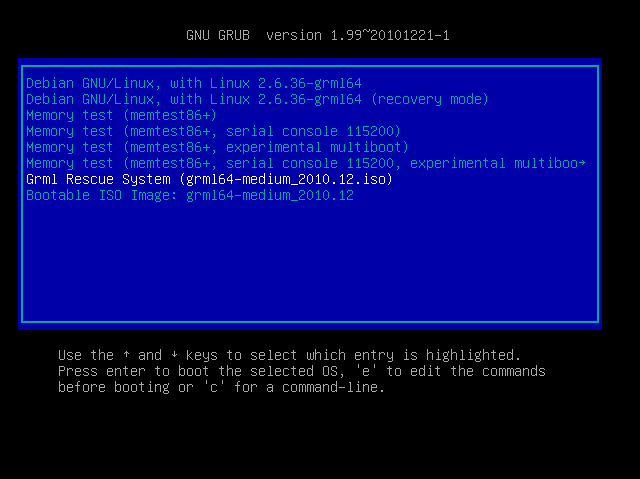
Voil , when rebooting your system you should see something like: Screenshot: grml-rescueboot The Grml Rescue System entry is what grml-rescueboot provides and Bootable ISO Image is what s provided by grub-imageboot. Just select the entry you d like to use, press enter and and you should get the bootsplash of the according ISO. BTW: I ve tested this with Ubuntu 10.10 too, grml-rescueboot works out-of-the-box with the Ubuntu ISO as well, it just doesn t support the memdisk ISO boot by grub-imageboot (yet). Tip: if you want to use grml-rescueboot and grub-imageboot with the same ISOs without having them twice on the disk just point the configuration option IMAGES in /etc/default/grub-imageboot to the according directory (like /boot/grml). Note: if you re using the ext 2,3,4 filesystem on the partition that s being used for /boot please be aware that you need GRUB >=1.98+20100804-12 (newer version is already available in Debian/unstable and hopefully migrates to squeeze in time) or GRUB >=1.99~20101122-1 because of the INDIRECT_BLOCKS support, see #543924 for the details. PS: We think about providing grml-rescueboot and grub-imageboot within official Debian. If you re interested in seeing integration support for other distributions as well please help and drop us a note.

Gunnar Wolf: Back with Ruby on Debian polemics

Once again, a polemic regarding how to properly integrate the Ruby language and libraries with the Debian distribution has been ignited. Similar arguments were presented in November and December 2008 and September 2010 And excuse me for just refering to my own blog, but there are links to some other posts from there... and there will surely be many others I just missed. There were even nice collaboration attempts (such as DebGem, announced in January 2009... But which apparently never stuck on, as it is still listed as in its public Beta period and lists only support for Debian 4.0 and Ubuntu 8.04 and 8.10). Some days ago, while I was on vacation, I received a mail from Lucas Nussbaum expressing the burnout he had been suffering from this situation. Some days after that, he posted a corresponding blog post - Giving up on Ruby packaging. The comments following his post are most interesting The one comment I'd like to highlight (noting I skimmed a whole deal of them) is by Paul Brannan, one of the original RubyGems authors. Yes, possibly the design criteria for Gems included some mutually-conflicting goals, and they cover some of Debian's goals. Unfortunately, this conflicting criteria... Was resolved to the opposite way we would have wanted (specifically, that a sysadmin should be able to install software with the same tools he was already familiar with). And of course, there are deeper disagreements, which are rightly stemmed from different priorities: Debian (+derivatives) is meant to make user's and sysadmin's lifes simpler. Gems are meant to make developers' lifes simpler. And while all developers are some sort of users, and sysadminsthe reverse is (obviously) not so. A developer maintaining several different codebases will surely suffer (well, this particular developer has surely suffered) if he has to maintain them all using coherent versions of system libraries. When a system is programmed, its developers want to use the greatest, latest tools to offer the best experience and functionality. And it's natural for libraries to evolve over time. However, any sysadmin will grind their teeth at the prospect of having many different versions of libraries, as the Gem model proposes. Why? Well, I was bitten by a minor example of it Bug fixes do not get backported. Of course, if simple bugs are not backported, security and stability of the system as a whole suffers. Often, new software versions will not only add functionality, but improve on how things are done. Not only bugs get corrected, but we get better response times, better memory handling, etc. It might sound harsh to say this, and even more, as a developer it feels I am talking against myself But while development time should be minimized during the system design/implementation, once systems are in production, it should be used to allow for friendlier sysadmin relations. I have to wear both hats at my real-life job. So, what is my take on this? Of course, blaming myself for choosing the wrong version is a no-go. When evaluating a library before using it in my projects, I try to look at its history and API-stability. APIs that change often speak about immature libraries which are still trying to get the right way to implement their functionality; just-started projects might be great and revolutionary, but they do not yet show any kind of long-term committment... And can lead (and have often led me) to painful rewrites when the Next Big Thing is reached. As for the users: Even if your favorite language has the best and friendliest distribution method, users just do not care about what language was a particular piece of software implemented in. Users want to be able to install and uninstall with their system's usual tools. Directly using Gems, CPAN, PEAR and whatnot is just unnatural for users, however convenient they are for developers. Distributions offer a non-technical advantage in this regard as well: A human filter. As an example, as I write this there are 19392 Ruby Gems and 19092 Perl modules in CPAN (note that CPAN stores some older versions but discourages authors from keeping too many - So no, they are still very different in size). Debian has around 30,000 packages. Why is that? Because all Debian packages _must_ be human-generated, human-reviewed, human-submitted. This means, a person must think each packaged piece of code is worth packaging, is stable enough and provides value to users as it is, and is fit for being part of a stable release. I am not saying with this that 90% of CPAN and Gems are crap I am saying that they are probably early implementations, to be installed, tested and improved by developers, and still not apt for general public use. Or maybe not interesting enough to be packaged as a service for the non-techie public at large. Oh, and one last point: Ruby is not a new language anymore. It is a mature, powerful language with different implementations, every time more stable... But it is a language deeply affected by the (not so new anymore either) the appearance of Rails. Why do I say this? Because although the language is in no way tied to Web development, many of its strongest uses are Web-oriented. How does this affect the current discussion? Well, because many people argue that users are no longer needed to install the software. Web systems are installed by sysadmins and used via a Web browser, and sysadmins are expected be more skilled than casual users. Still, in Debian (and in other distributions, surely) we try to make sysadmin's lives simpler I have (again, talking out of personal experience) installed several webapps (and system tools, and whatnot) for which I never followed any instructions besides aptitude install foo Using different languages, frameworks, and so on. Can I troubleshoot their installs? Probably, as there is a common logic for how the distribution I have chosen and specialized in works. Can I find causes for bugs in them? Possibly, although there are some languages and frameworks I dare not touch. Can I get help on getting them out of a tight spot? Surely, as there is a central bug tracking system for my distribution And one of the maintainer's tasks is to separate the problems related to the distribution (packaging, installing, simple user questions and misconceptions) to those derived from real bugs upstream. Anyway I am not saying that our way is the best way. No, by a long shot. Again, developers should have an easy, convenient way for installing whatever they want to play with. And to publish it without jumping through hoops. With this post, I'm only trying to express again why Debian works the way it does. And hope for better cooperation in the future. And as for several comments of what I read in Lucas' post, I think that there is interest for this synergy among some of the most committed Ruby people.

Next.

Previous.
