Search Results: "spa"

8 August 2008

Benjamin Mako Hill: Revealing Errors OSCON Keynote

When I gave a Revealing Errors talk at Lug Radio Live USA, I had the misfortune of being up against Robert Love's talk on Android which many people at the conference wanted to see -- myself included! One person who showed up to my talk anyway was Allison Randall. She was apparently entertained enough to invite me to give a short version of the talk as one of the keynote presentations at OSCON 2008! In the talk, I covered the ideas behind my Revealing Errors project and quickly walked through a few examples that showcase what I'm trying to do. I'm happy with the result: a couple thousand people showed up for the talk despite the fact that it was at 8:45 AM after the biggest "party night" of the conference! For those that missed it for whatever reason, you can watch a video recording that O'Reilly made and that I've embedded below. A larger version of the Flash video as well as a QuickTime version is over on blip.tv and I've created an OGG Theora version for all my freedom loving readers.

Enrico Zini: Handling concurrent update-apt-xapian-index runs

Handling concurrent update-apt-xapian-index runs So, update-apt-xapian-index takes a bit of a long time to run. When you install the package, if the index isn't there then postinst will rebuild it in background, good. Now, suppose you have an advanced package manager that after installing apt-xapian-index, detects that it's installed, detects that there is no database and runs an update with a nice GUI feedback. If this happened while the update is running in the background, the usual thing to do would be to abort the update; however, the package manager wouldn't be able to know when the indexing has finished and it can enable the advanced features. Let's not do the usual thing, then:
#  progress' is the object that does progress reporting.  Commandline options
# can choose a silent one, a machine readable one or a user readable one.
# Lock the session so that we prevent concurrent updates
lockfd = os.open(XAPIANDBLOCK, os.O_RDWR   os.O_CREAT)
lockpyfd = os.fdopen(lockfd)
try:
    fcntl.lockf(lockpyfd, fcntl.LOCK_EX   fcntl.LOCK_NB)
    #  ServerProgress  is a proxy progress reporter that listens for
    # connections on a Unix socket, and broadcasts progress status updates both
    # to the local progress reporter and to whoever connects to the socket.
    progress = ServerProgress(progress)
except IOError, e:
    if e.errno == errno.EACCES or e.errno == errno.EAGAIN:
        progress.notice("Another update is already running: showing its progress.")
        #  ClientProgress' is another proxy class that connects to the socket
    # forwards progress updates to whatever the user has chosen as the
    # local progress indicator.
        childProgress = ClientProgress(progress)
        childProgress.loop()
        sys.exit(0)
    else:
        raise
What happens here is that if the upload is in progress, the second update-apt-xapian-index will not be able to lock a lockfile. But instead of exiting, it connects to the other indexer via a unix socket, and shows the progress just as if it were the one doing the indexing. So, now, suppose I run update-apt-xapian-index:
# update-apt-xapian-index
Reading Debtags database: done.  
Rebuilding Xapian index... 20%

And suppose I run another one:
# update-apt-xapian-index
Another update is already running: showing its progress.
Rebuilding Xapian index... 20%

And suppose I run yet another one:
# update-apt-xapian-index --batch-mode
notice: Another update is already running: showing its progress.
begin: Rebuilding Xapian index
progress: 19/100
progress: 20/100

And suppose I run yet another one (running with -q shows nothing, but it will wait until the master indexer has finished):
# update-apt-xapian-index -q

This way, the advanced package manager (adept 3 does this) will show a progress indicator and correctly let the user know when indexing has finished... only, if an update is already running, the progress indicator will not start at 0% because the update was already in progress, and the user will think: "wow, I've been lucky!". The server side of the socket only uses nonblocking I/O, so there's no risk of slave indexers causing the master indexer to hang. It's been simple to implement, and brillant. It is in apt-xapian-index 0.15, which I have just uploaded to sid. Shame it's a bit late for lenny.

MJ Ray: Is Yahoo Now Even Worse On Spam?

When working on mailservers, I’ve noticed that Yahoo’s mailservers seem to “punish” others by sending code 421 (service not available) for a few minutes for a first report of spam that originated from there, longer for a second report and so on. Yahoo’s help pages suggest they do this if you don’t “comply with our guidelines (described below)” (which aren’t actually described below). That system seems to completely screw everyone on a server if a user forwards their own email to Yahoo and then flags some as spam, or if a website user who registered with a Yahoo mail address then closes their Yahoo account without updating their registration details. In the worst cases, a server’s mail queue can become clogged with stuff that it can’t forward to Yahoo. I’ve suggested that server owners ban forwarding to Yahoo, but not all have done that yet. Yahoo’s server-punishing tactics are particularly unfair because of the amount of spam we receive from Yahoo - when I tried rejecting that, the server tested seemed to get more 421 punishment for that. I now usually direct it to a blackhole, which feels a bit dangerous. Now I’ve just seen this from Indymedia which makes it sound like Yahoo’s getting even worse recently:-
“Yahoo doesn’t make it so easy for us. They do (unintendedly) transport a remarkable amount of spam, often sent by robots which automatically (and wide scale) crack Yahoos’ new account signup CAPTCHAS (those images with the cats + dogs + digits + letters in them) just to relay their spam through Yahoo. So it’s not easy to determine who sends legitimate email through Yahoo and who does not.”
I wrote about some alternative service providers back in 2006, including ippimail, which Yahoo users might like to change to. I’d be interested in comments about any new arrivals in this field. BT internet customers are probably using Yahoo-hosted email too. I recommend changing to The Phone Co-op, but my company is an agent for them, so I would say that, wouldn’t I?

7 August 2008

Gustavo Noronha Silva: 7 Aug 2008

So it is currently possible to use simple library calls in glib-based code to run something as root, by taking advantage of the gksu policykit mechanism: GksuProcess* gksu_process_new(const gchar *working_directory, const gchar **arguments);
gboolean gksu_process_spawn_async(GksuProcess *process, GError **error);
The DBus service already works; it is able to setup the environment and X authorization correctly. There is still lots to do; startup notification is still not handled, and dealing with the application’s stdandard output and error messages, as well as providing a way for the caller to send stuff into the processe’s standard input. It is already possible to start an application and know that it has been finished, though. As for the code: $ git clone git://kov.eti.br/srv/git/gksu-polkit.git/ Criticism is welcome! In other news… I’d like to ask our dear lazy web if anyone is using some nice way of providing only posts tagged in specific categories in a feed in wordpress. I’d like to use that to provide my posts to planet debian from my wordpress install.

Sandro Tosi: Another info source for Debian

It seems that #debian-devel@OFTC channel topic is used to inform for some particular situations, even grave ones (like HP Fort Collins outage of today).

But what to do if you'd like to be alerted for such situation and you can't check IRC, or you prefer different communication medium (like mails or feeds)?

There is a nice page on wiki.d.o that's been updated every time that #debian-devel@OFTC topic is changed. So, go there and simply subscribe to it (and you'll receive emails every time the page is changed). There should be a way to get an RSS feed from a MoinMoin page, but can't find a way: suggestions?

Russell Coker: A Basic IPVS Configuration

I have just configured IPVS on a Xen server for load balancing between multiple virtual hosts. The benefit is not load balancing but management. With two virtual machines providing a service I can gracefully shut one down for maintenance and have the other take the load. When there are two machines providing a service a load balancing configuration is much better than a hot-spare, one reason is the fact that there may be application scaling issues that prevent one machine with twice the resources from giving as much performance as two smaller machines. Another is the fact that if you have a machine configured but never used there will always be some doubt as to whether it would work… The first thing to do is to assign the IP address of the service to the front-end machine so that other machines on the segment (IE routers) will be able to send data to it. If the address for the service is 10.0.0.5 then the command “ip addr add dev eth0 10.0.0.5/24 broadcast +” will make it a secondary address on the eth0 interface. On a Debian system you would add the line “up ip addr add dev eth0 10.0.0.5/24 broadcast + true” to the appropriate section of /etc/network/interfaces, for a Red Hat system it seems that /etc/rc.local is the best place for it. I expect that it would be possible to merely advertise the IP address via ARP without adding it to the interface, but the ability to ping the IPVS server on the service address seems useful and there seems no benefit in not assigning the address. There are three methods used by IPVS for forwarding packets, gatewaying/routing (the default), IPIP encapsulation (tunneling), and masquerading. The gatewaying/routing method requires the back-end server to respond to requests on the service address. That would mean assigning the address to the back-end server without advertising it via ARP (which seems likely to have some issues for managing the system). The IPIP encapsulation method requires setting up IPIP which seemed like it would be excessively difficult (although maybe not more than required to set up masquerading). The masquerading option (which I initially chose) rewrites the packets to have the IP address of the real server. So for example if the service address is 10.0.0.5 and the back-end server has the address 10.0.1.5 then it will see packets addresses to 10.0.1.5. A benefit of masquerading is that it allows you to use different ports, so for example you could have a non-virtualised mail server listening on port 25 and a back-end server for a virtual service listening on port 26. While there is no practical limit to the number of private IP addresses that you might use it seems easier to manage servers listening on different ports with the same IP address - and there is the issue of server programs that are not written to support binding to an IP address. ipvsadm -A -t 10.0.0.5:25 -s lblc -p
ipvsadm -a -t 10.0.0.5:25 -r 10.0.1.5 -m The above two commands create an IPVS configuration that listens on port 25 of IP address 10.0.0.5 and then masquerades connections to 10.0.1.5 on port 25 (the default is to use the same port). Now the problem is in getting the packets to return via the IPVS server. If the IPVS server happens to be your default gateway then it’s not a problem and it will already be working after the above two commands (if a service is listening on 10.0.1.5 port 25). If the IPVS server is not the default gateway and you have only one IP address on the back-end server then this will require using netfilter to mark the packets and then route based on the packet matching. Marking via netfilter also seems to be the only well documented way of doing similar things. I spent some time working on this and didn’t get it working. However having multiple IP addresses per server is a recommended practice anyway (a back-end interface for communication between servers as well as a front-end interface for public data). ip rule add from 10.0.1.5 table 1
ip route add default via 10.0.0.1 table 1 I use the above two commands to set up a new routing table for the data for the virtual service. The first line causes any packets from 10.0.1.5 to be sent to routing table 1 (I currently have a rough plan to have table numbers match ethernet device numbers, the data in question is going out device eth1). The second line adds a default router to table 1 which sends all packets to 10.0.0.1 (the private IP address of the IPVS server). Then it SHOULD all be working, but in the network that I’m using (RHEL4 DomU and RHEL5 Dom0 and IPVS) it doesn’t. For some reason the data packets from the DomU are not seen as part of the same TCP stream (both in Net Filter connection tracking and by the TCP code in the kernel). So I get an established connection (3 way handshake completed) but no data transfer. The server sends the SMTP greeting repeatedly but nothing is received. At this stage I’m not sure whether there is something missing in my configuration or whether there’s a bug in IPVS. I would be happy to send tcpdump output to anyone who wants to try and figure it out. My next attempt at this was via routing. I removed the “-m” option from the ipvsadm command and added the service IP address to the back-end with the command “ifconfig lo:0 10.0.0.5 netmask 255.255.255.255” and configured the mail server to bind to port 25 on address 10.0.0.5. Success at last! Now I just have to get Piranha working to remove back-end servers from the list when they fail. Update: It’s quite important that when adding a single IP address to device lo:0 you use a netmask of 255.255.255.255. If you use the same netmask as the front-end device (which would seem like a reasonable thing to do) then (with RHEL4 kernels at least) you get proxy ARPs by default. For example you used netmask 255.255.255.0 to add address 10.0.0.5 to device lo:0 then on device eth0 the machine will start answering ARP requests for 10.0.0.6 etc. Havoc then ensues.

MJ Ray: RFID Security and Stability

While developing an RFID extension for the Koha library catalogue system over the last few months, I’ve learned a lot about I-Code tags and security systems, but I’ve not yet looked into Mifare, which is the other big RFID product line from NXP. I have been seeing several reports of problems with Oyster (which is Mifare-based) and a crack to be published. I thought Mifare was meant to be a much tougher product than I-Code. I’m surprised and disappointed that NXP’s reaction to a hack was to try to prevent publication. I haven’t heard from any suppliers about vulnerabilities, so I doubt that NXP are passing the message on to all Mifare-operators yet. They should tell Mifare operators so that they can protect themselves. It looks like the head-in-sand approach to security, which is very worrying. At least one of our RFID systems is Mifare-capable (which is why I think we should have been told about this vulnerability), so I’ll look into that when I get some spare time (March 2012 perhaps?) unless someone points me at a link with juicy details.

6 August 2008

Pablo Lorenzzoni: 100-thousand and counting

For those of you wondering how is the battle against the Brazilian Internet Surveillance Bill, I have to report we already got more than 100-thousand people to sign the petition. You can check the current count in the image on the right. I am updating it every 15 minutes, so you can even use its URL in another place (as are some people doing already). The bill will be voted by the Chamber-of-Deputies any time now We heard it would be on yesterday, but apparently it was not even enlisted for this week. This doesn t mean much, since the Deputies can hold an out-of-list voting we ll be watching. Meanwhile, I read an article by S rgio Amadeu that summarizes some of our feeling about that bill. Are we in the Western World (allegedly freedom lovers) turning into control-freaks? A whole lot of people I know are not even offended by this bill! These are the same people that don t think it s weird that USA claimed the right to seize any storage device entering their borders, for any time they want, with no warranted privacy. Are we in a middle of a paradigm shift? Are we accepting less freedom? What would George Orwell think of that? Maybe we got in a wormhole and ended up in 1984

5 August 2008

Eddy Petrișor: git-core etch backport is useless

Update:

It seems that the lenny version (1:1.5.6.3-1) plus some small changes to allow building and running on etch does not have this problem.

The changes include:

* backported to etch
- compile against tcl8.4, instead of tcl8.5
- gtik and git-gui depend on tk8.4, instead of tk8.5
- drop the versioned dep on asciidoc and docbook-xsl


It s really nice that git-core is backported to etch, but is kind of hard to convince people to use it when gitk needs tk8.5, which is unavailable in etch.

This was the reason why previosely I made a local backport (1:1.5.6-1~bpo40+1~local) thinking the missing/extra[*] dep was a temporary glitch. According to bug 456423, this should be safe.


Does backports.org have a buildd network? IIRC, it uses the experimental buildd network, but that doesn't explain the desynchronisation of the packages in etch-backports.


Oddly enough, the build now fails on my etch machine during the tests in t9400-git-cvsserver-server.sh (looks like it is not related to the tk8.5 change):

* FAIL 23: cvs update (create new file)
echo testfile1 >testfile1 &&
git add testfile1 &&
git commit -q -m "Add testfile1" &&
git push gitcvs.git >/dev/null &&
cd cvswork &&
GIT_CONFIG="$git_config" cvs -Q update &&
test "$(echo $(grep testfile1 CVS/Entries cut -d/ -f2,3,5))" = "testfile1/1.1/" &&
diff -q testfile1 ../testfile1

* expecting success: echo line 2 >>testfile1 &&
git add testfile1 &&
git commit -q -m "Append to testfile1" &&
git push gitcvs.git >/dev/null &&
cd cvswork &&
GIT_CONFIG="$git_config" cvs -Q update &&
test "$(echo $(grep testfile1 CVS/Entries cut -d/ -f2,3,5))" = "testfile1/1.2/" &&
diff -q testfile1 ../testfile1
Counting objects: 5, done.
Compressing objects: 100% (2/2), done.
Writing objects: 100% (3/3), 282 bytes, done.
Total 3 (delta 1), reused 0 (delta 0)
Unpacking objects: 100% (3/3), done.
To gitcvs.git
0879984..e6bd37b master -> master
cvs update: Updating .
cvs update: New directory master'
* FAIL 24: cvs update (update existing file)
echo line 2 >>testfile1 &&
git add testfile1 &&
git commit -q -m "Append to testfile1" &&
git push gitcvs.git >/dev/null &&
cd cvswork &&
GIT_CONFIG="$git_config" cvs -Q update &&
test "$(echo $(grep testfile1 CVS/Entries cut -d/ -f2,3,5))" = "testfile1/1.2/" &&
diff -q testfile1 ../testfile1

* checking known breakage:
mkdir test &&
echo >test/empty &&
git add test &&
git commit -q -m "Single Subdirectory" &&
git push gitcvs.git >/dev/null &&
cd cvswork &&
GIT_CONFIG="$git_config" cvs -Q update &&
test ! -d test

Counting objects: 4, done.
Compressing objects: 100% (2/2), done.
Writing objects: 100% (3/3), 388 bytes, done.
Total 3 (delta 0), reused 0 (delta 0)
Unpacking objects: 100% (3/3), done.
To gitcvs.git
e6bd37b..4a13ee9 master -> master
cvs update: Updating .
cvs update: New directory master'
* FIXED 25: cvs update w/o -d doesn't create subdir (TODO)

* expecting success: (for dir in A A/B A/B/C A/D E; do
mkdir $dir &&
echo "test file in $dir" >"$dir/file_in_$(echo $dir sed -e "s#/# #g")" &&
git add $dir;
done) &&
git commit -q -m "deep sub directory structure" &&
git push gitcvs.git >/dev/null &&
cd cvswork &&
GIT_CONFIG="$git_config" cvs -Q update -d &&
(for dir in A A/B A/B/C A/D E; do
filename="file_in_$(echo $dir sed -e "s#/# #g")" &&
if test "$(echo $(grep -v ^D $dir/CVS/Entries cut -d/ -f2,3,5))" = "$filename/1.1/" &&
diff -q "$dir/$filename" "../$dir/$filename"; then
:
else
echo >failure
fi
done) &&
test ! -f failure
Counting objects: 13, done.
Compressing objects: 100% (4/4), done.
Writing objects: 100% (12/12), 754 bytes, done.
Total 12 (delta 1), reused 0 (delta 0)
Unpacking objects: 100% (12/12), done.
To gitcvs.git
4a13ee9..f573218 master -> master
cvs update: Updating .
cvs update: New directory master'
grep: A/CVS/Entries: No such file or directory
grep: A/B/CVS/Entries: No such file or directory
grep: A/B/C/CVS/Entries: No such file or directory
grep: A/D/CVS/Entries: No such file or directory
grep: E/CVS/Entries: No such file or directory
* FAIL 26: cvs update (subdirectories)
(for dir in A A/B A/B/C A/D E; do
mkdir $dir &&
echo "test file in $dir" >"$dir/file_in_$(echo $dir sed -e "s#/# #g")" &&
git add $dir;
done) &&
git commit -q -m "deep sub directory structure" &&
git push gitcvs.git >/dev/null &&
cd cvswork &&
GIT_CONFIG="$git_config" cvs -Q update -d &&
(for dir in A A/B A/B/C A/D E; do
filename="file_in_$(echo $dir sed -e "s#/# #g")" &&
if test "$(echo $(grep -v ^D $dir/CVS/Entries cut -d/ -f2,3,5))" = "$filename/1.1/" &&
diff -q "$dir/$filename" "../$dir/$filename"; then
:
else
echo >failure
fi
done) &&
test ! -f failure

* expecting success: git rm testfile1 &&
git commit -q -m "Remove testfile1" &&
git push gitcvs.git >/dev/null &&
cd cvswork &&
GIT_CONFIG="$git_config" cvs -Q update &&
test -z "$(grep testfile1 CVS/Entries)" &&
test ! -f testfile1
rm 'testfile1'
Counting objects: 3, done.
Compressing objects: 100% (2/2), done.
Writing objects: 100% (2/2), 233 bytes, done.
Total 2 (delta 1), reused 0 (delta 0)
Unpacking objects: 100% (2/2), done.
To gitcvs.git
f573218..2ed3834 master -> master
cvs update: Updating .
cvs update: New directory master'
* ok 27: cvs update (delete file)

* expecting success: echo readded testfile >testfile1 &&
git add testfile1 &&
git commit -q -m "Re-Add testfile1" &&
git push gitcvs.git >/dev/null &&
cd cvswork &&
GIT_CONFIG="$git_config" cvs -Q update &&
test "$(echo $(grep testfile1 CVS/Entries cut -d/ -f2,3,5))" = "testfile1/1.4/" &&
diff -q testfile1 ../testfile1
Counting objects: 4, done.
Compressing objects: 100% (2/2), done.
Writing objects: 100% (3/3), 300 bytes, done.
Total 3 (delta 1), reused 0 (delta 0)
Unpacking objects: 100% (3/3), done.
To gitcvs.git
2ed3834..3f3e927 master -> master
cvs update: Updating .
cvs update: New directory master'
* FAIL 28: cvs update (re-add deleted file)
echo readded testfile >testfile1 &&
git add testfile1 &&
git commit -q -m "Re-Add testfile1" &&
git push gitcvs.git >/dev/null &&
cd cvswork &&
GIT_CONFIG="$git_config" cvs -Q update &&
test "$(echo $(grep testfile1 CVS/Entries cut -d/ -f2,3,5))" = "testfile1/1.4/" &&
diff -q testfile1 ../testfile1

* expecting success: echo Line 0 >expected &&
for i in 1 2 3 4 5 6 7
do
echo Line $i >>merge
echo Line $i >>expected
done &&
echo Line 8 >>expected &&
git add merge &&
git commit -q -m "Merge test (pre-merge)" &&
git push gitcvs.git >/dev/null &&
cd cvswork &&
GIT_CONFIG="$git_config" cvs -Q update &&
test "$(echo $(grep merge CVS/Entries cut -d/ -f2,3,5))" = "merge/1.1/" &&
diff -q merge ../merge &&
( echo Line 0; cat merge ) >merge.tmp &&
mv merge.tmp merge &&
cd "$WORKDIR" &&
echo Line 8 >>merge &&
git add merge &&
git commit -q -m "Merge test (merge)" &&
git push gitcvs.git >/dev/null &&
cd cvswork &&
sleep 1 && touch merge &&
GIT_CONFIG="$git_config" cvs -Q update &&
diff -q merge ../expected
Counting objects: 4, done.
Compressing objects: 100% (2/2), done.
Writing objects: 100% (3/3), 302 bytes, done.
Total 3 (delta 1), reused 0 (delta 0)
Unpacking objects: 100% (3/3), done.
To gitcvs.git
3f3e927..28c1b4a master -> master
cvs update: Updating .
cvs update: New directory master'
* FAIL 29: cvs update (merge)
echo Line 0 >expected &&
for i in 1 2 3 4 5 6 7
do
echo Line $i >>merge
echo Line $i >>expected
done &&
echo Line 8 >>expected &&
git add merge &&
git commit -q -m "Merge test (pre-merge)" &&
git push gitcvs.git >/dev/null &&
cd cvswork &&
GIT_CONFIG="$git_config" cvs -Q update &&
test "$(echo $(grep merge CVS/Entries cut -d/ -f2,3,5))" = "merge/1.1/" &&
diff -q merge ../merge &&
( echo Line 0; cat merge ) >merge.tmp &&
mv merge.tmp merge &&
cd "$WORKDIR" &&
echo Line 8 >>merge &&
git add merge &&
git commit -q -m "Merge test (merge)" &&
git push gitcvs.git >/dev/null &&
cd cvswork &&
sleep 1 && touch merge &&
GIT_CONFIG="$git_config" cvs -Q update &&
diff -q merge ../expected

* expecting success: ( echo LINE 0; cat merge ) >merge.tmp &&
mv merge.tmp merge &&
git add merge &&
git commit -q -m "Merge test (conflict)" &&
git push gitcvs.git >/dev/null &&
cd cvswork &&
GIT_CONFIG="$git_config" cvs -Q update &&
diff -q merge ../expected.C
Counting objects: 5, done.
Compressing objects: 100% (3/3), done.
Writing objects: 100% (3/3), 303 bytes, done.
Total 3 (delta 1), reused 0 (delta 0)
Unpacking objects: 100% (3/3), done.
To gitcvs.git
28c1b4a..1f0f9c8 master -> master
cvs update: Updating .
cvs update: New directory master'
diff: merge: No such file or directory
* FAIL 30: cvs update (conflict merge)
( echo LINE 0; cat merge ) >merge.tmp &&
mv merge.tmp merge &&
git add merge &&
git commit -q -m "Merge test (conflict)" &&
git push gitcvs.git >/dev/null &&
cd cvswork &&
GIT_CONFIG="$git_config" cvs -Q update &&
diff -q merge ../expected.C

* expecting success: cd cvswork &&
GIT_CONFIG="$git_config" cvs -Q update -C &&
diff -q merge ../merge
cvs update: Updating .
cvs update: New directory master'
diff: merge: No such file or directory
* FAIL 31: cvs update (-C)
cd cvswork &&
GIT_CONFIG="$git_config" cvs -Q update -C &&
diff -q merge ../merge

* expecting success: echo Line 9 >>merge &&
cp merge cvswork/merge &&
git add merge &&
git commit -q -m "Merge test (no-op)" &&
git push gitcvs.git >/dev/null &&
cd cvswork &&
sleep 1 && touch merge &&
GIT_CONFIG="$git_config" cvs -Q update &&
diff -q merge ../merge
Counting objects: 5, done.
Compressing objects: 100% (3/3), done.
Writing objects: 100% (3/3), 303 bytes, done.
Total 3 (delta 1), reused 0 (delta 0)
Unpacking objects: 100% (3/3), done.
To gitcvs.git
1f0f9c8..e6c5fc1 master -> master
cvs update: Updating .
cvs update: New directory master'
* ok 32: cvs update (merge no-op)

* expecting success:
touch really-empty &&
echo Line 1 > no-lf &&
echo -n Line 2 >> no-lf &&
git add really-empty no-lf &&
git commit -q -m "Update -p test" &&
git push gitcvs.git >/dev/null &&
cd cvswork &&
GIT_CONFIG="$git_config" cvs update &&
rm -f failures &&
for i in merge no-lf empty really-empty; do
GIT_CONFIG="$git_config" cvs update -p "$i" >$i.out
diff $i.out ../$i >>failures 2>&1
done &&
test -z "$(cat failures)"

Counting objects: 4, done.
Compressing objects: 100% (2/2), done.
Writing objects: 100% (3/3), 305 bytes, done.
Total 3 (delta 1), reused 0 (delta 0)
Unpacking objects: 100% (3/3), done.
To gitcvs.git
e6c5fc1..4d0f85b master -> master
cvs update: Updating .
cvs update: New directory master'
cvs update: Updating .
cvs update: New directory master'
cvs update: Updating .
cvs update: New directory master'
cvs update: Updating .
cvs update: New directory master'
cvs update: Updating .
cvs update: New directory master'
* FAIL 33: cvs update (-p)

touch really-empty &&
echo Line 1 > no-lf &&
echo -n Line 2 >> no-lf &&
git add really-empty no-lf &&
git commit -q -m "Update -p test" &&
git push gitcvs.git >/dev/null &&
cd cvswork &&
GIT_CONFIG="$git_config" cvs update &&
rm -f failures &&
for i in merge no-lf empty really-empty; do
GIT_CONFIG="$git_config" cvs update -p "$i" >$i.out
diff $i.out ../$i >>failures 2>&1
done &&
test -z "$(cat failures)"


* expecting success:
mkdir status.dir &&
echo Line > status.dir/status.file &&
echo Line > status.file &&
git add status.dir status.file &&
git commit -q -m "Status test" &&
git push gitcvs.git >/dev/null &&
cd cvswork &&
GIT_CONFIG="$git_config" cvs update &&
GIT_CONFIG="$git_config" cvs status grep "^File: status.file" >../out &&
test $(wc -l ../out) = 2 Counting objects: 5, done. Compressing objects: 100% (2/2), done. Writing objects: 100% (4/4), 366 bytes, done. Total 4 (delta 1), reused 0 (delta 0) Unpacking objects: 100% (4/4), done. To gitcvs.git 4d0f85b..a146cf3 master -> master
cvs update: Updating .
cvs update: New directory master'
Invalid module '' at /home/eddy/usr/src/tools/git-backports/1.5.6.3-1~bpo40+3~local/git-core-1.5.6.3/t/../git-cvsserver line 2895,
line 18.
cvs [status aborted]: end of file from server (consult above messages if any)
* FAIL 34: cvs status

mkdir status.dir &&
echo Line > status.dir/status.file &&
echo Line > status.file &&
git add status.dir status.file &&
git commit -q -m "Status test" &&
git push gitcvs.git >/dev/null &&
cd cvswork &&
GIT_CONFIG="$git_config" cvs update &&
GIT_CONFIG="$git_config" cvs status grep "^File: status.file" >../out &&
test $(wc -l ../out) = 2 * expecting success: cd cvswork && GIT_CONFIG="$git_config" cvs status -l grep "^File: status.file" >../out &&
test $(wc -l ../out) = 1 Invalid module '' at /home/eddy/usr/src/tools/git-backports/1.5.6.3-1~bpo40+3~local/git-core-1.5.6.3/t/../git-cvsserver line 2895,
line 19.
cvs [status aborted]: end of file from server (consult above messages if any)
* FAIL 35: cvs status (nonrecursive)

cd cvswork &&
GIT_CONFIG="$git_config" cvs status -l grep "^File: status.file" >../out &&
test $(wc -l ../out) = 1 * expecting success: cd cvswork && GIT_CONFIG="$git_config" cvs status grep ^File: >../out &&
! grep / ../out Invalid module '' at /home/eddy/usr/src/tools/git-backports/1.5.6.3-1~bpo40+3~local/git-core-1.5.6.3/t/../git-cvsserver line 2895,
line 18.
cvs [status aborted]: end of file from server (consult above messages if any)
* FAIL 36: cvs status (no subdirs in header)

cd cvswork &&
GIT_CONFIG="$git_config" cvs status grep ^File: >../out &&
! grep / ../out * fixed 1 known breakage(s) * failed 11 among 36 test(s) make[2]: *** [t9400-git-cvsserver-server.sh] Error 1 make[2]: Leaving directory /home/eddy/usr/src/tools/git-backports/1.5.6.3-1~bpo40+3~local/git-core-1.5.6.3/t' make[1]: *** [test] Error 2 make[1]: Leaving directory /home/eddy/usr/src/tools/git-backports/1.5.6.3-1~bpo40+3~local/git-core-1.5.6.3' make: *** [build-arch-stamp] Error 2


[*] depends on how you look at it

Russell Coker: A New Strategy for Xen MAC Allocation

When installing Xen servers one issue that arises is how to assign MAC addresses. The Wikipedia page about MAC addresses [1] shows that all addresses that have the second least significant bit of the most significant byte set to 1 are “locally administered”. In practice people just use addresses starting with 02: for this purpose although any number congruent to two mod four used in the first octet would give the same result. I prefer to use 02: because it’s best known and therefore casual observers will be more likely to realise what is happening. Now if you have a Xen bridge that is private to one Dom0 (for communication between Xen DomU’s on the same host) or on a private network (a switch that connects servers owned by one organisation and not connected to machines owned by others) then it’s easy to just pick MAC addresses starting with 02: or 00:16:3e: (the range assigned to the Xen project). But if Xen servers run by other people are likely to be on the same network then there is a problem. Currently I’m setting up some Xen servers that have public and private networks. The private network will either be a local bridge (that doesn’t permit sending data out any Ethernet ports) or a bridge to an Ethernet port that is connected to a private switch, for that I am using MAC addresses starting with 02:. As far as I am aware there is no issue with machine A having a particular MAC address on one VLAN while machine B has the same MAC address on another VLAN. My strategy for dealing with the MAC addresses for the public network at the moment is to copy MAC addresses from machines that will never be in the same network. For example if I use the MAC addresses from Ethernet cards in a P3 desktop system running as a router in a small company in Australia then I can safely use them in a Xen server in a co-location center in the US (there’s no chance of someone taking the PCI ethernet cards from the machine in Australia and sending them to the US - and no-one sells servers that can use such cards anyway). Note that I only do this when I have root on the machine in question and where there is no doubt about who runs the machine, so there should not be any risk. Of course if someone from the ISP analyses the MAC addresses on their network it will look like they have some very old machines in their server room. ;) I wonder if there are any protocols that do anything nasty with MAC addresses. I know that IPv6 addresses can be based on the MAC address, but as long as the separate networks have separate IPv6 ranges that shouldn’t be a problem. I’m certainly not going to try bridging networks between Australia and the US! Another possible way of solving this issue would be to have the people who run a server room assign and manage MAC addresses. One way of doing this would be to specify a mapping of IP addresses to MAC addresses, EG you could have the first two bytes be 02:00: and the next four be the same as the IPv4 address assigned to the DomU in question. In the vast majority of server rooms I’ve encountered the number of public IP addresses has been greater than or equal to the number of MAC addresses with the only exception being corporate server rooms where everything runs on private IP address space (but there’s nothing wrong with 02:00:0a: as the prefix for a MAC address). I also wonder if anyone else is thinking about the potential for MAC collisions. I’ve got Xen servers in a couple of server rooms, I told the relevant people in writing of my precise plans (and was assigned extra IP addresses for all the DomUs) but never had anyone mention any scheme for assigning MAC addresses.

Michal Čihař: Gammu test version 1.20.90

New testing version of Gammu was just born. It brings quite a lot of fixes and changes API a bit (some things will also change in next testing release). Full list of changes: You can download from usual place: http://cihar.com/gammu/, Debian users will find packages in experimental as soon as it passes NEW queue. PS: I still have about 100 unread mails about Gammu, so please be patient.

Steve Kemp: Five grand a head

It is nice when you work for a company where you can say:
"Ice-lolly break..."
The response?
"Me too!"
Tonight has been a productive evening, I guess the ice-lolly helped! I managed to optimize the storage of rejected SPAM mail for my commercial service. That is something I've been obsessing over recently since the volume of SPAM is currently hovering around 2.5 million messages. Still I suspect it is only a matter of weeks before I need to expand. The current setup has me using three machines: Ideally I'd like to split that up further so that I have a single machine running the web application (the part the user interacts with), a pair of MX machines, and the offsite machine doing the minimal work it does. That way the incoming mail will not affect the application at all directly. Thankfully the split should be trivial. The only hard part is finding a fast webhost that can offer me ~1Gb of RAM, ~1000Gb of disk space, and won't charge much. Ideally around £15/$30 a month. (hahaha! hahaha! ha!) ObQuote: L on

4 August 2008

Russell Coker: New HP Server

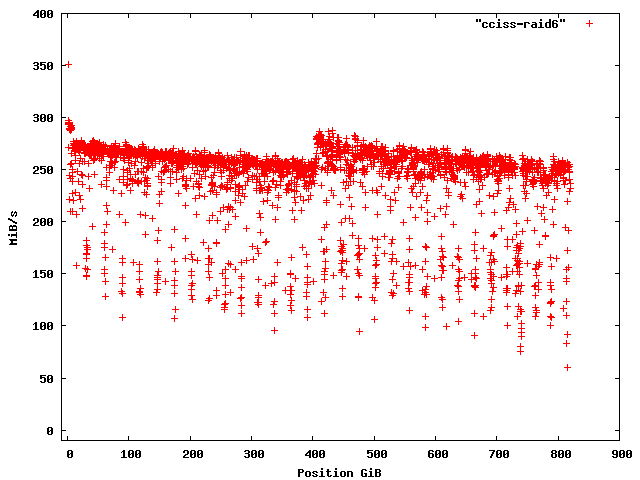
I’ve just started work on a new HP server running RHEL5 AS (needs to be AS to support more than 4 DomU’s). While I still have the Xen issues that made me give up using it on Debian [1] (the killer one being that an AMD64 Xen Dom0 would kernel panic on any serious disk IO) but the Xen implementation in RHEL is quite solid. The first thing I did was run zcav (part of my Bonnie++ benchmark suite) [2] to see how the array performs (as well as ensuring that the entire array actually appears to work). The result is below. For a single disk performance is expected to decrease as you read along the disk (from outer to inner tracks). I don’t know why the performance decreases until the half-way point and then starts with good performance again and again decreases. The next thing was to ensure that the machine had RAID-6 (I have been convinced that that using only RAID-5 verges on professional malpractice). As the machine is rented from a hosting company there was no guarantee that they would follow my clear written instructions involving running RAID-6. The machine is a HP rack-mounted server with a CCISS RAID controller, so to manage the array the command /usr/sbin/hpacucli is used. The command hpacucli controller all show reveals that there is a “Smart Array P400 in Slot 1“. The command hpacucli controller slot=1 show gives the following (amongst a lot of other output):
RAID 6 (ADG) Status: Enabled
Cache Board Present: True
Cache Status: OK
Accelerator Ratio: 25% Read / 75% Write
Drive Write Cache: Disabled
Total Cache Size: 512 MB
Battery Pack Count: 1
Battery Status: OK
SATA NCQ Supported: True So the write-back cache is enabled, 384M of data is for the write-back cache and 128M is for the read cache (hopefully all for read-ahead - the OS should do all the real caching for reads). The command hpacucli controller slot=1 array all show reveals that there is one array: “array A (SAS, Unused Space: 0 MB)“. The command hpacucli controller slot=1 array a show status tells me that the status is “array AOK“. Finally the command hpacucli controller slot=1 show config gives me the data that I really want at this time and says:
Smart Array P400 in Slot 1 (sn: *****)
array A (SAS, Unused Space: 0 MB)
logicaldrive 1 (820.2 GB, RAID 6 (ADG), OK) Then it gives all the data on the disks. It would be nice if there was a command to just dump all that. I would like to be able to show the configuration of all controllers with a single command. Also it would be nice if the fact that hpacucli is the tool to use for managing CCISS RAID arrays when using Linux on HP servers was more widely documented. It took me an unreasonable amount of effort to discover what tool to use for CCISS RAID management.

Russell Coker: Lenny SE Linux on the Desktop

I have been asked about the current status of Lenny SE Linux on the Desktop. The first thing to consider is the combinations of policies and configurations. I will number them if only for the purpose of this post, if the numbering is considered generally helpful it could be more widely adopted to describe configurations.

  1. Default configuration. This has the default policy and is configured with all users having the domain unconfined_t and daemons such as POP servers are allowed to access home directories of type unconfined_home_dir_t. This allows such daemons to attack privileged user accounts.

  2. Some restricted users. This is the same as above but with some users restricted. Daemons such as POP servers are only allowed to access the home directories of restricted users. This means that if a user is to have an unconfined account and receive email they must have two Unix accounts or receive their mail under /var/spool/mail. This is one setsebool command and one (or maybe a few) “semanage login -m” commands from the default configuration.

  3. All users restricted. The system administrator has the domain sysadm_t and users have domains such as user_t. This requires a few more semanage commands. It is equivalent to the old strict policy.

  4. MLS. This is anything that is based around the MLS policy.

Currently I have two Desktop machines running Lenny (a test machine and my EeePC) and one server. I have only just switched my test machine to enforcing mode so have no good data on it (apart from the fact that I can boot it up and login - which is always a good start). The server is running in permissive mode because I have not yet written the policy to allow the POP server to read from unconfined_home_dir_t. I could get it working by switching from level 1 to level 2 or 3, but I want to get level 1 server policy working for the benefit of others else first. My EeePC however is fully functional, I have been doing some work on it - that mostly means running a ssh client under GNOME but that’s OK (desktop environments such as GNOME and KDE are quite complex and demanding, getting a machine to boot and run such a desktop environment tests out many parts of the system). It’s only at level 1 for the moment because I want to get level 1 working everywhere before moving to the higher levels. I want to get things ready for real users ASAP. With the way the policy is managed now it will be possible to move from level 1 to 2 or 3 without rebooting or interrupting running services. So once users have systems running well at level 1 they can easily increase the security at a later date. The problems that I have had are due to text relocations in libraries (see my previous post about execmod permission [1]). I’ve filed bug report #493678 against libtheora0 [2] in regard to this issue and included a patch from Fedora (which disables the non-relocatable assembly code in question). It seems that upstream have some new assembler code to try and fix this issue, so hopefully we’ll have something that can make it into Lenny! I’ve filed bug report #493705 against libswscale0 for the same issue [3]. I included a patch to turn off the assembler code in question but that was not well received. If anyone has some i386 assembler skill and some spare time I would appreciate it if you could try and find a way to make the code position independent while losing little or no performance. One thing to note is that I am now using an Opteron 1212 (2.0GHz dual-core) system for compiling, I run the i386 DomU with a 64bit kernel (I expect that 32bit user-space runs faster with a 64bit kernel than a 32bit kernel), and the disks are reasonably fast. Even so it takes about 15 minutes to build libswscale0 and the other packages from the same source tree. Previously I was using a 1.0GHz Pentium-3 for my Lenny i386 development until I had the libswscale0 build process go for more than 90 minutes before running out of disk space! If your build machine is old enough to only be 32bit then you should probably plan on watching a movie or going to bed while the build is in progress. I have built packages that work around the above bugs and included them in my Lenny repository [4]. If you take the packages from that repository plus the Lenny packages then you should have a functional desktop system at level 1. I would appreciate it if people would start testing that and providing feedback. One important issue is the discovery of libraries that want shared stacks, text relocations, and executable memory. The deadline for fixing them properly is even more of a problem due to the number of people who have to be involved in a solution (as compared to the policy where I can do it on my own). One finally problem is a bug in xdm which causes it to give the wrong context for login sessions due to having an old version of the SE Linux related code [5]. Due to a combination of this and some policy bugs you can not login with xdm. This is not a hugely important issue as most people will use gdm (which has the newer patch) or kdm (which has no SE Linux patch but can use pam_selinux.so). Also another option is wdm which works with pam_selinux.so. I’ve had a response to my bug report suggesting that there’s a bug in the patch (which was taken from gdm so maybe there’s a bug in gdm code too). I haven’t responded to that yet as I’ve been concentrating on the things that will make the most impact for Lenny. At this stage I’m still unsure of when the release team will cut me off and prevent further SE Linux related fixes from going in Lenny. I need at least one more update to the policy packages before Lenny is released. I could release one right now with some useful improvements over what is currently in unstable, but am waiting until I get some other things fixed. If I get everything fully working at level 1 (both client and server) before Lenny then I will provide a similar status report for users and testers of levels 2 and 3. I don’t expect that I will even get a chance to test level 4 (MLS) properly before Lenny releases.

Marcela Tiznado: When did we start attacking each other?

So, I should be at DebCamp, but I'm back home after driving 800km in one day.  
Why? I still don't know.

The main reason for this post is the irrational and unilateral response I got
from the DebConf Orga Team, with no right to replica of any kind, and with
the violence and humiliation we were treated with. I've helped to make
3 DebConf's possible, and have been involved in many ways for the past years
in Debian, so this shocked me deeply.

The short story is that there was an extra bed in the room I was staying in, the
person who was suppose to be in that bed is a close friend of mine, so I asked
if someone else could use it while they weren't, since that meant I could take
the necessary equipment that I managed to get for DebConf, and also introduce
to Debian someone who is very active and well known in our local community
(and also part of the umbrella foundation used for local finance issues).
I was excited about getting there, like every year. Just to make this extra
clear, this person had already booked the full week of DebConf, just not
DebCamp, as he previously thought he couldn't attend. When he found out he
could, he was thrilled to be able to go and help setup. So, I made the mistake
of not notifying the Orga team about the switch. I did this because it truly
was harmless action, where a bed which would otherwise be wasted would get
used, and, I did not notify the Orga team because they've been very
aggressive, inflexible and unhelpful throughout the planning of the
conference. This doesn't justify it, just explains why someone who generally
is helpful decides to take the wrong path to solve something.

Up to here, nothing very exciting. What made this special, is that when one
of the organizers, Margarita Manterola, found out about the switch, instead
of coming to talk to me, even though she's known me for *years*, she went
and informed the hotel that somebody had committed a crime, and checked in
under a different name, as if me or the person that came with me where
some random stranger. All I can say is, WTF?

Let me stress this, the email that was sent out[1] twisted the facts, to the
extent that some of them are a lie, like the problem arrived at check-in,
when it actually happened while we where napping a few hours after we had
arrived, and any effort made by the Orga team with the hotel where wasted,
as it was one of them who had originally created the problem.

Instead of solving this among us as a group, and, again, "solve" is a
bureaucratic thing, because no one was being harmed, Marga decided to
actually *harm* me personally, the person who I had brought, and DebConf
as a group. What got solved? Nothing. I left, along with someone who
would of otherwise been helping out build DebConf, while the Orga team
demanded a ridiculous fee for me to stay in the hotel.
Rules are rules, I understand, but I also understand everybody listens to
downloaded music, people in Germany install[2] nmap, and a very long list
of rules that we tend not to follow because they're unreasonable or
unnecessarily complicated.
Is this really what DebConf is turning into?

All I can say is I'm very sad and shocked that the people I've worked with
for so many years decided to condemn me over such a meaningless issue, and
especially that the local team, Martin Ferrari, Damian Viano, Maximiliano
Curia and Margarita Manterola would do such thing to "one of there own",
and that the international Orga team would mindlessly follow through with it.

I apologized to the hotel, I do want to apologize to the innocent people who
had to deal with this, and, even though my intentions where good and unselfish,
I regret what happened.

Despite all of this, I'm still deeply committed to Debian, have worked during
the year and deserve to relax and enjoy it, so I will be there for DebConf
as a regular attendee.

See you there!

[1] http://lists.debconf.org/lurker/message/20080802.231856.66c7d3fd.en.html
[2] http://it.slashdot.org/article.pl?sid=07/05/31/1629259&from=rss

3 August 2008

Sandro Tosi: Minimal debian/rules for dh7+dpatch

I got a new package to start from scratch (amule-emc, ITP) so I wanted to try debhelper 7. In need of patching upstream source code, I used my old friend dpatch, but then started to have some problems putting things together; so, here below is the minimal debian/rules to use dh7+dpatch:

#!/usr/bin/make -f
include /usr/share/dpatch/dpatch.make

build: build-stamp
build-stamp: patch-stamp
dh build
touch $@

clean:
dh clean

%:
dh $@

Thanks to jcristau and noshadow from #debian-devel@OFTC for opening my eyes ;)Edited: thanks to Joey's comment, I was able to reduce it again down to:

#!/usr/bin/make -f

include /usr/share/dpatch/dpatch.make

build: patch-stamp
dh build

clean: unpatch
dh clean

%:
dh $@

2 August 2008

Thijs Kinkhorst: Bad at math

This morning's newspaper featured a front page article reporting that elementary schools are bad at math. The third paragraph states:
"The quality of arithmetic education has a strong variation. Nearly a quarter of all schools is weak, over a quarter are strong. Exactly half scores 'average'."
Maybe I've been badly educated, but don't those statistics match what should be expected? If it's a normal (gaussian) distribution, both the lower and higher scoring chunks should be about the same size and indeed, the average part should be by far the largest. Of course I could be misunderstanding it all, probably due to me also being educated under this system.

Ben Armstrong: Bits from the Debian Eee PC team, summer 2008

As always, we’re doing lots of interesting and significant things and have more good ideas than we have people to do the work.  If you have an Eee PC or are planning to get one, or are otherwise interested in our work, some of which has uses beyond just the Eee, here are some highlights: Earliest Eee models supported in Lenny Lenny will release with the atl2 ethernet driver and the non-free madwifi-source now works with the earliest Eee models as well, so our patched version is no longer needed.  This means Lenny will work with all of the earliest models of the Eee PC: 701 (2G and 4G surf, 4G, 8G) and 900! All we need now for full support in Lenny is to replace the non-free wireless driver with the free ath5k driver when it is ready. Free drivers Nick Kossifidis has submitted patches on linux-wireless supporting the Eee models currently supported only by the non-free madwifi in ath5k.  This means we’ll soon realize our goal of a completely DFSG free system for the earliest models of the Eee.  By 2.6.27, or at the latest 2.6.28, these models will be supported.  Then we will see about making a patch to support whichever kernel makes it into Lenny. New models Model 901, 1000 and 1000H users are now able to install using the atl1e ethernet driver from eeepc.debian.net.  Support for wireless and other aspects of the new hardware will follow soon.  The debian-kernel team was prompt to add atl1e to 2.6.26 which has just been uploaded to sid.  We hope 2.6.26 makes it into Lenny. Wireless installer Glenn Saberton has been doing an upstanding job adding wireless support to our custom Debian-installer.  We have supported WEP authentication for several releases, now, and a beta version supports WPA.  Glenn is also making progress with these patches upstream so that non-Eee Debian users will benefit from our work. LXDE is in Lenny LXDE has entered Lenny, thanks to Andrew Lee.  It is a quite lightweight desktop environment that is made with the Eee PC in mind. Live images Two flavours of Debian-live USB images are available: a demo of the LXDE desktop and a minimal console-only image for rescue/backup.  The images are still in alpha stage of development.  If you’d like to help, give us a shout.

More interesting things are planned for the future that benefit Debian as a whole.  With a small amount of work patching live-helper, anyone will be able to make a live image that includes a customized Debian-installer. Mobile device initiative This month on debian-devel, there was some interesting discussion about Debian support for the Intel Atom processor and a possible mobile net device initiative.  That’s something we could get behind, if anything comes of it. Wiki translation Robert Epprecht has been keeping the German wiki translation in good shape, but we could always use some more help with any of the translations. New members welcome If you’d like to join us, check out our site at http://wiki.debian.org/DebianEeePC and drop us a note on our list or join our irc channel and talk to us about what you’d like to do.    

1 August 2008

Matthew Garrett

Coincidentally, I had the opportunity to poke at a machine that actually does deliberately treat Linux differently in its ACPI tables today. Jeremy was poking at an Acer Aspire One before installing Fedora on it, and Dave noticed that it printing a bootup message indicating that the firmware was testing for _OSI("Linux"). A bit of poking later, and we have the following:
            If (_OSI ("Linux"))
             
                Store (0x03E8, OSYS)
                Store (0x0A, \_SB.PCI0.LPC.S4TM)
                Store (0x43, \_SB.PCI0.EXP2.PXS2.LSMP)
                Store (One, \_SB.PCI0.EXP2.LL0S)
                Store (One, \_SB.PCI0.EXP2.LLL1)
             
            Else
             
                If (_OSI ("Windows 2006"))
                 
                    Store (0x07D6, OSYS)
                    Store (0x06, \_SB.PCI0.LPC.S4TM)
                    Store (Zero, \_SB.PCI0.EXP2.PXS2.LSMP)
                    Store (Zero, \_SB.PCI0.EXP2.LL0S)
                    Store (Zero, \_SB.PCI0.EXP2.LLL1)
                 
Other OSes get the same values as Linux, other than the OSYS field. Now, what do these writes do? They're all to PCI config space, so since the machine in question is a 945/ICH7 machine we have publically available docs. A bit of digging later and it shows that the firmware is disabling PCIE active state link control and programming more conservative timings for entry into the C4 processor idle power saving state. In other words, certain bits of power management functionality are compromised if it detects that it's running anything other than Vista. Weirdly, it also flags the HPET as present but invisible on Linux, but I suspect that's an oversight rather than anything deliberate.

Why would they do this? I've no idea. I suspect it's something to do with the degree of platform validation performed rather than a subtle attempt to degrade Linux's battery life on the hardware (frankly, we do a good enough job of that ourselves right now), but this is exactly the kind of reason we removed _OSI("Linux") support from the kernel. Vendors will do stupid things with it.

Eddy Petrișor: Recommending the MSI MegaBook PR200WX-058EU laptop to Linux users

I recently bought a new MSI laptop and I am really pleased with my choice so far.

Since with the previous laptop I managed to kill two of my desired features, long battery life and pretty portable, I decided is time to look really well and see what the market has to offer.

I settled on a MSI PR200WX-058EU which has the following:
  • built on a Centrino platform
    • Intel(R) Core(TM)2 Duo CPU T8300 @ 2.40GHz
    • Intel Corporation PRO/Wireless 4965 AG or AGN
    • Intel mobile chipset
  • 3GB of memory (yes, I would have enjoyed 4, but it seems the 32 bit barrier still decides hardware configurations)
  • 320GB HDD
  • DVD+/-RW
  • Mobile GM965/GL960 Integrated Graphics Controller
  • 12" wide screen (1280x800)
  • 1 Realtek Semiconductor Co., Ltd. RTL8111/8168B PCI Express Gigabit Ethernet
  • 8 cell battery by default (long battery life)
  • 1 USB 2.0 Camera - uses luvc driver
  • bluetooth
  • 1 card reader
  • 3 USB port, 1 HDMI, 1 D-sub 15 connector, 1 PCI Express port, modem port
  • fingerprint reader
  • an advertised weight of 1.8kg (I weighted it at 2.1kg with the 8 cell battery)

In other words a small and mobile powerhouse for which I payed 3800 RON (approx. 1100 ). I'd say not too bad at all.

Thanks to Gon ri Le Bouder and some searches on the internet I concluded that
the brand is not bad at all, and now that I have it I really am sure.

Of course, I installed Debian Lenny on it (I also sent an installation report), and, in spite of the initial problems, I managed to make the laptop work pretty nice, but I am especially excited about the webcam, which works with the linux-uvc driver.


There were some issues, but I managed to fix some them while I have been ignoring some other. The LaptopTestingTeam page for MSI PR200 on the ubuntu wiki was very helpful.
What have I been ignoring?
  • it seems that from time to time the battery charge status isincorrect, or acpi report that the AC is plugged in
  • headphones don't automatically turn off the speakers
  • fingerprint reader is not used yet, but I intent to experiment at some point with it (authentication via the fingerprint would be cool)
  • the keyboard seems a little bit too hard (but I hope it will loose up with time)
  • modem isn't probably working, but I don't think I'll ever try
  • there are some issues in gnome-power-manager which cause strange behaviour and grief wrt screen brighness
  • sleep doesn't work,but hibernation does


What would you do if I'd tell you that the battery lasts 4 hours or even more while the wlan is on and working (browsing and stuff like installing new packages, configs) with the brightness set to minimum?


I am really excited about this and I can say that I think I have found my next generation laptop, so if you're thinking of a cheap mobile powerhouse on which Linux must run, this laptop might be for you.

I find the following to be selling points (for a Linux buyer or others):
  • comes with FreeDOS, so no extra money for an OS you don't use
  • wifi works
  • webcam works with luvc
  • no big problems during install (the most severe are already fixed)
  • long battery life, even when using wifi (4+ hours in browsing+some package installation mode, according to my tests)
  • light enough to carry around easily (2.1kg, 2.4kg with charger)
  • nice design - some people asked me if I bought a MacBook
  • 4 state kill switch for all possible combinations for wifi/bluetooth
  • hibernate works with 2.6.24 or newer (sleep doesn't, but I will try a few things later)
  • there's no mechanical latch for the lid, there is a magnet, so there's no plastic to be broken, the laptop is more robust
  • the 8 cell battery is thicker than the regular one, allowing better ventilation
  • it seems it doesn't get too hot to put on my lap (still, I am a little afraid of blocking its ventilation due to the fabric of my clothes, so I'll probably try to carry around a hard paperboard or something like that)
  • the big resolution 1280x800 (for this screen size) seems to partly compensate for the reduced physical size of the screen (12")
  • bright screen

So, thanks again to Gon ri, Debian Installer team, LVM2 maintainers, Ubuntu Laptop Testing team, linux uvc developers, Lilo developers and maintainers, all the nice people who made and still make Debian possible.

Next.

Previous.