Search Results: "mak"

3 December 2011

Lars Wirzenius: #backuphackers and plea for help

The other day I was talking with someone else who is making backup software (bup, to be precise). That was nice, so I thought I'd create an IRC channel for our kind of weirdos. If you like making backup software, please join #backuphackers on irc.oftc.net. Also, I think there's a need for neutral third parties to run validation tests and benchmarks on backup software. Anyone interested in doing that?

Steve Kemp: So I removed some more software from my host

Today I was idly performing some maintainence upon one of my hosts, and it crossed my mind to look beneath /etc in there I found:
/etc/python
/etc/python2.4
/etc/python2.5
/etc/python2.6
That made me look more closely at the contents of /etc - the following command output was surprising:
steve@steve:~$ ls /etc   wc -l
187
Is that average? Heavy? Light? I have no idea, but I purged a hell of a lot of software today. Now I have only python v2.6 although for some reason I still have:
python
python-apt
python-apt-common
python-central
python-minimal
python-support
python2.6
python2.6-minimal
I suspect I could drop the pything2.6-minimal package, but for the moment I'm done. I have to make pretty people look exceptional with my magical camera. Anyway as part of this cleanup I ran a quick sanity-check on which processes are running and I think, short of kernel processes, I'm as minimal as I can be. I understand the purpose and reason for every running service:
UID        PID  CMD
root         1  init [2]
pdnsd    14091  /usr/sbin/pdnsd --daemon -p /var/run/pdnsd.pid
root     14199  /usr/sbin/monit -c /etc/monit/monitrc -s /var/lib/monit/monit.state
root     14206  /usr/sbin/syslog-ng -p /var/run/syslog-ng.pid
root     14234  /usr/sbin/cron
102      14595  /usr/sbin/exim4 -bd -q30m
redis    14627  /usr/bin/redis-server /etc/redis/redis.conf
root     14637  /usr/sbin/sshd
These are basic services; I use monit to ensure those essential daemons keep running. The only oddity there is probably the local DNS cache, but it is useful if you run any kind of DNS blacklist-using service, for example.
root     14794  /sbin/getty -L ttyS0 9600 vt100
I need a serial console login for emergencies.
root     14796  runsv node-reverse-proxy
root     14797  /bin/sh ./run
root     14799  /opt/node/bin/node node-reverse-proxy.js --config ./rewrites.js
These three processes combine to run my reverse proxy which routes incoming HTTP requests to a number of local thttpd instances.
qpsmtpd  27309    /usr/bin/perl -Tw /usr/bin/qpsmtpd-prefork --port 25 --user qpsmtpd --pid-file /var/run/qpsmtpd/qpsmtpd.pid --detach
..
The perl SMTP daemon which runs my incoming mail, passing it to exim4 which listens upon 127.0.0.1:2525. You can read about my setup in the out-of-date writeup Chris & I put together.
 /usr/bin/memcached -m 64 -p 11211 -u root -l 127.0.0.1
Memory cache for transient items.
s-blog    thttpd -C /etc/thttpd/sites.enabled/blog.steve.org.uk
1030      thttpd -C /etc/thttpd/sites.enabled/edinburgh-portraits.com
s-hg      thttpd -C /etc/thttpd/sites.enabled/hg.steve.org.uk
s-ipv4    thttpd -C /etc/thttpd/sites.enabled/ipv4.steve.org.uk
s-ipv6    thttpd -C /etc/thttpd/sites.enabled/ipv6.steve.org.uk
s-kvm     thttpd -C /etc/thttpd/sites.enabled/kvm-hosting.org
...
One thttpd instance is launched for each distinct HTTP site my server runs. Each site runs under its own UID, with its own chrooted directory tree. This is important for security. Each local instance listens upon 127.0.0.1 - and the reverse proxy previously mentioned rewrites connections to the appropriate one.
1016     28812     /usr/bin/perl -I./lib/ -I./ /usr/local/bin/blogspam
My anti-spam filter for blog comments.
Here is my christmas challenge. Can you identify each service upon your host? Do you know why you're running what you're running? Me? I had no idea I had a dbus deamon running. Now I've purged it. Ha! ObQuote - "I owe everything to George Bailey. Help him, dear Father." - It's a wonderful life.

2 December 2011

Raphaël Hertzog: My Debian Activities in November 2011

This is my monthly summary of my Debian related activities. If you re among the people who made a donation to support my work (310.73 , thanks everybody!), then you can learn how I spent your money. Otherwise it s just an interesting status update on my various projects. Dpkg: Multi-Arch Saga I know lots of people are waiting the landing of multiarch in Debian unstable, and so am I. Things are progressing, though not as quickly as I hoped. Guillem merged about half of the branch between the 24th October and the 6th of November. After that most of the work happened on his personal repository in his pu/multiarch/master branch. I verify this repository from time to time because Guillem does not inform me when he has made progress. I noticed changes on his repository on the 10th, 19th, 23th, 28th of November and on the 1th of December. He announced a long time ago that he had some interface changes and up to now only wrote about the switch from the command-line option --foreign-architecture (to put in /etc/dpkg/dpkg.cfg) to the explicit command dpkg --add-architecture that only needs to be called once (see mail here). As of today (December 2th), the promised email for the other interface changes is still not here. On November 23th, I reviewed Guillem s work and tried to run the code in his branch. I spent the whole day chasing up regressions and submitted lots of fixes to Guillem. Thanks to the extensive test-suite I wrote when I developed my branch, it has been fairly easy to track them all down. All the issues I reported have been fixed in the latest version of Guillem s branch although the fixes are often slightly different from those that I submitted. Dpkg: Squeeze Backport At the start of the month, I uploaded what I expected to be a fairly uncontroversial backport of dpkg 1.16.1.1. It turns out I was wrong. After some discussion, I think we came to an agreement that it was acceptable to backport dpkg-dev and libdpkg-perl only. My goal was not to bring the latest dpkg to users but to make it easier for package maintainers to backport packages using new features provided by dpkg-dev >= 1.16 (such as hardening build flags, the makefile snippets provided in /usr/share/dpkg/, or the improved dpkg-buildflags interface). Thus I modified the source package uploaded to squeeze-backports to build only dpkg-dev and libdpkg-perl. It has been uploaded on November 23th and it s waiting in the NEW queue for a backports admin to process it. Misc Dpkg Work I merged a patch of Colin Watson to be able to verify build-dependencies for a foreign architecture (taking into account the Multi-Arch status of each package listed). I released dpkg 1.16.1.2 with two minor fixes that were sitting in the sid branch. I wanted to get rid of this so that the path is clear for a 1.16.2 upload with multiarch. The package just migrated to testing so we re fine. I spent another day doing dpkg bug triaging on Launchpad, we re now down to 77 bugs with many of them tagged as incomplete and likely to expire in 2 months. The Debian Administrator s Handbook eBookWe released a sample chapter so that it s easier to have an idea of the quality of the book. The chapter covers the APT tools quite extensively. I bet that even you could learn something about apt-get/aptitude The crowfunding campaign on Ulule ended on November 28th.
With 675 supporters, we raised 24385 EUR. Of those, 14935 EUR have been put in the liberation fund and the rest corresponds to the various pre-orders and rewards offered. This means that the translation will happen (we just started) but that the book is currently not going to be released under a free license. Don t despair As planned, the liberation campaign is carried on until the 25 K target is reached! Instead of being hosted on Ulule, this permanent campaign is on the project website at debian-handbook.info/liberation/. Note that any contribution of 10 EUR or more means that you get a copy of the ebook as soon as it s available (even if the liberation target is not reached). Package Tracking System At the start of the month, I filed two ideas of improvements for the PTS in the bug tracking system: #647258 is about showing outstanding bugs that relate to a release goal and #647901 is about warning maintainers that the package is affected by a current transition. If you re a coder and want to start contributing to Debian and its QA team, those bugs could be interesting targets for a start. :-) In both cases, I have been in contact with members of the release team because those ideas require some structured data from the release team as input. Thanks to Meddi Dohguy and Niels Thykier for their help. Later in the month, the topic of relocating the PTS once again came up. For historical reasons, the PTS was hosted on master.debian.org together with the BTS. Nowadays the BTS has its own host and it made no sense anymore to have the PTS separate from the rest of the QA services hosted on qa.debian.org (currently quantz.debian.org). So together with Martin Zobel Helas we took care to plan the migration and on November 19th we executed the plan. It worked like a charm and almost nobody noticed (only one undocumented dependency was missed, which broke the SOAP interface). Misc Packaging Work WordPress was broken in Ubuntu and it was also not properly synchronized with Debian due to an almost useless change on their side. Thus I requested a sync so that the working version from Debian gets imported in Ubuntu. I sponsored the docbook-xsl 1.76.1 upload that I needed for Publican. Then I updated Publican just to discover that the test-suite triggers a new bug in fop (filed as #649476). I disabled the test-suite temporarily and uploaded Publican 2.8 to unstable. BTW, I also filed 2 upstream bugs with patches for issues I discovered while trying to generate the sample chapter of my book (see here and here). I uploaded a version 0.7.1 of nautilus-dropbox and fixed #648215 at the same time. I made an NMU of bison to fix a long-standing release critical bug that hit me once more during an upgrade (see #645038). I uploaded to experimental a new version of gnome-shell-timer compatible with GNOME 3.2. I took the opportunity to install from experimental the few GNOME 3.2 packages which are not yet in unstable Thanks See you next month for a new summary of my activities.

7 comments Liked this article? Click here. My blog is Flattr-enabled.

Michael Prokop: commit-sounds make committing more fun

December, release time. I m currently involved in the release management of three major projects and it s not always about fun. So lets make it more fun: https://github.com/mika/commit-sounds

1 December 2011

Christian Perrier: Between 60 and 64 languages supported in Debian Installer

(including English!) The string freeze of Debian Installer officially ended at 23:59 yesterday (Sept. 20th). Indeed, this was extended a bit to today, with agreement by Otavio Salvador who I thank for this. That allowed Zak to "save" Tagalog and also the Welsh and Latvian translators to polish their work. We now have to decide about some of these languages: those that failed to meet the release criteria but were formerly activated in D-I. There are four such languages: Amharic, Welsh, Estonian and Northern Sami. Please find below the mail I just sent to debian-i18n and debian-boot. I promised that this discussion would happen in public. It will (but it will be short as we can't delay the release of the installer for ages....and I think that my proposals are reasonable!)
First of all, the numbers as of Sunday Sept. 21st 09:32 UTC (date of
the last commit with an l10n update):
Languages meeting the release criteria: 59
------------------------------------------
Already activated and complete for level 1: 51
 Arabic, Belarusian, Bulgarian, Bosnian, Catalan, Czech, Danish,
 German, Dzongkha, Greek, Esperanto, Spanish, Basque, Finnish, French,
 Galician, Gujarati, Hebrew, Hindi, Croatian, Hungarian, Indonesian,
 Italian, Japanese, Georgian, Khmer, Korean, Lithuanian, Latvian,
 Macedonian, Malayalam, Marathi, Norwegian Bokm l, Nepali, Dutch,
 Norwegian Nynorsk, Punjabi, Polish, Portuguese, Brazilian Portuguese,
 Romanian, Russian, Slovak, Albabian, Swedish, Tamil, Thai, Turkish,
 Vietnamese, Simplified Chinese, Traditional Chinese
Already activated and complete for sublevels 1 and 2: 6
Bengali, Kurdish, Slovenian, Tagalog, Ukrainian, Wolof
Not yet activated languages complete for sublevels 1 and 2: 2
 (the mail in -i18n and -boot says 3 but this is an error by me)
Irish, Serbian
Languages failing to meet the release criteria: 15
--------------------------------------------------
Activated languages: 4
Amharic, Welsh, Estonian, Northern Sami
Not yet activated languages: 11
Afrikaans, Persian, Armenian, Icelandic, Kazakh, Kannada,
Malagasy, Malay, Telugu, Urdu, Xhosa
Discussion
----------
(careful people will notice that I moved Welsh down to "failed to meet
the release criteria" as this is what is technically correct)
Nothing to discuss for the 57 already activated languages that meet
the defined criteria. They'll be kept or first activated in the RC1
release of Debian Installer.
Similarly, nothing to discuss for the 11 languages that were not
activated and haven't made it. They will remain unactivated.
Two languages should be activated as they have met the release
criteria for the first time during the string freeze: Irish and Serbian.
This adds more load (and size changes) to D-I but I really don't see
any reason to not follow our own rules there.
The discussion comes for the 4 languages that fail to meet the release
criteria. Here are my proposals with some rationale:
Amharic: 
  I would really dislike deactivating Amharic because it's highly
  symbolic to have the language of Ethiopia activated. We have so few
  African languages. Also, the translation is nearly complete and the
  translator was well coping with updates until July. The missing
  stuff for Amharic in sublevels 1 and 2 are messages about loading
  drivers or firmware from removable media, the rescue mode stuff for
  the graphical installer and some messages that briefly appear during
  finish-install. A little bit more important is the message warning
  that the boot partition is not ext2 or ext3, added in August by
  tbm. I think this is not enough to drop out one year of efforts for
  the translator
  As a consequence, I propose to KEEP Amharic.
Welsh:
  Only five strings are missing in sublevels 1 and 2 because of the
  small experience of PO files by the person who completed the
  translation during last week. One will make the regular user login
  name screen to be in English and others will make the GRUB password
  screen to be in English as well, that's all.
  Additionnally, we can safely assume that all potential users of
  Welsh have good skills in English...and will therefore very easily
  cope with these screens.
  As a consequence, I propose to KEEP Welsh.
Estonian:
  The translation had NO update since Etch. The last update is dated
  back to Feb. 17th 2007. I haven't got any sign of life from the
  translator and no Estonian users have volunteered to maintain the
  translation.
  Missing strings are in many places, including several screens that
  appear in default installs. Even though one can assume that the
  skills of the average Linux user in Estonia is fairly good, I think
  this is not enough to throw users in a big mix of English and
  Estonian.
  As a consequence, I propose to DROP Estonian.
Northern Sami:
  The translation is very incomplete. With about any other language,
  that would be a reason to drop the translation.
  However, a few reasons make me suggest keeping it:
   - Northern Sami is mostly used in Norway and D-I will fall back
     to Norwegian Bokm l which is understood by all potentials users
     as it is teached in all Norwegian schools. 
   - Users will be warned, *in Sami*, about this situation
   - The choice of Sami will be kept in localechooser even if the
     translations are dropped. This is on request of Debian Edu
     developers to avoid them to develop a special boot floppy
     to offer the choice of Sami (a requirement for Norwegian
     schools). I personnally think this is a reward to Debian Edu and
     its ancestor Skolelinux for their initial involvement in the
     development of D-I
  As a consequence, I propose to KEEP Northern Sami.
I understand that these choices may be debatable and some may sound
slightly subjective. I however think this is the best way to be fair
with translators' efforts without compromising the quality of D-I.
Please note that the final word on this will be by D-I release
managers...but advices are very much welcomed.

30 November 2011

Benjamin Mako Hill: Bootstrapping

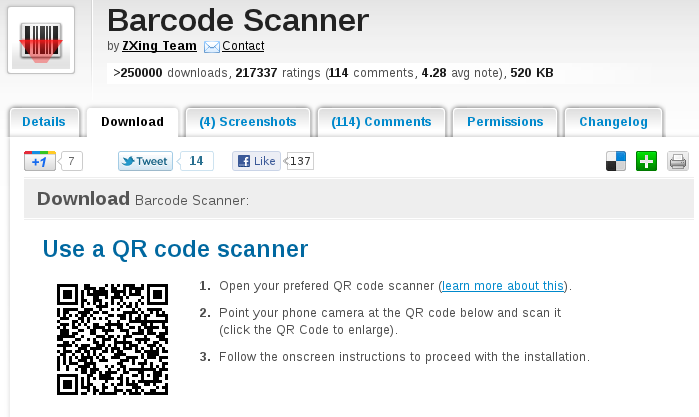
AndroidZoom, along with just about every other third-party interface to the Android Market out there, provides 2D barcodes which aim to make it easy to install Android applications that you find online on a phone. Maybe this would be a nice feature for F-Droid? Unfortunately, I found this feature when I was trying to help a friend install the (free software) ZXing Barcode Scanner because they wanted to read a 2D barcode.

29 November 2011

Lars Wirzenius: Obnam backup speed to local disk

I ran a backup of my backup home directory, to a USB drive with full-disk encryption. Here's the result:
04h00m13s 172739 files; 211.24 GiB up (15.01 MiB/s) /home/liw                  
Not a speed daemon, but adequate. Backing up over the network, or using encryption in Obnam (rather than the device mapper) makes things slower, but I'll optimze those next. The slowness is because Obnam is currently entirely sequential, so anything that adds a frequent delay (e.g., network round trip times, or running gpg) has a pretty big impact on the overall speed. But that's fixable.

28 November 2011

Craig Sanders: one of the reasons i like zfs

I got home from work tonight and zfs had reported that one of the disks in my main pool was dying. no great problem. insert a disk i had spare, and run zpool replace like so:
ganesh:~# zpool replace -f export  scsi-SATA_WDC_WD10EARS-00_WD-WMAV50933036 scsi-SATA_ST31000528AS_9VP16X03
and now it s just a matter of waiting until the data has resilvered and i can remove the old dying drive.
ganesh:~# zpool status export -v
  pool: export
 state: ONLINE
status: One or more devices is currently being resilvered.  The pool will
        continue to function, possibly in a degraded state.
action: Wait for the resilver to complete.
 scan: resilver in progress since Mon Nov 28 19:25:49 2011
    75.1G scanned out of 2.29T at 88.3M/s, 7h17m to go
    18.0G resilvered, 3.21% done
config:
        NAME                                                   STATE     READ WRITE CKSUM
        export                                                 ONLINE       0     0     0
          raidz1-0                                             ONLINE       0     0     0
            scsi-SATA_WDC_WD10EACS-00_WD-WCASJ2114122          ONLINE       0     0     0
            scsi-SATA_WDC_WD10EACS-00_WD-WCASJ2195141          ONLINE       0     0     0
            scsi-SATA_WDC_WD10EARS-00_WD-WMAV50817803          ONLINE       0     0     0
            replacing-3                                        ONLINE       0     0     0
              scsi-SATA_WDC_WD10EARS-00_WD-WMAV50933036        ONLINE       0     0     0
              scsi-SATA_ST31000528AS_9VP16X03                  ONLINE       0     0     0  (resilvering)
        logs
          scsi-SATA_Patriot_Torqx_278BF0715010800025492-part6  ONLINE       0     0     0
        cache
          scsi-SATA_Patriot_Torqx_278BF0715010800025492-part7  ONLINE       0     0     0
errors: No known data errors
(I use /dev/disk/by-id device names so I don t have to care about the kernel detecting the disks and disk controllers in a different order on each reboot also makes it easier to identify which disk is having a problem as I can squint at the front of the drives in my Lian Li 4-in-3 hotswap bays and read the serial number sticker) OK, yeah, sure it s not that much different from replacing a dying drive in an mdadm or hardware raid array but one nice advantage of zfs over raid is that it only resyncs the data in use, not the empty or unused blocks. given that these are 1TB drives in a raidz vdev, and the pool is 63% used that means syncing only about 630GB rather than 1TB. ps: in the time it s taken to write this, it s up to 10.11% done. 88MB/s reading data from the existing raidz drives and writing to a single drive isn t too bad at all. one of the reasons i like zfs is a post from: Errata

Asheesh Laroia: The OOT Killer

Commitments require care, and recently I have been suffering from the delusion that making more commitments will make me more able to achieve them. When overcommit reaches a certain point, the OOT (out of time) killer comes and reaps time from whatever it finds, often with disappointing consequences. (See also: OOM Killer.)

Dirk Eddelbuettel: A Story of Life and Death. On CRAN. With Packages.

The Comprehensive R Archive Network, or CRAN for short, has been a major driver in the success and rapid proliferation of the R statistical language and environment. CRAN currently hosts around 3400 packages, and is growing at a rapid rate. Not too long ago, John Fox gave a keynote lecture at the annual R conference and provided a lot of quantitative insight into R and CRAN---including an estimate of an incredible growth rate of 40% as a near-perfect straight line on a log-log chart! So CRAN does in fact grow exponentially. (His talk morphed into this paper in the R Journal, see figure 3 for this chart.) The success of CRAN is due to a lot of hard work by the CRAN maintainers, lead for many years and still today by Kurt Hornik whose dedication is unparalleled. Even at the current growth rate of several packages a day, all submissions are still rigorously quality-controlled using strong testing features available in the R system. And for all its successes, and without trying to sound ungrateful, there have always been some things missing at CRAN. It has always been difficult to keep a handle on the rapidly growing archive. Task Views for particular fields, edited by volunteers with specific domain knowledge (including yours truly) help somewhat, but still cannot keep up with the flow. What is missing are regular updates on packages. What is also missing is a better review and voting system (and while Hadley Wickham mentored a Google Summer of Code student to write CRANtastic, it seems fair to say that this subproject didn't exactly take off either). Following useR! 2007 in Ames, I decided to do something and noodled over a first design on the drive back to Chicago. A weekend of hacking lead to CRANberries. CRANberries uses existing R functions to learn which packages are available right now, and compares that to data stored in a local SQLite database. This is enough to learn two things: First, which new packages were added since the last run. That is very useful information, and it feeds a website with blog subscriptions (for the technically minded: an RSS feed, at this URL). Second, it can also compare current versions numbers with the most recent stored version number, and thereby learns about updated packages. This too is useful, and also feeds a website and RSS stream (at this URL; there is also a combined one for new and updated packages.) CRANberries writes out little summaries for both new packages (essentially copying what the DESCRIPTION file contains), and a quick diffstat summary for updated packages. A static blog compiler munges this into static html pages which I serve from here, and creates the RSS feed data at the same time. All this has been operating since 2007. Google Reader tells me the the RSS feed averages around 137 posts per week, and has about 160 subscribers. It does feed to Planet R which itself redistributes so it is hard to estimate the absolute number of readers. My weblogs also indicate a steady number of visits to the html versions. The most recent innovation was to add tweeting earlier in 2011 under the @CRANberriesFeed Twitter handle. After all, the best way to address information overload and too many posts in our RSS readers surely is to ... just generate more information and add some Twitter noise. So CRANberries now tweets a message for each new package, and a summary message for each set of new packages (or several if the total length exceeds the 140 character limit). As of today, we have sent 1723 tweets to what are currently 171 subscribers. Tweets for updated packages were added a few months later. Which leads us to today's innovation. One feature which has truly been missing from CRAN was updates about withdrawn packages. Packages can be withdrawn for a number of reasons. Back in the day, CRAN carried so-called bundles carrying packages inside. Examples were VR and gregmisc. Both had long been split into their component packages, making VR and gregmisc part of the set of packages no longer on the top page of CRAN, but only its archive section. Other examples are packages such as Design, which its author Frank Harrell renamed to rms to match to title of the book covering its methodology. And then there are of course package for which the maintainer disappeared, or lost interest, or was unable to keep up with quality requirements imposed by CRAN. All these packages are of course still in the Archive section of CRAN. But how many packages did disappear? Well, compared to the information accumulated by CRANberries over the years, as of today a staggering 282 packages have been withdrawn for various reasons. And at least I would like to know more regularly when this happens, if only so I have a chance to see if the retired package is one the 120+ packages I still look after for Debian (as happened recently with two Rmetrics packages). So starting with the next scheduled run, CRANberries will also report removed packages, in its own subtree of the website and its own RSS feed (which should appear at this URL). I made the required code changes (all of about two dozen lines), and did some light testing. To not overwhelm us all with line noise while we catch up to the current steady state of packages, I have (temporarily) lowered the frequency with which CRANberries is called by cron. I also put a cap on the number of removed packages that are reported in each run. As always with new code, there may be a bug or two but I will try to catch up in due course. I hope this is of interest and use to others. If so, please use the RSS feeds in your RSS readers, and subscribe to the @CRANberriesFeed, And keep using CRAN, and let's all say thanks to Kurt, Stefan, Uwe, and everybody who is working on CRAN (or has been in the past).

Benjamin Mako Hill: Voice Message of Peace

The Community Wellness team at MIT has a program on stress reduction, mindfulness, and relaxation. Among their services is a guided three-minute relaxation exercise recording (available at extension 3-2256 or 617-253-CALM). It's a very relaxing message. At the end of the recording, there's a revealing error where a standard voicemail robo-voice say "no messages are waiting" before you system hangs up on you. Turns out, the MIT wellness folks implemented this using the normal MIT voicemail system. This gave me a thought: What if my voicemail greeting included a guided relaxation message as part of its greeting so that anyone who left a message had the chance to relax a little bit first? Would messages left for me be more positive after a window of serenity? Would people ask less of me? Would my callers feel more relaxed and happier during the rest of their day? I just recorded a short version of the MIT message as my voicemail greeting. I suppose I will find out.

27 November 2011

Gregor Herrmann: RC bugs 2011/47

after the rather intensive last week, this week was more business as usual. here's the list:

Lars Wirzenius: Moving from SD to Ikiwiki for bug tracking

I've moved from using SD for bug tracking to using Ikiwiki. SD is a distributed bug tracker, and I quite like it. However, it seems to be hard to get anyone else to use it. Ikiwiki is a wiki engine, and makes it easier for others to deal with it, since they can just use a web browser. Since I don't really use any metadata for bugs, apart from open/closed, Ikiwiki is a simple solution that suits my needs. It's probably not suitable for a large project with lots of open bugs. I've only just switched, we'll see how this goes. I really hope distributed bug tracking takes off in a big way, however, since it's oh so nice to be able to take full advantage of one's bug tracker even when offline.

Carl Chenet: Brebis: fully automated backup checker

You make backups? That s great! But are they usable? The very day you will need your backup to restore your infrastructure, are you sure this backup you make three months ago contains the only file you need to restart your production environment? Are you sure this backup is not corrupted? Are you sure you do not store irrelevant or empty files instead of the ones you will need one day? Brebis is a fully automated backup checker. Brebis is written in Python 3 (>=3.2) and comes under the GPLv3 license. The current version is 0.4 (direct download). Some features (extensive list of features available here):
Official website: http://www.brebisproject.org
Mailing-list: http://lists.sourceforge.net/lists/listinfo/brebis-users
Brebis on Identi.ca: http://identi.ca/brebisproject and http://identi.ca/group/brebisproject

Craig Sanders: some more reasons to hate gnome shell

  1. Non-resizable configuration windows. I have a 1920 1200 screen but the window manager provides no way to resize windows like the System Settings window. Result is that the window is quite small and, worse, has a scroll bar for no good reason when another hundred or so vertical pixels would easily display everything. Even another 30 or so horizontal pixels would allow more icons per line under Hardware, reducing the number of lines, and again allowing the entire list of available settings to be displayed without a scroll bar. Instead, to see all of the options I have to scroll down. And these people call themselves user-interface and usability experts. It's not up to the gnome developers to decide that I never need to resize certain windows or certain kinds of windows. It's up to me to decide that. They're not at my desktop, using my screen. I am.
  2. No way to disable a shell extenstion from the command line. I installed the gnome-shell-extensions package and was trying out various extensions to see if they made gnome shell tolerable. Enabling one of them (i forget exactly which one), immediately displayed some "Oh no! Something has gone wrong. A problem has occured and the system can't recover. Please log out and try again." leaving me no option but to log out. An absolutely fucking useless error message. "Something" has gone wrong. A little fucking detail might help me to diagnose the problem and fix it. Like a trace of whatever the fuck it was doing when "Something went wrong". When i logged back in, it crashed again, with the same useless error screen. So, now I can't even log in to Gnome Shell. I've tried logging in to Fallback mode, but the Extensions tab is empty in gnome-tweak-tool (because, of course, nobody would want to configure Shell Extensions from fallback mode, would they?). I can't even find any way of listing which shell extensions are enabled, let alone disable one of them. Hell, I'd settle for disabling all of them, and then carefully re-enabling them one-by-one until I rediscovered the culprit.
  3. Oh, wait. I finally found /org/gnome/shell/enabled-extensions in dconf-editor. it's a text field with an array of items. so far, so good. The "editor" (and i use that term very loosely) for text fields is garbage. It can't even wrap lines so that it displays the whole field without a horizontal scroll bar probably my all-time least favourite user-interface element. Have gnome devs never heard of multi-line text-edit fields? Rather than fuck around with a crappy GUI editor, it's far easier to:
    $ dconf read /org/gnome/shell/enabled-extensions > /tmp/extensions
    $ vi /tmp/extensions
    $ dconf write /org/gnome/shell/enabled-extensions "$(cat /tmp/extensions)"
    
    I guess now it's time to log out from fallback mode to find out if I can log back in to Gnome Shell again. [ nope. didn't work ]
  4. Add non-resizable user-interface elements to item 1. above. So far, Gnome devs are doing a great job of regressing to the crap usability of the Windows GUI here s a useful rule of thumb for things like that: Every single window, every single user-interface element should be resizable and tweakable by the user. And the system should remember all user changes so that they don t have to waste a few minutes every time they run an app resizing things to suit their requirements. Gnome 2 mostly had that. Gnome 3 seems to have lost a large part of it along the way Second rule of thumb: If the user happens to replace their monitor or run it in a mode too small for the current settings, then they should revert to some sane default. Even better, it should remember the settings for each resolution choosing either sane defaults or the user s settings for the nearest similar resolution if the user hasn t created custom settings for that resolution yet.
  5. Lack of documentation. here's a good example:
    $ gnome-shell-extension-tool help
    Usage: gnome-shell-extension-tool [options]
    $ man gnome-shell-extension-tool
    No manual entry for gnome-shell-extension-tool
    See 'man 7 undocumented' for help when manual pages are not available.
    What more needs to be said? At least /usr/bin/dconf has built-in help. Which is great, since it doesn't have a man page either.
Update: About three hours of stuffing around later, and I ve finally got Gnome Shell running again. I have NFI what actually fixed it, it could have any one of the dozens of settings I fucked around with. Nor do i have any idea what the actual problem was. And after all that, the extensions I tried still don t make Gnome Shell tolerable. They make it less *intolerable* (bottom-panel extension in particular), but that s still a long way from being tolerable i m really trying hard to find some way to come to terms with Gnome 3. I ve been trying for months now. But every time I give it another trial, I just end up hating it even more I m glad I have more than one desktop machine to use, so i can experiment with odious shit like Gnome Shell without fucking up my main working environment. So it s back to my main desktop machine and gnome2. Eventually I ll have to upgrade that, but xfce4 is looking to be my best option. I already switched to xfce4 on my desktop machine at work last week, and it s pretty good certainly far better than the Gnome 3 fallback mode i ve been using there for the last 5 or 6 months. Thanks, Gnome devs you re making a fantastic advertisement for XFCE. I wouldn t have bothered trying it again if I hadn t been forced to. ps: before anyone says wait for Gnome 3.2, it s much better . Todays waste of time *was* using Gnome 3.2 some more reasons to hate gnome shell is a post from: Errata

26 November 2011

Lars Wirzenius: Luxury

Luxury is a roomy shower with plenty of hot water and a non-slippery floor. A gold-plated faucet really doesn't make it luxurious, just ugly.

Lars Wirzenius: Obnam 0.21 released (backup software)

I've today released version 0.21 of Obnam, my backup application. This is the first version that also got uploaded to Debian. It is currently waiting for manual processing in the NEW queue. From the NEWS file: USER VISIBLE CHANGES: BUG FIXES:

Lars Wirzenius: Obnam version 0.22 (backup application)

I have just released version 0.22 of Obnam, my backup application. Snippet from the NEWS file below. This version fixes a couple of bugs that could be said to be of the brown paper bag variety. USER VISIBLE CHANGES: BUG FIXES: CHANGES RELEVANT TO DEVELOPERS ONLY:

Lars Wirzenius: Obnam 0.23 released (backup software)

I've released version 0.23 of Obnam, my backup application. USER VISIBLE CHANGES: DEVELOPER CHANGES: INTERNAL CHANGES:

Christian Perrier: [life] [running] How do you feel after running 70km?

Happy. This is how I feel after I ran the "Le Puy-Firminy" night race last Sunday. 70 kilometers (mixed roads and trails), 1500 meters positive slope, close to my birth town, St-Etienne (the track on Garmin Connect unfortunately has bugs for the profile, sorry for this....this is apparently a bug in Garmin Connect as pyTrainer shows the track very well. And running this by night, starting at midnight and arriving at....09:16 the next day. A full night running. Such "ultra" experience is completely different from marathon running. In marathons, you mostly try keeping a constant pace all along the race, running very close to your limits all along the race. Very long distances involve managing much more than keeping a constant pace. Being able to run (and walk) for many hours requires being very careful at the start of the race, controlling the pace and save energy for the last part of the race. Climbing is most of the time done by walking (except for the very first runners) and going down for kilometers is very hard for legs, even at slow paces. Night running is also making things a lot different. Particularly in a quite small race like this one, it means running alone most of the time. And, by alone, I really mean alone. You and your head lamp, that's all. I am very happy about the way I managed this race. I reached the 32km mark, where an important food/drink point was organised, in a little bit more than 3 hours 15 minutes, where I stopped about 7-8 minutes. That was followed by about 5 kilometers downhill, at 6%, on a paved road, which is really killing legs. The marathon distance was reached in about 5h05, more or less what I planned, but that race is known to be harder in its second half. And completing a marathon, *then* knowing that you still have 2/3 of a marathon to run is kinda challenging..:-) Another important moment of the race was the 55 kilometer mark. This, because this was the longest distance I ever ran in a single race (in March, for the Paris Ecotrail race). Of course, the longer you run, the harder are legs and what was expected happened to me: I had cramps in both legs, at the worst moment, around km 64, when the track brutally goes down for 150 meters in a small canyon, then goes up for about 200 meters. Indeed, I completed kilometer 66 in....22 minutes (I see my marathon runners friends laughing here). This is indeed where you know if you're strong and motivated enough : not abandoning, continue despite cramps, waiting for them to disappear...and finally complete the race. It was really worth it anyway : running by night is really magic. I still remember the though moments at 5am, in the moonlight, alone on a road...and so happy to be there..:-) That race was the last one for me this year. I followed my plans (the only regret being not beating my record at Berlin marathon). Next year plans include two marathons: probably Caen ("Les Routes de la Libert " along the D-Day beaches in Normandy) in June and another one during Fall. I'll also push my limits a bit further with the 80km race of Ecotrail, arriving at Eiffel Tower first floor after running through forests in the SW area of Paris....and probably again that 70km race in November. Once you've tried ultra races, you don't want to stop..:-) Until the end of the year....recovery...and training. After all, Ecotrail is only in 4 months..:-)

Next.

Previous.