Search Results: "sto"

20 January 2011

Julien Danjou: Code fontification with Gnus and Org-mode

I've added code fontification using Org src blocks inside Gnus. This interprets the block as an Org buffer and fontify it accordingly if org-src-fontify-natively it set to t. Thanks to S bastien Vauban for the original idea and implementation. Now it works out of the box without any customization. Flattr this

19 January 2011

Eddy Petrișor: Picking up the pieces

Update: After trying KiBi's suggestion to take advantage of this information, I looked for more info on the issue and found this conversation. A git upgrade to the backported git 1:1.7.1-1.1~bpo50+1 version, and git svn rebase started pulling the right stuff in. Yes, I left the svn-remote.svn.rewriteRoot stuff set to the old value and the svn-remote.svn.url to the new value.

Keywords:

Unable to determine upstream SVN information from working tree history

when running git svn reabase


As I said yesterday, I am going to come back to being active in Debian.

I remember looking a little at my page on the Debian Wiki and it was clear that it was stale. (I sometimes find it amusing how I presented myself my name is Eddy Petrisor .) For some reason now the wiki seems to be down.

Two days ago I tried to get the Wormux/Warmux upstream source but git svn appears not to like the rename although I even modified the .git/config and .git/svn/.metadata, but it still wasn't satisfied and answered in a bad mood with this message (after a long waiting period):

$ git svn rebase
Unable to determine upstream SVN information from working tree history


And, yes, I am aware of the compromise and I changed my password for the project on gna.org.

I guess is better if I try to take a look at the RC bugs for the moment.

Gunnar Wolf: Mandate for what?

I lived in Israel between 1994 and 1996 This was just after the signature of the Oslo agreements, the Rabin-Arafat signature. 1994-95 was a beautiful time to be in Israel; there was the excitement of a prospect of real peace with the Palestinians, something that had been just seen as unattainable for the past 50 years. But we also saw the buildup of a huge tension, of real hatred. And the dream of the end of the conflict, of two people living in peace side by side was heavily shattered on November 4 1995, when prime minister Rabin was assassinated. But for the sake of where I'm trying to get to (this post is meant to be about current Mexico, not of Israel 15 years ago), lets go a couple of months back. The Israeli society is a deeply democratic one (although I understand many people feel it is losing that trait). Lots of political propaganda of all sorts, many of it very creative, are posted on the streets And not by the government or by political parties, but by citizen movements. I tried to follow it... I remember a particular sticker that I started seeing very often: Rabin has no mandate over the Golan . At first, I understod that the Golan residents rejected Rabin's authority (but, why was it posted all over the country? And what specifically was it about?), until a friend explained to me that it meant that it rather meant that the right wing all over the country felt that Rabin had no right to push for negotiations involving in any way the Golan heights return to Syria because that was not his electoral platform. So, fast-forward in time, and 12500Km to the west. If you have followed my ramblings for the past ~five years, you are aware of what I think about Mexico's government It is an illegitimate government, which got the power thanks to a dirty and illegal (as per Mexico's legal system) campaign and to voting fraud. And, according to what I have read, around 30% of the population still believe firmly the elections were stolen. But even if they were legal, valid and legitimate What has happened since 2006 should not be seen as valid. In Mexico, we don't have such a democratic culture. The society is not used to demanding anything from the politicians. We often see, as an example, that when talking about political organs, there is a divide everybody understands although makes no sense: We talk about citizens as people unaffiliated to political parties (v.gr. the 1996 Federal Electoral Institute was very well regarded as it was "el IFE ciudadano", and has since then been overtaken by the parties). Why are the parties' members not seen as citizens? Well, maybe because of the same distortion field that makes us believe our de-facto president when he stated that, from the (then) over 28000 people killed in the war campaign against crime (he oficially declared he never used the term war... Of course, he was proved wrong), only ~10% were civilians. In my book, that would mean that ~25000 soldiers have been killed But no, he means mostly drug trafficants. So, as they are not innocent bystanders, they somehow stopped being civilians? But again, I'm straying off the topic. Let us assume for a minute that the 2006 elections were clean legal, and that the campaigns were not diffamatory, and all that. And tha we had a modern government, with the stated separation between the three powers and all that. By today, the Legislative power would have surely called for the government's disolution. Why? Again, we Mexicans are not used to what a democratic system means. We can see over and over examples of people who have been voted to power and forgot/betrayed everything they campaigned for. And we are used to that being... Normal. But, who did we vote for? Given the suposition of this last paragraphs (clean elections led to our current government), did the majority of the population vote for Felipe Calder n, the person? Or did it vote for Partido Acci n Nacional, the abstract entity organized as a party? No. The vote was (should have been) for the political campaign, for the things he promised he would work for, the priorities in the direction he would give the nation. Not too long ago, we took pride of living in a peaceful country. Yes, everybody feared the crime rate in the streets, everybody knew big cities such as the one I live in (and love living in) have deep problems. But the country had good relations and good respect from the international players, and it was mostly safe. And, I don't think any of the few readers that have read this far (regardless of where they live or how much they know me) has that opinion of Mexico anymore. What is now heard inside and outside is that we have a huge organized crime (mostly due to drug traffic), and that it's taking over the country. Why did this happen? The fact is, Calder n lacked legitimacy when he reached the presidency in December 2006. And although his campaign was centered on pushing work generation (his slogan was El presidente del empleo, The president of the jobs), lifting restrictions to entreprises, opening borders, getting more money in our economy... He knew he had to please the people that would protect him from any (then, probable) insurrection: Military and police. Our army has always been more a joke than an army... But they still have their guns. So, contrary to everything he promised, the first things he signed was a salary increase to all order-keeping forces in the country, and an all-out attack against drug traffic cartels. He had to make the order-keeping forces protagonist, useful and loyal. Now, fast-forward again to 2011. The country is living the worst violence since the end of the 1910-1920 revolution. Over 30,000 people have been killed. Economy has fallen as it had not for many years (this was the worst-performing country in America in 2009). Work generation was said to be high, but then corrected to indicate it was mediocre (just about the baseline of population growth). So, the balance so far of four years of... Government? Economic disaster. Social disaster. Promises unachieved. Starting actions he had no mandate to do. Felipe Calder n has no mandate to get us in this war. Even if he had been democratically elected, he would have to step down.

Raphaël Hertzog: What I publish on Planet Debian and Planet Ubuntu

Up to now, Planet Debian and Planet Ubuntu were syndicating the main feed of my blog. I changed this recently (remember, I explained how I created my custom WordPress feed). Read on to learn why and subscribe to the main feed now if you want to get all my Debian/Ubuntu articles in the future. Planet Debian/Ubuntu are supposed to be windows into the lives of the contributors. Whatever they are doing. Obviously you get a lot of infos about Debian and Ubuntu since most contributors spend a lot of time working on those distributions. Due to this, those planets have also become dedicated medias to exchange between contributors. The problem I had is that my blog is more than just a place where I speak of what I do within Debian. As part of my evil plan, I set out my blog to become a great documentation resource for Debian/Ubuntu users. So when I wrote articles for users and/or beginners (like 5 reasons why a Debian package is more than a simple file archive or How to rebuild Debian packages), I got some remarks that it was odd to have those articles on Planet Debian because most contributors knew those things already. The bottom line is that from now on I ll decide on a case by case whether the article is suitable for Planet Debian&Ubuntu based on my feelings (and the feedback I get by email). But if you enjoyed my articles for users, I invite you to directly subscribe to my blog to make sure you ll get them all in the future: By the way I would like to thank you all. This blog has been created last July and I m glad to have already more than 1400 regular followers (spread over RSS/email/Twitter/Identi.ca/Facebook, not counting the thousands that read me via Planet Debian/Ubuntu). I hope you ll enjoy 2011 with me, and continue sharing the articles you like.

6 comments Liked this article? Click here. My blog is Flattr-enabled.

Russell Coker: Free Amazon EC2 Servers

Amazon is providing free EC2 access for new customers (who have never been customers before) for one year [1]. It is 750 hours per month (enough to run non-stop for an entire month) of access to a Linux micro instance which has 613M of RAM and the ability to burst to two ECUs of compute power. The main EC2 web page [2] describes an ECU as the equivalent CPU capacity of a 1.0-1.2 GHz 2007 Opteron or 2007 Xeon processor and they also describe a single core of a modern CPU as having 3.5 ECUs. So a micro instance could burst to half the CPU power of a single core. The DomU that runs my blog (as well as some web sites for friends) has been averaging less than 1% use of a CPU core over the last few months, so the CPU capacity of a micro instance should be more than adequate for most things that run on the net.The free offering only provides 15G of free data transmission and 15G of free data reception per month. For my blog server that would be more than adequate as it has sent 24.5G and received 14G over the last 75 days.The Cost of Disk IOThe offer requires that you sign up with a credit card so if you use more than the free capacity then you have to start paying. It seems that the main issue in this regard is disk IO.The only storage that is available for a micro instance is the Elastic Block Store (EBS) [3]. The main way that EC2 operates is that when you create a new virtual machine it copies the data from an existing image so you can easily create dozens or hundreds of virtual machines with local disk performance and the data is removed when the instance is shut down. EBS is essentially SAN based storage, it s persistent and operates like a regular disk.The pricing for EBS is $0.10 per allocated GB per month plus $0.10 per million IOs. Unfortunately they don t define what an IO is apart from mentioning that you can use IOSTAT to measure them. According to iostat the server running my blog is doing 0.99 tps, so that means in a 30 day month I would expect 30*24*3600*0.99 = 2.56M transactions. Iostat also tells me that my blog server has read 62075330 blocks and written 91683344 blocks over the last 75 days 16 hours of uptime, that means it would do about (62075330+91683344)/75.66*30 = 61M block transfers in a 30 day month. So if I was to run my blog server on EC2 I could be spending either $0.15 or $6.00 per month on disk IO depending on how they count it (or maybe something in between, something larger than a 512 byte block but smaller than a transaction as reported by iostat could be used). Given that the last time I checked the prices one could rent a DomU for less than $6 per month [4] the difference in possible ways of measuring IOs is very significant!The MySQL server that is the backend to my blog (as well as a few other things) seems to be averaging about 3 writes per second (and no reads during operation because the databases are small). So it might be another 5 million IOs per month for the database.It s unfortunate that Amazon haven t clearly specified what they mean when measuring IO for billing purposes. Some aspects of measurement such as whether the bills for bandwidth include Ethernet headers can be ignored as a 26 byte Ethernet header won t make much difference to the bill when the average packet size is around 400 bytes or more (from ifconfig output it seems that my blog server sends packets of an average size of 459 bytes and receives packets of an average size of 1250 bytes). But the methods of measuring disk IO could give a factor of 20 difference in the bill.Optimising for EC2If I was going to put my blog on EC2 then I would start by configuring Apache to log to a fifo and then write a daemon that stores the log data and allows my home server to poll it and get the log data. As the filesystem is already mounted with noatime it seems that writing logs is the cause of all the disk writes so if they were stored in RAM (which shouldn t be a problem with 4M of logs per day) then all those writes could be avoided. Another possible solution to this would be to make /var/log be a tmpfs and then rsync the files periodically to my home server. I don t really need to have all the logs remain on the server I just need them to remain somewhere.Amazon also offers 100,000 messages on their Simple Queue Service (SQS) for free [5]. The messages can be up to 8K in size and are stored for up to 4 days. So it seems possible to put Apache logs into SQS messages in bundles of less than 8K and then get them out later for transfer to a server outside EC2.If I was able to get my disk writes to almost zero then there s a good chance that I could get into the free zone for one year.ConclusionWould I use this service? If I was looking for new hosting for my blog then I would seriously consider it. EC2 is quite fast and well connected and depending on how they work out the billing for disk IO I could probably keep the cost close to zero.EC2 is a different way of running things so you can t just have a virtual server running and expect it to automatically restart if it goes down for any reason (a standard feature of virtual hosting companies). Amazon does have a range of tools for managing EC2 instances and they all seem to be available in the free trial. So after spending the time to learn those tools the result should be good.I think that there are two groups of people who could benefit from using this. One is hobbyists, this is a great way to learn some skills related to high-end server stuff and EC2 experience should look good on a CV. The other is companies who want to use EC2 anyway and who will just save some money that they would otherwise pay. I ve seen someone recommend the free offering from EC2 for a company that needed a small server, I think that isn t a good option as a company that only wants a single small server will be better off paying something between $5 and $20 per month for a DomU from one of the virtual hosting providers.After a year you have to pay regular prices. A micro instance costs $0.02 per hour which is $14.40 per month, SQS costs $0.10 per month for sending up to 1G of data in and at $0.01 per 10,000 SQS requests would costs $0.03 (the 4M of log data I generate per day would be 1000 requests to write and read it which would be 30,000 requests per month), the EBS for MySQL would cost $0.10 for 1G of storage and maybe $0.50 for IOs. That means $15.13 before counting bandwidth.My blog server averages just under 10G of transmitted data per month, the first Gig is free so that would cost $0.15 for each subsequent Gig which is $1.35 per month. It receives just under 6G per month which at $0.10 per gig would be $0.60. So including data transfer it would be about $17.08 per month.This is a lot more expensive than some of the cheaper virtual server offerings but admittedly the cheaper virtual offerings don t have as much RAM. Also with a blog instance running on EC2 I could easily configure it so that I could create some big instances that use the same MySQL database if a lot of extra traffic suddenly started arriving. A micro instance running MySQL on it s own could cope with a heap of load a lot more easily than the PHP code for my blog. So using bigger servers to run the PHP code while running MySQL on the same server would be a good option particularly if the bigger servers use caching.Finally if you want to run an EC2 instance for a year then you can get a reserved instance, you pay $54 per annum and the cost drops to $0.007 per hour instead of $0.02 per hour. Using a reserved instance for my blog would give a cost of $54+365*24*0.007+12*(0.10+0.03+0.10+0.50) or about $124.08 per annum. $10 per month isn t too bad. So if I migrated my blog to EC2 then I would probably keep it there after the free period expired. The ability to expand rapidly when necessary is worth paying extra. Of course I am making some assumptions such as that the performance of a micro instance doesn t totally suck as Amazon don t specify what bursting to 2ECU really means it could have some performance problems.Note that all prices in this post are in US Dollars.

Benjamin Mako Hill: An Only Slightly Fictionalized Story

Before heading back to graduate school, my brother worked full-time as a personal fitness and strength trainer. Like many trainers, he started out in an established gym and then struck out on his own once he had established an clientele base. Working on his own, he got almost all of his new business from referrals. Although one might think that a trainer's trusted long-term clients would be the source of most new business, it was mostly the newer, less established clients who referred new trainees. The established clients had already referred everyone in their social network that might be interested. That's how I learned about the weak ties of strength.

Dirk Eddelbuettel: RcppBDT 0.1.0

The family of Rcpp packages just grew by one: the first 0.1.0 release of RcppBDT is now on CRAN. RcppBDT stands for Rcpp Boost Date_Time. It employs what we call Rcpp modules: a mechanism which provides easier ways to expose C++ functions and classes to R (and which bears some resemblance to Boost.Python---see this vignette about Rcpp modules for more details). And thus RcppBDT provides R users with access to (some) Boost Date.Time functionality. I used Boost Date.Time because it is widely known, useful and well tested. It can also be used in pure template mode not requiring linking (if one foregoes string parsing and formatting which is fine here as we get this from R already; it can be added via a #define in the header file). With that, the package is rather portable as it only needs to find the Boost headers. (And no, I have not yet added a configure option for that.) Basic usage follows Rcpp modules and provides the C++ class via a Reference Class in R. That means using a new constructor and assessing functions via the $ operator. Here is an example:
R> library(RcppBDT)
Creating a new generic function for "print" in "RcppBDT"
Creating a new generic function for "format" in "RcppBDT"
R> d <- new(bdtMod$date, 2011, 1, 18)
R> format(d)
[1] "2011-01-18"
R>
Not very exiting yet: we create a date, using explicit year, months and date arguments and then format it. Something more useful follows:
R> d$getDayOfWeek()
[1] 2
R> d$getModJulian()
[1] 55579
R> d$getFirstOfNextMonth()
[1] "2011-02-01"
R>
We can use accessors to extracts parts of the date, or use functions to convert the date to different representations such as a modified Julian date. Moreover, given a date, we can apply helper functions such as get me the date of the beginning of the next month. More interesting still are helper functions such as the ones below. Note that this also shows the alternate access method using wrapper functions I added for the package, this may be more familiar to most R users:
R> getNthDayOfWeek(third, Wed, Dec, 2010)
[1] "2010-12-15"
R> getLastDayOfWeekInMonth(Sat, Dec, 2010)
[1] "2010-12-25"
R> getFirstDayOfWeekInMonth(Sat, Dec, 2010)
[1] "2010-12-04"
R> getFirstDayOfWeekAfter(Wed, as.Date("2010-12-31"))
[1] "2011-01-05"
R>
This uses some of the constants Jan, Feb, ... , Dec; Sun, Mon, ..., Sat and first ... fifth defined in the package; normal integers can also be used. The third Wednesday in a month is also known as the IMM Date to Finance-heads; the example was borrowed from Whit's earlier rboostdatetime code on github. More examples are in the demo available with the package and accessible via demo(RcppBDT) once you install the package. As always, feedback would be welcome, both on the usefulness (or lack thereof) of the Boost Date.Time functionality as well as on the Rcpp modules wrapping. Additional Boost Date.Time functionality (durations, times, ...) may be added; contributions would be welcome. The rcpp-devel mailing list off the R-Forge page for Rcpp is the best place to start a discussion.

18 January 2011

John Goerzen: Backing Up to the Cloud

I m recently taking some big-picture looks at how we do things, and one thing that I think could be useful would be for us to back up a limited set of data to an offsite location states away. Prices are cheap enough for this to make it useful. Services such as Amazon S3 and Rackspace Cloud Files (I ve heard particularly good things about that one) seem to be perfect for this. I m not quite finding software that does what I want, though. Here are my general criteria:
  1. Storage fees of $0.15 per gigabyte-month or less
  2. Free or cheap ($0.20 per gigabyte or less) bandwidth fees
  3. rsync-like protocol to avoid having to re-send those 20GB files that have 20MB of changes in their entirety every night
  4. Open Source and cross-platform (Linux, Windows, Mac, Solaris ideally; Linux and Windows at a minimum)
  5. Compression and encryption
  6. Easy way to restore the entire backup set or individual files
  7. Versatile include/exclude rules
  8. Must be runnable from scripts, cron, etc. without a GUI
  9. Nice to have: block or file-level de-duplication
  10. Nice to have: support for accurately backing up POSIX (user, group, permission bits, symlink, hard links, sparse files) and Windows filesystem attributes
  11. Nice to have: a point-and-click interface for the non-Unix folks to use to restore Windows files and routine restore requests
So far, here s what I ve found. I should note that not a single one of these solutions appears to handle hard links or sparse files correctly, meaning I can t rely on them for complete system-level backups. That doesn t mean they re useless I could still use them to back up critical user data just less useful. Of the Free Software solutions, Duplicity is a leading contender. It has built-in support for Amazon S3 and Rackspace Cloud Files storage. It uses rdiff, which is a standalone implementation of the rsync binary delta algorithm. So you send up a full backup, then binary deltas from that for incrementals. That makes it bandwidth-efficient for incremental backups, and storage-efficient. However, periodic full backups will have to be run, which will make it less bandwidth-efficient. (Perhaps not incredibly *often*, but they will still be needed.) Duplicity doesn t offer block-level de-deuplication or a GUI for the point-and-click folks. But it DOES offer the most Unixy approach and feels like a decent match for the task overall. The other service relying on Free Software is rsync.net, which supports rsync, sftp, scp, etc. protocols directly. That would be great, as it could preserve hard links and be compatible with any number of rsync-based backup systems. The downside is that it s expensive really expensive. Their cheapest rate is $0.32 per GB-month and that s only realized if you store more than 2TB with them. The base rate is $0.80 per GB-month. They promise premium support and such, but I just don t think I can justify that for what is, essentially, secondary backup. On the non-Open Source side, there s JungleDisk, which has a Server Edition that looks like a good fit. The files are stored on either S3 or Rackspace, and it seems to be a very slick and full-featured solution. The client, however, is proprietary though it does seem to offer a non-GUI command-line interface. They claim to offer block-level de-duplication which could be very nice. The other nice thing is that the server management is centralized, which presumably lets you easily automate things like not running more than one backup at a time in order to not monopolize an Internet link. This can, of course, be managed with something like duplicity with appropriate ssh jobs kicked off from appropriate places, but it would be easier if the agent just handled it automatically. What are people s thoughts about this sort of thing?

17 January 2011

Joey Hess: the conversion

It's summer in Spain, and outside there's a dry heat, but in the hack lab, it's frigid. I'm sitting across the table from Otavio, and each of our laptops is showing the same identical screen of text, editing the same file. Slowly. The file is located in Colorado, and we're fighting serious conference lag, plus transatlantic lag. Type a few lines, wait a minute, hope it shows up, and restart the converter to see if it worked. We're struggling with figuring out how to make it work, and pair programming across the table like this helps -- although we also struggle with each others accents sometimes, so we're eventually mostly communicating via text on the computers. Eventually Otavio rolls off to bed. Later, everyone else in the conference goes to bed or whatever -- I don't really notice. At some point a cleaning woman comes in, and seems suprised to see me. I muster up enough Spanish to ask if this muy fio air conditioning can be turned off. A bit later, I make this commit and then go out, look at storks in early morning light, and go to bed.
r59731   joeyh   2009-07-24 12:30:52 -0400 (Fri, 24 Jul 2009)   1 line
up to r15000; also skip the packages/po accient revs
That would have been 6 am local time. The log shows us back at it by 11 am local. There's so much detail in these logs, and it's hard to tell how any individual bit will turn out useful, but the value in aggregate is undeniable and that's why we struggle to retain it as technology marches on.
A few days later and the conversion is caught up to the commits documenting it. Everyone goes home. Later still, and work is done to verify the conversion. Problems are found, fixed. The worst of them involves the Danish language, and absolute evil. Tempers flare, and I have the last argument I'll ever have the pleasure of having with Frans. At some point in there, I do rather more coding in C++ than I ever have before, or ever wanted to. Frans's objections are addressed by that, more or less. We're using a weird tool that was developed as a kind of one-off for another project, but happens to meet our needs pretty well -- but we're stuck dealing with its bugs. And its need for copious handholding and historical research. The file we started out editing grows to two thousand lines, and now covers ten years of odd bits of history.
Suddenly it's a year and a half later. I'm in a cabin in winter, Otavio is down in summer, and I'm once again dealing with lag (dialup lag this time). We run the converter again -- one last time. And a time more.. and four or five more "last times". Finally, after a longish day, it's done.
This was not a major project, just some little bits of time here and there, maybe a week's worth in total, spread out over a few years and four or five people. It hardly seems worth writing about, just another codebase converted from Subversion to Git, a bit behind most of the other ones. Just thought I'd give you a glimpse behind the curtain.

David Welton: The Kindle and Book Sharing

I'm very pleased with the Kindle; all of a sudden, I can quickly, easily, and fairly cheaply buy lots of English language books that otherwise I would have had to order (not cheap, not quick). Furthermore, they're not cluttering up my house, either! Not that I view books as clutter, but sooner or later we're going to have to move out of the apartment we're in, and the less I have to haul around, the better. However, the fact that it's not easy to share the books with my wife is starting to annoy me. I could always give her the Kindle itself to read something, but that would deprive me of not only that book, but all the others I have as well. Indeed, the difficulty of the problem lies in the difference between digital goods and physical goods. Real books are: Ebooks are: Setting aside the costs and benefits to society of DRM, intellectual property, and so on, let's take the point of view of Amazon, book publishers and authors, who all want to maximize their income, and of readers, who want as much freedom as possible, and also, for the sake of argument, believe that paying for books leads to more money for authors, which leads to more books. I think the trick is to try and make the ebook market as similar as possible to that for real books. For instance, if you had the freedom to resell an ebook quickly and easily, the price would likely start dropping quickly, as people started selling their "used" copies of books they didn't want to keep. This would be good for the consumer, but potentially quite bad for authors, as fewer new copies would be sold. Sure, we have used book stores, but the practical limitations involved, and the fact that real books show some wear and tear, mean that there's still an incentive to buy new books. On the other hand, an ebook ought to be a bit cheaper than a real book if it's something you'd consider reading and then selling, because you no longer have that option, so the lack of freedom should be priced in to the original price. The other problem they seem to be having is with the lending of books. If you lend a real book, you can only lend it to someone who you see with some frequency, so there's already a big geographical limitation. Also, while they're reading it, you obviously can't. You have to have some trust in them, that they'll give it back to you sooner or later, so you won't just loan it to anyone: if you wanted a transaction with more finality, you'd simply sell it. Currently, Kindle books can only be lent for two weeks, and you can't access it while the other person has it. I think the latter part of that is fair, but two weeks seems like an arbitrary number. Remember though, that they don't want you to be able to just give someone a book, with no strings attached and no return-by date, because then you could also sell it, undercutting their store prices, and so on, as above. So to make lending work, they have to have some "strings attached". I think "two weeks" is a fairly arbitrary string though. What would work better? Perhaps a way that permanently differentiates the original purchaser from anyone borrowing it. For instance, a "recall now" button? This button would, when the original purchaser pressed it, disable it on the borrower's device and reenable it on the buyer's device. This would prevent secondary markets, or at least limit them, because the 'borrowed' books would be inferior to the originals. And yet it might still work well for lending; I could lend books to people who trust me without problems. Interestingly, I became aware of this site the other day: http://www.kindlelendingclub.com/ so it looks like whatever Amazon does, there are going to be tradeoffs involved. And of course, there is the point of view that all of the costs involved by DRM are too high, but that's a fairly involved discussion in its own right. What do you think?

16 January 2011

Dirk Eddelbuettel: Plotting overbought / oversold regions in R

The good folks at Bespoke Investment Group frequently show charts of so-called overbought or oversold levels; see e.g. here for the most recent global markets snapshot. Classifying markets as overbought or oversold is a popular heuristic. It starts from computing a rolling smoothed estimate of the prices, usually via a (exponential or standard) moving average over a suitable number of days (where Bespoke uses 50 days, see here). This is typically coupled with a (simple) rolling standard deviation. Overbought and oversold regions are then constructed by taking the smoothed mean plus/minus one and two standard deviations. Doing this is in R is pretty easy thanks to the combination of R's rich base functions and its add-on packages from CRAN. Below is a simply function I wrote a couple of months ago---and I figured I might as well release. It relies on the powerful packages quantmod and TTR by my pals Jeff Ryan and Josh Ulrich, respectively.
## plotOBOS -- displaying overbough/oversold as eg in Bespoke's plots
##
## Copyright (C) 2010 - 2011  Dirk Eddelbuettel
##
## This is free software: you can redistribute it and/or modify it
## under the terms of the GNU General Public License as published by
## the Free Software Foundation, either version 2 of the License, or
## (at your option) any later version.
suppressMessages(library(quantmod))     # for getSymbols(), brings in xts too
suppressMessages(library(TTR))          # for various moving averages
plotOBOS <- function(symbol, n=50, type=c("sma", "ema", "zlema"), years=1, blue=TRUE)  
    today <- Sys.Date()
    X <- getSymbols(symbol, src="yahoo", from=format(today-365*years-2*n), auto.assign=FALSE)
    x <- X[,6]                          # use Adjusted
    type <- match.arg(type)
    xd <- switch(type,                  # compute xd as the central location via selected MA smoother
                 sma = SMA(x,n),
                 ema = EMA(x,n),
                 zlema = ZLEMA(x,n))
    xv <- runSD(x, n)                   # compute xv as the rolling volatility
    strt <- paste(format(today-365*years), "::", sep="")
    x  <- x[strt]                       # subset plotting range using xts' nice functionality
    xd <- xd[strt]
    xv <- xv[strt]
    xyd <- xy.coords(.index(xd),xd[,1]) # xy coordinates for direct plot commands
    xyv <- xy.coords(.index(xv),xv[,1])
    n <- length(xyd$x)
    xx <- xyd$x[c(1,1:n,n:1)]           # for polygon(): from first point to last and back
    if (blue)  
        blues5 <- c("#EFF3FF", "#BDD7E7", "#6BAED6", "#3182BD", "#08519C") # cf brewer.pal(5, "Blues")
        fairlylight <- rgb(189/255, 215/255, 231/255, alpha=0.625) # aka blues5[2]
        verylight <- rgb(239/255, 243/255, 255/255, alpha=0.625) # aka blues5[1]
        dark <- rgb(8/255, 81/255, 156/255, alpha=0.625) # aka blues5[5]
      else  
        fairlylight <- rgb(204/255, 204/255, 204/255, alpha=0.5)         # grays with alpha-blending at 50%
        verylight <- rgb(242/255, 242/255, 242/255, alpha=0.5)
        dark <- 'black'
     
    plot(x, ylim=range(range(xd+2*xv, xd-2*xv, na.rm=TRUE)), main=symbol, col=fairlylight) 		# basic xts plot
    polygon(x=xx, y=c(xyd$y[1]+xyv$y[1], xyd$y+2*xyv$y, rev(xyd$y+xyv$y)), border=NA, col=fairlylight) 	# upper
    polygon(x=xx, y=c(xyd$y[1]-1*xyv$y[1], xyd$y+1*xyv$y, rev(xyd$y-1*xyv$y)), border=NA, col=verylight)# center
    polygon(x=xx, y=c(xyd$y[1]-xyv$y[1], xyd$y-2*xyv$y, rev(xyd$y-xyv$y)), border=NA, col=fairlylight) 	# lower
    lines(xd, lwd=2, col=fairlylight)   # central smooted location
    lines(x, lwd=3, col=dark)           # actual price, thicker
    invisible(NULL)
 
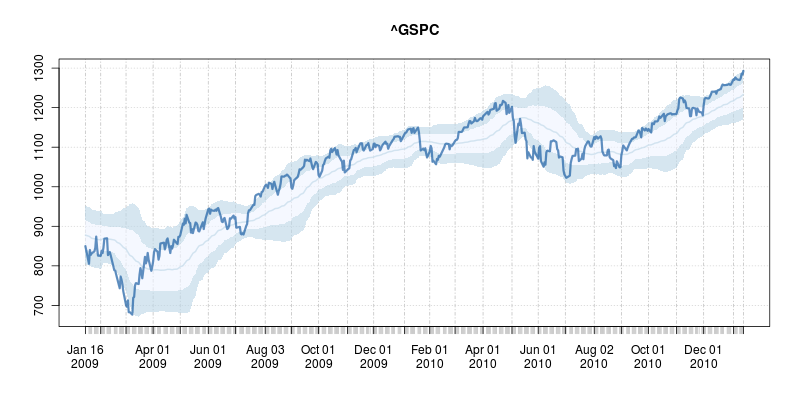
After downloading data and computing the rolling smoothed mean and standard deviation, it really is just a matter of plotting (appropriate) filled polygons. Here I used colors from the neat RColorBrewer package with some alpha blending. Colors can be turned off via an option to the function; ranges, data length and type of smoother can also be picked. To call this in R, simply source the file and the call, say, plotOBOS("^GSPC", years=2) which creates a two-year plot of the SP500 as shown here: Example chart of overbought/oversold levels from plotOBOS() function This shows the market did indeed bounce off the oversold lows nicely on a few occassions in 2009 and 2010 --- but also continued to slide after hitting the condition. Nothing is foolproof, and certainly nothing as simple as this is, so buyer beware. But it may prove useful in conjunction with other tools. The code for the script is here and of course available under GPL 2 or later. I'd be happy to help incorporate it into some other finance package. Lastly, if you read this post this far, also consider our R / Finance conference coming at the end of April.

Edit: Corrected several typos with thanks to Josh.

John Goerzen: 24 hours with Jacob

Friday, I wrote about the train trip Jacob and I were planning to take. Here s the story about it. Friday night, Jacob was super excited. He was running around the house, talking about trains. I had him pack his own backpack with toys this time, which were you guessed it trains. Plus train track. His usual bedtime is around 7. He was still awake in his room at about 11, too excited to sleep. The train was an hour late into Newton, so got up, got ready, and then went into Jacob s room at 3:15AM. I put my arm around him and said his name softly. No response. I said, just a little louder, Jacob, it s time to wake up to go to the train station. There was about a 2-second pause and then he sat bolt upright rubbing his eyes. A couple seconds later, in a very tired but clear voice, OK dad, let s go! That is, I believe, a record for waking up speed for Jacob. We went downstairs, got coats, mittens, hats, etc. on, made sure we had the stuffed butterfly he always sleeps with, and went out the door. As usual, Jacob chattered happily during the entire 15-minute drive to the Amtrak station. One of these days I need to remember to record it because it s unique. He described things to me ranging from the difference between freight and passenger trains, to what the dining car is all about, to tractors and how to ride them safely. Newton has some winter lights , and a few places still had Christmas lights, which were of course big hits. We had to wait a few minutes at the Amtrak station, and Jacob hadn t shown any signs of slowing down yet. He wanted to look at every Amtrak poster, picture, logo, or sign in the building. This generally meant me holding him up high while he leaned over to touch it and make out a few words. Then, of course, he would pick out minute details about the trains, such as how many coach cars he thought they had, and we d visit about that for awhile. We got on at about 4:20. We found our seats, and Jacob showed no signs of calming down, despite having had only 4 hours of sleep (instead of his usual 11) so far. We checked out the buttons for lights. And, of course, he excitedly yelled out, Dad, the train is moving! He spent the next while mostly watching out his window, but also still exploring his space. Finally at about 5, I said, Jacob, I am really tired. I am going to sleep now. Will you sleep too? His response: Oh sure dad, I will sleep with my eyes open! As a result, no sleep was had for Jacob, and only a little for me. The dining car opens for breakfast at 6:30, which is normally a rather foreign time for breakfast on the train for us. But we were both awake so I figured might as well go. So Jacob and I went to the dining car. We sat with a woman going from New Mexico to Lawrence for her grandpa s funeral, though it was expected and she was having a good time on the train. Jacob turned completely shy, and refused to say a word, except maybe a few whispered into my ear. He got his favorite railroad French toast, and had me drizzle some syrup on it. I used the word drizzle for syrup the first time he had French toast on the train, and if I fail to use that word in the dining car, I will hear about it in no uncertain terms from Jacob. He loved his dining car breakfast, but we spent about an hour and a half there. He was really slow at eating because his face was pressed up against the window so much. But that was just fine; we had nowhere else to be, the person eating breakfast with us enjoyed visiting (and, apparently, scaring the dining car staff with tales of bears in the New Mexico mountains). This was what the train trip was all about, after all. We played in the lounge car for awhile. The almost floor-to-ceiling wrap-around windows provided a great view for him, and more opportunities to press his face against a window. We talked about freight trains that he saw, noticed the snow on some of them. Then we found the back of the train and he got to look out the back window. Back at our seat, he played with his toys for about 10 minutes, which was all he used them on the entire trip. There was just too much else to enjoy. When we used the restroom on the train, he d comment on how much he liked the Amtrak soap. It smells SO very very good! He wanted to wash his hands on the train. By late morning, he had decided: Dad, I LOVE this Amtrak soap. It smells like peaches! Shall your hands smell like peaches too? And, when we d get back up to our seats, he d put his hands in my face, saying, Dad, smell that! My hands smell like peaches! It was from the AMTRAK SOAP! At some point, he discovered the airline-style safety brochures in the seat back pockets. These were filled with diagrams of the train car, a few photos, and lots of icons with descriptions. I don t know how many times I read the thing to him, or really how many times he then recited it to me from memory. It was a lot. He spent hours with those brochures. Jacob had already told me that he wanted pizza for lunch, so I got him the kid-sized pizza. It wasn t all that big, and he could have devoured at least half of it when hungry. But he was getting really tired and ate only a few bites of pizza and a few chips. Pretty soon he was leaning up against me, the window, and eventually had his head on the table in some tomato sauce. But he didn t quite fall asleep by the time we went back to our seats, and of course was wide awake by that point. Jacob loves spotting the word Amtrak on things. It was very exciting when he noticed his orange juice at breakfast, and milk at lunch, were Amtrak juice and Amtrak milk due to the logo on the cups. At dinner he noticed we had Amtrak plates, and when I pointed out that his metal fork had the Amtrak logo on it, he got very excited and had to check every piece of silverware within reach. Dad, I have an Amtrak fork too! . And dad, YOU also have an Amtrak fork! We ALL have Amtrak forks! *cackling laughter* I finally insisted that Jacob lay down for some quiet time. I closed the curtains, and he finally did fall asleep less than an hour before our arrival into Galesburg. So by 2:15 he was up to 4.75 hours of sleep, I guess. We stopped in the train station briefly, then started our walk to the Discovery Depot Children s Museum, which was right nearby. Although I made no comment about it, Jacob said, Dad, there is a train museum RIGHT HERE! Yes, you re right Jacob. I can see a steam engine and some cars here. Let s go in! I don t think it s open today. It IS open shall we go check? It wasn t, and that was mighty sad though when he spotted another old caboose sitting outside the children s museum, the day suddenly seemed brighter. He complained of how cold he was, although my suggestion that he stop walking through the big piles of snowdrifts was met with a whiny, But dad, I WANT to do that! We went inside the museum (having to walk right buy the locked caboose thankfully the people at the desk promised to unlock it for us when we were ready) and Jacob started to explore. There was some wooden play trains big enough for children to climb in which he enjoyed, but in general he went from one thing to the next every minute or two as he does when he s really tired or overstimulated. Until, that is, he discovered the giant toy train table. It had a multi-level wooden track setup, and many toy trains with magnetic hitches. It was like what we have at home, only much bigger and fancier. He spent a LONG time with that. We then briefly explored the rest of the museum and went out into the caboose. It wasn t the hit it might have been, possibly because there are several at the Great Plains Transportation Museum that he gets to go in on a somewhat regular basis. After that, he was ready to go back into the museum, but I was feeling rather over-stimulated. On a day when the highs were still well below freezing, it seemed just about every family in Galesburg was crowded into the children s museum, making it loud and crowded which I don t enjoy at all. So I suggested maybe it was snack time instead. A moment s thought, then he started to pull me out of the caboose before I could get my gloves back on Yes dad, I think it IS snack time. Let s go. Let s go NOW! We walked over to Uncle Billy s Bakery (Google link or minimal website). Jacob spotted some sugar cookies shaped like mittens. Despite my reluctance to get him more sugar, he was so excited plus I had barely prevented a meltdown at lunch by promising him that he would get dessert later in the day so he picked two red mitten cookies. I got myself a wonderful peach muffin and a croissant and we sat down at one of the tables by the window. I taught Jacob how to hang his coat on his chair and he lit into those cookies. I spotted a guy at the next table over wearing a BNSF jacket, and asked him if he worked for the railroad. He had retired as an engineer a couple of years ago, and had worked various jobs before that. He grew up in Manhattan, KS and so was interested in our trip and very friendly. While we visited, Jacob devoured his cookies and increasing portions of my snack as well. He told us about a new shop The Stray Cat just two stores down that was having a grand opening event today. They make decorations and art out of basically discarded items, and had some really nifty things that I may have bought had I not been wanting for space in our backpack. Then I spotted Sweets Old-Fashioned Ice Cream, Candy, and Soda Shop across the road. I figured he d love it and I was already in for the sugar so might as well. He picked out some birthday cake flavor ice cream for himself. I got huckleberry ice cream, which he insisted on calling purpleberry and managed to get some tastes of as well. After that, we went to the train station. It was about an hour until our train would be there. I wasn t sure if we d find enough to do, but I shouldn t have worried. Earlier, we had made the happy discovery that the station s restroom featured the Amtrak soap, so there was that. Then there was the model Amtrak train in the ticket window, which Jacob kept wanting to look at while I d hold him. And also, the California Zephyr came in. We watched it arrive from the station window, saw people get off and on, and saw it leave maybe the first time Jacob has witnessed all that in person. And, of course, we looked at the pictures in that train station. The ticketmaster gave Jacob a paper conductor s hat with puzzles and mazes on the back side. And then it was time to get onto our train back home. We ate dinner Jacob again ate little and almost fell asleep and got back to our seats. I let Jacob stay awake until about 8, when he was starting to get a bit fragile. It took him awhile to fall asleep, but he finally did at about 8:30. Today he s still been all excited. He will randomly tell us about bits of the trip, that the man at supper called his grilled cheese sandwich piece little when it was really big, what we did at the ice cream store, etc. And I do think that he is now a train safety expert. All in all, I think that is probably the most excitement he s ever had in 24 hours and it was a lot of fun to be with him for it!

Daniel Kahn Gillmor: resetting passphrases for mapped LUKS volumes

Let's say you set up a machine using an encrypted disk with LUKS (debian-installer's partman makes this wonderfully easy!). You choose an initial passphrase, get the machine working, and it's working great. Then, you need to restart it, and realize that (for whatever reason) you've forgotten or lost the passphrase for the volume. oops! (i'm sure this has never happened to you -- let's just pretend it's your less-fortunate friend). If your system is still running, and you have superuser access to it, you can actually set a new passphrase for the LUKS volume using information that the dm-crypt kernel module has about the in-use mapping. In my examples, i'll imagine that the source volume is /dev/XXX2 and the exported cleartext volume is known by the device-mapper as XXX2_crypt In the bigger picture, this should serve as a reminder that even though your disk is encrypted, if someone gets live access to the superuser account on a system with the encryption keys loaded, your data is no longer secret. Before you do any tweaking, you might want to back up your LUKS header, just in case:

0 root@example:~# umask 077
0 root@example:~# cryptsetup luksHeaderBackup /dev/XXX2 --header-backup-file XXX2.luksheader.backup
0 root@example:~# 
Maybe also copy that off the machine, since a copy of the LUKS header stored within its own volume isn't terribly useful for a backup-recovery situation. You might also be interested in looking at the contents of the LUKS header:
0 root@example:~# cryptsetup luksDump /dev/XXX2
LUKS header information for /dev/XXX2
Version:       	1
Cipher name:   	aes
Cipher mode:   	cbc-essiv:sha256
Hash spec:     	sha1
Payload offset:	2056
MK bits:       	256
MK digest:      93 51 6c 66 ec ce 32 54 6f 6b 52 d1 27 9b 5a 62 6f 6b 52 d1
MK salt:       	b2 ca 20 49 9f 78 49 c2 fe 15 b4 0f 74 11 23 49
               	64 9e 61 bb f2 82 60 47 a5 76 fa a4 24 0e 5a 7e
MK iterations: 	10
UUID:          	052f1da0-21a1-11e0-ac64-0800200c9a66
Key Slot 0: ENABLED
	Iterations:         	218733
	Salt:               	f2 ae 8c 53 48 a5 f0 bf e1 2c 06 5f 5a bd ff d9
	                      	9a 2e d1 49 3a 63 f8 49 82 ed ae 86 7b 7b 7e 76 
	Key material offset:	8
	AF stripes:            	4000
Key Slot 1: DISABLED
Key Slot 2: DISABLED
Key Slot 3: DISABLED
Key Slot 4: DISABLED
Key Slot 5: DISABLED
Key Slot 6: DISABLED
Key Slot 7: DISABLED
0 root@example:~# 
Now, the fix: We pull the live "master key" from the running device map, and fill a new luksKeySlot from it (this example uses bash's <() syntax for process substitution -- if you use a different shell, i'm sure you can find a different way to do it):
0 root@example:~# cryptsetup --master-key-file <( 
> dmsetup --showkeys table   awk '/^XXX2_crypt: /  print $6  '   tr -d '\n'   perl -e 'print pack("H*", <STDIN>);' 
> ) luksAddKey /dev/XXX2
Enter new passphrase for key slot: abc123
Verify passphrase: abc123
2 root@example:~# 
(note that the luksAddKey invocation above returned an error code of 2 even though it succeeded. I think this is a bug in cryptsetup's return code, not a bug in the password resetting -- it should have returned 0 instead of 2). You can check to see that a new key slot was enabled by re-running cryptsetup luksDump And if you really want to double-check before you reboot, you can try enabling a third keyslot using the passphrase you just added, since this would not succeed if your new passphrase failed to unlock any of the existing keyslots:
0 root@example:~# cryptsetup luksAddKey /dev/XXX2
Enter any passphrase: abc123
Enter new passphrase for key slot: anotherpassphrase
Verify passphrase: anotherpassphrase
0 root@example:~# 
You can also get rid of the original keyslot (which you don't know the passphrase to) like this:
0 root@example:~# cryptsetup luksKillSlot /dev/XXX2 0
Enter any remaining LUKS passphrase: abc123
0 root@example:~# 
(the above commands were all demonstrated using debian testing, with cryptsetup 2:1.1.3-4 and dmsetup 2:1.02.48-4) Tags: cryptsetup, dmsetup, luks, tip

Nikita Youshchenko: Avoiding apt-get update on n900 over gprs

While browsing n900 FAQ (in Russian) on maemoworld.ru site, I ve found some hints on avoiding automatic package list update over gprs. Problem is that gprs here in Russia is relatively expensive, and downloading several-megabytes package lists at unexpected moments costs money that users don t want to pay. Of course, Nokia ignores this problem. Hints linked above may be useful. But actually those don t disable updates over gprs, but disable updates completely, which is inconvenient. Much better is to still have automatic updates when on WiFi connection. Fortunately it is very easy to get that. Just create /etc/network/if-up.d/zz_block_apt_over_gprs with following content:
#!/bin/sh
# If on GPRS, set fake apt proxy to stop automatic update from working.
# Otherwise, remove fake apt proxy.
if [ "GPRS" = "$ICD_CONNECTION_TYPE" ]; then
  echo 'Acquire::http::Proxy "http://127.0.0.1:8768";' > /etc/apt/apt.conf.d/zz-fake-proxy
else
  rm -f /etc/apt/apt.conf.d/zz-fake-proxy
fi
exit 0
Well, this actually also disables package installation while on gprs. Bit IMO this is not usually needed, and if you happen to need to install something over gprs, you may just remove /etc/apt/apt.conf.d/zz-fake-proxy

Steve Kemp: This week in brief

This week in brief:
I've rejoined the Debian Security Team
My first (recent) DSA was released earlier today, with assistance from various team members. (My memory of the process was poor, and some things have changed in my absence.)
BlogSpam gains a new user
The BlogSpam API is now available for users of Trac.
Finally, before I go, I've noticed several people on Planet Debian report their photo-challenges; either a picture a day or one a week. I too take pictures, and I'm happy if I get one session a month. I suspect some of my content might be a bit too racy for publication here. If you're not avoiding friendface-style sites you can follow "highlights" easily enough - or just look at the site. ObQuote: "Be strong and you will be renewed. Identify. " - Logan's Run (1976)

Mike Hommey: Dear lazyweb

I would like to replace my current blog with a system that mostly generates static pages, with support for comments. I d like it to take files as input for blog posts (I d like to store them in git), instead of database tables, and to have a flexible markup language (flexible in that it d allow to customize the HTML output), and flexible templates. Ikiwiki might come close to that, though I haven t looked into details. Dear lazyweb, would you know other software that d fulfill my needs, or come close?

Russell Coker: Links January 2011

Halla Tomasdottir gave an interesting TED talk about her financial services company which uses feminine values and thus survived the Icelandic financial crash [1]. She also has a lot of other interesting ideas about how to run a corporation or a country.Hillary Clinton gave an interesting TED talk about national security and women s rights [2]. The US State Department is now making women s rights a priority due to the fact that places where women are mistreated tend to pose a security threat to the US. Unfortunately this talk can t be viewed without flash.Richard Dawkins reads some of his hate-mail while sitting by the fire [3], it s interesting to know that a loving God wants his minions to send hate-mail to scientists. There are a few cheap laughs here.Emily Pilloton gave an interesting TED talk about fixing some of the problems with the education system in rural USA by incorporating design [4]. Instead of having useless projects in shop class the students will complete real projects for their community which have to be designed, planned, and made. The students who end up going to university will learn some generally useful skills through this and the ones who don t go to university will probably have an immediate opportunity to apply the skills that they learn.Elizabeth Pisani gave an interesting TED talk about rational behavior and HIV [5]. She explains why certain behavior that carries great risk can be rational for the people who do it. One of her interesting points is the fact that the poor health system in the US makes it economically viable for the government to refrain from providing free needles to junkies as they don t pay to treat them when they get sick. She makes a good case for political change.Tony Porter gave an inspiring TED talk titled A Call to Men about the way the macho culture socialises men towards violence against women [6].Fraud Magazine has an interesting Interview with Dr. Robert D. Hare and Dr. Paul Babiak about psychopathic fraudsters [7]. Most of the interview is generally about psychopaths and the cases of psychopaths in business, there isn t much that is specific to financial fraud. It has a good summary of what some psychopaths are like.Barbara Fister wrote a Liberation Bibliography a call for knowledge to be free [8]. Currently universities pay researchers who then pay for corporations to accept copyright for their work and then resell it back to the universities. This is sucking money from the university system and denying access to knowledge to the people who can t pay.Charles Limb gave an interesting TED talk about using an MRI to study the brains of Jazz musicians doing Improv and Rappers doing Freestyle [9].Deborah Rhodes gave an interesting TED talk about her new method of screening for breast cancer for women with dense breast tissue [10].Cory Doctorow wrote an interesting article about Net Neutrality and it s importance in helping the less famous writers (the majority of writers) earn money [11]. He also makes some interesting points about Google and about the corporate welfare given to telephone companies.Beyond Zero Emissions has an interesting summary of the current situation regarding Carbon Capture and Sequestration (CCS), among other things the only system that s currently operational is leaking CO2 and killing plants and animals [12].The Brisbane council knew that the flood risks were greater than suggested by published information, they kept this news to themselves to assist property developers in selling low-lying land, and this led to increased problems now that the predicted floods have occurred [13]. Sounds like corruption, we could probably do with a Royal Commission into this.Psychology Today has an interesting article titled Wise Words From Fellow Introverts which is a collection of blog comments from introverts [14].

15 January 2011

Jordi Mallach: Hiking through the Pyrenean GR 11

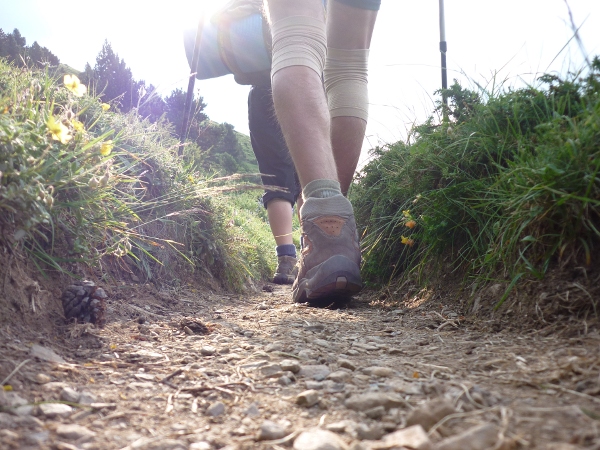
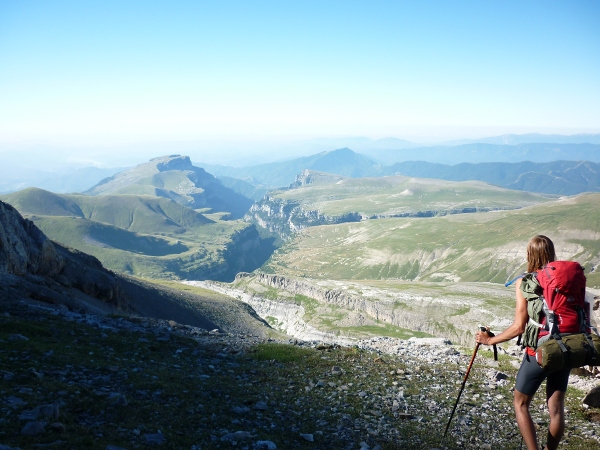
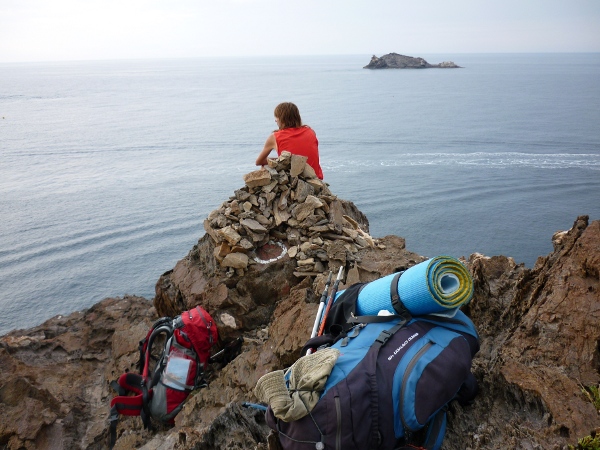
Tomorrow, at this time, I'll probably be unsuccessfully trying to find a comfortable position on a seat of the Bilmanbus to Irun. Very early on Saturday, as soon as we get off the bus, Maria and I will quickly head to Hondarribia's beach in Cape Higer to symbolically wet our feet in the waters of the Cantabrian Sea. We won't have much time to enjoy the cold waters of the ocean, though. Soon after that, we'll have to take a deep breath, look East, and start walking if we want to achieve our utmost objective: take a bath in the beautiful beaches of the Cap de Creus, in the Mediterranean sea. In between, 30 days and 840 kilometres of thick woods, deep valleys, high peaks and cold waters, all of which shape incredible landscapes.
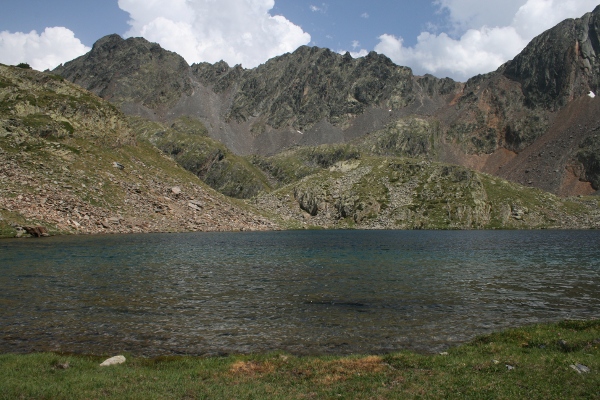

The Portella de Baiau, during our 2008 trip For a whole month, we'll be mostly disconnected from everything else that isn't our knee ache, our blisters, the Sun over our heads or where to get food. It's the first time I leave on a hiking trip as long and tough as this one, and I feel both uncertainty and eagerness. We've been so busy during the last few months that we've been unable to train at all for this, and I'm probably in the worst physical condition in a decade. It's too late to take care of that now, so we'll try to take good care of our legs and spine. In order to get back home in the Mediterranean, we'll have to be fast, some days joining two stages and skipping a few that we know are not that interesting (sections over asphalt, etc.). It's hard to make it in just one month, but we'll try our best. The plan is going to sleep not long after sunset, getting up at dawn, to be able to walk for a decent time before the heat starts being a handicap and just resting at midday, when the Sun is strongest. Of course, this means that I'm missing, yet again, this year's edition of DebConf in New York City, which is really sad because I was looking forward hanging around with Mako, Mika, Biella, micah, Clint and the rest of the NYC/ Boston gang, but when the idea of doing a long trip this summer popped up around January, it was clear DebConf seemed unlikely this year. I hope all of you have a lot of fun, and see you in a few weeks!

Jordi Mallach: De mar a mar, hiking across the Pyrenees

Two weeks ago, Maria and I completed one of our dreams when we arrived in Cap de Creus, where the Pyrenean range sinks in the Mediterranean. To get there, we walked hundreds of kilometres during a month, crossed dozens of steep valleys and enjoyed one of the richest experiences of our lives.

We managed to complete this challenge without facing major problems or pains, and after the first five our six days, our legs seemed to have gotten used to the daily effort and it started to be easier and easier. Our morale kept growing as days passed and we advanced east. When I started walking on a cold and rainy morning in Hondarribia, after barely no rest in the night bus to Ir n, I thought for myself that it was improbable that we'd manage to get anywhere near Catalunya, that one of us would get injuried way before, or we'd just give up and go for the easy beach vacation in the Basque Country.
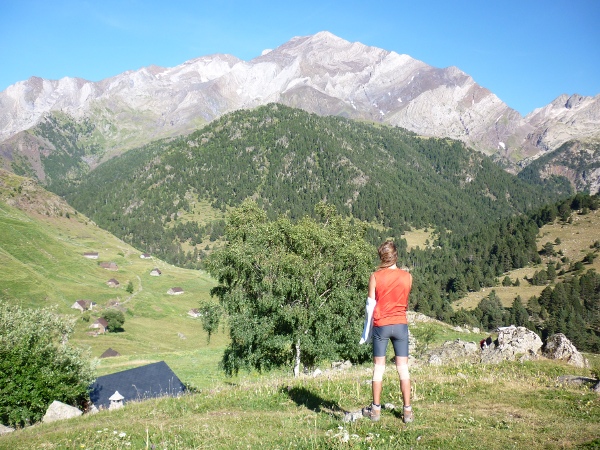

Biad s refuge, under Posets But we didn't, and after a somewhat painful start, with our boots soaking wet during the stages that crossed the enchanting Selva de Irati which ended up with me getting the biggest blister I've ever seen, we started to walk farther every day, extending the stages when we felt strong after reaching their official end. When we crossed from Nafarroa to Aragonese territory, the mental wall that I had built over the toughest stages in our quest started to fall apart. Days later, we found ourselves climbing down to Pineta, leaving Ordesa behind and enjoying a feeling that our adventure could not go better. The weather had been perfect for over a week and our legs and back were strong to go all over the way to the sea.


Ca n de A isclo, on our way to Pineta When we finally saw that huge blue stain on the horizon, the day before getting to the last mark, we got really excited. We had made it, but as we walked towards the cape, happiness slowly got mixed with melancholy. An unforgettable adventure was about to end, and we didn't want to face our return to the city and our routines. It had been many days surrounded only by awesome landscapes, and living without watches, with only sunlight and weariness marking the time to get in our sleeping bags.


At the very last red and white mark of our journey We've had plenty of time to meet great people. Starting with the Navarrian brothers we met in the early stage, which provided us with a good pace to follow while our leg muscles were still building up; or Kike and Ana, who drove from Pamplona to visit us during the first Aragonese stages (thanks for the supplies!). Tom s and Roger, young hikers from Matar , surprised us with their maturity and experience as mountaineers; we had the pleasure to join forces during four days, walking a really cool variant through the Infiernos and Collado del Letrero which avoided going through the ghost city of Panticosa. Roger and Tom s, we really hope to meet you soon! Andreu, Manel, Ghandi and Ga la visited us at the Vall de N ria and were unlucky to suffer a frightening hail and thunder storm when they left our shelter on their way back to their car. Thanks! All of you have been a very special part of our experience!

This adventure through GR 11 has been incredibly positive for us for several reasons. We've learned a lot about ourselves and strengthened our relation, and now I know how powerful drive can be; to get somewhere, no matter how far, it's really easy if you just believe you can do it and desire to get there. Maria and I are proud of what we've done, and no wonder we're looking for new challenges. An obvious one would be repeating this experience, going through the French side of the Pyrenees, but for now, the Corsican GR 20 seems the most appealing. We'll see, next summer!

Enrico Zini: Yet another Ubuntu anecdote

Yet another Ubuntu anecdote Some posts on planet made me remember of a little Canonical-related story of mine. Many years ago I shortly contracted for Canonical. It was interesting and fun. At the time I didn't have any experience of being temporarily hired by a foreign company, so I rang my labour union to get an appointment, to make sure with them that everything was allright. The phone call went more or less like this: Me:
Hello. I have received this contract for temporary employment by a foreign company and I wondered if I could book an appointment to come show it to you to see if it's all ok.
Their answer rather cut me short:
Hi. Be careful! People get temporary employment from obscure companies with the headquarters, like, in the Isle of Man, they do the job, the company disappears and they never get paid. There's bad stuff out there!
I looked at the contract, the heading said something like "Canonical ltd, Douglas, Isle of Man". I was certain that the union people would have never understood what was going on. I politely thanked them for their time and hung up. However, to this day I still regret that I didn't insist:
Uh, yes, the company is indeed in the Isle of Man. But what if I told you that it's owned by an astronaut?
I just signed the contract and had a good time.

Next.

Previous.