Search Results: "ina"

11 April 2012

Erich Schubert: Are likes still worth anything?

When Facebook became "the next big thing", you had the "like" buttons pop up on various web sites. An of course "going viral" was the big thing everybody talked about, in particular SEO experts (or those that would like to be that).
But things have changed. In particular Facebook has. In the beginning, any "like" would be announced in the newsfeed to all your friends. This was what allowed likes to go viral, when your friends re-liked the link. This is what made it attractive to have like buttons on your web pages. (Note that I'm not referring to "likes" of a single Facebook post; they are something quite different!)
Once that everybody "knew" how important this was, everbody tried to make the most out of it. In particular scammers, viruses and SEO people. Every other day, some clickjacking application would flood Facebook with likes. Every backwater website was trying to get more audience by getting "liked". But at some point Facebook just stopped showing "likes". This is not bad. It is the obvious reaction when people get too annoyed by the constant "like spam". Facebook had to put an end to this.

But now that a "like" is pretty much worthless (in my opinion). Still, many people following "SEO Tutorials" are all crazy about likes. Instead, we should reconsider whether we really want to slow down our site loading by having like buttons on every page. A like button is not as lightweight as you might think it is. It's a complex JavaScript that tries to detect clickjacking attacks, and in fact invades your users' privacy, up to the point where for example in Germany it may even be illegal to use the Facebook like button on a web site.
In a few months, the SEO people will realize that the "like"s are a fad now, and will likely all try to jump the Google+ bandwagon. Google+ is probably not half as much a "dud" as many think it is (because their friends are still on Facebook and because you cannot scribble birthday wishes on a wall in Google+). The point is that Google can actually use the "+1" likes to improve everyday search results. Google for something a friend liked, and it will show up higher in the search results, and Google will show the friend who recommended it. Facebook cannot do this, because it is not a search engine (well, you can use it for searching people, although Ark probably is better at this, and one does nowhere search as many people as one does regular web searches). Unless they go into a strong partnership with Microsoft Bing or Yahoo, the "like"s can never be as important as Google "+1" likes. So don't underestimate the Google+ strategy on the long run.
There are more points where Facebook by now is much less useful as it used to be. For example event invitations. When Facebook was in full growth, you could essentially invite all your friends to your events. You could also use lists to organize your friends, and invite only the appropriate subset, if you cared enough. The problem again was: nobody cared enough. Everybody would just invite all their friends, and you would end up getting "invitation spam" several times a day. So again Facebook had to change and limit the invitation capabilities. You can no longer invite all, or even just all on one particular list. There are some tools and tricks that can work around this to some extend, but once everybody uses that, Facebook will just have to cut it down even further.
Similarly, you might remember "superpoke" and all the "gift" applications. Facebook (and the app makers) probably made a fortune on them with premium pokes and gifts. But then this too reached a level that started to annoy the users, so they had to cut down the ability of applications to post to walls. And boom, this segment essentially imploded. I havn't seen numbers on Facebook gaming, and I figure that by doing some special setup for the games Facebook managed to keep them somewhat happy. But many will remember the time when the newsfeed would be full of Farmville and Mafia Wars crap ... it just does no longer work this way.

So when working with Facebook and such, you really need to be on the move. Right now it seems that groups and applications are more useful to get that viral dream going. A couple of apps such as Yahoo currently require you to install their app (which then may post to your wall on your behalf and get your personal information!) to follow a link shared this way, and then can actively encourage you to reshare. And messages sent to a "Facebook group" are more likely to reach people that aren't direct friends of yours. When friends actually "join" an event, this is currently showing up in the news feed. But all of this can change with 0 days notice.
It will be interesting to see if Facebook can on the long run keep up with Googles ability to integrate the +1 likes into search results. It probably takes just a few success stories in the SEO community to become the "next big thing" in SEO to get +1 instead of Facebook likes. Then Google just has to wait for them to virally spread +1 adoption. Google can wait - its Google Plus growth rates aren't bad, and they have a working business model already that doesn't rely on the extra growth - they are big already and make good profits.
Facebook however is walking on a surprisingly thin line. They need a tight control on the amount of data shared (which is probably why they try to do this with "magic"). People don't want to have the impression that Facebook is hiding something from them (although it is in fact suppressing a huge part of your friends activity!), but they also don't want to get all this data spammed onto them. And in particular, it needs to give the web publishers and app developers the right amount of that extra access to the users, while in turn keeping the major spam away from the users.

Independent of the technology and actual products, it will be really interesting to see if we manage to find some way to keep the balance in "social" one-to-many communication right. It's not a fault of Facebook that many people "spam" all their friends with all their "data". Googles Circles probably isn't the final answer either. The reason why email still works rather well was probably because it makes one-to-one communication easier than one-to-many, because it isn't realtime, and because people expect you to put enough effort into composing your mails and choosing the right receipients for the message. Current "social" communication is pretty much posting everything to everyone you know adressed as "to whoever it may concern". Much of it is in fact pretty non-personal or even non-social. We have definitely reached the point where more data is shared than is being read. Twitter is probably the most extreme example of a "write-only" medium. The average number a tweet is read by a human except the original poster must be way below 1, and definitely much less than the average number of "followers".
So in the end, the answer may actually be a good automatic address book, with automatic groups and rich clients, to enable everybody to easily use email more efficiently. On the other hand, separting "serious" communication from "entertainment" communication may be well worth having a separate communications channel, and email definitely is dated and is having spam problems.

Lars Wirzenius: Earth 2.0 by Soile Mottisenkangas

Soile made a short film, Earth 2.0 last week, for a film camp thing here in Manchester. It was all done in a couple of days. <iframe allowfullscreen="allowFullScreen" frameborder="0" height="225" mozallowfullscreen="mozallowfullscreen" src="http://player.vimeo.com/video/39984765?title=0&amp;byline=0&amp;portrait=0" webkitallowfullscreen="webkitAllowFullScreen" width="400"></iframe> Earth 2.0 from Soile Mottisenkangas on Vimeo. She's also set up a cafepress shop for those who want to support her filmmaking.

10 April 2012

Anand Kumria: The state of Django money.

Updated (2012-04-11): Now contains the final and correct pip install command. TL;DR: pip install django-money will give you a working set of Django fields that handle Money and Currency. Read below for how that happened. I began this Easter weekend trying to finish up one of my pet-projects and get it ready to publish. The goal of the website is to compare providers, of the same thing, from around the world. Representing prices is simple. A float will do if you are in a hurry. Except. When you need to perform calculations and you run into rounding errors. At that point you will likely discover the Decimal module. Which also works perfectly fine. And if you only ever deal in a single market that is fine. But across markets? That requires Money. Money is normally defined as a value and currency. Once you have both of those, you can then do cross-market comparison and upgrade you program to handle multi-currency easily. I hoped that I was not the only person who had realised this, so I started to look around. And I struck gold! I found Python Money. It even included appropriate Django fields as well. Unfortunately it had had no updates since 2008. . Worse it didn't work so well. I continued my search. I kept on looking and found Django Money. Even better. This separated out the Django support and the Python support. It turned out Jakewin's py-moneyed was actually a fork of Limist's py-moneyed. So I set about retrieving every fork and comparing them. <aside>Aside: There should be a git hubclone command which will add every fork of a project as an upstream so you can easily compare what has occurred and what has happened amongst them.</aside> It turns out that Jakewin's version was good, just out-of-date. It mentioned waiting until a pull request has been merged in to limist's version. Which had been done a while ago. And Jakewin's Django-money (djmoney) was nicely done too, unittests and all. It had just bitrotted compared to newer versions of Django (and South). I discovered there were a set of forks of django-money at github too. I analysed them all, and basically only jakewins's and reinbach's mattered. I created fixes for jakewins and reinbach's version. I also opened up on an issue asking limist's to tag and upload a new version of py-moneyed. I also got a response from limist and now you can do pip install py-moneyed and get a useful, working, version. And reinbach also responded and now you can do pip install django-money and get a working, usable, representation of Money within Django. It turned out to be a productive, if yak-shaving, weekend after all.

Bernd Zeimetz: working on spacewalk support for and in debian

With the latest release of Spacewalk PostgreSQL seems to be supported properly - finally. Also there are efforts to support Debian as a client system. So I'm thinking about using the upcoming BugSquashingParty in Salzburg to in the hope that you (yes, you!) are joining me! Please let me know if you are interested to work on Spacewalk related packages, even if you are not able to come to Salzburg.

Michal &#268;iha&#345;: phpMyAdmin in GSoC 2012

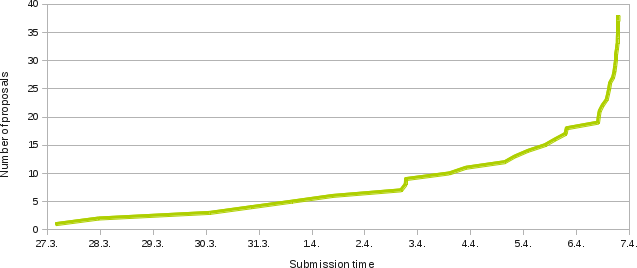
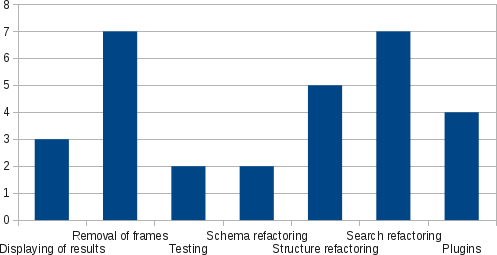
As student application period of Google Summer of Code 2012 is over, it's time to look at proposals we got for phpMyAdmin. First of all we got slightly less proposals than in past years (38 this year, 52 in 2011 and 68 in 2010). This is probably related to the fact that we heavily focus on code cleanup this year and this is definitely not that interesting topic as adding new features. I think quality has also slightly improved, but still there were few completely bogus applications for totally unrelated projects. Also as usual, people tend to leave submission for very last date: Number of applications over time (and then complain, that they don't have enough time to submit patch as described in our applicant guide). Quite unsurprisingly the most interesting topic seemed to be frames removal, where we got few really good proposals. You can see how other topics were frequent in following chart: Number of applications for various types Please note that the numbers are not 100% accurate as some proposals really did not fit into above categories. Anyway we're just waiting for last people submitting patches today and evaluation will finalize in upcoming days. Of course you will know the results from Google on April 23rd.
Filed under: English Phpmyadmin 0 comments Flattr this!

MJ Ray: DLT is better than CAPTCHA

Stop using CAPTCHAs. It s time to switch to DLT: Design, Limit and Trapdoor.
[a certain website] has the evil bad wrong Google reCaptcha on the edit page to stop disabled users, so screw it. Google s reCaptcha seems to be spreading again, obstructing more people when accessing more websites. Is there a reason for that? The re in reCaptcha stands for replace with real anti-spam, please!
I wrote the above about two years ago and it s not getting any better. I ve written similar things over the last ten years, as have many others, and I ve always sought to avoid using physical ability tests as a way to cut down spammers. Why do people keep reaching for the reCaptcha non-captcha or things that use similar bad eyetests like Mollom? So most online messages may be spam, but those physical ability tests do nothing to test for spam. They re trying to detect computer submissions (the TCHA in CAPTCHA is meant to be Telling Computers and Humans Apart), but that s really bad when the computer is helping someone with a disability to access the internet. People from the home of the CAPTCHA describe access for sight and hearing-impaired users as an important open problem for the project (Luis von Ahn, Manuel Blum and John Langford. Telling Humans and Computers Apart Automatically. In Communications of the ACM). Until that problem is closed, CAPTCHAs should be considered defective and removed whenever possible. What webmasters should do instead is DLT:
  1. Design it well: Set up sites so the spammers cannot get a quick win in the first place. Configure permissions and things like that so people have to do some work before they are trusted to post links. This is similar to the basic theory behind my Open Activism paper Fighting in the Shadows. This is much easier to do if the system is Free and Open Source Software (FOSS), too.
  2. Limit the damage: include rate limits to stop one person causing you lots of work: even with computer-assistance, few people need to post 10 forum messages every minute. Join up in co-operative anti-spam networks like blogspam.net so if they hurt you, others can see them coming. Again, it s easier to hook into a network if you re using FOSS.
  3. Trapdoor: keep a way for people to contact you if they are really blocked by your design decisions and limitation and keep a way to exempt them from the limits if needed. Make it welcoming because disabled users are tired of reporting barriers to webmasters who don t care and will never fix the web. A good multi-step eyetest-free contact form is a basic way to do this.
Have you tried this? Have your experiences been as good as our co-op s? Are there sites you don t think it would work for? A comments form is on the original of this article, as ever.

Dirk Eddelbuettel: RcppDE 0.1.1

The RcppDE package required a bug-fix release. One of the tests compared results to those from the DEoptim package this is based upon, and these are no longer equal, leading the tests to fail. While I was at it, I finally committed a few more things that had piled up. Below are the corresponding ChangeLog entries
2012-04-08  Dirk Eddelbuettel  <edd>
        * DESCRIPTION: Release 0.1.1
        * tests/compTest.R: With the just-release DEoptim 2.2.0, results are
        no longer identical so we commented-out the stopifnot() comparison to
        not break any automated tests (as requested by the CRAN maintainers)
        * .Rbuildignore: Added a few more files which R CMD check does not
        want to see in the tarball
2011-03-07  Dirk Eddelbuettel  <edd>
        * src/evaluate.h: Also reflect '...' argument from R function we pass
        in, with thanks to Josh Ulrich for the one-line patch
        * R/DEoptim.R: No longer pass environment 'env' down
        * man/DEoptim.Rd: No longer document now unused 'env'
        * src/deoptim.cpp: Minor tweak to RcppArmadillo object creation

9 April 2012

M nica Ram rez Arceda: From non-DD to DD

Two weeks ago I became a Debian Developer. I must say this made me very very happy! In fact, I still can't believe it But what makes me really happy is to continue collaborating in this great community. When you change your status from non-DD to DD, you must do some changes in your configurations. I've written a recipe about this called Non-DD to DD steps, maybe it can be useful for future incoming DDs. If someone detects an error, please tell me, I'll be glad of fixing it. Besides this, I don't want to finish this post without thanking publicly everybody that has given me a helping hand. First of all I want to thank ana, my tireless mentor and main sponsor, and mentors list as well as mentors IRC channel, for being always there. Also, I want to thank hauke, who uploaded my first little contribution and encouraged me a lot, francesca, with who I had the pleasure to work a little bit on past IRC trainig sessions, all people who have encouraged me (including greoga, rmayorga, asheesh, jordi, anibal and Debian Women Team), hyperair for helping me on packaging, lucas for clarifying my doubts about QA massive bugs filing, all members of OpenStreetMap Team for their help, lfaraone, my AM, and finally but not less important I thank all people I met in Debconf11 that make me find out that Debian is greater than I thought (agi, frequena, gunnar, vicho, tincho, sanvila, enrico and more!). I'm sure I'm forgetting someone yes, you! But I'm sure you'll forgive me, you know, memory is not my best quality ;-) Thanks!!!

Soeren Sonnenburg: Shogun Student Applications Statistics for Google Summer of Code 2012

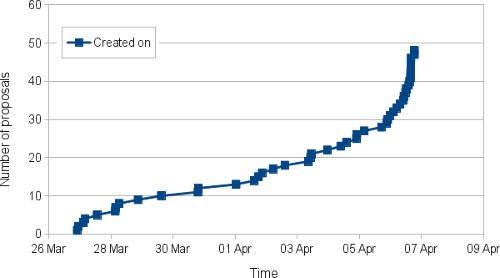
A few weeks have passed since SHOGUN has been accepted for Google Summer of Code 2012. Student application deadline was Easter Friday (April 6) and shogun received 48 proposals from 38 students. Some more detailed stats can be found in the figure below. This is a drastic drop compared with last year (about 60 students submitted 70 proposals). However, this drop can easily be explained: To even apply we required a small patch, which is a big hurdle.

  1. One has to get shogun to compile (possibly only easy under debian; for cygwin/MacOSX you have to invest quite some time to even get all of its dependencies).
  2. One has to become familiar with git, github and learn how to issue a pull request.
  3. And finally understand enough of machine learning, shogun's source code to be able to fix a bug or implement some baseline machine learning method
Nevertheless, about a dozen of proposals didn't come with a patch (even though written on the instructions page that this is required) - an easy reject. In the end the quality of proposals increased a lot and we have many very strong candidates this year. Now we will have to wait to see how many slots we will receive before we can finally start the fun :-)

Steve Kemp: Bye-bye AOL

Today I took that final step:
touch /srv/_global_/blacklisted/domains/aol.com
I remember, even a couple of years ago, I had friends who would mail me from their @aol.com email addresses. These days people have moved on. The two single biggest mail-providers I see in terms of spam are: I'd like to drop @yahoo.com but I have some (misguided) friends who continue to use it to mail me. I might start dropping non-friend mails from that domain, but that's a bigger job. Yes, this is a dull entry. Sorry. My existing bathroom has been ripped out and turned into this as a stepping stone into its new incarnation. I'm trapped in my office. Dust almost everywhere. Noise everywhere else. ObQuote: "There can be no understanding between the hand and the brain unless the heart acts as mediator. " - Metropolis

Craig Sanders: getting the terminal size in python

I m finally getting around to making myself learn python as more than just a read-only language. Working with Openstack kind of requires it. So far, I like it. Much more than I thought I would as an unrepentant sh and perl using systems geek. And getting over my distaste for the white-space issue is also proving to be much easier than I thought it would (although I still think that block-delimiters like make the code easier to read PyHeresy, I know) While hacking the /usr/bin/glance command to have less ugly output, and adding a csv option to list the image index in a usefully parseable format, I needed to figure out how to get the terminal size (height,width). This, cobbled together from various google search results, seems to work. It s probably not strictly-correct python idiom, and there s probably a better way of doing it. Comments and critique are welcome.
def get_terminal_size(fd=1):
    """
    Returns height and width of current terminal. First tries to get
    size via termios.TIOCGWINSZ, then from environment. Defaults to 25
    lines x 80 columns if both methods fail.
 
    :param fd: file descriptor (default: 1=stdout)
    """
    try:
        import fcntl, termios, struct
        hw = struct.unpack('hh', fcntl.ioctl(fd, termios.TIOCGWINSZ, '1234'))
    except:
        try:
            hw = (os.environ['LINES'], os.environ['COLUMNS'])
        except:  
            hw = (25, 80)
 
    return hw
 
def get_terminal_height(fd=1):
    """
    Returns height of terminal if it is a tty, 999 otherwise
 
    :param fd: file descriptor (default: 1=stdout)
    """
    if os.isatty(fd):
        height = get_terminal_size(fd)[0]
    else:
        height = 999
 
    return height
 
def get_terminal_width(fd=1):
    """
    Returns width of terminal if it is a tty, 999 otherwise
 
    :param fd: file descriptor (default: 1=stdout)
    """
    if os.isatty(fd):
        width = get_terminal_size(fd)[1]
    else:
        width = 999
 
    return width
getting the terminal size in python is a post from: Errata

Gunnar Wolf: Xilitla

On this Semana Santa (holy/major week), Regina and I took a little vacation: We went ~400Km North, to the magical Xilitla, in the Eastern part of San Luis Potos state. To get there, we went by the Sierra Gorda de Quer taro route: A beautiful but quite hard to drive road, crossing desert, forest and jungle through a very steep mountain ridge. What does hard to drive mean? It means that for ~200Km we had a speed average of 40-50Km/h. The road is in very good conditions, and traffic was quite light. And although our plans were to come back via the other ridge road (crossing Hidalgo state instead of Quer taro), we were persuaded to go the long way instead: We came back via San Luis Potos city, making ~700Km instead of ~400, but I'll concede it was a much easier drive. But although I take the road as an important part of the vacation, and although it was a very quick vacation, what is it we went to see there? Xilitla is a town at the beginning of the huasteca potosina region, with really exuberant vegetation, that captured Sir Edward James' heart back in the 1940s. Sir Edward, a noble Englishman, was good friends with several surrealist artists, and became one himself. After moving to Xilitla and buying an impressive chunk of jungle, in the 1960s he started building a surrealist garden in the middle of the jungle, which he continued to work on until his death, in 1984. We took some pictures, but of course, they pay very little tribute to the magic and beauty of the place. And going to the huasteca means going to places of nature, of many crystaline rivers. Yes, only three days (two of them spent getting there and back) are far too little to enjoy it. But even so, we went to the birth of river Huichihuay n (~45 minutes North of Xilitla) and to the Los Micos waterfalls (~20 minutes West of Ciudad Valles). Very nice places to visit, among so many others. We should go back to the huasteca soon! I uploaded many of the pictures here. They will not be syndicated on the planets that follow my blog on RSS (or for individuals following RSS, FWIW), but you will find them following the relevant links. And of course: I pay for a very cheap package on my hosting provider. Drupal often answers with an error page when the server is (even mildly) overloaded. So, feel free to hit reload if something appears unavailable.

8 April 2012

Tim Retout: Bye, Mark.

I've finally got around to deleting my Facebook account. I'd love to claim that this was a grand gesture against privacy-invading apps, or a bid to recoup vast amounts of my spare time... but it's not, really. I rarely logged in to the site, these days, so Facebook has very little of my personal data.

Luca Falavigna: Spam review: mass-tagging nominations

If you are one of those brave souls chasing off spam from Debian mailing lists, you will probably get bored of clicking on the Spam radio buttons a lot of times, and will probably look for a quick shortcut. I submitted a patch in bug #640309, but as of today, it has not been applied yet. Waiting for the patch to be applied, I prepared a little Greasemonkey script called Debian Mass Spam that allows to mark every message as Unsure , Ham , Inappropriate , or Spam by clicking the correspondent key on the keyboard: Spam review Just press Z (for Unsure ), X (for Ham ), C (for Inappropriate ), or V (for Spam ), and you will see every radio button to change its status. I tested it on Chromium, Iceweasel (with xul-ext-greasemonkey package) and Epiphany (with epiphany-extensions package), and it seems to work properly. Too many words and no actions so far, go and kill some spam now! ;)

Lars Wirzenius: What is a Linux distribution?

I got into a discussion recently about what a Linux distribution actually is. To some people, a distro is just a convenient way of source of binaries from which to pick what you install, either on your own computer or when creating an embedded system, or some other specific kind of system. To others it's a way of life, and the realization of the ideals of software freedom. To yet others, a distro is an outdated concept that will go away in the near-ish future, to be replaced by ... something. Here's my take: a Linux distribution is defined by the following things: Historically, there has been a lot of variation in all aspects mentioned above. Some of this variation may today be unnecessary. For example, it might be helpful for more distributions to share work on common tools, so that not everyone needs to re-invent and re-implement the same kinds of tools. However, my gut feeling is that due to the inherent interconnectedness of all things, it may be very difficult to have one set of tools to support well all workflows, policies, processes, and communities. The most important differentiating factors between the various distros are not the tools, but the community values, the perceived purpose of the distro, and the resultant criteria for choosing what to include and the workflow for developing the distro. Even when two distros use the same tools, there can be a lot of difference in the end result. Fedora and RHEL, for example, use a lot of the same infrastructure, but their purpose is entirely different. Debian and Ubuntu use mostly the same packages, even, and still there's a huge difference between the two distros: one aims at a high quality system based on free software, the other aims to support the business of one particular company. For this reason, there will always be a lot of Linux distributions around, and that is good.

6 April 2012

Petter Reinholdtsen: Why the KDE menu is slow when /usr/ is NFS mounted - and a workaround

Recently I have spent time with Skolelinux Drift AS on speeding up a Debian Edu / Skolelinux Lenny installation using LTSP diskless workstations, and in the process I discovered something very surprising. The reason the KDE menu was responding slow when using it for the first time, was mostly due to the way KDE find application icons. I discovered that showing the Multimedia menu would cause more than 20 000 IP packages to be passed between the LTSP client and the NFS server. Most of these were NFS LOOKUP calls, resulting in a NFS3ERR_NOENT response. Because the ping times between the client and the server were in the range 2-20 ms, the menus would be very slow. Looking at the strace of kicker in Lenny (or plasma-desktop i Squeeze - same problem there), I see that the source of these NFS calls are access(2) system calls for non-existing files. KDE can do hundreds of access(2) calls to find one icon file. In my example, just finding the mplayer icon required around 230 access(2) calls. The KDE code seem to search for icons using a list of icon directories, and the list of possible directories is large. In (almost) each directory, it look for files ending in .png, .svgz, .svg and .xpm. The result is a very slow KDE menu when /usr/ is NFS mounted. Showing a single sub menu may result in thousands of NFS requests. I am not the first one to discover this. I found a KDE bug report from 2009 about this problem, and it is still unsolved. My solution to speed up the KDE menu was to create a package kde-icon-cache that upon installation will look at all .desktop files used to generate the KDE menu, find their icons, search the icon paths for the file that KDE will end up finding at run time, and copying the icon file to /var/lib/kde-icon-cache/. Finally, I add symlinks to these icon files in one of the first directories where KDE will look for them. This cut down the number of file accesses required to find one icon from several hundred to less than 5, and make the KDE menu almost instantaneous. I'm not quite sure where to make the package publicly available, so for now it is only available on request. The bug report mention that this do not only affect the KDE menu and icon handling, but also the login process. Not quite sure how to speed up that part without replacing NFS with for example NBD, and that is not really an option at the moment. If you got feedback on this issue, please let us know on debian-edu (at) lists.debian.org.

Rapha&#235;l Hertzog: People Behind Debian: Francesca Ciceri, Member of the Debian Press & Publicity Teams

Francesca Ciceri, photo by Andrew McMillan, CC-BY-SA 2.0

I met Francesca in Debconf 11 in Banja Luka. If I recall correctly, it s Enrico Zini who introduced me to her, because she was the madamezou (her IRC nickname) who started to get involved in the publicity team. Since then and despite having a bachelor thesis to complete she got way more involved and even gained official responsibilities in the project. Before starting with the interview, I wanted to mention that Francesca is drafting a diversity statement for Debian I was expecting the discussions to go nowhere but she listened to all objections and managed to improve the text and build a consensus around it. Thank you for this and keep up the good work, Francesca! Rapha l: Who are you? Francesca: My name is Francesca, I m 30 and I studied Social Sciences. Currently I live in Italy but I m planning to go abroad (not a lot of jobs here for geeky social scientists). Apart for Debian and FLOSS world in general, I have unrestrained passions for chocolate; zombie movies; sci-fi; zombie books; knitting sewing crafting and DIY in general; zombie videogames; bicycles; pulling apart objects to look inside them; splatter B movies, David Foster Wallace s books, playing trumpet, and did I already mentioned zombies? Days are too short for all this stuff, but I try to do my best. Raphael: How did you start contributing to Debian? Francesca: Some years ago I was stuck in bed for literally some months, due to a grave series of migraine attacks. I wasn t able to do anything: no social life, no books or television. So, I decided to turn on the laptop and do something constructive with it: I was already a Debian user and it seemed quite logical to me to try to give back to the community. I am not a coder and I ve not studied Computer Science, so my first step was to join an Italian Debian on-line community (Debianizzati) and help with tutorials, users support, wiki management. In a couple of months I learnt many things: helping other users with their problems forces you to do lots of research! My first contributions to the Debian project were mostly translations of the main website. Translators are the perfect typos spotters: they work so precisely on the text to be translated that they finish to do a great QA job. This is how I ve started to contribute to the Debian website: with very simple things, fixing typos or wrong links or misplaced wml tags. I still remember my first commit to the website: the idea was to undercase some tags, but it ended up that I misplaced some of them and in addition I fixed them only in the English page and not on the translations as well. When after a couple of minutes, K re Thor Olsen a long time contributor of the team and now webmaster reverted my commit, I felt so stupid and full of shame. But, to my great surprise, no one treated me like an idiot for that error: Gerfried Fuchs, one of the guru of the team, replies me in a really helpful and polite way explaining what I did wrong and how to do things correctly. I think this episode was a turning point in my Debian life: there s this idea that Debian Developers are just a bunch of arrogant assholes and maybe it was true in the past, but for my experience they are not. Well, at least the ones I met and work with ;) .
To my great surprise, no one treated me like an idiot for that error.
Since then, I joined the WWW team and helped them apply the shiny new design provided by Kalle S derman. A lot of work was done during the week immediately before the release of the new website. Oh that was a week! We worked night and day to have the new design ready for February 6th, and it was fantastic when we finally published it, simultaneously with the release of Squeeze. At the same time, I started to contribute more actively to the Debian Publicity team, not only translating news but also writing them. It can sound scary for a non native English speaker to write something from scratch in English, but you have to keep in mind that your text will be reviewed by native speakers before being published. And we have some fantastic reviewers in the English localisation team: particularly Justin B Rye, who is tireless in his effort and more recently Moray Allan. I think I m particularly lucky to work with all these people: there s a special mood in both Publicity and WWW team, which makes you feel happy to do things and at the same time pushes you to do more just because it s fun to work with them sharing jokes, ideas, rants, patches and hugs. Rapha l: I believe that you have been trough the new member process very quickly. You re now a Non-Uploading Debian Developer. How was the experience and what does this mean to you? Francesca: Becoming a Debian Developer was not so obvious for me, because I didn t need to be a DD for the work I do in Debian. For instance, I don t maintain packages, so I had no reasons to want to become a DD in order to have uploading rights. For a while I didn t really feel the necessity of being a DD. Luckily, some people started to pester me about it, asking me to apply for the NM process. I remember Martin Zobel-Helas doing this for an entire week every single day, and Gerfried Fuchs doing it as well. Suddenly, I realized that people I worked with felt that I deserved the DD status and that I simply had thought I didn t. As a non coder and a woman, there probably was a bit of impostor syndrome involved. Having people encouraging me, gave me more confidence and the desire to finally become a DD. And so I did. The process for non uploading DD is identical to the one to become an uploading DD, with one exception: in the second part of the process (named Tasks and Skills) instead of questions about how to create and maintain packages, there are questions about the non packaging work you usually do in Debian. The general resolution which created the possibility to become a non uploading DD gave us a chance to recognize the great effort of Debian contributors who work in various area (translations, documentation, artworks, etc.) that were not always considered as important as packaging efforts. And this is great because if you are a regular contributor, if you love Debian and you are committed to the project, there are no reasons to not be an official member of it. With regards to this, I like the metaphor used by Meike Reichle in her recent talk about the Debian Women Project (video recording here):
a Debian Developer status is a lot like a citizenship in a country that you re living in. If you live in a country and you don t have citizenship, you can find a job, buy a house, have a family [...] but if this country at any point in time decides to go into a direction that you don t like, there s nothing you can do about it. You are not in the position to make any change or to make any effect on that country: you just live there, but there s no way that you can excercise influence on the people who run this country.
Rapha l: You recently joined the Debian Press Team. What does it involve and how are you managing this new responsibility? Francesca: The Press Team is basically the armed wing of the Publicity Team: it handles announcements that need to be kept private until the release, moderate the debian-announce and debian-news mailing list and maintain contacts with press people from outside the project. The real job, so, is done within the Publicity Team. The most important part of our work is to write announcements and the newsletter: while the newsletter is published bi-weekly, the announcements need to be write in a shorter timeframe. Localization is really important in spreading Debian word, so we work closely with translators: both announcements and DPN are usually translated in four or five different languages. The publicity work could be stressful, as we have strict deadlines, we need to take quick decisions and often do last-minute changes. Personally, I like it: I work better under pressure. But I know that is sometimes difficult for contributors to accept that we can t debate endlessly on details, we have just to go on and do our best in a given timeframe.
The publicity work could be stressful, as we have strict deadlines, [ ]. Personally, I like it.
Raphael: You re one of the main editor behind the Debian Project News. What s the role and scope of this newsletter? Francesca: Debian Project News is our beloved newsletter, direct successor of the Debian Weekly News founded by Joey Hess in 1999 and later kept alive by Martin Schulze. In 2007, Debian Weekly News was discontinued but in 2008 the project was revived by Alexander Reichle Schmehl. The idea behind DPN is to provide our users an overview of what is happening inside and outside the project. As the core team of editors is formed by three people, the main problem is to be able to collect enough news from various sources: in this sense we are always glad when someone points us to interesting blogposts, mails and articles. DPN is also a good chance for non coders to contribute to Debian: propose news, write paragraphs and review the draft before the publication are quite easy tasks but very useful. English native speakers can do a proofread (as no one of the main editors is a native speaker) while others can always translate DPN in their native language. People who want to help us can take a look at our wiki page.
DPN is also a good chance for non coders to contribute to Debian.
Just yesterday I realized that since January we don t miss or delay an issue: so I d like to thank the fantastic team of editors, reviewers and translators who made it possible. The team is now working on another way of spreading Debian s message: a long-time project is finally becoming real. Stay tuned, surprise arriving! Raphael: You re trying to organize IRC training sessions but that doesn t seem to take off in Debian, while it s quite common in the Ubuntu community. How do you explain that? Francesca: I m not sure about it: both Debian users and contributors seemed to appreciate this initiative in the past. I was quite surprised by the amount of Debian members present during the various sessions and by the amount of interesting questions asked by the users. So the only reason I can think about is that I need to put more enthusiasm in convincing the teams to do it: they need more encouragement (or to be pestered more!). I, for myself, think that IRC training sessions are a great way to promote our work, to share our best practice, to talk about our project to a wider audience. And I ll sure try to organize more of them. Help, suggestions, ideas are really welcome! Raphael: If you could spend all your time on Debian, what would you work on? Francesca: There is a project I d like to give more love, but I always end up without the time to do it: the debian-community.org project. Back in 2007, Holger Levsen founded it with the aim of reducing the gap between Debian contributors and Debian users, giving all an opportunity to contribute, share ideas and more. The project was discontinued and I d really like to revive it: in these years various things have changed, but I think that the core idea of having a node to connect existing local communities is still good and doable. In Debian we don t have the wide and well articulated local infrastructure present in other distributions (Ubuntu, particularly, but also Fedora): even if I don t like too centralized structures, I think that a better connection between the project and local groups of users and on-line communities would be a step forward for the project. Being part of the Events Team, I m aware of how much we need to improve our communication with local groups. An example is the events organization: sometimes, Publicity and Events teams even don t know about regional Debian related events (like booth at conferences, workshops, talks, install parties, etc) and this is a shame because we could offer a lot of help in organizing and promoting local events. What we lack is better communication. And debian-community.org project could give us exactly this. Could be a cluster of local groups, a platform for events organization and even a useful resource for newbies who want to find a local group near them. I started some effort in this sense, sending a proposal about it, working on a census of Debian local groups. Any help is appreciated! I m really curious to see how many Debian communities (from all around the world and the web) are out there, and I d love to have members from these communities better connected with the Debian Project. Raphael: What s the biggest problem of Debian? Probably the bikeshedding feticism of almost all of us. It s the other side of the coin of Debian s commitment to technical excellence and our perfectionism, but sometimes it leads just to endless discussions about details, and it is a blocker for various initiatives. In Debian, you have to be really patient and in a way stubborn to push some changes. This is frustrating sometimes. On the other hand, I really appreciate how people take some times to think to each proposals, give some feedback and discuss about it: the process could be annoying, indeed, but the result is often an improvement of the initial proposal. Raphael: Is there someone in Debian that you admire for their contributions? Most of my teammates are simply brilliant and adorable and hard-working. But I have to admit that I particularly admire David Pr vot: beside being a webmaster he does a lot of things, from French translations to DPN editing. All his contributions have a great quality and he s able to push you always further in doing things and doing them better. He is a good example of how I d like to be as contributor: smart, tireless, friendly.
Thank you to Francesca for the time spent answering my questions. I hope you enjoyed reading her answers as I did. Note that older interviews are indexed on wiki.debian.org/PeopleBehindDebian.

Subscribe to my newsletter to get my monthly summary of the Debian/Ubuntu news and to not miss further interviews. You can also follow along on Identi.ca, Google+, Twitter and Facebook.

3 comments Liked this article? Click here. My blog is Flattr-enabled.

Vasudev Kamath: Packaging Falcon Programming Language for Debian

Falcon is a programming language which is not yet packaged for Debian. I saw that the ITP#460591 is owned by my Debian mentor and good friend Kartik Mistry. So I jumped in to help him finish this package. Ok enough of introduction now directly to point. We thought its better to base the Debian package on upstream Git repository itself so we can do snapshot release like Go Language package is doing. So in this post I'm going to give steps we used to do this and also guidelines on future packaging of Falcon.
    1. First step we need to clone the upstream Falcon's git repo. Then duplicate *master* branch into *upstream* branch.
      git clone http://git.falconpl.org/falcon.git
      git checkout -b upstream
      
    
    2. Now by staying on *upstream* branch we made it track the upstream's git repo using following commands
       git remote add upstream-falcon http://git.falconpl.org/falcon.git
       git branch --set-upstream upstream-falcon
       
    
    3. We made the master branch point to origin which is our collab-maint git repository.
       git checkout master
       git remote set-url origin git.debian.org:/git/collab-maint/falconpl.git
       
    
    4. Next is creating the pristine-tar branch so that it will be easy for us to build using *git-buildpackage* tools. We just took snapshot of upstream's head and created a tarball and then used *pristine-tar* utility to commit it. Then we tagged upstream version
       git checkout upstream
       git archive --format=tar HEAD   gzip -9 > ../falconpl_0.9.6.8-git20120403.orig.tar.gz
       git tag upstream/0.9.6.8-git20120403
       pristine-tar commit ../falconpl_0.9.6.8-git20120403.orig.tar.gz
       
    
    5. And finally we copied **debian** directory from Ubuntu's falconpl package into our master branch and modified the debian changelog to match our new snapshot version. To release a new version all we need to do is follow step 4 and then additionally merge the upstream with master
So our repo is now in proper shape to be built using git-buildpackage. But we are left with many things to clean and fix. So things which are currently pending are
  1. Make copyright file in Debian copyright format 1.0
  2. Separate out each module falcon builds into separate package. Looks like Ubuntu doesn't install any of modules
  3. Last but not the least upload it to Debian ( Kartik's task :-) )
Even though I'm packaging Falcon for Debian I'm not a Falcon programmer so if there are any Falcon programmer reading this post and want to help you are always welcome :-).

5 April 2012

Steve Kemp: So I want a backup solution

I look after a lot of systems, and most of them want identical and simple backups taking of their filesystems. Currently I use backup2l which works but suffers from a couple of minor issues. In short I want to take a full filesystem backup (i.e. Backup "/"). I wish to only exclude a few directories and mounted filesystems. So my configuration looks like this:
# List of directories to make backups of.
# All paths MUST be absolute and start with a '/'!
SRCLIST=(  / /boot -xdev )
# The following expression specifies the files not to be archived.
SKIPCOND=( -path '/var/backups/localhost' -o -path '/var/run/' -o \
    -path '/tmp'  -o -path '/var/tmp' \
    -o -path '/dev' -o -path '/spam' \
    -o -path '/var/spool/' )
The only surprising thing here is that I abuse the internals of backup2l because I know that it uses "find" to build up a list of files - so I sneakily add int "-xdev" to the first argument. This means I don't accidentally backup any mounted gluster filesystem, mounted MySQL binary/log mounts, etc. backup2l then goes and does its jobs. It allows me to define things to run before and after the backup runs via code like this:
# This user-defined bash function is executed before a backup is made
PRE_BACKUP ()
 
   if [ -d /etc/backup2l/pre.d/ ]; then
      run-parts /etc/backup2l/pre.d/
   fi
 
So what is my gripe? Well I get a daily email, per-system, which shows lots of detail - but the key thing. The important thing. The thing I care about more than anything else, the actual "success" or "fail" result is only discoverable by reading the mail. If the backup fails, due to out of disk, I won't know unless I read the middle of the mail. If the pre/post-steps fail I won't know unless I examine the output. As I said to a colleague today in my view the success or failure of the backup is the combination of each of three distinct steps: If any of the three fail I want to know. If they succeed then ideally I don't want a mail at all - but if I get one it should have:
Subject: Backup Success - $(hostname) - $(date)
So I've looked around at programs such as backup-ninja, backup-manager and they seem similar. It is a shame as I mostly like backup2l, but in short I want to do the same thing on about 50-250 hosts: In my case it is usually the rsync-step that fails. Which is horrific if you don't notice (quota exceeded. connection reset by peer. etc). The local backups are good enough for 95% of recovery times - but if the hardware is fried having the backups be available, albeit slowly, is required. Using GNU Tar incrementally is trivial. If it weren't such a messy program I'd probably be inclined to hack on backup2l - but in 2012 I can't believe I need to. (Yes, backuppc rocks. So does duplicity. So does amanda. But they're not appropriate here. Sadly.) ObQuote: "Oh, I get it. I see now. You've been training for two years to take me out, and now here I am. Whew! " - Blade II - An example of a rare breed, a sequel that doesn't suck. No pun intended.

Michal &#268;iha&#345;: Why weblate?

I still get lot of questions why I wrote Weblate instead of staying with some existing solution. Most of the reasons were already addressed in previous posts, where I looked for Pootle alternative or announced Weblate, but still it might be worth to summarize reasons once more. Git integration None of existing tools integrate with distribute version control, while I find this integration somewhat obvious and necessary. Having translation system as one of remote branches makes things really easy to handle for developers. Merging translations is nothing more than git merge. Attribution to translator I think it's fair to request that translator gets appropriate attribution for his contribution. Once we rely on Git, it is quite obvious that he will be author for Git commit doing changes. This way you can find author purely with Git and don't need to look for other tools. Handling of several branches In phpMyAdmin we heavily use branches to maintain stable releases. On the other side we want to be able to push translations to both stable and testing branches without translators having to do the work twice. Weblate does automatically push changes to all branches. Well this is not limited to branches but to subprojects as they don't have to be only branches, they can be also just related projects like with Gammu and Wammu. Displaying context Most of tools I tried fail to provide way to show related source code even when Gettext po files contain such references. With Weblate this is just matter of configuring URL of viewer, what nicely integrates with existing services like Github. Sane merging of uploaded translations With Pootle, it is possible to upload incomplete po file and it will luckily take it and replace existing one. This is quite dangerous as you would not notice it is incomplete unless you do some translation validation before release. Weblate does merge uploaded translations unit by unit, what makes it slower, but generates minimal diff and works also across branches. Consistency checks There are always things which can go easily wrong in the translation like format strings and translation tool should catch these as early as possible. Weblate semi-enforces checks - if check has failed, you will be redirected back to previous translation to possibly correct it (or mark check for ignoring). At current state checks are not as good as I would like to, but they are completely modular and can be easily extended and improved. Bonus points While working on Weblate I realized that some things could be done even better than I originally anticipated. For example with Github web hooks, it is possible to receive notifications on upstream repository updates and merge changes as they appear, leaving to really live translation process. Git allows to write custom merge drivers and this can be utilized for less merge conflicts on po files (they are usually caused by timestamps in headers), so that's another handy you get with Weblate. Of course there is much more built in, just check the documentation.

Filed under: English Weblate 3 comments Flattr this!

Next.

Previous.