Search Results: "ema"

3 December 2007

Matthew Garrett: Spot the difference

Before takedown request:


After takedown request:


MPAA don't fuck with my shit.

(And yes, I did attempt to contact them by email and phone before resorting to the more obnoxious behaviour of contacting the ISP. No reply to my email, and the series of friendly receptionists I got bounced between had no idea who would be responsible but promised me someone would call back. No joy there, either.)

(Context)

David Welton: Interest in a simple open source newsletter system for Rails?

I'm putting together a very simple newsletter system for a client, based on Rails. It's meant to handle around 1000 addresses, and be simple to use: you create a newsletter with fckeditor, look at it, then send it if everything looks good. It also ads links so that people can unsubscribe, or subscribe from the site (with confirmation provided via a link in an email). It's not nearly as extensive as a lot of what I've seen out there in PHP, but I really needed something in Rails and didn't find anything that worked for me. I'm considering open sourcing the code, but am only likely to do so if there is interest from people willing to work on the code. I'm just not in the mood to put code out there that just sits there. If you are interested, email me and we can work something out.

Miriam Ruiz: Software patents are buggy

Patents are the best way to improve development, and software inventors have just the natural right to their algorithms and designs. Research and Development in industry wouldn’t just work without patent protection, and technology improvements would just stop, right? Well, I’m not so sure of that. Key arguments against software patents, stolen from Pieter Hintjens’ article:

Christian Perrier: It took 5 years...

...to make the use of gettext for debconf messages i18n mandatory. Policy 3.7.3 states:
     * Packages following the Debian Configuration management
        specification must allow for translation of their messages by using
        a gettext-based system such as po-debconf.                [3.9.1]
Not to say this took too long. Such changes are always long processes. Anyway, I think that Denis Barbier, who built the first po-debconf packages and uploaded the first version on 9/11/2002, would appreciate this. Now, let's hunt the last remaining black sheep....:)

Adam Rosi-Kessel: Success as a Parent

Success as a parent is when your two year old recognizes and demands, at various times, Joni Mitchell, Paul McCartney (particular tracks), They Might Be Giants, and the White Stripes. And when she knows how to operate her own portable CD player and navigate your cell phone photo library. These are skills that the Class of 2026 is going to need.

Biella Coleman: The other AAA s

The (overpriced) Amtrak train is rapidly hurling itself north toward New York City, the vanishing light gently illuminating the first snowfall of the year. I am heading back from the American Anthropological Association annual meetings, which were held in Washington D.C this year. After a year’s hiatus, I attended to present a short version of my paper on hacker conferences, which I have pushed along further to entertain more general questions and ideas about the role of conferences in ensuring forms of solidarity among publics that are dispersed geographically. While there are other events that are far more visceral or more profoundly produce what Emile Durkheim has called collective effervescence, conferences are probably one of the most common social forms for ensuring a steady state of moral solidarity among connected but geographically dispersed groups of people. Their importance and role is often overlooked, I think, because of their sheer ubiquity (and I am sure the fact that many are held in creepy corporate hotels populated by seriously over sized & gaudy furniture where you can sit and sip your overpriced Starbuck’s coffee does not help). But it is because they are so common that I think we need to take them a little more seriously as distinctly 20th century events that combine much older elements of ritual and pilgrimage. Because I have attended so many developer and hacker conferences, which tend to be longer as well as far more more enveloping, festive, and, frankly, well executed than academic ones, I tend to think of academic conferences as tepid, lightweight versions. But as I make my way back home, I am pretty worn yet inspired from this one as I decided to sort of let go to give it my all, sleeping far less than I really should have. I usually hold back some, perhaps because most academic conferences I attend are smack in the middle of the academic year, so my mind is partially occupied with the pile of work that awaits me, somewhat depressingly, at the end of your journey. Academic conferences can also produce a fair bit of anxiety, especially for younglings like myself, given that you are performing your skills (or lack of) and ideas (or lack of) to people you respect and admire too. Perhaps it is also due to the hotel environment, which I find not only particularly uninspiring but in all honesty, sort of soul sucking, though albeit, *very* conveniently so. This time, however, I was not going to let the hotel suck any more soul out of me because I was thrilled to see friends from time’s past, had a great time on my panel on digital subjectivities, and was excited to meet new folks and talk about those topics that I spend a lot of time thinking about. I also think the proliferation of (very cute) babies among my friends and the now visible crow’s feet adorning the smiling eyes of my friends made me feel the passing of time a little more forcefully than really I wanted to. So I did my best to turn that pesky faucet of time of off so as to give way to immersion, drawing those from past into the shared nest of the present, so that I would want to see them again in the future. And in the end, that is the point: social reproduction and shouldn’t procreation be fun? I think so… Now back to that pile of work.

2 December 2007

Brandon Holtsclaw: Brandon s Holiday Computer Fund

I’m a developer, and my primary tool is my computer. Unfortunately, about 3 months ago, my computer died an untimely death, and I have resorted to using a pentium 200MHz machine with 256MB Ram, which lets me keep up with regular communications, but significantly slows the pace of development. As a computer is a big purchase, and represents most of what I want to receive for the holidays, I’ve set up a fundraiser so that people who wanted to help towards this gift could do so without needing to purchase the entire thing (and to avoid the all too common problem of receiving 8 video cards and no RAM). www.fundable.com allows me to accept pledges via paypal but NOT collect any unless the goal is met, so if you feel giving and pledge something, it will only be charged if the goal is met ( this is set at $250, which seems to be the minimum for a decent system, if more is collected, I can look at something better). You can read more about how fundable works from www.fundable.com/faq, and I’m more than happy to answer any questions via email, IRC, Jabber, etc.

1 December 2007

John Goerzen: Attention Junkmailers

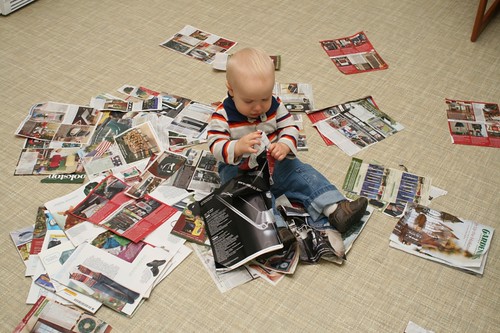
We love to hear from you. I'm sure that's what you're thinking, anyway, as you prepare volumes of paper to send to our mailbox.

But just so you know, let me explain just how much we love the material you send us.

When we get one of your catalogs, it will get added to the junk mail pile. Every so often, I will go through this pile. I will contact the company behind each and every mailing, asking them to remove me from their list and not rent my name further. If I have extra time, I will probably also write that note on your postage-paid envelope and pop it in the mailbox. I will also add your name to my list of companies that send me junk mail, so I can avoid doing business with you in the future. If you have sent me junk mail in the past, rest assured that I will find some creatively enjoyable way of dealing with your refusal to honor my removal request.

After I have processed your piece of artfully-crafted handiwork, possibly trying to sell me pink laptops or a shirt with the word "femail" on it -- whatever that means -- I will deposit your catalog, along with dozens of other similar catalogs, on the kitchen floor.

This is when the real fun begins, because now it's Jacob's turn to process them.

He will usually start by ripping out every page from the catalog. He'll start slowly and carefully, ripping out pages one at a time, savoring the wonderful rrrrriiiiippppp noise as he goes. But then he'll get faster, going for two pages at a time, then more, until finally he just will lunge for paper by the handful to crush, tear, or otherwise mutilate.

After that, there are many things he might do to your fine piece of unsolicited advertising. Perhaps he will enjoy drooling on it -- a satisfying fate for your 4-color catalog, don't you think? Or perhaps he will grab some of your pages, carefully emblazoned with your logo, and tear them into as many tiny bits as he can. Or maybe he will simply gather your work together on the floor, then spin himself around on top of it, scattering the remnants as far and wide as possible, cackling all the while. He may also smear bits of food on them if he ate recently, or perhaps he will simply resume tearing pages apart.

But whatever he does, rest assured that he will treat your catalog with the care and attention it deserves. No catalog will survive intact, and as many pages as possible will be ripped apart and left in bits. He does, after all, have a great attention to detail.

After Jacob is done, we will gather up what remains and put it all in our recycling container.

Oh, and under no circumstances will we actually make a purchase from your catalog.

Here are two pictures of the scene.

img_4160.jpg

Notice the careful concentration in this photo. Obviously he knows that Dell has been ignoring my removal requests for some time, and is taking note to tear their pages into the smallest possible bits.

But it's not all hard work -- processing your catalogs is fun, too.

img_4163.jpg

30 November 2007

Daniel Burrows: The Dreaded I-Word

A popular and recurrent topic of conversation on the Internet has the following form:
Is (X) innovative?
I occasionally find myself reading these discussions; they have the same sort of macabre fascination for me that's often ascribed to train wrecks, messy divorces, and Usenet. Of course, the outcome (or rather the lack of one) is always predetermined. The only variable is how many pixels will be mutilated and how many absurd postures will be struck before the dust settles. Why do I say the outcome is predetermined? Because in not one of these discussions does the person posing the question precisely define what innovation is. If the discussion concerned, say, whether an object was blue, or made of concrete, or 5 meters by 6 meters, this would not be a real problem: while any hair can be split, there are commonly accepted definitions of blue, concrete, and meter that are sufficient for an informal discussion. But innovation is not blue, concrete, or meter. Different people have subtly, even radically different views of what constitutes innovation and how to measure it. Hence, any discussion involving more than one person quickly devolves into chaos. One person will say, X is innovative because of such-and-such, and another will reply, X is not innovative because of such-and-such unrelated reason. Both writers are correct by their own definitions of innovation; they are answering different questions, and so they end up talking past one another. Although these discussions never go anywhere, I think it's entertaining and enlightening to catalogue some of the definitions of innovation that the participants use. I've listed some popular definitions below; feel free to email me with more suggestions and I'll update the list. Of course, since people rarely bother to define their terms, most of these meanings have been inferred from the statements people have made about what is and is not innovative. As a result, some of them are fairly absurd and may not accurately reflect the opinions of the speakers, had the speakers stopped to think about what they were saying. Caveat lector. Conventions: Below, personal pronouns such as I and me refer to the speaker. The words product, idea, and technique are used interchangeably and as appropriate to refer to the thing whose innovativeness is in dispute.
  • The idea advanced the state of human knowledge.
  • The idea was an improvement over existing ideas.
  • The idea improved the state of practice within its field.
  • The idea was previously unknown.
  • The idea was previously unknown to its creator.
  • The idea was previously unknown to me.
  • The technique solved a problem thought to be unsolvable.
  • The technique solved a problem with no known solution.
  • The technique solved a problem with no solution known to me.
  • The technique solved a problem with no solution known to its inventor.
  • The product was aesthetically pleasing to me.
  • The product is entirely unlike any other product with which I am familiar.
  • The product is exactly the same as some other product with which I am familiar.
  • The product solved a problem more effectively than existing tools.
  • The product made its creator the wealthiest living human.
  • The product made its creator wealthy.
  • The product made someone wealthy.
  • The product reaped a huge profit for the corporation selling it.
  • The product was bought by many people.
  • The product was used by many people.
  • The product was useful to many people.
  • The product was useful to someone.
  • I bought the product.
  • The product was useful to me.
  • The product was created by (some particular entity, such as Toyota or Apple).
  • The product was not created by (some particular entity).
  • The product is good. (NB: of course good is another ambiguous term with many definitions, one of which appears to be innovative; the fun never stops!)
A Contrarian View This post charitably assumes that the purpose of the discussions I described, and the goal of the participants, is to arrive at a commonly agreed-upon answer to the opening question. In reality, though, most discussions on the Internet, particularly when they involve many anonymous or pseudonymous parties, are just tribal wars. Individuals decide which side to affiliate themselves with, then search for arguments that will tend to support their side or undercut the opposition. Facts and logic are largely irrelevant, except as weapons with which to smack one's opponents, and a dismissive put-down is as good as or better than a reality-based analysis. Actually changing your mind based on the evidence presented shows weakness, and is to be avoided at all costs. If you have to assert that up is down, do it. In this environment, using vague terms appears to be a bonus, since it gives you more wiggle room and opportunities to play gotcha!. If someone responds to your post with facts that rebut you based on the definition you were using, you can pick any other definition and say ...but what about..? Which is why these discussions (in which no-one is actually discussing anything) are both a fascinating window into human nature and a depressing commentary on human nature, and why I keep finding myself reading them.
PS: This post is the first long post that I've used ikiwiki to write. An advantage of my new workflow, where I write posts on the bus and commit them into a local git repository, is that I have a nice block of time to write down random thoughts that have occurred to me on the way to or from work; sometimes I forget what I was going to write over the course of the day, and when I get home I usually get deluged in email and real life. It's always amazing to me how long it takes to write posts when I actually think about what I'm doing. This post has taken me at least an hour to compose, and I think probably more (especially counting the composition I did in my head while, e.g., walking from point A to point B). It's a lot harder -- which means, of course, that it's fun; if I don't get distracted by a coding project, I'll be trying to take advantage of my new workflow to post more often.

Frans Pop: debtree 0.7.2

Now available from alioth: debtree 0.7.2. The main change in this release is a much better display of virtual packages in dependency graphs. With this release I consider debtree "feature complete" when it comes to the information that is displayed in the graphs. A quick summary: Currently not supported are displaying Relaces, Obsoletes and Enhances relationships. If there's demand for it, adding them should be trivial. If you haven't yet, take a few minutes to look at the example graphs on the debtree website. What's next for debtree? You may remember that I filed an ITP when 0.7.1 was released but obviously its not in the archive yet. One reason is that debtree is completely redundant, at least if you consider the original reason I wrote it: to list how a package depends on another package. Just after the release of 0.7.1 I found out that aptitude why <package> <package> already provides that functionality!
I'm tempted to blame Enrico because I asked him if that was possible before starting on debtree, and Enrico really is supposed to know such things [1]! Luckily debtree now produces such nice dependency graphs to justify its existence :-) Anyway, I think that option should probably just be stripped out of debtree now. And if that is done, maybe it should be renamed to debgraph or apt-graph... I also discovered that beside apt-cache there was already another utility that produces dependency graphs: apt-rdepends. While, just like apt-cache, it lacks most of the features of debtree, it is quite fast and, because it is written in Perl, I could possibly port debtree to Perl myself using apt-rdepends as an example. Another reason is that a few people commented that maybe it should not be a separate package. I somewhat agree with that, but also would not like it to disappear in something non-descriptive like debian-goodies. I'd very much prefer it to eventually see it included in apt itself, or maybe in apt-utils. So basically I've been holding back a bit on uploading debtree to allow me to consider all this. The next task definitely is a rewrite in a better language and thereby give debtree a performance boost. [1] To his (and my) defence: that feature was only recently introduced in aptitude.

C sar G mez Mart n: Mark-ocracy

Yesterday we (ana, dato, holger and me) were at the CUM (University of Extremadura) to give a talk about Debian in general and QA in particular. We were talking about how things work within free software, we talked about do-ocracy and I coined the expression Mark-ocracy. It was funny :) Mark-ocracy: to do the things that Mark wants to do.

Felipe Augusto van de Wiel: 30 Nov 2007

It is about time...

qmail under Public Domain
Using qmail-ldap for quite some time (first because of my employer and then because I was used to it), the DJB license was a major pain, qmail-ldap patch is under BSD, but the original qmail was non-free. Yes, was. Yesterday DJB released qmail under Public Domain, and based on a GoogleVideo, he is going to change the license for all his existent software and for all his future works.

For some strange reason the URL direct to the video doesn't work, but if you do a search you are able to use the Watch video here option.


Not only that
Yes, I know. I'm not going to say sorry, I should post more, this last three months were not exactly the best ones, and I thought about writing something about what I was doing for Debian and other projects here but ended up being consumed by University, Work, Real Life and "Other Stuff (tm)".

One of the important things on the way is the Debian i18n Extremadura Meeting to be held on December, when we expect to work on i18n.debian.net, change from CVS to SVN, improve DDTP and ddtss and work with Pootle related stuff and infrastructure.

In the meantime, we are also changing our Primary Push Server for volatile.debian.org from durin to verdi (don't worry, a proper announcement will be made on an announcement list close to you). :-)

Thanks for everybody that had the patient to wait for my replies and/or my actions, and the ones that calmly understood my undergoing situation, giving me support and offering help. Thank you very much!

Stefano Zacchiroli: homepage field stats

Some numbers about the Homepage field I've got the statistics flu, it's probably floating around here in Spain. So I've wrote a couple of short scripts to collect numbers about how many packages are using the new Homepage field in debian/control and how many are still using the old pseudo-field in their description. So, here is a daily updated page with the Homepage field stats in Debian. The numbers are better than I had expected, even though about 4'000 packages are still using the old pseudo field, about 2'000 are already using the new one. (Technical) habits in debian can spread quite fast ...

Russell Coker: Vista ReadyBoostReady - Good for Linux?

At the moment it seems that about half the USB flash devices on sale are listed as “Vista ReadyBoost Ready“. I recently bought an 8G USB device that I returned because it could only sustain 4MB/s writes (not much fun for backing up 4G+ of data). So I’ve been wondering whether I should get a ReadyBoostReady device. ReadyBoostReady only means that it is faster than other devices in some ways, it has no inherent feature difference. After some searching I found a FAQ about ReadyBoost [1] which explains what it requires. It seems that ReadyBoost needs “2.5MB/sec throughput for 4K random reads and 1.75MB/sec throughput for 512K random writes“, which isn’t really a lot. About 5-6 years ago I was running some machines with 4 disk RAID-5 arrays that could sustain 3MB/s writes for significantly smaller block sizes (maybe 12K), given that random access is something that disks are really bad at (physical movement of the heads is required) and something that flash is good at) it gives an indication of how low the performance bar is for ReadyBoost. I’m sure that a device which meets the minimum specs would do some good if you have a single disk that’s not overly fast. But if you have a decent RAID array for swap then I doubt that the minimum requirements for ReadyBoost would give a benefit. As for doing bulk transfers, it seems that while ReadyBoost Ready devices will have consistent good performance across all their storage (apparently some devices perform better for the first blocks so that people who use FAT based filesystems can get good performance from their FAT) they won’t necessarily have particularly good performance for bulk IO (1.75MB/s is pitiful when you want to copy DVD images). There are some USB flash devices that are marketted as having high performance and which are supposed to sustain >20MB/s, but I’m unlikely to find them going cheap at my local electronics store. I had hoped that ReadyBoost would be demanding enough that the ReadyBoostReady devices (which aren’t the cheapest flash devices on sale but often aren’t too expensive) would satisfy my requirements.

Clint Adams: As treze cruzes: se mi parolus la lingvojn de homoj kaj an eloj, sed ne havus amon, mi fari us sonanta kupro a tintanta cimbalo.

Hmm.. me remete a um poema de Cam es he said. Ainda se eu falasse a l ngua dos anjos.. n o.. Ainda que eu falasse as l nguas dos homens e dos anjos, e n o tivesse amor, seria como o metal que soa ou como o sino que tine. um trecho da carta de S o Paulo aos Cor ntios she said. Ainda que eu falasse as l nguas dos homens e dos anjos, e n o tivesse amor, seria como o metal que soa ou como o sino que tine. Um grupo musical pegou partes dessa carta de S o Paulo e de um poema de Luis de Cam es e usou como inspira o para sua can o it said.

29 November 2007

Stefano Zacchiroli: rss powered pts

The PTS has grown RSS feeds These days I'm taking part in the Extremadura Debian QA Metting. Today is the first day and I've mostly spent it doing some PTS hacks. The first visible tiny teeny outcome of that is the addition of RSS feeds for the "latest news" part of each package page. For example, in the PTS page of bash you can see a link to the corresponding RSS feed. (Other package pages will need a bit to be completely regenerated by the current PTS run ...) Thanks to KiBi and Luk the pages are now also listing links to the corresponding entry in svnbuildstat. Forthcoming additions are links to outcome of the piupart tests run by Liw and H01ger and 2 new markers: one for lowThresholdNmu-ability and the other for maintenance by Debian Maintainers. Stay tuned!

MJ Ray: Installing a web application with its CPAN dependencies

I fully expect to be told that this is Evil, Bad and Wrong, but what are the drawbacks of moving a MakeMaker tarball into the local cpan download tree and using CPAN::install on it like this? Other than the usual hackiness-problems with that early draft, I can't see a blocking problem with it. The CPAN shell handles the dependencies. (Don't worry, the eventual debian package will use dpkg to install the dependencies.) (2007-11-29: 1 comment)

Ond&#345;ej &#268;ert&iacute;k: Debian meeting in Merida, Spain

Right now, some Debian Developers (and also not yet Developers, like me:), are on
the work sessions in Extremadura, I am on the QA and release teams meeting.

We started in the morning with presentations (see also the schedule). Any comments and suggestions welcomed, please add comments below the post.

Lucas Nussbaum presenting:


Most of us:


And in details, names from left to right. Cyril Brulebois, Gon ri Le Bouder:


Luk Claes, Marc 'HE' Brockschmidt, J rg Jaspert, Lars Wirzenius:


Fabio Tranchitella, Bernd Zeimetz, Mario Iseli, Luk Claes:


Filippo Giunchedi, Stefano Zacchiroli, Tzafrir Cohen, Simon Richter, Faidon Liambotis:


And again, so that Faidon is visible:

Daniel Burrows: Moved to ikiwiki

As of this posting, my blog has moved to an ikiwiki instance on my own server. I made this change for several reasons, with the primary ones being that
  • I can edit my posts offline in any editor I want. Since I often work offline, this is a huge advantage for me.
  • I can use revision control to manage the site.
  • The data that is valuable to me (i.e., my posts) is under my control and in a format that is easy to extract.
  • ikiwiki is also a nice tool for managing a Web site, so I can kill two birds with one stone (once I actually write a Web site, that is).
Obviously some of those could be acheived using blogspot, with a sufficiently complicated workflow, but ikiwiki makes this painless and natural. The major downsides seem to be:
  • ikiwiki doesn't support blog comments. For the time being, please email me with any comments on my blog posts and I'll post them myself. My email address is Daniel_Burrows@alumni.brown.edu.
  • The Emacs Markdown mode has some annoying flaws, such as not understanding Markdown lists.
I haven't set gitweb up yet, so there are no history links available. Once I feel confident that I understand the security implications of using gitweb, I'll see how to enable it.

28 November 2007

Gregor Herrmann: next step

an hour ago I received an email from my AM who considers my packages to be in good shape; that means that the "Tasks and Skills Check" part of my NM process is finished. & wouter has also already sent the NM report mail including his recommendation to accept me as a DD to debian-newmaint! so only FD review, DAM review, & account creation are lying ahead of me.

I'm indeed quite happy tonight :)

Next.

Previous.