Michael Janssen: :
Yesterday was pretty much a long day of preparation and presenting. The day started with no internet, possibly for the entire island of Kos, I wasn't really every that clear on the whole of it. Apparently there are 2 underwater lines coming to Kos island and both had been severed or put out of service by someone. This was a bad thing, because I had intended to finish some final experiments and do some statistics on results, and Excel wasn't working. I suspect it is because I hadn't installed the updating tool of Office 2004 for Mac. Anyway I could do what I needed to do with R or Gnumeric, but they were both not installed yet. No internet = no new applications.
I finished the experiments and data gathering and the internet came back on just in time for me to download Gnumeric and get some of the stats working correctly. The final presentation didn't change that much, only changing on one slide and adding one small table, but the added result was significant enough to justify all of the work that it entailed. Indeed, it proved that the entire premise of the paper and simulation was valid. That made me feel all warm and fuzzy inside.
The talk was at 3:30, the first in a session which was mostly unrelated papers. I don't feel as bad because many of the other papers were kind of a hodge-podge as well, and we were probably all placed in the session because we didn't really fit anywhere else. I met a nice researcher who was chairing the session because the actual chair was presenting in another session (something we had worked out with software in the ICRA2006 schedule, but apparently wasn't taken into account here). The actual presentation went well, and Nikos lent me his laser pointer which added a little to the presentation I believe. Nikos said the talk was good, but I also got a comment that it was well-presented later in the day from a unrelated researcher. I was so-so about the presentation until I got the unsolicited comment.
After the talk I called up Diana on Skype and chatted for a while, but the network was too flaky at the conference, so she called my cell phone. Using Skype is one of the things that I have done more in this trip than I have done before ever. It is really a wonderful program and network for people who are far away from each other, and it actually has much more impact when you consider the costs of calling home with other methods. I estimate I saved about $200 in just three days of Skype calling instead of regular calling, even with calling to cell phones in the US every once in a while, and with Diana calling my Hellenic cell phone when my network was flaky as well. It is much more of a disruptive technology in the non-US world where every call isn't already paid for.
The banquet was next. Usually I don't like going to banquets, but this was set up different than the normal ones that accompany these conferences. Instead of a large service crew bringing out fancy food to a large set of tables, it was setup in a buffet with a large selection of Greek food so you could pick and choose your favorites and even go back for more food if you liked. I ended up trying a large variety of foods and discovering some new tastes that I hadn't had before. It was throughly enjoyable especially when listening to the others at my table of which three or four were Greek.
Then it was back to the hotel by bus, and an early bedtime in order to stock up on sleep for the long hours in the next day. Today I plan on just relaxing, sleeping a bit when I get tired, and maybe trying out some local snacks. I've already arranged for a Taxi. The last installment will be written from the Athens airport tomorrow.
Comments: (0) Trackbacks: (0)
Comments
 This graph shows the percentage of the total download that used HTTP
from a mirror. The optimal line shows the minimum possible (i.e. all
peers are connected), which corresponds to only one copy (the first)
of every package being downloaded using HTTP.
This verifies my previous thinking, which is that fracturing the
download population into multiple small swarms results in lots of
inefficiencies, and lots of HTTP downloading. All efforts will need
to be taken to keep the downloading populations together. (This is
especially difficult for unstable, when a new swarm could be created
twice a day due to archive updates.) Swarms of 1,000 peers or more
seem to be sufficient to minimize the HTTP downloading.
 This graph shows the amount of unnecessary HTTP downloading that
occurred, which is just the difference of each line from the optimal
one in the previous plot. This shows the danger of selective
downloading, as all of this unnecessary HTTP downloading occurs
because the swarm is too big to find peers that have the desired
package (they do exist). Fortunately, this unnecessary downloading
seems to approach a maximum as the swarm size increases.
For the large swarm sizes needed to make the downloading efficient,
and assuming a reasonable number of connections of 100 (bittorrent
defaults to maintaining at least 40, and large swarms usually means
a large number of connections), we can expect to be using HTTP for
about 4% of the download. This number is surprisingly low due to the
popularity distribution of packages (only rare ones are hard to
find, but they aren't downloaded very often). I think 4% is
manageable in our situation, given that there is a backup method to
find the rare packages, though it does show the need to have that
backup method available. This is probably more of a problem for
regular bittorrent clients, in which there is no backup method.

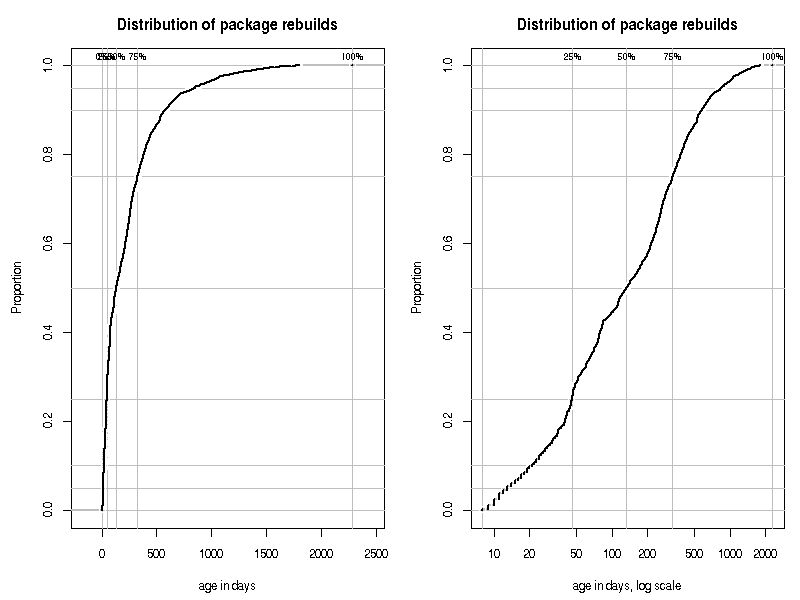 While it is close to impossible to find the 25 or 50 percentile on the first
chart, it becomes a lot easier on the second chart because the x-axis is
'stretched' using the log transform. About one quarters of the distribution appears
to be rebuild within 1.5 months old, and about half is younger than four
months (as a quick call to
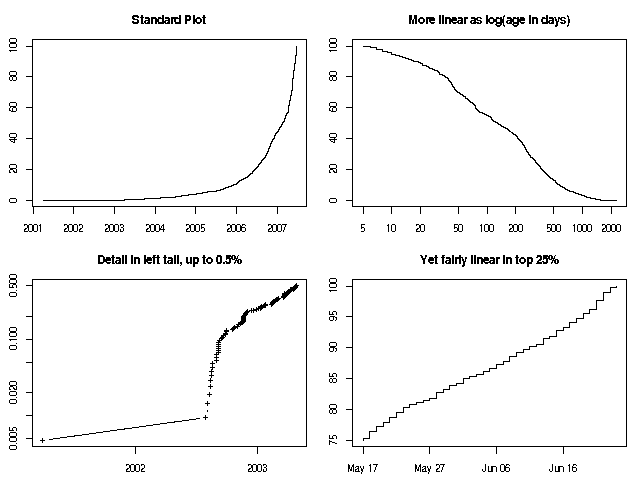 Updated to correctly display the assignment operator