Search Results: "ana"

5 August 2008

Steve Kemp: Five grand a head

It is nice when you work for a company where you can say:
"Ice-lolly break..."
The response?
"Me too!"
Tonight has been a productive evening, I guess the ice-lolly helped! I managed to optimize the storage of rejected SPAM mail for my commercial service. That is something I've been obsessing over recently since the volume of SPAM is currently hovering around 2.5 million messages. Still I suspect it is only a matter of weeks before I need to expand. The current setup has me using three machines: Ideally I'd like to split that up further so that I have a single machine running the web application (the part the user interacts with), a pair of MX machines, and the offsite machine doing the minimal work it does. That way the incoming mail will not affect the application at all directly. Thankfully the split should be trivial. The only hard part is finding a fast webhost that can offer me ~1Gb of RAM, ~1000Gb of disk space, and won't charge much. Ideally around £15/$30 a month. (hahaha! hahaha! ha!) ObQuote: L on

4 August 2008

Russell Coker: New HP Server

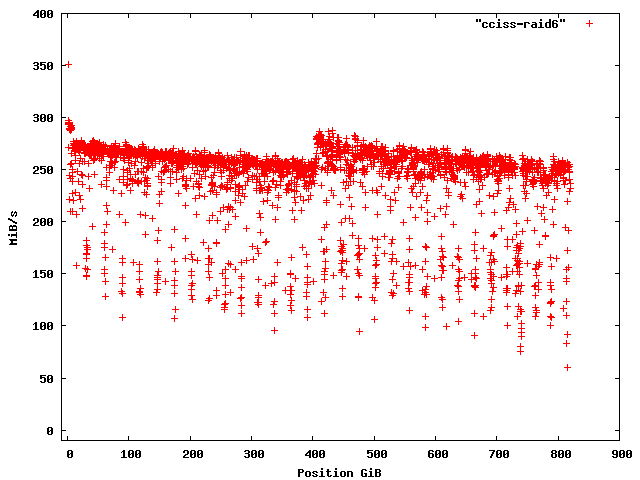
I’ve just started work on a new HP server running RHEL5 AS (needs to be AS to support more than 4 DomU’s). While I still have the Xen issues that made me give up using it on Debian [1] (the killer one being that an AMD64 Xen Dom0 would kernel panic on any serious disk IO) but the Xen implementation in RHEL is quite solid. The first thing I did was run zcav (part of my Bonnie++ benchmark suite) [2] to see how the array performs (as well as ensuring that the entire array actually appears to work). The result is below. For a single disk performance is expected to decrease as you read along the disk (from outer to inner tracks). I don’t know why the performance decreases until the half-way point and then starts with good performance again and again decreases. The next thing was to ensure that the machine had RAID-6 (I have been convinced that that using only RAID-5 verges on professional malpractice). As the machine is rented from a hosting company there was no guarantee that they would follow my clear written instructions involving running RAID-6. The machine is a HP rack-mounted server with a CCISS RAID controller, so to manage the array the command /usr/sbin/hpacucli is used. The command hpacucli controller all show reveals that there is a “Smart Array P400 in Slot 1“. The command hpacucli controller slot=1 show gives the following (amongst a lot of other output):
RAID 6 (ADG) Status: Enabled
Cache Board Present: True
Cache Status: OK
Accelerator Ratio: 25% Read / 75% Write
Drive Write Cache: Disabled
Total Cache Size: 512 MB
Battery Pack Count: 1
Battery Status: OK
SATA NCQ Supported: True So the write-back cache is enabled, 384M of data is for the write-back cache and 128M is for the read cache (hopefully all for read-ahead - the OS should do all the real caching for reads). The command hpacucli controller slot=1 array all show reveals that there is one array: “array A (SAS, Unused Space: 0 MB)“. The command hpacucli controller slot=1 array a show status tells me that the status is “array AOK“. Finally the command hpacucli controller slot=1 show config gives me the data that I really want at this time and says:
Smart Array P400 in Slot 1 (sn: *****)
array A (SAS, Unused Space: 0 MB)
logicaldrive 1 (820.2 GB, RAID 6 (ADG), OK) Then it gives all the data on the disks. It would be nice if there was a command to just dump all that. I would like to be able to show the configuration of all controllers with a single command. Also it would be nice if the fact that hpacucli is the tool to use for managing CCISS RAID arrays when using Linux on HP servers was more widely documented. It took me an unreasonable amount of effort to discover what tool to use for CCISS RAID management.

Runa Sandvik: Assembly 2008

I had to learn it the hard way; really cheap plane tickets doesn’t exist unless you buy them months in advance, and killing three hours at an airport can be done by writing a long post on how to kill three hours at an airport. But Finnair does have the funniest instruction videos I’ve ever seen. Going to Helsinki for Assembly 2008 was worth the money. This was my first party outside Norway, and the one thing that really surprised me was that most of the gamers actually did kill all audio and lights when told to do so. Smash told me that some hardcore gamers just put a towel over their head and screen to continue playing, but I still think it deserves some credit. Being at the party place was ok, even with the security check. I think the scene booth organized by Truck was great, even though I don’t have anything to compare it to. It was nice to see someone walk up to the booth and ask a lot of questions. I’m happy about missing out on Hesburger, and sad that it took me two days to find the Pizza Hut. Boozembly was a lot more fun, even with the rain. I found out that Sauli can be a very nice guy, that you don’t need toothpaste when you have mintu, that guys in kilts got nothing under and that kiitos means thanks. I sure hope information like this will be useful to someone someday. It’s always nice to see old friends, like Spiikki, again and even nicer knowing that you can still pick up where you left two years ago. And it’s fun meeting the skilled people you’ve admired for a long time. Actually telling them that got a bit easier when I managed to stop being so shy. I always find it difficult to keep it short and still cover the most important things, so I just want to say the following; I think the 4k by Portal Process and TBC rocks, and the 64k by Fairlight did impress me. Thanks to Leia and Little Bitchard for letting me crash at their place. And thanks to Gargaj for being awesome.

Russell Coker: Lenny SE Linux on the Desktop

I have been asked about the current status of Lenny SE Linux on the Desktop. The first thing to consider is the combinations of policies and configurations. I will number them if only for the purpose of this post, if the numbering is considered generally helpful it could be more widely adopted to describe configurations.

  1. Default configuration. This has the default policy and is configured with all users having the domain unconfined_t and daemons such as POP servers are allowed to access home directories of type unconfined_home_dir_t. This allows such daemons to attack privileged user accounts.

  2. Some restricted users. This is the same as above but with some users restricted. Daemons such as POP servers are only allowed to access the home directories of restricted users. This means that if a user is to have an unconfined account and receive email they must have two Unix accounts or receive their mail under /var/spool/mail. This is one setsebool command and one (or maybe a few) “semanage login -m” commands from the default configuration.

  3. All users restricted. The system administrator has the domain sysadm_t and users have domains such as user_t. This requires a few more semanage commands. It is equivalent to the old strict policy.

  4. MLS. This is anything that is based around the MLS policy.

Currently I have two Desktop machines running Lenny (a test machine and my EeePC) and one server. I have only just switched my test machine to enforcing mode so have no good data on it (apart from the fact that I can boot it up and login - which is always a good start). The server is running in permissive mode because I have not yet written the policy to allow the POP server to read from unconfined_home_dir_t. I could get it working by switching from level 1 to level 2 or 3, but I want to get level 1 server policy working for the benefit of others else first. My EeePC however is fully functional, I have been doing some work on it - that mostly means running a ssh client under GNOME but that’s OK (desktop environments such as GNOME and KDE are quite complex and demanding, getting a machine to boot and run such a desktop environment tests out many parts of the system). It’s only at level 1 for the moment because I want to get level 1 working everywhere before moving to the higher levels. I want to get things ready for real users ASAP. With the way the policy is managed now it will be possible to move from level 1 to 2 or 3 without rebooting or interrupting running services. So once users have systems running well at level 1 they can easily increase the security at a later date. The problems that I have had are due to text relocations in libraries (see my previous post about execmod permission [1]). I’ve filed bug report #493678 against libtheora0 [2] in regard to this issue and included a patch from Fedora (which disables the non-relocatable assembly code in question). It seems that upstream have some new assembler code to try and fix this issue, so hopefully we’ll have something that can make it into Lenny! I’ve filed bug report #493705 against libswscale0 for the same issue [3]. I included a patch to turn off the assembler code in question but that was not well received. If anyone has some i386 assembler skill and some spare time I would appreciate it if you could try and find a way to make the code position independent while losing little or no performance. One thing to note is that I am now using an Opteron 1212 (2.0GHz dual-core) system for compiling, I run the i386 DomU with a 64bit kernel (I expect that 32bit user-space runs faster with a 64bit kernel than a 32bit kernel), and the disks are reasonably fast. Even so it takes about 15 minutes to build libswscale0 and the other packages from the same source tree. Previously I was using a 1.0GHz Pentium-3 for my Lenny i386 development until I had the libswscale0 build process go for more than 90 minutes before running out of disk space! If your build machine is old enough to only be 32bit then you should probably plan on watching a movie or going to bed while the build is in progress. I have built packages that work around the above bugs and included them in my Lenny repository [4]. If you take the packages from that repository plus the Lenny packages then you should have a functional desktop system at level 1. I would appreciate it if people would start testing that and providing feedback. One important issue is the discovery of libraries that want shared stacks, text relocations, and executable memory. The deadline for fixing them properly is even more of a problem due to the number of people who have to be involved in a solution (as compared to the policy where I can do it on my own). One finally problem is a bug in xdm which causes it to give the wrong context for login sessions due to having an old version of the SE Linux related code [5]. Due to a combination of this and some policy bugs you can not login with xdm. This is not a hugely important issue as most people will use gdm (which has the newer patch) or kdm (which has no SE Linux patch but can use pam_selinux.so). Also another option is wdm which works with pam_selinux.so. I’ve had a response to my bug report suggesting that there’s a bug in the patch (which was taken from gdm so maybe there’s a bug in gdm code too). I haven’t responded to that yet as I’ve been concentrating on the things that will make the most impact for Lenny. At this stage I’m still unsure of when the release team will cut me off and prevent further SE Linux related fixes from going in Lenny. I need at least one more update to the policy packages before Lenny is released. I could release one right now with some useful improvements over what is currently in unstable, but am waiting until I get some other things fixed. If I get everything fully working at level 1 (both client and server) before Lenny then I will provide a similar status report for users and testers of levels 2 and 3. I don’t expect that I will even get a chance to test level 4 (MLS) properly before Lenny releases.

Julien Danjou: Analysing tiling window manager market

I found an interesting but old analysis from Don Stewart about trends in the tiling window manager market. I was curious so I tried to make it again to see the result 8 months later. wm-market I took the vote data rather than installed, because it's more accurate: it tries to count people who use the software rather then people that just installed it. And we all know that installing a software does not mean you're using it. awesome is rising fast. It has overtaken larswm and xmonad very quickly. Now it seems it just kicked wmii out of the game, and the next target will be the famous ion3, which should be deprecated in some weeks. I'm very impressed. I never though it will happen that way. That stats, so it means anything you want them to mean, but I think it's very cool anyway. :-) I think that the next thing to do is to beat the floating-only window manager like the *box, etc An interesting challenge, so stay tuned! ;-)

Marcela Tiznado: When did we start attacking each other?

So, I should be at DebCamp, but I'm back home after driving 800km in one day.  
Why? I still don't know.

The main reason for this post is the irrational and unilateral response I got
from the DebConf Orga Team, with no right to replica of any kind, and with
the violence and humiliation we were treated with. I've helped to make
3 DebConf's possible, and have been involved in many ways for the past years
in Debian, so this shocked me deeply.

The short story is that there was an extra bed in the room I was staying in, the
person who was suppose to be in that bed is a close friend of mine, so I asked
if someone else could use it while they weren't, since that meant I could take
the necessary equipment that I managed to get for DebConf, and also introduce
to Debian someone who is very active and well known in our local community
(and also part of the umbrella foundation used for local finance issues).
I was excited about getting there, like every year. Just to make this extra
clear, this person had already booked the full week of DebConf, just not
DebCamp, as he previously thought he couldn't attend. When he found out he
could, he was thrilled to be able to go and help setup. So, I made the mistake
of not notifying the Orga team about the switch. I did this because it truly
was harmless action, where a bed which would otherwise be wasted would get
used, and, I did not notify the Orga team because they've been very
aggressive, inflexible and unhelpful throughout the planning of the
conference. This doesn't justify it, just explains why someone who generally
is helpful decides to take the wrong path to solve something.

Up to here, nothing very exciting. What made this special, is that when one
of the organizers, Margarita Manterola, found out about the switch, instead
of coming to talk to me, even though she's known me for *years*, she went
and informed the hotel that somebody had committed a crime, and checked in
under a different name, as if me or the person that came with me where
some random stranger. All I can say is, WTF?

Let me stress this, the email that was sent out[1] twisted the facts, to the
extent that some of them are a lie, like the problem arrived at check-in,
when it actually happened while we where napping a few hours after we had
arrived, and any effort made by the Orga team with the hotel where wasted,
as it was one of them who had originally created the problem.

Instead of solving this among us as a group, and, again, "solve" is a
bureaucratic thing, because no one was being harmed, Marga decided to
actually *harm* me personally, the person who I had brought, and DebConf
as a group. What got solved? Nothing. I left, along with someone who
would of otherwise been helping out build DebConf, while the Orga team
demanded a ridiculous fee for me to stay in the hotel.
Rules are rules, I understand, but I also understand everybody listens to
downloaded music, people in Germany install[2] nmap, and a very long list
of rules that we tend not to follow because they're unreasonable or
unnecessarily complicated.
Is this really what DebConf is turning into?

All I can say is I'm very sad and shocked that the people I've worked with
for so many years decided to condemn me over such a meaningless issue, and
especially that the local team, Martin Ferrari, Damian Viano, Maximiliano
Curia and Margarita Manterola would do such thing to "one of there own",
and that the international Orga team would mindlessly follow through with it.

I apologized to the hotel, I do want to apologize to the innocent people who
had to deal with this, and, even though my intentions where good and unselfish,
I regret what happened.

Despite all of this, I'm still deeply committed to Debian, have worked during
the year and deserve to relax and enjoy it, so I will be there for DebConf
as a regular attendee.

See you there!

[1] http://lists.debconf.org/lurker/message/20080802.231856.66c7d3fd.en.html
[2] http://it.slashdot.org/article.pl?sid=07/05/31/1629259&from=rss

Ingo Juergensmann: PostgreSQL on SMP machines

Dear lazyweb,

it's well known that PostgreSQL is not multi-threaded, but runs multiple instances that can run on different CPUs/cores.
We have lately bought a dual quad core system as our new database server and everything is neat and fine as long I'm testing the database locally via socket or TCP on either IP and the database scales about all 8 cores:

postgres@dhcp-140:~$ /usr/lib/postgresql/8.3/bin/pgbench -h 192.168.1.140 -c 8 -t 30000 testdb


Cpu0 : 24.1%us, 3.1%sy, 0.0%ni, 70.9%id, 0.0%wa, 0.0%hi, 1.9%si, 0.0%st
Cpu1 : 24.5%us, 4.8%sy, 0.0%ni, 69.0%id, 0.0%wa, 0.0%hi, 1.8%si, 0.0%st
Cpu2 : 17.7%us, 3.2%sy, 0.0%ni, 77.3%id, 0.0%wa, 0.0%hi, 1.9%si, 0.0%st
Cpu3 : 13.5%us, 2.3%sy, 0.0%ni, 83.0%id, 0.0%wa, 0.0%hi, 1.3%si, 0.0%st
Cpu4 : 22.0%us, 5.3%sy, 0.0%ni, 70.9%id, 0.0%wa, 0.0%hi, 1.9%si, 0.0%st
Cpu5 : 23.5%us, 4.2%sy, 0.0%ni, 70.0%id, 0.0%wa, 0.0%hi, 2.3%si, 0.0%st
Cpu6 : 28.3%us, 4.3%sy, 0.0%ni, 63.7%id, 0.0%wa, 0.0%hi, 3.7%si, 0.0%st
Cpu7 : 23.9%us, 4.3%sy, 0.0%ni, 69.1%id, 0.0%wa, 0.0%hi, 2.8%si, 0.0%st


PID USER PR NI VIRT RES SHR S %CPU P %MEM TIME+ COMMAND
3551 postgres 20 0 98.2m 18m 16m R 11 1 0.2 0:05.30 postgres
3553 postgres 20 0 98.2m 18m 16m R 11 3 0.2 0:05.38 postgres
3546 postgres 20 0 98.2m 18m 16m S 7 7 0.2 0:05.52 postgres
3547 postgres 20 0 98.2m 18m 16m S 7 0 0.2 0:04.22 postgres
3548 postgres 20 0 98.2m 18m 16m S 7 2 0.2 0:04.62 postgres
3549 postgres 20 0 98.2m 18m 16m S 7 4 0.2 0:04.92 postgres
3550 postgres 20 0 98.2m 18m 16m S 7 0 0.2 0:05.84 postgres
3552 postgres 20 0 98.2m 18m 16m S 5 6 0.2 0:04.96 postgres


Column P marks the last used processor that process was running on. As you can see, postgres runs basically on all cores. But when I try to access the database from a remote host something strange happens:

Cpu0 : 22.5%us, 3.7%sy, 0.0%ni, 72.8%id, 0.0%wa, 0.0%hi, 0.9%si, 0.0%st
Cpu1 : 17.8%us, 2.8%sy, 0.0%ni, 79.1%id, 0.0%wa, 0.0%hi, 0.3%si, 0.0%st
Cpu2 : 5.6%us, 1.3%sy, 0.0%ni, 92.7%id, 0.0%wa, 0.0%hi, 0.3%si, 0.0%st
Cpu3 : 18.7%us, 3.2%sy, 0.0%ni, 76.5%id, 0.0%wa, 0.0%hi, 1.6%si, 0.0%st
Cpu4 : 1.0%us, 0.3%sy, 0.0%ni, 98.3%id, 0.0%wa, 0.0%hi, 0.3%si, 0.0%st
Cpu5 : 27.0%us, 2.5%sy, 0.0%ni, 69.8%id, 0.0%wa, 0.0%hi, 0.6%si, 0.0%st
Cpu6 : 0.0%us, 0.0%sy, 0.0%ni,100.0%id, 0.0%wa, 0.0%hi, 0.0%si, 0.0%st
Cpu7 : 34.1%us, 3.7%sy, 0.0%ni, 57.0%id, 0.0%wa, 0.6%hi, 4.6%si, 0.0%st


PID USER PR NI VIRT RES SHR S %CPU P %MEM TIME+ COMMAND
3580 postgres 20 0 98.2m 18m 16m S 13 7 0.2 0:03.56 postgres
3582 postgres 20 0 98.2m 18m 16m S 12 1 0.2 0:03.54 postgres
3586 postgres 20 0 98.2m 18m 16m S 11 7 0.2 0:03.34 postgres
3587 postgres 20 0 98.2m 18m 16m S 11 5 0.2 0:03.36 postgres
3581 postgres 20 0 98.2m 18m 16m S 11 5 0.2 0:03.46 postgres
3583 postgres 20 0 98.2m 18m 16m S 11 7 0.2 0:03.40 postgres
3584 postgres 20 0 98.2m 18m 16m R 11 3 0.2 0:03.36 postgres
3585 postgres 20 0 98.2m 18m 16m S 11 1 0.2 0:03.34 postgres


Postgres runs only on all core with an odd cpuid, that is core 1, 3, 5 and 7. This is reproducible and doesn't change when I connect more then one remote client or by raising the -c parameter. I'm running Lenny:

dhcp-140:~# dpkg -l grep postgres
ii postgresql-8.3 8.3.3-1 object-relational SQL database, version 8.3
ii postgresql-client-8.3 8.3.3-1 front-end programs for PostgreSQL 8.3
ii postgresql-client-common 88 manager for multiple PostgreSQL client versi
ii postgresql-common 88 PostgreSQL database-cluster manager
ii postgresql-contrib-8.3 8.3.3-1 additional facilities for PostgreSQL


So, dear lazyweb, when you have some tips to debug or solve the issue, please comment! I don't know yet if this is a bug and when, if it's in Postgres or maybe in the kernel (2.6.25-2-amd64)?

2 August 2008

Adeodato Sim : Updates

Oh dear, more than a month without posting here. Let’s throw in some random updates:
  • I’m in Dublin for the summer, doing an internship at Google. I’m not exactly thrilled by the project they’ve assigned me to, mostly because it’s C++, but oh well. We’ll see later about getting a full-time position.
  • I’m not going to be at DebConf. Not only I got the “amount unable to fund yourself” box backwards (40% vs 60%), but the money I was hoping to spend in travelling was unexpectedly needed at home. I tried tricking Google into sponsoring me, but as I was told, “In Google we are generous, but not that generous”. This is the first DebConf I’ll be missing since I joined Debian.
  • I didn’t fare too well in my return to University. I abandoned most courses, and got my first failure (ever) in one of the few I didn’t abandon. I’ll continue studying one more year at least, but it’ll be hard deciding what to do if I don’t manage to finish by then, because I really, really need to go forward with my life.

1 August 2008

Junichi Uekawa: Trying to debug a race condition in dsh.

Trying to debug a race condition in dsh. I received a report that dsh drops a few hosts when running 'hostname' on parallel on 1000+ node clusters. I have set up some testsuite and simulation environment, and found some possible causes, and managed to reduce that rate to about 1/3000. However, it's not zero, and I feel uneasy that not all corner cases have been found. I hate this feeling.

Erich Schubert: New pyroman release

As mentioned earlier, I've uploaded a new Pyroman release to Debian. I've also updated the download at the download page on alioth for the non-Debian users.There is just one single user-visible change (under the hood I switched some Python API so you need python 2.4+ now, which was available in sarge already):This version has a new command line option, "--verification-cmd". This can be used to point to a script file to verify network connectivity. For example, you could try to send a ping to the next router, or you could ssh to another host, have it ssh back and touch a flag file in /tmp to signal success.Similar to the --safe option, it is meant as a safety feature to avoid locking yourself out of your system. But while --safe needs to be used interactively, this new command could be used when automatically activating new firewall rules, e.g. triggered by cfengine or some other configuration management. If the verification command does not succeed, the firewall rules will automatically be rolled back to the previous state.Note that I didn't get around to add IPv6 support yet. It would definitely be desirable to add ip6tables support, but I currently do not have any experience with IPv6, so I'm not sure I'd know how to do things right. Of course I'd welcome any patches.(In case you havn't read about pyroman yet - it's yet another tool to configure iptables firewalls. It puts a thin abstraction layer on top of iptables, but the main benefit is that it uses "iptables-restore" to quickly mass-set all the firewall rules - other tools tend to invoke several hundred iptables processes to achieve the same - and if any error occurs it will both give you a clear indication of which rule caused the error and rolling back your firewall to the previous state.)

Matthew Garrett

Coincidentally, I had the opportunity to poke at a machine that actually does deliberately treat Linux differently in its ACPI tables today. Jeremy was poking at an Acer Aspire One before installing Fedora on it, and Dave noticed that it printing a bootup message indicating that the firmware was testing for _OSI("Linux"). A bit of poking later, and we have the following:
            If (_OSI ("Linux"))
             
                Store (0x03E8, OSYS)
                Store (0x0A, \_SB.PCI0.LPC.S4TM)
                Store (0x43, \_SB.PCI0.EXP2.PXS2.LSMP)
                Store (One, \_SB.PCI0.EXP2.LL0S)
                Store (One, \_SB.PCI0.EXP2.LLL1)
             
            Else
             
                If (_OSI ("Windows 2006"))
                 
                    Store (0x07D6, OSYS)
                    Store (0x06, \_SB.PCI0.LPC.S4TM)
                    Store (Zero, \_SB.PCI0.EXP2.PXS2.LSMP)
                    Store (Zero, \_SB.PCI0.EXP2.LL0S)
                    Store (Zero, \_SB.PCI0.EXP2.LLL1)
                 
Other OSes get the same values as Linux, other than the OSYS field. Now, what do these writes do? They're all to PCI config space, so since the machine in question is a 945/ICH7 machine we have publically available docs. A bit of digging later and it shows that the firmware is disabling PCIE active state link control and programming more conservative timings for entry into the C4 processor idle power saving state. In other words, certain bits of power management functionality are compromised if it detects that it's running anything other than Vista. Weirdly, it also flags the HPET as present but invisible on Linux, but I suspect that's an oversight rather than anything deliberate.

Why would they do this? I've no idea. I suspect it's something to do with the degree of platform validation performed rather than a subtle attempt to degrade Linux's battery life on the hardware (frankly, we do a good enough job of that ourselves right now), but this is exactly the kind of reason we removed _OSI("Linux") support from the kernel. Vendors will do stupid things with it.

Petr Rockai: adept 3.0 alpha 5

Short introduction: Adept is an APT frontend for KDE. You can use it to search for packages, install, uninstall, upgrade, all the usual things. It’s gone through a number of changes since 2.1, which has been the default package manager on Kubuntu for some time now. What’s new since 2.1
  • A KDE 4 application,
  • mostly rewritten from scratch,
  • more reliable already (in alpha) than 2.1,
  • much better & more reliable handling of interactive installs (debconf, changed config files),
  • fulltext search (powered by Xapian),
  • all new user interface,
  • faster and more responsive in about every respect.
Where to get Since compilation is still not that trivial (well, it’s 3 packages to compile and install, really, and you have to get them with darcs), I have prepared binary packages for the two main “target distributions”. In Debian, you can install alpha 5 from experimental:
apt-get install -t experimental adept
The sources.list line is:
deb http://ftp.debian.org/debian experimental main
If you are on Kubuntu Intrepid, the line is
deb http://ppa.launchpad.net/mornfall/ubuntu intrepid main
(more instructions on https://launchpad.net/~mornfall/+archive) What (and how) to test All of the previous components (save for notifier, which is not included at all yet) have been merged into a single binary, that is adept. I have missed desktop files in this alpha (it might be a little on purpose too, as I’d like people to run the program from terminal to be able to check the debug output and possibly send it along with problem reports). If you have sudo (Kubuntu-ers do, the rest can use kdesu or similar):
sudo adept
sudo adept installer
sudo adept updater
are the magic commands. Please give a go to all of them, report rough edges, crashes and all that, either through irc (mornfall at freenode, oftc) or mail me-at-mornfall-dot-net or use KDE Bugzilla to report bugs. Missing features I have one outstanding issue on “must have for 3.0”, that being filtering packages according to their state. There is also no actual way to browse through the 19k+ packages, but might have to give for 3.0. A “browsing” mode is likely for 3.1, although still could make it for 3.0 if I get my act together on that one. We’ll see how alpha testing goes, maybe I’ll have hands full of bugs to fix and won’t get anywhere on features… Known Issues
  • It seems that alpha5 does not play very well with the “autoremove” apt-get feature, I have that on todo, but please don’t blindly run autoremove after using alpha5.
  • It seems to crash upon exit, with a “double free or corruption” error from glibc. I’ll deal with that.
  • In alpha3, it used to keep running after you have closed its window. Please check that you don’t have stray adept process after exiting (I have not seen that happen in alpha5, but you never know) and if you do, please report.
  • The search in installer is case-sensitive, exact substring match, against I think short description only. That needs to be addressed.
Reward For the brave, fearless testers, I unfortunately cannot promise anything else than fuzzy feeling for doing a good thing… I won’t be at aKademy nor Debconf this year, so I can’t even promise beers. Maybe next time. ; - )

Julien Danjou: First release candidate for awesome 3

It's done! After more than 6 months of work, more than 1000 changesets, I managed to get out awesome 3 first release candidate version! I've done a quick announcement on the list. I am very excited to get some feedback about it. So far all I got has been very good. I've also changed the Web site design.

Eddy Petrișor: Recommending the MSI MegaBook PR200WX-058EU laptop to Linux users

I recently bought a new MSI laptop and I am really pleased with my choice so far.

Since with the previous laptop I managed to kill two of my desired features, long battery life and pretty portable, I decided is time to look really well and see what the market has to offer.

I settled on a MSI PR200WX-058EU which has the following:
  • built on a Centrino platform
    • Intel(R) Core(TM)2 Duo CPU T8300 @ 2.40GHz
    • Intel Corporation PRO/Wireless 4965 AG or AGN
    • Intel mobile chipset
  • 3GB of memory (yes, I would have enjoyed 4, but it seems the 32 bit barrier still decides hardware configurations)
  • 320GB HDD
  • DVD+/-RW
  • Mobile GM965/GL960 Integrated Graphics Controller
  • 12" wide screen (1280x800)
  • 1 Realtek Semiconductor Co., Ltd. RTL8111/8168B PCI Express Gigabit Ethernet
  • 8 cell battery by default (long battery life)
  • 1 USB 2.0 Camera - uses luvc driver
  • bluetooth
  • 1 card reader
  • 3 USB port, 1 HDMI, 1 D-sub 15 connector, 1 PCI Express port, modem port
  • fingerprint reader
  • an advertised weight of 1.8kg (I weighted it at 2.1kg with the 8 cell battery)

In other words a small and mobile powerhouse for which I payed 3800 RON (approx. 1100 ). I'd say not too bad at all.

Thanks to Gon ri Le Bouder and some searches on the internet I concluded that
the brand is not bad at all, and now that I have it I really am sure.

Of course, I installed Debian Lenny on it (I also sent an installation report), and, in spite of the initial problems, I managed to make the laptop work pretty nice, but I am especially excited about the webcam, which works with the linux-uvc driver.


There were some issues, but I managed to fix some them while I have been ignoring some other. The LaptopTestingTeam page for MSI PR200 on the ubuntu wiki was very helpful.
What have I been ignoring?
  • it seems that from time to time the battery charge status isincorrect, or acpi report that the AC is plugged in
  • headphones don't automatically turn off the speakers
  • fingerprint reader is not used yet, but I intent to experiment at some point with it (authentication via the fingerprint would be cool)
  • the keyboard seems a little bit too hard (but I hope it will loose up with time)
  • modem isn't probably working, but I don't think I'll ever try
  • there are some issues in gnome-power-manager which cause strange behaviour and grief wrt screen brighness
  • sleep doesn't work,but hibernation does


What would you do if I'd tell you that the battery lasts 4 hours or even more while the wlan is on and working (browsing and stuff like installing new packages, configs) with the brightness set to minimum?


I am really excited about this and I can say that I think I have found my next generation laptop, so if you're thinking of a cheap mobile powerhouse on which Linux must run, this laptop might be for you.

I find the following to be selling points (for a Linux buyer or others):
  • comes with FreeDOS, so no extra money for an OS you don't use
  • wifi works
  • webcam works with luvc
  • no big problems during install (the most severe are already fixed)
  • long battery life, even when using wifi (4+ hours in browsing+some package installation mode, according to my tests)
  • light enough to carry around easily (2.1kg, 2.4kg with charger)
  • nice design - some people asked me if I bought a MacBook
  • 4 state kill switch for all possible combinations for wifi/bluetooth
  • hibernate works with 2.6.24 or newer (sleep doesn't, but I will try a few things later)
  • there's no mechanical latch for the lid, there is a magnet, so there's no plastic to be broken, the laptop is more robust
  • the 8 cell battery is thicker than the regular one, allowing better ventilation
  • it seems it doesn't get too hot to put on my lap (still, I am a little afraid of blocking its ventilation due to the fabric of my clothes, so I'll probably try to carry around a hard paperboard or something like that)
  • the big resolution 1280x800 (for this screen size) seems to partly compensate for the reduced physical size of the screen (12")
  • bright screen

So, thanks again to Gon ri, Debian Installer team, LVM2 maintainers, Ubuntu Laptop Testing team, linux uvc developers, Lilo developers and maintainers, all the nice people who made and still make Debian possible.

31 July 2008

Matthew Garrett

Various people have asked me why there'd ever be a justification for ACPI tables to base various types of behaviour on the operating system they're running on, and why Linux claims to be Windows. There's pretty straightforward explanations that don't involve conspiracies, but they're not necessarily obvious. Let's start from the beginning.

ACPI provides two mechanisms for determining the OS, _OS and _OSI. _OS is an ACPI object containing a string. This string is supposed to represent the operating system. Windows 98 contained "Microsoft Windows", NT4 "Microsoft Windows NT" and ME "Microsoft WindowsME: Millennium Edition". All later versions of Windows contain "Microsoft Windows NT". Linux was "Linux" up until 2.6.9, and has been "Microsoft Windows NT" since then.

The obvious drawback to _OS is that it's a single string. _OSI was introduced with later versions of ACPI, providing an interface for ACPI tables to request which interfaces an OS supported. Interfaces may be something like "3.0 Thermal Model", indicating support for a specific aspect of ACPI, but may also be used to indicate the interfaces supported by the OS. The _OSI method is passed a string and returns either true or false depending on whether the OS claims to support that interface. The OS can therefore claim to support many different interfaces. Linux implements pretty much every aspect of ACPI that Windows does, and so claims to support all the interfaces that Windows implements. As a result, Linux will return true when asked if it implements support for any of the Windows interfaces (up to and including Vista).

That's all straightforward enough, but leaves two questions. The first is why Linux now claims "Microsoft Windows NT" for _OS. That's actually pretty simple - some DSDTs only check for various _OSI strings if _OS is "Microsoft Windows NT". This is stupid of them, but not a violation of the ACPI spec. The second is why Linux returns false for _OSI("Linux"). This is a little more subtle, but it basically boils down to "There is no Linux interface". The behaviour of Linux changes over time. We make no guarantees that its behaviour will be consistent over time as we find and fix bugs. Microsoft take a different approach. Their ACPI behaviour has few changes over time. Something claiming to be Windows 2000 will always behave the same way. We can't even bump the interface string per release - doing so would require us to maintain every broken behaviour we've ever implemented and switch between them depending on what the BIOS asked us for. Linux does not provide a stable ACPI API to platform firmware, and we make no guarantees that it ever will. The only behaviour you can depend on is that Linux will conform to either the ACPI spec or (where it differs) the behaviour of Windows. If you find behaviour that does not fall into either of those categories, then it's likely that the behaviour will change when we notice. The reason we removed Linux from the supported interfaces list in 2.6.24 was that we were beginning to see BIOSes that changed behaviour when they detected that they were running on Linux, and changes we wanted to make could have potentially broken these BIOSes.

Anyway. That's why we claim to be Windows. Now, why would a DSDT want to do anything with that information? It should be noted that making decisions based on this is not a contravention of the ACPI spec - section 5.7.2 even describes a case of this. There are a few situations under which this can be helpful. The first is due to varying interpretations of the spec. Early versions of Windows require that hotswap bays signal their removal by sending a bus check notification to the parent IDE bus. Later versions want a device check notification on the device itself. Both are valid, but you ideally want to use the right one on the corresponding OS. Checking the OS version lets you do so.


Red Stripe makes a lousy spec-compliant ACPI implementation. That is because it is not a spec-compliant ACPI implementation, it is beer! Hooray beer!

Another is user experience. Not all hardware is supported by all operating systems. For instance, older versions of Windows don't support high-precision event timers (HPET). The HPET is defined as an ACPI device, and so will show up as an unknown device in the Windows device manager unless the firmware disables it. This is acheived by altering a flag in the _STA response depending on the Windows version - earlier versions are told that the device should be invisible, and later versions are told that it should be exposed. Finally, there's bug workarounds. An example of this is Windows 98 crashing if a thermal zone reports a temperature of less than 15.8 degrees celsius. Working around that seems like a perfectly reasonable thing for a piece of hardware to do, since Microsoft don't make it easy for vendors to provide hotpatched versions of Windows.

The final part of this mystery is why various BIOSes attempt to check whether they're running on Linux. Almost all the BIOSes I've examined do nothing with this information, which is consistent with someone writing an OS lookup table many years ago and adding Linux just in case someone found it useful. People don't generally write ACPI tables from scratch (doing so would be very dull), so they'll base it on the one from a previous version. Code won't be removed unless it's breaking things, so you'll end up with various odd evolutionary dead ends that have persisted anyway. If your ACPI firmware checks for Linux, this is not inherently a bug in your BIOS. It's more likely that nobody cared enough to remove two lines of code that might turn out to be useful one day.

Antti-Juhani Kaijanaho: Making it official

I just wrote this in my user page in the English wikipedia:
Antti-Juhani Kaijanaho is no longer actively working on Wikipedia. While I approve, in principle, all the new and stricted editor policies, it is emotionally very demanding to be challenged under new policies for edits that were made in good faith under older policies. There just aren’t enough positive aspects to doing Wikipedia to offset that very big negative aspect.
Some of the challenges toward my edits have happened in the English Wikipedia, and some in the Finnish Wikipedia. I have felt like this for about a year now – it’s probably time to make it official. I may make minor edits, or write in talk pages occasionally, but any substantial edits I won’t bother with any more.

30 July 2008

Matthew Garrett

The Linux Plumbers Call for Papers is open for another day or so. It's looking like we'll have an excellent spread of interesting power management topics, but if you've got anything interesting to say then throw it forward. We're looking for kernel issues that have an impact on userspace, userspace issues that need kernel support and anything else that involves the interesting interactions between the two.


Hats for everyone and cab it to the Gold Club

San Francisco has been somewhat hectic, but yesterday included a quick trip to the office to discuss community involvement in improving power management. Look forward to developments there. Independently, I now join Brian the guy who had been clean too long to get onto the drugs rehab program (hurrah voicemail) in being an ex-owner of my US phone number. Probably best to delete it if you have it.

In other news, Foxconn are sending me a board with the "controversial" AMI BIOS in order to figure out what's going on. Progress by this time next week, with luck.

Joerg Jaspert: Argentina - Mar del Plata

After a night at Tinchos place, then driving and walking around Buenos Aires a day and finally taking a 5hours bus trip, Mark, Stephen and I arrived in Mar del Plata early this morning, at around 05:30AM. Brr, early. We could checkin to the Hotel at 06:30. During checkin we discovered that Stephen and my birthday are, in absolute numbers, 6 years, 6 months and 6 days apart, ie. 666. And we are managing the evil, I mean, the network for DebConf. HA. HAHA. HAHAHAHAHAHAHAHAHAHAHAHA. Ignoring that - stuff looks pretty nice over here. Most machines are working, most services we (as in admins, not video team) care about are setup or will be ready within the next 2 days, the Hotel stuff is doing the last preparations, it all looks great. There hasn’t been a DebConf that was that prepared, ever. We currently have a local smtp server accessible for everyone here (no direct outgoing smtp, we firewall that), a local OFTC IRC Server (Freenode IRCd is in setup), soon a full (pushed) mirror, preparing an upload queue for ftp-master, a schedule announce bot is also ready to run, most of the building has good wireless covering (and the rest is scheduled to get better soon). And lots of other nice things that are surely there and I just forgot to mention but which we will mention in some wiki page in time for you. (Oh, and make sure to listen to what DHCP tells your machine, all the various services get send to you :) ). Comments: 0

29 July 2008

Axel Beckert: Dear Aunt Google,

… this is “Do no evil”—urchin.js isn’t. For luck, urchin.js and friends can be easily blocked using e.g. Firefox plugins like AdBlocker or NoScript, or with filtering proxies like Privoxy. And a line like
address=/google-analytics.com/0.0.0.0
in the dnsmasq.conf of your home router works like a charm, too.

SCNR, via Symlink

28 July 2008

Jacobo Tarrío Barreiro: Translating the Debian installer

As some of you know, I’ll stop working on Galician translations (of everything) after Lenny is released (or after the end of October, if Lenny is not released before). Before that, I’m going to start documenting several aspects of my work on it in several blog posts. I’m not going to follow any particular order; when everything’s written, I’ll collate the documents and make them available together in a single coherent document. Although it is written for the future Galician team, this work (even the final document) will be written in English. If it is a problem for anyone, I don’t want them as translators. And, also, this will make this document potentially useful for other teams.
The Debian installer system (d-i, for short) is made up of several components. Some of these components were written especially for the Debian installer; others, however, are standalone applications which are used during the installation of Debian. The translations of many of these components are managed separately; however, an effort is being made to keep track of them, providing a single dashboard where a translator can see the status of the d-i translations, get files to translate, instructions for submitting the translations, etc. This dashboard resides at http://d-i.alioth.debian.org/l10n-stats/. There is a translation guide for d-i, explaining what components are in each level, how to retrieve the files to translate or update, and how to submit the translated files. I’m giving here a short summary in this post. For translation purposes, d-i is divided in five levels. Level 1 contains the strings everyone sees when installing Debian — the following levels contain components whose translation is less user-visible. Therefore, when translating d-i you should prioritize level 1 translations, then level 2 translations and so on. However, this doesn’t mean that they are any less important; you should try to always keep them up to date! You can see the status of every language in each level by going to the l10n-stats page. If you click on a language you can see a text file with a more detailed report on the translations for that level and language. You can also opt in to receive emails every morning when the status in a level for your language changes — you’ll have to ask Christian Perrier to subscribe you to the websec-txt notifications for your language. Level 1 translations are maintained on Alioth, so you should get an Alioth account and request to be added to the d-i project as translator. Then, you’ll be able to download and upload the translations using Subversion. There are lots of programs and packages that comprise level 1; however, to make translation easier and more efficient, the translations are consolidated in only 5 files (called sublevels). In this way, if the same string appears several times in several programs, you only need to translate it once. It’s 5 files instead of a single one so that it’s easier to distribute work, assign priorities, etc. The other levels consist of translations of individual programs, which are maintained in many different ways. The particular methods you have to use for each package are detailed in the translation guide. For most of them, it involves downloading the .POT or .PO file from a read-only version control repository, and uploading the translation using the Debian BTS.

Next.

Previous.