Search Results: "tim"

16 November 2013

Russ Allbery: Review: Wanderlust

Review: Wanderlust, by Ann Aguirre
Series: Sirantha Jax #2
Publisher: Ace
Copyright: September 2008
ISBN: 0-441-01627-8
Format: Mass market
Pages: 312
Wanderlust is the second book in the Sirantha Jax series and a direct sequel to Grimspace. There's no point in reading them out of order. The new shape of Sirantha's universe is still coming together after the climactic events of Grimspace, but they seem to involve a new job. In politics, even, but one for which she's uniquely qualified. Before she can even accept it, she finds out that multiple parties are interested in her taking this position, for widely varying reasons. But she starts her new position by taking a detour to visit some old friends (and the planet I liked least in Grimspace's settings), which turns into a war and a comprehensive distraction that lasts the rest of the book. The biggest problem with Wanderlust (and unfortunately there are several) is that it doesn't feel like a complete book. The first few chapters set up what appears to be the next step of Sirantha's adventures, as well as establishing a new villain, and then the rest of the book is an extended detour. She does learn more about the new villain, but almost everything that's set up at the start of this book is still unresolved at the end of it. The detours are moderately entertaining and (at least after an initial decision based on unfinished business from the first book) are at least related to the plot, but this feels like the setup and middle-book distractions of a book twice as long. I came away wondering why all of that was really necessary and why I had to wait to the next book to read the actual plot. The second problem with this book is the whining. And the angst. And the self-esteem issues. And did I mention the whining? Okay, I get that one of the distinguishing elements of this series is that it's space opera with an urban fantasy first-person perspective, and the latter usually comes with extensive angst and insecurity about one's love life. But, really, I am not interested in Sirantha complaining about her appearance yet again, and I am particularly not interested in the obnoxiously tedious "I love you and therefore I must push you away" dance that both she and the male romance lead do through half this book, and only stop doing because they can't any more. I realize that self-destructiveness is a thing, and that people do react this way, but I don't want to read about it, and I particularly don't want to listen to the narrator whine about how hard it all is for much of the book. Some of the appeal of Sirantha is that she's fragile, paranoid, and all sorts of messed up, but she muddles through and manages to do the right thing anyway. However, for me, the key word there is "do." When she's twitchy and angry and sarcastic and scared but doing something (which does also happen in this book), I really enjoy this series. When she's living in her own head and building elaborate plans for how she's going to destroy her life this time, it starts getting tiresome. It doesn't help that I don't see what she sees in her romantic partner (at least most of the time; he has his moments), and therefore I have even less sympathy for her grand self-sacrificing gestures. Thankfully, there are good parts too. Aguirre introduces a few new characters, all of whom I liked. Sirantha is assembling quite the ragtag band of misfits, and they're misfits in all the right sorts of ways. They play off each other well and they're full of plot hooks. We also get an amusing twist on Sirantha's relationship with her personal assistant AI, which, while bizarrely tangential to the plot, looks like it will hold a lot of promise for the future. And I love Vel, who made the end of Grimspace and who continues to be a highlight of these books, partly because he doesn't throw emotional temper tantrums or indulge in bizarre silent treatments. I always love the quietly competent characters in stories like this. This is not up to Grimspace, but hopefully it's an aberration. It's not bad, exactly, but it went off the rails. Thankfully, the next book promises quite a lot of Vel, which will hopefully be an improvement. Followed by Doubleblind. Rating: 6 out of 10

Lars Wirzenius: Debian: developing it wrong

This is an essay form of a talk I have given today at the Cambridge Mini-debconf. The talk was videoed, so will presumably show up in the Debconf video archive eventually. Abstract Debian has a long and illustrious history. However, some of the things we do perhaps no longer make as much sense as they used to do. It's a new millennium, and we might find better ways of doing things. Things that used to be difficult might now be easy, if we dare look at things from a fresh perspective. I have been doing that at work, for the Baserock project, and this talk is a compilation of observations based on what I've learnt, concentrating on things that affect the development workflow of package maintainers. Introduction and background I have been a Debian developer since August, 1996 (modulo a couple of retirements), and have used it a little bit longer. I have done a variety of things for Debian, from maintaining PGP 2 packages to writing piuparts to blathering excessively on the mailing lists. My day job is to develop the Baserock system at Codethink. Baserock is a set of tools and workflows for developing embedded and appliance Linux systems. If you squint, it looks a bit like a source-based Linux distribution. I have worked on Baserock since September, 2011. Some of Baserock's design has been influenced by my experience with Debian. With Baserock I have the chance to fix all the things that are wrong in Debian, and this talk is me giving back to Debian by pointing out some the things I feel should be fixed. I don't have solutions for these problems: this is a bug report, not a patch. It's also perhaps a bit of a rant. I am specifically concentrating here on technical and tooling issues that affect the development process of Debian. I excluding social issues. I am also not trying to get Debian to switch to Baserock. Baserock is targeting embedded and appliance systems, and makes simplifying assumptions based on those targets, which Debian does not get to do. I am pointing out problems, and I am outlining solutions as implemented in Baserock, when I think the concept carries over well to Debian. Build tools should be intelligent, packaging should be dumb In Debian, the fundamental tool for compiling the upstream code and assembling a binary package is dpkg-buildpackage. It uses debian/rules, which is a Makefile with targets with specific names and semantics. By executing the right targets in the right order, dpkg-buildpackage tells the source package to build the binary package. On the one hand, this is a nice design, because it abstracts away the large variety of upstream build systems into one API for dpkg-buildpackage to use. On the other hand, it puts all the intelligence for how packages are built into the packages. Making packaging intelligent, rather than the build tool, means packagers need to do more work, and there's more work to do when, say, the Debian policy changes, or when there are other changes that affect a large number of packages. If packaging is intelligent, then every package needs changes. If the build tool is intelligent, then you change the build tool and re-build everything. In Baserock we put as much intelligence as we can into the Morph tool, which drives the build process. It turns out that today, unlike in 1995, most upstream projects use one of a handful well-known build systems: autotools, cpan, cmake, Python distutils, etc. With just a little extra logic in Morph we avoid having any delta against upstream in Baserock. This doesn't work for quite all upstream projects, of course, but we've spent the 2% (two, not twenty) of effort that solves 80% of the problem. In recent years, the dh approach to packaging has made a lot of packages be able to have only a minimal, 3-line debian/rules file. This is excellent. Wouldn't it be nice if even that wasn't needed? It'd save thousands of files in source packages across the archive, at least. It would be easy to: if the file is missing, have dpkg-buildpackage assume the 3-line version by default. Getting rid of a single file is, of course, not a particularly big win. The big win is the change in mindset: rather than dealing with all new issues in development by adding yet more fields to debian/control and more optional, competing tooling outside the core toolset, if you improve the tools everyone uses, then everyone's packages gets better. The goal should, in my opinion, be that for the large number of packages where upstream uses a well-known, well-behaved build system, and uses it in a reasonably sensible way, the Debian source package should not require anything added to make the package build. There will still be a need to add some stuff, such as the debian/copyright file, to make a good Debian package, but just getting the package to build should require nothing extra. (Side note: wouldn't it be nice if there was a well-known, widely used way to mark up copyright information so that debian/copyright could be constructed and updated automatically?) Configuration file handling on upgrades: add ucf to dpkg already In the 1990s, dpkg had excellent handling of configuration files and merging local changes with changes from the new package version, but it was excellent only because it tried to do that at all, and mostly nothing else did. It hasn't changed much, since, and it's not excellent on any absolute scale. We have the ucf tool, which can do a better job, but requires to be added to each package wanting to use it. Why don't we make dpkg smarter, instead? If ucf is not not good enough to be merged wholesale into dpkg, let's write something better. Making every package maintainer use ucf manually is just wasteful. This is not the kind of thing that should be done for each package separately: the package manager should be smart so that packaging can be stupid. The goal should be that dpkg is smart enough in its configuration file handling that having the package do it is a very rare special case. Clean building shouldn't be hard The basic tool for building a package is dpkg-buildpackage. It is ever so slightly cumbersome to use, so there are some wrappers, most importantly debuild. However, if you're making a build intended to be uploaded to the Debian archive, you should be doing a clean build. This means having to learn, configure, and use yet more tools. A clean build is important: security updates, development, debugging, quality control, porting, and user support become more difficult if we don't know how a package was built, and can't reproduce the build. It gets harder to keep build dependencies correct, making it harder for everyone to build things. Luckily, Debian has solved the clean build problem. Unluckily, it has solved it multiple times, creating the problem of having to choose the clean building approach you want to use. The default way of building is not clean, so then you have to remember to use the non-standard way. You also get to spend time maintaining the clean build environments yourself, since that doesn't seem to be fully automated. None of this is hard, as such, but it's extra friction in the development workflow. The primary approaches for clean building in Debian seem to be pbuilder, cowbuilder, and sbuild. I happen to use pbuilder myself, because it's what's been around the longest, but I make no claim of having made an informed choice. That is part of the problem here: why should I have to spend the effort to become informed to make a choice well? Why is the default way of building not clean? Don't say performance: Morph sets up a clean staging area in seconds, and does not offer you a choice of not doing so. It's a chroot, with everything but the build tree hardlinked from cached, unpacked build dependencies, and protected using read-only bind mounts. What's more, this approach avoids having to maintain the pbuilder base tarballs or sbuild chroots manually. It's all automatic, and up to date, for every build. Furthermore, the staging area contains only the specified build dependencies, and not anything else, meaning a build fails if a build dependency is missing, rather than succeeding because it happens to be in the default set of packages the build tool installs. Mass building shouldn't be hard Suppose you want to try out a large-scale change in Debian. It might be trying out a new version of GCC, or using llvm's clang as the default C compiler, or updating glibc, or doing a large library transition such as a new version of GTK+, or trying a new dpkg version, or even something more exploratory such as changing the default optimisation flags for all packages to see what breaks. All of these will require you to at least rebuild all affected packages. Ideally you'd test the built packages as well, but let's concentrate on the building for now. Here's what you do. You make the changes you want to try out, and build those packages. You create a dedicated APT repository, and upload your packages there. You configure your build environment to favour that APT repository. You make a list of all reverse build dependencies of the packages you changed. You write a script to build all of those, preferably so that if you change A, and rebuild B, then you also rebuild C which build depends on B. Each rebuilt package you also upload to your APT repository. You keep track of the build log, and success or failure, of each build. The people in Debian who do this kind of stuff regularly presumably have tools for doing it. It shouldn't be a rare, special thing, though. If my package has reverse build dependencies, I should at least consider testing building when I'm making changes. Otherwise, it might take years until the reverse build dependencies are rebuilt, and the problem is only found then, making it harder to fix. To be fair, building a lot of packages takes a lot of resources. It's not feasible to rebuild everything in Debian every time there's any change to, say, eglibc. However, it's feasible to do it, for large subsets of the archive, without huge hardware investments. One VCS to rule them all In 1995 there was really only one relevant version control system: CVS. It was not a great tool. In 2000, another contender existed: Subversion. It fixed some problems in CVS, but still wasn't a great tool. In 2005, there was a great upheaval and distributed version control systems started to become mainstream. There were a large handful of them. In 2010, it was becoming pretty clear that git had won. It's ugly, but it's powerful. I'm not going to debate the relative merits of different version control systems. Until recently, I was a Bazaar boy, and all of my personal projects were kept in Bazaar. (I have recently switched everything to git.) There are, however, strong benefits from everyone using the same system. Developers don't need to learn a dozen version control systems. Tools that operate on many repositories are easier to write and maintain. Workflows become simpler if one system can be assumed. Debian has a strong historical tendency to choose every option. This is sometimes a good thing, and sometimes a bad thing. For keeping source packages in version control I believe it is to be a bad thing. The status quo is that a Debian source package may not be in version control at all, or it might be in any version control system. This is acceptable when everyone only ever needs to maintain their own packages. However, in a distribution the size of Debian, that is not the case. NMUs, security support, archive wide transitions, and other situations arise when I might need to change yours, or you might need to change mine. We try to work around this by having a complicated source package format, using quilt to maintain patches to upstream semi-manually in a debian/patches directory. This is an awkward workflow. It's a workflow that trips up those that are not used to it. (I know quilt is a patch management system, not a version control system. I think git does it much better anyway.) It would be oh so much easier if everyone kept their source packages in the same, real version control system. I don't even care what it is, as long as it is powerful enough to handle the use cases we have. Imagine a world where every Debian source package is kept, for argument's sake, git, and everyone also uses the same layout and roughly the same workflow to maintain it. What would this mean? It would mean that if you want to inspect the history of your package, you know how to do that. If you want to merge in some bugfix from upstream code, you know how to do that, without having to figure out which of the several source package formats are in use. It would make feasible the development of more powerful, more higher level tooling. For example, it would allow Debian to have what we call system branches in Baserock. In Debian we have stable, testing, unstable, and experimental. We may get something like Ubuntu's PPAs, or perhaps an improved version of those. These are very poor versions of system branches, just like quilt is a poor way to manage patches and deltas against upstream. For example, you can upload an experimental version of gccto experimental, but then nobody else can upload another experimental version. You can set up your own PPA for this, but you'll still be affected by all the uploads to unstable while you're working. A Baserock system branch is a branch of the entire system, or the entire distribution in the case of Debian. It is isolated from other system branches. In branch in an individual repository is a well-known concept. A system branch is conceptually like branching every repository in the distribution at once. The actual implementation is more efficient, of course. This would be possible to implement without standardising on one version control system, but it would be much harder to implement, and would have to live with the lowest common denominator for features. CVS and Subversion, for example, don't really to merges, where Bazaar, Mercurial, and git do. Possible does not mean feasible. Any work you do in a system branch is isolated. Your work doesn't affect others, and theirs doesn't affect yours, until a merge happens. This is a simple, but very powerful tool. Cheap system branches, and powerful merging, makes it possible to do experiments safely, with little fuss. Combine that with being able to build everything cleanly and quickly, and get into a situation where there's no need to have make technical decisions based on arguments on mailing lists, and instead they can be done by choosing by looking at working code. I don't know how this could be implemented in Debian, but think about it. If Debian could have this, it might many archive-scale changes easier. debian/rules clean: really? One of the silliest things we require of packages is that they have a debian/rules clean rule that cleans up after a build perfectly so that we can do repeated builds in the same source tree. Let's just use git clean -fdx instead. This is a problem that is superbly well suited for automation. There is no point whatsover making packagers do any manual work for this. Large scale semi-mechanical changes require too much effort About a decade ago, we decided to follow a new version of the Filesystem Hierarchy Standard and transition from /usr/doc to /usr/share/doc. This was an almost entirely mechanical change: in many cases, a mere rebuild would fix it, and in almost every other case it was just a minor tweak to the packaging. A one-line change. It took us seven years to do this. Seven years. Think about it. In a recent discussion about building R binary data files from source at package build time it was suggested that we take 2-3 release cycles to get this done. That's four to six years. Think about it. These are not isolated cases. Every time we need to make a change that affects more than a small handful of packages, it becomes a major undertaking. Most of the time all the people involved in this are agreeable to the change, and welcome it. The change takes long because it requires co-ordinating a large number of people. Sometimes people are just busy. Sometimes they've left the project, but haven't properly orphaned their packages. Waiting for a timeout for answers about packages drags the process longer. Mechanical changes, or semi-mechanical ones, which are very easy and very quick to do should not take years. They should take an evening, no more. There's no end of changes we might want to do like this. In 2005 and 2006 I filed a few hundred bugs from failed piuparts runs. They're still being fixed, even when the fix is simple, such as adding a postrm script to remove, when the package is purged, a configuration file created by postinst, or starting the service with invoke-rc.d rather than running an init.d script directly. Mostly one-line changes. There's more mechanical changes that might happen. For example, changing the value of the VCS-Browser field when the Debian version control server changes domain names. It's not just about simple, mechanical changes, either. Transitions of important library packages, for example, which require changes to reverse dependencies due to a changed API are another source of pain. What should be a few evenings of build fixes can drag out to months of co-ordination. This is caused partly by technical issues, and partly due to social issues. The main social issue is that we have quite a strong ownership of packages, and NMUs are to be done carefully, and only in some cases. This is both good and bad, and I won't discuss that aspect now. The technical issues are that our tools are primarily intended for maintaining individual packages, rather than all of them together, making it harder to make even simple changes in large number of packages. In addition to easy mass building and system branches, as outlined above, large-scale changes would require testing tools so that you don't build the new package versions, but also test things automatically. Essentially, CI at the distribution level. Conclusion I've listed above a small variety of problems I see in the Debian development processes and tools. They're not the important part of this talk. The important part is that it we, the Debian developers, should look at our tools, and workflows, critically, and improve them when we can. Even small improvements are very useful, when they affect each of our twenty thousand source packages. The important change I argue for here is one in mindset, rather than any specific problem in any tool. We need a mindset of constant, incremental improvement for our tools.

Russ Allbery: Review: Blue Remembered Earth

Review: Blue Remembered Earth, by Alastair Reynolds
Series: Poseidon's Children #1
Publisher: Ace
Copyright: January 2012
Printing: June 2012
ISBN: 0-441-02071-2
Format: Hardcover
Pages: 505
Geoffrey Akinya is one heir to the vast Akinya business empire, which straddles the solar system and has created vast riches from exploration and mining. He wants nothing to do with it. His passion is elephants: long and methodical study of wild herds in Africa, including a slow and careful investigation into their thought processes. His obnoxious and superior cousins have a passion for business and finance and can have the running of the company for all he cares. But Geoffrey's grandmother Eunice, the family matriarch and driving force behind much of their business expansion, has died. Her ashes are brought back to Africa from the Winter Palace in orbit around the Moon where she lived out her final days and scattered in a family ceremony. And, shortly thereafter, Geoffrey's cousins convince him to investigate a safe-deposit box left on the Moon by Eunice to ensure that it doesn't contain anything damaging to the family. What it contains is the first step in a puzzle. Despite himself, Geoffrey and his sister Sunday an artist and family black sheep who lives in a region of the Moon that is one of the sole holdouts against the ubiquitous monitoring common in the rest of the inhabited solar system are slowly pulled into unraveling that puzzle. This leads them into an uneasy alliance with one of the major political forces in the solar system and some startling revelations about their grandmother's actual plans. Blue Remembered Earth is another entry in the currently-popular sub-genre of solar system SF. Interstellar travel is still a dream, but a combination of improved technology, suspended animation, and heavy use of robots and robotic factories has let humans slowly expand into more of the solar system. On Earth, powers have risen and fallen, and the leap into the solar system coincided with a surging and powerful Africa. Extensive undersea colonization has established a new international consortium of sea-floor countries, and Earth politics have realigned into a diplomatic and business struggle between surface and oceanic nations. Unusually for this sort of fiction, most characters of significance in this story are African. The United States and Europe have quietly disappeared in the way that all non-US countries tend to in most other SF. Reynolds doesn't do very much with this setup (and the characters don't seem distinctly African to me). It's just there as the unremarked normal. I liked that. I kind of wish more of African culture had come through in the story, but there are enough SF novels with an assumed and unremarked white (and usually US) future that an assumed and unremarked black African culture is a nice change of pace. I picked up this book in part because it was described as a better 2312. That's a fairly accurate summary (although only helpful to those who have read Kim Stanley Robinson's novel). The scope and setting are similar, although Reynolds's future cuts back on the scope of off-world human colonization, relies more heavily on robotics, and keeps the power base on Earth. Both books are structured as a mystery, although in Blue Remembered Earth that mystery is deliberately planted for the characters. Reynolds is nowhere near as good at set pieces as Robinson, sadly. There's nothing here at the level of some of the scenes on Mercury in 2312. But he is much better at plotting and characterization, and Blue Remembered Earth tells a coherent story with increasing tension and a satisfying ending. Reynolds here uses an interesting strategy for spinning a mystery out of pieces of knowledge and discovery: set the discovery process prior to the novel, use protagonists who were unaware of it, and turn the details into a mystery that they have to investigate. This is an interesting way to address the problem that most discovery processes are slow and not particularly dramatic. It is artificial Eunice creates the plot for the novel but that worked for me. By the end of the book, I think I understand her reasons for doing so, and both Geoffrey and Sunday have good reasons to not be aware of any of the details before they start following the clues that Eunice leaves behind. The mystery of course sends Geoffrey and Sunday on a bit of a tour of the solar system as well as a tour of the past of their family business and the politics of the present. Here, Reynolds draws on an old SF idea: a conflict between groups that want to mechanize space exploration and groups that want to adapt humans for space. Long-time SF readers will be familiar with this approach, and I don't think Reynolds does anything startlingly new with it, but I thought it was a well-executed side plot. And, for once, an SF author realizes that Earth's oceans are as compelling of a place for that conflict to play out as outer space. There are, of course, significant mysteries to be uncovered, but it takes much of the book before those revelations start (even if one of them is almost spoiled in the dust jacket summary). The story up until that point is driven by character, particularly Geoffrey's stubborn annoyance at the rest of his family and his complete lack of interest in being the protagonist of a novel. I should probably warn here that many of the Amazon reviews disliked this book because of the characters, particularly Geoffrey. Apparently he comes across to some as whiny, resentful, and annoying. I, however, didn't have this reaction at all, possibly in part because I wholeheartedly share his opinion of both big business and his cousins. I thoroughly enjoyed reading an SF novel whose main characters are not driven either typical capitalist motives or a desire for personal exploration, but instead are pulled into the plot through a sense of loyalty and an inability to get out of the way of the problem. I also liked the way Reynolds manages to broaden and deepen the reader's appreciation for the characters as the story unfolds, and even salvages some characters I thought were unsalvageable. The last third of the book features some excellent plot twists and some very nicely-handled revelations. This is apparently the first book of a trilogy, and I had a suspicion at the end of the book that sequels were coming, but I think it stands on its own quite well. Most of the questions raised by the plot are resolved by the end of the book, and those that remain are of a size that other books have left unanswered intentionally. Despite not reaching the same moments of awe-inspiring beauty, and despite more workman-like descriptions, the stronger plot and more interesting characters do make Blue Remembered Earth a better 2312 for me. Given that 2312 won a Nebula, that's saying something (although I don't agree with that award). It's a bit deliberate in its pacing, and the plot built around a constructed puzzle can feel a bit artificial, but I think it's a solid and satisfying near-space SF novel. Followed by On the Steel Breeze. Rating: 7 out of 10

15 November 2013

Michal Čihař: Autumn in Dolomites

It has become a tradition, that I'm going into Dolomites each October with friends using Pentax. This year the weather looked more like a winter than autumn, but still it was nice opportunity to take some mountain pictures. We've started near Passo Rolle: However our first night and morning was at Passo Valles: Inevitably we had to visit some places where we've been in past as well, so we went again to Passo Falzarego: Last morning was at Passo Gardena, though it should be last time we did this (we've said this last year as well):

Filed under: English Photography Travelling 3 comments Flattr this!

Jo Shields: The directhex! In an Adventure with MIPS

We ve been trying to build Mono on MIPS in Debian for a long time. Just under a decade, in fact. Mono 0.29.99.20040114-3 was the first attempt, back when the Mono source was 10 meg, not today s ~80. It never worked though. Not once. At the end of 2004, 10 upstream versions later, we gave up, and turned off mipsel as a target architecture in the package. When I became a Debian Developer in 2009, one of the first things I did was try again with Mono on various previously unsupported architectures, by running a build on the Debian porterboxes. Supposedly MIPS support was there, as evidenced by all the MIPS-related files in the source tree. But I d try it, and it d fail, and upstream would say works for me . I repeat the process every major release or so, to see what s changed. The breakthrough Spurred by the removal of two bitrotted architectures (IA64 and SPARC), I decided to try again, this time investigating more deeply into the reason for the failures, with the help of upstream developer Alex R nne Petersen. A couple of hours of IRC-driven gdb and test program disassembly later, a seemingly innocent comment flagged something in my brain: 09-07-2013 15:10:11 < alexrp!~zor@baldr.rfw.name: TIL that mul and mult are not the same thing on mips Why is this notable? Well, MIPS processors lack a whole bunch of instructions which are commonly used in assembler. MUL is one of them it s valid MIPS assembler, which is expanded to MULT/MFLO when compiling. Call it a macro, or a mnemonic, or shorthand the preferred term is pseudoinstructions . So what s the issue? 09-07-2013 15:18:27 > directhex: mono isn't trying to use a mul instruction, right? i mean, that instruction doesn't exist as far as the cpu is concerned, it's a macro the compiler does things with See where this is headed? 09-07-2013 15:23:59 > directhex: mini/mini-mips.c:#define USE_MUL 1 /* use mul instead of mult/mflo for multiply */ Argh. See, the thing about MIPS pseudoinstructions is they may be real instructions on a given CPU implementation. Strictly speaking MUL isn t a standard instruction, but a given CPU might have it anyway, to make multiplication a little faster (by using only one instruction, not two, for multiplication). In this case, the Debian MIPS infrastructure is based around ICT Loongson-2E processors which don t have that extension but the upstream Mono developers were building and testing on an extended CPU, never seeing the issue themselves. Flipping that define to 0 (and amending the instruction length setting in another file) fixed the build. Mono was running on MIPS for me for the first time ever. Digging through the history in git showed just how annoying this implementation quirk was. USE_MUL was added in late 2008 replacing a previously used #if 1 . The mult/mflo version of the code existed in the Mono source since the first time the full MIPS port was committed in 2006, but we never saw it. The breakage So, with that patched to work, I added mipsel to the Experimental build of Mono which still failed. The runtime would build fine, but the class library build would fail at random times, with random meaningless stack traces. Unrepeatable. Some kind of race condition. The build would eventually succeed if I hammered make a few times, but that s no good for the Debian build daemons. Back to square one except I had an epiphany yesterday. I have heard more than once that Loongson processors are missing a few instructions. What if one of those was being hit, intermittently? I started doing a search in places that might need to work around that kind of issue, and found this. A patch to binutils in 2009, replacing one no-op instruction with another, when /usr/bin/as is fed the -mfix-loongson2f-nop flag. Turns out NOP is another pseudoinstruction on MIPS. Well, more of an alias. The opcode 0 000000 is Shift Left Logical with 0 registers and 0 data, which is a no-op. But on all but the latest generation of Loongson-2F chips, that opcode can, under heavy load, fail causing inconsistent state in the CPU registers. The flag to as replaces sll 0,0,0 with or $at,$at,0 , which is also a no-op instruction, but doesn t trigger the failure on Loongson-2F chips (and 2E chips, although that s not stated in the documentation). As long as ALL your programs get fed through as , you don t have a problem, since it uses the replacement opcode but what if you use a JITter to generate your own opcodes? Oh fuck, it couldn t be diff --git a/mono/arch/mips/mips-codegen.h b/mono/arch/mips/mips-codegen.h
index dc4df7d..1dbd1c6 100644
--- a/mono/arch/mips/mips-codegen.h
+++ b/mono/arch/mips/mips-codegen.h
@@ -334,7 +334,7 @@ enum
/* misc and coprocessor ops */
#define mips_move(c,dest,src) mips_addu(c,dest,src,mips_zero)
#define mips_dmove(c,dest,src) mips_daddu(c,dest,src,mips_zero)
-#define mips_nop(c) mips_sll(c,0,0,0)
+#define mips_nop(c) mips_or(c,mips_at,mips_at,0)
#define mips_break(c,code) mips_emit32(c, ((code)<<6) 13)
#define mips_mfhi(c,dest) mips_format_r(c,0,0,0,dest,0,16)
#define mips_mflo(c,dest) mips_format_r(c,0,0,0,dest,0,18)
Oh yes it could! Mono was using sll 0,0,0 (the recommended no-op instruction from the MIPS instruction reference manual), causing failures in my tests, because Debian s build and test infrastructure just happens to use defective silicon. And, again, upstream were unable to reproduce a problem because they use better silicon than we do. So what now? Well, last night I uploaded mono_3.2.3+dfsg-3, which includes the above patch to force the replacement no-op instruction. It test built fine on the porterbox, and it should (when the damn experimental buildd gets around to it), just work. Finally. After just under a decade, Mono packages will be available on MIPS in Debian. And after all this time, all we had to change was 4 lines to work around 7 year old Chinese knock-off processors. The edit So, things are finally built. It turns out that despite everything, the replacement NOP opcode is not enough. If you re-read the post to the binutils list, pay close attention to: In theory this is still not enough to fully eliminate possible hangs, but the possiblity is extremely low now and hard to be hit in real code. It s a filthy lie. It s easy to hit the issue in real code: just do a from-source build of the whole Mono class library. With the replacement instruction it builds .NET 2.0, 3.0, 3.5, 4.0, and most of 4.5, before dying in the same way as before an improvement on failing early in the 2.0 build, but not enough. Thankfully, 2 out of the 5 Debian mipsel build servers are not Loongson 2 they re 11 year old Broadcom SWARM developer boards. Not fast but also not broken. Luck smiled on me, and caused my build to go to one of these Broadcom machines. As a result (experimental_mipsel-dchroot)directhex@eder:~$ mono --version head -1
Mono JIT compiler version 3.2.3 (Debian 3.2.3+dfsg-3)
It s been a long time coming.

Paul Tagliamonte: Now introducing: Snitch!

Snitch is the first DSL I ve written in Hy. It may be the first Hy DSL ever, but I have nothing to prove that. Since I ve had a bit of time while the hard-working Alioth maintainers hack on getting vasks alive, I wrote Snitch (and set up the Debian view to be shown on fraked.debian.net - more to come!) Snitch's DSL looks like:
(rules "personal"
  (rule "pault.ag" pingable httpable)
  (rule "lucifer.pault.ag" pingable httpable))
Which expands out to quite a few lines that query the server s status using Snitch s informants, and insert the result into MongoDB. More to come!

14 November 2013

Tanguy Ortolo: Using Wine with sound under Debian testing (Jessie)

If you are using Wine under Debian testing with PulseAudio, you probably noticed that you cannot get sound playback any more. This is because: Loudspeaker icon
  1. Wine uses ALSA, which uses a plugin to play through PulseAudio;
  2. Wine being in 32 bits, all that has to be installed in i386 versions;
  3. recent versions of libasound2-plugins depend on libavcodec54 which depends on libopus0 which is not multiarch-capable and thus cannot be installed in both i386 and amd64 versions;
  4. libopus0:amd64 cannot be reasonably removed to install only libopus0:i386 because many multimedia software depend on it (in other words: try that and you will end removing VLC and everything similar too).
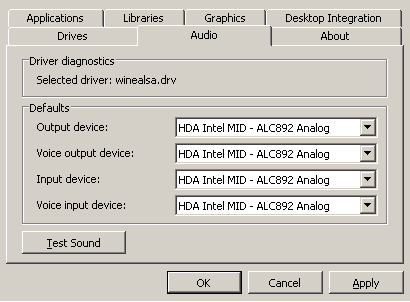
No need to despair though, as there are several ways to work around that problem until the maintainer of libasound2-plugins has converted it to multiarch.Use ALSA directly Since the problem is that Wine tries to use the ALSA PulseAudio plugin which is not available in 32 bits, the most direct solution is to configure it not to use it. Run winecfg, go to the audio tab and manually select your audio devices, which will then be used directly with ALSA without trying to use the PulseAudio plugin.
Screenshot of winecfg

Wine configuration

Downgrade ALSA plugins Since the problem is caused by a dependency chain that only exists with the testing (Jessie) version of the libasound2-plugins package, another solution is to downgrade it to a previous version. To do that, make sure you have enabled the Debian repositories for both the stable (Wheezy) and testing (Jessie) in /etc/apt/sources.list: deb http://ftp.fr.debian.org/debian/ jessie main deb http://security.debian.org/ jessie/updates main contrib non-free deb http://ftp.fr.debian.org/debian/ wheezy main deb http://security.debian.org/ wheezy/updates main contrib non-free Then, forcefully install the stable version of libasound2-plugins for both i386 and amd64: # apt-get install libasound2-plugins:i386/stable \ libasound2-plugins:amd64/stable

Russ Allbery: Review: Water Logic

Review: Water Logic, by Laurie J. Marks
Series: Elemental Logic #3
Publisher: Small Beer Press
Copyright: 2007
ISBN: 1-931520-23-2
Format: Trade paperback
Pages: 332
Water Logic is the third book in the Elemental Logic series, starting with Fire Logic. As with Earth Logic, it's best to read all three books in close temporal proximity, since Water Logic offers little recap of what happened in the previous books and relies on a large cast of characters who are not reintroduced. It's also hard to review without spoilers for the previous books. Earth Logic ended with a monumental shift in Shaftal politics, and half of Water Logic is deeply concerned with the implications of that shift and where Shaftal should go from here. Karis and Zanja are, of course, deeply involved, but much of the political story is told from the perspective of the character introduced in Earth Logic, and from the perspective of another earth blood, Meriseth. Water bloods haven't been seen much so far in the series. Water magic is about repeated patterns and the malleability of time, and the plot of Water Logic eventually entangles Zanja in events far in the past of Shaftal. This proceeds in parallel with more of Marks's excellent analysis of the meaning of war and peace, diplomacy, cooperation, multiculturalism, adaptation, and empathy. The two sides of the book do to some extent reinforce each other, but the connections are tricky and less obvious. Parts of this book are excellent. Wars are complicated and powerful, and don't end easily. The mutual incomprehension and mutual (if intermittant) struggle for understanding between the natives of Shaftal and the Sainnites is beautifully presented. I particularly loved Mariseth's approach throughout the book. Earth bloods are perhaps Marks's best invention, and seeing another (besides Karis) at work, with the same stubborn patience but with different tactics and different levels of power, was a delight. I feel like reading, and thinking about, Seth's decisions makes me a better person. As with the previous books, though, parts of Water Logic are a bit boring, or at least don't seem to coherently move in a conclusive direction. Zanja has long journeys across the landscape as well as several adventures after she's grabbed by water logic that seem only distantly connected to the rest of the story. Marks does pull this mostly together in the end, and I could detect other thematic linkages while mulling the book over after finishing it, but the book feels a bit disjointed while reading it. And there are some elements, such as the cowdogs, that are neat bits of world-building but that seem tossed in just because they're neat and don't feel strongly connected to the plot. The other complaint I have, which would probably have been lessened by reading the books closer together, is that the cast is a bit too large. All of Karis's extended family are, of course, still around, which I found more confusing than helpful. Named and important characters keep popping in and then disappearing, with no introduction and no help for the reader who doesn't remember the exact details of their roles from previous books. It's a bit frustrating, and it makes the book feel a bit cluttered, although it does a great job of showing the dynamics of a large and comfortable family. (Marks shows the dynamics of family webs with multiple adults better than any other fantasy author I know.) Karis is a bit more sidelined in this book, casting her in the role of force of nature, and I think that works well. It took me a bit to warm to Zanja again, but by the end of the book I was greatly enjoying her sections. But the star, for me, is Seth. Even though some of her segments should have been the boring parts of the book, since they were mostly concerned with quitodian issues, they were the parts I wanted to read about. I was very touched by the ending, even if I think a bit too much authorial hand-waving was required. There is material left for a sequel at the end of Water Logic, including a villain who has yet to fully appear, but it's currently not clear whether Air Logic will ever materialize. But, as with Earth Logic, Water Logic provides a satisfying ending and leaves the world in a stable enough place that I didn't feel cheated out of the end of the story. I think Fire Logic remains the strongest book of this series, but Water Logic is very much worth reading if you've read the previous books. Unfortunately, the books apparently didn't sell well, so this book is from a small press instead of Tor. You may have to order it on-line instead of finding it a local bookstore. But the whole series is very much worth reading. It's a refreshingly original take on fantasy and is much more thoughtful about human relationships and politics than most fantasy works. Rating: 7 out of 10

Russ Allbery: C TAP Harness 2.3

This release pushes out some improvements to my TAP library and test harness that I found time to do a while back. I have some other plans, but not much time, so I'm not sure when I'll get to them. Now included in the C TAP library is a test_cleanup_register function that registers a cleanup function called during exit from the test. This function will be passed a boolean argument indicating whether the test succeeded or failed. It was already possible to do this with simple atexit, but now callers can decide whether to delete possibly-interesting trace files based on whether the test was successful. As part of this change, I also refactored and improved everything that happens during test exit, and in the process fixed a bug where lazy plans and test summaries were still displayed even when a test aborted with bail. This release also adds the gcc warn_unused_result attribute to the various TAP library functions (mostly the malloc variations that call bail on failure) where the return value really shouldn't be ignored. You can get the latest release from the C TAP Harness distribution page.

13 November 2013

Julien Danjou: OpenStack Design Summit Icehouse, from a Ceilometer point of view

Last week was the OpenStack Design Summit Icehouse in Hong-Kong where we, OpenStack developers, discussed and designed the new OpenStack release (Icehouse) that is coming up. The week has been wonderful. It was my second OpenStack design summit, and I loved it. Bumping into various people I've never met so far and worked with online was a real pleasure. As it was to meet again with fellow OpenStack developers! The event organisation was great, as were the parties. :-) On the last day, I had the chance to present a talk with Eoghan Glynn and Nick Barcet how we built the auto-scaling feature in Heat, implementing the "alarming" feature needed in Ceilometer.
The slides and video of the talk is online on my talks page. Design sessions This time, Ceilometer design sessions were spread on 3 days. Everything we talked about has its Etherpad instance. The discussions were interesting, and the amount of feedback gathered is big and is going to be very useful. There's a lot of people and companies using Ceilometer now, and the project is getting more and more traction in general. There's a lot of different way to use it and to bend it to one's needs. Considering the amount of features and options that is provided, building functionality with a genericized approach it making Ceilometer useful for a lot of different and interesting use-cases. Icehouse roadmap The list of blueprints targeting Icehouse is available, but not yet complete. I expect people to start filling this list in the next days.If you want to propose blueprints, you're free to do so and inform us about it so we can validate it. The same applies if you wish to implement one of them! Thereafter, I try to guess what the roadmap will look like in the upcoming weeks for Ceilometer based on the discussion we had last week during the summit. Events management A lot of work is going to be put into event management. Ceilometer plans to store notifications sent using oslo.messaging by OpenStack projects. Some work already got merge for Havana, but the API part and future improvements and ideas will continue to flow into the Icehouse release. Agents and group management A lot has been discussed around the polling agents and around the alarm evaluator agent. The current state of the ceilometer-central-agent disallows any kind of high-availability and load-balancing, as the polling task are kept and scheduled on only one node. The high-availability part is already covered by a custom mechanism built into ceilometer-alarm-evaluator, but it came clear to us that a more generic approach is needed. A lot of other projects needs this kind of functionality, and a pattern have been pointed out. A blueprint about group membership has been discussed in an Oslo session, and will end into a new Python library written to solve this in Ceilometer and in other projects. TaskFlow will also probably be leveraged to solve the task distribution issue. Documentation Since a few weeks, Ceilometer auto-generates its API reference documentation using sphinxcontrib-docbookrestapi that parses our API code that uses WSME. We also want to start writing a user guide, and we'll do that inside our own repository. That way, I hope that we will be the first project in OpenStack to require documentation to be incorporated into every patch that's being sent to Ceilometer. This is the best way to assure that nothing can be changed nor added without being accompanied with a documentation update. Tempest testing Testing of Ceilometer already has been a subject during the previous design summit about testing. We already put a large effort on Tempest testing in this last cycle, but we encountered a lot of small issues that we had to tackle to achieve something. Some Ceilometer basic tests are already on their way into Tempest, so this is something that is going to be achieved very soon. Ultimately, I would also want Ceilometer moving towards providing its own set of Tempest tests as part of the code base. That way, it'd be as easy for core reviewers to refuse a patch if it doesn't provide functional tests as it is to refuse it if it doesn't provide unit tests. As we'll do for the documentation. API improvements Once again, a few API improvements will probably be implemented, like aggregation or the ability to specify multiple queries with OR and AND operators. Roll-up, archiving of data There seems to be interest in archiving and rolling-up the data stored by Ceilometer, so work in this area is to be expected. Supporting multiple data storage driver in parallel seems to be something that needs to be done for this and other aspects of Ceilometer feature set. Alarming The alarming feature set is already big, and the work that has been accomplished pretty amazing. A few improvements will be made, as retrieving better metrics and building better statistics (exclusion of low quality data points).

Joachim Breitner: Constructing a list in a Monad

In Haskell, lists are ubiquitous. In real-world Haskell, monads are ubiquitous. So it should be an easy task to fill a list with values obtained in a monad, i.e. a list of n random numbers (in the Rand monad), or getting some input from the user, and storing it in a list, until the user chooses to finish the input. The task For now, assume a function getInput :: IO Int; we want to run it 10000 and then have the list of the values returned. Sounds simple and straight forward, but it is actually really hard to get the run-time behaviour that we naively and optimistically expect. The expectation In an imperative setting, we would have a simple counting loop. In the loop, we run getInput, allocate a new cell for the linked list, and append it to the list. Clearly, this Can we achieve that with Haskell? Let s look at a few alternatives (complete code available)
Attempt 1: The accumulator I ll start with the probably worst attempt. Unfortunately, from what I have seen from correcting Haskell exams, this is what beginners would write, especially if they have the above imperative algorithm in mind, and know about the convert loops to recursion with accumulators approach to solving Haskell problems:
accumAppend :: Int -> IO [Int]
accumAppend n = go n []
  where
    go 0 l = return l
    go n l = do  x <- getInput; go (n-1) (l++[x]) 
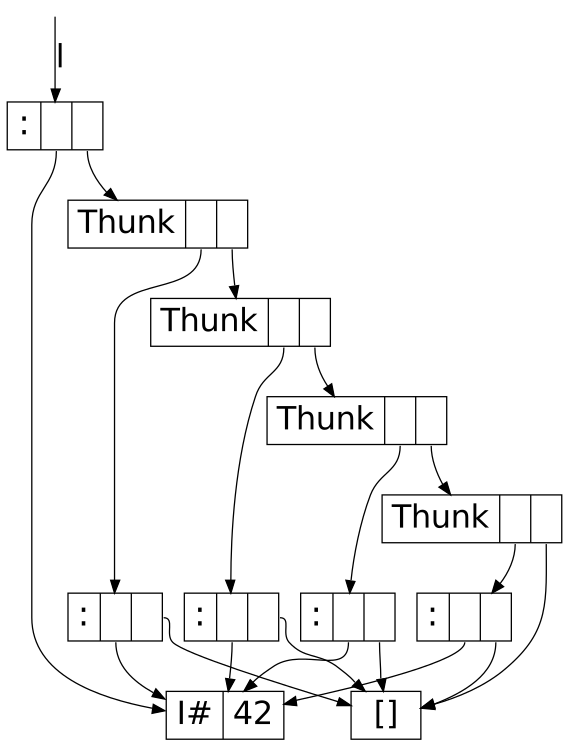
To check the space usage of this, I pass -Kn to the GHC runtime and see what limit is just enough to let this program calculate accumAppend 10000 and fully evaluate the resulting list. It turns out that we need 328336 bytes of stack space. So what about the second requirement; that the list is fully evaluated? Experienced Haskellers see it immediatelly: The accumulator is not used in the loop, so each iteration adds a thunk around the previous value, that would add the next entry to the end. Only when the list is actually used, these are run, each traversing the whole list, causing quadratic cost. We can verify this using ghc-vis:
Clearly (and not surprisingly) this is not the best solution. Attempt 2: The accumulator (forced) Lets try to fix the second issue, by making sure that the list is always fully evaluated. We import Control.DeepSeq and write
accumAppendSeq :: Int -> IO [Int]
accumAppendSeq n = go n []
  where
    go 0 l = return l
    go n l = do  x <- getInput ; go (n-1) $!! (l++[x]) 
As the accumulator gets fully evaluated before being passed to the next invocation of go, the result will not contain thunks. But note that this has also fixed the stack consumption: The code now runs the smallest setting for -K, 8 bytes. This works as both go and deepseq are tail-recursive. But this is still not the solution we are looking for, as the quadradic cost caused by using ++ is still there. Attempt 3: The accumulator (reversed) Since we know that l++[x] is expensive, but x:l is cheap, we can simply use this to update the accumulator. This has the slightly annoying consequence that the entries of the list are in the reverse order, but we can fix that in the base case:
accumReverse :: Int -> IO [Int]
accumReverse n = go n []
  where
    go 0 l = return (reverse l)
    go n l = do  x <- getInput ; go (n-1) (x:l) 
And indeed, we get noticably faster code that still runs in 8 bytes of stack. Unfortunately, we still don t construct the final list directly. Attempt 4: Naive recursion Maybe we can do without an accumulator. The most naive such code would be
listRecurse :: Int -> IO [Int]
listRecurse n = go n
  where
    go 0 = return []
    go n = do  x <- getInput; r <- go (n-1); return (x:r) 
and I d expect that most experienced Haskellers would write that code (if they are asked not to use a library function). And indeed, this code does create the final list directly. But it requires a large stack or 164616 bytes. The reason is that this is no longer tail recursive: After calling go again we need to take the result and prepend x Attempt 5: library functions Maybe we should simply not worry about the implementation, and use library functions? Clearly, the authors of such libraries have found the best solution. So how does
listReplicateM :: Int -> IO [Int]
listReplicateM n = Control.Monad.replicateM n getInput
fare? Unfortunately, not better than the naive recursion. In fact, the stack space requirement is the same 164616 bytes. The same holds when using special libraries for generating and consuming list, e.g. the Streams module from the vector package:
listStreams :: Int -> IO [Int]
listStreams n = MStream.toList $ MStream.replicateM n getInput
Attempt 6: Difference lists It is time to dig deeper into our box of tricks. What if we have lists with constant time Snoc (a.k.a. appending a new element)? Then Attempt 3 would not require reversing the list. Such lists are provided by difference lists; there are libraries for that, but we can simply implement them using lambdas:
accumDList :: Int -> IO [Int]
accumDList n = go n id
  where
    go 0 l = return (l [])
    go n l = do  x <- getInput; go (n-1) (l . (x:)) 
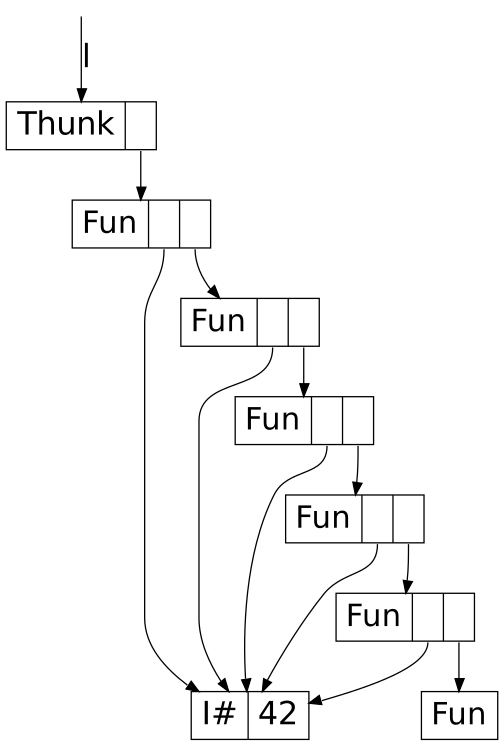
Indeed, no stack is required (8 bytes are enough). But we are cheating here: We are still not constructing the final list, but rather we combine functions that append elements to lists. So when accumDList returns, what we have in memory, is a thunk and sequence of partial function applications in the wrong order, and evaluating the thunk does basically the same thing as reverse in Attempt 3. It might be a bit faster, is still not satisfying enough:
Attempt 7: Unsafe functions Even deepter in the box of tricks, somewhere in the grit and dust where one usually should not reach, there is a function that can help us out here: unsafeInterleaveIO. This allow us to modify the naive recursion in a way that first creates the Cons-cell, and then continues the loop:
listUnsafeInterleave :: Int -> IO [Int]
listUnsafeInterleave n = do  l <- go n; return $!! l 
  where
    go 0 = return []
    go n = do x <- getInput
              r <- unsafeInterleaveIO (go (n-1))
              return (x:r)
The stack consumption is 8 bytes. It is worth noting that the all to deepseq (in $!!) will actually drive the evaluation of go. Also, it guarantees that the unsafe effects of unsafeInterleaveIO are confined to the execution of listUnsafeInterleave, i.e. are actually safe. Run time statistics I ran criterion over the functions (generating lists of length 1000), and found these results: Conclusion There are many ways to write a list-constructing list in Haskell, none are perfect they either fill the heap, or do not construct the list directly (usually requiring a second pass through it), or rely on IO-specific unsafe functions. The naive recursion performs the best, but may cause a stack overflow (note, though that from GHC 7.8, the stack will be unlimited). The next best option seems to be the difference lists
I m still wondering: What would be required from Haskell, GHC or the monads in question to have a fully satisfactory solution here, i.e. one that is as fast as the naive recursion, as stack efficient as the difference list solution, and allocates no thunks, only list cells?

Raphael Geissert: A bashism a week: heredocs

One great feature of POSIX shells is the so-called heredoc. They are even available in languages such as Perl, PHP, and Ruby.

So where is the bashism?

It's in the implementation. What odd thing do you see below?


$ strace -fqe open bash -c 'cat <<EOF
foo
EOF' 2>&1 grep -v /lib
open("/etc/ld.so.cache", O_RDONLY O_CLOEXEC) = 3
open("/dev/tty", O_RDWR O_NONBLOCK O_LARGEFILE) = 3
open("/proc/meminfo", O_RDONLY O_CLOEXEC) = 3
[pid 6696] open("/tmp/sh-thd-1384296303", O_WRONLY O_CREAT O_EXCL O_TRUNC O_LARGEFILE, 0600) = 3
[pid 6696] open("/tmp/sh-thd-1384296303", O_RDONLY O_LARGEFILE) = 4
[pid 6696] open("/etc/ld.so.cache", O_RDONLY O_CLOEXEC) = 3
foo
--- SIGCHLD (Child exited) @ 0 (0) ---


Yes, it uses temporary files!

So do ksh, pdksh, mksh, posh and possible other shells. Busybox's sh and dash do not use temporary files, though:


$ strace -fqe open dash -c 'cat <<EOF
foo
EOF' 2>&1 grep -v /lib
open("/etc/ld.so.cache", O_RDONLY O_CLOEXEC) = 3
[pid 6767] open("/etc/ld.so.cache", O_RDONLY O_CLOEXEC) = 3
foo
--- SIGCHLD (Child exited) @ 0 (0) ---


Next time you want data to never hit a hard disk, beware that heredocuments and herestrings are best avoided.

12 November 2013

Russell Coker: Bad Advertising of Protoplast

Carpal Tunnel Syndrome In early 2010 I wrote about Carpal Tunnel Syndrome, I gave a picture of the wrist brace and a description of the process of creating it [1]. A few months later I wrote a follow-up about how the wrist brace had helped me, at the time I was anticipating wearing it at night for the rest of my life [2]. But my wrist has continued to improve. Nowadays I never wear the wrist brace and hardly even think of it. I am a little more careful about posture than I was before, but mostly it has no impact on my life. I think this counts as a full recovery. At the time I was mildly interested in buying some thermo-plastic of that type to make things, but the only source I found was Jaycar which sold 100 grams for $14.95, Jaycar prices have now dropped to $11.50 for 100 grams or $89.50 for a kilo but it s still expensive [3]. Protoplast When looking at the sites that link to my blog I saw a site advertising Protoplast which is a type of thermo-plastic that can be used for making things [4]. Protoplast have more reasonable prices, E30 ($AU42.75) for a kilo and their web site offers better prices for anyone who purchases 10kg or more (good for hackerspaces etc). As they post no further than Belgium they aren t an option for me but they do seem to make a good offer, better than Jaycar offers in Australia. Protoplast is probably a good product, but I think that their advert is misleading. While it is probably possible to make a wrist-brace similar to mine with Protoplast it s a fact that my wrist brace was not made with it. My wrist brace started out as a flat sheet of plastic which could be formed to the final product without being melted. Converting a packet of plastic granules (as sold by Protoplast or Jaycar) to a sheet to even start work on such a wrist brace would take some work. To make a sheet of plastic out of beads sold by Jaycar or Protoplast you would ideally completely melt the plastic, if you just softened the plastic then it wouldn t be as strong as using a pre-made sheet. During the time that I wore the wrist brace I probably repaired it more than 30 times, this wasn t particularly difficult to do, I poured boiling water over it to soften the part that cracked until it became tacky and then pushed it together again. But the result was significantly weaker than the original due to the difficulty in welding the broken sections together. I ended up cutting some strips from less important parts of the wrist brace (the part nearest to my elbow) to reinforce the weakest part which was between my thumb and fore-finger. That section ended up being about three times thicker than it was originally while also not being as strong as it was originally. I also had difficulty in making it flat so it wasn t nearly as comfortable as the original version. It seems rather misleading to include the picture of my wrist brace on a site advertising plastic which wasn t used to make it and which probably couldn t be used to make something that looks as good with the same ratio of strength to mass. But with a suitable disclaimer indicating that the user probably can t get the same result it would be OK to give it as an example of what could be done. I can imagine someone using a product like Protoplast to make a wrist brace that can hold a mobile phone, that can be worn with a watch, or has other features that aren t offered by medical staff. License Issues The license for my blog doesn t permit people to just copy pictures, it s a Creative Commons Attribution-Noncommercial-Share Alike based license [5]. I am interested in supporting companies that make interesting products and anything that can help people with medical issues is also of interest. So I wouldn t rule out the possibility of a free license for a picture from my blog to be used in the way that they used it (with a link back to the original blog post). But I would want a description that informs readers that it s not an item made with their product, merely something similar that can be used for inspiration.

11 November 2013

Simon Josefsson: Using Replicant on Samsung Galaxy S III

For the last half-year I have used CyanogenMod on an Nexus 4 as my main phone. Recently the touch functionality stopped working on parts of the display, and the glass on the back has started to crack. It seems modern phones are not built to last. For comparison, before the N4 I used a Nokia N900 for around 3 years without any hardware damages (in my drawer now, still working). A few weeks ago I started looking for a replacement. My experience with CyanogenMod had been good, but the number of proprietary blobs on the N4 concerned me. Finding something better wasn t easy though, so I m documenting my experience here. My requirements were, briefly, that I wanted a phone that I could buy locally that had a free software community around it that produced a stable environment. I have modest requirements for things I wouldn t give up on: telephony, data connection (3G), email (IMAP+SMTP), chat (XMPP), and a web browser. I like the philosophy and openness around the Firefox OS but the more I have read about it, it seems unlikely that it would deliver what I need today. In particular none of the devices capable of running Firefox OS appealed to me, and the state of email reading seemed unclear. I m sure I ll revisit Firefox OS as an alternative for me in the future.

As I had been happy with CyanogenMod, but concerned about its freeness, it felt natural to move on and test the more free software friendly project Replicant. Replicant only supports a small number of devices. After talking with people in the #replicant IRC channel, it seemed the Samsung S3 would be a decent choice for me. The Samsung S2 would have worked as well, but it cost almost as much as the S3 where I looked. Despite the large number of Samsung S3 devices out there, it seems the prices even for used devices are high (around 2500 SEK in Sweden, ~380 USD). I ended up buying a brand new one for 3200 SEK (~500 USD) which felt expensive, especially after recalling the recent $199 sale for Nexus 4. Noticing that brand new Nexus 4 devices are still over 3000 SEK in Sweden comforted me a bit. I would have preferred a more robust phone, like the CAT B15, but the state of free software OSes on them seem unclear and I wanted something stable. So, enough about the background, let s get started. Building and installing Replicant on the device was straight forward. I followed the Replicant Samsung S3 Build instructions to build my own images. The only issue I had was that I had not set JAVA_HOME and the defaults were bad; make sure to set JAVA_HOME before building. I built everything on my Lenovo X201 running Debian Wheezy, with OpenJDK 6 as the Java implementation. Installing the newly built firmware was easy, I just followed the installation process documentation. I made sure to take a clockworkmod backup to an external SD card before wiping the old system. To get a really clean new device, I also re-formated /sdcard inside clockworkmod; I noticed there were some traces left of the old system there. I spent about one week testing various configurations before settling on something I could use daily. A fair amount of time was spent looking into backup and restore options for Android devices. My idea was that I would take a backup of the apps I ran on the N4 and transfer them to the S3. The Android Debug Bridge (adb) has a backup/restore command, however it (intentionally) ignores apps marked as allowBackup=false which a number of apps has. It doesn t seem possible to override that settings so much for the freedom to backup your own device. I then discovered oandbackup. It can backup your entire system, saving each app (together with associated data) into a separate directory, for simple review and inspection before restore. You can do batch backups and batch restore. I couldn t get it to automatically restore things, though, which would be neat for really automated re-installations (there is an open issue about this feature). After noticing that some apps did not like being moved from the N4 (running Android 4.2) to the S3 (running 4.0), I ended up installing most apps from scratch on a freshly installed Replicant. I use oandbackup to the external SD card so that I can quickly restore my phone. For backup/restore of SMS/MMS and Call Log, I use SMS Backup+ against my own IMAP server. Camera pictures are synced manually using adb when I am connected to my laptop. There is a number of apps that deserve to be mentioned because they are what I use on a daily basis. All of them come via the free software market F-Droid. For email (IMAP/SMTP), I use K-9 Mail which is feature rich but still easy to use. For chat, I use Xabber. I use NewsBlur s free software app to read RSS flows. For two-factor authentication, I use Google Authenticator. I haven t evaluated different PDF viewers, but the first one I tried (APV PDF Viewer) has worked fine so far. Handling a a synchronized address book and calendar deserve its own blog post because it is a challenging topic, but briefly, I m currently using a combination of aCal and DAVdroid. Finally, since Replicant is still work in progress, some words about stability and notes on what doesn t work. This is probably the most interesting part if you are considering running Replicant on an S3 yourself. Overall system stability is flawless, I hadn t had any crash or problem with the fundamental functionality (telephony, 3G, Camera). People have said graphics feels a bit laggy, but I cannot compare with the stock ROM and it doesn t get in the way of daily use. First some notes about non-free aspects: Some other observations: I am quite happy with the setup so far, and I will continue to use it as my primary phone. flattr this!

Daniel Pocock: Outreach Program for Women applications

The deadline for Outreach Program for Women applications is very imminent and a range of applications have now appeared on the OPW wiki It is great to see Debian has attracted a diverse range of women who all appear to have coding experience. Code samples have been submitted in Java, C++ and Python among other things and they come from a range of locations around the globe, including Brazil, the UK, Iran and India. Experience counts Looking through the records of some of these applications, it is interesting to see a range of experience and connections in industry and the wider open source family:
  • translator for O'Reilly
  • IBM internship
  • Linux module programming
  • Working alongside one of the Mercurial contributors in a previous role
Funding needed Recent emails from the OPW organisors and DPL have highlighted the need to raise more funding to ensure that Debian can offer OPW internships to the selected applicants. Solving the biggest problem of GSoC 2014 Many of these applicants are students and will be eligible for GSoC 2014. According to the Google FAQ, even students who graduate in 2014 are eligible as long as they are enrolled in a course on the cut-off date 21 April 2014 One of the biggest challenges facing GSoC mentors is the selection of students who are capable of completing good work and have a long term interest in open source. One of the best ways to overcome that challenge is to start forming relationships with potential GSoC students well in advance and get to know them as they make small contributions over an extended period of time. The interest that these candidates have expressed in Debian and OPW suggests that some of them may well be suitable for Debian to help them get onto this track for the next GSoC. Not only will this make the GSoC 2014 selection process easier but it may help us to select more GSoC candidates with a long term outlook. Women in science, engineering and the wider business world More news items have appeared recently about women in science and engineering and other leadership roles:

In the early 1950s, Morgan was the only female analyst among 900 rocket scientists at North American Aviation. She was also one of the few without a college degree.

"What I saw a thousand times during the downturn was, 'We'd like to give her that opportunity, but we need to go with the sure thing - we can't afford diversity right now,'" - Sallie Krawcheck, former chief executive at Merrill Lynch

Matthew Palmer: Timezones are not optional information

In high school, I had a science teacher who would mark your answers wrong if you forgot to include units. What does that mean? , he would write, 17.2 elephants? The point he was trying to get across was that a bare number, without the relevant units, wasn t precise enough to be useful. Also, carrying the units with you helped to cross-check your work if you got a numeric answer, but the units were garbage (seconds per kilogram, for instance, when you were trying to find an acceleration), then you could be pretty sure you d made a mistake somewhere. Fast forward to today, and I m currently working with a database containing a pile of timestamps. Without timezones. Where the timestamps being inserted are in local time. Thankfully, so far, this particular system has always been run in one timezone, so I ve only got one timezone to deal with, but the potential ramifications of systems with different timezones inserting data into this database terrify me. The naive answer is to just store everything in UTC and be done with it. I m not particularly averse to that solution, as long as it s very clear to everyone what s going on. The correct answer, though, I think, is to always keep timezone information with your timestamps otherwise, you ll never know whether it s 0830 in elephants

Gunnar Wolf: Talking in Paran : Free Software philosophy / the Debian project. PS: Want to contribute?

I'm very happy: I was finally able to present a talk at a Free Software conference in Paran , Argentina Regina's hometown. Not only in Paran , but at the Vieja Usina culture center, half a block away from her parents' house. So, I must doubly thank Laura: First, for letting us know there would be a Free Software conference there, and second, for taking some pictures :- What was this conference? Conferencia Regional de Software Libre, organized by Grupo de Usuarios de GNU/Linux de Entre R os (GUGLER). Of course, flying to Argentina (and more specifically, to Paran , which is ~500Km away from the international airport) just for a one day conference was out of the question So I gave the talk by videoconference. Of course, given we will be travelling for the December vacations to Argentina, I expect to meet in person the GUGLER guys soon. I gave a single talk, mixing together two different topics: (my very personal take on) the Free Software philosophy and Debian's place in the Free Software universe. I had a very good time giving the talk, and while I was unable to look at my audience, I got reports saying they were happy and interested. I even got some mails from them, which makes me quite happy ;-) Now, one of the recurring points whenever I talk about Debian: I often tell people that I cannot tell them why they should use Debian instead of other distributions. My years testing every distribution I come across are long gone, and I nowadays am familiar with Debian only. But I also tell them that personally I gain nothing by having more Debian users in the world What I want to achieve is the next logical step: To have more people contributing to Debian. So, here is a great opportunity for interested people, specifically a group that often has a hard time finding a way to collaborate with Free Software projects. Today, Paul Tagliamonte published a call for proposals for Debian 8 (Jessie)'s artwork. So, given many people always want to find a way to contribute to Free Software without being a coder, here's a golden opportunity. You can look at the themes sent for Debian 7 as a reference; look also at the technical requirements for your artwork, and... Well, you have until early February to work on it!

10 November 2013

Steve Kemp: So I have a new project

Recently I decided to set myself a big photography challenge. The three options which I discussed with a couple of people were: Ultimately I decided pubs would be most fun. Not least because you could do it every year or two, to see what changes occurred. To make it more useful I decided to not only take the pictures, but to collect, and share, the meta-data too: Today I spent an hour walking up Easter road, and down Leith Walk. I shot the outside of about 20 pubs, and then fiddled with the layout and organization of the images. I'm reasonably happy with the result, but it remains obvious that I'm not a designer. The data-set use to generate the site - which is perhaps the most interesting/useful part of the whole exercise to other people - is available online too: All the data, even the images, is stored on github for collaboration purposes. I'm not sure if folk will join in, but I can probably manage a few of the major thoroughfares every weekend indefinitely it will only take a couple of days to get "city-wide coverage", then the rest is gravy.

Sylvain Le Gall: opam2debian, a tool to create Debian binary package out of OPAM

One week ago, a thread in opam-devel mailing list started about the possibility to create binary snapshot to distribute OPAM packages. Distributing binary packages with everything already compiled is pretty useful when you want to make sure that everyone has the same version of packages installed and you don't want to spend time configuring all the computer of your colleague. As a matter of fact I was also interested to see that happening. I have several computers where I want to install a set of packages and I want to snapshot OPAM archives when I am ready for an upgrade. I have tested for a long time another source distribution: GODI. I even wrote a puppet module to drive it. This was a fun experience, but as with any source only distribution, there are some drawbacks. Especially even if it is fully automated, you get a lot of errors and timeout when trying to build automatically from source. This is how opam2debian has started. I wanted a replacement for puppet-godi that takes advantage of OPAM and the possibility to distribute my set of packages everywhere quickly. The goals of this project are:
  1. generate a Debian binary package with all the dependencies set on external packages (like libpcre)
  2. use OPAM to build everything
  3. use standard Debian process to build package
  4. create snapshot of OPAM repository that allow to rebuild exactly the same thing on different arches
The real challenge behind opam2debian was to be able to use standard Debian process to create package to get all the power of dependencies computation provided by the Debian maintainer scripts. My great achievement on this topic was to find a tool called proot that allows you to bind mount a directory as a user. This is an achievement because it allows to create a package using a directory where you are not allowed to write (i.e. /opt/opam2debian directory which is owned by root). This is a way to do it on any Jenkins builder without root access and a standard way for Debian to build packages. Usage example I need to compile a set of package to install on all my Jenkins builder. Here is the list of packages I need and I also want to use the latest OCaml version. I want to build a Debian package for Debian Wheezy which has only OCaml 3.12.1. Building the package:
$ opam2debian create --build --name opam2debian-test2 --compiler 4.01.0 \
 ocamlfind fileutils ocaml-data-notation ocaml-expect ounit \
 ocamlmod ocamlify oasis yojson sexplib extlib pcre-ocaml \
 calendar ocaml-inifiles ocamlnet ocurl gettext inotify ocaml-sqlexpr \
 ocamlrss ocaml-xdg-basedir
Getting the package list right can be tricky because the process will stop at the first error -- and if it is because the last package fails to build it can be long. I have implemented a --keep-build-dir in case you want to tune the package list live. The program will build everything and it can takes quite a while. At the end you get a file opam2debian-test2_20131105_amd64.deb which has a reasonable size of 232MB. That is big, but it looks like the biggest directory is $OPAMROOT/4.01.0/build, I am not sure if I can remove it but we may save some space here (the build directory represents 50% of the package size). Then you can just do a standard Debian installation:
$ sudo dpkg -i opam2debian-test2_20131105_amd64.deb
And you can use it:
$ eval $(opam config env --root /opt/opam2debian/opam2debian-test2/)
$ which ocamlfind
 /opt/opam2debian/opam2debian-test2/4.01.0/bin/ocamlfind
$ ocamlfind list
 [...]
 stdlib              (version: [distributed with Ocaml])
 str                 (version: [distributed with Ocaml])
 threads             (version: [distributed with Ocaml])
 threads.posix       (version: [internal])
 threads.vm          (version: [internal])
 type_conv           (version: 109.41.00)
 unidiff             (version: 0.0.2)
 unix                (version: [distributed with Ocaml])
 userconf            (version: 0.3.1)
 xdg-basedir         (version: 0.0.3)
 xmlm                (version: 1.1.1)
 yojson              (version: 1.1.5)
A nice thing to note, is that it is a standard OPAM install. You can install, update and upgrade OPAM from there, as root. However, I would recommend not to do it, and just rebuild a newer Debian package to upgrade. Install You will need the opam and proot Debian package available in Debian jessie and sid. You will also need various OCaml libraries (cmdliner, calendar, fileutils and jingoo). Download the opam2debian tarball on the forge, build and install it. The project is hosted on github. Open issues On the initial list of goals of the project. Not everything is completed. I have still several open issues. In particular 4. (create snapshot of OPAM repository) was blocked by a bug in opam-mk-repo, that prevents snapshots (see my pull-request to solve it). Another issues is about licenses of the included files. I should list them all and I need to figure out a way to extract every licences. Submit bugs directly to github.

Petter Reinholdtsen: Running TP-Link MR3040 as a batman-adv mesh node using openwrt

Continuing my research into mesh networking, I was recommended to use TP-Link 3040 and 3600 access points as mesh nodes, and the pair I bought arrived on Friday. Here are my notes on how to set up the MR3040 as a mesh node using OpenWrt. I started by following the instructions on the OpenWRT wiki for TL-MR3040, and downloaded the recommended firmware image (openwrt-ar71xx-generic-tl-mr3040-v2-squashfs-factory.bin) and uploaded it into the original web interface. The flashing went fine, and the machine was available via telnet on the ethernet port. After logging in and setting the root password, ssh was available and I could start to set it up as a batman-adv mesh node. I started off by reading the instructions from Wireless Africa, which had quite a lot of useful information, but eventually I followed the recipe from the Open Mesh wiki for using batman-adv on OpenWrt. A small snag was the fact that the opkg install kmod-batman-adv command did not work as it should. The batman-adv kernel module would fail to load because its dependency crc16 was not already loaded. I reported the bug to the openwrt project and hope it will be fixed soon. But the problem only seem to affect initial testing of batman-adv, as configuration seem to work when booting from scratch. The setup is done using files in /etc/config/. I did not bridge the Ethernet and mesh interfaces this time, to be able to hook up the box on my local network and log into it for configuration updates. The following files were changed and look like this after modifying them: /etc/config/network
config interface 'loopback'
        option ifname 'lo'
        option proto 'static'
        option ipaddr '127.0.0.1'
        option netmask '255.0.0.0'
config globals 'globals'
        option ula_prefix 'fdbf:4c12:3fed::/48'
config interface 'lan'
        option ifname 'eth0'
        option type 'bridge'
        option proto 'dhcp'
        option ipaddr '192.168.1.1'
        option netmask '255.255.255.0'
        option hostname 'tl-mr3040'
        option ip6assign '60'
config interface 'mesh'
        option ifname 'adhoc0'
        option mtu '1528'
        option proto 'batadv'
        option mesh 'bat0'
/etc/config/wireless
config wifi-device 'radio0'
        option type 'mac80211'
        option channel '11'
        option hwmode '11ng'
        option path 'platform/ar933x_wmac'
        option htmode 'HT20'
        list ht_capab 'SHORT-GI-20'
        list ht_capab 'SHORT-GI-40'
        list ht_capab 'RX-STBC1'
        list ht_capab 'DSSS_CCK-40'
        option disabled '0'
config wifi-iface 'wmesh'
        option device 'radio0'
        option ifname 'adhoc0'
        option network 'mesh'
        option encryption 'none'
        option mode 'adhoc'
        option bssid '02:BA:00:00:00:01'
        option ssid 'meshfx@hackeriet'
/etc/config/batman-adv
config 'mesh' 'bat0'
        option interfaces 'adhoc0'
        option 'aggregated_ogms'
        option 'ap_isolation'
        option 'bonding'
        option 'fragmentation'
        option 'gw_bandwidth'
        option 'gw_mode'
        option 'gw_sel_class'
        option 'log_level'
        option 'orig_interval'
        option 'vis_mode'
        option 'bridge_loop_avoidance'
        option 'distributed_arp_table'
        option 'network_coding'
        option 'hop_penalty'
# yet another batX instance
# config 'mesh' 'bat5'
#       option 'interfaces' 'second_mesh'
The mesh node is now operational. I have yet to test its range, but I hope it is good. I have not yet tested the TP-Link 3600 box still wrapped up in plastic.

Next.

Previous.