Search Results: "sto"

12 February 2011

Wouter Verhelst: Ten years of Debian

My first ever Linux installation was done in the late nineties 1998 or thereabouts but was a RedHat 4.5 installation rather than a Debian one. The reason for that was fairly simple: the Infomagick sixpack CD set that I'd bought contained RedHat, Debian, and Slackware, but the RedHat installation was the only one that could be installed directly from CD the other two required me to write floppies and boot from those to start the installation, and I wasn't very fond of that idea. It was only a few years and a few broken RedHat upgrades later that I saw the light and considered trying out this Debian thing that some of my classmates were talking about. The fact that I'd just bought my own computer (rather than having to compete for time with my siblings on my parents' computer) was a good reason to do a fresh Linux installation. I'd been planning to install Linux From Scratch, but as what was still known as the LFS HOWTO told me you'd need a working Linux installation to do that, I considered my options. Since I'd developed a strong dislike of RedHat, I wasn't interested in doing another RedHat anymore. So, I downloaded the most recent version of Debian at the time (Potato Test Cycle III), wrote it to a CD, and installed. I've probably still got the CD lying around somewhere. A few months later, I found these "Linux Gazette" packages in the archive, with the latest packaged issue being 47, but the latest upstream version being much higher. Trying to figure out what was going on, I mailed the maintainer, Adrian Bridgett, who encouraged me to take over maintenance. Thus began my life of actively contributing to Open Source software. In November 2000, I applied to become a Debian Developer. In January 2001, Martin Michlmayr was assigned to be my AM. And in early February 2001, now just over ten years ago, I'd become a Debian Developer. Yes, that was fast, and no, I probably wasn't really ready yet, at the time. Originally, I only cared much about these Linux Gazette packages. But, as time went on, I started looking around, too. A friend passed me an old Macintosh Centris 610. As I tried to install Debian on it, I found that it didn't actually run very well. This turned out to be due to it having a broken 68LC040 processor, so I bought me another m68k-based mac, one with a full 68040 processor (a Centris 650). Thus I became involved in the m68k port and buildd maintenance. As these old machines came with 80MB or 250MB SCSI hard disks of which I had none laying around, and a then-recent Debian installation had minimum requirements of about 200MB, I was in need of network storage to be able to do anything useful with the mac. NFS didn't work as expected; the RTC implementation on m68k mac hardware was reverse engineered and didn't work too well at the time, which meant that the clock would run slower if the machine was under load, and that in turn would mean that make would get confused about timestamps, since they would suddenly appear to originate from the future (in NFS, it's the server that assigns time stamps, not the client). There was a simple solution, however; Pavel Macheck had written this neat 'Network Block Device', which would let the client do its own filesystem on network storage. Only it wasn't packaged; but then, that was easy to fix. Thus I started maintaining the single piece of software that I've worked the most on, to date. A few years later, Pavel lost interest in maintaining NBD, and handed over upstream maintenance to me and maintenance of the kernel side to Paul Clements. Thus began my life in upstream work. And while I originally joined Debian with the intent of using it as a learning experience and stepping stone on my way to more "important" free software, I found that it wasn't as satisfying as was my work for Debian. Over the years, there's been this duality where I've felt like I was doing too much and not enough at the same time. Too much, because the things I was doing would eat up much of my spare time, leaving little time left for other hobbies. Not enough, because I witnessed other people doing much more for Debian than I did, and I wanted to make a difference. As the years passed by, many things have changed. Not only in Debian, but also besides it. I became an independent contractor, focusing mostly on supporting people in using Debian (although I support them with other distributions, too). The importance of a port went from 'something which these weird porter people are doing, and that we should probably help them with if it doesn't work, but is their problem really' to 'something that I really really really have to make sure works for my packages', and back for the port that I cared about most. After several years of trying, I finally managed to explain to my parents what this Debian thing is, why it matters, and what my role in the whole thing is. We did a few releases, some taking longer than I would've liked. People joined the project, and left again. Some of my friends died. My fame in the project rose, even though I wasn't aware of it initially; and thus I was rather surprised when someone asked me whether I was "the Wouter Verhelst" at a key signing party. Recently, I've started looking back, and considered the things which Debian has meant to me. Ten years ago, I was 22, still in college, and had way too much spare time on my hands. I'd recently gotten my first Internet installation, and all these online communities were very new to me. Yes, that was all probably rather late. Debian has changed my life in many ways; it has allowed me to meet various kinds of people, both online and in meatspace. I've been to Helsinki, Edinburgh, Mar del Plata, C ceres, and New York City, places that I might otherwise not have visited. Each of these trips was an incredible experience that I have fond memories of; and while the most fond ones originate from Helsinki, I cherish the memories of each of these trips as some of the best trips I've ever done. Working on Debian has forced me to learn about the inner workings of a Linux-based system, which is knowledge that has helped me tremendously professionally, too. And finally, working on Debian has given me a unique perspective on this whole FOSS community, which has helped shape my ethics and my view of the world. While I believe that I would've subscribed to most of that ideology at any rate, I'm not sure that the details of my beliefs and understanding would've been exactly the same. And while I don't agree on every position that the project subscribes to as a whole, I do believe that the philosophies that lie at the core of this project contain just the right mix of pragmatism and ideology that makes it possible for our project to thrive in a changing world of not only a growing group of people who subscribe unconditionally to the free software ideals, but also business people who care mostly about money. Over the years, somehow I moved from "one of the recent batch of new Debian Developers" to "someone who's been with the project longer than most". It still feels weird to see people shut up because you've built up a reputation in some area, and you give your gut opinion on some subject without researching it too much. I try not to let that happen too often. Today, ten years and just over a week ago, my life as a Debian Developer started, and it would change the way I looked at the world, the things I would do in my spare time, and the people I would meet. I wouldn't have it any other way. Thanks, Debian, for what's been a blast; may the next ten years be as inspiring to me and everyone as the past ten!

11 February 2011

Aigars Mahinovs: MorzeSMS

Quick post. In light of recent Nokia+Microsoft-MeeGo news, I have gone to learn more about Android in a hurry. And here is the first result MorzeSMS. Basically it is a tiny app that will play a morze code when you receive an SMS message. The morze code is the phone number of the sender in cut number morze form (to be shorter). The idea is that first of all morze is a cool sound and second is that each sender gets a unique sound that you can learn to identify over time so that you know who sent you a message as soon as you hear the beep. This is very early beta there is no UI, no configuration. You can download it here. Leave bug reports in the comments of this blog post. It does not disable the stock SMS-received sound.

Pau Garcia i Quiles: Nokia + Microsoft WTF

We just learned about the Nokia and Microsoft strategic partnership today and many people are concerned. I think the agreement is worrying for Qt, but even more worrying for Nokia. I foresee an exodus of current developers and Nokia mobile device users. Many Windows developers will come. Hopefully? I really wonder who is actually benefited by this strategic partnership. Nokia already had many mobile devices with Symbian, one with Maemo (and there could have been many more with Maemo, but for some unknown reason there weren t) and Meego could have been adopted already (but again, for some reason, Nokia had not). On the other hand, Microsoft had an operating system but no users. Virtually nobody wanted Windows 7. It was either Android or your own solution (MeeGo, WebOS, Bada, etc). In my opinion, the next move we will see is Microsoft buying Nokia to be able to compete one-to-one with Apple and Google. I think it will not take too longer, probably they are just waiting for Nokia stock to fall a bit more. So what should have been the change of direction Nokia should have done a few years ago? In my opinion, when Nokia acquired TrollTech, they should have released at least 10 devices with Qtopia. Immediately. And dump Maemo. In parallel, they could have added more and more Maemo features to Qtopia. By doing that, they would have had a good mobile operating system and applications in no time. There was even an X11 compatibility layer for Qtopia back then. I did not understand why Nokia adopted Qt and went on with Maemo and Meego based on Gtk+, and tried to keep as much backwards compatibility (regarding to source compatibility, development methodology,e tc) with devices which barely had users (N770, N800 and N810). I think noone understood that move. From my point of view, that was a waste of time, money and effort, which ultimately led to Nokia s demise. PS: Yes, I still am a KDE on Windows developer and part of the Debian Qt-KDE team

Joachim Breitner: GNUnify started

Yesterday night I arrived in Pune for the GNUnify conference where I m a speaker. I should speak more often at such conferences, they really pamper the speakers: I was picked up with a car from the train station, brought to a posh restaurant where other speakers were already dining and afterwards accommodated in the guest house of the Symbiosis University, which means a spacious room with my own bathroom (with running hot water) and best of all: Internet connectivity after midnight! Tonight I was alone, the next night I ll be sharing it with another speaker.
Today we had breakfast at the conference venue and the first talks started. I attended a talk about Openmoko, but nothing new to me so far. I was happy to see Debian listed as one of the Distributions for the FreeRunner, given that I once co-initiated that port. Nevertheless it could not bring me to try using the FreeRunner again, reliability is just not good enough. I asked for the next best (in terms of freedom and geek-compatibility) phone, but there is no obvious good answer. The n700 seems to be a dead end, given that Nokia might ditch Meego. The Geeksphone sounds like a good candidate, but is out of stock. My Haskell talk will start in 30 minutes. I hope I ll reach my audience and haskell-cafe will see more Indian names soon... The talks are recorded. I guess I should have dressed better.

10 February 2011

Adrian von Bidder: Freedom

LWN Coverage of Eben Moglen's FOSDEM keynote. A very thoughtful article on freedom and how to get there. While we can, technically, build these free systems that Eben Moglen talks about, history has shown that we won't. People don't care until it's too late until the police is on their doorstep with an arrest warrant (if the regime cares about such details at all.) So it's up to the small minority of people who actually cares and is prepared to pay the price (in money or in being isolated by not being on Facebook or whatever) to create systems that are both Free and also appealing to the uneducated masses. People will move to Free systems only when they're much cheaper and also offer more value as perceived by them, in terms of features, or coolness or whatever. Bling. We're almost there in terms of software (Firefox managed to get noticeable market share, and people at least talk about OpenOffice / LibreOffice.) We're nowhere close in terms of networks and content, though. Wikipedia and Openstreetmap are the rare exceptions, but there's not much in terms of social networking, searching, messaging, collaboration platforms etc.: all firmly in corporate hands. I'm not sure that Moglen's Freedom Box idea will succeed either: so far, I can't see the must have element for people who don't care about these things that might change the game.

Russell Coker: LCA2011, Harassment, etc

The conference LCA 2011 had an anti-harassment policy [1] which was violated by a keynote speech. The speaker and the conference organisers apologised, but of course the matter didn t end there.Discussion continued on the lca-chat list (for conference delegates) [2], on the Linux-aus list (for members of Linux Australia the parent body of the LCA conference) [3], and in some blog posts.There is also some discussion on an LWN article that is linked from an ITWire article [4].I think that the policy was reasonable and from all the descriptions it seems to have worked reasonably well. With such things there are always possibilities to tweak things, so probably there will be future policies which are better in some ways, but it seemed to do the job. The way that the LCA organisers handled the situation was appropriate. In the discussion there were some comments with logical failures that I think need further analysis, I ll summarise them one per paragraph with the heading being a para-phrase of the claim.Is it Offensive?A particularly relevant blog post is Skud s post about avoiding the use of the word offense [5]. In the various discussions about the speech in question most of the people who disapprove of the erotic images don t use the word offense , this is presumably due in part to the influence of Skud s post. This hasn t stopped people claiming that the debate is about whether the images are offensive, I m not sure if this is a deliberate straw-man attack or just cluelessness.The anti-harassment policy does use the word offensive in two places, I think that this was a mistake but it doesn t detract from the overall meaning of the document.Is it Harassment?There was some discussion about whether the actions in question were harassment. Wordnet s definition of harassment includes the act of tormenting by continued persistent attacks and criticism . It seems unlikely that any of the people in the audience who objected to the erotic content in the lecture slides had never seen unwanted erotic material before. So I think that it s worth considering this incident as just another entry in a list of similar incidents that some of the delegates have experienced, and thus as a continuation of persistent attacks IE harassment. Melissa McEwan s post about the variety of harassment that she has received from men is worth reading in this regard [6].I think that a reasonable analogy here is the school bullying campaigns that were experienced by many members of the Linux community when they were younger. School bullying in most cases is not about a small number of extreme incidents, but about a large number of small incidents each of which when considered independently can be rationalised as something that isn t significant (excusing such incidents independently is what allows bullying to be rife in most schools). In many cases of high school bullying the victim is blamed for supposedly over-reacting after a reaction is compared to some small incident at the end of a long harassment campaign, some of the criticism of the Geek Feminists seems to echo this pattern.It seems to me that some of the more dismissive comments which demonstrated a lack of regard for the experiences of other people can reasonably be considered as harassment too (which is also something that Melissa McEwan mentions). Note that I am specifically not advocating that the discussion be shut down, merely that the people who claim that it s only the (supposed) opinion of the majority that matters are part of the problem. However the fact that the apology for the talk received applause from the majority of the audience seems to indicate that the majority is in fact in favor of the anti-harassment policy.Derald Wing Sue, Ph.D. and David P. Rivera (a doctoral candidate in counseling psychology) have written a couple of interesting short articles about this for Psychology Today. Bullying and Microaggressions describes bullying as more than physical violence and also discusses adult bullies [7]. The Power to Define Reality describes the way that the experiences of people who lack power can have the reality of their experiences denied [8] this one really relates to some of the discussions about harassment.But it s Legal!It has been claimed that the legal system works well in Australia and that Australian law should be the only necessary guide to content. A trivial counter-case that was noted in the discussion is the fact that pure sales presentations are not accepted at LCA and such presentations are certainly legal! There is a good precedent for prohibiting things that are legal as part of the conference speaker agreement.More generally the legal system changes slowly and still infringes on what many people in our community regard as basic human rights. There is no reason why an Australian conference should have as it s standards the bare minimum that is required by Australian law.It was pointed out that workplace social norms translate well between cultures, they are usually more stringent than Australian law requires and Australian workplace law is a lot more stringent than the laws relating to conferences and other public events. It seems to me that a presentation which would result in a visit from HR if given at the office shouldn t be regarded as suitable for a conference such as LCA.But there is a Balance of Men and Women in Erotic Pictures!The complaints are not about a lack of balance in the erotic material, but it s presence there at all. Defending the slides on the basis that there was a supposed balance of male and female misses the point that most people just want no erotic material in presentations at conferences.Also it seems to me that if there are pictures which aren t offensive then the way to demonstrate this would be to publish them and say look, they aren t offensive . If it takes 600 words in a blog post to justify the use of some images then that alone seems to be evidence that the images were poorly chosen.But the talk was EffectiveSome of the people who have commented on this issue mentioned that they couldn t remember what was said when the images in question were displayed. When images from the talk are remembered and the main content of the talk isn t that seems to be a failure of the talk.When a major sponsor of the conference complains and requests that the talk video never be published that also seems like a major failure of the talk.I think that the effective talks are ones that educate people and inspire them to do something positive and useful. A talk that inspires a discussion about whether the speaker deserves censure doesn t seem effective.There are claims that there is no way the talk could have made the point as well if it wasn t for the images in question. But I can t believe that someone who is capable enough to get awarded a keynote speaking position at a conference such as LCA is incapable of finding other images to make the same point.But Similar Images are on MTVWhen people want MTV content they can watch MTV.Why Can t we just try Educating Men?It was claimed that education works in dealing with such issues in corporate environments and sporting clubs. My observation of the corporate environment is that such training must be extremely rare in Australia, the Netherlands, and probably the UK due to the fact that none of my employers have done it. I have heard first-hand reports of diversity training from people who work in the US. I expect that the fact that people who fail diversity training in a corporate environment get a meeting with HR is a major factor in it s effectiveness.The long email discussions and blog comment threads when these incidents happen could theoretically be used as training. But when you have some men using multiple mailing lists and dozens of posts arguing without appearing to learn it seems clear that they are not about to learn anything no matter what education is offered. It seems to me that you could broadly divide the free software community into two groups, those who want to learn how to do things better (but who are unlikely to make gross errors anyway), and those who won t learn.Besides, having a keynote speaker at a major conference apologise should be educational.But Clueless Nerds Hit on GirlsI don t know why every discussion about the treatment of women ends up getting a mention of this supposed issue.But Women Could make False AccusationsIn any classification system you have to make some sort of balance between false-positives and false-negatives. If the aim is to get zero false-positives then the incidence of false-negatives will increase. So if the aim was to never ever have a false accusation brought against a man for sexual harassment then the vast majority of real harassment cases would result in no action at all.I don t think it s reasonable to expect that most women who are mistreated should suffer in silence just to reduce the possibility that men might be falsely accused.The Rape Statistics cited in the discussion may be InaccurateThere is no possible way of interpreting rape statistics to make it not be a serious problem, now matter how you analyse the available information it happens far too often and has a significant impact on the victim. Also the suggested reinterpretation of the statistics didn t contradict the claim that it is likely that there are multiple rape victims attending LCA. So interpreting the statistics in a different way to get different numbers doesn t change anything. Trying to diminish the significance of rape generally doesn t support any other arguments that you might make.There are things that you can just discuss for the heck of it and things which should be discussed with care (if at all) to avoid needlessly hurting people. In these sorts of discussions the right thing to do is to avoid debating the numbers as much as possible.I think that the numbers produced by RAINN [9] are as good as we can get.But I am very supportive of women in our communityIf you spend all your time arguing with women and don t listen to what they have to say then you really aren t supporting them.ConclusionAfter publishing this post I ll email the URL to a few of the men who helped inspire it, I will explain how disappointed I am and how I expect better from them. I encourage others to do the same.Also when such discussions happen I encourage men to vote in favor of the positions advocated by women. Writing a message that addresses points in the debate can be difficult and if the debate is rapid then you may find that every point that you might make has been made by someone else. But in that case just posting to agree with the women can really mean a lot.

9 February 2011

Steve Kemp: Random tools I would use - and pictures

So previously I talked about pictures. Having spent a while playing with some new lighting ideas I'll present three recent images:

Now that's out of the way lets talk software. There are two specific things I think would be useful to me right now:
Opportunistic "cron"
I've got a few jobs that don't take long to run, and I schedule for once a day when my systems are idle. It'd be nice to have some long-running daemon which could trigger these odd-jobs (which do things like update my list of mutt mailboxes) when the system has been idle for >30 minutes, or some similar criterion. Ideally I'd say "Run this job when the system is idle, but if the system is never idle run it once a day, or once an hour regardless".
Content-aware tracking software
I use rsync to archive images across a number of systems. Imagine I rename a few images locally, I have to re-rsync even though ideally all I need to do is rename the contents remotely. The issue is remembering what I've changed. So given:
~/Images/Stolen-Souls/2011.02/
~/Images/Stolen-Souls/2011.02/02-Borcsa
~/Images/Stolen-Souls/2011.02/02-Camilla
~/Images/Stolen-Souls/2011.02/06-Indigo
~/Images/Stolen-Souls/2011.02/07-Rosa
If I rename "06-Indigo" then it's trivial to ssh to the remote host and do the same job. But what if I rename a bunch of individual files? Ideally I'd be able to run something like:
~$ tool --snapshot ~/Images/
~$ mv Images/old.jpg Images/new.jpg
~$ tool --show-changes ~/Images
mv Images/old.jpg Images/new.jpg
I half believe git can do something like this, but it seems like you should be able to index the filename+SHA1+size to ~/.snapshot, then later do the same thing and output a list of "mv" commands.
Anyway; I'm drunk. I'm probably not making sense, and I need to sleep. Goodnight. ObQuote: "Hello Mr. Svenning how have you been?" - Mallrats

Matthew Garrett: LCA 2011

I'm both back from LCA 2011 and also over the associated brutal jetlag, so if you sent me mail and I still haven't replied then it's fallen down some sort of cliff and you should probably shout at me until I do something about it. LCA was, as usual, excellent. Especially given that the original venue was the same distance above the river as the now somewhat misleadingly described dry dock on the opposite bank.

I did a bunch of talks this year, and they're now all online, so without further ado:

Enterprise power management - a discussion of power management with a focus on enterprise users, given at the plumbers miniconf. LWN did a writeup here, and every time I say "Tera" you should pretend that I'm saying "Giga". I have no good excuse.

Linux license compliance - about the poor observance of the GPL's conditions by vendors, given at the business miniconf. A useful example presented itself in the form of a GPL-violating Android tablet that I bought in literally the first store I went into in Australia this year. Probably also the last appearance of my Knuth t-shirt, because it appears to have several holes in places where it shouldn't.

Making laptops work in Linux - talking about identifying how laptop-specific functionality is wired up, with an emphasis on reverse-engineering ACPI methods to figure out how to make things work. This one was my presentation at the main conference.

The organisers and volunteers deserve incredible gratitude for the way the conference was managed, especially considering that the CBD was underwater a week and a half earlier.

Richard Darst: whiteboard.debian.net

A while ago (early 2009), I created whiteboard.debian.net as a way to do real-time editing collaboration. While working for DebConf, I really wanted to be able to collaboratively edit text with people, and all of the web-based solutions I found at the time were non-free. Thus, I took mobwrite and wrote a very thin wrapper around it. Mobwrite is where all the cleverness is (and mobwrite is way beyond my expertise, by the way). Mobwrite is Apache licensed, so you can use it in other places, too.Thus, whiteboard.debian.net was begun. It was never publicized very much. It has no authentication required and no history (the "static link" does provide limited recovery for mistakes, though). Here is a test whiteboard; open it in two tabs and watch the text areas sync. Any whiteboard is created if you go to a valid URL.I just deployed a slightly newer version of whiteboard. You can now see an options page for each whiteboard, and it can render in several lightweight markup languages (good for drafting+previewing things). If you have other options to add there, let me know.If you are interested in collaborative text editing, there are some other options. There is a Debian titanpad, an "open" instance of now-open-sourced Etherpad, and it has history support. Use titanpad.com and you don't have to log in. Here is a test pad. For a non-web application, Gobby exists. Use gobby-0.5 for smart undo history if everyone uses squeeze or above.Is whiteboard still relevant in light of the options above that store history? I'm sure it depends, but for now, whiteboard works well for a low-overhead scratch space and for cases where you don't want to have a history trail. I also tend to use it as a simple pastebin or a personal notepad when I don't want to worry about having traces left behind. In short, it is so minimal you don't have to think about starting one up for something. I have found that collaborative writing really helps to get things done, thus, I hope that whiteboard (or a similar tool) can be useful to you.

8 February 2011

Joey Hess: mapping git repositories

Git has lots of tools to map the history of a git repository. But, I have not been able to find tools to map networks of git repositories. Possibly noone has done it because such networks tend to be pretty centralized really, with low levels of (visible) interconnection, and so not that interesting, like this network of all known branches of ikiwiki. Soon after I started using git-annex, I realized the repositories using it would tend to be more interconnected, and less centralized, and generally a more complex, rich fabric than I'd seen in my use of git before. So I've built "git annex map", which uses graphviz to spit out fun maps like this. (Green nodes are trusted drives; red nodes are not currently available.)
Previously: git tube map

Christoph G hre: Squeeze finally landed

Half a year after I found three Squeezes in my luggage, some more of these cute green guys landed at FOSDEM.

Thanks to Gavin for the fun and all involved Debian people for Squeeze!
landed squeezes

Stefano Zacchiroli: ZOMG a Debian release

mythbustering a Debian release This is no news anymore, but in case you don't know yet: Debian 6.0 "Squeeze" has been released the past week-end. If you haven't yet downloaded Squeeze, stop reading this blog post right here and jump to: to choose your ISO; or check the release notes for upgrade instructions from Debian 5.0 "Lenny". Done?
Cool!
I hope you are now enjoying Squeeze as much as I've enjoyed being part of its development cycle which: I'm still shaked by the events, given the release happened in a sort of split context: the teams working on the final phases of the release (release team, ftp-masters, webmasters, cd, DSA, etc.) were "at home" hacking frantically on it, while many EU-based Debian people (including yours truly) were at FOSDEM representing Debian to the community with booth, talks, and answering the recurrent question so, have you released yet? . At FOSDEM, I've been personally submerged by congratulation messages that are not really for me, but rather for the Debian community at large. So: congratulations folks! People out there be them Debian users, users of some derivative, or Free Software enthusiasts in general seem to really love what we have achieved with Squeeze! The people that need to be thanked for this result are way too many, so I won't try to name names. Nonetheless, I've a few personal kudos to deliver to: I'm overwhelmed by happiness about all that and I'll cherish it forever as a souvenir of what a community of volunteers, driven by common ideals, can achieve. Now let's party and then roll up our sleeves for Wheezy, which is already open for development.
PS I've talked again at FOSDEM about the relevance of Debian in the Free Software ecosystem. I've the impression the message is getting through: check out the very nice article Why Debian matters more than ever by Zonker.

7 February 2011

Vincent Sanders: It is a bit breezy

The weather has been a bit odd round here for a while now. The snow storms in December and early January were a mild inconvenience for me but as I work from home the advice not to travel was not too much of a problem.

It seems however that now February is here and the snow is gone we are in for some pretty strong storms. This actually affected me today when my neighbours garden wall was blown over!

As you can see my nice new IP camera captured the event, well OK the frame before and after but you get the idea. Unfortunately for my neighbour the wall collapsed onto his pickup causing extensive damage.

A short time later when my weather station was recording gusts well over 50mph nearby drains started flowing the wrong way and it became a case of water, water everywhere!

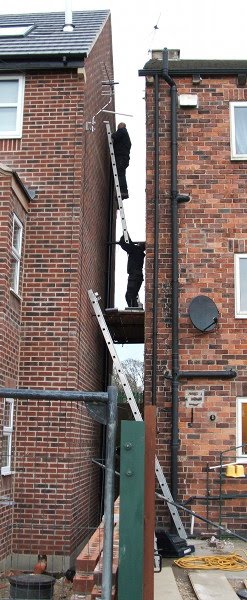
It seems that when the new buildings were erected a few years ago that the architect while maximising used space on the building plot may have inadvertently created something of a wind tunnel.

The Gap between our properties is on a parallel (north to south) to the valley below. The wind seems to travel along the crest of the valley and be funnelled through any spaces between the houses. Fortunately the rest of the properties on green lane are pretty old and the spacing between is very generous and the funnelling effect is minimal.

I wonder if we could fit a wind turbine in there? Alas it was too much for my secondary anemometer which is now smashed in three parts.

Also gaining access to the gable end wall of my property has become somewhat perilous (Hence the wonky APT antenna I cannot get fixed). Yes that really is a guy balancing on a ladder 10m high in a strong wind. And indeed the platform the ladder is resting on is built from scaffolding board wedged between the houses.

I guess the hospital emergency room being 300m away means medical assistance is on hand, even so he is braver than I am. So my weather satellite imagery will just have to come from the internet like everyone else's for a while.

6 February 2011

Alexander Reichle-Schmehl: A plea to all FOSDEM visitors:

Could some please put a picture of one of the new spacefun themed T-Shirts somewhere? I really want to see them... Update: Christoph Kluenter was so nice to upload some pictures.

Kees Cook: fun with game memory

So, I was testing a (closed source) single-player offline game recently and thought this exercise might be fun to document. I didn t want to spend any time actually earning in-game money since I d played it before and I wanted to just skip ahead to other aspects of the game. I was curious how straight-forward adjusting my cash might be. So, noting the in-game bank account number of 219393 and account balance of 3000, I dived right in. First up, what s the memory layout of the heap look like? I looked at the brk and the mmap regions without a mapped library or file, marked with w in the permissions column, from /proc/PID/maps:
0827e000-08282000 rw-p 00000000 00:00 0
0a22e000-0b08a000 rw-p 00000000 00:00 0 [heap]
efa59000-efd00000 rw-p 00000000 00:00 0
efd00000-efd21000 rw-p 00000000 00:00 0
Knowing these, I could use gdb s find command, after attaching to the process:
$ gdb /some/cool/game

(gdb) attach PID

(gdb) find /w 0 0827e000, 0 08282000, 219393
(gdb) find /w 0 0a22e000, 0 0b08a000, 219393
0xaf03d08
0xaf06ca8
No hits in the first region, but I see two hits for the account number value in the second region. Let s start there and see what s near them
(gdb) x/8x 0xaf03d08
0xaf03d08: 0 00035901 0 00000000 0 00000000 0 0af06ce0
0xaf03d18: 0 0af06be0 0 00000059 0 0af03d98 0 0af041e8
(gdb) x/8x 0xaf06ca8
0xaf06ca8: 0 00035901 0 00000bb8 0 00000bb8 0 0820b148
0xaf06cb8: 0 00000001 0 00000000 0 00000000 0 00000000
In that second hit, I see the value 0xBB8, which is 3000, and matches our account balance. Let s see what happens if we just change both of those to add a bit a few orders of magnitude above the current value
(gdb) set var *0xaf06cac = 0 00100bb8
(gdb) set var *0xaf06cb0 = 0 00100bb8
(gdb) x/32x 0xaf06cac
0xaf06cac: 0 00100bb8 0 00100bb8 0 0820b148 0 00000001
(gdb) continue
And presto, clicking on the bank account details in-game shows a huge account balance of 1051576 now. No need to reverse-engineer any saved games, whew.

5 February 2011

Vincent Fourmond: ctioga superseded by ctioga2

First, some historical details: some 6 years ago, I discovered Ruby together with Tioga, a great library for producing plots. That immediately resulted in my first Ruby program, ctioga. But as years passed and more features were forced into ctioga, I was compelled to see my initial design mistakes, and think about a complete rewrite. This is where ctioga2 was born, some time at the beginning of 2009. I completely stopped using the old ctioga a few month after starting to work on ctioga2, but it took ages before I finally came up with a decent enough documentation to release and announce publicly. But now, it's done, and the first public release of ctioga2 is out, still fresh ! Here are a few highlights of the differences: In any case, you can make yourself an opinion of ctioga2 by looking at the galleries. Enjoy !

Craig Small: Syntax Highlighting with Mid-Century themes

As a site that discusses a variety of programming languages, I thought it would be good to have syntax highlighting for the code snippets. This blog runs Movable Type so it had to fit in with the setup I have already. So I found the Syntax Highlighter module ok and the initial installation went fine, it was simply:
  1. Download the .zip archive
  2. Unzip the archive into a temporary directory
  3. Copy the plugins/SyntaxHighlighter directory to my plugins directory
  4. Copy the mt-static/plugins/SyntaxHighlighter directory to static/plugins
You then need to edit the HTML Head template and add to the bottom of it the following line:
<$MTSyntaxHighlighterInclude$>
Next, I like to use Markdown as my markup language. But you can only have one type text filter. Another plugin called FormatStack solves this. Create a new stack and put Syntax Highlighter before Markdown. You can then create documents with both sorts of tags and it works quite nicely, well almost. Mid Century Problems This is probably not a Mid-Century specific problem but the modern templates or styles may cause a problem. You ll find you switch styles and suddenly, no more syntax highlighting. The problem is the onLoad functions get overloaded. Some styles have an onload property on their body. You ll see lines similiar to
 <body id="blogbase" class="whatever" onload="mtEntryOnLoad">
This onload event stops other onload events, which means Syntax Highlighter cannot do its thing. The fix is rather simple, you just adjust the templates so they look like the following:
<body id="blogbase" class="mt-entry-archive layout-wtt">
<script type="text/javascript">
 mtAttachEvent("load", mtEntryOnLoad);
</script> 
After doing this and publishing it all worked! You may also see this sort of problem with other plugins that use the mtAttachEvent() Javascript call. Reducing Includes By default, the script includes all syntaxes it knows. If you want to only include some, you do this by specifying what brushes you want. For example if you only will highlight perl and python scripts then you can change the line to:
<$MTSyntaxHighlighterInclude brush="perl,python"$>
Syntax Themes The other attribute the Include line will take is theme. There are several themes but default is alternating white on grey with the rest being variations on light text on a dark background.

Craig Small: A few minor updates

No real terribly exciting updates lately but all important in their own way. ncurses A new version of ncurses got uploaded into sid. It should hopefully fix the backspace versus delete problem some of the FreeBSD people have been having with some of the terminal emulators. Oh, and if you are pining for the good old days when 8 colours and 64kB of memory was good enough for everyone, checkout ncurses-examples which have a bunch of interesting things you can do with curses, including some games. Anyone remeber the tower of Hanoi? dh-make dh-make, the tool to take a raw tar (or zip) archive and make a Debian package has been updated too. One of the interesting side-effects of maintaining dh-make is you find out (usually through bug reports) the little changes that happen to the Debian package build process. Most people, including myself, though the main big thing between versions 1 and 2 and version 3 of the source formats was the inclusion of quilt patches right inside the source files. And probably for the sake of "main things" this is true. What I didn't realise is that dpkg-source has changed in other ways too. Bug 580804 tripped this one up. For most people, you run dh_make, fix some things up and use debuild. If you didn't have the original tar file (perhaps you got the source from git or svn) you just use --creatorig and it copies the current directory into ../whatever-1.2.3.orig Source format 3 doesn't like this. Previously it would find that there was no orig.tar.gz archive but there was a orig directory and make the archive from that. Now you have to do it yourself and dh_make does it like that too. pidgin-musictracker Now this should of been a pretty simple stock-standard upstream upgrade. Download the file, uupdate, debuild and release. The problem is that upstream didn't fix their po files. These are the translation files that convert the raw english texts in a program into whatever language. This means the first time you run the build process, you have no diff file. However when you run it the second time, part of the install target rebuilds the po files (mainly the line references), you have differences and then a big diff file of these po updates. The real fix is to make sure your po files are up to date before you release! The trick is that they don't automatically and I have been caught myself; though it happens in the release testing phase (because my release testing involves usually building the debian archive so I see my own problem). irc came to the rescue again. Someone there suggested getting dpkg-source to ignore the changes. The way you do that is put parameters into debian/source/options. I wanted to ignore the changes to the po and pot files so my file has:
extend-diff-ignore=po/.*\.pot?
I put that in and it works!

Craig Small: Playing text adventures with mudlet

Mudlet I've been playing text based multi-user games on and off for years, or perhaps that's decades. When I first started playing them, all you had was telnet. Then this program called TinyFugue appeared which is still shipped by Debian. The generic term for these sorts of games are MUDs, or Multi User Dungeons. Anyhow, I recently came across a new MUD client called Mudlet. It's a very slick program and works quite well. The way it does its triggers (reactions to what the mud sends you) and aliases (reactions to what you type) is done well and is fast. For some people you may have 100s of potiential matches on a incoming or outgoing line so you want it to be fast. After trying it out, my next reaction was "ok, so is it packaged in Debian?". To my surprise, it wasn't so the only obvious thing to do was for me to package it. It is now sitting in the NEW queue waiting for our ever-overloaded ftp masters to have a look at it. While the program is done well, as shipped it doesn't play too well with a Linux system. The package carries about 4 different other packages around. I've changed that now so it uses the system libraries and fonts. All of them are shipped in Debian and I'm sure they individually get more attention and love then I would give them being a sub-part of the main package. It of course cuts down on build times and archive sizes too. I still play muds, no matter what client. For me there they're fun on two levels. The first is the puzzles and gameplay of the MUD itself. I play some MUDs run by Iron Realms who continuously update them, giving you new challenges. The second level is the scripting and customisation you can do. Instead of typing "sip health" you can write some scripts to check your health level and get the script to do it. Mudlet (and a lot of other MUD clients) use the Lua langauge to do this scripting. It's a little funny language but is easy to learn and use. You won't be able to build some epic programs with it, but for scripting it is pretty good. Languages in Hunspell Mudlet uses the hunspell library for spell checking. I have, of course, linked it with the Debian library. The difficulty now is what language? I was surprised that when you intialise the library, you specify what language files to use right there. Now for me its simple, the english dictionaries should be used! What I don't undertand is if there is a way of determining the right dictionary globally for a user. I first though it would be one of the locale parameters, those LC_whatever fields. Mine is en_AU.UTF8, which there is no dictionary for as I'd use en_US or en_UK. I could possibly patch Mudlet and find a dialog box somewhere where you can set the language, but to me an environment variable makes more sense. Does anyone use the DICTIONARY variable, for example?

3 February 2011

Stefano Zacchiroli: how to use Notmuch with Mutt

Mutt mail indexing on steroids! I've been using external mail indexing with Mutt for quite a while now. Before now I haven't given Notmuch a try, as it seemed too much experimental at the time of my initial review of mail indexing tools. As there is nothing better than a long oversea flight to perpetrate new hacks, I've now not only tested it, but also switched to Notmuch without looking back at maildir-utils for a split second. Getting started with Notmuch is trivial: Some performance figures: (1) the size of the index is a bit larger than the size of the mails (on my laptop: 535 Mb of index vs 375 Mb of mails stored in 60 maildirs); (2) even if the underlying indexing engine is the same (Xapian) as maildir-utils, Notmuch is much faster. With my setup it is so fast that I've added it as a hook triggered by offlineimap at the end of each synchronization:
    zack@usha:~$ grep -B 1 hook .offlineimaprc
    [Account Upsilon]
    postsynchook = notmuch new

With the big round of new mail downloaded in the morning, it hardly takes more than a few seconds to update Notmuch index, while with other periodic downloads Notmuch almost invariably reports "... in almost no time" (i.e. less than 1 second). Integrating Notmuch with Mutt The basic integration I want between Mutt and a mail indexer is the ability of stating a search query interactively and then jump to a fresh Maildir containing search results only. Additionally, given that Notmuch has neat thread reconstruction abilities, I also want to be able to reconstruct on the fly the thread corresponding to the currently highlighted mail: it comes handy when a thread has been split across different maildirs, archived, or the like. To that end, I've cooked up a little helper, called mutt-notmuch, that enables to trigger mail searches via a Mutt macro (F8 being my choice) and reconstruct threads via another (F9). Check the manpage for the 2-liner configuration snippet for your ~/.muttrc. Arguably, some of the logics of mutt-notmuch could disappear by adding support for a --output=symlinks flag to Notmuch. A bug report requesting that is pending: too bad oversea flights are not as good for accessing the Internet as they are for perpetrating hacks! Download

Next.

Previous.