Search Results: "mak"

3 January 2012

Martin-Éric Racine: xf86-video-geode 2.11.13

A few days ago, I pushed out version 2.11.13 of the Geode X driver. This is the driver used by the OLPC XO-1, by a plethora of thin clients such as the ThinCan, by low-power desktops such as the Linutop and by a few notebooks such as the eCaf EC800. While this release indeed features a few bugfixes (mainly to keep this driver compilable on the latest X server), the lion's share of the changes involve a complete overhaul of the build scripts, courtesy of Gaetan Nadon. The key motivation for this overhaul was to acknowledge the efforts made by third-party contributors to make the driver compile on BSD variants. Sure enough, this release finally compiles on FreeBSD and, low and behold, on Hurd. However, the hybrid nature of Debian's FreeBSD kernel-based GNU operating system variant posed an additional challenge, because it provides usable support for Video for Linux version 2 (V4L2), but without the full complement of Linux definitions. This resulted in one post-release commit (included in Debian and Ubuntu package 2.11.13-2), following which my assertion that we could now safely define this package as Architecture: any-i386 finally proved to be a safe one for Debian-based operating systems. At this point, I'm curious as to how many more operating systems, especialy BSD variants, can finally use this driver. Patches to further improve support of non-Linux systems are welcome.

Russell Coker: Standardising Android

Don Marti wrote an amusing post about the lack of standards for Android phones and the fact that the iPhone has a better accessory market as a result [1]. I d like to see some Android phones get standardised in a similar manner to the PC. The big thing about the IBM PC compatible market was that they all booted the same way, ran the same OS and applications, had the same expansion options, connectors, etc. The early PCs sucked in many ways (there were many other desktop computers in the 80 s that were better in various ways) but the larger market made the PC win. The PC even killed the Mac! This is something we should remember now when discussing the iPhone. I d like to see different Android phones that can run the same OS with the same boot loader. Having HTC, LG, Samsung, and others all sell phones that can run the same version of CyanogenMod and have the same recovery options if a mistake is made when loading CyanogenMod shouldn t be any more difficult than having IBM, Compaq, HP, DEC, Dell, and others selling PCs that run the same versions of all the OSs of the day and had the same recovery options. Then there should be options for common case sizes. From casual browsing in phone stores it seems that most phones on sale in Australia are of a tablet form without a hardware keyboard, they have a USB/charger socket, an audio socket, and hardware buttons for power, volume up/down, and home with the settings and back buttons being through the touch-screen on the Galaxy S but hardware in most others. A hardware button to take a picture is available in some phones. The variation in phone case design doesn t seem to be that great and there seems to be a good possibility for a few standards for common formats, EG large tablet, small tablet, and large tablet with hardware keyboard. The phone manufacturers are currently competing on stupid things like how thin a phone can be while ignoring real concerns of users such as having a phone that can last for 24 hours without being charged! But they could just as easily compete on ways of filling a standard case size, with options for screen resolution, camera capabilities, CPU, GPU, RAM, storage, etc. There could also be ways of making a standard case with several options, EG having an option for a camera that extends from the back of the case for a longer focal length such an option wouldn t require much design work for a second version of anything that might connect to the phone. Also standards would need to apply for a reasonable period of time. One advantage that Apple has is that it has only released a few versions of the iPhone and each has been on sale for a reasonable amount of time (3 different sizes of case in 4 years). Some of the Android phones seem to only be on sale in mass quantities for a few months before being outdated, at which time many of the stores will stop getting stock of matching accessories. Finally I d be a lot happier if there was good support for running multiple Android phones with the same configuration. Then I could buy a cheap waterproof phone for use at the beach and synchronise all the configuration before leaving home. This is a feature that would be good for manufacturers as it would drive the average rate of phone ownership to something greater than 1 phone per person.

Raphaël Hertzog: My Debian Activities in December 2011

This is my monthly summary of my Debian related activities. If you re among the people who made a donation to support my work (364.18 , thanks everybody!), then you can learn how I spent your money. Otherwise it s just an interesting status update on my various projects. Dpkg and Multiarch I had some hope to have a multiarch-enabled dpkg in sid for Christmas as Guillem told me that it was realistic. Alas Guillem got sick. We re in January and we re still not there. While some of Guillem s commits in December were related to multi-arch, the size of his pu/multiarch/master branch did not really shrink. We still have 36 commits to merge most of the work he did was refactoring some parts of the code that were already merged. And he initiated some discussion on interface changes. I participated to those discussions hoping to bring them to a quick resolution. I m still maintaining my own pu/multiarch/full branch, it is based on Guillem s branch but with further fixes that I developed and that he has not yet merged and with a change reverted (Guillem s branch allows crossgrading packages between different architectures while dpkg does not manage this correctly yet). I can only hope that January will be the last month of this never-ending saga. It s been one year since I started working on this project. :- Misc dpkg work I reviewed (and later merged) a patch of Kees Cook to enhance dpkg-buildflags so that it can report which hardening features are enabled. This feature might then be used by tools like lintian to detect missing hardening features. I mentored Gianluca Ciccarelli who is trying to enhance dpkg-maintscript-helper to take care of replacing a directory by a symlink and vice-versa. I took care of #651993 so that dpkg-mergechangelogs doesn t fail when it encounters an invalid version in the changelog, and of #652414 so that dpkg-source --commit accepts a relative filename when a patch file is explicitly given. Guillem also merged a fix I developed for LP#369898. Packaging work WordPress 3.3 came out so I immediately packaged it. Despite my upstream bug report, they did not update their GPL compliance page which offers the corresponding sources for what s bundled in the tarball. So I hunted for the required sources myself, and bundled them in the debian.tar.xz of the Debian source package. It s a rather crude solution but this allowed me to close the release critical bug #646729 and to reintroduce the Flash files that were dropped in the past which is great since the Flash-based file uploader is nicer than the one using the browser s file field. Quilt 0.50 came out after 2 years of (slow) development. The Debian package has many patches and several of them had to be updated to cope with the new upstream release. Fortunately some of them were also merged upstream. It still took an entire morning to complete this update. I also converted the packaging from CDBS to dh with a short rules file. Zim 0.54 came out and I immediately updated the package since it fixed a bug that was annoying me. Review of the ledgersmb packaging As the sql-ledger maintainer (and a user of this software for my accounting), I have been hoping to get ledgersmb packaged as a possible replacement for it. I have been following the various efforts initiated over time but none of them resulted in a real package in Debian. This is a real pity so I tried to fix this by offering to sponsor package uploads. That s why I did a first review of the packaging. It took several hours because you have to explain everything that s not good enough. I also filed a wishlist bug against lintian (#652963) to suggest that lintian should detect improper usage of dpkg-statoverride (this is a mistake that was present in the package that I reviewed). nautilus-dropbox work I wanted to polish the package in time for the Ubuntu LTS release and since Debian Import Freeze is in January, I implemented some of the important fixes that I wanted. The Debian package diverges from upstream in that the non-free binaries are installed in /var/lib/dropbox/ instead of $HOME.

Due to a bug, the files were not properly root-owned so I first fixed this (unpacking the tarball as root lead to reuse of the embedded user & group information, and those information changed recently on the Dropbox side apparently). Then we recently identified other problems related to proxy handling (see #651065). I fixed this too because it s relatively frequent that the initial download triggered during the package configuration fails and in that case it s the user that will re-trigger a package download after having given the appropriate credentials through PackageKit. Without my fix, usage of pkexec would imply the loss of the http_proxy environment variable and thus it would not be possible for a user to download through a proxy. Last but not least I reorganized the Debian specific patches to better separate what can and should be merged upstream, from the changes that upstream doesn t want. Unfortunately Dropbox insists on being able to auto-update their non-free binaries, they are, thus, against the installation under /var/lib/dropbox and the corresponding changes. Book update We re making decent progress in the translation of the Debian Administrator s Handbook, about 6 chapters are already translated (not yet reviewed though). The liberation campaign is also (slowly) going forward. We re at 67% now (thanks to 90 new supporters!) while we were only at 60% at the start of December. Thanks See you next month for a new summary of my activities.

No comment Liked this article? Click here. My blog is Flattr-enabled.

2 January 2012

Maximilian Attems: CPhT visit automn 2011

On my new particle physics blog (yupie to ikiwiki, thanks joey) posted some recollection of a fine, productive and busy Paris research visit to the Ecole Polytechnique. The feed agregegator for particle physics blogs got relaunched too that automn. In case you are interested in particle physics this should keep any reader updated on the Higgs hunt, black holes searches, fundamental interactions and much more.

Gunnar Wolf: Happy Public Domain day, even for the inhabitants of the longest-copyright-term country

Happy Public Domain day, even for the inhabitants of the longest-copyright-term country
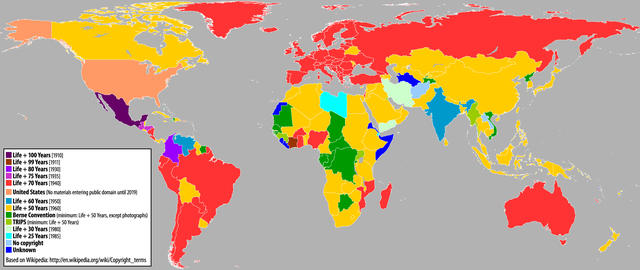
Every year, on January 1st, new material ceases to be protected by copyright and enters the public domain. This means, every year, more knowledge, literature, paintings, music, movies and a long etcetera becomes collective property, instead of being artificially held by the current holders of their rights. As this image shows (source: http://publicdomainday.org/node/39 ), I have the honor(?) to live in the country with the longest copyright protection term in the world. Copyright in Mexico does not only last for 100 years It lasts for the natural life of the author plus 100 years. This means that the popular corridos that tell the stories of the 1910 revolution are still not in the public domain. La sucesi n presidencial, the book which Francisco I. Madero wrote to justify that a peaceful political change was needed for the 1910 elections, will not enter the public domain until 2014 (president Madero was killed during 1913). Does it make any sense to kidnap cultural, political or artistic works for over a century? Not only that: Material that is legally sold as public domain in other countries is illegal in ours. Take as an example the recordings of Enrico Carusso, the great Italian tenor who died in 1921. Over 15 years ago, I bought a couple of CDs with his recordings (even if the sources were quite low-quality, as they had been copied over from wax cylinders to magnetic tapes to optical media). I bought them surprisingly cheap, as they were genuine public domain. But they are still protected in my country. That means, I ilegally have some stolen(!) works of art which I lawfully bought outside my country. Copyright law needs to be revised to match reality. Technological advances have strongly changed reality since 1717's promulgation of the first copyright laws. The solution is not to extend the terms, but to rethink the whole process. (yes, this rant was mainly made as an excuse for me to copy this image and put it in a location I can easily refer to later. But I hope it is interesting to you!)

1 January 2012

Joey Hess: a resolution that stuck

Last year, my new year's resolution was to write in my journal every day. That actually stuck, I wrote 262 journal entries in 2011. While I've been keeping a journal intermittently since 1998, last year I doubled the number of entries in it. And wrote a novel's worth of entries -- 53 thousand words! Most of it is of course banal and mundane stuff. Not good compared with Lars, who does something with his journal where he goes into some detail about code he's working on, and other work. The excerpts I've seen are quite nice. But after I've written code, written a commit message, documentation, perhaps bug reports etc, I often can't find much to say about it in my journal, beyond the bare bones that I worked on $foo today or faced a particularly hard bug. I also worry that the journal, and my reluctance to repeat myself, often tips the balance away from me blogging, if I write down something in the journal first.
Here's my journal for today:
Compare what jokes are funny now with those in 1982. The 1982 ones from net.jokes on olduse.net seem juvenile. Now compare what Unix joke man pages are funny now with those I'm reading from 1982. They seem basically the same. What would Biella make of this? Liw noticed ikiwiki OOM on pell. Tracked down to a perl markdown bug with long lines. Had quite enough of perl markdown; ikiwiki will be moving to a different engine. Added discount support to it today, still needs Debian package tho. [censored] Really gorgeous sunset, with a high wind, moon, puffy low, fast moving clouds. Enjoyed it ecstaticly. It's going to get cold soon. Very rainy early, but then got intermittently sunny; power is holding out ok. Was going to roast a chicken today, but got distracted and had a large lunch besides. Need to find some quick food for supper. I need to start a new book, should it be the River Cottage book about meat that I stole from Anna, or some SF? Blogged about journaling, and put this journal entry in it, so also journaled about blogging. Wrote it somewhat self-conciously.

The benefits for me have ranged from being able to go back and work out dates of events, to forwarding the odd excerpts to others. The best thing though is certianly having a regular time of introspection, to look back over my the day. If you've not got a new year's resolution yet, I recommend this one. (Learning Haskell would be another good one, if you haven't yet.) Just write something, anything, down in your journal every day.

Tanguy Ortolo: Debian Developper

Debian red swirl For this new year I got a quite specific present : a Debian Developer account. Of course this is not an end by itself but rather a beginning, or perhaps a continuation of my modest effort to contribute to the greater good of our users and free software. As an introduction, I would like to quickly explain how I came to this point, and I also have some people to thank.

Debianist journey
1997-2003
First family computer, a PC running Microsoft Windows 98. I became a power-user, and I progressively replaced all the pieces of that computer, except it operating system (though I reinstalled it several times).
2003
First contact with GNU/Linux: at my preparatory school, we use XEmacs and Kile under Mandrake Linux 9.2 to do some works in Caml Light and LaTeX. I start enjoying free software at home, with Mozilla Firefox, Thunderbird and Libre^WOpenOffice.org.
2005, preparatory school
I try Knoppix at home and eventually install Mandriva Linux 10.2 for my own use. Since then I have never used Microsoft Windows for personal work any more.
2005, engineer school
I integrate Centrale Paris and I join the team of VIA Centrale R seaux, which I believe is a known den of debianists. So I start using Debian on my personal laptop.
2006
Debian power-user. I start reporting bugs.
2007
First small contributions: some of my bug reports now include patches. I also start maintaining a French training document about Debian: formation Debian GNU/Linux.
2008
First packaging work with the help of adn, a modification and split of frozen-bubble to have a server-only package (contribution finally refused, actually).
2010
First package: I adopt dokuwiki with the help of adn. I become a Debian Maintainer, with the intent of applying as a Debian Member later.
2012
I am now a Debian Developer, responsible for a handful of packages and able to do NMUs and to sponsor new contributors.
As you may guess, I have always been a tinkerer, about computers but also about bikes (the ones that work with manpower, not the ones that make noise and smoke ;-)). And I also always wanted to publish my works somehow, because I hate to think that someone could have to do again some reusable work I had to do before instead of taking advantage of it. Well, it happened that free software was a way to achieve both goals: to hack and to make my work available for anyone. Thanks I would like to thank all those who helped me to discover and contribute to free software, especially: adn, who helped me with my first steps to directly contribute to Debian, dererk and all the Debian Developers that patiently reread and sponsored my packages, and my Application Manager gwolf, who gave quite a lot of time asking me questions, reading my replies, and replying to some questions that arose during the process. Outside of the Debian Project I have to thank Alexis de Lattre, who wrote the original Formation Linux that I am now maintaining under the name of Formation Debian GNU/Linux , a document which helped me to discover GNU/Linux and Debian specifically. More generally, I would like to thank all the Free Software community that made that possible: Debian Developers, hackers and users from everywhere. We have built and we are still building quite an impressive pile of very useful work, and we can be proud of it. Notes
  1. Here in the northern hemisphere our school years begin in the middle of the civil year, which makes it tricky to tell them apart
  2. This is almost a synonym for tinkering, in the context of free software, is it not?

Lucas Nussbaum: Re: Ubuntu vs Ruby

(original post) > If Ubuntu 12.04 if a LTS release, and Ruby 1.8.7 goes out of support in June of
> 2013, then why is the default still 1.8.7?
>
> Ruby 1.9.2 was released in 2010. Ruby 1.9.3 was released in October of this year. First, there s almost nobody in the Ubuntu development community doing any Ruby work. Packages are just imported from Debian, and Ubuntu follows what is done on the Debian side. In the Debian/Ruby team, we are currently transitioning to a new packaging helper (gem2deb) that makes it much
easier to support several Ruby versions. Once this will be done, switching to 1.9.3 by default will be very easy. We already provide a way for the sysadmin to change the default on a system. Now, doing that transition takes time, and we could have used *your* help (and could still use it). We are still quite on time to do it for Debian wheezy, but it sounds very hard to do it for Ubuntu 12.04 unless someone from Ubuntu steps
up to help.

Cyril Brulebois: X server 1.12 RC1

It s this time of the year again: a new X release approaches. The upstream schedule has been delayed a tiny bit so that the multitouch changes could land in master during this merge window. Which is what happened, a few days before Christmas. The other components involved in XI2.2 (aka. multitouch ) were packaged in experimental while the server side was getting prepared: Given we reached the 1.12 RC1 stage, it s a good idea to start building drivers against the new server to make it possible for users to perform some tests. And as usual, a new server means bumped input and video ABI, meaning a rebuild for the drivers to pick new dependencies. Some of them also needed a few fixes to make them build against the new server. Nothing that can t be fixed with a few merges from upstream master branches. The usual set of major drivers was uploaded to experimental: Significant change on the intel side: a snapshot of the current master branch was created, and packaged with SNA support enabled. SandyBridge's New Acceleration has apparently reached a point where it can be published to the masses, so here we go. Some details about it can be found in the initial commit. Also, for those wondering about the xorg-server FTBFS on some architectures, fixes are pending. Happy new year.

31 December 2011

Steve Kemp: The final updates of 2011

I've been informed by a couple of people that the Debian Administration site is down. Sadly it is; at the moment the host isn't showing anything on the serial console and remotely power-cycling it isn't showing any signs of life. At this time of year I don't want to drag anybody in to take care of it, so ETA on recovery/replacement hardware is Monday/Tuesday. In other news I've made it to year five of the KVM hosting sub-project/thing. Originally started as a Xen host its been running happily for quite some time. I suspect next year, or the year after that the price/specification ratio will end up losing out and we'll cancel the whole thing - but there are no immediate reasons to make any change. Finally I knocked up a simple tool to validate my TinyDNS records prior to uploading them. It is simplistic, but adequate to catch the kind of mistakes I make: Honestly it probably wants to be rationalised a little more - and check records more carefully. e.g. Ensure that the host a CNAME refers to itself exists, and making sure that the nameservers specified are valid. I just wanted to make something quick after accidentally uploading a zonefile where I'd managed to fat-finger several important records. le sigh. Oddly enough asking on serverfault.com showed no real suggestions - other than actually running tinydns locally and doing a zone-xfer to validate records. Overkill and harder than I'd like. Happy New year if you care about such things.. "I finished growing up, L on. I just get older. " - Leon

Iain Lane: Beer bread bakin'

I got a beer bread kit from Mum for Christmas this year. enticing It seems pretty easy, so for a pre-new-year treat, I gave it a go. simple to make ready to go Of course, for the beer I'm using one of my first batch of home brewed beer that I made just before the holidays. :-) professionally crown capped a nice colour, and not too cloudy too Chuck it in slop Mix it for around 30 seconds. bash it about, and this comes out Discover there is no bread tin here, so use cake tins instead. baz it in the oven Flatter than it should be, but otherwise YUM YUM YUM hells yeahs

Russell Coker: Sociological Images

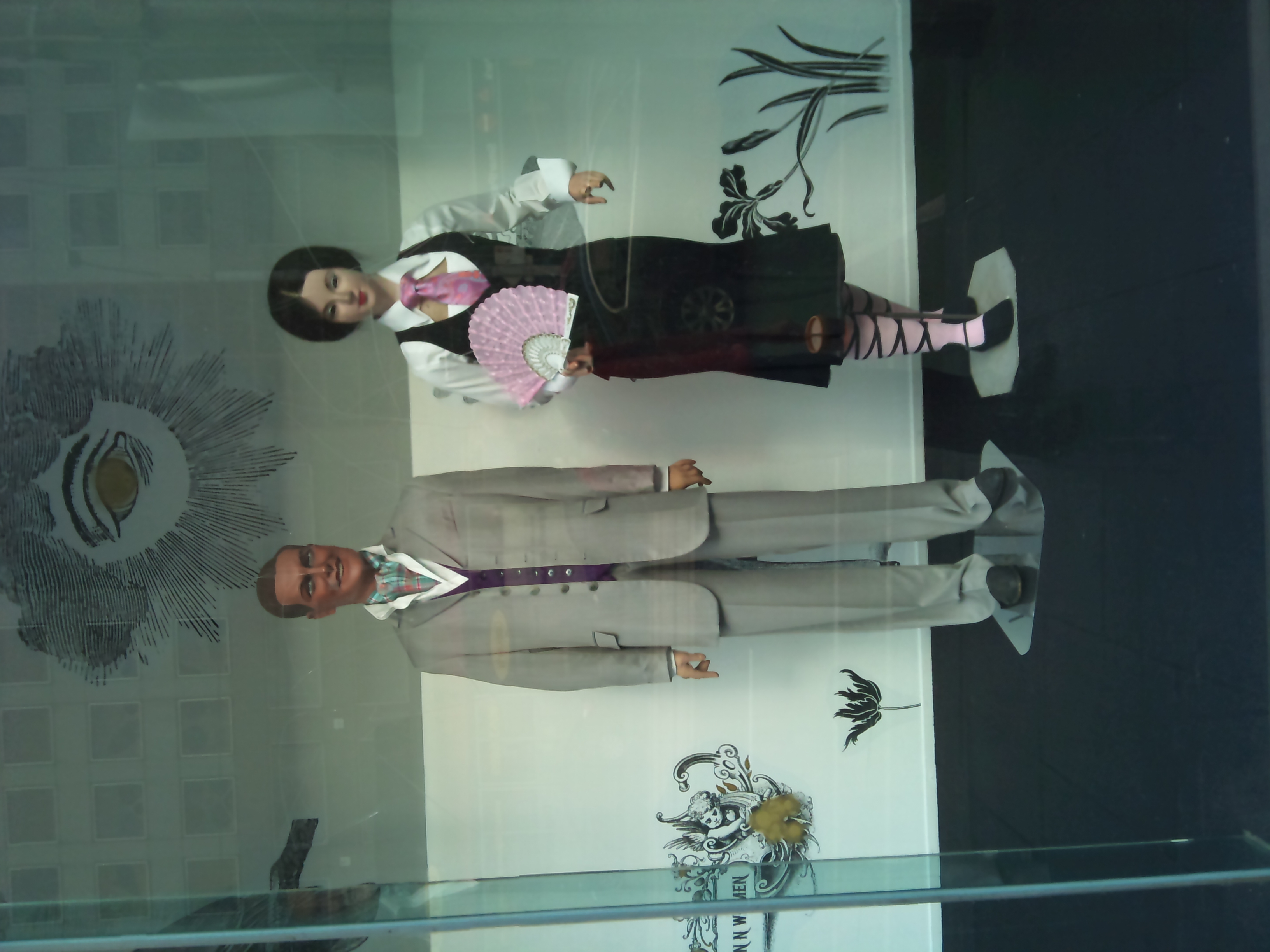
I ve recently been reading the Sociological Images blog [1]. That site has lots of pictures and videos that are relevant to the study of Sociology (most of which have a major WTF factor) and it s run by people who have Ph.Ds in Sociology so the commentary is insightful. Since reading that I ve started photographing relevant things. woman in straight-jacket advertising energy prices I can t work out the logic behind the above advert for Energy Watch which was on a billboard near Ringwood Station in Melbourne, Australia. The only thing that it clear is that it spreads bad ideas about mental illness and psychiatric treatment. It doesn t make me want to do business with them. Antons full display The above picture is a shop-front for the Antons clothing store (I m not sure if they are a tailor or if they sell ready to wear). It was taken on Lonsdale St, Melbourne where the store apparently used to be, now they are in Melbourne Central. Antons left display, African and Southern EuropeanAntons right display, Northern European and Japanese The above pictures show more detail. Unfortunately the combination of lighting and my camera (Xperia X10 phone camera) wasn t adequate to show the apparent ethnic differences between the two men. It seems that the most likely Australian interpretation of the ethnic groups that are represented are African (maybe Afro-American), Southern-European or maybe American Hispanic, North-Western European, and Japanese. It s good to have mannequins representing the fact that not everyone in Australia is white, but different facial expressions for different races seems a strange choice (admittedly it might be a choice made by mannequin manufacturers). Also the Japanese woman with fan idea is rather outdated. I ve just started reading You May Ask Yourself: An Introduction to Thinking Like a Sociologist (Second Edition) by Dalton Conley. I ve only read the first chapter, but that was good enough that the entire book has to be good enough to recommend.

Russell Coker: My Blog Server was Cracked

On the 1st of August I noticed that the server which runs my blog among other things was having an occasional SEGV from a sshd process. Unfortunately I was busy and didn t pay much attention to this, which turned out to be a big mistake. On the 12th of September I started investigating this properly and noticed that when someone tried to connect to ssh with password authentication sshd would SEGV after it was denied access to a shared memory region or a semaphore which had a SE Linux type of unconfined_t. I added some SE Linux auditallow rules and discovered that the memory region in question was created by the ssh client. Shortly after that I came to the conclusion that this wasn t some strange feature of ssh (or one of the many shared objects it uses) but hostile activity. The ssh client appeared to be storing passwords that it used in a shared memory region and sshd was also collecting passwords in the same region and presumably offering them to a ssh client which uses some extension to the ssh protocol. The sshd process was crashing because it couldn t handle EPERM on access to shared memory or semaphores. Presumably if the system in question wasn t running SE Linux then the exploit would have remained undetected for a lot longer. At this stage we don t know how the attacker got in. Presumably one of the people with root access ran a ssh client on a compromised system and had their password sniffed. One such client system was mysteriously reinstalled at about that time, the sysadmin of the system in question claimed to have no backups which made it impossible to determine if that system had been compromised. I believe that the sysadmin of the client system knew that their system was compromised, kept that information secret, and allowed other systems to become and remain compromised. The attacker made no good effort to conceal their presence, they replaced ssh, sshd, and ssh-add and didn t bother changing the Debian checksums so the debsums program flagged the files as modified. Note that I have kept copies of the files in question and am willing to share them with anyone who wants to analyse them. Steinar H. Gunderson has named this trojan Ebury [1]. Recovery By the evening of the 13th of September I had the system mostly working again. Jabber still isn t working because ejabberd is difficult to get working at the best of times, I am now investigating whether there is a better Jabber server to use, but as I don t use Jabber often this hasn t been a priority for me. Some of the WordPress plugins I use and all of the WordPress themes that are installed were outside the Debian packaging system, as I couldn t be sure that they hadn t been altered (because the people who wrote WordPress plugins don t keep old versions online) I had to upgrade to the newer versions. Of course the newer versions weren t entirely compatible so I had to use a different theme and I couldn t get all plugins working. Link Within no longer works, not that it ever worked properly [2], I wanted to try Outbrain again but their web site won t let me login (and they haven t responded to my support request). Does anyone know of a good WordPress plugin to provide links to related content? Either related content on my blog or on the Internet in general will be OK. Some people have asked me about the change in appearance of my blog. It was simply impossible (for someone with my PHP skills) to get my blog looking the same way as it did before the server was cracked. I think that the new look is OK and don t mind if people think it looks likw a VW advert VW make great cars, I was very satisfied with the VW Passat I used to drive. Future Plans I had bought some Yubikeys (USB devices that generate one-time passwords) [3] to control access to that server, if I had configured the software to use them then this might not have happened. The use of one-time password devices can prevent passive password-sniffing attacks. It would still allow active attacks (such as using ControlPath/ControlMaster options on the ssh client to allow a hostile party to connect later (EG the -M, -S, and -o ControlPersist options for the ssh client). It s a pity that there doesn t seem to be a way to configure the ssh server to disable ControlMaster. Conclusion It would be good to have some changes to sshd to allow more restrictions on what a client can request, as ControlMaster functionality isn t needed by most users it should be possible to disable it. SE Linux doesn t protect against a compromised client system or any other way of stealing passwords. It did do a good job of stopping Ebury from doing all the things it wanted to do and thus making me aware of the problem. So I count this as a win for SE Linux. Yubikeys are the cheapest and easiest way of managine one-time passwords. I had already bought some for use on the system in question but hadn t got around to configuring them. I have to make that a priority.

30 December 2011

Dirk Eddelbuettel: RcppExamples 0.1.3

A minor new release of the RcppExamples package is now on CRAN. RcppExamples contains a few illustrations of how to use Rcpp. It grew out of documentation for the classic API (now in its own package RcppClassic), and while we added a few more functions documenting how to do the same with the new API, the package is still nowhere near completion. The two ChangeLog entries since the last release are below. One new example was added, and some things were changed in order to make R CMD check (and the CRAN gate keepers) happy.
2011-12-28  Dirk Eddelbuettel  <edd>
        * DESCRIPTION: Release 0.1.3
        * src/newRcppDateExample.cpp: switch from std::cout to the new
        Rcpp::Rcout device available since Rcpp 0.9.8
        * src/classicRcppDateExample.cpp: idem
        * DESCRIPTION: Depends on Rcpp (>= 0.9.9) for Rcpp::Rcout
2011-04-08  Dirk Eddelbuettel  <edd>
        * R/RcppDataFrame.R: Added new example for Rcpp::DataFrame
        * src/RcppDataFrame.cpp: C++ source for new example
        * man/RcppDataFrame.Rd: Documentation
        * man/RcppParams.Rd: Small change to suppres a warning
Thanks to CRANberries, you can also look at a diff to the previous release 0.1.2. Questions, comments etc should go to the rcpp-devel mailing list off the R-Forge page

28 December 2011

Wouter Verhelst: Rsync'ing over a newer subversion (fsfs) repository

So there are two servers; let's call them srv1 and srv2. Srv1 contains a bunch of subversion repositories, but these are to be migrated to srv2. Since the repositories are not (just) used for ascii-only files, they're fairly big (several tens of gigabytes, altogether), so copying them from one server to the other would take a while. In order to make sure this would happen quickly, we had already copied them over to the new server, so that on the final switch would be quick (an rsync that would copy over just the new done transactions). That final switch was today. Only I didn't know that instead of just testing, the customer had already started using one of the repositories (and they'd forgotten to remind me), so the subversion repository suddenly jumped backwards in time. In addition, the new server wasn't being backed up yet (at least not for the subversion bits), so restoring from backups wasn't an option. Oops. Luckily the solution is fairly simple. You see, fsfs stores each revision in a unique file; that means that as long as nobody has committed to the repository yet (which they couldn't, since system users aren't the same on both servers, so the webserver didn't have write permissions on the repository after the rsync), nothing is lost. One only needs to manually change the repository so that whatever subversion thinks is the latest commit, actually is the latest commit. That information is stored in a file called db/current inside the repository. What's in that file depends on the repository version, which is stored in a file called db/format in the repository. For versions 1 and 2, the format is a single line with three space-separated values, of which the first is the last revision number used in the repository. The other two are counters that are used to give transactions unique names; and they, too, need to be up-to-date. For version 3 and above, the file contains only the revision number; there, the other two are derived from that instead of having their own unique number. Figuring out the last used revision number in an fsfs repository is ridiculously easy:
ls -v db/revs tail -n1
So if you've got a repository of fsfs version 3 or above, just change the revision number in the db/current file (after taking backups and making sure nobody can access the repository while you're doing this, of course), and you're all set. Unfortunately, in my case, the repository was still in fsfs version 2, which meant I could not change just the revision number and not expect trouble. I suppose it should've been possible to figure out what the last transaction numbers are, somehow, so that I could fix the current file completely, but I reasoned that upgrading to a newer repository format might have other advantages too, so I just dumped the repository and reloaded it, and everything worked at that point.

Russell Coker: Secure Boot and Protecting Against Root

There has been a lot of discussion recently about the recent Microsoft ideas regarding secure boot, in case you have missed it Michael Casadevall has written a good summary of the issue [1]. Recently I ve seen a couple of people advocate the concept of secure boot with the stated idea that root should be unable to damage the system, as Microsoft Software is something that doesn t matter to me I ll restrict my comments to how this might work on Linux. Restricting the root account is something that is technically possible, for much of the past 9 years I have been running SE Linux Play Machines which have UID 0 (root) restricted by SE Linux such that they can t damage the system [2] there are other ways of achieving similar goals. But having an account with UID 0 that can t change anything on the system doesn t really match what most people think of as root , I just do it as a way of demonstrating that SE Linux controls all access such that cracking a daemon which runs as root won t result in immediately controlling the entire system. As an aside my Play Machine is not online at the moment, I hope to have it running again soon. Root Can t Damage the System One specific claim was that root should be unable to damage the system. While a secure boot system can theoretically result in a boot to single user mode without any compromise that doesn t apply to fully operational systems. For a file owned by root to be replaced the system security has to be compromised in some way. The same compromise will usually work every time until the bug is fixed and the software is upgraded. So the process of cracking root that might be used to install hostile files can also be used at runtime to exploit running processes via ptrace and do other bad stuff. Even if the attacker is forced to compromise the system at every boot this isn t a great win for the case of servers with months of uptime or for the case of workstations that have confidential data that can be rapidly copied over the Internet. There are also many workstations that are live on the Internet for months nowadays. Also the general claim doesn t really make sense on it s own. root usually means the account that is used for configuring the system. If a system can be configured then the account which is used to configure it will be able to do unwanted things. It is theoretically possible to run workstations without external root access (EG have them automatically update to the latest security fixes). Such a workstation configuration MIGHT be able to survive a compromise by having a reboot trigger an automatic update. But a workstation that is used in such a manner could be just re-imaged as it would probably be used in an environment where data-less operation makes sense. An Android phone could be considered as an example of a Linux system for which the root user can t damage the system if you consider root to mean person accessing the GUI configuration system . But then it wouldn t be difficult to create a configuration program for a regular Linux system that allows the user to change some parts of the system configuration while making others unavailable. Besides there are many ways in which the Android configuration GUI permits the user to make the system mostly unusable (EG by disabling data access) or extremely expensive to operate (EG by forcing data roaming). So I don t think that Android is a good example of root being prevented from doing damage. Signing All Files Another idea that I saw advocated was to have the secure boot concept extended to all files. So you have a boot loader that loads a signed kernel which then loads only signed executables and then every interpreter (Perl, Python, etc) will also check for signatures on files that they run. This would be tricky with interpreters that are designed to run from standard input (most notably /bin/sh but also many other interpreters). Doing this would require changing many programs, I guess you would even have to change mount to check the signature on /etc/fstab etc. This would be an unreasonably large amount of work. Another possibility would be to change the kernel such that it checks file signatures and has restrictions on system calls such as open() and the exec() family of calls. In concept it would be possible to extend SE Linux or any other access control system to include access checks on which files need to be signed (some types such as etc_t and bin_t would need to be signed but others such as var_t wouldn t). Of course this would mean that no sysadmin work could be performed locally as all file changes would have to come from the signing system. I can imagine all sorts of theoretically interesting but practically useless ways of implementing this such as having the signing system disconnected from the Internet with USB flash devices used for one-way file transfer because you can t have the signing system available to the same attacks as the host system. The requirement to sign all files would reduce the use of such a system to a tiny fraction of the user-base. Which would then raise the question of why anyone would spend the effort on that task when there are so many other ways of improving security that involve less work and can be used by more people. Encrypted Root Filesystem One real benefit of a secure boot system is for systems using encrypted filesystems. It would be good to know that a hostile party hasn t replaced the kernel and initrd when you are asked for the password to unlock the root filesystem. This would be good for the case where a laptop is left in a hotel room or other place where a hostile party could access it. Another way of addressing the same problem is to boot from a USB device so that you can keep a small USB boot device with you when it s inconvenient to carry a large laptop (which works for me). Of course it s theoretically possible for the system BIOS to be replaced with something that trojans the boot process (EG runs the kernel in a virtual machine). But I expect that if someone who is capable of doing that gets access to my laptop then I m going to lose anyway. Conclusion The secure boot concept does seem to have some useful potential when the aim is to reboot the system and have it automatically apply security fixes in the early stages of the boot process. This could be used for Netbooks and phones. Of course such a process would have to reset some configuration settings to safe defaults, this means replacing files in /etc and some configuration files in the user s home directory. So such a reboot and upgrade procedure would either leave the possibility that files in /etc were still compromised or it would remove some configuration work and thus give the user an incentive to avoid applying the patch. Any system that tries to extend signature checks all the way would either be vulnerable to valid but hostile changes to system configuration (such as authenticating to a server run by a hostile party) or have extreme ease of use issues due to signing everything. Also a secure boot will only protect a vulnerable system between the time it is rebooted and the time it returns to full operation after the reboot. If the security flaw hasn t been fixed (which could be due to a 0-day exploit or an exploit for which the patch hasn t been applied) then the system could be cracked again. I don t think that a secure boot process offers real benefits to many users.

27 December 2011

David Welton: 2011 in Books

Since I got my Kindle a bit more than a year ago, I have finally been able to slake my thirst for reading materials, something that was prohibitively expensive when ordering English language books via Amazon.co.uk, and took lots of time to boot. Here are some of the interesting books I've happened on in the past year: The big one was "Start Small, Stay Small": which has tons of ideas on how to do small, niche startups, "for the rest of us". Those of us who aren't in Silicon Valley, who aren't seeking millions in VC funding, those who don't want to aim for "astronomically rich", but just a comfortable lifestyle with more control over our own destiny. This book gets special mention for being a big inspiration for LiberWriter. Here is a list of the others. And for fun, a variety of Sci fi and Western books, but nothing particularly noteworthy. Neal Stephenson's REAMDE was fun, but I'm not sure I'd read it more than once, like some of his other books. Here are my Amazon wishlists of things I'm considering reading at some point in the future. Comments welcome on the value of the books listed. "Regular" books: http://amzn.com/w/20I0Y1YGD1FUB and random fun books and movies. Business books: http://amzn.com/w/5B2JQOP8VZEW - although some of them are not strictly business books. Yes, if you're curious, the book links do have referral codes in them, to help sustain my reading habit.

Christoph Berg: Generating symbols files from a series of .deb files

PostgreSQL's libpq5 package got its symbols file somewhere around version 8.4, so the symbols in there were all marked with version "8.4~" or greater. As I'm working on pgapt.debian.net aiming at providing packages for all upstream-supported PG versions (currently 8.3 and up), this made packages incompatible with 8.3's libpq5. There didn't seem to be a ready program to feed a series of .deb files which would then run dpkg-gensymbols and build a symbols file, so I wrote this shell script:
#!/bin/sh
set -eu
[ -d tmp ]   mkdir tmp
i=1
for pkg in "$@" ; do
    echo "$pkg"
    test -e "$pkg"
    name=$(dpkg-deb -I "$pkg"   perl -lne 'print $1 if /^ Package: (.+)/')
    version=$(dpkg-deb -I "$pkg"   perl -lne 'print $1 if /^ Version: (.+)/')
    out=$(printf "tmp/%03d_%s" $i "$version")
    dpkg-deb -x "$pkg" "$out"
    dpkg-gensymbols -P"$out" -p"$name" -v"$version" \
        $ oldsymbols:+-I"$oldsymbols"  -O"$out.symbols"   \
        tee "$out.symbols.diff"
    test -s "$out.symbols.diff"   rm "$out.symbols.diff"
    oldsymbols="$out.symbols"
    rm -rf "$out"
    i=$(expr $i + 1)
done
To use it, do the following: The highest-numbered *.symbols file in tmp/ will then have symbol information for all packages. I then did some manual post-processing like s/~rc1-1/~/ to get nice (and backportable) version numbers. Another nice trick (pointed out by jcristau) is to replace the lowest version number of that package (8.2~ here, where libpq changed SONAME) by 0 which will make dpkg-shlibdeps omit the >= version part. (Most packages depending on libpq5 will profit from that.) I'm still pondering whether this script is non-trivial enough add to devscripts. (The people I asked so far only made comments about the mkdir call...)

Joey Hess: a Github survey

The great thing about git and other distributed version control systems is that once you clone (or fork) a repository, you have all the data. You don't have to trust that Github will preserve it; everyone who develops the project is a backup. Github carries this principle quite far amoung the features they provide. But not all the way. Today I have surveyed their features, and where the data for each is stored. The two that really stand out are the issues and notes not being stored in git. This means that, if a project uses github, it gets locked into github to a degree. The records of bugs and features, all the planning, and communication, is locked away in a database where it cannot be cloned, where every developer is not a backup. Github's intent here is not to control this data to lock you in (to the extent they want to lock you in, they do that by providing a proprietary UI that people rave about); it was probably only expedient to use some sort of database, rather than git, when implementing these features. They should automatically produce git repository branches containing a project's issues, and notes, based on the contents of their database. (For notes, git notes is the obviously right storage location.) Along with ensuring every developer checkout is a backup, this would allow accessing that data while offline, which is one of the reasons we use distributed version control. The lack of a global list of projects is problimatic in a more global sense. It means that we can't make a backup of all the (public) repositories in Github (assuming that we had the bandwidth and storage to do it). I recently backed up all the repositories on Berlios.de, when it looked to be shutting down; this was only possible because they allowed enumerating them all. People at The Internet Archive say that their archival coverage of free software is actually quite bad. We trust our version control systems to save our free software data, but while this works individually, it will result in data loss globally over time. I'd encourage Github to help the Internet Archive improve their collections by donating periodic snapshots of their public git repositories to the Archive. You're located in the same city, 5 miles apart; they have lots of hard drives (though less right now during the shortage than usual); this should be pretty easy to do.
Full disclosure: Github has bought me dinner and seemed like stand-up guys to me.

26 December 2011

Asheesh Laroia: Short key IDs are bad news (with OpenPGP and GNU Privacy Guard)

Summary: It is important that we (the Debian community that relies on OpenPGP through GNU Privacy Guard) stop using short key IDs. There is no vulnerability in OpenPGP and GPG. However, using short key IDs (like 0x70096AD1) is fundementally insecure; it is easy to generate collisions for short key IDs. We should always use 64-bit (or longer) key IDs, like: 0x37E1C17570096AD1 or 0xEC4B033C70096AD1. TL;DR: This now gives two results: gpg --recv-key 70096AD1

Some background, and my two keys Years ago, I read dkg's instructions on migrating the Debian OpenPGP infrastructure. It told me that the time and effort I had spent getting my key into the strong set wasn't as useful as I thought it had been. I felt deflated. I had put in quite a bit of effort over the years to strongly-connect my key to a variety of signatures, and I had helped people get their own keys into the strong set this way. If I migrated off my old key and revoked it, I'd be abandoning some people for whom I was their only link into the strong set. And what fun it was to first become part of the strong set! And all the eyebrows I raised when I told people I was going meet up with people I met on a website called Biglumber... I even made it my Facebook.com user ID. So if I had to generate a new key, I decided I had better really love the short key ID. But at that point, I already felt pretty attached to the number 0x70096AD1. And I couldn't come up with anything better. So that settled it: no key upgrade until I had a new key whose ID is the same as my old key. That dream has become a reality. Search for my old key ID, and you get two keys!
$ gpg --keyserver pgp.mit.edu --recv-key 0x70096AD1
gpg: requesting key 70096AD1 from hkp server pgp.mit.edu
gpg: key 70096AD1: public key "Asheesh Laroia <asheesh@asheesh.org>" imported
gpg: no ultimately trusted keys found
gpg: Total number processed: 2
gpg:               imported: 2  (RSA: 1)
I also saw it as an opportunity: I know that cryptography tools are tragically easy to mis-use. The use of 32-bit key IDs is fundamentally incorrect -- too little entropy. Maybe shocking people by creating two "identical" keys will help speed the transition away from this mis-use.

A neat stunt abusing --refresh-keys Thanks to a GNU Privacy Guard bug, it is super easy to get my new key. Let's say that, like many people, you only have my old key on your workstation:
$ gpg --list-keys   grep 70096AD1
pub   1024D/70096AD1 2005-12-28
Just ask GPG to refresh:
$ gpg --keyserver pgp.mit.edu --refresh-keys
gpg: refreshing 1 key from hkp://pgp.mit.edu
gpg: requesting key 70096AD1 from hkp server pgp.mit.edu
gpg: key 70096AD1: public key "Asheesh Laroia <asheesh@asheesh.org>" imported
gpg: key 70096AD1: "Asheesh Laroia <asheesh@asheesh.org>" not changed
gpg: Total number processed: 2
gpg:               imported: 1  (RSA: 1)
gpg:              unchanged: 1
gpg: no ultimately trusted keys found
You can see that it set out to refresh just 1 key. It did that by querying the keyserver for the short ID. The keyserver provided two hits for that query. In the end, GPG refreshes one key and actually imports a new key into the keyring! Now you have two:
$ gpg --list-keys   grep 70096AD1
pub   1024D/70096AD1 2005-12-28
pub   4096R/70096AD1 2011-03-11
There is a bug filed in GNU Privacy Guard about this. It has a patch attached. There is, at the moment, no plan for a new release.

A faster attack, but nothing truly new My friend Venkatesh tells me there is an apocryphal old Perl script that could be used to generate key ID collisions. Here in the twenty-first century, l33t h4x0rz like Georgi Guninski are trying to create collisions. In May 2010, "halfdog" posted a note to the full-disclosure list that generates PGP keys with chosen short key IDs. I haven't benchmarked or tested that tool, but I have used a different tool (private for now) that can generate collisions in a similar fashion. It takes about 3 hours to loop through all key IDs on a dinky little netbook. You don't have to use any of these tools. You can just rent time on an elastic computing service or a botnet, or your own personal computer, and generate keys until you have a match. I think that it's easy to under-estimate the seriousness of this problem: tools like the PGP Key Pathfinder should be updated to only accept 64-bit (or longer) key IDs if we want to trust their output.

My offer: I will make you a key I've been spending some time wondering: What sort of exciting demonstration can I create to highlight that this is a real problem? Some ideas I've had:
  • Publish a private/public key pair whose key ID is the same as Phil Zimmerman's, original author of PGP
  • Publish a private/public key pair whose key ID is the same as Werner Koch's, maintainer of GNU Privacy Guard
  • Publish a set of public keys that mimic the entire PGP strong set, except where I control the private key of all these keys
The last one would be extremely amusing, and would be a hat-tip to some work discussed in Raph Levien's Google Tech Talk about Advogato. For now, here is my offer: If you send me a request signed with a key in the strong set, I will create a 4096-bit RSA public/private key pair whose 32-bit key ID is one greater than yours. So if you are 0x517DD4E4 I will generate 0x517DD4E5. I will post the keys here, along a note about who requested it, and instructions on how to import them into your keyring. (Note: I will politely decline to create a new key whose 32-bit key ID would create a collision; apologies if your key ID is just one away from someone else's.) P.S. The prize for best sarcastic retort goes to Ian Jackson. He said, "I should go and create a lot of keys with your key ID. I'll set the real name to 'Not Asheesh Laroia' so everyone is totally clear about what is going on."

Next.

Previous.