Search Results: "cas"

14 July 2008

Joey Hess: awesome

After many years with ion, I've switched to using the Awesome window manager. This took three tries; the latest try seems to have stuck. I wish I had a good analogy to explain to my nontechnical readers what changing to a new window manager is about. One way to think about it is that it's like driving a car down the road, and suddenly swapping the steering wheel and brakes out for a tiller and gear shifter. And having to downshift for braking until you learn that the brakes moved to the turn indicator lever. By trial and error. But that's really only part of it. Another way to look at it is adopting a new philosophy. Or, in some cases a cult. (In some cases, with crazy cult leaders.) Whether they use Windows or a Mac, or Linux, most computer users are members of a big established religion, with some implicit assumptions, like "thy windows shall be overlapping, like papers on the desktop, and thou shalt move them with thy mouse". So, changing to a new window manager is a process of being dumped into a different environment, where nothing works like you've come to expect, and trying to construct a mental model that you can use to make sense of it. But it's also a process of modifying that environment to behave the way you like. And when done whole-heartedly, this doesn't just mean trying to make it like the environment you were used to before. It means trying to absorb the underlying philosopy of the window manager, and think up new ways of doing things, inspired by that philosopy, and modify the environment to allow doing those things. So ideally, "I switched to a new window manager" doesh't mean "my screen has some different widgets on it now". It means "I'm looking at the screen with new eyes."

Jaldhar Vyas: Q. Why Does a Seagull Fly Over the Sea?

A. Because if it flew over the bay it would be a bagel. I Spent a few days in Atlantic City with the family. Although we stayed at one of the casinos very little gambling was done due to the accompaniment of small children and my innate Gujarati aversion to throwing money away for no reason. So instead we made a semi-permanent camp on the beach and built a large and I must say pretty awesome sandcastle. Shailu insisted it should have a fire exit. I have taught her well.

Neil Williams: State of play in Emdebian ARM

Autobuilder Summary:
138 packages built successfully. 19 packages failed to cross build. 2 packages are tagged for a manual upload. (Dependency issues - rather than break the archive, these packages will not be uploaded until relevant dependencies have been fixed and uploaded.)
Stats
87% built OK
12% failed
Notes:
  1. All these packages built previously and fail at the latest versions in Debian Sid. Many could be upstream errors. All exist in Emdebian at
    previous versions (only 1 failure is known to contain bugs in the current versions in Emdebian and this only affects GUI installations. Two other GUI packages contains bugs but build OK.).
  2. Some of the packages in the repository (including some of the failures) are not used in *any* of the default emsandbox configurations. Two need to be removed from the repository completely.
  3. Some fixes are waiting for updates in Debian, either new uploads migrating to mirrors or pending fixes awaiting upload by me. (Probably tomorrow.)
  4. The history of each package is now available via the Emdebian Autobuilder Report. The package name links to the history of previous build attempts for this package. The version string links to the repository data for the current version in Emdebian. The result of the build links to the build log.
  5. A comparison with Debian unstable is constantly updated.
  6. 254 source packages exist in Emdebian but only 137 are currently built by the autobuilder. The rest will be built when new versions are uploaded to Debian (in some cases, that won't be until after Lenny). If I get time, I'll add build logs for these packages.
  7. The repository contains a fair number of packages that we don't currently use. This is a reflection of the problems of determining the "path" through the dependencies when starting at the bottom (glibc uClibc etc.). Bear this in mind when considering new architectures and new package sets. The process involves a lot of trial and error, particularly as cross-building potentially alters the dependency path at each iteration.

Problems
  1. libselinux and libsepol have just been uploaded with a bug fix that is needed for e2fsprogs and file cross-builds, amongst others. Waiting
    for the ARM mirror to receive the new builds, hopefully tomorrow.
  2. gtk+2.0 fails to cross-build because the patches now try to build the udeb which comes up against a bug in dpkg-cross. I'll be uploading the new version (including a couple of other bug fixes) tonight. (Final testing currently in progress.). The Gtk package also needs some work to run /usr/lib/libgtk2.0-0/update-gdkpixbuf-loaders so that the icons can be read in the GUI.
  3. pango1.0 also needs a fix to update the pango modules. This is usually done at build time but it means running a cross-built binary. It is a minor task and not CPU intensive so I plan to do this in postinst. Without this fix, no text is rendered in the GUI, only empty glyphs.
  4. xfonts-base is way too large still. More work is needed here to optimise just what is meant by the 'fixed' font for X, precisely which font files can be removed, which might be needed outside C or English locales etc.
  5. Other packages not currently cross-building include: (NOTE: Some of these build logs are VERY large.)
    • adduser - needs to be removed from the repository, it is perl and we implement it via busybox.
    • cups cupsys - /usr/include/pthread.h:653: warning: '__regparm__' attribute directive ignored.
    • gcc-4.2 - needs to be removed from the repository, it no longer builds libgcc1 which was the main reason for cross-building it.
    • glib2.0 - more generated content: /bin/sh: line 2: /usr/bin/glib-genmarshal: No such file or directory
    • gnomevfs - hasn't built for ages and isn't usable anyway due to dependency issues. Currently preventing the use of gpe-filemanager. Due to be replaced by GIO in Debian.
    • libusb - build failure, so far resistant to usual fixes.
    • ncurses - build failure - uses gcc in wide char support build.
    • ntp - build failure - assembly error. authkeys.c:445: error: invalid 'asm': invalid operand for code 'w'
    • pcre3 - build failure - apparently simply unresolved symbols resistant to usual fixes.

    • slang2 - possibly needs a patch update, tries to build -pic archives and then fails.
    • xorg-server - build failure: make[4]: *** No rule to make target -L/usr/arm-linux-gnu/lib', needed by Xprt'. Stop.


Of the problems above, only problems 2, 3 and 4 (gtk, pango and xfonts-base) are "critical" as these are the only ones where the current packages are sufficiently broken that the new version is essential before Emdebian can make a "release" of a series of three root filesystems for ARM. Sizes are still larger than desired - a fix for that requires changes in glibc which I hope to investigate during DebConf.

Any help on the above issues is appreciated.

Problem-solving:
$ emsource -c $package
$ cd /path/to/$package
$ emdebuild

If you have SVN access, use 'emdebuild --svn-only' to commit your changes (even if your changes don't solve all the problems).

Without SVN access, post the result of 'svn diff ../emdebian*' to this list (or 'svn diff ../debian*' if you have added a patch for the upstream code to debian/patches/).

Platforms:
All the above is based solely on Emdebian ARM for balloon3:
Linux balloon 2.6.25.2-pxa270 #1 Sun May 18 22:38:11 BST 2008 armv5tel unknown
balloon3 in CUED case
http://balloonboard.org/gallery/300/balloon3-0v1-fpga.jpg

AFAICT no other ARM platforms have been tested. :-(

I have a few fixes for the balloon3-config package that also needs an update in Emdebian - I've had some feedback from the touchscreen driver
upstream that we might be trying to use the wrong device (/dev/input/mice is the wrong target for the symlink, we can set whatever device we want in /etc/X11/xorg.conf and the driver will use that in preference to /dev/event0). As this is device-specific, /etc/X11/xorg.conf will be put into balloon3-config which is available via Emdebian SVN.

13 July 2008

William Pitcock: Thoughts about Dan Kaminsky s DNS vulnerability and it s effects for DNSBLs

Rumour has it that Kaminsky’s vulnerability is that it is possible to hijack the NS records for a TLD registry’s root servers, by spoofing the response from a hostile machine and guessing the transaction id. Obviously transaction spoofing is nothing new. Anyway, here’s a way how it works: Other methods on how to do this, including spoofing transaction IDs and UDP packets are left up to the reader. The problem in this case is that: So, that’s the vulnerability. Now, the important question I propose is, “can someone use this same concept to hijack a DNSBL?”. The answer is yes. By adjusting the values for the attack, one can still poison the cache for a specific domain if seen as desirable. This is a problem because spammers will now likely try to poison cache for DNSBLs in order to buy more time for their botnets… But maybe I am missing something. Luckily caching times out eventually so even if it’s poisoned, it won’t stay that way forever.

Russell Coker: Logic and Pants

I just read an interesting post about proposed new laws in the US prohibiting exposing underpants [1]. This is not a new thing and is part of a debate that has been taking place in many countries since the trend of “hip hop” saggy pants. The first thing that occurs to me is to wonder what the difference really is between underpants and bathers. It seems to me that bathers are simply underpants that don’t turn transparent when they get wet (and which are made of materials that don’t degrade easily when exposed to sea water, UV light, and chlorinated water from swimming pools. So it seems that unless there is some clear legal difference between bathers and underpants such laws will not be effective. Could an underwear company produce products that are essentially the same as it’s regular products but which say “swimming attire” on the label to allow it’s customers to escape silly laws? In fact why not label all underwear as “swimming attire” just in case? Would the prudes who object to a glimpse of underwear want police to go checking the labels of underwear to determine if they are permitted to be seen? The fascist trend in first-world countries is already quite bad, I don’t think we want to add underpants inspection to the list of police powers. Also it should be noted that a small portion of the police officers are corrupt, the idea of corrupt cops inspecting underpants is really not appealing… It would be possible to define any clothes worn under other clothes as “underwear”, but this has problems too. For example when I was younger I used to often wear jeans over my bathers when on the way to/from a beach (often there were no adequate facilities for changing clothes near a beach). If I was to wear jeans over my bathers while walking to a beach could I get booked for showing a small section of my bathers over the top of my jeans - and then legally entirely display my bathers while swimming? Of course there are legal nude beaches in many localities, but blurring the distinction between a regular beach and a nude beach by permitting activity that would be “indecent exposure” on all beaches seems likely to have results that would not make the prudes happy. The next logical implication of laws against exposing underpants is that they encourage wearing smaller underpants. My experience is that it is impossible to wear boxer-shorts without them being exposed above the top of my jeans. Should I be essentially prohibited from wearing boxer shorts because of the risk that if my shirt is not tucked in then someone might catch a glimpse of my underwear? Now if “underwear” was defined to be “anything work beneath the outer layer of clothes” then what about the situation of having multiple layers of clothes? For example when an athlete who wears a track-suit over shorts, are those shorts “underwear”? If so do they cease being “underwear” once the track-suit is removed? Is there a race condition [2] where an athlete can wear shorts on the track, a track-suit on the bench, but they have to remove the track-suit as fast as possible because they are committing indecent exposure while removing the track-suit? If underwear is defined as being the innermost layer of clothing, then what of the practice of “free-balling” (the practice of a man wearing a track-suit with no underpants) and the Scottish tradition of “nothing is worn under the kilt”? Can a track-suit or kilt be defined as underwear? If so how would it be enforced, would police look up the kilts of all men to ensure that the kilt is not the underwear? As for “plumber’s crack” the only solution seems to be to compel plumbers to wear overalls. Of course then plumbers would increase their rates to cover the expense and inconvenience involved in a forced change of attire. I think that most people would prefer to hire a cheap plumber who shows some “crack” than an expensive plumber.

Bastian Venthur: Porting rng to QT4

Today I was busy porting reportbug-ng to QT4. One really cool thing I noticed is the new QWebView widget, which is the main widget of the QWebKit module. It works surprisingly easy compared to the good old QTextBrowser of QT3 — now you can just throw an URL at it and it will render the page nicely complete with CSS, images, etc. Here’s the obligatory screenshot: reportbug-ng qt4 as you can see, the bugreport looks much better than in the old version of rng. WebKit does a really good job rendering the HTML, I think the fonts look even smoother than under firefox. To ease the transition to from QT3 to QT4 I’ve extracted all the Debian BTS specific stuff to python-debianbts and uploaded it to unstable. Rng uses it to query our Bug Tracking System via it’s SOAP interface and get the data in Python’s native data types. There is still the problem with rng (QT3) crashing when showing bugreports. I’ve investigated the problem a bit and found out that it is not rng’s fault but probably a problem with python-qt3 or one of it’s underlying libs. QTextBrowser causes segfaults in nearly 50% of the cases where you try to render html from a different thread: here’s an easy way to reproduce:
# crash.py
# Usage: python crash.py "some text"
#        python crash.py "some evil html”
from qt import *
import sys
import threading
class Form(QMainWindow):
    def __init__(self,parent = None,name = None,fl = 0):
        QMainWindow.__init__(self,parent,name,fl)
        self.browser = QTextBrowser(self, “browser”)
        self.setCentralWidget(self.browser)
if __name__ == ‘__main__’:
    if len(sys.argv)  2:
        print 'Usage: %s "some text"' % sys.argv[0]
        sys.exit()
    s = str(sys.argv[1])
    # setup qt stuff with a browser
    app = QApplication(sys.argv)
    app.connect(app, SIGNAL("lastWindowClosed()"), app, SLOT("quit()"))
    form = Form()
    app.setMainWidget(form)
    form.show()
    # start a different thread and try to set the text in the browser
    # we wait 1.0 second -- just to make sure the change happens after the
    # start of app.exec_loop() below
    t = threading.Timer(1.0, form.browser.setText, (s, ))
    t.start()
    app.exec_loop()
QWebView doesn’t seem to have this problem, the QT4 version of rng didn’t crash a single time. I’m not quite ready with the porting to QT4, and since I’ll be quite busy during the next weeks I suppose it will take a few weeks until the new version will be updated to unstable.

Wouter Verhelst: New toy

While all of Belgium is buzzing over the fact that now the iPhone is being sold here, in compliance with the law against coupled sales (i.e., not simlocked), I couldn't care less. Instead, I bought me something far more useful than a cell phone that wants to be a PDA. (occasionally, the poem is one of the better-known poems by expressionist poet Paul van Ostaijen, my favourite in the Dutch language) This is a Hanlin V3 e-book reader. I found that I was reading way too much text on the 'net, some non-fiction, but recently also fiction, to comfortably do so. I could print, but that's not very good for the environment. I could read some of it on my YP-T10, but not all of it. Hence, the ebookreader. This thing has an e-paper screen, meaning that it does not require power usage to retain an image on the screen, and that the quality of the display is much, much better than anything an LCD screen could hope to offer. Even from an angle: After having it for about two days, I must say I'm quite happy with it. Reading text on this device is way, way more comfortable than trying to read anything on my laptop, or something similar. Having said that, there are a few quirks with it, which I hope future firmware-updates will fix: These are mere annoyances, however. It's an ebook reader, not a webbrowser; I can live with that. And while the zoom function in the PDF files is not perfect, it mostly does the job. And the positioning of the buttons is probably something that will be different for each and every person. I've found that just plain files are most easily read; the device does a decent job of auto-detecting headers and applying some basic markup; and if it gets confused, fidgeting with the text file until it gets it right is not too hard. In addition, the device comes with much more settings to apply to markup on text files than it does for either of PDF or HTML; e.g., one can change the zoom level in more settings, the line spacing, and a few more things. Additionally, the device also comes with an MP3 player, but I don't really plan on using it. First, I don't like MP3 files; second, the device has not much battery—only 950mAh, which is enough for weeks because of the low power-usage of the screen—and using it for MP3 decoding is a waste of battery; and finally, I have a perfectly good portable media player, so I see no point in trying to use this device for that particular purpose. But, well, I guess some people will like it. All in all, I do like the device. The attention to detail in the packaging is... heh. It even comes with a screwdriver to load the battery...

11 July 2008

Martin-Éric Racine: Ah, the wonders of e-commerce!

After excruciatingly long months of waiting for all pieces of the puzzle to fall into place, I am pleased to announce that the dayjob finally rolled out its very first online shop! The process of putting this together has been quite an experience: I had to learn about the wonders of payment authorization gateways, different taxation jurisdictions, etc. For instance, we have to deal with 4 taxation jurisdictions:
  1. Estonian corporates and individuals: always add 18% VAT.
  2. Other EU individuals: always add 18% VAT.
  3. Other EU corporates: can be exempted from VAT, if their EU tax registration number is valid. Otherwise, add 18% VAT.
  4. Corporates and individuals from outside EU: always exempted from VAT.
As much as we looked around, we could not find any e-commerce site engine that can handle all the intricacies of dealing with EU corporate customers who may or may not have a valid EU taxation exemption number so, for now, our online shop only handles cases 1, 2 and 4 properly. What can you find on our online shop? Anyhow, I'm really happy to finally see this online shop deployed. So many people had wanted to purchase a ThinCan using a credit card or from countries for which shipping costs were difficult to determine and we unfortunately could not easily accommodate them. This is now resolved. Enjoy!

Lucas Nussbaum: 3G Internet access using mobile phone + laptop in France

In France, we only have 3 mobile network operators: Orange, SFR, and Bouygues Telecom. They usually discuss their rates together to make sure that one of them doesn’t break the market by creating too interesting rates (that’s why it would be so cool if Free.fr could get a 3G license, and why the governement can tell them “do what we want, or we will give Free a 3G license” - source). I’ve long been interested in using my mobile phone with my laptop to access the Internet. With the 3 operators, you can get a contract for a 3G USB key, but that’s not really interesting: it’s expensive, and there’s a limit on volume of data, so you have to monitor your bandwidth. Also, I only need to use my mobile phone as modem a few times a month. So I’m not really interested in paying an expensive monthly fee for that. What do french MNOs offer? Most of them have rather interesting offers when you want to get unlimited internet access from your mobile, but that doesn’t cover the case of using your phone as a modem, to access the internet on another device (e.g laptop). I’m not sure how they can see the difference, but apparently they do. (It seems that there are hacks making use of those unlimited rates, using your phone as a router between the Wifi network (but your phone has to support Wifi) and the 3G network, using apps like WMWiFiRouter. Another hack is to use the same HTTP proxy on the laptop than on the phone, which seems to give unlimited HTTP access.) But offers for using your phone as a modem are clearly less interesting (probably because they want to push their USB 3G cards offers): Bouygues:
Apparently, you are billed only based on the volume (see page 46 of this document), with a progressive rate. 5 MB/month costs 9 EUR, 100 MB costs 20 EUR, and over 100 MB, you pay 1 EUR/MB (!). SFR:
See page 40-41 of this document. You pay 0.50 EUR for a 30 minutes session, with 2 MB of data included. After those 2 MB of data, you pay 1 EUR/MB. Those rates are really crazy. Using a mobile phone on an HSDPA network (called “3G+” in France), you can easily reach 1 Mbps. (and I did see this rate while fetching files using rsync, so I was not particularly aiming at performance!). 1 Mbps translates to 7.5 EUR/min using the 1 EUR/MB rate. Or 12.5 cts/sec!!! Surprisingly, Orange (ex-France Telecom), which is usually not the most innovative MNO and ISP in France, saves us. With Orange, you pay 0.5 EUR for a 20 mins session, with unlimited volume (sessions called “session multim dia” by Orange). I was so surprised that I called the assistance to check. And after trying it yesterday, I was a bit anxious when checking my online bill this morning. But it works! Important note before you try (from Orange website):
La session multim dia est une tarification valable pour les clients forfaits mobile Orange (hors forfaits Orange pour iPhone, Mobicarte et cartes pr pay es). Pour les clients Classique, Intense, Pro, Click le forfait et Initial dont la souscription ou le r engagment est ant rieur au 14 juin 2007, pour les clients forfaits bloqu s dont la souscription ou le r engagement est ant rieur au 16 ao t 2007 et pour les clients b n ficiant d une offre blackberry, l accord expr s de l abonn b n ficier de la session multim dia est n cessaire. Les autres clients b n ficient de la tarification au volume.

10 July 2008

Biella Coleman: Han Reiser and autism

Autism Vox has a post about the recent autism defense for Han Reiser's case. It will be interesting to see play out (and I am as baffled as she is about the Duckbill Platypus. Is it just supposed to be a stand-in for strange?)

Rob Bradford: Patchsquad BOF [Updated]

Since Kristian’s excellent GTK State of the Union talk was today his slot is now available for a Patchsquad BOF. So that’s tomorrow at 11am. Thanks Behdad for allowing us to grab this. A little background on the idea of a Patchsquad: Primarily the idea is to reduce the workload of maintainers by commenting, not reviewing, patches that are waiting in Bugzilla. This may include testing, checking for obvious issues and gentle pestering of maintainers. Lucas held a BOF last year to introduce the idea that was well attended and a lot said but interest seems to have twindled. Myself and Diego want to try reinvigorate the idea! Update: Whoops! Looks like we haven’t got that slot afterall. If you’re interested in the Patchsquad pleas some along and speak to either Diego or myself.

Erich Schubert: Thesis done!

Yay! I just handed in my Diploma thesis in Computer Science (approx. Masters degree). It will still be some weeks until it has been graded, the dean has signed the diploma etc., but I'm pretty much done.The topic of my thesis is
Statistical Approaches for Robustifying Correlation Clustering Algorithms
so my field of research is Data Mining, in particular Data Clustering and Outlier Detection. My particular contribution is to improve the accuracy of PCA results in the presence of noise.Some ideas of the thesis are also just being published at the 20th International Conference on Scientific and Statistical Database Management (SSDBM) July 9-11, 2008, Hong Kong, China and the associated proceedings (Springer LNCS volume 5069):
Hans-Peter Kriegel, Peer Kröger, Erich Schubert and Arthur Zimek. A General Framework for Increasing the Robustness of PCA-based Correlation Clustering Algorithms
Other related publications will follow (an outlier detection method using parts of my thesis will be submitted to a journal soon, too). And in case the first name on that list rings a bell: he did some major contributions to multi-dimensional data structures such as the R*-Tree, X-Tree and Buddy Tree, and has since been very active in data mining.I'll be giving a short talk at the graduate seminar next week, and I'll probably publish the slides on my web page. But they will only be a short excerpt of my work due to time limitations of the talk.So basically, I'm jobless now! :-)I still have plenty of related ideas to continue research, and my advisor asked me if I'd like to continue with a PhD degree (so you can assume the grade of the thesis won't be too bad). However, the university is always short on open positions, and I don't know if I'll be able to get one (a research proposal is pending). Therefore, I'm looking for a position that allows be to pursue data mining and/or clustering research. Part time jobs are fine if they are well enough paid, although it of course would be best if the job would just include related research. If the job is located outside of Munich, a contact to a local university with a strong data mining research group is needed. (In Munich I obviously already have contacts to a strong research group.)As you might figure from me posting on Planet Debian, Planet GNOME and similar, I'm fairly experienced in OpenSource and Linux (something like 19 years of programming experience, 13 years of Linux experience). So I'm not just a fresh graduate, but a doer when it comes to coding. (Which is partially why I'd prefer a job outside of the university!)Anyone with interesting job offers (Google Munich anyone? I've been trying to get a back channel contact with you for weeks), please just drop me an email at erich AT debian DOT org.P.S. No, that doesn't mean I'm only looking for jobs in the data mining field. It would just be more convenient.

Robert McQueen: GUADEC, Telepathy and a Party on a Boat

For everyone at GUADEC, there’s a boat party sponsored by Collabora this evening. Our sponsorship was confirmed after the program was printed so it’s listed anonymously, but it’s mostly sponsored by Collabora, of course with huge thanks to Baris and his team for the organisation, and local sponsors for food and discounted beer. The boat leaves from Kabatas at 9pm today (Thursday). It’s actually pretty close to the 3rd anniversary of Collabora’s incorporation, so I think we could call this our birthday party. :D I gave my presentation earlier today about using Telepathy to make collaborative applications. My slides are available, as well as the apps I demoed, which are the python VNC demo based on telepathy-python’s examples, Elliot’s Tic Tac Tube game, and Guillaume and Alban’s quick hack to Empathy and Vinagre to share your desktop over a stream tube. I was followed up by Senko’s presentation (slides also available) which had an overview of the libraries and APIs currently available to embed Telepathy functionality in applications on the desktop. The talks were all recorded so hopefully some videos will turn up on-line too. Speaking about collaborative stuff with Telepathy, we’re really keen to hear from the authors of applications like Abiword, Inkscape, Vinagre, Jokosher, Tomboy, Gobby, etc, to find out how we can help you integrate with Telepathy, what features you need before you can get started, or just try and convince you that it’s a good idea. :) If you’re at GUADEC, come and grab one of the Collaborans or drop by on #telepathy on FreeNode and tell us what you’d like to do and how we can help. Yesterday after the talks on Soylent and the People project, Travis and I met up with the guys behind the People project (Ali Sabil and Johann Prieur) and some of the Online Desktop team (Owen Taylor and Marina Zhurakhinskaya). We sketched out a way of plugging together Telepathy, People, Soylent and the Online Desktop to deal a lot better with meta-contacts on the desktop, providing “first-class” people objects. It all looks pretty promising and hopefully we’ll all find some time to make moves towards our vision. This afternoon at 3:30pm, Olivier is also presenting our work on Farsight 2, which is really cool stuff and should include some exciting demos of the multi-person video conferencing stuff we’ve been doing. More generally, GUADEC is awesome. I’m having a great time in Istanbul (despite it being pretty hot for a pale-faced Brit like me), and enjoying the sights and sounds of such an interesting city and culture. I’ve caught up with many of the usual suspects (like Lennart, who never turns down the chance to turn up at a conference and sample the local bars and clubs), and had some great discussions.

9 July 2008

David Welton: Google, Android, and the case of the missing communication

Like many people, I participated in the Google Android contest this spring, and like most of them, I didn't win, but I did enjoy working with the platform, and am very excited about the idea of an open source mobile platform that's relatively powerful. From the outset, due to the lack of actual source code for a lot of the system, there have been "doubters" about what Google is really up to. I'm not one of them, and am largely ok with their reasons for holding back: I buy their reasoning that the long term benefits of a strong, properly QA'ed launch probably outweigh the possibility of failure that might come from the press and the public at large that doesn't care much about software freedom seeing phones come out with half-baked, early implementations. I think most of us working with Android were ok with that strategy, and the ones who weren't self-selected out of the platform, most likely. However, lately Google has made something of a mess of their communications regarding Android. The problem stems from the fact that they gave an updated version of the SDK only to the winners of the competition, which for a lot of people felt like a bit of a slap in the face: they helped popularize the platform by participating in the contest and writing applications for it, and in return got excluded from the upgrade path. Personally, it's not really any skin off my nose, as I'm sanguine about the Hecl port proceeding apace when the new SDK is public, but I can see that if you were, say, a company porting your app to the platform and now are left behind the competition winners, you might be a bit irritated. The biggest mistake they've made though, is a big lack of communication regarding this business. As I said, I don't really have that much skin in the game, and if they explained in a convincing way why they needed to do things that way, they would go a long ways to allaying the frustrations felt by many. I'm not much of a believer in conspiracy theories and plots, especially where companies are concerned. Inept bumbling is a far more likely explanation in most cases, including this one. What is odd, though, is that Google has a lot of people who "get it". I met Dan Morrill at the Munich Android event, and he definitely gets it. He writes about his frustrations as a developer advocate and all the crazy things people say. Well, one way to reduce the number of batty internet theories (eliminating them is clearly impossible due to the alien mind control rays) is to consistently communicate quality information about what's really going on, something that has been lacking with regards to the SDK question. Here's another Google employee who understands this need to communicate, and apparently does so despite being worried about being "slapped for talking publicy about all this": http://groups.google.com/group/android-developers/msg/244edfad99870c63
But the root of the problem is certainly not licensing but that there hasn't been a new public SDK release since M5, while at the same time a small group of people received updated versions privately. I really don't know precisely why this happened; but I'm sure it has more to do with logistics and reducing the burden of support while we shift priorities (to shipping real devices) rather than politics or any will of our part to "hurt the community" (come one guys, we are not that stupid... !) While others in the team may disagree, I think it was very very unfortunate; some of us are trying to prepare a new SDK release, but it's a lot harder than I can comment on here, so don't hold your breath because it might not happen that soon.
This explains things in part, but still leaves us in the dark, and leaves me with the feeling that someone in power, somewhere at Google, despite his or her clued in colleagues, really doesn't get it with regards to open source. I'm still unconcerned about the Android source code: I think we'll see it, but to be a true open source project, Android will need an open community as well, not one where decisions are taken exclusively at Google, and not even communicated to the development community at large. All in all, this mistake is more molehill than mountain, but however you look at it, in terms of open source, it is a step backwards.

8 July 2008

Russ Allbery: WebAuth and LDAP

Andreas, WebAuth really only requires that you use a Kerberos infrastructure for all of the web servers involved. It doesn't actually require that the user accounts be in Kerberos. That's the default, and the way verification is done by the WebKDC module, but the WebLogin front-end can also choose to do account verification itself and tell the WebKDC to trust it. There is currently code in there to do this for the REMOTE_USER case but nothing specifically to do an LDAP modification. However, it should be a relatively straightforward modification to login.fcgi, and I'd certainly take a patch that made it a hook. WebAuth still may not quite be what you want, but I wanted to throw the option out there. Another thing you could look at is Shibboleth, which does the whole web single sign-on thing without assuming any particular authentication system. (You have to protect a URL on the IdP with the authentication system of our choice.) The SP is packaged for Debian but the IdP isn't, and the configuration syntax and the documentation are fairly horrible, but it works and has a lot of fancy features.

Russell Coker: Is a GPG pass-phrase Useful?

Does a GPG pass-phrase provide a real benefit to the majority of users? It seems that there will be the following categories of attack which result in stealing the secret-key data:

  1. User-space compromise of account (EG exploiting a bug in a web browser or IRC client).
  2. System compromise (EG compromising a local account and exploiting a kernel vulnerability to get root access).
  3. Theft of the computer system while powered down when the system was configured to not use swap or to encrypt the swap space with a random key at boot time.

  4. Theft of a computer system while running or that did not have encrypted swap.

  5. Theft of unencrypted backup media.

Category 1 will permit an attacker to monitor user processes and intercept one that asks for a GPG pass-phrase as well as to copy the secret key. Category 2 will do the same but for all users on the system. Category 3 will give the potential for stealing the private key (if it’s not encrypted) but no direct potential for getting the pass-phrase. Category 4 has the potential for copying a pass-phrase from memory or swap. I am inclined to trust Werner Koch (and anyone else who submitted code to the GPG project) to have written code to correctly lock memory and scrub pass-phrase data and decrypted private key data from memory after use. But I really doubt the ability of most people who write code to interface with GPG to do the same. So every time that a GUI program prompts for a GPG pass-phrase I think that there is the potential for it to be stored in swap or to remain indefinitely in RAM. Therefore stealing a machine that does not have it’s swap-space encrypted with a random key (which is the most practical way of encrypting swap) or stealing a running machine (as mentioned in a previous post [1]) can potentially grant a hostile party access to the pass-phrase. So it seems to me that out of all the possible ways of getting access to a GPG private key, the only ones where a pass-phrase ones is going to really do some good are categories 3 and 5. While it’s good to protect against those situations, it seems to me that the greatest risk to a GPG key is from category 1, with category 2 following close behind. I previously wrote about the slow progress towards using SE Linux and GPG code changes to make it more difficult to steal the secret key [2] - something that I’ve been occasionally working on over the last 6 years. Now it seems to me that the same benefits can and should be made available to people who don’t use SE Linux. If a system directory such as /var/spool/gpg was mode 1770 then gpg could be setgid to group “gpg” so that it could create and access secret keys for users under /var/spool/gpg while the users in question could not directly access them. Then the sys-admin would be responsible for backing up GPG keys. Of course it would probably be ideal to have an option as to whether a new secret key would be created in the system spool or in the user home directory, and migrating the key from the user home directory to the system spool would be supported (but not migrating it back). This would mean that an attacker who compromised a local user account (maybe through a vulnerability in a web browser or MUA) would not be able to get the GPG secret key. They could probably get the pass-phrase by ptracing the MUA (or some other GUI process that calls GPG) but without the secret key itself that would not do as much good - of course once they had the pass-phrase and local access they could use the machine so sign and decrypt data which would still be a bad thing. But it would not have the same scope as stealing the secret key and the pass-phrase. I look forward to reading comments on this post.

Steve Kemp: When I was your age, television was called books

There are few programs I use with so much combined love & loathing than GNU screen. Yesterday I spent a while adding another feature I've been wanting for so long, the unbindall primitive. In many cases I find myself using screen as a wrapper around other things. But usually I end up having to disable dangerous keybindings, to gain security or to protect users from themselves. Typically this leads to a screenrc file looking like this:
#
#  Disable these bindings.
#
bind :
bind s
bind S
bind Z
bind ^\
bind c
bind ^c
bind z
bind Z
bind B
...
Instead it would be better if I could just say:
#
#  Unbind *all* keystrokes
#
unbindall
#
#  Restore actions we need/want/love.
#
bind x quit
bind d detach
bind c screen
..
Anyway, thanks to a small patch I can now. ObQuote: The Princess Bride

Russell Coker: Label vs UUID vs Device

Someone asked on a mailing list about the issues related to whether to use a label, UUID, or device name for /etc/fstab. The first thing to consider is where the names come from. The UUID is assigned automatically by mkfs or mkswap, so you have to discover it after the filesystem or swap space has been made (or note it during the mkfs/mkswap process). For the ext2/3 filesystems the command “tune2fs -l DEVICE” will display the UUID and label (strangely mke2fs uses the term “label” while the output of tune2fs uses the term “volume name“). For a swap space I don’t know of any tool that can extract the UUID and name. On Debian (Etch and Unstable) the file command does not display the UUID for swap spaces or ext2/3 filesystems and does not display the label for ext2/3 filesystems. After I complete this blog post I will file a bug report. If you are using a version of Debian earlier than Lenny (or a version of Unstable with this bug fixed) then you will be able to easily determine the label and UUID of a filesystem or swap space. Other than that the inconvenience of determining the UUID and label will be a reason for not using them in /etc/fstab (keep in mind that sys-admin work sometimes needs to be done at 3AM). One problem with mounting by UUID or label is that it doesn’t work well with snapshots and block device backups. If you have a live filesystem on /dev/sdc and an image from a backup on /dev/sdd then there is a lot of potential for excitement when mounting by UUID or label. Snapshots can be made by a volume manager (such as LVM), a SAN, or an iSCSI server. Another problem is that if a file-based backup is made (IE tar or cpio) then you lose the UUID and label. tune2fs allows setting the UUID, but that seems like a potential recipe for disaster. So this means that if mounting by UUID then you would potentially need to change /etc/fstab after doing a full filesystem restore from a file-based backup, this is not impossible but might not be what you desire. Setting the label is not difficult, but it may be inconvenient. When using old-style IDE disks the device names were of the form /dev/hda for the first disk on the first controller (cable) and /dev/hdd for the second disk on the second controller. This was quite unambiguous, adding an extra disk was never going to change the naming. With SCSI disks the naming issue has always been more complex, and which device gets the name /dev/sda was determined by the order in which the SCSI HAs were discovered. So if a SCSI HA which had no disks attached suddenly had a disk installed then the naming of all the other disks would change on the next boot! To make things more exciting Fedora 9 is using the same naming scheme for IDE devices as for SCSI devices, I expect that other distributions will follow soon and then even with IDE disks permanent names will not be available. In this situation the use of UUIDs or LABELS is required for the use of partitions. However a common trend is towards using LVM for all storage, in this case LVM manages labels and UUIDs internally (with some excitement if you do a block device backup of an LVM PV). So LV names such as /dev/vg0/root then become persistent and there is no need for mounting via UUID or label. The most difficult problem then becomes the situation where a FC SAN has the ability to create snapshots and make them visible to the same machine. UUID or label based mounting won’t work unless you can change them when creating the snapshot (which is not impossible but is rather difficult when you use a Windows GUI to create snapshots on a FC SAN for use by Linux systems). I have had some interesting challenges with this in the past when using a FC based SAN with Linux blade servers, and I never devised a good solution. When using iSCSI I expect that it would be possible to force an association between SCSI disk naming and names on the server, but I’ve never had time to test it out. Update: I have submitted Debian bug #489865 with a suggested change to the magic database. Below are /etc/magic entries for displaying the UUID and label on swap spaces and ext2/3 filesystems:
The following magic entry will display the UUID of a swap space as well as displaying the label in the same manner as the mkswap program:
# according to man page of mkswap (8) March 1999
# volume label and UUID Russell Coker
# http://etbe.coker.com.au/2008/07/08/label-vs-uuid-vs-device/
4086 string SWAPSPACE2 Linux/i386 swap file (new style),
>0×400 long x version %d (4K pages),
>0×404 long x size %d pages,
>1052 string \0 no label,
>1052 string >\0 LABEL=%s,
>0×40c belong x UUID=%x
>0×410 beshort x \b-%x
>0×412 beshort x \b-%x
>0×414 beshort x \b-%x
>0×416 belong x \b-%x
>0×41a beshort x \b%x The following magic entry will display the UUID and label (AKA volume name) of an ext2/3/4 filesystem:
# ext2/ext3 filesystems - Andreas Dilger <adilger@dilger.ca>
# ext4 filesystem - Eric Sandeen <sandeen@sandeen.net>
# volume label and UUID Russell Coker
# http://etbe.coker.com.au/2008/07/08/label-vs-uuid-vs-device/
0×438 leshort 0xEF53 Linux
>0×44c lelong x rev %d
>0×43e leshort x \b.%d
# No journal? ext2
>0×45c lelong ^0×0000004 ext2 filesystem data
>>0×43a leshort ^0×0000001 (mounted or unclean)
# Has a journal? ext3 or ext4
>0×45c lelong &0×0000004
# and small INCOMPAT?
>>0×460 lelong <0×0000040
# and small RO_COMPAT?
>>>0×464 lelong <0×0000008 ext3 filesystem data
# else large RO_COMPAT?
>>>0×464 lelong >0×0000007 ext4 filesystem data
# else large INCOMPAT?
>>0×460 lelong >0×000003f ext4 filesystem data
>0×468 belong x \b, UUID=%x
>0×46c beshort x \b-%x
>0×46e beshort x \b-%x
>0×470 beshort x \b-%x
>0×472 belong x \b-%x
>0×476 beshort x \b%x
>0×478 string >0 \b, volume name "%s"
# General flags for any ext* fs
>0×460 lelong &0×0000004 (needs journal recovery)
>0×43a leshort &0×0000002 (errors)
# INCOMPAT flags
>0×460 lelong &0×0000001 (compressed)
#>0×460 lelong &0×0000002 (filetype)
#>0×460 lelong &0×0000010 (meta bg)
>0×460 lelong &0×0000040 (extents)
>0×460 lelong &0×0000080 (64bit)
#>0×460 lelong &0×0000100 (mmp)
#>0×460 lelong &0×0000200 (flex bg)
# RO_INCOMPAT flags
#>0×464 lelong &0×0000001 (sparse super)
>0×464 lelong &0×0000002 (large files)
>0×464 lelong &0×0000008 (huge files)
#>0×464 lelong &0×0000010 (gdt checksum)
#>0×464 lelong &0×0000020 (many subdirs)
#>0×463 lelong &0×0000040 (extra isize)

Philipp Kern: Debconf 8: ready, set...

I think I'm ready to go to Debconf 8 now. Just got the last missing vaccination of ones recommended for visitors of Argentina (link German, sorry). Also signed up for an insurance in case I get sick. Now I just need to prepare my stuff properly and restock some of the drugs I occassionally use, just in case. I still feel a bit inert, but I guess that it will be a nice trip and experience. Thanks to those who made it possible!

6 July 2008

John Goerzen: Look out Nebraska, Here Comes Jacob!

img_5195.jpg

This weekend, the three of us got in the car and drove up to Tekamah, NE for Blogstock 08 at Cliff's. That's Jacob when we were stopped at a park halfway there. Sure looks like he's about to do something ornery, doesn't it? I think he looks even more ornery than the photo of Cliff. That's saying something.

We all really enjoyed Blogstock. Ralph, Cliff, and the rest of the Morrows sure know how to have an event. Ralph said that Cliff's BBQ smoked chicken is the best we'll ever have, and he may just have been right.

I'm going to include a few of my photos in this post; you can see all of my 200+ Blogstock photos on Flickr. (In case anyone else uploads Blogstock photos, you might tag them blogstock08).

Jacob had a blast, and I think he took special pleasure in keeping Terah and me busy. I recall saying something like this, all strung together:

"Jacob, please stop throwing dirt at the cat. That cat doesn't like to have dirt thrown on it. Jacob, stop throwing grass on the cat. Jacob, stop hitting the cat. The cat doesn't like to be hit. Can you pet the cat gently like this? Good job! Jacob, stop sitting on the cat. That hurts the cat. Stop throwing dirt at the cat. Would you like to go play in the corn?"

The Morrow cat was the most tolerant cat I've ever seen, and didn't really seem to mind having a toddler sit on its head. However, we noticed this morning that Jacob's legs mysteriously have some scratches that look very much like cat scratches. We didn't see anything happen, and Jacob didn't come crying to us or anything. I suspect the cat found a way to communicate that it doesn't very much like to have someone sit on it. I also suspect that Jacob understood the message.
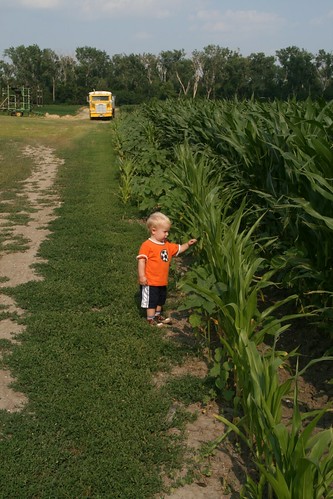
img_4996.jpg

As for corn -- Jacob loves corn. He first noticed it within the past week or two, and always gets excited when we drove past some. He calls it "koh!", and particularly tall corn is "koh-koh" or "ah-koh". Cliff has tall corn, and when I first asked Jacob if he wanted to see it, he immediately stopped pestering the cat, yelled "KOOHHHHH!!! KOH KOH KOH KOH!!!" and started running towards it. He started by carefully inspecting the corn from the edge of the field. (I can't help but thinking he looks a bit like is great-grandpa Yoder in this picture.) I can almost hear him saying "yep, this corn looks pretty good" in a couple of years.

img_5051.jpg

The real fun begins when you get into the corn, apparently. With a little bit of holding my hand to balance while walking over the rows of dirt, he'd get between the rows of corn and have a blast. That means mainly picking up a full handful of dirt, running to another random corn plant somewhere, throwing the dirt in the general direction of the corn, and cackling like this was the best thing ever. I had to watch out with the camera, because I didn't really care for it to be hit by dirt, and well, I was in the general direction of corn, too.
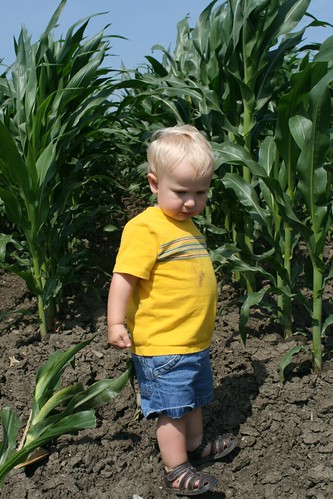
img_5062.jpg

And, in case you didn't know, having fun in the corn is serious business.

Now, what can a toddler possibly do after playing in the corn, eating some cherries off a tree, and smearing some dirt on his face with cherry juice?
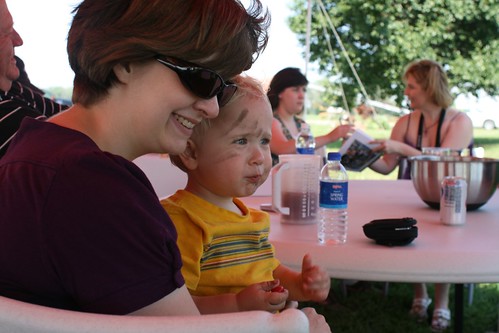
img_5088.jpg

Well, plan his next activity, of course! From the look on his face, it will be another one to keep Terah and me busy.

Jacob seemed to get along really well with everyone. But Ralph said that everytime he came close, Jacob would give him a nasty glare. Here's Ralph holding Jacob. Was this the look, Ralph?
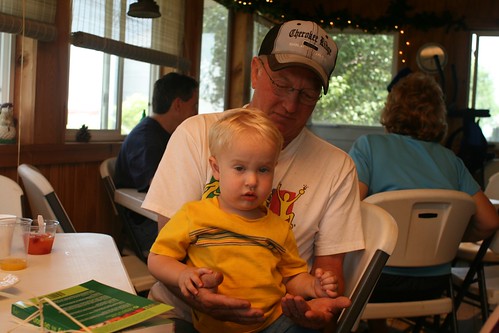
img_5078.jpg

Or maybe it was this:

img_5116.jpg

Friday evening, Cliff and Ralph made up some great hamburgers, hot dogs, and sausages. We all ate under the big tent, and had a nice time visiting. It was sort of an unusual thing -- meeting people you already know for the first time -- but very nice. We left somewhere around 8. Jacob enjoyed the hotel room, too.
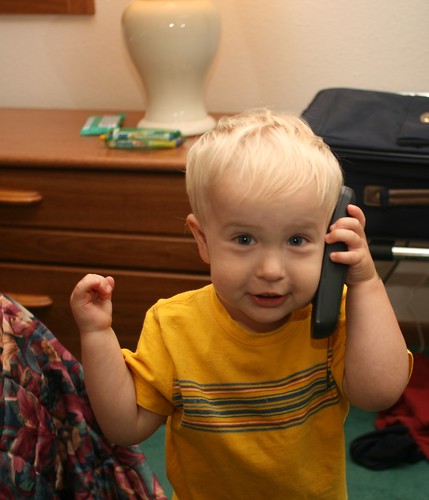
img_5027r.jpg

That's Jacob talking on the telephone. Well, I would normally use it as a TV remote, but to Jacob it looks like a phone, so a phone it is. (I can see his point.) This is Jacob answering the phone by saying Hi! Jacob's word for a phone, by the way, is "hi." He'll find a remote by the TV in the room, point to it, and yell "hi!"

Jacob's usual bedtime is 6:30PM. He normally falls asleep fairly easily and sleeps soundly until 6:30AM. Well, we got him in bed well after 6:30PM. Then he made the discovery that the hotel crib/playpen has a mattress that is not attached to the bottom like our mattresses at home are. This was good for at least an hour of excited playing. As Terah and I were trying to sleep, we'd hear these cackles from Jacob's crib, and the noises of a very active boy. I'd peek around and see him using the mattress as a tent, as a peek-a-boo toy, or just as something to throw. I think he fell asleep at about 11.

And woke up promptly at 6:30 on Saturday, just like clockwork, ready to make some phone calls and start the day.

Now, just a tidbit for anyone that doesn't have kids: a toddler, low on sleep, and endless excitement all combine to make for busy parents. Jacob did pretty well, and got in a good long nap in the afternoon. We did take several trips to the corn field.

For most of us, Saturday was a day for brunch, for sitting around and visiting under the tent, for horse rides, and maybe a massage for those that wanted it. Terah got to ride a horse, and Jacob got to ride a pony, too.

For Jacob, it was a day to make new friends, too.
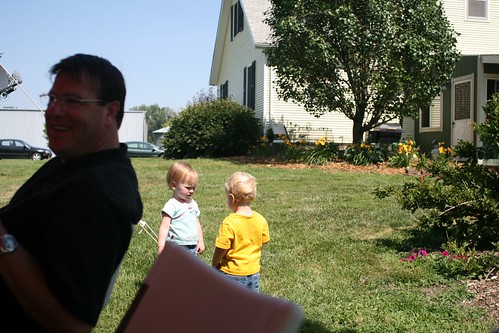
img_5095.jpg

I took this picture just a second after she had given him a hug. I was just a little too slow whipping out the camera.

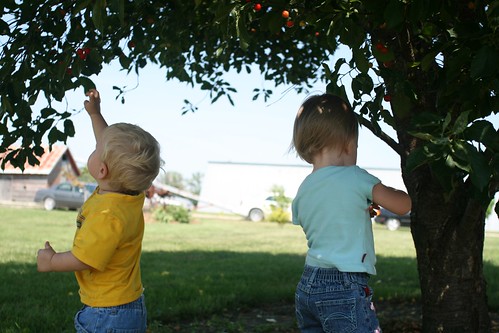
But when it comes to cherry picking, it's all serious business once again.
img_5098.jpg

Jacob loved eating these sour cherries. At first, he would pick one cherry off the tree, run over to the tent, give it to Terah for her to get the pit out, eat it, then go back to the tree for another one. He must have decided this was inefficient not long after I did. After a few roundtrips, he started trying to get the closest adult, whoever that might be, to pit the cherry for him. When he found one that would do it, he'd keep bringing cherries back to that person.

And then he was under the tree for a long time. Terah and I noticed, and had a conversation about just how many cherry pits it's OK to swallow. But when I checked it out, I found out that Jacob had figured out how to pit cherries himself. He did lose about half a cherry each time he did it, but I guess that was more efficient than pestering adults to do it for him. Though it may have also worked to carry two cherries to the tent at a time.
img_5123.jpg

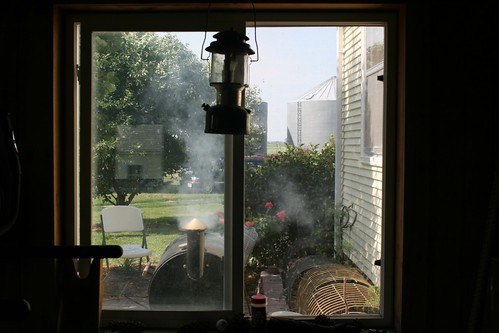
Late in the afternoon, Cliff started up the smoker for the chicken. He had rented a big smoker for the occasion, but it wasn't working, so he made do with his regular smoker, ovens for the corn, and an array of dutch ovens or side grills for everything else. I couldn't keep track of it all, and I was just watching, but somehow it all turned out perfect.
img_5140.jpg

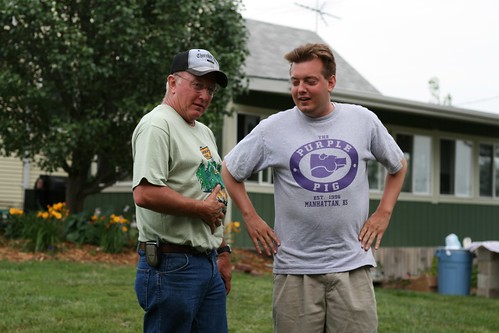
While the chicken was cooking, Ralph and son-of-Ralph (SOR) were having a conversation and patting their bellies. I couldn't hear, and didn't ask questions, so I'm choosing to believe that they were discussing how many pieces of chicken they could eat. When they heard my camera click, Ralph said, "He didn't just take a photo, did he?" Thereby guaranteeing a spot on my blog.

I had the distinction, I think, of being the least-read blogger at Blogstock. I can't quite remember how many times I'd meet someone, and they'd say, "Oh, you're the computer guy, right? I tried reading your blog, but I didn't understand it, sorry!" Completely understandable, I assure you!

After dinner Saturday, we talked about how we got started blogging (hi, Marty and Andy if you're reading), why we were there. Cliff said some very kind things about Terah and me, which really meant a lot.

Later, Cliff told me how Terah showed up in the kitchen with her tray of deviled eggs. Cliff saw them, and said, "Terah, I love you." Later, Cliff said "I love you" to someone else. From the next room, Terah piped up, "What food did she bring?"

Saturday evening, Terah took her horse ride. Jacob was quite tired by that point, and threw a tantrum about not being able to go with mom and ride a horse, too. We were talking about it when Rachel came over. Jacob asked her to pick him up, she did, and he instantly stopped fussing. Maybe it was a "so there" to me, since I had been holding him a minute before, and he took the opportunity to scream in my ear. But in any case, Jacob loved Rachel. She let him sit on a pony, carried him all around the yard, and he managed to hold it together until Terah came back at 9:30.

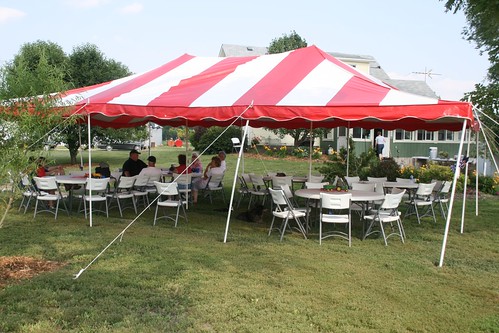
Saturday evening it was time for goodbyes. We all had a blast and I'm sure we'll do this again. If you weren't there, here's what Blogstock looks like:
img_4991.jpg

A bunch of friends sitting around chatting under a tent pretty well sums it up.

(There was a full tent of people; some were just elsewhere when this particular photo was taken.)

Jacob shared his thoughts on the whole trip on the way home, too. Well put, Jacob.
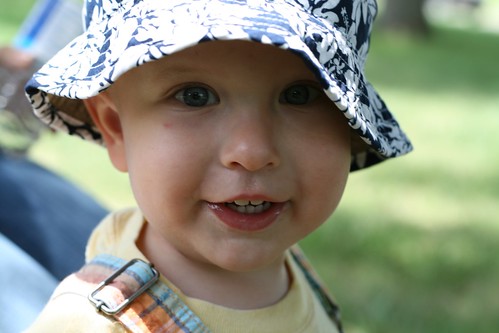
img_5202.jpg

Next.

Previous.